
menu

Insider: Ghost in the Machine

Are you a Quiet Speculation member?

If not, now is a perfect time to join up! Our powerful tools, breaking-news analysis, and exclusive Discord channel will make sure you stay up to date and ahead of the curve.

Recently I've been pondering processes. You know, like a computer. Processes as in how to process information. How to process events. How to take something in, absorb it, use it, and then expel a product out on the other side that is useful to us, and what we do on the daily.

I don't know how other people's minds work, but I've noticed as I have gotten older how much I like developing my process for doing just about anything. I want to know the landscape. I want to know the realm of whatever I am doing and whatever I do will be functioning in. Then I want to exploit the environment and find the shortcuts. I find the places and areas that are lacking and try my damnedest to see if it can be improved.

I enjoy this constant mental challenge because I see the world as very dynamic. No two people or things are exactly alike. No two situations are identical. No two collections can do the same thing. Even if 99 cards out of 100 are the same, what if the one different card is an Alpha Black Lotus? All of a sudden, there's a whole new facet to work with. All of a sudden, I'm doing my best impersonation of a jealous lover: "How many people are you talking to!?!"

Often times though, process get bogged down in the trial and error phase. There are too many moving parts and the results are just not what you anticipated.

Here's the easiest way to break it down into chewable pieces.

Step #1) There Is No Perfect Solution

Do you know how often I have to tell myself this?

It's typically a hard truth to swallow. Just remember that, though. This does not mean that your first attempt at buying a collection, buylisting, floor trading et.al. was a perfect success - there's more than likely a key point somewhere in there that you missed. And it's okay to miss it. Especially on your first attempt. Even on your 500th.

It just means that as long as you are swinging for the fences, you won't always make proper contact with the ball. There will be times you strike out and miss. When you do though, just get back up. Stand in at the plate, and try to make contact again. If you're playing your bankroll correctly, it shouldn't be life or death this time around either way.

Step #2) Know Your Limitations

Know the boundaries of the area you are working in. The worst thing you can ever do is attempt something with a final outcome that serves no purpose for you. Or, the results can't even be used to move you in an upward motion.

Why do we buylist? We buylist extraneous, surplus, or whole collections for quick turnarounds. Liquidation can be one of the best tools we have, but typically it's the most costly. Why? Because time is money. Time is also our boundary. Know how to work within time constraints. This means making a plan.

Step #3) Keep Expectations Realistic

Once you're within your limitations, you should then know what to expect. Rome was never built in a day. Remember this. Dreams and passions aside, understanding what is possible, what you are capable off, and what the most likely outcome is will also manage your expectations, motivations, and hopes.

We often are the ones that dash ourselves, bloody and broken, onto the rocks. Don't be the one to sink your own ship if your expecations are set to high. Plenty of people will either openly or secretly hope or try to do that for you. Don't give them the satisfaction.

Let's face it: We live in a world that loves to tell us that you can not do something. We build things up in our mind and live or die by the acceptance, recognition, or praise we get from others. Do your best to listen to your own voice. Your own voice is the one that is telling you what you want. This is what should drive you. Not their voices.

Step #4) Make a Plan

Knowing there is no perfect plan will often just get you moving. Sometimes we wait for the perfect solution to come about, before we try anything. This is simply to give us the best chance at succeeding. But you will make the most progress, be able to go farther, and be able to survive the greatest nuclear blasts if you just start. It takes time to build up momentum anyway, in any scale of venture. Just starting though is the crux for many. Once you do make the conscious decision to start though, you must formulate a plan of going about your business.

How are you going to strike up conversation with the opposite sex? Just go up to them and grope? Well, that's a plan--but certainly a poor one at best. More than likely, you're at least going to need to say, "Hi."

Working backwards from the desired result is a great way to figure out the steps that will get you there. At the worst, it will allow you to understand what it will take to get there. The next question will be simply how bad do you want it? Then you simply have to sit down, realize what you are and aren't willing to do to get the results you want. There are many ways to go about things, many with pros and cons that have nothing to do with Magic finance. Once you have set the parameters of what you can do and what you are willing to do, then you must work within those capabilities and just put in the work.

Connor: "How far are we gonna take this, Da?"
Il Duce: "The question is not how far. The question is, do you possess the constitution, the depth of faith, to go as far is as needed? "

Step #5) Act

Take action. Seriously. Do something.

"An object in motion tends to stay in motion unless acted on by an external force." - Sir Isaac Newton 

I can not even begin to communicate how true this is. Just take my word for it. Take action. Any action. It really does not matter what, you will have an opportunity to correct things, as long as you're starting with small moves, and you have followed the other steps.

Step #6) Reassess, Make Changes, and Continue

Not many things will work out the first time around. Or the second. Or 400th. Sometimes the 1,000,000th. If you knew the 1,000,001st time would pay off 4,000,000 : 1 would you do it? If you knew, without doubt, that the combined effort of all other attempts would be worth it, would you still do it?

If you said no, you need to find another avenue to pursue. You're just don't have the correct frame of mind to make it. In this venture, you could do it 1,000,000 times the same way or 1,000,000 times for each 1,000,000 ways to do things. There's going to be change. You will be required to adapt. You can possibly get away with not adapting for a time, but let me tell give you a secret right now:

You're not the first person to do this. You're not the last. This "venture" has been done for ages. Providing something someone needs but does not have the time to fully invest has been the backbone of business for centuries. If you think you are doing something other than that; if you think you are the only one that can provide the cards for your local area to play Standard; if you think you're the only one that is doing XYZ, I would love to show you how wrong you are--just so I can see one more person that understands what this business is really about.

It's about people. It's about time.

It's about doing things better. There is no right or wrong, just better or worse. It's about finding the best way that works for you because there is no one else that can stand in your shoes. Your unique skills have value to someone--yourself, if no one else. Your unique outlook is unique because no one else is you. On the flip, remember that you're the only one that will stand in your shoes, for better or for worse.

But if more people would contribute their unique skills, ideas, processes, and perspectives--in a constructive, non-combative, open manner--I truly believe we can become anything. The human ability of adaptation is just that remarkable.

-Till Next Time

Avatar photo

Dylan Beckham

Dylan has been involved in Magic: The Gathering since the heyday of The Dark. Continually invested in the community, he's been a Pro Tour Player, Trader, Judge, Tournament Organizer, Volunteer, and Vendor. Currently involved with the day to day operations of selling online, Dylan has brought his experience to Quiet Speculation to make you a better investor. Hailing from the Atlanta area, and now part of the Dallas scene - he's often at big events sourcing cards or discussing Life, the Universe, and Everything. Have a question? Feel free to comment, message, or email anytime.

View More By Dylan Beckham

Posted in Finance, Free InsiderTagged 5 Comments on Insider: Ghost in the Machine

Have you joined the Quiet Speculation Discord?

If you haven't, you're leaving value on the table! Join our community of experts, enthusiasts, entertainers, and educators and enjoy exclusive podcasts, questions asked and answered, trades, sales, and everything else Discord has to offer.

Want to create content with Quiet Speculation?

All you need to succeed is a passion for Magic: The Gathering, and the ability to write coherently. Share your knowledge of MTG and how you leverage it to win games, get value from your cards – or even turn a profit.

Zero to Draft: The Conclusion, Part Two

Are you a Quiet Speculation member?

If not, now is a perfect time to join up! Our powerful tools, breaking-news analysis, and exclusive Discord channel will make sure you stay up to date and ahead of the curve.

Before reading today’s article, you should definitely read last week’s piece to get up to speed. I’m picking up exactly where we left off, so let’s get started.

6. Bulk-Bulk-Bulkity-Bulk

I made $50 selling bulk commons and uncommons in this project. I wrote all about my process for that already, so I won’t go through the details again. The four 800-card lots I sold (each time I sold two for $25, although I can usually get $15 for one) came out to around 3200 cards. Three Two-Headed Giant Sealed events (played with my wife, so I kept all the cards), one normal Sealed event, and 22 drafts should equal 1520 cards, so in the last nine months I’ve scooped up nearly 1700 free draft leftovers, representing about $25. All this cost me was a little time and carrying a few more ounces of cardboard home each week.

It’s certainly understandable to want to save yourself the mess of tons of draft jank sitting around your house, and if a clutter-free environment (or just not storing extra boxes) is worth more than the few bucks these lots will earn you, you don’t have to mess with them. For my part, I’ve found it’s easy and quick, so I don’t mind making the extra effort to pay for some drafts.

7. Trading Is Dead

Fewer than 20 trades were made for this project. Back when I lost a lot more often but still had the desire to play for free, I was more willing to grind trades, but those days are behind me now. I’ve noticed other financiers mention the dead trading scene, most recently on an episode of Brainstorm Brewery, so perhaps this is not just exclusive to my circumstances.

My point here is that you don’t have to be a heavy trader to be an MTG financier. The trades I do make these days have a purpose: speculation, helping out a friend, getting a card for my cube, or outing a card I believe to have peeked are all valid reasons I might trade. But gone are the days of just trading for the sake of trading. Because I don’t often play constructed formats, I seldom “need” a card, so I maintain the power to just walk away from basically any transaction. This is leverage that has increased the average quality of my trades but has decreased the average number of them. This seems acceptable to me.

8. Speculation Is Unnecessary

To take it even further, I didn’t buy any singles for this project. I took the cards I opened in Limited events and made smart selling and trading decisions (or the lack thereof). When the time is right, I’ll cash out to a buylist. Just as you don’t have to be a heavy trader, MTG finance doesn’t demand you be a speculator, either.

Our community gets a bad rap sometimes, but I believe every player has something to gain from MTG finance. Just because you can afford to pay more for a card doesn’t mean you should. Why not learn some simple concepts and make the hobby less expensive? To me, MTG finance means that you recognize patterns, make smart financial decisions, and don’t let yourself get ripped off. Everything else is just a matter of time commitment and scale.

9. Take the Damn Money Cards

New players are well known for being unable or unwilling to pass rares. Experienced players usually express contempt for such practices, so when a new player starts to transition to the intermediate level, he will start taking commons and uncommons even over cards worth money. The problem is that the newly-intermediate player doesn’t realize that some rares are worth taking even if one won’t play them—and one doesn’t need to feel bad about that.

A player at this point in his development passed me an off-color Courser of Kruphix recently, which obviously just thrilled me. I happened to be in green, so all the better. But even if I hadn’t been, there is no common or uncommon I would have taken over that Courser. The most I could have won in that draft was five packs, which is about the same retail price as that one card.

As happy as I was to get such a nice pass, I felt bad for the guy. He got the idea in his head that “good drafters” take cards that go in their decks, but didn’t stop to consider the bigger picture. That Courser would have paid for his draft, he still would have had 41 cards to build his deck—and he may have never even drawn the Akroan Skyguard he took.

I don’t think he won that night, so he went from guaranteed value to a nearly worthless stack of commons and uncommons. Again, MTG finance means making smart financial decisions, no matter how small the scale.

10. Limited vs. Constructed

I know several players who don’t draft because they claim they can’t afford it. These same players play competitive decks in various constructed formats, which often cost more than the amount it would take to pay for a year of weekly drafting. This has always seemed a little suspect to me, but lately, I’m starting to see their point.

Playing frequent Limited events using the methods outlined in Zero to Draft is a great way for a new player or avid drafter to build a collection, draft often, and play some Magic without having to spend several hundred (or thousand) dollars all at once. That said, because cards from current sets often aren’t worth trading or selling until the following year, drafting does require one to tie some money up in cards that aren’t necessarily being used in the interim.

At my LGS, a draft costs $12 and one pack is added to the prize pool for each of the eight players. A Constructed tournament costs $5 and pays out in store credit. The maximum one can win in a draft is five packs, but a Constructed FNM often pays $40 or $50 in store credit just for making one of the top four slots. So although the initial costs of drafting are much less expensive, the prizes are less enticing and the entry fees are higher. For those with a Constructed deck already built and ready to play, Constructed is clearly the more financially advantageous option.

With the huge expense of a baby coming my way, I admit that where $12 used to seem trivial, it now seems highly irresponsible to tie up money in such a fleeting pursuit—even if I am technically playing for free. I literally have no idea what my ability or desire to get out and play Magic will be like after the young man is here, but all of a sudden, a $5 option with much better (and more flexible) prize support is starting to appeal to me. I have a Modern collection that I haven’t been using, so maybe it’s time to change that.

So yes, it is possible to draft frequently for free, although there’s a waiting game in reaching that point. If we’re being realistic, I have a trade binder with buylist values equal to what I’ve spent on this project, but I’m currently down nearly $100 in actual money. While not a hugely significant amount, if I had been playing Modern every week for this project, who knows what kind of store credit I would have built up by now?

It’s all about opportunity cost and what you find fun. Drafting is hands down my favorite way to play Magic, and although this project was probably not the most financially advantageous use of my MTG time, I made the best decisions I could within the confines of what I was trying to do. With a big (but also quite small) factor entering the equation soon, I’ll now have to decide where my priorities lie. If I’m taking time away from my son to play Magic, it feels to me like the potential payoff should be higher to do so. Because I already have the cards to play, this makes Constructed start to look like a more appealing option.

Setting Priorities

We all have different circumstances, and those circumstances are constantly changing. If you’re mainly a Constructed player, much of this series may not have applied to you. But you might be at a point where following the Zero to Draft gameplan is a great way for you to get started in the game, or maybe you’re like me and just enjoy Limited more than anything else. If that’s the case, I hope I was able to get you started on the right path.

I’d love to hear your success stories, so reach out to me on Twitter at @dbro37. Thanks for following Zero to Draft.

Bear Necessities

Are you a Quiet Speculation member?

If not, now is a perfect time to join up! Our powerful tools, breaking-news analysis, and exclusive Discord channel will make sure you stay up to date and ahead of the curve.

Magic is full of jokes.

Whether it's Mark Rosewater sneaking a card called Squee's Toy into Tempest, the Holiday gift cards like Yule Ooze or it's there mere existence of the Unglued and Unhinged sets, there's a lot of joking going on. That's why I wasn't the least bit surprised when I came across something interesting on MTG Merch.

Bears Raglan

Aww yiss. That's a baseball cut tee shirt representing our favorite ball club. What number would a player on The Bears obligatorily wear?

Bears Raglan

Yep. That happened.

I hate how baseball tees look on me, though, so I decided to check the site out to see if anything else grabbed me.

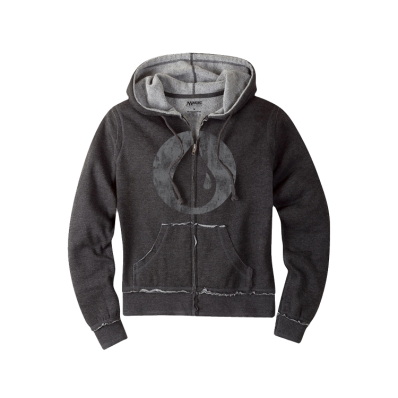
Blue Mana Hoodie

This is understated but overpriced. Still cool, though.

M14 Jace Tee

This I could see wearing, maybe.

The site even has something for the ladies...

Black Lotus Long Sleeve Tee

...albeit garbage.

Having worked for an apparel company at conventions, women don't want crap like this, at least not nerd girls. They want the same designs that are on the men's shirts, but in the babydoll cut with the sheer fabric that are comfortable and flattering for females. That's it. Get on it, apparel producers.

So what about all of you? Those of you who are old enough not to have to worry about wedgies anymore, would you wear anything from MTGmerch in public? Leave it below.

Avatar photo

Jason Alt

Jason Alt is a value trader and writer. He is Quiet Speculation's self-appointed web content archivist and co-captain of the interdepartmental dodgeball team. He enjoys craft microbrews and doing things ironically. You may have seen him at magic events; he wears black t-shirts and has a beard and a backpack so he's pretty easy to spot. You can hear him as co-host on the Brainstorm Brewery podcast or catch his articles on Gatheringmagic.com. He is also the Community Manager at BrainstormBrewery.com and writes the odd article there, too. Follow him on Twitter @JasonEAlt unless you don't like having your mind blown.

View More By Jason Alt

Posted in FreeTagged , 2 Comments on Bear Necessities

Have you joined the Quiet Speculation Discord?

If you haven't, you're leaving value on the table! Join our community of experts, enthusiasts, entertainers, and educators and enjoy exclusive podcasts, questions asked and answered, trades, sales, and everything else Discord has to offer.

Want to create content with Quiet Speculation?

All you need to succeed is a passion for Magic: The Gathering, and the ability to write coherently. Share your knowledge of MTG and how you leverage it to win games, get value from your cards – or even turn a profit.

Packing Basics for Limited

Are you a Quiet Speculation member?

If not, now is a perfect time to join up! Our powerful tools, breaking-news analysis, and exclusive Discord channel will make sure you stay up to date and ahead of the curve.

Over on Gathering Magic, Mike Linnemann recently wrote an article entitled “Better Basic Lands,” which details the basic lands he likes to bring along and use for Limited events. I’ve been packing pre-sleeved basics in my drafts for a couple years now, and I can’t recommend the practice enough.

Imagine this: you finish a draft and sit down to build your deck. Once you’ve got the build complete, what do you do? Most people have to stand up and walk to the land station to pick out their basics. I don’t know about you, but I don’t go to draft only to be mildly inconvenienced and get a miniscule amount of exercise. I came to play Magic, dammit. Bringing pre-sleeved lands saves you from that fate, and means you sleeve and unsleeve only half the cards of your unprepared opponents.

The downside is that you will always, without fail, be ready to play round one before your opponent is. That’s a given. But the upside, besides the aforementioned convenience, is that you can get a lot of shuffling in. This guy doesn’t have to worry about land clumps from an undershuffled deck! You'll also get the pleasure of playing with lands you find aesthetically pleasing, as well as the competitive advantage of all your lands featuring the same art.

The downsides are well outweighed by the upsides, so consider buying an extra pack of sleeves and picking out some of your favorite lands for your next draft. Full-art Zendikar lands are a popular choice, and some of my personal favorites to see in play are Beta basics. But you don’t have to go deep. Just pick out something you like!

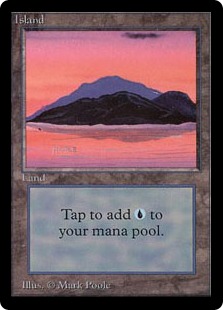
IslandC

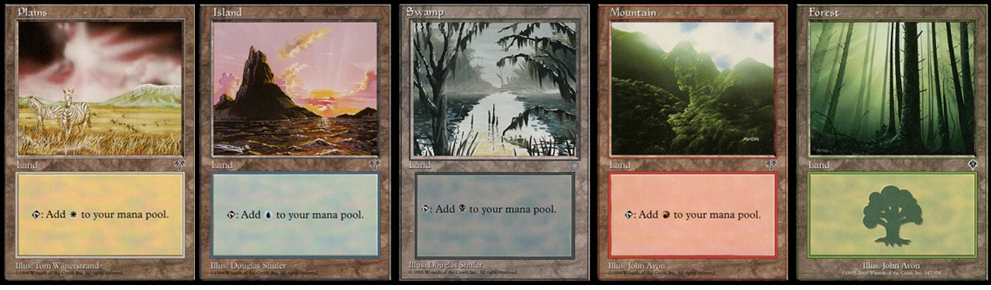
For my part, I am a firm believer in the original border. Besides Zendikar full-arts, I refuse to play with lands post-Eighth Edition. I also hate white-bordered cards, except for those from Revised—it's a nostalgia thing. The five basics I’ve been using since I started packing my own lands are shown below. Do you have a favorite set of basic lands?

limitedbasics

Avatar photo

Danny Brown

Danny is a Cube enthusiast and the former Director of Content for Quiet Speculation.

View More By Danny Brown

Posted in Drafting, Free, Sealed13 Comments on Packing Basics for Limited

Have you joined the Quiet Speculation Discord?

If you haven't, you're leaving value on the table! Join our community of experts, enthusiasts, entertainers, and educators and enjoy exclusive podcasts, questions asked and answered, trades, sales, and everything else Discord has to offer.

Want to create content with Quiet Speculation?

All you need to succeed is a passion for Magic: The Gathering, and the ability to write coherently. Share your knowledge of MTG and how you leverage it to win games, get value from your cards – or even turn a profit.

Insider: Breaking Down Hasbro’s Earnings Report

Are you a Quiet Speculation member?

If not, now is a perfect time to join up! Our powerful tools, breaking-news analysis, and exclusive Discord channel will make sure you stay up to date and ahead of the curve.

Every day it feels like the lines between what is considered “Magic” writing and what is considered “real journalism” is becoming more and more entwined. As I’ve moved onto the coverage team for Wizards and started doing more general stuff on the podcast, more and more I see the blending of this with my “day” job as a journalist.

And here I am breaking down the walls some more, writing an article analyzing Hasbro’s annual report, a duty typically reserved for business journalists in big newspapers or CNNMoney (one of my favorite stops in the morning, incidentally).

But here we are, and here we go. As people with a vested interest in Magic finance, the contents of this report are pretty vital to understand.

Let’s start with the basics.

  • Hasbro, Wizards’ parent company, posted revenues up 8 percent from a year ago.
  • That growth stemmed from increases across the company, but not the games division and not Magic.
  • Magic revenue was down single digits year-over-year, with an international increase but slightly decreased sales in the United States.
  • Margins on Magic remain high.

There’s more, but those are the main points. The next thing we have to consider is the remarks that accompanied these numbers, by Hasbro’s CEO Brian Goldner. There’s also some information that we don’t have that is worth mentioning.

Before We Go Any Further


Let’s clear something up. This is not the death knell of Magic. We’ve grown so used to seeing 20 percent increases over the past few years that it almost seemed inevitable, when of course it wasn’t. Revenues declined slightly, but it’s been one quarter (after they posted growth last quarter).

People have also drawn the connection to the lack of Modern growth, which I believe is another flawed argument. Modern prices stalled (as I wrote about here before the season even began) because the train had run so far ahead that the market needed to correct. Players were, and are, in a holding pattern until fetchlands get reprinted, and that has little to nothing to do with Magic decreasing single digits in the United States. Correlation is not causation, and I implore you to not read too much into an alleged connection there.

Healthy companies post down quarters all the time. Apple misses analysts’ predictions, and yet no one is claiming that Apple is on the fast track to a quick death.

With that out of the way, let’s move onto some specific points from the conference call.

On Hearthstone

“In terms of Magic and competitors, the brand you note is a very casual brand, that’s more focused on action. It would be more analogous to our Duels of the Planeswalkers product which is for entry level and it’s played on the iPad in a casual way.

Magic has a very deep strategic root 20-year history.

The analog card game is still the most important element of that business, the fact that people are playing face-to-face, the fact that we are executing so many face-to-face tournaments in so many geographies on a regular basis, tournaments going on literally all the time around the world, and that differentiates Magic versus a lot of competitors, that organized gameplay organization that Magic team has in place, the ability to go out and execute that.

Then Magic online gives us the opportunity to allow players to play at great distances and also to reignite players who may be dormant because they don’t have a lot of friends around who used to play Magic with them. So it’s a very different, much more deeply seated strategic gameplay in Magic.

We take all competition seriously, but I would tell you that they are different games.”

There are a few ways to look at this. On the one hand, I consider Hearthstone an inferior game to Magic. On the other, I play Hearthstone regularly and won’t touch Magic Online. And while I personally wouldn’t play MODO regardless of the existence of Hearthstone, I don’t find it hard to believe that some people have given up Magic Online for Blizzard’s new game.

That said, I don’t view Hearthstone as a long-term threat to Magic. Like many of us who got into Magic after playing Pokemon or Yugioh as kids, I believe people who play Hearthstone will eventually discover Magic. Even if Magic Online never becomes as easy or popular as Hearthstone (more on this later), the gameplay of Hearthstone comes nothing close to that of Magic, nor does the community. Sure, it seems scary now, and while it’s certainly nothing to be ignored I do agree that it’s more analogous to Duels of the Planeswalkers than anything else.

On Year-to-Year Growth

“If we look at MAGIC business, it is clearly driven by releases. And as we were looking at 2013 year-to-date versus 2014, last year we had our large and a small release in the first half of the year. And this year we had two small set. And yet MAGIC year-to-date is basically flat.

As we go into the fall, the MAGIC team will talk this week at Comic-Con and begin their talk about the size of each of the releases and what's coming up. So we haven’t really talked yet about what that is. But overall again looking at MAGIC, the growth internationally, where we are so far year-to-date, the size of the sets that we put out.

So we feel very good about MAGIC. So far this year, we feel we're in a solid place and a strong position as we go into the second half of the year.”

I will tell you what I consider to be the two most important factors here: Gatecrash and Modern Masters.

Namely, Gatecrash was a large set with shocklands, while Modern Masters is one of the most-hyped sets in the game’s history. Is it really any surprise that small-set Born of the Gods and casual-flavored Conspiracy can’t compete with that?

All of that leads to single-digit losses? That, to me, is not all that concerning. What it does show, pretty clearly I think, is that Magic is no longer growing at the absurd rate it was. We aren’t going to see duals double in price again in the next two years. We aren’t going to see Modern cards going crazy every week. We may not see the dual land cycle from a certain block triple in price the next Standard season because of an influx of new players.

And all of that is okay. Magic’s been around a long time, and none of these things suggest to me it’s going away.

Another note: We haven’t seen player numbers. It’s entirely possible the player base grew by a few percentage points, but because of the factors outlined above that didn’t translate to higher sales. If that’s the case, it’s a good sign moving forward. If not, it’s not the end of the world. But with only revenue numbers to work with, we’re not getting a full picture.

On Magic Online

“We feel good about the MAGIC business and we are investing to continue to build the business, focused on the MAGIC online business so that we can run more concurrent gaming sessions more broadly and more online tournaments. And so we’re building our capabilities there and that is some of the investment Deb had spoken to.”

Now we come to Magic Online, the program most dangerously affected by new card games coming out online. The switch to Version 4 has gone about as well as expected, which is to say there’s a ton of complaining just like everything in Magic, even if some (most) of it is warranted.

I’ll say it bluntly: Magic Online will never look as good or as smooth as Hearthstone. The nature of the games are simply too different. When it’s not my turn in Hearthstone I can get up and walk into the kitchen for a drink. When I discard a card I never have to care about it again. There are no elimination tournaments the system has to support. These are fundamentally different programs built to accomplish different things.

Yes, Magic Online is ugly. Yes, improvements are slow. But they are happening, and it’s possible to glean from this quote that perhaps things will receive an influx of money and manpower to move it along.

Takeaways

Remember, bears can make money just the same as bulls. If these numbers do continue to stabilize in the coming months and years, it is by no means a reason to jump ship.

Today, Magic is larger than it was at any point in the 18 years from 1994-2012. Don’t forget that.


Thanks for reading,

Corbin Hosler

@Chosler88 on Twitter

Avatar photo

Corbin Hosler

Corbin Hosler is a journalist living in Norman, Oklahoma (also known as the hotbed of Magic). He started playing in Shadowmoor and chased the Pro Tour dream for a few years, culminating in a Star City Games Legacy Open finals appearance in 2011 before deciding to turn to trading and speculation full-time. He writes weekly at QuietSpeculation.com and biweekly for LegitMTG. He also cohosts Brainstorm Brewery, the only financial podcast on the net. He can best be reached @Chosler88 on Twitter.

View More By Corbin Hosler

Posted in Finance, Free Insider11 Comments on Insider: Breaking Down Hasbro’s Earnings Report

Have you joined the Quiet Speculation Discord?

If you haven't, you're leaving value on the table! Join our community of experts, enthusiasts, entertainers, and educators and enjoy exclusive podcasts, questions asked and answered, trades, sales, and everything else Discord has to offer.

Want to create content with Quiet Speculation?

All you need to succeed is a passion for Magic: The Gathering, and the ability to write coherently. Share your knowledge of MTG and how you leverage it to win games, get value from your cards – or even turn a profit.

Going Rogue – And Winning

Are you a Quiet Speculation member?

If not, now is a perfect time to join up! Our powerful tools, breaking-news analysis, and exclusive Discord channel will make sure you stay up to date and ahead of the curve.

There's an old belief that going "rogue" at tournaments - that is to say, playing an unknown and possibly not-as-powerful deck - can give you a better chance to win. After all, if no one knows what you're playing, you're already at an advantage!

Of course, it doesn't really work that way in the real world. The best decks are the best decks for a reason, and there are enough people playing the game that finding something truly novel is pretty much impossible. And, even if you do, it's probably not good enough to win a tournament.

imgres

Except sometimes it is.

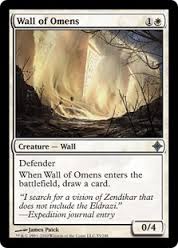
That's the story that Reddit user Travvyj shared today, and it's one I thought was worth passing on, if for nothing else than to show that it is possible. He decided to go against the grain and bring a Mono-White Control deck to the Extended format several years ago, and it turns out it worked okay for him: he won the event and played in the Pro Tour as a result.

Not bad.

Flash forward to the time before the Extended PTQ, and for some reason I just couldn't get Monowhite Control off my mind as the deck I wanted to play at the PTQ. I knew it would likely get crushed by any Faeries decks I ran across during the tournament (which were somewhat prevalent in the format), but I didn't care.

You can find the full post here.

Avatar photo

Corbin Hosler

Corbin Hosler is a journalist living in Norman, Oklahoma (also known as the hotbed of Magic). He started playing in Shadowmoor and chased the Pro Tour dream for a few years, culminating in a Star City Games Legacy Open finals appearance in 2011 before deciding to turn to trading and speculation full-time. He writes weekly at QuietSpeculation.com and biweekly for LegitMTG. He also cohosts Brainstorm Brewery, the only financial podcast on the net. He can best be reached @Chosler88 on Twitter.

View More By Corbin Hosler

Posted in Feature, Free6 Comments on Going Rogue – And Winning

Have you joined the Quiet Speculation Discord?

If you haven't, you're leaving value on the table! Join our community of experts, enthusiasts, entertainers, and educators and enjoy exclusive podcasts, questions asked and answered, trades, sales, and everything else Discord has to offer.

Want to create content with Quiet Speculation?

All you need to succeed is a passion for Magic: The Gathering, and the ability to write coherently. Share your knowledge of MTG and how you leverage it to win games, get value from your cards – or even turn a profit.

Legen… Wait For It

Are you a Quiet Speculation member?

If not, now is a perfect time to join up! Our powerful tools, breaking-news analysis, and exclusive Discord channel will make sure you stay up to date and ahead of the curve.

EDH is more popular than anyone at Wizards of the Coast could ever have anticipated. Sets were not designed with EDH in mind until very recently. This was fine in most cases, however, since EDH is the "bulk rare format" - any durdle will do. Krosan Cloudscraper? Get on the bus. Boros Battleshaper? Actual gas. Most cards that Timmy loved ended up translating well into a slow multiplayer format with tons of mana ramp and nothing but time.

Unfortunately, the one drawback to EDH not having been supported until recently is a few cards could have made dynamite generals. Everyone has their card that they lament has no legendary status for the purposes of EDH. Reddit recently got ahold of the idea and posed the question - "Which existing character do you most want to see as a legendary creature?" This is both for the purposes of EDH generals and also just to wrap up some storylines or flesh them out more. Some of the responses were interesting.

Full Text Here

Personally, I think the cycle of Nephilim should be retroactively made into Legendary creatures. The odds of them doing a second cycle of 4-colored creatures seems pretty remote and the existing Nephilim have great abilities that are predicated on them attacking or dealing damage which is tailored toward EDH before EDH existed. In fact, some playgroups allow Nephilim-based decks because the decks are so much fun and EDH has a community-enforced rule set anyway.

The best response I saw in the thread was Maelstrom Archangel which is hard to argue with.

How about you? Which Legend to you want to see?

Avatar photo

Jason Alt

Jason Alt is a value trader and writer. He is Quiet Speculation's self-appointed web content archivist and co-captain of the interdepartmental dodgeball team. He enjoys craft microbrews and doing things ironically. You may have seen him at magic events; he wears black t-shirts and has a beard and a backpack so he's pretty easy to spot. You can hear him as co-host on the Brainstorm Brewery podcast or catch his articles on Gatheringmagic.com. He is also the Community Manager at BrainstormBrewery.com and writes the odd article there, too. Follow him on Twitter @JasonEAlt unless you don't like having your mind blown.

View More By Jason Alt

Posted in FreeTagged , , 6 Comments on Legen… Wait For It

Have you joined the Quiet Speculation Discord?

If you haven't, you're leaving value on the table! Join our community of experts, enthusiasts, entertainers, and educators and enjoy exclusive podcasts, questions asked and answered, trades, sales, and everything else Discord has to offer.

Want to create content with Quiet Speculation?

All you need to succeed is a passion for Magic: The Gathering, and the ability to write coherently. Share your knowledge of MTG and how you leverage it to win games, get value from your cards – or even turn a profit.

Insider: Greed and the Art of Mulligans and Manabases

Are you a Quiet Speculation member?

If not, now is a perfect time to join up! Our powerful tools, breaking-news analysis, and exclusive Discord channel will make sure you stay up to date and ahead of the curve.

I have no need of fools who can imagine "enough".

There was an error retrieving a chart for Greed

Greed is an interesting concept in Magic. It's useful to determine when something is greedy, but it's useless to do so without considering whether the alternatives are greedier. Before I delve deeper, let's go ahead and define greed to mitigate any confusion. Webster's defines it as:

a selfish desire to have more of something (especially money)

Being "selfish" doesn't really mean anything in terms of a game of Magic, so I would substitute taking unnecessary risks as a working definition for greed as it pertains to Magic. That is, actions that ignore probability in favor of "gut feelings" or just general laziness are greedy when winning games is the desired end of those actions.

Greed in Mulligans

When Magic players talk about greed, we most commonly refer to the nature of mulligan decisions. It can be greedy to ship an average seven in search of an exceptional six--off the top of my head, straight mulliganing any hand without Force of Will against combo decks is expecting a lot from most decks--or it could be greedy to keep a hand with no way to interact with opposing game plans nor ways to dig for interactive elements.

Let's take a look at a sample hand from my pre-Magic 2015 Red Devotion deck:

On the draw in game one, after considering mulligaining for a minute, I kept this hand. My opponent Thoughtseized me on turn one and was irate that I would keep this. I would agree that the decision was close, and it's easy to see that some things had to go right for me to win that game, but I believe that this hand is perfectly defensible.

If I draw a Mountain or Sacred Foundry on my first turn or find one after scrying for my second turn, I officially have access to two one-mana Terminates and two RR two-drops, which are more or less "enablers" for devotion strategies.

Not only that, but, if the lands keep rolling, I have Boros Reckoner, who ranges from very good to absurd, and Fanatic of Mogis--the entire reason to even play my deck. I have a 15/53 plus 15/51 shot at making my deck do exactly what it's built to do, in addition to shots at more Temples or a Guildgate to possibly do everything that I want to do a turn or so slower.

Basically, if I hit my 15-outer and I lose, then I realistically shouldn't bother playing this deck in the first place. Bear in mind that I would probably mulligan this hand if the one land were a Guildgate or a basic Mountain, and would more strongly consider mulling it if the land were a Sacred Foundry--at which point the question would be if having definite access to double Chained to the Rocks is as relevant as scrying before I need to draw a land.

The counterpoint to all this is that the hand is a double-mulligain if I never hit a Mountain and functionally a mulligain to zero if I never hit a non-Nykthos land. Those cons are pretty strong.

Fortunately for the list of positives, we have a strong rebuttal. That is, the average six card hand that comes out of the gates stronger than this hand not only involves mulligaining into a good ratio of lands to spells, but also this mulligain expects the spells drawn to be very good. A six card hand with two-three lands and a couple two-drops could easily just lose to removal spells, or a six card hand with lands and some removal spells could easily run out of gas. Take this hand for example:

Now imagine your opponent casting a Desecration Demon or a Master of Waves. This hand has enough lands to immediately cast all of its spells, but it's cold to a wider variety of plays without top-decking a more narrow selection of cards. That is, digging for Chained to the Rocks is more ambitious than digging for lands.

Was my keep greedy? Certainly. Was the alternative better? Ambitiously.

When mulliganing, always consider what you're mulliganing into, not just what you're mulling away.

At the Vintage tournament in North Saint Paul this weekend, I kept this six card hand on the play in the Keeper mirror:

Keeping this hand means saying "go" on turn one, or cracking the Lotus to try to A-Call into a land. Not an ideal start. However, a mulligan to five is going to likely be a Black Lotus shy of an early Jace, and probably won't have as many ways to interact with the opponent. I definitely needed to get lucky to win with this hand, but it also takes an exceptional five card hand to mirror the potential that this hand has to come together.

Greed in Manabases

Manabases are an aspect of deck building that I believe is criminally under-valued. By extension, the concept of greed in manabases is under-explored. Modern manabases are generally based off of decklists that have ratios of color generating lands that allow players to cast their spells on time most of the time, as well as millions of games putting the statistics behind deck building to the test.

Greedy manabases are those that deviate from these statistics and samples in either direction--towards playing too few color generators or too many multi-color lands with opportunity costs.

When it comes to Standard deck building, you'll more commonly hear about people playing too many dual lands. The opportunity costs of Temples, Shocklands and Painlands can swing races by entire turns, so making sure that you have enough basics to play the occasional land untapped will obviously swing a non-zero number of games in your favor.

In Modern, most of the dual lands played are Fetches and Shocklands, which have similar costs. Additionally, the Modern card pool starts being wide enough where non-basic land hate shows up in force. Tectonic Edge and Blood Moon make people think twice about how many basics to put in their decks.

In sum, in Standard and Modern, you don't want to be caught with too few basics.

In Legacy, there are even more hazards for nonbasic lands. Price of Progress, Blood Moon and Back to Basics all rear their head from time to time, and Wasteland is the ubiquitous killer of consistent manabases.

There was an error retrieving a chart for Wasteland

And that brings me to the reason I've decided to write on the topic of Greed.

People play too many basics in Legacy. Losing to hosers sucks. Losing because your manabase doesn't allow you to cast your spells is worse.

I imagine that a great deal of players would disagree with my assertion, and I fully understand that it needs explaining. I'll start here:

"Alex Bertoncini's Esper Deathblade

creatures

4 Deathrite Shaman
2 Snapcaster Mage
4 Stoneforge Mystic
4 True-Name Nemesis
1 Vendilion Clique

spells

2 Jace, the Mind Sculptor
2 Liliana of the Veil
1 Batterskull
4 Brainstorm
3 Force of Will
4 Swords to Plowshares
1 Umezawa's Jitte
1 Council's Judgment
1 Ponder
3 Thoughtseize

lands

1 Creeping Tar Pit
4 Flooded Strand
2 Marsh Flats
4 Polluted Delta
1 Scrubland
1 Tropical Island
3 Tundra
4 Underground Sea
2 Wasteland
1 Karakas

Wasteland hits every land in this deck. This deck generally wants to hit a minimum of three unmolested land drops.

Even still, this deck is very strong in Legacy. A large reason for this is that when your opponent doesn't have non-basic land hate, the original dual lands have no drawback.

If nobody played Wasteland/PoP/BtB/Blood Moon, then there wouldn't really be non-budgetary reasons not to jam a whole bunch of duals.

Of course, in this particular deck, Deathrite Shaman and a high volume of lands make Wasteland less of a problem, but the real reason that this deck survives in a Wastland infested world is that the greediness of the manabase allows the deck to play extremely powerful spells. Delver decks often run as few as fourteen color producing lands and they can often just ignore Wasteland as well.

And really, the way many players ought to approach Wasteland is that they should hope they can ignore it. The thing about Wasteland is that as soon as you play a single non-basic it's on. Fetching a basic as your first land is fine if you can follow it up with more basics and fill out your colors--often by way of additional fetchlands. Alternatively, fetching a basic and then playing a dual can make a single Wasteland knock you off of two colors, and it will always knock you off of half of your mana.

I've seen many examples of greedy basics in Legacy, but the one that stands out to me as most heinous is the second Plains in Miracles.

SLDewey's Miracles

creatures

2 Snapcaster Mage
1 Vendilion Clique

spells

4 Swords to Plowshares
4 Force of Will
4 Brainstorm
3 Terminus
3 Entreat the Angels
2 Spell Pierce
2 Ponder
1 Counterspell
1 Supreme Verdict
1 Council's Judgment
4 Sensei's Divining Top
3 Counterbalance
3 Jace, the Mind Sculptor

lands

4 Flooded Strand
4 Island
4 Scalding Tarn
3 Tundra
2 Volcanic Island
2 Plains
2 Arid Mesa
1 Karakas

Now, there are spells that cost double-white in this deck. That is definitely a fair point. Alternatively, there are tons of blue mana symbols, too.

Further, the double-white spells are all generally cast with a minimum of four lands in play in a Counterbalance shell that usually wants to sit on a fetchland or two anyhow--meaning that fetching up a Tundra to cast any of the double-white cards is usually an option.

Sequencing your lands as Island into Island into Plains into Plains will definitely make you Wasteland proof, but good luck backing up your Counterbalance with a Spell Pierce in a timely manner or leaving up Brainstorm to counter a spell on your opponent's next turn.

The second Plains has non-zero upside, but I don't see it as being justifiable over the fourth Tundra. Against Blood Moon you'll need to raw-dog the Plains anyway, and against Price of Progress it's only one slot in your deck. And Counterbalance is absurd against Burn anyway.

This is, of course, just one example, but the underlying point is that playing more basics than you need is going to make your mana weaker in the games where you draw the extra basics over any duals that you may not be playing.

Another example of greed in manabases comes from the decklist that I posted last week.

Fair and Balanced

creatures

2 Snapcaster mage
3 True-Name Nemesis
1 Vendilion Clique

spells

4 Counterbalance
4 Sensei's Divining Top
4 Brainstorm
4 Lightning Bolt
3 Jace, the Mind Sculptor
4 Force of Will
1 Dismember
2 Fire // Ice
2 Spell Snare
1 Spell Pierce
2 Counterspell

lands

4 Scalding Tarn
3 Misty Rainforest
4 Flooded Strand
4 Volcanic Island
5 Island
1 Mountain

Why do I need five Islands? Rather, why do I need five Islands when I admit that Tarmogoyf is a problem?

I'm already playing a grip of fetchlands, so it's pretty easy to throw 2-3 Tundra into the deck and a few Swords to Plowshares somewhere in the 75.

Does this make me weaker to Wasteland? Sure. But I was already somewhat vulnerable. And if I fetch for a Tundra to cast a Swords to Plowshares and the Tundra gets wasted after the fact, it already did its job.

This deck has a weakness and has more than enough basics to beat Wasteland. The addition of another color can address its weakness.

Playing this many basics is just plain greedy.

~

Greed is a coin with two sides. Even when things are bad, that doesn't mean  the alternatives aren't worse. There are always other options, and sometimes greed is good.

Thanks for reading.

-Ryan Overturf
@RyanOverdrive on Twitter

M15 Limited Focus: Instants with Convoke

Are you a Quiet Speculation member?

If not, now is a perfect time to join up! Our powerful tools, breaking-news analysis, and exclusive Discord channel will make sure you stay up to date and ahead of the curve.

Did you know there are free, instant-speed spells in M15? Okay, maybe not free, but there are spells that can blow you out even when all of your opponent’s lands are tapped. Being aware of these is the first step to playing around them, so let’s take a look at the instants with convoke in Magic 2015.

Removal

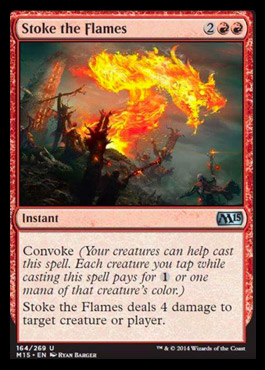
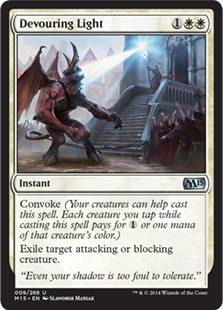
If you’re trying to keep a particular creature alive (or yourself!), be wary of your opponent’s untapped red and/or white creatures. Stoke the Flames is a premium uncommon in the format, and though cards like Devouring Light tend to be format-dependent, they’re usually at least playable and sometimes very good. One thing is for sure: Devouring Light seems miles ahead of Divine Verdict.

devouringlight

Combat Tricks

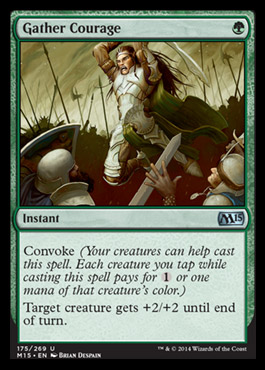
Short of removal, combat tricks are next most likely to blow you out when you think you’re safe. White and red are again colors you want to watch, but add green to the list this time, too. White common Ephemeral Shield doesn’t boost a creature’s stats, but it does blank removal and win in situations you thought were trades. Gather Courage is a little more fair than Mutagenic Growth (especially because it’s uncommon), but should still be respected at all pertinent times.

gathercourage

After Kindled Fury in M13, Weapon Surge in Dragon’s Maze, and Coordinated Assault in Theros, seasoned Limited players should be used to playing against cards like Crowd's Favor. This is, however, the first of this type of spell that can be cast with no red sources open, so be aware of when you should be playing around it.

Chord of Calling is certainly capable of being a combat trick, and though it’s a rare in M15, you will see it occasionally. If your opponent has a ton of mana and/or creatures untapped, you may want to think twice before assuming attacking is in your favor. I heard prerelease stories about Chording for Ob Nixilis, Unshackled, in response to a search effect. That’s the kind of story to keep you on your toes.

The Miscellaneous Ones

Unmake the Graves won’t necessarily blow you out, but it can provide some value at the end of your turn leading into your opponent’s turn. Similar cards didn’t see much if any play in recent sets, so don’t expect to see this one often.

And don’t expect to see Meditation Puzzle at all. Pure life gain spells are generally just plain bad, and this one won’t be an exception. Ninety-nine times out of a hundred, you will be actively happy when your opponent plays this against you. So unless you have good reason to believe it’s waiting in your opponent’s hand, don’t even bother playing around it.

Summary

Three white instants with convoke: one removal spell, one combat trick, and one unplayable.

No blue instants with convoke.

One black instant with convoke: a double Raise Dead that probably won’t see play.

Two red instants with convoke: a combat trick and a burn spell.

Two green instants with convoke: a Giant Growth and the rare Chord of Calling.

This makes a total of eight instants with convoke—it's not much to memorize, and if you do, you'll have the upper hand in your matchups.

Instants with Convoke in M15

White

Black

Red

Green

Insider: Branching Out

Are you a Quiet Speculation member?

If not, now is a perfect time to join up! Our powerful tools, breaking-news analysis, and exclusive Discord channel will make sure you stay up to date and ahead of the curve.

Welcome back, readers!

It's interesting how often, and almost cyclically, I hear people complain about some format becoming "stale" (though usually aimed at Standard).

Thanks to one major retailer we now have weekly large tournaments with new tournament results all the time as well as a strong MTGO metagame to pull data from. The collective "hivemind" of tournament players tend to pull the best decks and tweak them to be extremely efficient. This occurs fast enough that the decklists become "stock" within a couple of weeks and the best cards legal in the format quickly rise to the top. Thus while Standard may have around 1500 cards available, only maybe 0.5%-1% might actually find a home in Tier 1 deck (assuming several are even available).

This means that we have a lot of cards that aren't doing anything but sitting in a box and taking up space. One easy solution for many grinders is to gather them all up and sell them at bulk rates to stores, thus clearing up some space for themselves and allowing the store to maintain a stockpile in case some card breaks out.

The normal bulk rates are about $3/1000 cards or 0.3 cents ($0.003) per card. Another strategy I've seen to gather up these bulk commons/uncommons and sell them as "instant collections" on Craigslist which can often go for more like $10-$15 /1000, netting a much better rate, but requiring a good bit more work. I know I enjoy buying cards at the normal store bulk rates and rooting through looking for 'treasure'. It's often time consuming and sometimes you spend two hours to get $10, but it's more about something I happen to enjoy doing than about maximizing my earnings.

but+wait+theres+more

But there are other less advertised formats that cause demand for some of these "bulk" commons/uncommons you may be unaware of.

  1. Pauper - This one is probably more well known than the others to follow. All sets are legal, but the card must have been printed at least once as common. A few months ago, you could see a lot of Travis Woo's brews on ChannelFireball were Pauper decks. This format is fun and surprisingly powerful. The banned list is small and this format can be played on MTGO.
  2. Peasant - Similar to Pauper except you can play with any commons or uncommons (though depending on the store/person promoting it there may be a limit to the number of uncommons).
  3. 1 Rare EDH - This is a format I recently got into (courtesy of one of our local players wanting to try it out) in which you can have only one rare/mythic in your EDH deck. Typically this is the commander as you have the most access to them and the rares/mythics tend to be the most powerful cards in your deck (though not always as Skullclamp is often the most powerful cards in a lot of these decks). This is the format that inspiring me to write this article as I was digging around looking for cards for my 1 Rare EDH deck (Damia, Sage of Stone), when I realized just how many awesome commons/uncommons would be played in EDH if it weren't for the fact that many times there is a rare that is slightly better and just pushes it out of the limelight.
  4. Cube - This format is becoming a lot more mainstream and is often a goldmine for trades. People who build their own cubes often want to make them stand out (the easiest way is to foil them out). This are the people who help drive the price of those weird old foil commons/uncommons and you can often turn a pile of weird foils into some highly liquid cards (or even cash).

Looking over decklists for these formats (especially Pauper, as decklists are readily available here) and looking up a lot of the cards in these decks we see commons going for $0.2-$0.5. While this doesn't sound like a lot, it means that if you were to pull out those cards from your bulk (where they are likely sitting) you can easily trade/sell them for 67x-166x what you would get for them selling them as bulk. Granted this takes considerably more time then just handing a box of cards to a store, but the payoff can be big. After all, if I learned anything from my experience buylisting at GP Atlanta it's that nickles, dimes and quarters can add up quickly.

Ironically, Pauper is similar to Legacy in that while there is a very large card pool, there are a few well known archetypes and only the best of the best commons make it into them. I bring this up because you can glance over these archetypal decklists and just pull cards you recall while you're doing your normal sorting. One of the biggest tricks when buying a big collection is efficient sorting of cards so you want to train your brain to pull out as much as possible.

I do realize that it's likely difficult to get full value on most of these cards; after all, if you have 20 copies of Chittering Rats you'd have to find five people trying to build Pauper Mono-Black Control. The good news about the format though is that it's still very cheap to get into which encourages people to build multiple decks (so that they can change up their deck choice if they get bored or want to try something new).

So now that you've got your cards set aside how do you get rid of them?

My first suggestion is to build a few decks of the format you want to try out. The next is to bring them with you to your card shop and ask people (who aren't busy playing something else) to try them out or post an advertisement on social media requesting that fellow players build decks (this is how one of our local players got about 8-10 of us interested in 1 rare EDH).

Weekly Tidbits

  • Shardless BUG won SCG Baltimore and while the decklist was pretty stock the sideboard did include a copy of Null Rod. While a known Vintage staple, Null Rod hasn't seen much play in the Legacy scene for quite a while. We also see a copy in the 6th place BUG Delver deck.
  • 10th Place was taken by a different Shardless BUG deck with the Thoptor/Sword combo ,which is an interesting take.
  • We're finally starting to see Toxic Deluge find a home as one- to two-ofs in some Legacy maindecks and/or sideboards.

Major Overhauls to Digital MTG Products

Are you a Quiet Speculation member?

If not, now is a perfect time to join up! Our powerful tools, breaking-news analysis, and exclusive Discord channel will make sure you stay up to date and ahead of the curve.

Two key digital products associated with Magic: The Gathering—namely, Magic Online and DailyMTG.com—recently underwent major overhauls. And really, “major” may be an understatement here. For better or worse, things have been turned completely upside down.

On July 16, 2014, Magic Online 3.0 was shut down forever, leaving players with one option and one option only: Magic Online 4.0, previously known as the Magic Online Beta Client.

Unfortunately, any improvements over the old client have been largely buried under a sea of complaints regarding bugs, crashes, and memory leaks.

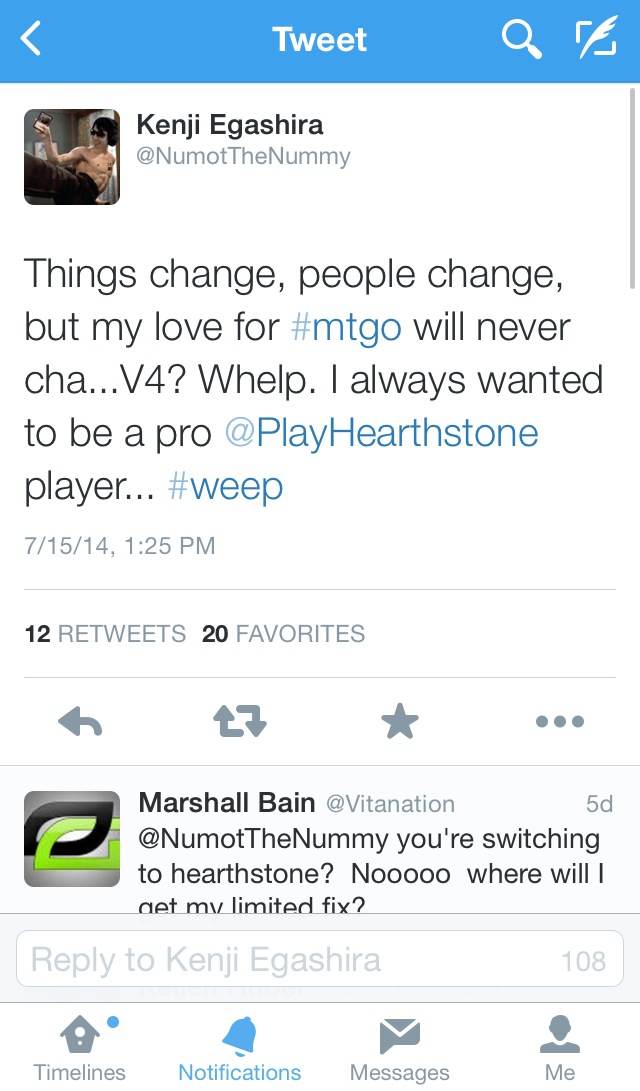
The look of the client has also completely changed: phases are indicated horizontally instead of vertically, cards are center-justified instead of left, graveyards can’t be enlarged, chat windows pop out rather than share screen space, and more. It’s possible to find supporters of the new client on Twitter, but they’re largely outnumbered by those with legitimate complaints about the program, who may well be outnumbered in turn by those just griping about having to learn something new.

But when the most popular MTGO streamer on Twitch.tv is tweeting this, you know things aren’t going great:

photo1 (3)

Not long before MTGO 4.0 became the only option, Wizards introduced a new site design for DailyMTG.com. This wasn’t an update to the existing layout. Rather, this was another complete overhaul of the existing system. Again, the Twitter community loudly decried the change, pointing out a number of problems, including things as basic as where one would click to read an article.

photo1 (2)

The new Daily MTG launch was accompanied with many problems, including links in old articles no longer working, card display errors in Gatherer, and navigation trouble for those looking for a particular feature. Personally, I would always Google “What’s Happening? MTGO” to find decklists for MTGO tournaments—now I have no idea how to find them. And losing the Card Image Gallery feature for new sets is especially painful.

In response to these fundamental shifts in design, Wizards.com forum user Felorin, identifying himself as Dr. Cat, CEO & Creative Director of Dragon’s Eyes Productions, really broke down the problems with these “gratuitous drastic changes to layout, color scheme, functionality, user interface, and visual style.” While recognizing the drive behind them (“new people come in with a ‘bold new vision’ and they want to express their creativity”), he explains that “human minds are a combination of two conflicting desires. The desire to experience something new, and the desire for the comfort of the familiar.”

It’s really an excellent breakdown of the topic that falls into the category of “couldn’t have said it better myself.” Check it out here. If you have had good or bad experiences with the new MTGO client or Daily MTG design, leave a comment! We can’t hope for improvements if we don’t offer constructive feedback.

Avatar photo

Danny Brown

Danny is a Cube enthusiast and the former Director of Content for Quiet Speculation.

View More By Danny Brown

Posted in Free19 Comments on Major Overhauls to Digital MTG Products

Have you joined the Quiet Speculation Discord?

If you haven't, you're leaving value on the table! Join our community of experts, enthusiasts, entertainers, and educators and enjoy exclusive podcasts, questions asked and answered, trades, sales, and everything else Discord has to offer.

Want to create content with Quiet Speculation?

All you need to succeed is a passion for Magic: The Gathering, and the ability to write coherently. Share your knowledge of MTG and how you leverage it to win games, get value from your cards – or even turn a profit.

Insider: [MTGO] Nine Months of Portfolio Management – Quick Flips & Very Short Term Specs

Are you a Quiet Speculation member?

If not, now is a perfect time to join up! Our powerful tools, breaking-news analysis, and exclusive Discord channel will make sure you stay up to date and ahead of the curve.

Welcome QS readers for one of the very last articles in my Nine Months of Portfolio Management series. This article is dedicated to Quick Flips, a specific category of my portfolio during this experience.

I wrote in my very first article here on QS that, to me, there are only three ways to speculate on MTGO.

  1. Cyclical investments: Mostly Modern positions, and under some circumstances boosters. Returns are usually moderate for a fairly low risk.
  2. Speculative investments: With no previous history and for any kind of reason you bet that a given card is going to be valuable in the future. Returns are variable and can be very high for a moderate to high risk.
  3. Quick Flips/Very Short Term investments: These type of opportunities happen every time an event suddenly boost the price of a card and the goal is to ride the wave. Returns are usually low but, if executed well, this type of investment is risk free.

In my Primary Portfolio, about 5%, or 256.28 Tix, of my initial capital were set aside from the beginning for potential Quick Flips. Even if I never used all of this 256 Tix in a single bet, this Quick Flip category could be seen as the biggest position of my portfolio.

At the end of April, the Quick Flips section of my Primary Portfolio had increased by 134% for a profit of 349.66 Tix. Let's talk a little bit more in details about how to take advantage of these Quick Flips and what they did for me during these nine months.

Quick Flip Opportunities

Unlike most of your regular specs, Quick Flips require you to pay particularly attention to MTG news. Being there at the right moment is the most important criteria for this kind of spec. Actually, Quick Flips are not really a spec per say. The goal here is to start riding the trend and to get out early enough--Free tix and zero risk.

When?

Quick Flip opportunities happen thanks to several type of events, maybe more often than you think. Any time a card or a set of cards are put forward, people may be incline to buy that card and generate a hype, whether it is justified or not.

From Daily Events on MTGO to Pro Tour top 8 deck lists, through GPs, SCG tournaments or Travis Woo brews, any specific exposure can cause a spike. Remember Nightveil Specter and Master of Waves after the Pro Tour Theros, or Fist of Suns during the GP Prague?

B&R list announcements also set a very fertile ground for strong hype-based speculations. For example, the B&R announcement last February suddenly put certain cards under the spotlight due to the ban of Deathrite Shaman and the unban of both Bitterblossom and Wild Nacatl, such as Scion of Oona, Mistbind Clique, Knight of the Reliquary and Vengevine

New set spoilers season also does the trick pretty well. Last year during the spoilers season of the three Theros blocks, cards with several colored mana symbols in their mana cost experienced an increase in demand because of the Devotion mechanism, especially Boros Reckoner, which actually spiked twice, during Theros spoilers season and during Journey into Nyx spoilers season because of Iroas, God of Victory. Ral Zarek also briefly spiked when the Inspired mechanism was spoiled.

This hype may only last a dozen of hours, such as with Amulet of Vigor during the PT Born of the Gods, or several months, like with Disrupting Shoal when Travis Woo's Ninja Bear deck took off. Most likely the pressure on prices will apply for several days only, and you usually don't want to hold your Quick Flip specs for more than a day or two.

Two days is actually the time frame I give my Quick Flips when the hype come from tournament results--after two days, prices can really get unstable and may have already come back to their pre-hype prices or you won't find anymore buyer at the newly inflated prices.

Quick Flip vs. Very Short Term Specs

Quick Flips are positions that you hold anywhere from a couple hours to several days, and the goal of these Quick Flips are purely to surf on the hype--I aim to be one of the first to jump on the train and I intend to get off the train at full speed, or at least before it slows down.

The final destination of that train doesn't matter and doesn't interest me at all. Pro Tour coverage and what recently happened with the P9 prices are great examples when you'd want to perform Quick Flips, holding for one or two days, generate some Tix and exit.

On the other hand, very short term specs are positions I'm going to hold for a slightly longer period of time, maybe two or three weeks. When the exposure of a card is more subtle or when I think we won't see a big spike but a slower and sustained increase, I'm inclined to hold the position slightly longer.

For instance, this occurs when old cards incorporate or are anticipated to incorporate with new decks after Standard rotation, thus without the big splash of a Pro Tour or GP coverage.

A good example is last year with Jace, Architect of Thought after M14 release and before the Pro Tour Theros when he was anticipated to be the Planeswalker of choice for control decks. Theros could have made Jace unplayable but, until then, you could have ridden the wave for a very short term spec.

Changes in prize pay out may also induce very short term specs on boosters.

Benefits of Quick Flips

I would definitely recommend to use and abuse of Quick Flips, especially if your bankroll is rather small. Smaller bankrolls can benefit the most from these types of speculations. Some other benefits include:

  1. Time. Quick Flips are usually the opportunity to grind 20 to 30% profit in no time. If you don't like to have your Tix tied for several weeks or for longer periods of time, this is the type of spec you may want to consider the most.
  2. Risk free. If you get in fast enough and don't hold your position for too long you are virtually immunized to losses. My advice here is hold your Quick Flip specs for a couple of hours to one or two days, no more. Keeping your position for more than two days can result in greater benefit but also expose you to potential losses. If you are selling too late, you may have a hard time to find a buyer at a decent price.
  3. Potentially high returns. With Quick Flips, you are usually aiming for moderate returns, but sometimes the hype is simply too strong--you can double or triple you initial bet in less than 48h.
  4. Growing your bankroll quickly. This is true only if you have a relatively small bankroll. Good returns in a short period of time and with virtually no risk is the type of investment that can make to spur your bankroll to grow real quick. Quick Flips are seemingly unpredictable, but, over the course of a year, you should be able to benefit from many of them.

Limits of Quick Flips

Quick Flips seem to be the perfect investment: no need to hold your positions for long period of time, risk free and with good returns in perspective. However, there're some limits to these Quick Flips and you won't be able to grow a 10,000 Tix bankroll solely based on them.

  1. Limited Tix investment. Because you are going to chase a card that everybody else wants too, you will find yourself quickly limited in the number of copies you can acquire at a decent price. The lower the price of the card, the lower the total amount of Tix you can invest. Even for a card with a high price tag, it won't be easy to buy for more than 200 Tix of the given card. This is the reason why Quick Flips become less and less interesting as your bankroll grows.
  2. Not well suited for a big bankroll. If your bankroll is several thousands of Tix big, you may find Quick Flips not very interesting for you and not worth your time. Think that you may have to search for the best bots or humans on the Classified for the best price, that these bots may not have the cards at the expected price or only have one copy instead of the playset advertised, etc... All of this to gain 20 Tix when your bankroll is 10,000 Tix large? Some Quick Flip opportunities may concern expensive cards, such P9 pieces and what we experienced with VMA the past weeks. Besides those, most of the Quick Flip opportunities concern cards with a much lower value.
  3. Timing. Since it is a matter of hype, often from the release of specific info, you have to be able to get on MTGO when it happens. Sometimes even four hours later it is too late. When the VMA full list was spoiled and revealed not to contain Wasteland, if you were like me and not online at midnight, only getting the news the next morning, it was already too late. No more Wastelands available. Also, if we know what kind of event may trigger a sudden spike of prices, nothing is guaranteed and you may sometimes have to wait for nothing. Not all the B&R list announcements or Pro Tours will allow you to spec on three different cards.

Nine Months of Quick Flips

As I stated in the intro of this article, the Quick Flips section of my Primary Portfolio yielded a nice 134% profit. I didn't keep a detailed track record of all the cards I speculated on, here is a summary from memory.

Boros Reckoner was one of my first target when the Devotion mechanism got spoiled in Theros. I kept the minotaur until the Pro Tour Theros and sold it quickly after it was clear that Mono Red Devotion was not the most popular Devotion choice.

There was an error retrieving a chart for Boros Reckoner

In the fall, many of my Quick Flips included GP and PT winners such as Jace, Architect of Thought, Blood Baron of Vizkopa, Pack Rat and Desecration Demon. Even after the Mono Black Devotion was known to be a thing, cards from the winning deck at GP Dallas bumped up for 48 hours.

There was an error retrieving a chart for Pack Rat

Theros and M14 boosters were also part of my Quick Flips, but more short term specs than Quick Flips.

The B&R list changes in February brought some very nice Quick Flip opportunities. I was only able to spec on few copies Scion of Oona and Mistbind Clique. I was already holding some Vengevine, Knight of the Reliquary and Gifts Ungiven that I sold while prices were high.

There was an error retrieving a chart for Scion of Oona

If you think about it, this Quick Flips category worked as a mini portfolio that started with 256 Tix and more than doubled after only nine months, with no real investment or speculation--only Quick Flips.

Finally, I said that Quick Flips are virtually risk free, and they are if you maintain a strong discipline. During my experience, two Quick Flip positions made me lose money. Why? Because I wanted to wait a little bit too long with cards that spiked only due to hype and not real trend.

During the Born of the Gods spoiler season, when Karametra, God of Harvest and Mogis, God of Slaughter were revealed, Trostani, Selesnya's Voice and Rakdos, Lord of Riot spiked briefly. They were good opportunities to gain a few Tix in a day or two. I effectively bought these two Return to Ravnica legends, but failed to sell them soon enough. I kept them longer thinking they could sustain they hyped price and even see play. I was wrong and because I didn't stick to the basic Quick Flip strategy, I lost some Tix.

In conclusion, it is certainly always profitable to keep some Tix available in your account. With a well targeted spec, you will surely be able to generate a substantial amount of Tix without committing your Tix for too long.

Especially for smaller bankrolls, I definitely recommend keeping a significant part of it as free Tix. It might as well be the safest and best way to grow your bankroll, thus avoiding frustrations of long and sometimes detrimental speculations.

With two Standard Pro Tours and Khans of Tarkir spoilers lining up for the next two months, opportunities for Quick Flips will be around. Keep an eye open for new deck techs and new cards/mechanisms from Khans of Tarkir. Multi colored mana symbols in the casting cost of Khans of Tarkir cards would immediately set on fire prices of cards with Devotion such as the Gods or Master of Waves, for instance.


Thank you for reading,

Sylvain Lehoux

Want Prices?

Browse thousands of prices with the first and most comprehensive MTG Finance tool around.


Trader Tools lists both buylist and retail prices for every MTG card, going back a decade.

Quiet Speculation