menu

#PTBNG: Conley Woods’ Knight-Pod Deck List

Are you a Quiet Speculation member?

If not, now is a perfect time to join up! Our powerful tools, breaking-news analysis, and exclusive Discord channel will make sure you stay up to date and ahead of the curve.

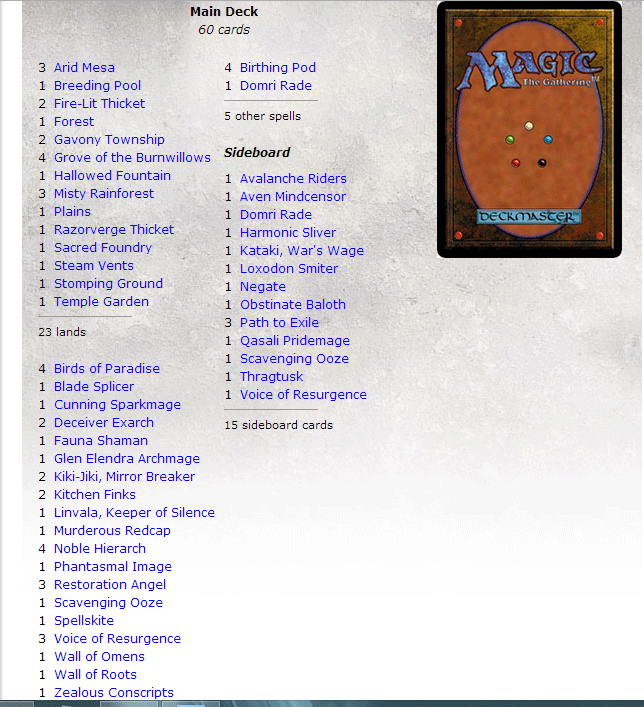
This is the list transcribed from Conley's Deck Tech at Pro Tour: Born of the Gods today. Knight of the Reliquary is the only surprise, and it's only a two-of.

Untitled Deck

Creatures

4 Birds of Paradise
2 Noble Hierarch
2 Knight of the Reliquary
4 Kitchen Finks

Spells

3 Abrupt Decay
3 Birthing Pod
4 Chord of Calling

One-Of Creatures

1 Melira, Sylvok Outcast
1 Viscera seer
1 Murderous Redcap
1 Spike Feeder
1 Archangel of Thune
1 Scavenging Ooze
1 Linvala, Keeper of Silence
1 Qasali Pridemage
1 Nekrataal
1 Eternal Witness
1 Voice of Resurgence
1 Reveillark
1 Ranger of Eos
1 Wall of Roots
1 Spellskite

Lands

1 Gavony Township
1 Bojuka Bog
1 Horizon Canopy
1 Ghost Quarter
4 Verdant Catacombs
4 Misty Rainforest
1 Marsh Flats
2 Overgrown Tomb
1 Temple Garden
1 Godless Shrine
2 Razorverge Thicket
3 Forest
1 Swamp

Sideboard

4 Thoughtseize
1 Abrupt Decay
1 Shriekmaw
1 Voice of Resurgence
1 Cloudthresher
1 Harmonic Sliver
1 Orzhov Pontiff
1 Entomber Exarch
1 Obstinate Baloth
1 Kataki, War's Wage
1 Aven Mindcensor
1 Ethersworn Canonist

Insider: The Night Before Christmas…..

Are you a Quiet Speculation member?

If not, now is a perfect time to join up! Our powerful tools, breaking-news analysis, and exclusive Discord channel will make sure you stay up to date and ahead of the curve.

.....in February?

Yes. Tonight is the night before Christmas.

Just a reminder - Friday morning begins Day 1 of Pro Tour Born of the Gods. If you've been following along - I'm a big proponent of Modern and what it can do for a store, trader, or investor. Most are fearful that one day there will be a bubble popped because of reprinting, but if you're playing the game correctly - this should never be a worry. It's all part of the ebbs and flows. Position is all that matters. Gaining the fraction of an edge before anyone else has it. Preparedness and willingness to strike. Never underestimate what a reprint will do for demand, or cost/supply.

Already, we're seeing where the rubber meets the road. A good cross selection of Modern applicable cards have already been seeing movement this last week based on where people feel this format is going.  The more important thing is - what can we expect? After each deck I present I will list cards I believe are going to experience a negative overall value change. Legacy, also being a thing, I will take into account with my interpretations.

1) Jund will still be a thing.

Jund-2

The initial hype is that Jund is dead. Some people are still able to put up numbers with it, but the recent bannings have relatively neutered the deck. With that being said - Huntmaster of the Fells and Courser of Kruphix are filling in the gap so far. Without moving to some form of mass removal, the deck will continue to have problems with aggro strategies. The Mid-Range or Aggro decks that it could really prey on have all fallen by the wayside.

Deathrite Shaman was the main tool that encouraged the fall from grace of most UWR style decks and now the floodgates have been opened. The issue for Jund is still being able to hand all the various ways UWR can interact with you while being able to disrupt their card advantage and making your top decks better. Drawing a Thoughtseize late in the game is still one of the worst feelings in Modern.

Cards Effected

Negative:
Deathrite Shaman
Lingering Souls
Ajani Vengeant
Liliana of the Veil
Maelstrom Pulse
Tron Decks

Positive:
Courser of Kruphix
Scavenging Ooze
Thrun, the Last Troll
Geist of Saint Traft
Snapcaster Mage

2) UWR will be HEAVILY represented

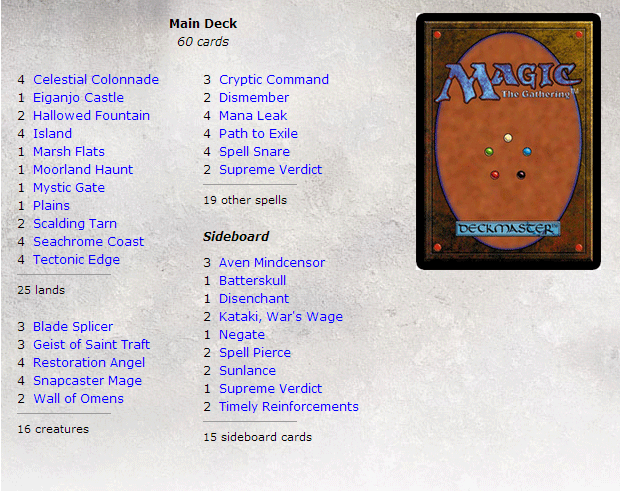
UWR

The belle of the ball. UWR is already posting significant numbers of players into the Dailies and Premier events that we have results for. This is going to make the loss in demand we've seen on all cards in that archetype swell. I don't forsee many changes to the archetype itself - other than more Supreme Verdicts being ran. The format is begging for a board sweeper and UWR will be the archetype to carry that flag. Which version that will do best is yet to be seen, but Blade Splicer could also see impact from the lists that are being played currently. This will ALL depend on what version eeks it's way to the top.

Cards Effected

Negative:
Tron
Affinity

Positive:
Sword(s)
Thundermaw Hellkite
Geist of Saint Traft
Supreme Verdict
Delver of Secrets
Restoration Angel
Spell Snare
Cryptic Command
Celestial Colonnade
Snapcaster Mage
Remand
Sphinx's Revelation

3) Scapeshift is a thing again

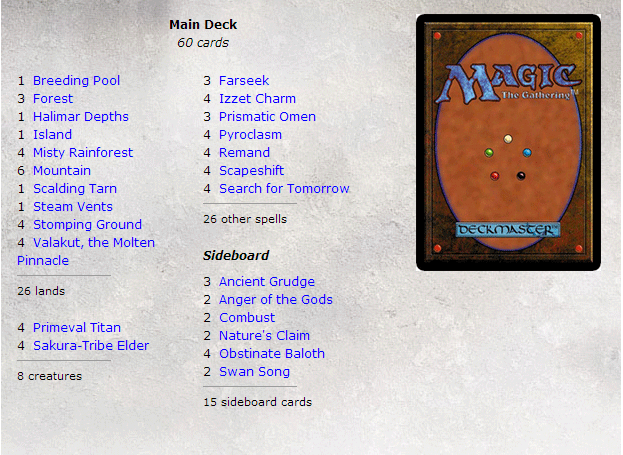
Scapeshift

From every Scapeshift player I have spoken to - the one issue they all had was how bad the Jund matchup was. That will not be the case anymore. The only other thorn could be the resurgence of "Fast Aggro." Keep a very close on on how this pans out.

Cards Effected

Negative:
Tron Decks
Zoo

Positive:
Cryptic Command
Scapeshift


4) Zoo will probably be a default deck for many people

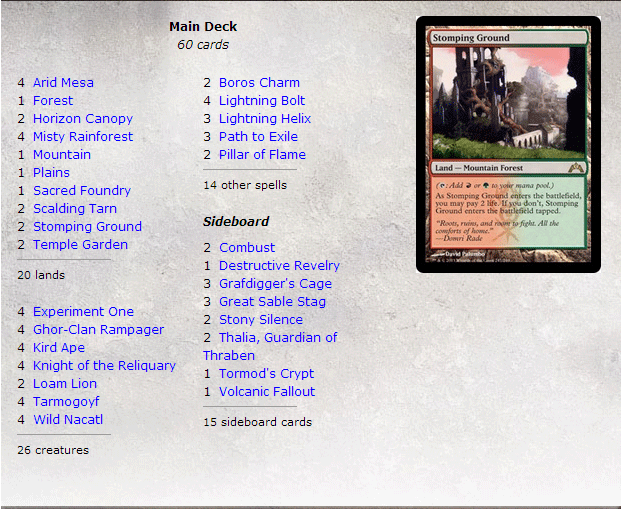
Zoo

Zoo is by far the resurgent "Hyper Aggressive" strategy of choice. This will be a starting point for many to see what was what during their playtest sessions. The representation will be high at the PT, but there aren't very many "winners or losers" from the Zoo. Once they start adopting Voice of Resurgence or [/card]Loxodon Smiter[/card], or those cards are in a well performing list - then I see more gainers out of Zoo.

Cards Effected

Negative:
Faeries
Splinter Twin

Positive:
Wild Nacatl
Ghor-Clan Rampager
Loam Lion
Kird Ape
Voice of Resurgence
Loxodon Smiter
Blood Moon


5) Pod will win the Pro Tour

Pod

The one caveat I will place on this: "Pod is an incredibly difficult deck to pilot correctly." With that out of the way, the format has been slow to react to what pod really can do as well - Pod switching over toe Noble Heirarch has been a boon for the creature battles the deck certainly will face. The format is very creature oriented, at this moment, but that shift has already started to occur with the changes that were wrought. Has it moved far enough into the control environment at this stage? I don't think so. I don't believe that most players are really going to account for Pod accurately. Or just how many angles the deck can attack you from. The additional splash damage of Voice of Resurgence being amazing against the rise of Faerie and UWR decks will only help the cause for Pod and it's variants.


6) There will be one dark horse that performs well.

I am leaning towards Boggles more so than Poison as a potential for this category. Affinity could still put up numbers because of the sheer number of people that play it and it's resiliency to Supreme Verdict. I don't think that Faeries has the capabilities of suffocating Zoo or being able to compete with UWR. Bitterblossom based strategies could be incorporated into a Jund shell, but that's hard to see as a 3-4 of as this moment. Most have been using 1-2 with mixed results.

Tron style decks have clearly fallen to Tier 2 and I don't foresee any list doing exceptionally well in a sea of counterspells. There's a chance a B/W Tokens shell could do well, but it's too early to see if that's going to be the case. That particular deck preys very much on an established metagame. It's my opinion that the format is only now starting to settle down.

Negative:
Tron
Bitterblossom
Liliana of the Veil

Positive:
Supreme Verdict
Voice of Resurgence
Noble Heirarch
Fish


7.) Step 3: ???

The rest is surely going to be a "wait and see."

There are a wide variety of strategies and some will be driven more to the wayside than others by the recent changes. Now that we have the top players in the World competing on the biggest stage - all the setup from last year's Modern Masters will truly come to fruition. With this lead-up into the summer season, this Pro Tour will set the stage for the coming months on the most readily available yet lucrative cards on the market. Standard is a great place to be for constant demand - but MODERN is where you want to be where demand, supply, and profitability all come together at once.

Time to open some presents!

Insider: Playability is Profitability

Are you a Quiet Speculation member?

If not, now is a perfect time to join up! Our powerful tools, breaking-news analysis, and exclusive Discord channel will make sure you stay up to date and ahead of the curve.

Ultimately (obviously) the cards people want to play with will be worth more than their unloved counterparts. As speculators we must be able to accurately evaluate a card's playability to enjoy success. Figuring out what is going to be good in a Standard format is probably harder than doing the same for any other format. Don't believe me? Take a look at pre-sale prices for singles and compare that to prices after Game Day.

With a small card pool, Standard specs are best made when cards can be seen fitting into or strengthening decks that already see play. Evaluate a card only on its ability to replace pieces of a known commodity and you will be much less likely to be holding onto losing positions. Occasionally a new keyword can make some cards still in standard suddenly very playable. While this is rare, when it does happen it seems obvious. Devotion is the latest keyword to prop up some otherwise borderline cards (Nightveil Specter), but the ability for you to take advantage of devotion friendly cards hasn't totally gone away. A card like Boros Reckoner was played before and after the devotion mechanic debuted. Demand for this card is steady with decent upside should red or white devotion become more of a thing in the format.

Modern Hits

Picking the right Modern cards for speculation is easier. A list of proven archetypes exists from which both new cards can be tested against and old cards can be found. Determining whether a new card belongs in an established decklist requires the same question a card vying for play in standard must answer: what am I replacing? Finding cards for Modern can also be a process of revitalizing, reinvigorating or strait up resurrecting an outmoded/ outclassed deck type.

Banning or unbanning a card often has that effect. The recent unbanning of Bitterblossom being an obvious boon to all things Faerie in Modern. More subtle is the effect of Wild Nacatl's return to the format. That move combined with the removal of Deathrite Shaman from the format should make Knight of the Reliquary decks much better and Faeries won't like the addition of Voice of Resurgence to decklists that already offer better card quality.

I hear some of you asking, "What about Birthing Pod?" Well, yeah, that card has been doing work as a functional replacement for Stoneforge Mystic. It also does something any card you would consider specing on should do: encouraging you to play with other good cards.

When thinking about how a card will impact a decklist, you will find cards that push you to run sub-optimal stuff. You've just found a very good reason not to put money into that particular card. For those of you wondering why I linked a Channel Fireball article or too lazy to click thru:

 "...it was interesting that Brian Kibler, in describing the “Birthing Pod” deck he used to good success at the Invitational, said that he almost ditched the Pods completely. He didn’t, because there was still good synergy between the Pods and the other cards in the deck. But he did go down to two copies of Pod, which says a lot about what was most important in the deck."


Approaching Legacy

Legacy remains a popular format in spite of huge barriers to entry. I love picking up cards leaving Standard that see play in one of Magic's most powerful formats. If it's played in Legacy, it's worth a look. Ignore rarity here. Innistrad was a very popular set, opened by many new players as the game we all hope to make some money by continued/s to grow in popularity. How many copies of this guy do you think exist?

While Innistrad block cards are still on sale thanks to rotation, Delver is still worth more than half a dollar. Gotta think that card is worthy of loading up on while it's still sitting in Standard player's binders begging to be appreciated. Something like Devour Flesh is going to be worth more than a bulk rare forever, so why not make some Johnny's day by trading a playset of his pet card for a playset of legacy playables?

The vintage cards you'll be likely to spec on are also legacy cards. Something like True-Name Nemesis is a no-brainer, making a spec on that card a matter of finding unopened Commander Decks. Of course, coping that Nemesis with a Phantasmal Image continues to make more than 5$ worth of sense.

Casual Appeal

Everybody's favorite casual format, EDH, can justify a lot of terrible investment theses. Rather than consider a potential card in terms of its EDH appeal, I consider similar cards in terms of their availability. Somewhat like traders demanding more for dual lands or other legacy "staples" picking up something in limited quantity if not total value that you aren't afraid to sit on is a fine way to dabble in the format. By making sure the cards I have for EDH players are perceived as limited in quantity I can justify asking for more should anyone show interest.

While I would never recommend speculating on EDH, foils or limited (alpha/beta) edition cards, I must admit there is nothing as satisfying as turning a foil Mercadian Masques Bribery into multiple playsets of various shocklands.  Speaking of Bribery, with abugames offering over $68 in store credit for a NM copy buying one for $59.99 off tcgplayer could make sense assuming you can trust a 95% approval rating.

When considering all these formats, Modern seems like the best place for card speculators. The ability to look over a developed history of deck archetypes when looking for potential investment opportunities, and to make multiple bets on what is invariably a more diverse range of deck types compared to Standard. Although a Modern speculator doesn't have a reserve list to protect their investments, Wizards has shown much more interest in developing this format.

In addition to offering Modern Masters to help stabilize pricing (without crashing the secondary market), Wizards has announced a Modern event deck will also be made available for sale end of May. The hefty price tag relative to other event decks again suggests a desire to offer "staples" to the community without destroying the value of current player collections. Finally, it seems likely to me that not all the new players coming to Magic want to hold a bunch of "useless" cards. A far more natural progression would be for those players to move into a format that allows them to play with all their cards - including their favorite cards no longer legal in Standard.

I'll conclude with a brief summary of my methods for card evaluation. First, before buying ask what this card will be replacing in an established archetype. Along similar lines, what cards does my potential spec target demand see play along side. Often a card will be perceived right away as a potential foundation for a new archetype. When considering a card like this for investment, you must be sure you've a body of cards to complete the picture. Finally, look forward to rotation. This is the easiest time to pick up Legacy playables on the cheap and to a lesser degree the same can be said for Modern playables. Ignore rarity when considering playability. If a card is played in Modern AND Legacy it will likely rise in value post rotation slump as it moves further and further from its time in Standard.

Let's hoard Devour Flesh and pick up cheap copies of Phantasmal Image. If you must get casual on the cheap, draft some M14 and hoard those Shadowborn Apostles.


Insider: Innistrad Block Redemption

Are you a Quiet Speculation member?

If not, now is a perfect time to join up! Our powerful tools, breaking-news analysis, and exclusive Discord channel will make sure you stay up to date and ahead of the curve.

This weekend will see the Pro Tour stop in Valencia with the constructed portion covering the recently shaken-up Modern format. Both speculators and players are keenly interested in the direction the format takes, so keep your eyes out this weekend for breakout decks and strategies.

In the meantime though, keeping tabs on the rest of the market reveals some interesting trends occurring with the set prices from Innistrad (ISD) block. The most recently rotated Standard sets are generally good buying opportunities in the Fall, and the evidence that has piled up over the last few months broadly confirms this strategy.

The Third Set Effect

Right now, hands down, it looks like Avacyn Restored (AVR) was the set to tie your horse to back in October. It has continued to march higher both in paper and digital.

The link between paper and digital is particularly evident during the first week of January. From December 31st to January 11th, TCG Mid for AVR went from $153 to $170, an 11% increase. There was a bit of a lag on MTGO, but the set was 11% higher than its December 31st price by the 14th of January, jumping from 114 tix to 126 tix in that time frame.

The chart below plots the price changes of a complete set of AVR in both paper (using TCG Mid prices) and on MTGO (using Supernova prices). Price changes are plotted as percentages relative to prices on October 10th, 2013.

The third set effect looks to be alive and well, and with cards like Griselbrand, Craterhoof Behemoth, Cavern of Souls and Restoration Angel, there's no shortage of Modern and Legacy staples in this set to drive demand. With Vintage Masters on the horizon, PTQs returning to MTGO in advance of Modern season, and gains in paper expected to continue, the outlook for cards from this set continues to be positive.

A Surprise Hit

The middle set of ISD block, Dark Ascension (DKA), has seen impressive gains on MTGO. Similar to AVR, it’s about 60% higher than it was back in early October, with about half of that gain coming since the start of January.

These gains have been a surprise to me. Based on the relative price of DKA in paper, I did not expect the digital version of DKA to see such high prices.

Unlike AVR though, it appears as if the gains have recently stalled out. Without being supported by a rise in paper prices (a trend that only just seems to be getting under way), future price increases will be muted for the digital version of this set. A digital copy of DKA is quite pricey compared to the paper equivalent.

Worlds Collide

Lastly, the price trends of ISD tell another story altogether. It shows a much more volatile price than the other two sets in the block. The big jump in December and January came on the back of Jund’s strength in Modern, with Liliana of the Veil being a key role in that deck, helping to drive the price of ISD sets up by 40%.

What’s happened since that time is interesting. We all know the recent Banned and Restricted announcement shook up Modern and for the moment it looks like Liliana will be riding the bench more than she used to. The market has driven her digital price down by about 25% in recent weeks, and the effect is visible in the Supernova set price for ISD. From a peak of 149 tix on Jan 21st, ISD now goes for 133 tix as of today, February 20th.

Over that same time period, we see that the TCG mid price for a set of ISD has gone from about $175 up to about $200 as of today. The recent price drop on digital ISD sets combined with the paper price increase has made ISD much more attractive to redeemers. Compared to DKA and AVR, ISD is the best value proposition at the moment.

Once redeemers start to get busy, we should see prices for ISD stabilize and then move higher. This will be most evident in the price of junk mythic rares.

Currently Mirror-Mad Phantasm is priced at 0.55 tix. As this card and other junk mythic rares start creeping up closer to 1 tix, you’ll know that redeemers will have been siphoning supply out of the digital economy. The value of redeeming sets of ISD in advance of Modern season will be too tempting for them to ignore.

Insider: Consuming the Casuals

Are you a Quiet Speculation member?

If not, now is a perfect time to join up! Our powerful tools, breaking-news analysis, and exclusive Discord channel will make sure you stay up to date and ahead of the curve.

Consuming Aberration is a $3 card today. That alone was surprising news to me when I found out. Phenax has started to push its price up, but it was going there all along. In fact, I suspect Aberration will be $5 a year from now, and probably $7-8 the year after that.

Casual cards.

They’re so easy to forget and yet so vital to Magic finance. The big Modern cards or hot new Standard specs get all the headlines, but the bread and butter for people like me is always these casual cards. They sell well in the store, they’re bought well from dealers and they’re usually easy to come by.

It’s no secret I love these cards, and with good reason. That’s why I like to update from time to time which ones I feel are the best current specs. Stuff like Avacyn was really easy to see coming due to the casual appeal, so with a new set out it’s time to look at our casual risers.

For starters, Consuming Aberration is the huge one. You can still get them for under $2.50, and it’s going to continue rising until it gets reprinted. Stuff like Lord of Extinction is really expensive for a reason, and while this isn’t likely to reach those levels soon it’s on the way.

Born of the Gods

Before I look back at some of my previous picks, let’s look at the new set and see what looks exciting. We’re not looking for something like the next Hellrider here, or even the next Courser of Kruphix (which I underestimated in my set review but had warmed up to by the time the podcast came out, and extolled its virtues on the cast the following week).

Instead, we want to find the next Consuming Aberration, Mind Funeral or the like. Getting in on Aberrations now is going to pay off handsomely in a year or two, and that’s what we’re looking for more of here.

Chromanticore

Jason’s favorite card from the new set, which may have some fringe Standard applications (it top-eighted a 92-person tournament in Japan last week). More importantly, it’s a cool five-color card, and most of all a mythic.

I don’t think we’re looking at Akroma levels of casual appeal here, but certainly enough to be worth grabbing when it bottoms out.

Fate Unraveler

This thing is still super cheap right now, and I’m pretty sure he will hit bulk-rare status. But I don’t think it’s a bulk rare long-term. It has lots of Commander applications, notably in Nekusaar, and I expect that to drive its price up slowly over the long haul.

Fated Retribution

Another card that’s going to drop super low but remain a Commander staple for years. Foils are an especially good play here.

Perplexing Chimera

Another bulk rare, another card with lots of Commander play. Same as above applies.

Gods

I’ve talked before about how I see these getting the “Eldrazi treatment,” and while they’re not on that level they will certainly follow the same trends. Some, like Phenax, are surefire bets that I can’t wait to stock up on when they bottom out, while the odd ones like Karametra are less so.

Past Casual Calls

Not really a ton in Born of the Gods, though what's there is pretty solid for the long-term. Let’s look back on some of the cards I noted in this series in the past and see where they've settled and what the remaining upside is.

Chromatic Lantern

I’ve been, and still am, huge on this card. It’s already come off its lows of $2.50 and is now closer to $3. It’s going to be $5 by the time it rotates out of Standard, and will continue rising until it’s reprinted. While Modern and Standard specs can be fun and rewarding, they’re often more risky than something like the Lantern, which is as close to a “blue chip” stock as you can get.

Gilded Lotus

Same logic as above. Sure, there are more printings than Lantern, but it’s also arguably more ubiquitous. It’s been on a real upswing already this year from $2-3, and it’ll be $5-6 before too long.

Darksteel Forge/Akroma's Memorial/Door of Destinies

These have filled the “casual artifact all-star” spot that has become routine in recent core sets. Forge and Memorial have the advantage of being mythics, and there’s tremendous upside on these still.

I originally talked about these back on Jan. 2, and Memorial has gone to $10 from $6 since then (these were $4 when I first wrote about them last year), while Forge has mostly bottomed out and is ever so slowly starting to rebound. You need to snag all of these while they’re still in binders.

Primeval Bounty

Still flat at $4-5, but it’s at a clear bottom. This is a little less attractive than the specs above, but I still like it as a solid gainer.

Sanguine Bond

I really wanted to like this card, since it was $10 before the core set reprinting, but the additional inclusion in Commander 2013 makes it less appealing.

Instead, let’s assume everyone getting one of these will also want Exquisite Blood, and move in on those while they can still be had for $5. These are on the fast track to $10+, and while the greatest profit was to be made when we talked about them last year, there’s still some upside.

Baneslayer Angel

When I initially talked about this card last year as a rising casual staple, it was $12-13. It’s come up a few dollars since then, and I’m confident it will be $20 by the end of the year.

Not only does it have the whole “mythic angel” thing going for it, it also occasionally has Modern applications, especially now that Zoo could be coming back. That would make it less of a gradual rise to $20 and more like a hard spike to $25, so keep that in mind.

Terminus

I’m not sure calling this a “casual” card is correct, but it’s certainly a powerful Commander card with applications in other formats. We’ve watched Entreat the Angels spike in the past week, and it’s not a stretch to see Terminus and Temporal Mastery do the same this year.

Mind Grind

Another card you would assume is bulk but is actually $2 and showing signs of picking up. These aren’t getting any cheaper, and the upside is real even if it’s not the next Glimpse the Unthinkable (and it’s not). Still, lots to like here.


So there we go. That’s my working list of casual targets for the next few months. Anything I missed that you like as a target in this category? Remember, we may not know what Standard will look like six months or a year from now, but the kitchen table won't change much.

Thanks for reading,

Corbin Hosler

@Chosler88 on Twitter

No Clue Brew: Crashing with Kiora’s Bounty

Are you a Quiet Speculation member?

If not, now is a perfect time to join up! Our powerful tools, breaking-news analysis, and exclusive Discord channel will make sure you stay up to date and ahead of the curve.

I have no idea what the hell I'm doing.

I'm not a Standard player.  I haven't played FNM lately.  I haven't PTQ'ed in years, and my best finish was a 7-1-1 9th place at a Star City Open some time in 2010.  I made Day 2 at a Grand Prix once, during which I got crushed 0-3.  So why in the name of the Gods am I writing an article on Standard decks and strategy?   Because I love to brew, that's why - and I don't do enough of it.

I had lunch with our own Jason Alt the other day and pitched him the idea for a column about brewing Standard from the eyes of someone who's not biased by deep metagame knowledge of the current format.  Such a lack of knowledge is inexcusable for a competitive player but for someone like me, whose goal is merely amusement, inexperience can lead to creative discoveries that would otherwise be lost in the bias of expertise.  That's why I've called this column No-Clue Brew; I want to turn this ignorance into literary bliss by seeing the format through a fresh set of eyes.

So why don't I play Standard anymore?  The truth is, I don't have the time to play competitive Magic.  There was a time when I did nothing but play Standard.  It was a dark time in my life.  I had almost no money and lived in a town where I knew no-one.  This was during the days of $500 5 Color Control, with its Cryptic Commands and Reflecting Pools.  I could afford nothing more than a Mono-Red deck where the most expensive card was Figure of Destiny, but my abject lack of employment allowed me to test the deck at least 4 hours a day.

After tuning the deck to perfection by optimizing it to kill, on average, a turn faster than other Mono-Red decks, I invested the rest of my pitiful savings into entry fees and played every Standard tournament within half an hour's drive each week.  For a year of my life, I sustained myself by winning packs and trading cards.

Those dark days are long gone, along with any real skill I may have had as a competitive player, but the urge to brew remains.  I'm honestly not that excited about Standard right now; the linearity of Devotion-based strategies is unbelievably strong and does not inspire much creativity.

It's important for Standard to have linear strategies so new players can jump right into the format, but it bores the crap out of me as a deck builder.  My goal when brewing is not to find the most optimal deck to bring to a competitive event.  My goal is to build around a card or interaction that sparks my creative urges and then locate the most optimal way to express that interaction.

Born of the Gods didn't really excite me.  The God cards are all interesting, though unremarkable.  Aside from being under-costed and hard-to-kill creatures, their abilities are not game-breaking.  Phenax, God of Deception may be my favorite because I'm kind of stupid for Mill strategies, but he still has the dreaded "tap" symbol which limits his utility somewhat.

Ephara, God of the Polis is a glorified Howling Mine.  Mogis, God of Slaughter is one of the oft-maligned Browbeat type cards that never quite does what you need it to do.  Karametra, God of Harvests is a Rampant Growth, although they quite easily could have pushed her power level to allow for any kind of land, basic or not.

Frankly, the only Gods in the block that impress me are Thassa, God of the Sea and Purphoros, God of the Forge.  I'm hoping that the Journey into Nyx Gods are worth a damn, considering that my two favorite guilds have yet to be represented.

Anyone who's drafted RTR with me knows I'm a fool in love for Izzet decks, and the combination of mana acceleration and card draw from Simic is too alluring to resist.  It should come as no surprise, then, that I'm choosing to focus on the Simic Planeswalker as my Build-Around-Me muse.

Enter Kiora, the Crashing Wave

Let's get all the garbage out of the way first.  Yes, Kiora would be a better card if she cost one fewer mana, 1UG. Yes, she "dies to removal."  Yes, she'd be better with a starting loyalty of 3 instead of 2.  All of these things are true for every card in Magic.

Facts are facts, and we must work with the card as it's printed.  Kiora is deceptively good.  If she started with 3 loyalty or cost 1 fewer mana, she would not be a well-balanced card; her {-1} ability might be the best Planeswalker ability ever printed, and activating it twice without dying would not be fair.  But let's start with the first one.

Kiora's {+1} ability passes my primary Planeswalker test: can it intelligently defend itself against a single threat if played on an empty board?  Yup.  Kiora can blank almost every creature in Magic by applying a temporary Gaseous Form.

Kiora's {-1} ability is the most tempting to build around, as one can easily imagine a scenario in which you play a billion lands and somehow win the game.  Sadly, paying 4 mana just to fire off this ability twice seems very expensive.  There is no guarantee that you'll have enough extra lands to make the best use of this long-form Divination, so building an entire deck around "playing extra lands" is a fool's errand.

My first attempt to use Kiora was looking at Maze's End and Gate-based strategies, but I decided I didn't want to build a deck in which all my lands showed up tapped.  As we say in New York, fuggedaboutit.

Releasing the Kraken for {-5} seems like the way to win with Kiora.  This is one of the few Planeswalker ultimates that come close to You Win The Game.  The fact that it can be activated on Kiora's 3rd turn makes it surprisingly accessible, not to mention totally irreversible.  Unlike some Planeswalkers, Kiora's plus-loyalty ability directly affects her ability to survive until the critical turn, no matter how big and dangerous the threat.  Indeed, the biggest threat to Kiora's survival is a swarm of minor threats, such as Brimaz tokens, Pack Rats and haste creatures.

Once I decided that I wanted to play towards Kiora's Kraken emblem, it became clear that this would need to be a control deck capable of buying time and protecting the queen.  I came upon Whelming Wave after reading sideboarding article by Brian Judkins, in which he called it "the closest thing to a mono-blue Wrath" that we'll see in this block.

There are some cards you don't want to bounce, like Gray Merchant of Asphodel, but the Wave can really screw up an opponent's plans for reaching Devotion.  If you're bouncing unfavorable targets like the Merchant, plan around it and/or save a counterspell.

Most crucially, Wave deals with the indestructible Gods.  Setting an opponent up to walk right into an Annul can be a devastating tempo swing, and late in the game you may catch them off-guard with Syncopate as well.

Between Kiora keeping their best creature on ice and Whelming Wave waiting in the wings, the opponent will need to find a frustrating balance between over- and under-extending their board.  Wave's interaction with Kiora's ultimate is generally going to be win-more, but in the rare cases it matters, it will be back-breaking and spectacular.

In Which I Attempt To Find A Strategy

With those two cards as the shell of the deck, I wanted to start looking at favorable synergies.  Even though the game plan wants to revolve around Krakens, Magic games don't always go according to plan.  In some cases, Kiora will never reach her ultimate because it will be more profitable to alternate icing a creature and casting Explore.  Sitting on a card advantage engine that protects itself can be a game-winning strategy unto itself.  It's unlikely that each activation of {-1} will correspond to an extra land drop, so that was the first hole I wanted to patch.

There are two cards I discovered that serve this purpose.  The first is Gatecreeper Vine.  It's is not exactly a defensive standout, but for two mana, it's hard to get much more efficient.  The only thing that came close was Sylvan Caryatid, but I really liked the idea of thinning my deck and making sure I always had extra lands in my hand for Kiora.

I also liked that Vine gets me yet another land after Whelming Wave; when I play control decks, I want to hit a land drop every single turn until the end of the game.  Sadly, post-build testing proved that Gatecreeper Vine was not the droid I was looking for and he did not make the cut.

The second card is the phenomenal Courser of Kruphix. A 2/4 body at CMC 3 is a great deal.  We want creatures that can block effectively and Courser does precisely that.  Considering this is a defensive deck, his Landfall trigger is particularly welcome.  We need all the longevity we can get, so this ability stacks up nicely alongside a 4-toughness blocker and Kiora's ice.

The Future Sight for Lands ability is generally underwhelming but when Kiora can both clear the top card of your deck and enable another land drop, we've got the basis for a real engine.  I am also not afraid to cast multiples, as the landfall trigger stacks and I'm not over-exposed to Bile Blight.

Gatecreeper vine ended up being too small and too slow, and this is when Sylvan Caryatid started looking pretty good.  While it has absolutely no synergy with the Courser Kiora engine, it's a cheap blocker that accelerates and fixes mana.  Good enough.  Including a few of these will ensure that I always have a turn 2 play, and will also help keep Kiora alive.

I wanted to shore up the defenses with another 2-drop blocker and I saw no better card than Omenspeaker.  Deck manipulation is particularly valuable in this build and the synergy with Whelming Wave ends up being very powerful.  There's not much else to explain about Omenspeaker's inclusion; it's exactly the card I wanted in my 2-spot.  Each time I cast this card I like it more - something I got to do frequently on account of Whelming Wave.

Once the mana engine and defensive line were in place, there was only one thing left to add to make this a real control deck:  Counterspells.  I already had access to life gain, extra mana, blockers, and card selection. There are a wide variety of counterspells in the format, so I decided to explore a mix of each until testing proved some to be better than others.  Annul does an absurd amount of work for a single blue mana, and it's safe to assume that there will be a live target for it in a majority of pre-sideboard games.   The same is true of Dispel, and I ultimately decided I'd rather pack that in the starting lineup over Annul.

I like to have a hard counter in every control deck, and Dissolve fits flawlessly.  Syncopate is versatile and takes advantage of the deck's potential to generate extra mana.  Simic Charm is not a true counterspell, but giving everything you control Hexproof for the turn serves a similar function.

Its other two modes (Giant Growth and Unsummon) both play powerful roles in a defensively-minded deck like this.  The Giant Growth mode turns all of your fat-butt blockers into real threats, and I take particular glee in how dangerous Sylvan Caryatid suddenly becomes.

With the control shell solidified, I wanted more mana acceleration and some early threats.  Kiora's Follower is a no-brainer here, and requires no further explanation.  8 2-drop mana guys seems like plenty.  I considered Elvish Mystic to attempt a live-the-dream scenario with a turn 2 Courser, but I ultimately decided that I needed to give this deck an early game instead of trying to ramp.  Future iterations of the deck may prove more mana-hungry, so it might be correct to shave numbers on things like Sylvan Caryatid to make room for a 4-pack of Elves.  We shall see.

That's when I found Shambleshark.  It fits in the mana curve flawlessly, it permits versatile play because of Flash, and every other creature in the deck Evolves it.  He even has synergy with Whelming Wave, since you can cast him and then reply all your Omenspeakers.  An early, unexpected threat that can come out of nowhere and hit hard is exactly what we needed.  We're gonna need a bigger boat.

Mutiny on the Bounty

After deciding to use a mix of the reactive cards mentioned above, there was still room in the deck for an alternative win condition; crucial in a deck whose only current path to victory is Planeswalk and Pray.  A very deep delve into Standard's card pool uncovered a card which seems, at first glance, to be absurdly powerful for its mana cost - Primeval Bounty.

This enchantment looks to be everything I want.  My creatures are all cheap and efficient so triggering 3/3 beasts is easy ( especially after a Whelming Wave has put all your Omenspeakers back on your bench ).  Casting a spell becomes a liability for your opponent because each counterspell comes with a permanent Giant Growth ( as does casting Kiora ).

And good luck beating a deck like this that gains multiple life with each land drop.  Primeval Bounty may actually turn out to be the best win condition the deck can muster, and works beautifully alongside the rest of the deck's engine.

The mana base needs to be honed through testing, as all good mana bases do.  Because the deck is heavy on 2-drops and 4-drops, I want to play a 4-pack of our Scry land, Temple of Mystery.  The lack of 3-drops removes the sting of regret that comes from ETB Tapped lands, as I play enough basic lands to ensure I can almost always hit an untapped land when I need it.  Early testing reminded me that it's sometimes better to sit on a Scry land until later in the game, when you have a better idea of what cards you're looking for.

I also need the versatility of our Shock land, Breeding Pool and we can absolutely afford to pay the life when necessary.  A pair of Simic Guildgates might be unnecessary, but I'd rather have the mana fixing slow me down than choke on a color, especially with cards like Whelming Wave that cost UU.

So, after all this theory crafting and blowing of hot air, here's the starting sixty I came up with.

Deck List: Kiora's Bounty

Untitled Deck

Creatures

3 Courser of Kruphix
4 Kiora's Follower
4 Shambleshark
4 Omenspeaker
4 Sylvan Caryatid

Spells

4 Kiora, the Crashing Wave
4 Whelming Wave
2 Dissolve
2 Dispel
2 Simic Charm
3 Primeval Bounty

Lands

4 Temple of Mystery
4 Breeding Pool
7 Forest
7 Island
2 Simic Guildgate

Sideboard

2 Mistcutter Hydra
2 Annul
1 Dispel
1 Dissolve
3 Gainsay
3 Plummet
3 Pithing Needle

The contents of your bench will depend entirely on how your matchups shake out, what's locally popular, and just how much you hate that one guy at your shop that plays that one stupid deck.  I am a fan of optimizing your reactive cards (Gainsay vs Annul, for example) as opposed to just jamming stuff that "seems good" like Skylasher, but I can see a mono blue deck removing its trousers to a giant Mistcutter Hydra out of nowhere.  I particularly love Pithing Needle right now, as it shuts down so many of the best cards in the game.

Remember, if your opponent puts Underworld Connections on a Swamp, you can just name Swamp.  The enchantment bestows its ability onto the land, and Pithing Needle doesn't mind attacking lands; it just can't stop mana abilities.

Unravel the Aether (also known as Unravel Your Editor, because of that stupid AE character) is probably a bad Annul, but I see a lot of value in the surprise factor of nuking a God mid-combat or at the EOT. I'm eager to hear other ideas for the sideboard, as it's never been my strong suit in deck building.

One Last Thing...

As the founder of this site, I'm obligated to make an overt plea to my readers: if you're not an Insider subscriber, please consider signing up. QS started as a one-man blog in 2009 ( yeah, that same dark year I was a Standard grinder ) and has grown into the site you see today - all because people like you decided that paying a few bucks a month for high quality Magic articles was a good deal. We have both free and Insider archives that stretch back almost 5 years, so you'll surely get your money's worth by simply taking the time to dig through them.

We know that MTG Finance articles aren't necessarily for everyone (although frankly, anyone who makes even one trade at each FNM should be reading them) so we have a no-BS money-back guarantee. If you enjoyed this ramble through Standard and want to say thanks, there's no better way then clicking the "subscribe button". Either way, thank you for reading

Overcoming Play Mistakes & New Brews

Are you a Quiet Speculation member?

If not, now is a perfect time to join up! Our powerful tools, breaking-news analysis, and exclusive Discord channel will make sure you stay up to date and ahead of the curve.

Last week, I wrote about my amazing new Orzhov Army deck that I have been doing well with. I was excited to bring you a tournament report from the PTQ, but there is not much to say. On top of flooding out, being mana screwed, and generally drawing poorly, I made a number of play errors.

Instead of griping about another tournament I could chalk up to variance, I want to focus on what I can fix: overcoming play mistakes.

Play mistakes are commonplace in Magic. Often through the course of a match we are so engrossed that we fail to see where we went wrong. By noting the details of each game and even writing down your mistakes, you can grow from them rather than plateauing at the same level.

In my efforts to break through on the Pro Tour I have been employing strategies like this. Every aspect of the game is important.

1. Mulligan Mistakes

The hand you keep at the beginning of the game obviously shapes what you will and won't be able to do. If you keep a sketchy hand but don’t reflect after the game, you will miss the importance of the situation.

The art of the mulligan is something I have been specifically working on over this past year. Since I am a cautious person, I find myself taking a mulligan more than most other players. I would much rather have the certainty of a good mix of lands and spells than risk a low land count hand.

Regardless of your mentality, the decision to mulligan or not is quite important. Consider your options carefully and try to make the wisest decision.

2. Sloppy Mistakes

The play mistakes I made this past Saturday were not as ambiguous as mulligan decisions, but rather sloppy mistakes. Magic is a game of mental fortitude. This is one aspect of the game that outsiders drastically underestimate. You need to have a vast amount of concentration to play eight rounds or more of Magic in one day.

Every time I sit down to play on Day 2 of a Grand Prix, I always think how hard this game can be at times. When you are tired or not focused on the game, it’s easy to make dumb play mistakes. This is what happened to me this past weekend.

After winning a close round one against Mono-Red, I found myself in game three against Mono-Black Devotion splashing red for Mizzium Mortars as well as some other cards that I didn’t see. Early in the game my opponent cast Nightveil Specter and passed the turn back. A turn or so later I realized my Soldier of the Pantheon was in play and I should have gained a life.

That’s the type of mistake that is %100 under your control but never seems significant. Unfortunately for me, that one life cost me the match.

Not missing little aspects of the game like this is extremely important at high levels of play. Similarly, in the same game, at the end of my opponents turn, I cast Ultimate Price to kill his creature. After resolving the spell I noticed I tapped my mana incorrectly so that I couldn’t also cast my Hero's Downfall to kill his other creature.

This did not seem like a problem until I drew Brimaz, King of Oreskos for my turn and then I did not have enough mana to cast both. Not paying attention to the lands I was tapping cost me a full turn.

The fact that all of these mistakes and more happened in the same game proved disastrous. If I had drawn another removal spell, I would not have been punished for my misplays but I did not. The game was winnable and I threw away my opportunity. Based on how awful I drew in the next two rounds I doubt it mattered that I lost that round, but we’ll never know.

Sloppy play mistakes are always avoidable. They result from distractions or lack of attention to the game state. Even if you have been playing for a long time, every player is capable of making these types of mistakes if you are not careful. If you find yourself making these types of errors often, focus on tightening up your play before working on the other types of mistakes.

3. Wrong Line of Play

Magic is a game of decisions and everything you do during the course of the game can affect the outcome.

Do you play one of your creatures or kill one of theirs? Which creature do you play? Do you play all of the creatures in your hand or just some? These are just some of the decisions we face in our games, not to mention deciding on how to build your deck for the tournament.

If you determine it’s best to kill all of your opponent’s creatures and then play a threat of your own, that is one line of play that may win you the game in some situations. More often than not your main decision is which of your opponents threats to rid yourself of.

Against Mono-Blue Devotion their main threats are Nightveil Specter and Master of Waves. Normally you would save your removal for one of those two threats. However, if you think it’s better to kill their early Cloudfin Raptor so it doesn’t grow too large, that is a calculated risk you are taking.

One key factor to winning more games is identifying your game plan before the game starts. Your plan may change over the course of the game, but from the moment you see your opening hand, you should be developing your strategy.

Once the game is over, think through your strategy and figure out whether or not it worked. By identifying bad lines of play, you can prevent yourself from using them in the future. Each metagame will present you with different challenges to overcome and unique scenarios to work through. The more you play, the better you will be able to adapt to these new situations.

4. Incorrect Sideboarding

The topic of sideboarding has been covered by many authors, including myself. It is an essential part of the game and should not be neglected.

Don’t settle for copying someone else’s sideboard or even throwing the best fifteen cards in your colors in your deck box. Customize your own sideboard not only to fit your metagame but also according to your play style.

Every card taking up a slot in your board needs a solid justification for its inclusion. Think about it like you are on the debate team and your challenge is to defend each card choice. If you do not have multiple reasons for each card, then you should consider removing them.

The second tricky aspect of sideboarding is piecing the puzzle of your sideboard together card by card. What I mean by this is you need to determine which cards to remove in each matchup and have enough cards to bring in to fill that many slots. If there are six cards that are too slow or not quite as effective against aggro, then I want six strong cards to bring in from the sideboard.

The key to putting your sideboard puzzle together is discovering cards that can function well in multiple matchups. Take Lifebane Zombie for example. You want to board it in not only against White Weenie, but also against Green-Red Monsters--even Blue-White Control often has creatures post-board.

Your sideboarding decisions often come up before the event even starts, but inevitably there will be situations where you must sideboard on the fly. If you are playing against Mono-Black Devotion splashing a card you have never seen in that deck before, when the time comes, think about how that will change your sideboarding decisions.

Playing against a new deck is the perfect example. You will need to determine which cards are ineffective and which you might be better off using. Don’t fall prey to over-sideboarding though. If you dilute your deck too much with sideboard cards, your deck may lose it potency. Most importantly, think through your decisions as much as possible and have good reasons for everything you do.

A New Direction in Standard

After spending so much time working on the Orzhov Army, I think it needs some tweaks. While I’m deciding what they should be, I’ve been thinking about a couple of other decks.

The first one came up quite often this past weekend. In between rounds of the PTQ, my friend Josh kept telling me how much he was winning. Once each round was concluded, he would come back and tell me how he crushed his last opponent. He didn’t stop winning until he was in the Top 8.

The thing is, he wasn’t playing a real deck. It was a complete unknown quantity. If you have read any of my articles, you know that this is the exact type of deck I am looking for.

The deck he was playing was not much different from some other archetypes that are played in Standard, but the card choices will floor you. Feast your eyes on Mono-Green Aggro, which Josh dubbed Beast Wars.

Beast Wars
By Josh Milliken

Untitled Deck

Creatures

4 Experiment One
4 Elvish Mystic
4 Swordwise Centaur
4 Kalonian Tusker
4 Reverent Hunter
4 Boon Satyr
3 Nylea, God of the Hunt
2 Polukranos, World Eater

Spells

4 Aspect of Hydra
2 Bow of Nylea
2 Enlarge

Lands

3 Mutavault
20 Forest

Sideboard

3 Pithing Needle
3 Mistcutter Hydra
2 Plummet
2 Witchstalker
1 Bramblecrush
4 Nylea's Disciple

When I looked over this deck, it seemed like mere draft leftovers, but top-eighting back to back events with the deck are results that speak for themselves.

Certainly this deck is aggressive, but there is virtually no way of disrupting your opponent at all. That goes against everything I believe about the metagame right now. Josh boasts great matchups against everything accept Blue White Control. If true, that is certainly a feat not normally attained.

One powerful aspect of this deck is that Nylea should be a creature often. The fact that she gives all your other creatures trample seems quite relevant as well. The power of Aspect of Hydra and Reverent Hunter should not be undervalued in this mono-green deck either. Staying with one color does provide a plethora of green mana symbols with which to create giant monsters with.

This is definitely a ‘see it to believe it’ type of deck, so I will probably take it for a spin sometime soon. You probably should too.

Next up, we have a Born of the Gods-inspired deck list.

R/W Burn
By Mike Lanigan

Untitled Deck

Creatures

4 Satyr Firedancer
4 Young Pyromancer
4 Chandra's Phoenix

Spells

4 Chained to the Rocks
3 Shock
4 Boros Charm
4 Lightning Strike
4 Searing Blood
3 Skullcrack
3 Warleader's Helix

Lands

4 Sacred Foundry
4 Temple of Triumph
1 Boros Guildgate
4 Mutavault
10 Mountain

A couple underused cards from BNG have turned out to be much stronger than anticipated. Both Satyr Firedancer and Searing Blood have shown themselves as potent weapons when played against me. I've seen many decks playing these cards but they lacked something to push them over the top.

The first weakness was not including Young Pyromancer as your Firedancers numbers 5-8. Obviously nothing can replace the Firedancer or the impact it can have on other decks with creatures, but Pyromancer is a powerful weapon in a deck full of spells.

The white mana is extremely important as well because this deck drastically needs access to Chained to the Rocks. Creatures like Master of Waves and Desecration Demon can overwhelm you quickly unless you chain them down. This deck needs more testing and probably some tweaking, but I think it does something powerful in the metagame.

Until Next Time,

Unleash the Force!

Mike Lanigan
MtgJedi on Twitter
Jedicouncilman23@gmail.com

Deck Primer: The Bitterblossom Deck No One’s Playing

Are you a Quiet Speculation member?

If not, now is a perfect time to join up! Our powerful tools, breaking-news analysis, and exclusive Discord channel will make sure you stay up to date and ahead of the curve.

Editor's Note: Paul Nemeth (Zwischenzug on MTGO) is the 2013 MTGO Constructed Player of the Year and can boasts the highest overall win percentage on MTGO ( as tracked by mtgstats.com). He started grinding about 3 years ago with 75 tix and, thanks to a ton of grinding, winning and a few good investments, his collection is now worth several hundred times that. He recently won a MOCS event to secure his POTY trophy.

I have a Modern brew for you guys today. I wanted to find a home for Bitterblossom that was neither Faeries nor B/x Tokens. I view the card as a powerful 2 mana Planeswalker although it's slow and costs a lot of life over the duration of a game. It's also difficult to answer, attacks, blocks, provides card advantage, and can take over a game all by itself. Many of the decks that have attempted to use this Tribal Enchantment have drawn on the popular and proven Lorwyn-Alara Block strategies, but there are other ways to win games with Bitterblossom.

Although it had elements of control, Faeries was an aggressive (though reactive) deck and B/W Tokens was undeniably aggressive. In contrast, a control deck can slow the game down to allow Bitterblossom sufficient time to generate a huge quantity of tokens. Control decks like to blank opposing removal, and often skimp on creatures to achieve this. Unfortunately, they still need a way to win the game. Aside from the bit about losing life, Bitterblossom is exactly the kind of threat I want to play in a control shell. Since the tokens can also block attacking creatures, it can function as a kind of Forcefield effect, potentially creating a net gain of life.

Grixis Bitterblossom Control

Untitled Deck

Spells

4 Lightning Bolt
4 Spell Snare
4 Bitterblossom
4 Mana Leak
3 Terminate
1 Devour Flesh
4 Snapcaster Mage
2 Electrolyze
4 Anger of the Gods
4 Cryptic Command
1 Batterskull

Lands

4 Creeping Tar Pit
1 Desolate Lighthouse
4 Scalding Tarn
2 Steam Vents
1 Watery Grave
1 Blood Crypt
3 Island
1 Mountain
3 Cascade Bluffs
3 Misty Rainforest
1 Sulfur Falls
1 Blackcleave Cliffs

Sideboard

2 Grafdigger's Cage
4 Fulminator Mage
4 Nihil Spellbomb
1 Dispel
1 Shadow of Doubt
1 Shatterstorm
1 Volcanic Fallout
1 Think Twice

Note that between Bitterblossom, Lightning Bolt, Electrolyze, Snapcaster Mage, Creeping Tar Pit, and Cryptic Command (to tap down blockers) you can actually close out a game pretty quickly. For instance, on your opponent's end step, cast Lightning Bolt, then Snapcaster Mage and Bolt their face again. On your turn, untap and activate Creeping Tar Pit. Attack with it and Snapcaster for a total of 11 damage. Now imagine you've been sitting behind a Bitterblossom, accruing tokens all along. Now imagine that your opponent is probably playing a healthy amount of Fetch and Shock lands. Most control decks don't care about the opposing life total until they have the game locked down, but this build can come out of nowhere with a huge burst of damage. Keep a close eye on your opponent's health and make sure you know when to switch into aggressive mode.

I wanted to make the mana base relatively painless to support Bitterblossom, but due to Anger of the Gods, Cryptic Command, and Terminate that didn't really seem possible. Desolate Lighthouse is key in draw-go matchups such as UWR Control and Splinter Twin, as it allows the deck to loot through the matchup's dead cards (such as Anger of the Gods. 4 copies may be 1 too many in the main deck, but the card is disgustingly good against Zoo and Pod, which I expect to be frontrunners in the post Ban/Unban Modern format. It exiles Voice of Resurgence, Kitchen Finks, and maybe even Wurmcoil Engine with a little help. Pyroclasm and Drown in Sorrow don't make the cut because the presence of Wild Nacatl requires main deck sweepers to do at least 3 damage these days. Batterskull provides lifegain to survive Bitterblossom, but it mostly exists to be the ultimate endgame against decks that play fair in Modern. Think Twice is in the sideboard because I really don't want it against most decks, but it is great against Liliana of the Veil and the slower matchups. The deck looks weak to Blood Moon. If your opponent is likely to have it, try to draw Mana Leak, fetch basic Islands early, and pray to your deity of choice.

Sideboarding Against The Field

This not a bible so you should always be looking to improve on it.

Fast Zoo
IN: +1 Volcanic Fallout
OUT: -1 Bitterblossom
(or no changes depending on their creatures.)

Melira Pod
IN: +2 Grafdigger's Cage, +4 Nihil Spellbomb, +1 Volcanic Fallout, +1 Shadow of Doubt
OUT: -1 Batterskull, -1 Devour Flesh, -3 Terminate, -1 Desolate Lighthouse, -1 Cryptic Command, -1 Bitterblossom

UWR Control
IN: +4 Fulminator Mage, +1 Think Twice, +1 Dispel, +2 Nihil Spellbomb
OUT: -4 Anger of the Gods, -3 Terminate, -1 Devour Flesh
Note that Fulminator Mage is not meant to be used as a Stone Rain. It's usually best to attack with him until they use removal or activate a Celestial Colonnade.

Affinity
IN: +1 Shatterstorm, +1 Volcanic Fallout
OUT: -1 Devour Flesh, -1 Cryptic Command
Watch out for Blood Moon and Etched Champion.

Faeries
IN: +1 Volcanic Fallout, +1 Dispel, +1 Think Twice
OUT: -1 Devour Flesh, -2Anger of the Gods

Splinter Twin
IN: +1 Dispel, +1 Think Twice, +1 Volcanic Fallout, +1 Shadow of Doubt
OUT: -4 Anger of the Gods
Maybe keep Batterskull in since you can play it under Blood Moon and there's a good chance they cut combo pieces for a fair plan. Be very careful about actually casting Batterskull. Patience is key.

Jund
IN: +1 Think Twice, +1 Volcanic Fallout, +1 Fulminator Mage
OUT: -3 Anger of the Gods

RG Tron
IN: +4 Fulminator Mage, +1 Shadow of Doubt, +1 Think Twice, +3 Nihil Spellbomb
OUT: -4 Anger of the Gods, -1 Batterskull, -1 Devour Flesh, -3 Terminate
It's not that Nihil Spellbomb is in any way good, it's that the other cards are really bad.

With the Modern Pro Tour only a few days away, it will be interesting to see if any of the competitors decide to field a deck like this.  It is highly probable that Bitterblossom will show up in force over the weekend; precisely what role it plays and what company it keeps remains to be seen.

Feedback is important to me, so please start the discussion with a comment!
Zwischenzug on MTGO
Paulanemeth@gmail.com

Insider: Good Shop, Bad Shop

Are you a Quiet Speculation member?

If not, now is a perfect time to join up! Our powerful tools, breaking-news analysis, and exclusive Discord channel will make sure you stay up to date and ahead of the curve.

Welcome back readers! Today's article is one that's been brewing for a bit in my head.

If you're reading this you're almost assuredly a speculator (such as myself), but there's a decent chance you aren't a store owner. It's not that store owners aren't members (in fact there are quite a few of them) it's that there are far more speculators than store owners in the MTG community.

I have asked several players (especially ones who frequent only one store) what they like about the store in a hope to capture all the various qualities of the best stores. Some of these may apply to those with online stores, some may be more geared to brick and mortar stores.  The reason for this is that everyone on here wants to have a local game store that they love to go to; this is the place where you meet with friends and play a game you love, where you are safe to be yourself without the fear/concern of being judged.

My goal with this article is for all the brick and mortar store owners to see what their customers want to see in a store and what they don't want to see in order to make them more money and make the customers happier--you as the readers are free to share the ideas with your LGS's.

So without further ado, let's delve into what makes a good store good and a bad store bad.

Properties of Good Stores

Well-Stocked

This should be obvious, but if you (as a store) want to make a lot of sales you need a lot of product. Whether this means always having a backup box or two in case someone walks in to buy a box or maintaining your singles selection to match what you're customers want.

One of the biggest challenges to maintaining a good singles stock is that with the constant shifts in the Standard metagame you need more than a playset of any given card whenever possible. This works fine if you have a large enough player base that cards are constantly coming in as fast as they are going out. It's much more difficult when you have a smaller player base.

To make matters more difficult, the "hottest" Standard mythic is often difficult to convince people to trade in as many are fearful of "the next Jace". The irony is that any player looking at it from a purely financial standpoint should want to unload the cards at their maximum value.

One trick is to have a "hot list" posted near the case of the shop to inform all the players of what the store really wants and is willing to give good value on. You also need to analyze the probability that you will be able to trade/sell the more expensive staples in a timely manner lest you be left holding the short end.

It's not wise to pick up the latest blue planeswalker selling for $40 if nobody at your shop plays control. You might want a few in case you get new customers looking for them, but don't stock up on cards that people won't want.

This does seem to go directly against my previous statement of maintain your playsets. But in this instance you have to compare the risk of not having a card that you could sell for $40 and making a customer happy versus the card sitting in your case gathering dust and losing value. This is the reason I'm very big on investing in the cards you feel confidant in.

This concept also applies to drinks and snacks which are often a great source of revenue.

Clean

I've been to many stores, some clean, some not clean and I can tell you that the clean ones feel more inviting and make me want to spend more time there. This applies tenfold to store smell. I understand that the clientele of a typical comic/game store varies greatly but if a store smells clean it is far more appealing than one that doesn't.

I've been told by friends who played Yugioh (it hurt to even type that out), that some players would purposefully not bathe before some tournaments because the stench would prove distracting to their opponents. This issue became such a problem that TOs were given permission to kick/eject players for excessive stench.

While I'm happy to report that I have yet to suffer through this level of olfactory torture at a Magic event, I have definitely been hit with some strong odors while playing.

It is important as a store to keep the environment sanitary as many stores often sell food (pre-packaged) and there is still risk of people getting ill should the area not be well maintained.

It is also important if you want to pull in younger players whose parents may have to drop them off that the store look like a safe place. My parents used our LGS as a pseudo baby-sitter when I was growing up and every dollar we had went to that store owner.

This aspect goes doubly for the restrooms, which while the least enjoyable thing to clean (especially at a game store) is also critical to maintain (maybe pony up for a maid service if you hate doing it that much).

Professional

I know this one seems obvious too, but it can be a lot more tricky than you'd think.

I've been to some stores that have a uniform but most don't. I will say that I like the uniforms a lot. It lets you know who is and who isn't a store employee. It gives the store a look of credibility and professionalism.

It also serves as a way for outside observers (say parents of the younger players) to feel like the store is a safe place and highlights the people they need to talk to when 'junior' wants packs from the latest set. The same applies to girlfriends/relatives of the players who don't themselves play the game.

Another major aspect of professionalism and honestly the one that is neglected the most is the language allowed. I realize Magic players are generally teenagers or older so the occasional swear word is almost expected, but that doesn't mean it needs to be accepted (and this is coming from someone who swears...a LOT).

Tempers flare and people get angry that their opponent top-decked the one out in their deck or that if they didn't draw six lands in a row they would have won easily and they want to swear, but that doesn't mean you (as the store owner) can't warn them for saying it. The same goes for off-color jokes (whether they be racist/sexist/dirty).

As a store owner you are expected by the parents of the individuals who attend your store not to participate in those jokes. You can easily offend some of your own patrons which is a good way to make sure they (and their money) don't return.

Promotes a Social Atmosphere

Some people go to certain stores simply because that's where their friends go. Stores are places for many people to hang out with friends (again in a safe and non-judgmental environment) and as a store owner you want to promote this.

I realize you don't want people just loitering (potentially taking up space for paying customers), but for the most part I haven't seen this be a huge problem. It also helps that many stores sell drinks/snacks which people buy when they get hungry/thirsty. The longer they spend there the more likely this is to occur.

Inclusive

The aspects that attract people to Magic are often the same ones that can ostracize them from other social environments. When I was in high school I played Magic with my friends while we waited for the bus stop and in the orchestra room. It was pretty obvious that the majority of our fellow students didn't understand our love for a card game and that made us easy targets for bullies.

I truly doubt that has changed much in the past 12 or so years. Thus, the game store needs to be the place that these people can go to and feel included. They can talk about their hobbies/passions without fear of ridicule.

People can still be ostracized (even by others who were themselves ostracized) and some people just rub others the wrong way. As a store owner/employee it's still your job to make them feel welcome.

We have an individual who frequents my favorite LGS who takes far more time than he should for any given turn. This issue becomes a major problem when we play EDH games, however, I can happily say that the store owner still encourages him to play and we just found ways to occupy our time (I trade with others during his turns).

Strong Communication

It's critical to communicate your tournaments, prizes, stock to your customers. Many stores send out emails or have facebook groups to let players know what they are offering. You need to be clear and concise about what you're doing as well as make your announcements well in advance.

This will prevent players from driving two hours to your tournament only to find out it's being held somewhere else or has been moved to another date. I recommend two months before a GPT/PTQ and at least three weeks before any other tournament. This will give players with weekend jobs time to request the days off.

You would obviously want to send updates as needed but an email once a week to your customer base is a good way to make announcements without coming off as "spam".

Works With Their Competition

I understand that it seems odd to "work with your competition", but what I mean by this is that there is likely a chance that the other stores in your area may attract a different crowd and thus demand will be different.

If you're the ultra-competitive Standard store you need all the high-end Standard mythics, but maybe the EDH cards rot in your case. Whereas, the store across town specializes in the casual crowd who are happy to trade in their $30 Standard staple for some packs.

You should establish a repertoire with the owner across town and send the EDH staples you can't unload his way for some of his Standard staples he can't unload.

This also holds true for big events. It's quite possible that one store may be able to get a PTQ, but may not have the staff available to properly run it. In that way the two stores could team up to provide overall better customer service and both make a good profit from all the players who grind those events (many of which won't be regular customers anyways).

Runs Large Events Well

The best stores are the ones who regularly run bigger events and run them well. I've been to PTQs run well...and some run poorly. The same goes for pre-releases.

It's important that you keep these events as close to the schedule as possible. You don't want to be that store owner who won't hold an event five minutes for the guys who called to say they're running late due to a major traffic jam, but at the same time you don't want to be the store owner who says an event starts at 1:00 and regularly starts it at 2:00-2:30.

This also means making sure you have adequate staff for these events. I realize most store owners are also players and they want to enjoy the game that they make their living off of just as much as the next guy. But when all your employees are playing in the event, there's no one to properly run the store and players don't want to wait on you as you have to get up and go help a customer out.

Appeals to All Types of Players

A good store will appeal to all types of players. While it's often difficult to assimilate casual and competitive players into the same environment, it's critical to do so.

Not only does it increase your potential player base, it provides outs for different types of cards. The casual players will trade in their hot Standard cards and the competitive players will trade in their foil casual all-stars.

Properties of Bad Stores

Weak Prize Support

I realize that as a store owner you need to make money and the desire to maximize profits will always be present. But providing weak prize support for a tournament that people payed to enter is the quickest way to piss off your customers.

Last week I attended a GPT with 24 entrants (at $10 per person). The prize support was $20 store credit +3 byes for the GP (1st), $15 Store Credit (2nd), $10 store Credit (3rd-4th), $5 Store credit (5th-8th). All the players were upset/grumbling that the store took in $240 in cash and gave out $75 in store credit (which is probably more like $50 in prize). Several mentioned not playing there again.

If you own a store it's critical to develop a good reputation when it comes to prize support for your tournaments. It's also important to let people know what the prize support will be before the tournament. Nothing upsets people more than finding out that it's an "all or nothing" tournament in the last round.

Unfair Trade-in Policy

I expect this one to get the most heat. I understand that as a store you need to have a good profit margin to stick around. After all, you don't know what will sell out and what will rot in your case all the time, so you need to cover for the flops.

However, some stores feel they can offer a pittance on cards just because they are a store. When you offer way below typical buylist prices, you may get cards from people who don't know any better, but those people eventually learn and then they resent you for "ripping them off".

I remember the week Dark Ascension came out, one local store (now unsurprisingly out of business) wanted my Sorin, Lord of Innistrad. At the time it was retailing for $40, and since I wanted to unload them I was thrilled. He offered me $10 per copy when SCG was buying them for $25, I promptly refused, he then bumped it up to $12.50 per copy because he knew someone who wanted them. I gathered my cards and walked out.

He came to me months later and asked if I had any Bonfire of the Damned's. I told him that I did but wasn't going to trade them to him, when he asked why, I referred back to the Sorin incident. He was never able to keep a good single selection and eventually went under.

Another caveat to this is keeping the policy equal. I realize that there is often a desire to give some customers preferential treatment (which I've actually received and was grateful for), however, this needs to be handled very carefully.

If someone regularly trades in cards you really need it makes sense to give them a good deal so they'll keep doing it. However, it would be quite awkward if the guy behind them wants to trade in some of the same cards and gets upset when there's a discrepancy between what you just gave someone else for his cards.

In that case you could set up a "trade-in tier" program that gives customers better rates after they've traded in so much. This would still allow you to "pay more" to your preferred customers, but keep the playing field level because it alerts everyone to the policy and may encourage them to trade in more to reach higher tiers.

Another aspect of this is when someone who doesn't know much about cards' values comes in trying to sell them to the store. It boggles my mind when store owners brag to me about paying near nothing for some highly valuable stuff. I understand all you see is dollar signs, and the potential profit margin might even make you giddy, but you should still explain to them the cards' value and offer fair prices.

This type of policy makes you the "trusted" store and will encourage others to bring their stuff to you first. After all, if you walked in not knowing that the shoebox full of cards you got when you were a kid is now worth $1000 you might have expected $50 and been happy getting $100, but when you leave with $600 you're thrilled and you'll go tell your friends (who also played) that they should bring their old cards to the store you just left.

Negative Towards Other Stores

I understand all stores are technically in competition with each other, but when you say bad things about other stores (even if they are true) you come across poorly. A smart store owner will work with his local competition and bad-mouthing them is the surest way to keep that from happening.

Avatar photo

David Schumann

David started playing Magic in the days of Fifth Edition, with a hiatus between Judgment to Shards. He's been playing Commander since 2009 and Legacy since 2010.

View More By David Schumann

Posted in Finance, Free Insider7 Comments on Insider: Good Shop, Bad Shop

Have you joined the Quiet Speculation Discord?

If you haven't, you're leaving value on the table! Join our community of experts, enthusiasts, entertainers, and educators and enjoy exclusive podcasts, questions asked and answered, trades, sales, and everything else Discord has to offer.

Want to create content with Quiet Speculation?

All you need to succeed is a passion for Magic: The Gathering, and the ability to write coherently. Share your knowledge of MTG and how you leverage it to win games, get value from your cards – or even turn a profit.

Insider: All About Event Decks

Are you a Quiet Speculation member?

If not, now is a perfect time to join up! Our powerful tools, breaking-news analysis, and exclusive Discord channel will make sure you stay up to date and ahead of the curve.

It has been almost exactly three years since the printing of the first event decks. Most financiers agree that event deck printings hurt card prices, but by how much? Today, I’m going to take a look at the history of event decks to see if we can gain some insight into the matter. Keep in mind that card prices are determined by myriad factors, so rather than identifying hard-and-fast rules regarding event deck printings, we’re just looking for patterns.

In the Beginning

The first event decks printed were for Mirrodin Besieged. Neither was incredible, but one was certainly better than the other. Take a look at the rares in each deck (with some pertinent uncommons, too).

Mirrodin Besieged Event Decks

Infect & Defile

2 Consuming Vapors
2 Drowned Catacomb
1 Hand of the Praetors
2 Phyrexian Vatmother

Into the Breach

1 Contested War Zone
2 Devastating Summons
2 Goblin Guide
1 Leyline of Punishment
1 Spikeshot Elder
4 Memnite
4 Ornithopter
4 Signal Pest

I was recently surprised to learn how inexpensive Memnite, Ornithopter, and Signal Pest each are, given that they’re all four-of staples in Modern Affinity decks. Going back and looking at these decklists certainly explains that for me.

Noting the four-of staple uncommons in this deck was a lesson to me: sometimes there’s a reason cards are the “wrong” price relative to how much play they see. Checking the lists for event decks, intro packs, and other supplemental products can alert you to extra copies of cards you’re considering buying, so check these products periodically to be reminded of what’s out there.

New Phyrexia Event Decks

Rot from Within

1 Green Sun's Zenith
1 Inkmoth Nexus
1 Melira, Sylvok Outcast
2 Obstinate Baloth
2 Putrefax

War of Attrition

1 Bonehoard
1 Kemba, Kha Regent
1 Mirran Crusader
1 Puresteel Paladin
2 Stoneforge Mystic
1 Sword of Vengeance

I was on hiatus during the Caw-Blade era, but I have to imagine people were excited and then subsequently annoyed when Stoneforge Mystic was reprinted as a two-of in a pre-con and then quickly banned from Standard. The ability to play this deck with no changes has to be one of the most awkward fixes I’ve ever heard.

Stoneforge spiked up to almost $30 recently, which goes against all of the common knowledge regarding speculating on cards printed in event decks. However, it did take a few years for that spike to occur. Would Stoneforge have spiked earlier without this printing? We can’t know that, but what we can know is that an event deck printing doesn’t invalidate a spec—it just makes it longer term. This is good news for quite a few cards we’ll be seeing in these lists moving forward.

M12 and Innistrad Block

M12 Event Decks

Illusionary Might

1 Glacial Fortress
2 Grand Architect
1 Lord of the Unreal
1 Phantasmal Image
1 Precursor Golem
1 Steel Hellkite
4 Mana Leak
4 Preordain

Vampire Onslaught

2 Blade of the Bloodchief
2 Bloodghast
1 Kalastria Highborn
1 Mimic Vat
1 Verdant Catacombs
4 Dismember
4 Vampire Hexmage
4 Viscera Seer

Verdant Catacombs reinforces my point about Stoneforge Mystic: for a while, this was easily the cheapest fetch land. I remember them being available for as low as $8. But now, due to seeing tons of play in Modern, Verdant Catacombs falls short of only the blue fetch lands. It took a while—a couple years. More and more, I think cards in event decks are fine for long-term specs but to be avoided for short-term.

I’m also noting casual staples Steel Hellkite and Mimic Vat. These are popular cards in my area, especially Vat, and they go in literally any EDH deck. And yet they’re both still under $2. Is it possible that event decks put more downward pressure on casual cards than competitive? It’s something worth keeping an eye on.

Innistrad Event Decks

Deathfed

1 Hinterland Harbor
1 Birds of Paradise
1 Splinterfright
2 Bonehoard
1 Green Sun's Zenith
1 Ratchet Bomb

Hold the Line

1 Champion of the Parish
1 Elite Inquisitor
2 Honor of the Pure
2 Mirran Crusader
1 Nevermore

This is a pretty lackluster pair of decks, with only Birds of Paradise and Green Sun's Zenith being relevant cards for eternal formats. This is event-deck printing number two for GSZ, which you may recall is banned in Modern. It’s hard to count the number of reprintings BOP has seen, so these were truly disappointing decks. Did Wizards decide to put fewer chase cards in event decks at this point?

Dark Ascension Event Decks

Gleeful Flames

1 Curse of Stalked Prey
2 Inkmoth Nexus
1 Hellrider
3 Torpor Orb

Apparently that’s not what happened. At the time of this printing, Inkmoth Nexus was one of the hottest cards in Standard. Birthing Pod decks had always been a thing, but as the format was getting larger, they were becoming more prevalent. So after some very disappointing products with Innistrad, Wizards printed two decks with two-of tournament staples to go along with Dark Ascension. Both of these cards, by the way, are just recently beginning to rise from their historical floors—roughly two years after this printing.

The three copies of Torpor Orb represent the first and only time an event deck had three copies of the same rare. A very narrow sideboard card seems like a strange choice for this honor, but it hasn’t kept this card from slowly rising over the last year.

Avacyn Restored Event Decks

Death’s Encroach

1 Cemetery Reaper
1 Gerralf's Messenger
1 Gloom Surgeon
1 Gravecrawler
2 Lashwrithe
1 Surgical Extraction

Humanity’s Vengeance

1 Blade Splicer
1 Divine Deflection
2 Glacial Fortress
1 Mirran Crusader
1 Moorland Haunt
1 Phyrexian Metamorph
4 Mana Leak

Okay, now things just seem random. Both these decks have a good amount of ~$3 cards, but neither has any true chase cards. I suppose Gravecrawler and Gerralf's Messenger did spend some time in the spotlight of $10+, but ultimately, these decks just look meh. It’s hard to tell what criteria event decks have as far as monetary value, if any.

M13 and Return to Ravnica Block

M13 Event Decks

Repeat Performance

1 Blade Splicer
1 Geist-Honored Monk
1 Green Sun's Zenith
2 Razorverge Thicket
1 Sunblast Angel
1 Thragtusk

Sweet Revenge

1 Darkslick Shores
1 Desolate Lighthouse
1 Firewing Phoenix
1 Red Sun's Zenith
2 Slagstorm
1 Sulfur Falls
4 Faithless Looting

Not printing Snapcaster Mage in the flashback-themed event deck was a slap in the face to players everywhere, but not such bad news if you were (or are) speculating on the card. This was at the beginning of Thragtusk’s reign of terror in Standard, and as we’ll see moving forward, it presents a very interesting case.

Also note GSZ’s third printing here. Incidentally, it is at its historical floor and may be worth picking up in trades. The card is still relevant in Legacy and will go crazy if ever unbanned in Modern, as unlikely as that might be.

Return to Ravnica Event Decks

Creep and Conquer

1 Deadbridge Goliath
1 Disciple of Bolas
1 Grim Backwoods
1 Thragtusk
1 Ulvenwald Tracker
1 Wolfir Silverheart
1 Woodland Cemetery
4 Strangleroot Geist

Wrack and Rage

1 Devil's Play
1 Dragonskull Summit
1 Grafdigger's Cage
1 Mizzium Mortars
2 Stromkirk Noble
1 Vexing Devil

Once again, Thragtusk was reprinted. If you’ll recall, the price didn’t drop. Apparently, if a card has become such a staple in Standard that basically every deck wants it, as was the case with ol’ Tusky at this time, even two event deck printings won’t budge the price. It was also around this time that a pattern was becoming clear: one event deck was regularly packed with goodies, making it a clear buy, whereas the other one was generally not attractive. We see unbalanced concurrent products like this still today, most recently in Commander 2013.

Gatecrash Event Decks

Rally and Rout

1 Ash Zealot
1 Champion of the Parish
1 Clifftop Retreat
1 Silverblade Paladin
1 Slayers' Stronghold
1 Spark Trooper
1 Thalia, Guardian of Thraben

Thrive and Thrash

1 Deadeye Navigator
1 Dungeon Geists
1 Gruul Ragebeast
1 Sphinx of Uthuun
1 Thragtusk
1 Wolfir Silverheart
1 Yeva, Nature's Herald
3 Rancor

Let’s make it reprint number three for Thragtusk. It was about this time that the card finally started to crash, but that was as much due to the metagame moving away from it as this reprinting.

The funny thing about this pair of decks is that the good buy was the deck without Thragtusk, at least while the cards in it were Standard-legal. It seems like as event decks have continued as a product, Wizards has focused more and more on Standard staples as opposed to eternal playables. The only card in either of these lists that might qualify for eternal-staple status is Thalia, Guardian of Thraben—quite the change from the Stoneforge Mystics, Goblin Guide, and Verdant Catacombs of yore!

Dragon’s Maze Event Deck

Strength of Selesnya

1 Advent of the Wurm
1 Champion of Lambholdt
1 Godless Shrine
1 Grove of the Guardian
1 Growing Ranks
1 Increasing Devotion
1 Geist-Honored Monk
1 Odric, Master Tactician
1 Parallel Lives
1 Wayfaring Temple
4 Intangible Virtue
3 Lingering Souls
4 Selesnya Charm

Finally, Wizards gave up on the two-event-deck plan and went to one deck with ten rares, up from seven. Unfortunately, the increased number of rares came with a whole lot of bulk and casual cards. With only Godless Shrine really applying to Standard or Modern, this deck does not make the future look bright for the value in this product line.

M14 and Theros Block

M14 Event Deck

Rush of the Wild

1 Clan Defiance
1 Deadbridge Goliath
1 Mizzium Mortars
1 Ogre Battledriver
1 Pyrewild Shaman
1 Rubblebelt Raiders
1 Savage Summoning
1 Stomping Ground
1 Wild Beastmaster
1 Wrecking Ogre
2 Burning-Tree Emissary
4 Ghor-Clan Rampager
3 Skullcrack

Once again, we’ve got a whole lot of bulk to go with one Stomping Ground. At this point, I’m forced to wonder whether Wizards is trying to get these decks out of the hands of speculators and into the hands of casual players. This could have some interesting ramifications, considering that if fewer of these decks sell due to lack of value, the cards in them may not be as impacted in price as before. This is definitely something to keep an eye on as we move forward.

As an aside, you have to be impressed that Mizzium Mortars has maintained $3.25. The card is a rare from a large set, and it’s been reprinted in several event decks and intro packs. Imagine where the card would be without any of those reprintings. I’m just glad that my speculation on it stopped at preordering a playset—anybody who bought in just got daggered by reprints over and over again.

Theros Event Deck

Inspiring Heroics

2 Detention Sphere
1 Hallowed Fountain
1 Fabled Hero
1 Frontline Medic
2 Imposing Sovereign
1 Lavinia of the Tenth
1 Precinct Captain
1 Soldier of the Pantheon

More $3 cards with a shock land. Is it just me, or are event decks getting boring? Printing Detention Sphere as a two-of certainly hurt those buying in at the $2 floor that hit right before this deck’s announcement. I was all set to buy in myself, but luckily decided to put my money elsewhere.

Theros Event Deck

Underworld Herald

1 Agent of the Fates
1 Blood Scrivener
1 Crypt Ghast
1 Desecration Demon
1 Fated Return
1 Herald of Torment
1 Hero's Downfall
1 Pack Rat
2 Xathrid Necromancer

And most recently, we have another deck full of Standard cards with some okay stuff but nothing insane. You’re definitely going to want to consider outing any positions you have among cards in this list, since none have really proven to be eternal playable.

Conclusions

It’s hard to draw any hard-and-fast conclusions from these lists, but here are some patterns we’ve identified:

1. Event deck printings hurt the price of most cards during their time in Standard, except for ubiquitous cards like Thragtusk.
2. After two to three years, eternal-playable cards from event decks tend to recover from depressed prices caused by their reprints (i.e. Stoneforge Mystic and Verdant Catacombs).
3. Wizards appears to be lowering the quality of chase cards in event decks, especially after increasing the number of rares included with Dragon’s Maze’s deck.
4. Wizards is not afraid to print cards in multiple event decks, so just because your pet spec has already been reprinted in one doesn’t mean it won’t be chosen again.
5. Casual cards seem to take larger and lengthier price hits than their competitive counterparts.

Honestly, there are just too many variables to determine how much event decks can impact prices, but it doesn’t hurt to review what information we do have available. I, for one, found it very interesting to see which cards had been printed in these products, as after some time, it’s easy to forget what’s gotten the nod.

Today’s article was perhaps a little light on advice, but let me make up for it with a big suggestion: keep a list handy that shows which cards were reprinted in event decks, intro packs, and other supplemental products. Knowing this info can have a huge influence on your speculative activities, and having it easily available will help you go in with as much knowledge possible. To help with this, I’ve included a list of all rares and several pertinent non-rares in event decks that you can copy and paste. You can find it below. Thanks for reading!

Born of the Gods

Underworld Herald
1 Agent of the Fates
1 Blood Scrivener
1 Crypt Ghast
1 Desecration Demon
1 Herald of Torment
1 Pack Rat
2 Xathrid Necromancer
1 Fated Return
1 Hero’s Downfall

Theros

Inspiring Heroics
1 Hallowed Fountain
1 Fabled Hero
1 Frontline Medic
2 Imposing Sovereign
1 Lavinia of the Tenth
1 Precinct Captain
1 Soldier of the Pantheon
2 Detention Sphere

M14

Rush of the Wild
1 Stomping Ground
1 Deadbridge Goliath
1 Ogre Battledriver
1 Pyrewild Shaman
1 Rubblebelt Raiders
1 Wild Beastmaster
1 Wrecking Ogre
1 Clan Defiance
1 Mizzium Mortars
1 Savage Summoning
4 Ghor-Clan Rampager
2 Burning-Tree Emissary
3 Skullcrack

Dragon’s Maze

Strength of Selesnya
1 Godless Shrine
1 Grove of the Guardian
1 Champion of Lambholdt
1 Geist-Honored Monk
1 Odric, Master Tactician
1 Wayfaring Temple
1 Advent of the Wurm
1 Growing Ranks
1 Increasing Devotion
1 Parallel Lives
4 Intangible Virtue
3 Lingering Souls
4 Selesnya Charm

Gatecrash

Thrive and Thrash
1 Deadeye Navigator
1 Dungeon Geists
1 Gruul Ragebeast
1 Sphinx of Uthuun
1 Thragtusk
1 Wolfir Silverheart
1 Yeva, Nature’s Herald
3 Rancor

Rally and Rout
1 Clifftop Retreat
1 Slayers’ Stronghold
1 Ash Zealot
1 Champion of the Parish
1 Silverblade Paladin
1 Spark Trooper
1 Thalia, Guardian of Thraben

Return to Ravnica

Wrack and Rage
1 Dragonskull Summit
2 Stromkirk Noble
1 Devil’s Play
1 Mizzium Mortars
1 Grafdigger’s Cage
1 Vexing Devil

Creep and Conquer
1 Grim Backwoods
1 Woodland Cemetery
1 Deadbridge Goliath
1 Disciple of Bolas
1 Ulvenwald Tracker
1 Wolfir Silverheart
1 Thragtusk
4 Strangleroot Geist

M13

Repeat Performance
2 Razorverge Thicket
1 Blade Splicer
1 Geist-Honored Monk
1 Sunblast Angel
1 Thragtusk
1 Green Sun’s Zenith

Sweet Revenge
1 Darkslick Shores
1 Desolate Lighthouse
1 Sulfur Falls
1 Firewing Phoenix
1 Red Sun’s Zenith
2 Slagstorm
4 Faithless Looting

Avacyn Restored

Humanity’s Vengeance
2 Glacial Fortress
1 Moorland Haunt
1 Blade Splicer
1 Mirran Crusader
1 Phyrexian Metamorph
1 Divine Deflection
4 Mana Leak

Death’s Encroach
1 Cemetery Reaper
1 Gerralf’s Messenger
1 Gloom Surgeon
1 Gravecrawler
2 Lashwrithe
1 Surgical Extraction

Dark Ascension

Gleeful Flames
2 Inkmoth Nexus
1 Hellrider
1 Curse of Stalked Prey
3 Torpor Orb

Spiraling Doom
1 Grim Backwoods
1 Bloodgift Demon
1 Hex Parasite
1 Myr Battlesphere
1 Solemn Simulacrum
2 Birthing Pod

Innistrad

Hold the Line
1 Champion of the Parish
1 Elite Inquisitor
2 Mirran Crusader
2 Honor of the Pure
1 Nevermore

Deathfed
1 Hinterland Harbor
1 Birds of Paradise
1 Splinterfright
2 Bonehoard
1 Green Sun’s Zenith
1 Ratchet Bomb

M12

Illusionary Might
1 Glacial Fortress
2 Grand Architect
1 Lord of the Unreal
1 Phantasmal Image
1 Precursor Golem
1 Steel Hellkite
4 Mana Leak
4 Preordain

Vampire Onslaught
1 Verdant Catacombs
2 Bloodghast
1 Kalastria Highborn
2 Blade o
f the Bloodchief
1 Mimic Vat
4 Dismember
4 Vampire Hexmage
4 Viscera Seer

New Phyrexia

War of Attrition
1 Kemba, Kha Regent
1 Mirran Crusader
1 Puresteel Paladin
2 Stoneforge Mystic
1 Sword of Vengeance
1 Bonehoard

Rot from Within
1 Inkmoth Nexus
2 Putrefax
1 Green Sun’s Zenith
1 Melira, Sylvok Outcast
2 Obstinate Baloth

Mirrodin Besieged

Infect & Defile
2 Drowned Catacomb
2 Phyrexian Vatmother
1 Hand of the Praetors
2 Consuming Vapors

Into the Breach
1 Contested War Zone
2 Goblin Guide
2 Devastating Summons
1 Spikeshot Elder
1 Leyline of Punishment
4 Memnite
4 Ornithopter
4 Signal Pest

Insider:[MTGO] Managing Your Portfolio

Are you a Quiet Speculation member?

If not, now is a perfect time to join up! Our powerful tools, breaking-news analysis, and exclusive Discord channel will make sure you stay up to date and ahead of the curve.

In this last “How to” article I will discuss proper management of your portfolio and talk about some of the expectations you should have when speculating on MTGO.

Being successful in investing on MTGO is not a matter of having a large bankroll and/or finding the perfect specs. And losing money on some investments is not necessarily a sign of poor management.

A Better Management of Your Portfolio?

Optimizing your portfolio and the way you manage it may have several benefits you were not necessarily aware of.

If after six months of speculation your bankroll has lost 50% of its value, it is clear that something is wrong with your strategy. Perhaps after six months your bankroll has increased by 10%, 50% or even 100%? Nonetheless, could this figure be better with a better management of your portfolio?

Tracking Your Specs

Keep track of every single card/booster you buy and sell is probably the best favor you can to do yourself if you're not already doing it.

Basically, with an excel sheet like the one below, you want to track basic information about your positions. This will help you better evaluate how you perform. Here's some of the information you want to track:

  • Name of the cards
  • Quantities, totals and unit prices for your buys and sells
  • Percentages and tix profits
  • Comments or notes of any kind

Here is an example of how I typically keep track of my portfolio.

In the tix total columns I add the price of all my buys/sells and use a simple formula to calculate the unit prices and the %/tix profits.

Recently, I divided my investments into several different tables, depending on the format--Modern, Standard and Legacy/Vintage. Investments in the different formats have different expectations and time frames.

Lessons From the Past

Similar actions lead to similar results, good or bad. Learning from your past experiences and others, especially from other QS members, is crucial. It is nice and profitable to follow someone experienced on any spec, but it is better to understand the process behind any position taken.

The person you like to follow might not call such or such spec that you like, maybe because he/she learnt from a previous spec that this type of card doesn't work for x/y/z reasons. Ultimately, you want to know why in order to progress.

Alternatively, that same person you follow may have missed an opportunity that you saw. For these reasons, it is important to understand as much as possible of the dynamic of the market and of your investments, even if it means making some "mistakes" or investing in losing positions from time to time.

Keeping track of your specs is a great way to remember your past speculations and how they ended.

Charts from MtgGoldfish can be helpful here, especially for cyclical investments--it is so much easier when you have two years or more of history to base your specs on. It may be interesting to retrospectively check how low you bought and how high you sell a given card as compared to MtgGoldfish charts. Maybe next time you'll buy earlier and sell later, and maximize your profits.

Diversify Your Portfolio

You want to be not only successful, but consistently successful. Diversification is more important for small and big bankrolls. With a small bankroll you could easily use all of your tix in two or three specs. If things don't turn out as expected you really don't want to lose your all your bankroll on two or three specs.

The simple idea behind diversification is to spread the risk, preventing any bad spec(s) from eventually driving you to bankruptcy. Even the best investor is going to have a bad calls at some point. Especially as a beginner, you want to bet first on more winners than losers. With more experience and/or confidence you will increase that winners/losers ratio, with better profit percentages as well.

On the QS forums the consensus seems to be 5% maximum for each spec. The idea is that no single position in your portfolio should represent more than 5% of your total bankroll. If one or more of your positions are seriously plummeting, the largest part of your bankroll is still safe.

I apply this strategy to my portfolio and most of my investments represent probably 2 to 3%, or less, of my total bankroll. Very few of my positions represent more than 5%:

  • Boosters can sometimes represent 10% or more of my portfolio. Booster speculations are indeed a little bit different. They are pretty much unaffected by any tournament results, or by the ban list announcement, and there's no risk that boosters drop to 0.10 tix in a matter of weeks. Because of their inherent stability they might be the only reasonable exception to the "5% rule".
  • I also make an exception to the rule when two specific events occur together: a card is expecting to increase in a very short term and its price is pretty low for what it should/could be. If these conditions are met I'm inclined to invest more than usual with the goal to sell most of this position quickly.

For small bankrolls, this may imply that buying a 30+ tix card is not recommended as it could be way more than 5% of your portfolio.

Invest the Same Tix Amount

Whenever possible, I try to dedicate the same volume of tix for my investments. This is an extension of the diversification idea; you want your spec to weigh more or less equally in your portfolio. You never really know which of your positions is going to be spec of the year. This is particularly true when you speculate on junk rares or mythics.

According to the price and/or the availability of a card, you might not be able to allocate the same number of tix for every specs. As your bankroll gets bigger it will become almost impossible to buy 150 tix worth of a 0.20 tix card, especially if this card if from an older set.

You may have to spread your buys over many days, with the risk of buying at higher prices. Simply buy as much as you can with the buying price you are ready to pay.

Expectations From Your MTGO Investments

The Size of Your Bankroll

According to the size of your bankroll, the management of your positions might not be the same. This is due in part to availability and price of cards, as well as the time you have to dedicate to your MTGO finances.

At a 100 tix bankroll level, your goal might be to make that bankroll grow as fast as possible. At a 10,000 tix bankroll level, your goal might be to manage a good time/ROI ratio and simply collect your benefits every six months or so. Doubling the size of these two bankrolls will not take the same amount of time and effort, and you might not want deal with the same type of cards.

As I mentioned in my first article, I divide MTGO investments into three types: cyclicals, speculations and quick profits. I believe the ratio dedicated to these types of investments should differ according to the size or your bankroll.

  • With a small bankroll (100 to 1000 tix), I would recommend a minimum of speculative positions, and probably none to be honest. I would dedicate a large amount of my portfolio to quick flips, meaning up to 50% of your bankroll will be in the form of free tix most of the time. The other 50% should be invested in cyclic investments. Overall, you don't want to have uncertain speculative positions that can considerably slow you down if nothing happens, or worse, they lose value.
  • A mid-size bankroll (1000 to 10,000 tix) (this is my case) may incorporate some speculative and long-term investments. Cyclical investments should probably represent the largest part of your portfolio as they are reliable and generally yield good returns. You may still have part of your portfolio dedicated to quick flips but you might find it time-consuming for marginal profits. However, buying MTGO out of something like Blood Baron of Vizkopa is not going to be a problem for you now, so some quick flips might still be interesting.
  • Big bankroll (10,000 tix and over). Depending on the time you have to allocate to your MTGO portfolio, you may rely mostly on cyclical "high price-tag" investments and some speculations. You may want to dedicate some time to gathering 500 copies of junk rares and mythics now and then and wait for some to explode. Quick flips might not be attractive at all for you, as it requires a lot of time for a very minor fraction of your benefits in the end. If managed well, a bankroll of this size becomes a decent source of income.

Time Frame

As "easy" as it may seem, and as for any type of financial investments, don't expect miracles. Unsurprisingly, the more you get involved and the more time you dedicate to your MTGO speculation, the more success and profit you are likely to achieve.

When I started exploring investments on MTGO, my goal was to generate a 10% profit within my first year. After my first year and a couple transactions, I defined a good spec as a spec able to generate a 30% profit in three months. At that time, my bankroll was worth about 1000 to 1500 tix.

As I said before, it is easier to make a smaller bankroll grow. Whatever the size of your bankroll, I still think that having all your positions generate on average 30% profits every three months, or about 100% per year is a pretty good goal.

Also, before drawing any sort of conclusions, good or bad, give yourself at least six months to one year. Some seasons of the year are more likely to generate profits than other. Modern season, for instance, is a period you don't want to miss.

Remember to be patient and disciplined--you are likely to spend most of your time waiting for you positions to grow and/or for new opportunities to happen.

Cash Out Benefits From Time to Time

Lastly, allow yourself some form of concrete rewards after several months of successful speculation online. Even if your goal is to make your bankroll grow as much as possible until it reaches a 10,000 tix value, cash out some of your benefits and offer yourself a treat. Nobody wants to be caught with $20,000 worth of tix and a MTGO market that crashes for unexpected reasons.


Next week, I'll review these first two months of 2014 and the aftermath of the Modern PT.

Thank you for reading,

Sylvain Lehoux

Avatar photo

Sylvain Lehoux

Sylvain started playing Mtg in 1998 and played at competitive level for more than 10 years including several GP and 3 PT. When he moved to Atlanta in 2010 for his job he sold all his cards and stopped "playing". In 2011 he turned to Mtg Online and he experimented whether it was possible to successfully speculate on this platform. Two years later and with the help of the QS community his experience has grown tremendously and investing on MTGO has proven to be greatly successful. He is now sharing the knowledge he acquired during his MTGO journey! @Lepongemagique on Twitter

View More By Sylvain Lehoux

Posted in Finance, Free Insider, MTGOTagged 12 Comments on Insider:[MTGO] Managing Your Portfolio

Have you joined the Quiet Speculation Discord?

If you haven't, you're leaving value on the table! Join our community of experts, enthusiasts, entertainers, and educators and enjoy exclusive podcasts, questions asked and answered, trades, sales, and everything else Discord has to offer.

Want to create content with Quiet Speculation?

All you need to succeed is a passion for Magic: The Gathering, and the ability to write coherently. Share your knowledge of MTG and how you leverage it to win games, get value from your cards – or even turn a profit.

Jason’s Alticle: Unexpected Results

Are you a Quiet Speculation member?

If not, now is a perfect time to join up! Our powerful tools, breaking-news analysis, and exclusive Discord channel will make sure you stay up to date and ahead of the curve.

Greetings, Excavators!

We spend a lot of time buylisting, but do any of us really know what cards are worth?

Seriously, Do We?

If you're on the QS mailing list, you got a pick-the-pic e-mail this week all about foil cards. It was inspired by some real shocks I got while buylisting these past few weeks. I have a large backlog of cards, I get new collections all the time and I am buylisting a gigantic collection for someone for a cut of the profit. In short, buylisting, not speculating, takes up the bulk of my time lately.

Any card under $5 is really just not worth selling on TCG Player due to their fee structure and if you buylist, you'll often find you make more than what you'd make on TCG Player after fees and a stamp. I don't recommend buylisting a Force of Will necessarily, but I don't think it's worth listing foil Kor Skyfisher on TCG Player either.

Kor Skyfisher in my mind has become the poster child for "Holy crap, I'm glad I looked this up" cards. I don't know what you use to buylist--Trader Tools, Bidwicket, manually navigating store websites. Personally, I use Trader Tools 2 and it saves a lot of time.

...You Are Paid to Say That

Absolutely. Part of working at QS means that I support QS offerings whenever possible, and that involves talking about Trader Tools. I am absolutely paid to tell people to use Trader Tools. However, I am not paid to actually use Trader Tools, and that is an important distinction.

I used to use Bidwicket and now that Kelly has incorporated everything I want a buylisting site to include into Trader Tools, I use it despite not having to if I don't want to. Don't take my word for it, either, Shawn Massak at Hipsters of the Coast used it to buylist a large collection and our Insiders have lots of success with the tool as well.

I'm not here to sell you on Trader Tools. Use it, don't use it, it's up to you. Besides, don't get emotionally attached to Version 2 because Version 3 is coming and it makes Version 2 look like a piece of crap. I merely wanted to address the fact that although I would probably say I did regardless, I do actually prefer to use Trader Tools, found at mtg.gg, to buylist.

OK, I Believe You--What Was That About Kor Skyfisher?

As I was saying, one night I was plugging along listing a bunch of foils when I came upon a foil Kor Skyfisher and foil Steppe Lynx.

My mind started to wander a bit, thinking about how funny it was that two cards that both got a decent amount of play in Standard both rotated out, but here was Steppe Lynx, a powerful card that was featured in Tier 1 decks and would buylist for a buck or two and here was Kor Skyfisher, a total bulk casual card that I was going to end up throwing right back in the box it came out of. As a joke, I wanted to type in Skyfisher to see what it buylisted for.

I literally (no, of course not literally) pooped my pants when I saw that foil Kor Skyfisher was being bought for $0.89 and foil Steppe Lynx was being bought by the same vendor for $0.49. Sure, Steppe Lynx isn't seeing Modern or Legacy play, but its power is still etched in everyone's memory.

Lynx is a cube all-star, whereas Skyfisher seems more casual, and are casuals driving the foil price market? Did I just happen to do this on a weird day and get odd results? Whatever the case was, this experience upended a lot of my assumptions about how to pick and what to bother looking up. I found a lot of surprises.

In fact, let's play a game.

Game Time!

Let's see if you can pick which of the two cards is worth more. Remember, these are the foil prices.
1

Winner

Buylisting for $0.26, compared with $0.10 for the other card.
2

Winner

Buylisting for $0.73 compared with $0.35 for the other card.
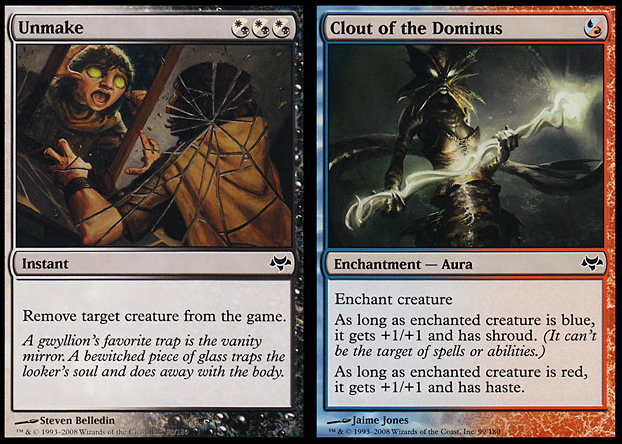
3

Winner

Buylisting for $1.46 compared to the other card's $0.39.


It isn't just foil cards either. I was going through a pile of cards from Return to Ravnica and this one made me glad I looked everything up.
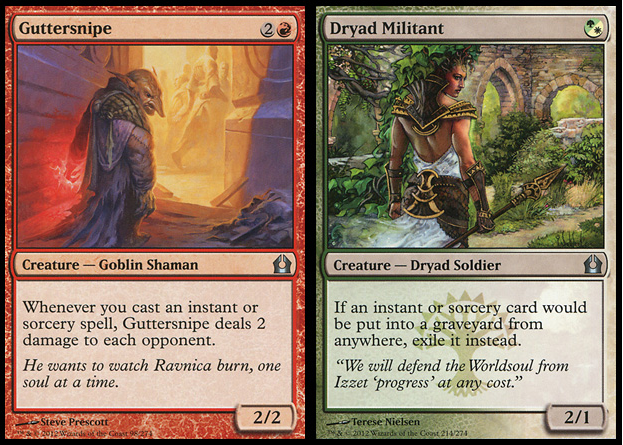
4


One of these cards is being bought for $0.50 (down from $0.75 before its reprinting in Commander 2013) and one of them doesn't show up if you set the buy price threshold at a dime.

I'm sure you've figured out that Guttersnipe is worth 10 Dryad Militants. Would you have guessed that? Maybe. But I am willing to bet that there are quite a few people out there who might pass over a card like Guttersnipe or freaking foil Kor Skyfisher when they do their picking.

A card's power, your demand for it locally and the number of times a card has been printed matter, but they aren't everything. Being a Legacy foil like Putrid Imp doesn't help it be worth more than a casual foil like Fire Servant. Being first-pick removal in Eventide draft doesn't help Unmake end up worth more than a durdly aura like Clout of the Dominus.

Are there rules to help you pick? I have to tell you, I buylist a lot and I haven't really found any rules that have helped me in my picking. What I have found is that there are certain cards, especially foils, that I am very glad I looked up.

A few guidelines may help you though.

  • Power in Standard only matters if the card hasn't rotated. No one needs Disfigure anymore, but Spreading Seas wasn't a pick and now is.
  • Cube and Casual cards are cards you may miss. I didn't know what Fire Servant did until very recently. Not a bad card at all, but no one card when it was Standard-legal.
  • Being played in Legacy doesn't matter as much as you think for cards under five years old.
  • RTFC. Not knowing what a card does isn't justification for skimming past it. We all miss valuable cards because we're not all casuals.

If you're inclined to use Trader Tools, what I do is pick a set and display just that set. Then I sort by buy price to see if there is anything above a dime that I would otherwise skip over. You pull every rare automatically, but do you pull every Child of Night? (Trick question, you shouldn't--that card isn't worth anything.)

Not every collection you get will be set-sorted, but if you spend an hour every few months checking the sets sorted in this way you may find a few surprises. If you are already picking Shrieking Affliction, great, but if you didn't know it was being bought for a dime while dealers are all set on Dryad Militant, seeing it in the list in this way is a big help.

Check store buylists and bidwicket periodically. If a card has a high buy price, it could be because the store needs copies badly in which case once you satisfy their demand the price will normalize. But it could also mean there is something you don't know and really should.

I have learned to treat these little surprises as opportunities. If these little price discrepancies surprise someone who is primarily concerned with the price of a card, they are likely to be lost on someone who only cares about a card's playability. If someone traded you a set of foil Skyfisher straight up for a set of foil Steppe Lynx, you'll both come out of the deal ahead, and isn't that the goal?

Unexpectedly, Weather

The Star City Games Open in New Jersey was cancelled due to weather so that means all I need to do is cover the Legacy Grand Prix. Mexico City had a Limited Grand Prix, but that doesn't give us much info we can use. There were some PTQs, and a lot of my friends did well in some, but those are a pain to track down and I'm sure you wouldn't mind not talking about Standard for a week, even if it's new.

I will show you one thing in Standard, though, because everyone thinks it's funny.
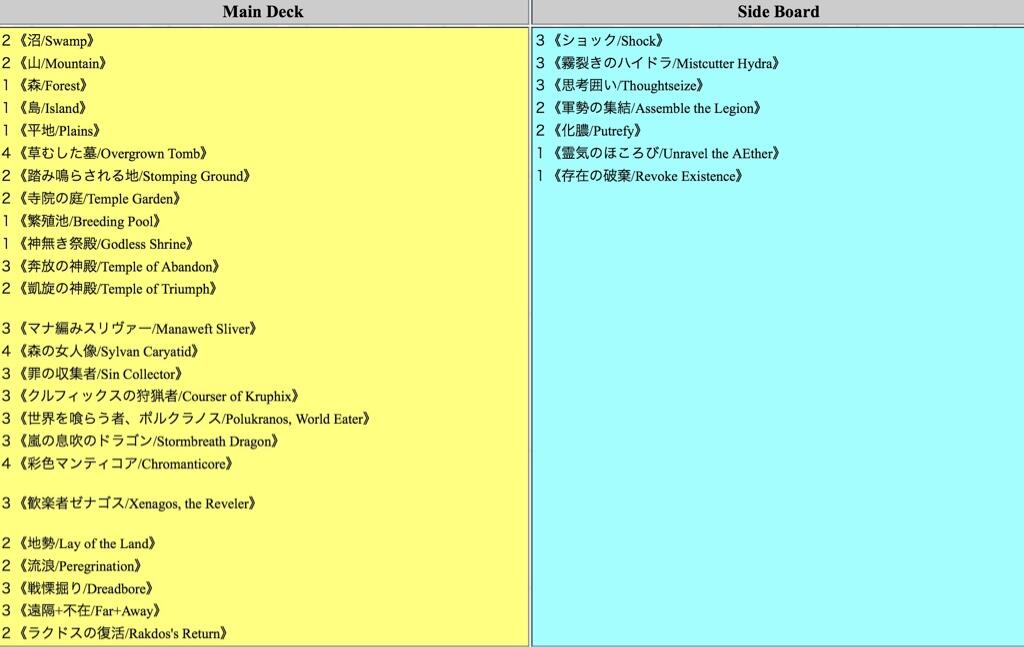
LOL CHROMANTICORE!

There you have it, ladies and gentlemen. The same people who brought us tentacle porn and used panties in vending machines have brought us a deck with maindeck Chromanticore.

For the record, I never said Chromanticore was a bad card. I said it was a stupid card, and it looked like it was designed by a nine-year old. If it finds a five-color shell where it's a Baneslayer every once in a while and pairs well with Xenagos the God, so be it. That doesn't change the fact that it's a durdle card for durdles, and should be legendary so I could build an EDH deck around it.

Let's talk about the Grand Prix in Paris, and also about why there aren't four Legacy Grands Prix a year. Actually, that last question we can tackle first. The official Wizards position on that question is "because." Now we can move on.

Let's Talk Legacy

GP Paris Coverage

Grand Prix Paris was not expected to break any significant ground, but a little bit of tech did pop up.

Armed with hindsight, we know that Sylvan Safekeeper appeared as a one-of in one sideboard. This isn't particularly new tech--the card was already good in Maverick decks.

Protecting your Mom, filling your yard with land to buff Knight of the Reliquary, and, Jesus I am dating myself here, but Terravore and even sacrificing Tropical Island against Merfolk--the card was a thing. Tutorable with Green Sun's Zenith, the card was a fine one-of.

As the sun set on Maverick, Safekeeper went with it. At its height, the card never really went above $2, and it would need significant adoption to get even that high after sinking below $1.

That's why when I saw this,

chas 1

I was a little skeptical. I am certainly not buying a card that has historically struggled to go above $2 on the basis of "some number of copies in some number of decks doing well in Paris."

I scoured coverage trying to get a glimpse of a deck tech interview, camera time, something. If this was somehow the cornerstone of a new deck I wanted to see what was what before I actually paid money. Before I saw exactly what was up, I saw another tweet.

chas 1

I figured this was an excellent test of the market. Chas shared the tech with the Finance subreddit and if I was right about that subreddit being populated by sheep, bait like that dangled in front of them would have been too much to resist. For whatever reason, that subreddit has developed its own set of criteria for what determines a good spec, and chief among them seems to be "number of NM copies on TCG Player," which isn't the worst criterion, although that information is almost meaningless on its own.

With Safekeeper starting to sell, would the sheep follow over the cliff? Was I a moron for not filling a shopping cart with the 20 copies one dealer had for $0.79? Was I missing great new tech?

Weekend results show us that the Lands deck was using Safekeeper as a one-of out of the board to protect their Merit Lage token from doom as it swung for the win. Not bad tech, certainly. Is it a reason to buy Safekeeper, especially now that the $1 copies are gone?

I was proud of and disgusted with Reddit at the same time. I was proud of them for not pouncing on this obviously iffy (to me) spec like they might have in the past. Low downside isn't a good thing if there is a historical basis for low upside as well. I expected a feeding frenzy. Instead, they were almost insulted that Chas would dare try to use them to buy the card out for him.

Now I know Chas and Chas is a good guy. There is a 0% chance that he was attempting a pump and dump here. The fact that he told people immediately on Twitter and on Reddit instead of his weekly article meant that people could buy in while there was still time to actually benefit from his tip.

It is puzzling to me that someone like Chas with a reputation to protect and who would not sacrifice that reputation for like $50 tricking people into buying Safekeeper was regarded with such suspicion, but Joe Blow Nobody with a week-old account can tell people about Fist of Suns and watch the internet sell out.

A few trolls treated Chas so poorly that he said he'd never be back. I don't blame him. He tried to do a good thing and let people in on some inside info and even the people who didn't say that he was cancer (direct quote) did, in my opinion, something much worse, and that was to treat him like he was attempting to trick them in some way.

The people who regarded him with suspicion as if he valued his reputation so little probably don't think what they did was worse than the troll who called him cancer. They're wrong.

While they seem to be getting better at evaluating specs, or at least waiting for results the way they didn't with Fist of Suns, they aren't better at evaluating motives, and that's unfortunate. Chas, if you're reading this, buddy, that subreddit needs you more than you need it, and stick to doing nice things for people who deserve it.

Safekeeper may not have panned out, but with such low upside it's not like anyone took a bath. Low risk specs like that are rare, and Safekeeper could easily have been the cornerstone of some meta-breaking deck. If Fist of Suns can hit $10 in a weekend, $1 on Safekeeper seemed, pardon the pun, pretty safe. You miss 100% of the shots you don't take.

The Decks

As long as we're talking about it, I love this Lands deck to pieces. The best part for me was that from what I can gather, the reason Kasper Euser didn't run Tabernacle is that he didn't have any. Is that why he got 14th? Probably not, but Tabernacle is a helpful card indeed. Still, eschewing it carves hundreds off the cost of the deck and that makes it attractive in my opinion. The deck is posting results and it's fun.

Elves and Sneak and Show did worse than the Lands deck to round out the Top 16 "14th place and worse" segment of the article.

We had Sneak and Show in 12th and 13th place, and none in the Top 8. A deck that had people complaining about its power level and predicting bans should have done a little better if the bellyachers are correct as they so infrequently are.

Sneak and Show is a powerful deck and gets free wins but it takes more than that to win a GP. You need consistency as much as you need luck, and having games where you get all of your enablers and no monsters or all monsters and no enablers do more to hurt the deck than any sideboard card. Combine that with a miserable mirror match and you have a recipe for a deck that is just another good Legacy deck and nothing more.

RUG Delver in 11th is no surprise. The deck ran two True-Name Nemesis which reassured me that the deck wants them. SCG Open results are all we've got, but better players means you can have a bit more confidence in the choices given the better field and longer event. I expect this is a card that belongs in this deck.

10th place's Pod deck was a surprise. Six months ago people argued with someone on the podcast (it might have been Corbin or maybe it was even me, I don't remember) who said Birthing Pod was a good pickup at $3. "It's in an event deck as a two-of, idiots" was the general tone.

Now people wonder how the card could ever have possibly been cheaper than $10. With implications in Legacy on top of its marquee status in Modern, this "feels" like a $10 card to me, and while it's most likely too late to buy in, I am confident socking these away at $10 since I expect them to hold value. Recurring Nightmare misses its friend, Survival of the Fittest, but this deck is a nice evolution of Nic Fit and I like seeing Pod in Legacy.

Esper Stoneblade made 9th and that does it for the "almost Top 8" portion. Stoneforge Mystic is looking more and more like a blue card every day with how well it pairs with True-Name and how much card advantage it can get you.

The Top 8 Esper Stoneblade deck piloted by Stefan Böttcher also ran this powerful combination, although I like Böttcher's build a bit better. Maybe it's because he makes me feel okay about all the Deathrite Shamans I am sitting on.

Jean-Mary Accart opted to run Painter's Stone against the metagame. I feel like as far as "combo" decks go, this one can see a lot of dead draws, but modern builds have made use of cards like Jaya Ballard to make sure you get mileage out of Painter's Servant if you can't resolve a stone. I like the Chandra Reuben Bresler ran in his list, but this is a stock list and it's fine. It was good enough for Top 8 after all.

Loïc Le Briand opted for Reanimator. There has been a real renaissance (pun intended) of this deck lately, which has buoyed Griselbrand's price quite a bit. I expected Gris' price to be what it is now a year or so from now and I thought I had more time to pick them up. Not so as it has seen myriad uses between Legacy and Modern and despite its banning in EDH casual players still like it, too. Expect this to be high for the foreseeable future.

Jóse Manuel Fernández Castelló decided to run BUG Goodstuff. He called it "Team America" and I suppose this was the inevitable evolution of that deck. Running smaller creatures than before and cutting Dark Confidant, the deck leans on its spells more than before.

Not as ballsy a choice as it was when Gerry T said "Screw it" and jammed both Tombstalker and Force of Will in the deck along with Dark Confidant, the deck is really benefiting from True-Name Nemesis if Delver and Tarmogoyf can't get the job done. This is always going to be a good color combination in Legacy.

Philipp Schönegger, Maxime Gilles and Paulo Vitor Damo da Rosa were all on Miracles. While Miracles didn't win the event, seeing three copies in the Top 8 bears noting. Do I think there is financial opportunity here? I don't, no. Seeing this many copies of Terminus and Entreat is interesting, but this is hardly a new deck in Legacy.

The deck didn't get better, the players did. I don't think players who are worse at Magic than PVDDR are going to pick this deck up and all of a sudden this will be three in every Top 8. Two of these Top 8 finishers have been playing this deck for years, after all. I wouldn't crack my piggy bank to buy Terminus, folks.

Javier Dominguez had the best BUG deck, in my opinion, and he won the event accordingly. I can't advocate not running Dark Confidant in this deck. Zero-mana card draw is very important and if you're cutting Tombstalker, the lower mana curve makes Dark Confidant a great choice.

He'll eat removal they could use on Delver, he is practically unblockable when your life is low and he draws cards. He's one of the best creatures ever designed and he belongs in a deck with one- and two-mana creatures.

Deathrite Shaman will always be sicko in Legacy and I don't expect Abrupt Decay's price to dip as much at rotation as some others do. I like my foil Abrupt Decays long term--I think $50 will happen sooner than I had initially anticipated. There may be a bit of a dip at rotation, but with as many poised buyers as sellers, I wouldn't bet on a precipitous one.

No pet decks in evidence, if you ask me, besides Elves although that's been a real contender of late.

Verbosity

That does it for me this week, folks. How I managed 3,400 words on a week where I thought I'd get to take it easy because of the SCG Open being cancelled, I'll never understand.


Zero to Draft – Free at Last, Free at Last

Are you a Quiet Speculation member?

If not, now is a perfect time to join up! Our powerful tools, breaking-news analysis, and exclusive Discord channel will make sure you stay up to date and ahead of the curve.

Zero to Draft Series: Part 1 | Part 2 | Part 3 | Part 4 | Part 5 | Part 6 | Part 7


Insiders may be familiar with this series already, but I’m excited to introduce it to an expanded audience here on the free side of Quiet Speculation. I’ll still be writing weekly Insider content, but for reasons I’ll explain below, we’re making Zero to Draft free to read. How things will go from here will be partially up to you, the readers. But first, let’s get everyone on the same page.

The Project

I started Zero to Draft with the Theros prerelease. My goal was very simple: to draft as much as possible for as little as possible. Frankly, I want to play Magic for free. If you’re visiting Quiet Speculation, you’re likely in a similar boat. This is an expensive game we play, and any way to mitigate that fact is welcome to us all.

Starting with the Theros prerelease, I tracked every dollar I spent to play in Limited events. Any cards I sold or traded were noted. All the cards I ended up with were kept separate from my personal collection in order to maintain the purity of the project. I never opened any prize packs ever, except to play Limited. After my last Theros draft, this was the state of the project:

Events played: 14 total – 12 Draft, one Sealed, one 2HG Sealed
Money spent: $114
Money received from card sales: $100.52
Buylist value of trade binder: $79.78
Net money spent: -$66.30
Packs held: 0
Draft record: 24-5
Sealed record: 3-1
2HG Sealed record: 2-2

The Problem

From the prelease to the very last triple Theros draft, I came out $66.30 ahead while playing in 14 separate Limited events. I achieved my goal of playing for free and then some, but it soon became clear that keeping articles on the project financially relevant was more difficult than I anticipated.

This is partially because I’m not trading much these days. I’ve identified very few opportunities in Standard lately, instead focusing my speculative efforts on Modern cards. Given that players who draft frequently are mostly packing draft leftovers in their trade binders, I just didn’t see many cards I wanted to acquire during the past several months. In addition, I haven’t opened a whole lot of money cards during much of this project, so I’ve lacked trade bait in general.

Insiders are primarily paying for financial content, and while I tried to incorporate some into my Zero to Draft articles, the project just didn’t provide enough material to always keep things focused on finance. So I wrote articles in the series infrequently, trying to save up material, but then details got lost in the shuffle. I’ve continued tracking stats, but it’s been quite a while since I wrote an update.

Free at Last

Basically, I think the Insider audience was wrong for the series, and that’s why we’re moving it to the free side of the site. This will allow me to occasionally put emphasis on topical non-financial matters. At the same time, the series will still ultimately be about my quest to play for free, and hopefully the incidental financial advice that comes along with that will help others do so, too. The first step to becoming a full-fledged financier is becoming a financially-minded player, and if you’re not in that mindset yet, I want to help you get there.

I’m also passionate about Draft. It consists of the vast majority of the matches I play. I’m an avid listener of the Limited Resources podcast and a huge fan of its nuts-and-bolts-Spike mentality. To the extent that I don’t travel to GPs or PTQs, I’m a casual player. But my mindset is competitive: I’m looking to win as many drafts as I can, make as few mistakes as possible, and consistently improve my game. I draft several times a week on MTGO, and while I do well enough to draft at a fraction of the list price, I’m not satisfied. I’m ready to level up.

One of the best ways to become an expert at a subject is to teach it to others. I’m a pretty good drafter, and while I haven’t won any major Limited events, I draft often enough to become very familiar with current formats. This experience gives me insights and knowledge that I can share with you, the readers. This doesn’t mean that I consider myself to be an authority on drafting. I have learning to do, too, so feel free to share what you know in the comments! A collaborative effort will help us all improve our games, which I expect is a goal of every Magic player.

Moving Forward

So the focus of this series is shifting. The fact is that building a collection three packs at a time (or six packs on occasion), is slow going. Each installment will address the financial implications of my most recent draft(s), but sometimes the only update will be the addition of some bulk and maybe a trade or two. I’m going to make it fairly easy to follow along with the financial goal of the project, but the majority of words I write here will now be focused on non-financial topics, mainly Draft strategy.

I considered the possibility of starting again from zero so that new readers could follow the series from the ground floor, but like I said, building a collection one draft at a time is not a fast process. I don’t think it’s a stretch to share the contents of my trade binder and assume that new readers can extrapolate how such a folder has been assembled over the course of several Limited events and a few trades here and there. If you disagree with me and strongly believe I should be starting fresh, let me know. In any case, here’s the trade binder with which I’m currently working:

Zero to Draft Trade Binder

White

1 Elspeth, Sun's Champion
1 Heliod, God of the Sun
2 Hundred-Handed One
1 Silent Sentinel

Blue

1 Fated Infatuation
1 Thassa, God of the Sea

Black

1 Abhorrent Overlord
1 Agent of the Fates
1 Eater of Hope
2 Erebos, God of the Dead
3 Hythonia the Cruel
1 Liliana of the Dark Realms
1 Thoughtseize
1 Whip of Erebos

Red

1 Felhide Spiritbinder
1 Forgestoker Dragon
1 Titan of Eternal Fire

Green

1 Arbor Colossus
2 Bow of Nylea
1 Hunter's Prowess

Multicolor

2 Ashen Rider
2 Steam Augury
1 Tymaret, the Murder King
1 Xenagos, the Reveler

Artifact

1 Colossus of Akros

Land

1 Temple of Plenty
1 Temple of Silence
1 Temple of Triumph

Foils

1 Erebos, God of the Dead
1 Fleshmad Steed
1 Thassa's Rebuff

The Holding Section (not currently for trade)

1 Arid Mesa
2 Demigod of Revenge
1 Gilded Lotus
1 Prime Speaker Zegana
4 Prognostic Sphinx

Bulk Commons and Uncommons

1000 or more

It’s nothing special, but there’s a few sweet cards in there. I recently sent in a buylist order, so I got rid of a few of the more overpriced cards I had. I was particularly happy to get an absurd $3.50 for a copy of Pain Seer I opened at the prerelease. I could not get out of that card fast enough (and there’s some of that incidental financial advice I promised).

Speaking of the prerelease, it went quite well. I played only one event, a Two-Headed Giant Sealed tournament with my wife. She opened the Elspeth listed above, and it did not underperform. We managed a 3-0-1 record, taking home 14 packs in addition to a pile of cards worth close to the $50 entry fee (Xenagos and two Temples were also in that pool).

I also participated in my first Born of the Gods draft recently. After some incredibly close matches, I was able to split the finals. It was also the most financially advantageous draft of this entire project so far, considering I opened both Thassa, God of the Sea, and Thoughtseize. Yes, I think Born of the Gods-Theros-Theros is going to go just fine…

Here’s my updated Zero to Draft stats:

Events played: 16 total – 13 Draft, one Sealed, two 2HG Sealed
Money spent: $164
Money received from card sales: $111.32
Buylist value of trade binder: $124.95
Net money spent: -$72.27
Packs held: 14
Draft record: 26-5
Sealed record: 3-1
2HG Sealed record: 5-2-1

Please let me know in the comments or on Twitter, @dbro37, what you’d like to see from this series. There are many ways it could go, and you have a chance to shape the direction I take things with your feedback. Thanks for reading!

Want Prices?

Browse thousands of prices with the first and most comprehensive MTG Finance tool around.


Trader Tools lists both buylist and retail prices for every MTG card, going back a decade.

Quiet Speculation