If not, now is a perfect time to join up! Our powerful tools, breaking-news analysis, and exclusive Discord channel will make sure you stay up to date and ahead of the curve.
Star City Open Series is a great way to stay on top of Standard and figure out what cards are moving.
Standard
Last week some new deck variants popped up at the Star City event in Richmond, but none of the decks were entirely new archetypes. Tempered Steel won the event, while the Top 16 was littered with U/W aggro-control decks including Humans, Delver of Secrets, and Mage Blade. Heartless Summoning and Mono Green were also present. The Mage Blade deck ran a singleton Dungeon Geists, which I was interested to see. I’m watching this guy very closely.
Mono Green is a deck I had personally tested a bit, but Todd Anderson’s version at this event was a little different than what I had pieced together. While I was surprised to see no Vorapede, it did include a singleton Bellowing Tanglewurm(?!), which doesn’t mean it is a card worth picking up, but shows that maybe Vorapede isn’t going to do anything.If Tanglewurm is getting the nod over Vorapede in a Mono-G Deck, I don’t know that Vorapede will ever be good enough.
Max Brown made 16th place with Mono-G as well and his deck was a bit different, but still no Vorapede. I do like to see Wolfbitten Captive in there, as he is a pretty powerful 1-drop.
This means we may see another brief spike on Dungrove Elders. I’ve been holding onto a set of mine, and as soon as that spike hits the market, I’m hoping to get out.
The best information I see from this event is that Vorapede is not playable. If Mono-G ramp decks can’t make use of it, what can? It looks like we’ll need a Titan rotation before this guy sees any play.
But, for the most part, the format hasn’t shifted too much since Dark Ascension was released on us, at least until we see the Pro Tour decks in just a few short days.
As new decks pop up, you’ll want to be ready to jump on them. The best place to be is at your LGS for FNM. Day one will still be wrapping up by the time your event is in full swing, and swooping in an scooping up any surprise cards right from the display case will be easy pickings.
It also gives you an opportunity to start trading for key staples before everyone else is informed about new decklists. Have bookmarks ready in your smart phone and scope it out between rounds.
Legacy
The Legacy portion of the Star City event did bring some interesting developments.
Tezzeret Control made Top 8. I’d since given up any hope on Tezzeret, Agent of Bolas rebounding at all, but this dedicated Tezz deck breathes some life back into this tired Planeswalker. Using key defensive artifacts like Ensaring Bridge and the newly printed Grafdigger's Cage, alongside the Thopter Foundry/Sword of the Meek Combo. I haven’t yet dumped my Tezzerets, but now I may wait and see if they climb back up at all.
Another deck I want to peek at is the Legacy Pox deck I’ve seen various iterations of recently. While most of these pieces aren’t great speculation targets, Liliana of the Veil as a 4x is certainly notable. She also sees play in the Modern Deathcloud deck, and makes an occasional appearance in Standard. She may not come down much more if you’ve been waiting to get in on some.
Stoneforge Mystic is still all over the format, both in Stoneblade and Maverick varieties, and I think it may have finally found a bottom it can rebound out from. Despite bannings in Modern, this card will be all over Legacy until banned there as well. There’s just too much awesome stuff it can do in that format. If you don’t have a set, now’s a good time to pick one up. They ring in at about $5-6 a pop on eBbay (and $7.99 on SCG), but I’ve been able to find them cheaper in trades.
The other notable card is Chain Lightning. Burn’s resurgence in Legacy combined with its playabiltiy in the Tempo style decks along side Lightning Bolt has seen this card start to climb over the past month. If you want a cheap deck to get into, Burn has always been the ticket but is rarely on top of the metagame for long. If I had any of these, I’d be looking to move them out while I can.
Thanks for catching up on the tournament coverage with me. Watch my Twitter Feed (@torerotutor) for my input on the new decks and cards. I have a couple friends playing and I’ll be following the entire event closely.
If not, now is a perfect time to join up! Our powerful tools, breaking-news analysis, and exclusive Discord channel will make sure you stay up to date and ahead of the curve.
At first glance, Dark Ascension appears to be underpowered relative to recent sets. Some people have gone as far to say that the set’s value is lower as a result. I, too, have reacted in this way.
Perhaps it was naïve of me to assume there would be very little in terms of financial relevance in Dark Ascension. So I’m taking a step back to reassess things. Statistically speaking, it seems highly unlikely that every card from this newest set other than Sorin, Lord of Innistrad will be destined for the dollar bin.
Star City Games: Richmond
As of the time I am writing this article, there is really only one notable tournament that highlights the beginnings of Dark Ascension’s impact on Standard: Star City Games Richmond. Naturally the first thing I want to do as part of my reassessment is to consider what new cards have been making a splash.
Standard always goes through a period of transition when a new set is released, and this is no exception. Even though Dark Ascension’s power seems underwhelming upon first glance, I still need to have respect for potential new archetypes. That being said, I need to be very careful.
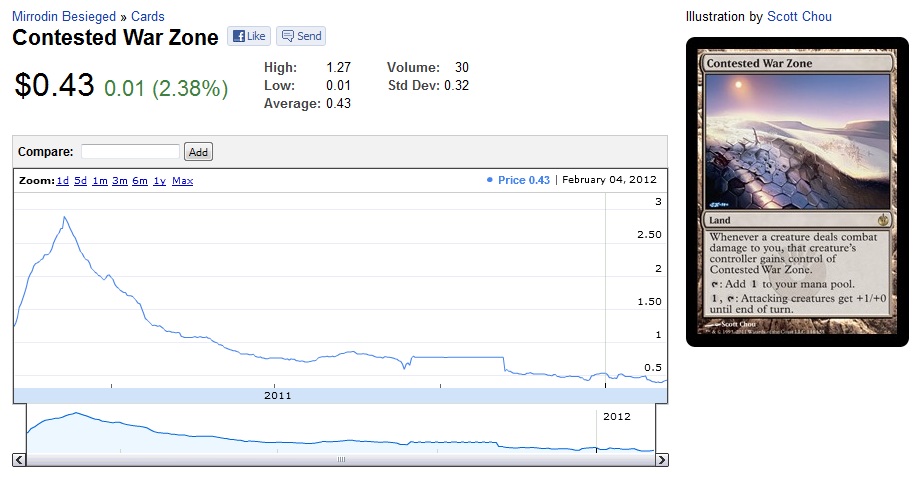
I only managed to attend one Star City Games tournament in 2011, in Indianapolis. At that time, Mirrodin Besieged had just been released and it was the first weekend where this set was legal. Cards like Go for the Throat and Black Sun's Zenith were exciting people all Saturday morning. But there was one card that fetched even more attention that day. (chart courtesy of blacklotusproject.com)
The card was Contested War Zone, and it was exchanging hands on site as high as six dollars. Thanks to this card, Kuldotha Red became a tier one deck on that day. I remember starting 2-0 at that tournament before getting smashed round 3 by this deck, even losing on turn four of game 2 thanks to some mana screw.
A quick look at the above graph shows how evanescent Kuldotha Red’s tenure in Standard truly was. In fact, the deck is still completely legal in Standard, yet Contested War Zone now sells for less than $0.50 on eBay. There is a valuable lesson to learn from this anecdote – one successful tournament when a card is brand new does not imply a promising speculation buy.
Back to Today
Right now the time is 6:42pm on Saturday, so the Star City Games tournament has not reached Top 8 yet. Therefore, there are no published lists yet (I’ll come back tomorrow to check the lists and update this article, don’t worry!). Since I have been busy most of the day, I have been unable to watch the live coverage. For now, all I have to go by is this short paragraph on Star City’s homepage:
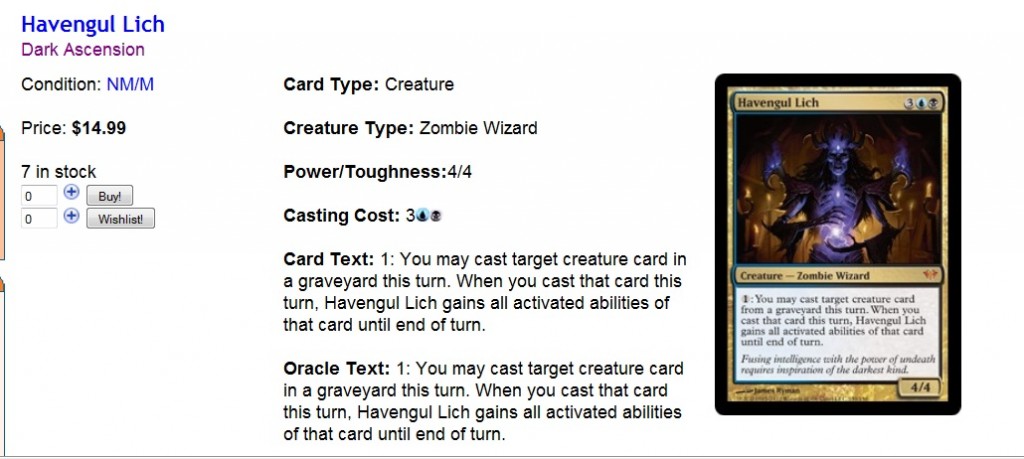
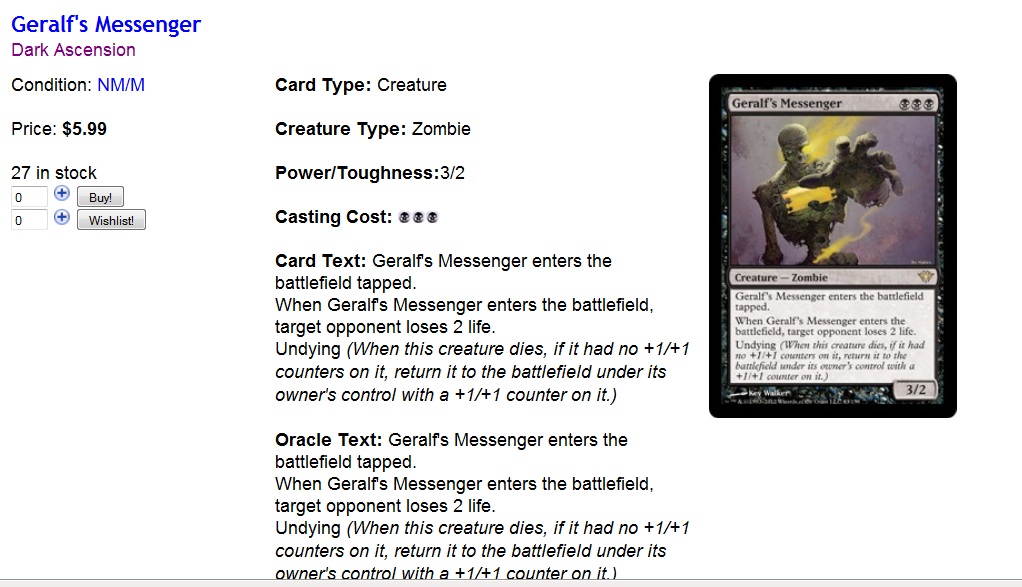
The StarCityGames.com Richmond Open Series is winding to a close, and it’s been an eventful Saturday so far. Heartless Summoning has suddenly begun turning heads, powered by Dark Ascension’s Havengul Lich and a number of large creatures. National Champion Ali Aintrazi is piloting the deck, but he’s not alone… Control and aggro are both showing up in strong numbers, with Dungrove Elder, Champion of the Parish, Delver of Secrets, and Geralf’s Messenger headlining new aggressive strategies—Mono-Red has some competition!
Based on this assessment alone, it seems like Heartless Summoning has become a card thanks to Havengul Lich. Additionally, Green aggro decks may finally have breached tier one status, though it’s not clear why. Dungrove Elder has been around for a while so there must be some other factor. I’ll have to dig further when I look at the lists tomorrow.
Of the final cards mentioned specifically, only Geralf's Messenger is from Dark Ascension. Thus, we have two cards from Dark Ascension that may try to break the preconception that this set is underpowered.
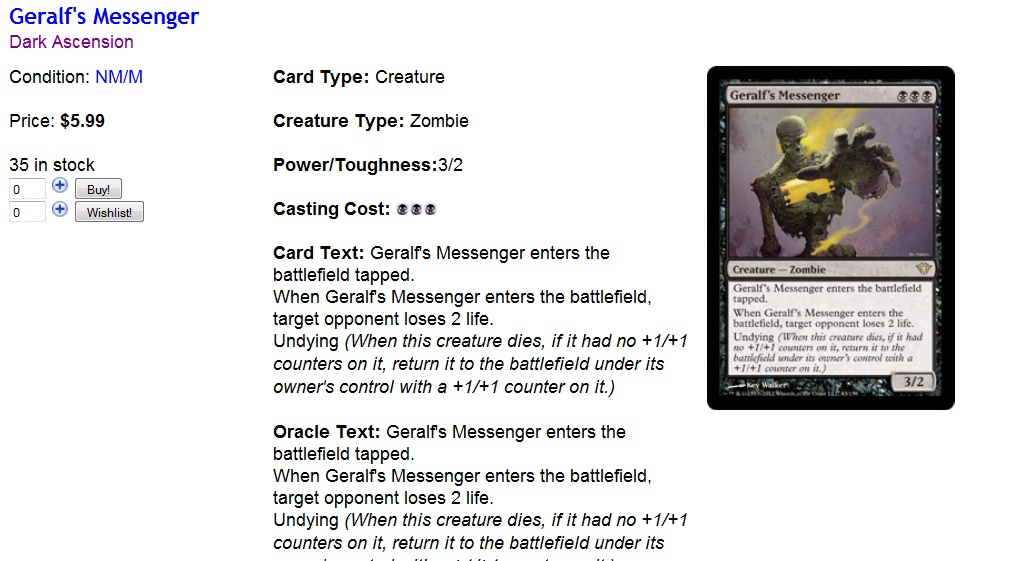
Checking Star City’s stock, it seems that there are 7 Havengul Liches in stock at $14.99 and 27 Geralf's Messengers in stock at $5.99. But as tempting as it is, I don’t believe it’s time to buy.
I’m going to wait until Sunday to see the Top 8 deck lists and to recheck stock on these cards. While I have to actually wait until tomorrow morning – over 12 hours – to see these lists and digest them, you merely have to scroll down…
…
…
It is now 9:30am on Sunday – let’s see how Dark Ascension’s cards have done.
Where Have All the New Cards Gone?
And our Top 8 decks include:
Deck Name – # in Top 8 - # of DKA cards in main deck
U/W Delver – 2 – 0,4 (1x Faith's Shield, 3x Thought Scour)
Esper Delver – 1
Solar Flare – 1 – 2 (Tragic Slip)
Mono Green – 1 – 4 (4x Strangleroot Geist
U/B Heartless Summoning – 1 – 6 (4x Tragic Slip, 2x Havengul Lich)
Wolf Run White – 1 - 0
Tempered Steel – 1 - 0
So it appears the Heartless Summoning deck and Mono Green decks managed to make Top 8! They unfortunately lost in the quarter finals, but they still earned some level of respect.
Turning my attention toward Dark Ascension cards, there is some evidence that supports many speculators’ initial hypothesis – these cards may be underpowered in this Standard format. Only five unique cards found their way into the Top 8 main decks, with the only rare/mythic being Havengul Lich.
What Does it all Mean?
The format is still in its infancy. There will be months of time during which Pros and Amateurs alike will be brewing up new ideas. As of right now, though, I see very little reason to jump in head first on speculations from Dark Ascension. In fact, I would be much more inclined to pick up Tempered Steel cards and Mono Green aggro cards before moving into anything from Dark Ascension.
It’s interesting to note that there was no card similar to Contested War Zone within Dark Ascension. Or if there was, it certainly had no real impact on the format. Yet.
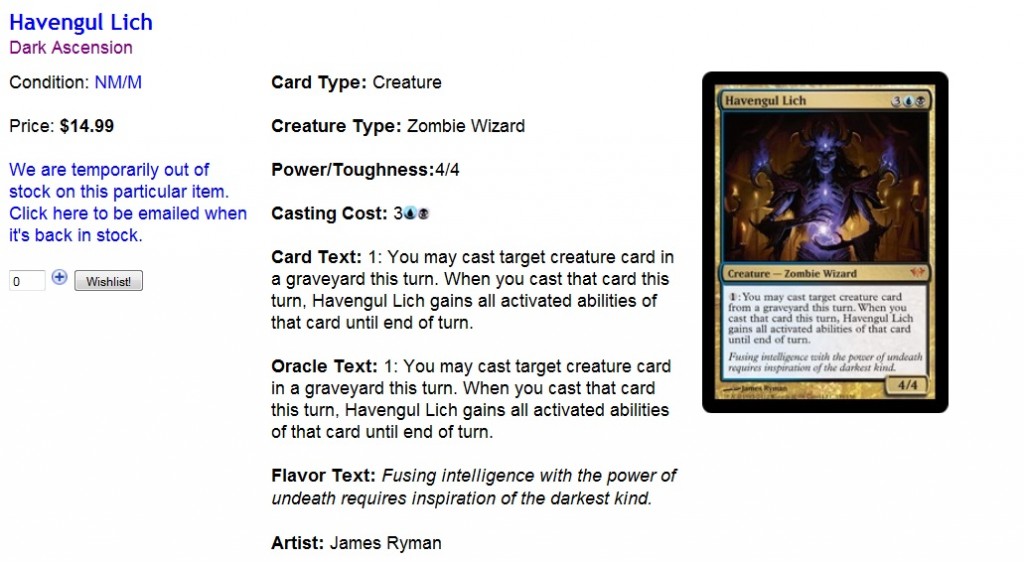
Before I close I want to revisit the two cards I looked up on Star City’s website to see if the price and/or quantity changed.
I am so excited that this little experiment was informative! In about fifteen hours, Havengul Lich moved to sold out status on Star City Games. It won’t be long before they increase their price to $20 as a result. My advice: if you can trade for them at $15, it couldn’t hurt too much. But I would certainly not rush to Star City Games as soon as these are back in stock and buy them out. As I learned from the Contested War Zone fiasco, one successful stint in a young format does not make a card a hit.
I can make an interesting observation here as well. After getting some hype from Star City’s own website, the card did not make any splash in the Top 8 of SCG Richmond. Result? The stock on this card increased from 27 to 35 - a reflection of this card’s disappointing performance.
This concludes my journey into the early tournament impact of Dark Ascension. In all honesty, none of these results really surprised me. My initial reaction to this set’s spoiling was that it is relatively underpowered. The sacristy of cards from Dark Ascension in this Top 8 only solidifies my assessment. And while Havengul Lich may have earned itself the spotlight for the time being, I see very little opportunity to jump in on any particular card.
While this format sorts itself out, my primary focus will be on cards from Scars block and M12 which made a recent splash here. Dark Ascension cards, on the other hand, will have to simply wait.
If not, now is a perfect time to join up! Our powerful tools, breaking-news analysis, and exclusive Discord channel will make sure you stay up to date and ahead of the curve.
Having been reviewing preconstructed Magic decks for some eighteen months now, it's not at all unusual to get comments from readers on older articles that reviewed a deck they were interested in. And so it was some time back on our article of the Magic 2012 Booster Battle Pack release, "I do wish they had these booster battles for non-core sets, would be neat to play ISD only." I suggested in my reply that it might be a fun thing to build, but it stuck in my mind a bit until I decided I'd give it a try myself!
For those unfamiliar, the Booster Battle Packs were a riff on the popular "Pack Wars" limited format where you take an unopened booster pack, some land, and shuffle them together. Last September's product was an attempt to give the format a little bit of shape and direction. Each pack came with two boosters as well as "two 20-card semi-randomized decks."
What this really meant was that each player would get two 10-card packets which contained five cards of a single colour (four common, one uncommon) and five of the corresponding basic land. To mix things up, Wizards designed two different packets for each colour, many of which explored a small sub-theme or aspect of the colour represented. The randomness came in which packets you found waiting for you when you opened the Battle Packs up, but in all cases you got a nucleus for a 25-card two-colour deck, as you'd open the booster pack and pick exactly five cards from it.
This was a novel way to play with Magic 2012 cards. But what if we took the same approach with Innistrad?
Today I'll be building ten sample packets for some Innistrad pack wars, which is a great way to teach and develop those folks who may be new to the game, or just have a bit of fun yourself.
We'll break down the Magic 2012 packets to give us an idea of what Wizards' intent was and then rebuild using Innistrad cards. Together with some Dark Ascension booster packs, you've got a fully operational Death Star limited format! Here goes!
White
M12 White A
Armored Warhorse
Divine Favor
Pride Guardian
Siege Mastodon
Serra Angel (U)
M12 White B
Angel's Mercy
Griffin Rider
Griffin Sentinel
Peregrine Griffin
Roc Egg (U)
As you can see in these first two packets, there was some thought given behind how each packet would be composed. In this case, you have two different facets of White creature-based strategies.
Packet A has the ground forces of the lot, with a solid aerial finisher in the Serra Angel. The Divine Favor gives you a bit of a battlefield boost for one lucky trooper, with a dollop of lifegain thrown into the mix.
For packet B, we have the core of a skies deck, including a nifty interaction between
cards focused on the Griffin Rider. One thing to bear in mind here is that these cards form the core of a deck in miniature- 25 cards is not a lot, so even with singletons you'll have a good opportunity to draw and play them. Add to the fact that these quasi-Limited matches tend to be a little on the slower side and you see that the Griffin Rider is a solid pick here.
For Innistrad, we'll be mirroring these two constructions.
INN White A
Avacynian Priest
Elder Cathar
Moment of Heroism
Thraben Purebloods
Spectral Rider (U)
This is your 'ground forces' core, with a combat trick (Moment of Heroism) thrown in. The Avacynian Priest is a good lockdown/stall card, and can pry open a defense to help keep the beats rolling. Thraben Purebloods is a functional reprint of Siege Mastodon, and a good finishing beater as its high toughness can be hard to deal with.
For the uncommon slot, while the Fiend Hunter is considerably stronger than the Spectral Rider, I kept the power level deliberately lower in keeping with the original, but you could just as easily make the substitution to give this player an extra dose of removal. It should also be noted that in a Booster Battle Pack there is no colour overlap between packets, so if you get the White one, your Rider is free and clear!
INN White B
Abbey Griffin
Chapel Geist
Doomed Traveler
Voiceless Spirit
Midnight Haunting (U)
For our skies construction, we have an easy recourse to the Spirits tribe - though the [/card]Abbey Griffin[/card] makes a fine midrange body. Our uncommon here is a creature card and surprise removal all in one, Midnight Haunting. Mausoleum Guard would be alright as well, but you'd have to find room for another noncreature card, as each pack had at least one.
Blue
M12 Blue A
Aether Adept
Amphin Cutthroat
Coral Merfolk
Jace's Erasure
Belltower Sphinx (U)
M12 Blue B
Cancel
Chasm Drake
Frost Breath
Skywinder Drake
Azure Mage (U)
Again the pattern is clear here, taking two different aspects of the colour and highlighting each.
For pack A we see a milling sub-theme through the enchantment Jace's Erasure and the Belltower Sphinx. That's not a lot of arrows in the quiver, but the tactic is aided by the small size of the deck as well as in the slower pace of the format. You also want to be careful not to overload a packet, which can gain a serious advantage if the corresponding booster pack has a lot of cards that support that strategy.
The second pack gives you your aerial option, much as it did in White. You also get some of Blue's signature element - countermagic - as well as a combat card in Frost Breath. This pack had a lot of special effects to help take over the later game, such as the Chasm Drake's passenger ability as well as the card-drawing mana sink of the Azure Mage.
For Innistrad, we'll need to change things up a bit.
INN Blue A
Fortress Crab
Selhoff Occultist
Spectral Flight
Stitched Drake
Curiosity (U)
INN Blue B
Claustrophobia
Frightful Delusion
Moon Heron
Stitcher's Apprentice
Murder of Crows (U)
There was a certain temptation to invert Blue A, turning it from a minor offensive mill theme to a self-milling theme to take full advantage of Innistrad's various incentives for doing so. Deranged Assistant, Stitched Drake, Armored Skaab and Skaab Goliath would form a superb nuclear core for such a deck, with a Dream Twist to round it off. The problem here is that such a construction would run a very real risk of self-decking with only 28 cards left in the library after you draw your initial hand.
Another consideration worth mentioning is that this is a product largely keyed to the novice. It's been well established that self-milling is a "feel-bad" tactic for newer players, so it might be something we avoid this time around. By the same token, we're also excluding all dual-faced cards. Though they'd make for some entertaining inclusions, we'll take our cue from the Intro Packs and make do without.
Back to our packs. We'll include a Selhoff Occultist in pack A for a dollop of offensive milling, the Crab for some defense, and give the merest hint of what is possible with your graveyard by including the Stitched Drake. For our uncommon, we're going with Curiosity for some card drawing. As a creature aura, this will go well with the Stitched Drake or any other evasive creature we find. For B, we want something a little more aggressive to contrast the two packets, so we're going with some birds in the air and some removal and countermagic.
Black
M12 Black A
Disentomb
Mind Rot
Sorin's Thirst
Zombie Goliath
Sengir Vampire (U)
M12 Black B
Bloodrage Vampire
Duskhunter Bat
Taste of Blood
Tormented Soul
Vampire Outcasts (U)
Notice the theme that jumps out of Black B? Bloodthirst! Everything there either enables it or takes advantage of it, and with that being a set mechanic we have carte blanche to make a replacement packet however we like. Packet A by comparison is a much more generic construction, with some typical Black effects (draining, discard, recursion) and a couple fat beaters. With Innistrad as heavily tribal as it is, these packets almost create themselves!
INN Black A
Ghoulcaller's Chant
Ghoulraiser
Rotting Fensnake
Walking Corpse
Abattoir Ghoul (U)
INN Black B
Markov Patrician
Stromkirk Patrol
Typhoid Rats
Vampire Interloper
Tribute to Hunger (U)
Both of these packets are similar in composition, drawing almost exclusively upon Black's tribes for the set. That said, there's enough differentiation between them that they don't feel like carbon copies of one another. For A's uncommon, we passed up the Diregraf Ghoul. A strong second-turn 2/2 attacker, they go rapidly downhill when drawn later in the game. The Abbatoir Ghoul is more expensive, but it is useful at any point and keeps us on-theme with the Zombies.
A shortage of suitable Vampires forced the inclusion of the Typhoid Rats in pack B, but they also can come in handy. Even when drawn late, they can be a strong defensive threat thanks to their deathtouch. It was a bit of a coin toss for the uncommon slot, as Falkenrath Noble would do a job there as well. Consider bringing along Dead Weight if you decide to go that route instead.
Red
M12 Red A
Chandra's Outrage
Fiery Hellhound
Firebreathing
Goblin Tunneler
Volcanic Dragon (U)
M12 Red B
Blood Ogre
Goblin Fireslinger
Lava Axe
Shock
Stormblood Berserker (U)
It might not jump out at you, but packet A for Red actually contains a fairly clever little interaction. Use the Goblin Tunneler to make a low-power, pumpable creature unblockable, then pump them up once they get in for damage. The Fiery Hellhound combos perfectly here, but any small weenie will do when you've got access to a Firebreathing. As we saw above in Black, Red also comes equipped with a bloodthirst-theme, meaning we'll be starting from scratch there. As with Black, though, we can easily fill the gap with a tribal core.
INN Red A
Ashmouth Hound
Harvest Pyre
Kessig Wolf
Pitchburn Devils
Skirsdag Cultist (U)
This packet seems to hearken back to the old Bard's Tale/Wizardry computer games when your party would be attacked by the most random and ridiculous gaggle of unrelated mobs you could possibly imagine. Since we're passing up Werewolves, we have to make do with what we get. Fortunately, there are still some synergistic options available to us.
The Pitchburn Devils offer up a free Lightning Bolt when they die, and if you happen to pop them with the Skirsdag Cultist (perhaps in response to removal) you get a free Shock to go with it. It would be a shame to let all that killing go to waste, so there's a handy Harvest Pyre to stack the bodies onto to help eliminate your opponent's biggest threat.
INN Red B
Bloodcrazed Neonate
Crossway Vampire
Night Revelers
Vampiric Fury
Rakish Heir (U)
Aaand here's the thematic choice! The all-singing, all-dancing, all-Vampires troupe, you don't need to open any others in your booster to still get some good use out of the Vampiric Fury or the Rakish Heir, though of course the more the merrier. Regardless of which creatures you end up with, the [card Bloodcrazed Neonate]Neonate[/card] becomes a must-deal-with threat, and the Crossway Vampire can blunt your opponent's best defender to help you go for the jugular with one last attack.
Green
M12 Green A
Garruk's Companion
Gladecover Scout
Plummet
Stampeding Rhino
Overrun (U)
M12 Green B
Giant Spider
Greater Basilisk
Sacred Wolf
Trollhide
Lure (U)
Alas, poor Green. Sadly typecast in the role of red zone beaters, you don't find a great deal of differentiation between these two packs. Both the [card Garruk's Companion]Companion[/card] and [card Spampeding Rhino]Rhino[/card] in packet A have trample, but everyone gets invited to that party once you land your Overrun.
Meanwhile, packet B promises a brutal Greater Basilisk + Trollhide + Lure combo to kill off your opponent's best three defenders while the rest of your army rushes past, but doesn't give a great deal of flavour besides. Luckily, Innistrad's bursting with it, so let's make two very distinctive replacements.
INN Green A
Ambush Viper
Darkthicket Wolf
Orchard Spirit
Ranger's Guile
Lumberknot (U)
INN Green B
Festerhide Boar
Prey Upon
Somberwald Spider
Woodland Sleuth
Boneyard Wurm (U)
Packet B gives us a fair sampling of Innistrad's morbid mechanic. If there's a weakness there, it's that these creatures tend to be a bit on the expensive side, to to even that out we have a couple of cheap options. The Boneyard Wurm only gets better as the game goes long, and in the creature-heavy limited environment of pack wars, you can expect casualties in the red zone. To force the issue, there's also a Prey Upon. In this packet, it should work for you almost every time - even if you use it to 'fight' one of your useless weenies against a better creature, your own chump's death will give you a morbid trigger!
For packet A, you get a more rounded sampling of Green's creature power. The Ambush Viper is occasionally exaggerated as "Green's Doom Blade," but there's no mistaking that it has some strong killpower as a surprise blocker. The Orchard Spirit gives you some evasion while Lumberknot can become very large very quickly. Ranger's Guile is there for a combat trick as well as a way to counter your opponent's targeted removal.
For each packet, you'll want to throw in five basic lands of the appropriate type. Then all you need is two booster packs of Innistrad and a friend, and you're good to go!
The Contest
To the winner go the spoils!
We'll be giving away an "Innistrad Booster Battle Pack," sleeved and ready for play, to one lucky Quiet Speculation reader!
The prize package includes every card listed above from Innistrad - all ten packs. Each pack is fully sleeved, containing the five cards listed in each packet above, five land of the appropriate type (also sleeved), as well as three empty sleeves for the cards you pick out of your boosters.
Boosters? That's right! We're throwing in four Dark Ascension booster packs to get you started on your path to Limited gameplay! And just to make sure you've got something more tangible than glory to play for, we've even thrown in a prize - a pair of foil, promo Mondronen Shaman, the giveaway for Dark Ascension's release parties.
This will be a random drawing from all participants, and will end on Monday, 20 FEB, with the winner to be announced in the next Magic Beyond the Box feature.
Here's how you enter:
1. Leave a comment on this article in the comments below. Simply let us know what you thought of the original Booster Battle Packs or of the new one we've created above. If you would have done it differently, what might you have included? Was there anything we left out? Is this a good way to tech new players Limited, and, if not, do you have any ideas of your own? Any of these questions are fine, or leave some comments of your own! As ever, it doesn't have to be the great American novel, but we always like to hear the community's thoughts - especially when Wizards attempts something new. Doing this will get you an entry in the pot.
2. If you retweet the "official contest announcement tweet" on Twitter (from me, @ErtaisLament), you'll get another chance to win as well!
If not, now is a perfect time to join up! Our powerful tools, breaking-news analysis, and exclusive Discord channel will make sure you stay up to date and ahead of the curve.
So last week was the Dark Ascension Prerelease, which was awesome! I managed to pick up all of the cards from the new set that I needed, won some packs, and had a great time. But because I'm degenerate, I decided to go to the release event this week as well, half hoping to go 0-2 drop and go play some Commander.
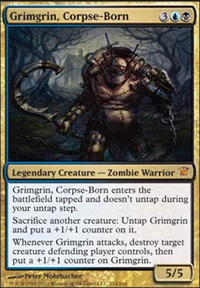
In my pool I had the fortune of opening Grimgrin, Corpse-Born and Gravecrawler. I won more than a few games by "going off" with those two. Sometimes Falkenrath Noble joined the party. Other times I got to loop Ghoulraisers to keep Grimgrin going.
Needless to say, I was hooked after that and immediately set about building a Grimgrin deck out of whatever pieces I had around that weren't already in decks. I really wanted the deck to be more on the low-powered and budget end of the spectrum, since most of the decks that I have right now are pretty well tuned and heavily invested in.
As mentioned in the recent Slobad article, you can get a lot of value from sacrificing creatures to Grimgrin. You can protect your guys from removal like Swords to Plowshares. What I really want the deck to do is to loop Gravedigger effects as a slow but powerful recursion engine and a way to power up Grimgrin.
Gravedigging
Gravedigger
Warren Pilferers
Pit Keeper
Ghoulraiser
Cadaver Imp
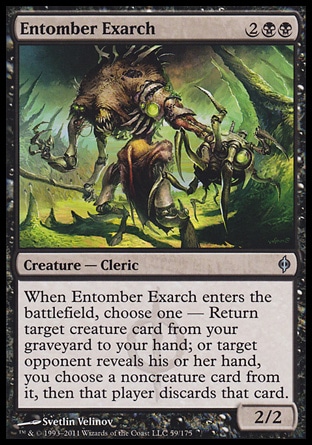
Entomber Exarch
Grave Scrabbler
Gravecrawler
Phyrexian Reclamation
Dawn of the Dead
Cackling Counterpart
Mimic Vat
Nezumi Graverobber
Morgue Theft
Tortured Existence
The plan for this deck is for it to be mostly commons and uncommons, built around generating incremental value with creatures that like hitting the graveyard over and over. The gravediggers are a huge part of this, since they let you keep rebuying other value guys or other gravediggers, keep a presence on the board at all times, and have a constant source of food for Grimgrin.
The two worst cards here are Tortured Existence and Grave Scrabbler, but the interaction between the two is pretty sweet. These probably aren't good enough to stay in the deck very long, but I wanted to start with ALL of the gravediggers!
Get Morbid!
One of the sweet things about Innistrad Block is that it gave Zombie decks and graveyard decks all kinds of cards that enable them to do awesome things. Morbid as a mechanic plays particularly well with Grimgrin, since you can sacrifice creatures at will. Grimgrin also loves creatures that have abilities that trigger when they die, since you can activate those whenever you want as well. Even if you're on a pretty strict budget, or just building with what you have around, you can build a pretty sweet deck almost exclusively out of Innistrad cards!
Sacrifice Me!
Black Cat
Floating-Dream Zubera
Ashen-Skin Zubera
Solemn Simulacrum
Reassembling Skeleton
Vengeful Pharaoh
Shapesharer
Evil Twin
Unfortunately there's not too many of these, since you mostly want to be sacrificing Gravediggers, but the ones you do have are pretty awesome. First, you can't imagine that I'd play a deck like this without the on-color Zuberas in it, right? This is a perfect home for them and it's an excuse to play with my favorite tribe. Who would've known that the Zombie deck was actually a Zubera deck in disguise?
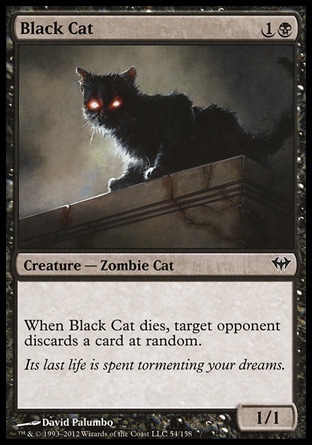
Shapesharer is actually there pretty much exclusively to copy Zuberas, though there are some other awesome things it can do, mostly by copying cards from the next set we'll talk about. Black Cat is a flavorful inclusion that's sort of like a second Ashen-Skin Zubera. Reassembling Skeleton lets you untap Grimgrin at will and is certainly very good, but I don't know if I want such an easy mechanism since it does seem a little over done. Last, Vengeful Pharaoh is a great way to discourage people from attacking you, since it's going to end up in your graveyard pretty much whenever you want it to. I'm sure there are plenty more cards that like to die so be sure to let me know which ones I missed in the comments!
Sacrifice other Stuff!
Falkenrath Noble
Diregraf Captain
Nim Deathmantle
Grave Pact
Murder of Crows
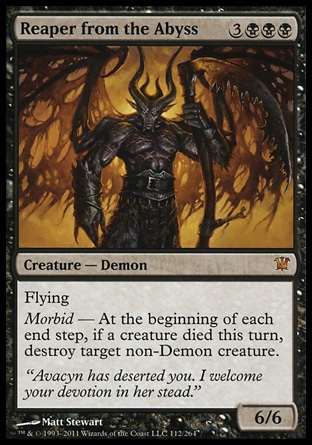
Reaper from the Abyss
Mimic Vat
Trinket Mage
Skullclamp
As usual, the two sides of this are the cards that like to die and the cards that like to see other cards dying. The best cards here are Skullclamp (and the Trinket Mage that fetches it!), [card]Reaper from the Abyss, and Nim Deathmantle, since they generate so many extra cards just by being in play for a turn or two. There are so many opportunities to break these cards and really run away with a game using them.
Mimic Vat is pretty good in most decks, but especially good in this one where you can imprint whatever creature you want, whenever you want. Murder of Crows is a card that I was excited about for Commander from Innistrad and I haven't really seen anyone playing it. That said, this is the perfect deck for it, since you want to filter through your deck for your best cards, stock up your graveyard with Pit Keeper, and Murder of Crows enables you to do all of those things.
The last card that's kind of interesting is Falkenrath Noble. It's sort of surprising how many decks have trouble beating a Falkenrath Noble, even without Grimgrin enabling it. Incremental value cards, like Falkenrath Noble, Reaper from the Abyss, and Murder of Crows are all so much more powerful than people give them credit for and are definitely things that I look to include in all of my decks.
Stock Your Graveyard!
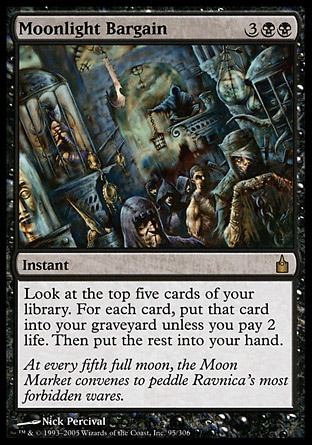
Moonlight Bargain
Fact or Fiction
Forbidden Alchemy
Diabolic Tutor
Buried Alive
Beseech the Queen
Mirror-Mad Phantasm
The graveyard is a very important resource for most Commander decks and this one is certainly no different. Cards like Fact or Fiction and Buried Alive have been used to stock graveyard for just about forever, but there are some new tools that are pretty exciting. Forbidden Alchemy and Mirror-Mad Phantasm from Innistrad are great for filling up your graveyard with fun stuff to take advantage of.
Then there's also Moonlight Bargain, a card that doesn't get nearly as much play as it should. If you can take advantage of your graveyard, you get to draw most of the five cards, regardless of how many actually end up in your hand.
The tutors are in this section because, frequently, you use them to go get one of these enablers because your graveyard is so vital to the way this deck wants to play the game. You have a full seven Gravedigger effects that you don't really want to play until you have creatures in your graveyard plus tons of other ways to buy back and otherwise take advantage of having guys in the graveyard. Because of that, these kinds of effects are very important for getting your engines going either in the early game or after having your graveyard exiled.
Going Beatdown!
Swiftfoot Boots
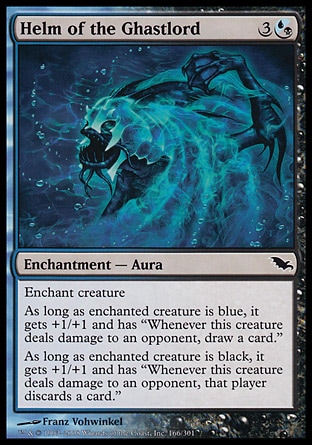
Helm of the Ghastlord
Myr Battlesphere
Grave Titan
Bloodline Keeper
Necrotic Ooze
Steel Hellkite
Massacre Wurm
Sometimes you just need to kill them and Grimgrin isn't always good enough. Commanders do occasionally get tucked, and some decks are more capable of dealing with single creatures, making it harder to deal 21 points with Grimgrin, so you need to have a plan to kill other players.
The first thing this deck wants to do is just suit up Grimgrin with Swiftfoot Boots or Helm of the Ghastlord and beat in. Lightning Greaves and Bonehoard would also be awesome choices for these slots but I just don't have any additional copies of those cards lying around.
Additionally, you have a bunch of cards that can win the game on their own. Token generators like Grave Titan and Myr Battlesphere can run away with the game pretty easily, especially when you have cards like Nim Deathmantle in your deck. In addition to that, you've also got Massacre Wurm, which can single-handedly kill someone playing a tokens deck, which there are a ton of in my local metagame.
Then there's also the Grimgrin, Corpse Born, Bloodline Keeper, Necrotic Ooze combo which you can go for without too much fear.
For anyone who's unfamiliar, if you get Grimgrin, Corpse Born and Bloodline Keeper in your graveyard, you can make Necrotic Ooze infinitely large by making a vampire, then sacrificing it to untap Necrotic Ooze. It's possible that it's worth adding Thornbite Staff to this deck so that you can go infinite with Grimgrin and Bloodline Keeper equipped with Thornbite Staff.
Card Advantage and Utility
Azure Mage
Phyrexian Arena
Withered Wretch
Makeshift Mannequin
Syphon Flesh
Damation
Faerie Macabre
Think Twice
Tragic Slip
There are a ton of sweet cards here that I'm excited about! It's exciting to see what you come up with when you have to build with restrictions of any kind, since it makes you think a little outside the box and find more corner case cards.
There are a few cards that are just generically good, like Phyrexian Arena, Damnation, and Makeshift Mannequin. But then there are some cards that are only really good in a deck like this one, like Faerie Macabre and Tragic Slip. In this deck, Faerie Macabre is uncounterable graveyard hate that's easily recurred and Tragic Slip is just Swords to Plowshares with no drawback!
Another exciting card is Azure Mage. This is a card I've been championing in a few formats recently, and I believe that it's criminally underplayed in Commander. This is a format where people go big and where you run out of cards. There will be turns where you've got nothing to do and just want to draw two cards. Granted, Azure Mage is much better in a deck that actively wants to and is able to recycle it, but the card is just much more powerful than it's given credit for.
The worst card in this set is easily Think Twice. This should probably be almost anything else, and it's probably because I've been playing too much Standard, but I really like the idea of milling away Think Twice and then getting a free card. Mulldrifter is likely much better, but somehow I don't have any additional Mulldrifters.
The Mana Base
Manabases are especially difficult when you're working with whatever you have, since that usually doesn't involve an abundance of dual lads. Two color decks tend to be pretty easy though, and fortunately I picked up a Devour for Power preconstructed deck awhile ago and was able to scavenge a bunch of fixing from that!
Mana Rocks
Mind Stone
Armillary Sphere
Mistvein Borderpost
Everflowing Chalice
Wayfarer's Bauble
Every deck needs some kind of acceleration. My personal inclination is to stay away from cards that draw attention, like Sol Ring, in preference of things that can either turn into cards later, provide color fixing, or scale-up as the game goes on.
Mistvein Borderpost can be used as a land drop, but more frequenty you just want to play it as a Darksteel Ingot that lets you cast a turn four Grimgrin. This is probably a deck that wants more artifact mana, especially doubling effects, but I just don't have the collection to support that right now, so instead I'm going with a slightly higher land count than usual, starting at 39 lands instead of the typical 37 or 38 or so.
Lands!
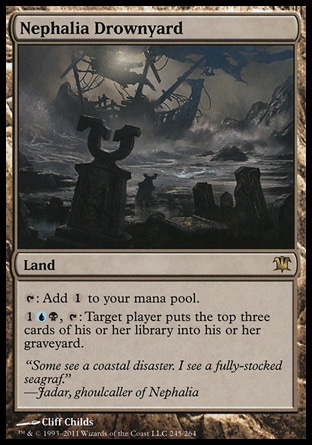
Nephalia Drownyard
Shimmering Grotto
Evolving Wilds
Terramorphic Expanse
Miren, the Moaning Well
Jwar Isle Refuge
Sunken Ruins
Dimir Aqueduct
High Market
Tectonic Edge
Barren Moor
Dreadship Reef
Drowned Catacomb
Haunted Fengraf
15 Swamp
10 Island
With the mana taken care of, let's look at what the finished deck looks like:
[deckbox did="a146" size="small" width="560"]
It's exciting when a deck turns out exactly how you wanted it to. And that's what happened here.
I wanted a slow, grindy, theme deck that interacted along the same axes that my group was comfortable with and was much closer to their power level. Playing with a bunch of slow, creature-based recursion engines means that you're never going to be out of gas but that your most powerful plays are much worse than they could be.
You could certainly build the deck to be more capable of comboing off, since there are a number of ways to generate infinite [card Tendrils of Agony]storm[/card] with Rooftop Storm, of all cards. The deck could also be a lot more casual, focusing a lot more on Zombie tribal than on using Grimgrin as a value-engine to dominate the longer games.
Regardless, I'm pretty happy with how it's turned out, and if you've got any suggestions to improve the deck (but not too much!), I'd be glad to hear them in the comments.
As always, if you've got a deck you want looked at, or an idea you want to talk about, I'm always glad to talk about the format, so get in touch with me via Twitter or email! Next week I'm planning on finishing up my Yomiji, Who Bars the Way deck that I was challenged to make, so be sure to check it out!
If not, now is a perfect time to join up! Our powerful tools, breaking-news analysis, and exclusive Discord channel will make sure you stay up to date and ahead of the curve.
Stephen Menendian - Vintage World Champion This Week in Magic
-- We're joined this week by Stephen Menendian, Vintage player extraordinaire and writer on Eternal-Central.com, who gives us a nice look at Vintage as a format and the nifty stuff you can do there. You can grab his book, Understanding Gush, over on Quiet Speculation or follow him on Twitter @SMenendian
-- MTGCast in is need of Donations. We are a bit low behind the monthly goals at this point.
MTGO MTGCast Official Clan: Limited Resources
Contact "marshall_LR" in game to join the MTGO Clan, Limited Resources. Marshall can also be reached via twitter at: http://twitter.com/#!/Marshall_LR Subscribe to the MTGCast Monday Night Magic RSS feed! RSS feed for Monday Night Magic iTunes feed for all shows on the MTGCast network RSS feed for all shows on the MTGCast network Twitter for MTGCast Hoodchefz favored by MTGCast crew
Contact Us!
Call us and leave a voice message at 570-486-6637!
If not, now is a perfect time to join up! Our powerful tools, breaking-news analysis, and exclusive Discord channel will make sure you stay up to date and ahead of the curve.
Welcome back to our exploration of Zendikar. If you were busy last week while we were plumbing the ruins of ancient tombs, take a look at Part One and you'll catch up. Otherwise, come on in and let's check out the second half of this set!
Lotus Cobra
$4.75
Lotus Cobra, along with Jenara, were ballyhooed because we all thought that everyone would need four of these in every deck to compete. It was a little more true with the Cobra, since the Mythic decks used it to catapult into Sovereigns of Lost Alara or Elspeth. With a fetchland, this can create two mana on a turn, so one can get some excellent mana advantage.
In Vintage, the Cobra also took off; there are, after all, far fewer ways to kill a little monster like this one. Cobra could transform the land drop from a Gush into casting Necropotence. It could turn into a turn-2 Jace if you wanted it!
Lotus Cobra doesn't see much competitive play these days and it isn't really a compelling casual card. It isn't much that you'd want in a Commander deck, since it's just a mana accelerator. But that said, it's a slightly played Mythic, so it commands a few dollars.
Mindbreak Trap
$2.75
The Trap sees a little Modern and Vintage play, mostly for use against Storm decks. It saw a big jump lately as a way to fight U/R Storm. It can stop Grapeshots or it can completely handle a Past Into Flames. Being able to stop an Eldrazi makes Mindbreak Trap into a worthwhile Commander spell. It has experienced a few little jumps here and there; not a solid speculation target, but worth acquiring a few.
Nissa Revane
$4.25
Nissa's history is this: when printed, Elf fans went crazy. Nissa dropped to $5 when the hype settled down. Then, Eldrazi Green came out and cards like Nissa became $15 cornerstones of the top Standard deck. Nissa could feed an Eldrazi Monument or spawn a growing field of swarming, angry elves. Now that the deck has gone, Nissa is down to reasonable levels for a planeswalker. The bonus ability for Nissa is nearly-irrelevant for Commander, since you only get one little guy to spawn, but the Ultimate can still pull a deck full of elves onto the board.
Oracle of Mul Daya
$1.25
In recent Magic, we've seen ramp decks really take off. I think it's a result of having good expensive spells to cast. We've always had good acceleration, but one of the earliest big-spell decks I can remember is Accelerated Blue- a deck with Grim Monolith and Morphling! Oracle is part of a new wave, along with Primeval Titan and Avenger of Zendikar. Oracle is a sustainable, mid-level ramp creature that's at home in both Standard and Commander decks. Oracle is kind of fragile, but I find that it can last for a few crucial turns in Commander. That's often all you need.
Pyromancer Ascension
$1.25
PA spawned a new combo type. Thanks to the shifting of Rituals to Red, one can use cantrips and Rits and easily "flip" Ascension. Then, it's just a matter of making enough mana to storm out with Grapeshot or Empty The Warrens. This card is still pretty seriously underpriced, but I doubt that PA decks will take off more than they have in Modern. If you're set on playing Sulfur Falls, Twin is probably the better deck. This deck gets batted around in Legacy now and then because you can use Regrowth and Manamorphose to loop through the entire deck.
Sorin Markov
$4.75
Who knew that Sorin would drop this low! Of course, he was never a great Standard planeswalker; his major appeal comes from Commander. Being able to Magister Sphinx someone can be pretty solid, especially if you can drain them for 20 life or more. On top of that, Mindslaver is one of the most feared cards in Commander for a reason! Unfortunately, Sorin is pitiful at defending himself and leveling him up only draws the ire of the whole table. If you're going to make a casual Vampire deck, then this guy is a good pal to have as the King Baddie, but don't wait for him to see much Constructed play.
Vampire Nighthawk
$1.25
This is exactly the kind of uncommon that I want to see once in awhile. Nighthawk is really strong, but it just kisses the boundaries of what 1BB should get you. Cards like this make us care about uncommons, and the uncommon slot is a great home for powerful weenie creatures. We'd grumble if Kitchen Finks were a rare, but as an uncommon, it feels like a treat to open. Similarly, Strangleroot Geist is a great uncommon that gets us excited to open packs again.
Vampire Nighthawk sees a bit of casual play, especially because Deathtouch is such a rare ability. In multiplayer, a Deathtouch creature is like having a Seal of Doom on the board. With Nighthawk's Flying, you can even dare someone to come in with Empyrial Archangel - they'll still taste the blade!
Warren Instigator
$2.00
What's better than one Goblin Lackey? Two tied together! For another mana, you get twice the hand-clearing, field-cluttering Goblin acceleration. Now absent cards like Goblin Matron and Goblin Ringleader, you'll rapidly run out of Goblins to actually deploy. That can be uncomfortable, especially for people trying to make this guy work in Modern. I don't see it happening, but the Instigator is still a fine casual card. This is another example of a card that people lost their senses over, then realized that it wasn't quite as good as previously thought.
Well that concludes our analysis of Zendikar, but we'll keep delving into this block next week as we try out the buried treasures of Worldwake! Until then,
If not, now is a perfect time to join up! Our powerful tools, breaking-news analysis, and exclusive Discord channel will make sure you stay up to date and ahead of the curve.
Gears are turning, the hivemind is hard at work churning, and our intellectual fires inside are burning. Dark Ascension's complexity will take some time to unravel. We will find out that many cards in this set are valued incorrectly, both too high and too low. In my opinion, the majority of the cards are undervalued. I have been looking at so many decklists being published that seem not well thought through. Many decklists have been published recently that break a rule I learned a long time ago in my magic career. That rule? It is almost never correct to clog up your mana at any particular spot in the curve. The one exception is at one mana because many aggressive decks want to have a creature on the first turn of the game. To ensure we always have a creature on turn one, we want a minimum of eight cards, but usually eleven or twelve. This gripe comes from zombie lists mostly. One of them I saw, had a whopping eleven creatures in the three cost spot! With no mana acceleration to help, that is just too many cards in your deck clogging up the midgame. How many hands are you going to keep that are three three drops and four lands?
What’s the point? Zombies, or almost mono black aggro, is a tough deck to build. Who does this guy think he is? I know that’s what you’re thinking. But yes, I think I can do better. What cards are definitely in the deck? Tons of authors have talked about them and how powerful they are.
We can all agree both of these cards are powerful, that much is true. What we can’t agree on is what cards to play with them. All the comparisons of Gravecrawler to Bloodghast are closer to accurate than you might think, but not for the same reasons. They remind me of each other because of the line of text that says they each cannot block. What this implies is that you need a plan for other aggressive decks. You are not going to be able to block in combat so build your deck with that in mind. The same is true of Geralf's Messenger because half the time he won’t be able to block either.
Speaking of Geralf's Messenger, he’s no Kitchen Finks. This guy reminds me more of a vampire than Kitchen Finks. What creature then? Well Kalastria Highborn of course. The two of these new zombies were destined to be played together just like the two vampires were. So often I would play Kalastria Highborn later in the game when I had mana to sacrifice Bloodghast to Viscera Seer and rebuy it with a land. That is what Geralf's Messenger reminds me of. What do both of these decks have in common? They both want Viscera Seer. Man how I wish this card was in Standard right now. Sadly no such card exists at the level and synergy of Viscera seer but we do have options. Here is a list of ways we can profitably sacrifice in this deck.
Untitled Deck
Sacrifice Outlets in Standard
Why do we want a sacrifice outlet so bad in this deck? There are two main reasons I see for this desired effect. The first is just a natural inclusion because we have creatures and spells (Tragic Slip) that do things when they die. The second relates back to the title of the article. What are our problems? Well, a pile of tokens on the other side of the board seems difficult to attack into, so if we have a way to sacrifice things profitably, we don’t need to worry about attacking as much.
We still have not answered the question about how we are going to build this deck. There are two main roads we can take with this decks design. The first is with blue mana and the second is with red. Unlike with vampires though, I think the blue mana makes more sense because of the synergy it provides. Regardless of which color ends up being better, I feel strongly that Mortarpod should be included in the list. For a mere three mana, you can equip Gravecrawler, sacrifice him for the damage, and then replay him with another zombie in play. A repeatable effect such as this should not be underestimated. I can imagine times where you have six mana and this is how you are grinding those last points of your opponent’s life.
The blue mana seems better for me because I feel that Grimgrin, Corpse-Born belongs in the deck. He is certainly not a four of, but two or three copies seem appropriate. He allows you to eliminate large threats on your opponent’s side of the board and is also a reusable sacrifice outlet. There is another card though in blue that interests me quite a lot as well. That card is Phantasmal Image. In case you don’t know, when Phantasmal Image copies a creature with undying, and then dies, it comes back from the graveyard with a plus one plus one counter and you may choose a new creature for him to copy. For example, play Phantasmal Image copying Geralfs Messenger, sacrifice him in any way, including pinging it with your own Mortarpod, and let him return to the battlefield and copy anything sweet you or your opponent’s control. Not only does it have synergy with your deck, but if Reanimator/Solar Flare is a deck again, it kills basically all of their threats. This would also work with Strangleroot Geist in a Birthing Pod deck.
Sacrificing our creatures only gets better when we have our new zombie lord, Diregraf Captain, in play. The blue cards just have so much synergy together. Do they block your Gravecrawler when you have Diregraf Captain in play? They lose a creature and a life, and you can just replay your Gravecrawler from the graveyard. Cemetary Reaper is still good, but I think his applications will be less than those of Dirgraf Captain. If his ability cost two instead of three, Cemetary Reaper would be immensely better. With this knowledge, let’s take a look at Blue Black Zombies.
Untitled Deck
Creatures
4 Diregraf Ghoul
4 Gravecrawler
1 Hex Parasite
4 Black Cat
3 Phantasmal Image
4 Geralfs Messenger
2 Diregraf Captain
3 Phyrexian Obliterator
2 Grimgrin, Corpse-Born
Spells
3 Mortarpod
3 Altars Reap
3 Tragic Slip
Lands
4 Drowned Catacomb
4 Darkslick Shores
16 Swamp
If the Hex Parasites turn out to be not just good in this deck but good in the metagame, more could find their way into the list. Maybe it is wishful thinking, but removing the counter from Geralfs Messenger so you can sacrifice him again, seems so incredible.
If we were to go with red mana, there are a couple cards worth noting. We would have access to some hefty burn spells in Brimstone Volley and Artillerize, as well as gaining Faithless Looting to do things like discarding Gravecrawler since we can play him later. Grim Lavamancer seems decent as well if we are filling our graveyard with cards from Faithless Looting and burn spells. I don’t know how well positioned Red Deck Wins will be, but if so, combining it with Zombies, seems better than just red. A deck list for that version might look something like the following.
Untitled Deck
Creatures
4 Diregraf Ghoul
4 Gravecrawler
2 Grim Lavamancer
4 Stormblood Berserker
2 Torch Fiend
4 Geralf's Messenger
3 Falkenrath Aristocrat
Spells
2 Brimstone Volley
4 Incinerate
4 Arc Trail
3 Faithless Looting
2 Sword of War and Peace
Lands
4 Blackcleave Cliffs
4 Dragonskull Summit
3 Mountain
11 Swamp
This is a deck that has been doing well in the Magic League and is built in similarly to Red Black Vampires. My first thought was to change the list a little but I thought, including the exact list would be better. If I were to change it though, I would add two Mortarpods immediately as an additional sacrifice outlet and finisher. Mortarpod and Valkenrath Artistocrat seem really good with Brimstone Volley, so you should be getting the full five damage almost every time. This deck is good I'm sure, but is it good in the metagame? That part I don't know.
What about control in the new metagame? That, I have no clue about. Well sort of. I’ll get back to that in a minute. What has been the way to succeed in Standard so far this season? Be proactive. Standard, and the way we build decks, has seemed more like older formats this year with the focus being on what are you doing in the first three turns of the game. Blue White Delver has been doing this successfully and for other decks to beat it, they must try to do the same. With Black White tokens in addition to Delver decks not going away and possibly reanimator style decks returning to the format, how do you build control to beat all those avenues of attack? I am sure the greats like Michael Jacob, Gerry Thompson, and Patrick Chapin will come up with something, but is there another way? YES!
Yes, there is another way and it goes right along with the title of the article, Avoiding Your Problems. Recently at FNM, I have been having a ton of fun with a forgotten deck. The archetype is very popular and successful, but this version has been passed over for the new tech. What deck am I speaking of? Wolf Run Robots! This deck utilizes more artifacts to ramp your mana and then uses finishers like Batterskull, Wurmcoil Engine, and Myr Battlesphere to end the game. The part that I like the most about the deck though, is how good it is against aggressive decks. Wolf Run (insert color here) has a decent enough match against most decks that run small fast creatures, but against a delver deck, you sometimes have a rough time stabilizing because they kill you so quickly and bounce your huge threats. Wolf Run Robots avoids that altogether though, by fetching two copies of Glimmerpost so you can gain a minimum of four life from those two lands. The second time when you get the other two lands, you gain another eight life. With that breathing room, you have time to overwhelm your opponent with giant monsters they have no way to deal with. Myr Battlesphere reminds me of Grave Titan in this deck because they can bounce it as many times as they like and you don’t mind because you get the four 1/1’s. Unfortunately there are no cards that stand out in this set as inclusions in the deck, but I still think it may find a place in the metagame. Here’s the list I have been playing successfully.
Untitled Deck
Creatures
1 Birds of Paradise
4 Palladium Myr
4 Solemn Simulacrum
1 Acidic Slime
4 Primeval Titan
3 Wurmcoil Engine
3 Myr Battlesphere
Spells
4 Rampant Growth
4 Sphere of the Suns
4 Green Sun's Zenith
2 Batterskull
Lands
2 Buried Ruin
2 Ghost Quarter
4 Glimmerpost
4 Inkmoth Nexus
2 Kessig Wolf Run
1 Rootbound Crag
10 Forest
1 Mountain
Sideboard
4 Ancient Grudge
4 Blasphemous Act
2 Viridian Emissary
1 Viridian Corrupter
1 Thrun the Last Troll
1 Tree of Redemption
2 Beast Within
Other than updating the sideboard, this deck is not much changed from its original incarnation. After updating the sideboard for new metagame considerations, I feel that this deck could be a great way to "interact" with the format. By "interact", i definitely mean, ignore what they are doing and go over the top.
Well that's all for this week folks. Remember, sometimes the best way to interact with the format is not to.
If not, now is a perfect time to join up! Our powerful tools, breaking-news analysis, and exclusive Discord channel will make sure you stay up to date and ahead of the curve.
Every time you sit down to trade, you face a ton of decisions, often more than you face when playing a typical game of Magic. And what decisions you make matter. Trade or hold onto that Sorin, Lord of Innistrad? How many copies of Skaab Ruinator is too many? Is trading an Arid Mesa worth getting that Olivia Volderen?
The truth is most of you reading this site can hold your own on decisions like the ones above. But, if you’re anything like me, you face an altogether different problem when you sit down at the table – staying up-to-date on all your prices.
This is a problem more than ever these days in this volatile market. What has Bloodline Keeper gone up to? Which Scars Dual Land is the flavor of the month right now, and how high has it gone? What’s the latest card that Modern has spiked the price on?
In theory, it’s easy to stay current on your prices. Just check the major sites, read the latest articles and spend enough time on the trading floor, and you’ll know the prices, right?
If only it were that easy in the real world.
Here in the real world, things happen. The car breaks down, your kid gets sick, you take a night off of FNM to hang out with your girlfriend, or, God forbid, you have a career that stops you from staying up-to-the-second in the Magic world. It can make it very difficult for players to stay in the game as they get older, and it’s one reason why the attrition rate in Magic can seem higher as players skew older.
This effect also is clearly felt at the trading tables. Being behind just a week on your prices can be just as damaging as being behind a week on the latest Standard tech. If you’re at a point in your life where it has become more difficult to keep up with daily price changes in cards, I have a strategy to share with you that revolutionized my trading methods, and most importantly, my profit margins.
Keeping it casual
I did the “grab every Standard card” thing for awhile, and it worked out okay. But at times when I needed to cash out, it sucked to find out that the cards I traded for at their current prices had come down just a few short weeks later when I needed to sell. Even worse, I was getting much less in cash for them than I thought I would.
This was a frustrating experience, and I began to search for a better way. Of course I knew that Legacy cards were the place to be, but no one wanted to trade those away for my relatively small Standard collection, nor were there many players with these type of cards at my store.
What I did have was a group of extremely casual players who brought their “fun” decks to FNM and mostly just gave me free packs in Limited events. This was great for my playing career but a little less lucrative for my trading endeavors.
One night something clicked as I was surfing buylists online (something I definitely had more time to do while I was in college). I realized that the Cauldron of Souls and Wilt-Leaf Lieges I had from random drafts were actually worth money! More importantly, it hit me that if I didn’t know this, other people probably didn’t either. And I was sold.
I realize this story seems a little naïve to us nowadays, but in the halcyon days of 2008 the truth is there was no focus on the financial side of Magic outside of the DailyMTG column “Building on a Budget,” Quiet Speculation was just a seed of an idea in Kelly’s mind, and EDH was being played in just a few hotel rooms across the country among judges.
What is the relevance of all this? Well, for me, it represented the day I learned that the ‘Casual” card was the place to be. Not only was the buylist value better on these cards, but they were much easier to acquire!
From then on, my goals shifted to picking up these types of cards and just trading for the things I needed for my own decks. Over time, as I began to care less about Standard and learned the wonders of having friends who will loan you cards, I began to focus even more exclusively on these cards.
Now let’s step out of the past and come back to now. Everything I learned in 2008 is just as true today as it was then. There have been some changes along the way, most notably the explosion of EDH and the rise in knowledge regarding prices, but the basic tenets are the same. Casual cards are worth more than ever, and you will still find them very cheaply in trade.
With that in mind, we can feel comfortable targeting these cards in trades (as I am sure many of you do), but there is an even bigger benefit to this tact that we haven’t touched on yet.
Remember above where I mentioned the negative implications that time constraints have on trading? Well, one of the best thing about targeting casual cards in trades is that the prices are very stable (which is why you get a better buy price on them). Nicol Bolas, Planeswalker has been $15-20 forever and will likely stay that way. Mill cards like Glimpse the Unthinkable are always going to be popular. And Planeswalkers, even unplayed ones like Sarkhan Vol, will retain value.
So what qualifies as a “casual card?” Let’s break down some of the major archetypes.
Mill
Mind Funeral retails for $3-4 and Archive Trap is $2. These cards are played in zero competitive decks, but still hold their value. These were even more popular before Commander became a thing, but as you can see, they still stand the test of time. This is why I really like grabbing Increasing Confusion as a throw-in over the next year, because you can get them as handouts and they’ll likely stay upwards of $2 forever.
Commander
This particular category is no secret and has been beat to death. What’s especially important to note is that, even though something like Jhoira of the Ghitu is a solid $4, the foil version is more than seven times that. Popular Commanders and other staples of the format are insane pickups in foil if you can find any.
Of course, you can still find other random cards that aren’t Commanders, like Coalition Relic, that retail for good prices ($4, despite a reprint in the case of the Relic) and still have the insane foil prices ($25 for Relic).
Angels/Dragons
This is something that was much more prevalent in the past but still exists today. I’ve had players come up to me and ask me to trade them every Dragon I own, and Mark Rosewater recently said that they try to always make these because they are one of the most popular creature types.
At the Dark Ascension Prerelease (where I went 10-0-1 over two events), a new player asked me if they put a Dragon in every set after seeing some older ones in my binder. When I told him yes, he got excited to start collecting them. That’s the effect these things have, for whatever reason.
The real move in picking these up is getting the Mythics, because that’s where the most money will always lie. For instance, Bogarden Hellkite and Hellkite Overlord are worth $3-5 despite being nothing but a casual card. It’s also why I like picking up Angelic Overseer and Moonveil Dragon as throw-ins right now.
Elves/Token Generators
Immaculate Magistrate is worth $5 despite seeing a reprint already. Elvish Promenade is a $3 uncommon, and we all know about the $25 Doubling Season.
For whatever reason, people love Elves. Elvish Champion and Elvish Piper are stupid expensive for what they are and always trade very easily. It also helps that Elves and Tokens overlap pretty heavily.
This makes something like Parallel Lives a good choice right now, though it will probably take a while, both due to Doubling Season already existing and the sheer bulk of Innistrad packs that were cracked.
Black/White cards
This is randomly a very popular casual color combination. Fetid Heath is worth real money and Deathbringer Liege is too, not to mention Commander staple Divinity of Pride.
It’s not the biggest factor in the world, but keep this in mind while you are digging through collections. People still don’t realize that Stillmoon Cavalier goes for $8 on SCG.
I’ve been teased in the past for my love of cards like Adaptive Automation ($4) and Captivating Vampire ($4), but these are the cards I make most of my money in Magic off of. When I sell cards, I usually am able to pull dozens of things these out of my binder and make a few hundred dollars without ever touching the larger-ticket items. This allows me to grow my collection with the truly difficult-to-acquire cards like Dual Lands and next-tier things like Mutavaults, not to mention the nearly-75 Zendikar Fetchlands I have, while still making real money selling cards.
If not, now is a perfect time to join up! Our powerful tools, breaking-news analysis, and exclusive Discord channel will make sure you stay up to date and ahead of the curve.
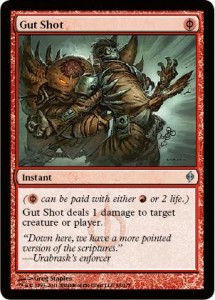
On December 1, we talked about picking some Uncommons to make some money on during this upcoming season. Well one of them has already seen the 500% growth I mentioned, so It’s time to move out, and re-adjust the group. Gut Shot is now selling anywhere from $6-8 a playset on EBay, so fire up your listings, or pick your favorite outlet, and cash those out. This should single handedly cover your costs (and then some) of the entire speculation group. The rest of this will be free-roll through PTQ season. This is the benefit of diversification. Once you hit one winner, you get a free gamble on the rest.
Gut Shot: In at $1/set, Out at >$6/set.
What about the rest of the list? Well I suggested cultivating your own particular pool based on the types of qualities these winners tend to have. One that I’m sure almost everyone is on board with is Dismember, is that still a Buy? Just a Hold? I’m moving in on more of these
Dismember: In at $2.50 ea, Currently $2 ea.
This is a Buy for me right now. The meta has shifted to more bounce effects and focused on Tempo-based aggro. While I can’t argue that this wasn’t necessary, Dismember is not gone, and will guarantee to make a resurgence. I see this as an opportunity to buy more of what I like at a lower price.
The remaining cards are all about the same as they were in December, so are indefinite holds, as you’re not risking much by holding on to them. Entomber Exarch saw a slight increase, but probably not enough to cover transaction costs of shipping, while Beast Within dipped very slightly which means if you didn’t buy them before, there’s still time to do so.
Now that we’ve seen the new set, what uncommons do we want to add to the stockpile?
I like two uncommons so far, Lingering Souls and Strangleroot Geist. While these should seem somewhat obvious, picking them up at the right time is key. They both retail for $1.50 ea on Star City, but likely trade a bit lower, and will come down in the next few weeks as people get their hands on these. When Standard PTQ season rolls around, they’ll come back up again. Look for steals in trades, and stash the ones you grab in packs until you can get $2-3 for them.
I’m also interested in Oblivion Ring, but I'm hesitant to make a big move here, due to the massive number of printings available. I do expect Oblivion Ring to see a lot more play as Enchantments, Artifacts and Planeswalkers are all over Standard, and if any Undying creatures take the field, Oblivion Ring deals with them nicely too. This one is a pretty safe bet also, as it’s unlikely to completely disappear from the format. I’d also be careful that it may see yet another printing either in Avacyn Restored, or in Magic 2013.
Lastly, Lambholt Elder (AKA, Grandma Werewolf) is of interest to me. While a very expensive ½, a 4/5 ‘Ophidian’ type is no joke, and sits at a low enough price that I’d be interested to see where it goes. It’s pretty tough to block a 4/5, but it’s also pretty tough to let your opponent draw a card while you take 4. While I’ll admit it’s a longer shot, I’m going to stash a few of these and see where it goes. A friend and I were discussing it, and when he said, “As a 1/3, Scroll Thief would have never connected in Standard which is why he was never good, as a 1/2 you'll prob never hit your opponent anyway. Now, imagine your scroll thief as a 4/5. It’s like that GGG 4/5 beast [Leatherback Baloth] that basically draws a card, just have to wait until Vapor Snag is no longer the flavor of the month.” I liked his thinking on this. It’s a cheap target, without much risk, so I’m going to jump on his bandwagon on this one. It’s just tough to say if/when the format will want a card like this.
Lastly, there’s been endless chatter about Dungeon Geist. This is pretty cheap right now, and I’m at least grabbing a set at release weekend, but I’m not so sure about it really being the next Sower. None the less, it’s additional Frost Titan type effect, for less mana, on an aggressively costed flier. At the least, after Titans leave the format, he should be a player. Keep your eyes on him.
What uncommons did you speculate on? Did you pick any winners that weren’t in my Dec 1 list? Is there any you want to add now, that we’re not discussing?
Enjoy release weekend, and keep your eyes on the Pro Tour chatter next week to see what archetypes pop up.
If not, now is a perfect time to join up! Our powerful tools, breaking-news analysis, and exclusive Discord channel will make sure you stay up to date and ahead of the curve.
In another bout of loud internet talkin', CommanderCast is flooded with guest hosts this week. Cassidy Silver, Chris Lansdell, and Omar Hernandez step into Andy's wheelhouse and deliver another episode of EDH's realest talk. Discussed this week: alternative Commander rules, Akido decks, a Shimatsu entourage, and more!
Hit the button or play, or download the entire episode! The full show notes are here.
For full show notes and more Wrexial-Approved hotness Monday through Friday, hit up CommanderCast.com.
If not, now is a perfect time to join up! Our powerful tools, breaking-news analysis, and exclusive Discord channel will make sure you stay up to date and ahead of the curve.
In the midst of the Dark Ascension pre-release hype, we mustn’t lose sight on the other significant shift in the MTG competitive scene. The beginning of Modern PTQ season has arrived! And what a diverse metagame we now have!
After multiple iterations of bannings, Wizards has finally created a diverse eternal format where Force of Will isn’t king. This is an exciting time, where creative minds can brew up wild strategies that may actually have a shot at winning.
Now that the first handful of tournaments is completed, I want to take a first look at the winning decks in order to identify potential pick-ups.
The Field
Here is a breakdown of the winning Modern PTQ decks from Wizards’ website:
Affinity – 3
Boros – 2
Melira Pod
Splinter Twin
U/B
Past in Flames Storm
Fairies
Blue Scepter
Talk about diverse! All five colors are represented, though only one of them legitimately relied on Green. Black is likewise somewhat underrepresented here, but this is probably an improvement versus the previous metagame where black was a nonfactor completely.
And how about the disappearance of Zoo? The banning of Wild Nacatl has completely handcuffed the Naya version of aggressive decks, opening the door for some much more creative strategies.
While I wish I could continue on about how much I love Modern’s evolution, I need to turn my attention to the financial implications.
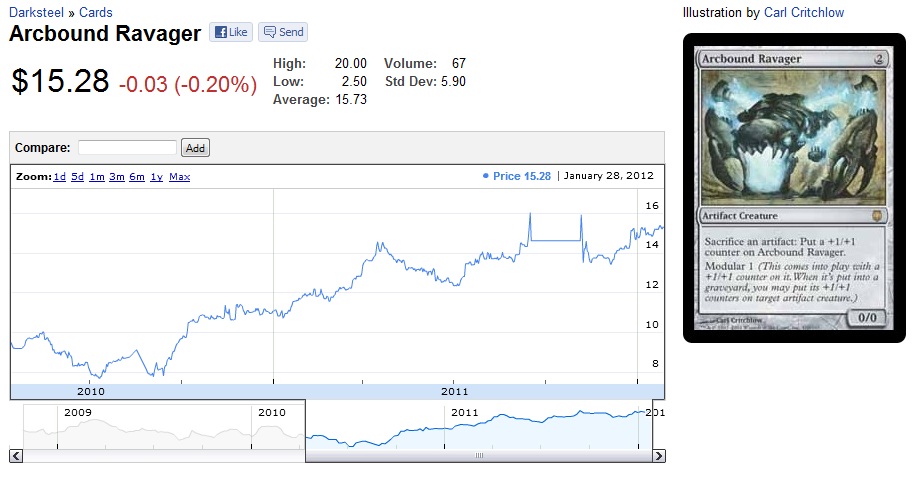
The [card Arcbound Ravager]Ravager[/card] in the Room
The resurgence of Affinity has thus far been noteworthy. No one should be particularly surprised by this since an Affinity Modern deck is not a novel idea. Something can still be learned from its recent success, though – Affinity cards are worth trading for.
A quick look at the trend of Arcbound Ravager (chart courtesy of blacklotusproject.com) reveals just how lucrative Affinity cards have become. I remember enthusiastically selling my set of Arcbound Ravagers to Star City Games when they were buying them at $10 each. Months later, the buy price has not changed, but it is interesting to note that Star City Games has increased their sell price to $22 each!
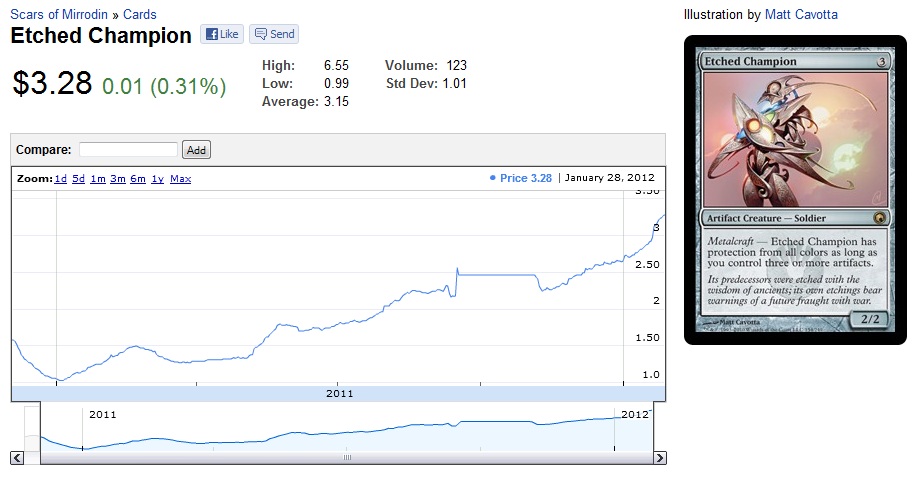
While I don’t expect you to find people who will trade Ravager at $15 so easily, there may be some other profitable Affinity cards. Consider, for example, Etched Champion (chart courtesy of blacklotusproject.com):
This card has had quite the run and, to be honest, I had no idea until recently. Actually, I counted many Etched Champions in people’s trade binders at the latest FNM. Many people will still trade these near bulk prices since they have significantly fallen out of favor. While I would not rush to eBay to purchase 50 of these, I certainly see merit in trading for a handful.
One other noteworthy card I want to identify is Mox Opal. While this one has not rebounded as significantly, it has finally found a reliable and well performing home in an eternal format. This means that Standard rotation won’t hit this card’s price nearly as much. The time may not be perfect to move in on this card, but I would have a hard time seeing it drop below $12 in the long term.
Boros Deck Wins
Years ago, I tried my hand at a PTQ and was promptly stomped on by an array of Boros Decks. The Red/White combination, implementing efficient creatures and removal spells, is frequently a deadly one.
Value-wise there are a number of rares played in the deck, but very few are worth more than $10. One of the winning lists ran two Elspeth, Knight Errants, but this particular card has already been on speculators’ radars. Even the Dual Decks version with the arguably inferior artwork has stabilized over $10. If you can find anyone looking to trade these away at the now-obsolete price of $12, it wouldn’t be a terrible idea to pick up a few.
Many of the popular Boros cards were, in fact, printed multiple times. Figure of Destiny was a promotional card and Grim Lavamancer has a reprint.
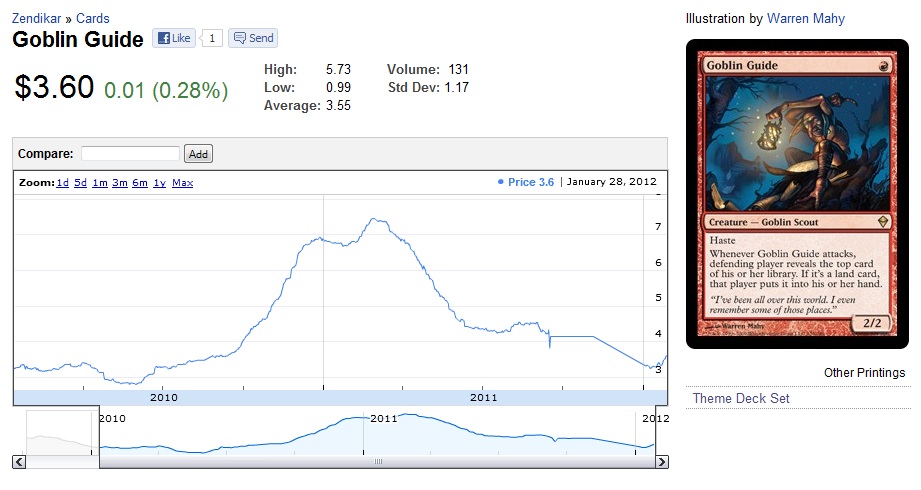
I am, however, turning my attention to a different one-drop creature (chart courtesy of blacklotusproject.com):
Goblin Guide is an ubiquitous card. It has shown up in aggressive Legacy decks, it was a Red Deck Wins staple during its time in Standard, and it is even a casual favorite. Now the Goblin Scout can add a new line item to its resume – success in a winning Modern deck.
Thus far, this success has barely altered the card’s value. Recent prices are still averaging near the card’s lowest. This could be a wise time to buy in here. Standard players who never unloaded him before rotation may be willing to trade these at discounts, while Modern players will be looking for this 4-of staple for their Red Aggro decks.
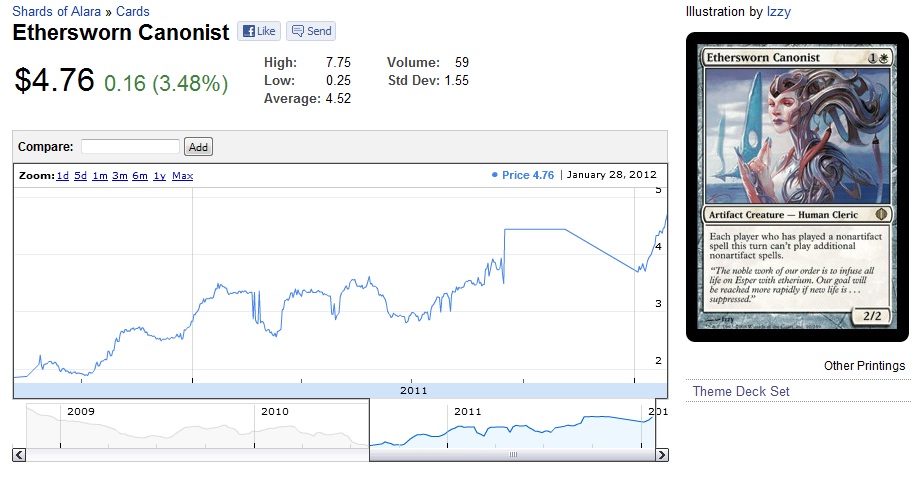
I want to mention one other card both relevant to Affinity AND Boros – Ethersworn Canonist (chart courtesy of blacklotusproject.com):
This card has been on such a run recently. I’ve even seen it on a MOTL buylist upwards of $4.50! This two mana Hate Bear, along with the likes of Gaddock Teeg, have both seen a nice increase. Both are excellent sideboard tech to combat control decks and the Past in Flames combo deck. Additionally, Affinity can only stand to gain from main decking the Canonist.
Hate Bears have always had an invisible price ceiling. The Canonist has been in this price range before, and so it is difficult to say if its momentum will take the card’s value to new heights. Star City Games seems to think so, as it is currently selling Ethersworn Canonist at $7! Certainly this is a Modern card worth watching.
The Remainder of the Field
It seems I am already nearing the end of my article, and yet I have only managed to discuss financial implications of two decks!
Melira Pod, the Modern deck I am currently piloting, has won one PTQ so far. Blue control decks have also finally surfaced as well. Either in the form of Fairies, combined with Black for Dark Confidant, or combined with Isochron Scepter for some recyclable counterspells.
While it is tempting to immediately jump on the cards that made these decks win, their sustainability in this Modern metagame is still undetermined. I am holding back my initial reaction to scoop up sets of Isochron Scepters, although they are a fun casual card and I’d love to see them win more PTQ’s... but I need to exercise discipline, however, and keep emotion out of the equation. If I stumble upon an Isochron Scepter or a Birthing Pod in someone’s trade binder, I may try to pick it up if the price is right.
What’s Next?
There are many more Modern PTQ’s to come, not to mention a couple Modern Grand Prixs later in the year. It looks like we finally may go three months without Modern bannings, but that does not imply that the Metagame has settled.
Some hyped decks have not broken out quite yet. Merfolk builds have been discussed at length on Twitter but the deck’s success has yet to be proven. Likewise, the popular Martyr of Sands has yet to break out despite causing the price of Proclamation of Rebirth to jump up five-fold.
I am going to maintain respect for this uncertainty – I will casually be trading for some of the cards in these breakthrough brews, but I will not be aggressively buying them.
The only cards I am strongly behind are the tried and true: Zendikar Fetch Lands.
People are STILL selling Misty Rainforest and Scalding Tarn for $10. These cards are even better than $10 bills – they will likely increase in value while $10 bills will decrease due to inflation!
Keep a close eye on winning Modern decks, and stay tuned for additional analyses!
If not, now is a perfect time to join up! Our powerful tools, breaking-news analysis, and exclusive Discord channel will make sure you stay up to date and ahead of the curve.
Prerelease weekends are always some of the most exciting weekends of the Magic year, and the Dark Ascension prerelease was certainly no different. It's always a ton of fun to see how the cards actually play, which ones might have some viability in constructed formats, and frantically trying to find the cards you need for Commander decks! This week's article is a finish to my series on artifact-themed decks, and will focus on Kataki, War's Wage, but first, I wanted to do some quick hits on Dark Ascension, and pick out my favorite five cards for Commander.
Quick Hits
So without discussion or proof, here are some of my impressions for non-Commander formats:
Lingering Souls is just as absurd as we all thought it'd be, and single-handedly wins games.
Pyreheart Wolf is absolutely absurd in limited. It seems mediocre until it's across the table from you.
The number of flash creatures, counterspells, and other tricks at 3 and 4 in Blue and White is really tough to play around.
Undying as a mechanic is going to define the limited format.
Bloodline Keeper is still unbeatable, and likely moreso, since there's less removal for it now.
Dark Ascension for Commander
Now, unfortunately, this set really doesn't seem that exciting for most constructed formats; at least to me. There are some cards that are pretty obvious hits for Commander - a new planeswalker in Sorin, Lord of Innistrad, a super powerful land in Vault of the Archangel, yet another graveyard enabler in Havengul Lich, and a new combo piece in Mikaeus, the Unhallowed. That said, there are still a few cards that I'm pretty excited about, and I'd like to take a little time to talk about them!
5. Dawntreader Elk
This is another really strong fixer at common, which I'm excited to see. It's a little worse than Sakura-Tribe Elder, but not too much. People still don't give Caravan Vigil the respect it deserves in Commander, and I'm hoping that this guy catches on a little more. Definitely not the flashiest card, but a very solid role-player.
4. Diregraf Captain
Zombies are just a ton of fun, and I'm really glad to see them get a really powerful lord. The combination of a great blocker plus Glorious Anthem plus Vengeful Dead, when all of those cards are playable on their own is great for the Zombie-Tribal decks, and this has definitely got me working on a Zombie deck of my own. Let's not even talk about how busted this guy is in Horde Magic; suffice it to say he's pretty close to unbeatable.
3. Counterlash
This and Scattering Stroke are as close to Mana Drain as we're ever going to get again, and Counterlash can be arguably better for Commander. It doesn't put you absurdly far ahead in the early game, but it will generally generate about as much mana as a Mana Drain, but also lets you cast stuff at instant speed, and that's something that can't be understated.
2. Requiem Angel
I already have a tough time not building only mono-white decks that attrition people out with creature tokens, and this card certainly isn't helping me resist that impulse. Letting Darien, King of Kjeldor Skullclamp up Soldiers, then the Spirits of the soldiers is really good. The Angel also lets you go infinite with Nim Deathmantle, Ashnod's Altar, and a non-spirit EtB effect creature. She does a lot of powerful things, all while just being a giant, splashable beater; definitely one of my top cards from the set!
1. Grim Backwoods
Last but certainly not least is the card that's here mostly because of my obsession with Child of Alara. Sweeping the board for value feels so good; especially when you can also do tricks with Dryad Arbor or Nim Deathmantle to get even more value out of Grim Backwoods. I'm pretty sure this is an auto-include for most G/B/x decks in the format, and especially ones that rely on effects like Grave Pact. This is a very powerful and synergistic effect, but shouldn't be overbearingly good. It's costed pretty much perfectly, and will enable a lot of cool interactions for my favorite deck!
Back On Track
The decks I've built so far during my artifact experimentation phase were a very aggressive Sakashima the Impostor deck, and a very controlling and attrition-y Slobad, Goblin Tinkerer deck. In both cases, I tried to avoid the prison cards that artifact decks tend to start running; Sundering Titan and Winter Orb, for example. In particular, I cited that Mycosynth Lattice leads to a lot of degenerate game states with Nevinyrral's Disk, Karn, Silver Golem, and other similar effects.
This deck has no such reservations, and is built pretty much exclusively to hate on other players with broken artifact decks. There are some very aggressive prison elements, some grindy attrition elements, and very, very few ways to actually close out a game once you've got things under lockdown. Because really, it's much more fun to get in for two with Kataki. Largely, the goal of this deck is to break the symmetry of prison pieces by casting them on your turn, leaving them in play for other player's turns, then sacrificing them before your untap step or during your upkeep. Then you can rebuy your prison pieces with various Open the Vaults effects, all while pulling ahead on resources with artifacts that like dying. Let's start with the simple part; your card advantage engine.
So Much Value!
Ichor Wellspring
Mycosynth Wellspring
Chromatic Star
Terrarion
Origin Spellbomb
Spine of Ish Sah
Junk Diver
Myr Retriever
Helvault
Core Prowler
This is where the deck starts; breaking the symmetry of Kataki's ability, and turning to your advantage. About half of these are, at their worst, cantrips or Divinations. The key difference is that these are permanents that White is pretty good at recurring, which means that you're going to get to cast your Reach through Mistss a ton of times per game, and that each time you get to cast it, you're digging closer to another way to recur it and eke even more cards out of the deal.
In addition, you have some recursion in Junk Diver and Myr Retriever, which are especially awesome because they're creatures in addition to being artifacts. You've got Spine of Ish Sah as an incredibly powerful late game engine, as well as Helvault and Core Prowler as cards that enable your Momentary Blink/Recursion theme and your Counter theme respectively. These are certainly two of the highest-variance cards in the deck, but are very powerful if you get their respective engines going. Helvault protects your key guys, while also being another Spine of Ish Sah or enabling you to start Momentary Blinking your creatures.
All of these cards interact very well with White's ability to recycle permanents, especially cheap ones, over and over
again; so let's take a look at the crux of the deck, which is your ability to recur key artifacts:
Artifact Recursion
Second Sunrise
Open the Vaults
Roar of Reclamation
Sun Titan
Auriok Salvagers
Remember the Fallen
Argivian Archaeologist
Order of Whiteclay
Treasure Hunter
Mine Excavation
Razor Hippogriff
Arcbound Reclaimer
Twilight Shepherd
Nim Deathmantle
Karn, Silver Golem
Antler Skulkin
Mimic Vat
There are a few kinds of effects here that it's important to distinguish. You have huge one-shot recursion effects like Roar of Reclamation and Open the Vaults, which you really want to hold until late in the game so you can dump a ton of prison pieces into play at once. Then you've got smaller one-shot effects like Mine Excavation that are going to let you recur prison pieces mid-game or put you further ahead on cards. Then there are incremental value cards like Sun Titan and Order of Whiteclay, that can recur most of your card advantage artifacts, and some of your prison pieces. Generally you start locking up the game with one of these while your opponents are still trying to develop their mana past your prison pieces, and they just put you so far ahead on mana and cards that other players can't really overcome it.
Last, there are the EtB creatures, and the engines that try to take advantage of those, like Nim Deathmantle and Antler Skulkin. Furthermore, the deck even runs Karn, Silver Golem as a way to animate your artifacts and buy them back with your creature recursion engines. Karn is also generally the way that you actually close out a game, since it effectively puts a ton of power on your board for a very small investment up front.
Prison Rules
These cards are critically important to how the deck functions, because they buy you time. Time to enable your card advantage engines, and start making more land drops and to play more lock pieces to put people further and further behind. These are also the way that you just lock people out while you find a way to actually win the game, which usually ends up being Kataki or Karn beatdown.
Static Orb
Winter Orb
Sundering Titan
Mycosynth Lattice
Throne of Geth
Sculpting Steel
Lodestone Golem
Glowrider
Thalia, Guardian of Thraben
Tanglewire
Smokestack
Martyr's Bond
Lux Canon
Ward of Bones
Uba Mask
Sphere of Resistance
Expedition Map
Weathered Wayfarer
Crucible of Worlds
The worst cards here are the Sphere of Resistance effects by a pretty fair margin. I'm not absolutely certain that these effects are completely necessary, but I do like how much time they get you to make extra land drops. Generally, you don't cast these on the first turn possible; you want to wait until you can keep people off of their four and six drops, since those are so much more powerful than most other early-ish drops. Then you can cast Kataki and a Sphere on the same turn, and decide on your turn whether you want to pay for your Sphere or whether casting an extra spell will help you keep them off their six drop another turn.
Besides those, you've got some more traditional lock pieces like Tangle Wire and Smokestack. These are largely the reason that the deck runs Proliferate effects, so that these aren't just embarrassingly bad in the late game. You want to be able to play a late game Smokestack and immediately put it up to three or four counters, since you have random artifacts that you want to sacrifice anyway, and other people will have to sacrifice real permanents.
You also have your non-basic land package, which can set up Buried Ruin loops with Crucible of Worlds, or just a Strip Mine/Wasteland soft lock if you can give up your land drop each turn. Generally, you really don't want to give up your land drop, since this deck is very mana-hungry, but I can't stress enough how important it is to keep people off of six drops like Primeval Titan and Sun Titan. Those are the kind of cards that you can't beat without the help of the rest of the table, and when you're playing a prison-ish deck, they won't tend to be very helpful.
Last, you've got game-ending cards like Sundering Titan and Mycosynth Lattice, which all but end the game on the spot. Sundering Titan will destroy between nine and fifteen lands over two turns, since you'll cast it, not pay for it, and likely rebuy it on your next turn. Mycosynth Lattice is a hybrid Wrath of God and Armageddon which you're pretty capable of sacrificing before you have to pay for all of your permanents. Sometimes other players will be able to take advantage of your Mycosynth Lattice, so it's certainly a card you want to be pretty cautious with, but the effect is just too powerful to pass up.
Utility Effects
At this point, most of the functionality of the list has been pretty fleshed out, and the deck really just needs a few ways to control the board if you get behind, and to protect your artifacts. There's also a few techy cards that I just like playing with, and a few more ways to try to win the game.
Leonin Abunas
Austere Command
Stonecloaker
Path to Exile
Swords to Plowshares
Oblivion Stone
Shrine of Loyal Legions
Mentor of the Meek
Skullclamp
Sensei's Divining Top
All is Dust
Requiem Angel
Stoneforge Mystic
Sword of Feast and Famine
The first important card here is Sword of Feast and Famine, since it's another way to break the symmetry of Kataki, since you can pay for your artifacts and still cast spells. The effect is especially powerful underneath prison effects. I don't know if the effect is powerful enough to warrant running Steelshaper's Gift in addition to Stoneforge Mystic, but that's definitely a change worth considering.
You have a pretty typical suite of sweepers, spot removal, and a single Stonecloaker as graveyard hate. Typically, you want more than one piece of graveyard hate, and I think that a Scrabbling Claws could be good here, since it can cantrip and be easily rebought, but I haven't been playing against a ton of graveyard decks recently, so I feel reasonably safe cutting some of my hate.
Last, there are some sweet cards I just like playing with. Requiem Angel and Shrine of Loyal Legions are awesome for this deck, since they give you a ton of guys to sacrifice to Smokestack, blockers in the mid-game, and a win condition late. Shrine can be recurred all kinds of different ways, and the two interact very favorably; especially in conjunction with cards like Skullclamp and Mentor of the Meek. This set of cards is definitely pretty weak, but I really like playing with them, so I'm happy to run it.
Manabase
Everflowing Chalice
Sol Ring
Ancient Tomb
Buried Ruin
Emeria, the Sky Ruin
Mistveil Plains
Blinkmoth Well
Phyrexia's Core
Strip Mine
Wasteland
Urza's Mine
Urza's Tower
Urza's Power Plant
Cloudpost
Glimmerpost
Vesuva
Tempe of the False God
High Market
Flagstones of Trokair
Deserted Temple
Inkmoth Nexus
Remote Farm
17 Plains
So, the manabase for this is pretty straightforward, and very similar to the one used in the last two articles. In any mono-colored deck that either wants to ramp quickly, or has very few color-commitments, I run Urzatron, [card Cloudpost]Locus lands[/card], and Vesuva, because there's usually very little downside, and occasionally they let you explode in the early- or mid-game.
The interesting cards here are Blinkmoth Well and Phyrexia's Core. Phyrexia's Core is there so that you can sacrifice lock pieces before your turn, to make them one-sided. Sometimes you'll use it to get extra value from Nim Deathmantle or something similar, but generally it's to break the symmetry of your artifacts. Blinkmoth Well does the same thing, but only with Static Orb. You tap the Static Orb at the end of the turn before yours, and you get to untap all of your permanents. This interaction used to work with Winter Orb, but was changed fairly recently; because of that, Blinkmoth Well may not be good enough, but it's still worth trying. With that, let's take a look at the final list!
[deckbox did="a145" size="small" width="560"]
*Note: the application I use to put together lists hasn't been updated with Dark Ascension cards, so there should be three cards missing: [card Thalia, Guardian of Thraben]Thalia[/card], Helvault, and Requiem Angel.
That's all I've got on artifacts for the time being. They're definitely an awesome type of permanent, especially for the decks that are built around abusing them. Lands are still my favorite kind of permanent, but this was certainly a fun change of pace! Over the next couple of weeks, I'm planning on finishing up some decks I've been working on for awhile: Yomiji, Who Bars the Way, Zombie Tribal, and Planeswalker Control!
Carlos Gutierrez
cag5383@gmail.com
@cag5383 on Twitter
If not, now is a perfect time to join up! Our powerful tools, breaking-news analysis, and exclusive Discord channel will make sure you stay up to date and ahead of the curve.
Zendikar was a set designed around the theme of explorers and adventurers discovering ancient secrets and powerful treasures. The set was packed full of treasures, literally - the Hidden Treasures promotion by WOTC inserted iconic, expensive and rare old cards into a small set of boosters. Players could open an Underground Sea or a Candelabra of Tawnos; they might open Guardian Beast or crack Black Lotus. Zendikar was full of treasures inside the set, too; the Allies were like Slivers, growing with every new one. The long-awaited enemy-color fetchlands continue to pull good prices and deserve discussion of their impact on the game at large. Let's not tarry any longer... let's dig in to the first half of the world of Zendikar!
Archive Trap
$1.25
If you do the math on Archive Trap, you can see that it's set up to make a dream come true. Your opponent cracks their fetchland on the first turn and then, bam! Four Archive Traps blast their entire library out of the game. Even when you can't make the dream scenario come true, this Trap takes out an appreciable amount of someone's library for its mana. You can pull it up with Trapmaker's Snare or Merchant Scroll and have twelve in the deck, too.
But Archive Trap is more than just a card, it's a reminder for the trader that casual, junky cards like this and Sanity Grinding are worth actual money. Milling decks are fun and represent a blue strategy that doesn't rely on piles of counterspells. Huge numbers of Archive Traps change hands every month on Ebay, so these are hot to have in a binder.
$8.25
Marsh Flats
$8.00
Misty Rainforest
$11.00
Scalding Tarn
$10.75
Verdant Catacombs
$8.25
Ever since Onslaught, we wondered when we would get these babies. They made the biggest impact in Eternal formats, because base-blue decks must be able to play around Wasteland. In Legacy, grabbing a basic Forest lets you cast Tarmogoyfs against Merfolk. In Vintage, getting a Mountain means that you can evoke Ingot Chewers into a Chalice of the Void without exposing a Volcanic Island.
Even in newer formats, these cards link up manabases. In Modern, they get the Ravnica lands. These lands are actually quite a bit less powerful without fetchlands around, which sounds like a stupidly obvious statement. But when you compare them to checklands (Dragonskull Summit) and the 2-lands (Darkslick Shores, and is there any better name for these?), a fetchland isn't great. If you have no need for a shuffle, it will only snag one color, fixing but one of your colors. I think we've been used to fetchlands for so long that when we look at Modern manabases, we jump to fetches when filter lands or checklands might be much, much better.
Blade of the Bloodchief
$1.25
There is a small contingent of loyal Vampire fans, and their bloodsuckers don't sparkle, they kill. The Blade comes down early and can make the smallest thrall into a grand old monster. I think if you're going to make a casual Vampire deck, then the list probably starts with four of these guys.
Bloodchief Ascension
$1.25
I wanted so much more from this card than it is... you can put it together in a burn deck and get a lot of reach, but by that point, you've got them halfway to death anyway. It's better in Commander and it's a fine casual card. I like that this card gives you a great payoff and it has an achievable goal. It's clear how to get the quest counters on this.
Bloodghast
$3.50
Bloodghast promises something for nothing. Sure, a 2/1 for BB isn't much, but it just keeps coming back for more! Every land, every landfall from a fetchland, brings back this little ghoulie. Most of the time, it's not for long because you're sacrificing it to a Cabal Therapy, sending it away with Attrition, or feeding it to a Bloodthrone Vampire. Bloodghast comes up a lot in Legacy Dredge, which drives some of its price, but more generally, it's just an interesting card that casual players want. I foresee Bloodghast doubling in price over the next year; it's a Vampire and it is nigh-unkillable. I'd bet on that as a casual gainer!
Chandra Ablaze
$3.25
We've always wanted Chandra to be decent; every other color has a playable Planeswalker, but red just can't get its act together. She looks like she'll fit in a burn deck, but at six mana, good luck! Red doesn't need more card disadvantage and burn spells on its banner cards. Despite being unplayable in real formats, Chandra Ablaze still carries a few bucks. I know that Kelly Reid and Corbin Hosler actively trade for these, since they're frequently undervalued.
Day of Judgment
$1.50
Either a worse Wrath of God or a differently-named Wrath for your Gifts Ungiven decks. DOJ lets monsters regenerate through it, but that's what we have to put up with for a hugely powerful effect. I think this card is mucho underpriced at under two bucks; there are plenty of copies in print, but you can say the same thing about Wrath and even the skankiest white-bordered versions rarely dip below $5.
Eldrazi Monument
$2.50
This was briefly the "it" card when Eldrazi Green made waves in Standard. The idea was that you could summon a bunch of meaningless elves and tokens and then drop this thing, creating a flying army of monsters that actually means something. Giving your team flying is great in green - it's super-trample! Also, blowing away one plant token each turn didn't matter very much in the scheme of things. The monument shot up in about a week to $15, but it has since settled down after rotation. I peg this card to end up a lot like Akroma's Memorial. It'll eventually be $8 again when people realize that they all want it for their Commander decks.
Emeria, the Sky Ruin
$1.25
Emeria has slowly been ticking up in value. It has an insane effect, but you have to pay a huge cost of playing all Plains. That Emeria isn't Legendary makes it even better, since you can get double the fun if you hit seven Plains and get two of these babies out. It's seeing a little bit of play in Modern with the mono-white Martyr decks. Those decks are The Real Thing and I wouldn't be surprised to see a breakout price jump on secondary cards like Emeria.
Felidar Sovereign
$2.00
My oh my, this can combine lifegain with actually winning the game! All those Life Bursts and Martyrs actually mean something when you can drop this guy and protect it. There was a howl in the Commander community when this first came out; people called for emergency pre-emptive bans. Turns out, killing a six-mana guy is easy enough to do.
$3.50
Back when Zendikar first came out and Quiet Spec was just a blog that Kelly ran, this card was spoiled and people divided sharply over it. A lot of people thought it was awful; after the first turn, it was bad, and it let your opponent draw cards all the time! It turns out that Goblin Guide was part of a devastating R/W Landfall strategy; by the time your opponent started their second turn, they might be at 16 life and facing down even more danger. The Guide has gotten a little bit of love in Modern because it's a part of Boros and Zoo decks. It'll be a solid roleplayer in the format for a long time.
Iona, Shield of Emeria
$8.50
Iona promises a hard lock in one card, a tremendous barrier to the opponent attached to a 7/7 body. It was the primary reason that Karakas went from $7 to $40. Iona and Painter's Servant could lock someone out completely; Iona and Unburial Rites became a combo with Gifts Ungiven. I don't think people attempt to pay retail for Iona, but there are plenty of ways to sneak her out. What I find most interesting about Iona's tradeability is that there were hundreds of transactions for her in the past few months. If your goal is to trade into a more liquid portfolio (meaning, easier to find customers), this is the card to look for. Converting this Angel into cash is simple enough.
Kalitas, Bloodchief of Ghet
$2.00
Mainly a Commander rare, either as a general or merely as a floating battlestation of doom. Unlike other big monsters with tap-out abilities, like Helldozer, Kalitas doesn't punish you too much for not attacking; it makes a token so your next combat phase will hit just as hard as the one you skipped.
That's it for the front end of Zendikar; join me next week as we look at serpentine lotuses, maniacal planeswalkers and crafty goblins!
Until then,
Doug Linn
Want Prices?
Browse thousands of prices with the first and most comprehensive MTG Finance tool around.
Trader Tools lists both buylist and retail prices for every MTG card, going back a decade.