
menu

Insider: The Secrets of Shadowmoor

Are you a Quiet Speculation member?

If not, now is a perfect time to join up! Our powerful tools, breaking-news analysis, and exclusive Discord channel will make sure you stay up to date and ahead of the curve.

What happens when your fairy tales turn Grimm? When the inky darkness seeps into the wonderland? Shadowmoor answered that, turning good heroes like Sygg, River Guide into murderers like Sygg, River Cutthroat. In the set, we saw game-changers like the filter lands and extensions of themes begun in Morningtide, such as the Liege cycle. Let's take a look at the first half of the set this week!

Ashenmoor Liege

$2.00

Ashy Larry is one of the weaker Lieges, but he still locks in at two bucks. Our own Corbin Hosler has noted for a long time that people undervalue the Lieges in trade. He stocks up on them when people consider them throw-ins and then unloads them to buylists and casual players who value them highly. I suggest picking them up, too. No reason to let Corbin have all the profit!

Boartusk Liege

$1.50

The Meat Mountain is worth keeping an eye on because it occasionally shows up in Modern and Legacy Goblin decks. It fights Engineered Plague effects without dying to those effects, itself.

Boon Reflection

$1.50

Shadowmoor's Reflection cycle contains a bunch of heavy enchantments. I don't think this is especially good for, say, a Commander deck because it's such an expensive card. That said, it turns things like Healing Salve and Life Burst into worthwhile spells to cast. It's also downright nasty with Martyr of Sands.

Cursecatcher

$3.00

These are three bucks and they will trade for that price all day long. These are the gems to find in Shadowmoor bulk. They are that expensive because Legacy Merfolk decks are very popular. Cursecatcher fits right into the “fish” mana denial theme. With one on the board, are you going to run out a Firespout? What if you've got two mana up – are you sure they don't have a Daze, too? Cursecatcher often becomes a 2/2 or 3/3 early in the game, meaning that it is at least a cheap beater.

Demigod of Revenge

$5.00

Demigod is a casual favorite and it's easy to see why. If you're playing with him fairly, you get a free one every time you cast another. People also combined him with Intuition to make fifteen power worth of guys.

Demigod also has, or at least had, Protection From Newbies. Here's the illustration:

Demigod player: Announce Demigod of Revenge.

Newbie: Cryptic Command that!

Demigod player: okay, it's countered. Now Demigod's ability resolves. I'll put it back into play. Thx dood.

This led to a LOT of discussion about implied trigger passing, whether it was okay to do this, whether you could intentionally bait the opponent into countering it before its ability resolved, and much more. It's a problem that never comes up on MTGO, which further frustrated people who wanted precise rules to apply everywhere. I'm unsure about how it works at this point, especially across different RELs. Check with someone brainy before you attempt this on an opponent!

Deus of Calamity

$1.50

Deus is worth a little bit because it's part of a marginal deck that once existed – All-In Red, or AIR. The idea was that your opening turn involved something like Mountain, Rite of Flame, pitch Simian Spirit Guide, Seething Song, Deus, never let the opponent have a land. It was all-in because a single Path to Exile would do you in. It won a little bit and people like the creature combo aspect of it. I'm sure that a part of its price is currently based on decent Commander playability, too.

Everlasting Torment

$1.25

I see this as a good pickup if Martyr decks gain a foothold in Modern. As it is, the card is from a long line of spells that Red gets to beat Circles of Protection and the like.

Fire-lit Thicket

$3.00

The filter lands were huge for Shadowmoor and I feel like they were a do-over for the bad Odyssey filters. This can take a red mana from a Volcanic Island and turn it into two green mana for an Eternal Witness. This fluidity, along with Reflecting Pool and the Vivid lands, let people make obscene manabases in Lorwyn block. Fire-Lit Thicket is at the bottom end of the filter lands, and it still clocks in far above most R/G lands.


Fulminator Mage

$2.00

This guy is heating up on Modern speculation, too. I think it's a decent card in the right deck, and I've got my eye on Living End lists. They aim to recycle a card like this, turning it into a Sowing Salt. Targeted removal isn't as good anymore and the reason is that you can't hit specialty lands like Cloudpost anymore. You're stuck chipping away at someone in an attempt to color-screw them, which is awkward.

Ghastlord of Fugue

$2.00

The Lieges are certainly worth a few dollars, but did you know that this one is worth a double cheeseburger, too? Typically it's worth scanning through stacks of Lorwyn-block rares, since there are dozens just like this guy.

Glen Elendra Liege

$1.75

Another Liege, another money card. Seriously, so many people will just let these go for bulk prices.

Graven Cairns

$1.75

Cairns were previewed in Future Sight, foreshadowing this whole land cycle. Come to think of it, of the Future Sight lands – Horizon Canopy, Grove of the Burnwillows, Watery Grave, this and Nimbus Maze, all but the last saw significant tournament play. Cairns is below the filter land average because there are two printings of the card.

Greater Auramancy

$4.50

Did you know that this was worth this much? Seriously? People love their enchantments and you've got to look at cards like this and Doubling Season to realize that casual player does not mean poor player. Casual players will shell out serious money on otherwise-unplayable cards like this, and they do it in enough numbers to make these cards jump in price.

Kitchen Finks

$3.25

I love Kitchen Finks and I finally broke down and bought my own set. What a reliable card. It has so much packed into it. For 1GG or however you pay for it, you get a 3/2, a 2/1 and four life. Kitchen Finks are the bedrock of a lot of slower strategies. Birthing Pod decks look to sacrifice them twice and Gifts decks use them to buy an eternity of time. I am convinced that Finks are a good long term “hold” card. They won't ever be reprinted, since they have a set-specific keyword, and they've been three bucks since they were first printed.

That's it for this week, but don't forget to come back next week so you can see the rest of the set!

Until then,

Doug Linn

The Best Mono-Green Commander Deck (Part 2)

Are you a Quiet Speculation member?

If not, now is a perfect time to join up! Our powerful tools, breaking-news analysis, and exclusive Discord channel will make sure you stay up to date and ahead of the curve.

Last time I went through the best possible drops for Mono-Green on Turns 1 & most of the way through Turn 2.

Today I'll finish Turn 2 in regards to 4 mana cost spells, and talk about Turn 3 in regards to 5-6 mana spells. That should finish Phase 1 of Mono-Green EDH. Next time I'll talk about Phase 2.

So on with the show.

Turn 2 Continued

The best spells here are ones that are either going to ramp you over the top for Turn 3, or a spell that puts you into an incredibly strong position. Here are the best, then some of the rest.

Turn 2, 4 CMC Spells

That leaves the last of our optimal Turn 2 plays, the 4 CMC spells.

  • Defence of the Heart: Strategicaly, one of the best cards in multiplayer, or combined with Forbidden Orchard. You won't ramp, but you're likely pulling the two best creatures out of your deck, and if you have any type of combo available, you're winning on the spot (eg. you have Greater Good in hand, and you go fetch Melira, Sylvok Outcast and Woodfall Primus). Why would you not want that?
  • Birthing Pod: It's a fine play (and you can, and usually should, cast it for 3 mana) that makes every creature you draw with enter-the-battlefield effects that much better, while making the Genesis in your graveyard that much better as well. Commander loves a good tutor, and while this is no [card]Survival of the Fittest, and a little more sensitive to hate, it's a great card.
  • Garruk Wildspeaker: An early planeswalker is a fantastic thing, and given that this can then untap two lands on Turn 2 and allow for another play, it's crazy good. He does all the right things: helps ramp, protects himself, and provides a win condition.
  • Garruk Relentless: On Turn 2 I'm not as big a fan, but if your opponent is playing any type of weenie strategy (or ramping off Birds of Paradise or similar), then he's a fine play. He can stick down a creature or consistently tutor for a better one, and as I keep saying, and will continue to say long until the world has turned to dust, and the stars have blinked out, and the universe is cold and soulless, consistency is power in Commander.
  • Explosive Vegetation / Skyshroud Claim: Pretty much the same card, Skyshroud Claim has a little more utility through the ability to grab Dryad Arbor. Still, it's allowing you to push towards the 6 mana Turn 3 play, which is what every green deck should aim for.
  • Mwonvuli Acid-Moss: This is one of the most brutal tempo boosts you can manage on Turn 2 in mono-Green, especially on the play. You can often leave an opponent on zero lands while you ramp to 5 mana, ready to drop that precious 6th mana on Turn 3 and go nuts.
  • Natural Order: If you're ramping off Birds of Paradise, this can be the perfect 'fast start' card. Unfortunately you're not hitting Progenitus, Blightsteel Colossus, or an Eldrazi off it, which makes it significantly worse than it might be. However, Vorniclex would be a fine find.
  • Oracle of Mul Daya: Combined with Azusa, Lost but Seeking, the two ladies become a card-advantage and filtering machine. You can burn through land pockets easily, and ramp outrageously. It's exactly what you want to be doing.
  • Thran Dynamo: There's no doubt this is a great ramp spell, but as I explained last time, I'd rather be dropping lands than mana artifacts in mono-Green. Lands are forever, artifacts for never. Or something like that. Okay, the slogan needs work, but you get what I mean.

Other Turn 2, 4 CMC Spells

Aluren is better in an Elf-deck, or a deck specifically set up to combo off it, which is what this ramp-deck is not doing. It's also symetrical, so be careful of what opponents may do once you play it. Citanul Hierophants is another card that's best with lots of little creatures, such as Elves, but also useful as a terrible combo enabler.

Arboria is a great turtling card and one you should consider as a side-plan for when you have problems ramping out for one reason or another (terrible draw, counterspells, etc). It buys you time, and sometimes that's all you need.

Brooding Saurian is a defensive card, this one kicks blue decks in the family parts. It's a pity it doesn't come with a "can't be countered" clause, but you really want to include it as a one of (ha ha!) in your Commander deck. Likewise Tsunami is a legitimate T2 play in 1v1, which is dominated by blue poo decks. Screw the bastards, I say.

If you've just dumped two lands and double ramp spells on the play, then restocking your hand with Harmonize is not a bad idea. Greater Good is one of Green's best card-draw engines, particularly abusable through the amount of creature recurssion available. It also provides a sacrifice outlet for those that need one, or to effectively counter any Control Magic enchantments headed your way.

Erratic Portal is a key piece of the 'value engine' you often hear about. Essentially you want to be bouncing your Woodfall Primus or Acidic Slime or Solemn Simulacrum every turn to get the most out of it. However, it's not going to achieve the maximum mana plan.

I have a soft spot for Nature's Will, though as much as I like it, it's not making it to the top-drop list. What it allows is for you to safely cast any spell on your second main phase, other than a few corner cases such as Force of Will. This ability is very, very powerful in 1v1 magic, as mono-Green doesn't have a lot of access to anti-counterspell technology.

Two other artifacts to consider are Nevinyrral's Disk and Solemn Simulacrum. Nevinyrral's Disk blows things other than lands up. If you're travelling down the land-ramp path, this can really put a crimp in your opponents' mana-ramp strategies. Meanwhile Sad Robot got the I, Robot treatment. Still good. If you're on 4 on Turn 2, with a land in hand, he'll push you that magic 6 mana spot on Turn 3, and that's perfect.

Vernal Bloom is more narrow than Heartbeat of Spring, and a great play if you're the only Green player, which makes it better in 1v1 against anything other than your own deck, and weaker in multiplayer where Green decks are everywhere.

Turn 3

Although I recognize you could have 5 (or more) mana on Turn 2, I'm going to reserve discussing 5 and 6 mana plays for Turn 3, otherwise this analysis will get well out of hand.

Turn 3, 5 CMC Spells

At this point in the mana-curve you're probably moving out of the establishment phase and into Phase 2: Durdling, but there are plently of powerful establishment plays.

  • Doubling Season: You're out of ramping up and into setting up broken plays, whatever they may be. Works wonderfully with planewalkers, and allows for various combos, but certainly draws plenty of attention in multiplayer.
  • Garruk, Primal Hunter: This guy is just a monster. The card-drawing ability is crazy good in Commander, especially with Eldrazi kicking around (living the dream!). His ultimate is great in a ramp strategy, as you can be dropping anywhere between 6 and 20 wurms into play. Sounds good to me.
  • Mind's Eye: A superbomb in a multiplayer game, generally very good otherwise, it's a fantastic way to out-resource your opponent. It tends to draw a lot of attention in multiplayer, but that's not such a curse in 1v1 as you already have your opponents undivided attention anyway.
  • Plow Under: Better on the play than the draw, this is a massive tempo boost, effectively timewalking your opponent twice. Usually by the time they're recovered, you're casting incredibly broken 12 mana spells. It's also not a dead card later on, allowing you hit a Maze of Ith or Cabal Coffers for a Turn later on.
  • Primal Command: The best play on Turn 2 is a tempo swing + tutor, bouncing a land and searching up Primeval Titan or Acidic Slime, depending on your planned line of play. If you're having to gain 7 life on Turn 2, you're probably already screwed.
  • Seedborn Muse: What a fantastic card this is, allowing for hyper-accellerated (but distributed) mana, turns all your aggressive creatures into active blockers, and enables insidious combos. Ever had a Seedborn Muse and a Patron of the Orochi in play at the same time? So. Much. Mana.

Other Turn 3, 5 CMC Spells

There are a lot of different directions you can take at 5 CMC. You could aim to combo out or make broken plays with either Mirari or Memory Jar, both of which do a lot of heavy lifting for 5 mana.

On the creature front, both Dramatic Entrance and Citanul Flute allow for some great plays (and work well together). An end of turn Eldrazi is usually game over this early in the game.

Gauntlet of Power and Gilded Lotus both provide an artifact based mana boost, though I think I'd prefer the Gauntlets over the Lotus in mono-Green. Similarly, if you're looking for a simple tempo boost, Acidic Slime can be a 'just plain good' play.

Turn 3, 6 CMC Spells

Unsurprisingly, there are very few Phase 1 spells at 6 CMC. However, there are a few worth mentioning.

  • Lurking Predators: As the final piece of the establishment puzzle, Lurking Predators is very, very good. It acts as both a resource-advantage engine and a library filtering mechanism. Particularly powerful in multiplayer, it has some advantages getting around Erayo, Soratami Ascendant (now banned as a General), Teferi, Mage of Zhalfir, Knowledge Pool, and other nonsense cards.
  • Mana Reflection: The card that best pushes mana production over the top, this is what you want for the 12 mana Turn 4 play. Less fragile than Caged Sun, although it doesn't pump creatures, that's a minor bonus at best when you're really aiming to dump Eldrazi and other fatties on the board.
  • Primeval Titan: Many will call this the best T3 / 6 CMC play, and it's hard to argue. A consistent card advantage and tempo advantage machine, he also beats in very, very well. He can rustle up utility lands without a problem (hello Gaea's Cradle), but even if you're just grabbing more forests he's still a monster on the board.
  • Wild Pair: One for the Combo lovers, maybe you want to play on Turn 3 and follow it up on Turn 4 with Primeval Titan, fetching out Rampaging Baloths or Vigor or Woodfall Primus or Wurmcoil Engine. I prefer Wild Pair in multicoloured decks more than mono-Green, but it's still one heck of a card.

Other Turn 3, 6 CMC Spells

There are plenty of other durdly establishment cards at 6 CMC. You could entwine Journey of Discovery as an effective 6 CMC spell, or similarly entwine Reap and Sow as a bad Mwonvuli Acid-Moss.

Your artifacts of choice are Caged Sun, the slightly better Gauntlet of Power, and Planar Portal, the far better Citanul Flute. The last really interesting play is Summoning Trap, but you take what you get with that one, and it's terrible when you miss hitting a target.

--//--

That ends Turn 3, and the last discussion for Phase 3. Next time I'll discuss the durdly Phase 2, where establishing, retaining, or regaining board control is the most important issue, and the cards available to do so in mono-Green.

Insider: The Long and Short (term) of it

Are you a Quiet Speculation member?

If not, now is a perfect time to join up! Our powerful tools, breaking-news analysis, and exclusive Discord channel will make sure you stay up to date and ahead of the curve.

It’s a basic question we all face as traders. How much is Card X worth? Of course, the answer to that question is hugely variable, for all the usual reasons. Yes, it matters whether a card is Standard playable or a Mythic Rare. Yes, whether or not the card is Legacy playable matters.

But people often overlook one of the most basic concepts of profit — When do I plan to sell?

I’ve talked numerous times about how you don’t make a cent on Magic cards until you sell. I’ve even talked about when to sell. But that doesn’t mean I don’t watch people every day get so caught-up in the day-to-day fluctuations that they lose sight of the big picture. Yes, it’s great that your Olivia Voldarens are up today, and it’s very disappointing that your Stoneforge Mystics dipped so low after they were banned.

But if you are too preoccupied with following the day-to-day movement of your cards, it becomes way too easy to miss money.

If you’re a savvy trader, you know about the usual fluctuations on cards in between seasons. This was especially prevalent with Old Extended, when prices would double in price without a single change in the meta taking place, all because people didn't need the cards for another six months. It’s even more prevalent on Magic Online, where the need to draft NOW causes people to move cards at sub-optimal prices in order to squeeze that next draft in.

However, if you want to be serious about treating your Magic collection as a business, you have to be willing to look past the minutia of the immediate. For instance, let’s look at our example of Stoneforge Mystic. When the card was banned, people rushed to sell theirs, even though they were getting horrible prices and the card was still a powerhouse in Legacy. Of course, if you sold out at the beginning this might have been worth it, but many people sold out at the bottom, just to have to reacquire them later for Legacy.

This shows the focus on the short-term among the general Magic population. Of course, it’s not limited to Magic, as most of our society operates the same. But those who win in the long-term in the business world are forward-thinking, and the same holds true to Magic. There’s nothing wrong with short-term investments (and I’ll elaborate in a moment), but in general I prefer to gear my collection toward more stable, longer-term investments.

Every trader is different. Some prefer to deal exclusively in high-dollar, hard-to-find items, where others deal primarily in Standard staples. Personally, I prefer to move Standard cards for more stable, long-term positions, but that’s due to my position in the game. However, this might not be the best model for everyone.

When to go short-term

By short-term, I mean Standard cards, things that rise and fall quickly like the Illusions deck or Olivia. The reason being is that things in Standard will typically spike quickly and slowly slide off before hitting rotation and dying completely.

Trafficking in these cards works great for some. Ryan Bushard (@CryppleCommand) comes to mind. He hits up a ton of large events and is on the trade floor enough to see demand spikes incoming. More importantly, he’s also on the floor at the height of those demand spikes, so he is able to capitalize on a short-term spike in demand, like the Illusions deck at GP: San Diego or Olivia at Worlds. He was able to do very well on something like Inquisition of Kozilek and GP: Dallas last year because he’s on the floor enough to stay ahead of the trends.

For Ryan, short-term moves make a lot of sense, because he can turn the inventory over very quickly, either for staples or other hot cards he knows he can move quickly.

Does this fit your description? Are you following every article, hitting FNM and more every weekend? If so, it makes a lot of sense for you to deal in the Standard short-term market.

When to go long-term

Let’s compare Ryan’s situation to mine.

I live in Oklahoma and work full-time as a sports writer, including Friday nights spent at football or basketball games. I’m usually able to make it for the last hour or so of FNM to hang out and trade, and occasionally I make a Wednesday draft. I don’t make many big events, though I do make a few. When I travel to these events, I usually play at least part of the time (whereas Ryan just trades), so my time on the trade floor is pretty limited even in these situations.

As you can guess, that makes it very difficult for me to profit on quick-moving items. Even if I pick up something like Olivia early on, it may be a while before I can find the right buyer for her.

Instead, I make my money on things like Sanguine Bond and Murkfiend Liege. I love dealing in these casual, relatively-low value cards for a few reason. First of all, many people undervalue these. But the bigger reason is that they hold their value well over time. If work comes up and keeps me away from the trade floor, I’m not taking the risk that Olivia will go out of flavor and I’ll be stuck with multiple playsets of the card. Another reason I love picking up casual cards is that their sell value (to a dealer) is usually a much higher percentage than something like Stromkirk Noble.

That’s why I love grabbing cards like Army of the Damned or Parallel Lives on the cheap, because I know I can leave them in my binder for a while and still be fine. While you can sometimes deal with a much lower velocity of cards, it’s easier to know where you’re at in the long-term. I traded a ton of Inkmoth Nexuss at $12 and lost some value there, but chances are in a year the cards I got for them will still be worth more. This model works for me because I don’t know when I’ll be able to sell those cards, whereas someone like Ryan can hit up a big tournament with multiple dealers every other weekend and move the Nexi for great prices.

When I have a short-term target (like selling at the end of GP), I change my position and move for the short-term deals, since I know I’ll be able to use them. You should be able to move seamlessly between the two to suit your individual needs at the time.

Which is for you?

Neither style is wrong, and the beauty is that both sides can turn a profit, even when dealing with each other. I told the story a few weeks ago of a large deal I did with local Oklahoma ringer Trevor Hunt.

If you didn’t read the original article (and you should, it's one of my most popular pieces this year), the short version is that Trevor traded me a bunch of Legacy cards and got a ton of Standard stuff from me. While he won “on paper” in the deal, it made a lot of sense for both of us because he knew he could move the Standard staples like Consecrated Sphinx and Hero of Bladehold quickly, but he wasn’t having the same luck with things like Wooded Foothills. From my position, I have no problem holding onto the Foothills for a while and selling at my convenience, and in the end, we both won.

So the next time you take to the trading floor, whether it’s at your local FNM or the next Pro Tour, know what your endgame is. You won’t be disappointed with the results.

Thanks for reading,

Corbin Hosler

@Chosler88 on Twitter

Boon Reflection: A limited PTQ story

Are you a Quiet Speculation member?

If not, now is a perfect time to join up! Our powerful tools, breaking-news analysis, and exclusive Discord channel will make sure you stay up to date and ahead of the curve.

Success. This word means something different for each of us. My opponent in the second to last round of the Sealed PTQ in Buter, PA would most likely determine this event a success even though he did not top 8 and most likely did not top 16. Why then is my top 8 at this PTQ not a success for me then? The difference is my opponent (sorry I did not write down any names for this event) almost got there at his first event outside FNM. This is a major accomplishment for him and hopefully will motivate him to continue on this path. Though It helps when you have a double Olivia Voldaren, double Heretics Punishment sealed pool like he did, tight play is still needed to be successful at such a talent filled event such as this one.

For those of you unaware, currently I have the hash tag #Can'tWinAMatchintheTop8ofanEvent attached to my name. One of these events I will break this curse that has been on me for as long as I have been playing. Don't get me wrong, I am and was ecstatic that I top 8'd a PTQ but some extra packs is not the same as qualifying for the pro tour. This is where my goofy title for the article comes from. It is not only the name of a Magic card, Boon Reflection is my motto for this next year. I need to reflect back on the things I did well, continue to improve, and the one boon I ask for is to break out of the quarterfinals of an event. Personally, I hope that I can do this in North Carolina for the Star City Invitational. We will see.

Important things I learned from this PTQ:

When I was passed my sealed pool and looked it over, I knew it was going to be a complex pool to work with. I dismissed red immediately because it had some playable cards but the color was not nearly deep enough and there were no cards worth splashing. I like removing colors from consideration when building sealed decks because once you determine it is not an option you can focus more on the colors that are an option.

I really wanted to play green because I think the werewolves in green are hard to deal with plus I had double Prey Upon. Unfortunately besides the couple werewolves and the two removal spells that was about it for green. There might have been one or two other playable cards but not nearly enough even for a second color. Splashing a third color didn’t seem likely either because I had no mana fixing but I kept the green removal spells in mind as I went along.

The difficult part about the rest of the colors was that they all were about the same power level. They were all solid, had good playables, and had some removal spells. It seemed like white was going to be my main color because I had early aggressive creatures, removal, and synergy. The blue seems paired well with the white because it provided some additional flyers, a sacrifice outlet in Stitchers Apprentice, and some beef in Stitched Drake and Makeshift Mauler. What I didn’t like about blue was the fact that it was geared towards the midgame. I know that seems fine but it goes against one of my main philosophies in Innistrad Limited…mana curve is one of the most important features about your deck. Normally I want to have one costs but I definitely need a fair number of plays on turns two and three for me to be comfortable with any limited deck in this format. There were many games I won over the course of the day because I played spells on turns one through four of the game. In fact, there was a game in the last round of the event before the top 8 where I won the game with that sequence even after only playing lands for the next five turns in a row and nothing else. Pay attention to how much your cards cost because your mana curve is really important.

What I ended up playing was the white paired with the black cards for a couple reasons. I really love black in Innistrad because it provides card advantage for you. The flashback cards in black do a lot more than the ones from other colors. For example, a card that I favor more highly than most is Moan of the Unhallowed. This card is very powerful especially if your second color is green or blue and can accelerate it out a turn early. Even on turn four it is better than what most other colors are doing with their four mana. Black not only offered me Moan of the Unhallowed, but also Unburial Rites, Sever the Bloodline, and Skirsdag High Priest. These cards added the card advantage I was looking for as well as some solid removal spells in the color as well. Finally ,there were two of a card that I find players constantly undervaluing. Falkenrath Noble is simply an amazing card. Four mana for a two powered flyer is not that bad to start but the ability to drain life when ANY creature dies changes the game drastically. Some of my opponents made critical errors playing against this card so make sure you understand how powerful it is.

Play the colors that will give you the best chance to win. That is why I decided on white black. Analyze your pool and decide which colors will give you the best chance to succeed in the event. If you have a strong color with no removal, make sure you pair it with a color that has removal or you probably misbuilt. This goes for your sequence of plays as well. Make the right play even if you think it may make you look silly. I encountered this, as I thought I might, with Unburial Rites. In my deck, Unburial Rites is not spectacular because I do not have great threats to get back. In the last round I was faced with a decision of how to play this card. I had a ton of mana but just could not finish my opponent off. With the reanimation spell in hand, I could play and it flash back to get two more creatures on the board. When I thought over all possible ways the game could play out, I paid my nine mana and returned a Falkenrath Noble and Doomed Traveler to play. Why? They were the only two creatures in my graveyard, the rest were removed from the game. It was hard to reanimate a Doomed Traveler, but it was the correct play. There were a lot of people watching the match at that time but it was correct so I needed to not care what they thought and just make the right play. Don't let spectators change how you play. It was an important lesson for me, and I luckily made the right decision and hopefully you will too.

Top 8 Draft:

The draft after the sealed event was one of the most interesting, skill intensive, complex series of mind games I have ever been involved in. Here's the procedure. Sit down and open you pack. Set all the cards down accept the flip card. Hold the flip card up so everyone at the table can inspect them. Now, pick your pack up and draft a card. If you pick a flip card, everyone at the table sees what you picked. These logistics were talked about and debated briefly when the set first came out but in a high level event like this, the implications were almost overwhelming.

What happened in the actual draft? Well I faced one of the hardest decisions of my life in pack one, pick one. We sit down and do the whole procedure outlined above. The girl sitting next to me opens Garruk Relentless, I open Mayor of Avabrook, and the rest of the table open red or green werewolves of varying strength. I look over the pack after what seemed an eternity of everyone examining each flip card, and the only other first pickable card in the deck is Stitched Drake. I must decide, do I fight over green through two of the packs or do I ship an amazing green card because I know about the Garruk Relentless. What would you do?

nullnull

Rather than fight over the green cards with the table, I made one of the boldest picks I have ever made and took the Stitched Drake. Second pick I took Curse of Deaths Hold and after that I was firmly committed to drafting the blue black self mill deck. The deck was fine but certainly not my strongest draft deck ever. As we know, I lost the in the quarter finals in a rather horrible fashion by mulliganing to five game one. Then, game two I beat him soundly and he was never really in the game. Finally, in game three it was going well until I started drawing cards. You would think this was a good thing but it doesn't matter how many cards you draw if the are all lands, and in my case it was six extra cards and those six plus my two for the turns were all lands. It happens. I just wish it didn't have to happen in the top 8 of events for me all the time. Never did draw that Stitched Drake once either. Oh well.

If you are interested in the top 8 draft deck lists, they are posted on the organizers web site.

If you enjoyed this trip into limited, read up from some other players more competent than myself. First read my favorite new author Jeremy Neeman. His article will serve you well at the next PTQ or big event you are headed to. Also, take a gander at AJ Sacher's article focusing on Innistrad limited. AJ's in depth discussion of plays was extremely well written. There is a lot for everyone to gain by reading this article.

I learned a lot this past weekend and I hope I have been able to convey that to everyone. Enjoy limited because it is quite interesting right now.

Until next week,

Unleash the Force on Innistrad!

Mike Lanigan

MtgJedi on Twitter

Jedicouncilman23@gmail.com

[bizblog] Email Newsletters and Split Testing

Are you a Quiet Speculation member?

If not, now is a perfect time to join up! Our powerful tools, breaking-news analysis, and exclusive Discord channel will make sure you stay up to date and ahead of the curve.

I know more than a few of our readers like to get a peek at the business behind QS.com, which is why I'm writing about split-testing our newsletter. Here's the Wikipedia definition of it:

A/B testing or split testing is a method of marketing testing by which a baseline control sample is compared to a variety of single-variable test samples in order to improve response rates.

Essentially, you select one thing you want to change about your message and leave everything else the same. Then you see which one people like more.

We use Mailchimp, an incredibly powerful and incredibly free newsletter delivery program. It meters just about everything about our newsletter mailings, be they to Insiders only or our general, free mailing list (sign up!).I can tell when people give us a few minutes of their time when they read our content, and I can find out whether Insiders are looking at our article recap links in our periodical Insider-only emails.

Among other things, Mailchimp lets me split-test single variables. This time, it was whether the headline "Make money on Grove of the Burnwillows" would be read by more people than "The biggest engine in Modern..." I used hype-y headlines on both - I like an email to actually tell the reader in the subject line what it's about, instead of being something like "QS Free Newsletter, [Date]." Keep reading to find out which one was better! I think next time I'll try testing a boring headline with a hyped headline and seeing which one our readers prefer. That is, clearly, another thing you can test with A/B tests.

You may have received the email yesterday, or you may have gotten it this morning. I wasn't leaving you out! What I did was schedule Mailchimp to send the "winning" email to the full list. It selected about a quarter of the list and sent it to them. I then set it to send the email that was opened more to the rest of the list. Why did it take a day? With usual newsletters, timeliness isn't that important, so the default is a day. I think I'll explore setting it to half a day or a matter of hours. It's clear from Twitter that people were interested in getting it and discussing it. It should have sent to the full list yesterday afternoon.

I personally like writing our newsletter because I love talking with fans, but it's also an opportunity to show people what our Insider service is about. I detest getting on newsletter lists that just send out ugly pitches and don't entertain at all, so I don't want to inflict that on anyone. With split testing, I can send the most efficient messages to our subscribers and hopefully, encourage some of them to sign up.

It turns out that "Make money on Grove of the Burnwillows" beat the other headline by 3%, which isn't that significant. The other headline, though, had at least 5% more clicks on the internal links (my Survival article and the Insider signup page), so there may be something to that.

I am still finding my legs on the subject of what people like to read about in newsletters. Expect more unlocked Insider articles and format commentary, along with occasional non-sequitors (I just discovered this history documentary I love is online!) or things like decklists that are heating up (wait till you see my Modern Gifts deck).

I'll say one last thing on split testing: we will never split test our up-to-the-minute Insider email alerts. The overwhelming value of those is their timeliness, and I'd never do something to delay them.

Douglas Linn

Doug Linn has been playing Magic since 1996 and has had a keen interest in Legacy and Modern. By keeping up closely with emerging trends in the field, Doug is able to predict what cards to buy and when to sell them for a substantial profit. Since the Eternal market follows a routine boom-bust cycle, the time to buy and sell short-term speculative investments is often a narrow window. Because Eternal cards often spike in value once people know why they are good, it is essential for a trader to be connected to the format to get great buys before anyone else. Outside of Magic, Doug is an attorney in the state of Ohio.  Doug is a founding member of Quiet Speculation, and brings with him a tremendous amount of business savvy.

View More By Douglas Linn

Posted in Free2 Comments on [bizblog] Email Newsletters and Split Testing

Have you joined the Quiet Speculation Discord?

If you haven't, you're leaving value on the table! Join our community of experts, enthusiasts, entertainers, and educators and enjoy exclusive podcasts, questions asked and answered, trades, sales, and everything else Discord has to offer.

Want to create content with Quiet Speculation?

All you need to succeed is a passion for Magic: The Gathering, and the ability to write coherently. Share your knowledge of MTG and how you leverage it to win games, get value from your cards – or even turn a profit.

Insider: Pick Some Winners

Are you a Quiet Speculation member?

If not, now is a perfect time to join up! Our powerful tools, breaking-news analysis, and exclusive Discord channel will make sure you stay up to date and ahead of the curve.

I don’t do well with Magic by trading. Sure, I do trade, and fairly often. But for the most part, my trades are fairly even, or I’m possibly sacrificing “value” by whatever measure people consider when they use such a term. Some would say I’m crazy for making a trade that I know is at a “loss in value”. "Loss in value" doesn't mean anything. It means to you, whatever your business plan is for your portfolio, and today we'll talk about my strategy and how it's worked for me. I've noticed chatter on other sites and over twitter, that people are catching on to the Dual Land trend. Hopefully those of you who made some money with me on the Scars Duals, are ready to be moving into Innistrad lands with me too, because the secret is spilling out, and once these hit bottom tons of speculators are going to be jumping on them. So if you feel you are "overpaying" in trades for them. Keep in mind what you're planning to sell them for come next October, not what buylists say today.

When I was a kid, I collected the Marvel trading cards. There were a series of hologram cards in those packs, that were highly desirable (at least in my circle of friends). I made it my goal to collect all the holograms from the set, and I was trading hard for them. One day, I brought my loot home, and showed my dad. I flexed my muscles, and bragged about how I had traded away some marginal value cards for them, and these holograms were worth anywhere from $5-10 a piece. My dad literally laughed-out-loud (and yes I’m old enough that this was long before LOL was a term). He said, “They aren’t worth anything, until someone wants to buy it.” I blew it off at the time, but in the end he was right. The Marvel trading card fad died long before I was willing to part with mine, and if I ever recouped anything for them, it wasn’t much. Who knows, what I gave up for them likely also depreciated to $0, but the fact is the same. It doesn’t matter what an investment is worth until you want to close your position. I avoid selling (Standard) cards more than twice a year (Usually once each in April/May and October). So I only care what the price of these cards will be at that time. Anything I own in the interim are simply tools to help me build the value of what I plan to sell when the time comes.

Timing is Everything
Why April/May and October? April/May is between the release of the 2nd and 3rd set in the Block, based on the current Wizards schedule. It is also 6 months before Rotation, and typically speaking, the beginning of Standard PTQ Season (this is the one we’ll focus on today). The second is October, It’s post-rotation, and State Championships are brewing (aka the only relevant Standard tournament in the fall).

The key staple Uncommons from Scars block are going to see their highest ever pricing this coming Summer. Now is just about the last chance to get in on them while they are affordable. Many of these I’ve been talking about picking up as throw-ins over the last year, and now I’m going to teach you my method for identifying winners.

Diversification
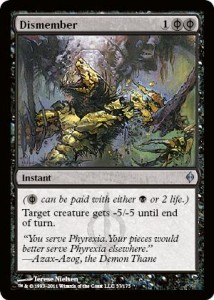
No reason to pick one Uncommon (like Dismember) and go all in. We want to be prepared for a metagame where maybe Dismember isn’t the hot card (seems unlikely, though). I’ve also mentioned Despise, as a possible late bloomer. If the format needs more disruption than removal, Despise could be the hot item. I doubt many will outclass Dismember, but Dismember doesn’t sit as low as some of these other cards, and it is likely going to be easier to move 4-5 playsets of 4-5 different cards than 20 playsets of Dismember.

The goal is to identify 4-5 uncommons that are fated for rotation, that will see serious spikes during the Summer. Dismember, is all but a slam dunk, just like the Path To Exile or Bloodbraid Elf of years past. I still like Despise in this group, because the risk is so small. But are there others? I think there are quite a few Playable uncommons, but I want to look at ones I think have the best chance of spiking. Mostly these are Phyrexian mana spells, as they can slot into so many decks. Act of Aggression and Gut Shot are really inexpensive right now, and I’m stocking up readily. These two are problem solving cards, and there’s no guarantee they end up being the right answer, but since both can be found well under $1 per playset, the investment is minimal, and could easily grow by 500% at the right time. Other uncommons on my radar are Necropede, Contagion Clasp, Exarchs (R/U/B varieties), Go for the Throat, Beast Within, and Dispatch. We want a collection of 4-6 that would be strong in different types of Metagames. This is why I’m shying away from Go for the Throat and Dispatch, but still watching them. The removal spells that are most versatile are Dismember, Act of Aggression and Gutshot, as they go in more decks. Despise will be my disruption choice, and I’ll combine that with Entomber Exarch, and I’m giving Beast Within the nod because it’s a great catch-all answer. Rounding it off with Necropede as a long(er) shot, as a great utility card that has usage in and against lots of decks, beats protection from colors, snipes at x/1 creatures, and supports an Infect deck. This makes my personal list 7-deep. When I attend my first standard PTQ, i hope to pay for all my events of the season by dumping multiple sets of each of these cards. The cards that are still under $1 per playset could profit you as much as $3-5/set, while the more expensive ones may only double in price. Keep in mind, especially with the cheaper cards, you’re looking to hit maybe 2 out of 4, and still make a profit. Make sure you don’t extend yourself too thin, or there wont be enough winners in your batch to offset all the losers. They can’t all win, but by diversifying, you put yourself in a good spot to be a winner on ‘em all as a whole. The ones I’d say need to be in consideration for sure are Dismember, Despise and Gutshot. The rest, use your own Metagame analysis when spoilers for the next set come out to do your best predicting, so you can be the first one to jump on the movements.

As I adjust my selections, I’ll make updates here, but make sure you have your “Inquizition of Kozileks” to dump at the prime time this summer.

See ya next week!
Chad Havas
@torerotutor on Twitter

Insider: Profiting from Standard Rotation

Are you a Quiet Speculation member?

If not, now is a perfect time to join up! Our powerful tools, breaking-news analysis, and exclusive Discord channel will make sure you stay up to date and ahead of the curve.

Magic prices are impacted by a whole slew of factors.

Factors such as breakout performances in large tournaments, are acute, or, in other words, have an immediate and measurable impact on a card’s demand, driving price up significantly.

Other factors are more predictable and describe the ebb and flow of the Magic market in a broader sense. While the latter are less sudden and require more patience, their predictability can help a savvy player identify key speculation opportunities.

This week’s article will focus on one particular factor of this type: Standard rotation.

The Inevitable

Everyone who has attempted an FNM Standard tournament knows that Standard’s rotation is inevitable. With this dramatic change comes the dreaded truth: many card values are going to tank. (This ubiquitous feature of Standard is in fact the main reason I choose not to compete in this format.)

Mythic rares which were once dominant and commanding $20-30 price tags will drop to single digits. For recent examples, consider the likes of Lotus Cobra and Vengevine. Without comparatively dominant homes in other formats, these cards may never demand such high prices again.

Everyone should be familiar with the fact that as Standard cards rotate, they are, in most cases, destined for a significant price slash. The intent of this article is to describe a few upward price trends I have noticed after the last few format rotations. By studying these phenomena, we can in turn make predictions on which cards will go up in price as the face of Standard transforms once again.

I will start with my particular favorite: lands.

Real Estate

While the real estate strategy may not hold up as well in the real world, often times the best Magic card investments lie in the most critical of card types: lands. While this frequently holds true across all formats, there is a particular trend I want to point out in the context of Standard rotation. The best way to outline this observation is to give a couple examples, beginning with the one I alluded to last week.

Every Standard format has had its form of color-fixing, most commonly through lands. These multi-color tappers date back to the game’s inception in 1993, with the original (and most powerful) Dual Lands. Since then Wizards has consistently created lesser versions to be used in Standard. The long-term fate of many of these lands is in an EDH deck or trapped in a casual trade binder, despite having their turn at financial stardom while in Standard.

During their Standard tenure, these lands often follow an interesting price trend. The 2nd most recent cycle, Scars of Mirrodin Dual Lands, are great examples of this trend.

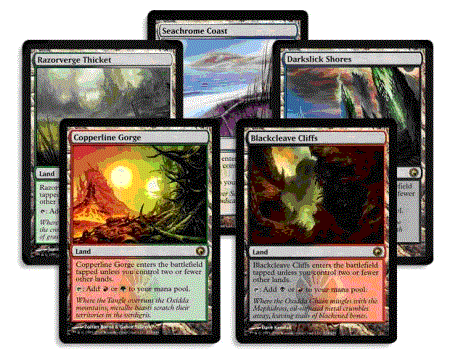
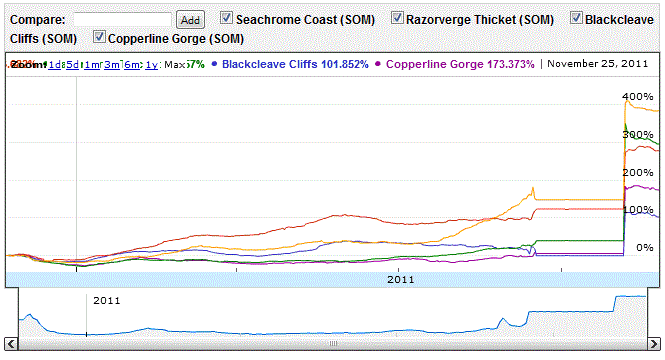
The shape of the price curves for all five lands are similar, despite all being valued slightly differently. See the chart below [courtesy of blacklotusproject.com] for a snapshot of this trend for all five cards since release.

The first thing to notice is that, after initial release, all five of these lands experienced a small relative decline.

This is not too surprising: cards are frequently priced highly at release due to the initially limited quantity. As more packs are opened during drafts and the like, supplies increase rapidly, thereby stabilizing to a slightly lower price.

As the Standard season matured, these lands were relatively flat. While Seachrome Coast and Darkslick Shores saw small increases during the season thanks to the dominance of Caw-Blade / Dark-Blade control strategies, significant price jumps were absent.

Now I want you to focus on where the price on all these cards shot up within weeks. This jump lies directly on top of the Innistrad release, which is, of course, when the format rotated.

Did the supply of Scars Duals suddenly drop post rotation? This is not likely, though it is possible that people stopped trading them away so freely. The main driver for these price spikes is tied to the fact that the format lost two other beloved mana-fixers: Zendikar Fetch Lands and Worldwake Man Lands.

The absence of these beloved lands created quite the demand for Scars Duals, even though Innistrad and M12 also contain multicolor lands. M12 Dual Lands also went up a little bit as well, despite the large quantity printed. Naturally, with this increased demand came a price spike.

This is not an isolated incident. Going back another block, one of the Worldwake Man Lands experienced a comparable price jump upon rotation of Shards of Alara block:

The above chart [courtesy of blacklotusproject.com] depicts the value for Creeping Tar Pit.

On October 1st, 2010, when Shards of Alara block rotated out of Standard, this card averaged $1.97. The format’s rotation was a catalyst that drove the price up threefold. I will concede that the other lands of this cycle did not respond in a similar fashion. It seems bizarre that only Creeping Tar Pit experienced this jump.

While it is possibly due to metagame influences, very slight play in Legacy, and the overwhelming dominance of [card Jace, the Mind Sculptor]Jace 2.0[/card] in Standard, the same phenomenon did not take place with Celestial Colonnade. The reason may be tied to the fact that the Colonnade was the buy-a-box promo for the set. Overall, though, all the man-lands became slightly more sparse in trade binders after Shards of Alara rotated out of Standard.

Looking forward now, it is my belief that these trends will continue as long as Wizards continues to make new pseudo-dual lands once per block. A new set of enemy duals were printed in Innistrad. While they initially sold at $6-7 upon release, most of them have dropped in price already. Reapplying the previous trends, I would predict these lands to drop further as Innistrad is continuously drafted week after week. As the next format rotation approaches and we prepare to say goodbye to the beloved Scars of Mirrodin block, I am anticipating the Innistrad Dual Lands will experience a decent price hike. I plan to grab ample copies of Innistrad Dual Lands in the $2-3 range before this happens and I would recommend the same to my readers.

Mechanic Augmenters

The other trend I want to discuss is what I call “Mechanic Augmenters”. These are the cards that synergize well with the latest set mechanics and could strengthen in playability as the second and third sets of a block are released. In other words, these are the cards that have the potential to gain value through increased playability as the smaller sets of the block reach players' hands. Let’s look at two examples.

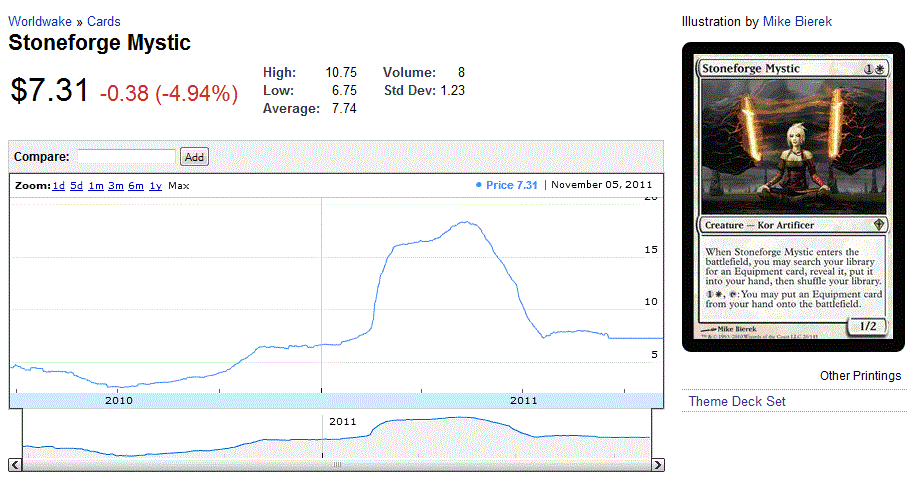
The first example I want to use is Stoneforge Mystic

There was an error retrieving a chart for
:

When this card was originally printed it commanded only modest respect. After all, Zendikar block did not deliver strong equipment cards. But by the time Rise of the Eldrazi came out, everyone heard the rumor that the subsequent block would be artifact-themed. And what card type is equipment? Artifact, of course! This was a buy signal in all possible ways, with minimal down side. Worst case, Stoneforge Mystic could have always been a Commander favorite fetching Sword of Fire and Ice and Umezawa's Jitte for eternity.

Sure enough, the creation of three new swords AND living weapons more than exceeded many players’ expectations. Each new set release from this block made Stoneforge Mystic more and more playable (valuable) until, ultimately, Wizards had to ban the card from Standard and Modern altogether! Before this happened, Stoneforge Mystic tripled in price.

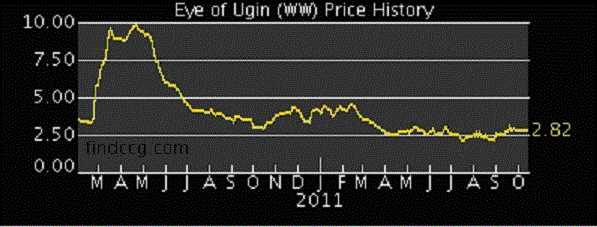
The other example I want to give is Eye of Ugin:

The trend captured on findmagiccards.com highlights what happened very well. The card was originally printed as a virtually useless land. Once the first [card Kozilek, Butcher of Truth]Eldrazi creature[/card] was spoiled, the card price nearly quadrupled. While it did not hold that price for long, this represented a profitable opportunity to the MTG speculator. I still regret missing this one. I discredited the card completely upon first read without focusing on what could have been. Wizards would not have printed Eye of Ugin except to foreshadow what was coming.

Looking forward, I can readily identify at least one mechanic augmenter in Innistrad: Skaab Ruinator. This creature generated much hype when it was originally spoiled, pre-selling for $25. Since then, the card has done nothing but drop in price. At less than $5, the card is garnering my attention. It’s a mythic rare that costs 3 mana and can only get better as more self-milling cards are printed. Plus we have two new sets in this graveyard-themed block to go! This is shouting "opportunity!" at me, and with a very minute risk. I do not plan on missing the next potential Stoneforge Mystic.

Concluding…

This article discussed a more optimistic view of Standard rotation. I used to dread the price drop of all my valuable cards as they rotated. Now I trade them away a couple months before rotation in order to pick up cards that will not be rotating for another year.

I use historical examples for reference when I try to identify speculation opportunities. The above suggestions are not guarantees, but they hopefully provide insight into a novel way of approaching speculation. Now that you have an understanding of how to use historical trends to predict future performers, what opportunities do you see?

-Sigmund Ausfresser
@sigfig8

Rainy San Diego: Part II

Are you a Quiet Speculation member?

If not, now is a perfect time to join up! Our powerful tools, breaking-news analysis, and exclusive Discord channel will make sure you stay up to date and ahead of the curve.

Last time I told you the story of how I went 8-1 on the first day of Grand Prix San Diego. Today we move on to Day Two, and you can expect your regularly scheduled Commander content back next week. In the meantime, I'll relieve the anxiety I know you've all been experiencing about what the surprise was on Sunday morning:

I cracked my eyes open, feeling the stiffness in my lower back that accompanied sleeping in a bed five inches too short. On the bunk across from me, I saw two figures. Strange... with six beds in the hostel room and only four of us, nobody had slept in that top bunk the night before. I crawled out of bed and did a double take.

The man on the top bunk was not one of my friends, and I noticed another stranger on the bed above me. We'd been told we would have the room to ourselves and had been planning to pack up before heading to the event site in order to avoid paying for an extra night.

As quietly as possible (which is to say, “not very”) we shoved cards into boxes, emptied the fridge, and zipped up our bags.

We made our way to the convention center, managing to avoid the rain that had been falling off and on all weekend, and arrived just before they opened the hall. My friends who hadn't made Day Two headed over to the PTQ tables while I took my seat for the player's meeting. After filling out some tax information and release forms, I sat down for my first draft.

[Note: these pick orders are approximate. I had no method of recording them and as such they may be slightly inaccurate.]

Draft One

Pack 1 Picks

I dropped Blue in pack one after Matthias Hunt (the drafter to my right, and 2011 Rookie of the Year) got shipped a fourth pick Civilized Scholar. White seemed semi-open to me, but after I played Matthias (spoiler alert!), he revealed that he started in White. I obviously overvalued the run-of-the-mill White creatures, not from a card quality perspective, as they're all very strong, but from a signaling one. White has a lot of decent common creatures, so receiving a few might just mean there were slightly better ones in the pack.

Pack 2 Picks

Pack two was painful as I passed not one, but two Bonds of Faith for my first pick Fiend Hunter and second pick Angel of Flight Alabaster. When I found a Vampire Interloper sixth pick, I moved in on Black (because it had been obviously open in pack one) in search of an aggressive deck.

Pack 3 Picks

For pack three, I was pretty sure White would be cut, but decided to stick with it for my bombs and removal, just hoping that I would be able to get enough Black cards to fill out my deck. Interestingly enough, after completing the drafting portion, the deck I built was almost mono white:

Day Two Draft Deck (One)

2 Doomed Traveler
2 Selfless Cathar
3 Unruly Mob
2 Vampire Interloper
1 Silverchase Fox
1 Chapel Geist
1 Voiceless Spirit
1 Midnight Haunting
1 Fiend Hunter
1 Elder Cathar
1 Thraben Sentry
2 Angel of Flight Alabaster
1 Dearly Departed
1 Blazing Torch
1 Dead Weight
1 Bonds of Faith
1 Victim of Night
1 Rebuke
9 Plains
7 Swamp

Round 10

The pairings went up and I found myself matched up against Lokman Chen, a local ringer who I'd previously played at a couple of PTQs.

Lokman had drafted a strong Red-Black deck full of aggressive Vampires with the [card Vampiric Fury]fury[/card] to back them up.

Game one I started off too far behind to play around the fury, he had it, and I promptly died to Instigator Gang after losing my team. I'd used my Fiend Hunter earlier in an attempt to stabilize, but I probably should have held it because I had a lot more blockers to draw than answers for bombs.

In game two, I battled back against his Gang-less draw but fell to it again in the third game with Bonds of Faith and Victim of Night unable to stop the menace. I wasn't exactly thrilled to have used up my safety net loss for a Top 8 slot on the first round of Day Two, but since my goal was really only to Top 16, I wasn't feeling too dejected.

Rounds 11 and 12

The next round I was paired against Love Janse, a Top 8 competitor at last year's Worlds. Luckily for me, I'm terrible with names and didn't recognize his, so I wasn't all that nervous going into the match which I won fairly easily on the backs of my two-power fliers.

My luck in not recognizing big names ran out in round 12 when I found myself paired against none other than Matthias Hunt. I managed to stay pretty calm despite Matthias and his UW deck beating me pretty convincingly in the first game.

His subsequent mana screw meant that game two was pretty uneventful, but game three we came out racing. I read him for Moment of Heroism, but after bricking for a few turns, I had no option but to hope I'd made a mistake. I set up a potential win for the next turn, and Matthias swung back for exactsies with Moment.

We talked for a bit after the match, and he confirmed that he'd been trying to stay out of Blue after passing Murder of Crows, but had switched for the late [card Civilized Scholar]Jekyll[/card]. And as I mentioned, he was in White before grabbing double Bonds of Faith in pack two. Matthias gave me the lowdown on which standing cutoffs to aim for, and then we wished each other good luck for the next draft.

Draft Two

Pack 1 Picks

After seeing two late Harvest Pyres, I was pretty sure that red Was open. And, while I hadn't seen a lot of great stuff, Black seemed to be suffering from not having much opened rather than an overabundance of drafters.

Pack 2 Picks

After moving in on my colors and deciding to splash Blue instead of White, I took the 45 seconds I was given to review my picks and try to formulate a list of curve considerations.

Pack 3 Picks

This draft showed me the awkwardness of drafting mostly at FNM and on MtGO.

Not being able to look at my pool between picks, in the middle of pack three I knew white was open, but wasn't sure how many of my playables were red. I decided to stick to red, but when I got to deck building ended up cutting it anyway, meaning I missed out on a lot of late Elder Cathars and Doomed Travelers that would have made my deck better.

The list I registered:

Day Two Draft Deck (Two)

1 Typhoid Rats
3 Walking Corpse
1 Ghoulraiser
1 Screeching Bat
1 Markov Patrician
1 Village Cannibals
1 Midnight Haunting
2 Rotting Fensnake
1 Falkenrath Noble
1 Brain Weevil
1 Evil Twin
1 Stromkirk Patrol
1 Bitterheart Witch
1 Dead Weight
2 Bonds of Faith
3 Victim of Night
1 Demonmail Hauberk
9 Swamp
5 Plains
3 Island

Yup. The plan was to kill them with 2/2s without being terribly aggressive. And I'm always a fan of playing my last pick of the draft (maybe more so when it's a Ghoulcaller's Bell). Needless to say, after going 1-2 with a much stronger deck in the previous draft, I was going to need some pretty favorable variance to pull out the 3-0 I'd need to Top 16 for a Pro Tour invite.

Round 13

My first round opponent had what appeared to be the nuts Green-Blue deck.

Game one he bricked for approximately one million draw steps and I was able to pull it out. The second game he stumbled a bit and then started stabilizing. I had a Falkenrath Noble down, and my opponent ran out a couple of ground guys to stop my forces rather than flashing back Spider Spawning, so with all my skill I promptly top-decked Demonmail Hauberk to kill him.

Round 14

Once again, I was paired against Jon Finkel. I'd heard from one of the players who'd taken an Instigator Gang in the draft that he and Jon were in the same colors. Not knowing what the nonRed one was, I decided to assume Jon was playing aggro.

His first land was an Island and my removal heavy hand started looking a lot worse. Soon enough my team of Rotting Fensnakes and Walking Corpses were staring down three enchantments and Jon got his Burning Vengeance.

I decided to warp my deck to deal with the enchantment,. Since I hadn't seen any strong creatures, I cut Blue and its Evil Twin for Naturalize to go alongside Paraselene and Urgent Exorcism. Game two he managed not to find a single Burning Vengeance despite a bevy of Think Twices and Desperate Ravings, and my random dorks barely got there.

I'd done it! I totally had Jon Finkel's number! I started to put my cards away.

“That was game two.”

Awkward...

After apologizing profusely, I decided I needed to be a bit less all-in on enchantment destruction, as Jon had almost won without an enchantment on the board, so I took out Green in favor of more creatures out of Red. I started the beats off well, but my team quickly succumbed to two doses of Burning Vengeance, as did I soon thereafter. Paraselene and I haven't been on talking terms since it ditched me.

Round 15

And here I was, sitting in the last round of a Gran Prix that I couldn't Top 16, playing for a few hundred bucks.

I'd looked at the standings. My tiebreakers were very good. If I won I'd most likely Top 32, but a loss or draw would put me out of Top 64—that is to say, prize-less.

My opponent this round had an insane mono Red aggro deck. After winning the roll, he started things off with a Reckless Waif. I tried to staunch the bleeding with a turn two Walking Corpse, but Cobbled Wings quickly invalidated that plan, and the Screeching Bat I dropped the turn was soon the laughing stock of his Furor of the Bitten.

I ripped through my sideboard, trying to find a plan of action. I hadn't come all this way and worked this hard just to leave with nothing! My White and Blue were too slow and I needed to block.

I threw together a Jund-colored concoction, complete with Ancient Grudge for his wings and an assortment of mediocre Red dudes. I figured that the only way I was going to win was to draw perfectly, so the greed was justified.

Of course, I immediately got color screwed and lost. Miserable, and trying to contain it, I congratulated Marc on making Top 64, saw the Galvanic Juggernaut and Brimstone Volley his deck had in store for me had I squeezed that game out, and moped over to watch my friends grind after being out of contention in the PTQ.

Moving Forward

Seventy-fifth place might be 'good,' but after Day Two it was more than disappointing. It was soul-crushing. For a while after the tournament I felt dejected even thinking about competitive play, but having moved a little bit farther past it, coming so close has only determined me to do better.

I'm planning on being at the Santa Clara PTQ tomorrow, and you better believe I'm in it to win it (though some Commander and cubing certainly might occur on the side). Come back next week for the casual side of The End of the Worlds. And in the meantime play some Innistrad limited. It's fantastic!

Jules Robins
julesdrobins@gmail.com/Google+
@JulesRobins on twitter

Insider: An Introduction to Interactive Learning

Are you a Quiet Speculation member?

If not, now is a perfect time to join up! Our powerful tools, breaking-news analysis, and exclusive Discord channel will make sure you stay up to date and ahead of the curve.

Hello again, dear readers! Thanks for tuning in.

One of the things that has always interested me about MTG is theory. Whether it’s deck building, finding the proper mana curve, or economics, I’m always down for learning new tips and tricks to maximize my trading and gaming potential.

Different people learn in different ways. Some people can see something being done and imitate it immediately (visual), other people need to do that thing themselves (kinesthetic), and yet others like to hear things explained to them (auditory).

When you’re reading a website, you’re basically forced to learn visually, which may not be your preferred learning style. Because of this, I think that incorporating another method of study would be beneficial to train our minds to think in dollar signs and decimal points.

So spit out your gum and take off your hats… school is in session!

Homeroom

One of the things that I am going to try to accomplish as a writer is train you to think about things in different ways and present you with new ideas that may be applied to your existing trading and buying practices. I feel that the best way to do this is to give you some hands on experience on this very site! After all, as an Insider you are paying for this content, so we want to be sure that we’re giving you the tools and skills that you’ll need in that harsh and unforgiving world that is your local LGS or favorite Online Store.

As such I have designed two exercises that I think you’ll enjoy!

In this article I would like to introduce you to these exercises that I intend to run in my regular articles from time to time. I would very much appreciate your feedback, letting me know if this is something that you enjoy and find of value! They would not be entire articles, just fun little “games” that we can “play” together as a wrap up.

(Note: All of the prices I use are from eBay completed auctions dated Nov 24th / 2011)

Without further ado I present to you the two new ideas:

  • Trade or NO Trade?
  • Snap-Buys

Trade or NO Trade?

In “Trade or NO Trade?” you will be presented with two piles and it will be your job to decide if the trade is good, bad, or equal, as well as which pile you would take.

This exercise will allow you to look at a trade and evaluate it, which will work on the following skills:

  • Pricing – Which Pile is actually WORTH more?
  • Uptrading – Useless T2 Rares vs. Proven Staples?
  • Speculating – Is one pile worth more but the other has more potential?
  • Opinion – Debating “close calls” to get a general consensus?

Let’s do a few of these now to get warmed up!

<< TRADE 1 – Mythic Madness >>
PILE 1 PILE 2

4x Stromkirk Noble
1x Olivia Voldaren
1x Sword of Feast and Famine

1x Geist of Saint Traft
3x Hero of Bladehold (Promo)
4x Champion of the Parish

So what do you think? Pile 1 or 2? Or are they even?
Think about it before you scroll down…

<< TRADE 1 – Mythic Madness >>
PILE 1 PILE 2

4x Stromkirk Noble $5.5x4=$22
1x Olivia Voldaren $13
1x Sword of Feast and Famine $30

1x Geist of Saint Traft $12
3x Hero of Bladehold (Promo) $11x3=$33
4x Champion of the Parish $3.5x4=$14
TOTAL = $65 TOTAL = $59


While Pile 1 in this example comes out slightly ahead, this still looks like a relatively fair trade on both sides. Losing out on $5 to make a trade of this magnitude doesn’t seem that bad since there are so many cards being shifted from one side of the table to the other.

If you were on Pile 1, sometimes it’s worth it to take a slight loss just to get all the cards you need from one place.

How do you feel about this trade? Would YOU have done it? Did you evaluate the card values at the same prices that I did? Did you need to look up the prices, or did you just know them off the top of your head? Try getting used to making your predictions without looking up the answers, then check your work to ensure you were correct.

Let’s do another one!

<< TRADE 2 – Fish for Forces >>
PILE 1 PILE 2
1x Beta Lord of Atlantis (ex+)
3x Stifle
1x Tundra (nm-)
1x Flooded Strand
3x Force of Will (ex)

So what do you think? Pile 1 or 2? Or are they even?
Think about it before you scroll down…

<< TRADE 2 – Fish for Forces >>
PILE 1 PILE 2
1x Beta Lord of Atlantis (ex+) $40
3x Stifle $15X3=$45
1x Tundra (nm-) $80
1x Flooded Strand $25
3x Force of Will (ex) $50X3=$150
TOTAL = $190 TOTAL = $150


Bad deal for Pile 1! Everyone loves a good FoW, and people are more than prepared to pay their astronomical prices... But there is a difference between giving a good deal (like in Trade 1), and getting taken advantage of.

It’s not unheard of to value FoW @ $60 in trade, but you have to look at every trade objectively. If it was the 3x FoW for a bunch of lesser cards like Shocklands, Hot T2 Planeswalkers, Zendikar Fetchlands and the like, I can see giving that kind of premium. However, we’re talking about Stifles, Duals, Betas and Onslaught fetches, which are all high demand themselves!

Not only that, but since I go by eBay completed listings when looking for prices, these are actual sell values. As such, theoretically, Pile 1 could do a little more work and sell all their cards for $190, buy the FoWs for $150 and pocket the leftover $40.

C’mon Pile 2… you could have at least put back that bonus Flooded Strand ya Greedo!

We’ll do one more today!

<< TRADE 3 – Random EDH Rares >>
PILE 1 PILE 2
1x FOIL Coalition Relic
1x Reveillark
1x Maelstrom Pulse
1x Baneslayer Angel
1x FOIL Birds of Paradise (M12)
1x Ulamog, the Infinite Gyre (FTV)
1x Doran the Seige Tower (FTV)
1x Doubling Season
1x Pact of Negation
1x Crystal Quarry
1x Day of Judgment (MPR)
1x Sol Ring (REV)
1x Decree of Pain
1x Solemn Simulacrum (MIR)

So what do you think? Pile 1 or 2? Or are they even?
Think about it before you scroll down…

<< TRADE 3 – Random EDH Rares >>
PILE 1 PILE 2
1x FOIL Coalition Relic $20
1x Reveillark $3
1x Maelstrom Pulse $8
1x Baneslayer Angel  $5
1x FOIL Birds of Paradise (M12) $5
1x Ulamog, the Infinite Gyre (FTV) $11
1x Doran the Seige Tower (FTV) $4
1x Doubling Season $20
1x Pact of Negation $12
1x Crystal Quarry $2.5
1x Day of Judgment (MPR) $3
1x Sol Ring (REV) $6
1x Decree of Pain $2.5
1x Solemn Simulacrum (MIR) $6
TOTAL = $56 TOTAL = $52


These are the kinds of trades that I feel you’ll be seeing most of the time when trading with casual players. They find some stuff that they like, you find some valuables that you hope to re-trade for value.

It turned into another fair trade in the end, so my question is this… what side would YOU rather have taken?

Each side has some good stuff in it (Relic / Ulamog / Pulse in Pile 1 & Doubling Season / Pact / Solemn in Pile 2) so it’s in the air as far as I’m concerned. In these kinds of trades the cards above are what I normally hone in on, as they are the ones that are actually valuable. As long as the valuable cards seem to line up fairly well, the little “throw-ins” don’t matter as much… especially if our side of the “bigger” cards is better!

As long as that’s okay, just take the pile that you need and feel confident that you didn’t get jacked, because sometimes that’s all you can do! 🙂

TIP: In the kinds of trade like Trade 3 when the big stuff lines up but a side is down $5 or something menial, it’s okay to be the guy who loses. (As long as your partner isn’t a shark!)

Say something to your trade partner like: “Hmmm… looks pretty close, but I think you’re still ahead. Tell you what, let’s do it this time, but remember me for next time!” So you lose out on some terrible rares that no one else would have wanted anyway and you make a trading partner for life! Great deal.

Snap-Buys!

We are speculators and investors and, as such, probably spend a lot of time scouring buy/sell lists for deals or prices that haven’t corrected themselves to reflect current market values. Sometimes it’s hard to know what you should and shouldn’t be looking to buy when you’re presented with a wall of text and hundreds of different prices.

Snap-Buys is an exercise in quickly scanning sell lists to home in on what the better deals are within them. Together we will look through a random sell list, make the choices of what we would buy, then compare our lists to see if we’re all on the same page value-wise.

This exercise will allow you to look at a sell list and evaluate it, which will work on the following skills:

  • Pricing – What are the good vs. bad deals?
  • Speculating – Great place to buy cheap rares at bulk prices
  • Comparison Shopping – Sell list prices vs. eBay prices
  • Bartering – You can put in a lower offer to see if they accept
  • Opinion – Since we all won’t choose the same things

If you’re looking for a TON of good sell lists, I like to go to MOTL (Magic Online Trading League) at www.magictraders.com and check out their sales threads. Most sites these days have some kind of trading community in their forums, so these are commonplace, and the strategies that you develop here can obviously be transposed to whatever lists you find.

Here is a list that I scooped from an active post today.

Make a list of those cards that you would buy! Whether for investing, speculating or simply trade for fun and profit.

(Quantity x Card - $Price)

3x Phantasmal Image - $8
1x Gilded Lotus - $8
2x Sacred Foundry - $15
2x Sensei's Divining Top - $11
2x Vendilion Clique - $24
1x Gilded Drake - $10
1x Phyrexian Dreadnought - $15
1x Consecrated Sphinx - $10
1x Maelstrom Pulse - $5
2x Day of Judgment - $1
1x Kiki-Jiki, Mirror Breaker (COK) - $10
1x Idyllic Tutor - $5
3x Wrath of God (rev) - $4
2x Sol Ring (revised) - $6
2x Regal Force - $3
1x Adarkar Valkyrie - $4
1x Lightning Greaves (Commander) - $0.75
1x Akroma, Angel of Wrath (TSS) - $5
23x Demonic Tutor (rev) - $7
1x Kor Haven - $5
2x Flagstones of Trokair - $2
2x Molten-tail Masticore - $1.5
1x Eternal Dragon - $2
1x Academy Ruins - $6
1x Twilight Mire - $5
1x Mystical Tutor (mirage) - $2
1x Wurmcoil Engine (promo) - $17
1x Bridge from Below - $14
3x Puresteel Paladin - $2
1x Karn Liberated - $10
1x Gideon Jura - $9
2x Frost Titan - $3
1x Mox Opal - $20
1x Blade Splicer - $3
4x Spell Snare - $4
1x Jin-Gitaxias, Core Augur - $3
4x Memoricide - $1
4x Inquisition of Kozilek - $2
2x Path to Exile - $2
2x Spikeshot Elder - $1
1x Grim Lavamancer (M12) - $3
1x Dungrove Elder - $3
1x Geist of Saint Traft - $12
1x Venser, Shaper Savant (ex) - $8
2x Vindicate - $26
3x Knight of the Reliquary (KvD) - $8
3x Show and Tell - $28
1x Force of Will - $55
2x Transmute Artifact - $15
5x Reset - $16
2x Null Rod - $8
2x Maze of Ith - $30
6x Baron Sengir - $3
1x Goblin Welder - $6
1x Tezzeret, Agent of Bolas - $12
8x Regrowth (rev) - $1

That’s the end of this list!
So… what did you “buy”?
Here’s what I thought we could use:


1 Maelstrom Pulse $5
2 Day of Judgment $1
2 Molten-tail Masticore $1.5
1 Eternal Dragon $2
2 Path to Exile $2

These are the only cards I thought would be worthwhile from that entire list. Some cards were close to par value, others were slightly below, but these were the ones that I feel we’d be best off buying for value. Sure the Spell Snares @ $16 / playset looked good, but we could get those off eBay for that same price and they would only trade to another human @ $5 each… not enough room to profit. (I would have put an offer in with the seller for $12 / playset if they were interested, however. :))

Here’s why I chose what I did:

  1. Maelstrom Pulse is showing up in Modern decks, is out of stock in NM on SCG @ $9.99 and actually sells for between $7-10 on eBay.
  2. Day of Judgment trades locally for $3 each and often, people will trade for them as a playset - meaning that your $4 investment = $12 in trade. If you can trade 4x DoJ for a Geist, you’re in great shape!
  3. I’m speculating on Molten-Tail Masticore, since he puts cards in the graveyard and we’re currently just starting a graveyard-themed block. He’s pretty powerful with his great CC vs. P/T, is mythic, and is under $2. He’s a risk that I’m willing to take, as I’m sure I could just re-trade him at $2 if I had to.
  4. Eternal Dragon’s price fluctuates greatly between $2-$5 and he’s in basically every White EDH deck ever for his Plainscycling (read: Dual fetching) ability and recursion. You WILL be able to get $5 in trade for him.
  5. Path to Exile is a Modern staple and, while it’s only actually worth $2 right now, it’s another of those cards that fluctuate and are getting hard to find. Store these two with another two that you have lying around and trade them as a playset for $15. The buy-it-nows on eBay had one in NM- sell for $4.75 and a playset sell for $14.68 (in case you wanted a reference as to how high these CAN go).

Putting it All Together…

The purpose of this article was to get our collective brains working and introduce you to a new style of interactive learning. I will be trying to incorporate these exercises into my weekly articles from time to time in order to keep us on our toes, adding some fun things to discuss through more of a “hands on” approach to trading, which should have us soaking up data points up like sponges.

Again, I’d love to hear your feedback on this initiative, as it’s something new that I haven’t seen on any other website.

Until next time remember: “You’re bigger than you think!

Cheers,

Carl Szalich

Why so Blue, Myojin?

Are you a Quiet Speculation member?

If not, now is a perfect time to join up! Our powerful tools, breaking-news analysis, and exclusive Discord channel will make sure you stay up to date and ahead of the curve.

When my friends and I started playing Commander in college, we didn't really know that there were "official" rules for the format.

We played very casually with plenty of house-bans and rules. Consequently, when someone built an Azami, Lady of Scrolls combo deck, it easily dominated our games. One person's response to this was to build a Myojin of Night's Reach deck. At the time, we didn't know or care that casting your general from the Command Zone was different than casting it from your hand, so Myojin of Night's Reach was a great foil to the blue combo deck.

However, it didn't take long for the combo player to respond in kind by switching their general to Myojin of Seeing Winds. Soon, the game devolved into a sub-game of these two decks jockeying for position, trying to win the Divinity counter war, and the rest of us trying to win before they did.

If you could force the other player to use their Divinity counter first or get more Divinity counters than the other player, you just won. This was accomplished with cards like Winding Canyons, Clockspinning, and Aether Snap.

Of course, after several months of this, two things happened that were very bad for these two decks. First, the rest of us got tired of the ridiculous Divinity counter sub-game and started playing beatdown decks that never let these decks hit eight and ten mana. Secondly, we learned how the rules worked. The decks tried to adapt by using things like That Which Was Taken, but these two changes made the decks essentially unplayable.

That said, even after all this time, I remember how absurdly powerful the Myojins could be when you managed to get Divinity counters on them.

Sometimes I get a little nostalgic for those high tension games—games where a few of us mere mortals tried to kill the Myojins before they finished fighting one another.

Recently, the Myojin were brought up as a sort of joke during one of our games at the local game store and were discussed as cards that have been completely outclassed by Titans, the Eldrazi, and the Praetor cycle from New Phyrexia. Since then, I've been thinking about throwing together one or two Myojin decks to teach some respect for the greatest of all the Kami.

Of the five, the Blue one seems to be the best place to start, since it's the most capable of bouncing creatures and manipulating counters.

Groundwork

Let's be honest. The format has come a long way since in the last couple of years.

These days we're playing in a world where you can build a combo deck or a prison deck in any color that plans to win by it's sixth of seventh turn with a startling degree of consistency. The primary way of getting a Divinity counter on Myojin of Seeing Winds is to cast it once, then bounce it and cast it again. If your plan involves casting a ten mana Hill Giant not once, but twice, it'd better win you the game. That means that the important question is: What's the best way to make Myojin of Seeing Winds a one-card combo? There are two suites of cards that I thought of that accomplish that:

Voltron Package

  • Diviner's Wand
  • Empyrial Plate
  • Sculpting Steel
  • Phyrexian Metamorph
  • Copy Artifact
  • Tezzeret the Seeker
  • Fabricate
  • Winding Canyons
  • Hall of the Bandit Lord
  • Swiftfoot Boots

This is what I imagined to be the primary route to victory. You get a Divinity counter on Myojin, you suit it up, then draw a billion cards and one-shot someone with your general. Diviner's Wand and Empyrial Plate both make Myojin gigantic. And with either of those, 18 cards will make Myojin lethal. Ideally though, you'll be able to copy whichever equipment you're using at least once, cutting the number of cards you need in half. The tutors like Fabricate and Tezzeret the Seeker just make your "combo" more consistent, while the lands give you haste or pseudo-haste while making you less susceptible to disruption and freeing up mana on your big turn.

Laboratory Maniac Package

  • Laboratory Maniac
  • Inexorable Tide
  • Shrieking Drake
  • Crystal Shard
  • Erratic Portal
  • Call to Heel
  • Rescue
  • Into the Roil
  • Capsize

Your secondary route to victory is significantly more epic and has more synergy with the overall plan of the deck.

The plan here is relatively simple: Get a Myojin in play with a Divinity counter and and resolve Inexorable Tide.

At this point, Shrieking Drake reads "U: Proliferate," which you'll use to put a few Divinity counters on Myojin of Seeing Winds. Then you can start removing the counters one at a time until you draw Laboratory Maniac, and then you can proceed to draw your deck and win the game! As an alternative to Shrieking Drake, you can use bounce spells to recast creatures, hoping to draw into more bounce spells.

The upside to this plan is that it doesn't involve the combat step and that the bounce spells are already necessary to the deck, since you have to get a Divinity counter on the Myojin somehow.

At this point there are a few big questions that still need to be answered in order for the deck to function: How do you deal with disruption? How do you generate enough mana in a reasonable fashion? Are there more reasonable ways to get Divinity counters?

The easiest question to answer is how to deal with disruption—with disruption of your own! Blue has a huge array of countermagic available to it and you'd be remiss not to take advantage of it in a mono-blue combo-ish deck.

Disruption

  • Turn Aside
  • Dispel
  • Remand
  • Cryptic Command
  • Dismiss
  • Force of Will
  • Foil
  • Pact of Negation
  • Counterspell
  • Deprive
  • Faerie Trickery
  • Dissipate
  • Arcane Denial

The protection here generally falls into two camps. The first is the very cheap or free countermagic, like Force of Will and Foil, which help you to protect your Myojin. Generally, I'm not a fan of cards like these because they put you so far behind the rest of the table in terms of cards. However, with this deck, once you're casting these counters you won't care about your hand size since you're about to kill a player and restock your hand. You just want the counters to be as cheap as possible so you can make sure you don't get blown out by removal.

The second class of counters are those with some amount of utility that you'll plan on using throughout the game while you're setting up your Myojin turn. Things like Dissipate deal with recursion strategies, while the cantripping counterspells make sure you don't fall behind on cards.

Remand is probably the most interesting one here, since it does double-duty as a counterspell and as a way to get Myojin into your hand so you can get a Divinity counter on it.

Mana Ramp

  • Gauntlet of Power
  • Caged Sun
  • Sol Ring
  • Thran Dynamo
  • Everflowing Chalice
  • Mana Vault
  • Grim Monolith
  • Voltaic Key
  • Trinket Mage
  • Solemn Simulacrum

This deck is clearly going to be incredibly mana intensive. You're looking to spend at least 20 mana over two turns to maybe kill someone, so you're going to need some of the most degenerate mana acceleration there is to get there at a reasonable point in the game.

Gauntlet of Power and Caged Sun are the two most powerful cards here, since they double your mana. You could also try Extraplanar Lens, but I've seen people get blown out when they try to use that card and it's not something I'd like to have happen to me.

We've also got classics like Solemn Simulacrum and Trinket Mage into Sol Ring. Trinket Mage can also get Mana Vault and Voltaic Key, which let you ritual up to Myojin.

The card with the most potential out of these is Everflowing Chalice, since this deck does have a small Proliferation sub-theme. Chalice can quickly get out of hand. The fact that Chalice scales up over the course of a game and interacts favorably with one of the themes of the deck definitely pushes it over the top of a more efficient cards like Worn Powerstone.

More Divinity Counters!

  • That Which Was Taken
  • Sakashima the Impostor
  • Viral Drake
  • Steady Progress
  • Tezzeret's Gambit

And the last of the must-includes are the cards that make it easier to get Divinity counters on your Myojin. Proliferating Divinity counters is one of the first things I thought of when I first saw that mechanic and I'm definitely excited to see how that interaction works out. Sadly, there aren't all that many proliferate cards that are very good unless you have counters as a dedicated part of your deck, but the ones that the deck is running are fine, even if you can't proliferate on anything.

[card Sakashima the Impostor]Sakashima[/card] and That Which Was Taken are both easy ways to get additional counters. Both are repeatable effects and have their own upsides and down sides, but I think [card Sakashima the Impostor]Sakashima[/card] is slightly better, simply because it costs half as much to cast and get value in the same turn.

Filling in the Gaps

Thus far, we've dedicated forty-three deck slots to the fundamental engine of the deck. The last sixteen or so cards need to be good enough to handle the early and midgame so that you don't lose while you're setting up a Myojin turn. As the deck is mono-blue, we're generally going to have to rely on artifact-based interactions to protect ourselves from creatures and other permanents that we can't counter on the way down. The suite needs to focus on dealing with on-board problems and slowing the game to the point that you'll get a chance to resolve a Myojin.

Utility

  • Nevinyrral's Disk
  • Oblivion Stone
  • All is Dust
  • Duplicant
  • Karn Liberated
  • Steel Hellkite
  • Treasure Mage
  • Propaganda
  • Forbid
  • Muddle the Mixture
  • Relic of Progenitus
  • Spreading Seas
  • Jushi Apprentice
  • Venser's Journal
  • Mystic Remora
  • Dream Halls
  • Body Double

The first suite of cards is exactly what we need to make sure the game doesn't get out of control. As long as you can prevent other players from reaching their endgame before you have a chance to start killing people, everything should work out. There's not too much to say about these guys; they're pretty standard inclusions in decks across the color pie and spectrum of archetypes.

The second set, however, is a little more interesting. You have some graveyard hate and non-basic hate; effects which need to be present in some quantity in every deck. There's also Muddle the Mixture and Forbid, which both do interesting things for the deck. Forbid plays well with Myojin's ability to restock your hand, and Muddle the Mixture enables you to find your Empyrial Plate.

Over the course of a game, you're going to have to use countermagic to protect yourself, and both Mysic Remora and Jushi Apprentice are great ways to restock your hand. They also enable you to use a cards like Dream Halls to enable you to cast Myojin more easily, or Venser's Journal to keep your life total up. Lastly, Body Double is another way to cheat counters onto a Myojin of Seeing Winds; as long as you can get Myojin in your graveyard, Body Double halves the cost of getting a Divinity counter.

The Manabase

Building the manabase for this deck is a challenge since there are strong incentives to run utility lands and basics. Utility lands give you more value out of your mana, but the basics play better with Caged Sun and Gauntlet of Power. Both approaches have upside and the trick is to find a way to balance the two. Here's the approach I've settled on:

  • 25 Island
  • Inkmoth Nexus
  • Mishra's Factory
  • Blinkmoth Nexus
  • Faerie Conclave
  • Deserted Temple
  • Vesuva
  • Thawing Glaciers
  • Buried Ruin
  • Tolaria West
  • Academy Ruins
  • Reliquary Tower
  • Darksteel Citadel
  • Seat of the Synod

The manlands, particularly Inkmoth Nexus, interact very favorably with your equipment gameplan and give you a backup to Myojin. Thawing Glaciers enable you to consistently make land drops, especially in conjunction with Deserted Temple and Vesuva, which is important for making sure you can get to ten mana. Academy Ruins and Buried Ruin are there to protect your artifacts from removal. Your gameplan hinges pretty heavily on resolving and keeping in play fragile pieces of equipment, so being able to recur those is very important.

With the manabase finished, let's take a look at the finished decklist:

[deckbox did="a137" size="small" width="560"]

That'll Do

And that'll do it for this deck!

I'm excited to take it to my LGS for a few weeks to see how this turns out and if it's able to earn some respect for the old school of gigantic legendary creatures. As always, be sure to let me know what you think in comments, on Twitter, or by email. I'm always excited to discuss the format with anyone who's interested. Be sure to check out next week's article. I'm excited to be taking a unique look at how to handle graveyard-based attrition and combo decks!

Carlos Gutierrez
cag5383@gmail.com
@cag5383 on Twitter

CC S4E10 | Crossover Week III: Third Strike

Are you a Quiet Speculation member?

If not, now is a perfect time to join up! Our powerful tools, breaking-news analysis, and exclusive Discord channel will make sure you stay up to date and ahead of the curve.

Crossover Month continues to explode all over your ears with this installment. Andy is joined by Derfington, JayBoosh and Scotty Mac for a ManaDeprived crossover spectacular. This week's episode has an new installment of Doucheology, Hated Out, and a discussion on the most played-out cards in Commander.

Hit the button or play, or download the entire episode! The full show notes are here.

For more Wrexial-approved content, head over to CommanderCast.com

QS Drafts: Drafting Innistrad #9 [MTGO]

Are you a Quiet Speculation member?

If not, now is a perfect time to join up! Our powerful tools, breaking-news analysis, and exclusive Discord channel will make sure you stay up to date and ahead of the curve.

Join Forrest Ryan, Kyle Stoll, Patrick McGregor and friends as they narrate a group-drafted MODO tournament.

Other drafts:
QS Drafts: Drafting Innistrad #1
QS Drafts: Drafting Innistrad #2
QS Drafts: Drafting Innistrad #3
QS Drafts: Drafting Innistrad #4
QS Drafts: Drafting Innistrad #5
QS Drafts: Drafting Innistrad #6
QS Drafts: Drafting Innistrad #7
QS Drafts: Drafting Innistrad #8
QS Drafts: Drafting Innistrad #9

Insider: The Money in Morningtide

Are you a Quiet Speculation member?

If not, now is a perfect time to join up! Our powerful tools, breaking-news analysis, and exclusive Discord channel will make sure you stay up to date and ahead of the curve.

Hello, readers! We move ever deeper this week into the fairy tale of Lorwyn with its expansion, Morningtide. These two sets were supposed to be the "light side" version of fairy tales - giants, dwarves, toadstools with faeries sitting on them and more. The next two sets, Shadowmoor and Eventide, took things in a dark turn. We'd never before seen a big set-little set-big set-little set series made intentionally before in Magic. It made for a rich and deep Standard pool, especially with Time Spiral still in the mix. Unfortunately, a few power cards dictated the script for Standard and we saw a bit too much of Faeries for most peoples' liking. That said, there are still a lot of money cards to be mined in Morningtide, so let's take a look!

Bitterblossom

$10.50

Bitterblossom was the scourge of Standard. Turn 1 Ponder led into this card on turn two, then a Scion of Oona or Spellstutter Sprite soon followed. It was death of a thousand cuts as the little fliers absorbed big attackers and just kept punching through. Bitterblossom made a lot of people rage-quit Magic, especially because Wizards did nothing about the card and instead, just tried printing stoppers like Volcanic Fallout. I like to think they've learned their lesson now, especially looking at how Stoneforge Mystic and Big Jace got nailed when they became dominating.

Faeries was certainly an exciting theme deck for people, but I am unsure of why the price remains so high. This card is, I promise, never getting unbanned in Modern. Even casually-popular lords, like the Elf suite, don't rise into double-digit prices. My guess is that a lot of people still look at this card and think it's worth the $15 they traded to get them in the first place, so that's what's keeping the price up. Maybe people just love rogue decks.

Chameleon Colossus

$1.75

I like this guy, even though everything I said about Mirror Entity being the best creature in most categories still applies. Chamillionaire is really cool - he easily gets giant, he's protected from removal and his Changeling ability saw a lot of actual, creative use. For example, in the Doran decks, it would come out with Treefolk Harbinger and sometimes turn on Murmuring Bosk. When you pump eight mana into this dude or double him even once with Loxodon Warhammer on him, you know cool things are just around the corner.

Countryside Crusher


$1.25

This sees a moderate amount of play in Legacy in both Aggro Loam decks and red Ancient Tomb Aggro decks. He certainly gets big in a hurry, but lose a land in play and you may never cast another spell again. It's a good Terravore kind of card, for sure.

Door of Destinies

$5.75

I first saw Door pop up in an Allies Commander deck and I realized that it was the set promo. I saw just how quickly this card gets out of hand. Think about it - two tribal dudes hit and now everything gets +2/+2. Another hits and it's instantly a Durkwood Boars or better. Any token generation, like Summon the School, and things are absurd. It's easy to see how this card fetches so much money, even though there are more copies of it than any other Morningtide rare. What a monster of a card. This is the sort of thing that can sit unchecked for a single turn in Commander and just go bonkers in an instant. Remove this on sight!

Grimoire Thief

$1.50

Casual players must really love this effect. The Thief is pretty terrible in actual constructed Magic, which makes me think people just want to combine this with something like Mind over Matter. Dig these out of junk boxes and things you'd sell for a dime to a dealer, because these are worth cash!

Idyllic Tutor

$4.25

This is another Commander card that keeps going up and up. It has a crossover appeal for people who play Enchantress decks and also folks who want to get power enchantments for their 100 card decks. I've used it before to pull up a Palliation Accord (seriously nuts) or a Holistic Wisdom in Commander. A few months ago, these were two bucks, and the market keeps driving them higher and higher.

Kinsbaile Cavalier

$2.00

The Goat-Knight, despite its art, is a serious card for casual Knight deck players. The double-strike means that your guys effectively get at least +2/+0, being as most knights aren't puny. This, like Orcish Oriflamme of old, can conceivably seal up the game when the opponent least expected it. Again, this is a card to pull out of your junk stacks. People, amazingly, pay real money for these.

Leaf-Crowned Elder

$2.00

Lorwyn has something for a lot of casual tribal deck assemblers, and this is a good example. I don't know why you'd play a treefolk deck (the mana curve has to start at what, eight million?), but this guy lets you cheat them right into play. Combine with Sensei's Divining Top to make a bad card slightly less bad!

Murmuring Bosk

$2.75

This has seen a little bit of Modern love, since it makes three colors of very useful mana. I don't know if there will ever be a Doran deck, but this is an integral 1-of, at the least. I pack one in my Melira deck, since it can occasionally be useful to have a Grand Coliseum in the deck. I don't think its price is justified, but it could easily start ticking up if GWB is a real combination in Modern.

Mutavault

$22.50

The Mishra's Factory redux drew a lot of attention when it first came out and it continues to see a lot of love. It's been reprinted as a promo, which has done nothing to the value of this card. Mutavault simply says "are you playing a Tribal deck? Wanna make it a hell of a lot better?" It makes more faeries for Spellstutter Sprite, it picks up Lord of Atlantis bonuses, it triggers Goblin Piledriver and more. I'd love to see it reprinted, since people love this kind of card. Unfortunately, Changeling is a pretty set-specific word, which means Mutavault is going to stay at over twenty bucks for a long time. Huge numbers of these change hands on Ebay, so they aren't that hard to move. If you are value-trading, then these will always bring you love.

Preeminent Captain

$3.00

Why is it that, of tribal decks, the "profession" decks are never as good as the "race" decks? We don't really see Clerics burning up the top tables, but Faeries, Kithkin and Merfolk all had good runs. Even Wizards were just a flash in the pan! There have got to be some die-hards trying to make it work, though, since this guy is worth a bit of cash. It's this kind of card that makes me love writing this series, since I see someone getting this guy as a junk toss-in for a trade and grinning all the time.

Reveillark

$3.00

I'm actually surprised that Reveillark is this cheap. It's a seriously fun card and people can build half-decent Modern decks with it. Fun fact: Kitchen Finks was actually improved by adding a power point so that you couldn't bring it back with Lark! I'm sure Shriekmaw got the same treatment. At it is, you'll have to be content with bringing back Mulldrifters and Body Doubles for infinite shenanigans. Most decks with white cards in Commander can benefit from this flying Elemental, too.

Scapeshift

$2.25

Braggy time: I remember Steve Sadin writing "this thing could be good with Valakut"when the land was printed. I ended up buying a bunch at a quarter, then blowing them out for four bucks apiece. That was before people actually started talking to each other about speculation, which tells you how young the field actually is. I think that was one of my first calls with Kelly. Sadin was right and Scapeshift started tearing it up in Extended. You can't make the combo happen in Modern, so it's only a few dollars, but I wouldn't put it past someone to try and make the Tron with this card. It's a one-spell insta-Tron if you've got the lands laying around.

Stonehewer Giant

$3.50

Here's another card that keeps ticking up in price, bit by bit. The Giant is a lot of fun in Commander, where you can dig up Helm of Kaldra and the rest of the set, or simply punish people with Swords. The Vigilance is a really cool touch. You can attack in with the Giant, then tap him so he can go dig up a piece of l00t to use. Maybe he'll get a trident this time!

Vendilion Clique

$21.75

I really hate that these things are so expensive. Clique does a moderately useful thing, but the flash is what makes it so good. Yes, it obviously lets you burgle a card in the opponent's draw step - no more Life from the Loam! But that instant speed also lets people sit back on Clique and then flash it in at the end of the turn when they don't have to hold up counterspells any more. Maybe that Planeswalker you're so proud of is about to get killed by a trio of pests. Clique is simply good utility, so I'm bummed to see that it's over twenty bucks. Modern has been driving its price a lot, since Clique shot up from $8 a few months ago. It can act as combination disruption and an alternate kill in Twin decks, but the presence of Punishing Fire really holds Clique back from being too obnoxious.

What a huge set review! There's a lot of cash to be made by mining Morningtide. I hope you'll join me next week as we get into Shadowmoor!

Until then,

Doug Linn

Want Prices?

Browse thousands of prices with the first and most comprehensive MTG Finance tool around.


Trader Tools lists both buylist and retail prices for every MTG card, going back a decade.

Quiet Speculation