menu

Sleeper Cell NPH

Are you a Quiet Speculation member?

If not, now is a perfect time to join up! Our powerful tools, breaking-news analysis, and exclusive Discord channel will make sure you stay up to date and ahead of the curve.

This week we will go off the beaten path of the usual trade analysis articles I write.  Instead I want to talk about the new set. Now before you groan and close this article bear with me I promise it will be worth it.  Yes, we all know Karn Liberated and Sword of of War and Peace are insane as this has been beaten again and again by every author on the internet.  What about the rest of the set?  Is there any value or is it just a pile of trash?  This week I will cover what I like to call the sleeper cards, the ones people turn a blind eye toward to focus on the larger metagame changers.

What few people realize is that the casual market drives prices just as much as the competitive standard players.  Do you know what the lieges from Lorwyn block are worth?  Few people realize that they still hold any value at all and if you know how to play your trades correctly you can turn a hot ticket item into double or triple the value just from people’s lack of knowledge.  The same works for new sets, everyone is looking for the new game changers and fail to realize that just because a card isn’t worth 10+ doesn’t mean it won’t be worth picking up.   I’ll run down the chain so you can follow by set color and I’ll cover anything that has potential to be more than bulk.  Most of these prices will take a month or three to catch on but when everyone else is so concentrated on the competitive aspect they still make great pickups while they are cheap.

~White~

Blade Splicer: Expect this guy to be a bulk rare to start with. It's unlikely that it will see any real standard play but with the new set comes a “new” tribe.  Golems have been around the game of Magic for year’s but casual players love the idea of theme decks so expect this guy to be a quick return at 2-3. It does have the added benefit of being four power split between two guys for three mana so it is not impossible to imagine an aggro deck that wants more Sword targets to look at this guy for consideration.  Either way a very safe pickup at bulk to a dollar.

Verdict: 2-3

Chancellor of the Annex:  It's unlikely that this card will see any play at all. Its not enough of an impact to see Standard play and casual crowds hate counters. Even EDH doesn’t have much of a home for this guy. Its reveal mechanic is cute and may slow down the game slightly but the in play mechanic is extremely underwhelming.

Verdict: Bulk

Elesh Norn: Everyone knows this card may see play as a finisher in some control post rotation and Legacy Dredge is already looking at it in the SB spots so I don’t feel like I need to explain.  EDH and Casual appeal as well doesn’t hurt the mythics price tag so pick them up if you can get a good deal.

Verdict: 6-8

Norn's Annex: This card won’t see any Standard play as the decks you want it against just don’t mind paying the life and to have it down by turn three costs four life itself.  Perhaps fringe EDH play to go with the suit of Propaganda, Ghostly Prison and similar effects but unlike the others no mana is required and typically swinging with a fatty feels worth the two life.

Verdict: Bulk

Phyrexian Unlife:  This card may never see a competitive table in its lifetime; however, the potential in so many combo decks makes this card look like a great pickup.   With Melira in the same set casual players all over are sure to be drooling over this.  The reason Platinum Angel is not a bulk rare is the same reason this will remain in the green.

Verdict: 3-4

Puresteel Paladin: Currently has a six dollar price tag on SCG and while that seems relatively high I expect that price to remain.  Mono White Quest has still been putting up numbers in the latest MODO events and this guy appears to be able to take that deck into post NPH with style.  Combined with Quest and Flayer Husk the card draw that deck lacked before may be available in a package that is efficiently costed and gives you a backup plan in case your armored creature hits the bin.  The deck may need to transform slightly in order to allow more artifacts in but it may be a change well worth the tweak.

Verdict: 5-8

~Blue~

Chancellor of the Spires: This guy looks like garbage to the competitive eye, and rightfully so.  He has no business in a Standard seventy five as even if mill becomes viable he is to much of a dead draw after your opener to even be worth considering.  Does this make him worthless?  Certainly not, there is a reason Glimpse the Unthinkable is a 15+ dollar card, Casual players LOVE mill.  I venture to say it is probably one of the top 5 played archetypes in the casual realm.  The idea of free mill and a huge body is doubly appealing. The ability is just a bonus.  Everything about this guy screams Timmy!

Verdict: 4-6

Jin-Gitaxias, Core Augur: Boy is this set made for the Timmies out there.  Spike looks at this guy and tries to cheat him in which may or may not prove effective, but Timmy wants to cast this guy straight out.  This card not only has the Casual and minor competitive draw but EDH will scoop this up in a heartbeat. Mono U control may have just found a new general and even if he doesn’t get the nod in most decks in the key position, expect to see him in the 99.  A strong card that denies your opponent’s a chance to play real Magic while sifting through your deck at an unmatched speed
.sign me up!

Verdict: 6-8

Phyrexian Ingester: A Duplicant of sorts that for one mana provides an extra power and toughness.  However the beauty of Duplicant is the fact that it gives decks like green a way to remove creatures and can be searched for in a multitude of plays.  Ingester seems outclassed and while Duplicant stays out of the bulk pile I feel he will not share the same future.

Verdict: Bulk

Phyrexian Metamorph: As with Elesh this guy has already had a lot of hype.  A sculpting steel for 2 life or a clone at the same cost feels amazing. While sculpting steel has a pretty high price tag itself I expect this to top it.  Four dollars seems low in the long run but that is SCG’s early price. I expect a bump to 6 within a month and possibly closing in to the 10 mark if it finds a competitive Standard home.

Verdict: 6-8

Psychic Surgery: While this card does have some cute applications in Legacy it seems far to narrow to ever see any real competitive play.  Casual players may look at it but overall without fetchlands and other search effects running rampant among their circle of friends even they will probably stray away.  EDH may run it as an annoyance but with little effect on the actual game play I feel its destined for the bulk binder.

Verdict: Bulk

Xenograft: Another card I would label as “cute”. If this had been aggressively costed we may have seen a few Turntimber Ranger decks popping up but as it is I don’t see any potential even in the casual realm.  The effect has been done in the past and those cards don’t hold much value so expect this to follow suit.

Verdict: Bulk

~Black~

Chancellor of the Dross: As with the white Chancellor I just don’t feel like this card does enough in either instance to warrant a look.  Casual players may find it appealing in multiplayer games to start 12-15 life ahead while draining the others but painting a bullseye on your head before the game even starts seems to outweigh what little advantage it offers.

Verdict: Bulk

Glistening Oil: I can’t say enough as to why this card is bulk.  Casual players have no interest in giving their opponents infect and beyond that this takes multiple turns to see any results, all the while they are still beating your face in.  The last ability is about the only thing that even makes this card limited playable and even then I’m not that excited about it.

Verdict: Bulk

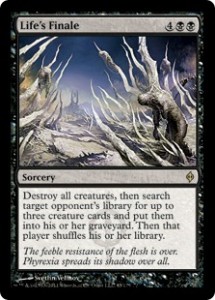
Life's Finale: This is one of the cards I have been trying to evaluate for weeks now with no avail.  Although the ability is extremely good and it is a wrath
.it also costs six.  Black has so many other ways in casual formats to remove creatures. I feel that the two extra mana for a pseudo Earwig Squad ability may not be worth it.  At the same time in the EDH realm this card seems fantastic .  I can’t be sure on every card and this one is certainly one of the few I’m still torn on.

Verdict: 1-6?

Phyrexian Obliterator: I am on the Mono Black train. I’ll admit that something about being so evil in game just makes matches seem entertaining to me.  As for this guy I had to read him about twenty times to make sure I wasn’t missing something.  With the rise in Doom Blades to take care of Precursor this may sneak into some top eights before people know what hit them.  It appears all the tools are in place to make a tier one deck but whether on not that comes to fruition is still yet to be seen.  As for the Casual market, they will scoop this card up for that and any Mono B EDH decks floating out there.

Verdict 15-25

Praetor's Grasp: While this card will be unlikely to see any Standard play, EDH and Vintage love him.  I don’t think the price will be astronomical but remaining slightly above bulk seems fine considering the rest of black is pretty disappointing in this set.

Verdict: 2-3

Sheoldred, Whispering One: This card is one of those few gems in a set that everybody will love.  A cross format card, especially at mythic, it is one to certainly watch out for.  Costing one more than Grave titan means it may not see immediate play but this card may quickly become a control finisher.  Just like Grave Titan expect the price to start low where it is now and only go up from here, possibly reaching the 15-20 mark at some point.  Being the Prerelease card does hurt that potential some but with the casual crowd and EDH alike gunning for this girl expect a quick spike shortly after release to 10.

Verdict 10-15

Surgical Extraction:  This is strictly a competitive card. Useless in EDH with very little casual appeal makes the current and future price completely dependent on tournament results.  That said the card seems great in almost every format and I expect a lot of play so I would say the current price tag will stick, perhaps only seeing a slight drop with the buy-a-box promo being available as well.

Verdict: 8-10

Well that’s it for this week, come back next week for the conclusion of the set and a look at the casual commons and uncommons to keep an eye out for.  While many of the prices are known just as many of these cards have slipped past the radar of competitive players.  Playing the casual and competitive markets against each other is a great way to turn the new set into great profits for yourself while giving everyone what they want in the end.

Until next week, keep trading!

Ryan Bushard

@CryppleCommand on twitter

Wide Screen

Are you a Quiet Speculation member?

If not, now is a perfect time to join up! Our powerful tools, breaking-news analysis, and exclusive Discord channel will make sure you stay up to date and ahead of the curve.

Note: You may notice I am a bit more brief in my description of color and technique in this article. For more advanced readers I hope this will be an improvement. For those of you just beginning in this hobby, or in the reading of this series, please feel free to peruse some of my earlier works to catch you up to speed.

When running a business, it is important to offer as many services as you can. For a lawn service, you may offer to cut, trim, edge, and maybe even thatch their lawn. This gives you the edge over the business who will only cut and edge the grass. In a business of card alters, we can do the same thing. Although border-less alters are the most common, they are by no means the only alters we should provide, and by extension advertise. With a little thought and imagination, the possibilities are limitless. Today, we go wide screen.

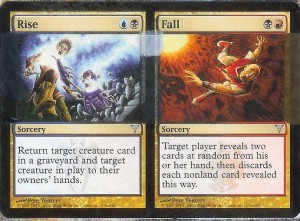
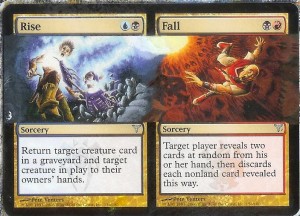
Once again, we are pinning our hopes to the rise of Commander. Some of the most useful cards tend to be the split cards, as they offer two cards in one. These cards also offer interesting possibilities as there is more than one composition to work with. Today, we will work with Rise/Fall and attempt to blend the two pictures together. What we want to do is extend the art over the border in a straight line to create a panoramic view of the art. This type of alter, while rare, can be striking.

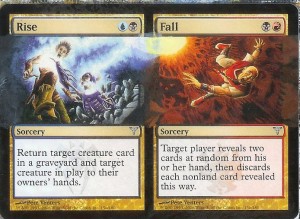
The base coat should be a dark blue (Ultramarine Blue mixed with Mars Black) on the Rise side, and a Dark Red (Naphthol Red and Mars Black) on the Fall side. I chose a thin coating of Mars Black for the middle, as I wasn't sure what I wanted to do there. Often times I find that I have a basic idea of what I want to do with a card and flesh it out as I work. When this is the case, I try to be as conservative with color in those areas as I can. The more paint I put on, the thicker the card gets. Notice that I used Titanium White in the upper middle, knowing that I would want a lighter color in that area.

Examining the original art closely shows us the details of the card. Until I had begun painting this card I had never noticed the background on Fall was composed of skulls. I find that as I paint cards, I also gain a deeper appreciation of the art, and the artists. To paint this area, simply finish the patterns of the skulls by using a lighter version of the base coat. I used Cadmium Yellow to bring the tone up for this. I also used this color in the center area, having arbitrarily decided that I wanted the Rise art to be on top of the Fall art. I mixed yellow and white to create the yellow of the light source in the top left corner.

The Rise side was a little tricky. I found a proper background color by adding Titanium White to my base coat mixture, which resulted in a slate blue. After a bit of experimenting to match the lighter blue I then abandoned the use of Mars Black, and just mixed the white and blue for the gaseous death that is fuming over the borders. I carried this light blue over into the center where it met with the light yellow from the other painting. Once again, I tried to avoid painting near the rocks of the tomb. I wasn't quite sure what I wanted to do with that, but the time to decide was coming quickly.

Having the outer borders satisfactorily done, I turned my detail work to the center. I decdied the best way to work the two light sources together was a sort of swirl. I dragged the light blue down under the yellow and into the Fall composition. I did the opposite with the yellow to create a sort of Yin and Yang design. I used a bit of white to blend them together. I didn't want to mix the two colors, as green isn't a part of the color palette in either of the pictures. For the tomb I simply extended the rocks over the center using varying mixtures of black and white. I used a dry brush technique to create some texture for the stone.

I was surprised at how quickly this particular card was finished. I suspect that my running out of yellow was a factor, I would have liked to touch up the right side a bit more. This leads me to an interesting bit of advice. When you first sit down to start or continue a project, remember to lay out everything that you will need. This will keep you from having to rush around looking for a particular color while your mixture dries, or from being surprised at running out of a certain color.

I also wanted to share a bit of good news, and a bit of bad news with you. The bad news is that I haven’t received a single submission for the art contest. While I can only assume that most of you, like me, were consumed by final exams and the like; I am pleased to say that this has led me to the good news. I get to keep my foil Mirran Crusader, and the extra boosters I had purchased for prizes contained a Tezzeret. Contest or no, I want to stress the importance of continued practice in this craft. Only by trying your skills will you learn to perfect them.

-The Painters' Servant

Twitter: PaintersServant

Email: Mbajorek02@gmail.com

New Cube, New Phyrexia

Are you a Quiet Speculation member?

If not, now is a perfect time to join up! Our powerful tools, breaking-news analysis, and exclusive Discord channel will make sure you stay up to date and ahead of the curve.

It’s that time of year! There isn’t much to do but sift through this huge dump of information to find those precious gems that are brilliant enough to make it into the Crown Jewels of Magic known as the Cube.

Phyrexian mana adds an interesting challenge to card evaluation, and I think all cards with it need to have special consideration. Aggressive cards like it more than control cards (as life isn’t as valuable a resource in the archetype), but anything that can be cast for little to no mana warrants a closer look.

I’m not going to rate every card out of the set; that would take way too much of all of our lives. I’m just going to comment on ones that I think will have an impact, other people think will have an impact, or that I want to make fun of. I will rate the cards on a scale of 1-5, with the following basic meanings:

1- Not good enough for any reasonable-sized non-specialty Cube.
2- Good enough in the largest of cubes (720+)
3- Good enough in the medium cubes (450+)
4- Good enough in the smallest of cubes (360)
5- First pick quality in any cube

Note: I reserve the right to change my opinions at any time! These are ‘testing in my head’ predictions, and I am never too proud to admit that I missed on a card evaluation or missed a card entirely. I’ll eagerly update you on any new findings in future articles.

As an aside, I don’t really like testing cards in the Cube before I actually have the cards in hand. I take a lot of pride in being able to obtain cards for my Cube, so I don’t want to print proxies and ‘taint’ my Cube with inkjet artwork. I’ll gladly listen to everyone else’s testing results with proxies, however.

So let's get started!

Karn Liberated

A colorless planeswalker! Sure to be loved by any deck capable of generating seven mana, Karn at his worst is a double Vindicatecapable of taking out the most protected of creatures (nice Sword of Fire and Ice on Stillmoon Cavalier
see ya!). At his best, his ultimate is a game-winning play much like Jace, the Mind Sculptor; it doesn’t say ‘you win the game’, but that’s exactly what is gonna happen 99% of the time. His most likely line of play? Alternating Vindicates and removing cards from hands depending on board state, while the rest of your cards mop up the game.

Rating: A solid 4, because of his high cost.

Blade Splicer

At four power for three mana, Blade Splicer is ahead of the curve; throw in first strike, and the deal is even sweeter. That said, this card doesn’t exactly get my blood flowing as something I feel the need to include. The 3-drop spot in white isn’t exactly devoid of talent; Mirran Crusader, Spectral Procession, Paladin en-Vec, and even cards like Mirror Entity and Mystic Crusader perform pretty well in most cubes.

I feel like your 1/1 won’t be attacking very much, so the whole four-power thing is a little bit of a misnomer even though first strike is very nice (if disrupt-able). Any other Golem tribal interactions likely begin and end with Precursor Golem, Lodestone Golem, and Mirror Entity, so there isn’t much value there. Conclusion: solid, but not spectacular by any means. Nice interactions with the blink deck, however.

Rating: 2, with a chance to be a 3.

Dispatch

A powerful effect, IF you have metalcraft. Leave this card for the Myr Servitor Cube.

Rating: 1

Elesh Norn, Grand Cenobite

Elesh has a super-powerful static ability, but with a really high mana cost. A 4/7 body isn’t all that great for all that mana, but this card will obviously stop most aggressive decks cold. The question is, will you live that long? If you are tired of Crovax, Ascendant Hero but like the effect, then Elesh is your
man? If you play multiplayer a lot with your Cube, then Elesh is your
bro? If you have a dragon/haymaker (aka slow) Cube, then Elesh is your
oh never mind, just play it. If you didn’t fit one of those criteria, then leave Elesh on the bench.

Rating: 2, with increased value for slower/multiplayer Cubes.

Exclusion Ritual

Six mana Maelstrom Pulse! Put it in a binder with Surgical Extraction, Meddling Mage, Cranial Extraction, Memoricide, and Lobotomy.

Rating: 1, unless you use the 4-of rule with cards like Squadron Hawk and Nissa Revane. If you do, then 1.01.

Inquisitor Exarch

2/2’s for two mana are fine, but here in the Cube we expect a lot out of our Grizzly Bears. While Exarch is neato mosquito with ‘blink’ strategies (think Venser, the Sojourner, and Momentary Blink), it has a LONG list of creatures ahead of him on the WW totem pole (Soltari Priest, Soltari Monk, Knight of the White Orchid, Knight of Meadowgrain, Eight-and-a-Half Tails
you get the point).

Rating: 1, moving to a 2 if you like White Weenie or blinking.

Norn's Annex

Good in an aggressive mirror, but I can’t see a lot of other reasons to play it. I also actively dislike cards that make aggro decks less viable in Cube (Moat, Propaganda, Ghostly Prison, et al). Might have some multiplayer value.

Rating: 1, higher if you hate decks that attack.

Phyrexian Unlife

If you are at one life, this card reads: 2W, gain 10 life. If your opponent has seven power in play and you are at one with no blockers, this card reads: 2W, gain 17 life. See what I’m saying? I still don’t think it is good enough, but like a lot of other cards in this set, it sure is interesting.

Rating: 1

Porcelain Legionnaire

As a 3-drop, Porcelain Legionnaire is fair. As a 2-drop, however, look out. This is exactly the kind of card aggressive decks want, and this particular one can fit into any color. When you are aggressive, the two life loss is almost a non-factor especially when your investment has a first strike that will kill most creatures that cost less than four. This card is the real deal.

Rating: A 4, with no reservations.

Puresteel Paladin

See Inquisitor Exarch, above.

Rating: 1, unless your Stoneforge Mystic REALLY needs a friend.

Jin-Gitaxias, Core Augur

Ten mana? TEN MANA? Sure, you draw seven and your opponent can’t have cards longer than a turn. Who cares, it costs ten freaking mana and doesn’t win you the game. Unless I’m mistaken, it seems like a few blockers will actually cost you the game as you draw yourself out with the end step trigger. All bets are off if you can reanimate this on early turns.

Rating: 1, unless you are playing lots of multiplayer or dragon/haymaker. Save this for Commander, the land of Reliquary Tower and Library of Leng. Include it if you are a master, and you just reanimate this on turn 2-4 all the time.

Mental Misstep

No thanks. But I’ll gladly take any foils you open for this Legacy monkey wrench. Don’t get me started.

Rating: 1

Phyrexian Metamorph

The best Clone variant printed for Cube, to date. At four mana, Clone + Sculpting Steel is worthy of consideration, but like other Phyrexian mana cards, the reduced mana cost and colorless nature pushes it over the top. A great choice for a promo foil, as well, as all sorts of Cubes and Commander decks will want this.

Rating: 4

Psychic Barrier

Remove Soul and Essence Scatter aren’t good enough, and neither is this. But I bet it looks awesome in foil! [Editor's Note: It does!]

Rating: 1

Spined Thopter

Without paying life, this card is a 1. At two colorless mana, this card becomes a lot more interesting. Not interesting enough for me, but I don’t like the [card Stormfront Pegasus]pegasi[/card] [card Mistral Charger]brothers[/card] very much either. Sue me. [Editor's Note: I'm having my attorney call you.]

Rating: 2

Tezzeret's Gambit

I think this is a good example of a card losing some value by being a more of a control card with a Phyrexian mana cost that would make it worthy of consideration. Blue doesn’t want this card, and aggressive decks want to be doing other things for three mana. Proliferate isn’t a very stellar Cube mechanic either.

Rating: 1

Despise

An interesting Duress variant, as creatures and planeswalkers are pretty important commodities in Cube. It’s a bit narrower than Duress, and only slightly better than Ostracize in Cube (which isn’t good enough), but the extra cards it hits are important ones. For now, it stays out, but I feel like some further testing might be warranted. This is also an option if you find that Planeswalkers need a touch more hate, and is something that Inquisition of Kozilek - which I would include before Despise - cannot touch (unless your initials are J.B.).

Rating: 2

Dismember

It would be hard not to compare this to Snuff Out, which is a fine Cube card. For 1 extra mana, we get the ability to hit black creatures but can’t kill some fatties outright. We also gain the ability to be a bit more flexible in our mana cost, as this card seems fine at two mana plus two life as a cost. Also, it is a good replacement for Sudden Death if you don’t care about the split second (I do, so I'll find another way to include it).

Rating: 3, but with room to move up or down.

Geth's Verdict

Diabolic Edict is awesome. Chainer's Edict is very good. Cruel Edict isn’t good enough. Where does Geth's Verdict fit in? The instant speed is the allure here, but the BB mana cost could limit the amount of decks in which it sees play. The one life loss is too small of a bonus to be taken too deeply into consideration, I think.

Rating: I feel like this is somewhere between a 2 and 3: solid, but I’m not in a rush to include it.

Phyrexian Obliterator

It’s everything Phyrexian Negator wanted to be when he grows up. The problem? Negator only had one black mana in his cost, whereas big brother has FOUR. BBBB is pretty rough, but the big question is: when are you going to be able to cast it? Turn four (or before) and this card is N-V-T-S nuts. On turn five or six, this card will be a nice curve topper for a primarily black aggressive or midrange strategy. The real problem? Never drawing the fourth black source. That is a very realistic scenario for any two color deck, which makes this card unplayable in anything resembling a three+ color deck. For me, that risk is too large.

Rating: 2 for me, but if you are pushing/want to reward mono-black as an archetype, then it is a 3 or higher.

Sheoldred, Whispering One

Another in a plethora of very expensive, very powerful, very slow cards that are better in multiplayer than 1v1 play, Sheoldred generates a lot of card advantage within even a single turn cycle. The 6/6 sometimes-evasive body is OK for seven mana, and unlike Jin-Gitaxias (TEN MANA?!?) you will likely live long enough to cast it. If you’re looking for another finisher in black, you could do worse
I just wish he had an enters/leaves the battlefield effect.

Rating: 3

Gut Shot

If this card isn’t good enough at least ten out of eleven times you draw it, you can’t Cube with it. I’m betting it is more like eleven out of eleven.

Rating: 1

Moltensteel Dragon

HERE is an interesting card that I initially overlooked. I think this card is very good and would be welcome in just about any aggressive deck, but functions best as a red finisher (duh). With Phyrebreathingℱ, this card is extremely dangerous in any deck, and WILL change how your opponents play. They just cannot tap out for a non-flier without doing a lot of math, because you can just Hatredthem out at any point. On turn five in mono-red, this card is capable of doing upwards of 10 damage (16 max without ramp, a 16 life total, and a fifth land). That’s a lot, and even if you never pump (you will) you are still getting a 4/4 flier for four mana and some life. And he's a Draaaaaaaagon!

Rating: I’m calling Moltensteel a 4, and time will tell if it could be a 5. Be glad he is foil in a preconstructed deck!

Urabrask the Hidden

A reasonably costed Preator! A 4/4 haste for five mana isn’t that spectacular, and the haste ability loses some value because most aggressive red decks will already have most of their creatures in play already by the time you untap after Urabrask. The creature Kismet is nice, but once again it seems to be too little too late for most red decks. There are a lot of 5-drops better than this guy.

Rating: 2, with a bump for multiplayer/haymaker cubes.

Beast Within

At first glance, I thought Beast Within was a staple. It is an instant speed Vindicate that is splashable and in a color that traditionally doesn’t get to destroy creatures? Yes, please! Then I started to think more about it. How many worthy targets does it really have? How highly will it be picked? How bad is the 3/3 drawback?

How many targets are OK with the drawback? Well, we certainly aren’t turning any 3/3s or less without sick abilities into a 3/3. We also aren’t hitting any basic lands under normal circumstances. We aren’t using it as a removal spell for non-flying blockers very often either, since it still leaves a sizable body behind to block. I’m likely never casting it on turn 3, either.

So the card seems like something we want to use on problem cards mainly: cards that will cost us the game if they stick around. What are those cards (and do we really want a card we are only using to react to bombs)? Umezawa's Jitte, Skullclamp, most if not all Sword of X and Y, high loyalty planeswalkers (like Nicol Bolas, Planeswalker or Gideon Jura), problem creatures (Akroma, Angel of Wrath, Grave Titan, Meloku, the Clouded Mirror), and problem lands like Maze of Ith seem to be good targets; I’m just not convinced that it is enough. I also try to keep the number of purely reactive cards in the Cube pretty low, so


Rating: 2 for right now, but this could change a lot after testing.

Brutalizer Exarch

A definite upgrade to Mold Shambler, but I don’t cube with that card either.

Rating: 2, for flexibility.

Mutagenic Growth

Free spells need to be examined when they have a real effect, and +2/+2 qualifies. Mutagenic Growth is likely 3rd or 4th on the list of pump spells, after cards like Vines of Vastwood, Giant Growth, Berserkbut likely better than cards like Stonewood Invocation and Briarhorn (saving four mana for a trick is SO much).

Rating: 2, possibly a 3.

Noxious Revival

Regrowth is awesome. Nature's Spiral wasn’t good enough. Noxious Revival is instant and possibly free, but you are losing a card on the deal. That said, I think this card is soild. There are lots of tricks to be played with it:

Cast Reanimate on Kokusho, the Evening Star? I'm sorry, that card isn't there.
Cast Makeshift Mannequin to get a blocker? I'm sorry, what blocker?
Topdeck an answer for Baneslayer Angel? Actually, how about a nice Jungle Lion?

Did I mention it was fast and free? Kinda like your *insert important person*.

Rating: I’m going to call this one a 3 until I get some testing time in. I feel like it is a nice spell, though, and likely worthy of inclusion.

Vorinclex, Voice of Hunger

A fatty with a body smaller than its mana cost, an ability that does nothing impressive if you don’t get to untap with it, and only has pseudo-evasion. Also, if you have eight mana available, do you really need sixteen next turn? Save this for Commander/multiplayer games.

Rating: 1

Jor Kadeen, the Prevailer

Fine card, with good converted mana cost to power ratio but only worth it if you can guarantee metalcraft on a regular basis. Jor probably ranks somewhere around tenth place of W/R cards, which isn’t close to good enough in most cubes.

Rating: 1

Batterskull

This card is siiiick. 4/4 vigilance lifelink for five colorless is pretty cool, but when you add the fact that it can be equipped to make your own Baneslayer Angel (albeit for a steep cost) AND be returned to your hand in order to make more germ tokens (really neat with Stoneforge Mystic, by the way), you have a card that is pretty awesome for cubes of any size. Cut Sword of Vengeance if you haven't yet for it. Or maybe even Basilisk Collar (unless some call you...Tim?).

Rating: 4

Hex Parasite

Having answers to Planeswalkers is always good, and unlike Vampire Hexmage (apparently 'hex' now means removing counters, in case you didn't realize), this card gets a benefit from removing counters and can do it multiple times. Question is, is it worth it? How many targets do we really get, both in total and ones that are effectively answered by Hex Parasite?

Good Targets: Planeswalkers, Lorescale Coatl, Skinrender (if target doesn’t die), Kitchen Finks, Glen Elendra Archmage, Murderous Redcap, Student of Warfare, Kargan Dragonlord, Joraga Treespeaker, Parallax Wave, Smokestack, Tangle Wire, Countryside Crusher, Greater Gargadon, Aether Vial

Not-so-good Targets: Triskelion, Umezawa's Jitte, Engineered Explosives, Etched Oracle

So while the first list contains some powerful cards, they only number about 30 or so: that is less than 10% of the smallest cubes, and only goes down from there. While you may be picking up more cards with which it can interact favorably in larger cubes, the increased number of total cards will likely reduce that percentage even more. I don’t think these types of percentages are high enough to include the little bugger, as a 1/1 for 1 just isn’t that impressive on its own.

Rating: 2, but only because of the power against Planeswalkers (even though high loyalty PWs will still be a pain).

Lashwrithe

If you support mono-black as an archetype, go for it. Otherwise, this card just isn’t that impressive as a 3/3 of 4/4 living weapon for four mana, even if it does have a Phyrexian mana equip cost.

Rating: 1, but a 2 or 3 if you support mono-black heavily.

Myr Superion

T1 Joraga Treespeaker, t2 level up, Myr Superion anyone? Anyone? Bueller? Anyone?

Rating: 1

Spellskite

This might be the most interesting card to me of the set- not because of the power level, but because of the possibilities this card has when it comes to being a GIANT pain. The size/cost ratio is right on par with other cube-worthy walls (0/4 for 2), and the flagbearer-type effect is pretty annoying. For those of you who played in Apocalypse limited, you might remember how annoying it was to play vs. Coalition Honor Guard.

The 4 toughness was a giant pain, and I don’t see that changing much for Cube. This card is usable by any color, even though it really shines in blue
oddly enough, a control color that would probably like a 0/4 for two mana! Even though it cannot interact with equipment (I assume it is not a legal target), it does screw with almost every removal spell, almost every aura, and lots of abilities (Grim Lavamancer, e.g.). As a side benefit, it also holds equipment/auras and can attack as well since it does not have defender. And I bet it looks cool in foil.

Rating: I’m calling Spellskite a 3, with a note to test it as soon as possible.

Sword of War and Peace

Yikes. Possibly the second-best sword after Sword of Fire and Ice, Sword of War and Peace has an incredible ceiling of power. By itself, it can generate huge life swings even with reasonable hand sizes (6 total cards between players generates an eight life swing by itself- two for the sword, six for the trigger) and it goes up from there. While not as spectacular as the other swords in topdeck wars (read: still good), the other thing it does is help to put control decks under more pressure while simultaneously putting control decks PLAYING the card a similar advantage
neato! In reality, this card is pretty freaking good no matter what deck is playing it.

Rating: 5, for sure.

That’s it! In general, there seem to be a lot of big mana cards that might see play in Commander or other multiplayer formats. The set has a few big auto-includes (Karn, Sword, Dragon, Legionnaire, Metamorph) and some nice possible role-players as well. More than any other recent set, I feel as though there are a lot of ‘test me’ cards that need some quality time before we know how good they really are. Playtesting is usually repetitive at best, but you don't have to twist my arm to Cube again!

May all your squares be three dimensional!

-Anthony Avitollo
@Antknee42 on Twitter
Co-host of The Third Power Cube podcast

Season Finale | CommanderCast S2E13

Are you a Quiet Speculation member?

If not, now is a perfect time to join up! Our powerful tools, breaking-news analysis, and exclusive Discord channel will make sure you stay up to date and ahead of the curve.

The end of Season 2 has come, and with it, another badass Season Finale episode of CommanderCast. Andy, Jeremiah, Carlos and Byron are sending off the season with a gauntlet of hot topics; proxies, the future of Commander, aggro decks, and more. Also don't miss the additional Circle of Judgment where we decide upon the winner of the Season 2 Contest, and investigate some of the Secret Tech our listeners provided.

Check out http://commandercast.blogspot.com/ for more, including out back catalog of content to fill the gap between seasons!

Can't see the Flash player above? Just click the direct download here!

The Future of America, Team

Are you a Quiet Speculation member?

If not, now is a perfect time to join up! Our powerful tools, breaking-news analysis, and exclusive Discord channel will make sure you stay up to date and ahead of the curve.

The classic BUG tempo deck has seen success in various configurations. We’ll discuss the choice between Tombstalker and Dark Confidant and the new inclusion of Mental Misstep.

For those unfamiliar with Team America, take a quick gander at what this archetype has to offer:

You’d be hard pressed to find a stronger roster of powerful cards. As it’s nice to see what a deck could look like, I’ll just leave my current build here for reference.

Team America, by Tyler Tyssedal

Creatures

4 Tarmogoyf
4 Tombstalker
1 Terravore
1 Kira, Great Glass Spinner

Planeswalkers

2 Jace, the Mind Sculptor

Instants

4 Force of Will
3 Daze
4 Brainstorm
4 Stifle
1 Smother
1 Go for the Throat

Sorceries

4 Hymn to Tourach
2 Maelstrom Pulse
3 Ponder

Lands

4 Wasteland
4 Underground Sea
2 Tropical Island
2 Bayou
4 Polluted Delta
2 Verdant Catacombs
4 Misty Rainforest

A Quick Look at “the” Legacy Meta

Team America has traditionally won by establishing tempo by [Card Stifle]stifling[/Card] an opponent’s fetch, [card Hymn to Tourach]Hymning[/card] two cards from their hand, and landing a [card Tombstalker]big[/card] [card Tarmogoyf]old[/card] [card Terravore]fatty[/card] with [card Kira, Great Glass Spinner]counter[/card] [card Force of Will]backup[/card] [card Spell Pierce]in[/card] [card Daze]hand[/card]. [card Brainstorm]Efficiency[/card] and [card Jace, the Mind Sculptor]card advantage[/card] at its finest.

This may be obvious to some, but metagames shift and what worked a few weeks ago may no longer be positioned as well as it was. Some may remember when Team America ran Sinkhole over Hymn to Tourach, narrowing in on land destruction. Then came Zoo and its uncannily efficient creatures. Suddenly that turn two Sinkhole didn’t seem so appealing with an already swelling board presence staring you down—especially on the draw.

Every deck goes through these changes. The 75 should never be considered concrete in a format like Legacy where the success of one deck sends a ripple across all playmats. If combo does well one week, decks that can beat combo come out of hiding in order to take advantage an easy matchup.

And then decks that can beat the deck that can beat combo come out of hiding in attempt to take advantage of an easy matchup.

But there are no perfect matchups. You can’t simply pick next week’s “best deck” and win. You’re not likely to face your best matchup every round and it’s possible that some may be looking ahead and predicting which decks will have a resurgence and opting to go with that archetype.

So the deck you play this week that would have had a good chance in last week’s meta is now playing against one of its worst matchups.

Seems like there’s a lot to think about when deciding which cards to play.

Suffice to say, you can’t always beat the meta. So first start by playing what you like—trusting that many others will be doing the same thing. Since Team America has a fair matchup against most decks and fits my play style, I usually find myself gravitating towards BUG when not otherwise compelled.

So. Back to Team America. Well? What’s good?

One of the biggest decisions the dedicated Team America player has to make right now is which creatures to run. Tarmogoyf is the sole reason we run green—everything else that is green in the deck is a result of Tarmogoyf coming to the party. He’s big and starts the clock.

With cantrips and tempo aplenty, Team America feels most comfortable running 8-10 creatures. With Goyf on board, we have 4-6 slots left to fill.

The traditional choice is a complimentary four-of Tombstalker. A 5/5 flyer for BB? He’s a beast, there’s no doubt about it, and he alone sets a four turn clock. Our graveyard fills quickly with our fetches, cantrips, and spells, so it’s not uncommon to land the demon on turn three or four.

But wait! Do you hear that?

“Yo dawg, I heard you like cards, so I put some cards on your cards so you can draw while you draw!”

Of course! Play [card Dark Confidant]Bob[/card], too!

Tombstalker vs. Dark Confidant

So Dark Confidant is an option. A very lucrative option. He provides a free card every turn for just a little bit of life. If you couple him with Jace, the Mind Sculptor, you can set up your Bob triggers with Jace’s Brainstorming and essentially draw three cards for free every turn.

And who wouldn’t want that?

Tombstalker. That’s who.

Tombstalker's converted mana cost is 8. We already have four Force of Wills that manage their way to the top of the deck once in a while. So, while it would be nice to have both a 5/5 flyer and a 2/1 that draws us a card every turn, we have to decide between one or the other.

However, an issue arises when we consider giving up Tombstalker in favor of Dark Confidant:

It dramatically changes how the deck plays.

Tombstalker provides a clock. If you can protect his body, he will usually win you the game, flying through the air with a resolved slam dunk. You spend the match leading up to his casting gaining card advantage through your opponent’s loss of tempo generated by disrupting and preventing their plan while furthering yours—filling your graveyard for his food. His casting is always a pivotal moment in the match.

Tombstalker applies pressure and forces your opponent to find an answer. His evasion flies over creatures on the ground and your counter spells can protect him or deny your opponent’s must-answer spell. Suddenly the spotlight is aimed on the demon in the room. That’s right where we want it.

[card Dark Confidant]Bob[/card], on the other hand, dances to a different tune. Where a turn two Hymn to Tourach is what we hope for, a turn two Bob is as equally impressive. Especially if he draws you into that Hymn. But, at that point, the way we approach winning is altered. If your opponent has a creature on the field, you won’t want to throw [card Dark Confidant]Bob[/card]’s little body at it. While Tombstalker simply glides over, [card Dark Confidant]Bob[/card] doesn’t attack unless he will survive—or you secretly want him dead.

Dark Confidant is a different type of pressure.

The way the deck fundamentally operates changes when we switch out Tombstalker for Dark Confidant. Instead of the tempo disruption and big flying beats, with [card Tarmogoyf]Goyf[/card] running backup on the ground, we have to shift into another mode of winning, one that takes advantage of Dark Confidant’s card advantage. More trust that the [card Tarmogoyf]Lhurgoyf[/card]([card Terravore]s[/card]) on the floor will get through and deliver the beats.

Team America with Dark Confidant?

I’m going to make a bold statement here, so please let me know why you may disagree:

The deck is no longer Team America if it doesn’t run Tombstalker.

Any Team America build with Dark Confidant is known as Team America by name and color association alone. For example, take Gerry Thompson’s well earned 3rd place finish with a Bob’d Team America:

Team America, by Gerry Thompson

Untitled Deck

Creatures

4 Dark Confidant
4 Tarmogoyf
2 Terravore

Instants

4 Brainstorm
3 Daze
4 Force of Will
4 Go for the Throat
2 Spell Snare

Planeswalkers

2 Jace, the Mind Sculptor

Sorceries

4 Hymn to Tourach
1 Inquisition of Kozilek
2 Ponder
2 Thoughtseize

Lands

2 Bayou
4 Misty Rainforest
4 Polluted Delta
2 Tropical Island
4 Underground Sea
2 Verdant Catacombs
4 Wasteland

Sideboard

3 Ghastly Demise
2 Krosan Grip
2 Spell Pierce
3 Submerge
2 Llawan, Cephalid Empress
1 Life from the Loam
2 Maelstrom Pulse

Hymn, Inquisition, Thoughtseize, Wasteland, and the counters are all solid sources of disruption. You can strip a card from their hand, make them discard two others, and then safely land a creature that will either beat or draw you cards.

No Stifles to emphasize the tempo gain through land destruction. No reason to fill your graveyard with haste. Less focus is placed on taking advantage of your unanswered threats’ ability to end the game with more focus placed on drawing further counters and disruption in order to maintain the tempo. You can’t rely on a flyer to swing over an opposing army, so instead you need to establish a position where you can clear their threats out of the way—or strip them from their hand—so that your creatures can get through.

Plus, there’s always Jace, the Mind Sculptor. While I include him in my Tombstalker builds because he’s that good, he really shines when Bob is courting him. Jace’s Brainstorm can supply Bob with an unlimited supply of free draws, netting a total of three cards per turn.

Three cards per turn.

Not only that, you can fateseal/scry and ultimate as another win condition if the board is a stalemate. Plus you can unsummon their blockers and force them to discard or counter on the recast, all while clearing the board to get damage in.

The synergy and interactions available are certainly beautiful. But, again, the deck shifts focus with the mere swapping of a single creature.


If Tombstalker were a water balloon, Dark Confidant would be a super soaker.


And Team America is a water balloon. It’s been the fundamental nature of the deck to fill the graveyard like a faucet stretching a balloon, landing with an explosion when the time is right. Sure, sometimes the balloon misses the target (i.e. A lost counter war) or your opponent catches it and throws it back (Vedalken Shackles, Sower Of Temptation, Jace’s unsummon), but when it hits, it drenches.

But by no means is BUG disruption a bad route to take. Bob delivers longevity and an increasing stream of pressure. I agree with the majority who consider him one of the best two drops ever.

I’ve played Team America builds with Tombstalker, Dark Confidant, and even Counterbalance and Sensei's Divining Top. I don’t want to hearken too long on the semantics of naming a deck, but calling any BUG build Team America is like calling any Bant build New Horizons. Sure, both decks share a lot of the same cards, but you use those cards with a different route in mind.

So? Tombstalker or Dark Confidant?

I can’t tell you which one is better, but I want to be clear that the decision is not merely the choice of one card slot. Whichever you choose affects how the deck operates, so it would be wise to reconsider other cards in the deck as well. Typically, Stifle seems to be the first to go when you make the transition. Games seem to go a bit longer and the tempo gained by picking off the beginning fetch does not carry as much weight as before.

Plus, some people simply hate playing Stifle, for whatever reason. Personally, I like the card and I have no problem with pitching it to a [card Force of Will]Force[/card] or [card Brainstorm]shuffling it away[/card] late game, but it does seem to lose its place when it's paired with [card Dark Confidant]Bob[/card] and not the 5/5 delver.

I’ve had success with both at different periods in time. If I had to advise, I would say you should play the one you like the most. If it starts failing you, it’s never too late to switch it up.

Unless, of course, you’ve already turned in your list.

Room for Mental Misstep

One of the worst things about having only 8-10 creatures is getting one removed. We can’t always offer the protection we’d like. It also happens to be that many people are skilled at top decking that removal spell right when they need it.

I’ve been playing a singleton Kira, Great Glass Spinner main as a lead-in shield, with another in the side against removal heavy decks. She’s done her job more than once by forcing an opponent to throw two spells at her—sometimes the second getting countered as well.

In most games, however, we only have one way of hard countering a [card Swords to Plowshares]Swords[/card]/[card Path to Exile]Path[/card]—Force of Will. Force also happens to require an additional blue card to pitch, which can be troublesome when we just spend our last few turns filling our graveyard with cards. Most people naturally play around Daze, seeing that [card Swords to Plowshares]Swords[/card] and Path to Exile are both one cost spells and we sometimes land a creature while they have more than one land.

Mental Misstep protects our creatures. Outside of countering a detrimental turn 1 Goblin Lackey, Aether Vial, Grindstone, Goblin Welder, and the occasional Dark Ritual, the main purpose that Misstep will find itself performing in this deck will be protecting the creatures and furthering the game plan.

Mental Misstep will be performing a relatively vital role, and it’s not just an auto-include because it’s the latest fashion. Daze becomes ineffectual late game and Mental Misstep is a hard anti-removal counter. Four of them actually seems right.

But what to cut


After some testing, this is what I’ve decided I don’t want to see in the deck:

4 Force of Will
3 Daze
4 Stifle
4 Mental Misstep

That is far too many spells that do little to actually win the game. We want at least four removal spells (some combination of Maelstrom Pulse, Smother, and Go for the Throats, optimally) and enough threats to last. I prefer running 10 creatures and 2 Jaces, so those, for me, are off limits. If we’re going to be committed to running Hymn to Tourach, we run four. Force of Will isn’t an option, either.

4 Brainstorms and 3 Ponders keep the deck consistent. I can see going down to 2 Ponders, especially if we run Dark Confidant over Tombstalker, but that’s really the only place I can see trimming.

So our options are:

-3 Daze
-1 Ponder
+4 Mental Misstep

Or

-4 Stifle
+4 Mental Misstep

At first glance it would seem that cutting Daze is the logical choice, as both Daze and Misstep are counter spells. But Daze and Misstep usually do completely different things. Daze can stop a one drop on the play, but it typically exists to punish an overly aggressive opponent who taps out to play a threat. Its synergy with Stifle and Wasteland shouldn’t be overlooked.

Stifle, though, is actually closer to Misstep in terms of conditionality with what it can actually do. It punishes fetch lands, Wastelands, and other activated or triggered abilities, but it’s a reactive tempo card that can be the unexpected invisible wire that causes someone to trip. Though its restrictions are closer to that of Misstep’s than Daze is, it doesn’t do the same thing.

So what combination offers the best synergy?

  • Daze and Stifle compliment one another, having obvious synergy.
  • Daze and Mental Misstep counter different types of cards, rarely becoming redundant.
  • Stifle and Mental Misstep have no direct synergy. Although it’s punishing to Stone Rain an opponent’s land for U, the effectiveness of Mental Misstep remains the same.

Not to mention how Stifle is a valid target for Mental Misstep while Daze isn’t.

If you want to play Mental Misstep, I would advise cutting Stifle. If you’re not playing Stifle, then I would also recommend playing Dark Confidant instead of Tombstalker. Thoughtseize and Inquisition of Kozilek are also aggressive discard outlets that may prove to be better than Daze, so toy around with cutting 3 Dazes, and possible a single Ponder, for some combination of 3 Thoughtseize and Inquisition, as the discard is a more consistent way to prevent a card from entering the field. Daze does aid in counter wars, though, so it’s an idea still needing further exploration.

However, if you want to rock Stifle, I would say stick with Tombstalker and cut 3 Daze (and perhaps 1 Ponder) for 3-4 Mental Missteps. You lose your ability to Daze some of your opponent’s spells, but you’re investing in protecting your black flyer. Swords, Path, and Go for the Throats are some of the most common ways to kill an 8 drop 5/5 black flyer, and Daze is pretty useless against those cards as it is.

It is also wise to note that we may see a drop in one-drop removal with the fear of Misstep being everywhere, so pay attention to that.

Some Preliminary +Mental Misstep Decklists

As other decks shape up in preparation for GP Providence, we’ll have a better idea of what the field could look like. More testing is underway, but I’ll leave you here with a few BUG Misstep Tempo builds to consider.

BUG Tempo, by Tyler Tyssedal

Untitled Deck

Creatures

4 Tarmogoyf
4 Dark Confidant
2 Vendilion Clique

Planeswalkers

2 Jace, the Mind Sculptor

Instants

4 Force of Will
4 Mental Misstep
4 Brainstorm
2 Smother
1 Go for the Throat

Sorceries

4 Hymn to Tourach
2 Maelstrom Pulse
3 Thoughtseize
2 Ponder

Lands

4 Wasteland
4 Underground Sea
2 Tropical Island
2 Bayou
4 Polluted Delta
3 Verdant Catacombs
3 Misty Rainforest

BUG Disruption, by Drew Lavin

Untitled Deck

Artifacts

1 Engineered Explosives

Creatures

4 Dark Confidant
4 Tarmogoyf

Legendary Creatures

2 Vendilion Clique

Planeswalkers

2 Jace, the Mind Sculptor

Instants

4 Brainstorm
4 Force of Will
2 Ghastly Demise
2 Go for the Throat
4 Mental Misstep
1 Repeal

Sorceries

4 Hymn to Tourach
4 Inquisition of Kozilek

Lands

2 Bayou
4 Misty Rainforest
4 Polluted Delta
2 Tropical Island
4 Underground Sea
2 Verdant Catacombs
4 Wasteland

Team America, by Tyler Tyssedal

Untitled Deck

Creatures

4 Tarmogoyf
4 Tombstalker
1 Terravore
1 Kira, Great Glass Spinner

Planeswalkers

2 Jace, the Mind Sculptor

Instants

4 Force of Will
4 Mental Misstep
4 Stifle
4 Brainstorm
1 Smother
1 Go for the Throat

Sorceries

4 Hymn to Tourach
2 Maelstrom Pulse
2 Ponder

Lands

4 Wasteland
4 Underground Sea
2 Tropical Island
2 Bayou
4 Polluted Delta
2 Verdant Catacombs
4 Misty Rainforest

Until next time,
Tyler Tyssedal

Testing Torment

Are you a Quiet Speculation member?

If not, now is a perfect time to join up! Our powerful tools, breaking-news analysis, and exclusive Discord channel will make sure you stay up to date and ahead of the curve.

Torment is the second set in the Odyssey block and it has the distinction of being the first set designed around one color. In this case, the set was designed with a focus on black, testing the design limits of what could be done with swamps. It extended the graveyard and Madness themes of Odyssey, while adding several “Swamps matter” cards alongside. For a second set in a block, Torment has a lot of real gems for the collector and trader. Much of its value, if you can believe it, is driven by Legacy (instead of the casual market, which usually makes up most of a set's value). Let's look at some of the valuable cards from Torment!

Breakthrough

Breakthrough costs, in essence, one mana and has the phrase “draw four cards” printed on it. Impressive. I suppose the fair use of Breakthrough is to pump three or four mana into it and keep some cards, functioning sort of like an Impulse. However, Breakthrough gets the most play from Dredge decks. Those four draws can turn into four dredges, flipping over twenty or more cards for a single mana. Breakthrough saw intermittent play in Madness decks, but it is in combination with the dredge mechanic that this uncommon really shines.

$1.75 ($5.00 in foil)

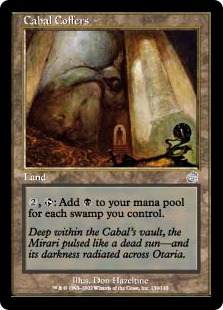
Cabal Coffers

Though not as industrious as Yawgmoth, those Cabal guys make some pretty sweet toys.

I know I've written about this before, but people LOVE monoblack decks. Coffers was the engine that powered monoblack control like nothing else before or after. It made huge amounts of mana later in the game, which were paired with Mirari and Diabolic Tutor for all sorts of powerful tutoring. MBC, as it was known, was a disrespected-but-legitimate deck in Odyssey Standard. People like to revisit Coffers-fueled decks, even though they aren't that good these days. Cabal Coffers, though an uncommon, has been an expensive card since it was printed. It has been reprinted in a Duel Deck (which is where my copy is from) and as a FNM promotion. However, though it dropped about $3 from these reprintings, it still commands a lot of value from players.

$4.75

Cabal Ritual

That Cabal gets around, right? Cabal Ritual, with its threshold ability, looks like it's just there to reward you getting to the late game with a little more mana, right? Its most common application, though, is in Storm combo decks, where it makes up a critical mass of acceleration. A Polluted Delta to cast Duress on the first turn, a Lotus Petal and a Dark Ritual on the second turn and soon, you've hit threshold and Cabal Ritual is taking your mana to stratospheric heights. Without Cabal Ritual, most Legacy storm combo decks simply wouldn't exist. Though a buck normally, the foils are especially valuable.

$1.00 ($8.50 in foil)

Chainer's Edict

With the appeal of Diabolic Edict, some truly creepy art and integrated card advantage, it's no wonder that Chainer's Edict is a popular uncommon. In MBC, it would often fuel a scenario where it blows away an early Wild Mongrel or other monster. Later, after a Mutilate, it would be flashed back to take care of any straggler the opponent was holding back. As a removal spell, it's fine – it will kill Shroud creatures, for example. However, just like Urza's Rage had that “maybe this will come in handy” kicker, the flashback gives decks that might falter in the lategame a chance if all they do is draw land. When R&D wanted to push Black to the forefront in Torment, this is a good example of their success.

$1.00

Some counterspells are just bonkers.

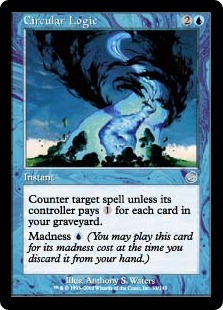
Circular Logic

Blue-Green Madness was the hit of Standard, simply because it cost about $15 to throw together. This fact, alone, annoyed a lot of more serious players. UG Madness was a powerful deck and it could easily punish a better player if they misplayed; on the other hand, UG Madness wasn't exactly a skill-intensive deck. One would often play something like Wild Mongrel on the second turn, then discard a Deep Analysis or Basking Rootwalla to it. Soon, the player would have a single blue mana up all the time, supporting their Circular Logic to ward against Wrath of God or Upheaval.

Psychatog decks were also quick to adopt Circular Logic; they could discard it to a Psychatog, which was pretty good, but they could also pitch it to Compulsion, making it a Dismiss. Circular Logic was also almost always a hard counter, prompting an opponent to pay seven or eight mana on top. Unlike Mana Leak, which gets worse as the game goes on, Circular Logic actually scales with gameplay. In that regard, it's probably just a little too good for Standard play. It gets a little bit of attention right now in casual decks, but it has dropped from its high of $4.

$1.00

Devastating Dreams

Devastating Dreams is most notably part of the Legacy and former Extended deck known as CAL. The basic plan with Dreams is this: you've got a Mox Diamond in play and you're a land up on the opponent. You cast the Dreams, discarding three or four cards. Board wiped, Armageddon. However, one of those discarded cards was Life from the Loam. Now, you've got a big mana advantage on the opponent because your land drops just won't stop. Dreams could spell the death knell for a deck like Goblins, since you'd eliminate their attacking force and starve the mana-hungry deck of resources.

Dreams has also dropped a little in price because it's out of favor right now. However, fans of land destruction still look fondly at it.

$1.50

Grim Lavamancer

If there's one creature a burn deck will play, it's this guy. Every turn, Shock you! It shows up in Legacy Zoo decks, burn, and even Threshold decks. Another important part of Lavamancer's appeal in Legacy is that it unbalances the Tarmogoyf standoffs that sometimes appear. It gives a Zoo deck a lot of reach in that they can just land this guy and start burning out an opponent hiding behind a Moat. It's popular with casual and competitive players everywhere, so it's no wonder that Grim Lavamancer is one of the most expensive cards from Torment. He's been reprinted as a foil in promotional decks, but a lot of tournament players avoid foils. As a result, the reprint hasn't much affected its price.

$6.75

Ichorid

Ichorid is one of those creatures that was trash for a long time until people figured out how well it worked with the Dredge mechanic. Now, Ichorid powers up Cabal Therapy and makes Bridge from Below tokens in a deck named after it. Ichorid is part of a tradition of black creatures that just won't stay dead. From Ashen Ghoul to Nether Traitor, it's in fine company. Dredge is also a fairly cheap deck to put together for tournament play, which makes Ichorid popular.

$4.25

Laquatus's Champion

Sometimes, casual players like to Live the Dream with reanimation strategies. These often involve Living Death and these guys. Eighteen life or more, right out the door. On top of that, though it looks like you'll get that life back, the Champ regenerates, meaning he's unlikely to kick the bucket any time soon. That six power made for a pretty strong beater, as well. The Champion didn't see much competitive play – the premier kill spells were Mutilate and Chainer's Edict, after all – but those monoblack players haven't forgotten the black Flametongue Kavu.

$1.50

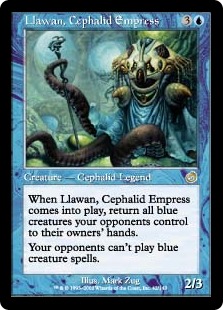
Llawan, Cephalid Empress

At what point did they think that intelligent cuttlefish would appeal to players?

Llawan has been a trash card for many, many years. Recently, though, people realized that Merfolk can hardly beat a resolved Llawan. Consequently, it's become a very hot sideboard card for decks like Counterbalance that are soft to the fish men. Llawan has had a meteoric price increase, from nothing to several dollars. It is rare to see a sideboard card, even an actively played one, make this kind of increase. I attribute it to Llawan being so bad that people bulked them off, meaning nobody had a Llawan in their binder to trade off to people. Once she became hot, it was only the dealers who had the squid in their collections.

$7.00

Mutilate

Before there was Damnation, there was Mutilate. If you play enough Swamps, you can come up with a board sweeper that even regenerators cannot escape. That's the power of Mutilate. It was the backbone spell of MBC, much like Damnation held together Mystical Teachings in a later Standard environment. While Damnation has made Mutilate less desirable, people still want the card for nefarious purposes. Since it's cheaper than Damnation price-wise, that actually plays into Mutilate's demand pricing. If someone is willing to pay $1.50 for it instead of $15 for Damnation, then it can probably be bumped up to $2 if it's the second-best option. I suppose that is what makes it worth a little bit.

$2.00

Nantuko Shade

The Shade can turn Coffers mana into pure death. One out, with untapped lands, becomes a dangerous monster to attack into. If one just holds off, then the Shade will eventually transform into a 9/8 or bigger insect. Scary indeed. The most disruptive thing about Shade was that your opponent would hit you with one with, say, four lands untapped. You wouldn't block, thinking they'd just tap out. Instead, they'd turn that mana into a Diabolic Tutor or some other spell, forcing you to take two points of damage that you might not have taken otherwise.

Shade was $8 before it was reprinted, where it took a nosedive that would make even Meddling Mage feel better. Speculators who jumped on Shade got burned seriously. The success of Shade in Standard was entirely predicated on Cabal Coffers; without the land, the Shade was under the curve for modern creatures.

$2.25

Parallel Evolution

like Doubling Season, a Parallel Evolution will double your Saprolings, Squirrels or other token creatures. It's a real niche card, but a lot of token players want this kind of effect. If you see this card in a junk pile, remember that it's worth a cheeseburger or two. Worth snagging or attempting to get in a throw-in trade.

$1.75

Putrid Imp

The Imp is mainly a discard outlet for Reanimator and Dredge decks. Occasionally, it gets Threshold and beats down an opponent, which is embarrassing. They're worth digging through your collection for, but people rarely trade for them unless they're foil.

$1.00

The Tainted Lands

Tainted lands, like Tainted Isle, reward a player for pairing their colors with Swamps. They're modestly popular, since they're a little cheaper than other dual color lands and have no drawback if you're playing Swamps anyway. What I find interesting is that Tainted Field usually goes for about double what the other ones fetch, a testament to the fact that BW has terrible manafixing capabilities and will take what it can get.

$1.00

So in conclusion, Torment is a surprisingly rich set for value traders. I would never be upset to buy a collection that had this set represented in it, since it has a good number of modestly-valuable cards in it.  You'll never pull out a $20 card from it, but there's something for everyone in the set.

Where Torment went for Black, next week's Judgment put a lot of power into White and Green, two of the worst colors in Magic. Join me next week, when we look at Mana Flares, Phantom monsters and even more insects!

Until then,

Doug Linn

NPH Guide to Rares

Are you a Quiet Speculation member?

If not, now is a perfect time to join up! Our powerful tools, breaking-news analysis, and exclusive Discord channel will make sure you stay up to date and ahead of the curve.

Editor's note: A few days ago, on Insider, I ran down the Mythic Rares in NPH, but I'm going to change it up a little bit today.  I'm going to review the Rares, but instead of putting it on Insider, I'll be making it free for everyone to read!  Normally this sort of review would be an Insider feature, but I'd like our non-members to see what they've been missing!  If you like the content you see on this site and would like to help support us and our writers, consider signing up for an Insider subscription!  I've included the introduction from the Mythic Rare article for our non-Insiders that are reading this article today.

---

New Phyrexia is almost here.  It’s been three months of Birds and Blades, and with the third set of Scars of Mirrodin block merely days away, it’s time to gather what we know and wage war against bad trading decisions.  With a new set, there are always potential sleepers and it’s our job on Quiet Speculation to show you the way.   While I won’t go into a review of every application for every new card, I’ll be sure that you have a complete understanding of what to do when you get to your prerelease.  I’ll be quoting prices based on online presale numbers, which are the best metric we have as of now.  In general, Ebay tends to be lower by a few percent, but as long as we’re comparing apples to apples, the numbers will all line up.

Bear in mind that Magic’s prices are dominated by Standard competitive play, and that my analysis comes with exactly that bias.  Commander / EDH can also drive prices, but not to the extent that Standard can.  Legacy, Vintage and Extended are all healthy, enjoyable formats and all that good stuff, but Standard is the format that makes the trading game work.  These cards all have their merits, and not every card was designed to be good in competitive Magic.  Bearing that in mind, my only goal is to tell you where to put your money, not how to play around the kitchen table.

Birthing Pod - $4

Its presale price seems to be a stretch, but the card has power for certain.  It's a natural fit in Elf-style decks where the power level between 1,2 and 3 CMC creatures jumps up very quickly, and most aggro decks can find a way to abuse the engine.  The biggest appeal is using a mana dork to pay the mana cost and fuel the greusome rebirth of another mana dork, and the ability to fetch lifegain creatures or other creatures with an ETB effect is also quite appealing.   Between Fauna Shaman, Birthing Pod and Green Sun's Zenith, it should be fairly easy to chain into a big ol' fattie.  It's easy to ignore Phyrexian mana symbols when figuring out mana curves, but after a couple expenditures of 2 life, the cost becomes very real.  $4 seems high, but it's not entirely unwarranted given the potential applications of this card.  Anything that can tutor can always get better in a new context, so even if Birthing Pod sees little play, it will always be one creature away from being an all-star.  My verdict:  wait and see.

Blade Splicer - $2

I'm hearing a lot of talk about this card and I'm right up there on the bandwagon.  3 mana is a very reasonable for the array of dudes you get.  The granting of First Strike to all your golems makes Precursor Golem very interesting indeed.  The fact that the 1/1 grants First Strike is important because, frankly, who wants to blow some removal on a 1/1 when there's a 3/3 up in your face?  This 2-for-1 seems a natural fit for Stoneforge decks, even if they're not as good as Squadron Hawks in terms of sheer "dude density".  $2 seems like the correct presale price, but it's on my short list of potential rising stars.  The subtle power level of Blade Splicer is not immediately apparent, but I suspect the card will see play in a variety of decks during its tenure in Standard.

Bludgeon Brawl - $1

There is not a lot to say about Bludgeon Brawl as far as competitive Magic is concerned, but I must tip my hat to the designer.  The flavor is flawless.  I doubt it has constructed implications, but casual players will enjoy it and it will have some very interesting applications in Commander.

Caged Sun - $4

Caged Sun is a throwback to Mirari's Wake, which has remained a popular casual and Commander card since its release.  $4 is the correct price for this, even if it will see little competitive play.  It's the type of card that every casual and commander will want, so its price will stay pretty high.  There is an off-chance that some kind of Grand Architect deck uses these to ramp mana to absurd levels, since it fits into the "machine" flawlessly.  If this happens, get ready for a big run on the card.

Free mana? Free Goblins? The force is strong with this one.

The Chancellor Cycle

I'm addressing these as a whole because there isn't a good precedent for comparison.  With the exception of Chancellor of the Dross, they're all a modest dollar on presale which seems to be low at first glance.  The classic Leyline problem is in full effect here, but at least these big guys are castable.  It's unwise to consider what happens when you get more than one in your opening hand, because this will not reliably happen.  The effects are major enough to warrant consideration in competitive play, and Fauna Shaman seems like a natural fit.

The Black Chancellor will be an irritation in Commander, but it lacks enough power to really matter.  Chancellor of the Annex is potentially the most powerful, but a proper application will be difficult to find.  Mana Tithe on their first spell is very hard to out-tempo.  Chancellor of the Tangle seems to fuel his own cause better than the rest, since accelerating out a Fauna Shaman on turn 1 is precisely what you want to be doing.  Tangle is probably the Chancellor with the most competitive applications.   Chancellor of the Spires combos nicely with Archive Trap and could bring about the rise of a real Mill deck again.  The Mill deck would have to run cards like Enclave Cryptologist and See Beyond if they wish to shuffle their Chancellors away, but that is not much of a leap of faith.  Overall, I'm pretty excited about these cards and their lack of precedent means that they could be undervalued.  It's hard for them to get much cheaper.

Fresh Meat - $1

I liked this card better when it cost 2G, made 2/2 bears, and was attached to a Gray Ogre, but I suppose that beggars can't be choosers.  I seriously doubt this will become a relevant card so it's not even on my radar right now.

Glistening Oil - $1

A creature enchantment that does very little and is confused as to whose side it's on?  I think I'll pass.

Hex Parasite - $6

In contention for the best rare in the set, this tiny annoyance kills you AND your Planeswalkers.  It invalidates entire archetypes, and has made me stop caring about ever breaking Pyromancer Ascension again.  Kuldotha Red decks have another incredible early play, and the applications don't end there.  Almost every deck uses a card that cares about counters, so as long as Planeswalkers remain a part of Magic, Hex Parasite will be around to assassinate them.  Presale price is justified, and it bears mentioning that there are a few cards in Magic that really benefit from a 1-drop that can instantly bring you to 1 life.

Invader Parasite - $1

3/2s for 5 don't usually make the team, but at least this little guy can put a dent in Valakut's plan.  Too bad you're probably dead by the time he's castable.  I've heard others speaking highly of this card, so I'm willing to give it a chance.  I come from an era of Avalanche Riders and Stone Rains, so I'm probably just a jaded Old Fogey.

Jor Kadeen, the Prevailer - $1

Sadly, random dorks that pump other random dorks are not that exciting when priced at 5 mana.  Someone will surely build a Commander deck that can aggro you out of the game, using Jor Kadeen as their general, but beyond that, he's not too exciting.

Lashwrithe - $4

The presale price is entirely too high, as there isn't a deck around that can reasonably use this card.  No one has cracked the Mono-Black deck yet, so until that happens, this will remain little more than a bulk rare.  Stay away.

I'd hate to see the encore.

Life's Finale - $2

I withhold judgment on this card, since I'm disinclined to hype up a 6 mana Damnation.  The second ability, which strips creatures from your opponent's deck, is an interesting feature and I'm not entirely sure how to value it.  $2 seems right, if a bit high, as there is little chance any deck will play more than 2 of these in a competitive format.  Commander players will need their foil copies straight away, however.

Melira, Sylvok Outcast - $2

The presale price is correct for a card that can hose an entire archetype, but Infect decks will have no trouble removing a 2/2 creature with no protection whatsoever.  It will be an important speed bump in stopping the Infect deck, but a 2/2 body isn't doing the card any favors.

Moltensteel Dragon - $1

Oh boy, another Dragon that does almost nothing.  Casual players are going to love killing themselves with this big red beast, but players who care about not losing the game will likely choose to stay away.  Bulk rare, until you find "That Dragon Guy".  There's the obvious interaction with Treasure Mage in the Grand Architect deck (which has yet to pan out), so keep an eye on Moltensteel Dragon.  The CMC is 6, but your true mana cost is only 4 (after he takes his pound of flesh).  It's an interesting interaction and might be the push that Grand Architect needs,

Myr Superion - $3

Joraga Treespeaker is leaving Standard in the fall, but until then, enjoy smashing faces with a 5/6 on turn 2.  Decks will now have to choose between Go For The Throat and Doom Blade, since Myr Superion is a legitimate threat.  No preexisting deck exists for Superion, which will keep the price down, but a large and inexpensive beater might be exactly what someone's rogue brew needs to break into the primetime.  Myr Superion is the Game Day promo, which won't really effect the price at all.   Standard Powerhouse.

Norn's Annex - $2

Priced above bulk in presales, Norn's Annex is an interesting card from a design standpoint.  The mana cost varies from 3 to 5, so you'll have to be honest in assessing how much damage you're liable to take in the coming turns.  Unfortunately, Sword decks are happy to pay 2 life a turn to attack you so Norn's Annex will be kept out of Standard for a while.  As much as I want to like this card, (W) or 2 life isn't really enough to keep you from losing the game, so it will probably fall to a bulk rare.

Omen Machine sounds so much cooler too.

Omen Machine - $1

Screwy cards like this almost never find a home, but when someone figures out how to break the symmertry, bad things happen.  It's 6 mana cost will keep it from being a big player in competitive play, and a lack of ways to return cards to the top of your library is also a large problem.

Phyrexian Ingester - $1

Great flavor, terrible card in constructed.  Even if it eats something like a Titan, it's still just a big fattie.  Those don't really cut it anymore.

Phyrexian Metamorph - $4

At such a high presale price for a rare, this card bears the burden of proof.  Its value will largely depend on its context, but considering its current company, it will not be difficult to find a home.  Sculpting Steel is still good even if it Shocks you, and Clone for 3 is an effective counter to an opposing Primeval Titan that found it's way onto the board early.  Phyrexian Metamorph will be an important card in Standard for the next year and a half, but its price will be tempered by the fact that it's a Release Promo.

Phyrexian Swarmlord - $1

Cool card, no constructed applications.  Verdant Force, a close comparison, made dudes every turn, which is why it was so scary.  I can't see this breaking the bulk rare threshold.

Phyrexian Unlife - $1

I have no idea how to evaluate this card.  The idea of sticking this alongside Melira, Sylvok Outcast, confuses and infuriates me.  I rarely put a "wait and see" rating on a card, but I'm going to do that with Phyrexian Unlife.  I want to find a home in some quirky, stupid deck for the card, but I really need to get in some games with it before I pass judgment.  $1 could be way too low, or just right.  We'll just have to wait and see!

Praetor's Grasp - $4

$4, and worth every penny.  This card is bonkers, considering how many players will be using de facto colorless cards with Phyrexian mana.  I adore cards that use an opponent's deck against them - see my Merieke Ri Berit EDH deck for an example - and the fact that there are no restrictions on what you can snag or when you can cast it are what brings this to mind as a Standard-playable rare.  There's a deck in here somewhere, involving Surgical Extractions and Duresses and Praetor's Grasp, but the exact list will take a while to put together.  There are enough inexpensive ways to cripple an opponent by playing cheap black cards that a mono-black control deck might be viable.  Then again, there's someone who says exactly that same thing every time a set is released, so don't believe it until you see it.

Psychic Surgery - $1

Similar to Jace's Erasure, it excites me a similar amount.  That is to say, not at all.  The effect is powerful as all hell, but the trigger could be dead against certain decks, especially once the fetch lands and Stoneforge Mystic leave Standard.  I'll leave this in the bargain bin.

Puresteel Paladin - $6

What!?  Seriously!?  Wow.  Just wow.  This guy...wow.  There are no words.  Cedric Philips, are you in the house?  We need someone who can build a good white beatdown deck, because "bonkers" doesn't begin to explain how good this card is.  It fixes almost every problem that white decks have, and considering the plethora of amazing equipment, Puresteel Paladin looks to be in great company.  By the way, Batterskull now recurs and cantrips.  Just.  Saying.  $6 is correct, but if the white aggro deck can't get there, then you're going to see Puresteel Paladin drop in price significantly.  If this happens, start hoarding them! This card will be a staple, even if not immediately.

Slag Fiend - $4

I'm not a huge fan until I see a reliable way to stoke the furnaces effectively.  There are certainly implications across all formats, but I can't see a practical application right now.  I might get lit up for this, but I think $4 is unsustainable.  If you can ship 'em out at $4, do so.

Soul Conduit - $1

The regular version will be worth nothing.  The foil version will be worth a bunch for EDH/Commander.  Japanese foils will be pretty expensive for the same reason.  Don't get too excited but pick up  the foils from Standard grinders and slip them to EDH'ers.

Spellskite - $2

The price is right and the ability is filthy good.  It has room to grow based on its context and the metagame, but don't go nuts getting them unless they're cheap in trade.  I doubt they will be.  Cheap things that help Metalcraft and protect your team are invaluable, especially with the aforementioned Puresteel Paladin.

Surgical Extraction - $12

Wow, this price is way too high!  It's the buy-a-box promo, which won't effect things too much, and it's a rare.  Other rares that have presold this highly have not sustained it for too long, but before you cry "cartel" or "price-fixing", realize that the demand for a card is never higher than during the first few weeks.  Enough has already been said about Surgical Extraction and most of its uses are quite apparent, but don't buy them at $10+ unless you're desperate to play them right away.

Torpor Orb - $4

Torpor Orb takes the sting out of a lot of cards in Magic, and it should prove to be an important player across all formats.  $4 seems like the right price, and even if it doesn't see play in Standard right away, it will be a valuable card for a long time.  The typical refrain of "horde 'em when their price drops" applies here, especially if they see no type 2 play.

Stop! In the name of love!

Unwinding Clock - $2

This will be another wait and see card.  It's price could easily shoot up if a deck is found to abuse it, but you could see a serious issue when the Marvel Universe calls because Tony Stark wants his friggin' arc reactor heart back.  Until then, enjoy your Awakening for Machines and find a way to break it.  You break it, you buy it.

Xenograft - $1

Seems like there's some serious in-fighting in Phyrexia since the Father of Machines kicked the bucket a while ago.  Jin-Gitaxias and Vorinclex are really having it out, and they're doing it in the public eye.  It's like Jocks and Nerds in High School all over again.  Boys, boys!  You're both pretty.  Airing public grievances won't solve anything, and have you forgotten that Urabrask the Hidden is stewing somewhere inside the Great Furnace talking smack about you on Twitter?   Oh, Xenograft is a terrible card that no one will ever play, but it will make a few kitchen table casuals pretty happy.  I know of one gentleman with a Tribal-themed cube that'll want one post haste.

And there you have it.  Every rare in New Phyrexia, laid out for your digestion. There are  very few "obvious" sleepers, but that means that we'll all have to keep our heads up and our eyes on the tournament results as they come in.  The metagame will certainly change over the summer, since M12 is fast approaching.  The prerelease is tomorrow, so get your binders together, print off some articles, and start trading!

Once again, because I'm shameless:  If you like the content you see on this site and would like to help support us and our writers, consider signing up for an Insider subscription!   It would warm my heart, and more importantly, keep us fed.

One-Stop-Prerelease-Shop

Are you a Quiet Speculation member?

If not, now is a perfect time to join up! Our powerful tools, breaking-news analysis, and exclusive Discord channel will make sure you stay up to date and ahead of the curve.

Today, I had initially planned to spend some more time on the pricing evaluation model, but most of our other writers have touched on all the key cards already, and rather than rehash all that, I want to talk about how to not hemorrhage funds during prerelease weekend.

First, there’s some prerequisite reading (also, your one-stop shop for the QS pre-re picks):
Kelly put up his review of the mythics in the set, and when Kelly speaks, you should be listening. {EDIT: Kelly put up his rare review today}
Stephen Moss has touched on prerelease pricing a couple times now, and both of his pieces will give you some good insight on what to look for.

Last, but certainly not least, is Chris McNutt's piece about potential pack shortages due to the early leak of the set.

So, now you’re caught up. You’ve hit the key articles here on QS about the prerelase, and hopefully you’ve applied some of your own judgement to the spoiler released on the mothership. Have some cards in mind to target in trades. Keep in mind that casual players may not value key staples as highly as you do. Cards like Mental Misstep may be easy to trade for from certain players, while not so easy from others. There is an employee at my LGS that has promised to buy every Surgical Extraction people will sell him, because he’s convinced it will be a $10 card. I will be trading for this card heavily, just to sell to him. Some people have an irrational attachment to a specific card, know about this, and use it.

I hope by now you’ve got an idea of what cards to target, if any, and you’re ready to go game some sealed, and maybe even draft or play 2HG at some side events. If your LGS is like mine, you’re operating on a store credit system, and Prerelease weekend can be a huge dent in your store credit, if you’re not careful. There’s two reasons for this phenomenon. First, prizes are typically paid out in packs, rather than credit, which you have to either hang onto to trade/sell or crack for money cards. Second, there’s a large number of events. Our LGS has a sealed event both Saturday and Sunday, as well as drafts and 2HG events throughout the day. It’s quite possible to flunk out of a couple of events and be out of all the hard work you put in saving up store credit during the previous drafting season. Lets talk about how to avoid these pitfalls, and walk away with as much store credit as possible, while still keeping the cards you may need.

Show up to your prerelease early. Arrive early, and talk to the owner before it gets too busy. Ask to take a look at his buylist. They should have this ready for you on Pre-release day, if they don’t, suggest that they do, and ask them about buy prices on some key mythics, especially ones you feel are over-valued based on pre-sale pricing. Also, ask if they are buying the prerelease promo. If they are, it will be at its peak right away. If you decide you want one later, you’ll be able to trade for it at a reasonable price down the line. Be sure to sell off any cards you identify as over valued ASAP. This means DURING the sealed event, if the cards aren’t going to be played, or immediately when you drop/win if you need them. As the owner buys up cards, his buy prices may decline as he fills up stock on certain cards. Be aware of this.

After carefully studying the buy list, you should have some extra time. Spend this time organizing you binder, AT THE STORE. It allows you to clear out some space for the pre-release cards to make a front and center appearance, so you can move them quickly, and it also allows other early-birds to see your trade binder, and approach you for a trade. The pre-releases tend to bring out not only the regulars, but a huge number of casual players as well. It’s time to unload some of the Timmy and Johnny rares you haven’t been able to trade to any of the usual faces you normally see. It also gives you a chance to find out about what cards certain people are overly excited about, so you can seek them out if you happen to open something they want in your sealed pool.

At some point, you’ll receive your product, and build your deck. Hopefully, you’ll have some success with that, to soften the blow of the $30+ entry fee. To aid in that regard, I can’t recommend Limited Resources Podcast enough, to get you completely caught up on how this format will shake out. If you end up with some prizes, great! These prizes can often be sold on the spot, either to the store owner or to other patrons. Please be careful about making sales at your LGS. If your owner is not okay with it (which most aren’t) do so off the store premises. It’s not good practice to piss off the store owner, who may be buying cards from you that day also. Your other option is to simply trade them away. Because these packs aren’t available for sale, people will irrationally over pay for these. Keep in mind, you’ll be able to buy these as of next friday, for normal retail. Be sure to be wary of potential shortages in packs in your area. You may be able to ask the owner if he expects any pack shortages in the coming weeks/months. See Chris McNutt’s recent article, for more about this. Ultimately, unless you’re speculating on the value of these packs rising due to shortages, get rid of them right away.

After your exit from the main event, you’ll likely want to jump into some side events. If your exit was early, its your chance to recoup some value by dominating a draft, and scooping up some sweet cards. Keep your eye out in draft for key uncommon foils. Frank Lepore wrote an article about cards he thinks will have sleeper playability. Use your best judgment, but poking around the Spike articles for playable commons and uncommons will give you an idea of what foils will be in high demand early. Remember, we’re currently in Standard PTQ season, and even if an uncommon isn’t going to be expensive, Spikes will need them immediately after the release, be prepared and stocked.

2-Headed-Giant has also been a profitable event for me in the past as well. Grabbing a solid teammate can not only be an easy road to victory, but many times the limited players don’t care much about the cards in the pool, and will let you take first pick of what you keep.

Prerelease is all about fun, but don’t fall into the money trap that the weekend can be. Grinding trades, and moving unreleased cards is your key to getting in a lot of freeroll gaming.

Enjoy your Prerelease weekend, and onto the Release. In two weeks I’m going to talk a little bit about what Expected Value is, and how it should affect what and how you draft.

Chad Havas
follow me: @torerotutor on twitter

Past and Future

Are you a Quiet Speculation member?

If not, now is a perfect time to join up! Our powerful tools, breaking-news analysis, and exclusive Discord channel will make sure you stay up to date and ahead of the curve.

Howdy everyone and welcome to a B-E-A-utiful spring day! This week I am going to review some high-profile cards and where I see them going and what you should do. And off we go! Weeeeeeeeeeeeeee!

A quick note about my "Instant Collection" series I am planning on doing. I am going to postpone it for 2 weeks. I have to run the Prereleases, FNMs, Release, and All Night Gaming the next 2 weeks and that just shortens my week to do actual work, so something had to be cut and it was doing the research for that. I will still have an article next week, and after that I will pick up the slack and get that series rockin' and rollin'.

Splinter Twin

History:

The first card is the recent rags-to-riches story, yes, Splinter Twin. I personally found 10 of these things in my bulk rares and was very happy about it. He combos with the new functional reprint of Pestermite: Deceiver Exarch (What IS an 'Exarch'? It isn't even a real word!). This has led traders everywhere to find as many as possible before the masses catch wind of the change.  Deckbuilders everywhere are trying to jam this combo into many different shells, looking for that deck that will take down Caw-Blade.  Ebay has them in the $8-$9 range, as do vendors at the moment.

Future:

I think the peak is here. $9 each for a rare that isn't Stoneforge Mystic is already pushing it. Unless this finds traction in Legacy, I think it will end up at $2-$3 for a bit, and then if there is no Extended like format in the future, it should drop down even more.

Sword of Feast and Famine

History:

This card has helped push the Caw-Blade decks to new heights. The insane card and tempo advantage granted by this equipment is allowing it to become part of one of the most dominate type 2 decks in history. It started off in the $12 range for presales and is currently sitting at $20 for both vendors and eBay.

Future:

I see this card going up in the future. Granted it has some competition in the form of Sword of War and Peace and Batterskull, but the tempo with this card is to not be taken lightly. With Stoneforge leaving Type 2 in the fall, I can see this card becoming a potential 3-4 of in decks, and the mythic rarity will only help push the price higher. This card could reach as high as $40 if the metagame does not shift. It also blocks Phyrexian Obliterator nicely, so that is something to keep in mind for the future.

Stoneforge Mystic

History:

This card has always been in the "Sleeper" category, slowly gaining speed the more equipment that were printed. It started off tutoring up Basilisk Collars and quickly ramped up to getting Swords. It wasn't until the beginning of the year that Stoneforge saw the spike in play and spike in price. He had been sitting at the $3-$5 range since its printing, but has since jumped to the $20-$30 range for both eBay and Vendors.

Future:

This card will continue to be hot until it rotates out this fall. Its play in Legacy will keep it somewhat high, probably in the $8-$10 range, and for a rare these days, that is high. I have serious doubts about Extended being around next year, but if it were to exist, I can see this card reaching $20 again in season. There will be even more equipment in Innistrad and this guy will continue to find better and better ways to suit up 1/1 Flying birds and make them truly a force to reckon with.

Gideon Jura

History:

Gideon was the powerhouse card to come out of Rise of Eldrazi. This card has seen more ups and downs than a rollercoaster. Started off near $40, has sunk as low as the teens, and is now back up into the 20s and 30s range. He was considered a staple in the Caw-Blade taking over standard, but some recent developments, particularly the deck that finished 4th in SCG:Boston by Edgar Flores decided to replace them with Jace Beleren and never looked back. He is currently hanging out at $22ish on eBay and $30 for Vendors.

Future :

I can only see Gideon being played for the next year and still dropping in price. There are some strong hints that he is replacing Ajani Goldmane in M12 as the white planeswalker, thus giving him the Baneslayer Angel treatment: Strong price printed once, weak price printed twice. I could see it doing something similiar where it yo-yos between $8 and $15 after the reprint. It isn't an angel like Baneslayer, but it is a Planeswalker which is just as exciting to some people.

Jace, the Mindsculptor

History:

Man, talk about a controversial card. Starting at the $35 range in presales, he quickly jumped the charts on its way up to $100 retail. He has seen play in every blue deck in standard and has become the boogeyman that everyone is afraid of. Now, I am in the camp that says Valakut is the problem, keeping Vengevine decks down, the ones that naturally prey upon Jace, but there is plenty of room for argument there. With 32 copies in the recent T8 of GP Dallas, people have started to call for the banhammer to hit Jace hard. However, with only a few months left for him to be around (and there may not being enough new data with New Phyrexia interacting with Jace) the DCI might not have a case to make an informed decision one way or the other. He is currently $70 on eBay and $80 for Vendors.

Future:

Well, this is probably the easist card to figure out where it is going. 0% chance of reprint and lots of play in older formats. I can see Jace being a lot like Tarmogoyf. A stern drop and then slow rebound once they realize that it is format defining in Legacy and Vintage to a degree. I would expect him to settle in the $50 range when everything is said and done. This barring any kind of reprint in a dual deck or promo give away, but I have a feeling Wizards wouldn't want that kind of reaction on the secondary market.

Contact
E-mail: tennis_stu_3001@hotmail.com
MOTL/MTGO: stu55
AIM: stoopskoo15
Store: The Vault- Greensburg, PA

Hybridizing Commander

Are you a Quiet Speculation member?

If not, now is a perfect time to join up! Our powerful tools, breaking-news analysis, and exclusive Discord channel will make sure you stay up to date and ahead of the curve.


Welcome to another installment of Ray of Command! Last week I wrote about the biggest problem facing the Commander format right now, staples, and I’d love to get some more of your input on the issue. This week we’ll take a look at another one of the format’s points of controversy: hybrid cards.

For those unfamiliar, in regular Magic [card Barrenton Cragtreads]hybrid[/card] cards can be played in any deck that can produce one of their colors. Yet in Commander we don’t allow any cards with color identities that aren’t a subset of the Commander’s color identity. You can’t play any cards that are a color or have a mana symbol of a color that your Commander neither is nor has a mana symbol of.

Ever since Ravnica’s release, this issue has been hotly contested, and the argument to change the rule has always been the obvious one: if I can play Relentless Assault in my Urabrask, the Hidden deck, why not Waves of Aggression? Of course, this debate is coming up again now because of the new Phyrexian Mana mechanic. These are designed to be playable in any color, so some people might be outraged that while the rest of the world finally gets a blue Hornet Sting, Commander players don’t get access, but by the same token this argument justifies the rules committee.

Not just Phyrexian mana, but the hybrid mechanic in general, causes a lot of bleed. Wizards of the Coast has spent a lot of time debating what should or shouldn’t show up in hybrid, and towards this end, they’ve divided hybrid cards into four categories (as Mark Rosewater explained in his article for Hybrid Week).

Overlap

The most obvious place to use hybrid mana is for direct overlaps, such as Twisted Image/About Face/Inside Out. These cards certainly have no problems going into a Commander deck in one color due to color pie concerns, but hybrids have another issue: flavor.

Many people, myself included, don’t care too much for literal flavor in building a Commander deck. After all, how would [card Godo Bandit Warlord]Godo[/card] know about Argentum Armor which is both in a different universe than he is and wasn’t "created" until after his death? Nonetheless, cards that promote similar game-play in some way feel right. This issue can come up without hybrids, like Captain Sisay calling up Elesh Norn for help. On this front, I think it’s more up to the players than the rules committee to make their decks play flavorfully.

Philosophy

This category bleeds effects, but the card as a whole feels right. For instance, while unlike [card Leyline of Punishment]red[/card], black wouldn’t normally get [card Everlasting Torment]the ability to stop damage prevention[/card], [card Acolyte of Xathrid]life loss[/card] works under the same basic principle. Here we’re starting to get into a gray area, but these cards still don’t reach [card Venarian Glimmer]Planar Chaos levels[/card], so there’s no real precedent for shutting them out while Kor Dirge remains legal.

Top-Down Designs

This isn’t really a hybrid issue in particular, but rather the Form of the Dragon philosophy: Moat isn’t red, but becoming a dragon sure is. With that in mind, the bleed here is no worse than on mono-colored cards (and actually fewer thus far because there aren’t many hybrid cards).

Pretty much everyone in R&D agrees that these first three areas are acceptable for hybrid design, and none of them pose any significant issues for Commander. The issues come with the fourth type of hybrid cards which R&D (or at least Mark Rosewater and formerly R&D member Devin Low) often argue about the validity of.

Multicolor Bleed

Devin Low’s camp vouches that in the service of the overall card, abilities that are firmly stationed in one color should be allowed to bleed over hybrid cards, ala Augury Adept, Giant Solifuge or Ghastlord of Fugue. These cards would all make much more sense as normal multi-colored cards, and in my opinion, that’s where they should stay. That said, like Psychic Venom, they already exist.

Is it worth getting rid of all of the other hybrids to make room for them? If you asked me a couple of months ago, I would have confidently replied that it wasn’t worth losing hundreds of cards to keep less than ten where they belong, but New Phyrexia is a whole different beast.

With classic hybrids (excluding the Beseech the Queen cycle), the offenders would only bleed into one or two colors, but with the overload that is Phyrexian Mana, the new set has cards that bleed into four [card Gruesome Encore]colors[/card]! The Low camp seems to have won out, and allowing hybrids to be playable in decks that could pay either cost (read: any deck) would completely invalidate the color pie.

But for all this talk about the color pie, I don’t think that’s the rules committee’s main concern with hybrid cards. The color pie is already invalidated by virtue of Commander’s slow pace. Every color has had access to the majority of effects for quite a while, but they maintain their distinctness in tournament Magic and even casual play because this sort of broad bleed is only allowed on [card Spine of Ish Sah]very[/card] [card Kozilek Butcher of Truth]expensive[/card] [card Planar Portal]spells[/card].

In Commander these barriers break down, and colors’ distinctness from one another is maintained through quantity rather than cost. With each new Karn the barriers drop a little more, and while allowing hybrid cards broader access might hasten that eventuality, we’ll be glad to have more options for deck building after it arrives.

The last obstacle standing in hybrid’s way is the Duplicant problem; freeing up hybrids would not only detract from the distinctness of colors, but the distinctness of decks. Allowing every deck that is black or white to run [card Debtors Knell]Debtor’s Knell[/card] as opposed to just those that are black and white cuts down on format diversity because the card is so powerful.

As I noted last week, we aren’t going to overcome the format’s staple problem by confronting its symptoms; we need to change our entire mindset. If we continue to disallow hybrid cards while keeping our current mindset, we’ll simultaneously drown in staples while cutting off creative resources from the people who’ve managed to transcend the staple issue. If I can play Godhead of Awe with [card Night of Souls Betrayal]Night of Souls’ Betrayal[/card] in a blue-black deck regularly, there’s no reason that I shouldn’t do the same with [card Szadek Lord of Secrets]Szadek[/card] leading my forces, but with the current rules I have fewer option for cool interactions like this one to include.

Just because the reasons commonly given against running hybrids all over the place in Commander don’t hold up doesn’t mean that there’s no issue. While the color pie, flavor, and uniqueness may not provide strong reasons to keep things as they are, the rules themselves do. Changing the Commander color rules to accommodate hybrids would make them more complex, changing the rule from ‘the color identities of your cards must be subsets of your Commander’s color identity’ to ‘you can only play cards that have mana symbols which are at least partially the same as you Commander’s color identity and their color must be a subset of your Commander’s color identity excepting colors they have due to hybrid mana symbols.’

That's a mouthful.

The much bigger issue is how unintelligible the system becomes. Explaining to a new player that their cards can’t have any colors on them that their Commander doesn’t is fairly straightforward, but explaining that you’re allowed to use Dire Undercurrents in your [card Nath of the Gilt-Leaf]Nath[/card] deck, but they can’t play Mirrorwood Treefolk with [card Doran the Siege Tower]Doran[/card] isn’t going to leave a positive impression. And really, what’s the justification for this difference? If I need more cantripping artifacts for [card Glissa the Traitor]Glissa[/card], why shouldn’t I get to use Sunbeam Spellbomb? And if we allow that, why shouldn’t you be able to run [card Iona Shield of Emeria]Iona[/card] solely as a reanimation target in your Chainer, Dementia Master deck?

I say you should. I’m not advocating disregarding your Commander’s color, but rather throwing out the matching color identity rule and just keeping rule 4: “A deck may not generate mana outside its colors. If an effect would generate mana of an illegal color, it generates colorless mana instead.” This change isn’t perfect of course, but I think that the good outweighs the bad.

One major downside is that the change would power up combo decks and fun-wreckers, but this isn’t actually much of a problem. Fast combo decks were already powerful enough to dominate a casual table without getting to Sneak Attack in a Pestermite in your [card Kiki-Jiki Mirror Breaker]Kiki-Jiki[/card] deck; the social contract, not color rules, are what hold back degeneracy. Similarly, while [card Zur the Enchanter]Zur[/card] gets more powerful with the addition of Ancestral Mask, he wasn’t exactly kosher for casual circles regardless, and the rules committee has stated that they aren’t concerned with cutthroat Commander.

The only other real drawback I see (again, assuming we as a community can get over our staple madness) is that decks might become over-reliant on Mycosynth Lattice to play all sorts of cards, but I assume that the prevalence of artifact destruction will be enough to keep this sort of behavior in check. The upsides of this change are pretty obvious: you can finally stick Fate Transfer into Experiment Kraj, that is to say, you have more options for creative deck building. Moreover, it reduces the number of ‘feel bad’ moments in the deck building process. Also, for what it’s worth, monored would get a bit stronger with the addition of [card Scion of the ur-Dragon]Scion[/card]’s cadre to Zirilan of the Claw decks.

What do you think? Should we change the deck construction rules for Commander, or leave them as they are? What philosophy should Wizards take in designing hybrids? Let me know below. Until next week


Jules Robins
julesdrobins@gmail.com
@JulesRobins on twitter
toahaomin on mtgo

Insider: Overcoming Variance in Trading

Are you a Quiet Speculation member?

If not, now is a perfect time to join up! Our powerful tools, breaking-news analysis, and exclusive Discord channel will make sure you stay up to date and ahead of the curve.

I know terms like tilt and variance are usually applied to playing Magic cards rather than trading for them. But as is often the case, dealing with Magic's financial aspects  parallels playing the game. But there’s a big difference between losing because you drew seven lands in a row and losing big on a trade.

If your deck is constructed properly and you shuffled well, there’s just nothing you can do about losing to a good mana flood. However, when you trade off that Splinter Twin at a dollar you have no one to blame but yourself.

These are things that can lead to tilting in the trading game. Everyone has read a million articles about why going on tilt is bad when you’re playing the game, and the same thing happens when trading. I’ve gone on tilt and made my own mistakes after screwing up a previous trades, and it will always catch up to you eventually if you don’t understand how to handle it.

Rather than tell you how to handle these situations once you’ve gone on tilt, I’m going to instead suggest you check out any of the excellent articles written by the pros, like this one, about how to avoid going on tilt, and add in the words “while trading” instead of “while playing.”

Instead, today I want to focus on variance in the MTG financial world, and how to approach it.

Let’s start with the story that kicked off this train of thought.

Last Friday I show up for FNM excited to game with Eldrazi (the same deck that carried me to 2nd place at Nat Qs the next day), but even more excited to complete a trade. Earlier in the week a guy texted me to tell me he was willing to trade a Revised Underground Sea for my two Tezzeret Agent of Bolas and a few other things. I had three Tezzes, and was planning on holding on to them to play after rotation, but you can’t turn down trades for Underground Seas.

I arrive at the store 45 minutes early (an excellent technique to get good trades with those completing decks) and sit down across from Underground Sea guy. He’s a regular at the store, but he’s never had any hugely desirable cards besides a Volcanic Island that was too damaged to even be placed in a sleeve. I start the conversation off by asking how he was able to acquire a Sea while he pulls out his binder and hands it to me. I casually glance down while opening up his new binder, which is small, white and clean instead of his regular trashed binder.

I almost fainted, cheesy movie-style.

The first page of his binder contains no less than five pieces of Power. Mox Emerald and Timetwister are taunting me. Mox Sapphire is trying to tear my heart out. I look up quizzically, and he tells me to keep going.

The next page contains nine of the best-conditioned Dual Lands I have EVER seen. Beta Savannah openly mocks me. These things are so untouched they must have been sitting in a museum for the last 15 years.

Hands shaking, I gingerly pull out the Underground Sea, and he asks me what’s it’s worth. I desperately want to tell him it’s worth about two Tezzerets. I could tell him it’s a $50 card and he would believe me. I could tell him Revised lands aren’t worth anything compared to the others. After a few seconds, I tell him it’s a little over $100. I go on to complete a very good value trade for it (two Tezz, one Black Suns Zenith, and a few other comparatively meaningless cards).

While trading, I do a quick value check of his new binder (chock full of other expensive goodies such as Candelawbra of Tawnos, which is slowly melting my brain). It’s well over $2,000.

Underground Sea guy sometimes skips tournaments because he can’t afford the entry free. I know something is up, but he won’t budge. I’m honestly checking the cards for counterfeiting at this point because I’ve seen about two pieces of Power in Oklahoma in my lifetime.

Finally, he breaks. He found the cards at Vintage Stock, a new chain of stores that set up shop across Oklahoma and buys Magic cards in bulk and resells them based on rarity. He and a friend went through the shop’s boxes and he got his $2,000 collection for about $12. As in, less than I just spent on dinner.

I congratulate him for winning the lottery, but inside I’m steaming because I’ve gone through the cards at that same location before with nowhere near the success. I grind out incremental value every week and this guy just happens to go to the store after they receive a new collection and don’t know what a Google is?

Must. Be. Nice.

So what can we learn from Underground Sea guy?

Nothing.

He just got lucky. It happens.

But we can learn from ourselves.

Have any of these things happened to you?

-       You hear the new guy at the table next to you tell the person he’s trading with “I don’t care about card values, it’s about playability.”

-       You bought 50 copies of Sarkhan Vol at the prerelease (after all, he does ultimate in just two turns!)

-       You sold your Jaces at $40 apiece.

-       Your 500 copies of Hand of the Praetors on MTGO didn’t quite work out.

-       You bought or traded for a playset of Survival of the Fittest two days before the ban announcement.

-       You traded your Splinter Twins away for a dollar two weeks ago.

These are all examples of variance when dealing with finances, and they can be tough to get over, but you have to be able to set your frustration aside. If you’ve been around the trading game for awhile, something along these lines has happened to you. How did you deal with it? Did you immediately set out to shark the very next trade you could to make up your lost value? Did you take it out on your next FNM opponent? After all, why try to grind out small profits when the shark across the room is raking in the money?

It sucks to have variance strike like this and it may seem easier to just shark instead, but some of the best grinders in the world like Kelly Reid and Jon Medina have names you recognize because they have, by and large, kept true to the basic principles of good trading – Your trade partner is more important than the trade, and your reputation is more important than any single score you might make, even if its for a binder of Power.

It’s difficult to recognize in the moment, but our response to something like opening up Underground Sea guy’s binder of Power defines who we are in the Magic community. Inside you might be screaming that if anyone deserves this lucky break it’s you, the guy grinding it out every week, but in the end you have to swallow your pride and congratulate them instead.

They say your reputation precedes you, and it is absolutely correct. Everyone knows you can’t shark your way across town and expect anyone to trade with you. But I think it goes one step farther – You have to treat every situation like it’s your only chance to show who you are, because it is.

Someone somewhere, whether its your current trading partner, the guy next to you, or the store owner you didn’t know was listening, is judging you in that moment, and you only get one chance to tell them who you are as a person.

Because trading is considered more of a social activity than playing, especially at the FNM level, you are much less likely to be forgiven for behaving badly during a trade than if you nerdrage during a match.

There’s another trader I’ve seen who’s pretty good at what he does. He knows his prices, is sociable and friendly enough when he’s playing or trading. But that’s where it ends. His interest ends when he shakes their hand. Watching from the outside, it’s easy to watch the shark chase down his prey (even if he’s not actually sharking them). The technique is nearly flawless, but it comes across as way too practiced.

It’s effective, but does that make it right? I say no. When I write about engaging your trade partners about more than just number crunching, it doesn’t mean it ends once you’ve tucked his cards into your binder. One of my core trading philosophies, taken from my very first article on QS, is “It’s about building friendships, not matching dollar signs.”

Remember that, and the rest will take care of itself.

Thanks,

Corbin Hosler

@Chosler88 on Twitter

*BONUS*

I initially planned on writing price predictions for New Phyrexia but there has been a glut of articles doing the same recently, and I don’t want to waste an article agreeing with everyone else. For what it’s worth, I see Karn ending up about $25-30 (Price-wise, it’s a better Nicol Bolas, Planeswalker and goes into every deck), and I think the best pickup this weekend is Urabrask, the Hidden, who I think is undervalued right now. If anyone is interested in hearing my predictions (or at least wants them on record), let me know in the comments and I’ll tack it on to next week’s article.

Want Prices?

Browse thousands of prices with the first and most comprehensive MTG Finance tool around.


Trader Tools lists both buylist and retail prices for every MTG card, going back a decade.

Quiet Speculation