
menu

Fortune Telling: MH2 Speculation, Part 3

Are you a Quiet Speculation member?

If not, now is a perfect time to join up! Our powerful tools, breaking-news analysis, and exclusive Discord channel will make sure you stay up to date and ahead of the curve.

Everything eventually ends. As the year wraps up, it's time for me to bring my Modern Horizons 2 speculation to a close. I need to clear space for the upcoming Kaldheim spoiler season. And hopefully, the return of paper Magic; I've spent considerable time and energy trying to figure out how I'm going to incorporate paper results, and I don't want it all to be in vain.

As a reminder, this series is about existing cards that I think could make it into MH2. There's no way to predict what new cards may come, but I could discuss the cards I'd like to see reprinted. This is not random speculation; I set down rules in the first article, and I'll stick to them:

  1. Don't make Modern into Legacy. Reasonable power levels and it has to make sense in Modern's context.
  2. No hate cards. It's too easy/lazy, and also boring. I have to pick cards that encourage brewing and new gameplay.
  3. No low-hanging fruit. Counterspell is obviously ok for Modern; I'll look deeper and push myself to find hidden gems.

I've gotten through all the mono-colored cards, so today I'll wrap things up. It's time for the gold card, artifact, and land.

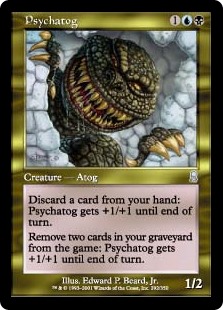
Psychatog

The pool of gold cards is surprisingly shallow, reprint-wise. New players may not know this, but prior to Invasion block, multicolored cards weren't really a thing. There were smatterings here and there, but Invasion was the first real multicolor themed set and the first time Wizards figured out how to design multicolored cards in a consistent fashion. Since Invasion, every set's had at least a few gold cards, but there aren't many from before then. Except for slivers. As a result, my pool of possible reprints are cards from Invasion-Onslaught and some early-set weirdness. A surprisingly high percentage of which have either already been reprinted or are now straight outclassed. Which made my selection much easier.

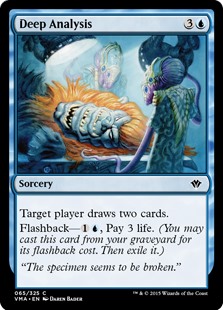
The most interesting and brewable gold card I could remember (or find, after quite a search) is Psychatog. Dr. Teeth was the creature when I was first becoming competitive, and remained as such for years afterward. It terrorized Standard as the win condition of a UB Control deck that won in combo fashion. The beauty of 'Tog is the efficiency: the first ability directly fuels the second, which is bolstered by just playing normal Magic. 'Tog completely controlled the game via tons of counterspells while never missing land drops thanks to Deep Analysis and Fact or Fiction. Eventually, the deck would hit eight mana and could "combo" by floating its mana, clearing the board with Upheaval, then dropping 'Tog with Force Spike backup.
Various iterations of 'Tog remained contenders in Extended, but suffered heavily after 2006. See, Time Spiral brought Sudden Shock, which was quickly adopted by Red Deck Wins and Zoo specifically because it killed Psychatog. 'Tog fought back with Counterbalance, but it was past its prime, and hasn't seen play since rotating out of Extended.

Potential Utility

As before, so again. Dr. Teeth would naturally fit into a card advantaged focused UB control deck. 'Tog's effectively a cannon through through to launch a hand and graveyard at the opponent's face, and control elements play well with this strategy. Counters are especially important, considering that removal for black creatures is significantly better today than back in 2002. It also incentivizes pure control and card advantage over the value acquisition typical of the current brand of UBx control decks. Thus, Psychatog could naturally draw players away from Uro.
The more interesting possibility is as a discard outlet. Wizards learned from Odyssey block, and have endeavored to keep discard outlets less efficient and repeatable than 'Tog, Wild Mongrel, and Aquamoeba. It became something of a priority after dredge was unexpectedly busted. Making Psychatog a Dredge card would require a significant retooling of that deck, and it doesn't particularly fit in other existing graveyard decks. However, it might be decent alongside Life from the Loam and cycling lands, finally fulfilling the promise of those reprints.

The Risk

'Tog is a control kinda combo finisher. The old combo with Upheaval is way too expensive for Modern (maybe even for Standard) these days. It's also harder to keep a full graveyard around than back in 'Tog's heyday. Or even its Extended days. Plus, to really make 'Tog thrive requires a massive amount of support, and it's very hard for a heavy control deck to get broken. Dredge and similar graveyard decks aren't exactly tearing Modern up, and 'Tog doesn't fit into their gameplan anyway. It'd take an as yet unknown deck to really make 'Tog being a discard outlet dangerous, so the inherent risk is low.
Add in that two of 'Tog's favorite partners, Deep Analysis and Circular Logic, aren't Modern legal making the potential shell around 'Tog weaker. Couple that with the known hard counter in Sudden Shock and the actually played Abrupt Decay, and 'Tog's a pretty low risk printing. Something would have to go very wrong with wider UBx control for Psychatog to seriously harm Modern.

Likelihood

Psychatog is a card that a lot of players remember fondly, and seeing it reprinted would generate plenty of nostalgia. It's also a pretty low-risk card, so it's highly reprintable. However, MH2 would need discard synergy for Wizards to actually reprint 'Tog, since they build supplemental sets around Limited play, specifically draft.

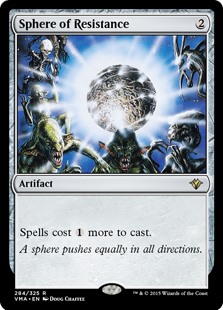
Sphere of Resistance

Artifacts were also surprisingly hard. There's a lot more choice out there for one: the second expansion set, Antiquities, was also the first artifact set. For two, a lot of those artifacts are really busted. I wasn't being facetious when I asked not whether but how Kaladesh would be busted; Wizards simply cannot get artifact sets right. Even outside of broken blocks, Magic's history is littered with busted artifact mana, absurd engines, and frustrating prison pieces. However outside of that, there's mostly useless jank and outclassed artifact creatures, even in the Commander sets. I'm not sure Masticore would see play anymore.

I choose Sphere of Resistance because it's the only non-legal artifact that I could think of or find that could see play and wouldn't just be a Karn, the Great Creator bullet, tribal engine, or simply busted. I don't think Cursed Scroll is good enough anymore, and Winter Orb violates rules 1 and 2. Sphere is also requires the most work to build around. Unlike decedent Thorn of Amethyst, there's no work-around to dodge the tax. The flavor text is very accurate. As the only way around Sphere is through, the typical home has been in decks with Ancient Tomb or Mishra's Workshop, using the mana advantage to power past the opponent.
When that isn't an option, as it isn't in Modern, the only other usage is as part of go-under strategies. A deck that drops creatures the first few turns followed by Sphere for disruption and protection would be effective. Such decks are rare in Modern, partially because Delver of Secrets is mediocre and mostly because Prowess is too fast. Prowess can't use Sphere, because it's slowed down a lot by taxes, and so a Sphere could open up the meta.

Potential Utility

In Legacy, Sphere is used in Lands, Cloudpost, and Stax to put the screws to Delver decks. That it also gives them hope against terrible combo matchups is somewhat incidental. They're using their acceleration to power through Sphere as mentioned above and it is theoretically possible that Titan and Tron could wield Sphere too. However, I'm skeptical.

Tron relies on cheap cantrips to survive, far more than any other Modern deck. Subsequently, playing Sphere would be pretty harmful to Tron's gameplan. Why bother with disruption when you can just drop a bomb? As for Titan, it really doesn't have a lot of extra mana to spare in the early turns when Sphere matters. It wants to play a one drop, ramp turn 2, then get out Primeval Titan. Sphere doesn't fit that plan.
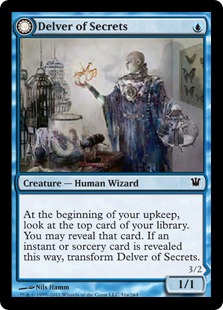
A more likely scenario is to pair Sphere with cheap creatures and/or Aether Vial. Delver-style decks suffer heavily against Prowess, but could more easily play under Sphere since it only wants to resolve a spell or two a turn. Prowess needs to play many spells a turn to really do anything, which would give other go-under creature decks more of a chance. Death and Taxes would be a bigger beneficiary thanks to Vial and its much higher land count. Taxes also only plays one spell per turn anyway and only Path on opposing turns, so the impact is muted not by mana but strategy. Sphere also generally plays into the Taxes part of the name quite well.
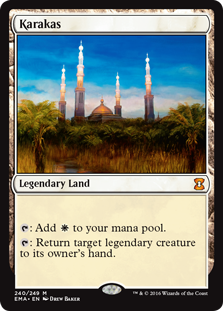
While Sphere would hit Storm-style combo and Prowess the most, midrange and control aren't immune. Both decks are inherently clunky and slow, with most of the power coming from 3+ mana spells. Against fast decks, any delay in casting Uro, Titan of Nature's Wrath can be catastrophic.

The Risk

If I'm wrong about Tron and Amulet running Sphere it wouldn't be the end of the world, but I'd hardly say that's acceptable. The decks ramp fast enough that Sphere could be potentially backbreaking. There's enough land hate around that it might not be too much of a problem, since taking a turn off to Sphere keeps them from hitting their best curves too. Eldrazi Tron is another worry, but that deck is so inconsistent mana-wise that I'm not sure it's something to consider.

Outside that, there's the overall problem of player frustration. Wizards has stuck with Thorn and Thalia precisely because they feel more fair, and so less obnoxious. They're not, as in practice their effect is decidedly asymmetric, but there's a psychological release value from the creature exemption. Wizards doesn't like players feeling bad, no matter how unjust their feelings are, so they'd shy away from Sphere.

Likelihood

In terms of power, Sphere is perfectly fine. However, the player complaints aspect makes it unlikely. That said, Sphere is the sort of card that could just be dropped into the set if there's a slot to fill, unlike many cards on my list.

Karakas

And finally, on to the final entry. Karakas is the very obvious choice here, but I tried very hard for it not to be Karakas. There's a solid argument for it violating rule 3, as Karakas is the sort of card that could (but never would) be printed in Standard. Also, I think there's more danger here than appreciated. However, a surprising number of old standby lands have been completely outdated. Why bother with Thawing Glaciers when fetchlands or Lotus Field exist? Castle Ardenvale made Kjeldoran Outpost look silly. And that's not getting into the unfun, busted, or just plain weird lands out there. Yes, Wasteland is too good and Rishadan Port is too hateful.
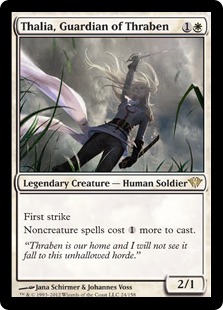
Karakas is a Plains that also bounces legendary creatures. Nothing more, nothing less. That's not really exciting or brew-around, but it open a whole slew of options and possible uses.

Potential Utility

The first thing that always comes to mind when Karakas is mentioned is bouncing Griselbrand. No mana to defeat Neoform is a great deal. This is also Karakas's primary use in Legacy. The secondary is bouncing an Emrakul, the Aeons Torn cheated out by Show and Tell. While Through the Breach is not really a thing anymore, it's nice to have that kind of answer available in a format. There's also utility in stopping Jace, Vryn Prodigy from flipping.
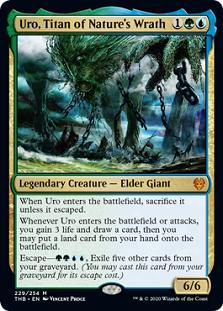
The other use is protecting legends from removal. The legend in question is usually Thalia, Guardian of Thraben in DnT, but Leovold, Emissary of Trest is common too. Legacy being very removal light, this is very strong and in Thalia's case can be close to a soft lock against Delver. Modern could see something similar for DnT, which would have considerable value against the Prowess decks.

The Risk

The problem with Karakas is that the utility is also the risk. Protecting a legend like Thalia is fine, but what about Omnath, Locus of Creation? Suddenly the card becomes an even more absurd value engine, as it can be bounced purposely to draw cards every turn. That's not a great engine, admittedly, and it'd arguably be better to just beat down with Omnath. However, I've seen looping Uro in Legacy successfully grind out players. So long as Wizards insists on making value-generating legends, there's a huge risk that Karakas would just make them more annoying, maybe to the point of becoming oppressive.

Likelihood

As I mentioned, Karakas' power is on a level that I could see being ok in Standard. It might not make much sense in a Standard set, but power-wise Karakas is fine. I think that there's a decent chance of seeing Karakas in Modern at some point, but I'd prefer it be after Wizards finally learns not to give it all away for free.

And Now, We Wait

With my list done, we'll have to wait until summer to see if I called anything. I'll be back next week to finish a piece of outstanding business and finally be done with 2020. To a better 2021!

Asset Explosion: An Economic Analysis

Are you a Quiet Speculation member?

If not, now is a perfect time to join up! Our powerful tools, breaking-news analysis, and exclusive Discord channel will make sure you stay up to date and ahead of the curve.

As 2020 comes to a close, all we can do is say “good riddance”. I can’t remember a year in my lifetime that has been so trying. Everyone knows about the virus and how many people it has affected. To combat its spread, the lockdowns and restrictions on capacity has driven unemployment up to 14%, settling to a still-high 6.7%. Not to mention the emotional toll all the quarantining has on our psyche.

Needless to say, this has been a very trying year.

Despite all of this, we’re staring at massive returns in assets across the board. It seems like everything has soared to all-time highs, whether it’s cryptocurrency, the stock market, or a physical asset. This week, I’m going to examine this asset value growth, speculate on some of the drivers of this price appreciation, and look ahead to 2021 to see if things will continue or reverse.

Asset Value Explosion

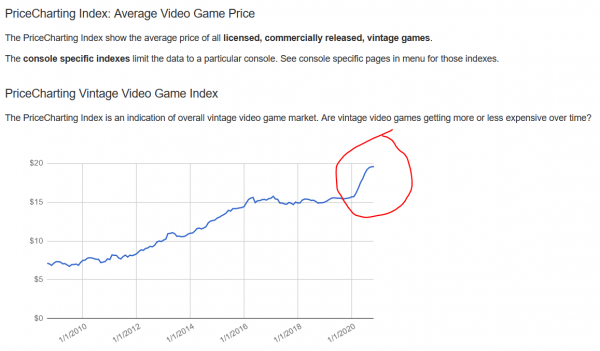
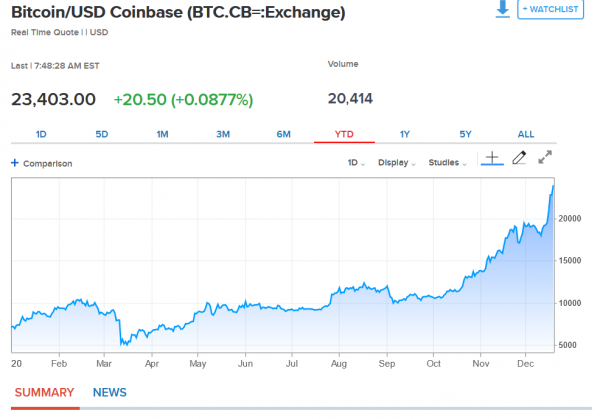
Before diving into Magic trends, let’s take a look at a few other assets first to clearly establish how broad these asset rallies are, in the face of everything going on macroeconomically. Take a look at these 2020 price charts for three different assets: Bitcoin, the NASDAQ, and a vintage video game index calculated on the Video Game Price Charting website (2020 is circled in red).

Everything has risen dramatically in 2020. Bitcoin is currently trading at its all-time high, roughly $23,000, after breaking the previous high in convincing fashion. The stock market has gone ballistic as many trendy tech stocks soar to lofty heights, sending the NASDAQ to an all-time high. Even vintage video games—something you’d expect less volatility out of given their physical nature—has seen tremendous growth in 2020. The index as a whole rose from $15.71 to $19.60 in 2020, a 25% increase in one year!

The list doesn’t end here, either. Pokemon cards have risen to nose-bleed levels as wealthy investors decide to participate in the collectible card game market. Star Wars (Decipher) CCG cards have climbed, with sealed product selling for never-before-seen prices. I suspect other collectible card games with any sort of following have also climbed in price.

Then there’s Magic, which is no exception to this trend. If we were to draw a Venn Diagram with two circles—Commander playable and Reserved List—the intersection of these two would be a collection of cards with skyrocketing prices.

There was an error retrieving a chart for Mox Diamond

Of course, many Reserved List cards from Magic’s first four expansions have taken off this year. This has also been the year of exploding demand for Collectors’ Edition copies of cards as budget alternatives for Old School.

In summary, almost every asset class has risen to values never-before-seen despite high unemployment and a fragile economy.

Attempting to Explain This Paradox

Why are Magic cards near all-time highs (we have seen slight retracement these last couple months) while so many families struggle to make ends meet in this pandemic? This seems paradoxical in nature—how can a weak economy equate to higher asset prices? Every time I see the stock market notch a new high, I’m baffled by its resilience.

I’m no economist, so all I can do is highlight a few potential catalysts and speculate on their impact. Despite my lack of qualification, I believe there are a few clear factors at play. This list certainly won’t be all-inclusive, but it will hopefully give readers a feel for the driving forces behind this asset explosion.

First, there’s the fact that, despite the high unemployment rate, many individuals are still gainfully employed and are now working from home. This population has seen a drastic reduction in weekly expenses: less dining at restaurants, less travel, less commuting to work, etc. So while they are still working the same job and making the same pay, their savings account is growing. Some individuals who fall in this bucket are most assuredly putting more money to work in various investable assets (into which I’m lumping Magic).

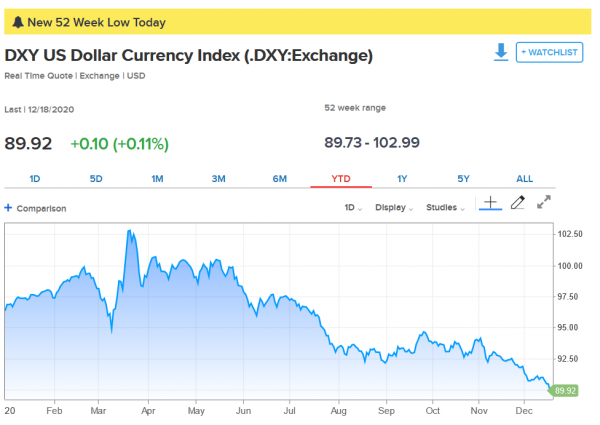
Second, there’s the U.S. Dollar index. The value of the U.S. dollar is at its 52-week low as of today.

As the U.S. Dollar weakens, other assets will grow in price on an absolute basis. This makes logical sense: as the dollar weakens, it’ll take more dollars to acquire a given asset.

Third, there’s the Fed (i.e. the federal reserve), headed by Jerome Powell. The Fed continues to be very market-friendly during this trying time. They’re keeping interest rates at virtually zero and continue to pump dollars into the economy by purchasing treasuries. Here’s an excerpt from the FOMC statement last week:

"In addition, the Federal Reserve will continue to increase its holdings of Treasury securities by at least $80 billion per month and of agency mortgage-backed securities by at least $40 billion per month until substantial further progress has been made toward the Committee's maximum employment and price stability goals. These asset purchases help foster smooth market functioning and accommodative financial conditions, thereby supporting the flow of credit to households and businesses."

“Accommodative financial conditions” is a key phrase here. Credit continues to flow alright, and at near-zero interest rates, providing liquidity for households and businesses in need. Speaking of which, this relates to a fifth factor at play: low mortgage rates. Mortgage rates are at generational lows, triggering record-high refinancing. When people refinance their mortgage, they generally reduce their monthly payment due to the lower interest rate. Instead of going to a bank’s bottom line, that savings is available for individual investment.

Speaking of individual investors, this leads to a sixth factor: new investors. With the advent of Robin Hood, stock trading has become completely commoditized. Now most brokers offer commission-free trading. This means nearly anyone with a few bucks to spare can buy stocks. The newest wave of investors are of the younger generation, and they’re scooping up shares in growing tech stocks, leading to these all-time highs we’re seeing in the NASDAQ.

Looking Ahead

What does this all mean for Magic prices in 2021?

I have no crystal ball, so the remainder of this article will be my opinion and is future-looking. So please take these predictions with a grain of skepticism.

I believe the next couple months will see a continuation of the slight reversion in Magic prices. So many cards skyrocketed in 2020 and really got ahead of themselves. This should normalize a little bit as the higher prices brings more copies out of players’ hands and into vendor inventory. We’ve already seen this unfold on Card Kingdom’s and ABUGames’ sites, where their recent buylist and price increases has helped them gradually restock Reserved List inventory.

But counterbalancing this reversion will be an extension of everything discussed above in 2021. The Fed will remain accommodative, interest rates will remain low, and people will still lack ways to spend money in the traditional sense. This will prop up asset prices, including Magic cards.

What’s more, I particularly like Power 9 right here—I’m seeing significant demand for these cards as players managed to cash out of other Reserved List cards to raise funds.

There was an error retrieving a chart for Mox Sapphire

Collectors’ Edition Power 9 is especially hot—in fact, major vendors haven’t adjusted their prices on CE cards to match the newfound demand. Once this adjustment is made, we’re going to see record-setting buy prices for CE Power and Dual Lands, and this will cause a discontinuous price jump in the market. Eventually this will settle, but I still expect near mint CE/IE Mox Ruby, Mox Emerald, and Mox Pearl to retail for $1000 this time next year, with the other pieces even higher.

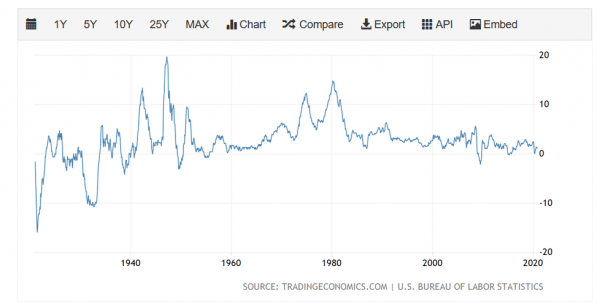
The biggest factor I’m going to be watching in 2021 is inflation. I’ve been banging the inflation drum for a year now, and it hasn’t quite materialized on the timeline I expected. So maybe I’ll still be early to the party in 2021. But if inflation does finally start to gain traction, it’ll mean higher asset prices across the board. Inflation has been stable and near 0% for years now.

While the Fed doesn’t want inflation at 10%, I do think a little more inflation coming into the market is long overdue. Will 2021 be the year for this trend to unfold? I don’t know, but if we see a vaccine helping us return to normalcy next year, and the economy recovers while the Fed remains accommodative, then it’s certainly possible.

In summary, I think 2021 will be another year of growth for investable Magic cards, assuming the game remains healthy. If large in-person events are still on hold for months into 2021, the supply will still be strapped, enabling prices to continue their rally. And as people start to cash out of cards that are suddenly more valuable, it could funnel demand towards high-end cards. This is what I expect to see next year.

Wrapping It Up

The pandemic has taken its toll on the world, that is for sure. Despite all of its negative impact, assets across the board are notching new highs. This is likely due to a combination of many factors at play, driving down the value of the U.S. Dollar while driving up demand for these investable assets.

As we look ahead to 2021, I don’t anticipate many of these factors to suddenly reverse. The Fed will still be accommodative, people will still eschew travel and instead invest their savings in stocks, cryptocurrency, and physical assets (e.g. Magic cards, vintage video games, etc.), and perhaps we’ll start to see some inflation kick in.

Don’t forget, as we speak Congress is working on a bill that would give most U.S. citizens a few hundred bucks to help them navigate these difficult times. I know there’s a lot of controversy around this measure, and I don’t intend to make this article a political one. I’ll just say that there’s a decent portion of the population who will receive this money while still being comfortably employed, and will use this unexpected influx of money to buy more of these assets.

These are all bullish factors at play, and it gives me confidence as I hold my collection tightly. There may be a bit more to the recent retrace, but I still like Magic as a store of value heading into next year. Only a major setback in the pandemic or the collapse of Magic as a game would make me feel otherwise. I don’t think either will happen in 2021 (at least, I feel optimistic they won’t) so I remain a long-term bull on Magic cards. I’m planning accordingly.

December ’20 Brew Report, Pt. 1: Flagged!

Are you a Quiet Speculation member?

If not, now is a perfect time to join up! Our powerful tools, breaking-news analysis, and exclusive Discord channel will make sure you stay up to date and ahead of the curve.

The world's on fire, or so it can seem—depending on your news outlet, salvation may well be around the corner. In any case, there's one world that's blooming and flourishing, and that's the world of Magic: Online Modern invention! Today, we'll check out four of the coolest decks I've seen surface in December thus far, including an underplayed tribal strategy, one sacrilegious twist on an old favorite, and a novel package that's both ramp and land hate.

Keeping the Tempo

Tempo has long been my preferred way to play Modern, although I course-corrected to midrange by building Colorless Eldrazi Stompy. Call me a sucker for attacking and disrupting. And I seem to share this passion with others. The next couple decks are spins on ones I've sleeved up myself that bring something new and exciting to Modern.

Dimir Rogues, RROZANSKI (5-0)

Creatures

4 Soaring Thought-Thief
4 Thieves' Guild Enforcer
3 Snapcaster Mage

Artifacts

4 Mishra's Bauble

Sorceries

1 Agadeem's Awakening
2 Bloodchief's Thirst

Instants

2 Cling to Dust
4 Drown in the Loch
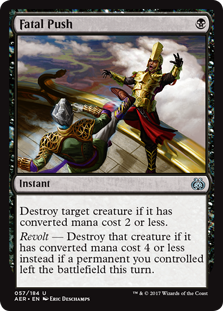
4 Fatal Push
4 Into the Story
2 Spell Snare
4 Thought Scour

Lands

2 Creeping Tar Pit
4 Darkslick Shores
1 Field of Ruin
1 Flooded Strand
4 Island
1 Marsh Flats
4 Polluted Delta
1 Sunken Ruins
2 Swamp
2 Watery Grave

Sideboard

1 Lurrus of the Dream-Den
1 Cling to Dust
2 Aether Gust
2 Ceremonious Rejection
2 Collective Brutality
2 Engineered Explosives
2 Mystical Dispute
2 Surgical Extraction
1 Thoughtseize

No bending over backwards to boost Tarmogoyf with Thieves' Fortune—this is Dimir Rogues we're talking about! Goyf still shows up in Modern, but not nearly at the levels it used to, and it's long become antiquated in tribal tempo shells like this one. Indeed, the above list makes it seem like Rogues has everything it needs in blue and black to become a solid lower-tier contender.

Soaring Thought-Thief is a unique lord that advances the gameplan by milling opponents. While doing so can prove dangerous depending on what you face, a heavy reliance on Thieves' Guild Enforcer makes it all worth it: with Thought-Thief active, Enforcer is a one-mana, four-power creature with flash and deathtouch. Bloodchief's Thirst makes an appearance as additional copies of Fatal Push, although these can take out planeswalkers; Drown in the Loch forms the backbone of the interactive suite, handling anything opponents throw at the pilot and keeping with the mill theme.
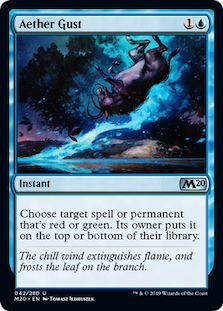
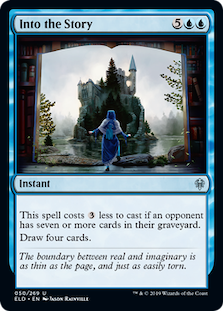
And speaking of that theme, Into the Story provides a way to gas back up in the mid-game that frequently draws four for four. "Is that even good?" you may ask, to which I'll reply, "I have no idea." But there are four copies here, and the deck at least did something, so I for one am excited to experience firsthand whether Treasure Cruising-plus is as fun as it looks. We'll get to whether it's any good second. But let me leave you with this image: end of turn, Snapcaster, target Story....

Temur No Delver, TUBBYBATMAN (5-0)

Creatures

4 Monastery Swiftspear
4 Tarmogoyf
3 Hooting Mandrills
3 Stormwing Entity

Sorceries

2 Flame Slash
4 Serum Visions

Instants

4 Lightning Bolt
3 Tarfire
4 Manamorphose
4 Stubborn Denial
4 Thought Scour
2 Blossoming Defense
2 Vapor Snag

Lands

1 Botanical Sanctum
1 Breeding Pool
1 Forest
2 Island
4 Misty Rainforest
4 Scalding Tarn
2 Spirebluff Canal
1 Steam Vents
1 Stomping Ground

Sideboard

2 Abrade
2 Aether Gust
3 Cleansing Wildfire
1 Destructive Revelry
2 Feed the Clan
3 Grafdigger's Cage
2 Veil of Summer

Is that old boy Temur Delver? Yes! I mean... no? Where's Delver? Certainly not in Temur No Delver, which drops the staple of this archetype for the more aggressive Monastery Swiftspear. It's true that Bolts, Pushes, and Thirsts have been creeping up in the numbers lately to deal with hyper-aggressive strategies like Mono-Red Prowess. So Delver's not too long for this world. Neither is Swiftspear, but at least the 1/2 can tuck away a few points of damage before it bites the dust; every point counts in a deck like this one, and few Stage 1 creatures are as reliable at outputting pressure. Plus, when you're leaning on Tarmogoyf and Hooting Mandrills to pick up the pieces, the faster your one-drop gets shot, the better! Flying isn't even entirely forsaken, as relative newcomer Stormwing Entity brought its four copies of Manamorphose to the party and is ready to roll.

Mandrills itself is in an interesting spot right now. The card has always been superb in Modern, where it tramples over creatures typically relied upon to chump-block fatties while dodging Fatal Push and Abrupt Decay. With the popularity of Aether Gust, however, I feel like Gurmag Angler and other cost-reduced fatties are finally giving the Ape a run for its bananas. Gust is making waves for its use against Uro, Titan of Nature's Wrath, but Mandrills suffers significant splash damage. Having this thing topped or bottomed stinks more than having a fresh turd flung at your head.

Control's New Cleanse

Control decks are alive and well, and I don't just mean four-color Uro piles. More standard interactive builds have figured out some neat tricks to defeat the Omnath menace, and now they're unveiling the goods.

Jeskai Saheeli, CHUKI322 (5-0)

Creatures

4 Felidar Guardian
3 Snapcaster Mage
1 Sun Titan

Planeswalkers

1 Jace, the Mind Sculptor
4 Saheeli Rai
4 Teferi, Time Raveler

Sorceries

4 Cleansing Wildfire

Instants

1 Force of Negation
3 Lightning Bolt
2 Lightning Helix
4 Opt
3 Path to Exile
4 Remand

Lands

4 Flagstones of Trokair
4 Flooded Strand
1 Hallowed Fountain
1 Raugrin Triome
1 Sacred Foundry
4 Scalding Tarn
3 Snow-Covered Island
1 Snow-Covered Mountain
1 Snow-Covered Plains
2 Steam Vents

Sideboard

1 Lightning Helix
3 Aether Gust
1 Ashiok, Dream Render
1 Ceremonious Rejection
2 Dovin's Veto
3 Mystical Dispute
2 Rest in Peace
1 Supreme Verdict
1 Teferi, Hero of Dominaria

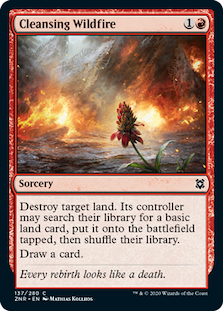
Okay, so it's aggro-combo-control. But at its core, this greenless build of Jeskai Saheeli emphasizes the control, employing a hefty haul of removal spells and interactive planeswalkers to buy itself time before going infinite with Saheeli Rai and Felidar Guardian. That spicy new tech I alluded to above? It's none other than Cleansing Wildfire, mainboarded, maxed out, and paired with a set of Flagstones of Trokair.
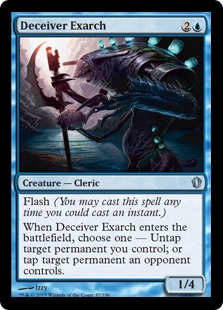
Back in the day, players used to pop their own Flagstones using Boom//Bust as a build-your-own, two-mana Stone Rain. Cleansing Wildfire does something similar. If it's not destroying Field of Ruin, Tron lands, or Valakut, the Molten Pinnacle, Wildfire can be pointed at one's own Flagstones of Trokair as a build- your-own, cantripping Rampant Growth. Cantripping Rampant Growth! In Boros colors! Jeskai Saheeli is no stranger to tapping out for planeswalkers and 1/4 Cats, so despite its heavily interactive nature, it doesn't mind casting the sorcery on turn two. Still, thanks to with Teferi, Time Raveler, Wildfire is often cast at instant speed, which makes it kind of absurd. At last, a worthwhile use for Tef's +1 ability!

Jeskai Control, NPIZZOLATO (5-0)

Creatures

4 Snapcaster Mage

Planeswalkers

2 Jace, the Mind Sculptor
2 Teferi, Hero of Dominaria
3 Teferi, Time Raveler

Enchantments

3 Shark Typhoon

Sorceries

4 Cleansing Wildfire

Instants

3 Cryptic Command
3 Force of Negation
3 Lightning Bolt
3 Lightning Helix
2 Path to Exile
4 Remand

Lands

4 Flagstones of Trokair
4 Flooded Strand
1 Hallowed Fountain
3 Island
1 Mountain
2 Mystic Sanctuary
1 Plains
1 Prairie Stream
1 Raugrin Triome
1 Sacred Foundry
4 Scalding Tarn
1 Steam Vents

Sideboard

1 Lightning Bolt
3 Aether Gust
1 Anger of the Gods
2 Ashiok, Dream Render
1 Mystical Dispute
1 Nexus of Fate
2 Supreme Verdict
3 Tale's End
1 Timely Reinforcements

Here's the same package in Jeskai Control, a decidedly more dedicated control deck that stretches out the game before winning with a big Shark Typhoon. The more lands the better since that's the gameplan, and having extra insulation against the land-based combo decks all over Modern right now while serving as a competent ramping plan seems like just what Dr. Jeskai ordered.

The success of Flagstones-Wildfire in these lists led me to wonder if other strategies might want it. It's perhaps worth noting that Splinter Twin's cursed remains, Kiki-Exarch, put up multiple strong finishes this month. That strikes me as a pile that would make great use of the engine, as it's already running Wildfire in its 75 to compete with the land-lovers. The package alone isn't much reason to splash white, but Time Raveller adds protection for the combo... at that point, the question becomes: is Kiki-Exarch less reliable than Copy-Cat?

Going Out with a Bang

Leave it to Modern to keep throwing innovation our way as we press on into the new year. I'd bet the rest of December also fails to disappoint. This New Year's, find me counting down from 10 on all alone in a room scrolling the MTGO dumps!

Insider: My Last Look at Commander Legends

Are you a Quiet Speculation member?

If not, now is a perfect time to join up! Our powerful tools, breaking-news analysis, and exclusive Discord channel will make sure you stay up to date and ahead of the curve.

I've already written about Commander Legends twice already, so I expect this article to be my last one covering the set for a good while. Previously, my focus was on the true rarity of specific printings of the cards, and some of the mythics I felt might be a bit underpriced. We are still waiting for additional supplies of Commander Legends cards and the prices for almost everything have plummeted heavily which was expected.

Today, I am going to move away from the mythics and rares and focus on the commons and uncommons of the set. Now thanks to all the collector boosters nowadays foil versions of any specific card in a set tend to not be worth much more than nonfoil versions. It also doesn't help that foil is no longer the "pimpest" version of a card thanks to Extended Art (EA), Borderless, and Showcase variants. The focus on today's picks relies heavily on the fact that the extended art variant is ONLY available in the Collector Booster packs, which unlike the regular packs are a limited run. These packs are broken down like this;

  • 1 foil-etched Commander (rare or mythic)
  • 1 foil-etched reprinted Commander (rare or mythic)
  • 1 extended art non-legendary card (rare or mythic)
  • 1 foil non-legendary card, might have extended art (rare or mythic)
  • 2 foil Commanders (uncommon or rare or mythic)
  • 1 foil-etched Commander (uncommon)
  • 1 extended art non-legendary card (common or uncommon)
  • 2 foil non-legendary cards, might have extended art (common or uncommon)
  • 5 foil cards (common)
  • 1 foil double-sided token

I've bolded two of the bullet points because it shows that the cards we are looking at today can only be pulled in 3 of the 15 "slots" in the pack.

The challenge with common or uncommon specs is that they have a lower price ceiling due to higher supply and any reprint tends to decimate their value. However, I would expect as we have seen with 'original foil' versions of valuable commander cards is that the price of the "pimpest" version tends to not take much of a hit when the card is reprinted, though the obvious exception is when the value is heavily reliant on limited supply as is the case with many Portal Three Kingdoms cards.

It is important to note that not every common or uncommon in the set has an Extended Art variant, there are 32 commons/uncommons in the set with an Extended Art variant. While we don't know the print sheet makeup exactly, I looked back at the data I used for my last Commander Legends article and it appears that the Extended Art commons and uncommons were pulled at roughly the same rate. So with all that being said, let's look at some good buying opportunities for Extended Art commons and uncommons from CLG.

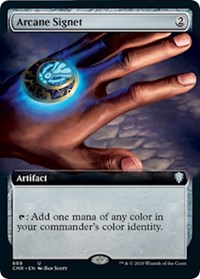
One of the most powerful 2 drop mana rocks in Commander, Arcane Signet, is a staple in almost every multi-colored commander deck and can easily replace any of the old diamonds in a mono-colored deck. When this card was first released in the Throne of Eldraine brawl decks it was easily going for the entire MSRP of the deck ($20). It has been included in every Commander based product printed since it's release and still managed to sit in the $2-$3 range.

Looking at the pull data supplied by Mr. Vanek, in 50 collector booster boxes, he pulled 16 non-foil extended arts and 8 foil extended arts. However, the price difference between the two is currently $3.6 versus $25. To me, this implies that either the foil version is overpriced or the non-foil is underpriced and obviously bringing this up I tend to believe the latter.

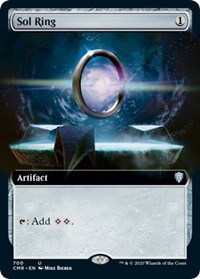
Sol Ring is arguably the most powerful card in Commander. Despite being reprinted almost every year since 2013 in every commander deck, it still managed to be worth $2-$3 because it's pretty much the first card people put in every single deck. The Extended Art variant is currently sitting around $5 while the foil option is around $30.

Looking at Thomas' pull rates he got 18 non-foil and 7 foil extended arts in the 50 collector boxes opened. So we have a pull rate of around 1:3 but a foil multiplier of 6, which means something is again off and I tend to believe the non-foil is underpriced.

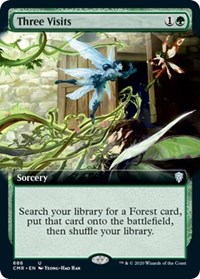
We finally got a much-needed reprint of a Portal Three Kingdoms commander staple letting people get copies for 1/50th of the previous going rate. Green is the most powerful color in commander and a major reason behind that is its ability to ramp. Three Visits is simply a renamed Nature's Lore, but the ability to get any forest, including triomes, shocks, and dual lands means it easily fits in any deck that plays green.

Looking at Thomas' pull data there were 16 non-foils pulled and 8 foils pulled and yet the prices are $4 vs $13, which is closer than the previously mentioned cards, but given this is the first reprinting of the card I expect the supply of these to quickly be absorbed by the player base.

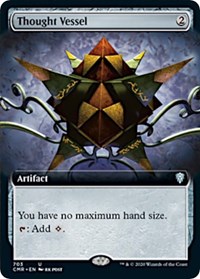
The last card I want to showcase today is Thought Vessel, our Reliquary Tower mana rock. While not as prevalent as the two previously mentioned mana rocks it still tends to be a card high on the "auto-include" list for many decks. Interestingly enough this is also the only card on the list where the Extended Art market price is within 20% of the normal version. I expect this to shift as more Commander Legends booster boxes hit the supply and thus the normal versions continue to be opened, whereas, the Extended Art supply will be pretty static as once all the Collector Booster boxes are gone no more copies become available.

Conclusion

It is important to note that I've purchased a couple copies of several of these cards for my own personal use and that action inspired this article. I was honestly surprised at how cheap these Extended Art variants were and I truly don't think they can remain this low for that long. As always if you have any thoughts, comments, or suggestions for future articles please comment below or reach out to me on our discord channel.

Wild Speculation: MH2 Speculation, Part 2

Are you a Quiet Speculation member?

If not, now is a perfect time to join up! Our powerful tools, breaking-news analysis, and exclusive Discord channel will make sure you stay up to date and ahead of the curve.

With the metagame update done, that ends the heavy content for 2020. It's time to coast to the finish! I think we've all earned a nice easy December considering how 2020's gone, so going into the new year, let's destress and remember what hope felt like. I miss FNM.

To that end, I'll be picking up where I left off two weeks ago with Modern Horizons 2 speculation. There's no way to predict what new cards may come, but I could discuss the cards I'd like to see reprinted. However, I won't just belch out a list of cards and be done with it. I've got standards, after all. I set down rules in the first article, and I'll stick to them:

  1. Don't make Modern into Legacy. Reasonable power levels and it has to make sense in Modern's context.
  2. No hate cards. It's too easy/lazy, and also boring. I have to pick cards that encourage brewing and new gameplay.
  3. No low-hanging fruit. Counterspell is obviously ok for Modern; I'll look deeper and push myself to find hidden gems.

I led off with white and blue, so today I'll be working through the Jund colors. And they were tougher than expected.

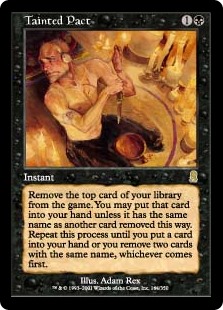
Tainted Pact

Every time someone brings up possible Legacy imports, it seems like black gets the most unreasonable suggestions. Why, oh why, do players think Hymn to Tourach is ok? I thought everyone wanted to play Magic, not randomly ruin someone's day. However, that might be a function of players seeing black as the color of discard and removal more than anything else. Understandable, really, since that is a significant part of what black does these days. What they forget is that black is also about the high-risk, high-reward cards, and that's why my pick is Tainted Pact.

I have very fond memories of Pact from when I was learning to play. The store owner at my first FNM played in the tournament, and was playing Odyssey mono-black control, but ran Pact rather than Demonic Tutor. He may have also had legitimate curve or metagame reasons for doing so, but he definitely kept running Pact because it was fun. Every time he cast Pact, it was a whole production, and for a kid just learning the game, it was awesome to watch. He'd go on like a carnival barker about spinning the wheel of fate, and it never failed to lighten the mood and make the whole store feel fun. This singular experience was largely responsible for drawing me into Magic.
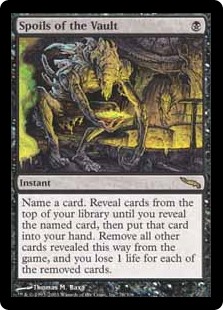
Unlike every other Demonic Consultation variant I can think of, Tainted Pact doesn't guarantee finding a specific card. It just digs into the deck, and you select a random one. The beauty and the balance is that if two of the same card are ever revealed, you get nothing, hence the carnival associations. Pact is an elaborate cantrip that rewards certain deckbuilding choices as well as its caster's understanding of probability. And I'm all about skill-testing cards and encouraging players to branch out in their deckbuilding.

Potential Utility

Also unlike every other Demonic Consultation variant that I can think of, Pact isn't a clear candidate for combo abuse. Outside of some extreme Lutri, the Spellchaser-related shenaniganry, Pact can never exile an entire library Ă  la Spoils of the Vault (no combo with Thassa's Oracle). The fairest use of Spoils I've ever seen was in Esper Death's Shadow back in 2017, where the guy was using it to get a turn 2 Shadow. And instead killed himself two times against me. Otherwise, it's just been used to find Ad Nauseam as far as I know. Pact also doesn't cause loss of life, so it doesn't synergize with Death's Shadow. Plus, even as just a cog in a combo deck, it can't really search for a critical combo piece any better than a normal cantrip. Which will limit Pact's usage to fairer decks.
And that's where the really interesting part lies. I'm not sure what kind of deck would use Pact. I don't think the deck that could use Pact currently exists. Jund-style midrange doesn't need a two-mana cantrip, and there's no black control. An aggressive deck might be risky since they tend to have more four-of's than control, but also run fewer lands. The deck that wants Pact runs a wide range of spells with each one in small numbers, doesn't run many playsets of lands, doesn't mind exiling cards from its library, and is based in black. The 4-Color Omnath decks fit the first two categories, but not the last two, which may open up space for something new. Control players like digging into their decks and generally have some redundancy, so it makes sense for something new to arise and take advantage of Pact.

The Risk

As noted, the odds are pretty low for Pact to suddenly break Modern. I can't even say that Pact is much of a consistency tool, since the outcome is pretty random. There's few ways to stack the top of your library in Modern, so the risk of hitting a duplicate card rises quickly the deeper Pact goes. It's just a slightly odd cantrip, and so I'd say the risk is pretty low.

Likelihood

Wizards isn't exactly fond of Consultation-style cards. I seriously can't think of a variant since Spoils, and couldn't find one after trying. However, Pact is so different from the other options that Wizards might be willing to try again. It doesn't have the same risks as Consultation or Spoils and doesn't see Legacy play, so I'd call Pact a plausible inclusion.

Blood Oath

Red was really hard. For most of Magic's history, red was the color of four things: Land hate, burn, goblins, and janky enchantments. And while I'd love to really punish Uro decks with Price of Progress, it violates rule 2. And may not be healthy for Modern anyway. Modern already has most of the good burn, and Flame Rift is too good with Death's Shadow and Scourge of the Skyclaves. Most of the good-but-not-busted goblins are in Modern already. And jank is jank. I really had to dig deep and remember an obscure card that Extended players often discussed in hushed tones when I was starting out.
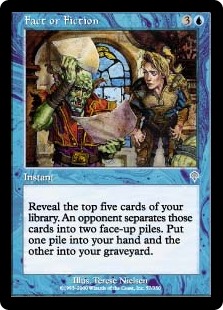
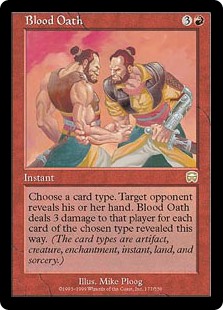
Blood Oath is a very strange card. It's straightforward to play, but the threat of it makes opponents play strangely. I heard a story somewhere that during a GP one player split a Fact or Fiction pile of five instants 5-0. Their opponent, being tapped out, saw that said player had four mana open and was playing red. Suspicious of a lethal Blood Oath, the pile of zero was selected. In something of a reversal of my list so far, Oath is an excellent card against slower decks, but not in them. Aggro decks empty their hands quickly, reducing Oath's effectiveness, but would love to punish those who hold cards.
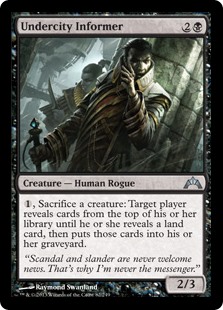
At the same time, Oath is very much a precision tool. It takes a lot of format and deck knowledge to know what to card type to name. Again, I like skill-testing cards, particularly ones that show off how much more knowledgeable you are, and this Oath would benefit from the Modern we currently have.

Potential Utility

Obviously, Oath is meant to punish slow control decks that hold cards in hand. It's theoretically possible that it hammers Life from the Loam decks too, but that's far less likely. In a Modern where grindy value and card accumulation are at an all-time high, Oath would be particularly potent. There's nothing as satisfying as really punishing a durdly deck for tapping out. However, Oath could never be too punishing thanks to planeswalkers taking up a lot of slots that would have gone to sorceries or instants back when it was first printed. The number of card types being greater reduces Oath's impact by making it harder to guess an opponent's hand. Oath would be a threat, but not necessarily a lethal one.

There's additional utility besides attacking midrange and control decks. Combo decks are a great target. Ad Nauseam and Storm style decks are particularly attractive, as they need a critical mass of spells in hand, and those tend to be all instants. An upkeep Oath on the combo turn against Storm sounds like a devastating move. Granted, right now Oops, All Spells is the main combo deck, but it is still weaker than you might think to Oath.

Oops doesn't need a critical mass to go off, just one specific card, so it can't be effectively punished for resource accumulation. However, because Oops has no lands, the Oath call is easier. This is especially the case since Oops is typically 1/3 creatures and 1/3 sorceries. In that matchup, Oath is less of a guessing game than most, and provides an opportunity to really punish a slow combo. Being four mana means that Oath can't really preempt the combos, which incentivizes decks that might want to Oath to have additional disruption.
Oath is not very effective in an aggro matchup. While these decks tend to be very creature-heavy, giving Oath the chance to deal massive damage, they also dump their hands, and Oath costs four mana.

The Risk

The risks of a four-mana instant are naturally low due to Modern's speed. The format can also easily adapt to Oath by changing up deck composition or prioritizing casting their spells rather than sitting on counters.

However, there is a risk of Oath being very punishing alongside other information-gathering cards. If Gitaxian Probe wasn't rightly banned, I could see Oath being too effective. As is, Oath doesn't exactly synergize with Thoughtseize, since discard reduces the targets for Oath. It doesn't necessarily conflict either, since information is still information, and the Oath player can just track how the hand has changed and make reasonable conjectures. Therefore, there is a risk of Oath being a bit too reliable outside its intended use.

Likelihood

This is a very reprintable card. Red gets to deal damage based on opposing permanent types (see Aura Barbs, Cindervines, and Enchanter's Bane), and punisher-type cards get printed all the time. The questions is whether Wizards is ok with red doing that to cards in hand, and Rosewater is pretty quiet on that front. I'd say Blood Oath is plausible.

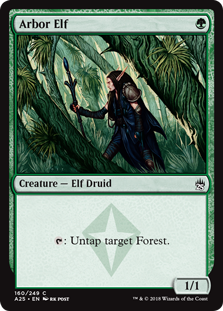
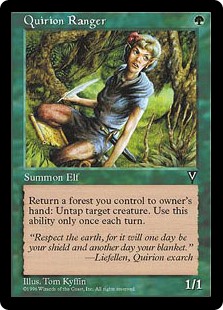
Quirion Ranger

I had a problem with green, too. A lot of green's good cards from early Magic are ramp spells or mana generators, and Modern definitely doesn't need more of that. Outside that there is lots of artifact destruction and fatties, but those aren't unique or interesting. Sylvan Library is a color-pie break, so it's not happening (and really, does green need more card advantage now?). A lot of other interesting cards don't really make sense in Modern or are pretty busted, like Carpet of Flowers, Natural Order, and Crop Rotation.
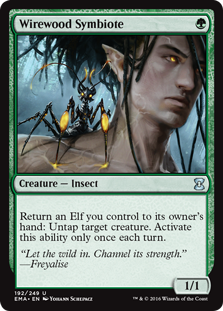
This pushed me towards that other green mine, Elves. Many of the best ones are already in Modern or are mana engines, and Elves doesn't need more of that. It came down to Wirewood Symbiote or Quirion Ranger, and I picked Ranger. Symbiote functions too much like ablative armor, which exacerbates Elves's grindy nature. Legacy Elves is a combo deck, but Modern's version is decidedly tribal beatdown, often so filled with 2-for-1's and Collected Company that it's hard to keep up outside sweepers. Symbiote would be another bit of grind, and just adding another tool isn't what I'm looking for.

Ranger is more unique. It trades long-term land development for immediate mana boosting, being a sort of engine despite not actually producing mana. The implications of bouncing a forest are interesting to contemplate, as is actually building a deck to utilize the temporary boost effectively. Again, Symbiote just fits. Plus, Ranger hasn't actually seen a printing since Visions. Not a big price problem for a common, admittedly, but still, it's about time.

Potential Utility

Elves can just slot in Ranger, but to really maximize it will take some major readjustments. Legacy Elves uses Ranger to cheat on lands while gaining mana from Dryad Arbor, which isn't played in Modern. It also untaps elves for additional Heritage Druid activations. The most obviously good use for Ranger in Modern is untapping Elvish Archdruid, which isn't bad, but is hardly the same as accelerating into Natural Order. Does Modern Elves want to go more land-light and cheat drops using Ranger? I don't know, but it would be interesting to find out.

Additionally, maybe there are decks outside Elves that want to replay their forests. I can't think of any, but the option is there. Amulet Titan likes to bounce lands, but those are Simic Growth Chambers. Unless Field of the Dead or Valakut, the Molten Pinnacle want some insurance to hit their triggers.

The Risk

It's a 1/1 elf. Everything kills it, and the risk/reward in its ability makes removal an even more punishing possibility. While there is some chance that Ranger proves an unexpected mana boost and something breaks, it would be easy enough for the format to adapt and clean up the mess.
Likelihood

Wizards doesn't like to just include cards in sets so they can be reprinted, so Ranger would need to fit into a draft theme. Landfall is very popular and we just went back to Zendikar, so if there was ever a time to finally reprint this Legacy staple, Horizons is it. I think it pretty likely.

Speculative Fiction

And that concludes the mono-colored cards. I'll wrap this series up next week with the multicolored card, the artifact, and the land. I'll see you then.

MTG Finance Takeaways From My 2020 Advent Calendar

Are you a Quiet Speculation member?

If not, now is a perfect time to join up! Our powerful tools, breaking-news analysis, and exclusive Discord channel will make sure you stay up to date and ahead of the curve.

If you haven’t been following along, I’ve been using Magic booster packs as an advent calendar this December and it has been a blast. Now that the first two weeks of December are over, the remaining packs are more exciting, culminating with boosters from Mirage, Alliances, Weatherlight, and Visions. These are some of my favorite sets from when I started playing the game!

On my way there, I have actually learned a few financially relevant tidbits by doing this calendar. In case you haven’t been following the advent calendar, or in case you haven’t particularly cared, I’m going to highlight the top four things I have learned thus far opening all these booster packs and tracking their value.

Without further adieu, here they are in reverse order!

Number 4: Upside Down Sets

In most sets, a rare or mythic rare is the most valuable non-foil card to be opened in a booster pack. This is especially true with any set printed in the last decade. Therefore, as I’m opening Throne of Eldraine, Theros Beyond Death, or Gatecrash packs, the most interesting card to reveal comes in the last slot of the pack (besides the token or basic land).

As Magic sets age, values are driven less and less by rarity (though it’s almost always still a factor) and more and more by their demand for play in non-rotating formats. This stands out most with two booster packs I opened last week: Scourge and Prophecy, which were released in 2003 and 2000, respectively.

Before opening the Scourge booster pack, I browsed buylists for non-foil cards to see what the most valuable card is in the set to open. The number one card was Sliver Overlord, which buylists to Card Kingdom for $13. No surprise there.

But the number two most valuable card in the set? This uncommon!

There was an error retrieving a chart for Pemmin's Aura

That’s right, an uncommon is the second most valuable non-foil card to open from Scourge. The blue aura is quite popular (presumably amongst casual players…you can’t possibly tell me Arixmethes, Slumbering Isle Commander players are driving the price up). This demand among the casual crowd, lack of reprint, and age of the set has driven this uncommon’s price to be the second-highest of the set!

Although, the real upside-down award goes to Prophecy, one of the most underpowered sets ever printed. There’s one (and only one) card printed in the set that absolutely dominates some games of Commander. The card in question is none other than Rhystic Study.

There was an error retrieving a chart for Rhystic Study

The card has been reprinted in a few supplemental sets, but none with a humungous print run. Because of this, and because Prophecy was printed 20 years ago, this most valuable card from the set goes for $20. And it’s only a common!!

While I was opening my Prophecy booster pack, I wasn’t too interested in the uncommons or the rare. The real suspense came with the commons and whether or not I’d see a Rhystic Study.

Number 3: Expeditions Destroyed Battle for Zendikar

One of the boosters I opened was from Battle for Zendikar, released a little over five years ago. Before cracking the pack, I once again browsed through Card Kingdom’s buylist to see what would be worth opening. It turns out that outside of Ulamog, the Ceaseless Hunger and Void Winnower, there’s really very little in the set worth more than the price of the pack.

There was an error retrieving a chart for Ulamog, the Ceaseless Hunger

In fact, the top eight most valuable non-foils from the set are all mythic rare. This means the odds of opening something of value is even lower, considering the most valuable rare is barely worth $2.

Perhaps the set is underpowered like Prophecy was. But I’m not so sure I’m in full agreement here. While some of the rares were truly awful, I believe the Expeditions drove prices of the set’s cards downward. With the chance at opening a $200 card, more BFZ product was opened and that generated more supply on all the rest of the singles.

What’s really interesting is that Kaladesh, another set with Masterpieces, follows a different trend. In that set, the three most valuable non-foil cards are rares. And there’s nearly a dozen rares and mythic rares worth actually opening. While the Masterpieces are likely having an impact, the set seems to be good enough to overcome this and still maintain some value outside the chase foils.

Number 2: Foils Used to be Very Rare!

Nowadays foils are a dime a dozen. Some premium sets, such as the Masters sets, contain a guaranteed foil in every booster. Throne of Eldraine booster packs advertise odds of opening a foil card at 1:3.

The back of a Core Set 2020 pack boasts odds at opening a foil at 1:45 cards—with 15 cards per booster, that’s the same odds as Throne of Eldraine.

This wasn’t always the case. You don’t have to go too far back to see worse odds. The back of a Gatecrash booster advertises odds of a foil at 1:67 cards, or roughly every four or five booster packs. These odds were fairly common a few years ago, and I see the same numbers on the back of my Shadows Over Innistrad and Battle for Zendikar as well.

Going back further, the back of the Scourge booster I opened advertises foil odds at 1:70 cards. These 1:70 odds date all the way back to Judgement and Torment. But older sets, starting with Odyssey and going backwards, have advertised odds at 1:100 cards, or roughly every six or seven booster packs.

There was an error retrieving a chart for Rhystic Study

It’s no wonder foils from roughly 2001 and before are so rare and valuable! They occurred much less frequently (less than half as often) as foils nowadays. This also partly explains why foils carry such little premium in modern-day sets (though their frequency in set boosters and showcase boosters multiply their print run dramatically).

Number 1: Why Is Decree of Silence Worth Money?

When I opened my booster pack of Scourge, I was focused solely on two cards I knew had value: Pemmin's Aura and Sliver Overlord. As I leafed through each card one by one, I made it through the uncommons with a bout of disappointment as I saw no Pemmin's Aura. Then I arrived at the rare and saw it wasn’t Sliver Overlord. Bummer.

The rare was in fact Decree of Silence, and while I was recording my pack opening video I commented how it wasn’t the most exciting but still a cool card. It wasn’t until after the fact, when I looked up the card on Trader Tools and realized the card was worth about $10! Immediately I asked, “Since when?”

There was an error retrieving a chart for Decree of Silence

Apparently, the answer to that question is, “Since April this year.” That’s about when the card spiked. When I asked Twitter why the card had jumped, my attention was directed to the printing of a new Commander card, Gavi, Nest Warden. Now it makes sense! Thanks to Gavi, you can pay zero mana to have an uncounterable counterspell that also draws you a card! That’s a potent combination.

I had thought maybe the card had spiked thanks to Solemnity—this combination of cards essentially locks all your opponents out of casting spells for the rest of the game. Apparently, there was a small jump back when Solemnity was printed, but Gavi was the real driving force.

This just goes to show you, any card from an older set that does something unique has the chance to one day become expensive. It just needs the right Commander card to be printed. As Wizards continues to innovate in the Commander space, and cards become more and more complex in their abilities, you just never know what card will spike next. I’m excited that I opened one of them!

Wrapping It Up

While my Magic advent calendar started as a fun activity to get me excited about this year’s holiday season (despite the pandemic), I am learning a great deal of relevant MTG finance information as well. This calendar has already taught me a few valuable tidbits, and I was excited to share them all here so others could also benefit from my education.

Please stay tuned as we look ahead to the last two weeks of this advent calendar. Whether or not you celebrate any particular holiday, you may be interested in watching me open some exciting packs from Magic’s history. I saved the best packs for last, and I can’t wait to see if my luck continues as we head towards the New Year!

Budget-Focused: Aggressive Gruul Cards Getting Overlooked

Are you a Quiet Speculation member?

If not, now is a perfect time to join up! Our powerful tools, breaking-news analysis, and exclusive Discord channel will make sure you stay up to date and ahead of the curve.

Welcome to another week of budget-focused Magic! I know I've been a little quiet as of late, but I'll be posting more frequently in the future! Last we talked, we discussed some Zendikar Rising cards to keep an eye on, some of which have been on the rise since. Today we'll be going over some cards that have potential demand in Pioneer, and why I think they'll be relevant in the current metagame. What I'd like to start doing in these articles is spotlighting any cards previously discussed that have either gone up. or look like they will spike based on trends in Pioneer.

Here's a highlight of some previously discussed cards that are rising in price. The price shown (at time of writing) is how much it has risen since we last discussed them.

  1. Deflecting Palm (Prerelease Foil) – up $2.49
  2. Glint-Horn Buccaneer (Prerelease Foil) – up $16.37
  3. Sigarda's Aid Foil – up $2.21
  4. Hanweir Militia Captain Foil– up $0.60
  5. Ilharg, the Raze-Boar Foil – up $1.49
  6. Skyclave Apparition Extended Art Foil – up $2.28

Hopefully, some of you picked up the gems listed above. Anyway, let's continue with some new Gruul picks!

Hardened Scales and Swarm Shambler

There was an error retrieving a chart for Swarm Shambler

Swarm Shambler extended art foils are a great pickup, especially when the card looks to be at its price floor. It's currently sitting at $0.99 but has plenty of room to at least double or triple in price. The upside it holds going into mid and late-game situations is great. Swarming the board with a ton of insect tokens can easily take over a game if left unchecked.

Swarm Shambler enters with a 1/1 counter, and that makes it incredibly synergistic with cards like Hardened Scales; anything utilizing or buffing creatures with counters on them, or when they enter the battlefield, really. Secondly, we make tokens any time a creature we control with a 1/1 counter on it gets targeted. This ability adds extra depth, as this synergizes in token builds in addition to counter decks. Lastly, it has the ability to buff itself, which allows it to scale into the late game in the right situation. It doesn't quite fill the same role as a card like Hangarback Walker, but it's pretty close.

This might not seem too big of a deal, but this ability can easily be abused. Hardened scales being on the board, even with one out gives it two 1/1 counters. We can also use this as a defensive tactic. As we know we can block, buff, and potentially rid of a threat pending board state.

Chandra's Pyreling

There was an error retrieving a chart for Chandra's Pyreling

Next up is Chandra's Pyreling, specifically the alternate art foil. Currently at $0.38, this card has the potential to be around the $2.00 range (if not more) depending what flavor of Mono Red becomes successful. It seems at least looking at it can go in not only Mono Red, but Gruul builds too. This popped up on my radar a while ago, and earns my consideration immediately for three things:

  • An above-average toughness for a two-drop that dodges Shock
  • Gets buffed when your burn spells and/or when a triggered ability resolves for damage
  • Double Strike is huge for aggro decks, which is appealing when you're looking to close out the game quickly

Using a Cavalcade of Calamity build in addition to quick burn spells can buff this elemental quickly if you're looking to build-around, but your average top eight brew could utilize this card:

Pioneer Mono Red

Creatures

4 Eidolon of the Great Revel
4 Ghitu Lavarunner
4 Monastery Swiftspear
4 Soul-Scar Mage
4 Viashino Pyromancer

Instants and Sorceries

4 Boros Charm
4 Light Up the Stage
4 Lightning Strike
1 Shock
4 Wild Slash
4 Wizard's Lightning

Lands

4 Battlefield Forge
4 Inspiring Vantage
5 Mountain
2 Needleverge Pathway
4 Sacred Foundry

Sideboard

1 Lurrus of the Dream-Den
3 Chained to the Rocks
4 Roiling Vortex
4 Searing Blood
3 Soul-Guide Lantern

Another way we could utilize its ability late game would be to use a card like Unleash Fury and then use Fling to deal lethal damage. In perfect world, we can use Shock, Unleash Fury, swing for damage, and Fling, 14 damage (assuming no blocks).

Chandra's Incinerator

There was an error retrieving a chart for Chandra's Incinerator

The last card we are going to discuss today is Chandra's Incinerator alternate art foils. Currently, the price for a normal copy is at $1.49 and has room to grow long-term. When it first dropped in Core Set 2021, it looked like an auto-include in any red build. It is geared towards late-game based on text alone but can come out sooner depending on the texture of the build.

If you're not too worried about having it come online early, then Mono Red can utilize this in the later stages of a game to give the deck reach. Although this is more likely going to be a one or two-of in the average red deck, the upside it holds should push brewers to figure out the best way to utilize this.

Another aspect to this card is the ability to deal damage to creatures. As a red deck, it's never ideal when you're forced to use a burn spell to take care of an opposing threat, but Chandra's Incinerator allows you to do both, ultimately allowing players to focus on burning their opponent out without wasting your precious instants and sorceries. This is not something people should overlook, as we are always looking for ways to get the most out of each play.

Wrapping Up

Pioneer is still a developing format and happens to have quite a few red and green cards that show a lot of potential upsides. Much like Modern, it contains a ton of cards that haven't yet found a home, whether it's a matter of a card not yet printed, or the right set of circumstances in the metagame at large. The cards mentioned today overall look solid and are worth keeping an eye on, in my opinion. As stated in previous articles, the key to Budget-Focused is being aware of these kinds of cards and getting in early! I hope you all enjoyed today’s article and I will see you next time.


Pioneer Prospects: Five Cards Worth Speculating On

Are you a Quiet Speculation member?

If not, now is a perfect time to join up! Our powerful tools, breaking-news analysis, and exclusive Discord channel will make sure you stay up to date and ahead of the curve.

The other day I released a video essay on my YouTube channel discussing all of the reasons I think Winota, Joiner of Forces is an amazing Magic card. In the aftermath of the release, I found myself reading Reddit comments on the video (I know, bad idea) along the lines of, "I didn't watch the video BUT..." where people went on to complain about how broken Winota is as a card.

While I can see where they're coming from, I guess (dealing with her and Agent of Treachery at the same time was a bit much, I guess), I couldn't imagine why they would think Winota was still a problem. She hardly puts up numbers in Standard anymore, is banned in Historic, and hasn't made much of a splash in Modern or Legacy. Then, after reading a tweet from Filipa Carola on Twitter, I remembered that Pioneer was still a format and that Winota was still legal there!

Pioneer friends, please forgive me. I started building a few Pioneer decks right as the Pandemic was starting (late to the Pioneer game, I know) and then promptly forgot the format existed because I wasn't able to go to any of the burgeoning Pioneer events in my hometown. However, with Pioneer still developing on MTGO and the likelihood that it will one day be a supported format on Magic Arena as well in sanctioned paper play (post-pandemic), I think it would be foolish to keep ignoring the format and its financial implications. With that in mind, I started sifting through Pioneer league results, and today we're going to look at five cards that are worth speculating on. I also made a video companion to this article, which you can watch below!


Winota, Joiner of Forces

There was an error retrieving a chart for Winota, Joiner of Forces

Let's go ahead and start with Winota, Joiner of Forces. Winota is the backbone of a sweet Naya Midrange deck in Pioneer and after looking at the list that EmErgy took to a 5-0 finish in a Pioneer League on MTGO on 11/26/2020 I immediately ordered the singles I was missing to have the deck in paper. The deck looks to ramp with early non-human creatures such as Elvish Mystic, Llanowar Elves, and Lotus Cobra into threats that also make non-human creatures like Goblin Rabblemaster and Legion Warboss to finally set up an epic Winota, Joiner of Forces into Angrath's Marauders. If you need to find any of your awesome creatures, you can employ Eldritch Evolution to sac one of your mana dorks and find something better.

With regular printings of Winota going for around three dollars and the extended art selling in the six to seven dollar range, I think there's a lot of room for growth with the card and now is a great time to pick up your copies. As always, I lean towards trying to secure the non-foil extended art version of the card (I believe competitive players who want to "bling" out their decks without risking game losses due to curling foils will gravitate towards these options) and if you can get them closer to the five or six dollar price point I think they are definitely worth snapping up. I also don't think it's a bad idea to be picking up the related rares like the goblins or the Marauders, which are all powerful cards that should see some growth when paper play resumes.

Wilderness Reclamation

There was an error retrieving a chart for Wilderness Reclamation

Anyone who watched my Twitch stream while Wilderness Reclamation was still a thing is probably familiar with how salty Rec decks made me when I had to play against them. The mana advantage these decks create can be absurd, which is why the card is banned in Standard and Historic. At four mana, it never really took hold in Modern or Legacy, but the Temur Rec list that it has found its home in with Pioneer is a force to be reckoned with. Now, I know I rarely talk about uncommons, but when one is the backbone of a deck like Wilderness Reclamation is, I think it's worth taking a look at. So far it has only been printed in Ravnica Allegiance and Commander 2020 and both copies are sitting in the two to three dollar range - which is impressive for an uncommon these days.

Now, it's also worth considering the fact that there is a good potential for this deck to get hit with some bannings once paper play resumes. The list that Bielzito took to a 5-0 finish in a Pioneer League on MTGO on 12/10/2020 uses a playset of Wilderness Reclamation to help set up powerful spells like Expansion // Explosion, Shark Typhoon, and of course features the much-maligned Uro, Titan of Nature's Wrath. There's also a playset of Growth Spiral - and as we saw with Historic, Growth Spiral plus Wilderness Reclamation is a good recipe for a banning.

However, if you can be picking up copies of Wilderness Reclamation on the cheap at your local shop without messing with shipping costs, I think this is a great card to have plenty of copies of in your speculation box once Pioneer paper play resumes - just make sure to be paying attention to tournament results and Twitter outrage so you can sell them before a banning happens.

Soul-Scar Mage

There was an error retrieving a chart for Soul-Scar Mage

Any format where you can successfully take a burn deck to a 5-0 finish like _ZNT_ did in a Pioneer League on MTGO on 12/10/2020 is a good format in my book. I've always been a big fan of Soul-Scar Mage and seeing it perform so well in several formats, with Pioneer being no exception, warms my heart. Pioneer burn, helmed by companion Lurrus, of the Dream Den, functions like any other burn deck you've seen before. It has a powerful creature suite, usually featuring playsets of Soul-Scar Mage, Monastery Swiftspear, Eidolon of the Great Revel, Ghitu Lavarunner, and Viashino Pyromancer. Pair all of these good red creatures with a bunch of burn spells and you have a quick, powerful deck capable of being fast enough to take on any opponent.

With the only printings of Soul-Scar Mage coming from Amonkhet and the price hovering around four to five dollars, I think now is a great time to pick up copies for your speculation box (or if you're looking to play a sweet deck, of course.) I don't see this rad Mage being primed for a reprint any time soon, and since it shows up in several formats' burn decks, if you want your copies you should definitely pick these up before paper play resumes.

Sylvan Caryatid

There was an error retrieving a chart for Sylvan Caryatid

Okay, so I wanted to bring up an Oops! All Spells list without writing about Zendikar Rising's new dual-sided lands (which I have already written about many, many times.) You should definitely be thinking about picking those lands up, but in the Pioneer world, there's another card worth highlighting that features in the Oops! All Spells list - Sylvan Caryatid. This plant is a fantastic mana producer with several upsides from Theros, and so far it only has the Theros printing as well as a gorgeous Buy-A-Box promo version. In Pioneer, Sylvan Caryatid can fit into all sorts of decks that run green, but in Oops! All Spells it pairs nicely with rares like Prized Amalgam, Kazandu Mammoth, Thoughtseize, and like Naya Midrange - Eldritch Evolution. Mana producing creatures are an essential component of this super cool deck that doesn't run any actual land cards!

If you don't already have a couple of playsets of Sylvan Caryatid from back in the Theros era, you can snag non-foil copies of the non-promo version around the four dollar mark and if foils are more your bag, the Buy-A-Box version will run you about eight to ten dollars. The Buy-A-Box version might be a bit expensive if you're looking to speculate on Pioneer really taking off once paper play resumes, but I'm comfortable picking up copies of the regular printing at their current price and will continue to do so until around the five or six dollar mark.

Nissa, Who Shakes the World

There was an error retrieving a chart for Nissa, Who Shakes the World

After being repeatedly beaten into the dust by her, I guess I shouldn't have been surprised to find a mono-green planeswalkers list featuring Nissa, Who Shakes the World putting up decent numbers in Pioneer! This mono-green list is sweet, and like many mono-green lists it focuses on using good mana producing creatures to ramp into super powerful cards like Karn, the Great Creator, Vivien, Arkbow Ranger, and the aforementioned Nissa. This deck also features a full playset of Nykthos, Shrine to Nyx, which is one of those cards I seriously regret selling off after Theros rotated - which is sitting at about twenty dollars apiece now.

Now, there are definitely more printings of Nissa out in the world than there are of the other cards we've talked about so far. With prerelease printings, War of the Spark, the Japanese alternate art War of the Spark, Throne of Eldraine Promo Pack printings, and the stained glass version distributed with Secret Lairs, there are quite a few versions of the card out there. However, with how powerful Nissa can be, I think picking up copies now is still a good idea. I'm personally prioritizing the stained glass variant as well as the regular War of the Spark printing. Both can be had in the four to six dollar range, which I think leaves a lot of room for growth when paper play resumes.

Until Next Time

Well, friends, that's it from me for now! I hope you've been having a great week. Are you managing to get any Pauper games in during the Pandemic? Do you have any sweet lists I should check out? Feel free to hit me up in the QS Discord any time, and you can always feel free to stop by my Twitch channel or Twitter if you want to chat Magic. Take care out there - we've almost made it through 2020! It's hard to imagine, but every day that goes by is a day closer to being able to see you all at a large Magic event again, and that's a thought that makes it easier for me to get through these lonely quarantine days.

November ’20 Brew Report, Pt. 2: But First, ApĂ©ro

Are you a Quiet Speculation member?

If not, now is a perfect time to join up! Our powerful tools, breaking-news analysis, and exclusive Discord channel will make sure you stay up to date and ahead of the curve.

Last month, we took a look at some of the more interesting decks the online dumps provided in November, focusing on the many applications of Scourge of the Skyclaves. It is indeed December now, but what better time to check out the candidates from the last two weeks? With our comprehensive metagame update published and Modern's current bigger players established, let's scrape the barrel for the never-before-done—or, if we're lucky, the next big thing!

As the Sky Keeps Claving

Scourge of the Skyclaves made for a fun exposé, but it seems players have had their fun. In November's second half, they gravitated to its buddy in lore, or so I assume: Skyclave Apparition. When we ran Uro's Spell Spotlight, only Apparition stood between the ubiquitous Titan and Modern's #1 most-played creature slot. But Death and Taxes certainly ain't the only deck packing the little guy. Sure, it's been showing up in the likes of Counters Company (great at finding utility creatures) and UW Spirits (which has betrayed its tribe before with Reflector Mage and Militia Bugler), but also in decks potentially better-poised to take advantage of its versatile disruptive effect.

PrimeTime, _BATUTINHA_ (11th, Modern Challenge #12233116)

Creatures

3 Skyclave Apparition
1 Arboreal Grazer
1 Springbloom Druid
4 Dryad of the Ilysian Grove
4 Elvish Reclaimer
4 Primeval Titan
1 Ramunap Excavator

Sorcerys

2 Hour of Promise

Instants

4 Eladamri's Call
4 Path to Exile

Lands

1 Blast Zone
1 Bojuka Bog
2 Castle Garenbrig
1 Cavern of Souls
2 Field of the Dead
4 Flagstones of Trokair
2 Forest
1 Ghost Quarter
1 Horizon Canopy
1 Plains
1 Radiant Fountain
1 Sacred Foundry
1 Sejiri Steppe
1 Selesnya Sanctuary
1 Snow-Covered Forest
1 Snow-Covered Plains
1 Temple Garden
2 Valakut, the Molten Pinnacle
1 Vesuva
4 Windswept Heath
2 Wooded Foothills

Sideboard

1 Aven Mindcensor
3 Boil
3 Celestial Purge
1 Collector Ouphe
1 Eidolon of Rhetoric
1 Gaddock Teeg
1 Knight of Autumn
2 Relic of Progenitus
1 Tireless Tracker
1 Veil of Summer

Skyclave Apparition seems to have become a staple in PrimeTime, which I've been calling all mish-mashes of land-oriented cards that revolve around Primeval Titan and Dryad of the Ilysian Grove. Here, the card serves multiple functions, helping win a tight race when playing fair while removing troublesome permanents such as Blood Moon (a card we've been seeing more and more of lately).
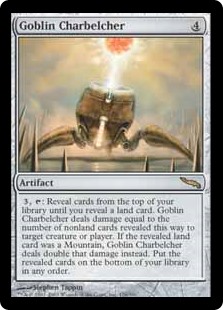
PrimeTime doesn't always assemble its Field of the Dead or Valakut late-game; sometimes, opponents have just the right answers, or find ways to cripple the engine. In those cases, Apparition helps the deck's namesake 6/6 crash through for lethal. To increase access to both Primeval Titan and Apparition, Eladamri's Call has become an attractive option, letting the deck run a creature toolbox without committing to the combo plan associated with Summoner's Pact.

Bant Ephemerate, SOULSTRONG (10th, Challenge #12233116)

Creatures

2 Eternal Witness
4 Ice-Fang Coatl
4 Skyclave Apparition
3 Uro, Titan of Nature's Wrath
1 Venser, Shaper Savant
3 Wall of Omens

Planeswalkers

3 Teferi, Time Raveler

Sorceries

1 Time Warp

Instants

3 Cryptic Command
4 Ephemerate
3 Force of Negation
2 Path to Exile
3 Remand

Lands

2 Breeding Pool
4 Flooded Strand
1 Hallowed Fountain
4 Misty Rainforest
2 Mystic Gate
1 Mystic Sanctuary
1 Prairie Stream
2 Snow-Covered Forest
3 Snow-Covered Island
2 Snow-Covered Plains
1 Temple Garden
1 Windswept Heath

Sideboard

1 Venser, Shaper Savant
1 Path to Exile
3 Aether Gust
2 Ashiok, Dream Render
3 On Thin Ice
3 Tale's End
2 Veil of Summer

We've covered Ephemerate decks before, back when they ran Yorion (remember those days?). Behold, the instant's new face: a tighter, sleeker Bant Ephemerate deck that heavily incorporates Skyclave Apparition as a high-value blink target. Like with the old Oblivion Ring-style creatures, blinking Apparition in response to the trigger leaves opponents without one payoff for the kill, or pilots with a "free" exile effect for their trouble. And since opponents never get those cards back with Apparition, but just lousy tokens in their place, the combination can threaten to decimate boards.

The rest of the gang's all here: Ice-Fang Coatl, a great card in Ephemerate even if it's hard to splash in most decks without Arcum's Astrolabe hanging around anymore; Eternal Witness to buy back the right cards, including Ephemerate; and, of course, Uro, Titan of Nature's Wrath. Gotta use that graveyard! Gotta draw those cards! Gotta gain that life! In decks like this one, Uro is just too good not to play.

Neoform Ephemerate, SESBEN1111 (5-0)

Creatures

4 Watcher for Tomorrow
1 Blade Splicer
3 Eternal Witness
4 Ice-Fang Coatl
4 Noble Hierarch
1 Reveillark
1 Skyclave Apparition
2 Soulherder
1 Uro, Titan of Nature's Wrath
1 Venser, Shaper Savant

Planeswalkers

3 Teferi, Time Raveler

Sorceries

3 Neoform
1 Time Warp

Instants

4 Ephemerate
3 Force of Negation
3 Path to Exile

Lands

1 Breeding Pool
1 Canopy Vista
3 Flooded Strand
1 Hallowed Fountain
4 Misty Rainforest
3 Prismatic Vista
2 Snow-Covered Forest
2 Snow-Covered Island
1 Snow-Covered Plains
1 Temple Garden
2 Windswept Heath

Sideboard

1 Force of Negation
1 Path to Exile
3 Ashiok, Dream Render
3 Ceremonious Rejection
1 Deputy of Detention
1 Gaea's Blessing
1 Kitchen Finks
1 Knight of Autumn
1 Stonehorn Dignitary
2 Veil of Summer

"What if we took the deck we just saw... and made it... weird?" Well, SESBEN1111, I would love that! Neoform Ephemerate trades most of its Apparitions for a full-blown toolbox and Watcher for Tomorrow, a staple Ephemerate target. This deck's creatures can be tributed to Neoform to pull more menacing beasts out of the deck, yielding rank-ups reminiscent of the Birthing Pod days: that measly Watcher might as well be Venser or Apparition, but the real magic happens when the three-drops become Reveillark!

“Deadguy Ale, FERMTG (5-0)"

Creatures

4 Tidehollow Sculler
4 Stoneforge Mystic
4 Skyclave Apparition

Planeswalkers

3 Liliana of the Veil

Artifacts

1 Batterskull
1 Sword of Feast and Famine
1 Sword of Fire and Ice

Enchantments

3 Bitterblossom

Sorceries

3 Inquisition of Kozilek
2 Lingering Souls
3 Thoughtseize

Instants

2 Cling to Dust
4 Fatal Push
1 Kaya's Guile

Lands

2 Brightclimb Pathway
1 Castle Locthwain
4 Concealed Courtyard
2 Field of Ruin
2 Godless Shrine
4 Marsh Flats
2 Plains
2 Shambling Vent
2 Silent Clearing
3 Swamp

Sideboard

3 Ashiok, Dream Render
2 Collective Brutality
2 Fulminator Mage
1 Gideon, Ally of Zendikar
1 Kaya, Orzhov Usurper
2 Path to Exile
1 Plague Engineer
3 Rest in Peace

Dark Confidant? Never heard of him! Deadguy Ale is an age-old Legacy strategy that gained a little traction in Modern when Stoneforge Mystic came off the banlist. This build trims the fat in the creature suite, axing Confidant, Giver of Runes and more in favor of staples Tidehollow and Stoneforge as well as—who else—Skyclave Apparition! Bitterblossom also constitutes a threat, especially alongside all that equipment. The rest of the deck is full of disruption; this is BW Tokens with a vengeance.

Head Out the Clouds

Skyclave Apparition seems like Modern's latest sauce, but is likely to have a lot more staying power than something like Reflector Mage, which now sees play limited to Humans. Its no-questions-asked "that's just gone" effect is one the format has been clamoring for. But just as there's more to Modern than Uro, there's more to November than Apparition. Here are a couple quick hits from this extremely diverse month.

“Esper Unearth, DAIBLOXSC (3rd, Challenge #12233116)"

Creatures

4 Erayo, Soratami Ascendant
4 Emry, Lurker of the Loch
4 Monastery Mentor
1 Spellskite
1 Tasigur, the Golden Fang
1 Lurrus of the Dream-Den

Planeswalkers

4 Teferi, Time Raveler

Sorceries

3 Unearth

Instants

4 Repeal
3 Thought Scour

Artifacts

1 Aether Spellbomb
2 Engineered Explosives
4 Mishra's Bauble
4 Mox Amber
1 Soul-Guide Lantern

Lands

4 Flooded Strand
1 Godless Shrine
1 Hallowed Fountain
1 Minamo, School at Water's Edge
4 Polluted Delta
1 Silent Clearing
2 Snow-Covered Island
1 Snow-Covered Plains
1 Snow-Covered Swamp
2 Waterlogged Grove
1 Watery Grave

Sideboard

1 Spellskite
2 Soul-Guide Lantern
3 Aether Gust
4 Fatal Push
1 Jace, the Mind Sculptor
4 Thoughtseize

Mox Opal may be banned, but Mox Amber's fate was much kinder, and so players get to keep messing around with Erayo, Soratami Ascendant. That's the case with Esper Unearth, the latest deck to try its hand at breaking the upside-down enchantment. Powering out a flipped Erayo means running lots of cheap artifacts, something Emry, Lurker of the Loch and Monastery Mentor can also appreciate. Behold, a blueprint! Cantrips and light disruption fill out the rest of the shell, with a full set of Teferi, Time Raveler included to put the hurt on the Faerie menace. Or whoever runs instants nowadays.

UW Belcher, ZYX_JERRY (5-0)

Creatures

3 Thassa's Oracle
3 Skyclave Cleric
4 Simian Spirit Guide

Planeswalkers

4 Teferi, Time Raveler

Artifacts

4 Goblin Charbelcher
4 Pentad Prism
4 Talisman of Progress

Sorceries

4 Emeria's Call
4 Sea Gate Restoration
4 Selective Memory
4 Serum Visions

Instants

3 Beyeen Veil
4 Disrupting Shoal
2 Force of Negation
4 Jwari Disruption
4 Silundi Vision
1 Spell Pierce

Sideboard

1 Spell Pierce
1 Echoing Truth
4 Leyline of Sanctity
2 Mystical Dispute
3 Path to Exile
3 Rest in Peace
1 Supreme Verdict

Don't worry combo fans, I didn't forget you! It's true, attacking is lame. But so are those cookie-cutter Gruul Belcher decks, not to mention the Ballustrade builds. Blue Belcher to the rescue! With all those snazzy land-spells, it was a matter of time before someone tried their hand at a more unorthodox Belcher concoction. And if anything, I'd say this deck speaks to the power of Goblin Charbelcher the card; the land-spells don't seem particularly exciting in this color. Rather, the draw to UW seems to be threefold:



  • Access to Serum Visions
  • The ability to disruption-proof the combo by powering out Teferi, Time Raveler
  • An alternate gameplan via Selective Memory

Resolving Selective Memory lets players empty their entire deck of cards, causing Thassa's Oracle to trigger a win upon resolution. As such, the deck boasts an alternate combo dimension similar to that of Inverter Oracle in that it's very difficult to stop if its pieces resolve. Memory-Oracle is also harder to hate out with permanents such as Pithing Needle, which otherwise stop the Belcher combo.

As is always the case with new brews, we'll see if these hang on or just prove flashes in the pan. But either way, it's great to see more nuance in established decks, especially in Belcher (which got old fast) and among Modern's pool of ever-morphing disruptive creature strategies.

Day Dreaming

Many of my buddies have expressed a reduction in Modern interest of late, something I don't doubt has something to do with paper Magic being more or less on hold in most of the world. But don't sleep on this format! It's as diverse as ever, and never stops giving when it comes to new tech.

Insider: Sifting for Specs #2

Are you a Quiet Speculation member?

If not, now is a perfect time to join up! Our powerful tools, breaking-news analysis, and exclusive Discord channel will make sure you stay up to date and ahead of the curve.

This is the second article in a series devoted to looking at some older cards that have potential, but seem to just be missing something to make them desirable to the playerbase. The first article in the series can be found here. As I discussed in that article, my main focus is going to be on older rares with a single printing, as I've always found them to have the most upside.

Obviously, Reserved List options are the most desirable; we've seen enough random RL jumps that it's very possible the buy-in on some of the RL options may still be too high. We'd need them to settle back down to the bulk range for consideration.

That being said, I do not want to limit myself fully to bulk rares, but I will set a limit of cards that retail on TCGplayer for no more than $5 to keep things interesting. I will maintain the same format I used in the first article for consistency. Today we will focus solely on the Ice Age, a set with a large print run where a lot of the rares are pretty cheap, with the most expensive card in the set being Necropotence.

There was an error retrieving a chart for Márton Stromgald

Marton Stromgald is one of my pet favorites. I had a Commander deck built around him long ago that was incredibly aggressive, which made it good for winning games but bad for having fun with friends. It is a Reserved List rare from Ice Age and its price has definitely waxed and waned.

It's actually been slowly rising since July 2020 where it used to sit at $3 and now is nearing $6, though plenty of played copies are available below $5. This card has a relatively unique ability and it's power scales very quickly. The decks that feature this card typically want two things, lots of attacking creatures and ways to keep Marton from dying, by either making him unblockable or indestructible.

What it needs to break out:

  • A really powerful red or artifact token generator that spits out a lot of tokens quickly.
There was an error retrieving a chart for Glacial Crevasses

Glacial Crevasses is a card I've seen prove to be very powerful in certain Commander decks. It's a very powerful repeatable Fog that costs no mana to activate. I've mainly seen it in aggressive red decks that operate on minimal mana and tend to make enemies at the table quickly, however, it's also very abusable with decks that can play lands from the graveyard.

I'm especially interested in it right now because while nothing has been spoiled, many of us think that the upcoming Kaldheim set will include a return to snow-covered lands. It is very important to note that it requires a Snow-Covered Mountain to activate so it tends to get less relevant and desirable in decks that play more colors.

What it needs to break out:

  • At least 1 set that heavily promotes using Snow-Covered Mountains in some fashion, whether it be by benefiting by playing snow-covered lands in general or one that promotes playing mono-red heavily, similarly to how the Torment set promoted playing black heavily.
There was an error retrieving a chart for Infernal Darkness

Infernal Darkness is very much like a poor man's Contamination, with the difference being that it costs 1/15th of the price and the upkeep is cumulative so it's harder to lock people out of the game. That being said, it doesn't require you to maintain a creature to sacrifice each turn, and it can stall a board just as easily. It's more of a short-term stall unless you can repeatedly bring it back.

What it needs to break out:

  • It needs a way to reduce or eliminate the pain from the cumulative upkeep. I would expect that if Ghen, Arcanum Weaver becomes a more popular commander that it would fit well in that style of deck as you'd also have access to Solemnity.
There was an error retrieving a chart for Naked Singularity

This card is very similar to the previously mentioned Infernal Darkness in that it fits well into a prison-style deck, but it's also equally good in a 5 color or a "chaos" themed deck. Its potency obviously drops when your opponents play a lot of colors, but it's extremely powerful again mono-colored decks.

It is important to note that its ability is a replacement effect so lands with multiple land types can still produce multiple colors, just different colors. It's also important to note that it only affects lands with land types, so City of Brass can still tap for mana of any color.

What it needs to break out:

  • A shift in Commander to a lot of mono-colored decks or at most dual-colored decks.
There was an error retrieving a chart for Ritual of Subdual

I apologize if you're noticing a trend here, but it looks like Ice Age seemed to have a lot of cards to mess with people's mana and I didn't even include Reality Twist. At one point this card neared $2, but has again returned to bulk status. Unlike the other cards mentioned earlier, this one hurts everyone's lands equally and can very easily slow down a game and lock players out though. Note that nowadays, people play a lot more mana rocks in EDH, which can help them get out from under this card.

That being said, its ability is very powerful and it seems like it fits very well in decks that can both a) produce a lot of mana to keep paying the upkeep cost, and b) produce that mana from not lands. When I have seen this card played, it tends to be in mono-green Elf decks which meet both the criteria.

What it needs to break out:

  • A commander that promotes a lot of non-land mana production or a way to eliminate or repeatedly pay the cumulative upkeep easily.

Conclusion

As I mentioned in my previous article, this series is best with community involvement. I'd love to hear people's feedback on cards they think would be good for this series, I only ask that they also let me know why they think the card has potential. You can reach me on our discord chat or leave a comment below.

Ramp Rising: November 2020 Metagame Update

Are you a Quiet Speculation member?

If not, now is a perfect time to join up! Our powerful tools, breaking-news analysis, and exclusive Discord channel will make sure you stay up to date and ahead of the curve.

Alright, no more delays. All the data is finally in, and so it's time to do November's Metagame Update. So far, the metagame has generally been dynamic. The top deck hasn't been consistent between months, though Rakdos Prowess and its descendant Scourge Shadow have been consistently Tier 1 since I started doing these again. Will it continue? Only one way to find out.

November was the largest data set so far, and by quite a large margin. September held the previous record with 611 decks, and November blew that away with 681. There were a few very large Preliminaries, but the increase was mainly due to the Modern Showcase Challenges. So November's data is far more robust and valid than any I've worked with so far, both statistically (more data=more likely to reflect reality) and in terms of accurately measuring competitiveness. For the first time, this data may be an accurate reflection of the metagame.

November Metagame

To make the tier list, a given deck has to beat the overall average population for the month. The average is my estimate for how many results a given deck “should” produce on MTGO. To be a tiered deck requires being better than “good enough;” in November, the average population was 8.51, meaning a deck needed 9 results to beat the average and make Tier 3. Then, we go one standard deviation above average to set the limit of Tier 3 and cutoff to Tier 2. The STdev was 11.95, so that means I add 12 to 9, and Tier 2 starts with 21 results and runs to 32. Subsequently, to make Tier 1, 33 decks are required.

9 has consistently been the starting point for the prevalence tiers. The exact average has been pretty different, but for each full month, the average has been between 8 and 9. I'm not sure why or if it means anything, but it's interesting to note. The standard deviation has been very different each month, which is why the number of decks in each tier, particularly Tier 2, vary so much.

The Tier List

Just as November saw more decks than ever, it had a higher total diversity than ever before. I recorded 80 different decks, and could have had over 90 if I was willing to split hairs over deck types. 4-Color Omnath is the worst offender; there are easily three different versions of midrange and two of control (arguably more), differentiated by their numbers of Hour of Promise, total planeswalkers and the combinations thereof, the number of Omnath, Locus of Creation, and the exact removal composition. I'm not willing to nitpick that hard, nor is any other site. However, I missed there being several versions of Mill and As Foretold running around. Subsequently, their numbers are inflated. While I'm not willing to comb back through the data now to fix this, though I'll keep an eye out in future updates.

22 decks made the tier list, which is one deck more than October but one less than September. That may seem odd, especially given that the starting threshold is the same each month, but it makes sense given my data. There are 19 singletons, and another 14 with only two results. This broadened the data considerably, but that doesn't make it easier to cross the threshold. I also had 6 decks just miss either the prevalence or points thresholds.

Deck NameTotal #Total %
Tier 1
4c Omnath639.25
Scourge Shadow547.93
Reclaimer Titan416.02
Heliod Company405.87
Tier 2
Mono-Red Prowess294.26
Oops, All Spells284.11
Amulet Titan273.96
Jund Scourge263.82
Death and Taxes243.52
Mono-Green Tron243.52
Tier 3
Izzet Prowess172.50
Ad Nauseam172.50
Ponza142.06
Kiki Twin142.06
As Foretold131.91
Eldrazi Tron131.91
Dredge101.47
Crab Mill101.47
Hammer Time101.47
Sultai Uro91.32
Jund91.32
Belcher91.32

The first thing to note is that 4C Omnath and Scourge Shadow are in first and second place again. However, both have declined from October, both percentage-wise and in total numbers. Omnath is only down two decks, which might just be margin of error, but Scourge losing eight decks is definitely not just variance. I suspect this is indicative of the metagame adapting to both.

The second thing is that ramp decks did really well in November. Reclaimer Titan, Amulet Titan, and Tron all jumped up a tier. Amulet Titan has had a pretty volatile year, so its return isn't too notable. However, this happening at the same time as both its fairer variant and Tron made a push is strongly indicative that November was unusually favorable for ramp strategies.

There's an Asterisk at the Top

I know, I've already hedged about Scourge Shadow and especially 4C Omnath twice, but this is something else entirely. Since the tier list is an aggregation, it misses some crucial context about how November played out. Approximately 2/3 of all Shadow and Omnath results came in the first two weeks of November, and Omnath virtually disappeared from the week of November 22. In other words, they both jumped out to enormous early leads, but coasted to the finish. Which suggests they're less dominant than they appear.

I can say with some certainty why this happened. The overall metagame is certainly shifting, and players are getting used to playing against the popular decks, which will cut into win percentage and results. This is has been particularly true for Omanth decks, with Boil coming seemingly from nowhere to take 15th on MTGGoldfish's staples list. Having a big target on one's back means just that.

However, I suspect at least some of that drop off (and rise in the first place) is artificial. Streamers have to keep up with trends and constantly switch decks to maintain interest (and thus their viewership and income). It's logical that there was a mass exodus of influencers from Shadow and Omnath after a few months of interest now that the decks are old hat. Such an event would have shifted results away from both decks and could have dropped the non-influencer user base if players followed suit and stopped playing the decks, regardless of their actual results. I can't prove this happened, but it makes logical sense.

What Happened to Humans?

On that note, where'd all the Humans go? There were 45 results for Humans in October, making it the third-place deck. I think I recorded 3 in November. I can't remember ever seeing so stark a drop-off before, and I have no idea why. It's worse than Ponza's October collapse. There's never been a metagame shift outside of an Eldrazi Winter situation to warrant such cratering. Mono-red Prowess made a comeback, as did ramp, and while they're not great matchups, the overall metagame is not that different from October. Even if it had gotten that hostile, I'd expect a more gradual fall. I mean, Infect didn't just disappear after Gitaxian Probe was banned, and straight Jund is still hanging around. Did the community just agree to stop playing Humans and I missed the memo?

Blood Moon Resurgent

As noted above, the metagame became more hostile towards many colored decks as November wore on. However, Boil was more of an exclamation mark than the reason, as granddaddy Blood Moon came back in a big way. Part of this is the minor resurgence of Ponza, but the primary change was Mono-Red Prowess started maindecking a full set of Moons.

Mono-Red Prowess, Tweedel (1st Place, Modern Challenge 11/29)

Creatures

4 Bomat Courier
4 Monastery Swiftspear
4 Soul-Scar Mage
4 Bonecrusher Giant
4 Seasoned Pyromancer

Enchantments

4 Blood Moon

Sorceries

4 Firebolt
4 Light Up the Stage

Instants

4 Lava Dart
4 Lightning Bolt
1 Burst Lightning

Lands

17 Mountains
1 Fiery Islet
1 Sunbaked Canyon

Sideboard

1 Obosh, the Preypiercer
4 Blast Zone
4 Shattering Spree
4 Surgical Extraction
2 Kozilek's Return

Having argued repeatedly that Blood Moon was highly effective against the top decks and was underplayed, I'm glad that the lesson finally stuck. The question remains whether it is effective enough to stick.

Power Rankings

Tracking the metagame in terms of population is standard practice. However, how do results actually factor in? Better decks should also have better results. In an effort to measure this, I’ve started using a power ranking system in addition to the prevalence list.

A reminder of how it works: as I go through the Preliminary and Challenge results, I mark each deck’s record or placement respectively. Points are then awarded based on those results. Preliminaries report results based on record, so that’s how the points are distributed. 5-0 is three points, 4-1 is two, and 3-2 is one. Challenges are reported in terms of placing, so being Top 8 is worth three points, Top 16 is two, and being reported at all is one. The system is thus weighted to award more points to decks that perform well in Challenges rather than Preliminaries. The reason is simply that Challenges are larger and more competitive events, and the harder the field, the better a deck needs to be.

The Power Tiers

The 681 decks earned a total of 1110 points in November. Interesting to note, this is the largest gap between population and points so far. The average points were 13.88, so 14 points makes Tier 3. The STdev was 19.69, meaning Tier 2 began at 34 points and Tier 1 is for 54 points or more. There were 22 decks just like the population tiers, but Jund didn't make the cut on points. In its place is Counters Company, which in turn missed the population cutoff.

Deck NameTotal Points% Points
Tier 1
4c Omnath1039.28
Scourge Shadow938.38
Heliod Company676.04
Reclaimer Titan655.86
Tier 2
Amulet Titan504.50
Oops, All Spells464.14
Mono-Red Prowess413.69
Death and Taxes403.60
Jund Shadow393.51
Mono-Green Tron363.24
Tier 3
Izzet Prowess302.70
Ad Nauseam282.52
Kiki Twin252.25
Ponza211.89
Eldrazi Tron211.89
Hammer Time201.80
As Foretold171.53
Dredge161.44
Crab Mill151.35
Belcher 151.35
Sultai Uro141.26
Counters Company141.26

Notable this month is that the tier composition didn't change, and only one deck fell from Tier 3. Previous months saw lots of decks change tier from population to power, but not in November. It doesn't mean anything, but it's an interesting curiosity. The other thing to note that Tier 1's power percentage is overall higher than its population share despite both being down from October. There's clear evidence that the metagame broadened in November. Moreover, it's pretty clear to me that I'm justified in not calling Omnath or Scourge Tier 0 decks despite their stats potentially justifying such a decision.

A General Reshuffling

Despite tier composition being largely unchanged, tier positions are drastically different, reinforcing that popularity doesn't indicate actual power. Heliod Company jumped Reclaimer Titan, though the difference between the two is a single 5-0 result. More significant is Amulet Titan switching places with Mono-Red Prowess and all the shifts that happen in Tier 3. It's clear that Modern is a very dynamic place right now, and that the real best-performing decks aren't always the most played.

Average Power Rankings

Finally, we come to the average power rankings. These are found by taking total points earned and dividing it by total decks, which measures points per deck. I use this to measure strength vs. popularity. Measuring deck strength is hard. Using the power rankings certainly helps, and serves to show how justified a deck’s popularity is. However, more popular decks will still necessarily earn a lot of points. This is where the averaging comes in. Decks that earn a lot of points because they get a lot of results will do worse than decks that win more events, indicating which deck actually performs better. A higher average indicates lots of high finishes, where low averages result from mediocre performances and high population. Lower-tier decks typically do very well here, likely due to their pilots being enthusiasts. So be careful about reading too much into the results.

The Real Story

After months of looking, I think this system may be the best that I can do. I just can't find anyone who's tried to do sports-style stats more Magic, nor is there any reason to suspect that they would be appropriate. So, I'll just have to roll with what I have.

When considering the average points, the key is looking at how far-off a deck is from the Baseline stat. The closer a deck's performance to the Baseline (which is the overall average of points/population), the more likely it is to be performing close to its "true" potential. A deck that is exactly average would therefore perform exactly as well as expected. The further away the greater the deviation from average, the more a deck under- or over-performs. On the low end, the deck's placing was mainly due to population rather than power, which suggests it's overrated. A high-scoring deck is the opposite.

I'd like to formalize this more, but the usual trick using standard deviations won't work. Given the small numbers involved, the STdev encompasses the whole data range, meaning you just have to eyeball it to see if the deviation is significant.

Deck NameAverage PointsTier
Hammer Time2.003
Amulet Titan1.852
Kiki Twin1.792
Izzet Prowess1.763
Counters Company1.753
Scourge Shadow1.721
Heliod Company1.681
Death and Taxes1.672
Belcher1.673
Baseline1.66
Ad Nauseam1.653
Oops, All Spells1.642
4c Omnath1.631
Eldrazi Tron1.623
Dredge1.602
Reclaimer Titan1.591
Sultai Uro1.563
Ponza1.503
Mono-Green Tron1.502
Crab Mill1.503
Jund Scourge1.502
Mono-Red Prowess1.412
As Foretold1.313
Jund1.223

The only deck to crack the two-point average this month was Hammer Time, the mono-white Sigarda's Aid/Colossus Hammer deck. Granted, Hammer Time had a very low population but managed a number of impressive results. This is the perfect storm for a high rank, but it doesn't necessarily guarantee good placement in the metagame. It doesn't make it a fluke, either; only time can tell that. Hammer Time is similar to Scourge Shadow in that it has a strong aggro-combo plan, but finds itself lacking in the disruption department. Hammer Time makes up for this weakness by being faster, which moves it more into glass-cannon territory. It's going to do very well in the hands of expert enthusiasts, but I'm skeptical of its staying power.

What's Uro's Deal?

All the Uro decks that made November's tier list landed below the point average. 4-Color Omnath wasn't too far below, so it's probably within the margin of error. However, its being on the low end certainly suggests that its position as top deck is more due to population than performance. That the other Uro deck, Sultai Uro, is well below the average all but confirms that Uro decks suffered in November. Given the above identified trends, it would strongly suggest that Modern is adapting to Uro, and the Titan is losing a lot of its bite. December will be critical in confirming or refuting this idea.

Evolution Endures

At the end of the day, despite all the grumbling, Modern appears to still be in a very good spot. Therefore, I'm thinking Modern may be moving away from needing bans in the immediate future. Of course, I don't know overall win percentages, so I may be surprised come January. Still, given that the top decks appear to be losing ground and the overall metagame keeps churning away, I think Modern's perfectly healthy.

Playing the Damaged Lottery

Are you a Quiet Speculation member?

If not, now is a perfect time to join up! Our powerful tools, breaking-news analysis, and exclusive Discord channel will make sure you stay up to date and ahead of the curve.

I’ve seen it many times before. Usually, it’s while I’m shopping for a well-priced Old School card for a deck. Sometimes when I see a card spiked on MTG Stocks, I’ll run to TCGplayer and see it. It’s so risky, but it is difficult to ignore.

What am I talking about? Buying heavily played / damaged cards, of course!

Imagine this scenario: you’re looking for an English Legends Sylvan Library. You noticed recently that Card Kingdom’s buy price on the card keeps climbing, and then you noticed the card spiked to $223 on MTG Stocks. Despondent, you make a desperation check on TCGplayer and find the following, cheapest listings:

First off, these copies are fairly reasonable considering how high the TCG mid number is. Secondly and more importantly, you’re faced with a tough choice. Do you roll the dice on the $75 damaged copy or do you pay $15 more for the cheapest HP from a seller with far less feedback? Or do you pay yet another $5 to purchase a heavily played copy from a larger seller?

The Damaged Lottery

It can be very tempting to pay far below market price for a copy of a card you intend to play even though it’s listed on TCGplayer as “damaged”. Here’s the description for damaged cards according to TCGplayer’s Grading Guide:

“Cards in Damaged condition can exhibit a tear, bend or crease that may make the card illegal for tournament play, even in a sleeve. If more than 30% of the card is damaged by liquid, it’s considered Damaged. Cards in Damaged condition may have extreme border wear, extreme corner wear, heavy scratching or scuffing, folds, creases or tears or other damages that impact the structural integrity of the card.”

What do you make of this? Well, I’m relieved to see that TCGplayer has updated their grading guide to remove “inking and signatures” from their damaged description—they instead suggest sellers use pictures for such cards. But still, I feel like a damaged card with extreme border wear is a lot more tolerable than a card that exhibits a tear. Shuffle creases are fine if you’re looking for a budget copy to play, but a fold? That may be problematic.

As you can see, purchasing a damaged card can be very risky (hence why I describe it as “the damaged lottery”). I’ve only tried it a couple times from TCGplayer. One seller I like in particular tends to grade their cards one tier lower than I personally would—therefore, I trust their damaged cards to be on par with heavily played condition. But there’s always a chance it doesn’t break that way. Conversely, I once bought a cheap, damaged Legends Spectral Cloak and it looked like someone had dropped a pile of bricks on the card.

There was an error retrieving a chart for Spectral Cloak

With TCGplayer, the large pool of sellers makes it almost impossible to identify trends and predict what you’ll receive. It truly is up to chance, like the lottery. But how about buying heavily played cards from major online vendors like Star City Games, Channel Fireball, and Card Kingdom? What are their HP lotteries like?

Major Vendors

I have a lot more experience purchasing heavily played and damaged cards from major vendors because I’m more inclined to trust they wouldn’t sell a card literally torn up. Here are the “HP” or “Damaged” descriptions from some of the major vendor’s grading guide.

Card Kingdom:

Channel Fireball:

Star City Games:

ABUGames:

There’s a lot to unpack here, and I’m not going to dive into every single characteristic by website. I think the descriptions are largely consistent. Because of all the ways a card can be deemed heavily played, it’s easier to identify that a card is heavily played than it is to define in words what that means. I’m going to take some creative license, and reference the famous quote by United States Supreme Court Justice Potter Stewart:

“I shall not today attempt further to define the kinds of material I understand to be embraced within that shorthand description [HP/Damaged cards], and perhaps I could never succeed in intelligibly doing so. But I know it when I see it…”

(If you don’t know what Justice Potter Stewart was actually referencing for this quote, please look it up and have a laugh!)

Some Personal Examples

As I mentioned before, I have become a bit of an expert in heavily played cards from major vendors because I tend to purchase from that category most often as long it’s a seller I trust. Most often, I’m shopping for the most played copies I can find because I’m looking for a deal—the cheapest sleeve-playable copy I can find. But sometimes I’m also looking to do some credit arbitrage, and some stores pay more aggressively for HP cards than others.

I want to pause here and share a few examples of HP cards in my collection and provide a brief background of where they came from.

First, here’s a heavily played card I bought from Star City Games:


This copy of Tracker is, to me, the ideal outcome when I purchase a heavily played card. Some edge wear, surface wear, and slight deterioration of the corner. I don’t see any creases or inking, which tend to make re-selling a card particularly difficult. All in all, this is the perfect copy for my collection or to sell to another buylist.

Now here’s a different card I received from Star City Games. This one was also sold as heavily played:

When I first examined this card, I was convinced Star City Games had made a mistake! This card is Moderately played at the worst, right? Some edge wear but a very clean surface. But then I noticed it—a weird purple defect on the front face, top left portion of the card. What is that? Inking? Why is it purple? Maybe it’s a misprint or printer defect? That would be cool if it was! But because it’s there, it makes selling this card a bit more complicated. Other vendors may not accept it and I have to highlight the defect to any prospective buyer. This is less than ideal, but I’m happy to include this in my personal collection.

Next, here’s a card I received recently from Card Kingdom, listed in “Good” condition:

This card is rough. Whitening around the edges of the entire card, surface wear, and one edge looks like someone kind of bit down on the card or something! But, because of the broad definition of “Good” on Card Kingdom’s grading guide, this card does indeed fit the category. I’m not too happy with this card’s condition, but the price was right and it’s still an Alpha Blue Elemental Blast—because of this, I don’t think I’ll have any difficulty selling the card.

Next, here’s a heavily played card I recently received from ABUGames:

I deal with heavily played cards from ABUGames a ton. While their near mint prices are astronomically high relative to the market, their played and heavily played copies are sometimes a little closer to reality. This makes such cards prime targets for acquisition when working store credit arbitrage.

This Arabian Nights City of Brass is one of the worst heavily played cards I’ve ever received from ABUGames. Technically it fits their description, but yikes! The card has no folds or inking and is perfectly sleeve playable (in fact it’s in my Old School deck) but it’s not an attractive copy for one’s collection. I would have been more disappointed in this if the card wasn’t priced well (when factoring in the store credit inflation factor).

There was an error retrieving a chart for City Of Brass

Lastly, I want to mention one other recent, relevant experience. I don’t have images of the cards, but a few heavily played cards I received from Star City Games recently had some water damage. It wasn’t major (in fact I didn’t even notice it at first) but it was there. I attempted to flip some of these cards to Card Kingdom’s buylist, hoping they would grade as “Good”. But they ended up rejecting the cards altogether and shipping them back to me. I don’t think Card Kingdom allows for water damage in their “good” category, but it’s good to note Star City Games does. I took the damaged cards and shipped them to ABUGames instead—they accept “minor to moderate water damage” as heavily played.

Wrapping It Up

Buying damaged and heavily played cards can be a great way of saving money. Often times I’ll be browsing TCGplayer for cards and I’ll find damaged copies priced significantly below all other available copies. Every time this happens, I pause and think about the damaged lottery.

Most often I pass on the card and move on. It’s impossible to predict what you’ll get! The card could have some light inking and otherwise be flawless…or the card could be bent in half and run through the laundry. The range is so huge for this condition.

For this reason, I stick to major vendors when I deal in damaged and heavily played cards. But even this experience can be extremely variable. Cards can arrive with some major edge wear and not much more. Or the card could be water damaged and may have been inked. Again, the range is huge, and different vendors seem to have variable definitions around what qualifies.

In the end, it’s really a personal choice around what you’re willing to accept and how much of a discount to market price you’re getting for the damaged card. With few exceptions, I pick up heavily played and damaged cards from major vendors because their pricing is extremely competitive—even below what I could sell the card for myself. In these cases, it’s worth the gamble. And as ugly as that City of Brass is, I am still going to play it in my deck.

Everyone’s tolerance for play is different, making the damaged lottery even more complicated. Something unacceptable to one person may be perfectly fine to another, and vice versa. Either way, I don’t think the damaged lottery is going away anytime soon. As long as people are willing to roll the dice to save money, we’ll continue to see damaged cards of all sorts being sold at major discounts.

QS Insider Cast: Standard Updates, Commander Legends in Legacy, and Secret Lairs

Are you a Quiet Speculation member?

If not, now is a perfect time to join up! Our powerful tools, breaking-news analysis, and exclusive Discord channel will make sure you stay up to date and ahead of the curve.

Welcome back to the QS Insider Podcast! Chris O'Berry and Joe Davidson discuss the new Standard meta, Commander Legends in Legacy, and the new Secret Lair drops! This cast was originally broadcasted live to Insiders in the QS Insider Discord, November 29th, 2020.

Show Notes

  • Standard Updates - Obosh, the Preypiercer, Genesis Ultimatum, Terror of the Peaks
  • Commander Legends - Jeweled Lotus, Legacy Potential
  • New Secret Lair drop analysis

Wanna Chat? Find us in the QS Discord or on Social Media

Chroberry - Twitter / Instagram / Twitch

Joe - Twitch / YouTube / Twitter

Want Prices?

Browse thousands of prices with the first and most comprehensive MTG Finance tool around.


Trader Tools lists both buylist and retail prices for every MTG card, going back a decade.

Quiet Speculation