menu

Arena: Building on a Budget Vol. #1

Are you a Quiet Speculation member?

If not, now is a perfect time to join up! Our powerful tools, breaking-news analysis, and exclusive Discord channel will make sure you stay up to date and ahead of the curve.

Hello, everyone, and welcome to another Magic Arena article! Last week we had a quick look on how to build a competitive deck on budget. This week, I'm going to showcase the building process of a Standard 2021 deck, together with a quick three-game video to showcase the deck on Arena!

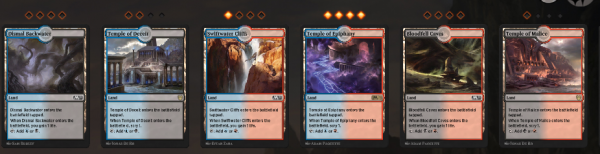
A few days back, I was scrolling through my lands collection, thinking about the decks to play post rotation. Then, I looked at the full sets of Temple of Epiphany for a moment and tell myself - I haven't played with Izzet colors for quite some time, maybe this is a great opportunity to put something together for some games!

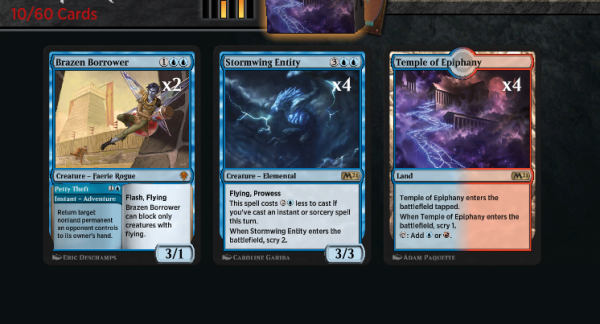
Speaking of blue, there are two cards that I identified as staples after rotation.

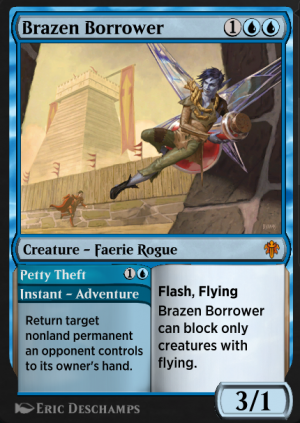
Brazen Borrower is great on its own, with the adventure part of the card being an instant speed bounce spell to return something troublesome off the opponent's board. After that, this faerie card can flash in as a 3/1 flying attacker which can put in some good work on pressuring the opponent's life total! Given a  playset of Brazen Borrower, I would play four copies in most of my blue decks. For the article this week, I only have access to two copies so I'll only play two, to better simulate the "building on budget" scenarios.

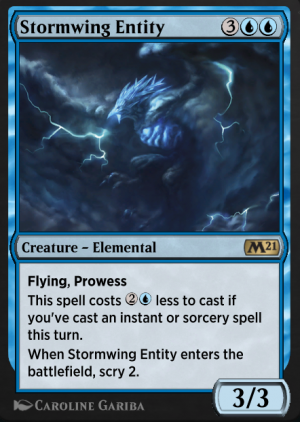
Another card that caught my eye is Stormwing Entity. This is a 5-cmc card from Core Set 2021 and it will become cheaper when we cast an instant or sorcery spell before it on the same turn. It makes me think of the Delver decks in Modern and Legacy; a 2-mana flyer with prowess and a scry 2 ETB trigger seems pretty good in Standard. While Eliminate would probably become one of the best removal spells in Standard, Stormwing Entity totally dodges it.

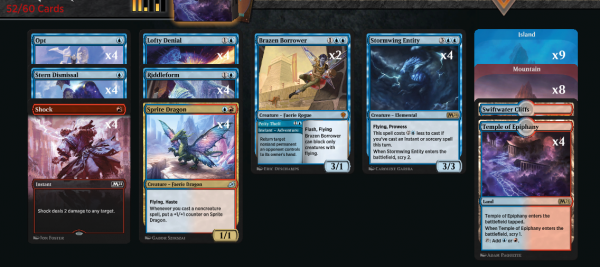
So, I started off my Izzet deck like this:

Again, this is based on my collection, you can totally change the numbers depending on what you have. As always, I wouldn't recommend you to craft cards that I showed, unless you really, really like the card. Always remember, only keep a card if you will be playing with it in the longer-term.

Since we want to maximize Stormwing Entity's potential, we want to have a lot of cheap instants or sorcery spells. Speaking of cheap, Shock and Opt quickly came to my mind. With these 1-mana spells, Stormwing can potentially become very huge and helps us close out the game faster. Opt is also very important for this deck because we don't want to include too many lands in a tempo strategy.

I then went through the collection, looking for creatures that suit the same gameplan and I found Sprite Dragon, as well as Riddleform. These two cards fit the theme pretty well, with the "cast noncreature spell" triggers, similar to Stormwing's prowess trigger. Sprite Dragon also has haste, which provides us momentum after potential sweepers or removal out of the opponent's hand. Like I said, with a bunch of cheap spells, these flyers can potentially close the game quickly.

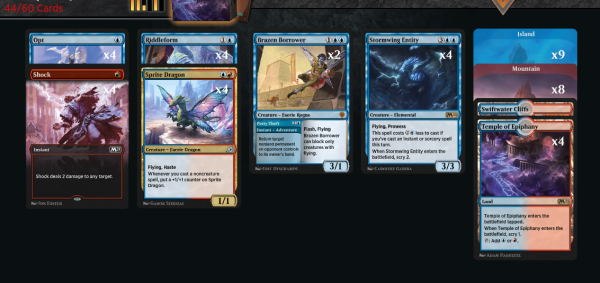
Now, my Izzet deck looks like this:

I could have added playset of Fabled Passage, but I really want to make the deck cheapest possible. Competitive-wise, I don't want so many tapped lands in the first three turns of the game since we are on the tempo plan. In order to not draw too many lands, I decided to play 22 lands, instead of the 24 lands suggested by Arena's deckbuilding tool. Most of our cards only cost 1-3 mana anyways.

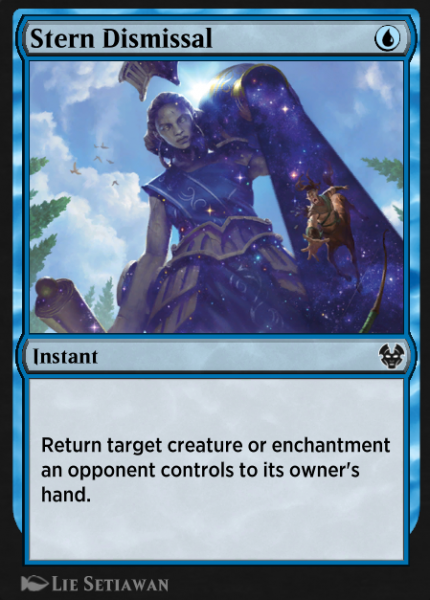
At this point, I still need another 16 cards to complete the deck. I can't play a blue deck without some Unsummon effects and counterspells! Unsummon is actually going to rotate soon, but the good news is I found a better replacement in Stern Dismissal. Instead of only bouncing creatures, Stern Dismissal is able to bounce enchantments like Banishing Light, for just one mana. Not much consideration needed! A playset of this card is exactly what we need to deal with troublesome blockers and enchantments.

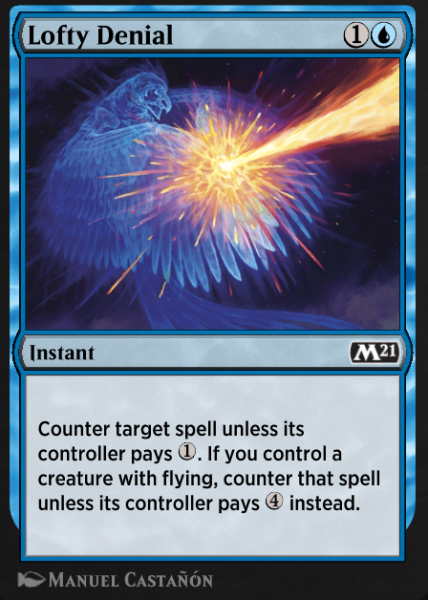
For counterspells, I did some comparison and personally think Lofty Denial fits this deck best. It becomes better when we have flying creatures in play - which is exactly what we have right now! We have a total of fourteen flyers including the Riddleforms. Riddleform will be able to help Lofty Denial because we will have a 3/3 sphinx before the counter spell resolves.


Alright, what else do we need? We are down to 8 cards.

Technically, we can simply add in 8 burn/removal spells to call it a day. But I really want to play with some cards that I would probably not touch in other decks. Then I found this card.

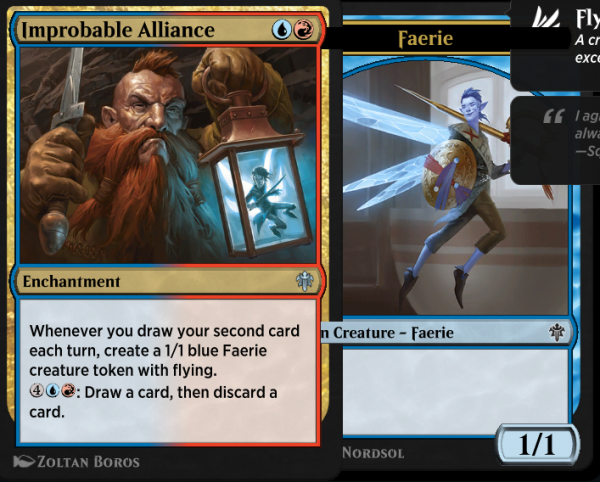
Improbable Alliance may not be the best include in this Izzet build as we don't really have that many card draw effects other than Opt. However, I see this card as land-flooding insurance: we'll be able to filter our draws, trigger Riddleform, and create 1/1 flyers. After some testing with this card (outside the video), it can sometimes smooth out draws in the late game and ultimately helps to close out stalemate situations. To make Improbable Alliance better in the early games, I've added a few Fire Prophecy as removal with the ability to potentially exchange dead cards in our hand for more useful cards.

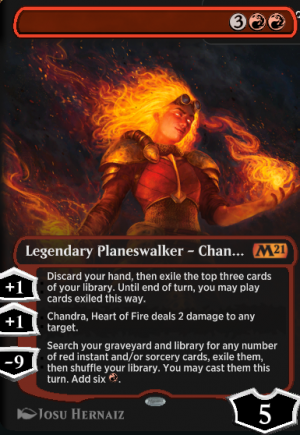
We are almost done, but I want to add a few burn spells which can target anything so that we can play more aggressively. I ended up with two copies of Slaying Fire and a Bonecrusher Giant. As I was about to conclude the deckbuilding, I ran into a red planeswalker from Core Set 2021...

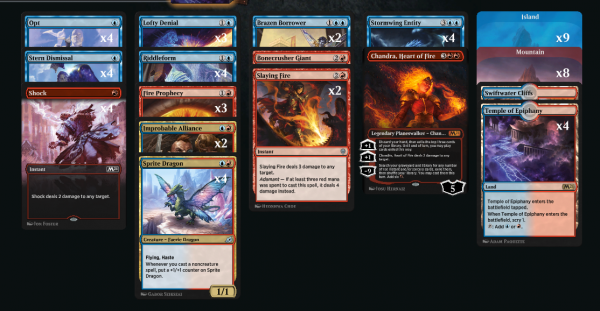
The fire in her eyes is telling me to bring her along, so I cut a random card to add her into our 60-card deck. The final build looks like this:

I was lucky to have won all three games in the video. If you are interested to try out the deck, I have the decklist over here. Feel free to make changes accordingly!

That's all for this week, hope you enjoy the write up as well as the video! Let me know your thoughts in the comment section below people!

Thanks for reading, and I’ll see you again next week!

–Adrian, signing out.

Preparing for a Paper Future with Double Masters

Are you a Quiet Speculation member?

If not, now is a perfect time to join up! Our powerful tools, breaking-news analysis, and exclusive Discord channel will make sure you stay up to date and ahead of the curve.

Double Masters has been a weird set for me. I get pretty hyped for fancy reprint-based sets - why wouldn't I? As a player who started in 2012, they often have cards that I never got a chance to play within a standard environment, cards that have been outside of my limited budget, and more so lately cards with very stylish alternate arts.

When I started seeing the Double Masters spoilers flooding Twitter, I couldn't help but be a little excited. Then the sticker shock won over and I realized that there wasn't any way I would be buying much of the set with how expensive it was. It's hard being at a point in your life where you have to be extra careful with your budget at the same time Wizards is announcing so many cool, expensive products!

My circumstances shifted enough that I was actually able to buy a VIP Booster Pack and a Booster Box to open on my YouTube channel! I was a little nervous because I'd been seeing pretty awful value being pulled from other creators' boxes, but I ended up getting lucky and making my value back (at least at the time of opening) on both boxes. Then my friend asked me to open his box of four VIP Booster Packs on my channel and the value was a completely different story. If you were rating them purely on the monetary value pulled the were absolutely awful. 

There was an error retrieving a chart for Rage Reflection

However, as I was editing the footage and getting it ready to upload, I realized that under other circumstances there were cards in there I would have been super pumped to open at previous points in my Magic playing career! I mean, there were two different packs with borderless Goblin Guide and Batterskull which are both cards I love dearly and have sleeved up for plenty of tournaments over the years.

At one point in my Magic playing career cards like these were expensive pieces for decks that I’d have to budget and save for or hope I got lucky and was able to pull them - and that got me thinking about how paper Magic is coming back someday!

Paper Magic is Coming Back Someday

At some point (hopefully), the Pandemic is going to wind down and we'll be able to go back to playing paper Magic again. It could take a while, but I think Wizards of the Coast will be able to outlast the effects of the virus and push to bring us all back to the table to shuffle real-life cardboard.

When that happens, all of the long-time paper players will need cards for new decks and all of the new players who have been drawn to the game through Arena will be wanting to get their hands on cards to play in actual tournaments. When that happens, I don't think all of these competitive cards are going to stay as low as they have been.

Let's take a look at a few cards reprinted in Double Masters that I think have the potential to rebound in price once competitive paper tournaments begin to happen again in earnest.

Goblin Guide

A card that's very dear to my heart that saw a reprint in Double Masters is [card]Goblin Guide[/Guide]. A long-time staple in both Legacy and Modern burn variants, there was a time when this intrepid goblin explorer was one of the pricier cards in the deck.

There was an error retrieving a chart for Goblin Guide

At one point, the original printing cost over $80 for a playset for non-foils, and now you can get a playset for around $17 from Double Masters. The non-foil and foil versions are both super low right now at close to $38 for a playset of either version. Like I said in my Core Set 2021 Speculations article, I think that competitive players looking to add style to their deck without the risk of failing a deck check for having curled foils in their decks (which can count as a marked card) will be gravitating towards the non-foil full arts. For this reason alone, I have been prioritizing picking those versions up with my trading.

There was a playset of Goblin Guide in a Lurrus of the Dream-Den Burn deck that went 5-0 in a Modern League on MTGO on 9/11/20, as well as in a Legacy burn deck that took a 5-0 in a Legacy League on 9/5/2020. When paper Magic comes back, people will be turning to MTGO league results as one of their primary resources for assembling their paper decks. Taking a look at decks that consistently put up 5-0 finishes is a good way to anticipate which cards will be in higher demand once paper tournaments come back.

Blood Moon

Blood Moon is another one of those cards that I always wanted to have a playset of when I was a newer player that took a long time to finally trade into. It's a common sideboard card in many decks that have access to red in eternal formats, and part of the foundation for most red-based Modern and Legacy prison archetypes.

There was an error retrieving a chart for Blood Moon

Blood Moon has seen quite a few reprints that have helped keep its price down, but there was a time where it could run you close to $100 for a playset. A lot of the printings now will run you close to $80 for a playset, but you can get Double Masters non-foil regular printings for less than $30 for all four. The fancier, borderless versions are a bit pricier - running close to $23 for a single copy, but Blood Moon is such a commonly played card in eternal formats I still think that's a decent price to pick them up at.

A Gruul Midrange deck featuring four Blood Moon in the mainboard had a 5-0 finish in an MTGO Modern League on 9/1/2020 as well as showing up as a four-of in the mainboard in a sweet Mono-Red Prison list that took a 5-0 finish in an MTGO Legacy League on 9/12/20. I think picking up Blood Moons is a pretty solid choice as you round out your Double Masters speculations.

Meddling Mage

I'll be honest, I was stunned when I was editing the footage from the box opening and realized that the gorgeous, full-art foil Meddling Mage I'd pulled was only worth around $7. Admittedly it's been a while since I was paying active attention to Modern, but before the pandemic when I was actively playing, Humans was a force to be reckoned with, and Meddling Mages weren't the cheapest pieces of the deck to pick up.

There was an error retrieving a chart for Meddling Mage

The recent inclusion of Meddling Mage in Mystery Boosters drove the price down a lot, but I'm honestly super surprised with how affordable they are these days. You can get a playset of the full art, non-foil Double Masters version for around $23 or foil for around $25. You can get a playset of the regular art non-foil for $6.

I think Humans is still a pretty prominent deck to look out for in the Modern format. Piotr 'kanister' Głogowski recently took humans to a first-place finish in the MTGO Modern Challenge on September 13th with a list featuring four Meddling Mage, as well as four Noble Hierarch, another Double Masters reprint that I would encourage people to pick up right now while prices are down. I'm picking up playsets of both Meddling Mage and Noble Hierarch non-foil full-arts for my own collection, and I'll for sure be looking to pick up even more copies for my speculation box.

A Quick Note on Modern Horizons

Speaking of that Modern Humans list, I think taking a look at Modern Horizons cards again if you haven't yet is a very good idea. Humans runs four Unsettled Mariner as well as a Waterlogged Grove. I'd start taking a look at Modern and Legacy decks that are doing well and featuring Modern Horizons cards like Force of Negation, Seasoned Pyromancer, and the Horizon Lands. If you're looking to pick copies up to play or shore up your collection, now is the time to do it before supply really starts to dry up in earnest.

There was an error retrieving a chart for Force of Negation

With that note, I'm out of here for now! What did you think of Double Masters? Are there any cards, in particular, you're speculating on? Let me know in the comments or hit me up in the QS Discord. If you'd like to chat with me live, I stream on Twitch every Wednesday, Friday, and Sunday. You can find me @MTGJoeD on all the social media platforms or say hi in the comments section on my YouTube. I hope you are all doing okay out there in the world and taking care of each other! Stay safe, and I'll see you next week.

A Moment of Zendikar Rising Spoilers, Pt.2

Are you a Quiet Speculation member?

If not, now is a perfect time to join up! Our powerful tools, breaking-news analysis, and exclusive Discord channel will make sure you stay up to date and ahead of the curve.

With the new set fully spoiled, it's my turn to look at the spoilers. Normally, I'd have led off with a look at the new mechanics. It just wasn't applicable this time. Kicker and landfall have been around before, and party isn't really a mechanic. And the Spell lands aren't enough to carry a whole article. Which is actually very nice. Despite its heritage, Zendikar Rising is a low-power set by Modern standards. Nothing stands out as being obviously broken. When I searched for Uro-style sleepers and deceivers, I came up with nothing. Which frankly is a breath of fresh air after the past year.

A Note on the Spell/Lands

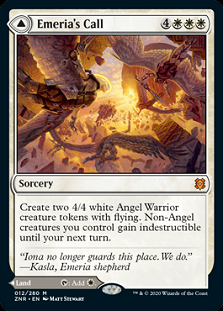
I fully agree with Jordan's assessment of the Modal Double Face Card (MDFC) lands. They're very flexible cards, let down by the fact that Modern doesn't need tap lands and the spells generally aren't too exciting. Emeria's Call is the only one I can see players actually playing as both a land or spell on purpose. And even then, as a one-of at most.

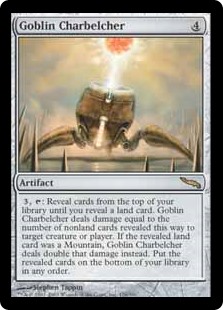
However, this only applies to normal decks. Apparently, there exists a community of Goblin Charbelcher players in Modern. They've been working on that terrible deck for a long time and think that the MDFC's are their salvation. The logic is that the untapped MDFC's replace all the other lands, so there's never any risk of fizzling a Charbelcher activation. MDFC's are front-facing everywhere but on the stack or battlefield, so they're missed when Belching. It also means that these decks can function like normal Magic decks in a pinch.
This actually means that we may be in for a rush of Oops, All Spells-style decks in the near future. Except slightly more reasonable than the predecessor deck because, again, they will actually play lands. Just not ones that Balustrade Spy will recognize. Given that Neoform exists in similar space, has been a deck for some time now, and is bad, I wouldn't worry. But do be aware.

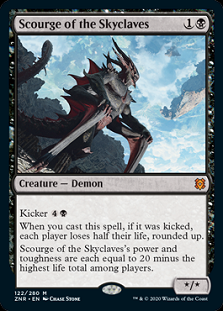
Scourge of the Skyclaves

Prior to 2017, Scourge of the Skyclaves might have received little attention. The kicker is too expensive for Modern, and a creature that requires players to be a certain lifetotal to hit the field is too big an ask. Then Death's Shadow became a thing, took over Modern, and faded away. Now, anything that even vaguely resembles Shadow must be considered a possible Modern card.

And Scourge does resemble Shadow. It's just got a lot more text and conditions attached. Where Shadow is always a 13/13 and has an ability that shrinks it, Scourge's power and toughness is 20 minus the highest life total. Scourge has no evasion, only heft, but it does have a kicker which halves everyone's lifetotal (playing nicely with its P/T condition). Of course, that kicker costs five, which means that Scourge would have to be played for seven. That's an enormous cost in Modern, and most likely means that it's not going to happen. Shadow decks run very low to the ground, so if the plan is to run Scourge as Shadows 5-8, that kicker is out of reach.

However, I don't think that a deck that intends to get the mana necessary to kick Scourge even wants to. Control decks are about preserving their lifetotal. It may be a resource to be traded for time or cards, but in the end, they need to stay alive. Kicking Scourge runs counter to that plan. More importantly, control frequently has the lower life total when it turns the corner and plays a win condition. Losing half of that is a huge risk in the Prowess era.

Out of Control

The catch is that, unlike Shadow, Scourge's controller doesn't totally control its size. The opponent gets a vote.

Scourge of the Skyclaves's power and toughness are each equal to 20 minus the highest life total among players.

Among players. All of them. The opponent's life total also determines Scourge's size. This is a huge problem and why I think it unlikely Scourge will just be Shadow's 5-8 anywhere. It's very easy to control your own life total, especially when the goal is to get it low fast. It's why Shadow was so successful. Doing that while simultaneously dropping the opponent's life is much harder. Prowess is a master of eliminating opposing life totals, but not its own. While it can play extra fetches and shocks with Thoughtseize and Street Wraith, why bother? The attack plan is so fast the opponent will be dead before Prowess's life is low enough.

Then there's the fact that the opponent will object to having their life lowered. Plans never survive contact with the enemy and all that. I read comments that it would work out since Modern's manabase is so painful, opponents will be on 16 or lower quickly. That may have been true once, but I don't think it can be relied on anymore. Tron never does damage to itself. Ponza, Amulet Titan, and Stoneblade don't have to fetch and shock. Humans, Prowess, and Ad Nauseam do very limited damage and only occasionally. Really, I think that players are thinking of Jund. And that's still not universal.
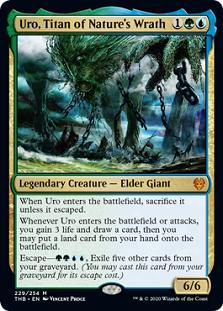
And then there's the Uro, Titan of Nature's Wrath decks. They can do a lot of damage to themselves, but they get it back with Uro. And with Prowess running around, there a lot of lifegain, too. Auriok Champion is a greater enemy of Scourge than of Shadow. The amount of effort necessary to make Scourge work is far greater, and far more precarious, than Shadow. And that's not even mentioning that Scourge is double the cost. That's not how to break into a format.

The Big Draw

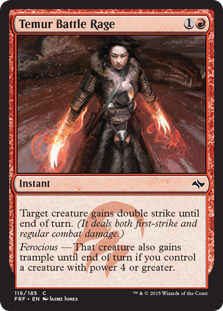
That being said, I would still expect Scourge to see play. There are always the optimists who see only the upside without the logistical problems and want the extra Shadows. However, this time, there is a decent payoff to that optimism. Scourge combos with Temur Battle Rage better than Shadow. Killing the opponent from high life requires Shadow players to be quite low themselves. To kill an opponent on 16 life, for example, Shadow must be at least an 8/8, meaning 5 or less life. That's not a small amount of danger in a world filled with Lava Dart and Lightning Bolt.
Scourge needs its controller to be at 10 life and the opponent on 15 to win. A Raged Scourge then deals five on the first strike, becomes a 10/10, and kills on the second. Both life requirements are far easier to attain than for Shadow's kill. Two-card combos are very attractive things (*cough* Twin *snort*) and I fully expect this combo being relatively easier will be enough to draw brewers. The question will not be the strength of the combo, but how well the deck overcomes all the conditionals needed to make Scourge work. And whether that effort just makes a worse Death's Shadow deck.

Nahiri's Lithoforming

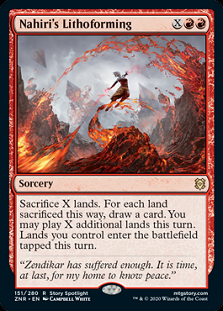
If Scourge was a card where I know exactly what it does, but I don't know where it's for, then this next card is one that I know exactly what it's for, but not what it does. On the surface, Nahiri's Lithoforming looks like a variation of Scapeshift, sacrificing lands then replacing them. However, cost notwithstanding, Lithoforming is worse than Scapeshift because it doesn't search for lands. Instead, it draws cards, and its controller may play lands from hand to replaced the sacrificed ones. Assuming they've drawn enough to replace the lost lands. And the new lands enter tapped. Which means that Lithoforming is far less likely to combo kill than Scapeshift.
However, there is a deck that doesn't mind sacrificing lands, doesn't care about comboing with the right ones, and likes to draw cards. Its name is Assault Loam, and it's fringe but always waiting. Every time there's some new land effect or cycler, Assault Loam lurches from the depths as it tries to reclaim the CAL glory days. And then it slinks away when its weaknesses (graveyard hate, dredging away win conditions, being durdly) remain crippling. That being said, this looks promising enough that a frequent Loam hopeful I know figuratively (and I suspect literally) flipped when he saw Lithoforming.
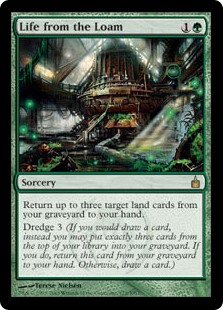
Lithoforming combos with Life from the Loam so well even I saw it immediately. Loam always has lots of land and gets them all back, meaning it will have lots of fuel for Lithoforming and can get the sacrificed lands back. In said hopeful's estimation, this gives Lithoforming combo potential. With a Seismic Assault out, players can float mana for Loam, cast Lithforming, cast Loam, then use all the lands in hand to kill the opponent.

But, What Does It Do?

Then I asked the (I thought obvious) follow up question: "How is all that better than just repeatedly dredging Loam?" And I was meet with a very irritated silence. That has continued until I wrote this sentence. Genuinely, I cannot come up with a way that casting Lithoforming is better than just Loaming for a few turns. Whether in Dredge, Assault Loam, or any weird Scapeshift variant, I haven't come up with a use that is good enough to justify its inclusion. It's only good alongside Loam, but whatever I've gained by adding Lithoforming was win-more at best.

That said, the synergy is so promising and the combination of card draw, land drops, and graveyard filling is so powerful I have to imagine there is a use for Lithoforming. Just look at what Uro's done. Lithoforming just screams combo potential and value. The question is finding a way to make it do something that nothing else is doing and do it better than existing options. I'm not going to find it, but I'll be keeping my eyes open. Perhaps that niche doesn't exist yet and Lithoforming proves to be this set's sleeper.

The Tax Deck Cometh

And finally, Zendikar Rising was a great set for Death and Taxes players. We got two very strong creatures, one of which is good enough that I'm salivating at the prospect of playing it in Legacy. The only problem is that they're both three drops. That slot is already pretty crowded, and so they're not cards that I can just force into any list. Their abilities also fulfill very different niches and thus they want to be in different decks. How that's going to play out is unclear, but I at least will be trying to make them work.

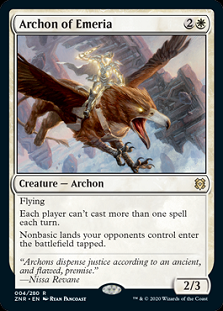
Archon of Emeria

First up is Archon of Emeria. Which is everything I ever wished Thalia, Heretic Cathar could be. Big Thalia's anti-creature ability was never too relevant in my experience. DnT isn't fast enough to really take advantage most of the time, and after that initial hiccup almost everything outclassed Thalia. Having 2 toughness didn't help matters.

Archon flies, which is a huge upside. It will actually swing for damage consistently, unlike Big Thalia, while stalling opposing mana development. 3 toughness is also much better than 2, especially with Lava Dart and Lightning Burst running around.

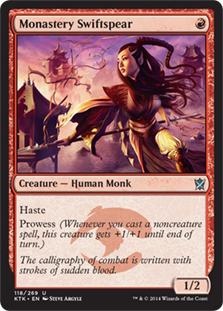
Critically, Archon swaps the anti-creature ability for Rule of Law. Suddenly, Archon becomes a huge beating against Prowess decks. Unless they have Lightning Bolt the turn Archon comes out, Archon will buy absurd amounts of time to stabilize. Prowess will only get to play one spell, which means there will be no explosion, and few ways to take out the flier. Theoretically, that also means that Archon could profitably block Monastery Swiftspear, but that's only for the brave; blocking a 1/2 then getting the Archon Darted is a bad time. Archon's also devastating against traditional combo decks as a result.
As a result, Archon wants to be more of a hard lockdown-style card. This would put it into shells similar to Legacy DnT with Phyrexian Revoker and Aven Mindcensor. It's the sort of deck that really puts the screws to opponents and then flies over for the win. I haven't seen decks like that in MTGO data, but early testing is proving fruitful.

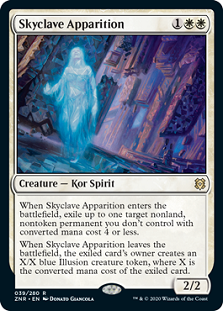
Skyclave Apparition

On the other hand, Skyclave Apparition looks to fit right into existing decks. Apparition exiles anything with CMC 4 or less. Thus, it is the most versatile removal in white's arsenal. The drawback is that when Apparition leaves play, the exiled card's owner gets an Illusion with P/T equal to said card's CMC. However, this is a very small drawback compared to the fact that the card never comes back. Turning a planeswalker, Uro, or Ensnaring Bridge into a vanilla creature is still amazing. And the drawback only manifests if Apparition leaves the battlefield.

Plus, the ability is formatted like Oblivion Ring, not Banishing Light. So it's exploitable. If Apparition leaves before the first trigger resolves, then the opponent gets no token. Which makes using Apparition alongside flicker and blink effects very exciting, and why I've already penciled it into my Legacy deck (gotta remove Oko somehow). Bant Ephemerate could use Apparition, but that's not what I'm about. Parrit on MTGO has been doing very well playing the flickering version of DnT, and Apparition is a very strong include.

"Flicker DnT, Test Deck

Creatures

4 Thraben Inspector
4 Thalia, Guardian of Thraben
4 Leonin Arbiter
3 Charming Prince
4 Flickerwisp
4 Blade Splicer
2 Skyclave Apparition
4 Restoration Angel

Artifacts

4 Aether Vial

Instants

4 Path to Exile

Lands

4 Ghost Quarter
4 Tectonic Edge
3 Horizon Canopy
2 Shefet Dunes
10 Plains

Apparition is only a 2/2 with no abilities in combat, so I don't want too many or I'll never kill the opponent. However, permanently exiling Jace, the Mind Sculptor, flickering Apparition via Vial, then also exiling Sword of Fire and Ice is an epic beating. And they didn't even get a 4/4 token!

Arisen Anew

All in all, Zendikar Rising looks like a very normal set. Which is a weird thing to celebrate, but it's been a weird time for Magic. Now, with the spoilers done, time to get testing.

Italian Legends: A Worthwhile Consideration

Are you a Quiet Speculation member?

If not, now is a perfect time to join up! Our powerful tools, breaking-news analysis, and exclusive Discord channel will make sure you stay up to date and ahead of the curve.

As the daily buyouts of Reserved List cards continue, I’ve touched upon some discounted alternatives that have been overlooked in recent articles. Foreign Black Bordered (FBB) versions of core set cards have appreciated modestly. Collectors’ Edition and International Collectors’ Edition cards are selling readily as budget alternatives in Old School (CE/IE Power is especially hot).

One group of cards I had purposefully been ignoring, however, is the Italian printing of Legends. Ignoring, that is, until now.

I sit here and witness Legends buyouts day in and day out. It seems this set is getting hit particularly hard by the speculators and market manipulators. Bartel Runeaxe, Boris Devilboon, North Star, Livonya Silone, and Lady Caleria have all been hit hard, causing a doubling of price on TCGplayer.

There was an error retrieving a chart for Bartel Runeaxe

Of course, these price increases only reflect English copies. Are Italian copies following suit? Are they worth a second look? This week I’m diving in—some data may surprise you!

Italian Legends: Brief Background

I did some research, but couldn’t find any definitive information regarding the set. Most people agree the print run of Italian Legends was larger than its English counterpart. Wikipedia also mentions that Italian Legends was printed after Italian The Dark, even though their English counterparts were in the reverse order.

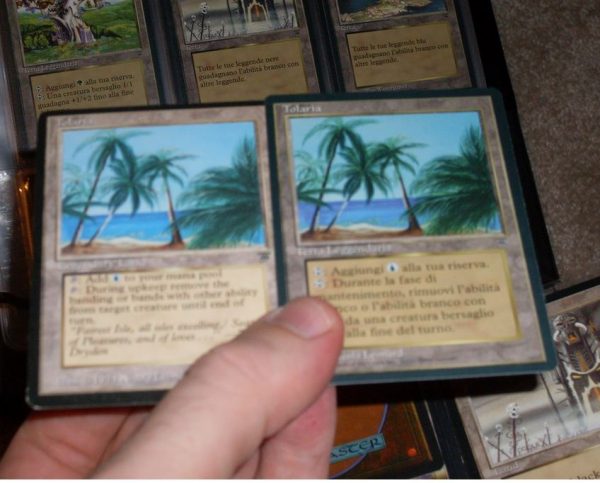
What we do know, without a doubt, are two key features of Italian Legends. Firstly, the Italian versions of Legends cards have much more vibrant colors in their artwork compared to English. Take a look at the comparison below—it’s readily noticeable.

The two languages were printed on different presses, hence the difference in print quality. Personally, I like the darker printing better—it reminds me of the difference between Unlimited and Revised Dual Lands. But I digress. (Aside: Notice how the Italian printing uses the newer version of the tap symbol…this is evidence that the Italian set came out later than the English version).

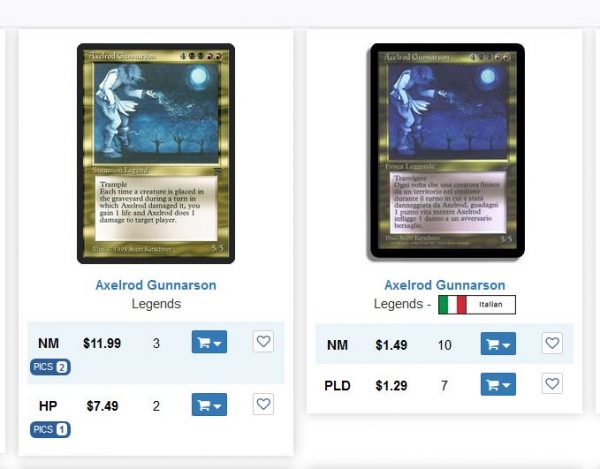
The other widely accepted fact about Italian Legends is that, despite the more vibrant print quality, they’re far less desirable than their English counterparts. Just look at that price differential!

This begs the question: now that so many English Legends cards are disappearing from the market, at least temporarily, are Italian copies worth looking at?

Italian Legends Market Overview

It’s difficult to trend pricing on Italian Legends. The usual price tracking websites don’t take them into consideration, and disparate price charting isn’t available. The best resource I can use, therefore, is eBay’s completed listings. Let’s start with a card that really soared in price over the past few weeks: Gwendlyn Di Corci.

There was an error retrieving a chart for Gwendlyn Di Corci

On TCGplayer, the cheapest English copy is $224.99 for heavily played. The cheapest Italian copy is moderately played and about one-third the price, $75.69. But how does that compare to a few weeks ago?

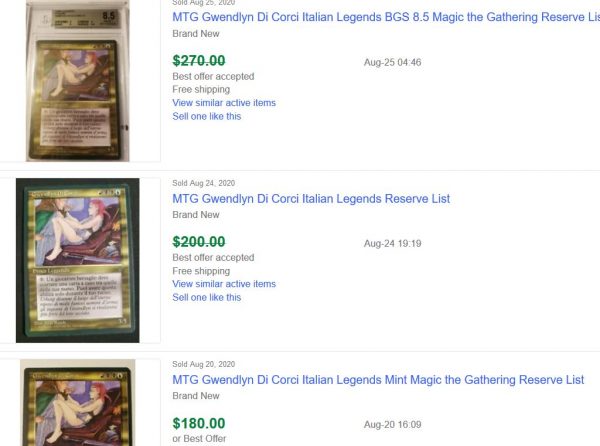
There are only a few sold listings for Italian Legends copies on eBay, and the price range is very wide. Back in June, a near mint copy of the card sold for $55.97 plus shipping. In July, copies sold for between $50 and $70. In early August, pricing was consistent with July. But then after the buyout occurred, look at what happened!

It looks like FOMO took hold of some folks, and Italian copies were bought up greedily along with their English counterparts. I honestly didn’t look these up before starting to write this article, so I had no idea Italian copies sold for around $200 during the buyout! No copies have sold on eBay since August 26th. This is probably because the cheapest copy listed by a U.S. seller is still $180, more than double that on TCGplayer.

Let’s look at one more example: Acid Rain. This was bought out a couple weeks ago as well. The cheapest English copy on TCGplayer is $75.88 and the cheapest Italian copy is $19.69. Again, this is nearly a 3x multiplier.

Back in June, Italian copies were selling on eBay for $10-$16. In July, the range increased and widened to $16-$22 (one outlier sold at $37.99). In August the range was $16-$30ish. So there’s a modest price increase—not huge, but it does look like demand heated up during the buyout yet again.

One interesting thing to point out is the price differential between Italian and English Legends for a card that hasn’t been bought out / spiked (yet?). For example, take a look at Eureka on TCGplayer. The cheapest Italian copy is $220.99 and the cheapest English copy is $304.99. This is evidence that, when a buyout occurs, people flock to the English copies specifically. Italian copies tend to be overlooked, driving the multiplier between English and Italian to the stratosphere.

Shopping for Italian Copies

Based on the data above, it looks like people tend to overlook Italian copies during a buyout. Sure, a few copies may sell at buyout pricing that week, but the Italian market is largely overlooked. That said, it does appear Italian Legends cards do appreciate a little bit in price and there's a chance of catching a sale during peak buyout hype.

Therefore, if you’re looking for certain cards from Legends and get frustrated by a buyout, you could look to Italian copies as a budget alternative. They are far cheaper, still offer some modest price appreciation, and have a nicer aesthetic due to the darker printing. I usually avoid buying foreign cards, but even I am getting tempted by the discounted, Italian versions of Legends cards as English prices skyrocket.

This begs the question: how should I shop for Italian Legends cards? Well, we’ve already seen a significant price discrepancy between eBay and TCGplayer when it comes to Legends cards that were bought out. So right off the bat, I’d recommend TCGplayer over eBay.

But I have an even better idea! I’d recommend shopping at ABUGames. Yes, you read that correctly! I believe the best deals are available at the large online vendor.

For example, consider All Hallow's Eve.

There was an error retrieving a chart for All Hallow's Eve

These have been selling in the $90 range on eBay lately. The cheapest Italian copy on TCGplayer is heavily played and $94 plus shipping. ABUGames has 4 played copies in stock for $86.09. Not only is that slightly below market price, but you can also acquire them using their inflated store credit! And ABUGames recently upped some of their buy prices on some of the Reserved List cards that were bought out. So you can flip your now-overpriced English Reserved List cards for discounted Italian Legends cards. It’s not a bad way to cash out.

How about our friend Bartel Runeaxe, which was aggressively purchased over the weekend. The cheapest Italian copy on TCGplayer is now $8 or so. ABUGames has “MINT” copies at $6.29 and played copies for just $2.99! That’s not a bad discount!

Now, not all Italian Legends cards at ABUGames are steals, so make sure you do some research before pulling the trigger. ABUGames has a “MINT” Italian Angus Mackenzie for $129.39. Even with inflated store credit, that doesn’t seem like a great deal compared to the $87.99 near mint copy on TCGplayer. With these exceptions aside, there are definitely some deals to be found at ABUGames.

Wrapping It Up

To be completely honest, I used to avoid Italian Legends cards. Personally, I like being able to read my cards even if I already know what they do. But the recent buyout activity of English copies of some of my favorite cards has caused me to reevaluate my priorities. If I want to own more copies of a Legends card, I am starting to glance at Italian options as a way to avoid paying the new, overheated prices.

Luckily, there are some attractive options out there. eBay doesn’t seem to offer as much for buyers (though I may try my luck at selling there), but TCGplayer pricing is attractive when compared to the spiked English counterparts. My favorite option, though, is ABUGames. I still find they offer inflated trade-in credit numbers on some Reserved List and Alpha/Beta cards, and trading into reasonably priced Italian Legends cards could be a way of cashing out and trading up.

For example, I just traded ABUGames a played Golgothian Sylex, Season of the Witch, Abu Ja'far, and a couple dollar cards to pick up a played Italian All Hallow's Eve. That wouldn’t have been possible two months ago, before the Reserved List buyouts happened. But now this kind of deal is possible and I’d recommend considering it.

One final disclaimer here: Italian Legends cards, despite their arguably improved aesthetic, do not sell as easily. Expect them to be less liquid and sell more slowly than their English counterparts. As long as you don’t mind the wait—or if you’re looking for cards to keep for a while in your collection/decks—then I recommend Italian Legends as an attractive, budget-friendly alternative during the buyout craze of 2020.

Is the Reserved List a Lie?

Are you a Quiet Speculation member?

If not, now is a perfect time to join up! Our powerful tools, breaking-news analysis, and exclusive Discord channel will make sure you stay up to date and ahead of the curve.

The reason for this particular article is a video by Tolarian Community College regarding the Reserved List.

It seems that every year or so we have a new call to abolish the Reserved List and now is the time for this year's call. While I enjoy the Professor's videos, I have some issues with this one. I definitely don't want this article to come off as contentious, but I feel there are some glaring errors in the Professor's statements, and ignoring these errors would be a failure to the Magic Finance Community.

Statements I disagree with:

1) "It (the Reserved List) is one of the biggest things holding the game back today."

If this were true, the game wouldn't have seen massive growth since the inception of the Reserved List. The reserved list has no effect on Standard, Modern, or the Pioneer formats as no cards in those respective formats are on the Reserved List. They are all still among Magic's most popular formats. I would be willing to accept that the Reserved List holds back the Legacy and Vintage formats from a widespread appeal, but those represent a small fraction of the overall Magic games being played.

Many stores that try to promote Vintage run unsanctioned events that allow for proxies, which essentially eliminates the financial burden that the Reserved List places on prospective players of the format. Even with these proxies being allowed, we don't see massive turnouts to these events. WotC's removal of Planeswalker Points means that sanctioned events have little benefit over unsanctioned events from the player perspective, though hosting sanctioned events is better for stores.

The only format I haven't mentioned so far is Commander where the Reserved List does legitimately affect what some players can put into their decks. However, it is mostly a casual format; most players have no issues with other players using proxies in their decks, barring the event being a sanctioned one.

2) "There is no reason to think that the secondary market would be affected much at all." (RE: the dual lands.)

This is the most egregiously incorrect statement in the entire video. This statement seemingly ignores the basic Law of Supply and Demand in economics. We have seen time and time again that reprints do affect the secondary market and always in a loss of value of the original cards when these cards are for playing for the simple reason that the supply increased more than the demand did.

I agree that there would be a lot of demand for original Dual Lands with a reprinting, but if players weren't willing to pay $500 for an Underground Sea now, they certainly wouldn't pay $500 for one after a reprint hits the market.

There was an error retrieving a chart for Imperial Recruiter
There was an error retrieving a chart for Imperial Seal
There was an error retrieving a chart for Burning of Xinye

I specifically picked these Portal Three Kingdoms cards because that particular set is extremely rare in English, and thus is more similar to a lot of the oldest Magic sets. These sets happen to contain a lot of Reserved List cards, there is very little supply, and a fair amount of demand, resulting in high card prices. In all three instances, we can see significant price drops after the reprint was announced.

He tries to justify a lack of price drop by claiming they are collector's pieces. That argument would only be true if most of their value was attributed to their collectibility rather than their playability. He uses ABU printings of Shivan Dragon and Birds of Paradise, and in both instances fails to mention the value of the Revised printings.

There was an error retrieving a chart for Shivan Dragon

If he had included Revised, it would have obviously nullified his entire point. These are worth far less than any of the older versions because there are so many more copies floating around.

3) "Even with a non-Reserved List card that wasn't in Alpha, the price has held."

The Professor uses Scroll Rack as an example to argue that reprinting hasn't caused the price to drop. Both reprints were from premium supplemental sets, Commander's Arsenal and Kaladesh Inventions, which added relatively few new copies to the overall supply. The price stability of Scroll Rack really only indicates that the overall demand wasn't satisfied by these reprints.

Given the whole point of his argument is to abolish the Reserved List and print enough that the demand from players would be met, choosing this example is a bit disingenuous. If they abolished the Reserved List tomorrow and printed 100 new copies of every card on it, the price of the originals would likely see no change.

However, if they printed 100,000 new copies of every card on it, there is no way the price wouldn't drop. Players with originals would try to unload them as soon as the announcement was made in order to lock in whatever value they could. Instead of Scroll Rack why not look at a card in a similar vein that has been reprinted on a much larger scale?

There was an error retrieving a chart for Polluted Delta

Polluted Delta sees play in numerous formats from Vintage, Legacy, Modern, and Commander. The Khans of Tarkir printing caused the price of original Onslaught copies to drop by over 50% and remained pretty flat for four years. Only recently have we seen an uptick in price, but it's still far from its pre-reprint highs. I would expect any mass reprinting of a Dual Land, Moxen, or any other high-dollar Reserved List rare to react more like Polluted Delta than Scroll Rack.

4) "Reprints of dual lands would add value to players collections."

The argument here is that after players have acquired the reprinted copies, they would eventually gravitate towards the price of the originals. There could be some merit to that, as saw with Polluted Delta listed above. Just because a card rises in value from $38 to $49 dollars doesn't mean it has recovered.

The high for Onslaught copies was $115 and it was still $93 right before Khans of Tarkir released. So instead of owners losing 60% of the value of their cards they only lose 48%, which is still pretty far from "adding value".

5) "The idea that people would sue Wizards of the Coast is a load of bull plop."

We live in a pretty litigious society, where people sue others for all sorts of reasons. I don't have any legal background to know how much of a case anyone would have for WotC deciding to end the Reserved List, but I don't doubt that they would certainly have to spend effort and/or money on legal counsel.

He then points out that WotC has already made several changes to the Reserved List policy, and argues that WotC made those changes before and didn't get sued. I am curious if this can even be verified. I think the elimination of the premium version clause of the Reserved List (which until 2010 was still an option for WotC), indicates that something caused them to "strengthen" the Reserved List rules. Given the public disdain for the Reserved List by many WotC employees, most notably Mark Rosewater, it would seem unlikely that WotC would end this policy on their own accord.

Conclusion

I can honestly say that I don't really have strong feelings toward keeping or abolishing the Reserved List myself. I feel I would definitely lose money should it be abolished. I also have to acknowledge there would be a great benefit from its removal.

My favorite format is Legacy, and I would love to see the playerbase for it grow. The price barrier that the original Dual Lands present is likely a major contributing factor to its stagnation. That being said, I think it's important to dissect the points provided in the video, especially when they are erroneous.

Arena: Deckbuilding with Zero Wildcards

Are you a Quiet Speculation member?

If not, now is a perfect time to join up! Our powerful tools, breaking-news analysis, and exclusive Discord channel will make sure you stay up to date and ahead of the curve.

Hello, everyone, and welcome to another Magic Arena article! This week, we are going to look at how to create a budget-friendly yet competitive deck. When I say budget-friendly, that doesn't always mean cheap decks comprised of commons and uncommons. The idea is to spend the fewest resources outside of what you already have in your collection to construct a deck.

Situations where you may want to create a budget deck:

  • You haven't obtained all cards from a new set
  • To complete quests for gold
  • To join a short-term event

We can consider these short-term decks. In these situations, you probably don't want to spend any gems or rare/mythic wildcards to build a short-term deck, especially when those cards are not needed in any other decks you will be playing moving forward. Sure, you can probably netdeck and replace any missing cards from a list with others in your collection.

However, as I mentioned in my previous article – I will be writing about how to optimize playing the game on a budget – we want to do this the "best" way. Now, best can mean any or all of these things when budget-building for Arena:

  • Time-saving, less grind
  • Better win rate
  • Re-usability of deck/cards

In this article, I will provide actual budget deckbuilding samples for you to better visualize the process.

Building Objectives

Every time I want to build a deck, I will ask myself: what do I want to achieve? Can I hit multiple goals with the same deck? In Arena, we build decks primarily for these reasons:

  • Clear daily quests
  • Gain XP for winning
  • Have fun
  • Climb the ladder

So make sure your goal is clear! From there, figure out what the requirements for this new deck are.

Case Study 1:

You have a quest telling you to "Cast 30 Red or Blue Spells" that you want to clear. Many new players would probably think, "I can simply build a deck with 40 1- or 2-red-mana spells and 20 Mountains." While technically right, it's important to consider what other goals we can accomplish. Why not make a deck that can win games at the same time? That way, we get to clear quests for the gold and XP, while gaining XP for daily rewards at the same time! Chances are, we will come to the conclusion that a low-curve, aggressive red deck is what we needed.

What I'm trying to convey: try to make a deck that can do multiple things at once for maximum efficiency! Not only that, but it also boosts the reusability of the deck since it can be used for different reasons that may arise – you don't need to keep non-competitive/boring decks in your collection.

Case Study 2:

You want to climb the Constructed ladder for this season (and for sure to clear quests and/or to gain XP), but you either don't have enough wildcards to complete the deck you want to play or its near rotation whereby spending wildcards might not be worth it. This week is the exact time where nobody is making new decks for Standard, and probably don't have enough wildcards to catch up with the changes in Historic. Under such a scenario, the best option is probably to homebrew or to play another Constructed format, be it Brawl or Standard in 2021.

Analyze the Format

Understanding of the format you want to play is the key to budget deckbuilding. If you don't own the best decks in the format, you're left with the option of building a deck that is good or at least not bad against the field. Before we jump into deckbuilding, let's ask ourselves these questions:

  • What deck is good in the meta? What is weak?
  • Which are the best colors in the format?

What deck is good in the meta?

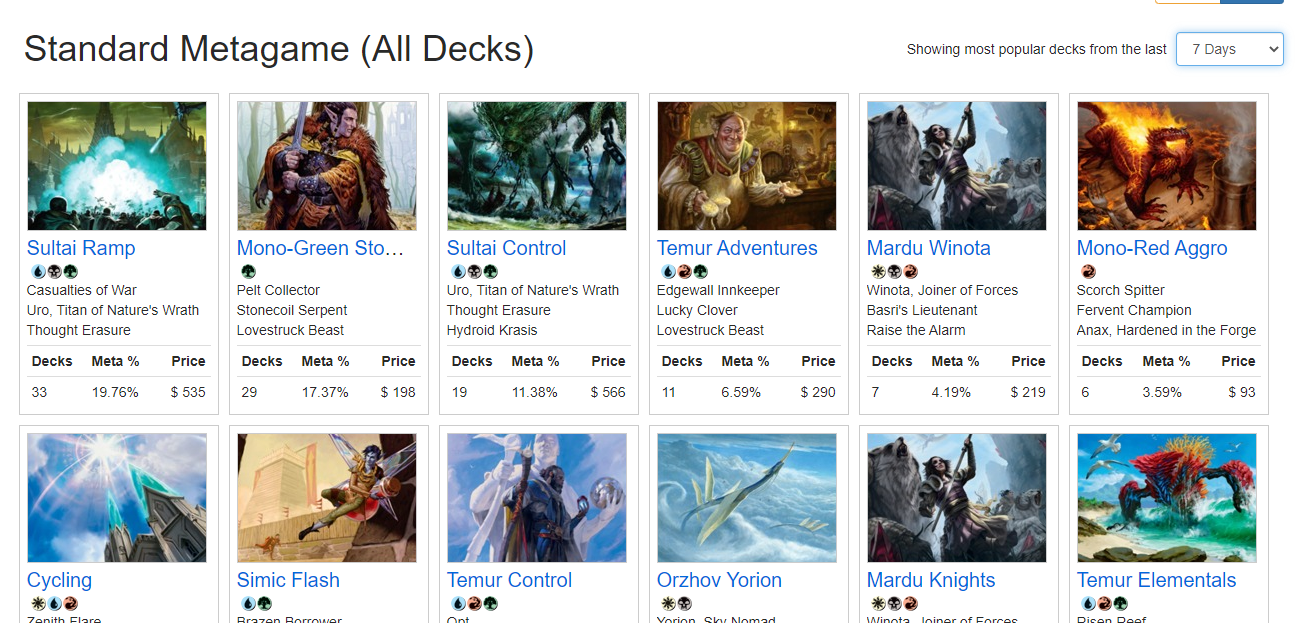
Using a decklist database like MTGGoldfish or MTGTop8, select the format you want to look at, and you will have all the details you need at glance. For example, in the current week of Standard, you will find Sultai Midrange/Control variants at the top, followed by aggro decks like Green Stompy, Mardu Winota, and Mono Red.

The field is something around 50 percent aggro and 40 percent Sultai. From here, we can say that aggro is good unless you encounter decks with a good amount of lifegain, especially with Uro, Titan of Nature's Wrath. Besides that, we also found out there's no true control deck in the environment post-ban, which is a strong indicator that we shouldn't be playing control.

Which are the best colors?

From the metagame analysis above, it's clear that green is popular, followed by blue and red. If we were to make a Standard deck, we probably want to start with green and blue. In the recent sets, green has lots of card advantage, and that is the main reason why green is at the top right now.

Go Through Your Collection

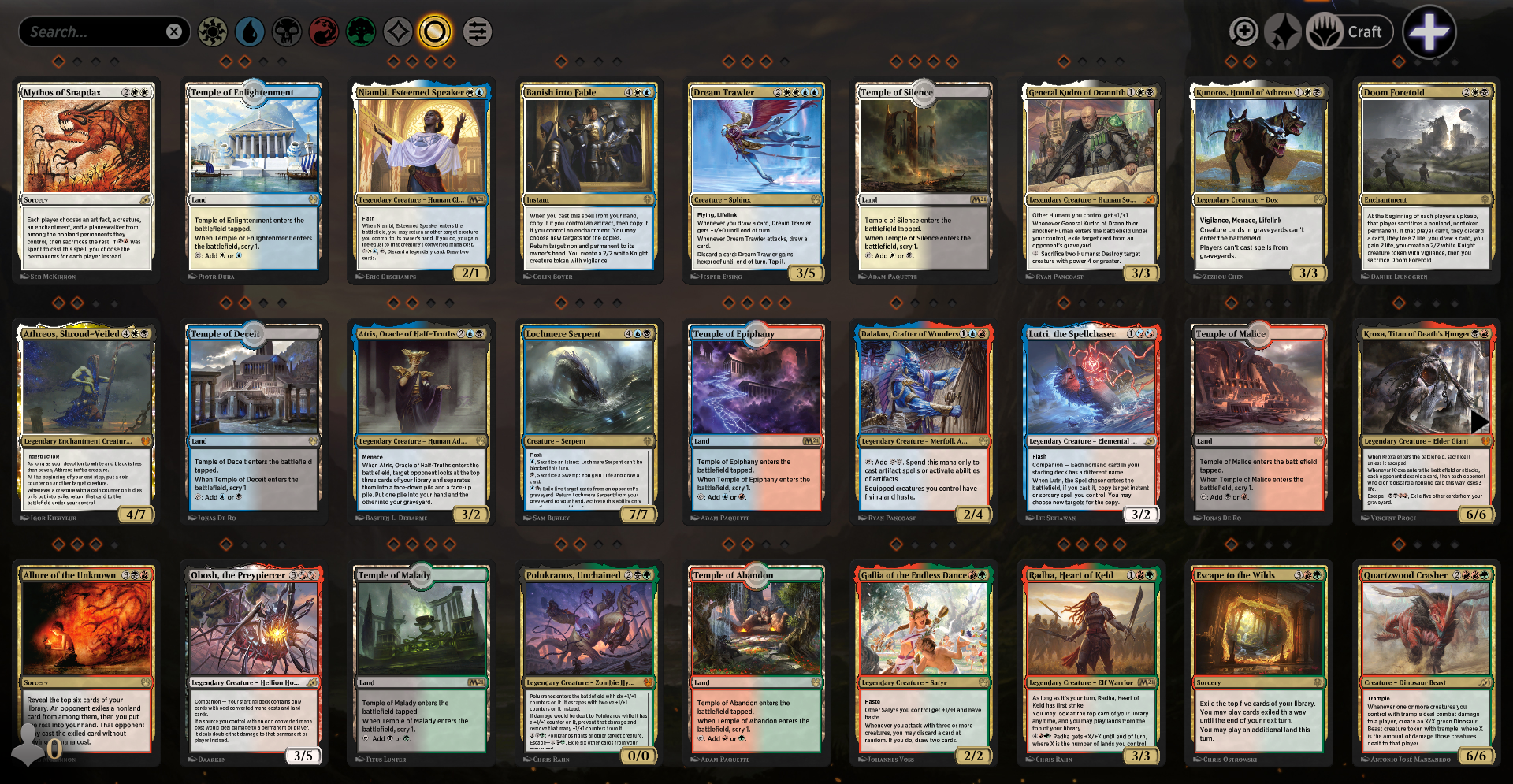
Once you know what you need, let's proceed to figure out which format to play and/or what deck to play. At this point, evaluating your collection is important, so you can ensure the deck you built gives you a better if not the best outcome. Start by checking what rares and mythics you have in your collection.

For instance, I need a deck for the Constructed ladder, and since my pool is relatively small, I can't make any functional Historic decks. My best option here is Standard 2021, as I have collected enough cards in the newer sets to throw something together. My deckbuilding process would look like this:

Starting with the gold cards in my collection, I feel Kunoros, Hound of Athreos is the strongest card, complemented by the full set of Temple of Silence and the access to quality lifelink creatures in both colors. Patterns emerge when looking at these Orzhov colored cards:

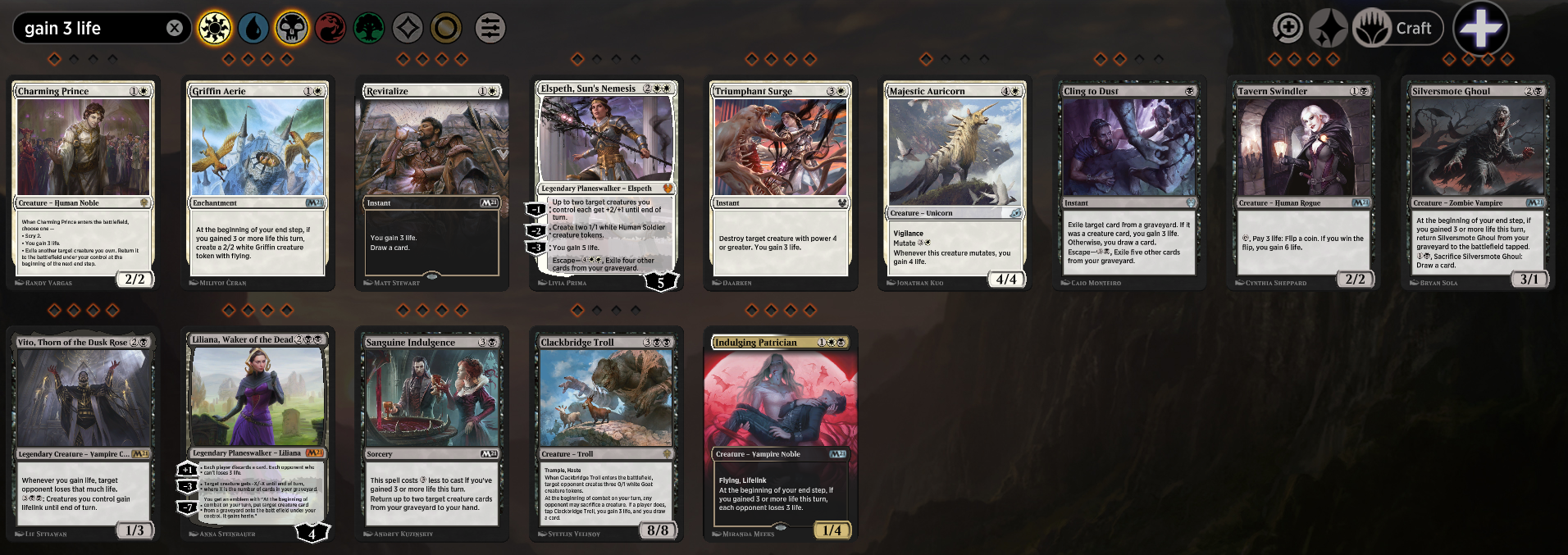
  • "Gain 3 life" mechanic from Core Set 2021
  • Lifelink is good under the current metagame where most people play aggro decks.
  • With the black-white Gold cards I have, I can make an Orzhov Lifegain Midrange deck with Griffin Aerie

Now, we can continue by adding cards that fit our gameplan. A playset of Griffin Aerie is an auto-include while cards like Vito and Indulging Patrician are cards that synergize well with this strategy.

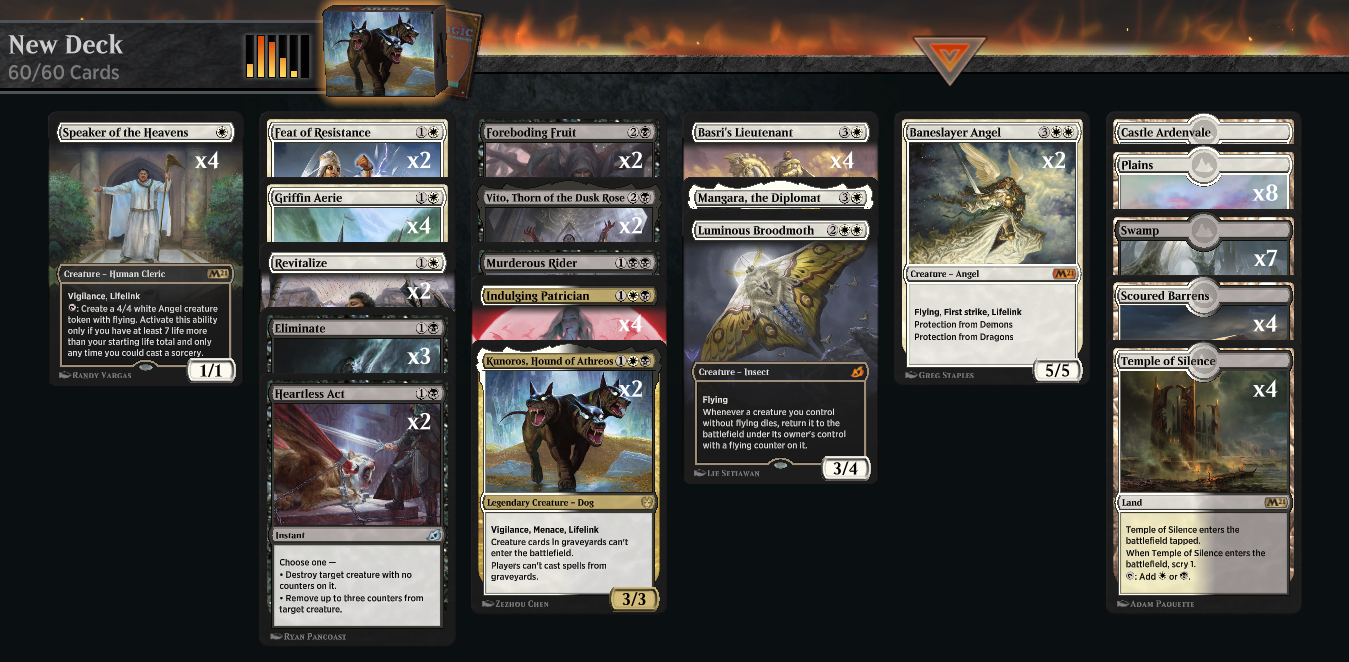
After adding the right number of creatures, removal spells, and combat tricks, my new Orzhov deck looks like this:

Disclaimer: This is only a case study based on what I have in my collection. It will definitely vary from what you will end up building.

When I have the chance, I will make videos playtesting budget decks and will share the deck-tech over here, along with the thought process when I try to build the deck. If you have a card that you would like to see played in Standard, you may leave a comment down below to let me know!

Alright, that’s all from me this week. Thanks for reading, and I’ll see you again next week!

–Adrian, signing out.

Introducing: Your New QS Insider Community Manager!

Are you a Quiet Speculation member?

If not, now is a perfect time to join up! Our powerful tools, breaking-news analysis, and exclusive Discord channel will make sure you stay up to date and ahead of the curve.

Hi there, friends! I’ve got some cool news to share with you today - I’ve accepted the position of Community Manager here at Quiet Speculation!

I’ve been a fan of Quiet Speculation for a long time, and in my time writing articles here I’ve really grown to admire the team behind this website. I’m super grateful for the chance to be a part of the crew! I’ll be spending lots of time in the Discord – which you should definitely join if you haven’t – as well as writing a weekly article, working on reviving the QS Insider podcast, and plenty of other stuff!

I shot a quick little introduction video to give everyone a bit of background on myself and my MTG Finance history:

If you have any questions for me, feel free to reach out in the Insider Discord. I’m looking forward to getting to know everyone a little better in our QS community!

Investigating Confounding Conundrum

Are you a Quiet Speculation member?

If not, now is a perfect time to join up! Our powerful tools, breaking-news analysis, and exclusive Discord channel will make sure you stay up to date and ahead of the curve.

Ah, spoiler season. The time when I don't have to stretch myself doing statistical work. Just looking at the new cards, doing some basic analysis, and speculating about whether there's a place in Modern for them. Simple and low-pressure, just what this year's called for. Then, something had to come in a ruin everything: a card that appears tailor-made for Modern, something that a pet deck of mine has longed for, and yet, upon testing, has yielded conflicting data. I'm talking about Confounding Conundrum. And it's a frustrating card. It both does and does not work the way everyone thinks it does.

Hate pieces in general are pretty hard to evaluate. Their value depends on not only the prevalence of whatever they're targeting, but of the counterplay available. Rest in Peace seemed lethal against Hogaak, Arisen Necropolis decks, as they couldn't operate without their graveyards. However, it was useless in context due to Hogaak's speed as well as Force of Vigor. Enchantment removal is generally less played than artifact removal, making it more persistent, but the effects tend to be more narrow.

Confounding Conundrum is not only an enchantment hate piece against many cards and strategies, but a potentially maindeckable one. Which provides far more opportunities, but also exposes a lot of problems. I'll conclude that Conundrum is Modern-playable... asterisk.

About Confounding Conundrum

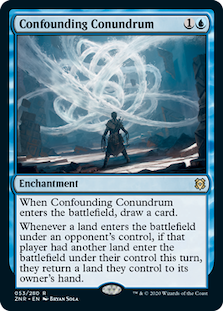
By now, everyone's seen the card because, at minimum, you see it alongside this paragraph. And there is a lot of text to work through then try and wrap the mind around.
Whenever a land enters the battlefield under an opponent's control, if that player had another land enter the battlefield under their control this turn, they return a land they control to its owner's hand.

Confounding Conundrum is a land hate card. Specifically, it's designed to hate ramp by ensuring that opponent's can only play the single land per turn the rules allow. Every additional land played per turn can only replace a land currently on the battlefield, ensuring equity. I'd expect this type of effect to be white, but blue does have a history of bouncing lands dating back to Boomerang, and the formatting is decidedly blue. Opponent's don't have to return the offending land, just a land. This will be important later.

When Confounding Conundrum enters the battlefield, draw a card.

I'm not being facetious here; Conundrum being a cantrip is very important. We've seen Growth Spiral, Manamorphose, and Veil of Summer, which have mediocre primary effects, become powerhouses thanks to cantripping. At minimum, Conundrum always cycles, which puts it into consideration as a maindeck card. We haven't seen this on a land hate card since Blood Sun, which never quite lived up to expectations. Not because Sun is unplayable, but the meta has never needed that type of effect. That may not be true of Conundrum.

How it Works

Conundrum is counting lands. When it sees more than one land in a turn, it triggers. The trigger will go onto the stack before the opponent can use the land. They're free to tap the land at this point, but can't cast any sorcery speed spells until the trigger resolves. This being a triggered ability, multiple Conundrums mean multiple triggers.

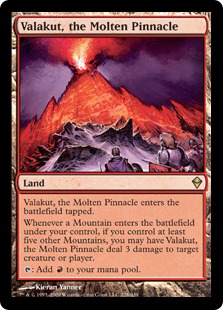
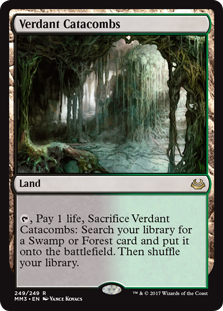
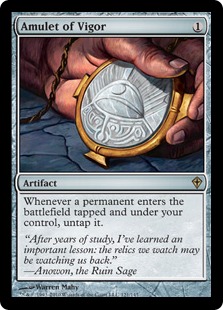
The final note is that triggers go onto the stack active-player-first, so any triggers the opponent may get from the extra land entering the battlefield happen after a land has been bounced by Conundrum. This in turn means that Conundrum effectively answers all the payoffs for all the Primeval Titan decks. Valakut, the Molten Pinnacle and Field of the Dead are looking for certain conditions to be met when they trigger and when they resolve (the intervening "if" clause). Both lands trigger when the conditions are met, then Conundrum's trigger goes on the stack and resolves first. If Conundrum leaves less than 5 other mountains or 7 lands with different names on the battlefield, the abilities fizzle. If they Scapeshift, then all the lands will have to be bounced for a really bad time. By the same token, Amulet must bounce a land before Amulet of Vigor can untap the karoo.
Also worth noting: Conundrum sees fetchlands as the allowed land drop. Cracking them on the same turn will trigger Conundrum. In this way, the enchantment gently hates on almost every deck.

An Exploit

The source of the new land is irrelevant. Two lands hitting in a turn is all that it takes for Conundrum to trigger. So Path to Exile and Field of Ruin count. Field is particularly exciting, as Conundrum turns it into better Dust Bowl. Much like pairing these cards with Leonin Arbiter, there is considerable potential in abusing Conundrum as a taxing piece. And unlike Arbiter, Conundrum isn't symmetrical.

A Problem

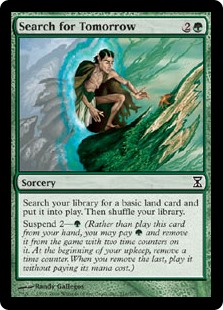
There are two problems with all of this. The first is the phrase "fail to find." A player can always fail to find when searching for a specific thing in any zone that is unknown information. They have to do anything else involved in the search (shuffling, mostly), but they never have to pick anything. Thus, a ramp player doesn't have to actually find a land when they search for one. I don't know why they wouldn't, as even though they have to bounce a land afterwards, they've at least ensured they'll have their next land drop. They can also resolve their Search for Tomorrow and not play another land that turn. With only one Conundrum out, this is a bit of a wash, and will only be relevant with several Conundrums out; indeed, fully resolving Search and triggering two Conundrums sets players back on mana development, making a fail preferable.
The second problem is that this isn't too hard to play around for most decks. They just have to not play more than one land on the same turn, and that's not too hard with smart sequencing. Decks with fetchlands can always just not crack them on their turn. This is standard practice for many decks anyway. Creature decks can skip their land drop until after combat in case of a Path. Valakut will crack their Sakura-Tribe Elder or Khalni Heart Expedition on their opponent's turn and ramp away. Plus, every deck misses land drops sometimes. Conundrum isn't going to surprise any opponent as long as they're actually paying attention, so don't assume that it will ever return lands. It's more of a threat than a reality.

On the Legacy subreddit, I saw someone call Conundrum a slow Sphere of Resistance. I agree with the sentiment, but would categorize it more as a slow Damping Sphere. Conundrum does nothing to affect any deck's ability to play spells in a given turn. It affects the subsequent turns. Go ahead and crack a fetch into Conundrum, float the mana, bounce a land, then cast whatever. The next turn is when the tax is applied, because of the bounced land.

In Modern's Context

Being solid in a vacuum is all well and good, but what matters is reality. I can wax speculative all I like, but the real test is when a card is actually tested. So that's exactly what I've been doing. I've decided test the maindeck potential of Confounding Conundrum, and to get the most out of it required a taxes shell. I'm no stranger to UW taxing decks, and have tried to make Spirits and Taxes work a few times. It never really worked out in the past as the deck, was incredibly anemic and fairly schizophrenic due to the Spirits portion not jibing well with the Taxes side, and the mana was always all over the place. However, Xurikk 5-0'd a League with Spirits and Taxes, so I just took that list, arbitrarily replaced the Deputy of Detentions with Conundrum, and got to work.
I'm not going to post a list because, of course, the deck wasn't very good. I went through a few iterations, but no change seemed to improve anything. That said, it was an ideal test platform, and it is from that testing that I can say that Modern has a place for Conundrum.

Testing Results

Conundrum is not good against Prowess decks. This shouldn't be much of a surprise as the tempo-negative Spreading Seas was never good against Burn, even though it usually took out one of their mana sources. Against Izzet and Rakdos, Conundrum hitting fetchlands does slow down the explosive attack. However, Prowess is still free to use fetched mana to play spells, and all I did was spread out the pain. There were a few times Conundrum slowed Prowess down enough to stabilize, but they were far outweighed by the times I lost to playing a do-nothing cantrip instead of a creature.
Additionally, Conundrum does nothing particularly great against the metagame's main ramp deck, Tron. Neither variant ever plays more than one land a turn. It is very dangerous to wait for a land drop before activating Field of Ruin against Mono-Green Tron. It's usually pointless to do so against Eldrazi Tron. There are instances where G-Tron was having a bad day and Conundrum made it worse, but for the most part it was worse than Seas would have been. Ponza was in the same boat.

Against Jund and Wilderness Reclamation decks, Conundrum showed potential. Both decks play lots of fetchlands and like to use all their mana in a turn. Temur also runs acceleration sometimes. This meant that both had to really think about playing into Conundrum and reevaluate their gameplans. It was especially hard for Jund, given its playstyle, and a lot of mana was left on the table. This was not even getting into Path and Field suddenly having no drawbacks. As might be expected, mana disruption is more effective against slower fair decks.
Conundrum was a beating and a third against the various versions of Valakut I tested. There's a whole spectrum from traditional Scapeshift decks to Vial Titan and Conundrum ruins all of them. Titan, Golos, Tireless Pilgrim, and Dryad of the Ilysian Grove are just land selection rather than ramp, while Sakura-Tribe and Elvish Reclaimer must be used on the opponent's turn only. Worse, there's simply way to just win with Valakut and, for once in its existence, it can only be the gradual value engine it was intended to be, and not a combo kill. Just a horrible wrench in the gears.

So, About that Asterisk

Observant readers have noticed that I skipped over Amulet Titan and more importantly Uro, Titan of Nature's Wrath. Conundrum does appear to particularly target Uro. Which is also what most of the hype is about. So, why so cagey?

These are the decks behind my opening-statement asterisk. My testing against both didn't go as expected. Something very strange happened when testing against Amulet that makes me nervous ever playing Conundrum against it again. And as for Uro...

First, It Gets Dangerous

Even if you get out Conundrum on turn 2, I didn't notice it having much effect. Uro decks durdle and are heavy on counterspells. They're fine cracking fetchlands on opponent's turns to not trigger Conundrum. Growth Spiral is an instant too, and is usually played on opponent's end steps anyway, so there's not a ton of disruption happening. I didn't really benefit much playing Conundrum, other than Field activations.

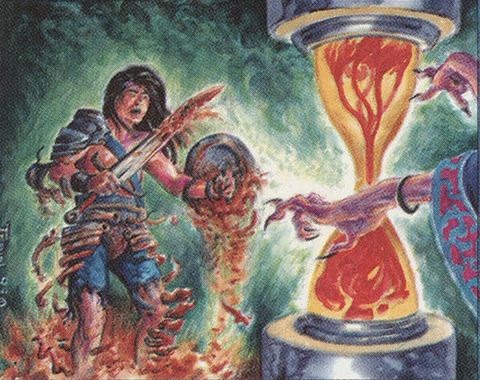
What about against Uro itself? Well, that's where it got complicated. Yes, stopping the ramp was decent. However, even when opponent's declined to put a land into play, Uro was still gaining three life and drawing a card. And preventing Hour of Promise from swamping me wasn't nothing. The problem was as the game went on, Conundrum makes it slightly easier to start looping Mystic Sanctuary. It was frequently correct later in the game to deliberately trigger Conundrum to recycle Sanctuary without burning Cryptic Command. And that felt really bad.

Admittedly, by that time, the game was pretty well lost, and the extra Sanctuary triggers were the door locking rather than closing. However, the fact remains that by lengthening the game, Uro started to benefit from my hate card. That shouldn't happen, and makes me leery of Conundrum in the current metagame.

Then, It Gets Weird

Meanwhile, the Amulet matchup mostly played out as expected. As I said, Conundrum answers Amulet of Vigor. It also hits Azusa, Lost but Seeking. It's a very strong hate piece here, arguably better than Damping Sphere. However, during a test game, something weird happened.

With two Sakura-Tribe Scouts, Azusa, Amulet, and five lands out against my Conundrum, Amulet played Simic Growth Chamber. Then started going off. As in, Summer Bloom going off. Using the Karoo bounce triggers, Amulet kept replaying the Chamber, returning the other lands, and floating the mana for Primeval Titan. Titan found Gemstone Mine and Slayer's Stronghold, let them be bounced, then used a Scout to replay the Stronghold, used floating mana to activate it, and swung. In the end, Titan was a mana short of the Sunhome, Fortress of the Legion kill. And that felt like a sequencing error.
That only happened once. But it did happen. Couple that with the Uro results, and I can't give an unequivocal recommendation for Confounding Conundrum. It has its uses, and in the right metagame it will be devastating. Right now? It's potentially more of a liability.

Positing Positioning

In a world full of Primeval Titan, I think that Conundrum is a slam-dunk sideboard card, possibly making its way into the main to randomly screw fetchlands. But in the current metagame, I'd steer clear.

A Look at Collectors’ Edition Cards

Are you a Quiet Speculation member?

If not, now is a perfect time to join up! Our powerful tools, breaking-news analysis, and exclusive Discord channel will make sure you stay up to date and ahead of the curve.

Last week I covered the recent move in a lesser-known bucket of cards: Foreign Black Border. This article was well-received overall, and readers acknowledged the recent trend, consistent with my own observations.

At the end of the article, I gave a very brief nod towards a different black-bordered set that can also be viewed as a budget alternative to many of today’s spiking Reserved List cards. That set is the Collectors’ Edition (and International Collectors’ Edition) sets, CE and IE for short.

While I wrote a section on these cards a couple time in the past (one insightful piece was back in December 2019), I wanted to spend more time this week covering recent trends on this set—there are some very surprising movements lately that merits an article to drive awareness.

A Little Background

If you want the full history, you can read about it in my December article. The key thing I want to emphasize here, for those who don’t want to bother getting lost in the hyperlink tangle, is that the set was released in 1993 and only 14,000 sets were produced. In today’s day, that’s an extremely tiny print run! Even Unlimited was printed in greater numbers, especially when you look at the uncommons and commons.

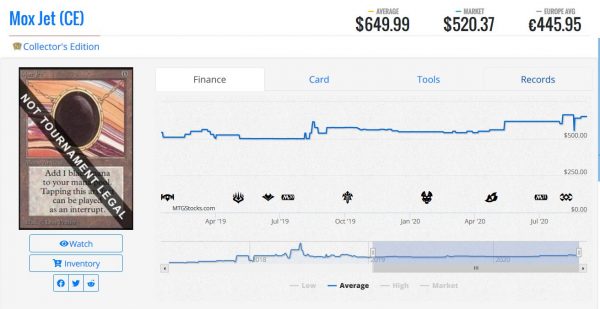
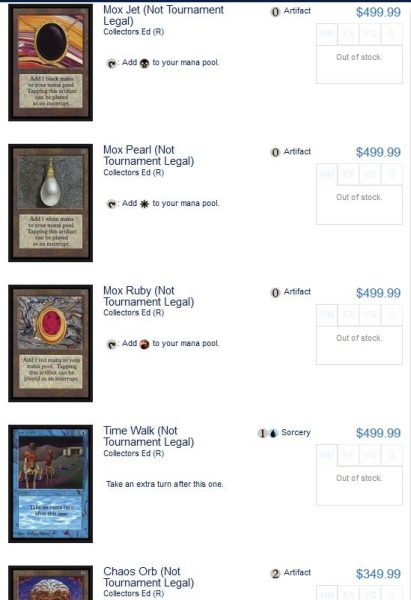
Keep in mind rarity has no meaning with Collectors’ Edition. Every set was printed to contain one copy of every card in the set. Therefore, there are just as many CE Ironroot Treefolk as there are Mox Jet—their price differential is therefore drifted solely by demand since the supply is constant.

As you can see in the graph today, some of these CE cards are worth a pretty penny. But even though Power is on the move, there are some other CE cards that are running hot that are worth touching upon.

Some Hot CE/IE Cards

You may have noticed Braingeyser’s spike over the weekend—it’s another Commander-playable, Reserved List card so it’s no surprised speculators made their move.

There was an error retrieving a chart for Braingeyser

While the Revised copy was the one that popped on MTGStocks, a quick change to settings reveals that the Collectors’ Edition printing also jumped a significant amount.

According to MTGStocks’ weekly interests page, a couple other CE cards also rose measurable throughout the past seven days. This includes Goblin King (+14%), Savannah (+11%), Lightning Bolt (+11%), Zombie Master (+10%), Force of Nature (+8%), Jayemdae Tome (+5%), Fastbond (+5%), and Wheel of Fortune (+5%).

These gains may not seem drastic when compared to some of the recent Reserved List buyouts—that’s a fair observation. However, these modest gains are much more real than the artificial price manipulation we see on the more popular sets.

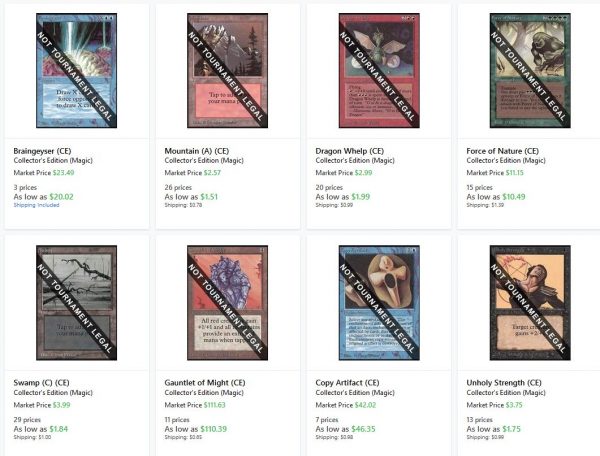
Moving beyond MTGStocks, there’s a clever way of utilizing TCGplayer to investigate which cards from a given set are hottest. If I go to the advanced search option, select Collectors’ Edition, as the set, and then click search I’ll narrow the browser down to all cards from the selected set. Then, in the sort drop-down menu, I pick “Best Selling”. Voila! I now have the set sorted according to which cards have sold the most on TCGplayer using some sort of recency basis.

So when I do this, what do I see?

There we go with Braingeyser as mentioned before, the number one seller. I see two other Reserved List cards also showing up on the top 8 list: Gauntlet of Might and Copy Artifact. I’m a little more perplexed by Dragon Whelp and Unholy Strength, but this could be a nod to the fact that some Old School players purposefully seek out CE cards as budget black-bordered alternatives. The basics could be on the list for that same reason.

Two other cards I want to specifically call out are Wheel of Fortune and Chaos Orb. The latter is especially pricey because of its play in Old School. I once saw a joke that CE/IE Chaos Orbs technically have a larger surface area than their rounded-cornered counterparts, so they actually maximize your chance of destroying a card. While that difference is negligible, the fact that Chaos Orb is an icon of Old School is not—because many playgroups allow CE/IE cards, Chaos Orb is one of the hottest cards in the set and will continue to be so.

Wheel of Fortune is an interesting one. It is also popular in Old School, but I suspect Commander players are buoying its price most of all. I mention this card because the CE printing is nearly the same price as the Revised version—both are in the $200 price range on TCGplayer. Interestingly, this similarity is not reflected on Card Kingdom and ABUGames’ site. This brings me to one last observation on these cards, which has a chance of making you a little money on this under-the-radar set!

There was an error retrieving a chart for Wheel Of Fortune

Lastly, let’s talk briefly about Timetwister, the only Power 9 card legal in Commander. Have you seen what’s happened to this card’s price recently? Nice condition copies are selling in the $3500 range and the cheapest Unlimited copy I can find for sale is a played $3980 copy on eBay. Collectors’ Edition copies have also moved in kind, and TCG low is $650. I don’t think this card will ever pass Black Lotus as Power 9 leader, but the gap is certainly closing.

There was an error retrieving a chart for Timetwister

Retailers Behind the Curve?

I made a purchase on Star City Games’ site for the first time in quite a while last weekend. In addition to the 20 Jaya Ballard, Task Mages I grabbed at $0.45 each, I picked up a played Collectors’ Edition Volcanic Island. I had to purchase SCG Premium in order to earn the 10% discount, so my cost basis is roughly $249.99 - $25 + $7.99 + $7.50 (shipping), approximately $241.

A quick glance at TCGplayer suggest this was an amazing price—market price may only be $250, but the cheapest copy available on TCGplayer today is moderately played for $300. While TCG low doesn’t exactly reflect a card’s value, it’s good at indicating directional trend. I believe popular CE/IE cards, such as Dual Lands and Reserved List staples, are climbing in price right now. When I factor in that a couple CE/IE copies of Volcanic Island sold on eBay in the low $300’s over the past month, and I’m confident this purchase will result in a modest profit.

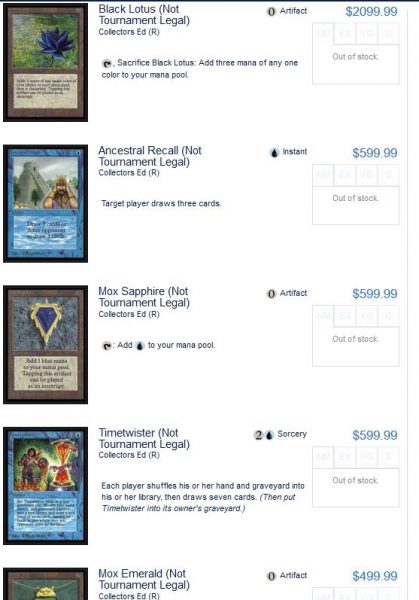
When I browse CE/IE cards across Star City Games, Card Kingdom, and to a lesser extent ABUGames, I’m observing two related trends. First, their prices seem competitive on the set and in some cases actually low relative to the market. Second, they’re sold out of almost all the higher-end cards from these sets.

These two observations are directly related.

See what I mean? The most expensive card Card Kingdom has in stock from Collectors’ Edition is a near mint Mana Vault ($59.99). Even this price is consistent with eBay completed listings and TCG pricing, meaning you could grab those Vaults with store credit and do a decent job flipping them for cash.

The story is similar at Star City Games—they actually have a couple CE Dual Lands in stock: an Underground Sea and Volcanic Island, both near mint for $349.99. While these aren’t slam-dunks in terms of profitability, applying the SCG Premium 10% discount makes them attractive acquisitions with store credit. Given the current upward momentum behind CE cards, it wouldn’t surprise me if these sold out sometime in September.

ABUGames actually does have some high-end CE cards in stock. BUT their prices are often much higher than the rest of the market.

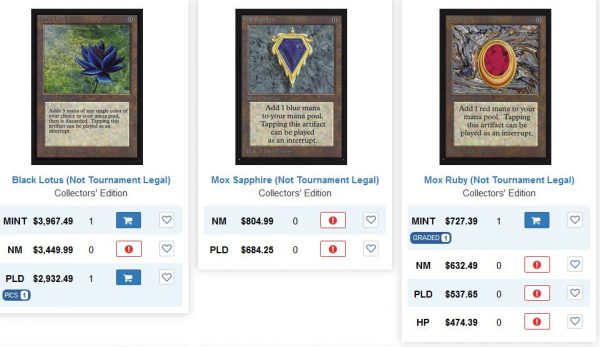
A $2932.49 played CE Black Lotus is about 30% higher than the market. And while that “MINT” CE Mox Ruby may be tempting if you have store credit to cover the $727.39 price tag, I’m pretty sure that card is really worth only about $500. It seems, in some cases, ABUGames has already adjusted their prices upwards on the most desirable CE/IE cards.

However, they do have some CE/IE cards that haven’t been adjusted yet. Consider Wheel of Fortune for which they charge about $100. No surprise they’re out of stock here! But if you can catch a restock on something like this, you could make some easy profit.

Wrapping It Up

While mainstream Reserved List cards continue to disappear from the market, it’s important to keep Collectors’ Edition and International Collectors’ Edition cards in mind. They may not be tournament legal, but many Old School playgroups allow the sets. It wouldn’t surprise me if Commander group did the same thing.

As a result, many CE/IE cards have been quietly climbing in price. This is observable when viewing the best-selling cards from the set on TCGplayer. However, many of the large online vendors haven’t quite caught up with their pricing yet. The result is an opportunity to make a little profit and acquire CE/IE cards at a discount to the market.

This price discrepancy won’t last forever—eventually, Card Kingdom and Star City Games will adjust their pricing accordingly. Until then, expect to see them largely sold out of most of the desirable cards from these sets. But keep an eye out for a restock. If your timing is good, you could nab a great deal on a CE/IE card. Using store credit, the deal becomes even more attractive!

Keep an eye on CE/IE cards in the coming weeks. As speculators swarm over the Revised Reserved List cards, you may find a deal on his overlooked set. Or, as a player, perhaps you are OK playing a CE card in your Commander deck and the budget alternative could save you some money. Whatever your angle, the days of ignoring the non-tournament legal square-bordered cards are long gone. There’s real demand for these cards, and their prices are finally reflecting this

Zen Again: Zendikar Rising Spoilers, Pt. 1

Are you a Quiet Speculation member?

If not, now is a perfect time to join up! Our powerful tools, breaking-news analysis, and exclusive Discord channel will make sure you stay up to date and ahead of the curve.

Zendikar Rising spoilers are officially underway! That also means summer is ending... but what great outdoor plans did we have that weren't ruined by a global pandemic anyway? There's never been a better time to forget about real-life exploration and lock ourselves inside to peruse new cards at a glowing computer screen!

Flip Top

Rising's marquee mechanic is the flipping cards, which let pilots choose which side to play the card as when they're ready to play either side. One side houses a spell, while the other has a land. On the whole, I don't think these cards will see a whole lot of play in Modern, but I wouldn't count them out entirely.

Lands on Lands

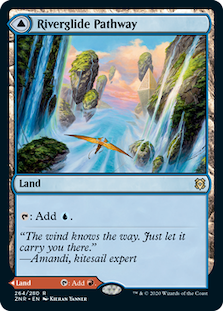
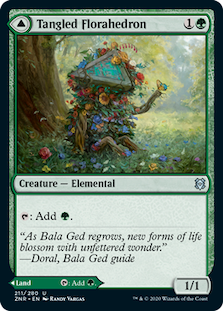
At their most basic, the flipping cards are two-sided lands, giving players the choice of producing one of two colors for a game's entirety (as with Riverglide Pathway). This cycle aims to provide mana fixing, but fixing is already very good in Modern—we've got fastlands of every pair, Horizon lands, and of course the ol' fetch-and-shock. Nonbasic lands need to be quite powerful to merit inclusion in Modern decks, as players open themselves up to hate like Blood Moon and Field of Ruin for running them. I don't think the double-land cards are gonna make it.
Lands n' Spells... At Once

Then there's the spell lands, which enter tapped but can also be cast for an effect. In theory, the idea isn't so splashy, but potentially powerful nonetheless. Having lands that can double as spells lets players functionally play fewer lands in their decks, as it mitigates the risk of flooding. Compare with cycling lands, which do something similar, but still tax pilots mana to draw into another card. Plus, that new card might just be a land, and not a spell!

Whether flip lands beat cycling lands depends mostly on how good the spells on the other side are. And they aren't great. For the most part, these spells are wildly overpriced for their effects, especially since they force players to run taplands.
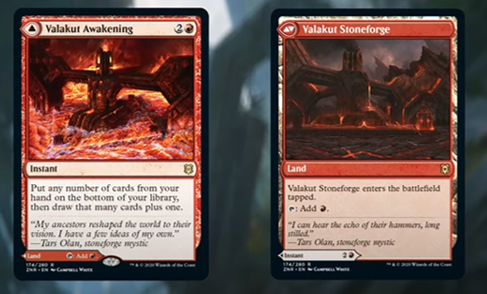
Take Tangled Florahedron. Here we've got a flexible-looking card: players can use it to ramp into four mana, or they can deploy the card as a land if they're light on sources early on. But then there's each side of the card: never would players want to run taplands in Modern, and no deck wants a generic two-mana Llanowar Elves. This is the format of infinite mana via Devoted Druid, after all!

Splashier spells like Valakut Awakening show more promise. Depending on how the rulings will go, a deck like Dredge could bring back the land with Life from the Loam, then cast Awakening for more Dredge triggers. But even that deck now has better things to do at that stage of the game: recur Blast Zone, for instance, or just cast Ox of Agonas for a similar effect that also impacts the board—and a cheaper one, to boot! This line of thought gets more interesting with other land recursion effects, such as Wrenn and Six, but there's no getting around that the new spells in question leave much to be desired.
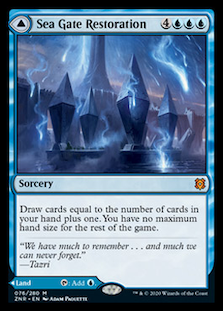
A Mythical Implementation

Yet another cycle of flip lands is the most promising. At mythic rare, this final cycle lets players have the spell land enter untapped, but at the cost of 3 life. That might seem like a lot until one considers these cards have three modes: spell, tapped land, and untapped land. That flexibility makes the steep asking price worthwhile and even desirable in many scenarios.
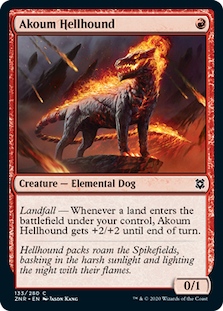
As for the spells, they're a lot more impactful, but mostly finisher-type effects. That means only slower decks will be able to run these. Still, those decks do love a high land count, and not needing to dedicate space to extra finishers—which can be invaluable in grindy mirrors—might merit further exploration.

Let's Double Up

Another exciting development is Rising is the set's plagiarism—that is, its printing of cards that closely resemble existing Modern playables.

Ruin Crab

Hedron Crab? Meet Ruin Crab! Mill decks will love doubling up on their favorite creature, but I think the new Crab's most promising future lies in energizing brews that rely on Hedron Crab for self-mill. What's left of the Hogaak deck will probably want a playset, as well as fringe strategies like Rally the Ancestors.

Akoum Hellhound

Steppe Lynx? Wow, haven't heard that name in a while. That's because Lynx was petty much the only Modern playable landfall creature, and as such, not really worth building around with a high land count: don't draw one of just four copies, and you're playing a Zoo deck full of lands. Yuck!
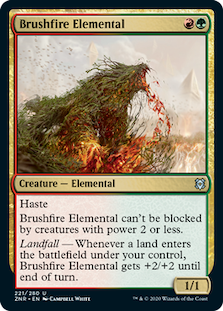
Well, Akoum Hellhound to the rescue! Lynx will certainly benefit from this canine companion, as it does from another somewhat-recent printing: Wrenn and Six. With Wrenn in the mix, a high land count isn't even a prerequisite, as the walker recycles fetchlands every turn.

It helps, too, that Plated Geopede got a makeover in Rising, ditching lame-brain first strike for the broken haste. Here's what I've been messing around with:

8Lynx Blueprint, Jordan Boisvert

Creatures

4 Steppe Lynx
4 Akoum Hellhound
4 Monastery Swiftspear
4 Tarmogoyf
4 Brushfire Elemental

Planeswalkers

4 Wrenn and Six

Artifacts

4 Mishra's Bauble

Instants

4 Manamorphose
4 Lightning Bolt
2 Path to Exile

Sorceries

4 Light Up the Stage
4 Crash Through

Lands

4 Wooded Foothills
4 Arid Mesa
2 Sacred Foundry
1 Temple Garden
1 Stomping Ground
2 Mountain

Yes, that's Tarmogoyf, who effortlessly grows to 5/6 in this build and backs up our fragile landfall clocks by slamming opponents who Fatal Push them. And Monastery Swiftspear, the attacker too good not to run in an aggro shell these days. Manamorphose, Mishra's Bauble, Crash Through, and Light Up the Stage happen to be pretty great alongside Tarmogoyf, too, and giving our landfall guys trample is the sauce. A common curve: T1 Lynx, T2 Goyf/Wrenn/Lynx-plus-removal and swing 4, T3 Brushfire-plus-Crash and swing for a ton.
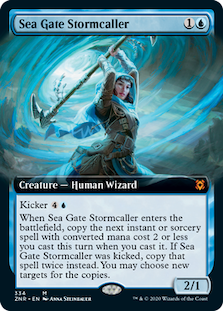
Oh, and yeah, 14 lands. That's the smallest amount I was able to hit by pushing my count lower and lower. Wrenn provides unending land drops, and we've got 12 cantrips, so the unbelievable number plays out fine in practice.

Sea Gate Stormcaller

Snapcaster Mage, meet Sea Gate Stormcaller! Except you play Stormcaller before your spell, not after. And on the same turn. And only on your turn. I'll see myself out.

Nonbasic Hate

One positive development in Rising is the presence of nonbasic land hate. We've seen a bit of this push in the past with printings like Damping Sphere, Field of Ruin, and Alpine Moon, all of which were adapted in some quantity to combat Modern's Tron menace. If you ask me, when it comes to nonbasic land hate, the more the merrier!

Confounding Conundrum

Conundrum replaces itself on resolution, making it relatively splashable. And it incidentally hates on fetchlands, giving it further application in different matchups. And it stacks, making for some very nasty plays with Ghost Quarter & co. Besides that, Conundrum seems tailor-made to fight Uro decks specifically, which are all about land ramping. Whether they can quell the Simic menace remains to be seen.

Cleansing Wildfire

Hierarch, Aribter, Wildfire? Who doesn't want a cantripping Stone Rain? But then, what Hierarch-powered Christmasland scenario doesn't look awesome on paper? Cleansing Wildfire might take a bit more work to get going than Conundrum, but giving red a way to Field of Ruin opponents on a cantrip strikes me as a great way to start spreading nonbasic hate into different deck niches.


The Expediting Continues

Between two-sided cards, classics returning in new and exciting forms, and different colors getting extra ways to interact with enemy land strategies, I'm stoked to see what else Zendikar Rising has to offer. We didn't even get into the party mechanic... but you already know I'ma throw one if we get some cool Rogues to invite! Which new cards have you gearing up for an expedition?

A Breakdown of the Zendikar Adventuring Party Video

Are you a Quiet Speculation member?

If not, now is a perfect time to join up! Our powerful tools, breaking-news analysis, and exclusive Discord channel will make sure you stay up to date and ahead of the curve.

We got quite a lot of information from this video first posted on September 1st, 2020. If you don't like spoilers I suggest you skip this article.


While there is a ton of spoiler information in the video, I'm going to highlight the things I'm most excited about and what speculation opportunities I see due to the new cards.

Zendikar Rising Spoilers

Party Mechanic

At first glance, I almost brushed this mechanic off. The idea is that you need to control multiple creatures with specific creature types to get additional benefits from spells with this mechanic. A party consists of:

  • Cleric
  • Rogue
  • Warrior
  • Wizard

We don't have a lot of cards spoiled that include this mechanic just yet, but some of the first ones are impressive if you can reliably get a full party quickly.

I misread this mechanic at first thinking it was completely broken with Changelings, however, the wording appears to mean that even if you have a creature that meets the subtype requirement multiple times you are still limited to only benefiting from that creature once. This feels like a mechanic that WoTC felt they could push the power level of the cards IF you manage to get a full party only because it will likely be difficult to do so, and equally difficult to maintain it.

Landfall Mechanic Returns

The landfall mechanic appears to be the permanent one associated with the plane of Zendikar. So far, spoilers containing landfall cards have been somewhat sparse and I haven't seen any that make me want to take some action, however, if you were inclined to pick up cheap Azusa, Lost but Seeking wouldn't be a bad call. It's a powerful Commander card that also finds a home in Modern ramp decks that tend to play Primeval Titan.

There was an error retrieving a chart for Azusa, Lost but Seeking

Creature Subtype Matters

While I sort of touched on this with regards to the party mechanic, this set appears to have a lot of dual subtype creatures which opens the door to older cards that interact with any of those subtypes for significant gains. We have already seen Edgewalker spike in price and I expect to see more cards from that era do the same.

There was an error retrieving a chart for Edgewalker

Kicker Returns

I've been a fan of the kicker mechanic since it was first announced in Invasion. Making a spell semi-modal gives players flexibility, something that is highly desirable in a game with a fair amount of variance. My biggest concern with it is that WoTC so far has seemed to be a bit afraid of pushing the boundaries on this mechanic as there have already been 137 cards with the kicker mechanic (or multikicker) and only a small handful ever end up seeing meaningful play in any given format.

"Pog" Lands

I'm not sure what the official name for the new rare dual land cycle is, but I've heard people call them "Pog" lands and I enjoy that nostalgic throwback, so until there is an official name I'm going to stick with that.

These lands serve as "dual lands" when in your hand, but only tap for mana of whichever color you play them as once they leave your hand. This clever design allows players to fix mana the turn they play it but forcing them to live with the decision afterward. I think these lands are hard to evaluate in a vacuum because we don't know how much this restriction will affect deckbuilding. I do think we may see some of the blue options in Merfolk decks as a way to help get around Choke.

On a similar note, there are other dual-faced card lands in the set that instead of having a different land on the back instead have a spell. My two favorites so far are:

While these DFC lands come into play tapped when played as a land, the spell sides seem quite powerful. Regrowth for 1 more mana seems very good later in the game when the additional cost is minimal and the same goes for Valakut Awakening. While some of the other options are a lot less impressive, these two stand out to me so far.

One thing to look for with regards to these lands is older cards that return lands to your hand, as they can potentially sit on the battlefield (protected) from hand disruption, and then if you can return them when you'd like you can cast them when needed.

Expeditions Return

Apparently foil versions will only be available in Collector Boosters, unlike previous Expeditions, which were always foiled. Nonfoil versions will be available in draft/set booster boxes as box toppers. Collector Booster boxes will also include 2 non-foil Expeditions as box toppers. So far we have seen all the Expeditions spoiled, as the video states that there are 30 total and we have 30 spoiled:

  • Scalding Tarn
  • Misty Rainforest
  • Marsh Flats
  • Arid Mesa
  • Verdant Catacombs
  • Polluted Delta
  • Flooded Strand
  • Wooded Foothills
  • Windswept Heath
  • Bloodstained Mire
  • Prismatic Vista
  • Wasteland
  • Strip Mine
  • Cavern of Souls
  • Grove of the Burnwillows
  • Horizon Canopy
  • Luxury Suite
  • Morphic Pool
  • Sea of Clouds
  • Bountiful Promenade
  • Spire Garden
  • Darkslick Shores
  • Copperline Gorge
  • Seachrome Coast
  • Blackcleave Cliffs
  • Razorverge Thicket
  • Valakut, the Molten Pinnacle
  • Creeping Tarpit
  • Celestial Colonnade
  • Ancient Tomb

The List

Lastly, we were told that the set boosters may contain a card from "The List" which seems to be a curated list of 300 cards from Magic's past. The likelihood is apparently around 1 in 4. We got the following 3 cards spoiled from "The List"

  • Food Chain
  • Simian Spirit Guide
  • Slimefoot, the Stowaway

Judging by the images this appears to have the same planeswalker symbol in the bottom left-hand corner that we saw with Mystery Booster cards.

Kaldheim

All we were told about Kaldheim is that it is a Viking themed plane. That isn't a whole lot to work with, but it would make sense to have creature types like warrior or berserker in the plane so for those who really like to gamble look for cards that play with either of those subtypes as potential specs.

Strixhaven: School of Mages

This appears to be a plane with 5 Colleges of Magic. We didn't get much regarding this set, but it would seem likely that wizard might be a prominent creature subtype for this set, so some possible speculation targets might be something like:

There was an error retrieving a chart for Riptide Laboratory

Riptide Laboratory has only 2 printings: Onslaught and Jumpstart. Supply is likely to be pretty minimal of course there is a fair amount of risk that it gets reprinted and the price collapses. This is a card I will have in my card as spoiler season rolls around and should it be eliminated from possible contention in the set I'd probably buy a few copies.

Adventures in the Forgotten Realms

This is the Dungeons and Dragons crossover set. My knowledge on that game is pretty limited to games like Baldur's Gate that came out years ago so I don't have any potential speculation opportunities for this set currently.

Return to Return to Innistrad

While the set names haven't been released yet, there will be 2 sets in a return to Innistrad with 1 focusing on werewolves and the other on vampires both of which are beloved casual tribes so keep an eye out on older cards that interact well with either creature subtype.

Time Spiral Remastered

I actually took a break from Magic during my college years which happened to include the Time Spiral block, so I never got to enjoy drafting the block but have been told it was a lot of fun. Similar to the original Time Spiral block they will include timeshifted cards in the packs that include the old style borders, so artifacts will be brown, etc.

As old-style borders tend to be more desirable to many competitive players there could be certain timeshifted cards from the set that become more valuable than their original printing based solely on the old-style border. We got to see the following cards spoiled as timeshifted:

  • Path to Exile
  • Relentless Rats
  • Chalice of the Void


Why You Should Play Magic Arena

Are you a Quiet Speculation member?

If not, now is a perfect time to join up! Our powerful tools, breaking-news analysis, and exclusive Discord channel will make sure you stay up to date and ahead of the curve.

Hello, everyone! I'm Adrian. I used to cover MTGO content here about two years back and am glad to be sharing new content with you all again – this time about Magic Arena!

Since this is the first week covering this new mode of gameplay, I want to talk more about the pros and cons of Arena itself before we move on to figure out how to best play the game on a budget.

Magic Arena, released back in September 2018, has quickly become the platform where the Magic players compete to become the very best in the world. Especially in 2020, where many events in real life have been postponed or canceled due to the pandemic, social distancing and online business have become even more important nowadays. Most Magic players are no longer able to go out and play paper Magic. Instead, they stay at home and play digital versions of the game.

MTGO used to be a big part of my life, and I invested lots of time and money into it. However, as time went on, I found it difficult to sustain my time and money investments in the game. I'll put it this way: it's not wise to put in so much focus in exchange for virtual items when the economy is affected by COVID-19, which is expected to cause the worst global recession since World War 2. So, I quit MTGO and started playing Arena this year.

Why Choose Arena?

First of all, Arena's model is free-to-play (FTP), although it does offer in-game purchases whereby you can choose to pay to speed up your collection progress. In Arena, it's fine to remain an FTP player – you will encounter a bunch of similar players like this in the game. Instead of winning prizes (i.e., tickets in MTGO), we earn gold and experience from wins to unlock rewards such as cards and packs. Players will only be receiving gold and experience for the first 15 wins daily, which means players cannot progress faster than everyone else by winning more than 15 games a day. Sounds fair in an FTP game model, right?

In Arena, there's no trading system like MTGO. In other words, your collection can only grow and its just a matter of time for players to collect everything they need. Many of you might ask, since there's no trading, why would Arena contents appear on QS? It's simple: we want to share ways to help you get the best returns out of the investment you're putting into the game. If you save $100 after reading articles here, that's an extra $100 in your pocket!

Duplication Protection and Vault Progress

In every card game, having excess copies of a card past a playset is worthless unless you hope to generate value from it. In Arena, duplication protection is something important to be aware of in order to spend fewer resources while getting the same returns. Whenever you crack a pack on Arena, if you are about to open a rare or mythic that you already have, no matter from the same or a different set, the system will exchange it with another card of the same rarity. For example, if you have a playset of Fabled Passage from Throne of Eldraine and you happened to open the same card in M21 pack, you will get another rare insteaaad, until you eventually have playsets of all other rares.

What happens to the duplicate commons and uncommons? Instead of getting replaced by another card, duplicate commons and uncommons contribute to your vault progress.

Another feature of Arena that differs from MTGO is that players get wildcards of each rarity. Wildcards can be exchanged for any card of that particular rarity. When a player's vault progress meter reaches 100 percent, they get three uncommon wildcards, two rare wildcards, and one mythic wildcard. A very common strategy in Draft when one has no playables to choose from is to contribute more to one's vault progress by picking up uncommon chafe over common.

Players on Arena usually don't crack packs before they can guarantee full collections of at least all rares from the set in question. Note that the system only exchanges a card you owned with a card of the same rarity, meaning that if you have not collected all the mythics from the set, opening a rare card will not upgrade it to mythic! Instead, they turn into 20 gems (40 gems for duplicate mythics), which can be used to purchase various virtual items in the Arena store. In my future articles, I will compute the suggested amount of time to put into the game with the goal of collecting at least 98-percent of each set.

Ban List Protection

A ban is one of the most terrible things that can happen on MTGO. Why? Assume you are speculating that a certain card will be banned, say, Embercleave. So you sold off your sets of Embercleave before the B&R announcement, hoping to avoid losses. However, it turns out that Cleave is not banned and its online price went up by 3 tickets! Here, it's technically a loss of 12 tickets if we want to re-purchase a playset of the equipment.

Similar minor losses can happen the opposite way, where we fail to sell a card before B&R news. This is another nightmare scenario – without us even noticing it, the value of our collection might shrink over time to the competitive environment – we can lose a lot of money just from inaction!

None of this happens on Arena. If a card we own is banned, we get wildcards of the same rarity to replace it. If a really good card dodges a ban, it still costs the exact same one wildcard. How great is that? It means we don't need to think twice when we craft a card that we want to play!

Variety of Fresh Formats

The Arena team introduces new, fun formats from time to time, especially for FNM at-home events. Besides the normal formats such as Standard, Historic, and Limited, Arena also boasts:

  • Brawl: Commander deck except they only contains Standard-legal cards,
  • Artisan: Constructed with only commons and uncommons of the legal sets,
  • Event decks: Play an event with pre-constructed decks,
  • More, and most importantly most formats introduced have a low barrier to entry!

If you like Pioneer but you haven't had much chance to play, good news for you: WotC is constantly releasing sets which are Pioneer-legal into Magic Arena. Ideally, the Pioneer format will slowly but surely make its way to Arena.

Conclusion

Magic Arena saves me lots of money and time as a working adult, and I'm still able to have fun playing Magic! What else is more important than that as a Magic player?

Before I end this article, here are some Arena-related topics  items I'm planning to cover in the coming weeks:

  • Whether various sets are worth drafting on Arena.
  • Discussing the amount of time to put into drafting, if a player is interested in completing a particular set.
  • Building competitive yet budget-friendly decks and playtesting them on Arena.

Alright, that's all from me this week. Thanks for reading, and I'll see you again next week!

–Adrian, signing out.

Avatar photo

Adrian Tan

Adrian started playing Magic relatively recently, during Return to Ravnica block. He used to play a lot of paper Magic, but family and work commitments starting at the end of 2016 led to him selling off a large portion of his paper collection to focus on MTGO. He's found speculating on MTGO singles to be a great way to subsidize his gameplay expenses, and he's here to help you go infinite on MTGO!

View More By Adrian Tan

Posted in ArenaTagged , , , , Leave a Comment on Why You Should Play Magic Arena

Have you joined the Quiet Speculation Discord?

If you haven't, you're leaving value on the table! Join our community of experts, enthusiasts, entertainers, and educators and enjoy exclusive podcasts, questions asked and answered, trades, sales, and everything else Discord has to offer.

Want to create content with Quiet Speculation?

All you need to succeed is a passion for Magic: The Gathering, and the ability to write coherently. Share your knowledge of MTG and how you leverage it to win games, get value from your cards – or even turn a profit.

Want Prices?

Browse thousands of prices with the first and most comprehensive MTG Finance tool around.


Trader Tools lists both buylist and retail prices for every MTG card, going back a decade.

Quiet Speculation