Are you a Quiet Speculation member?
If not, now is a perfect time to join up! Our powerful tools, breaking-news analysis, and exclusive Discord channel will make sure you stay up to date and ahead of the curve.
It's the end of June. Normally that wouldn't feel weird to say, but this is a rather unusual year. Where has it gone, and simultaneously why does it feel like it never goes at all? Without paper events as a guide and work disrupted, time is losing meaning to me. Fortunately, I keep being reminded of time as a side effect of tracking metagame changes and data. And therefore it's time to take a look at the overall metagame and try to see where it's heading.
I want to make it clear that I'm not doing a classic-style metagame update. The first reason is that those used a weighting system to reflect the differences between paper and online Magic, which is not applicable right now. Thus, I don't have to do the calculations. The second, and more primary reason, is data points. I only have 295 total decks in my sample, and while that seems like a lot, a good sample for this scale of inquiry should have at least 500 entries, and ideally at least 1000. So when I actually tried to do the stats work, I got a tier list that made no sense. I'm contemplating how to work around this problem for the future, but in the meantime, we still have plenty of juicy data to dive into!
Week of 6/21
I'll begin where I left off last week. I started tracking the weekly results to determine the impact that companions were having on Modern. It ended on a pretty grim note. I kept going to see if the nerf worked. It had, and since it's clear that companions are now just Magic cards, I'm done sorting them out of results. Nothing worth seeing anymore. A consequence of all that inquiry was that I watched how the metagame changed week to week, and observed that since the nerf, Modern had gotten very volatile. The additional week of data confirms that observation.
| Deck Name | Total # |
|---|---|
| Other | 13 |
| Eldrazi Tron | 8 |
| Burn | 6 |
| Ponza | 5 |
| Bant Snow | 4 |
| Humans | 4 |
| Sultai Snow | 4 |
| Toolbox | 3 |
| Amulet Titan | 3 |
| Storm | 3 |
| Mono-Green Tron | 3 |
| Izzet Tempo | 2 |
| Whirza | 2 |
| Kinnan Combo | 2 |
| Infect | 2 |
| Winota | 2 |
| Grixis Death's Shadow | 2 |
| Temur Rec | 2 |
| Dredge | 2 |
| Prowess | 2 |
The first thing I have to address is the numbers. This week, only one Challenge was reported, and the five Preliminaries were pretty small, so I only have 74 results. I suspect that release events for Core 2021 are at fault.
 The second thing is the volatility. Ponza fell to third, Burn rose to second, and all the snow decks lost percentage. Amulet Titan reappeared while Whirza collapsed. Other, made up of all the singleton decks, remains the most populous category by a good margin. What this suggests is that there's no clear best deck in this metagame. Players are seeing success with wide ranges of decks each week. The question will be how sustainable this volatility is.
As a case in point, this week saw two decks built around Kinnan, Bonder Prodigy. I was tempted to lump them in with the Toolbox decks, but these decks weren't built around their tutors. In fact, I think each only had Eldritch Evolution. The same is true for the two Winota, Joiner of Forces decks. This isn't the first time Winota has been in the data, but previous decks had more tutors, and so were classified as Toolbox. These new versions are Zoo decks with a card that's arguably busted, which means they're a different archetype.
June's Aggregate Metagame
If the week-by-week results are unclear, then what about the overall metagame? There's a very clear answer, but it's not what I expected. For this section I combined the results from all the weekly metagame updates. After I calculated the metagame percentages, I lumped all the 2-of decks into Other with the singletons because they were less than 1% of the metagame.
| Deck Name | Total # | Metagame % |
|---|---|---|
| Other | 55 | 18.7 |
| Bant Snow | 28 | 9.5 |
| Eldrazi Tron | 28 | 9.5 |
| Ponza | 27 | 9.2 |
| Burn | 22 | 7.5 |
| Humans | 16 | 5.4 |
| Storm | 13 | 4.4 |
| Toolbox | 13 | 4.4 |
| Dredge | 12 | 4.1 |
| Amulet Titan | 12 | 4.1 |
| Sultai Snow | 11 | 3.7 |
| Whirza | 10 | 3.4 |
| Temur Urza | 8 | 2.7 |
| Prowess | 7 | 2.4 |
| Temur Snow | 5 | 1.7 |
| Mono-Green Tron | 5 | 1.7 |
| Infect | 4 | 1.4 |
| Neobrand | 3 | 1 |
| Sultai Reclamation | 3 | 1 |
| Izzet Tempo | 3 | 1 |
| Unearth | 3 | 1 |
| Ad Nauseam | 3 | 1 |
| Niv 2 Light | 3 | 1 |
Other is the most popular category by far. To be clear, there were 20 decks with two results, so even if I hadn't put them in Other, it would still be the largest category. This strongly indicates that there is great diversity in the metagame and that brewers are finding success with offbeat decks. That fact normally indicates overall metagame health.
 As for the individual decks, there are some stark divisions in the data. Four decks posted 22+ results in June, and then there's a sheer drop off to Humans with 16. If you were to twist my arm for a tier list, I would put Bant Snow, Eldrazi Tron, Ponza, and Burn in Tier 1. Humans would be Tier 1.5 in my book, with all the decks with 10-13 results constituting Tier 2. I'm saying this rather than giving a mathematical answer because my calculation put Tier 1 at only the top 3 decks and Tier 2 was Burn, Humans, Storm, and Toolbox. I haven't had time to figure out if this is a function of the methodology being inappropriate or if I messed up somewhere.
In either case, the metagame has definitely slowed down without companions. June's metagame was similar to, though not exactly the same as, the pre-companion metagame. Slower decks had the advantage while aggro and combo were looking for a way into the metagame. What that means for July is unclear.
Where's it Going?
I know this heading title sounds like a rhetorical question, but I'm being genuine. As I was putting this all together, it became clear that Modern is now in wild flux. The power rankings don't accurately reflect the reality of the metagame. This makes perfect sense, as they're an aggregation meant to show the overall trend rather than reflect dynamic reality. Looking at the specifics of the data raises a lot of questions about those aggregate results. Take this graph showing the top five decks from the power rankings by weekly metagame percentage.
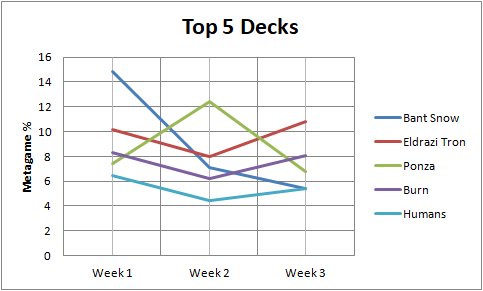
As shown, every deck's been up and down. None more than Bant Snow, which simply collapsed after week 1. Were it not for that exceptional first week, it would not be tied for first place. In fact, that week 1 result is so out of line with what Bant Snow managed in subsequent weeks that I'm inclined to think of it as an outlier. That ~15% was likely not a function of Bant Snow's positioning or metagame but rather population based. The fact that Snow as a whole declined in week 3 along with supposed predator Ponza supports this theory.
It's equally possible that the small sample size of week 3 impacted the results. However, that wouldn't change the overall picture of a very volatile metagame. As previously noted, players are seeing success with many different decks. The Other category is filled with decks that put up results once, then disappeared again. New decks have decent individual weeks, disappear, then reappear. And the top deck changes wildly between weeks. This tells me that there really isn't a metagame yet. Players are still trying to figure out what's good now, and that answer remains elusive.
What it Means
 Right now is the time for brewing. If you've got the cards online, I'd recommend trying out that whacky idea you've been sitting on for awhile. It can't be weirder than the decks that have actually made the data. They've run the gauntlet from Toolbox decks that I can't find their combo kills to strange configurations of Mill to a straight port of Pioneer Inverter of Truth combo. Seriously, the only difference I remember is fetchlands. The best part is that everyone else is experimenting and looking for the new best decks, so even if your idea is half-baked, it's no less wonky than everything else.
Looking Ahead
However, nothing lasts forever. This Wild West will have to come to an end eventually. I don't know how it will end, but I am certain that Eldrazi Tron will hold a niche in that new world. Eldrazi have always been a significant part of the online metagame, even though they're inconsistent at best in paper. Furthermore, it looks like Chalice of the Void is a decent card again. The Eldrazi have lost a lot of their bite over the years, but Eldrazi Tron is always the best Chalice deck. When Chalice is good, so is E-Tron. I don't know if that's actually the case given the overall volatility, but players clearly think it's true. We'll have to keep watch.
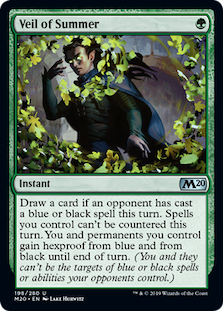
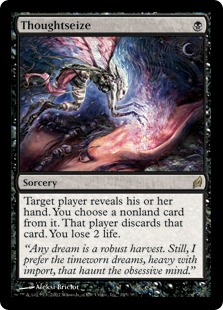 The second observation is that targeted discard is at an all-time low in Modern. Jund and Grixis Death's Shadow are nowhere to be found. Sultai Snow doesn't always run Inquisition of Kozilek or Thoughseize maindeck, and is a small part of the metagame anyway. I suspect Snow decks being mainly 2-for-1's is a significant factor, as is Inquisition being bad against Eldrazi. Plus, Veil of Summer, anyone? Now is the time to break out decks that are weak to discard.
The third thing is that Big Mana is retreating. Eldrazi Tron doesn't count as it can't get big mana consistently. It's a beatdown deck with acceleration. Amulet Titan has fallen from the top of the metagame, and is now where I think it has always actually been. However, I've never considered normal Tron to be overrated or badly positioned. And yet it's just gone. Snow decks have upped their counters and run Field of Ruin, but they're a very small part of the metagame, so I'm mystified by Tron's fall.
Where I'm Heading
These trends are pushing me to actually put some money into MTGO and get a new deck. I already had Humans from years of playing MTGO drafts when the lockdown happened and paper Magic stopped. Not wanting to put money into digital cards, I've just been playing Humans. And it hasn't gone well recently. I was very surprised to see Humans as the fifth-place deck in the standings because I've had terrible results recently.
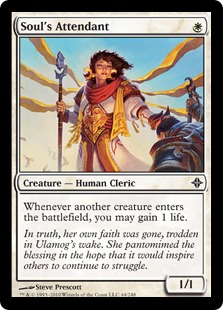 Part of that has been on me. I play sloppier online than in paper. I'm not sure why, though the anonymity plays a part. In paper, if I mess up, I'll hear about it for weeks. Online, nobody knows you, so it's easy to just move on. I'm also doing nothing else when playing paper, and so focus more. I got a lot of other stuff distracting me on my computer. I've also had a run of terrible luck. Lots and lots of flood-outs and runs of terrible-but-fringe matchup after terrible-but-fringe matchup. Culminating in a League where I hit five Soul Sisters decks, flooded to death in each, and they hit multiple Path to Exile every game.
More importantly, but less cathartically, Humans has felt poorly positioned to me. A lot of the appeal of the deck is its fast clock and disruption. This makes it very strong against combo and control decks with limited sweepers. Which is exactly the metagame that we had until recently. Meddling Mage is very good against Amulet Titan. However, Humans is not and has never been very good against waves of spot removal, and that's what's seeing more play. Sultai Snow is very Jund-like, and the various Izzet decks that are creeping in have full sets of Lightning Bolt and Lava Dart. However, this meta is looking favorable for an old friend.
Updating Spirits
I quit playing Spirits when Big Mana and discard decks took off in the last third of last year. Spirits' clock was too slow to contend with Amulet Titan, even with Damping Sphere, and discard is a nightmare for a deck that wants to hold cards in hand until the time is right. Humans dodges both problems and so was the better deck. Now that everything's shifting, I'm looking back at my old standby.
UW Spirits, Test Deck
I'm on Moorland Haunt and Mutavault over Field of Ruin thanks to the aforementioned fall off in Tron. Haunt is an exceptional tool in grindy matchups, and key to forcing my way through Ice-Fang Coatl. It's even better since I'm not running Rest in Peace at the moment. Without Jund or Dredge, the need for long term persistent graveyard hate is down. Grafdigger's Cage is far more useful in more matchups. I'm still testing, but Spirits loves a meta full of durdle, and Spell Queller targets.
Take Advantage
The June meta clearly shows that Modern is in flux. This cannot last, but since Wizards attention is focused solely on Arena (and I'm not sure it's working out) Modern will have more breathing room than normal. Without the spotlight, there's time to experiment. We'll see how this affects July's metagame in a month.


 The data is from the two full weeks since the
  shouldn't be surprising. It's been putting in strong online showings for a long time, though that
  As for the overall metagame, it is far too soon to tell. Again, it's obvious just by looking at the standings that the metagame is far out of equilibrium and is trying to sort itself out. The only clear trends so far are GBx and Prowess disappearing: I have exactly one Jund deck in either sample.
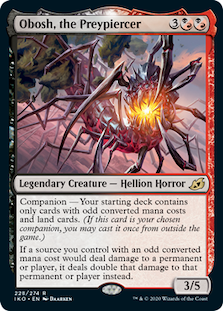 Oh boy, was I ever wrong here. I thought that Obosh Ponza would just keep on keeping on. Instead, only one deck kept the companion. I don't need to guess; I know why I was wrong. I thought the only card lost to Obosh was Chandra, Torch of Defiance, and that's not too burdensome. I forgot that Ponza ran Bloodbraid Elf before companions. Elf's a

 In "
In "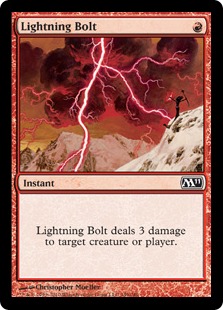 Unlike Stage 1 creatures, which are happy to trade at parity with removal, Stage 2 threats ask too much investment to incentivize such an exchange. As such, all of Modern's played Stage 2 beaters have built-in ways to sidestep Modern's most centralizing removal spell, if not card: Lightning Bolt.
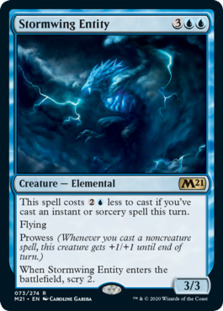
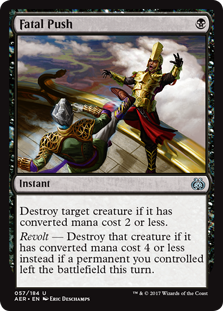 feel like keeping a land untapped, they can threaten to "counter" the instant by simply casting a cantrip, hurling opponents into a mind game: do they risk losing their Bolt for a shot at killing Entity before its controller draws more instants? Or hold out for a tap-down moment? And as for those, "free" spells like Gut Shot can buff Entity even without mana available.
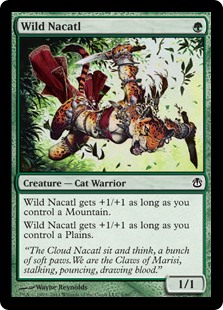 Even ignoring removal, 3/3 is not great stats for a Stage 2 creature. And while Entity can play defense in a pinch, needing to throw spells around every enemy combat step to have more than a Wild Nacatl to work with isn't exactly reliable. Rather, Entity shines on offense, where it clocks better than most Stage 2 creatures.
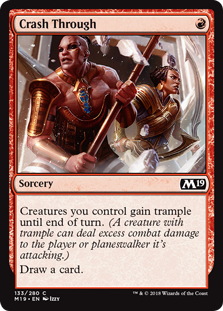 Also contributing to Entity's offensive standing is its evergreen keyword. Currently, Monastery Swiftspear, Soul-Scar Mage, and Bedlam Reveler are the prowess creatures played in Modern, and none of them have flying. But flying makes a world of difference! Those creatures are all played despite the fact that a chump block throws into question the string of spells cast before combat, requiring players to dip into Crash Through to make prowess worthwhile. That's not a great plan simply because it's not very reliable, but indeed, prowess and evasion are superb together. In essence, Entity comes pre-packaged with a Crash Through for every turn, as few blockers fly, and those that do are easily shot down with burn or other removal. When was the last time you saw a Lingering Souls?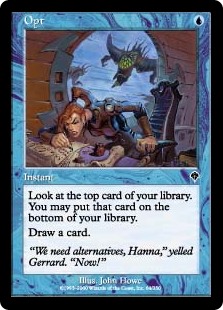
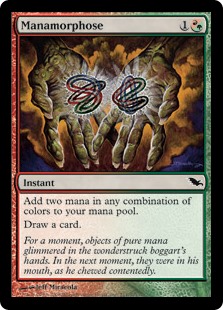 More critically, players need to cast an instant or sorcery on their turn to cast Stormwing for 1U. On its face, that would make the creature cost a functional three mana, since Modern's cheapest instants and sorceries cost 1. But there are some free options to consider (RIP Gitaxian Probe). Best of all is Manamorphose, which replaces itself while happily popping out Stormwing on turn two. I think any deck running 3+ Stormwing will want a full set of these. Phyrexian mana spells can also work, but they're much more conditional; burning Gut Shot with no creature target is less-than-ideal, for instance, although shooting a mana dork and following up with Stormwing is the dream for sure.
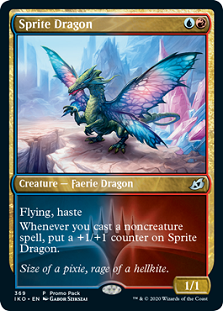 Why, Delver, of course! Okay, so the strategy isn't exactly starved for Stage 2 beaters—Temur has Tarmogoyf, and
 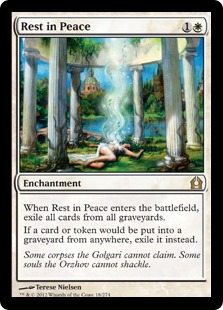 Rest in Peace has long been a nightmare for Temur decks, which lean more graveyard-heavy than most aggro strategies thanks to a reliance on Tarmogoyf. And Goyf itself
  I went with green over black as a third color for a few reasons. First,
 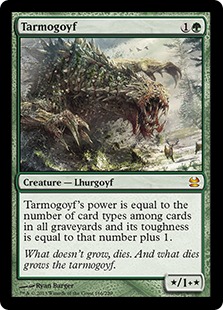 But there's something to be said for how no-questions-asked Tarmogoyf is, plopping down on turn two pretty much no matter what and starting to apply pressure. Besides, not all decks play Fatal Push! I started with one copy, moved up to two, and recently trimmed the fourth Entity for Goyf #3. I'd finally felt like enough reps had been achieved that I didn't need to keep Entity at 4 for the sole purpose of grinding numbers with it, and I think the deck runs smoother with fewer birds; otherwise, they can clog in the early game, unlike Tarmogoyf.
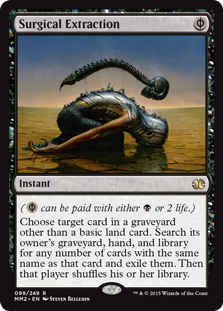 Being able to rely on scry 2 triggers from Entity, as well as the filtering offered by all those cantrips, makes the deck apt at running surgical bullets. In the main, I limited these to a Vapor Snag and a Snapcaster Mage, but the sideboard is full of one-ofs with varying degrees of relevance depending on the situation.
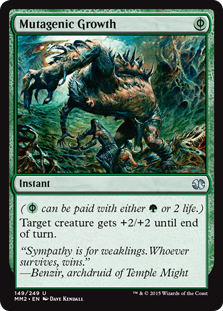 The one Phyrexian spell that does make the mainboard is Mutagenic Growth. In a pinch, Growth can target an enemy creature (or our own Delver) to rush out Stormwing. But more often, the instant protects the Stormwing we tapped out for from Lightning Bolt. It does the same for a flipped Delver. In non-Bolt matchups, Bolt's not entirely dead, either; when growing a swinging Stormwing, it's Lava Spike, and can otherwise accelerate into Hooting Mandrills when we're trying to build a board against linear combo or help
 difference between getting a land drop and casting spells and an even greater one,
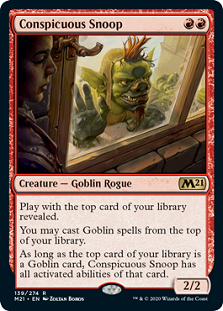
  you have an arbitrarily large number of Snoops.
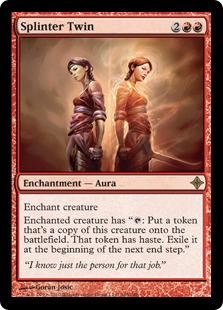 Pestermite plus Splinter Twin equals an actual win. Counters combo consists of Druid plus Vizier of Remedies, but winning requires at least one more card. The combo just makes infinite mana.
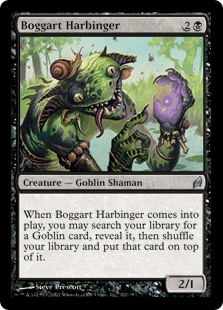
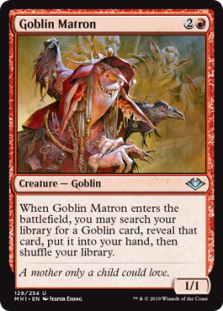 Then there's the issue of the cards themselves. Boggart Harbinger is not a good card. If it was, it would have seen play before Goblin Matron was reprinted. Demonic Tutor is far more powerful than Vampiric Tutor for a reason. Harbinger's only advantage is the extra point of power and the combo. Twin is also not a very good card in a vacuum, but at least it has some unique utility with any creature rather than being a worse version of another card.
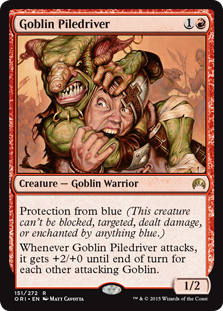 However, slightly-worse-Twin is not an indictment. When it comes together, it's phenomenal. And plugs a strategic hole in Goblins. Whether in Modern or Legacy, Goblins is strong against slow decks, but folds to combo. Goblins's clock is surprisingly slow and can only really race with multiple Goblin Piledrivers. Instead, Goblins grinds with Mogg War Marshall, Goblin Matron, and Goblin Ringleader. My
 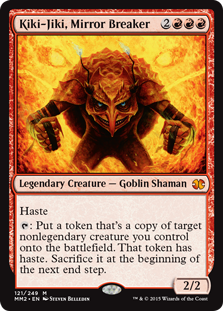 As for the combo, Harbinger was as poor as previously described. And also worse because it was clogging up my hand a lot. Goblins is already a top-heavy deck, and Harbinger made it worse. Not just by also costing three, but by making the card flow worse. Since Matron tutors to hand, it is actually card advantage, and more importantly leaves the chance to draw something you need open. Harbinger isn't card advantage, just delayed selection, and dictates your draw step. This isn't inherently bad unless you need to find a string of cards to get back in the game. Harbinger can be actively harmful in those instances. And shaving a Ringleader to stop drawing all my Kiki-Jiki's was a huge mistake.
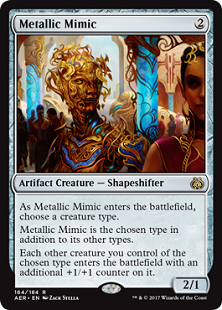 I stuck with Metallic Mimic for my persist combo piece rather play Grumgully, the Generous. Part of that was fitting the green proved tricky. Goblin decks are mana-hungry, and I was really straining the color balance and life total to make it happen. The primary reason was curve. Again, Goblins has a lot of three drops as is, and hands can get clogged when they're not just clunky. Even when I ran Vial, there were lots of hands that just didn't do anything because of all the threes. Grumgully is very good because it can be tutored, but until the curve problems get worked out, I'm staying away.
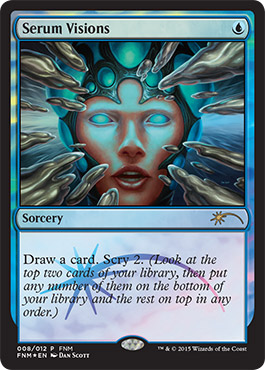 This was not a good deck. It didn't have enough interaction to shut down opposing decks, and the threats were too weak to push through. It had to combo to win most of the time, and that didn't happen consistently enough. The problem is that outside the tribal shell, Snoop is just a 2/2 that can combo. It's far too anemic to be a threat on its own, and the goblin density is too low to consistently hit anything in a typical game. Harbinger is in the same boat. Perhaps in a Grixis list with cantrips it could work, but I can't imagine that deck being better than Death's Shadow.
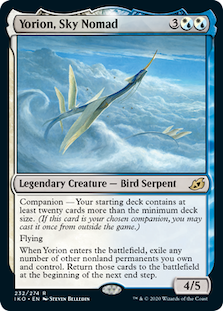 Here’s a quote from my last piece:
 Yorion decks all play with tempo in some way: they tend to try delaying the game until they can cast and resolve Yorion, Sky Nomad and reap the value of blinking their cantripping permanents, not to mention the sudden board boost of a 4/5 flier. Then, they often continue using disruptive tactics to help their clock get there.
 While Urza
 This
This 
 Reclamation isn’t the only strategy that can make use of some land-ramping, and


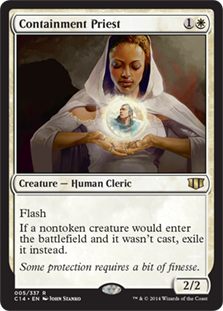 Priest will see play in Modern because it has already seen play in Legacy and Vintage. In both formats, Priest is a huge beating against Dredge and nothing else, leaving decks free to exploit their own graveyards while hosing the most linear of zone abusers. Modern
 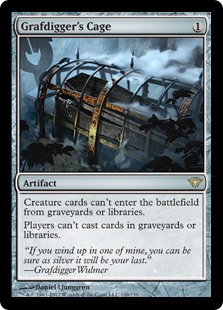 Beyond belonging for its cost and creature-type, Priest is also a substantial upgrade for Humans's current options. Rest in Peace is the best graveyard hate option, but it can't fit everywhere. In Humans' case, Surgical Extraction has
 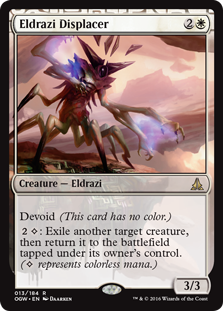 combining Priest with Eldrazi Displacer to snipe every opposing creature. Just never, ever, try to flicker your own creatures (except for Priest).
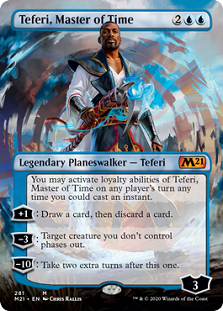 The next contender is yet another Teferi with a static ability. Because everyone just loves Teferi, Time Raveler. In fairness, this new one is not at all as obviously onerous as "T3feri," and was made before Wizards realized their mistake.
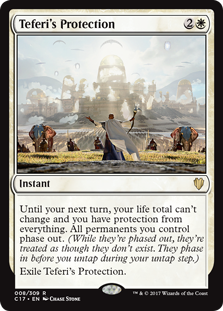 At the start of its controller's untap step, when normally nothing happens and no player has priority, it phases in, unless otherwise specified. It's not entering the battlefield because it never left, so no triggers happen. It simply "exists" again. Wizards is explicitly
 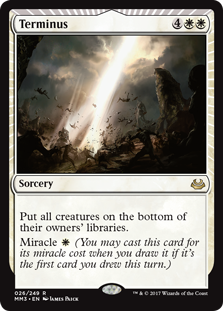 then wiping the board on the opponent's attack step. And that can happen, but I skeptically ask how that's in any way better than just playing Jace, the Mind Sculptor?
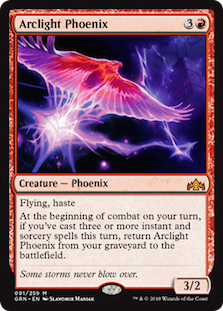 However, outside of control decks, there is real potential. Getting to Careful Study over the course of a turn cycle is still very strong. And doing so gives Te4ri five loyalty to boot. I could easily see a velocity- or tempo-centric deck using Te4ri as a top end engine to help power them through the mid-game. It's nowhere near as good as Faithless Looting and so I don't think that Izzet Phoenix will suddenly return. However, something in a similar vein using Thing in the Ice and Crackling Drake is more plausible.
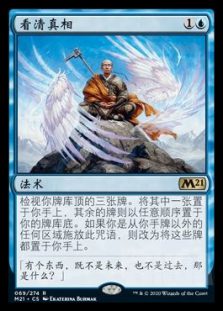 chance. However, See has a second mode. When cast from anywhere other than hand (read: exile, library, or graveyard), it draws three. Ancestral Recall is still a bargain at two mana. The trick is making it happen.
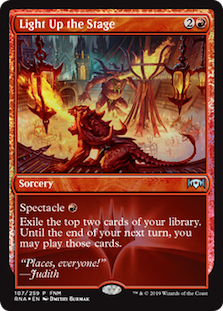 then draw a bunch of fuel. The catch is that flashing back Storm's cantrips are usually enough fuel as is, so I don't think See adds much. It doesn't hurt much either. I'd have to test, but intuitively I think See is too win-more to make an impact on Storm.