menu

Insider: Artful Maneuvers – Selling Your Altered Cards

Are you a Quiet Speculation member?

If not, now is a perfect time to join up! Our powerful tools, breaking-news analysis, and exclusive Discord channel will make sure you stay up to date and ahead of the curve.

After last week's article about trading altered cards, there were a few points that were raised which I'd like to address before we move on to selling cards.

The first point addressed prices for trade versus prices for sale. For the most part I use the same price. While it is more work to turn cards that I've received in trades into cash, I also find that this is a great way to trade for the cards I would be painting anyway. You will need a steady source of cards to paint if you plan to make a business out of this. In the end though, you will need to turn those cards into cash and that is where this week's article comes in.

The second issue is one of condition. This is simple--once you paint on a card then it is ruined. So when using the pricing formula from last week you always choose the price for a mint card. The scratches on the back are no longer relevant as these cards must be played in sleeves to be legal. Anyone who argues condition with you at this point should be reminded that there is paint all over the card.

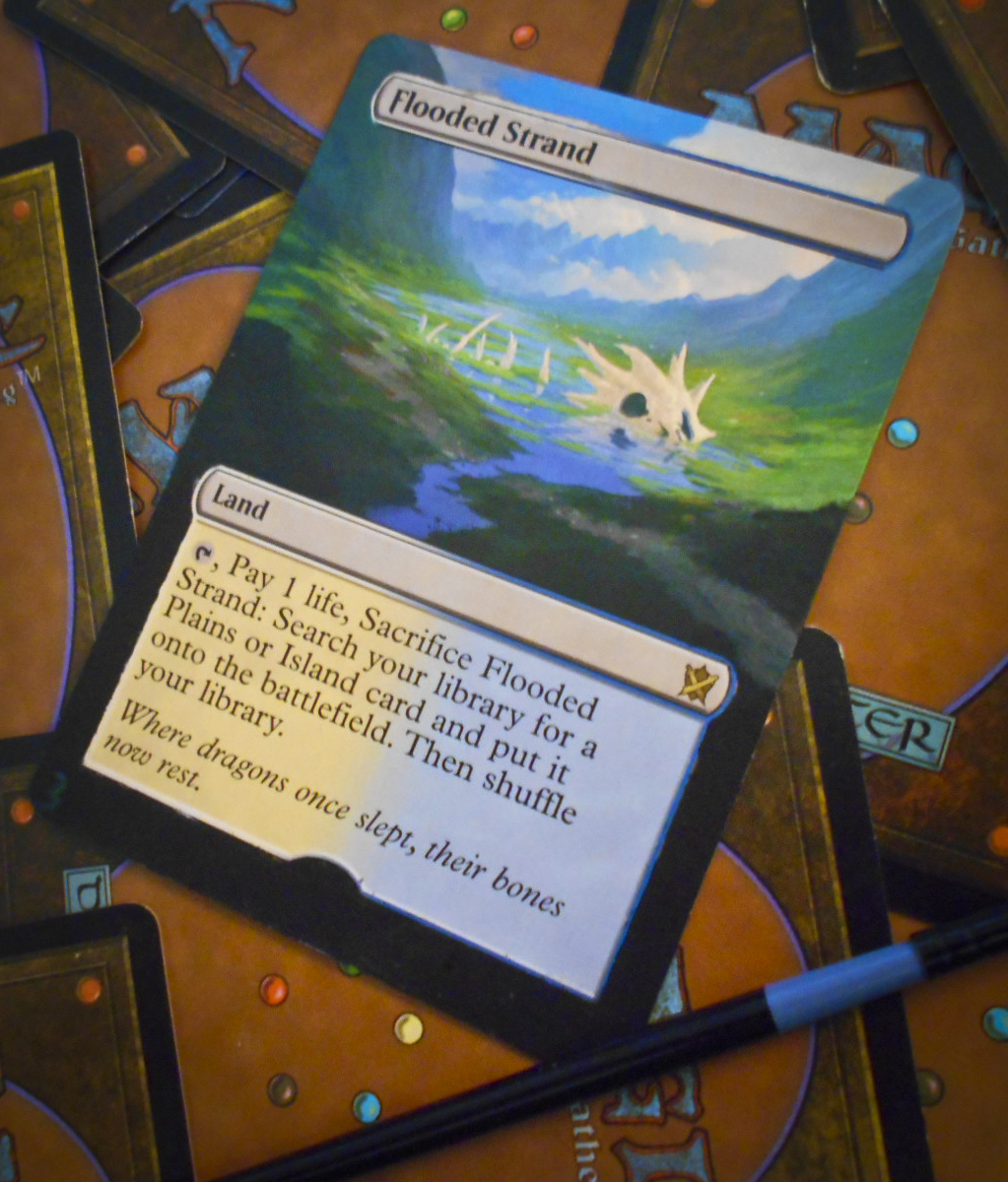
Flooded Strand
Flooded Strand that I painted at my table during a recent midnight prerelease.
The last point addresses issues with tournament organizers and shop owners. A number of problems can be avoided by simply explaining things to the T.O. or store manager that you plan to be working around.

Most people are very reasonable once they know what is going on, but if an owner walks by and see's a binder full of cards with price tags then they certainly have reason to be suspicious. When going to a new or unfamiliar venue you should make it a point to introduce yourself to the various people in charge and explain that the prices in your trade binder are simply for ease of reference.

If they ask you to remove the prices, then so be it. It is their store and as guests we must respect their rules. Either way, you have now started a very important business relationship on the right foot.

Until you have enough inventory, start-up capital, and time to open your own store (brick and mortar or online) then you will likely be conducting much of your business in other peoples' stores. Building relationships with the store owners is a valuable concept for anyone in finance, but more so for the local alterist. It opens up more doors for selling and advertising our work.

Consignment

This brings us to our first cash outlet for alters. Consignment deals in local shops can be beneficial for both parties. My local shop allows me to showcase altered cards in their displays. The store sells them and takes a certain percentage and I get the rest of the cash.

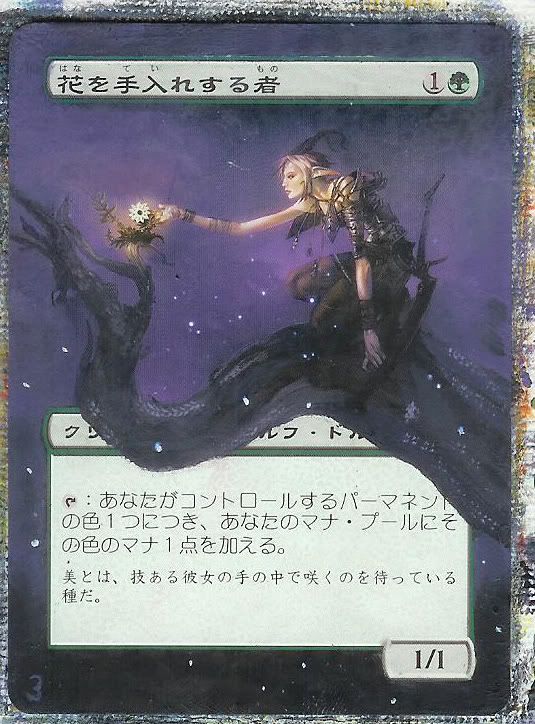
Bloom Tender
Bloom Tender is a simple but eye-catching alter and is popular for EDH and Tiny Leaders.
An agreement like this allows the store to sell a unique product and make a small amount of money for their trouble. Aside from the obvious benefit of having an outlet to sell their work, the artist now has their cards in front of the hundreds of people that take the time to look in the showcase. There are no listing, or rental fees for this advertisement.

In fact, you may even be able to place a small note stating that you accept commissions with your contact info. All of this advertisement is certainly worth the 15% consignment fee.

Additionally, you may inquire about setting up a table or booth for a large event at the store. In my experience, if you can convince the store or T.O. that you will be out of the way then these can be very cheap if not free!

This is a great way to sell your alters and gain a lot of commission work. It is important to plan ahead with your T.O. and discuss any fees or questions well ahead of time so that there are no surprises.

Speaking of Fees...

Selling online is by far the easiest way to sell, but also the most treacherous. I'm sure as a financially-minded person, you, the reader, are well aware of listing fees, final value fees, and other various taxes associated with online sales. Remember these when trying to sell and remember that your $12 card may only net you $10 cash when sold.

When selling on eBay or other auction sites you must also be prepared for your work to occasionally sell at $0.99. You can avoid this by setting your beginning price at whatever floor you feel comfortable with, however you may lose many bids or viewers doing this.

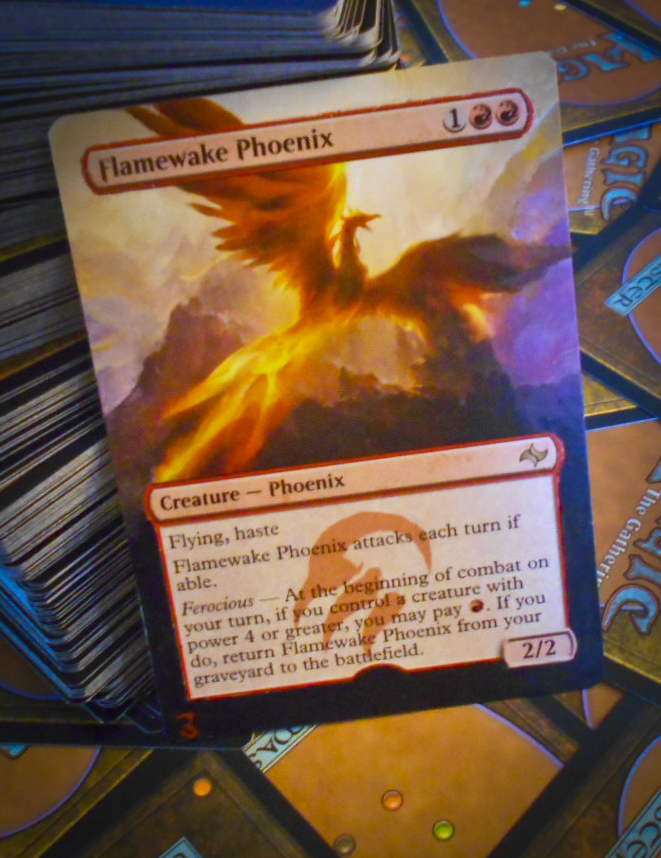
Flamewake Phoenix1-1
I can barely ever keep altered Flamewake Phoenix in my binder.
My favorite way to sell online is through ETSY. The fees are less than other places and they deposit the money directly to your bank account. (At this juncture I'd like to point out that I am not paid by nor do I represent ETSY, I just keep a small shop on their site.)

Regardless of how you sell your work, it is always important to keep a professional attitude. You are not only representing yourself and your own business, but perhaps the local shop that has allowed you space in their very crowded singles case. You attract more flies with honey, and if people like you then they will be more willing to work with you in the future.

I'll start painting again next week. Make sure you pick up that Rattleclaw Mystic I warned you about so that you can follow along.

Insider: Non-MTGO Players’ Guide to MTGO

Are you a Quiet Speculation member?

If not, now is a perfect time to join up! Our powerful tools, breaking-news analysis, and exclusive Discord channel will make sure you stay up to date and ahead of the curve.

Welcome back readers! Hopefully the title this week says it all. In the last two weeks I jumped onto the MTGO train, though not in the ways many might expect. Despite my love of eternal formats and Commander, I have no intention (currently) of converting into an MTGO player. Then what is the point of this article, you might ask. Well, my jump into MTGO is a purely financial one.

MTGO offers many things I wish real world MTG was. Especially the MTGO trading system, which is equivalent to having a GP-sized trade area complete with multiple vendors and prices readily available. Even more importantly it's extremely easy to compare prices (thanks to the search feature), which is absolutely critical when you're trying to maximize your profit.

MTGO trades occur instantaneously, similar to the stock market. If I buy/trade for something on MTGO I own it immediately--there is no concern about them shipping the card while its price continues to rise thanks to the PT, or the like. This also means (to me) that locking in profit is much easier and can allow for lower profit margins per transaction because you have a lot more potential transactions thanks to the "always on" aspect of MTGO.

Now before I delve into my experience thus far, I feel it's important to explain why I felt the need to join MTGO despite numerous complaints about its overall architecture and numerous functionality issues.

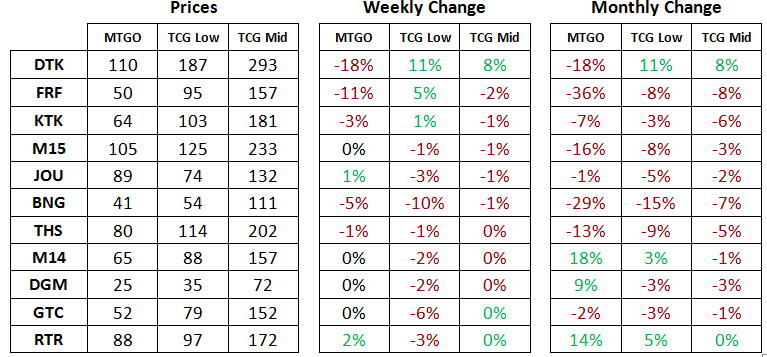
It all began with Matt and Sylvain's "MTGO Market Report for April 15th, 2015". Every time they run this article series they post a graphic like the one below:

MTGO changes

The first major thing that I noticed was the huge discrepancy between the MTGO price of a full set of FRF and the TCG Mid (which is what I typically trade at). Looking up the redemption policies here, I figured out that it would cost me $25 in redemption fees + $2.99 in shipping. Thus a full set of FRF could be acquired for $77.99, which is still cheaper than the TCG Low price of the whole set.

The other important factor to me was that FRF as a set has a lot of its money tied up in just a few cards. This is not one of those sets with a ton of $5-10 cards in it, but rather one with a $30+ card, two $15 cards, one $10 card, and several $5+ cards. This is critical because it means you don't have to sell a ton of the cards to break even. I also noticed that locally, no store can keep Ugin's in stock, so being the person with them would give me a lot of leverage with the local player base.

The next step was to download MTGO, which you can do here. It's a bit awkward that they charge you before you even get to try it out, but $10 isn't going to break the bank and you do get $5 worth of event tickets on your account. So right now the financials of MTGO are -$10. However, the old adage that "you gotta spend money to make money" seems apropos here.

WoTC will let you convert your money straight into event tickets, but luckily there's a thriving MTGO economy outside of that specific avenue and the going rate is a bit lower. I was able to buy tickets from a fellow QS member for $0.93 per ticket, (so 93% of the typical cost).

For those interested in how to do this here are the steps:

  1. Find your seller (your best bet is the Exchange forums here on QS, but I did have to wait a few days until someone responded to my request to buy tickets--sometimes the exchange is more active than others). I emphasize this because depending on how you go about it, you may have to send your money first, which puts the risk of being ripped off on you. Thus it's important to deal with someone you feel is trustworthy (like someone who pays to be on QS and values their reputation).
  2. Send your money (this may occur after you get your tickets, depending on how you and your seller coordinate).
  3. Log onto MTGO, add the seller to your buddy list (for convenience). Assuming your trade is in real time, they should have a green circle next to their name. You then right click their name and scroll down to "trade".
  4. You should see the event tickets in their account. You then drag the tickets into the "Trade to you" category, and you can right click on their event tickets and go 10 at a time (which is very helpful when buying a bunch of tickets). Then you hit submit and wait for them to accept.
  5. Send your money (if you didn't do this in step 2).
  6. Go to the trade screen again (which looks like this).
  7. MTGO interface
  8. Add what you want to buy (in my case it was FRF Sets) into the search filter in the upper left hand corner and hit enter. Now you can see all the bots selling full sets of the set you've chosen.
  9. Scroll through and find the best price (I bought mine from GoatbotsFullSets).
  10. There is a limit to how many cards you can get at one time, so you might be forced to do several transactions, but in order to make sure you get everything hit "ctrl+A" for a select all and pull one set at a time into your "trade for" section. Depending on the set, you may be able to get 1-2 sets at a time (due to the card limit). Then the bot will calculate how many tickets you owe and you simply follow the same trade procedure mentioned above.

At the time of buying my tickets, the going rate for FRF sets was down to 46.5 tickets per set, so I purchased enough tickets so that I could buy four full sets with a few left over just in case.

46.5*4=186 tickets * $0.93= $173

So my current total investment is -$183. 

The next step is redeeming them. In order to do this, simply go over to the "store page" and click on the redemption option in the upper left corner (seen below).

redemption page

You simply click on the set icon that you want to buy and pay your $25 times how ever many sets you purchased. Once you do that, MTGO will verify that you have the cards for all the sets and then process your payment with a $2.99 shipping fee added.

Note that the $2.99 fee is not based on a "per set" basis, so you don't pay $2.99 for one set and $5.98 for two...you simply pay $2.99 (though I've heard the rate changes when you redeem 100+ sets). This is important because it's much smarter to redeem a bunch of sets at once than one at a time.

Updated total cost: -$286

Once paid, I got my email from WoTC within a day or two. The sets shipped out of Texas and arrived (to me) within four days (which is considerably faster than the previous 4-8 weeks others used to complain about).

mtgo shipping

I emphasize the speed of delivery because this really does seem like a great way for stores to restock on cards if the demand is high enough that players aren't trading/selling them into the store. As a store owner it's critical to have a good offering of singles, as that tends to be where a majority of store profits are made.

I still have 4 Tix left, so my final cost per FRF set is roughly $69.75 per set. As of my typing this up the TCG Mid prices of the top 10 cards in the set are:

  1. Ugin: $30.87
  2. Monastery Mentor: $15.56
  3. Soulfire Grandmaster: $10.99
  4. Whisperwood Elemental: $11.2
  5. Tasigur, the Golden Fang: $6.36
  6. Warden of the First Tree: $4.11
  7. Brutal Hordechief: $4.34
  8. Shaman of the Great Hunt: $4
  9. Crux of Fate: $3.29
  10. Valorous Stance: $2.38

I break even if I can sell the top five cards of the set (which actually leads to a $5 profit).

A word of caution; it is my belief that FRF is special in that the top five cards alone allow one to generate a profit and that the paper prices can change as the metagame shifts. However, I feel like FRF as a set actually has a lot of good mythics with potential that hasn't been seen yet, so (to me at least) it appears to be a solid investment. And as shown, I've put my money where my mouth is on this one.

Avatar photo

David Schumann

David started playing Magic in the days of Fifth Edition, with a hiatus between Judgment to Shards. He's been playing Commander since 2009 and Legacy since 2010.

View More By David Schumann

Posted in Buying, Finance, Free Insider, MTGO5 Comments on Insider: Non-MTGO Players’ Guide to MTGO

Have you joined the Quiet Speculation Discord?

If you haven't, you're leaving value on the table! Join our community of experts, enthusiasts, entertainers, and educators and enjoy exclusive podcasts, questions asked and answered, trades, sales, and everything else Discord has to offer.

Want to create content with Quiet Speculation?

All you need to succeed is a passion for Magic: The Gathering, and the ability to write coherently. Share your knowledge of MTG and how you leverage it to win games, get value from your cards – or even turn a profit.

Tuning the Grixis Delver Sideboard

Are you a Quiet Speculation member?

If not, now is a perfect time to join up! Our powerful tools, breaking-news analysis, and exclusive Discord channel will make sure you stay up to date and ahead of the curve.

It's no secret I'm a big fan of Grixis Delver. This isn't because Grixis Delver is the best deck in the format: although it has killer Twin and Affinity matchups, it struggles with Abzan and Burn. It's also not because I'm one of those Treasure Cruise ex-pats from winter 2014 (I hated that card). I love Grixis Delver because it showcases the best in Modern innovation and deckbuilding. The deck exploded on the MTGO scene almost entirely based on the average Magic player, an evolution I discuss in an article on the deck's history. Although the deck is still making paper inroads, and players are still trying to figure out the best list, Grixis Delver has a lot of promise for the next few months. But as any competitive player knows, you can't get through tournamets on a strong game 1 alone. Sideboards and games 2 and 3 are much more important, and a real place for decks to improve their matchups and either seal a match or recover from a bad game 1.

Negate Art

This article is about fine-tuning the Grixis Delver sideboard. Sideboarding is one of the most underappreciated parts of deck building, particularly by the average Modern player without a lot of tournament (let alone professional) MTG experience. Although it's important to have a strong maindeck as your core, it's just as important, if not more important, to have a strong sideboard that fixes bad matchups and solidifies good ones. If we can sharpen up the Grixis Delver sideboard, we can dramatically improve our chances of taking this deck to a strong tournament finish.

[wp_ad_camp_1]


Identifying Key Matchups

Modern is one of the hardest formats for sideboarding. There are lots of decks to consider, lots of high impact cards to squeeze in, and lots of matchups that come down to one or two decisive cards. Players at all levels of Modern have weighed in on these issues, and although I don't want to speak too much to this conversation, I do want to acknowledge it as a shaping element of sideboarding. This is perhaps more important with Grixis Delver than a lot of other decks because Grixis Delver has some very polarizing matchups we need to address.

In my most recent article on win rates, I used data from MTGO to analyze matchups between key decks. Based on these findings, and from our own more qualitative experiences with the deck, we can immediately identify some important matchups sideboarding needs to fix. Just for reference, here are those numbers again.

DelverGrixis Delver

  • Top Decks prevalence: 8.4%
  • Deep Dive prevalence: 7.2% (68)
    Deep Dive matches: 213
  • MWP: 48.4% (p=.79)

vs. Abzan: 10% (1/10)
vs. Affinity:
63.5% (10/16)
vs. Burn: 18.2% (2/11)
vs. Jund: 50% (4/8)
vs. UR Twin: 81.2% (13/16)
vs. Amulet Bloom: 28.5% (2/7)

To start, these aren't the "true" win rats of decks. These are observed win rates in a representative sample. That means we can normalize all of these closer to 50% to estimate "true" MWPs. For instance, Grixis Delver doesn't actually have a 10% win rate against Abzan. It's probably closer to 30%-40%. Same with Twin: probably closer to 60%-70%. But even so, we can use this to identify the matchups that need improvement.

Abrupt DecayThat brings us right to Burn and Abzan. It's bad enough having a rough Abzan matchup. Although Abzan's metagame share is falling, it's still a solid tier 1 deck and an important matchup every deck needs to face. It's also a deck that is unlikely to ever go away, and a great choice players will bring into unknown metagames. Being bad against Abzan is not a good place for upcoming decks to start their rise to fame. That said, Abzan is also a hard deck to sideboard against and beat period, even if you have a maindeck suited to the matchup. So it's also not the end of the world if we can't turn this around in games 2/3 entirely. Even just bringing this to 45-55 would be a win in my books, so that's probably what we are going to aim for.

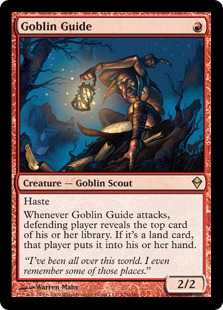
Goblin GuideDat Burn matchup tho. Burn is currently Modern's most popular deck on MTGO, and one of the big three in paper. It's cheap, strong, proactive, linear, and has all the trappings of a great choice for Modern events. This is not a deck you can have a terrible matchup against, especially on top of a bad Abzan matchup. Going into an event with 30%-40% win rates against two decks that make up a collective 20%+ of the format is tournament suicide. You might as well show up with 5 Color Humans (rock on, Champion of the Parish!!). This is a matchup we absolutely, positively, no-questions-asked need to fix if we want Grixis Delver to have a competitive shot. To some extent, the deck gets carried on the back of a strong Affinity and Twin matchup, but we don't want to bank on dodging Burn and Abzan at the Grand Prix level. So when we start thinking of cards, Abzan and Burn are the two decks we need to keep in mind. We also don't want to lose sight of other decks out there, like Amulet Bloom, Scapeshift, Zoo, Merfolk, RG Tron, and everything else you might hit at a Modern event. But Burn and Abzan will be immediate priorities.

Sample Sideboards

Here are three sample sideboards I want us to think about before we make our own. To some extent, it's dangerous to look at sideboards without the context of a maindeck (especially when you have contextual cards that only work in certain maindecks, like Stubborn Denial). But in the interest in keeping this focused on boards and keeping this relevant to a wide range of Grixis Delver players, I'm going to maintain an emphasis on sideboards alone. It will help us isolate similarities and differences between the lists to find things that probably work and things that might not.

Claudio Zurlo's Grixis Delver Sideboard (Ovinospring 2015)

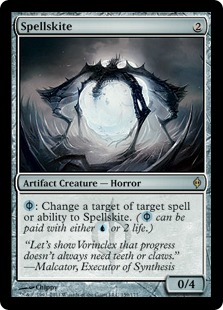
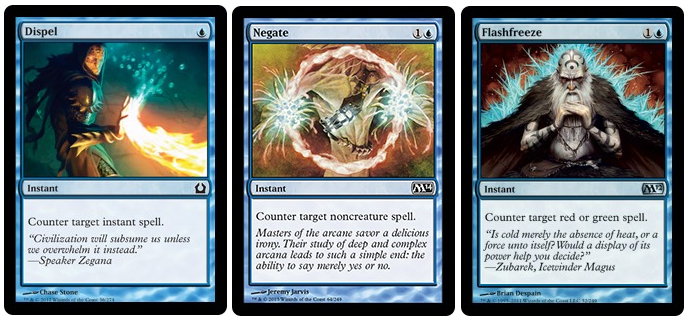
Spellskite1 Flashfreeze
1 Dispel
1 Negate
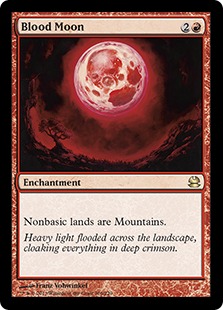
2 Blood Moon
1 Izzet Staticaster
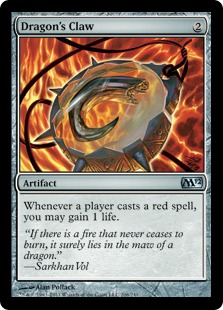
3 Dragon's Claw
2 Vandalblast
1 Dismember
1 Grim Lavamancer
1 Engineered Explosives
1 Spellskite

The first board is from Claudio Zurlo's 4th place finish at Ovinospring 2015, an Italian Modern event that took place on May 1. Zurlo played a pretty standard maindeck with a versatile sideboard, packed with singletons and flexible card choices. We see a lot of these cards in other Delver sideboards: Dispel, Negate, Moon, Claw, Vandalblast, etc. It's hard to say with certainty if there's a "stock" Grixis Delver board yet, or even if "stock" boards exist at all, but this one is pretty close to that standard.

Nate Kahovec's Grixis Delver Sideboard (SCG Portland)

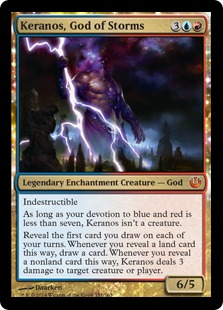
Keranos2 Dragon's Claw
2 Blood Moon
1 Dismember
1 Dispel
1 Flashfreeze
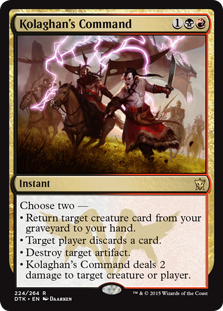
1 Kolaghan's Command
1 Magma Spray
2 Negate
1 Vendilion Clique
1 Keranos, God of Storms
2 Vandalblast

Looking at another recent Grixis Delver finish, we see Nate Kahovec's 2nd place finish at SCG Portland from May 3rd. Kahovec's main was very similar to Zurlo's, differing on only a few cards and competing in equally diverse Modern fields. His sideboard, despite some similarities, had a bunch of cards that were not present in Zurlo's list. Keranos is interesting here, as is that Clique and Spray, and suggest a different metagame focus than we saw in the list above.

dimk's Grixis Delver Sideboard (MTGO PTQ)

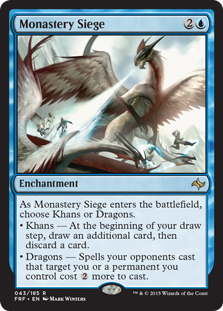
Monastery Siege2 Deprive
1 Kolaghan's Command
2 Blood Moon
2 Dragon's Claw
2 Engineered Explosives
2 Izzet Staticaster
2 Monastery Siege
2 Vendilion Clique

Finally, here's another take on the Grixis Delver sideboard and maindeck as played by dimk at his 4th place finish at an MTGO PTQ on May 2nd. It's important to look at MTGO lists on top of paper ones to see how different sideboards form in slightly different metagames. dimk's list, in addition to having more Gurmag Angler than other lists, along with different countermagic, has a bunch of interesting cards in the sideboard for us to consider. The board includes Siege, as well as a lot of two-ofs instead of singletons.

This is a good starting point for us to break down the different card choices and see commonalities between different sideboards. Many of you are probably already pulling out some of those similarities and differences, and I want to highlight the most important in the next section.

Optimizing the Sideboard

Looking over the sideboards listed above, plus the dozens of others we can find online for successful Grixis Delver decks, we see a few common cards emerge. I don't think these cards are non-negotiable in any metagame, but they are clearly strong now and you would have to make a very strong case against them if you wanted them ditched. I'm going to talk about those cards first, as well as give what I think is the optimal number of each of them.

Dragon's Claw3 Dragon's Claw

It's not okay to have a bad Burn matchup in Modern. Or rather, it's not okay to accept a bad Burn matchup without at least trying to improve it. Dragon's Claw is one of the best anti-Burn cards in Modern because it both screws up Burn's lethal damage math, and because it benefits deck that are already using red spells. Grixis Delver might not be overflowing with red, but it has enough spells (10-14 or so, depending on the build), that you are likely to at least gain back 2 life off this card. Claw comes down early and puts Burn in bad positions. It's particularly good in decks with clocks of their own, which can abuse the lifegain to buy time for their own creatures to win the game. Grixis Delver is such a deck. The reason we are running 3 and not 4 is because Burn is the only matchup where you really want this, and I think we can have enough overlapping sideboard slots elsewhere that we don't need to be too all-in against Burn. We need to maximize sideboard slots in Modern, and Claw is too narrow to be 4 cards deep on.

Grixis Delver Counterspells

1 Dispel, 1 Negate, and 1 Flashfreeze

Do not play Grixis Delver without these cards in your board. Depending on your metagame, you could even go up to 2 on either Negate or Flashfreeze, just because the cards are so important. Keep Dispel at 1 though. Overall, these spells pass the versatility test with flying colors. In many matchups, all of them are either Counterspells or discounted Counterspells with no drawbacks. This is true in both the trouble matchups like Burn and Abzan, but also other important matchups like Twin, Infect, Scapeshift, etc. Just looking at these three cards, we see three compelling reasons why we don't need 4 Claws in the board. Burn tends to run 10-12 creatures and then about 26-30 other spells, so these cards are actually just drawback-free hard counters in that matchup. They buy you time and force Burn to put more cards into their critical mass of spells needed to kill you, something Burn can struggle to do. Add to that their versatility across the format and you have three cards that you should never exclude from your Grixis Delver board.

Blood Moon3 Blood Moon

As most Modern players who have been under the Moon know, this card is just instant game-over against so many decks. I admit that Blood Moon isn't as strong today as it was in the past, particularly with the dominance of Burn, the continued power of Merfolk, the rise of Grixis Delver (can't forget the mirror), etc. But there are still enough matchups, namely stuff like Tron, Amulet, Scapeshift, Zoo, Abzan, etc., that it's absolutely worth keeping as a "core" slot of the sideboard. I'm particularly fond of Moon in that Abzan matchup, and that's why I'm up to 3 Moon instead of a more conservative 2. A resolved Moon against Abzan with threats on the field is very hard for them to handle. Just the threat of Moon forces Abzan players towards very conservative manabase development, which can help you stay aggressive and not get stymied by a giant Rhino too early. Sure, the Abzan player is going to discard this and blow it up with Decay, but Moon makes up for that weakness by being a strong topdeck even later in the game, and for moving Abzan's disruption away from your other targets. All of that said, if Abzan keeps dropping its metagame share, consider dropping Moon to 2 copies to keep pace.

Kolaghans Command1 Kolaghan's Command

It doesn't get better than Kolaghan's Command in the versatility department. Need to recover resources against Abzan? KC has your back. Need to break Batterskull or some Affinity card? KC is there. Need to zap an aggro problem? Look no further than KC. Trying to get card advantage over control? Two letters: KC. What KC lacks in individual power in all those departments, it makes up for in flexibility and pure, unadulterated value. Shock sucks. So does Shatter. But paying 3 mana to blow up an Inkmoth and a Plating? Way better. Or kill a Hierarch/Ooze and return a Snapcaster? Pure frikkin value. There will be matchups where KC's versatility does not make it valuable enough to run. For instance, this is not a card you want in the Burn matchup. But in the matchups where it's good, it's very good, and you will almost always love topdecking it on turn 4 or so.

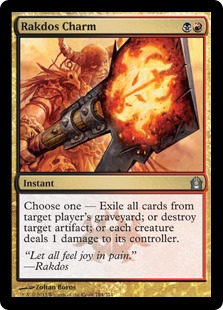
Rakdos Charm2 Rakdos Charm

Speaking of versatility, Rakdos Charm has been giving red/black mages some versatile sideboard action for years, even before KC came along. The big reason to run Charm in a deck that already has a good Twin and Affinity matchup is because Charm gives you additional tools in that matchup while also solving a big problem: the graveyard. In a four round MTGO daily, you can gamble on avoiding graveyard-based decks. You can even get away with this in a 7-8 round local event. But a two day GP? Good luck. You are almost guaranteed to hit something cute like Dredgevine, Living End, UW Tron, 4C Gifts, Griselbrand Reanimator, or any of the other big graveyard decks of the format. And with Collected Company Podless Pod starting to make more Modern waves, the graveyard is only becoming more important. To some extent, you can battle these decks with your countermagic and hard removal. But at a certain time, you need that graveyard interaction to seal a game, and Charm gives you that badly needed firepower to threaten graveyard decks where it hurts the most.

That brings our sideboard core to about 11-12 cards, depending on how many copies you include of stuff like Moon, Claw, and Charm.

3 Dragon's Claw
3 Blood Moon
2 Rakdos Charm
1 Kolaghan's Command
1 Dispel
1 Negate
1 Flashfreeze

This also gives you 3-4 slots for other options, which is a nice bit of extra flex you can use in unknown metagames or at large events. Before wrapping up today, I want to talk about some of those other choices you can use, both in those 3-4 slots, and even in place of some of the cards listed here.

Other Sideboard Options

When filling out the rest of your sideboard, or if looking to attack the metagame from unique angles, here are some cards to consider. Some of these cards are, in my opinion, weaker than other options above. Others are good cards but are more contextual, so only run them in certain metagames.

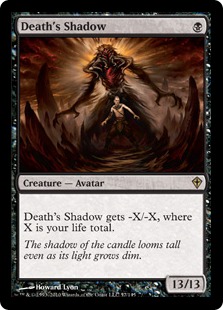
Deaths ShadowDeath's Shadow

Death's Shadow is one of the techier solutions I have seen to Burn. Instead of stopping the damage, Shadow embraces it, building a massive body as you suicidally race the Burn deck. It's a cool way to play the matchup, and I think it can definitely work in some games. My big issue with this plan is that we aren't faster than Burn to begin with, and Shadow isn't fast enough to win that race. The big exception to this is if you are already playing Angler and Stubborn Denial, in which case Shadow becomes a lot better. So if you are playing a "bigger" Grixis Delver list, consider 3 Shadow in the board. If not, stick with Claw; it fits our tempo gameplan better anyway. Bonus points if your opponent used Destructive Revelry to try to preempt Claws and you dropped Shadow instead.

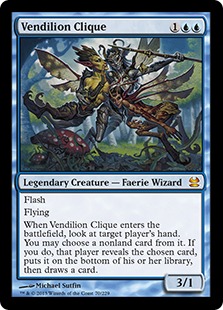
Vendilion CliqueVendilion Clique

if your metagame has lots of combo or control decks, Vendilion Clique becomes one of the better cards around. Flash on a 3/1 Flyer alone is huge. Add the disruptive and information elements and Clique is practically maindeck material in some lists. A very strong singleton choice in the sideboard. The only reason I wouldn't maindeck it is because it's not the best card against decks like Affinity and Burn, and there's enough aggro going around these days that you want the option to bring it in when needed more than you want to be stuck with it in game 1.

Deathmark

Abzan decks got you down? +1 Deathmark has you covered. This card is becoming a lot better with all the Podless Pod style decks cropping up on both MTGO and in paper, not to mention the rise of Jund even as Abzan's share has declined a bit. If you go to a GP in June, strongly consider adding one of these to the board. Unknown metagames tend to attract lots of Abzan, and Deathmark gives you yet another bullet to improve your games 2/3 against the format's premier midrange deck.

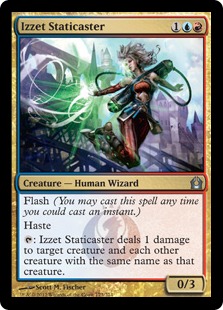
Izzet StaticasterIzzet Staticaster

Lingering Souls causing trouble? Tired of mana dorks? Sick of Affinity's X/1s? Izzet Staticaster has you covered. A big reason to look to Staticaster these days is because she's good against Abzan and Abzan Liege decks, and because we are seeing more and more green-based Collected Company decks where Staticaster really shines. Serious metagame call here, but in the right matchups, she will definitely reward you for boarding her in.

Monastery Siege

This is the only card on the list I view as a total trap card. As a solution to Burn, Monastery Siege is often just too little, too late. Can you imagine tapping out on turn 3 to cast this? Burn just keeps on attacking or just pays the extra mana to still get in a Bolt effect on top of a 2 point Swiftspear swing. You might as well do nothing with your turn. This is way better in Merfolk, where you can get a much stronger board presence before dropping this on turn 3 (particularly with an active Vial). But in Delver, you probably only have one creature on the board when you drop it, which isn't the kind of pressure you want in combination with Siege. And god forbid you cast this into an active Eidolon. In all the other cases where you might think Siege is good (delve fuel and dig in the mirror, removal protection against Abzan, etc.), there are almost always better options.

There are dozens of other cards we can consider for the deck, including Grim Lavamancer, Magma Spray, Vandalblast, Olivia Voldaren, etc. Instead of evaluating all of these cards and going for another thousand words, I think it's better to use some of the principles in this article to evaluate those cards (and others not listed) on the side. As long as you are sticking to your core sideboard and not violating the deck's maindeck roles, you have a lot of flexibility in the board. Also, remember that Grixis Delver runs between 10 and 12 cantrips, which means you can be a little more conservative with your card counts in the board. Shaving down to 2 copies from 3 is totally reasonable with cards like Visions, Probe, and Scour in the maindeck.

So get out there and sideboard up your Grixis Delver lists. It's not enough to have a good game 1 these days, and if we want this deck to enjoy some tournament success in June, it needs to be on the back of a strong sideboard. Let's see if we can get there!

Deck Overview: Standard Selesyna Collected Company

Are you a Quiet Speculation member?

If not, now is a perfect time to join up! Our powerful tools, breaking-news analysis, and exclusive Discord channel will make sure you stay up to date and ahead of the curve.

With four Abzan decks in the Top 8 of GP Paris and an aggressive version of the deck taking the tournament down, it's clear that Siege Rhino is still well-positioned in Standard. The most interesting element in the Top 8 though is Zan Syed's Selesnya Collected Company deck. In a format with mana this good, eschewing Siege Rhino is a blatant statement than Syed believes Collected Company to be more powerful. Here's his list:

Standard Collected Company

creatures

4 Elvish Mystic
4 Fleecemane Lion
4 Den Protector
2 Hidden Dragonslayer
2 Warden of the First Tree
4 Deathmist Raptor
4 Courser of Kruphix

spells

3 Dromoka's Command
4 Collected Company
2 Valorous Stance
3 Mastery of the Unseen

lands

4 Temple of Plenty
4 Windswept Heath
4 Plains
2 Blossoming Sands
1 Nykthos, Shrine to Nyx
9 Forest

sideboard

3 Plummet
3 Hornet Nest
3 Arashin Cleric
2 Elspeth, Sun's Champion
2 Whisperwood Elemental
2 Reclamation Sage

I really like the inclusion of Warden of the First Tree here. This deck is great at gumming up the ground, and Warden is a way to break up board stalls that can be hit off of Collected Company. This interaction is in some ways reminiscent of Ranger of Eos and Figure of Destiny.

There was an error retrieving a chart for Warden of the First Tree

As a Collected Company deck, there isn't a ton of room for spells here. Mastery of the Unseen is an amazing tool against control decks, and the lifegain is quite valuable against aggressive decks. The only thing that I don't like about this inclusion is that the deck only plays one Nykthos, Shrine to Nyx. I fully expect to see more copies of Nykthos in future versions of this deck, which I am positive will be a relevant force in Standard going forward.

Insider: GP Paris, Megamorphs and Post-Rotation Monored

Are you a Quiet Speculation member?

If not, now is a perfect time to join up! Our powerful tools, breaking-news analysis, and exclusive Discord channel will make sure you stay up to date and ahead of the curve.

The Grand Prix in Paris this weekend was Standard and illustrates a fascinating evolution of the format. Pull up the Top 8 and we'll go for a trip down these results.

La Vie en Rouge

I want to start off with the most exciting part for me, Kyoungsoo Kim's Mono-Red Aggro. While another traditional mono-red deck top-eighted, Kim's deck is fascinating to me, since I've been very curious about whether mono-red would survive rotation. This is important because there are plenty of good mono-red cards, but huge elements of that deck rotate. So why is mono-red important to track?

Mono-red is often the first deck people reach for when a format rotates. What happens without Stoke the Flames and Foundry Street Denizen?

Kim's deck suggests that it gets a little bigger on the mana curve with Thunderbreak Regent and Flamewake Phoenix. He's got the dragons and a firebreathing Lightning Berserker to trigger ferocious. He's skipped the Foundry Street Denizens so he doesn't have to run Dragon Fodder into a Bile Blight. At three mana, his Phoenixes replace Hordeling Outburst and manage to get in flying damage on the same turn. It's a heck of a topdeck.

Actions: I like Phoenix a lot here. It's about $0.60 and can easily form the core of a new mono-red deck that goes over the top. I expect mono-red players to pick up the cards to make Kim's deck, knowing that they've now got another option if they think their field is going to be full of Esper Dragons.

Megamorphosis

Deathmist Raptor and Den Protector are proving themselves fine on their own, deadly in combination. The dino has been stable at $22, rising up from about $17 a few weeks ago on a steady incline. Still a bad place to park your money, but these guys are in demand and people want to trade for them. Den Protector is at $8, a price I thought unsustainable (but then, I thought $5 was high). MTGO redemptions are going to start pushing prices down a bit.

The fact remains that these little morphs are going to keep coming back, harassing Esper Dragons and nonrecursive decks alike. Frank Karsten wrote an article on the nine different archetypes he saw; read it carefully. He describes how the decks trigger it (like Ashcloud Phoenix and Whisperwood Elemental) and how other decks beat the Raptor (fly over it, hit with Abzan Charm and more). If you're set on beating the Raptor, Frank wrote about seven strategies to kill them as well. Many of his suggestions are fanciful, but he rightly points out cards like Elspeth, Sun's Champion and Anafenza, the Foremost as cards to hack down the recursion.

Actions: Understand that this combo is going to be part of Standard for a long time, whereas we are losing many answers to it.

I like Anazfenza at $3.75 as a long-term addition to Abzan lists. She hits darned hard and stops ridiculous loops. Unfortunately, she almost demands you one-for-one the Raptor to exile it. Abzan has no first-strikers, after all. She's also from Khans, the world's most popular set. She could see $5 in a few months, but this is mostly a call for you to pick them up for your Abzan list now.

Esper Dragons Cannot Stop the Deathmist Loop Profitably

Big pounders like Ojutai and Silumgar are about all you can rely on against Deathmist Raptor and Den Protector. The rest of Esper Dragons is set up to one-for-one the opponent and then recharge with a Dragonlord's Prerogative or other large spell.

That doesn't work as well when they're hitting Den Protectors that have already rebought another Den Protector, for instance. It doesn't give much of an edge against an opponent who sneaks an end-step Collected Company through.

Esper Dragons is a list that doesn't respect the megamorphs enough and it will suffer until it does. I predict that this means less Foul-Tongue Invocation and more Encase in Ice on the sideboard. I also expect more Elspeth and Ashiok, since both cards generally avoid the megamorphs.

Mardu Dragons Shows Up... Barely

In 16th place is a Mardu list that I'm pleased to see. Patrick Dickmann also sleeved up Mardu but failed to make it far enough. I still love this deck. It's up to four Soulfire Grand Master now, which gives an insultingly powerful lategame against durdly Deathmist decks. "Let's see," says the Mardu player, "I can kill you with Dragons in the air; I have ten of them." Looking at the Masters, our dragonlord says, "or maybe I can just recur Draconic Roar and gain six life every turn."

The combination especially with Draconic Roar is insane with Soulfire Grand Master, by the way. It'll kill all sorts of morphs and flipped megamorphs, and the six life points means that you can straight-up ignore the opponent's attacks. In fact, a 4/4 Raptor is probably better because it gives you a persistent target each turn!

On top of all that, Mardu Dragons gets access to Anger of the Gods off the sideboard. That sweeps away all the token trash, cleans up against Mono-red, even kills Caryatids if you're interested in keeping an opponent off of Ugin mana. I love this deck going into the summer. Let's hope it gets good tools from Origins to further power it up.

Collected Company on the Rise

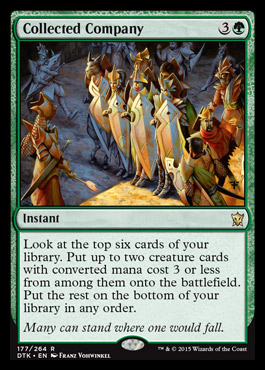
This green instant has put on $3 to its pricetag over the weekend. It lets you get out Raptors and Den Protectors (no Regrowth on 'em though) and a host of other cards if you want to be specialized. I think the four-color Company decks look thrilling and bad. Flipping two Mantis Rider from Collected Company looks crazy good, but I also expect some number of games to involve staring at Savage Knuckleblade in hand and the wrong Temples in play.

Craig Wescoe showed us last week what this card looks like in White Weenie. This week, we're seeing it show up in even more decks. I've also seen Warden of the First Tree show up with it. That unimpressive mythic is probably going to take over for Fleecemane Lion as soon as the cat and first-turn "Temple, Go" plays rotate out of the format.

Plus ça Change, Plus C'est la Même Chose

Abzan wins again.

Four weeks ago, Abzan was laughing at Den Protectors and Raptors. It has begun to integrate them this week. What lost out? From what I can see, Tasigur is Sir Not Appearing in This Top 8. Investing heavily in that guy seems rough when a deathtoucher can sit back and block him from the other side. There were only two copies in the whole Top 16.

Abzan has been looking particularly aggressive lately. Full sets of Rakshasa Deathdealers with Fleecemane Lions make this deck swing in fast. They've been playing a few copies of Elspeth, Sun's Champion on the board, but the Ugin of a month ago is nearly absent.

Actions: As mentioned above, Warden of the First Tree is getting more play. He's dropped from $4.50 to $2.50 these days and I like it. Playable mythics tend to quickly snap back up in price and he's seeing play in the Collected Company decks as well. Furthermore, Wingmate Roc is also attractively priced at $3.

I'm also seeing Hidden Dragonslayer come up as a one- or two-of, shooting down dragons and flipping up for Deathmist value. He's $0.75 currently--that's pricey for a bulk rare but he has promise. He's no Den Protector, but I wouldn't be surprised to see a deck running four of these just cruise through stacks of dragons.

Quick Hits

  • Tasigur continues his downward trend; they can be had for $5.25 now. This upcoming metagame looks very hostile to him and I'd trade out of mine now.
  • Mastery of the Unseen is $1.25 and I'm perplexed why it isn't $3. This card is going to cause problems from all sorts of sideboards.
  • There's a weird outside chance that Garruk, Apex Predator is the best answer to Deathmist Raptor and company. You get to match it with deathtouch creatures every turn and eventually overwhelm an opponent.

If it happens next week, you can read about it here!

-Doug

Insider: MTGO Market Report – Modern Masters 2015 Rares, Uncommons and Commons Special

Are you a Quiet Speculation member?

If not, now is a perfect time to join up! Our powerful tools, breaking-news analysis, and exclusive Discord channel will make sure you stay up to date and ahead of the curve.

As reported earlier, the full list of the 249 cards of Modern Masters 2015 is here. Reprinted cards matter, and non-reprinted ones matter even more.

On MTGO, prices have been deflated all over the place, fearing a potential reprint. Now that everything is set, Modern staples safe of reprint will--if they haven't already started--spike again. Some cards may even triple in the coming weeks.

Here is a brief shot at what to look for as soon as you can.

We'll focus here on cards not reprinted and constituting decent speculative targets at the time of writing this article. Although some cards may not be in MM2, but, despite a certain growth in the future, they are not very attractive at their current prices, especially compared to other targets.

On average, you should expect prices to reach new highs sooner or later, and you should evaluate for yourself the risk/reward of each of these potential specs.

Rares

Uncommons

Commons

You may consider these Targeted Speculative Buy Recommendations.

Most of these cards have seen significant play in Modern within the past six months, and combining their current relatively low prices and the fact that they shouldn't be reprinted any time soon, they are great targets both in the short term and the long run.

Insider: MTGO Market Report – Modern Masters 2015 Mythics Special

Are you a Quiet Speculation member?

If not, now is a perfect time to join up! Our powerful tools, breaking-news analysis, and exclusive Discord channel will make sure you stay up to date and ahead of the curve.

Now that the full spoilers list is available, what really matters is what is not being reprinted.

The 15 Mythics of Modern Masters 2

MTGO wise, this a nice set of mythics. Red is clearly weak here, particularly Comet Storm, but every other card has been over 10 Tix in their recent history, with most in the 20s and above.

By comparison, Modern Masters 1 had at least 7 of its 15 mythics worth pretty much nothing right after release. All but Comet Storm has proven  applications in Modern constructed at one time or another.

If you haven’t sold these cards yet, you should do it right now before prices get cut in half or more.

Noteworthy Omissions

As it was the case yesterday for Indomitable Archangel, Apocalypse Hydra and Etched Monstrosity, Modern Masters 2015 will include rares previously printed as mythics.

As this article was initially prepared yesterday, we haven't had a close look at the full MM2 list in order to spot more mythics that have been reprinted as rares. If you see some, please feel free to list them in the comments.

Right now, here are some mythics from previous sets worth considering as speculative targets that are not in MM2.

”Mythics to consider”

The following prices are from this 10am EST today and may have already changed.

Tezzeret and Ajani are two planeswalkers that have shown some play in Modern from time to time, and Tezzeret even shows up in Legacy. Ajani is currently around 11 Tix and saw a price spike up to 27 Tix when played. Tezzeret’s price is not so low--around 12 Tix right now with a record high of 17 Tix, but it is from a second small set.

Mindbreak Trap, Thrun, the Last Troll, Blightsteel Colossus, and Lotus Cobra have been very stable for several months and seem to have established a floor for themselves. They are all more than 50% off from their highest price, meaning that could double if integrated in popular decks again. Some of these, such as the Trap and the Colossus, hold more appeal for Legacy and Vintage players.

Targeted Speculative Buying Opportunities

These are what we consider the safest and best bets to place now. The market will react quickly as everyone sees what's in Modern Masters 2015.

Mindbreak Trap
Thrun, the Last Troll
Tezzeret, Agent of Bolas
Ajani Vengeant
Blightsteel Colossus
Lotus Cobra

As you see in these recommendations, it is very important to gauge for potential price spikes triggered by the MM2 list made available. Speculators and players will certainly react quickly and too much of a price increase may compromise future speculative outcomes.

Look for more MM2 coverage to come.

Magic Goes Vice

Are you a Quiet Speculation member?

If not, now is a perfect time to join up! Our powerful tools, breaking-news analysis, and exclusive Discord channel will make sure you stay up to date and ahead of the curve.

This week the people at Vice put out their short documentary about Magic for their American Obsessions series. The installment focuses largely on Jacob Wilson, but also features Magic players from every level of the game.

Jacob Wilson

The documentary can be found here. Be warned though, if the sight of unsleeved Volcanic Islands and Ancestral Recalls being shuffled around sounds like something that would make you uncomfortable, then this one might not be for you.

There was an error retrieving a chart for Ancestral Recall
Avatar photo

Ryan Overturf

Ryan has been playing Magic since Legions and playing competitively since Lorwyn. While he fancies himself a Legacy specialist, you'll always find him with strong opinions on every constructed format.

View More By Ryan Overturf

Posted in FreeTagged , 4 Comments on Magic Goes Vice

Have you joined the Quiet Speculation Discord?

If you haven't, you're leaving value on the table! Join our community of experts, enthusiasts, entertainers, and educators and enjoy exclusive podcasts, questions asked and answered, trades, sales, and everything else Discord has to offer.

Want to create content with Quiet Speculation?

All you need to succeed is a passion for Magic: The Gathering, and the ability to write coherently. Share your knowledge of MTG and how you leverage it to win games, get value from your cards – or even turn a profit.

[MTGO] 1 Year, 100 Tix April Report

Are you a Quiet Speculation member?

If not, now is a perfect time to join up! Our powerful tools, breaking-news analysis, and exclusive Discord channel will make sure you stay up to date and ahead of the curve.

Four months have passed now. Things are still doing okay but April is the first month my account has lost value compared to the previous month. Today, in addition to the state of the project I'll develop a little bit more on the double booster quickflips and the lessons to be learnt there.

Before getting into more details related to this project, we are unlocking today the next article of the Nine Month of Portfolio Management Series. Part 5 - Investing in Modern.

In this article I discussed the result I got with the Modern positions, what I call the cyclical positions. Following natural trends of the Modern format, speculation with Modern cards has shown to be very positive with returns on many positions often in the +100% range.

Before we begin April's report, be sure to check out the following links (if you haven’t already):

-7.83% in April

The upward trend has clearly stopped and April's results are a little step backward. This number could have been even worse considering that half-way through April I lost 12.72 Tix on the first DTK booster quickflip. Fortunately, the very next DTK booster quickflip turned out much better. Here is the chart for this month.

Summary of the Specs

This month I kept selling some of my Modern positions that finally turned profitable, namely Manamorphose, Figure of Destiny and Ethersworn Canonist. I still have some copies of Canonist and Figure. Prices seem to keep rising and I plan on unloading the rest very soon, before a potential reprint announcement in Modern Masters 2015.

I'm still holding several Modern positions. Many gave me mixed results so far but are getting better lately. Vexing Devil is on an upward trend since the end of March and I hope it will cross the 3 Tix bar where I'm looking to sell it. Smash to Smithereens and Enter the Infinite are in the same boat and I'll try to sell them soon as they become profitable.

In the buy section I bought two Mutavault. The M14 manland is at about its floor since rotation and might have new applications in Modern with all the dragon-related cards from DTK that actually appear to be playable in this format.

My Pauper picks clearly lost value this month. After spiking over 1 Tix, Mental Note is back to ground level. I missed that selling opportunity hoping for higher prices and even if I still believe in the card I might close this position soon if I don't see signs of a strong rebound. Innocent Blood, Flame Slash and the recently acquired Moment's Peace are not looking great either. I'm not in a hurry to sell these and I'll wait a little bit more to decide if it's worth keeping or selling.

Concerning my Standard positions, Temple of Enlightenment did wonders--I doubled up with it. Courser of Kruphix looks rather undecided, a week up, a week down. The effects on prices of Standard rotation start as early as right now on MTGO, and I'll probably sell my Courser in May before it dips further.

KTK prices are up by about 10% in average since the release of DTK. I could have/should have bought more KTK positions, however I only bet on Siege Rhino for now, a powerhouse in both Standard and Modern.

Lessons From The DTK Booster Quickflips

Two Moves - The Flop

The quickflip on the DTK boosters was supposed to be a smooth and easy way to generate Tix. Speculations with boosters usually yield moderate profits, in the magnitude of +10 to +20%, with the possibility to sink in a large amount of Tix even with a big bankroll. The risks are usually low since you can't lose it all on such specs--a loss of 30% is already pretty big for boosters.

The initial move here was to acquire DTK packs from Friday to Sunday right after the launch of Dragons of Tarkir prerelease events. This is the first weekend when the new set is available to draft and since boosters can't be used at that point to enter the events (only Tix are accepted) their value tends to be lower than when players can effectively use them to enter drafts.

Prices are expected to ramp up from Monday to the next weekend when the booster demand from players wanting to participate in the release events (accepting boosters to enter now) is at its peak. Selling then is supposed to yield some profit.

This strategy has been fairly successful in the past but not so much recently. DTK booster prices however rapidly dropped to the 3.0-3.1 Tix range, which is getting attractive for speculators for a one-week quickflip. I bought 24 DTK boosters at 3.18 Tix/each.

Up until this point, the theory was great. Prices of DTK packs had already risen to 3.6 Tix by Monday, suggesting the quickflip was about to be quite profitable the following weekend. Unfortunately the dream of a juicy quickflip stopped right there.

By Thursday DTK packs were as low as 2.5-2.6 Tix. I had decided to wait until the weekend since even after that big and unexpected price slide, packs are supposed to be higher on the weekend. They were. I sold my 24 packs at 2.65 Tix/each, a loss of 12.72 Tix.

Two Moves - The Top

By Wednesday, April 15th, DTK boosters were as low as 2.4-2.5 Tix, quite a fall from 3.6 Tix a week and a half earlier. Here I decided to give another shot at the DTK booster spec; I was in for another quickflip (I'll explain the reason why just below). I bought 20 new DTK boosters for 2.61 Tix/each. Four days later I sold them back with a 14.38 Tix profit, a 27% gain.

DTK packs actually kept climbing and reached 4 Tix the very next weekend. As you can see in the graph above from Mtggoldfish.com, price peaks always occur on the weekend and lowest points are always reached in the middle of the week, a recurrent trend for anything on MTGO.

Take Home Messages

The flaw of the initial spec was that the prize payout of tournaments almost all offered DTK boosters alone as prizes. The market got very quickly saturated of DTK packs and even the demand from the DTK release events didn't absorb that; hence the price of DTK packs fell.

Realizing the trend is the first step towards stopping the hemorrhage. Unlike cards, booster price trends tend to be very steady (up, down or flat) as long as they are drafted and offered as prizes. To stop the hemorrhage I had to sell my packs. I could have kept them for longer, waiting for a recovery or else. I could have lost more as well. I'm glad I didn't wait for another week (don't forget here that at that point in time I didn't know what was going to happen, the only thing I knew was that the market was putting a downward pressure on booster price).

Once you realize you are in the wrong fight you have to cut your losses and move on. Put your Tix to a better use rather keeping them tethered to a lost cause.

Unexpectedly, on Wednesday, April 15th, the booster prize payout got changed. Most of the tournaments that awarded DTK packs only now award DTK and FRF. The supply of DTK was decreased. The parameters of the equation have changed, and with them I have to change my view on the DTK spec; this is why I bought DTK packs again. I sold my packs the following weekend to secure my gains and free my Tix.

By the way, did you see what happened to FRF boosters price? The exact opposite as for DTK packs--FRF was very high and lost ground as more supply entered the market.

A losing spec on the previous week can turn into a winning one the following week. If the parameters change you have to reconsider your position and get in again if these new parameters make the spec viable again.


Thanks for reading and see you next month!

Sylvain Lehoux

Insider: Modern Grixis Delver Updates

Are you a Quiet Speculation member?

If not, now is a perfect time to join up! Our powerful tools, breaking-news analysis, and exclusive Discord channel will make sure you stay up to date and ahead of the curve.

There was a time when I grinded the SCG Open Series more than most, and if not for a misconception about when the year ends I would have been qualified for every Invitational. These days I don't make it much further than Minneapolis for Opens, but somewhere along the line I accrued enough open points to earn myself an Invitational qualification.

Previously, my Invitational experiences consisted of getting a lot of free wins in Legacy and playing something terrible and getting smashed in Standard. The times they are-a-changin' though, and the Columbus Invitational is Standard and Modern.

Eep.

In a world of PPTQs it makes a ton of sense to showcase the formats that people are grinding every weekend. This is bad for Ryan Overturf, but I think it's good for Magic. You win some, you lose some. It is lucky for me that this is happening at the first point in a long time where I've felt good about my ability to succeed in the Standard environment.

There was an error retrieving a chart for Chromanticore

With Treasure Cruise banned in Modern, I haven't put the work into figuring out what I should be playing. My default is to play Delver of Secrets regardless of how terrible a decision it is, and I don't see a compelling reason to not stay the course considering how much work is involved with trying to put a Modern deck together.

Back in February I postulated that Tasigur, the Golden Fang was an extremely powerful tool for Modern Delver decks. Weeks after writing that, Richard Nguyen took 21st at an SCG Open with a variant of the deck. Currently, you can expect to see a couple Grixis Delver decks cash any given Modern Daily Event. The deck is hardly dominant, but it's real.

There was an error retrieving a chart for Tasigur, the Golden Fang

A couple weeks ago I physically sleeved the deck up for the first time to battle in a TCGPlayer event. Figuring out the numbers for the deck is tough, as it feels like you're being pushed towards playing too many creatures and access to Terminate changes the value of the various counterspells in the deck. I wasn't sure how well I was walking the tightrope, but this is the list that I registered:

Grixis Delver

Creatures

4 Delver of Secrets
4 Snapcaster Mage
3 Young Pyromancer
3 Tasigur, the Golden Fang

Spells

1 Pillar of Flame
2 Electrolyze
4 Lightning Bolt
4 Mana Leak
1 Remand
2 Spell Snare
3 Terminate
2 Thought Scour
4 Gitaxian Probe
4 Serum Visions

Lands

2 Island
1 Mountain
1 Swamp
1 Blood Crypt
1 Darkslick Shores
4 Polluted Delta
4 Scalding Tarn
2 Bloodstained Mire
2 Steam Vents
1 Watery Grave

Sideboard

2 Engineered Explosives
1 Dispel
2 Countersquall
1 Counterflux
2 Spell Snare
2 Spell Pierce
1 Electrickery
1 Dismember
1 Terminate
2 Magma Spray

The deck performed admirably in the swiss portion of the tournament, and I 3-0-2'd my way into the Top 8 after beating up on Temur Delver and a couple Abzan decks. The Terminates made the deck so much stronger in a proactive role, and the tension between casting a threat and leaving up countermagic was much lower than it ever was with Izzet Delver. Tasigur was also great at enabling the deck to compete in the late game against Abzan, just as I had anticipated.

Then in the Top 8 of the tournament I played a mirror match. Well, it was mostly a mirror except for one crucial difference. I felt like I had a better handle on the matchup than my opponent, and most of the early exchanges between us looked to be building up in my favor, but then my opponent completely wrecked me with a piece of technology that I had eschewed.

There was an error retrieving a chart for Kolaghan's Command

In a mirror based on attrition, killing one my guys plus Raise Dead is obscene. Then he cast it again with Snapcaster Mage... There was no way I was ever winning a game when this card was in his deck and not in mine. Lesson learned.

I had seen Kolaghan's Command in lists from MTGO before, but I dismissed it because I was only looking for things that made the deck better against Abzan. The degree to which Kolaghan's Command makes you better against any deck that tries to kill your creatures and has anything that dies when you deal two damage to it and/or has any artifacts makes up for the fact that it's only marginal against Abzan.

On the topic of Kolaghan's Command, the card is currently ticking down in value, though long-term I see it proving to be a Modern staple. Pay attention to the price on this one. There's an opportunity to make some money here if you can get in at the floor. Some copies can be had for right around $1, and I love this card at ~$0.50.

The other takeaway from this tournament is that Young Pyromancer just kind of sucks now. He was great with Treasure Cruise, but now he's just the guy that your opponent waits to Electrolyze. The upside of the card has diminished severely and while the downside hasn't increased, it wasn't true that Young Pyromancer was great before Treasure Cruise, and none of the new cards are direct contributors to Pyro's power.

There was an error retrieving a chart for Young Pyromancer

Seeing as I already felt that I was playing too many creatures, I don't much mind cutting Young Pyromancer. With Young Pyromancer on the out, you have to wonder if this deck actually wants Gitaxian Probe. It's a decent delve enabler, but it's still the card that I board out against everybody. Needing to find untapped duals for three colors of mana also really hurts Probe.

If we cut Pyro and Probe, that leaves us with a lot of space to fill. I like Kolaghan's Command as a two-of, so that's our first addition. The more Commands, the more we care about our graveyard being stocked. Cutting Probe also leaves a bit of a cantrip void, so maxing out on Thought Scour is a no-brainer.

An extra land makes sense when we are now actively excited about a five-mana play (Command + Snapcaster) and also might just be needed without Probe to help us draw lands for "free". Figuring out the exact removal/counter configuration isn't an exact science, and for now I like trying the full four Terminate and three Spell Snare.

The last slot should likely be occupied by a threat. Vendilion Clique comes to mind, but it mostly has the same problems as Young Pyromancer. It would be nice to be able to run four Tasigur, but instead we'll need to play the next best thing. Or rather, something that's pretty good, but bears the appearance of a steaming turd.

There was an error retrieving a chart for Gurmag Angler

That's going to leave us with the following configuration:

Grixis Delver

Creatures

4 Delver of Secrets
4 Snapcaster Mage
1 Gurmag Angler
3 Tasigur, the Golden Fang

Spells

1 Pillar of Flame
1 Electrolyze
2 Kolaghan's Command
4 Lightning Bolt
4 Mana Leak
1 Remand
3 Spell Snare
4 Terminate
4 Thought Scour
4 Serum Visions

Lands

2 Island
1 Mountain
1 Swamp
1 Blood Crypt
1 Darkslick Shores
4 Polluted Delta
4 Scalding Tarn
2 Bloodstained Mire
1 Flooded Strand
2 Steam Vents
1 Watery Grave

Sideboard

2 Engineered Explosives
1 Dispel
2 Countersquall
1 Counterflux
1 Spell Snare
2 Spell Pierce
1 Electrickery
1 Dismember
1 Combust
1 Kolaghan's Command
2 Magma Spray

Upon reviewing this list, Delver of Secrets actually looks somewhat out of place. It's so much worse than our other creatures, but ultimately it's a necessary concession to the Modern format. We simply need Delver to clock combo and Tron opponents before they can overpower us, even if it means that we give up some value against Electrolyze.

With the Invitational coming up and the Planeswalker Points year coming to an end, I'll be jamming a ton of games with Grixis Delver throughout May. I'll be sure to write about any new technology that I come up with here.

Thanks for reading.

-Ryan Overturf
@RyanOverdrive on Twitter

Testing Reid Duke’s 8Rack: Video

Are you a Quiet Speculation member?

If not, now is a perfect time to join up! Our powerful tools, breaking-news analysis, and exclusive Discord channel will make sure you stay up to date and ahead of the curve.

8rack smallpox

Back in March, Team Pantheon's Reid Duke -- a known Legacy Pox player -- developed his personal take on Modern's discard deck 8Rack.

[wp_ad_camp_1]


You can see his list below.

8Rack by Reid Duke

Planeswalkers

4 Liliana of the Veil

Spells

4 The Rack
4 Shrieking Affliction
4 Dismember
4 Inquisition of Kozilek
4 Raven's Crime
4 Smallpox
4 Thoughtseize
4 Wrench Mind

Lands

16 Swamp
4 Mutavault
4 Urborg, Tomb of Yawgmoth

Sideboard

4 Bloodghast
2 Waste Not
1 Darkblast
1 Tasigur, the Golden Fang
2 Night of Souls' Betrayal
4 Deathmark
1 Tasigur's Cruelty

8Rack in Action

As you can see, his version includes some radical choices over what most 8Rack players are used to, so I thought I'd give it a spin to see if there's anything to it. I faced off against RG Tron, two Grixis Delver decks, and Blue Tron in the tournament practice room. The results:

Lessons Learned

There are several things to take away from this:

  • The Tron match is improved a little thanks to Smallpox, but not nearly as much as we'd like. Some number of Surgical Extraction would help with this (and with other matches).
  • Smallpox as a 4-of is just too much, even with 24 land. Either we need to increase the land count, or drop the Smallpox count.
  • 4 Mutavault is too much. I knew this going in as I used 4 for months before finally doing the math and seeing clearly how greedy it is (which was in line with my own experiences). It's not always needed or useful anyway, so I don't feel too bad about trimming one.
  • The lack of Ensnaring Bridge is felt very obviously and harshly many times. We absolutely need it or Damnation.
  • The flexibility of Dismember was great in these matches, but especially as a 4-of, it would be brutal vs Burn, which is currently sitting pretty atop the meta at 9.2% (9% for MTGO alone), and Affinity (7%).
  • No Dakmor Salvage is a mistake. With a Raven's Crime in hand, this is a Lily +1 when we don't have Lily, and a double activation when we do. Persistent discard is extremely important.
  • The sideboard proved interesting and useful at times. I'd like to try it a lot more to get a better feel for it. Waste Not sideboard is something I've always approved of; Night is a card I'm glad we can use in this version (in mine it's too expensive).

So, to summarize, I vastly prefer the stock mainboard, but there could be something to the sideboard, if only a piece or two.

Until next time!

Possession is 9/10ths of the Law

Are you a Quiet Speculation member?

If not, now is a perfect time to join up! Our powerful tools, breaking-news analysis, and exclusive Discord channel will make sure you stay up to date and ahead of the curve.

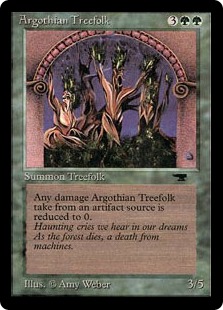
Recently, Channel Fireball came into possession of the original artwork for Argothian Treefolk and Crystal Rod. I know, I know, nobody has any idea what those cards are. That's not what's important here. All you need to know is that original Magic art is expensive. Even if it was used as a representation of garbage.

There was an error retrieving a chart for Crystal Rod

The story gets interesting when artist Amy Weber claimed that the artwork was originally stolen from her. You can read more about the incident on the Reddit threat here.

Weber apparently put CFB on blast on social media instead of contacting them directly about the allegedly stolen art, which is not a very professional way to go about things. Either way, the art is now in possession of law enforcement, and hopefully it is soon returned to its rightful owner, be that Amy of CFB.

The moral of the story is that even pretty medium art is worth a substantial sum of money. So you should probably read more of Mike Bajorek's articles.

Avatar photo

Ryan Overturf

Ryan has been playing Magic since Legions and playing competitively since Lorwyn. While he fancies himself a Legacy specialist, you'll always find him with strong opinions on every constructed format.

View More By Ryan Overturf

Posted in FreeTagged , 5 Comments on Possession is 9/10ths of the Law

Have you joined the Quiet Speculation Discord?

If you haven't, you're leaving value on the table! Join our community of experts, enthusiasts, entertainers, and educators and enjoy exclusive podcasts, questions asked and answered, trades, sales, and everything else Discord has to offer.

Want to create content with Quiet Speculation?

All you need to succeed is a passion for Magic: The Gathering, and the ability to write coherently. Share your knowledge of MTG and how you leverage it to win games, get value from your cards – or even turn a profit.

Insider: Top 10 Tiny Leaders

Are you a Quiet Speculation member?

If not, now is a perfect time to join up! Our powerful tools, breaking-news analysis, and exclusive Discord channel will make sure you stay up to date and ahead of the curve.

You may have heard about Tiny Leaders and all the hype, but perhaps you're skeptical about this being just another fad. I definitely felt the same way before I played any games in the format. A dozen decks later, I remembered why I love this game so much and found myself knowing quite a bit about the format.

The most frequent question I get asked, besides what the rules of the format are, is what is the nearest comparison. A lot of players think that Tiny Leaders is like singleton Legacy. The comparison is somewhat accurate because most of the cards that see frequent play are staples in Legacy. For me, I don’t think it really compares well to Legacy though.

When I think about Tiny Leaders, it reminds me of Cube Draft. The good cards in Tiny Leaders are almost all Cube Draft all-stars and the archetypes frequently match up with what players draft in Cube. The difference is that this is a constructed format and you have a general that you can cast anytime you want.

That’s sweet because whichever general you choose can be central to your strategy. If you want to have a one-drop every game you play, you can choose a general that costs one mana. The fact that you can make your build-around card automatically be castable once you reach the required mana is a very interesting deck building concept.

If you like Modern, Legacy, Cube Draft, or just interesting new formats, you will likely be drawn into this format. Let me take you on a journey through the best format you aren't playing yet.

Honorable Mention

[cardimage cardname='Zurgo Bellstriker' a=5]

First up we have everyone’s favorite deck to play, Burn! Wait, this isn’t on the top 10 list? Maybe I made a mistake. Hold on let me check.

After further inspection, it appears that players start with 25 life in this format. Trying to burn someone out with an extra quarter of their health seems rather difficult.

Players will still try to play burn decks in this format, but from my experience the extra five starting life allows the defender to get set up and stabilize more easily than in other formats. Burn spells are great and will still be played, but making that your whole deck concept isn’t a good idea.

With all that being said, creating an aggressive red deck around Zurgo Bellstriker is still a decent idea. If done well, this type of deck can be pretty brutal. Make sure to include some X spells in your list for maximum efficiency.

[cardimage cardname='Grenzo, Dungeon Warden' a=5]

If you’re interested in playing an aggressive red deck, you should most likely stick to Goblins and Grenzo is the best general for your horde. The main issue with playing a tribal deck is that the removal is so efficient in this format, and it’s hard to assemble your synergies. Every time I have played with or against a tribal strategy a couple well timed removal spells have broken the advantage the tribal player had in the game.

Goblins can be brutally fast though and is a good aggressive archetype in the format. It may be somewhat easy to disrupt, but it’s a blast to play.

I’ve considered playing Grenzo as the general for a non-Goblin based deck as well. His ability doesn’t have a creature type restriction. It will trigger for any creature with power less than or equal to his own, which can be any creature in your deck. Regardless of your build, you can always use sweet cards like Reito Lantern to combine with Grenzo’s ability.

[cardimage cardname='Varolz, the Scar-Striped' a=5]

Lastly on our honorable mention list is Varolz, the Scar-Striped. When you start thinking about this niche general, you probably are drawn quickly to cards like Death's Shadow and Phyrexian Dreadnought. Once you proceed past voltroning Varolz or doing something fun like putting a pile of counters on Champion of Lambholt, you move quickly into super villain territory by using infect creatures. Once you reach this point, you’ve started building more of an aggro-combo deck.

This deck is quite strong, but the reason it’s not on the top 10 list is because it’s not that popular. It takes a certain type of player to want to jump through a bunch of hoops in order to create a giant infectious monster with which to kill your opponent. The deck can definitely be a bit flimsy as well because there will be plenty of times when you draw the wrong half of your deck.

If this is your type of deck, make sure to balance out the number of creatures you are playing just to scavenge with the number of creatures to scavenge onto, and the spells to support your strategy. It’s a delicate balance, but if you make it as consistent as possible, you are on your way with a recipe for success.

10. Xira Arien

[cardimage cardname='Xira Arien' a=5]

Jund Control

Commander

1 Xira Arien

Creatures

1 Deathrite Shaman
1 Birds of Paradise
1 Scavenging Ooze
1 Young Pyromancer
1 Tarmogoyf
1 Dark Confidant
1 Vampire Hexmage
1 Prophetic Flamespeaker
1 Goblin Rabblemaster
1 Courser of Kruphix
1 Troll Ascetic
1 Eternal Witness

Spells

1 Inquisition of Kozilek
1 Thoughtseize
1 Duress
1 Chain Lightning
1 Lightning Bolt
1 Crop Rotation
1 Punishing Fire
1 Green Sun's Zenith
1 Sylvan Library
1 Abrupt Decay
1 Smother
1 Hymn to Tourach
1 Mizzium Mortars
1 Toxic Deluge
1 Liliana of the Veil
1 Pernicious Deed
1 Sword of Fire and Ice
1 Phyrexian Arena

Lands

1 Verdant Catacombs
1 Wooded Foothills
1 Bloodstained Mire
1 Polluted Delta
1 Windswept Heath
1 Bayou
1 Taiga
1 Badlands
1 Overgrown Tomb
1 Stomping Ground
1 Blood Crypt
1 Grove of the Burnwillows
1 Dark Depths
1 Raging Ravine
1 Thespian's Stage
1 Command Tower
1 Urborg, Tomb of Yawgmoth
1 Volrath's Stronghold
1 Swamp

Sideboard

1 Pyroclasm
1 Black Sun's Zenith
1 Jund Charm
1 Dismember
1 Phyrexian Revoker
1 Reclamation Sage
1 Gaea's Blessing
1 Vampire Nighthawk
1 Glaring Spotlight
1 Den Protector

Number ten on the list is my favorite Tiny Leaders deck and the one I play most often, Xira Arien. In this deck we have hand hate, removal, combos, card advantage and strong threats. What more could you ask for? This seems to not be a popular commander among much of the community due to the age of the card, but once you’ve looked over the list and seen the deck play, you will change your mind.

When I first started brewing for this format, my thought process started with Inquisition of Kozilek, Abrupt Decay and Smother. All three of those cards hit every card in the format. Anytime the power level of competitive level cards increases dramatically like this, take note and take advantage.

It seemed like everyone I talked to initially was trying to do the same type of broken things they do in Legacy and I saw these cards as an avenue to halt those efforts. Additionally, the almost-always banned combo of Grove of the Burnwillows in combination with Punishing Fire is legal in this format and that seemed too good not to take advantage of.

So, I was left trying to explore Jund. For this combination we have two options, both of which are from Legends. One returns creatures from my graveyard to play and one draws a card. Obviously drawing cards is better, especially for this controlling strategy I was developing, so my choice was made. Xira Arien would be my first Tiny Leader.

At first glance, she seems underwhelming even on a good day. I will tell you though, I’ve won lots of games by casting her as my last card and riding her card advantage to victory. She is much better than she seems and when you are facing down another similar strategy to your own, her power will become immediately evident.

9. Sygg, River Cutthroat

[cardimage cardname='Sygg, River Cutthroat' a=5]

Mill Deck Wins

Commander

Creatures

1 Hedron Crab
1 Drowner Initiate
1 Jace's Phantasm
1 Duskmantle Guildmage
1 Baleful Strix
1 Snapcaster Mage
1 Ambassador Laquatus
1 Riddlekeeper

Spells

1 Visions of Beyond
1 Ponder
1 Preordain
1 Brainstorm
1 Tome Scour
1 Increasing Confusion
1 Shared Trauma
1 Dream Twist
1 Bloodchief Ascension
1 Counterspell
1 Smother
1 Mesmeric Orb
1 Mindcrank
1 Brain Freeze
1 Glimpse the Unthinkable
1 Mind Grind
1 Mind Sculpt
1 Psychic Drain
1 Mind Funeral
1 Ashiok, Nightmare Weaver
1 Jace Beleren
1 Liliana of the Veil
1 Psychic Strike
1 Black Sun's Zenith

Lands

1 Polluted Delta
1 Flooded Strand
1 Bloodstained Mire
1 Verdant Catacombs
1 Marsh Flats
1 Scalding Tarn
1 Misty Rainforest
1 Command Tower
1 Underground Sea
1 Watery Grave
1 Creeping Tar Pit
1 Shelldock Isle
1 Urborg, Tomb of Yawgmoth
1 Oboro, Palace in the Clouds
1 Nephalia Drownyard
1 Island
1 Swamp

Next up, we have a popular general for a number of reasons. First and foremost is this general represents the best strategy for milling. In a 50-card format like this one, milling is actually a viable strategy. For example, there’s a reason that Sword of Body and Mind is banned. Some players might want a mono-blue general like Kami of the Crescent Moon or Ambassador Laquatus, but the black mana is important for some of the most powerful aspects of this strategy.

Not many competitive players want to jam a mill deck over and over, but this strategy should be taken into consideration when you are sideboarding. Gaea's Blessing, for instance, goes into almost all of my sideboards that it can fit in.

Sygg doesn’t just mill though. I’ve seen storm decks, Merfolk decks, and U/B Control decks built around him. He’s versatile because he has to be. Since he’s the only Dimir commander, you will need to use him if those are the only colors you want in your deck. Rarely do players have him as their general in order to utilize his card drawing ability, but playing an aggro-control deck with cards like Vendilion Clique or even Dauthi Marauder seems like it would be great fun.

No matter which route you choose to go with Sygg, he can be a potent threat.

8. Thalia, Guardian of Thraben

[cardimage cardname='Thalia, Guardian of Thraben' a=5]

Death and Taxes

Commander

1 Thalia, Guardian of Thraben

Creatures

1 Champion of the Parish
1 Mother of Runes
1 Isamaru, Hound of Konda
1 Student of Warfare
1 Mikaeus, the Lunarch
1 Precinct Captain
1 Grand Abolisher
1 Leonin Relic-Warder
1 Stoneforge Mystic
1 Imposing Sovereign
1 Hidden Dragonslayer
1 Kor Firewalker
1 Anafenza, Kin-Tree Spirit
1 Phyrexian Revoker
1 Flickerwisp
1 Blade Splicer
1 Kor Sanctifiers
1 Mirran Crusader
1 Brimaz, King of Oreskos
1 Mentor of the Meek
1 Banisher Priest

Spells

1 Land Tax
1 Aether Vial
1 Swords to Plowshares
1 Path to Exile
1 Condemn
1 Journey to Nowhere
1 Council's Judgment
1 Ajani, Caller of the Pride
1 Sword of Fire and Ice
1 Sword of Light and Shadow

Lands

1 Wasteland
1 Eiganjo Castle
1 Rustic Clachan
1 Rishadan Port
1 Windbrisk Heights
13 Plains

Sideboard

1 Aven Mindcensor
1 Ethersworn Canonist
1 Kataki, War's Wage
1 Leonin Arbiter
1 Valorous Stance
1 Brave the Elements
1 Unexpectedly Absent
1 Sphere of Resistance
1 Oblivion Ring
1 Return to the Ranks

Turn two Thalia every game. I think I could stop there with my explanation and everyone would be content, but I’ll go on. I love this deck because the creatures are so disruptive to opposing strategies.

Sometimes Thalia can nearly shut down your opponent all on her own, but if not, there are a lot of other hate bears in this deck too. I’ve found this to be one of, if not the best, aggressive strategy. Not only is it a blast to play, but your creatures are all so impactful, even when you aren’t attacking. I would really like to fit in Spirit of the Labyrinth in this deck somewhere also.

When constructing your deck, you should have a plan for Thalia. If you let her make all your spells overcosted, the game won’t go well for you. So Condemn her, Hinder her or at least have some one-mana removal spells to get rid of her quickly.

All of the spells in this deck are tremendously good, but I’m not sure they all belong there. Ten spells isn’t a ton, but Thalia works against you as well, so cutting down on that number could be more efficient. Stoneforge Mystic does help with this as well as Aether Vial, but trying to hardcast a Sword and equip is extremely difficult with your general in play.

7. Sydri, Galvanic Genius

[cardimage cardname='Sydri, Galvanic Genius' a=5]

Zenith Control

Commander

1 Sydri, Galvanic Genius

Creatures

1 Snapcaster Mage
1 Trinket Mage

Spells

1 Ponder
1 Preordain
1 Swords to Plowshares
1 Path to Exile
1 Spell Snare
1 Spell Pierce
1 Secure the Wastes
1 Standstill
1 Smother
1 Counterspell
1 Mana Leak
1 Martial Coup
1 Black Sun's Zenith
1 Hinder
1 Lingering Souls
1 Jace Beleren
1 Detention Sphere
1 Thirst for Knowledge
1 Blue Sun's Zenith
1 White Sun's Zenith
1 Sphinx's Revelation

Artifacts

1 Everflowing Chalice
1 Elixir of Immortality
1 Engineered Explosives
1 Ratchet Bomb
1 Mind Stone
1 Azorius Signet
1 Dimir Signet
1 Orzhov Signet
1 Pristine Talisman
1 Coalition Relic

Lands

1 Marsh Flats
1 Polluted Delta
1 Flooded Strand
1 Command Tower
1 Arcane Sanctum
1 Underground Sea
1 Tundra
1 Scrubland
1 Watery Grave
1 Hallowed Fountain
1 Godless Shrine
1 Creeping Tar Pit
1 Celestial Colonnade
1 Shelldock Isle
1 Urborg, Tomb of Yawgmoth
1 Academy Ruins

Sidri takes the number seven spot on the list due to her Affinity for artifacts. While many players with this general will have Arcbound Ravager style decks similar to those played in Modern, my friend and I have been perfecting a completely different take.

The goal here is to create a ramp deck that builds up to powerful X spells and controls the game along the way. Additionally, I thought it would be cool to attack with your mana accelerants and utilize them as a pseudo-Rude Awakening to kill your opponent late in the game.

The Zeniths may seem underwhelming, but once you try them out, you will immediately see their power level. Green Sun's Zenith is also amazing, but everyone knows that card is strong. The verdict is still out about Red Sun's Zenith though, but based on how good the other four are, I need to try it out in more decks to get a feel for its power level.

Many of these spells show up in decks throughout the format. As you will see below, there can be some overlap between decks. Playing strong competitive level spells is never a bad thing though.

6. Yasova Dragonclaw

[cardimage cardname='Yasova Dragonclaw' a=5]

Lands

Commander

1 Yasova Dragonclaw

Creatures

1 Azusa, Lost but Seeking
1 Trinket Mage

Spells

1 Zuran Orb
1 Mox Diamond
1 Engineered Explosives
1 Sensei's Divining Top
1 Gamble
1 Crop Rotation
1 Expedition Map
1 Manabond
1 Exploration
1 Pithing Needle
1 Mental Misstep
1 Spell Snare
1 Counterspell
1 Summer Bloom
1 Life From the Loam
1 Punishing Fire
1 Sylvan Scrying
1 Explore
1 Ensnaring Bridge
1 Intuition
1 Compulsive Research
1 Crucible of Worlds

Lands

1 Misty Rainforest
1 Scalding Tarn
1 Wooded Foothills
1 Taiga
1 Volcanic Island
1 Tropical Island
1 Tranquil Thicket
1 Lonely Sandbar
1 Forgotten Cave
1 Tolaria West
1 Maze of Ith
1 The Tabernacle at Pendrell Vale
1 Glacial Chasm
1 Diamond Valley
1 Simic Growth Chamber
1 Thespian's Stage
1 Vesuva
1 Dark Depths
1 Academy Ruins
1 Ghost Quarter
1 Wasteland
1 Grove of the Burnwillows
1 Raging Ravine
1 Forest
1 Island

First up on our Standard tri-color generals is Yasova Dragonclaw. Some of the Khans block legends are the most versatile generals in the format. With Yasova, for example, you can play any combination of the available colors. You don’t have to include all three colors in your deck. A lot of decks with this general are composed similarly to that of RUG Delver, but the build above is a perfect example of how eclectic the format can be.

This version is of course modeled after the Legacy deck Lands. While the Lands deck doesn’t typically play any X spells, I think this deck could be served well by including some. This deck’s engine is quite good and runs smoothly. Not many players will bring this to battle, but when they do, it can be difficult to play through.

There is another version of this strategy that utilizes Valakut, the Molten Pinnacle. I think I would prefer to Valakut people rather than assembling and recurring a large assortment of random lands.

5. Alesha, Who Smiles at Death

[cardimage cardname='Alesha, Who Smiles at Death' a=5]

Mardu Aristocrats

Commander

1 Alesha, Who Smiles at Death

Creatures

1 Champion of the Parish
1 Doomed Traveler
1 Figure of Destiny
1 Bloodsoaked Champion
1 Mother of Runes
1 Cartel Aristocrat
1 Dark Confidant
1 Tidehollow Sculler
1 Stingscourger
1 Mogg War Marshal
1 Tymaret, the Murder King
1 Fulminator Mage
1 Liliana's Specter
1 Goblin Rabblemaster
1 Fiend Hunter
1 Sin Collector
1 Blade Splicer
1 Bone Shredder
1 Mentor of the Meek
1 Vampire Nighthawk
1 Xathrid Necromancer

Spells

1 Lightning Bolt
1 Swords to Plowshares
1 Path to Exile
1 Inquisition of Kozilek
1 Thoughtseize
1 Bonfire of the Damned
1 Mizzium Mortars
1 Hymn to Tourach
1 Crackling Doom
1 Liliana of the Veil
1 Recurring Nightmare

Lands

1 Bloodstained Mire
1 Arid Mesa
1 Marsh Flats
1 Badlands
1 Plateau
1 Scrubland
1 Blood Crypt
1 Sacred Foundry
1 Godless Shrine
1 Nomad Outpost
1 Command Tower
1 Vault of the Archangel
1 Lavaclaw Reaches
1 Mutavault
1 Mountain
1 Plains
1 Swamp

Creatures with enters the battlefield abilities, check. Creatures with leaves the battlefield abilities, check. A commander that brings them all back from the graveyard, double check!

Alesha is not only as versatile as Yasova, she is also the most popular commander in the format. I’ve talked to countless players whose first Tiny Leaders deck was employing this general.

This particular version is built based on the previous Standard deck as a template. There are lots of flavors of this deck though and you likely won't play against the same one twice. She clocks in at number three on the list because she is the most played commander, but there are a lot of potent strategies you can use within her color pie.

4. Shu Yun, the Silent Tempest

[cardimage cardname='Shu Yun, the Silent Tempest' a=5]

Jeskai Delver

Commander

1 Shu Yun, the Silent Tempest

Creatures

1 Delver of Secrets
1 Monastery Swiftspear
1 Seeker of the Way
1 Soulfire Grand Master
1 Young Pyromancer
1 Snapcaster Mage
1 Monastery Mentor
1 Geist of Saint Traft
1 Vendilion Clique

Spells

1 Ancestral Vision
1 Brainstorm
1 Ponder
1 Preordain
1 Mental Misstep
1 Spell Snare
1 Spell Pierce
1 Mana Leak
1 Counterspell
1 Path to Exile
1 Swords to Plowshares
1 Lightning Bolt
1 Lightning Helix
1 Cyclonic Rift
1 Izzet Charm
1 Electrolyze
1 Raise the Alarm
1 Hordeling Outburst
1 White Sun's Zenith
1 Martial Coup
1 Jeskai Ascendancy
1 Jace Beleren
1 Sphinx's Revelation

Lands

1 Flooded Strand
1 Arid Mesa
1 Scalding Tarn
1 Polluted Delta
1 Tundra
1 Plateau
1 Volcanic Island
1 Hallowed Fountain
1 Sacred Foundry
1 Steam Vents
1 Celestial Colonnade
1 Command Tower
1 Mystic Monastery
1 Faerie Conclave
1 Island
1 Mountain
1 Plains

As the only Jeskai general you can imagine how popular this one will be in your metagame. Players love their Jeskai decks. Most versions you come across will share many cards in common with this build. This color combination has some of the best answers available in the format, so it makes sense players would try to jam them all in one deck. My version here focuses a bit more on exploiting the token theme, while others may exclude those cards for other Legacy and Cube staples.

One thing you’ll notice with all of these decks is the strength of the money manabase. Additionally, even with the smaller card pool, you don’t need to sacrifice any spots to chaff. The fifty-card deck size leads to strong builds like this through every color combination.

3. Anafenza, the Foremost

[cardimage cardname='Anafenza, the Foremost' a=5]

Yesterday Ryan wrote up his take on Anafenza. Check that out here.

As with the other generals, there are many ways to build Anafenza, but most of them tend to look similar to what Ryan posted. Some players choose to use Doran, the Siege Tower instead of Anafenza, but both of them are hard hitters. Anafenza’s graveyard hating ability can be particularly relevant in this format and getting that effect anytime you want is definitely a strong block on which to build your deck.

2. Ezuri, Renegade Leader

[cardimage cardname='Ezuri, Renegade Leader' a=5]

Elves

Commander

1 Ezuri, Renegade Leader

Creatures

1 Joraga Treespeaker
1 Elvish Mystic
1 Llanowar Elves
1 Fyndhorn Elves
1 Arbor Elf
1 Birchlore Rangers
1 Heritage Druid
1 Quirion Ranger
1 Wirewood Symbiote
1 Nettle Sentinel
1 Essence Warden
1 Joraga Warcaller
1 Rofellos, Llanowar Emissary
1 Devoted Druid
1 Priest of Titania
1 Scryb Ranger
1 Multani's Acolyte
1 Elvish Vanguard
1 Eladamri, Lord of Leaves
1 Elvish Visionary
1 Wolf-Skull Shaman
1 Elvish Spirit Guide
1 Imperious Perfect
1 Elvish Champion
1 Elvish Archdruid
1 Eternal Witness

Spells

1 Glimpse of Nature
1 Vitalize
1 Crop Rotation
1 Vines of Vastwood
1 Green Sun's Zenith
1 Lead the Stampede
1 Chord of Calling
1 Genesis Wave

Lands

1 Gaea's Cradle
1 Yavimaya Hollow
1 Cavern of Souls
1 Treetop Village
1 Wirewood Lodge
1 Pendelhaven
9 Forest

Number two on our Top 10 is a brutal one, Ezuri, Renegade Leader. Unlike most of the other generals on the list, there are not going to be many different versions of this deck running around. They will all be within a couple cards of each other. The reason is because the strategy is one of the best available.

When I was first getting into the format, I suspected that this strategy would not be very good because you can only have one copy of each of your important elf combo pieces. I couldn’t have been more wrong. If anything, the archetype in Tiny Leaders is more consistent than any of the constructed versions ever were.

The sickest part is that your general is also your win condition. Generate ridiculous amounts of mana, then play your general and pump your team. This deck wins consistently on turn three or four so your choices are be prepared to face it or lose quickly.

Your best bet is to kill the first mana accelerant. If you can do that, it will slow them down tremendously, allowing you to find the answers you need to continually break up their game plan.

1. Geist of Saint Traft

[cardimage cardname='Geist of Saint Traft' a=5]

Stoneblade

Commander

1 Geist of Saint Traft

Creatures

1 Delver of Secrets
1 Snapcaster Mage
1 Stoneforge Mystic
1 True-Name Nemesis
1 Monastery Mentor
1 Vendilion Clique
1 Trinket Mage

Spells

1 Engineered Explosives
1 Pithing Needle
1 Sensei's Divining Top
1 Force Spike
1 Brainstorm
1 Mental Misstep
1 Path to Exile
1 Swords to Plowshares
1 Spell Snare
1 Spell Pierce
1 Gitaxian Probe
1 Ponder
1 Preordain
1 Mana Leak
1 Counterspell
1 Unexpectedly Absent
1 Daze
1 Disrupting Shoal
1 Hero's Blade
1 Sword of Feast and Famine
1 Sword of Fire and Ice
1 Detention Sphere
1 Council's Judgment
1 Steel of the Godhead
1 Entreat the Angels

Lands

1 Flooded Strand
1 Polluted Delta
1 Windswept Heath
1 Marsh Flats
1 Tundra
1 Hallowed Fountain
1 Command Tower
1 Cavern of Souls
1 Temple of Enlightenment
1 Celestial Colonnade
1 Mishra's Factory
1 Faerie Conclave
1 Wasteland
2 Plains
2 Island

Finally, the pinnacle of the format is the terrifying Geist of Saint Traft. Not only is it the only general with hexproof, it’s also the one set up to kill you all on its own. Bring your Liliana of the Veil and even Glaring Spotlight so you can defeat this juggernaut.

In a typical protect-the-queen strategy, this deck will not only halt every effort you make to progress your own board, but also present its potent strategy for winning the game. By now you have seen most, if not all, of these cards in the other decks in the Top 10, but in combination with the best general, they form an extremely difficult-to-defeat combination.

Some might say this deck is easy mode, but it does enough winning that it doesn’t really matter. I wasn’t kidding about Glaring Spotlight either. Go look back in my Jund sideboard. It’s there.

Quick Finance

I hope you enjoyed this look into an amazing format. Before I go for the week, I have a couple quick financial tips.

Price Corrections:

Nykthos, Shrine to Nyx is $5 again.
Dragonlord Dromoka should be up to $10 based on eBay numbers.
Narset Transcendent is down to $25 and dropping.
Fetches starting to increase again, so get them while they are low. They won’t ever be any lower.

These four things are notes I wrote to myself this week while I was updating my store's inventory. Some of them you might know already, but others you might be able to take advantage of at the trade tables this weekend. That’s all I have for this week. Thanks for reading.

As always,
Until next time,
Unleash the Force!

Mike Lanigan
MtgJedi on Twitter
Jedicouncilman23@gmail.com

Want Prices?

Browse thousands of prices with the first and most comprehensive MTG Finance tool around.


Trader Tools lists both buylist and retail prices for every MTG card, going back a decade.

Quiet Speculation