menu

Insider: Your Manabase and You

Are you a Quiet Speculation member?

If not, now is a perfect time to join up! Our powerful tools, breaking-news analysis, and exclusive Discord channel will make sure you stay up to date and ahead of the curve.

I’m about waist deep in Limited PTQ season, which is normally a pretty awesome time for me. Unfortunately, I find this to be one of the most awful sealed formats I’ve ever had the pleasure to participate in. None-the-less, the grind rolls on as I try to get as prepared as possible for the upcoming GP San Diego here in my home town. Part of this process has involved some roadtrips, one of which is a newer member to our clan of grinders. As he falls deeper and deeper into the world of Magic we all love, he’s starting to “binderize” his cards, and add value to his events through trading, and slowly build a constructed deck. He was so focused on trading for pieces to build Solar Flare, by the time he had the deck nearly built, it had fallen out of favor in the metagame, and he said, “Why do I even bother?!” I told him his methodology was all wrong.

In this game, you have to be able to cast your spells. 5-color decks have been impossible since the rotation of Reflecting/Vivid manabases in Standard, and are very unlikely to exist ever again. Just like you need appropriate mana to cast your spells, you need an appropriate manabase to build any constructed deck, or to maintain any respectable tradestock. It doesn’t matter if you’re playing the Tier 1 stock U/B control deck, or a Tezzeret deck or a homebrew U/B infect deck, you’re gonna need 4x Darkslick Shores. End of story.

Unlike my roadtrip cab-mate, my binder is actually kind of bare of most of the highly desirable non-land cards. I tend to ship those out as quickly as possible, when they see any type of spike in price. Spells are volatile, they fall in and out of favor as soon as a new article goes up on StarCityGames.com. Lands on the other hand, are stable. Stable is good. At the end of every event, i hope to have more lands in my binder than when I left, and less spells. I don’t expect pricing to change much before my next opportunity to trade. About 3-4 months ago, I reccomended stocking up on Scars lands before rotation, at the time they ranged from $2-4. Now you see why. I’m really glad I kept playsets of each tucked away so I can play with them, I’ve since cashed out all extras I had for Legacy goodies in the last couple weeks.

Darkslick Shores: ~$10-11
Seachrome Coast: ~$12-13
Copperline Gorge: ~$8-9
Blackcleave Cliffs: ~$4-5
Razorverge Thicket: ~$9-10

Cue the music: “One of these things just doesn’t belong here, one of these things just doesn’t belong. One of these things just ain’t like the others, one of these things just doesn’t belong.”

Can someone tell me why Blackcleave Cliffs is half the price of the next cheapest Scars land? Sure, B/R is not exactly a hot color combination in standard right now, but neither is U/W really. Mono R decks are splashing G for Kessig Wolf Run, and there’s not enough vampires to support the sweet Vampire tribe we’ve seen thus far. It is presumed that with the arrival of Sorin at somepoint in this block, that the Vampire tribe will get continued support, and B/R decks always have a way of poking back into Standard. Does this mean buy up any Blackcleave Cliffs you can find? Eh, maybe not, but picking up a set if you need it seems fine, and holding on to any extras you already own for a spike in price seems even better. I’d even suggest trading away extras of the others and getting a hold of some Blackcleave Cliffs. You should be able to get about 2-for-1 or more. Standard season is a ways away, so even if the other Scars lands dip back down a bit, there will be another spike when season rolls around. Be prepared to jump in on a dip if you haven’t already.

I want to also make a quick comment on Inkmoth Nexus. It’s hot right now at $15, which is not that surprising. A lot of decks can play it. Keep in mind Reflecting Pool was a reprint (before Mythics existed) that went in almost every deck and it got up to as high as $20. That’s got to be the absolute ceiling for a Standard rare land. I wouldn’t expect Inkmoth to creep any higher than it already has.

In the world of post-Mythic Magic, WotC has claimed to keep manabase at the Rare slot, keeping it affordable. Unfortunately, lands are the only thing that are used in such a large span of decks, and even though they aren’t mythics, can fetch a pretty penny. The best strategy for anyone trying to get into the game is living off the cycle of Standard Manabases. As you increase value with each transition you can be increasing volume on your speculations year after year. This has been a big part of my speculation model as I rebuild my collection going forward.

What does this tell us about Innistrad lands? Quite a lot actually. These are starting to fall in price rapidly as product is opened, but remember this article next year around this time when you “missed the chance” to make money on the Innistrad lands. It’s a cycle, and using each year’s knowledge to build for next year is crucial. Notice, unsurprisingly, that the Blue lands reach the highest peaks. This explains why I’m trading all of my Isolated Chapels for Sulfur Falls and Hinterland Harbors. B/W is not often a desirable combination, and a year from now I hope to cash in on some of these long term speculations. In the meantime, I get to assure myself access to any manabase for any deck, and at worst will have to borrow a few key spells to attend an event. Build your collection on a solid manabase, and you will have the tools to succed year in and year out.

SCG KC Report: T8 Standard & T16 Legacy

Are you a Quiet Speculation member?

If not, now is a perfect time to join up! Our powerful tools, breaking-news analysis, and exclusive Discord channel will make sure you stay up to date and ahead of the curve.

“It’s just gonna get Spell Snared.”

“It’s just gonna get Spell Snared” said the man I shared a bed with in Kansas City the night before.  He may have spent the evening before fueling up on Vodka infused energy drinks, vomiting in the Jack Stack men’s room, and getting the back of his credit card signed as “Mr. Penis Esq.”, but Pat knew Legacy, and I agreed with him.

Shirtless, yet bespectacled, I couldn’t convince Pat McGregor that Aggro Loam would be a good deck for him to play.  He’s got a fantastic history with the deck—winning such things as a Black Lotus and a Star City Games Legacy Open on the back of Life from the Loam and Countryside Crusher.  I wonder how much rent and ramen it has provided him.  “Land, Mox Diamond, Chalice for two has to be good right now”, I tried reasoning.

“It’s just gonna get Spell Snared. Where’s Forrest’s Enchantress deck?  That sounds exactly like what I should be playing straight cold while hung over,” Pat said sarcastically through the hotel room fart haze of five men who had all consumed an unhealthy amount of alcohol and cow the night before.  I stopped caring and headed for the event site, seeking fresh air and skipping breakfast as I was still pretty sated from prior night’s cow feast.

Pat McGregor

I was also pretty high on the fact that I top 8'ed the Standard portion of SCG KC the night before with Wolf Run Ramp. But I was still at a loss for Legacy.  

I could build any number of decks in the 30 minutes I had after I signed up for Legacy—but still wasn’t sure what I wanted to do.  My local foray into Bant Aggro left me pretty unimpressed, and Natural Order hadn’t show up on the radar in a couple weeks.  My gut told me play Wastelands.  My logic told me I was going to face Snapcaster Mage and Stoneforge Mystic all day.  The tempo thresh decks with Delver of Secrets looked pretty janky, but Pat had proved to me what a beating the insect side of Delver could do in some Standard testing.  I guessed resolving any threat above 3 and 4 mana was unlikely.

I signed up and grabbed a table to myself, pulled out my Bant deck and my iPhone.  I opened up my Google docs Legacy folder and searched around. Wasteland, Qasali Pridemage, Scavenging Ooze, Grim Lavamancer.  

There it was, everything I wanted to do.  Pridemage beats Stoneforge, Ooze beats Snapcaster, Lavamancer beats Delver of Secrets.  The decklist was old, but seemed appropriate.  The sideboard needed some help, but I’m not a moron and I can figure somethings out for myself.

Pat showed up with the rest of our entourage: Mike Hawthorne, Josh Rayden, and Julian Booher.  Mike looked around and said “There’s nobody here for Legacy.  Pat, you might want to play a real deck.”  The table became a mess of cards as Pat switched to RUG Tempo. People swapped cards they needed and I employed the child labor of Julian Booher to help me double sleeve my deck:

BIG ZOO by Mark Hinsz

Maindeck

4 Wild Nacatl
4 Grim Lavamancer
4 Qasali Pridemage
2 Scavenging Ooze
4 Noble Hierarch
4 Knight of the Reliquary
2 Tarmogoyf
4 Chain Lightning
4 Lightning Bolt
3 Path to Exile
1 Sylvan Library
1 Elspeth, Knight-Errant
3 Arid Mesa
3 Windswept Heath
3 Wooded Foothills
2 Plateau
2 Taiga
1 Savannah
1 Forest
1 Mountain
2 Horizon Canopy
1 Karakas
4 Wasteland

Sideboard

1 Tormods Crypt
1 Price of Progress
2 Pyroblast
2 Relic of Progenitus
2 Choke
1 Krosan Grip
2 Red Elemental Blast
4 Mindbreak Trap

Nate Siftar runs the Thursday night Legacy tournaments at the local store in Minneapolis where I play.  He doesn’t get to play much, but when I saw him play a Zoo deck with Wasteland, I was pretty intrigued at how he got it to work.  The decklist above has evolved a bit from his original vision, but it plays giant Green creatures—which I am fond of—and just experienced a bit of success with the night before.

ALL THE JUSTICE IN THE WORLD

Round 1:  My opponent plays a Turn 1 Cloudpost, which throws me for a giant loop.  I’m thinking some sort of Scapeshift deck when he eventually adds more lands with an Explore.  I’m not doing anything impressive but attacking with cats and holding burn when I finally see the writing on the wall.  Tap Cloudpost, Tap Cloudpost, Tap Forest, Tap Taiga:

“I’ll get two Glimmerposts and gain 8 life”, my opponent said as my shoulders gave in and I nodded politely.  I had the Path for the Titan, but the following Emrakul, the Aeons Torn was too much.    

I lost the next game after Wastelanding him a bunch.  Wurmcoil Engine does fine damage at a cheaper cost than Emrakul and it made my Price of Progress look pretty silly.

I found Pat after round one. He was wearing a half-smile, half-eyeroll expression:  

“I lost to Modern Cloudpost,” he said.  I nodded knowlingly and explained my doubly ironic loss to the very Jolly Green Giants that I beat faces with the day before.

Round 2 I faced Drew Levin.  Drew and I have squared off a number of times in the past, and I had knocked him out of contention the night before in Standard in what was likely a very positive matchup for him.  

He’s a fine guy most of the time, but I find his in-game mannerisms and banter to be condescending.  He also seems to have an attention seeking quest to get himself onto SCG video coverage that doesn’t appeal to my “Midwest Lutheran sit-in-the-corner and try-not-to-get-noticed” upbringing.  

Every time prior we have played Legacy, I had been playing Zoo, so he accurately guessed I was on cats.  I surmised he was likely Blue with Snapcaster, but it could be anything beyond that.  Game 1 he put the screws to me with a Wasteland that I had trouble recovering from.  I card disadvantaged myself by using two excess Path to Exiles on my own creatures as he was trying to kill them.  

I saved the third for his Stifled Phyrexian Dreadnought, which he telegraphed with Trinket Mage.  

Games 2 and 3 I was able to control his graveyard with Scavenging Ooze and Relic of Progenitus.  We had each other in top deck mode, and I was getting the most of that despite him playing Brainstorm.  I had topdecked the timely Pyroblast for his likewise-timely Jace, the Mind Sculptor—allowing my Knight of the Reliquary to get through.

 I forgot to draw a card from my Relic activation and did my math wrong when I attacked a 5/5 Knight into a 5/6 Tarmogoyf—so I understand the frustration Drew had as he marked the drop slot on the match slip after the second round.  

There’s nothing like playing a game of Magic against an opponent who makes multiple obvious errors. And still losing.  I’ve been there before, but am glad to be on the other side of it this time.  There had been some in-game discussion about my “joke deck,” which I wasn’t very fond of, so I wasn’t terribly sympathetic.

 He got up and left disgruntled—which allowed me to steal his pen.

My Round 3 opponent was insulted when I told him that my loss was to Primeval Titan.  “You don’t have to be a jerk, I was just making small talk.”  I told him that I wasn’t lying, I actually lost to Primeval Titan and Emrakul from Cloudposts.  He giggled, and I destroyed his BUG deck in two games.

Round 4 was a fairly easy affair against Painter's Servant / Grindstone Combo. Zoo has so many ways to disrupt the combo. Even more-so post board. I had the [card Red Elemental Blast]Red Blast[/card]s for his Show and Tell sideboard package as well.

Round 5 was
a text feature match which can be found here.

Game: 1 I beat him when he had no permanents.  

Game 2: He had permanents which made it more awkward, but I was able to put him in a position where he only had equipment and Mutavaults in play to attach to them.  Batterskull’s equip cost is pretty silly when you don’t have a Stoneforge around.  He was able to hit me once with a Mutavault and Sword of Feast and Famine, but he wasn’t able to untap into anything. I alpha striked him on my next turn.

Round 6 was rough, as I wasn’t able to keep a good hand against UW Stoneforge.  He was able to draw out Game 1 with Jace, the Mind Sculptor, and I probably should have scooped, but a Qasali Pridemage at anytime could have helped a lot.

I got him under Choke in Game 2, and Game 3 was getting drawn out due to Jace as well.  I had a Choke on the table, but it wasn’t doing much as I didn’t have action. My opponent was drowning me in card advantage.  Time was eventually called, and no one was able to win in 5 turns.  He had board position on me, my hand was blanks, and I was sure he would be able to win in a couple extra turns. So I scooped.

I almost dropped, but Ian Ellis reminded me that I could still win some cash if I stuck it out.  I was hungry, tired, and disheartened at my losses, but sat down to Round 7—facing an unknown matchup.  

I was able to resolve an early Wild Nacatl and Noble Hierarch, taking 4 chunks of life away from my opponent, who was just sitting on basic Islands and Swamps.  

He eventually used Engineered Explosives to take them out and I resolved a Scavenging Ooze and Sylvan Library.  I drew some extra cards from the Library, as I didn’t see my opponent pressuring me in any way.  I lost the Ooze and Library to another Engineered Explosives.  My opponent hard cast a Leyline of the Void, and the jig was up.  

I was able to burn him out of the rest of Game 1. I was able to put him on Leyline of the Void/Helm of Obedience combo.  Game 2 went much the same way, even though he had a turn zero Leyline.  I made sure to space out my mana costs to avoid an Explosives blowout and he wasn’t able to setup much action.  I sided out quite a few Grim Lavamancers, Tarmogoyfs, and Knight of the Reliquary in case he did have the Leyline.

Round 8 was the final round, and my little buddy Julian Booher and I had a “fake feature match”.  We sat up there, but it isn’t covered in any way.  Pat was on video coverage with a “win and in” situation vs. Alex Bertoncini.  
Julian was on UW Stoneforge and knew I was attacking with cats.  We had a good natured battle, knowing we weren’t really playing for anything.  I won the roll and rolled him with a pretty unbeatable hand of Wild Nacatl into Noble Hierarch with burn for his Stoneforge Mystic and face.  

Game 2 he walked me into overextending to his Wrath of God, winning easily from there.  

Game 3, my hand was sick and he mulled to 5.  I assumed an easy win, but he took out my Turn 1 Nacatl with an early Swords to Plowshares, which slowed me down tremendously as I now had to play around Wrath of God— which he eventually had.  I made him empty his hand to Force of Will my lethal double Lightning Bolt, and then topdecked the Chain Lightning I needed to reduce 1 life to zero.

I finished in the money at 15th place.  

Pat lost his last round and finished 10th.  Mike Hawthorn, Ian Ellis, and Gene Richtsmeier rounded out the other Minnesotans in the Top 32.  Josh Rayden was busy getting us Chipotle and wearing the battery of his phone down by watching this on endless repeat:

http://www.youtube.com/watch?v=Lhop9Pd4xfQ

ZOOVERVIEW

The metagame is going to be dominated by Snapcaster Mage for a little while.  The UW pairing with Snapcaster Mage and Stoneforge Mystic contains strong synergies that can naturally beatup on aggressive creature decks.  A Sword in the yard is as good as a Sword in hand most of the time, and fighting creatures through what amounts to 12 Plow/Path effects can be brutal.

With Lavamancer and Pridemage you can keep the Stoneforge part of the package largely in check.  Ultimately, however, I was disappointed with Knight of the Reliquary.  Strictly put, costing 3 mana is now an issue with more Daze and Wastelands in the format.  Beyond a Wasteland lock, which is always good, Knight's uses are minimal, and his impact on the board is likewise unflattering.

Going forward, I would likely try to reduce my costs by cutting the Elspeth and some number of lands and Knight of the Reliquary.  Once the Knights are gone, I would lose Wastelands.  I would probably replace everything with more burn.  You can make a case for more aggressive creatures like Kird Ape, Steppe Lynx, or Goblin Guide, but you still run into the 12 Plow/Path problem, and I can't find myself playing Goblin Guide in a format with Brainstorm.  I would likely look for more burn in the form of maindeck Fireblast or Price of Progress.

“It’s just gonna get Spell Snared.”

STANDARD

I’m not going to do a round by round account of Standard, as I’m mostly here to talk about Legacy, but I do have some thoughts to share about Wolf Run Ramp:

  • Mirran Crusader is a problem.  I likely only made Top 8 because Drew Levin kept a one land hand on the play (on camera) and never played one against me in Round 8.  The deck can’t really deal with it.  Find a way.  Batterskull is a possibility, but you probably need more. Oh, and thanks Drew!
  • Garruk Relentless is better than Garruk, Primal Hunter.  Todd Anderson’s article on SCG convinced me of that, and it was probably one of the two best things I did with my Wolf Run deck.  He helps fight token decks, infect decks, and is amazing at taking out mana accelerators in the mirror.
  • Sword of Feast and Famine maindeck was probably my best decision on the day.  I played it instead of Batterskulls maindeck, and it flat out won me matches.
  • Acidic Slime for the mirror can be key.  The mirror is a battle for who can hit Primeval Titan first.  Use Gut Shot and Garruk Relentless on their guys.  Acidic Slime and Beast Within their lands.  Anything to keep them from generating 6 mana.
  • http://starcitygames.com/events/coverage/round_9_zach_krizan_vs_mark_hi.html

Game 1 of Round 9 mirror match. I had the turn 3 Primeval Titan.  You can’t stop that.  Game 2, Garruk and Acidic Slime slowed down his mana development allowing me to hit Titan first—even on the draw.

UW faced off in the finals for Standard, so expect there to be a lot of attention to the way UW and Wolf Run Ramp interact.  I would expect Wolf Run Ramp will have to move away from Dungrove Elder to expand it’s mana base to compete.  Either more Red for Slagstorm or Blasphemous Act, or add White for Day of Judgement.

THANKS...

I've already name-dropped everyone, but I want to give a shout-out to my travel-mates. Thanks for making sure the van smelled like Iowa, even when we weren't driving through Iowa.

Oh, and I haven't mentioned Forrest Ryan....so, here is Forrest Ryan:

That’s what I know.

Mark Hinsz

@hinsz on Twitter

QS Drafts: Drafting Innistrad #4 [MTGO]

Are you a Quiet Speculation member?

If not, now is a perfect time to join up! Our powerful tools, breaking-news analysis, and exclusive Discord channel will make sure you stay up to date and ahead of the curve.

Josh Rayden, Forrest Ryan, Daniel Cecchetti and Johnny Vang attempt a series of group drafts to illustrate the power of some of the best archetypes in Innistrad Draft and to learn about the format together. Hopefully you can learn from these antics as well. Kicking things off is a straightforward G/W draft.

Key takeaways:

  • Mulligans suck. No, seriously. There's nothing to be done about it, that's just Magic. Maybe we made some decisions along the way that made these more painful than they otherwise would have been, but it's tough to mulligan as much as we did and still win the draft. If we'd had a little better luck with our opening hands this deck seemed like it had the tools to go all the way.
  • This wasn't the best example of some of the better aspects of this archetype. There was a distinct lack of Avacyn's Pilgrims and Travel Preparations which are the backbones of the best G/W decks.
  • Unruly Mob is something that we've heard people go back and forth on repeatedly. It's probably not the best way to go about things. Unless you have more token generators and things like Demonmail Hauberk it's just not good enough.
  • Rares are always a tricky thing to evaluate. A lot of the time one doesn't get the opportunity to play with or against rares before they come up as a pick. We got to try a couple. Creeping Renaissance seems good. Given that a green mill deck is a viable strategy, the card seems bonkers in that deck with Mulch, Splinterfright, Boneyard Wurm, and blue cards. Geist-Honored Monk is awesome, period. Angelic Overseer is one of the top three cards in the format.

Note: Draft 4 was recorded prior to Draft 3's improved sound quality, so expect a return of improved sound quality in future videos.

Other drafts:
QS Drafts: Drafting Innistrad #1
QS Drafts: Drafting Innistrad #2
QS Drafts: Drafting Innistrad #3
QS Drafts: Drafting Innistrad #4

The Best Mono-Green Commander Deck (Part 1)

Are you a Quiet Speculation member?

If not, now is a perfect time to join up! Our powerful tools, breaking-news analysis, and exclusive Discord channel will make sure you stay up to date and ahead of the curve.

"What's the most powerful and/or gamebreaking card you can cast with a mono-green Commander deck?"

That's what I asked on Twitter the other day, to which I received a variety of responses (these aren't all of them, I've tried to cull some of the duplicates):

@steve032: Tooth and Nail for double Colossus or Eldrazi? or probably just Sundering Titan

@wortwelt: Depends on your General, but Genesis Wave for x>12 did it almost every time for me. (Azusa)

@Lil2wkd: Kozilek.

@kevinan: I have elves built, and Omnath has ALWAYS been insanity.

@gkStull: Tooth and Nail... fetching Vorinclex and Avenger or something dumb like that

@TylerDerpden: Depends on the deck. I'm leaning towards Tooth and Nail or Survival of the Fittest.

@gifgif: Lurking Predators, probably

@MrScottyMac: Tooth and Nail. Not close.

@TylerDerpden: Earthcraft can be bonkers in the right deck. Pair with elves or with a Squirrel Nest 🙂

@Dustyg013: Genesis Wave. Not close. (Note: MrScottyPac would disagree with you)

@BoltTheBird: Praetor's Council.

@lansdellicious: Tooth and Nail, Lurking Predators, Omnath, Seedborn Muse, Azusa.

@inSketch: Primeval Titan, Tooth and nail

@GuDoug: Genesis Wave if you have enough Mana, Earthcraft if you have enough Guys, Survival if you got the cards, But usually FOREST

@the_toMatto: Greater fucking Good.

@acadapt: I personally enjoy Hall of Gemstones on a table full of multicolor generals.

@twiz718: wild pair or mana reflection imo.

@Daiches2: Terrastodon; Kamahl, Fist of Krosa come to mind.

@MemoryLapseGuy: Genesis Wave for X-1 (where X is the number of cards in your library). Eye of Ugin is pretty tough to beat also. 🙂

@Baxteen1: Horn of Greed. Play lots of lands draw cards play more lands.

A fair bit of consensus out there: Tooth and Nail, Genesis Wave, Praetor's Council, [card Primeval Titan]Prime Time[/card], and Eldrazi. This makes sense; a big format requires big hits to win it and these tend to be pretty big hits.

I've been struggling with putting together the an optimal competitive green list for a while. I think there's general consensus about what's on the top of the curve, but what I want to know is what are the best plays you can make at every point in the curve.

My mind is a terrible thing to taste.

So here I go, the best things you can play in a mono-green deck for their mana cost. And I'm talking the "Best of the Best of the Best." For the purpose of this exercise I'm going to assume the commander is either Azusa, Lost but Seeking or Omnath, Locus of Mana, to emphasise the strategy of consistent ramp into powerful plays.

Turn 1

I'm going to intentionally try to differtiate the issue of "Turn 1 play" and "1 CMC Card". I want to understand the optimal play in the early game, or as Mike Flores, who I don't know on an intense and personal basis, would put it, 'Phase 1', and I want that to be particularly associated with mono-green.

The Best Turn 1, 1 CMC or Less Spells

Here we go.

  • Sol Ring: Sol Ring is the definitive Turn 1 Play, allowing for an immediate play into a 2 CMC mana-stone, Grim Monolith, or Sensei's Divining Top + Skullclamp (yes, I've done this). For any deck this is probably the most powerful play of all.
  • Sensei's Divining Top / Mirri's Guile: The Top is certainly the better card, but their are so similar that I'll discuss them together. The ability these two cards give to sculpt turns and ensure constant land-drops continue is invaluable. Top can defend itself by hopping onto the top of the library, but Mirri's Guile is usually underrated and ignored, much to the detriment of opponents. Both are fine Turn 1 plays as they allow for a consistent game plan in later turns.
  • Exploration / Burgeoning: Again, not quite the same card, but depending on the number of players you're up against, Burgeoning can sometimes be the better card (the more players, the better Burgeoning gets). Both are limited by the number of lands you can get into your hands, so cards they find extra lands become far better with these in play.
  • Mana Vault / Mana Crypt: In a mono-green deck I'm actually happier to play cards that get land into play than run mana-artifacts, but if you're going to run them, these are two of the best. If you can play them early to enable broken land-ramp plays, then all the better.
  • Mox Diamond / Chrome Mox / Mox Opal: As above, I'd rather be ramping to lands than ramping to artifacts in a mono-green deck, but these can certainly give you the jump-start you need, Mox Diamond in particular.
  • Crop Rotation: It's a simple spell, but might be perfect to find the land you really wanted, whether that be Gaea's Cradle or Ancient Tomb, depending on your strategy. Not as good as some of the other cards on the list, however.
  • Expedition Map: Like Crop Rotation, this will find you the card you really want... later. Unlike the other powerful cards on this, it's slow, but the tutor effect for any land is not to be ignored.
  • Joraga Treespeaker: A fantastic 'ramp spell', it suffers from being a creature. However it does allow you to easily present 5 mana on turn 3, which is where any consistent green ramp deck wants to be.
  • Birds of Paradise / Llanowar Elf: As basic creature ramp they'll usually survive a turn to be useful in Commander, but as a general rule I give creatures no more than 3 rounds of play before they end up in the graveyard. I'd rather be casting Sol Ring, but who wouldn't?

Other Turn 1, 1 CMC or Less Cards

Worldly Tutor / Sylvan Tutor: On Turn 1 your targets are pretty limited. Birds of Paradise, Joraga Treespeaker, Sakura-Tribe Elder, Fauna Shaman make the grade, but not much else. They'll certainly make it into the deck, but aren't great Turn 1 plays, unless you plan on comboing out somehow with Heritage Druid.

Skullclamp, Candelabra of Tawnos and Aether Vial are also fine 1 CMC cards, they're probably not what you want to be playing on Turn 1 in a deck designed to ramp to maximum power. In a dedicated Elf, deck, however, they may be perfect.

Turn 2

I realize that several of the Turn 1 plays means you'll have 2, 3 or possibly 4 mana on Turn 2, so I'm going sort each of those out individually. Try to bear with my flimsy premise as I slog through the horror of fondling green cards.

Of course, if you've used a Mox, you may be able to play these on Turn 1, which is all the better, but as sorting these into any type of logical fashion is killing me, you'll have to read about them in the order I choose.

The Best Turn 2, 2 CMC Spells

  • Earthcraft: A very powerful play in the right deck, you need to be running either Squirrel Nest (and combo out Turn 3/4) or Gaea's Cradle + tokens/elves. If that's your strategy, it's probably one of the most powerful plays you can make. If not, it's a do-nothing enchantment.
  • Rampant Growth / Explore: Rampant Growth is a classic, in a sense, and it does exactly what you want it to do, in terms of ramping out. It's not flashy, but it gets the job done. Explore, on the other hand, is a little more situational. It will allow you to play a non-basic land, but only if you have it in hand (or draw into it). I think in a Ramp deck you'll want to play both, but it's hard to say which is better in Commander. Certainly Explore feels better in Constructed, where you can draw into more Explores, but the singleton nature of Commander prevents this flow.
  • Gaea's Touch: Exploration / Burgeoning again, with an ability to get a 1-time mana boost. It's has the restriction of only playing basic Forests, which is a little awkward, and the casting costs is GG, so you're not casting it off a Sol Ring any time soon, but it's still a fine Turn 2 play.
  • Grim Monolith: If you're going to go down the artifact-ramp route, there's few better plays than this. Sure, you don't get to muck about with Power Artifact in a mono-green deck, but the one-shot ramp ability is unquestionably good, especially if it ramps you into enough mana to do it again. And again. And again.
  • Sakura-Tribe Elder: The little guy isn't the Constructed powerhouse he once was since damage is no longer on the stack, but as a recurring, sacrificial little dude who finds you the Forests you need, he's not half bad at all.
  • Oath of Druids: Arguably the most powerful 2 CMC play in mono-green (the next card is what you'll argue about) the symmetrical nature of the card is not to be ignored. Worse in a multiplayer game, fantastic in 1-on-1 (especially when combined with Forbidden Orchard and backed up by Defense of the Heart), it prefers you to be playing early ramps sorceries and artifacts over creatures.
  • Survival of the Fittest: Another excessively powerful 2 CMC card. It's not taking you as quickly down the ramp plan, but the ability to tutor for the exact right creature every turn is stupidly good. Built around, you'll also have enough graveyard recursion through cards such as Masked Admirers and Genesis to make the card truly abusable. You can go find your early ramp, then reach back into your graveyard for your game-ending bombs. Casting this and Oath of Druids on Turn 2, thanks to Sol Ring, is near unbeatable.
  • Sylvan Library: The last of the amazing 2 CMC enchantments, Sylvan Library allows for some fantastic card draw and library manipulation. You generally need the card advantage to keep up with the blue decks, and as such will want to include it in any green deck.
  • Emerald Medallion: It may not seem as great as a simple mana stone, but over time Emerald Medallion will save a lot more than 1 mana per turn. If you can put this in play on Turn 1 off Sol Ring, then you can play Oath and Survival on Turn 2 while still having 2 colorless mana up. That's pretty crazy, and therefore pushes the card from good to great.

Other Turn 2, 2 CMC Spells

Fellwar Stone / Every 2-Drop Mana Artifact Ever: Probably not as good as a Rampant Growth, or even a Sakura-Tribe Elder. Lands have a way of sticking around that artifacts don't. There's so much artifact hate in the format that manabases that rely on them can really get blown out. There's far less land destruction, and as such I'd rather place my ability to ramp in the hands of lands over artifacts in mono-Green. Journeyer's Kite is much slower than the rest of our options, but it does provide a level of consistency that's lacking amongst other routes, and provides a constent source of card advantage in the long run.

Wall of Roots is nice, yes, and can be a temporary blocker, but you'd rather just have another land in play.

Lightning Greaves does not achieve the end of early, consistent ramp, but it does, however, protect a specific line of play with Omnath. You'll certainly run it, but you may not want to be playing it on Turn 2.

Hermit Druid is the perfect play if you plan on comboing out on Turn 3, but that's pretty difficult to do in green without access to key cards such as Necrotic Ooze and Dread Return.

Life from the Loam: Unless your first two lands were sac lands or Wastelands specifically to enable life from the Loam, this card is more a later-turn play than a Turn 2 play.

As for Fauna Shaman, it's no Survival of the Fittest, even though it acts as a level of redundancy for that broken enchantment. Melira, Sylvok Outcast is also a 2CMC card for comboing out. Her combos generally require more setup, and running her out on Turn 2 is more often than not a lesser option.

The Best Turn 2, 3 CMC Spells

  • Azusa, Lost but Seeking: Powering out a Turn 2 Azusa is fantastic, especially if you've missed your ability to play Exploration, Burgeoning, or Gaea's Touch. As your commander you shouldn't be afraid to simply run her out there, as she'll more often than not immediately pay for her buy-back cost. She's far less threatening than Omnath, so people will often skip playing the removal for her, even though they absolutely should.
  • Omnath, Locus of Mana: Omnath, on the other hand, is a play that really, really wants a Lightning Greaves attached to it. Being able to use Omnath as both a fast beater and a mana well can lead to some super-fast starts, but it's an approach that needs a little support. Unlike Azusa, Omnath won't leave anything behind when he goes, which encourages the use of instants such as Momentous Fall to make up for the loss. He's probably a little more skill intensive than Azusa, but in the right deck a little more powerful as well.
  • Awakening Zone: I'm a big fan of Awakening Zone as it does so much: ramps, combos nicely with Skullclamp, enables sacrifice triggers, combos nicely with Skullclamp, provides blockers, combos nicely with Skullclamp, activates Overwhelming Instinct and Beastmaster Ascension, and combos nicely with Skullclamp. You get the picture.
  • Cultivate / Kodama's Reach: When it comes to Cultivate/Kodama's Reach, in the quest to continually ramp, these guys get the job done best. They work nicely with Azusa and similar enchantments (by allowing us to put the extra card into play), or help us continue to steadily put lands into play if we have Omnath instead. They help us reach the critical level of 5 mana on Turn 3, which is where we really want to be.
  • Squirrel Nest: If we're combing out with Earthcraft, Squirrel Nest is an insane Turn 3 play. If you're not then it's not too terrible a play, especially as you're likely already running Skullclamp, and having fuel for the clamp is no small thing. Running it just to achieve the occasional Turn 3 blowout is worthwhile.
  • Yavimaya Elder: The Elder is probably the only other Turn 2 3-drop creature worth playing. He's one of the highest card-advantage cards for the mana cost, in a way putting Mulldrifter and Solemn Simulacrum to shame. His can also block well, and/or use his ability to sacrifice and replace himself.
  • Other Turn 2, 3 CMC Cards

    There are so many interesting 3 drops that make a great green deck but aren't necessarily what we want to be doing in the early game. Elvish Archdruid is a great option for ramping out with Elves, but that's not where this deck is headed.

    Green has so many 3 mana utility cards it's hard to go through them all. Clearly Krosan Grip, Beast Within, Viridian Shaman and Eternal Witness all serve their purposes with ruthless efficiency.

    As corner cases go, Ohran Viper and Splinterfright are excellent creatures, but aren't pointing towards the ramp you want, and are more a beat downy/controlly/combo-y effect, if that makes any sense at all (seriously, what type of card is Splinterfright if not all three archtypes?). Farhaven Elf is another good creature + ramp spell and shouldn't be dismissed, especially if we have ways to abuse the enter-the-battlefield ability.

    Far Wanderings and Journey of Discovery are certainly good card, but are best played on Turns 3-5 when you have 6 mana up, or significant number of cards in the graveyard, which is unlikely on Turn 2. Harrow is an interesting spell, but you're only really ramping up a single land (and really opening yourself up to a counter-magic blow-out), so it seems safer to stick with Cultivate and Kodama's Reach.

    Realms Uncharted makes for an interesting play, if going down the Crucible of Worlds / Life From The Loam route, which could easily have a lot of synergy with Splinterfright (as Life From The Loam helps dredge for Splinterfright action, and Crucible helps recur the lands as well).

    Then there are other utility permanents, such as Overwhelming Instinct, Oblivion Stone, and Fecundity, but they are better coming down once you have a board presence established, rather than on Turn 2.

    Viridian Joiner / Umbral Mantle is a fine infinite-mana combo in the 3 CMC slot, and certainly one to consider if you're using the 'big' X-Spells. However you'd want to play them together in the same turn, so a Turn 2 play with zero protection is pretty much out.

    Horn of Greed is an intersting case. It's probably best abused in a mono-green deck, but is a symetrical effect that your opponents can also take advantage of.

    There's More

    In an effort to make this readable, my long-suffering editor has insisted I split this series up, so next week I'll be discussing the best Turn 2, 4 CMC Spells, and then get onto Turn 3.

    That's right, we haven't even reached Turn 3 yet.

    Until next week.

    Something to Chewie On | MNM 283

    Are you a Quiet Speculation member?

    If not, now is a perfect time to join up! Our powerful tools, breaking-news analysis, and exclusive Discord channel will make sure you stay up to date and ahead of the curve.

    "You read it somewhere else, but you heard it here first!"

    Hit the button to play, or download the entire episode!

    Our Sponsors

    We are brought to you by MTGOTraders.com, CapeFearGames.com, CardHoarder.com, Decked Builder / Drafter iPhone apps, MagicOnABudget.com, HalfPriceHobbies.com, MTGPad.com and MTGMintCard.com!

    Get your own MTGCast t-shirt today! - http://www.zazzle.com/mtgcastshirts

    Check us out on Quiet Speculation.

    This Week in Magic

    Jack, Chris, Chris, Adena, and Chewie brings you a another edition of Monday Night Magic to the MTGCast Network!

    MTGCast News

    Tom will be taking a MNM sabbatical.  He has a new baby on the way, and is in real need of a break from Podcasting.  The show will live on under the direction of Jack and Chewie, who will be joined by the normal stable of awesome guest-hosts each week, in the memory of Tom.

    MTGO MTGCast Official Clan:  Limited Resources

    Contact "marshall_LR" in game to join the MTGO Clan, Limited Resources.  Marshall can also be reached via twitter at:  Marshall_LR

    MNM Guest Host(s) of the Week

    Chris Lansdell from Horde of Notions - http://hordeofnotions.com
    Bryan Prillaman from Avant-Card Show - http://avantcardshow.com
    Jungle Rat Rob from The Retro League - http://www.theretroleague.com

    Subscribe to the MTGCast Monday Night Magic RSS feed!
    RSS feed for Monday Night Magic
    iTunes feed for all shows on the MTGCast network
    RSS feed for all shows on the MTGCast network
    Twitter for MTGCast
    Hoodchefz favored by MTGCast crew

    Contact Us!

    Call us and leave a voice message at 570-486-6637!

    Join the MTGCast Facebook Group - Discussion, Photos, Videos and More!

    Jack at jack@mtgcast.com -- jacklacroix
    Chewie at themanapool@cardshark.com -- themanapool
    Chris at otwellc@gmail.com --  otwellc
    Tom at pitimp@mtgcast.com -- mtgcast
    Adena at prsgrrl@gmail.com -- prsgrrl
    Eric at eric@mtgcast.com -- EricMTGcast
    Conley at conley@mtgcast.com -- Conley81
    Robert at robert@mtgcast.com -- thebeme
    Tristan at tsg@channelfireball.com -- TristanGregson
    Adam at styborski@gmail.com -- the_stybs
    Chris Lansdell at lansdellicious@gmail.com -- lansdellicious
    Marcel at marcel@mtgcast.com

    Chewie, Jack, Chris, Adena, Eric, Conley, Marcel, Chris, Robert, & Tom - The Monday Night Magic News Team!

    Posted in Free, TimmyTagged , Leave a Comment on Something to Chewie On | MNM 283

    Have you joined the Quiet Speculation Discord?

    If you haven't, you're leaving value on the table! Join our community of experts, enthusiasts, entertainers, and educators and enjoy exclusive podcasts, questions asked and answered, trades, sales, and everything else Discord has to offer.

    Want to create content with Quiet Speculation?

    All you need to succeed is a passion for Magic: The Gathering, and the ability to write coherently. Share your knowledge of MTG and how you leverage it to win games, get value from your cards – or even turn a profit.

    Building a Sealed Cube for PTQ Practice

    Are you a Quiet Speculation member?

    If not, now is a perfect time to join up! Our powerful tools, breaking-news analysis, and exclusive Discord channel will make sure you stay up to date and ahead of the curve.

    Have you practiced sealed? A format distinct from draft, Jason Schousboe shares the value and process of constructing your very own sealed cube in preparation for testing the pool.

    The Sealed Cube and PTQ Practice

    The sealed PTQ season is now in full swing. Like so many others, my friends and I are planning our various road-warrior weekends with an eye towards winning that elusive blue envelope.

    Over the years, my team has developed a sort of methodology for practicing limited formats that has yielded a nontrivial amount of success. In the last couple years, several of us have qualified for the Pro Tour from limited events. Mostly from PTQs, but also by means of limited GPs. We’ve also posted a large number of top-8s in limited PTQs.

    As for myself, I managed to qualify for PT Nagoya with a 16th place finish at Grand Prix Denver. Unfortunately, I couldn’t afford the trip and rapidly found myself back on the PTQ grind. At any rate, I’m super excited for the limited season and I’ve been practicing Innistrad sealed into the ground.

    The biggest secret we have uncovered is simply that nobody practices sealed. Especially at the beginning of the season, before the new set is released on MODO, there is an enormous edge to be gained by grinding the sealed format instead of reverting to the popular standby of infinite drafts.

    The propensity to prepare for PTQs with drafts seems to correspond with a dominant attitude that sealed is less skill-intensive than other formats. Or worse: completely luck-based.

    I think Matthias Hunt put it best earlier this year at GP Kansas City when we were talking about building sealed pools. He remarked that five or six people had approached him to get his opinion on their build, and he had disagreed with every single one of them on their submitted deck.

    The players who had asked his opinion were all competent, experienced players. The kind of player you can expect to face in the bubble round of a PTQ.

    Assuming the existence of an optimal build for each sealed pool, someone has to be correct in this dispute, and someone else has to be wrong. Our goal each season is to be on the right side of these questions more often than our competition, by virtue of having gathered more empirical data about how different sealed builds play out.

    The Sealed Cube

    Cracking a thousand packs just to grind sealed games is understandably unappetizing for most of us who do not have gobs of excess cash cluttering up our houses. Fortunately, there is a convenient and cost-effective way to circumvent this problem and provide you with as many sealed pools as you have the time and gumption to build.

    To wit: the sealed cube is essentially an artificial recreation of real booster packs that can be distributed to several players, and later shuffled back together for fresh pools. Matthias pioneered this idea a couple years back and we've put one together every season since.

    Over the years we’ve arrived at a rough system for recreating the pseudo-randomness of real boosters. There are some flaws to be sure—namely the absence of print-runs and foils—but overall the system has proven adequate at generating likely sealed pools.

    The Sections of the Cube

    Putting a sealed cube together is a super easy process. The cube is divided into several sections corresponding to rarity (see below). To form a new pool, simply shuffle each section and deal out the appropriate number of cards.

    • Rares and Mythics:

    A given mythic appears approximately half as often as a regular rare, so this pile consists of two of each rare and one of each mythic. Each pool gets 6 cards from this pile.

    Since we want to begin practicing as soon as possible after prerelease weekend (and to reduce overall cost), we use proxies for these spots. This is a pretty cheap and fast way to get your cube up and running, but if you have access to all the actual cards, then by all means go nuts.

    You really want the actual card images and text to make referencing unfamiliar cards as painless as possible. We print out an image of each card, taken from Gatherer, on white paper at a low resolution (96 dpi). Then we cut out each card and stick it in a sleeve over a real Magic card.

    • Uncommons:

    This pile consists of three of every uncommon. Each pool gets 18.

    • Commons (by color):

    We divide the commons into two sections to mimic the way print runs ensure a certain number of cards of each color in a given booster. You’ll want to mark the common cards with a marker or stamp for easy sorting, preferably with a different color and symbol for each section.

    The first common section consists of two of each common, divided by color. The colorless commons are sprinkled randomly into each of the five colored piles. Each pool gets 6 cards from each pile.

    • Commons (random):

    This pile is two of every common, shuffled up together. Each pool gets 30 cards from this pile.

    • Double-faced Cards:

    We've had to improvise the latest incarnation of the sealed pool to accommodate the double-faced slot in Innistrad boosters. As these cards take the place of a common, you have to adjust the numbers of commons above (5 from each colored pile and 29 from the random pile.)

    The rarity of a double-faced card is supposedly the same as that of its single-faced equivalent. The numbers on this work out to 10x of each common double-faced card, 5x of each uncommon, 2x of each rare, and 1x of each mythic. Shuffle all of these into one pile and deal 6 out for each pool.

    Assembling the Cube

    The fastest way to get your sealed cube online is to ask a group of friends to pitch in their bulk from prerelease weekend.

    It's usually not hard to find a few people in your core testing group who will agree ahead of time to donate their commons and uncommons. While people are sometimes reluctant to part with dollar uncommons like Unburial Rites or Memnite, they’ll usually be satisfied by an offer of later reimbursement.

    We've found people remarkably willing to give up cards in the understanding that they will ultimately benefit as much as everyone else. It's also gotten easier each year as word has spread. This year we had already acquired every card for the sealed cube by Sunday of the prerelease!

    Once you’ve put in the work to make the cube, you can deal out pools and get in several matches in about two hours. The numbers listed above support about five pools at any given time, but even grinding one-on-one can provide valuable experience.

    Don’t be afraid to experiment! One of the strengths of the sealed cube is how it enables testing fringe strategies without any risk. Is there a rare you haven’t gotten the chance to play with yet? Bias one of the pools and try it out. Wondering about a build-around-me like Burning Vengeance that might be a sleeper or downright terrible? Build two different versions of your pool and see which one performs better.

    Evaluating Cards in Sealed

    A mistaken assumption I see many people making in sealed is that the strength of a given card or strategy is the same as in draft.

    Sealed is a fundamentally different format than draft. While commons predominantly define the latter, rares and mythics in sealed are far more impactful. This is partly a function of the number of packs opened, which doubles the likelihood of opening a bomb. It is also due to the relative difficulty in capitalizing on synergies.

    An example from last season of a radical difference between draft and sealed environments can be seen in the role of the infect mechanic. In Scars of Mirrodin sealed, infect was generally regarded by the pro community to be unplayable, barring the occasional appearance of some ridiculous and unlikely pool.

    This was not a function of the infect creatures themselves, but rather the environment as a whole. In sealed, there were literally twice as many [card Arc Trail]Arc Trails[/card], [card Perilous Myr]Perilous Myrs[/card], and [card Necropede]Necropedes[/card] to fight through. The increased presence of these particular cards and other spot removal drastically lowered the value of a card like Plague Stinger, an obvious standout in the equivalent draft format.

    The best way to ascertain the strength of cards in sealed is exactly the same as in other formats: test them directly in the context of the environment in question. Those who have done this before the first couple PTQs are likely to have an advantage over those that haven’t.

    Over- and Under-valued Innistrad Cards

    At this point I have personally built and tested about twenty-five or so Innistrad sealed pools. The following are some the cards I’ve found to underperform or overperform with respect to my initial expectations. I will focus on cards whose value I believe differs from their value in draft.

    Underperforming

    Skaab Creatures: It is a lot harder in sealed to get a critical mass of milling enablers like Deranged Assistant, so these guys can rot away in your hand. They are also harmed by the overrepresentation of white, whose removal spells often don’t kill their targets. You will probably always play the first Stitched Drake or [card Skaab Goliath]Goliath[/card], but be aware of how many ways you have to stock your graveyard.

    Back from the Brink: This card suffers from the same problems as the Skaab creatures. Its upside is obviously way higher, and I would probably start this in any blue deck, but don’t be afraid to side it out against a removal-light opponent. I’ve seen it be a glorified, ten-mana Makeshift Mauler more than once.

    Harvest Pyre: All of these graveyard dependent cards basically compete with each other for space. The first one is going to be good, and it certainly can kill the likes of Olivia Voldaren or Bloodline Keeper, but, like the skaab creatures, this has diminishing returns in multiples.

    Slayer of the Wicked: Another card impacted by white’s status as best color. You will have to wait to get value quite frequently, and sometimes you just have to run it out there. I don’t think I would splash for this in sealed until I know my opponent has some juicy targets, but its still an autoinclude if you’re maindecking white.

    Overperforming

    Cobbled Wings: In the all-too-frequent struggle to answer fliers, the wings is a nice option at common. Even strapped onto a 2/2 idiot, the wings help provide a clock. On werewolves they become downright scary. Reequipping post-combat to block is also dirt-cheap at one mana, and will rarely hamper your board development.

    Creeping Renaissance: When this card is good, its a beating and a half. It’s basically an eight-for-one (except you probably won’t get a chance to flash it back before burying them with the first Tidings.) It can suffer from some of the same issues as Back from the Brink, but generally is stronger for not exiling anything and for being in a color that plays more dudes and fewer skaabs.

    Grimoire of the Dead: There are only three nonrare cards that answer the ol’ Necronomicon: Ancient Grudge, Bramblecrush and Naturalize. People rarely maindeck any of those. At least in game one, this card is just bonkers. Your opponent is essentially forced to race it—a much harder task in sealed than in draft. If you can combine it with a few removal spells hitting their best dudes, things get out of hand quickly.

    Mask of Avacyn: Innistrad sealed is often characterized by an unanswered evasive creature smashing for huge chunks of damage. Since most of the removal is conditional, your opponent is often struggling to kill a lowly Chapel Geist. Mask of Avacyn essentially guarantees that if they didn’t remove it this turn, they will never remove it. The clincher here is the +1/+2 which distances this card quite a bit from Swiftfoot Boots, ensuring your monster passage past many defenses.

    Night Revelers: I’ve found this guy to be a decent top-end in most decks. He’s better in sealed for the same reason that Slayer of the Wicked is worse: you’ll find him hasted up more often than not. If you have access to awesome bombs, then leave him on the sidelines, but don’t hesitate to revel a bit if you’re looking for ways to close out a game.

    Silverchase Fox: Foxy here is innocuous enough, but I will always start one in my white decks. He will sometimes gobble up a removal spell like Claustrophobia or Bonds of Faith, but his real job is to stop broken shenanigans like Gutter Grime and Heretic's Punishment. I prefer him as a maindeck inclusion over Urgent Exorcism because two-drops in this format are unusually valuable and he’s never dead.

    Thraben Purebloods: The Siege Mastodogs are quite the workhorse (workpuppy?). He stops most things on the ground—aside from flipped werewolves—while your squad of ghosts attack in the air.

    In Conclusion:

    Hopefully this little primer is enough to give you a head-start on Innistrad sealed and building your own practice cube. Over the next couple weeks I plan to cover a couple PTQs from this season in detail, starting with the MODO PTQ from last Tuesday (I went 7-3 for a 41st place finish and an enviable three packs of recompense).

    I will be attending the Madison PTQ this weekend (last weekend by the time you read this), attempting to capitalize on all the practice my team has done this season. I’ll let you know how we fared in the next installment.

    Please comment if you have any thoughts or questions. Thanks for reading!

    -Jason Schousboe

    CommanderCast S4E7, Feat. Vincent Price

    Are you a Quiet Speculation member?

    If not, now is a perfect time to join up! Our powerful tools, breaking-news analysis, and exclusive Discord channel will make sure you stay up to date and ahead of the curve.

    Andy is joined by Byron, Carlos, and guest Calvin for Episode 7 of Season 4. This week's weak Halloween-themed episode features the occasional Vincent Price sound clip because, let's face it, he's awesome. Otherwise, business as usual: we tackle a range of topics and hopefully do it in a way that's informative and entertaining. Reprints, Teysa, Orzhov Scion, and a Halloween theme deck are all on the agenda this week!

    Hit the button to play, or download the entire episode! The full show notes are here!

    If you'd like to see more [card Wrexial, the Risen Deep]Wrexial[/card]-approved content including expanded show notes, links, and other material like articles and videos, head over to Commandercast.com!

    QS Drafts: Drafting Innistrad #3 [MTGO]

    Are you a Quiet Speculation member?

    If not, now is a perfect time to join up! Our powerful tools, breaking-news analysis, and exclusive Discord channel will make sure you stay up to date and ahead of the curve.

    With new and improved audio, Forrest Ryan and Kyle Stoll draft a Halloween themed deck on video, bringing us along with tasteful banter and insight into the picks and plays of today's matches.

    Other drafts:
    QS Drafts: Drafting Innistrad #1
    QS Drafts: Drafting Innistrad #2
    QS Drafts: Drafting Innistrad #3

    Yum, Data!

    Are you a Quiet Speculation member?

    If not, now is a perfect time to join up! Our powerful tools, breaking-news analysis, and exclusive Discord channel will make sure you stay up to date and ahead of the curve.

    Hey guys,  this isn't a blog post proper, but more of a test of a new feature.  I've been keeping track of some prices lately, and I wanted to run this output by the Insiders to get some feedback.  The software behind this is still in very early prototyping.  The idea is that, at any given time, stuff is happening in the market.  We might know about it, we might not.  While we all have the good sense to check prices on cards which we know to be "hot", sometimes we just don't see a change coming.  That's where this little report comes in.  I took down some TCG Player prices in the last 5 days and did some math.  There is a lot of information out there.  When presented with "complete" information, we have to distill it down into relevant and actionable data.  This report aims to do exactly that.

    I set the thresholds at Rare/Mythic for rarity and at either +$1 or +5% change within a 5 day period.  The price being evaluated was the TCG Player "mid" price.  I can just as easily evaluate the high or low, but I felt Mid had a lot of useful information "cooked in".  The low price is often skewed due to quantity issues and there's no enforcement of accuracy on high prices.  The mid is probably the most accurate data we have.  I ran the report for Standard only.  Here's what I came up with.  As you can see, there are probably some false positives (Runechanter's Pike?  ....really?)  and some definite hits (Elspeth Tirel, the Duals, Angelic Destiny).

    This is the sort of thing I want to provide to my readers.  While our analysis is usually dead-on, numbers just don't lie.  With this data, you will have the benefit of our analysts' interpretations but you will also have the raw information to make your own decisions.  There are a load of things I want to add to this report, but I'm more interested in hearing what paying customers who work in this industry want.  We recently had a very pointed forum post asking for data like this, so I'm glad to know that my readers are really passionate about what we're doing.

    So, whatcha think?

    Scars Change Report

    Run on Sun Oct 30 2011

    Min Change $1 or 5%, Rares and Mythic Rares only

    Copperline Gorge +5.78% within 5 days
    Current quotes - hi: 10.29 mid: 7.91 lo: 6.29

    Darkslick Shores +6.41% within 5 days
    Current quotes - hi: 13.38 mid: 10.94 lo: 9.82

    Elspeth Tirel +5.37% within 5 days
    Current quotes - hi: 24.99 mid: 23.32 lo: 20.20

    Elspeth Tirel +$1.3 within 5 days
    Hi: 24.99 Mid: 23.32 Lo: 20.20

    Skithiryx, the Blight Dragon +5.34% within 5 days
    Current quotes - hi: 10.29 mid: 8.70 lo: 5.70

    Wurmcoil Engine +5.54% within 5 days
    Current quotes - hi: 24.49 mid: 20.37 lo: 18.90

    Wurmcoil Engine +$1.17 within 5 days
    Hi: 24.49 Mid: 20.37 Lo: 18.90

    Besieged Change Report

    Run on Sun Oct 30 2011

    Min Change $1 or 5%, Rares and Mythic Rares only

    Black Sun's Zenith +8.09% within 5 days
    Current quotes - hi: 5.25 mid: 3.68 lo: 2.84

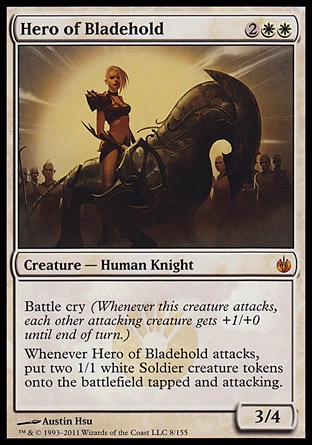
    Hero of Bladehold +10.14% within 5 days
    Current quotes - hi: 15.74 mid: 13.08 lo: 10.50

    Hero of Bladehold +$1.34 within 5 days
    Hi: 15.74 Mid: 13.08 Lo: 10.50

    Hero of Oxid Ridge +10.14% within 5 days
    Current quotes - hi: 13.18 mid: 10.70 lo: 9.00

    Hero of Oxid Ridge +$1.34 within 5 days
    Hi: 13.18 Mid: 10.70 Lo: 9.00

    Slagstorm +7.19% within 5 days
    Current quotes - hi: 3.99 mid: 2.98 lo: 2.00

    Spine of Ish Sah +7.19% within 5 days
    Current quotes - hi: 1.04 mid: 0.37 lo: 0.13

    Sword of Feast and Famine +$1.81 within 5 days
    Hi: 39.99 Mid: 35.83 Lo: 32.35

    Thrun, the Last Troll +13.97% within 5 days
    Current quotes - hi: 14.95 mid: 11.60 lo: 8.63

    Thrun, the Last Troll +$1.76 within 5 days
    Hi: 14.95 Mid: 11.60 Lo: 8.63

    Phyrexia Change Report

    Run on Sun Oct 30 2011

    Min Change $1 or 5%, Rares and Mythic Rares only

    Lashwrithe +25.23% within 5 days
    Current quotes - hi: 4.19 mid: 2.11 lo: 1.09

    Innistrad Change Report

    Run on Sun Oct 30 2011

    Min Change $1 or 5%, Rares and Mythic Rares only

    Blasphemous Act +6.67% within 5 days
    Current quotes - hi: 1.04 mid: 0.60 lo: 0.23

    Devil's Play +8.64% within 5 days
    Current quotes - hi: 2.56 mid: 0.81 lo: 0.25

    Endless Ranks of the Dead +10.56% within 5 days
    Current quotes - hi: 3.14 mid: 1.58 lo: 0.83

    Runechanter's Pike +6.67% within 5 days
    Current quotes - hi: 1.04 mid: 0.48 lo: 0.17

    2012 Change Report

    Run on Sun Oct 30 2011

    Min Change $1 or 5%, Rares and Mythic Rares only

    Angelic Destiny +10.03% within 5 days
    Current quotes - hi: 13.18 mid: 11.08 lo: 8.95

    Angelic Destiny +$1.1 within 5 days
    Hi: 13.18 Mid: 11.08 Lo: 8.95

    Archon of Justice +27.42% within 5 days
    Current quotes - hi: 8.48 mid: 0.64 lo: 0.23

    Drowned Catacomb +7.64% within 5 days
    Current quotes - hi: 4.38 mid: 3.11 lo: 2.25

    Druidic Satchel +6.02% within 5 days
    Current quotes - hi: 3.99 mid: 1.39 lo: 0.44

    Garruk, Primal Hunter +$1.21 within 5 days
    Hi: 39.99 Mid: 36.41 Lo: 31.00

    Rootbound Crag +8.56% within 5 days
    Current quotes - hi: 3.14 mid: 1.82 lo: 1.00

    Sorin Markov +19.66% within 5 days
    Current quotes - hi: 11.87 mid: 6.64 lo: 4.85

    Sorin Markov +$1.26 within 5 days
    Hi: 11.87 Mid: 6.64 Lo: 4.85

    Kelly Reid

    Founder & Product Manager

    View More By Kelly Reid

    Posted in Finance, Free Insider, QS Blogs5 Comments on Yum, Data!

    Have you joined the Quiet Speculation Discord?

    If you haven't, you're leaving value on the table! Join our community of experts, enthusiasts, entertainers, and educators and enjoy exclusive podcasts, questions asked and answered, trades, sales, and everything else Discord has to offer.

    Want to create content with Quiet Speculation?

    All you need to succeed is a passion for Magic: The Gathering, and the ability to write coherently. Share your knowledge of MTG and how you leverage it to win games, get value from your cards – or even turn a profit.

    Insider: the Financials of Future Sight

    Are you a Quiet Speculation member?

    If not, now is a perfect time to join up! Our powerful tools, breaking-news analysis, and exclusive Discord channel will make sure you stay up to date and ahead of the curve.

    Future Sight was the third set in Time Spiral Block and it was full of all the busted elements you could imagine. The Development team decided to look at how Magic would appear at some point in the future, perhaps in an alternate universe. We saw keywords like Delve that haven't appeared since, along with cards like the Pacts that revisited ideas on just what you'd pay for a "free" spell.

    Future Sight is also full of money. Since it was in print, it usually made sense to open boosters and sell the contents, because they would typically be worth more than the sealed booster. That rarely happens in Magic - we sort of saw it with Worldwake, but Future Sight was the best example. Future Sight is so deep, in fact, that I've split it into two articles. I've never done this with a small set before; when I do it, it's so readers like you do not get overloaded with a big wave of cards to remember at once.  Let's take a look at all these valuable cards!

    $13.00

    Awhile back, The Magic Lampoon released a spoof set spoiler in which nearly every card was named Akroma. We had Akromat, Akromium, and my favorite, "Akroma! Hans, Run!" Fans will buy anything Akroma-branded and this was a cunning skewer on how R&D was pumping up their favorite angel. Speaking of pumping up, the Memorial is like Eldrazi Monument - all your meaningless mana dorks and tokens become pretty hearty monsters in combat with this artifact down. Memorial is strongly traded for and I've seen them go on Ebay for as little as $9. If you're patient and thorough (and use a bidding scheduler), you can pick some of these up on the cheap to trade away for as much as $15. People don't really consider the option of using Ebay as a "buylist" to recruit underpriced cards, and with the variance on pricing that I've seen on the site, you can stand to make a bit of cash if you're dedicated.

    $16.00

    Bridge was probably conceived as a Johnny card that would reward people who could discard it. It's The Goggles when you have it in play, and Black has so few ways to get rid of their own enchantments... certainly, this wouldn't matter much. I think if R&D had paid more attention to the Dredge deck that had existed since Ravnica, this card would have never seen print.

    Bridge is what powers up modern Dredge decks in Vintage and Legacy. It makes warm bodies with Cabal Therapy and then sends those corpses into a Dread Return. It can often result in over a dozen 2/2s on the second or third turn. Bridge has no "fair" uses; it's just a combo piece. Bridge is also the cornerstone of the Dredge deck, making it an expensive card to pick up. I had thought that these were around $8; they've obviously gone up since then. You can take advantage of being current on this card's price!

    $2.50

    I tend to think that people are getting Cloud Key for a bit of wishful Modern thinking. It's a bit of a combo enabler, but there really isn't anything you can do with Key that isn't completely cumbersome. I have a feeling that I'd get a set of these out of a junk box and they'd just sit in my binder forever...

    $1.50

    Relic is a perennial Commander favorite. It fixes all sorts of mana and it's usually just below Sol Ring on the "always include" mana artifact list. Foils of this are $20. The price has dropped from $3 because the Phyrexia vs. the Coalition decks have put a bunch of these into circulation. Sets are a hard sell and the card doesn't get much binder love on its own. I have hopes for this in Modern, since it's an absurd card, but time will tell.

    $2.50

    Dryad Arbor went up, thanks to Modern and Green Sun's Zenith. Now that the sorcery is gone, I wish these would come down to a buck. You'll occasionally see them in Dredge decks and as a 1-of for Natural Order decks in Legacy. They are a curiosity and I don't think we'll see them reprinted; Get one or two if you play older formats and be glad that you won't have to scrounge for them when you need them. They are also phenomenal junk collection booty; two or three of these and you'll be happy you bought all those commons!

    $13.00

    Grove was unloved and unplayed until people figured out that it combined with Punishing Fire to make a beast of an aggro destroyer. It's the reason that you don't see Zoo decks with Steppe Lynx in Modern. That kind of all-in deck can be smashed apart by recurring Fires. Grove was the most hyped card in the leadup to the Modern debut and it fell short because people planned around it. Elves can win before it becomes recursive and Zoo has loaded up on Loam Lions instead. Grove still has a place, but it's more marginal than previously predicted. They're at $13 now, but I wouldn't be surprised to see them dip a bit more before the Modern Grand Prix and PTQ season picks up.

    $7.50

    Chalk this up as another card that slowly creeps up in value. Canopy sees obvious Commander play and also makes slight appearances in Legacy. People are tossing it into Modern Zoo decks, but I'm not sure that's the right home for them. They certainly aren't getting enough play to justify this price tag, so I'm not sure what else is driving the market for Canopies.

    $2.75

    Jhoira's price is strictly driven by her insane power as a general in Commander. The typical Jhoira deck will play her and then immediately suspend some terrible and strong spell, like Jokulhaups or Mindslaver. Even if you kill her, that spell still comes out to wreck people. Later in the game, she'll stack up a few spells, so that Apocalypse is followed by an Eldrazi to put the game away. If you see someone playing Jhoira, kill them as soon as you can. It's a really satisfying team effort to kill that person before their suspended monsters come off the stack. Note that foils of this card are stupidly expensive.

    $4.50

    Korlash was the prerelease foil, but you can't tell that by his price! This Zombie warlord has been a fan favorite since it was printed. We saw decks that used him with loads of removal and just planned to smash in with this giant regenerator. I think people like the idea of using him with recursion in casual games - you can get obsessed with value and run stuff like Phyrexian Reclamation for super ultra card advantage. It has a surprisingly-brisk casual fan market, so pick these up when you can and trade them off to people who love thematic decks.

    That's the first part of our Future Sight look. Like I said before, I've never had to split a small set up before, which should tell you about how deep Future Sight is for the collector and trader. Join me next week when we talk about Pacts, Magi and Lhurgoyfs!

    Until then,

    Doug Linn

    Insider: When To Sell (and a new project)

    Are you a Quiet Speculation member?

    If not, now is a perfect time to join up! Our powerful tools, breaking-news analysis, and exclusive Discord channel will make sure you stay up to date and ahead of the curve.

    One of the most common responses a MTG finance writer gets after writing a theory or trading-based article is “What are the hot buys this week?” usually with no regard for the value of what was written in lieu of "buy this now."

    Luckily, this is a problem we have a little less of on QS due to the fact a lot of that day-to-day speculation takes place in our forums and the Prediction Tracker. I also like to think that our readership is a little more educated than the crowd that usually comments on some of the bigger sites. Just as strategy articles are allegedly all about the decklists, finance articles are all about the hot buys. It doesn’t matter how great an article was or if there aren’t any good buys at the moment, there seems to always be a crowd screaming “WHAT CARDS I BUY TODAY?”

    This is the wrong question.

    People love to get in on cards when they’re cheap and feel proud of themselves or show off when the card spikes or goes up a few dollars. It’s great to save a few dollars on cards you might have bought, but this is in no way the same as making money.

    I’ve linked to the following article a million times, but if you still haven’t read it, you need to. This type of behavior is known as the Myth of Making Profits, and gets you nowhere if your goal is to actually make real money that translates outside of the cardboard world. As such, the proper question is not “what should I buy?” but this:

    When should I sell?

    Cashing out

    I’ll start out with the basics of the format changes before investigating some other non-format-related concerns about when to sell out. Everyone knows about the seasons of MTG, we go from Limited season (now), to Extended/Modern to Standard. The first and easiest advice I have for when to sell is that you should only sell in-season.

    Modern

    We’ll start by looking at Modern, this year’s Winter PTQ season. You should sell your Modern/Extended right at the beginning of the PTQ season, not in the middle and certainly not at the end.

    Despite the established theory that prices don’t drop until the month of rotation, which may hold true for retail prices, that doesn’t get you far when you need actual cash out of your cards. Dealers lower their buy prices on specialty-format cards that are only good in season well before you near the end of the season. This was a lesson I learned somewhat painfully during Extended last season.

    Modern prices are depressed right now due to it being out-of-season. Obviously you don't want to sell out now, but you also don’t have the luxury of waiting until the end of the season to move your cards, as every day after the opening PTQ to the end of the season means you’re losing money on your Modern holdings. Wait for the first few results to break out to create the demand for particular decks, then move your cards out as soon as you can after that for cash.

    Legacy

    Legacy prices follow a very easy metric in the United States, particularly now that we’re fully past the price correction the market went through following the explosion of the SCG Open Series.

    While there will be weekly fluctuations based on the metagame, Legacy prices will always peak right before the one US Legacy GP we have (at least on the old schedule). You’ll notice the run-up in Legacy prices ended very quickly after GP Providence, and depending on how the new GP schedule works out, you can expect the same to happen every year. While Legacy is awesome both as a format and an investment because it holds prices so well, it’s around the time of this GP you’ll find absolute top-dollar.

    Standard

    Ah, Standard. The most volatile format we have. The same rules from above apply, but with a few things we should note.

    For starters, Standard is always heavily played, regardless of it being a PTQ format. This means you can’t bank as heavily on the “in-season” rule for selling, at least not with all your cards. Looking at where we’re at right now, I have different suggestions for when to cash out depending on the set.

    For starters, I would hold all Scars block and M12 cards that are closer to staple than they are “flavor of the week” (things such as Inkmoth Nexus and Hero of Bladehold are what I consider a staple). I would advise holding onto them until the opening of the PTQ season, when they are both farther out of print and more in demand.

    Time to sell or hold?

    You can’t wait much longer, or you begin to push up until that time when players hold off on buying due to impending rotation, but there is a sweet spot there (generally around the beginning of Summer), where you can use the fact that they are winding down in availability due to natural causes while still sustaining a high level of demand.

    On the other hand, you should be moving all the Innistrad block cards you can right now. Not accounting for metagame shifts that can cause spikes, you’re not going to get better prices for Innistrad cards than you would have in the lead-up to States. The annual States tournament seems to mark the point every year when the most recent set begins its downward descent that doesn’t end until the packs stop being opened.

    Looking at something like Snapcaster Mage, people are always interested in getting it from me, but I don't have many because I’m not very invested in the card right now. I'm very leery of picking it up at the inflated $30 pricetag that it’s not going to sustain for another year (it already closes at $18 or lower on Ebay, by the way). You have to decide if you can move these cards fast enough to make it worth trading into them at their high prices, but you certainly want to sell (or trade) these as soon as you can. In about nine months, as we move out of Innistrad block and into M13, the time becomes right to start picking the hot cards of the set up again.

    There’s an easy analogue that helps this makes sense. I’ve never seen anyone rush into a store that has signs advertising that everything is “full price.” No, it’s when there are sales that people rush to buy. Treat your Magic collection the same.

    Other considerations

    Let’s start with the myth of the “rotation dip.”

    One trend that has been growing more pronounced over the last year or two is the quickening of the rotation dip. Whereas it used to be immediately before and after rotation, that timetable has moved up significantly, due to what I suspect to be greater knowledge among the player base regarding prices. This is directly tied to the rise of Magic finance writing and higher card prices among hot Standard cards, which has educated the player base and caused an ever-growing number of players to try and beat the rush, so to speak.

    Let’s look at a few recent examples that dispel this traditionally-held belief.

    Look at Jace, the Mind Sculptor. Using the currently-defunct BlackLotusProject (they’re experiencing some difficulties with MOTL, which has caused them to go down until a replacement is found), we can see that Jace peaked long before his rotation or even whispers of a banning came around. Luckily, QS had you covered on this one, if you were invested into the Blue Man.

    This was an example of retail stores being out of sync with a card’s actual market value (though I’m sure they were still selling their copies at inflated prices). But what we want to take from this is the ceiling on Jace came long before he went out of Standard, despite not becoming any worse in the meantime.

    The “Rotation Dip” still exists, but if you’re still in the mindset of using the rotation as your benchmark date, you’re far behind. To extract full value, remember to keep an eye on the market and move your timetable up.

    Cross-format playability

    Another consequence of the rise of Legacy and now Modern is that players are more aware of what will retain value. This means that the Rotation Dip can also mislead you on this account if you’re not careful.

    No price dips here

    An interesting case study here is the Zendikar fetchlands. For a while the prevailing theory among many was that you should wait until they rotated to begin picking them up, due to the aforementioned anticipated drop. That’s what I initially thought too, until I began to do some research on them.

    For ages, the going rate on the fetches was $10 a pop, and the traditional line of thinking would suggest these would bottom out right after rotation and then increase from there, meaning you should get out at their current price and back in later. But as I dug into it, I found that actual market data (again using BLP) wasn’t supporting this theory. There was simply no continuing dropoff in their Ebay prices. This led me to put a buy/hold call on fetchlands, and that has paid off handily, as their retail price has actually gone up, not down, since their rotation.

    While now is certainly a great time to pick them up, the truth is there was never a time to get out of these, further supporting my premise that the “rotation dip” has been overstated.

    Hot risers

    This is the hardest market to navigate, particularly in MODO. I don’t have anywhere near the expertise to comment as much on that (though this is a good start), but I can speak to how to approach this in paper Magic.

    The simple truth is that very rarely will buying in cash on Standard cards net you a lot of money, unless you really get ahead of the game on something like Stoneforge Mystic or Consecrated Sphinx (now I wonder what site was far ahead of those?).

    Obviously one of the best plays is to pick up low-priced Mythics in trading because if there is a jump, you’re going to generate the most profit on Mythics. But this is about selling, and my rule is this — Sell first, ask question later.

    It’s basically impossible to know if a card is going to stay hot (Sphinx) or make a jump then die later (Frost Titan). If you’ve done your work picking them up on the cheap, just get out, take your money, and worry about it later. You’ve made money, don’t take the chance of losing out by waiting to see if it will eke you out a little more.

    Purging the Binder

    I’ve touched on this before, but I want to remind you that this is something you should do regularly. I literally begin to get antsy if my binder grows too big, even though I do my best to trade into Legacy and casual staples that will hold their value and not require me to move them within a few weeks or lose out.

    Of course, I don’t imagine everyone’s in the same position as me and know buylist prices for the majority of their binder. It’s well worth your time to take your binder to a dealer at a big event and sell off your Standard stock, particularly if you don't do this already. There’s no rush to sell the Legacy/EDH/Casual cards if you don’t want to, but if you can get a few bucks out of a Standard-only card, it’s usually much better to do so than to let it rot in your binder.

    I’m not telling you to take bulk rates on your cards just because they’re in Standard or to sell a card you legitimately feel will rise in value, but those Spellskites or Kessig Wolf Runs probably aren’t holding their current price tags long-term. Something to keep in mind.

    Wrapping up (Landing a Car?)

    I think I’ve covered a lot of the factors you need to keep up with and hopefully made you a little more aware of when to sell your cards. If you’re serious about making money from Magic or aspire to be a successful floor trader, selling cards should be an enjoyable experience, not a painful one.

    Many people go through a sticker shock when they realize that their cards aren’t worth nearly as much as they thought (retail is not a cash value). But the truth is, if you are in it to make money you value all your cards at buylist prices anyway, so cashing out is a validation of your hard work, not something to be feared.

    If I wanted, I could have traded into one of the most impressive trade binders you could find, but instead I (and many other serious traders) prefer to cash out at regular intervals. It’s nice to have a sweet trade binder and all, but it’s also pretty sweet to buy a TV or an engagement ring with the money you’ve made trading.

    Now for the teased project. It's something that started off as a joke, but the more I think about the more I think it’s a real possibility. The goal?

    Buy a car with fetchlands.

    How far can 250 Fetchlands take you?

    It sounds crazy, but as a huge Dave Ramsey believer, I only drive used cars, so we’re looking at a reasonable price here.

    Looking at the old fetches such as Polluted Delta, I can get at least $20 apiece for them as of today. I expect to do the same with Misty Rainforests and Scalding Tarns in 5-7 years (assuming Gavin doesn't kill Magic in that time), and since only the Zendikar fetches are legal in Modern, that timeframe could be even faster if the format sticks around. A little math shows that to buy a $5,000 car I’ll need to sell about 250 fetchlands. I’m up to about 50 right now, including some foils, and I really don’t think it’s a stretch to imagine I’ll get there in the next few years of trading if I work at it. With dedication and proper managing of your inventory, this is surprisingly attainable. Obviously this a very long-term project that isn't quite as entertaining as Pack to Power or even Box to Extended, but I want you to understand what the stakes are when you're dealing in the cardboard with the funny pictures.

    And, in case you’re wondering, Car > iPad.

    Thanks for reading,

    Corbin Hosler

    @Chosler88 on Twitter

    QS Drafts: Drafting Innistrad #2 [MTGO]

    Are you a Quiet Speculation member?

    If not, now is a perfect time to join up! Our powerful tools, breaking-news analysis, and exclusive Discord channel will make sure you stay up to date and ahead of the curve.

    Forrest Ryan and Kyle Stoll continue to draft Innistrad on video, bringing us along with tasteful banter and heartwarming commentary, offering insight into the picks and plays of today.
    Note: Audio quality has been addressed and future videos will begin featuring professional level audio clarity. Stay tuned!

    Other drafts:
    QS Drafts: Drafting Innistrad #1
    QS Drafts: Drafting Innistrad #2

    Is the Big Bad Wolf Red or Green?

    Are you a Quiet Speculation member?

    If not, now is a perfect time to join up! Our powerful tools, breaking-news analysis, and exclusive Discord channel will make sure you stay up to date and ahead of the curve.

    #1 and 2 Decks to beat: Wolf Run Red and Wolf Run Green


    null

    Both of these versions are solid, resilient decks. With no Spell Pierce to keep Green Sun's Zenith in check, the Primeval Titan decks are quite the force to be reckoned with. They are consistent, disruptive, and have the best end game of any deck in the format. Sure grabbing Kessig Wolf Run and an Inkmoth Nexus with Primeval Titan isn't as good as Valakut, the Molten Pinnacle, but it's only one step away.

    Contrary to what I posted last week, I actually ended up throwing this deck together for FNM. The main reason I wanted to play it was just to see what it was all about. Is it as good as the hype makes it out to be? How is it in the metagame? In addition, I knew no one was playing it at my store yet so I thought I could show some players what it was all about. This theory was completely wrong and Wolf Run Red was by far the most popular deck this past Friday with five out of the twenty or so players that attended this week.

    It seems that actual tournament play has much more impact than testing, in my experience. So, make sure to test out your decks locally before heading off to the big show somewhere. This tournament was no exception and I learned some valuable information about this deck and playing against it from the tournament.

    Notes on the deck:

    Kessig Wolf Run is a powerful card and probably should be moved to four copies main deck. You do not need Inkmoth Nexus to win, nor do you need Primeval Titan. What you actually need is the land. It enables so many options to win the game. If you are going to play this deck one of the most important matches to test is the mirror. It is miserable. It might be the worst mirror I have ever had to play and it was my only loss on Friday. Be prepared for the mirror. I don't have some secret but I think Genesis Wave might be a place to start, thought it may be too expensive. One important thing is making sure to not miss a land drop. I definitely lost a mirror because I failed to move from five to six mana so I could play my titan. This makes me think twenty seven lands might be necessary. That would allow for more Kessig Wolf Run action as well.

    Garruk is amazing. I don't need to specify which one because they both are awesome. I ran four Garruk Relentless and two Garruk, Primal Hunter and I was pretty happy with that. Garruk Relentless on turn three is where it's at. I definitely agree with Todd Anderson on that point. In the mirror, being able to set up Overrun with Garruk Relentless should win you the game when that plan is an option.

    Does this deck have bad matchups? Most players think the deck does not really have bad matchups. The mirror, or pseudo mirror in the Green version, is by far the hardest part about playing this deck. There is one other matchup that is not getting the attention it deserves and that is Mono Red. Some players just beat Mono Red all the time with this deck but be careful because it is actually a bad matchup. I tested these two decks this week for a couple hours and once the Mono Red player figures out what's going on, they can win almost any game. The key is a solid Mono Red list you are comfortable with and playing the match correctly. Usually that means not tapping out later in the game when you have one or more active Shrine of Burning Rages. They are clutch to winning the match.

    Modified Todd Anderson Wolf Run Red

    Untitled Deck

    Creatures

    1 Birds of Paradise
    4 Viridian Emissary
    1 Viridian Corrupter
    1 Thrun, the Last Troll
    1 Acidic Slime
    3 Primeval Titan

    Spells

    2 Galvanic Blast
    3 Slagstorm
    4 Beast Within
    4 Rampant Growth
    4 Green Sun's Zenith
    4 Garruk Relentless
    2 Garruk, Primal Hunter

    Lands

    8 Forest
    4 Mountain
    4 Copperline Gorge
    4 Inkmoth Nexus
    2 Kessig Wolf Run
    4 Rootbound Crag

    Basically I took Todd Anderson's list and made some adjustments based on my play style. I felt Todd's list was the best I had seen so far. The deck could probably be more tuned than it was but I liked this list quite a bit. Garruk Relentless being able to tutor for Primeval Titan is amazing so don't forget that is an option.

    Since I am such a big fan of Todd Anderson's work right now, I thought I would use his mono green list from this week as well. If I were going to play a mono green list, it would look remarkably similar to his build. Take a look.

    Untitled Deck

    Creatures

    2 Acidic Slime
    4 Birds of Paradise
    4 Dungrove Elder
    2 Llanowar Elves
    4 Primeval Titan

    Spells

    4 Rampant Growth
    3 Beast Within
    4 Garruk Relentless
    2 Garruk, Primal Hunter
    2 Batterskull
    4 Green Sun's Zenith

    Lands

    20 Forest
    1 Mountain
    2 Inkmoth Nexus
    2 Kessig Wolf Run

    What's the difference between the mono green and red green builds? The picture logo basically says it all. Do you want to play Dungrove Elder or Slagstorm? Dungrove Elder is the more proactive choice for sure, but I would much rather play a more interactive card like Slagstorm that is a three mana Wrath of God sometimes and other times a planeswalker killer or even a burn spell. Also, on the play, Slagstorm kills Dungrove Elder so in some instances it acts as a trump.

    With all the Green White Tokens decks, Mono Red, Most of the creatures in the poison deck, and other aggressive strategies running around, I would much rather be on team Slagstorm than team Dungrove Elder. It mostly comes down to personal preference though as both are viable and good options.

    What if you don't support team Slagstorm or team Dungrove Elder? We'll, just form Voltron!

    Answering questions last week in the comments, it was suggested to play Vault Skirge. Initially, my hatred for the card overwhelmed my ability to make a coherent decision about the card because I was blinded by how terrible I think the card is. I got to thinking about the card later in the day and remembered how critical it was in Tempered Steel decks. It is still horrible on its own, but its impact is not negligible and once you hit a Tempered Steel, it actually becomes a decent threat. Don't we do the same thing with the equipment in this deck? I could not stop thinking about this card and its implications. It lowers the curve of the deck a little to be more interactive in the early turns of the game which is something I am actively trying to do in Standard right now because I think it is essential in the environment. In addition, it makes achieving metal craft that much easier for Puresteel Paladin, Dispatch, and the recently included again Etched Champion.

    The other main suggestion was for Painsmith, but that is just not what this deck wants to be doing. Too much black mana requirement to be able to hit it turn two and a very low impact if played late in the game. The Vault Skirge though? I think that step might allow this deck to evolve into its next level. Take a look at the new version. I have been very happy with this build in testing this week.

    Untitled Deck

    Creatures

    3 Doomed Traveler
    3 Vault Skirge
    4 Puresteel Paladin
    3 Etched Champion
    2 Mentor of the Meek

    Equipment

    4 Flayer Husk
    4 Mortarpod
    3 Sword of War and Peace
    3 Sword of Feast and Famine
    1 Batterskull

    Spells

    4 Dispatch
    3 Oblivion Ring
    1 Mox Opal

    Lands

    4 Seachrome Coast
    4 Glacial Fortress
    10 Plains
    2 Moorland Haunt
    2 Inkmoth Nexus

    Sideboard

    1 Sword of Feast and Famine
    1 Sword of War and Peace
    3 Corrupted Conscience
    2 Phantasmal Image
    1 Inkmoth Nexus
    2 Trinket Mage
    1 Blazing Torch
    1 Sylvok Lifestaff
    1 Batterskull
    1 Oblivion Ring
    1 Revoke Existence

    What makes this deck so good right now? Mortarpod is honestly a big part of that. That ability to ping for one damage repeatedly over the course of the game is remarkably good right now. Players are advocating Gut Shot, Mortarpod does that but many times! It is just so good against a variety of decks and is definitely one reason to play this deck. I think that Voltron has the best removal in the format honestly. Oblivion Ring deals with everything and Dispatch feels like cheating sometimes for how strong it is. We could sideboard Day of Judgment as well if we wanted. What else do you need? Blue Black Control gets Snapcaster Mage to flash back their removal but honestly a lot of their removal is pretty clunky. That's right, I just compared the removal of the best control deck in the format to the removal of a blue white aggro decks! Believe it!

    Another big reason I feel this deck is so strong is because of the carefully constructed mana curve and built in card advantage engines. In many games you can be fairly controlling depending on the match so know when you need to be the beatdown and when to control the game.

    The Doomed Travelers have continued to perform well for me but I cant help thinking that a 1/1 for one is just not powerful enough for competitive play. This deck is built on synergy rather than blunt power though and a threat that can cary a sword and replaces itself seems similar to the idea of Squadron Hawk in previous versions. The evasion and lifelink on Vault Skirge seem quite relevant but we will see how I feel about the card after FNM This Week.

    Some sideboarding notes:

    Aggro:
    Against any other aggressive deck you want to bring in the Trinket Mage package that I moved to the sideboard. It was just not performing well against most of the decks in the metagame. These cards are very good against aggro though and you could side the Trinket Mages against a removal heavy blue black control deck as well. The second Batterskull comes in here as well. How you sideboard will depend on what aggro deck you are playing against but typically the two Mentor of the Meek for the Trinket Mages and one sword for the Sylvok Lifestaff.

    Big Bad Wolf:
    A while ago I used Corrupted Conscience to much success against some Valakut, the Molten Pinnacle builds. I think this might be a good way to beat them again. You could play Act of Aggression in this place as well but I think the enchantment is better. Fetching two Inkmoth Nexus seems pretty good also. The fourth Sword of Feast and Famine is there for this match and I think we want it even with Ancient Grudge because we should be able to play around it to get some activations off of the sword. I would probably take out the Etched Champion because it's not likely the metalcraft will be active very long. I would also remove the Batterskull for the extra land. The additional land being Inkmoth Nexus might be a little greedy. Maybe it should just be an Island, I am not sure yet. Games two and three should probably be more difficult but luckily your game one percentage is high.

    The Oblivion Ring and Revoke Existence are for Birthing Pod decks and Tempered Steel decks because they are still around and favored by some in my metagame.

    Phantasmal Image is kind of a catch all at the moment. I would think about sideboarding it in against Wolf Run to copy a titan or Wurmcoil Engine and then remove their copy from the game. Even with Kessig Wolf Run I think that would be decent. It's possible that this spot and more should just be Flashfreeze though to try to not let their threats resolve. The Phantasmal Image does other things though like comes in against Solar Flare decks and Geist of Saint Taft decks so it just depends on what you have to play against. If your meta is thirty or more percent Wolf Run, Flashfreeze should probably be a priority.

    Are you the Big Bad Wolf? Or are you fighting against it? It is the same question revisited once again with new cards. Team Slagstorm or Team Dungrove Elder? I choose neither. I'm a part of the Voltron Force!

    Until next time,

    May your opponents not draw their Ancient Grudges, and

    Unleash that Voltron Force!

    Mike Lanigan

    MtgJedi on Twitter

    Jedicouncilman23@gmail.com

    Want Prices?

    Browse thousands of prices with the first and most comprehensive MTG Finance tool around.


    Trader Tools lists both buylist and retail prices for every MTG card, going back a decade.

    Quiet Speculation