menu

Mirror, Mirror

Are you a Quiet Speculation member?

If not, now is a perfect time to join up! Our powerful tools, breaking-news analysis, and exclusive Discord channel will make sure you stay up to date and ahead of the curve.
Recently, I've been getting a ton of emails about the new Commanders from the pre-constructed decks. Being the new guys on the block, and capable of doing new and exciting things, these commanders are incredibly popular. There are a ton of people who are putting their own spin on them. In particular, Riku of Two Reflections has been getting a ton of attention. Who doesn't love copying gigantic spells and creatures, right?

The interesting thing about [card Riku of Two Reflections]Riku[/card] is the sheer variety of powerful things you can do with him. I've been discussing different approaches to [card Riku of Two Reflections]Riku[/card] with a a few readers over the last few weeks. It was really interesting to see so many different takes, and explore the sheer breadth and power of interactions there are with Riku. To give you an idea, Michael sent in a build that was based on Clones, Rite of Replication, and Parallel Evolution; Tim sent in a version that played every Time Warp and Anarchist effect available in the color combination; finally, Scott sent in a build that focused on comboing out as efficiently and quickly as possible.

Based on the experiences I've had playing with and against different [card Riku of Two Reflections]Riku[/card] lists, I think there are two baseline approaches: Combo and Midrange. The combo decks are the ones that try to do something inherently unfair that results in some kind of infinite combo with turns, creatures, or something else. The midrange decks are the ones that play all the the value creatures, and are using [card Riku of Two Reflections]Riku[/card] to copy generically good cards as opposed to using him to do something degenerate. The rest of the article will focus on outlining different ways to build these decks, as well as the things that I do and don't like about each of the approaches.

We'll start with the combo builds. The way I see it, there are two different ways to build combo-[card Riku of Two Reflections]Riku[/card]. You can either build a Time Warp-based deck, or a creature-based deck. There's no reason you couldn't run these together, but there just isn't enough overlap between the two to make it worthwhile. There also isn't enough space to fit all of the cards that these two archetypes want without skimping on ramp and utility. That said, the Time Warp deck is pretty straightforward, and a skeleton would look something like this:

Time Warp Riku

[deckbox did="a122" size="small" width="560"]

The plan here, for anyone who hasn't seen anything like it before, is to spend the early turns ramping. Then you find a Time Warp and copy it with [card Riku of Two Reflections]Riku[/card]. Hopefully that will give you enough time to find another Time Warp effect, and you can start chaining your turns. Eventually, you can Call to Mind back two Time Warps and then Regrowth both Call to Mind and Time Warp, and take infinite turns. Even if things don't go exactly as planned, if you can take a number of turns with cards like Oracle of Mul Daya, Jace, the Mind Sculptor, and other cards that give you incremental value, you can pull incredibly far ahead with "just" one Time Warp.

Creature-Combo Riku

[deckbox did="a123" size="small" width="560"]

Similarly to the Time Warp build, this one wants to spend the first few turns ramping their mana. However, instead of taking extra turns once you get to seven or so mana, this one wants to get to nine or ten mana and just win. How do you do that? Well, the deck runs a multitude of one- and two-card combos with [card Riku of Two Reflections]Riku[/card] that let you do just that, as well as just two-card combos that win without [card Riku of Two Reflections]Riku[/card]. Let's take a quick run-down of the combos in the deck:

1. Kiki-Jiki, Mirror Breaker/Splinter Twin + Deceiver Exarch/Splinter Twin

Any two of these pieces lets you make infinite hasty guys and attack for the win. This deck is going to run near-infinite tutors for creatures to be able to set this combo up, since it is your fastest combo, but you're also going to run cards like Tooth and Nail and Defense of the Heart to just drop the combo into play.

2. Palinchron + Riku of Two Reflections

Casting and copying Palinchron costs nine mana, and generates fourteen. Bouncing Palinchron costs four more, leaving you with a net gain of one mana. Generate infinite mana, and then do something absurd with it. Pretty straightforward, right?

3. Worldgorger Dragon + Riku of Two Reflections + a creature with an "enters the battlefield" effect

This is the most non-intuitive combo in the deck, and seems hilariously appropriate with the unbanning of Worldgorger Dragon. Have a creature with an ETB effect and [card Riku of Two Reflections]Riku[/card] in play. Cast Worldgorger Dragon, and with it's ETB trigger on the stack copy it. The copy enters the battlefield, triggers, and removes everything else from the game. Then the original ETB trigger resolves, and removes the copy from the game. Now all of your permanents enter the battlefield again, and you can repeat the cycle. The important thing to clarify is that, here, the order in which you stack things matters. Assuming just [card Worldgorger Dragon]WGD[/card], [card Riku of Two Reflections]Riku[/card], and another card are in play, here's what you want it to look like:

[Resolves First]
Riku trigger (Worldgorger Dragon)
Worldgorger Dragon EtB Trigger
Riku Trigger (other creature)
[resolves last]

Now, you can loop this as many times as you want, never allowing the Riku triggers for your other creature to resolve. Once you've generated infinite mana and triggers by blinking everything, you can choose NOT to copy Worlgorger Dragon and allow it to remove all your permanents from the battlefield, and then pay for all of the stacked [card Riku of Two Reflections]Riku[/card] triggers, and have infinite creatures, infinite of a particular effect, or whatever you set up. It's important to remember that depending on what the creature is you may want to stack things differently, but in general this is how the combo is going to work.

4. Cloudstone Curio + Peregrine Drake/Cloud of Faeries + [card Riku of Two Reflections]Riku[/card]

If you have any of the "free" creatures from Urza's Saga, Cloudstone Curio and [card Riku of Two Reflections]Riku[/card] in play, you can generate infinite mana and creatures. You cast the free creature, untap your lands, copy the free creature with [card Riku of Two Reflections]Riku[/card], and then have the copy bounce the original, and net both mana and a creature each cycle.

5. Shrieking Drake + Peregrine Drake + [card Riku of Two Reflections]Riku[/card]

And here's another infinite creatures combo. Casting and copying Peregrine Drake costs seven mana. Then casting and copying Shrieking Drake costs three. The Shrieking Drakes bounce the original copy of both Peregrine Drake and Shrieking Drake, and you repeat the loop, netting a 1/1 and 2/3 flier each iteration.

Now, personally, I don't think I'd like playing either of these decks. For me, the fun of taking extra turns was spoiled when I realized I wasn't just taking an extra turn, but rather skipping everyone else's turns. I don't fault anyone for enjoying taking extra turns; there are very few things that are as much fun, but it's just something I'm not interested in doing.

Similarly, I don't like playing a deck that can just put two or three cards on the table and just win the game.  I really don't find this to be particularly interactive or fulfilling, and don't think that my playgroup would appreciate it either. That said, I definitely enjoy designing decks like this, and can appreciate the elegance of combo win conditions. I'm also sure that if I played with more people who enjoyed comboing off, I'd be much more inclined to play something combo oriented. Now that we've taken a look at two different 'unfair' [card Riku of Two Reflections]Riku[/card] decks, let's take a look at a 'fair' Riku deck:

Midrange Riku

[deckbox did="a124" size="small" width="560"]

Now this is a deck I can get behind! Ramp in the early game, and then take a trip to Value Town with your utility guys. [card Riku of Two Reflections]Riku[/card]'s abilities give you an exceedingly unfair late-game plan that can generate absurd amounts of card advantage. Why creatures over spells? To be honest, it's just easier to abuse creatures. Crystal Shard and Genesis make creatures easier to 'reuse' than spells. Consider also that creatures are more likely to progress the game than spells are, just because you can copy them to create a board presence then start attacking for two.

The thing that I like most about this deck, though, is that it has a ton of cute cards that do interesting things. Birthing Pod and Wild Pair are cards that I really like in the deck. The small recursion elements that you get from Caldron of Souls, Nim Deathmantle, and Mimic Vat are awesome, especially when you start assembling multiple pieces!

Now, just because this deck isn't a combo deck doesn't mean it doesn't have very powerful interactions. You do have the Peregrine Drake/Shrieking Drake combo. You also have Teferi, Mage of Zhalfir or Winding Canyons plus Seedborn Muse to let you play during everyone's turns. With Wild Pair in play, you can chain Avenger of Zendikar into Chancellor of the Forge, potentially copy both of them, and make a billion plants and hasty goblins. Alternatively, you could potentially deck yourself by chaining Avenger of Zenidkar into Regal Force.

The thing that I like about this build of the deck is that the cards are good at any point in the game. You have a ton of mana-sinks that want you to double up on ramp spells, even very late in the game. [card Riku of Two Reflections]Riku[/card] plus powerful engine artifact and enchantments give you a very consistent, powerful, and synergistic late game that can just crush people with card advantage. Who doesn't love a deck that goes big, and focuses on the interactions of fun and powerful cards?

Hopefully that's a pretty good overview of the kinds of approaches one can take when you're building a Riku of Two Reflections deck. The card is obviously very powerful, and can be a ton of fun to play both with and against, and I'm looking forward to seeing what other people are doing with him!

As I'm sure most of you are aware, Grand Prix Pittsburgh is this weekend (August 27-28), and I'm pretty excited for it! This is going to be my first Grand Prix, and I'm really hyped to meet some of the people I've been talking to for the past few months, and I'm really hoping to get in some Cube and Commander games after I scrub out of the main event! Let me know if you're planning on being there; I'm really looking forward to a weekend of gaming!

Carlos Gutierrez
cag5383@gmail.com
@cag5383 on Twitter

Insider: Cleaning Cards for Increased Profits

Are you a Quiet Speculation member?

If not, now is a perfect time to join up! Our powerful tools, breaking-news analysis, and exclusive Discord channel will make sure you stay up to date and ahead of the curve.

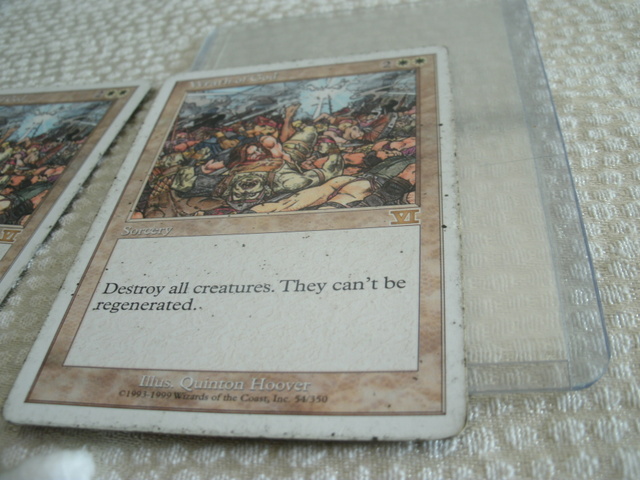
I scored a free Wrath of God the other day. This isn't like a trade toss-in, this was a no-strings-attached "add me to your EDH stack" Wrath of God, and I got it simply because I know how to clean cards. If you can do this too, you can instantly increase the value of older cards like dual lands and Sol Rings.

You've seen them, disgusting-looking cards, usually with a once-white border that is now gunked up. It happens to old cards and people don't want to trade for them because they look like a gunky keyboard from a high school computer lab. Unlike old coins or antique furniture, Magic cards aren't worth more when they retain the dirt and grime from years of play.

They're gross and there's no reason to have cards that look so bad. Here's my story on fixing the problem.

I noticed that I didn't have any spare Wraths in my collection for casual decks, so I went on Ebay and purchased two Wraths from a seller. They were $1.50 total, plus another $1.50 for shipping. Note to sellers: it is a terrible idea to sell two of a card. People either want one or four copies. Nobody bid on this lot and I stole it.

Unfortunately, there were no pictures with the auction, and when I opened the envelope, I saw this junk:

Disgusting. I wouldn't even handle these if they were in sleeves!

You're cringing because you've also seen cards that look like this. I had stumbled on the technique to clean up cards when I bought a lot of Tundras from someone and they came, looking like this. I had a spare Tundra and I decided to clean up the worst-looking one with my technique and then resell it. What I bought for $30, I resold for $50, simply because I cleaned it up.

Let's look at how to clean them. I have tried a bunch of different solvents and solutions to get gunk off, and most of them will strip the surface of the card, as well. Magic cards have a water-resistant coating on the front and back, but acetone and alcohol will strip that away quickly. The best cleaner I found for cards is simply a few ounces of very hot water and a drop or two of Dawn dish soap.

Once you have that solution mixed up, dip a cotton swab in it. Then squeeze out most of the water. You are looking for a bare amount, not a soaked ball of cotton here. The reason you don't want to use too much is that it can get in between the layers of the card, which can cause rippling and ruin the edge. You can always moisten a little more, but you cannot remove anything.

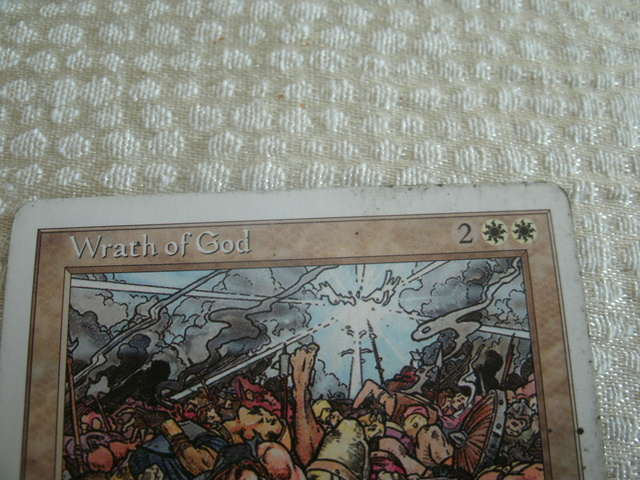
Take your moistened swab and gently go along the border of the card, trying to keep on the face of the card and not the side. You will, in all likelihood, not damage your card, but it is worth testing this on a junk Dance of Many or similar card. You will see the gunk lift right off almost immediately. You want the cotton to do the work, not the stick that it's mounted on. If you are scraping with the stick, you are pushing too hard and you will scar the card. Switch out swabs frequently and take your time. It is not hard to do, though, and it gives great results. Check this out:

On the left is the cleaned portion. On the right, the original grime.

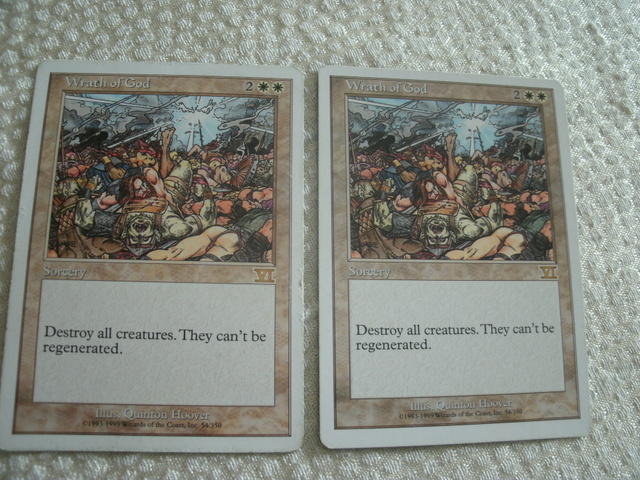
I have used this technique on Moxes, Ancestral Recall, and all of my dual lands. If you are gentle, you will not damage the cards at all. I am supremely confident in this technique and I think you'll find that your cards look better, trade for more and sell for higher amounts online. I took the second Wrath I got and sold it for far more than the $3 I had invested in the original two, and I only spent ten minutes of my time cleaning them up. What cards do you have that need a facelift? What profits will you unlock with a little care and patience?

The finished, cleaned product!

Douglas Linn

Doug Linn has been playing Magic since 1996 and has had a keen interest in Legacy and Modern. By keeping up closely with emerging trends in the field, Doug is able to predict what cards to buy and when to sell them for a substantial profit. Since the Eternal market follows a routine boom-bust cycle, the time to buy and sell short-term speculative investments is often a narrow window. Because Eternal cards often spike in value once people know why they are good, it is essential for a trader to be connected to the format to get great buys before anyone else. Outside of Magic, Doug is an attorney in the state of Ohio.  Doug is a founding member of Quiet Speculation, and brings with him a tremendous amount of business savvy.

View More By Douglas Linn

Posted in Finance, Free InsiderTagged 5 Comments on Insider: Cleaning Cards for Increased Profits

Have you joined the Quiet Speculation Discord?

If you haven't, you're leaving value on the table! Join our community of experts, enthusiasts, entertainers, and educators and enjoy exclusive podcasts, questions asked and answered, trades, sales, and everything else Discord has to offer.

Want to create content with Quiet Speculation?

All you need to succeed is a passion for Magic: The Gathering, and the ability to write coherently. Share your knowledge of MTG and how you leverage it to win games, get value from your cards – or even turn a profit.

End of the Line | CommanderCast S3E13

Are you a Quiet Speculation member?

If not, now is a perfect time to join up! Our powerful tools, breaking-news analysis, and exclusive Discord channel will make sure you stay up to date and ahead of the curve.

Another block of CommanderCast episodes comes to an end, and with it the migration from the sputtering, depleted husk of CommanderCast.blogspot.com to the new, vibrant CommanderCast.com! For our grand finale to the season, Andy is joined by three CommanderCast cornerstones: Byron, Donovan, and Carlos. Together, these three hit topics like life gain, the [card Kokusho, the Evening Star]Kokusho[/card] issue, and in a super-community segment discuss what they feel are the best and worst attributes of Commander.

The show will return in three weeks for the season four Premiere on CommanderCast.com! Be there!

This week's full show notes can be found here.

Hit the play button to listen, or download the entire episode!

Insider: Evaluating Betrayers of Kamigawa

Are you a Quiet Speculation member?

If not, now is a perfect time to join up! Our powerful tools, breaking-news analysis, and exclusive Discord channel will make sure you stay up to date and ahead of the curve.

Betrayers of Kamigawa is fortunate for us in some ways because there are very few cards that are actually worth memorizing. This set and its follow-on were nearly complete duds for tournament Magic; they left few memorable cards after Standard was over. There is a fascinating contrast here, though, because CHK Block Constructed was a fascinating environment. There was White Weenie, Gifts Control, and all sorts of Jitte-maximizing decks. The main themes of the block – Spirits and Arcane spells, were not compelling for players and did not scale outside of the block. Arcane spells, in particular, looked cool in theory: you could tack on cool effects with extra mana. Unfortunately, the Arcane subtype meant that all these cool cards could never be reprinted outside of block. That's why Kodama's Reach turned into [card]Cultivate[/card] and Cranial Extraction became [card]Memoricide[/card] for reprinting purposes.

Let's take a look at the cards worth knowing from BOK!

Final Judgment

Wrath effects always command a little premium over bulk, and FJ is actually one of the better ones. Instead of just burying the problem, it sweeps it into the land of Exile. This was important during Block because it took all the thrill away from an opponent who had tapped out to land a Yosei or Kokusho. Final Judgment is probably the third-best Wrath effect for EDH (behind Wrath itself and Rout) and I am surprised that more players do not pick it up. Part of the reason must be that Exile is pretty serious business and it can cut in on your own deck's recursion aspirations.

$2.00

Higure, the Still Wind

Unfortunately, you can't make a legitimate Commander deck with this guy without dipping into Changelings. All the coolest ninjas are black, not blue, so you can't grind someone with Okina-Gang Shinobi. He is still moderately popular in casual decks because, hey, Ninja!

$1.00

Ink-Eyes, Servant of Oni

My favorite part of CHK Block is the Legendary names. Most of the creative power must have gone into them, and Inky is a perfect example. What a badass name. Ink-Eyes is a pretty popular Commander card and the flavor is excellent. You let this little dude in and then it turns into a Rat Ninja and steals one of your monsters. That has universal appeal, and Inky even regenerates!

Despite being the prerelease card, Ink-Eyes has held onto a lot of value. I think it's worth pointing out here that this was probably the first prerelease card that did not totally suck. I don't know why they did it, but for years, Wizards did not give out a playable card for prereleases. We were stuck with trash like Beast of Burden! Now, we get monsters like Sun Titan, Korlash, Vampire Nocturnus and more. Those are lovable cards, unlike Overtaker.

$8.50

Kira, Great Glass-Spinner

Kira started to creep up in price when Merfolk became a respectable Legacy deck. She plays nicely with the deck's mana curve and helps to stop removal spells. Merfolk was viewed for a long time as the “budget” Legacy deck. Naturally, the entire deck became mad expensive when it started winning things. Kira blew up, as did Standstill and all the Merfolk lords. I think the cat is out of the bag on Kira – folks know the card is worth a few bills. Occasionally, you will see it come up in collections, because Kira saw no play outside of Legacy and some very narrow Vintage Fish decks.

$12.50

Mirror Gallery

For such a narrow effect, I have no idea why Mirror Gallery commands a few dollars. I presume that there are people who throw their Sliver Overlord Commander decks against each other and would rather not confront getting their guys Legend-killed. Maybe other players need to get two Baron Sengirs in play at the same time. Regardless, this is my call for “best chance to score at bulk price” in the set.

$2.00

Tendo Ice Bridge

Let's make one thing clear: this land is terrible. People only play the Nintendo Bridge when they have maxed out on City of Brass and Gemstone Mine. It was a valuable card in Block and Standard because it could power 4-color Gifts decks, but apart from that, the land is awful. If you are playing this, Reflecting Pool or even Vivid Crag is leagues better. This card commands a slight premium because it was from an unpopular set and it has some value as a land in Commander.

$2.00

That Which Was Taken

Another cool name! TWWT saw zero constructed play, but people like the card quite a bit in Commander. It is unfortunate to have your toys blown up, so Indestructible is a good protection. It also combines well with the Myojin; who wouldn't want to draw every turn with Myojin of Seeing Winds? This turns up in bulk bins a bit of the time, so keep an eye out for it.

$2.50

Threads of Disloyalty

What a difference a mana can make. Threads is much worse than Control Magic if you have the four mana available, but that did not stop the card from being Constructed-playable, even when Control Magic was in the format. There are times when you don't want to wait the extra turn. In Standard, it was when an opponent had Dark Confidant or Jushi Apprentice active. In Legacy, it might be a Wild Nacatl or Tarmogoyf. Threads is a great example of what makes a playable card; though full of restrictions, it fills the right role for the right price. It is superbly designed and I'd love to see it reprinted!

$2.75

Umezawa's Jitte

It is fitting that we finish with the bête noire of the set. Jitte, a card that slipped out of R&D with untested changes at the last minute, wrecked a lot of formats. In Block, it became so bad that people ran Manriki-Gusari to pop the card. Jitte is the go-to equipment in any format where it is legal. I see Jitte as a mixed bag in terms of design. It destroyed a lot of interactivity, but it also was the first equipment that was really worth playing (Skullclamp is a different animal entirely). The Swords from Darksteel were neat, but they never had the universal appeal of this card. They could never sweep away a game like a Jitte on the second turn could. Though Umezawa's Jitte is a complete design aberration, it set a strong boundary on what you could get done with two mana.

Jitte was an attendance promo card for the Grands Prix a few years ago, so there are hundreds of thousands of promo foil copies floating around. That has, interestingly, not affected the price of the card in the way that the promos dropped the value of Chrome Mox. Though the card is banned in Modern, it remains legal in Legacy and at kitchen tables all around the world.

$16.50

That's Betrayers; next week, we will look at the few playables in Saviors before we move onto another block, full of cool color interactions and power uncommons. See you then!

-Doug Linn

The real-life MTGO bot – how I use a bulk box to double my collection automatically

Are you a Quiet Speculation member?

If not, now is a perfect time to join up! Our powerful tools, breaking-news analysis, and exclusive Discord channel will make sure you stay up to date and ahead of the curve.


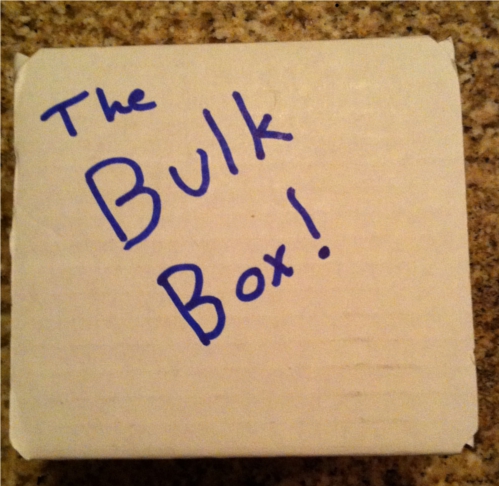
I want to introduce you to the most popular, yet most underutilized, tool that Magic players (and more specifically Magic traders) have at their disposal: The Bulk Box.

The concept of The Bulk Box was introduced to me on the very first day of my Magic career, back when I opened my first pack and started my first draft. Upon completion of my draft, a guy who was quite obviously sharking the young, impressionable souls like myself walked up to me with his binder full of expensive cards and a box. Having looked through the binder and finding every card way out of my price range, I turned to this box that he was carrying with him.

The rules were simple. I could put in any two of my rares, and get any rare out of his big box. To me, it was a genius plan, and as I rifled through the box and pulled out the stack of rares I wanted for my awesome UB Mill deck (quite the deckbuilding genius I was!) I handed to him, in return, a stack of rares that I had opened from the draft and the multiple boxes I had purchased. Assuming I took twenty rares out of the box, and assuming that your local game store buys bulk rares at the fantastic rate of ten cents each, Señor Sharky Shark made two dollars at the bare minimum from our one trade, assuming every card I gave him was pure trash and bulk.

Assuming that he kept this box running all day, and met about five more of me over the course of the tournament, that is a very easy $10 minimum for doing very little work.

Here's how to start up your own bulk box.

The idea is simple: you take every rare that would normally poison your binder and put them in the box. Anything that has a buylist price above bulk stays where it is - and I check this by using Trader Tools on this website. Those are cards that I can actually trade or just bulk out to buylists already. Everything else goes in the box. You were not going to trade off that Amulet of Unmaking anyway.

How has it been working out?

Fast forward two years and I am quite the trader-savant. My binder has nice rares and I’m grinding the tables like it’s nobody’s business, making money along the way. The Bulk Box has proven to be a money maker all on it’s own, as I just set it out at the table where I am trading and let it work its own magic while I focus on trades through my main binder. Most of the time, I have people show me what they are putting in and taking out, but often I just let the box run its course. It is important, though, that you check the status of your box every so often for multiple reasons. First, the box can grow stale very quickly, especially if you run into particularly savvy traders, but mostly just naturally over the course of time. When this happens, you have to consider selling at least half of your Bulk Box to put into some speculative investments (like, for an example that may or may not relate to me, buying one hundred Argent Sphinxes from my local game store). Second, you may have hit a home-run.

A home-run, in this scenario, can occur quite often, as your goal is to ensure that every card in your Bulk Box is, by your local game store’s buylist, a bulk rare. In most cases, this means that all the cards are 10 cent rares. So for a home run to occur, all you need to do is have someone put in a rare that is actually worth 25 cents, or 50 cents, or, as it happened to me, ten dollars (Somebody, when I wasn’t looking, put an Arid Mesa into The Bulk Box). I find two things to be true about The Bulk Box.

First, when people use it they are pretty much able to name their own prices on cards, since the general framework was in place, so they become too sure of their pricing and choose not to use smartphones or other gadgets to check card prices. Second, people tend not to know the correct prices on many of their cards and, therefore, make mistakes. Third, the raw card transfer works for you. "Look," you say, "you get to pick any two cards to put in the box, then you get to pick anything you want from this. You've got nearly unlimited choices." People like to feel empowered like this.

Three rules to make sure you're always going to win with the bulk box

Over my years of experience running The Bulk Box, I have claimed quite a few home runs, but I also have attempted to perfect the art of The Bulk Box. To that end, I have created a few simple rules.

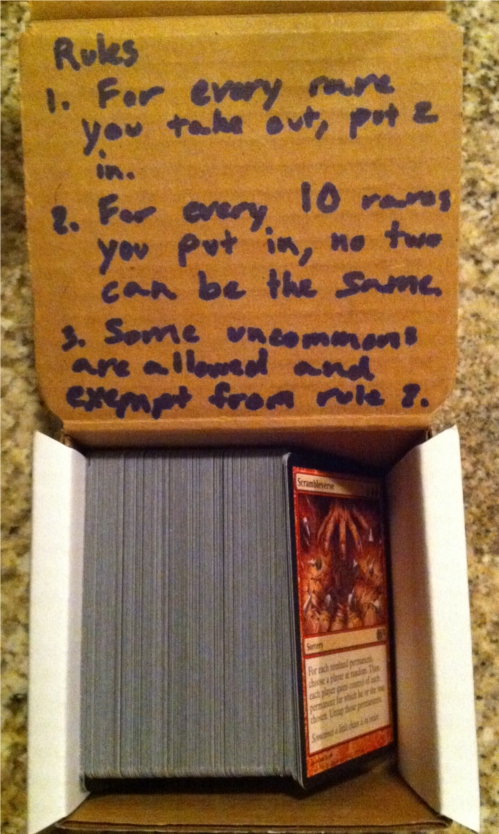
First, the basic rule that started it all, you can put any two rares in to get one card out.

Second, for every ten cards you put in, no two cards can be the same.

Third, certain uncommons are accepted, and are exempt from rule two.

Rule one is the foundation of the entire box, but it started creating issues when I started socializing with some of the more savvy traders in my playgroups. What I offered to them was not a chance to get ahold of some sweet random rare for their commander decks, but rather instant portfolio diversity for their stacks of Red Sun's Zeniths and Thada Adel, Acquisitors. In just a few short weeks, I would have my box completely filled with Thada Adels, Red Sun’s Zeniths, and nothing else. The entire market for The Bulk Box will be gone, and with it, all my potential money.

The Bulk Box rules

How to manage and cash out on this bad boy.

Starting, or restarting, The Bulk Box is not difficult. I tend to cash out the box once a month. I use Trader Tools, located at mtg.gg, to quickly pick out anything that sells above bulk prices. It takes about ten minutes, tops, and I usually have at least $20 to sell if I've been particularly active that month.

However, restarting The Bulk Box because you’re now stuck with a box of Red Sun's Zeniths and Goliath Sphinxes becomes tiresome, which made rule two a necessity. Rule three is new, and if I wrote this article two weeks ago it would not exist. Rule three is another great way to generate home-run hitting scenarios. There are some differences though. The list you actually present to people of commons and uncommons you will accept must be a list of ones that are worth at least 10 cents, so you’re always making a profit. It is useful to keep this list on you, and it was nice to have that stack of Timely Reinforcements (one of my better speculation calls) when my local game store sold out at a PTQ and I was able to value them at $3 each. I like to keep my list current and standard legal.

Following these guidelines will help you construct a Bulk Box of your very own, transforming you into a real life MODO Bot, able to generate dollars out of what appears to be the most useless cards in existence.

Sam Blitch
@theothersamb on Twitter

A Unique Time

Are you a Quiet Speculation member?

If not, now is a perfect time to join up! Our powerful tools, breaking-news analysis, and exclusive Discord channel will make sure you stay up to date and ahead of the curve.

"It's a unique time in our history, in the history of any civilization. It's the moment of the acquisition of technology. That's the moment where contact becomes possible." Contact

It's a unique time...

...when Wizards takes action and bans two cards, but the oppressive deck still remains to dominate the format.

...when Wizards creates a new format that shakes the financial community.

Well these past few weeks have been busy haven't they? Between new formats and tons of huge events, the Magic community has certainly been busy. We all know that Caw Blade is still out in force, but its dominance has been lessened now after the bannings. Still, it is the best deck so we must prepare ourselves to beat it. I am preparing to beat it at the upcoming Grand Prix Pittsburgh! This summer has been great: a Starcity 5k and a Grand Prix in my home town is amazing. I hope lots of players get to attend.

What can we do about fighting the swarm of Squadron Hawks equipped with Sword of Feast and Famine? For the past few weeks I have been advocating creating a giant fighting robot to destroy your opponent named Voltron! Voltron is equipped with his blazing Sword of War and Peace to swing past those pesky Squadron Hawks. If you follow the new show, you know the deck can draw its magma pistols with Mortarpod. Voltron is a toolbox worth of cards designed to beat up on players that are trying to equip their Squadron Hawks with Sword of Feast and Famine.

Let's get to my updated list.

Voltron!

Untitled Deck

Creatures

2 Etched Champion
4 Puresteel Paladin
4 Squadron Hawk
3 Trinket Mage

Equipment

3 Flayer Husk
4 Mortarpod
1 Basilisk Collar
1 Sylvok Lifestaff
2 Sword of Feast and Famine
3 Sword of War and Peace

Spells

1 Mox Opal
4 Preordain
4 Dispatch
2 Oblivion Ring

Lands

2 Celestial Colonnade
4 Glacial Fortress
3 Inkmoth Nexus
1 Island
8 Plains
4 Seachrome Coast

Sideboard

1 Elspeth Tirel
1 Gideon Jura
2 Timely Reinforcements
2 Revoke Existence
1 Oblivion Ring
1 Dismember
4 Flashfreeze
3 Torpor Orb

If you have been playing with the deck, you know how powerful some of the cards are. Check out my last two articles solely dedicated to playing this deck: Ready to Form Voltron and Voltron Force.

Well what's different? Previously I have not liked the Etched Champion in this deck, but I think that it it quite important so he made it back into the deck. In that spot I had been running things like Kemba, Kha Regent or the two planeswalkers that are in the sideboard. Etched Champion is similar to those cards in that he is a difficult-to-deal-with threat that can win the game all on its own. He should almost always be unblockable and unkillable outside of Day of Judgement. You will notice I still have my Oblivion Rings. That is because they have been simply amazing in basically every match. I do not understand how the deck can run without them. Other than the changes to the never-static sideboard, the only other adjustment was a third Sword of War and Peace over the lonely Sword of Body and Mind.

The most important thing to know about this or any deck right now is how to beat Caw-Blade. The first thing you should do is to read the other two articles I've written about the deck. Once you have done that you will probably notice that I keep going on about Spell Pierce.

I believe that Spell Pierce is the single most important card to winning the match. You have all these really good Equipment in your deck, what is your rush to play them? The only one you can run out there regardless of the situation is Flayer Husk and maybe Mortarpod, depending on if you have a back up, but probably not even then. You want to play such that their Spell Pierces are so bad that they think about sideboarding them out for game two. These games are not quick so you should not be worried about them beating you quickly. If you get a Sword Spell Pierced, you will probably lose the game. Make them have to spend not only a Spell Pierce but also a Mana Leak to counter your equipment. Number one, if they do that then you should have the time to be attacking them and whittling down their life total. Number two, they are spending two cards to deal with your one Sword.

The number two most important thing to remember about playing this deck against Caw-Blade is to wait to play your Puresteel Paladin.

It is almost never the right play to cast him on turn two. If you have nothing else to do on your turn two and your opponent isn't showing Mana Leak, then sometimes it is right to play it there. Almost always the best time to play the paladin is late in the game. When you play it with a bunch of equipment in play, you get so much free mana because all of your equipping is free. A good time to play him a lot of the time is turn five if your opponent taps out. Then you can play Puresteel Paladin followed by Sword of War and Peace, draw your card, and blow them out.

One thing that makes this deck so good against Caw-Blade is the fact that the mana curve is so low. Because all of your cards are so cheap, you can play around all of their counters. The better you get at this, the easier the match will become. Make sure you test the match. If you have additional questions, I'd be happy to answer them below.

Maybe you never watched Voltron as a child and so you need a different deck to play. Well today is your lucky day. There are two other decks that are also quite good at beating Caw-Blade that I want to talk about.

First up is Brian Kibler's new deck, Blade Breaker. Kibler, the creator of the Caw-Blade menace, knows how to beat the deck, and I think it's quite good too. Here's his solution that he updated to top 32 at the TCG Player Invitational.

Untitled Deck

Creatures

3 Acidic Slime
4 Birds of Paradise
3 Goblin Ruinblaster
4 Hero of Oxid Ridge
1 Inferno Titan
4 Lotus Cobra
2 Manic Vandal
4 Skinshifter
3 Thrun, the Last Troll

Spells

2 Arc Trail
2 Dismember
3 Sword of War and Peace

Lands

4 Copperline Gorge
4 Forest
4 Misty Rainforest
4 Mountain
3 Raging Ravine
3 Rootbound Crag
2 Scalding Tarn
1 Tectonic Edge

Sideboard

2 Act of Aggression
2 Arc Trail
1 Dismember
2 Garruk, Primal Hunter
1 Goblin Ruinblaster
1 Naturalize
1 Natures Claim
3 Obstinate Baloth
2 Tectonic Edge

The basic premise of this deck is to make sure that you kill every equipment that Caw-Blade ever plays. If Caw-Blade does not have their Sword of Feast and Famine, it is not nearly as dangerous. This updated version cut one Manic Vandal and one Acidic Slime for some bigger guys but that should still be enough to destroy their swords. Personally I like running a second Inferno Titan in my build, but I do not have much testing with the deck yet so I would rather just post his list for everyone.

Not only do you get to destroy their Swords, but you also get to swing through their blockers with Hero of Oxid Ridge. This hasty guy has always been good at fighting Squadron Hawk and now he is also good at fighting Timely Reinforcements. They can't counter Thrun, the Last Troll and they can't block your guys equipped with Sword of War and Peace. This deck is designed to beat up on Caw-Blade.

I like the Obstinate Baloths in the sideboard to help with the Mono Red match as well as any other aggressive match if you need it.

Skinshifter can be a little awkward but he is pretty decent. Often you can play what you need to play and still have the mana for Skinshifter because of Lotus Cobra.

Overall the deck is pretty solid. It definitely has good matchups against Caw-Blade and Tempered Steel. More testing and sideboarding for matches like Valakut, UB Control, and Splinter Twin might be necessary, but this deck is certainly a good metagame choice.

The second deck I want to talk about was posted this week by Terry Soh called Snake Blade. What intrigued me about Snake Blade was its similarities to the Beef Blade project my friends and I were working on before the bannings. Take a look.

UG Snake Blade

Untitled Deck

Creatures

1 Acidic Slime
1 Birds of Paradise
2 Consecrated Sphinx
4 Lotus Cobra
1 Obstinate Baloth
1 Oracle of Mul Daya
1 Thrun, the Last Troll
1 Primeval Titan

Spells

2 Beast Within
2 Dismember
4 Mana Leak
4 Green Suns Zenith
3 Rampant Growth
4 Sword of Feast and Famine
3 Garruk, Primal Hunter

Lands

7 Forest
2 Island
2 Inkmoth Nexus
4 Khalni Garden
4 Misty Rainforest
4 Tectonic Edge
3 Verdant Catacombs

Sideboard

2 Acidic Slime
3 Obstinate Baloth
1 Dismember
3 Natures Claim
2 Spell Pierce
1 Thrun, the Last Troll
3 Creeping Corrosion

What I like about this deck is the versatility that Green Sun's Zenith gives the deck. I have loved that card since it was first printed and it was really good in Valakut. Lotus Cobra gives you such a huge mana advantage and so does Sword of Feast and Famine. You are not going to run out of cards because between Garruk, Primal Hunter and Consecrated Sphinx, you should always have something to do. This deck seems like it has answers for every deck in the metagame but it also seems quite skill intensive. Though I have not tested this deck myself yet, it seems like the perfect solution right now.

Well, that's all for this week.

Until next time, Unleash that Caw-Blade-beating Force!

Mike Lanigan

MtgJedi on Twitter

Jedicouncilman23@gmail.com

p.s. When I first started writing for this site I wrote on the financial side. Would anyone be interested in an article on an introduction to speculation? Post below or send me a message. Thanks!

Insider: What’s next for Modern?

Are you a Quiet Speculation member?

If not, now is a perfect time to join up! Our powerful tools, breaking-news analysis, and exclusive Discord channel will make sure you stay up to date and ahead of the curve.

Well, it happened. Modern finally blew up, just as we called and tried to prepare you for.

Some of you did well, and made a lot of money from the price spikes. Some of you had the value of your collection suddenly shoot up. Maybe some of you are glad you got in trades for these cards before they spiked. And maybe some of you didn’t do anything at all (I hope this isn’t the case).

But no matter which group you fall into, we all have the same question on our minds.

What now?

Are current prices sustainable?

In short, yes and no.

I don’t think Modern cards are exactly a bubble, but I do think there are limits to their growth, the Shocklands in particular.

I think in the near-term, high prices on things like Shocklands and the like aren’t going anywhere except possibly up. But I think this calms down after the fervor of the Pro Tour and prices settle down a little from where they are now. They’re still going to be expensive, but I think the growth period is going to slow, if not come to a halt, but I don't think it's going to plummet either. Unless the format starts to see FNM-level play, we should return to modest growth, rather than the current boom.

Coming out of the Pro Tour, the best thing to do is look for the top performing decks and finds the gems among them. The format is so vast and unexplored that there is certain to be a card or two that explodes in price. Things like Grove of the Burnwillows and Punishing Fire are so well-known going into the tournament that I don’t see there being much upside to these cards as an investment.

On the other hand, I would pick up all the Vesuvas you can find in trades. Star City and Channel Fireball are sold out but still list the price at $13, which makes it a good pickup at that price. 12-Post (Cloudpost, Vesuva and Glimmerpost) is a very good deck, and there’s little reason Vesuva won’t jump to $20 after a good showing at the tournament just as Grove did on speculation.

Another gem from my testing is that Green Sun’s Zenith for Dryad Arbor is still an incredibly strong play. Alongside the play Dryad Arbor already sees in Legacy, now seems like the best opportunity you’re going to have to pick them up. It’s already pushing $2 on Ebay and is unlikely to see a reprint (due to the whole “Creature Land” thing), so I would begin collecting these now.

Also, you know that Aether Vial is still legal (and a boatload of Fish, which is good news for me!). Pick up your Vials again and I think it’s a pretty good time to move on the Lorwyn Merfolk cards (and Coralhelm Commander) in case the deck turns out to be viable in Modern. Regardless, these cards are going to continue to tick higher until Legacy goes defunct.

Time to sell?

At this point, I think it’s entirely fair to sell out of your investments and lock in your profits. While Modern cards as a whole might continue to creep higher after the Pro Tour, the headlines are going to be dominated by a few breakout cards, meaning if something like Grove doesn’t do something extraordinary (which it won’t, since it’s already hyped to the breaking point), then the price is going to level off or drop while people move to the hot new tech or answer cards like Ghost Quarter and Tectonic Edge.

Basically, I think the time is right to sell out of all your major investments with a few exceptions. For instance, I don’t think you need to sell your Dark Confidants unless you really want to. He’s not unreasonable to see a reprint in some future special product (Duel Decks, etc), but even then you’ll be able to get out at a decent price. For the same reason, I also don’t think you should move Mutavault or anything else that is also a Legacy staple (cough cough Goyf).

Things like Grove, Pact of Negation, and other cards that you think are moved more by Modern hype than actual playability should be moved out. While they may go higher, remember, you bought in at a very low price, and there’s no reason to be a Greedo in this situation. Take your money and put it into the sleepers or breakout cards of the Pro Tour.

Of course, there’s one thing I haven’t touched on yet – What about those Shocklands?

Why Modern is not Legacy

In a word – reprints.

Let’s compare duals for a second. Hallowed Fountain is retailing for $45 at Channel Fireball. Plateau goes for the same. Something is wrong here.

Ask yourself – Why was Modern created? The answer was to fix a few problems with the current formats Wizards of the Coast offers. No one liked old or new Extended, but people do seem to like Legacy. But Legacy has all those expensive cards that are on the Reserved List (the evil mastermind behind all of this chaos), so many players are priced out the format.

Modern isn’t an elegant solution, but it is a solution. Or, at least it was, before the lands you had to have to compete started pushing $50. I’ve already heard the complaints from players that Modern is pricing them out, just as Legacy has. You better believe Wizards has heard this too, but they have one weapon at their disposal that they don’t when it comes to Legacy – reprints.

So what does this mean to you and your set of Shocklands? In the short-term, not much. Unless Innistrad turns out to somehow be the rumored Return to Ravnica, then there’s not much chance of your Shocks falling off a cliff. But rest assured, they are going to be reprinted somewhere along the line.

There’s no way Wizards goes to all the trouble to create Modern and change the Pro Tour format at the last minute just to have the same problem with card prices that they do with Legacy. Whether it’s in special product, M13 or the Fall 2012 set (which might actually be Ravnica, according to the rumor mill), I think it’s a pretty safe bet we’ll see Shocks reprinted.

Not only does that mean the price is going to eventually drop, it also means that the price will be suppressed in the medium-term. Because so many people are on board the Return to Ravnica bandwagon, they’re going to have a hard time justifying spending hundreds of dollars on a playset of lands for Modern that they think are going to reprinted within a year. Whether or not we return to Ravnica in a year is actually a moot point, since the perception exists that we will – that’s all it will take to keep these lands from going much higher.

This is a concept I explored two weeks ago, and determined then that the time was near to sell the Shocklands you invested in. Since then the price has gone up even more, but I think it’s finally hitting near the top of its ceiling. That means it’s time to move them.

Yes, I am telling you to sell your Shocklands if you are using them solely as an investment. I think the best time to do so is in the next two weeks to maximize value from the players who are trying to acquire them for the Pro Tour. After the Pro Tour, when Modern is just another out-of-season format, prices are going to settle and you’ll be out money that could be better spent elsewhere.

Where does that leave us?

Now that the initial run on Modern cards is peaking, it’s going to become business as usual as far as finding the right cards to pick up. When the Pro Tour rolls around, be ready to move immediately on the breakout cards of the tournament, but be cautious if you want to buy into the hyped cards that are nearing their peak.

The Pro Tour is going to be a big deal, and you can rest assured I’ll be on top of it here to keep you ahead of the curve, as I have ever since Modern was conceived. Once the Pro Tour is over, we’re going to have a few months of excitement over Innistrad before we actually hit Modern season in the winter. It’s likely we’ll have a buying opportunity then while everyone is fawning over Innistrad, and I’ll be sure to check back in on Modern then to spot the good deals for you.

Thanks,

Corbin Hosler

@Chosler88 on Twitter

Prediction Tracker

The changeover to our new layout (which is awesome) didn't go over well with the Prediction Tracker, but I've fixed it to display a little better now. As an update, we're also in the process of separating the Standard portion of the Tracker from the Eternal portion (all other formats), so that should help readability once we get that up and  going. Let me know if you have any questions/suggestions!


[iframe https://docs.google.com/spreadsheet/pub?key=0AqV8zg-4f2ehdHpZT0lVellDZGViZWxld2dfTjJyUHc&single=true&gid=2&output=html 605px 720px]

[iframe https://docs.google.com/spreadsheet/pub?key=0AqV8zg-4f2ehdHpZT0lVellDZGViZWxld2dfTjJyUHc&single=true&gid=10&output=html 605px 720px]

[iframe https://docs.google.com/spreadsheet/pub?key=0AqV8zg-4f2ehdHpZT0lVellDZGViZWxld2dfTjJyUHc&single=true&gid=11&output=html 605px 720px]

[iframe https://docs.google.com/spreadsheet/pub?key=0AqV8zg-4f2ehdHpZT0lVellDZGViZWxld2dfTjJyUHc&single=true&gid=12&output=html 605px 720px]

Keeping the Peace: A Guide to Life Gain

Are you a Quiet Speculation member?

If not, now is a perfect time to join up! Our powerful tools, breaking-news analysis, and exclusive Discord channel will make sure you stay up to date and ahead of the curve.

As those of you with a competitive bent are most likely aware, the format for Pro Tour Philadelphia has recently been changed to Modern, an 8th Edition-Mirrodin forward eternal format with an extensive banned list. With all of the bannings the format is starting to look more like Ravnica-Time Spiral Standard than old Extended, and so when I thought about the possibility of Dragonstorm once again being the premier Combo deck, Martyr of Sands/Proclamation of Rebirth immediately came to mind. In the old days, that deck could gain quite a bit of life, and served as a great example to point to when asking somebody to reconsider the 'common knowledge' that life gain is bad.

Then, as always, my thoughts turned to Commander. I've recently been reading over some of the articles from Mark Rosewater's Five Hundred and Counting, and I stumbled back over The Multiplay's the Thing, wherein Rosewater asserts that life gain gets a lot better when stalling for time lets your opponents beat each other to a pulp. The reasoning made sense, but at the same time I've often seen decisions about who to go after in multiplayer games made entirely based on who had the highest life total. This begs the question: how can life gain be used best in a multiplayer environment?

A Little Red White Dot
But before we get into that, we need to address life's odd perception. When new players come into the game, they're often excited by the "Lucky Charms" (Dragon's Claw and friends) because life is the game's most obvious measure of success. After all, if you go to zero you lose. In a new player's mind, you've obviously done better if you lose with your opponent at thirteen rather than twenty. When people delve deeper into the game, they find these life gaining spells underwhelming and then classify life gain as universally bad. Recently Wizards has printed some cards that show how powerful life gain can be as an addition to an already passable card, like Kitchen Finks, Baneslayer Angel, Batterskull, and Timely Reinforcements. Nonetheless, many FNM players still dismiss life gain on newly spoiled cards. Why is that? Because secretly, life still feels important to them, and the only way that they avoid getting laughed out of their shop is to constantly tell themselves that life gain is bad.

Why does any of this matter? Because a large portion of players assess threats not on who they think has the highest chance of knocking them out of the game, but on who feels most powerful to them. At a subconscious level, the guy with seventy-three life still feels way ahead, even if he has little board presence and few cards. Mark Rosewater is right in that life gain does vastly improve when you're opponents are hurting each other during the time it buys you, but you need to make sure they're hurting each other. If you gain too much life you'll often become public enemy #1, and at that point it's no stronger than in it would be in a duel.

But just because people feel threatened by high life totals doesn't mean that life gain needs to be thrown out entirely. It does help you win. Sure you don't want to cast Congregate only to have an Identity Crisis and then die to slow beats, but the same amount of life gain doled out while you take incremental damage will feel a lot less significant to an opponent who isn't counting. Even if Beacon of Immortality gains you eight more life than Shattered Angel would, the extra hate it draws can put you out of the game rather than losing you a creature. As with taking extra turns, we want the benefits of life gain without the associated hate, and keeping anyone from seeing just how much life you've gained is the best way of doing so.

That isn't to say that one-shot life gain has no use, it just takes a bit more predictive power to utilize. When you do eventually solidify yourself as The Threat by setting up an engine, building up a huge board presence, or drawing a ton of cards, all of the other players are going to gun for you. That means you're going to get attacked, and while Fogs are all well and good, most of the time Invincible Hymn is going to offset more than one attack step. You can't become more of a target once you're already the only threat, and as with card draw, once you're being focused on you want to assume complete dominance quickly; incremental life gain may prove too slow. For most decks dealing with your opponents' creatures will be a better solution than gaining life once you're The Threat, but sometimes [card Wrath of God]Wrath[/card]s need to be supplemented.

Into the Stratosphere
Alright, so we know how to gain life for maximum effect in reasonable increments, but what if we go completely overboard? What if we have twelve lands, a Mana Reflection, three Doubling Cubes via Sculpting Steel and Phyrexian Metamorph, Voltaic Key, and a Tezzeret the Seeker to cast Dawnglow Infusion with and thus gain 28,432 life? Will using Copy Artifact for another Cube, Copy Enchantment for another Mana Reflection, or Rings of Brighthearth for more Tezz and Key activations change anything? Not really. While there will be an occasional game in which somebody may loop enough Overwhelming Stampedes with their massive token swarm to kill you from thirty thousand life, the vast majority of the time it's as good as the 'infinite' life you would get from [card Melira, Sylvok Outcast]Melira[/card], Kitchen Finks, and a sac outlet. Life gain incurs diminishing returns; it's not worth your time gaining more life once you're at a nearly untouchable total because you're much more likely to die to commander damage or poison.

Understanding People
At its core, multiplayer politics comes down to understanding people: what we think we want, what we really want, and what we fear. As Magic players, we think we want to win, and in part we're right. But as I've noted before, we have sub-goals. We want to accomplish tasks that we correlate with winning. We want to cast creatures; we want to attack with creatures; we want to destroy opponents' creatures. We also want to feel like we're winning. The less powerful mages among us panic when we feel like we're losing. We throw away creatures in desperate, thoughtless attacks. We stop playing around tricks that don't cost us to play around. We remove the wrong creatures and leave ourselves with no outs. We don't want to feel like that, and all of these failures are attempts to mitigate the sense of failure.

Try not to make things hopeless. You're here to have fun with your friends, and while some of us (like yours truly) enjoy trying to claw our way back into games, most people don't want to feel hopeless. Here incremental life gain once again trumps huge swings. It's a lot easier to imagine shutting off a combination of Bottle Gnomes and Shirei, Shizo's Caretaker before it gets out of hand than it is to think about bringing some one down from the lofty heights of a hundred and twenty life. We just want to feel like we know how to go about winning, like we're in control of our fates.

Lemon Curry
And now for something completely different.

My editor, Adam Styborski, recently wrote an article over on Gathering Magic about what our priorities should really be when we play Commander: promoting fun. In this article and others like it, I've explored strategies that are powerful in the format, weak spots that one can exploit to win, and quirks of human psychology that one can work around to maximize chances of victory. A lot of these methods can be taken places I never intended them to go in the name of victory, and though I've certainly mentioned it often enough, Adam's article has driven the point home that I need to be loud and clear.

You aren't playing Commander to win.

If you're a bit Spike-y, you'll enjoy victory a lot. But it's not the only thing to enjoy in Magic, and your enjoyment can't counteract others' unhappiness. Winning is all well and good, but the second it gets in the way of anybody having fun, it needs to be chucked out. Many of the methods I've recommended over the past few months seem to look to circumvent the social contract, but at their heart Commander's norms aren't about a specific result so much as the experience that comes with playing. Participating in this format challenges each of us to put on the game designer's hat. We are no longer the player, looking for every opportunity to eek out an advantage. Rather, every Commander player ought to be part of a design team, seeking to make a game that is highly enjoyable, infinitely replayable, challenging, and frustrating as rarely as possible.

Take up the banner, because Commander's continued success rests on your shoulders.

Jules Robins
julesdrobins@gmail.com/Google+
@JulesRobins on twitter

Insider: Modern Looks and Drafting M12

Are you a Quiet Speculation member?

If not, now is a perfect time to join up! Our powerful tools, breaking-news analysis, and exclusive Discord channel will make sure you stay up to date and ahead of the curve.

Since we last met, the inevitable update to the Modern banned list has arrived, and we of course have to modify our expectations of certain card movements. My updates are on the tracker, but there are three I want to focus on specifically.

Gifts Ungiven:
Buy: <$3 Sell: $6.
Any format that harkens back a multitude of blocks will have control and combo decks lurking. While the ban-hammer looks to bash most of them into submission, the long grinding control decks, and the inevitable combo decks are looking for cards that not only create card advantage but also add late-game value. One such card is Gifts Ungiven. Nothing spells trouble like a Gifts pile of 3-tron pieces and a Life From the Loam, just as an example. There are rumblings around the net of Mono-U 12-post being a real thing, and if you give away Green, you’ll want some tutors in this deck. Even tutors to find narrow tutors to find game winners. The deck generates enough mana to utilize this strategy.

Thoughtseize:
Buy: $15-17 Sell $25.
Magic R&D fought hard to protect aggressive decks by banning cards like Mental Misstep and Jace,the Mind Sculptor. Thoughtseize will be the best bet to stop a Knight of the Reliquary, Dark Confidant, or even Meddling Mage. Utility spell that already has Legacy demand on lockdown.

Maelstrom Pulse:
Buy $7.50 Sell $12.50
There are a ton of cheap efficient removal spells available. Path to Exile, Dismember, Lightning Bolt all come to mind. However in the more ubiquitous removal, we have Maelstrom Pulse and Oblivion Ring. Both are the “destroy target Planeswalker/Enchantment/Artifact/Creature” cards. Luckily Maelstrom Pulse also blows up O-Rings, en masse. Further, the surge of Zoo decks, will likely make a card like this very playable. Doran decks, or any Junk/Jund deck for that matter will rely on this staple to clear the board of annoying permanents, including opposing Oblivion Rings.

In full disclosure, these are the three I personally am actively buying, not just targeting in trades. Most calls I make, I am trading for them, so as not to expose myself too much if there is no-movement or negative movement. Cards above, I’m committing cash to. And will continue to until the prices adjust.

I mentioned I’d give an MTGO update this week, and here it is. My very first Article here on QS was about why you shouldn’t be drafting Scars block, and should focus on M11 drafting if you’re trying to maximize your draft dollars. Well, now I’m here to update that plan. And to also discuss pack-economics a bit farther.

First, let’s look at some facts about drafting Scars block in comparison to M12. The cards you crack are a huge portion (about half) of the average benefit of drafting. The other half comes from prize support, but both are linked, in a very obvious way. Cracking a single M12 booster, if sold directly to Bot’s should make you approximately 0.971 tickets, which over a complete draft set, comes to a total of 2.913 tickets. With Scars block, in the order in which they are opened is 1.852 for NPH, 1.303 for MBS and 0.838 for SOM. The total for the set, is therefore 3.993. As a result, the cost of these packs is different as well. You can draft Coreset for about 10.59 tickets (including entry fee) while Scars block will cost you 12.17. Supposing you pull exactly your fair share of prizes in either format, the 10.59 of M12 entry fee will average you 8.12 tickets in return (when combining prize support with cards opened). While the 12.17 Scars block entry fee will average you 8.91 in return. You are paying an extra ~1.6 to draft Scars block, while only reaping an additional 0.8 ticket reward. In more direct terms. M12 returns 8.12/10.59=76.7% of your entry fee on average, while Scars block is 8.91/12.17=73.2% entry retention.

The big issue here, is the NPH packs are the most expensive to buy from bots. If you win an 8-4, you will receive 3 SOM Boosters, 3 MBS Boosters, and 2 NPH Boosters. If you lose in the finals you receive 2 of SOM and 1 each of MBS and NPH. SOM are the cheapest of the block as is, so selling your excess SOM packs off for NPH packs to continue drafting is a huge blow to your bankroll. M12 doesn’t have this problem, and at the lower entry fee, can support almost the same expected gain from each draft. 4-3-2-2's are rarely correct options for anyone, but certainly not for Scars Block, the prize pack disbursement further exacerbates the problem of the lopsided pack values, giving out more SOM and MBS packs than 8-4's do.

So once again, 8 months later, I’m still saying, Coreset draft is better than the active block from a financial standpoint. However, you should use this information wisely and apply it to your business plan in a way that makes sense. I’ve done the hard work for you crunching all the numbers, but what can you do with it? Do you have an MTGO budget? If so, what can you afford to draft? Do you support your drafting by grinding constructed queues? If so, likely drafting M12 makes the most sense, as constructed queues pay out their packs that way, and selling them to bots is not wise unless necessary. Don’t be sheep, sheep are what feed the system for the financial minded. Take the available information and apply it to your scenario.

I’ve been starting to learn ‘the MTGO grind’ so that I can supplement my drafting with constructed queues, and any patterns or habits I discover will be updated as I come across them. The coming weeks will cover Modern fluctuations, the progress in my Legacy trading (getting closer to building a LandStill deck), and continuous updates on the MTGO scene.

Happy Trading!
Chad Havas
@torerotutor on Twitter

Insider: Burning Breaches & Mike’s Modern Struggle

Are you a Quiet Speculation member?

If not, now is a perfect time to join up! Our powerful tools, breaking-news analysis, and exclusive Discord channel will make sure you stay up to date and ahead of the curve.

My article is a little late and a little short this week because of some computer problems. I've literally written (and rewritten and rewritten!) it three times. I’ve had corrupted files all other times. This is try number four and I’m glad things are beginning to work again.

I'm going to dedicate the first part of this article to Modern. I don't like the format. I think it’s nothing more than another Extended, but it has made some cards ridiculously expensive, and it’s worth looking at regardless of my own personal opinions of it.

Get Punished

So Punishing Fire is good. Really good. I easily bought 40 Grove of the Burnwillows on Friday at anywhere between $4-$6 apiece all across the internet. It was a good call, as Grove has skyrocketed to almost $20 a piece.

I will be selling mine as soon as they arrive.

With all the Modern bannings, Punishing Grove has become absurdly good. After helping some Minnesota guys test for the PT, we came to the realization that a turn 2 Punishing Fire with a Grove in play is essentially unbeatable.

I personally think Grove will get banned. Wizards is trying to make the format slower and more diverse. Punishing Grove doesn't allow that to happen, offering a recurring removal/pump suite at hand, which leads me to believe that it will get banned sooner than later.

Wizards wants aggro to be good and Punishing Grove prevents that, even though the mechanic is used in Zoo. The format will warp to fit around this card and prevent other’s little kitties from winning games.

And we can’t have little kitties not winning, can we?!

I would recommend selling these this week, or sell them in Philly if you are going.

Move these fast or face getting burned.

Shocking, Isn't It?

Modern's shock lands have reached an insane price. Modern can’t support these prices.

Wizards wants this new format to be playable, but, as of right now, the cost is just far too insane for that to be wholly true. They will reprint these lands in the near future to try to keep the price down.

I sold all of my shock lands recently and I do not regret it one bit. I got a price I was happy with and don't want to be too involved when this bubble bursts.

Another card that spiked recently is Vendilion Clique. I own a set of these for Legacy and will be holding onto them. I personally think it is one of the best creatures ever printed and will easily stay at least/around $25+ for as long as it sees play.

How to Buy Everything

So, this past week, with Modern changing prices all around us, you had to be buying cards on the fly in order to make maximum profit.

Where do you draw the line? When have you bought enough?

I’ve found that the best way to buy a ton of cards at once is to go to every website connected with TCGplayer.com. Simply go to the stores with 3 or more of the desired card and buy as many as you can afford once you’ve decided that the investment will likely pay off.

When buying cards, the worst you can do is lose all that money in shipping. If a card you buy doesn't go up in value, then sell it off (Legacy cards, especially staples, can be sold to dealers at about 75% the retail cost) and cut your losses. That’s why buying only from stores with three or more works far better than buying everyone out. If you make a bad gamble, you are really only out the money you paid in shipping and the small hit from selling back to dealers. You can always, however, trade the cards to others for at least the value you purchased them at.

Buy fast. Familiarize yourself with buying cards on your smartphone, assuming you have one for checking prices on the floor. I've seen people buy hundreds of cards on the fly in a matter of minutes because of these little wonders.

When a new banning comes around or a new format is announced, you need to be ready to capitalize on it.

For the most part, the Magic economy is fairly predictable. You just have to look for the trends and hints.

Enough about Modern, let’s talk about the REAL Eternal format.

Through the Breach

WHY!??!

I don't understand why Erik Manooshism would choose Through the Breach over Sneak Attack.

I can't think of a single reason why Sneak Attack would be considered, in any way, worse.

You can use Sneak Attack more than once. Sneak Attack and activation is equal to the converted mana cost of Through the Breach.

I just don't get it. If you have any enlightenment for me, please do tell. Maybe it’s because he simply didn’t have/couldn’t afford/could borrow Sneak Attacks..?

Just because it was in a winning list doesn't always mean you should buy it.

This is a perfect example.

After seeing two Sneak Show decks in Top 8 of SCG Richmond, I bought a few Sneak Attacks and a few Show and Tell.

I did not buy any Through the Breach.

I'm not saying Through the Breach can't be played in some deck, somewhere. I just don't think it was the right call in Sneak Show.

On the other hand, it was nice seeing my favorite deck New Horizons make Top 8, even if it wasn't playing Stifle.

What Does a Magic Card Mean to You?

When you see a Magic: The Gathering card, what do you see?

What emotions do you feel?

When someone trades me a Magic card, it’s as though they are giving me a seed. Some seeds grow to be great trees while some seeds grow to be weeds that leech off of other plants and eventually get pulled out of the ground and tossed aside.

Magic has grown by leaps and bounds in the last few years. While the player base continues to grow larger, so does the demand for quality cards.

Figure out what cards in your collection are going to grow over time.

Evaluate why they will grow and then practice looking at other "worse" cards the same way.

What makes a card good?

What makes a card worth more money than the next?

Try to find "sleepers" in your collection that may be worth money some day. Set them aside, monitor new releases and see what happens. Learn to evaluate trends in the game and then evaluate what type of cards make sudden leaps in price.

The next time a hot new deck comes out, having these potential sleepers set aside will help you have a better understanding of which cards out there may go up and which won’t.

Man, That is Vial

…is legal in Modern and hasn't really jumped in price yet. Vial has proven itself to be one of the best 1 drops in all the game. I bought a few of these on speculation and encourage you to do the same. Plus, who doesn’t love some fishies?

With Mental Misstep being banned, there aren't a whole lot of ways to stop a turn 1 Vial from resolving. I think Vial has a ton of room to grow. We won’t be seeing a reprint anytime soon.


I've heard a lot of rumors about him being reprinted in Innistrad. Yes, it is a graveyard based set. Yes. Tarmogoyf uses the graveyard.

You know what other car uses the graveyard?

Yawgmoth's Will. That card will never see a reprint.

While I personally think Tarmogoyf will be reprinted someday when Wizards has pushed the power creep far enough so that Tarmogoyf is cast aside by some new mythically rare, bigger, stronger, faster, evolveder form.

But I don't think that will be anytime soon.

Keep your Goyfs for awhile. They will continue to be a Legacy staple for many years to come and won’t (shouldn't) be outclassed anytime soon.

Weekly Checklist

Check a Check a Check, Check it Out.

Sneak Attack- $29.99 on SCG

Sneak Attack has started to show its face again in Legacy. This card is worth picking up for long term gain. It has a lot of potential to grow as, especially as creatures get better. Don't be afraid to pick up some played ones for cheaper because casual players absolutely love this card.

I'll throw a Modern card on here because it could someday be good in Legacy.

Bloodbraid Elf- $2.99 on SCG

Cascade is a pretty broken mechanic. And Legacy really doesn't have a great way of dealing with this critter. I think its value will increase with Modern, too, as I’m sure she’ll rear here cheating little head again sometime soon. Pick them up now to make sure you can get them on the cheap(er)

Show and Tell- $29.99 on SCG

I don't really know what else to say about this card that hasn't been said. It’s too good and will probably will get banned at some point. For now, though, buy them while they are cheap(ish) and if/when they start to dominate a Mental Misstep ridden format, you won’t be left in the dust.

Next Week

Before I go...

HAVE YOU SEEN HOW BAD THIS CARD IS?

That’s really all I have to say about Wood Elemental…

I will be out of town, in Alabama, next week for some family business. I'll see if I have time to throw an article together, but if you don’t hear from me, have a great week! If you do that, you'll hear from me soon.

Until next time...

If you’re not having fun, you’re not risking anything.

Please feel free to post question in the comments or email me.

May the force be with you.

-Mike Hawthorne
Twitter: Gamble4Value

Email: MTG_Mike@live.com

Community Choice: Threat Assessment

Are you a Quiet Speculation member?

If not, now is a perfect time to join up! Our powerful tools, breaking-news analysis, and exclusive Discord channel will make sure you stay up to date and ahead of the curve.

A few weeks ago I spent an afternoon talking with some of the Commander crowd on Twitter about what kinds of articles people wanted to see more of. Almost universally the topic people wanted to hear about was threat assessment, one of the most controversial and misunderstood concepts in the online Commander community. Now, it's much harder to evaluate what threats are important in casual formats than in competitive formats, because the format is broader, and the key lessons to be learned are much more vague, and less likely to be applicable across all different playgroups.

"What's the Biggest Threat" is the vaguest, most nebulous, and most important question that you can ask during any given game of Commander. Coincidentally, it's also the question that's likely to get the widest range of answers from other players and spectators. It's also unfortunately one of the phrases that's picked up a derisive connotation, like "the spirit of the format" and "EDH Spike" where people complain about other players being bad at identifying the real threat at the table, usually without thinking about what they might have done to affect the outcome of the game.

As loathe as I am to give the topic any kind of credence, I do feel like it's a topic that could be developed upon and turned into something more useful. The problem is that the way that any given person is going to think about the threats at the table is going to depend on their own experiences, both with Magic as a whole, and with the Commander format. Consider also that you're also playing a political sub-game with multiple other players, and that there is exponentially more unknown information than in a one-on-one format. In Commander, I start to have trouble thinking about my next turn, much less three or four turns from now.

The ability to "correctly" evaluate the threats at a given table is going to rely on an encyclopedic knowledge of Magic, and knowing your deck like the back of your hand. It also depends on your knowledge of the format and your opponents; are you able to guess what's in their decks? Their hands? How other players are going to react as the game-state changes? These are all complex questions that need to be constantly reevaluated to decide who and what you need to be afraid of.

What I like to do is break things down into simpler, more familiar terms. There are three things that I like to think about when I'm considering what players and cards I'm most concerned about in a given gamestate. At the beginning of the game, as soon as generals are revealed, I think about Match-up Threats. During the developmental turns, I like to evaluate the archetypal role of each deck at the table relative to one another. This allows you to determine which decks are Archetypal Threats. Finally, at every point in the game, you have to think about which decks are problems now, and which decks will be problems later, in a different game-state, or Circumstantial Threats.

Match-Up Threats

As someone who has built and critiqued a lot of decks, I tend to be reasonably adept at guessing what cards are in people's decks. And really, that's what this is all about: you need to know what decks are and aren't problematic for you, and under what circumstances. Typically, there are three ways I categorize decks here: non-threats, contingent threats, and threats.

Quite simply, non-threats are things that I don't think I really have to worry about at all. Say I'm playing mono-white Wrath of God the deck; I don't think I have to be very concerned about creature decks. The key point here is that you have to know the mechanics of your deck. What does your deck do, and what stops you from doing it? If there are any decks at the table that either can't deal with what you're trying to accomplish, or can't prevent you from doing what you want, those are probably non-threats, and you don't need to concern yourself with them barring game-state-specific considerations.

Threats are just the opposite; decks whose primary strategy is a good foil to yours, and which you will have difficulty fighting through. Whether you're afraid of Counterspells, Wrath of Gods or Avenger of Zendikar, you have to know what kind of threats and answers you have trouble dealing with, and identify the players who have access to those kinds of cards quickly. Once you've identified the players you have to be afraid of, you have to work out how you're going to deal with the threat. Maybe it's holding back lands against the guy playing Obliterate, or maybe it's leaving the mono-white control player in to Wrath the board for you. Regardless, you have to recognize your weaknesses, and use that knowledge to avoid situations where you are disadvantaged.

Finally, there are contingent threats. These are the hardest to categorize, and are also unfortunately the most common type of threat. These are the decks that aren't typically threatening, but can be contingent on their board position, or on specific cards. For example, the Avenger of Zendikar decks become much better against the Wrath of God decks when they have access to something like Eldrazi Monument or [/card]Genesis[/card].

These are the threats you have to think ahead to deal with, and this is where you get rewarded for knowing the format and the decks of the regular players in your group. You should have a pretty good idea of what kinds of targets you should hold you Swords to Plowshares for. You should know how risky it is to Morality Shift, or to tap out against Niv-Mizzet, the Firemind. These are the matchups where you're rewarded for identifying ahead of time which cards and interactions are important.

It may seem unimportant to take the time to think about these things: how much of a difference can the little things make when so many things have such a profound impact on how the game shakes out, right? Does it make a difference when I fizzle you Capsize by leaving up Crop Rotation into Diamond Valley? Or when I bait Control Magic, Wrath of God AND Puppeteer Clique with Primeval Titan when Sun Titan is the one that matters? When particular cards or effects are pivotal in your match-up with another deck at the table, paying attention to small details and giving yourself the ability to play around their trumps makes all the difference in the world, and is a huge edge for the people who take the time to think that far ahead.

Now, thinking about match-up threats is all about identifying which things can be threats, and why they can be threats. Archetypal threats and circumstantial threats are all about determining how decks will threaten you and when they will threaten you, so that you can adapt your interpretations with a dynamic game-state.

Archetypal Threats

The big question that defines an archetypal threat is how something threatens you. I tend to prefer to define these as active threats and passive threats, since that covers a spectrum of archetypes and speeds. It also doesn't attach a priority to the threat, but rather defines the mode by which you are threatened. In the most simple terms, this is defining which decks at the table are control decks, and which are beatdown decks.

By this logic, if you're sitting down across from a Godo, Bandit Warlord deck and a Teferi, Mage of Zhalfir deck, [card Godo, Bandit Warlord]Godo[/card] is clearly the active threat early in the game, and [card Teferi, Mage of Zhalfir]Teferi[/card] is more passive, right? Well...not necessarily. Active threats are need to be dealt with quickly and proactively. [card Godo, Bandit Warlord]Godo[/card] is clearly an active threat, since he demands removal or a wrath, or threatens to kill you very quickly.

So what is a passive threat? It's something that you're going to lose to eventually. These are the [card Teneb, the Harvester]Tenb[/card] decks that grind you out with infinite recursion, the Child of Alara control decks that will start wrathing you every turn. These decks require that you either kill them before they start doing their thing, or that you have adequate disruption to keep them under control, otherwise they become very difficult to contain, and can often end up comfortably playing the Archenemy of the table.

Most decks don't fall into one of these extremes, but somewhere in the middle, and it's important to identify which role they're playing at any given time, so you know when to drop threats and when to hold up answers, and so you can identify which cards are important at a given point in the game.

Circumstantial Threats

Finally, these are the threats that depend on the game-state. Who or what is a threat now and what's going to be a problem later. Conveniently, the way I've chosen to split these up is this: immediate threats and long-term threats. Immediate threats do things now, and long-term threats do things later but transition into an immediate threat. Simple, right?

For example, Avenger of Zendikar is an immediate threat. It must be answered right away, or it will end the game for one or more players on the next turn. Conversely, something like Capsize is a long-term threat. It clearly needs to be dealt with at some point, but odds are that it can wait until the more immediate threats have been dealt with.

Deciding whether something is an immediate threat or a long-term threat requires, once again, that you be able to identify what resources are important at a specific point in the game. If you're playing an attrition-based control game, then the life you lose taking hits from random 2/2's is much less important than leaving removal up and getting your own card advantage engine online. If the other decks are more aggressive, then casting blockers and setting up your Oblivion Stone is more important than drawing more cards.

Really, what this all comes down to is that you have to know what your deck is capable of, and what it's weak against. You want to know enough about the players and decks you're playing against to identify which decks have a good or bad match-up against your deck, so that you can prioritize your resources, play around answers, and choose who to kill first. You want to be aware of where you fall on the archetypcal spectrum of decks at the table, so you know when you hold back, and when to apply the pressure. Finally, you want to know which things are threats that have to be answered right away, and which can wait until later.

The thing is, there's so much unknown information that it's near impossible to "correctly" assess threats. You don't know what people have in their decks, or in their hands. You don't know how they prioritize the threats at the table, or who they're going to point their creatures at. There's always going to be a human element to threat assessment, and you're never going to make absolutely perfect choices. Sometimes people cast spells just to cast them, and sometimes you forget to play around something important. Regardless, I think there are just too many elements in to keep track of for anyone to be truly good at threat assessment in this format.

Carlos Gutierrez
cag5383@gmail.com
@cag5383 on Twitter
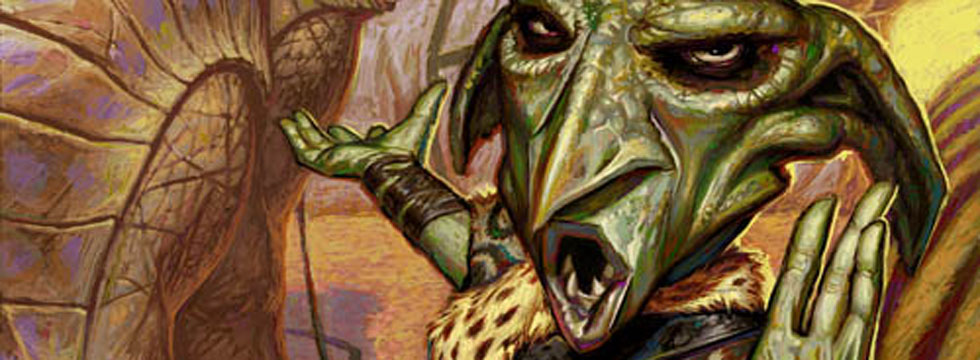
Cubing 101: White’s Sorceries and Instants

Are you a Quiet Speculation member?

If not, now is a perfect time to join up! Our powerful tools, breaking-news analysis, and exclusive Discord channel will make sure you stay up to date and ahead of the curve.

Welcome back to our third installment of "Building a Standard Cube," where we are constructing a Standard-legal cube piece by piece in an effort to help illustrate the principles behind cube construction. With so many options it's easy to get overwhelmed, but we'll be taking a lot of the guesswork out by building off of the Standard framework (as we defined here). In our last column we took a look at white's enchantment cards and narrowed down our selection. Today we'll be looking that the two card types that many argue are really one category: sorceries and instants. Although far richer in instants than in its slower brethren, white has also built up a reputation as having a number of powerful sorceries, often coming in the form of board-sweeping [card Wrath of God]Wrath[/card] effects.

The first thing we want to do is determine how many of each card type we'll be needing to include in our cube. As you'll recall, when we crunched the numbers we arrived at the following:

Since we're building a 45-card cube, that means we'll be selecting a total of 13 instants and 5 sorceries today. You might think that given all this structure there's little room for customization with regards to the contents of the cube, but the good news is that the framework only gives us card quantities which reflect today's Standard. It's up to us to choose the actual cards themselves, and that includes making a judgment call on rarity distribution. Some, upon seeing that creatures represent 60.48% of white's cards in Standard, might opt to give out two rare slots here. Others might instead opt to spread them around a little more, and that's the approach we'll be taking here.

A Word on Rarity

Quick mental math tells us that 450 cards translates into 30 15-card boosters for our cube, giving enough for a full draft table of eight players and a few left over for mystery. This in turn means that we'll need 30 rares, and we'll make sure to keep the distribution even across the colors for the sake of fairness. One approach might be to just divvy them out evenly, with five rares going to each of the five colours, and the remaining five for artifacts and nonbasic lands. There's certainly nothing wrong with that approach, and it gives each color a little more impact.

On the other hand, our Standard environment hits both non-colour categories squarely. Zendikar block was an 'adventure world' setting where land mattered, while a return to the artificial world of Mirrodin yielded a trove of artifacts. In order to better reflect this, we'll instead be giving each color only four rares, with a full ten going for nonbasic lands and artifacts.

How about uncommons? Well, our cube will require 90 of them. An even slice across all six categories yields 15 uncommons each. As with the rares, though, we'd like to tip the scales a little heavier in favor of the nonbasics/artifacts to reflect the feel of the sets we're using. Luckily, having more uncommons means we can fine-tune the balance a little better than we could at rares without shorting any of the other colours. Borrowing two cards from each color would leave thirteen uncommons each, and a reasonable 25 reserved for nonbasics/artifacts.

You'll recall last week we selected eleven cards from the pool of enchantments: seven commons, three uncommons, and a single rare (Marshal's Anthem). That means we still have ten uncommon and three rare slots left to fill.

With that said, it's time to look at some cards!

Instants

Once again, it's easiest to begin by breaking the card pool down into smaller groupings of cards that play a similar role.

Removal

  • Arrow Volley Trap
  • Banishment Decree
  • Celestial Purge
  • Choking Fumes
  • Condemn
  • Demystify
  • Dispatch
  • Dispense Justice
  • Divine Offering
  • Marrow Shards
  • Pitfall Trap
  • Puncturing Light
  • Refraction Trap
  • Smite

Protection

  • Apostle's Blessing
  • Brave the Elements
  • Emerge Unscathed
  • Stave Off

Combat Tricks

  • Bold Defense
  • Fulgent Distraction
  • Guardian's Pledge
  • Harmless Assault
  • Inspired Charge
  • Mighty Leap
  • Narrow Escape
  • Repel the Darkness
  • Safe Passage
  • Seize the Initiative
  • Shieldmate's Blessing
  • Soul Parry
  • Veteran's Reflexes

Life Gain

  • Angel's Mercy
  • Rest for the Weary
  • War Report
  • Whitesun's Passage

Miscellaneous

  • Due Respect
  • Frantic Salvage
  • Join the Ranks
  • Master's Call
  • Silence
  • White Sun's Zenith

There aren't a lot of insta-cuts to make here in the form of rares we know we won't want. Silence is a cute card, but not what we're going for here. White Sun's Zenith? As mentioned last week I'm a big fan of cycles, and adding the Zenith cycle at rare would lend a lot of flavor to the cube. That one we'll keep. Now for the hard part: getting the other 12.

Plainly, combat tricks and removal form the largest portion of white's instant pie, so we'll be awarding them the lion's share of cards. Removal in particular is a critical element for any Limited format, so let's give them five cards to start with. But which five to take? I want to give white the ability to answer a number of threats without being overly wedded to the philosophy of 'target attacking or blocking creature' white is so often saddled with. That lets me cut Arrow Volley Trap, Choking Fumes, Condemn, Pitfall Trap, and Puncturing Light. I'm passing over Celestial Purge in an attempt to avoid color hosers.

That still leaves Dispense Justice, which we'll take alongside Dispatch to give some representation to metalcraft. These are both uncommons, so we'd better stick to commons next. Divine Offering is a no-brainer in this artifact-rich environment. Smite is very conditional (the creature needs to be attacking and you need to be blocking), but its cheap cost means you don't have to hold much open to make the most of it. This leaves us needong one common removal card, and there aren't many more that fit the bill. That means we'll go back and take Puncturing Light. Not for the first time, this project takes on a truly Limited feel.

Moving next to the combat tricks, we'll start with Bold Defense. I like this card because it's common, features the kicker mechanic, affects all your creatures (the reason we're passing on cards like Guardian's Pledge), and with its first strike can even act as ersatz removal. For another creature-pumper, we'll also take Inspired Charge which can also serve as a finisher. Repel the Darkness can help get some nettlesome defenders out of the way, and it also replaces itself in your hand. Finally, we'll opt for Mighty Leap to enable a flyer in a pinch. Like the reactive removal above, I've tended to avoid another feature of white instants which are Holy Day effects. They tend to be of limited applicability and are poster-children for 'best-case scenario' thinking.

The same might often be said of life gain, as it's fairly useless when you're ahead. But a certain sense of obligation moves me to snare one as a representative of the species, so I'll take War Report, which can be absolutely vulgar in a creature-dense environment. Protection? We'll do the same, and snare an Apostle's Blessing as a nod to Phyrexian mana. Lastly, we'll pluck a couple of effects out of the 'miscellaneous' category. We've already opted for White Sun's Zenith, so that leaves one more. I like the tension that goes into cards that summon token creatures, so that provides us with Join the Ranks and Master's Call. Both will have their uses, but the cheaper cost of the latter gives it the nod.

For those keeping score at home, that's thirteen cards: a rare, two uncommons, and ten commons. As is common when trying to balance the different considerations of card types and rarities, we may find ourselves tinkering with the mix even after we've made our selections. In this case, seeing that I only needed two uncommons tells me I can safely add another, so let's cut Puncturing Light (a card that's a bit too conditional for my liking anyway) and add in Arrow Volley Trap. Yes, it's expensive, but much of what we've taken thus far tends to be on the cheaper side, and it gives us a chance to get a trap into the mix.

With the dust now settled, here are our picks for instants:

  • Apostle's Blessing
  • Arrow Volley Trap
  • Bold Defense
  • Dispatch
  • Dispense Justice
  • Divine Offering
  • Inspired Charge
  • Master's Call
  • Mighty Leap
  • Repel the Darkness
  • Smite
  • War Report
  • White Sun's Zenith

Sorceries

Sorceries, being a fairly limited bunch overall, don't need to be divided into categories for ease of reference.T his is a judgment call we can easily make just by looking at the full list.

  • Conqueror's Pledge
  • Day of Judgment
  • Excommunicate
  • Iona's Judgment
  • Landbind Ritual
  • Nomads' Assembly
  • Oust
  • Phyrexian Rebirth
  • Remember the Fallen
  • Revoke Existence
  • Solemn Offering
  • Survival Cache
  • Timely Reinforcements
  • Windborne Charge

With a number of rares to choose from, that makes narrowing down our choices somewhat easier. To be fair, it's not much of a contest. You don't get more iconically white than Wraths, and we have two to choose from here. I'll take Day of Judgment over Phyrexian Rebirth due to the mana cost. Although getting a free reset + critter is an attractive prospect, I often like to use Wraths to punish my opponent for overcommitting in the early game when I feign defenselessness, then unload my hand and dominate the board. The six-casting-cost Phyrexian Rebirth trades some versatility for card advantage, but here I'd prefer the versatility.

Next we'll move to bolster our removal credentials with Iona's Judgment, Revoke Existence, and Solemn Offering. We'll close with Survival Cache as a way to get rebound in white. The aggro-punishing Timely Reinforcements was tempting, but just too conditional. If you're ahead in both creature count and life, it does absolutely nothing.

To summarize, our sorceries will be as follows:
  • Day of Judgment
  • Iona's Judgment
  • Revoke Existence
  • Solemn Offering
  • Survival Cache

As always, different folks will have a different ideas on what they'd take in their cube. Any choice you felt was absolutely bonkers and proves I am divorced from reason? Wondering why I took one card and left another behind? Let me know in the comments below!

Jay Kirkman
@ErtaisLament
www.ErtaisLament.com

Want Prices?

Browse thousands of prices with the first and most comprehensive MTG Finance tool around.


Trader Tools lists both buylist and retail prices for every MTG card, going back a decade.

Quiet Speculation