menu

Prelude to the Ban Update

Are you a Quiet Speculation member?

If not, now is a perfect time to join up! Our powerful tools, breaking-news analysis, and exclusive Discord channel will make sure you stay up to date and ahead of the curve.

Next week, we will receive a Banned/Restricted list update. This is at the forefront of everyone's mind due to the overwhelming and continual dominance of the Caw-Blade archetype in Standard, but the DCI may take action in other formats as well.

Standard

Caw-Blade is so overpowering that it doesn't have a bad matchup. When Jund was the best deck in standard (a title which was lost when Rise of the Eldrazi was released), it at least had an awful matchup against monored decks. When Faeries was the best deck in standard, US Nationals had a top 8 with 32 copies of Great Sable Stag and 31 copies of Volcanic Fallout. It was possible to hate out both of those decks. Caw-Blade? Not so much. Unlike Faeries, Caw has the tools to deal with anything people throw at it. Vengevine? Meet Condemn or Oust. Torpor Orb? Meet Spell Pierce and Divine Offering. The deck simply is capable of being built to handle any threat that is posed to it, and the only reason people are having even slight success with decks like Elves or Vampires is that the Caw-Blade players are warping their deck to fight the mirror so much that they're not even playing sweepers or Gideon Jura.

Furthermore, the Open Vampires won in Indianapolis was one which every SCG player over 15 points was playing in the Invitational. The following Open, also won by Vampires, coincided with Pro Tour: Nagoya, which several SCG series regulars were attending. What did the Invitational Standard format look like? Caw-Blade everywhere.

Despite the claims of those who say this format is amazing because the more skilled player wins the mirror the vast majority of the time, deckbuilding and metagaming should count for something. Tournaments should be something more than a test of the same mirror match every round.

So, what needs to be banned to fix this problem? The most popular options are Stoneforge Mystic and Jace, the Mind Sculptor.

Jace, the Mind Sculptor

Banning Jace, the Mind Sculptor isn't really a solution to the Caw-Blade problem. It was a popular subject of discussion after 4 Caw-Blade and 4 RUG decks made top 8 of pre-NPH Grand Prix: Dallas, but Jace isn't the key to Caw-Blade. It's obviously a good card - probably too good at that - but it's a card which can and has been fought successfully in the past. If Jace were an $8 card instead of an $80 card, I doubt the calls for its banning would have ever reached the level they peaked at. It was an issue that every deck that was doing well was a Jace deck, but at least there were multiples, and decks like monored remained viable to punish the other players for taking too long.

Then New Phyrexia got printed and Caw-Blade gained Batterskull and Sword of War and Peace to make racing it all but impossible.

So what are the fringe decks with any success since NPH came out? Twin, RUG, Bluemanji, Boros, Vampires, and Elves. The first 3 are Jace decks. What happens if Jace and only Jace gets banned? They probably disappear entirely. What happens to Caw-Blade? People either stick to blue for the countermagic or switch to red and play Boros so they can continue to lay down turn 2 Mystic into turn 3 Batterskull, or stick Swords on Squadron Hawk.

With all that said, if Wizards decides to ban something, Jace is quite likely to be on the chopping block.

Stoneforge Mystic

Banning Stoneforge Mystic yanks the ridiculous engine out from under Caw-Blade, turning it back into Kibler's Caw-Go deck. It loses the ability to drop Batterskull and simply lifelink its way past any aggro deck, but can still put up a lifegain plan if deck builders decide to run the equipment the hard way. The free wins go away, but the deck remains. This is the ideal ban, and would be a blatantly obvious decision.

Except for one thing.

Stoneforge Mystic is in an event deck. A deck which people are supposed to be able to open up and play in FNM. This is a problem. There's precedent - Skullclamp was banned even though it was in a precon. Unfortunately, that was under a different marketing system. The only saving grace here is that it is now possible for FNM to be made Extended, and WotC could do a last-minute marketing push to get the stores to label the Stoneforge deck as an "Extended Event Deck" or some such. This is still a poor situation, since the deck doesn't have any cards from the larger format, but this would still be a terrible position to put new players in.

This is the best single card by far to ban to fix the format, but it would be an incredibly hard decision for Wizards to make.

Batterskull

So why not skip Mystic and ban Batterskull instead? This leaves the deck intact, but takes away the free wins.

Let's look at history. Caw-Blade was the best deck before Batterskull got printed. It'll probably continue to be the best deck. Let's turn to ancient history. Specifically, the last time cards got banned in Standard.

Going in to our meetings that would ultimately lead to this eight-card ban, we knew the goal was to make a statement. We had to alter the reality of the format, but we also had to let the world know without a doubt that we “slew the dragon” as it were.

Taking away Batterskull doesn't do this. What would the reaction of the player base be if they ban a card because Caw-Blade is the best deck... and then Caw-Blade wins the next major event? Wizards looks dumb, Jace is still too expensive for a large number of players to afford, and nothing's really changed. Sure, monored gets better, but does this really change all that much? Caw-Blade goes back to playing Mortarpod, Sword of War and Peace still lets them lifelink away, and it is still in all likelihood the best deck in the format.

Batterskull could be banned, but if it's the only card banned, it won't change very much.

Jace and Stoneforge Mystic

Ding dong, the witch is dead. Banning both Jace, the Mind Sculptor and Stoneforge Mystic leaves no doubt that Caw-Blade is eliminated as a deck, and people won't simply swap the blue half of the deck (as little as 8-10 cards in some cases) for another color.

Some people have postulated that in a world without Caw-Blade, Splinter Twin or Valakut, the Molten Pinnacle becomes dominant. I don't believe that. It might have been true that Valakut would have locked out certain "not fast enough" aggro decks before New Phyrexia thanks to Overgrown Battlement, Slagstorm and Pyroclasm, but now, there's plenty of power to go around. Every color has access to Dismember to solve the Splinter Twin problem, and the aggro players can reload with Shrine of Burning Rage, get out of red sweeper range with Tempered Steel, or play a tempo game and counter sweepers with Spell Pierce and Unified Will or Corrupted Resolve.

It's true that a lot of people would just fall back to Valakut or Twin early on, since they're at least obviously good enough; but the demise of Caw-Blade gives us breathing room to build decks with a different core.

This, of course, also requires Wizards to figure out a way to explain to the new players why they can't play with the event deck they just bought.

Jace and Batterskull

The worst of Mystic's abuse gets axed from the format here, and with Jace gone there's no real incentive to play the rest of the Caw-Blade shell. Boros and Green-White Vengevine decks will pick up where Caw-Blade left off, but they'll at least have to pay equip costs and risk losing tempo to removal spells.

This plan probably has the largest intersection of how good it would be for the health of the format combined with how likely Wizards is to do it.

Nuke it from Orbit

The only way to be sure, a full format reset would axe Jace, the Mind Sculptor, Stoneforge Mystic, Valakut, the Molten Pinnacle, Splinter Twin (or Deceiver Exarch), and just knock out all the top decks in a single swing; basically putting everyone back at square one. This seems extremely unlikely - I can't see Wizards deciding to ban Twin or Valakut without those decks actually doing anything to the format yet - but would prevent the format from stabilizing with one of the current second-tier decks at the top.

Extended

Nothing's currently banned in Extended. When the format rotates prior to the presumed Spring PTQ season, it will lose Lorwyn block (good riddance, Faeries), and pick up Innistrad. With Stoneforge Mystic rotating out of Standard, I can't see Wizards pre-emptively banning it in Extended, and there are no other cards I'd seriously consider getting a ban there. The upside is people who are angry about their Caw-Blade deck getting banned have what's likely to be a tier 1 deck ready for Extended anyway. Some discussion I've had with Corbin Hosler on twitter has led us to conclude that Bant-Blade with Sovereigns of Lost Alara and Eldrazi Conscription is the obvious deck going into the new format.

Modern

Modern was a big hit at the community cup, so it's possible Wizards will announce Modern as a real format. If so, Hypergenesis may get added to the ban list.

Legacy

Mental Misstep shook this format up a great deal. It's likely that Wizards doesn't want to tweak Legacy right now, but if it continues to stabilize around the same few blue decks, there are a few ways available to shake up the format.

First off, let's talk about the 51 new Commander cards.

Flusterstorm, Homeward Path, and Scavenging Ooze have some degree of Legacy application. Flusterstorm is a Spell Pierce that's better in a counter war and a Storm hate card that's not dead elsewhere. The drawback is it can't counter Jace. This is potentially the card that would see the most play.

Homeward Path is a niche land, but it's extremely potent in its niche, neutering theft effects like Sower of Temptation and Vedalken Shackles. It's an immediate 1-of in Knight of the Reliquary decks. Mind Harness and Threads of Disloyalty suffer greatly from this printing.

Scavenging Ooze is only of note because it is a graveyard hate creature which can be fetched via Green Sun's Zenith. Otherwise, there are better options.

None of these has a very strong overall effect on Legacy, and none of them will drastically alter the format. So, what would it take to pull Legacy out of its current Blue Period?

Ban Mental Misstep

This would immediately re-diversify the format to where it was before. Still, we've never seen Wizards ban a counterspell for being too good, and it's possible Wizards considers Misstep's impact on Legacy a good thing. Among other reasons, it removes all possible need for them to ban the extremely expensive Candelabra of Tawnos.

Still, this isn't happening for at least a year, and the format would have to get in pretty dire straits for this to happen even then. Misstep is in some ways a self-regulating card, but since Spell Snare also exists, people can't reasonably be expected to build decks that dodge them entirely.
(As an aside: a Force of Will ban is almost certainly out of the question - FoW is regarded as an "escape valve" for when things would otherwise be far too broken.)

Unban Earthcraft

Let me get this straight. With two enchantments (Earthcraft plus Squirrel Nest) and a basic land, I can make infinite tokens and win the next turn.

Wait.

We're talking about Legacy here. This combo is exactly 2 mana cheaper than the Standard infinite combo, doesn't have the luxury of Flashing out its first piece on its opponent's endstep, and exists in a world with Force of Will.

Why is this banned?

Okay, okay, there's applications elsewhere. Nettle Sentinel plus Earthcraft... wait, what? Heritage Druid exists, and you can actually tutor for that with Summoner's Pact!

It could fit into Enchantress decks, allowing people to tap Argothian Enchantress to untap a land which has multiple Wild Growths and Utopia Sprawls attached, but that's not a big deal- they're already drawing most of their deck, laying Serra's Sanctum or Carpet of Flowers, and casting Emrakul, the Aeons Torn on the same turn Earthcraft would let them anyway.

Taking Earthcraft off the banned list would be doing us all a favor by making the list shorter, but wouldn't change the format very much at all. This seems like it should be a real possibility.

Unban Land Tax

Land Tax isn't broken, and is a solid way to encourage people to play larger numbers of basic lands. The downside is it slows games down further, drags things out further with Sensei's Divining Top, and fuels what was once considered a degenerate card-drawing engine with Scroll Rack.

Now, let's all go look at the effect of Land Tax and Scroll Rack. You search your library for 3 lands. You then Rack away 2 of them, spending 1 mana, and draw 2 fresh cards. There are now 2 lands on top of your library. (If you have extra lands, you rack away all but 1 so you can make your drop for the turn, unless you have enough. Then you rack away all of them.)

That sounds kind of familiar. Let's all read Jace, the Mind Sculptor again... are we really going to play Tax and Rack, or are we just going to Brainstorm away the spare lands?

Either way, Land Tax is either the most powerful long-term card advantage engine in Legacy, or not good enough to play at all. That's exactly the sort of thing which isn't going to get unbanned.

Unban Mystical Tutor

With Mental Misstep's existence, does Mystical Tutor really need to stay on the banned list? Control players can simply employ the "counter the tutor" technique of old, while combo players regain some consistency. I can't see Wizards unbanning Mystical so soon, but it's worth keeping in mind for the future.

Unban Worldgorger Dragon

The classic 2-card combo is Worldgorger Dragon plus Animate Dead, with Necromancy as a backup. Then, while your permanents are blinking in and out of play, you tap your lands until you've got millions of mana and then decide that the Animate Dead is going to bring back Shivan Hellkite instead.

This is basically straight up worse than Necrotic Ooze reanimator if you're using Buried Alive to fill the graveyard!

So, why's this on the banned list at all? Well, for starters, if there's nothing else in the graveyard and no way to ever get a non-Dragon creature in the graveyard, then the game ends up in an unbreakable infinite loop, which forces a draw. Dragon matches often go to 4 or 5 games because the Dragon player will force a draw instead of a loss, and that's not something Wizards wants to see people doing. Cards like Char and Earthquake do it from time to time, but not with the maddening frequency of the Dragon deck. This is going to stay on the banned list even though it's an inferior strategy for the same reasons as Shahrazad.

Vintage

I don't follow Vintage, but there's some logic for restricting Preordain to go with the existing Brainstorm and Ponder restrictions.

Conclusion

It's fairly likely that something will get banned in Standard. Stoneforge Mystic is the best option by far, but due to outside circumstances it's not likely. If Wizards actually does ban Mystic, they deserve a round of praise for being willing to make the hard decision. Banning Batterskull plus Jace would probably shake the format up well enough to restore interest, but Mystic is probably still a central card to the format.

There are a few cards in Legacy which might warrant unbanning, Earthcraft and Mystical Tutor the most prominent among them, but given how recent Misstep's shakeup of the format is, it's unlikely that Wizards will follow through on it.

Joshua Justice

@JoshJMTG on Twitter

After the Bannings

Are you a Quiet Speculation member?

If not, now is a perfect time to join up! Our powerful tools, breaking-news analysis, and exclusive Discord channel will make sure you stay up to date and ahead of the curve.

The million dollar question on everybody's mind at the moment is, "What will Wizards ban?"

In case you haven't been playing much Magic, reading many articles, or generally interacting with Magic players in any way since PT Paris, the perennial grumblings that standard is broken and requires bannings have gotten louder and louder recently.  Ever since Sword of Feast and Famine was printed and catapulted Stoneforge Mystic into the limelight people have been complaining about her, and Jace, the Mind Sculptor has been collecting complaints for quite a while before that.  The recent printing of Batterskull has only exacerbated the problem of [card Jace, the Mind Sculptor]Jace[/card]+[card Stoneforge Mystic]Stoneforge[/card] winning everything. Whether they think Jace should be banned, Mystic banned, both, neither, Batterskull, or any number of other proposed solutions, everyone seems to have an opinion.

While I don't think anything needs to be banned, I'm not going to bother going into why.  By the time this article sees print there will be less than a week until the official announcement from Wizards (Monday the 20th, if you weren't aware), and I'm sure they have already made their decision one way or another.  One more article going over why something does or does not need to be banned isn't going to do anything productive.

Much more important than simply rehashing the arguments on both sides is getting a step ahead of the competition in next week's tournaments after something does get banned.

Jace has many people infuriated, and rightly so.  The combination of Worldwake's shorter drafting life than the typical second set in the block, due to Wizards making Rise of the Eldrazi a large set, and the M11 Titans pushing Vengevine decks out of the format combined to put keep supply short while removing his natural predators, setting the stage for the most expensive card standard has ever seen.  People not being able to play competitively because they couldn't afford $100 or more for each Jace is, without a doubt, bad for the game because the game is supposed to be about deck choice and play skill, not budget, and many players have been clamoring for Jace, the Wallet Breaker to be banned based on price tag alone.

Oh, and he also is absurdly powerful, placing dozens of copies in the Top Eight of tournament after tournament.

So what happens if Jace is banned?

Jace is the linchpin to blue based control decks, which would have to change significantly - if they don't go extinct entirely.  The thing is, UB Control is the most Jace-reliant deck in standard at the moment, and it isn't exactly dominating the format.  UR Twin would be significantly hurt, but it could still survive, and CawBlade would not be nearly as hurt as you may suppose.  Losing the ability to search up Squadron Hawks, brainstorm with Jace and put two Hawks back, shuffle, and repeat would be unfortunate, but that is usually used to seal up a game that is already won.

This is the most recent UB list to make a high level appearance, where Shouta Yasooka played it to a Top Eight at the recent GP Singapore.

[deckbox did="a79" size="small" width="567"]

If you are looking for a blue-based control deck to play after Jace goes the way of the Dodo, this is the place to start--it only plays two Jaces!

With a combination of Tumble Magnets, targeted discard in Despise and Inquisition of Kozilek, and removal starting as early as turn one from Disfigure, this is quite well positioned to fight against CawBlade, even before it added four maindeck Torpor Orbs to shut down Stoneforge Mystic and Squadron Hawk.

In a post-Jace world, however, CawBlade is going to lose some of its appeal.  It will have fewer pilots backing it and it will fall from its status as public enemy number one, making an anti-Caw deck significantly less appealing.  The most likely decks to gain popularity if Jace is banned will be aggressive decks like Boros, Vampires, or RDW.

Chikara Nakajima's Boros, Top Eight from GP Singapore:

[deckbox did="a80" size="small" width="567"]

Brandon Montoya's Vampires, first place at the latest SCG Open:

[deckbox did="a81" size="small" width="567"]

Patrick Sullivan's RDW, Top Eight at the SCG Invitational:

[deckbox did="a82" size="small" width="567"]

These will be the most likely winners from any banning of Jace.  They are already capable of putting up results in the hands of skilled pilots, removing Jace from their primary opponent, CawBlade, will encourage many current CawBlade players to switch decks and bring some aggressive players that had quit because they couldn't beat Jace back to the table.  Playing any of these lists would be fine in a post-Jace environment, though some tweaking may be required.

If everyone is playing with either watered-down CawBlade or aggressive decks, where do you want to be?  You could grind out the aggro matches by going a little bigger, cutting a few burn spells for an Inferno Titan or two or other large threat, if that's your thing.

Another option would be to try to beat the aggro decks without interacting, something that combo has always specialized in.

Here is Mike Flores' most recent incarnation of the UR Twin deck:

[deckbox did="a83" size="small" width="567"]

With a whopping seven maindeck Jaces this brew would not be able to shrug off any banning.  Many of the deck's wins, however, come from pretending to be a UR control deck--particularly against aggressive decks that can kill a Deceiver Exarch.  If everyone begins playing more mountain decks, it could adapt by adding a Consecrated Sphinx or two to the maindeck, in addition to Pyroclasm.  With some changes to the sideboard, this would allow the deck to play as more of a control deck that sought to control the game long enough to land a game-ending fatty that also had an oops-I-win combo available, rather than an all-in combo deck.  Losing the digging capability of Jace does not hurt as badly if your plan is to stay alive and then play a x/6 rather than to pair Exarch with Twin.

Were Jace to be banned CawBlade would be hurt but certainly not out of the running.  Stoneforge Mystic into a Sword or Batterskull is still one of the most powerful openings in standard, and Jace didn't help that, Preordain did.  It would be a mistake to think the 'Blade would no longer be a tier one deck.

The most common changes would be a more widespread acceptance of Mirran Crusader, who has before now drawn divided opinions because of its weakness to Jace's -1, Consecrated Sphinx and Sun Titan as other late game finishers that interact favorably with opposing Crusaders, and Tumble Magnet.  While Spellskite saw quite a bit of attention and play shortly after the set's release it has fallen from favor in more recent lists.  The current lack of predators for the Magnet, combined with an uptick in aggressive decks the significantly lowered chances of topdecking a Magnet when the opponent has a Jace at 11, mean the Magnet could be ready to make a comeback.

One deck that could gain the most from Jace's banning is the Soul Sisters deck.

[deckbox did="a84" size="small" width="567"]

Already enjoying some fringe success, this deck can play like either a CawBlade that never drew its Jaces or a combo deck.  Phyrexian Metamorph entering play as a copy of Leonin Relic-Warder and repeatedly going in and out of play with either a Suture Priest or Soul's Attendant in play results in infinite life, handily beating any of the aggressive decks.  An active Attendant or Priest also shuts down the Deceiver Exarch-Splinter Twin combo, giving Soul Sisters an excellent game against the combo deck--for game one, anyway.  If Jace were banned tomorrow this would be high on my list of possible decks for the next tournament.

The second head on the chopping block is Stoneforge Mystic.  The Mystic went virtually unnoticed when printed until Sword of Feast and Famine was added to the format, allowing the two drop to search up uncounterable near-Time Walks.  She had some fringe play in Legacy before this, searching up Umezawa's Jitte and Sword of Fire and Ice, but she became far more widespread with the second sword's printing.

Then Wizards decided that Baneslayer Angel wasn't good enough and should be improved by making it virtually immune to creature-kill, often uncounterable, frequently given flash, and tutorable, so they printed Batterskull, and the pot boiled over.

Since New Phyrexia was printed Stoneforge Mystic has become not only the best creature in standard by a mile, but also high on the list of best creatures in Legacy.  That is quite a statement considering Legacy is home to Tarmogoyf, Dark Confidant, Goblin Lackey, Mother of Runes and a plethora of other broken creatures from all of Magic's history.

When one of the most powerful plays available in Legacy, curving Stoneforge Mystic into Batterskull into Jace, the Mind Sculptor, is doable without substitution in standard, it is hard to argue there is not a problem.  Stoneforge is in an Event Deck that is being released soon which could make banning it rather awkward, but it still seems a much more likely scenario than Jace.  Jace is a central character in the storyline while Stoneforge is nobody, and you can buy a playset of SFMs for the price of a Jace which means banning it will be less likely to infuriate collectors.

If Stoneforge gets the ax the format will change far more than if Jace were to get banned.  CawBlade will be nuked back to its pre-MBS stage, when it was good but not dominating, and Valakut will probably be returned to a tier one or two deck.  The aggro decks will be more competitive, so Caw will begin playing with Day of Judgment or other creature removal again.  Dismember will disappear from its current omnipresence because it will no longer be required that a deck be able to kill a two-drop Squire on the draw to be competitive, which in turn will make decks that rely on early, powerful creatures to thrive.  Fauna Shaman, Lotus Cobra, and Grand Architect are all extremely powerful creatures to build around in a format where people are playing Day of Judgment for crowd control instead of Dismember.

[deckbox did="a85" size="small" width="567"]

The "BluManji" deck has been gaining popularity recently after being popularized by Adrian Sullivan.  He claims it has a good matchup against CawBlade, and with Stoneforge gone it is hard to imagine that the matchup wouldn't improve.  With Nest Invader, Birds of Paradise, and Lotus Cobra together the deck has any number of ways to put out a Jace on turn three, and it can also accelerate out a Frost Titan or Consecrated Sphinx as early as turn three with the right draw.  Those are both extremely powerful capabilities that demand the deck be respected, and the fact it can chain Vengevines with Fauna Shaman is icing on the cake.

Another deck that can take over the game with mana advantage before the opponent is settled in is RUG.  RUG is also capable of a turn three Jace, the Mind Sculptor with Explore or Lotus Cobra, and the top end of its curve is unmatchable.  Frost Titan, Inferno Titan, Avenger of Zendikar, Wurmcoil Engine, Precursor Golem...RUG has access to nearly every large creature in current standard that you could ask for, allowing it to customize itself to any expected metagame.

[deckbox did="a86" size="small" width="567"]

Pat Cox played this to a win at the SCG Invitational, opting for a rather traditional-looking build.  Other than the Dismember and Beast Withins, both of which are good against either CawBlade or UR Twin, this list looks like it could have come from months ago.

For those looking for something a little more current-looking and spicy, this may be just what the doctor ordered:

[deckbox did="a87" size="small" width="567"]

This list can follow the traditional RUG line of Lotus Cobra into Jace, the Mind Sculptor into Inferno Titan before the opponent has done anything meaningful, but it also has the Deceiver Exarch-Splinter Twin combo built in, allowing it to win at a first opportunity.  Telling opponents 'tap out to deal with my Jace or Titan and you might just be dead' can severely limit their options, further leveraging the deck's natural advantage in mana.  I had been planning on playing a list quite similar to this in my last tournament until a friend wanted to borrow my Splinter Twins, pushing back onto CawBlade.  If Stoneforge Mystic were banned I would almost certainly be playing this list or something similar until rotation.

One of my favorite movies is a little known gem called Spy Game, with Robert Redford and Brad Pitt.  A mystery set against the backdrop of the CIA in the Cold War, the plot centers on an agent, Redford, being grilled about an agent he trained years ago, Pitt.  Near the beginning, after being asked for his files on Pitt, Redford asks his secretary to hide them and deny any knowledge of their existence.

"Feeling a little paranoid on our last day, are we?"  she asks him.

"When did Noah build the ark, Gladys?"

She looks puzzled.

"Before the rain, Gladys.  Before the rain."

Brook Gardner-Durbin

@BGardnerDurbin on Twitter

The New Kid on the Block

Are you a Quiet Speculation member?

If not, now is a perfect time to join up! Our powerful tools, breaking-news analysis, and exclusive Discord channel will make sure you stay up to date and ahead of the curve.

The new Magic: The Gathering Commander decks are upon us! This weekend, I hope you’ll go out to your local store to support the release, and show Wizards that we appreciate all they’re doing for us. Moreover, who wouldn’t want to get their hands on these? Between Sol Rings and Lightning Greaves in each deck and 51 brand new cards there’s plenty to be excited about, so go grab a deck (or five) and have a great time.

But after you’ve played with the preconstructed decks a couple of times, I’m sure you’ll be anxious to try out your new cards elsewhere. Without further ado, we ought to answer the question: how do we go about it? When you come right down to it, there are three ways that one can put cards into a deck.

1. Incorporation

The easiest way to play with a new card is to do just that, stick it into your deck. Of course, this won’t always turn out well, but once you’ve built a deck with a strong theme, sometimes a card just fits in perfectly and does exactly what you want it to. This is the primary method for utilizing new cards because you already have a deck (or decks) built, and you’re probably already on a constant lookout for cards you’ve never seen that would fit into it.

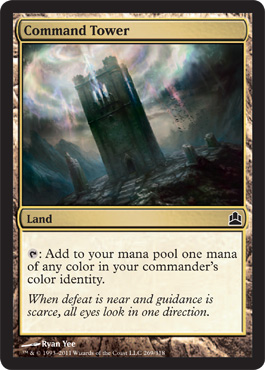
Let’s look at a couple of examples to really get at the point. Our first is Command Tower:

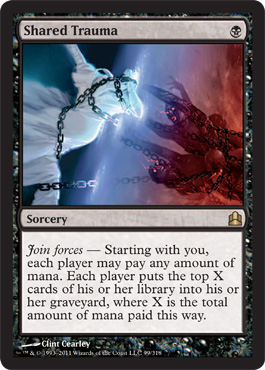
If it wasn’t already abundantly clear, the vast majority of multicolored Commander decks would improve by including this card over one of their other lands. This sort of incorporation is very easy because you’re replacing a card that already fills a role your deck needs with another which is simply better at fulfilling that role, but the replacements aren’t always so straightforward. For the sake of argument, let’s pretend that I have a Geth, Lord of the Vault deck. Looking over the Commander spoilers, I’d immediately be drawn to Shared Trauma.

But, while like Command Tower, I know that this card would benefit my deck (it works well with wanting things in graveyards and enormous mana output, just like Geth himself), it wouldn’t replace another card in the same role. Even with Geth in the Command zone, mill is still far from the most potent strategy, and due to Geth’s nature, mana rocks like Worn Powerstone will be stronger than all but the most powerful of mill spells. Shared Trauma certainly falls into that category, but it’s a category that we ultimately wish was deeper.

Normally we might be able to supplement an unfortunately small number of appropriate cards with tutors, but Beseech the Queen and friends are already overtaxed finding Cabal Coffers. So we play what we can get: Mesmeric Orb, Altar of Dementia, Keening Stone, Mindcrank, Whetstone, and maybe Sword of Body and Mind. But we don’t really want to take any of these out for the new card, rather we would cut a card from an overrepresented role, perhaps creature removal. Still, the challenge of finding a card to cut pales in comparison to the difficulty of making multiple replacements simultaneously.

2. Sub-Themes

Most decks have a strong theme, often dictated by their Commander, but that doesn’t determine every card in the deck. Taking, for instance, the Saffi Eriksdotter list that I discussed last week, the spell choices focus on the themes of creatures with “enters the battlefield” abilities and sacrifice outlets because those synergize with the Commander. However, once we’ve established major themes, we can rely on drawing cards that fit into that category.

Because we have a lot of ways to sacrifice creatures for a benefit, recursion becomes very powerful. Similarly, by including a lot of 187 critters, ways to Unsummon or Flicker creatures gain a lot of utility, and as such, I’ve established both of these as sub-themes within the deck. Because sub-themes complement the main functionality of the deck rather than being necessary for every game, you can often build them into a deck with just a few cards to support them, and as such, a new release can easily make a new sub-theme viable. Take Scars of Mirrodin: prior to the set’s release, our only meaningful ways to interact with counters were Gilder Bairn, Doubling Season, and Energy Chamber, but with the additions of Contagion Clasp, Contagion Engine, Throne of Geth, Thrummingbird, and Inexorable Tide, it quickly became sensible to include counter-based strategies in all sorts of decks.

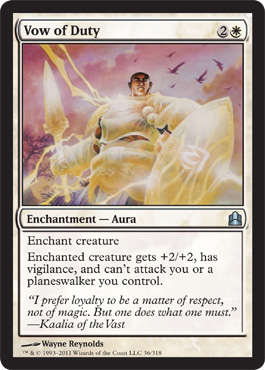
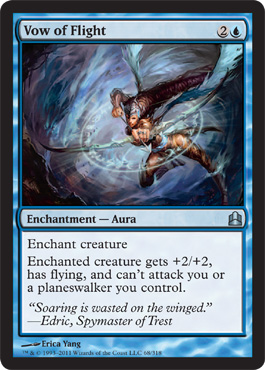
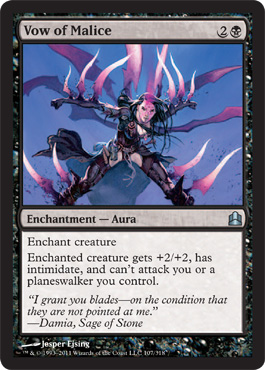
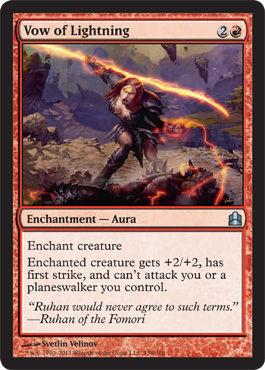
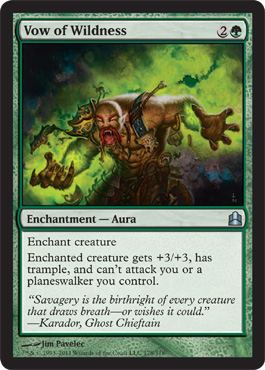
Similarly, while there still may not be enough Rootwater Matriarchs and Ramses Overdarks to consistently want to enchant your opponents creatures, the new Vow cycle will let you do so without having to run junky cards.


While none of these cards in isolation would convince you to try this sort of tactic out, by existing together, they open up the real possibility of semi-consistent synergy.

3. From the Ground Up

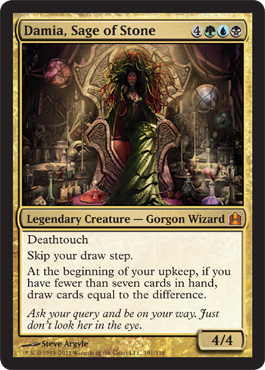
Thus far, what we’ve discussed applies to sixty card Magic as well as Commander, but we really start to see the connection if we choose to build around a card. The largest difference is obvious: if you want to build around a new legendary creature, choosing it as your Commander affords you an unparalleled level of consistency. Take, for example, Damia, Sage of Stone:

While you could try to build around this powerful seven-drop in a regular deck, needing to consistently draw it means you have to run card draw, a role which has virtually no value once the Gorgon comes out to play. Alternatively, by always having access to this Commander, you can pack your deck full of Rampant Growths, Cancels, Jace's Erasures, and Zombie Infestations (all of which will be back for Magic 2012).

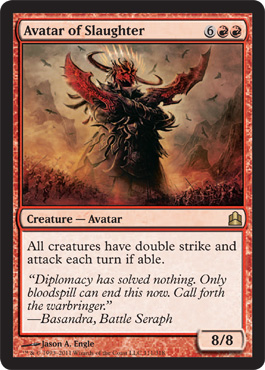
While Commander’s rules make building around a legendary creature easier, they severely inhibit one’s ability to build around any other card. In a sixty card deck running four of your build-around card, you have a 40% chance to see that card in your opening seven. On the other hand, as one out of ninety-nine, you only have a 7% chance to find the card you’re looking for. But we’re a resourceful bunch, and we aren’t about to let a deck-building challenge dissuade us from centering a deck around, say, Avatar of Slaughter.

Tutors are the best way to simulate more copies of the card you want to focus on, and even if we were confined to red, we’d see a marked increase in number of Slaughterers drawn by adding Gamble and Planar Portal, from a 7% up to a 20% chance of "finding" a copy in our opening grip. Then again, the new Avatar works exceptionally well in a deck chock full of infectious critters, so perhaps we should add black and green to the mix. With the additions of Demonic Tutor, Vampiric Tutor, Diabolic Tutor, Demonic Collusion, Chord of Calling, Worldly Tutor, Sylvan Tutor, Brutalizer Exarch, Tooth and Nail, Defense of the Heart...

Maybe we don’t need all of those. By using multiple tutors could get our chance of 'drawing’ Avatar of Slaughter up past 80%, but at some point that’s not doing us any good.

The problem is that tutors aren’t perfect replacements for more copies of the card. Once you’ve gotten it out of your deck, your tutors no longer find it. You need some recursion. If you’re looking for a creature you have tons of options, from Haunted Crossroads and Miraculous Recovery, to Genesis or even Eternal Witness! Even if you aren’t running the recursion colors, there are plenty of hidden (and not so hidden) gems. Red can get back artifacts with Trash for Treasure or Goblin Welder, and blue can do the same with Argivian Restoration or Academy Ruins (Junk Diver and Myr Retriever don’t hurt either). Both can grab spells with such hits as Anarchist, Surreal Memoir, and Mnemonic Wall. Artisan of Kozilek can help creatures stick around, and blue can recur anything with Recall.

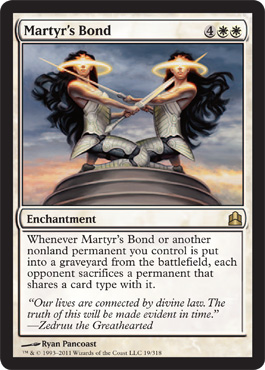
Of course having to run a bunch of tutors and recursion is still inefficient compared to running extra copies of a card, and while Commander is a singleton format, you might be able to find some cards that are similar enough to fill a role. Butcher of Malakir has done a lot of good work as a second Grave Pact, even earning the nickname ’Magus of the Pact’ (a la Magus of the Moat/Moat) among my playgroup. But Martyr’s Bond is ready to demote everyone’s favorite Vampire to third.

“Hold on!” you may be shouting, “this is starting to sound an awful lot like your sub-themes section. Are these even different categories?” Yes, but only because of a limitation of the format’s singleton nature, and even there the line is blurry. Using a new card as a basis for your deck, that is something that's a theme unto itself, means that you have to find it for your deck to play out properly, but can do without a sub-theme for some number of games. The distinction then lies in the limited number of tutors available. With the exception of five-colored decks and those built around a creature, you simply don’t have enough tutors to find every card you want to play, and the division between a theme and a sub-theme springs from what you tutor for. You can generally run enough tutors to find the core themes of your deck every game, but not enough to find every interaction you’d like to.

I hope you enjoyed this look at using new cards, and next week we’ll go a bit more in depth on one of them. In the mean time, share you’re thoughts in the comments: do you prefer this sort of broad meta-strategy, or something you can apply more directly right now? This column is for you, so I’d love to know what you think so that I can make it better.

See you next week,

Jules Robins
julesdrobins@gmail.com
@JulesRobins on Twittera

Finding the Right Audience

Are you a Quiet Speculation member?

If not, now is a perfect time to join up! Our powerful tools, breaking-news analysis, and exclusive Discord channel will make sure you stay up to date and ahead of the curve.

So you’ve got this trading thing down. You’ve learned all the techniques for gaining value from trades, you’re up-to-date on all pricing trends, and you know exactly cards are going to be good after rotation.

Believe it or not, this doesn’t mean you’ve “made it.” In fact, it means very little unless your goal is to just hoard cards. I’ll assume your goal is to make a profit, which means that no matter the size of your collection, all you’ve done is take the first step.

I’ve talked before about The Myth of Making Profits, and today I want to share a few stories that demonstrate what making the right contacts can do for you.

It’s no secret that succeeding at Magic means you need good networking skills. After all, it’s a lot easier (and cheaper) to stay up on tech when you can rely on a few friends to loan you cards when you need them. But networking extends to trading, and if you don’t spend time creating and sustaining a good network, then you’re costing yourself heavily when it comes time to cash out.

I’ve been on both sides of this coin, and I hope that sharing some of my experiences will demonstrate the importance of building a network, and how to go about doing that.

Saved while selling staples

Last Extended season, I thought I was running good. I had a list of cards from Lorwyn block to pitch before rotation, and I even wrote a column about what to sell. I was personally sitting on about 20 Reflecting Pools I expected a good price for.

I planned on selling off my staples at the upcoming PTQ here in Oklahoma. We get one PTQ in the state per season, and we have one dealer show up. Even though buy price were slowly dropping across the board, I decided I was still better off selling to the dealer in person than ship them off online. My reasoning is that I would save on shipping and the hassle of mailing cards.

I got the PTQ, took my binder to the dealer, and disaster struck. He informed me that, despite his policy of buying all cards, he just wasn’t interested in Extended stock, including Legacy staples like Thoughtseize.

At this point, I’m in a pretty rough spot. I can either commit to trading off the cards, which would give me more trade fodder to work with but would be much more effort since it’s not easy trading off rotating cards for a decent price. On the other hand, I can decide to sell my cards online, and deal with the fact that I lost a good 15-20% in the weeks of waiting for the PTQ.

That’s a sad story (trust me, there were tears), but fate decided to cut me a break that day (probably in repayment for my scrubbing out of the tournament). A few months back, another friend of mine had hooked up a ride to a PTQ in Wichita, and she got me invited along by more or less playing the girl card. All of this was fine by me, as it was a free place to stay.

I kept in touch with our ride (Joe Naseef, or @Sgt_Guido) after the trip, becoming friends and sharing deck ideas and the like. After telling him at the PTQ about my predicament, it turned out that he knew (the now SCG-famous) Chris VanMeter, who was able to buy my Extended cards off of me. I took a hit on the prices of the cards, but it was about what I would get online, minus the shipping and the hassle.

It was a reasonably happy ending to a situation that could have potentially cost me a lot of profits, and it never would have happened without creating a network of Magic players and traders.

This story isn’t all that unique among Magic players, but the takeaway is that I was forming connections with not just other Magic players, but also a customer. After dealing with Chris, I know I now have another person I can go to if I’m looking to unload stock.

What’s a Beta Dual worth, anyway?

This is really a tale of two different networks. You guys might remember Underground Sea Guy (he’s the guy who found Duals and Powers for $20).

At the time he came into his new expensive card lot, he was just happy to have them. After a few weeks, the newness wore off, and he started talking about selling them. The problem? He has a smaller group of players and traders he knows and has no contacts in the dealer industry. I tried to convince him to sell his lot to me, but he wanted to take it to a Convention he was attending the next month. Rather than give up, I told him that if he didn’t like what he heard from the dealer to remember that I was interested.

After coming into his collection, he looked at all his cards at their Star City Games price. I knew better. His perceived price of the collection was nothing like a dealer would offer him, and I banked on that fact. When he came back after only selling some of his collection, because (surprise!) the dealer didn’t offer him what he thought they should be worth, I jumped at the chance to get in. He needed the money from selling the cards, but he was out of options of where to sell.

After pricing out his collection and letting him know what he could expect from an online dealer regarding the condition of the cards, he decided that it was worth taking less, since I had the cash ready to hand to him. We all know that Cash is King, and he decided it wasn’t worth dealing with dealers.

Now, I could have eaked out profit selling the cards online, but where Underground Sea Guy was out of options, I had a network of traders that I knew would be interested. Within 24 hours of picking up the cards, including a Beta Savannah, I had shipped the lot for double what I paid for it, and much more than I would have got from an online dealer. Something like this would never have happened if I hadn’t developed a strong network of collections across the state.

Making your own contacts

How to go about making these contacts when you have none?

The first thing is to become very friendly with the dealers in your area. The owner of my local shop trusts me enough to allow me to openly sell cards in his shop. But I didn’t get to this point overnight. I’ve taken the time to get to know him on a personal level and have discussed my involvement in dealing cards on the side.

I understand this won’t work everywhere, but if you take the time to make a personal connection with as many people in the business as you can, then you’ll be surprised by how easy it becomes to move cards when you need to or gain privileges that aren’t the norm.

Prediction Tracker
[iframe https://spreadsheets.google.com/spreadsheet/pub?key=0AqV8zg-4f2ehdExkeU9mN05PdXBIMkJWNVlCUnlwWWc&single=true&gid=2&output=html 925px 1000px]

[iframe https://spreadsheets.google.com/spreadsheet/pub?key=0AqV8zg-4f2ehdExkeU9mN05PdXBIMkJWNVlCUnlwWWc&single=true&gid=10&output=html 925px 700px]

[iframe https://spreadsheets.google.com/spreadsheet/pub?key=0AqV8zg-4f2ehdExkeU9mN05PdXBIMkJWNVlCUnlwWWc&single=true&gid=11&output=html 925px 700px]

[iframe https://spreadsheets.google.com/spreadsheet/pub?key=0AqV8zg-4f2ehdExkeU9mN05PdXBIMkJWNVlCUnlwWWc&single=true&gid=12&output=html 925px 700px]

The big news from the Prediction Tracker this week is the emergence of Block decks. Tempered Steel was the big winner, which is a card we’ve been talking about to watch for awhile. It and Puresteel Paladin look like solid options for investing going forward.

I’m working on a list of some of the best calls made via the Prediction Tracker so far, and chances are you’ll be able to find it in the QS Newsletter in your inbox in a few weeks.

Thanks,

Corbin Hosler

@Chosler88 on Twitter

Avatar photo

Corbin Hosler

Corbin Hosler is a journalist living in Norman, Oklahoma (also known as the hotbed of Magic). He started playing in Shadowmoor and chased the Pro Tour dream for a few years, culminating in a Star City Games Legacy Open finals appearance in 2011 before deciding to turn to trading and speculation full-time. He writes weekly at QuietSpeculation.com and biweekly for LegitMTG. He also cohosts Brainstorm Brewery, the only financial podcast on the net. He can best be reached @Chosler88 on Twitter.

View More By Corbin Hosler

Posted in Finance, Free Insider, PredictionsTagged , , , , , , , 1 Comment on Finding the Right Audience

Have you joined the Quiet Speculation Discord?

If you haven't, you're leaving value on the table! Join our community of experts, enthusiasts, entertainers, and educators and enjoy exclusive podcasts, questions asked and answered, trades, sales, and everything else Discord has to offer.

Want to create content with Quiet Speculation?

All you need to succeed is a passion for Magic: The Gathering, and the ability to write coherently. Share your knowledge of MTG and how you leverage it to win games, get value from your cards – or even turn a profit.

Setting Yourself Up For Success

Are you a Quiet Speculation member?

If not, now is a perfect time to join up! Our powerful tools, breaking-news analysis, and exclusive Discord channel will make sure you stay up to date and ahead of the curve.

“Proper planning prevents piss-poor performance.” I’ve heard this from a number of people at a variety of times. However, I’ve found that people usually say this when they themselves haven’t planned properly. For those of you that are slow on the uptake, YOU ARE RUNNING OUT OF TIME. If you maintain a Standard collection, it’s time to ship all your rotating goodies. On top of that, it’s time to reconsider any M11 cards that are being reprinted. Standard is about as stale as it can get, and unless you have a Tier 1 deck built, and you need your pieces, start cashing out to prepare for 2 new sets releasing within the next 4 months.

Hopefully, over the last couple months you’ve been dumping as much Zendikar block stuff as you can in your trades. Anything left over should be organized and traded out to a dealer. I recommend taking advantage of any trade-bonus they may offer. Perhaps they’ll give you additional value if you trade cards for cards instead of just selling. It’s a great way to pick up a handful of Legacy cards, with a stack of stuff that will literally have no value in a few months. I recently got rid of a stack of stuff to a local dealer for a Wasteland and 2x Crucible of Worlds. I didn’t get rid of anything worth more than $5, and it included a big pile of draft bulk, like Burst Lightnings, Doom Blades, Explores and Vampire Nighthawks. Keep in mind, that my actual trade binder was recently stolen, and these longboxes of draft bulk that I save for season-end were one of the few things to survive the loss.

How can you go about setting yourself up for next season? Well, first, clear out your stock like I did, to make tracking and maintaining these bulk boxes simpler. Then, you’ll want to sort all of your Scars block commons and uncommons, by set, and then by color, and then by name. After each draft, filter your deck into these boxes, and pull the notable cards for your binder. Did you know that dealers pay as much as $0.10 for cards like Myr Galvanizer, Arc Trail, and Trinket Mage? My box has over 30 Trinket Mages in it, thats $3. This stuff really does add up quickly. Either use a 5000 count box, using a row for each set, or use a separate longbox for each set. I like to try and maintain at least 4 of every common/uncommon in these boxes, and cards that see even the slightest play, I’ll collect as many as possible in these boxes. Organizing these into longboxes is useful not only to find cards when you need them, but to be prepared to bulk them out this time next year. It also is a great idea to bring them to larger events when a certain uncommon may become the hot ticket, and you’re not the guy saying, “Oh no! I’ve got a stack of those somewhere at home!” I’ve been that guy, it’s not fun.

Track how much you can bulk out at the end of the season. Find out what you’re going to do with that inflow, and how does it fit your trading plan, as I discussed last week. Are you going to put that value back into your trade binder? Will it be for Standard cards that aren’t rotating? For Legacy staples? Will you cash out to place some pre-orders for the upcoming sets? Make a plan. Write it down. Crunch some numbers.

Make a list of any bulk rares from Scars block you own, but are not in your trade binder. Keep it up to date on a spreadsheet. The spreadsheet will allow you to look at things at a glance, when something pops up on the Prediction Tracker, or news pops up at an event. You can often keep all of these separated in a single box. Once the draft format changes at the M12 release, the amount of Scars block being opened will immediately subside. Picking up what seems like junk rares in parts of your trade will likely payoff. Cards like Argent Sphinx, Spikeshot Elder, Scars Dual Lands, Sunblast Angel, Contagion Engine, Massacre Wurm and other rares may not have much value to the drafters around you. Last week I made the following trade:

My:
Steam Vents
Razia, Boros Archangel

His:
3x Argent Sphinx
3x Spikeshot Elder
2x Hive Mind
1x Hive Mind (Foil)
2x Slagstorm
3x Precursor Golem
1x Ezuri, Renegade Leader
3x Etched Champion
1x Blackcleave Cliffs

Most of these rares were literally in a box he had written: “Junk Rares” on. My trade partner is exclusively a drafter, and also plays EDH casually. I know he always has a huge stock of standard rares, and he hoards everything he drafts. He also needs the common EDH staples, and we both tend to have excess of stuff the other needs. This trade is a win-win. As indicated on the prediction tracker, I expect Argent Sphinx to pick up some steam next year, and same to be said for Spikeshot Elder. Hive Mind I want to try and flip as quickly as possible, before it’s delegated back to the $0.10 realm.

I have a friend who drafts with me every week, and he doesn’t keep many of his cards, and doesn’t speculate much on future values. But, man-oh-man, does he grief when he “had so many of those, I can’t believe it’s worth something now...” I’m waiting to rub it in his face when I dump some large number of Argent Sphinxes around November next year. I’m invested in these so cheaply, that any amount of increase will be a sizable profit, and if it sees play in a Tier 1 deck, I’ll be making it rain.

This week on the Prediction Tracker:
As noted above, Argent Sphinx made the list for me this week. Blue is losing the best 4-drop it’s had in ages, and while the Sphinx is certainly no Jace, it is an extremely aggressive creature, at a great spot on the curve. The fact that Lightning Bolt is not being reprinted, makes me like this guy even more. I also added the Commander Pre-con’s to my Hot list. The Commander crowd at my LGS is going nuts for this new product, and I also know that most of them don’t like to buy cards, I don’t see many of them shelling out the dough to buy one or more of the precons, but I know they are all excited to add some of the new singles to their existing decks. Be first to have extras, and pick up trades as quickly as you can. I also moved Karn off the Watch list, and onto my dump list. Karn Liberated didn’t show up at Nagoya, and you may as well get rid of him now. I was hanging on to the one copy I drafted recently, hoping it would pick up a small amount of steam of PT Nagoya, but no such luck. I’ll be trading it for a Koth, I hope. I also added Elvish Archdruid to my watch list. Having been confirmed for M12, his price certainly wont shoot up too drastically, but all the ducks are in a row for a solid Elf deck to roll through a small card-pool version of Standard in the fall, and Archdruid could shoot up temporarily. I’ve been trading for these at very close to bulk levels by using the “It’s about to be reprinted” approach. If people ask me directly, I”ll admit that I think he may see some play, and that I’m speculating on the card. I have no qualms telling people that I’m speculating on the card, but I always emphasize that I’m sticking my own neck out there by gathering them up. This has worked well for me in the past. Sometimes a simple line like, “Yeah, I know it seems like I know something you don’t, since I want a dozen of your Argent Sphinxes, but to be honest, I’m just taking a gamble on these, because I could see someone doing something cool with this next season.” Usually, that’s enough to deter any odd hesitation, and most people aren’t trying to take risks with their trades anyway.

I’d really like to hear from some of you as to what low-end rares from Scars block you think have potential for next season, and we can collect the results below in the comments, or if there’s enough interest, we can start a thread in the forums.

Happy Trading
Chad Havas
@torerotutor on twitter

Sick of CawBoring? BEEF It Up!

Are you a Quiet Speculation member?

If not, now is a perfect time to join up! Our powerful tools, breaking-news analysis, and exclusive Discord channel will make sure you stay up to date and ahead of the curve.

Are you sick and tired of playing your generic Caw-Blade decklist? Doesn’t it get monotonous and repetitive, playing the same seventy-five as you were six months ago? Are you ready to kick it up a notch? Don’t you want to throw something out there that for once your opponent won’t expect? That for once they won’t know the exact decklist you are playing, down to just a few cards? If that sounds like you, then man do I have something for you!

A deep, booming, manly voice comes on the speaker and bellows


Where’s the BEEF?

Beef it up with BEEF-Blade!

cow plus sign sword

or

primeval plus sign stoneforge

At the end of April I wrote an article about Caw-Blade with green, how my friend had designed and tested it, and about how another friend qualified for nationals. After just a few short weeks, New Phyrexia came out and everyone forgot about the deck. Adding green mana to Caw-Blade was great against everything but the Splinter Twin decks. Now that the metagame has adjusted, the resurgence of green mana, in what has been called possibly "the best Standard deck of all time" by more than a few influential players, is upon us once more.

Dylan Kiedrowski qualified for nationals and also top 8'd a PTQ with an updated version of the deck. The same basic concepts are present in the deck. One sweet feature of the deck is the ability to gain a huge mana advantage on your opponent by playing Lotus Cobra. The other huge benefit is the inclusion of Primeval Titan as a difficult creature to deal with. Both of those cards are obviously powerful but especially so against Caw-Blade. These types of threats allow you to gain quite an advantage against the current king of Standard. Take a look at the updated list and then follow below for some card discussion.

Untitled Deck

Creatures

4 Stoneforge Mystic
4 Lotus Cobra
4 Squadron Hawk
1 Viridian Corrupter
1 Oracle of Mul Daya
2 Primeval Titan

Spells

1 Sword of Feast and Famine
1 Sword of War and Peace
1 Batterskull
1 Mortarpod
4 Preordain
3 Dismember
4 Jace, the Mind Sculptor
3 Green Suns Zenith

Lands

4 Misty Rainforest
4 Razorverge Thicket
4 Forest
3 Tectonic Edge
3 Island
4 Celestial Colonnade
4 Seachrome Coast

Sideboard

3 Day of Judgment
3 Celestial Purge
4 Spellskite
1 Obstinate Baloth
3 Beast Within
1 Consecrated Sphinx

One weakness of the Caw-Blade lists that are doing well is the lack of Spell Pierce. This was an area that we focused on to exploit with the new version. The card that was chosen to fill this roll is a favorite of mine, Green Sun's Zenith. In this list, Green Sun's Zenith means...

Most of the time Green Sun's Zenith will be cast for three mana to go get your Lotus Cobra, but the rest of the package is versatile and solid. Viridian Corrupter can destroy any of the problematic equipment or other artifact giving you trouble. Oracle of Mul Daya is like a tutorable Jace the Mind Sculptor. Honestly, that last statement is not a joke, she really is that powerful. Finally, if you draw the Zenith late game, it is your win condition by grabbing Primeval Titan. Keep in mind that just having the Zenith as additional copies of Lotus Cobra is usually the right play because being that far ahead in mana will win you most games.

Dylan played this deck against a well rounded field of competitors, not just a bunch of Caw-Blade opponents. The deck has game against every deck in Standard and is favored in most of them. The aggressive decks can be troublesome but if you play tight, the match should be yours especially after sideboard. The following is the list of decks that he played against throughout the tournament.

Pro Tour Qualifier in Columbus, Ohio
round 1 vampires 1-2
round 2 mono red 2-0
round 3 mono red 2-1
round 4 gw birthing pod 2-1
round 5 boros 2-0
round 6 caw-blade 2-0
round 7 caw-blade 2-1
round 8 twin-blade 0-1 intentional draw

top 8 quarter finals four color birthing pod splinter twin 2-1
top 8 semi finals twin-blade 2-1 primeval titan plus equipment
top 8 finals vampires 0-2

Overall, the deck is consistent because you should have a solid play for turn two every game. The manabase provides all three colors on a regular basis and has been well tested, so mana problems are almost never an issue. The main benefit to playing the deck is great numbers against Caw-Blade and Splinter Twin decks as well as solid matchups against the rest of the field. One thing to be careful of is Vampires. If you will notice, this version lost twice to Vampires. It is definitely a winnable match-up but it is quite tough, especially against a good Vampires player. There was some testing of Nest Invader specifically against anyone playing the red/black aggressive deck, but it was cut for consistency reasons. It is possible that the Obstinate Baloth in the sideboard should change into a Nest Invader. The Baloth is not very good and will likely be cut from the deck entirely. It is too slow, especially so when relying on the Zenith to tutor for it.

The other hard match is anything with the Splinter Twin combo. Yes, I said it is a fine match for the deck, but it is actually not all that favorable. Game one against a dedicated Splinter Twin deck can feel almost unwinnable because you have quite a small amount of disruption. The post board games are much more in your favor because you have many cards that come in for that match. When they likely win game one though, and especially if you don't draw well or mulligan, you can easily lose the match, so just be aware of that possibility. The difference is that a deck designed solely to win by Splinter Twin, is really rough, whereas a deck that has a back up plan is much more in your favor. A good example of this is the Twin-Blade deck that runs Stoneforge Mystic and equipment in addition to the Splinter Twin combo. That deck is not nearly as tough to beat as, say, the Grixis Twin deck that is not seeing much play anymore.

Some notes on the deck:

BEEF-Blade is capable of some amazingly sick plays. Lotus Cobra allows craziness like turn three Jace the Mind Sculptor, unexpected Day of Judgments off of triple Forest, Island, Island and a Misty Rainforest, or just the ability to play multiple two cost creatures on turn three.

Mortar Pod is still amazing. It destroys the current Mono Red decks, does work against any Birthing Pod deck slowing them down considerably, and is still good against Caw-Blade and other Squadron Hawk decks like Boros.

Late game you do insane things no other deck in the format can do like equipping Primeval Titan or double Tectonic Edge on their lands. Don't make bad attacks with your Primeval Titan because they might just blow you out in combat by blocking and using their Dismembers. It is usually correct to just wait and equip the titan - it's a sicker play anyway so you get some style points for killing your opponent that way.

Until next time, may your Caw-Blade opponent never see your Primeval Titans coming and unleash that green force in Caw-Blade!

Mike Lanigan

Email: Jedicouncilman23@gmail.com
Twitter: mtgjedi

Don't forget to check the Banned Restricted announcement Monday, June 20th.
Some crazy things could happen.

Event Decks: Painted into a Corner?

Are you a Quiet Speculation member?

If not, now is a perfect time to join up! Our powerful tools, breaking-news analysis, and exclusive Discord channel will make sure you stay up to date and ahead of the curve.


Precon history was made just a few short months ago with the launching of the Event Decks for Mirrodin Besieged. The two had bumped into one another along the fringes every now and again as with decks featuring affinity (Bait & Bludgeon) and monoblack Vampires (Rise of the Vampires), but never before had there been deliberate overlap between the Preconstructed and Standard communities. Before the advent of the Event Decks, the overlap was accidental: an archetype arose in Standard that happened to be featured in a theme or intro deck. "What would happen," Wizards seemed to ask, "if we created preconstructed decks specifically for constructed play?"

It was bold, risky, new ground. Given the need to balance content versus cost, Wizards set a high bar with the following blurb found on the back of each deck:

Event Decks let you enter the world of tournament play knowing you've got a powerful deck designed to let you be immediately competitive. Each Event Deck contains 60 powerful cards and a supplemental 15-card sideboard. Rest assured that each one of these weapons was handpicked to inflict pain upon any opponent who takes you on.

Looking to deliver on that promise first was Into the Breach and Infect & Defile. Containing no mythics and only seven rares, Wizards offered a monored aggro deck in the style of Kuldotha Red, and a blue-green midrange infect in the latter. When we first looked at the decks, we wanted to gauge the level of power they possessed with an eye towards estimating their performance in Standard.

Could they compete? Given their design restrictions, did they still have enough tools to be viable? When your entire raison d'ĂȘtre is predicated upon being "tournament-ready" these are vital considerations.

It wouldn't take long to realize that Wizards had a solid idea on their hands, but that they needed to fine-tune their process: Infect & Defile was not holding its own. The problem was a simple one: the deck simply needed too much time to fire off, and that time gave the opponent too much time too develop their board state. A Hand of the Praetors may look pretty cool in abstract, but when your opponent plays Jace, the Mind Sculptor on their turn, you've got a problem. The deck was also two-colored. Rare-filled manabases are a given if you're playing more than one colour, but what Event Deck (with its seven-rare limit) has the quota room to spend cards on the less-sexy land content? Infect & Defile puts forth a game effort with a pair of Drowned Catacomb, but for the most part you're making do with a playset of Jwar Isle Refuge. Competitive decks ramp the power level up quickly. To beat them with inferior cards, you need to be faster.

Enter New Phyrexia.

Once again, we're treated to a pair of Event Decks which undeniably draw their inspiration from Into the Breach. Gone is the slower, more reactive permission suite. Gone is the two-color construction. And if there's going to be a rare slot spend on a land card, it's going to be something that is a win condition (Inkmoth Nexus) rather than a mana fixer. Enter War of Attrition and Rot from Within. Monowhite and monogreen respectively, these decks are ones designed to have the game well in hand by the midgame. The question is less whether or not they are competitive, because an opening hand of Forest, Forest, Glistener Elf, Groundswell, Groundswell, Mutagenic Growth, and anything else is going to win you the game on the play unless they have a one-drop critter or say, a Spell Pierce. The question now is this: given our second release of Event Decks, what do the they tell us about the future of the product line?

The Swagger has Been Tempered

That bit above about being "immediately competitive?" Gone. See if you can spot the subtle difference in tone between that and the current blurb:

Event Decks let you jump into tournament play with a powerful deck that will give you a fighting chance. Each Standard-legal Event Deck contains 60 cards from a variety of sets and also includes a 15-card sideboard. Rest assured that each one of these weapons was handpicked to inflict pain on every foe.

"Immediately competitive" versus "a fighting chance?"

Midrange is Out

The slower-paced Infect & Defile might well be the last of its kind. It's too slow, too cumbersome, and perhaps just too much of a risk to run when dealing with an uncertain metagame. In truth, there will be plenty of times that Infect & Defile performs as it should as Friday Night Magic (FNM) is the home of the vast, wide open metagame. You'll have Tier 1 competitive decks, sure, but also rogue decks, budget decks, and other sorts of oddball goodness. The problem, though, lies in planning. Optimize a deck for a casual metagame and it will going to crash and burn when it hits a more competitive room, as will the goodwill of the player who just shelled out 25 bucks for the privilege of scrubbing out. Optimize instead for a more competitive environment and you may end up with a deck that can grab a few wins in the challenging room, and simply win even more in the casual. Who could complain? Of the two, only Into the Breach seemed to be the latter. Lesson learned.

Speed is In

As mentioned, Rot from Within is perfectly capable of a turn two or three win, with a good enough start. War of Attrition won't be as explosive, but will often have established a solid board position quickly, one that takes a little speed off the top-end in return for a dose more durability. They're both cut from the same cloth as Into the Breach, looking to maximize their win percentage by striking before the enemy's battle plan has been enacted.

With Event Decks already confirmed for both Magic 2012 and Innistrad, the format appears here to stay. The worry, though, is that we're going to see nothing more than a series of fast aggro decks for each release. The goal was ambitious: make a variety of decks competitive in the Standard environment. But it might well be that the limitations placed on that ambition have painted Wizards into a corner with regards to their archetype choices.

Looking to get a little more insight on the format, I checked in with Jesse Smith. You might know Jesse as @Smi77y on Twitter, a host of The Eh? Team Podcast, and an up-and-coming deckbuilder on his site 60Cards. "With good synergies," he told me, "you can beat a deck with Jace, the Mindscuplter in it, without the bomb mythics."

Alright, that's encouraging! What else?

"Without using mythics, at least currently, aggro is best strategy, and possibly combo with Splinter Twin. Seven different rares? I mean monored and Elves are doable without mythics, as is Splinter Twin. All of these obviously only capable at FNM level. A solid red deck, which would be Goblins or standard burn would be best. Vampires are clearly the best choice for a non-mythic deck on a high competition level though."

It's interesting to note that the one combo Jesse mentioned, Splinter Twin/ Deceiver Exarch, is one that Wizards R&D didn't catch until it began to be played. Is it possible that they'll build a viable combo Event Deck? If the archetype works, it certainly seems possible. At a certain point Wizards is going to want to offer some non-aggro strategies, otherwise the product line will become too stale. Vampires is another intriguing option. With Innistrad speculated to be a "Gothic horror" set, the odds may seem good that we'll see some monoblack aggro as well.

I am still uncertain that Wizards had the right measure for the first set of decks for Mirrodin Besieged, but they have also shown themselves to be a company that adapts as needed demand. The improvement in the New Phyrexia Event Decks shows promise, but the burden now will be to diversify the product range.

Bring on Magic 2012.

_________________________________

It's giveaway time!

Want a copy of War of Attrition all your own? We're giving one away! To enter, simply reply to this article and answer the following:

Have you bought any of the Event Decks? Why or why not?

If so, what are your thoughts?

If not,  what would it take (if anything) to get you to invest in one?

As always, you don't need to write the "Great American Novel," just let us know what's on your mind! We'll pick a commenter at random next Wednesday, June 23 2011, and they'll get a brand-new, factory-fresh copy of War of Attrition!

_________________________________

Jay Kirkman

@ErtaisLament

www.ertaislament.com

Examining the Future

Are you a Quiet Speculation member?

If not, now is a perfect time to join up! Our powerful tools, breaking-news analysis, and exclusive Discord channel will make sure you stay up to date and ahead of the curve.

You don't need a Crystal Ball to look into the future for standard possibilities, just a good idea of how things will pan out after this fall. While we know almost nothing (read: Nothing) about Innistrad, what we do know is the meta game right now, or rather, the general block meta game that we should be looking at. A semi-defined block meta game helps us look at what the format will look like minus all of this falls rotating set, and while it isn't a fully accurate representation of how things will look come Scars/M12/Innistrad standard, it's a very educated guess as to what's going to remain popular, and therefore profitable.

Sure things:

Sword of War and Peace

Sword of Feast and Famine

Batterskull

There isn't a lot to say here. They will see play as the meta game shifts them into favor, and while they lose some of their power with Stoneforge Mystic leaving, they are still powerful on their own. I wouldn't expect them to drop much, if at all. They may even go up as more copies must be used in order to draw them consistently.

Highly possibles

Black Sun's Zenith : With the set looking dark and Gothic style from what we've seen, I would expect that the powerful black spells such as this and others stand a good chance to continue to see play.

Consecrated Sphinx : Seeing play or not seeing play in the current format doesn't weight much into this one, it just needs an unlikely mono blue deck, or a much more likely U/X deck to come along, and this will continue to see play, and be in demand.

Sword of Body and Mind : This is completely dependent on the strengths of blue and green between M12 and Innistrad. They aren't bad to have around, but I wouldn't put a ton of invenstment into them since the other two swords outshine it, even in an environment of Jace.

Hero of Bladehold : This card still holds amazingly strong possibilities. If there is a white based aggro deck to be found this fall, expect this card to be at the forefront of it.

Hero of Oxid Ridge: See Hero of Bladehold

Koth of the Hammer : The red planeswalker found many homes this past weekend, and if Innistrad gives red a few more tools to work with, we could see Koth get another boost in demand. Many of the Red lists from this weekend looked strong as they were, and could easily be ported over to a new standard environment where new tools exist, and it still has access to Inferno Titan

Tempered Steel : One of the MVP's of this past weekend, and if wizards provides efficient artifact support in their upcoming set, it could easily push this to be a card that people are looking for. The promotional ones should keep a weighty price for the time being, but as this is such a situational card I wouldn't be heavily invested.

Inkmoth Nexus : Saw play in many decks as a possible alternate kill through poison. It was a favorite in both red and white based decks, even if it was just to combat opposing Inkmoths. I feel secure in these for the time being, and I would pick up a few more if they can be found cheaply.

Still on the Hunt

Infect creatures : A good weekend for them, but that's to be expected in a block format where infect was a featured mechanic. It may be much more of a threat when Zendikar leaves, but it will also depend on what new decks come up from the next set.

Thrun, the Last Troll : He proved himself to be rather powerful this past weekend, though he was still subpar. The green mythic is still looking for enough support and the right environment to shine in, while not being outclassed by other options. Keep 2-4 on hand, at worst you trade them to players who love green "hexproof" creatures after M12 comes out.

Slag Storm : If Koth moves up, this probably will too. I wouldn't be surprised if this card sees demand this fall, as it is still very powerful for its cost. Keep a few on hand, and pick up more if you can get them cheap.

Kuldotha Phoenix : See above. Kelly Reid is invested in these, and I believe

Red Suns Zenith : Another red card that had a great weekend. A mana generating red based deck could put these to good use, and as they are very, very inexpensive for the time being, I would grab a few if you can.

Ratchet Bomb : A card that rises and falls in favor depending on the meta at the time. I don't expect that to change any time soon, so get them when cheap, sell them when in demand.

Grand Architect : There are a lot of things that have to go right for this card and the decks that it supports to come back, but it's always possible. They are cheap, but I wouldn't stock up on too many. If Innistrad looks like its going to support this card, you will still have time to get them.

Puresteel Paladin : Just as the Grand Architect, the same holds true here. While an equipment based white deck is possible, I'm just not convinced that his abilities are powerful enough to see standard play. You never know though, much like the Mirrodin to Kamigawa shift, Innistrad could prove to be a vastly underpowered set, and he could rise to popularity very quickly.

Venser, the Sojourner : Poor Venser, snubbed from the U/W decks that currently see dominant play, his abilities seemingly useless. Perhaps he can once again see demand with a new set of cards. Planeswalkers have a tendency to rise and fall in popularity, and Venser has been falling for quite some time.

Elspeth Tirel : Same story as Venser, though she has a decent glimmer of hope associated with her if white proves to be strong.

With such an assortment of cards and archetypes present at this weekends PT, it's hard to imagine that a few of them won't continue to show through rotation. With a few of the titans confirmed to be in M12, and Gideon Jura still being in standard, it's fairly easy to add in those and other "plug and play" style cards into decks.

Thanks for reading, and I hope this gives you a view of what you can be watching for as a new standard approaches this fall.

Stephen Moss

MTGstephenmoss@gmail.com

@MTGstephenmoss on twitter

Commander Deck Tech: Sol’Kanar the Swamp King

Are you a Quiet Speculation member?

If not, now is a perfect time to join up! Our powerful tools, breaking-news analysis, and exclusive Discord channel will make sure you stay up to date and ahead of the curve.

Welcome! Today I’m going to talk about my monoblack Grixis Commander deck, Sol’Kanar the Swamp King. I know you what you’re thinking right now. “Why wouldn’t you just play a monoblack commander if your deck is monoblack?” There are two reasons. First, I tried the few Grixis commanders and decided I didn’t really like them, but I still really wanted a Grixis deck to fill in my shard decks. I have a commander deck for each shard: Phelddagrif for Bant, Sharuum the Hegemon for Esper, and two more that I’ll talk about in future deck tech articles. Secondly, by being mono-black but with a tri-color commander I get access to a few useful spells that I really wanted to play with that I’ll talk about more a little bit later.

This deck is my big mana deck. For those of you familiar with monoblack control (MBC) decks, this is my take on a Commander version of that archetype. For those of you who aren’t, typical MBC decks feature a strong discard and removal suite backed up with powerful win conditions varying from Consume Spirit to Phyrexian Totem and Phyrexian Negator to Hypnotic Specter from way back in the day. This is my deck for when I feel like ignoring the concept of mana limitations.

Notable Moments Playing Sol’Kanar:

  • Timmy Moment: Casting Exsanguinate with X=32 on turn 10 using Gauntlet of Power, Caged Sun, and Cabal Coffers
  • Johnny Moment: Casting Diabolic Tutor for Memory Plunder, to then cast an opponent’s Austere Command, choosing enchantments and creatures with converted mana cost less than three, destroying my opponent’s board while leaving my Geth, Lord of the Vault alive to reanimate all his soldiers
  • Spike Moment: Casting Exsanguinate with X=32 on turn 10 using Gauntlet of Power, Caged Sun and Cabal Coffers (Hey, even Spike likes totally owning everyone in one turn, right?)

Why Sol’Kanar?

Out of the possible choices, Sol’Kanar is the most synergistic with a deck full of black spells. One of the things black really likes to do is pay life for spells, especially card drawing spells, which you need a lot of in here. Sol’Kanar provides a great counter for that by giving you life just for doing what you already want to do: casting your spells. For my typical playgroup, I also tend to gain quite a bit of life from everyone else’s spells, since we have one player who almost exclusively plays black decks, along with multiple other people who at least partially black decks quite often.

The second is the often overlooked built-in evasion he has: swampwalk. As I mentioned, a lot of people in my playgroup play black decks. Even if they didn’t, I’m running both Urborg, Tomb of Yawgmoth and Blanket of Night to make sure all my lands count as Swamps, which will also make him unblockable by my opponents. While it’s not 7, it’s very typical for you to have at least one way to increase his power available almost all the time so Sol’Kanar is typically a three hit unblockable kill with commander damage.

Focus #1: Mana Ramping

The real key to making the deck work is mana ramping. Unsurprisingly, with no green spells allowed in the deck you have to jump through a few more hoops to get there. Fortunately, Torment gave us one of the best ways to cheat on black mana, Cabal Coffers. This card almost single-handedly makes the MBC archetype work. Without the huge amounts of mana provided by getting almost a 2-for-1 deal on your Swamps, goes from strong to absolutely silly.

Since doubling our mana with Coffers is so strong, why not play all the ways to do it? Magus of the Coffers, Vesuva (to copy Cabal Coffers), Gauntlet of Power, and Caged Sun all make the cut as mana doublers for me. I’m not a huge fan of the one shot effects like Bubbling Muck. Doubling Cube is too inefficient for my taste. Nirkana Revenant goes in as a great threat as well as a mana ramper. Between the tutors and the actual number of doublers we’re running, we can pretty easily find one to make sure we have one on curve.

Speaking of curve, there’s another important part of the mana ramping that often gets overlooked. In this deck, it’s vitally important that we hit [emp]at least[/emp] the first seven land drops, if not the first 10. Since there are very few ways for you to get more lands onto the battlefield, it’s very important to make sure you don’t miss any land drops. One of the best ways to accomplish this without just running a ton of extra lands that will be dead cards fairly often is to include the land cycling creatures. This is another bonus of running a Grixis commander instead of a mono black one – we get access to Jhessian Zombies and Igneous Pouncer to make sure we make our land drops and that we have access to the colors we need to cast Sol’Kanar. I’ve had Shoreline Ranger and Chartooth Cougar in here at various points but they’re currently out because I haven’t had a problem hitting my land drops consistently.

Focus #2: Board Control

In normal multiplayer MBC decks, board control is supplemented with a strong discard suite to deal with things before they can become a problem. Unfortunately, most discard spells aren’t that great in a multiplayer setting because they only trade one-for-one or 2-for-1, which simply isn’t efficient enough in a multiplayer setting. I elected to focus on board control much more heavily, since my meta is very much a creature-beatdown fest. If your group plays a lot of combo, you should remove some of the creature removal for some discard spells. Mind Twist and Mind Shatter are a great place to start.

For your board control selection, it’s important to include several different ways to kill creatures. Being able to kill everything early is important, so Damnation is in. Having a few ways to take out enchantments and artifacts is important in every deck, regardless of color. Thankfully, Wizards gave us both Nevinyraal's Disk and Oblivion Stone to handle them, even in monoblack. All is Dust can take out the enchantments for us most of the time as well. Next, you want be able to kill indestructible creatures and regenerators regardless of whether your opponents want them to die or not, so cards like Mutilate Bane of the Living are necessary.

Last but not least, a few spot removal spells can make all the difference. Since we’re playing black with lots of mana, there are a few good choices, but the best are either reusable (Slaughter) or drain (Consume Spirit), with forced sacrifices also an option. I personally passed on the opponent sacrifice removal because all too often I’ve really wanted to kill one creature, but my opponent had a random utility dork to protect his threat from a Diabolic Edict-type card. If your meta is less creature heavy than mine, you might prefer those to some of my selections.

Focus #3: Win Conditions

Realistically, your best win conditions are big creatures your opponents can’t deal with easily that also provide you with a bonus secondary effect. Amusingly, this is probably the least important of the focuses. In all reality, if you can control the board you could win with a Squire. Regardless, getting more out of your creatures than just a big beater is pretty much a necessity considering how few you’ll probably have room for in the deck. Nirkana Revenant is a great example as it doubles your mana while pumping itself to be a win condition whenever you’ve got the board under control. All of my creatures were selected because they provided a nice bonus as well as the base effect; nothing’s here just to beat for damage. Nightmare Lash and Lashwrithe both do a fantastic job of making your threats especially scary. I’ve considered Strata Scythe as well, but since I run a fairly large number of non-basics, it just isn’t as frightening.

The secondary win conditions are the X drain spells. Exsanguinate proves that Wizards loves multiplayer MBC and wants it to be happy. Consume Spirit and the golden oldie Drain Life both do a great job of killing creatures, opponents, and anything else you can aim it at with a mana doubler or two on the battlefield.

Secondary Focus: Drawing and Tutoring

While the drawing and tutoring power isn’t a strict focus of the deck, it’s a big part of the power inherent in a heavy black strategy. You really need to be able to find a mana doubler and a win condition. You also need to maintain card advantage when you’re using your board control to keep your opponents from stopping your couple threats. Taking advantage of the ridiculous card advantage engines black has available is a must. Phyrexian Arena is a great example of what you’re looking for in a card. Necropotence (AKA The Skull) should be in as well. Look for effects like this, and run several.

For tutors, you pretty much want every one that’s remotely mana efficient. Demonic Tutor’s in for sure, as is Vampiric Tutor. Praetor's Grasp is a new one I’m experimenting with to see how well it works. The all-star for me is undoubtedly Demonic Collusion. You should always pay for the buyback unless you think you’re going to win that turn or the following turn. It should also be the last tutor you cast if you have multiples. I’ve cast Demonic to go get Consultation multiple times. Late game when you’re drawing multiple cards per turn and hitting a lot of land that you can’t do anything with, it’s easy to dump them to Consultation buyback and effectively get to tutor instead of drawing dead.

Cards for Consideration

I’ve already found room for a bunch of cards from New Phyrexia, but here’s a general list of what I’d like to find room for in here:

Xiahou Dun, the One-Eyed
I really want a copy of this guy to be in From The Vault: Legends so I have a copy I can run in here. I don’t want him bad enough to buy one on eBay for over $100. If he doesn’t make it in the set this summer I might think about it because he is just that good.

Life's Finale
This one has some serious potential, I just have to decide what to cut. The important part is making sure you aren’t helping your opponent by putting three creatures into their bin. On the other hand, it could be a nice peacemaker offering to find someone a Genesis. Just be sure you can answer the card advantage they’ll get.

Batterskull
I’m seriously considering trying to find a spot for this guy. It’s likely a permanent blocker and it gains life. It really should be in I think, I just have to decide what to cut for it. Most of the other living weapons are nice, but Lashwrithe and this guy are really the ones you want.

Dread Cacodemon
This guy’s definitely going in, possibly as a straight upgrade to Reiver Demon. It’s an utter beating in most cases and considering they won’t have any blockers, I’m not sure losing the flying is relevant. I might end up cutting another spell for it instead, but it’s definitely going in.

Syphon Flesh
I’m a big fan of getting multiple free chump blockers in return for making my opponents sacrifice creatures, I’m just not sure if this is efficient enough for the way I tend to play this deck. With the mass removal I’m already running it’s probably just the right spell for the job in many cases, so I’ll probably give it a test run.

The Deck

And the deck, in its entirety:

Untitled Deck

General

1 SolKanar the Swamp King

Beaters

1 Korlash, Heir to Blackblade
1 Dread
1 Geth, Lord of the Vault
1 Helldozer
1 Massacre Wurm
1 Nirkana Revenant
1 Sheoldred, Whispering One
1 Maga, Traitor to Mortals
1 Myojin of Nights Reach
1 Reiver Demon

Removal

1 Damnation
1 Mutilate
1 Nevinyrrals Disk
1 Slaughter
1 Bane of the Living
1 Profane Command
1 Sorin Markov
1 All is Dust
1 Consume Spirit
1 Drain Life
1 Phthisis
1 Decree of Pain
1 Oblivion Stone

Swamps Everywhere

1 Armillary Sphere
1 Igneous Pouncer
1 Jhessian Zombie
1 Twisted Abomination
1 Blanket of Night
1 Lashwrithe
1 Nightmare Lash
1 Gauntlet of Power
1 Magus of the Coffers
1 Caged Sun

Drawing

1 Senseis Divining Top
1 Necropotence
1 Phyrexian Arena
1 Phyrexian Etchings
1 Graveborn Muse
1 Promise of Power
1 Seizan, Perverter of Truth
1 Skeletal Scrying

Tutoring

1 Expedition Map
1 Vampiric Tutor
1 Demonic Tutor
1 Praetors Grasp
1 Beseech the Queen
1 Dimir House Guard
1 Netherborn Phalanx
1 Demonic Collusion
1 Liliana Vess

Utility

1 Grim Discovery
1 Grim Harvest
1 Withered Wretch
1 Crucible of Worlds
1 Sadistic Sacrament
1 Memory Plunder
1 Strands of Night
1 Puppeteer Clique
1 Nightmare Incursion
1 Exsanguinate

Lands

1 Badlands
1 Blood Crypt
1 Bloodstained Mire
1 Bojuka Bog
1 Cabal Coffers
1 Evolving Wilds
1 Mouth of Ronom
1 Polluted Delta
1 Scalding Tarn
1 Snow-Covered Island
1 Snow-Covered Mountain
20 Snow-Covered Swamp
1 Terramorphic Expanse
1 Thawing Glaciers
1 Underground Sea
1 Urborg, Tomb of Yawgmoth
1 Vesuva
1 Volcanic Island
1 Volraths Stronghold
1 Watery Grave

Until next time, may you always have your land drops on time.

Insider: Good Habits

Are you a Quiet Speculation member?

If not, now is a perfect time to join up! Our powerful tools, breaking-news analysis, and exclusive Discord channel will make sure you stay up to date and ahead of the curve.

Hello All! Due to my brother's bachelor party this weekend in New Jersey I was unable to work out a painting tutorial for this week. Luckily for you I have planned for this and I have a great topic for today's article. We get to talk about cleaning! Well actually we'll be talking about proper care of your painting materials and how it can save you money in the long run.

Treat this brush like you would treat your own...

Proper brush care is an essential part of this hobby. A well cared for brush paints smoothly and last longer. The first thing to do when you have finished with a brush is to rinse it with water and dry it on paper towel. Secondly, squirt some paint thinner into a small bowl and add some water. Take your paint brush and “paint” the bottom of the bowl lightly until the pigment stops flowing from the brush. To dry the brush, “paint” your paper towel a couple of times and set the brush upright to finish drying.

A brush that hasn't been cleaned properly can become stiff and frayed. This will lead to unsightly lines in your stroke, and an inability to properly and accurately spread the paint. Basically, your art will suck. If you are noticing any of these symptoms currently, it is time to buy a new brush and follow the proper care solutions stated above. While brushes may only be a few dollars, it is easy to see how buying more brushes more often can add up. Wouldn't you like to be spending that money on a draft or something? Also, I should mention that smooth, properly blended artwork sells for more than stringy, gritty artwork.

Your workplace is showing...

I would love to say that keeping a clean workplace is a huge key to success, but it isn’t and my workplace is quite often a mess. Properly stated, a comfortable workspace is a huge key to success. Painting is a hobby that requires some space, so you want to make sure you have enough space to work comfortably. Constantly having to shift things aside to make room for yourself can be a huge distraction. Things like this, that draw your attention away from your painting also draws your mind away from focusing on the task at hand and painting to the best of your ability. The better your painting, the more money it is worth.

Did I not mention that?

Perhaps I should have mentioned this in my first article, but you should be collecting things. One way to help keep fresh ideas pouring into my head is by keeping a binder full of interesting pictures. Anytime you look in a magazine and find a picture you like, cut it out (not in the waiting room) and file it in this binder. Landscapes, portraits and animals are all great for reference and inspiration. Old calendars are great for that sort of thing. Also, you may consider keeping a small box full of interesting objects as well, like old bottle caps for interestingly shaped rocks and such. Having a place to look for inspiration when you've hit a block can be enormously helpful in moving the process along.

Odds and Ends...

A few more things to keep in mind:

1. Put the cap back on your paint!
2. Keep your water away from your projects
3. Keep your paint all in one place (looking for that one color that’s really on the counter because you had it in your hand when you went to get a drink but the pizza guy came so your dropped everything on the counter to go and pay and then you were so excited because of the pizza that you totally forgot what you were even doing in the kitchen so you didn’t go back there sucks.)
4. Put the cap back on your paint (Really! Buying new paint knowing that you had a full tube makes you feel like crap)

Anyway, more painting next week!

-The Painters' Servant
Twitter: PaintersServant
Email: Mbajorek02@gmail.com

Insider: Shots Fired: Big Game Hunter

Are you a Quiet Speculation member?

If not, now is a perfect time to join up! Our powerful tools, breaking-news analysis, and exclusive Discord channel will make sure you stay up to date and ahead of the curve.

After a few weeks of discussion on up and coming cards that could put your collection in the black quickly we move onto a less risky yet less exciting type of call shot. This week we will be covering the art behind calling a card that is already seeing heavy play and therefore already has a price tag. For an example of such a card I have already covered check out my first call shot article two weeks ago where I discussed Tarmogoyf in depth. In addition to steady calls a great way to produce some income is to speculate on a new format, something I will be covering later in today’s article.

The most important thing to remember when trading for a card that already holds value is to not over-estimate the card based on predictive future price. Most of the cards you will be picking up in these types of trades will not drop below their current value so picking them up at or below the current price means you can always flip them for an even break. When I am attempting to pick up such cards I will usually look for about a ten percent reduction in the current price in trades creating a safety net and a possibility for a larger margin if the card does rise. An example from this past weekend at the Star City Games event in Indianapolis was Dark Confidant. He can currently be acquired in trades around twenty dollars if you play your cards correctly and given the current popularity I expect a steady growth over the summer.

Dark Confidant has been a staple in legacy for years and that doesn’t look to be changing any time soon, making them a safe bet at today’s price and potentially yielding a large return in the future. Watching the stock on certain websites can be a great indicator on whether or not a card could be on the rise. Knowing what to look for can allow you to be ahead of the game. Picking up a card like Bob at twenty or twenty five leaves a lot of potential for gain as the card slowly rises to Tarmogoyf status. Goyf has been cut in recent months for Stoneforge, but very few lists have moved Bob out of their starting sixty. Given that knowledge we can assume the rise of legacy will also raise the tag on this black staple. I have been labeled as a bit of a rogue when it comes to price assumptions. My past calls, however, show I have a fairly good track record, whether it be cards like Knight of the Reliquary, or Mythics like Consecrated Sphinx. Death's Shadow is catching on and has even found a feature on the building on a budget segment at the mothership. Consecrated Sphinx is already seeing widespread play. Dark Confidant is hardly my call but I believe the price tag will reach the forty mark near the end of the summer. I could even see the value higher than Jace, the Mind Sculptor once the big blue walker rotates. Midrange decks with Bob have been placing very highly as of late and I don’t expect the trend to subside any time soon. Given the sold out status Bob Maher has achieved everywhere expect the rise to happen sooner rather than later.

So even if you aren’t privy to such information or just don’t have the time to stay on top of such things how can you stay up to date with the game? The short answer is the Prediction Tracker that recently went live here on Quietspeculation.com. With the information provided by the authors here you can stay up to date on all of the latest happenings in the Magic financial world in one place. Investigate further into our predictions and you will find sound evidence behind calls we have made and where we expect cards to be in the future. Follow your favorite authors over the months to see just how close they were and make a good return for yourself in the meantime all in one place.

So where is the next place to look? What great investments do I have up my sleeve? Keeping up with my area of the trackeris a great way to find out, but for now I will talk about the riskiest investment I've made to date, one that can yield some of the highest returns if executed properly. I am talking about the creation of a new format in the near future given the popular demand and WotC’s obvious consideration. Whether it is modern or overextended investing in staples for both is a sound idea which can offer limitless return. What is the ceiling on a Ravnica Shockland if Modern becomes a PTQ format to replace Extended? What if it became a Grand Prix format? If Modern were to take off cards like the shock lands and the above mentioned Dark Confidant could see tremendous gains in a very short period of time. All the signs are pointing in the right direction and if you are willing to take a risk no better opportunity can be found. In this case the risk is small given both the shocklands and Bob are staples whether it be Legacy or EDH but even so the reward is great.

If you are a risk taker you can look further into the depths of such a format and apprehend a makeshift metagame in which you can deduce the cards that perhaps now sit neglected but may soon find a home. Given the banning list we have a solid idea of what decks may be to powerful but some that perhaps were not initially perceived can be used to our advantage. Personally I am looking at Dredge to be the combo deck of choice as nearly every card lost has a replacement. Though not as powerful as the legacy version it appears to still offer a consistent turn three kill making it a deck to look at. Once I deduced this information and looked for possible staples that have gone by the wayside I found cards such as Gemstone Mine and Oona's Prowler to be at the top of the list. Gemstone Mine already holds a five dollar price tag which can be a bit steep if you are looking to pick up any quantity of the card. Oona's Prowler on the other hand looks to still be in most people’s bulk binder, neglected since its days in standard. I again don’t look to trade too heavily for such cards as you are taking a large risk if the format never takes off but creating trades that can allow such cards as throw ins to even out a dollar or two can quickly lead to a decent stock of sleeper cards.

Since we have covered the basics and gone a little farther in depth with such call shots you have to be asking yourself: why invest? Why take such a risk when I can just grind sure values all weekend at a Grand Prix or PTQ? Honestly I can’t give you all the same answer, for some it’s the thrill of watching an idea grow, the same as if you were to watch your deck flourish and top eight a Grand Prix. For others it is something as simple as a combo you caught onto early becoming the next big thing. For others it is all about the money. Great margins can be involved when dealing with such calls and if executed properly you can quickly take your collection from a small array of mediocre cards to dual lands and powerful staples. Many though just want the pure joy of taking such a small risk only to watch it grow into something worthy of bragging rights. Everyone wants to be the mind behind the next big thing and this is the place to do it. Getting a reputation can not only lead to profit within the trade world but also within the community. Websites such as Queitspeculation.com need people who are trade savvy to make these calls to keep people interested in the secondary market. Without writers all over the web divulging information, it would be very difficult for some to know where to invest in the game and when to sell out. Such information can be the difference on whether or you can afford to continue playing.

This may sound overblown when you first think about it but the reality is no one woke up one day and was a great trader. We all started somewhere. A great call shot can vault you into the known trade world and if you prove yourself over time you may find yourself writing for a variety of websites such as this one. A few years ago no one knew how widespread backpack trading would be, those of us that were around used a variety of methods to work our way up in the world. Over the course of the game those that have stuck around for any amount of time have learned how to adapt their trades to each new situation whether it be a new format or having to reformat their trade model all together. The key to being a good trader is to stay two steps ahead of the general public, knowing where the market is going can be a tough read at first but once you understand there is a whole network of traders that communicate and share ideas you begin to realize just how similar the world of the Pro Player is to that of the trading community. No one stays on top on their own, only through a network of tightly knit friends and colleagues can you stay ahead of the game.

I hope this article gives you an insight not only into the art of a call shot but into the world of the backpack trader as well. What we do is necessary to keep the cards in circulation and whether you work solely out of your local shop or have moved onto larger events, tools such as these can be great boons to keep you on top of your game. Since I have given you an insight into the large scale trade world I find it only fitting to describe in more detail how working together can create greater profits for everyone involved. Though you can of course grind on your own volition I think you will find that working as a group can create a better trade community as well as a great gathering of friends each time you are able to attend an event. Check out next week’s article as we dive right into what it means to be a trader on a large scale. I will discuss how to approach the subject and how to make sure you have all the tools to stay on top in a metagame that is quickly shifting to smart phones and technology that allows pricing at anyone’s fingertips.

Until next week keep your sights high and your aim steady!

Ryan Bushard

@CryppleCommand on Twitter

The Birth of a Nation

Are you a Quiet Speculation member?

If not, now is a perfect time to join up! Our powerful tools, breaking-news analysis, and exclusive Discord channel will make sure you stay up to date and ahead of the curve.

During the second season of CommanderCast, I bore witness to the birth of something far more monumental than anyone had ever imagined. On that fateful day, we created a nation; a nation for people who love the red-zone; for the underdogs of the kitchen table; for those who believe in winning with style, and especially those with silly hats. Welcome to the Ib Nation.

Andy might have been a little overenthusiastic here, but he's got the right idea! Ib Halfheart, Goblin Tactician is an interesting little guy who has a pretty terrible rap. Sacrificing lands to make guys? Who would want to do that? You have to sacrifice your guys if they get blocked, and four damage isn’t really that much anyway. What exactly does Ib Halfheart do that other token generals like Kemba, Kha Regent or Rhys the Redeemed don’t do better?

While those generals are typically better for making overwhelming amounts of tokens, at controlling the board, and at playing a slow attrition game, Ib is better at, well, Goblin tactics. If you’re playing Ib, you have to have an all-in mentality. There’s going to come a point where you look at the board, and you have to ask “Are you guys feeling stupid? ‘Cause I know I am!” and go for it. Sometimes you’ll just win the game by effectively flinging your entire board at everyone else on the table, and sometimes it’ll blow up in your face spectacularly. Either way it’s guaranteed to be hilarious, and it’s amazing how much more fun you have when you stop worrying about silly things like combat math and the late game.

For those familiar with the various Goblin-themed beatdown and combo decks that have cropped up in competitive formats over the years, the Ib Halfheart, Goblin Tactician deck is a combination of all of those. We’ll get to how exactly that works later; the easiest place to start is the common ground. Each and every one of these decks starts with the same thing: get lots of Goblins into play.

The Horde

  • Ib Halfheart, Goblin Tactician
  • Goblin Marshal
  • Siege-Gang Commander
  • Goblin Offensive
  • Goblin Warrens
  • Mogg Infestation
  • Warbreak Trumpeter
  • Moggcatcher
  • Chancellor of the Forge
  • Goblin Recruiter
  • Goblin Matron
  • Goblin Ringleader

This is your early game. You want to assemble as many Goblins as possible without sacrificing too many of your lands to Ib Halfheart. Eventually you’ll sacrifice all of your lands, but there’s no reason to do that preemptively. The best cards here are the ones that are the most flexible; the ones that don’t just make Goblins leading up to the “all-in” turn. Goblin Ringleader, Goblin Matron, and Goblin Recruiter are your card advantage engine. Find one of the few answers you have, or just find a way to up your damage output.

Mogg Infestation and Chancellor of the Forge double up the number of Goblins you have available on the all-in turn, and are far and away two of the most powerful cards in the deck; hold these for as long as possible; the amount of value you get out of these will make or break your Goblin Offensive. But let’s be honest: a horde of 1/1 Goblins aren’t going to get the job done. Let’s see what we can do to make them a little more respectable:

Anthems

  • Eldrazi Monument
  • Shared Animosity
  • Quest for the Goblin Lord
  • Goblin Wardriver
  • Mass Hysteria
  • Goblin Chieftain
  • Goblin Bushwhacker
  • Goblin Warchief
  • In the Web of War

Notice here that we’re looking for two things. First, to give the Goblin horde as much power as possible for as little cost as possible, and something like Shared Animosity is absolutely stellar at this. Coat of Arms is worth considering over Eldrazi Monument, but I play against far too many token decks for that to be very effective in my metagame. Secondly, the deck wants to give Goblins haste.

What happens ideally is that you’ll come to a point where you have a respectable amount Goblins in play, and you’ll float a bunch of mana, sacrifice all your lands, play a few anthems, and maybe a Mogg Infestation, then drop a way to give your new Goblins haste and attack for some large quantity of damage. Things don’t usually go quite that smoothly but that’s the idea, and it’s reasonably effective at killing one to two players who aren’t expecting it.

However, that leaves two questions: how are you going to pay for all these anthems and Goblins? More mana means more Goblins and more power, so the more consistently you can produce large quantities of mana, the easier it will be to kill more players. The second question is: what happens when people are prepared for when you Empty the Warrens? What other ways does the deck have to force through damage? We’ll start with the easy question; this is how we’ll produce enough mana:

Ramp and Rituals

  • Mana Echoes
  • Brightstone Ritual
  • Koth of the Hammer
  • Gauntlet of Power
  • Caged Sun
  • Thawing Glaciers
  • Terramorphic Expanse
  • Evolving Wilds
  • Deserted Temple
  • Scrying Sheets
  • Vesuva
  • Explorer's Scope
  • Rings of Brighthearth
  • Crucible of Worlds
  • Expedition Map

There are a few kinds of cards here. The first set is the rituals. These are things you’ll play on or just before your big turn, and are the biggest indicators of whether your turn will go well or not. If you get to use one or more of these to their full effect, you’re going to be producing obscene amounts of damage. Mana Echoes in particular is downright unfair with Ib Halfheart, Goblin Tactician at the helm. The amount of colorless mana available to you goes up exponentially as you sacrifice your lands, and that always leads into some incredibly unfair plays.

The second set of cards are much less explosive than the ritual cards, but allow you a lot more consistency. They don’t let you do absurd things when you go all-in, but they do let you play out your spells more readily when you’re trying to reach critical mass, and give you additional activations of Ib Halfheart. Consistent land drops and mana acceleration are incredibly important to the functionality of this deck. When you’re as capable at losing to random removal and chance as this deck is, you don’t want to risk losing to your manabase too.

But that’s enough of the nuts and bolts; let’s get to the exciting part of the deck. So far, this deck is just mana and Goblin tokens. That’s neither flashy or powerful, if we’re being honest about it. It’s always important for token decks to be able to convert their endless supply of creatures into other resources like mana and cards. Ib Halfheart says “forget that” and just turns them into more damage.

Cannon Fodder

  • Skirk Prospector
  • Goblin Sledder
  • Voracious Dragon
  • Goblin Bombardment
  • Boggart Shenanigans
  • Furnace Celebration
  • Goblin War Strike
  • Vicious Shadows
  • Hissing Iguanar
  • Goblin Sharpshooter

When you can’t solve your problem by swarming it with Goblins, Flinging them at it will usually solve the problem. This is pretty straight forward: you beat down with Goblins, and if that doesn’t work, you have sacrifice outlets and cards that take advantage of sacrificing Goblins. While the idea is simple enough, the execution can be headache-inducing if you insist on doing the math. Just imagine for a second that you have Ib Halfheart, Goblin Tactician, Mana Echoes, and Furnace Celebration in play with Goblin Offensive and a sacrifice outlet in your hand. Just how many Goblins can you make? How mana will that generate? How much damage will that correspond to?

This is not a deck that readily forgives math errors, and hopefully the previous example gives you an idea of how quickly the math can get out of hand. Honestly, it’s more fun, and it’s more in the spirit of Ib Halfheart to just make a decision and hope for the best. It’s guaranteed to end in plenty of damage and hilarity anyway, so you’ll have the moral victory regardless. If you can do the math quickly and efficiently, more power to you. If you’re like me and either can’t or won't be bothered, then don’t worry about it and go for it; what’s the worst that can happen?

Now that we've established the engine of the deck, the rest of the deck is going to be filled with utility and card advantage. The key to this step is identifying how people are going to interact with you meaningfully. Ib Halfheart doesn’t really care about the various value engines that are common in Commander decks. He doesn’t care about Debtor's Knell or Crystal Shard, about Primeval Titan or Consecrated Sphinx. If it doesn’t stop you from crashing in for lethal damage, Ib Halfheart just doesn’t care. That said, you do have to have ways to deal with some problematic permanents, and here’s what I’ve been happy with:

Removal

  • Spikeshot Elder
  • Gempalm Incinerator
  • Basilisk Collar
  • Mortarpod
  • Wild Swing
  • Capricious Efreet

Clearly, this suite of removal focuses on creatures, which seems reasonable to me, since creatures are what will stop your alpha strikes more often than not. Spikeshot Elder is awesome with the anthems the deck runs, and with Goblin Sledder; I know I’ve had a 30/30 Spikeshot Elder that’s domed people for a few hundred points of damage.

Second, let’s talk about the equipment. Mortarpod is one of my favorite cards from Mirrodin Besieged for Commander, particularly in token decks. It’s another sacrifice outlet, albeit expensive, and it justifies running Basilisk Collar for more than just Goblin Sharpshooter. These are two of the weaker slots in the deck, but they’ve been fine thus far, and I don’t know what I’d replace them with.

Lastly, let’s talk rules for a second. Wild Swing and Capricious Efreet are basically Vindicatein this deck because of how the rules work. If you target three permanents, two of which are Mountains, and sacrifice those two mountains to Ib Halfheart, Goblin Tactician while the spell/ability is on the stack, then the permanent to be destroyed will be chosen at random from the remaining targets. So, while they look kind of awful, those are actually two of the best removal spells available for this deck!

The last thing that any serious deck needs is some way to generate card advantage and consistency, an area where red is typically lacking. Here's how I've decided to try to overcome that weakness:

Card Advantage and Utility

  • Recoup
  • Wheel of Fortune
  • Chandra Ablaze
  • Sensei's Divining Top
  • Spinerock Knoll
  • Gamble
  • Hoarding Dragon
  • Skullclamp
  • Godo, Bandit Warlord
  • Manabarbs
  • Ankh of Mishra
  • Zo-Zu the Punisher

Wheel of Fortune effects are about as good as red can do when it comes to card advantage, and Recoup really capitalizes on that sort of effect. Notably missing here is Knollspine Dragon, but that card isn't actually very good here. Since you tend to sacrifice all or most of your lands when you try to win, it's pretty difficult to actually cast the Dragon and get any value. Spinerock Knoll, on the other hand, is probably the best hideaway land in the format. It's worth noting that YOU don't have to deal the damage. As long as an opponent takes 7 damage, you can cast the spell.

Second, I think it's worth noting that [card]Manabarbs[/cards] and company are, in fact, card advantage in this deck, because they deal damage to every player. Each point of damage that these cards deal to your opponents means that you need fewer cards that to deal the rest of the damage.

And that's the deck! We'll add some lands and take a look at the final product:

[deckbox did="a73" size="small" width="560"]

So, I've been having a ton of fun with this deck since mid-March or so, and I know that this isn't even close to ideal. There's clearly quite a bit of room for personalization and development within the deck. Still, it's a lot of fun to play, and does some really interesting things

As usual, if you've got any constructive comments or criticism, I'm glad to hear it. I'm still pretty new to this writing thing, so I'm sure there are improvements to be made. If you've got any questions, deck ideas, or lists you want to talk about, I'm always glad to talk shop!

Carlos
cag5383@gmail.com
@cag5383 on Twitter

The Man in the Mimeoplasm | CommanderCast S3E3

Are you a Quiet Speculation member?

If not, now is a perfect time to join up! Our powerful tools, breaking-news analysis, and exclusive Discord channel will make sure you stay up to date and ahead of the curve.

This week CommanderCast is breaking all the rules (that don't matter)! Only three hosts? Spoiler discussion? Who are these rank amateurs?

If you think you can stomach these twists, we're talking about previews from the new Magic: The Gathering Commander release. But don't worry, there's some real content in here too. Barriers to entry for new players, ramp decks, and favorite one-mana spells are also up for discussion.

Next week's episode will be a special edition of CommanderCast, discussing our hands-on experience and first impressions with the new Commander product. However, to maintain our policy of shunning theorycraft and worthless conjecture in place of experience and battle-tested strategy, we will be posting CommanderCast one day late: expect next week's episode to drop on June 21.

Want to help out? E-mail your experiences or awesome findings with the new product to CommanderCast@gmail.com to get in on the mailbag segment. As always, commandercast.blogspot.com is where you can find full show notes and additional information, content, and rules for the Season 3 Contest.

Click the button to play or download the entire episode!

Want Prices?

Browse thousands of prices with the first and most comprehensive MTG Finance tool around.


Trader Tools lists both buylist and retail prices for every MTG card, going back a decade.

Quiet Speculation