menu

Doug’s Quandary

Are you a Quiet Speculation member?

If not, now is a perfect time to join up! Our powerful tools, breaking-news analysis, and exclusive Discord channel will make sure you stay up to date and ahead of the curve.
I recently received an email from our very own Doug Linn, writer of the column Legacy's Allure, about card advantage in Commander. Well, it wasn’t just about card advantage. It may be simpler to refer you to what I call "Doug’s Quandary" (which would make an excellent name for a novel, mathematical problem, or Magic article).

Doug introduced some issues he had with his monored Bosh, Iron Golem Commander deck:

Namely, there are bottlenecks on certain resources. The most frustrating thing is drawing land after land, which is hard to stop if you aren't playing Blue...How do you tune nonblue decks so you have cards coming in, enough lands on the table and little pressure for those resources? I don't have this problem in my Lin Sivvi deck, because obviously after landing the general, I can use up as much mana as I have every turn. How do I get Bosh to that same point?

When someone so versed in the technical intricacies of Magic asks me for my input on a topic I am nigh obligated to throw my entire mental weight (which is less significant than it sounds) behind tackling a solution. I offered an answer, but even after a few paragraphs I don’t think it was enough to fully expound upon the problem. So I am dedicating this week’s article to Doug’s Quandary because I think delving into this issue will reveal a deeper method of thinking about, building, and tuning your Commander decks.

I will use monored for the majority of my examples because in the context of this archetype, the problem is simple to illustrate. Every deck other than monored (except, perhaps, monobrown) will have more tools available to gain card advantage. By illustrating deckbuilding concepts rather than just card choices, any information you glean can be transferred across to other decks you may be working on. Fishing lessons and all that!

We Need to go Deeper

Doug’s Quandary is a multi-pronged issue concerning card advantage, but not revolving around it. Card advantage (or lack thereof) is just a symptom. There are two lines from Doug’s text that are crucial to understanding this problem:

“Namely, there are bottlenecks on certain resources. The most frustrating thing is drawing land after land”

and

“How do you tune nonblue decks so you have cards coming in, enough lands on the table and little pressure for those resources?”

We’ve all experienced games where things just don’t go as we planned. Mana screw in the early game can be just as bad as bricking turn after turn in the late game.

To sum up the obstacles we face, we need to:

  • Hit our land drops in the first several turns of the game
  • Play enough early spells to accelerate mana or build a board state; and
  • Maintain card advantage throughout the game
  • As I wrote earlier, card advantage is just a symptom of the quandary. I believe the real issue is resource flow. It feels much like a balancing act between hitting your land drops, playing early spells to gain momentum, and reaching critical mass with your mana at the same time you reach critical mass with your spell power. It starts with your opening seven, and doesn’t stop until the game is over.

    Hit land drops in the first several turns of the game

    Consistently playing lands relies largely on a combination of the deck’s land count and the hand you keep. When you topdeck nothing but lands game after game, it may be worthwhile to re-examine your land count. And while keeping a five-land hand will ensure a fine early game from a mana standpoint, but will not likely put you ahead of other players in the grand scheme of things, and will likely not prepare you for the late-game shenanigans that Commander is known for.

    Cards like Thawing Glaciers and Journeyers Kite help ensure land drops while marginally thinning the deck. Keep in mind that these cards should not be classified as “ramp”. Consistent ramping establishes an enormous amount of bandwidth, which is why green is so powerful in Commander. Red has little in the way of true ramp so it is important to focus on consistently hitting land drops and, where possible, to accelerate land drops without compromising card value (ie. Terrain Generator).

    Play enough early spells to accelerate mana or build a board state

    Some Commander players have dismissed the notion analyzing the mana curve in their decks. I, myself, rather strictly abide by maintaining a healthy curve in my decks. That means cutting higher casting cost spells when necessary, and filling out the curve with early spells. To optimize resource flow, you need to look at a Commander deck as a true constructed deck; one with many more moving parts, yes, but that does not mean it cannot be tweaked and tuned.

    Early spells establish your board for the long game and make other players less likely to attack you. Senseis Divining Top, Darksteel Ingot and Lightning Greaves are fine examples of cards you can play early that will give you a boost throughout the game. But it is also important to establish a board presence or defensive measures relatively early. Mana-light threats like Taurean Mauler will make other players think twice about picking on you.

    Maintain card advantage throughout the game (Optimize individual card value)

    As one angle for trying to solve the problem, I say, “Don’t think about card advantage.” What are you thinking about?

    The more we play Magic, the more the notion of “card advantage” is hammered into our heads. We spend so much time trying to draw more cards that we sometimes gloss over the very cards we are trying to draw into. When we run out of gas, we curse ourselves, hoping for a Jaces Ingenuity or a damned Jayemdae Tome to put us back into the game (monored ain’t pretty sometimes, folks).

    But how did you empty your hand in the first place? Did you just bolt everything you saw?

    Monored is an archetype that can ill afford playing one-for-ones, which means it is exponentially more important for that Commander deck to play cards with value. It can’t play like white and search for cards it needs, and it can’t play like black and pay life for cards to reload. It relies on artifacts instead, but those are generally clunky and conditional. Instead of jumping through numerous hoops for more cards, wouldn’t it just be easier to play better cards that last longer and provide more of an impact? Cards with good value? It seems neater.

    The real reason for playing high value cards is that they should enable your deck to use fewer card advantage spells.

    I fell into a trap by adopting a school of thought for my monored deck that eschewed red creatures in order to avoid red’s traditionally fragile board states. I thought it would be easier to play a control game with red spells like Fissure and Cinder Cloud, but at the end of the day they’re still one-for-ones (and they’re pretty poor ones at that).

    Red has a lot of cards with good value. Shattering Pulse, Fanning the Flames, and Reiterate are examples of good spells with added value. It is just a matter of recognizing the right ones for the deck.

    Ponder a choice between Brittle Effigy and Predator, Flagship.

    Brittle Effigy fills a niche that red woefully lacks: exiling removal. But it’s a one-for-one. You can’t recur it and do it again, so it’s pretty much always a one-for-one. You only have one copy, so in a do-or-die situation, you either have it or you don’t (and chances are you don’t). And it’s a permanent, so it can be removed if it’s just sitting on the table, which it will, because it costs only one mana, right? But it actually costs five, and it’s essentially a sorcery. Would you still play a 5CC sorcery to exile a creature (see Iona's Judgment).

    Predator, Flagship actually costs five, and it costs another seven to destroy any given creature. There’s no question that it’s more mana-intensive to strafe a creature to death. But consider this: you’re not killing little things with this card. Red actually has great options to kill small critters. But big ones? Not so much. By the time other players are dropping huge dudes, you should ideally have mana to power the Predator. With the Predator, you have the ability to repeatedly kill creatures and/or give other creatures flying: two significant abilities that carry a certain amount of political weight in Commander.

    Permanents like Predator, Flagship arguably offer more value than straight-up spells. Creatures can repeatedly deal damage over time. Artifacts can provide mana and abilities every turn. The weakness of the permanent is that it can be removed, but if your permanents make enough of an impact (ie. offer enough value), you should not need to overextend in order to make a difference in a game.

    By running fewer one-shot spells and more value-added spells, you are easing the strain on the card advantage engines that you are already running. You can afford to hold back cards because the ones you have already played have placed you in a safe position in a game.

    Managing your Commander deck’s resources often starts when you’re first drafting up your list or sitting in front of a pile of cards. It is difficult to throw a catch-all net that will help address all the myriad issues that can come up in any given Commander game, but I hope this has helped you pick up on a few things you may want to look at for solving the quandaries in your own Commander decks.

    David Lee
    @derfington on Twitter

    Meandering Through Masques

    Are you a Quiet Speculation member?

    If not, now is a perfect time to join up! Our powerful tools, breaking-news analysis, and exclusive Discord channel will make sure you stay up to date and ahead of the curve.

    For all the trash talk I gave to Mercadian Masques last week, it's still a pretty good set for traders to make a dime on. It has a few powerhouses for actual tournament play, but most of the value is driven by the casual market. It also has some really high-value foils. To my knowledge (and I will be corrected below if not) that MM had increased foil frequency print runs, meaning more foils. You don't have as many ridiculously priced commons like you do with Urza Block, but there are a lot that are in demand.

    Because MM is a big set with plenty of cards worth over a buck, I'll be splitting this article into two parts so you don't suffer from information overload. We'll go through the first half today and the second half, along with foils, next week (MM is front-loaded alphabetically with good cards...). Let's get started!

    Pay up, pay up...

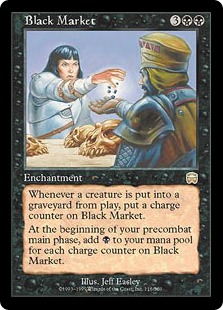
    Black Market

    With the removal of mana burn, some cards won and some lost. Black Market is a huge winner for multiplayer games. I try to work it into every EDH deck I can cram it into, where it's like some sort of ultra Gilded Lotus. With any amount of time, Black Market produces absurd amounts of mana. For example, in the last set of games I played, Black Market went over twenty counters in each game in about three turns. The real pain is finding out what to do with those crazy piles of mana.

    $1.75

    Brainstorm

    We know this card is a boss, but what surprises me was how long it took people to string it together with fetchlands. We're not talking Onslaught here, but the classic ones like Flood Plain. By the time Bob Maher's Oath deck came around, people knew to string Brainstorm together with shuffle effects, but it wasn't immediately obvious. Even decks like CounterPost that ran Thawing Glaciers didn't couple it with Flood Plain. These days, Brainstorm gets coupled with as many shuffles as possible. It formed the backbone of blue in Vintage, to the point where it was restricted for being just too powerful. In Legacy, it is mostly constrained to CounterTop decks, but it's immensely popular, both in Ice Age and its reprint in MM.

    $1.50

    Bribery

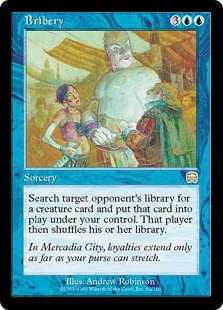
    Well let's let Blightsteel Colossus decide who she wants to work for, huh?

    There was a day when Bribery was a chumpy little casual-only card. I remember bulking them out at fifty cents. What a terrible memory. Bribery is just about the most powerful blue card in EDH these days because it can turn into Blightsteel Colossus, Emrakul Lagasse, Iona or any other manner of monsters from opposing decks. As more good EDH creatures are printed, the better Bribery gets. Though it was printed again in 8th, it's still in high demand. It's especially good to know how much this card goes for because you might run into people like me who have no idea!

    $7.00

    Cave-In

    My favorite Cave-In story involved someone in Legacy wishing for it with Burning Wish to kill the opponent, who was at 2 life. I don't think you can top that.

    $1.00

    Charisma

    Charisma appeals to people who build decks full of pingers. They tack it on Prodigal Sorcerer and slam away. It doesn't sound especially powerful, but people like Living The Dream. You can make the most of their love of creature control by knowing the value of this weirdly-priced card.

    $3.00

    Collective Unconscious

    Regal Force at a discount! I suppose this is for people who need eight of this effect for their elf decks? Anyway, worth knowing about. You didn't expect Urza Block level card draw, did you?

    $1.00

    Conspiracy

    Now this is a card I can get behind! It used to be one of my favorite non-Trix Donate combos. Name Wall and give to the opponent! Now that Defenders took out that little trick, Conspiracy works for people who want to pack all sorts of monsters into a tribal deck. It's strictly casual, but people tend to enjoy the card.

    $1.00

    Crumbling Sanctuary

    The two uses I remember for this card were in Tinker decks from Extended and 5-color. If you are unfamiliar, 5-color is a format with 250 card decks and no Highlander restrictions. Thus, you could go get your single Sanctuary against aggressive decks and quintuple your life total, removing it when you got control of the game. It works better in 5C than EDH because you can run all manner of redundant cards in 5C, so you don't run much of a risk from milling out.

    $1.00

    Dark Ritual

    Though it has been extensively printed, people really like this copy. It's got Rebecca Guay art, after all! Foils are absurdly expensive.

    $1.25

    Delraich

    Again, people casually love this card. It's easily summoned with Sengir Autocrat and it makes sense, thematically, with Suicide Black decks. It's also noteworthy for being a black creature with Trample.

    $1.00

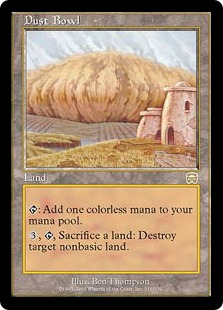
    Obi-Wan's hut didn't know what was coming...

    Dust Bowl

    Dust Bowl is a very popular card for EDH and other formats where you can afford a few colorless lands. Since it fits in every EDH deck, it's got a bit of appeal. While blasting people every turn with Dust Bowl usually doesn't work in most formats, being able to tank a Maze of Ith or Gaea's Cradle can make you friends around the table. Turning every excess land drawn into Wasteland can be potent when used judiciously.

    $2.50

    Food Chain

    Food Chain is the Great Green Hope. People want to make it a legit combo in Legacy, combining with Evoke monsters or Goblins. It's not amazing, but folks still want to stockpile them in hope. I wouldn't hold onto them on Legacy hopes. At this point, you can make an Evoke deck with them that will put out Emrakul on turn 3 or 4 without disruption, but that's simply too slow. Get rid of these guys if you have them.

    $2.50

    Fountain Watch

    People just don't like getting their toys blown up... Fountain Watch steps a little further than Leonin Abunas, protecting your gear from meddlers. Fountain Watch has a surprising price tag, and it's gone up a bit as time goes by. It's popular for EDH decks full of toys, like Hanna and Sharuum decks.

    $2.75

    Gush

    Recently unrestricted, Gush forms the backbone of several Vintage decks. It's still too good for Legacy, apparently, but it gets good play in Vintage. It's got a good price for a common and people need four copies, so they tend to move well.

    $1.00

    High Market

    Again, we've got a colorless land that makes a little bit of utility. People like it to trigger their Academy Rector or get a little value from a guy that's gonna die anyway. It's largely outclassed by Miren, The Moaning Well, but if you need two of the effect and cannot afford Diamond Valley, the Market has you covered.

    $2.00

    Ivory Mask

    If you really don't want to deal with Burn players, the Mask is great. It sees 1-of sideboard play in Legacy with decks packing Enlightened Tutor, but it's mainly for casual magic. You've got a friend with a pinger deck; use the Mask to stop them.

    $1.25

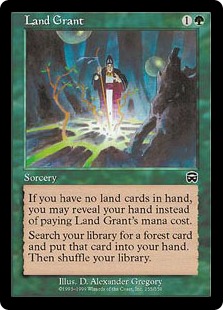
    This lets your opponent get a preview of the "still had these" moment postgame.

    Land Grant

    This was one of the first cards I fell in love with, mainly from 10-land Stompy. You'd use it to pull up a Forest in the land-thin deck. If you need a dual land or Rav-dual from your deck and cannot swing buying fetchlands, then Land Grant is a fine substitute in casual circles. It also sees play in 2-Land Belcher in Legacy, since it doesn't trigger Goblin Charbelcher and functionally acts as a land. It's an uncommon that holds a bit of value and a lot of casual attention; since you're unlikely to unload these to other traders, I suggest sending off four-packs to Ebay or buylists.

    $1.25

    Magistrate's Scepter

    There are, I think, acceptable and unacceptable ways to take extra turns in casual Magic. For example, Time Walk is a little too good, and recurring it is inexusable. Time Stretch is pretty good on its own and every EDH deck with it has three or four ways to get the stupid thing back again. However, Magistrate's Scepter makes for an entirely fair extra turn now and then. People see it coming, but it's only when you tack on ways to put charge counters on that it gets out of hand. You can use Coretapper, Power Conduit, or Energy Chamber to get a deal on those extra turns. Use Coretapper with Skeleton Shard and take infinite turns with enough mana!

    $3.50

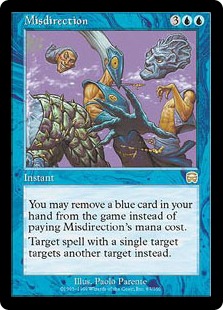
    At least this Paulo Parente piece doesn't have inappropriate images... looking at you, Ekundu Cyclops.

    Misdirection

    This is the closest we get to Force of Will on a budget, and it's infrequently a good counter in Vintage. For example, it was played in Pitch Storm because it functioned to counter opposing Counterspells (by turning them on itself – trust me, it works). It also steals Ancestral Recall now and then. Unfortunately, Spell Pierce has changed the way blue decks function and Misdirection isn't as good as it once was, compared to the new Force Spike. That said, it's worth having a copy or two for both casual and Vintage decks. It trades briskly.

    $8.00

    On that note, we'll take a break until next week! We'll look at hits like Rishadan Port and look at what the most expensive foil in Masques is... it's probably not what you think!

    Until next week,

    Doug Linn

    Shark Infested Waters

    Stu Somers (Click to read more by Stu!)

    Stu speaks from experience when he tells both new and experienced traders how to handle a difficult trade partner. Sometimes, you need to know when to nix a deal.

    You Think You’re Better Than Me?

    Are you a Quiet Speculation member?

    If not, now is a perfect time to join up! Our powerful tools, breaking-news analysis, and exclusive Discord channel will make sure you stay up to date and ahead of the curve.

    I've started trading heavily online again because I have very little time to trade in person, and only the same 5 or 6 people to trade with in person. For the most part, it's a positive experience and one that I recommend. However, as with all trading, you hear ridiculous stories from people trying to  rip you off. What follows are the most ridiculous things I've been told which should serve as a guideline both as what you should avoid saying yourself, because you're not fooling anyone, and the kind of crap that people will say to try to trick you into undervaluing your cards or overvaluing theirs. These are things people have actually said to me when trying to get special treatment for their cards:

    "It pains me to lose value on cards cause of [condition] when I value them the same." Cards have prices for different conditions for a reason: better condition cards are worth more. You are not losing value on your VG (very good) dual lands because of condition; they are worth less because of condition. If you traded for them at NM (near mint) prices, that's your problem. If you value them the same as NM cards, that is your ignorance. These people have the same mentality as those who want full retail value for cards they sell to our store: you're trying to make money off of me.

    In neither case is this correct. In the case of played cards, I'm simply trying to get the cards for the correct price. In the case of selling cards to a store, I'm trying to make money off of my hard work, man hours, and knowledge. Just because things aren't going the way you want doesn't mean everyone's out to get you. Fortunately, people with this kind of trading mentality can normally be reasoned with as they're not actually trying to take advantage of you and simply want what they misconceive as being fair. Just be sure not to sympathize with their position or you can be taken for a ride.

    "I had to pay a lot to get these." So? This one (or subtle variations) is heard most frequently right after rotation. The last time I heard it was when I was trading for some shock lands after they left extended. There's not much to this argument either: they bought cards at their peak and now want to recoup that full value because they don't know how to properly manage their inventory. My answer last time was rather curt, but a nicer version of it normally gets the message across nicely: "I can't value these cards higher just because they used to be worth more." This scenario can go either way: the person knows that they're trying to get more than their cards are worth, and now they know that you know it too. They may either pull their cards off the table and try to find someone less informed, or, if you have cards that they're interested enough in, will accept fair value on their cards.

    "These aren't worth anything." This one pisses me off more than anything other thing people say when trying to rip you off, and it's also the one you hear most often. It's normally used to describe cards that are a small step above bulk rares (as in playable and popular in casual play, but worth normallly $0.50-1.50), and only used to describe your cards, never theirs. Describing my cards as being literally worthless is a surefire way to have me take my cards off the table, and it's really the only correct course of action. Afterall, these people are not only calling your cards worthless but actually treating them as such in the trade. "Worthless" is not a mean way of saying bulk to them; they will insert these "worthless" cards into whatever trade you're working on and give nothing in exchange.

    And now for Bill O'Reilly's most ridiculous item of the day:

    I had pulled a foil Volcano Hellion out of someone's binder, because it was one of the last foils I needed for my foil Planar Chaos set. Because it was one of the last ones I needed, I was willing to go as high as $3 on it just to get the set done, at which point I was told this: "I need more than that; that was the foil rare in a really bad box I bought, so I need to make up the value somehow." I don't even need to explain what to do if someone tries treating you like this on the trade tables. (Hint: Physical violence is encouraged!) [Editor's Note: We do not encourage violence. Please see here and here for background.]

    Alright, I'm done ranting. Go forth into the world and trade!

    Dr Jeebus

    Dr. Jeebus is the most electrifying man in intellectual sports entertainment. He has been playing all forms of Magic since early 1995, and was recently voted the angriest Magic personality on Twitter. Though Jeebus does not have the time or money to go pro, but he's still really good and understands both the intricacies of play and of design, so you should listen to him. His notable accomplishments include beating a pro player so severely as to make him cry while at the age of 13, and defeating 5 multiplayer opponents using a single Thoughtlash.

    View More By Dr Jeebus

    Posted in Finance, FreeTagged , , 9 Comments on You Think You’re Better Than Me?

    Have you joined the Quiet Speculation Discord?

    If you haven't, you're leaving value on the table! Join our community of experts, enthusiasts, entertainers, and educators and enjoy exclusive podcasts, questions asked and answered, trades, sales, and everything else Discord has to offer.

    Want to create content with Quiet Speculation?

    All you need to succeed is a passion for Magic: The Gathering, and the ability to write coherently. Share your knowledge of MTG and how you leverage it to win games, get value from your cards – or even turn a profit.

    Faulty Drafting: B. R. E. A. D. and Scars

    Are you a Quiet Speculation member?

    If not, now is a perfect time to join up! Our powerful tools, breaking-news analysis, and exclusive Discord channel will make sure you stay up to date and ahead of the curve.

    [This is an offering from Zach McNair, fresh off a Top 16 and a Top 32 finish each during his PTQ: Paris season. Zach actually wrote this article for us more than a month ago, so please keep that in mind as you share in the comments whether you'd like to read more from Zach 🙂 - Dylan]

    When I first began playing Magic competitively, I was awful. Then again, so were most of the people who were just starting into the competitive world with me. And that was just when playing Constructed. At one point we even believed that you could play a 40 card deck in Standard, unknowingly having looked at the Limited tournament rules by mistake.

    As time progressed, we learned more about how to construct decks, how to win games through careful play, and how to play against your opponent. However, we still had not been truly introduced to the Limited world. We mostly just Pack Warred or played games with decks constructed from random cards in our collection.

    When I was finally brave enough, I did a little research and learned the basics. Choose one card from the first pack, pass the rest, and keep picking until the end. It seemed easy enough. Needless to say, my first draft was a train wreck. And the second. And many more to come, for about a year. Granted, I was 12 at the time and no one expected any better. However, I did. I wanted to play better, to learn how to best my opponents. I looked up to a pair of local players, and still do to this day, and I tried to learn from them.

    It was a slow process, but over the course of the next year, I managed to reach a point where I could win at least one match in every draft. It was a small achievement, but it was something. Then something big happened. I discovered the simple yet effective acronym B.R.E.A.D. This became my motto, and though I was still not winning entire drafts, I was managing a winning record. I still had a long way to go, but it all started with that simple acronym.

    For those of you who aren't familiar, B.R.E.A.D. is meant to be a basic code to follow when choosing what cards to take in a draft and when.

    B - Bombs. This usually refers to rares and mythics like Steel Hellkite and Elspeth Tirel. Some commons can be included in this category, but generally they will be uncommons (Golem Artisan) and rares. These are the cards that when played will swing the game in your favor quickly and significantly. When backed up properly, you win the game when they resolve. They are the most important cards to have, and are first on the list to be taken.

    R - Removal. This is the category that I like the most. Removal is everything from Hornet Sting to Galvanic Blast to Day of Judgment. Obviously some types of removal are more powerful than others, but every card that can kill a creature is worth taking notice of, and picking up early on in a draft. For the purpose of our acronym, you should only be passing up removal for bombs, and nothing else.

    E - Efficiency. Here lies what you seek to pick up after your first 2-3 picks, and what makes up the bulk of a Limited deck. Efficient creatures and spells are not necessarily aggressive ones, but they give you more for the mana you pay than other cards at the same cost. Cards such as Sky-Eel School, Perilous Myr, Glint Hawk Idol, and the [card Copper Myr]mana myr[/card] all fall into this category. They are also the most difficult to decide in which order to take, because they are numerous compared to the other categories.

    A - Aggression. Creatures such as Dross Hopper and Carapace Forger fall under this category. Spells that are included in this are combat tricks suck as Untamed Might and Seize the Initiative, along with spells like Exsanguinate. They are sometimes necessary to fill the curve, and are good as the last 1-2 cards in a deck, but they are not a priority. These cards are better than the last category however.

    D - Dregs. These cards are usually the last 1-2 picks you will get, or if the packs are weak they can be the last 3-4. Things like the basic land of the pack, Blunt the Assault, and other cards fall here. These are the unimportant cards that should never make your deck.

    This approach is a quick and easy way to determine pick orders when sitting down to draft a format you don't know well, a new format, or sometimes is just an easy way to determine the orders. However, in some sets, you find a fault in this line of thinking.

    Scars of Mirrodin, the most recent set and the place from which I draw my card examples, has proved to invalidate some of the ideas in B.R.E.A.D. Granted, most of the time the order will hold true. Steel Hellkite is awesome in almost any deck, and Sunblast Angel is insane in any white deck.

    The set as a whole focuses so much on synergy, such as metalcraft and poison, however, that you cannot always follow this order. I have found myself taking an artifact creature over Turn to Slag in a RW or UR metalcraft deck that was just one or two artifacts shy of being complete, quite a few times. Granted, Turn to Slag is not the best removal spell in the set, but it is still removal.

    This leads to some interesting archetypes that are sometimes underrated, though have recently gained popularity because of drafters such as Ari Lax or LSV. The "Dinosaurs" deck values bombs such as Molder Beast and Alpha Tyrranax very highly, and plays every removal spell it can get its hands on. The deck is extremely powerful, but can be overrun by a more synergistic deck.

    Synergistic decks often do one thing, and they need to do it really well. In Scars Limited, UG metalcraft, BR Furnace Celebration, and most of all Infect fall into this category. The best example is the Infect deck. It seeks to overwhelm the opponent with quick creatures that can quickly leave the opponent on the back foot, often winning with Untamed Might or Proliferate shenanigans. Every card in the deck is designed to do exactly that, and while removal remains a priority, normal bomb cards decrease in value. The only exceptions are cards like Skithiryx, the Blight Dragon, Contagion Engine, and Hand of the Praetors. However, when presented with the choice between an Alpha Tyrranax, which can be a bomb, and even a mediocre poison creature such as Contagious Nim, the Poison player will always choose the poisonous creature.

    Sometimes, even in normal decks, players can make an argument for taking early game cards over late game bombs. For instance, in a recent posting on ChannelFireball.com David Ochoa took Arc Trail over the bomby Kuldotha Phoenix when heavily set in Red.

    On the flip side, the deck you are drafting can turn certain cards into bombs that wouldn't normally be. For instance, Flesh Allergy is an okay removal spell on its own. It has the ability to deal with every creature out there. When paired with Perilous Myr or a Furnace Celebration, Flesh Allergy can become an instant bomb that leads to a 4-6 point life swing and can kill two of your opponents creatures in one fell swoop. If you have 2 or so Perilous Myr[/card, or a [card]Furnace Celebration, and are relatively aggressive, I would consider taking Flesh Allergy over a lot of late game bombs, even cards like Myr Battlesphere and Steel Hellkite. Most of the time I will still take the bomb, but there are times when I have taken the more synergistic card and have won drafts because of it.

    The idea behind all of this is that while B.R.E.A.D. is an excellent guide to follow, it's just that: A guide. It is not perfect, and while you can follow it to the letter, you can't always expect to win without having a little flexibility in your picks and without determining what would be best for the deck you are drafting.

    In closing, I would like to demonstrate this theory by taking you through a recent draft where I heavily deviated from the B.R.E.A.D formula, and the results of the draft.

    Pack 1 Pick 1:

    This is quite the pack. Grasp of Darkness, Necropede, and Turn to Slag are all excellent cards. Turn to Slag is not as good as the first two because it is a slower card, and not the way I want to start out a draft. However, Grasp is by far the most powerful. Even though Necropede has the upside of being colorless, I am more than willing to take a small risk for a large reward of playing an incredible removal spell. Here our only options fell in the second category of B.R.E.A.D., removal, so there isn't much else to talk about.

    Pack 1 Pick 2:

    This pack has two interesting bombs in Genesis Wave and Volition Reins, however I don't like taking either of them. I like Genesis Wave, but it is too early for me to take it. If I get it late with some Myr and dinosaurs, I will gladly play it, but I am not going to commit to that pick 2. And while Volition Reins is powerful, against infect it is usually awful, and even against other decks it is usually mediocre unless a lot of things go right. And I don't want to take a triple Blue card after a double Black one. The pick here is Perilous Myr. An argument could be made for Fume Spitter, and for Tel-Jilad Fallen, but Perilous Myr is simply better. Even if I end up infect it is still a good card that can make the cut. Plus, removal on a creature is always good.

    Pack 1 Pick 3:

    Here we have a far less interesting pick. Perilous Myr is easily the best card in the pack. Now that I have two artifacts, I am going to be watching out for black metalcraft cards, and Barrage Ogres. Either way, I would like to be B/x Metalcraft or Goodstuff.

    Pack 1 Pick 4:

    Okay, we have a very interesting pack. Sky-Eel School is an incredibly powerful flier, and pick 4 is a good sign that something is open. I am not usually a fan of UB, but if enough artifacts show up it is an excellent tempo deck that can burn out the opponent with Bleak Coven Vampires after swinging in with tons of fliers. I would like to mention here that Cerebral Eruption would be the B.R.E.A.D. pick, being removal and burn (fitting a bit into the aggression category), but I don't like it. I have never been happy when casting Cerebral Eruption, and have rarely been unhappy when my opponents are.

    Pack 1 Pick 5:

    Another tough pick, it is between Bleak Coven Vampires and Sylvok Lifestaff. I like both of the cards. Usually, given these cards, I would take the artifact. It is a solid card and is cheap, making hitting metalcraft easier. However, I don't have any metalcraft cards yet, and the Lifestaff won't be great in the Sky-Eel School midrange control deck. The Vampires, however, will really shine in that type of deck. For this pack, the Lifestaff would have been the B.R.E.A.D. choice, because it is the more aggressive of the two cards, and the Vampires aren't really a bomb. However, I like the Vampires because they will lead to a more synergistic deck.

    Pack 1 pick 6:

    This pack does not have much left, though I am surprised to see a Ghalmas Warden this late. However, the Soliton is a nice gift this late. If we pick up a Heavy Arbalest, I will be very happy, and even without it I like the Soliton. My Pick: Soliton.

    Pack 1 pick 7:

    Well, this pack is full of the dregs. I am once again surprised to see a decent white card, but the Nihil Spellbomb will be the best card for our deck, cantripping and turning on metalcraft earlier. My Pick: Nihil Spellbomb.

    Pick 8 & 9, Soliton and Bonds of Quicksilver respectively. There wasn't much else in the packs.

    Pack 1 pick 10:

    Apparently no one at the table likes Genesis Wave, and while I could take Plated Seastrider, I think I will find enough playables and take the Wave. I just wanted to point out that if I had 2 Myr, and was in Green, I would be a very excited person and would gladly go in on a tabled Genesis Wave.

    There wasn't much else for Pack 1, other than a late Turn Aside, which is actually a card I have been really impressed with. I don't necessarily like running it main, but I really like having it in the sideboard, especially against Turn To Slag if I have Heavy Arbalest.

    Pack 2 pick 1:

    By now we all know that Skinrender is a bomb. It is removal and a 3/3 all at once. There is nothing even close in this pack. My Pick: Skinrender.

    Pack 2 pick 2:

    Well, this pack is lacking in cards for me. Darksteel Myr, Moriok Reaver, and Plated Seastrider are all playable. Here, I have to follow B.R.E.A.D. and take the more aggressive card, which is actually the better card on defense as well. My Pick: Moriok Reaver.

    Pack 2 pick 3:

    Looking back on this pick, I probably should have taken Silver Myr. However, I couldn't resist Lumengrid Drake. That card has always been nuts for me, and is exactly the kind of card my UB metalcraft deck wants. Plus, I have faith that I will have enough artifacts in the end. My Pick: Lumengrid Drake.

    Pack 2 pick 4:

    And here is a good reason to take the Drake, as we have our wonderful Silver Myr sitting and waiting to be taken. Here, B.R.E.A.D. would dictate either taking the Necropede or Fume Spitter, because both are removal. However, this deck wants artifacts, and wants to be able to cast the big spells when it matters, so Silver Myr is the choice. My Pick: Silver Myr.

    Pack 2 pick 5:

    Well, here I follow B.R.E.A.D. Instill Infection is a card that I really like. It offers a combat trick, an answer to Plague Stingers and [card Embersmith]Smith[/card]s, and is overall a good card. Removal it is. My Pick: Instill Infection.

    Pack 2 pick 6:

    And we have hit the dregs again already. Sunspear Shikari once again goes late, but there is nothing for me. I don't want a second Turn Aside. Trigon of Thought is unfortunately the pick, though I have never liked the card and it will probably not make the cut unless I end up short on playables. My Pick: Trigon of Thought.

    Pack 2 pick 7:

    More interesting packs. Here I had the choice between Instill Infection and Stoic Rebuttal. There wasn't much else in this pack for me. I like Stoic Rebuttal, however with only Sky-Eel School as a double Blue card, and Bleak Coven Vampires and Skinrender as double Black, I would like to stay more focused on Black so that the mana will be easier in the end. My Pick: Instill Infection.

    The rest of this pack consisted of a Lumengrid Drake and a second Moriok Reaver, with nothing too interesting going on.

    Pack 3 pick 1:

    Sometimes you open well. Steel Hellkite is exactly the kind of card that I like to play. It is a bomb, and in this case it is also an artifact for our deck. There is nothing in the pack that even comes close. My Pick: Steel Hellkite.

    Pack 3 pick 2:

    An interesting set of cards. Trinket Mage can currently only fetch a Spellbomb, and while not bad, that is not what i want my cards to be doing. If this were still pack one, I might be tempted to take it on the hopes of picking up a Lifestaff or Darksteel Axe, etc. However, Leaden Myr fits perfectly into the deck, giving us another early artifact and another way to hit 4 and 5 mana a little earlier. It is also better than the Silver Myr Here, because I have one already and want to be able to consistently cast Skinrender. Interestingly enough, the only cards that fit into B.R.E.A.D. here are Trinket Mage and Exsanguinate, both cards meant to outclass your opponent and take them out of the game quickly. My Pick: Leaden Myr.

    Pack 3 pick 3:

    Talk about a gift!! Heavy Arbalest with two Solitons already? Yes please! I have never been unhappy to have an Arbalest, even if I know my opponent is holding Turn to Slag. I can usually still get a one-for-one trade with the Arbalest, and if left unchecked it can quickly dominate the game. It is also slightly better than Chrome Steed, because they are both artifacts and the Arbalest provides a more consistent and powerful way to win.

    Pack 3 pick 4:

    Coming up on this pack, I have 11 playable artifacts. With that few, I am tempted to take Grindclock. However, I really don't think it is good enough to take over a flier. I am going to take the Lumengrid Drake and gamble a bit, hoping that I can get at least get 2-3 more artifacts from this pack. My Pick: Lumengrid Drake.

    Pack 3 pick 5:

    And voila! Moriok Replica is everything that I want, an artifact, a creature, and a way to get out of land runs. And I am really hoping that one of these two Bleak Covens (this pack and the previous one) will table, however unlikely that seems. My Pick: Moriok Replica.

    Pack 3 pick 6:

    There aren't many choices here. If I had taken the Grindclock, I would consider Thrumming Bird, but as is I have very little to abuse with it. The Fume Spitter is good in this case, because it gives me a way to stop early rushes and gain tempo when my opponents have Myr or Smiths. My Pick: Fume Spitter.

    Pack 3 pick 7:

    Here we have a two excellent choices. The first time I looked at this pack however, I snap picked the Replica before seeing the Rust Tick. It is still a close pick in this case, but I think the Rust Tick is actually better in general. But, I took the Neurok Replica on first sight because it is yet another card that this deck really wanted. B.R.E.A.D. overruled again. My Pick: Neurok Replica.

    Pack 3 pick 8:

    And the last artifact that i really needed. Leaden Myr is excellent, and really finishes out the deck. My Pick: Leaden Myr.

    The rest of the pack was uneventful, except for a Scrapdiver Serpent and, actually, a very exciting tabled Bleak Coven Vampires. Let's look at the final list:

    Untitled Deck

    Creatures

    1 Fume Spitter
    2 Perilous Myr
    2 Leaden Myr
    1 Silver Myr
    1 Neurok Replica
    1 Moriok Replica
    1 Skinrender
    1 Sky Eel-School
    2 Soliton
    2 Bleak Coven Vampires
    1 Steel Hellkite
    1 Scrapdiver Serpent

    Artifacts

    1 Trigon of Thought
    1 Nihil Spellbomb
    1 Heavy Arbalest

    Instants

    2 Instill Infection
    1 Grasp of Darkness

    Lands

    8 Island
    9 Swamp

    Unfortunately, the replays were lost for all of the games except the first one, but I will go over the highlights.

    Game One: UW Metalcraft Aggro:

    I keep a hand of Swamp, Island, Leaden Myr, Instill Infection, Lumengrid Drake, and Scrapdiver Serpent on the play. My opponent leads with two Island and a Riddlesmith, while I draw Island and Soliton and play the Leaden Myr on turn two. Turn 3 I played a freshly drawn Moriok Reaver. My opponent tutors up a Darksteel Axe with Trinket Mage, while I draw a Swamp and pass the turn with Instill Infection mana up. They played a Sunspear Shikari and attacked for 2. I Instill Infectioned the Shikari, drawing a second Soliton. At 18 life, I play Soliton, which can now stop the Shikari and I am feeling pretty good. My opponent plays a Prototype Portal imprinting Chrome Steed, which worries me a little. I draw Silver Myr, play it and Soliton, and attack for 3. My opponent takes it and goes to 17.

    He plays a Gold Myr, digs with the Riddlesmith and passes the turn leaving 4 mana open. I draw an Island, play Scrapdiver Serpent, and attack with both Solitons. He goes to 11. Chrome Steed appears from the Portal at the end of my turn.

    He passes with no action. I untap, draw Steel Hellkite, and attack with the Serpent. Post-Combat, my opponent at 6, I play the Hellkite and pass. He forgets to activate the Portal because of an F6 through my turn. He untapss, drop Golem Artisan, and again leaves 4 mana up. I untap, draw Nihil Spellbomb, and play Lumengrid Drake targeting the Chrome Steed and my opponent concedes.

    Game Two was similar, except my opponent was stuck on lands and I had a turn 5 Scrapdiver Serpent. Nothing too interesting.

    Round 2: WR Cerebral Eruption/Myrsmith

    Game One: I get blown out by Cerebral Erruption with Myrsmith tokens out the wazu to kill me. There wasn't much else to this game, because he hit the one thing left in the deck that could kill Scrapdiver Serpent, and killed Steel Hellkite the next turn with Turn to Slag.

    Game Two: I keep a hand with Skinrender, Neurok Replica, Lumingrid Drake, Leaden Myr, Swamp, and Island. My opponent again has Cerebral Erruption, followed by Turn to Slag, but I used the Replica in response to the Eruption to bounce Skinrender, which let him kill the Drake and a Myr. I followed it up with a Soliton that was [card Turn to Slag]Turned to Slag[/card], and then followed up with Moriok Reaver and Replica. My opponent played an Auriok Replica, which I killed with Skinrender, and he only had an Origin Spellbomb left for creatures. He died in short order.

    Game Three: Less exciting hand because of a mulligan to 6, but it had Perilous Myr, Lumengrid Drake, and a Leaden Myr with three lands. My oppenent has a slow start, and I draw the Fume Spitter on turn two to kill his Myrsmith before it gets out of hand. I drop Perilous Myr the next turn, draw a couple of lands, while my opponent plays an Origin Spellbomb and Auriok Replica. Eventually we both get the ball rolling, and trade some blows. I get a decent amount of cards in my hand thanks to two Instill Infections. I hold back a little, having only 2 creatures on the board, because of Eruption. He has it again, and hits a Lumengrid Drake. I follow up with Nihil Spellbomb, Silver Myr, and Soliton. He has Turn to Slag for the Soliton (I am seeing a pattern...), but I follow up with the second Perilous Myr and Lumengrid Drake to bounce a Myr Token. Not too much longer I get a Sky-Eel School and they die in short order.

    Round 3: UR Furnace Celebration

    My opponent had an interesting deck. Lots of Spellbombs, Barrage Ogre, and Furnace Celebration.

    Game One: My opponent never finds a Furnace, and I have Grasp to kill their Barrage Ogre. He is defeated shortly after by a large Serpent.

    Game Two: At this point I am a little sad, because the deck has done nothing but win with good cards, and nothing much on interaction except for Lumengrid Drakes. However, this game changes that. I run out Myr, Perilous Myr, Heavy Arbalest, while my opponent plays a Spellbomb and a Furnace Celebration. I follow up with Bleak Coven Vampires, draining them for 4. He kills a Myr with the Spellbomb, and plays a Myr of their own. I play a Nihil Spellbomb and follow up with a second Bleak Coven Vampires. A couple turns and a Lumengrid Drake later, I have have triumphed and won 8 packs.

    Though only the last game showcased the power of synergy, I still feel like this is a good example of how to draft a powerful deck where a lot of cards get better based on the deck you have put together. Happy Drafting!

    Zach McNair

    Insider: Buy List Updates

    Are you a Quiet Speculation member?

    If not, now is a perfect time to join up! Our powerful tools, breaking-news analysis, and exclusive Discord channel will make sure you stay up to date and ahead of the curve.

    Another day, another Buy List update. Mirrodin Besieged has made its triumphant debut onto the buy lists and pretty much all the cards we had expected to be valuable are there with little in the way of surprises. We need more sleepers.

    I would like to thank TCGPlayer for their retail price coalition, Magic Traders for their eBay data, as well as Cool Stuff Inc, Troll and Toad, Starcity Games, Channel Fireball, Card Haus Games, Altereality Games, Strike Zone, MTG Mint Card, ABU Games and of course Kelly Reid’s Dragons Den Online for their online buy lists.

    First up this week we have the top 60 list. It’s a combined list of both Standard and Extended but the top four spots all go to cards from well established Standard decks.

    [iframe https://spreadsheets.google.com/pub?key=0AukC5EWiTvOpdDdKVDhyNmZOX182dTNFQ0FNYXdHT1E&hl=en&single=true&gid=9&output=html&widget=false 567px 400px]

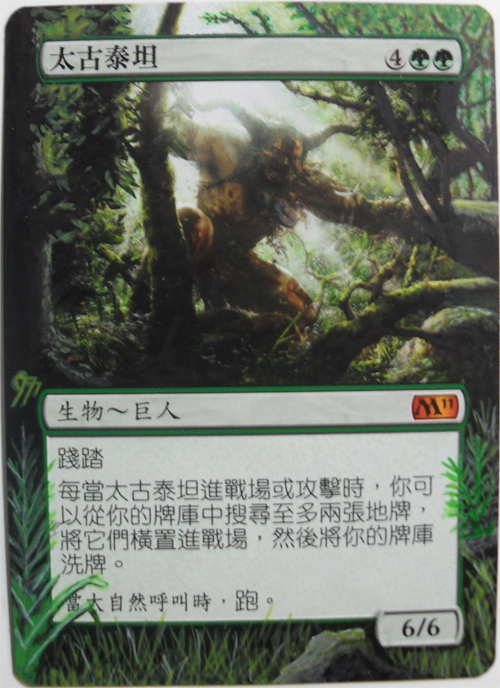
    Jace, the Mind Sculptor is still king of the Planeswalkers but is sitting there right next to the new comer Tezzeret, Agent of Bolas. [card Tezzeret, Agent of Bolas]Tezz 2.0[/card] made a big impression at Pro Tour Paris and I think he’ll be able to maintain a decent price for a while to come. That of course lowers the potential value of a lot of the rest of the set so I could easily see even more Worldwake-esque polarization to be on the way. Rounding out the top 5 we have M11’s Primeval Titan, Rise of the Eldrazi’s Vengevine and Lorwyn’s Thoughtseize.

    I have a bit of a rant to go on before I continue.

    Shortly after the new Tezz decklist from Pro Tour Paris went online, I went eBay to purchase a set of Tezzeret, Agent of Bolas expecting that they would jump in price. I don’t do much in the way of speculative purchasing, these were only to play with, not to flip for profit. There were many sites including Troll and Toad and Card Kingdom that had them available for sale at around the same price, but with shipping and tax, the sale would have ended up about $10-$15 higher than the eBay offering. I suppose that ultimately it teaches me not to buy from someone with a positive but sparsely populated rating (250 transactions). I reasoned that since I only have 100 transactions under my belt and am an honest buyer, then I should ignore the low transaction number (compared to the thousands that others boast) and give the guy a chance. Monday of the next week rolls around and there has been no communications from him so I send off an email asking about a tracking number. Sometime later that night I receive a reply that says his binder was stolen and he was cancelling the sale. This is certainly a plausible event to happen. Binders and cards are stolen often enough that it’s not really a shock when it happens, but I’m not inclined to believe him. The timing is certainly suspicious, and a number of small inconsistencies don’t add up. His eBay profile says he’s from Bend Oregon, and the local shops seem to have events on Tuesdays and Fridays. This being the case, when was this binder stolen? Before the purchase and he hadn’t pulled the auction down, or after when they should have been set aside or already shipped? Ok, so maybe they were in the binder at FNM and he planned on sending them out on that Saturday and just didn’t notify me. He claims to have been trying to get some replacements in order to complete the sale, so that could be the reason for the delay in notification. Though there are two shops within 1.5 miles of each other, he claims that they aren’t available from the only shop in his home town or from it's patrons. That could be possible. After all, getting a full playset so fast isn’t super easy to do unless you’re pretty lucky, especially in a small town. After I protested the cancellation he went on to explain that he had really been looking forward to the sale of them because he had intended to use the money to buy a box of MBS. He had in fact already borrowed the money for that box from his father and the money from the sale was to pay him back. I’m further bothered by the fact that this auction was for cards that are rare but aren't unique. It's not some irreplaceable set of exploring gear left to him by his great great grandfather or something (and why would he sell that anyway unless it was part of the plot of a movie by Machael Bay based on toys from the 80's?) He could still acquire more and honor the sale and maintain his claimed hard earned 10 year eBay rating. I called the local stores in Bend Oregon to ask if someone’s binder had been stolen but no one picked up the phone. I’m not sure that confirmation of a stolen binder would even mean anything. I mean, he could have contacted me to let me know. The delays make me thing he was more likely struggling with telling me this “story” rather than looking for replacements. Allowing bought and paid for cards to be placed into an environment that they could be stolen is also irresponsible.

    I'm thinking this weeks FNM might be a road trip... see what deck he's playing... what do you think?

    All these little things add up to a big flashing red sign screaming that he’s trying to scam me. It’s not even an original plot. This kind of thing happens fairly often, probably more often than binders being stolen. I’m not out for revenge; if I was I would just link you to his eBay profile and warn you not to deal with him. I would pretend to have power and influence so that I could make sure it cost him appropriately for unethical practices like this. I can’t really do that though because he could be telling the truth. Coincidences (combined with irresponsible behavior) can sometimes happen. Who knows? I suppose it’s a good thing that I tend not to play Blue.

    [iframe https://spreadsheets.google.com/pub?key=0AukC5EWiTvOpdGREaGlyaHhfOWU0OXBRWmVhUDItbWc&hl=en&single=true&gid=3&output=html&widget=false 567px 400px]

    [iframe https://spreadsheets.google.com/pub?key=0AukC5EWiTvOpdDdKVDhyNmZOX182dTNFQ0FNYXdHT1E&hl=en&single=true&gid=3&output=html&widget=false 567px 400px]

    Our current top Mythics read like the list of most expensive Pro Tour cards, which is some justification for the pricing. [card Tezzeret, Agent of Bolas]Tezz 2.0[/card] is being purchased by online stores for more than he was being sold just a week ago. He is of course the lynch pin in the newest Standard deck on the block…

    Tezz Something by Patrick Chapin

    Land

    1 Blackcleave Cliffs
    4 Creeping Tar Pit
    3 Darkslick Shores
    2 Inkmoth Nexus
    3 Island
    2 Mountain
    4 Scalding Tarn
    3 Tectonic Edge

    Creatures

    1 Treasure Mage
    1 Wurmcoil Engine

    Artifacts

    4 Everflowing Chalice
    1 Mindslaver
    2 Mox Opal
    4 Prophetic Prism
    3 Sphere of the Suns
    3 Tumble Magnet

    Planeswalkers

    3 Jace, the Mind Sculptor
    4 Tezzeret, Agent of Bolas

    Other Spells

    2 Galvanic Blast
    4 Preordain
    2 Pyroclasm
    2 Slagstorm
    2 Stoic Rebuttal

    Sideboard

    3 Duress
    1 Flashfreeze
    1 Jace, the Mind Sculptor
    1 Kuldotha Rebirth
    2 Pyroclasm
    1 Ratchet Bomb
    4 Spreading Seas
    2 Stoic Rebuttal

    … to me though he still seems pretty limited in scope of use. The deck could certainly be dominating, but [card Tezzeret, Agent of Bolas]Tezz 2.0[/card] isn’t like Jace, the Mind Sculptor who can fit anywhere you can wedge two islands. There are a few pretty good Tier One playables in Mirrodin Besieged so he might not be able to maintain a $50+ price tag but it doesn’t seem too unreasonable right now. How’s that sentence for definitive?

    I have to assume that Nicol Bolas, Planeswalker is in high demand in the casual crowd, so make sure to grab them from the binders of your competitive friends and move them to your Commander junkie friends. and by grab I mean trade and by friends I mean friends. Buy low, sell high, visit a new magic store for FNM… maybe in Bend Oregon... it’ll work out.

    [iframe https://spreadsheets.google.com/pub?key=0AukC5EWiTvOpdDdKVDhyNmZOX182dTNFQ0FNYXdHT1E&hl=en&single=true&gid=11&output=html&widget=false 567px 400px]

    [iframe https://spreadsheets.google.com/pub?key=0AukC5EWiTvOpdDdKVDhyNmZOX182dTNFQ0FNYXdHT1E&hl=en&single=true&gid=13&output=html&widget=false 567px 400px]

    The First list gives us a ranking by percentage delta of those cards which are on Buy Lists for a price that is higher than the average eBay price and the second is the same but based on Store pricing. The margins are a bit slimmer on some of the cards then they were last month. Jenara, Asura of War, Lord of Extinction, Kalitas, Bloodchief of Ghet, Liege of the Tangle and Sun Titan all show the promise of margins from smart Buy List sales. Tezzeret, Agent of Bolas shows unreasonably high on this list, so I think the eBay averages on Magic Traders just haven’t caught up with real world yet.

    [iframe https://spreadsheets.google.com/pub?key=0AukC5EWiTvOpdGREaGlyaHhfOWU0OXBRWmVhUDItbWc&hl=en&single=true&gid=5&output=html&widget=false 567px 400px]

    [iframe https://spreadsheets.google.com/pub?key=0AukC5EWiTvOpdDdKVDhyNmZOX182dTNFQ0FNYXdHT1E&hl=en&single=true&gid=5&output=html&widget=false 567px 400px]

    Stoneforge Mystic really jumps out at me on this list. If you can get eBay bargains on these little guys they’ll make great trade fodder if not make you a few quick bucks. Rounding out the top six we have all the current fetch lands. I pick up every one that I can trade for. They might dip a bit when they rotate later this year, but they’ll always be useful in any format. The Extended Rares are of course basically just the Faeries deck in order of value…. More or less. Ok, so the Omen deck is there too. Dig through the old boxes of cards and search for the Prismatic Omens you never thought would have a place. It might be a good time to cash some in.

    [iframe https://spreadsheets.google.com/pub?key=0AukC5EWiTvOpdDdKVDhyNmZOX182dTNFQ0FNYXdHT1E&hl=en&single=true&gid=14&output=html&widget=false 567px 400px]

    [iframe https://spreadsheets.google.com/pub?key=0AukC5EWiTvOpdDdKVDhyNmZOX182dTNFQ0FNYXdHT1E&hl=en&single=true&gid=15&output=html&widget=false 567px 400px]

    Now these are some interesting Womby list. If these values stay stable long enough for you to receive an eBay shipment and get the off to a store, there are some margins to be had for sure. Gather up your Rise of the Hobgoblins, Cool Stuff Inc wants them for $1.50 each.

    [iframe https://spreadsheets.google.com/pub?key=0AukC5EWiTvOpdGREaGlyaHhfOWU0OXBRWmVhUDItbWc&hl=en&single=true&gid=7&output=html&widget=false 567px 400px]

    [iframe https://spreadsheets.google.com/pub?key=0AukC5EWiTvOpdDdKVDhyNmZOX182dTNFQ0FNYXdHT1E&hl=en&single=true&gid=7&output=html&widget=false 567px 400px]

    Above are the complete Uncommon lists.

    [iframe https://spreadsheets.google.com/pub?key=0AukC5EWiTvOpdDdKVDhyNmZOX182dTNFQ0FNYXdHT1E&hl=en&single=true&gid=17&output=html&widget=false 567px 400px]

    [iframe https://spreadsheets.google.com/pub?key=0AukC5EWiTvOpdDdKVDhyNmZOX182dTNFQ0FNYXdHT1E&hl=en&single=true&gid=18&output=html&widget=false 567px 400px]

    Crumbling Ashes seems like an odd one to spike demand, but there it is and ABU Games wants them for almost $0.50 each.

    Due to some technical limitations I’ve had to strike the calculations for most of the Commons, but they probably weren’t interesting anyway….

    [iframe https://spreadsheets.google.com/pub?key=0AukC5EWiTvOpdGREaGlyaHhfOWU0OXBRWmVhUDItbWc&hl=en&single=true&gid=8&output=html&widget=false 567px 400px]

    [iframe https://spreadsheets.google.com/pub?key=0AukC5EWiTvOpdDdKVDhyNmZOX182dTNFQ0FNYXdHT1E&hl=en&single=true&gid=8&output=html&widget=false 567px 400px]

    That’s all I have for this week, but thanks for tuning in and remember to tip your wait staff (tip well too because they have to split it with the bussers).

    Magic Analyist
    Chris McNutt
    Level 1 Judge
    @fatecreatr on Twitter

    Free: Buy List Updates

    Are you a Quiet Speculation member?

    If not, now is a perfect time to join up! Our powerful tools, breaking-news analysis, and exclusive Discord channel will make sure you stay up to date and ahead of the curve.

    Another day, another Buy List update. Mirrodin Besieged has made its triumphant debut onto the buy lists and pretty much all the cards we had expected to be valuable are there with little in the way of surprises. We need more sleepers.

    I would like to thank TCGPlayer for their retail price coalition, Magic Traders for their eBay data, as well as Cool Stuff Inc, Troll and Toad, Starcity Games, Channel Fireball, Card Haus Games, Altereality Games, Strike Zone, MTG Mint Card, ABU Games and of course Kelly Reid’s Dragons Den Online for their online buy lists.

    First up this week we have the top 60 list. It’s a combined list of both Standard and Extended but the top four spots all go to cards from well established Standard decks.

    [iframe https://spreadsheets.google.com/pub?key=0AukC5EWiTvOpdHlrdUpHbnZYeWZFb1NReXo1ODROa0E&single=true&gid=9&output=html&widget=false 567px 400px]

    Jace, the Mind Sculptor is still king of the Planeswalkers but is sitting there right next to the new comer Tezzeret, Agent of Bolas. [card Tezzeret, Agent of Bolas]Tezz 2.0[/card] made a big impression at Pro Tour Paris and I think he’ll be able to maintain a decent price for a while to come. That of course lowers the potential value of a lot of the rest of the set so I could easily see even more Worldwake-esque polarization to be on the way. Rounding out the top 5 we have M11’s Primeval Titan, Rise of the Eldrazi’s Vengevine and Lorwyn’s Thoughtseize.

    I have a bit of a rant to go on before I continue.

    Shortly after the new Tezz decklist from Pro Tour Paris went online, I went eBay to purchase a set of Tezzeret, Agent of Bolas expecting that they would jump in price. I don’t do much in the way of speculative purchasing, these were only to play with, not to flip for profit. There were many sites including Troll and Toad and Card Kingdom that had them available for sale at around the same price, but with shipping and tax, the sale would have ended up about $10-$15 higher than the eBay offering. I suppose that ultimately it teaches me not to buy from someone with a positive but sparsely populated rating (250 transactions). I reasoned that since I only have 100 transactions under my belt and am an honest buyer, then I should ignore the low transaction number (compared to the thousands that others boast) and give the guy a chance. Monday of the next week rolls around and there has been no communications from him so I send off an email asking about a tracking number. Sometime later that night I receive a reply that says his binder was stolen and he was cancelling the sale. This is certainly a plausible event to happen. Binders and cards are stolen often enough that it’s not really a shock when it happens, but I’m not inclined to believe him. The timing is certainly suspicious, and a number of small inconsistencies don’t add up. His eBay profile says he’s from Bend Oregon, and the local shops seem to have events on Tuesdays and Fridays. This being the case, when was this binder stolen? Before the purchase and he hadn’t pulled the auction down, or after when they should have been set aside or already shipped? Ok, so maybe they were in the binder at FNM and he planned on sending them out on that Saturday and just didn’t notify me. He claims to have been trying to get some replacements in order to complete the sale, so that could be the reason for the delay in notification. Though there are two shops within 1.5 miles of each other, he claims that they aren’t available from the only shop in his home town or from it's patrons. That could be possible. After all, getting a full playset so fast isn’t super easy to do unless you’re pretty lucky, especially in a small town. After I protested the cancellation he went on to explain that he had really been looking forward to the sale of them because he had intended to use the money to buy a box of MBS. He had in fact already borrowed the money for that box from his father and the money from the sale was to pay him back. I’m further bothered by the fact that this auction was for cards that are rare but aren't unique. It's not some irreplaceable set of exploring gear left to him by his great great grandfather or something (and why would he sell that anyway unless it was part of the plot of a movie by Machael Bay based on toys from the 80's?) He could still acquire more and honor the sale and maintain his claimed hard earned 10 year eBay rating. I called the local stores in Bend Oregon to ask if someone’s binder had been stolen but no one picked up the phone. I’m not sure that confirmation of a stolen binder would even mean anything. I mean, he could have contacted me to let me know. The delays make me thing he was more likely struggling with telling me this “story” rather than looking for replacements. Allowing bought and paid for cards to be placed into an environment that they could be stolen is also irresponsible.

    I'm thinking this weeks FNM might be a road trip... see what deck he's playing... what do you think?

    All these little things add up to a big flashing red sign screaming that he’s trying to scam me. It’s not even an original plot. This kind of thing happens fairly often, probably more often than binders being stolen. I’m not out for revenge; if I was I would just link you to his eBay profile and warn you not to deal with him. I would pretend to have power and influence so that I could make sure it cost him appropriately for unethical practices like this. I can’t really do that though because he could be telling the truth. Coincidences (combined with irresponsible behavior) can sometimes happen. Who knows? I suppose it’s a good thing that I tend not to play Blue.

    [iframe https://spreadsheets.google.com/pub?key=0AukC5EWiTvOpdHBQUVVmRUdEbFpuaE14Zk5rYmhGUkE&single=true&gid=3&output=html&widget=false 567px 400px]

    [iframe https://spreadsheets.google.com/pub?key=0AukC5EWiTvOpdHlrdUpHbnZYeWZFb1NReXo1ODROa0E&single=true&gid=3&output=html&widget=false 567px 400px]

    Our current top Mythics read like the list of most expensive Pro Tour cards, which is some justification for the pricing. [card Tezzeret, Agent of Bolas]Tezz 2.0[/card] is being purchased by online stores for more than he was being sold just a week ago. He is of course the lynch pin in the newest Standard deck on the block…

    Tezz Something by Patrick Chapin

    Land

    1 Blackcleave Cliffs
    4 Creeping Tar Pit
    3 Darkslick Shores
    2 Inkmoth Nexus
    3 Island
    2 Mountain
    4 Scalding Tarn
    3 Tectonic Edge

    Creatures

    1 Treasure Mage
    1 Wurmcoil Engine

    Artifacts

    4 Everflowing Chalice
    1 Mindslaver
    2 Mox Opal
    4 Prophetic Prism
    3 Sphere of the Suns
    3 Tumble Magnet

    Planeswalkers

    3 Jace, the Mind Sculptor
    4 Tezzeret, Agent of Bolas

    Other Spells

    2 Galvanic Blast
    4 Preordain
    2 Pyroclasm
    2 Slagstorm
    2 Stoic Rebuttal

    Sideboard

    3 Duress
    1 Flashfreeze
    1 Jace, the Mind Sculptor
    1 Kuldotha Rebirth
    2 Pyroclasm
    1 Ratchet Bomb
    4 Spreading Seas
    2 Stoic Rebuttal

    … to me though he still seems pretty limited in scope of use. The deck could certainly be dominating, but [card Tezzeret, Agent of Bolas]Tezz 2.0[/card] isn’t like Jace, the Mind Sculptor who can fit anywhere you can wedge two islands. There are a few pretty good Tier One playables in Mirrodin Besieged so he might not be able to maintain a $50+ price tag but it doesn’t seem too unreasonable right now. How’s that sentence for definitive?

    I have to assume that Nicol Bolas, Planeswalker is in high demand in the casual crowd, so make sure to grab them from the binders of your competitive friends and move them to your Commander junkie friends. and by grab I mean trade and by friends I mean friends. Buy low, sell high, visit a new magic store for FNM… maybe in Bend Oregon... it’ll work out.

    [iframe https://spreadsheets.google.com/pub?key=0AukC5EWiTvOpdHlrdUpHbnZYeWZFb1NReXo1ODROa0E&single=true&gid=11&output=html&widget=false 567px 400px]

    [iframe https://spreadsheets.google.com/pub?key=0AukC5EWiTvOpdHlrdUpHbnZYeWZFb1NReXo1ODROa0E&single=true&gid=13&output=html&widget=false 567px 400px]

    The First list gives us a ranking by percentage delta of those cards which are on Buy Lists for a price that is higher than the average eBay price and the second is the same but based on Store pricing. The margins are a bit slimmer on some of the cards then they were last month. Jenara, Asura of War, Lord of Extinction, Kalitas, Bloodchief of Ghet, Liege of the Tangle and Sun Titan all show the promise of margins from smart Buy List sales. Tezzeret, Agent of Bolas shows unreasonably high on this list, so I think the eBay averages on Magic Traders just haven’t caught up with real world yet.

    [iframe https://spreadsheets.google.com/pub?key=0AukC5EWiTvOpdHBQUVVmRUdEbFpuaE14Zk5rYmhGUkE&single=true&gid=5&output=html&widget=false 567px 400px]

    [iframe https://spreadsheets.google.com/pub?key=0AukC5EWiTvOpdHlrdUpHbnZYeWZFb1NReXo1ODROa0E&single=true&gid=5&output=html&widget=false 567px 400px]

    Stoneforge Mystic really jumps out at me on this list. If you can get eBay bargains on these little guys they’ll make great trade fodder if not make you a few quick bucks. Rounding out the top six we have all the current fetch lands. I pick up every one that I can trade for. They might dip a bit when they rotate later this year, but they’ll always be useful in any format. The Extended Rares are of course basically just the Faeries deck in order of value…. More or less. Ok, so the Omen deck is there too. Dig through the old boxes of cards and search for the Prismatic Omens you never thought would have a place. It might be a good time to cash some in.

    [iframe https://spreadsheets.google.com/pub?key=0AukC5EWiTvOpdHlrdUpHbnZYeWZFb1NReXo1ODROa0E&single=true&gid=14&output=html&widget=false 567px 400px]

    [iframe https://spreadsheets.google.com/pub?key=0AukC5EWiTvOpdHlrdUpHbnZYeWZFb1NReXo1ODROa0E&single=true&gid=15&output=html&widget=false 567px 400px]

    Now these are some interesting Womby list. If these values stay stable long enough for you to receive an eBay shipment and get the off to a store, there are some margins to be had for sure. Gather up your Rise of the Hobgoblins, Cool Stuff Inc wants them for $1.50 each.

    [iframe https://spreadsheets.google.com/pub?key=0AukC5EWiTvOpdHBQUVVmRUdEbFpuaE14Zk5rYmhGUkE&single=true&gid=7&output=html&widget=false 567px 400px]

    [iframe https://spreadsheets.google.com/pub?key=0AukC5EWiTvOpdHlrdUpHbnZYeWZFb1NReXo1ODROa0E&single=true&gid=7&output=html&widget=false 567px 400px]

    Above are the complete Uncommon lists.

    [iframe https://spreadsheets.google.com/pub?key=0AukC5EWiTvOpdHlrdUpHbnZYeWZFb1NReXo1ODROa0E&single=true&gid=17&output=html&widget=false 567px 400px]

    [iframe https://spreadsheets.google.com/pub?key=0AukC5EWiTvOpdHlrdUpHbnZYeWZFb1NReXo1ODROa0E&single=true&gid=18&output=html&widget=false 567px 400px]

    Crumbling Ashes seems like an odd one to spike demand, but there it is and ABU Games wants them for almost $0.50 each.

    Due to some technical limitations I’ve had to strike the calculations for most of the Commons, but they probably weren’t interesting anyway….

    [iframe https://spreadsheets.google.com/pub?key=0AukC5EWiTvOpdHBQUVVmRUdEbFpuaE14Zk5rYmhGUkE&single=true&gid=8&output=html&widget=false 567px 400px]

    [iframe https://spreadsheets.google.com/pub?key=0AukC5EWiTvOpdHlrdUpHbnZYeWZFb1NReXo1ODROa0E&single=true&gid=8&output=html&widget=false 567px 400px]

    That’s all I have for this week, but thanks for tuning in and remember to tip your wait staff (tip well too because they have to split it with the bussers).

    Magic Analyist
    Chris McNutt
    Level 1 Judge
    @fatecreatr on Twitter

    The Importance of Evaluation

    Are you a Quiet Speculation member?

    If not, now is a perfect time to join up! Our powerful tools, breaking-news analysis, and exclusive Discord channel will make sure you stay up to date and ahead of the curve.

    In public relations, one of the underlying tenets of good practice lies in the acronym ROSIE. That is – Research, Objectives, Strategies, Implementation, and Evaluation. As a PR student, this is how I formulate every plan I work on. While I could get into how the whole thing applies to Magic, today I’m going to focus on Evaluation and its place on the financial side of the game. Also, I hear there was a Pro Tour.

    Just about every Magic writer on the interwebs has talked about how important evaluating their play is, regardless of the outcome of the game. The right play is the right play, even if it blows up in your face three matches in a row. But how can we apply this to the finance side of the game, where we "play?"

    As a writer, the best way for me to do that is look back at my past work and find out where I went right or where I may have been mistaken. This is something I plan to implement moving forward, though I’m unsure as to when the best time to do this would be. End of each Constructed season? End of the calendar year? Let me know in the comments what you think is best.

    I plan on looking back at some of my recent advice today and see how I did, and I’m going to be as blatantly honest with you as I can be and not pull any punches. I’ve written before about how I think accountability is huge in this burgeoning field of financial writing. Everyone seems to think they have some insight into the Magic financial world these days, but it still takes hard work, practice and patience to stay on top of your game.

    There are other applications of Evaluation besides predicting card trends (which I’ll get to), but let’s start by looking at some individual cards. I’m dividing this into three sections – Calls I was right on, calls I was wrong on, and calls I missed entirely. Let’s start with the part where I get to brag a little bit.

    Tezzeret, Agent of Bolas

    At the time I wrote this column (Feb. 1), you could find Tezzerets for around $25 on Ebay or $30-35 at some online stores. Since his strong showing in Paris, you can’t get Tezzeret for less than $50 on any major site and its price is skyrocketing on Ebay. I hope you’ve picked yours up, because this guy isn’t going anywhere and I expect his price to stay stable for the foreseeable future.

    Contested War Zone

    On Feb. 8, right after Kuldotha Red broke out in the SCG Open that weekend, I suggested picking up Contested War Zone, and was able to get a few playsets myself for under $2 a card. It’s up 40 percent since then, and still has a little room to climb.

    Stoneforge Mystic

    Though I wasn’t as early on this as I would’ve liked to have been, I suggested picking these up back on Jan. 12, when they averaged around $6 on Ebay. It’s gone up 20 percent since then, and has a little more room to grow before it peaks. It was nice to be ahead of the curve on this one, though I wish now I hadn’t sold a playset in December.

    [card]Sword of Body and Mind[card]

    In that same article, I suggested picking up the Sword. Since then, it’s also up about 20 percent and seemingly headed higher. Stoneforge-Equipment decks look like they’re here to stay for the foreseeable future, and hopefully you got a jump on this card already.

    Venser, the Sojourner

    While this one isn’t incredibly recent, I’m still going to take the chance to point out that I was calling this a $15 card when other financial writers were talking about how crazy it was and how you should buy at $30. And Medina still owes me dinner over this 😉 With that said, all the low-priced Planeswalkers are worth keeping an eye on post-rotation.

    Missed calls

    Genesis Wave

    While this card is actually up a fairly large percentage on BlackLotusProject, I’m considering this a miss because it didn’t see anywhere near the kind of move I expected after Kansas City. I thought the card would quickly hit $2 on Ebay and you could easily flip them, but it hasn’t done that. It’s still on the way up, so we’ll see.

    Reflecting Pool

    While this card (along with pretty much all the Extended staples) may have risen, it isn’t quite as high I thought it would go. I expected $13-15 on Ebay, but it topped off around $11 and is on the way down.

    Primal Beyond / Hoard of Notions

    Unfortunately, the Elemental deck never really took off during Extended season, and these two cards are basically unchanged since then. Luckily, as I pointed out when I first wrote about it, they were so cheap to begin with you aren’t losing out on these cards. If you bought into these (I picked up some foreign Primal Beyonds myself) you are out a bit of your time and maybe a few dollars, but that’s the way it goes. There is risk associated with any investment, and unfortunately this one didn’t quite pan out. But luckily it didn’t exactly kill us, either.

    Cards I missed entirely

    Knight Exemplar / Student of Warfare

    I guess the printing of Mirran Crusader made people decide to build their Knight decks, because both these cards are up a TON since the spoiling of Besieged. Exemplar is up to $5 apiece and Student is at $4.50 a pop on Ebay. I strongly suggest trading for these from people who haven’t caught up to the shift, and flipping them within the next month. Without any competitive play, these aren’t going to stay high forever.

    Green Suns Zenith

    It hurts to write this, because I knew from the start the Zenith was nuts, and I talked and wrote as much on nearly every outlet but my column. When I saw the initial pre-sale price I knew immediately I wanted to trade heavily for it during Prerelease Weekend, but I was stuck in the mindset that pre-sale prices nearly always come down. It’s a lesson learned, because you can now sell these to StarCityGames for more than they presold for.

    I’m sure there’s plenty more I’ve missed, so make sure to let everyone know in the comments! The great part of QS is we have a select group to share financial advice with, and the community aspect is a very strong advantage for all of us. No one can be on top of everything, but we aren’t exactly disseminating to the masses, either.

    Other applications of Evaluation

    Let’s start this out with a forum post by one of our Insiders.

    “Hey guys,

    This is kind of embarrassing to admit, but here goes.

    I feel like I have all kinds of advanced financial strategies from reading the articles here, but I don't have a good grasp of pricing/values when I am trading, so I sometimes I feel out of my element. I don't have the time to/know how to get to that point, so I would appreciate an article or series of articles to enlighten me and people in my situation.

    Thank you ”

    Among other things, a common suggestion that came out of the forums was to record each trade you make and compare prices later. Many of us already do this (though I’ve fallen off lately). It really is a great tool and keeps you up-to-date on prices that you might not find just scrolling through the latest Nutt Draw lists.

    Likewise, we should do this with every investment we make in Magic. I recently bought eight copies of Contested War Zone at $1.91 apiece, plus $4 shipping. I’ve recorded the total price of the transaction and will do the same when I resell them (I’m aiming for $3 apiece on them). This is very important to managing your money in Magic and in the rest of your life. I wrote more about this in The Myth of Making Profits, if you are interested in reading more about this effect.

    In short, we buy or trade cards all the time and pat ourselves on the back for coming out ahead $5 in the deal. But that “value” does nothing if it isn’t converted in hard cash (or more cards, if that’s what you’re interested in). As such, recording prices of things like shipping, envelopes, card protectors and so forth is vital to making money on this game.

    This is why we have the “Rate My Trade” section in the forums, where we can evaluate each other’s trades and offer opinions on them. It also is why I started recording my trades in my column every week (which is where my column name “The Revenue Review” comes from, if you didn’t know). This is something I haven’t done much of recently as I’ve moved toward offering specific card advice rather than trading advice, but it is something I’m happy to revisit, if you are interested.

    I also record the contents and movement of each lot I buy. I’m currently in the process of buying a $400 lot from a friend who wants to get rid of them, and I know I can flip the binder for at least $500, for a $100 profit. I’m hoping I can do this in person at an upcoming PTQ, but if not I’ll resort to shipping off the cards (which incurs additional expenses). A few months ago I sold off some cards to pay for my half of a new TV I bought with my girlfriend, and I recorded the movement of those cards. It’s a lot of work to take this extra step, but the payoff is well worth it. I plan on revisiting this particular sell and walking you through the process I went through, and let you know how it panned out and how much money I made on the deal.

    Relive Your Greatest Success

    Another benefit of recording all your Magic transactions, besides my love of a good Excel spreadsheet, is the ability to take a look back at your trades. You can track that Bear Umbra all the way to a Mox Emerald, and the boost it provides you in both monetary value and morale makes the extra time well worth it.

    Looking back at my predictions over the last few months gives me renewed confidence in my ability to make myself (and you) money, and I promise to stay on top of my game (for all of our sakes).

    That’s it for this week. We’re settling into an interesting time right now where prices have moved because of the Pro Tour and the metagame is ready for a shift. Keep a close eye on the metagame over the next few weeks to see where we go from here.

    Thanks,

    Corbin Hosler

    @Chosler88 on Twitter

    Cube SWOT: Green

    Are you a Quiet Speculation member?

    If not, now is a perfect time to join up! Our powerful tools, breaking-news analysis, and exclusive Discord channel will make sure you stay up to date and ahead of the curve.

    Green's overall strategy is a very creature-centric one. The first cubes adhered to a strict 50/50 ratio of creatures and noncreatures in white, red and black, with blue having more noncreatures than creatures and green being the opposite. This has since been debunked as an effective way to manage a cube, but the idea of focusing on green's creature base is still sound in that green's strengths lie with its robust and powerful creatures.

    In order for green to perform optimally it's important to specifically highlight green's strengths, making it easier to be a green mage as green has a tendency to be underpowered in cubes.

    Strengths:

    Green's beefy creatures are, pound for pound, the strongest in the game and this strength is well-represented in cube. While green's 2/x creatures may not be as powerful as those found in white, green's aggressive at the 1 and 2 mana slot creatures, supporting aggressive decks extremely well. Many of these creatures are also excellent in nearly any green deck as cards like Llanowar Elves provide value in multiple deck archetypes.

    • River Boa
    • Wild Dogs
    • Fauna Shaman
    • Tarmogoyf

    However, green's excellent creature base is apparent at the 3-5 mana range. No other color in the game provides overall better creatures at the same cost as green does. Compare Great Sable Stag to a creature like Paladin En-Vec or Thrun, The Last Troll to nearly every other 4-mana creature in the game and one can see that there's little competition.

    • Great Sable Stag
    • Thrun, the Last Troll
    • Thornling
    • Eternal Witness

    Green's mana acceleration is amongst the strongest that is found in the game.   Last year, Tom LaPille said that cube designers should take signets and bouncelands out of their cubes because they make green decks weak.   Though a series of drafts without signets, I disagree; green decks aren't necessarily irrelevant because of the existence of powerful Ravnica manafixers.  Instead, cube designers should only include providers of mana acceleration and mana fixing that are more powerful than those found in Ravnica and exclude providers that are less powerful, such as Rampant Growth and Farhaven Elf.

    When a cube designer chooses to include signets and bouncelands in a cube, green does lose a particular advantage.  This is because when taking out artifact-based mana acceleration (signets, Mind Stone and Everflowing Chalice) and bouncelands,  green becomes the sole provider of mana acceleration, yielding green a unique strength.  In either case green already has excellent mana fixing and mana acceleration tools that are more powerful than signets and bouncelands. [Editor's Note: I enjoy cubes without every signet and bounceland. It gives green a real texture and mana-fixing power that's different than "stomp city." Choose wisely.]

    • Birds of Paradise
    • Llanowar Elves
    • Joraga Treespeaker
    • Wall of Roots
    • Cultivate
    • Rofellos, Llanowar Emissary
    • Noble Hierarch 

    While white shares the ability to destroy both artifacts and enchantments with green, green is by far the best color at that task. Green not only has the one-shot spell versions in cards like Naturalize and Nature's Claim, but has, by far, the highest amount of these effects tacked onto creatures. Wickerbough Elder, among others, has earned keep as a cube staple by being able to destroy powerful artifacts and enchantments while attacking for damage.

    • Naturalize
    • Uktabi Orangutan
    • Acidic Slime
    • Wickerbough Elder

    Like red, green has a surprisingly high amount of ways of achieving card advantage in more indirect ways than simply drawing cards but rather through other means, such as finding lands or destroying permanents while providing a body.

    • Krosan Tusker
    • Cultivate
    • Woodfall Primus
    • Genesis

    Weaknesses:

    Blue has very strong cards that people tend to think of when they think of broken cube cards: Force of Will, Time Walk, Ancestral Recall, and Tinker. Green does not have that much in terms of utter brokenness.  Cards like Survival of the Fittest, Eternal Witness, Tarmogoyf, and Sylvan Library are extremely strong green cards, but they are ultimately "fair" in that they don't do anything that warps the fundamentals of the game like Tinker.

    While green does have a lot of mana-ramping tools, green gives surprisingly little to the mana-ramp strategy in terms of creatures at the 6+ mana range, as creatures like Grave Titan beat the options available for green at the same cost. What green does bring is really strong in creatures such as Woodfall Primus and Terastodon.

    Much like red, even though there is a surprisingly high amount of card advantage there is unfortunately not much in the way of pure card draw, which is important when a green deck needs to dig for an answer.  While land search can help green decks to smooth draws, when a topdecked bolt could end the game green decks have a hard time getting the crucial card draw. This can be seen through Harmonize, a timeshifted version of Concentrate, a card that is frequently unused in cubes because of the better options in blue. However, green doesn't have the myriad of draw options that blue has, so green is much happier to pay 4 mana at sorcery speed to draw 3 cards.

    Green's biggest weakness is in its inability to directly destroy creatures. All of the other colors such as red and black can easily destroy creatures and even blue can bounce them (or steal them, although that comes at a rather high mana cost); green does not have these options. While green does have some anti-flying cards, like Cloudthresher and Hurricane, something like a Grim Lavamancer or a Graveborn Muse that never enters combat can be troublesome for a green deck to handle.

    Opportunities and Threats – Archetypes:

    Photobucket

    Selesnya (Green-White) Aggressive and Midrange

    As discussed in the white Cube SWOT article, Selesnya is good at both the aggro and midrange roles, so I will discuss green's contributions for both versions of Selesnya.

    In Selesnya aggro decks, green provides redundancy for white's strong 1-mana and 2-mana creatures. Green's strongest role is in its extremely powerful 3-mana creatures, such as Great Sable Stag and Ohran Viper, to end the game quickly, covering a minor weakness in white's weak creature base at the 3 mana slot.  Green's disruptive cards like Plow Under and Acidic Slime can also provide curve-ending powerful tools for disrupting an opponent and its "pump" spells like Vines of Vastwood can act as reach elements to end the game quickly.

    In Selesnya midrange decks, due to the fact that many of the spells are at the 3-6 mana range green's excellent creatures that reside there are extremely useful. Creatures like Deranged Hermit and Genesis can act as strong mechanisms for gaining card advantage or win the game by grinding out massive amounts of card advantage through a path that is cleared by white's mass removal. Green's mana acceleration, while useful in Selesnya aggro decks, is even better in Selesnya midrange because it can help the deck to accelerate into larger threats and to help the deck recover from mass land removal spells.

    Photobucket

    Simic (Green-Blue) Midrange

    Green embodies the improvement that is inherent in the Simic guild, improving on nature as green's powerful midrange creatures are supported extremely well in Simic cube decks. Green's already difficult-to-answer creatures like Troll Ascetic, Kodama of the North Tree, and Great Sable Stag are provided extra protection in blue's countermagic and blue can cheaply bounce troublesome permanents to the opponent's hand, providing a path for creatures to take over the game.

    Green's mana acceleration is extremely important for Simic decks since it can help blue decks to circumvent the early parts of the game and to help the deck  into more expensive creature-removal tools such as Control Magic. As the game progresses, green's land-searching tools help to remove lands from the deck, improving the quality of the draws provided by blue cards.

    Finally, green deals with a critical weakness in blue: its inability to directly remove artifacts and enchantments from the battlefield. Naturalize effects which are strapped onto creatures like Indrik Stomphowler are excellent in Simic decks because the deck can stall the game so that the card advantage gained by those creatures can shine.

    Photobucket

    Golgari (Green-Black) Midrange

    Golgari midrange decks, nicknamed "The Rock" for the infamous midrange deck of yore, are replicated well in cube by burying the opponent in large creatures and an incremental card advantage.

    Green's Naturalize effects are powerful in Golgari midrange since black is unable to destroy artifacts and enchantments on their own.  Much like in Simic, the best of these types of cards for the Golgari deck are the ones that are strapped onto creatures not only because the long game state that Golgari seeks to achieve is strengthened by the card advantage, but Golgari can also reanimate them easily.

    Green provides powerful reanimation enabling cards that make black's reanimation even stronger, as cards like Life from the Loam, Survival of the Fittest, and Fauna Shaman can put large creatures in the graveyard quickly to be reanimated at a later time. Cards like Ob Nixilis, The Fallen and Rampaging Baloths are even better in Golgari decks since they interact so well with green's mana acceleration and are especially powerful as reanimation targets in Golgari reanimator decks, since the landfall triggers provide for incremental gains during the course of the game.

    Golgari aggro is another option for the archetype, as green's powerful aggressive creatures can supplement black's powerful ones to swarm the opponent quickly. A card like Putrid Leech, while excellent in Golgari midrange, is even better in Golgari aggro, since the deck cares little for the life loss as the opponent should be dead long before the life loss is relevant.

    Photobucket

    Gruul (Green-Red) Aggressive

    As mentioned in the Cube SWOT for red, Gruul aggro decks are very powerful because of the redundancy of the colors:  both have extremely powerful aggressive tools and they overlap very well. However, pound-for-pound, green's efficient creatures outmuscle red's and are thus an important component of successful Gruul decks, as creatures like Albino Troll and Garruk's Companion provide unparalleled amounts of power for a cheap mana cost in the deck.

    Whereas more expensive artifact and enchantment removal cards are better in midrange green decks like Simic and Golgari, Gruul decks are happier with the cheaper options provided by cards like Nantuko Vigilante, since it gives the deck an answer to cards like Moat or Mimic Vat while attacking cheaply.

    An important thing to note is that both colors lack direct card advantage. While cards like Staggershock and Garruk Wildspeaker can serve as excellent sources of card advantage, Gruul decks should be sure to have direct card advantage tools such as Sylvan Library at their disposal to enable the deck to topdeck important burn to win the game.

    Photobucket

    Monogreen Aggressive

    Monogreen decks tend to play similarly to the Stompy decks of old, winning through a large creature swarm and using Giant Growth effects to act as pseudo-removal effects against blockers. Equipment is extremely useful in these decks, particularly the Mirrodin "Sword of" cycles, as a card like Sword of Fire and Ice can provide for large amounts of direct card advantage that is hard for green to come by.  As is frequently mentioned in these SWOT articles, colorless sources of damage like Cursed Scroll and Molten-Tail Masticore (as well as the original Masticore due to its ability to quickly destroy creature hordes) are useful to serve as reach and to provide the critical last points of damage to win the game.

    Analysis:

    Some cube designers make the mistake in thinking that green can only support midrange decks and it is important to note that green supports aggressive decks extremely well through its cheap and efficient aggressive creatures. Two of the green archetypes can attest to that as its powerful creatures provide upgrades and redundancies to green-based aggressive strategies.

    Green has an extremely high amount of 4-mana creatures and it may be tempting to include all of them due to their use in midrange decks, but it is important to curtail this amount by realizing that aggressive green decks do not require many 4-mana creatures in their decks.  It is important to use these creatures to support midrange archetypes as green supports midrange strategies well through its 2 midrange archetypes, but it is important to not go overboard in including too many midrange-based green cards.

    Some say that it's not easy being green in cube, but it is if you appropriately support its strengths!

    Thanks for reading!

    @UsmanTheRad on Twitter.
    idratherbecubing.wordpress.com - my cube blog with my various cube lists.
    The Third Power – a cube podcast that Anthony Avitollo and I co-host.

    GDS2: And Then There Were Three

    Are you a Quiet Speculation member?

    If not, now is a perfect time to join up! Our powerful tools, breaking-news analysis, and exclusive Discord channel will make sure you stay up to date and ahead of the curve.

    The final axe has fallen on the Great Designer Search 2, and as you likely know by now Devon Rule was given a laudatory seeing-off. Devon had made a game effort, but in the end hadn't sold the judges on his world and vision, and that was that. Next month, the remaining three will be flown to Wizards of the Coast in Renton where they'll be subjected to 'The Gauntlet,' a grueling interviews and mock design sessions to see which of them rise to the top. Hopeful recollections of multiple job offers (as was the case in the original GDS) have been explicitly squashed, so in all likelihood only one dream will find its fulfillment there.

    As I've mentioned before, I hadn't really paid attention to the GDS2 after abandoning early ambitions to 'give it a shot' when my newborn son arrived, figuring I could wait until the dust had settled and read it all in one fell swoop. This changed when the aspiring designers were challenged to build an intro pack and enlisted our help and expertise in playtesting and fine-tuning their decks. (You can read the account of Ethan's, Scott's, Devon's, and Shawn's decks here on Quiet Speculation.) The experience put me right into the thick of the competition, and so I was as breathless as any when the final results of this last challenge went up on the mothership.

    It made for riveting reading. Not only did I now have an emotional stake in the outcome, having lived their decks for an entire weekend plus, but on a more general level the chance to look behind the curtain at some of the inner workings of intro decks was compelling stuff. Especially intriguing was the ability to look at feedback and judgments I had made on the decks and their component cards, and see how they lined up with the august four-person panel of Mark Rosewater, Tom LaPille, Ken Nagle, and Graeme Hopkins. As it turned out, the results were quite surprising. One reminder before we plunge in: the decks that we tested weren't always the same as the ones submitted for judging. I'll try and note the differences when discussing a specific card.

    Ethan Fleischer, Tooth and Claw

    I had a policy in place at the time that prevented me from "playing favourites" with regards to what I thought about the decks and their potential prospects which can now be safely discarded with the final judgment having officially been rendered. A bit silly, perhaps, but I felt it best if I adopt a neutral stance as I was reviewing the work of all four finalists. Tooth and Claw was our overall pick for 'best in show.' In our extensive gauntest of tests, it felt like the deck with the most overall polish and the evolve mechanic was a blast.

    What We Thought: We were initially concerned with its power level. It amassed an impressive 12-6 record on the first round of testing, leading us to mention to Ethan that its record "is a bit of a concern as well, but I'll want to see how it does against a couple Rise of Eldrazi and Scars of Mirrodin decks before drawing too many conclusions." On the second day of testing it went a more balanced 4-5, giving us some reassurance.

    What the Judges Thought: Ken Nagle put it bluntly. "This deck was overpowered in the playtest." In addition to power level and the lack of 'obviously bad' cards, another concern of the judges was the excessive use of the evolve mechanic. Said Rosewater, "I believe you have too many evolve cards. It's good for the deck to have focus, but you don't want evolve to take over to the extent that it feels like it's all the deck does."

    Reaction: My first thought brought to mind Zendikar's The Adventurers, which had 80% of its creatures as Allies, but the more I thought about it the less apt the comparison seemed. Unlike Allies, who more or less suffer unless surrounded by other Allies, evolve creatures could function just fine with even just a splash of them in a deck. In that regard, I did have to allow that Tooth and Claw might have been a bit more theme deck than intro pack. Pairing up our deck report with the judges' statements, we were fairly close to the mark here.

    I thought Migration Route, a land fetch that pulled a land from your deck to your hand and gave you the option of a second to the top of your library if you wished was elegant and fun. It was changed before submission to bring the first to play instead, but was not a hit with the judges. Said Rosewater, "I often found myself annoyed that I lost my next draw. On two occasions, I needed the second color but had plenty of mana in my hand making the bonus land a drawback." That didn't make much sense, since the "bonus land" was optional and shouldn't be seen as a drawback.

    We were in agreement that the 1-drop evolver Eohippus was "very strong" and a very welcome presence in your opening hand, while Fecund Maiasaur (spits out 2/2 dino-babies with each evolve trigger) was too good in its slot. We both evoked the Turntimber Ranger by comparison.

    Overall, great deck, and not at all surprising that it advanced.

    Scott Van Essen, Breakout from Malgareth

    This deck was our next-favourite, though reaction amongst the playtesting group was a little more split. As the most spike-ish of the three, I really enjoyed the options and decisions that the breakout mechanic forced, where if one of your attacking creatures got through unblocked all your breakout cards triggered added bonuses. Reviews otherwise were a little more mixed.

    What We Thought: "It feels like there’s nothing in the deck that’s not doing some busywork," I wrote to Scott, "and that starts to feel more like Constructed and less like an intro deck." I recommended adding in some vanilla creatures, as this would have the additional benefit of keeping the creatures a little more on-curve and reduce the deck's chances of falling behind. The breakout ability carried a premium in the casting cost of a creature, and many of them had smallish bodies. We noted that breakout was a little difficult to grok at first for a new player, but once seen in action could be readily grasped.

    What the Judges Thought: Rosewater hit upon this as well. "There is a subclass of spells that read poorly but play well," he explained. "Exalted from Shards of Alara falls into this subset. Usually it involves some condition that seems hard to do but once you start playing with the cards you realize that it's a lot easier than you thought at first blush."

    Not being a huge fan of creature combat, I really enjoyed the novel dimension that breakout added to it. Rosewater hit the nail on the head here when he remarked, "I love mechanics that make you have to rethink what's important so long as it's not too mentally draining to do so. Breakout seemed to hit the sweet spot."

    Although over the course of the articles I would come to really enjoy Tom LaPille's insights, I did not agree with his dismissal of breakout. "The theme of this deck is so deafening to me," he said. "It feels more like a theme deck than an Intro Pack deck." It's a fine line to draw: the line between LaPille's theme and intro decks is a fine one in a world of The Adventurers and Scars of Mirrodin's Metalcraft, the latter of which boasts over half its nonland components with its namesake keyword.

    Devon Rule, City of Gold

    Although thus far our reviews and the remarks of the judges were typically within the same ballpark, things were to go in quite a different direction here. We had Devon's deck in last place, which should come as little surprise given that we abandoned testing after three rounds and resubmitted it to the designer for an overhaul. Of all the designers, Devon seemed to put the least stock in our outcomes, claiming that his playtesting showed different results and ending our correspondence without so much as a thank you for our effort.

    What We Thought: In a word? Broken. From top to bottom we felt that Devon had some interesting ideas at play here, but the mechanics of the deck were unsustainable. When I was able to engineer a 17/17 crusher with intimidate on turn 5, the deck seemed to have far more in common with a constructed deck than an intro pack. "In short," I summarised, "the ability of mana to be hoarded in the early game has the consequence of being massively swingy, because you can reap a ton of Gold Counters early and make some truly sick plays. Second, swingy outcomes are hard to predict and, therefore, hard to plan for. You might tone the deck down some to diminish the risk of such upper-end results, but then is there enough in the deck to hold steady when you don’t get any such accelerants at all?"

    What the Judges Thought: Although the Rental Hydra (the 17/17 body) remained in the deck intact, one of the most egregious offenders was given a well-deserved nerf. The Lotus Vendor was initially a Llanowar Elves that tapped for gold counters, but this was changed in the finished product to act as something of a filter/battery instead. What allowed the Hydra to become so bloated was the hireling mechanic, which bestowed +1/+1 counters to a keyworded creature for each gold counter cashed in to help pay for its casting. This meant that most hirelings had an upper 'growth limit' set by their casting cost, and the numbers could be tweaked to ensure balance. The Hydra was simply a single Green mana and X. "Having a single unbound hireling seems like a good idea," noted Graeme Hopkins.

    Even with Devon's fixes, I wasn't convinced. "Certain cards," observed Rosewater, "get you gold too easily." I just didn't feel that the right balance was struck here. With City of Gold, the judges and I parted ways.

    Shawn Main, Spread the Blight

    Blight was a rather tricky mechanic that had the whiff of being brokenly overpowered, but actually was quite reasonable in its execution. In short, 'blighting' a permanent marked it for destruction, but its doom was only foretold. Only when another blight effect was triggered would all such marked permanents be destroyed, only to begin the process anew.

    What We Thought: I really enjoyed the rather elegant design space being expolored by the blight, in particular where the blight either had limited targetability (for example, a Naturalize variant that blighted only artifacts or enchantments) or had other applications (like the Blightsky Elemental, who decreed that all creatures with blight counters on them would lose the flying keyword). On the other hand, my playtest partners were not so keen, as one noted when she said that having to continuously set up intricate series of plays made her feel like she "had to go fishing to cause [her opponent] pain."

    What the Judges Thought: They were with my partners on this one. Tom LaPille summed it up best when he said, "Let's talk about blight for a little bit. Overall, I found it rather miserable to play with. I had this enormous pile of cards that read and played to me like "Do half of what you want to do." I don't want to blight things, I want to kill them. Especially frustrating were spells that blighted things, when I am used to playing with spells that outright kill things. The blight cards collected together, rather than alleviate this problem, made me feel like I was fighting someone while knee-deep in molasses.... It made me wish I just had a Doom Blade."

    They had a point. The lack of precision removal was often frustrating. "It’s undoubtedly a tough balance," I Noted in my report to Shawn, "you don’t want to sprinkle in a bunch of [card Doom Blade]Doom Blades[/card], because that makes it too good at removal when paired with Blight. But fundamentally a player does want to feel in control of their deck, and Blight doesn’t give them the same reassurance."

    Nagle's conclusion was about right. "Blight many things, don't touch the blighted thing and hope to draw another blight card. While I have qualms about the Wodotha set design having enough "meat" to sink my teeth into, it's more than enough for this Intro Deck exercise. Once again, good job using what you were given."

    About Those Intro Packs

    Perhaps the most enjoyable part of the read was the collective insight on the construction of intro decks, and much of this came from Tom LaPille. Sprinkled thoughout the varies deck reviews were little nuggets of wisdom regarding their aims and means. The most basic of these was the need for vanilla creatures, a point Tom made more than once. As it turns out, he has a number in mind- three- but the guidelines on construction go deeper than that. Here are some of the highlights.

    Sometimes, bad cards are good. "Part of why I like [Fog] is that it's actually not very good," said Tom. "One of the stealth lessons we try to put into Intro Packs is that sometimes a card isn't actually worth playing in a deck. You're not trying to stall for anything in particular, so Fog isn't worth much to you. Eventually, someone might figure that out, cut the Fog for something else, and be on their way toward a happy lifetime of designing decks."

    Ken Nagle took this point even further. "One thing I'd like to see is an obvious bad card that even a new player will dislike. When I say bad, I mean really bad. The card's badness should be nausea-inducing to an experienced player like you and me. New players are very forgiving to new cards. You have to scream badness at that volume for new players to hear it.

    Why go to such lengths to first make disgustingly bad cards, then include one in a fixed deck product?

    If you do it just right, a new player will take out a card and put in a card they like better from their booster pack. This is the behavior we want to teach players who purchase Intro Packs. Every day, new players take this first step in learning Magic deck-building."

    This was a refreshing point to hear echoed by design and development, as this was something I had myself hypothesized about intro decks not long ago.

    Core Set cards serve a purpose. This was especially illuminating to me, as I have tended to consider the inclusion of Core Set cards as a black mark against an intro deck. In small amounts they're inobtrusive, but I have very quickly taken exception to the erosion of a deck's flavour when there's too many "generic" inclusions. So I was rather surprised to learn the purpose they often serve when Tom LaPille remarked about one of Ethan's dinosaurs, "note that you won't get reminder text on this guy's trample ability because he is not in a core set. Whenever possible, I try to include a core set card with a mechanic that I'm including so that mechanic is explained on the new player's cards somewhere."

    Aha! So that explains why Child of Night and Vampire Nighthawk are such frequent fellow-travelers.

    These are but the barest excerpts here. I urge anyone who has an interest not only in intro pack design, but in card design overall to check out the Great Designer Search 2 if they have not already. I began as a playtester for all four decks, and ended up learning quite a bit more than I thought I might. Quite fortunate indeed!

    The Contest

    And speaking of fortune, what better way to end than with the announcement of our two winners from last week's contest. Readers had the opportunity to win a foil Elspeth Tirel by letting us know what their favorite preconstructed deck is and by retweeting the contest announcement. In a similar vein, by exploring additional Timmy content on the site one lucky reader would snare a foil Fauna Shaman.

    We're thrilled to note that the participation was fantastic, and the lucky winners are...

    Elspeth Tirel: Ethan Fleischer

    Fauna Shaman: Stric9

    If you're a winner, please be on the lookout for an email shortly so we can send out your prize. That's all for now, thanks for reading!

    _____

    Jay Kirkman

    @ErtaisLament on Twitter

    ErtaisLament.com

    Building on the Basics part 2

    Are you a Quiet Speculation member?

    If not, now is a perfect time to join up! Our powerful tools, breaking-news analysis, and exclusive Discord channel will make sure you stay up to date and ahead of the curve.

    Welcome back to part two of Building on the Basics. We're going to look at the next few blocks of information and how they can be built on for improved trading. If you haven't read the first part, I suggest doing that first. You can find the first article here.

    This week we're going to cover the topics of Comparative Pricing, Competitive Pricing, and Dealing with the Unknown.

    Comparative pricing continues to build on the research you've done and the baselines that were established last week, and helps establish a cards credibility as a possible tournament staple, and thus a worthy early investment. This is also the first full portion of speculation. Using the research and baselines, you can look at spoilers as they come out and find an average price when compared to other cards like it. Using this you can find cards with higher accuracy that will most likely go up from their original price.

    Continuing to use my favorite example we will look at Green Sun's Zenith. Its most easily compared to Summoner's Pact, a card that saw play the entire time it was legal. Even after it got the axe from extended, it still carries a $5.99 price tag on CFB and SCG, and is sold out at that price on SCG. We could then conclude when it was spoiled that even if it only hit $5.99, buying them for $2.99 each was virtually guaranteed profits. At $9.99 each, you should be celebrating if you bought more than four to sell back. I touched on the other Sun's a few weeks back, so lets do some comparisons.

    Black Sun's Zenith: Most easily compared to? Mutilate. Mutilate saw tons of play back in its day, since Mono Block Control was a tier 1 deck. $10 wasn't unheard of for the price on this card, and right now Black Sun is sitting low on the pricing scare from where I'm looking. I hear being able to reuse removal without *Yawgmoth's Will is good.

    White Sun's Zenith: Most easily compared to? Decree of Justice. Face it, three out of four times, you cycled this for soldier tokens. the casting cost on WSZ is the same as the cycling cost, you get the same number of guys, with double the power and toughness. You don't get to draw a card, but trade-offs. If you hard cast decree of justice, you got 4/4 flyers. For the same cost, you're getting twice as many (+1 because of double X cost in DOJ) 2/2 ground pounders.  Same amount of power and toughness, just less evasion. Control decks may find a love for White Sun's Zenith yet. Did I mention these shuffle back in?

    Red Sun's Zenith: Most easily compared to? Disintegrate. Sorcery? check. XR cost? Check. Removes creatures from the game? Check. Disintegrate saw play, Fireball saw play, and if mid-range/control red becomes viable via Koth of the Hammer and Slagstorm then this will also see some play. Oh, and it shuffles back in to be used again. Awesome, its what Beacon of Destruction always wanted to be: useful.

    Blue Sun's Zenith: Most easily compared to? Stroke of Genius. You know what the difference is between BSZ and Stroke is? 2U vs. UUU, which isn't really much considering the kinds of decks that normally played Stroke. In fact, BSZ is superior to stroke when you factor in the reshuffle effect. This Sun's cycle is powerful, and shouldn't be ignored as the metagame evolves.

    When looking at spoilers and presale prices, ask yourself these questions. Where do the new cards fit? Does it fit into a currently existing archetype, and make it stronger? Does it have a home in Legacy, opening up a new deck that was missing it? If any of those answers are "Yes", then its probably a card that needs to be picked up for future investments.

    How do we make use of those investments? Well, you have to sell them when the price is at a point you're comfortable with. If you paid $4 for a card, then selling them for $6 should be something you're happy to do. Its a great profit margin, and as volatile as the Magic market can be, sometimes its just the right way to do things.

    Competitive Pricing is best used when selling or trading to another player, since you can't play the competitive pricing game with a dealer and come out ahead. It may sound weird, but my prices on cards vary from the read I get on people. If someone is looking for a card 10 minutes before an event, and I've seen him making the rounds asking for it, you better believe I'm going to undercut the dealer by all of .50. If the dealer is out of stock, all bets are off, and my price may even be $2 higher than the dealer was selling them for. Supply and demand drive prices, and knowing how to be competitive with prices will gain you the extra profits to buy that "free" lunch later in the day, or be able to go out to dinner with your friends after the event and order what you really want.

    As with all things, its good in moderation. Don't gouge people too hard, no one likes to give up their kidney to play their deck for the day. Don't ask for an absurd price, because if you want to make the deal, you'll go lower when he rejects the offer, and then the buyer is in control. The moment you say "ok, well how about this (lower price)" he knows he can haggle you down to the price, or at least close to the price, he wants to pay.

    I use a fairly simple formula. For every dollar the card is worth, add .15 when someone is looking for it at an event, but stay below the dealer. Once the dealer sells out of the product, feel free to raise it to .30. This prevents you from underselling a card there is a run on, and isn't an outlandish request. Yes, if Jace, the Mind Sculptor was sold out at an event and someone wanted to buy one of mine, i would ask $130. This may seem high, but you're also probably not desperate for that Jace to play in the event.

    Dealing with the Unknown is easily the hardest thing to do. The "unknown" covers such a wide variety of topics that its nearly impossible to discuss them all. Do you know the price of every card? No, but your smart phone does, and don't be afraid to use it. Openly telling someone "I don't know the price of this, but I will find out in just a moment" is by far the best and most honest way to deal with any situation regarding price. Loss prevention can also be factored into the unknown, and on that front I would suggest only having 1 copy of a given card in your binder. Keep any extras in an alphabetically ordered box that stays with you at all times. If your binder is stolen, its much easier to accept the loss of one card rather than the loss of all of them. For high ticket items such as Dual lands, Jace, P9, or anything else worth more than $50+, I simply take a common, write the name of the card on the back, and put that in the binder. If anyone asks tell them you have the card and that you are using a placeholder for it so it isn't damaged while people go through the binder. Most anyone will understand this, and some may be even more interested in trading knowing that the cards are protected from the wear and tear of being flipped around in a binder.

    Quick aside here, binders cause more damage than most people realize over a period of time. from an accidental bend, to someone holding the page too tightly, and even damaged edges when placing the card into the binder slot; damaging a card is far easier than most people think about.  Protect those high value items.

    To finish out this article, I want to address the * I put next to Yawgmoths Will. There is no doubt that the card is amazing, and right now I'm watching Praetors Council for a few reasons. Yes, it costs more than Will, but were not playing it in an era of Dark Ritual and other black accelerators/rituals. We are however playing Council in an era that has seen very heavy ramping strategies in the forms of Valakut and UG ramp. It is a mythic, and currently very low in price for an effect that's breaking in the mid to late game. In extended you currently have Time Warp and other effects to help power it along. It has the better part of two years in standard still, and its been a while since we've seen a viable combo strategy in standard. If there is one, I could easily see this card being a part of it paired with the mana ramp currently available to us. Just something to keep in the back of your mind.

    Till next week,

    Stephen Moss

    @MTGStephenmoss on Twitter

    Inbox always open, MTGstephenmoss@gmail.com

    The Parisian Aftermath

    Are you a Quiet Speculation member?

    If not, now is a perfect time to join up! Our powerful tools, breaking-news analysis, and exclusive Discord channel will make sure you stay up to date and ahead of the curve.

    Paris, the city of love. And just in time for Valentine’s Day, the results from Pro Tour Paris have hit the books. Looking over the top performing decks in the Standard portion, we can clearly see areas in which we can speculate. So let’s dive into this new world of Standard, and take a look at the movers and shakers from PT Paris. I’ll highlight several cards that take slots, or there are a considerable lack of, in the top decks, and whether they’ll be moving up or down price.

    Grave Titan:

    Prediction—down

    Grave Titan is the staple finisher of U/B Control decks. It quickly replaced Frost Titan due to its ability to effectively fight a Jace, and create an entire army when it lands. But Zombie Belly’s time in the spotlight is ending. The first sign was the printing of Go for the Throat. While this amazing removal spell out of Mirrodin Besieged was really only adopted in U/B itself it still reduced the power of Grave Titan, as Doom Blade was no longer floating around. The Pro Tour only confirmed what many were thinking, when traditional builds of U/B utterly failed in their efforts. U/B was weak to the U/W Caw-Go control build, to fast draws from Boros, and to the U/B or Grixis Tezzeret deck. Overall, it’s clear that Grave Titan’s time on center stage is coming to a close, and U/B decks will need to find a more effective anti-control finisher, or else fall behind in the search for victory.

    Stoneforge Mystic:

    Prediction—up

    Now, this isn’t really a fair prediction. Mystic has already skyrocketed up to $18, so I can’t claim that I knew this prior to it actually happening. I’ll even admit, Mike Lampert talked to me about a potential increase in Mystic before the Pro Tour started…but I kinda just ignored it. Personally, I hate Stoneforge Mystic whenever I cast it, not because it’s bad, but because it’s not my type of card. Yay for principles…I guess? This does bring up an interesting point: never let your own personal feelings for a card get in the way of how you deal with it economically. If Hornet Sting ever leaps to $5, I’m not going to question why this would happen. I’ll pick some up, sell them, and THEN rant about how bad the card is. Now, I don’t feel that Mystic can maintain its current price for very long, as $18 is slightly insane, but it won’t settle below $10 for a very long time.

    Sword of Body and Mind/[card]Sword of Feast and Famine[/car]d:

    Prediction—up

    Both Swords played a crucial role in the success of the Caw-Go deck at the Pro Tour. One of the best things about the deck was its ability to go on an aggressive Hawk+Mystic+Equipment plan against other control decks. These aggressive draws were only enabled by the Swords, which generated additional value for their controller every time they connected, eventually putting the game so far out of reach, that it would be impossible to come back. Both swords have hovered at around $10, but the FaF variety has recently gone up to about $15. I think FaF will always be of higher value than BaM, because having untapped lands is so good in a control deck that wants to deploy threats and hold up countermagic. Either way, both of these Swords have much more room to run, so I would recommend trading for, but not buying, these now.

    Gideon Jura:

    Prediction—up

    Jura is quite an interesting planeswalker in that he will spike, then decline slightly back down to close to his previous price, then spike again. After Pro Tour Paris, Gideon is well due for another spike. Gideon played a massive role in the success of U/W control decks at the Pro Tour. He served as a way to buy time against aggressive decks, remove creatures from the board against midrange strategies, and acted as a massive threat in the control mirror. His ability to protect Jace, and the spot he occupies on the deck’s curve, all push him even farther along the scale of playability. While there are several obvious pickups after the Pro Tour, such as Stoneforge and the Swords, I feel that Gideon will be slightly overshadowed by them, and so you might be able to find him for a lower price, or trade for him more easily.

    Primeval Titan:

    Prediction—down

    Not a single Valakut deck showed up in the top 8 of Pro Tour Paris. Valakut was the favorite deck going into the tournament, the most consistent, and the most popular! What happened? Simply put, I don’t believe Valakut gained enough from the new set to keep it competitive. It was already teetering on the brink of mediocrity, and then it only gained Green Sun's Zenith (though I guess Slagstorm could also be seen as a very slight improvement), while other decks gained powerhouses. Valakut has a tough time with aggressive decks in the first game, before Pyroclasms come in, and control decks are an issue now, with the Sworded up Hawk plan. As Valakut continues its fall, the headline of the deck, one Mr. P. Titan, will slump as well.

    Green Sun's Zenith:

    Prediction—slightly down

    Mainly due to the failure of Valakut to place at PT Paris, just like Primeval Titan, Zenith will also take a slight price hit, though I can’t imgaine it being more than 1 or 2 dollars. The real kicker for Zenith’s worth will be Extended season, and whether it can be utilized effectively in Fauna Shaman decks such as Ooze Combo or Elves! If it is, then its price will certainly rise, but otherwise all the hype may have been for naught.

    Contested War Zone:

    Prediction—stable

    Though War Zone’s home deck, Kuldotha Red, didn’t make a huge splash in Paris, War Zone will hold value over the coming weeks until another large Standard tournament occurs. Kuldotha is one of the cheapest decks out there, except for some form of Quest aggro, so many will play it because they don’t have the spare cash for Jaces or Fetchlands. In other aggro decks, War Zone is less popular. The other played aggressive deck, Boros, often focuses on swinging with only a few large landfall creatures, so adding an extra point of power isn’t usually worth it. Quest is a much better deck for War Zone, but its high amount of White mana symbols means that the lands it can play are very restrictive, though I have seen some copies of War Zone showing up, replacing some Tectonic Edges. Overall, War Zone will remain stable for the time being because it is a necessity for aggressive strategies.

    Let’s move on to the comment contest. The winner from last week’s article is “The Chandrian” (hopefully a reference to the greatest book of all time, The Name of the Wind). So, please send me your shipping address, and I’ll get your cards out to you. If you haven’t received your cards yet, don’t worry. I bundle my outgoing shipping, so I’ll send out the first few winners all at once some time during the next week. Next week’s prize is yet to be decided, but I promise it will be something good! So remember, comment under the article with one positive comment, one constructive criticism relating to the article, and one future article idea to be eligible to win.

    I’d like to end this week’s article with some props to give out. I recently sent out some cards to get altered for my EDH deck. Jeremy Froggatt has been writing articles recently about card alterations for the Starcitygame Talent Search, so I contacted and commissioned him. I have to say, I could not be more pleased with the results. The work was fantastic, and I highly recommend talking to Jeremy if you ever want to get a card worked on. pictured here is the Primeval Titan, the scan of Azusa was a little too large to put in the article.

    BEAUTIFUL!

    --Noah Whinston

    mtgplayer@sbcglobal.net

    nwhinston on Twitter

    Arcadefire on MTGO

    Baldr7mtgstore on Ebay

    Intervening “If”

    Are you a Quiet Speculation member?

    If not, now is a perfect time to join up! Our powerful tools, breaking-news analysis, and exclusive Discord channel will make sure you stay up to date and ahead of the curve.

    "If" is a word that is used quite often. It is an important word in the English language, and is part of many philosophical discussions. The word "if" has its place in Magic as well. It shows up on many cards, usually as part of a Triggered Ability, or the condition for a Static Ability. But why is "if" so important?

    Under normal circumstances, a Triggered Ability is independent from its source. Flametongue Kavu's ability "When Flametongue Kavu enters the battlefield, it deals 4 damage to target creature," once triggered, will resolve weather or not the Flametongue Kavu dies. Even if you kill the Kavu, the ability will be on the stack, and doesn't care if the Kavu remains in play, just if it came into play.

    Now, lets look at a Limited favorite from the current block. Lumengrid Drake's ability says "When Lumengrid Drake enters the battlefield, if you control three or more artifacts, return target creature to its owner's hand." This triggered ability acts differently than the Kavu's. But before I explain how it works, lets look at what is different between the two abilities. They are both "enters the battlefield" triggers. They both will go on the stack, and both target a creature. The Drake however has those two little letters I mentioned earlier. The reason this is so important is a rule called the "intervening 'if' clause."

    BONUS RULES STUFF

    I know that this usually happens at the end of the article, but it seemed appropriate to use it here.

    Taken straight from the Comprehensive Rules:

    "A triggered ability may read "When/Whenever/At [trigger event], if [condition], [effect]." When the trigger event occurs, the ability checks whether the stated condition is true. The ability triggers only if it is; otherwise it does nothing. If the ability triggers, it checks the stated condition again as it resolves. If the condition isn't true at that time, the ability is removed from the stack and does nothing. Note that this mirrors the check for legal targets. This rule is referred to as the "intervening 'if' clause" rule."

    That is pretty wordy, but hopefully by the end of this article it will make more sense. Now lets get back to our Drake.

    Because of that little word, if the Drake's ability is on the stack and your opponent Crushed one of your three artifacts you would not longer meet the necessary condition. When the ability went to resolve, if you didn't do anything else, it would be removed from the stack and do nothing. Now, if you could somehow flash a new artifact into play the ability would resolve as normal. It doesn't care what three artifacts it is, or if the condition was not true at some point between triggering and resolving. As long as there are three artifacts when it triggers and three when it resolves you will get your full effect from the Drake entering play.

    So that's interesting enough for a card that might see some play in limited. What about a card someone might actually play. Well, there happens to be a fairly popular card in Standard, and even in Extended that has this dreaded clause built in...

    "Judge! I have a question. If I have a Valakut, the Molten Pinnacle in play and I play my 6th Mountain, the ability will trigger and I'll do 3 damage to my opponent. He used his Lavaball Trap on two of my Mountains and says now my ability doesn't work. Is that true?"

    Ah yes, everyone's favorite new red land has everyone's least favorite two letter word in the middle of it's ability. Yes, this is true, as long as they shoot a Mountain that was already in play. If you no longer have five OTHER Mountains in play when Valakut's ability goes to resolve you will not get your three damage. If you have multiple Valakut's (and really, who doesn't) and exactly five other Mountains, one instant speed land removal spell can ruin your whole day. Even worse, if you used your Primeval Titan to fetch up Mountains five and six, with a playset of Molten Pinnacles in play... You can see where I'm going with this. Unfortunately, destroying the Valakut's themselves will have no effect once the abilities are triggered. So don't get any funny ideas with your Tectonic Edges.

    As Always, Keeping it Fun,

    Kyle Knudson

    Level 2 Judge

    Allon3word at gmail.com

    PS In case you were wondering, putting Mountains five and six into play at the same time with Primeval Titan's ability will trigger a Valakut twice. The ability counts the other Mountain that came into play as one of the other five it needs.

    Want Prices?

    Browse thousands of prices with the first and most comprehensive MTG Finance tool around.


    Trader Tools lists both buylist and retail prices for every MTG card, going back a decade.

    Quiet Speculation