If not, now is a perfect time to join up! Our powerful tools, breaking-news analysis, and exclusive Discord channel will make sure you stay up to date and ahead of the curve.
Like I mentioned before, running small businesses requires doing lots of little things. This past week, it was the entirely pleasurable task of packing and mailing stickers out to people who won a promotion that we ran on Twitter (@quietspec). Folding fliers I printed up, addressing envelopes, taking it to the post office, et cetera.
Buying postage on the company account meant cataloging the receipt and accounting for the expense on our ledgers, which I run. I don't have an accounting background to speak of, so it is a bit of a learning experience. My law classes, especially Income Tax, prepared me for keeping and recording everything that comes in, so that's playing to a strength.
Mirrodin Beseiged is coming up, which signals a busy season for QS as we get many new readers looking for trading guides. We want to cover the hell out of Beseiged without making you feel overwhelmed by it. We are also dearly looking for people who want to write about MTGO trading. If you or someone you know can do that, hit us up.
If not, now is a perfect time to join up! Our powerful tools, breaking-news analysis, and exclusive Discord channel will make sure you stay up to date and ahead of the curve.
As a gamer of the 90’s I had the immense pleasure of living through the golden resurgence of video games. Nintendo, Sega, and Sony all made massive efforts – some more successful than others – to corner and maintain market share. One of the most surprising of these changes was that of Square moving from exclusivity with Nintendo to Sony, a shift prompted partly by the politics of the era as well as technology changes.
It’s in this era, with that switch, that put Final Fantasy Tactics onto the PlayStation system. What Final Fantasy VII did to put RPGs into the mainstream, FFT did for the tactical strategy genre. I don’t need to state how beloved it still is today for many of your fond memories to bubble back again.
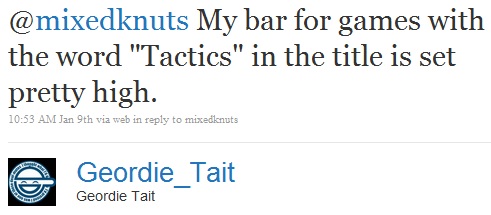
Or, as Geordie Tait so elegantly put it on Twitter:
Magic: The Gathering - Tactics is a game that, until recently, was under the radar and baselessly derided. With a storm of momentum, kicked off by a media blitz to just about every major source of Magic news and discussion, we’re now on the cusp of the public reveal. I had the opportunity to join in the beta period for Tactics and I definitely put some time into the world Sony created.
What I want to share today is how I look at Tactics, through the eyes of someone looking casually at Tactics and what it can offer players like us.
As Good as an Emulator
While there are certainly a few final changes that resulted from the efforts everyone who participated in the beta some features are quite clear and translate well to the release, namely: the game is free.
If it hasn’t been made clear for you yet, the game is free. Well, mostly (more on this later). But for simply downloading and joining in you get the following:
The starting campaign and sampling of cards from all colors
Access to online play, both of the competitive and just-with-friends varieties
Access to the marketplace of cards within the game
What this means is that you don’t have anything stopping you from playing as little, or as much, as you’d like. The initial campaign, from my experience, was fairly interesting with the standard sequencing of scenarios that gradually ramp up in difficulty. While I’m sure a serious player will run it through it short order it comes with the re-playability of starting over and using a complete different set of colors.
Adding to the mix is that even without buying booster packs or playing competitively, you can duel your friends and play around with only those you’d like to. Essentially, you’re getting complete access to the game, even seeing spells and creatures available only through booster packs, by being able to play with anyone - just like the updates for most MMOs on the market.
Auction Kings
Let’s say you have a little money to spend however you see fit. Buying Station Cash allows you the currency of the game. Similar to other freemium type games, by throwing money in you gain significant power to do more:
Buy booster packs from the store
Buy additional campaigns – the rest of the story you don’t have
Bid and pay for auctions for specific cards
While booster packs lend themselves to drafting and cracking a normal, and auctions are self-explanatory, it’s the expanded campaign that has me most interested. While I might grumble a bit about DLC (downloadable content) that feels like it should be part of the game at launch, I do enjoy following up on things when there’s more to the story (and the additional story is a negligible amount more than the cost of one booster pack).
How and what types of competition, and the costs thereof, aren’t something I looked at because that’s not what I do. But for a paltry few bucks I get a “complete” game at launch. This is something I’m fine with.
But, again, the base is free. You can try out a lot of the game (and the tutorial seems to be fixed from the initial preview offered to those who traveled to Denver) through the initial campaign before even considering going for more.
No, I’m Not LFM
One of the early bits of information about Tactics was shared through Penny Arcade in their interview with John Smedley of Sony Online Entertainment:
Smed: Obviously we'll have dueling, and we'll investigate other ways to use your cards, but the single player experience is also very important to us. Long term, campaigns are a major focus. … [A]bout seventy percent of Legends of Norrath and PoxNora players play it that way.
I got hooked on strategy games playing against the computer. While I have played against others online it was strictly in massive free-for-all StarCraft games at LAN parties (who has those anymore) and a modem-to-modem game of WarCraft: Orcs and Humans well over a decade ago.
I’m not exaggerating.
The campaign is robust and was something I enjoyed playing through. The prospect of more, with the ability to replay through it using different colors, is the biggest draw the game has for me. Picking up a game or three against a few friends will certainly be in order, but focusing on enjoying the tactical pursuits, toying with the intelligence to see how it reacts to different information, and looking for the optimal strategies given wildly different options for decks is exactly how I’ve enjoyed strategy games of the past.
Why would this change at all now?
While it’s obvious at this point that this won’t be the next generation Final Fantasy Tactics or something that replaces it in my heart, it will be a way to enjoy the themes of Magic in a soundly single-player way. And that concept is nearly completely unique as far as Magic goes.
I encourage you to check out magicthegatheringtactics.com, specifically the forums, to see some of the questions and answers that are already out there. I suspect that Tactics is not going to be a competitive powerhouse like Magic Online but will instead be a place for casuals to gather and flourish, like it is in other online card game equivalents already put out by Sony.
I know I’m going to be there; see you there tomorrow, too!
If not, now is a perfect time to join up! Our powerful tools, breaking-news analysis, and exclusive Discord channel will make sure you stay up to date and ahead of the curve.
Exodus was a monumental set in a great block, and perhaps its greatest legacy is not any single card – it is the colored rarity symbol. For the first time, casual players who knew nothing of pack order could tell which card of theirs was rare – something challenging when dealing with cards like Avizoa or Mind Bend that do not immediately look like rares or uncommons. Rarity symbols evened the trading field a lot, since players now know a little more about what cards make up a fair trade. I also suspect that it has had an impact on rare design. If players were able to immediately realize that clunkers like Gravebind were rares, they would more readily complain about getting trash in their packs. I don't think it had a huge impact (certainly not like designing with drafting in mind) but it made bad-rare-reaction much more immediate.
Exodus introduced the Oath cycle, and you know one of those cards already. The rest were middling cards, but they fed into a then-new theme of making colored cards in rare cycles. The Mirage dragons like Canopy Dragon and Pearl Dragon were a good example of this; I can't think of anything profound before that cycle. Beyond just the Oaths, I was impressed with just how much of Exodus is still played, from Eternal formats to casual tables. As usual, I compiled this list from Magic Traders, which uses Ebay finished auctions as a guide. Where things have looked uncertain, I cross-referenced to try and bring the most realistic price for these cards. Let's look at the hits!
Cataclysm
Did you know you can save three Mishra's Factories with Cataclysm by animating them? Cool trick. The sweeper was popular in White Weenie decks, since you could do tricks like saving a Soltari creature, a Cursed Scroll or Scroll Rack, an Empyrial Armor or Land Tax, and still have a reasonable board left. Cataclysm remains popular even though it sees no Eternal play of consequence because it has a unique ability for White. Cataclysm shreds so much of the table at once that it can be good for EDH decks that can capitalize on that one big attacker with a piece of equipment. It is also useful for a lot of casual players, which lends to the price being what it is.
$3.25
City of Traitors
Testing, testing...
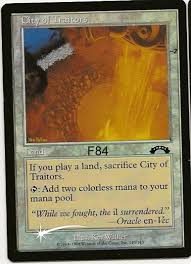
The City is, along with Ancient Tomb, the go-to land for colorless ramp in Legacy. It commands a huge price especially because Crucible of Worlds buys back the land when you lose it. The City has never been reprinted and is an immensely popular card in Eternal formats that gets best use when players use four copies. I would not be surprised to see the card become more expensive as the American Legacy GP comes up this season.
Did you know that some Exodus cards were printed as test foils? One of each color was printed, and City of Traitors was the land printed to see how the foiling process looked. Copies surface at times, but they are incredibly rare.
$18.00 (non-foil, of course!)
Coat of Arms
The best card to happen to Slivers and Elves is a frequently reprinted and popular casual card. Though the Coat has been reprinted a lot (from 7th to 2010) it holds a steady value across printings.
$3.00
Curiosity
I remember playing Curiosity in UR Fish in Vintage, which dates me. You could tack it onto Cloud of Faeries or Grim Lavamancer and watch the cards roll in. It was one of two playable creature enchantments (the other being Rancor) because it usually paid for itself in cards. Curiosity is an uncommon and, though it was reprinted in 8th Edition, it holds casual value. I don't think people are likely to trade for copies from you out of the binder, but it's worth pulling out of nickel boxes to make sets to resell.
$1.00
Dominating Licid
The Licids were an interesting experiment, but ultimately failed. They were not that powerful in terms of benefit, could still be killed at times, and were a rules headache. The new combat rules have all but killed any shot for Licids to be good, but Dominating Licid still holds some allure. I think the reason is that it's hard to find creature-stealing effects that will stay on the board and just menace people. Vedalken Shackles is a good alternative, but it needs a huge Island commitment. The Licid just sits there, daring people to attack you instead of another player at the table. Perhaps that's why Dominating Licid sits a bit above bulk price.
$1.00
Equilibrium
Witness the enduring popularity of Astral Slide decks to understand how much people love getting more uses out of their Enter-The-Battlefield creatures. Equilibrium can bring back your guys for another use or it can turn each of them into a Man-O-War. Both abilities are great and can be built around, especially with Flash creatures.
Equilibrium has been reprinted, but its value still holds up well. Again, this is another card that people would be quick to dismiss as a bulk rare. Remember its value and you'll profit from it at some point.
$1.00
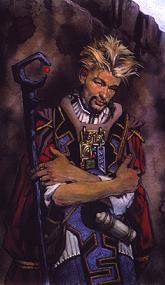
Ertai, Wizard Adept
Woe to the player sitting to the left of the planeswalker packing Ertai. They face a reuseable counter-wall that can just sit there and glare. Ertai is a surprisingly expensive card for something that sees no Eteral play. On the downside, he's got an expensive cost for his ability and a glass jaw, but on the upside, he is inexpensive to summon and resummon. Ertai also allows for a lot of diplomacy, but mainly I think people feel he's cool. There is a lot of casual appeal for a blue player in being able to drop the walking Counterspell!
$3.50
Hatred
From the makers of Channelball... Hatred was the right color to combine with Dark Ritual, and alongside City of Traitors, it powered up Hatred Black. The Black Weenie deck, which still has nostalgic devotees today, could kill out of nowhere on the third turn. A card on the power level of Hatred with a similar effect has not been retried again; something that reads “3BB: if you have more life than your opponent, win the game most of the time” is a little above the power curve. You can find Hatred for a dollar in bins (I did a few months ago) but they are worth a little more than double that. They are terrific to have in a trade binder because so many people want and remember them.
$4.00
Manabond
I remember busting this out of a pack and feeling confused and cheated. It sat in my binder for ten years before the Lands deck came out in Legacy. With Life from the Loam, the discard effect was turned into an advantage! Manabond took off from a junk rare to a valuable card. Around the time of the last American Legacy GP, it was between ten and twelve dollars. The card has settled from there due to Lands being sub-par, but it is still a good card to have in the collection.
$5.50
Memory Crystal
Apparently, buyback is popular? The two best cards to buy back are Capsize and Whispers of the Muse, and neither will win you friends. Getting two Crystals out means that you become the ultimate pest. I suppose it also combines with new-school buyback cards like Evangelize as well. Like so many others, the Crystal is worth a bit more than bulk, so it can help to scoop up underpriced ones, if only to resell online.
$1.00
Mind over Matter
According to R&D, this card was thought undercosted(!) because it could still enable Stasis decks to lock down the game. Back in the days, Stasis was the most annoying deck around. It packed cards like Serra Angel to kill you or Despotic Scepter to remove its own Stasis and untap in the process. I'm glad the card is gone from most Magic circles, but I admit that I miss Stasis' art. We don't have a clown-coyote dynamic in enough Magic art pieces these days.
Mind over Matter recently had a run because Temple Bell looked tempting. After five minutes of testing though, everyone realized how terrible that combination actually is. Mind over Matter is also seeing a little attention because it works well with High Tide and Candelabra of Tawnos in Legacy, which might combine with Time Spiral to do something. I wouldn't hold onto my copies if I had them (in fact, I sold mine last month) because I just don't see it doing something bonkers in Legacy.
$5.00
Mirri, Cat Warrior
Now THIS is a rare! The Proto-kroma had stacks on stacks of neat abilities and she was in everyone's favorite casual color. She's been reprinted, both in Anthologies and 10th Edition, but commands a buck.
$1.00
Oath of Druids
From its start, people realized that this would let you cheat out an Archangel repeatedly, especially with Gaea's Blessing. It forced White Weenie decks to pack Monk Realists at the ready, for example. Oath is still popular and is currently part of Gush Oath, one of the best decks in Vintage. It had its first Eternal breakout when Forbidden Orchard was printed, which allowed Oath to avoid ugly cards like Afterlife to get its triggers. My Vintage group, Team Meandeck, broke out Oath of Druids at an early Vintage tournament and rode Akroma and Spirit of the Night to victory on the back of a monoblue shell. For all the play it gets, Oath also remains modestly priced. At its heights of popularity, it rarely goes beyond ten dollars.
$6.75
Price of Progress
Price remains strong both in casual burn decks and Legacy Zoo builds, so it has a ready market. It is the power uncommon of the set and registers a bit of money. Kelly Reid and I pulled a bunch of these out of a thoroughly-picked store box last year, proving that you can still find deals here and there!
$4.00
Recurring Nightmare
Recurring Nighmare combined with Survival of the Fittest to form one of my favorite decks of all time. These days, it sits on the sidelines because it has been banned in EDH and gets a bit of casual play. Every now and then, people try to make it work with Yosei, the Morning Star in Legacy, but I don't think the deck is there yet. It still holds a lot of casual appeal because it thematically black both in its reanimation and sacrifice qualities. I would be happy to have Recurring Nightmares in my binder.
$8.00
Seismic Assault
This card proved that RRR could get you a better effect than regenerating The Brute. It combines with Life from the Loam or Swans of Bryn Argoll to deal Shock after Shock. Though reprinted, it is still tradeable, especially in its original printing.
$1.50
Sphere of Resistance
It is a wonder to me that the Sphere is still so cheap. It has been the cornerstone of the Vintage Stax deck for seven years now and sees a little bit of attention in Legacy as a sideboard card. Lack of casual appeal probably keeps the card where it is, but for a very playable card, it is inexpensive.
$3.00
Spike Weaver
People like repeatable Fogs, apparently. The Spike momma had appeal with Recurring Nightmare because you could blink it in and out to recharge its counters. Now, Spore Frog with Genesis is the more attractive way to permaFog, but the Spike still has its fans.
$1.75
Survival of the Fittest
What do we price the recently banned card at? It has taken a nosedive after the banning, and some sets sit unsold on Ebay for $85. The most recent closed auctions on Ebay show the card has continued to slide in value, so I am unsure of where to put a final price. I am pretty sure it is stabilizing now, though.
$13.00-18.00
Survival is a fascinating card to end on, but it is not emblematic of Exodus, a set just as memorable for Oath of Druids and Mind over Matter. It was a tremendous set at the end of a great block. Thanks for following me into the Rath cycle and join me next week when we crash head-long into the financial ridiculousness of the Urza Block.
Until then!
-Doug Linn
twitter.com/legacysallure
Exodus was a monumental set in a great block, and perhaps its greatest legacy is not any single card – it is the colored rarity symbol. For the first time, casual players who knew nothing of pack order could tell which card of theirs was rare – something challenging when dealing with cards like Avizoa or Mind Bend that do not immediately look like rares or uncommons. Rarity symbols evened the trading field a lot, since players now know a little more about what cards make up a fair trade. I also suspect that it has had an impact on rare design. If players were able to immediately realize that clunkers like Gravebind were rares, they would more readily complain about getting trash in their packs. I don't think it had a huge impact (certainly not like designing with drafting in mind) but it made bad-rare-reaction much more immediate.Exodus introduced the Oath cycle, and you know one of those cards already. The rest were middling cards, but they fed into a then-new theme of making colored cards in rare cycles. The Mirage dragons like Canopy Dragon and Pearl Dragon were a good example of this; I can't think of anything profound before that cycle. Beyond just the Oaths, I was impressed with just how much of Exodus is still played, from Eternal formats to casual tables. As usual, I compiled this list from Magic Traders, which uses Ebay finished auctions as a guide. Where things have looked uncertain, I cross-referenced to try and bring the most realistic price for these cards. Let's look at the hits!
Cataclysm
Did you know you can save three Mishra's Factories with Cataclysm by animating them? Cool trick. The sweeper was popular in White Weenie decks, since you could do tricks like saving a Soltari creature, a Cursed Scroll or Scroll Rack, an Empyrial Armor or Land Tax, and still have a reasonable board left. Cataclysm remains popular even though it sees no Eternal play of consequence because it has a unique ability for White. Cataclysm shreds so much of the table at once that it can be good for EDH decks that can capitalize on that one big attacker with a piece of equipment. It is also useful for a lot of casual players, which lends to the price being what it is.
$3.25
City of Traitors
The City is, along with Ancient Tomb, the go-to land for colorless ramp in Legacy. It commands a huge price especially because Crucible of Worlds buys back the land when you lose it. The City has never been reprinted and is an immensely popular card in Eternal formats that gets best use when players use four copies. I would not be surprised to see the card become more expensive as the American Legacy GP comes up this season.
Did you know that some Exodus cards were printed as test foils? One of each color was printed, and City of Traitors was the land printed to see how the foiling process looked. Copies surface at times, but they are incredibly rare.
$18.00 (non-foil, of course!)
Coat of Arms
The best card to happen to Slivers and Elves is a frequently reprinted and popular casual card. Though the Coat has been reprinted a lot (from 7th to 2010) it holds a steady value across printings.
$3.00
Curiosity
I remember playing Curiosity in UR Fish in Vintage, which dates me. You could tack it onto Cloud of Faeries or Grim Lavamancer and watch the cards roll in. It was one of two playable creature enchantments (the other being Rancor) because it usually paid for itself in cards. Curiosity is an uncommon and, though it was reprinted in 8th Edition, it holds casual value. I don't think people are likely to trade for copies from you out of the binder, but it's worth pulling out of nickel boxes to make sets to resell.
$1.00
Dominating Licid
The Licids were an interesting experiment, but ultimately failed. They were not that powerful in terms of benefit, could still be killed at times, and were a rules headache. The new combat rules have all but killed any shot for Licids to be good, but Dominating Licid still holds some allure. I think the reason is that it's hard to find creature-stealing effects that will stay on the board and just menace people. Vedalken Shackles is a good alternative, but it needs a huge Island commitment. The Licid just sits there, daring people to attack you instead of another player at the table. Perhaps that's why Dominating Licid sits a bit above bulk price.
$1.00
Equilibrium
Witness the enduring popularity of Astral Slide decks to understand how much people love getting more uses out of their Enter-The-Battlefield creatures. Equilibrium can bring back your guys for another use or it can turn each of them into a Man-O-War. Both abilities are great and can be built around, especially with Flash creatures.
Equilibrium has been reprinted, but its value still holds up well. Again, this is another card that people would be quick to dismiss as a bulk rare. Remember its value and you'll profit from it at some point.
$1.00
Ertai, Wizard Adept
Woe to the player sitting to the left of the planeswalker packing Ertai. They face a reuseable counter-wall that can just sit there and glare. Ertai is a surprisingly expensive card for something that sees no Eteral play. On the downside, he's got an expensive cost for his ability and a glass jaw, but on the upside, he is inexpensive to summon and resummon. Ertai also allows for a lot of diplomacy, but mainly I think people feel he's cool. There is a lot of casual appeal for a blue player in being able to drop the walking Counterspell!
$3.50
Hatred
From the makers of Channelball... Hatred was the right color to combine with Dark Ritual, and alongside City of Traitors, it powered up Hatred Black. The Black Weenie deck, which still has nostalgic devotees today, could kill out of nowhere on the third turn. A card on the power level of Hatred with a similar effect has not been retried again; something that reads “3BB: if you have more life than your opponent, win the game most of the time” is a little above the power curve. You can find Hatred for a dollar in bins (I did a few months ago) but they are worth a little more than double that. They are terrific to have in a trade binder because so many people want and remember them.
$4.00
Manabond
I remember busting this out of a pack and feeling confused and cheated. It sat in my binder for ten years before the Lands deck came out in Legacy. With Life from the Loam, the discard effect was turned into an advantage! Manabond took off from a junk rare to a valuable card. Around the time of the last American Legacy GP, it was between ten and twelve dollars. The card has settled from there due to Lands being sub-par, but it is still a good card to have in the collection.
$5.50
Memory Crystal
Apparently, buyback is popular? The two best cards to buy back are Capsize and Whispers of the Muse, and neither will win you friends. Getting two Crystals out means that you become the ultimate pest. I suppose it also combines with new-school buyback cards like Evangelize as well. Like so many others, the Crystal is worth a bit more than bulk, so it can help to scoop up underpriced ones, if only to resell online.
$1.00
Mind over Matter
According to R&D, this card was thought undercosted(!) because it could still enable Stasis decks to lock down the game. Back in the days, Stasis was the most annoying deck around. It packed cards like Serra Angel to kill you or Despotic Scepter to remove its own Stasis and untap in the process. I'm glad the card is gone from most Magic circles, but I admit that I miss Stasis' art. We don't have a clown-coyote dynamic in enough Magic art pieces these days.
Mind over Matter recently had a run because Temple Bell looked tempting. After five minutes of testing though, everyone realized how terrible that combination actually is. Mind over Matter is also seeing a little attention because it works well with High Tide and Candelabra of Tawnos in Legacy, which might combine with Time Spiral to do something. I wouldn't hold onto my copies if I had them (in fact, I sold mine last month) because I just don't see it doing something bonkers in Legacy.
$5.00
Mirri, Cat Warrior
Now THIS is a rare! The Proto-kroma had stacks on stacks of neat abilities and she was in everyone's favorite casual color. She's been reprinted, both in Anthologies and 10th Edition, but commands a buck.
$1.00
Oath of Druids
From its start, people realized that this would let you cheat out an Archangel repeatedly, especially with Gaea's Blessing. It forced White Weenie decks to pack Monk Realists at the ready, for example. Oath is still popular and is currently part of Gush Oath, one of the best decks in Vintage. It had its first Eternal breakout when Forbidden Orchard was printed, which allowed Oath to avoid ugly cards like Afterlife to get its triggers. My Vintage group, Team Meandeck, broke out Oath of Druids at an early Vintage tournament and rode Akroma and Spirit of the Night to victory on the back of a monoblue shell. For all the play it gets, Oath also remains modestly priced. At its heights of popularity, it rarely goes beyond ten dollars.
$6.75
Price of Progress
Price remains strong both in casual burn decks and Legacy Zoo builds, so it has a ready market. It is the power uncommon of the set and registers a bit of money. Kelly Reid and I pulled a bunch of these out of a thoroughly-picked store box last year, proving that you can still find deals here and there!
$4.00
Recurring Nightmare
Recurring Nighmare combined with Survival of the Fittest to form one of my favorite decks of all time. These days, it sits on the sidelines because it has been banned in EDH and gets a bit of casual play. Every now and then, people try to make it work with Yosei, the Morning Star in Legacy, but I don't think the deck is there yet. It still holds a lot of casual appeal because it thematically black both in its reanimation and sacrifice qualities. I would be happy to have Recurring Nightmares in my binder.
$8.00
Seismic Assault
This card proved that RRR could get you a better effect than regenerating The Brute. It combines with Life from the Loam or Swans of Bryn Argoll to deal Shock after Shock. Though reprinted, it is still tradeable, especially in its original printing.
$1.50
Sphere of Resistance
It is a wonder to me that the Sphere is still so cheap. It has been the cornerstone of the Vintage Stax deck for seven years now and sees a little bit of attention in Legacy as a sideboard card. Lack of casual appeal probably keeps the card where it is, but for a very playable card, it is inexpensive.
$3.00
Spike Weaver
People like repeatable Fogs, apparently. The Spike momma had appeal with Recurring Nightmare because you could blink it in and out to recharge its counters. Now, Spore Frog with Genesis is the more attractive way to permaFog, but the Spike still has its fans.
$1.75
Survival of the Fittest
What do we price the recently banned card at? It has taken a nosedive after the banning, and some sets sit unsold on Ebay for $85. The most recent closed auctions on Ebay show the card has continued to slide in value, so I am unsure of where to put a final price. I am pretty sure it is stabilizing now, though.
$13.00-18.00
Survival is a fascinating card to end on, but it is not emblematic of Exodus, a set just as memorable for Oath of Druids and Mind over Matter. It was a tremendous set at the end of a great block. Thanks for following me into the Rath cycle and join me next week when we crash head-long into the financial ridiculousness of the Urza Block.
If not, now is a perfect time to join up! Our powerful tools, breaking-news analysis, and exclusive Discord channel will make sure you stay up to date and ahead of the curve.
First, I want to say thank you to everyone that commented on my last article. The feedback was overwhelmingly positive, and thanks in part to that feedback, I was offered a weekly column here at Quiet Speculation, which I accepted. Thanks to everyone that read or commented on my last article, and to everyone that will do so on this article or any of my future writing.
Now, a bit about me. I have been playing Magic on and off since about Ice Age, which came out when I was around five years old. I learned to read so that I wouldn’t have to play by memorizing the card pictures to their abilities anymore, which was becoming a problem as more sets were released. I would play now and then with friends at the kitchen table, but none of us had any real idea what we were doing, and I dropped it after a few years. I came back to Magic and started trying to compete seriously when Onslaught was the newest thing. My first taste of real success was later that year, when I got tenth at States after being cheated (really) out of the top eight. After putting up with Affinity for a while, I decided it was no longer worth it after I got crushed at regionals with Tooth and Nail when the format was Affinity block and Champions of Kamigawa, so I quit again. I came back once more about a year later when Kamigawa block was finished as well as Ravnica, and Coldsnap was about to come out, and I’ve been going strong ever since then. Since I came back most recently, I have four or fiveish (I forget) PTQ top eights, and I won The 2010s in Montana.
My column will generally follow the current Pro Tour Qualifier schedule, with occasional digressions. I don’t have an exact plan for articles; I would rather leave that up to you, the readers. If you prefer one type of article to another, or if you would like to hear more about any topic, please let me know in the comments, and I’ll be happy to accommodate.
I’ve recently been playtesting with this list, which made top four at a recent PTQ in Roanoke, Virginia in the hands of Sean McKeown:
Untitled Deck
Creatures
4 Birds of Paradise
4 Noble Hierarch
4 Lotus Cobra
4 Knight of the Reliquary
4 Sovereigns of Lost Alara
3 Chameleon Colossus
3 Vendilion Clique
Instants
2 Cryptic Command
Sorceries
4 Thoughtseize
Enchantments
2 Eldrazi Conscription
Lands
4 Forest
2 Island
2 Celestial Colonnade
4 Flooded Grove
4 Misty Rainforest
1 Murmuring Bosk
4 Razorverge Thicket
1 Sejiri Steppe
4 Verdant Catacombs
It doesn’t look much like a the old standard Mythic, but I see many of the changes as logical upgrades, with the changed cards serving similar purposes to the deck. First, this build has Vendilion Clique instead of Dauntless Escort — both are good at protecting your team from a Wrath effect, but the Flash has been quite helpful to me. Next, this list entirely cuts Planeswalkers, favoring instead two Cryptic Commands and the three Chameleon Colossus. Most standard Mythic lists had Jace, the Mind Sculptor and Elspeth, Knight Errant — I see the Commands and Colossi as filling a similar purpose. The Jaces were there to help give the deck more game after a Day of Judgment and to help push through a creature war, while a Cryptic Command can simply counter a DoJ, and its tap ability allows you to alpha strike with impunity. The Elspeths also allowed you to gain an edge in the creature war, or to have a more durable threat against control. The Colossi make sure that a creature match never stays stalled for long, and the protection from Black is often game ending. The last change, and one I am still undecided about, it the move from Mana Leaks to Thoughtseizes.
While I’ve been playtesting, I’ve been thinking about the possible ways that this deck can be beaten. When playing, I am constantly asking myself how I can lose — what the opponent needs to draw, how they can attack, etc. When you know what needs to happen for you to lose, you can figure out how to play around it as best you can. While I’ve been playtesting and thinking about what they need to have to win, I’ve come up with the main ways Mythic loses.
1. It never gets off the ground: Mythic is in many ways similar to Mono Green Eldrazi in Standard. They both trade a bit of consistency, by running a large number of mana producers that don’t do much in the late game, for the ability to quickly ramp into expensive, game-ending threats. While I would consider Mythic far more reliable and consistent than MGE, they share a weakness to early disruption of their mana producers. If you stop Mythic from accelerating, it becomes a much clunkier deck. The Sovereigns combo can still get you, even if it comes out later in the game, but it’s much less scary on turn six than turn three. Lotus Cobra is of course the main offender here, as it leads to the most broken draws, especially with a Knight of the Reliquary.
To take advantage of this, you have to be able to kill a Lotus Cobra early, or remove it from their hand with discard before it hits play. As a Green creature with only one toughness and no protection, as well as being only two mana to play, the Cobra can be taken care of by every removal spell ever printed, as well as Thoughtseize and Inquisition of Kozilek. The important thing is that you are aware of Cobra’s ability to run away with a game and have a plan to stop it. If the Cobra is gone, Mythic slows down considerably and is much more of a Doran-speed deck. It doesn’t give you infinite time, but you don’t have to worry about being dead on turn three.
2. Significant early pressure: Killing a Cobra or the other mana producers is all well and good, but if you aren’t moving your own game plan forward in the meantime it isn’t going to do you any good, as Mythic will eventually be able to just play out its threats the old-fashioned way. Mythic usually doesn’t want to trade creatures in the early game, as it wants to build up to a Sovereigns kill. An early couple of beaters can beat a Mythic player down to a low life total before they can really set up, allowing you to finish them off even if they hit a Sovereigns. Mythic also has relatively few creatures with power, so swarm strategies are reasonable. While this build of Mythic has Cryptic Commands to help fight such strategies, most builds do not. An early Putrid Leech, Plated Geopede, or Wolf-Skull Shaman can be bad news for the Mythic player. To follow up on your pressure, you need to make sure you don’t die to a Sovereigns, as rumor has it one of those can catch up in a race pretty quickly.
3. Card Advantage: The Mythic deck trades late game staying power for early explosiveness. While many builds can last late in the game with Planeswalkers (Jace TMS and Elspeth v1 being the most commonly played ones) it is still an uphill battle. Most builds have very few ways to draw cards or otherwise gain card advantage, so if you have a way to survive their early rush and last until the late game with more cards in hand than them, you will be in a good place. A good Control deck can protect itself from a Sovereigns kill with a well timed targeted kill spell, and of course playing a board sweeper or two will leave them far ahead. Mythic’s threats are all quite significant by themselves, so it is hard to catch more than one at a time, but any board sweeper will buy you time to drop a Jace and begin restocking your hand. For this kind of strategy, you need to have a reliable way to draw cards or otherwise create card advantage, as well as have multiple removal spells to ensure you survive long enough for your card advantage to begin taking over the game.
4. Race: Mythic’s god draw is a turn one Birds of Paradise or Noble Hierarch, turn two Lotus Cobra, fetchland, Knight of the Reliquary, and turn three fetchland, Sovereigns of Lost Alara, attack. That’s a turn four GG, which makes it one of the fastest decks in current Extended — in a vacuum, at least. With even a single piece of disruption, however, it slows down significantly. If you counter or kill the Cobra, then they won’t have the Knight until turn three, which means they would need another one drop accelerator to have a turn four Sovereigns. Even if they do have a second Birds or Hierarch and a turn four Sovereigns, that would leave them without an attacker, so they aren’t going to be attacking for the first time until turn five. When a single piece of disruption can slow their clock down that much, that opens the window for a faster combo. Most Valakut-centered decks, for example, can combo off turn five or six fairly consistently. Whether Wargate or one of the more aggressive builds, a little disruption can buy you enough time to combo off yourself. While the Valakut decks are the most prominent combo decks at the moment, any Splinter Twin deck would be able to race as well if they proved viable. (Am I missing an Extended Combo deck? I feel like I’m about to make an idiot of myself here by not mentioning one. I’m sure you’ll let me know in the comments.)
I think that Mythic is an extremely powerful deck and an excellent contender for the current Extended season, but it does have several weaknesses that can be exploited if you are aware of them and play around them. If you can stop them from pulling ahead with their mana and exploding into the mid/late game before you, put them under pressure from the beginning, survive their initial rush and bury them in card advantage, or beat them to the punch by slowing them down just a little, you can have them beat. It’s a deck that can do quite a few unfair and unexpected things, so I would recommend playtesting against it, even if you don’t have the time to playtest against everything. Once you have some familiarity playing against it, you can figure out which weakness you want to exploit, depending on your deck and its strengths.
If not, now is a perfect time to join up! Our powerful tools, breaking-news analysis, and exclusive Discord channel will make sure you stay up to date and ahead of the curve.
"What happened after the honeymoon? Did desire grow or did familiarity make partners want other lovers? Was the notion of ever-deepening romance a myth along with simultaneous orgasm? The only time Rifkin and his wife experienced one was when they were granted their divorce. Maybe in the end, the idea was not to expect too much out of life." -Gabe Roth
Ask anyone who can count the length of their marriage in decades and a similar refrain is almost guaranteed to emerge: marriage takes work. Sure there's the early infatuation and attraction, the courtship, and the riveting journey of mutual discovery and exploration. But with the lengthening of years, romantic love must arrange to share space with companionate and new challenges come to the fore. How do you develop your relationship? How do you keep things interesting?
Woody Allen explored these themes in his superb film Husbands & Wives, from which the opening quote was taken, and today I'll be exploring them in the context of Magic's preconstructed products. Remember what it was like to tear into your first deck of Planechase? To dig through the wildly maniacal schemes of Archenemy? To challenge your mate to match after match with Duel Decks? Think back to those heady, halcyon days of frantic, card-tapping infatuation, and the oversize cards, and the smell off the cardboard when you peeled off the plastic shrink wrap. Let your mind wander to those memories for a few moments.
What happened? You and those decks were close but over time you just became used to each other. Maybe you thought those decks would always be there and began to take them for granted. Maybe you didn't put the work into it.
I'm here to tell you that it's not too late! It's no chore at all to rekindle the romance with your favourite precons; all it takes is a little spicing things up! Soon you'll have a new appreciation for your old flame and see things in a whole new light. In today's Magic Beyond the Box we'll be paying some of the game's casual products a visit and exploring new ways to play each that can add a lot of enjoyment to each of them.
Planechase: The Eternities Map
Planechase was a blast when it debuted in 2009 and introduced us to Planar Magic. Each of the four releases contained 10 oversize plane cards as well as a tailored-to-fit 60-card deck that was optimised by the selected planes. Although the planes were meant to augment a particular deck (yours or your opponent's) players quickly found that the concept was quite adaptable and variants sprung up almost immediately. Some mixed them in with their Commander games, others shuffled all 40 planes together and dueled around a shared deck.
Perhaps the most intriguing of these variants, however, is The Eternities Map. Unlike most other variants, this takes a little art-class skill to pull off but once organised the payoff is well worth it. You begin by taking a sheet of thick cardstock or cardboard and buy 40 of the Ultra Pro oversize card sleeves (or more, if you've picked up the extra promo planes from Tazeem to Tember City). Affix these sleeves to the backboard with glue or strong tape in a grid-type formation with the translucent side facing out.
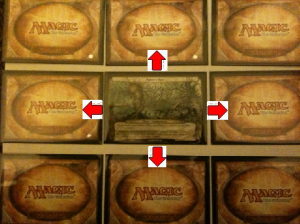
Once you're ready to begin a game, gather your mates and shuffle the deck of Planes. Then, without looking at the front of the cards, fill the cardsleeve grid with Plane cards, with their cardbacks facing out. Once you begin, take one of the ones in the middle and turn it around so that it faces outward, as shown in figure 1.0.
Figure 1.0 A ready-to-play Planar Map, with legal moves highlighted by arrows
With the revealed Plane serving as the one you all start on, begin a game of Planar Magic! The twist here is that rather than moving a plane you leave to the bottom of its stack you are able to physcially move one square in any of the four immediate directions every time you Planeswalk. This means that you might Planeswalk and move one square up, which becomes your active Plane (affecting all players), but if one of your opponents liked where you were before, they might Planeswalk and move down one square, taking you back. Each time you move you reveal the new Plane by turning it around in its sleeve and once revealed it stays visible to all players.
Thus, depending on your exploratory spirit (and luck of the draw) you might spend a game striking out in uncharted directions, or should you find a plane suited to your particular advantage you might spend your die rolls every round trying to get back there!
Duel Decks: Planeswalker Royal Rumble
It might have escaped notice, but with the release of Duel Decks: Elspeth vs Tezzeret we now have six planeswalker-themed Duel Decks available, and it's quite an esteemed assemblage! Of course, after your twentieth time bashing in on Chandra as Jace, or going through the motions again with Garruk, you might be forgiven for allowing a little ennui to slip in through the cracks.
Lost in the shuffle might be the fact that there are now a perfect amount of decks available for some multiplayer mayhem! The six decks are reasonably well-balanced even outside their own Duel Decks framework, and blend together in a perfect mix of competitiveness and flavour. You can try aligning the decks any number of different ways. Put all six names in a hat and randomly draw. Bend flavour a little bit and go for a theme of heroes (Jace, Elspeth, and Garruk) versus villains (Liliana, Tezzeret, and- why not- Chandra). Round-table style, free-for-all, or even dive in for a game of Emperor- anything can happen when you pit the game's marquee personalities against one another and see who's left standing!
Archenemy: A Gathering of the Tribes
This was something we did right off the bat when Archenemy was released last year and it's become such fun that it's even evolved into a mini-format. Tribe deck construction is a fun bit of scenario-building and has some of the same elements as building a cube: in both cases you're sculpting a play experience. The idea for A Gathering is that while it's fun to just play the game as a game and try and topple the king of the hill there's an extra level of enjoyment that comes when you can champion a cause greater than your own.
Here's the short of it: build a set of decks that represent some storied faction looking to topple the greatest villain for their time, then let your mates play out the scenario with these 'self-made precons.' The most popular one here was the descendant of the first "Gathering of the Tribes," which pitted the races of Zendikar against a decidedly non-Eldrazi threat. Kor and Merfolk, Goblin and Vampire, and even the Elves had a look in these five mono-coloured decks that were essentially a cycle all to themselves (for instance, each played the rare land associated with their colour, such as Valakut and Magosi).
Of course, tribal is but one of any number of themes you might opt to pit your Archenemy against. Perhaps planeswalker-themed decks (no, not these), or decks that stress the particular role associated with a colour (a blue deck stuffed with countermagic, a red one filled with burn spells, and a white one in the healer's role). Get creative and design your own scenario, then see how viable it plays out. If you can get close to a 50% win rate against the Archenemy you might be onto something!
Bring Back That Loving Feeling
As mentioned at the beginning of this column, for most of us successful relationships are those you work on and not things that 'just happen.' Once upon a time you were excited about Planechase, or Archenemy, or Duel Decks, and chances are good you even plunked down hard-earned money for them. If they've been neglected and cast aside for younger models perhaps you're missing out on something truly fulfilling. Take them down off the shelf and give them a second chance.
After all, if you're willing to put in just a little time to spice things up you might just fall in love all over again.
If not, now is a perfect time to join up! Our powerful tools, breaking-news analysis, and exclusive Discord channel will make sure you stay up to date and ahead of the curve.
Hey guys and gals, welcome back into the Cave. While I've been going some Extending testing with my GW Midrange deck from last week, I have a deck I've had on the back burner that I'd forgotten about and decided it was time to bring it out into the light to test in the current meta. As we all know, Worlds has come and gone, and we have a few familiar decks that decided to show themselves again as well as new brews that came out of left field and surprised everyone. For those that don't know, the top tier decks in Extended at Worlds were Tempered Steel, Faeries, 4 Color Control, Jund, Elves, Valakut Ramp(GR), Valakut Control (UWG Prismatic Omen), and Ooze and Oz. So with this is mind, what do I think of this? "Well, for starters, everyone hates Fae..." whoops, sorry about that, personal opinion sneaked in there... but I really don't have a very good position on how these decks will do. Most notably that Faeries will indeed be at the top tables, but what about the newer additions?
We have Valakut Control, a typically-Bant deck that has more sinister plot to play Prismatic Omen and Scapeshift to kill us; the Tempered Steel "Affinity," which plays low casting cost artifact creatures and overwhelms us after a Tempered Steel hits play; Probably the most talked about deck, as I discussed this briefly in the last article too, is Conley Woods' deck Ooze and Oz as most of the community has affectionately called it. Like to have a non-Blue Combo deck that wipes your opponent's board, gets infinite mana, infinite power and toughness, and/or infinite damage to boot? Then this deck is for you! Basically the whole combo revolves around Necrotic Ooze with cards like Fauna Shaman, Grim Poppet, Devoted Druid and Molten-Tail Masticore. With Devoted Druid and Grim Poppet in the graveyard you can wipe you opponent's board plus go infinite mana by tapping Necrotic Ooze and untapping it with Devoted Druid's ability.
So what do I have in store for the Extended field today? Well, this deck was actually one of my Extended projects before GW Midrange and a few others that I'm still doing lists for. I called it something else originally, but I didn't want to get sued so I renamed the deck BR Darkside. So here we go with the development list:
Black
Removal
Doom Blade - Conditional removal, destroys target non-Black creature
Consume the Meek - Conditional Instant-speed mass removal, destroys all creatures with converted mana cost 3 or less
Disfigure - -2/-2 to a creature
Gatekeeper of Malakir - Conditional removal with payment of kicker, target player sacrifices a creature
Grasp of Darkness - -4/-4 to a creature
Consuming Vapors - Recurring removal, target player sacrifices a creature and you gain life from its toughness (with Rebound!)
Shriekmaw - Comes into the battlefield, destroys a non-black, non-artifact creature, alternative casting cost with Evoke but sacrifices on resolution
Nameless Inversion - Good creature type instant, +3/-3 to target creature
Deathmark - Conditional removal, destroy target Green or White creature
Fleshbag Marauder - Each player sacrifices a creature when it enters the battlefield
Smother - Conditional removal, destroys a creature with converted mana cost 3 or less
Infest - All creatures get -2/-2
Tendrils of Corruption - Deals damage equal to number of Swamps you control, then gain life equal to number of Swamps you control
So we have a lot of removal this time around and some cards I am very happy to see once again. Most notably Infest, Shriekmaw and Tendrils of Corruption. Unfortunately since we're going more 50/50 on Swamps and Mountains, Tendrils of Corruption seems like it needs a better home. Infest needs a good home when Aggro is more prevalent than this format of Control and Combo. Shriekmaw is good in the right deck and could be a possibility in the 75.
Utility
Makeshift Mannequin - Reanimation, allows you to reanimate a creature from grave and puts a mannequin counter (if targeted, that player sacrifices it)
Beseech the Queen - Heavy cost depending on mana, tutors a card for you
Duress - Disruption, takes a non-creature, non-land card from hand
Inquisition of Kozilek - Disruption, takes a card with converted mana cost 3 or less from hand
Memoricide - Disruption, new Cranial Extraction except you can take any number of those cards (though mostly you take all of them anyways)
Puppeteer Clique- Reanimation, enters the battlefield and reanimates a creature from opponents grave, gains haste, exiled at the beginning of the end step
Liliana Vess - Planeswalker, toolbox, target player discard a card, tutors a card, ultimate recurs all creatures onto your side of the field, heavy mana cost
Mind Shatter - Disruption, discards X cards where X is the mana put into the spell (plus BB, of course)
Rise from the Grave - Reanimate, gets a creature from a graveyard, adds Zombie type and Black along with its original types and colors
Sign in Blood - Draw, draw two cards and lose two life
Dark Tutelage - Draw, basically it's a Dark Confidant enchantment
Faerie Macabre - Discarding this card exiles two cards from a graveyard
Vampire Hexmage - Sacrifice to removes counters from a permanent (read: Planeswalkers!)
Alright, so we have a list that I consider usable options in the current format, and anything I missed is appreciated in the comments sections. I will admit having Liliana Vess is strange but it's still a Planeswalker that can fetch us answers as needed. Most of these are Control-centric, which is fine since I can already tell some are going to fit better in this deck than others, such as Makeshift Mannequin over Rise from the Grave.
Staples
Thoughtseize - Disruption, you lose two life to take any nonland card out of an opponent's hand
Profane Command - Toolbox spell, (choose 2 of) target player loses X life, returns a creature card with converted mana cost X or less from your graveyard, target creature gets -X/-X until end of turn, or X target creatures gain Fear until end of turn
Malakir Bloodwitch - Protection from White, flyer, when enters the battlefield each opponent loses life with condition of the number of Vampires on your field, and you gain life to the life lost
Bitterblossom - Enchantment that makes you lose a life during upkeep and creates a flying Black 1/1 Faerie Rogue token
Leyline of the Void - Enchantment that exiles cards when they are about to be put into the graveyard
Abyssal Persecutor - Good 4-mana 6/6 flyer, downside is your opponent can't lose the game and you can't win with him on the board
Bloodghast - Recuring, if in graveyard it can recur itself with its landfall trigger
Shriekmaw - Comes into the battlefield, destroys a non-Black, non-artifact creature, alternative casting cost but sac on resolution. Also has Fear
So here we have some of the old and new staples Black has to offer. Thoughtseize in particular is a must for any Black deck, as it takes away their finisher and/or key cards away from them. The life payment isn't too costly depending on the deck you're playing against, however Burn can be one of those decks to be worried about.
Base
Grim Discovery - Recurs a land and/or creature back to your hand
Eyeblight's Ending - Destroys a non-Elf creature
Grave Titan - Heavy mana cost, when entering the battlefield or attacking you put two 2/2 Zombie creatures into play. Also has Deathtouch
Nothing really for us here but Grave Titan might be interesting somewhere.
Red
Removal
Arc Trail - Good multiple removal spell, conditional in situations where no creatures are present (note that it can target both players and is rarely truly "dead")
Banefire - Deals X damage where X is the amount of mana tapped into it. X of 5 or more makes in unpreventable damage
Lightning Bolt – Best removal spell Red has produced, always in the Red deck
Burst Lightning – Quick burn plus removal, conditional extra damage with Kicker
Pyroclasm - Mass removal of small toughness creatures, or post combat board wiper
Combust– Conditional removal, but solid removal overall in the current format
Flame Javelin - Restricted in terms of mana; 4 damage is a lot but it could have been a 3-, 4-, or 6-mana burn spell depending on mana available
Cunning Sparkmage - Decent removal of low-toughness creatures or post combat
Fling - Sacrifice a creature to deal damage equal to its power to a creature or player
Ashling the Pilgrim - Pays to put counters on it, if done a certain amount of times deals damage equal to the number of counters on it
Galvanic Blast - See Burst Lightning, conditional with Metalcraft instead of Kicker
Lash Out - Deals 3 damage to creature, conditional 3 damage to player if controller of spell wins the Clash
Inferno Titan- Awesome recurring removal spell and 6/6 Firebreathing Titan to boot
Magma Spray - Really good removal of creatures both before or post combat, 2 damage plus exiles if going to grave
Bogardan Hellkite - Creature with Flash, plus 5 damage to target player and/or any number of creatures
Searing Blaze - Decent removal, conditional with extra damage on Landfall
Flame Slash - Good, efficient Sorcery-speed removal
Chain Reaction - Deals damage to each creature equal to the amount of creatures on the field
Shard Volley - Sacrifices a land to deal 3 damage to target creature or player
Caldera Hellion - Deals 3 damage when enters the battlefield, gets bigger if sacrificed a creature before hitting play
Earthquake - Deal X damage to each creature without flying and each player where X is amount of mana paid (minus R)
Staggershock - Recurring damage
Ember Hauler - Sacrifices with payment to deal two damage to target creature or player
Tarfire - Deals 2 damage to target creature or player
Volcanic Fallout - Deals 2 damage to each creature and player at Instant speed, cannot be countered
Siege-Gang Commander - Deals damage when sacrificing a Goblin with 1R payment
So now we have our removal suite, mostly in Red. Most of these choices are going to depend on the field and how much Red we want in the deck. First thing first, Lightning Bolt is an auto0include in any deck Red is going to offer. A lot of these cards can be sideboarded in for some matchups such as Volcanic Fallout, Magma Spray, Combust and Chain Reaction.
Utility
Reverberate - Copies and changes direction of a spell
Ricochet Trap - Changes direction of a spell
Shatter - Destroys an artifact
Wild Ricochet - Copies and changes direction of a spell
Incendiary Command - Toolbox spell, choosing only two modes of: 4 damage to target player; 2 damage to each creature, destroy target nonbasic land, or each player reshuffles their hand and draws that many cards
Leyline of Punishment - Stops lifegain and prevention of damage
Goblin Ruinblaster - Destroys a nonbasic land with a 2/1 haste body and relevant creature types
Ingot Chewer - Destroys an artifact
Chandra Ablaze - Planeswalker, recurring damage source
Manic Vandal - Destroys an artifact
Siege-Gang Commander - Token producer
Smash to Smithereens - Destroys an artifact and deals 3 damage to that artifact's controller
Staples
Lightning Bolt - Main staple of Red decks, 3 damage to target creature or player
Flame Javelin - 4 damage to target creature or player
Volcanic Fallout - Uncounterable damage, 2 damage to all creatures and players
Earthquake - Conditional damage with payment, X damage to non-flying creatures and players
Manabarbs -1 damage each time a land is tapped for mana
Pyromancer Ascension - Copies spells when conditions are met
Ball Lightning - Conditional creature, haste, trample, solid power, weak toughness
Goblin Guide - Probably one of, if not the best, Red 1-drops
Hell's Thunder - Conditional creature, haste, flying, recurs itself with Unearth payment
Hellspark Elemental - Conditional creature, haste, trample, recurs itself with Unearth payment
Kargan Dragonlord - Solid beater in a mono-Red deck
Siege-Gang Commander -Token producer, deals damage when sacrificing a goblin with 1R payment
Taurean Mauler - Valid creature type, gets stronger whenever an opponent plays a spell
Base
Tunnel Ignus - Deals 3 damage to opponent when conditions are met
Chaotic Backlash - Deals damage times two from the number of White and/or Blue permanents an opponent controls
Heat Shimmer - Copies a non-Legendary creature and puts it onto the battlefield, exiles at the beginning of the end step
Warp World - Puts all permanents each player controls back into the deck, shuffles, then puts that many permanents back into play under each players' control
Stigma Lasher - Cheap mana cost Wither creature that prevents your opponent from gaining life after it deals damage to him or her
Multicolored
Removal
Murderous Redcap - Deals two damage to target creature or player, recurs to deal another one damage if no -1/-1 was on it at the time (Persist)
Bituminous Blast - Deals four damage to creature, plus Cascade
Terminate - Destroy target creature
Firespout - Conditional removal, since we're in Red it will deal 3 damage to each nonflying creature
Utility
Thought Hemorrhage - Name a card, Extradicate effect, deals 3 damage for each of the named card in the opponent's hand
Slave of Bolas - Threaten effect, sacrifice at the end of the end step
Sarkhan the Mad - Planeswalker, draw spell, destroys a creature to put a 5/5 Dragon into play, deals damage equal to power of each Dragon you control
Staple
Demigod of Revenge - 5/4 flyer that recurs each of itself from graveyard when cast
Boggart Ram-Gang - Cheap 3/3 beater with haste and wither
Blightning - 3 damage plus discards two cards from opponent's hand
Everlasting Torment- All damage is treated as if it were wither, and players can't gain life
Anathemancer - Deals damage to target player equal to number of nonbasic lands they control
Fulminator Mage - Sacrifice to destroy a nonbasic land
Base
None
Colorless/Artifact
Removal
Argentum Armor- Destroy permanents, expensive artifact and equip cost
Ratchet Bomb – Destroys all permanents with condition of number of charge counters, one-time "mass" removal
Molten-Tail Masticore – Flame Javelin, anyone?
Brittle Effigy - One time removal spell, exiles their finisher or threat
All Is Dust – Good mass removal spell, heavy mana cost, doesn’t affect Eldrazi creatures or artifacts, forces sacrifice rather than destroying
Ulamog, the Infinite Gyre - Destroys a permanent, expensive mana cost
Utility
Basilisk Collar - Equipment that gives Deathtouch and Lifelink
Armillary Sphere- Fetches two basic lands into hand
Sword of Body and Mind - Good overall equipment, pumps, token producer, protection from Green and Blue, and mills your opponent plus creates a 2/2 token on combat damage
Sword of Vengeance - +2/+0, Haste, First Strike, Trample and Vigilance seems pretty good for an equipment
Lodestone Golem - Good stall card through adding mana cost to non-artifact spells
Thorn of Amethyst - Adds cost to non-creature spells by one colorless
Staple
Wurmcoil Engine- Lifelink and Deathtouch? Along with putting two 3/3′s out with one of each ability, and being a 6/6, is good in my book
Pithing Needle - Prevents a named card from using activated abilities that are not mana abilities
Molten-Tail Masticore - Flame Javelin with Regeneration
Base
None
Nothing really exciting since we're not going into Esper colors, but a solid list nonetheless.
Decklist
Untitled Deck
Creatures
4 Demigod of Revenge
3 Murderous Redcap
4 Vampire Nighthawk
3 Boggart Ram-Gang
2 Wurmcoil Engine
Sorceries
4 Blightning
4 Thoughtseize
Instants
4 Lightning Bolt
4 Terminate
3 Doom Blade
Lands
4 Blackcleave Cliffs
4 Dragonskull Summit
4 Reflecting Pool
4 Graven Cairns
5 Swamp
4 Mountain
Sideboard
4 Pithing Needle
4 Thought Hemorrhage
3 Anathemancer
4 Tunnel Ignus
This is the deck I'm going to stick with for a couple of Extended sessions, so the gauntlet I've set up will have updated notes from the bottom so I can see where we are with the deck and what changes can be implemented for improvement.
Notes on Card Choices:
Alright, so first things first, let's talk about the mana base since I didn't pick up on that in my last two articles. I really wanted a fast start with the deck so I incorporated the new Blackcleave Cliffs as the new Blood Crypt so we can have a first turn Thoughtseize or Lightning Bolt. After that we have Reflecting Pools and Graven Cairns to keep the mana base fluid.
Decks I'll be testing against: Tempered Steel Faeries 4 color control Jund Valakut Ramp(GR) Valakut Control(UWG Prismatic Omen) Ooze and Oz
Check back next time to see how the testing goes. Thank you for reading, and please don't be shy about commenting below on any of the lists or the decklist itself!
If not, now is a perfect time to join up! Our powerful tools, breaking-news analysis, and exclusive Discord channel will make sure you stay up to date and ahead of the curve.
Hey all, and welcome back to Whinston’s Whisdom on Quiet Speculation. In my last article, I started describing the most basic steps of a trade, and left off on the types of tournaments that people trade at, and the relative advantages of each. Let’s continue from there…
Pick a target:
While I know the age old adage of “never judge a book by its cover” is critical when interacting socially with others, I am not ashamed to admit that I do judge prospective trading partners by appearance before inviting them to trade. Engaged in an intense playtest game? Probably a Spike interested in the hottest new competitive rares. Playing a game with a casual Sliver deck? That Timmy binder will come in handy. Playing with a pimped out Eternal or EDH deck? It’s not hard to guess what they’ll be looking to trade for. While obviously these assumptions aren’t always true, by scoping out a trade partner quickly before the start of trading, you can gain some insight into their card evaluations and what kind of stuff they’ll want to get from you.
Build rapport:
If there is one step out of this entire series of articles that I had to pick as the most important, it would be this one. A trade will not go through in your favor unless you can make the other trader feel good about it. Your persona and your interaction with the guy on the other side of the table is critical toward building yourself up as a good trader. Adopting a persona is but the first step in this. Take people like Kelly Reid or Jon Medina. These are guys that have street cred. They have the experience to back them up. Their persona will often be one of intelligence and superiority, but never arrogance. Obviously, for a less experienced trader that hasn’t played as large a part in the MTG financial community as these 2 have will be unable to adopt this same persona. And this is where your own personal judgment must come into play. Depending on who you’re trading with, the persona you adopt will have to adapt to fit the situation. While Kelly’s persona might work with a shark trader, or someone who’s been around the trading scene for a while, it might scare newer or more casual players away. Likewise, too softhanded an approach will make you seem vulnerable to those more experienced, while benefiting your interactions with those that are newer. The very best traders can swap their persona according to the situation, which is something that I’m working on right now. When I trade, I often take an aggressive role. I’m always the one proposing trades rather than letting my opponent gain the upper hand in our negotiations. And while this can be effective, it also pushes people away part of the time. There is one person at my store who will always open up his binder to me, but is never willing to make a deal with me, while I see others trading with him and making much more profit off of him than I had planned to. Sometimes, a persona and a target will simply not mesh. When this happens, you must switch. While I’m slightly worse at taking the role of a newer, or at least meeker, trader, just a small amount of effort in this direction can pay off big.
Of course there are other ways to build this rapport as well. Persona isn’t everything, though it is admittedly the biggest part of rapport. Simply making the other trader feel comfortable can go a long way towards building rapport. If he’s unsure about a card price, don’t cite a site’s price from memory. Instead hand over your smartphone and let him check for himself. Ask where he’s from, how he’s doing in the tournament, how long he’s been playing. Find common ground. Worst case scenario, you both play Magic! If that isn’t the best way to find common ground I don’t know what is. For Spikes, tell that hilarious story about your buddy forgetting to target his opponent with Sign in Blood. What a chump! Regale Johnnies with your EDH 5 card combo tales, while awing Timmies with turn 4 Progenitus. In Next Level Magic, Patrick Chapin talks about in-game rapport, and how to build a similar connection to an opponent while in a game rather than a trade. One of the things he said that struck me the most was when he talked about the brain being more willing to accept suggestion when it feels that it itself is suggesting an idea, rather than a foreign power. When you establish rapport with another trader, make him understand the similarities between the two of you, he is more willing to go with you during the trade, and while there are obviously some limits, will give up more value to you because he feels like you're on his side.
Obviously there are some that look down on this sort of behavior as psychological warfare. While this is not always the most popular tactic, especially when money is on the line rather than a game of Magic, it is yet another tool for your arsenal. But why is there such a distinction between playing the game and trading? If you mind trick an opponent during a game, causing him to throw away the game, in a match that will put one of you into the money and one of you out of it, is this unfair? There’s money on the line here too, as the winner will make infinitely more than the loser, yet why do people find it more acceptable to use rapport as a tactic in game rather than in a trade?
Begin flowery soliloquy
To those opposing this, I say “Nay!”. Trading is a match, just as a match is a trade. Why distinguish such between the two, when both require an assertion of dominance over a lesser being. Your opponent, be he slinging spells or swapping them, is the enemy. Those who hunger for victory, let you not be content with any amount of profit, any amount of match wins. Let the score tally up more and more in your favor until none dare stand before you. Carpe diem, seize the day! And lest you be diverted from your true course, hold your path true, but not rigid. “Aut viam inveniam aut faciam” (Hannibal), I will find a way or I will make one. Those that oppose you know not the falsity of their words, but rather attempt a hopeless stand, that will surely fall to your skill and discipline.
End
Begin caveman speech
Trade is game. Game is trade. No different.
End
This distinction between game and trade must be done away with. I conduct myself in a game identically to the way I do in a trade. In both, the end goal should be victory, no matter the tactics (disclaimer: if something would be considered cheating in a game, it is in a trade too! i.e. lying is a no no).
With this all said, rapport is the most important in-trade, if not overall, tactic necessary to a trader. Uncharismatic traders never prosper, while those that can make their opponents love them even as they destroy them (thank you Ender Wiggin) are the ones that make the big time.
Cashing Out
So you’ve made DI profit trading. From your paltry investment, you have enough cardboard cash to buy a horse, if not a house. But unless your landlord takes cards as payment, they’ll still be knocking on your door waiting for rent at the end of the month. You’d better cash out quick! In my experience there are really only 3 ways to do this.
Ebay—the simplest and most common way of turning cards to cash, yet ultimately, my least favorite. Your sell price can never be exorbitantly high because the market will determine its value, yet you then lose +12% to Ebay and Paypal fees, then have to wait for payment, and then have to take the trouble to ship out the cards. While a fine outlet if there’s little demand for a card in your area, I would look to other options first.
Store buylists—sweet and easy. Stores consistently buy cards for MUCH less than they sell them for, yet sometimes it doesn’t matter. A sudden peak in price can leave buy prices high enough for you to still make a profit, but without the hassle and fees of Ebay. Perhaps more importantly, you get cash, for all the places where Paypal isn’t accepted. I will use this option when available and economically sound (remember that taking a lower price on your cards can be ok if it’s significantly faster because of opportunity cost as I mentioned two articles ago).
Sell to the players—there are two ways to exploit this option. You could be a dealer, in which case you probably shouldn’t be taking much advice from my articles as I try and address the smaller trader, but of course if you are there’s a very easy way to sell your cards. Just...sell…them. As a small trader you can also do the same. While some stores, especially those that sell their own singles, frown on and may even ban the selling of cards, you can always step outside with a client to do so, or sell them at much below dealer pricing to your friends. You both end up well by doing this, but make sure not to price gouge them. It’s quite a good way to not have friends anymore.
That’s all on financial content for today. I’m not 100% sure what my plan is for next week, but I’m sure I’ll think something up.
I have noticed that there are few or no comments, so I’ve decided to do something that worked well the first time I tried it on Blackborder. It’s comment contest time!
The rules:
Comment on this article before Wednesday, January 19th with one thing you liked about the article, one constructive criticism, and one topic you’d like to see covered in a future article. I’ll pick a winner, either the one whose topic I like best or one randomly, and send them a free card, shipping at my expense.
This week’s card will be a copy of the Unhinged card R&D’s Secret Lair, so get those comments in.
If not, now is a perfect time to join up! Our powerful tools, breaking-news analysis, and exclusive Discord channel will make sure you stay up to date and ahead of the curve.
So while we were off for the holidays, I got an email from a reader and it is actually a very interesting situation. With all the Legacy events that happen more and more across the country, it's a situation that could very well come up for you. It has to do with a part of the game that isn’t dealt with very often. When people sit down to play magic, they usually just shuffle up, draw 7 cards, and start playing. However, there might be more going on in between some of these steps. So without further ado:
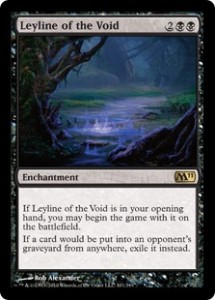
“JUDGE! I have a question. If my opponent as a Leyline of the Void in his opening hand, and I have a Gemstone Caverns in mine, can I Stifle his Leyline’s trigger if I’m going second?”
Leylines started an interesting trend in magic: taking advantage of the ability for things to happen before the game actually begins. With the addition of Gemstone Caverns to the mix I can see where this situation could come up. Why wouldn’t you be able to Stifle a Leyline? This feels exactly like that kind of thing you usually do with your Stifle. Something triggers “when” something else happens, goes on the stack, and you get to respond by countering the trigger. Why would this be any different?
When you’re playing a game of Magic there are many rules that tell you when and how to do things. They are less clear about these things before a game actually begins. To be honest when I first read this question I felt like I knew what the answer was, but in considering it I was having a hard time explaining why. So I started to do some digging.
There are a couple reasons that I found as to why you can’t Stifle a Leyline trigger. The first, and probably the clearest reason, is outlined in rule 103.5. This rule is a special exception to putting cards into play. Unlike a regular trigger that would go on the stack and then resolve, this rule states that if you have a card in your hand like a Leyline or Cavern, starting with the player who goes first, you simply put them into play. Once the player who goes first has put all of their cards into play, each other player in turn order puts any cards they have into play. So when the Leyline is put into play, the other player doesn’t even have the mana available to Stifle.
What if you’re playing in a game with more than two players. Let’s say Player 1 doesn’t have any cards to put into play, player 2 drops his Gemstone Caverns, and then Player 3 attempts to play his Leyline. In order to cast Stifle, you need to have a target; in this case, a triggered ability on the stack. But as we learned from rule 103.5, Leylines and other effects like this don’t use the stack. They are put directly into play. Since they never go onto the stack, they are never a legal target for Stifle. On top of all this, the rules state that you can only cast spells when you have priority. Even if something happens before a game begins, you still won’t get priority to respond to it.
So at the end of the day, if a player starts the game with a Leyline in his hand, they’ll get to put it into play. And no matter how bad it might be for you, there isn’t much you can do about it. Unless you happen to be packing Disenchant.
Since we are in Extended season, and PTQs are starting back up, I'm going start next week with some interactions from some Extended decks. As always, you can email me a question and you, too, could have the judge answer your call.
As always, keeping it fun,
Kyle Knudson
Level 2 Judge
Allon3word at gmail.com
Bonus Rules Stuff
Starting your game:
There are many steps that take place before you actually begin your game. One thing that should be known for tournament magic is that you can do everything EXCEPT actually start the first turn, before the start of the round. It just gives you more of your 50ish minutes of tournament round to actually play your game.
Shuffling, choosing who goes first, drawing your hand, resolving mulligans, and resolving Leyline like effects all happen before the game actually begins. Leylines would happen last, because your "opening hand" is determined after you completely resolve mulligans and you don't get to see if your opponent has a Leyline before you choose to mulligan.
If not, now is a perfect time to join up! Our powerful tools, breaking-news analysis, and exclusive Discord channel will make sure you stay up to date and ahead of the curve.
I originally planned to dig a little deeper into the advantage and disadvantages of store credit this week, but the SCG Opens this weekend at Kansas City changed my mind.
With there actually being some innovation in Standard (more on this to come), and the first large Legacy tournament since the banning of Survival of the Fittest, it seemed like a better idea to break down the results of those tournaments. The fact that I split the finals of the Legacy Open on Sunday was pretty cool too, but this is a financial column, so you can find my (hopefully entertaining) tournament report later in the week.
Standard
The top 8 decklists are posted here, but there is really only one deck that shakes up the format at all. That deck is U/G Genesis Wave Ramp, which has the potential to affect the prices of a few cards, not just the Wave.
Prior to the tournament, it was hard to argue that the best three decks in the format weren’t Valakut, U/W or U/B Control (take your pick), and B/R Vampires. What Conley and Chris VanMeter brought to Kansas City trumps each of those decks through a combination of land denial and a plethora of must-answer threats.
If you follow me on Twitter (@Chosler88) you know that I suggested picking up Genesis Waves Saturday night as soon as I found out that Conley had locked up Top 8. When he brings a deck to play, other people want to build it. If you were quick you could have picked up some great deals on Genesis Wave (I traded for 6-7 at $1 during the tournament). While these aren’t going to see a huge jump in price because of the tournament (First-set rares in today’s world can only go so high), they currently go for under a dollar on Ebay, so it doesn’t take much to profit on these.
But you know that already. I’m here to talk about the other cards affected by the breakout U/G Wave deck.
We know the best way to speculate on Magic and succeed at this juncture in the game is to bet on Mythics. The problem with the Wave deck is all the mythics in it have already gone through their price spikes, and none offer us much opportunity.
But we can go a step farther. It stands to reason that with Wave emerging as a natural foil to three of the best decks in the format, it will become a larger part of the metagame and demand its own trump. That trump exists, and that is where we’re going to make our money.
While Conley’s deck has been grabbing the headlines of the Open, it is Boros Deck Wins that actually took down the tournament, in large part to its terrific matchup with the Wave deck. Right now Boros occupies only a relatively small position in the metagame and has been very off-and-on in regards to its performance. Many people are still using Worlds 2010 as their baseline for decks, and Boros had no showing in the Top 8 of that tournament, and only three copies on the Top Performing Standard Decks section.
If Wave becomes a larger part of the meta as expected, expect to see Boros grow as well. Boros also has more to gain from the last two Mirrodin sets thanks to Stoneforge Mystic.
With that in mind, the next step is to look at Boros to find out where we can profit.
The Rare and Mythics Rares in Boros
- Goblin Guide
- Stoneforge Mystic
- Scalding Tarn
- Arid Mesa
- Spikeshot Elder
- Sword of Body and Mind
- Koth of the Hammer
- Basilisk Collar (Sideboard)
The first step is to examine the one rare from Scars of Mirrodin, which just is being opened at too high a rate to see much of an increase, even if Boros picks up steam.
- Spikeshot Elder
Next we’ll look at the rares from older sets that are in the deck.
- Goblin Guide
- Stoneforge Mystic
- Arid Mesa
- Scalding Tarn
- Basilisk Collar
Looking at the Zendikar cards on Black Lotus Project, we see that Goblin Guide steadily climbed from last summer (when it hovered around $3) to nearly $7 today. But the Guide has been dropping over the past two weeks, and I don’t think it’s going to eclipse $8 any time soon, making it a poor investment.
The fetchlands are each around $9, and are so ubiquitous in every format that it’s going to take a lot more than a moderate uptick in the number of Boros players to mess much with its price.
Transitioning to the Worldwake rares, we see Stoneforge Mystic and Basilisk Collar. Let’s start with the Collar. It’s about $4.50 on BlackLotusProject and might climb a little, but again, it’s not going to make you any real money.
The Mystic, on the other hand, has more of an opportunity. It’s nearly $7 apiece on Ebay and also is played in Quest decks. The ship carrying wads of cash has sailed, but there is a small freighter with loose change hanging around. With more Equipment coming from Mirrodin, expect this to tick up some in the next few months. I don’t think it will eclipse $10 apiece on Ebay, but I wouldn’t be surprised to see it get close. It also dodges the normal dilemma facing Rares because it was printed in Worldwake, which was drafted in small numbers for a very short amount of time. I have more to say about the Mystic when we get to the Legacy section, but that does it for now.
This leaves us with two cards out of Boros to look at, Sword of Body and Mind, and Koth of the Hammer.
We’ll start with Koth. I don’t think he’s a worthwhile investment at this point because he is already used in a number of decks, will be opened for some time to come, and is a Planeswalker. Planeswalkers are amazing cards to make money off of, but only when they come out of nowhere. Koth is a known entity, and Boros isn’t going to push his stock much higher than it already is.
That leaves us with just the Sword of Body and Mind, and this is where I see the most opportunity. It started out at $8 on Ebay and dropped to about $6.75 before starting a tiny climb back up in the last five days. This is the perfect time to jump on the bandwagon. With more equipment-enabling cards on the way, in addition to the probable rise in Boros decks, this card can make you some money. Most importantly, it’s a Mythic.
Not only does it give a creature protection from the entire Wave deck, it also prevents Jace from bouncing the creature and Frost Titan from tapping it down. It swings through Overgrown Battlement and mills Mountains from Valakut players. There’s nothing to not like about finding Swords around $6 to invest in.
By this point (Wednesday, four days after the Wave deck broke), you’re already behind on the cards in it. What I hope I’ve accomplished today is to show you how we can stay a step ahead of the pricing metagame. This coming weekend’s SCG Open will likely see more U/G, and if it continues to perform well, and I suspect it will so long as players sleeve up Valakuts, then Boros becomes the go-to answer deck and Sword of Body and Mind will benefit, as will you.
Legacy
My suspicion that the metagame would shift back to the pre-GP Columbus days proved correct, making Merfolk a great choice. Also, it was the only deck a friend had available to loan me, so that’s what I sleeved up (Figuratively anyway; I was actually handed the deck pre-sleeved at 2 a.m. on Sunday to pound out three test games before we crashed).
And just like Columbus, I think Merfolk was one of the three best decks at the tournament, the others being Lewis Laskin’s Green and Taxes or Gene Richtsmeier's BW Tempo. Alas, I managed to punt the finals, so Goblins is your winner.
Looking at the financial side of the tournament, there are a few decks that draw our interest. The first is Spring Tide, piloted by Jacob Baugh to a Top-16 finish. It’s the first High Tide, Time Spiral deck to make an impact, but I doubt it will be the last. Obviously most of the cards in the deck jumped in price immediately following the unbanning of Time Spiral, but I wanted to bring it to your attention that the deck did perform well in case you’re invested in the cards or can trade for them cheaply.
Next up is B/W Tempo and Green and Taxes, and the two share a card that keeps finding its way into this column: Stoneforge Mystic. The Mystic is in an interesting place because I think it can be a decent medium-term investment, but is a bad long-term investment right now. Why?
I explained in the Standard section why we can expect to see the Mystic trend upward in the medium-term. But its price is going to tumble when it rotates out of Standard, even if its playable in Extended, making it a bad long-term investment right now.
With that said, you want to pick these up as soon as the price drops following its rotation from Standard. I realize I’m telling you that way in advance, but I fully expect the card to continue to make appearances in Legacy decks, and it’s not going to become any less powerful as time goes on. Pick these up around that time, and you’ll see its price slowly begin to come back up.
That’s all the space I have for this week. I hope you enjoyed this week's column, and you can look for my tournament report later in the week.
If not, now is a perfect time to join up! Our powerful tools, breaking-news analysis, and exclusive Discord channel will make sure you stay up to date and ahead of the curve.
[Hello, everyone 🙂 This is an offering from Brook Gardner-Durbin as a Guest Author. I know he's looking to write more regularly, and it's in part up to you all to determine whether or not that will be at Quiet Speculation! When you're done reading, please don't be shy about commenting below on whether you liked it or not. Here's a hint though: It's some really good stuff. -Dylan]
Ahh, Mythic, how I love thee - let me count the ways. I would actually count, but me counting from one until my keyboard broke would be a fairly boring read, so I'd like to talk about how to beat Control decks instead.
I started playing Mythic when it was Standard, right after I saw Zvi Mowshowitz's first list, playing Rafiq of the Many and Finest Hour. While I normally prefer U/x Control decks, the ability to win the game on turn 4 or grind out a long game with a Control deck is quite appealing. At the end of the season I had switched to the Eldrazi Conscription build, and was sad to see it go. When Extended season rolled around recently, I hoped that it would be able to mount a comeback. To my delight, it appears it has.
Here is the list that got second in a Magic Online PTQ on 01-02-2011, played by Celldweller:
Untitled Deck
Creatures
4 Birds of Paradise
3 Dauntless Escort
4 Knight of the Reliquary
4 Lotus Cobra
4 Noble Hierarch
4 Sovereigns of Lost Alara
Instants
4 Mana Leak
Planeswalkers
2 Elspeth, Knight-Errant
4 Jace, the Mind Sculptor
Enchantments
2 Eldrazi Conscription
Land
4 Forest
3 Island
1 Plains
3 Celestial Colonnade
1 Flooded Grove
1 Marsh Flats
4 Misty Rainforest
1 Murmuring Bosk
2 Razorverge Thicket
1 Seachrome Coast
1 Sejiri Steppe
3 Verdant Catacombs
Sideboard
3 Kitchen Finks
4 Natures Claim
2 Spell Pierce
4 Linvala, Keeper of Silence
2 Jace Beleren
The first thing most people familiar with last Standard season would notice is that this looks almost identical to the list when it was Standard. Other than the Scars duals, every card in this list was in Standard, which shows what a beast this deck was.
The deck is built around the Sovereigns-Conscription combo, which allows you turn a superfluous Bird or Hierarch into a 10-power behemoth with haste. While the Annihilator doesn't trigger the first time it attacks, because both Annihilator and the Sovereigns ability trigger when the creature is declared as an attacker, an attack with Sovereigns in play is usually good game. Even if the first attack doesn't kill them, you have a 4/5 to block with and the second attack will always finish them, as you can search a second Conscription up, and the Annihilator of the first will now trigger.
The rest of the deck is support staff. There are Birds and Hierarchs to accelerate, along with Lotus Cobra and Knight of the Reliquary. While Knight alone only produces one mana per turn (by sacrificing a tapped land and putting an untapped one into play) with Lotus Cobra she can make three.
The Knights are also a large threat themselves, which can go along with the Elspeths, Colonnades, and Dauntless Escorts to present an army that is not dependant on the Sovereigns combo to win. The Escorts also serve as protection against Wrath effects or other disruption, along with the Mana Leaks. Jace, the Mind Sculptor does what Jace always does, allowing you to put a Conscription back into your deck if you draw it, dig for a Sovereigns or whatever else you need, keep an opponent from topdecking their out with his +2, or even as an alternate win condition if the board gets clogged up too much.
Against most decks, your plan is simply to race them. You have Leaks to disrupt them a little, and your clock is about turn 4-5, so you can race with the best of them. The deck isn't very hard to pilot once you have a few games under your belt, so I'm going to talk about the more interesting games - those against Control.
When playing against Control, you have two possible plans. If you have the draw for it, you can go for a quick game and try to kill them as soon as possible. That draw, however, doesn't happen very often. You need the mana for a quick Sovereigns and multiple Mana Leaks to protect your the Sovereigns when you cast it and your attacker for two turns, long enough to kill them. This plan usually isn't very good against Control, because even if you have the mana producers for an early Sovereigns and the Mana Leaks to protect, they have multiple chances to disrupt you. They can fight you over the Sovereigns when you cast it, leaving you tapped out, then untap and Day of Judgment or use spot removal on the Sovereigns. Even if you got in an attack before they died, thats not going to kill your opponent, and a Wrath effect will usually leave you far behind. A manland or another creature or two can finish the job, as a single attack with a Sovereigns in play is going to deal at least eleven damage, but I generally prefer to go for a slower game.
One thing I think many people underestimate is Mythic's ability to last in a long game, which is its biggest asset against Control. Between your Planeswalkers and manlands, it's not hard to have a significant board presence with only one or two creatures committed. The Knights, in particular, are frequently quite large, which lets you play out a single threat at a time and make the opponent answer it before committing another.
Your biggest advantage against Control is that you have the ability to tap out, and they don't. If you tap out for a threat and it is countered, you can simply untap and try again the next turn. On the other hand, if the Control player taps out for anything, you can play a Sovereigns on your turn and hit them immediately, or force through a Jace or Elspeth. There are few things that the Control player can tap out for that are as bad for you as what you can do back to them. Cruel Ultimatum is the most widely played one.
My usual plan when I play Mythic against a Control deck is to go ahead and play out my mana and try to put out a single threat at a time, making them answer it before committing anything else to the board. You can put yourself out of Mana Leak range fairly quickly, which makes them either use two Leaks to counter your threat or use a Cryptic Command. If you have a Leak of your own, you can use it to force through an important spell and ride the resolved threat as long as you can. Eventually they will have to tap out to answer it, which will give you another window to force through another threat or two. The spells most worth fighting over with your counters are your Planeswalkers and Knight of the Reliquary - everything else is worth using as a test spell to soak them out of counters. The Planeswalkers are important because they create a continuous advantage and can't simply be Path to Exiled in the end step, and the Knight is your biggest threat besides Sovereigns. She can add mana, protect herself or another creature from spot removal by searching up the Sejiri Steppe, and represents a significant chunk of the opponent's life total.
Sideboarding
Celldwellers had seven cards worth considering when sideboarding against a Control deck - the two Spell Pierces, the two Jace Belerens, and the three Kitchen Finks. The counters are good for forcing through your threats and countering their Wrath effects or other threats; the Belerens can come in before their counter shields are up, especially if they have Vivid lands or you have a turn one accelerator, and Jace Beleren allows you to outdraw them into the late game; the Finks can provide additional defense against both board sweepers or spot removal.
That leaves the question of, "What to take out?" Because I prefer trying to grind the Control decks more than trying to beat them in the early game, I take out the Birds of Paradise. Bringing out the Birds obviously lowers your chances of a quick game, but that's fine with me since that isn't my plan anyway. Their absence also increases the value of your topdecks later in the game, ensuring you are drawing action instead of blanks. By cutting your Birds you are also lowering your vulnerability to Volcanic Fallout, which can be a blowout if you have too many accelerators in play.
After bringing out the Birds and putting in the two Pierces and the Jaces, I swap one Sovereigns of Lost Alara for one Kitchen Finks. It would be nice to put in the others, but I'm not sure what else could be cut. I could see an argument made for cutting one of the Conscriptions for another Finks, but I am always worried about drawing one naturally without a Jace, the Mind Sculptor to put it back, especially because you are bringing in extra small Jaces. Bringing in the small Jaces means you are drawing more cards, which increases your chances of drawing the Conscription, and more importantly it means you may end up in a situation where you have a small Jace in play with two or three counters and a big Jace in hand that you can't cast to put back the Conscription in your hand.
Other options for the sideboarding include Vendillion Clique, Cryptic Command, or Qasali Pridemage, or of course additional Spell Pierces or Jace Belerens. The Clique serves as an additional way to win the counter war, as three power with flash is nothing to sneeze at. The fact that it can strip away a Wrath effect or something similar is icing on the cake. Pridemage could be used to destroy any Oblivion Rings they might have, as well as giving you a two-drop. With the Birds gone, you don't have much to do on the second turn if you don't have a Hierarch, so another two drop helps with the curve. There aren't many Oblvion Rings in most control decks at the moment, however, and the mana curve argument isn't as strong as some other, so I wouldn't be sideboarding the Pridemages just for control. Rather, I might sideboard them for other matchups, such as Wargate or Faeries, and consider bringing them in against control if I decided they were better than something else.
The Cryptic Commands can allow you to stick a bear of some sort, then sit back and attack with it, holding up your counter mana for anything threatening. They probably aren't as good at this as an additional Spell Pierce, so while useful, I'd see them like I see the Pridemages - worth considering if they are already in the board for other matchups, such as a creature mirror, but I wouldn't sideboard them for Control alone. The triple Blue mana cost is also worth noting, as that could be a problem if your mana dorks are killed.
Here is another list, which got fourth place at another recent PTQ, in the hands of Sean McKeon:
Untitled Deck
Creatures
4 Birds of Paradise
3 Chameleon Colossus
4 Knight of the Reliquary
4 Lotus Cobra
4 Noble Hierarch
3 Vendilion Clique
4 Sovereigns of Lost Alara
Instants
2 Cryptic Command
Sorceries
4 Thoughtseize
Enchantments
2 Eldrazi Conscription
Lands
4 Forest
2 Island
2 Celestial Colonnade
4 Flooded Grove
4 Misty Rainforest
1 Murmuring Bosk
4 Razorverge Thicket
1 Sejiri Steppe
4 Verdant Catacombs
Sideboard
4 Great Sable Stag
2 Qasali Pridemage
1 Cryptic Command
4 Linvala, Keeper of Silence
3 Jace, the Mind Sculptor
1 Tectonic Edge
I feel like a kid on Christmas morning! Sean swapped the Dauntless Escorts for maindeck Vendilion Cliques, cut the Mana Leaks for Thoughtsiezes, then cut the six Planeswalkers for two Cryptic Commands, three Chameleon Colossuses, and an extra land.
The Escorts and Cliques are similar in purpose, as both allow you to protect your army from Wrath effects. The Escorts are better against other creature decks if you are unable to find a Sovereigns, but the Cliques Flash and Flying seem better against Control. The Cryptic's ability to tap an opposing team seems more than able to make up for the points you lose against other creature decks from choosing Vendilion Clique over Dauntless Escort, and having a counterspell effect in the main helps against Control, especially considering the next change - from Mana Leaks to Thoughtsieze. The Thoughtsiezes again serve a similar funtion to the counters, but like the change from Escorts to Cliques, it is a change from reactive to proactive. The mana doesn't seem like it would be particularly difficult, as this list is playing eight saclands that could get the one Murmuring Bosk in addition to the Birds and Lotus Cobra. I haven't had a chance to play with this list yet, so I'm not entirely sure how to evaluate the difference between the Planeswalkers and the Chameleon Colossus. Even if you only have the mana to double the Colossus' power once it will still be a significant threat, and if you ever get to eight mana it will become a question that must be answered or they die. With Cliques and Thoughtsiezes to strip away those answers, it's easily conceivable that it could go the distance alone, as the Planeswalkers it replaced could. I would probably rather have a Colossus than an Elspeth against other Black-based decks in the format, such as Jund or Fae, so that is another change I couldd agree with, at least for now.
I don't think it is a coincidence that Celldwellers list looked almost identical to the old Standard lists and came from the first PTQ, while Sean's list was from a later date and has added a full color to the deck, in addition to making other significant changes. Mythic is a deck that normally plays three colors, and can easily add another due to its flexible manabase, which allows for an incredible number of options. Just as 4CC can customize itself to have nearly any answers to the expected threats, Mythic can change to present the questions not expected to be answered. The fact Mythic's raw power level is above average for current Extended and it is easily customizable to any predicted metagame, combined with its good matchup against the Control decks, makes it one of the best decks in Extended today and an excellent choice for any upcoming PTQ or other tournament.
Before I go, here are a few tricks when playing with the deck:
Murmuring Bosk is a Forest - remember you can get it with any of the fetchlands, or sacrifice it to Knight of the Reliquary.
Knight of the Reliquary can sacrifice a tapped land and search for one to put into play untapped, allowing you to make an additional mana if you want it. Not only can this be used to accelerate you, you can also get some opponents when they cast Mana Leak into your two sources of mana and Knight.
Knight can also search for non-basics, allowing you to search for fetchlands, and use those to get another land to sacrifice the next turn. If you have a Lotus Cobra in play this is three mana (turn a tapped land into fetch, making a mana off Cobra, sacrifice it to put another land into play and make another off the Cobra, then tap the land you searched for).
The Knight can also search for a manland at the end of turn, giving you an extra attacker on your turn.
Sovereigns is a may ability, not a must. If you suspect/know they have targeted removal in hand, you can attack them with a bear and choose not to search until they are at a low enough life total they have to pull the trigger.
If you have put two cards you don't want on top with Jace, the Mind Sculptor and don't have a way to shuffle with a Knight or fetchland, you can search with Sovereigns and fail to find the Conscription if you don't want to (or can't), just to shuffle them away.
Exalted and Chameleon Colossus pumps - put them on the stack in the right order, kids.
Qasali Pridemage can be sacrificed after its Exalted trigger is on the stack, before blockers are declared, if the opponent has a blocker that is an Artifact.
Elspeth, Knight-Errant gives flying. I promise.
Noble Hierarch doesn't cast Thoughtsieze, but Lotus Cobra does.
Valakut checks both when the ability triggers and on resolution, so you can respond to the trigger by searching up your Tectonic Edge with Knight and killing the Valakut, which means you will take no damage.
If not, now is a perfect time to join up! Our powerful tools, breaking-news analysis, and exclusive Discord channel will make sure you stay up to date and ahead of the curve.
So you love Friday Night Magic but you are tired of net decking. You want to bring your own crazy brew to the table and still be competitive. Or perhaps you want to take it further and be successful at designing a deck you can even take to a PTQ and top-8 or better! Where do you start? You can start with a mana base, or a theme, or figure out a way to attack the metagame you think you'll play. Me... I like to design a dream. It's not the best place to start from a super competitive standpoint, but I've done pretty well for myself at FNMs. And I am going to go over some of the mistakes I've made over the years and the decks, as best I can remember, that taught me these hard fought lessons.
Untitled Deck
4 Birds of Paradise
3 Doran, the Siege Tower
3 Order of Whiteclay
3 Kitchen Finks
4 Treefolk Harbinger
4 Bosk Banneret
4 Leaf-Crowned Elder
3 Nameless Inversion
2 Crib Swap
1 Cryptic Command
4 Wolf-Skull Shaman
4 Chameleon Colossus
With 22 Land
The Dream: To attack with an Order of Whiteclay and other things that look pretty innocuous and then slam a Doran out of your graveyard with the untap ability (they probably didn't see), then hit for lethal!
Now let's assume that we ignore the fact that this list is pretty much insane for a second. I mean, there are a ton of things that are wrong with this list. Some are so obvious they aren't even worth talking about. One of the more subtle things I didn't catch on to until later was the lack of turn one Green mana. It seems so simple a thing now to have missed it, but I filled this deck with so many Vivids so as to cast super janky cards in this deck like Cryptic Command and Firespout in the board that I didn't have very many ways to power out a turn two Doran, the Siege Tower. On a more uplifting note, this deck is the deck that made me love competitive Magic. I won my first tournament with this deck at FNM. I love everything about this deck. And I do mean everything. From Kinshipping rips off the top to win games, to pulling out Kitchen Finks out of your yard with Order of Whiteclay before the persist trigger resolves, to even winning a game because I lived The Dream! I played against another Treefolk deck, a Burn deck, a White/Green Aggro deck, Fish and something else. This deck makes me giggle with glee. The stories it would tell you if it could speak. But what lesson did it teach me? Well you've seen the list. It could have taught me any number of about 10 things, but the thing I walked away with most at the end of two weeks with this baby was Pitfall 1.
Pitfall 1: Tunnel Vision
This is a mistake my playtest partner and I make a lot. We playtest against each other over and over, and then make changes based on the games we played. Now this seems like a good idea on the surface. Try things, then if they don't work, fix them. What's wrong with that? The problem can be that you add something to your deck to make the matchup you are focussed on better. But sometimes this can make the rest of your deck a lot worse versus the rest of the field. I ended up adding the Firespouts from the board to the maindeck after a week of this because I had boarded them in every single game the week before. I went 5-0 with the deck one week and made changes to make it better, like cutting out the silly Cryptic Command, and proceeded to sideboard out Firespouts every game the next week. I made a decision based on the fact that I played lots of Aggro decks the week prior, then I played a bunch of Control and Combo decks the next week and had a bunch of dead cards! I guess that is why it's good to test postboard, but its hard sometimes to dedicate the proper amount of playtesting required. Watch out for this one: it can be pretty sneaky.
On to list two:
Untitled Deck
4 Devoted Druid
3 Quillspike
3 Kitchen Finks
3 Wrath of God
3 Chameleon Colossus
4 Cryptic Command
4 Mulldrifter
3 Reveillark
3 Wall of Reverence
4 Broken Ambitions
1 Condemn
2 Path to Exile
With 24 Land
The Dream: To have a Devoted Druid and a Wall of Reverence in play, then have people shrug and tap out to put a huge threat, allowing you to drop a Quillspike and gain infinite life. And then proceed with the grinning. Alternatively is to attack with a Quillspike, have them use a removal spell, and Condemn it in response.
I am going to start you off with saying this is my favorite list. Ever. Hands down. I play a list three times at an FNM if I am in absolute love with it. I think I played this deck something like eight times plus a PTQ. As an added bonus I think I learned the most from it! I learned at least three major things from it, but I only want to go into two of them with this list as I think other lists will better illustrate the last point.
Pitfall 2: Focus
This deck never could quite figure out how it wanted to kill you. This deck has synergies coming out of its ears, but for every synergy it has a desynergy. I definately got there on Chameleon Colossus and Wall of Reverence a lot, but for every time I gained 16 or even 32 life with a Chameleon Colossus, I had to put a Chameleon Colossus out there only to Wrath of God it away a turn later. Either that or hope and pray that my opponent just overextended like crazy. Wishful thinking is not a way to play competitive Magic. Turn two I never could decide whether or not I should keep Broken Ambitions mana open or drop a Devoted Druid. I liked the flexibility of having both but Broken Ambitions is no Mana Leak. If you don't keep all of your mana open for it, people just wait for you to tap out to cast their big spells. And when you have to be the one to react to a turn two Bitterblossom when they were on the play you put yourself in a very bad position. It was fun and it was a blast, and I would still like to work on an Extended version of this deck, but until I work out the kinks it is probably not even worth taking to an FNM. I think it has potential still though and I would still love to see that look of horror on a Control players face as you stick a Glen Elendra Archmage and a Quillspike post board. I really would hug this deck if I could; which brings me to my next point.
Pitfall 3: Love
This is a hard one to admit to myself even now. This deck just isn't that great. Sure, it's good, but it just isn't up to snuff in a competitive environment. I loved this deck too much. I still love this deck too much. I fought and fought to make this deck super competitive. I worked too hard to try to make this deck good and it clogged my creative juices. It demanded to be played at the expense of everything else and didn't allow me to branch out into other decks. I should have been creating something new instead of trying to make this deck better. Fine tuning a deck is good, but at some point you have to be able to admit to yourself that a deck isn't quite as good as you think it is. There is always unexplored territory to find, even if the old territory is what makes Magic worth playing.
Untitled Deck
4 Knight of the Reliquary
4 Explore
2 Everflowing Chalice
4 Path to Exile
2 All is Dust
1 Emrakul, the Aeons Torn
1 Kozilek, Butcher of Truth
1 Ulamog, the Infinite Gyre
4 Oracle of Mul Daya
2 Sun Titan
4 Wall of Omens
4 Summoning Trap
With 28 land
The Dream: Casting Emrakul. That is the dream of most decks running the big boy. It doesn't get much better than that! I guess this deck taught me two lessons, too. The second is the more significant point I think.
Pitfall 4: Revisitation
Never throw out an idea. Keep them around. You never know when a metagame is going to change and, all of a sudden with some tweaks, a deck is going to be killer! This deck started out as okay but with some changes to the environment and some changes to the deck you can take a deck to the next level. Oh, if only I could have seen into the future to make tweaks accordingly! Which brings me to point 5.
Pitfall 5: Underselling cards
Underselling cards. You know what is wrong with this deck? It ran the wrong Titan. Sun Titan is awesome in this deck: It pulls back Tectonic Edge, Wall of Omens, Knight of the Reliquary. Seems pretty good. But! On a scale of 1-10, Primeval Titan in this deck would have been somewhere between amazing and ridiculous. I think I was too focussed on the ability to Tectonic Edge every turn with Sun Titan to even see Primeval Titan. But if I had, I think this deck would have been taken to the next level. My point is that while there are good cards and better cards in Magic, often times cards get overlooked. And if you overlook a card just because it has always been looked upon as "not very good" you will never come up with crazy decks like Soul Sisters or even Cruel Control in its first incarnation running Wall of Reverence.
Untitled Deck
4 Birds of Paradise
4 Cold-Eyed Selkie
4 Cephalid Constable
4 Wings of Velis Vel
4 Giant Growth
4 Cryptic Command
4 Lord of Atlantis
4 Sages Dousing
4 Stonybrook Banneret
2 Aquitects Will
With 22 Land
The dream: Turn two Cephalid Constable, turn three Wings of Velis Vel, bounce all your permanents, and ride him to victory! Ah this deck brings back memories. The problem with this deck is two-fold. One lone Figure of Destiny ruins your day. Once you're, spent you're spent. Second, ideally you want to bounce all their lands, including the land you just turned into an Island so that your stuff is no longer unblockable!
Pitfall 6: New set, new goodies
Thinking a deck can still be good because nothing major rotated out. I stopped playing this deck because I thought that, without a reliable way to make Constable unblockable, it wasn't worth it. Unfortunately I missed out on running Noble Hierarchs and Elspeth. So, this deck got a bunch of new goodies, why wouldn't you play it? It was the other decks that rotated out though that made this deck unviable! A lot less removal was being run during Time Spiral due to so many Combo decks and people not wanting oft-dead cards. As soon as it rotated out, Condemn was being used a lot more as well as lots of other removal. Three months later Path to Exile entered the picture. There was no hope for this deck after that. In an ever-changing metagame, you need to pay as much attention to what decks are leaving as to what cards are coming in. I am a little sad I never picked up the deck again after Shards of Alara came out, but in the end I think it was the right call.
Untitled Deck
4 Mana Leak
2 Venser, the Sojourner
2 Condemn
2 Journey to Nowhere
2 Wall of Omens
2 Contagion Clasp
3 Everflowing Chalice
3 Stoic Rebuttal
3 Jace, the Mind Sculptor
3 Baneslayer Angel
2 Volition Reins
4 Preordain
2 Day of Judgment
With 26 land.
The Dream: Ultimate Venser. Ride it to victory.
Pitfall 7: Overselling cards.
Overselling is overestimating the value of a card. So what two cards did I overestimate the value of here? I'll give you a hint: I still think Contagion Clasp is an underrated card. I overestimated the value of Venser and Wall of Omens. Both are terrible in this deck. Now if you've made it this far stick with me a little longer and I'll explain to you why I think Wall of Omens is a terrible card. When it came out, Wall of Omens was a great card. It gave new life to Control decks that were floundering hard. It bought them time, it replaced itself... it was great! Now there are very few Aggro decks to slow down. Everything is midrange these days, and an 0/4 Wall only blocks Vengevine once. On top of that Mana Leak is almost always a better bluff than casting a Wall of Omens.
Additionally, Venser is better when you run more Wall of Omens. The problem with Venser is that he doesn't impact the game until he Ultimates. Best case? He comes into play and draws you a card. Sometimes if you're really lucky he gives your Baneslayer "Vigilance". If you can get him to Ultimate it's very hard to lose, but in Control, you generally want to play cards that help you catch up. Venser can be completely ignored if you are on the cusp of death, which makes him a poor card choice. Especially if he eats four slots! I think I needed more time to fine tune this deck but States hit pretty quick after the new set came out.
If this article does anything I hope it just gets you excited for the new Extended format and even might stir up a few new ideas. Building a Magic deck is kind of like art. Throw enough spaghetti in your opponent's face, and some of it might stick.
If not, now is a perfect time to join up! Our powerful tools, breaking-news analysis, and exclusive Discord channel will make sure you stay up to date and ahead of the curve.
First off, huge props to Corbin for his second place finish at the SCG Legacy 5K on Sunday. Onto the business.
There are things in the online writing world concerning Magic articles that trouble me. First, how do we know that the author is truly providing us with all of the information? I have been a subscriber to Star City Premium for almost three years now, and in those three years I've read articles that have left me feeling enlightened about a subject, and articles that left me doubting very much the author was telling me up to date and relevant information, or if they were giving me last weeks testing results, keeping this weeks information for themselves.
I want you guys to know that since you're paying to read this content, its going to be as up to date and as useful as it can be. If I think a card is about to heat up or cool off, I'll try to keep you informed of it here every Tuesday and on Twitter through the week. Any advice I give is the same advice I'm using for my own personal interests, and you can rest assured that you being one of our Insiders means a lot to me, so I will do everything in my power to make sure its worth your money on my end. I've gone back through my old articles and updated them when possible so anyone who went through them would still find the information relevant. Hopefully you find some value in this.
The spoiler season is in full force, and while I do not enjoy making a snap judgment, there are two cards in particular I want to touch on. No, they aren't Hero of Bladehold, or Thopter Assembly. For that matter I doubt either of the two are rare. The cards I want to focus on today are Plague Myr and Signal Pest. While the auto-card probably won't bring them up, I found a picture for the pest. The Plague Myr however, is as follows:
Plague Myr - 2
Artifact creature - Myr
Infect
[T]: Add 1 to your mana pool.
Its subtle, for sure, but its also one of the things that an infect deck needed to put itself into true contention. It offers a cheap creature that doesn't cost any colors to bring out, and accelerates you into a turn 3 Hand of the Praetors. I've championed this card for a number of months now, advocating that they are a great pick up with Mirrodin Besieged just on the horizon. With the confirmation that Infect is returning, and the new keyword Poisoned being introduced, its easy to see how Infect could end up being a deck, and if so, the Praetors might need a hand in spreading the disease a bit faster. If we see a one drop infect creature, things will go insane since your games could end up looking along the lines of:
Turn 1: 1/1 infect creature
Turn 2: Attack for 1 poison counter, Plague Myr
Turn 3: Hand of the Praetors, attack with the turn 1 creature, now a 2/2. 3 poison counters.
Turn 4: Removal spell, infect creature, trigger hand. 4 counters. Attack with 2 2/2's, and a 3/2 infect creature, game.
While that may be a bit of a Magical Christmas Land scenario, it's not unreasonable with decks such as UB control and Valakut being around, but I'll leave the in depth strategy to the Spike guys.
I could be completely wrong on the call for Hand and Plague Myr. It could be that its just not enough to push the infect deck into the realms of playability; which for us means profitability, but what if it does? Lets see how other comparable situations worked out.
Graph from www.findmagiccards.com
A year ago, Kabira Evangel sat unused, just recovering from being valued at under a quarter. It was at about .35 cents, and then Worldwake dropped. The price doubled in just under three months, hitting a lofty average of .82 cents at the height of Allies deck play, where it currently sits. Not interesting until you put that kind of statistic on a card that already has casual appeal, and is a lord to boot. Currently the average price on Hand of the Praetors is $3.52. If he doubles, the average price is going to be just cresting $7.00, which means vendors will be selling him for 8-9+ depending on tournament popularity, and buying him from 5-6, also dependent on popularity. For the time being he sits in most players binders, a mocking grin on his face, knowing that his day is coming.
Graph from www.findmagiccards.com
You can probably get him as a throw in at this point in most trades, or use him to even out deals. Point being, hes dirt cheap to many players right now, competitive players more than most, but that window may soon be closing. As more and more cards are spoiled from the new set, its very likely that players will be looking at old, under rated and under valued cards to fill out the deck. Of course the infect deck could be given a creature along the lines of Talus Paladin that works well with other Infect creatures, but I think we're getting ahead of ourselves here.
The other card I mentioned, Signal Pest, provides interesting ammunition to fast aggro based strategies. I could see this easily fitting into anything that uses little guys to get the job done, and could bring about more use of Kuldotha Rebirth. Its downside is that it doesn't pump its-self, so until we know the rarity of this card, its hard to say much more about it. I'm guessing it will be an uncommon. I don't see the "all other creatures" effect being powerful enough on a 0/1 to warrant it being a rare or above.
While I can easily see it fitting into the Tempered Steel deck in extended, making it a 1 cost 2/3 with a lord effect on all other creatures for damage every attack step, until we see more of the set I'm not convinced of its use in standard, and therefore, its long term profitability. I have a feeling over the next week we will see a huge upswing in spoilers and know a good majority, if not all of the set two weeks past that.
If not, now is a perfect time to join up! Our powerful tools, breaking-news analysis, and exclusive Discord channel will make sure you stay up to date and ahead of the curve.
Stronghold is a fine set in itself, but it serves best as a unique example of the power and limitations of reprints. Most of the “money cards” in Stronghold have been reprinted, but the originals still maintain a value premium. My best guess for this is that most players prefer the original cards; however, why some cards command a premium over, say, a dollar, is a little less clear. Let's start looking at the set and you'll see what I mean. I have selected cards that are at or over a dollar on Magic Traders, which compiles Ebay completed auctions to give a pretty accurate picture of what a card actually sells for.
Burgeoning
With Exploration topping $20 (and soon to be more, thanks to High Tide and Time Spiral), Burgeoning fills in as the “poor man's Exploration.” It will just about always be worse than the Saga enchantment, but it is still a popular card. I reckon that it commands its price because it's actually known as the cheap replacement for Exploration – which is to say, it is more desirable because it is a decent replacement for a card most casual players cannot budget for. You can still pick these up for far below what they regularly trade at, and many people will want a copy for their green-based EDH decks.
$3.50
Crystalline Sliver
This is just about the most frustrating Sliver that there is (second goes to Hibernation Sliver) and it has seen some reprintings in the form of promotional cards. Crystalline Sliver was actually slated to be a promo card years ago, but a funny thing happened – someone stole a huge stack of them from the warehouse! Wizards did not have enough to give out, and I believe they also held back so they could track the illicit ones. That said, years later Crystalline made another appearance. It has dropped about a dollar in value, but it remains one of the legendary power uncommons from Tempest block.
$3.00
Dream Halls
Sorry to pick on them because I actually loved the magazine, but Inquest ranked this as the worst card in Stronghold. Sure, it's bad when you are trying to cast junk like Leviathan, but it was stellar when you combined it with Time Spiral or Mind over Matter. Zvi cooked up a Dream Halls deck that would loop Gaea's Blessings to deck you out with Inspiration. It used the Halls to fuel up Ancestral Memories, an otherwise-prohibitively expensive spell to cast.
Dream Halls saw a huge speculative price spike when it was legalized, and it took off more when people combined it with Show and Tell to cast Conflux over and over in Legacy. The card jumped from $3 to $20 over about a week when it won a major Spanish tournament. The dust has settled on Dream Halls and it has plummeted in value. I am happy to find this because it has provided me with a real example of the market correcting for an overpriced card, which rarely happens in Eternal Magic.
$5.00
Ensnaring Bridge
The Bridge was popular from the start in “Burning Bridges” decks that would combine the artifact with burn spells. You dump your hand and then sit behind that Moat while you sizzle opponents. The Bridge has seen little serious tournament play, but it remains a fan favorite. The Stronghold version is still valuable, even though the card has been reprinted in several base sets.
$3.25
Grave Pact
Since its inception, Grave Pact has been probably the best multiplayer card of all time. At its printing, I think Fiery Justice was the only thing close. The Pact is simply murderous, especially combined with cards like Breeding Pit that would make little token dorks. Grave Pact, like so many other Stronghold cards, has seen subsequent printings, but that original Stronghold art still draws a premium. I recently got a Coalition vs. Phyrexia copy for $2 with different art, but in my extensive attempts to pick up an original, I just couldn't find a deal. Grave Pact is scary enough with just the one copy you are allowed in Commander. I would imagine that players who can deploy multiples are quickly executed at the multiplayer table!
$4.50
Horn of Greed
Cards like the Horn have seen a modest uptick in value because they are valuable colorless card draw in Commander. People like to utilize them with Exploration and Azusa, Lost but Seeking for other cute combos too. Horn is in low demand, but it is certainly a promotion above bulk rare.
$2.00
Intruder Alarm
Intruder Alarm conjures up all sorts of Johnny combos. I don't think there is a “fair” use for the card at all. I wonder if the designers knew it would just be played alongside Tradewind Riders and Prodigal Sorcerers and let it go, even though it didn't do what it was supposed to do by messing up the untap step. The Alarm has also seen a lot of reprintings, but it holds steady for casual players.
$2.25
Mogg Infestation
Best combined with another Mogg Infestation. It summons piles of Goblins, which is pretty cool. It also wipes out someone's army and leaves them a conciliatory force in its wake, meaning that Mogg Infestation is a decent multiplayer card. Anything reasonably old that creates Goblin tokens has a lot of appeal, and this one has a unique ability. They sell briskly and I'm sure you know someone who would love to have a copy or four for their deck.
$1.00
Mox Diamond
Ugh, something with Mox in the name. Mox Diamond has always had a lot of appeal, since once you pay the cost, it's an insane little gem. The reprinting in FTV: Relics has done little to the price; They still clock in at around what they used to, especially because the Relics release was so limited and many players dislike foils. A card like this is always going to get tossed into this deck or that one, so it's no surprise that it is the most expensive card in the set.
$28.50
Shaman En-Kor
The Shaman lets you toss damage wherever you want, which makes attacking into or blocking the force that he supports pretty annoying. I double-checked his price at online vendors, and the Ebay price is a little above what stores offer it for! Remember that this is another card above bulk price, which is how you can make a lot of green from a collection that has already had its Mox Diamonds skimmed out.
$1.00
Sliver Queen
The big mamma-jamma, the original five-color bruiser, has not seen any sort of reprinting and still the holy grail of Sliver collecting. You can get rid of these things as soon as you get them, but be aware that practically nobody values them at their still-respectable book value. Some players who want the card are also skeptical about trading for such a high-ticket item. She is still the queen for a reason, though, and her price tag confirms it.
$24.00
Soltari Champion
My first exposure to The Champ was in Cube, where it is a really cool and flavorful Lord. The walking Glorious Anthem is nearly unblockable and pumps all your guys, not just those with Shadow. I am unsure what casual decks drive the price of the card beyond bulk, because you rarely see anything played only in fringe EDH decks uplift a card. Again, remember this because it is worth more than the ten cents someone will give you for a stack of bulk junk.
$1.00
Volrath's Shapeshifter
Though once mighty, this rules nightmare has seen better days. At one point, it functioned with Survival of the Fittest in Extended in a deck known as Full English Breakfast. The deck's goal was to attack with the Shapeshifter mimicking Birds of Paradise. It would then turn into a Flowstone Hellion (thanks to Survival) and activate its ability for +11/-11. With those on the stack, it would take the form of Phyrexian Dreadnought, making a 23/1 flying, trampling... thing. It is forever a Johnny card, but with hits like Necrotic Ooze stealing the spotlight, I'm unsure that the Shapeshifter is that hot anymore.
$1.00
Volrath's Stronghold
The Stronghold has been a casual favorite for a long time. It saw play in Rock decks in old Extended to pull back Spike Feeders and Bone Shredders, but its price has always followed the allure of endless creature recycling. That Volrath is ahead of the curve on sustainable living. While it sat at $5 for years, the Stronghold has spiked due to EDH versatility. It fits in any deck that runs both creatures and black mana, meaning it is a hot tradeable card.
$10.50
Wall of Blossoms
While on paper, the Flower Power is awesome – great wall, replaces itself, tournament pedigree – people forget about the Wall. Newer players don't need this green Wall of Omens, and with two-drop blockers like Sakura-Tribe Elder in the mix, the Wall gets tossed in boxes more than it should. They should sell for a buck, but it is rare to find someone who wants them that does not already have them. They are still worth grabbing out of those commons boxes, though!
$1.00
Warrior Angel
In this installment of People Love Angels, we see an overcosted, underpowered Spirit Link angel with pretty cool art. Remember that since Serra Angel, we had only seen two more rad angels: Seraph and Archangel (go home, Melesse Spirit). Warrior Angel was another indication that we could see white fliers with real punch and cool flavor. Perhaps that is why it is above bulk pricing.
$1.00
It was fun just going over the Stronghold spoiler to assemble this article; it brings back great memories. Like Tempest, the set had plenty of power to it without being ridiculous. We were still interested in the Weatherlight crew, before we knew that they would be with us for four or five more agonizing years.
Join me next week when we wrap up with Exodus, a set that pushed design power and revolutionized trading, just by adding that rarity symbol. More on the symbol and the set later!
-Doug Linn
twitter.com/legacysallure
Want Prices?
Browse thousands of prices with the first and most comprehensive MTG Finance tool around.
Trader Tools lists both buylist and retail prices for every MTG card, going back a decade.