menu

Insider: Predicting the Next Pioneer Spike

Are you a Quiet Speculation member?

If not, now is a perfect time to join up! Our powerful tools, breaking-news analysis, and exclusive Discord channel will make sure you stay up to date and ahead of the curve.

The announcement of the Pioneer format was a monumental moment for Magic and its market. It suddenly and massively increased the utility and value of huge swaths of cards that had been mostly forgotten; long-gone from Standard but too weak for Modern, the stuff of cubes and Commander decks. Now, these cards are front-and-center of Magic’s newest format, and with widespread competitive support already announced, it’s clearly slated to be the new successor to Modern. The show of demand from the market, players and speculators alike, has been incredible, and cards are spiking by the day. 

In the immediate aftermath of the announcement, some low-hanging speculative fruit was picked, but with the cardpool so large and the metagame completely unknown, things are really just getting started. Now the format is live on MTGO and actually being played competitively, with a high-profile Challenge this weekend and a PTQ to come the following. Soon we’ll have access to winning decklists, and their proliferation will create the foundation of metagame.

When we actually get our hands on results and see what’s actually winning, the market is going to react accordingly. Fortunately, there are still a lot of opportunities to cash in on the staples of the future. While much of the movements so far have been based on speculation, Magic Online movements paint a better picture of actual demand from players. A look at the top-gainers on MTGO in the past day reveal some deep insight into the metagame and its staples, and in turn the future of the paper market. 

Starting with the big picture, the biggest Pioneer movers on MTGO have mostly been in line with the biggest and earliest paper movers, with  Smuggler's Copter and Dig Through Time on top, and cards like Aetherworks Marvel and Jace, Vryn's Prodigy close behind. That makes sense given the hype, but these cards have already spiked and now is a great time to sell, not buy. What’s most interesting to me are the other top-gainers that haven’t yet spiked in paper. These MTGO increases are likely to be driven more by organic demand, and provide a look at future staples of the format.  

There was an error retrieving a chart for Hissing Quagmire

Hissing Quagmire was the third-biggest gainer on MTGO this week, a staple of all variety of  Black-Green decks, including the Winding Constrictor Hardened Scales deck that has emerged as an early and frontrunner. Any format with Thoughtseize is going to have good black-green midrange decks, and Hissing Quagmire will always be a part of that. It can still be had for around $1.50, a bargain rate compared to Celestial Colonnade’s peak over $70.

There was an error retrieving a chart for Declaration in Stone

The fourth-biggest gainer this week was Declaration in Stone. It’s simply white’s best removal spell in the format, where it lacks a good one-mana option like Path to Exile. On the plus side, it’s quite powerful as both an exile effect and for the potential to take multiple cards at once, and it will be an essential part of the toolbox of most white decks in the format just as it was in Standard. Still very readily available for under $1, I have to imagine this card has room to grow with its investigate Clue-making keyword making it less likely for reprint than the average card.

There was an error retrieving a chart for Jace, Architect of Thought

I was surprised to see Jace, Architect of Thought as one of the biggest winners this week, but with Jace, the Mind Sculptor on the sidelines, JAoT is the best Jace in the format, at least of those that don’t have to flip. It was a crucial card-advantage tool in various blue decks in Standard, including control and Blue Devotion, both of which are being played in Pioneer. With applications in all sorts of blue decks, it makes sense why it’s in-demand. However, it has a duel-deck printing and Return to Ravnica was heavily opened, but at under $2 there’s not much to lose on this staple that once demanded $50.

There was an error retrieving a chart for Dragonlord Ojutai

The Dragonlord cycle from Dragons of Tarkir is one of the most powerful but accessible cycle of creatures in Pioneer, and all of them will be playable just like they were in Standard. The standout there was Dragonlord Ojutai, and it threatens to be the control finisher of choice in Pioneer as well. One of the top gainers online this week, it has budged in paper from around $4.50 to $5, and is likely to continue its upward trajectory.

There was an error retrieving a chart for Master of Waves

Master of Waves has seen tremendous growth online this week, and it’s being played as the centerpiece of an aggressive Mono-Blue Devotion deck with Tempest Djinn. MPL player Andrea Mengucci streaming the deck has only added to its popularity. Master of Waves also offers some spicy synergy with Risen Reef in a potential Elemental tribal deck, so it has a lot going for it, not to mention its applications for hosing red decks. It’s already showing some growth in paper and has crossed the $2 mark, with a foil Duel deck printing still under $2, and both likely to keep going.

There was an error retrieving a chart for Legion Loyalist

Speaking of red aggro, all variety of decks that try to get the opponent dead ASAP with red cards are being played. Legion Loyalist doesn’t see play in Burn decks, but it’s a great tool for red decks that swarm, potentially even Goblin tribal versions, and it has seen huge growth online. It does have a Guild Kit printing, and both versions are still around $3, but I could see it really taking off as one of red’s premier one-drops without Goblin Guide around. With a couple of spikes in its recent history to over $10, it should have a lot of upside. 

Plan for Bans

I highly recommend picking up any of the cards I mentioned today if you plan to play with them. Speculation at this stage is certainly still risky, the metagame is in its infancy, but there’s also clearly a ton of opportunity. The most important thing to consider is that bans, multiple of them, will be inevitable, and probably sooner than later, so be sure to have an exit plan that keeps this in mind. 


Insider: A Look at Pioneer Dual Land Options

Are you a Quiet Speculation member?

If not, now is a perfect time to join up! Our powerful tools, breaking-news analysis, and exclusive Discord channel will make sure you stay up to date and ahead of the curve.

With the advent of the Pioneer format, we are already seeing massive price spikes of Standard staples from yesteryear. Many of our Insiders jumped on these cards right after the format was announced and will likely make a fair amount of money off these specs. One important thing to keep in mind though is that WoTC basically warned us at the outset that they will likely be banning cards once results start pouring in. Outing these specs is going to be somewhat time-sensitive, though I imagine you have at least a few weeks if not months before then.

That being said, the key to any deck's success is its mana base. Back in Magic's early days, most decks stuck to one or two colors as mana fixing options were often pretty limited and players knew that having your powerful spells stranded in hand due to incorrect mana colors was a miserable way to lose games. WoTC has since been far more benevolent in their mana fixing as the game has evolved.

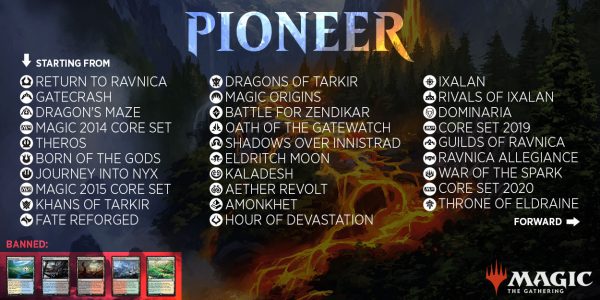
Here is a list of the sets legal in the Pioneer format as well as the current banned list, the Khans of Tarkir fetchlands.

It's important to note that WoTC was worried enough about 4-5 color "good stuff" decks that they started the format off by only banning lands that help fix mana, likely to prevent a format like KTK-BFZ standard which was typically 4+ color decks with perfect mana.

While WoTC has given us plenty of options for mana fixing in this format, it's important to keep in mind that we haven't gotten truly "free" fixing since the original A/B/U/R dual land cycle. All of our rare duals now have some sort of significant drawback or caveat attached. Oftentimes this caveat involves entering the battlefield tapped, which typically affects aggro decks more so than control or combo decks.

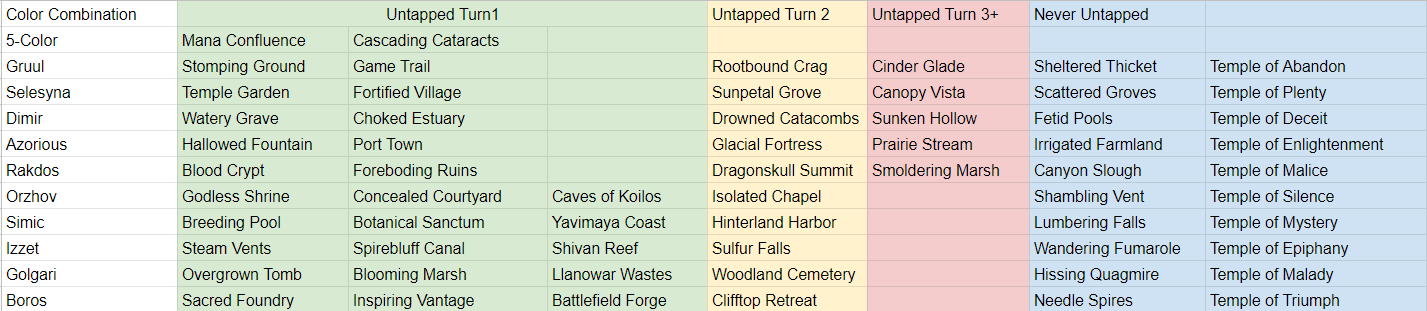
We know that in most eternal formats the early turns often decide the final outcome, so mana restrictions in the first few turns can greatly affect the outcome. With all that being said here is a graphic showing the color combination options as well as the restrictions on entering the battlefield untapped for all the rare mana fixing lands legal in Pioneer.

Initial observations imply that the enemy colored decks will have slightly faster mana fixing as they have 3 sets of duals that can be tapped for either color on turn 1. The allied color combinations will likely be a bit slower, though the fact that both Dimir and Azorius are typically color combinations that fall into that control category seems fitting. All color combinations do have an equal number of rare dual land options to begin with. It is also important to note that decks playing black have access to Urborg, Tomb of Yawgmoth which will also help fix their mana.

Potential Speculation Opportunities

We have started to see the Kaladesh fastlands move in price already. Speculating on these is fine if you can find them underpriced. However, I am doubtful that these lands can rise above $10-$14 as that was the ceiling when they were in Standard. Kaladesh debuted in the fall of 2016, which isn't long enough ago that the playerbase would have grown enough to raise that ceiling. Many are now sitting in the $8-$10 range which means that after fees and shipping even if they were to reach $14 you would see minimal profits.

There was an error retrieving a chart for Botanical Sanctum
 
There was an error retrieving a chart for Blooming Marsh

In my opinion, the lands with the most opportunity for growth are the Shadows Over Innistrad duals. While they were mostly overshadowed by the KTK-BFZ interaction during their days in standard, these lands are currently dirt cheap with many copies of each version being under $1.25. They are great lands to play turn 1, as you are likely to have another land to let them come into play untapped and the land you reveal only has to have the correct land type. In Pioneer, the shocklands, BFZ duals, and Amonkhet cycling lands can all be revealed to trigger the untap requirement.

There was an error retrieving a chart for Choked Estuary
There was an error retrieving a chart for Game Trail
As with most dual land cycles, the color combination(s) of the major decks will command the highest premiums. The format is still in its infancy, so determining any sort of metagame trends is unlikely; thus your best bet is to spread the risk and buy a basket of the lands with the knowledge that some will likely increase a good bit more than others.
There was an error retrieving a chart for Sunken Hollow
My second choice of lands for speculative opportunities would be the BFZ duals. While they are more likely to be better in non-aggro decks, the fact that they usually enter untapped later in the game and have multiple land types which is important for both the SOI lands I previously mentioned and the buddy land cycle (the duals from Ixalan and Dominaria) makes them decent targets. They were heavily played during their time in Standard; admittedly, a large part of that was tied to access to the KTK fetches which Pioneer does NOT have.
The only other land I would specifically keep in mind is Mana Confluence. While the pain may add up over time, it would likely be a must-include for any deck with four or more colors and might be good enough in a 3-color deck.
There was an error retrieving a chart for Mana Confluence

What I would avoid

It is important to remember that when given a limited pool, players will play with whatever is available, however, when additional options are given players will gravitate towards using only the best option. I bring this up because, while the Theros block scrylands are an option, the scry 1 is likely not that valuable compared to the fact that they always enter tapped. Thus, I would argue they are the worst of your options in this format. I would expect any growth for scrylands to be tied to standard use, so speculating on them is ok if your focus is Standard. However, I dislike them as Pioneer specs.
There was an error retrieving a chart for Temple of Plenty


Insider: Pioneer’s Most Important Cards, Part 1

Are you a Quiet Speculation member?

If not, now is a perfect time to join up! Our powerful tools, breaking-news analysis, and exclusive Discord channel will make sure you stay up to date and ahead of the curve.

Hey, all! Chroberry here back with my first proper article in a long while. As many Insiders may be aware, I've recently taken a more active role in some behind-the-scenes work at Quiet Speculation, which led me to take a break from articles and focusing more on our Discord, Trader Tools, and more. However, this crazy new(?) format has got me pumped to revisit some old favorites, and I'm excited to go over them with all of you.

The official announcement of Frontier Pioneer this Monday as Magic's latest non-rotating format has gotten players everywhere making mad scrambles for cards they know will be good in the new format. Much like the hype that ensued after Modern's inception in 2011, many cards stand out as frontrunners, as we've seen so many ludicrously powerful (and downright banworthy) cards dominate the metagame in their respective Standards.

This article will likely end up reading like a greatest hits list of the past seven or so years of Standard, but I promise you there will be some surprises at the end.


Lands, Lands, Lands

It's hard to start off talking about the format without first mentioning manabases, the keys to casting all of our powerful spells on time. Much like Modern before it, a vast majority of the mana bases that hold up Pioneer's early decks will start with the shocklands from the two Ravnica blocks that are legal in the format, and the checklands. What's significantly different this time around is the forced absence of fetchlands, the only initial bans for the format.

This will force many mana bases to be running full playsets of this land pairing, a marked difference from the usual two-shock two-check paradigm we usually see in Modern. Fetchlands aren't here to enable low shockland counts, so expect to be running approximately four of each, and likely far more basic lands than we're used to seeing in other Eternal formats. We can only hope this banning decision from Wizards contributes to deck diversity. It appears to be a good step in the right direction.

There was an error retrieving a chart for Overgrown Tomb

These are by far the most important cards to be picking up now if you're looking to start brewing in this format. If you don't have your 40 of each, I would consider making some fast trades and quick buys to get your hands on these early. Supply is high, but this sudden spike in demand will do a very good impression of the hype we saw during Modern's initial announcement, in a time period that was well before Return to Ravnica promised reprint of the cycle. Earlier is better.

There was an error retrieving a chart for Woodland Cemetery

While our shocks and checks are likely the most important, don't forget all the other untapped options we have access to in this format. Many have stated that the mana bases for three colors will be a bit rough, but not for total lack of support. This notion comes from the half-finished nature of some cycles, such as the Kaladesh fastlands and Core Set painlands only being in enemy colors. You'll probably be packing playsets of those as well, if your deck has access to them that is.

There was an error retrieving a chart for Blooming Marsh

These aren't the only "playables" to keep in mind, though. Take the time to consider some of the other options to fill gaps in your mana base, such as the allied Battle for Zendikar tangolands, the allied cycling lands from Amonkhet, the Temples of Theros, and finally the reveal lands from Shadows Over Innistrad. These will not be super high-priority pickups in terms of cost, but should be something to keep in mind.

There was an error retrieving a chart for Llanowar Wastes

Before we move off the subject of lands, I should mention; it's probably no secret that Golgari-based decks will likely be the most powerful piles in the format's early days. For reasons I'll be outlining shortly, I'd prioritize picking up your Overgrown Tomb and Woodland Cemetery playsets to save yourself some extra dollars, as these may be more in demand than most of the others in those cycles. To add to that, I'll shoot my shot and say that Sultai will be the preferred "good-stuff" decks, as we have an insane amount of options in those colors to build powerhouse decks.

The Good Stuff

Most of the cards I'll be outlining here are my initial thoughts for being a distinct cut above the rest. We've got a lot of ground to cover, so I'll be moving quickly.

There was an error retrieving a chart for Thoughtseize

First and foremost, I will have to call out Thoughtseize to be what I consider the most powerful card by rate in this format. Its last appearance was format-warping and usually demanded four slots in every black deck during its life in Standard. Pound for pound, it doesn't really have an equal. To quote Ari Lax,

Would likely quit my day job if I always got Thoughtseize in Standard. Or quit Magic. Unsure which, honestly.

There was an error retrieving a chart for Oko, Thief of Crowns

I'm sure no one is surprised to see Oko on this list. Oko is making huge strides in all the constructed formats it's legal in, and that trend will likely continue in Pioneer. We're about to get very tired of Oko's reign in Standard, and I wouldn't be surprised if this three-mana planeswalker makes its way on to the first banned-and-restricted announcement regarding this format. It is possible that the expanded card pool will balance out its relatively high power level, but I'm not seeing it from here just yet. It also fights Teferi, Time Raveler for space as being the most significant three-mana walker.

There was an error retrieving a chart for Teferi, Time Raveler

We'll likely see Bant lists pairing these two together to great success, and you can expect to see the value of this card to rise over time, as well. While definitely more oppressive to see across the table in some matchups, 3feri has a greater chance of surviving any initial bans and seeing significant growth in the next few months.

There was an error retrieving a chart for Aetherworks Marvel

Speaking of ban-worthy cards, I have very little doubt that Aetherworks Marvel will make its way to that very same announcement. With the second iteration of the Eldrazi Titans legal alongside it (namely Ulamog, the Ceaseless Hunger), along with the full suite of energy cards from Kaladesh, I would be incredibly surprised if this artifact dodges that first wave of adjustments to the Pioneer. Attune with Aether turned out to be one of the biggest offenders representing the energy mechanic, and you may want to keep an eye out on that one as well.

There was an error retrieving a chart for Smuggler's Copter

As it turns out, the Kaladesh block has a ton of absolutely busted cards that may receive a quick ban. Again, I say that with very little testing of this format, but cards like Smuggler's Copter, Saheeli Rai, the Gearhulk cycle, and tons more have the potential to be overrepresented in Pioneer than many other sets. If you'd like a deeper dive on some of bigger cards from that set, I wrote an article about it some months back, still long after Frontier had well outstayed its welcome.

There was an error retrieving a chart for Saheeli Rai

Pay particular attention to the lifespan of Felidar Guardian in this format, as it will be a big indicator of how willing Wizards is to let Pioneer have a powerful two-card combo deck. Obviously, we'll see a lot of players attempting to build decks around cards like Approach of the Second Sun and Nexus of Fate that have basically have the text "you win the game" on it, but the speed of those spells pales in comparison to what CopyCat decks will be able to do.

To Be Continued...

There is such a large swath of cards to go over, and I've only scratched the surface so far. Join me soon for part two, where I'll go over more of the hits, as well as some more off-beat choices that you may not have considered. Stay tuned!

Balance and Blades: Honing Stoneforge Mystic

Are you a Quiet Speculation member?

If not, now is a perfect time to join up! Our powerful tools, breaking-news analysis, and exclusive Discord channel will make sure you stay up to date and ahead of the curve.

Unbannings always trigger a surge of interest, articles, and brewing. When the card's utility and thus its home is obvious, the cards is quickly adopted, as was the case for Bloodbraid Elf. For those whose power is tougher to unlock, interest and visibility wanes while the hard work is done. Such is the case for Stoneforge Mystic.

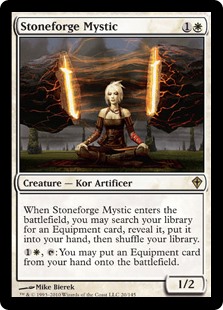
I've been working with Stoneforge Mystic since the unban, and getting the Kor to consistently perform has proved surprisingly frustrating. Today, I'll be explaining my results and discussing why it's so hard to actually wield Stoneforge in Modern.

A Note on Pioneer
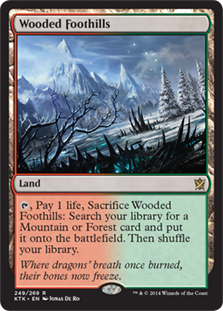
The additional announcement of the Pioneer format was interesting, but there's not much to say at this point. Wizards didn't say much in the announcement other than that it exists and the fetchlands are banned. All this tells me is that they're worried that it will go the way of Frontier, which is understandable. The fetchlands and Battle for Zendikar duels and lack of punishment for greedy mana meant that 4-5 color good stuff dominated everything. Lack of metagame shifts or diversity killed existing interest while lack of support prevented growth. Whether banning fetchlands saves Pioneer from the same fate is impossible to say right now. If it does, then this would functionally push Modern into Legacy's niche. If Pioneer fails then the status quo will remain. We just have to wait and see.

The Bladesmith's Forge

After weeks of testing, my overwhelming impression of Stoneforge Mystic is confusion. I don't understand what is going on with the Mystic package in relation to the rest of Modern. Results, both in pure testing and in tournament settings, have indicated opposing forces and effects at work. On the one hand, Stoneforge is a very strong value card as well as a game-winning threat. On the other, it is a very awkward, slot-intensive package that isn't very good if drawn out of order. Swords and Batterskull didn't see play before Stoneforge for a reason, and if you've drawn them, Stoneforge becomes a very bad threat. The whole is greater than the sum of the parts, but when the parts come individually, they're terrible. Playing with Stoneforge therefore has a very schizophrenic feel.

Game-Changing...

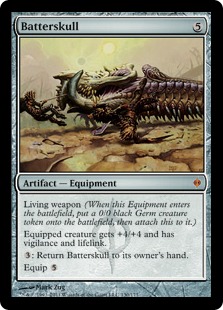
The strongest argument in Stoneforge's favor is that it is game-warping. Once Mystic is in play, the opponent always has to pause and reevaluate their entire gameplan. Unanswered, Batterskull is a five-turn clock that makes it significantly harder for many decks to kill the artifact's controller. Active Swords can be more threatening if the protection or triggers are particularly relevant, like Sword of Feast and Famine against a combo deck. Thus the game becomes about the Mystic. If you can kill her, it is almost always correct to do so immediately. If not, then the only option is to find a way around the Batterskull. This is easier said than done, since a 4/4 vigilance creature is a significant body in almost every matchup.
Worse, you have to destroy the artifact to remove the threat, and not many decks can do that in Game 1. Control will get grinded out, while aggro and combo will have to race. As my original testing suggested and subsequent testing has shown, this is very hard. Ground-based aggro like Humans can't really punch through 'Skull. Meanwhile, even evasive aggro struggles. While Spirits just flies over the Germ, it still has to deal four extra damage every turn to actually make progress. This lengthened clock in turn incentivizes aggro to overextend to try to win the race, leaving them vulnerable to sweepers. In addition to being a solid threat, Stoneforge has a disruptive effect by warping opposing gameplans and demanding answers that in a vacuum aren't useful in the overall matchup.

...But Not Meta-Shifting
Despite its effects on individual games, Stoneforge has made little measurable impact on the metagame at large. We are still in a turbulent time, and the metagame has only begun to settle, but there is no widespread adoption of blue-based midrange going on. This is understandable, since just as with Jace, the Mind Sculptor beforehand, it is very hard to incorporate new cards into fair decks.

There's a lot more need to balance and tweak something fair than something busted. The former needs the right balance of supportand power cards, the latter mostly needs enablers. Even when the right balance is found, the actual effect of the fair card may be worthwhile, but too subtle to independently detect. Another factor may be the overall metagame being hostile. Amulet and Tron did very well in Indy, which is very bad news for blue decks.

Bottom Line

Stoneforge's advantages seem to be balanced by its weaknesses. The game-warping power is balanced by clunkiness; the increased pressure on aggro by reduced answers for other decks. Therefore, on net, Stoneforge is currently an ambiguous addition to Modern. It's certainly playable, but additional work is needed to make it great. That work may best be left in the hands of others, as all the avenues I've explored have led to frustration.

Stoneblade Meandering

When the unbanning happened, some joked that the change provided a great opportunity for Legacy Stoneblade players to 5-4 Modern events. I've come to understand the reasoning behind this joke. Stoneblade is not putting up impressive results, and every deck I've tested felt poor for different reasons.
The devil is in the details. A control deck can just slap more powerful answers or card advantage on its problems, but Stoneblade has to balance the answers against its threats. The need to hit Stoneforge on-curve also makes the manabase trickier: there's a lot of tension over how many Celestial Colonnades can be run before the deck fails to curve out or has to kill itself with shocklands to make it work. More refinement may be all that Stoneblade needs for a major breakout, but it feels like there's also raw power missing, and I'm not sure if it's on the answer or threat side.

Jeskai

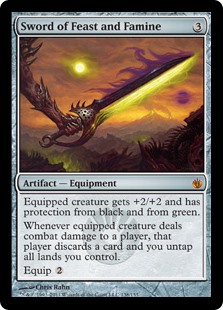
I stated where most of the metagame started, Jeskai Stoneblade. On paper it seemed like the perfect home. Lots of answers to clear the road for threats, solid protection, and the option to burn the opponent out is a very solid strategy, and making the threats even better seemed legit. Stoneforge stood to be especially potent here since Sword of Feast and Famine is exceptional in a deck that needs to tap out for threats but is also packed with counterspells. However, despite hype and expectations leading up to SCG Dallas, nothing happened. In fact, the only big result was a Top 4 in Ghent.
Based on my experience testing the deck, I think it comes down to the metagame. Jeskai thrives on picking apart small creature decks and out-tempoing slow decks, and that's not the metagame we seem to have. I initially tried to simply turn my Jeskai tempo deck from 2018 into Stoneblade, but quickly discovered that even with a Sword, Geist wasn't good enough. I had to cut too many answers to fit in all the creatures and the Stoneforge package, so Geist had to go. Then, despite constant tweaks to that answer package, I never found the right mix to both keep me alive and clear the road. There's too much Jund, Urza combo, and Amulet Titan pulling me in too many directions to make Jeskai a sane deck. If things settle towards the middle or move toward creatures then Jeskai is definitely where I want to be.

Jeskai Stoneblade, David Ernenwein (Test Deck)

Creatures

4 Spell Queller
4 Snapcaster Mage
4 Stoneforge Mystic

Planeswalkers

2 Teferi, Time Raveler
1 Jace, the Mind Sculptor

Artifacts

1 Batterskull
1 Sword of Feast and Famine

Instants

4 Opt
4 Lightning Bolt
4 Path to Exile
3 Lightning Helix
2 Mana Leak
3 Cryptic Command

Lands

4 Flooded Strand
4 Scalding Tarn
2 Steam Vents
3 Hallowed Fountain
2 Sacred Foundry
1 Sulfur Falls
1 Glacial Fortress
3 Snow-Covered Island
2 Snow-Covered Plains
1 Snow-Covered Mountain

Esper

The other control option was Esper Stoneblade. Considering his history of whining and being wrong about Modern control and general disdain for the format, I hate to agree with Shaheen Soorani. However, he's right that Esper Stoneblade is the right vercion for a combo- or even control-heavy metagame. Thoughtseize is the answer to everything, and just better at ensuring the road will be clear than any other option. The removal is also much more decisive, and Drown in the Loch is an extremely powerful Game 1 card. I also frequently board it out because this is the kind of deck that opponents absolutely will bring in graveyard hate against.

Esper Stoneblade, David Ernenwein (Test Deck)

Creatures

4 Snapcaster Mage
4 Stoneforge Mystic

Planeswalkers

2 Teferi, Time Raveler
2 Jace, the Mind Sculptor

Artifacts

1 Batterskull
1 Sword of Feast and Famine

Sorceries

4 Thoughtseize
3 Lingering Souls

Instants

4 Opt
3 Path to Exile
3 Fatal Push
2 Drown in the Loch
2 Cryptic Command
2 Force of Negation

Lands

4 Polluted Delta
4 Flooded Strand
3 Field of Ruin
2 Hallowed Fountain
2 Watery Grave
2 Godless Shrine
3 Snow-Covered Island
2 Snow-Covered Plains
1 Snow-Covered Swamp

The problem is that the deck is very dependant on Stoneforge. Lingering Souls is a very strong card against control and Jund, and the overall answer package can get there, but it's really hoping that it doesn't have to. There's just not a lot of closing power unless Stoneforge has survived, and that means the comparatively thin answer package can be overwhelmed. That's not as big an issue if combo is popular, and the deck can easily be tuned to pick control apart, but doing that and maintaining the staying power to beat aggro or Tron is very hard. I think this is a better pick than Jeskai right now, but I'm still unhappy with it.

Azorius

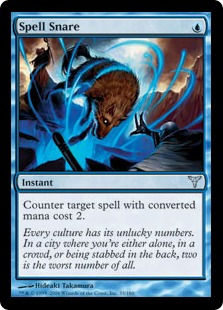
Azorius Stoneblade has more results than the other versions, but it's also the version that I like the least. The idea is to take the less painful manabase, add utility lands and Spell Snare, and prey on all the other midrange decks. This is not bad in theory, but I've consistently found it to be a triumph of hope over reality. There's nothing about UW Stoneblade that feels better than the alternatives, and it frequently feels like playing bad UW Control. Running the Stoneforge package means cutting planeswalkers and answers, and those have always been the main advantages of UW. Stoneblade must get by on situational counters and Path to Exile. In practice, I always feel behind against everything and struggled to catch up unless turn-three Batterskull goes unanswered. At least with control I knew when I was actually winning.
Some lists have taken to running Mystic Sanctuary to create a Cryptic Command soft-lock. While it can be powerful, it is not a cure-all. If you're looping Cryptic, you can't do anything else; you don't draw a new card for the turn, so your board is effectively locked. It gets worse if you need to loop Cryptic to not die to creatures, since now the opponent can simply find an answer or a planeswalker, resolve it, and power through. The only way to make the loop good is if you have an additional constant source of card advantage or a clock  in play, and as mentioned, such can prove a tall order for Stoneblade decks. I'd run straight UW Control with Sanctuary rather than Stoneblade.

Aggro Rising?

I haven't seen Stoneforge in aggro decks very much. Then again, I haven't been seeing that many results for aggro in the first place. I'd blame the heady combination of Jund and Urza currently dominating. The former is generally good against aggro thanks to waves of removal, and the latter is hard-to-disrupt combo. Given that Humans can't run Stoneforge due to mana issues, it makes some sense that Stoneforge hasn't seen much play in creature decks.
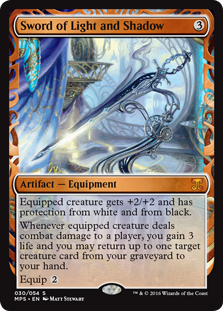
However, that doesn't mean that it won't work. I took UW Spiritblade to an MCQ last month and it performed well, although I missed Top 8 on tiebreakers. The Stoneforge package, specifically Sword of Light and Shadow, was critical to wins over Jund and Esper Control. As a grinding tool, I've never found anything better that works consistently in aggressive decks. The problem is that you need to be doing a lot of grinding for it to really matter, as the aforementioned awkwardness is palpable in an aggressive deck. Over longer games, the initially dead cards become more relevant and playable, and what had been awkward bricks change to game winners. However, my meta shifted away from control and towards combo and big mana, so I cut the package.

That said, I'm confident that in a different meta or build, Stoneforge will excel. Having a threat that demands answers and is at least a cantrip is very rare for the aggro, and the threat of turning into an unsolvable threat can be potent. The question of how to do that remains, and I don't have answers. Spirits and synergy-based decks aren't the answer, mainly due to the lack of cohesion: Spiritblade really felt the pinch when I wasn't triggering Mausoleum Wanderer or couldn't flash in Mystic with Rattlechains. A more goodstuff-oriented shell is necessary for Stoneforge to excel.

Death and Taxes

Legacy's best Stoneforge Mystic deck is still struggling in Modern. I've tried a number of different builds with Stoneforge, and they haven't impressed me, mostly due to the weakness of Death and Taxes in general. The deck has always been underpowered compared to other decks. In Legacy, Thalia, Guardian of Thraben is a house, and most creatures are on the small-and-cheap side. But in Modern, size matters far more. Every DnT deck I've ever tried has felt anemic compared to other decks, particularly other creature decks. Going the Eldrazi route helps somewhat , but adds mana issues. Additionally, when the disruption doesn't line up, the deck flounders.
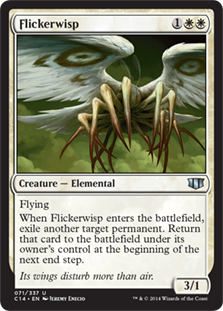
Mystic helps with the power problem, though not quite enough. The bonus from Swords is very welcome, particularly when the protection is relevant. However, it is rather slow and vulnerable to removal in response to equipping creatures. It's also not that hard for certain decks to answer the equipment itself, setting pilots back to square one. Batterskull is a decent threat, but often outclassed on the ground. As a recurring threat or when equipped to a flier it can swing games, but it can also be so clunky that it never gets going.

What I've found is that the threat of the equipment is far greater than its reality, and opponents alter their play patterns to my advantage. Jund will hold onto Kolaghan's Command or Assassin's Trophy rather than just using it to stabilize. That threat can be leveraged into considerable tempo and incremental value, which can then turn into game wins. For that reason, I feel that moving away from disruption and towards card advantage is the right call in a vacuum. However, given that Urza combos seem to be rising that seems like a very poor idea. My guts says that DnT is very close now to being a real deck, the problem is finding exactly the right mix of relevant disruption and power to make it work.

Outside Shots
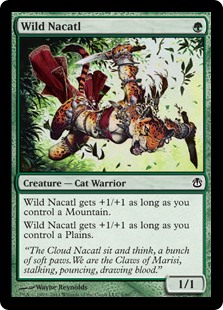
I've also heard chatter about other Stoneforge aggro decks, but that hasn't turned into anything concrete. Right after the unbanning, players were trying to make Stoneforge Zoo work. Zoo is a goodstuff aggressive deck focused on bigger creatures. In theory, this solves DnT's power problem. However, I haven't actually seen results. Zoo's problem is that it's too medium in Modern's metagame, and Stoneforge doesn't sufficiently fill in the gaps.

Meanwhile, there are rumblings that Mardu Stoneblade is a thing. The theory is that if you pack all the removal alongside Seasoned Pyromancer, then Batterskull- or Sword-wielding spirit tokens can cruise to victory. I'm skeptical that it will given Mardu's history, but anything is possible.

Too Stoned

I predicted that it would take time for Stoneforge to actually find a home in Modern, but I may have underestimated how much. I've spent a while looking already, and feel like I'm going in circles. Here's hoping someone cracks the code soon


Insider: Brawl Decks and You

Are you a Quiet Speculation member?

If not, now is a perfect time to join up! Our powerful tools, breaking-news analysis, and exclusive Discord channel will make sure you stay up to date and ahead of the curve.

I apologize to my regular readers for the hiatus recently. My wife and I took a 12 day trip to Italy paid for with my MTG profits this year. It was an amazing experience and it was a lot more affordable than I initially would have expected. This is the third year in a row in which I sunk my MTG profits into non-MTG things; two years ago it was an engagement ring, last year it was a wedding, and this year it was the Italy trip.

I used to sink all my profits into expanding my collection and inventory. However, I've found that it's important to diversify where you get your enjoyment, and to be 100% honest, I don't find the same joy in the game as I used to. Having non-MTG related goals financed by MTG has helped me enjoy the game from a different angle. Also, it helps me justify some of my purchases to my wife. If anyone wants to discuss this topic or what site I used to book my vacation please feel free to personal message me in our Discord chat.

Now it's time we get into the actual MTG finance part of this article.

If you are a member of pretty much any MTG buy/sell/or trade groups on Facebook, you likely saw a ton of people trying to sell the Brawl decks for significantly higher than the "MSRP" of around $20 that they were expected to go for. The reason for this is that it seems that many local game stores had a very limited allotment of these decks and they all contain some fantastic Commander cards, as well as some very fun "build around me" commanders.

Looking at the graph below we can see that Arcane Signet started out very high. In fact, if you were able to pre-sell them you could have paid for any of the decks they came in.

There was an error retrieving a chart for Arcane Signet

In fact, many of the cards found only in these Brawl decks started out quite high due to this initial scarcity including all four of the commanders;

There was an error retrieving a chart for Chulane, Teller of Tales
There was an error retrieving a chart for Alela, Artful Provocateur
There was an error retrieving a chart for Korvold, Fae-Cursed King
There was an error retrieving a chart for Syr Gwyn, Hero of Ashvale

We've seen quite a few cards spike in price thanks to just these commanders and I expect we'll continue to see more as players finally get there hands on these decks.

There was an error retrieving a chart for Overburden
There was an error retrieving a chart for Heartseeker
There was an error retrieving a chart for Scion of Oona

The biggest winner though is a common from Visions that when you have Chulane out reads; "pay one blue mana and Explore".

There was an error retrieving a chart for Shrieking Drake

Shrieking Drake has actually sold on TCGPlayer for $4.47.

These spikes show that the Brawl commanders have strong demand, so I've come up with a list for each commander of cards that haven't moved much yet but have some potential.

Chulane, Teller of Tales

There was an error retrieving a chart for Vizier of the Menagerie

While Vizier is a relatively recent card, it was printed at mythic and it managed to hold a $2.50 price tag despite seeing virtually no play in standard throughout its life. It has crept up to around $5 (mid) though there are plenty of copies sitting in the sub $3.50 range as of October 20th. According to EDHRec, it's currently in 20% of the lists submitted which is significant enough to take note of.

There was an error retrieving a chart for Karametra, God of Harvests

Karametra is a bit older and came from a very underpowered set. This card has seen very steady solid growth over the past few years and it could easily jump should it fall into the "auto-include" category for Chulane decks.

Alela, Artful Provocateur

There was an error retrieving a chart for Coastal Piracy

Coastal Piracy has been printed twice, once as an uncommon in Mercadian Masques and the other as a rare in 8th Edition, thus both printings were long before the playerbase booms of the mid 2000's and thus there are likely a lot fewer copies of this card floating around than you might think. It provides a powerful effect that is highly desirable in a deck that generates evasive tokens. It's also important to note that Alela is the only one of Brawl commanders that doesn't include an ability to draw cards.

There was an error retrieving a chart for Grand Architect

Grand Architect seems like an auto-include in any Alela deck. It is a lord effect in a color that doesn't often get them and it allows you to tap the tokens Alela makes for mana to cast artifacts which then make more tokens. It has a single printing from 9 years ago and it belongs in most blue-based artifact Commander decks. It saw a spike a few months ago but has rapidly cooled back down and it sitting below $5.

Korvold, Fae-Cursed King

There was an error retrieving a chart for Awakening Zone

Awakening Zone seems like it should be considered an auto-include for any Korvold deck. It generates mana producing tokens with a built-in sacrifice outlet for no mana every turn. While it has been printed 4 times, 3 of those were in small print run sets like the original Commander decks and Planechase products. It once held a price of over $5 but has slipped considerably to around the $2.5-$3 mark.

There was an error retrieving a chart for Mazirek, Kraul Death Priest

While typically everyone who bought the Plunder the Graves deck focused on Meren of Clan Nel Toth, Mazirek was the other option as a Commander. There is only the one printing and people often forget that Commander players tend to hold onto the unique Commanders. Supply is often a lot lower than you'd expect; in fact, a glance at TCGPlayer shows only 65 vendors with copies most of which are one-of's.

Syr Gwyn, Hero of Ashvale

Syr Gyn is an interesting one because he has a few different "build around" options; one can go with a heavy equipment theme which is why we see cards like Heartseeker spiking or one can go with a knight theme which is why we see Knight Exemplar up 200% in the past month.

There was an error retrieving a chart for Sigiled Sword of Valeron

Sigiled Sword plays perfectly in both builds. It is an equipment that creates knight tokens. It's also a bulk rare so you have very little risk and a fair amount of potential reward on this one. It is obviously a very recently printed card but core sets typically get opened less than block sets. I would imagine this would be close to an auto-include in any build of Syr Gwyn.

There was an error retrieving a chart for Khorvath Brightflame

This is one of the few instances where I likely wouldn't play both partners of a Battlebond partner pair, however, Korvath providing flying and haste to all your knights seems extremely strong in a deck whose commander that lets you draw cards when knights attack.

Conclusion

I'm actually a big fan of the Brawl decks that WoTC released with Throne of Eldraine. The new Commander options are causing random price spikes that us MTG financiers love and I am excited to build my Chulane deck. It's also very important to note that all of the Brawl cards are legal in Standard.

You would expect WoTC's R&D department to vet these additions to their bread and butter format, and should any of them find a home in Standard that card could see massive gains given that the easiest way to acquire them is to simply buy the decks. Though, I do believe that WoTC did promise that any Brawl deck cards could also be found in the Collector Boosters, but at $20+ each this seems like an unlikely source for significant Brawl specific card supply.

QS Insider Cast – Pioneer is Here!

Are you a Quiet Speculation member?

If not, now is a perfect time to join up! Our powerful tools, breaking-news analysis, and exclusive Discord channel will make sure you stay up to date and ahead of the curve.

Welcome back to the QS Cast! Join Chris Martin, Chris O’Berry, and Sam Lowe as they talk about the new non-rotating format, Pioneer. This cast was originally broadcasted live to Insiders in the QS Insider Discord, October 21st, 2019.

Show Notes

Show notes provided by Chris Martin

1. We covered Pioneer craziness - touched on the impacts it could have to other formats and one important point made by @Cardbreaker was the possibility of rotation being less opportunistic due to Standard players hanging onto more cards for Pioneer. We felt in response to that awesome point that we will need to be more diligent tracking floors (i.e. buying at peak supply).

2. We covered Modern Horizons as a possible impact from Pioneer in the sense that the Modern spotlight could cool off and make MH1 more dependent on Commander players to drain supply (i.e. anyone who spec'd on MH1 will need to be aware that those cards could take longer to mature to profitability)

3. We talked about the importance and safeness of "real estate" (mana bases) because they are highly unlikely to be banned in Pioneer with Fetches already gone.

We also isolated a handful of lands we felt will become staples in the new format:

Spirebluff Canal Blooming Marsh Botanical Sanctum (moved a bit already today because of obvious Oko synergy) Mana Confluence (only 5C fixer in the entire format, WARNING that a reprint could be on tap in Return to Theros, though) 4.

We listed a card each which we like that did NOT spike significantly today Chroberry --> Whisperwood Elemental, in at $1 and out at as much as $10 if it legitimately catches on as a staple to an archetype. Sam --> Torrential Gearhulk, in sub $5 and out at as high as $15 or more (Sam feels strongly that this could be one of the better cards in the format, especially if Baby Teferi ended up on the ban list. Chris --> Chandra, Torch of Defiance, in at $10-12 and out at $20+ (on heels of burn/red being positioned well out of the gates)

Wanna chat? Find us on Twitter or in the QS Discord

Chroberry – @chroberry
Chris Martin – @ChiStyleGaming
Sam Lowe – @MahouManSam

Four Tips for Buying Cards Peer-to-Peer

Are you a Quiet Speculation member?

If not, now is a perfect time to join up! Our powerful tools, breaking-news analysis, and exclusive Discord channel will make sure you stay up to date and ahead of the curve.

Thanks to recent changes in legislature, popular selling websites such as eBay and TCGPlayer now withhold sales tax from buyers. Large vendors such as Card Kingdom have also implemented a sales tax. While a 6-10% sales tax may seem like a minimal value, the increase in purchase cost can really gouge one’s margins.

For example, oftentimes I’ll grind a 10% profit using ABUGames credit arbitrage. If ABUGames began withholding sales tax at my local tax rate of around 7%, 70% of my profits would have eroded. This would render the practice virtually pointless from a money standpoint (I still enjoy the practice and helping the community).

As a result, I’ve been relying more heavily on peer-to-peer transactions recently. My sources include Facebook, Twitter, and Discord. With the frequency of this activity increasing, I’ve run across a few dos and don’ts I wanted to share, particularly on the buying side. These are not meant to call anyone out—in fact, I have broken some of these rules for customers multiple times. But I think it’s important to share some helpful tips when buying cards from others online, especially for those who don’t buy from private individuals online that often.

Recommendation 1: Be Up Front About Shipping and Fees

It’s convenient that social media sites don’t charge fees to use their platform to transact Magic cards. Facebook, Twitter, and Discord are all convenient platforms to use, making them attractive venues for pedaling wares.

Unfortunately, the fee structure for the most popular payment method—PayPal—is often less understood. Depending on how payments are sent, they can incur a fee. Currency conversion also merits a PayPal fee, and these fees can begin to add up. As in the case of eBay and TCGPlayer, these fees are incurred by the seller receiving the payment.

When I sell to peers and receive these PayPal payments, I expect my account to increase by the price agreed upon. Once the payment hits my account, I receive an alert in email and on my phone. However, that alert displays the price paid by the buyer. If there’s a fee due to the way PayPal was used, I can only see it if I log into my account to view the transaction.

I usually don’t mind if the payment incurs a fee. But my recommendation to buyers is to be 100% clear if the desired method of PayPal payment will incur a fee or not. I may be willing to eat the fee, or I may ask to share that cost with the buyer. Either way, I want to know in advance how that fee will be covered before a transaction is executed. This up-front transparency will eliminate any surprises when I check my account to ensure the agreed-upon payment is credited to my account.

Recommendation 2: Be Up-Front about Delayed Payments

Sometimes I’ll post a card for sale, someone will message me about it, and we’ll negotiate back and forth a bit. I’m always open to reasonable offers, and I’m often a motivated seller. My desire for liquidity is your opportunity to get a great deal on a card. This back and forth is perfectly acceptable.

What I don’t appreciate, however, is when after the negotiation takes place and a price is agreed upon, the prospective buyer asks if they can pay at some point in the near future. This reminds me of the Popeye character Wimpy, who always wanted to pay for his hamburgers next Tuesday.

If you need to wait for payday or some influx of cash to your account, I ask that you please be transparent about this at the very beginning. Otherwise, in these scenarios the seller incurs some hidden risks. What if the buyer backs down? What if the card's price drops due to reprint or spoiling of some new card? These are possibilities that suddenly make the deal much more awkward.

By being upfront and stating your intention to pay on a future day makes it crystal clear to me as a seller that if I accept an offer, that payment won’t come for some time. Sometimes that’s OK, but other times if a card is very easy to sell, I may not want to wait. But being transparent is the best way to avoid a very awkward situation in which a price is agreed upon, and then I have to wait days to complete the transaction I had intended to complete immediately.

There was an error retrieving a chart for Delay

I recognize that in reality, people don’t always have funds readily available in their PayPal accounts. I can be flexible. But please don’t spring the surprise news at the very end of negotiation—it just leaves a sour taste in my mouth.

Recommendation 3: Don’t Make Offers Below Buylist

It may seem obvious to some, but you would be surprised how many times I am selling a card and someone offers me a number below Card Kingdom’s or ABUGames’ buylist. While I don’t expect everyone to know every vendor’s buylist price, you really need to be lowballing to make such an offer sometimes.

I always price my cards below TCG low (by condition) when I’m trying to make a sale. Sometimes that may not be a competitive enough price, but I don’t expect offers more than 10-20% below my asking price all the same. Other reputable sellers on social media also consistently price their cards to sell quickly. Coming in with an offer 30+% below asking price can therefore be insulting.

There was an error retrieving a chart for Anger

I try not to take offense to such lowball offers—I know it’s not a personal attack on my intelligence. But it could reflect poorly on the buyer, and can be perceived as an insult. If you’re interested in purchasing a card from someone and you want to make a low offer, please do a quick check online to make sure you’re not offering below vendor buy prices. That's all I ask. Maybe there's still good justification for proceeding with the lower offer, in which case sharing the data you've uncovered in your research could help strengthen your rationale for the lower offer.

Trader Tools is a handy tool to make that quick check: if your offer is below the buy price that shows up on that site, you need to make sure you consider your offer once more before sending it to the seller. Sometimes condition, past relationships, or other factors make such a low offer acceptable. But if this exception isn’t obvious, please think twice before clicking “send.”

Recommendation 4: Don’t Throw Away Envelopes Right Away

I’m usually pretty cheap (this should come as no surprise). If I can save a few bucks by buying one copy of a card from four sellers instead of four copies from one seller, I will do so despite the minor inconvenience.

When I do this, it sometimes gets confusing when the cards arrive in the mail—who shipped me which copy? If I only receive three and the fourth gets lost in the mail, who is the seller I need to contact? Or if one arrives damaged, I need to know who shipped that copy.

There was an error retrieving a chart for Telepathy

Some sellers don’t include an invoice (this would be a corollary recommendation—always include an identifier within the envelope if you’re selling), so the only way to identify them is by referencing the return address on the envelope. That’s why I always keep envelopes until I’ve confirmed the seller. If you tear open your packages and immediately toss the envelope, you may run into a sticky situation whereby a copy had not arrived, and you don’t know who the offending seller is.

If you’re the seller, include an invoice or something that identifies you as the seller. If you’re the buyer, keep all materials the card came with until you know who sold you that particular copy. It will avoid potential confusion and ensure the sellers get the credit they deserve for that shipment, whether it be positive or negative feedback.


Wrapping It Up

Selling peer-to-peer using social media is an attractive way to exchange Magic cards. By avoiding fees, a lower price can be offered to buyers while sellers can achieve greater liquidity.

However, sometimes these peer-to-peer transactions bring along with them some headache. Sometimes that headache is worthwhile because it means I can sell at a higher price, or sell more quickly. Other times, I’d rather just ship to a buylist to avoid the hassle. It’s truly case-dependent.

To facilitate the smoothest transactions possible, I presented four recommendations on how to be most up-front and transparent.

First, be crystal clear on payment method and who will incur the fees. No one likes getting paid less than what they agreed upon because of an unexpected fee. Second, be very up-front about your payment timeline. If you can’t send payment over for a few days, that may be fine. But don’t complete negotiations and then spring that news upon me at the very end—it leaves a sour taste in my mouth. (On the other hand, if you can pay immediately, make that intention clear as well because I may accept a slightly lower offer if I know the cash is nearly in-hand).

Third, please try to avoid making lowball offers below vendor buylists. I don’t expect buyers to know the buylist price of every card offered by every vendor. Because I try to make my prices competitive, I just ask that you double-check if you’re about to make an offer more than 20% lower than my asking price. It may still be fine, and I may still be desperate enough to accept. But if your number is less than Card Kingdom’s number, you’re not likely going to get a yes.

Lastly, always keep the materials a card was shipped within until you definitively confirmed who sent the cards. This is good practice for situations where you ordered multiple copies of a card from various sellers. And if you’re a seller, by that same token, try to include an identifier within the envelope so buyers know who shipped them the card(s). It eliminates a potential issue should a card not arrive, or arrive damaged. This happened to me once, and I had to use the return addresses on the envelopes to confirm which seller’s card hadn’t arrived so I could open a case and pursue a refund.

These practices aren’t mandatory, but they’re helpful to make peer-to-peer transactions as smooth and pain-free as possible. And doing this will motivate me to offer more cards for sale via social media rather than shipping to buylists, benefiting the player base rather than the major vendors.

…

Sigbits

  • A basic land now shows up on the top of Card Kingdom’s hotlist. What basic land could possibly have a buy price of $490? None other than the Guru Island, of course! I haven’t tracked Guru land prices, so I don’t know if this is a good number or not. But it’s just really interesting to see a basic land top the list!
  • Second on the list is another ubiquitous card: Lightning Bolt. At one point they had Beta copies on their hotlist, but now only the Judge Promo version is, with a $295 buy price. This foil continues to be one of the most valuable versions of the red common, though I prefer Beta copies myself.
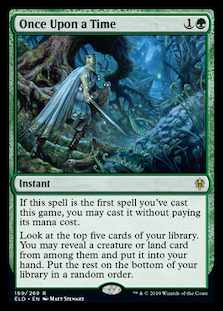
  • The only Throne of Eldraine card to show up on the first page of Card Kingdom’s hotlist (meaning it’s in high demand and has a high enough buy price) is the extended art version of Once Upon a Time. The special printing of the green instant carries a $47.50 buy price, currently. These special card versions are going to make for interesting study as their prices unfold over time.

Make It Happen: Modern’s New Enablers

Are you a Quiet Speculation member?

If not, now is a perfect time to join up! Our powerful tools, breaking-news analysis, and exclusive Discord channel will make sure you stay up to date and ahead of the curve.

2019 may well go down in the books as the Year of Enablers. Between the Faithless Looting-fueled Phoenix decks and the Stitcher's Supplier-abusing Hogaak menace, Modern was defined this year by pushed cards locating, buffing, and ultimately breaking engines and payoffs. Of course, both Phoenix and Hogaak have left us by now. Without Looting in the picture, players have turned to new strategies—and new enablers. Today we'll look at the three biggest players powering the format's new school of competitive decks.

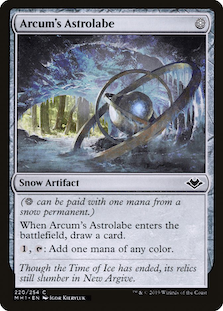
Arcum's Astrolabe

This unassuming artifact is first on our list, and has already popped up in decks ranging from totally fair to completely crazy.

Taste the Rainbow

On paper, Astrolabe serves one main purpose: filtering mana. It replaces itself in terms of card economy, only charging pilots a single mana for game-long access to colors of their preference. And boy, does the extra filtering go a long way! We've already seen four- and five-colored control decks rear their heads, as well as this behemoth, which continues to put up results against all odds:

Niv-Mizzet Reborn, by Dan Schriever (3rd, SCG IQ Danbury)

Creatures

3 Niv-Mizzet Reborn
1 Tolsimir, Friend to Wolves
1 Huntmaster of the Fells
1 Ice-Fang Coatl

Planeswalkers

3 Teferi, Time Raveler
1 Kaya, Orzhov Usurper
1 Wrenn and Six

Artifacts

4 Arcum's Astrolabe

Enchantments

4 Utopia Sprawl

Instants

3 Assassin's Trophy
1 Drown in the Loch
1 Izzet Charm
2 Kaya's Guile
1 Kolaghan's Command
4 Lightning Helix

Sorceries

3 Bring to Light
1 Dreadbore
1 Supreme Verdict
1 Unmoored Ego

Lands

1 Breeding Pool
1 Misty Rainforest
1 Overgrown Tomb
4 Pillar of the Paruns
4 Prismatic Vista
2 Snow-Covered Forest
1 Snow-Covered Island
1 Snow-Covered Mountain
1 Snow-Covered Plains
1 Snow-Covered Swamp
1 Stomping Ground
1 Temple Garden
1 Verdant Catacombs
2 Windswept Heath
1 Wooded Foothills

Sideboard

1 Abrupt Decay
2 Ashiok, Dream Render
1 Crumble to Dust
1 Dovin's Veto
1 Fulminator Mage
1 Izzet Staticaster
1 Kambal, Consul of Allocation
1 Kess, Dissident Mage
1 Knight of Autumn
1 Lavinia, Azorius Renegade
3 Rest in Peace
1 Unmoored Ego

Niv-Mizzet Reborn proves that even full of clunky-looking spells, drawing that many cards is as good a combo turn as any. The spells in question actually play much smoother than first appears thanks to Astrolabe, which lets the deck curve Assassin's Trophy into Teferi, Time Raveler into Huntmaster of the Fells quite smoothly. Indeed, it feels as though Astrolabe's filtering capabilities are unmatched in Modern.

Filtering, though, is less of a story right now than Astrolabe's other function: super-charging artifact decks. The best-performing of these strategies is Whirza, an aggro-control-combo hybrid that attacks opponents from a myriad of angles and has proven quite difficult to disrupt for all but the most disruption-heavy decks (AKA Jund).

Whirza, by Mason Grode (3rd, SCG Classic)

Creatures

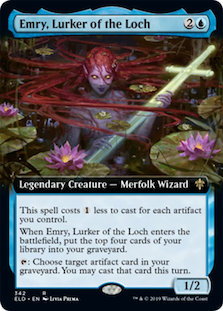
4 Emry, Lurker of the Loch
2 Sai, Master Thopterist
4 Urza, Lord High Artificer

Planeswalkers

2 Saheeli, Sublime Artificer

Enchantments

3 Jeskai Ascendancy
1 Search for Azcanta

Instants

4 Paradoxical Outcome

Sorceries

1 Nexus of Fate

Artifacts

4 Engineered Explosives
3 Everflowing Chalice
4 Mishra's Bauble
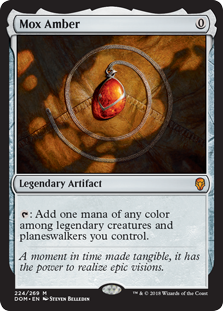
2 Mox Amber
4 Mox Opal
4 Arcum's Astrolabe

Lands

8 Snow-Covered Island
1 Snow-Covered Mountain
1 Snow-Covered Plains
2 Flooded Strand
1 Hallowed Fountain
3 Prismatic Vista
1 Scalding Tarn
1 Steam Vents

Sideboard

4 Chalice of the Void
4 Engineered Explosives
2 Ceremonious Rejection
2 Galvanic Blast
3 Generous Gift
2 Path to Exile
2 Teferi, Time Raveler

Jeskai Ascendency is a recent addition to these decks, and comes alongside the freshly-printed Emry, Lurker of the Loch. Between Mox Opal and Astrolabe, how to accommodate the enchantment's supposedly steep color requirement was never much of a concern.

Once Upon a Time

Next up is Throne of Eldraine wave-maker Once Upon a Time. The unique cantrip seems to be redefining the way green-based Modern decks are built. Its success in big-mana strategies like Tron, Valakut, Eldrazi, and Amulet is old news now. But Time continues to impress in less-likely archetypes.

Traverse Shadow, by Ole Spree (4th, MCQ Utrecht)

Creatures

4 Death's Shadow
1 Murderous Rider
1 Plague Engineer
4 Street Wraith
4 Tarmogoyf

Artifacts

4 Mishra's Bauble

Instants

2 Assassin's Trophy
1 Dismember
4 Fatal Push
1 Kolaghan's Command
3 Once Upon a Time
2 Temur Battle Rage

Sorceries

4 Inquisition of Kozilek
4 Thoughtseize
4 Traverse the Ulvenwald

Lands

1 Blood Crypt
4 Bloodstained Mire
1 Forest
2 Nurturing Peatland
2 Overgrown Tomb
1 Stomping Ground
1 Swamp
4 Verdant Catacombs
1 Wooded Foothills

Sideboard

2 Alpine Moon
4 Collective Brutality
1 Collector Ouphe
1 Embereth Shieldbreaker
3 Fulminator Mage
1 Kolaghan's Command
1 Plague Engineer
2 Veil of Summer

Traverse Shadow employs Traverse the Ulvenwald as additional copies of its precious few threats, some of the best beaters in Modern. But the sorcery doesn't come online until delirium is set up, which can take up to a few turns. Enter Once Upon a Time, which locates Shadow or Goyf early on without fussing about graveyard requirements.

A topdecked Time won't find anything, naturally. But previously occupying this spot was the now-banned Faithless Looting, which helped turn on delirium fast enough for Traverse to dig up threats in a timely manner. Time fills a similar purpose, sculpting early plays while boasting an instant typeline; pre-Time, players would run enablers as lackluster as Manamorphose to ensure access to the card type.

Dredge, by Julian Hecker (6th, MCQ Utrecht)

Creatures

2 Golgari Thug
3 Merchant of the Vale
4 Bloodghast
4 Narcomoeba
4 Prized Amalgam
4 Stinkweed Imp

Artifacts

4 Shriekhorn

Instants

1 Darkblast
1 Once Upon a Time

Sorceries

2 Conflagrate
4 Cathartic Reunion
4 Creeping Chill
4 Life from the Loam

Lands

1 Blast Zone
1 Blood Crypt
1 City of Brass
1 Mountain
2 Bloodstained Mire
2 Forgotten Cave
2 Gemstone Mine
2 Stomping Ground
3 Copperline Gorge
4 Wooded Foothills

Sideboard

1 Leyline of the Void
3 Ancient Grudge
3 Lightning Axe
3 Nature's Claim
2 Thoughtseize
1 Haunted Dead
1 Ghost Quarter
1 Shenanigans

In the same Top 8, Julian Hecker's Dredge deck also makes use of Once Upon a Time, if just at one copy. By now, plenty of math has been issued on how to best abuse the cantrip, and one copy apparently makes sense depending on a deckbuilder's goals. It will be interesting to see this card appear at varying numbers in a variety of lists over the coming years.

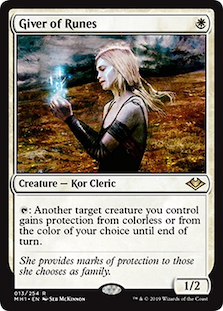
Giver of Runes

Our last feature is Giver of Runes, a card whose future seemed unsure when Modern Horizons was spoiled. Fortune has certainly smiled upon the Kor, who now co-stars in multiple creature decks. It turns out many are in the market for a one-mana Spellskite.

Mardu Shadow, by VOLOLLO (1st, Modern PTQ #11965105)

Creatures

4 Death's Shadow
4 Giver of Runes
1 Hex Parasite
4 Tidehollow Sculler
4 Ranger-Captain of Eos
4 Street Wraith

Instants

4 Fatal Push
2 Kolaghan's Command
2 Lightning Bolt
2 Temur Battle Rage

Sorceries

3 Inquisition of Kozilek
4 Thoughtseize
2 Unearth

Lands

2 Arid Mesa
2 Blood Crypt
4 Marsh Flats
3 Bloodstained Mire
2 Godless Shrine
1 Sacred Foundry
4 Silent Clearing
1 Plains
1 Swamp

Sideboard

1 Ashiok, Dream Render
1 Celestial Purge
1 Collective Brutality
3 Fulminator Mage
1 Kaya's Guile
1 Liliana of the Veil
1 Liliana, the Last Hope
1 Lingering Souls
1 Path to Exile
1 Pithing Needle
1 Plague Engineer
2 Wear // Tear

Mardu Shadow is my favorite of the Giver decks, using the creature as an all-purpose utility play. Here, Giver does it all: it draws removal away from Shadow, as do targeted discard spells; it pushes damage through blockers, as does Temur Battle Rage. And it helps block, as does Death's Shadow. That it's searchable by Ranger-Captain of Eos is the icing on the cake.

GW Eldrazi, by Tanner Bromer

Creatures

4 Eldrazi Displacer
4 Giver of Runes
4 Noble Hierarch
4 Ranger-Captain of Eos
4 Reality Smasher
4 Stoneforge Mystic
4 Thought-Knot Seer
1 Walking Ballista

Artifacts

1 Batterskull
1 Sword of Light and Shadow

Instants

4 Once Upon a Time
4 Path to Exile

Lands

4 Brushland
4 Cavern of Souls
4 Eldrazi Temple
1 Forest
2 Plains
2 Temple Garden
4 Windswept Heath

Sideboard

2 Blessed Alliance
2 Collector Ouphe
2 Damping Sphere
1 Hexdrinker
2 Nature's Chant
2 Rest in Peace
2 Thalia, Guardian of Thraben
2 Veil of Summer

While I haven't tested the above build of GW Eldrazi personally, archetype aficionado Tanner Bromer stands by this build as a viable alternative to more conventional Knotblade decks we've been seeing. The big difference? Gone is Ancient Stirrings, once a cornerstone of the strategy, to make room for Giver of Runes. The core of Once Upon a Time, Giver, Eldrazi Temple, Hierarch, and the strongest colorless creatures does seem potent, and I'm excited to take this Stir-free build for a spin.

Custom Brews Enabled

We'll no doubt see a new league of enablers emerge as the defining bunch of 2020, but Astrolabe, Time, and Giver are already setting the bar pretty high. Which role-player do you think is next to blow up?

Lessons Learned from SCG Indi and ELD Part 1/2

Are you a Quiet Speculation member?

If not, now is a perfect time to join up! Our powerful tools, breaking-news analysis, and exclusive Discord channel will make sure you stay up to date and ahead of the curve.

I’ve been on a bit of a hiatus from Magic recently, both from playing competitively and from watching market trends. How foolish I was, distracted largely by the wonderful 2004 iteration of World of Warcraft that has occupied the majority of my time for the last month and a half. This ends today. Magic is awesome, and it’s particularly awesome right now. Before we move on from WoW Classic, check your Auction House for Winterfall Firewater. I’ve been snapping these bad boys up for 50 silver a pop, and once more people are raiding on your server, they should be worth a decent amount more. I’ve farmed a ton of Winterfall Furbolgs and can say confidently that they’re not super easy to farm. Now, onto the card game!

My Tournament Weekend

Let’s start with the competitive side of Magic before delving into Finance. I played the following Four-Color Snowheeli Blade list:

Cast Saheelis to Escape Your Feelies

Creatures

4 Felidar Guardian
4 Stoneforge Mystic
4 Ice-Fang Coatl

Planeswalkers

2 Jace, the Mind Sculptor
4 Saheeli Rai
3 Teferi, Time Raveler

Spells

1 Batterskull
1 Sword of Fire and Ice
2 Spreading Seas
3 Force of Negation
4 Arcum's Astrolabe
4 Path to Exile
1 Winds of Abandon

Lands

1 Snow-Covered Forest
3 Snow-Covered Island
1 Snow-Covered Mountain
2 Snow-Covered Plains
1 Breeding Pool
4 Flooded Strand
2 Hallowed Fountain
4 Prismatic Vista
1 Sacred Foundry
1 Temple Garden
3 Windswept Heath

Sideboard

3 Blood Moon
2 Deafening Silence
2 Rest in Peace
2 Stony Silence
2 Timely Reinforcements
3 Veil of Summer
1 Ceremonious Rejection

I spent way too much time playing WoW and not very much time testing. I was really invested in hitting level 60 and not very invested in performing well in this tournament. I played two MTGO leagues to test. I 1-4’d with Neobrand and 2-3’d with this deck. Since 2 is better than 1, I played this deck. I also 3-2’d with Storm earlier in the week, but that deck scares me and I figured I’d misplay less with this deck. Whether or not that was true is unclear, as I managed to misplay many times with this deck anyway. The primary difficulty of this deck is just sequencing. Do you play out your Teferi, Time Raveler now, or your Saheeli Rai, or do you hold up your Stoneforge Mystic activation, or do you hold up hardcast Force of Negation? Or Ice-Fang Coatl?

This deck is really clumped on decisions for the Turn 3 mark and I did not have nearly enough experience to make those correctly. It’s certainly a powerful deck, but I didn’t feel like I was particularly favored against the format’s current mainstays. Urza, Lord High Artificer decks felt deceptively easy when playing against them online, but I’d only played against the new combo variants with Jeskai Ascendancy and/or Paradoxical Outcome. The variants that can Whir of Invention for Ensnaring Bridge or Pithing Needle proved to be much more difficult. The deck was a ton of fun, but I’m not passionate enough about it to champion the archetype, and that’s what it really needs right now.

I dropped half-way through day 1, but the bonfire was already lit.

Amulit. I'm sorry.

The Fire to Improve

I was going to put the work in and play a good deck, hopefully the best deck, whatever it takes. From the matches I’d played, and from my conversations with players, I’d determined the likely best choice for this would be Amulet Titan. I’m also good friends with a lot of the best Amulet pilots, so I have a wealth of resources to pull from to learn the deck. I approached Will Pulliam to get his decklist so I can buy the cards for it. I catch him just as he’s finishing his match, and he informs me that he’s currently 7-0.

It may not mean too much, but it felt like this was a sign that I’d chosen the correct deck. He happily shipped me his list, and through a combination of helpful Twitterers and Magic vendors, I acquired the 43 cards I needed from the deck for about $250 total. This process also revealed something magical to me: cards in the Amulet Titan deck are likely underpriced right now. These two graphs are very telling:

There was an error retrieving a chart for Azusa, Lost but Seeking
There was an error retrieving a chart for Amulet of Vigor

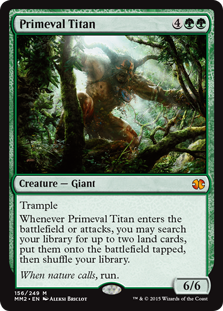
A lot of vendors had not noticed just how far these cards have dropped recently. One vendor had Azusa, Lost but Seeking available for $40 per. Another had the same card from the same set in the same condition for $20 per. Yet another had them for $30. Amulet of Vigor had a similarly wild price spread across vendors, albeit none asking quite so high as $40. Is $40 that unreasonable for Azusa though? She was nearly that high earlier this year, before the Summer Gaak Attack. With Amulet Titan back on top of the Modern metagame, I expect these and other staples of the deck such as Primeval Titan and Summoner's Pact to see some serious gains.

One powerful Magic card from this deck bridges us over to Throne of Eldraine’s massive impact on the market: Once Upon a Time. Be sure to check out last week’s iteration of the QS Cast to witness me underestimate this card’s potential. OUAT is the real deal folks. My misguided thoughts were limited to thinking of the card in terms of Mono-Green Tron and Neobrand. Two copies of Mono-Green Tron made the top 16 of SCG Indi, and one of them played 3 copies while the other played zero.

It’s just too easy to brick in a deck that is not reliant on its creatures in the early game and only plays 17-19 lands. In Neobrand, it’s a buck-wild “Allosaurus Rider or bust”, which is likely an improvement to the deck, but not a particularly impressive one. OUAT is busted in Amulet Titan though. It also seems to be performing quite well in Jund Death's Shadow, Devoted Devastation, and GW Eldrazi decks. When you have numerous good creatures that you want to hit at any point in the game, OUAT becomes very powerful.

Any queasiness I had from paying $13 a copy at Indi was quickly dispelled after playing with the card in Amulet Titan. Shortly after I completed this article, the decklists for Mythic Championship V were posted. Once Upon a Time is the most played card, with 169 copies across 68 decklists. It may spike before this article is even published, and I will discuss the Mythic Championship in more detail in next week's article.

A Powerhouse Set

Once Upon a Time is merely one of a wide swath of powerful cards impacting Modern already. The following cards are also already proving themselves in Magic’s most widely-played eternal format: Oko, Thief of Crowns, Brazen Borrower, The Royal Scions, Bonecrusher Giant, Emry, Lurker of the Loch, Drown in the Loch, Charming Prince, Castle Garenbrig, Wishclaw Talisman, Mystic Sanctuary, Grumgully, the Generous, Mystical Dispute, Witching Well, Merchant of the Vale, Gingerbrute, All that Glitters, and Into the Story. I think that’s everything for week one.

That is just so, so many eternally playable Magic cards in one set. And yet, prices for this set are relatively flat and stagnant across the board. Normally, this would be unheard of. This fall set is clearly powerful, but there’s a large, dark cloud blanketing the skies of MTGFinance: The banned and restricted list update announcement was moved forward to October 21st.

Magic players know this can only mean there is a change that needs to occur sooner rather than later, and only one archetype fits the bill: the Field of the Dead/Golos, Tireless Pilgrim decks in Standard. The Magic community at large believes that Field will get the axe, but will anything else go with it? It wouldn’t shock me if Wizards took out Teferi, Time Raveler as well, effectively unbanning Instants in Standard. I think Modern is unlikely to be touched, particularly after the wonderfully diverse metagame we saw in Indianapolis last weekend. Urza-related cards are likely safe for now, so if you need them, please help yourself by buying them before Monday while there is still apprehension about a possible ban.

As for Standard, little is safe. Oko, Thief of Crowns is very unlikely to get banned and is powerful enough to remain a mainstay of the format. Murderous Rider will definitely start seeing play if Black is at all playable. Fires of Invention could become the basis for the best deck in Standard, depending on how things shake out. The only easy buy here is Bonecrusher Giant, as it’s nearly certain to continue seeing play in Standard and is available for a mere dollar currently. I personally think the showcase version of this card is really cool, and they’re still cheaply available in both foil and nonfoil. I wouldn’t be at all surprised if $20 for a set of foils winds up seeming ridiculously cheap in a month.

There was an error retrieving a chart for Bonecrusher Giant

It's also possible that low singles prices may be ahead for Eldraine, as this set seems to be a victim of the "Dominaria Effect", in which a set has many powerful cards competing for the value of the booster box price. Be wary that if the diversity of value stays this wide, it could mean lower prices for all but Oko, Thief of Crowns.

Part 2 Comes Next Week

We’re just brushing the surface of Throne of Eldraine’s complexity here. There’s a bunch of money to be made if you can predict what deck is going to wind up on top of the post-ban Standard metagame. Right now may also be your last chance to get ahead of the Modern bull market! Join me next week for Part 2 of this article, where I will break down Throne of Eldraine Collector’s Boosters and how the numerous new premium variants of Standard cards fit into the current MTGFinance world. We'll also go over the financial implications of Mythic Championship V. Thanks for reading, tweet at me if you have any questions about buys/sells leading up to the ban.

See you all at #SCGATL and the #SCGINVI!

Metagame’s First Look: SCG Indianapolis Analysis

Are you a Quiet Speculation member?

If not, now is a perfect time to join up! Our powerful tools, breaking-news analysis, and exclusive Discord channel will make sure you stay up to date and ahead of the curve.

With a few weeks of online events and an SCG Team Event, the metagame is finally taking shape. It's nowhere near enough for any real analysis to take place, but it is a good starting point. With SCG Indianapolis in the books it's time to start pulling apart the data and contextualizing it.

Modern has been incredibly volatile this past year: Faithless Looting's ban knocked out a longstanding pillar, Hogaak, Arisen Necropolis warped the format, and we've been spoiled for new cards. So much has changed that I don't think it fair to compare the new metagame to the pre-Modern Horizons one. Therefore, I'm treating the new meta like a blank slate. I don't know what the metagame "should" look like anymore, so I won't judge and will continue to be open minded but skeptical until more data comes in.

Day 2 Meta

As has become tradition, I'll start with the broadest data and then get more specific. Prior to the tournament, the expectation was for Urza, Lord High Artificer-based decks to dominate. The deck appeared to be solid and the addition of Emry, Lurker of the Loch stood to supercharge the deck. Of course, this was all speculation, so let's see what really happened.

Deck NameTotal #
Other 28
Amulet Titan12
Urza Ascendancy12
Jund12
Mono-Green Tron11
Burn11
Urza Outcome8
Grixis Death's Shadow6
Eldrazi Tron5
5-C Whirza5
Humans4
UW Control4
Titanshift4
Jund Death's Shadow3
Dredge3
UW Stoneblade3
Bant Stoneblade3
Devoted Devastation2
Abzan Company2

I'll give the prophets partial credit: if you aggregate all the various types of Urza decks, they would be the best represented deck in Indy's Day 2. Even if you only lump the combo versions together, they'd be the most popular deck. They'd still be behind the other category, but this is Modern, so that fact doesn't really count. That I have to aggregate at all is one mark against the predictions. There's also the question of it being a self-fulfilling prophecy; as always, hyped decks show up in great numbers and then do well, so it's hard to say if the result is meaningful.

Jund is tied for first place among individual decks, which is surprising given the quantity of big mana decks (aka Jund's worst matchups). It would be easy to attribute this result to Wrenn and Six, and the ensuing hope all Jund players seem to have, but this may be legit. The power of Jund has always been playing slightly-better cards than the opponent, and more of them. Now Jund never has to miss a land drop end enjoys a consistency upgrade. I hope to see this result sustained.

Top 32 Results

Now to move onto the Top 32. I know I ususally only do the Top 16 in these articles, but I saw the results initially posted as the Top 32, and just rolled with it. (For those curious, the data for all Day 2 decks has now been released.)

Deck NameTotal #
Amulet Titan4
Urza Ascendancy3
Mono-Green Tron3
Burn2
Humans2
Grixis Death's Shadow2
Jund2
Urza Outcome2
Gifts Storm1
Jund Death's Shadow1
GW Eldrazi1
Dredge1
Devoted Devastation1
UW Stoneblade1
Esper Goryos's 1
Four-Color Whirza1
Boaryo's Vengence1
Elves1
Abzan Company1
Bant Snowblade1

Gifts Storm won the event, though that makes perfect sense given the bracket. The only Top 8 decks with relevant game 1 interaction were GW Eldrazi and Jund Shadow, and the only way Drake Sasser could have hit them was in the finals. Instead, Drake was fed a steady diet of other combo decks and just won the footrace each time. Storm is relatively easy for other decks to disrupt, but it is usually the faster and more reliable combo. From what I saw, Drake benefitted from his opponents' more complicated decks clunking to varying degrees.
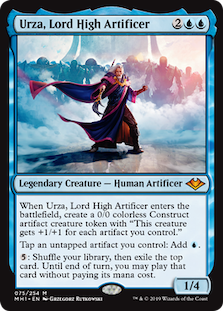
The rest of the sample is a host of big mana and combo decks. I count 8 midrange or slower interactive decks, 5 aggro decks, 12 combo decks, and 7 big mana decks. The three most-played decks all fall in the latter categories. Why this happened is hard to say, though the low Humans turnout is likely a factor; Humans was initially built to thrash Storm, and the clock-plus-disruption strategy is the classic way to defeat any combo. It can also race most big mana decks and has considerable sideboard options against them. The lack of control is likely a combination of lots of bad matchups against big mana and uncertainty over how to build the decks. Between a developing metagame and difficulty making Stoneforge Mystic work, I'd wager they're just not ready for the big time yet.

Classic Complication

Finally, it's time to look at the frequently contradictory data, the Modern Classic. The Classic posts very different results from the main event so often that I can't imagine it's a coincidence. My theory has been that the Classic is composed of Day 1 drop-outs, and so reflects the starting population. However, it's been reasonably argued to me that some decks do better in shorter tournaments rather than long. I may never know the reason for the deviation, but it happened again.

Deck NameTotal #
Urza Outcome4
Amulet Titan2
Dredge2
Jund2
UW Control1
Izzet Kiki1
Burn1
Abzan Company1
Jund Death's Shadow1
Eldrazi Tron1

Only one version of Urza deck appeared, and it dominates the data. Amulet is alphabetically second, but tied with Dredge and Jund. The only version of Tron is Eldrazi Tron, which appears at copy. This is more in line with the aforementioned predictions and expectations and to an extent defies the Open. Again, I'm not sure what to make of it or how it relates, but it does provide an interesting data point for further investigation.

Bottom Line

Combo decks had a very good week, winning both events. Big mana was the next-biggest category, while the fair decks suffered. Given matchup expectations, I'd argue that players expected fair decks to be out in force and came with their predators. This suggests that in future weeks, anti-combo decks will be the metagame call.

Dangerous Outcome?

Urza, Lord High Artificer decks were clearly the most popular decks last weekend. There has been considerable attention on the deck, and a lot of high-level players claim it's the best deck in Modern. There haven't been many Modern events since Hogaak, Arisen Necropolis was banned, but Urza decks have done very well. Naturally, this has led the internet to start the usual banning speculation, as happens whenever a new deck does well. Normally I'd just ignore the calls, but there's a wrinkle this time.
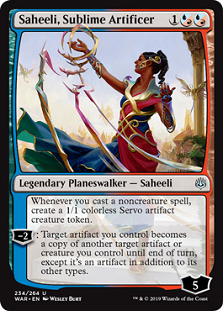
Last week, Wizards suddenly announced that they were moving up the date of the next banned and restricted announcement from November 18 to October 21. This has naturally led to speculation that the new kid on the block was getting axed. This is almost certainly false. Given the timing of the announcement and the competitive schedule, it's more likely a Standard ban is coming.

The announcement came as decks were being submitted for this weekend's Standard Arena Mythic Championship, and Golos, Tireless Pilgrim decks were overwhelmingly popular. Prior to then, they were widely considered the best deck, and fairly oppressive since Standard lacks answers to Field of the Dead. Given that it looks like Field will dominate this weekend and there's another Standard MC next month, the land itself is the likely target. As a result, it is very unlikely that anything will happen in other formats.

Historical Precedent

That doesn't mean it is impossible for Modern to see another ban, just that it's not why the announcement was changed. If there is to be a ban, the only possible target would be the Urza decks. Nothing else appears to be as successful or (theoretically) dangerous. However unlikely I believe it is, there is a reasonable argument for why another ban could happen: simply put, the Urza combo decks look to be another round of Krark-Clan Ironworks, and can play out similarly to the previously-banned Eggs. These precedents make it more plausible for a ban should Urza cause enough problems.

The main problem is logistical. If observations from the weekend are to be believed, it may not be power or dominance that makes Wizards take action, but the repetitiveness. The linked clip was from Autumn Burchett taking nearly twenty minutes to combo off with Paradoxical Urza. While that is an absurd time to spend on one turn, I'm told Autumn has a reputation as a slow, delibrate player, and that turn was not unusual. The only reason this could translate into a ban is if these lengthy combo turns are universal, which I can't verify.

A linked problem is that the combo isn't deterministic: the combo decks don't necessarily have a combo kill. Singleton Aetherflux Reservoir is the closest I've seen to an immediate combo kill. Whether they're running Jeskai Ascendancy or not, these decks intend to win by making an absurd amount of Thopter or Servo tokens and maybe have Nexus of Fate for a combo kill delayed by one turn (until the tokens can attack). Tokens are fairly easy to interact with, and Plague Engineer can undo a great deal of comboing. All these factors result in dull gameplay for viewers and opponents.

Given that these problem are why Ironworks got banned, it's not impossible that something could get banned from Urza. If that happens, I expect it would be Urza himself, as it's generally preferred to ban engine cards. The Emry combo is less reliable and can also be shortcutted to victory.

Reliably Unreliable

I strongly doubt that anything will happen in Modern next Monday. Wizards just had a major banning, and therefore it's too early to be making proclamations about the metagame. We're just getting the first look at actual metagame data, and the picture is unclear.

Urza is very popular and is getting a lot of hype. This necessarily translates into metagame presence. As previously discussed, the hype says that Urza is busted, and decks featuring him are far better than anything else in Modern. Whether this is actually true hasn't been shown in results, but it's too early to be certain. It would take a very clear tale of Urza decks dominating MTGO, which only Wizards knows, for any action to be taken.

Going beyond the data, I'm also not certain on a qualitative level that anything needs to happen. I've been helping a friend test the Urza decks, and he's described it as the most frustrating deck in the world to test. When the Jeskai Ascendancy or Paradoxical Outcome versions are running well, it's the closest we'll ever come to playing paper Vintage. PO Urza's combo kill is basically a Black Lotus away from Vintage Outcome. However, when it doesn't, it feels like complete garbage. The deck is mainly air and needs a critical mass of artifacts to do anything.

Fearful Commitment

The problem has been that a given hand might be the former or the latter, and there's no way of knowing until you play out the game. On many occasions, we've kept turn-one Emry hands, completely whiffed on the mill, and then drawn only payoff cards without anything to make them good. The exact same hand with a mediocre-or-better Emry mill wins within a couple turns. The Ascendancy version is slightly better in that redundant enchantments stack and trigger each other when cast, so there's a chance to dig into gas; however, a Lightning Bolt on Emry can kill any chance that version has to win.
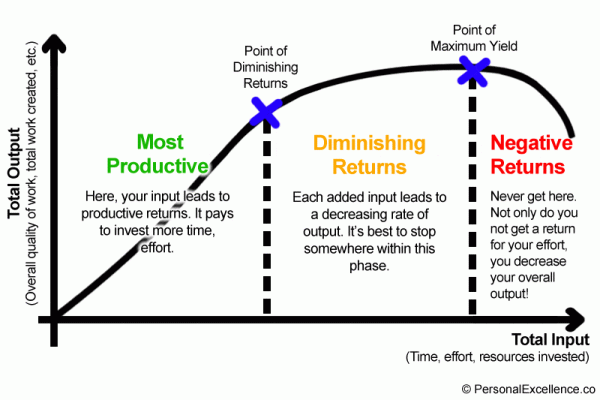

Testing the combo version has also turned my friend off the more reliable Whirza combo/prison decks. Having a reliable gameplan is great, but it feels anemic in comparison to the combos. The data disagrees, but he says it feels so much worse. Then there's the overarching issue with all these decks: they're very poor if Urza himself never resolves.

Just the Start

SCG Indianapolis is the first data point of this new Modern. As always, it will take quite a bit more data before any determinations or predictions can be made. Still, it is exciting to see Modern's rapid shift from this time last year.

Why MTG Finance Exacerbates My Smartphone Addiction

Are you a Quiet Speculation member?

If not, now is a perfect time to join up! Our powerful tools, breaking-news analysis, and exclusive Discord channel will make sure you stay up to date and ahead of the curve.

My name is Sigmund Ausfresser, and I have a problem.

After reading the book Digital Minimalsim by Cam Newport, I realized that I have an addiction to my cell phone. I found myself monitoring meaningless events from my phone rather than paying attention to what’s around me: my 2-year-old’s bath time, my son’s arts and crafts project, and my spouse’s daily conversation about her day. Does my phone really contain information more valuable than these in-person experiences with my family? This was the first indication that I needed to make a change.

Then I got a whiff of the data, graciously recorded by my iPhone, and the word “addiction” became more appropriate. How else can you explain something that grabs my attention for an average of 2 hours 33 minutes a day; something I pick up and look at an average of 105 times a day; and something that attempts to grab my attention via notifications an average of 66 times a day? I’d say that qualifies as an obsession, wouldn’t you? What a waste of time!

There was an error retrieving a chart for Time Stretch

What does this have to do with Magic? Much of the time I’m looking at my device, it’s because of a Magic engagement. Whether it’s Twitter, Discord, Slack, or browsing in Safari, I spend so much of my time using my phone to engage in the Magic hobby. While these services have a purpose, I think it’s time I make some drastic changes. Immediately.

What’s the Incremental Value…Really?

In the past, I have written about the material benefits of engaging with the MTG finance community on social media. Discussing cards on Discord, monitoring trends on Twitter, and watching metagames unfold on Twitch are fantastic ways to stay in the loop on what cards are making waves in the multiverse. But how often does engagement with these services provide quantifiable benefit?

Consider the law of diminishing returns:

The first couple times these social networking services are engaged, productivity is realized. But it doesn’t take long before the benefit of each incremental check yields a diminishing return. When I wake up in the morning, I check MTG Stocks, Card Kingdom, Discord, and Twitter to see what trends unfolded overnight. There are usually a few valuable tidbits. But checking these same services and sites ten times more throughout the day offers minimal, if any benefit.

It’s time I put a stop to these unhealthy habits. I’ll still respond to people when they ask me MTG finance questions directly because I love interacting with the community. But my replies will be slower. Additionally, I’ve deleted Discord, Facebook, and Twitch from my phone so I can only interact with these services from a computer—this way the distractions won’t get to me while I’m out and about. My Twitter usage will also be severely reduced and I intend to cull the number of accounts I follow to better curate my feed (no offense to anyone I may unfollow!).

To enforce these rules for myself, I have also utilized the Screen Time function in iOS—now my access to the Twitter app is shut down after I use this service for fifteen minutes in a given day (I hope to reduce this time even further). This seems like ample time, but it goes by so quickly because Twitter is my primary interface with the community.

Will I miss some crucial event and fail to capitalize on a golden opportunity for profit due to these self-imposed restrictions? It’s possible, but highly unlikely. As long as I purposefully stay engaged when it’s convenient for my schedule, I’ll remain informed of major events: ban and restriction updates, metagame evolution (I don’t care much about Standard and Modern anyway), and special product releases.

It’s important to remain informed of these occurrences as they unfold, but these are acute events. Monitoring every person’s random tweet and following every buylist change on Card Kingdom’s website is far less valuable. It’s these behaviors that I intend to eliminate.

Jeremy’s Grab Bags: A Case Study

Quiet Speculation’s newest writer, Jeremy (@MissouriMTG on Twitter), has devised a brilliant method of liquidating cards while maximizing his time: selling grab bags. You can purchase these products in $100, $450, and $1000 increments. Because of his reputation, prospective buyers know they’ll receive “value” in purchasing these pre-assembled products. Every $100 spent is assured to realize at least $100 in cards.

I’ve purchased two of these grab bags myself. In the first, I received a near mint book promo Mana Crypt.  This card buylists for $160, so I made a 60% profit on this particular bag. A worthwhile investment! The second grab bag was a little less inspiring, containing an array of Modern-bordered cards whose buylist value was in the high $90’s. It was cool to open a semi-randomized grab bag of cards, but because I’m primarily an Old School player and collector, none of the cards had utility. I plan on selling all of these.

There was an error retrieving a chart for Mana Crypt

That brings me to why I think Jeremy is a genius for selling these products: even though he’s giving folks “value” by selling grab bags, he’s essentially buylisting these cards to players instead of stores. Think about it: he gets paid $100 right away, then ships whatever pile of cards he wants. As long as they’re worth at least $100, the customer is happy. This means he doesn’t have to submit 1000’s of cards to buylists, put them in alphabetical order, worry about downgrades in condition, etc.

What’s more, when Jeremy’s customers receive their grab bags they will need to sell cards in order to realize the “value” made by purchasing this product. This means effort. In my case, I’m submitting buylists to both Card Kingdom and ABUGames to eek out profit without wasting too much of my time. Others may choose to sell the cards on eBay or TCGPlayer. Either way, we the customers are acting like the resellers. Jeremy buylists the cards to us, the customers, and we are the secondary sellers looking to turn a profit.

Why is this brilliant? Let’s put it in the context of Digital Minimalism. Jeremy is bypassing the time and effort of being the secondary seller, by instead shipping these grab bags to players who are dying to hand over their hard-earned cash. In doing so, he’s essentially paying us (in cardboard) to sell all these cards for him! He’s paying for our service by selling us $110-$140 worth of cards for $100. Without realizing it, we’ve become his hired hands!

There’s still the thrill of opening that envelope without knowing what’s inside. Maybe you opened some cards you’re happy to keep. That’s all possible. But the bottom line is, Jeremy is paying us to make his life easier by accepting whatever cards he wants to liquidate. He’s paying us to sell these cards for him. I tend to enjoy placing buylists and working the grind, but in a world where I’m trying to cut down on my Magic finance time, I think I need to step aside and let others take advantage of this paid position. I applaud Jeremy for his ingenuity.

Wrapping It Up

Instead of being an MTG finance article, this week I wanted to dwell on something that is directly impacting my life at this moment: my smartphone addiction. I want to significantly cut down on how much time I engage with social media and various MTG websites. I'm on the unproductive portion of the diminishing return curve, and each incremental minute I’m spending is yielding negligible gains.

It’s time to change that. I’ve already deleted a bunch of applications from my phone, and the apps I’m keeping will be regulated using iOS’s Screentime capability. This will hopefully keep me in check when it comes to time I’m spending on my device. It’s so critical to remember there’s a real-life world around us—an experiential world that doesn’t require a screen interface. It’s about time I compulsively check what this world has to offer, rather than constantly escape into the dark hole that is social media.

As for the impact on MTG finance, I expect to spend less time engaging with the hobby. But this doesn’t mean I’ll be any less interactive—I just need to be more deliberate in where I spend MTG time. Checking buylists five to ten times a day out of boredom (yes, I have been doing this) can’t possibly be productive. Instead, I’ll do my checking once in the morning and once before bed, and that’s it. It’s highly unlikely I’ll miss some golden opportunity by adhering to this self-imposed rule. And even if I do, so what? Opportunities arise on a weekly basis in MTG finance, and if I miss one I’ll just as likely be able to find the next one.

Lastly, I’m going to consider more creative ways of moving cards in order to save time. I’ve already begun this by focusing on buylists rather than selling peer-to-peer. In other cases, I sell via Twitter to avoid the hassle of selling on eBay or TCGPlayer. I may even sell more aggressively moving forward, pricing cards low enough to make selling even faster and easier. I may leave a little money on the table by doing this, but the time it gains me back will be more than worth it!

…

Sigbits

Buylists have been relatively unexciting lately due to the softness in the Magic market. For this reason, I don’t have many inspiring data points to share. Instead, I’ll share a couple of recent purchases I’ve made from Card Kingdom (using store credit) because the pricing was attractive.

  • First, there’s King Suleiman. I actually didn’t have enough store credit to buy this one, but I still grabbed it because that $58.49 price tag for “Good” copies was so attractive. TCG low is $70, so $58.49 seemed like a great price. Also, I love the flavor, the card is on the Reserved List, and the artwork is terrific. Seemed like a win in my book!
  • Another very recent store credit pickup is Thunder Spirit from Legends. Unfortunately, Card Kingdom only had EX copies in stock, at $119.99 (I would have preferred a more played copy for cheaper). Still, TCG low for lightly played copies is $138 and market price is $210 so $119.99 for EX felt like a deal. They had a few more copies in that condition in stock, but it wouldn’t surprise me to see them gradually dry up, followed by a price hike.
  • My most exciting recent pickup was a VG Moat, for $479.99 in-store credit. I don’t think I’d ever purchase this card with cash, but I had a decent amount of credit and I wanted to acquire a higher-end card. Moat is playable, has iconic artwork, and TCG low is $535.49. Combining all these factors, I doubt there are as many deals worth grabbing as Card Kingdom’s VG Moats. This is one I intend to keep and enjoy for a while!

QS Insider Cast – Throne of Eldraine Release Week

Are you a Quiet Speculation member?

If not, now is a perfect time to join up! Our powerful tools, breaking-news analysis, and exclusive Discord channel will make sure you stay up to date and ahead of the curve.

Welcome back to the QS Cast! Join Chris Martin, Chris O’Berry, and Sam Lowe as they talk about Throne of Eldraine going into release weekend. This cast was originally broadcasted live to Insiders in the QS Insider Discord, October 3rd, 2019.

Show Notes

Standard

Cards to watch and consider - Rankle, Master of Pranks - fluctuating $9-10, glue card (run as 4x) in a couple Rakdos 5-0 lists

Simic clear favorite to start with - "deck to beat" - but Rakdos is also showing fringe decks with 5-0s include Gruul, Sultai, and Golos decks

Lands to watch: Breeding Pool and Temple of Mystery (might be worth selling these into hype if you are holding copies because the prices are going to climb nicely due to Simic's metagame share)

Knight of the Ebon Legion --> sell into hype ($10+ rares in Standard are tough to hold)

Spawn of Mayhem --> we think sell, take profits now because the upside is limited and the downside could be back to $2

Modern

Talked about Once Upon a Time: Sam's take is it is overrated; some good reports of it working well in Tron - Emry, Lurker of the Loch: running wild in Modern alongside Urza mostly, but a brand new deck has emerged as a combo deck around Emry (without Urza)

Cards to Consider: - Fatestitcher: 4x in the Emry decks ; target nonfoils at $1 and foils (LP condition) at $4 - Karn, the Great Creator and Teferi, Time Raveler -

Hand disruption: Inquisition of Kozilek and Thoughtseize - Graveyard and artifact hate continues to shine: Rest in Peace and Stony Silence respectively, not as big on Leyline of the Void yet due to reprint, but soon this will be a target worth acquiring, too.

EDH/CommandFest

Sentiment is that it is too early to make financial predictions on these new EDH standalone events hosted by ChannelFireball, but I gave some insights into the vendors which will be at these events and the potential for EDH to be a little less quiet over the winter than in past years. Sol Ring foils are a part of the sign-up package for MagicFest and CommandFest, and will likely become great speculation targets down the road (once supply runs out).

Wanna chat? Find us on Twitter

Chroberry – @chroberry
Chris Martin – @ChiStyleGaming
Sam Lowe – @MahouManSam

Start This Party Right: Brewing Gx Eldrazi

Are you a Quiet Speculation member?

If not, now is a perfect time to join up! Our powerful tools, breaking-news analysis, and exclusive Discord channel will make sure you stay up to date and ahead of the curve.

With Throne of Eldraine released, it's only a matter of time until the set's real players make themselves known. But despite the lack of data we've got at this stage, certain candidates are already hogging the conversation. Perhaps the most polarizing card in the set is Once Upon a Time. The instant has all the makings of a Modern playable: it's fast; it's free; it's powerful. But since "Leyline of Given Spell" has never been Modern-legal before, Time's true potential, or lack thereof, remains up for debate.

For my part, I've been especially happy with Once Upon a Time in green Eldrazi shells. Black pushes the deck too far into midrange territory to occupy its own niche; here, it's overshadowed by Jund. And blue doesn't really offer much to the strategy. That leaves white and red, two splashes my testing has indicated are super legit.

The Gx Eldrazi Core

In "Weird Science: Dissecting Modern's Eldrazi Decks," I compared the draws to Colorless Eldrazi Stompy, Eldrazi Tron, and Bant Eldrazi, delving into how each deck sought to fill the fast-mana void left by Eye of Ugin's banning. Stompy ran Serum Powder to quickly locate Temple; Tron packed Urza lands as an additional mana engine that, while off-theme, was more explosive. And Bant ran Noble Hierarch, a card that buffed Eldrazi creatures via exalted, further improved Temple draws by leading to dreaded turn-two Thought-Knot Seers, and compensated for hands without Temple by nonetheless reaching one turn higher on the mana curve. While Hierarch cost players a mana and opened Eldrazi pilots up to disruption in the form of ubiquitous small-creature removal, it also let them run Ancient Stirrings, one of Modern's strongest enablers.
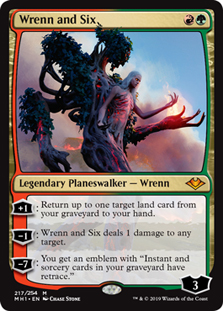
These decks all still exist in Modern, in one form or another. But it's the Gx builds of Eldrazi that improve directly from Throne of Eldraine, which grants them Once Upon a Time. Time is similar to Serum Powder in that it fixes opening hands, but dissimilar in that it makes for a pretty big topdeck in a deck that's already interested in making its land drops and sort of prone to flooding. In other words, Time is pretty much all upside.

Gx Eldrazi Core, by Jordan Boisvert

Creatures

4 Noble Hierarch
4 Thought-Knot Seer
4 Reality Smasher

Instants

4 Once Upon a Time

Sorceries

4 Ancient Stirrings

Featured here are the best-of-breed Eldrazi creatures, Noble Hierarch, and a suite of eight heavy-duty green cantrips. Between Time and Stirrings, both of which find Temple and Thought-Knot, resolving the four-drop a couple turns early should be par for the course in most games.

Where the deck goes from here depends on whether white or red is splashed.

Splashing White

Some of white's perks include:

  • An obvious additional Eldrazi creature in Eldrazi Displacer
  • An alternate gameplan in Stoneforge Mystic
  • Blue-chip removal in Path to Exile
  • Powerful sideboard hosers, namely Rest in Peace

The above benefits are ranked from most important to least. While Rest is backbreaking for opponents in some metagames, it's by no means necessary. Similarly, there are other removal options available to this strategy, such as Dismember. But I think Stoneforge gives the deck a very potent angle of attack against other creature decks. Best of all is Displacer, which is a hoser in its own right against certain decks (Infect for instance) as well as a must-answer threat for attrition and aggro-control strategies alike.

GW Eldrazi, by Jordan Boisvert

Creatures

4 Eldrazi Displacer
4 Thought-Knot Seer
4 Reality Smasher
4 Noble Hierarch
4 Stoneforge Mystic

Planeswalkers

3 Karn, the Great Creator

Artifacts

1 Batterskull
1 Sword of Feast and Famine
1 Sword of Light and Shadow

Instants

4 Once Upon a Time
4 Path to Exile

Sorceries

4 Ancient Stirrings

Lands

4 Brushland
2 Cavern of Souls
4 Eldrazi Temple
2 Forest
3 Horizon Canopy
2 Plains
4 Prismatic Vista
1 Wastes

Sideboard

2 Damping Sphere
1 Dismember
1 Ensnaring Bridge
1 Grafdigger's Cage
2 Knight of Autumn
2 Collector Ouphe
1 Liquimetal Coating
1 Mycosynth Lattice
1 Phyrexian Revoker
1 Basilisk Collar
1 Walking Ballista
1 Weather the Storm

This list is based on Ally Warfield's suggested build from last month. To make room for Once Upon a Time, I've cut a Karn and the Talismen. Once should help find Temple often enough that the additional ramp isn't so necessary; in the late game, it finds closers like Reality Smasher, making the need for Karn less pressing. I have left the number of lands intact, though, reasoning that the Karn package does benefit from pilots making their land drops.

Splashing Red

I think red's allure is a little subtler than white's, but I'm overall more excited by this splash.
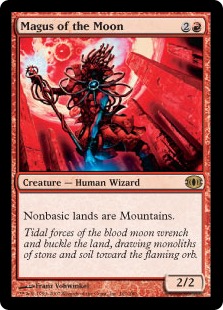
  • A card advantage, utility engine, and curve-fixer in Wrenn and Six.
  • An all-purpose removal spell in Lightning Bolt.
  • A free-win dimension granted by Magus of the Moon.
  • Some juicy role-players: a conditional tide-swinger in Eldrazi Obligator and a hoser for small aggro in Grim Lavamancer.

Something something Lightning Bolt good something. But Modern's best card isn't the best reason to go red. That honor goes to Wrenn and Six, the planeswalker that has revitalized Jund and even rendered wedges as suspect as Temur playable.

In this deck, Wrenn combines with fetchlands to ensure we hit our land drops, which has some serious implications for the deck's construction. For example, we can now top out the curve with World Breaker, giving us mainboard outs to Modern's available prison plans. Making land drops also helps pay for mid-game Times, which we can more easily chase with whichever fatty we rip off the top of our library.

Wrenn also gives us some utility dimensions. Dryad Arbor makes the cut as a fetchable, repeatable blocker, or even attacker in the right situation. And Tranquil Thicket turns Wrenn's plus into an actual plus. Finally, we can't really lose to land destruction anymore, eliminating a common pathway for opponents to deny us our gameplan.
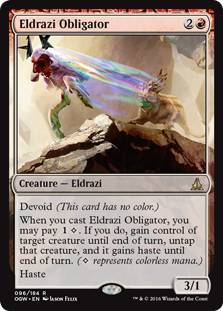
Magus of the Moon is another exciting addition to the red build, and it comes with a couple Birds of Paradise. Time finds either creature, which lets us set up "Magus hands" with some ease, and lock opponents out of the game as early as turn two. Not everyone can answer a Magus; having access to that plan Game 1 without needing to commit to a bloated Blood Moon package is a huge boon.

One factor to address in GR is the absence of Eldrazi Displacer. We still need another Eldrazi to round out the curve and make Temple worthwhile. I'm currently on Matter Reshaper, with Obligator relegated to the sideboard. While the 3/1 haste has certainly put up numbers for the strategy in the past, I feel that with so much aggro and midrange in the format right now, Reshaper earns its slots. Obligator is high-impact, but also high-variance, only proving relevant in certain matchups. Additionally, it's more of a four-drop than a three-drop, and its ability requires a colorless source besides the first Eldrazi Temple. I didn't want to be locked into fetching Wastes every pre-board game.
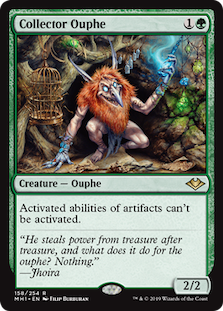
Joining Obligator in the sideboard is Grim Lavamancer, which has proven a house against small creature decks. GR is fully capable of stuffing its graveyard, and with Time in the picture, we can open the little guy quite easily.

GR Eldrazi, by Jordan Boisvert

Creatures

4 Matter Reshaper
4 Thought-Knot Seer
4 Reality Smasher
4 Noble Hierarch
2 Birds of Paradise
2 Magus of the Moon
2 World Breaker

Planeswalkers

4 Wrenn and Six

Instants

4 Lightning Bolt
4 Once Upon a Time

Sorceries

4 Ancient Stirrings

Lands

4 Wooded Foothills
4 Prismatic Vista
4 Eldrazi Temple
2 Stomping Ground
2 Tranquil Thicket
1 Dryad Arbor
3 Forest
1 Mountain
1 Wastes

Sideboard

3 Collector Ouphe
3 Eldrazi Obligator
3 Grim Lavamancer
2 Damping Sphere
1 Grafdigger's Cage
1 Torpor Orb
2 Ancient Grudge

As far as the sideboard goes, Ancient Grudge is the only non-searchable card here. But I think it's too strong in this metagame not to include in a GR deck. The 3 Collector Ouphe may raise some flags, so let my mission statement be clear: I'm through losing to Whirza!


Christmas Come Early

Is GR the future of Eldrazi? Or will the just-released Stoneforge Mystic finish by proving its worth in this ultimate test? Let me know your thoughts in the comments. Until then, may you assemble the nut!

Want Prices?

Browse thousands of prices with the first and most comprehensive MTG Finance tool around.


Trader Tools lists both buylist and retail prices for every MTG card, going back a decade.

Quiet Speculation