menu

Interesting New Set Observations

Are you a Quiet Speculation member?

If not, now is a perfect time to join up! Our powerful tools, breaking-news analysis, and exclusive Discord channel will make sure you stay up to date and ahead of the curve.

Normally I don’t pay attention to new sets. Cards from new Standard sets follow a predictable price trajectory, starting too high and rapidly plummeting post-release. The exceptions are the few cards that suddenly break out in Standard, but I lack the foresight to predict the winners and the losers.

All this said, a couple of Magic’s newest sets have really piqued my interest—not necessarily from an MTG finance standpoint, but from an interested collector’s standpoint. It began with Dominaria, returning us to my favorite plane. I loved all the nostalgia within the set, and I found much of the artwork to be fantastic.

There was an error retrieving a chart for Jhoira, Weatherlight Captain

While I had absolutely zero interest in returning to Ravnica for a third go, I did appreciate War of the Spark when that set released. There wasn’t anything particularly nostalgic about this set, but the unique characteristic of having a Planeswalker in every pack was gimmicky enough to convince me to buy some packs. Modern Horizons was a walk down memory lane all over again, and now Core Set 2020 is shaping up to be a really interesting addition to the game.

Observations About Newer Sets

I’ll begin this section stating that it’s been a while since I paid any attention to the financial relevance of Standard cards. While I have my finger on the pulse of cards from Magic’s earliest sets, I tend to ignore trends of Magic’s latest. So my observations may strike you as obvious, but I’d wager there are a number of newcomers to MTG finance who may be wondering the same things as I.

As I skimmed pricing data, I found a few perplexing trends involving new sets. They seem to deviate from observations I’ve made in the past, back when I paid closer attention to Standard.

Observation 1: For being such a success, War of the Spark buylists prices seem soft.
Is it just me, or are there very few cards worth opening in a War of the Spark booster box? Sure, Japanese boxes have the alternate art Planeswalkers, but the best an English box can yield (nonfoil) is Liliana, Dreadhorde General: $13.50 from Miniature Market. And that high buylist surely can’t last, considering there are plenty of copies for sale just a couple bucks above that. I pulled a Liliana from my a Bundle back in May and immediately buylisted it to Card Kingdom for $22 + 30% trade credit. Even this most desirable card from the set has plummeted since then.

There was an error retrieving a chart for Liliana, Dreadhorde General

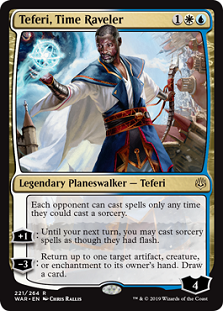
Maybe this shouldn’t have come as a surprise to me, as Standard cards frequently tank in price after supply floods the market. But for being such a successful set, I’m surprised by how inexpensive its most valuable card is. By the way, Teferi, Time Raveler is the only other card that buylists for at least $10, with Miniature Market paying highest ($10). Card Kingdom’s highest nonfoil buy price for English War of the Spark cards is $8.75, for Finale of Devastation.

Observation 2: Despite the lack of high-value cards, War of the Spark’s box EV is very high.
According to Dawnglare, War of the Spark’s booster box EV is $94.42. This number feels high considering the lack of big-money cards in the set. Besides Core Set 2020, which still needs to shake off new-release inflation, War of the Spark’s EV is higher than any other Standard-legal set. How does this math work?

I suspect it has to do with the large volume of non-bulk cards in the set. A number of the uncommon Planeswalkers are worth a buck or two, which surely boosts the EV a bit. Many of the rares are also worth a few bucks, decreasing the likelihood of opening an absolutely worthless booster pack. Perhaps this is why War of the Spark’s box EV is so strong?

Observation 3: Dominaria’s box EV is miserable.
On the opposite end of the spectrum, Dominaria’s booster boxes are horrible to crack right now. According to Dawnglare, Dominaria’s booster box EV is $57.39. I know the set is going to leave Standard soon, but are there no eternal-playable cards that will hold value post rotation? The EV of Dominaria boxes is on par with Amonkhet, but I would have guessed Dominaria was far more successful.

When I examine the top buylists for Dominaria, I quickly see why this set’s EV is so pitiful. The value of the set appears to be concentrated in the top few mythic rares. Teferi, Hero of Dominaria buylists for $25 and Karn, Scion of Urza is next at $10. The top rare is Hinterland Harbor, buylisting for a pitiful $4. This tells me that unless you open a top mythic, you’re likely not to get your money back from opening a Dominaria booster pack.

There was an error retrieving a chart for Teferi, Hero of Dominaria

Looking Ahead to Core Set 2020

Next, I want to pause briefly on Core Set 2020 to study its release EV. I just recently ordered a bundle from this set and I was wondering what the best cards to open were. How likely would I recoup my buy-in if I crack the bundle?

Currently, a booster box from this set has an EV of $111.77. Of course, this is artificially high since the set just came out, and singles haven’t flooded the market yet. But what’s driving the high EV upon release? What’s worth opening and what should my action be if I do open the most valuable cards in the set?

The most valuable nonfoil card in the set so far is Chandra, Awakened Inferno. At time of writing, Card Kingdom offers $23 for the mythic rare. Next is Omnath, Locus of the Roil and Sorin, Imperious Bloodlord at $11.75. The fourth most valuable card in the set is currently a rare reprint, Leyline of the Void ($9).

There was an error retrieving a chart for Leyline of the Void

What will I do if I open any of these cards in a booster pack? It’s 99.9% likely I will sell them immediately. Look at what happened to my Liliana, Dreadhorde General transaction—I opened one in a booster and got almost $30 in store credit for it, and now it would barely get me $10 at that same store. That’s a dramatic plummet. Of course, there’s a nonzero chance something I open breaks out in Standard and jumps in price. But nowadays, I don’t even bother playing the Standard speculation game. It seems completely unnecessary to gamble on new cards when there are so many more predictable trends worth acting upon.

What Trends?

For starters, there’s still that Modern Horizons phenomenon out there. This one-of-a-kind set is about to fade into the background, allowing its most playable cards to slowly increase in price over time. While some purchases I made may have been premature, I haven’t regretted acquiring Modern Horizons playables. Foils have been especially strong.

There was an error retrieving a chart for Seasoned Pyromancer

Looking back a little further, it seems Ultimate Masters cards have completely bottomed. While a given card from the set may not suddenly double overnight, it seems like we can safely acquire Ultimate Masters cards now without threat of further price declines. The most playable cards have already been on an uptrend.

There was an error retrieving a chart for Cavern of Souls

If I were going to put money to work in newer cards, these are the two sets I would focus upon.

Wrapping It Up

It’s not often I pay attention to new sets. With very few exceptions, cards in new sets follow a predictable trend: they start high and quickly sell off as new supply hits the market. There’s little to explore from an MTG finance standpoint unless you’re talented at picking the sleepers of the set. I am not.

All that said, I do notice some perplexing trends in new set pricing of late. Perhaps this is the new norm, and my absence from Standard MTG finance explains why I find these trends so interesting. But even if this is the case, I suspect others out there may be equally inexperienced, and would also benefit from the same musings.

Either way, my overall message track remains the same: there are so many high-probability high-reward plays out there that betting on Standard seems ill-placed. If its profits you seek, you needn’t mess with Standard sets at all. There’s enough strength in sets like Modern Horizons and Ultimate Masters to be worth buying into. Of course, if you want to get into sets even older, there’s plenty more worth acquiring.

Besides picking up some Modern Horizons cards with store credit, I’ve been focusing recently on Beta rares. Any rares. There are only a couple thousand of each one and there will never be any more. But that’s my style; you need to figure out what interests you most. If you can find ways to make a little money from Magic while also enjoying the cards in the meantime, you’ve discovered the one way to have your cake while eating it too!

Sigbits

  • I never would have predicted the buylist on foil Wrenn and Six to rise so quickly. Card Kingdom now offers $140 for near mint copies, and that card’s price doesn’t seem to be slowing down. Because this set is somewhat unprecedented, I can’t predict the ceiling on its most desirable foils. But if I were forced to guess, I’d say this card could reach $300, and it wouldn't surprise me.
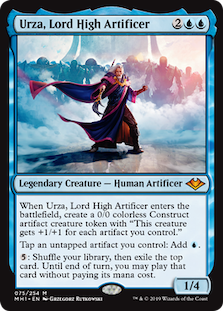
  • Urza, Lord High Artificer is the next most valuable foil from Modern Horizons, with a buylist of $115. Force of Negation foils are next at $90. Both of these also have robust demand, and I don’t expect these prices to drop. New supply probably won’t be hitting the market quickly enough to overcome demand at this point, and that’s precisely why Modern Horizons foils interest me so much.
  • Can I pause for a moment and dwell on my favorite set, Arabian Nights? At one point, the top three cards from the set buylisted to Card Kingdom for well over $1000. But their buy prices on Library of Alexandria, Bazaar of Baghdad, and Juzam Djinn have slowly been dropping as they continue to take in supply. Now they’re paying $1010 for Bazaar, $900 for Juzam, and just $770 for Library. There does appear to be some softness in this market, but I suspect it won’t last forever.

Studying Spreads For Smarter Speculation

Are you a Quiet Speculation member?

If not, now is a perfect time to join up! Our powerful tools, breaking-news analysis, and exclusive Discord channel will make sure you stay up to date and ahead of the curve.

There have never been more new Magic releases to keep track of, and the stakes have never been higher. It seems like every day another card is spiking as the market adjusts, and it’s obvious there is opportunity for profit for those that buy in ahead of time. The problem is figuring out what’s next to rise, and with so many cards to consider, it’s a daunting task.

There are all sorts of factors to weigh, and everyone sees things a bit differently from each other, but one opinion that’s hard to ignore is buylist prices - what stores are actually paying for cards. 

The prices stores pay for cards is a good way to gauge how much their customers demand them, so it provides useful insight into how the market is behaving. Comparing this buy price with the best selling price - the spread - provides a more complete picture of just how hot a card is at that point in time.

By looking at these spreads, we can inform our speculation. Buying into cards with the lowest spread and anticipating that high demand will drive prices upward. Conversely, looking to move cards with the highest spreads and relatively low demand could cause their prices to sag over time. 

QuietSpeculation’s TraderTools conveniently computes these spreads, identifying the buylist with the highest price. It’s useful for some quick analysis of buylist spread and identifying cards in high demand, which isn’t always so obvious looking at price movement alone.

To gain some further insight into the market and look for speculation opportunities, I’ve looked over these spreads and found some interesting information.

Core Set 2020 is not yet in Trader Tools, so I started my analysis with Modern Horizons, which is still very much a hot finance topic. This week’s spike of Wrenn and Six to $75, which comes after its spike to $50 in June, should be a sign there’s more growth to come in other staples.

I wish I had the old buylist data on Wrenn and Six to see if a low spread could have helped predict the spike, but I do remember that when I bought most of my MH1 cards from CardKingdom, Wrenn and Six was selling at a steep premium. So steep, in fact, relative to other staples I had to buy it elsewhere. It's likely to have had a relatively inflated buy price as well, which could have predicted the upcoming spike.

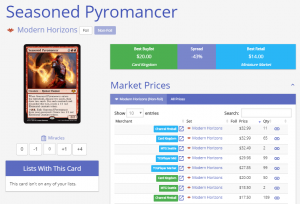
Seasoned Pyromancer was similarly overpriced, and similarly spiked soon afterward, so there’s certainly also some information to be gleaned from sell price alone. However, seeing buy prices from that time would paint a clearer picture.

There was an error retrieving a chart for Unbound Flourishing

Currently, the Modern Horizons card with the lowest spread is Unbound Flourishing, at 14%. TraderTools shows the cash buy price, but in my experience, the best practices for buylisting is to take advantage of trade-in bonuses and make smart buys to stretch my dollar further. When you add CardKingdom’s 30% trade-in bonus to this 14% spread, that means the card has a negative spread. 

When a card has a negative spread, there’s an arbitrage opportunity to be made in buying from one place and selling to another.  Opportunities for easy true cash arbitrage don’t come up often, are short-lived, and not likely to be very large. Though, it’s an interesting phenomenon that points to a card being in very high demand, and is likely to see a price increase accordingly. 

While this case of Unbound Flourishing isn’t extreme, it’s a pretty clear sign to me that the card is very high-demand and is due to rise in price. It’s not a competitive card and lacks the cross-format appeal of something like Wrenn and Six, so it’s not surprising its price has been off to a slow start. Unbound Flourishing's Commander and casual appeal give this incredible long-term prospects - just look at the history of Doubling Season.

There was an error retrieving a chart for Force of Negation
There was an error retrieving a chart for Prismatic Vista

The next cards that buylists are demanding the most are Prismatic Vista and Force of Negation, both at 25% spreads. When you take the trade-in bonus into consideration, you’re essentially at a break-even point, so it’s clear these cards are selling well. It’s no surprise to me, because as a competitive Eternal player, these were the exact two cards that I bought playsets of for personal use with no plans to sell them.

Both are already proven Legacy staples with plenty of Modern applications, so I am sure many other players have had the same thought process as me, and more will begin to follow suit as the cards become more prominent. 

The next most in-demand card is Thran, Yawgmoth Physician at 27%, another card with an essentially 0% spread. The card is a Commander all-star, but unlike Urza, Lord High Artificer, it lacked the same hype and came in at a much lower price point - that gives it more room to grow. Given that it’s also seeing some success as a Modern playable, it has a bright future. 

There was an error retrieving a chart for Silent Clearing

Also coming in below the 30% break-even trade-in bonus spread is Silent Clearing. This was and still is the cheapest land in the cycle, but clearly, demand is catching up. Its low price makes it a bargain relative to more expensive options in the cycle and likely a good speculation target. That said, the next card in line is the 34% spread Sunbaked Canyon, which is seeing the most play of any in this cycle, and I imagine will one day be the most expensive. 

There was an error retrieving a chart for Finale of Devastation

Looking at spreads for MH1 was enlightening, so I was curious how past sets are behaving. War of the Spark, for example,  also has a card with a 14% spread, Finale of Devastation. It makes sense, given it’s become a 4-of staple in Modern, and it’s seeing increased Standard applications now with Cavalier of Thorns. Growth seems imminent, but nothing else comes close to break-even spread, so I imagine the rest of the set should be pretty stable over the summer until the fall set shakes things up again. 

There was an error retrieving a chart for Smothering Tithe

The highlight from Ravnica Allegiance and Guilds of Ravnica is the Commander and casual star Smothering Tithe at a 25% spread, while the rest of the set seems relatively saturated. This Commander phenomenon extends back to Core Set 2019’s Hungering Hydra at 26% and to Dominaria, where the highlight is Muldrotha, the Gravetide at 16%, followed by Helm of the Host at 30%.

My takeaway here is that the safest way to speculate on such recent cards is to target those with the most obvious Commander potential, simply because they are still relative bargains given their strong future prospects. While their sets will rotate from Standard and most of the cards will become forgotten, it's these Commander cards that will eventually become their legacy.

Interestingly, the next most demanded cards from these Standard sets tend to be the lands, whether shocklands or checklands, but at spreads of 50% or higher are currently very stable, so it's hard to imagine their prices are going to see any significant growth in the near future.

June ’19 Brew Report, Pt. 2: Out in Force

Are you a Quiet Speculation member?

If not, now is a perfect time to join up! Our powerful tools, breaking-news analysis, and exclusive Discord channel will make sure you stay up to date and ahead of the curve.

Last week, we began taking stock of the novel decks appearing in 5-0 dumps post-Modern Horizons. With a ban in the books and M20 entering the card pool, the coming weeks are sure to feature even more upheaval. But lots of new tech is already out in force. Perhaps June's innovation bears signs of what's to come.

Old Dogs, New Tricks

A number of midrange decks have benefited notably from Modern Horizons, and now stand only to improve without Hogaak combo forcing them to sideboard playsets of Leyline of the Void.

Temur Twin, by LOUISBACH (11th, Modern Premier #11905352)

Creatures

3 Deceiver Exarch
2 Pestermite
3 Kiki-Jiki, Mirror Breaker
3 Snapcaster Mage

Planeswalkers

4 Wrenn and Six
2 Jace, the Mind Sculptor

Instants

4 Lightning Bolt
4 Cryptic Command
2 Force of Negation
2 Remand
1 Spell Pierce
1 Spell Snare

Sorceries

4 Serum Visions
1 Anger of the Gods

Lands

2 Breeding Pool
1 Hinterland Harbor
2 Lonely Sandbar
4 Scalding Tarn
3 Misty Rainforest
1 Wooded Foothills
1 Raging Ravine
2 Spirebluff Canal
2 Steam Vents
1 Stomping Ground
1 Sulfur Falls
3 Island
1 Mountain

Sideboard

4 Leyline of the Void
2 Tireless Tracker
1 Force of Negation
1 Engineered Explosives
1 Magmatic Sinkhole
1 Nature's Claim
1 Pithing Needle
1 Pyroclasm
1 Surgical Extraction
1 Thragtusk
1 Weather the Storm

Temur Twin embraces the midrange role uncomfortably forced onto Splinter Twin decks with the banning of their namesake enchantment. Rather than for Tarmogoyf, though, the deck adopts green for Wrenn and Six, a development I wholeheartedly approve of. Wrenn ensures pilots never miss another land drop, a critical benefit for a deck shooting to hard-cast a five-mana creature as early as possible. Raging Ravine and Lonely Sandbar give Wrenn some extra dimensions in terms of land recursion, and further diverts opposing resources, buffing Twin's classical gameplan.

Hexdrinker Jund, by WILDABEAST49 (5-0)

Creatures

4 Hexdrinker
4 Tarmogoyf
3 Dark Confidant
1 Grim Flayer
3 Seasoned Pyromancer

Planeswalkers

4 Liliana of the Veil
2 Wrenn and Six

Instants

3 Assassin's Trophy
4 Fatal Push
3 Lightning Bolt

Sorceries

4 Inquisition of Kozilek
2 Thoughtseize

Lands

4 Verdant Catacombs
4 Bloodstained Mire
3 Blackcleave Cliffs
2 Overgrown Tomb
1 Stomping Ground
1 Blood Crypt
3 Blooming Marsh
1 Nurturing Peatland
2 Swamp
1 Forest
1 Mountain

Sideboard

1 Cindervines
2 Collector Ouphe
2 Damping Sphere
2 Fulminator Mage
4 Leyline of the Void
2 Plague Engineer
2 Ravenous Trap

Hexdrinker Jund is the most recent in a long string of BGx developments. Seasoned Pyromancer and Wrenn and Six have happily joined the Jund cast, and from the dumps seem to position Jund as the frontrunner among BGx decks.

Other lists are foregoing Hexdrinker, but the creature does seem potent in this shell—BGx has always struggled against faster decks it can't adequately disrupt, namely Tron; the 2/1 lets them pressure those strategies from out the gate while scrambling to sequence interaction. In fair matchups, the creature maintains relevance as a mini-Progentius.

Mardu Pyromancer, by ALFREDITOMELIRA (5-0)

Creatures

2 Yawgmoth, Thran Physician
1 Monastery Mentor
4 Young Pyromancer
4 Seasoned Pyromancer

Instants

1 Abrade
4 Fatal Push
1 Kaya's Guile
4 Lightning Bolt
2 Surgical Extraction

Sorceries

4 Faithless Looting
4 Inquisition of Kozilek
2 Thoughtseize
3 Unearth
4 Lingering Souls

Lands

4 Blackcleave Cliffs
2 Blood Crypt
4 Bloodstained Mire
1 Godless Shrine
4 Marsh Flats
1 Sacred Foundry
2 Swamp
2 Mountain

Sideboard

1 Kaya's Guile
3 Blood Moon
1 Dreadbore
1 Duress
4 Leyline of the Void
2 Plague Engineer
3 Wear // Tear

Despite what they might be saying at the LGS, Mardu Pyromancer seems alive and well; this build has clocked multiple 5-0 finishes and Top 8ed a Modern Premier. It integrates Seasoned Pyromancer to flavorful results. On the strategic side, Monastery Mentor joins Young Pyromancer as copy number five. Unearth surfaces as a way to get back into the game after a token-maker is removed, and Yawgmoth, Thran Physician replaces Bedlam Reveler as top-end payoff.

The Cat's Meow

Zoo decks also seem to be performing well online, with a range of GRx decks putting up numbers.

Vanilla Zoo, by LALAUWBA (5-0)

Creatures

4 Wild Nacatl
4 Noble Hierarch
2 Hexdrinker
4 Tarmogoyf
3 Qasali Pridemage
2 Thalia, Guardian of Thraben
2 Ranger-Captain of Eos
1 Knight of Autumn
4 Bloodbraid Elf

Instants

4 Path to Exile
4 Lightning Bolt
4 Lightning Helix

Lands

4 Windswept Heath
3 Wooded Foothills
2 Arid Mesa
2 Sunbaked Canyon
2 Horizon Canopy
2 Razorverge Thicket
1 Copperline Gorge
1 Sacred Foundry
1 Stomping Ground
1 Temple Garden
1 Snow-Covered Forest
1 Snow-Covered Mountain
1 Snow-Covered Plains

Sideboard

1 Ancient Grudge
1 Blood Moon
2 Boom // Bust
1 Chandra, Torch of Defiance
1 Choke
3 Declaration in Stone
1 Gideon, Ally of Zendikar
1 Pillage
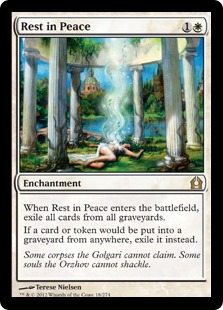
4 Rest in Peace

Vanilla Zoo gets its name from its stock appearance—here's a Zoo deck that looks exactly as I'd expect a Zoo deck to look in 2019. Joining the jungle ranks are Ranger-Captain of Eos and Hexdrinker, the latter searchable by the former. Ranger can also find Hierarch, for when exalted might help break a board or threaten lethal, or Nacatl, for when mana is tight. Bloodbraid Elf serves as board-widener extraordinaire, and is best when hitting Ranger.

Three-Drop Zoo, by CIMOS21 (5-0)

Creatures

4 Woolly Thoctar
4 Noble Hierarch
4 Hexdrinker
4 Tarmogoyf
3 Collector Ouphe
4 Gruul Spellbreaker
3 Ranger-Captain of Eos
4 Bloodbraid Elf

Instants

4 Lightning Bolt
3 Lightning Helix
1 Path to Exile

Lands

3 Windswept Heath
3 Wooded Foothills
1 Sacred Foundry
1 Stomping Ground
1 Temple Garden
2 Inspiring Vantage
1 Razorverge Thicket
1 Copperline Gorge
3 Horizon Canopy
2 Sunbaked Canyon
2 Forest
1 Mountain
1 Plains

Sideboard

3 Path to Exile
2 Damping Sphere
3 Knight of Autumn
4 Rest in Peace
3 Thalia, Guardian of Thraben

Three-Drop Zoo also employs the Ranger/Hexdrinker combination, as well as a slew of other three-drop plays—Gruul Spellbreaker I understand, the Ogre having surfaced even in GR Eldrazi, but Woolly Thoctar certainly strikes me as suspicious. And what does the 5/4 replace? None other than Zoo figurehead Wild Nacatl!

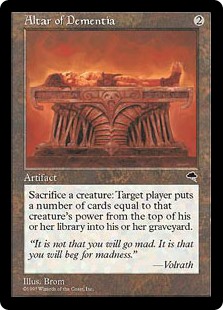
There may well be more to this build than its epic cascade hits, though, as H0LYDIVER has also enjoyed success with it. In any case, Collector Ouphe looks great as a mainboard answer to both Altar of Dementia and Thopter-Sword, breakout artifact plays post-Horizons.

Virtue Zoo, by HYBRID7 (5-0)

Creatures

4 Loam Lion
4 Kird Ape
4 Wild Nacatl
4 Narnam Renegade
4 Experiment One
4 Squadron Hawk

Enchantments

4 Force of Virtue

Instants

3 Path to Exile
4 Lightning Bolt
1 Lightning Helix

Sorceries

4 Light Up the Stage

Lands

4 Windswept Heath
4 Wooded Foothills
3 Arid Mesa
2 Sacred Foundry
2 Stomping Ground
2 Temple Garden
1 Snow-Covered Forest
1 Snow-Covered Mountain
1 Snow-Covered Plains

Sideboard

1 Path to Exile
3 Alpine Moon
3 Destructive Revelry
3 Ravenous Trap
2 Rest in Peace
3 Stony Silence

Virtue Zoo is named for one of the most panned of its cycle, Force of Virtue. +1/+1 makes Wild Nacatl, Loam Lion, Kird Ape, and Narnam Renegade exquisitely difficult to remove in Modern, a format whose high-water mark is 3. The stat boost also improves Squadron Hawk, giving the deck aerial-presence-in-a-can. Light Up the Stage lets pilots fill back up on cheat threats, removal, and anthems.

GR Prowess, by MOUSTAFALLLO (5-0)

Creatures

4 Monastery Swiftspear
4 Soul-Scar Mage
4 Dreadhorde Arcanist
3 Abbot of Keral Keep

Artifacts

4 Mishra's Bauble

Instants

3 Become Immense
4 Blossoming Defense
4 Lightning Bolt
4 Mutagenic Growth

Sorceries

4 Scale Up
3 Assault Strobe
2 Reckless Charge

Lands

4 Scalding Tarn
2 Wooded Foothills
4 Stomping Ground
4 Copperline Gorge
3 Snow-Covered Mountain

Sideboard

3 Ancient Grudge
3 Dragon's Claw
3 Gut Shot
4 Leyline of the Void
2 Spellskite

Trending away from the interactive side of the spectrum is GR Prowess, a deck not unlike Infect or Mono-Red Phoenix in its focus on blitzing opponents. This deck runs Dreadhorde Arcanist as a way to stack more prowess triggers, grow-'em-all via Scale Up, or just generate 12 extra power through Become Immense. MOUSTAFALLLO isn't sleeping on Arcanist's strength alongside Mutagenic Growth, which saves the fragile body from Lightning Bolt and also double-pumps using the creature's ability.

Unearthing the Future

Despite my best efforts, Claim // Fame never saw much Modern play. But its older brother Unearth is making waves in the format. While it sometimes does less for the card investment—Claim // Fame can reanimate, pump, and give haste all at once—Unearth beats out the split card on versatility, targeting creatures with CMC up to 3 and cycling in the face of Rest in Peace (or just while no targets exist in the graveyard).

BR Unearth, by WILDABEAST49 (5-0)

Creatures

4 Lightning Skelemental
4 Seasoned Pyromancer
4 Dreadhorde Arcanist
4 Bloodghast
3 Flamewake Phoenix
2 Gurmag Angler
1 Tasigur, the Golden Fang

Instants

4 Fatal Push
4 Lightning Bolt

Sorceries

4 Faithless Looting
4 Thoughtseize
4 Unearth

Lands

4 Blackcleave Cliffs
4 Bloodstained Mire
1 Arid Mesa
1 Verdant Catacombs
1 Wooded Foothills
1 Polluted Delta
2 Blood Crypt
2 Mountain
2 Swamp

Sideboard

1 By Force
2 Grim Lavamancer
3 Inquisition of Kozilek
4 Leyline of the Void
2 Liliana of the Veil
2 Ravenous Trap
1 Shenanigans

BR Unearth is about as straightforward an Unearth deck possible, aiming to reanimate the most obvious targets for the sorcery: Lightning Skelemental and Seasoned Pyromancer. Dreadhorde Arcanist is also a bargain at one mana, and swinging with the Zombie lets pilots recast Unearth from the graveyard.

As for fueling the graveyard, only Faithless Looting makes an appearance, leading me to believe this deck could use some work on that front—dipping even deeper into graveyard payoffs like Bloodghast and Flamewake Phoenix seems especially precarious. Other builds have assuaged this qualm by diversifying their angles of attack, such as with Young Pyromancer.

Grixis Unearth, by TACOFARMER (5-0)

Creatures

2 Jace, Vryn's Prodigy
2 Snapcaster Mage
3 Dreadhorde Arcanist
4 Lightning Skelemental
3 Seasoned Pyromancer
2 Fulminator Mage
1 Yawgmoth, Thran Physician

Instants

4 Thought Scour
3 Lightning Bolt
2 Fatal Push
2 Kolaghan's Command

Sorceries

4 Faithless Looting
4 Inquisition of Kozilek
4 Unearth

Lands

4 Polluted Delta
4 Blackcleave Cliffs
1 Blood Crypt
1 Steam Vents
1 Watery Grave
4 Spirebluff Canal
2 Darkslick Shores
1 Fiery Islet
1 Snow-Covered Island
1 Swamp

Sideboard

2 Fulminator Mage
1 Collective Brutality
2 Deathmark
1 Engineered Explosives
2 Goblin Cratermaker
2 Plague Engineer
4 Surgical Extraction
1 Terminate

Grixis Unearth does the strategy one better, splashing blue for more potent Unearth targets: Snapcaster Mage and Jace, Vryn's Prodigy. Both of these creatures keep the Unearth loops going, as does Dreadhorde Arcanist, letting Grixis establish a value snowball roll it down the hill. Joining Looting is Thought Scour, an effective graveyard enabler with so many good hits in the deck. In the face of graveyard hate, the deck has some backup plans; its red and black creatures do a fine job beating down an enemy hiding behind Rest in Peace.

BUG Unearth, by JONSPARROW (5-0)

Creatures

4 Ice-Fang Coatl
4 Tarmogoyf
4 Hexdrinker
2 Scavenging Ooze
3 Snapcaster Mage
3 Plague Engineer

Planeswalkers

2 Liliana of the Veil

Instants

3 Assassin's Trophy
2 Scarab Feast

Sorceries

3 Collective Brutality
2 Inquisition of Kozilek
1 Maelstrom Pulse
3 Thoughtseize
2 Unearth

Lands

3 Prismatic Vista
2 Misty Rainforest
2 Polluted Delta
2 Verdant Catacombs
1 Overgrown Tomb
1 Watery Grave
1 Breeding Pool
2 Creeping Tar Pit
2 Hissing Quagmire
3 Snow-Covered Forest
2 Snow-Covered Swamp
1 Snow-Covered Island

Sideboard

1 Assassin's Trophy
2 Ashiok, Dream Render
2 Dead of Winter
2 Fulminator Mage
2 Narset, Parter of Veils
2 Stubborn Denial
4 Surgical Extraction

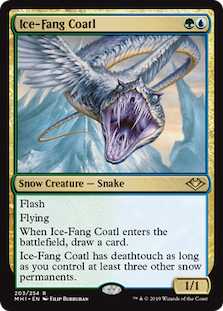
BUG Unearth ties together many midrange goodies from Modern Horizons. Leading the charge are Hexdrinker, an Unearth-targetable threat that grows to huge proportions in a deck looking to go long; Ice-Fang Coatl, an up-and-coming staple in decks that can swing the snow land requirement; and Plague Engineer, and oft-sideboarded haymaker in certain matchups that indeed looks great against Hogaakvine, especially in pairs. Covering for Engineer in the sideboard is Dead of Winter, which does an okay Toxic Deluge impersonation. Finally, in lieu of opposing interaction, Collective Brutality will fuel Unearth.

Esper Mentor, by STAINERSON (7th, Modern Premier #11898937)

Creatures

4 Monastery Mentor
4 Snapcaster Mage
3 Jace, Vryn's Prodigy

Planeswalkers

2 Teferi, Time Raveler

Instants

4 Opt
4 Fatal Push
2 Path to Exile
2 Force of Negation
1 Spell Pierce
2 Surgical Extraction

Sorceries

4 Inquisition of Kozilek
4 Serum Visions
2 Thoughtseize
3 Unearth

Lands

4 Polluted Delta
4 Flooded Strand
2 Hallowed Fountain
1 Watery Grave
1 Godless Shrine
3 Darkslick Shores
2 Island
1 Plains
1 Swamp

Sideboard

1 Path to Exile
1 Spell Pierce
1 Celestial Purge
2 Collective Brutality
1 Engineered Explosives
2 Fulminator Mage
2 Narset, Parter of Veils
1 Stony Silence
4 Yixlid Jailer

The idea of Esper Mentor has been floated around Modern for quite some time now, but the archetype itself rarely finds its footing. Unearth is a one-mana sorcery that recurs the expensive token generator once it's been dealt with, perhaps promising to revitalize the deck.

Jace, Vryn's Prodigy and Snapcaster Mage are other juicy Unearth targets in Esper colors, as well as Yixlid Jailer and Fulminator Mage from the sideboard. And Teferi, Time Raveler proves the perfect planeswalker to pair with Monastery Mentor—once it's on the battlefield, pilots can Unearth their namesake threat and go to town creating prowess-boasting 1/1s without fear of enemy interruption.

A Whole New Modern

All these lists came from during Hogaakvine's reign of terror, hence the many copies of Rest in Peace, Leyline of the Void, Surgical Extraction, and even Scarab Feast. I expect the more sustainable among them to chug right along with Bridge from Below banned, just with less hate in their arsenal. Modern should also open up enough to let in even more new brews now that decks have fewer parameters to respect online. It's going to be an exciting month!

To Chop or Not to Chop? The Uncut WAR Sheet Conundrum

Are you a Quiet Speculation member?

If not, now is a perfect time to join up! Our powerful tools, breaking-news analysis, and exclusive Discord channel will make sure you stay up to date and ahead of the curve.

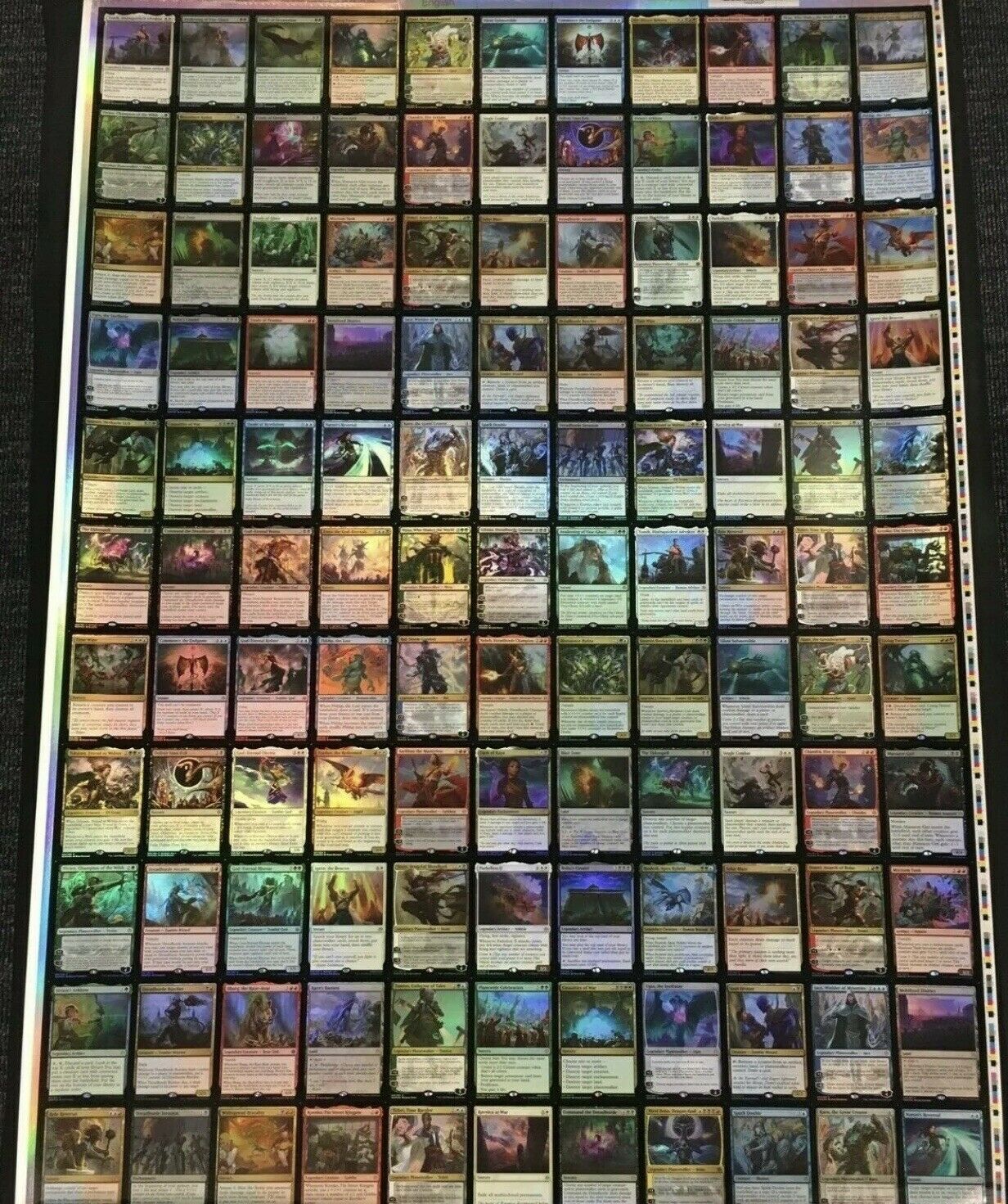
Wizards of the Coast recently promised to send an uncut foil sheet of War of the Spark as compensation to those who successfully ordered and received confirmation emails for the WAR Mythic Edition special release but did not receive product (and were instead refunded).

People have been receiving theirs in the mail over the last couple weeks, with nary a confirmation email from eBay or WotC in sight. Mine came in on Wednesday, June 26th. The lack of communication with recipients of sheets will likely cause some issues with people not receiving theirs, although I surprisingly have not heard many stories to that tune as of yet. Sheet arrival seems to be a bit more tenuous overseas, but here in the U.S. they have likely all arrived by now.

My sheet was rolled correctly and received with minor dings and dents.  I informed Wizards of the Coast of the damage via the normal channels, and they’ll be sending me a new one shortly. They didn’t ask for me to return the damaged one, so that one is off to a professional miscutter.

Yeah, that’s right, I’m chopping mine. Just peep some of the beauties being cranked out by the hard-working individuals of the NFC Miscuts Facebook group!

Photos courtesy of Daniel Helm


Whether or not this is the right call from an MTGFinance perspective depends on circumstance though. I’m going to break down the various options most people will select from for their sheets and analyze those approaches from an MTGFinance perspective.

The level one move is to sell your sheet on eBay or to an individual. I’ll almost never argue against cashing out, but is now really the right time? I’m seeing these go for obscenely cheap. Between eBay fees and shipping, most sellers aren’t making even $200 for their sheet. Battle for Zendikar, a lukewarm set finance-wise, sells for about $500 for a rare sheet. Heck, even preorders of the WAR rare sheet were going for $400 earlier in June. Lots of these are now in the hands of people who are not too familiar with MTGFinance or still feel burned by not receiving their Mythic editions. People want these gone, and they don’t want to wait around to ditch them.

How many sheets are out there?

I’ve written this article from scratch twice now. Originally, I had a very lengthy diatribe about how people are overestimating the supply that will enter the market. The raw numbers made me think that because only be about 10,000-15,000 sheets will enter players hands, only a small fraction of these would enter the market. This was off-base.

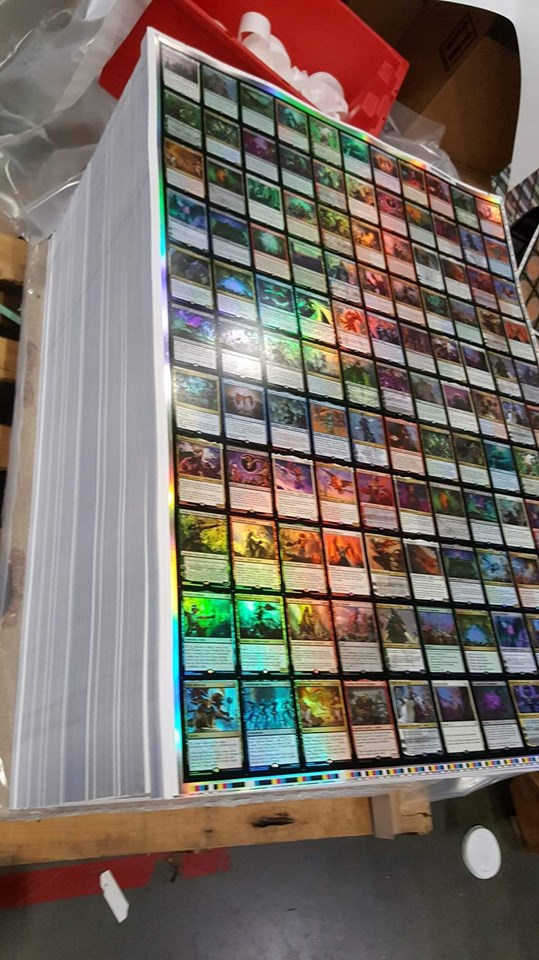
My justification was that of these sheets, a large number will be stored as long-term specs (and likely improperly, which would result in fewer undamaged sheets available), a large number would be framed, and some number would be cut for the cards. While this is still true, I think we’re going to be looking at more than half of the sheets entering the market. And believe me, there are a lot of sheets. Just... just look.

Now THAT is a pile of cards!

Wizards sending out replacement sheets and not asking for returns throws off all valid calculations of supply. At this point, the only thing that’s safe to say is that supply is going to outstrip demand. The first time I wrote this article, I thought that snagging these for $200 a sheet would be solid. Now, that sentiment is laughable.

They will certainly rebound a month or two from now, but these are going to be a hassle. People are having difficulty selling theirs on eBay for $200 now. Buyers are rightfully cautious because so many sheets have arrived damaged. There’s just not enough information right now to know what the financial future of these will be.

What should I do with mine?

All bets are off. Sheets are so cheap now that buyers are going to be finding them shipped for incredibly cheap prices. If you still have yours and want to sell it, you’ve missed the boat. Don’t panic sell yours, just hold it for a couple months to see if the market rebounds a little. The exit goal is $300. If sheets get back there, either sell or commit to holding it forever. If you have an undamaged sheet, you will have an easier time getting good value out of it. Just make sure you don’t leave it in the tube it came in.

These things get more and more warped/damaged the longer they sit in a tube. Invest in a $30 uncut sheet toploader (such as this one here) and you should get a stronger return on the investment. If you do tuck it away, be certain to store it as you would your other cards; in an area that does not get sunlight, has low to no humidity, and does not frequently change temperatures (as close to room temperature as possible is best).

Chopped-full of value!

Having the sheets cut professionally will likely also prove profitable, although it is a lot more work. Let's dig into the nitty-gritty of having your sheet fully cut. Each sheet contains two of every rare and one of every mythic rare card from War of the Spark. These sheets are 11 x 11 cards, for 122 cards total. The floor on a miscut foil tends to be about $5 for the absolute bulk foil rares.

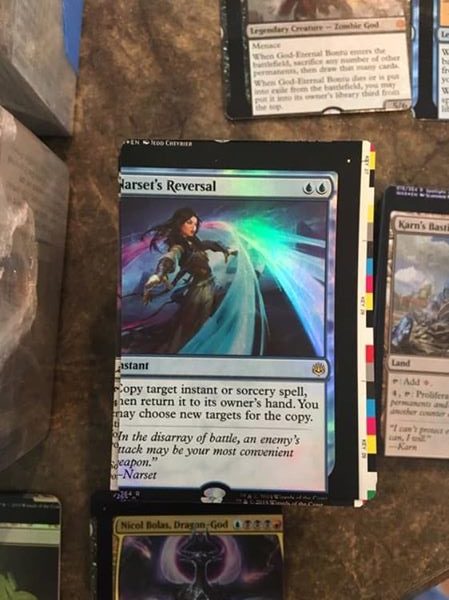
The following cards will almost certainly fetch above-bulk value when miscut: Finale of Devastation, Finale of Promise, all of the planeswalkers, all of the legendary creatures, and a small handful of other constructed playable cards.

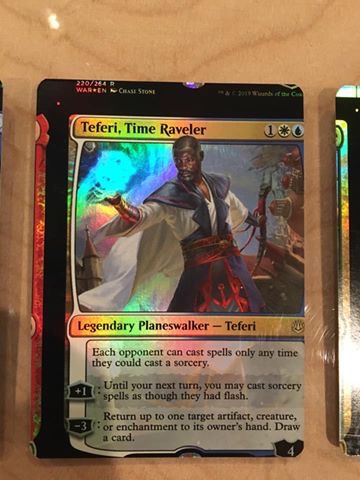
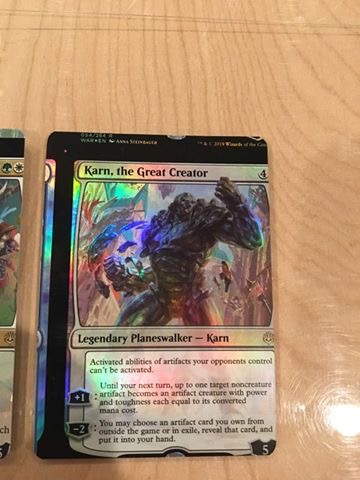
This is actually the majority of the cards on the sheet. Prices are going to vary wildly for these, but even assuming the average value of a card on the sheet is $10 (which I think is a fairly conservative figure), that means your cut sheet is worth over $1000. Not too shabby! I'll probably have my replacement sheet cut too, unless I decide to frame it. The payoff seems to be high enough that cutting the sheet is worth it, and the time frame shouldn't be an issue considering some of the best cards, such as Teferi, Time Raveler, Karn, the Great Creator and Dreadhorde Arcanist are all very eternally playable.

You've already won

At the end of the day, these are awesome, unique pieces of Magic history. I wouldn’t recommend tossing it out for a measly $120 or so unless you need the spare cash right now. If you got one or more of these, you're in a great spot! If you didn't, go nab one from eBay! They really can't get much cheaper than they are now. Hope you all had a great Fourth of July weekend. Expect to hear from me again soon, and as always, follow me on Twitter @MahouManSam for day-to-day #MTGFinance updates.

Bridge Collapse: Banning Reaction

Are you a Quiet Speculation member?

If not, now is a perfect time to join up! Our powerful tools, breaking-news analysis, and exclusive Discord channel will make sure you stay up to date and ahead of the curve.

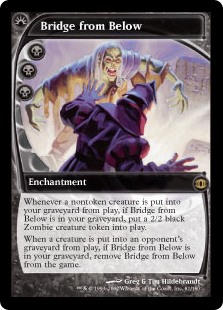
I had planned to spend today's article discussing Hogaakvine: what it does, how it does it, how to play against it, and how I'd build decks given Hogaak's rise. However, that article was mooted this morning by Wizards. Instead, let's examine what's happened and where it leaves Modern.

Also, once again, nothing got unbanned. This should continue to come as no surprise since Wizards is very sparing with unbans. Nothing will happen while Modern is at all in flux. We'll have more luck with unbannings if things settle down and get more stale next year.

The Announcement

Effective Friday, Bridge from Below is banned in Modern. I genuinely wasn't expecting anything to get axed today. Wizards has always been in the habit of waiting-and-seeing. This approach was confirmed when they announced the London mulligan was here to stay. It's only been a month since Hogaak became legal, which isn't much time for data collection, and subsequently I didn't think Wizards had enough data to make a move.

However, I didn't have Wizards' data (mores the pity); just my own experiences and the testimonies of others. From what I'd seen, Hogaak won on turn 2 half as often as it clunked out and didn't do anything meaningful. However, according to Wizards, my experience was an uncommon one.

In the case of the Hogaak Bridgevine deck, its initial overall win rate on Magic Online was over 60%. Despite the metagame's best efforts to adapt, the deck's win rate remains higher than is healthy for long-term metagame diversity.

That is an alarming winrate, especially considering how well-known the deck's weakness to graveyard hate is. However, in context, it makes more sense.

It has only two unfavorable matchups among the other ten most played decks and a high win rate against lesser played "rogue" decks. Especially telling is its Game 1 win rate of roughly 66%, requiring most decks to sideboard heavily against it.

While that 66% win rate is very impressive, by itself, I can't imagine that it's enough. Affinity's long-term success can be attributed to a similar Game 1 statistic. Affinity of any stripe has a very strong aggressive plan that just folds in the face of sideboard hate, not unlike graveyard decks.

In context, though, it is enough to pull the trigger on Hogaak. Affinity doesn't just fold to hate. It also folds to waves of removal. Even if I don't hit my Stony Silence against Affinity, I can still play normal Magic, take care of the enablers or the payoffs, and plausibly win. Because of Bridge and the sacrifice outlets, normal removal just isn't effective against Hogaak. They'd respond to any removal spell by sacrificing the creature for value and making zombies to replace it, which fair decks have no answer for. Thus, hate was necessary, and Hogaak had answers to the hate, so the win rate didn't dip enough post-sideboard.

While I've seen considerable hysteria surrounding Hogaak on social media, I doubt it was a serious factor in Wizards' decision. Their past actions, including not banning Faithless Looting despite Izzet Phoenix's record, indicates they only consider hard data when making decisions. I actually suspect that fear over Hogaak dominating the upcoming Mythic Championship is the most pertinent reason for Wizards' decision:

While we don't intend on setting a precedent for quickly taking B&R action whenever a successful new deck breaks out, in this case, the situation clearly needed to be addressed. We're looking forward to watching the metagame continue to evolve as we approach Mythic Championship IV in Barcelona on July 26–28, and we hope you'll join us for full coverage of that event.

Nature of the Ban

In the announcement, Wizards says they considered a number of Hogaak Bridgevine cards for banning before settling on Bridge.

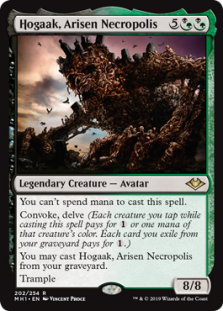
We discussed several possible bans that would weaken this deck while having minimal impact on the rest of the metagame: Hogaak, Arisen Necropolis; Altar Of Dementia; and Bridge from Below. While cases can be made for each, we identified Bridge from Below as the card most likely to cause metagame imbalance again in the future. Because Bridge from Below doesn't cost mana or other resources to use and isn't reliant on being drawn naturally from the library, its power level is highly sensitive to the cards that synergize with it. As new card designs that have synergy with the graveyard are released over time, Bridge from Below is the most likely key card in the deck to become problematic again.

This ban was laser-targeted at Bridgevine. No other deck in Modern plays Bridge from Below, nor can they; Bridge is not a Magic card. It doesn't work like any other card in the game, since it does nothing if you cast it. It only does something in the graveyard, so only graveyard decks could ever use the card.

That's not the end of it though, as even then Bridge requires you to kill your own creatures to do anything. The only utility Bridge has ever had is as a cog in broken graveyard combo decks. A (relatively) fair aggro deck like normal Dredge has no use for Bridge. Therefore, banning Bridge makes the most sense if the goal was only to eliminate one problem deck.

As for the wider concern over graveyard decks in general, Wizards appears fine with the way things are.

Our goal is not to eliminate graveyard strategies from the Modern metagame, but rather to weaken this version of the graveyard combo archetype that has proven too powerful for other decks to reasonably adapt to. In fact, we believe that targeting Bridge from Below specifically will still allow for other strategies in this style to continue to be a part of the metagame.

I agree with Wizards' decision, but I might have gone further. I think that Wizards is just kicking the ban can down the road unless they ban Faithless Looting. It's too good at what it does.

Granted, banning Looting now doesn't make much sense. Looting isn't a critical piece of Hogaak's fast kills and is unlikely to fix the warp Hogaak appears to be causing. However, with the proliferation of graveyard strategies that Looting makes possible, I can't imagine the card will escape the ax forever. Still, until the tipping point is reached, I wouldn't ever skimp on graveyard hate.

Fall of the Necropolis

Where does that leave Hogaak Bridgevine? The short answer is: dead. Without Bridge, the combo isn't possible. Looping Hogaak requires a continuous stream of black or green creatures, and that isn't possible for current lists without Bridge. The nearest analogue I could find is Golgari Germination, which actually has to be cast and resolve like a real Magic card to do anything. This creates anti-synergy with the Stitcher's Supplier engine that was the core of the old Bridgevine deck since they cannot recklessly mill themselves to success.

If Hogaak players wish to keep playing their decks, adjustments will need to be made. The ideal curve for pre-ban decks was getting a Hogaak and two Bridges into the graveyard with Stitcher's Supplier turn one, then playing Alter of Dementia turn two and going infinite immediately. Now they'll have to cast Germination on turn 3 before they can even think about looping Hogaak for value, and can't actually go infinite without playing a second Germination turn 4.

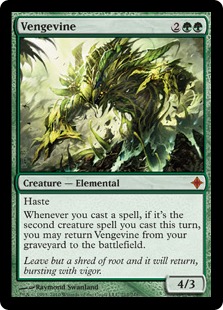
That's worse enough that I cannot imagine it being good enough for Modern. Therefore, I don't think Hogaak combo will be viable anymore. It's easy enough to stock the graveyard for Hogaak, but the limiting factor is having creatures for convoke. Even hitting well and flooding the board with Bloodghasts and/or Vengevines turn two isn't enough to loop Hogaak enough to win via decking. At that point, Hogaak becomes a liability since attacking with the creatures rather than durding with him is a shorter route to victory.

Relocating the Necropolis

Hogaak really wants to be in a graveyard aggro deck like Bridgevine. It needs cheap creatures to convoke and a full graveyard. Thus, the natural home is Bridgeless Bridgevine. Wizards believes that such a deck is possible.

Without Bridge from Below to continually produce Zombie tokens with which to convoke, the interaction between Hogaak and Altar Of Dementia should become more about stocking the graveyard for value over multiple turns rather than completing a one-turn win combo.

I disagree. Without the possibility of a combo kill, there's very little reason to bother feeding Hogaak to Altar. The deck that remains is a straight Vengevine aggro deck, intending to swarm the opponent quickly with recursive threats. There's no reason to spend a turn playing and then sacrificing Hogaak, since such a deck needs to hit well with Stitcher anyway.

Therein lies the ultimate problem with Bridgeless Bridgevine. Bridge gave these decks something meaningful to hit when they didn't get their ideal aggro curve, as the decks are filled with dinky 1/1 enablers. Bridge turned them into something actually threatening for those times Vengevine was stuck in hand or in the bottom third of their library. Lacking Bridge, the deck loses its middle ground of zombie beatdown. Now there's only the occasional explosion or otherwise anemic creatures, and I doubt that's good enough for Modern.

Logistical Nightmare

With that in mind, where might Hogaak, Arisen Necropolis find a new home? Dredge seems the obvious answer, but I'm not sure. The list is so tight I don't know that Hogaak can fit in.

Dredge, Claudio Barrientos Ochoa (MC London)

Creatures

4 Bloodghast
4 Narcomoeba
2 Golgari Thug
4 Prized Amalgam
4 Stinkweed Imp

Artifacts

4 Shriekhorn

Instants

1 Darkblast

Sorceries

4 Faithless Looting
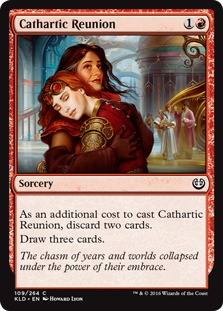
4 Cathartic Reunion
4 Life from the Loam
2 Conflagrate
4 Creeping Chill

Lands

4 Copperline Gorge
4 Wooded Foothills
2 Blood Crypt
2 Stomping Ground
1 Ghost Quarter
1 Bloodstained Mire
1 Dakmore Salvage
1 Gemstone Mine
1 Steam Vents
1 Mountain
1 Forest

What exactly do you cut to make room for Hogaak? Cutting creatures isn't going to work. Prized Amalgam is the point of the deck, and it needs its own enablers in Bloodghast and Narcomoeba. However, those don't really synergize with Hogaak. Amalgam enters play tapped and on end step, so it can't cast Hogaak and Narcomoeba is blue, leaving only the vampire spirits to cast him.

Looking elsewhere is also trouble. Cutting enablers like Shriekhorn is out of the question, as is cutting the dredge package; they're what make the deck work. Lands can't be cut since Dredge already runs the bare minimum. Creeping Chill is critical to giving Dredge other angles of attack, and has significantly increased the deck's success since its printing. Darkblast is the weakest card in Dredge, so maybe cutting it and having Hogaak as a one-of is acceptable.

However, does all that hoop-jumping actually benefit the deck? Hogaak is a big beefy creature, but Dredge wins via overwhelming the opponent with early damage, then closing with Chill and Conflagrate. Hogaak doesn't mesh with that plan. If Vengevine Aggro isn't good enough, and Dredge doesn't want it, I don't know what other deck is willing to feed the Necropolis.

Where Does Modern Go?

The ban being so targeted means that no other deck must adapt. In a sense, that means that Modern can revert to its pre-Horizons configuration, though I don't think it will. Too much has been added to the format between Horizons and Core 2020 for that to happen. Instead, Modern will return to a state of heavy flux as the new cards are integrated. Hogaak was warping the format, and all the testing and brewing was done with the warp in mind. Now it's back to the drawing board.

Getting Complacent

One thing I am certain of is that next week's 5-0 deck dumps will show lots of decks cutting their graveyard hate now that Hogaak is gone. Don't. Do. That. You always need graveyard hate in Modern. With Hogaak going away, normal Dredge will return in force. Don't just lose to Dredge.

Similarly, Jund got some new toys, and they utilize graveyard synergies as well. Seasoned Pyromancer and Wrenn and Six are making the cut now. The former's real value is on the front end, but Wrenn does nothing worthwhile with Rest in Peace in play.

Looking Ahead

With Bridge finally gone, Modern can finally figure out what all the new cards enable. The graveyard will still be a critical zone that successful decks must remember to interact with, but the overall format will start to look more normal. And that means more interesting decks can find their place in Magic's most diverse format.

MTGO: The Rares of Modern Horizons

Are you a Quiet Speculation member?

If not, now is a perfect time to join up! Our powerful tools, breaking-news analysis, and exclusive Discord channel will make sure you stay up to date and ahead of the curve.

[show_post_categories show="category" hyperlink="yes"]

Welcome back, folks! In my last article, I discussed the financial outlook of the most expensive cards and other mythic rares of Modern Horizons on MTGO. This week I'm going to take a look at some of my favorite rare speculation targets. Which cards are overvalued? Which cards are undervalued? Let's dig in!

I. Speculations to Avoid

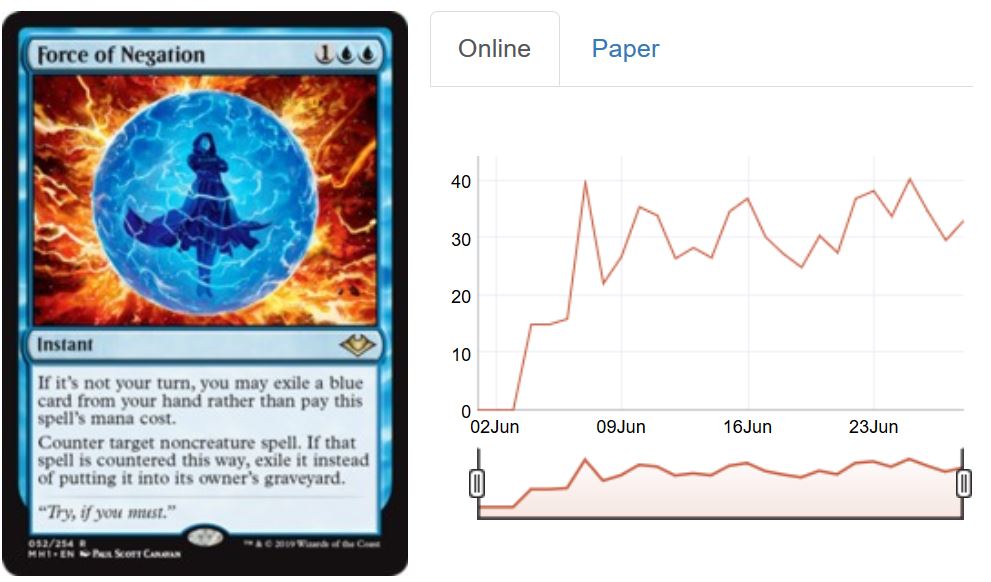
1. Force of Negation

Current Buy Price: $33.07

Force of Negation is already a Legacy and Modern staple and is the most-played card in the set. Oftentimes acting as Force of Will numbers five and six in Legacy Delver strategies and serving to check some of the brokenness in Modern, Force of Negation will continue to hold a high-value long term. I question, though, whether it can grow beyond the $30 to $35 price point it has been hovering at for the past two weeks. It is possible, but I wouldn't want to tie up so much capital in a card just as likely to go down to $25 as to go up to $40.

At best this is a spec you should unload before October when Medwin brings the card to a treasure chest near you. I think it's fine to own a playset of it, but I wouldn't be speculating on it.

2. Altar of Dementia and Hogaak, Arisen Necropolis

Current Buy Price of Altar of Dementia: $2.77
Current Buy Price of Hogaak: $4.33

You know why. Don't get caught holding these cards. The prices of both are already depressed due to an expectation that the deck will get nerfed, and I'm confident that expectation will become reality. Modern Horizons was a great set, but one thing absent I hoped it would contain was a toned down version of Faithless Looting. Maybe we'll get one soon.

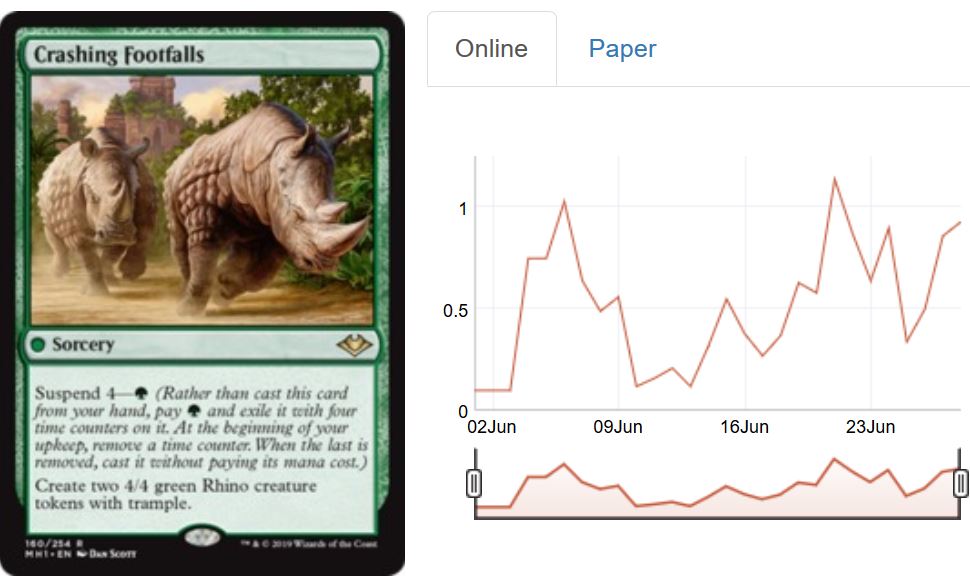
3. Crashing Footfalls

Current Buy Price: $0.93

There aren't many rares and mythics from Modern Horizons that I think could plummet in price, but Crashing Footfalls is one of them. Many people are experimenting with the card in Legacy and Modern in Free Spells shells. If the card ultimately doesn't pan out, it will likely be worth a quarter. If it does, I don't think its price will be all that much higher than where it currently is. This is a card I want to own a playset of if I'm playing with it, but it's not a card I want to invest in.

II. Safer Speculation Targets

1. The Canopy Lands

Current Buy Prices: $4.12 -- $4.84

Probably the most obvious investment targets in the set, these lands are sure to go up in price over time as long as they aren't included in the Fall treasure chest update at a frequency higher than 6. These lands are great and will be used from now until the end of time. Expect them to settle between $10-$15, with Sunbaked Cayon commanding a slight premium due to Red and White traditionally being the weakest card advantage colors.

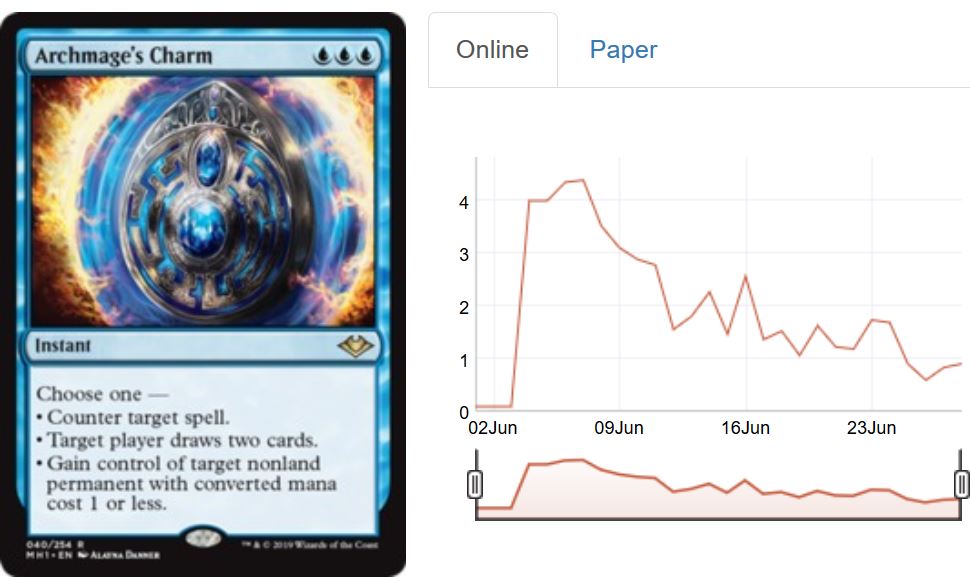
2. Archmage's Charm

Current Buy Price: $0.91

Archmage's Charm is one of those sneakily good spec targets that flies under the radar of most traditional MTG Finance discourse because it's not sexy and wouldn't be a good spec target in paper. It is, however, (i) in the best color, (ii) versatile, and (iii) has a third mode that is back-breaking against some popular cards and decks. I don't expect this card to become a breakout sensation, but its power will likely mean it commands a price of at least $2.00 sometime in the nearish future.

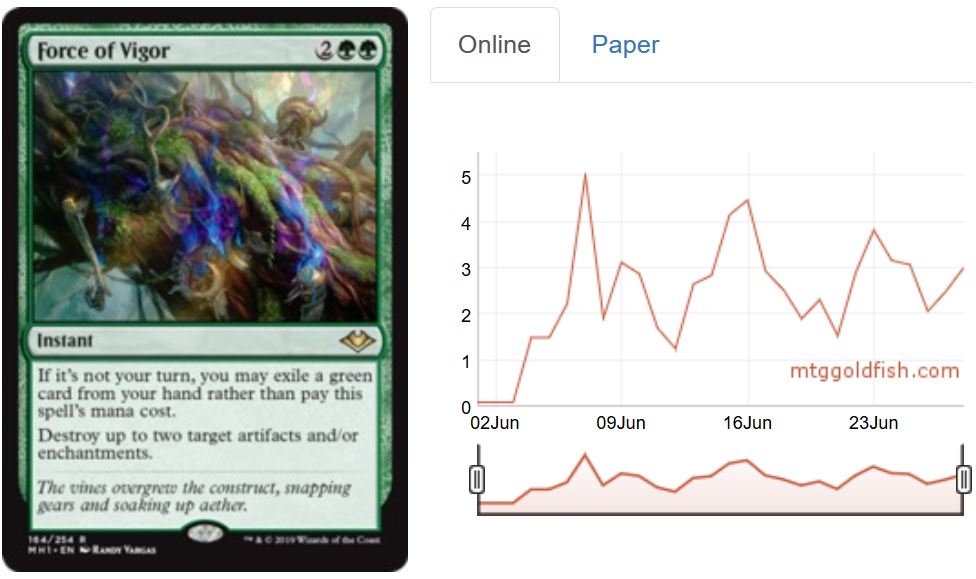
3. Force of Vigor

Current Buy Price: $3.02

During spoiler season I thought that Force of Vigor would see more play in Modern than any other card in Modern Horizons. Obviously, I was wrong, but some of the reason for that is that the Hogaak menace has pushed out some of the decks that Force of Vigor was meant to keep in check. Force of Vigor is still seeing play anyway in a variety of decks, and I expect that to increase if the Hogaak decks get nerfed. It's hard to imagine Force of Vigor being less than a $5 card, so this is one I'll likely be investing in. It's too potent a tool.

III. Riskier Speculation Targets

1. Force of Rage

...Just kidding! Just kidding!

I still can't believe this card got printed.

1. Goblin Engineer

Current buy price: $1.44

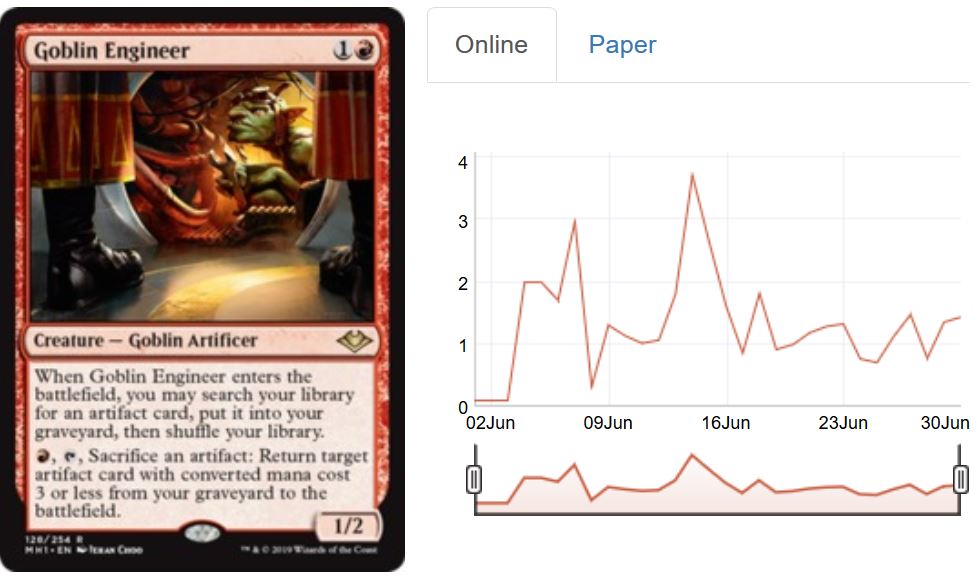
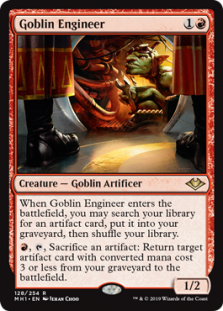
Goblin Engineer is a very powerful card, capable of putting artifacts like God-Pharaoh's Gift into the graveyard, and retrieving cards like Ensnaring Bridge from the graveyard. Its price is a bit high for my liking right now, but that's largely because it is already seeing experimental play in a variety of decks and archetypes. From a financier's perspective, this card is somewhat similar to Archmage's Charm, except that it has a lower floor and a higher ceiling. Likely a risk I'll be taking though, especially if it goes below $1.00 again.

2. Pashalik Mons

Current Buy Price: $0.06

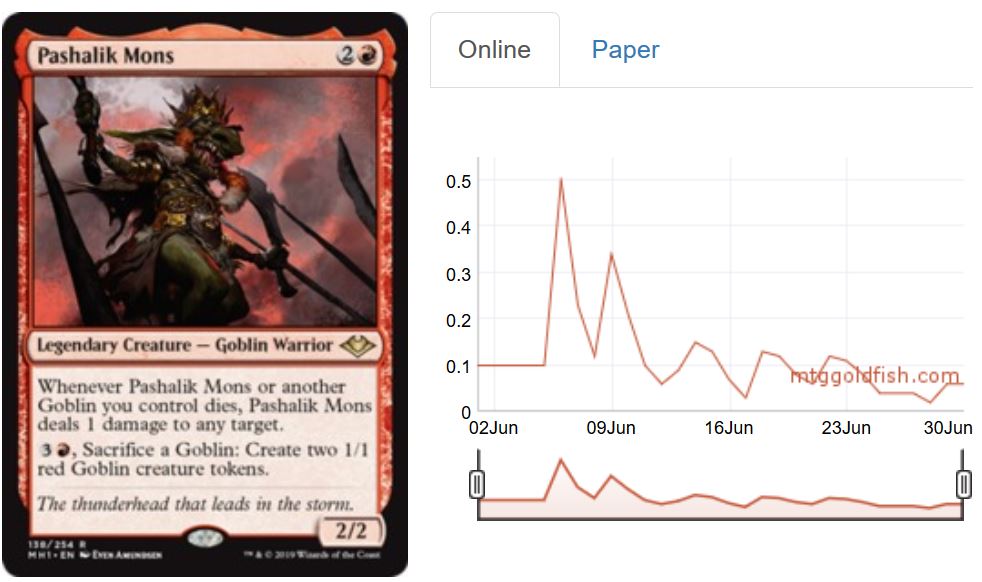
Goblin Ringleader is coming to Modern in a few short weeks, and that might be the shot in the arm that pushes Goblins into tier one or tier two territory in Modern. Pashalik is at bulk pricing now, and even though it might not work out now, it could work out in the future and skyrocket in price.

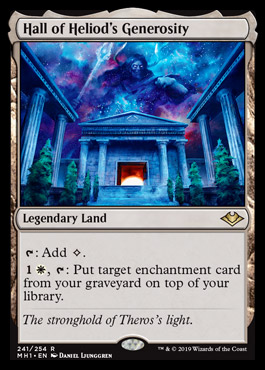
3. Hall of Heliod's Generosity

Current Buy Price: $0.08

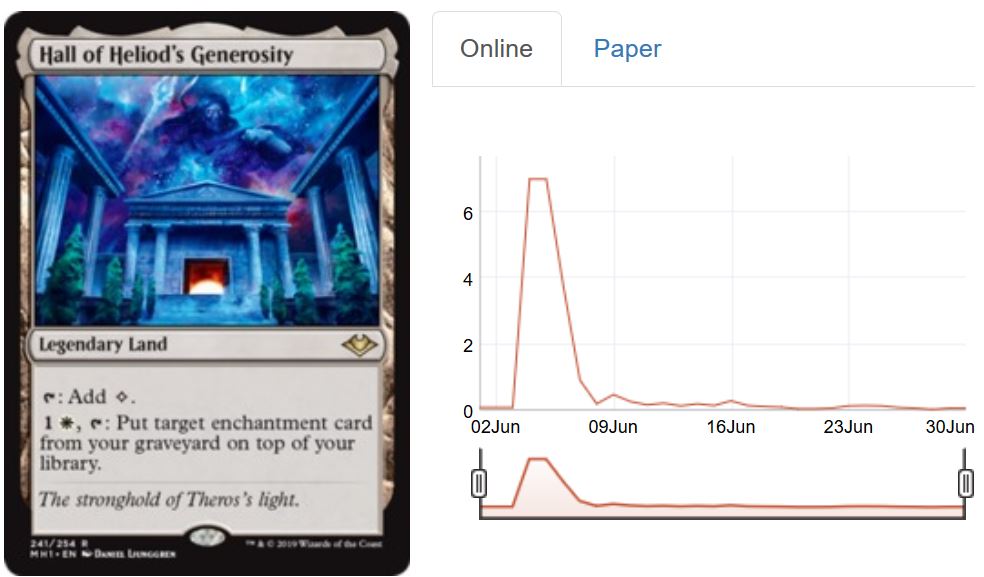
Hall of Heliod's Generosity is definitely a longshot, but at bulk pricing, I don't mind swinging for the fences. The biggest problem this card has when compared with Academy Ruins is relatively straightforward; I believe MaRo has said it himself: conceptually, enchantments are more likely to be things that don't get sacrificed or used up than artifacts. With that said, you never know what will get printed in the future that will make this card see real Modern and Legacy play. We shouldn't discount the casual demand this card will have with Enchantress Commander decks either.


IV. Signing Off

Thank you for reading. Undoubtedly there are other good opportunities in this set, and just because I didn't cover something here doesn't mean that you should avoid it. The set is chock full of cards that could see Modern and Legacy play, and as a supplemental set supply for all these cards will be low (especially those that lack the demand to be put in the treasure chests in October).

My coverage of Core 2020 will mirror that of War of the Spark. Shortly after release, I will do a financial power ranking of the mythics, and then once the set approaches peak supply I will do a financial power ranking of the rares and uncommons. As always, I try to write my articles just before it's wise to act on what I'm discussing. If you have any questions, leave them in the comments below or hit me up in the QS Discord.

Stop Wasting Time on MTG Finance

Are you a Quiet Speculation member?

If not, now is a perfect time to join up! Our powerful tools, breaking-news analysis, and exclusive Discord channel will make sure you stay up to date and ahead of the curve.

Social media has escalated the visibility of MTG Finance. Not a day passes by when someone touts a profitable transaction or shares some words of wisdom on how to approach the latest and greatest set. If you wanted to fill an entire day solely by consuming content about making money in Magic, there would be no shortage of content to view.

While the façade put up by the community is one of profit-driven excitement, this experience is only skin-deep. Underneath the surface, you’ll find hours of grinding, research, and shipping cards at break-even pricing simply to maintain liquidity. Have you ever really stopped to think about how much time you’re spending on this hobby?

MTG Finance: Is It Worth It?

According to my personal tracking, this marks the 400th full-length, stand-alone MTG finance article I’ve written. Nearly eight years spent researching, trading, and writing about the greatest hobby of all time. But in all this content creation, I’ve not once stepped back to ask the question: is MTG Finance really worth it? Do the financial gains justify the endless hours of work required to truly be successful?

There was an error retrieving a chart for Time Stretch

Let’s take a step back and consider this for a moment, and try to capture all the ways we’re spending time on MTG Finance:

  • Researching Prices – This is a daily activity of mine because I track card prices on MTG Stocks. I also review Card Kingdom’s hotlist daily so I can monitor the cards they are most interested in acquiring (at possibly aggressive prices). Since Card Kingdom updates their buylist more than once a day, I tend to check back a couple times. Add in occasional price checks at other sites, and this activity takes up about 30-45 minutes per week.
  • Social Media Engagement – The amount of time spent on MTG Finance while engaging in social media is tricky to quantify because there is always overlap with other engagements. But between Twitter, Discord, Facebook, Instagram, etc., the total time is not insignificant. I actively engage in Discord and Twitter conversation about Magic, but even if you’re just lurking you could still be sinking minutes of time out of every day in this hobby. I estimate this takes 2 hours of my time in total per week.
  • Transactions – This time commitment varies. For some QS Insiders, this may be the majority of sunk time into the hobby. I see some people posting long lists of recent sales in the Sales Reporting channel on Discord. On the other hand, I average only 1-2 sales per week along with 2-3 buylist orders. So I’ll estimate this time commitment at 60-90 minutes per week, but your mileage may vary.
  • Other – In this category are activities that don’t occur weekly: watching video coverage to see what’s hot in the latest metagame, engaging in discussion on B&R changes, picking through bulk (a true time sink), and any number of other ways one can engage in this hobby. Let’s bucket this all together as another hour per week, on average.

Add it all up, and we’re at around five hours per week. While everyone’s numbers will be different, the fact of the matter is this hobby is a major time sink. And we haven’t even sat down to play a game yet! I’d encourage everyone to repeat the same exercise I did above, really getting honest with themselves, and use the result to determine whether or not it’s really worth their time.

Three Tips to Streamline Your MTG Finance Approach

It’s true my time on MTG Finance is sprinkled throughout a day, a few minutes here and a few minutes there. But the time does add up, and there are probably other things I would enjoy doing with at least a portion of that time. Perhaps we can make a concerted effort to cut down on some of the weekly activities that eat up the majority of our time spent on the hobby.

I’d wager I can still enjoy MTG Finance and turn a profit while cutting my time spent on the hobby in half. That’s going to be my challenge to anyone who feels they’re spending too much time on this hobby. And I have a couple ideas to share on how to accomplish this goal:

  1. Don’t get sucked into every bit of price movement. Much like in the stock market, card prices are constantly in flux, and somebody out there is making money every day. But that somebody doesn’t always have to be you. Be disciplined about the cards you speculate on, the cards you buy during a buyout, and the cards you choose to ignore. You don’t have to scavenge the internet for copies every time a card price doubles. This eats up unnecessary time and often becomes fruitless because buyouts are more thorough nowadays. This morning I noticed Storage Matrix spiked. I could spend 10 minutes checking every obscure Magic store I know to see if I can find copies at the old price. But if I do this every day, the time spent becomes very high. My time may be better spent elsewhere.
There was an error retrieving a chart for Storage Matrix
  1. Cut down on social media. This will be the most difficult adjustment for me, but perhaps others will not have such a hard time with it. I am constantly refreshing Twitter and Discord because I want to be in front of any price move. But even this level of vigilance has not helped me catch every buyout. In fact, I estimate that 95% of the time I refresh these two apps, I find very little of consequence. I’m going to try and deliberately set times in my day when I can catch up on social media rather than constantly engaging in discussion. If I miss one more buyout, so what? I ignore most the hype on social media anyways, since I tend to focus on older cards (with the exception of some Modern Horizons pickups).
There was an error retrieving a chart for Seasoned Pyromancer
  1. Reduce the “Other” category towards zero. While this varies by individual, we all probably have various time sinks in this hobby that we can dramatically reduce. Do we really need to watch coverage of every Grand Prix or every SCG Open? Half the time, Standard’s metagame is stale and the opportunities to profit are nonexistent. If bulk picking is your “thing”, do you really think it’s worth your time to dig through boxes of cards looking for nickels and dimes? Personally, I find this activity relaxing and I enjoy the hunt, but is the activity really adding up to something worthwhile? Perhaps not. Perhaps my time is better spent focusing on the big cards and I let the nickels pass through my net. They’re too small to be worth pursuing most of the time.

Twitter debates are always toxic, so avoid engagement in any discussion around leaks, B&R speculation, new formats that are the flavor of the month, and most critically, the Reserved List. Don’t ever engage in Reserved List debate—no one escapes such discussions a “winner”. Everyone loses every time. Period.

There was an error retrieving a chart for Underground Sea

Wrapping It Up

Magic is a wonderful hobby with numerous ways to engage. For many reading this article, the primary way of engagement is MTG Finance. But if you’re like me, you’re spending way too much time on this hobby with little to show for it.

Moving forward, I’m going to make a deliberate effort to spend less time on MTG Finance. There are multiple ways this can be done, and I summarized a few key tips in this article. Hopefully, people can reapply this approach to come up with their own strategy.

I’m already excited to think about what I will do when I cut this time sink down. Perhaps that’s another way of getting motivated to reduce my MTG Finance time—I’ll think about the additional time I’ll have to read a book, play with my children, or catch up on a movie. If I consciously realize that this precious time I’m doing a different hobby is a result of less MTG Finance time, I’ll realize the benefits.

While I certainly don’t want to eschew MTG Finance completely, I think such a reduction is something we can all benefit from. After all, who really wants to spend more time on social media? No thank you!

Sigbits

  • Mox Diamond is certainly a hot card right now. I’ve obtained two from ABU Games using store credit, and both sold on eBay within 24-48 hours of listing. Card Kingdom’s buylist is getting quite aggressive: $190 for Stronghold copies and $205 for the FtV foils. Keep an eye on this one, especially if you’re in the market for some copies yourself.
  • As usual, there are a bunch of Masterpiece cards on CK’s hotlist. It seems they’re always trying to restock these cards. This week, some key cards on their list include Mox Opal ($180), Force of Will ($170), Misty Rainforest ($175), and Chalice of the Void ($140). It feels like these cards are permanently pinned to Card Kingdom’s hotlist.
  • One card that seems to have climbed up on Card Kingdom’s hot list lately is Antiquities Hurkyl's Recall. They currently offer a $50 buy price for the blue instant. This may seem impressive, but ABU Games is even more eager to acquire copies. They offer $53.82 cash for near mint copies, or $123.05 in credit!

June ’19 Brew Report, Pt. 1: Tribals, Tribulations

Are you a Quiet Speculation member?

If not, now is a perfect time to join up! Our powerful tools, breaking-news analysis, and exclusive Discord channel will make sure you stay up to date and ahead of the curve.

In "Stitched Together: Early Successes from Horizons," we looked at some of the breakout cards in Magic's newest expansion. The month has now ended, and it's left plenty of new developments in its wake. Today, we'll look at the veritable explosion of tribal aggro strategies in Modern as well as a few novel takes on combo.

Tribal Trouble

Besides Goblins, Merfolk, and Humans, all of which we covered a couple weeks ago, Horizons has injected even more tribal strategies with new lifeblood.

Winding Elves, by L2AMPAGE (5-0)

Creatures

4 Dwynen's Elite
2 Elves of Deep Shadow
4 Elvish Archdruid
3 Elvish Clancaller
4 Elvish Mystic
2 Ezuri, Renegade Leader
4 Heritage Druid
4 Llanowar Elves
2 Nettle Sentinel
4 Shaman of the Pack

Sorceries

4 Winding Way

Instants

4 Collected Company

Lands

4 Blooming Marsh
3 Forest
4 Gilt-Leaf Palace
3 Llanowar Wastes
4 Nurturing Peatland
1 Pendelhaven

Sideboard

3 Assassin's Trophy
2 Choke
3 Collector Ouphe
3 Damping Sphere
4 Yixlid Jailer

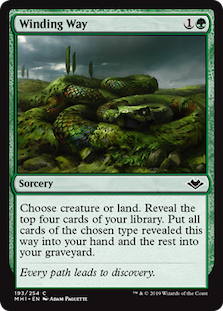
Modern Horizons marked my first prerelease event since Khans of Tarkir, and I went undefeated with a mono-green deck full of 2/2s (some of them even real Bears!). Besides 4 Savage Swipe, my deck's only noncreature spells were 3 Winding Way, and I was constantly impressed by its performance. Not enough to consider it for constructed, though, which proved the day's biggest mistake.

Elves already plays Lead the Stampede, so it makes sense to try Way there; while the newcomer digs 20% less deep, it also costs a third less mana, and going from CMC 3 to CMC 2 is a massive leap in Modern. Lead-based builds seem alive and well regardless, but Way could catch on as lists continue to roll out.

Collected Slivers, by DEEPFRDKIRBY (5-0)

Creatures

4 Predatory Sliver
4 Sinew Sliver
4 Sedge Sliver
3 Galerider Sliver
3 Cloudshredder Sliver
3 Diffusion Sliver
2 Manaweft Sliver
2 Necrotic Sliver
2 Striking Sliver
2 Gemhide Sliver
1 Darkheart Sliver
1 Dregscape Sliver
1 Homing Sliver

Artifacts

4 Aether Vial

Instants

4 Collected Company

Lands

1 Blood Crypt
4 Cavern of Souls
1 Forest
4 Mutavault
1 Overgrown Tomb
4 Sliver Hive
1 Swamp
1 Urborg, Tomb of Yawgmoth
3 Verdant Catacombs

Sideboard

1 Darkheart Sliver
2 Damping Sphere
3 Dismember
2 Frenetic Sliver
3 Harmonic Sliver
3 Leyline of the Void
1 Syphon Sliver

After months of speculation, Slivers finally has an actual result! The idea here is to max out on lord effects, then divvy up the remaining slots among other Slivers to maximize the odds of finding a combination that yields unique keyword abilities.

Ninjas, by MRRAEB (5-0)

Creatures

4 Faerie Seer
4 Spellstutter Sprite
4 Snapcaster Mage
4 Ice-Fang Coatl
4 Ingenious Infiltrator

Instants

4 Opt
4 Fatal Push
3 Mana Leak
4 Cryptic Command

Sorceries

4 Inquisition of Kozilek

Lands

1 Breeding Pool
4 Misty Rainforest
1 Overgrown Tomb
4 Polluted Delta
2 Prismatic Vista
1 Snow-Covered Forest
6 Snow-Covered Island
1 Snow-Covered Swamp
1 Watery Grave

Sideboard

2 Assassin's Trophy
2 Force of Negation
4 Leyline of the Void
2 Plague Engineer
1 Spell Pierce
2 Surgical Extraction
2 Thoughtseize

Ninjas has never claimed much Modern playability; my own experiments with Ninja of the Deep Hours revealed ninjutsu's fatal flaws as a mechanic. Ingenious Infiltrator is a definite upgrade, touting extra toughness and a clause that drastically improves it in multiples. But it seems running discard is the most reliable way to ensure a successful ninjutsu. Additionally, Faerie Seer and Ice-Fang Coatl serve as attractive options to bounce back.

Some builds are opting to take (what I would once have called) full advantage of green by adding Tarmogoyf, a strong follow-up after losing a ninjutsu enabler to removal.

Vampires, by ARTEMESIS (5-0)

Creatures

4 Cordial Vampire
4 Indulgent Aristocrat
4 Stromkirk Condemned
4 Viscera Seer
4 Asylum Visitor
4 Blood Artist
4 Bloodghast

Sorceries

3 Call to the Netherworld
4 Thoughtseize

Enchantments

4 Call the Bloodline

Lands

4 Bloodstained Mire
3 Marsh Flats
3 Polluted Delta
8 Swamp
3 Urborg, Tomb of Yawgmoth
60 Cards

Sideboard

1 Cry of the Carnarium
4 Fatal Push
3 Inquisition of Kozilek
4 Leyline of the Void
3 Liliana of the Veil

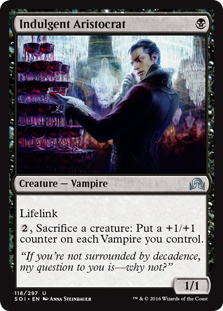
Diving off the deep end a little, we have Vampires, appearing in a much different form than we've previously seen. This deck functions like Humans, distributing +1/+1 counters over a wide team of one-drop bodies. Asylum Visitor and Call to the Netherworld provide the card advantage missed from lacking Militia Bugler, and Thoughtseize does the heavy lifting on the interactive side.

While Seize is one of Modern's most historically powerful cards, Humans is capable of pumping out multiple disruptive effects at once, while Vampires must rely more on its speed to get the job done before opponents do. It also doesn't strike me as particularly fast. There's plenty more interaction in the sideboard, of course, but I can't imagine this deck doesn't lose a lot of game 1s.

Zombies, by FATKIDDESTROYERS (5-0)

Creatures

4 Carrion Feeder
4 Cryptbreaker
4 Gravecrawler
4 Tidehollow Sculler
4 Undead Augur
4 Wayward Servant
4 Diregraf Colossus

Artifacts

4 Aether Vial

Sorceries

4 Thoughtseize
4 Dark Salvation

Lands

4 Concealed Courtyard
4 Prismatic Vista
4 Silent Clearing
8 Swamp

Sideboard

4 Fatal Push
3 Leyline of Sanctity
2 Liliana, the Last Hope
1 Liliana, Untouched by Death
2 Plague Engineer
3 Tormod's Crypt

Zombies continues our journey into the spookier side of Modern's upheaval. We've seen Zombies here and there in Modern, but always carried by Smuggler's Copter; this build breaks the mold, and is notable for basically just being an old Standard list.

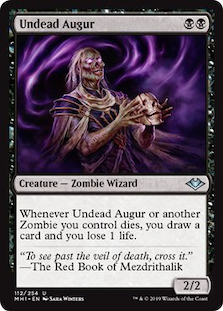
Making the difference are Carrion Feeder, a card now infamous in Modern for its applications in the Hogaak deck, and Undead Augur, a Horizons notable and pushed bear that converts dead Zombies (itself included) into draw power. This combination lets players turn their on-board Zombies into new cards, an impressive engine with Gravecrawler in the mix. Aether Vial helps make use of the creatures drawn, and Silent Clearing prevents flooding. But I can't for the life of me figure out that Prismatic Vista....

Soldiers, by DUCKBILLY (16th, Modern Challenge #11892017)

Creatures

2 Field Marshal
4 Champion of the Parish
2 Kytheon, Hero of Akros
2 Militia Bugler
3 Soldier of the Pantheon
3 Thalia, Guardian of Thraben
2 Thalia, Heretic Cathar
4 Thalia's Lieutenant
4 Tithe Taker

Planeswalkers

2 Gideon Blackblade

Instants

4 Lightning Bolt
4 Lightning Helix
2 Path to Exile

Lands

4 Arid Mesa
4 Cavern of Souls
2 Inspiring Vantage
1 Mountain
3 Mutavault
3 Plains
2 Sacred Foundry
3 Sunbaked Canyon

Sideboard

2 Brave the Elements
2 Damping Sphere
1 Grafdigger's Cage
3 Jötun Grunt
2 Mirran Crusader
2 Runed Halo
1 Shatterstorm
2 Stony Silence

Soldiers is another long-forgotten tribe of Modern. Despite occasional results, White Weenie-style decks have never really made it here. This deck may prove no different, but it does have some intriguing aspects going for it:

  • Tithe Taker as value-generating taxer
  • Gideon Blackblade as bulk-plus-utility
  • First strike as relevant keyword
  • Jötun Grunt in a topping list

Jokes (and light synergies) aside, I don't much understand Grunt over the brutally effective Rest in Peace. But perhaps a faster clock is what Soldiers needs versus graveyard decks.

Stuck Together

Showing old tribes love isn't all Modern Horizons has done for the format. Some new combo decks are also beginning to show up.

Engineering a Win

Goblin Engineer drew the attention of my local playerbase upon spoiling, with some claiming it would spawn its own archetype as Stoneforge Mystic has in Legacy. My own experiments with the card, admittedly brief, using Trash for Treasure, and in a Temur Snow shell, suggested that even when not assembling a combo, Engineer proved a solid value engine. Since then, the card has been welcomed into Modern  alongside Urza, Lord High Artificer. But other pilots continue to tinker with the 1/2.

Modular Engineer, by GOSEIGEN (5-0)

Creatures

3 Arcbound Ravager
4 Goblin Engineer
1 Hangarback Walker
4 Sai, Master Thopterist
4 Walking Ballista

Artifacts

4 Chalice of the Void
4 Chromatic Star
2 Engineered Explosives
2 Ichor Wellspring
4 Mox Opal
1 Nihil Spellbomb
1 Pyrite Spellbomb
1 Sword of the Meek
3 Thopter Foundry

Enchantments

1 Ghirapur Aether Grid

Lands

2 Blast Zone
3 Darksteel Citadel
2 Ghost Quarter
4 Glimmervoid
2 Sea Gate Wreckage
2 Snow-Covered Island
4 Spire of Industry
2 Spirebluff Canal

Sideboard

1 Nihil Spellbomb
1 Ashiok, Dream Render
1 Crucible of Worlds
1 Damping Sphere
2 Goblin Cratermaker
1 Grafdigger's Cage
1 Mortarpod
1 Padeem, Consul of Innovation
1 Plague Engineer
1 Spellskite
2 Surgical Extraction
2 Wear // Tear

Modular Engineer features the Thopter-Sword combo Goblin is so good at assembling, but falls back on a Plan B cribbed from Hardened Scales. Being able to turn any artifact into Arcbound Ravager puts a lot of pressure on removal-spell decks, especially against the backdrop of the XX-costers, and Ichor Wellspring provides a non-Construct path to value.

Mono-Red Prison, by FADVISOR82 (5-0)

Creatures

4 Goblin Rabblemaster
4 Goblin Engineer
4 Simian Spirit Guide

Planeswalkers

4 Karn, the Great Creator
2 Chandra, Torch of Defiance

Sorceries

2 Slagstorm

Instants

4 Abrade

Artifacts

3 Chalice of the Void
3 Ensnaring Bridge
3 Ichor Wellspring
1 Liquimetal Coating
1 Trinisphere

Enchantments

4 Blood Moon

Lands

2 Darksteel Citadel
3 Gemstone Caverns
13 Mountain
3 Ramunap Ruins

Sideboard

1 Chalice of the Void
1 Chandra, Torch of Defiance
1 Ensnaring Bridge
1 Liquimetal Coating
1 Anger of the Gods
1 Dragon's Claw
3 Eidolon of the Great Revel
1 Grafdigger's Cage
1 Mycosynth Lattice
1 Sorcerous Spyglass
1 Tormod's Crypt
1 Torpor Orb
1 Walking Ballista

Mono-Red Prison has been one of Modern's go-to stompy decks for a while now. It usually runs Legion Warboss as additional copies of Goblin Rabblemaster, but FADVISOR82 opted for Goblin Engineer instead.

Engineer has some quirky uses in this deck: it grinds out value with Ichor Wellspring; locates Liquimetal Coating for Karn shenanigans or Trinisphere in its right matchups; monetizes spare copies of Chalice of the Void and Ensnaring Bridge, as well as bringing back the latter if opponents destroy it; and helps tutor Karn bullets in post-board games. Its inclusion over Warboss makes Mono-Red less of a one-trick pony, giving the deck some added utility and resilience in the face of disruption at the cost of a more reliable stompy plan of lock-piece-into-pressure.

The More, the Merrier

60 cards? I don't think so! ELEVINESS took the internet by storm with their Battle of Wits deck, and later published the tournament report from an 11th-place Modern Challenge finish.

Battle of Wits, by ELEVINESS (11th, Modern Challenge #11892017)

Creatures

4 Birds of Paradise
4 Sylvan Caryatid
4 Sakura-Tribe Elder
4 Wall of Roots
4 Snapcaster Mage
4 Eternal Witness
3 Knight of Autumn
1 Sin Collector
4 Restoration Angel
1 Arc-Slogger
1 Caldera Hellion
1 Thragtusk
1 Kiki-Jiki, Mirror Breaker
1 Ramunap Excavator
2 Panglacial Wurm
2 Platinum Emperion
1 Terastodon
1 Elesh Norn, Grand Cenobite
1 Iona, Shield of Emeria

Sorceries

4 Inquisition of Kozilek
4 Thoughtseize
4 Traverse the Ulvenwald
4 Glittering Wish
4 Sylvan Scrying
4 Farseek
4 Search for Tomorrow
4 Cultivate
4 Dreadbore
4 Madcap Experiment
4 Scapeshift
4 Maelstrom Pulse
3 Unmoored Ego
3 Slaughter Games
4 Supply // Demand
4 Wargate
3 Bring to Light
1 Timely Reinforcements
1 Anger of the Gods
1 Crumble to Dust
1 Damnation
1 Supreme Verdict
1 Unburial Rites

Instants

4 Fatal Push
4 Abrupt Decay
4 Assassin's Trophy
4 Chord of Calling
4 Growth Spiral
4 Izzet Charm
4 Remand
4 Eladamri's Call
4 Pulse of Murasa
4 Gifts Ungiven
2 Summoner's Pact
1 Pact of Negation
1 Noxious Revival

Enchantments

4 Battle of Wits
1 Rest in Peace
1 Detention Sphere
1 Worship

Lands

4 Arid Mesa
4 Bloodstained Mire
4 Flooded Strand
4 Windswept Heath
4 Wooded Foothills
4 Verdant Catacombs
4 Polluted Delta
4 Misty Rainforest
3 Marsh Flats
4 Steam Vents
4 Stomping Ground
4 Breeding Pool
2 Sacred Foundry
2 Blood Crypt
2 Watery Grave
2 Overgrown Tomb
2 Temple Garden
1 Hallowed Fountain
1 Godless Shrine
4 City of Brass
4 Mana Confluence
4 Evolving Wilds
4 Field of Ruin
2 Valakut, the Molten Pinnacle
1 Tolaria West
1 Khalni Garden
1 Blighted Woodland
1 Dryad Arbor
1 Tectonic Edge
1 Ghost Quarter
1 Blast Zone
1 Boseiju, Who Shelters All
8 Forest
4 Island
3 Plains
2 Mountain
1 Swamp

Sideboard

1 Knight of Autumn
1 Bring to Light
1 Detention Sphere
1 Slaughter Games
1 Supreme Verdict
1 Unmoored Ego
1 Casualties of War
1 Dark Heart of the Wood
1 Firespout
1 Fracturing Gust
1 Fulminator Mage
1 Heroes' Reunion
1 Izzet Staticaster
1 Safewright Quest

The deck is split between enablers/mana, tutors/bullets, goodstuff value components, and win buttons, including its namesake enchantment. Cutest of all, "the more, the merrier" doesn't extend to the sideboard, which features just 14 cards.

Refined as it looks all neat and parsed, Battle is far from optimized. ELEVINESS has expressed interest in trying Karn, the Great Creator, which I agree would be an excellent four-of in this deck; Teferi, Time Raveler is also a solid Glittering Wish target, and Prismatic Vista would apparently make the cut if not for its high price online. Funniest of all, the pilot never once cast Battle of Wits during the tournament, and went on to suggest the deck may be better off without it. Omitting Battle might enable cutting the least effective plans from the list to tighten things up, and subsequently allow for different builds depending on which engines best punish an existing metagame.

Appetite for Brews

This week's dump was packed with Modern first-timers, but we've only just scratched the surface of the impact Horizons is having on the format. Join me next week for Part 2 of the June Brew Report.

Preparing for Modern’s Impending Bans

Are you a Quiet Speculation member?

If not, now is a perfect time to join up! Our powerful tools, breaking-news analysis, and exclusive Discord channel will make sure you stay up to date and ahead of the curve.

The writing is on the wall, and a ban in Modern is coming during the next announcement on July 8th. Ever since Modern Horizons was released, the format has been in the grip of the Hogaak, Arisen Necropolis-powered Bridgevine deck, which along with other new inclusions Altar of Dementia and Carrion Feeder has become the most busted Modern deck in recent memory. Arguably, it is the most broken deck ever, or at least sits among them. The deck is dominating results, and it’s exerting tremendous pressure on sideboards. To allow the deck to live on would be unconscionable, so a ban is inevitable.

Bans will have a big impact on the metagame, and Modern is a huge driver of prices, so there is the potential for some major shakeups coming in the market. Now is the time to prepare. The shake-up will be amplified further by this week’s official institution of the London Mulligan rule for all formats, which showed during its trial run to have a big impact on Modern. Along with the release of Core Set 2020, it’s a very interesting time and one that presents a lot of opportunity. 

There’s a big question of what will be banned, but my money is on Faithless Looting. Banning something like Hogaak, Arisen Necropolis or more to cut down Bridgevine would help stop the deck, but it would just leave the format vulnerable to both Dredge and Arclight Phoenix. Banning Faithless Looting knocks down Bridgevine along with these other graveyard decks, and would do a lot to open up the format to other strategies. 

That said, a Faithless Looting ban alone will not be enough to stop Bridgevine, so I expect we’ll see more on the chopping block. The safest bet is Bridge from Below, which makes the deck’s sacrifice outlets so strong, and just doesn’t have any fair use anywhere in the format, so will not be missed. Vengevine is another potential ban target, but I expect it to survive this round.

I am preparing for both Faithless Looting and Bridge from Below being banned, and for the world to come afterward. One way to get an idea of what to expect is to look backward, to before Arclight Phoenix brought the format into upheaval. The top deck at that time was Bant Spirits, which during the months prior had been gaining ground on Humans as the format’s premier tribe. These creature decks suffered extremely against a deck with Thing in the Ice and Gut Shot, and will have much pressure lifted without them as fixtures of the metagame.

There was an error retrieving a chart for AEther Vial

A Faithless Looting ban would be a major boon to these tribal decks, which would rise towards the top of the metagame. Both decks are also highly disruptive and should have a reasonably good game against the unfair decks promoted by the London Mulligan. For that reason, I like targeting cards like Aether Vial, an essential part of both decks.

There was an error retrieving a chart for Noble Hierarch

Noble Hierarch is another candidate, especially since its Ultimate Masters reprint cut the price down to half of its previous $80, and given the poor metagame conditions has yet to begin its recovery, so it feels like a true bargain. 

These tribal strategies have also gained some very potent new tools from Modern Horizons, which only serve to improve their chances at rising back to the top of the metagame after a ban. Giver of Runes has become common in Humans and is set to appreciate, and although at this point is already pretty expensive, maybe $20 or even higher is realistic down the road once the set is out of print. A more value-oriented play is Unsettled Mariner, which has become a staple of both Humans and Spirits, and has potential in other decks like Merfolk. At $4 it seems to have plenty of upside but little room to fall given that it’s already seeing competitive play.

There was an error retrieving a chart for Karn Liberated

Of course Urzatron was also a menace to the format, along with another land-based deck Amulet Titan, and they also have a lot to gain from the London Mulligan rule.  There’s some argument that if Faithless Looting is to be banned, then Ancient Stirrings ought to go along with it, which is certainly possible. I think it’s more likely that Wizards will move cautiously and take baby steps with the least change possible, and will target Ancient Stirrings in the future if it’s a problem, but it’s something to consider for speculation purposes. In the meantime, Urzatron should be a pretty safe bet, so a staple like Karn Liberated, another UMA reprint with a suppressed price point, looks like a good target. 

No preparation for upcoming bans would be complete without considering the implications of Core Set 2020, which will be released July 12th. War of the Spark and of course Modern Horizons have set a precedent for Wizards really paying attention to Modern-playable cards, and it has continued with Core 2020. For example, Lotus Field shows a lot of promise in the Amulet Titan deck and makes its staples, such as namesake Amulet of Vigor, look like good targets. Across the board, the deck’s staples showed strong growth during the spring leading into Modern Horizons, and I see no reason it shouldn’t continue once this Bridgevine period ends.

There was an error retrieving a chart for Goblin Piledriver

M20 will finally bring Goblins to the next level with Goblin Ringleader, the card it has always wanted in Modern. With Goblin Matron in Modern Horizons, there is clearly a concerted effort on the part of Wizards to elevate the tribe, and now there’s some real potential. Simply put, Goblins now in Modern is an entirely different animal than Goblins before, which typically were hyper-aggressive all-in decks. Now, it can play a more balanced game similar to how it acts in Legacy, where it was once a top strategy. Aether Vial has long been a staple of the deck, so Goblins is yet another reason why that card has great prospects. A more Goblin-specific spec would be something like Goblin Piledriver, which combined with card advantage from the new goblin reprints should excel. 

There was an error retrieving a chart for Force of Negation

The Neobrand deck has been performing pretty decently on Magic Online despite the Bridgevine menace and before the London Mulligan rule, so its prospects look good, and speculating on its staples could be a good play. On the other hand, it now has Force of Negation to contend with. I don’t believe Force of Negation is particularly strong in this Bridgevine metagame, but is still good enough to be a maindeck two-of in Azorius Control. It's likely to see even more play as a safety valve to the London Mulligan rule. I’ve picked up a set to play with because I just don’t ever see them being cheaper. 

My beloved set of Arclight Phoenix, on the other hand, I sold last week when I realized its glory days are likely behind it.

QS Round Table #1 – Spoiler Season Burnout (Complete)

Are you a Quiet Speculation member?

If not, now is a perfect time to join up! Our powerful tools, breaking-news analysis, and exclusive Discord channel will make sure you stay up to date and ahead of the curve.

We've reached the end, folks! All five parts of the round table discussion are available here. Part 5 is available down below.

The rapid-fire rate of release of Magic product in the last few months has been absolutely staggering. With all of these releases so close together, it feels like we've been on the ride for several months, without much chance to stop.

Our staff here at Quiet Speculation felt it was appropriate to come together as a team and discuss the implications of this release schedule, and why they matter. Welcome to our first round table discussion, focusing on the last three months of product releases.

1. Are there too many releases to keep up with?

Chaz Volpe: Not at all. There’s a product for all players currently - some may not pertain to you - and that’s okay. It’s in the game’s best interest to keep providing us with releases and/or content to help stay relevant.

Chris Martin: WotC tested the boundaries of wallet fatigue and sensory overload with a hat trick of releases, but I didn't find it to be too many. It is great for players because the possibilities feel endless and it is equally great for content creators because of the freshness it injects into their work.

David Schumann: Maybe not now, but a constant barrage of new products will lead to "excitement fatigue", where each subsequent set will feel less special/unique. There would likely be wallet fatigue as well, one reason we often look for good speculation targets from Standard legal sets released shortly before masters/specialty sets is that players have limited financial resources and they utilize them to maximize their enjoyment, which often means they reduce purchasing of one product in favor of the next.

Niels Rietkerk: As someone who has not dealt in recent cards for over a decade it doesn’t matter much to me, however, it does feel like we’re getting a lot of releases in a short time frame. I fear wallet fatigue among players. If less is bought per set, because the money gets spread out more, it may also lead to cards from less popular sets becoming rarer.

Kelly Reid: No, I love the frequency of releases. They should print more Magic cards in general. Collectibility is for Reserved List cards and variants like promos. Magic cards should be cheap enough that people buy lots of them and trade them often. That's what's best for the game. As a casual player, a lot of the non-tournament cards end up being amazing in my various playgroups, even if they're just quirky trick cards; those end up in my Danger Room stack. I think they're in a good groove now and hope they keep it up. They have a license to print money with MTG and I think they should use it to the fullest.

Tarkan Dospil: My short answer to these types of questions is always - "Despite what many may think; Wizards knows what they're doing." From my perspective, wallet fatigue certainly seems like a thing, but they have teams of experts analyzing market data to determine how the consumer base will ingest the product. I will stress that WotC is NOT interested in burning out consumer wallets for short-term gain. There are too many hands in the pie from Hasbro down, and the brand is too valuable. They may make mistakes along the way, but they have zero incentive to drive the game into the ground by burning buyers out. From a secondary market perspective, an increase in the release cadence means a lot of things will be undervalued, simply because they're left behind. This leaves room for a lot of opportunity. It also allows for many new card interactions to emerge sooner, which keeps the market interesting.

Sigmund Ausfresser: The issue isn't necessarily about keeping up - the QS Insider Discord does a great job staying on top of spoilers - but having sufficient resources to fully appreciate each set. If each new set brings cards that would fit into your decks, and you want to draft each one a couple of times, and you want to speculate here and there, you run out of cash very quickly. I don't see how these rapid-fire set releases aren't cannibalizing each other, both from a sales and overall excitement standpoint.

Christopher O'Berry: The release schedule this year has been rapid, and I'm definitely feeling the strain of it all. The fatigue is real. That being said, the release schedule has brought a lot of hype for the game overall, and I believe that will be a good thing for Magic in the long run. Design and play experiences for these recent sets have overall been very good, and if they continue to churn out products of this quality at an even rate, I don't foresee them changing course any time soon.

Kyle Rusciano: No. After throwing more and more product releases at Magic players year after year for the past several years, Wizards' decision to pull back in 2019 shows that they now know and respect the number of releases beyond which the market sinks into fatigue and disinterest. Players want to feel that they can keep abreast of what is going on in Magic, and they can do that more easily this year. In 2017 and 2018 there were definitely too many sets; the market was clearly oversaturated and uneasy about the ever-increasing frequency of supplemental sets filled with reprints. In 2019, however, there will be one or two fewer supplemental sets, which will make for a far more digestible number of releases. What I question is the timing of these releases. It's important to let each set breathe and space them out relatively evenly.

2. Should the timeframe for spoiler season be changed?

Reid: They should just release the whole set at once. There's no real suspense or drama these days; they should just show us the whole edition as a complete thought. Don't pretend to tease us. I also think the drip-release can cause subconscious biases due to recency and primacy effects. Players may over-rate the first big mythic rares they see, and under-rate subsequent ones. Finally, you eliminate the 'dead-brew' time when you've seen some cards and you want to build decks, but have to wait till they're all released. This is a boring and frustrating time to be a Magic player.

Dospil: I thought the experiment with War of the Spark; whereby they protracted the spoilers by an entire month to tell the WAR story, was a fantastic play. It added another layer to the spoiler experience, and allowed time for the market to group-think how the cards may impact the game. I want to stress that second part: Spoilers aren't just to reveal cards, anymore. In my view, they're part of the broader engagement strategy that WotC seems to be employing, where you're interacting with the game at all times across a variety of vectors (spoilers, social media, content creators, FNM, etc). I like the extended spoiler methodology like WAR, and I hope we see more of that in the future.

Ausfresser: The current spoiler season pacing is fine. Spoiling cards over the course of two weeks feels like an appropriate rate, though I'm not sure how exciting all these common and uncommon spoilers are. The issue is when one spoiler season is right up against another, and before you even get the new cards in your hand, you have to think about the next set.

O'Berry: At current, I think it's just right. My main issue with the current hype cycle formula of these last three sets was not enough time in between them, and not necessarily for the spoiler season itself. That being said, I think the style in which the spoilers are doled out needs a little innovation. War of the Spark was a fantastic example of how to build hype by carefully curating the spoiler schedule according to the story. This won't work for every set, I imagine, but there is definitely creative space for spoiler releases that have yet to be explored.

Rusciano: No, two weeks for supplemental sets and between two to three weeks for normal sets is fine. This is especially true if we get to experience the main storyline as a part of spoiler season as we did with War of the Spark; I found myself caring more about the story in part due to the way that spoilers followed the set's narrative arc. Hopefully, we will experience more of this going forward.

Volpe: The time-frame for when previews are provided, should be changed. It would certainly be hard to accommodate all players and many time-zones, but there has to be a more efficient way. With more players tapped into the many facets of the game, especially the financial facet-information is the most valuable commodity. Missing major new previews of cards or product is not a great feeling just because you have other commitments in your day.

Martin: I would prefer a quicker spoiler season and a consistent place to find the cards the moment they are spoiled (ex: when someone is scheduled to spoil a card that card should be posted at that same time to a Wizards spoiler homepage). I think the current format of spoilers being done by MTG personalities is too fractured and causes inadequate delivery of information.

Schumann: I don't see any solid argument to change the timeframe. As stated above my bigger concern is the various fatigues that go with a constant barrage of new product options. I would prefer it if they released the spoilers in a more organized/controlled fashion, something like 1 mythic/4 rares/4 uncommons/5 commons a day or something more set so we would know when we could “turn off” for the day and not worry about missing out.

Rietkerk: I believe longer would be better, but only if there’s enough time between sets. With the increasing release frequency, a shorter timeframe would probably be more appropriate just to make sure there’s no overlap.

3. Is the high volume releases healthy for the secondary market?

Dospil: I don’t think it’s unhealthy. Look at historical data of MTG releases and you'll see that the product is incredibly resilient. Almost no set falls into 'worthlessness' and nearly all sealed product sees growth over time. To reiterate my point from question one - more product means more cards are left behind, only to creep up in value over time as new competitive interactions are discovered and/or the casual market finds cool things to do with them.

Ausfresser: This is a complex question, and it depends on your definition of "healthy". I don't see any systemic risk to the high volume of releases. Long term, some cards in these sets may have a higher secondary market value simply because not enough product was opened during these back-to-back set releases. This will create opportunities to profit as these cards age, and that is interesting for me to track. But some may not deem this as healthy.

Rusciano: Reprints, not new card printings, are bigger drivers of market unease and panic than new card printings. The market was clearly displeased at the rate of reprints flooding the market once Wizards began releasing multiple Masters set per year. It's no accident that the secondary market is far happier and healthier this year now that Wizards has taken its foot off the gas pedal. As long as Wizards has only one major reprint set a year (counting something like Modern Horizons as half a reprint set), the market will be healthy and happy. In general, I think it's good that Wizards creates sets that give us alternate ways to play, be it multiplayer (Conspiracy), 2-on-2 (Battlebond), or whatever else they think of next.

Volpe: Overall, yes - but, the issues with information and timing as I mentioned above is unhealthy on the market for a broad number of players. Other than that specific issue: More sets, more cards, more eyeballs, new interactions, MTG Arena - all of these aspects are now working in tandem to bring new players and visibility to the game. This is healthy, this is what we want as players of any type, as store owners, as fans of the game. More importantly, it elevates the value of the game.

Martin: In general, the high volume of new products causes longer tails on EDH spec maturity because player/brewer focus is distracted. It also causes an abnormal amount of speculator dollars entering the market which inflates a large portion of cards unnecessarily. That said, it is healthy for the secondary market so long as the products are well-received (i.e. Magic as a game is healthy then so will be the secondary market).

Schumann: Yes and no. Obviously, Chronicles wasn't and that is what caused the formation of the reserved list in the first place. Too limited of a print run can cause card prices to soar and alienate players. This is similar to how the original Modern Masters sold out everywhere and all the effort into developing a good limited format by the development team was pretty much wasted. Most people barely got to experience that limited format.

Rietkerk: Because I reckon the increased frequency may lead to some sets being undersold relative to others I would expect popular cards from those sets to reach greater heights. I am reminded of Voice of Resurgence back in Dragon’s Maze that reached great heights because the set was relatively unpopular.

Reid: For sure. If retailers buy it from WotC and players buy it from retailers, everyone wins. The more cards moving through the market, the better. There might be some dilution of value for higher dollar cards when they're reprinted, but this is not a major or frequent concern. Overall, more cards in hands means more people committed to the game of Magic, which creates and supports the secondary market.

O'Berry: If buyers are ready to shoulder the cost every other month to purchase new Magic product, then I don't see any reason to label this release schedule as unhealthy. I think the biggest challenge for buyers and sellers in the secondary market will be obtaining or moving cards at a rate that allows them to keep up with trends. You don't want to be stuck holding the bag on products that have no demand.

4. Do you think this hectic release schedule is sustainable for Wizards?

Ausfresser: It's possible. I assume Wizards has done extensive study on release schedules, pacing, and the like. They would be in a better position to evaluate its sustainability. If I had to guess, I'd say it is sustainable long-term, but they may evolve the kinds of sets they release over time. For example, perhaps a Commander-focused set, followed by a Standard set, followed by a Modern-focused set would be reasonable to release back-to-back because the target audiences are different. They won't likely accelerate the release schedule for Standard sets--that wouldn't be sustainable.

O'Berry: The release schedule of this first half of the year was incredibly quick, but the quality of these sets was equally as high. If WotC can continue to release products of this caliber, there will be enough demand to justify pushing out so many products in such a short timeframe. It's possible they'll find the upper limit of this as early as the end of the year, but it's too early to tell yet.

Volpe: This question could be covered in multiple articles- but my short answer is Yes; it’s sustainable. At least, I hope they can sustain this. In the larger gaming genre, many games currently suffer and atrophy due to an inconsistent release schedule of content. This can lead to a myriad of reactions, some justified, others not so much-but folks could leave the game entirely as a result. I don’t want to see that happen to this game. The more content, the better-especially in our present time.

Martin: The hectic release schedule isn't sustainable for WotC long-term if it cuts into the quality of set design. The proven model has always involved a creative product design with a strong limited format, so if more products in a cycle ends up hurting that formula WotC will have to readjust.

Schumann: No. Not only is player fatigue a problem (both wallet and excitement), but I’d imagine their development team would have difficulty sustaining this rapid-fire release schedule. I’d expect that in order to release sets rapidly the development time is reduced which likely means that we’d expect more bans and/or broken format warping cards to be released which is a detriment to the game.

Rusciano: Here is how I would reconfigure the release schedule to more evenly space them out. Since 2019 seems poised to be a year in which Wizards releases a judicious amount of product, I'll use it as an example:

January 15th: Ravnica Allegiance

March 1st: Gideon Spellbook

April 1st: War of the Spark

June 1st: Modern Horizons

July 15th: Core Set 2020

August 21st: Commander 2019

October 1st: Fall set (Codename: Archer)

November 21st: potential supplemental set

The biggest difference between Wizards' schedule and mine is that Wizards released War of the Spark about a month later than I would have and scrunched everything else together as a result. Another point of contention is the release of the winter set -- I wouldn't wait until the last weekend of January to release it. Releasing it in mid-January gives spring and summer releases an extra week or two to breathe.

Rietkerk: For newer players frequent new releases are exciting, it’s likely those who have been around longer who observe the increased release frequency and realize there is more they might want to buy in a given period. If Wizards is on a strategy of mostly catering to the newer players then this strategy may very well prove sustainable (with some grumbling from the enfranchised players).

Reid: Yes. We players can suck down information in firehose-like quantities and we're always thirsty for more. I say keep it coming until they find any good reason to pump the breaks.

Dospil: I think this relates to WotC attempting to adapt to a contemporary games market that is increasingly “here today, gone tomorrow”. They want MTG to always be in the back of players’ (and even non-players) minds. So long as core game design doesn’t suffer, I don’t see any problem with a continuous stream of releases, and I certainly do think the modern, attention-deprived gaming community can adjust. The most important key to this is WotC continues to expand awareness and recruit new players. Players are the lifeblood of the game, and the more we have, the easier all of this is.

5. What was the most important lesson to take away from these last three months of spoiler seasons?

Schumann: It’s easy to get swept into a wave of excitement and jump in on lots of different specs. While we do promote some diversification, too much is also a problem. It’s important to sometimes hold off and really evaluate an opportunity to determine if you really want to park money into it. Before buying into any spec I like to consider what price I think is a reasonable “out” and how much profit I’d make if the card did reach that price. I’d also have to factor in fees/shipping associated with outing said target and then determine what type of profit margin I’d make.

Rietkerk: My recommendation would be to try to identify which sets are less popular and identify the cards from those sets that are popular. Barring reprints, these should have the best future ahead of them as they should be showing what was known as the ‘third set phenomenon’ back in the day.

Volpe: Commander/EDH is currently the primary drive of the game-and source of hype and excitement for players. If it wasn’t known, or on the fence about that fact before; know it now. I’ve spent, and sold more in the last three months- between War of the Spark/Modern Horizons and now Core Set 2020, with Commander 2019 around the corner; than I have in some years, total. Even considering I don’t spend nearly as frequently as I have in the past.

Rusciano: With so many new releases, and releases that are geared for different audiences, it's important to write down (yes, write down) the time window during which you want to buy cards from a particular product and the time window during which you want to sell cards from a particular product. That's been a big takeaway for me. Speaking from a digital finance perspective, I'll say too that I've been holding my speculations for less time on MTGO. Churn is an important concept that I plan to emphasize more in my articles. In the past I would hold cards for 6-12 months; now I'm holding cards for 1-2 months. I only have 20% of my speculations from RNA season outstanding and only 40% of my speculations from the current WAR season outstanding.

No, the two weeks for supplemental sets and between two to three weeks for normal sets is fine. This is especially true if we get to experience the main storyline as a part of spoiler season as we did with War of the Spark; I found myself caring more about the story in part due to the way that spoilers followed the set's narrative arc. Hopefully, we will experience more of this going forward.

Martin: The most important take away for me is to practice tremendous patience and pick your spots when speculating during a heavy volume of new product releases. Ignore edge cases and don't slip down a rabbit hole chasing specs; focus solely on the cards which will see the most immediate increase in demand.

Ausfresser: It's important to maintain steady cash flow. If you went all in during War of the Spark you would not have had sufficient resources to adequately buy into Modern Horizons and Core Set 2020. As cards spike, it's critical to sell into that hype to maintain that steady flow of cash and enable subsequent purchases. Even if you're bullish about the long-term prospects for a given card, you may be best served focusing on short-term opportunities during these rapid set releases, and then shift towards long-term holds only after the pacing slows down again.

O'Berry: If there's one thing I can take away from the three months, it's the fact that keeping your purchasing power relatively even across every release is important. I went in on a lot of specs during War of the Spark, and had to make quick moves in order to have the resources to invest in Modern Horizons, and now Core Set 2020.

Reid: Just. Chill. I get excited about new cards and I just want to play with them NOW, so I understand. But 95% of cards are worth a lot less after a month or two. If you can't wait a few weeks because you want to play Standard on Day 1, then wait until the cards are actually in players' hands. Trade for as much as you can, and buy the rest with cash. But there's no reason to jump at buying things when they're first put up for presale. None.

Dospil: The turn-n’-burn buy/sell strategy is more important now than it ever was. With no more dedicated reprint sets, cards will be reprinted anywhere and anytime. Predicting what will be reprinted where will be an incredibly difficult challenge, meaning it’s imperative to ‘lock in gains’ and move on from positions.

As has been stated by others: Casual is King. The Commander and Kitchen Table market is clearly the focus of the game and its design and has slowly taken over the secondary market (particularly in the US). Tournament staples still have flash, but they no longer determine how potent a set is or how successful it will be. I think a perfect example is Modern Horizons, a set with a small handful of relevant Modern cards…and a plethora of powerful casual cards.

Preorder speculation continues to die a slow death as a revenue stream. The collective MTG hivemind is simply too good at card evaluation these days, and more cards are launching at ‘correct’ preorder prices (which is to say, more preorder pricing leaves little room for hype to drive them further up). There are fewer and fewer targets that have a good entry point, and the scant few that do don’t often show the kinds of returns they used to.


Sigbits Extra #1 – ABU Games Store Credit

Are you a Quiet Speculation member?

If not, now is a perfect time to join up! Our powerful tools, breaking-news analysis, and exclusive Discord channel will make sure you stay up to date and ahead of the curve.

By now, most of you know about my credit flipping strategy with ABUGames. They offer such high trade-in value on random Alpha, Beta, and Unlimited cards that it's easy to find cards that can be flipped for twice as much store credit. When store credit is "half price" like this, it's not hard to find ways to spend that credit on cards that can be sold for more than initial buy-in.

Up until recently, I had been targeting played Modern and Legacy staples as acquisition targets. While (not surprisingly) ABUGames is usually sold out of the best deals, persistent searches did ultimately bear fruit. That is until they increased their prices!

Now some of my formerly favorite targets are just too expensive to be worth acquiring even with cheaply acquired ABU store credit. Jace, the Mind Sculptor was my number one go-to card for weeks--played copies, when available, were under $100 and could easily be flipped for 85%. When credit is acquired with cash at a 50% discount, the 35% difference is all profit. But ABUGames caught on, and now their played price on Big Jace starts at $152.55. Mox Opal is another target I liked picking up with credit because played copies were under $90. It's great they have stock on these now, but at a $111.89 price tag, I'm nowhere near as interested in purchasing any with my store credit.

There was an error retrieving a chart for Mox Opal

Other favorites that have recently increased in price include Fetch Lands, Mox Diamond, and Transmute Artifact. The list used to be quite extensive, but the vast majority of targets have all gone up in price, evaporating profits right before my eyes.

A New Approach

Luckily, I discovered a new way of spending credit to keep the proverbial "profit train" from becoming derailed: Modern Horizons cards! These can't be acquired indiscriminately, mind you. These need to be approached with care. But if you are in touch with the market on these cards and do the proper research, you may find success as I have with this segment of the market.

Here's an example of a recent order I placed - remember, you can secure cards through checkout on ABUGames without actually having store credit available. As long as you promptly send cards in shortly thereafter, ABUGames will hold these orders for you.

  • 3x NM Giver of Runes - $12.15
  • 3x NM Aria of Flame - $6.59
  • 4x NM Plague Engineer - $3.29
  • 1x PLD Plague Engineer - $1.69

Obviously, there's a continuum here--not every card is going to be priced below TCG low and you'll have to make some concessions. But I believe pickups like these are solid given the rate ABU store credit can be acquired. For example, if you divided each of the above prices by 2, you'd feel compelled to purchase all these cards. When store credit is acquired at a 50% rate, that's essentially the price of acquisition of these hot Modern Horizons cards.

There was an error retrieving a chart for Plague Engineer

I like this approach because it enables me to buy into Modern Horizons without a significant outlay of cash all at once. Instead, I'm making acquisitions below a market price by leveraging ABUGames' aggressive store credit strategy. I've also reapplied this approach to Card Kingdom, where I've been able to acquire a few playable Modern Horizons foils at a reasonable rate.

From here, I can choose to sit on the cards for the long term view, or I can try to cash out for a modest short-term gain. Either way, I don't think you can go wrong flipping credit into Modern Horizons cards, especially as Core Set 2020 release nears and Modern Horizons gradually becomes a thing of the past.

Getting Started: Selling on Major Platforms

Are you a Quiet Speculation member?

If not, now is a perfect time to join up! Our powerful tools, breaking-news analysis, and exclusive Discord channel will make sure you stay up to date and ahead of the curve.

Welcome back to my "Getting Started" series. If you haven't read the previous article you can check it out here. We've discussed how to find specs and when to buy them, but we haven't talked about how to actually make some money. This is the part that can be a bit intimidating as there are multiple ways to liquidate your purchases, but I promise that once you find the outlet that best serves you, it becomes fairly easy and consistent. I'm going to describe a few of the more popular ways to sell your cards.

Each process serves its own audience and you have to understand that selling on one platform might give you a better experience than another platform. If one way doesn't work for you, then it's best to explore options until you find something that does work. For example, if you're looking to sell some cards you found for a great pre-order price before that card spiked (Seasoned Pyromancer I'm looking at you), eBay might one of the better platforms to sell on. I'll describe some pros and cons to each platform, but keep in mind these will mostly be from my own experiences. As always, I urge you to do some research before selling.

eBay

There was an error retrieving a chart for Gideon Jura

Let's start with one of the more obvious choices - eBay. This is a fantastic platform to sell on if you are looking to get rid of large collections (bulk mostly), pre-sale or pre-orders for upcoming sets, random cards that don't seem to find traction on other platforms, or something that you want to set and forget (for a few days). eBay is an auction site, but you can choose to sell at a strict price as well. When you start the initial process of selling on eBay it will ask you to enter some keywords or a UPC number. It's better to be more descriptive than not when you are titling your post. "MTG Gideon Jura" is not nearly as good as "Magic The Gathering - Gideon Jura - M12 [Foil] - LP x1".

After titling it, eBay will ask you if what you're selling is similar to other items - feel free to chose one if you wish but I personally like making my own posts. Give as much card information to the site as you can (Planeswalker, Foil, New/Used, Mythic Rare, etc). Next, upload a picture of the exact lot you are selling, keep in mind if you are selling a playset, a collection, or multiple cards, then it is good to make sure all of the cards are pictured. In the description, it is best to give the card information again, shipping information, and any other relevant details. eBay will give you a suggested bid and shipping but you can change these to whatever you wish.

You can also choose to make the listing an auction with a starting bid (and a reserve to be met if you want), a buy it now option for a strict price, and a best offer. Let's say we are selling a Gideon foil from Magic 2012. We could probably list it for a seven-day auction starting at $1 bid to meet a reserve of at least $14, a buy it now option of $18, and a best offer option. This way, people can bid on it until the seven days are up, and if the reserve isn't met you can have the option of relisting it. If someone offers you $13 and you really feel like you want that money, then you can take the offer.  Let's say you get someone to buy the card for $18 once the auction ends. What is your actual profit? For the basic seller, eBay has two fees - the insertion fee and the final value fee.  An insertion fee is what they charge you to make a listing and they offer you 50 free insertions a month.

If you're just starting out or don't have the intention to use eBay that much, this is a great offer. Final value fees are based on how much your item sells for and you are charged at the end of the sale. Their site says that most categories are a 10-12% fee after the sale. As well, you must consider shipping costs (unless you use a plain white envelope) that may not be paid by the buyer. Sometimes, it's more competitive to offer free shipping. For this example, we'll say we offered free shipping and we want to use a bubble mailer to send the card a few states away. You can find bubble mailers in large quantities fairly cheap on Amazon or eBay. Let's say we bought 50 for $7.99; that means each mailer is roughly $0.15. We bought Gideon at $12, it sold for $17.50, eBay takes 10% so we're down to $15.75, shipping is $2.60 bringing us to $13.15.  Your profit on that single card is only $1.15.

Not all cards will give you the same scenario.  Let's look at the same card on Facebook.

Facebook

There are plenty of places to sell on Facebook (including Marketplace), you just have to look for them. If you do a search for "MTG buy/sell/trade" you'll find a plethora of pages. Let's say we joined a "Sick Deals" page and we are looking to sell the Gideon. Most "Sick Deals" pages require you to post at 10% below TCGplayer or eBay lowest listings. The lowest listed foil is about $9, but the lowest listed as NM foil is $17.88. If we make a post (following the same concepts as our eBay post) simply asking "10% below TCG low" then we will most likely get an offer for about $15 shipped in a PWE.

Considering Facebook has no fees (but no protection also) and this is one of the faster ways to sell you cards, our profit now goes to just under $3 (when you include the price of envelopes and stamps). It's as easy as that! Just make sure that you are respectful about your posts, and you adhere to the rules of whichever page you post - some of them require pictures with your name and date, some require a minimum amount, etc. Most social media sites follow the same path as Facebook when it comes to sales. Selling on Twitter is easier with hashtags (i.e. #MTGBuySell), Instagram also uses hashtags and requires a bit of traction with followers, Discord is best with large groups (such as the QS Discord), and apps such as LetGo require constant reposting and checking.

Friendly LGS

Of course, you could always buylist your cards. Taking them to your local game store is a great way to support your community, but you have to understand that buylisting sometimes doesn't result in a profit. The Gideon we bought at $12 isn't listed on CardKingdom's buylist, is $10 on CoolStuffInc, $9.80 on TrollAndToad, and is $16 at ABUGames but only for store credit (cash is under $7). This also means your LGS will probably buy it back for about $8-11 in store credit.

If you're going to buylist cards I would recommend only doing it if you know you are going to make a profit. Some stores give you a bit more in store credit because they want you to shop at their store, but understand that sometimes prices are a bit higher as well. We might be able to buylist our Gideon at ABU for $16 in-store credit, but they also sell the same card for $22.99 NM. Understanding store credit with the secondary market is a topic for a whole different article, though.

I hope this article gives you a bit more information about how to sell your cards, should you chose to do so. I honestly think there is an art to MTG Finance, and it might take some time and practice to get it down. However, you always have friends to help you here at Quiet Speculation! Feel free to find me on Twitter (@DVplaysMTG), the QS Discord, or comment here on the article if you have any questions - I'd be glad to answer anything I can. Happy selling folks!


Outside Shots and Roleplayers in Core 2020

Are you a Quiet Speculation member?

If not, now is a perfect time to join up! Our powerful tools, breaking-news analysis, and exclusive Discord channel will make sure you stay up to date and ahead of the curve.

With all of Core 2020 spoiled and the prerelease looming, it's time to wrap up spoiler talk. After the flood of clear playables in Modern Horizons2020 is back to being mostly about roleplayers and brewing opportunities. This is typical of a non-Modern-specific release, and much like a typical set, 2020 has plenty of interesting cards that need a home to make it in Modern.

I'd be remiss not to mention the results from this weekend's events. StarCityGames had a team Modern open in Baltimore, and GP Dallas was Modern. In both events, Hogaak, Arisen Necropolis-based combo decks were a huge presence. Hogaak was by far the most-played deck in Dallas, though Izzet Phoenix eclipsed it in Baltimore. What this means is hard to say. Baltimore being a team event necessarily caused distortions in the data from teams avoiding overlapping decks. Dallas's results are likely more valid, as the MCQ results look similar.

However, I wouldn't look to either event for direction on the metagame. Core 2020 releases next week, bringing not only new cards and a shift in the metagame, but also the London mulligan. All that change obsoletes the current data and may redefine Modern. I'd load up on graveyard hate as a precaution, but how powerful the Hogaak deck will actually end up is not clear. I don't want to speculate on metagame changes yet, so instead I'll speculate on the new cards.

Lotus Field

First up, we have the fixed and upgraded version of Lotus Vale. If you've never heard of Veil, I don't blame you. It never really had tournament success thanks to existing across from Wasteland for its entire history. However, it became notable after the 6th Edition rules changes turned it into Black Lotus. Before then, you had to sacrifice two untapped lands before Vale could be used; afterwards, the sacrifice became a triggered ability, and for a brief window Vale was Lotus. Wizards then errated Vale back to original functionality.

Field fixes most of the problems with Vale. It has hexproof to protect against Wasteland, enters play tapped, and requires two sacrifices even if you don't want it to stay in play. By itself, this is nowhere near playable in Modern, and probably not in Standard either (too much tempo loss). However, in conjunction with Amulet of Vigor, Field is potentially absurd. Two Amulets and a Field yield a turn-two Primeval Titan.

Granted, that's not very likely to happen (especially since I can't envision Field as more than a one-of), but a more plausible use is to play Titan as normally as possible for Amulet decks, then fetch Field to help power out a combo turn. I don't know how good that actually is, but Amulet players I know think it's worth testing. Be on the lookout.

Searching Further Afield

I've also heard rumors of using Twiddle effects with Field to generate large amounts of mana. Exactly how to get such an engine going, what it would be building to, or why it would need Field to operate is not clear to me, but generating large amounts of mana is nothing to sneeze at. The main problem I foresee is that such a deck would be very vulnerable to disruption. Humans is very strong against decks of this style, and it seems like a single counter on a Twiddle could upend a potential combo turn.
Another possibility is alongside Blood Moon and Blood Sun. Either card will prevent Field from entering tapped and requiring sacrifice. The former would then need to be removed for Field to be broken, but the latter makes Field arguably the most powerful land legal in Modern. Each approach presents its own hoops to jump through. For the Moon route, there's the issues with taking it off the field and freeing opposing lands. With Sun, there's the fact that Sun itself isn't very good in Modern. Again though, having a huge mana boost may be all that's necessary.

Scheming Symmetry

Next up, there's the nerfed Vampiric Tutor. Vamp was a deceptively powerful card before it was banned everywhere. Instant speed tutoring is very good in the first place, and Vamp tutored for anything. The only restriction is that the tutored-for card went on top of the library instead of the hand, but that was solved by playing it on the opponent's endstep. I guarantee that if Vamp was legal, every deck would play a full set.

Enforced Symmetry

However, Scheming Symmetry is nowhere close to its predecessor. Wizards has nerfed the effect by first making Symmetry sorcery speed, and also by making it symmetrical. Playing Symmetry as-designed ensures that the opponent gets their card first, which is a great deal for them.
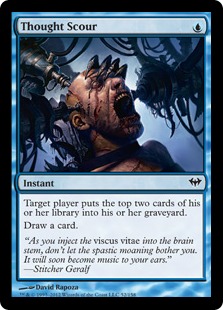
Also worth noting, Symmetry requires two target players. This means it cannot be cast if opponents have Leyline of Sanctity out. If they gain hexproof after Symmetry is cast, then their part fizzles while you still get to search. Spells that require multiple targets need the required targets to be cast, but only one to resolve.

Breaking Symmetry

If Symmetry is going to see Modern play, the Symmetry must be broken. There's no way to give opponents hexproof or shroud, so a different angle must be found. The obvious way that leaves is to mill away your opponent's card, and I expect that mill decks will employ of Symmetry as a result.

For other decks, Thought Scour is the most efficient way to break the symmetry. It's not only the cheapest, but it also draws the card you searched for. The main problem is that accomplishing this requires you to have Scour after tutoring. This means you didn't use it earlier, and that's not great. Also, not Scouring yourself is usually just wrong.
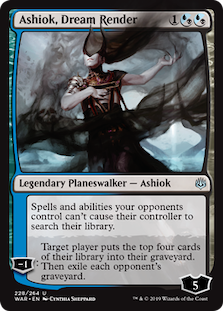
Using War of the Spark planeswalkers is another option, though I'm skeptical. Teferi, Time Raveler lets you Symmetry on the opponent's end step so you can draw your card first. Teferi is a good card, but this method takes setup and won't happen quickly. The opponent will also still get their card on their draw step.

Ashiok, Dream Render is another option. It doesn't stop the opponent searching since they don't control Symmetry, but you can tutor then mill away the opposing found card. The only problem is that Ashiok doesn't see much play right now.
Regardless of how Symmetry gets broken, there's not currently a deck that wants to put that much effort into tutoring. Death's Shadow decks run Scour, but since they're adopting Ranger-Captain of Eos, they don't need Symmetry. Tutoring is also always better in a combo deck, though the only one that I know of that could use Symmetry is Ad Nauseam. It's not clear that Symmetry is better than Spoils of the Vault there.

It's also possible that decks don't bother trying to actually break Symmetry and just play it normally. I could see a Dredge-type deck just finding whatever they want to dredge away the following turn and not caring about what the opponent finds. I expect this to only work game 1, but that may be enough.

New Leylines

A big headline for 2020 is the return of leylines. Leyline of the Void and Leyline of Sanctity are getting welcome and much needed reprints (sidenote: Void's reprinting makes me wonder what Wizards knew about Hogaak's impact on Modern). Blue also got Leyline of Anticipation, but that card has never done anything in Modern, and I doubt that will change anytime soon.

Meanwhile, red and green got entirely new leylines, which have the potential to make it in Modern. The red leyline is very narrow, but its effect is incredibly powerful in the right matchup and in the right deck. Meanwhile the green leyline is potentially busted. It may be superfluous a lot of the time, but there are times that it will win the game.

Leyline of Combustion

Red decks generally only interact with other decks via direct damage. This means that red decks have traditionally struggled against combo decks. Pyrostatic Pillar and then Eidolon of the Great Revel changed this somewhat by limiting how many spells the combo decks could cast before dying.
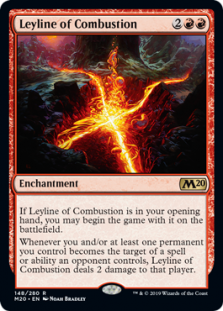
Leyline of Combustion follows in their footsteps, but rather than punishing casting spells, it punishes the win condition; a lethal Grapeshot against an opponent with Combustion out kills its caster instead. This doesn't stop the combo, just the kill, so its utility will be limited.

Combustion does have additional value since it triggers if creatures are targeted. This could be decent for a Goblins deck against midrange or control, but I suspect they'll just start leaning more heavily on sweepers and moot Combustion. Alternatively, they could just take some damage, remove Combustion first and then start killing creatures, so I wouldn't look to Combusting any prepared opponent out of the game.
Interestingly, this card may be best against Burn. Burn does a decent chunk of damage to itself off its lands, so if they're creature-light, Combustion may kill the Burn player first. I think I'd rather rely on Sanctity against burn since Lightning Helix is a card, but for those decks that can't run Sanctity, Combustion may be almost as good.

Leyline of Abundance

The green leyline requires some clarification: its ability affects only those abilities that have the tap symbol in them, so it doesn't work with Heritage Druid. However, Devoted Druid does tap for two mana. Thus, in the right context, Vizier of Remedies is no longer necessary for Druid to generate infinite mana. One Druid, Abundance, an untapped land, and Ezuri, Renegade Leader combine to make every elf arbitrarily large.
There's also the chance that Abundance is all that's needed to win. A board of mana dorks but no payoff is often death for Elves, but Abundance can fix that since it contains a means to pump the team. Working with Devoted Druid again, there's the potential to grow everything to considerable size very quickly. I don't know that this route is actually better than the current options, but it is worth looking into.

Season of Growth

On the subject of green enchantments, Season of Growth looks promising. The first ability is nothing to write home about, but the second might be just what fringe enhantment strategies need to be viable. Season turns every spell you cast on your own creatures into a cantrip. There's combo potential in Jeskai Ascendancy combo and its Crimson Wisps, but I think that boosting auras is the real intention here.

Bogles

The big problem with Season is that it doesn't do anything worthwhile without creatures to target, making preemptive removal its worst enemy. As such, I think Season has potential in Bogles. Opponents can't preemptively remove hexproof creatures and Bogles tends to struggle with running out of gas.
Kor Spiritdancer is already played primarily for this exact purpose, and I think Season challenges it well. Season is less vulnerable and also boosts Ethereal Armor. Spiritdancer being a target for auras is very important since Bogles' greatest weakness is the low creature count, but that's a backup plan most of the time. On balance, I think Season comes out ahead. The real question is whether that's enough to make Bogles an attractive option again.

Enchantress

The other thing worth noting is that Season is the closest thing Modern has to Enchantress's Presence which is a keystone in Legacy Enchantress. That deck is a prison deck built around Elephant Grass and Serra's Sanctum, neither of which is Modern legal. Modern does have its share of interesting prison enchantments and enchantress's, so there might be something to Season there. Of course, Season would only trigger on auras, so it will never be Presence, but it's looking increasingly plausible that Enchantress could be viable in Modern too.

Kykar, Wind's Fury

The final card is a combo piece. Kykar, Wind's Fury makes the most sense in Jeskai Ascendancy as a backup plan in case Ascendancy gets hit by Surgical Extraction-style effects or called with Meddling Mage. Instead of outright winning, Kykar floods the board with fliers, which may be enough. If Kykar is out during the combo, he may help feed the combo by turning the spirits into red mana. How useful said mana might be is another question, but there's plenty of potential here.


Storm's Brewing

The big question hanging over 2020 is the London mulligan. The spoiled cards may rise or fall in value based more on how the new mulligan affects decks rather than their own merits. Nobody knows what that will do to Modern. Perhaps the doomsayers are right and broken combo decks will reign. Maybe Wizards and the optimists are right and it will have a positive impact. We'll have to wait for the data to come in to see.

Want Prices?

Browse thousands of prices with the first and most comprehensive MTG Finance tool around.


Trader Tools lists both buylist and retail prices for every MTG card, going back a decade.

Quiet Speculation