menu

The Top Five (Plus Two) Preconstructed Decks of Innistrad Block

Are you a Quiet Speculation member?

If not, now is a perfect time to join up! Our powerful tools, breaking-news analysis, and exclusive Discord channel will make sure you stay up to date and ahead of the curve.
Ertai

It's that time again! A feature that's become something of an annual tradition here on Quiet Speculation, we look back at the end of a block and rate its preconstructed decks. Which were the picks of the litter, those decks that brought something new and exciting to the table? And- yes- which were the worst, the ones that didn't quite live up to the promises of expectation and hope.

Because we're glass-half-full people at heart, we'll be beginning with a look at the best of the bunch, but for those who delight in the other end of the spectrum won't have long to wait.

Innistrad block has certainly brought with it plenty to get excited about, much of which was captured and preserved for posterity in its precon decks. We were given a slew of new tribal decks as well as some compelling new mechanics to play with. Sadly, the dual-faced cards were deemed too complex for inclusion in the Intro Packs, and didn't manage to find purchase in an Event Deck. As such, they find themselves in the forgotten class of sidelined mechanics, alongside miracles and fateful hour.

Still, we come not to bury Innistrad Block, but to praise it. Over the past year we at Ertai's Lament thoroughly tested each precon deck from the set and assigned each a score. We'll now look at the top five of the block, counting down to the very best of the bunch. As an added bonus, we'll then take a look at the Event Decks and present our picks of the best two of those as well!

5. Bound by Strength (Avacyn Restored) and Fiery Dawn (Avacyn Restored)

Wouldn't you know, a tie! Avacyn Restored brought us both of these decks, and they do a fine job of telling the story of the set in miniature. With Avacyn now returned to the benighted plane, the hunted and harrowed people of Innistrad have found the courage to come out from their barricaded homes and shuttered hearts. The fiends that have terrorized them for two sets are back-footed, and with renewed vigour the goodly folk are taking the fight to them.

The very concept of the hunted teaming up to become the hunters are at the very core of the new soulbond mechanic, and Bound by Strength is that mechanic's showcase deck. Packed with a ton of creatures designed to partner up and bring a power greater than the sum of their parts to the table, the deck was able to bring a ton of threats on-line in a steady stream of beaters. Reflective of Innistrad's removal-light environment you had few ways to impose your will on the battlefield outwith the red zone, but with the right soulbond pairings you could outpace your opponent and take the fight to them.

We saw this narrative reflected in Fiery Dawn as well, albeit in a much less overt manner. To understand the significance of this Red/White construction, we need to jump back two sets to Innistrad. Back then, the protective wards were faltering, and the night was encroaching upon the human settlements thanks to the abrupt and unexplained disappearance of the plane's guardian angel, Avacyn. Humanity's plight was unveiled in the Green/White Intro Pack deck Repel the Dark. While an entertaining enough deck in its own right, it lacked a certain punch, and if you got the impression that the Humans were circling the wagons, well, you weren't alone.

In earlier sets, Red Humans weren't the kinds you'd want to encounter in the night, being Werewolves and Cultists in the main. For the set's third act, the more pensive Green was out in favour of the fiery Red, as the Humans pulled their swords and pikes down off their mantles and burst forth to smite the things that go bump in the night. The aggressiveness the colour affords was a perfect base for the deck, and put this one far ahead of its earlier predecessor.

4. Dark Sacrifice (Dark Ascension)

We enjoyed the look and feel of this deck for a number of reasons, not least because of its historical significance. In a game where many remember the purging of objectionable creatures types like "Demon" and the sanitising of art with a whiff of occultism to it (see the early Unholy Strength), to find a deck where the objective was to play Humans and then sacrifice them to the forces of darkness was a sign of the game's maturity.

Of course, that alone wouldn't be enough to rate it on this list, so fortunately the deck is a blast to play. In a medium where most decks tend to be creatures + supporting effects = RAWR!, it's always a treat when Wizards sends something down the path that's cast from a different mould. Not for nothing he spell-heavy Mirromancy topped our list of best decks of Scars of Mirrodin Block last year. This time we get an updated sacrifice-engine deck in the grand tradition of some of the game's best theme decks like Coldsnap's Beyond the Grave and Mirrodin's Sacrificial Bam. Play out your altar-fodder, then sacrifice them up to reap up life, +1/+1 counters, or repeatable creature kill. The Dark Side is strong with this one!

3. Relentless Dead (Dark Ascension)

By the time the middle set of the block rolled around, it was a great time to be a Zombie. Already unearthed amongst a wicked garden of delights such as Endless Ranks of the Dead and Army of the Damned, Dark Ascension added a nasty lord to the mix in the Diregraf Captain, and at uncommon no less! It was the perfect tie-together for the divergent Zombie types we'd been introduced to in the first set.

On the one hand, you had the traditional "shambling undead" Zombie type in Black, the kind that claws its way out of its own grave at the ghoulcaller's beckoning. Not to be outdone, demented "skaberen" were cobbling together body parts, branding them with arcane symbols and bringing their patchwork dead back to a mockery of life. These Blue Zombies were flavourfully quite different, often requiring the exile of creatures from the graveyard as a condition of casting.

All of this came together for a delightful bit of tribal brain-eating with Relentless Dead. Though it had its share of filler and the typically poor removal suite (in Blue and Black!), the deck came together tighter than a skaberen's stitching.

2. Eldritch Onslaught (Innistrad)

The precons of a block's first set often seem to be the weakest, since as a rule they have the smallest card pool from which to draw (though to be fair, large-set closing acts like Avacyn Restored and Rise of the Eldrazi have the same limitation). Indeed, last year only one Scars of Mirrodin deck cracked the top five, and even then it was last on the list. Fair play to Eldritch Onslaught then for coming within grasping distance of top honours. Like the aforementioned Mirromancy, Eldritch Onslaught made a name for itself by defying the conventional formula and attacking the precon metagame from a different angle. Though we'll likely never see the likes of Stronghold's The Sparkler again, with its three creatures and bajillion spells, Edlritch Onslaught had  relatively muted number of them- fifteen- and many of them were there to support the spell-heavy strategy of using and abusing flashback for incremental advantage.

Novelty is all well and good, but what rates the deck so highly is that it worked. With thirteen of the deck's twenty-one noncreature cards being able to be played out of the graveyard, the deck also had something almost no other deck in the block was given- a hefty removal package. Eldritch Onslaught could bounce and burn with the best of them, then looked to land a finisher like Sturmgeist or Murder of Crows to close the game out. All in all, this was a great way to kick off the new block.

1. Grave Power (Dark Ascension)

When we reviewed Grave Power on Ertai's Lament earlier this year, we had this to say:

Although we try and avoid hyperbole when assessing the decks, it would be unfair to credit Grave Power with anything less than recognition for being one of the best Intro Pack decks we've ever seen- and certainly near the top of the Theme Decks as well. This is the rarest of precons- one that treats each card slot as something not to be squandered, has a cohesive theme and the strategy to get there, and throws its full weight behind it to support it.

Our enthusiasm has in no way diminished with the passage of time, and its crowning here as the "best in block" is fully warranted. Consistent from pillar to post, this deck took the same strategy as the Event Deck Deathfed and did it one better- with far less resources available to it. Often with Intro Pack decks we'll see one rare card that fits well within the theme, and one that isn't a perfect fit but does the job well enough. Though this tendency has lessened somewhat after Wizards adopted the policy of the non-foil rare being from the base set rather than having both rares come from whatever expansion the Intro Pack supported, the two in Grave Power were pitch-perfect. An early Splinterfright was like turning on a tank of nitrous in a race car, and in the removal-poor Innistrad environment a monstrous beater like the Ghoultree tends to stick around.

If you were going to experience this block through the lens of only one Intro Pack deck, this would be the one. It was an absolute joy to play, and we hope its a harbinger of things to come for the format.
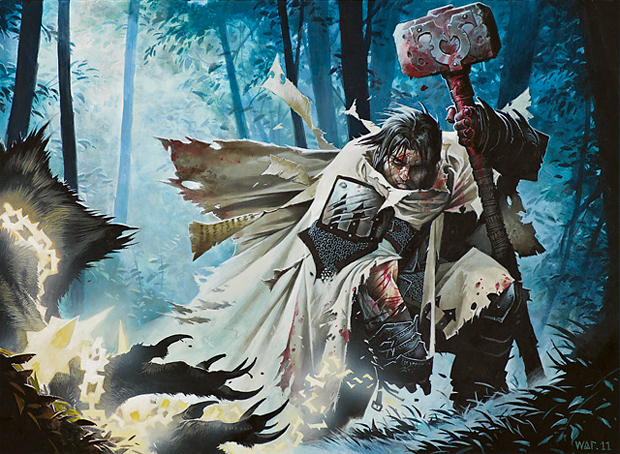
Fiend Hunter

Bonus: The Event Decks

Although we haven't touched upon these in previous annual write-ups, it's an overdue addition since we review and rate the Event Decks just as we do all other precons. Since our "top five" list of Intro Packs scoops up the cream of the top one-third (or so- Scars Block had only fourteen Intro Packs thanks to being one light in Mirrodin Besieged), it only makes sense to hold to the same proportion. On that note, here are the two best Event Decks to come out of the block.

2. Hold the Line (Innistrad)

The White-weenie competitive archtype got an update with Hold the Line, after first being given the Event Deck treatment with New Phyrexia's War of Attrition. War was noteworthy for having the then-recently-banned Stoneforge Mystic in the deck, but Hold the Line could draw on no such power. Instead, Hold the Line looks to race off the blocks the very moment the starter's pistol fires, with an impressive eleven one-drops. Indeed, no creature in the deck costs more than three mana, and with four of those being Fiend Hunters, the deck has very strong tempo and removal options available to it.

We've noted here before how speed is the greatest weapon in the Event Decks' arsenal, given their avowed aim to keep you competitive at the Friday Night Magic tables. Hold the Line is blisteringly fast, though it is susceptible to stalling out in the mid-to-late game as all decks of this archetype tend to be. Still, with an impressive amount of removal at its disposal, what Hold the Line can't go through it can go over

1. Spiraling Doom (Dark Ascension)

The top deck here is one of the highest-rated decks we've ever reviewed on Ertai's Lament. Once upon a time here on Quiet Speculation, I mused that the need for speed was limiting what sorts of Event Decks Wizards could put together. Four decks in on this new product line, the adventurousness on display with Mirrodin Besieged's midrange Infect & Defile seemed tempered by results. Infect & Defile wasn't a bad deck, it just didn't live up to the competitive promise. Unsurprisingly, the next two decks for New Pyrexia were more of the "speed kills" vein, making up for limitations on card rarity and power by compensating with quickness.

We've been delighted to see the Event Deck line mature and prosper, with forays back into the midrange better tuned to withstand the rigours of Standard. Spiraling Doom was the pinnacle example of this, a toolbox deck that keys off of a single card: Birthing Pod. With Pod decks already competitive, it was a great archetype to build from with the inclusion of undying creatures. With answers for nearly any threat you could face staggered over a consistent chain of converted mana costs, the deck was remarkably consistent even if it did suffer from not having access to an extra Birthing Pod (easily remedied for those taking the deck into the field).

Time and again we've enjoyed decks that take the less-traveled path and still find ways to put up the wins. A stock 24-creature, 12-spell deck can be a lot of fun to play, but the focus on that formula tends to diminish the variety of win conditions we know the game is more than capable of. Such decks always get our attention...but they have to do more than that to attain ratings high enough to be included on the annual "best-of" list. The decks presented here today have done so, and claimed their rightful reward.

Thanks for joining me today in a look back through Innistrad block. We're already looking forward to the start of the next as we Return to Ravnica in the fall, but in the meantime we'll be back soon to look at how the other half lives as we present the worst decks of Innistrad block. See you then!

______________________

Jay Kirkman
@ErtaisLament

www.ertaislament.com

Anticipating Talrand

Are you a Quiet Speculation member?

If not, now is a perfect time to join up! Our powerful tools, breaking-news analysis, and exclusive Discord channel will make sure you stay up to date and ahead of the curve.

Welcome to the final article in my series on budget monocolored decks. Our target today is the oft-maligned color blue.

By now it should be no secret that I wasn't looking forward to this article. I hate the impact blue has in Commander. Its true that library manipulation and card drawing make it a great support color for decks trying to do interesting things. But the countermagic and combos make it a miserable color unto itself.

At this point, I've tried a few times to build a proactive blue deck, and it is possible. You have to limit the number of counterspells, combo pieces and card draw engines you play, lest the deck devolve into the generic strategy of valuing everyone to death.

The thing is, there are very few blue Commanders that lend themselves to aggression. Sakashima the Impostor does an okay job, depending on how aggressive the rest of the table is, and Hakim, Loreweaver is okay if you're willing to go all in on auras. But both seem gimmicky and likely to get old sooner rather than later.

That said, the mantra of this series has been that budget decks thrive on gimmicks that let them focus on accomplishing one thing as consistently and powerfully as possible. So I guess we should run with one of these two...

What's that? New legends in M13 you say? Well, let's check those out and see if there's something a little more exciting:

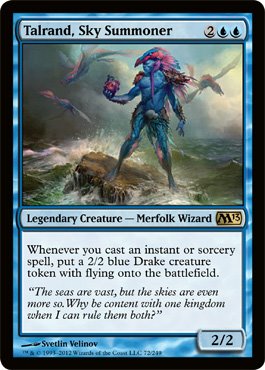
Let's Talk Talrand

This guy seems more interesting. He proactively develops the board and kills players directly rather than messing around and drawing a billion cards. He's on the cheap side, something not many popular blue Commanders can claim. He's more flexible than Hakim, and more gimmicky than Sakashima, but encourages you to play with blue's strongest card types.

I like Talrand because he asks a unique set of questions. How many instants and sorceries can you cast in one turn? How good are cantrips that double as combat tricks? What kind of effects can we find "draw a card" stapled onto, and how much better are those when they come attached to a 2/2 flier?

The short story is that this guy is absolutely insane for budget blue decks. Toss him into any deck with your favorite blue cards and whatever rares you have around, and make up the difference with miscellaneous cantrips. They don't even have to be good cantrips like Preordain. Bring on the [card Portent]Portent[/card]!

One Drake, Two Drake

The unfortunate thing is that Talrand does not lend himself to building particularly interesting decks under a budgetary constraint. You're going to splurge on a few powerful cards that interact favorably with the rest of your deck, and then pack it to the gills with as many drake producers as possible.

We want to cast as many spells as possible each turn, while still leaving up countermagic to protect Talrand. This means buyback and retrace cards as repeatable drake factories. It also means spells that untap lands or otherwise enable us to cast more spells.

Cantripping Down the Lane

Let's start with the cantrips:

  • Aquitect's Will ($0.25)
  • Cerulean Wisps ($0.15)
  • Clairvoyance ($0.15)
  • Cloak of Feathers ($0.15)
  • Fleeting Distraction ($0.15)
  • Gitaxian Probe ($0.75)
  • Interdict ($0.49)
  • Into the Roil ($0.99)
  • Leap ($0.15)
  • Mental Note ($0.25)
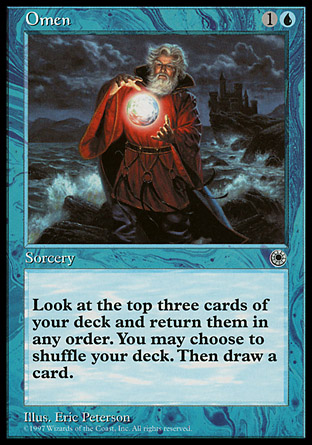
  • Omen ($0.39)
  • Obsessive Search ($0.15)
  • Opt ($0.19)
  • Peek ($0.15)
  • Ponder ($0.89)
  • Portent ($0.25)
  • Preordain ($0.89)
  • Quicken ($0.75)
  • Reach through Mists ($0.25)
  • Serum Visions ($1.75)
  • Shadow Rift ($0.25)
  • Think Twice ($0.25)
  • Thought Scour ($0.49)
  • Visions from Beyond ($0.49)
  • Twisted Image ($0.15)
  • Whispers of the Muse ($0.25)
  • Gush ($0.49)
  • Peer through Depths ($0.89)
  • Merchant Scroll ($0.99)
  • Catalog ($0.15)
  • Deep Analysis ($0.75)
  • Distant Melody ($0.25)
  • Sleight of Hand ($0.89)
  • Jace's Ingenuity ($0.25)
  • Perilous Research ($0.49)
  • Shared Discovery ($0.15)

That's thirty-eight cards dedicated to sifting through your deck as cheaply as possible. Throw in some flashback cards like Think Twice for resiliency and some high impact cards like Distant Melody to pull ahead if you start running out of gas, and you're set.

There are a couple things to consider when running this high a density of cantrips. The first is that opening hands will look wonky, full of cards that do nothing but replace themselves (the first time that random Shadow Rift is actually relevant should be hilarious). It also means that the longer a game goes, the more likely you are to flood. You don't have much in the way of card advantage, just selection.

Mana Sinks

If all we can do is cantrip into more cantrips, it will be hard to actually win the game. That's where the other mechanics I've mentioned come in. Buyback and retrace make sure you always have something to sink mana into and provide a continuous source of 2/2 beaters.

  • Petals of Insight ($0.25)
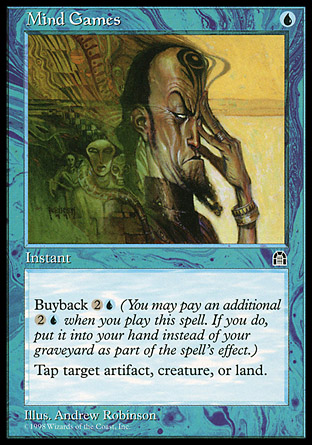
  • Mind Games ($0.15)
  • Capsize ($0.75)
  • Mystic Speculation ($0.39)
  • Oona's Grace ($0.15)

I only found these five cards but each one should be a reasonable mana sink. The worst one is definitely Petals of Insight, which I've had a soft spot for ever since running Petalmane Baku combo in Standard back in the day.

Mind Games seems like the kind of card that dominates games given sufficient mana. You can lock down problematic guys, turn off all of someone's colored sources or tap down blockers, all while generating more fliers. Seems fair, right?

Build Your Own Summoner's Bane

Take a look at this card from Zendikar:

Never having seen the light of day in Constructed, unplayable even in Limited, Summoner's Bane is actually a terrible card. But what if we can turn good counterspells into [card Summoners Bane]Summoner's Banes[/card]? With Talrand we get the upside of efficient counterspells with valuable bonuses and 2/2's on top of it! Suddenly, Summoner's Bane seems a lot more reasonable.

  • Arcane Denial ($0.75)
  • Dismiss ($0.75)
  • Exclude ($0.39)
  • Thwart ($1.75)
  • Foil ($0.75)
  • Bone to Ash ($0.15)
  • Counterspell ($0.99)
  • Deprive ($0.25)
  • Negate ($0.15)
  • Dispel ($0.25)
  • Turn Aside ($0.15)
  • Abjure ($0.25)
  • Controvert ($0.39)
  • Fervent Denial ($0.25)
  • Muddle the Mixture ($0.65)

Unfortunately, good counterspells are usually expensive because of the popularity of the color blue. But there are a ton of budget options, many of which appear here. Sure, you can do some great things with Forbid and Cryptic Command, but they aren't necessary. You should be fine as long as you can protect Talrand with stuff like Turn Aside, keep the game from getting out of control, and stop [card Wrath of God]Wrath of Gods[/card].

Winning the Game

At this point we should have no trouble blazing through our deck and generating an enormous army of drakes. But a continuous stream of guys will not always be enough to finish the game. We want a few ways to turn our temporary advantage into permanent victory.

  • Lunar Mystic ($0.49)
  • Sakashima the Impostor ($4.99)
  • Favorable Winds ($0.25)
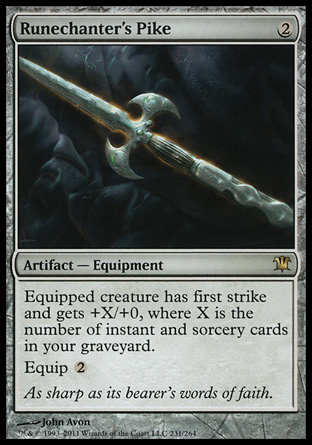
  • Runechanter's Pike ($1.25)
  • Diviner's Wand ($0.49)
  • Laboratory Maniac ($0.49)
  • Surrakar Spellblade ($0.49)
  • Artful Dodge ($0.15)

These are the cards you're digging for, the ones that will end the game.

Lunar Mystic seems like a great way to make your counterspells even better. It also turns ordinary cantrips into real card draw to guarantee you don't run out of gas and hit your land drops late into the game.

Sakashima the Impostor is the big splurge for this deck. Doubling up on 2/2's will present lethal very quickly and easily, especially in conjunction with Favorable Winds.

The biggest question is what to do if you can't make enough guys to constitute a reasonable threat. We have a few answers to that problem.

Runechanter's Pike and Diviner's Wand can enable a one-shot kill and help avoid overextending into sweepers. Runechanter's Pike is especially powerful considering how little esteem it enjoys. This unassuming equipment has made the cut in most blue decks I've worked on since the release of Innistrad!

Artful Dodge is mostly there as a way to force through huge hits with one of your two equipment, but can also make a few guys in a pinch.

Lastly, Laboratory Maniac provides a quirky and fun plan B. You just want to be careful with him when going for the win. Try to trigger him with your draw step or a sorcery speed cantrip, and hold back instant-speed cantrips in case you need to respond to removal.

The Mana Base

The density of cantrips in this deck will let us run a low land count. We could try to run some number of mana rocks to incrase the likelihood of turn three Talrand, but given the choice between those and Sakashima, I think Sakashima has a higher upside. Because of that, and since we're already a little above the price I would prefer, our mana will simply be a bunch of basics.

  • 33 Island

There are definitely a few nonbasic lands to consider, like Buried Ruin or manlands. Even [card Lonely Sandbar]cycling lands[/card] can smooth out your draws and keep the cantrip engine running. The right number of lands might be higher or lower, but it's tough to say without playing a ton of games. Especially in a deck with so many cantrips, you're going to leave yourself open to a ton of variance.

With the mana out of the way, let's look at the finished deck! Coming in at $34.92, here's Talrand:

Untitled Deck

Creatures

Sorceries

Instants

Artifacts

Enchantments

Lands

33 Island

I can't express how excited I am to see what people do with Talrand. This guy rewards you for indulging in typical blue shenanigans, but does so in an interactive way rather than a degenerate way. Finally, blue has an efficient way to make an army that doesn't involve tutoring up Myr Incubator. I'm excited to see what corner case interactions end up defining Talrand decks, because it's going to be sweet!

I'm sure there are ways to upgrade the basic list above. Shuffle effects to go with the cantrips would probably be good. Cryptic Command and other tier-one counterspells would make a huge difference. Other than that I can only think of expensive staples to add, but there are undoubtedly a few gems lurking somewhere in Magic's twenty-year history.

The deck is pretty sweet as is but it will take some tweaking to find out which cards don't work and how many cantrips is enough.

I have Twitter to thank for next week's deck. @Andrew_Magrini was working on a Jund deck with Sek'kuar, Deathkeeper, and @GUDoug and I started talking about things you could do with Ghave, Guru of Spores. This approach seems right up my alley. There will be so many lands!

Carlos Gutierrez

cag5383@gmail.com
@cag5383 on Twitter

Insider: Grand Prix Yokohama Creates New Modern Price Trends

Are you a Quiet Speculation member?

If not, now is a perfect time to join up! Our powerful tools, breaking-news analysis, and exclusive Discord channel will make sure you stay up to date and ahead of the curve.

Grand Prix: Yokohama was this past weekend, attended by over 1,500 players battling for prizes and glory. Importantly, they did battle with Modern decks, which is good for Insiders. Modern is popular enough on the tournament level to drive prices and many of the cards in the set are old enough that it's hard to track them down. They get expensive or hard to find (I had to call 5 stores last week to find one that had Oboro, Palace of the Clouds!). Ergo, it's a good field to get action on, especially because many of the lower-tier decks still have good money rares in them that you can trade into. This week, we'll look at the Grand Prix results and analyze them for Modern play and speculation.

First off, here are the T8 decklists (new window).

Let's talk about Birthing Pod.

Birthing Pod has been involved in the Melira deck since Modern really kicked off. The card allows for combo kills in otherwise-midrange aggro decks. I was thinking about why a deck like Melira that looks so atrocious on paper is actually good, and here's my logic. If you ignore the combo and just try to race with superior monsters, they can rip the combo on you or alternately, grind you down over a long haul. If you just focus on stopping the combo, they can still beat you to death with exalted Kitchen Finks. Ouphe! I think Melira and other Pod combo decks are angled in such a way right now that they apply just the right amount of combo and old-fashioned beats. They should not be good, but they are.

Fully half of the decks in the T8 used Birthing Pod. That's incredible. I don't think these decks are unfair by any stretch - remember that their combo involves two-toughness monsters, whether they're angling for Melira or just Kiki-Jiki. Removal is so underplayed right now and the Pod decks are so resilient that they can move through a lot of point removal. These decks also ran Chord of Calling in some number. Chord has been a solid pickup for a long time. It doubled in price to about $6.50 but I'd still trade for them at that price, which is something I'll get into later in the article.

The other breakout has been Restoration Angel in those decks. Let me be honest; I didn't think the Angel would even cut it in Standard, much less in Modern. Four mana for a blink is a lot to ask for, but a 3/4 body for four mana with Flash is downright silly. Take off the blink and I think it's still a fine control card a la Vendilion Clique. I never expected to see it paired with enters-the-battlefield effects like the Pod decks do. That's the result of small thinking on my part. The Angel is here to stay and she makes fighting these kinds of decks harder. You can get the Lightining Bolt on Melira, but it has to make it past the Angel to stick. You can kill a Finks once, but the Angel will reset it - which is downright dirty.

That said, there are still some great ways to fight these decks. Remember how I said they all depend on two-toughness dudes? While Pyroclasm is a good sweeper if you can afford to play it (and Whipflare is also generous), I'm looking more at Sudden Shock ($0.10). Split Second is really nasty; it can off a Pestermite from Twin and blow away small Ravagers. It can also shut down the Kiki-Jiki coming from Pod. It's not stellar, since they can go get another Kiki if they have Murderous Redcap around, but I'm much more comfortable running a card like that instead of Krosan Grip. I'm also looking hard at Grafdigger's Cage ($0.75) because it stops all of the tutoring - their only out is drawing the Qasali Pridemage to get past it. Now, the Cage shuts down the Melira deck but it doesn't stop Kiki-Jiki from still killing you with Restoration Angel, but I figure you should have a way to kill the goblin at that point. There's also Torpor Orb ($0.15) to stop the combo, but it doesn't stop them from getting Pridemage and still killing the hate card. I'm inclined to run a mix of Orbs and Cages. The most brutal thing you can do is probably Aven Mindcensor ($2.25) because it offers a clock and some serious surprise, often stopping a Pod or a Chord completely.

There's money to be made by banking on Birthing Pod. You can get the Pod itself for about $2.25, which I feel is suspiciously low right now. Both Cage and Orb are seriously cheap and rare. These are the sort of card that shoots up to $3.50 when people realize that they're long out of print and they need them for sideboards. Damping Matrix did the same thing about four years ago when Zoo players needed the effect and I'm certainly going to get a few sets of Orbs and Cages to sit on. Aven Mindcensor is also a fine card to grab - it's a power uncommon but it's the kind of card that can also go up. Remember how expensive Spell Snare is right now! Mindcensor is a little more limited in scope, but it's still a brutal surprise to unleash. Kiki-Jiki is still expensive as heck, even though he recently saw a collector reprint. Trying to get money out of that goblin will be like getting blood from a stone. I'd stay away from trying to trade for them unless you get great deals, but they're a hot card and you could easily move it.

Looking at the predictable decks - Jund and Affinity

These two decks are the workhorses of Modern. You're going to have someone make the playoffs of an event with them because they are consistent and powerful, even though the decks are narrow. It's worth noting that the Jund deck has a lot of crazy Japanese one-ofs like Olivia Voldaren and Jund Charm. I don't think these are the right calls for consistency's sake, especially because there are no Maelstrom Pulses in his 75, but they are the kinds of cards that will come up just enough to really swing a game now and then. When the opponent doesn't suspect Olivia, she can take over a game. When they know she's coming, they can plan for it.

Affinity has about 3-4 slots that are open to whatever you want to put in. Most of the time, it's Shrapnel Blast, but it was Master of Etherium here. Master seems like a decent plan to me because Affinity falls totally apart in the face of Pyroclasm effects. Master gets the Ornithopters out of burn range and it also turns into a decent beater on the back of Moxes, Drums and Citadels. I prefer the sudden burnout of Shrapnel Blast, but Master is a fine play instead.

We can't draw much for speculation from these two stalwarts. I'll note that only Jund is running Dark Confidant, where he is a solid role-player. Not even the B/W Tokens deck runs Bobby Digital. I don't think his price tag is justified.

That B/W Tokens deck and Faeries?

First, Faeries. Vedalken Shackles is an enormously powerful card. The Faeries player needed to run Miren, The Moaning Well to make it better, but they somehow missed how awesome of a chain-gun that combo is. Spellstutter Sprite, as one player pointed out, is like Mental Misstep in the format. It's one of the few counters for Thoughtseize that I don't feel totally shameful about having to blow on the discard spell. The Faeries deck looks resilient enough with counters that it can probably get around a Pyroclasm, too.

Next, the tokens deck. Kelly and I have been saying that Zealous Persecution is highly powerful right now in Modern and this bears it out. Multiple times in the finals, the Tokens player just wiped out the Faerie board with Persecution. It was delightful to watch. This sports three main and the fourth in the board and I'll reiterate that it's a great card to pick up. You can't really make Lingering Souls do much without it, since 1/1s are pathetically small in Modern. Now, when they become 2/2s and your opponent's guys shrink, you're trading tokens to kill off Delvers and other, more serious monsters.

I'm not sure where the Tokens deck goes from here, though. It's still highly susceptible to things like Ratchet Bomb and even Repeal becomes a kill spell. It's got a good longer game since any pump spell combined with tokens is a serious matter. But even random things like Echoing Truth are still potent and the deck has no way to interact with a combo deck like the Birthing Pod lists. Nonetheless, I see BW Tokens being a serious part of the metagame for awhile. People like big, breakout rogue decks and this one is easy enough to make a budget copy of.

If you're going to speculate on Tokens decks, I suggest focusing on Windbrisk Heights ($3.00). It makes the deck pretty busted and it's one of the older cards in the deck. Spectral Procession is also a good snag, but things like Honor of the Pure and Intangible Virtue just aren't worth the dollar or two you'd make from them. These are 2-of cards that are nearly interchangeable. While Virtue is currently hot, Honor has been reprinted enough to make it essentially worthless.

Understanding really long term calls based on current R&D design trends.

I was chatting with a friend the other day about RG Tron and the Tron archetype in Modern. I said that I thought it was a good bet to keep playing Tron and that Tron will only get better with time. The reason is that there will be more awesome Tron cards printed in the future. Wizards loves big spells. We've seen things like Bonfire of the Damned, the Eldrazi, Wurmcoil Engine and more come as gifts from the sky. Karn, Liberated is the core of the RG Tron deck type! However, Wizards is never going to print any nonbasic land hate that's better than what we already have. It's simply against what R&D feels - they don't like land destruction to be too good. So we've got Molten Rain, Blood Moon and Sowing Salt, but we'll never see Wasteland or even Dwarven Miner in Modern. Tron is only going to get better and the hate for it will never be printed.

You can extend this to Birthing Pod and Chord of Calling, too. Wizards keeps making more creatures for the Modern pool and some of them turn out to be cards like Restoration Angel. Pod is only going to be better as time goes on. That's why I think getting Pods right now is an incredible long-term call for Modern and I still think Chord of Calling is fairly priced. If you've got money that you can tie up for a year in Modern, tie it up with Birthing Pods. You've got great factors on your side that are built into the card. It works on Phyrexian mana, so it'll never be reprinted. Similarly, Chord uses Convoke, so the only time we'll see it come back is in a special boxed set.

There are more calls like this all over Modern. A lot of the time, they're not worth tying money up into, but sometimes they are sure bets. I stand by Birthing Pod in particular as a good bet for a long time to come in Modern.

Questions, comments and feedback are always welcome! I love love love talking Modern.

Until next week,

Doug Linn

Douglas Linn

Doug Linn has been playing Magic since 1996 and has had a keen interest in Legacy and Modern. By keeping up closely with emerging trends in the field, Doug is able to predict what cards to buy and when to sell them for a substantial profit. Since the Eternal market follows a routine boom-bust cycle, the time to buy and sell short-term speculative investments is often a narrow window. Because Eternal cards often spike in value once people know why they are good, it is essential for a trader to be connected to the format to get great buys before anyone else. Outside of Magic, Doug is an attorney in the state of Ohio.  Doug is a founding member of Quiet Speculation, and brings with him a tremendous amount of business savvy.

View More By Douglas Linn

Posted in Finance, Free InsiderTagged , , , , 3 Comments on Insider: Grand Prix Yokohama Creates New Modern Price Trends

Have you joined the Quiet Speculation Discord?

If you haven't, you're leaving value on the table! Join our community of experts, enthusiasts, entertainers, and educators and enjoy exclusive podcasts, questions asked and answered, trades, sales, and everything else Discord has to offer.

Want to create content with Quiet Speculation?

All you need to succeed is a passion for Magic: The Gathering, and the ability to write coherently. Share your knowledge of MTG and how you leverage it to win games, get value from your cards – or even turn a profit.

Insider: The Booming Business of Ratios, Part 1 – Why Force of Will is Simply Worse Than You Think

Are you a Quiet Speculation member?

If not, now is a perfect time to join up! Our powerful tools, breaking-news analysis, and exclusive Discord channel will make sure you stay up to date and ahead of the curve.

Rather than try to dazzle you with my accomplishments, dear readers, I would instead like to begin this maiden article with a little bit of logic.

As a trader, I don’t necessarily make the most money in the business, not by a long shot. But as a starving college student, it’s wonderful to know that, if worse comes to worse, I’ll be able to pay for food and a couple of toys. More importantly, however, my time is limited, so my goal over the last 6 months has been to streamline the process of value trading as much as possible, maximize value and to minimize work. I'll start off my time here with this, my personal approach to trading for value. In it, I explain why low value cards are a more lucrative investment than high value ones, simply because their perceived value is less static, and people care less about smaller cards.

Why I’m Here

No bragging, just a prologue.

When I first approached trading, I learned Everything I could about it, with a capital ‘E’.

Here is a picture of everything, according to Google. Picture credited to abeautifulrevolution.com

I got a Quiet Speculation account and  read every other financial article published on the net since who-knows-when. Following that, I made a definitive list of every card I thought impacted Standard, Extended, Legacy and Vintage at that time and their prices... and then memorized it.

You may have found the flaw in my plan: the overall time commitment was, in a word, obscene. And while I now find myself with what I consider to be strong understanding of the underlying market economics of Magic: the Gathering, I attribute far more to intuitively knowing how cards measure up in the metagame than to any painstakingly devoured laundry list of then-current statistics.

I also tried my hand at speculation, finding reasonable success with the outbreak of Modern, but also found that the amount of effort I needed to put towards actually reselling, listing and calculating profit margins on those speculations to a bit more than the time I had on hand. I have never been the biggest fan of that side of M:tG finance simply because I dislike the variance of gambling, and the unfortunately uncontrollable nature of high-risk, high-reward speculation.

What I eventually lighted on was simple: since my goal was to make money to buy things, not just build a large collection, I had to trade for cards that made not only a good margin consistently, but also had reasonable selling value. These cards are the same ones you’ve heard time and time again: Death Baron, certain Lieges, Mana Reflection, Sanguine Bond - all those perennially undervalued gems that fetch surprising amounts at the dealer tables.

Ratios

The first of my approaches to this was simple - ratios.

Obviously, this is a picture of ratios- with a pie chart to boot. And now, back to the content.

Imagine yourself in a position where you misvalue a Silverblade Paladin at 5 dollars. This is a reasonable number, and not too far off from the truth. Say the last you checked was on May 21st, and it was retailing around 6 dollars.

You learn about this, you shrug, no biggy. What’s a buck in cardboard? It’s not even a real dollar, it’s probably not worth more than 40 cents. I lose that much to couch cushions on a regular basis.

Let’s take an alternative example. How much is Force of Will worth? If you’re any kind of player at all, you should be able to estimate the retail price pretty closely. If you’re a common trader, you probably know the TCGplayer mid too. If you’re an avid trader, you almost certainly know the average buylist, retail sell, eBay sell, TCGplayer and maybe a price compiler like ApathyHouse or BlackLotusProject.

As an avid trader, you were probably close on the Silverblade call - experience with cards in similar positions has left you with the ability to shoot in the right general area without having ever looked at the new set’s prices online.

However, and this is big: If everyone knows what Force of Will is worth, why do you trade for it? Obviously,  I’m not advocating avoiding FoW (the card is bonkers, hugely liquid and has a hefty buylist value), but what on earth do you expect to make out of it?

When Jace, The Mind Sculptor retails for 60 and you get him fro 50, you probably pat yourself on the back. I know I do. But what about Silverblade? Worth 6, gotten for 5? Same ratio, and a hell of a lot easier to do. If everyone knows the price of Jace, or the price of Force, where’s the value to be made? Even the most play-focused of people know better than to trade their Force for standard garbage, and most know it’s valuable enough to warrant them taking the mere 30 seconds to check on it.

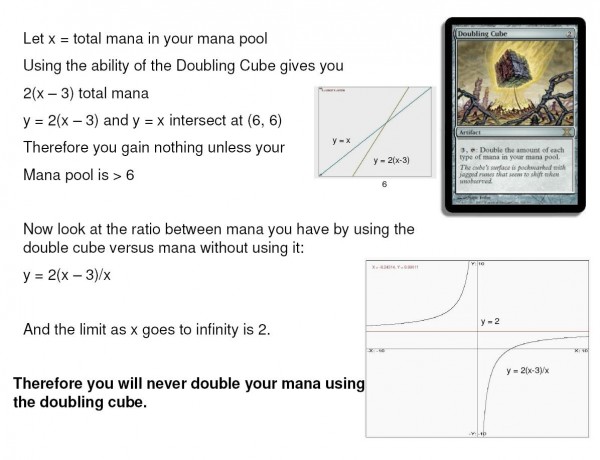
Unlike previous pictures this one has relevance to the article. Also unlike the previous, it makes me cry on the inside. Credited mtgmintcard.com

Instead, what I do, and what I advocate, is the equivalent of assured penny stocks. If it’s worth 2 bucks and you get it for 1.50, you just made a 33% profit. That’s huge. Hell, it’s worth 3 and you get it for 2? Bam! 50% and it’s not even hard!

The first complaint here is almost certainly going to be buy value, but why? If you can trade these small value cards for slightly less small value cards, and make up the price gap, you don’t lose anything because of the low buy.

Another Example

Since that the last paragraph was slightly more complicated and indecipherable than the Minotaur’s maze:

You trade a 10 dollar card of your choice for 2 Silverblade Paladin. You make 2 bucks sell, and likely nothing buylist. Those 2 Paladins each turn into a pair of generic 3 dollar cards, which you find relatively easy to turn three of into a generic 10 dollar card.

Now what do you have? In 2 trades, you made a 30% profit on what looks like, at first glance, not only a not particularly lucrative series of trades but trades where your trading partners are unlikely to suspiciously check value. If they’re paranoid and do their research, their first thought probably isn’t to come after you with a pitchfork but to shrug and assign those lost dollars to incidental expenses and never think of them again.

The Brain

Psychology is an important part of Magic, and even more so in trading.

As you may have noticed in the previous example, I pay particular attention to the possible responses of a person. One of the biggest reasons I avoid making value in my big Legacy staple trades is because, psychologically, these are the hardest hits for people to deal with.

If you lose your Force of Will at 10 dollars below retail when the trade has been based on Star City, you feel it.

When you lose your paladin at 1 below retail, you really don’t - even if you lost a multitude of Paladins, it matters less.

When I trade for Legacy staples, I instead strive to achieve the fairest, most even trades I possibly can. Those are the trades that get scrutinized, that get seen and get judged, so being seen as an honest and upstanding trader gives me a level of trust not available to a person who seeks to grind value out of every trade.

In my opinion, this is one of the reasons it’s crucial to remember that trading is nothing more than a vehicle of convenience. Trading allows me to get cards, often more quickly than I would buying them, and obviously for less straight up cash.

If a person is trading for a Standard card, the likelihood is that there are many, many copies floating around their area and the local gaming stores near them. As such, regardless of their assumed cash value, their commonality devalues them in the eyes of the traders.

Perception Matters

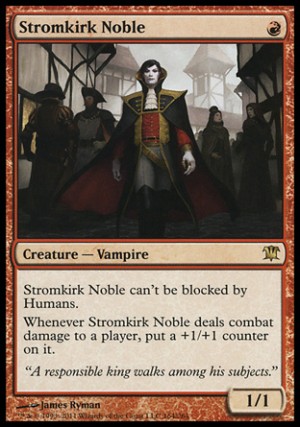
Remember Stromkirk Noble? That sucker was once worth 8 bucks, but nobody would ever trade for it at that happily, because everybody and their mother had the better part of a playset sitting around in their binders.

Did you know this card still exists?

Guess what’s worth 8 dollars? Null Rod. Guess what happens to be valued at 10? Restoration Angel.

Which one do you think commands more value in a trade, despite the Angel being worth more? If you need a hint, remember that Null Rod is a Legacy and Vintage staple, and, even though it's almost completely unplayable right now, it retains some level of liquidity.

People remember it being good, and because it's old and not in Standard, tend to put more stock into its value than other cards. Simultaneously, how many more Angels do you see at the trade tables than Null Rod? If Force (valued 60) has more perceived value than 10 Silverblade Paladins (6 each), doesn’t it make sense that the owner puts more emphasis on not getting ripped when they trade it?

While that may seem unconnected to convenience, trust me - they’re intrinsically tied. The more value an object has that you wish to obtain, the more interest you have in shopping around. The more expensive it is, the more likely you are to scour the internet, the local papers and your friend’s garages to find it.

For example, how much work do you put into finding a nice flower pot? If you’re me, you put the least amount of effort possible - if I’m ever in the position where I need a flower pot, I walk into Lowe’s and get the closest one in the right size.

Compare that to a car. Buying a car, I’d check Craigslist, the local for sale ads, ask around, check on cars with for sales signs on them and generally do anything I could to get the best possible deal

Just like anything else, Magic cards have perceived value, and it's important to realize that when you trade for them.

~

Tune in next week for the second part of this series within which I delve further into the psychology of trading and the value of ratios. I'll even explain what to do if you don't want a binder full of Silverblade Paladins (or worse!), and what the next step is- perhaps there will even be a bulleted list. If you have questions, comments or snide remarks, I eagerly look forward to reading them in the comments section.

Avatar photo

Tucker McGownd

Hi, I'm Tucker McGownd. I'm a low risk trader that spends most of my time in Minnesota, where I go to school, play magic, study for school, play Ultimate for my college team, study for school, and read. I've been playing for a long, long time (I first played during Mercadian Masques block, and first bought a pack in Urza's Saga). I was incredibly lucky when I cracked packs until I learned how much cards were worth, at which point I proceeded to open Thoughtlace in every set until Scars, where I picked up more than my fair share of molten psyche. I'm currently looking forward to the inevitable reprint of Chimney Imp.

View More By Tucker McGownd

Posted in Free InsiderTagged 7 Comments on Insider: The Booming Business of Ratios, Part 1 – Why Force of Will is Simply Worse Than You Think

Have you joined the Quiet Speculation Discord?

If you haven't, you're leaving value on the table! Join our community of experts, enthusiasts, entertainers, and educators and enjoy exclusive podcasts, questions asked and answered, trades, sales, and everything else Discord has to offer.

Want to create content with Quiet Speculation?

All you need to succeed is a passion for Magic: The Gathering, and the ability to write coherently. Share your knowledge of MTG and how you leverage it to win games, get value from your cards – or even turn a profit.

You don’t have to be a stats genius to get results from split testing

Are you a Quiet Speculation member?

If not, now is a perfect time to join up! Our powerful tools, breaking-news analysis, and exclusive Discord channel will make sure you stay up to date and ahead of the curve.

I use a bit of split testing at QS and I know I've written about it before. The concept is simple: in my case, I send out a newsletter with slightly different titles to 20% of the list and see which one wins. That winner gets sent out to the entire list. One hurdle I face is the guessing game of "why did they choose this one? What can I learn for the future?" Sometimes I think that I don't need to split-test something because it's simple and that's bad thinking.

You always split-test.

You do it because one title will always outperform the other and that competition helps your message get out.

Typically, one headline beats another by about 11% with our newsletter. That's a several-hundred-person difference.

Even if all I'm doing is living in the moment, cranking out two headlines with a slight difference and not getting into the psychology of WHY people prefer one... I still get more eyeballs.

Even if I don't learn a thing for the next newsletter, I still get 11% more opens. That's more people reading our content, learning about the site, engaging with our writers and community, laughing and internalizing that QS is where you go if you want to make more profitable trades in Magic.

Douglas Linn

Doug Linn has been playing Magic since 1996 and has had a keen interest in Legacy and Modern. By keeping up closely with emerging trends in the field, Doug is able to predict what cards to buy and when to sell them for a substantial profit. Since the Eternal market follows a routine boom-bust cycle, the time to buy and sell short-term speculative investments is often a narrow window. Because Eternal cards often spike in value once people know why they are good, it is essential for a trader to be connected to the format to get great buys before anyone else. Outside of Magic, Doug is an attorney in the state of Ohio.  Doug is a founding member of Quiet Speculation, and brings with him a tremendous amount of business savvy.

View More By Douglas Linn

Posted in Biz BlogLeave a Comment on You don’t have to be a stats genius to get results from split testing

Have you joined the Quiet Speculation Discord?

If you haven't, you're leaving value on the table! Join our community of experts, enthusiasts, entertainers, and educators and enjoy exclusive podcasts, questions asked and answered, trades, sales, and everything else Discord has to offer.

Want to create content with Quiet Speculation?

All you need to succeed is a passion for Magic: The Gathering, and the ability to write coherently. Share your knowledge of MTG and how you leverage it to win games, get value from your cards – or even turn a profit.

Adventures in Qualifying – Epic Tales from the WMCQ

Are you a Quiet Speculation member?

If not, now is a perfect time to join up! Our powerful tools, breaking-news analysis, and exclusive Discord channel will make sure you stay up to date and ahead of the curve.

Each of us has our own reasons for playing Magic. For me, one of the main motivating factors is the opportunity to travel. Some of the best experiences of my life have been on Magic tournament trips. When I told my friends at work that I was traveling all across the East Coast this summer they were astonished. Most people do not get the opportunity to do that.

Magic has led me from my home town of Pittsburgh all the way up to the plains of Minnesota and down to the Music City of Nashville. Last weekend I found myself sitting down to play this great game on the campus of the University of Maryland.

Sights and Sounds of the Capitol

For those of you who don’t know, as I didn’t, the University of Maryland is actually located between Baltimore and D.C. The campus was beautiful but smaller than I expected for such a well known school. During the trip out there I kept thinking how cool it would be to see D.C. People all across the country dream of seeing our nations’ capitol. I was excited that Magic would afford me that opportunity.

Fast forward to 8pm Saturday night when four of my friends and I finish eating dinner at the best restaurant I’ve been to in a long time. As we left BD's Mongolian Grill, stuffed, we were discussing what to do for the rest of the evening. I suggested drafting my newly completed cube. But one of my friends had other plots in motion. Apparently his girlfriend was interning in D.C. this summer and she was a mere ten miles away. I did not mind abandoning my cube daydreams to accompany him to see her.

We soon learned that in D.C. ten miles translates to about an hour drive. The apartment was one of the nicest places I’ve ever seen. A window stretched across the whole living room and from fifth floor you could see into the D.C. night sky. We spent a little time hanging out and admiring the amazing view until someone suggested we find something to do in the city. One of the girls in the apartment was a tour guide so she offered to show us around.

At 10pm, I set out with nine other people on what would be one of the best experiences of my life.

We walked down the capital’s streets, streetlights shining down around us. There were lots of people out, but fewer than during the day and fewer I expected considering the city's size. After passing by a variety of skyscrapers and through overpasses where the trains echoed above, we began to walk through one of the many gorgeous parks in the city. At one point a man offered to sell us his baby and was chastised by his female companion. In spite of this bizarre occurrence, the park still seemed pristine in the moonlight.

After exiting the park, we traveled a few more blocks and arrived to see this:

I stared, and the gravity of this breathtaking site struck me. We walked around the front of the building for a while admiring the architecture and talking about the guard, his assault rifle, and his colleague that had just arrived as backup in case our intentions proved nefarious.

We continued our journey to the other side of the building where we could see the Washington Monument, which shone brightly in the distance. After our friends on the security force showed up to keep an eye on us, we decided to head over and take a look up close.

After crossing the large span of yard that surrounds the monument, I stared up at the structure. Words and pictures do not accurately portray how tall or incredible the obelisk is. We wandered around the area and passed couples sitting on the lawn and a group of bikers.

The final stop on our midnight tour would be the White House. The lights on the lawn were off so it was a bit hard to see, but it was definitely worth it. There were other groups in the area as well, some presumably to see the site where the president lives, but also the security guards on the street, and the man who had been living for years in a tent across the street in protest over something or other.

All in all, it was an epic journey. After this amazing experience, my friends and I vowed to see more of the cities we find ourselves in while playing Magic.

Magic Tournament, Anyone?

Rewinding to Saturday morning and the tournament proper, I had decided to play Wolf Run Black. While working with the Dungrove deck, I kept thinking how good Doom Blade is right now, especially for killing Restoration Angel. After mentioning last week that I thought black might be the right direction to go, I researched Conley Woods' list from a few months ago and based my deck off of his build.

Wolf Run Black did the exact things I thought were necessary to be successful at this tournament:

1. Beat Delver. You cannot top-eight an event or win the whole thing with out being able to beat this deck. Forfeiting the matchup against the best deck is never a good idea.

2. Have game against aggro. Another thing going for Wolf Run Black is its ability to beat aggressive decks like Green Red Aggro, Birthing Pod decks, and even Dungrove Green, although that is a tough matchup.

3. Present an inherently powerful game plan. Titans provide one of the most powerful effects printed in the last few years. They justify their time and mana investment more than any other top-end ramp card in recent memory. Haymakers like this also give you a good win percentage against unknown decks.

Although I did not top-eight either of the events this weekend, I do not regret my decision to play Wolf Run. With a few different pairings against normal metagame decks, my results might have been drastically different. The most important fact is that Delver is drastically in your favor. Playing against Delver is challenging, but I ended the weekend undefeated against the deck.

Here’s the list:

Untitled Deck

Creatures

1 Birds of Paradise
1 Glissa, the Traitor
1 Borderland Ranger
2 Phyrexian Metamorph
4 Solemn Simulacrum
1 Huntmaster of the Fells
1 Stingerfling Spider
3 Grave Titan
4 Primeval Titan

Spells

3 Doom Blade
2 Geths Verdict
3 Green Suns Zenith
4 Rampant Growth
1 Ratchet Bomb
4 Sphere of the Suns

Lands

4 Woodland Cemetery
1 Dragonskull Summit
4 Cavern of Souls
4 Glimmerpost
2 Inkmoth Nexus
1 Kessig Wolf Run
5 Forest
3 Swamp
1 Mountain

Sideboard

1 Curse of Deaths Hold
1 Surgical Extraction
2 Nihil Spellbomb
1 Ratchet Bomb
1 Tree of Redemption
1 Viridian Corrupter
1 Acidic Slime
1 Stingerfling Spider
1 Devils Play
2 Sever the Bloodline
1 Phyrexian Metamorph
2 Blashphemous Act

Tune in next week for a complete write up of both tournaments and more information about the deck. It is a solid deck so if you are looking for a change, try it out and post your thoughts.

Until next time,

Unleash the Force!

Mike Lanigan
MtgJedi on Twitter
Jedicouncilman23@gmail.com

Insider: Bans and Spoilers, Some Snap Thoughts

Are you a Quiet Speculation member?

If not, now is a perfect time to join up! Our powerful tools, breaking-news analysis, and exclusive Discord channel will make sure you stay up to date and ahead of the curve.

As expected, we’re deep in M13 spoilers now, and the set is fast approaching. Wizards has done a lot to make the core set interesting in recent years, and M13 looks to be no exception, especially with the Titans finally rotating out.

And while M13 remains the hot topic, it will be pushed out for a few days at least by the action, or inaction, of the banning committee. On Wednesday the quarterly decisions were announced, with nothing getting the hammer in any format, and Land Tax actually being unbanned.

Let’s start with the obvious. Land Tax has gone crazy in price, and we have no idea how good it will be in Legacy. If you have any Land Taxes or you got in cheap, I have to default to my usual rule of thumb: sell into the hype. Unload your Land Tax now while you can, because even if the card turns out to be real (and it could be, with Scroll Rack and miracles) it’s unlikely the price will hold where it is now. Unless you absolutely need yours, sell now and lock up some profits.

Arguably more important than the unbanning of Tax was the lack of a ban on any of the pieces of Sneak and Show. I honestly thought Show and Tell would get the ban, since it’s always being talked about for possible banning and is so difficult to interact with. I know some people were calling for the banning of Griselbrand, but I never bought into that. If the combo was too good for Legacy, Show and Tell would have gotten the axe, not the big baddie. After all, they banned Survival of the Fittest, not Vengevine.

With that said, there’s very little in the way of upward movement possible with the pieces, since Sneaks and Shows have already spiked. The big Demon himself, though, I’m looking to unload. He was banned in EDH on Tuesday, so that will cut down on some demand, not to mention the set he’s in is still being opened.

The most interesting tech to beat the combo decks has been Gilded Drake, a card that was fetching a weekend price of $20 on the floor at the SCG Invitational last week. It’s likely you can pick up some of these on the cheap still in trades, and I suggest doing so since it looks like those combo decks are going to stick around for a while.

Let’s touch on Modern for a second. While largely ignored right now, I wrote last week that it was time to move on Modern cards again to take advantage of this. The lack of bans in the format backs that up nicely, since it shows both that Wizards seems to be content with the current state of the format and you can make your investment moves accordingly.

Now onto Standard, where Delver still reigns supreme after no part of the deck got hit. If anything went, I expected it to be Snapcaster, since that’s the most inherently powerful card in the deck. But the win percentages of the deck seem to be acceptable to Wizards, though I suspect that is a product of such a large percentage of people playing the deck, including less skilled players. Just because a deck is “fair” in the hands of the average player doesn’t mean it’s not overpowering in the hands of a better player. While that’s true of any deck, it does help to explain why Delver dominates tournaments and headlines despite performing at a median rate.

But here’s what I suspect is the true reason behind the lack of bannings. First off, understand that Standard bannings are not where Wizards wants to be, and such measures will only be taken in extreme circumstances such as Cawblade. So when Wizards tells you in their release that tournament attendance has never been higher, you can see perfectly clearly why no ban is coming.

Sure, Delver may clearly be the best deck and close to overpowering, but as long as people are still showing up to play Wizards has a hard time justifying upsetting a portion of its player base by banning cards. I won’t go so far as to say it was absolutely the correct decision, but I think it’s probably fine, and it will only be another few months of Ponder and Vapor Snag anyway.

No bannings means you can feel confident picking up more Restoration Angel, as the card is obviously very good and now in no danger of losing its status as a go-to card in the best deck. It also means the cards that would stand to get better with bannings, like Primeval Titan, need to go asap.

Now let’s look at M13, the newest Core Set coming out. With the Duels of the Planeswalkers game releasing yesterday, previews are coming in earlier than usual. I’ll have my usual full review here in a few weeks, but I wanted to touch on the two new Planeswalkers we’ve had spoiled so far. If you’re not a spoiler person (do those people still exist, even?) then don’t read on.

Let’s start with Liliana. She’s a four-cast gal who comes down with three loyalty like our old buddy Jace. To start off, I see a few obvious problems with the card. It’s not that she can’t protect herself, exactly, but a lot of the time you’ll just be paying 4 mana to shoot one of their guys, in which case an actual removal spell is obviously better. She has more applications in a control deck, but I can’t see a ton of decks wanting to maindeck Liliana outside of something like a Control mirror where all that matters is hitting your land drops.

Now we get to the Ultimate. Except we don’t. Never judge a Planeswalker by their ultimate. Ever. In this case, the Ultimate is extremely underwhelming, and does very little to win you the game on its own. That’s pretty bad.

Price-wise, I see a similar trend to Jace, Memory Adept. Popular for casual players and EDH groups and a fringe contender in Standard. $10-16 is what I think now, assuming Shocklands in either M13 or Return to Ravnica and nothing else groundbreaking out of the set.

Now the big one. Imagine this sequence of plays, since it’s going to happen to you. I play a mana dork on Turn 1 and pass to you. You play your Shockland tapped. I play a Planeswalker with 5 Loyalty and ship the turn.

Sound bad? It is. The new Ajani doesn’t protect itself very well either, but it comes down so early and with so much loyalty that it can easily overcome that shortcoming. It makes your Birds big enough to trade with Delvers or pumps up your Champion of the Parish the turn it comes down.

It also has the ability to almost instantly end a game with its powerful -3 ability, not to mention sticking around afterward. Wizards really pushed this card, and while I don’t think it’s another Jace, it will probably settle around $20-30 in the end.

That’s where I’m at on the two big cards of the set, without knowing the full contents of M13. There’s also still a hole in the land cycle, setting us up for a possible reprint of shocks, probably the allied color ones I’ve been calling for a year in a half. What is almost certainly true is that there will be something new, since the lands haven’t been revealed and the old Glacial Fortress cycle would likely be spoiled by now. All the Farseek-type cards just reinforce my point.

There’s also the lingering question of Noble Hierarch. It’s a perfect opportunity for Wizards to reprint it, but the card could be too powerful for Standard. Hierarch is obviously great since it’s played all the way back to Legacy, and is even a Human to go into the GW Human decks. Of course, Hierarch into Geist into something dumb isn’t very fun for either side, so we’ll see what happens. One thing is for sure – it’s going to be an interesting next few weeks.

Thanks for reading,

Corbin Hosler

@Chosler88 on Twitter

Insider: Ban List update and AVR Set Redemption

Are you a Quiet Speculation member?

If not, now is a perfect time to join up! Our powerful tools, breaking-news analysis, and exclusive Discord channel will make sure you stay up to date and ahead of the curve.

Bannings

Last night we got our updated banning announcement, and there were some unexpected developments.

One note is that Griselbrand and Sundering Titan were banned in Commander, so adjust your values accordingly. Griselbrand was a huge player in Commander, so now we’re left with his access to Unburial Rites decks in Standard and Reanimator and Show and Tell decks in Legacy. Sundering Titan may see some Tron play in Modern, but nowhere else.

Land Tax is unbanned in Legacy. We should see this card immediately in the $30+ range, but until the card sees play, it will be hard to pinpoint a number. Black border will be in high demand, especially with its playability in Commander. This will likely produce some new decks, but I dont see how it helps anyone beat a Grislebrand. I talked about the impacts of Griselbrand in the Legacy format a few Weeks ago. Disruption has to come back. Cards that play well in Hymn to Tourach decks will be seeing more play soon.

No Changes in Standard.

Snapcaster is going to shoot back up a bit, especially on buylists. Some places were flooded as people feared its banning. Look for it to return to its mid-twenties. Other than that, no changes on the Standard front.

AVR Set Redemptions

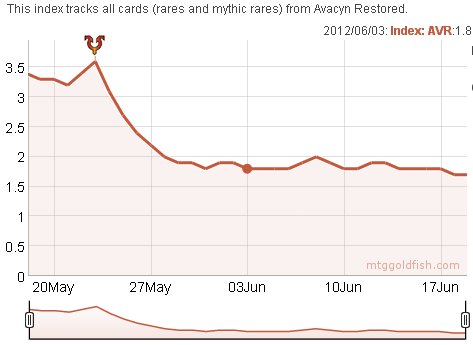
Last week I mentioned mtggoldfish.com as an awesome resource for analyzing price changes in MTGO singles. I spent some time looking over data and doing some research and something has become readily apparent.
If you act quickly enough, there is money to
be made in AVR sets on MTGO. Looking over each card, and the set as a whole, I looked at the downward trend since the sets release. This, in itself, is not unexpected. As more packs get opened, prices drop as people sell their singles for tickets or boosters. Set redemptions are just opening up in a couple days on MTGO, so there may not be a very long window of opportunity on this, so if you plan to act on this, do so quickly. Normally, these sets do stay afloat because of their redemption value, at least early on while the paper versions are still in high demand.

Bot sell prices, for the entire set of Rares and Mythics is $117.30. Wizards will charge you $10 for redeeming this set to paper for shipping, and complete sets sell on EBay for $150-$165 looking at completed listings from the last 24 hours. This is the factor that will likely decline sooner, rather than later. As set redemptions release, these full set prices may fall a bit on EBay, but not too much. As it stands, in a worst case scenario, and after EBay and shipping fees, there’s a profit of $15/redemption.

Not that exciting, especially if you have to manually hunt around bots for each card. There’s a better solution. Instead of hunting around the bots, you can simply create your own buy list in the MTGO classifieds. I would set your buy list just above bot buy lists, and preferably in even ticketed quantities (at least for the itemized listings in the classifieds).

Your listing might be like this:

HUMAN buying ALL AVR cards (Mythics, Rares, Uncommons and Commons), Griselbrand 5tix, Restoration Angel 7tix. Bulk Rares at X for 1, Uncommons at Y for 1, and Commons at Z for 1.

I've also seen people use a more typical Paper dealer strategy. Just make a listing that says, "Human Buying all AVR cards, Private Message me." Have them make tradeable all cards they are interested in dumping, and you can make offers on the rares and mythics one by one, and then make an offer on a chunk of commons and uncommons. This gives you a chance to find even better deals, and not get stuck with even more copies of commons/uncommons than you actually need.

I would try a few different versions of this until you’re getting the volume of responses that you want. Also you want to periodically pull down your listing and repost it so it will be closer to the top of search results. Players will be good at looking for the best buy prices, so do your best to stay competitive.

You should be able to complete as many sets as you want, as long as you have time to sit by your MTGO account while you do other things. I expect this method to reduce your cost per set by about $20-25, adding straight into your profits. If you can gather a handful of sets over the next couple of days, it's a quick profit pickup.

Secondly, you’ll have to wait a couple weeks to receive your redemption sets once they become available on Thursday. I would still start Auctions now. Create a 7-10 day Auction to get people bidding on it early before they realize the price on these may begin to decline. Further let the auction be longer to allow you some time to receive your shipments. I would also make a point in the EBay listing to allow for additional shipping time also.

There is definitely a balancing act to watch for here. As single prices continue to fall, you can get in cheaper, but complete set prices may also decline during that time frame.

I don’t have data on Foils, to know if a Foil set is worthwhile to attain and redeem, but it is certainly possible. For what it’s worth, I’ve seen only one listing sold for a foil set at $600 in the last few days.

I’m hoping to get a couple sets like this together, I’m just not sure if I’ll have the time before prices on EBay fall, but I could be lucky and they will take longer than I think. Hopefully, we wont all be competing with each other.

Next week, we should have a bulk of the remaining spoilers to look at and dive back into Standard speculation for the remainder of the Summer. Let me know below if you have any other techniques to maximize the value of the AVR set redemptions.

My Invitational Weekend

Are you a Quiet Speculation member?

If not, now is a perfect time to join up! Our powerful tools, breaking-news analysis, and exclusive Discord channel will make sure you stay up to date and ahead of the curve.

Last weekend was the Star City Games Invitational in Indianapolis, which I was pretty stoked to attend. While the main even was mostly miserable for me, the weekend on the whole was awesome.

My trip started when Josh Rayden picked me up on Thursday afternoon. With most of the qualified Minnesotan Magic community (wrongly) declining to attend the invitational, it was just the two of us until we picked up Dan Cecchetti and Sam Black in Madison.

On the way to Indy we made a stop in Chicago to eat at Portillo’s at Josh’s request. They make this shake there with an entire piece of cake blended int that Josh is rather infatuated with. Personally I think we would have been better off driving around Chicago, but when a trip takes nearly half a day in the first place, there isn’t a lot of value gained from making good time.

We got to our hotel around 10 or 11 P.M. Plenty of time to get decks together and get in a decent night’s sleep. Of course, the sleeping would have been easier if the air conditioner in our room at the Ramada worked worth a damn, though that’s not to say that I haven’t had worse.

Not surprisingly, everyone in the car was on some blue/white variant for the Standard portion of the Invitational. I was on Delver while Josh, Dan and Sam were all on the midrange build. I was playing something very close to LSV’s list from the WMCQ and had been doing pretty well with it on MTGO. I was expecting the mirror to be popular and was pretty comfortable with my ability to play it.

If only I got that opportunity.

Scrubbing out in Standard

My first round got off to a rough start with my mulliganing to six on the play. I ended up keeping Geist, Mana Leak, Gitaxian Probe and three lands. The hand wasn’t super exciting, but the Probe could, after all, be anything. Even another Probe! I paid life to see my opponent’s hand on turn one and saw this:


Then my probe drew me another land.

I Leaked the Rampant Growth on turn two and pretty much bricked infinitely after playing Geist on turn three. My opponent hit all of his land drops and I failed to find anything that could interact with or race his uncounterable Titans.

Game two went pretty much the same way.

I was pretty tilted after losing a match that I felt there was nothing I could do about.

In the next round I ended up making a play that I’m fairly certain cost me the match against the blue/white midrange deck. There are a lot of factors behind the play in question, but suffice it to say I committed a Geist of Saint Traft that I probably didn’t have to into a Day of Judgment that I gambled wasn’t there.

In round three I savaged Esper Spirits because it’s not a deck, and in round four I was outdrawn by Wolf Run Ramp again.

My heart was really out of the game at this point and I ended up dropping after losing a RUG Delver mirror in the second round of the Legacy portion. While I can’t say that I was impressed with my opponent’s play, I can definitely point to a play in game one and a play in game three that I punted on.

Josh had a similarly bad day and the two of us went out for burgers and beers/margaritas, while Sam and Dan battled the rest of the day.

Neither of us wanted to subject ourselves to playing more Standard at the Open on Saturday, so instead we planned on colluding in some sanctioned EDH matches. I could think of no better way to get off tilt than to ruin the good times of children.

I hadn’t brought any of my EDH decks, but Josh had his Arcum Dagsson combo deck and Dan had a pile of blue cards that he said was an EDH deck.

Dan’s pile had Patron of the Moon as its general, which we quickly changed to Teferi, Mage of Zhalfir so as to turn off our opponent’s counterspells. Then we filled the deck with really bad cards like Cancel and Stoic Rebuttal.

At the end of Friday Sam and Dan had managed to day two and we made our way back to the hotel.

There we watched Reuben Bresler’s delightful interview with Todd Anderson. It was spectacular to watch, considering both the Sam Black references in the video and the fact that Dan was the guy that drew out of the Top 8 of Nashville with Todd.

I really enjoyed Reuben’s work on this one and look forward to more content from him.

Day Two

For whatever reason day two of the Invitational started at 9 A.M. With our hotel being 15 minutes away from the event site, Josh and I ended up waking up bright and early to travel to the site where we stayed the entire day, which I could have very well done without.

Dan and Sam got to battling while Josh and I signed up for a “Commander” pod. It wasn’t long before we were seated across from two local kids playing with Rhys the Redeemed and Dralnu, Lich Lord. They Rhys player had a neat deck box I had never seen before. I asked him which store carried Gladware deckboxes, but he wasn’t very interested in my comment.

The two of them did basically nothing while Josh assembled Helm of Awakening and Sensei's Divining Top to draw his whole deck and Brainfreeze everyone for 81. As it turned out, everybody had Eldrazis in their decks, meaning that he would have to go for a more conventional win.

Josh made Mycosynth Lattice and Darksteel Forge and started LD’ing people with his Karn, Silver Golem. The Dralnu player Capsized Josh’s Lattice to try to buy some time, which I declined to counter. At this point in the game I had done essentially nothing and had four counterspells in hand.

Mostly I hated that Josh’s deck wasn’t better at winning and figured he could durdle his own way out of it. A turn or two later he was able to Nevinyrral's Disk away everybody else’s permanents and the game was all but over.

A word of advice for anybody that wants to run competitive EDH tables - play fun decks. I don’t really care that the other kids didn’t have fun. Frankly if they want to have a good game of EDH they should just go make friends. What was annoying was that it took Josh, like, four weeks to combo off. We would’ve done better to have the combo player play something like Griselbrand (now banned!) or some manner of deck that can just Tooth and Nail for the win.

Meanwhile, Sam Top 32’d the Invitational and Dan finished 33rd.

Josh, Dan and I went out to Fogo de Chao for infinite meat Saturday evening, which Sam passed on as he is a vegetarian. I didn’t much care for the atmosphere at Fogo, but devouring red (or more likely at Fogo pink) meat is a great way to de-tilt oneself.

Day Three

Despite Dan’s finish in the Invitational he didn’t care to play the Legacy Open on Sunday. I was battling with a relatively stock RUG list with Josh playing Esper Stoneblade and Sam playing his Zombie deck.

My day again went extremely poorly. I won my first round against Sneak and Show and then went on to lose the next two to Sneak and Show and Reanimator. I’m thinking that my maindeck should’ve been more configured to beat combo in game one with some of the maindeck removal spells switched to the sideboard.

Meanwhile Dan entered the noon Draft Open and ended up with a superbly miserable deck containing four copies of Fleeting Distraction. Needless to say, he didn’t make it too far with that one.

In round four I played against an extremely unpleasant Merfolks player. He kept track of his life total and his life total only using dice instead of paper and communicated very poorly throughout our match. Honestly, the topic of in-game communication deserves an entire article to itself, but, if nothing else, you should at least verify life totals with your opponent every time damage is dealt.

After that match I dropped and decided to incinerate some money in the 3 P.M. Draft Open. I was a little apprehensive about joining as I had not played a single draft of Avacyn Restored, but I considered the following:

  1. I had heard that Avacyn Restored is pretty much like drafting a core set, so my limited knowledge wouldn’t hurt me too much.
  2. SCG Draft Opens can be extremely soft.
  3. I was on too much tilt to not make a poor decision even if points 1 and 2 ended up being false.

My draft pod featured a few local guys along with Joe Bernal and Max Tietze. I was a bit nervous when I heard that I only had 40 seconds to make my first pick, as I thought I would have closer to 50 seconds, but I was able to read every card and make reasonable picks despite the time constraints.

My first three picks were two Scrapskin Drakes and an Into the Void. I figured that there was no way that three mana fliers could be bad and Into the Void is very plainly insane. There were no good blue options for my fourth pick, so I took a Joint Assault because I had heard that blue/green Soulbond was a good deck. As the pack progressed it became pretty clear that blue was open but I didn’t get very much green.

In pack two I was very happy to open a Vanishment. I then second picked a Wolfir Avenger over a Nephalia Smuggler, which I ended up regretting later as green was otherwise extremely dry. I got some other goodies in this pack, including a Mist Raven and an eleventh pick Devastation Tide. I realize that the card isn’t super exciting, but it’s certainly better than eleventh pick.

In pack three I pretty much stuck to picking blue cards. During deck build I realized that I didn’t get very many green cards at all. While I wanted to play Wolfir Avenger, I realized I could very easily play mono-blue.

Mono-Blue Cards

spells

3 Scrapskin Drake
2 Into the Void
2 Vanishment
1 Ghostly Flicker
1 Devastation Tide
1 Tandem Lookout
1 Misthollow Griffin
1 Peel from Reality
1 Elgaud Shieldmate
2 Gryff Vanguard
2 Mist Raven
1 Fleeting Distraction
1 Latch Seeker
1 Galvanic Alchemist
1 Crippling Chill
1 Narstad Scrapper
1 Angelic Armaments

lands

15 Island
2 Seraph Sanctuary

I had two Spectral Prisons on my sideboard that I probably should’ve just maindecked. I sided them in pretty consistently and, if nothing else, the Angelic Armaments didn’t really fit.

There’s not much to say about how the swiss rounds went. I had good fliers, good bounce spells and decent card draw. I very easily 3-0’d into top 8 despite multiple mull to fives and play mistakes.

I opted to split the prize for the top 8 but the motion was no-sir’d.

My Top 8 draft went considerably worse. The flow of the colors was pretty awkward. I knew I was white for most of the draft but landing on a second color was tough. I ended up in green/white, which I don’t mind playing in most formats if I have a lot of tricks, but I came up short in that department for this draft.

My deck ended up being extremely mediocre:

Green/White Mediocre-Range

spells

1 Cloudshift
3 Moonlight geist
1 Emancipation Angel
2 Bladed Bracers
1 Farbog Explorer
2 Seraph of Dawn
1 Wildwood Geist
1 Goldnight Redeemer
1 Pathbreaker Wurm
1 Druid's Familiar
1 Midvast Protector
1 Nightshade Peddler
1 Righteous Blow
1 Zealous Strike
1 Thraben Valiant
1 Voice of the Provinces
1 Nettle Swine
1 Commanders Authority

land

10 Plains
8 Forest

I had a Defang in my sideboard that definitely should have been maindeck. I got a lot of flak for playing Commander's Authority which I responded to by writing “Bitterblossom” on the card in Sharpie. It’s clearly not good against blue decks, but an infinite blocker that can generate bodies during a board stall is hardly unplayable.

My quarterfinals match against David McDarby pretty much consisted of my equipping Bladed Bracers to angels and blocking his creatures until he died. His deck was about as mediocre as mine.

I opted to split again going into the semifinals but I was no-sir’d again.

My semi-finals opponent’s deck was extremely durdly and featured Archangel, Terminus and Angel of Glory's Rise.

He Terminused in game one and soon after we had a board of Angels staring at one another while my Commander's Authority made tens of tokens. I gained a grip of life with Goldnight Redeemer and my opponent scooped out of boredom. I feel like the game was mine to lose but not knowing what was in his deck I can’t say for sure that he couldn’t win.

In game two I rolled him with Druid's Familiar because that card is laughably good.

After that it was on to the finals against Dave Shiels where I finally got my split. His deck was considerably better than mine, featuring double Triumph of Ferocity and Tamiyo, the Moon Sage. I made the match kind of close, but I don’t think that I really had much business in it.

~

It was a strange weekend for me. I got completely savaged in the highest EV tournament in Magic and then ended up splitting the finals in a format where I had no idea what I was doing.

At any rate, Invitational weekends are insane and I feel that everybody should be doing whatever they can to make it out to them. There are tons of great people there and a lot of different ways to game. Even if you’re not qualified, it’s well worth traveling with somebody who is, and I say this as somebody not at all associated with SCG.

Of course, they're a lot better when you're winning.

-Ryan Overturf

CommanderCast S6E7 – Rhys We Facin’, Planes We Chasin’

Are you a Quiet Speculation member?

If not, now is a perfect time to join up! Our powerful tools, breaking-news analysis, and exclusive Discord channel will make sure you stay up to date and ahead of the curve.

This week on CommanderCast Andy is joined by Sean, CaptainRedZone and William to discuss the new Planechase 2012 product with a side of Rhys the Redeemed. The two discussions overlap a bit, but for the most part we're focusing on the new Planechase product here.

LET'S GET IT!

Hit the button or play, or download the entire episode! The full show notes are here.

Jason’s Archives: Starcity Invitational Wrap-up, Reddit and Griselbanned?

Are you a Quiet Speculation member?

If not, now is a perfect time to join up! Our powerful tools, breaking-news analysis, and exclusive Discord channel will make sure you stay up to date and ahead of the curve.

Greetings, Speculators!

Last weekend I went to Indianapolis for the Star City Games Invitational and I have a lot of info to relay about it. I also dug up a few gems for you, so let's get down to brass gnats.

Griselbanned?

Is Griselbrand warping Legacy enough to warrant a ban? We'll know tomorrow for sure, but in the meantime all we can do is speculate. I will get into the results of the Legacy events in Indy at the end of the article.

Are "cheaty" decks like Hypergenesis, Reanimator and Sneak and Tell seeing more play in Legacy? Certainly, just as they did when Emrakul was printed.

Are these decks dominating the top 8s of multiple events? Later I will reveal how many copies of Griselbrand were in the top 8 at the Legacy events in Indianapolis. The number may surprise you.

While many are calling for Gris' head, I take a more reserved tack. I don't prefer bannings, emergency or otherwise. They admit to a fundamental failure on the part of Wizards to predict the effect of a card or archetype on the format, and I believe they should be used as a last resort. The "future future" league employs some of the best innovators from the history of the game, and if they didn't see Griselbrand ruining magic, there are two possibilities.

  1. They made a mistake (this happens; look at Stoneforge Mystic and Jace the Mind Sculptor)
  2. They found new tech to contain the threat and deemed that overall the card improved the format.

I tend to err on the side of "let's innovate" and not "OMG this sucks they need to ban it and every card that shares a creature type with it!"

The "like OMG so oppressive" dredge decks of yesteryear are easily dispatched with the application of a simple Tormod's Crypt or Leyline of the Void. Gris decks can be managed likewise. And not merely managed; greedy decks like those are wrecked by hate cards. Dredge is all-in, and after you crypt their stuff away they aren't left with much of anything.

Similar strategies are already being adopted to answer broken decks like Sneak and Tell, which is all-in on the 'brand plan. You can easily put this deck in topdeck mode with a Gilded Drake to steal Gris, Humility to make him hilarious or Wipe Away to send him packing (unless they are using Sneak Attack, most players will pass priority after cheating out Griselbrand hoping to bait out a Swords to Plowshares or Go for the Throat).

My prediction is that when the dust clears, Griselbrand decks will be simply another part of the metagame. They are getting a lot of play because they are new, not because they are the best. Easy to hate out, fragile and greedy, these decks promise quick wins and also many games where you just can't draw right and aggro caves your face in.

Worth a quick mention is the impending possible ban of Ponder and/or Snapcaster Mage. I fully expect Ponder to be banned tomorrow although I won't be surprised if it's Snapcaster Mage instead. Although Ponder is flipping Delvers and making shaky hands keepable, its days are also numbered -- its omission from M13 means it's rotating soon. Snapcaster Mage could warp the format for years. These are likely the only two cards on the chopping block.

This Week on the Web

First up is a Reddit post I really got a kick out of. Last week on Twitter Sam Black was asking people for cards that had good flavor text and Reddit delivered.

The thread is at this link

This is worth reading through. There may be some gems you've forgotten about. A lot of work goes into flavor text and it's nice to take a second to go back and appreciate how good it's been over the years.

Special thanks to Captain_Zavec for getting the conversation started.


Be careful not to summon the Don Cheadle Captain Planet

Joystick_Genie was reminded of another cycle of colored power rings from his childhood. I personally think if you get all five rings on five creatures of the appropriate colors it should summon Progenitus. After all, Progenitus is a hero. Gonna take their life down to 0. Right? Like in the song? Ok, then, moving on.


He later went on to prove Santa wasn't real and there is no such thing as a free lunch

Math genius HarlequinNight brings us this hilarious mathematical proof that Doubling Cube can never double your life total. What a buzzkill!


Whereas I grew up next to Banksy and he scultped a melted mailbox in my image that looked nothing like me

Redditor eegan1220 grew up next door to Magic artist Lars Grant West and shared with us this terrific custom painting featuring him as a triceratops commander. Too cool!

The conversation it spawned is also worth reading, found here

Artist Alley in Indy

It was an all-star turnout in Indianapolis.

Eric Klug -- card alteration artist

ClaarBar -- card alteration artist

Lindsay Burley -- 3D alteration artist

All 3 do work on commission and are worth checking out.

I am Become Mind Sculptor, Warper of Formats

Top 8 Standard Invitational

Half of the top 8 was U/W delver, but considering the structure of the Invitational, it's hard to tell if those players simply 2-2'ed the Standard portion and 4-0'ed Legacy on day one. Still, U/W was a significant portion of the field and it seems like a good choice for strong players. Things may not be looking great for Snapcaster and Ponder.

Lauren Nolan, who took the whole thing down, chose Delver for the Standard portion.

Hetrick's RUG Pod is a good choice to look into if you don't want to flip delvers in the next few weeks. I saw Hetrick make some very tricksy plays with this deck. One of these consisted of casting Zealous Conscripts, stealing an opponent's Restoration Angel, podding that into another conscripts to steal another angel and swinging for the win. This deck has all the tools you need to take the format down and I think is a good choice.

U/W Midrange also made a splash and is a deck to watch out for.

Top 8 Legacy Invitational

A true lover of Delver of Secrets, Nolen took down the Legacy portion with RUG Delver.

Only eight [card Griselbrand]Griselbrands[/card] in the top 8 of this event. No Sneak and Tell, no Hypergenesis, just two Reanimator decks (arguably the least unfair deck to cheat in creatures). Is the format ruined? People seemed to be the most afraid of decks like Sneak and Tell, but where are they? Zero in the top 8 and only two in the top 16. Warped format?

It's hard to tell from Invitational results, so let's delay the verdict until we analyze the Open results.

Top 8 Standard Open

Players in the Open made some different choices. Only one U/W Delver managed a top 8, the same as the number of U/W midrange decks. In fact, there were eight different decks in the top 8! That seems like a healthier format than we'd thought. RUG Pod makes another appearance, piloted by Michigan's Josh Glantzman who managed a top 8 in both the Legacy and Standard Opens. Nice job, Josh!

U/W Delver took home top honors, however, piloted by Ross Merriam.

Top 8 Legacy Open

The Legacy Open was won by ... Goblins? Other than Stingscourger, I don't see many ways to deal with a Show and Tell'd Gris. Packing four copies of Cavern of Souls and a suite of cheap, efficient beaters, Goblins is back, baby! With Mental Misstep a distant memory, one-drop-heavy decks are starting to reemerge. Great job Brad Campbell!

Merfolk also managed a top 16. Maybe in a format skewing toward pseudo-combo decks like Sneak and Tell, fast, efficient beaters are the play. Any amount of disruption can foil your opponent's plans, and anything short of a nut draw from Sneak and Tell can't race decks like Maverick. In a format where people are eschewing Progenitus in favor of Griselbrand, Maverick is a much better choice as Karakas smokes [card Emrakul, the Aeons Torn]Emrakul[/card] and Griselbrand whereas Progenitus merely laughs it off. Crop Rotation is great sideboard tech right now to make sure you find that Karakas and never take damage. Maverick is more than capable of handling Sneak and Tell, which accounts for the lack of Gris decks in the top 16 of the Legacy Open.

A format warped by Griselbrand? Hardly. Even players who weren't ready for it (and a top 8 that all said the deck they feared most was Sneak and Tell) handled Gris decks easily. I think Griselbrand is stupid powerful, and in a format with Necropotence and Yawgmoth's Bargain on the banned list, has even more potential for abuse. However, the results from this weekend, which were supposed to show how unfair Griselbrand was, did not.

Griselbanned? I doubt it very much.

I'm Audi 5000

Take it sleazy, speculators. Thanks for joining me this week, and check this space next time for more of what's good in the world of MTG.

Also check out the episode of Brainstorm Brewery we recorded from the road in Indianapolis that should go up later this week.

Don't do anything I wouldn't do.

And if you do, pics or it didn't happen.

Insider: Trading For Cash Cards

Are you a Quiet Speculation member?

If not, now is a perfect time to join up! Our powerful tools, breaking-news analysis, and exclusive Discord channel will make sure you stay up to date and ahead of the curve.

Many cards hold their value for a variety of reasons. Dual Lands are valuable due to their unmatched power in Legacy. Strong Planeswalkers such as Elspeth, Knight Errant are valuable because of their versatility across multiple formats. And of course the Power 9 and other Vintage must-haves are icons representing the most valuable of Magic: The Gathering cards.

A collection of these cards is nice to have. But a collection of cards is only worth what one could get in cash for it. The old adage “cash is king” is a mantra I live by when dealing in Magic Cards.

Many of my Twitter followers have seen me use this phrase before, and it is the basis of this week’s article.

A Slightly Different Look

Everyone knows the value of Dual Lands, Force of Will, Jace, the Mind Sculptor, Bazaar of Baghdad, etc. Cards like these have been played ad nauseam and no one needs reminding that these are as good as cash. Even cards like Zendikar Fetch Lands, while printed more recently, are well-recognized for their cash equivalency.

But what about cards that don’t see the same scale of play or attention? There are many Magic Cards which can be readily converted to cash, yet don't reach the same levels as Legacy and Vintage staples. These are the cards that are difficult to find in many trade binders, yet the players who possess these cards may sometimes have trouble moving them because they are less glamorous.

The result is an opportunity to acquire these cards close to their cash value. These cards could then be held for a period of time in hopes of slow value increase, or they could be sold quickly for some easy dough.

Which cards should we be looking out for? There are too many to name, of course, but I will try and give a couple examples across multiple price ranges. These would be great cards to keep an eye out for when trying to equalize value in a trade.

Small Value Cards (< 5$)

Let’s start small. I mean very small, as in cards that are as good as cash yet are worth less than one dollar.

One that many tend to overlook is the inevitable “junk rare”. These are the Timesifters/Grindclocks/Need for Speeds of the world – the cards that can be acquired by the dozens at less than a quarter each with minimal effort.

Do not be fooled by their ample supply. These forgotten rares are money simply because retailers will pay a flat amount for them, normally in the ten to fifteen cents range. And when people are looking up cards on TCG player to value them, picking up the occasional Timesifter valued at $0.13 (which can often be rounded down to a dime) may not be the worst idea.

Another up-and-coming example of a set of cards which are easy to sell for cash is the Zendikar full art land. While there are many in existence, these lands are slowly fetching more and more cash at auction. Some players may be thrilled to unload a bunch of lands for a Standard card – it may not be a bad idea to oblige them!

As we slide up the price scale to cards worth a couple bucks, we have available an endless list of cards that easily sell for cash. But rather than delve too long on this topic, let me instead direct you to an all-inclusive series of articles already available on this site: Doug Linn’s Hidden Treasures Set Reviews series (listed below, from an upcoming "Start  Here" Insider page we're compiling).

Within, Doug highlights the many overlooked cards in each set which are convertible to cash (timestamped according to when the article was published, of course):

Hidden Treasures Set Reviews by Douglas Linn

Mid-Range Cards ($5 - $20)

The magnitude of cards which fall into this price range is incredible. When I started playing Magic, I was thrilled to own a couple cards worth double digits as there weren’t many outside of the unobtainable cards in the original few sets. Nowadays, every trade binder out there seems to have at least a few of these since they are available in every new set.

But some cards in this price range, which can be readily converted to cash, are less popular and therefore may be easier to acquire in trades closer to cash value.

One of my favorite examples is a pair of Vintage-legal cards that do not see as much play as they once did: Tolarian Academy and Vampiric Tutor (charts courtesy of blacklotusproject.com).

These two cards are fairly stable in price, yet they are often obtainable very near their cash equivalent. Tolarian Academy is nearly the same as a $20 bill if in NM condition, yet Star City Games sells SP copies for the same price. Vampiric Tutor has been a steady gainer over the past couple years, yet the restrictions on this card’s playability means some players are okay with trading this one away at cash pricing. These are worth keeping an eye out for.

One other example in this price range I want to mention that falls on the cheaper side of the $5 - $20 price range is Gideon Jura. It sees almost no constructed play nowadays, yet the card still can be exchanged for a five dollar bill. Downside is limited on this card, and acquiring them at five bucks could be similar to trading for cash.

Big Ticket Items With Little Attention (> $20)

The key here is finding cards that can be readily converted into cash and can be acquired through trades at reasonable pricing. Cards like Force of Will are nice to acquire but they normally demand a premium at the trade tables. Consider Gaeas Cradle, for example. Both the Cradle and the Force retail for $70 at Star City Games. Yet I frequently see Force of Will selling for just under $50 on MOTL, while Gaeas Cradle normally sells on the same site for a full $10 more (chart courtesy of blacklotusproject.com).

The discrepancy is in popularity – everyone knows Force of Will is a major Legacy staple. Meanwhile, Gaeas Cradle sees less Legacy play and more casual play. I would gladly trade my Forces for Cradles all day long as this would nicely increase my collection’s cash value.

One other example I can readily think of is Lions Eye Diamond. While this card is somewhat of a Legacy staple, the card sees play in only a couple decks (chart courtesy of blacklotusproject.com).

This card has gone on huge price rally recently, and I’m not really sure why. Dredge has not increased in popularity, and the recent outburst of blue Delver, Esperblade, and Reanimator decks has significantly weakened ANT decks, but perhaps it's due to the printing of Faithless Looting. Yet, Lions Eye Diamond is equivalent to a picture of Ulysses S. Grant!

Despite this run, the card is not as tradable as Dual Lands or Force of Will. The result? Players may not consider asking for $60 in trade on this one. Considering how the card was only a $20 card three years ago and (more entertainingly) a $0.20 card ten years ago, the perceived value of this one just has not kept up with the actual value.

Prices Subject To Change

There are many other examples, depending on how obscure you want to get. As I’ve discussed in previous articles, many Alpha Rares are trending higher in price, yet players may not value their Alpha Fungusaur at $100 as they should. Of course, good luck finding a player with an Alpha Fungusaur in their trade binder.

I would encourage you to consider other cards in these categories. Since the game is constantly in flux and prices are ever-changing, today’s opportunity may not be the same as tomorrow's. For example, it’s pretty likely you’ll still be able to trade for and sell a Tolarian Academy near $20. Meanwhile, Lions Eye Diamond’s perceived value will eventually surpass its eBay value, as most cards do.

Perhaps some of you have other ideas/suggestions on what cards trade for near their cash value?

Let’s face it – not many have the resources and time to open a retail store and command retail prices on their cards. The more you trade for these cash-equivalent cards near their cash value, the more you’ll get for your collection. This is one way you could actually fetch close to retail prices on your Standard and Legacy staples without all that overhead.

-Sigmund Ausfresser
@sigfig8

Inner Calm, Outer Strength

Are you a Quiet Speculation member?

If not, now is a perfect time to join up! Our powerful tools, breaking-news analysis, and exclusive Discord channel will make sure you stay up to date and ahead of the curve.

Now that we're at the tail-end of my budget series we're getting into strategies that I'm less familiar with and colors that are less budget friendly. We got through white and black with no trouble, green was a little bit of a stretch, and now we're headed into blue and red.

I can't stand blue decks in this format so I want to put that one off for as long as possible. That leaves us with red.

Red presents a unique challenge, both in general and as far as budget restrictions go. Red's deficiencies are mostly a function of social stigma. Take a second to think about red's part of the color pie. It can destroy artifacts and lands, burn people out, [card Reverberate]copy[/card] things and push the [card Scrambleverse]random[/card] button.

Its most powerful axis of interaction, mass land destruction, has a ton of negative feelings associated with it. Few things will get you hated off of a table as quickly as Obliterate.

Typically, red decks compensate for their deficiencies with artifacts and colorless cards. Unlike with white, red doesn't have many equipment-based cards, so it tends to lean on colorless staples like All is Dust, Solemn Simulacrum and Nevinyrral's Disk. Those are clearly outside out of the budget for this series, which makes things a little awkward.

Picking the Commander

Throughout this series I've emphasized that a budget restriction encourages you to build around your Commander.  Without access to pricey card advantage and tutoring engines, you want to make the one card you always have access to as powerful as possible. On a budget you must rely not on individual card quality, but rather on powerful interactions.

That's why each of these budget decks has had a Commander with a huge upside. It might not do a ton in the early game, but can dominate a game once you get rolling. The upside of your general needs to be high enough to beat decks that are more powerful card for card.

Unfortunately, there aren't too many candidates for red. You could try to build an attrition deck with Slobad, Goblin Tinkerer. Or you could try to build a budget version of Godo, Bandit Warlord, investing in one or two expensive cards to power him up. Those are both great options, but I think we can have the most fun with Homura, Human Ascendant.

You can invest in a few cards to swarm the board with tokens, each of which will be gigantic under a flipped Homura. As long as you have creatures, you can interact with the rest of the board. Creatures can turn into removal, either by trading with bigger guys in combat or by killing the person who controls the scary permanents.

It's important to recognize what this guy will demand from you. You need to have ways to generate multiple creatures, preferably through sweepers. You need to have extra red mana available to turn those creatures into real threats.

You also need to be able to kill off Homura easily and consistently. Sacrifice outlets are awesome, since they give you additional things to do with your tokens and flip your Commander.

Finding the Inner Flame

Our first concern is flipping Homura. Fortunately, this task is covered by regular removal spells that we'll want to run anyway. But the best ways to kill Homura will provide some sort of value in the process.

You also want to gear your removal towards creatures without flying. Red has all kinds of Earthquake effects that will kill most creatures in the format, including Homura, but leave your guys alone once Homura has flipped.

This means you will want to hold back less conditional removal in case someone does have a creature with flying that has to die.

  • Grab the Reins ($0.39)
  • Fling ($0.15)
  • Shivan Harvest ($0.25)
  • Skirsdag Cultist ($0.25)
  • Artillerize ($0.15)
  • Bloodpyre Elemental ($0.15)
  • Spitebellows ($0.49)
  • Firemaw Kavu ($0.25)
  • Breath of Fury ($0.49)
  • Spawning Pit ($0.39)
  • Aftershock ($0.25)
  • Fireball ($0.25)
  • Disintegrate ($0.25)
  • Fault Line ($0.75)
  • Rolling Thunder ($0.49)
  • Jaws of Stone ($0.25)
  • Jiwari, the Earth Aflame ($0.49)
  • Scourge of Kher Ridges ($1.75)
  • Earthquake ($0.49)
  • Hammerfist Giant ($0.49)

A full fifth of our deck is capable of killing Homura somehow. You may have to two-for-one yourself to do it, but these cards get the job done. You also have some versatile removal and a bunch of [card Earthquake]Earthquakes[/card] which you can follow up with token generation.

You have to be careful not to use up all of your removal just because you can. Only kill the creatures you have to, and try to keep a card that can kill Homura in hand so that if someone [card Austere Command]Austere Commands[/card] or [card Tranquility]Tranquilities[/card], you can reflip and get back on the aggressive.

To me the most exciting cards here are Breath of Fury and Jiwari, the Earth Aflame. Breath of Fury is a way to combo off if you have enough tokens in play. Suit up Homura, get in a hit, flip to pump your guys and start smashing face. The firebreathing effect doesn't wear off until end of turn, so the damage adds up more quickly than you might think.

Jiwari, the Earth Aflame, on the other hand, is an uncounterable Earthquake. Plenty of other cards will flip Homura even if countered, like Fling and Artillerize, but Jiwari does everything you could hope for in this deck. It clears the way, flips Homura, and becomes repeatable removal if you get it into play safely.

Tokens, Tokens Everywhere

The next concern is to make sure Homura's ability is relevant. There's a few ways to do that, the first of which is making a billion tokens. An anthem with evasion and firebreathing as your Commander is sweet when your plan is to make a bunch of guys. The second thing we can do is take advantage of firebreathing with cards that care about power, like Fling.

The easy place to start is tokens:

  • Beetleback Chief ($0.99)
  • Chancellor of the Forge ($0.49)
  • Dragon Fodder ($0.49)
  • Emrakul's Hatcher ($0.15)
  • Firecat Blitz ($0.25)
  • Goblin Marshal ($0.49)
  • Goblin Offensive ($0.99)
  • Mogg Alarm ($0.49)
  • Mogg War Marshal ($0.39)
  • Rakka Mar ($0.75)
  • Rapacious One ($0.25)
  • Siege-Gang Commander ($0.89)
  • Warbreak Trumpeter ($0.39)
  • Kazuul, Tyrant of the Cliffs ($0.49)
  • Orochi Hatchery ($0.49)
  • Empty the Warrens ($0.89)
  • Myr Sire ($0.15)
  • Myr Turbine ($0.39)
  • Kuldotha Rebirth ($0.15)
  • Myr Battlesphere ($0.39)
  • Lightning Coils (0.49)

With enough money, you could make this a Goblin-based engine and include cards like Ib Halfheart, Goblin Tactician. Since we're on a budget, we're pretty much stuck with every common and uncommon token generator, and even some of those are a little pricey.

Once you've flipped Homura, each of these produces a minimum of six power in evasive firebreathing dragons, which is nothing to scoff at. A number of these effects are even repeatable, which isn't something I expected to achieve with this budget.

Finding more repeatable effects is a good target for upgrading the deck. Cards like Myr Matrix and manlands can make a huge difference here. Since you're super reliant on having creatures in play at all times, token generators and lands that live through your sweepers are hugely important.

Dragonfire

If tokens and anthems are the framework of the deck, we will need a way to close out games once people have stabilized. For that we have a few creatures that care about the power boost provided by Homura. We may not be able to afford something like Spikeshot Elder, which would be awesome, but we can do fine without:

  • Hellkite Charger ($0.49)
  • Bloodshot Trainee ($0.25)
  • Spikeshot Goblin ($0.25)
  • Godo, Bandit Warlord ($1.75)
  • Moonveil Dragon ($1.39)
  • Conquering Manticore ($0.49)

There's not a ton to say about these besides that they help you steal games. Some of these guys, like Godo, Bandit Warlord and Bloodshot Trainee offer you some marginal utility, but for the most part these guys are here to generate huge amounts of damage from small board states.

Again, these encourage you to invest your mana every turn, which is one way that budget decks can stay ahead of more powerful decks. By converting mana to damage you can apply a ton of pressure, which other players may not be prepared for.

There are only a few more slots left to fill before we start to worry about cost. Let's see if we can squeeze in a few much-needed utility effects.

Utility and Resiliency

One of the more obvious issues with a deck like this is its weakness to sweepers. Red doesn't have much in the way of recursion, and Eldrazi Monument is difficult to maintain besides being well outside of our budget. Similarly, you don't have access to ways to protect your stuff or answers to nonland, nonartifact permanents. You can always resort to Red Elemental Blast, something I'm more than happy to do. But that seems a little hateful as a starting point.

  • Wild Ricochet ($0.49)
  • Hoarding Dragon ($0.49)
  • Nim Deathmantle ($0.49)
  • Gorgon Flail ($0.25)
  • Ingot Chewer ($0.49)
  • Anarchist ($0.25)

Here I've included a small equipment suite. I'd love to fit in Mortarpod, but I don't think there are quite enough tutors to take advantage of it. It may prove better to add Basilisk Collar and some pingers to create a removal engine.

Still, I really like Mortarpod as a sacrifice outlet to power up Nim Deathmantle. Deathmantle itself really shines in this deck, rebuying Goblin Marshal every turn or making an evasive guy that you can dump mana into. It gives you a ton of longevity you might not have otherwise, and is almost always the first thing you tutor for.

These slots are certainly flexible and you can play around with different options. The best thing to look for are utility effects attached to bodies that can take advantage of Homura.

The Mana Base

Red mana will be at a premium in this deck. Caged Sun and its ilk would be excellent additions, although I wasn't able to fit them into our budget. In any case we won't want to run a ton of colorless utility lands. We do want to make space for some number of manlands in order to maintain our board presence after a sweeper.

  • Armillary Sphere ($0.25)
  • Wayfarer's Bauble ($0.39)
  • Ur-Golem's Eye ($0.25)
  • Pristine Talisman ($0.25)
  • Iron Myr ($0.15)
  • Guardian Idol ($0.25)
  • Mycosynth Wellspring ($0.15)
  • Ichor Wellspring ($0.25)
  • Pilgrim's Eye ($0.25)
  • Expedition Map ($0.49)
  • Phyrexia's Core ($0.25)
  • Valakut, the Molten Pinnacle ($1.75)
  • Ghitu Encampment ($0.39)
  • Dread Statuary ($0.25)
  • Stalking Stones ($0.25)
  • 31 Mountain

If there's a card you're dying to add but you don't want to change the budget, these are your flex slots. Because so many cards in this deck are redundant, you could easily cut one for another, or even cut multiple cards for a few extra lands. That mana will always be put to use, so there's no reason to miss land drops, and it won't change the overall power level too much.

Here are a few ideas that I would have loved to fit in:

  • Spikeshot Elder ($0.89)
  • Knollspine Dragon ($0.99)
  • Mogg Infestation ($1.99)
  • Caged Sun ($0.99)
  • Gauntlet of Power ($4.99)
  • Koth of the Hammer ($6.99)

And with that, let's take a look at the finished product. For $31.52, you too could own:

Untitled Deck

Creatures

Instants

Sorceries

Artifacts

Enchantments

Lands

31 Mountain

I've always thought that Homura was underplayed relative to his power level. Double anthem, evasion and firebreathing is no joke, and should bring the beats pretty hard! There's room to improve on this but it's a good start and I look forward to developing it more. For my version though, I'll probably swap out some of the budget cards like Shivan Harvest for Spikeshot Elder and the like.

A quick aside before we wrap this up: I did go and build a deck very similar to the one I posted last week on MTGO for less than three tickets. That's right. Three. The deck is currently 3-2 in games. The deck definitely still needs work but I'm pretty happy with how it turned out, especially for having spent so little!

Next week we'll wrap up this series with a blue Commander even I can get excited about. It's a little more my speed than typical blue Commanders that focus on combo or prison elements. Those decks are fun to build but ultimately not much fun to play, which is really what matters.

Carlos Gutierrez

cag5383@gmail.com
@cag5383 on Twitter

Want Prices?

Browse thousands of prices with the first and most comprehensive MTG Finance tool around.


Trader Tools lists both buylist and retail prices for every MTG card, going back a decade.

Quiet Speculation