If not, now is a perfect time to join up! Our powerful tools, breaking-news analysis, and exclusive Discord channel will make sure you stay up to date and ahead of the curve.
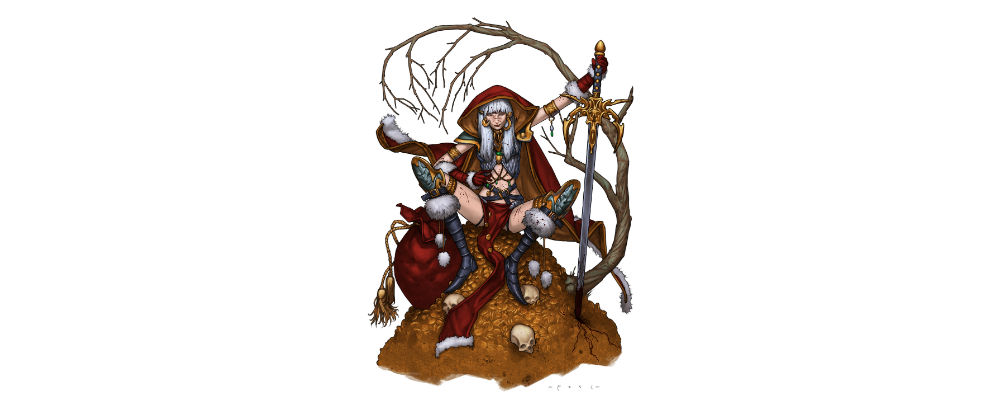
Her'es a quick biography of some of our writers, along with their favorite articles from 2011! Our Insider subscribers received postcards with custom art done by MTG artist rk post, as shown in the title image of this post! Check out each writer's favorite articles below!
Carl Szalich
Carl Szalich
Originally educated as a computer programmer at Fanshawe College in London, Ontario, Canada, I have since abandoned that initial calling. Drifting between various jobs including Insurance Advisor and Banker, I now work full time as a bilingual (french / english) customer service agent for a major plumbing & manufacturing group. I live with my girlfriend who is as anti-magic as they come, so sometimes struggle on a personal level to balance my time between familiy obligations and "play time" (like so many of us out there, I'm sure).
Though I have not had success at any major tournaments, I feel it's more because I haven't really attended rather than being a terrible player. I frequently win local FNM's and enjoy playing almost as much as trading! I occasionally write in my own magic blog (http://donttrainmyorgg.blogspot.com), but focus primarily on strategy and deckbuilding these days since my financial articles go straight to our beloved Quiet Speculation :). I own the P9 and have playsets of any vintage / legacy staples, but my main passion has always been foil cards. I am known amidst my city as "the foil guy" and people contact me specifically to trade their foils to me, with shops even sending me texts when they get a foil that's particularily spicey. I just completed my foil werewolf deck, which has twice as much foil as any other and will be played into the ground before the season is over even though the tribe is still... how to phrase it?... terrible.
A great little article on the best times to sell certain cards in your collection to maximize your profits! I reference this article regularily when I'm preparing to do a major sell-off.
I really like this article more for the explanations of EV (Expected Value) than the actual drafting tips. EV is a concept that you can use not just as you draft, but as you trade! This information can also be used to determine which packs to crack to try and gain the most value... if you're into that kind of thing :P.
A fun article that let's YOU decide which pile in a trade you would rather have and why, as well as how to scan buy lists for fun and profit! It's an introduction to re-occuring themes in my present articles and sets things up nicely for the future.
I'm looking forward to next year and wish each of you a safe and happy Christmas / Holidays / New Year!
Cheers,
Carl Szalich
Carlos Gutierrez
Carlos Gutierrez
I'm Carlos! I graduated from Lafayette College fairly recently with a degree in Chemical Engineering with a focus on bio-simulations, and have been trying to figure out what to do with myself since then. I tried the grad school thing, and that wasn't really what I wanted to be doing, and now I'm doing the job-hunting thing. In the meantime, I do a lot of cooking and gaming with my wonderful girlfriend of six years, Rebecca.
Until very recently, I played Commander and Limited exclusively, but since Grand Prix Pittsburgh, I've been trying my hand at constructed formats. I've been writing about Magic, particularly Commander, for about a year now. I've been a regular writer for both Quiet Speculation and Commandercast, while I've done guest pieces for sites like Mana Deprived and Red Site Wins. I'm a fairly regular guest host on podcasts like Commandercast and Horde of Notions on the MTGCast network, and I'm starting to travel to larger events to meet some of the awesome people I've met through online networking. I don't have any illusions or aspirations of greatness within the Magic community, but it's been incredibly rewarding to contribute to Magic culture in my own way, and to have met so many amazing people, and I'm incredibly grateful to Kelly and Quiet Speculation for giving me the opportunity. Here's hoping for a great 2012!
I'm a private tutor at the University of San Diego. Courses I teach include, Corporate Finance, Microeconomics, Macroeconomics, Statistics, Quantitative Business Analysis, Decision Science and Operations Research. My hobbies outside of Magic include concerts, movies, and puzzles. I'm a huge fan of the www.themastertheorem.com weekly puzzles.
I started out learning to draft around Conflux, and during M10 made my move into more competetive play. I keep a blog over at torerotutor.blogspot.com that doesn't get updated often enough now that I write here, and I so far have only one PTQ top 8 to my name. I'm in my 2nd year of grinding PTQ's and have aspirations of the Pro Tour.
Chad's Pick
How To Run a Profitable Ebay Store - Chad Havas
My interview with a successful EBay store owner. This one was extremely fun to make, and I learned a ton in the process.
Sigmund Ausfresser
Sigmund Ausfresser
I work full time as a Chemical Engineer with The Procter and Gamble Company, living in Boston, MA. My current focus is on Modeling & Simulation working on Gillette Razors. In order to make myself a better modeler, I am studying for a Masters in Applied Mathematics with the University of Washington. Between all this, plus the fact that my wife and I are expecting our first child (a boy!) in early March, I keep very busy! Whenever I can, I grab a few minutes here and there to read some fantasy books, old Inquest Magazines, and play the occasional old-school video game on my Sega Genesis or Sega Saturn.
In the realm of Magic, I have enjoyed this game since the release of Visions back in 1997. It wasn't until Shards of Alara block was printed that I became eager and persistent enough to try competitive play. This was also around the time I became interested in Legacy and, in turn, MTG Finance. I purchased all the cards I needed to build an Ad Nauseam deck and when I saw an increase in these card values, I became intrigued with the concept of having a hobby that can also pay me back. For a couple years I played as many brainstorms as possible while also keeping a close eye on the happenings in the financial market. Since then I have won a few local Legacy tournaments and I went 6-2-1 at GP Columbus last year, missing Day 2 by one tie! I wrote a finance column for Red Site Wins for a couple months before coming here to Quiet Speculation.
While I am relatively new to Quiet Speculation, this recent article has caught my eye. I was exposed to a Dark Ascension card and I learned about different ways to profit from the spoiler.
If not, now is a perfect time to join up! Our powerful tools, breaking-news analysis, and exclusive Discord channel will make sure you stay up to date and ahead of the curve.
Like many other players, I was up late Monday night waiting anxiously to see the Banned Restricted Announcement. There were theories about what would happen but I was uncertain as to the outcome. The Result?
The Following cards are banned in Modern:
While some of you might not care about Modern, this is quite huge for the format. Especially with the upcoming PTQ season in this format, these changes will impact the format drastically. I expect an actual metagame to develop now that the format is more open. Many more decks will playable and there is a lot of room to innovate. This has me really excited to go to some PTQ’s. The rumor around twitter is that Wizards is moving some of the PTQ’s to the store level so they may be even more accessible than ever before! If you are not into modern yet, this might be the opportunity you were looking for. The cost is still prohibitive to some, but budget decks are available. Over the coming months, I will be looking at Modern, analyzing the metagame and the new decks, as well as trying to innovate in the format myself. For those of you who follow my articles for the Standard content, do not distress as I will continue on that front as well.
For today, I wanted to look at some initial Modern decks just to get your gears turning. Let’s start with the obvious. Zoo. Zoo is by no means dead, so do not think that. Certainly Wild Nacatl is, and will always be, amazing and one of my favorite cards, but the deck can operate with out it. The next question? Is Jund just a better combination of colors now that Wild Nacatl isn't in the picure? I don’t believe so and the reason is Knight of the Reliquary. This three drop can just be enormous sometimes and the utility he provides is quite large. The following is a list of lands that might be used in conjunction with Knight of the Reliquary.
Untitled Deck
Lands
There are a few lands on this list I want to highlight. Any deck that is playing Knight of the Reliquary should definitely exploit a few of these utility lands. I think it is mandatory that there be one or two man lands to fetch. I have seen Stirring Wildwood, Raging Ravine, and Treetop Village all being played so far in modern and they were all quite good. In my opinion, I think that Stirring Wildwood is the best of the bunch because it taps for two colors of mana but the reach along with the 3/4 body is actually quite relevant with many players including Vendillion Clique in their decks. Ghost Quarter or more likely Tectonic Edge seem quite good against the control decks so a couple of those main or sideboard seem necessary. And don’t forget to leave home without your Bojuka Bog. Most likely in the sideboard, Bojuka Bog provides a tutorable hate card against any graveyard deck. I have even sided this land in against other Knight of the Reliquary decks to shrink their Knights. Finally, I think that a one of Kessig Wolf Run would really go a long way towards finishing games. It turns any of your creatures into a threat just like in Standard. What I am not sure of is if just playing another Stirring Wildwood isn’t just better. Another route is that of Moorland Haunt.
If Zoo is still viable, then what is this deck going to look like? Good question. Here is my preliminary build.
Untitled Deck
Creatures
4 Baneslayer Angel
4 Knight of the Reliquary
4 Noble Hierarch
2 Snapcaster Mage
4 Tarmogoyf
4 Loam Lion
Spells
1 Bant Charm
4 Lightning Bolt
4 Lightning Helix
4 Path to Exile
1 Elspeth, Knight-Errant
Lands
1 Forest
2 Plains
4 Arid Mesa
1 Hallowed Fountain
4 Misty Rainforest
1 Moorland Haunt
1 Sacred Foundry
4 Scalding Tarn
1 Steam Vents
2 Stirring Wildwood
2 Stomping Ground
1 Temple Garden
This deck is basically a direct port of the deck Reid Duke played in the MOCS this year. The only change I made initially was replacing Wild Nacatl with Loam Lion. It is possible that Kird Ape would be a better choice than Loam Lion depending on what lands you are searching for. If your first land search is going to typically be for Stomping Ground, then you want Kird Ape, etc. If this deck interests you though, go read the article he wrote about his experience. It was a very well written article.
In addition, there are a few decks unaffected by the bannings. Both Affinity and Melira Combo will still be solid, viable options for the upcoming PTQ season. The following two deck lists are successful versions from Worlds. Certainly they will need tweaked for a new metagame, but both decks are primarily concerned with their board state and not the opponents, so they should not require too many changes.
Untitled Deck
Creatures
4 Birds of Paradise
1 Eternal Witness
1 Grave Titan
4 Kitchen Finks
3 Melira, Sylvok Outcast
1 Murderous Redcap
1 Noble Hierarch
1 Protean Hulk
1 Ranger of Eos
1 Reveillark
1 Spellskite
3 Viscera Seer
4 Wall of Roots
Spells
4 Birthing Pod
3 Chord of Calling
3 Thoughtseize
Lands
1 Dryad Arbor
4 Forest
1 Gavony Township
1 Godless Shrine
1 Golgari Rot Farm
1 Horizon Canopy
4 Misty Rainforest
2 Overgrown Tomb
2 Razorverge Thicket
2 Swamp
1 Temple Garden
4 Verdant Catacombs
Untitled Deck
Creatures
4 Arcbound Ravager
3 Atog
4 Frogmite
4 Memnite
4 Ornithopter
4 Signal Pest
3 Vault Skirge
Spells
4 Cranial Plating
4 Galvanic Blast
4 Mox Opal
3 Shrapnel Blast
4 Springleaf Drum
Lands
3 Blinkmoth Nexus
4 Darksteel Citadel
4 Inkmoth Nexus
4 Mountain
Modern is full of possibilities for many different archetypes. Combo is still viable with Splinter Twin, Ad Nauseum, or some type of storm deck. Control will certainly be played, though I expect it to be extremely hard to build. Regardless of what decks you like to play, there are now many options. Wizards wants the format to be open and foster creativity. I think banning these two cards has successfully accomplished that goal. There are still come cards that feel so powerful that many decks will be playing them like Tarmogoyf and Snapcaster Mage, but there are a lot more ways to put those cards to use now than there were before.
It seems this article turned into an intro to Modern, but that's ok. Hopefully it got you thinking about a fun new environment to build decks in. Cards like Anathamancer, Bloodbraid Elf, and Lotus Cobra can now be revisited and used again. This metagame is unexplored and has a lot of room to grow. My friends have been talking about everything from Illusions to Doran. What are you talking about with your friends? More Modern content will follow after the new year so start brewing.
If not, now is a perfect time to join up! Our powerful tools, breaking-news analysis, and exclusive Discord channel will make sure you stay up to date and ahead of the curve.
Here we are at the end of the year, and it’s been quite a ride, hasn’t it? We’ve seen, among many other financially relevant things, the successful launch of Quiet Speculation’s Insider service, the rise and (soft) fall of Legacy staples, the rise (and very hard) fall of Modern prices, not to mention the format itself, and names like Jonathan Medina, Chas Andres and Kelly Reid have become household names even for those who aren’t interested in the financial side of the game.
Most importantly, 2011 definitively announced that the rules have changed. The line between huge profit and massive loss is a razor’s edge more than ever before. No longer can you find the hot financial tech a day late, or you’ll already be completely out of luck. This year cards soared in value and fell off even faster before they were ever even played in a tournament. This can be contributed to the prominence of the “value trader” and the rising costs of cards in general making people more aware.
While there have been some head-scratching moments in 2011 (the absurd Modern prices, this article denouncing Legacy as a bubble, etc), it was, by and large, the best year to date for those interested in the financial side of the game. Yes, it became more difficult to make your money off of trading due this rise, but it also marked the first time ever you could read (multiple) financial articles a day, and that is a good thing. It will be exciting to see what 2012 has in store for us (and if QS has anything to say about it, it will be a lot).
With that said, I think it’s important to look back at my own 2011 and see what I did well, what I did wrong, and why it’s important.
The last part is easy. If you read my work, you know that accountability, integrity and honesty are hugely important to me when it comes to Magic finances, even if you wouldn’t necessarily group those things together. But being honest with both others and yourself is of the utmost importance in trading, and it goes deeper than being honest about card prices on the trading floor.
It’s especially important if you strive to have any kind of influence. Whether that means writing weekly articles, becoming a respected floor trader or even just the “trading guy” at your local FNM, the way you carry yourself matters. I’ve talked at length about doing the right thing in your interactions with people, but there’s also a responsibility to be honest with yourself and others about the money you make. Think about it. You may not shark people, but if there are others who look up to you (and there likely are), if you brag about how much you made off trading, other people will feel the pressure to match you and are more likely to shark someone to do it because they think "that's the way it's done", not to mention those who hear you talking about it and become terrified of losing value themselves. In an indirect way you have the ability to affect the perception of the “value trader” in your area. Keep that in mind.
The other thing is that it’s vital that you’re honest with yourself about your profits. People constantly talk about the times they’ve “won” speculating on a card or making a trade, but in the end all that matters is the bottom line. Your cash. Are those cards you made “infinite value” trading for still sitting in your binder? That’s not making money, it’s building inventory. And while there’s nothing wrong with this, you cannot count that as a profit if you’re trying to treat this as a business.
Another mistake I see people make is not counting their true expenses. Making $150 in value on the trade floor is nice, but recognize that if you paid $200 in food, gas and hotel costs to get to the event, you’re not “making money,” you’re just losing slightly less. This is why I keep a detailed log of my expenses on Magic-related trips; I want to know where I stand after I’m done, and that’s only done by selling cards, not holding them in your binder and attaching a nebulous value to them.
To be true to my word, here’s what I consider my best and worst MTG-financial moves of 2011.
Doing it right
I had some solid scores this year, and I made some major callshots. I didn’t make as much as I should have (more on this later), but I still did well for myself. Let’s take a look.
Good calls
In no order, some of the best cards I’ve been ahead of
- Spellskite
- Stoneforge Mystic
- Consecrated Sphinx
- Mutavault
- Dark Confidant
- Modern
I’m especially proud of my calls on Confidant and Modern cards, of which I singled out Ravnica shocks when they were closing at under $11 a pop on Ebay. The Confidant I deduced by using good, old-fashioned mathematical analysis here when it was going for just $14 on Ebay (it's now $30). It’s satisfying to know that I can recognize undervalued and playable cards, and if I do half as well on callshots in 2012 as I did last year, I’ll be happy.
Maximizing dealers
If you’re serious about selling cards for cash, you know how difficult dealing with dealers can sometimes be. This was an area I focused on last year, and I’ve become much more connected among potential buyers for cards. This allows me to both move cards easily at good prices to a dealer or work out arrangements with them beforehand to maximize my profits. This was especially valuable when I was able to buy a bunch of beta dual lands this year and flip them at maximum profit because I had the right contacts.
The Prediction Tracker
This thing was my baby, and I’m glad that it’s become as popular as it has. I’ll be the first to admit it’s gone through some growing pains, but I know it’s made people who’ve used it a lot of money.
Kelly’s been working on an updated database for the Tracker, and hopefully that will be up and running soon. In the meantime, one of my goals for the Christmas holiday is to update the version we currently have running and mold it into a more easily updated form. We’ve gotten some new writers since we started it, and I’m excited to bring them onboard.
The Prediction Tracker is the first of its kind, and I couldn’t be more proud of it, and especially of what I know it will become.
Doing it wrong
While there have been some good times this year, I’ve also made my share of mistakes, many of which I’ve shared with you. Here’s a few that have been especially good learning experiences.
Not buying in
The biggest trouble I had this year was the inability to pull the trigger. While I expertly called the rise of Ravnica lands, Bobs and Filter lands, I didn’t buy in hard to any of them. Instead I targeted them in trade, a tactic that made me decent money but nowhere near as much as it would have if I had actually bought in hard. Obviously hindsight is 20/20 and all that, but I missed out on literally thousands of dollars in shocklands alone. I also remember almost clicking “buy” on Grove of the Burnwillows at $5 and deciding to hold off only to watch them rocket to $20 literally the next day.
Part of my problem is that I was a broke college student and was scared to tie up so much capital. Now, being an employed (but still mostly broke) college graduate I have a little more wiggle room, and will try to put (more of) my money where my mouth is next year.
There were a few small things I bought into with cash that paid off, including Hive Mind and Reflecting Pools. But there was also Primeval Titan, which worked out but not quite well enough. I detailed the entire experience here, and it’s worth looking at if you want to see When Speculation Goes Bad.
Card calls
There were a couple calls I made that didn’t pan out at all, such as predicting the return to prominence of Baneslayer Angel when it was going for $8-10. I also missed the boat on Hero of Bladehold as well as a few other cards. While I don’t mind missing a few sleepers like Hero (I didn’t lose anyone money there), I feel worse about things like Baneslayer, though thankfully there were very few examples of that.
Being hesitant to go big
This is something that appears to be a recurring thing for me, and it certainly fits with my risk-adverse nature. I traffic mainly in small casual cards like Adaptive Automaton rather than trying to go bigger. I love working in the $1-15 range when trading, but I’m significantly more unwieldy when we start going bigger. Part of that is an unfamiliarity with many older card prices because I’ve only played for the last three years and only traded for two of them, but part of it is also my tendency to hold onto big-ticket items. Either way, I need to work on being more flexible next year.
There it is. An honest look at some things I feel like I did well last year and some things I certainly didn’t do well. I highly suggest doing this for yourself. It will both help you to recognize some weaknesses and set yourself some tangible goals for next year. I’m off next week, so I’ll see you in the new year, when we will surely have a ton of Modern information to wade through.
If not, now is a perfect time to join up! Our powerful tools, breaking-news analysis, and exclusive Discord channel will make sure you stay up to date and ahead of the curve.
With the banning announcements recently behind us, everyone is trying to crack the format before PTQ season begins. Modern has been talked about at length since the PTQ format was announced, but there’s still some cards out there I think could be sleepers. It’s way too late to get in on your manabase cheaply, but if you plan to play PTQ’s they won’t be coming back down anytime soon.
Glittering Wish
Certainly the most cost effective tutor, can dig up some great answer cards out of your sideboard. It could go in a Mythic Bant deck fetching a Sovreigns of Lost Alara, Geist of St Traft, or even a Rafiq. It tutors up other key cards like Maelstorm Pulse, Knight of the Reliquary, and many more. Glittering Wish is under $1, and certainly has some room to grow.
Plow Under
Making a splash early on in Modern speculation, I think its time for it to shine again. In its Extended and Standard PTQ tenure, it saw peaks as high as $20, and the format has been forced to slow down quite a bit. At $4-5 I like this card as a strong buy.
Threads of Disloyalty
Got a Tarmogoyf problem? What about Dark Confidant? Just take ‘em. If Merfolk does exist, this will also be a great mirror-breaker. Currently sits around $2, and I could see it creeping up to as high as $5.
Life from the Loam
The best legal card with the keyword Dredge, and a great combo piece with Gifts Ungiven, this card has some serious potential. It’s ceiling is around $10, and I don’t know if it will get that high, but these can be sniped on ebay as low as $3 and I’d be willing to pay as much as $4.50.
Coalition Relic
This card enables some awesome ramp, and with the format slowed down a shade, I think people will be using it to power out big sorceries, creatures and planeswalkers. As its already an EDH staple, these could spike severely if it has any Modern demand at all.
Doran, the Siege Tower
When Nacatl leaves, the Doran deck has access to the only “Nacatl” left in the format, which is Treefolk Harbinger. This deck will see a resurgance, but I don’t know to what degree. The fact that you can find Doran under $2 seems spicy to me, and is a gamble I’m willing to take. Which leads me into...
Maelstrom Pulse
If Jund or Doran turns out to be a real deck, Maelstrom Pulse could hit heights of $12, which is just about double its current value. A catch all removal is something an aggro deck needs to cleanly solve problems that stop them from getting damage in.
Volcanic Fallout
With Punishing Fire gone, control decks will need a sweeper to deal with many creatures. Wrath of God and Damnation are already a bit too high to be worth investing in, but Fallout is cheap, and would be a great answer card if Merfolk (or any Fish strategy) deck arises. They can be found for $1/playset, and I could see them hitting as high as $4/set.
As modern takes shape, keep your eyes on MTGO events to see what hot decks are appearing. After the new year I’m going to write about Modern cards on MTGO and what decks are easiest to buy right now.
Unrelated to Modern, there’s one other tidbit I want to discuss. With the announcement of Avacyn Restored, I plan to preorder some booster boxes of Dark Ascension. This set will only see limited play for 3 months, none of which are a PTQ season. Mythics that are playable in this set will be hard to find the following year, and boosters will likely shoot up in value quickly after the next set is released.
I hope everyone has a great holiday season, and a very happy new year!
Until 2012,
Chad Havas
@torerotutor on Twitter
If not, now is a perfect time to join up! Our powerful tools, breaking-news analysis, and exclusive Discord channel will make sure you stay up to date and ahead of the curve.
As those of you who've played a decent amount of Commander are likely aware, more so than players of any other format, Commander players like to and do pimp out their decks.
This tendency makes a lot of sense: like players of eternal formats, Commander players have the assurance that their favorite cards will never rotate. But even beyond that, since Commander is played casually, metagame shifts don't usually render cards unplayable. Clearly Commander decks are safe places to invest in, but doing so begs one to question their motives. Some people want to pimp out their decks as an indicator of how invested they are in the game, while for others it's a status symbol.
For me, the choice is purely aesthetic. And coming at the problem from this perspective, I'm not interested in misprints or foreign copies of cards so much as black bordered copies and foils.
The Long and Shining Road
I didn't always like foils. In fact, for the majority of my Magic career I refused to play with them. After all, I reasoned, they do the same thing as a nonfoil version, and they're more expensive. I could just build more decks by trading a foil for a normal copy of a card and something else.
That logic is sound, but it oversimplifies Magic.
While the gameplay and friendships that exist independent of my decks' foiliness are the main appeals the game holds for me, they aren't the only ones. Due to a busy schedule, I end up spending a lot more time looking through my Commander decks than playing them, so visual appeal plays a big role. And despite my best attempts to convince myself otherwise, foils simply have more to look at.
But how did I come to realize this inconvenient truth after years of avoiding it?
Exposure
When I realized that my Dralnu, Lich Lord deck wasn't any fun for anyone, I decided to build a Commander deck around Shirei, Shizo's Caretaker. After playing with it for a little while, I realized that the way I lost most often was running out of gas after facing too many [card Wrath of God]wrath[/card]s.
While Living Death or Twilight's Call would do the trick, they would simultaneously undo all my hard work destroying the opposition, so I decided on Balthor the Defiled as a solution.
The only problem was that I didn't have a Balthor.
I kept playing the deck without a comeback capability and traded with everybody who came into my local game store in hopes of finding a Balthor, but for months none showed.
Then, finally, I found one in a binder... but it was a foil.
Still, I wasn't about to pass up an opportunity to start playing my deck the way I wanted it and I figured that, eventually, I would find somebody with a normal copy who'd be happy to trade it and something else for my foil.
For more than a year I kept my eyes open and played my foil [card Balthor the Defiled]Balthor[/card], but I couldn't find another copy. I built and scrapped other Commander decks, but Shirei was my pet and I kept it together. Every time a table caught on and wrathed me into oblivion, I would cast a [card Diabolic Intent]tutor[/card] and flip through my deck until I found Balthor's familiar gleaming border.
I started to overextend into wraths and formulate game plans under the assumption that I'd tutor for Balthor. But every time I edited my list, I looked over the uniform names in a text file and considered cutting the Zombie Dwarf. He simply didn't add much that Coffin Queen and Hell's Caretaker didn't already provide. Still, I didn't want to take Balthor out.
Then, one day as I turned the pages of a binder at my local shop, and I stopped dead upon seeing a normal Balthor.
It looked so... plain.
Sitting there I recounted the story of how I'd been unable to find a regular copy of the card. As I attempted to ration how I didn't really like foil cards, I felt increasingly uneasy. Sitting in front of this binder I confronted what I'd never been able to before: I like to think of myself as a rational person, and I do my best to act rationally, but the very term 'rational person' is a misnomer. People are irrational and even if I knew that there was more good to be found in foil-less decks, that didn't stop me from yearning to keep what I'd grown accustomed to.
I traded for the matte version. But for reasons I couldn't explain at the time, I held onto my foil copy.
Realization
Many months later I began writing for Quiet Speculation.
I ran through my initial ideas for Commander content quickly and soon found myself going week to week, trying to find a topic worth covering. When I couldn't come up with an idea, I'd go and build a deck. For my second randomly selected Commander I found Chorus of the Conclave.
Soon after I'd built the deck in real life, a friend of mine was strapped for cash and looking to sell some cards. As I flipped through the stack of rares he'd brought, I noticed a foil Sunpetal Grove.
It was beautiful, glowing in the dim cardshop light. I decided I'd get it just to look at if nothing else.
That didn't last long.
I was running Sunpetal Grove in my Chorus list anyway, why not run the better looking copy? As soon as I gave in, my transformation was rabid. After all, if I was going to devote a lot of time to Commander, I might as well enjoy it as much as I could, right?
Over the following months I traded for foil versions of every Commander card I could get my hands on, and soon many of my decks were nearing 50% foil.
Reconsideration
In the meantime, my younger brother had become quite the trader and had amassed a stock of premium [card Flooded Strand]Onslaught Fetches[/card] and [card Crucible of Worlds]Crucibles of Worlds[/card]. For the first time, I was contemplating trading cards I might use, like [card Volcanic Island]Revised Duals[/card] for premium versions of cards I already had.
Over the last few weeks I've started to question my decision again. I'm brewing Modern decks without the pieces to build them and my binder isn't exactly lush with high value cards. I've traded the vast majority of my collection into a combination of high end foils and hundreds of foil junk rares. It's not that my collection has lost value, but rather that a lot of its worth is tied up in cards that are impossible to move quickly if I need to.
How do you get rid of a foil Mindless Automaton? You let it sit in a binder for months until you find somebody else trying to foil out a Commander deck, at which point you get the great benefit of trading it for a dollar. Investing in this sort of stock is preposterous unless you get a lot enjoyment out of using it. I'm not sure the aesthetic enhancement of my Commander decks is worth more to me than being able to build more decks for a range of formats.
I'm Only Choosing
So now it's time to decide how I'm going to move forward. If I start trying to de-foil my decks, will I regret it later when I (supposedly) have more spending money? If I don't, will I regret it when I end up without a ticket at the end of the coming Modern PTQ season? I talked things over with my brother. We came to a few different plausible solutions.
1. Dump Foils
The first option is to go with my head. This choice makes the most logical sense and the only real barrier to choosing it is how much enjoy looking at the foils in my Commander decks and attached to them I am.
2. Keep Foiling
The second easy option is to continue trading other resources into foils for my decks and take a hit to my deck-building capabilities for the short term. This option leaves me likewise uneasy because it seems so senseless. Of course, something in between might be possible.
3. Only Expensive Foils
Not trading for a bunch of junk rares means that it would be easier to move a bunch of high-value foils to traders if I ended up needing to liquidate them and I would still get to have foils in my Commander decks. Still, this solution does nothing to serve my short term deck-building needs. What's more, it has little immediate impact since it would take a while to trade away my junk foils.
4. Only Cheap Foils
Getting rid of my expensive foils would mean a lot less money tied up in Commander decks, but it doesn't actually do much for me. The high end foils I have and trade for are cards I think are good investments anyway, so if I'd be trading for them regardless, I might as well play them.
5. No New Foils
Another solution is to keep my current stock of hard to move foils but not to trade into any new ones. 'Staunching the bleeding', if you will.
6. Foil the Favorites
The final possibility we explored is to foil out Commander decks, but not as quickly as I have been doing. My stance up 'til now has been to trade for junky foils for any deck I'm even considering building because I don't know how long it might be until I run across them again. And I don't want to miss out.
This has resulted in a lot of unused foils from decks that either never came together or got taken apart soon after the fact. By only looking to foil out tried and true decks, I would miss out on opportunities for some foils but I'd also waste a lot less money.
The End
I still haven't decided on a course of action but I hope my journey has given you some additional insight into the world of foils. I'd love to hear your stance on the matter.
Jules Robins
julesdrobins@gmail.com/Google+
@JulesRobins on twitter
If not, now is a perfect time to join up! Our powerful tools, breaking-news analysis, and exclusive Discord channel will make sure you stay up to date and ahead of the curve.
Organization is very important to me. My wife would likely suggest that I border on the edge of obsession in some realms and my Magic collection is no exception. In addition to the obvious benefits in deck building, having an organized card collection is also important when trading, buying, and selling cards.
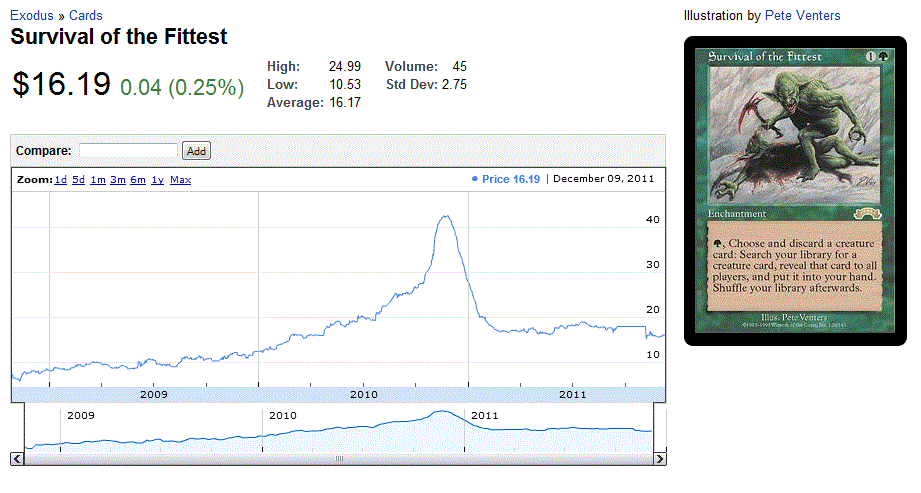
Last week I discussed various levels of risks one could take with some categories of Magic cards. These include some [card Underground Sea]"blue chip cards"[/card], [card Land Tax]banned cards[/card] with possibility of becoming playable again, cards with [card Visions of Beyond]latent potential[/card], and cards which grow [card Survival of the Fittest]incredibly rapidly[/card] but are at risk for equally fast decline.
Using this categorization I make sure my collection is organized in a particular way and I have developed a trading strategy accordingly. Let me explain further.
"Not-For-Trade Binder"
Almost every Magic: the Gathering player has a trade binder – some may even have multiples, including myself.
The purpose of multiple binders is not to intimidate novice players, however. Rather, having multiple binders is a useful tool which helps me prioritize trading some cards over others.
Consider your tried-and-true blue chip cards, for example. These are likely to hold value for an indeterminable length of time with potential for gradual increase. Dual Lands, Fetch Lands, Power 9, Force of Wills and the like should not be haphazardly traded away. Instead I often keep these cards, usually consisting of playsets, in a separate Monster binder the majority of others never get to see.
If these cards were in the front of my trade binder, most savvy traders would recognize these blue chip cards for what they are and easily fixate on them. This has happened to me numerous times before I adopted this strategy. My choices were slim – either trade away my Duals and try my best to obtain value, or tell my trade partner they were not for trade and risk objurgation.
It may be possible for you to earn some value trading them away and at times this is necessary to complete a deck. Still, a number of these cards should form the backbone of your collection, providing you with stability in your portfolio and a ready source of liquidity (easy to trade or sell).
The Front and Back of My Trade Binder
It goes without saying then that being able to trade away cards from the other categories for blue chip cards is often a win. Sometimes, sacrificing small value in these trades is even acceptable because the long term stability of these cards.
For example, I would gladly trade Ravnica Shock Lands away for Legacy Dual Lands. The former may see a reprint for Modern play while the latter are on the Reserved List. The original Modern hype caused these cards to jump significantly in value already and further upside is far from guaranteed. This is especially true since many solid lists are running as few as two or three Shock Lands with a heavier focus on Fetch Lands.
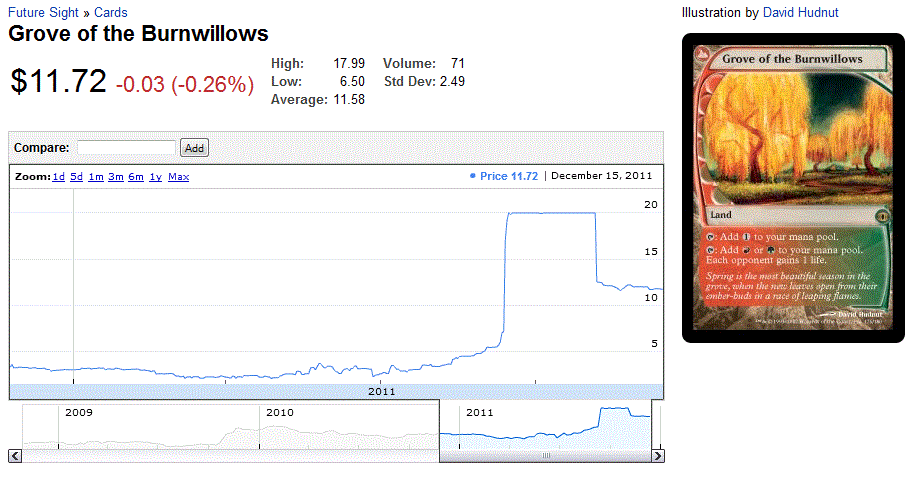
Uncertainty can be a major influence on card pricing, driving fluctuations as people speculate upon bannings, reprints, etc. Grove of the Burnwillows, for example, was a major staple in Modern, but the card's value dropped substantially even before the banning announcement on December 20th. (chart courtesy of blacklotusproject.com).
Grove of the Burnwillows demonstrated characteristic “Rapid Growth” profile. Once Modern became legitimate, the window to purchase this card cheaply was exceptionally narrow, but the rapid price decline was equally rapid. The ideal situation would have been to unload these cards at $20, possibly trading them for much more stable cards.
I strive to trade for cards that I believe are still growing at a rapid pace. At their peak, they are easy to trade and sell and can likely be converted easily into blue chip cards. Therefore, as I acquire the cards I want to speculate on I keep them towards the back of my binder almost as a reminder of what I am seeking. They may be for trade but I often meet less resistance when I tell others that the cards in the back are not for trade, versus having them in the front and not being for trade.
Once a card appears to near a peak, or once the buzz of reprints or bannings begin, I frequently place cards like Grove of the Burnwillows and Shock Lands in the front of my trade binder. I typically divide these into two binders – one for Standard and one for Modern/Legacy. I also tend to place the more valuable and most relevant cards towards the front and have subsequent pages of cards with decreasing value. This is the critical time to trade these rapid growth cards for something far more stable to place in my Monster binder.
The Middle of My Binder
While I wish my binder was filled with Shock Lands and other expensive cards, this is simply not the case. Other commitments keep me away from running the trade tables day in and day out. As a result, I frequently place cards from the remaining two categories into the middle of my binder.
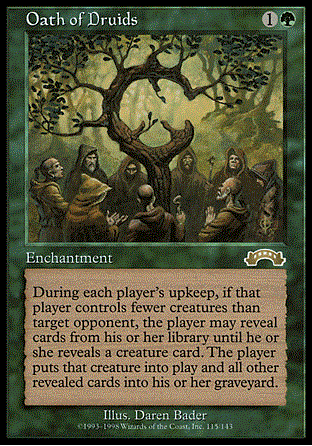
First are the banned cards which I refer to as the Vintage Section. These are the cards like Oath of Druids, Mystical Tutor, and Earthcraft which are currently banned in Legacy. Because they will never be reprinted and they cannot really be banned much more, these card prices will not decline. That being said, there is one thing and one thing only that would cause their price to spike – an unbanning.
Because of this all or nothing characteristic, I like obtaining these cards as throw-ins either from trades or as extra cards to buy from a seller to mitigate high shipping costs. While I don’t mind trading these cards away, I normally like to keep a handful in case the unbanning does one day occur. The middle of my binder is the perfect location for these cards. They may get noticed by an interested trader but they will likely be overlooked.
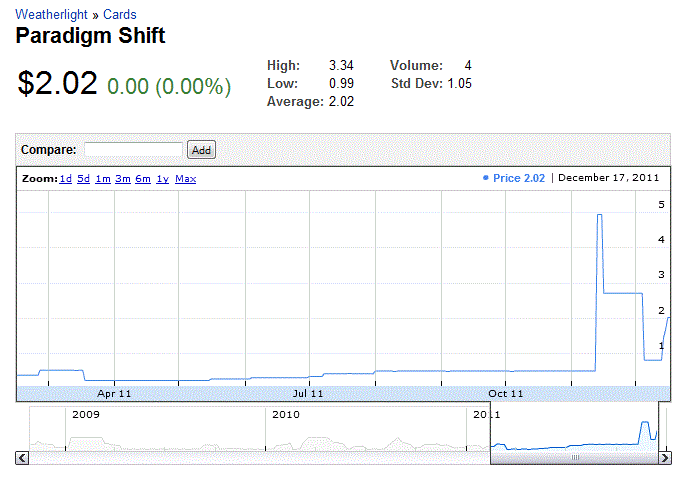
The second category that goes into the middle of my binder is cards I think have latent potential should a format take a particular turn. These are some additional speculation targets such as Visions of Beyond and Skaab Ruinator in Standard and Paradigm Shift in Legacy (chart courtesy of blacklotusproject.com).
Every card I own which I feel may garner some interest at some point goes into the binder. Typically, these cards are spread throughout the binder but they still fit a particular pattern.
Standard, Modern, and Legacy cards I’m speculating on would go in the middle or the back of their respective sections. Cards which may interest the occasional casual player may also go into this category. But make sure you are aware which cards have a shot of [card Divining Witch]making a deck[/card] versus which cards are [card Thieves Auction]merely interesting[/card].
Again, the rationale here is that I want to measure interest in these cards by having them in my binder, but I do not want these cards to be the first my trade partner sees.
Concluding Obligatory Disclaimer
No one has a perfect binder setup. My descriptions above sound fairly organized but I fall behind all the time. This is no cause for concern, however. Having an organized trade binder is merely a tool that can help you organize your thoughts in a way that clearly outlines your trade strategy at any given moment.
Rather than focus on keeping the perfectly kept trade binder, it is far more important to spend that energy on researching card values and trends. Knowledge is truly a much more valuable asset to earn value from Magic. Still, organizing my binder is paralleled with organizing my thoughts and I find it helpful.
If not, now is a perfect time to join up! Our powerful tools, breaking-news analysis, and exclusive Discord channel will make sure you stay up to date and ahead of the curve.
Last week, in Part 1 of this series, we looked at factors that affect foils and give them value, which can be read here: A Fortune in Foil Part 1: Identify.
Today we will be looking at more foils of exceptional value, where to find lists of the cards we should be looking for, and strategies to move them to the right players. In order to cover all our bases, we will again be evaluating the cards following the four major groups we identified:
Commander/EDH
Vintage & Legacy
Cubes
Casual
1) Commander/EDH
Gotta catch 'em all!The best resource I have found to find high value commander cards is in the MTGSalvation forums where there is always a HUGE Commander discussion underway. One link in particular is of interest to me in this case: The Top 50 EDH Card List!
You’re going to want to print and/or memorize the cards on this list, as they are the most popular cards played in EDH and therefore the cards that are in the highest demand. Not all of these are available in foil, as some are very old, but all of them that CAN be foiled will have a Commander player clamoring for trades with you.
This is also a valuable resource because many people will just outright copy those lists and try and fill their deck with the aforementioned cards since the community says they’re good. This is the same kind of mob mentality that can be attributed to “net decking”, as when a deck does well and everyone jumps onboard, wanting the same cards. This list has basically created demand for the cards within it!
It’s interesting to me that I am able to position the EDH cards that I have for sale/trade by actually referencing the above article as one of my trading strategies. When approaching a trade for Commander foils, it’s beneficial to say something along the lines of: “Say, I think this card could really help your deck… it’s even in the top 50 list!”
Of course, it really does need to help them, but those cards are there for a reason and were decided upon with much community debate. Not EVERY deck will use them, as different strategies require different cards, but like they say: Good card is Good.
As with last time, I’ll be offering a few examples of cards in foil as well as their non-foil counterparts to compare. I couldn’t resist adding the Decree/Expedition Map since there was so much discussion about it last week.
(* = Special Factors such as Judge foil/reprints in effect. Base card set used for pricing.)
Card Name
Non-Foil Value
Foil Value
% Difference
Decree of Pain
$5.00
$25.00
500%
Expedition Map
$0.25
$5.00
2000%
Dust Bowl
$3.00
$45.00
1500%
Eternal Dragon*
$4.00
$16.00
400%
Crucible of Worlds
$20.00
$50.00
250%
2) Vintage & Legacy Playable Foils
U Jelly? I'm not... just filled with rage!The meta is always shifting, but staples will always be in demand no matter which deck is on top at the moment. Hopefully we all know about the major cards like Misdirection, Tarmogoyf and Dark Confidant, but almost ANYTHING that even shows fringe play in these formats will command a hefty premium.
This is a great website that has basically replaced the old deckcheck.de for tournament results. I’ve linked the Legacy tournaments results since that’s what we’re discussing, but it has tabs for ALL formats. Reviewing the latest results keeps you on top of the changing meta and ahead of the curve when it comes to picking up the hottest breakout cards. Combined with our Insider email alerts, you’ve got all you need!
Positioning foils to Legacy & Vintage players can be difficult due to their value, but are fairly easy to move provided you know how to market them. The whole blanket statement: “Legacy cards retain their value better than Standard cards” applies to Legacy foils as well! The problem isn’t so much moving these cards as it is finding the right buyer for them. Everyone knows that Legacy foils have value, but few people aside from the collectors are willing to pay it.
Card Name
Non-Foil Value
Foil Value
% Difference
Dryad Arbor
$2.50
$17.00
680%
Ichorid
$5.00
$20.00
400%
Delver of Secrets
$0.25
$5.00
2000%
Goblin Guide*
$3.00
$9.00
300%
Knight of the Reliquary*
$8.00
$20.00
250%
I wanted to include a few of these selections for a special reason! The Knight of the Reliquary price was affected by its foil reprint in Knights vs. Dragons, but we can still see that its Alara Reborn version carries a nice premium.
As far as Goblin Guide goes, he will be the new GP promo for 2012, so it will be interesting to time stamp his price here and see what happens to him when the GP promos start getting widely circulated.
As an aside, Dark Confidant & Vendilion Clique's prices were literally unchanged when their Judge foils were released, so the limited quantity of those floating around does not (seem to?) have a huge impact on price.
If, however, they decided to print a card that was previously unavailable as a foil (a la Xiahou Dun, the One Eyed) THEN we have a perfect storm of limited quantity and high desirability that is sure to cause a price explosion. (I’m thinking a lot about the possibility of Force of Will getting this treatment sometime soon… scary!)
3) Casual Appeal
There is no site that will tell us what cards are going to be valuable to individual people when we’re talking about casual appeal.
Everyone has different wants, needs, and desires. As such, the value of certain cards is directly related to the personalities of the people who want to trade for them. There is always that one Vampire player in the room, or the “Elf Guy” who refuses to play any other tribe because, to them, it’s not about winning or losing, but about having fun and getting in with team Edward or the little green men.
This creates a very limited but profitable environment to trade casual cards, as people trade for them with their heart, not their head. So when you do find the right person to trade your foil Goblins to, you can expect to get value since you’re filling a need, not just a want to that player.
Card Name
Non-Foil Value
Foil Value
% Difference
Jace, Memory Adept
$10.00
$27.00
270%
Doubling Season*
$15.00
$30.00
200%
Vampire Nocturnes*
$12.00
$20.00
167% <- Fail?
Yosei, the Morning Star
$5.00
$30.00
600%
Sarkhan Vol
$7.00
$18.00
257%
4) Cube Foils
To trade Cube foils you need to find someone with a Cube, which can be a challenge unto itself.
But once you find that person you’ll be able to make a reoccurring trading partner out of them! Make a few mental notes about who the Cube owners are and the people who play that Cube are and approach them to ask about the style of Cube that they’re playing. Many people, just like when we talked about EDH, use a standard Cube list and modify it to taste, so there is, once again, a list of most of the “desirable” Cube cards that we can use to memorize and reference.
This time let’s mix things up and head to a Star City article written by the one and only Evan Erwin, who is a huge Cube enthusiast and probably one of the major reasons the Cube has met with the success it has. His article describes some of the common builds that get included in Cubes as well as the top 50 Cube cards per color.
A link to Evan's main Cube site can be found here, which is also written and moderated by Evan Erwin: http://www.cubedrafting.com/
I actually have a copy of his Cube that I play with, so I can certainly confirm that many other people would use his advice and lists as well. The reason why I use his Cube list is because it puts everyone at the same level. If you’re playing with an “unknown” list, it gives an advantage to those who have used the Cube the most since they will know what cards are within it, whereas a new Cuber would not have any kind of information on what archetypes are built in and what cards they can expect to see.
Because of this, myself and others like to use Evan's list because it allows everyone before a Cube session to see the cards and prepare themselves accordingly. A standard list puts everyone on the same level “informationwise”, but not “skillwise”.
Card Name
Non-Foil Value
Foil Value
% Difference
Absorb
$2.00
$15.00
750%
Trygon Predator
$2.00
$15.00
750%
Vindicate*
$22.00
$70.00
318%
Stoneforge Mystic
$6.00
$25.00
417%
Eternal Witness*
$2.50
$15.00
600%
Coming Down the Pipeline! :O
I had a brief contact with The Big Bosses regarding a suggestion for a new script that would really help identify all the foils that meet certain value criteria. In the future we plan on having a script/program in place that will search through sites like StarCityGames and display the foils having a certain % difference between them and their non-foil versions.
I’m thinking that a 200%+ price difference should get the major cards pulled, but there is not yet an estimate on when this will be completed. Just wanted to let you know that we’re thinking about it and planning on its implementation at least. Perhaps hand in hand with Project Condor?
Trade or No Trade? THE CONCLUSION!
Last week I posted this trade and asked you to evaluate it. Let’s see what today’s values are for those cards to see if it was a good or bad trade in the monetary sense:
1x FOIL Garruk, Primal Hunter $30
1x FOIL Batterskull $22
1x FOIL Geist of Saint Traft $24
1x FOIL Tezzeret, Agent of Bolas $28
1x FOIL Chandra, the Firebrand $19
1x Scavenging Ooze $16.00
1x Tropical Island (NM+) $90+
Total = $208.00
Total =$229.00
Based on eBay completed listings, this is what we came out with.
I’ll bet this surprises a lot of you, doesn’t it?
I valued the VG+ sea and the NM+ Island the same, even though I feel the Island is actually worth a little more for being pristine. Flawless dual lands are almost impossible to find these days, so their value to collectors is huge. It’s not surprising to me that when we’re talking about foils that cross into all of the areas we've discussed that their value woulld be almost double that of a regular's.
Not only that, but if we look back up at the values for Sarkhan Vol and Jace, Memory Adept, we see that both before and after, they have grown to many times that of their non foil equivalents. Of Garruk, Primal Hunter, Batterskull, Geist, Tezzeret & Chandra, which do you think will likely follow suit when compared to their non foil brethren?
That’s right, all of them! So, if we were to pick the foil pile, not only would we post gain on the monetary realm, but we would do so in such a way that we’ve invested in cards that will (should) retain their value!
Concluded!
If you’ve taken anything from this article, I hope it’s to not just dismiss everyday foil cards. Although it takes practice to identify them, there is a fortune in foil out there to be had.
If not, now is a perfect time to join up! Our powerful tools, breaking-news analysis, and exclusive Discord channel will make sure you stay up to date and ahead of the curve.
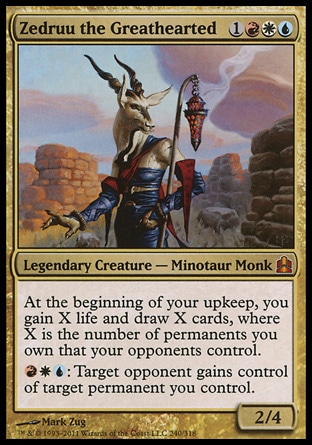
When the Commander decks were first spoiled, there was one new Commander who really jumped out at me as begging to be broken. Zedruu the Greathearted was, to me, the card with the most inherent potential to do something absolutely busted in a format as over-the-top as Commander. There had to be something inherently unfair you could do with Donate on a stick, right?
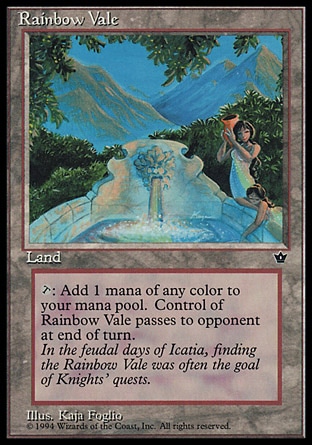
Was there ever! Since the decks were released, we've seen all kinds of applications for [card Zedruu the Greathearted]Zedruu[/card]. From the obvious "how many times can I donate Illusions of Grandeur" plan, to locking people out with cards like Celestial Dawn and Pyromancer's Swath to just playing political games with cards like Rainbow Vale while you pillowfort. People have tried just about everything and most aspects of Zedruu's potential have been pretty thoroughly explored at this point.
Because everyone was so excited about Zedruu and tried to break him in every way possible, he's a lot less interesting now than he was a few months ago. That said, it's the holiday season, and I really feel like playing a Zedruu deck to get in the spirit and teach people about The Will of Zedruu. Besides, when you have a card that generates both cards and life, there's always going to be something interesting that you can do with it!
As I mentioned before, most Zedruu decks are very heavily skewed towards the combo-control end of the spectrum. That's because these are the archetypes which can most easily take advantage of the resources that Zedruu provides. These decks want to draw a ton of extra cards, looking for particular combo pieces or answers, while using Zedruu to generate political favor and to let you trade one-for-one the entire game without falling behind. Life is also a powerful resource for these decks, since they use their life as a resource to buy more time and draw steps in order to find the cards they need.
In general, the question going to define how you build your Zedruu deck is this: what kind of cards are you donating to your opponents?
Are you giving them gifts like Rainbow Vale? Cards that don't care who controls them, like Moat or Howling Mine? Or are you donating things that ruin their day, like Taniwha? Most control decks fall into the first two categories, while combo decks are covered by the last.
Personally, I'm content to immediately rule out combo. I do like to build decks that are very powerful and non-interactive, but I generally don't like to play them. I also don't need another prisony-pillowfort deck that brings the game to a Standstill. I've got Child of Alara for that! I also absolutely cannot stand "Group Hug" decks, because I think they do more to unbalance the game in favor of the more degenerate decks than they do to make the game more enjoyable. In that sense, it's a form of king-making, or choosing who wins.
This leaves us with beating down as a plan, which seems a little strange when your general is a scrawny goat. Conveniently enough, however, Auras generally don't care who controls them, just what they're enchanting. Things like Steel of the Godhead are going to give the same bonus regardless of who controls the enchantment. Furthermore, I think that a Voltron-style deck is very well suited to taking advantage of the extra cards and life that Zedruu will provide you with and is an interesting departure from what Zedruu normally looks like.
Getting Big
Generally, Voltron decks jam all the most powerful Auras and Equipment in the format into their deck, add some acceleration and disruption, and call it a day. That's basically what we're going to do with this deck, but it's important to note that there's a very key distinction between Equipment and Auras for this particular build: Auras can be donated, Equipment cannot.
If you donate Equipment, the new controller can re-equip on their next turn. And you'll be the saddest.
It's also worth noting that, generally, Equipment are better than Auras because you're down cards when someone destroys your creature. Zedruu's ability helps to mitigate the loss of cards so we don't have to be as leery of Auras that are usually just not good enough.
Equipment
Champion's Helm
Swiftfoot Boots
Sword of Feast and Famine
Sword of Fire and Ice
Diviner's Wand
Empyrial Plate
Sunforger
Steelshaper's Gift
Now, the equipment here serves a couple of very distinct purposes. First, to provide Hexproof. This keyword is incredibly important for this style of deck and the power of Hexproof creatures plus Auras and Equipment has been proven time and again. The ability to keep suiting up your guy without worrying about removal is just unfair and is an effect I wanted on Equipment rather than Auras. Secondly, there are cards like the Swords and Diviner's Wand that have effects that are so powerful you can't ignore them. Evasion plus pumping your guy plus powerful utility effects? Seems really good, right?
Empyrial Plate is there to make Zedruu a threat immediately after he's been killed without requiring further investment. This is almost always going to be at least a +7/+7 bonus, which puts Zedruu very close to a two-turn clock. Lastly, Sunforger is there to cover one of the biggest weaknesses of the deck: a lack of answers. When you're playing an aggressive deck, you can't dilute your draws with too many answers because then you're not applying enough pressure. Sunforger plays both roles, and that flexibility is very important.
Auras
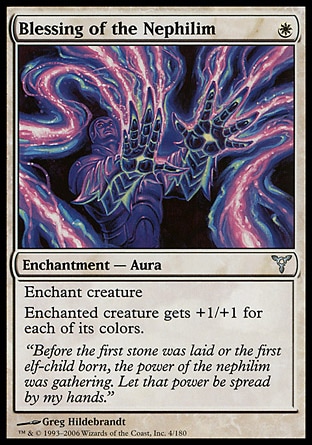
Blessing of the Nephilim
Clout of the Dominus
Scourge of the Nobilis
Steel of the Godhead
Empyrial Armor
Battle Mastery
Vanishing
Daybreak Coronet
Pemmin's Aura
Flickering Ward
Copy Enchantment
Eldrazi Conscription
Drake Umbra
Eel Umbra
Hyena Umbra
Flickerform
Indestructibility
Angelic Destiny
Three Dreams
Idyllic Tutor
Soverigns of Lost Alara
Academy Rector
Totem-Guide Hartebeest
Wild Research
While the equipment mostly focused on utility effects, with pump as a secondary concern, the Auras are here to just pump Zedruu. That said, there are a few interactions to be aware of.
Firstly, Flickering Ward and Sword of Fire and Ice can make your auras "fall off" of Zedruu if you aren't careful.
Second, Copy Enchantment doesn't work quite the way people seem to expect. It does not target the Enchantment you want to target. If you copy an Aura, it also does not target the creature that you want to enchant. As it comes into play, it becomes the Aura you chose, then you choose a creature to attach it to. No one can respond to you choosing either an Enchantment or a Creature. They have to respond to you casting the [card]Copy Enchantment
Thirdly, take a look at the way that [card Hyena Umbra]Totem Armor[/card] is worded. Now look at Indestructibility. Indestructibility isn't in the deck to enchant Zedruu, though that's certainly something you can do. It's in the deck to enchant the Umbras. This basically makes Zedruu Indestructible, rather than just forcing people to kill him twice. They have to answer Indestructibility first, then Zedruu, and that's something a number of colors aren't equipped to do.
Lastly, Vanishing and Flickerform are great ways aside from Hexproof to protect Zedruu. Just be sure you brush up on your Phasing rules first! A permanent phases out along with all of the Auras and Equipment attached, then phases in during your Untap step. It does not trigger abilities when it phases in, and it "remembers" that it is the same card as when it left play.
Of the enchantment tutors, Wild Research is the most exciting, partly because it's just an awesome card but mostly because it interacts very favorably with the deck. First we should take into account Zedruu's ability: discarding a card at random will generally leave you with the card you tutored for! Second we should take into account this next suite of cards: your other sources of card advantage!
Card Advantage
Pursuit of Knowledge
Mesa Enchantress
Kor Spiritdancer
Replenish
Retether
Sun Titan
Second Sunrise
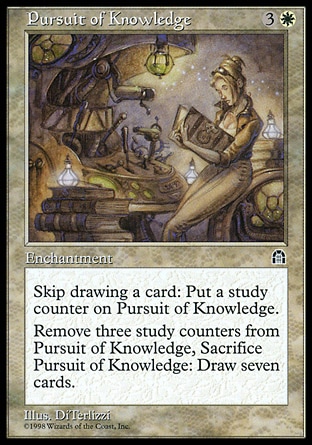
Pursuit of Knowledge is a card I play with at every opportunity because it's just an awesome card. One-sided Wheel of Fortune? Sign me up! Especially with cards like Zedruu or Sylvan Library, you can just activate it in one turn and the card is nowhere close to fair.
Replenish, Retether and Sun Titan are all here to help mitigate the number of cards you lose to removal. Sun Titan made the cut over Open the Vaults because too many people want to recur artifacts, which makes Open the Vaults less one-sided. These cards also make Wild Research an incredible engine, regardless of whether you hit or miss on the random discard.
Mesa Enchantress and Kor Spiritdancer are the reason that Flickering Ward made the cut into the deck. I'm not sure if that interaction is good enough, considering that the ward has so little synergy with the rest of the deck, but it's certainly worth trying!
Disruption
All beatdown decks need some kind of disruption. Whether it's burning guys out of the way or countering their board sweeper, you have to have some way of being sure that you can push through for damage. This deck has two ways to do that: countermagic and generic utility removal.
Countermagic
Forbid
Remand
Delay
Envelop
Absorb
Dismiss
Cryptic Command
Arcane Denial
Memory Lapse
Lapse of Certainty
Counterspell
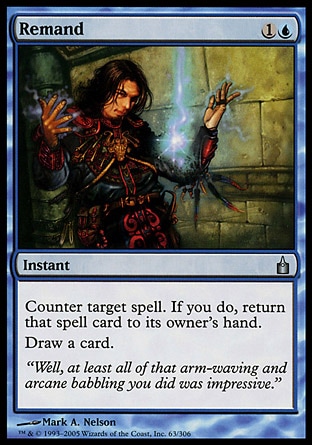
Countermagic is incredibly potent in this deck, especially tempo-oriented countermagic like Remand and Memory Lapse. Tempo is normally pretty irrelevant in Commander games, but I like it in this deck for two reasons. First, it's entirely possible that you could just kill someone before they get a chance to recast their spell. Second, you're going to untap and draw two to four cards and likely find another counterspell. It's not too difficult to chain counterspells against someone while you're beating them down with Zedruu.
It's also worth noting that two of your counterspells can be tutored up by Sunforger[card]: Absorb and Lapse of Certainty!
Utility
Divine Reckoning
Winds of Rath
Swords to Plowshares
Orim's Thunder
Oblation
Most of these are just generic removal for your Sunforger toolbox. The two real gems here are Divine Reckoning and Winds of Rath. The ability to sweep away most relevant creatures besides Zedruu is absolutely insane. There are very few spells that can clear the way like these two and most players will never see them coming.
Tricks and Treats
If you're playing Zedruu, you've got to have some political tricks, right? These are your techy cards that will help gain political favor and make sure that Zedruu is active, even after the board has been swept!
Vow of Lightning
Vow of Flight
Vow of Duty
Rainbow Vale
Darksteel Relic
Darksteel Relic and Rainbow Vale are great technology for Zedruu decks and I'm surprised more decks don't run them. They're incredibly difficult to get rid of and will make sure you're going to net cards off of Zedruu every time you recast him.
The Vows, on the other hand, are awesome tools for politics that double as Voltron pieces. The trick is that you Vow someone's creature, then donate the Vow to another player, or even enchant Zedruu and then donate the Vow. It's a little weird, and these kinds of corner cases don't come up often, but these types of plays shouldn't be overlooked!
Mana Base
The manabase is one of the most important parts of this deck. You've got a color intensive general who you want to cast on turn three. He has a color-intensive ability that you want to be able to activate while casting double-White Auras and double-Blue countermagic. That's a pretty stringent list of requirements and it can be difficult to put together a manabase that's up to the task if you don't have access to Volcanic Island and Hallowed Fountain. That said, here's my attempt at a reasonable manabase:
Mana Ramp
Oath of Lieges
Sol Ring
Azorius Signet
Izzet Signet
Boros Signet
Fire Diamond
Sky Diamond
Marble Diamond
The artifact ramp is very important since you want to stick a turn three Zedruu as frequently as possible. Any one of these mana rocks will enable that, and even Oath of Lieges will if you didn't go first. You could even go as far as to add things like Everflowing Chalice and Mind Stone, but those don't help your color requirements.
Lands
Hall of the Bandit Lord
Sunhome, Fortress of the Legion
Serra's Sanctum
Ancient Tomb
Cascade Bluffs
Rugged Prairie
Mystic Gate
Spinerock Knoll
Deserted Temple
Cephalid Coliseum
High Market
Tolaria West
Pillar of the Paruns
Ancient Ziggurat
Flooded Strand
Scalding Tarn
Arid Mesa
Battlefield Forge
Shivan Reef
Adarkar Wastes
City of Brass
Teetering Peaks
Sejiri Steppe
Reflecting Pool
Exotic Orchard
Forbidden Orchard
Command Tower
2 Island
2 Plains
This combination of pain lands, fetch lands, filter lands, and five-color lands is the best combination I can think of without spending your life's savings on a manabase. That said, there are certainly changes you could make. Terramorphic Expanse and other fetches could be added to enable Clifftop Retreat and other buddy lands, for example.
That said, there's a ton of utility available in the chosen lands that could be changed to other utility lands or cut altogether for additional color-consistency. Mikokoro, Center of the Sea and Reliquary Tower, in particular, are hits that are missing. However, you do get to run gems like Ancient Ziggurat and Pillar of the Paruns that are awesome for you early game, which you can then donate to someone who can't use them later on. Have you ever donated a Pillar of the Paruns to a mono-colored deck?
The most important utility land in the deck is Hall of the Bandit Lord, a card which I can't praise enough. Haste is incredibly important in this style of deck, especially in the late game once Zedruu has been dealt with once or twice. You can wait for someone to tap out, then Haste them right out of the game, if you've held enough Auras back.
With that finished, here's the finalized decklist that I've been running for the last two weeks:
[deckbox did="a140" size="small" width="560"]
I have been very happy with the deck since it combines some elements of politics with a proactive and interactive strategy rather than just trying to interact as little as possible with Ghostly Prisons and Illusions of Grandeur. As awesome as those interactions are, this deck is just a lot more engaging and makes games more tense. It's a deck I'm glad to close the year out with!
With that, I'd like to wish everyone a happy and safe holiday season and I look forward to seeing what the new year brings. By the time we get back, Dark Ascension will be almost upon us and I'll have had plenty of time to come up with some interesting new lists to share! If you've got anything you want to share or ask about, be sure to comment or hit me up through email or Twitter! I'm always glad to talk about the format!
Carlos Gutierrez
cag5383@gmail.com
@cag5383 on Twitter
If not, now is a perfect time to join up! Our powerful tools, breaking-news analysis, and exclusive Discord channel will make sure you stay up to date and ahead of the curve.
Eventide is packed with some expensive casual and tournament cards. The set contains many enemy-colored cards, from Lieges to filter-lands. The power of the lands, along with Reflecting Pool and the Vivid cycle, let people play essentially anything they wanted in decks. The resultant Standard pool heavily favored decks that could play Cryptic Command into Archon of Justice into Cloudthresher. It wasn't exactly the best time to be playing, especially when the next set introduced Cruel Ultimatum. I'm glad that R&D has taken a step away from making set themes revolve around color relationships, especially enemy colors; the record-breaking sales of Innistrad underscore that. Enough about that, though, let's pay some bills from our casual card binder as we dip into a very lucrative set!
Balefire Liege
$3.25
As I mentioned in my Shadowmoor series, the Lieges are casual dynamite. People love creature-boosting and they'll look at this guy and want to connect him with guys like Boros Recruit. On top of that, every R/W spell they cast with Liege turns into a Lightning Helix. Even if we're just playing Commander around the kitchen table, a free Lava Spike with every red spell is a solid deal. People will chronically undervalue Lieges, so get them whenever you can.
Bloom Tender
$2.00
Bloom Tender can transform from a bad Utopia Tree into a bad Priest of Titania when you've got enough permanents out. I never liked the card that much, but it does give some appreciable ramp if you have a 1-drop before it. The issue, though, is that you both want small dudes to turn on Tender alongside big mana spells to dump that mana into. If I were playing this casually, I might combine it with something like Selesnya Guildmage or Azure Mage to absorb some of that excess mana. I'm hard-pressed, though, to find a great one-drop outside of Executioner's Capsule that I'd play in a ramping deck. Untapping on the third turn with access to five mana is some serious speed, though.
Cascade Bluffs
$8.50
I have been unsuccessfully bidding on these damn things for the past month on Ebay. I refuse to accept that this card is so much money. It's an important part in R/U combination decks in Modern, but those don't exactly make big showings. You've also got Scalding Tarn and now Sulfur Falls to compete against. Is it so much to ask that I get to tap this and my Grove of the Burnwillows and be halfway to casting my Cryptic Command? Can you let me be cheap and greedy at the same time?
The enemy filter lands are solid trades at this point, especially because people want them for Commander. If you're letting yours go, extort the person you're trading with.
Cold-eyed Selkie
$2.75
I've picked up countless copies of this from dollar boxes at stores or in throw-ins. Selkie is a really popular casual card for the same reason cards like Cephalid Constable are. People want to get more out of them, and with Noble Hierarch, they can do it easily. Selkie sees a tiny bit of Vintage play with Hierarch, forming the backbone of a Fish deck.
Creakwood Liege
$4.75
What did I say about those Lieges? This is a stupid card in Commander. It makes an Elephant every turn and it combines in excruciating ways with Ghave, Guru of Spores. I have seen people on the ropes who bounce back and slaughter people in two turns, thanks to Liege. Every little nasty utility guy, from Llanowar Elves to Bone Shredder, turns into a legitimate threat with Liege around. Kill these on sight.
Deathbringer Liege
$5.75
Again, expensive Lieges. W/B is a popular Commander combination and this Liege lets you Royally Assassinate guys when you cast that Gerrard's Verdict. Even if you don't get both halves out of it, this Liege still has some mighty combat tricks to it. I'd be wary of someone with four cards in hand and this on the table.
Divinity of Pride
$6.00
See what happens when we make a format where you start at 40 life? These kinds of things happen. This card is casual cocaine; when you first read it, your mind immediately jumps to how it levels itself up, how it can turn into a giant(er) monster. It's self-evident how cool Divinity of Pride is. No matter how useful Morphling was, you couldn't look at it and see how good it actually was, the way you can with this card. It should come as no surprise that Divinity of Pride is a hot Commander card.
Dominus of Fealty
$1.50
When Eventide was first spoiled, people figured that Commander decks would become half-Eventide. Seriously! You got great lands and all these huge monsters. This was a Word of Seizing on a stick, and it was a pretty big stick at that. What deck would pass up something like this? Alas, the politics of EDH mean that people generally don't play a bunch of cards like this that shout "kill me! Better yet, kill my owner!" Dominus is still a fine card to sneak in and it's a great feeling when you can slap Lightning Greaves on it.
Fetid Heath
$6.75
Another enemy filter land. This one is hugely popular for casual players who realize that you actually have to spend some money on your manabase.
Figure of Destiny
$3.50
Figure inspired the whole leveling mechanic - it's a pretty cool card and it's had a lot of tournament play. Figure showed up in White Weenie decks; it made appearances in Boros decks. It even comes out of Burn deck sideboards, since it can become a reliable form of damage in a deck that usually cannot draw good cards after its initial opening. I'd put Figure at $5 or $6 if it were not also the prerelease card.
Flooded Grove
$5.50
It's interesting to note that this color combo is worth less than other ones. Less people are playing Momir Vig decks than Selenia, Dark Angel, apparently.
Glen Elendra Archmage
$4.50
I've seen people speculating on this card for Modern and I don't think it's great. First off, you'll find that this either soaks up two removal spells (was that your goal?) or it has to be played in a dedicated tap-out control deck to fight other, similar decks. Granted, it's a hugely powerful card, especially when people side out their removal. Unfortunately, it'll die to Punishing Fire (for as long as it's around). I am not discounting this; combo decks can have a hard time unsticking this girl, for example. I just don't see it as the right answer for four mana.
Hallowed Burial
$2.00
When is it better to tuck creatures than kill them? What if you're playing Commander and you get to hide Generals and prevent people from recurring their now-stocked graveyard? I like Hallowed Burial, since it stops Persist guys and goofy recursion. People also don't get too worked up about it, and I think that's because they've rationalized the spell with "well, I can just draw that creature again." This card and Final Judgment are probably better than Wrath of God in Commander!
Light from Within
$1.25
It took me a moment to realize the full impact of this card. This is the long game card for Weenie decks. Your Knight of Meadowgrain and Ramosian Captain become full-grown beasts! This card is terrible with token strategies - no pumping going on there - but I can see how someone would run this as their Armageddon-style card. You've got to be able to match monsters with people who are soon casting actual Beasts, so this keeps someone in the game.
Murkfiend Liege
$3.50
This Liege joins your Seedborn Muse and Awakening if you must get every bit of mileage out of your monsters. I think it's inferior to the Muse in just about every regard, but it's there if you want to run both.
Primalcrux
$2.50
Primalcrux is a real reward to Green players. It's a sizable guy on its own, but if you have an elf and maybe a wall sitting around, it gets even bigger. Only for the truly dedicated Green players, though!
Regal Force
$3.50
Regal Force has become the finisher in big-mana elf decks. You can Summoner's Pact for it and then draw eight or nine cards. It's a real-sized monster, so you have a fattie if you want, and it can keep the combo going. The original Elf-combo decks from Extended would use this to draw into their single Grapeshot, then Storm someone out. It's no surprise that Regal Force is worth a few dollars, since even when you're fairly playing it, you'll draw three or four cards. That's really good for green decks, which is why this is a casual staple.
Rise of the Hobgoblins
$1.75
This honestly surprised me. People must love making little tokens. I do remember that this was played in a lot of control decks in Standard out of the sideboard. The fine distinction is that you only have to pay for the tokens if this actually hits play. Ergo, you run out a little 2cc spell against an opponent who might have a hand full of counters. If they can't stop it, you make four or five guys and then you're set. If they do counter it, at least you didn't tap out!
Rugged Prairie
$4.25
I attribute the lower price of this card to the fact that this is not a casually popular color combination.
Sanity Grinding
$1.25
People always want The Mill Deck to work. This was bandied as a legitimate finisher in control decks, but it never panned out. You could imagine nailing a dozen cards from an opponent with this, but if you can't get all of those spells from them with four Grindings, you'll still probably lose. Twincast helped, in addition to being useful on its own. Around the kitchen table, I'm sure people put this alongside Archive Trap and have a great time.
Scarecrone
$2.00
Scarecrows aren't exactly a popular casual deck, but I find I play this card a bit in Commander. She's a real gem in my Karn deck, but in any list where you want some recursion and card draw, it'll do. Try it out in Bosh or Memnarch decks, for example.
Stillmoon Cavalier
$3.75
Another casually-popular card in the right color combo. The Cavalier popped up in tournament play from time to time. There was a B/W Tokens deck that couldn't stop Cavalier at all, so the Knight made his presence felt from sideboards in Standard. It's a huge mana investment in older formats like Commander; I couldn't see pumping five mana into this to swing on someone. On the other hand, protection from two colors is really relevant in a blocker, in case you want to use this like a Fog Bank.
Talara's Battalion
$2.50
Are you joking? This card is a junk rare, through and through. You're not playing it on your second turn unless you're also playing a Land Grant or Invigorate, which makes this cost 1GG for a 4/3 any other time. That's bad, but it's also an aggressive Elf; I can't blame people for wanting to run it.
Twilight Mire
$8.50
I've also been attempting to score one of these, to no end. People LOVE their B/G decks, which have surprisingly few good manabase choices.
Wake Thrasher
$2.25
Wake Thrasher saw a little bit of love in Merfolk, especially since mana burn went away and you can now straight-up tap Islands for firebreathing. Merfolk is on its decline in Legacy; Snapcaster Mage gives white decks too much access to Swords to Plowshares for Merfolk to really compete. That's not to say that Wake Thrasher is bad in casual Merfolk lists. You often need something to smash through a 5/5, and trading little 2/2s all day long won't win the game. That's where this guy comes in.
That's all for Eventide! Go make some serious casual dollars. The filter lands are solid pickups if you're going to play Modern. Lifeloss from fetchlands and Ravnica duals is a big deal, which makes painless mana making much more playable. Keep an eye out for those Lieges and join me next week as we get into more recent history with Shards of Alara!
If not, now is a perfect time to join up! Our powerful tools, breaking-news analysis, and exclusive Discord channel will make sure you stay up to date and ahead of the curve.
It's Friday morning and your alarm goes off at 6:30 AM. For some of you, this is no different than any other day. For others, this time hasn't seen you being awake in quite a while. No matter what your situation, it is still hard to drag yourself out of bed, but eventually you do. Your bags are packed and everything is already prepared for the trip. No work today, a relieving thought, but eight hours in a car seems like quite a daunting task. The hotel has been booked for fifty dollars a night for two nights. Thirty three dollars per person for lodging really is not that much though for a trip a couple of states away. Gas calculations have been made for approximately forty dollars per person and food estimates come in around fifty dollars if you conserve and eat some food you brought along. Don't forget you have to pay for your events also. While you could get by with $160 in your wallet, there are certain to be more things to buy and other events to play in so count on $200-$250. Think you'll be a little short, the vendors there are sure to help you out by buying some unwanted cards. This much money might seem a lot to some, but it's a small price to pay for the fun times you are certain to have traveling to a big event.
The car ride goes much quicker than you predicted, mostly because you and your friends discussed the decks you would be playing and the metagame you expected. What do you think the most played deck will be? How well does your deck do against it? What is your sideboard going to look like. All these questions and more are discussed. This time is so valuable for finalizing deck lists before you get to the event site. If you are lucky, this process will yield some new piece of tech or a whole new deck you have to scramble to get the pieces for on site so you can take the event by storm. Once all decks are finalized the last part of the journey went especially fast because your friend suggested you play twenty questions with magic cards as the topic, an epically fun game.
Arriving at the event site on Friday night is much different than it will be the next day. Not as many players are there yet, but you are ready to try and grind your way into qualifying for the event. Even if you don't get qualified, you can at least test your deck out and see if you want to make any changes. The atmosphere is a bit relaxed for such a competitive crowd, but you have your game face on and are ready to battle.
Even failing to grind into the event, the evening was still enjoyable and the food after the grinders was quite good. It's getting late and everyone needs to get some rest before the event tomorrow. No Invitational, but there is still a big event you need no qualification to enter. The hotel is tolerable as a room with some beds and maybe a little testing. Your spirits are lifted upon thinking of the competition tomorrow will hold. You are prepared. You are ahead of the other players. Your deck has been tested and you are ready to beat them all! Tomorrow will hold no variance like tonight did and you go to bed ready to crush the field.
As your roommates wake you a little bit to early, you groan but roll out of bed so everyone can make it to the site early. The hotel is not far from the event site. It is only a short drive to the convention center. When you ask, your friends tell you the hotel is cheaper when you stay a quick drive away. Walking into the convention center hall is like nothing you have ever experienced. There are hundreds of magic players all over the place. There are vendors, artists, alterers, and people who make 3D cards. Some players are already selling cards to vendors while others are on a non-stop mission to trade, trade, trade. Some players are writing out deck lists and others are getting in some last minute testing. If you don't have all the cards for your deck be prepared to wait in the long line of others in a similar situation. It is a lot to take in but the exhilaration you feel is almost overwhelming.
What took you so long to make it to big event like this? Excuses about money mostly you think, or maybe your friends thought they were too busy to make it to an event out of town. Whatever the reason, you certainly are glad that didn't stop you this time.
While the Star City Invitational this past weekend in Charlotte, North Carolina was not my first big event, I did recall these same feelings while I was there. It was just like I was at my first big event all over again. I still get the rush when I enter the event hall for the first time each weekend.
This experience used to be much easier for players to experience because prereleases used to be held in convention centers in most major cities. It was great. You got to meet all kinds of new players and have this experience while you still had a casual event to play in. This old style prerelease was the gateway for casual players to break into competitive play even more so than FNM. It allowed them to get a taste of what it was like to play in a larger event. I miss it so much and wish we could return to my good old days of convention center prereleases.
Getting back on topic, if you have never made it to a big event, I highly recommend it. Make it your New Year's Resolution to get to a big event. Star City is expanding their series yet again and Wizards is increasing the number of Grand Prix tournaments. Find the time and money for this experience. I guarantee you will not be disappointed.
One of the other great things I love about going to big events is seeing all the friends you have made from playing this game. It is worth it. For me, it was great to hang out with Quiet Specs own Corbin Hosler. Talking magic finance is a ton of fun for me and this guy knows his stuff. Ryan Bushard, who now writes for gatheringmagic.com, was a blast this weekend. Not many people can make a living with this game but Ryan is killing it with his Box to Extended project.
The main goal of this article is to spread the joy of going to big events, but never fear, I have some tech to share.
Last week, I talked about a new version of Green White Tokens. While I do not have a tournament report filled with success and stories of the top 8, the deck is solid and still quite viable. There was one change I made from the deck last week. Both versions are very good but I felt that this new version, only four cards different, had the edge on the field.
Untitled Deck
Creatures
4 Avacyns Pilgrim
3 Birds of Paradise
3 Viridian Emissary
3 Blade Splicer
4 Mirran Crusader
4 Hero of Bladehold
2 Sunblast Angel
Spells
3 Mortarpod
2 Tumble Magnet
3 Oblivion Ring
3 Garruk Relentless
2 Gideon Jura
Lands
4 Razorverge Thicket
4 Sunpetal Grove
4 Gavony Township
8 Forest
4 Plains
Sideboard
1 Mortarpod
1 Elesh Norn Grand Cenobite
2 Bonds of Faith
3 Timely Reinforcements
2 Thrun the Last Troll
2 White Suns Zenith
2 Sword of Feast and Famine
1 Sword of War and Peace
1 Creeping Renaissance
The change? Sunblast Angel over Sun Titan! It is a wrath effect that has a huge flying body. I won the only game I drew her over the weekend. Switching the numbers on Blade Splicer and Mirran Crusader seemed pertinent due to the rise of Blue White Illusions because they just pay their one mana to bounce the token and that basically nullifies your threat. Mirran Crusader is also better against Wolf Run. Taking out a Garruk Relentless and a Viridian Emissary for the two Tumble Magnets just felt like diversifying my removal. Tumble Magnet and Gideon Jura go well with Sunblast Angel, though Phyrexian Rebirth may have been a better choice even with no evasion.
The part of the sideboard I loved was Bonds of Faith. Instead of running another Oblivion Ring or Pacifism like some pros have advocated, Bonds of Faith allows you to play defensively like a normal Pacifism effect or offensively by pumping your Mirran Crusader. The necessary Timely Reinforcements was fine as was the one of Sword of War and Peace. Elesh Norn Grand Cenobite is pretty standard tech now, but the card is just amazing in any type of mirror or similar match. The part of the sideboard that I am not sure was optimal was the package of Thrun the Last Troll, White Suns Zenith, Sword of Feast and Famine, and Creeping Renaissance that I boarded against control decks. The reason I am not sure is because I do not think that many spots should be dedicated to beating a small percentage of the metagame. My friend played the same list as I did and dedicated more space to beating Wolf Run, this decks worst match. His sideboard is as follows.
[Alternate Sideboard]
2 Tumble Magnet
1 Sword of War and Peace
2 Pacifism
4 Spellskite
4 Timely Reinforcements
2 Ghost Quarter
[/Alternate Sideboard]
There are a lot of cards that overlap here. The two Pacifisms should have been Bonds of Faith but no manner of convincing would make him purchase them for $.50 each. He chose to go with the sideboarded Spellskites and Ghost Quarters to bring in against the Wolf Run decks. He successfully beat a few of them so maybe this strategy is just better than what I decided to go with. My impression though, is that this plan is too reactive and I wanted to be doing something more proactive.
Regardless of what sideboard you decide to go with, the deck is a ton of fun and is capable of winning any game. Do not forget about Green White Tokens because it is still powerful. If the new set brings a better two cost creature, Green White Tokens could see a resurgence in the metagame.
Many of the matchups are solid and in your favor like Blue White Humans, Red Deck wins, and even the popular Illusions deck is a decent match for you. If you decide to play this deck, just make sure you have enough cards in your sideboard to beat Wolf Run and the control decks.
Traveling to events and discovering new cards to use in different ways are just a few aspects of how amazing this game is. There will be retellings of games won and lost. There will be stories of dinner with Jonathan Medina and restaurants filled with crazed MMA fans. Will you be living in these stories or just be there to hear about them when you friends return from the weekend-long trip?
Until Next Time,
You can't just go have dinner with Jonathan Medina, Corbin Hosler, and Ryan Bushard so go Unleash that Road Warrior Force!
If not, now is a perfect time to join up! Our powerful tools, breaking-news analysis, and exclusive Discord channel will make sure you stay up to date and ahead of the curve.
As you might have known, last weekend I attended the Star City Games Invitational, where I was hoping to improve on my Top 32 finish at the last Invitational.
The only interesting thing about the tournament itself if that I played Burn in Legacy. After being an avid Merfolk fan (and a person who won a lot with the deck without cheating), I really wanted to play it again. The only problem is that the deck is stone-cold terrible right now. If Batterskull hadn’t already mostly killed the deck, Snapcaster Mage sure did, giving the UW decks the ability to play virtually 12 copies of Swords to Plowshares after boarding.
With this in mind, I chose to play mono-red Burn. My friend Sam Davis had Top 8’ed a month or so prior with the deck (which really inspired the move to UR Delver in Legacy), and he told me it had a good matchup against Stoneforge, which was good enough for me since I didn’t really have anything else available anyway. Some testing Friday night against eventual Top-16 finisher Darin Minard quickly dispelled the notion that I could beat Stoneforge with Burn (against him at least), leaving me pretty disheartened going into the tournament, though I did realize that Searing Blaze was very good against Stoneforge.
Of course, I then proceeded to win every single game I played against Stoneforge decks. I also beat a Painted Stone deck and then died on Turn 1 two games in a row to Garrett Young playing Charbelcher. It’s a bad sign if your Burn deck deals 3 damage over the course of two games.
Anyway, I felt decent going into Standard at 3-1 with RG Wolf Run, where I managed to promptly lose to Orrin Beasley playing UB after I drew just 3 real spells to go along with 16 land/ramp spells in Game 3. I then lost the mirror to a top deck. Bad beats, etc…
Here’s where we get to the crux of what I want to talk about today. While most people would be crushed after scrubbing out of a huge tournament, I felt a sense of relief. Finally, I get to stop grinding with decks I’ve never practiced with and I can hit the trade tables!
I almost didn’t believe it myself — I was actually looking forward to trading more than playing. While I’ve always enjoyed both equally, I was actually taken aback by how much I wanted to get off of the Invitational tables and into the masses to start the cards flowing. Maybe it was because I was more comfortable on the trading floor than this particular format (I want to play Combo), maybe it was lack of sleep, maybe it was delirium, maybe I just wanted to prove myself on the trading floor. I don’t know, but I jumped right in.
As I talked about last week, your trading strategy should be a variable thing. In normal situations at big events, I’m looking to cash out that weekend, and tailor my trading preferences to that. The only problem with that strategy is that Star City was the only dealer at the event. That meant I was free to trade around for anything, and did so quite well. I want to highlight a few particular lessons that were reinforced for me last weekend.
Trade what you know
As you probably know if you’ve ever seen me trading, I love to deal in low-value items that I can pick up for even cheaper. This means I look all day for things like Adaptive Automaton and even Cemetery Reaper. I picked up both of those cards as throw-ins in trades all day, and they quickly add up when you start selling them at a dollar or two apiece to a dealer.
Why do I focus on these types of cards? Part of it is the long-term investing strategy I talked about last week, but another reason is simply that I know the prices of cards like this very well. Things like Dragonmaster Outcast slip under people’s radars all the time (or they just don’t care about the card), and this is where I make my money.
While it may seem flashy or cool to start dealing in higher-dollar items like Ravnica shocks or older Legacy cards, you take a big risk if you don’t know your prices. Personally, I’m not very good with a ton of older cards, due to having only played for around 3 years, so I feel safer just avoiding the area and not risking missing big.
Retail is bunk
While retail prices usually guide most of the trading floor talk, you must understand that SCG prices are gospel. For example, let’s look at a card I picked up all weekend – Scalding Tarn.
As I’ve talked about before, these are a steal in trading at their current pricetag of $12, but that’s what people were moving them at to me all weekend long. On the flip side, I wouldn’t let mine go for less than $16-18 in trade, and I only traded them when I didn’t really have another choice. People would tell me they were at $12 in the case and that because of that I should trade them at that price, but I was persistent in my stance.
“It’s no secret,” I would say, “that this card is going to spike in Modern season, and I have to trade it at that price if you want it.”
Guess what? People picked a few up off of me at that price.
Here’s a couple of other cards that are hard to price. Tell me what you come up with for these, and I’ll tell you how I valued them at the event.
- FOIL Elesh Norn, Grand Cenobite
- FOIL Japanese Army of the Damned
I’ve had the Elesh Norn forever, and I picked up the army at $8 in trade since that’s what SCG had offered the guy who had it in cash.
Now the hard part – what price do we use when we’re moving these?
Let’s start with the Praetor. It’s sold out at $30 on SCG, so I told people all day I had to have $40 out of it. Most people balked at this, but you really have to pay attention to the number in stock online. If it’s out of stock at $30, chances are it’s going up after they restock. In the end, I ended up selling it to a friend for $20 cash, giving him the friend discount in the process.
Now the Army. Foil Japanese is sexy, but it’s very difficult to move. SCG has a few in stock at $20, and I figured the easiest person to move this to was my buddy and GatheringMagic writer Ryan Bushard, who loves Japanese foils. Using Ebay as a guide, we put the Army at about $15 in cash, and I picked up some casual foils I’m sure I’ll get a good price for. Namely, I got three foil Adaptive Automaton and a foil Bramblewood Paragon, along with something else small.
While these may not seem great, keep in mind that the Army was worth $8 in cash to SCG (and I got it at basically $4 in cash value), and I get destroyed by fees if I sell on Ebay. The cards I picked up will only sell to SCG for $4, but like the Army they have a niche market, albeit one a bit stronger than the Army. I’m either going to trade these at a premium to the casual players I have at my shop (who don’t care about Japanese), or I’m going to move them to a dealer at GP: Austin in need of stock. It’s all about having the right market. I don’t have a great market for the Japanese Army, but the foils casual cards I can move well.
Bulk to Tundra
This is my #sickbrags of the weekend. I’m telling this story because I’m proud of myself, but also because it demonstrates how important finding the right buyer is.
Let’s start with the first. I’m trading with an EDH player who wants some EDH things and a few other casual cards, headlined by an Ulamog, the Infinite Gyre. He has a pretty small collection, and the only thing I find that I want is a nicked foil Scalding Tarn. I pull it out and ask him if we can get there. He put the value on the Tarn at $40, and after I point out and discuss the condition with him, he knocks it down to $25, mostly because he was happy to trade it for EDH goodies.
After picking up the Tarn for a bunch of $4-10 cards, I’m pretty satisfied with myself. A little while later, another player wants it from me, and has a fairly played Force of Will that he spots at $45. He wants the Tarn, and happily trades straight across. I’m already doing a bit of a dance inside, because it’s the first Force I’ve owned.
Flash forward a bit later. The guy across from me is in desperate need of a Force and doesn’t care how played it is. Obviously this works out well for me, and he has quite a collection to trade. This is where I felt like I did my best work. Recognizing that he was basically already committed to the Force, I was very clear in what I wanted and what it would take for him to get it.
I pulled out his NM Tundra and told him it was the card I needed if I was giving up the Force. Obviously the Tundra is a lot more expensive than the Force, and after values were set, we were short about $45-50 on my end. He kept trying to convince me to pick up his SP-MP Tropical Island instead, but I knew I had him and stood my ground. In the end, he went for it, getting two Scalding Tarns from me that we put at $15 and a MP Wooded Foothills that he accepted $20 for. We shook hands and the cards were exchanged.
And just like that, I had moved a pile of EDH cards and a few fetchlands into a NM Tundra in just a few hours.
Covering costs
As I spoken of in the past, it’s very important to keep track of your expenses and revenues if you are serious about making a profit in this arena. Not being able to sell on-site made this a bit harder for me, but here’s where I’m at.
- Gas for the 36-hour round-trip ($85)
- Hotel bill for 3 nights and parking ($407)
- Food (about $75)
Due to a miscalculation on my part, I ended up about $15 short from one of the people staying with us, so I’m basically going to have to eat that cost. After settling up the hotel with our driver, I had about $500 in charges that represent the total cost of the trip.
After getting cash from others in the room and selling a little of the cards I got on the weekend, I’m currently sitting at $320, or about $180 short of paying for the entire trip. My goal is to sell enough at GP: Austin to get me there (and cover that trip as well), and keep the Tundra as my spoils of the weekend, in addition to whatever I profit in cash. As my binder stands now, I think I’ll be able to pretty easily do this, as I’m sitting on a ton of stock at the moment due to the weekend.
And that, my friends, is the tale of my trip to Charlotte. Despite scrubbing out of the tournament, I got to see a bunch of friends from across the country, had a fun 36-hour car ride with a few buddies and will be able to cover the cost entirely with the trading I did over the span of a few days.
If not, now is a perfect time to join up! Our powerful tools, breaking-news analysis, and exclusive Discord channel will make sure you stay up to date and ahead of the curve.
My round one opponent of the Star City Games Invitational couldn't have been much older than 14. When I sat down across from him, I couldn't help but get the feeling I might be on the verge of an easy win. I wasn't going to let my guard down, but I was secretly hoping he had luck-sacked his way to the Invitational by spiking some Standard Open (like I did). He proved me very wrong by being patient with his RUG Delver deck, putting down one threat at a time, protecting it, as well as Wastelanding and Stifling me out of the games.
Six months ago, a loss like this to a wittle kid wiff a wittle whisp would have swightly twilted me, but I've recently been able to take a lot of emotion out of my gameplay and I feel like this has helped tremendously with my in-game concentration. There is a little phrase from “Finding Nemo” that pops into my head that sort of describes this new found attitude: "Just keep swimming, just keep swimming, just keep swimming".
http://www.youtube.com/watch?v=CmyUkm2qlhA
BIG ZOO by Mark Hinsz
Maindeck
4 Wild Nacatl
4 Grim Lavamancer
4 Qasali Pridemage
2 Scavenging Ooze
4 Noble Hierarch
4 Knight of the Reliquary
2 Tarmogoyf
1 Sylvan Safekeeper
3 Chain Lightning
4 Lightning Bolt
4 Path to Exile
1 Sylvan Library
1 Elspeth, Knight-Errant
2 Arid Mesa
3 Windswept Heath
3 Wooded Foothills
2 Plateau
2 Taiga
1 Savannah
1 Forest
1 Mountain
1 Plains
2 Horizon Canopy
1 Karakas
3 Wasteland
Sideboard
1 Tormods Crypt
2 Gaddock Teeg
4 Pyroblast
2 Relic of Progenitus
2 Thrun, the Last Troll
1 Krosan Grip
1 Tower of the Magistrate
1 Umezawas Jitte
1 Oblivion Ring
Round 2
My Reanimator opponent had a turn two Jin-Gitaxias, Core Augur in play, but I had the Path to Exile. Most of the damage was done though, as his graveyard was filled with juicy reanimation targets like Angel of Despair, Blazing Archon, and Iona, Shield of Emeria. He was at low life from the Jin-Gitaxis reanimation and could tell I had burn by the cards I was holding back, so he named Red when he Animate Deaded his Iona. He also Animate Deaded his Angel of Despair targeting my Qasali Pridemage, but I just took out the Animated Iona (yes, he did these things in the wrong order) and burned him out.
Game 2 he gets the same Jin-Gitaxias, Core Augur in play on turn two. I have one shot to win this game, and fein as though I should scoop, hail mary attacking my Grim Lavamancer into the Gitaxis. He blocks and I Lightning Bolt it to death and am able to pull out the match win.
Round 3
I matchup well against Goblins most of the time. He was pretty slow game one and he Goblin Matroned for a Warren Weirding to deal with a growing Scavenging Ooze. I Wastelanded his single Black source, Badlands, and beat his little green men with my big Green men.
Game 2: I assembled Tarmogoyf holding an Umezawa's Jitte before he got any action going—Bolting the turn 1 Goblin Lackey.
Round 4
I see the pairings and feel confident, predicting my opponent Craig Wescoe is on some Stoneforge Mystics and Snapcaster Mages.
He does not disappoint and slowly opens up game one with me having all gas, removing any blockers or threats. The memory gets foggy here and he takes Game 2 easily after resolving Elspeth, Knight Errant. Game 3 we are facing an interesting situation where I have a Thrun, the Last Troll in play battling a Jace, the Mind Sculptor and 3 Spectral Procession tokens. I can put Tarmogoyf down to keep up pressure, but don't want to overextend into a Wrath of God (I could only pray it be a Day of Judgment to regenerate Thrun). I decide I need to go for it, still banking two Wild Nacatl in my hand. My Tarmogoyf is a 7/8, and he doesn’t find the Wrath in time.
Just keep swimming, just keep swimming, just keep swimming.
The SCG Invitational Day 1 is split format, with the first 4 rounds being Legacy followed by 4 rounds of Standard.
Coming into Standard at 3-1
I'd been testing two man MODO ques with Wolf Run White (Oblivion Ring, Day of Judgment, Timely Reinforcements in the board) and doing really well them. Most everyone else in our Group of Traveling Minnesota Magicians is on Pat McGregor's Illusions list—including Gene Richtsmeier.
The night before the tournament we were battling the decks against each other as he didn't have much practice with Illusions and I didn’t have much practice playing against the Illusions deck. I felt like the matchup was close but in his favor a bit and the sideboard I had wasn't putting any pressure on him. I started to really doubt the results from my MODO two mans, as they can be a bit soft. Others in the group were all split on what Wolf Run removal they were using, but I went with my gut and decided I wanted to be using Dungrove Elder again.
The MODO standard dailies were providing decklists that were all showing 4-0 Dungrove builds. I had already determined that I wanted to play two maindeck Thrun, the Last Troll, as I was always boarding him in, so I added the hexproof Dungrove Elders and hexproof Thrun to my decklist and hoped it would win me some games. It appeared I was going to be "dancing with the woman who brought me"—playing Dungrove Wolf Run and Zoo like at SCG Kansas City, where I qualified for the Invitational.
Dungrove Elder Wolf Run by Mark Hinsz
Maindeck
4 Birds of Paradise
2 Llanowar Elves
4 Dungrove Elder
2 Thrun, the Last Troll
3 Solemn Simulacrum
1 Acidic Slime
1 Batterskull
4 Primeval Titan
4 Rampant Growth
4 Green Suns Zenith
3 Garruk Relentless
1 Garruk, Primal Hunter
2 Arc Trail
3 Kessig Wolf-Run
2 Inkmoth Nexus
2 Mountain
18 Forest
Sideboard
2 Arc Trail
3 Autumns Veil
1 Thrun, the Last Troll
1 Acidic Slime
1 Tree of Redemption
2 Sword of Feast and Famine
1 Viridian Corrupter
1 Ratchet Bomb
1 Wurmcoil Engine
2 Ancient Grudge
Round 5
Sure thing, I get paired against Illusions. Game 1 wasn’t very interesting as he got stuck on two non-White lands. I naturally drew Forest, Mountain, Kessig Wolf-Run and killed his team of Phantasmal Bears with my lands before I played what wouldn’t be my last Troll of the day. Game 2 was a bit more interesting as I had early acceleration with Birds and Elves which allowed me to get two Dungrove Elders in play. However, they were only 1/1s, as I had a bunch of utility lands. I landed another Troll and drew the Forest I needed to pump my guys a bit and trample one of em through for the win.
Round 6
I'm sitting down against an unknown opponent who reminds me of a character from one of my favorite TV shows: "Freaks and Geeks".
Game 1 he mulls to 3, finally deciding to keep and plays Mountain, Grim Lavamancer. I Acidic Slime his Mountain before he is able to do anything else. Game 2 he curves out perfectly: Stromkirk Noble, Stormblood Berserker, Chandras Phoenix. He has the Ancient Grudge for my Batterskull before I die. Game 3 I get a turn 2 Llanowar Elves from a Green Sun's Zenith and hope he doesn’t have the removal. He attacks his 1/1 Noble into it. I block and play turn 3 Dungrove Elder, Turn 4 Dungrove Elder, Turn 5 Tree of Redemption, dropping a basic Forest every turn, killing him with 6/6 Elders. We both laughed pretty hard at my choice of Plants and Treefolk as creature types populating the table.
Round 7
I'm climbing pretty high up the tables now, getting paired against Reid Duke who is just coming off the MOCS World Championship. I read everything Reid does and we seem to have similar tastes in decks. I know he is on Wolf Run White, possibly with some Birthing Pods, Day of Judgment, and Elesh Norn, Grand Cenobite.
Game 1 he wins the roll, which is bad for me, but plays a Birds. I draw one of my two maindeck Arc Trails and pray he plays another Birds. He does me one better with a Palladium Myr, and I’m smiling pretty big when I get to blow them up and put me back in the race to six mana. We both get our titans and the struggle ensues with me trying to kill him with trample damage on Dungrove Elders, and him trying to infect me out.
I recognized this a bit too late and used my Batterskull to put me on top of the damage race with a much too greedy penultimate (beta?) alpha strike. I needed to hold back some mana and eqiup my Batterskull to a Birds of Paradise to soak up infect damage on the crack back. I simply didn't do the math and lost because of it.
Game 2 I stumbled a bit with a mulligan and lost the race to 6 mana.
Just keep swimming, Just keep swimming, Just keep swimming.
Round 8
Win and in. I look at the pairings.
I briskly walk by Ryan Overturf on my way to my table to see if he knows what Brian Kibler is playing, as I thought he had played him earlier.
"I played him in Legacy."
FRACK!
I turn to get to my table and Ryan hurls the words "Blue Black Infect" at me.
I am 1-0 lifetime versus Hall of Famers, so I can only assume things are in my favor. I sit across from Kibler and begin to shuffle, the volume of his headphones indicating he's not ready for chit chat.
He wins the roll.
Drowned Catacomb - Go
Forest- Birds - Go
Swamp - Doom Blade the Birds - Go
(Seriously? This guy is in the hall of fame. Why is he killing my birds so early? Surely he should save that for something better, like the two Primeval Titans in my hand.)
Forest, Green Sun's Zenith for Llanowar Elves.
Swamp, Virulent Wound the Llanowar Elves.
Forest, Dungrove Elder - Mana Leak
Drowned Catacomb - Go
Forest, Thrun - Go
Liliana of the Veil - sac a Thrun
No land - Go
Swamp, Skithiryx, the Blight Dragon
...
I lose to a couple hits from Skithiryx. 3 Titans stranded in my hand.
Losing via dragons from the Dragonmaster. Who would have thought.... it figures.
Game 2 Presents me with a hand of:
This. Could. Work.
I draw another Birds and am on the tunnel visioned gameplan of putting as many mana creatures as I can into play and get a Sword of Feast and Famine equipped to one of them. About turn 3 I’m starting to see the flaw in this plan as I look at my board of 1/1s and 0/1s. I’m thinking of the cards that will ruin me, which include Ratchet Bomb.
Then it dawns on me and I say out loud: “Wow, Curse of Deaths Hold would really wreck me right now.” Kibler is stoic. I get the Sword of Feast and Famine equipped to a Bird, and it goes the entire distance—attacking past the DragonMaster’s Skithiryx.
Game 3 has the balance of my tournament resting on it’s shoulders.
I mull to 5 and keep a one lander Forest with a Birds, Thrun, and Garruk Relentless. I draw more 1 drop accelerants and actually have a bit of action.
He unfortunately lands Liliana of the Veil and a Phyrexian Crusader.
I resolve the Garruk Relentless to take out his Phyrexian Crusader, flipping my Garruk.
Kibler untaps and plays:
.
My board is dead, my Garruk makes creatures that instantly die. He eventually lands Phyrexian Vatmother and I only draw blanks, with Liliana also blanking the Thrun in my hand. Any creature I play will get eaten by Liliana. Any spell I don’t play will likewise get eaten by Liliana.
What A B!t..
The day of Magic was over for the both of us and I took the opportunity to gleam any insight from Mr. Kibler.
“I didn’t have the Curse boarded in game two, but added it in game three once you pointed out how strong it was against you.”
I returned his trademark smile with one of my own and signed the result slip.
Thus my Invitational tournament ended. I didn’t make Day Two. I honestly feel like every 8-plus round tournament you play in, you get one match to give to a bad matchup and one match to give to bad luck/mulligans/land screw.
You can’t make any mistakes, as that is loss number three and it puts you out of the tournament. My mistake came in Round 7 versus Reid Duke and it cost me day two. I lost a game versus the mirror in which I lost the die roll but played my Titan first. I didn’t do the math and, although it may seem strange to attribute the entire day to one play, I believe that play cost me the ability to cash the tournament.
I let out a sigh of relief to release some of the mental stresses of the day and sought out the rest of the Minnesota crew to swap our stories over drinks and sushi.
DAY TWO—STAR CITY GAMES LEGACY OPEN—CHARLOTTE
After having reasonable success with Zoo the day before, I sleeved up 74 of the same 75 from Saturday and set to battle—benching a Thrun, the Last Troll from the sideboard for a third Gaddock Teeg.
Round 1
My opponent wins the roll and leads with Plains, Aether Vial. My hand has Forest, Horizon Canopy and a couple Qasali Pridemage, so I'm not too worried. He proceeds to play Rishadan Port and ports me on my upkeep, setting me back another turn. I eventually get to play the Pridemage, but, by the time that happened, he had two Ports and two Plains and is taking my mana away on upkeep. I never drew the third land.
Game 2. Goes much the same way. I can't keep down the power of Aether Vial and he ends up locking up some lands, Wastelanding others, and Mangara of Corondor takes out another. His Jotun Grunt was bigger than my Knights and cats.
Another day starting with a loss. Daggers.
Round 2
. I'm facing off against GW Maverick and can't keep up with the Swords and Plows he draws. I don't know his list, but, for whatever reason, he had more removal than other Maverick builds I've seen before.
Round 3
At 0-2, my opponent didn't show up.
I get a chance to get some food from the convention center food court and reflect on my morning so far. I haven't won a game, yet I'm 1-2.
Round 4
This was my most hilarious match of the day - opponent wins the roll and opts to go first:
Game 1:
Him: Scalding Tarn
Me: Wooded Foothills
Him: Ancient Tomb, Show and Tell - Show and Tell resolves, him revealing Emrakul, the Aeons Torn. I reveal and put Sylvan Library into play hoping to dig into Karakas.
I don't find the Karakas.
Game 2:
Me: Taiga
Him: Scalding Tarn
Me: Wooded Foothills
Him: Ancient Tomb - Show and Tell - I Pyroblast the Show and Tell - He Force of Wills the Pyroblast - I crack the Foothills, and have a second Pyroblast for the Show and Tell.
Me: Tarmogoyf for the win.
Game 3:
Him: Scalding Tarn
Me: Windswept Heath
Him: Ancient Tomb, crack Scalding Tarn for Island, Show and Tell. Show and Tell resolves, he puts Emrakul, the Aeon's Torn into play. I cover it up with my revealed Oblivion Ring.
Me: Tarmogoyf and others take the rest of the match.
There really isn't much like beating a decidedly bad matchup to help turn your day around—especially when he had Show and Tell turn two three games in a row.
Round 5
In a hilarious twist of fate, I find myself paired against another Show and Tell/Hive Mind opponent. He didn't have the multiple turn two Show and Tells that my previous opponent had and he lacked answers to my Gaddock Teeg.
Round 6
.
My opponent plays a third turn Cephalid Illusionist, signaling his comborific aspirations. I have removal for the creature and every one he plays after—winning with him only having lands in play. Game two I get to be the control deck, playing an early Wild Nacatl and leaving it to do the full 20 to him as I keep creatures off the board with my removal spells. It might have been a game if he had played a Turn 1 Aether Vial.
So, my Zoo deck is now 3-0 versus the combo decks.
Round 7
I appear to be facing another GW Maverick build, with the addition of the Punishing Fire / Grove of the Burnwillows combo. I outdraw him first game, due to a Sylvan Library keeping me up on lands and removal spells. He takes game two pretty easily with an active Umwezawa's Jitte against my board of Sylvan Safekeeper and two lands. Game 3 is full of action, with both of us using our removal to keep the massive threats off the board. We are basically both in topdeck mode, and he rips Stoneforge Mystic for Batterskull into Knight of the Reliquary into Sword of Feast and Famine to my Noble Hierarchs.
I drop, being out of contention, and go back to witness the Urza's Block Rotisserie draft that the bulk of the Minnesota crew is running with the leadership of Forrest Ryan.
The drafting portion had started about four rounds ago. There was fun and merriment had by all, especially Gene, who drafted a Show and Tell / Sneak Attack monstrosity of a deck including hits like Serra Avatar.
Forrest Ryan setting up the Urza's Block Rotisserie Draft.
THE TAKEAWAY:
Zoo's place in Legacy is quickly being replaced by the GW Maverick decks. That deck has the same powerful creatures and can abuse Green Sun's Zenith better than Zoo can. I feel like its sideboard options are limited and is likely softer to the combo decks that don't exist, as Snapcaster Mage decks keep them suppressed.
I have to admit that my results with Sylvan Safekeeper in Zoo were disheartening, but I was excited to see a copy in a couple GW Maverick decks with Green Sun's Zenith. Maybe it would work better with Terravore in that deck.
Ultimately, I think there will be a larger push for Thrun, the Last Troll in Legacy. He's a good guy to have on your side when you need something to dominate a board of Jace, Swords with Flashback, and even Batterskull.
Tower of the Magistrate is the real deal.
I also want to re-stress the noticeable change I've found in myself when facing these tournaments. I've alluded to it a number of times already, but this philosophy of playing a game at a time has really made a change in my tournament results. I owe the seed of that idea to Gerry Thompson:
When I first read it, I didn't think much of it. However, I kept hearing Julian Booher talk about it, spouting similar nuggets of philosophy in his Twitter and Facebook updates. Then he started to do really well at tournaments. Julian is a bit of an anomaly in our group, as he can simultaneously be the youngest and most mature person in a room. I witnessed the changes in his game and success firsthand, spawning jealously in myself—resulting in personal frustration.
If not, now is a perfect time to join up! Our powerful tools, breaking-news analysis, and exclusive Discord channel will make sure you stay up to date and ahead of the curve.
I used to be a gambler a few years ago. In the literal sense I would go to the local casino every month or two and try my hand at table games to double my money. I am also an inherently logical person–show me the numbers and I will attempt to make the decision that makes most sense.
One day I came to the realization that my gambling habit was irrational. In the long run, casinos always win. What is the sense in even trying?
After a couple years working in the “real world”, I turned my focus towards Wall Street. One of my favorite aspects of the market is that, as long as you have faith in humankind (all philosophy aside), stock in profitable companies will pay out in the long term. Since then I have built a diverse portfolio crossing multiple sectors and nearly twenty different companies.
Is Magic Like a Casino or Wall Street?
As I continue to morph my stock portfolio, I frequently wonder if there is a parallel between viable strategies on Wall Street and trading strategies in Magic. It's likely that there are some cards that behave much like stocks on Wall Street. On the other hand, however, is it possible that trading some Magic cards for profit is similar to going to a casino? Driven by luck and largely out of my control in the long run?
The game itself is vastly diverse. Through various formats, printings, and desirability, the game has striated into different types of cards. A natural outcome is that some of these cards fit a long term investment strategy while others are more driven by luck.
Because I consider myself as a logical person, my intent is to slowly shift my portfolio to the steady performers. But before I can balance my card portfolio, I need to first understand how to classify each card.
Incremental Growth – Blue Chips
Most readers of this column are familiar with the concept of “Blue Chip” stocks on Wall Street. This same classification can be applied to a handful of Magic cards as well. These include Dual Lands, the Power 9, and other valuable/powerful cards on the reserve list unlikely to be impacted by bannings. In a less traditional sense, I would also classify sealed, out-of-print product here as well, since their values are generally stable with a gradual upward trend as supply diminishes.
While these cards should absolutely be a part of every Magic Card speculator’s portfolio, they are rather uninteresting to talk about. Their slow and steady growth is predictable over a long enough term and this stability can act as a foundation to your portfolio. Let me instead discuss three other types of card investment opportunities and provide some examples of each.
1: Gamble-ing
Many Magic cards seem worthy of speculation, but at the end of the day they are largely equivalent to lottery tickets. My favorite examples of huge gambles are cards on the banned list. They can be compared to dollar scratch off tickets–cheap shots in the dark with high potential, but also having a low likelihood of significant payout.
Take a look at a card like Memory Jar (courtesy of blacklotusproject.com):
This overpowered culprit has been on the Legacy banned list since I became an active player a few years ago. With no loving home, this card is doomed to the back of people’s binders, trading in the two dollar range. But all of that can change overnight…
On December 20th, Wizards of the Coast will announce updates to the banned & restricted list. Should this card come off the list, it will follow a similar trajectory to its Urza’s block neighbor, Time Spiral (courtesy of findmagiccards.com):
This card experienced a near 10X gain within weeks! This is the equivalent of winning some green on a scratch-off ticket, in the world of MTG Finance.
My dilemma is whether or not catching this type of jump is worth trying on a frequent basis. Clearly this is a rare occurrence. Not only did Time Spiral have to be unbanned, but it also had to find a home in a Legacy deck ([card High Tide]which it did[/card]). This is not a frequent event, and while it does not hurt to own a few banned cards for casual play, having an entire portfolio of these cards in the hopes of hitting the jackpot is haphazard at best.
My advice to you would be to dabble in cards you feel are most likely to be unbanned but not to overindulge. It’s just not worth owning 100 Oath of Druids.
2: Fighting Chance
As you might expect, there is a continuum of risks at your disposal when it comes to speculation. There are cards which have a relatively significant potential but are not long shots on the banned list. For example, consider in this category cards which are known to be powerful but have not yet broken into a respective format.
Stoneforge Mystic is a great example, which I discussed a couple weeks ago. I often need reminding that this card did the same exact thing before Batterskull was printed, but it wasn’t until this living weapon came along that the card’s potential was truly maximized.
Since I talked about Stoneforge Mystic last week, I’ll mention a new one here. Consider the price chart for Dark Depths (chart courtesy of findmagiccards.com):
This card always had the ability to produce an indestructible 20/20 creature. And while Clockspinning was an available card, it was much too slow to give Marit Lage a fighting chance. Then along came Vampire Hexmage and the proverbial two-card combo came into being. Dark Depths shot up exponentially as evidenced in the price chart.
What makes Dark Depths different from Memory Jar? Simple. The former was always legal in Legacy, so the potential for this card’s power to be fully unleashed was always there. For the latter, everyone knows the card’s power but, unfortunately, Wizards of the Coast would prefer it be unavailable to Legacy players.
I would argue that speculating in Dark Depths carried lower risk of poor returns simply because it was always legal. If Memory Jar never saw Legacy play again it would not surprise me. But an uncounterable 20/20 indestructible creature was bound to hit tournament tables eventually!
At the end of the day, I would much rather maintain a sizable portion of this card category in my portfolio than the gambling category. Cards like Skaab Ruinator and Visions of Beyond come to mind. They are both extremely powerful, but they need a little bit of help in order to see tournament play.
3: Wild Growth
The final group of cards on the risk spectrum I want to discuss can be compared to growth stocks on Wall Street. Everyone is familiar with Apple’s products, and their popularity has been reflected in the company’s stock price over the past couple years. Some Magic cards also follow a similar trend. And, while seemingly safe, often times these cards can be impacted by outside forces.
Some classic examples are the cards which become too powerful too quickly and are subsequently banned (or not). For example, Survival of the Fittest was a great speculation target at one point while its initial power was being harnessed (chart courtesy of blacklotusproject.com):
According to the chart above, speculators had over a year to acquire this card and make bank. Much like Apple stock, this card price soared very rapidly due to high demand. These cards rapidly grow in demand and they often attract attention. The trick here is to identify these growth opportunities, build your position, and sell when the card is overvalued. Note that this is not a direct parallel with Wall Street, as a government would not typically step in and stunt a company’s growth intentionally without good reason.
That being said, sometimes the growth of a stock price can also get ahead of itself, leading to a similar price trend. Google stock between 2005 and 2008 is a great example (chart courtesy of Yahoo Finance):
Much like Survival of the Fittest, Jace, the Mind Sculptor, Candelabra of Tawnos and many others, Google stock’s hype drove the price up a bit too rapidly, and a correction is also inevitable.
My recommendation on cards in this category is to buy as the hype starts and sell after the cards reach a particular price point. It doesn’t matter if you sell at the absolute peak–what matters is that you make profit. Sometimes you need to be satisfied with a solid return, even if the card value continued to go up further. Cards in this category won’t go up in value forever and there is often a correction in price that could take years to overcome.
It is often difficult to identify these cards early on because they are still being discovered. If their chart looks like the first half of Google’s stock chart above, it’s probably too late to buy. For some potential winners, consider cards like Stifle, Flusterstorm, or, even better, Spell Snare. These are seeing increased play in the current metagame. Spell Snare in particular has jumped recently and can reach as high as eight to ten dollars should Wizards continue to print [card Snapcaster Mage]Two Drops[/card].
Your Call
There’s always an investment opportunity, both on Wall Street and in Magic Cards. But before you leap in, you should take a step back and consider what your portfolio should look like based on your risk tolerance. Are you the gambler, who wants to own multiple copies of every card on the banned list in hope of them becoming legal again? Or are you the slow-and-steady investor who turns profit on trendy cards and converts said profit into blue chip cards?
Your risk tolerance is a fundamental question to answer before you aggressively buy into any one thing in particular. Just like in the stock market, diversification is often key.