menu

Betting on Core Set 2020

Are you a Quiet Speculation member?

If not, now is a perfect time to join up! Our powerful tools, breaking-news analysis, and exclusive Discord channel will make sure you stay up to date and ahead of the curve.

I came across a post on the mtgfinance subreddit about speculating on bargain Modern Horizons cards for the long-term - the theory is that supply of these cards hit their peak supply after Grand Prix Vegas, at which point focus started shifting towards Commander 2019 decks and Throne of Eldraine. With supply bloated, prices have sunk and look to have bottomed-out. With no new supply coming, prices should increase as the player base grows and demand increases. It all sounds nice in theory, and people shared all sorts of ideas on what cards to target. After digging deeper I’m not so confident in the premise. 

I decided to use QuietSpeculation’s Trader Tools to take a look at buylist prices and to get an idea of how these cards are performing in the market, and they paint a picture of very bloated supply. The spread numbers on the cards are very high, with buylists offering low numbers compared to what they are selling for. For example, the price of the top-upvoted recommendation in the thread, Unsettled Mariner, a surefire cross-archetype staple over the long-term, retails for about $1.50, but buylists for just $0.75.  It gives me the sense that these retail prices could fall further still as stores try to unload their bloated inventories. It also seems like supply is so high that it will require massive increases in demand to meaningfully increase of these most bargain cards, so any speculation would have to be done on a truly long-term time frame. 

There was an error retrieving a chart for Collector Ouphe

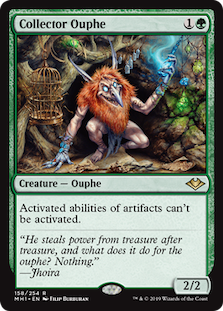
The Modern Horizons card with the lowest spread is currently Collector Ouphe at 33%, which buylists for $3 but can be bought for $3.50-$4. This smaller spread means it has much better legs to stand on as a good spec. It has a great appeal across formats as one of the best hosers in the game, so its future prospects look great.

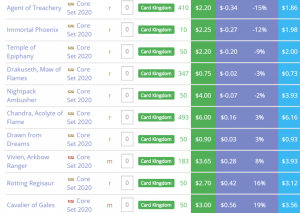
This buylist-focused approach to speculation got me looking at other sets, and I was blown away by the prices of Core Set 2020, which looks very different thanModern Horizons. Its spreads are very low, and at the time of writing, it even has multiple negative spreads that offer arbitrage opportunities.

*Immortal Phoenix doesn’t count since it’s a promotional card

These spread numbers are based on the TCGPlayer Mid price, so in reality, these cards can be had even cheaper and the spreads are even smaller. Numbers like 3% are actually on the negative side. It’s rare to see so much demand from such a recent set, and it points to the fact that Core Set 2020 was severely under-opened. It came right before the release of Commander 2019 decks, and after the exciting Modern Horizons, which made the core set release seem even more lackluster than usual.

Events like Grand Prix Vegas using Modern Horizons instead of Core Set 2020, which was released a month prior, is perfect evidence of the core set’s reduced importance being even further diminished.  Yet, it was actually quite a powerful set, putting multiple staples like Elvish Reclaimer and Mystic Forge immediately making it in Legacy, and currently dominating Standard with cards like Field of the Dead and Golos, Tireless Pilgrim. Buylist prices also paint the picture of a set with high casual appeal, which helps to explain the high buylist price for cards like Drakuseth, Maw of Flames and Chandra, Acolyte of Flames.

There was an error retrieving a chart for Drakuseth, Maw of Flames

There really isn’t much Core Set 2020 being opened anymore except by those cracking for singles, but demand is only going to increase, with the set still having a year left in Standard, and especially for the most playable Eternal and casual cards. I see the stage set for significant price increases in the coming months as Core Set 2020 is farther and farther back in the rearview mirror, so I like taking any opportunity to buy in on these cards for a good price with an eye towards significant gains next year. 

There was an error retrieving a chart for Agent of Treachery

The card with the lowest spread is Agent of Treachery, which makes sense to me as it is seeing play in Standard's top deck and has huge casual appeal. With a Standard ban of Field of the Dead looking inevitable, players will be looking to alternative late-game tools like Agent of Treachery, so its fortunes might further improve there into next year,  and its long-term casual prospects look great. 

There was an error retrieving a chart for Temple of Epiphany

Temple of Epiphany seeing such robust demand makes sense given it’s a Standard staple with casual appeal. What’s telling is that the price of the original printing fell very little after the printing, from around $3.30 to $2.40, and is already heading back up. The rest of the cycle tells a similar story, and I think that gives them all a strong foundation as a spec.

There was an error retrieving a chart for Drawn from Dreams

Drawn from Dreams is a truly powerful card, a fixed version of the Modern and Legacy banned Dig Through Time. It’s not seeing a ton of play in Standard, but it gained a major boost from Fires of Invention, which it's being used in combination with as up to a 4-of. With a ban looming players are going to look towards the next most powerful strategies, and surely Fires of Invention is on the shortlist of things the pros will be trying to break for the Mythic Championship next month. Its price is up nearly 25% from Throne of Eldraine release and about to crack $1.

There was an error retrieving a chart for Voracious Hydra

A Field of the Dead ban will really shake up the metagame and the market, so at this point really anything is fair game. Green-based multicolor ramp decks were the top in Standard even without Field of Ruin, and they are still now after rotation with Field of the Dead. I imagine they’ll still be on top afterward, just in some other form. That makes green look like a good bet overall. One prime target is Voracious Hydra, which stands out to me as a card already seeing play in some of these decks, a versatile tool that fits all flavors of green decks.


Throne of Eldraine Specs to Keep an Eye on

Are you a Quiet Speculation member?

If not, now is a perfect time to join up! Our powerful tools, breaking-news analysis, and exclusive Discord channel will make sure you stay up to date and ahead of the curve.

The breeze is brisk, the trees are changing colors, school is back in session. That can only mean one thing - rotation is here!

Rotation has passed us and that means that a new standard is in session. There are already some powerful decks putting up results on Arena and Twitch too. The two biggest contenders seem to be different builds of Oko, Thief of Crowns and variations of Field of the Dead, along with variations of Fires of Invention decks close behind. A lot of cards have already spiked because of this, but there are many others to look at. Keep an eye on the meta as it slowly shifts and settles with decks looking to beat the contenders. Let's take a look at some cards that have the chance to trend upward due to this.

The Fires Burn Bright

There was an error retrieving a chart for Fires of Invention

Fires of Invention decks are becoming more popular and thus rely on exactly that card to fuel their game. Currently sitting around $3, Fires is one of the key cards to this deck. Regardless of build (except maybe the Golos, Tireless Pilgrim decks) the decks are slow midrange without it.  There are articles showing up as well as popular YouTube/Twitch personalities playing it and it has proven to hold it's own against the meta. This card has the potential, in my opinion, to hit roughly $6-7.

Send in the Cavalry

There was an error retrieving a chart for Cavalier of Flame
There was an error retrieving a chart for Cavalier of Gales

Both of these cards are the beef of Fires decks.  Cavalier of Gales is able to set up your hand and hold the field while Cavalier of Flame puts pressure on the opponent and eventually wins the game. The red Cavalier is already on the rise, doubling up from $3 to $6 in the last week, and has the potential to hit $9. This is a decent indication that Gales can move past the $4 and would be wise to hold onto a few.

I'm going on an adventure!

Much like Bilbo Baggins, the cards from Throne of Eldraine allow us to seek out adventure. There are two up-and-coming decks that utilize this mechanic and try to abuse it with Lucky Clover. Sitting at a quarter, this card isn't the win condition of the deck but does allow it to become much more of a threat than a draft deck. These decks use cards like Lovestruck Beast, Edgewall Innkeeper, Order of Midnight, and Bonecrusher Giant to act as two-for-one type spells with the potential for more thanks to the Clover.

This deck reminds me of the 4-Color Gates decks that were popular at the beginning of Guilds of Ravnica Standard. They are a great entry point for players newly jumping into Standard, as many of the cards are cheap minus one or two, and are a great fit for FNM or casual gameplay. All of the uncommon adventure cards (especially alternate arts) have the potential to move into the $1-2 range and can be a great bulk pick-up.

Two great picks for a great deck

Fae of Wishes gives us yet another way to reach out for help in the sideboard much like Mastermind's Acquisition did.  The biggest difference though is that Fae of Wishes, while only being able to grab a noncreature card, is attached to a 1/4 flyer that can become reusable and is significantly easier to splash into a deck.  Keep in mind the most popular decks that are running blue are making room for the Fae in their lists.

Being able to search out an Unmoored Ego, a timely Time Wipe, or an Ethereal Absolution in decks that have the ability to play these cards (such as Fires or Golos) can facilitate a crucial turning point for the game. They are being run as a 4-of in the lists that maindeck them, and did I mention that the 1/4 flyer can block for days?

This card is something to definitely keep your eye on. It's currently sitting around $2 and has the real potential to hit $5+. Foils are also a great pick-up for Commander at about $4, as well as the foil alternate art around $8-9. The foils are a long-term hold of course, but I would expect to see the regular version with an upward trend soon. This glorious card also brings me to my final spec.

There was an error retrieving a chart for Chance for Glory

Now that Nexus of Fate has rotated out of Standard Chance for Glory might have a moment to shine. Instant speed, take an extra turn (whose "lose the game" trigger can be countered in the right build) is a pretty strong ability - but costing three mana and giving your creatures the chance to live another turn could be what takes the cake. Fae of Wishes can search for it when you're looking to attack with a horde of 2/2 zombies in Golos decks, it's an easy play if you need those few extra points of damage in Fires decks, or if you're looking at an aggro deck like Mardu Knights to keep swinging for the win.

It's an underrated mythic that can be found for bulk and has the ability to hit even $3 or $4. I don't think you can miss on this one - even after they rotate most "extra turn" cards trend upward thanks to Modern, Commander, and casual love.

Wrapping Up

I've listed a lot of cards here, and there are plenty more if you just keep an eye on what is happening in the meta currently. We've come to a new standard again and there is plenty to test. Pros and streamers are always looking for new ways to beat what is top tier and all it takes is a few wins for underrated and undervalued cards to have a breakthrough.


Cool Stories, Bro: Testing Throne of Eldraine

Are you a Quiet Speculation member?

If not, now is a perfect time to join up! Our powerful tools, breaking-news analysis, and exclusive Discord channel will make sure you stay up to date and ahead of the curve.

Throne of Eldraine is officially out, and that means that data is slowly trickling in. Very slowly, to the point that I can't draw conclusions yet. It will take a few more weeks of events and brewing before things settle enough to get an accurate view of the new metagame. Now is the perfect time to try out the wilder and weirder ideas. Or just get in lots of testing with more sober ideas. I've been doing a lot of the latter, and today I'm sharing my results.

Mr. Charisma

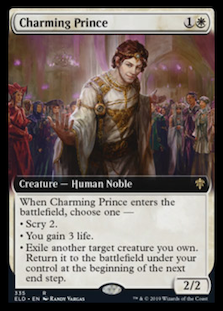
I'll start the article where I started testing. Charming Prince stood out more than the other Eldraine spoilers. It's not the flashiest card nor the most obviously powerful, but it was the one that most looked like it needed to be worked on. There wasn't an obvious kingdom for the prince, and it wasn't clear that existing decks wanted him at all. After considerable work, I can confirm that there is, though not in a way I expected.

He Only Belongs...

I have tried Prince in a lot of Bant Ephemerate shells along with Death and Taxes, and as predicted, the results have been resoundingly meh. Getting value from creatures is good, and getting to reuse the best abilities is great. However, Prince is fairly awkward. His own value abilities are a little marginal, which is fine because flexibility makes up for weak power (see also: Collective Brutality).

However, the fact that Prince only flickers is a problem. Flickering means returning the exiled creature at the beginning of the end step like Flickerwisp rather than an immediate return like the blink of Restoration Angel. Having to wait for value and being limited in targets meant that it didn't really fit into Bant or DnT. The former wants blink effects because it's all about chaining value continuously in a single turn, which Prince can't really contribute to. The later needs something more impressive or evasive than a 2/2. However, that doesn't mean that Prince isn't a Modern card. He just needs the right deck.

...Among His People

In my set review, I was somewhat skeptical that Prince could find a home in Humans. The deck is tightly constructed and the metagame context made me think that a flexible, but not exceptional, card like Prince couldn't make the cut. It turned out that I was thinking too linearly.

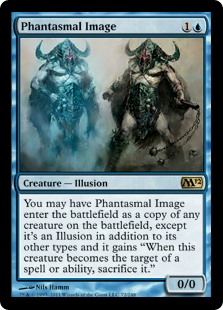
While I've always appreciated its utility, I've never actually liked Phantasmal Image, in Humans or otherwise. The card does nothing on its own by design; its value is dependent on how the game has played out up to the point it resolves. Thus, it tends to make good hands and situations great, and bad ones worse. Getting extra copies of Thalia's Lieutenant or Mantis Rider in a turn is the recipe for an instant kill. Alternatively, anything beats copying a tapped Noble Hierarch after everything else got removed. Prince gave me an excuse to replace the Images, and it has been working out well for me.

Untitled Deck

Creatures

4 Noble Hierarch
4 Champion of the Parish
4 Thalia, Guardian of Thraben
4 Thalia's Lieutenant
4 Meddling Mage
4 Kitesail Freebooter
3 Charming Prince
4 Mantis Rider
4 Reflector Mage
2 Deputy of Detention

Artifacts

4 Aether Vial

Lands

4 Ancient Ziggurat
4 Cavern of Souls
4 Unclaimed Territory
4 Horizon Canopy
1 Plains
1 Island
1 Silent Clearing

Sideboard

2 Grafdigger's Cage
2 Gaddock Teeg
2 Collector Ouphe
2 Auriok Champion
2 Dismember
2 Plague Engineer
2 Militia Bugler
1 Deputy of Detention

I swapped out the usual Waterlogged Grove for Silent Clearing, figuring that since I was playing more white cards, I would need the white mana. Periodically paying one less life for Dismember was also a consideration. I have no idea if this is a good change because it has yet to be relevant. I've never had any more or less trouble casting spells. That's the problem with testing one-ofs that aren't tutoring targets: the odds of drawing them are low enough that you're more likely to be in situations where they are average rather than good or bad, rendering them tough to evaluate.

What He Does...

The main reason I've replaced Image with Prince is that I've been playing against a lot of Jund and UWx Control, and Prince is much better against them. There's a lot of Burn too, but the impact Prince has is mainly felt Game 1 and is fairly small. Humans has a lot of sideboard options against Burn, and the matchup is already pretty good. However, in the grindy matchups, particularly with Vial in play, Prince's flickering is a house. Vialing-in Prince saves a creature from targeted removal and presents another threat, yielding a 2-for-1. Image just replaced the targeted creature; a 1-for-1. That it's a flickering effect also means that in the event of a sweeper, Prince can exchange himself with a more impactful creature like Mantis Rider. There's also the utility of netting extra enters-the-battlefield triggers.

However, the biggest advantage is that Prince is never a dead card. Given the density of removal in Jund particularly, it is very possible that Image will struggle to find anything to copy, stranding it in hand. A dedicated attack on both the hand and board can easily leave Humans desperately hoping to topdeck something to copy just to be rid of the Image. Meanwhile, Prince is always 2/2, and on an empty board scrys 2 towards the next threat, which in attrition matchups is sometimes game-winning.

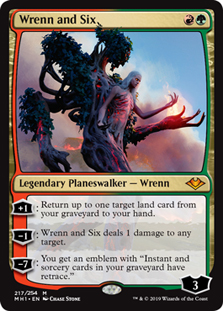
There's also the issue of Image's fragility. The card is terrible against Jund, not only because of the aforementioned risk of no targets, but because Wrenn and Six just kills it. Image already died to everything anyway, true, but Wrenn's downtick means Image is dying while the opponent gets to keep their removal spells for other creatures. That advantage snowballs in the tight Jund matchup. Also, Prince is a Human, which means he benefits from Cavern of Souls against UWx. In other words, more blanked cards for the opponent and more threats for Humans.

...And What He Doesn't

However, Prince hasn't been universally better than Image. The fact that Prince flickers rather than blinks creatures makes the ability far more defensive than Humans wants to be, and that can impact tempo-relevant matchups. I really wish he flickered opposing creatures. For example: I have a board of random dorks including Reflector Mage being walled off by a Tarmogoyf and no Aether Vial. Drawing Image means copying the Mage and clearing the road for two turns. Prince can flicker Mage, but the road won't open until Mage returns on end step, leaving just a one-turn opening. Prince has cost me games against Zoo and Affinity as a result.

The other problem alluded to above is that Prince lengthens Humans's clock. With a Vial, Image, and Mantis Rider Humans can swing for 6+ damage (board depending) on turn three. Replace Image with Prince, and only 3 damage is locked in. Given that Humans' niche is fast, disruptive aggression from not-especially-robust creatures, that damage difference may prove fatal. I've already lost games because I couldn't quite race Valakut, but would have with Image. However, this factor has proven relevant fewer times than Image's fragility costing me games against Jund and UWx.

Overall, whether Humans should adopt Prince over Image comes down to how the metagame develops. In a non-interactive field of Tron, combo decks, and other creature decks, Image is the pick, since tempo is more important than value. If the meta shapes up as my experience indicates with Burn, UWx, and Jund dominating, then Prince is the pick, because life and grinding value matter more than tempo. I will be sticking with Prince due to my metagame, but with the overall meta still fluctuating, this may not last.

Wild Tonal Swings

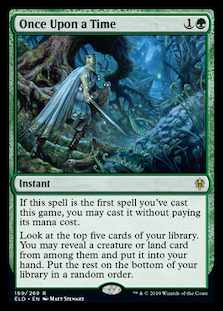
The other topic is fan-favorite Once Upon a Time. When the card was first spoiled, the hype machine ran wild, and everyone assumed that it would be everywhere, ushering in a new faster era of creature combo. Once the card had been more thoroughly examined, the hype started to die down. That a swingy cantrip isn't appropriate in every deck is a lesson that needs to be relearned periodically. However, the potential is enough that Once can't be written off, and testing has shown that it can work in Modern, within reason.

Flat Note

First of all, I haven't seen anything to suggest that Neobrand is anymore of a deck now than before. When I first experimented with Neoform I found the deck to be swingy, explosive, and bad. With Once in the picture, Neobrand was still swingy, explosive, and bad. I just felt compelled to keep more speculative hands because I had Once to try and fix things. The deck's fundamental problem is its fragility since it is a multipart combo with very specialized pieces. Once helped a bit with finding Allosaurus Rider or a missing land, but those weren't really the problem anyway. The real struggle was finding and resolving a tutor, which Once can't help.

Wild Note

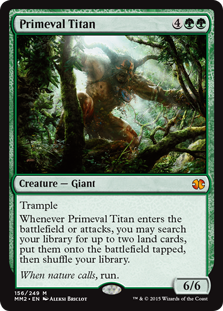
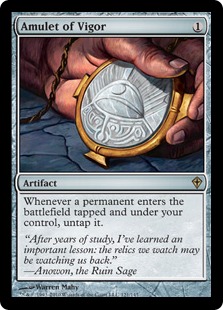
However, playing Once in more robust decks felt pretty good. Specifically, I tested RG Valakut and Amulet Titan, and Once was a reasonable card in both. I tried a lot of decks out, but only Valakut and Amulet actually made Once feel good. The main advantage those two deck have is that the lands are all they really need. Hitting Valakut, the Molten Pinnacle or Tolaria West isn't as obviously good as hitting Primeval Titan, but they can still outright win the game on their own (technically).

It was also far more reasonable to play Once either as the first spell or at any other time for these two decks. I keep hammering this point, but the main appeal of Once is getting played for free. Nobody would run the effect otherwise. Both Valakut and Amulet do run similar effects already, and as big mana decks, Once's cost isn't a problem. It actually felt just as good to pay full price as it did to cast Once for free. Free copies are generally speculative, finding what I think I need, where paid-for Once finds what I actually need. As a result, I was very satisfied with Once. Then I checked over my notes and realized something wasn't right.

Deceptive Noise?

Despite the positive effects I was noticing in-game, when I looked at my win-rate data, there was no noticeable improvement. In any matchup, for either deck. While I can't definitively explain this effect, my working theory is that the trade-offs made to run Once are steeper than expected. In Amulet, I had to cut on utility cards, particularly Engineered Explosives, while Valakut trimmed ramp spells. This meant that while my early game felt better, the mid-game was slightly worse. In Amulet, the lessened interaction meant that any hiccup in the gameplan was magnified. In Valakut, it became slightly harder to hit the last few land drops. These effects are certainly marginal, but so are the odds of casting Once for free.

There's also the issue of mulligan ambiguity. Do you keep an otherwise unkeepable hand on the promise that Once fixes everything? Once isn't Land Grant, and keeping hoping to find that critical missing piece is a dice-roll. There were instances in testing where I kept, hoping to hit a land, and saw only creatures. Or I needed a specific land (a non-karoo in Amulet; a green source in Valakut) to turn a garbage hand into a phenomenal one, then whiffed on Once and lost. I kept track of this data, and it worked out 13 times to 24 disasters. I'm therefore inclined to think that Once is a trap. Solidly playable, but an opening-hand trap. I need to further explore this disconnect between the quantitative and qualitative data.

First Draft

These are just the early results, and metagame swings and adjustments may change my evaluations. Also, I have a lot of work to go on a lot of other cards. How's your testing going? Let me know in the comments.

Best Bets for Long Term Investments – 7 Year Lookback

Are you a Quiet Speculation member?

If not, now is a perfect time to join up! Our powerful tools, breaking-news analysis, and exclusive Discord channel will make sure you stay up to date and ahead of the curve.

Can you believe my first Quiet Speculation article went live nearly 8 years ago, in November of 2011? Since then, I've written hundreds of articles across an array of topics. This week, I stumbled upon an oldie-but-goodie I wrote back in June 2012. This column covers a basket of trading card collectibles that could fit into a long-term investment portfolio. While seven years isn't long enough to plan retirement, it is enough time to make some interesting observations.

Did I make good suggestions? Were there any ideas that ended up as dead money? Would you have been better off buying my trading card ideas versus a general S&P500 market fund? Let's find out! (Updated text will be in bold italics throughout the article).

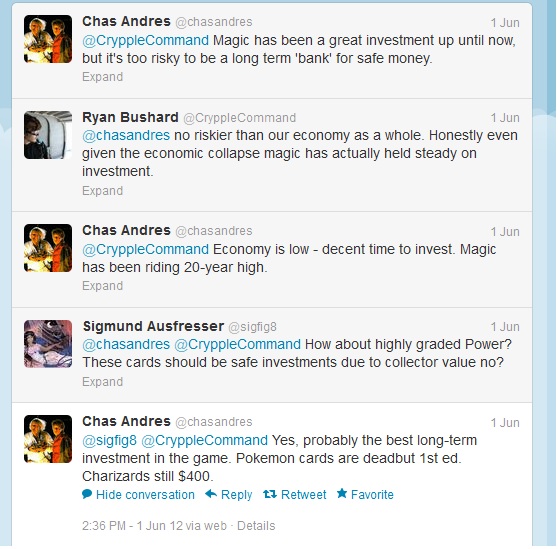
This past week, an interesting conversation on Twitter caught my eye. Chas Andres (@chasandres) was participating in the discussion, and since he’s a highly regarded finance writer in the realm of MTG, I paid close attention.

The topic: Magic: The Gathering cards as an investment. I am not talking about buying cards which may see an increase in play during the next PTQ season or the next biggest tier 1 strategy. I’m referring to investing in Magic Cards as an alternative to, say, a 401(k).

Here is a snippet of the conversation, which I eventually had to chime into since I am avidly interested in this topic.

A couple interesting tidbits and deductions leap out at me from this conversation. What are they? I’m glad you [maybe] asked!

Players are Fickle, Collectors are Dependable

Chas Andres agreed with my interjected comment – we both feel that one avenue for long term investing in Magic is highly graded Power 9. The reason is fairly obvious. These cards are exceptionally rare and collectors with lots of money are willing to throw thousands of dollars at these rarities. Because supply is so low, only a few well-off collectors need to “demand” the card in order for the price to fly high.

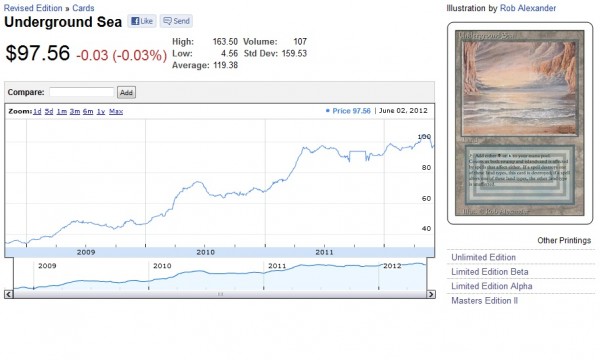
One may suggest that Dual Lands are likewise stable for investing. The return on Dual Lands has been remarkable these few couple years, especially relative to the stock market.

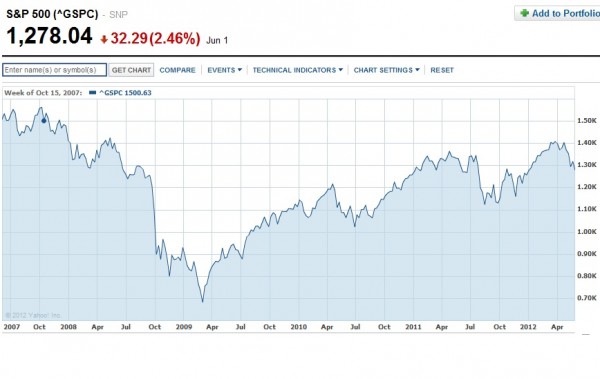
Underground Sea chart courtesy of blacklotusproject.com – note the chart only goes back to 2008, but I assure you the card’s value was growing steadily for a year or so before then as well. Compare this chart to the subsequent one, which is the performance of the S&P over the last five years, courtesy of Yahoo Finance.

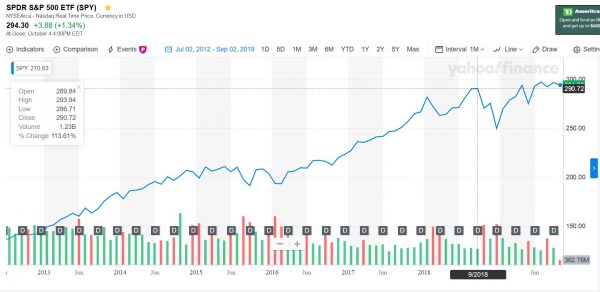
Here are updated charts for both Revised Underground Sea and the S&P500. Which has been a better investment since 2012?

There was an error retrieving a chart for Underground Sea

While the S&P500 has about doubled since 2012, it pales in comparison against Underground Sea, whose buylist value nearly quadrupled in that same time. Interesting...

But I hesitate to embrace investment in Dual Lands for the long term. My one reason for caution lies in the unpredictable nature of the player. The game of Magic, Legacy in particular, is very popular right now. An increase in the player base has driven up these cards in value multiple times. But they are still driven up mostly by their playability and NOT their collectability. I had not anticipated the explosion in Commander back in 2012, but I suspect this format offers plenty of price support for Dual Lands.

While subtle, this difference separates the safe long term investments from the short term bubble. All it would take would be a major migration for Star City Games from Legacy to Modern and Dual Land prices could collapse. Same comment here about Commander--thank goodness for that format! Alternatively, even if Legacy continues to receive the same support, but players lose interest or become flustered with a hypothetical banning/unbanning, the prices still could drop further.

If I am moving significant quantities of cash into Magic Cards and not into other retirement plans, I want to make sure a card’s playability will not negatively impact my portfolio. This leads me to my second observation from the Twitter conversation.

Charizard Transcends Pokemon

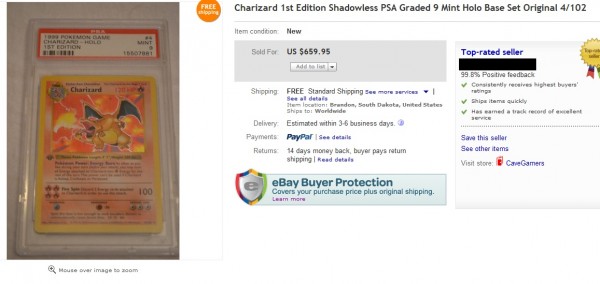
How many people do you know who still play The Pokémon Trading Card Game? For me, the number is virtually zero, and I would wager this is not an uncommon trend. But if few people are still playing this game, then why in the world does a first edition Charizard still sell for hundreds of dollars???

The answer is consistent with my previous point – the card is highly collectible and rare. The card needs no player base to maintain value because it is rare enough such that even a few collectors will drive the price up substantially. Don’t believe me? Check out this eBay ended auction:

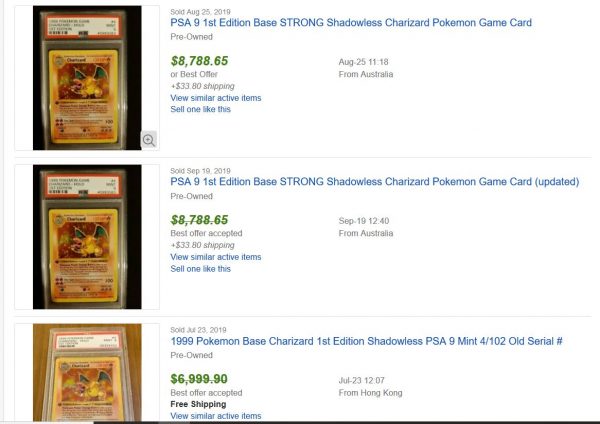
If you think nearly $700 is ridiculous for a Pokémon card, then you will be completely awe-struck to hear that a PSA 10 copy of this card sold for $1,826.00! All this despite the fact the game’s player support has dwindled significantly since its peak. Without realizing it, I mentioned one of the best long-term investment ideas right here. Thanks to the resurgence of Pokémon, these same cards reliably sell for thousands of dollars. A PSA 10 copy would clear $10,000, over 5x the initial investment.

The main takeaway here is that a card can lose popularity amongst players, but if that same card is very rare and collectible, it will maintain value. Hence why I support highly graded Power 9 as dependable avenues for investing. Any Near Mint copies of Power have skyrocketed in price since the writing of this article.

This Is Getting Costly

I don’t know about you, but if I were to purchase a PSA 8 Alpha Black Lotus, which retails for nearly $5,000, I would need to sell the vast majority of my collection. If only we could travel back in time! Assuming PSA 8 equates to EX condition, that same Alpha Black Lotus would now retail for around $60,000. Forget Dual Lands, this one purchase could have netted me a 1000% gainer if I had actually pulled the trigger in this long-term investment strategy. If only I had the liquidity at the time to make such a purchase! This is the opposite of diversification and I would not condone this strategy. If $5000 was too concentrated an investment, $60,000 sure must be!

There must be a happy medium. There must be a way one can invest in highly collectible cards which should increase in value while not having to shell out five grand on a single card.

I see a couple alternatives here, but they each have their drawbacks.

First, we could purchase lesser cards, such as a graded Bazaar of Baghdad or the like. At a few hundred dollars instead of a few thousand dollars, this option is much more affordable and, as long as the card’s condition is high enough, collectors should still keep this card’s value high. This was a great suggestion, as highly graded Bazaar of Baghdads now DO sell for thousands of dollars.

There was an error retrieving a chart for Bazaar of Baghdad

But let’s face it – there are fewer people interested in a PSA 8 Bazaar of Baghdad than a PSA 8 Alpha Black Lotus. So it will be more difficult to find sellers in the long term and the card may not appreciate as much.

Second, we could consider purchasing highly graded Unlimited Power. High-quality Unlimited Black Lotuses sell in the $1500 range and other Power should be even cheaper. This is an affordable way to still have a chunk of cash invested in high-quality Power. Near mint Unlimited Lotuses retail for $15,000, another 10x gainer. If only I had listened to my own advice!

There was an error retrieving a chart for Black Lotus

The drawback here is related to the supply. There are far greater quantities of Unlimited Black Lotuses than Alpha ones. Even though the demand may still be very high on this poster-child card of Magic, the supply keeps the value in check. Of course, you could find one of the few PSA 10 Unlimited Black Lotuses, as these are likely very rare. But these will again cost thousands of dollars, so the cost of entry barrier is still there.

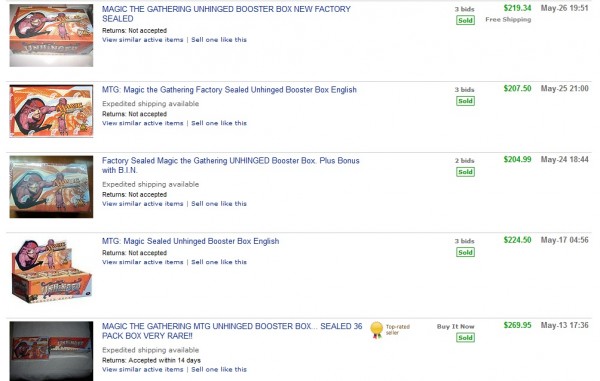
Lastly, we could try to brainstorm other Magic products which are highly collectible, rare, and should maintain value even should the game of Magic lose popularity. Many of you already know I have a sizable investment in sealed Magic Booster Boxes. I feel these should not drop in value because they will assuredly decrease in supply while a sufficient casual market will maintain a sizable demand. There is no need for a Star City Games tournament circuit for a sealed Unhinged Booster Box to grow in value. These now sell for $600 on eBay. This is nearly triple the price from 2012--better than the S&P500 over that same time period, but a far cry from Black Lotus.

If Booster Boxes aren’t your thing, perhaps there are other options. Off the top of my head, there are misprinted cards, high-quality altered cards, or even sealed booster packs of older sets. I’m sure there are many other options and I would love to hear what other considerations you have come up with for a long term Magic investment.

Collectability And Rarity Are Key

The goal is to find a Magic product or card that is highly popular amongst collectors and somewhat difficult to find. These are the gaming assets that should maintain and build value in the long term. They rely little on the game’s popularity and even less on individual playability. Like a rare baseball card, they merely grow in value because they are very hard to obtain for the well-off collectors.

While Dual Lands, Force of Wills and the like have all returned terrifically in the past few years, I’m wondering how much room these cards have to run. Don’t get me wrong – I have no intention of selling my 40 Dual Lands and 40 Fetch Lands any time soon. I still like to play the game and I see the utility in these cards. But in terms of longer-term holdings, I see some significant advantage to something much rarer. Dual Lands would have been a stellar investment given their placement on the Reserved List. Thankfully, I talked folks away from Force of Will and Fetch Lands since they both got hit with reprints (though Force of Will has recovered from its reprinting).

There was an error retrieving a chart for Force Of Will

-Sigmund Ausfresser
@sigfig8

Final Thoughts

I hope you enjoyed this trip back in time. It was certainly eye-opening to me, reading through 7-year-old predictions and realizing just how insightful they were. If only I had the confidence to acquire large positions in the ideas I suggested, I would have outperformed my stock market investments handily. Alas, I was even more risk-averse then than I am now, so I am not surprised I held back.

Looking ahead, one may ask the same question that triggered this article years ago: Are Magic and other trading card games good bets for long-term investments? The challenge in 2019 is that so many prices are inflated already. The Reserved List buyout spree of last year really spiked prices hard, and the market is still finding equilibrium in recovery. I don't advise making any long-term investment purchases in Magic at this moment. Then again, everyone's talking about a recession on Wall Street...so maybe a few pieces of Power and some Dual Lands will outperform the S&P500 over the next 7 years as well? I'm not sure, which is why I diversify between the two. Only time will tell which strategy is the optimal one!

September Brew Report, Pt. 2: Creature Feature

Are you a Quiet Speculation member?

If not, now is a perfect time to join up! Our powerful tools, breaking-news analysis, and exclusive Discord channel will make sure you stay up to date and ahead of the curve.

Last week, we kicked off the September Brew Report, covering some of the juiciest decks to emerge from recent 5-0 dumps. As the format continues to find its footing after the Hogaak ban, the possibilities seem endless. Today we'll discuss the other newcomers.

Fair Enough

We'll kick things off with Modern's unsung heroes: the decks that play it fair against all odds.

Temur Midrange, by C4N7O (5-0)

Creatures

4 Tarmogoyf
4 Ice-Fang Coatl
4 Snapcaster Mage
1 Tireless Tracker

Planeswalkers

1 Jace, the Mind Sculptor
3 Wrenn and Six

Instants

2 Abrade
2 Cryptic Command
3 Force of Negation
4 Lightning Bolt
1 Magmatic Sinkhole
2 Mana Leak
2 Opt
2 Spell Snare

Sorceries

3 Serum Visions

Lands

1 Breeding Pool
1 Field of Ruin
1 Fiery Islet
1 Ghost Quarter
1 Lonely Sandbar
1 Lumbering Falls
2 Misty Rainforest
2 Prismatic Vista
3 Scalding Tarn
1 Snow-Covered Forest
4 Snow-Covered Island
2 Snow-Covered Mountain
1 Steam Vents
1 Stomping Ground

Sideboard

1 Alpine Moon
1 Ancient Grudge
1 Anger of the Gods
2 Ashiok, Dream Render
2 Damping Sphere
1 Engineered Explosives
1 Flame Slash
1 Fry
1 Keranos, God of Storms
1 Pyroclasm
1 Surgical Extraction
2 Weather the Storm

Temur Midrange has never been a deck in Modern, though that hasn't stopped players from trying time and again to crack the code. It simply lacks the heavy-duty removal options of black and white, as well as proactive non-creature plays with which to develop its position. Jund loses out on the ability to run counterspells, but gains targeted discard and Liliana of the Veil, draws that Temur could never match.

Until, perhaps, now. Joining the wedge's ranks are Wrenn and Six, a proven powerhouse in and out of Jund that offers Temur an on-plan way to satisfy its hungry mana requirements. Also new is Ice-Fang Coatl, a pseudo-removal spell with its condition met. Temur is already in the business of fetching basics, so the snow creature does a fine Baleful Strix impersonation for the deck.

Whether such developments turn the combination around remains to be seen, but color me doubtful for the time being. Discard spells greatly enhance this kind of nickel-and-diming playstyle, and Jund is a force to be reckoned with right now for that reason.

BR Claim, by IVAN_CATANDUVA_BR (5-0)

Creatures

4 Pestilent Spirit
4 Rix Maadi Reveler
2 Rotting Regisaur
4 Seasoned Pyromancer

Planeswalkers

1 Chandra, Acolyte of Flame
3 Liliana of the Veil

Instants

4 Gut Shot
3 Kolaghan's Command
4 Lightning Bolt

Sorceries

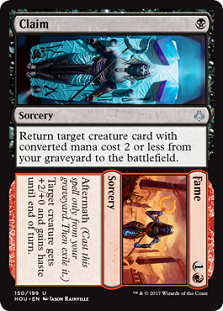
3 Claim // Fame
3 Inquisition of Kozilek
3 Thoughtseize

Lands

1 Barren Moor
3 Blackcleave Cliffs
1 Blood Crypt
3 Bloodstained Mire
2 Field of Ruin
1 Marsh Flats
3 Mountain
3 Swamp
4 Verdant Catacombs
1 Wooded Foothills

Sideboard

2 Anger of the Gods
1 Chandra, Torch of Defiance
3 Collective Brutality
4 Pillage
2 Plague Engineer
1 Shadow of Doubt
2 Surgical Extraction

BR Claim follows in the footsteps of a breakout deck post-Horizons, BR Unearth. That strategy aimed to abuse Unearth by reanimating juicy targets like Seasoned Pyromancer. Variations have dipped into three drops as diverse as Lightning Skelemental, Jace, Vryn's Prodigy, and Monastery Mentor. This deck runs the staple Seasoned Pyromancer and Rotting Regisaur. But it doesn't run Unearth; only Claim // Fame, which targets neither of those creatures.

Claim can only bring back one creature in the list: Rix Maadi Reveler. As such, it serves as a mini-velocity engine to power through the deck. But it's much less efficient at doing that than reanimating Pyromancer. Rather, the draw to Claim lies in its other half, Fame. With the aftermath spell in the graveyard, opponents need to be wary at every turn, as a 7-power Regisaur could emerge out of nowhere and take a bite out of their life points.

With all that said, I sincerely don't understand why this deck doesn't have any Unearths in it and would dearly appreciate any guidance in the comments!

Fishing for a New Religion

Fish-style tempo decks have taken many forms in Modern, and the strategy continues to emerge in unique constructions as new cards are released.

Deadguy Ale, by BENNYHILLZ (5-0)

Creatures

4 Dark Confidant
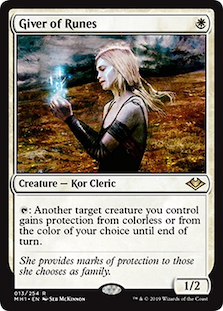
4 Giver of Runes
4 Thraben Inspector
4 Stoneforge Mystic
4 Kitesail Freebooter

Instants

1 Cast Down
4 Fatal Push
1 Slaughter Pact

Sorceries

1 Collective Brutality
4 Inquisition of Kozilek
3 Lingering Souls
3 Thoughtseize

Artifacts

1 Batterskull
1 Elbrus, the Binding Blade
1 Sword of Fire and Ice

Lands

4 Concealed Courtyard
2 Flooded Strand
2 Godless Shrine
4 Marsh Flats
1 Plains
2 Polluted Delta
2 Snow-Covered Plains
3 Swamp

Sideboard

2 Collective Brutality
1 Lingering Souls
3 Fulminator Mage
2 Kalitas, Traitor of Ghet
2 Liliana of the Veil
1 Liliana, the Last Hope
1 Manriki-Gusari
3 Rest in Peace

Deadguy Ale is a black-white fish deck with more midrange elements than your typical Death & Taxes, such as Dark Confidant and Inquisition of Kozilek. It's long been native to Legacy, but as Stoneforge has just arrived in Modern, the strategy is a newcomer here.

BENNYHILLZ did us the favor of breaking it in, employing Giver of Runes and Thraben Inspector to generate a beautiful curve without the need for Aether Vial. Lingering Souls plays exceedingly well with Sword of Fire and Ice, and Elbrus turns any flying creature (there are plenty) into a serious threat. A full set of Fatal Pushes round out this elegant list.

Trending away from synergy is rare in Modern, but as a lover of all-purpose disruption, I'm excited to see if such developments continue.

Company Hatebears, by POC (5-0)

Creatures

2 Knight of Autumn
2 Collector Ouphe
1 Eternal Witness
4 Giver of Runes
4 Leonin Arbiter
4 Noble Hierarch
4 Stoneforge Mystic
4 Thalia, Guardian of Thraben
2 Thalia, Heretic Cathar

Instants

4 Collected Company
1 Mana Tithe
4 Path to Exile

Artifacts

2 Batterskull

Lands

4 Field of Ruin
4 Ghost Quarter
4 Horizon Canopy
4 Razorverge Thicket
1 Snow-Covered Forest
2 Snow-Covered Plains
3 Temple Garden

Sideboard

2 Collector Ouphe
1 Knight of Autumn
1 Burrenton Forge-Tender
2 Phyrexian Revoker
1 Ramunap Excavator
2 Ranger-Captain of Eos
3 Rest in Peace
3 Tocatli Honor Guard

Speaking of moving away from synergy, Company Hatebears pulls a Naya Zoo in using its titular instant for non-combo purposes. When you're fishing out the best two-drops in Modern, among them Stoneforge and Thalia, who needs to go infinite?

A big factor allowing this deck to exist is Collector Ouphe, which gives it superb interaction against artifact strategies the likes of Whirza. That deck certainly isn't going anywhere, and Ouphe's stock should only rise as Emry makes a splash alongside Jeskai Ascendency come Throne.

Pride of the Pack

Of course, Modern is still home to plenty of synergy, and much of it has to do with creatures. These decks put innovative spins on that old concept.

Bant Pride, by INTERNETSURFER09 (5-0)

Creatures

4 Pride of the Clouds
2 Aven Mimeomancer
4 Birds of Paradise
3 Deputy of Detention
4 Empyrean Eagle
4 Mantis Rider
4 Mausoleum Wanderer
2 Noble Hierarch
3 Selfless Spirit
4 Unsettled Mariner

Instants

3 Collected Company
2 Force of Negation

Lands

2 Botanical Sanctum
1 Breeding Pool
1 Fiery Islet
4 Flooded Strand
1 Hallowed Fountain
2 Horizon Canopy
1 Island
1 Misty Rainforest
1 Plains
2 Razorverge Thicket
1 Sacred Foundry
1 Steam Vents
1 Temple Garden
1 Waterlogged Grove
1 Windswept Heath

Sideboard

1 Selfless Spirit
1 Collected Company
1 Force of Negation
2 Blessed Alliance
2 Celestial Purge
3 Collector Ouphe
1 Disdainful Stroke
3 Life Goes On
1 Reflector Mage

Behold Bant Pride, AKA flying tribal. But hasn't this deck been done before? Like, with Spirits? Well, kind of. Spirits has better lords, to be sure. But it doesn't have the grind game enabled by the forecast mechanic. Or durdle game?

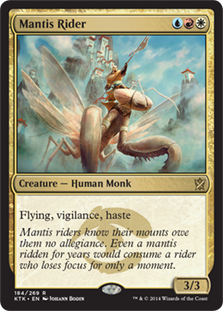
Balancing out that snail-slow plan is Mantis Rider, the game's-now-over closer from Humans. Growing Rider above 3/3 is an interesting premise, and one I've spent many hours trying to implement well myself. The format's changed a lot since those days; perhaps it's the 4/4 or 5/5 Rider's day to shine outside its original tribal deck and alongside some straight-up draft cards.

Company Hatebears, by POC (5-0)

Creatures

4 Yawgmoth, Thran Physician
1 Acidic Slime
4 Birds of Paradise
1 Blood Artist
4 Geralf's Messenger
1 Kitchen Finks
1 Scavenging Ooze
4 Strangleroot Geist
1 Thragtusk
4 Wall of Roots
4 Young Wolf

Instants

3 Chord of Calling

Sorceries

4 Eldritch Evolution

Lands

4 Blooming Marsh
2 Forest
3 Khalni Garden
3 Overgrown Tomb
2 Swamp
4 Twilight Mire
1 Urborg, Tomb of Yawgmoth
4 Verdant Catacombs
1 Windswept Heath

Sideboard

2 Collective Brutality
2 Collector Ouphe
3 Damping Sphere
1 Dosan the Falling Leaf
4 Leyline of the Void
1 Obstinate Baloth
1 Reclamation Sage
1 Shriekmaw

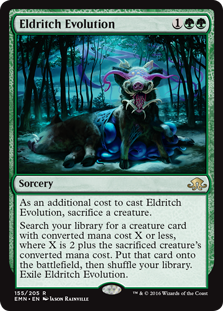
Yawgmoth Undying might not play Collected Company, but it's got the other green creature-finders, Eldritch Evolution and Chord of Calling. That's because it's not looking for a critical mass of beaters or disruptors so much as one specific card: Yawgmoth, Thran Physician.

With the Cleric in play, Young Wolf and its undying buddies get a new lease on life, not from the graveyard this time, but from the bulk bin. Yawgmoth's -1/-1 counter cancels out the +1/+1 counter from undying, letting pilots draw cards at will. They only have 20 life, of course, but Geralf's Messenger races that clock by dealing twice as much damage each sacrifice, and recruiting Blood Artist first goes infinite. It's likely that players mid-combo will find a way to grab Artist in their next 10-or-so cards.

A Month in the Books

September has been very exciting for Modern, and the fun's just beginning: Throne of Eldraine is about to become legal! Which brews stand out to you the most? What kinds of decks do you hope to see emerge from the new expansion? Let's keep the discussion going in the comments.

Insider: Differentiators

Are you a Quiet Speculation member?

If not, now is a perfect time to join up! Our powerful tools, breaking-news analysis, and exclusive Discord channel will make sure you stay up to date and ahead of the curve.

Differentiator - one that shows a contrasting element that distinguishes.

I started this article off with the definition of my key term simply because not everyone may know what a differentiator is. In the business world, these are elements of your product or service that differ between you and your competitors. Some of the more common differentiators in the business world are:

  • Price
  • Availability
  • Quality
  • Customer service
  • Customization

Customization

Customization seems like a difficult one for a third party seller such as a Magic store owner to establish. That isn't to say it isn't possible. For example, if you own an actual brick and mortar store you could run unique tournaments or formats. One of my favorite ones I've played in the past was a "make your own Standard" where you picked two blocks and a Core Set and made a deck. If you own an online store, perhaps you could look at getting some custom tokens as business cards. The point is that while it may be more difficult to customize, it isn't impossible.

There was an error retrieving a chart for Customs Depot

Other differentiators are easier to establish for a Magic store. In fact, we can see some of these elements at play from some of the major stores.

Star City Games has almost everything available, great customer service, and they have good quality grading. However, they also tend to charge more and buy for less.

Card Kingdom has a large inventory, though not as big as SCGs, good customer service, and somewhat competitive prices. On the downside, they limit you to buying no more than 8 copies of a given card in a given condition so your availability is limited.

Troll and Toad sometimes has great prices on cards as well as a decent inventory. However, their grading has actually been a running joke in MTG finance realm. I can speak to this personally, though I will give them some credit with regard to their excellent customer service element.

TCGPlayer tends to have the lowest prices of any online sales platform, but at a cost. Grading is often lax and it is difficult to buy large quantities of older cards without having to buy from multiple vendors and accruing multiple shipping costs.

So as you can see, most companies don't try to maximize all the differentiators, as they cost money and can impact profits. It's important to find the right combination for your customer base and it's a delicate balance as you often can't ignore any one of them completely. The key here is to figure out what your customer base values and focus on maximizing those differentiators. After all, thanks to the internet and the general fungibility of Magic cards, you as a store owner have tons of competition.

Customer Service

A great way to determine which differentiators to focus on is going straight to the source by asking your customers. If you own a brick and mortar store, you should be able to get constructive criticism from your customers relatively easily. A word of caution; good constructive criticism focuses on flaws and may or may not include suggestions to fix them. It can be hard for some people to take constructive criticism. However, I personally believe it's one of the most important qualities to have in order to ensure your own success in life.

It is a bit harder as an online store as your customers are often unlikely to communicate with you unless something goes wrong, but you can still ask. If you sell on TCGPlayer, you get automatic feedback if the customer doesn't bother to leave any, but you may have more luck reaching out to customers who actually fill out the feedback option on TCGPlayer. You will find out very quickly that most people are happy to give their opinions when asked and the sheer act of asking will differentiate you from a great many of your competitors. One word of warning, though; you don't want your request to seem like a form letter, as that very quickly turns people off of providing good feedback. Make sure to personalize it with the buyer's name and perhaps what they purchased as well.

There was an error retrieving a chart for Aetherworks Marvel

Quality

As none of us actually manufacture Magic cards, you might think that this one doesn't apply, but we all do have to grade them and package them in some way. Our stores do have a Quality Assurance department, though they just may start with me and end with I. One of the most likely drivers of bad feedback for online stores is found in this category. I've found that by being a relatively harsh grader when I list cards, I very rarely get push back from customers and have on multiple occasions gotten feedback attune to "Card in better condition than I expected." Not surprisingly, I have had people buy from my store repeatedly, despite the fact that I don't have the cheapest possible price all the time.

One important thing to remember is to put yourself in the buyer's shoes; would you buy from a store with an 85% rating, 90% rating, 95% rating? Price is often the biggest driver behind whether I make a purchase or not, but I most definitely have passed on cheaper options because the seller had an unacceptable rating.

There was an error retrieving a chart for Acquire

Availability

This differentiator is another one that can be more difficult for online stores to utilize, but there are some obvious tricks. The one I most use is when I list a card for sale, I also list any cards it may combo with to allow potential buyers a "one-stop-shop" opportunity. If I get a Cabal Coffers in, I'll make sure to check to see if I have any Urborg, Tomb of Yawgmoth listed. This is also a fantastic way to move cheaper cards whose demand is often tied to another card.

There was an error retrieving a chart for Price of Progress

Price

Last, but let's be honest it's actually first, is price as a differentiator. In this day and age, a significant number of purchase decisions are heavily influenced by price. I've sold LP copies of a card I listed for $0.01 less than a NM copy before. It can be easy to forget that there are numerous Magic players out there that don't have a significant amount of expendable income to buy cards, so they save wherever they can. Of these given differentiators, the price you list cards will have the most impact on how many you actually sell.

Even worse, it seems like there is always someone willing to undercut you by a little bit and prices of cards can plummet rapidly when sellers are motivated to move them. For those of you who use TCGPlayer, you can actually get a price difference report under your seller admin tools. You can then sort it in either ascending or descending order, which allows you to quickly see where you may have opportunities to update prices. I have had most success when I keep my prices within about 15% of the lowest listing. However, I always factor in whether there is a shipping cost associated with that listing, as I know that newer sellers are defaulted to $2.99 shipping and will list $3 cards at $0.01 to try and get their early sales.

Conclusion

Hopefully, this article has caused you to consider ways in which you can differentiate your business from so many others. There are thousands of choices on the online marketplace, and setting yourself apart in a meaningful way can lead to success. If you can think of any other differentiators please feel free to reach out to me on the QS Discord or in the comments below.


Dem Boyz Is Here: Assembling Modern Goblins

Are you a Quiet Speculation member?

If not, now is a perfect time to join up! Our powerful tools, breaking-news analysis, and exclusive Discord channel will make sure you stay up to date and ahead of the curve.

There's an odd lull in Magic right before the set release. There's no point discussing spoilers anymore; the set's known and being tested. However, those testing results are questionable. There hasn't been enough time to process the new cards and produce results, nor has the metagame adjusted to reflect these new cards. This means content tends to be more speculative. Today's article bucks that trend, instead focusing on some old, well-tested business that I've never gotten around to discussing: Modern Goblins.
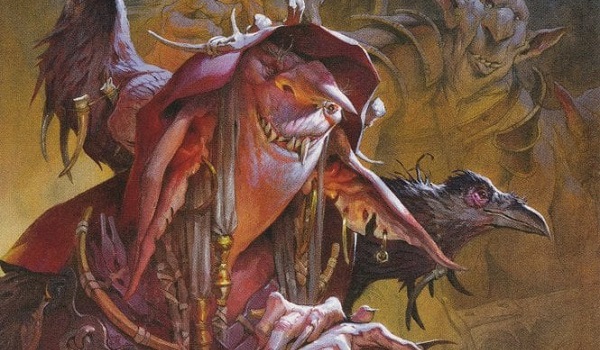
Over a year ago, I dug into Modern Goblins. Dominaria had just been released, and with it came Goblin Warchief and Skirk Prospector. It looked like a new era had dawned for the little red men. However, it wasn't meant to be. In my testing, whichever version of Goblins I tried proved anemic compared to alternative aggro decks. Goblins was very good at executing its gameplan, but it couldn't deal with disruption. It was mostly 1/1's and lacked card advantage, so any misstep spelled doom. I didn't see any future without Goblin Matron and Goblin Ringleader.

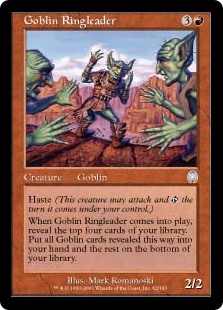
And then it happened. Modern Horizons brought not only Matron, but a replacement for Gempalm Incinerator in Munitions Expert. Then Core 2020 saw Ringleader reprinted. It looked like all the pieces now existed for a Goblins rebirth in Modern. Now, with months of testing under my belt, I can unveil my findings.

The Obvious Route: Pure Tribal

I started the same place I imagine everyone else did, with tribal Goblins. RB Goblin Bidding from Onslaught block is the deck most recent iterations aspire to, and with Goblins being one of Magic's original tribes, it just makes sense. The question is how to actually build the deck, and there's no single answer; it's extremely customizable. The core Goblins are Skirk Prospector, Mogg War Marshal, Goblin Matron, and Goblin Ringleader. Every other Goblin is negotiable depending on the metagame and what pilots wants from the deck. This does incentivize building a toolbox version, and my testing showed that it can be quite strong if the toolbox is built right.

That proved hard for me to consistently do, and given my existing bias towards aggro decks, I opted for a straight tribal aggro deck.

Tribal Goblins, Test Deck

Creatures

4 Skirk Prospector
3 Goblin Piledriver
4 Mogg War Marshal
4 Metallic Mimic
4 Munitions Expert
4 Goblin Matron
4 Goblin Chieftain
3 Sling-Gang Lieutenant
4 Goblin Ringleader

Artifacts

4 Aether Vial

Instants

2 Tarfire

Lands

4 Wooded Foothills
4 Bloodstained Mire
4 Cavern of Souls
4 Blood Crypt
4 Mountains

I borrowed the Tarfire from Legacy Goblins, and I ended up tutoring for it so much I put in an extra. There's a surprising amount of tension in building the deck because so many of the best cards cost three or greater. I'm running Goblin Chieftain in this version, but Goblin Chainwhirler, Goblin King, Goblin Warchief, and Goblin Rabblemaster are all valid additions. Were I feeling more adventurous I might run a mix, but I prioritized reliability over raw power.

It's often said that Goblins isn't an aggro deck. The creatures are lackluster on their own, and curving Goblin Piledriver into Goblin Warchief isn't so impressive anymore. Therefore, it's better to take a controlling role, making Goblins a board-control beatdown deck. This is true of most versions, but it doesn't have to be. My version is 100% an aggro deck with the option to sideboard into something more controlling. The truth is that Goblins can be made to fulfil whichever role it needs to in the situation.

The Multicolored Question

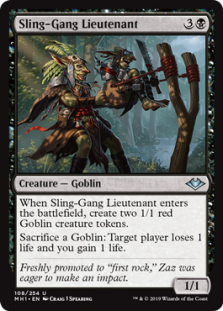
One note is that when going the tribal route Goblins really should be red-black. Sling-Gang Lieutenant is an excellent finisher and sometimes the only route to victory. But Munitions Expert is the real all-star of the deck, and I recommend a full set. Modern being Modern, creature decks are everywhere, and Expert is instant-speed removal that synergizes with the deck. What pushes it over the top is the ability to kill planeswalkers. War of the Spark is casting a very long shadow, and not having to attack walkers away is extremely valuable. I had some good times in testing killing Karn, the Great Creator in response to Mycosynth Lattice, then attacking for lethal. Being RB also means that Gobins can run Thoughtseize if necessary.
Control's Nightmare

As mentioned in my previous articles, Legacy Goblins is a nightmare for control decks, particularly straight UW. The traditional route to victory for control isn't to actually win the game, but to make opponents concede once all hope is lost. Between Matron, Ringleader, and token makers, it is almost impossible to adequately exhaust Goblins.
Cavern of Souls and Aether Vial moot a good chunk of control's best interaction. Stoneforge Mystic is trouble mostly because it's a 1/2 and thus blocks well, but the equipment isn't worrying thanks to the maindeckable Goblin Cratermaker and Goblin Trashmaster. Between Expert able to kill all control's win conditions and the sheer volume of cards Goblins can pull from, the matchup can be moved towards un-losable quite easily.

I found siding in Warren Weirding and Earwig Squad very effective for my deck, though it's not a strategy that works for every deck. Weirding's primary job is taking out the Baneslayer Angel's that control likes to bring in against creature decks, but in this deck it can also keep my board full when I'm throwing creatures away for damage. Squad exists to steal the few sweepers in UW, but can also take their win conditions in a pinch. This strategy works because I'm fully embracing being a go-wide aggro deck, and the slower toolbox builds can't throw away creatures as readily as I can.

Goblin's Nightmare

That said, I eventually abandoned tribal Goblins and started testing other decks. I had decent results, but never good enough to make me stay. A significant part of the problem is the metagame. The slower control decks that Goblins really beats on aren't an overwhelming metagame presence, and the overall picture hasn't been clear enough to metagame against. Goblins is a more like a creature-based control deck than a true beatdown deck, and that's a hard thing to make work in a shifting field.
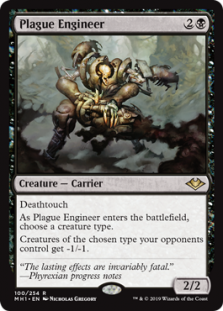
A far bigger problem for me was Jund. I could never find a reliable way to overcome the deck no matter how I tweaked Goblins, and the BGx stalwart is regaining popularity. Jund has always been solid against small creatures, but its fortunes improve further with access to Wrenn and Six. Worse, Plague Engineer is a card that kills almost everything in Goblins. The lords help some, but savvy Jund players prioritize removing those. In fact, Plague is such a house against Tribal Goblins that I found myself siding in more Tarfires, which are mediocre against Jund as a whole, and arguably a liability since they grow Tarmogoyf. However, I desperately needed reliable answers to Engineer, and Tarfire was better than anything else. Trying to sandbag around Engineer or go for critical-mass turns was also risky thanks to Jund's discard element.

Thanks to the volatile metagame and the apparently unwinnable Jund matchup, I shelved the deck. There's a lot of potential, especially for experienced toolbox tuners, but the inherent weakness to Engineer made me look elsewhere.

Throw Away the Key

The next place I went was to a prison version, similar to Legacy Goblin Prison. The conceit is to use the prison elements to make up for the inherent weakness of the creatures; locking the opponent out of the game long enough for your medium beats to steal the game. In theory, the plan is very solid, and the deck works better than I initially gave it credit.

Prison Goblins, Test Deck

Creatures

4 Goblin Rabblemaster
4 Skirk Prospector
4 Mogg War Marshal
4 Goblin Piledriver
4 Goblin Matron
4 Goblin Ringleader
2 Siege-Gang Commander

Artifacts

4 Chalice of the Void
4 Aether Vial
2 Trinisphere

Enchantments

4 Blood Moon

Lands

4 Cavern of Souls
4 Bloodstained Mire
4 Wooded Foothills
8 Mountain

Being a Blood Moon deck I had to cut the black, and so had to make do with the pricier Siege-Gang Commander. Rather than lords, I took a page from Mono-Red Prison and ran a full set of Rabblemaster, which is a very good clock when protected by Chalice. I speculatively went with Trinisphere as my last maindeck prison piece. I had begun work on this deck before Faithless Looting was banned, and Sphere was incredible back then. It still has its moments, especially when accelerated into, but I'm thinking maindeck Ensnaring Bridge is better now.

Solid Locks...
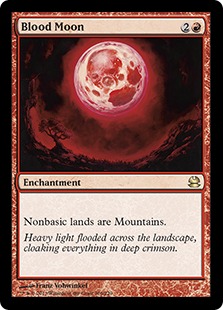
For my money, Blood Moon is highly underplayed. While it isn't very effective against Tron, there are vast swaths of the meta that behave like the card no longer exists. Jund, Humans, Death's Shadow, and Eldrazi decks are supremely vulnerable to the enchantment. Even decks with many basic lands like UW Control, Whirza, or Bant Blink heavily rely on their utility lands and fetchlands and can fail without them. In fact, I've found Blink decks to be so dependent on their fetchlands that they actually die to Moon.

...Weak Doors

The problem is that Modern Prison isn't as potent as Legacy prison. Chalice for 1 invalidates the typical Delver deck, but almost every deck relies heavily on Brainstorm and Ponder to function. Modern decks aren't so restricted on mana cost, and thus are far harder to actually lock out of the game. This means that prison cards may be irritating, but they're not an end by themselves. There's a reason Whirza is moving towards straight combo and Lantern Control isn't a deck anymore.

Still an Improvement

That being said, I liked this deck better than the typical mono-Red Prison deck. Those decks have a lot more lock pieces and interaction, and can frequently get them out turns 1-2. However, they also have to. Without a relevant lock piece on the board, Mono-Red Prison becomes a fairly clunky Mono-Red Control deck, and there's a reason Skred Red is a fringe strategy. I stress relevant because sometimes they go all-in on the wrong piece, like Blood Moon against a mono-colored deck or Ensnaring Bridge against Tron. The decks have the capacity to completely lock out other decks, but if they fail to do so, they're massive underdogs.
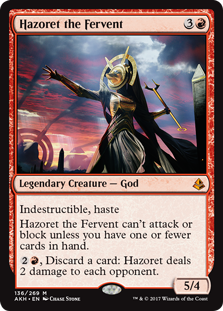
The other issue is the clock. Prison decks have some impressive threats like Hazoret the Fervent and Stormbreath Dragon, but there aren't many of them. It's not uncommon for the deck to use most of its opener pumping out a lock piece and then have to win with a single Chandra, Torch of Defiance and some lucky topdecks. If that one threat is answered, the opponent receives plenty of time to draw out of the prison. Modern isn't Legacy: Decks play more basic lands and a variety of mana costs.

The Goblins version is not as good a prison deck and can't always lock opponents out quickly enough. It also doesn't have to. Goblin Prison isn't exceptional at any one thing, but it is above average as a combined prison-and-beatdown, or stompy, deck. It doesn't have to worry as much about drawing the wrong half of its deck as Red Prison, nor mulligan as aggressively as Colorless Eldrazi. Both of its competitors have better best hands, but Goblins has slightly better average hands, and that's preferable for me.

This transforms it into something surprisingly effective. The creature beatdown plan is perfectly serviceable on its own. When executed in conjunction with the prison pieces it tends to play like a decent tempo deck. The Goblins easily flood the board and close the game while the opponent is working around a Chalice or restricted by Moon. There is increased risk of whiffing with Ringleader and sometimes you draw too many prison pieces and just die, but I'd play Goblin Prison over Mono-Red Prison any day.

Just Kill 'em

The other option is the combo route. I abandoned anything like Dirty Kitty early in testing. It was fun to run an odd Storm deck and confuse my opponents to no end, but even with Matron and Ringleader, the deck was never consistent enough to be worthwhile. Modern combo decks need to be far leaner and more efficient than Fecundity decks can possibly be. Going for Abzan Company-style Murderous Redcap combos proved more fruitful. However, there was a lot of tension in splashing green for Collected Company and Rhythm of the Wild. In the end, I decided that staying RB and using Metallic Mimic was just as effective.

Combo Goblins, Test Deck

Creatures

2 Pashalik Mons
4 Skirk Prospector
2 Goblin Piledriver
4 Mogg War Marshal
4 Metallic Mimic
4 Putrid Goblin
3 Munitions Expert
4 Goblin Matron
4 Goblin Warchief
3 Sling-Gang Lieutenant
4 Goblin Ringleader
2 Murderous Redcap

Lands

4 Wooded Foothills
4 Bloodstained Mire
4 Cavern of Souls
4 Blood Crypt
4 Mountains

This deck may look like the tribal deck, but it's actually home to a number of different combos. I have Goblin Warchief primarily as a cost reducer to make comboing off easier since the pieces are fairly expensive. In addition to Redcap, a sacrifice outlet, and Metallic Mimic, there's Putrid Goblin to feed Sling-Gang Lieutenant. Pashalik Mons is an alternative kill condition for any loop and a decent value play by himself.

Easy, But Hard
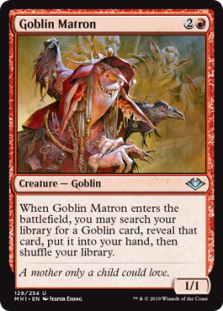
This was a very weird combo deck for me. It's almost alarmingly simple to find all the combo pieces, and often spares, thanks to Ringleader and Matron. Mimic is the sticking point, but Pashalik Mons alongside Lieutenant and Putrid Goblin frequently obviate the need for the full combo. Two damage triggers per sacrifice is very good, and given how often Goblins just floods the board, it has the same effect as the infinite combos. Multiple ways to achieve the combo combined with lots of ways to find the pieces meant that I could reliably get my pieces.

The problem was then getting them together on board. Without Vial, I was constantly choked on mana, and often Prospector couldn't make up the shortfall long enough to assemble the combo.

An Odd Hybrid

Ultimately, Combo Goblins didn't thrill me. It never felt necessary in light of Goblins' standard beatdown plan, which was still largely intact. In fact, it arguably hampered the beatdown strategy. I was tutoring to put the combo together rather than just killing my opponent by the shortest route possible, and while having something resistant to removal was sometimes nice, Putrid Goblin just didn't belong. I think Goblins is better off not trying for combo kills.

WAAAAAAAAGH

Were I to revisit Goblins in the future, I would definitely start with the combo version, but tune it in a beatdown direction. The Redcaps and combo aren't that impressive, but having the option to kill out of nowhere with Mons and Sling-Gang is too good to pass up. However, I'd need to see a large metagame shift to retake the plunge. Specifically, I'd need to see more control and non-Jund midrange than fast aggro or Whirza. Given how Modern is still catching up with everything that happened over the summer and a new set is coming out, Goblins will need to keep waiting.


Insider: How You’re Leaving Money on the Table

Are you a Quiet Speculation member?

If not, now is a perfect time to join up! Our powerful tools, breaking-news analysis, and exclusive Discord channel will make sure you stay up to date and ahead of the curve.

Hello! My name is Jeremy, and today we’re going to go over what you’re doing wrong when it comes to buying and selling cards. I’ve been fortunate enough to work with several gaming shops, vend events by myself at the booth, as well as dig for every last nickel over the past several years. I know QS readers expect value for their subscription, and these tips should help you monetize your side hustle a little more without leaving extra money on the table.

Common Mistake #1 - Stacks

If you’ve ever been to a Magic player’s house, the first thing you’ll notice when walking in is cards everywhere. On the kitchen counter, the table, or maybe stacked next to the computer that you the reader are currently sitting at right now. Since you’ve presumably paid to access this content, you need to also keep your cards sorted in a way that is also more premium than the average binder grinder selling cards.

The first thing you should do when branching out into buying and selling is to organize everything. It doesn’t matter if every card is alphabetical, or if it is sorted by color. Every single card that is for sale should be in some sort of pull system. I highly suggest taking a weekend watching your favorite show, sport, or podcast and start organizing the thousands of cards that are gathering dust. After doing this, you won’t have to waste time in the future looking for a card that you misplaced or selling something last minute to a desperate player on Facebook looking for his 75th FNM card.

There was an error retrieving a chart for Vizzerdrix

Another advantage of organizing your cards rather than stacks is being able to be the first one to buylist jank cards in your collection. Most people send their cards to Card Kingdom, but you can also sell bulk cards to Thomas Dodd’s Blueprint and get equal or higher numbers on a lot of stuff that Card Advantage can sell well. Selling bulk helps you in two ways: It clears up your small space where you sell cards and helps you maintain enough capital to play or buy more Magic. A lot of times, older established players will have a ton of nickels in their bulk boxes. By taking a couple hours a weekend, they could easily pay for a trip to a Grand Prix by digging these nuggets out and buylisting them.

While buylisting smaller cards, it is also relatively easy to check your higher-end cards. A lot of the time, the ION Scanner can show obscure cards that have a negative spread. By adding in higher-end cards with smaller spreads in an organized collection, you can essentially double-dip on the time you’re spending buylisting by easily accessing any profitable card in your collection at a relatively quick pace, rather than spending an entire day buylisting a couple hundred dollars worth of nickels.

Common Mistake #2 - Networking

Even if you the reader have never been to a MagicFest, it’s 2019 and we have a ton of data available at our fingertips nowadays. Most vendors post their hotlists online, such as 95MTG, before each Grand Prix. It is also possible to simply message the vendors ahead of time on social media and ask for a buylist before each event two days out.  Vendors want to buy these cards and will happily let you know what cards they are looking for before each show if you ask nicely.

By bringing or mailing cards to these vendors, you start to establish rapport and can help each other out. A vendor may be able to buy an obscure foil for you that you’ve let them know that you are interested in. They may even offer it at a discount in exchange for helping them out with acquiring cards for their hotlist, or for putting someone in touch with them to conduct business.

If you have never been to a Grand Prix, there are plenty of other ways of making money through networking. Quite a few vendors sell on social media via Facebook and Twitter. By staying in contact with these vendors, you can easily acquire hard to find cards for prices well below TCG Market. Another reason networking is useful is arbitrage. Many QS Insiders use the Discord to figure out arbitrage deals, where both parties are essentially guaranteed free money barring reprints or a banning.

There was an error retrieving a chart for Sol Ring

By reaching out to a party in Europe or Japan, you can easily save 30% on your Magic card expenses. Furthermore, you can even trade with these parties by shipping them cards that to them are cheap where you live. By establishing these relationships, not only do both parties profit but they help establish you as a person that can get any card as long as the buyer or seller is patient. For example, Sol Ring was for a very long time less than a dollar overseas, while $3 stateside.

It was very profitable to buy a large amount of Sol Rings from overseas and bring them to the states to flip for free money. As more people caught on, like anything in arbitrage, the price of Sol Ring internationally rose to where it is now. Currently, it is far less easy to make money on Sol Ring unless you are a vendor or high-profile seller.

Networking is also essential for capital investment. A lot of readers have messaged me in the past saying that their friend or whoever has a collection that they would like to sell, but that they themselves cannot afford to buy and flip the collection. Many vendors will give a kickback or referral if you pass that business along to them, as they can afford to buy some of the higher-end collections out there. I personally spent much of 2018 flying around the world buying Reserved List collections as prices reached the stratosphere, and it was beneficial to both myself and the person that recommended the collection to me.

By networking, you can help spread the image that you can buy any sized collection locally which establishes yourself as a trustworthy individual that is worth bringing their business to.

Common Mistake #3 - Becoming attached to your cards

If you are selling cards, you should have a clear distinction between your personal collection, and cards that you are selling. Over time, a lot of vendors start to build decks with cards they have acquired. If the purpose of using #mtgfinance is to make playing the game cheaper, then this is a sound move. However, many insiders also sell cards to try and actually profit off of the game. In this case, you should never move cards from your buys into your personal decks, unless you are selling the card to yourself.

It is always a slippery slope to take a card that you have bought to flip and move it into your own deck. Over time, you will start to reason with yourself more and more that you only paid X for a card, so it won’t be a problem. Costs like these add up. With a potential recession on the horizon, you are only hamstringing your capital that you could potentially have to scoop up collections when someone casts Armageddon on the stock market.

There was an error retrieving a chart for Jace, the Mind Sculptor

Another reason that you shouldn’t be attached to your cards is knowing when to let them go. Say you got a great deal on a foil Jace, the Mind Sculptor from Worldwake. Over time, this card has slowly trickled down as demand has shifted to both cheaper foil Masters set copies and a premium box edition as well. If you had bought a foil Jace from Worldwake for $400 a couple years ago, you’d be barely breaking even nowadays selling the card if you had held onto it.

If you are buying and selling cards for a profit, you should always flip those cards as fast as possible. A successful business can be a business that has low volume and high-profit margins, but the best businesses are the ones that have high inventory turnover and low margins, not unlike Amazon. By selling cards faster and recouping your income, you'll care less about the overall day-to-day of Magic and more about simply making 10-20% on each card that passes through your fingers. It may be more work, but it looks better for your online seller portal metrics as well as the number of customers that you can reach.

Wrapping Up

Hopefully, these three easy tips can help you to maximize your returns in order to play the game cheaper or make a little money on the side. Magic Finance is a complex issue with many different ways to maximize your return on the game. However, these general tips should help any reader better approach whichever avenue of finance you decide to follow. Smart practices lead to even smarter returns! If you have any questions, you can always reach out to me on Twitter @MissouriMTG.

ABUGames Arbitrage: Two Follow-up Questions

Are you a Quiet Speculation member?

If not, now is a perfect time to join up! Our powerful tools, breaking-news analysis, and exclusive Discord channel will make sure you stay up to date and ahead of the curve.

My transparent ABUGames arbitrage article received a lot of positive feedback—thanks to all my readers who took the time to share their thoughts and reactions!

Among the responses, I received two questions that I felt I could not answer satisfactorily through social media. Therefore, I decided to address both legitimate concerns in a follow-up article. These responses will likely benefit many folks beyond just those who asked the questions. Besides, I think both involve a reality check that will be helpful for the MTG finance community to digest.

Question 1: Shipping Costs and Optimization

In last week’s article, I talked about how I purchase cards from Card Kingdom and other websites with the intent of flipping said cards for roughly 2x the store credit from ABUGames. I spend this store credit on cards that I can sell for cash, and the difference between my purchase and my sales would become profit.

This is true, except I glossed over one important factor: shipping costs. This practice incurs a significant amount of shipping expenses, and they tend to add up without realizing. I’m going to break things down step-by-step, and share a few tips on how to minimize shipping costs along the way.

First, there may be shipping costs when purchasing cards. Fortunately, these are easy to dodge because many vendors offer free shipping on singles above a certain threshold. I don’t think I’ve paid shipping to Card Kingdom or Channel Fireball in many months, as their threshold is so reasonable ($25 and $50, respectively). These are often my go-to places to acquire cards for this arbitrage game, especially when pursuing more costly Old School cards.

There was an error retrieving a chart for Scrubland

As for other sources like TCGPlayer, eBay and Facebook, I always factor shipping costs into my purchase prices. Sometimes sellers don’t charge shipping on these platforms, and that always helps. Otherwise, when I talk about converting cash into 2x credit at ABUGames, that cash purchase includes any shipping costs. More recently, sales tax also needs to be factored into the equation. If your conversion from cash to credit isn’t in the 2x range after these expenses, then the arbitrage endeavor isn’t worthwhile—look elsewhere.

Second, there is a shipping cost incurred when mailing cards to ABUGames’ buylist. This expense is unavoidable, but it can be minimized. Buying shipping supplies in bulk is a great way to cut down on the cost of shipping supplies—my bubble mailers cost me about $0.20, and this number can be driven even lower if you’re willing to purchase 500 envelopes at once.

The other way to cut down on shipping costs is to leverage PayPal’s USPS shipping label service. This service will net you discounts on your postage, while also saving you trips to the Post Office.

From here, the only way to minimize the hurt of shipping costs is to make larger buylists—keeping buylist orders over ~$300 ensures the impact of shipping is less than 1%.

Third, there are shipping expenses when cashing store credit out of ABUGames. There is no longer a threshold that nets you free shipping. At one point, I was getting free shipping from ABUGames on all orders above $150, and free FedEx shipping when purchases were even larger. I have a feeling ABUGames had to abandon this promotion when they implemented their inflated credit strategy. Otherwise, they would have to ship way too many orders at their own expense.

Now the only way to minimize the impact of this shipping charge is to make larger purchases with trade credit. Fortunately, no matter how large a purchase is, the USPS option is always available for $4.12. I’ve placed four-figure orders before and selected the first-class option—ABUGames still ships via FedEx, but they pay the difference.

I suppose this is still a promotional benefit, though now the threshold to obtain this benefit is not advertised. Therefore, there’s no reason to pick anything other than USPS-First as your shipping option. When you purchase with trade credit that you obtained at fifty cents on the dollar, you’re essentially paying just $2.06 for shipping, which isn’t too prohibitive.

The fourth and final shipping expense involves the selling of cards obtained from ABUGames with trade credit. To keep these costs down, follow the same strategy as step 2—purchase shipping supplies in bulk and use PayPal shipping for discounts. Finding higher dollar cards to buy with trade credit will help here, because it means fewer packages you'll have to ship when you sell those cards.

There was an error retrieving a chart for Mox Opal

In total, you can see how these shipping costs can quickly eat into margins. That’s why transactions have to be relatively large, ABU credit needs to be spent very strategically, and at the end of the day margins can be razor-thin. Most recently, I’ve been primarily using this credit strategy to unload illiquid Old School cards. I would not advocate pursuing this strategy with cards that have robust demand from Standard, Modern, and Commander unless the numbers you’re getting in trade credit are more than 2x your cash price.

Speaking of Razor Thin Margins…

The second question I received about last week’s article came from another active member of the MTG finance community. They were inquiring about the value I place on my time. After reading last week’s column and the above section on shipping, one can quickly get the idea that margins from this arbitrage pursuit are very thin. Is it really worth the time?

Rather than get into economic and philosophical debate, I’ll boil this down into something fully transparent at the risk of coming across overly simplistic: This is how I engage in the Magic hobby nowadays, and I enjoy doing it. Because I do this for entertainment, I don’t consider value of time in the equation.

There was an error retrieving a chart for Tithe

Some people spend hours a week playing casual games of Magic. Some go to FNM every week to scrub out of a Standard event. Others play Commander every weekend with their friends. I wouldn’t question how these people value their time as they engage in gameplay.

Because I don’t have the opportunity to play Magic for fun anymore, I have found a different way to remain engaged and interested in the hobby. Credit arbitrage still enables me to “trade” cards, build up my collection, and interact with others in the community. It has become my replacement for gameplay.

I don’t consider time-value while I read a book for pleasure, or attend a sporting event, or bowling with my friends, simply because I enjoy these hobbies.

There was an error retrieving a chart for Jayemdae Tome

I also genuinely enjoy credit arbitrage to ABUGames. If money was my primary motivator, then pursuing a part-time job would be far more productive. But money is only a secondary motivator here (plus it helps that I can do it on my own time from the comfort of my home). Engagement with community and finding deals for everyone, myself included, are the primary motivators. Profit is an added bonus that I'm using to gradually fund my kids' college funds.

For that reason, the value of my time isn’t a part of the equation.

If you’re interested in pursuing this credit arbitrage, you need to be in the same mental place. Time has no value because this is a pursuit of passion and enjoyment. You may be able to grind out profits with large enough purchases, but if you’re number one goal is to make money there are far more efficient ways of doing so that don’t involve Magic. Rather than ignore this truth, I encourage folks to embrace this reality and enjoy the fact that this hobby can be enjoyed while also making a few bucks. Most hobbies are purely cost sinks!

Wrapping It Up

I always appreciate feedback on my weekly column. I used to have to skim through comments on my articles, replying there in the hopes that folks will see what I have written in reply. Nowadays things are more direct—comments can be sent to me directly on social media (Twitter) or within the QS Insider Discord.

On Twitter, I’ll do my best to reply with the given allotment of characters. With the Insider Discord, I’m able to get into a much deeper discussion and answer questions more thoroughly. And in rare cases, your questions and comments trigger ideas for whole new articles!

This is precisely what happened this time around. Questions about shipping costs and the value of time are connected, in a way, as they both involve profit margins. The former has to do with how to maximize margins, while the latter considers the hourly rate at which these margins are obtained. Hopefully I’ve done a thorough enough job explaining where I’m at on each.

Lastly, I’ll reiterate this as bluntly as I can: If money is your motivator, stop wasting your time on Magic finance! Other than the Old School boom from the last couple years, I make far more money on an hourly basis writing these articles than I do on flipping Magic cards. MTG finance is a hobby of mine, first. I do hope to use this hobby to help fund my kids’ college costs. But if it was solely a money-driven interest, I would have applied for a part-time job as an Uber driver a long time ago.

…

Sigbits

  • Old School prices have gotten really soft lately, but they aren’t exactly collapsing. Every once in awhile, Card Kingdom sells some copies of a given card, and it returns to their hotlist. This week I noticed Eureka return, with a $200 buy price.
  • Another returner to Card Kingdom’s hotlist is Beta Lightning Bolt. They currently pay $180 for near mint copies. This sounds impressive, until you look at ABUGames’ buy price. They offer $280 cash for near mint copies—a full $100 more than Card Kingdom! ABUGames also offers $642 in-store credit, which could easily be converted to over $300 using my credit arbitrage strategy. It’s no wonder Card Kingdom remains out of stock on this card!
  • Stoneforge Mystic’s unbanning in Modern has certainly made waves in the singles market. Sword of Fire and Ice remains one of the big winners from the move by Wizards. Card Kingdom has Modern Masters and Darksteel printings on their hotlist for $65 and $59, respectively.

September Brew Report, Pt. 1: Reading the Runes

Are you a Quiet Speculation member?

If not, now is a perfect time to join up! Our powerful tools, breaking-news analysis, and exclusive Discord channel will make sure you stay up to date and ahead of the curve.

A lot has happened since my last Brew Report back in August. So much, in fact, that I didn't even get to write a Part 2! This month, I'd like to rectify that hiccup with two juicy metagame reports, as always focusing on the countless innovating decklists published by Wizards every few weeks. Today, we'll consider whether Modern standbys have adapted to the new format and how things are shaking out for tribal aggro.

Modern Vets Step It Up

We'll start with the old faithfuls. These decks have existed in Modern for some time already, but not like this. Recent developments among winning builds earn them a closer look.

Mardu Shadow, by VOLOLLO (1st, Modern PTQ #11965105)

Creatures

4 Death's Shadow
4 Giver of Runes
1 Hex Parasite
4 Tidehollow Sculler
4 Ranger-Captain of Eos
4 Street Wraith

Instants

4 Fatal Push
2 Kolaghan's Command
2 Lightning Bolt
2 Temur Battle Rage

Sorceries

3 Inquisition of Kozilek
4 Thoughtseize
2 Unearth

Lands

2 Arid Mesa
2 Blood Crypt
4 Marsh Flats
3 Bloodstained Mire
2 Godless Shrine
1 Sacred Foundry
4 Silent Clearing
1 Plains
1 Swamp

Sideboard

1 Ashiok, Dream Render
1 Celestial Purge
1 Collective Brutality
3 Fulminator Mage
1 Kaya's Guile
1 Liliana of the Veil
1 Liliana, the Last Hope
1 Lingering Souls
1 Path to Exile
1 Pithing Needle
1 Plague Engineer
2 Wear // Tear

Mardu Shadow emerged unscathed from the bans, but seems to be adjusting nonetheless. While Shadow is traditionally a threat-light archetype, VOLOLLO's 1st-place PTQ list invites plenty of critters into the fray. Hex Parasite has been played as a planeswalker-sniping bullet ever since Ranger-Captain of Eos jettisoned Mardu Shadow to Modern relevance. The same can't be said for Tidehollow Sculler, a Thoughtseize on legs that lets the deck run more than eight targeted discard effects, or Giver of Runes, the Horizons update to Mother of Runes that's found itself everywhere from Company to Infect.

Giver specifically is hugely interesting for Shadow. Many decks struggle against protection effects, as we're now discovering with the elemental Swords back in the picture. Giver not only draws removal away from Shadow, but clears a path, preventing enemy blocks and allowing the massive Avatar to crash in for heaps of damage. Searching up additional copies of Giver is as easy as targeting Ranger-Captain with Unearth, so if pilots are clogging on Shadows, those Ranger-Captains still generate terrific value plays.

Vengevine, by DARTHNIUS (10th, Modern PTQ #11965105)

Creatures

4 Stitcher's Supplier
2 Bloodghast
3 Carrion Feeder
4 Gravecrawler
4 Hedron Crab
4 Narcomoeba
4 Prized Amalgam
4 Vengevine

Sorceries

4 Creeping Chill
4 Glimpse the Unthinkable
3 Memory Sluice

Lands

4 Bloodstained Mire
3 Marsh Flats
3 Overgrown Tomb
4 Polluted Delta
2 Swamp
4 Watery Grave

Sideboard

2 Assassin's Trophy
1 Damping Sphere
4 Fatal Push
4 Force of Negation
1 Gnaw to the Bone
1 Leyline of the Void
2 Thoughtseize

Who said Vengevine was dead? Well, a lot of folks, and they weren't totally wrong; the deck isn't about to return to its former glory without Hogaak, Arisen Necropolis. But even with Faithless Looting and Bridge from Below also banned, the deck is proving to have some legs after all, with this version placing 10th in the same PTQ.

Vengevine's new incarnation combines multiple enabling engines with Stitcher's Supplier, here trending away from the pricey Satyr Wayfinder and towards Hedron Crab. Crab mills more, and faster; while Wayfinder provided Hogaak with explosive starts by also tapping for the 8/8, Crab gives the deck more of a turn two or three. Another blue one-drop, Memory Sluice, contributes to the count by milling four right off the bat, Ă  la Wayfinder. The difference is Sluice can be copied by tapping controlled creatures, making it mill a potential eight cards. Rounding things out is Glimpse the Unthinkable, a no-nonsense mill-10.
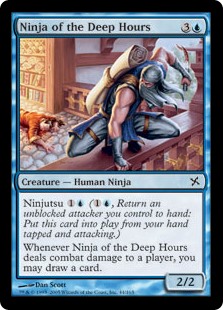
The win conditions also get an overhaul, with Prized Amalgam joining Vengevine's usual supporting cast. Amalgam's an all-star in Dredge, and here has little synergy with the deck's namesake card; it's kind of a Vengevine-light, rewarding pilots for animating creatures, but more slowly and with lax requirements.

This deck looks to me like a hodgepodge of apparently relevant cards, so I'd be surprised to see it continue putting up numbers. New strategies often demand a certain grace period from the metagame before players realize how to beat them. But it has some things going on that I like; milling out opponents seems like a reasonable Plan B depending on the matchup, and having access to Force of Negation from the sideboard is also big game.

UR Phoenix, by ASPIRINGSPIKE (5-0)

Creatures

4 Arclight Phoenix
4 Thing in the Ice

Enchantments

3 Aria of Flame

Instants

3 Force of Negation
4 Izzet Charm
1 Lightning Axe
4 Lightning Bolt
1 Magmatic Sinkhole
4 Manamorphose
4 Thought Scour

Sorceries

2 Chart a Course
4 Serum Visions
4 Sleight of Hand

Lands

2 Fiery Islet
3 Flooded Strand
3 Island
1 Mountain
2 Scalding Tarn
4 Spirebluff Canal
3 Steam Vents

Sideboard

1 Abrade
2 Alpine Moon
2 Anger of the Gods
3 Dragon's Claw
2 Narset, Parter of Veils
1 Shenanigans
2 Spell Pierce
2 Surgical Extraction

UR Phoenix was perhaps last metagame's most controversial deck. A poster-child for Looting abuse and velocity strategies in general, Phoenix was the best deck in the room at most tournaments, but never put up numbers the likes of Hogaak. As such, the Modern population seemed divided about whether the deck was too strong. In any case, it's come down some without Looting around; the above build isn't from the PTQ, but a regular ol' Competitive League, and it's the only Phoenix deck I could find.

Still, the strategy looks fine on paper, with Izzet Charm replacing Looting as a much slower, but also more flexible, Swiss army knife. Chart a Course also rears its head as a discard outlet for Phoenix that can put players up on cards should the matchup call for it. I think Phoenix's glory days are firmly behind us, but am pleased the deck can remain a valid low-tier option.

One with the Tribe

The month also brought its fair share of tribal strategies.

Elementals, by WHITNEN (5-0)

Creatures

4 Flamekin Harbinger
3 Flickerwisp
4 Lightning Skelemental
1 Omnath, Locus of the Roil
4 Phantasmal Image
4 Risen Reef
4 Thunderkin Awakener
4 Unsettled Mariner
4 Vesperlark
4 Voice of Resurgence

Artifacts

4 Aether Vial

Lands

4 Ancient Ziggurat
4 Cavern of Souls
1 Mountain
1 Plains
4 Primal Beyond
2 Reflecting Pool
4 Unclaimed Territory

Sideboard

2 Dismember
4 Fulminator Mage
2 Healer of the Glade
1 Ingot Chewer
4 Leyline of the Void
1 Shriekmaw
1 Wispmare

Elementals isn't a deck totally new to this column. Last month, I covered a similar Elementals deck, with Aether Vial and all. But it didn't look, or feel, serious. Now, the deck has changed a bit: Unsettled Mariner disrupts opponents; Phantasmal Image copies the best Elementals; Smokebraider gets the axe for being way too inefficient. And this new build is all over MODO, grabbing 5-0s in most dumps and even placing 10th in a Modern Challenge. It would appear the value Risen Reef once promised indeed exists in spades.

4-Color Ninjas, by VINNIED (5-0)

Creatures

3 Fallen Shinobi
4 Ice-Fang Coatl
1 Jace, Vryn's Prodigy
2 Scavenging Ooze
3 Spell Queller
4 Tarmogoyf

Planeswalkers

1 Jace, the Mind Sculptor
3 Teferi, Time Raveler

Artifacts

3 Arcum's Astrolabe

Instants

1 Abrupt Decay
1 Assassin's Trophy
3 Fatal Push
2 Path to Exile

Sorceries

4 Inquisition of Kozilek
1 Lingering Souls
2 Thoughtseize

Lands

1 Celestial Colonnade
1 Godless Shrine
4 Misty Rainforest
1 Overgrown Tomb
4 Polluted Delta
2 Snow-Covered Forest
1 Snow-Covered Island
1 Snow-Covered Plains
2 Snow-Covered Swamp
1 Temple Garden
3 Verdant Catacombs
1 Watery Grave

Sideboard

1 Lingering Souls
1 Path to Exile
2 Ashiok, Dream Render
1 Kaya's Guile
3 Nihil Spellbomb
1 Obstinate Baloth
3 Stony Silence
1 Tireless Tracker
2 Unmoored Ego

Okay, so there's only one actual Ninja in 4-Color Ninjas. But it's all the Ninja this deck will ever need. Fallen Shinobi apparently helms plenty of midrange decks these days, all thanks to easy-bounce creatures and Teferi, Time Raveler. My own experiments with ninjutsu proved fruitless, but that was before we could easily lock opponents out of interacting on our turn; with that landmine dodged, the deck can be stuffed full of high-impact disruption.
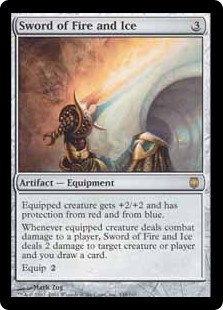
As for Shinobi's effect, it's certainly better than that of Ninja of the Deep Hours. Casting the cards for free means heaps of tempo, helping recoup Shinobi's hefty four-mana price tag. Its relevance varies depending on the opponent, but against high-curve decks like Tron, one hit from the Ninja can spell game over.

Holding everything together is Arcum's Astrolabe, which filters mana and turns on Ice-Fang Coatl. Astrolabe is behind many multicolor control-style decks these days and is proving to be one of the most critical cards from Modern Horizons.

UW Faeries, by WAFFLER (5-0)

Creatures

3 Faerie Seer
4 Giver of Runes
4 Spellstutter Sprite
4 Stoneforge Mystic
4 Unsettled Mariner
2 Deputy of Detention
1 Nimble Obstructionist
4 Spell Queller
2 Thalia, Guardian of Thraben
1 Vendilion Clique

Artifacts

4 Aether Vial
1 Batterskull
1 Sword of Fire and Ice

Instants

3 Path to Exile

Lands

3 Flooded Strand
3 Hallowed Fountain
3 Horizon Canopy
2 Island
1 Moorland Haunt
1 Mutavault
3 Plains
4 Seachrome Coast
1 Waterlogged Grove
1 Windswept Heath

Sideboard

1 Deputy of Detention
2 Nimble Obstructionist
1 Burrenton Forge-Tender
1 Ceremonious Rejection
2 Damping Sphere
1 Disdainful Stroke
2 Disenchant
1 Geist of Saint Traft
2 Negate
2 Stony Silence

UW Faeries doesn't exactly epitomize what we've come to expect from the tribe. It's more of a straight-up fish deck than a control deck, even wielding Giver of Runes and the ground-pounding Unsettled Mariner among its hefty creature suite. Stoneforge Mystic gives UW an oomph play on the level of Bitterblossom, or perhaps more impactful; not only does the deck then gain points against anyone hurting in the face of a Batterskull, the many cheap fliers carry Sword of Fire and Ice exceptionally well. Spell Queller is another goodstuff creature with no tribal affiliation, but plenty of strategic relevance to the deck's gameplan.

Cooling Down

Temperatures may be dropping outside, but things are heating up for Modern. Between the new bannings, the fresh format, and Throne of Eldraine just a couple weeks away, who knows what the future holds? Just September was full enough of surprises that we'll look at the rest of the new decks next Friday. Until then, bundle up!

Happy Endings for Throne of Eldraine Spoilers

Are you a Quiet Speculation member?

If not, now is a perfect time to join up! Our powerful tools, breaking-news analysis, and exclusive Discord channel will make sure you stay up to date and ahead of the curve.

All good stories must come to an end. Hopefully, they'll be paced better than Game of Thrones's was. The Throne of Eldraine prerelease is this weekend and the spoiler is finished, so it's time to wrap up my set review. There haven't been many interesting individual cards spoiled since my last article, but a number of minor themes have gotten cards. Today we'll examine some of these themes for potential viability.

Artificer's Enchanted

Food hasn't really panned out as Modern playable. I was somewhat skeptical that it could in the first place, given its power compared to clue tokens. There isn't an efficient way to continuously generate them, and the payoffs don't payoff enough. Witch's Oven is good at making tokens, but there are better ways to sacrifice creatures and better effects for doing so. If Feasting Troll King made tokens whenever it entered the battlefield, it would also be playable. Having to cast it means that won't happen. Savvy Hunter remains the best food producer and consumer, but she's too much worse than Tireless Tracker to earn a place.

However, that's not all there is to Eldraine's artifacts. There is a minor artifact and enchantment theme running through the set (which is very appropriate) and some of those cards may make it. I've already covered the flagship card Emry, Lurker of the Loch, but there's another card that may revive a dead archetype. And a sting of others that are traps.

They're Alive!

I can't decide if Dance of the Manse is a reference to Sword in the Stone or Beauty and the Beast. I'm picking Sword since it's the less popular movie. Dance harkens back to Eggs, and could potentially revive the archetype. The front side is considerably worse than Open the Vaults or Faith's Reward, but the upside is that Dance is also such a deck's win condition, which potentially increases the combo's consistency and frees up deck space. Considering that there's now an actual Golden Egg, it seems like an Eggs deck could exist in Modern again.

However, it remains a long shot. The cheap enablers, card drawing, and recursion are all there and have proven power, but there's no engine; Eggs continues to lack a sacrifice outlet or mana generator within sight of the banned Krak-Clan Ironworks, which has always been the key card for the strategy. Lacking that card, it is very hard to generate the mana or critical mass of in-grave artifacts to make such a combo work. The best I've come up with is to continuously cycle Terrarion and other eggs, spinning the wheels and hoping to just keep cantripping into a lethal Grapeshot. The deck tested worse than Storm.
Nonetheless, I'm not willing to give up on the idea. The core of the deck is strong enough that it may be worth stretching to find the mana to make it work. Urza lands are the best option for making mana for artifacts, but there's nothing to keep the mana flowing during a combo turn. Wizards has been leery of mass land untapping since Candelabra of Tawnos. The best option I could find is Early Harvest, which could only generate the necessary mana alongside Heartbeat of Spring, and at that point the combo looses its artifact identity. Paradox Engine alongside signets and Mystic Forge can generate the mana and velocity, but they can't get the critical mass of artifacts into the graveyard for Dance to animate. There wasn't enough deck space. I feel like the deck is within my grasp but not my sight. Here's how far I've gotten:

Dancing Eggs, Test Deck

Artifacts

3 Paradox Engine
4 Mox Opal
4 Chromatic Star
4 Chromatic Sphere
4 Golden Egg
3 Azorius Signet
3 Selesnya Signet
3 Simic Signet
3 Mind Stone
3 Mystic Forge

Sorceries

4 Ancient Stirrings
4 Dance of the Manse

Lands

4 Urza's Tower
4 Urza's Mine
4 Urza's Power Plant
4 Breeding Pool
2 Temple Garden

When I've gotten perfect hands, the deck has gone off on turn three. The problem then is that the combo then wins the next turn. Playing a longer game lets you slowly build up artifacts and "Dance off" naturally, but that's not a winning strategy against aggro decks. The problem might be that Dance just isn't the right win condition, but it feels so close that I won't give up yet.

Crown Jewels

The other big artifacts are the cycle of story-relevant legends. I've covered Embercleave already, and its playability hinges entirely on Stoneforge Mystic. The Circle of Loyalty is also plausible in the unlikely event knight tribal is playable. Anthem effects are always decent, but Circle would be particularly good because it makes more Knights, and in several ways. However, the remaining three are traps to avoid.
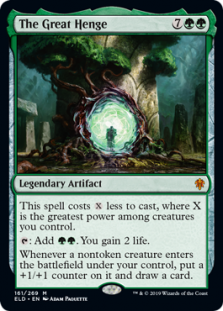
It's not that their effects aren't powerful or desirable. The problem lies in the setup. All these cards are too expensive alone, and need their cost reduction online to be playable. The Magic Mirror and The Cauldron of Eternity are easiest to enable, since blue and black are the colors of self-mill. With Thought Scour or dredge, it's not that hard to fill a graveyard by turn three. It's not a guarantee given that lands could be the only hits, but it's highly plausible.

But why would you want to spend a turn and play either spell? Cauldron fits into Dredge's strategy of dumping creatures into the graveyard, but the relevant creatures are already getting reanimated, and Dredge doesn't want to put them back into the deck. Mirror does nothing the turn it comes down and is slow to get going, which is not what velocity decks want. Control wants a steady stream of cards and is willing to wait, but it could also just play Teferi, Hero of Dominaria or Jace, the Mind Sculptor to accomplish that task and more. I can't see why any deck that could enable these cards would want to.
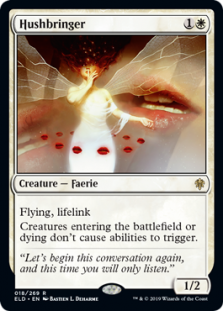
If The Great Henge counted total power among controlled creatures, it could be a bomb for Elves. It still may be if a very combo oriented version comes along that needs pump effects and velocity. As-is, the abilities tend to come online after they're relevant. Getting out a 7/x creature early is hard. The deck that's best at it is Death's Shadow, and it doesn't want to be gaining life when it taps Henge for mana. Additionally, no version plays that many creatures, so once Henge is out the second ability is pretty weak. Other decks don't have the means to drastically reduce the price without using up all their cards, so I don't see much use for Henge in Modern.

The Fair Folk

The other big disappointment goes to Faeries. There just isn't anything that will help UB Faeries recapture its glory days. Brazen Borrower, Hypnotic Sprite, and Stolen by the Fae are close, but slightly too costly and narrow. I imagine that this was intentional. Given how long Bitterblossom was banned in Modern, Wizards is still very cautious not to print pushed Faeries. The enthusiasts apparently still have to pay for their dominance all those years ago.

The Quiet One

Adding insult to poverty, the best faerie in the set is completely at odds with the Lorwyn-introduced Faerie strategy. When first spoiled, I thought Hushbringer's art was a placeholder. I thought it might be an unused design from Pan's Labyinth. Or from anything by David Cronenberg. However, once past the creep factor, this is an upgraded Hushwing Gryff, and a promising sideboard card.

Gryff has never had an impact in Modern. Torpor Orb sees a little play as a Whir of Invention target, but giving it wings didn't make it more playable. The increased vulnerability of creatures is a factor, but the the primary problem is that Gryff is a creature. Creature decks are frequently packed with abilities Gryff shuts down, so it's risky to run Gryff even if their opponent may be hurt more. Control decks generally want the harder-hitting and more versatile Vendilion Clique as a three-mana flier. If they really need the effect, they can just run the Orb. Tocatli Honor Guard is another option, but a 1/3 ground creature needs to be phenomenal to see play.
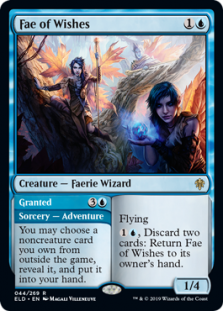
Hushbringer is better than Gryff. 1/2 looks worse than 2/1 on paper, but Modern has a lot of Wrenn and Six running around. Hushbringer also gets extra text. Lifelink on a 1/2 may not do much, but against Burn, a few points is all it takes. The Faerie also stops death triggers unlike Gryff and Orb. While a nice addition, I can't think of much utility for that ability. Most creature death abilities are activated, leaving persist and Protean Hulk. The real kicker is that Hushbringer is two mana. Gryff is too slow at three to really stop Humans or Bant Blink.

Silent Resurgence

With all that said, Hushbringer still doesn't really have a home. Every white deck is packed with ETB abilities. They're not going to run a card that shuts their own deck down this effectively. Humans is pathetic when Thalia's Lieutenant is just a 1/1, or Kitesail Freebooter a 1/2 flier. It should be noted that Meddling Mageand Phantasmal Image aren't affected because they're "as this enters" and not "when this enters" abilities, which Orb, Gryff, and Bringer don't affect. Given the power of creatures with ETB abilities and the number of decks that rely on them (Bant Ephemerate being the most egregious), I can't imagine many creature decks using Hushbringer.

However, the effect is so powerful at two mana that I wouldn't write Hushbringer off. Again, she neuters Humans, Spirits, and Faeries to a lesser extent, and cripples Bant Ephemerate. Sword of the Meek, Stoneforge Mystic, and Urza, Lord High Artificer are also affected. This is too much of the metagame for Hushbringer not to see play. The only deck that could really benefit from the effect is UW Control, which doesn't have great matchups against any of these decks, doesn't play many creatures, and has lost metagame share to Stoneblade variants. Given that Burn is also a deck, I could see Hushbringer making it in control's maindeck.

Hushbringer Control, Test Deck

Creatures

2 Snapcaster Mage
4 Hushbringer

Planeswalkers

2 Narset, Parter of Veils
3 Teferi, Time Raveler
3 Jace, the Mind Sculptor

Instants

4 Opt
4 Path to Exile
2 Spell Snare
3 Logic Knot
2 Force of Negation
3 Cryptic Command

Sorceries

2 Oust
2 Supreme Verdict

Lands

4 Flooded Strand
4 Celestial Colonnade
4 Field of Ruin
4 Hallowed Fountain
6 Island
2 Plains

Whether that deck would actually be better in the metagame than Stoneblade is uncertain, but I imagine it would have a significant advantage against Stoneblade. Their Squire-with-upside is just Squire against the flying squire with upside, and given the rest of the card advantage, should be enough to overwhelm Stoneblade.

Trickster Faerie

The other playable faerie has an obvious use, though I'm not sure it's so useful. Fae of Wishes is another adventure creature where the appeal is (mostly) the attached sorcery, Granted. This is the third wish in Modern, and on face, it's not particularly playable. Mastermind's Acquisition already exists, and while slightly harder to cast, it also finds creatures. Looking across Magic, only the cheap wishes have seen consistent play. Especially difficult for Fae is that at the same price, blue combo runs Gifts Ungiven. Gifts will be more powerful more of the time due to Past in Flames and finding multiple cards.
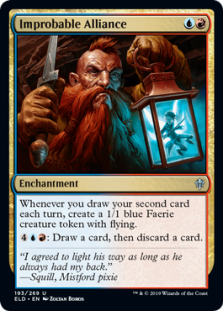
What makes Granted more appealing is that it can be repeated, although not for cheap; you could Gifts three times for the price of two wishes. However, this repeatability opens up a new angle for combo decks. Rather than looking at Fae as a slow Cunning Wish, think of it as a value engine. Combo decks generally don't sideboard heavily, especially tight combos like Storm. Fae of Wishes gives Storm the option to fill the sideboard with wish targets, never actually sideboard, and still have post-board angles covered. They'd also be able to wish for missing pieces of the combo. Flexibility is rare for combo, and there's a lot of potential of a stream of value wishes. It's just a question of if the time it takes to make it work is a dealbreaker.

Engines of Discovery

The final topic is a theme that Wizards has been quietly sneaking into blue and red for the past several sets. They're trying to make drawing cards that trigger off drawing multiple cards in a turn important. There have been a few cards here and there as Wizards tests the waters, and they're finally taking the plunge in Eldraine. The previous iterations have been Limited-only, and the new cards aren't busted on their own. However, they could be exceptional in the right deck.

The Odd Couple

Specifically, Improbable Alliance has the potential to be better than Bitterblossom. However, Blossom just sits there generating tokens where Alliance requires you to draw two cards a turn. No more: it only triggers for the second card. Thus, Alliance is no Young Pyromancer. However, flying Faeries are better than walking Elementals, and two bodies per turn cycle beats Blossom's one for a life. Alliance will also never be a liability against Burn.

Eldraine seems intent on making Alliance work. The Royal Scions naturally curve out from Alliance and ensure a steady stream of Faeries.

There's also the strict upgrade to Tormenting Voice, Thrill of Discovery, which seems specifically designed to get a second trigger from Alliance. Given that Modern also has Thought Scour, Opt, and Think Twice, it shouldn't be that hard to get two tokens per turn cycle and slowly bury the opponent.

The question is whether that's actually good enough. The velocity decks that are capable of making Alliance good haven't done much since Faithless Looting was banned. I'm unclear if this is because they're actually non-viable or if the metagame shift makes them unappealing. If it's the latter, Alliance may reignite interest. However, it will face stiff competition from faster game-winners Aria of Flame and Pyromancer Ascension. A control deck could make better use of the tokens, but it's also less likely to have the time or mana to make multiple a turn.

Fantastic Conclusion

Thone of Eldraine looks to be an excellent brewers set. There's nothing obviously overpowered, but tons of options for those looking for an edge. With the metagame still trying to absorb Modern Horizons, now is the time for the weirder decks to make themselves known. Maybe one of them will be the next Cinderella story.

ABUGames Credit Arbitrage: An Update

Are you a Quiet Speculation member?

If not, now is a perfect time to join up! Our powerful tools, breaking-news analysis, and exclusive Discord channel will make sure you stay up to date and ahead of the curve.

I would have expected the ABUGames credit game would be old news by now, with opportunities long gone. But it seems like at least once a month, someone on the Quiet Speculation Insider Discord is inquiring about cards to buy with trade credit. I know that I, personally, have been grinding this avenue exceptionally hard lately as a way of exiting unplayable Alpha and Beta cards and buying liquid Legacy and Modern staples.

Because this topic is so relevant, garners the interest of many Insiders, and is still my number one strategy for making money in Magic right now, I’m going to revisit the subject again this week. But before closing the window and moving onto the next article, I will emphasize that the theme may be similar, but the specifics are different. What used to work from an ABUGames credit arbitrage standpoint six months ago no longer works.

Therefore, if you have any plans to flip cards to ABUGames for store credit, to be used to buy cards to sell for cash, then stick with this week’s column. The specific ideas here can be directly applied to help you make and save money on Magic immediately.

Now, how’s that for a hook?

Evolving Environment

After grinding the ABUGames trade credit strategy for over a year (90 buylists since they updated their site in March ’18), I would have expected the low-hanging fruit to have disappeared by now. After all, many of the unplayable Alpha, Beta, and Unlimited cards I’ve been shipping them has caused them to reduce their trade credit offers on those very cards.

For example, I used to buy HP Unlimited Two-Headed Giant of Foriys from TCGPlayer for around $36-$38. Then I would promptly ship them to ABUGames for $80 in-store credit—any time you can double your cash into credit, you’re leaving enough margin to turn a profit (remember, ABU credit is worth about 60% cash). After doing this multiple times, ABUGames finally dropped their trade credit offer on HP copies of this card from $80 to $56, closing the window of opportunity.

There was an error retrieving a chart for Two-Headed Giant Of Foriys

The other side of the equation also continues to evolve. I used to pick up every Mox Diamond and Mana Crypt that ABUGames listed because their price was attractive relative to the value of their store credit. One could acquire these and sell them for 70% of ABU’s price, meaning copies purchased with store credit could be flipped for a 20% margin, before shipping costs. This window closed quickly, however, and ABUGames caught on by increasing their prices on these two cards. Now the opportunity isn’t nearly as attractive.

There was an error retrieving a chart for Mox Diamond

Much like a game of whack-a-mole, every time an opportunity closes, another window opens up. And this is precisely why I continue to work the ABUGames trade credit grind week after week, month after month. One day this may become tiring or unproductive. Until then, I expect to be working this avenue to increase the value of my collection little by little.

The Newest Opportunities

While some people like to keep secret their approaches to MTG finance, I am fully transparent. That’s why I’m going to next write about the exact deals I’m finding, where I’m finding them, and how I’m utilizing them to cash out via ABUGames’ store credit.

First, I’ll share my buying ideas. Even though ABUGames continues to drop their buy prices on many Old School cards, some still remain elevated. For example, consider Unlimited Forcefield.

There was an error retrieving a chart for Forcefield

This past week, Card Kingdom reduced their prices on many Unlimited and Beta cards (presumably Alpha as well). As a result of this adjustment, they marked down their HP Unlimited Forcefields to $140. After tax, this amounts to around $150. ABUGames offers $320 in store credit for these—more than double the $150 cost. Perfect!

Here’s another example: Unlimited Scrubland. Card Kingdom dropped their price on this one too. However, you’ll never see them have “Good” copies in stock. The reason: they only charge $160 for these copies, whereas ABUGames offers $348 in store credit on their buylist. Yet another opportunity to double cash into credit on ABU’s site. Even the Very Good copies are worth considering—they are $240 on Card Kingdom’s site, and can be flipped to ABUGames for $475 in-store credit. While not a double, this is still a worthwhile strategy if you can acquire the Scrublands with store credit.

A third Card Kingdom example is Unlimited Raging River. Card Kingdom’s “Good” and “Very Good” prices make for arbitrage: $34 and $50.99, respectively. ABUGames pays $80 and $104 in store credit for HP and Played copies. Both of these cases can mean a double-up, and when using Card Kingdom store credit to make the acquisition, the deal is even more attractive!

If Card Kingdom isn’t your preferred site, then consider browsing TCGPlayer stock for other opportunities. Every time they offer sales or larger cashback bonuses, it’s your chance to run the arbitrage method. One specific example is Arabian Nights City of Brass. There’s a “Damaged” copy in stock sold by Channel Fireball (this usually means HP) for $189.99. Combine this with a 7% cashback offer, and your net buy price could be around $177. ABUGames pays $333.60 in credit for HP copies of the card—it’s not quite a double, but it’s pretty close!

New Ways to Exit ABU Credit

Now we have multiple ways (and there are many more) to acquire ABUGames store credit for $0.50 on the dollar. Great, now what?

Fortunately finding ways to exit ABUGames store credit is even easier than finding ways to acquire it cheaply! Right now my favorite target is Mox Opal.

There was an error retrieving a chart for Mox Opal

Their played copies are the most attractively priced. You can get played Scars of Mirrodin copies for $125 and Modern Masters 2015 copies for $131. TCG low for moderately played copies is in the $95-$100 range, meaning these should sell fairly quickly if priced in the high $80’s. Spending $130 in credit on a card that sells for $88 equates to a 67% cash-out rate of ABU credit. Therefore, credit acquired at $0.50 on the dollar can be converted to cards that sell for $0.67 on the dollar—the difference (17%) is your profit margin before shipping.

ABUGames is always sold out of Mox Opals because people acquire them as soon as they’re listed. But they do restock from time to time. Keep watch and eventually, you’ll get lucky.

One card that’s even more attractive to acquire with ABU credit is Sword of Feast and Famine. The Modern Event Deck copy is listed at around $65 for those in Near Mint condition. The Market price is $60, and you should have little trouble selling this hot card for $50. That’s a 77% conversion of credit to cash, one of the best I’ve found on ABUGames’ site! Even the Mirrodin Besieged copies are worth grabbing for $82 in-store credit, though acquiring played copies for $65 is even more attractive.

There was an error retrieving a chart for Sword Of Feast And Famine

Other targets I frequently browse include the following: heavily played and played Dual Lands (namely Scrubland, Savannah, and Tundra, played Force of Wills, played Power Artifacts, played Transmute Artifacts, Giver of Runes, played Chalice of the Voids, Sword of Fire and Ice, and Sword of Light and Shadow. How’s that for actionable?

This list should give you a starting point on how I exit ABUGames store credit most profitably. There are of course other cards to investigate, but hopefully, this list gives you enough of an idea of the types of cards worth looking for. Don’t forget, played copies are the key because ABU’s markdown from near mint to played is often larger than what the market dictates. A large markdown makes perfect sense on Alpha and Beta cards, but Modern players looking for cheap Batterskulls don’t necessarily care if their cards have a little play to them.

Wrapping It Up – and a Word of Caution

One of my favorite ways of leveraging ABUGame’s buylist has nothing to do with arbitrage. Their site is simply a great way of unloading cards that are difficult to sell. After leaving MagicFest Indianapolis a couple weeks ago I was left with a smattering of Alpha and Beta cards that no vendor wanted (at least, not at the numbers I had hoped for). I tried selling them on the Old School Discord, but most were ignored. ABUGames, of course, took them all.

Sometimes I’ll ship failed specs to ABUGames too. When I realized the wait time on some Modern Horizons foils would take longer than I had anticipated, I liquidated to ABUGames. Their trade credit on foil Morophon was was in the $70’s at the time (it has since dropped). They also received my foil Serra the Benevolent. Even though the conversion to credit isn’t ideal in these circumstances, it at least gives you a chance to convert the slow-moving cards into something more liquid.

There was an error retrieving a chart for Morophon, the Boundless

Before closing, however, there’s one word of caution I need to emphasize. That is around ABU’s grading—recently, they have become very strict with grading. Make sure you examine ABU’s grading guide closely before going down this path. Otherwise, you may be surprised by some downgrades, eroding profits. Sometimes the resulting trade credit from a downgrade is still acceptable; other times, your profits evaporate entirely.

The more buffer you can build into your trades (i.e. the better the return), the less the downgrades will hurt. Remember, if you disagree with a downgrade you can always ask them to ship the card back. Just make sure it’s a card you actually want to keep (or can sell somehow). You wouldn’t want to be left holding a stack of heavily played Unlimited Two-headed Giant of Foriys because moving them would be a major pain!

As long as you take this pitfall into account, ABUGames remains an excellent avenue to growing value in your collection. By leveraging the targets in this article, you’ll be exactly mimicking my own strategy these past few weeks. As long as the strategy works, I’ll continue the grind into the foreseeable future!

…

Sigbits

  • Once I saw Forcefield was marked down on Card Kingdom’s site, I immediately grabbed three “Good” copies they had in stock. After doing so, the card showed up on their hotlist with a $170 buy price. Shortly thereafter someone else must have bought copies because their buy price subsequently jumped to $210. Personally I think their markdown on this card was too severe.
  • The same can probably be said for Beta Lightning Bolt. I can’t say with certainty that they dropped their sell price on the card last week, but my hunch is they did. I say this because, out of nowhere, the card is appearing on their hotlist now with a $180 buy price. I suspect they dropped their price and started selling copies quickly, hence the need to restock.
  • Jace, the Mind Sculptor has been on the rise on Card Kingdom’s buylist again. Now they pay $105 for Worldwake They offer only $80 for FtV copies and $85 for Masters 25 copies, but these prices are always fluctuating.


Goyfs That Fly: Brewing UB Trap

Are you a Quiet Speculation member?

If not, now is a perfect time to join up! Our powerful tools, breaking-news analysis, and exclusive Discord channel will make sure you stay up to date and ahead of the curve.

In his assessment of the latest spoilers, David commended Throne of Eldraine for bringing the brewing fun back to Modern with its innovative, flavorful design. Restrictions breed creativity, they say, and I agree that after the format-crushing power of Modern Horizons, it's refreshing to have a Standard-power-level set to tinker with.

Today's article focuses on one such restriction-based creature: Vantress Gargoyle. A lover of undercosted beaters and cantrip-heavy aggro decks, I've long had an eye on Jace's Phantasm, for which the stars have never aligned. With Gargoyle in the picture, brewing with Phantasm turns from pipe dream to possibly doable—we may now have enough payoffs to justify running the necessary enablers.
Animating the Gargoyle

On their surface, Phantasm and Gargoyle are as good as opponents make them. Against decks like Dredge and Phoenix, opponents grow the creatures for us; other strategies will require us to do the heavy lifting. A deck featuring them as primary win conditions must then have the ability to execute such a task reliably, but nonetheless not clog on pieces once "reverse-threshold" is achieved.

Maximizing Phantasm, or Gargoyle, is a simple as resolving a single Archive Trap—or Glimpse the Unthinkable, or whatever. In other words, pilots will need to hemorrhage a card, and a specific one. They'll also need to expend however much mana that spell costs.

So are these creatures worth it? In "Beat This: Evaluating One-Mana Beaters," I established a metric to answer this sort of question. Jace's Phantasm is a Stage 1 combat creature that requires a unique resource: cards in opponents' graveyards. Since getting cards into enemy yards may well require mana (Thought Scour) or card economy (Archive Trap), these spent resources also enter the equation. Gargoyle follows suit, except it's more of a Stage 2 creature thanks to its cost, but is better on defense before we've met its condition.

With eight creatures in the deck and not four, running enablers en masse at least makes sense. The best one is certainly Archive Trap, which is frequently live for its alternate cost of 0 mana thanks to Modern's fetch-centric manabases. Not costing anything to cast lets us spend mana on actual spells, so all we're losing is the card economy, which isn't such a big deal in this tempo-focused format.

Another promising enabler is Thought Scour. While it doesn't immediately activate our beaters like Glimpse, Scour critically costs half as much and replaces itself, preventing clog. If opponents are putting cards into their own graveyards, which they often are regardless of the deck, Scour helps hit that magic number so we can start applying serious pressure. Just as players are comfortable running Scour to power out Tasigur, the Golden Fang and other grave-reliant creatures, we can point it at opponents to build our own threats—Scour doesn't count itself in this instance, though, and these creatures have tougher requirements than the delve ones.

When it comes to incremental millers like Scour, every card matters, giving Vantress Gargoyle the advantage over Phantasm early on. Gargoyle also blocks creatures before we meet its graveyard condition. But Phantasm still costs just one mana, has an additional point of toughness, and isn't an artifact, making it preferable in pretty much any game state where opponents have a heavy graveyard.
Version 1: Mono Blue

In truth, the first build I put together splashed red for Lightning Bolt, a tempo deck's best friend. But I fast found the instant to be superfluous; 5-power fliers don't really nickle-and-dime opponents, they just kill them. And it's not like we need to clear the ground for Phantasm and Vantress to get their hits in. As cheap interaction, I chose Force of Negation and Disrupting Shoal. These free spells let us spend mana sculpting a gameplan, protect our threats for a couple crucial beatdown turns, destabilize opponents while we attack them, and rid our hand of additional enablers.

Removing Bolt made Snapcaster Mage less appealing, although I did like it alongside Thought Scour. But I soon swapped out the 2/1 for Mission Briefing. While Briefing lacks the tempo bonuses Snap brings to the table, it can retrieve a larger number of spells, since not using the flashback keyword forgives alternate casting costs. Archive Trap, Force of Negation, and Disrupting Shoal can all be cast for free from the grave with Briefing. Surveil also helps us piece together a gameplan.
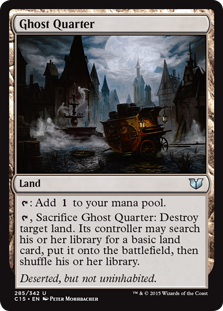
I still felt the need for more threats in the first version, so took a page out of the Bennyhillz Book of Beaters with Thing in the Ice. Straight blue lacks board interaction, and Thing keeps creatures at bay all while attacking opponents from an angle not reliant on the graveyard. Thing required a heavy suite of cantrips, leading to the inclusions of Opt and Serum Visions alongside Thought Scour. Also featured is Visions of Beyond, another way to turn extra enablers into relevant spells and a bonkers mid- to late-game card with a fine floor.
The final mainboard inclusion was Ghost Quarter. Quarter doesn't really cast any of our spells, so I didn't count it as a land. Rather, its purpose is to turn on Archive Trap against decks that don't run fetchlands.

Mono-Blue Trap, by Jordan Boisvert

Creatures

4 Thing in the Ice
4 Jace's Phantasm
4 Vantress Gargoyle

Instants

4 Thought Scour
4 Opt
4 Visions of Beyond
4 Mission Briefing
4 Disrupting Shoal
4 Force of Negation
4 Archive Trap

Sorceries

4 Serum Visions

Lands

14 Island
2 Ghost Quarter

Sideboard

2 Damping Sphere
2 Vedalken Shackles
2 Vendilion Clique
2 Stubborn Denial
2 Ceremonious Rejection
1 Dismember
3 Surgical Extraction
1 Ghost Quarter

Out of the sideboard, Vedalken Shackles and Vendilion Clique served as extra plans. I did win a fair number of games with Shackles, but opponents would bring in artifact removal anyway after seeing Vantress Gargoyle, so this plan ended up being hit-or-miss.
As for the mainboard, it had its fair share of problems, chief among them consistency. When things went according to plan, the deck felt unbeatable, as with turn one Phantasm into Trap into Vantress into Force of Negation. But success hinged on whether we could resolve Archive Trap early or not. In lieu of the titular instant, Thought Scour just didn't mill enough cards unless opponents were feeding graveyard synergies themselves. (It did, however, often combine with Trap to put opponents over the 20-card threshold for Visions of Beyond by the mid-game.)

I went so far as to try Serum Powder to locate Archive Trap more reliably, but Powder requires decks to play far more lands, as it necessitates pilots to be comfortable going to 5 or less looking for their dream card. Since Trap isn't a land, finding that card alongside a land or two and some payoffs was too much to ask of my mulligans. Powder also clashed with Thing in the Ice, which prefers blue consistency tools.
And when I'd open or draw Archive Trap naturally, it still wouldn't fire 100% of the time. If opponents wouldn't search their libraries, I had no way of casting it. That's where Ghost Quarter comes into play, except Quarter was so bad the rest of the time its inclusion was hardly worthwhile; I started with 4 copies and finally had to trim to 2 and just kind of hope opponents fetched. When I had the "combo," spending a land drop and going -1 to turn on Trap felt awful. I needed another way to force opponents to search.

In any case, other niche options for increasing Trap's functional numbers included the pricey Trapmaker's Snare and the Shoal-unfriendly Chancellor of the Spires. But I didn't have a chance to test these cards, as one was spoiled that deeply altered the deck's course.

Version 2: Blue-Black

That card was Drown in the Loch. Drown could act as removal or permission, giving it utility in every matchup on top of its clear synergy with our Plan A. Having a card that so dependably slowed the game's pace increased consistency in its own rite, since the longer the game goes on, the more cards hit the bin to feed our creatures. But dipping into black at all provided me with another missing link.
Unlike the blue cantrips, Scheming Symmetry is a pure tutor, letting us pull Archive Trap right out of the deck. With any blue cantrip in hand, Symmetry is essentially a modal Glimpse the Unthinkable: we pay B for Symmetry and go -1 on card economy, putting Trap on top of the deck; pay U for our cantrip, drawing the Trap; then pay 0 for Trap since we've forced a search this turn, milling 13 of our opponent's cards. And Symmetry only improves the more options we have. Should we draw the tutor alongside Trap, we can just put whatever card we most want on top and Trap opponents off their own choice. Similarly, Thought Scour interacts favorably with Symmetry, milling the opponent's card while immediately drawing us our own. An active Gargoyle can also tap to remove an opponent's searched-up card after we've drawn our own.

UB Trap, by Jordan Boisvert

Creatures

4 Jace's Phantasm
4 Vantress Gargoyle

Instants

4 Thought Scour
4 Opt
4 Visions of Beyond
4 Drown in the Loch
3 Mission Briefing
4 Force of Negation
4 Archive Trap

Sorceries

4 Serum Visions
4 Scheming Symmetry
1 Temporal Mastery

Lands

4 Polluted Delta
4 Flooded Strand
2 Watery Grave
1 Mystic Sanctuary
5 Island

Sideboard

2 Damping Sphere
1 Torpor Orb
2 Vendilion Clique
2 Fatal Push
2 Stubborn Denial
3 Surgical Extraction
1 Disdainful Stroke
1 Ceremonious Rejection
1 Fumble

Mission Briefing and Archive Trap had provided a makeshift mill plan in the mono-blue deck, but with more reliable Traps and tutoring functionality, UB is better at achieving that plan should we need to. We therefore have more ways to close, as well as more removal thanks to Drown; these changes rendered Thing in the Ice superfluous.

A couple of newer tech choices are Mystic Sanctuary (spoiled yesterday) and Temporal Mastery. Mastery can be searched up with Symmetry when we plan on not drawing the card this turn, such as to Trap opponents immediately. It's a great find when we've got a beater in play, as it significantly increases our clock. It can also be cast with an instant-speed cantrip on our opponent's turn.
But milling Mastery with Scour or Briefing is usually preferable to having it in the deck, where it can be accidentally drawn by something like either Visions (far from the end of the world thanks to Force of Negation, but still not ideal). With Mastery in the grave, though, we can crack a fetch for Sanctuary and put it right back on top of the deck. Doing so lets us set up and execute an attack even from an empty board position (first turn deploy threat, second turn swing), or double up on hits (turning one creature into 10 damage, or a pair of them into 20!).

The land can also be used to get back the best instant in the graveyard at a given time. That's sometimes Drown in the Loch or Force of Negation, both of which protect us from enemy topdecks; more often, it's Visions of Beyond, which chains into other copies of itself as did Treasure Cruise. Because of Sanctuary's Island requirement, I went from 4 to 2 to 0 Darkslick Shores.


Touching again on the sideboard, black opens up Fatal Push, a critical tool for disrupting small creature strategies. I added Fumble after struggling to deal with Batterskull; the card is a bullet to search with Symmetry, and seems to me like the best option for quickly dismantling the lifelinker.

Proceed with Caution

Drown was only just spoiled this week, so things are still up in the air. This weekend, I'll be testing a UB build that runs Chancellor in addition to Trap to turbo out threats, and when I do, Mission Briefing will be the first cut. The prospect of Chancellor and Trap doubling up in openers to immediately turn on Beyond is very alluring, and those extra draws make up for the functional disadvantage of drawing 7-drops late, especially with Negation in the picture.

I'm excited to see what other goodies Throne holds. Overwhelmed Apprentice and Merfolk Secretkeeper kind of miss the mark for this deck, but the intent is there. Still, I doubt we'll get payoffs on the level of Gargoyle or Drown, the latter of which looks to be a playable Modern card even in non-mill decks, as does Sanctuary. But hey, I'll take more all-around Modern playables, too!

Want Prices?

Browse thousands of prices with the first and most comprehensive MTG Finance tool around.


Trader Tools lists both buylist and retail prices for every MTG card, going back a decade.

Quiet Speculation