menu

Unlocked: The Hidden Supply of a Card

Are you a Quiet Speculation member?

If not, now is a perfect time to join up! Our powerful tools, breaking-news analysis, and exclusive Discord channel will make sure you stay up to date and ahead of the curve.

While many QS Insiders were monitoring trends at the Pro Tour this past weekend, I had a rare opportunity to support the staff working the Quiet Speculation booth at Gencon. This was truly an eye-opening experience to me. Despite being a member of the community for many years, I had never actually tried the Ion Scanner technology.

Wow.

If you haven’t used it before, you really should check it out. I’m not going to write an article as an advertisement, but it’s worth at least emphasizing the technological advances in a couple paragraphs. I went through two Commander decks and scanned one card at a time in rapid fashion, discovering I had more value in these cards than I ever imagined. The applications are endless – buylisting, digging through bulk, trading, planning a strategy to sell at a GP, pricing cards on TCGplayer, etc. Needless to say, I was blown away.

While there, I discovered another trend I wanted to highlight. It is perhaps less flashy, but no less important to understand. This trend relates to quantities of a card available for sale on the open market, and how sometimes numbers aren’t what they seem.

The Biggest Boon at Gencon

As I arrived on site, I was given a tip from our technical team at Quiet Speculation: Dave & Adams Card World had a booth with boxes and boxes of $1-$20 cards. These cards were worth digging through because all of the prices were stickered and many were obsolete. Then I received a Direct Message from a Twitter follower emphasizing the exact same thing.

“If you haven’t hit them up, Dave and Adam card world [SIC] over by SCG has a mess of underpriced old school in their $25 and below boxes”

I became a man on a mission. The results did not disappoint. I found numerous $3-$5 cards from older sets that had spiked. Perhaps the best find was a pair of played $3 Angelic Voices from Legends.

There was an error retrieving a chart for Angelic Voices

I also found cheap copies of Bronze Horse, Kjeldoran Outpost, and Femeref Enchantress. They even had $3 Propagandas, which surprised me because that card isn’t exactly obscure and the price should be well known. Overall, it was a nice little windfall that helped subsidize some purchases I made for my personal collection.

While this information isn’t directly helpful to readers after-the-fact, I bring this up because I discovered something while sifting through Dave & Adams’s boxes. They had a ton of Alpha and Beta basic lands along with a healthy lot of HP commons and uncommons. This was an important realization, because historically I have judged the market supply of a card based on TCGplayer’s stock. Currently there are maybe 50 Alpha Swamps in stock. But Dave & Adams Card World easily had another couple dozen in their boxes. What’s more, their pricing was in the $17 range, quite competitive to the pricing on TCGplayer.

As another example, they had a few HP Alpha Burrowing in stock. While having three copies in a box doesn’t seem worth mentioning, this is 33% of the total stock on TCGplayer. Remove the two obviously overpriced copies, and the addition to the supply is even more significant.

There was an error retrieving a chart for Burrowing

Expanding the Point

Let’s take a step back for a moment and consider the implications. When I shop around for older cards, I often pay close attention to the supply on TCGplayer because I want to make sure I’m purchasing cards that will soon become nonexistent at reasonable prices. When I see an Alpha uncommon with three copies in stock, and one of them is way overpriced, I become very tempted to purchase one for myself “before it’s too late”. This is based on my hypothesis that in a few years, many Alpha cards will become nearly impossible to purchase at “reasonable” prices.

But my observation at Dave & Adam’s Card World’s booth last weekend causes me to pause and consider. TCGplayer getting wiped out of a card may not imply the card is gone from the market forever. Some shops may have some additional supply and not even realize it! I wonder if there are other vendors like D&A that have boxes of random $5 cards that contain Beta commons and uncommons or $15 cards that contain Alpha. How many Alpha basic lands are truly out there for sale, just not brought to inventory on major websites?

Perhaps these cards aren’t as rare as I thought? Perhaps there are more copies out there for players to use and collectors to purchase if only they could find them? I will point out that while I was digging through these boxes (for the second time), I was bumping elbows with guys from Hot Sauce Games. They had gotten wind of this gold mine and were purchasing stacks of SP and NM Old School cards. I was frustrated to have missed out on more gems, but at least the Hot Sauce Games guys will inventory these and hopefully bring them to online inventory. That should help alleviate demand pressures in the short term.

Here’s another example: there are currently 13 near mint copies of Arboria for sale on TCGplayer.

There was an error retrieving a chart for Arboria

At another vendor’s booth, I found a couple copies of the card and picked one up for my collection. The cost was $7. When I tweeted this discovery, a follower indicated this vendor appeared “sold out” on their website.

That’s strange. I know I saw multiples in a stack at the seller’s booth. I wonder if the vendor had removed these from their online inventory so they could sell them in person at Gencon. This seems to happen a lot, in fact. I often notice Star City Games’ stock on high-end cards such as Power go to zero across the board during major events. For example, it may be possible SCG has zero Black Lotuses in stock, but it seems equally likely they just pulled their online inventory to try and sell these cards at their Gencon booth.
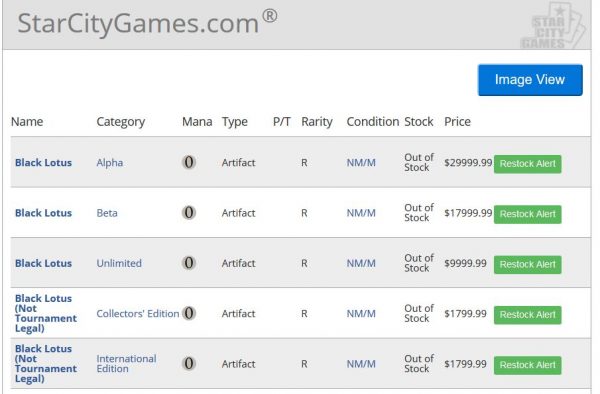
Yet again, online stock of cards may not accurately reflect what is truly available on the market. You just need to know where to find them.

The Converse Can Also Be True

This trend can work in the opposite direction as well. Sometimes there is less supply than what seems to be available on the market. For example, Channel Fireball uses Crystal Commerce and can post their stock on their website and TCGplayer simultaneously. When a card is purchased from one site, their available quantities are automatically adjusted on the other site. I suspect other vendors do this as well.

While this seems negligible for small-time shops, this could make available supply at a larger vendor appear twice as big. Obviously a single individual would realize that an Alpha card in stock on TCGplayer is the same card as what is in stock on Channel Fireball’s website. But to the market as a whole, this could appear as though the available supply on a card is greater than what is actually for sale.

If I’m in the market for an Alpha Burrowing, I may check TCGplayer and see a damaged copy for $24.99 (obviously this is a bad price, but just for the sake of discussion). Let’s say I’m interested in purchasing it. Another Alpha player may be browsing Channel Fireball’s stock and see that same Burrowing on their website for $24.99. To both of us, we see an available copy of this card for sale. But in reality, only one person’s demand can be satisfied with that copy. Thus, the supply is insufficient to meet the demand despite an appearance that indicates otherwise.

Implications

What does this all mean? To me, I think this means we need to exercise caution when making purchasing decisions based on supply of a card. A card may seem low in stock, but there may be available copies out there to refuel the market. This means a predicted price spike due to buyout may not actually come to fruition as people dig out copies from slightly harder-to-find shops.

This is critical when dealing in very rare cards, such as Alpha uncommons. But it could also have implications when chasing buyouts of more heavily printed cards. Remember when I hyped Rainbow Vale because I realized how fun the card was in pack wars? The attention gained enough traction to send the card from $2 to $7.

There was an error retrieving a chart for Rainbow Vale

I had thought all lightly played and near mint copies were pretty much purchased from the market. That was far from the case. I should have known a Fallen Empires card would have ample supply in random boxes of bulk across the country. Just a few months after peaking over $7, the card was back down to $3.50 as supply returned to the market. There’s a ton of Fallen Empires out there—we need to consider the hidden supply in addition to the TCGplayer supply when speculating on a card.

Remember when Revised Savannah Lions spiked? I had grabbed a dozen played copies from TCGplayer and flipped them all to Card Kingdom when the online shop had a $4.20 buylist for them. While near mint and lightly played copies are more expensive now, the played copies have slowly returned to the market. Card Kingdom’s buy price on Revised Savannah Lions now: $1.85. There’s a lot more Revised out there than people realize.

Wrapping It Up

I am not trying to discourage people from looking at cards in sets with larger print runs. I’ve even written about how Revised and Fourth Edition cards offer real opportunity over the next few years. But I did want to emphasize an important point this week: there are more copies of a card on the market than you’d realize just looking at TCGplayer.

This became very apparent to me while browsing stores at Gencon. The fact that I could purchase a dozen Alpha Swamps from a single vendor without having any impact on the apparent market supply (i.e. TCGplayer) tells you just how deep the supply really goes. The copies are surely out there—people just need to dig for them. As a price spikes, it motivates more and more people to dig through their boxes and look for copies to list for sale.

Thus, after a buyout the price of a card retracts as that new supply hits the market. It happens all the time, but I got to witness firsthand some of the driving forces behind that price retraction. After finding a couple Angelic Voices, I submitted a buylist order to Card Kingdom for easy profit. If a few people follow suit from this past weekend, Card Kingdom will drop their buy price. This will reduce demand for the card as there will be less arbitrage available. I know people are familiar with this concept; it was just fascinating to me to witness firsthand how much of a card is really out there if one is willing to dig deeply enough. I’ll be keeping this in mind next time I speculate on a card strictly due to low supply on TCGplayer.

Sigbits

  • I did notice Card Kingdom just recently added Bazaar of Baghdad to their hotlist. In doing so, they also upped their buy price on the Arabian Nights card from $900 to $1050. While prices remain volatile, I have noticed that the overall trajectory of Arabian Nights cards remains upward. This applies even to non-Reserved List cards like Flying Men.
  • I noticed that Teferi, Hero of Dominaria took over as the most valuable card from Dominaria, surpassing Karn, Scion of Urza. However it’s interesting to note that their foil values are of the opposite trend. Karn’s foil buy price at Card Kingdom is $66 while Teferi’s is only $48. Perhaps this reflects Karn’s greater utility in other formats? Or does this mean Teferi’s foil price is too low? It’s an interesting observation.
  • One of the other Reserved List cards I found in D&A’s $3 box was a single copy of Femeref Enchantress. I eagerly set that one aside knowing I could buylist it for much more. In fact, Card Kingdom is currently paying $7.25 on the card. It may even have greater upside if it finds a consistent home in the new “enchantments matter” Commander 2018 deck.
Unlocked: How Paper Events Affect MTGO Prices

Are you a Quiet Speculation member?

If not, now is a perfect time to join up! Our powerful tools, breaking-news analysis, and exclusive Discord channel will make sure you stay up to date and ahead of the curve.

Welcome back, guys.

Ever since WotC decided to release Standard sets online earlier than before, players have relied on MTGO results to prepare for their paper events. So it's not hard to see how MTGO prices can affect paper prices. But how true is the reverse: do paper events affect prices on Magic Online?

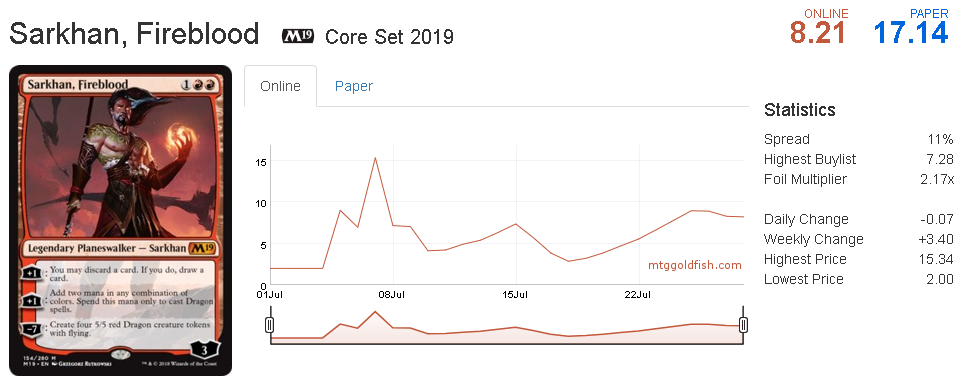
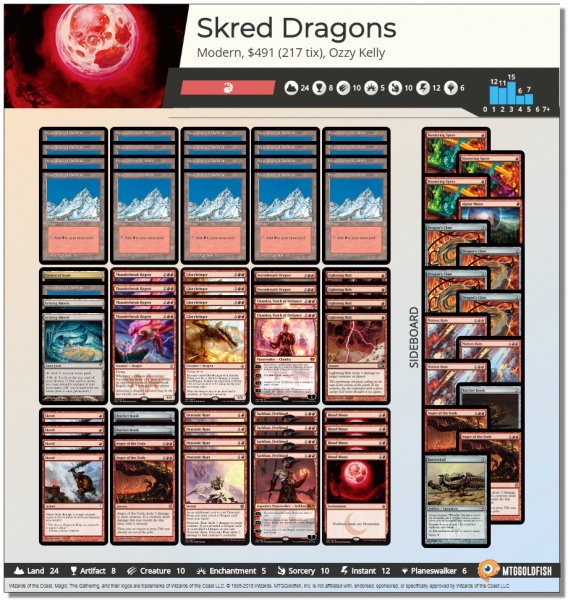
Last weekend, a new deck emerged in Modern and took down an SCG Classic by surprise. The idea of Skred Dragons probably came from the Mono-Red Dragons deck in Standard. Sarkhan, Fireblood is the main fuel of the deck, which plays 10 copies of Dragons in the entire 75.

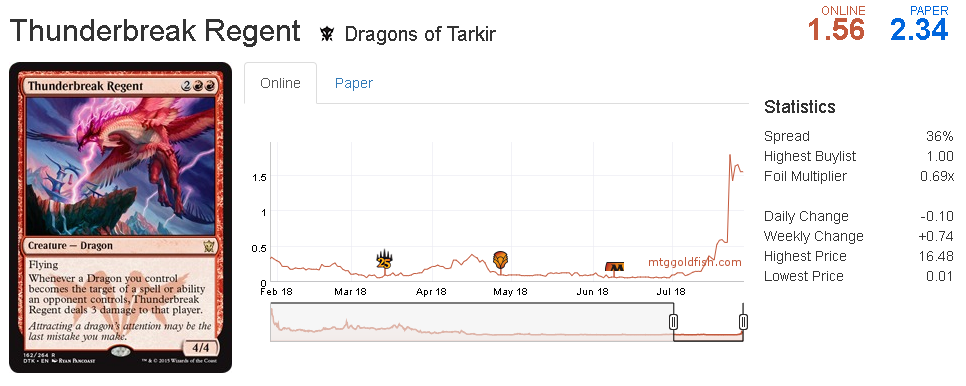
Running so many creatures that cost more than four is unusual in Modern, unless they're paired with ways to ramp or create extra mana. There used to be a "Dragon Stompy" deck in Legacy as well, but I don't think it is still strong right now. Anyways, the win with Skred Dragons last weekend caused the price increase on Thunderbreak Regent. The spike isn't huge, but it's still relevant for anyone who somehow kept a bunch of Thunderbreaks in their binders.

Next up, I'm going to show some examples of paper events affecting prices on MTGO. These are among the most impressive spikes ever to happen in Magic history.

Grishoalbrand

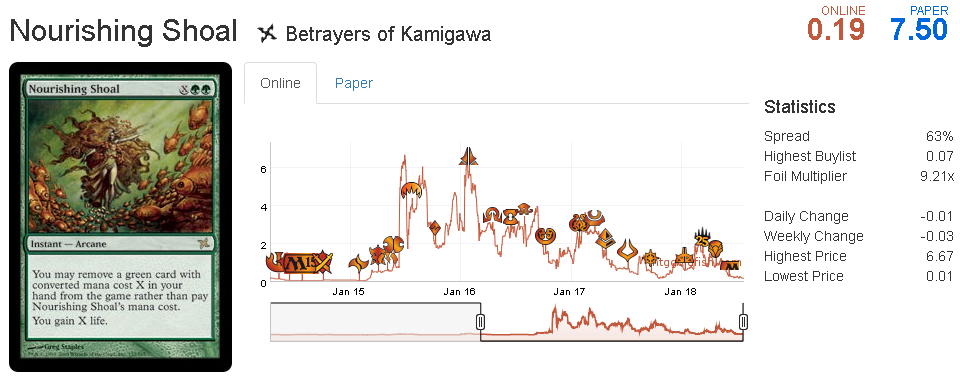
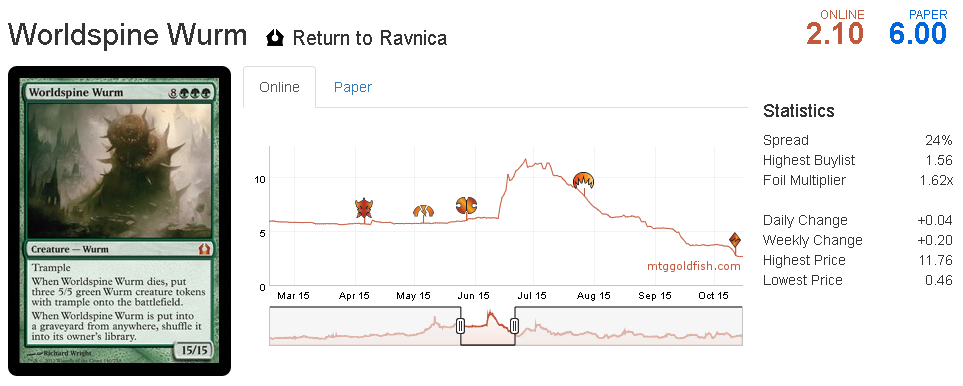
New players in Modern might not know about GriShoalBrand, as the deck isn't that popular nowadays. But older players definitely know this deck that made its first appearance in June 2015. The introduction of Nourishing Shoal and Worldspine Wurm to the Goryo's Vengeance deck gave the deck more life to activate Griselbrand's ability, thus making the deck more consistent in achieving an instant win once Griselbrand is put into play.

Nourishing Shoal spiked when it was seen on camera at GP Charlotte 2015, where the deck eventually reached Top 8. This was one of the cards that impacted the Modern metagame very hard in Modern history. GrisShoalBrand didn't win the GP, but in every event after that, Goryo's Vengeance players were packing a playset each of Nourishing Shoal and Worldspine Wurm.

When Shoal spiked, the other half of the combo also increased in price drastically.

Noticed the obvious increase between June and July 2015. That is the exact moment when the public learns that Shoal and Wurm make the deck way more consistent than before. Presumably the combo was some local player's secret tech for a while, but it hadn't been used in premier events before.

Eldrazi Winter

Pro Tour Oath of the Gatewatch was another premier event that had a major impact on MTGO prices. This was the season right after the banning of Summer Bloom and Splinter Twin, when Eldrazi totally dominated the metagame and only one or two other decks were even viable.

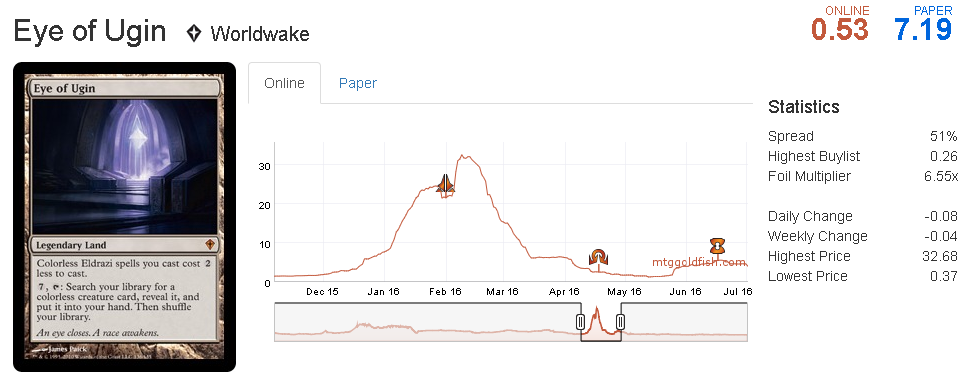
Eye of Ugin was the highlight of the PT weekend, powering out the new Eldrazi creatures in Oath of the Gatewatch (OGW) like Reality Smasher, Thought-Knot Seer, and Eldrazi Mimic. Not only did the legendary land allow the player to play every Eldrazi Mimic in hand on turn one, it also made casting a turn-two Thought-Knot or Smasher way more consistent with the help of Eldrazi Temple and Simian Spirit Guide.

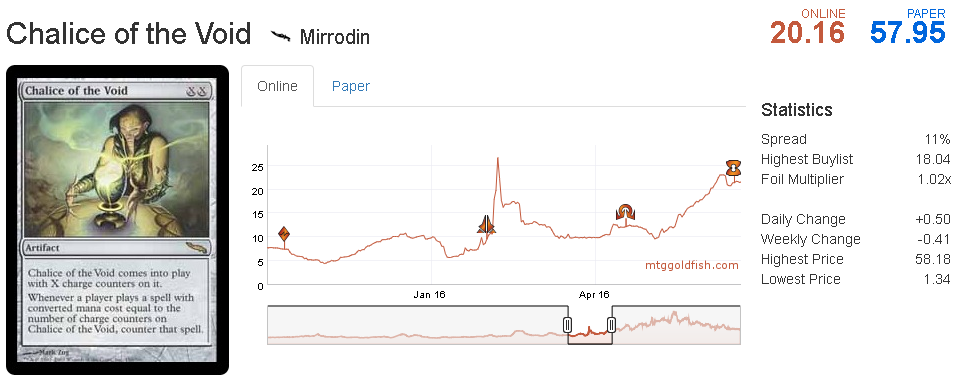
As you can see in the graph, the spike actually happened before OGW was released on MTGO. That was due to discussion happening online when OGW spoilers were going on. Back then, cards were released online a few days before the Pro Tour, so there was very little time for players to test on MTGO before buying into copies of Eye of Ugin. It happened that the theories about the strength of the card were proven true at the Pro Tour (this was highly predictable), which is why the price of the card spiked further during the Pro Tour weekend.

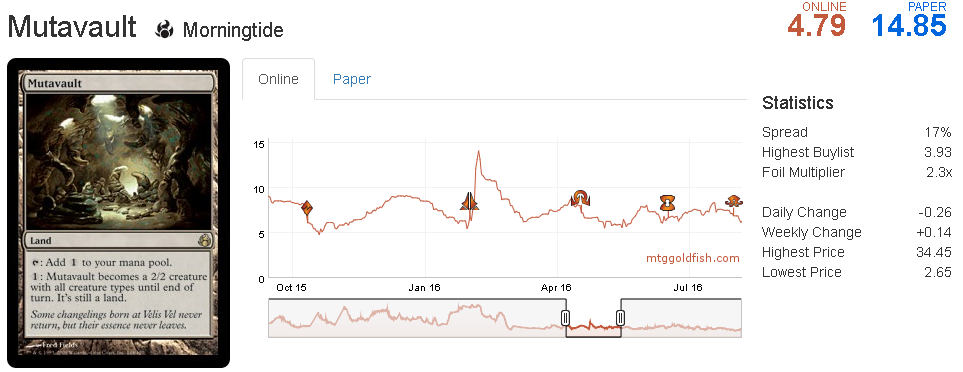
Eye of Ugin wasn't the only card to spike in response to the new Eldrazi deck. Many players wanted to play the deck online, causing a sudden increase in demand for all components of the Colorless and UR Eldrazi decks. Chalice of the Void was a particularly important part of the strategy. With Simian Spirit Guide players could cast Chalice for one on turn one, shutting off many decks like Infect, Zoo, Burn, and Jund.

The Breakout of Death's Shadow

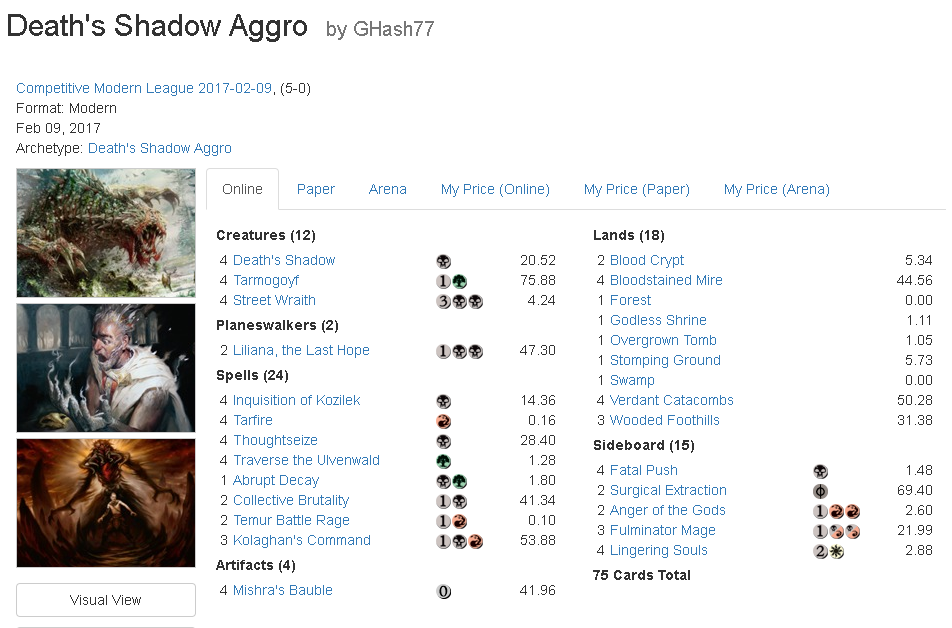
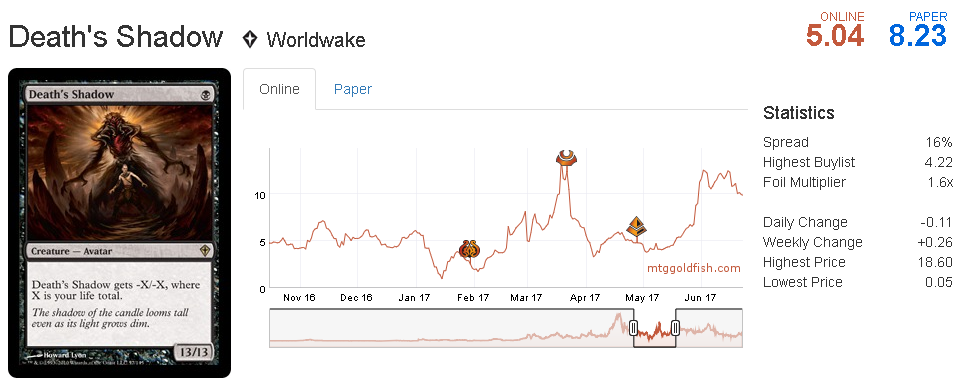
This story happened at Grand Prix Vancouver 2017. If you were playing on MTGO or following the metagame at the time, you already knew of the existence of Jund Death's Shadow before GP Vancouver (17-19 February 2017):

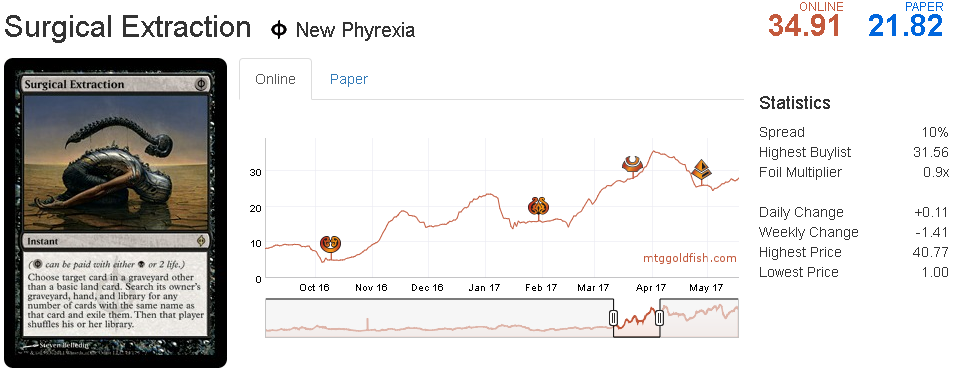
Online players didn't take this deck seriously until it became the champion at GP Vancouver. This time, however, the market response wasn't a spike in the deck's components, but rather a slow growth as Jund Death's Shadow gradually became the most played deck on MTGO.

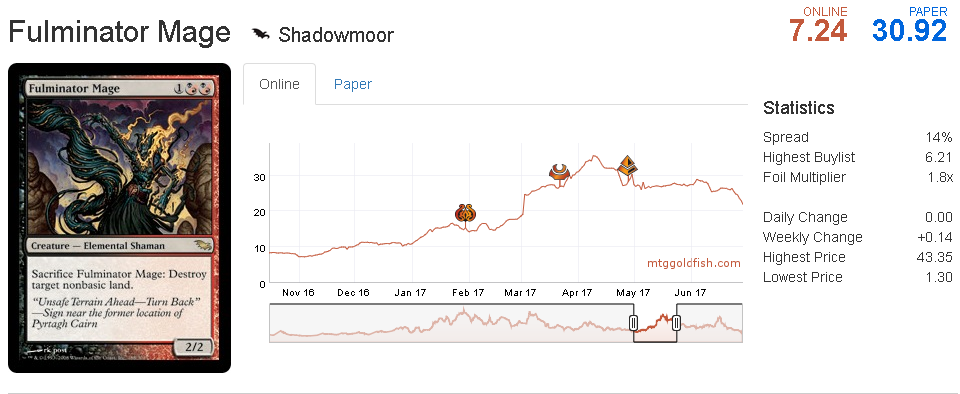
Surgical Extraction suits the theme of the Death's Shadow deck—mana efficiency and self-imposed life loss. For just two life, players could exile a playset of any card in the opponent's graveyard. This card is very powerful because Jund Death's Shadow has a bunch of discard spells, and even Fulminator Mage to destroy lands like Valakut, the Molten Pinnacle or Urza Tron lands.

The recurrence of Fulminator Mage with Kolaghan's Command and Liliana, the Last Hope made this black-red creature a core sideboard card of Jund Death's Shadow. Previously, only the regular BGx and Jund variants played this card in their 75—the sudden increase in demand caused the card to increase to 35 tickets.

The namesake card itself was surprisingly unpredictable, even though the deck was built around it. This could be caused by the Modern Masters reprint which happened around that time.

Speculations

Is speculations possible on this category of spikes? I think it's doable, but not without a lot of work. Basically, what's required is a lot of insider and/or live news from premier events happening around the world every week.

For example, if you happened to be there at GP Charlotte 2015 and had already witnessed the power of the Nourishing Shoal-Worldspine Wurm combo, you might be able to deduce speculation of these two cards was a good call. Without information like this, investing in cards blindly is not likely to get you the right ones.

The Jund Death's Shadow example is easier to profit from since the price increases happened slower. In this case, you would have had plenty of time to make the right decision and pick up the cards, even if you missed the first weekend.


Alright guys, that’s all for the week. Thanks for reading, and I’ll see you again next week.

Unlocked: Commander Movements This Week

Are you a Quiet Speculation member?

If not, now is a perfect time to join up! Our powerful tools, breaking-news analysis, and exclusive Discord channel will make sure you stay up to date and ahead of the curve.

Summer is known for being a slow and quiet time in Magic finance, but there’s still plenty of action occurring. A major catalyst, and the biggest news right now, is the impending release of the Commander 2018 decks, which are still being spoiled and will be released just a week.

We know the deck themes and some of the cards—most importantly the commanders themselves—so it has set off a wave of speculation. The Commander market has also been stimulated by Core Set 2019, which provided the new Elder Dragons as great commander options. In particular, Arcades, the Strategist has spawned an entirely new archetype that's driving demand for a swath of old creatures with defender.

Arcades, the Strategist

There was an error retrieving a chart for Perimeter Captain

One example is Perimeter Captain, notable because it comes from a set—Rise of the Eldrazi—that has always demanded high prices. This card recently spiked from $0.5 to $3.

There was an error retrieving a chart for Oathsworn Giant

Another key card for the deck is Oathsworn Giant. This has also seen a significant spike for an uncommon, from $0.50 to $2, and again up to over $3, which makes it seem like the demand is very real.

There was an error retrieving a chart for Meekstone

It took me quite a while to figure out why all of the many printings of Meekstone were spiking, from a few dollars to ten or more. I finally got my answer when looking through the EDH REC decklist of Arcades, the Strategist, which showed it as a key staple of the deck. It’s a perfect fit for a deck focused on toughness rather than power.

Commander 2018

Bant Enchantments

The new Commander deck driving prices the most this week has been the Bant deck built around enchantments.

There was an error retrieving a chart for Enchanted Evening

Enchanted Evening is quite the powerful effect in a deck that cares about enchantments, and it’s from a set that is know for high prices and spikes, Shadowmoor. This has already seen a significant spike and is maintaining the new price point.

There was an error retrieving a chart for Aura Thief

Aura Thief could be a fit in the enchantment deck as a way to benefit from the random enchantments opponents might have, but it’s also a very strong hoser against the deck that some sneaky players will turn to as a way to attack their play group. Its price has spiked from a few dollars to over ten, but I am curious if the price can be maintained as a new staple or will turn out to be a fad that falls back in price.

There was an error retrieving a chart for Opalescence

Opalescence is a classic enchantment-matters card. It’s also on the Reserved List, so it’s no surprise that it saw some growth this week, and it should only continue to do so.

There was an error retrieving a chart for Starfield of Nyx

Starfield of Nyx has maintained a solid price since rotating out of Standard. Being a few years old now, it makes sense that demand has caught up with supply and that the price is increasing.

Jund Lands

The Jund lands deck has been a big driver of prices as well, with a few cards standing out.

There was an error retrieving a chart for Titania, Protector of Argoth

Titania, Protector of Argoth is a busted card that has actually made its way into Legacy and even Vintage, and a clear Commander all-star right at home in a lands deck. Its price spiked this week, and has actually continued to grow higher above $10. I see it only continuing to grow until a future reprint.

There was an error retrieving a chart for The Gitrog Monster

The Gitrog Monster has strong Commander demand because it works in all sorts of decks. It's perfect for a Jund lands deck, which has driven demand to the point that it has grown from around $3 to $10.

Esper Top-of-the-Library

The Esper top-of-the-library deck has been mostly quiet so far in terms of moving the market, but it has a lot of potential. I expect action will pick up once it is fully spoiled and we have a better idea of what cards might work well in the deck.

What has been moving are a few foils, which could be the precursor for paper versions following suit. Cards of note are Morality Shift, which definitely makes a big impact on the top of the library; and Charmed Pendant, which seems perfect in a top-of-library deck as both a payoff and as a way to manipulate the library.

There was an error retrieving a chart for Morality Shift
There was an error retrieving a chart for Charmed Pendant

One of the biggest spikes this week was another Commander card unrelated to the new releases, foil Words of Wind. This card combos with Jhoira, Weatherlight Captain to create an infinite engine. The nonfoil version has followed its lead up to nearly $4 from $3, and will probably keep heading higher.

There was an error retrieving a chart for Words of Wind

Casual All-Stars (and the Best Ones from Core Set 2019)

Are you a Quiet Speculation member?

If not, now is a perfect time to join up! Our powerful tools, breaking-news analysis, and exclusive Discord channel will make sure you stay up to date and ahead of the curve.

As a person who has had the advantage of working in a game store for many, many years, I'm able to draw upon that experience to predict potential future MTG-related investments. The biggest advantage of that experience behind the counter is being able to see what kinds of cards different people buy and what they do with them.

Don't Put All Your Eggs in Spike's Basket

A lot of financers focus on "Spike." It is certainly a good strategy because Spike buys a decent amount of cards, and when a bunch of Spikes are all making a run at the same cards in Standard, Modern, and Legacy, those cards tend to do well financially, at least in the short term while the metagame is shifting.

There was an error retrieving a chart for Grim Lavamancer

Grim Lavamancer is a great example of a spikey card that has done really well lately. The card happens to be very well positioned in Modern. It's also just a very good card in general. As a result, with more and more top eight lists including this small angry fellow, it makes sense that others looking to duplicate that success will follow the leader. It also helps that the card can be realistically played in many different viable decks. Basically, if you are playing red and want to machine gun down small creatures, Grim Lavamancer is your Lava Man.

It's a flashy pick, and if you made the move to get in on Lavamancer before the hype train kicked in, great work. The problem with focusing on these types of picks is that they don't happen frequently or consistently. How often does a card really break out and change the dynamic of an established metagame? Sometimes, but not all the time.

For sure, pay attention to what Spike is buying and sleeving up, but experience has taught me to diversify. There are plenty of other, more obscure markets that offer terrific value for the taking.

Observing the Casual Crowd

Flashback to my flashback about working behind the counter at the LGS. I know how Spike shops for singles. It's basically making fine tunes their decks when something shifts and requires an adjustment. It's nice that Spikes are always making fine tunes to their decks, and that they're often buying into a price increase since they are more often than not "following the leader."

You may be surprised to know that Spikes don't equate for the biggest chunk of Magic, or even MTG singles sales, when it comes to the big picture at a game store. Not even close.

There was an error retrieving a chart for Mikaeus, the Unhallowed

In fact, it is the casual crowd that comprise the big spenders with the deep pockets, and I've always paid close attention to what kinds of cards they buy, what kinds of decks they play, and what they are into when it comes to collecting Magic cards. It's hard to really nail down what Timmy and Johnnny like to play and buy, largely because we can't go to MTGTOP8 and quantify "The Casual Metagame." Every kitchen table has a completely different meta from the next, yet all casual metas share some similarities.

There is a certain stigma associated with "casual crowd." Even though I know better, there is still a part of me that returns to the late 2000s when I hear "casual" and thinks about friends who had unsleeved Mono-Black decks full of useful commons like Hymn to Tourach and pump Knights. The person with the shoebox full of random cards is much less a thing now than in the olden days. I'm sure that plenty of people still find joy with their friends with a shoebox full of random cards, and I hope they do – I started that way – but, whether or not these elusive individuals exist or not is largely arbitrary to my discussion.

The fact is that the "casual" players who spend money on singles are organized, intelligent, and dedicated to playing Magic on their own terms. Whether it be Commander or brewing off the wall decks with cards they like to play against like-minded friends, these individuals play the game.

The Difference Between Casual and Competitive

I think the intuitive way to differentiate between the two groups is to say that competitive players focus on playing in tournaments and casual players do not. I think this tends to be technically correct, which is of course the best kind of correct.

There was an error retrieving a chart for Flying Crane Technique

The question becomes: how accurate is this presumption? Pauper is not a real "tournament format" with Grand Prix, yet lots of people love that format. Have you ever seen people "go-deep" on their Commander decks? All the time. It's not a tournament format. Even players who simply jam whatever they want at the kitchen table once a week, isn't that a sort of tournament where the individuals involved basically agree to play a format they enjoy and meet up?

I actually believe the biggest difference between competitive Magic and casual Magic has to do with the type of games players agree to play with one another. In competitive Magic, the focus of deckbuilding and gameplay is on the first four turns of the game. In casual Magic the emphasis is placed on turn four and beyond.

There are a few reasons that I believe this to be true:

  1. Multiplayer Adaptable - Casual decks tend to exist in a matrix where they are used both for 1v1 duels and multiplayer. "Competitive" decks focused on executing in the first few turns don't always fare well in multiplayer. Without an infinite combo (which is generally frowned upon in a casual game),  it's hard to defeat three other players quickly when they are all packing Wrath of Gods.
  2. Commander starts players with 40 life. It's way hard to play an aggressive beatdown deck against one opponent with 40 life. Worse against multiple players with 40 life!
  3. Longer games with bigger, more exciting bombs are more fun to play. Constructed Magic is about grinding known matchups between the established "Best Decks." In a casual game, there is nothing on the line besides playing for fun and enjoyment, and so deckbuilding reflects that "fun" element.

What Does a Good Casual Card Do?

We all know what good tournament cards look like, but what does a good casual card look like? Well, casual players obviously like great cards, and there is a ton of crossover between what people play in Constructed and at the kitchen table. For our puroses today, I'm more interested in cards that are, or will become, staples at kitchen tables everywhere, but will be largely ignored in Constructed. To that end, I present:

The Best Casual Cards in Core Set 2019

Let's apply what I've suggested to the most recent MTG set. These are the casual cards that I think fit the mold of what the casual crowd will be into a month from now or even five years from now. If the shoe fits, run away with the value.

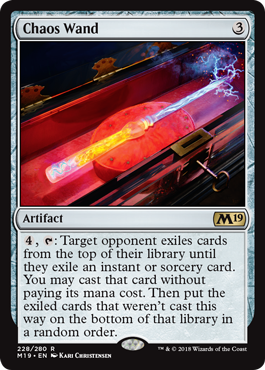
Chaos Wand

I love this card as a casual staple. I've been plucking them up for cheap whenever I can. The card has Commander/casual staple written all over it. First of all, it's super powerful in any metagame where people are focused on going big rather than being efficient. In Commander, chances are that you'll be paying four mana to cast more expensive spells! Foil copies also seem like savage value right now.

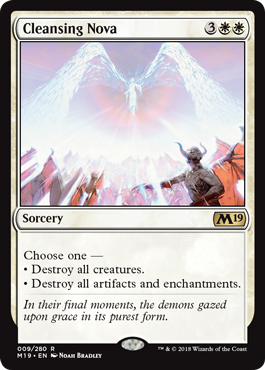
Cleansing Nova

I love this card for multiplayer. Cards like Austere Command and Akroma's Vengeance are already mainstays, and this card is a mana cheaper and can be more flexible. Sweepers are great in a slow, multiplayer game – and this is a very, very good sweeper.

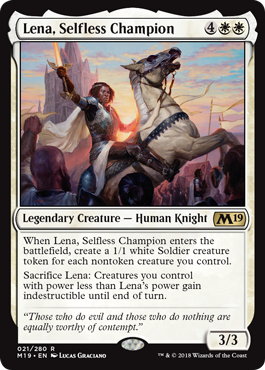
Lena, Selfless Champion

It's a bulk rare but actually a great Magic card. I could actually see myself playing with this card in a Commander deck. It does the two things that I care about: generates more resources and protects those resources. It's hard to play creatures in multiplayer, but this is the kind of creature I'd want to cast if given the choice.

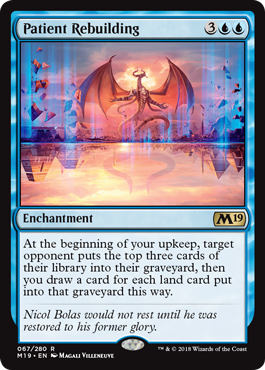
Patient Rebuilding

The card is actually pretty powerful. The milling is not arbitrary and it provides the potential for drawing multiple extra cards every turn. I feel like this is a card that would fare well at the kitchen table, despite that fact that the card has basically no value right now.

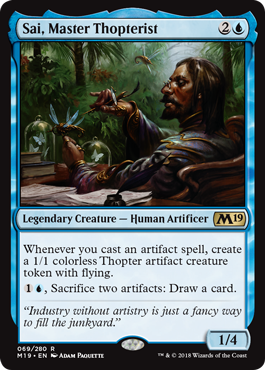
Sai, Master Thopterist

I think this card is actually a Constructed powerhouse on the verge of breaking out across the board, but it's also a great Commander or kitchen-table card. First of all, this would be an insane commander. Second of all, it's basically a powerful free roll in any artifact deck. The fact that it creates resources and can turn those Thopters into raw cards allows this card to basically do many things (all of which matter) at various stages of the game.

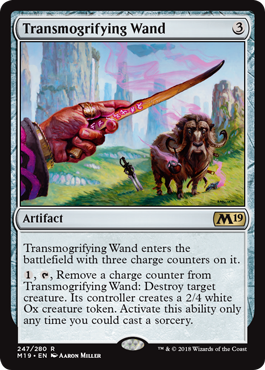
Transmogrifying Wand

The card looks like it sucks, but it is actually absurdly powerful. The ability to straight up kill three different creatures is impressive, and in multiplayer, the 2/4 tokens do not matter at all. I thought the card was great in my draft deck when I was turning 4/5s into 2/4s. I'd happily pay one mana to destroy a scary dragon or giant monster.


I know that the biggest money in MTG finance lately is grinding Reserved List cards and getting ahead of the Spike spikes. However, there are other areas of value to be observed if you're willing to spend the time and energy. I love these types of investments because they typically cost very little to get into and frequently return a ridiculous percentage yield when they hit. I also love these picks as cards to pull out of $0.25 rare boxes at Grand Prix.

The casual game is real. I'm just as happy to sell cards to a casual player as a Spike. No matter the type of player you are selling to, remember that their money spends the same as anybody else's!

The New Crackback: Introducing Miracle Bo

Are you a Quiet Speculation member?

If not, now is a perfect time to join up! Our powerful tools, breaking-news analysis, and exclusive Discord channel will make sure you stay up to date and ahead of the curve.

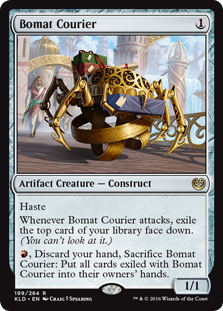
There's a new Delver in town, and this one doesn't need delirium or a white splash to put the hurting on opponents as of turn one. All it requires is a single, generic mana and an appetite for attacking. Meet Bomat Courier, my latest addition to Temur Delver.

Noah Walker's breakout Legacy performance with post-ban Grixis Delver at SCG Worcester inspired me to reach out and pick his brain about the Construct, a conspicuous 4-of in the build. I spent the following week obsessively testing Bomat Courier in Modern Delver shells. This article explains my choices and offers insight into how Courier plays alongside the format's most efficient combat creatures.

Miracle Bo, by Jordan Boisvert

Creatures

4 Delver of Secrets
4 Bomat Courier
4 Tarmogoyf
3 Hooting Mandrills

Artifacts

4 Mishra's Bauble

Instants

4 Lightning Bolt
2 Vapor Snag
1 Tarfire
1 Dismember
3 Stubborn Denial
2 Mutagenic Growth

Sorceries

4 Faithless Looting
4 Serum Visions
1 Forked Bolt

Lands

4 Misty Rainforest
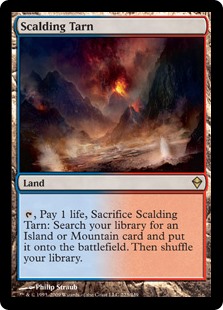
4 Scalding Tarn
2 Wooded Foothills
1 Spirebluff Canal
2 Steam Vents
1 Stomping Ground
1 Breeding Pool
2 Island
1 Forest
1 Mountain

Sideboard

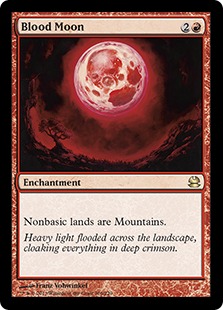
3 Blood Moon
3 Mana Leak
2 Huntmaster of the Fells
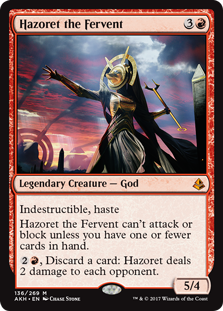
2 Hazoret the Fervent
1 Ancient Grudge
1 Destructive Revelry
1 Firespout
1 Anger of the Gods
1 Engineered Explosives

All About Bomat

Modern is a removal spell format. For thresh decks to succeed here, they must run more creatures than in Legacy or Vintage to keep the pressure on. This condition, combined with the lack of powerful setup cantrips like Ponder and Brainstorm, contributes to Delver of Secret's relative absence from the metagame.

That hasn't kept me from rooting for the little guy, and in Temur colors no less. Tarmogoyf and Hooting Mandrills are great with Delver, and pet cards of mine, so I often play the three creatures together.

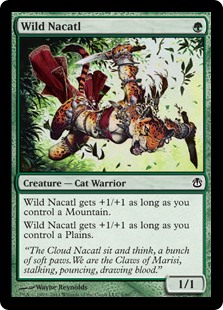
I've added various creatures to that suite, including Snapcaster Mage, Monastery Swiftspear, Young Pyromancer, and Gnarlwood Dryad. My favorite supplemental threat is Wild Nacatl, the headliner in Counter-Cat. Miracle Bo dedicates that slot to Bomat Courier.

More to Kill, More to Love

Rule 1 for our additional creature: opponents must want to kill it quickly. Otherwise, they'll be content to shoot down our other threats and ignore this one. That's a problem I've run into with Gnarlwood Dryad: the creature shines in aggro-control matchups that must remove Dryad to beat us with their own Tarmogoyfs, but without delirium, the Horror leaves other opponents free to advance their gameplan without fear of just dying. That thing is hard to grow without an enemy's helping hand!

Unlike other one-drop options, Bomat requires no setup: it's always just Bomat. The artifact operates independently from the graveyard, letting us dedicate our remaining creature slots to heavy-hitters Goyf and Mandrills. Doing so proved challenging with delirium in the mix, and fatal in the face of Rest in Peace.
The one-power Bomat Courier doesn't pressure via damage, but via card advantage. Leaving the Construct unchecked results in us drawing multiple cards for a low mana investment, a mechanic that has historically broken tempo decks. Unlike a niche combat keyword like deathtouch, every opponent cares to some degree about card advantage from our deck, since we've got everything in there: reach, permission, and of course, more threats. So they're all incentivized to remove Courier.

As a bonus, Courier boasts two subtypes. Chasing a dead Delver with Tarmogoyf has long been Temur Delver's bread and butter, but burying Courier further grows the Tarmogoyf. Courier's multiple types similarly make delving easier, as fewer cards in the graveyard provide more types.

The Haste Factor

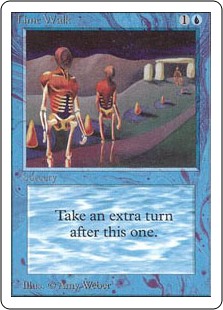
I consider haste the most busted of Magic's evergreen mechanics. Creatures differ from sorceries by having casters wait a turn before using them, so ones with haste essentially come with an attached Time Walk. Bomat Courier makes use of the keyword by sniping planeswalkers, providing value in the face of removal, and drawing us out of tight spots.
First, the planeswalkers. Liliana of the Veil once presented an enormous hurdle for Temur Delver shells; she would come down, eat our creature, and then force a Lightning Bolt or simply chew through our hand and board. Bomat takes out a freshly minused Lili no-questions-asked, all while generating board presence in the form of a must-answer threat. The same applies for other minus-to-one walkers like Chandra, Torch of Defiance and Teferi, Hero of Dominaria.

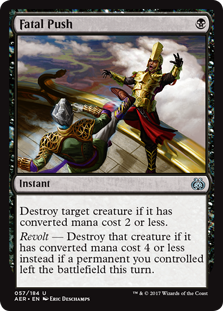
As any Delver player knows, removal-heavy opponents don't waste much time in killing our early threats; that turn one Delver is liable to immediately draw the Push from an opponent's opener. Haste at least gives us one damage for our trouble. I've even found many opponents unwilling to burn removal on turn one Bomat, letting us rack up a few more points before dealing with the Construct.
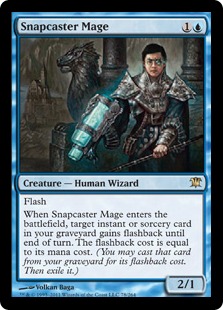
Finally, haste bails us out of bleak topdeck situations. In a simplified game state, drawing Bomat and swinging not only presents a threat, but locks in a two-for-one. Opponents then topdecking a removal spell can burn it on our artifact, sure, but Courier replaces itself by then. Of course, they've got no choice; if they wait, we'll set up an even more threatening card advantage engine. Every ensuing turn they whiff on removal represents another card we'll draw when they find it.

These three dimensions granted by haste give Bomat Courier a close Temur analog in Snapcaster Mage, whose combination of flash and flashback performs similar legwork. Of course, Snapcaster ups our mana curve significantly, which interferes with Faithless Looting and the Delver gameplan in general; it also forces us into a more reactive role, while Bomat increases our aggression. And a deceased Snap does half as much for our living Tarmogoyfs!

Other Effects

Bomat's inclusion has had other subtle effects on the deck's playstyle. Our long-game improves relative to with Snapcaster, since Bomat runs away with a win unanswered. The cards drawn also let us make our land drops more comfortably without giving up the spares in hand for Looting.
Incremental damage from sudden Bomat attacks contributes to burn-fueled victories, too, in a similar vein to Bolt-Snap-Bolt. And the Construct's costing colorless mana greatly eases the pressure on our manabase; an otherwise useless Forest or Island can now produce board presence, helping us leave up R as Bomat insurance.

Finally, our cantrips sequence differently now, and optimal sequencing patterns shift more throughout games than they did previously. Fetch (to ensure we have access this game to our single Stomping Ground, Mountain, or Forest), cast Bomat, attack and exile, and then Serum before making our other pays is a common early-game sequence. With more lands in play, we might Serum before swinging with Bomat to generate a two-part Preordain, using Bomat to access a scried card on our opponent's turn or in our second main phase.

Co-Stars

Accommodating Bomat Courier pushed me into novel deckbuilding territory, a fact reflected by Miracle Bo's card choices. Here's an explanation of what else made the cut.

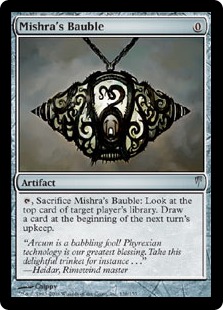
Mishra's Bauble

Mishra's Bauble has three well-known applications in Temur Delver decks:

  • Grow Tarmogoyf/enable delirium/support delve
  • Give a second chance at flipping Delver of Secrets via upkeep trigger stacking
  • Hide cards from targeted discard/Liliana of the Veil by cracking on opponent's turn

In Miracle Bo, its uses are more varied. Noah Walker has spoken on Bomat Courier's interactions with Legacy cantrips, and Bauble also supports the Construct in unintuitive ways. We can peek at our top card with Bauble and attack with Bomat to get rid of it before casting a cantrip. Or we can cantrip first to make sure we have access to it next turn. Or fetch before attacks to keep that card in the deck.

More devious still, seeing something like another creature might make us want to swing with Bomat to exile that creature for later. When opponents force us to crack the Construct, we'll have another creature to replace it with. Similarly, Bauble helps us look for critical cards to tuck, like Stubborn Denial against combo decks. Should we see something useless, like a land, we can fetch that card away before attacking.
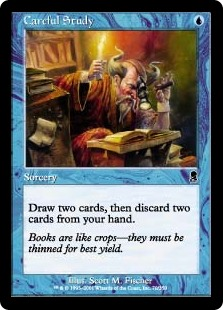
Whether to tuck a good or bad card depends on two factors: how likely we think Bomat is to die when we can't or don't want to crack it, and how likely we are to have mana available to cash in its body at the right moment. Both factors require planning a few turns ahead and closely monitoring the game state.

Lastly, Bauble's known synergy with fetchlands becomes denser with more cantrips in the mix. If we need a threat or removal spell this turn cycle, we can peek before fetching and fire off a cantrip first should we see what we need. Serum Visions also doubles as Preordain with Bolt or Denial; Bauble can then look at our opponent's card, and we'll have the scried instant on their turn. With Faithless Looting instead of Serum, it's usually best to Bauble first, fetch or not, and then Loot, giving us the juicy cards right away—but not if we're out of mana for the turn cycle.

That's a lot of possible options without a blanket "correct" sequencing pattern. Rather, the ideal order of operations for Bauble depends wholly on a pilot's goals in a given situation. It's subsequently quite challenging to extract maximum value from the cantrip in each game, especially without in-deck experience—my Miracle Bo Baubles have significantly improved since last week. Those marginal gains add up fast over the course of games, matches, and certainly tournaments.
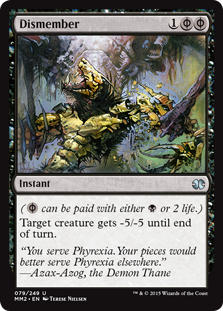
I will say that overall, Bauble's better early on, when we have more ways to interact with the scry at our disposal. As a topdeck, the artifact drops way off, and is regularly Looted away for something immediately impactful.

Vapor Snag/Dismember/Tarfire/Forked Bolt

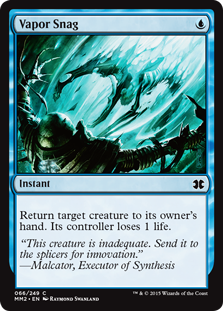
This removal package started as 4 Vapor Snag, 2 Forked Bolt. I knew I wanted most of my removal to be single-use and easy to throw around. Snag would take care of the bigger threats, while Forked gunned down 1/1 blockers to make way for Bomat. A Forked was eventually replaced by Mutagenic Growth after the first copy so impressed me in that role, and two Snags were later swapped out for Dismember and Tarfire, in that order.

Our manabase is painless enough for Dismember, which can be binned to Looting when it's dead. Tarfire is mostly an extra early removal spell for the small blockers we don't want to Snag. The combination of growing Goyf and firing at instant speed give it the nod over another Forked.
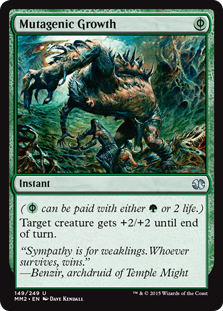
I like holding up Steam Vents to disrupt creature combos, cast Denial, or crack Bomat, and found Forked Bolt's sorcery card type cumbersome at times. It's still nice to have access to the one copy for blowouts, which I've found surprisingly simple to set up.

Mutagenic Growth

Mutagenic Growth fills a few roles for us. Its most obvious application is with Insectile Aberration, where it does a Mental Misstep impersonation against Lightning Bolt; halting damage-based removal also extends to sweepers like Pyroclasm and utility cards such as Electrolyze or Collective Brutality from the opponent, even when Delver's unflipped. This role is what I initially recruited Growth for in Counter-Cat, where it remains a staple for saving both Delver and Wild Nacatl at no mana cost.
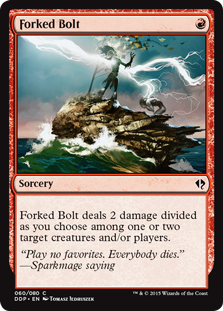
Miracle Bo lacks Wild Nacatl, but all its other creatures still benefit from Growth: the trampling Hooting Mandrills becomes especially nasty as a 6/6, and Tarmogoyf gets to swing into his defected brethren unperturbed.

Then there's Bomat Courier, the primary catalyst for a return to Growth. I found that even with a wealth of one-mana removal, the battlefield sometimes clogged enough for Bomat to have trouble attacking. Chief offenders on this front include Memnite, Thalia, Guardian of Thraben, and Lingering Souls.

Mutagenic makes mockeries of these situations. Opponents are almost sure to block the 1/1, and if they do, Growth acts as a 0-cost removal spell for their creature. And that's without mentioning the other creatures opponents throw in front of Bomat, like Devoted Druid; those blocks become a huge liability once they're hip to the Growth plan. Of course, if opponents don't block, we lose nothing and can simply execute our gameplan as normal.

Since Growth doesn't tax us mana, it's the ideal answer to these kinds of boards, even beating out red removal. We can spend that extra mana on chasing the combat phase with Tarmogoyf or making other proactive plays. And since Growth costs 0, we can chain cantrips pre-combat seeking it; Serum into Looting gives us a whopping five looks before we take to the red zone.
Growth's mana cost enables tricks with Bomat Courier before the damage step, too. It's not uncommon to swing with Bomat and then crack it after opponents lock in a block, and we've locked in a card. Should Courier have a Growth under it, that instant can be used no matter our mana situation to win another fight this turn.

One of Growth's more passive effects is complicating enemy decision trees, as playing around the card requires different lines than our other combat spells do. Say opponents have two 1/1 Spirit tokens and we swing with Bomat. Should they single-block, they open the door for us to remove a token and keep the card under Bomat, only to attack again next turn for an overall net of two cards. Double-blocking prevents that from happening, but also opens them up to a blowout from Mutagenic Growth, killing both their tokens and leaving us with Bomat.
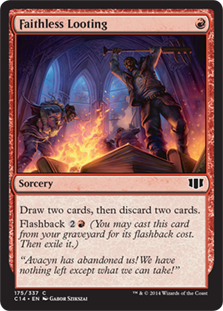
Similarly, I've had payers throw multiple 3/4 Goyfs in front of Mandrills in hope of still trading with the Ape should I have Growth; Vapor Snag on a Goyf let me cleanly trade for one without losing my beater. Growth's very presence keeps opponents guessing throughout the game, and forces them into lines they can never know are wrong until it's too late.

Faithless Looting

Including narrower cards in an aggro-control deck requires an analysis of balance: how much does the card do for the strategy? How often will it be dead or lackluster? The upside of Mutagenic Growth in Miracle Bo seems higher than it does in Counter-Cat, but Bo's Growths are likelier to be dead in general, since they save Wild Nacatl from Bolt, but not Courier.

That and similar quirks are mitigated by Faithless Looting, which cycles through the wrong half of the deck to string together its impressive micro-synergies. By that same token, Looting lets us pack plenty of Stubborn Denials, as we can just dump them in the absence of a ferocious enabler; conversely, in the combo matchups that reward multiple Negates, Looting tosses away our Snags and Bolts to power out Mandrills and locate Denial at once.
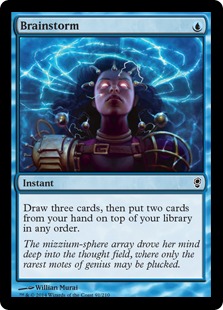
Enabling Hooting Mandrills without Thought Scour, a far inferior cantrip in a deck so likely to tap out, is but one of Faithless Looting's additional benefits. It also buffs Tarmogoyf into a ferocious threat. Combined with Mishra's Bauble and a fetchland, Looting imitates Ponder, and mimicks Preordain with Serum Visions (Serum draws and scries; Looting gets us the found cards) and even Brainstorm in the mid-game (by exchanging unneeded cards for new resources).

A trick long employed by my GRx Moon decks, this "Brainstorm mode" of Faithless Looting incentivizes Miracle Bo to avoid making land drops after the third. Looting turns those spare lands into business. Longer games usually call for a fourth land drop, which allows us to flashback Looting and cast a one-mana spell in the same turn cycle. So does an industrious Bomat Courier; the Construct excels when we dump our hand, and also when we can reliably hold up R to crack it. Looting helps find what we need to empty our hand for Bomat, i.e. dumping conditional permission spells for lands and threats we can play immediately. A turn or two later, it resets our Bomat draws by filtering past the less exciting cards hidden by the artifact.

Stubborn Denial

Speaking of narrower cards, here's an instant that's actually dead against a handful of Modern decks. But that's what Faithless Looting is for. The rest of the time, Denial's a brutally efficient counterspell that handles many of Miracle Bo's problem-causers (sweepers; heavy-duty removal; planeswalkers) as well as the win conditions in a slew of linear combo decks.

I tried Spell Pierce in this slot, and even a split, but found Denial a more reliable way to secure a board advantage.

Sideboard

I tend to build highly transformational sideboards that attack opponents from multiple angles. The sideboard has always played a crucial role in Temur Delver, and this time around's no different.

Blood Moon

Recently successful Temur Delver decks have foregone Blood Moon altogether for the cheaper Tron-beater, Damping Sphere. But I still like Moon's applications against Modern as a whole, as well as its low opportunity cost in a deck with 4 Faithless Looting.

Triple Moon ensures we almost always have it by three mana if we want to, letting us shape our hand to punish opponents who fetch greedily. Should they grab basic lands, we can dump the enchantment to Looting, growing Tarmogoyf up to 7/8!

Mana Leak

Mana Leak is still a superb counterspell in many matchups, and one of our key cards: Tron, Valakut, and Ad Nauseam are all hopeless without it, and great with. As with Moon, I run 3 because I always want to see it in those matchups. But it's such a liability against most decks that I don't want it in the main. So far, I haven't missed Leak in Game 1; our mainboard isn't configured to ever hold up two mana regardless.

Huntmaster of the Fells/Hazoret the Fervent

Huntmaster of the Fells typically plays double duty in my Temur decks by providing an additional sticky threat against midrange while serving as wincon-in-a-can against small creature decks. Then big story here is Hazoret the Fervent, which joins Huntmaster as a curve topper that comes in against a variety of opponents.

While Bomat shines at killing minused walkers, Hazoret smashes the plussed ones, i.e. Teferi, Hero of Dominaria. Black midrange decks have almost no ways to deal with the God, and white control shells are forced to spend their Paths on our green creatures, meaning they ramp us into four mana. Hazoret ends up being great against pretty much anyone looking to interact.
Faithless Looting makes its attacking condition hyper-meetable, and keeps Hazoret from clogging our hand. While we can loot the God away if needed, we usually just end up dumping everything else, since casting Hazoret is so game-breaking.

Ancient Grudge/Destructive Revelry

I cut a Grudge halfway through my testing to have outs to enchantments in the deck. Destructive Revelry comes in against lots of opponents, including UWx decks with Detention Sphere or Runed Halo and even Burn, where it hits Eidolon of the Great Revel as well as the odd Ensnaring Bridge. The incremental damage from Revelry plays nice with small points stolen by Bomat, and all our card selection helps us get to the one-of as needed.

Firespout/Anger of the Gods/Engineered Explosives

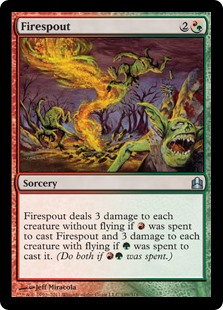
I love Pyroclasm, but it kills too many of our creatures for me to be comfortable running it. By contrast, Firespout provides a much-needed third point of damage against Humans while letting us surgically manipulate the battlefield. The sweeper outs boards of Lingering Souls tokens for Bomat Courier to continue attacking, or cleans up a gaggle of growing Humans while Delver chows down in the air. The added versatility of sometimes not wanting to hit ground creatures makes Firespout a welcome addition to the Bomat build.
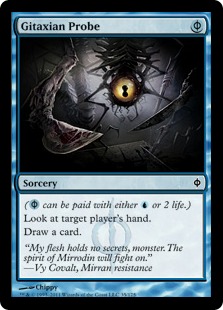
The Anger of the Gods split follows the same logic as the Revelry split, and hedges against Hollow One's recursive threats. Anger also deals with Dredge, the increasingly popular Bridgevine decks, and the odd Kitchen Finks. Double red is natural to achieve in this deck, but this sweeper still has to contend with Firespout. It's still possible I just want another Spout here.

Engineered Explosives is a card I haven't omitted from my Delver shells for over a year. In Temur, it answers Tarmogoyf and even enables blowouts on boards we wouldn't otherwise beat. Above all, it's supremely flexible.

I Ain't Mat at Cha
Wizards may have inadvertently crippled Modern Miracle Grow analogues when they banned Gitaxian Probe. But I can't help but smile at where the archetype's heading. Between my own promising experiments with Bomat Courier, CHAUGHY's recent results with Noble Hierarch, and Jeff Hoogland's 13-0 with a UR shell at SCG Indy, I'm starting to feel like the sky's the limit for the Human Insect that could. And his little dog, too!

Daily Stock Watch – Higure, the Still Wind

Are you a Quiet Speculation member?

If not, now is a perfect time to join up! Our powerful tools, breaking-news analysis, and exclusive Discord channel will make sure you stay up to date and ahead of the curve.

Hello, everyone and welcome to another edition of the Daily Stock Watch! Commander 2018 is due for release next week and we know some of the things that are pretty obvious from the set spoilers. One tribe that is getting a major lift from this set are Ninjas (thanks to Yuriko, the Tiger's Shadow) and just like that, you know card prices of ninjas from older sets are going to spike because of hype. One of these guys is already on the move, and it is our featured card for today.

There was an error retrieving a chart for Higure, the Still Wind

People have always clamored for a Ninja tribal deck regardless if it's in a competitive field or for casual gaming. As of posting time, we have 11 ninja creatures that are available for an actual deck building (don't pay attention to the ones from Unstable) and all of them are either blue, black, or a combination of both. Yuriko from C18 doesn't require you to play ninjas to make it strong as a commander as its ability stands out on its own. I can't fathom with the idea of playing with just that many ninja cards to make it look like an actual deck, so we could take that factor out of the equation for the meantime.

So what's with this minor price spike that Higure, the Still Wind is experiencing?

I guess it's safe to say that it's all about the idea of more ninjas coming to print soon. In due time, there will be more than just these 11 ninjas in existence that we could be building a deck around. There's just not enough of them around right now that I couldn't even find an appealing deck list to show you as to why you should join the hype train. Is Higure even worth its current all-time high of $2.27 to begin with?

The Ninja Gang

And my answer for that question is a definite yes for a variety of reasons. First off, Higure is a legendary card which gives it instant appeal for the casual crowd and collectors alike. It's also very likely that WotC would print more ninjas soon, so cheap ones like it that had very little value for now will become essential for future use. And last but not the least, I don't think that it would hurt to invest a few bucks for something that has a big potential in the long run. Just look at it as a penny stock-like investment that could play out well if things will run the course that we expect it to.

At the moment, you could still get cheap copies of Higure, the Still Wind from various vendors in TCGPlayer for less than a dollar up to $3.52 depending on condition and card language. Planechase copies are still up for grabs for $2.85 up to $3.49 via StarCityGames, but other stores such as Card Kingdom and ChannelFireball are both out of stock. Foil copies might be a good investment if you could get it for under $10 and I'll encourage you to get normal copies in the $1-$2 range if possible. Just don't over commit to this card alone as there are other options out there such as Ink-Eyes, Servant of Oni and Sakashima's Student but feel free to load up with a few playsets. There should be room for growth in the not so distant future for it.

And that’s it for today’s edition of the Daily Stock Watch! See you again next time, as we check out a new card that should be on the go, or good enough for speculating. As always, feel free to share your opinion in the comments section below. And if you want to keep up with all the market movement, be sure to check in with the QS Discord Channel for real time market information, and stay ahead of the hottest specs!

Hold ‘Em & Fold ‘Em #4

Are you a Quiet Speculation member?

If not, now is a perfect time to join up! Our powerful tools, breaking-news analysis, and exclusive Discord channel will make sure you stay up to date and ahead of the curve.

Hold ‘Em & Fold ‘Em Article Series Focus

  1. Cards that you should hold on to or pick up for tournaments if you need them before they rise in price. These cards are either seeing increased play in one or more formats, the supply is drying up, or they’re pretty far from the next reprint.

  2. Cards that you should consider selling or trading away. Their prices are pretty much at the ceiling owing to inflation from speculation, reprint inevitability in the near future, a lull in tournament play, or some combination of these.

Many people often mention the "summer lull" when it comes to MTG finance. But Warren Buffett once said that as an investor, “It’s wise to be fearful when others are greedy and greedy when others are fearful.” I think greedy is a strong word here, but it gets the point across of making profitable investment decisions.

This year has been a perfect example of how to turn the MTG finance summer lull in your favor. For example, I’ve highlighted some key cards from M19 in my previous articles like Sai, Master Thopterist, Thorn Lieutenant, and Supreme Phantom. And don’t forget about the upcoming Pro Tour 25th Anniversary from August 3-5 that I’ve also mentioned. This will bring us even more data we can use to make some wise decisions on cards to pick up cheap and cards to get rid of before they tank in value. So be sure check back regularly to stay abreast of what’s happening before the market shifts. I suggest bookmarking or adding my articles to your feed.

In my last article, I tried something new: tapping into the readership for feedback on whether certain cards are ‘holds’ or ‘folds’. So for this article, I’ll be putting that feedback into action. In addition to that, I’m including a new section called Updates to reflect on cards mentioned in previous articles to help you see where we are with regards to any recent market shifts rather than wait to do a monthly, quarterly, or yearly review.

Hold ‘Em

Defense Grid - Masterpiece Series: Kaladesh Inventions


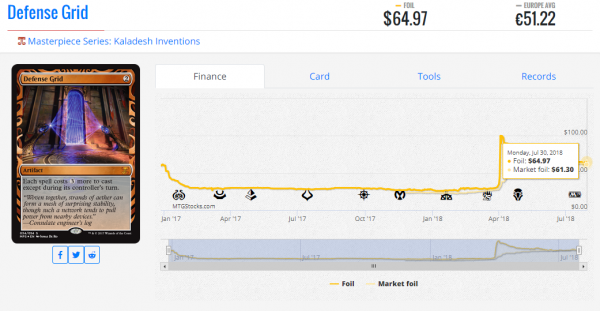
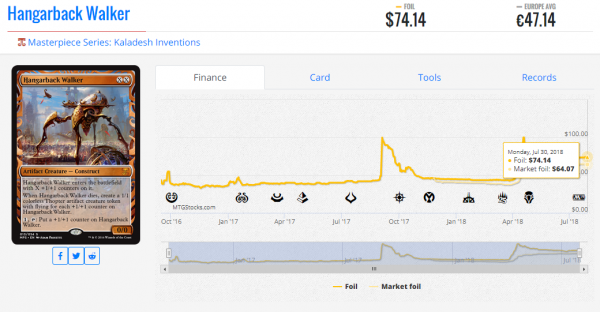
Yes, $65 is a lot for a Magic card. But this version will probably never get any cheaper. If you take a look closely at the graph, you’ll see that the foil and market foil prices have almost come to a meeting point. And from here on out, the market foil price will be the standard and continue to rise.

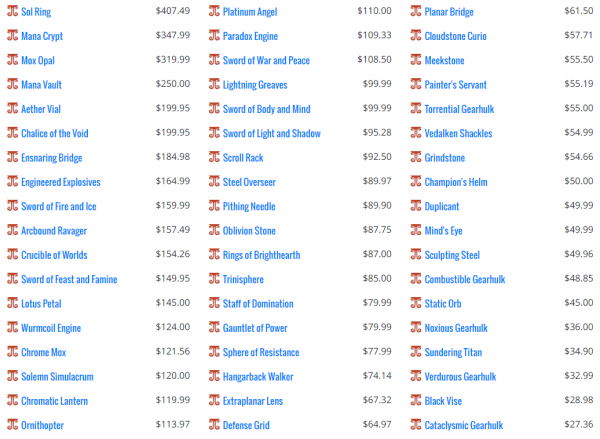
Kindly take a look at this list again.


Defense Grid is the only card that’s under $100 aside from Steel Overseer, Pithing Needle, Trinisphere, and Hangarback Walker that sees play in multiple competitive formats. It sees play in Modern’s Ironworks Combo by Sebastian Pozzo and Legacy’s Sneak & Show by Timothy Candee. These are two of the most powerful decks in their respective formats.

Modern: Ironworks Combo

Creatures

2 Myr Retriever
4 Scrap Trawler

Non-Creature Spells

4 Ancient Stirrings
2 Pyrite Spellbomb
3 Chromatic Sphere
3 Engineered Explosives
4 Chromatic Star
4 Krark-Clan Ironworks
4 Darksteel Citadel
4 Terrarion
4 Mox Opal
4 Mind Stone
4 Ichor Wellspring

Lands

2 Aether Hub
2 Forest
3 Buried Ruin
3 Inventors' Fair
4 Grove of the Burnwillows

Sideboard

1 Defense Grid
1 Pyroclasm
1 Galvanic Blast
2 Lightning Bolt
1 Ghirapur Aether Grid
1 Wurmcoil Engine
1 Beast Within
3 Guttural Response
4 Nature's Claim

Legacy: Sneak and Show

Creatures

4 Griselbrand
4 Emrakul, the Aeons Torn

Non-Creature Spells

1 Flusterstorm
2 Spell Pierce
4 Brainstorm
4 Force of Will
3 Preordain
4 Show and Tell
4 Ponder
2 Omniscience
4 Sneak Attack
4 Lotus Petal

Lands

1 Polluted Delta
1 Flooded Strand
1 Misty Rainforest
1 Mountain
3 Volcanic Island
3 Ancient Tomb
3 City of Traitors
3 Island
4 Scalding Tarn

Sideboard

1 Boseiju, Who Shelters All
2 Pyroclasm
2 Abrade
2 Blood Moon
3 Arcane Artisan
4 Grafdigger's Cage
1 Defense Grid

Hangarback Walker - Masterpiece Series: Kaladesh Inventions


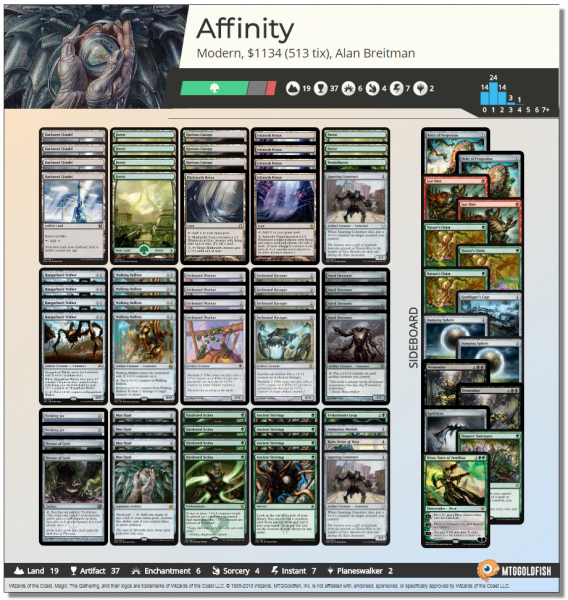
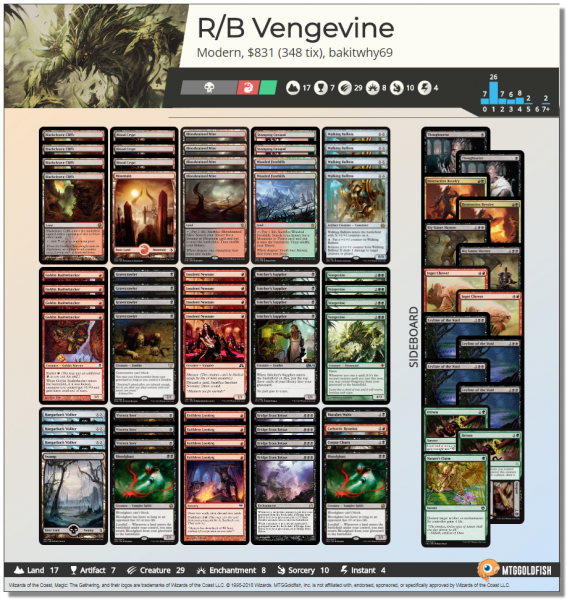
This probably has even more potential to grow compared to Defense Grid since it sees play in multiples in different decks across Modern, Legacy, and Vintage. Most notably, it’s showing up as a four-of in each of these new Modern decks: Bridgevine by KOZOUKUN and Hardened Modular by VELHOVENTURA.

Modern: Bridgevine

Creatures

4 Goblin Bushwhacker
4 Gravecrawler
4 Hangarback Walker
4 Insolent Neonate
4 Stitcher's Supplier
4 Vengevine
4 Viscera Seer
4 Walking Ballista

Non-Creature Spells

2 Collective Brutality
4 Faithless Looting
1 Grisly Salvage
4 Bridge from Below

Lands

4 Blackcleave Cliffs
2 Blood Crypt
4 Bloodstained Mire
1 Mountain
1 Overgrown Tomb
1 Stomping Ground
4 Wooded Foothills

Sideboard

1 Collective Brutality
2 Ancient Grudge
2 Darkblast
4 Destructive Revelry
4 Leyline of the Void
2 Lightning Axe

Modern: Hardened Modular

Creatures

4 Arcbound Ravager
4 Arcbound Worker
4 Hangarback Walker
2 Sparring Construct
4 Steel Overseer
4 Walking Ballista

Non-Creature Spells

4 Ancient Stirrings
1 Apostle's Blessing
1 Evolutionary Leap
4 Hardened Scales
4 Mox Opal
2 Throne of Geth
2 Welding Jar

Lands

2 Blinkmoth Nexus
4 Darksteel Citadel
8 Forest
1 Horizon Canopy
4 Inkmoth Nexus
1 Pendelhaven

Sideboard

3 Damping Sphere
2 Dismember
1 Evolutionary Leap
1 Gut Shot
4 Nature's Claim
2 Relic of Progenitus
2 Shapers' Sanctuary

Steel Leaf Champion - Game Day Promos


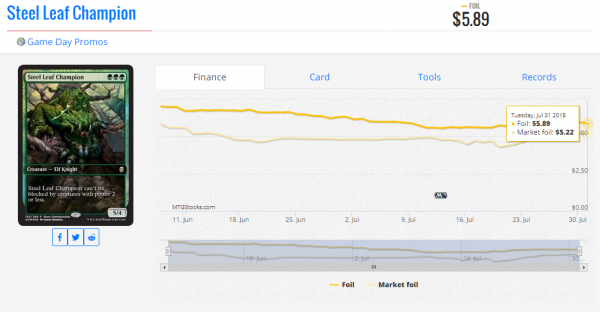
Mono-Green Aggro by Brendan Hicks is one of the better decks in Standard right now and will most likely be around after rotation in the fall. And Steel Leaf Champion will probably always be a four-of alongside Llanowar Elves. There were
three in the top eight of SCG’s Indianapolis’s Standard Classic last weekend.

Standard: Mono-Green Aggro

Creatures

4 Scrapheap Scrounger
3 Greenbelt Rampager
4 Llanowar Elves
4 Steel Leaf Champion
4 Thorn Lieutenant
3 Thrashing Brontodon
3 Ghalta, Primal Hunger
3 Rhonas the Indomitable

Non-Creature Spells

4 Blossoming Defense
3 Heart of Kiran
1 Skysovereign, Consul Flagship

Lands

12 Forest
4 Blooming Marsh
4 Hashep Oasis
4 Woodland Cemetery

Sideboard

1 Aethersphere Harvester
1 Greenbelt Rampager
1 Thrashing Brontodon
4 Vine Mare
2 Hour of Glory
2 Nissa, Vital Force
2 Vivien Reid
2 Duress

The cool thing about Steel Leaf Champion is that it’s semi-secretly making its way into Elves by Bevanz in Modern as a four-of as well. And it’ll only get better as more Elves are printed. You can read a little bit more on Modern Elves from Adam Yurchick here.

Modern: Elves

Creatures

4 Dwynen's Elite
4 Elvish Archdruid
2 Elvish Champion
4 Elvish Mystic
2 Ezuri, Renegade Leader
4 Heritage Druid
4 Llanowar Elves
4 Nettle Sentinel
4 Shaman of the Pack
4 Steel Leaf Champion

Non-Creature Spells

4 Collected Company
2 Lead the Stampede

Lands

4 Blooming Marsh
9 Forest
4 Gilt-Leaf Palace
1 Pendelhaven

Sideboard

2 Abrupt Decay
2 Blossoming Defense
2 Fracturing Gust
2 Heroic Intervention
1 Maelstrom Pulse
2 Reclamation Sage
2 Relic of Progenitus
2 Spellskite

And here’s a bonus side note...if you want to test this deck out, I suggest replacing four of the Forests with four Overgrown Tombs. This way you can consistently cast Shaman of the Pack and Maelstrom Pulse on turn three based on Frank Karsten’s mana guide. And if you also want to cover the two Abrupt Decays, replace a fifth Forest with a multicolor land like Mana Confluence or you can play a Verdant Catacombs or a cheaper fetchland like Windswept Heath so you have thirteen black sources on turn two.


Finally, I can’t reiterate enough how promos are the next buyout specs 
according to Chas Andres.

Fold ‘Em

Nimble Obstructionist - Hour of Devastation (Non-Foil & Foil)


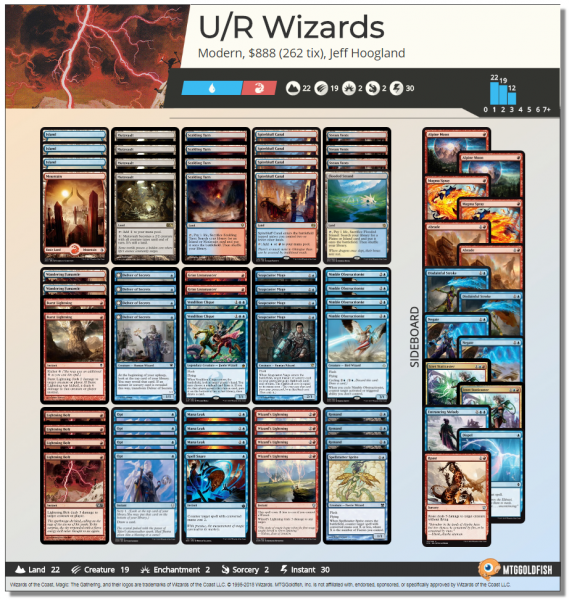
Jeff Hoogland just made top eight of the
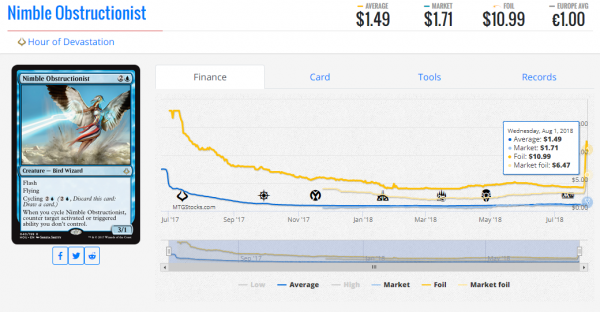
SCG Indianapolis Open last weekend with UR Wizards. And he drew kind of poorly on top of possibly making a mistake or two in game three against Humans. If it weren’t for that, he might’ve taken home the trophy. However, Nimble Obstructionist doesn’t really see play outside of his deck; so I’d sell into the hype. If you want to play the deck, just get or keep a non-foil playset since prerelease and pack foils are already a bit overpriced.

Modern: UR Wizards

Creatures

4 Delver of Secrets
2 Grim Lavamancer
4 Nimble Obstructionist
4 Snapcaster Mage
1 Spellstutter Sprite
2 Vendilion Clique

Non-Creature Spells

2 Burst Lightning
4 Lightning Bolt
3 Mana Leak
4 Opt
3 Remand
1 Spell Snare
4 Wizard's Lightning

Lands

3 Island
1 Mountain
1 Flooded Strand
4 Mutavault
4 Scalding Tarn
4 Spirebluff Canal
3 Steam Vents
2 Wandering Fumarole

Sideboard

2 Izzet Staticaster
2 Alpine Moon
2 Abrade
2 Disdainful Stroke
1 Dispel
2 Magma Spray
2 Negate
1 Entrancing Melody
1 Roast

Reader Feedback

Chandra, Torch of Defiance - Media Promos: SDCC 2018 [Hold]


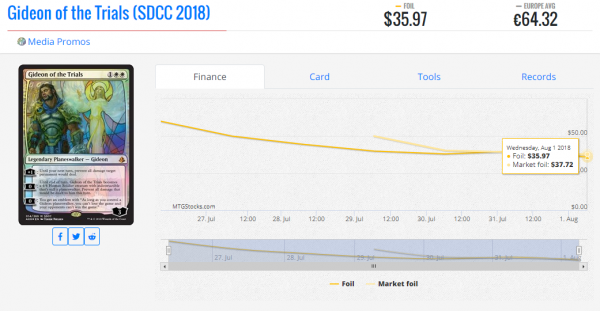
Gideon of the Trials - Media Promos: SDCC 2018 [Hold]


Thanks to David Scott for the 
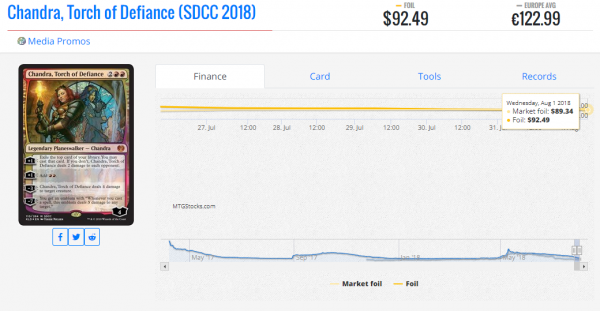
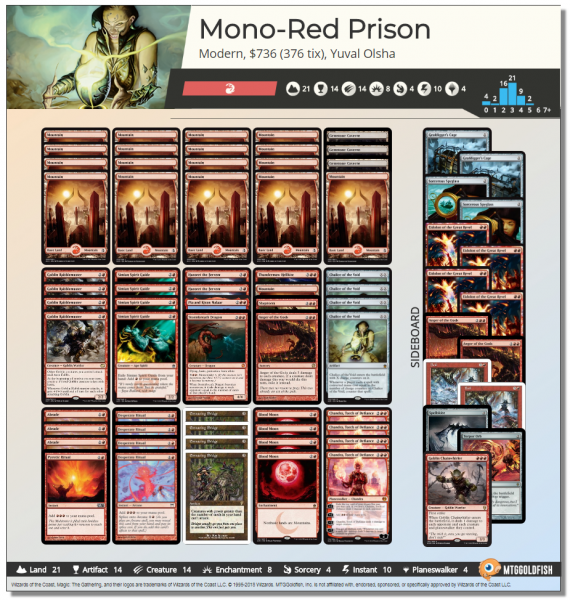
feedback on the previous article. Although these will both be rotating out of Standard in the fall, they’re both played in Eternal formats with Chandra seeing more play than Gideon because she pops up in Legacy via Mono-Red Prison by Pierre-yves Claudon.

Legacy: Mono-Red Prison

Creatures

4 Goblin Rabblemaster
1 Hazoret the Fervent
4 Magus of the Moon
2 Pia and Kiran Nalaar
4 Simian Spirit Guide

Non-Creature Spells

4 Blood Moon
4 Chalice of the Void
2 Chandra, Torch of Defiance
4 Chrome Mox
4 Ensnaring Bridge
2 Karn, Scion of Urza
2 Trinisphere
4 Fiery Confluence

Lands

4 Ancient Tomb
4 City of Traitors
11 Mountain

Sideboard

1 Abrade
4 Faerie Macabre
3 Kozilek's Return
3 Scab-Clan Berserker
2 Sorcerous Spyglass
2 Sulfur Elemental

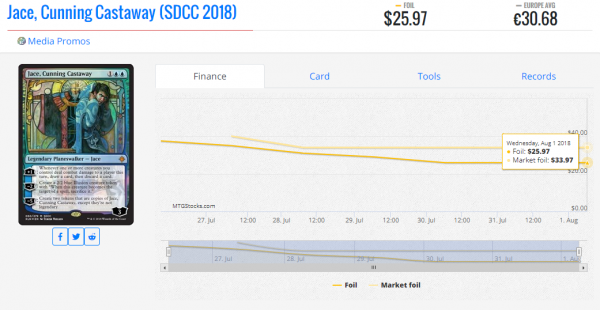
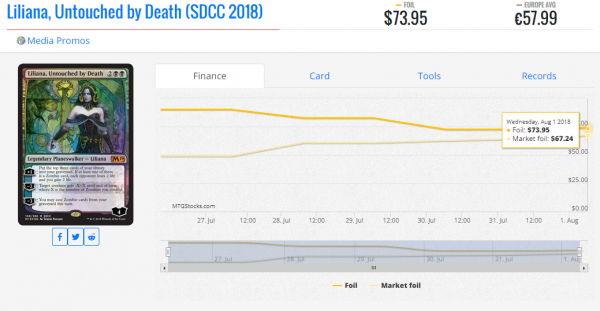
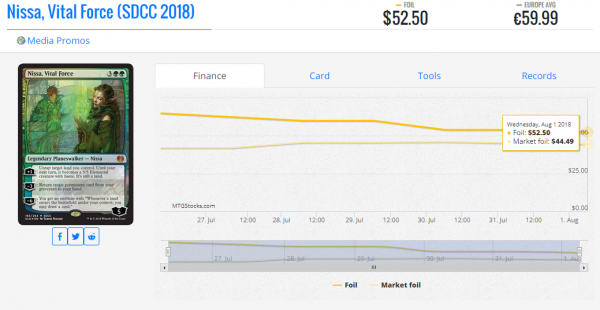
Many people love Terese Nielsen; and rightfully so, because the artwork on these are amazing. But I would stay away from the other three since none of them see play outside of Standard except for Nissa, Vital Force, which sees play as a one-of in Elves once in a great while.

Jace, Cunning Castaway - Media Promos: SDCC 2018 [Fold]

Liliana, Untouched by Death - Media Promos: SDCC 2018 [Fold]

Nissa, Vital Force - Media Promos: SDCC 2018 [Fold]

Sarkhan, Fireblood - M19 (Foil) [Hold]

  
Thanks to Rajib Ali for 
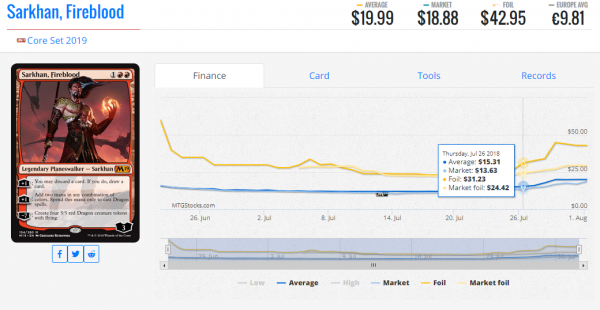
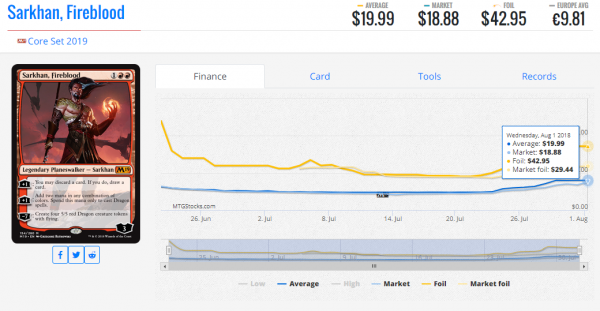
the question about Sarkhan, Fireblood. If you visit the link, you’ll see that I replied to Rajib on July 26 and suggested to pick up foils under $25 if possible. Now the floor for foils is about $40 according to TCGplayer. So if you bought any then or held the ones you have...congratulations, your foil Sarkhans have increased in value by $15 in less than two weeks.

Sarkhan, Fireblood - M19 [Fold]


However, I would fold any extra non-foil copies you have and sell into the Skred Dragons hype. 
Card Kingdom is buying copies for $15 cash and $19.50 in store credit.

Updates

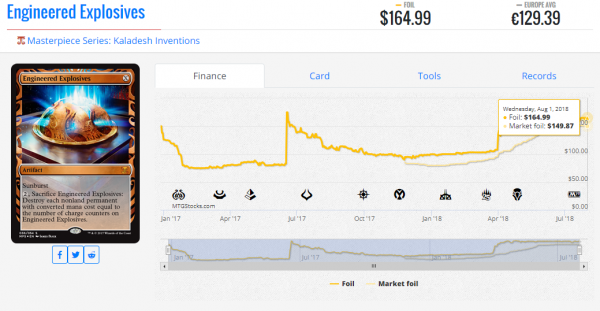
Engineered Explosives - Masterpiece Series: Kaladesh Inventions [Article #2: Hold]


Card Kingdom is now 
sold out of these. And copies on TCGplayer are drying up starting at $160 instead of $150 now.

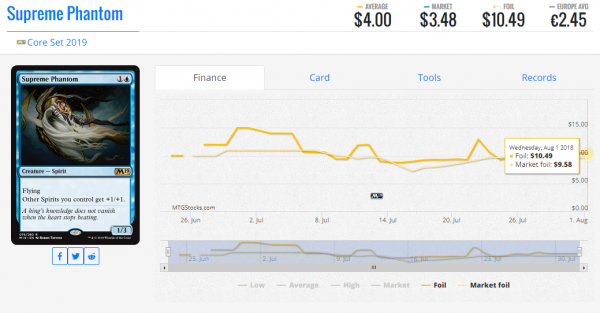
Supreme Phantom - M19 (Foil) [Article #3: Hold]


Card Kingdom only has three copies at $11.99 instead of $10.99 now. And there aren’t many Prerelease or pack foils on TCG Player under $10.

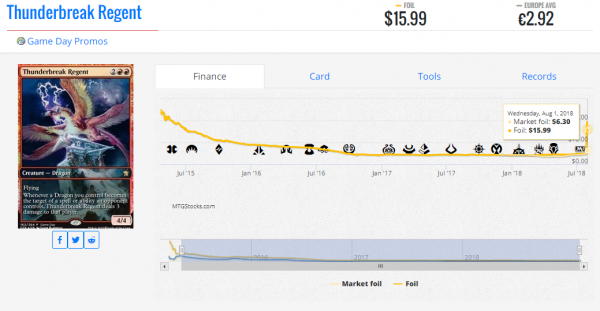
Thunderbreak Regent - Game Day Promos [Article #3: Hold]


Well, there’s the spike we were looking for. Card Kingdom is 
sold out. And TCGplayer only has a handful starting at $15.

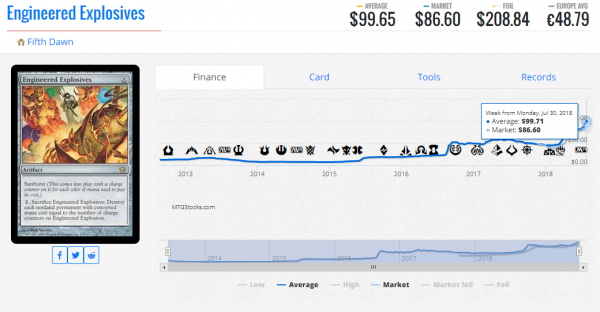
Engineered Explosives - Fifth Dawn / Modern Masters [Article #2: Hold]


I just got my $51 cash from Card Kingdom, but I think I might’ve goofed on this one. The cheapest one available on TCGplayer is $90. Wow! This is probably another good sign that the Inventions version is about to pop. I would still try to upgrade any Fifth Dawn or Modern Masters versions you have to Inventions as soon as possible. These are going to tank as soon as a reprint spoiler happens, but the Inventions version will just keep going up.

Thunderbreak Regent - Game Day Promos [Article #3: Fold]


Here’s a bit of that counterintuitiveness we saw in the 
previous article. Use the spike to sell into the Skred Dragons hype if you don’t plan on playing the deck or play Thunderbreak Regent if it’s ever reprinted in Standard.

Alright, I hope you’ve enjoyed me putting the reader feedback into action and the updates on holds and folds in previous articles. Don’t forget to post your hold and fold questions in the comments below to keep the train going.

Summary

Hold ‘Em

-Defense Grid - Masterpiece Series: Kaladesh Inventions
-Hangarback Walker - Masterpiece Series: Kaladesh Inventions
-Steel Leaf Champion - Game Day Promos

Fold ‘Em

-Nimble Obstructionist - Hour of Devastation (Non-Foil & Foil)

Reader Feedback

-Chandra, Torch of Defiance - Media Promos: SDCC 2018 [Hold]
-Gideon of the Trials - Media Promos: SDCC 2018 [Hold]
-Jace, Cunning Castaway - Media Promos: SDCC 2018 [Fold]
-Lilian, Untouched by Death - Media Promos: SDCC 2018 [Fold]
-Nissa, Vital Force - Media Promos: SDCC 2018 [Fold]
-Sarkhan, Fireblood - M19 (Foil) [Hold]
-Sarkhan, Fireblood - M19 [Fold]

Updates

-Engineered Explosives - Masterpiece Series: Kaladesh Inventions [Article #2: Hold]
-Supreme Phantom - M19 (Foil) [Article #3: Hold]
-Thunderbreak Regent - Game Day Promos [Article #3: Hold]
-Engineered Explosives - Fifth Dawn / Modern Masters [Article #2: Fold]
-Thunderbreak Regent - Game Day Promos [Article #3: Fold]

Let me know what you think in the comments below. Agree? Disagree? Why? You can also connect with me on Twitter at @edwardeng. I’m also open to suggestions on how to make this series more valuable. Hit me up.

Have fun,
Eddie

State of the Meta – Week of July 30, 2018 (Part 1)

Are you a Quiet Speculation member?

If not, now is a perfect time to join up! Our powerful tools, breaking-news analysis, and exclusive Discord channel will make sure you stay up to date and ahead of the curve.

Welcome to a new edition of State of the Meta! PT 25th Anniversary is right around the corner, which will feature Team Constructed only (no draft) with each team member playing a separate format (Standard/Modern/Legacy).

Things have been shifting a bit as of late in the world of eternal formats: from the dominance of Matt Nass and his KCI build in Modern, to the recent Banned & Restricted announcement removing Deathrite Shaman and Gitaxian Probe out of the Legacy landscape. So I figured I would have a look at recent results from the past two weeks (MTGO and paper tournaments) and what the new hot techs are. Today's column will focus on Modern, with Legacy coming later on this week.

Modern – Known Quantities

Humans

Let’s start right away with the elephant in the room: Humans has been sitting atop the Modern metagame for a while, and in yet another case of the rich getting richer, was awarded a shiny new toy with M19 - Militia Bugler.

There was an error retrieving a chart for Militia Bugler

This uncommon flew under the radar of many during preorder season, but foils are now sitting pretty at around $10 on TCGplayer. While some pros have downplayed its potential in Humans, I will let Pro Tour Champion Gerry Thompson do the talking here:

Militia Bugler allows you to grind, find your hate, and give you more bodies to pump with Thalia's Lieutenant. It's the perfect card for Humans and is a significant upgrade to the deck. Considering Humans was already among the top decks in the format, it should make quite an impact.

That’s quite the ringing endorsement if you ask me. Militia Bugler is played in a variety of maindeck/sideboard splits, but never with fewer than two copies in the maindeck. Its inclusion has significantly shifted the Humans build towards Aether Vial rather than Collected Company. I would keep an eye on Vial prices and snap copies if you see an uptick and intend to play them.

KCI Combo

The rising star of the format, Krark-Clan Ironworks Combo, often relies on Pyrite Spellbomb as their win condition. However lately there were a few builds online using Aetherflux Reservoir instead, as a one-of so far. Currently, due to the emergence of the Blue Storm archetype, prices of Reservoir are actually trending up – up to $3 from the $1 tag back before Dominaria release, and could keep going up if the deck keeps seeing play (some pros have been running it at Nationals) and if it starts showing up consistently in KCI.

As a side note, I have to mention that Reservoir has been replacing or complementing Grapeshot in recent Cheerios builds. Nevertheless, I am still expecting prices to drop after rotation, once Blue Storm players have to move out of the archetype.

There was an error retrieving a chart for Aetherflux Reservoir

Another card worth mentioning out of the KCI build is Defense Grid: a sideboard card almost exclusively, its non-foil stock is clearly dwindling at every major online seller. 8th Edition and 9th Edition copies have been creeping up, and Urza’s Legacy ones have doubled in price over the past six months ($6 to $12). It also has a Masterpiece printing, which went up just about 10 percent in the past month and sits around $65 now. With only one non-foil, black-border printing, these are the copies I would grab, looking to sell out right away if it spikes.

There was an error retrieving a chart for Defense Grid

Some quick notes:

  • The traditional Dredge build (see below for the reason for disambiguation) is now playing Shriekhorn in the maindeck, either three or four copies. It essentially serves as three extra discard outlets for a single mana, and helps enabling Dredge on the draw step of the second turn. NM foil stocks are very low, and just like in Militia Bugler’s case, it would just take a little exposure to make the price jump;
    There was an error retrieving a chart for Shriekhorn
  • Obvious lord is obvious: Elvish Clancaller is now a four-of in most if not all Elves lists, which have shifted decidedly towards the BG build, allowing for Abrupt Decay, Thoughtseize and Maelstrom Pulse to be included. Other less spoken cards to benefit from that shift: Lead the Stampede (suffers from an IMA reprint though) and Gilt-Leaf Palace – I was shocked at how much the Palace still buylists for, so look for those in your Lorwyn shoeboxes;
    There was an error retrieving a chart for Elvish Clancaller
  • A new inclusion in Taxes deck of either Death or Eldrazi variety: Tocatli Honor Guard is showing up with two or three copies in the sideboard, replacing Hushwing Gryff as the Torpor Orb on a stick for the Humans matchup (and Snapcaster Mage and Primeval Titan to some extent);
    There was an error retrieving a chart for Tocatli Honor Guard
  • I would be remiss if I did not mention the comeback of the UB Mill archetype, highlighted by a second-place finish at this weekend’s Modern Challenge on MTGO. This time around, the centerpieces are Manic Scribe (supported by Search of Azcanta) and Mesmeric Orb. The latter has been printed only once in Mirrodin, and you would be hardpressed to find sub-$20 NM copies. Mill decks have always had a strong following, and the strategy is a favorite alt-win condition among casual players: will the recent string of relevant performances be enough to push the Orb even higher?
There was an error retrieving a chart for Mesmeric Orb

Modern – New/Returning Archetypes

Hardened Robots

There were a few attempts in the recent past to build around Hardened Scales, but this one looks the most legit, at least on the MTGO scene, since it is posting consistently in the 5-0 results. Outside of Hardened Scales itself, the notable inclusions are Hangarback Walker and, more interestingly, Throne of Geth. Granted, it is only played as a two-of in the majority of lists, but it is still a fairly old foil (from Scars of Mirrodin, an eight-year old set) with only seven vendors left on TCGplayer for NM foil copies (up to 11 when considering LP).

In the sideboard, the archetype has given a second life to Nissa, Voice of Zendikar, but is currently included as a one-of only. I could see it moved to the maindeck, though, instead of Animation Module for example. I will keep an eye on how the deck evolves and be ready to snag cheap Nissa copies if it takes off.

There was an error retrieving a chart for Throne of Geth

Supreme Spirits

This one was easy to see coming as soon as Supreme Phantom was spoiled out of M19. I hate to go for the easy pun (shoutout to Jeremy), but it really gave a second life to the Spirits archetype by giving it a faster clock. Non-foils of Rattlechains ($0.6 to $1.3), Drogskol Captain ($0.7 to $1.8) and especially Mausoleum Wanderer ($1 to $5) are all seeing significant changes in prices, and foil copies all at least doubling up ($6, $18, and $13 respectively).

Two cards I noticed gaining steam and dropping in stock: Moorland Haunt and Nikko-Onna. The land brings in resiliency and creature redundancy, while Nikko-Onna, mostly played in the UW build (too risky in the Bant shell manabase), acts as Reclamation Sage out of the sideboard and is one of these “old foil” cards.

There was an error retrieving a chart for Moorland Haunt

There was an error retrieving a chart for Nikko-Onna

Vengevine Supplier

This innovative list is trying to abuse the interaction between cheap, efficient creatures, and Stitcher's Supplier to bring back Vengevine and have explosive one-turn attacks. Between Hangarback Walker (already pressured by Hardened Robots), Walking Ballista and Insolent Neonate, there are several ways to trigger Bridge from Below for multiple zombies to show up in your ranks.

Among graveyard fillers, Cathartic Reunion, Corpse Churn and even Macabre Waltz are being used to find additional copies of these creature (by drawing or rebuying them) all while potentially dumping even more Bridges and Vengevines in the graveyard. If the deck takes off, I would also recommend looking at Driven//Despair out of the sideboard, which can lead to complete blowouts.

There was an error retrieving a chart for Stitcher's Supplier

Skred Dragons / Prison Red

Sarkhan, Fireblood has already found a home in no fewer than two modern archetypes: Skred Red and Prison (Free Win) Red. In the former, Sarkhan is used to power out Thunderbreak Regent and Glorybringer, with (weirdly) Stormbreath Dragon as a curve topper. The list below actually won a Modern SCG Classic on 7/22, so there must be something to it!

As for the prison deck, the card has only appeared as a two-of so far, and seems to be used primarily as a draw engine and a late-game win condition via the ultimate. Price wise, Sarkhan, Fireblood has already jumped back and maintained $20 for about a week: depending on if/how it performs at the PT (whether in Standard Five-color Dragons or in Modern Skred Red), the card could see a secondary spike.

There was an error retrieving a chart for Sarkhan, Fireblood

UR Wizards

Finally, Jeff Hoogland made headlines this past weekend at the Modern SCG Open in Indianapolis by finishing tied atop the standings at 13-1-1 with UR Wizards:

Guess who’s back? Delver of Secrets! The little Insect-that-could was nearly unstoppable, with the only loss being a concession to Tron in round 14 when sitting on 13-0 – because Hoogland wanted to go grab a bite to eat!

The deck has access to eight Lightning Bolts (via four copies of Wizard's Lightning) and the closest proxy to Stifle that Modern could ask for in Nimble Obstructionist. The deck plays somewhat like a Counter/Burn build by providing support to an early Delver or can turn aggressive by flashing in Vendilion Clique or Nimble Obstructionist.

During the Swiss rounds, the ability to fly over Humans was key to this deck winning the race (which it didn’t manage to do during the top eight, however). Hoogland had been tuning the deck for a while during his Twitch stream, and there was much hype generated by his undefeated run, so it is not that surprising that both Nimble Obstructionist and Grim Lavamancer have been under a lot of pressure since Sunday, both foils and non-foils. Although the deck has also been posting multiple 5-0’s online, I would recommend selling into the hype, especially the Obstructionist which you will most likely be able to pick up again for cheaper after rotation.

There was an error retrieving a chart for Nimble Obstructionist

There was an error retrieving a chart for Grim Lavamancer

Wrap-Up

That will do for the Modern portion of the article. With very few Legacy events since the latest B&R Update, I will actually be submitting part two during day two of this week’s PT to take advantage of the format’s showcase during this special event. Please let me know in the comments below if you think this type of column is useful, and if you would like to see it more frequently and at what rate – I will try my best to answer promptly!

Finance Level Up: Event Tickets and You

Are you a Quiet Speculation member?

If not, now is a perfect time to join up! Our powerful tools, breaking-news analysis, and exclusive Discord channel will make sure you stay up to date and ahead of the curve.

Welcome back, folks.

Today I'm going to go over strategies regarding how to best translate your money into digital currency (event tickets) on Magic Online. There are multiple ways to do so, and learning about them will help you maximize your dollar, both as a player and as an investor.

First, though, I recommend reading Alexander Carl's piece on the future of Magic Arena and Magic Online. Not because I agree with the overarching argument of the piece, but because it's important to read multiple points of view in order to make an informed decision.

I. Arena

I can tell that Alexander's experience on the platform has been far more positive than my own, so much so that he sees little reason why one might prefer the Magic Online client to the Arena one. The biggest stumbling block for me is that the way the player interfaces with the program during a game of Magic has been designed for the sake of the mobile and casual gamer, and this drastically changes the experience. This is fine – Magic Arena seems better for some people and Magic Online seems better for others, and I think the two programs can coexist and succeed precisely because of this difference.

I'll provide two basic examples to give you a better sense of what I mean.

First are the gameplay modes.  Arena offers two gameplay modes. One of the modes, "full control mode" is extremely cumbersome and an absolute chore to use (I have yet to encounter someone masochistic enough to use it as a default experience); it is the equivalent of setting a stop on every single possible step on Magic Online.

The other gameplay mode is the normal mode, and this mode passes through every step and turn in which you cannot perform an action, given the cards in your hand and the targets those cards can have.

This is great for Hearthstone-style gaming, but it comes with an annoying downside that has driven me nuts in Core 19 draft. If your opponent plays a mountain and then the turn is instantly and seamlessly passed to you, you know for a fact that he has no Shock. If you detect that the opponent has to press the Enter key to pass turn instead of having the client automatically do it for him, you know he has Shock. Likewise, if you cast a creature on an empty board, your opponent has 1U mana available, and the client pauses, you know for a fact that he has Essence Scatter, and if your creature resolves and the client doesn't pass the opponent's priority for him, you know for a fact that he has Disperse. This is all well and good if we're wanting super fast casual games, but it's not all well and good if we want to play traditional or competitive Magic.

Second is tapping for mana. Tapping for mana is much more annoying to do on Arena than in paper or MTGO. As a result, you know that when someone is tapping mana for a spell, he's doing so to be able to play something else with specific mana requirements (which enables you to guess exactly what he has in hand).

In paper and MTGO, tapping mana is effortless and something you have to do, which means that leaving certain color combinations open isn't as much of a tell. A few days ago, for example, my opponent went through the rigamarole of tapping WW so he could leave 1UU open (presumably the auto-tap failed him here and wanted to tap UW). Thus I knew he had Cancel in hand with near absolute certainty.

These are the sorts of things that make the Arena interface better for some gamers and worse for others. It's important to acknowledge that the client is being designed with a certain gamer in mind.

II. Financial Level Up: Getting Event Tickets

One of the most important, yet rarely discussed, aspects of MTGO finance is about how one should go about converting one's physical currency into digital currency (event tickets or "tix"). Doing so as cheaply as possible will help make your investments and event entries go farther.

The baseline method for buying tix is to purchase them from the Wizards store. While ostensibly 1 tix is worth $1.00, Wizards does charge you sales tax on top of that. If you're in America, that rate will be determined by the state you live in, and if elsewhere, by your country's VAT. Here's a map generated by the Tax Foundation showing the average sales tax someone in any given state will pay, including local taxes. The exact percentage Wizards charges you will likely be somewhere in between your official state sales tax and the tax percentage listed in the map. For example, Texas's official state sales tax is 6.25%, factoring in local taxes Texans pay an average of 8.17% sales tax, and Wizards charges me a sales tax of 6.75%.

Thus, a ticket costs me $1.0675, but if I lived in Oregon, New Hampshire, Delaware, or Montana, a ticket would cost me closer to $1.00 even. If I lived in countries with more socialistic tax policies like many of those in Europe, I could expect a ticket to cost me closer to $1.20.

Fortunately, there are other methods of getting event tickets that can help you pay less for them. Let's discuss these below.

(1) Buying Event Tickets from bot chains

This is an easy method that many Americans and most Europeans could stand to benefit from. Right now, for example, Cardhoarder is charging $1.03/ticket with no tax, which means that many people would do better to buy from them than from the Wizards Store. Another bot chain selling event tickets, Magic4Ever_MTGO, is charging $0.96/ticket using Neteller, and MTGOTickets is selling them for $1.02/ticket (plus they have a special welcome offer for a better rate on the first 10 tix you buy!). It's important that you use reputable bots for these transactions,  meaning that they have an active website, social media presence, and community recognition.

(2) Taking advantage of the Wizards Christmas playpoint bundles

This past holiday season Wizards offered players the opportunity to buy play points at a discount. While the smaller bundles offered only a modest discount, the "Mythic bundle" allowed MTGO users to pay $100 plus tax to get the $120 worth of play points. This means that you were getting a 17% discount (paying $0.83 plus tax per $1 worth of goods). Obviously, this is a good method of putting capital onto your MTGO account only if you are a player, not merely an investor, but I absolutely think players should take advantage of this offer should Wizards once again offer it this winter (and I expect they will).

(3) Buying cards from bot chains for cash

This is the method I've been eager to share with you, as it's one that I only began employing this year, and to good effect. Both Cardhoarder and MTGOTraders offer 8.00% discounts on all cards if you buy with a physical currency (cash, credit, Paypal). The best part about all of this is that you won't have to pay any taxes this way. In exchange for taking on some risk, you basically get to transfer your physical currency onto Magic Online at a rate of $0.92/ticket. As I stated in my first point, use bots with a positive community reputation.

Instead of buying event tickets from the Wizards Store like I have in years past, this year I have added money to my MTGO account using this method twice (both times using Cardhoarder). I bought eight copies of The Scarab God and four copies of Teferi, Hero of Dominaria this way. That $120.08 on The Scarab God turned into $128.88, meaning that I more or less paid $0.93/ticket. The Teferis were more of an investment and so I haven't sold them yet, but if I sold them today, I would have paid $0.83/ticket.

This is an excellent method to employ if you don't need access to capital immediately but know you will want it in future months. If you choose to employ this method, it's best to follow QS's MTGO writing team to help you make informed decisions regarding which cards to buy. Know that this method involves taking on some risk, but I think it is a great option for players and investors to add money to MTGO.

III. Signing Off

Thanks for reading! Please leave your comments and questions down below. I'm particularly interested in hearing whether any of you have employed any of these methods in adding capital to MTGO, and how happy you were with them.

Daily Stock Watch – Nexus of Fate

Are you a Quiet Speculation member?

If not, now is a perfect time to join up! Our powerful tools, breaking-news analysis, and exclusive Discord channel will make sure you stay up to date and ahead of the curve.

Hello, everyone and welcome to a new edition of the Daily Stock Watch! I've always been a believer of the fact that buy-a-box cards were made exclusive to that regard because of its absurd power level. Even though we might beg to disagree with this assessment based on Firesong and Sunspeaker's inability to even become relevant in any format, there's just so much that we could do with today's featured card. I heard that a couple of pros are going to bring a deck that's built around this to the upcoming Pro Tour 25th Anniversary and why shouldn't they? I'm a fan of this card as well.

Tagged by many Commander players as "Nexus of Disaster", this BaB promo card is sending shock waves to the world of competitive Magic with talks that it could dominate this weekend's showcase. Pro player Ali Aintrazi was never shy in being vocal about how many times he tried breaking this card for competitive use and I see no reason why he shouldn't. An instant-speed Time Walk that doesn't touch the graveyard naturally and comes back to your library is just absurd. But how come no one has broken it since it was released? The answer for this one might be easy -- they have saved their secret weapon for this big event.

I'm still not sure how the pros would build the deck, but let's a quick look at how Aintrazi built his list.

Esper Nexus

Instants and Sorceries

1 Commit // Memory
1 Consign // Oblivion
2 Cast Down
3 Glimmer of Genius
4 Disallow
4 Fatal Push
4 Nexus of Fate
4 Vraska's Contempt
1 Mastermind's Acquisition
2 Duress

Other Spells

2 Search for Azcanta
2 The Mirari Conjecture
3 Teferi, Hero of Dominaria

Lands

1 Plains
2 Island
3 Swamp
2 Field of Ruin
2 Glacial Fortress
3 Aether Hub
3 Irrigated Farmland
3 Isolated Chapel
4 Drowned Catacomb
4 Fetid Pools

Sideboard

1 Cleansing Nova
1 Forsake the Worldly
2 Negate
1 Fumigate
2 Duress
2 Essence Extraction
1 Torment of Hailfire
1 Chromium, the Mutable
1 Mystic Archaeologist
1 Arguel's Blood Fast
1 Omniscience
1 Jace's Defeat

A case for having a green base to ramp up to Nexus of Fate is much more plausible right now, but that idea has drawn opposition from players who think that having so much mana would basically let you win games without even needing the Nexus. This version is playing with the idea of using the Nexus to beat your opponent just like how a straight up UW deck with Teferi, Hero of Dominaria would, so why not ramp to the Nexus instead? That might be the case over the weekend, but that is yet to be seen. There are other factors to consider in assessing one's dominance during the Pro Tour anyway (the player could have a perfect Standard record but messes it up in another format and misses the cut). If a good list with four copies of Nexus of Fate makes it to the top eight, then we might have a situation at our hands.

Time Walking

There are many cards out there that lets you take an extra turn upon resolution, but none has ever come close to being as scary as Nexus of Fate because it's an instant. The possibility of drawing it on your extra turn because it returns to your library is very likely, and it allows you to have a shot at having infinite turns or ramping up your planeswalkers till you can beat your opponents using its ultimate. The dream set up for this card in Standard might be in a Bant shell filled with planeswalkers, but let's not forget how good this could get in Commander as it joins the list above. At just a shade above $20 right now, I don't think it's too bad to get our own copies (as they will be limited due to the fact that this is a BAB card) now and save it for spec purposes. There's a good chance that this could hit the $40 barrier in the near future if its lives up to the hype.

At the moment, ChannelFireball, StarCityGames, and Card Kingdom are all out of stock of Nexus of Fate. This might be the case for a while and this could generate a buzz about how bad print runs for Buy-a-Box cards are right now. There are still multiple vendors via TCGPlayer who are selling it for somewhere between $20.72 up to $44.99, and I expect these stocks to disappear anytime soon as news spreads like wildfire when it gets some camera time during the Pro Tour. Grab your copies now! The window to get your own might be closing real quick on this one.

And that’s it for today’s edition of the Daily Stock Watch! See you again next time, as we check out a new card that should be on the go, or good enough for speculating. As always, feel free to share your opinion in the comments section below. And if you want to keep up with all the market movement, be sure to check in with the QS Discord Channel for real time market information, and stay ahead of the hottest specs!

Unlocked: MTGO Market Report for August 1st, 2018

Are you a Quiet Speculation member?

If not, now is a perfect time to join up! Our powerful tools, breaking-news analysis, and exclusive Discord channel will make sure you stay up to date and ahead of the curve.

Welcome to the MTGO Market Report as compiled by Matthew Lewis. The report will cover a range of topics, including a summary of set prices and price changes for redeemable sets, a look at the major trends in various Constructed formats, and a "Trade of the Week" section that highlights a particular speculative strategy with an example and accompanying explanation.

As always, speculators should take into account their own budgets, risk tolerances and current portfolios before buying or selling any digital objects. Please send questions via private message or post below in the article comments.

Redemption

Below are the total set prices for all redeemable sets on MTGO. All prices are current as of July 31, 2018. The TCGplayer market and TCGplayer mid prices are the sum of each set's individual card prices on TCGplayer, either the market price or mid price respectively. Redeemable sets are highlighted in green and sets not available for redemption are highlighted in red.

All MTGO set prices this week are taken from GoatBot's website, and all weekly changes are now calculated relative to GoatBot's "full set" prices from the previous week. All monthly changes are also relative to the previous month's prices, taken from GoatBot's website at that time. Occasionally, full set prices are not available, and so estimated set prices are used instead. Although Hour of Devastation (HOU), Amonkhet (AKH), Aether Revolt (AER), and Kaladesh (KLD) are no longer available for redemption, their prices will continue to be tracked while they are in Standard.

Standard

Speculators should be prepared to be sellers this weekend during the Pro Tour. Any hype driven price spike on Standard staples should be sold into, particularly for cards rotating out of Standard in the fall. For the portfolio, I am holding mostly structural bets such as complete sets of Dominaria (DAR) and foil mythic rares from Core Set 2019 (M19) so I will not be responding to the results for the most part.

There are a few single card specs that I've made such as on the opposing-colour check lands and on Radiant Destiny. These are the types of specs that have better long-term potential as we get into the fall and winter. The returning mass of players at that time will drive significant demand for Standard staples, generating higher prices as a result. There's no need to rush to sell these types of specs.

There was an error retrieving a chart for Nexus of Fate

One card that has been in demand this week is Nexus of Fate; available as the buy a box promo for M19 in paper, this card is on the curated list for Treasure Chests. As a result, the supply is severely restricted which generates the doubling of price seen this week as it's risen from 30 tix to 60 tix and remains almost completely out of stock with only one copy available on MTGOlibrary and zero copies available at MTGOtraders and Goatbots.

This will be a good example if Wizards of the Coast errs again with this type of promo. Treasure Chests deliver a steady drip of supply into the market which is not suitable to moderate prices on new, in-demand Standard cards. Speculators should use their best judgment for future promos to decide whether a card is Standard playable. If it is, then it's clear that accumulating supply before the price discovery process kicks off is a good bet.

Modern

Modern will also be a part of the Pro Tour this weekend and speculators should treat it in a very similar way. G/B/x components such as Liliana of the Veil, Tamogoyf and Voice of Resurgence have been trending up this week, possibly signaling the pros unease with the format. Although regular players love Modern, pros have a harder time cracking the format since there are so many viable archetypes making it impossible to bring a deck that is favored against the field. Choosing to run a deck like Jund is not unusual since it is deemed a coin flip against almost every strategy and a pro is often confident they can push that percentage up enough to make a difference.

There was an error retrieving a chart for Voice of Resurgence

In terms of market conditions, it's a similar outlook as for Standard. Be a seller into any price spikes. The best opportunity for speculating on Modern will be in October and November when Guilds of Ravnica is released and everyone's attention turns to Standard. That's when you want to be holding tix and be on the lookout for staples at bargain prices.

Foil Mythic Rare Strategy

M19 has been out for a little under a month on MTGO and it's time to check in on how foil mythic rares from this set are doing. Coming off of DAR, expectations were sky high as foil mythic rares from that set rapidly increased in price to deliver substantial profits after only six weeks. Have a look at how two key measures evolved for that set in the chart below. The blue line is the sum of the sell price for all foils and the red line is the buy price of foil mythic rares only. The green line is the percentage generated by dividing the blue line by the red line. All prices are courtesy of Goatbots.

Two things we can see in the chart is that the percentage peaked at over eighty percent and that the price of a foil set saw substantial appreciation going from under 300 tix to over 350 tix in the first month of its release. For speculations, the first point is crucial to timing the sale of foil mythic rares in order to maximize profit. If RIX and XLN are also included, we'd see that the percentage peaked at eighty-three and seventy-seven respectively. So, for M19 we have a pretty good idea that sometime in the second month of release, if the foil mythic rare buy price over the foil set price hits about eighty percent, then we should be ready to sell.

Below I've reproduced the foil mythic rare chart for M19 to see how things are evolving and to compare with DAR. Right off the bat it looks like this set will not be seeing the same rapid price appreciation that DAR did as the blue line has been steady at about 300 tix for the last three weeks. The red line has been rising steadily and the percentage is currently sitting at seventy-five. M19 looks like it is on track and I will be looking for a peak in the percentage as redemption opens for this set in the coming weeks.

The question of whether or not this is worthwhile trade for speculators remains open. After steady profits on all recent sets, the trade on M19 is not yet profitable although it is trending in the right direction. I think the theory around this strategy remains robust but that the trade is getting crowded. As more and more people try to buy the foil mythic rares after a set is released, it drives up the price and reduces the profit potential for all speculators looking to get in on the trade. All speculators will need to judge for themselves whether or not this is a strategy worth pursuing in the future, but it's clear that foil mythic rares are still a good store of value for players looking to conserve their tix.
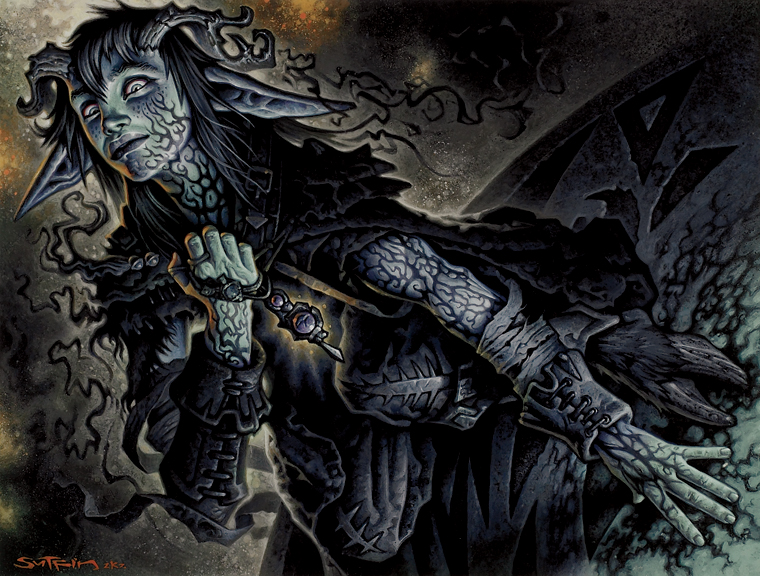
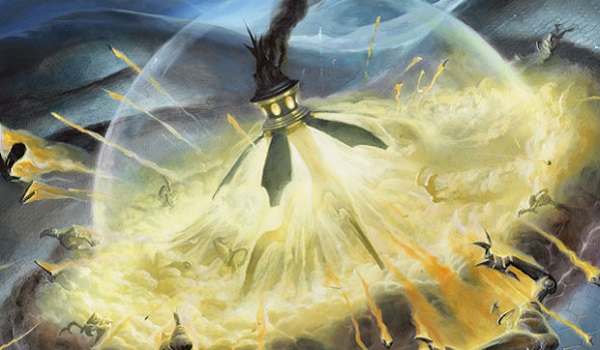
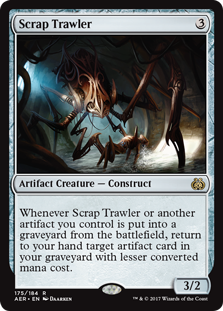
Trade of the Week

For a complete look at my recent trades, please check out the portfolio. There are no new trades this week, but I wanted to check in on last week's purchase of Sarkhan, Fireblood. After peaking at 9 tix, this card has dipped back down to around 7 tix. For speculators, it's always nice when a winning trade only goes in one direction, so a drop in price always generates some fear that something has gone wrong.

There was an error retrieving a chart for Sarkhan, Fireblood

For Sarkhan, the market now looks well supplied at around 7 tix. The uptrend is over, at least for the short term. When redemption opens, the link to paper prices will also open and that gives some hope. The paper price is up another five dollars this past week, so I still think the market is grappling with the power level of this card. Another high-level finish will trigger another price increase in paper which will feed back into the digital price. This trade is a hold at the moment pending further results from constructed and the opening of redemption.

Daily Stock Watch – Polluted Bonds

Are you a Quiet Speculation member?

If not, now is a perfect time to join up! Our powerful tools, breaking-news analysis, and exclusive Discord channel will make sure you stay up to date and ahead of the curve.

Hello, everyone and welcome to a new edition of the Daily Stock Watch! Our venture into the world of investing in Magic continues today with a card that I have given very little attention to for its entire existence. It is by far something that I don't see as a strong threat in Modern or Legacy based on its attributes and competitive exposure, but it has slowly climbed the financial ranks because of casual and Commander appeal. Talks about cards like this one are made during Fridays, but the market is slowly running out of supply of the card and I felt that I needed to let you know about it.

There was an error retrieving a chart for Polluted Bonds

I once pegged this card as the ultimate sideboard for Scapeshift decks but reality just kind of reminded me that I could be dead before this even hits play. I don't see any scenario where this could also be a problem for Lands in Legacy, so what that tells us is that Commander is the reason why this card is worth above $5. Just a week ago, it was able to hit its all-time high of $12.84 and we have buyouts to thank for it. But is this card really investing into?

This portion of my usual segment is where you'd see a decklist that highlights our featured card, but I'd leave this space for today as there is no particular deck where you could slot this in and it will make a massive difference. Don't get me wrong when I say this, but for as good as a card this is based on what it could potentially do, it's equally just as bad because of its high casting cost. If you are going to punish big mana decks for playing too many lands or trying to turn the tides against Valakut, the Molten Pinnacle variants, there are just a hundred of other ways to do so in competitive formats.

People ain't dumb when it comes to buying, so I'm quite sure that CardKingdom isn't paying $7.30 for a mint copy of this card for no apparent reason (although StarCityGames is at a distant $5 for its buylist price). We could make a case for law of supply and demand on this one, as Shadowmoor was printed quite some time ago and this card hasn't been reprinted in any other set after it. This is where the fear of keeping "Commander lovable" cards like Polluted Bonds comes in to play as one reprint could just wreck your pockets financially. Just ask Death Baron owners how much it stings to see your $20 card turn into a sub-$4 one. Just imagine how this would delve into near bulk territory in case something like that happens.

Punish them Better

There are lots of ways to punish opposing mages if you hate lands, and I don't really see Polluted Bonds making this list unless you're playing a multiplayer game of Commander. I've once played a Grixis Griever deck built around land destruction, mass removal and hand disruption, and I enjoyed every bit of it just as much as my opponents loathed my play style. I'm not out here to spoil your fun if you think that it's awesome to slowly torture your opponents for playing lands, but I'm actually here to tell you that there are better ways to do it. I'm not paying $10 for something like Polluted Bonds and neither should you. Time to move it around if you still can.

At the moment, StarCityGames only has foreign copies of Polluted Bonds left in its stock. CardKingdom is dry, while TCGPlayer still have various vendors that have it for anywhere between $6.19 up to $10.22. Foil copies of the card are priced more than double of the normal ones, and I'd gladly sell them for that price if I ever get the chance to do so. This should be your window to move your copies around before its price starts decreasing. Its ceiling shouldn't go past $15 in any case that it dodges a reprint.

And that’s it for today’s edition of the Daily Stock Watch! See you again next time, as we check out a new card that should be on the go, or good enough for speculating. As always, feel free to share your opinion in the comments section below. And if you want to keep up with all the market movement, be sure to check in with the QS Discord Channel for real time market information, and stay ahead of the hottest specs!

The Hidden Strength of Krark-Clan Ironworks

Are you a Quiet Speculation member?

If not, now is a perfect time to join up! Our powerful tools, breaking-news analysis, and exclusive Discord channel will make sure you stay up to date and ahead of the curve.

I've spoken about Krark-Clan Ironworks on several occasions now, but continued testing has reinforced my belief that many Modern players don't really understand how it works. The combo itself is incredibly complicated once it gets going, and as a result, players frequently misplay. But the strategy's true strength isn't its density, but how much Engineered Explosives does for the deck.

KCI's main components have always been part of Modern, but the deck lay low until recently. The first version made Stanislaw Cifka take too long winning Pro Tour Return to Ravnica in 2012. When this problem proved to be a feature and not a bug for Eggs, Second Sunrise was banned. Eggs didn't have a noticeable presence again until five years later, when Matt Nass won GP Hartford last April. It's easy to point to Scrap Trawler as the reason. However, Trawler had been in Modern for over a year at that point. There is more to the evolution of Eggs into Ironworks than that one card.

Not Trawlering You

I'm not saying that Trawler didn't have an impact on Ironworks. Arguably, its existence is critical to why Explosives is so powerful in Ironworks. However, Trawler alone didn't bring Ironworks to power. Ironworks spent 2017 on the far edges of the fringe. For that year, it wasn't any better than the Eggs decks it evolved from. I would also argue that the benefits of Trawler are balanced by its negatives.
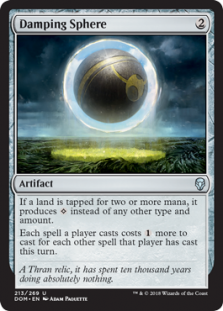
The biggest plus for Trawler is its cost. After Second Sunrise was axed, Eggs came to rely on Faith's Reward and Open the Vaults to rebuy its artifacts. Their higher costs slowed Eggs down slightly, but mostly made it far more vulnerable to countermagic, a huge contributor to its decline. Reward had to move from reserve to primary enabler because the only other option is a six mana sorcery. Prior to the ban, Eggs could play around UR Twin's Remands because everything was cheap. That wasn't true with Open the Vaults.

Additionally, Trawler returns artifacts to hand rather than to play, which is a neutral feature. It's good because it facilitates a single Engineered Explosives completely clearing opposing boards or loops with Mox Opal. But it also makes Ironworks more vulnerable to Damping Sphere or Rule of Law than Eggs was.
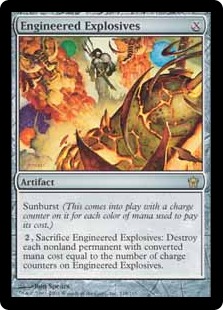
Trawler has above all added complexity to the deck. Eggs had to keep track of all the draw triggers and floating mana. Ironworks has to do all that plus remember Trawler and Myr Retriever triggers. Eggs didn't care about the order of sacrifices, but Ironworks can lose to poorly stacked Trawler triggers. All this accounting means that Ironworks demands flawless play in a way that Eggs didn't, with the penalty being judge calls for many missed triggers and failures to maintain game state. It has become a deck like Amulet Bloom that only committed players can play consistently well.

Explosives and Ironworks

The addition of Trawler and the transition from Eggs to Ironworks are not the key to the deck's recent success. I believe that the adoption of Engineered Explosives is. Looking back, the initial Ironworks decks ran one Explosives; maybe two. Eggs rarely ran any in their 75. However, ever since Hartford, three has been the norm. My Ironworks opponent in Week 1 had four. This is the real game changer.

Sunburst makes Explosives it shockingly flexible, as Legacy Miracles players first discovered: it doesn't matter how much mana was payed for X, but the number of colors, letting Explosives resolve through Counterbalance locks. Sunburst also means that taxing effects don't work. Thalia, Guardian of Thraben does nothing to Explosives, while she does impact Chalice of the Void.
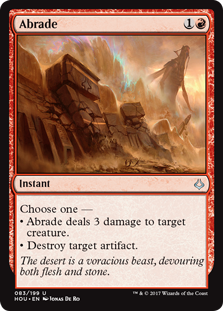
More importantly, Explosives hits all non-land permanents, including every hate card but Stony Silence. Normally, an engine combo like Ironworks is effectively dead to Meddling Mage naming the engine card. I certainly won plenty of matches Maging Eggs years ago. Explosives neatly answers Mage, and almost every other good card in Humans. Take note, ramp players: only Ruric Thar, the Unbowed is unsolvable for most Ironworks decks, as Explosives answers all hate cards that cost less than five mana. Thus, Ironworks is far less vulnerable to hosers than it was in the past.

On top of all that, Explosives is an artifact and can be played for free. This means it is never dead. It turns on Mox Opal, feeds Ironworks, and finishes the Trawler chain for value. Trawler means it can be played early to set up Opal, then sacrificed and brought back to remove troublesome permanents. It does everything that Ironworks could ever want.

Answers in Combo

Normally, answers in combo decks don't mesh with the rest of the deck. Abrade may add to storm count, but it doesn't actually further the combo, because it doesn't provide mana or draw cards. It may be dead if its intended targets don't show up. Furthermore, adding answers tends to dilute combo decks, making it harder to actually go off.
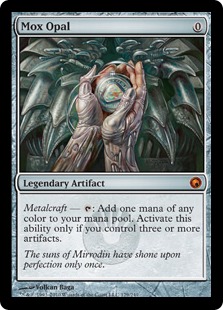
Since combo became a thing, combo players have been warned not to over-sideboard and turn their deck from combo to a bad fair deck. I remember Jon Finkel saying in a Storm deck tech years ago that the sideboard was there only to make his teammates happy. Given the choice, he never sideboarded in Storm; if he did, it was only to go all-in on Empty the Warrens. Explosives doesn't have that problem, as it fits almost perfectly into the combo.

Comparison to Angel's Grace

The closest direct analogue for Explosives' integration with the Ironworks combo is Angel's Grace in Ad Nauseam. Grace's main purpose is to facilitate using Ad Nauseam to draw the whole deck, finding a win condition and the means to execute it. It has the ancillary benefit of preventing opponents from killing you, but it isn't perfect at that; just ask Infect. Ad Nauseam also pays a heavy price using Grace in that role, as there are only four in the deck.

Unjustified Banlist Talk

Combo decks tend to draw out the mania among Modern players, regardless of data or power level. Right now, the data demonstrate that Ironworks is Tier 2 at best and not a problem by any stretch. However, this hasn't stopped commentators from picking sides. Mox Opal and Ancient Stirrings are  the chief targets of player ire, but this is entirely unjustified. The problem isn't with the deck's power level, but that Explosives has changed the nature of the deck and players have yet to adapt.

Mox Opal

The argument against Opal centers on it being free and accelerating the deck. Casting Ironworks a turn early provides a huge advantage. Skimping on land is also beneficial for any combo deck, and Opal makes it relatively painless. However, none of these factors point to Opal being particularly overpowered in Ironworks. This is Modern, in which interactive decks have plenty of ways to counteract even the strongest Ironworks starts. It can be rough on decks that want to goldfish their opponents, but that is the price that has to be paid. Failing to have the means to stop fast starts is a choice, and not a reflection of Ironworks. Opal is also vulnerable to all the same hate as the rest of the deck.

Players have argued to me that Opal facilitates the best Trawler loops, but I don't find that argument persuasive. If Trawler is looping artifacts, Ironworks is winning. The relative efficiency of the loop only matters if Ironworks gets bottlenecked. Yes, Opal is effectively Black Lotus mid-combo, but how often does the extra colored mana actually matter for the Ironworks kill? Especially with all the Chromatic Sphere activations in a typical loop? It's a nice bonus, but not a critical component.
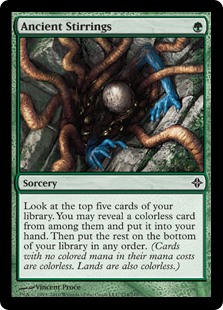
Remove Mox Opal from Ironworks, and the only effect will be to reduce the explosiveness of its best hands. It will not dramatically affect the average Ironworks win speed because the deck must still find Ironworks. If the effect is really necessary, there are other options available like Lotus Bloom that will fill the niche. On the other hand, there's nothing that can fill Explosives's shoes. Oblivion Stone is far slower and can be a liability.

Ancient Stirrings

I'd argue that thanks to devoid, Stirrings is the best cantrip in Magic. It looks five cards deep and finds whatever the decks that utilize it need. This gives them consistency that far surpasses colored decks and is a huge contributor to Ironworks's success.
Removing Stirrings would noticeably weaken Ironworks' ability to find its namesake card, and that translates to more games lost. However, I doubt it would be that dramatic of a drop-off. There are plenty of other options available, from Fabricate to Conjurer's Bauble. They're all worse, but again, everything is worse compared to Stirrings.

Cantrips make decks more consistent. Combo decks need consistency more than any other deck because they have pieces to assemble. However, they don't win games by themselves, nor do they turn games around. In a tight spot, Stirrings is only a good topdeck because it provides the best chance of finding the Explosives that will actually save the day.

Reevaluating Strategy

Let me be clear: Engineered Explosives is not bannably powerful, nor does Ironworks warrant any bans, my hatred of Stirrings notwithstanding. The only reason the deck will eat another ban is if it causes GPs to drag on forever again.
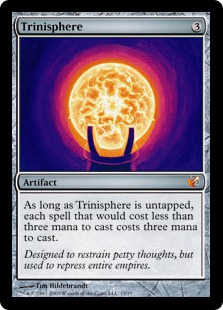
Instead players need to focus on countering the effectiveness of Explosives. Players know that Ironworks is vulnerable to Stony Silence, graveyard hate, and not resolving Ironworks itself. The problem is most of the good options for fighting Ironworks all cost two mana. I've seen Humans scoop to losing Thalia and Mage in the same blast. Normally, it's a bad idea to run anything but the most powerful card but given how Ironworks operates and how it sideboards, this is a time where less than optimal cards may be more potent. The conventional permanent based attacks won't work against the new version of Ironworks. It's time to rethink and reposition.

Option One: Diversify

A solid strategy for dealing with answers or hate is to be less vulnerable. Since Explosives is set to a specific mana cost, the simple way to avoid getting blown out is to use differently costed hate cards. All the most powerful cards cost two mana, but that doesn't mean there aren't perfectly serviceable cards available, such as swapping Rest in Peace for Leyline of the Void. Shifting from relying on a single mana cost denies Ironworks the chance to solve all its problems with one fell swoop. Make Ironworks work harder, and it is likelier to stumble.
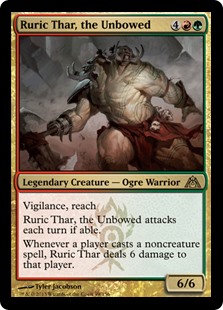
One option that I am exploring for my next PPTQ is Trinisphere. It is harder for Ironworks to produce three colors of mana than two, and Three Sphere has the advantage of weakening Nature's Claim. Trinisphere is far more narrow than the Damping Spheres I'm currently running in Spirits, but has about the same impact against Storm and plays around Explosives better than banking on Sphere and Rest in Peace.

Option Two: Dodge

The more straightforward approach is to simply moot Explosives. Grixis Shadow uses non-permanent disruption. Ironworks doesn't really have an answer to discard spells, a fast clock, and countermagic. True, relying on discard leaves players open to losing to topdecks, but that's why a clock is critical. Even the slowest UW Control deck can drop a Vendilion Clique end of turn and then hold up counters. To not lose to Explosives, don't make it matter.


The other option is to play permanents that Explosives can't hit, but the only one I can think of is Ruric Thar. As mentioned, he's a nightmare for most combo decks. The only way Ironworks can theoretically answer him without taking 6-12 damage is double blocking with Scrap Trawlers. Blocking may be the only option because how likely is Ironworks to bring in Galvanic Blast against ramp decks?

Option Three: Answer

The other option is to simply preempt Explosives. Humans has Thalia, and she is very potent against looping artifacts. Instead of using Mage to name Ironworks, name Explosives. This protects Thalia and preserves the board; a second Mage should provide the nail in the coffin. Another option is Pithing Needle. Needle normally does nothing against Ironworks because everything is a mana ability, but it does hit Explosives, which means it protects the real hate and may even draw Nature's Claim away from another target. A far cleaner answer is Gaddock Teeg, who prevents both Explosives and Ironworks from being cast.

Adapt and Win

Like most combo decks, Ironworks knows what it's vulnerable to and has taken steps to strengthen itself. The reason that this is different from other combo decks is that the answer it needs meshes perfectly with the combo. Therefore players need to stop focusing specifically on the combo and look more broadly. Ironworks has adapted, and it's time the rest of the metagame follows suit.

Want Prices?

Browse thousands of prices with the first and most comprehensive MTG Finance tool around.


Trader Tools lists both buylist and retail prices for every MTG card, going back a decade.

Quiet Speculation