menu

Insider: Nationals Sweep Market

Are you a Quiet Speculation member?

If not, now is a perfect time to join up! Our powerful tools, breaking-news analysis, and exclusive Discord channel will make sure you stay up to date and ahead of the curve.

This past weekend we had a number of PTQ's, a couple of Nationals events, and some results from MTGO to work off of for our post M12 format. I found it interesting that there were no red decks in the top 16 of the SCG Open, or the top 8 of the Japanese Nationals event. Red seemed to be such a strong contender with its new cards added into the mix, however the format continued to be about tuned up Valakut lists, U/W Puresteel, Tempered Steel, and U/B Control. There are a number of other strategies worth watching, but I wanted to focus on those previous four today, and get a good idea of whats going to happen for them. For the prices I'll be using the Online Store from TCG Player.com, since more often than not that's where I can get the lowest prices through.

Valakut

With the namesake card for this deck, Valakut, the Molten Pinnacle rotating out this fall, I would expect that this deck will enjoy its time in popularity until the very end. The addition of Solemn Simalacrum to the list gives them acceleration, blocking, and card replacement when it dies. It's no wonder that almost every winning list is playing them as a 4-of right now, making him a card that I only see starting it's use in the current metagame.

Solemn Simalacrum

Lowest price: Tabletop Arena @ $4.75 (M11)

Highest price: The Gaming Goat @ $7.99 (Mirrodin)

$4.75 is a really good price at the current point. In trade, you should be able to pick them up for $5 pretty easily, and it's a fair price for the time being. If U/B control picks up the card, it could go higher for the average, so get them if able.

The next card is one that can be found in the sideboard of any deck playing green, and with Tempered Steel picking up more popularity, I expect these to find more play.

Creeping Corrosion

Lowest price: Wild Rabbit Ent. @ $0.16

Highest price: IDeal808 @ $0.24

I don't think they will be going up to above the $2 mark since their use is limited to decks with green, but hitting the $1 mark isn't unreasonable if Tempered Steel continues to do well. Grab a few for throw-ins if you can, or buy some for under $0.20 each, since you can usually trade them for $1 in value.

Tempered Steel

The best and worst thing about Tempered Steel is that the deck mostly plays commons and uncommons. This makes it an attractive option to people looking for something new to play, but it doesn't leave a whole lot of room for investments and profits. The most expensive piece of this deck is the Mox Opal, and it was many months ago that I told people to be watching them.

Mox Opal

Lowest price: Run MTG @ $16.50

Highest price: CCG Unlimited @ $17.00

With only a $0.50 difference between the highest and lowest, there isn't a whole lot of room to get a killer deal, though compared to SCG's $19.99 price point, even $16.50 looks pretty good if you really need a set. You can probably get them for $15 in trade, and perhaps lower if the deck falls in demand.

The next card has foil a full art versions, but the normal rare ones still get you a decent price.

Tempered Steel (normal version)

Lowest price: Alter Reality Games @ $3.48

Highest price: XtremeGames @ $4.48

(Full art version)

Lowest price: Channel Fireball @ $7.99

Highest price: CCG Unlimited @ $22.98

Quite the difference there, CFB is usually hit-or-miss for their prices, though this time they have a rather decent deal. If you know people looking for them and willing to pay the medium between the two prices ($12-$15) I would pick up a set of them from CFB and take your profits.

Finally, a card that most of us have already sold off, or are holding onto to see if it goes higher,

Inkmoth Nexus

Lowest price: Wild Rabbit Ent. @ $7.92

Highest price: CardAddiction @ $9.20

Again, most of us have already gotten them, and either sold them off or are holding a few of them to see if their demand in a few decks ticks the numbers up a couple of dollars. I don't suggest getting in on these now if you already haven't, unless you can find them at $6 and under.

U/B Control

The favorite from worlds last year seems to have made a return in Japan, but on the financial side of things, it's rather dull. Solemn made an impact here as well, Jace Beleren is rotating, and Black Sun's Zenith isn't used enough to warrant buying them in large quantities.

U/W Puresteel

This deck is like the lovechild of Caw-Blade and Tempered Steel, and it's all awesome. Fifteen main deck equipment are present to take full advantage of the Puresteel Paladin's effect, and there are often three more swords in the board. With the possible surge of blue based control decks on the way, the market has responded by increasing the demand on Sword of Body and Mind, giving you an excellent opportunity to get rid of them for a decent price.

Sword of Body and Mind

Lowest price: Wild Rabbit Ent. @ $7.04

Highest price: Fustion Gaming @ $7.90

The FtV Relics swords go for a bit more though, ranging from $12-$15, while a Scars foil sword is $15+. Still, if there are a number of people that decided to play blue based control/permission decks in your area, its a good time to have a few of the swords to trade away to the local aggro players.

Puresteel Paladin

Lowest price: TJ Collectibles @ $1.79

Highest price: The End Zone @ $2.80

With the low price being under $2, I've gone and picked up a few of these myself. From what I've seen the deck is a real contender now, so having a few of the Paladins ready to go when people decide they want to play it can work in your advantage.

The other other from the deck worth mentioning is Inkmoth Nexus, but I already covered that up above.

That about covers it for this week, next week we'll see how things continue to pan out. we have the SCG Open Seattle, and a few other events that will give us more results. Keep an eye on fringe decks, many of them are just in need of the right meta or a few more tweaks from becoming something really great.

Stephen Moss

Understanding the Standings

Are you a Quiet Speculation member?

If not, now is a perfect time to join up! Our powerful tools, breaking-news analysis, and exclusive Discord channel will make sure you stay up to date and ahead of the curve.

I've been asked by several people, during events ranging from local free-entry tournaments all the way up to the Pro Tour (really!), how to read standings and figure out whether to draw or not, or whether they even have a chance to make it if they win. This article aims to be a tutorial for understanding how to read standings and how to use them to your advantage. I'm going to use some simplified examples in order to demonstrate various scenarios that come up in tournaments.

The Basics

A win is worth 3 points. A loss is worth no points at all. A draw is worth 1 point. This is commonly reported as Win-Loss-Draw, so a player who won 3 rounds, lost two, and drew one would be reported as 3-2-1. With zero draws they're commonly left off, so a player who went 5-2 is a player who won 5 rounds and lost 2. (Whereas 5-0-2 would refer to 5 rounds won, zero lost, and 2 drawn.)

The round count in an event with a cut to the top 8 is set so that a player who loses only one round and has no draws is guaranteed to make top 8, regardless of what his tiebreakers are. Because of this, people tend to simply say they're "X-0" or "X-1". This doesn't always apply to smaller events (which sometimes cut to top 4, or have no cut at all) or to events with byes - Magic Online in particular has had problems with miscalculating the number of rounds to play and X-1s have missed it.

At events like PTQs, this isn't a problem, and X-1 can be safely assumed to make the top 8. Usually, a player who is X-1-1 makes it into the top 8, but sometimes not every person who is X-1-1 can make it. What usually happens is that people figure this out when looking at the standings, and opt not to draw, so that 8th will be an X-1-1, or occasionally an X-2.

At events with a low player count, or a player count which barely exceeds the amount which made the event add a round, a "double draw" is fairly common. For instance, an event with 34 players almost always has exactly 4 people at 4-0 after 3 rounds, and those 4 players will draw in both the 4th and 5th round, taking them to 11 points, guaranteeing their entry to the top 8.

Round Count

I'm going to quote the Magic Tournament Rules, Appendix F here for simplicity, then explain it in more detail:

The following number of Swiss rounds is often required for Premier tournaments. It may be used at the Tournament Organizer’s discretion for non-Premier tournaments. It is included here for reference only.

Players Rounds
8 3
9-16 4
17-32 5
33-64 6
65-128 7
129-226 8
227-409 9
410+ 10

Team tournaments consider each team as a single player for this purpose. Individual or team tournaments that cut to top 4 should be run with one extra round. Individual or team tournaments that cut to top 2 should be run with two extra rounds.

So, why are those the numbers? Well, for the numbers up to 128, they're exactly on the powers of 2. This should make a certain intuitive sense when you consider that exactly half the players will be undefeated after each round.

Remember that players are paired from the top down, with another player of the same record, so long as others exist. If there's one left over, that person gets paired down to someone as close as possible - if there are 5 people at 12 points, then the 5th will be paired with someone at 11 if one exists, or one at 10 if there isn't an 11, or a 9-point player if nobody has 10 or 11. (At the very bottom of the standings, of course, if one person is left over that person receives a bye.)

In short, these round counts make it so that, at most, 1 player can go undefeated. That's important, since this applies for all Swiss events, not just ones with a top 8 cut. It'd be absurd to give a number for an 8-player event otherwise! In addition, these numbers also guarantee that no more than 8 players can have a single loss.

A Simple Example

At a local 7-round PTQ, the standings after Round Six look like this:
1. Adam Anderson 18
2. Bob Bennett 18
3. Chris Campbell 15
4. David Davis 15
5. Edgar Edwards 15
6. Frank Fisher 15
7. Greg Gray 15
8. Hubert Hall 15
9. Isaac Isakson 12
(players continue from there)

The short version of this? 2 people at 18, 6 people at 15, and an arbitrary amount at 12 or below.

As we can see, if everyone plays it out, the people currently at 18 are a lock. This is the way it should be, since 18 points can only be had via being 6-0, and X-1 is supposed to make top 8 no matter what. A 6-0 player losing the final round becomes 6-1 and still makes the top 8.

As for the players currently at 15, the 3 winners will make it to 18 and be guaranteed to make top 8, but what about the losers? They will remain at 15, and since there are already 5 people above 15, only 3 of the people at 15 points will advance - the people advancing from 12 to 15 can pass them via tiebreakers.

What if there were a way to guarantee that they could avoid losing? Let's bring the intentional draw into the equation! As we've discussed, people currently at 12 points cannot ever get past 15 points in a single round, and since the highest person at 12 points is in 9th, we know that making it to 16 or more points means you cannot finish at 9th or below.

Therefore, the people at 15 points should all choose to take the intentional draw to make top 8, meaning in this event everyone at X-1-1 makes top 8 and nobody at X-2 does. That's great news for Hubert, but terrible news for Isaac, and the reason why "0-2 drop" is a common phrase. Even in the cases where X-2 players can make top 8, the way tiebreakers are calculated (a subject for another article) means that people who lose early in the event have far worse tiebreakers than people who lose late in the event.

The Double Draw

In smaller events, it's often common that a person at X-0-2 can make it. Consider a 16-player event (thus, 4 rounds) with a cut to top 8, with no unintentional draws in the first two rounds.

After round one:
8 players at 3 points
8 players at 0 points

After round two:
4 players at 6 points
8 players at 3 points
4 players at 0 points

Now, if people know what they're doing, you'll see the 4 people at 6 points choose to draw. Why? Well, let's consider what happens if they don't:

After round three:
2 players at 9 points
6 players at 6 points
6 players at 3 points
2 players at 0 points

If you learned the lesson in the simple example well, you'll notice that in this case the people at 9 and 6 can all draw to make 7 points and be assured of making top 8, rendering the last round largely irrelevant.

However, there is an edge case where if there are some unintentional draws it's possible that 7 points puts people in a position where their tiebreakers matter. Consider what happens if two people who are at 3 points draw:

After round three:
2 players at 9 points
5 players at 6 points
2 players at 4 points
5 players at 3 points
2 players at 0 points

Not all of the people at 6 points can draw in! One of them will be paired against a 4-point player, and the 4-point player will be unable to agree to a draw. This is not necessarily the person who has the worst tiebreakers! As a result, it is better for the people who go into round 3 at six points to take an intentional draw, resulting in the following standings:
After round two:
4 players at 6 points
8 players at 3 points
4 players at 0 points

After round three:
4 players at 7 points
4 players at 6 points
6 players at 3 points
2 players at 0 points

And even if there is an unintentional draw between 3-point players, all the people who go into round 3 at 7 points are going to be able to draw to 8.
After round three:
4 players at 7 points
3 players at 6 points
2 players at 4 points
5 players at 3 points
2 players at 0 points

Here the pairings are 7-7, 7-7, 6-6, 6-4, 4-3, 3-3, 3-3, 0-0. The first two of these will continue on the "double draw" plan, the 6-6 players can draw to 7 and safely make it, the 6-4 people have to play it out since the 4 drawing to 5 can't make it. 7 points (2-1-1) is guaranteed to make it, but depending on what happens in the 4-3 matchup, a single person at 6 points can make the top 8 - but it comes down to tiebreakers, and it's not necessarily going to be the person who beat the 4-point player.

In practice you don't have to evaluate a whole tournament because you only care about a particular person - yourself. The simplest possible rule of thumb for the double draw in small events is as follows: if there are exactly 4 people at X-0, and nobody at X-0-1, you can safely double draw.

Complex Double Draw


Round 5 of a 7-round PTQ has just finished, and we have the following standings due to some undefeated players going to time in this round and the last:
1. Adam Anderson 15
2. Bob Bennett 15
3. Chris Campbell 15
4. David Davis 13
5. Edgar Edwards 13
6. Frank Fisher 13
7. Greg Gray 12
8. Hubert Hall 12
9. Isaac Isakson 12
...more 12-point players follow, for a total of 18...
Nobody is at 11 points, but there is one person at 10 points.

When standings are posted, Adam and Bob are paired against each other. Chris is "paired down" against David, and Edgar and Frank are paired against each other. (The 10-point player is paired against a 9-point player.) Can Adam and Bob plan on double-drawing?

First, let's observe that a double draw puts them on 17 points. Is 17 a lock for the top 8? The important thing is how many people there are at 12 points. With 22 other people at or above 12 points, 11 can win the first round and at most 6 can win the next. That works out perfectly for Adam and Bob- except for one small problem. They've got to have other people to draw with.

There is a "pair-down" involved, which means there are multiple scenarios that could play out.

Let's see what happens if David wins (We'll say Edgar wins his match against Frank, but it doesn't matter which one it is):

Adam 16
Bob 16
David 16
Edgar 16
10 players at 15 points, including Chris
Frank 13

The players at 16 clearly can't draw the next round, since there will be 5 18-point players after this round. One of them will lose to the other 3 on tiebreakers.

Let's see what happens if Chris wins (We'll say Edgar wins his match against Frank, but it doesn't matter which one it is):

Chris 18
Adam 16
Bob 16
Edgar 16
9 players at 15 points
David 13
Frank 13

One of them will be paired up against Chris (who can clearly agree to draw) and the other will be paired against Edgar. Is 17 points safe here? You'll have one player at 19, three at 17, and either 4 or 5 people at 18. If it's 4, then they're all in just fine, but if the person who gets paired down against a 13-point player wins, then it comes down to tiebreakers, and one of the people at 17 points will lose out.

So, can Adam and Bob count on a double draw? The answer is clearly no. There are too many people at 12 points in the initial situation to make it a safe play.

Complex Double Draw Okay

After 5 rounds of a 7-round PTQ, the standings are as follows:

1. Adam Anderson 15
2. Bob Bennett 15
3. Chris Campbell 15
4. David Davis 13
5. Edgar Edwards 13
6. Frank Fisher 13
7. Greg Gray 12
8. Hubert Hall 12
9. Isaac Isakson 12
...more 12-point players follow, for a total of 10...
Nobody is at 11 points, but there are seven people at 10 points.

This is the same situation as before, but a bunch of the 3-1 players picked up an unintentional draw, so there are way fewer people at 4-1 than normal.

Let's rework Adam and Bob's double draw math with these new numbers :

If David wins (We'll say Edgar wins his match against Frank, but again it doesn't matter which one it is):
Adam 16
Bob 16
David 16
Edgar 16
6 players at 15 points, including Chris
Frank 13

Notice how this works out to be identical to the conventional 4-player double draw? That's what Adam and Bob are dependent on - the right amount of X-0-1 players "catching up" to them so they can be assured that they'll have a draw partner in the next round. This is exactly what they want, and is the ideal situation for the double draw in a complex scenario.

But what happens if David loses and Chris wins? Chris won't be X-0-1, but is that a problem?
Chris 18
Adam 16
Bob 16
Edgar 16
5 players at 15 points
David 13
Frank 13

Because David was paired up, Chris ends up ahead of them and can agree to the final-round draw, it works out just as well for Adam and Bob. However, Chris is in with a loss, and may try to get a friend into top 8 by knocking out the person he gets paired against.

In this situation I would overall consider Adam and Bob safe to draw with the goal of double drawing, because the only way one of them gets knocked out is if Chris wins and decides to go for the dreamcrush. The chances of that are pretty low, but not utterly nonexistent.

Breaking Down the Double Draw

As we can see, the number of X-1s makes a big difference when doing double-draw math. Since a double draw requires 4 people to be involved, there can be no more than 4 other people who make the top 8. As a result, this means a maximum of 16 other people can be in contention leading into the second-to-last round. When there were 18 people at X-1 and 6 people above it, the double draw was not viable. Thus, the simple rule of thumb needs a bit more detail:

Exactly 4 people at X-0
Maximum of 16 people at X-1

If there are 3 people at X-0, then having exactly 3 people at X-0-1 will enable the paired X-0 players to double draw, but as a result of the additional players in contention, this only works when there are 10 or fewer people at X-1. (There is a small risk of the paired-down X-0 winning, then deciding to dreamcrush rather than draw, but even if he does that, there's only a 1 in 3 chance that you get paired against that person.)

If there are 2 people at X-0, then having exactly 4 people at X-0-1 enables the X-0 players to double draw. This works with as many as 16 people at X-1.

Drawing to Other Cutoffs

If you're in an event with point cutoffs or other critical thresholds, such as an SCG Open, Grand Prix, or even the Pro Tour, you can apply the single-round math to the final round to ensure meeting the threshold. This is tricky, since you have to account for people above you or at the same record opting to draw, but let's look at the last Pro Tour.

At PT Nagoya, anyone with 30 points after Round 15 could take a draw to guarantee top 50 and win an invite to Pro Tour: Philadelphia. Quite a few people took advantage of that: everyone at 31 except for Carrie Oliver and Kai Fielder, who made it to 31 from 28, took a draw in the final round to secure their invite. Of course, not everyone took that option: people who were already qualified for Philadelphia opted to play the final round to try to make top 32 and get more Pro Points, resulting in their opponents not getting the draw. This is important to remember - once outside of top 8 contention, not everyone has the same goals when choosing to draw!

Application

When handling draws, it's best to avoid all mention of the prize and just focus on explaining to your opponent that taking the draw allows you both to make the relevant cutoff in order to avoid giving the appearance that you are performing bribery or collusion. Needless to say, actual bribery or collusion will get you disqualified and possibly banned by the DCI. Just ask your opponent if they are willing to draw, and if they are unsure, explain that a draw ensures that you both make the cutoff. If they refuse even when you both are locked for top 8, there's nothing you can do but re-offer the draw after the first game is over. If you're below them on the standings, it's often helpful to point this out, since you can simply point out that if a draw were going to screw them over it'd screw you over just as well.

Furthermore, outside assistance will earn you a Match Loss penalty, so once you've left the pairings board and are at the table, don't tell people at adjacent tables whether they're safe to draw or not.

Joshua Justice

@JoshJMTG on Twitter

Joshua Justice

Joshua Justice is a Magic player in Atlanta who's been to the Pro Tour twice. College put him on hiatus from the game until January 2010, and 5 months later he won his first Pro Tour invite with Super Friends. After a series of narrow misses in the second half of the year, Joshua won a GPT and used that to make top 16 of Grand Prix: Atlanta and secure his second Pro Tour invite in just over a year. While Nagoya was a bust, Joshua has been grinding points on the SCG Open Series, and is a virtual lock for the second Invitational. His focus is primarily on metagaming and deck tuning, and partially-open formats are his favorite playground.

View More By Joshua Justice

Posted in Free, Strategy2 Comments on Understanding the Standings

Have you joined the Quiet Speculation Discord?

If you haven't, you're leaving value on the table! Join our community of experts, enthusiasts, entertainers, and educators and enjoy exclusive podcasts, questions asked and answered, trades, sales, and everything else Discord has to offer.

Want to create content with Quiet Speculation?

All you need to succeed is a passion for Magic: The Gathering, and the ability to write coherently. Share your knowledge of MTG and how you leverage it to win games, get value from your cards – or even turn a profit.

Commander Archetypes: Aggro

Are you a Quiet Speculation member?

If not, now is a perfect time to join up! Our powerful tools, breaking-news analysis, and exclusive Discord channel will make sure you stay up to date and ahead of the curve.

Commander has many viable strategies. Today I'm going to review the aggro archetype, and suggest a few generals that you might enjoy using. As it turns out, the aggro decks you'd play in a 20 life format don't work very well in a 40 life format, but you can still play aggressive decks with the right general. In many cases it becomes somewhat similar to a midrange strategy from 20 life formats. Every card needs to count no matter what turn you play it, but the fundamental idea of winning in the red zone is still there.

Aggro includes two different strategies:

  • Traditional aggro with a good curve and aggressive creatures, and
  • Commander damage where your goal is to get 21 damage in with your commander on as many opponents as possible, as fast as possible.

Tribal strategies typically play into the traditional aggro role as does token generation, though both with their own distinct touches.

Colors to Choose

Traditional Aggro

Normally, the premier aggro strategies are red or white, possibly with a splash into some other color. This holds true for the most part in Commander as well, but any color can get the job done if you build the deck to do it. The big difference is the typical "Sligh" strategy of beating your opponent down to low life totals, then finishing it off with red burn spells like Lightning Bolt, doesn't work the greater majority of the time because people simply have too much life. Since the "all in" plan usually doesn't cut it, a lot of typical aggro staples have to be swapped out for creatures that are a little less powerful on offense for things that serve as persistent threats.

For tribal aggro, color selection is all about what tribe you want to play. Almost every tribe that has enough representatives to make a deck if it has a commander of the same creature type. For Goblins, you have Wort, Boggart Auntie. Elementals have Horde of Notions. Vampires have a host of choices, as do Soldiers. If you know you want to play aggro, and you know you want to play tribal, you're only limited by your imagination.

Token generation is a powerful alternative method of playing aggro in Commander as well. By generating enough tokens along with a few global pump effects, your swarm can quickly become unstoppable. For tokens, I highly recommend green and/or white. Supplementing with a third color can't hurt if you can afford the mana base for it.

General Damage

The flip side of aggro is to pick a good aggressively costed general and go for the general damage win. Sometimes just turning your general sideways can be enough if you pick the right general. Another common method is to play a cheap CMC general and ways to pump him or her up (known commonly as a "Voltron" strategy for the kid's cartoon from the late 80s where combining several "weak" robots together made a big near-unstoppable monster robot). The general gives you a persist threat you know you can count on, and you fill your deck with ways to make sure you can get in for 21 on each opponent. Almost every color combination provides a possible general for this type of play, if you want to try it.

How to Build Your Curve

Traditional Aggro

Normally the most important thing to do with an aggro deck is to get the pressure on early to kill your opponents before they have a chance to react. In Commander, it becomes much more important to apply consistent pressure because you can't rely on being able to beat your opponents down before they can mount a defense. If you want to play the aggro game, you need to play threats from one or two mana and up. You will also need to make sure you have a late game planned to go with your early aggro strategy.

The key is making sure the creatures you play at one, two, and three mana are as relevant on turn 7 or later as they are on turn 1 and 2. Up until recently there weren't a lot of creatures that fit the bill. Rise of the Eldrazi and level up creatures did a nice job of fixing that. Level up gives us a nice curve of creatures that can start putting on the pressure early and serve as useful mana sinks for late game, turning small creatures into a huge threats.  Level up creatures are a good place to start looking for relevant aggro creatures to play in Commander. Kicker and multikicker creatures are good as well since you have at least two different places to play the creature.

Tribal strategies face an interesting dilemma. With a few notable exceptions (Dragons and Angels jump to mind immediately), most tribal-oriented creatures are small. This potentially complicates things because Commander is often a game of fatties and board sweepers. The best solution for this is to build some solid recursion into your deck. Plan out your curve with your guys, but leave a few slots for ways to recur your creatures or otherwise deal with the board sweepers you'll be seeing out of the control players. Depending on your tribe of choice, you may be able to pick a commander with built-in recursion. These often make the strongest choices because they shore up the natural weak point of a tribal Commander deck: wanting to have multiple guys out when many groups are very board sweeper heavy.

Depending on the colors chosen, token deck curves can end up looking very odd. Most of the good token generation spells are between four and six mana, and your token pump can range anywhere from a converted mana cost of two up to seven, or more. Sometimes you'll find yourself playing out [card Glorious Anthem]anthems[/card] before you even get a significant number of tokens! This isn't necessarily a bad thing. If your tokens enter the battlefield bigger than the base stats it certainly doesn't hurt, and it makes them more resistant to removal. Combine global pump with haste effects for ultimate synergy.

General Damage

For the Voltron strategy, the key is picking the right supplemental abilities to enhance your commander. The three main areas to address are damage capability, evasion, and the ability of your opponents to answer it. You do want your commander to have a decent power, some sort of evasion, and to be difficult to kill. Generally speaking, you get one or two of those abilities on the general itself, and then supplement the others through your deck construction.

For example, say you want to build a Rafiq of the Many Voltron style aggro deck. Rafiq provides a lot of damage in an efficient package, with his double strike, four power, and exalted bonus. The double strike actually provides a little defense by making him much harder to kill when attacking, and increasing his power effectively makes him more survivable (but he's fairly fragile otherwise). However, he lacks evasion. Give him a Loxodon Warhammer, and he's a two-hit kill that's almost impossible to beat in combat. Add in Lightning Greaves or Shield of the Oversoul and he's nigh unstoppable.

Recommended Generals

Here's a quick list of possible generals for both traditional aggro and general damage strategies.

White

  • Commander Eesha – Give her vigilance and go to town.
  • Crovax, Ascendant Hero – Your tokens get bigger, their blockers get smaller. The self bounce means you should never be paying more than 6 to cast him.
  • Eight-and-a-Half-Tails – The go-to-guy for a mono-white Voltron general. Protection gives you evasion and defense at the same time. Just don't enchant him.
  • Elesh Norn, Grand Cenobite - Great choice for a mono-white tokens deck.
  • Kemba, Kha Regent – She screams Voltron.
  • Lin Sivvi, Defiant Hero – Step 1, pick Lin Sivvi. Step 2, fill deck with rebels. Step 3, … Step 4, Profit!
  • Pianna, Nomad Captain – You could do much worse if you wanted an aggressive general to support your tokens.
  • Raksha Golden Cub – This guy is expensive, but he will end the game if you have a Cat or two on the field when he comes down and you equip him.
  • Zhang Fei, Fierce Warrior – A little on the expensive side, he can end a game pretty quickly with minimal pump, and is basically unblockable.

Blue

  • Kira, Great Glass-Spinner – She's good for protecting your other beaters, but not so great at Voltron.
  • Sun Quan, Lord of Wu – Your whole team is basically unblockable. What's not to like?
  • Thada Adel, Acquistor – See how many Sol Rings you can get in one game.
  • Vendilion Clique – Quick beats that provide some protection by picking on the sweeper guy and getting rid of one.

Black

  • Ascendant Evincar – See what I said about his happy version.
  • Drana, Kalastria Bloodchief – Flies, eats blockers, and pumps her power. She's fantastic for general damage or as repeatable removal.
  • Skithiryx, the Blight Dragon – You don't need pump when you only have to get in for 10.
  • Zhang He, Wei General – Battle cry in black is not to be overlooked if you're going for a swarm strategy.

Red

  • Ashling the Pilgrim – "99 mountains.deck" exists for a reason.
  • Godo, Bandit Warlord – He loves being equipped. Go find him one and beat some face.
  • Lu Bu, Master-at-Arms – The only thing better than horsemanship for getting in general damage is horsemanship and haste.
  • Urabrask the Hidden - Giving all your guys haste is amazing. Even better, he makes it really hard to just chump block. Not bad for Voltron or traditional aggro.
  • Zo-Zu, the Punisher – Make those mana ramp players hate you really fast.

Green

  • Eladamri, Lord of Leaves – Makes your other guys immune to spot removal, which Elf tribal sometimes needs.
  • Ezuri, Renegade Leader – Repeated use [card Overrun]Overruns[/card] in the tribe of making-way-too-much-mana seems good.
  • Hua Tuo, Honored Physician – Recursion on your commander is great for aggro so you can reuse the guys that end up in the graveyard at inopportune times.
  • Kamahl, Fist of Krosa – Look, more Overrun goodness!
  • Nemata, Grove Guardian – Pumps Saprolings and makes them. Token strategies love this guy.
  • Omnath, Locus of Mana – Give him trample and tap out every turn.

Multicolor

  • Sygg, River Guide – Excellent Voltron general, similar to Eight-and-a-Half-Tails but giving you access to blue as well.
  • Wydwen, the Biting Gale – Self bounce and flash gives you pseudo-haste.
  • Wort, Boggart Auntie – Fixes the one weakness of Goblin tribal by giving them a way to recur all the suicidal goblins. Fear makes her potentially dangerous as a method of general damage, especially when combined with the multitude of Goblin lords.
  • Radha, Heir to Keld – The best second color to pair with green Elf tribal is debatable, but Radha can be very explosive and gives the archetype some potential reach.
  • Stonebrow, Krosan Hero – Trample counts as evasion if your guys are big enough. Playing a few smaller tramplers then curving into Stonebrow can be pretty sweet.
  • Ulasht, the Hate Seed – If you want to play red and green tokens, it's hard to beat Ulasht for sheer explosive potential.
  • Gaddock Teeg – Shut off all those pesky sweepers before they matter! He's potentially a real downer of a commander for the rest of the table though; be prepared to get attacked by every single creature they can muster until they get rid of him.
  • Rhys, the Redeemed – It's hard to say no to double tokens.
  • Tolsimir Wolfblood – Anthem for your guys and making a big token. Not bad for green-white tokens.
  • Nath of the Gilt-Leaf – He's another option for Elf tribal. Free elves for getting rid of your opponent's cards.
  • Agrus Kos, Wojek Veteran – If anyone says attack, it's Kos.
  • Brion Stoutarm – Potentially awesome Voltron general, or you can Voltron his minions and throw them at people.
  • Jor Kadeen, the Prevailer - An interesting general for both Equipment-based Voltron strategies and for more traditional aggro. Either way, play lots of artifacts.
  • Thelon of Havenwood – Make that Thallid deck you always wanted to!
  • Kresh the Bloodbraided – Almost more of a combo general than an aggro one, Kresh tends to become huge very, very quickly.
  • Rith, the Awakener – Very few creatures make tokens as fast as Rith does. I've played her many times and if she gets to trigger more than once, it's usually game over.
  • Uril, the Miststalker – Another poster boy for the Voltron strategy. Give him Shield of the Oversoul and watch your opponents panic.
  • Jenara, Asura of War – Built in pump and evasion says let me get in there already.
  • Rafiq of the Many – He is a big fan of Loxodon Warhammer, any of the "Swords of A and B," or really any equipment. He does scary amounts of damage and is very hard to deal with in combat.
  • Doran, the Siege Tower – He's possibly the most amusing Voltron commander because he'd rather have Slagwurm Armor than almost anything else. He's also a solid Treefolk tribal commander as well since they almost universally have higher toughness than power.

The End of Aggression

That's it for aggro. Next time I'll take a look at the myriad strategies encompassed in midrange Commander. Until then, remember it's never a sin to turn your team sideways!

Investigating Innistrad

Are you a Quiet Speculation member?

If not, now is a perfect time to join up! Our powerful tools, breaking-news analysis, and exclusive Discord channel will make sure you stay up to date and ahead of the curve.

For the precursor to this article, see Investing In Innistrad.

---

When we last left off, discussions about the fall MTG expansion Innistrad were baseless speculation. In keeping with what has become a Magic tradition, the preceeding Core Set seems to have a few "plants" for the upcoming set. We have a lot of speculation on the contents of Innistrad, but our best guess right now is "Graveyard Matters". For old-school players, this will harken back to Odyssey block and for good reason. We have many dread returns from that era, many of which play nicely with contemporary cards.

Grim Lavamancer

What better card to showcase the "graveyard as resource" mechanic? Grim Lavamancer is a five-tool powerhouse that can slot into almost any deck featuring red mana, but it works against many of the typical graveyard mechanics (Threshold, Flashback and Reanimation). That said, it will be a defining card in Innistrad Standard regardless.

Sutured Ghoul

Speaking of Reanimator, this former gamebreaker can no longer rely on Hermit Druid for an instantly stocked graveyard, nor can it get after your opponent with a healthy dose of Anger. It's clearly a plant for Innistrad, but it won't likely end up a defining player in the metagame. This zombie will likely have to stay in the grave for a little while longer.

For Zombies, press 1. Para continuar en Espanol, oprima "cinco".

Call to the Grave

The Abyss is back, with a twist! Odd that it includes a clause about Zombies, but then again, why would a zombie heed a call to the grave? They rather enjoy being out on the battlefield, where brains are plentiful and fresh. This reprint may not end up seeing competitive play, but you may be noticing a theme here.

Zombie Infestation

Speaking of reprints, another Odyssey block favorite is back in black. This aggressively-costed enchantment is an endless source of mindless fun, and can help fuel whatever graveyard-based strategy you desire. This one is going to see competitive play, especially if the rumors surrounding Flashback's return are true.

Cemetery Reaper

A contemporary card, Cemetery Reaper confirms what has seemed to be a theme in the 2012 Core Set; Zombies are back. You heard it here first - Innistrad is going to feature Zombies as a central tribe. There simply aren't enough of them in Standard right now, so printing a Lord and a tribally-aligned enchantment makes almost no sense. The inclusion of this card in M12 should be sufficient proof of this hypothesis, so Cemetery Reaper seems like a great pick-up for Magic players looking to speculate.

Bloodlord of Vaasgoth

We have seen a slew of new Vampires in M12, slower and more powerful than their Zendikar cousins, but they haven't been enough to support the tribe once Zendikar leaves the format. Bloodlord of Vaasgoth implies what Vampire Nocturnus did two years ago; Vampires are going to be the "other" black tribe in Innistrad! There's no sense in printing such a bombastic powerhouse lord for an unsupported tribe, so it's hardly a stretch to see Vampires return. Enough already with the Vampires.

Time Reversal

If everyone is spending their turns setting up a stocked graveyard, what better way to handle the situation than by emptying it? Yes, I'm just trying to find any reason to justify this card's reprinting whatsoever, and I'm really grasping for straws. Got a better idea?

Other Notables

If you didn't already guess that your graveyard matters now, take a look at these other cards that suddenly arrived on the scene:

Jace, Memory Adept
Merfolk Looter
Jace's Archivist
Visions of Beyond
Vengeful Pharaoh

---

Like what you see here and want to help Quiet Speculation grow?  Sign up for Insider! You'll get access to our expert financial advice and the indispensable prediction tracker, and you'll be helping us add new features to the site!

Kelly Reid

Founder & Product Manager

View More By Kelly Reid

Posted in Finance, Free2 Comments on Investigating Innistrad

Have you joined the Quiet Speculation Discord?

If you haven't, you're leaving value on the table! Join our community of experts, enthusiasts, entertainers, and educators and enjoy exclusive podcasts, questions asked and answered, trades, sales, and everything else Discord has to offer.

Want to create content with Quiet Speculation?

All you need to succeed is a passion for Magic: The Gathering, and the ability to write coherently. Share your knowledge of MTG and how you leverage it to win games, get value from your cards – or even turn a profit.

Insider: Layers

Are you a Quiet Speculation member?

If not, now is a perfect time to join up! Our powerful tools, breaking-news analysis, and exclusive Discord channel will make sure you stay up to date and ahead of the curve.

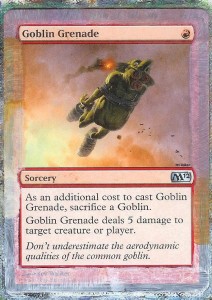
Hello again faithful viewers, it is once again time to dust off the paint brushes for another tutorial. With the release of Magic Core Set 2012, I thought it might be nice to paint up a card that you should have by now. Goblin Grenade will surely be showing up in standard in the year to come, so you may consider painting a set of these to sell, trade, or keep. I for one can't wait to sacrifice a Goblin Arsonist in limited, but let's save the dreams for another time.

Once again, we find ourselves painting the borders of our card white in preparation for color. You may observe a more noticeable brush stroke this time around. Sad news dear readers, this spells the beginning of the end for my favorite paint brush. The more noticeable brush stroke is due to the hairs in the brush head starting to stray and leave their own marks in the paint. Oh well.

Step 2: Do those go together?

Now that our primer has been laid, we can start to put in color. Today, we have some odd color combinations to work with: Raw Sienna, Brilliant Purple, and Brilliant Orange. Hardly a trio you see mixed together often, but they work beautifully together to create an explosion in the fading light of the evening sky. So, taking our Brilliant Purple and dulling it down with Raw Sienna, we lay down our first color along the top and right edge of the card. Remembering that oranges and yellows don't cover well, a mixture of Titanium White and Brilliant Yellow will work for the left side.

Step 3: Layers

For those of you who wanted more pictures, I heard you loud and clear! There is one more picture today than usual. In the hopes of not cluttering up the article with pictures, I've decided that I could be a bit more efficient in using each picture. Picture three for example, takes the place of four different pictures, all of which would have shown a different layer.

Occasionally, instead of color matching, we must turn our talents to texture matching. This often happens with clouds and skies in general. In the case of Goblin Grenade we have the purple of the sky obscured by the smoke fire and shrapnel of an explosion. The most efficient way of portraying this is by painting the sky first, then layer by layer adding in the different elements of the explosion.

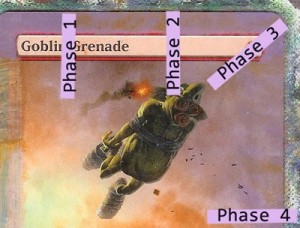
Phase one is once again the mixture of Brilliant Purple and Raw Sienna. This not only gives us the color of the sky, but a bit more coverage of the card itself. In Phase two, we lightly dry-brush straight Raw Sienna to show the darker smoke from the explosion. You must be very careful with this step and err on the side of caution, this brown can quickly take over the picture due to how dark it appears on the card. Phase three is where we can remedy any mistakes we made with the Raw Sienna, by dry-brushing the original purple-sienna mixture over the Raw Sienna. Phase four is where we depict the light colored smoke by adding a touch of white to our mixture and once again dry-brushing this color on. The last step covers any visible lines left by phases two and three and brings the colors together.

Step 4: Left side no longer left out

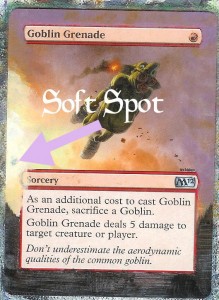
If your paints behave anything like mine do, than you probably need another layer of coverage (at least) on the left border of the card. I used Titanium White with a touch of Cadmium Yellow to get close to the color at the heart of the explosion and used that for some extra coverage. Picture four depicts one of the most annoying things you will encounter when painting cards. The inexplicable “soft spot”. This is a spot on the card that for whatever reason just refuses to take paint. It may take three, four, maybe even 5 more coats to paint over than the rest of the card and often results in a noticeable difference in thickness if not treated carefully. My best advice is to let the card completely dry, then come back to it and paint over the soft spot again. In most cases this will cure the problem, but some are more stubborn than others. While I was waiting for the soft spot to dry, I painted the bottom black.

Step 5: Closure

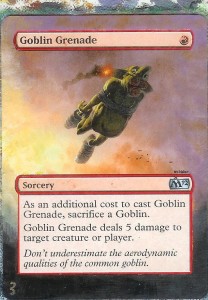
After successfully painting over the soft spot I used the same technique on the left border as I did on the top and right. I began with my white/yellow mixture and took it almost to the corner of the name box on the card. As I moved upward along the side I added Brilliant Orange to the mixture. At the very top I added Brilliant purple and Raw Sienna as well to help blend with the top part of the card. I also used this mixture to blend the bottom black as well (which received another coat of black) and you can see on the left where my paint brush actually frayed to death. I will of course finish that little bit of blending shortly, but I thought it a nice memorial to a brush that I have used throughout this entire series. After cleaning the edges of the text boxes with a trusty toothpick, I signed the card and scanned it for you.

Did I win Yet?

For those of you who have entered the raffle through this last week, winners will be chosen today and notified. The winners will be announced and recognized next week. Obviously I had to turn this article in on Monday, so as I write this, there are still a few hours for people to submit entries and feedback. I would like to thank those of you who did take the time to provide such awesome feedback, it is greatly appreciated and because of it these articles will be better than ever. I must encourage you to continue to leave feedback, comments and concerns in which every way is convenient to you so this article can continue to grow and I can keep giving away my work. See you next week!

-The Painters Servant

Twitter: PaintersServant

Email: Mbajorek02@gmail.com

The Great Machine: The Motor

Are you a Quiet Speculation member?

If not, now is a perfect time to join up! Our powerful tools, breaking-news analysis, and exclusive Discord channel will make sure you stay up to date and ahead of the curve.

Over the course of this series I have gone over a variety of ways to both understand and utilize a group of traders to maximize your profits. At this point, assuming you have established a solid group of traders and have made some long lasting connections on the floor, it is time to put all that knowledge to use. How do you approach the floor now that you have a trade group? How do you begin to tackle the overflowing room of Magic players? This is what we will be discussing today! As with anything in our line of work, approaching the trade floor takes a mix of preparation and quick wits to ensure success.

It’s All In the Art of the Execution

Having a plan before the weekend starts is usually a solid idea; however, in this case, it is usually not necessary as you usually won’t know the layout of the center before arrival. There are strategic places to position yourself at different times throughout the weekend to ensure the trades keep flowing, so having a general idea of where you want to be is encouraged. As with any plan, you need to do a little homework, and the first piece of that homework on any major trip is checking the artist roster. Wasting your time getting cards signed is just bad value when you could be spending that hour in line trading instead. This does not however mean you should not bring cards with you that are by that artist! The trade value of such cards, especially foils and promos by a particular artist, goes up exponentially at events where that artist will be present. I typically have a small binder with any random commons or uncommons along with bulk rares that the artists in attendance have done. In addition, before I leave, I try to pick up any foils and oddities that may fetch a greater profit at such shows. It may be difficult to move a foil Ninja of the Deep Hours normally, but I saw a few move hands in Kansas City just because Dan Scott was there. Keeping check a few weeks ahead can allow you to acquire cards that have been sitting in peoples binders forever for a very reasonable price as well. Foils and foreign cards are normally hard to move at local shops so letting your local group know you are seeking them will allow you a plethora of good product and allow your friends to dump their unwanted cards.

Once you arrive on site, you certainly want to locate the artist booths and allocate some of your time, preferably early Saturday, to sitting at the tables nearest them. Let people know in casual conversation that the artist of particular cards are nearby; this will not only pique their interest but also make you look more prepared than most when they see the binder you have assembled. As stated before, you want to ideally be on the floor early Saturday, and this is especially true for events where artists will be present. Anyone with byes, or any of those who are not playing in the main event, will be looking to get all their artist work done early in the day. This is not only due to the events they will be playing in later, but also partially to the fact that everyone else is busy in the main event and they would like to get the work done before it gets busy. The Saturday morning crowd also has spare time to trade typically since they have nothing else going, making this an ideal situation for you from both perspectives.

Vendor Alley

Anyone who has attended a major event knows what Vendor Alley is and how crucial those guys are to our success over the weekend (and in some ways, us to their weekend as well!). That being said, there are not only ideal times to "vendor your stock off" during the weekend, which I have already covered in a past article, there are also ideal times to occupy the tables near the vendors. This is a great example of why being prepared, being early to the site, and showing up the night before can be so important. First off you should have already visited the vendors early on Friday, and so by the middle of the day Saturday you should have a solid idea on both buy prices and needs. Take advantage of this information early: utilizing every tool you have can net you a few extra dollars here and there, which can really add up by the end of the weekend. In the early afternoon of Friday, when all the players begin to arrive to vendor before the weekend or to just hang out, is the most opportune time to occupy the tables nearest the Alley. If people are heading in that direction they almost certainly have trade stock on them that they are looking to dump. Translation: they have little-to-no attachment to many cards in their binders. This strategy also lets you catch them before they sit down with a vendor, meaning their prices may be off and they don’t know what the hot sells are that weekend. Their binders will also certainly be more stocked at this point than likely for the rest of the weekend, allowing you to have first pick.

While I do believe it is great to use the Alley to your own personal goals, or the goals of the group, there is also a certain etiquette that must be followed. Most of the vendors understand what we do and many are ok with us being around, and though some even started their roots on the trade floor, this does not mean you can disrupt their business for your own gain. Don’t sit at the table directly next to a vendor trying to steal their business, don’t undercut them because you know you can trade a card lower than they sell it to someone. There is an unspoken code the old school traders understand that allows us to not only work with the vendors, but in many cases create friendships with like-minded individuals. I have found that although you may have snagged that trader, you lost something much more valuable in the way of respect. You must also understand that this is not a one way street, though you may at first feel like the vendor is getting the better end of the deal, you have to understand you will see some benefits as well. When your face becomes regular and people begin to know you as a staple of the trade floor, your reputation begins to means everything.

Treating the vendors and players well can create unexpected benefits that you may not have even thought possible. A great example of this was at a Grand Prix last year. I was sitting next to the StrikeZone booth and had done my vendoring in the morning already. I had a playset of a card that his price was just not quite where I wanted it to be so I held them for trade. Later that day he had someone come up and ask for them, but at this point he was sold out. Due to our previous interactions and relationship he called me over and asked if I would be willing to part with them for retail. I was happy to get full price out of a card and shipped them to him, and then watched him sell the cards for the same price he had bought them from me for. There are a few things to learn from this example that may not at first be obvious. The first is to understand that this scenario only played out the way it did because we have done thousands of dollars of business together. In turn I, as what you could call a loyal customer, was rewarded for helping him in the past. The second and probably least obvious lesson is that the vendors want us there. People look at some floor traders with disdain assuming we are out only to rip people off and profit, this is not true. We are the motor that drives the machine. We are an integral part as to why the secondary market works the way it does, and without us there would be an even larger demand for cards.

I will discuss more in depth next week how the machine all comes together and how everything works out for not only the betterment of the individual, but for the community as a whole. When all the parts and pieces work together we find that not only can we all be successful at whatever part of this game we are involved in, we can also help others to be successful in their own aspects too. The trade world can seem like a cutthroat place at first but when you navigate it correctly you will find necessity and friendship, among a host of other things. Join me next week as I delve into exactly why a backpack dealer is so integral in the Magic community!

Tracking our Progress

This week’s edition brings us a brand new set, M12. While overall this set appears to be the fallen empires of sets in the past few years, it does offer some hidden gems. I will be covering the set in depth, as I did with New Phyrexia in a few weeks. In addition to covering the new set, I will be looking back at my short term calls for NPH to see just where we currently stand.

That news aside, there are a few cards I added to the tracker that I feel warrant careful consideration. Many of these cards have already met and or exceeded what I perceived to be their short term value which is great!

Grand Abolisher: I expected this guy to hit a quick peak at 5 and settle in the 3-4 range. I was off on my estimate of the peak range, though not in a negative way. If you followed my direction and picked him up for two last week you are doing quite well with his current price tag at 7. I would dump them before too long if you can get 5+ for them as they are only rare and not a format defining card such as Stoneforge.

Visions from Beyond: Another example of my underestimations on this set, Visions is already seeing a 7-8 price tag while I expected it to peak around 5. Again as with Abolisher, you are doing quite well if you managed them at my pick up of 3 last week. As for future value I am undecided on this card, I feel like this may have a solid potential in a few decks but I foresee it settling in the 4-5 range after the hype is over. With such power, and an effect we haven’t seen on a playable card in years expect there to be a lot of brews containing Visions, allowing you to hopefully net full retail.

Jace, Memory Adept: This guy keeps getting compared to the Mind Sculptor which is just not fair. Looking at this guy in the right build offers a lot of potential, his plus ability is to draw a card, yes he cost five, yes he is slow and can’t protect himself. This however does not make him unplayable, and he had the fastest clock on a planeswalker we have seen yet leaving your opponent only 3-4 turns to clear him off the board. I expect his price tag to settle in the thirty range and slowly drop from there if he sees little play. However as a possible control finisher as well as finding a home in turbofog this emo jace reincarnate could fetch 40+ even after the hype settles.

Ryan Bushard

@CryppleCommand on Twitter

How to Really Live: My Life as a Traveling Backpacked, Cardboard-Dealing Degenerate

Are you a Quiet Speculation member?

If not, now is a perfect time to join up! Our powerful tools, breaking-news analysis, and exclusive Discord channel will make sure you stay up to date and ahead of the curve.

Mike Hawthorne begins his upcoming weekly Legacy-focused Insider series by introducing himself and responding to the most recent tournament results, noting which cards deserve speculative attention.

My name is Mike Hawthorne and Magic: The Gathering has kept me alive.

You may be asking, "What does that mean?" Well, if you'll allow me to take a step back from the melodrama for a second, I'd be happy to explain it.

This game has provided me with more than just friendships and fun. It has literally my paid bills, allowed me to travel the country, and have a great time, all while making financial gains.

This will be the first in my upcoming weekly financial column—a Legacy-focused look at the current card market, smart trades, movers and shakers, and a review of any recent Legacy tournaments and cards that stand out.

After this week my article will also be Insider-only.

All that said, I would like to start with an introduction of sorts. Although I likely know many of you, very few are actually acquainted with my history.

My Magic Biography

Getting Back Into Magic & Establishing a Collective

I've been playing Magic for quite awhile.

I started playing a little before Prophecy and have been on and off ever since. September 2009 is the most recent time I decided that I would get back into Magic competitively. I went online and saw that Fae and 5cc were dominating the Standard metagame. I decided that since a rotation was going to happen in October I would just start testing post rotation Shards-Zendikar Standard.

I was playing with a few casual friends, Josh and Mike C., at the time. We eventually decided it would be a good idea pool our cards into a collective—a topic I will explore more on a later date.

As a whole unit we choose to make a single trade binder. We had a lot of old cards—mostly Onslaught block—and we bought a few boxes of Zendikar on release day. Then we were off to the races.

I told the collective that the safest bet with the new set were the new fetch lands. Having understood the importance and reputation of the Onslaught fetches, I knew they were good enough to see play and would maintain a solid value. So we began by trading for those aggressively. Our collection quickly built itself up, growing exponentially, narrowing in on solid trade decisions.

One day I walked into my local shop and started a quick trade with a young, handsome, intelligent gentleman over a Goblin Guide.

We had five Guides as a collective and this kid wanted one to finish off his RDW list. At the time, Goblin Guide was worth ten dollars and, after a bit of perusing, we agreed on an equal value from his book. Then we started debating the current and future value of a foil Zendikar Forest.

As the deal got heated, we simply agreed not to trade. Instead we decided that I would lend him the Guide with the safeguard of exchanging phone numbers. This gentleman soon joined up with our collective and turned out to be one of my best friends in the game: a great writer and fantastic person, Tyler Tyssedal.

As the months went by, the collective massed an insane volume of variety and accessibility. November rolled around and we had a foil set of every fetch land, 4 Baneslayer Angels (then a $50 chase), 12 Noble Hierarchs, 8 Elspeth, Knight Errants and a playset of every playable Standard card.

The best part of our collection at the time was the lands binder. When you opened it up, the first several pages featured 41 Arid Mesa, 30 Marsh Flats, 28 Misty Rainforest, 28 Scalding tarn, and 20 Verdant Catacombs. That’s a total of 147 fetch lands. Good times.

We had the best Standard collection in our area, routinely lending out cards our friends needed to complete the deck they wanted to play that week if a trade didn't happen. Each of us could play whatever deck we willed. In the land of Standard Magic, we felt like we were on the top of the world.

Then December 4th happened.

Tripping Over Your NES’s Power Chord

I was a server at a local Perkins, working overnight and dinner shifts. I had just finished up work and kept my backpack with the collective’s binder in the back room, as I had come from a tournament earlier that night.

I had gotten into my SUV with my bag in hand when I realized I had left my serving book and some cash in the restaurant’s kitchen.

I threw my bag in the back seat, locked my car, and went inside.

I got caught up talking to my manager and ended up staying inside for no more than 5 minutes. As I walked back outside and around to the driver side, I not only heard but felt a crunching under my feet. Broken glass.

I looked at the back window of my SUV. It was smashed out. I immediately looked in to see if my in dash DVD player had been removed. It hadn't. My iPod was still in the cup holder.

The backpack was gone.

I called the police. I ran inside praying I had brought my bag in with me. I couldn't find it. After the police showed up, I had to explain to the officer what was in the back pack.

He looked shocked when I tried to explain the value of what had been stolen. I remember him saying, "You’re telling me that there was several thousand dollars worth of cardboard in that backpack?"

He assured me they would be looking for my backpack.

Gone.

The next morning I called the collective.

One by one I called them and told them what had happened. Everyone originally thought I was joking.

If you have never had to deliver shocking news to someone you normally joke around with, let me tell you: it’s very difficult. It goes something like this:

Tyler: "Whats up?"
Me: "So my car was broken into last night and the collection was stolen"
Tyler: "Hahaha that would suck."
….SILENCE….
Tyler: "You aren't kidding…"

I told them I was going to see if I could get my insurance to cover it and that I was going to replace all of the cards, if humanly possible.

A few days later I got the news that insurance wasn't covering it.

I called everyone again.

I felt like complete garbage. I told everyone I would give them all my old cards that had just been taking up space in my room, figure out a way to reimburse, and then I was going to quit.

As a hobby with the possibility of financial gains, so comes the reality that there exists the possibility of loss.

A day later I got a call.

"Mike, we need you to stay. We started from scratch before and we can do it again."

All of us got together and decided that we would rebuild our collection. It would have been an undesirable amount of money had we chosen to replace it card-by-card, purchasing each one as singles. We didn’t want to do that. Afterall, Magic was a hobby we enjoyed—not our retirement.

We decided to rebuild our collection without spending money beyond what we already had budgeted: tournament entrance fees.

We dug through cards and rebuilt a terrible trade binder. All of the wonderful friends we had made in the game offered to and donated cards. We played suboptimal lists and played tighter than we ever had just to get prize packs.

Our local store runs tournaments every Tuesday attracting upwards of 35 people. We went every week and would pay $5 to grind out four rounds of Magic. If you placed in the top 10% you received 6 packs as a prize, 25% getting 4 packs.

As a four-man team we spent $20 total, walking out with a minimum of 16 packs every week. We would crack them all and shove the rares into a trade binder.

Enter/Exit the Grind

While Worldwake was being spoiled, Jace, the Mind Sculptor made his debut as Tyler and I enjoyed a trek to a local casino. Yes, this sounds counterproductive… but I have a thing for casinos. And, remember, we were rebuilding our collection without spending money beyond the cost of entering tournaments.

Tyler was on his phone telling me what it did while I was playing Blackjack.

I remember it like it was yesterday. He explained the first two abilities and we both looked at each other and knew this card was going to be insane.

Then he finished reading the last two and I, in my most film-noiry tone possible, told him that this was going to put us back on the map.

We traded for them at release. I picked up a grand total of 30 by the time they reached $60. Then they hit $80. We could literally trade them for anything.

We eventually traded them all away aside from 10, thinking that if three people wanted to play them we’d be able to do a 3-3-4 split, not fully realizing that this card was going to be a 4 of in everything.

The Ebb

By the time Rise of the Eldrazi came out, Mike C. had slowly stepped out of the tournament scene and Josh was slowly burning out.

An occasional draft for Mike.
An occasional FNM for Josh, merely there to hangout.
Then, when Jund rotated out, they just stopped altogether.

It was kind of a slow process. But, as I look back on it, it was like slowly losing some of my best friends.

They really didn't want to be part of the game any longer, so it was becoming harder to hang out with them. We had made Magic such a routine part of our relationship that, without it, our friendships lacked structure. When free time is limited, and when your free time happily revolves around a Magic tournament with friends, it becomes harder to get out of this pattern. Add to this work schedules and you have a bummer on your hands.

Legacy

As Standard began to feel more and more stale, Tyler and I transitioned into playing Legacy. As our pool consisted mostly of Standard cards, we made it our next goal gather up Legacy cards.

Tyler would send me lists and we would talk about them. And for some reason we still, to this day, never really agree on optimal Legacy lists and pet cards. But Tyler, even though I don’t always agree with him, knows what he’s doing. Like they say, there’s more than one way to skin a cat… or build a deck.

By now I was the only one left playing Standard, since Tyler had effectively made a full transition into Legacy. I held a graphic arts job and my hours were from 2pm until 10pm. I really didn't have much time for structured Magic.

I would read articles to try to stay current, but the flow of cards stagnated in our hands. They stopped moving. Our binder froze and Magic all but faded away.

Full Time

Then I lost my job.

I applied for jobs immediately. I also began to play Magic full time.

I started grinding trades and keeping my values current.

I decided to sink whatever money I had saved up into flipping Magic cards at major events, realizing I could make a living off of trading and selling Magic cards, constantly in the company of good people and fun friends.

If you have gone to a Grand Prix in the last 9 months, you would probably recognize me.

I generally hang out at the dealer tables, cube with friends, and make degenerate decisions.

I know most of the dealers and they know me.

I love to gamble and almost never turn down a bet.

All of my income in the past 9 months has been from Magic. This game has insane value that a lot—I would say the vast majority of—players don't understand.

Now, in my current Magic life, I play multiple formats, keep updated on the card economy and gamble with my friends over such trivial things as which numbers will show up on dice to even considering fantasy drafting the StarCity circuit.

And now this article marks when I’ll begin offering weekly financial review advice.

This Week In Review

After such an exhaustive introduction, we'll keep things things short by touching on SCG's Legacy finals matchup. In the future we'll go into more depth, exploring other portions of the week's results and perhaps a few other choice areas.

This week in Legacy we witnessed Manaless Dredge and Blue Zoo face off in the finals of the Legacy portion of the StarCityGames Legacy 5k. Top 16 decklists can be found right here.

I'm going to assume that if you are reading this you can look at the lists and figure out how these decks work. I will leave my opinions on deck choice and plays/misplays out of the weekly review, as I will primarily be looking at these tournaments through a financial lens.

Let’s start with Blue Zoo.

”Blue Zoo by Caleb Durward”

Maindeck

3 Grim Lavamancer
3 Knight of the Reliquary
4 Noble Hierarch
2 Qasali Pridemage
2 Tarmogoyf
4 Wild Nacatl
4 Brainstorm
4 Lightning Bolt
3 Mental Misstep
4 Swords to Plowshares
3 Jace, the Mind Sculptor
3 Green Suns Zenith
1 Forest
2 Misty Rainforest
2 Plateau
1 Savannah
1 Taiga
2 Tropical Island
1 Tundra
1 Volcanic Island
4 Windswept Heath
4 Wooded Foothills
1 Dryad Arbor
1 Karakas

Sideboard

2 Phyrexian Metamorph
2 Aven Mindcensor
2 Ancient Grudge
3 Red Elemental Blast
3 Submerge
1 Gaddock Teeg
1 Thrun, the Last Troll
1 Tower of the Magistrate

The maindeck looks pretty standard, as far as Legacy decks go. Blue is there for Brainstorm, Jace, and Mental Misstep—all solid cards in the current metagame.

The card that sticks out to me is in the sideboard: Tower of the Magistrate.

As Stoneforge decks gain popularity and equipment becomes better, this card will find some sideboard play. As of right now, StarCity is selling these at $.99 a pop. I bought some on speculation. Seeing that other Masques block rares gain quick value, this card will become harder to find.

In the maindeck, seeing Tarmogoyf as a two of is pretty strange, but I still wouldn't get off of these. Tarmogoyf has been getting worse and the price tag has dropped a little. But I would say that the proper course of action for when Tarmogoyf takes little dips is to actually pick a few up. I doubt that Wizards will ever print a more efficient beater, and Magic decks will always want beaters. This is why Wizards banned Mystical Tutor—people love creatures. They’ll be sure to keep the battlefield populated.

A quick mention on the Phyrexian Metamorph: while it's neat and kills Progenitus, it's in Standard and is already at max value. A couple Standard cards in the sideboard of a winning deck will do little to impact price, seeing that they're still easily opened and obtained.

Up next, the Manaless Dredge deck that has people talking.

”Manaless Dredge by Nicholas Rausch”

Maindeck

4 Bloodghast
3 Gigapede
4 Golgari Grave-Troll
4 Golgari Thug
4 Ichorid
4 Narcomoeba
4 Nether Shadow
4 Phantasmagorian
4 Shambling Shell
4 Stinkweed Imp
4 Street Wraith
1 Woodfall Primus
4 Bridge from Below
1 Iona, Shield of Emeria
4 Cabal Therapy
4 Dread Return
3 Dakmor Salvage

Sideboard

1 Inkwell Leviathan
1 Sphinx of the Steel Wind
1 Ancestors Chosen
1 Blazing Archon
1 Gigapede
1 Stormtide Leviathan
1 Terastodon
4 Contagion
1 Akroma, Angel of Wrath
1 Elesh Norn, Grand Cenobite
1 Iona, Shield of Emeria
1 Llawan, Cephalid Empress

The cards are going to go up a little in value seeing as it’s a pretty cheap and fairly competitive glass cannon of a deck.

Cards like Gigapede are seeing play, but I wouldn't pick up a ton of these seeing how narrow the card’s application is. I would buy a set if you plan on playing the deck, but that’s about it there.

The cards I sought and bought while watching this deck play were Ichorid and Bridge from Below.

Bridge from Below has been slowly creeping up in value, and it has nowhere to go but up. It’s a unique effect that is the backbone of a metagame dependant powerhouse of a deck.

Ichorid is pretty cheap as far as a Legacy/Vintage staple goes. This card is one I would consider picking up when around, as, in the long run, it also has nowhere to go but up. Ichorid is not a short term gain, though, but I predict that the card will become more valuable over the coming years.

Some Dread Return targets need to be scooped up while they are still relatively recent:

Sphinx of the Steel Wind is a card that, overtime, will go up in value. Being a great EDH and a great Cube card, alongside being a Legacy staple, is a perfect mixture of want, desire, and need.

Iona, Shield of Emeria is a card that was immediately viewed as a hit, but I believe it is going to go down in value for a little while, especially with her (unplayed) rotation from Standard in the near future. Unlike Spinx, she isn’t well liked beyond being a silver bullet reanimation target that sometimes whiffs at stealing the game. Jin-Gitaxias, Core Augur has overtaken her in Reanimator as the go-to target.

Bloodghast is also underpriced right now at $7.99 on SCG, and we have a new graveyard/vampire themed set around the corner. We could be in for a jump in value, especially considering Extended’s relationship to this card and future cards that may compliment its role elsewhere.

The Checklist

I will be updating a Legacy checklist every week, featuring new cards I recommend you take steps in obtaining.

I will rarely talk about cards like Dual Lands, Wastelands, and Force of Wills. These should simply go without saying. If, for some reason, any of these cards are set to or do jump or fall in price, I’ll be sure to take a stern look at it and explore exactly why it had happened.

I will, however, be focusing on the more obscure cards necessary in making a Legacy collection complete and ahead of the curve. Although Legacy is an Eternal format, the cards of relevance continue to evolve, as should binders and collections.

Let’s look a few key cards from this week’s SCG Legacy finalists.

Noble Hierarch - $11.99 on SCG

This card is insane. A better Birds of Paradise that makes your Tarmogoyf bigger than your opponents. Will see play for years to come as a RUG/Bant staple. Not to mention how well it works with Natural Order.

Tower of the Magistrate - $.99 (sold out)

One or two of these in any collection can't hurt. It might see play as a tutorable land and is from an older set.

Karakas - $59.99

This card is an obvious (newer!) Legacy staple. They are getting harder to find and, ideally, at least should be required in any collection.

Bridge from Below - $9.99 (sold out)

A Dredge necessity that will continue to creep up in value.

Ichorid - $4.99 (NM sold out)

The price tag on this card is way too low. I feel it may eventually get a reprint, but for now it is a card that is worth picking up.

Sphinx of the Steel Wind - $6.99 (NM sold out)

As new sets come out, creatures get better and Reanimator does the same. This card is really good against the aggro decks when brought back from the dead. It is going to get harder to find the longer it’s been out of print.

Until Next Time

Although a lot of this article has been a huge peek into my life, I can promise that there will be far more financial content from here on out.

In this game you have to make your money work for you. Cards are almost always as liquid as cash. Get connected, be aware, and never stop buying. If you're not having fun, then you're likely not risking anything.

Feel free to post questions in the comments or email me.

Until next time,

- Mike Hawthorne
Twitter: Gamble4Value
Email: MTG_Mike@live.com

Like what you see here and want to help Quiet Speculation grow? Sign up for Insider! You'll get access to our expert financial advice and the indispensable prediction tracker, and you'll be helping us add new features to the site!

Liquid Swords | CommanderCast S3E8

Are you a Quiet Speculation member?

If not, now is a perfect time to join up! Our powerful tools, breaking-news analysis, and exclusive Discord channel will make sure you stay up to date and ahead of the curve.

It's the color everyone loves to hate! This week, the mono-colored madness continues as we're hit by a deluge of stack manipulation, boring combos, and card draw as we dive into the mono-blue segments! Andy is accompanied by Byron, Carlos, and guest Neale in a laser beam of a show. It's all mono-blue for the whole running time! What is blue's role in the format? Is blue over-hyped? What are obnoxious blue spells? If you like Islands, winning, or just making everyone mad, this week's CommanderCast has something for you.

Also, we try to sing the intro music. This doesn't go well.

If you somehow don't regret listening to this one, then head over to http://commandercast.blogspot.com/ on Monday, Wednesday and Friday for more Commander-related goodness. This week's full show notes can be found here.

Click play to listen, or download the entire show! (Warning: Some "not safe for work" content.)

One Fish, Two Fish

Are you a Quiet Speculation member?

If not, now is a perfect time to join up! Our powerful tools, breaking-news analysis, and exclusive Discord channel will make sure you stay up to date and ahead of the curve.

I wanted to start off this week by talking about some of the feedback that I got about mono-white decks from last week's article. In general, the responses that I got were pretty negative; some of you who don't share my enthusiasm for white in this format. The seems like the two most common commanders are Akroma, Angel of Wrath and Isamaru, Hound of Konda, which isn't really that surprising to be honest. These are probably the most iconic white Legends from recent Magic history, and fit nicely into two of the most popular Commander deck types: [card Wrath of God]Wrath[/card]-based control, and Voltron decks.

That said, white has a lot more depth to it than these two commanders and archetypes. Today, I want to take some time to briefly go over other features that define mono-white, and the roles that different commanders can play for these archetypes. Based on contributions by you, the readers, there are three well-defined archetypes that play to white's strengths:

1. Wrath-Based Control

Commanders: Akroma, Angel of Wrath, Mageta the Lion, Elesh Norn, Grand Cenobite, and Konda, Lord of Eiganjo.

Let's be honest for a minute. This is a deck everyone builds, or thinks about building, shortly after being introduced to the format. When the format is described as a "Haymaker Format" that's defined by card advantage and giant creatures and spells, a white deck that runs all the best sweepers and Ivory Masks seems fine: the Wraths keep the board stable and net card advantage, the Masks protect you from huge spells, and your commander either provides a win condition or lends consistency to your plan of Wrath'ing all the problematic permanents away.

This kind of approach can be very powerful, as long as it's backed up with enough efficient spot removal, rather than just infinite clunky Planar Cleansings. This strategy also gets worse as people start running more efficient threats, and more must-answer threats that will force you to spend a Wrath of God on a single creature. That said, if you want to sweep the board, white is by far the color that's best suited to do it!

2. Voltron

Commanders: Isamaru, Hound of Konda, Eight-and-a-Half-Tails, Kemba, Kha Regent

This is another one of the most popular archetypes in the format, and for good reason. First, these kinds of decks are a great foil to the wrath-based decks since you can always recast your general and be up cards in the short-term. These are also popular because they are one of very few aggressive approaches to the format, since the 20 life buffer makes it so much harder to kill one player, let alone a whole table of players.

To be completely honest though, I don't think that white is a very good color for supporting a Voltron strategy. The problem is that the choices that you have access to don't increase their own clock, like [card Godo, Bandit Warlord]Godo[/card] and Rafiq of the Many. The other problem is that they aren't terribly good at protecting themselves, like Sygg, River Guide.

Here's what it boils down to: white certainly has the most efficiently costed aggro generals. The problem is that other decks will just play mana dudes or mana rocks and trump your commander with a more powerful and more resilient one. While white is a superb support color for aggressive decks, since it gives you cards like Stoneforge Mystic and Steelshaper's Gift, I don't think that it's very good as a primary or mono-colored aggressive deck.

3. Tokens

Commanders: Kemba, Kha Regent, Darien, King of Kjeldor, Elesh Norn, Grand Cenobite

And last, but not least, there are token decks. Most token decks are green, and for good reason. Green is usually better at ramping up into things like Avenger of Zendikar, pumping tokens with things like Overrun, or even gets cards like Doubling Season to put it completely over the top. However, in my opinion, white has the two best commanders for producing tokens over time. Untapping with [card Kemba, Kha Regent]Kemba[/card] or [card Darien, King of Kjeldor]Darien[/card] puts you in a great position to start taking over the game.

While green may be the best color for aggressive token decks, white is the best color for controlling token decks, as having access to cards like Diversionary Tactics, Catapult Master, Knight-Captain of Eos and other cards that allow you to use your tokens to control the board and grind out advantages over long games.

It's worth noting that these three strategies are all going to have two things in common with one another: Equipment and Wrath effects. These are the two things that white is best at, and the best way for white to generate card advantage. Consequently, both will play a prominent role in any white-based Commander deck.

That said, there is another approach that white can take to a multiplayer game: a permanent-based attrition or resource denial plan, rather than a Wrath-based plan. Some of the commanders that come to mind that emphasize this plan are Yosei, the Morning Star, Hokori, Dust Drinker, Kataki, War's Wage, and Michiko Konda, Truth Seeker, all of which allow you to deny key resources to other players while developing your own position without much trouble.

I'm still looking for suggestions and comments about what kinds of white decks you see all the time, what secret tech you have, and what kind of deck I could make that's a fairly unique approach to this color. Right now, I'm leaning towards a [card Kataki, Wars Wage]Kataki[/card] deck, but to be honest, it's mostly because the Twitter crowd threw the gauntlet by saying that it'd be a terrible deck.

For The Fish Among Us

All of that said, I do have a deck that I'd like to take a look at before I max out my word count. I received a few emails asking for different takes on a Sygg, River Guide list, some asking for help with a budget build, and some wanting a take that didn't focus on equipment and general damage. I figured I'd try my hand at accomplishing both of these, and building an attrition-control deck with Sygg protecting key Merfolk.

For budget builds, I generally set the budget at about $40, and use StarCityGames pricing as a baseline. Unfortunately, the more traditional Merfolk lords like Lord of Atlantis, Merrow Reejerey, and Coralhelm Commander are cards in competitive formats and likely out of range of the budget, so we'll have to try something a little different:

The Fish

  • Sygg, River Guide (0.99)
  • Summon the School (0.49)
  • Stonybrook Schoolmaster (0.15)
  • Merrow Harbinger (0.25)

The "Lords"

  • Voidmage Prodigy (0.65)
  • Lullmage Mentor (0.49)
  • Sage of Fables (0.25)
  • Vedalken Aethermage (0.25)
  • Azami, Lady of Scrolls (1.99)
  • Patron Wizard (5.49)
  • Aphetto Grifter (0.25)
  • Shapesharer (0.39)

Tapping and Untapping

  • Ocular Halo (0.15)
  • Surgespanner (0.49)
  • Merrow Levitator (0.15)
  • Inspired Sprite (0.25)
  • Fallowsage (0.49)
  • Puresight Merrow (0.25)
  • Freed from the Real (0.25)
  • Pemmin's Aura (0.99)

Thus far, the deck is trying to take advantage of the "tapping/untapping" mechanic that was emphasized for Merfolk in the Lorwyn/Shadowmoor block, with some additional synergies thrown in. Synergies as small as Stonybrook Schoolmaster letting you get two activations out of Patron Wizard, and as game-breaking as Voidmage Prodigy and Lullmage Mentor giving you the ability "U: Counter target spell."

The deck is essentially built on the premise of building up a small army of Merfolk tokens, and using those to both control the board, control the stack, and draw tons of cards by various mechanisms. [card Sygg, River Guide]Sygg[/card] and countermagic help you protect key merfolk once you find them, but the biggest problem is going to be getting some Merfolk to start with. There are, of course, tons of tutors and other cards that would help alleviate this problem, but the vast majority of those are well outside of a $40 budget. here's what I've got instead:

Card Selection

  • Jushi Apprentice (0.89)
  • Magus of the Future (0.89)
  • Azure Mage (0.25)
  • Tidal Courier (0.30)
  • Enclave Cryptologist (0.25)
  • Information Dealer (0.15)
  • Soothsaying (0.89)
  • Coastal Piracy (0.25)
  • Crystal Ball (0.49)
  • Compulsive Research (0.19)
  • Skullclamp (2.5)
  • Concentrate (0.39)
  • Distant Melody (0.15)

The hope here is that any given hand will have either an engine card like Lullmage Mentor or Summon the School, or a couple of ways to dig through your deck and find one. The mana base it really going to want to have shuffle effects, like Flood Plain and Terramorphic Expanse, to help with cards like Soothsaying and Information Dealer.

Besides the card selection, there are also a number of ways to actually pull ahead on cards that seem like they could be very powerful. Coastal Piracy rewards you for the tokens you're hoping to generate, and along with the lords like Patron Wizard might make it worth considering a Merrow Commerce here. I don't think I can quite bring myself to do it yet.

We have to keep in mind that this is going to be a very slow deck to get started. You have to find and be able to cast one of several three- and four-mana engine cards, and then have several turns with them in play before you actually start making any progress. Unfortunately, most of efficient removal spells and countermagic are well outside the budget of this deck, but let's take a look at what's available:

Countermagic and Removal

  • Counterspell (1.49)
  • Commandeer (1.39)
  • Unified Will (0.25)
  • Cancel (0.25)
  • Stoic Rebuttal (0.25)
  • Sage's Dousing (0.49)
  • Abjure (0.25)
  • Dismiss (0.49)
  • Faerie Trickery (0.25)
  • Traumatic Visions (0.15)
  • Familiar's Ruse (0.25)
  • Disenchant (0.25)
  • Dismantling Blow (0.25)
  • Venser's Journal (0.49)
  • Opposition (1.39)
  • Into the Roil (0.49)
  • Weight of Conscience (0.15)

These are obviously not the best counterspells and removal spells in the format, but they get the job done. You even get to play quite a few really unique counterspells that people certainly aren't going to try to play around. I mean, really, who plays Unified Will and Abjure? Obviously this deck would love to have Hinder, Spell Crumple, and Cryptic Command, along with the rest of the suite of tier 1 countermagic, but I don't think that they're absolutely necessary.

The removal suite is actually where I think the deck is suffering the most. There really aren't that many great removal spells that aren't outside of the budget for this deck. The thing that I like least about this deck is how reliant it is on countermagic to handle pretty much every threat. You have two ways to remove artifacts and enchantments, and one way to remove creatures. Granted, you also have Opposition and Aphetto Grifter but those aren't "real" removal.

Finally, let's round out the deck with some more wizards and some trinkets! This set of cards should provide a little more utility and card advantage to the deck, and hopefully give the deck some additional resiliency:

Wizards

  • Mirror Entity (2.75)
  • Willbender (0.39)
  • Vesuvan Shapeshifter (0.65)
  • Dawnglare Invoker (0.15)
  • Azorius Guildmage (0.39)

Treasures

  • Treasure Mage (0.25)
  • Steel Hellkite (0.99)
  • Salvaging Station (0.89)

Trinkets

  • Trinket Mage (0.25)
  • Wayfarer's Bauble (0.25)
  • Origin Spellbomb (0.15)
  • Aether Spellbomb (0.15)
  • Scrabbling Claws (0.25)

That basically rounds out the decklist, sans lands. I really like the utility that this last set of cards provides, since they give you some capacity to answer almost anything, given enough time to find the pieces you need. Weighing in at $39.91, here's the final decklist:

[deckbox did="a119" size="small" width="560"]

If you've got a little extra to spend on the deck, these are a few of the cards that I think do the most for the deck with the least investment. In no particular order, and with a short explanation:

  • Ajani Goldmane: He's like Merrow Commerce and Glorious Anthem, except much better than either!
  • Glen Elendra Archmage: Combos with Sage of Fables! May also be an excuse for my favorite equipment, Nim Deathmantle?
  • Mystical Tutor/Personal Tutor: Summon the School really is that good.
  • Sun Titan: Buy back my Voidmage Prodigy or Lullmage Mentor? Don't mind if I do...
  • Cryptic Command: One of the best counterspells in the format.
  • Reveillark: All of our engine "lords" have power 2 or less. I see.
  • Spell Crumple/Hinder: "Tucking" is good I hear.

Before I wrap this up I some exciting news. I managed to win a Grand Prix Trial this past Saturday, meaning that Grand Prix Pittsburgh will be the first Grand Prix I'm attending in several years. If you're a fan of Commander, I'd love to try to meet up with some people for Commander games after I scrub out of the main event.

Beyond that, I've been getting a lot of feedback recently and I want to keep the momentum up! If you've got comments about the article or questions about decklists, I'm always glad to get constructive feedback. If you just want to talk about the format, particularly if you're heading to GP Pittsburgh, leave a comment, shoot me an email, or hit me up on Twitter!

Carlos Gutierrez
cag5383@gmail.com
@cag5383 on Twitter

Insider: SCG Cinci Standard Watch List

Are you a Quiet Speculation member?

If not, now is a perfect time to join up! Our powerful tools, breaking-news analysis, and exclusive Discord channel will make sure you stay up to date and ahead of the curve.

The Star City Open in Cincinatti has given us a first glimpse into the New Standard.  After the landmark bans of last month and the release of the 2012 Core Set, we've all been dying to see what new archetypes emerge.  The usual suspects have shown up, but with some twists.

Valakut was everyone's consensus for a "Level Zero" benchmark, and it made its fair showing in Cincy.  It didn't crack the Top 8, but it brought attention to a few cards that should surprise no one. Urabrask, the Hidden has been spotted in Valakut decks, which should be an indicator of things to come. Once Valakut disappears from Standard, other decks will surely take a hint and find a use for Urabrask.  He's still very inexpensive for a Mythic Rare, but he will remain so until the right deck comes along to really leverage his potential.

Solemn Simulacrum is also a natural fit in Valakut, but it seems like he fits in very few other decks.  This should not be so.  No one managed to put together a Smallpox deck at this particular event, but the inclusion of Jens in a Smallpox deck should be a foregone conclusion.  New archetypes take longer to evolve, so expect Solemn Simulacrum to hold steady while brewers find him a home.  He may end up dropping a bit, so don't rush to finish your playset.

Thrun, the Last Troll is climbing again, but many can be had in trade binders for a pittance.  Mana Leak is here to stay, so Thrun will still have a role to play.  He can carry a [card Sword of Feast and Famine]Sword[/card] and blank removal; two qualities that never go out of style.  Thrun isn't the sort of card that will see play as a four-of, which will temper his price, but he seems cheap right now!

A natural fit for the metalcraft-based Puresteel Paladin deck?

Caleb Durward's Puresteel Paladin deck is for real, so take notice.  Building it as an aggro deck seems to be a poor choice, as the Puresteel engine needs both time and resources to function.  That said, Caleb's deck choices seem to imply an understanding of this fact, supported by his Top 8 finish at Cincinatti.  His deck uses a lot of the Living Weapon equipment to get the max value out of Puresteel Paladin, but most interestingly, it uses Etched Champion as a potential finisher.

Etched Champion's ability to, again, swing a sword, keeps it very relevant, and in a deck focused on metalcraft, it is rarely targetable by colored spells.  Doing its best Thrun, The Last Troll impression, Etched Champion is fairly costly on paper, but represents an exceptional opportunity on MTG Online.

Timely Reinforcements has turned out to be an immensely popular card, both in sideboards and main decks.  Though an Uncommon, traders have a play here: foils.  This card can utterly blow out aggro decks, and likely accounts for the lack of mono-red decks in the Top 8.  Get these foils before they hit $10.

Blade Splicer has been on the radar for a while, but it's starting to see mainstream play.  4 power for 3 mana is never bad, and splitting it between two cards is usually better.  First Strike is just gravy.  Blade Splicers can be had for $1 in trade, but as time goes on, they'll be getting harder to find and thus, more valuable.  Don't expect a big spike or anything, but enjoy getting marginal value.

CawBlade won the top spot, despite the bannings, featuring Blade Splicer!

Mirran Crusader isn't "everywhere", but it seems to be one of the most powerful creatures in the 3-hole.  Holding a Sword of War and Peace makes it instantly lethal, putting games out of reach in a single swing.  Keeping it safe from Grim Lavamancer and all the quality red burn is gravy, and it is already immune to all the best removal in Black.   This card is going to be crucial post-rotation, but it's not cheap right now.  Just keep it on your radar.

Two Tempered Steel decks made Top 8 in Cincinatti, which makes me glad I got a playset of the full art Game Day promos early.  Tempered Steel is an absurdly powerful card, and once Lightning Bolt leaves the format your Memnites and Signal Pests get even scarier.  Combined with the NPH artifact creatures, and it's easy to see why Tempered Steel is so good.  Get in on this.

Finally, Sword of War and Peace seems to be the consensus "4x" sword now that Stoneforge Mystic is gone.   Most decks find that multiple copies of Feast and Famine don't quite do enough, and the Protection from Red is quite crucial against all the powerful burn around.  Most decks that are using Swords are going to focus on the beatdown, so the life swing provided by Sword of War and Peace is far more important than any of the other effects on any other sword.  Long-term, this is the Sword to have for post-rotation Standard.

Kelly Reid

@kellyreid on Twitter

Insider: Delving into Darksteel

Are you a Quiet Speculation member?

If not, now is a perfect time to join up! Our powerful tools, breaking-news analysis, and exclusive Discord channel will make sure you stay up to date and ahead of the curve.

Darksteel, the second set in Mirrodin block, is notorious for driving off more Magic players than any other set, even the Urza block. It contained high-power cards for Affinity that did not require finesse to win with. It was like UG Madness in that the best deck was cheap, easy to play and frustrating to metagame against. Before Darksteel, there were several Affinity builds. Some tinkered with controlling counterspells and Broodstar, others angled more toward “cogs” like the Spellbombs. Once Darksteel hit, it was “Disciple of the Vault, Clamp, Ornithopter, Ravager, Clamp my stuff, you take 9, swing for eleven.” Try as people might, nothing could kill Affinity decks, even the deck your friend came up with that he swore would kill Affinity. The reason was that Affinity with Darksteel was so consistent and efficient that if your dedicated hate deck stumbled even once, you'd die with a hand full of Oxidize and dreaming of Molder Slug.

Luckily for the collector, the set is packed with value cards. Many of them won't surprise you, but it is still worth getting the updated price check on them. Others, I am sure, are new to you. Let's take a look!

Aether Vial

Aether Vial is now, without the absurd P3K uncommons, the most valuable uncommon there is. It's like a Gilded Lotus that you can play on the first turn. It was a card that was stupidly powerful, but people didn't realize it at the time. I even looked up Darksteel reviews from the time – one soul called it “too slow or simply extraneous .” Ben Bleiweiss was a little more charitable when he said “Since previous cards of this type have been pure crappola, people might gloss the Vial over as useless as well - but give this one a second glance, will ya?”

Aether Vial grew to be so good that it ended up banned in Extended. The reason was that Vial gives an incredible amount of acceleration, even if it supposedly only drops a guy a turn later than your lands would support (if you drew a land every turn, that is!). Vial let decks in Extended play a Goblin Matron into a Goblin Ringleader in the same turn or utilize the color-fixing properties to run Meddling Mage in Affinity. Vial is currently a superstar in Legacy, fueling Goblins and Merfolk. Vial has dropped $4 since the printing of Mental Misstep because when you get your Vial countered, your deck has to play a lot more fairly and it does not perform as well.

My advice is to score these from people who don't know how much they are and to pass them off to folks who overvalue them.

$10.75

Arcbound Overseer

People who like to play casual Affinity decks or tamper with artifact themes in EDH tend to like this guy. He trades in really low numbers, but he is worth more than bulk.

$1.00

Arcbound Ravager

The combination of Ravager with Disciple of the Vault in a set with artifact lands meant that you could pound twenty damage out at a frightening pace. Ravager blanked an opponent's removal completely. If you kill my Frogmite, I'll eat it. If you kill my Ravager, I'll put his counters on my Frogmite. Thanks for playing. Ravager also made a convenient sacrifice outlet when you had Skullclamp and extra Frogmites and Ornithopters, too.

Arcbound Ravager sees very little play these days, since the Legacy Affinity deck is honestly not great. He trades well and in big volumes, though, so it's worth keeping an eye on.

$13.50

Blinkmoth Nexus

People love lands that give them a little more value. Blinkmoth Nexus is like a flying Mishra's Factory, and it could take on Modular counters from a friendly Arcbound Ravager. Though Blinkmoth Nexus is nowhere near playable in constructed formats, people like manlands and they especially like this one! It's rare for a card to hold so much value after high standard prices, but this little land did. They trade in pretty good volume, on top of that.

$4.25

Darksteel Colossus

When this guy got spoiled, Vintage players went agog, since we had Tinker. Vintage is a gentleman's club and the idea of swinging with an 11/11 Iron Man was unseemly to most people, who simply claimed that it would get Balanced, Sworded, bounced or worse. Oh, how they were wrong. A startling thing for people just observing a Vintage game is how rapidly a player can access Tinker if they are actively working on that goal. A Tinker on the second turn is not hard to pull off, and when it gets this guy, it can be hard to beat. Sometimes, you would have those games that started with an Island, Mana Crypt and Tinker for this guy. The second turn, you'd cast Time Walk and that'd be the game.

Now, Darksteel Colossus has been surpassed by Blightsteel Colossus, which kills in half the time. It was also reprinted, which depressed the value a lot. You're gonna laugh at me for this, but I traded a Sword of Fire and Ice for a Colossus when they were both out a few months and worth about the same. Regrets...

$3.75

Darksteel Forge

Nine mana is a lot to pay for this effect, which means you only see it show up in really casual decks. However, people get really horsey with Darksteel Forge and things like Mycosynth Lattice. One of the best EDH decks uses Arcum Dagsson, the Forge and Nevinyrral's Disk to blow up the world, over and over. Consequently, the Forge is in high demand for people who want to set up that combo and live a life forever alone.

$6.50 (yeah, really)

Darksteel Reactor

Thanks to Proliferate, this card has seen some new life. Instead of grinding twenty turns of BeeGees-level staying alive, you can untap that Gilder Bairn and get to a game win in no time. Contagion Engine cuts the time by two thirds alone! While cards like Vampire Hexmage can ruin your day, the march toward a game win is now surer than ever with Darksteel Reactor.

$1.50

Death Cloud

Death Cloud follows in the tradition of Pox, Balance, Balancing Act and more to demonstrate that sometimes, having more permanents isn't the greatest thing. Death Cloud is scalable, which is really cool from a constructed standpoint. It saw extensive play in Standard as well as Extended. After the big Affinity bans, Death Cloud was used to hold back the superpowered Tron decks. It sees a little play these days, but it got a lot better with Life from the Loam, which has rejuvenated the card in casual circles.$1.25FlamebreakBurn decks look for roleplayers, and this RRR sorcery will wipe away attackers while slinging some burn at the dome. Unglamorous, but useful.$1.00Leonin ShakariWhite equipment decks are more popular than ever in casual, so it's no surprise to see that this gets some attention. The Shakari can make your equips more profitable, even when you aren't slinging Lightning Greaves around all the time. I had not expected it to be so valuable, which is just a testament to the appeal of Commanders like Kemba, Kha Regent.$2.00MemnarchMemnarch has been around for a long time in grumpy, controlling casual blue decks. They usually feature Tolarian Academy alongside, with the big brain taking whatever he wants. Memnarch is a sure way to lose friends in multiplayer, but if you have the blue mana for it, Memnarch might not need friends – he'll just take them! Thanks to relaxed EDH rules, Memnarch is now available as a Commander. However, I have seen him appear only rarely, with the usual monoblue generals like Azami and Vendilion Clique holding strong to their position.$3.75Mycosynth LatticeEarlier, I wrote about how this card combined with Darksteel Forge. It also does some really nasty things when you combine it with Null Rod. All the sudden, lands don't tap for mana. People get inordinately into this combo as well, meaning that the Lattice gets a lot of attention.$6.00Myr MatrixMaybe it's the new Myr printed that's made Myr Matrix interesting. Paying 5 mana for a 2/2 isn't exactly exciting, after all. My guess is that the same people who love Myr Matrix have fond memories of The Hive.$2.50Panoptic MirrorThe Mirror does with Time Walk what you wanted Isochron Scepter to do. Panoptic Mirror is so good at repeating spells that it's banned in EDH for being too powerful. A Demonic Tutor each turn is robust, to say the least. Casual players like it and it'll show up now and then in Type Four and Cube decks.$3.00Pristine Angel
I have fond memories of Christine the Pristine Angel. We ran it in our Vintage Oath deck, which was basically monoblue control. That is to say, piles and piles of instants. If an opponent was running lots of spot removal, we would side in this Angel. With spells in hand, the Angel could attack all the time and blank any removal that people pointed at it. The Angel also has a rare combination of being both immune to colors and artifacts, so it is a superb defensive player.

$3.25

Shield of Kaldra

The main market for Shield of Kaldra these days is people who are looking to protect their general. If you are running a very specific deck oriented around something like Shirei, Shizo's Caretaker, then getting your general killed is a bad thing. Shield makes sure it sticks around for awhile longer, and while it doesn't grant haste, it does grant... Protection from Wrath? It also gets some attention from people who want to assemble the Kaldra combination.

$2.75

Skullclamp

Originally, Skullclamp cost a lot more and did a lot less. It only drew you a card. It didn't give -1 toughness. It cost more to play and activate. The designers wanted a card that rewarded people for playing creatures and acted like a consolation prize when they died. Skullclamp was that, but times a million. The designers did not thoroughly test the final card before they sent it to the printers, meaning that they missed its interactions with X/1 creatures. Several months later, Skullclamp fueled crazy decks in Standard. It clamped Goblins, it clamped artifacts. The most powerful thing it could do, though, was clamp Elves in Elf and Nail. You'd either Tooth and Nail on turn 4 or Clamp your brigade, drawing ten cards and locking things away soon afterward. Skullclamp is too good for Legacy, and people always seem to have plans for it in Vintage.

$1.75

Sundering Titan

Sundering Titan murders dual lands. There's no way around it. It kills them coming and going, and it has been a one-sided Armageddon in Vintage since it was first printed. Sundering Titan has shown up in other formats, usually alongside the Urzatron. It's in moderate demand at the moment.

$2.00

Sword of Fire and Ice

The Sword is a casual monster, emboldened by Commander play. There exists better equipment these days, but this Sword is just iconic. People go amok over it. The price briefly jumped to $50, but when the cough syrup wore off, the Sword settled to its standard ridiculous price.

$27.00

Sword of Light and Shadow

The less-loved Sword from the set, this one nonetheless gives card advantage and protection from meaningful colors. I prefer this one in Commander play, but it is forever an ugly duckling next to its twin.

$22.00

Trinisphere

I remember when this was printed. Vintage players looked at it, looked at Mishra's Workshop and then asked “does this do what we think it does?” Trinisphere locks out Moxes when you get it out first. It locks out an opponent completely if you can follow it with a Wasteland or two, punishing greedy Vintage players. Trinisphere got to be so problematic that it is now restricted in Vintage. It appears occasionally in Legacy, but it is much worse in a format full of basic lands and bereft of moxes.

$2.25

Viridian Zealot

Though we have many options for a Naturalize effect these days, the Zealot is a thematic Elf and deserves extra attention on that front. You can track it down with a Wirewood Herald, for example. In monogreen decks, the Zealot is the necessary solution where Qasali Pridemage would be instead.

$1.75

Well of Lost Dreams

Finally, all that lifegain means something! Well of Lost Dreams lets you draw a card for each life you gain, meaning that it's just as crazy as you'd think in my Ghost Council Commander deck. Alongside Martyr of Sands, it draws serious amounts of cards in a neat little combo. Well has been creeping up a little in price as EDH players who are looking for more card drawing look toward it.

$1.50

That's it for Darksteel! Next week, we're looking at Fifth Dawn, a set that wants you to play with as many colors as you can conjure up. Until then,

Doug Linn

M12 Commander Financial Analysis (Part 2)

Are you a Quiet Speculation member?

If not, now is a perfect time to join up! Our powerful tools, breaking-news analysis, and exclusive Discord channel will make sure you stay up to date and ahead of the curve.

Welcome back everyone to my Commander centred review of Magic 2012. For my take on the first half of the set, check out my previous article here. As a reminder, I will not be talking about every card, just new cards that have a chance at being Commander or casual playable.

RED

Chandra's Phoenix

This is possibly great in Standard, and plays very closely to Hell's Thunder, but for Commander it just doesn’t hit hard enough. All Chandra’s Phoenix will do is create some enemies for you while not really affecting them all that much. I also love the art and this arcana, showing the card’s art coming to life from concept to final product.

Chandra, the Firebrand

This is our first splashable Planeswalker folks! Tom Lapille stated that they chose the splashable casting cost for Chandra to set her apart from [card Koth of the Hammer]Koth[/card]. I really respect this choice. It shows that WotC actually puts a great deal of thought into the whole card creation process. Choosing to make Chandra and easily splashable card was the right move in my opinion and will hopefully be proven over time.

I think Chandra is awesome, but that may be my affinity for spell copying. If you compare the two, Koth seems to be the better mainly due to his very awesome ultimate. However, when splashed, Chandra could become the focus of some serious decks and fill roles in decks Koth never could even come close to.

Her reverberate is the #1 reason most players are finally getting excited for Chandra 3.0 after 2 [card Chandra Nalaar]previous[/card] underplayed [card Chandra Ablaze]versions[/card]. It may be a Magical Christmas Land scenario, but doubling a Tezzeret's Gambit or Volt Charge seem like really amazing lines of play. I could see her in a new version of Mind Hammer, one of @Smi77y’s creations. The deck lost the [card Jace, the Mind Sculptor]Mind portion[/card] of its deck but I could really see [card Tezzeret, Agent of Bolas]Tezzeret[/card] working well along side Chandra. I don’t think the deck would need [card Koth of the Hammer]Koth[/card] any longer either, so pretty much the deck would basically have to be renamed at that point.

Chandra is great as a Commander card as doubling spells is one of the best things you can do in a format filled with the most powerful spells created in magic. Her ultimate is not as game winning as some of the better Planeswalkers in Commander, and her ping ability will be pointless most of the time so I would really focus on her being yet another spell copying card.

All said, I do not think she is worth more than her current price. I don’t think anything will come close to the “[card Jace, the Mind Sculptor]next Jace[card]” anytime soon. WotC is really getting the hang of creating Plansewalker, and it really shows in their design. Keep her if you want to use her but trade her now if you don't. M12 won’t be opened all that much and she will be one of the chase cards of the set.

Scrambleverse

Is this a very horrible Warp World, or [card Zedruu the Greathearted]Zedruu[/card] deck’s killing blow? The card is way too expensive and way too crazy to see any play in standard. The only place I see it is Zedruu and chaos decks that don’t look to win, they just look to do insane things like Warp World and Scrambleverse. Trade these away to anyone looking if you can. They will never be worth more than $1 and will probably be used as proxies or ripped up by people hating on the card.

Warstorm Surge

A new version of Pandemonium is always welcome. A crazy bomb in limited as most effects like this are. Norin the Wary Commander decks seem to be getting popular and this card allows you to have another effect and this time it is only for your creatures. I personally have not built a Norin the Wary deck but I am looking forward to trying it out. It seems like loads of fun, but not enough to make this card worth anything more than bulk. This is basically as playable in standard as Pandemonium is at the moment. (Just a hint to anyone out there not in the know, Pandemonium is not legal in standard.) Trade these away as soon as you find a taker, although I highly doubt you will find any.

GREEN

Arachnus Spinner

Arachnus Web

The fact that you can search your graveyard as well as your library is pretty interesting. You can actually lock down any creature with this spider. Its almost Angel of Despair or even Frost Titan.

If the creature is larger than 4 power all you will have to do is continue to tap down your own spider. Flying is a big weakness to a lot of Commander decks, so I believe this spider may be the answer a lot of decks are looking for. Silklash Spider has been my go-to spider, but I think Arachnus may be a reasonable card to use. The only bad thing about Arcachnus is it’s effectively 2 cards. Even though Commander is a 100 card format, as most experienced Commander players know decklists can get pretty tight and the balance found in a tuned deck can easily be thrown off once you start changing cards around.

I don’t see any reason this would be played in a Titan-filled world, so don't worry about letting go of this spider if you don’t intend to use him in Commander. On a positive note, because of the nature of both cards I think Arachnus Web will be a great pick up as a foil.

Dungrove Elder

Hexproof is a big draw for casual players. They overestimate its power and are easily blinded by it. Having a variable P/T is also another draw for casual players. With all that, Dungrove Elder is basically a huge casual hit. As for Commander, he is obviously ok in mono-green decks, with cards like Brawn and Roughshod Mentor. I can’t see Dungrove Elder defining Standard, trade these away at your leisure but don’t be scared of holding onto him either. The market should not dry up for him as there is always a new player addicted to casting green monsters.

Garruk, Primal Hunter

I love Garruk. I’ve played him in decks ever since he was released. I even played him in a homebrew All in Green style of deck that actually got 5th in a premier event for me at one point in time. It had some game but really didn’t work after Overgrowth left the core set. This new Garruk is–

Aside: Actually, let's go on an aside for now as it is something I have always wanted to talk about. I pronounce it Gah-ROO-k and I don’t care if that’s wrong. It sounds more primal that way to my ears. Watch Gladiator’s opening battle to get a feel of the language and culture I picture Garruk to come from.

New Garruk is possibly better than his predecessor, yet may not see as much play. His first ability is very [card Elspeth, Knight-Errant]Elspeth-like[/card], yet better. A bunch of 3/3’s can take over a game mighty quickly, and Garruk does this while becoming more loyal to your cause. His second ability fills a gaping hole in green’s repertoire. Even as "just" a five mana Harmonize, Garruk would probably see some play but being able to build a huge army is what puts him over the top.

However, be cautious while using Garruk as his ultimate is just asking to be a blow out when your opponent [card Day of Judgment]Judges your Day[/card]. It still is pretty much game breaking in any matchup without sweepers. It’s even better with a card like [card Urabrask the Hidden]Urabrask[/card] helping along. But this brings up Garruk’s glaring weakness, his casting cost.

Triple green is not something you just over look when building a two or more color deck, but if there is any color that can pull it off it’s green. With Lotus Cobra, Overgrown Battlement, and Joraga Treespeaker in the format it shouldn’t be a problem. But once all of our amazing Zendikar block mana fixing is gone, Garruk will be limited specifically to very strong green decks based. I am sure this part of Wizards’ continued experimentation with Planeswalkers, as Chandra’s splashiness seems to be as well. I hope they continue pushing the envelope with Planeswalkers as they are a different worlds of design that are just not possible with any other card type.

Will he see play in Standard? Highly likely because he fills a void in green. Will he see wide play? Time will tell. Will he see Eternal play? Probably not.

Commander on the other hand is another story. I am very excited to get my hands on the new Garruk to shove him into my Commander deck. I do think I will play both in my deck, but he actually may beat the [card Garruk Wildspeaker]old Garruk[/card] out of a spot in time.

Garruk is one a chase mythics of the set, along with the other [card Jace, Memory Adept]new[/card] [card Chandra, the Firebrand]Plansewalkers[/card], so hold onto him if you are looking to play him. I don’t see him going up in price. Thankfully, the prerelease prices are not as insane this time around as they were in Scars of Mirrodin. I really think the days of $50, or higher, Planeswalkers is now behind us, and I don’t think anyone is upset at that.

Garruk's Horde

You still have to pay for the creature so I am not in love with this guy as much as others are. He doesn’t do enough to warrant any play in Standard, so his price should stay at bulk. For Commander, I think there are several better cards out there, but I do get excited thinking about this guy and Oracle of Mul Daya in play at the same time. If you base your deck around him, and have a high concentration of creatures, he could work out very well. However, bending your deck to conform for the Horde really isn’t worth it. Green is full of so many big beaters that you really don’t need this guy, and I would trade him away any chance I find. I really don’t think he is worth his weight in Commander.

Jade Mage

Nothing spectacular about this card for Commander, but token strategies can never really have enough good token producers. Jade Mage is at least above average for token producers. I will eventually sound like a broken record here, but look out for foils as that’s really the only way to get money out of Commander-only Uncommons and Commons.

Hunter's Insight

Hunter’s Insight is a very exciting card, but I am hesitant to play it in Standard. Momentous Fall was such a huge bust, and I was one of the people who mistakenly had high hopes for the card. However, Hunter’s Insight seems like it could be the real deal this time. It opens you up for a two-for-one, but at least it forces their hand in using their removal before the ideal moment. It also has a great piece of artwork attached to it, and should look great as a foil. I am not fully sold on its Standard applications, but for Commander it should be a fine addition to any Green deck that is lacking card draw.

Primordial Hydra

I am not sure what a Standard playable Hydra would look like, but I am pretty sure this one is not. Paying five for a 3/3 that becomes a 6/6, then a 12/12 with trample is probably the best case scenario, but I don’t see this being much better than a Primeval Titan or a Consecrated Sphinx. If they end up killing it by the time it becomes a real factor, two turns after it has been out, you really haven’t gained much. In contrast, after two turns with Primeval Titan would have gained you so much advantage that you should be way ahead of your opponent at that point. Taking one off the casting cost could have possibly push him over the edge into playability but no point in talking about something that didn’t actually happen. The Hydra is basically a bigger version of Scute Mob, a card that was just not good enough.

For Commander, I think this guy would probably be [/card]Wrath[/card]'d away before he is relevant as he does get out of hand pretty quickly if not kept in check. Casting him for "X=5" or more can be game breaking. Usually I don’t like plain old beatsticks in Commander, but this guy is one of the [card Hamletback Goliath]biggest[/card] [card Lord of Extinction]beatsticks[/card] [card Kresh the Bloodbraided]around[/card].

I plan on testing him out at least. I’ve been meaning to rework my Wort, the Raidmother deck into a Rosheen Meanderer deck, and I think this Hydra would be a perfect fix for the deck. As long as I am right about the Hydra not being Standard playable, it should follow the price of Quicksilver Gargantuan fairly closely. Trade accordingly.

Rites of Flourishing

It is great to see this card reprinted, as I like the card and what it does for green. It is a mainstay in many Commander decks, so it should be popular the second time around. Foils are what to look out for in my opinion. The regular copy will be easily found. On magicthegathering.com, Jacob Van Lunen wrote an article about a Turbo Fog brew using this card. I’d be very excited if that becomes a part of the metagame because I have an unhealthy addiction to anything with the word Turbo in front of it.

Skinshifter

This card is somewhat like a green version of Figure of Destiny, but much worse. I know it is Quiet Speculation’s preview card, but I think this will end up being worth just above bulk. The fact that it reverts back to a 1/1 at end of turn, and can only be activated once per turn, means you constantly have to keep mana up for it to stay alive. After losing all that tempo by slowing yourself down keeping this thing alive, all it will do most of the time is fly in for two damage. Being a 2-drop is a reason to consider this card, but I just don’t think it has what it takes to make any mark. I can’t see any potential metagame where this guy would be good in Commander either. Trade them away to anyone who is still high on him.

Stingerfling Spider

I think this card has the possibility of making a mark in Commander, especially in decks that can either recur or clone it. As I said before, most decks have a glaring weakness to flying, and this guy can be a decent addition against the flying menace. I highly doubt we will be seeing this card show up in Standard. Get foils, and only foils, of this one.

Trollhide

This set has an Aura sub-theme, so it’s expected that there is at least some cards that can fit into an [card Uril, the Miststalker]Uril[/card] deck. Trollhide a decent addition to Uril’s tool belt, but nothing to get crazy over. Only foil versions should be on your trade list as it shouldn't see play in any format other than Commander.

ARTIFACTS & LAND

Adaptive Automaton

This is "the DIY (Do it Yourself) Lord," as one of my friend calls it, and I am very excited about this card. He’s an auto-include in any Limited deck because you should have at least a few creatures that overlap creature types. I’ve heard of it even becoming a Human Lord!

As for Standard, Elves seem to have enough lords in their arsenal (so I don’t think another one will help), and unless there is another tribe, like Vampires, that is in desperate need of another lord, I don’t think he will be seeing much play at the top tables of Standard.

When Phyrexian Metamorph was spoiled I speculated in the Quiet Speculation forums that he would be a great pick up, not only for his cloning abilities but his ability to be an extra Lord for any tribal decks that exist. Adaptive Automaton should see the same, if not more, play as Phyrexian Metamorph. He probably won’t see much play in Commander, except in tribal heavy decks like Sliver Overlord or Reaper King decks, but the DIY lord will see play and be in huge demand for the casual market as a whole. If they continue to print him in core sets he will be worth around the same amount as a Coat of Arms, slightly more until he catches up in number of printings. If he is only in the core set for one or two releases I could see him going up in value over time, possibly even close to $10. I would be hoarding these guys once the initial price drops after a set release.

Druidic Satchel

This is a very interesting card, and will probably be loved by the more casual Commander crowd. Try to look for people valuing this at bulk rates. If it takes with the casual crowd it could be worth a few bucks, or at least have demand so you can move it.

Manalith

To hit the broken record, this is a Commander playable so look out for foils.

Quicksilver Amulet

This is a casual stand out and has been for years: a $4 to $5 card easily. If you can get it cheaper than that, get it. This time around it could even actually see some Standard play because creatures are so much better now than they were back in the 90’s. I won’t hold my breath for it to make it, but if it does it will obviously help the price of the card. Do not trade these away at low prices. It is a solid casual card that will always have worth, even after rotation.

Solemn Simulacrum

This is a huge Commander staple, and it should also see play in Standard. The new art may be liked by some players, but some may prefer the more traditional Jens art. It was recently reprinted in the Commander sets, but the demand for this card is big. I would get as many of these as I can, and even at its current retail price I would always be open to picking these guys up. There are enough Commander players out there to keep his price at $5, and that is not even taking into consideration his place in Standard. Foils will be a hot item. Try and get them ASAP.

Sundial of the Infinite

This is a very unique combo-oriented card. It should stay at a buck or two due to the casual market loving wacky cards. Currently it is very niche, but if someone breaks it it will jump up. I am not out looking for tons of these, but if I can get a playset at $1 or less each in a trade I’d be more than happy to sit on them until I find a motivated casual buyer (or until it becomes essential to a Standard or Legacy deck).

Swiftfoot Boots

Lightning Greaves 2.0 will be the easiest card to trade away for awhile. Everyone and their mother will need at least one for their Commander deck. It could even see play in Standard, but the equip cost could stop it from reaching that point. Imagine having Greaves out while playing a Titan... I’ll let you mull that one over while I go around trading for all the foils boots out there.

Buried Ruin

This is basically another utility land that Commander decks can use. It will most certainly be part of some Mindslaver shenanigans, so watch out for anyone who plays the card. I’d actually be inclined to destroy it on sight if I have the chance to. I don’t think it will see constructed play yet, but getting a Wurmcoil Engine back seems like the first step to being this played in Standard. You know the deal, if it’s a foil blah, blah, blah.

Magic 2012 seems like a pretty fun set, with a lot of great additions to the casual card pool. I think the set was a little bland for Standard with respect to new cards, but the reprinting of Grim Lavamancer cannot be ignored.

Hope you all enjoyed the Prerelease events, and make sure you tweet @mtgaaron if you had any trouble getting into a prerelease. There were reports in some areas that there was not enough room or product at some venues. It would be just as disastrous if the same happened for the Launch Parties. If we complain enough Wizards, they will reassess and adjust Prereleases as a whole.

And as promised in my last article here is the second alter done by @derfington!

It says FOG!!!!

Awesome stuff eh? It's my favorite of the two, but really because I love me some Spike Weaver protection. Check out the rest of his alters on his blog.

Follow me on Twitter @RyeAbc or on Google+

Can I Read That?

Are you a Quiet Speculation member?

If not, now is a perfect time to join up! Our powerful tools, breaking-news analysis, and exclusive Discord channel will make sure you stay up to date and ahead of the curve.

Everyone with a little bit of Johnny in them wants to build a deck that nobody's ever seen before. Everyone with a little bit of Timmy in them wants to experience something fresh. Everyone with a little bit of Spike in them wants to prove they can win when nobody expected them to. Surely there can be no greater joy than building a deck that everyone thinks is terrible then doing something incredible with it.

There are 444 Legendary creatures that you can use as your Commander. Of course, your playgroup may have relaxed the banned list to allow [card Braids, Cabal Minion]Braids[/card], [card Rofellos, Llanowar Emissary]Rofellos[/card], [card Kokusho, the Evening Star]Kokusho[/card], or [card Emrakul, the Aeons Torn]Emrakul[/card]. You might allow the Unprecedented strength of Frankie Peanuts, Richard Garfield, Ph.D., Johnny, Combo Player, Timmy, Power Gamer and Jalum Grifter. Heck, you might be the 1996 World Champion. (Didn't think I would notice you reading this, did you Tom Chanpheng?) Regardless of your exact limitations, the fact of the matter is that the vast majority of Commander options never really get put to use.

But with good reason. The only benefit that you can possibly incur from Haakon, Stromgald Scourge is the ability to tap Command Tower for black mana, and [card Sima Yi, Wei Field Marshal]Sima Yi[/card] isn't much better. That said, a bit of patience in looking at 'bad' Commanders is warranted. Norin the Wary can be powerful with a little help from Genesis Chamber, or a Pandemonium variant. Phage the Untouchable can circumvent the Haakon problem by way of Torpor Orb or Sundial of the Infinite, becoming a regular Blightsteel Colossus.

These are cool and interesting, but when you get down to it they're rather gimmicky. We want prolonged, variable fun, and to that end it's time to venture into the world of reasonable but overlooked Legends.

Keeping House

To anyone who knows me, it should come as no surprise that I'll start the discussion with Shirei, Shizo's Caretaker. When I pull out my Shirei deck, everyone has to pause and read the card, at which point most of them conclude that it's 'really slow' or 'not worth playing 1/1s for.' Over and over again, people fail to recognize the impact that recurring an arbitrarily large number of creatures with powerful abilities on each player's turn is.

How would you like to gain twelve life every turn round for no mana with a Bottle Gnomes, turn off every other player's recursion with Heap Doll, or draw four extra cards a round with Mindless Automaton? How about all three? Better yet, if you can secure Shirei, Shizo's Caretaker's survival with Lightning Greaves, Darksteel Plate, or the like, your opponents can't even get rid of your other engine pieces. You have an unlimited supply of chump blockers.

What more can you ask for? Sure, Shirei isn't the most powerful Commander there is, but he can certainly rumble with the likes of Uril, the Miststalker or Teneb, the Harvester without drawing anywhere near as much hate. What's more, Shizo's Caretaker's power scales with the number of players. Provided that you're ignored at first, you can usually take on the rest of the table before they catch on.

In addition to his own hidden power, Shirei, Shizo's Caretaker takes advantage of one of human psychology's numerous quirks: people associate a Commander deck very closely with its Commander, but in doing so they alter their perception of how powerful the rest of the deck is. While Shirei might not lead your forces as potently Skithiryx, the Blight Dragon, he has equal access to a bevy of [card Demonic Tutor]tutors[/card], [card Phyrexian Arena]card draw[/card], and [card Damnation]sweepers[/card] as well as the Cabal Coffers engine. You can add power to your deck by playing a marginally worse Commander if nobody respects its power.

A Different Aspect

Continuing on our black Kamigawa tirade, we come to Iname, Death Aspect. As with Shirei, the key here is not only to have a Commander that most of the table has never come across, but also one that doesn't read too threateningly to them. As soon as they reach the word Spirit, many will discount your deck as a 'terrible piece of spiritcraft.' But if there's one thing I've learned from Scion of the Ur-Dragon, it's that one should never underestimate a Patriarch's Bidding, and between the redundancy that black has in this effect and the color's abundance of tutors, you shouldn't have a hard time recruiting Spirit of the Night, Kuro, Pitlord, and twenty of their closest friends to your side of the battlefield.

The one downside is grave hate, but playing a 'bad' commander gives you the benefit of the doubt. You can play [card Iname, Death Aspect]Iname[/card] to find He Who Hungers, Kyoki, Sanity's Eclipse, and Infernal Kirin, alongside six or so of your weaker Spirits, to confirm your opponents initial suspicions. Once those have been exiled or the hate sent elsewhere, you can recast Death for your real beaters.

What's more, there's nothing wrong with spiritcraft, so if your playgroup isn't too cutthroat you can have fun with a strategy that would often be too weak without some help. Balthor the Defiled is great with [card Iname, Death Aspect]this part of Iname[/card], but Death Denied or Phyrexian Reclamation can certainly let you [card Thief of Hope]steal hope[/card].

That's the Spirit!

As it turns out, there are a lot of Legends in Kamigawa block. It may or may not have something to do with every single rare creature in Champions of Kamigawa being Legendary. Despite their surroundings, many of these Legends aren't Spirits, but might still work well with one of these:

People usually play Rhys the Redeemed as their token Commander (Elves are an ethnic minority), but often run Crovax, Ascendant Hero or [card Elesh Norn, Grand Cenobite]Elesh Norn[/card] for a mono-white token deck. I've seen Kaysa and Kamahl, Fist of Krosa leading the other half of the color scheme, but I've never seen Sakiko, Mother of Summer get her dues.

Yes, Edric, Spymaster of Trest is probably more powerful in this role, and he even discourages attacking you! Nonetheless, Edric is going to attract a lot of unwanted attention outside of the red zone while [card Sakiko, Mother of Summer]Sakiko[/card] should elicit less fear.

Despite their apparent differences, Sakiko plays an awful lot like [card Rhys the Redeemed]Rhys[/card]. 'Doubling' your tokens may be a bit slower via Sprout Swarm or Nemata, Grove Guardian, but nonetheless the numbers get out of hand quickly. Luckily, you get some benefits as well. Every Overrun that doesn't win the game gives you a lot of mana, and by being forced into mono-green you gain access to Vernal Bloom and friends. All of this can give you some more interesting lines of play than Rhys has available.

A lot of deck building is making assumptions, and if you can see a level below what is immediately 'obvious,' you can find Commanders that do exactly what you want better than the established Commanders for that general realm of strategy.

Pitch Black

The only things that players consider weaker than Kamigawa block are Auras, so at first Ramses Overdark may seem to be overshadowed by his sister [card Visara the Dreadful]Visara[/card]. I think he might actually be better! Blue is a rather strong color and, as mentioned with Shirei, Shizo's Caretaker, playing an under-appreciated Commander lets others to overlook the rest of your deck. In this vein, blue's superior card draw should help you overcome the fact that you need a card to make [card Ramses Overdark]Ramses[/card] into an Avatar of Woe.

Then again, Dragon Wings doesn't even need that, and False Demise, Fool's Demise, and Shade's Form would make great inclusions anyway. Beyond that, you could get mean with [card Genju of the Falls]the[/card] [card Genju of the Fens]Genjus[/card], but this classic will do just fine leading a fairly standard control deck.

Finding More

This list doesn't even scratch the surface of the realm of under-appreciated commanders, so how does one find their own? The easiest way is to first come up with a theme for a deck, then look through a list of the legendary creatures. Most of the commanders that nobody plays have had that fate befall them because they don't look good on paper, but if you know what you're looking for you'll have a better chance at objectively evaluating the card for what it can do.

Failing this sort of inspiration, you can look through a list of every legendary creature in Magic. Every time you come across one that you haven't seen played, ask yourself what would need to happen to make that card good, then use Gatherer to see if you can find enough to support it. If you find a Legend that can do something interesting but doesn't seem good enough, make sure to write it down so that you can reevaluate it when a new mechanic synergizes with it!

Did you enjoy this article? Would you have liked it more if I'd focused on a single Commander? Or made a longer list and let you look for synergies yourself? Let me know!

Until next week, may your deck be full of surprises.

Jules Robins
julesdrobins@gmail.com
@JulesRobins on Twitter

Want Prices?

Browse thousands of prices with the first and most comprehensive MTG Finance tool around.


Trader Tools lists both buylist and retail prices for every MTG card, going back a decade.

Quiet Speculation