menu

Insider: My Plan to Own GenCon

Are you a Quiet Speculation member?

If not, now is a perfect time to join up! Our powerful tools, breaking-news analysis, and exclusive Discord channel will make sure you stay up to date and ahead of the curve.

There is a huge amount of excitement for GenCon this year, with the World Championships along with the FNM championships going on. That does not even mention events like the Vintage Champs that happen every year. Along with every other game you can imagine. By the time you read this I’ll be on the floor trading and/or just hanging out. As everyone says, GenCon is an amazing event, and you’re doing yourself a disservice to spend the entire time trading.

There have been several really good primers written already about GenCon, and you can find Doug Linn’s here and Ryan Bushard’s here.

With all of that in mind, I figure you’re not in need of another generic GenCon primer, as helpful as they are. Instead, I want to share with you my strategy for this weekend, which conveniently also applies to just about any large event you go to.

The plan

To spell it out clearly, my goals for this weekend are simple: make a lot of money and have a lot of fun. And hope that one of those doesn’t impede on the other. And, since I live in Oklahoma, I get to start the fun with a 12-hour drive!

So how do I plan on maximizing my profits this weekend? Before I get into specifics, let’s acknowledge all the usual methods to profit from trading.

-       Trade up without giving a premium.

-       Trade down only if the premium you are getting makes the deal worth it in cash values.

-       Take advantage of knowledge discrepancies in pricing.

-       Utilize pricing discrepancies to maximize profit, such as SCG OOS (out of stock) pricing, using SCG to trade up, TCG to trade down, etc


-       Turn Standard cards into Legacy/Modern/Casual staples.

-       Speculate on underpriced cards.

These are all the usual tricks we know about and use. Every trade I make this weekend will hinge on those tried-and-true techniques, as usual. But there’s another trick I have up my sleeve, one that only works at relatively few events a year.

The idea

I came upon this idea quite generically, really, at GenCon last year. At the time, the PT in Nagoya had shown that White Weenie Tempered Steel builds were dominating Block strategies, and dealers had already begun buying accordingly for the upcoming Standard season.

So what did this mean for me? It meant that the breakout card of the Pro Tour, Hero of Bladehold, had already started to climb. In fact, some dealers were buying for $6 that weekend, which was an absurdly good buy price at the time. They were also buying the promo version of the card at just a dollar less than the regular version.

Only one thing made this particularly relevant – no one on the trade floor knew about it. People understood that Hero was good, some even knew that the price had gone up some. But because they hadn’t put in as much preparation as me, they got burned.

I traded for every Hero I could find in that two days, and I didn’t give more than $8 on trade for any of them, because very few people realized the price was climbing toward $10. If this doesn’t automatically set off a lightbulb in your mind, it should. Giving $8 in trade on Standard cards and getting a 75% return in cash value is absurd. Even with optimal buylist pricing, you’re usually around 60%, and often lower on Standard cards.

And this doesn’t touch on the fact that because people “knew” the promo version was cheaper, I got a ton at $5 in trade, which is actually just selling whatever I traded them for full retail price.

Applying it

“Sure, you got lucky last year at one event, who cares?”           

-- ­Cynical You.

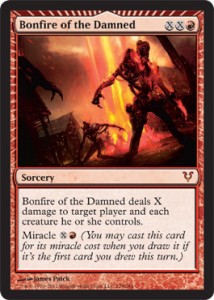
I’m able to do this at nearly every event I go to. All it takes is some hard work. Doing your homework and shopping and memorizing buylists from around the dealer hall (or GP room) isn’t the most fun. But it pays off again and again. At GP: Nashville this year it was Birds of Paradise and Black Suns Zenith. Then it was Geralfs Messenger. A month or so back it was Bonfire of the Damned.

The trick to making this work is not to simply shop buylists around the room, something I’ve talked about before. I know you see the value in that, and it will make you money time and again.

But there’s more to it than that. If you’re on the trade floor much, or even just your FNM, you have a general idea what most cards trade for. And you can put that knowledge to work long before you even get on the trade floor and have to deal with smartphones and the like. Simply find a target for the weekend by comparing the spread between buy price and trade price, and formulate a plan.

There’s another benefit to having a plan in place, especially at an event like a GP or Open, where most players are leery about trading with someone who could be a shark. Approaching someone to initiate a trade can sometimes put people on the back foot, and even more so if you pull out two or three binders and tell them you’re not looking for anything in particular. By having a target for the weekend, you will immediately put people more at ease because they don’t think you’re only there to rip them off.

And the truth is, you’re not. You’re simply taking advantage of dealer discrepancies. Even if the majority of dealers online are only paying $4 for a particular card, the needs of individual companies on a given weekend fluctuate, and maybe someone needs it badly enough to pay $6 this weekend. Because you’ve found a proper target, you can make a straight-across trade of cards from the same set and still come out two dollars ahead. Over and over, all while still making value from the tools you already have in your repertoire.

This effect is magnified at events with new technology for formats. Someone piloting a breakout deck in Legacy or Modern creates a “weekend price” that’s far beyond what the rest of the marketplace is. We saw this effect with Show and Tell and Sneak Attack, which both shot absurdly high at the last SCG Invitational.

Find us at GenCon and get some free Spirit Tokens!

Now, to own GenCon

I don’t know what my target will be this weekend. I have hopes of finding a dealer with a good buy price on Champion of Lambholt, which most people give away as bulk. I also wouldn’t be surprised to see something like Terminus pop up.

Whatever it is, you’ll see me employing this technique out on the trade floor, and I’m expecting an awesome weekend! If you’re there, make sure to come say hi. I’ll have some really sweet Spirit Tokens custom made for my financial/deckbuilding podcast, Brainstorm Brewery.

See you there!

Thanks for reading,

Corbin Hosler

@Chosler88 on Twitter

Insider: Across the Atlantic – European Fundamentals

Are you a Quiet Speculation member?

If not, now is a perfect time to join up! Our powerful tools, breaking-news analysis, and exclusive Discord channel will make sure you stay up to date and ahead of the curve.

Hello readers, my name is Gervaise Pechler. Besides being a motivated Magic player, I am a passionate speculator, professional poker player and a Bachelor student in Business & Psychology. I became exposed to trading card games at the age of eight when Pokemon took over the world, following up with Dragonball Z, LOTR, .hack//enemy, Magic: the Gathering and even Pirates. I will be mainly discussing my speculation and trades here in Europe.

There is a lot of Insider information about how to capitalize on cards, which American index to use, which decks and new cards T8’ed in a SCG Open and what price changes occur in dollars. But the Magic world is so much more than that! TCGplayer and StarCityGames are two of the biggest in the USA, but incidentally pose high costs for EU residents due to import tax, currency costs and the longer waiting time to get the actual cards.

I'll be using this first article to introduce you to Europe and Magic Finance. This is largely my view on where to get, sell and trade cards, because Europe has large submarkets like Spain (with its Spanish cards), as well as Italy and Germany. Still, those countries produce, play, sell and buy English cards. I am most familiar with the UK and Benelux (Netherlands & Belgium) market. I am discovering other markets as we speak by traveling and meeting people who can guide me in the right direction.

In Europe, there is no big retailer like StarCityGames that covers the whole continent and organizes big tournaments every week. The stores that I consider "big" are present at PTQs, GPTs and other major tournaments. For example, in the UK, you have Manaleak.com and MagicMadHouse.co.uk, which also covers Northern-Ireland and Scotland. These sites are ideal to pick up under-appreciated cards during the PTQs and by using their buylists. I bought Etched Champions at £1 each, which is a good price for me to speculate on when the Modern Season is starting again.

Community based card exchanges

Most Dutch card websites are based on a community where you can also trade cards with other users. This is particularly great because there is a lot of casual demand, which boosts the prices of cards you probably want to get rid of, anyway.

A prime example would be on Nedermagic.com with Havengul Lich. It is not the cheapest shop but has the most traffic & stock in the country. Havengul Lich is selling for €8 with a buylist price of €3. Black Lotus Project, on the other hand, shows this as selling for $2.64. Getting this card cheap from other markets and trading or selling it away to this website makes me want to participate in ‘community’-based retail sites, since most players will memorize the price at €8, allowing me the uptrade that I want.

Another use of these sites is their up-to-date buylists. There is a bonus when you trade in cards for other cards and a "penalty" if you simply want cash. I can automatically uptrade if I want, because the buylist is huge.

To summarize, these sites are great to trade cards with other players, selling or trading in your cards with the vendor, and utilizing their up to date card prices to supply some underpriced cards from other markets.

Marketplaces

Another type of site I frequent is user-to-user marketplaces. The most famous one is eBay, which I used to use a lot back when I was living in the Netherlands. I bought cards from the US and Asia when the Euro was strong and, being very lucky, never had to pay for import tax.

Nowadays there is a European marketplace for Magic players called www.TCGmarket.eu where you can buy & sell Magic, Yu-Gi-Oh, WoW & spoils. It charges a 5% flat fee on every sale you make and the interface is clear and accepts PayPal for instant payment. The downside with using PayPal is that they charge an uncapped fee. It is the classical time versus cost debate. I mostly use this website to search for old EDH cards, still undervalued Standard cards and for looking up if a seller is underpricing his collection so I can actually make a profit.

Let’s use Restoration Angel as an example, as it is a popular card:

US Prices

  • StarCityGames: $12.99 - Sold Out
  • BlackLotusProject: $8.71
  • TCGplayer.mid: $10.89

Europe

  • Manaleak.com (UK): £8 ($14.8)
  • Nedermagic.com (NL): €8.95 ($11) - Sold Out
  • TCGmarket.eu (EU): from €5.5 ($6.77)

Since TCGmarket merges a lot of sellers together, there are common priceshifts. The sellers who offer the lowest prices mostly only have a single copy for sale and are often non-English, non NM. The following screenshot brings one to the page of Restoration Angel on the website:

For example, when I want to buy the cheapest Restoration Angel, I tend to look at the seller's other singles to see if I can combine cheap singles with others to ease the shipping cost per card.

Another use of TCGmarket.eu is for when cards are preselling. Several big sellers are offering the cards in presale just like StarCityGames. The advantage the buyer gets is that there is fierce competition between those sellers, so the prices are attractive. At the same time, when a card gets hot during presale, one has to be quick. You can buy up to 16 or 32 copies from a single vendor, which makes it very convenient for me to use TCGmarket.eu over the traditional retail sites.

I tend to avoid sealed products on this website as one is charged with a €20 shipping cost at the very least. Although cheap (Italian Counterpunch sell at €30 while it is $60 & sold out at StarCityGames ), it generally requires multiple units to cover the shipping cost and, even then, I have to put a lot of effort into finding potential buyers to buy from me.

To summarize, user-to-user marketplaces like TCGmarket.eu are an ideal place to find real bargains for direct resell value or to make your trade binder look more enticing. I do not have a sellers account yet, but I tend to only put cards up that are worth selling, which should mostly be cards that I can get more for than if I would be selling it to a vendor directly.

Off the radar

There are also a lot of small internet stores. They are pretty hard to find and sometimes I wonder if they are still operating. If I happen to find one, I usually check if they have the newest set as well. If they have it, they should still be operating.

I primarily use these shops for pure value, which means picking through each set to find underpriced/outdated cards. These small shops are may not use buylists and when they do, they mostly give low price quotes. It is basically grinding through their stock and evaluating whether this Sliver Legion listed at $7.00 is worth more elsewhere.

I am looking to write some more about this as it is a new and exciting experience for me, but know I can improve the methodology.

Local Games Stores

Finally there is the LGS that I frequent. They have three weekly tournaments, which are on Tuesday (Draft), Thursday (Standard) and Friday (Sealed).

Draft and Standard evenings are less popular and filled with more regulars, who are not terribly fond of trading. When they trade, they just need something for their decks, which I frequently have. It's fine but not a goldmine.

The Friday Sealed event is packed with more casual players as Sealed is considered a steep entry price for most regular players. I typically attend in order to perform trades and establish new EDH connections.

The LGS itself has binders from Lorwyn and the famous ‘2 for 1 euro’-bulkbox. I've found the most interesting cards in these bulkboxes. For example, I've managed to find a foil Student of Warfare and Preeminent Captain.

I know some local game stores have set prices, but I feel these are not set in stone. One can negotiate heavily about the prices and, if all else fails, you can trade overpriced cards in for a free draft or for other cards that they undervalue.

As this is my first article for QS, I would like to have as much feedback as I can to improve my writing and cover topics of interest. I am open to any discussion where we both can learn from as I am continuously perfecting my craft in the Paper Magic world. Thank you for reading.

- Gerv

Introducing a New Format Called The Danger Room

Are you a Quiet Speculation member?

If not, now is a perfect time to join up! Our powerful tools, breaking-news analysis, and exclusive Discord channel will make sure you stay up to date and ahead of the curve.

What if you could play hundreds of the best cards in Magic and not worry about mana? Isn't it cool to think about drawing off the top of a giant deck and playing what comes up?

The Danger Room is a new way to play Magic. It uses a shared box of cards, meaning that you can play it with everyone, and it is very simple to learn. It was designed by my teammate Brian Demars to evoke a certain kind of Magic game. The Danger Room excites me more than just about any other format at the moment and I am eager to share the game with you.

Brian plays a lot of Magic and observed that most of the time, he wasn't getting what he came for in his games, no matter what the format. He concluded that:

25% of the time, one player wins a game of Magic because the other player got mana-screwed

25% of the time, one player wins because the other player got mana-flooded

25% of the time, one player wins because they played a huge bombastic unanswerable spell, like Cruel Ultimatum

The last 25% of the time, both players get to cast a lot of spells, they trade monsters in combat and play an enjoyable, long game of Magic.

The Danger Room aims to slice off that last quarter of games and maximize their potential. This means that the games typically last awhile – 20 minutes to half an hour, at least. They are filled with interesting combinations and card trades and they don't have the hallmarks of frustration that can plague a typical game – you're stuck on two lands while an Insectile Aberration is crashing into you, for example.

The variant rules are simple.

1. Each player begins with the following ten cards in a pile off to the side:

Each turn, a player can select one of these lands and put it into play.

2. Players start the game with six cards and have a maximum hand size of nine cards.

3. Since both players are technically playing off the top of the same, giant deck, cards that are shuffled in or put on the bottom of the library are exiled instead for expediency.
And that's it! The rest of the game is played as normal.

How is The Danger Room deck designed? What makes it different from other formats?

Players use a big, shared deck that looks sort of like a Cube deck. It contains hundreds of cards and the player isn't sure what they'll draw that turn. It contains no lands. The Danger Room deck is crafted to be at a certain power level, which is what makes the game really interesting. The power level is above an uncommons-only Cube, but far below a regular Cube. It's sort of like a really, really good draft deck. There are plenty of rares in the deck, which is a deckbuilding aspect that gives it a huge edge over peasant and pauper Cubes; you can play the good sweepers. Cards like Wrath of God and Pernicious Deed act as useful and necessary safety valves on the board. People who have played Pauper Cube can sympathize with the unfortunate board gummed up with lots of weenies and no way to break out. The Danger Room uses all-star cards from Limited, workhorse uncommons and unloved rares from Magic past. You'll never draw a card in the format and wonder why it's so crummy, why something more powerful wasn't included.

The most incredible part of the deckbuilding aspect is that there is absolutely nothing that alters the way you play lands and cast spells on sequence. There is not a single Signet nor Stone Rain. Nothing either player does can accelerate them or slow their opponent's mana production. This is a major appeal for me because it means that you can cast the things that you draw, make plans, and not have to outrace the opponent's mana production. In a format with no other acceleration, a card as simple as Avacyn's Pilgrim can be highly distorting to gameplay. I get that Signets are a big part of the Cube experience, but I want to play awesome spells and not draw mana fixers. Danger Room decks draw business every single turn and the power each player wields can change dramatically in a draw step.

To advance the goal of long, interesting games, The Danger Room is built with a defensive mind. If there are cards that are a little too powerful, it's better that they are defensive and not offensive. For example, Ivory Tower and Fog Bank are excellent defensive cards, and they're both in the deck. However, Overrun effects can potentially end a game, off the top, with a single card; there are far fewer of them. I'd rather have a Grizzled Leotau than Geist of Saint Traft come up. Of course, there are plenty of cards that can and do win stalls and games. Evasion of all forms, be it landwalk, shadow or flying, see enough play to make things lively. It's pretty cool that Bog Wraith is a playable card, even when the power level of the rest of the box is markedly higher.

One common gripe about Commander and Cube is that there is too much tutoring and searching; decks end up being made to run the fewest number of “real” cards, oriented to getting that Mirari's Wake or Recurring Nightmare in play and grinding it. This is fun to an extent, but we found that drawing high-quality but random spells each turn makes the game much more engaging. Thus, there is nothing in the deck that tutors. Since you're using a shared deck, the combos that come up are delightful surprises and not planned-in machines. That Cavern Harpy you drew is going to go great with Sea Gate Oracle, for example. The Nantuko Disciple will give Intrepid Hero many more targets. These sort of things feel more like the old-school Inquest “killer combos” and not actual lethal combinations, and they enrich the game without dominating it.

Want to see what this looks like in action? Here are some sample opening hands:


Do you get a sense of the power level from this? I love this sample hand; it's got really good spells from every Magic age. I love that cards like Wall of Heat can see play in this format, where they are simply not good enough for other game variants. Having access to interesting rares like Orzhov Pontiff and Masked Admirers also boosts the fun and intricacy of The Danger Room. This hand has layered value in it; imagine, for example, putting that Quicksilver Dagger on the Wall of Heat and having a reliable blocker and draw engine.


This hand is gold to a player who wants a long-form game with lots of interaction. Look how it can set up a Darkheart Sliver/Disturbed Burial combination; how the Kannushi (did you have to read it, too?) is a versatile early blocker; and think of the extended value you get from casting the Page on the fourth turn!


Sweepers, efficient cards from Magic past, and fun cards like Belfry Spirit that often don't see play, even though they're objectively good cards. If you look at these hands and want to start slinging these spells, then The Danger Room is definitely made for you.


Deck Construction Goals

If you are assembling The Danger Room, these are the general rules to follow in construction.

1. It should be at least 300 cards, and preferrably 500 or more.

2. No searching, tutoring or Scrying. These slow down games and make them unfun when you're playing off the top.

3. Nothing should affect lands; Grixis Charm can bounce a land, so it's out.

4. Play as many sweepers as you can. This includes cards like Chain Reaction, Forced March, Kirtar's Wrath and more. However, be aware of power level; Decree of Pain is much too good to run.

5. Play a bit of draw spells, but make them big and make them count. Nothing weaker than Concentrate should show up. People cast draw spells less than you'd think.

6. Enough equipment makes every monster a star. Again, bear in mind the power level you're working with. Sword of X and Y is too good, but Vulshok Morningstar is just fine.

7. Pack enough removal in the deck. I try to make sure there are about 10% burn and kill spells and 5% artifact and enchantment hate.

8. It can be a challenge to find good fatties that aren't simply too good. We designed our Danger Rooms so that cards like Shivan Dragon and Air Elemental are at the curve and good enough to play. These nostalgic cards are fun and it should be an event to draw and play them. However, a card like Dragonsoul Knight or Wurmcoil Engine will dominate a game on its own and should be avoided.

9. You will naturally have more of certain colors than other colors. This is fine; some colors are just better. You don't have to have an exact mix of colors and gold cards, the way one typically does in Cube. Simply run what's good - it's liberating.

10. Prioritize fun. Fun for me is older cards from the classic era. This nostalgia plays out with cards like Banshee, Storm Seeker, Lurker, Wall of Bone, Royal Assassin, Cursed Rack, Giant Spider (Beta is only $1), Abu Ja'far and Nettling Imp. Beyond just being fun, these cards also make a good touchstone for power. Is the monster you're adding drastically better than Sengir Vampire? If it is, you might not want it in the stack. I run Black Vise for the throwback appeal, even though it's brutally good, and I run Icy Manipulator, though it can tap a land, because their nostalgia value is just so good.

What cards did not make the cut? Which ones were too good?

Since it is a new format, it took awhile to figure out what was a dead card, what was fun to play with, and what was simply unbeatable. Here are some illustrative examples of each category. These cards were just not good enough: Maul Splicer (too small for the mana), Reparations (didn't trigger often enough), Cautery Sliver (not fun enough), Repel Intruders (too much mana to hold up for a weak effect). On the other hand, these were just too good: Jiwari, the Earth Aflame (casting it with any board advantage meant you were unbeatable), Deathbringer Thoctar (too strong in a longer game), Skullclamp (card drawing too frequently), Loxodon Warhammer (too swingy for my taste, though I run Behemoth Sledge).

Cards that are 100% super fun all the time:

After each game, it's worth asking yourself and your opponent what cards they thought were too good and if they had any stinkers in their hands that they didn't want to see.

Assembling your own Danger Room is cheap and easy

The great thing about putting this deck together is that you already own many of the cards that are good in the format. Most of the cards you'll have to hunt down or buy are cheap. Giltspire Avenger and Mask of Riddles will not break your bank. I had about 300 of the cards in my deck already and ordered another 200. I've sunk about $60 into the cards and another $35 for 500 sleeves. This is less than the cost of a lot of opening hands in Cube, and it gets you a whole box of cards to play with. It really, really pays to shop around for the best price on the cards. Most stores charge 10 cents for bulk commons, but I found that AdventuresON, for example, had most of these cards at 2 and 3 cents. At that price, I'd rather pay someone two cents to look for the card for me, even if I have one in my collection! You can find other discount retailers by going to TCGPlayer and searching for junk commons; if they list at 3 cents, that store is worth further investigation. Most of the rares are cheap; Coffin Queen, Exalted Angel, Spellskite, Shadowmage Infiltrator and Dark Suspicions are easy to find and economical to purchase. Buy English-language cards so that newbies can actually read and understand your cards. I'll note that you shouldn't go nuts with buying foil commons until you've got a good grasp of what's playable. I seem to cut the foils more than the nonfoils after awhile and I've got an unfortunate pile of cards like Cloistered Youth sitting around. Since they're foils, I was less eager to cut actual bad cards. I counsel that you avoid this pitfall.

On a practical note, this makes your deck much less of a theft target. I am fine lending it out to people and letting strangers sit down and play with a stack, where this can be risky to do with a regular Cube. If you don't foil everything out, you further diminish the chances of having a fun deck get swiped.

You can use the Invasion lands or you can use the Coldsnap duals, though I find little reason to run "snow matters" cards outside of Skred. I also suggest getting multiple copies of these lands, so that people can jump in and play with the same stack.

My Current List

It's a beast to type this whole thing up, but THIS is my current list. I'll be tracking changes on it so you can return to view it at any time and see the newest iteration of it. The lists are easily pasted into any deck-builder tool on an online store.  Expect discussion on what cards individually are good and bad in the future. If you'll be at GenCon, track me down and we'll play some games!


-Doug Linn

Insider: New Product Hype

Are you a Quiet Speculation member?

If not, now is a perfect time to join up! Our powerful tools, breaking-news analysis, and exclusive Discord channel will make sure you stay up to date and ahead of the curve.

So much for the “dead zone”. Between rampant speculation on Innistrad block cards, anticipation of Return to Ravnica’s financial impact on Standard and Modern, and the recently spoiled Commander’s Arsenal cards, there are certainly enough discussions to keep your head spinning.

I’ve become overwhelmed just trying to keep up with all the forums, tweets, and articles referencing the above products. So rather than trying to digest it all, I’m going to apply historical trends and internalize the facts as we currently know them in order to predict financial changes.

Don’t get me wrong – I intend to keep up with some of the rampant buzz. To tune out the Hive Mind’s voice could be financial suicide. What’s ideal is of course a balance of the two.

Innistrad Block Cards

It’s no mystery that once Standard rotates, the remaining block often increases in value. As people turn their focus to fresh, new cards the previous block’s cards fall out of favor
 temporarily. It doesn’t take long before a new Standard metagame develops and a handful of different cards rapidly become format staples.

Of course it’s not so easy to identify which cards will become critical in the new Standard – especially this far advance when we know so little about the upcoming set. Everyone expects Shock Lands to be reprinted, and we all know that each of the guilds will return (albeit in a different distribution from last time). But, in general, there is a huge gap in information within which to speculate.

Let’s take a look at some of the financially relevant cards currently in Standard.

Miracles

Miracle cards have demonstrated their power in block constructed, even winning a Pro Tour. At their discounted mana costs, these cards are undeniably powerful. But are they powerful enough to survive a metagame shift?

I believe they will not only survive the shift, but they will actually become more powerful. With a much smaller card pool to select from (no board sweepers, no solid counter-magic, etc.), these miracles will be put to the test. Depending on where the format goes, we may see some solid price increases on some cards.

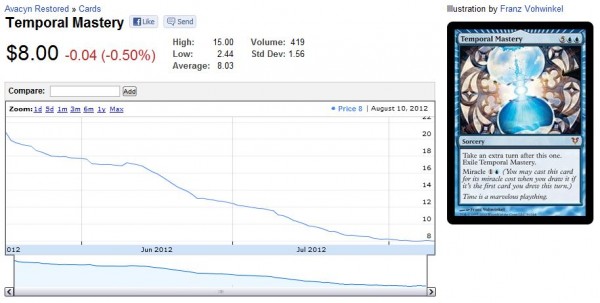
Consider Temporal Mastery, for example (chart courtesy of blacklotusproject.com):

The trend looks pretty depressing, doesn’t it? But in a format rampant with aggressive strategies, control-based decks really haven’t had their chance to shine. And this pseudo-Time Walk is a prime example of a card that should see increased play as the format rotates. Especially since it’s recently hopped onto many speculators’ radar courtesy of Reid Duke’s SCG Open victory: http://sales.starcitygames.com//deckdatabase/displaydeck.php?DeckID=48345.

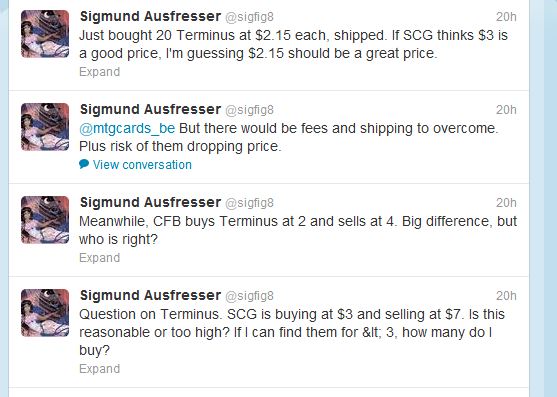
Another miracle card which may see a price shift come rotation is Terminus. It’s no secret that I’m speculating on this card. For those who don’t follow me on Twitter:

It’s also interesting to see Star City Games’ aggressive approach to Terminus. While it is possible (though highly unlikely) SCG is unaware of the card’s dropping price, I’ve wagered that they too are speculating on this card. After all, with Day of Judgment leaving the format what other board sweepers are useful? Terminus may also strengthen if some of the Return to Ravnica Guilds depend on graveyard synergies (I’m looking at you, Golgari) or token strategies.

Edit: Since Sunday, August 12th, Star City Games has dropped their buy and sell price on Terminus to $2 and $6, respectively. That being said, there were four copies in the SCG Kansas City winning Legacy decklist. This card may not have a home in Standard, but it is certainly powerful enough to find one.

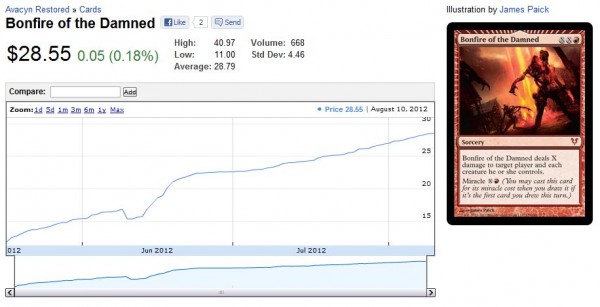
I’ve saved the miracle with the most buzz for last: Bonfire of the Damned (chart courtesy of blacklotusproject.com):

This card has been on a steady rise since mid June. But can this Standard all-star continue its run in a new metagame? I’ve mentioned in the forums how red sorceries are rarely the most valuable card in Standard. And with so many unknowns on the horizon, it feels like there is more downside potential than upside potential. The card sells on eBay for $35 already, and I have a tough time seeing auctions that pass $40, unless the card really warps the format.

Because I’m risk averse, I already sold my few copies for a marginal profit with intent of buying back in should the price drop. If you have an appetite for risk, feel free to hold onto your copies. But as a cautious speculator who has been burned from Standard rotation in the past, I’m going to buy into underappreciated cards like Temporal Mastery and Terminus instead.

Return to Ravnica

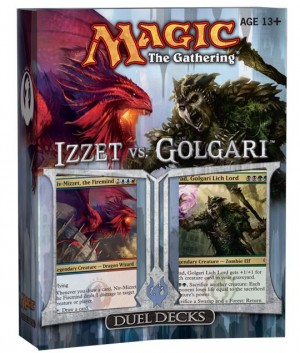
As most of you know, there have been two cards confirmed for Return to Ravnica:

The lack of confirmed information is stopping no one from speculating on what is to come. We can safely infer a few key facts solely based on the spoiled cards, and so I’d rather base my decisions on these facts rather than pure speculation.

First, we see that Wizards is not afraid of reprinting previous Ravnica block cards in Return to Ravnica. My guess is that the reprints won’t stop with Niv-Mizzet, the Firemind. This means no card in Ravnica block is sacred.

Of course, the most financially devastating reprint would be Dark Confidant. But beside the Shock Lands, there are a handful of reprints that could impact card values negatively such as Doubling Season, Life from the Loam and even Spell Snare. Net, I wouldn’t recommend acquiring any of these cards while they are so vulnerable to reprinting.

I have already made reference to the second fact we can garner from the two spoiled Return to Ravnica cards confirmed so far: the graveyard may still matter.

There is already a potential synergy between Innistrad and Golgari. Gravecrawler and Geralfs Messenger are already seeing Standard play, and if Golgari gives you reason to kill your own creatures, these guys could see a resurgence.

And don’t forget my number two speculation for rotation: Innistrad Duals. There just so happens to be a [card Sulfur Falls]U/R[/card] one and a [card Woodland Cemetery]G/B[/card] one.

The third and final deduction I’ve made from the confirmed Duel Deck Izzet vs. Golgari is that Return to Ravnica will probably be awesome.

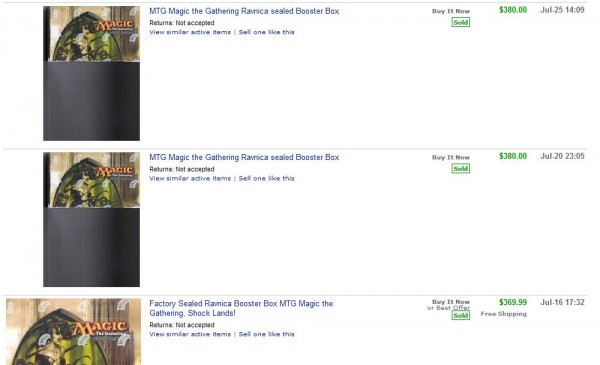
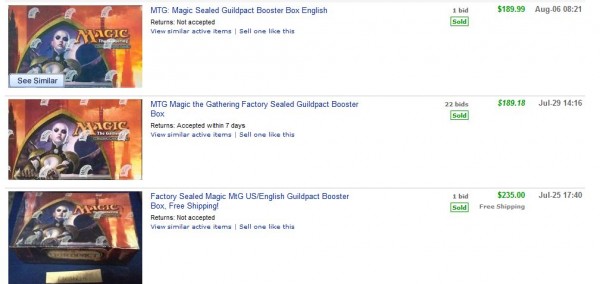
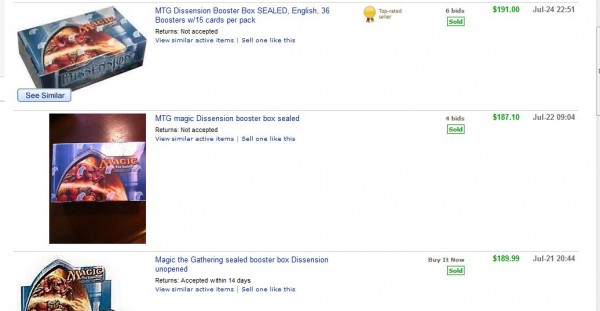
Is this relevant? Well, if this block is as powerful in eternal formats as the original Ravnica block, then perhaps it’d be a wise investment to hold onto a sealed booster box of these next three sets. They are pre-selling at $90-$100 now, and I don’t expect their prices to drop much. Just look at prices of the original Ravnica block booster boxes:

Investing in these would have yielded a fine return (to Ravnica -- sorry I had to).

Commander’s Arsenal

The next Commander product has just been announced, and it sure has gotten players’ attention. Wizards of the Coast is marketing the product with a super premium price tier by marking an MSRP of $74.99! What do you get for that investment?

Well, besides some neat counters and a sweet life keeping device, we know we’ll also be getting 18 foil cards including Sylvan Library. That’s pretty sweet, but it’s not worth $75. So is this deck a buy? A Twitter poll reveals people’s hesitancy due to the steep price:

Clearly we will need more information before the overwhelming majority is convinced this product is worthwhile. The first round of Commander Decks have been out for a while now, and even the most popular one, Counterpunch, can be had for under $60 on eBay. Political Puppets, on the other hand, still can be had for under $40, very close to MSRP. Many Wizards of the Coast sealed products increase in value a few years after release, but it’s not a guaranteed trend. It truly depends on the value of the cards within, and that is why I am in the “wait” group from the poll above.

Some key finance players are avidly supporting a preorder of this product, but I see little downside in waiting. Especially since I don’t think this product is even available for preorder yet anyways.

Have Your Trigger Finger Ready

I’ve theorized what changes may be coming, but soon enough we will have new information daily. Spoiler season always brings with it some wild speculation opportunities, driving rapid price swings on specific cards. The best advice I can give you is to have some cash ready for buying and flex your index finger. Pay close attention to Twitter and the QS forum as players point out the next hot speculation target.

Once a target is spotted, the window to pull the trigger on buying the card closes rapidly. Most people buy out TCG Player and eBay first. Less searched sites such as Cardshark and even Amazon are not bought out as quickly. While everyone buys out eBay, I’d suggest going to these sites first for opportunities to purchase the hottest card on the cheap.

Just don’t tell anybody else there is stock at these sites until after you’ve bought the copies you want!

-Sigmund Ausfresser
@sigfig8

Commander Staples: Top Five Cards by Color

Are you a Quiet Speculation member?

If not, now is a perfect time to join up! Our powerful tools, breaking-news analysis, and exclusive Discord channel will make sure you stay up to date and ahead of the curve.

Here are a few cards for your consideration:

You probably recognize these as some of the most powerful cards in Magic. The cream of the crop, the iconic staples that define formats and warp metagames. Few would argue that these cards set the bar for sheer power.

But in Commander this is not the case. Commander manipulates the rules of Magic in such a way that card quality must be assessed completely differently than in any other format. There are many key factors that affect the quality of a card in Commander. The multiplayer nature, starting life total of 40, and bizarre deck requirements are just a few.

Normally, in Constructed formats, players take a card's mana cost into consideration, but for Commander this is less of an issue.

This is because Commander is generally slow. Larger numbers of players lead to longer games, players start with 40 life, and decks are less consistent. Players can usually bank on hitting their eighth land drop to cast that juicy hydra demon lord that draws eight cards and destroys eight creatures (this card may or may not be my invention). This means players can rely on their expensive spells, which results in the epic games of Magic Commander is known for.

Let's look at blue as an example. Normally when compiling a top five list for best blue cards we might include Snapcaster Mage, Brainstorm, Force of Will, Counterspell and Stifle. (I don't really play other formats so this is probably wrong, but you get the idea.) Cards like this are actually quite poor in Commander. Sure they have their uses, but I wouldn't put them anywhere near the top five.

Time Stretch, on the other hand, ranks above all of these. In most formats ten mana is pretty unreasonable, but not in Commander. While ten is steep, most Commander games will go long enough for a spell like this to be hardcast. The possibility of casting cards like this (fairly) is what makes Commander such an interesting, dynamic and unique format.

The other colors more or less follow suit. The best cards outside of Commander usually don't measure up in the world of 99 cards.

The Best Commander Cards

Let's take a look at what I consider to be the top five Commander cards for each color and why.

Now, there are two things to be aware of when I made my decisions. First, I chose cards that are more or less good in a vacuum. For example, Palinchron is extremely powerful but relies heavily on [card mana reflection]other cards[/card] to be good. I tried to keep cards like that off the list. Second, I avoided stupid cards like Armageddon because I don't play with or against such cards.

There are a few questions I kept in mind when judging power level. Do I usually win the game when I cast this card? Does it actively help me cast cards that win the game? Does it efficiently stop my opponents from winning the game? Should every Commander deck run this card if it's on-color? These are all important things to consider when assessing card quality for Commander (and for that matter every other format).

Without further ado:

White

I command you to destroy all your permanents.
  • 5. Stoneforge Mystic. This card is fantastic. In most cases it gets a Sword of Fire and Ice or [card Sword of Light and Shadow]Light and Shadow[/card], which are quite good in Commander, but it also has the option to get other [card Argentum Armor]powerful equipment[/card] to fulfill roles you may need.
  • 4. Return to Dust. This card is just amazing. Just show me one Commander deck with out artifacts or enchantments in it. Not only can this card get two of them, but it exiles which is actually much more critical in Commander than in other formats.
  • 3. Wrath of God. Creature wrath effects are very powerful. When you kill not one, but two of your opponents' entire board of creatures, it's that much better. This creates a lot of pseudo card advantage which is very beneficial.
  • 2. Stonehewer Giant. This is another fantastic equipment fetcher. He pretty much does what Stoneforge Mystic does, but more than once and he equips it for you.
  • 1. Austere Command. This card is extremely versatile, which is clutch in Commander. It will always take care of two threatening cards, if not more, and it is easy to set yourself up to be far ahead after casting it. Every white deck should use this.

Blue

Hey, does your deck run Avacyn? OK, I'll bribery you.
  • 5. Time Stretch. TWO extra turns?! That's insane! The fact that this costs ten mana does keep it at number five though.
  • 4. Rhystic Study. This card draws a surprising amount of cards. As soon as one person declines to pay the extra one, everyone else stops paying as well. It's a, "Well, if you're not paying, then I'm not," kind of situation.
  • 3. Desertion. In most situations paying five mana to steal an opponent's three-drop creature is underwhelming, but when it steals a nine-mana legendary angel, it suddenly gets a lot better.
  • 2. Time Spiral. Refilling an empty hand is good in any format, and the fact that you see it coming makes it way easier to take advantage of. Oh, and did I mention its free? In fact, with the use of bounce lands (and [card caged sun]other tricks[/card]), it actually generates mana!
  • 1. Bribery. This card is a lot like Desertion, except you don't have to wait for your opponent to cast anything and it always gets the best creature they have available. In Commander that usually means something nuts. Turn five Griselbrand! Wait, he's banned. Dang. We'll just have to settle for his nemesis [card Avacyn, Angel of Hope]Avacyn[/card].

Black

The demon advises you win the game.
  • 5. Rune-Scarred Demon. Not only does this guy get any card from your deck, he also lays the smack down as a 6/6 flyer.
  • 4. Phyrexian Arena. I've found this card to be extremely powerful. Remember how Commander games last forever? Well, drawing a card every turn for forever is...a bunch of cards, at least 50, and the life loss is mostly irrelevant.
  • 3. Decree of Pain. Creature sweeper and card drawer in one. What else can I say? It even becomes more powerful with more people in the game.
  • 2. Necropotence. This card breaks the "good in other formats, bad in Commander" rule. It is busted in all formats and becomes even more busted when you start with 40 life. Enough said.
  • 1. Demonic Tutor. I'd probably put this in the top five Commander cards among any color. It's that good. Tutors are even more powerful in Commander due to deck size and inconsistency. This gets any card on this list, so it has to be good.

Red

I'll...attack.
  • 5. Shattering Spree. This card is efficiently costed and destroys every artifact you need it to to cripple your opponents. Any deck that isn't green is going to have some artifact mana, and being able to kill all of them, but not your own, is pretty sweet.
  • 4. Starstorm. A variable creature sweeper that cycles? Sounds good to me. It's also an instant, which is great. This card is good during all points of a Commander game.
  • 3. Godo, Bandit Warlord. See Stoneforge Mystic and Stonehewer Giant. What can be bad about free equipment? Also, swords are pretty sweet when they hit twice. Side note, a Spanish Godo, Bandit Warlord has the coolest name of a card ever. Look it up.
  • 2. Wheel of Fortune. This card gets you out of a tough situation, to wit: running out of cards. This is one thing you don't want to happen in Commander. Also, red is lacking in card advantage and this gem keeps those dragons flowin'.
  • 1. Insurrection. I'm pretty sure I've won the game every time I've cast this card. What makes it so powerful? There are usually at least three players' worth of creatures to steal, said creatures are simultaneously large and in charge, and voila you control all of them.

Green

The time is prime for more land.
  • 5. Azusa, Lost but Seeking. This chick is bonkers. Playing three lands per turn is the bee's knees, and with splendid cards like Tower of Fortunes keeping your hand full, its pretty easy to take advantage of her every turn.
  • 4. Mana Reflection. Double Mana. Not just an extra mana, and not just for lands, but double mana for everything. That is all.
  • 3. Skyshroud Claim. On the surface this card feels underwhelming compared to the other cards on this list, but trust me, every green Commander deck everywhere should run this card. It's just that efficient. It accelerates and fixes your mana (think Tropical Island, Bayou, Taiga and Savannah), and as a plus puts lands onto the battlefield untapped.
  • 2. Tooth and Nail. This card is just sweet. Two creatures from your deck, right into play, bam. Hint: I often get the green card ranked at number one.
  • 1. Primeval Titan. This card does exactly what is best in Commander, ramping tons of mana. And it fetches any lands you could fancy. Urborg, Tomb of Yawgmoth and Cabal Coffers? Why not. He's also a beefcake that can pummel your opponents to death while he generates thousands of mana.

Wrapping Up

And there you have it, Andy Martin's top five Commander cards for each color.

Compiling this list was a lot more difficult that I thought. Commander is such a diverse format where anything is possible and it's very difficult to narrow such a large chunk of quality cards down to 'best five'.

I'm sure some of you agree with some of my choices, and I'm sure even more of you disagree. The above list is based on my years of Commander experience and Magic knowledge, but I would love to hear what you all think. What are your top fives for each color? Let me know in the comments!

Andy Martin
arm7845@gmail.com

Jason’s Archives: Fact or Fictional Characters, What’s the Matter with Kansas & Nights in Columbus

Are you a Quiet Speculation member?

If not, now is a perfect time to join up! Our powerful tools, breaking-news analysis, and exclusive Discord channel will make sure you stay up to date and ahead of the curve.

Greetings, Speculators!

No time to editorialize this week as I'm busy getting ready for Gen Con. Also known as geek Christmas (nobody calls it that -- Editor) Gen Con is a plague that descends on Indianapolis, Indiana every year in August. Reminiscent of locusts, the swarm of cosplayers and furries is so thick over the long weekend it can blot out the sun, and most residents of the city stay indoors until Monday.

Its aftermath is nothing short of devastation; large swaths of the city are stripped bare, from the shelves of comic book and costume stores to the city's entire supply of Pocky, erased from existence. The downtown Steak and Shake, voted the best place in Indianapolis to get hepatitis, does 90% of its annual business and closes for the next month to remove the smell of clove cigarettes from the curtains.

Not to be trifled with, Gen Con is serious business and I'm putting in enough prep work to ensure I bring everything I want to get rid of.

If you want to know how to get ready for this momentous weekend, this guy has you covered.

I'm Not Going to Gen Con, You Clown. What You Got for Me?

Wow, I was getting to it. You're kind of a jerk sometimes, imaginary person I use as a rhetorical device to establish flow in my article.

Make My Favorite People into Cards!

Done! I found quite a bit of that.

Flavor wise, we couldn't come up with an ability that simulated a nude shower fight.

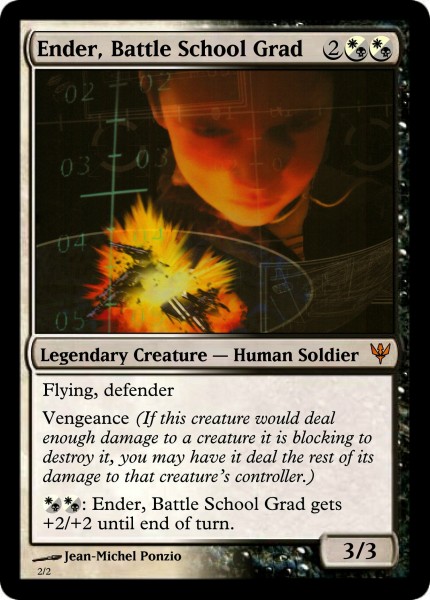
Redditor BearSole gets us started with his creation of Ender Wiggin, the savior of humanity and scourge of kids with names like "Bonzo". If you haven't read the Ender's Game series, shut up, yes you have. If you actually haven't, you really should because they are quite good.


This jives nicely with my tendency to refer to Emrakul as "the heavy."

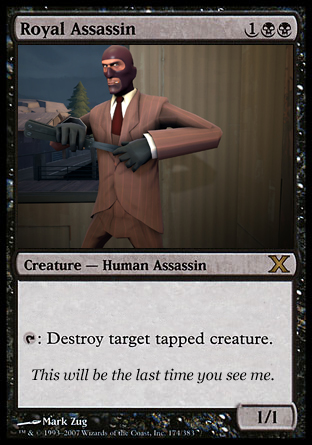
Death Monkee brings us his update to Royal Assassin. Personally, I think Evil Twin better embodies the TF2 assassin's skill set, but this is strong work and I loled.


You don't have to be a loony to play this card, but it can't hurt.

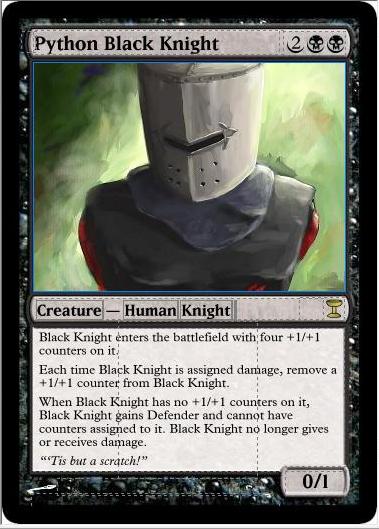
Mightyskunk has graced our day with his rendition of Monty Python's tenacious Black Knight. Completely insusceptible to flesh wounds and scratches, this guy can take a real beating and keep on defending. Not the blackest of abilities, this card still has a lot of casual appeal, and should incite a lot of "python" quoting.


Do not cast this card from your hand. He who casts from his hand has forgotten the face of his father.

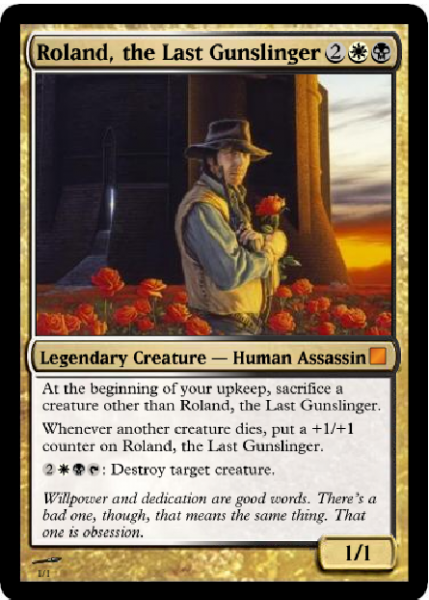
RainInHeaven wraps up our hit parade with this lovely rendition of the Waste's most dangerous eight-fingered badass. I try to structure my articles like the Dark Tower series; an exciting build to an inevitably disappointing ending.

Going for Gold: Not Just a Ravnica Draft Strategy Anymore

Ever wish they had Magic events in the Olympics? I haven't either. Anyway, enjoy this thing:

It could happen. They used to give out Olympic Gold Medals for poetry.

IrrelephantInTheRoom is all about Magic in the Olympics. I'll compete if they have medals for fastest pack to power.

Modern Goes to Kansas, Gets a House Dropped on its Head

As Magic is the second most enjoyable activity in Kansas (the most enjoyable being packing a bag and going somewhere else) there was an SCG Open event in Kansas City over the weekend. Let's take a look.

Top 32 Standard Lists

Three Delvers in the top 8, which seems OK to me. The winning list, piloted by Mike Prokop, is a bit of a throwback to the Delver lists of six months ago, augmenting the instants and sorceries that flip [card Delver of Secrets]Delver[/card] with a Runechanter's Pike or two.

Pike has gotten better recently as a strong synergy piece with another card that's seeing more play in several formats -- Talrand, Sky Summoner. When I said on the podcast that I thought Talrand bore looking at in Legacy, I wasn't just being cute. I was close but not quite spot on. Talrand is currently seeing some experimental inclusion in Vintage decks such as Gushbond. Nothing beats a free 2/2 plus two cards. Well, maybe some kerosene and a lit cigar. Not much else though.

Gut Shot, Gitaxian Probe, Dismember; the old favorites are all here. This feels very much like a throwback deck, but a throwback to a time when Delver was on top and didn't even have the absurdity of [card Talrand, Sky Summoner]Talrand[/card] to abuse the high instant/sorcery count. Now Runechanter's Pike feels like cheating with both Talrand and Moorland Haunt spitting out fliers to Pike up.

All in all it feels like the way the deck should head in the future, at least until the Phyrexian mana cards are gone. As stale as it is for Delver to win, this list seems at least a bit innovative. Congrats, Mike.

Bugs and Pump Spells

Second place is.... Mono Green Infect? What in the actual crap?

Not as cutesy as it appears at first glance, this deck goes all-in on one dude with the protection suite to ensure he gets the job done. Abusing the absurd interaction between Apostle's Blessing/Ranger's Guile and Wild Defiance, this deck is explosive and dangerous. A nuts draw from this pile is unbeatable without the right removal from the opponent, and the deck can even eke out some amount of post-wrath inevitability. Day of Judgment is fine and all, but if your opponent has Forest, two Cathedral of War and Inkmoth Nexus left over, you're dead anyway.

Green Sun's Zenith takes a bit of the sting out of running so few creatures and the sheer number of counter/protection spells make more than one creature unnecessary. Infect has always been a potent strategy and it's good to see it pay dividends. This marks the second SCG event in a row where a fun, innovative deck came along and, you know, got inevitably curb-stomped by Delver in the Finals. Still, second place seems really good to me.

Not everyone would agree.

The Top 8 was pretty standard. One standout was a deck I'm fond of -- Zombie Pod. How Matthew Dennis managed to make Top 8 with a whopping zero copies of Gloom Surgeon, I'll never understand. Have you read that card? Lighter on the zombies and heavier on the pod, Dennis instead included a Massacre Wurm and a Thragtusk (TUSK!) as answers for a long game.

How silly is Disciple of Bolas? He's as good as you thought. Everyone who played Limited or Duel of the Planeswalkers knew this guy was a beast, but since no pros had jammed him yet, it took a month for him to reach Top 8. Don't be a follower. [card Flock of Rabid Sheep]Sheep[/card] are followers, and they get sacced to Trading Post. Is that what you want? To get sacced to a Trading Post? Be an Elvish Pioneer and play good cards before it's cool.

Top 16 Legacy Decks

Four copies of Stoneblade variants in the Top 8? Is this a regional thing? I was ready to call this deck as dead as Dillinger, but Kansas City saw garden-variety Stoneblade lists dominate.

In the coveted "Jason's favorite deck of the event, naturally in second place" slot is... LANDS! You may remember Lands winning in Detroit. This deck has real gas and as boring as it is to play sometimes, other times you get to ruin someone's day. Nothing beats the rosy cheeks and bulging forehead veins of the 296th RUG Delver player who loses to you round one and complains about your joke deck only to see you wave a few hours later from Top 8.

Some say Lands is a real deck capable of winning events. Others say it's the 75 card version of the a fraternity prank. Can't it be both?

Sorry Maverick, wanna maybe reread Cursed Totem?

Congrats to Kobie Spaeth for winning and to Alex Olson for ruining eight guys' days.

I Swear There's Something in Columbus Every Weekend

This weeekend it was a SCG Open Series event. See if you can guess the deck that won the event. Don't peek, just say your answer out loud then scroll down.


Got your answer?


No peeking...


No, it wasn't U/W Delver, you cynical planeswalker, you. If you were any more [card Jade Mage]jaded[/card], you'd put saprolings into play.

Could this possibly be correct? No Delver in the Top 8? Hot damn! Let's see what we got here!

Scotty Doolittle made use of his ability to talk to animals and piloted Naya Pod to a first place finish. It looks like a pretty stock list so let's move on. Congrats, Scotty!

Defiant Infect makes another strong showing here, piloted by David Rohlfing. This deck is a contender, and when more than ten people at an event play it, expect to see it compose more than one slot in future Top 16s.

Control's Triumphant Return?

Chandra, the Firebrand sure looks like fun if you're playing Bonfire of the Damned late in the game. Jamming an impressive three copies of Frost Titan, a Grixis Control deck piloted by Michael Kenney took second.

This isn't the least hostile format toward control, but this deck is teeming with removal and getting your counterspells shut off by Cavern of Souls isn't as back-breaking when you can set up a 10-point Devil's Play and double it. [card Nicol Bolas, Planeswalker]Nicol Bolas[/card] is tough for most of the format to deal with if he resolves and he looks like the deck's main win condition, apart from beating faces with titans or sphinx. Tight play is a necessity with a deck like this, so second place is quite impressive. Nicely done, Michael.

Another Dungrove Green deck stands out in an otherwise pretty stock Top 8. All in all, eight players managing to finish better than every Delver deck in the room warms the cockles of my heart.

Get Off My Lawn!

All in all it was kind of a surprising weekend. I sold five playsets of Vexing Devil overnight on eBay, so more on that when I get back from Gen Con and figure out what the heck is running Vexing Devil. Whatever it is, I hope it involves active Blood Artists.

I am done with you now (see title above). Leave me to my Gen Con preparations and leave me some love in the comments. Or some hate. A cookie recipe, anything.

If you see me at Gen Con, ask me for one of the sweet 1/1 Spirit tokens we made for Brainstorm Brewery. There's a prize in it for anyone who uses one of our tokens in a match on camera.

Until next week, don't do anything I wouldn't do. And if you do, name it Gideon. I think that would be awesome.

Jason Alt
@JasonEAlt on Twitter

Insider: More Examples of Predictive Senses

Are you a Quiet Speculation member?

If not, now is a perfect time to join up! Our powerful tools, breaking-news analysis, and exclusive Discord channel will make sure you stay up to date and ahead of the curve.

It's another week of examples today, selected to help hone some of your predictive senses on speculation. I'm going to share some cards today and I'll be honest - sometimes, I still don't know why these things act the way they do. Join me as we tease out the reasons why cards go up or fail to go up. If you didn't catch my article last week, here it is. You'll get a sense of my thinking process and the questions that I'm asking myself along the way.

First off, let's start with one I called about a month ago...

Baleful Strix

Baleful Strix is a little wonder-bird that showed up first in the new Planechase set. It has three really powerful abilities - Deathtouch, flying and cantripping - it replaces itself when you cast it. This card has been creeping up pretty quickly, and let's look why.

Does it exist in an earlier set? No, certainly not. We have never seen a card with this kind of utility before and like Bonfire, which I talked about last week, this looks unique. The closest we've gotten is Tidehollow Strix, which has made completely zero impact on constructed sets. However, this one trades off a point of power for a full card. Thus, it's sort of hard to compare this Strix to that Strix.

Terrified of small birds getting caught in its jet engines.

How powerful is this card? Baleful Strix is mighty powerful in the right environment. Baleful Strix is a freebie to cast. It pitches itself to Force of Will. It conquers the mightiest of attackers - even Emrakul bows to the avian's fetid touch. The combination of Flying and Deathtouch means that the Strix will trade with any attacker or blocker it comes across - this is an incredible deterrent to attacks. On top of that, it draws a card - a control deck can therefore gain both a blocker and a card. It adds beef to the board and a 1/1 with the right backup is a fine win condition.

Baleful Strix would be a Standard all-star. It would spawn a thousand fascinating and fun control lists and it would be a fine bird to wield a Sword. However, Baleful Strix is only legal in Legacy and Vintage. We must, then, look at it in the lens of these two formats.

Baleful Strix has not made much of an impact in Legacy and the reason is that there are too many creatures for it to trade with. Hear me out on this, since it seems like a good reason to play the Strix in the first place. The creature quality is both low enough and dense enough in Legacy that you're not going to get much advantage out of swapping this for a Delver or Nimble Mongoose. A 1/1 will die to plum anything in Legacy, even if it has to take something out with it. U/B is a bad combination on its own in Legacy and this card does not solve the problem of too few cards that can seal up the game. Therefore, you're not going to play the Strix when Delver of Secrets can probably do the same or better job and will actually put enough pressure on things to win the game in Legacy.

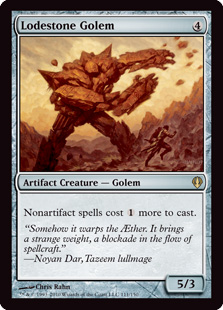
Vintage, however, is another monster indeed. Remember that Vintage games play out much differently than any other format. Mishra's Workshop, in particular, warps a lot of play. Shop decks typically run big artifact punishers. Think of Chalice of the Void, Lodestone Golem, Sphere of Resistance and more. They aim to shut you down and then pound you to death with big robots and they are very good at punishing blue-based decks. This Strix solves a critical problem that blue decks face. Entertain this possibility: a Shop deck plays a Mox, an Ancient Tomb and a Thorn of Amethyst on their first turn. You reply with a humble Island. They play another land and then a Lodestone Golem - you're on the clock and you don't even have some lucky Moxes to beat their taxing effects! However, you peel that Polluted Delta, get a Swamp and play a Baleful Strix right through both of their resistance effects. That Golem is completely shut down and the Shop player is going to have to wait on more threats to pressure you. You've got a serious chance of winning the game, even if all you have is a 1/1 on defense. It's doubly dangerous if you've got Goblin Welder trading your Strix in and out, drawing cards and producing a Deathtouch blocker when needed. On top of that, it's pretty good against Noble Fish, a deck that leans hard on Tarmogoyfs to get their damage through.

Are people going to love to play this card? Baleful Strix applies to a specific kind of player: the value-added man. Nothing is thrilling about Baleful Strix on its face, but this is a total grinder card. This is the card that you lovingly trade for a big man from the opponent, knowing that you paid UB and zero cards to eliminate their worst threat. It's not going to see much play in Legacy, but I see it as a role-player in Commander. None of this explains, however, why this card is going up so much in price.

When Juggernaut just isn't good enough...

Conclusions: Let me give you a little bit of history with Baleful Strix. About a month ago, I posted in the QS forums to keep an eye on this card. It was at about $5 at that time and I had seen several of my Vintage teammates do very well in a regional tournament with it. Their decks gladly ran four of the card. This card has a narrow print run and limited availability, so it was prime for growth. However, Vintage doesn't exactly move card prices. Lodestone Golem and Grafdigger's Cage, two epic Vintage noteworthies from recent times, can be had for a song. Nonetheless, Baleful Strix was going to be a key part of Vintage, even if it wasn't a big market. I was pleased and impressed that it jumped to $10 in that time, but I am at a bit of a loss to explain why. My theory is that the lack of card availability on this (you aren't opening this uncommon in packs) and the need to have four in a deck combine to drive a market on this. On top of that, people LOVE to play blue decks in Vintage, so lots of people are going to try out the Strix. I normally discount Vintage impacts from influencing the price of just about anything in Magic, but I am pretty sure that this card has reached this price because of that boutique format. I see Baleful Strix rising ever more after Planechase disappears from shelves. I'm not going to call it a great buy at $10, but getting it for that in trade is a fine idea. The remainder of the Planechase deck it comes with has some nice cards, too - meaning that you can buy the boxed set, crack it for the Strixes and still cover some of your expense.

I'll also caution you that this is not an endorsement of jumping on cards that only have Vintage appeal. In this instance, the Strix's limited availability beat the fact that it's only Vintage-playable to make it worth something. This isn't usually the case.

Memnite

Memnite is the first creature with an actual power that you get for free. It's a true gambit that asks "what's a 1/1 worth to you? Would you spend card slots on it?" A lot of times, the answer is "yes, I'd love to play this thing."

Does it exist in an earlier set? No, Memnite has never existed before. It has somewhat-close analogues in the instances of Phyrexian Walker, Ornithopter and Shield Sphere.

How powerful is this card? I've gotten beat to death enough times by Memnites to tell you that this is a powerful card. Free is a fine price to pay for a 1/1 in the right deck. What kind of deck? Well, Affinity for one... Modern loves this card. Further, people have seen success with it in Tempered Steel decks and red aggressive decks with Kuldotha Rebirth. Plus, it's a fun card. You get something for nothing with seriously no strings attached.

Are people going to love to play this card? Emphatically, yes. I believe that this card is going to follow in the footsteps of Shield Sphere among casual players in that it will have a long and loyal following. Shield Sphere is a dumpy little wall that is outclassed most of the time by Steel Wall. However, it's free and it's from an older set. Shield Sphere nets a dollar and it's not as good as Memnite. You must consider the draw of "free." People are going to play with these in every deck; they'll get beat up from play. They'll get buried in boxes. They'll continue to see banner play in Affinity. These are cards to hold onto.

As long as this card is legal in Modern, Memnite will have a home alongside Mox Opal and Springleaf Drum.

Conclusions: I see Memnite getting into the $3 range in a year or two. Remember that Memnite is going to rotate out of Standard, meaning its $0.90 current price will likely dip down a bit for awhile. There will never be another card printed that's as good as Memnite for the price, and we are unlikely to see a straight reprint. Pick up this guy and hold onto it.

A final note to follow up from last week. In the feedback, pipdickenz took me to task for claiming that Bonfire of the Damned would not hit $45 in print. I'm bearish on this card and I'd like to explain my reasons. At print time, the card was about $28 from Ebay. It's gone up in stores because chase rares typically behave that way, but the prime indicator of the market is Ebay - it's hard to disagree with what people are actually paying for a card. The card is currently closing for about $32 plus shipping, which is a far cry from $45. I don't think it'll get to that threshold on Ebay. We'll see.

Until next week,

Doug Linn

Insider: M13 Release Impacts on the MTGO Market

Are you a Quiet Speculation member?

If not, now is a perfect time to join up! Our powerful tools, breaking-news analysis, and exclusive Discord channel will make sure you stay up to date and ahead of the curve.

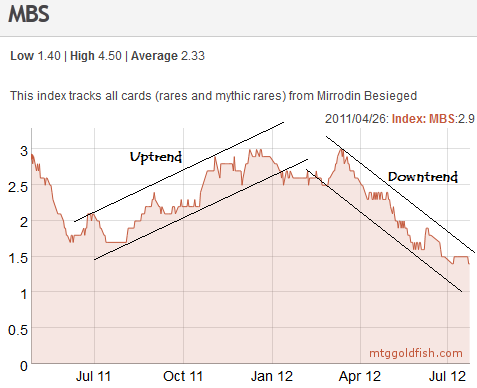
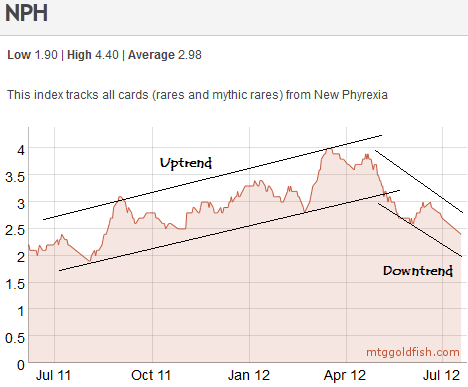
Looking over historical price trends, one notices that the price bottom for the cards from Mirrodin Besieged (MBS), as represented in the MTGGoldfish chart of the MBS index, is the end of July 2011. New Phyrexia (NPH) has a similar chart. That last week of July coincided with M12 release events, a time when prizes for sealed events are quite generous.

The attractive payout structure pushes the demand for tix higher as they are the only means to play in sealed deck release events. Ordinarily, limited events accept a combination of boosters and tix as entry, but not in this case. The attitude of most MTGO players is such that they are enamored with the idea of ‘going infinite’, ie, not having to pay to play.

Combined, these effects broadly depress prices for singles, as the quickest way for players to gather some tix is to sell singles into the market, typically to bots. This, along with the shift towards M12 as a draft format, gives a reasonable explanation for why these indices hit a low during core set release events.

Spot the Trend


Further examination of the chart shows that after the observed low at the end of July, an uptrend begins, which is defined as a series of higher highs and higher lows. For MBS, the trend is intact until January 2012. And for NPH, the trend lasts until May of 2012.

After the upward trend is broken, both MBS and NPH begin a downtrend where a series of lower highs and lower lows are reached. This downtrend is ongoing at the moment, as players eye the Fall rotation. It will continue until approximately October, when Scars block and M12 rotate out of Standard.

This observed pricing trend is useful to speculators. As a general rule, when considering the timing of taking positions in the latest sets, the core set release event period is the best window of opportunity.

As M13 release events begin firing, any of the best speculative targets from Dark Ascension (DKA) and Avacyn Restored (AVR) should be purchased. Each of the following proposed targets carries two ratings, one for risk and one for return. Here ‘Risk’ is the chance of suffering a loss on a medium time horizon (3-6 months) if purchased at the suggested prices while ‘Return’ measures the potential gain if things work out as predicted. When considering taking a position, it’s prudent to always consider risk first.

Top Picks

Sorin, Lord of Innistrad

(Risk: Low to Medium, Return: Medium to High)

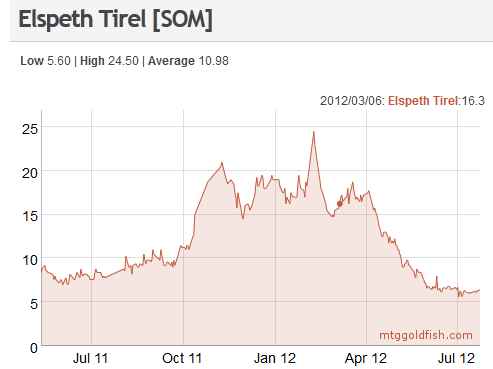
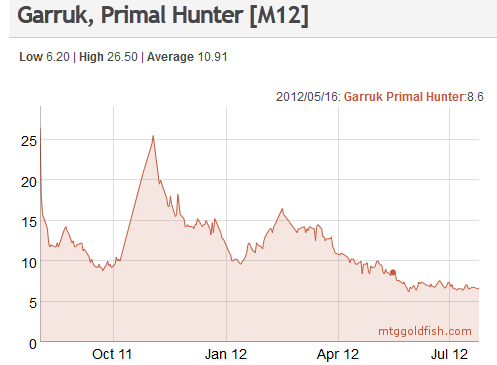
This Planeswalker sees sporadic play in Standard at the moment and has found a price floor of 14-15 tix. As players try to crack the metagame of Fall Standard by trying out strategies both new and old, expect a resurgent interest in this card. Both Elspeth Tirel and Garruk, Primal Hunter saw huge spikes in price during October of last year as the metagame sought to establish itself. Expect Sorin to see similar price action as players test out W/B tokens in the new format.

Usually a key predictor of the Fall Standard metagame will be the decks from Block Constructed. However, this year Lingering Souls and Intangible Virtue were banned in Block so the successful Block decks we have seen online are not entirely representative of what we can expect in the Fall. The true power of token decks is probably quite high an,d for this reason, Sorin, Lord of Innistrad is under priced relative to other Block staples such as Bonfire of the Damned and Huntmaster of the Fells.

As a strategy, Tokens might take people by surprise in Fall Standard. As a good speculator, don't be surprised.

Downside protection on buying Sorin, Lord of Innistrad is offered in the run up to the release of Gatecrash in early 2013. That set will have the Orzhov guild returning, so any powerful W/B cards will have extra interest at this time as deck builders anticipate using the new cards in Gatecrash. Acquire this card for 14-15 tix during M13 release events.

Restoration Angel

(Risk: Low to Medium, Return: Medium)

This card has powered up Delver variants in Standard as well as Birthing Pod decks in Modern. This card is a staple for both formats.  The price has settled into a range of between 6 and 8 tix lately, but we can expect a small dip in price during M13 release events. The start of the Modern PTQ season in January 2013 offers downside protection on this position -- if the price remains stable or falls once rotation hits, then higher demand during the PTQ season should provide the best opportunity to exit this trade.

Acquire this card for for 5-6 tix during M13 release events, either through posting to the classifieds and picking up copies that players are dumping or through the bots. This price range is a high level to stake out a position in a rare, but recent examples of rares hitting 10+ tix include Stoneforge Mystic, Kalastria Highborn, and Birthing Pod.

As of Aug 8th, this card is priced at over 9 tix, so if it doesn't get down closer to 6 tix, steer clear. 7 to 9+  tix is too high to speculate on for an in print rare.

Gravecrawler/Geralf’s Messenger

(Risk: Medium, Return: Medium)

Both of these rare zombies have seen their prices hover between 3 and 5 tix since the start of June. Typically they have moved together, with Gravecrawler holding a slight premium. They form the backbone of any aggro zombie strategy in Standard, and the current builds will be largely intact come rotation of Scars block and M12.

There might be a good opportunity to sell these before rotation, so keep your eye open and don't just file these away for October. Holding for rotation will not be a mistake, though, as the early stages of a new Standard format are often filled with aggressive strategies, so expect to see Zombies taking it's place in the metagame right off the bat.

If possible, pick these up for around 3 tix, though as of Aug 8th they are both above 5 tix, which brings an unacceptable level of risk.

Value Play

Tibalt, the Fiend-Blooded

(Risk: Low, Return: Low to High)

This card has been in a steady down trend since AVR was released. With a restrictive casting cost and few practical applications at the moment, this card has fallen to an all time low for a single printing in-print Planeswalker.

When you start to talk about the cheapest mythic Planeswalker ever, it's time to pay attention.

With the price so low, it will quite literally have difficulty going lower. Buying this card might never yield any profit, but at worst it will result in a small loss. On the upside, if it finds a home, it could rise to 6-8 tix. Buy this card as a low risk gamble for between 2.5 and 3 tix.

Unfortunately, the recent spike in the price of Bonfire of the Damned and Temporal Mastery has dragged upwards the price of all AVR mythics. As of Aug 8th, Tibalt is hovering closer to 4 tix.

Value Trap?

Wolfir Silverheart

(Risk: Medium to High, Return: Low to Medium)

In comparison to Tibalt, this rare is at a critical juncture of price and playability. It is good but is it good enough?

Wolfir Silverheart has been sitting in the 1.5 to 2 tix range and copies of it are all over the top decks of ISD Block Constructed. If things break right, it could see a price of between 3 to 4 tix. However, as a rare (as opposed to a mythic) it could just as easily settle into a range of 0.5 to 1.5 tix.

And with Jund decks being over represented in ISD Block Constructed, this card has little going for it at the moment.

The Dark Horse

Hellrider

(Risk: Medium, Return: Low to High)

For much the same reason that Wolfir Silverheart is priced too high, this card is priced too low. Tokens being nerfed in Block means that this enabler isn't in high demand at the moment on MTGO. Stick a few of these under the mattress for Fall Standard.

Pick them up for 2 tix or less and on the upside they could hit 5+ tix. Expect Tokens to be a part of the metagame in the Fall. This guy will be in the thick of things as another pseudo anthem effect.

Summing Up

The case has been made here for a few cards with varying potential.

Sorin, Lord of Innistrad carries the best risk/return ratio of the cards considered here. After Pre-Release weekend for M13, prices softened on many cards but there are a few in demand cards for Standard that have hit new highs, such as Restoration Angel and the DKA zombies.

Keep your eyes open for prices to slide over the first weekend of Release events and get your tix ready to snap up any opportunities. Remember, don't over pay for these cards as a higher price increases risk and reduces potential return.

Matthew Lewis

Matt Lewis currently lives in Ottawa, Canada and is a long time player and PTQ grinder who now speculates and plays exclusively on MTGO. He's always ready to discuss ideas and investment strategies, so drop him a line in the comments, the forums or on modo, username mattlewis.

View More By Matthew Lewis

Posted in Free Insider, MTGO16 Comments on Insider: M13 Release Impacts on the MTGO Market

Have you joined the Quiet Speculation Discord?

If you haven't, you're leaving value on the table! Join our community of experts, enthusiasts, entertainers, and educators and enjoy exclusive podcasts, questions asked and answered, trades, sales, and everything else Discord has to offer.

Want to create content with Quiet Speculation?

All you need to succeed is a passion for Magic: The Gathering, and the ability to write coherently. Share your knowledge of MTG and how you leverage it to win games, get value from your cards – or even turn a profit.

Innovating Near Rotation: What’s Your Angle?

Are you a Quiet Speculation member?

If not, now is a perfect time to join up! Our powerful tools, breaking-news analysis, and exclusive Discord channel will make sure you stay up to date and ahead of the curve.

As we get closer to Standard rotating, players spend less time developing new decks. By this point in the season, everyone usually has a deck or two they're used to. More time goes into tweaking existing decks than trying to build something completely new. This is quite understandable.

For those of us unsatisfied with where the format is, this is the perfect time to innovate. There are more players bringing the best decks to each event and fewer bringing rogue decks. When this happens it is much easier to build a deck to beat the expected field.

The three big archetypes you need to prepare for are Delver, Zombies, and Green-based aggro (Monogreen, Green-Red, and Naya with or with out Birthing Pod). That may seem like a diverse array of decks but they are all just aggressive strategies that try to win the game as fast as possible. They have a weakness in common which we can exploit. They all have a hard time beating a wrath effect.

Last weekend, Reid Duke won the Standard porting of Starcity Games DC with a deck similar to what I was advocating earlier in the season, Wolf Run Blue. For my perspective on the deck take a look at these two articles here and here. Reid's deck went in a different direction than mine with the main difference being four copies of Temporal Mastery. This is the list he ran.

Wolf Run Blue by Reid Duke
2nd Place in Starcity Games Open D.C.

Untitled Deck

Creatures

2 Phantasmal Image
1 Snapcaster Mage
3 Solemn Simulacrum
2 Thragtusk
2 Frost Titan
4 Primeval Titan

Spells

4 Ponder
4 Farseek
4 Rampant Growth
1 Blasphemous Act
3 Bonfire of the Damned
4 Temporal Mastery

Lands

2 Cavern of Souls
4 Copperline Gorge
4 Glimmerpost
4 Hinterland Harbor
1 Inkmoth Nexus
1 Kessig Wolf Run
5 Forest
4 Island
1 Mountain

Sideboard

2 Thragtusk
2 Beast Within
3 Crushing Vines
2 Negate
1 Karn Liberated
1 Blasphemous Act
2 Whipflare
2 Cavern of Souls

Reid's angle was to kill his opponents' creatures with Bonfire of the Damned, play a titan, then follow up with Temporal Mastery to close the game.

One main point in the decks favor was how unexpected it was. No one saw this deck coming or knew how to play against it. He beat some extremely good opponents throughout the course of this event and playing a rogue deck helped him accomplish that feat.

Wolf Run Blue is still a great choice right now so if you are still eager to cast your Primeval Titans, this is the deck for you.

The Brews

As I mentioned above, a large part of the format is creature-based aggressive strategies. We can exploit this by building a control deck designed to fight against those decks.

I have two new decks to talk about today. Both of them may need some tweaks but they are quite good at what they do.

Updating Solar Flare

The first deck is basically an Esper Control/Solar Flare hybrid deck. The funny part is that I didn't arrive at this list by starting with either of those decks. I started this deck with four Terminus and three Day of Judgment and developed the deck from there.

Solar Flare Esper Control

Untitled Deck

Creatures

3 Phantasmal Image
4 Snapcaster Mage
2 Sun Titan

Spells

2 Dead Weight
2 Go For The Throat
4 Ponder
3 Thought Scour
3 Think Twice
4 Lingering Souls
3 Day of Judgment
4 Terminus
2 Sorin Lord of Innistrad

Lands

3 Evolving Wilds
1 Darkslick Shores
2 Drowned Catacomb
2 Glacial Fortress
4 Isolated Chapel
4 Seachrome Coast
2 Island
3 Plains
3 Swamp

This is not your typical Esper Control deck and it plays much differently. The spells you want to cast in the early game are Ponder, Phantasmal Image and Lingering Souls. Think Twice and Thought Scour are in the deck to set up Terminus as an instant so they should be saved for the midgame. Ponder also helps with this. Don't be afraid to use your [card Snapcaster Mage]Snapcaster[/card] on turn three to flash back Ponder either.

[card Sorin, Lord of Innistrad]Sorin[/card] may seem a bit out of place but his role is important. The best time to play him is as follow up to one of your wrath effects but he also acts as a pseudo-finisher by pumping your tokens to lethal range. Ideally you want to set up an instant speed Terminus on your opponents turn and then play Sorin on your turn, a sequence that will win you most games.

On the note of this not being a typical control deck, there are no Mana Leaks. Cavern of Souls keeps making Mana Leak worse and worse. The only countermagic I would suggest is Negate in the sideboard or possibly Mental Misstep.

In my article last week I mentioned the power of Terminus right now. This deck abuses that power quite well and with Day of Judgment for back up, your opponent will have a hard time keeping creatures on the board.

This deck plays out much differently than you may be used to. For example, even if you can miracle a Terminus, if you have two Phantasmal Images in play, it may be better to look for a Day of Judgment so you put them in your graveyard rather than on the bottom of your library. Little things like that can drastically improve how well the deck plays.

Finally, this deck wins a lot of games by flashing back a bunch of Lingering Souls late in the game. If you have done a good job clearing the board for most of the game, a couple spirit tokens can easily put it away.

Naya Trading Post Control

If you thought that last deck was rogue, prepare yourself for this crazy little number.

Naya Trading Post Control

Untitled Deck

Creatures

3 Sigarda, Host of Herons

Spells

3 Pillar of Flame
4 Whipflare
3 Oblivion Ring
3 Day of Judgment
3 Bonfire of the Damned
2 Devils Play

Artifacts

4 Ichor Wellspring
4 Mycosynth Wellspring
3 Trading Post
3 Staff of Nin

Lands

4 Evolving Wilds
4 Clifftop Retreat
4 Phyrexias Core
2 Buried Ruin
5 Mountain
5 Plains
1 Forest

The primary objective of this deck is to kill absolutely everything your opponent plays. After that, it should be fairly easy to wrap up the game with both halves of Devils Play and some Staff of Nin activations.

Speaking of the staff, I think it is one of the most underrated cards from Magic 2013. If you had to play against it in a sealed event, then you caught a glimpse of how powerful it can be. Six mana is a lot, but drawing an extra card per turn should not be underestimated. With your removal keeping the board clear, the staff begins to limit your opponents options since they can no longer rely on any creature with one toughness.

Trading Post gives you a variety of options each game but mostly it functions as a draw engine with the wellsprings.

Only three creatures may seem like a risk, but this deck harkens back to the classic control decks of Magic history that used to kill with as many (or fewer) win conditions. By playing no other creatures, you shut down your opponent's removal and obtain some virtual card advantage.

This deck is well-positioned to take down the format. It's possible that Terminus belongs in it as well, but as you can tell from this and last week's article, my perspective on the card may be a little skewed. The biggest question I have is about the inclusion of Pillar of Flame. Considering the plethora of other removal in the deck, I'm not certain it's necessary. If it were to come out, more artifacts may be a good idea to further support Trading Post.

Both of these control decks are designed for one specific purpose: to defeat the creature decks dominating Standard right now. My schedule is extremely busy in the next month so I am not certain how much time I will have to play Standard. If you test out these decks or have suggestions, please post them in the comments below.

I know these decks are not your typical fare, but that is intentional. With so many cards legal in Standard, now is the time to innovate. Do not let the lull between rotation drag you down; use this time to be on the cutting edge.

Until next time,

Unleash the Rogue Force!

Mike Lanigan
MtgJedi on Twitter
Jedicouncilman23@gmail.com

Insider: “Way Back” Trade Stacks #2

Are you a Quiet Speculation member?

If not, now is a perfect time to join up! Our powerful tools, breaking-news analysis, and exclusive Discord channel will make sure you stay up to date and ahead of the curve.

In case any newer readers don’t know, when I first started writing for this site almost two years ago, every week I would record the trades I made at FNM and present them here.

I did so for a few reasons. The first was simply a thought exercise for me; to see how well I did trading and how much money I was realistically making a week. This was fun (and pretty helpful), and people seemed to like it. I also used it to show what cards I was targeting in trades and what, if any, techniques I used to complete the trade.

Now what’s more fun than recording and analyzing trades? Why, recording and analyzing those same trades months or years later! I visited this concept here, and today I want to do the same.  If you’re curious as to why this exercise is actually important to you as a trader, and why I suggest you try it out yourself, I suggest you start here. I also wrote a companion piece this week on LegitMTG you can check out for a more recent explanation.

Let’s get started.

Date: Aug. 5, 2010

His:

Twilight Mire ($4.50)

Mystic Gate ($5.50)

Gaddock Teeg ($4)

Rite of Replication ($1)

Mine:

Ad Nauseam ($1)

[card]Kozliek, Butcher of Truth ($10)

Net: $4

Today:

His:

Twilight Mire ($12)

Mystic Gate ($7)

Gaddock Teeg ($5)

Rite of Replication ($2)

Mine:

Ad Nauseam ($1)

[card]Kozliek, Butcher of Truth ($20)

Net: $5

I find it really interesting that this trade hasn’t changed much at all in the way of net profit even though the value of the cards involved has fluctuated quite a bit. And honestly, looking back at this trade, I’m not positive which side I’d like to be on today. Without checking buy prices, I feel like I’d rather have the Kozilek, simply because it’s such a hot-ticket item, though I’m not sure I would give $5 in trade value to get it.

What I’m taking away from this trade is this. We knew when the three Eldrazi were spoiled that they were going to be big-ticket casual items for years to come. We didn’t know the extent to which EDH would blow up, but still. On the other hand, we didn’t yet know how out-of-print Mythics would fare (very well), and I was trying to pick up cards for Extended season by grabbing the lands, which have appreciated exactly as I expected them to.

Looking at SCG buylist numbers now for this trade, we see the lands pile comes out exactly a dollar ahead. This reaffirms my belief I’d rather be on the receiving end of the Kozilek. When $5 of “book value” equates to just one dollar of cash value (though noted SCG isn’t buying the Rite), I want the high-ticket item. Chances are I would be able to trade down the Kozilek into much more than $1 in cash value if I wanted, or I would have the ability to trade it up as part of a larger trade.

Onto the next one, from the same FNM.

Date: Aug. 5, 2010

His:

Groundbreaker ($2)

Trinisphere ($3.50)

Coralhelm Commander ($3.50)

Phylactery Lich ($5)

Ulamog, the Infinite Gyre ($9)

Nevinyrrals Disk ($5)

Mine:

2x Birds of Paradise ($10)

Sorin Markov ($8)

Net: $10

Today:

His:

Groundbreaker ($2)

Trinisphere ($4)

Coralhelm Commander ($3.50)

Phylactery Lich ($1)

Ulamog, the Infinite Gyre ($16)

Nevinyrrals Disk ($6)

Mine:

2x Birds of Paradise ($12)

Sorin Markov ($6)

Net: $14.50

Here I get to be on the receiving end of the Mythic Rare, and we see how much better it worked out for me, as I’m up $4 more than at the time of the trade. But there are a few other interesting things going on here.

First off, in case you’re wondering, I picked up the Groundbreaker to trade to a friend who was looking for it. If I remember right, he never ended up taking it so I got stuck with a Groundbreaker for an undetermined amount of time. Lame.

Another interesting note is that Magic 2010 Birds have actually gone up since this trade was made (more recent ones are $5). The card has been printed, quite literally, a million times at this point, but it can still command a very solid price for a rare. I’ve always moved Birds without a problem when they’re in my binder, so it’s helpful to see that it’s a trend that’s been going on a for a while.

On a related note, Birds at $6?!? I understand we’re using SCG as our price point, so it’s not the lowest price you’ll find, but it is what you hear quoted most often on the trade floor. In my experience these have been trading for $3-4, meaning you can make a good amount of value by simply grabbing a pile of these in trade.

I know Birds isn’t in M13, but the speculation is it will be in Ravnica, since that’s the same trick they pulled last time around (Not in Core set, appeared in original Ravnica). I kind of like this as a target right now, provided you get in at the $3 price point I usually see these going for. These are a solid couple bucks on a buylist, and you can probably finagle even more of a discount when you bring up the fact that it’s “about to rotate.”

Looking at the rest of the trade, we can see how I got burned on the stupid Lich. Scars was about to come out, so it seemed like a safe speculation target. I don’t have it in my binder now, so that means it went somewhere, but I have to imagine I took a loss on it. Also worthy of note is that the Lich is the only one of the cards that was Standard-legal at the time of this trade that has come down in price. Eternal appeal, folks.

One more:

Date: July 24, 2010

His:

Birds of Paradise ($4.50)

Steel Overseer ($5)

Leyline of the Void ($4)

Grave Titan ($35)

Mine:

Leyline of Sanctity ($6)

Kargan Dragonlord ($14)

2x Textless Bituminous Blast ($5)

Net: $23.50

Today:

His:

Birds of Paradise ($6)

Steel Overseer ($3)

Leyline of the Void ($1.50)

Grave Titan ($7)

Mine:

Leyline of Sanctity ($5)

Kargan Dragonlord ($4)

2x Textless Bituminous Blast ($2)

Net: $6.50

Talk about taking a beating. This just goes to show how you can “win” a trade at the time you make it, but still totally understand why the other person made said trade. I can only hope I got rid of that Titan quickly. And seeing that Dragonlord was $14 is a trip, since these days I look to pick it up as a near-bulk Mythic since that’s how most people value it.

Also, it makes me incredibly sad these textless cards are just a dollar apiece. I get that it’s not played in anything, but all these Player’s Rewards cards just look so cool! And they obviously aren’t being reprinted in that form. Just makes me want to buy up all of these that exist on the Internets.

Next week I plan on having an event primer, since I’ll be at GenCon next week!

Thanks for reading,

Corbin Hosler

@Chosler88 on Twitter
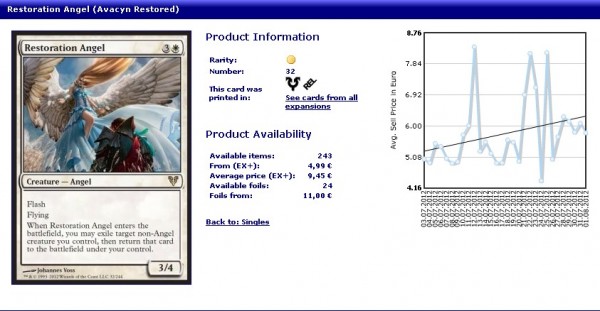
 

Pondering Trading Post Iin Standard

Are you a Quiet Speculation member?

If not, now is a perfect time to join up! Our powerful tools, breaking-news analysis, and exclusive Discord channel will make sure you stay up to date and ahead of the curve.

I haven’t been brewing nearly as much as I used to, and when I first saw Brad Nelson’s monoblack trading post deck I barely skimmed the list. I wrote it off almost entirely because it was monoblack, as my brain currently filters monoblack to “bad”.

Since then, Brad has continued to write about the card ad nauseum, but for the most part his lists haven’t been very exciting.

A couple days after Brad posted his initial list, my friend Jens Erickson sent me this spicy meatball:

First Post

spells

2 Wurmcoil Engine
3 Solemn Simulacrum
1 Phyrexian Metamorph
1 Batterskull
2 Tumble Magnet
3 Trading Post
4 Pristine Talisman
1 Mortarpod
1 Ratchet Bomb
1 Karn Liberated
1 Spine of Ish Sah
4 Bonfire of the Damned
3 Terminus
2 Mycosynth Wellspring
4 Ichor Wellspring
2 Entreat the Angels
2 Oblivion Ring

lands

2 Buried Ruin
4 Mountain
9 Plains
4 Phyrexias Core
4 Clifftop Retreat

Now this, this got my wheels turning.

The basic Trading Post engine is more or less this:

This list plays a few more artifacts, but these are the ones that I consider the most important when moving forward with Trading Post brews. These cards make up your life gain package, your card advantage engine and your win condition.

While this deck struggles somewhat in the early game, the life gain of Pristine Talisman, Trading Post and Wurmcoil Engine makes stabilizing rather easy provided you survived long enough to cast them. I’m also pretty sure that Spine of Ish Sah + Trading Post is about as powerful as endgames come.

Jens took roughly this list to the most recent PTQ in Madison and ended up losing his win-and-in to go 5-2 on the day. As suspected, his list had some trouble against Delver decks.

The major problem with this list is that it’s not really two colors. It’s a monowhite deck that splashes Bonfire of the Damned. This is awkward for a few reasons. The first reason being that the deck can’t reasonably support lower-end red cards like Pillar of Flame and Whipflare - aka red cards that are good in the Delver matchup. The other awkward element is that the deck is splashing for what is far and away its strongest card.

I discussed this at length with Jens and we decided that a “Big Red” deck was probably just more powerful and consistent than his initial list. I spent some time brewing and came up with the following:

Repost

spells

3 Trading Post
4 Ichor Wellspring
4 Pristine Talisman
4 Bonfire of the Damned
4 Sphere of the Suns
2 Wurmcoil Engine
2 Phyrexian Metamorph
1 Batterskull
3 Whipflare
1 Slagstorm
4 Solemn Simulacrum
2 Pillar of Flame
2 Dismember
1 Spine of Ish Sah

lands

4 Phyrexias Core
16 Mountain
3 Buried Ruin

In addition to having access to more, cheaper removal, the other major change that I made in constructing this list was adding Sphere of the Suns. This is largely a nod to Dungrove Elder. From my experience playing UR Bonfire Control, I’ve played a lot of games where Dungrove Elder was just a turn ahead of my Bonfires, and having more mana acceleration helps to combat this problem.

The other cool thing that Sphere of the Suns does is enable a “2-4-6” curve into Wurmcoil Engine, or just an early active Trading Post. Not to mention that “cycling” dead Spheres is pretty sweet.

I like this list quite a bit. It’s pretty consistent and powerful. As a matter of fact, if counterspells were a non-factor I would have stopped brewing here...

But that’s not the world that we live in.

When I say that counterspells are a factor, I mean two things. There’s the obvious point that this deck is drawing to a few very specific spells, which makes it somewhat weak to counters. The other manner in which I mean that counterspells are a factor is that this deck doesn’t get to play any, and that means that it doesn’t have any manner of catch-all for opponents that decide to go over the top.

You basically just have to pray that the things that you’re doing are better than the things that your opponent is doing. You also really don’t want to play any manner of Trading Post mirrors, as whoever draws the first Post will probably just win.

Unless, of course, they’re monoblack, in which case you probably just win as you have four copies of “dome you for a million”.

Anyway, this line of thought led me to exploring monoblue Post. My starting point for this was to look at Brad Nelson’s Grand Architect deck from GP Minneapolis. I really liked the idea of having both the Trading Post engine and the Snapcaster Mage engine in the same deck.

Upon trying to build Architect Post, I concluded that playing Architect just made you too weak to Vapor Snag, Dismember and sometimes Bonfire. This felt like an awkward place to be. I quickly cut every copy of Grand Architect and ended up with a monoblue list playing four Pristine Talisman. The card played exceptionally well in the other lists and monoblue shouldn’t be any different in this regard.

Even without Architects, Vapor Snag was still good against Wurmcoil Engine. Additionally, with Delver of Secrets and Rancor being problem cards for the format at large, I made some room for Mental Misstep in my deck. It also happens to do work against Zombies and Elves, which seem to be picking up popularity. Mise.

My current monoblue list looks something like this:

Counter Repost

spells

3 Phantasmal Image
4 Mana Leak
4 Ponder
4 Vapor Snag
4 Ichor Wellspring
2 Trading Post
1 Spine of Ish Sah
2 Wurmcoil Engine
4 Snapcaster Mage
4 Pristine Talisman
1 Phyrexian Metamorph
3 Mental Misstep
2 Dismember

lands

2 Buried Ruin
4 Phyrexias Core
16 Island

The Trading Post engine remained more or less intact, with the most noticeable cut being Sad Robot. I like Solemn Simulacrum quite a bit, but I needed to make room for the Snapcaster Mage package. This deck doesn’t really have any problems generating insane value in the late game, and I’m of the opinion that the number of spells that cost more than three should be kept to a minimum.

When people see me playing this deck, the most common question asked is “How do you win?” And the best answer that I can give is “Eventually.”

The deck plays out in a pretty straightforward manner. You spend the early turns countering/bouncing/copying opposing threats while digging for a Wurmcoil Engine. Once you get one to stick the game becomes very difficult to lose. I have had many opponent’s copy my Wurms only to realize that they’re much more relevant to the guy with the Trading Posts and Buried Ruins.

While Trading Post mirrors have been awkward for previous incarnations of the deck, the monoblue Post list has the huge advantage of being able to counter opposing Posts, the value of which cannot be overstated.

At this point in time I’ve used this deck to take down a couple FNMs and a Game Day, but these achievements aren’t terribly notable. I’ll be taking this deck to the SCG Open this Saturday in Kansas City, and I don’t hate my odds.

Next week I’ll be sure to fill you in on how that event goes (went?) in addition to discussing various matchups. Of course, the best way to learn is just to try it out for yourself.

Good luck, high five.

-Ryan Overturf

Insider: Standard Updates for M13

Are you a Quiet Speculation member?

If not, now is a perfect time to join up! Our powerful tools, breaking-news analysis, and exclusive Discord channel will make sure you stay up to date and ahead of the curve.

This past weekend I failed miserably at a Southern California PTQ. This did, however, give me a chance to wander around the room and look at people's decks. There were tons of the usual suspects including G/R Aggro, Naya Pod, Mono-G, Ramp and Delver, but a bunch of the fringe strategies showed up, and G/U Infect showed up in force. Ultimately U/W Midrange took down the event over a buddy of mine, John Kassari (www.twitch.tv/ehhhhhhh) playing RUG Ramp. This particular event hand a handful of vendors, and as usual, the top tier Mythics skyrocketed at the event site.

Bonfire of the Damned

At the event site, Bonfire of the Damned was selling at $40+ and dealers were buying them at $25 when doors opened but as high as $32 minutes before the Event started. I still feel this card settles down in the $20-25 range, but me and some friends had a discussion, and they didn't agree with me. I'm fairly confident in my estimate, but they presented a good argument that I wanted to pass on. "What percent of decks are playing Bonfire?" (About Half) "And how many copies do they play?" (Four.) "So, the card is a 4-of in 50% of the format. $30-40 isn't absurd."

I think this line of thought is fine, and I understand it. The issue I have with this is that even though limited season is over for Bonfire, it's price could reach a breaking point where Dealers simply break open product to find more of them. Whenever a price gets this high, it affects the overall value of a box. The more and more that dealers crack, the more that hit the market, and we'll see it decline back to Earth. Further, we have no idea if it will continue to see the quantity of play that it does now. Over the last 24 hours, EBay listings have been closing right at $35 range, and in a fairly decent volume. Some say that if it begins to see play in Legacy it could hit as high as $50.

Sean, my local dealer who you may know from the forums is my resident Legacy expert. He claims that this is exactly the card Control decks in Legacy would love, but there just isn't a true control deck that can use it yet. These arguments are not unfair. In my experience, cards like this dominate a format, and people have to adjust their deckbuilding so that they aren't stone-cold-dead to a miraculous Bonfire. Until a true control deck arrives in Standard, we don't really have decks that are able to side-step the burn spell. I'm still on the side of the fence that says it has to come back down to the $20-25 range, but be aware there are those that disagree with me.

Trading Post

This was my "sleeper" for M13, and so far, it's looking like a good pick. What started out in the $1 rare bin, is now up to $2.50 on retail sites, and it may have room to creep up a bit more. I got my set cheaply, as I was excited to play with the card, and traded for a few more while it was still around $1. The Mono-Black list has been running it, executing a Mindslaver lock as a possible win.

At the PTQ I saw a 4-color post deck, as well as U/B. Trading Post is a tricky card, because unlike other format staples, the card itself doesn't dictate what the deck surrounding it must look like, and it will take some time for people to find the right build. Especially when the format has so many powerful decks, the best innovators may not be looking at new decks until the format rotates.

I'm still advocating picking up Trading Posts, but mostly in trades, not at retail. Buy lists have this card around a quarter, which is about 10% of retail, so this is one that I'd be using the buy list pricing if you're trading with people that like to look stuff up. Of course, we also want to keep our eye on spoilers too. If Selesnya really has a token theme, maybe these Goat tokens will have more uses than chumping.

Talrand, Sky Summoner

As a cornerstone of the newest iteration of Delver, this Legend has crept up to the $5 range on EBay as of this writing. This price is fair for him, but a bit higher than I'd expect him to settle. At $5, we don't have much room for him to pick up any more steam. It's possible he makes an appearance in Modern, which would totally change my valuation, but barring that, he's at about his ceiling.

His playability is fairly narrow to certain decks and his Legendary status, but I will mention I've seen some pretty sweet EDH decks featuring him as a General. I'd be targeting foils of this card as heavily as possible, especially after rotation when we may see him dive back down a bit with the rotation of Ponder and Mana Leak. If you need copies of him for Standard, I don't think you stand to lose much by buying in now, but if you can wait, I would.

Liliana of the Dark Realms

Has everyone forgotten about her yet? She's fallen to as low as $18 on some retail sites, like Card Kingdom, but I wonder how low this could go before it's a good buy. She's got powerful effects, but is only playable in certain strategies. I fear she has a taste of the Tezzeret, Agent of Bolas syndrome, which I did lose some money on last year. This has me a bit hesitant to even consider her, but even Tezzeret had moments in the spotlight where his value shot up.

How low does she need to go before it's worth taking a risk on her? I'm confident enough that Shocklands are coming back, that I'm guessing she'll have utility in more than just Mono-Black Control, but even then, is $18 too high? If this comes to $13-15 I'm picking up at least one set, and going to ride it out.

Now that the format is developing with M13 in it's wake, what cards have new valuations or potential going forward? Is there any cards that are going to find their way into older formats like Legacy or Modern? I'm hopeful for Trading Post to be my big winner of this set, and I want to find a new speculation target from M13 while drafts are still running rampant at my LGS. The last tip I want to mention is Blood Artist. It's selling rapidly at $5/set on EBay, and my local dealer has bumped his up to $6/set. If you're moving these online, you may want to do the same.

Jason’s Archives: Cubes Made of Liquid, Trees Wielding Swords & Other Boggling Riddles

Are you a Quiet Speculation member?

If not, now is a perfect time to join up! Our powerful tools, breaking-news analysis, and exclusive Discord channel will make sure you stay up to date and ahead of the curve.

Greetings, Speculators!

We all play this game to have fun. Winning usually is, but the same can't always be said for the work put in to get there. Grinding the 90th consecutive Delver versus Pod match to optimize sideboards can get miserable and start to feel like a job. Certain aspects of Magic are quite the opposite of fun.

But all is not lost when the specter of drudgery rears its head. Over the years playgroups have invented their own variants or sidegames to keep the game interesting and the barrels of guns out of their mouths.

You may recognize some or all of these. Formats like 2-Headed Giant and Commander (I don't want to get sued by Duncan McLeod; he's not particularly litigious but he lets his [card Tatsumasa, the Dragons Fang]Tatsumasa[/card] do the talking) were so universally embraced by the community that Wizards decided to adopt them as sanctioned formats (read "found a way to monetize them").

The most meta example ever: my long-time partner in crime and 2HG, "The Godslayer" (née Aaron Sulla), and I were paired against other friends at a 2HG tournament, so we decided to intentionally draw and kill the next hour with 2HG Type 4 instead.

In addition to being a ton of fun, these formats sometimes lead to the discovery of new tech.

Once, bored at a tournament and lacking anything besides a box of bad rares, I suggested to my buddy Travis Cullum that we build a Type 4 pile and derp around to kill some time. Two of the three games we played, he managed to use Sovereigns of Lost Alara to grab Celestial Mantle and cave my dome piece in (our all-rare pile lacked the removal most often printed at uncommon or common). "This card HAS to be good!" Travis kept saying, referring to Sovereigns. "What," I said "you want to fetch up Celestial Mantle in Standard? Yea, good play, chief."

A little later they printed Eldrazi Conscription and Travis finally had what he needed to make Sovereigns a card. You know how the rest of that season went. Travis didn't have to play Celestial Mantle, Zvi's Mythic deck didn't have to run Rampaging Baloths and there was finally a credible alternative to Jund. The combo between Sovereigns and Conscription was so good that I jammed three Sovereigns and two Conscriptions in my Naya deck. It was like the Spanish Inquisition.

The New Arrival

The point is, boredom has contributed both to good tech and the creation of new formats that help players blow off steam when Magic has starting to feel like a grind. Recently a new development, promising the most potential for a good time since the arrival of EDH, has materialized.

I'm referring, of course, to The Booze Cube. The Booze Cube is designed to turn any gathering of Magic players into a date with a stomach pump. While I don't condone underage drinking, binge drinking, public intoxication, drunken driving, worm eating or listening to Party Rock Anthem, responsible adults can use a Booze Cube to spice up their night of cube drafting.

The Booze Cube Needs Your Help

The Booze Cube recently contacted some Magic podcasts about submitting cards for potential future expansions. One of the participants was Brainstorm Brewery. While it's too late to get cards submitted to Brainstorm Brewery in time for our contest, if you have a great idea submit it to The Booze Cube directly.

Even if they decide it's not for them, the booze cube is meant to be printed and drafted at home (I would double sleeve; drinks WILL be spilled) so making your own cards is half the fun. If you're inclined, you can check out the Brewery Crew's contributions at this link.

Jason's Anal-Retentive Bum Cover

The Booze Cube isn't for everyone. The website has some no-no words. It advocates drinking alcohol. Some of the puns are of a sexual nature. First, let me stress that I did not invent The Booze Cube. I am sharing it with my audience because I think most of you are grownups and you can handle hearing about something fun. However, if you

  1. Are under 21.
  2. Don't approve of profane language.
  3. Don't approve of "adult" humor.
  4. Are otherwise a curmudgeon.

then The Booze Cube may not be for you, and if you click on the link and it ruins your day, I warned you.

If you're a grownup and you think The Booze Cube looks like fun, you're right. I would advocate pacing yourself; many of the cards are designed to give you drinks in lieu of damage and I can see games going VERY long. Anything that says "chug a beer" or "drink a shot" strikes me as something to avoid, but I know my limits.

Print it out. Invent your own cards. Get some cheap, filthy beer (you won't taste it after turn six anyway), some good friends and make a night out of it.

Magic is supposed to be fun and The Booze Cube is a good way to guarantee the good times. If you have a Booze Cube party, send me some pictures at altjason17@gmail.com and I will share your drunken revelry with the rest of my reading audience.

Back in the World of Sober Magic

Competitive players in the community congregated in our nation's capitol this weekend to sling some cardboard and prove things actually can get done in DC. Let's see how it played out.

Top 32 Standard Decks

Wolf Run's Lesser-Known 'Blue Phase'

Last week I got a kick out of the concept of adding blue to the traditional Wolf Run build, and it looks like that concept paid big dividends for Reid Duke.

Temporal Mastery is a clunky-looking card in an aggro-ramp deck, but it serves a valuable purpose. Ramp often taps out to cast an enormous spell, hoping their hard work isn't undone by a board sweeper. With Ponder to set it up and the mana-producing juice to hardcast it, Temporal Mastery lets a ramp player take that next turn right away and hit them when their defenses are down. Two swings with any beater and an active [card Kessig Wolf Run]Wolf Run[/card] are usually enough to put any game away.

The deck also gets mileage out of a terrific interaction between two cards that haven't been tried in concert that often: Primeval Titan and Phantasmal Image. Although imaging a titan is nothing new, ramp in particular stands to benefit from a double rampant growth for any two lands at the mere cost of a Farseek.

A man after my own heart, Duke also included a block favorite that I expect to pop up more as we approach rotation -- Blasphemous Act. Act, or BA as I like to call it because I grew up watching the A-Team, deals with pesky swarms of opposing spirits, larger-than life praetors, hexproof ghosts and trolls. It even deals with opponents at thirteen life or less if you're monkey enough to jimmy jam a Stuffy Doll or two into your 75 (I am!). It's a one-of in Duke's list, but sometimes the best part of [card Bonfire of the Damned]Bonfire[/card] is wiping the board, and ramp has the mana to cast this no matter how few creatures you need to kill.

Should you be going after super cheap copies of Temporal Mastery? It's not my place to say, but I will mention that I have been squirreling away a few playsets. EDH guys will never reject Time Walk effects and with a Mastery deck taking down an SCG event, there is potential. If Temporal Mastery starts to see more play, you may see yourself vindicated.

Angry Trees (with Swords)

After the delicious tequilla shot that was Reid Duke's winning list, came the cold, sobering bite of lime wedge. Four Delver decks in the Top 8. One-ofs of Frites, Naya Pod and Dungrove Beats rounded out the Top 8 nicely, seeming to mitigate the multiple copies of Delver piles with the reassurance that perhaps the format is healthy after all.

Seven Delver decks in the Top 8 seems unhealthy. Four is doable, especially given my suspicion that the percentage composition of the Top 8 pretty closely mirrored the percentage of the field represented by each deck. I bet there were way more than four times as many copies of U/W Delver as there were copies of Dungrove Aggro, so in that sense, Dungrove outperformed Delver.

And how could it not? The biggest complaint about Dungrove Elder before was his idiotic inability to deal with chump blockers. This necessitated the clunky inclusion of Bellowing Tanglewurm to help him muster the courage to face a couple of the g-g-g-g-ghosts that control was only too happy to present. Dungrove Elder was obviously a beast when wrapping his little tree branch mitts around a Sword of War and Peace (mostly war, let's be honest) or bellowing his way past chumps, but when his advance was stymied by a cluttered battlefield he fell short.

Now Elder has a new friend and the game has changed. Rancor is the new weapon in the fight against flying [card Wild Nacatl]nacatl[/card] and the key to Dungrove Elder's recent resurgence in popularity. Trampling and hexproof, a rancorous Dungrove Elder is nearly impossible to deal with barring a bigger blocker or a wrath effect.

Top 8 finisher Joseph Smith (I won't make the joke, I'm sure he's sick of hearing it) tried to minimize the number of times he'd need to attack with Elder by including several copies of what Corbin affectionately calls "kick the castle": everyone's favorite Might of Oaks substitute, Revenge of the Hunted. Predator Ooze, another card I've been picking up for quarters and squirreling away for a day like today when he is front and center in a beats-heavy green list, makes an appearance and is quite good wearing a Rancor.

The Frites list is pretty stock-standard, but Michael Wayne still deserves a high five, if only because he chose not to play Delver.

Congrats to the entire Top 8!

Top 32 Legacy Decks

Travis Gibson, who the Star City coverage referred to as William Gibson at one point (any Neuromancer fans here?) decided that Delver was too good for one format and jammed him in Legacy to great effect. Gibson's list bears mention because he went back to nine months ago and dragged along a popular card that has recently fallen by the wayside a bit: Grim Lavamancer.

Grims is the man in so many situations it's hard to fathom his ever having fallen out of favor. What's the toughness on a flipped [card Delver of Secrets]Delver[/card]? If you answered "the exact number as the amount of damage dealt by a Grim Lavamancer" you're starting to see why being prepared for the RUG Delver mirror pays. And well, in the form of giant novelty checks and trophies. To beat the mirror Gibson also had four copies of Submerge riding the pine in the sideboard. Someone read this metagame like a book. Congrats Will..., er, Travis!

Being prepared for Maverick can't hurt as the deck put an impressive nine copies in the Top 32, including 2nd and 3rd place piloted by Chas Hinkle and Orrin Beasley respectively.

Perhaps the most noteworthy aspect of the Top 32 was a higher frequency of burn decks (one) than Sneak and Show decks (zero). After the community clamored for a ban of some of the Sneak and Show components a few months ago, it turns out the best answer to the deck is to "play a better one." With Show and Tell pushing $60, clearly lots of players are sleeving this deck up. But where are they when prizes are announced? Perhaps this deck isn't the boogeyman we thought.

Platinum Qualifier Top 8

Also worth a quick mention was the Platinum Qualifier at Phoenix games over the weekend. The Top 8 was pretty unremarkable with one major exception. Joseph Neuman recognized the awesome power of the Black Market deck and since he Top 8'd with it, it seems worthy of some analysis.

Abusing the absurd interactions between Trading Post and artifact creatures, this monoblack control deck revels in the long game. Between a wall of removal and reusable sources of lifegain, this deck seems pretty miserable to play against when it gets a good draw. Trading Post is a card that merits building around and this is just one example of the success some players have found with it. Great job, Joseph!

That's What I Got for You

Remember to send me some booze cube party snaps. I'll be back next week with a collection of homemade Magic cards representing some of science fiction and fantasy's favorite characters. You won't want to miss that, so meet me right back here in a week. Same Alt time, same Alt channel.

Jason Alt
@JasonEAlt on Twitter
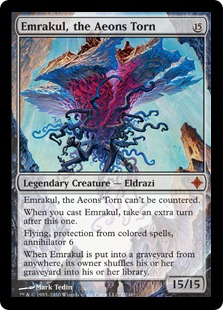
Want Prices?

Browse thousands of prices with the first and most comprehensive MTG Finance tool around.


Trader Tools lists both buylist and retail prices for every MTG card, going back a decade.


Quiet Speculation