menu

Insider: Modern: Green and White

Are you a Quiet Speculation member?

If not, now is a perfect time to join up! Our powerful tools, breaking-news analysis, and exclusive Discord channel will make sure you stay up to date and ahead of the curve.

Today, we're covering two of the remaining colors for cards to be watching for in the modern format. We've covered Blue, Black and Artifacts, and today we're continuing on with Green and White, with Red and multi-colored to wrap up next week.

First though, I wanted to address some things that have been spoken about on various sites, and about discussions I've been a part of. The community as a whole seems to be split as to the idea of Modern becoming a format in paper as well as MTGO. I'm still on the side of the camp firmly believing that we will see paper support for Modern coming along rather soon, and here's my two biggest reasons why:

- Extended in its current incarnation is lacking. The card pool doesn't have a ton of room for exploration, and seeing past results, it's going to be constricted down to being the same decks we saw just recently, except more caw-blade.

- Wizards realizes that it needs something between standard and legacy, and extended isn't cutting it. With the reserve list in place, it's very difficult to allow people to get over the price barrier that's currently in place to be able to play.

Alright, enough of that, let's see some cards.

Green

Viridian Zealot

High: $1.28 @ Hobby Goblins

Low: $0.82 @ Cape Fear Games

Trade: $0.50

Zealot saw a fair amount of play when it was legal in standard and in extended, and I see no reason for that to change. Being an Elf is a bonus as well, though the heavy requirement for green means it's rough to splash. Still a card I would be watching for in trade folders, and most people value him as junk at this point.

All Suns' Dawn

High: $ 0.43 @ Comic Asylum

Low: $0.25 @ Alter Reality Games

Trade: $0.10-0.25

This card is gas for multi colored combo decks. It may never see it's full potential, but the possibility still remains, and because of that, I have bought a few, just to hold onto and see where they go.

Rude Awakening

High: $0.50 @ TJ Collectables

Low: $0.23 @ Gaming Etc

Trade: $0.10-0.20

Though decks rarely played more than one or two of them, it was still a nice side finisher. I don't believe it's worth having any more than two of these on hand though, since the market for them is rather small. If they see use, it should be fringe enough at first to still have reaction time to buy more if necessary.

Heartbeat of Spring

High: $0.79 @ HotsauceGames

Low: $0.68 @ Magic Inferno

Trade: $0.50

A card I mentioned last week for Maga, Heartbeat combo was one of the better decks in that standard environment, and has the possibility to fuel another combo deck in Modern. I have a set that I'm holding, just in the event that someone needs them, but I won't invest in them more than a set at a time right now.

Iwamori of the Open Fist

High: $0.38 @ Crossroad Games

Low: $0.28 @ Top Deck Hobbies

Trade: $0.10-0.20

A 5/5 trampler for 2GG is pretty decent, and made even better when very few legends are being played, thus his drawback is rarely an issue. This could top out the curve on a green beatdown style deck, and at 0.28 each, I've picked up three to have on hand.

Chord of Calling

High: $1.49 @ MTGEmporium

Low: $1.29 @ Premier Magic

Trade: $1.00

Chord of Calling has had a roller coaster of a price life. It lost almost all of it's previous value with the massive extended cut, and now sits at a decent price to load up on a few. I expect these to see some play, even if it's just as a 2-of in an elf deck. That alone should be enough to put this card back into the profitable range, if not by much.

Vinelasher Kudzu

High: $0.74 @ TheManaCrypt

Low: $0.48 @ Manawerx

Trade: $0.25-0.50

Vinelasher saw play as long as it was legal, and I don't expect now to be any different. At 1G it's easy enough to splash with a big enough effect to find a home in almost any strategy.

Magus of the Candelabra

High: $0.25 @ Untapped Games

Low: $0.22 @ Manawerx

Trade: $0.15-0.25

Another possible piece to the combo deck puzzle, this one has already had a few mentions alongside the Locus lands and Vesuva. I had a few already, but paying $1 for a set isn't exactly going to hurt if it does nothing.

White:

Auriok Champion

High: $3.48 @ Crossroad Games

Low: $2.55 @ BattleZone Games

Trade: $2.00

With a price already over $1, it's very difficult to feel that this has a decent possibility of yielding profits later on, but something about this card just speaks out to me. I would get them when you see them in folders, but don't overpay.

Hokori, Dust Drinker

High: $0.45 @ The MTG Place

Low: $0.34 @ Gaming Etc

Trade: $0.25

I enjoy lockout strategies, and I enjoyed playing this card in standard when it was in. Depending on the decks that are seeing play, it's very possible to see this be picked up as a counter to many combo strategies.

Promise of Bunrei

High: $0.69 @ Manawerx

Low: $0.25 @ Gaming Etc

Trade: $0.15-0.25

Promise was used both in B/W Husk and in the traditional WW deck of the day. It's still a powerful enchantment and shouldn't be ignored, since it's interaction in a B/W Tokens deck could be monstrous.

Proclamation of Rebirth

High: $0.77 @ White Lion Games

Low: $0.67 @ TJ Collectibles

Trade: $0.50

I feel the format is probably too fast for martyr-proc style decks to flourish, and a variant of soul sisters would most likely take it's place in that case, but it's worth remembering that this card exists.

Angel's Grace

High: $2.37

Low: $1.44

Trade: $1.50

Already a card that's getting some attention because of the Hive Mind deck in legacy, if the format is combo, this card could continue to gain in demand.

A good number of the cards I've listed, I've also bought a set of if I didn't have one, or specified otherwise. To date I've spent just under $25, and feel comfortable with the prospect of the format taking shape, and making double what I've spent back. In the event that the format doesn't come together in the paper sense, I won't have lost more than I can make up in a FNM's worth of trading. I'm willing to wager one evening of trading on speculation for the chance to make a much larger sum.

Thanks for reading, see you all next week!

Stephen Moss

Reap What You …Lace?

Are you a Quiet Speculation member?

If not, now is a perfect time to join up! Our powerful tools, breaking-news analysis, and exclusive Discord channel will make sure you stay up to date and ahead of the curve.

My name is Carlos, and I have a problem:

I have an obsession with bad combo decks.

Whether it's going infinite with Petals of Insight and Psychic Puppetry, or Second Sunrise and [card Floating-Dream Zubera]Zuberas[/card], I've always had a fascination with the way bad cards come together to do something broken. I can always get myself to put down the bad decks for awhile. Yet, after a week or so, I start hearing the siren call and have to get to work on a new one. This time, the combo is so bad that I'm absolutely giddy about it.

Now, my problem with bad combo decks in a format like Commander is this: no matter how bad your combo is, it's still really good when you get to play all the best tutors and enablers. That's why when I set out to build a truly Frankenstein-esque masterpiece, I stick to a pretty tight budget.  (At least according to StarCityGames, just to make sure it's fair for everyone else. Obviously.)

Now, this masterpiece started a few weekends ago, at a Grand Prix Trial for Pittsburgh. Some of my friends had dropped and started playing Commander when the epiphany happened: one of the new guys cast Reap, against a mono-black deck. Now, I'm the kind of guy who loves an All Suns' Dawn more than most, but when I saw an instant-speed Praetor's Counsel, I pretty much lost it. I mean, how is that even remotely fair? There has to be some way to break that interaction, right?

Now, there's a glaring issue with building a deck around Reap: what if no one's playing black? Well, that's where the "bad cards" part of this combo deck come in. We're going to make people play black. Unfortunately, Painter's Servant is banned so we'll just have to up the ante. When anyone starts playing with cards like Prismatic Lace and Deathlace, people had better sit up and pay attention.

Reap-Lace

  • Reap (0.39)
  • Prismatic Lace (0.49)
  • Deathlace (0.49)
  • Illusion // Reality (0.25)
  • Quickchange (0.15)
  • Sway of Illusion (0.25)

What's that? You didn't think I was serious?

Many thanks to norbert88 on Twitter for helping me find the gem that is Sway of Illluson. How perfect is that card for this deck? It even cantrips! That said, in case people aren't playing creatures, most of your other options change the color of any permanent.

You could also run cards like Glamerdye and just change the color on Reap to a color that's more relevant, but I feel like that lacks the style of Deathlace-ing people to, well, death.

Now, you may be wondering what exactly the plan is once you've made a few permanents black and cast Reap. Well, next you make a few more permanents black, and then you casting Regrowth on Reap and start doing it all again!

Regrowth

  • Regrowth (1.99)
  • Recollect (0.25)
  • Nostalgic Dreams (0.39)
  • Call to Mind (0.25)
  • Relearn (0.39)

Nostalgic Dreams is easily the worst card here, purely because it removes itself from the game, which isn't very good when your plan is Reap. The rest of these are all absolutely stellar because they're reasonably cheap ways to buyback Reap, as well as any of the other relevant cards in the deck.

Now, the three biggest constraints on combo decks are mana, cards, and velocity. Ignoring mana and velocity for the moment, I'd like to take a second to appreciate that with a Prismatic Lace, Reap[card], and [card]Regrowth, we can generate an infinite supply of other cards, so long as we can make enough mana to continue the cycle, and as long as we combo off before we die. That said, mana and velocity aren't really things that we can ignore, since they are very real constraints.

Let's take care of mana first, shall we?

Rituals

  • High Tide (1.75)
  • Bubbling Muck (0.49)
  • Turnabout (1.75)
  • Early Harvest (0.89)
  • Frantic Search (0.39)
  • Rude Awakening (0.49)
  • Twincast (2.75)

This set of cards accomplishes quite a few things. First, High Tide gives us a mana-production engine that increases proportionally with our ability to get more cards with Reap, since we'll recast High Tide each time we cast Reap. Second, Bubbling Muck puts us into a third color. If they could fit into the budget, cards like Mana Reflection and even heartbeat of Spring would make it much easier to generate the obscene amounts of mana that the deck needs.

Now, it's important to note that black is not going to be nearly as important as blue and green to this deck, but having another exponential ritual like High Tide is pretty important, and the ability to touch black for transmute tutors like Dimir Infiltrator will really add a lot of consistency to the deck.

Finally, cards like Early Harvest are what enables the deck to go off and produce near infinite mana and cards. As long as you can produce enough mana for the initial iteration of Reap/Regrowth shenanigans, you don't have to worry terribly much about mana or cards. Now we just need to be sure that we have enough mana to manage the initial iteration of the Reap loop:

Ramp

  • Explore (.49)
  • Rampant Growth (0.25)
  • Kodama's Reach (0.49)
  • Cultivate (0.99)
  • Search for Tomorrow (0.19)
  • Primal Growth (0.39)
  • Sakura-Tribe Elder (0.99)
  • Deep Reconnaissance (0.25)
  • Far Wanderings (0.19)
  • Krosan Tusker (0.25)

Most of the ramp suite is pretty standard, but I do want to comment a little on some of them. Explore is particularly awesome here as a mid-combo draw engine and ramp spell. Similarly, Search for Tomorrow and Primal Growth are both stellar because, with enough High Tides, they actually produce more mana than they cost! While they're not as efficient as Explosive Vegetation early in the game, they're much better mid-combo.

Similarly, the less expensive ramp spells are also much more convenient than Explosive Vegetation purely because they cost one or two mana less. That makes them much more useful in the earlier iterations of the Reap loop. By the time you can cast Explosive Vegetation in that loop, the extra mana is probably completely irrelevant, and any other color fixing would do just as well.

Now that we have mechanisms for producing nigh-infinite cards and mana, the deck needs to be able to accomplish that in a reasonable number of turns. Easiest and most consistent way to do this is to run a bunch of slow, clunky draw spells and tutors. These help you sculpt your hand and dig for Reap, and help you find a win condition once you've gone infinite.

Tutors and Card Draw

  • Weird Harvest (.89)
  • Mystical Tutor (1.39)
  • Merchant Scroll (3.99)
  • Mystical Teachings (0.25)
  • Dizzy Spell (0.15)
  • Muddle the Mixture (0.75)
  • Dimir Infiltrator (0.19)
  • Dimir House Guard (0.25)
  • Drift of Phantasms (0.25)
  • Dimir Machinations (0.49)
  • Perplex (0.25)
  • Clutch of the Undercity (0.39)
  • Shred Memory (0.25)
  • Deep Analysis (0.99)
  • Ior Ruin Expedition (0.19)
  • Compulsive Research (0.39)
  • Concentrate (0.99)
  • Flow of Ideas (0.25)

Now, there's actually two kinds of tutors here. There are Transmute tutors, and there are the things that find the Transmute tutors. Anyone who played the old Heartbeat of Spring combo deck in Ravnica-Champions Standard will be familiar with this. You can Weird Harvest for Drift of Phantasms and Dimir Infiltrator, transmute those into Early Harvest and Reap, and basically have your combo set up for you. Easy, right?

Similarly, Mystical Teachings and Merchant Scroll can find any instant you need, or Muddle the Mixture and Dizzy Spell to find something else you may need, like Bubbling Muck or Regrowth.

Finally, all of these card draw spells are awesome when you're setting up your combo turn; they fit very nicely into the curve of the deck, and most of them are great mid-combo as well. Ior Ruin Expedition is just the pinnacle of efficiency once you've got your engine going, and nothing says game over quite like the third Flow of Ideas for ten or more cards.

In addition to the suite of tutors, we can also run more mana-efficient cantrips that will give us all kinds of deck manipulation and filtering, layering consistency and speed to the deck. Cards like Preordain and Ponder have repeatedly demonstrated their usefulness in combo decks across formats, so there's no reason they won't work here as well!

Cantrips

  • Ponder (0.99)
  • Serum Visions (0.25)
  • Preordain (0.09)
  • Gitaxian Probe (0.99)
  • Peek (0.15)
  • See Beyond (0.15)
  • Jinx (0.25)
  • Opt (0.19)
  • Impulse (0.89)
  • Flash of Insight (0.49)
  • Shrine of Piercing Vision (0.25)
  • Ideas Unbound (0.39)

All of these are great at helping you dig to hit land drops, or sculpt your hand over the first couple turns. They're also very good at helping you dig for relevant spells mid-combo. Some of the cantrips, like Jinx and Ideas Unbound get much, much better mid-combo, since they provide additional utility along with a cantrip.

These are the kinds of cards that allow you to use your mana efficiently in early iterations of the Reap loop, since you'll only have a few extra mana and won't be able to afford to cast something like Flow of Ideas. They also give you reasons to keep casting Deathlace for more value off of Reap!

Finally, even if we have managed to give the deck enough velocity, mana, and cards, to function in a game of Commander, you still have to be able to end the game. Right now, all we have is a shell that can draw it's deck. Here are the game-ending spells in all their glory:

Win the Game!

  • Gigadrowse (0.25)
  • Blue Sun's Zenith (0.99)
  • Mind's Desire (1.39)
  • Temporal Fissure (0.25)
  • Ebony Charm (0.25)

Alright, so Gigadrowse may not be a win condition, but besides Muddle the Mixture this deck is completely dead against countermagic, which is something we want to avoid. If there are blue decks at the table, you can just sit and ramp, and wait until you can tap down all or most of the open blue sources on the table with Gigadrowse, untap and win.

The rest of these, though, are awesome win conditions, mostly because it's not possible for you to deck yourself with a Blue Sun's Zenith in your deck. For some reason I can't fathom, Mind's Desire is unbanned, so why not Mind's Desire your deck away, Temporal Fissure everyone else's permanents to their hand, and then Ebony Charm everyone infinite times? Oh, did I mention that Ebony Charm is tutorable graveyard hate too?

All we've got to do is add a mana base, and that'll be the whole deck! We need to run just enough forests to cast our first ramp spell on turn three, and mostly Islands for High Tide, and just enough swamps to splash for our tutors and Bubbling Muck.

What's that? I need a Commander too? Oh, right. Well, there are only three choices for this color combination, and all of them are justifiable. Vorosh, the Hunter can put a quick clock on the table and is a fine blocker, and gives you something to do with your mana while you're sculpting your hand. The Mimeoplasm fill a pretty similar role to [card Vorosh, the Hunter]Vorosh[/card], but doubles as graveyard hate, and is probably just the best Voltron general in the format.

Damia, Sage of Stone is what I'm choosing to head this because she's the most synergistic, I think. If your hand gets disrupted, or you cantripped a bunch and whiffed on a Regrowth or Early Harvest, [card Damia, Sage of Stone]Damia[/card] lets you refuel without much trouble, all while being a GREAT blocker. With that taken care of, here's the final 99:

[deckbox did="a120" size="small" width="560"]

Using StarCityGames prices as a baseline, this masterpiece costs $39.23, and it's certainly more than capable of wrecking a table that's unprepared for Deathlace shenanigans. And, really, what table is ever prepared for Deathlace?

Hopefully you enjoyed this foray into one of my guiltiest Magic pleasures: bad combo decks. I'm excited to see any comments about this deck since I'm looking to improve it as much as possible while keeping it under a pretty tight budget. I'm also interested in hearing about your own bad combo decks, or cards you think would be a good basis for a bad combo!

But mostly, I'm hoping that someone can help me come up with a suitably epic and hilarious name for this monstrosity!

Carlos Gutierrez
cag5383@gmail.com
@cag5383 on Twitter

Digging Up Innistrad: Part II

Are you a Quiet Speculation member?

If not, now is a perfect time to join up! Our powerful tools, breaking-news analysis, and exclusive Discord channel will make sure you stay up to date and ahead of the curve.

This week we continue my last article's exploration of how to play out of the graveyard before Innistrad brings too many [card Faerie Macabre]hosers[/card] to bear. We've already covered the hate that people should be packing and the most effective methods of filling the 'yard, so now we finally get to look for some cards to bin!

Grave-Robbing
While there are a lot of options for filling your graveyard, the more difficult task is making use of it afterward. Magic has a couple of mechanics that let you make good use of your 'yard, and a number of strange cards that operate from the grave, but the vast majority of cards will need to be played the old fashioned way despite growing stronger as the death toll swells. Let's take a brief glance at some mechanics that can be used from the grave.

Montages
Odyssey's Flashback mechanic is a great fit for the grave-loving mage. When you bin Chainer's Edict or Fervent Denial, it's the same as drawing a nice piece of disruption. Sure, they're a bit on the expensive side, but beggars can't be choosers. Even better, these cards are okay to draw because they'll still give you the same useful effect.

Archeology
Next up is Shard of Alara's Unearth, or 'Flashback for creatures.' Unfortunately many of the Unearth cards are pretty unexciting, but Extractor Demon, Rotting Rats, and Kederekt Leviathan are all great additions to the team.

Bringing in Boats
You always want a couple of Ravnica's Dredgers in the cemetery because, let's face it, drawing cards is so 2004. Besides, in addition to replacing your draw step and looting activities with something more functional, you get to cast Life from the Loam every turn!

Recuperate
Using the same card over and over again seemed fun, I wonder if we could recover that capability somehow? There aren't many options, but don't controvert me when I say our prospects are far from [card Grim Harvest]grim[/card].

Inking
Our final keyword mechanic is Shadowmoor's Retrace. Giving your lands extra utility is a great way to avoid mana flood, and with enough retrace spells your lands start asking Who? // What? // When?// Where? // Why? pretty quickly. The choice of [card Spitting Image]copying a creature[/card], making [card Worm Harvest]a million tokens[/card], or [card Waves of Aggression]attacking a lot[/card] seems good to me.

Can't Touch This
“But wait,” you cry triumphantly, “what about Unhinged? I Gotcha!” In a word: don't. I know I talked last week about somebody not noticing Vengeful Pharaoh as a positive, but if you run [card Creature Guy]Gotcha cards[/card], the correct play becomes not to speak, and that's just not fun, Goblin Mime be damned.

The Misfits

Magic has a long history of cards that come back after they die, and even though only a fraction of these will rturn if you never played them in the first place, they still make for an extensive list relative to which this is just the tip of the proverbial iceberg.

Scavenging
Cards that themselves work out of the graveyard are likely ideal if we're planning to bin a lot of them, but there are an inordinate number of cards that interact favorably with a full 'yard without necessarily popping out of it. There are options for recursion like Mnemonic Wall or Entomber Exarch, graveyard 'casting' like Zombify or Yawgmoth's Will, counting like Ancestor's Chosen or Lord of Extinction, and even mass reanimation in the vein of Living Death or Twilight's Call. All in all, these cards are best used either to fill a role that you can't find in cards that work out of the 'yard or as knobs with which to adjust a deck's power level. Of course, to take full benefit of these cards, you'd need to run all five colors, and the format offers some compelling reasons against doing so.

Eulogies
Who deserves to lead our shambling army forth from the cemetery? To get the best combination of cards, we'd want a five colored commander. Our best choice is probably Horde of Notions, though Scion of the Ur-Dragon certainly makes some compelling arguments. One of his most eloquent came at his own eulogy:

Though I have met a Sudden Death, I know that I shall not be forgotten, no matter how costly it may become to remember me. I know this because I have been many things to many Dragons. At school I was a [card Dragon Mage]mage[/card]. Working only towards magical perfection, I was a [card Yosei, the Morning Star]bright star[/card] for the [card Dragon Whelp]whelps[/card] to follow. Then, one fateful night, I was bitten by a [card Vampiric Dragon]Vampire[/card]. Since that time, I have been known as a [card Karrthus, Tyrant of Jund]glorious leader[/card] by some, and as a [card Dragon Tyrant]tyrant[/card] by others. My choices were my own, but I must admit that I was indeed part of a conspiracy. Never did I diverge from doing the Patriarch's bidding. Love me or hate me, but know that I had focus. Never was I merely a horde of notions, I always had a plan. Now I'm gone, and you may have to pay two much to make any use of me; nonetheless I beg you to reminisce about my exploits so that they shall never seem [card Mistveil Plains]plain[/card]. I must work towards my kind's [card Pyrrhic Revival]revival[/card], so for now I shall merely wish you luck as you face the [card Crucible of Fire]crucible[/card] that is nothing less than a matter of [card Life // Death]life and death[/card].

Really though, either way you go the decks look fairly similar. You get your choice of the cards we've discussed thus far with a few of the tribe's best thrown into the mix, and Scion would run slightly fewer enablers and more cards to abuse the yard while Horde wouldn't need as many win conditions, but rather more ways to dump Elementals. Still, there are better options for graveyard interaction than either of these two. It boils down to a question of what's worth giving up colors for.

As is most likely obvious, black is the strongest in pretty much every department in which the graveyard is concerned, but the other colors have varying strengths and weaknesses:

  • White has strong recursion with Resurrection effects and Replenishes, but very little to offer in the enabler department
  • Blue can fill your 'yard about as well as black through a combination of mill and looting, but is inept as far as actually making use of those cards goes.
  • Red has some looting (though it's not really on par with blue's), and it does have some recursion via [card Magma Phoenix]Phoenixes[/card] and a few Trash for Treasure effects. It's sort of the most mediocre of both worlds.
  • Green has few really fantastic enablers plus a bunch of Dredgers, and the color has a lot of Regrowths putting it firmly in third as both an enabler and abuser of graveyards.

With that in mind, we'd really like to build a deck with black, green, and either blue or white. Luckily, these combinations offer us some great commanders!

UBG
The Mimeoplasm has a lot of potential power. More than a month ago, I showed you a build that focused on beating face, and a version I've been running with no library searching at all has been doing well consistently. Here we'd be looking to abuse him a lot more. If you can mill a significant portion of your library via Traumatize, everyone's favorite Ooze is going to have a lot to do, but if you [card Shared Trauma]Share Trauma[/card] with the whole table, you'll probably be able to kill someone with Triskelion and a Mortivore, and don't get me started on Lord of Extinction. Moreover, even if you draw one of your 'combo' pieces, you shouldn't have any trouble [card Looter il-Kor]looting[/card] it away.

The other option is our other new on-color commander: Damia, Sage of Stone. With Damia the deck takes on two distinct phases of game play. With the Gorgon online, looting loses it's upside when compared to straight discard, so we'll want to take advantage of Zombie Infestation and friends. But why even bother with the graveyard? It's not like we need more card advantage with Damia out.

Unfortunately she's not going to stay out long, and so building to abuse the graveyard ensures that we're far ahead even after she dies. It doesn't even have to be all or nothing: Damia's ability has an intervening if clause, which means that it won't trigger at all unless you have fewer than seven cards when your upkeep starts, and won't do anything unless you have less than seven cards when it resolves. The upshot here is that you can use Putrid Imp or whatever to get down to six cards at somebody's end step. If [card Damia, Sage of Stone]the Sage of Stone[/card] gets killed, you're down a card, but if she triggers, the ability will resolve independent of her survival and you can safely drop the rest of your hand to get a fresh seven. Both of these commanders are worthy leaders, but let's see what other colors have to offer.

GWB
This color combination's relevant commanders are Teneb, the Harvester and Karador, Ghost Chieftain. While Teneb is better in a vacuum because she hits harder and recurs guys cheaper, she's also much, much softer to removal. With Tenebyou often won't get anything back and her cost will skyrocket, but Karador will almost always cost just three, leaving you plenty of mana to cast a critter from the 'yard before you pass priority and he can be killed.

The main question here is whether or not to drop blue for white, and while the white commanders are good, they're hampered by their limitation to one creature per turn (or occasionally two with Karador if you sacrifice him and recast him). Filling you yard doesn't lead to unstoppable power, just a lot of options. Of course, there is a Legend who allows you to recur as many creatures as you want and much more cheaply than Horde of Notions:

Sedris suffers from a lack of green mana, but is nonetheless an alluring option. He obviates the need for strong recursive elements and make exquisite use of every type of enabler, making even sacrifice seem like a worthy option. On top of that, he's very strong against disruption because not only can he be used right after you cast him, but he pushes you to run a lot of very mana intensive and powerful creatures. You shouldn't have trouble making relevant plays even if your army gets exiled. Finally, despite how restrictive Unearth looks, you can abuse it. Unearth only replaces a zone change with exiling if the creature wasn't already going into exile, so using something like Voyager Staff or Wormfang Drake can turn Unearthing a creature into a Torrent of Souls. Even better, Tawnos's Coffin can bring the creatures back ad infinitum, and cards like Sengir Nosferatu or Shifty Doppelganger make prime Unearthing candidates

The Stragglers
Of course there are more commanders that can support a graveyard strategy: Chainer, Dementia Master, Wort, Boggart Auntie, Dralnu, Lich Lord, Glissa, the Traitor, but these will generally be weaker due either to their lack of coloration or lackluster abilities. That doesn't mean you can't or shouldn't run them. After all, the point is to have a good time, they just might not make the message as clear to your playgroup that they ought to be a little bit more hateful.

Jules Robins
julesdrobins@gmail.com on Google+
@JulesRobins on twitter

Insider: DeGen Con, or The Weekend that Was & A Peculiar Two Drop

Are you a Quiet Speculation member?

If not, now is a perfect time to join up! Our powerful tools, breaking-news analysis, and exclusive Discord channel will make sure you stay up to date and ahead of the curve.

This last weekend I was at Gen Con. The trip was a blast and if you've never been, I seriously suggest you go. Anybody who likes gaming of any sort will enjoy it.

Here’s an exhaustive account of all the drinking we’d done this weekend. Mind you, this isn’t necessarily the norm, which I suppose is why I’m telling it to you.

The Captain and the Crew of Gambling Pirates

Over the weekend I had some pretty insane experiences. I traveled down to Indianapolis in Mark Hinsz’s van with Forrest Ryan, Josh (the thunder god) Rayden, and Julian Booher. The ride was filled with sleeping and jamming games of Ascension on the three iPads in the car.

At one point during the trip Josh Rayden and Mark Hinsz were playing separate games of Ascension while I watched Julian attempt to satisfy his addiction to Starcraft 2 by playing it in a moving vehicle.

We arrived in Indy around 1:30am and went directly to the hotel to meet up with the 6th member of our party, Dan. He was asleep when we arrived, so we decided to make as much noise as possible and not give him any opportunity to sleep through our arrival. We missed him.

The first day started with waking up at 9:30am. I looked at Julian and asked, "Wanna have a drink?" He agreed and that's when the weekend began.

We decided that we would all meet up at 6:30pm to get Fogo de Chao, opting to just do whatever we wanted until then. We got our badges and some mixer and hit the scene.

Forrest and I spent the most of the day drinking while hitting up dealer booths. We ran into Kelly Reid and dug through dealers' 2-3 dollar binders and foil binders. I found some pretty good deals.

I managed to pick up:

4x Angel's Grace @ $2 each
4x Pattern of Rebirth @ $2 each
4x Unmask @ $2 each
2x Tower of the Magistrate @ $1 each
1x Consume the Meek (foil) @ $1
1x miscut Swords to Plowshares @ $10

BROkens

We decided to walk around and check out the non-Magic related booths.

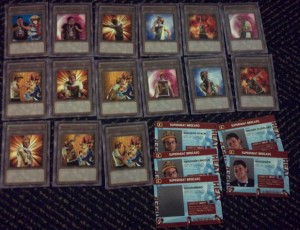
Julian, Forrest and I found a sweet booth where you could get your picture taken and made it into a Yu-gi-oh! token. So, of course, Forrest got in line at least 25 times and got a bunch of ridiculous tokens done.

Here are some of them.

I apologize for the quality but it seems the only picture that was taken of them was taken with a phone.

They also Had "Bro Cards" which had a picture of your face and your name. So we used names such as, ABROham Lincoln, BROver Cleveland, BROseidon, BROseph Stalin, and finally BROhammad (without a picture for obvious reasons).

Pretty much everyone in our crew made some sort of token at this booth. It was a very cool idea. Props to Konami for doing it.

After making more tokens than we could really ever use, we met up with Dan and Josh and looked at all the cool Steam Punk stuff.

Games of Chance

I'm normally not into cosplay, or any kind of dressing up, but I do appreciate looking at creative art and clothing.

The Steam Punk culture is pretty sweet and they have a ton of cool looking gadgets at their booths.

Dan and I were looking at these giant glass containers that had shoulder straps attached. We thought it would be funny to have one of us carry it around and drink from it all weekend. One of the employees was standing near it and he was trying to get us to buy it. He told us it was "only" $55 plus tax.

So, like the logical upstanding gentleman that we are, we decided to game for it.

The two of us put our cards in my hat and Josh volunteered to pull out the winner's card. The person who was last left in the hat was to be the one to buy the "Mead Jar" to give to the other. Josh reached in the hat and handed me my card.

I was the winner.

6:00pm came around and Julian, Forrest and I started making our way to Fogo. We stopped at CVS on the way and bought some (more) alcohol. After purchasing it, we realized that we didn't have a room key. After a little thought, we decided we would just drop the drinks off at the hotel after eating.

We arrived at Fogo and as we walked in the door, carrying plastic bags filled with over 5 liters of booze and 6 liters of soda, we strode by gentlemen in suits on dates with their wives and girlfriends. We laughed at how we looked like debauched children and continued on to our reserved table.

As we feasted on unlimited meat, Dan and I started getting a little itch for some friendly wagers. I told him that I would be willing to flip a quarter for $20 dollar bills. He agreed and we began the adventure.

Forrest was flipping the coin, Dan would call it in the air and we would pay each other immediately. On the first flip Dan called heads. It came up tails.

+$20 to me.

Second flip he called heads again, it again showed tails.

+$20 ($40 net) to me.

Before the third flip he declared that he wanted "double or nothing". I accepted his request.

As Forrest flipped the coin, Dan called heads. It came up tails for a third time.

$80 total for me.

Dan realized he couldn't beat me in a coin flip, so we moved on to rolling dice. Each would roll a six sided die at the same time and the highest roll would get $20. In the event of a tie we would double the stakes and re-roll.

We both rolled and I lost.

Dan was now only down $60 to me (not including the $60 Mead Jar he had purchased earlier).

We rolled again and we tied.

One more roll and he won.

He now was only down $20.

We rolled again and it was a tie.

We doubled the stakes and rolled. A second tie.

With each of us having $80 at stake we rolled one last time.

I rolled a 3. Dan's die spun around and settled on 2.

The whole table cheered and Dan literally threw his money at me.

We all laughed and continued to shove food down our throats. Julian exclaimed that I was "unbeatable" in games of chance.

I decided I would give Dan (another) chance to win a bet. Julian told us we should ask our waitress her favorite letter. If it was a vowel, I would win $20.

He had a 5:1 chance to win $20.

We asked our waitress and she said her favorite letter was "L".

I handed Dan a $20.

Julian then suggested that I should wager another $20 on if her first name started with "L".

Now Dan had a (statistical) 25:1 chance to win another $20. As the server delivered checks, I asked "What’s your name?"

She replied Laurel and Dan slammed the same $20 back on the table.

"Come on Guys. It's Only 300 Ounces."

After Fogo, Forrest, Julian and I went back to our hotel to drink.

We drank and drank and drank until we knew we were probably too drunk to go anywhere. Instead of staying inside our hotel, however, we filled the mead bottle with Captain and Coke, filled a flask with Vanilla Vodka, grabbed a few cans of Crush soda, and walked the 5 blocks to the convention center.

When we arrived we ran into a ton of local Minnesota guys drafting. We decided that heckling the draft was the obvious best plan. As the MN drafters passed the mead bottle around, we laughed and made light of another friendly player’s mother.

We got a phone call from Mark saying our friend Drew had arrived in town. We then met them at the local bar where they had ordered a "tower" of beer.

The "tower" was a 100 ounce container with a spout at the bottom.

They had made it a goal to take it down all on their lonesome. As they drank, I ordered a second tower to split with the crew. Some other MN guys stopped in to hang out and one of them offered to flip coins with me for $20s. I agreed and we started off with 2 wins in my favor.

I bet him the waitress’ favorite number was even and he took it. If she returned and said she didn't have a favorite number, we would give her all the money.

When she returned we asked her. She said it was 4. I took his $20 and gave it directly to her. We continued to gamble on a bunch of nonsense and even played games with 3 of us rolling dice for money.

We ordered our third 100 ounce tower of beer and struggled to take it down. Seeing as most of us had already been drinking most of the day, it was quite the challenge.

All of a sudden we realized Forrest was missing.

Kyle Stoll and I went looking for him and found him in the stall of the bathroom, puking into the toilet. He said he would be right out and ended up strangely walking back to the hotel alone. He says he remembers walking to the hotel but getting into bed was a complete blur.

We attempted to play Legacy Champs in the morning. When you split drinking 100 ounces of beer per hour of sleep you get, you tend to be a little hungover.

At the end of the weekend I added up my total winnings and I was up $240 including the flask, which I sold back to Dan for $30 dollars on the way home.

Keep Watch.

At Gen Con I heard countless stories about people having their deck boxes and backpacks stolen.

The community in MN is great and at local shops you don’t have to watch your stuff as closely as you probably should. At major events, however, we know how important watching our stuff is.

A friend put his deck into his bag and put his bag on the table next to a group of friends cubing. The table we chose was in an unoccupied area and we thought we would notice any suspicious activity.

As we sat there, apparently someone walked up, went into his bag and grabbed his U/W Legacy deck. And then just walked off with it.

The deck included black bordered Tundras, foil Standstills, foil Onslaught Fetches, and a ton of other high dollar cards.

Watching your belongings really is the most important thing you should do at any Magic event.

I hate to say it, but there are thieves among us. People will continue to steal and lie and cheat, but let’s not make their goal (and apparent purpose) any easier.

Oozing With Value

This weekend I played in Legacy Champs while extremely hungover. It wasn't a good idea. After going 2-2, I dropped and decided to instead just Railbird.

I watched several games where players cast a card from a Commander Deck, Scavenging Ooze.

This card really has really proven itself as good.

It shrinks an opponent’s Tarmogoyf, hoses Dredge and other graveyard based decks, and allows you to continue to grow a giant aggressive threat in the aggro mirrors. On top of all of that, it gains you life.

I tweeted to buy this card a few days ago. When I tweeted, you could find them from $9.99 on SCG to $14.99 elsewhere.

I think this card has the potential to grow to a 20 to 30 dollar card.

It really is insane. Buy them now before they become hard to find, as the Commander sets are at least $30 a pop. This is a long term investment as I don't think these will jump up over night, but you never know.

And, to be honest, I can see it outclassing Tarmogoyf. That’s a pretty big statement.

Digging Your Own Grave

The newest premium deck is on the horizon. Graveborn.

I am selling my Entombs , extra Reanimates, and Exhumes. Call it a hunch or the ability to read, but I don't want my Entombs to become the next Chain Lightning. The premium decks murder the prices of the cars they reprint. I understand the concept behind them… but I HATE them for what they do to the secondary market.

The tagline for Graveborn reads:

Legions of corpses await your sinister commands. This 60-card, all-foil deck entombs, exhumes, and reanimates some of the most powerful Magic creatures from all five colors of mana. Harvest your graveyard for an assortment of these face-beaters as you walk over a field of bones to claim your victory.

I would expect the FNM promo Reanimate to take the biggest hit in price, but I can't be completely certain quite yet. As more info comes out I will be sure to keep an eye on this in future articles.

For now, your safest bet is to dump these cards and go buy a Graveborn deck for each one you sell. You’re literally duplicating value there.

What Does Magic Mean to You?

What is a Magic Card to you?

A great gentleman I was talking with at 4:45am on Sunday asked Forrest Ryan and I this question.

I'll be going in depth about what it means to me next week, but for now I want to ask you this:

When you see a Magic: The Gathering card, what do you see?

What emotions do you feel?

I had never asked myself this question before.

I'd like to see what kind of answers everyone comes up with. Leave a comment at the bottom or tweet or email me.

You Read it Where?!?

This weekend I had a few people tell me that other financial writers on other sites were telling them to buy cards that I didn't mention or how this person traded a pack to power or whatever.

I guess all I really have to say to this is that it really doesn’t matter all that much to me.

I read other financial articles and I'm happy to discuss cards. I don't, however, want to trade a pack to power.

There is a reason great writers like Kelly Reid and the like write articles for Quiet Speculation. For one, each writer brings something different to the table—an approach or style to working with the financial aspect of Magic—that other writers do not focus on. I look at the Eternal aspect/format of Magic, focusing on the more secure ebb and flow of an established yet evolving format, while perhaps others anticipate the spikes (for example, that 50 cent raise) of certain cards. Neither of these approaches is wrong and you shouldn’t feel as if I or any other author is competing with the other financial aspects of Magic.

Along with this is the fact that you’re an Insider. The information you gain from these articles would be worth far less if it were freely available to anyone to follow and take advantage of. Yes, someone may trade pack to power on some blog, but that story isn’t necessarily worth trying to emulate. Here you find sound financial advice and I’m happy to work with you.

I stay up to date with prices and trends. I write about cards that I think will make a decent size gain. I rarely write about a card increasing in value less than at least few dollars.

I know there is a ton of money to be made buying cards that increase a mere 50 cents. I try not to jam a ton of that information into these articles, though. Legacy isn’t necessarily the market for that.

If you have a question about a card and if you think you should be buying it, then please feel free to ask. I have absolutely no problem assisting you in making these personal calls.

What I care about helping you make profit.

Not about who traded a foil Slag Storm to a Mox Ruby in 9 months.

Checklist, Checklist!

(silence)

Progenitus - 14.99 on SCG

A staple in Legacy. It allows Green decks to abuse Natural Order. This card is already hard to find and will continue to get harder to find. As Show and Tell decks continue to improve, this guy may see more play if Emrakul continues gets hated out (Karakas anyone?). What more needs to be said about protection from everything?.

Dryad Arbor - $2.99 on SCG

A land that’s also a Green creature that can be fetched?!? And it can pay for and sacrifice itself to Natural Order? Yeah. It's neat. Buy them now in case we never get a good reprint. At this price, it’s worth picking up a few for your collection. A little over a month ago this card was worth less than $.50, and you may be able to still find them near that range at a local shop. Foils are a little higher, they sit at about $15.00. I'm not sure if the foil will go much higher, but it may be worth a small gamble.

Dread Return- $1.99 on SCG

This card is used in Dredge and Breakfast. I like it a lot and it seems there’s a good chance that Innistrad will make this card even better in Legacy. Buy them while they’re cheap. As we continue to get new Dread Return targets, Dread Return itself will continue climb in price. As far as fair in Legacy goes, this is far from it. .

Until Next Time…

May your cup always be full. And never drink with the Captain without your crew.

If you’re not having fun, you’re not risking anything.

Please feel free to post question in the comments or email me.

Until next time,


-Mike Hawthorne

Twitter: Gamble4Value

Email: MTG_Mike@live.com

Spawn Trapped | CommanderCast S3E11

Are you a Quiet Speculation member?

If not, now is a perfect time to join up! Our powerful tools, breaking-news analysis, and exclusive Discord channel will make sure you stay up to date and ahead of the curve.

The latest episode of CommanderCast has arrived: listen to this with your ears! Andy is joined by Byron, Donovan, and guest beast Scotty Mac in an episode containing screams of rage, tears of sorrow, and none of the above.

But seriously. In this episode: Commander and monies, Respawn Magic, multiplayer card draw, and the return of the retro cycle review with a super cycle review.

Need more? Hit up CommanderCast.blogspot.com and LET'S GET IT!

The full show notes for the episode can be found here.

Click the button to play, or download the entire episode!

Voltron Force!

Are you a Quiet Speculation member?

If not, now is a perfect time to join up! Our powerful tools, breaking-news analysis, and exclusive Discord channel will make sure you stay up to date and ahead of the curve.

It was late in the game, and you knew you that time was almost up. The game was going to be over if you couldn't put it away soon. It had gone well so far, and you did a good job of controlling the board, and although most of your resources were used up, you knew you still had a chance to take it down. There was one lonely Squadron Hawk holding your final position. This was it: if you did not draw something, this turn would be your last. Was there anything you could draw to get out of this situation? A removal spell would buy you a little time but you really needed to just finish the game. You did have a Sword of Feast and Famine in your hand that you could never play safely with out risking getting blown out by Spell Pierce.

Draw.

Puresteel Paladin!

What luck! That was the best thing you could have drawn. Play Puresteel Paladin, play Sword of Feast and Famine, draw your card, then proceed to obtain your thirteen free mana and win the game. Thirteen free mana what? Well, that's how broken Puresteel Paladin is. Sword of Feast and Famine, Sword of Body and Mind, two Flayer Husks, a Sylvok Lifestaff, and two Mortarpods total thirteen mana for all of their equip costs. You might think that this is a rare occurrence to form Voltron like this but it actually happens quite frequently.

Last week I wrote about the blue white Puresteel Paladin Deck that I named Voltron. I thought the deck was interesting, but I was not planning to play it at the StarCity Games: Pittsburgh 5k. Not being able to find any sleep the night before the event, I found myself still thinking about forming Voltron in a constructed event. Laying there, I just thought about the different matchups for the deck. I was pretty happy with almost every match. The one I was worried about the most was Valakut, but it seemed like that deck was getting hated out by the majority of the other decks. Once I made the decision to play Voltron, I fell asleep quickly, confidant about my choice for the next day.

Since I already had a rough outline, it was not hard to put the deck together in the morning before the event. Luckily the event site was only ten minutes from where I grew up, so I did not have a far drive and knew exactly were I was going. One of the things I thought a lot about when I couldn't sleep was how I was going to be able to answer some specific problem permanents like Sword of Feast and Famine, Tempered Steel, Birthing Pod, and basically any planeswalker. The answer I came up with seemed so obvious that I couldn't believe that no one else had thought of it: Oblivion Ring. Lots of other decks were playing it, so why not Voltron? It was not dead in any match and it solved most of the problems I had with the deck. I had no clue how I was going to fit Oblivion Ring into the deck but I knew I had to find room somewhere. The deck list is so crammed for space that there are not a lot of cards you can change.

Here's the list I registered for the 408 person Standard event on Saturday.

Voltron!

Untitled Deck

Creatures

4 Puresteel Paladin
4 Squadron Hawk
3 Trinket Mage
1 Spellskite

Spells

1 Mox Opal
4 Preordain
4 Dispatch
2 Oblivion Ring

Equipment

1 Basilisk Collar
3 Flayer Husk
4 Mortarpod
1 Sword of Body and Mind
2 Sword of Feast and Famine
2 Sword of War and Peace
1 Sylvok Lifestaff

Lands

3 Celestial Colonnade
4 Glacial Fortress
3 Inkmoth Nexus
4 Seachrome Coast
1 Island
8 Plains

Sideboard

3 Dismember
3 Flashfreeze
1 Oblivion Ring
2 Revoke Existence
2 Timely Reinforcements
1 Kemba, Kha Regent
1 Hex Parasite
1 Gideon Jura
1 Elspeth Tirel

Most of the changes I made were to the sideboard. I was not content with the one I had posted in the article nor the ones other players were running, so after some quick thinking, I changed half the cards. Timely Reinforcements is better than Kor Firewalker. That is my opinion, of course, but after you think it over, it is quite obvious. First of all if you have played against this card, you know how powerful it is. Second, you can bring this card in for multiple matches, whereas Kor Firewalker you cannot (obviously deriving most of its usefulness against Red decks). I am not sure the third Oblivion Ring is necessary. Sometimes it was quite good and others I felt it could easily be something else. If Revoke Existence did not deserve a place then certainly the third Oblivion Ring would be an easy inclusion. Revoke Existence is important in the Tempered Steel match and the fact that it also costs two mana is quite relevant. They basically come in anytime there are hard-to-deal-with permanents that aren't planeswalkers. Hex Parasite is almost a free spot in your deck. If your opponent has planeswalkers, side out one Flayer Husk for the one Hex Parasite. Sometimes it will win you the game and even if they don't have a planeswalker that game, he is still a guy that can hold equipment. The two planeswalkers proved to be quite important and came in for matches that were not quickly won. Their purpose was to have something to sideboard against Vampires. Trust me when I say that Vampires has a hard time with both of those guys. If you know the matchup, then with whichever deck you are playing you should come out victorious. The two planeswalkers swing the match a lot in your favor though.

What about the main deck? I never really liked the one Accorder's Shield or the one Swiftfoot Boots that I replaced it with. Not owning a second Mox Opal made that an easy cut also. I don't actually like the second Mox Opal either in case you were curious. You don't ever want a second one and sometimes you don't even want the first one. The reason not to cut the Mox is because sometimes, it simply wins you the game. A fair bit of the time when you draw it you can trick your opponent by, out of nowhere, obtaining metalcraft with the Mox. The extra mana is sometimes useful, but it's the metalcraft enabling that matters for Dispatch, Puresteel Paladin, and general sneakiness. Just like the Mox, the reason for the Inkmoth Nexus in the deck is often just to help obtain metalcraft. Sure, it is helpful as an actual creature once in a while, but that's usually reserved for blocking. I did not win a game all tournament with poison damage if that tells you anything. The Nexus can tap to activate itself, allowing you to use any of your metalcraftyness.

My actual tournament experience was rather unfortunate as I did not do as well as I would have liked. So, rather than depress you with a story filled with play mistakes and heartbreak, I thought I would share the important things that I learned from the experience. Whenever you switch to a new deck right before a tournament, you must be prepared for less than ideal play. After all, if you have never played it before, how can you be an expert?

Aggro Matches:

The aggressive decks I played against were Vampires, two Tempered Steel decks, and G/W aggro. In any of these matches, and Red Deck Wins as well if you have to play against it, you must become the control deck. It is not a hard role to assume. You have living weapons, Squadron Hawks, and equipment along with solid removal spells. What the aggro players don't realize is how much life you gain with this deck. You have Sword of War and Peace, Sylvok Lifestaff, and the most important card in the deck...

I don't think the secret is out yet but Basilisk Collar is what makes this deck a contender in the metagame. All you have to do is equip your Basilisk Collar to your Mortarpod token and you kill any creature in play. Usually you block one creature to prevent the combat damage and during declare blockers, sacrifice the token to kill the real threat. That trick with Mortarpod saves you so much damage. Trinket Mage and Preordain help you find whatever pieces you you need to assemble your pinging death machine. Once you have a Puresteel Paladin in play, you can make your whole team into death pingers to put the game out of reach for your opponent.

The Tempered Steel match can be particularly tough but hopefully you have a turn two Mortarpod to keep their team small enough that, once they play the Tempered Steel, you don't have to take too much damage. They do not have many ways to kill your Puresteel Paladin so as long as you are not going to get run over your card advantage should take over the game. I won both of my matches against Tempered Steel and, even though it can be quite close sometimes, the match is definitely in your favor.

The green white deck was just terrible for me. I thought we were going to draw the match because of how long game one took, but I managed to turn a difficult game into a win. Game two he blew me out with Creeping Corrosion as a three-for-one. Game three was pretty quick though; when I had a terrible draw, he blew up my equipment, and he had a second Hero of Bladehold that I could not deal with. Overall any deck like this should be an easy win, but it's hard to win any game when you don't have mana.

I included planeswalkers in my sideboard for a reason and that reason was to beat the Vampires deck I played. He did not know the match as well as I did, so I had a clear advantage. The planeswalkers game two really sealed the deal. This match made me feel so much better that I am on the Voltron side rather than the Vampires side. Unless Caw-Blade really does take over the metagame again, I think Vampires time has passed. In my opinion, the other decks in the format are pretty rough for Vampires to deal with.

Combo:

I played against two combo deck during the weekend. One is relevant to everyone and one is not. RUG Twin Pod is relevant to everyone whereas Blue Green Acidic Slime/Clone/Genesis Wave is not. He called the deck Bant Acid Wave. Apparently there were also a couple Venser, the Sojourners as well but I never saw them. This is perhaps the worst possible match I could conceive of and I still almost managed to beat him to stay in contention. Unfortunately, I could not find any flyers or green swords game three and he knocked me out of the tournament. Has anyone else noticed a trend that I play against the most random decks that are present at the tournament? It makes my life interesting but sometimes I wonder how well I would do if I did not have to play against dedicated hate decks like this.

Anyway, onto the relevant match in RUG Twin Pod. My opponent did not have very good hands in this match but it is a tricky one. You do not want to sideboard too many cards but this was one match were I was glad to have the third Oblivion Ring in the sideboard. Even the Flashfreezes should probably stay in the sideboard because they have lots of blue cards you cannot counter. It made me wonder if the Flashfreezes shouldn't be Mana Leaks instead. I still am not sure about that one. Setting up your Mortarpod plus Basilisk Collar is important but this match almost played out similar to one of the aggro decks in how you play against it. Make sure to find an Oblivion Ring if they play their Birthing Pod because once it is active you are most likely out of the game.

Control:

Caw-Blade. This is once again the deck to beat but now it is very beatable. The games will be close and you need to play tight but they are all winnable. As I said last time, don't get blown out by Spell Pierce. In fact, play the game as though if they Spell Pierce something you probably lose the game because, honestly, that is what happens. If you run any of your swords into a Spell Pierce you are going to have a rough time winning. Just wait for a safe time. Be patient. I did not do this and got caught up in drawing a card from Puresteel Paladin. RESOLVING A SWORD IS THE MOST IMPORTANT THING YOU CAN DO IN THIS MATCH. Make sure it resolves and you usually win. You can deal with anything they do so just take your time and resolve the sword. They will do everything they can to stop you from doing this but it is not that hard because they have to play spells or they will die to all your little guys attacking them. I really like Kemba, Kha Regent in this match. The games usually go long so you should be able to play around Mana Leak and then equip him up. Kemba, Kha Regent is a great way to beat Caw-Blade.

The hard part about playing against this deck is the sideboarding. How you sideboard really depends on what version of the deck they are playing. If they are playing Hero of Bladehold, you should probably be bringing in the third Oblivion Ring and maybe some Dismembers. If they are playing a version with less creatures, you should probably be bringing in the planeswalkers. Regardless, you should bring in the Hex Parasite because it can blow them out at no cost to your efficiency.

My best advice especially for the Caw-Blade match it to play some games against it. Testing is always good but really needed in this case.

In the tournament, I played against two Caw-Blade decks and I should have beat both of them but, as I mentioned before, I was not patient in the second match with my Sword of Feast and Famine and that cost me game three.

One final notes for this week. Dispatch is rediculous. It is like Path to Exile in that you rarely can play it during the first three turns of the game, but when you cast it, it feels like cheating. They get no land and don't gain any life. It is almost always active during the game and was so good for the entire tournament.

Until next time, Unleash that Voltron Force!

Mike Lanigan

MtgJedi on Twitter

Jedicouncilman23@gmail.com

p.s. If you have any good stories from this or any other deck, I'd love to hear them in the comments.

Insider: Compiling Champions of Kamigawa

Are you a Quiet Speculation member?

If not, now is a perfect time to join up! Our powerful tools, breaking-news analysis, and exclusive Discord channel will make sure you stay up to date and ahead of the curve.

Champions of Kamigawa drew upon Japanese mythology, with its shrines, kami and crazy dragon spirits. Though it doesn't pack in the ridiculous combo cards like Mirrodin did, it is full of legends, which means that there are a bunch of cards that get their value from Commander. This week, we will look at the first half of the set and how you can get the most money from Champs. Let's look!

Azami, Lady of Scrolls

Azami draws all of her value from being a frustratingly good Commander general. The idea is basically this: lay down a few cheap Wizards, then counter everything you come across. Around turn five, play Azami and then draw four or five more cards to refuel. Continue countering and drawing. Apparently, some people think this is a productive use of their multiplayer time! Azami is one of the best generals and it's for good reason that she's worth a few bucks.

$2.50

Azusa, Lost but Seeking

Azusa, apart from frequently being confused with Azami, is another very good commander. She usually crops up in a deck with about seventy lands and wins with things like recursive Mindslaver, Plow Under, or the like. Eldrazi are also common kills. Azusa is a solid general because you can plan to, on turn three, ramp from three to five lands. Next turn, if nobody can kill her, Azusa ramps you from six to nine lands. All you have to do at that point is figure out what to do with Forests (which is harder than it seems).

$3.25

Boseiju, Who Shelters All

If you're fighting against an Azami deck, this comes in handy. The only time it saw tournament play was in the Vintage Gifts Ungiven deck and Tooth and Nail; both contained spells that simply won the game if they got to resolve. It comes up now and then in Commander, but it's less useful there because people rarely play decks full of counters in that format.

$1.50

Cranial Extraction

Remember that minute when this card was worth $30? People wanted to recur it with Eternal Witness and strip decks apart. It did become relevant when Kamigawa block decks used it to take out opposing Gifts Ungiven. Cranial Extraction has gone down a lot in price because Thought Hemorrhage and Memoricide do the same thing, but are better in some ways. Cranial still gets a little bit of love if you're interested in having twelve of the effect, though.

$1.50

Eight-and-a-half-Tails

Or 17/2 Tails, if you're uninterested in simplifying fractions. He's the ultimate white weenie, protecting your guys from removal and getting them past attackers. He sees a bit of Commander play, since he's a good, evasive general and can also do remarkable support for your whole team. The only real limiter on him is the heavy white mana commitment you need for it.

$2.50

Forbidden Orchard

If you just saw this card in a vacuum, you would rightly think that it was baaaaaad. It is valuable because of the existence of one card: Oath of Druids. My Vintage team quickly figured out that you could string the two cards together and get out the biggest monster around. Back then, it was Akroma and Spirit of the Night, but now we have Hellkite Overlord and Emrakul Lagasse. Forbidden Orchard is only relevant because of Vintage, since Oath is banned in Legacy. This is interesting to note because Vintage rarely has an effect on prices, because it is infrequently played.

$4.50

Ghostly Prison

Ghostly Prison is a white-branded Propaganda. This kind of effect is powerful in Commander because it encourages people to attack other players instead. It doesn't completely lock people out like Moat or Humility will, but it is a subtle power. This kind of effect also shows up occasionally in Legacy because it efficiently shuts off Dredge decks.

$2.50

Gifts Ungiven

Gifts is a storied card. When it first came out, a lot of naysayers thought it was just a poor Intuition. You couldn't get Accumulated Knowledges with it, for instance. On the other hand, Gifts always draws two cards, and there are plenty of recursive spells and similarly-named spells to get the job done. Gifts saw play in Block, Standard and Vintage for its power. In Block and Standard, it could do things like set up permanent Fog combos or get a bunch of Dragons out. It could make Yosei or Glare of Subdual hit and lock down the board.

In Vintage, it was another monster. Gifts Ungiven could pull out Yawgmoth's Will, Black Lotus, Recoup and Mana Crypt. No matter which way it was split, you would be casting Will for two mana or less. It could pull out Tinker and Time Walk, and Gifts fueled itself. A Gifts at the end of the opponent's turn would load up the graveyard, and the following one on your turn would get and cast Will, often putting the game away. The power of Gifts Ungiven got it and Merchant Scroll restricted in Vintage.

Gifts still has a few fans, but it's banned in Commander for being ridiculous, so it has a limited audience.

$2.25

Glimpse of Nature

It took several years to figure out how this card worked. People attempted it with Kobolds, but its real home was in Elves. Specifically, it needed Nettle Sentinel and Heritage Druid to form a cheap and compact mana engine. Glimpse turns every drawn Elf into another card and another mana. Skullclamp wishes it had that kind of efficiency! Glimpse still gets attention, even though it isn't played in many formats, because Elves is a playable deck in Legacy. These spiked after the Nettle Sentinel combo got big and it never dropped since then.

$10.50

Isamaru, Hound of Konda

Isamaru was the first vanilla legend since Legends! It outclasses all the awful Craw Wurm wannabes from Legends, getting more damage in than any of them could have hoped to. Isamaru has a great history of tournament play and still pops up now and then in Legacy Zoo decks. People also like to build up white weenie decks for casual play and this guy is an auto-include. I'm surprised that its value has held up so well!

$3.00

Jugan, the Rising Star

Green gets the worst cards in every cycle and this one was no exception. Jugan is terrible compared to its other Legendary Dragon friends, but it's still a flying green creature. That alone keeps its value up. If that weren't enough, it's also a dragon, so it's a must-have for people who collect that tribe.

$1.25

Keiga, the Tide Star

Keiga is a total no-win card. If you don't kill it, she'll smash you to death. If you do kill it, well... you better not have any guys in play. Keiga was absolutely the best card to tap out for in Block and Standard. She shows up in casual decks, and it also gets that aforementioned dragon price bump. Keiga has also maintained a strangely-high value.

$4.00

Kiki-Jiki, Mirror Breaker

We love making copies of things and this guy does it over and over. Kiki can do fair things, like copy Goblin Matron or Mulldrifter. It can also do game-winning things, like making as many Pestermites as you can count. Kiki is casually very popular, even though it doesn't see any tournament play. Kiki has not been reprinted at any point, but I wouldn't be surprised to see it pop up in something in the future. It's a definite fan fave.

$6.75

Kokusho, the Evening Star

Kokusho was the best Dragon Spirit printed, and it's only under ten bucks because it's banned in Commander. Combine two of them and you get to drain for ten. Combine with Recurring Nightmare and you can get as much life and drain as you want. Kokusho was actually a bad bet over time, since it has dropped from fifteen dollars down to its current price, even after having rotated for several years. The moment that Kokusho gets unbanned, you'll see its price triple overnight. Be one of the people picking it up before it spikes in that situation!

$7.00

Konda's Banner

Konda's Banner is a good card for a lot of Commander decks. If you're playing Wort or Lin Sivvi or anything in between, the banner is going to give your guys +2/+2 if you build the deck properly.

$1.25

Konda, Lord of Eiganjo

Konda gets a lot of love because he's indestructible. I get the sense that people would actually like him less if he was just an 8/8 without bushido, because the ability makes people face tough decisions. Players like forcing an opponent to make that consideration. The fact that he stays back for defense is great on top of that. Seven mana might as well be a million in Commander, but he has a big impact if he ever lands on the board.

$2.00

That's it for now, but come back next week when we look at other Legendary Dragons, fortune-telling Tops and divinity counters!

Until then,

Doug Linn

Vintage Metagame Primer, Part One: Combo

Are you a Quiet Speculation member?

If not, now is a perfect time to join up! Our powerful tools, breaking-news analysis, and exclusive Discord channel will make sure you stay up to date and ahead of the curve.

With convention season in full swing and the Vintage Championships this past weekend*, we're coming up on this year's Vintage season. I, personally, am not going to GenCon, so I won't be in the Vintage Championships - but Dragon*Con in Atlanta is having a 15-proxy Vintage event open to all comers.

*Expect a detailed recap of the event next time in Part Two!

(The full Dragon*Con Magic schedule isn't complete yet, but here is the initial event listing.)

Fifteen proxies may seem like a high number at first, but with the Power using up 9 slots, and a playset of one of the high-dollar cards (Mishra's Workshop, Bazaar of Baghdad, Mana Drain) taking up 4 more, there really aren't that many slots left for proxies of random expensive cards like Moat or Library of Alexandria available - but better 2 than none, and 15 isn't so high of a number that it allows people to play nothing but proxies. I'll be pricing decks using TCGPlayer.com's low price.

With this in mind, approaching the format requires us to first look at the existing archetypes and what their strengths and weaknesses are.

Vintage is known as the land of the turn one kill. This assessment is generally regarded as inaccurate by those who play the format regularly, but it provides us a useful starting point, because the existence of turn one combo does define the things that other decks have to be able to handle. In addition, other combo decks exist, and it's important to discuss their impact on the metagame.

Goblin Charbelcher


While not a good deck, Belcher provides a useful baseline. The most recent complete list I could find from a real event is a top 8 list from a 20-man event in Manila:

Untitled Deck

creatures

4 Simian Spirit Guide
4 Elvish Spirit Guide
3 Goblin Welder
4 Street Wraith

spells

4 Manamorphose
1 Seething Song
3 Autumns Veil
3 Empty the Warrens
4 Rite of Flame
3 Gamble
1 Ancestral Recall
1 Brainstorm
1 Wheel of Fortune
1 Windfall
1 Timetwister
1 Channel
1 Tinker

permanents

4 Goblin Charbelcher

mana artifacts

1 Black Lotus
1 Sol Ring
1 Lions Eye Diamond
1 Mana Vault
1 Mox Jet
1 Mox Ruby
1 Lotus Petal
1 Memory Jar
1 Mox Sapphire
1 Mana Crypt
1 Mox Emerald
1 Mox Pearl
1 Mox Opal
3 Chrome Mox

sideboard

1 Serum Powder
1 Ingot Chewer
1 Goblin Welder
4 Leyline of Anticipation
2 Seething Song
1 Guttural Response
3 Natures Claim
1 Pyroblast
1 Empty the Warrens

This deck stacks up at over $5000, over $1000 of which comes from a single Black Lotus. Once you proxy the Power, Lion's Eye Diamond, and Mana Crypt, the cost of the deck drops to a far more manageable $175, with proxies left over for things like Chrome Mox, Sol Ring, or Wheel of Fortune if you need them to make the deck even cheaper.

This version includes some interesting sideboard technology - the Leyline of Anticipation in the sideboard exists so that when Belcher is on the draw against a deck which threatens Chalice of the Void, Trinisphere, Sphere of Resistance, or even Duress, Belcher can win during the opponent's upkeep.

Storm

Vintage Tendrils bears some similarity to Legacy Tendrils - the most relevant thing being that it is not a turn one kill deck, but a deck which aims to use the first turn or two to set up a kill. Many of them are actually control decks which have a combo kill finish.

The Tropical Storm


This won a 49-man event in Mayo.

Untitled Deck

spells

4 Force of Will
3 Mana Drain
3 Repeal
4 Gush
4 Preordain
2 Thoughtseize
1 Tendrils of Agony
1 Gifts Ungiven
1 Ancestral Recall
1 Mystical Tutor
1 Hurkyls Recall
1 Brainstorm
1 Vampiric Tutor
1 Mindbreak Trap
1 Merchant Scroll
1 Yawgmoths Will
1 Time Walk
1 Demonic Tutor
1 Regrowth
1 Timetwister
1 Tinker

permanents

1 Blightsteel Colossus
1 Fastbond
1 Jace, the Mind Sculptor

mana artifacts

1 Mox Ruby
1 Mox Emerald
1 Mana Crypt
1 Mox Sapphire
1 Black Lotus
1 Mox Jet
1 Sol Ring

land

3 Island
2 Scalding Tarn
3 Misty Rainforest
3 Tropical Island
3 Underground Sea
1 Library of Alexandria

sideboard

2 Nihil Spellbomb
3 Trygon Predator
2 Yixlid Jailer
2 Hurkyls Recall
2 Dismember
2 Natures Claim
2 Mindbreak Trap

(Some versions of this deck don't run Tinker and Blightsteel Colossus.)

The cost of this deck is, again, through the roof. Seven thousand dollars is an absurd amount of money, but proxies make it a great deal more tolerable. Unless you're already a Legacy player, it's still going to be close to $1000 to put together - the dual lands, Jace, and Forces being the primary culprits.

With 7 counterspells and 2 bounce spells as well as the Fastbond+Gush engine, this can serve as a passable card-advantage control deck capable of disrupting other combo decks in the mirror. Unlike the Legacy version of this deck, there isn't a huge stack of Infernal Tutors, Grim Tutors, and Lion's Eye Diamond - getting the combo kill is more straightforward. You can Gifts Ungiven for Yawgmoth's Will, Regrowth, and the 2 cards you actually want; you can Mystical Tutor for a combo kill; use Mystical Tutor (perhaps even via Merchant Scroll) for a Tinker kill or to set up the Gush-Fastbond engine, and you can use Demonic Tutor to set up Yawgmoth's Will for the recursion victory.

The one thing I find odd about this list is the missing Ponder. If I were going to cut a card for it, I'd lean to one of the Repeals or a Mindbreak Trap, depending on my prediction for the metagame. If you need to save a proxy, a Mana Drain would probably be the best thing to cut. The deck may also be able to survive cutting a dual land for a fetch, or turning one into a slightly-cheaper Bayou.

The sideboard of this deck seems a little unfocused and generic. There are other versions with red splashes for Ancient Grudge in the maindeck and Ingot Chewer in the sideboard alongside Leyline of the Void, Red Elemental Blast in addition to some of the cards in this deck.

Ad Nauseam Tendrils


This list placed top 8 in Alcobendas during a 58-man event in April.

Untitled Deck

spells

4 Pact of Negation
2 Chain of Vapor
4 Dark Ritual
4 Ad Nauseam
4 Duress
1 Thoughtseize
1 Hurkyls Recall
3 Cabal Ritual
2 Tendrils of Agony
4 Preordain
1 Brainstorm
1 Ponder
1 Ancestral Recall
1 Demonic Consultation
1 Mystical Tutor
1 Vampiric Tutor
1 Demonic Tutor
1 Yawgmoths Will

permanents

1 Necropotence

mana artifacts

3 Chrome Mox
1 Mana Crypt
1 Mana Vault
1 Sol Ring
1 Lotus Petal
1 Black Lotus
1 Mox Sapphire
1 Mox Jet

land

2 Island
2 Swamp
2 Marsh Flats
3 Polluted Delta
2 Underground Sea
1 Scrubland

sideboard

1 City in a Bottle
1 Plains
4 Serenity
1 Hurkyls Recall
3 Extirpate
1 Rebuild
1 Slaughter Pact
1 Chain of Vapor
1 Tundra
1 Thoughtseize

Rather than taking the control role as The Tropical Storm does, Ad Nauseam Tendrils aims to disrupt the opponent and close out the game with a combo finish quickly. As a result, it plays a lot like the Legacy deck, but with more powerful cards. As for cost, it's a lot cheaper since it doesn't have Force of Will and Mana Drain alongside a base of Power and Duals - this deck actually drops to $650 with a mere 5 proxies (Black Lotus, the two Moxen, Mana Crypt, and Ancestral Recall). The remaining 10 proxies can fuel dual lands, fetchlands, and the like.

The first thing that jumps out here isn't anything in the maindeck - it's that wonderfully bizarre sideboard! City in a Bottle is almost certainly intended to be used as an alternative way of attacking Bazaar of Baghdad-based Dredge decks in a manner which they aren't expecting. They've got counter-hate cards for Leyline of the Void and Yixlid Jailer, sure, but is Dredge really going to board in Ancient Grudge or Ingot Chewer to blow up City in a Bottle? Incidentally, this makes later printings of City of Brass and Kird Ape superior in game to the original Arabian Nights (and Chronicles) printings. Other relevant cards affected by City in a Bottle include Library of Alexandria and Drop of Honey (though ANT doesn't care about that one!).

Serenity and the white mana sources seem like an incredible counter-strategy to the mono-brown decks and their piles of cost-increasing effects. I'm a bit concerned about the blue matchup with this deck: there's no Xantid Swarm or similar effect, and only 5 (or 6 post-board) discard spells plus Pact of Negation to force the combo through. That may be why this list runs a staggering 4 copies of Ad Nauseam- a number which would be downright suicidal in Legacy! The lack of aggressive creature-based strategies in Vintage might make this reasonable, but I'd be looking for a way to cut that down to 3 if at all possible.

Serenity and the white splash is standard, but by no means universal. Other versions are opting for Kataki, War's Wage to put some pressure on as well, while a few more recent lists simply max out on Hurkyl's Recall and Steel Sabotage post-board and eliminate the white splash altogether.

Back to the maindeck - the use of Ad Nauseam renders Blightsteel Colossus unplayable, but if you really wanted you could use Tinker to nab Time Vault or Voltaic Key if you really want a backup plan. Eating 3 cardslots for that is highly suspect, and is probably wrong. As a result, this deck is all-in on Tendrils of Agony. If you can't handle that, you shouldn't play it.

I suspect this list came from a no-proxy event; if you have access to proxies or Imperial Seal it's got to be better than Mystical Tutor at minimum, and you probably run both.

I'm suspicious of the 3 Chrome Moxes - Legacy ANT started out with 2 and Ari Lax and I independently ended up cutting them to zero before the Mental Misstep-induced metagame shifts killed the deck outright. It might be correct in Vintage, but I'd definitely be looking to cut one for another fast mana source. Mox Opal is almost certainly too greedy in a deck with this low of an artifact count, and 12 lands doesn't suffice for Mox Diamond, but I'd be inclined to run Mox Pearl since it supports the sideboard splash and acts as a "colorless" source for the deck's main focus.

Dredge

Bazaar of Baghdad gives this a great boost over what Legacy players are used to, and this serves as the primary Bazaar deck. As with Legacy, there are both mana-driven and manaless variants.

Manaless Dredge

Untitled Deck

creatures

1 Angel of Despair
2 Cephalid Sage
2 Flame-Kin Zealot
4 Ichorid
4 Golgari Thug
4 Narcomoeba
4 Stinkweed Imp
4 Golgari Grave-Troll
4 Street Wraith

graveyard

3 Ancient Grudge
4 Dread Return
4 Cabal Therapy
4 Bridge from Below

artifacts

4 Chalice of the Void
4 Serum Powder

land

4 Bazaar of Baghdad
4 Dryad Arbor

sideboard

4 Leyline of the Void
1 Ancient Grudge
4 Contagion
3 Emerald Charm
3 Reverent Silence

Legacy players should be right at home with this manaless list that won a 72-man event in Spain, with Bazaar turbocharging the dredging and Cephalid Sage letting Dread Return chain into a blisteringly fast turn. Street Wraith and Ichorid play nicely together, and the life loss is largely irrelevant in Vintage. Dryad Arbor in conjunction with Reverent Silence or Emerald Charm is your out to Leyline of the Void, which is otherwise back-breaking.

The cost? At around $1000, $900 or so of which is Bazaars, this is one of the cheapest decks in Vintage. As such, it will very likely be overrepresented at no-proxy events. With 15 proxies building Dredge for cheap is downright trivial.

Mana Dredge

Untitled Deck

creatures

1 Flame-Kin Zealot
2 Ichorid
2 Golgari Thug
4 Narcomoeba
4 Stinkweed Imp
4 Golgari Grave-Troll
1 Woodfall Primus
4 Bloodghast

spells

1 Darkblast
2 Dread Return
4 Cabal Therapy
3 Unmask

enchantments

4 Bridge from Below
4 Leyline of the Void

artifacts

4 Chalice of the Void
4 Serum Powder

land

1 Dakmor Salvage
3 Petrified Field
4 Bazaar of Baghdad
4 Undiscovered Paradise

sideboard

2 Ancient Grudge
2 Darkblast
3 Chain of Vapor
4 Natures Claim
4 City of Brass

This variant uses Petrified Field to get around Wasteland as well as allow you to swap it for a millled Bazaar. The Undiscovered Paradise and Bloodghast engine is one I am not a fan of, but this deck is geared towards a slightly longer game than the manaless list above thanks to Chalice and Leyline providing a strong disruption suite. Naturally, Leyline puts it over the top in the mirror, but this is by no means unique to the mana variant - manaless lists can use the same tech.

The cost is similar - this deck costs a bit more without proxies due to the moderate expense attached to Undiscovered Paradise, Chalice of the Void, Unmask, and the like, but people who have the ability to proxy them can build the deck for the price of a stack of commons and uncommons.

Oath of Druids

Oath of Druids plus Forbidden Orchard is a combo that tends to get played in a control shell, like this list that won a 55-man event in Spain:

Untitled Deck

creature

1 Iona, Shield of Emeria

instants

4 Spell Pierce
1 Flash of Insight
1 Krosan Reclamation
1 Thirst for Knowledge
1 Ancestral Recall
4 Force of Will
1 Mystical Tutor
1 Vampiric Tutor
1 Brainstorm
1 Gifts Ungiven

sorceries

1 Recoup
1 Timetwister
1 Merchant Scroll
1 Regrowth
1 Yawgmoth's Will
1 Ponder
1 Time Walk
1 Demonic Tutor

permanents

1 Pernicious Deed
4 Oath of Druids
1 Senseis Divining Top
1 Voltaic Key
1 Time Vault

mana artifacts

1 Mox Jet
1 Mox Sapphire
1 Mana Crypt
1 Mox Pearl
1 Black Lotus
1 Mox Emerald
1 Mox Ruby
1 Sol Ring
1 Lotus Petal

lands

1 Snow-Covered Island
2 Flooded Strand
2 Polluted Delta
4 Forbidden Orchard
1 Faerie Conclave
2 Tropical Island
1 Volcanic Island
2 Underground Sea
1 Library of Alexandria
1 Strip Mine

sideboard

1 Tormods Crypt
1 Empyrial Archangel
1 Hellkite Overlord
1 Pernicious Deed
1 Slaughter Pact
2 Ancient Grudge
1 Wipe Away
1 Darkblast
1 Rebuild
1 Ravenous Trap
2 Mindbreak Trap
1 Balance
1 Trinisphere

(Note: this has a 59 card maindeck. I was unable to find the 60th card. The same player later made top 8 with a version of this with multiple Thoughtseizes, so a straight up comparison is useless.)

As you can see from the staggering number of 1-ofs, the strategy here can readily be summarized as: PLAY ALL THE RESTRICTED THINGS!

Okay, there's a bit more to it than that - the restricted cards obviously have a great deal of power, and they fit the deck's core strategy. The Key-Vault combo is a natural fit here, and the 1-of Faerie Conclave provides a nice alternative way to win, especially under Key-Vault conditions where the Oath of Druids target has been removed.

One thing I find interesting about Oath lists is that they seem incredibly vulnerable to cards like Sadistic Sacrament and Jester's Cap, which aren't showing up in many sideboards. It's possible that Oath is simply beatable easily enough by other means (or not popular enough to bother), but if you really want to beat it, a single Cap can readily take out all the win conditions. Remember that leaving Time Vault is an option- if they don't have a way to win while taking infinite turns, they'll simply deck themselves.

What about the cost? This is even more expensive than Gush Tendrils, but 12 proxies takes care of all the Vintage-only money cards, putting the cost at around $1000 and leaving room for 3 proxies for dual lands or Force of Will.

"Minus Fifteen" / Dragon

A blast from the past, Dragon took down a 33-man event at Blue Bell Game Day #15. Jake Gans's list transforms into being a Mana Drain/Jace, the Mind Sculptor control deck postboard to dodge the combo hate. In addition, Gans has made 2nd twice and top 4 once - all in the past few months. These were 30-45 player events ranging from February 26 to July 31- a respectable record for a deck that few people are playing.

The other Bazaar of Baghdad deck, Dragon is notorious for being one of the few decks that can force games to draw when it can't win, and it probably goes to game 4 more than any other deck. (That's right - the rules aren't actually "best of 3", it's "first to 2 wins".)

Untitled Deck

creatures

4 Dark Confidant
3 Worldgorger Dragon
1 Oona, Queen of the Fae

instants

2 Read the Runes
1 Echoing Truth
4 Force of Will
2 Intuition
1 Thirst for Knowledge
1 Mystical Tutor
1 Ancestral Recall
1 Brainstorm
1 Vampiric Tutor

sorceries

4 Duress
1 Demonic Tutor
1 Time Walk

permanents

1 Necromancy
2 Dance of the Dead
2 Animate Dead
1 Senseis Divining Top

mana artifacts

1 Mox Ruby
1 Mox Emerald
1 Sol Ring
1 Mox Pearl
1 Mox Jet
1 Mana Crypt
1 Mox Sapphire
1 Black Lotus

lands

2 Island
1 Swamp
4 Bazaar of Baghdad
3 Polluted Delta
4 Misty Rainforest
4 Underground Sea

sideboard

1 Voltaic Key
1 Time Vault
1 Blightsteel Colossus
1 Island
1 Gifts Ungiven
4 Mana Drain
1 Tolarian Academy
2 Jace, the Mind Sculptor
1 Tezzeret the Seeker
1 Tinker
1 Yawgmoths Will

For those of you who aren't old-timers, here's how the Dragon combo works: You play Animate Dead, or one of the analogues, targeting Worldgorger Dragon. When the Dragon enters the battlefield, it exiles all other permanents you control - including the Animate Dead. When the Animator leaves the battlefield, the Dragon goes back to the graveyard, which returns everything else to the battlefield. Animate Dead's return brings back the Dragon, and while the Dragon's "exile everything" trigger is on the stack, you get to use all your untapped lands. Bazaar of Baghdad flips your deck into the graveyard (except for 1 card if you're on an odd number - don't want to deck yourself!), while your other lands tap for mana. If you're on an odd number of cards left in your deck, you can Intuition, Brainstorm, Thirst for Knowledge, or Read the Runes before Bazaar empties your hand, then continue getting infinite mana and milling yourself out. Once you've gotten ten million mana and you've milled Oona, you make the Animate Dead effect bring back Oona, Queen of the Fae and exile your opponent's whole deck, then let them take a turn and die. Ideally, you don't flip every single card out of your deck - leave at least 1 (2 if you could get on an even number) so that you can take one turn to attack them with Oona's tokens and win if they have a way to restock their deck somehow. Furthermore, leaving 4 is a lot safer than 2 since it lets you dodge an Ancestral Recall. Of course, if Oona's the bottom card, you do what you have to and maybe they kill you on the spot, but there's nothing you can do in that case.

Now, here's where things get sticky. If you don't have Bazaar of Baghdad and there's no other creatures in any graveyard, then Animate Dead on Worldgorger Dragon causes an infinite loop that can't be broken. Even if you have Echoing Truth, you aren't required to cast it to break the combo. However, if another creature is in a graveyard, you're required to specify a number of times to use the Worldgorger loop, then Animate that other creature instead. Since creatures don't often hit the graveyard except where Dredge is involved, a clever Dragon player can use this to turn a lost game into a drawn one.

The transformative sideboard (hence the "Minus Fifteen" name) gives it incredible potential. Since Dragon is vulnerable to the graveyard hate everyone has to wreck Dredge with, it largely disappeared from the metagame. However, siding into Jace/Tezz Vault with the Tinker+Blightsteel Colossus kill gives it a game plan that completely avoids the hate. I'll discuss Jace/Tezz Vault in part two of this primer. The cards that get taken out in the transform are the 4 Bazaars, the 5 Animate effects, and the 3 Dragons. That leaves 3 more - typically it's the Intuitions and Oona, but depending on what you're playing against you might wish to change that up somewhat.

So, what's Minus Fifteen going to set you back? If you can't proxy anything, around $8000, on par with Gush Tendrils and Oath. Proxying up the maindeck Vintage uniques and the sideboard Time Vault uses 14 proxies and still leaves the deck at a ridiculous $1700. The problem here is that the Power, Bazaars, and Mana Drain simply take up too many cards to proxy out, and the dual lands plus Force of Will are still a fair chunk of change. You're going to have to buy something if you want to play this deck. Mana Crypt and Mana Drain are the cheapest options, letting you proxy the Power and Bazaars. Even with proxies, Minus Fifteen is unfortunately inaccessible to anyone except dedicated players.

Other Combo Archetypes

Painted Stone, Dark Depths, and Bomberman all make some appearances in Vintage as well.

Painted Stone is a Painter's Servant and Grindstone combo deck, which should be familiar to Legacy players. Its primary function in the metagame is as an anti-blue deck, which gets to play Red Elemental Blast in the main. Most lists include Tinker into either Blightsteel Colossus or Inkwell Leviathan, and the Key-Vault combo makes an appearance here as well. Some lists splash black for Dark Confidant, and Mystic Remora makes an appearance in some builds. One amusing list I found plays Spellstutter Sprite and Skullclamp- talk about value! The deck is typically expensive and doesn't proxy as well as some others - once you proxy Power you've still got Forces, Drains, and dual lands to contend with. For Legacy players this isn't a big deal, since they can proxy Drains and play the rest, but others may have difficulty.

Dark Depths is really a hybrid deck - almost every list has the Leyline of the Void+Helm of Obedience combo (and the one that doesn't has Rituals and Tendrils of Agony), making this deck's position in the metagame a "maindeck Leyline" one. Much like how Painted Stone is good in a blue metagame, Dark Depths/Helm-Line is an excellent choice in a Dredge metagame. This is actually a very cheap deck - many lists run minimal Power (Lotus alone, or Lotus and Mox Jet) and the deck is monoblack so there's no dual lands. If you're new to Vintage and want to play a "real deck" without dropping a ton of money, this is a serious contender since it can be played completely Powerless. There's a lot of $20-$50 cards in it, but if you're a Legacy player there's a good chance you'll have it all save for the Helm of Obedience. The deck can be upgraded with Imperial Seal and Grim Tutor, but if you don't have those you can play Necropotence or some other card-draw effects. Here are some Dark Depths lists for you to examine if you're interested in this archetype. (Bonus points to the Sadistic Sacrament player!)

Bomberman is the name given to the Auriok Salvagers+Black Lotus (or Lion's Eye Diamond) infinite-mana combo, so named because it used to win via Pyrite Spellbomb. Modern lists use AEther Spellbomb and win by playing most of their deck and Time Walking or using Voltaic Key and Time Vault to take an extra turn and win in combat. Pyrite Spellbomb is otherwise a dead card, whereas Inkwell Leviathan and Sphinx of the Steel Wind can be Tinkered into. Assembling Key-Vault with enough cards left in the deck is game, and since you can do other things in the middle of the Salvagers combo with infinite mana, this shouldn't be hard - AEther Spellbomb recursion plus Trinket Mage is the simplest method. One list uses the infinite mana to fire off a Tendrils of Agony kill with Mystical Teachings to set up the win.

Conclusion

As we can see, Vintage has a great many options for combo players. While Key/Vault are so easy to slot in that they show up almost everywhere, other combos require varying degrees of dedication to the win. The existence of these decks is what gives Vintage its reputation as land of the turn one kill - but games rarely end on turn one due to the sheer amount of disruption other decks play. My next article will cover the rest of the metagame.

Joshua Justice

@JoshJMTG on Twitter

Insider: The Grand Design

Are you a Quiet Speculation member?

If not, now is a perfect time to join up! Our powerful tools, breaking-news analysis, and exclusive Discord channel will make sure you stay up to date and ahead of the curve.

[Note: My apologies for the delay in getting Ryan's latest offering to you guys - it's well worth the wait! -Dylan]

Over the past few weeks I have been covering the ins and outs of both forming a solid trade circle and formulating a plan for major events. This week’s article will be devoted to the man behind the curtain, the reason that backpack traders are as essential as the players themselves. Every person who has played Magic since its beginning in the early 90’s has probably traded cards at some point - this is, after all, a trading card game. This does not, however, mean that everyone is a trader; in fact, most people who play the game concentrate so much on metagaming and deck tech they don’t even realize how much goes into being a successful trader.

A Stroll Through History

When I began trading in a serious fashion about four years ago, I was down on my luck and needed to find a way to make some extra cash. At the time, I was what most would consider a grinder: attending any event within a few states, hoping to achieve that elusive dream and find my ticket onto the gravy train. The real story for me began at a particularly dismal Grand Prix for which I had barely scraped together the money to pay for my expenses and entry. My sealed pool that weekend can only have been described as an abomination, and even with two byes I knew my chances for a day two were slim… at best. I was quickly handed my two loses and dropped from the main event, utterly disappointed and beaten, both in the game and mentally. With almost no money for side events, I was looking for something to do when a gentleman asked if I had brought trades. I was in no mood for people at that moment, but I did need a few things for my standard deck, so I politely sat down and began trading.

At the time I was familiar with most of my prices, but I was certainly not a professional trader by any stretch of the imagination. This one trade changed all of that! We sat and conversed for a good while, each mulling over the others binder, asking values to feel out terrain. I found a few cards I was looking for, although he was a little higher on his prices, and on my second pass through the binder I started asking on cards I knew people had been looking for. I was able to acquire a couple of cards at a very reasonable price and parted with some cards that he valued slightly higher than I. After the trade he got up and was on his way. I, on the other hand, sat there and looked over the cards I had received and did some quick mental math to deduct how much I had come out ahead in the trade - you have to remember, this was before the days of major retail websites and smart phones. It was at this moment that the planets aligned for me. It was like those scenes from the movies where the main character finally realizes what he should have known all along. I could do this! How else after all was I going to fund my hobby as a freshman in college that had been recently laid off?

That weekend, I proceeded to trade during every waking moment until I finally couldn’t take any more. Needing money, I walked over to the vendor’s alley to sell some of the loot I had accumulated over the weekend. No, I didn’t make a fortune or have enough to buy collections of power, but I did make enough to pay for the next event and my binder was not only still intact, it actually had more value then when I came!

Fast forward four years to now, where I am working for myself as a full-time floor trader without any secondary income, and I'm not only still able to travel, but able to pay my bills as well. Granted I no longer play much Magic, and certainly not in a competitive regard, but I do have a new love for the game. Somewhere last year I finally had the realization that playing Magic is actually just not that lucrative unless you are in the top .001%. This realization led me to end my days as a grinder and pursue not only a new avenue, but also rekindle my love for this game that had been lost somewhere in the years of finishing just out of the money or of missing a top eight on tiebreaks. It already felt like Magic was a full time job, so why not make it one? I was connected in the community and still had a solid player base with which to travel. I have found over the course of the past year that I not only immensely enjoy what I do, but I have also walked out of a Grand Prix with as much money as first place many times.

So you may be asking yourself, what does this have to do with floor trading? What relevance does this history lesson have? The truth is, this story (and almost every other floor traders' tale) can teach a plethora of valuable lessons. The first and most obvious is to do what you love. I didn’t switch over to floor trading because I wanted to become rich, and in fact this line of work is hardly as glorious as it may seem. Yes I get to see the country… from the inside of a convention center for 12-14 hours a day! Yes I make money from my hobby… which has now become my job. Truthfully, the reason floor traders do what we do is for the love of it. I get the same thrill from haggling a trade or from scouring a collection for hidden gems as I did while playing for a top eight or winning a PTQ. Though it may seem like an enjoyable job surrounded by friends and money, it is also a great deal of work. I regularly spend sixty to eighty hours a week on pricing, writing, and preparing for events. Don’t go into floor trading without a plan. You must have an organized idea of how you will tackle the trade world in order to succeed. Know your angle.

My Message

The most important message that I can convey, however, is the importance of floor traders. Now that you have an idea how I, and many others like me, got into floor trading, it is time to understand why we are such an integral part of the community. As I said earlier, I spend sixty to eighty hours a week on Magic, and most of this time is spent scouring for trades and collections in my local area. Only a small fraction of what we do is at major events, so most of my work takes place within thirty miles of my home. There are so many untapped markets that as a player you either are unaware of or just don’t have the time to devote yourself too. Sure, everyone has probably traded with that college kid who had a great selection of older cards and happened to stumble into your card shop, but if he hadn’t come to you would you know how to find him? As I stated in previous articles, small hole-in-the-wall shops and local colleges can be great places to find players (and, in turn, traders) that you never knew existed in your area. Back when I was a grinder, I knew about a few of those locations in my local area, but even armed with that knowledge I still rarely visited them because I was more concerned with playtesting and preparing for the next weekend’s event. Most players don’t have the time to scour the local area, and honesty, until I started doing this full time, I didn’t realize how much there was to scour. Between combing The Internet for deals and collections and making your weekly rounds in your area, you quickly realize why a player who is concerned with winning just could not devote the time to this.

So where does this place us, the floor trader, in the circle of Magic culture? Are we vendors? No, vendors have a very different mentality, as instead of looking for the cards they get the cards come to them, whereas we cannot afford to wait around. Truly what separates us from anyone else in the Magic community is that we are willing to leave our circle of comfort at a local shop and explore the sides of Magic that so few even know exist. Some of my favorite deck designs have come from players who don’t even have a registered DCI number. Are they competitive? Sometimes they are, but within their local circle, it’s funny how even outside of the mainstream community, a pecking order is established. Every group also has their advanced trader - this guy typically has most of the cards and is the one you want to be doing business with. So what do these players have anything to do with the competitive players? A lot more than you may think!

When I go to trade cards with these payers I am able to push a lot of stock that is no longer wanted or needed in the competitive world. Think about how many bulk rares exist in each competitive players binder and how long they will remain there. I put those cards to good use by buying them from the guys at my shop and at major events, and then in turn providing them to these payers who would otherwise have very limited access to them. Countless times I have heard these players state things like, “Man I didn’t even know this was a card - that will fit perfectly into Deck X!” So as I provide a service to them, in return I seek cards that my local players and players at major events would be seeking. Since I probably bought most of these bulk rares at dimes I can in turn flip them for 1-3 each to quickly gain value to a Jace or Titan that they may have opened in a pack. Am I ripping these kids off? Some may say yes, but upon further examination, I believe the evidence points toward no. I am A) Giving them a resource previously not available to them, and B) Giving them 5-15 cards, each of which they will likely play, for their single card that will only have sat in their binder. The groups I work with are always glad to see me and understand what I do, and if you still believe this is wrong then perhaps my next point will enlighten you!

Ethics: Just Who Wins?

So, say you believe uptrading between casual and competitive players is wrong: you believe no one wins but the floor trader. Frankly, you are wrong, because everyone wins in the end and the secondary market simply wouldn't exist if people weren't as content with the service floor traders provide. I just explained how the casual player benefits, and it is obvious that I benefit financially from these transactions, but where do the vendors and players fit in? The vendors benefit because I can bring them a larger stock of cards which they can then turn around and resell. Many times I have found cards like Wasteland or Force of Will delegated to a casual player's trash pile only because, in their circle, it has no use. By me infusing this card into the secondary market I provide vendors with a larger stock which in turn benefits the player. Can you imagine how much dual lands or other staples from years past would cost if people were not constantly scouring the casual scene or picking through peoples attics and garage sales? The truth is, by doing the service we do, we actually make Magic cheaper for everyone involved. Yes we still profit, but in the end so do the players and vendors.

Thanks for hanging with me over these past few weeks. I hope you learned a great deal and are looking at floor trading from a fresh perspective. I know I have probably left open a few loose ends with this article due to word constraints, but I hope that I can answer any questions you may have in the comment section, so please leave me some feedback, stories or just ideas in general on how you feel about this subject. Join me next week as I discuss M12 and take a look back at my calls for NPH. Good, bad, or ugly, we will be covering the whole slew of rares and chase commons/uncommon.

Tracking our Progress

I will keep this short this week since I have already bored you enough with my back story, and besides that not much has really shifted over the past week.

Lord of the Unreal: I was skeptical at first of this guy but after watching some primers and building an illusion deck of my own I can say this is the real deal. I expect some top eights in the next few months, and with this guy being a central part, expect a solid rise from his current two dollar price tag.

Phantasmal Image: I loved this guy from the start, and honesty the more I look at it the more potential I see, and not just in standard. Legacy doesn’t have a whole lot of targeting that woudnt kill the guy anyway so his “downside” is honestly not an issue. The upside however of running 4x extra of your best creature, or theirs for that matter, can be a huge boon in almost every matchup and a card I expect only to rise from the current 4 dollar price tag. If I had to label the next Stoneforge Mystic rare price ceiling… this would be it.

Grand Architect: I have been a fan since his release and I feel after rotation he may finally have his chance to shine. I expect a solid increase from his current three dollar price tage due to both Illusions and B/x artifact-based decks.

Ryan Bushard

@CryppleCommand on Twitter

Until Next week, keep your binders open and your trade partners close!

Insider: Is Now the Time to Sell Your Shock Lands?

Are you a Quiet Speculation member?

If not, now is a perfect time to join up! Our powerful tools, breaking-news analysis, and exclusive Discord channel will make sure you stay up to date and ahead of the curve.

I’m going to assume you did the right thing and bought into Shocklands in May when I suggested it. The question is, then, is it time to sell?

Ever since Director of R&D Aaron Forsythe uttered the memorable words “We’re moving forward with the Modern format,” Shocklands (Watery Grave, Hallowed Fountain etc…) have been on a tear. We’ve been working hard to keep you up-to-date, and the time has come to move into other, less-obvious cards to speculate on (Hint: it’s Filter Lands).

But what about those Shocklands?

I first called to pick them up on May 26, so I think using a June 1 price point is fair for this exercise. If you’re not familiar with what I’ll be doing here, check out this article from Doug Linn asking the same question regarding Survival of the Fittest, which was tearing up every Legacy tournament and was a popular choice to be banned.

Let’s start by setting some prices. I’m going to use Hallowed Fountain as my example, since it’s currently the most expensive one on the market (as usual, we’ll use BlackLotusProject prices).

Hallowed Fountain Price:

June 1, 2011 - $10.47

Aug. 4, 2011 - $15.60

I’m going to use one caveat here. If you’re not aware, BlackLotusProject.com, while an incredible resource, is a bit of a lagging indicator due to the nature of the sales it compiles. When demand for a card really surges, it takes a few days for that to reflect in Ebay, since ongoing auctions take a few days to close on the price more correctly associated with current demand levels.

Taking this into account, we see that Hallowed Fountain is still rising steadily, so I’m inclined to believe the current BLP isn’t necessarily what we want to use verbatim. This pushes the price on Fountain higher, but it is offset by another factor – Ebay and Paypal fees, which total about 12%. Considering these numbers, I think a reasonable adjusted price is $15 of pure profit.

Hallowed Fountain Price (adjusted):

Aug. 4, 2011 - $15

With that out the way, we’re going to look at the possible scenarios presented right now by the Fountain, as well as the factors that will affect its price, and I’m going to handicap each according to what I think is most likely.

Market Result Probability End Price
Nothing happens 5% $12
Modern is announced as PTQ/GP Format and Shocks aren’t reprinted in the next year 40 $28
Modern is announced as PTQ/GP Format and Shocks are reprinted in the next year 55 $9

A basic chart, yes, but I believe it covers the most relevant outcomes. While there are some other scenarios I’ve seen discussed such as making Modern a Magic Online only format, I don’t see this as being credible enough to merit discussion.

Nothing Happens

I find this very unlikely, but it is worth looking at. It’s possible that either Wizards decides they don’t want to do Modern after all, intent to turn it into just an FNM format, or maybe we just misunderstood what Aaron Forsythe meant.

If this occurs, I see the price dropping heavily, but ultimately settling up a few dollars from where they were before the hype. This is for a few reasons. First, people won’t want to sell their Shocklands for less than they bought them for, so there will be fewer in circulation than before the buying spree. Secondly, the release of the Commander product has increased the amount of people building Commander decks, which is a factor many people forget about when looking at the price increase on Shocks. A non-trivial number of these are floating around in 100-card decks right now. Thirdly, we’ll be further away from their original printing, so prices will understandably trend higher.

Modern is real and Shocks aren’t reprinted

It seems highly likely Modern is going to receive some support, possibly replacing the unpopular current Extended season. With Wizards hosting a record number of Grand Prix next year, I think we can be confident Modern will be the format on display at a few of these.

The question, then, comes down to the question of reprints. I think it’s more likely than not we’ll see reprints, which I’ll get to in the next section. For now, let’s assume no reprints.

If we’re stuck with just the current supply of Hallowed Fountains and all of a sudden people need them for that PTQ next weekend? The price is going to keep going up. SCG is out of stock at $25, and we already have anecdotal evidence that people are buying these at $30. Remember, Wizards hasn’t even made any official announcements about Modern yet, so the prices still have a ways to go. I think dealer prices would even out between $35 and $40, so $28 seems like a reasonable Ebay rate, based on the current growth.

Modern is real and Shocks are reprinted

I consider this the most likely scenario for a few reasons which I’ll list, and aren’t all lists better with bullet points?

-       The current Core Set dual land cycle of Sunpetal Grove and friends has been reprinted three times in a row. I understand that Wizards doesn’t want players taking damage from their own lands, but it’s clearly time for a new cycle. In a perfect world, the Shocks would have been in M12, since there wasn’t a flashy cycle of new Mythics to sell the set, but putting Fetches and Shocks together was out of the question.

-       With players in need of Shocks and the Core Set in need of a new cycle of lands, cracking Hallowed Fountain in M13 seems highly plausible (or Innistrad).

-       Wizards doesn’t ignore the secondary market. While they don’t participate in it and claim no decisions are based off of it, they are certainly aware of it, and it is discussed in the halls of R&D, as illustrated a recent article regarding Jace. If they’re looking to create an Eternal format that’s more affordable than Legacy, I don’t think $40 lands are something they want to see.

-       Shocklands have proven to be highly popular. As the $9-10 pricetag before Modern hype took over indicated, these are a popular choice among players even when they don’t have a format of their own.

As for the price of $9, I looked at the current cycle of fetchlands, namely Scalding Tarn and Misty Rainforest. Both of these cards see heavy Standard and Legacy play, but hover around $10. Shocklands would be in the same position if they were reprinted.

Is it time to sell?

Let’s crunch some numbers.

For the math, I’m going to quote Doug’s article, since he explains the process masterfully (insert “Hallowed Fountain” for “Survival”)

With this kind of prediction, we rate out what the end price is by discounting each price by the likelihood that it will happen. So, a weak reaction to banning is worth $2.50 ($25 x 10%), since it is unlikely to happen – if Survival goes, I think its value will eventually end up at about that of Recurring Nightmare, which also currently only has casual appeal. This chart reflects a 40% chance that Survival will get banned; you can adjust it up or down, based on what you believe is correct.

The math works out that my predicted, current, realistic value of Survival is (12+20+2.5+3) or $37.50. This is well below what the card retails for these days, even below what you could sell them for on buylists. Since the price of Survival of the Fittest is a little over what we think it’s worth, it is what the market called an “overpriced asset.” If we could effectively “short” the market, this would be an excellent opportunity.

So, for Hallowed Fountain, we’re working with a current price of $15. Now let’s apply the formula.

Nothing happens – 12 x 5% = $.60

No reprints – 28 x 40% = $11.20

Reprints – 9 x 55% = $4.95

Total: $16.75

What this means to you

Using this kind of analysis, if our projected price ($16.75) is higher than what the current price is ($15), then you want to hold on to the card. What our statistical analysis tells us is that the Shocks are nearing the point where it is current to sell. This passes the “facts check” test, since the price of some of the other Shocks (Stomping Ground, etc), have begun to plateau on BLP.

With this, we can reasonably conclude that the optimal time to sell your Shocklands is coming but not quite here. If you bought in early, I would wait for more signs that the Shocks as a whole are coming to a peak on Ebay and sell at that point. Alternatively, you could sell some now to cover your costs and use the profits to reinvest in Shocks if you want to lock in your profits but think the prices are going higher.

If you bought in later in the process and can’t sell now for a reasonable profit, I suggest holding onto them until an official announcement comes from Wizards, because that represents the next spike in the prices. Just be aware of the possibility of an announcement of reprints, which will hurt you.

I know this was a very wordy “process” article, but I hope some of you enjoy seeing the work that goes on behind the decisions we make at QS. If you just wanted to know whether or not to sell now and skipped to the end, you’ve got that, and my reasoning behind it.

I’ll be at GenCon this weekend thanks to the original Quiet Speculator Kelly Reid getting me a last-minute pass, and some kind souls from Oklahoma willing to let me tag along for the 13-hour drive in a full car (where I’m told I’ll be learning to play Ascension). If you’re there, feel free to say hi to the QS crew (we’ll be the ones with the awesome “Got Trades?” shirts). See you there!

Thanks for reading,

Corbin Hosler

Prediction Tracker
[iframe https://spreadsheets.google.com/spreadsheet/pub?hl=en_US&hl=en_US&key=0AqV8zg-4f2ehdF9CT1pET24ycW1SSURtbENmNGM4aVE&single=true&gid=2&output=html 605px 720px]

[iframe https://spreadsheets.google.com/spreadsheet/pub?hl=en_US&hl=en_US&key=0AqV8zg-4f2ehdF9CT1pET24ycW1SSURtbENmNGM4aVE&single=true&gid=10&output=html 605px 720px]

[iframe https://spreadsheets.google.com/spreadsheet/pub?hl=en_US&hl=en_US&key=0AqV8zg-4f2ehdF9CT1pET24ycW1SSURtbENmNGM4aVE&single=true&gid=11&output=html 605px 720px]

[iframe https://spreadsheets.google.com/spreadsheet/pub?key=0AqV8zg-4f2ehdHVMTVQ4akJXdkJKdWotN3dYWmtJZGc&single=true&gid=12&output=html 605px 720px]

Insider: Tidal Changes

Are you a Quiet Speculation member?

If not, now is a perfect time to join up! Our powerful tools, breaking-news analysis, and exclusive Discord channel will make sure you stay up to date and ahead of the curve.

I've talked about a trader/player's need to ride PTQ waves, in the past, and as the seasons change we need to reassess where this new season fits our plan. During a Standard season I rely on key uncommons picked up from drafting to fund my events, while Sealed season thrives a bit more on boosters.

Standard PTQ season is now over, and Sealed season is rolling in. There will be a couple months with Core Set PTQ's until Innistrad comes along, and M12 packs will be cracked like wildfire during that time. At my most recent Standard PTQ, dealers were buying Dismembers for $5 each. I have no idea what they were selling for, but I would assume it was at least $8. Of course I had my longbox of uncommons, and had enough Dismembers alone to cover my entry fee to the tournament. This is something to take note of, even though there isn't another Standard PTQ on the horizon. Next year's season, Dismember will still be legal, if they dip in price at all I am going to stash a bunch of them (also to replace the ones I sold at the PTQ). Keep in mind, their value is tied to the viability of the Exarch-Twin combo, and there may not be as much demand for it next year. I still think it will be a desirable removal spell that fits in any deck to deal with problematic must-kill creatures. Next year I hope to have twice as many to sell to dealers.

I do normally try and dump what I can at these PTQ's and Sealed PTQ don't generally have the same benefit. For the most part, prices on cards like Dismember only shoot up so high because people need them that day. For a Sealed PTQ, you're not going to see much of that, so scouring buy lists is your best bet for dumping any rotating cards. For the most part, you're going to find your value at a Sealed PTQ by trading with other players, hopefully a larger pool of collectors than what you see at your LGS. Fresh blood, fresh cards, and new opportunities. The other card to be stashing up for next year is Oblivion Ring. If you do find yourself at a high-profile Standard Event, you should be able to bring some good money on these. Just don't try this tactic at SCG opens, while they seem comparable to PTQ's, Starcitygames.com corners the dealer market, and they don't have to compete with buy prices of other dealers, gobbling up all that profit for themselves.

So, since PTQ season is over, is Standard all but dead now? While I don't want to exaggerate, it is mostly true. There are still SCG opens, and Nationals around the corner, and of course there will always be FNM, but to the Spike circuit, they are going to be ready to get rid of most of their decks now. This means Zendikar block stuff that I (and everyone else on QS) recommended getting rid of a while ago, they will just now be willing to part with. Most of it you won't want, but some of it you do. Namely the Fetchlands and Jace. If Fauna Shaman dips low enough, I may even try and stash a set of her for Extended play. I dont want to encourage too much preparation for Extended, because its unknown if the new Modern format will replace it, and if it does, how soon. There will be a Grand Prix in my hometown of San Diego, this year, and it's currently slated for Extended, so I'll be watching this develop very closely.

As we sit in the dead center of a limited season, that involves packs that are worth more sealed than opened, boosters from prize support should be saved. If you're the Spike type, you should be using these to Money Draft. Sell sets to opposing teams, and then battle. Not only is it good to get more repetitions working with the cards for Sealed season, but its an instant cash-out of your packs. The other option is always to trade them, if playing limited isn't your thing. Especially so at FNM. There are about 4 players I know always spend any winnings in store credit towards boosters, and I always am sure to let them know when I've got packs. Often times they will trade cards into the store for more packs! This gives you an opportunity to buy their cards at store buy prices, and sell them packs at retail. This is the most profitable way to move your packs, especially ones that aren't that desirable to the financially minded. Hopefully you'll find yourself on the good side of some prize support to take advantage of this.

Also at the PTQ, dealers were selling Shocklands just under $30, and people were buying them. I really don't understand it, because they are not legal for the format, but also running at considerably lower prices online. What this indicates to me, is people have been looking for these, and unable to find them, so jumped on the opportunity, even if they felt they were overpaying. Im hesitant to think the Shocklands are going to shoot up more than they already have, so there may not be much of an opportunity to make money here, but if you plan to pick some up for Modern, you may want to start shopping around Ebay looking for steals. The number 1 way I have made money on Ebay is by searching for misspelled cards. While i'm giving you the most extreme example, I check Ebay each week for "Duel Lands". I once found an unnoticed auction and snagged a Bayou fairly cheap. This isn't going to net you tons of money, but it takes very little work, and you'd be surprised how bad people spell sometimes. While you may not have luck using that search term, there may be some other options for you. I also bought a DCI Promo foil 'Vindicatel' for under $10 about a year ago. You may search around for a while, but you'll likely find some kind of steal this way if you add it to your daily/weekly list of activities.

With respect to my personal business plan, now that Standard season has ended, it's time to focus on extending my collection into Legacy. Force of Will and Wasteland are on my list to pick up first. I already have one Wasteland, and Force of Wills have come back down slightly, so I"m shopping pretty hard on Ebay for both of these, while aggressively seeking them in trades. Once those are tackled, I'll move on to Dual's to form which ever deck I'm going to actually build. Other cards I'm picking up are Mental Missteps, now that NPH is not being cracked as regularly, and also collecting Despises. These are two uncommons that are well worth hanging onto a good number of for a while.

Don't get caught up in the undertow of the changing tide, just be prepared and ride the waves!

Chad Havas
@torerotutor on twitter

Insider: Back in Black

Are you a Quiet Speculation member?

If not, now is a perfect time to join up! Our powerful tools, breaking-news analysis, and exclusive Discord channel will make sure you stay up to date and ahead of the curve.

Last week we looked at the impressive cards from blue for modern, which I still feel is the largest area for growth. This week I'm going to cover the next sections for the highest growth; black, and artifacts.

Some may wonder why I didn't cover lands first, since they tend to be the highest value items in most sets. The reason is simple; the lands have already shot up to inflated prices, and we've said to pick up the Ravnica lands for months now. That being said, I probably won't cover lands at all, for that same reason. I also have a feeling that should modern become a fully supported format, we will see WOTC reprint the shock lands, since there isn't a reserve list for modern. Many of today's cards are here out of speculation, and I'm avoiding many of the "known" factors, so we can identify cards worth picking up. You won't see Dark Confidant, Damnation and other well known cards on this list, but it is full of speculative calls and semi-known cards.

Black

Death Cloud - Cloud Rock was a decent deck in extended, and all of those tools will be back in modern.

High: $1.28 @ StrikeZoneOnline

Low: $1.16 @ TCGWarehouse

Trade: $0.75

I really doubt these prices will remain this low, but I would only expect it to go up to about $2.00, perhaps a little more if there is a demand surge.

Plunge into Darkness - It's seen fringe play, but nothing major. In the event that a combo deck using black shows up, I would expect this to get a slot or two.

High: $0.34 @ Magicinferno

Low: $0.25 @ Alter Reality Games

Trade: Throw in. When you can buy them near mint from ARG, and they have 39 for sale, I wouldn't be offering much on these.

Nezumi Shortfang - Shortfang saw quite a bit of play while he was legal in standard and extended.

High: $2.51 @ Cape Fear Games

Low: $1.98 @ Jax Card Singles

Trade: $ $1.50

Night of Souls' Betrayal - This card has seem quite a bit of play as well, and seeing it for 0.21 makes my speculator senses tingle. While it may not go over $1.00, I would still be happy with that.

High: $0.46 @ White Lion Games

Low: $0.21 @ adventuresON

Trade: Throw in.

Ink-Eyes, Servant of Oni - EDH has kept the price on Ink-Eyes up for a while now, and of all the ones available on TCG player, you have to get to the $7.99 mark before you see any near mint ones. I would be looking for these and trading for them wherever you can find them, since EDH will give you a great fall back option.

High: $8.07 @ CarkKeiser

Low: $6.97 @ AnyCardUSA

Trade: $5.00

Yukora, the Prisoner - Yukora saw most of his play in the Kamigawa block constructed season, though a 5/5 for 2BB isn't terrible. He's overshadowed, however, by Abyssal Persecutor.

High: $0.23 @ ChannelFireball

Low: $0.15 @ StrikeZoneOnline

Trade: Throw in.

Maga, Traitor of Mortals - Used as a kill condition in a few Heartbeat of Spring combo decks, he could still find use as a finisher for big mana strategies.

High: $0.48 @ Crossroad Games

Low: $0.36 @ Asgard Games

Trade: $0.25

Sins of the Past - Saw most of it's play as a single copy in storm decks from extended season. I would still have a couple on hand, namely foil ones which can be had for $1.07.

High: $0.20 @ Manawerx

Low: $0.14 @ Gamers' Inn

Trade: Throw In

Infernal Tutor - We've seen from legacy that there are a number of ways to abuse this card. While it's going to be harder to use it in those ways in modern, it's still a possibility.

High: $5.38 @ XtremeGames

Low: $3.57 @ Lucky's Card Shop

Trade: $ $3.50

Slaughter Pact - Still an amazing removal spell, the black Pact offers itself up as removal of choice against many creature combo strategies.

High: $1.68 @ Premier Magic

Low: $1.32 @ Untapped Games

Trade: $1.00

Imp's Mischief - As with many of the black cards listed here today, this is speculation. It wouldn't surprise me to see this card rise marginally, but it all depends on which colors are in favor for the format.

High: $0.24 @ TJ Collectibles

Low: $0.23 @ TJ Collectibles

Trade: Throw in

Artifacts

Chalice of the Void- Chalice needed a mention, even though I was avoiding putting many of the main stream cards on this list. Seeing it at $8 and under makes me think that if modern does indeed get paper support as a format, that price will nearly double, and sit at $15 for a while.

High: $7.99  @ Anthem Games

Low: $6.99 @ Matchplay

Trade: $ 7.00

Trinisphere - With so many cards that can be used in lock-out strategies, I would have a few of these just on principal.

High: $2.79 @ TJ Collectibles

Low: $2.23 @ Magic Inferno

Trade: $2.00

Cloudstone Curio - Used in the extended Elves! deck to make it an infinite combo, this could see more play should the entire format be opened up.

High: $0.95 @ Tabletop Arena

Low: $0.75 @ The Card Nexus

Trade: $0.50

Moratorium Stone - With a graveyard themed set coming up, I felt this was worth mentioning. It's super cheap, and a decent graveyard/removal spell.

High: $0.20 @ The Mana Fix

Low: $0.14 @ Gamers Sanctuary

Trade: Throw In

Jesters Scepter - There was a point where this card couldn't be had for under $4, and that was before the market exploded in price.

High: $0.79 @ Cape Fear Games

Low: $0.68 @ StrikeZoneOnline

Trade: $0.50

Epochrasite - a recurring 4/4 is good, or so I'm told. This one may not have lifelink, but it does cost less, both in mana, and price.

High: $0.89 @ Crossroad Games

Low: $0.64 @ Gaming Etc.

Trade: $0.50

Thorn of Amethyst - Continuing with possible lockout cards, this could be something to look at should mana storm combo decks (rite of flame, seething song, desperate ritual) gain in popularity.

High: $0.86 @ AnyCardUSA

Low: $0.64 @ Magic Inferno

Trade: $0.50

Without knowing what the banned list will look like for the format, every card needs to be taken into consideration. Cards that were banned for the community cup may be unbanned, while other cards end up seeing the no-play zone. For now, keep anything on the table as an option.

Thanks for reading! Next week we cover Red, Green, and White

Stephen Moss

How to Build Your First Cube

Are you a Quiet Speculation member?

If not, now is a perfect time to join up! Our powerful tools, breaking-news analysis, and exclusive Discord channel will make sure you stay up to date and ahead of the curve.

The reasons players begin to look at the world of cubing are as varied as the reasons why people play Magic in the first place. Commonly, cubing represents the opportunity for a player to create a little world of their own from their favorite sets and cards that they can share with their friends. For others, it's a chance to put on the designer's or developer's cap and construct a finely-balanced experience that explores themes and mechanics in the different colors. Still more relish the simple prospect of drafting over and over again without having to buy boosters each time.

As with other alternative formats, cubing has paid its dues on the sidelines before coming to prominence, and there is a fairly established body of literature on the subject (including here at Quiet Speculation). Unfortunately for the novice, much of that literature tends to assume you have some experience with cubing; articles with actual, hard numbers tend to be much less common. This is understandable as there is no 'right' way to build a cube. They can be highly subjective in nature: tribal cubes, power cards cubes, all-rares cubes (and all-commons cubes) are relatively commonplace in the format. But any area where there is no defined 'good' but plenty of opportunity for 'bad' engenders an uncertainty that can be off-putting.

That was me when I built my first cube. I had to draw upon a combination of guesswork, consensus of the published 'experts', and dead reckoning to put it together. Unsurprisingly, I was uncertain about the outcome. Was one color much more powerful than the others, but it wasn't readily obvious? Was I unwittingly sabotaging someone's chances by my selection of cards? When we did our first draft and mono-Black aggro won the day, I had to wonder: Was it because of the player's skill, a bit of luck, or was my cube slightly skewed in that direction, giving the player an unfair advantage?

At last it dawned on me that many of the factors I worried about were the same things that Wizards R&D worry about too, and they've got a lot more minds and experience to devote to the matter. Could a solid 'starter cube' be built by reading the signs they're already telling us? Is the blueprint already out there, hidden in the card pool, that would give us a solid framework upon which to build our cube?

That's indeed the case. If you've been wanting to build your own cube but have been a little intimidated by wanting to 'get it right,' you've come to the right place.

The Standard Cube

Most cubes tend to liberally dip into the length and breadth of Magic's history to find some of the best and most interesting cards ever printed. Undoubtedly these are fun to both play and make, but these tend to be more advanced constructions. (If you're curious to see the thought processes that go into the construction of even the most basic of these time-spanning cubes, you should check out the superb Gathering Magic's "Community Cube" articles by Adam Styborski.)

For our purposes, we want to stick to something that's a little simpler: Standard. There are several reasons to do this. First, since it's a smaller card pool it makes the cube much easier to create. Second, these cards are readily available and generally inexpensive, just the ticket for those who want to get their feet wet in the format but don't want to make a serious time and money commitment if they end up dissatisfied.

Finally, it gives us a very nice snapshot in time using cards that were intended to be played alongside each other. Although R&D doesn't catch everything (famously missing the Splinter Twin and Deceiver Exarch combo), their 'Future Future League' of playtesting ensures that while designed seperately, card sets aren't released in a vacuum. This also ensures that the cube will have some depth in the sets it is representing- players will get a sense of what the environment was about (what it offered and valued) by including more than just a scant handful of the 'best cards.'

Indeed, historical-minded builders could well take the same approach here to most any two-year period of time and build a similar 'Standard snapshot' cube. A '2003 Edition' might pull cards from Odyssey Block (Odyssey, plus Torment and Judgment), Onslaught Block (Onslaught, plus Legions and Scourge), along with, say, 7th Edition or 8th Edition to tie it all together.

Building our first cube out of Standard also gives us another advantage: our structure is already in place right there in front of us. Advanced cubers often have a laundry list of considerations they have to take into account when designing their cube. For instance, is each color properly represented, in terms of its flavor or abilities? And is there the right balance of creatures and noncreatures? Luckily for us, Wizards has already done this with each set we'll be looking at. By looking at the numbers, we can create a very solid blueprint for what we need to build.

Defining the Colors

To a certain degree, any cube nearly builds itself. You know that you have five colors to balance, so each of these must have an equal representation in your card pool. Only once has Wizards ever heavily skewed the color balance: 2002's Torment was heavily skewed towards Black, and that was "balanced" against White and Green overflowing with the follow-up Judgment. The real x-factor comes in the way of cards outside the colors: nonbasic lands and artifacts.

Naturally, the proportion of these cards is defined by their environment. The "land matters" Zendikar block had a generous complement of nonbasic lands: a full thirty-six of them. Scars block? Just nine. Similarly, Scars boasts almost five times as many artifacts as Zendikar did (182 to 38). Here's where a bit of a judgment call is needed. Because nonbasic lands trend the highest in rarity of any card type outside of planeswalkers, they can distort the numbers a bit if we simply add all nonbasic lands and artifacts together and adjust it against how many cards each color gets. While remaining true to our overall goal, it's easier to make a sweeping statement that says "artifacts and nonbasic lands will be lumped together into a sort of 'sixth color,' getting the same number of card slots as any of the other five' and go from there.

Now that we've defined our colors, we next want to look at the size of the cube. Cubes generally tend to come in three sizes: 360, 450, and 540 cards. Remember, an optimal draft environment consists of eight players each opening forty-five cards (three booster packs). That's where 360 comes from (8 times 45). What about 450? And 540? These larger builds are there for variance and diversity. If a cube is 360 cards, a table of eight players will open every card in the cube. Each player can be certain that someone has picked every other rare. By upping the cube size, you add a welcome element of uncertainty. Is that Steel Hellkite in someone's pack, or in one of the leftovers. There's only one way to find out!

Crunching the Numbers

For our purposes, we'll be looking to build a 450-card cube. This translates into 30 boosters' worth of cards, divided into the following commonalities: 30 rares, 90 uncommons, and 330 commons. We'll be keeping costs (and "swinginess") down by excluding mythics, though they could easily be inserted in place of one rare per color (plus a nonbasic/artifact). But commonality is something we'll worry about when the time comes to actually select the cards. For now, we want to build that blueprint, and a 450-card build means that each color gets to have (450 divided by 6) 75 cards to represent it. Of course, while each color is designed to be balanced against one another, that doesn't mean that they do so in an identical fashion.

Indeed, the amount of the different card types, creature and noncreature spells alike, goes a long way at establishing that color's own flavor and identity. It's our goal to preserve as much of this as possible. That means taking a hard look at each color specifically, and determining proportions. We all know that Green is creature-heavy, but knowing exactly how heavy is a very different matter.

As players, we have an understanding of the game's themes. Sometimes we need the comfort and reassurance of hard numbers to give structure and form to what we know to be true. This can be a painstaking process, but luckily we've done all the work for you. After digging around with Gatherer and crunching the numbers across all eight sets we're including, here's what we found.

A quick note on methodology. We used Gatherer to compile the numbers, and looked at each block or set individually to find out how many card slots were dedicated to each group (White creatures, Black sorceries, etc). Simply selecting Format: Standard is misleading because cards that have appeared in multiple sets in the current enviroment (from Doom Blade to Day of Judgment) will only be counted once. Additionally, for reasons stated above,the card type of planeswalker has been excluded from our search, as have multicolor cards.

White: Green is surely the creature colour, but who knew just how close White came to equaling it? White has a sizable portion of its might tied up in bodies (150 cards), and is equally strong in both instants (44) and enchantments (38). Sorceries are few and far between, with only 16 cards of this type.

Blue: As you might expect, Blue is the weakest colour when it comes to creatures (131 cards), though not as weak as some might think. It's not surprisingly the strongest colour for instants (56), perfectly comfortable with enchantments (35), and middle of the pack with sorceries (27).

Black: Black offered up some surprising results. Although we often think of Black aggro strategies as demanding lots of creature options, Black is fairly average with them (141 cards). It's real edge? Sorceries, with a lion's share of 54! Those who favor instant-speed options over their slower cousins are really missing out on a key element of Black's flavor here as there are only 29 instants in this color, easily the worst of any of the colors. Credit cards like Doom Blade and Dismember for letting Black instants punch well above their weight in terms of impression. As for enchantments, Black is solidly average (28).

Red: Red is a bit of a funny color when it comes to identifying its strengths and weaknesses based on card type. It leads in only one category (enchantments) but for having the fewest (23). It's fairly creature-poor (137), second only to Blue, and also second-lowest in instants (41). It makes up for this, however, by being heavy on sorceries (47).

Green: Creatures and combat tricks, right? Not an entirely unfair assessment; Green is blessed with both (a leading 153 critters, and second-place with 49 instants). Consequently, it's rather poor with sorceries (only 23), and boasts the second-fewest enchantments (25).

Nonbasics/Artifacts: We have an abundance here thanks to the back-to-back releases of Zendikar block and Scars block, so there should be little shortage when it comes to options. Since we want to keep the look and feel of Standard, we've broken down this class a little further to give you the 'right' number of artifact creatures and equipment.

So now we have the basic framework of a Standard, 450-card cube. It's said that no plan survives first contact with the enemy, and it's no different here. You should feel comfortable fudging the numbers if there's one extra creature you really want to get in for Blue, for instance. The important things are that the color balance is maintained, and each color gets the same number of rares, uncommons, and commons. In other words, each color keeps a fair shake of things.

Next time, we return to the world of cubing to take a look at the actual cards and tropes (removal, milling, etc) available to each of the colors, individual rarities, and begin to cut down to a final list. While numbers are numbers, the selection process itself will be a highly subjective experience, and we'll find some numbers in surprising places to help us on our quest. See you then!

Jay Kirkman

Jay Kirkman started playing Magic: the Gathering during Alpha, and despite some significant pauses his love for the game is as strong as ever. His area of focus is in the preconstructed products, and he runs the review weblog Ertai's Lament. He favours Grixis, is addicted to discard, and lives in Frankfort, Kentucky with his wife, stepkids and brand new son (and future Pro Tour stalwart) Liam.

View More By Jay Kirkman

Posted in Free, TimmyTagged , , , , , , 3 Comments on How to Build Your First Cube

Have you joined the Quiet Speculation Discord?

If you haven't, you're leaving value on the table! Join our community of experts, enthusiasts, entertainers, and educators and enjoy exclusive podcasts, questions asked and answered, trades, sales, and everything else Discord has to offer.

Want to create content with Quiet Speculation?

All you need to succeed is a passion for Magic: The Gathering, and the ability to write coherently. Share your knowledge of MTG and how you leverage it to win games, get value from your cards – or even turn a profit.

Want Prices?

Browse thousands of prices with the first and most comprehensive MTG Finance tool around.


Trader Tools lists both buylist and retail prices for every MTG card, going back a decade.

Quiet Speculation