menu

Celebrity Great Designer Search – Meet the Finalists!

Are you a Quiet Speculation member?

If not, now is a perfect time to join up! Our powerful tools, breaking-news analysis, and exclusive Discord channel will make sure you stay up to date and ahead of the curve.

The Great Designer Search was Wizards' reality show. When Mark Rosewater came to me to hose the celebrity version of the show, I was ecstatic. Shows like Celebrity Fear Factor, Celebrity Apprentice, and Celebrity Rehab have all been fantastic hits, and this could finally give me the respect and adoration that should so rightfully be mine already. We had a lot of good entries so it was really hard to eliminate as many people as I had to, but I managed to narrow the field down to five finalists. They were all required to submit a couple of their designs as well as a brief introduction. So with that, it is my pleasure to present to you the finalists completing for the title of America's Next Top Celebrity Great Designer Chef Who Happens to Be In Rehab. Survivor fits in there somewhere too.

Name: Michael Bay

Player Psychographical Profile: Timmy

Favourite Card: Kaboom!

Introduction: Magic's come a long way since the early days, and I think that's a mistake! Some of Wizards' best work goes all the way back to the earliest days of the game. Antiquities had Rocket Launcher. Arabian Nights had [card Aladdins Ring]the shotgun[/card]. Where has all the firepower gone? Well the world I've designed for this competition is called Awesomeville. It's a futuristic, post apocalyptic world full of steampunk goblins, robots, some dinosaurs just for fun, Megadeth, and LOADS OF EXPLOSIONS!

Card Designs:

Mutually Assured Destruction WUBRG

Instant (Mythic)

You lose 99% of your life, rounded up. All opponents lose the game. If your life total is 0 or less, you and your teammates also lose the game.

"I speak of mutally assured destruction. Nice story; tell it to Reader's Digest!"

Everything Goes BOOM! 2RR

Enchantment (Rare)

All permanents have "Sacrifice this: Deal 2 damage to target creature or player."

"BOOM goes the dynamite!" - Shia LaBeouf, Goblin Plot Device

Ginormous Mecha-Scaleback 5GG

Artifact Creature - Dinosaur Cyborg (Mythic)

Trample

Ginormous Scaleback is indestructible.

"Semper Fidelis Tyrannosaurus!"

10/10

Rolph "Chip" Hitler*

*Note: If you are unaware, Chip Hitler is the youngest sibling of famous dictator Adolf Hitler. While not particularly well known, he was chosen because Adolf is dead, and because every celebrity reality show needs its Billy Baldwin.

Player Psychographical Profile: Spike

Favourite Card: Invoke Prejudice

Introduction: I want a world where all the impurities are exposed and then expunged. I'm in this to win, as I am with all things, so I also want a world without flavour text on cards; it's inefficient.

Card Designs:

Hasidicism 3GG

Enchantment (Rare)

When Hasidicism comes into play, secretly gain control of the world economy

1G: Regenerate target creature unless any other player gives you a dollar.

Jamuraan Spear-Chucker WW

Inferior Creature - Human Disgrace (Common)

Jamuraan Spear-Chucker is too lazy to untap during your untap step.

T: Deal 1 damage to target creature or player.

2/2

Flames of Cleansing 3WW

Sorcery (Rare)

Destroy all non-white creatures and all inferior permanents.

Judge Mills Lane

Player Psychographical Profile: Melvin

Favourite Card: Hand to Hand/Bureaucracy

Introduction: Alright, celebrities: I want a good clean fight. Hands above the belt; no cheap shots. We live in a society of rules, and the world of Magic is no exception. The only thing more important that knowing the rules is being in a position to decide the rules.

Card Designs:

Stricken From the Record RRRR

Enchantment (Mythic)

If Stricken From the Record is in your opening hand, you may begin the game with it on the battlefield.

Anytime a player could mulligan, that player may reveal their hand. If their hand contains all or no lands they may put those cards on the bottom of their library and draw that many cards.

The first player to take a turn this game does not skip that turn's draw step.

Whenever unused mana empties from a player's mana pool that player loses 1 life for each unused mana.

Blocked creatures may distribute their damage among any number of blocking creatures regardless of blocking order.

"Back in my day..."

Order in the Court WW

Instant (Common)

Prevent all damage that would be dealt this turn by attacking creatures.

"Vernacular? That's a doibee!"

Land of Confusion

Land (Rare)

T: Add 1 to your mana pool.

Pursuant to Rule 613.3b of the Magic: the Gathering Comprehensive Rules, effects applied in Layer 7b are applied after effects in Layer 7e would be applied.

"I'll allow it."

Shigeru Miyamoto

Player Pyschographical Profile: Johnny

Favourite Card: Figure of Destiny (Except it should turn back into a 1/1 every time it gets hit to make the game more challenging!)

Introduction: ほとんどの輝かしいゲームショーライバル! 私はゆがみを下ったところにある魔法の世界にパイプを持って行って、マッシュルーム王国〔界〕にそれを運ぶことを意図します。 トカゲ、菌類、及び配管工が多いです! 今、本当にどの位太っているかを反映するために私にあなたのmiiを調節させてください!

Card Designs:

A Link to the Past BG

Enchantment (Mythic)

Whenever you would draw a card, you may instead remove two cards in your graveyard from the game. If you do, return a card from your graveyard to your hand.

Bowser, the Lizard King 3RG

Legendary Creature - Lizard (Rare)

When Bowser enters the battlefield, exile target creature. When Bowser leaves play, return that creature to the battlefield.

Trample

R: +1/+0 until end of turn.

6/6

"The princess will be mine."

Cunning  Sprite U

Creature - Faerie (Uncommon)

Flying

You may look at the top card of your library at any time.

Prevent all combat damage that would be dealt to Cunning Sprite.

0/1

"Hey, listen!"

Emeril Lagasi

Player Psychographical Profile: Johnny/Spike/Timmy

Favourite Card: Crop Rotation

Introduction: Rise of the Eldrazi set the stage with multikicker, so now it's time to kick this game up to notches unknown! We're gonna get a lot of different aspects working together and the flavor combination is gonna blow your mind.

Card Designs:

Unbound Insight U

Instant (Uncommon)

Multikicker - 1

Reveal the top card of your library and one additional card for each time Unbound Insight was kicked. An opponent separates those cards into two piles. Put one pile into your hand and the other on the bottom of your library in any order.

Gathering all the pieces for a recipe is often a team effort.

Mixing Bowl 4

Artifact (Rare)

X,T: Reveal an instant or sorcery card with converted mana cost X or less from your hand. Add the revealed card's effect to target instant or sorcery.

As the gremlin poured the dangerous secret ingredient into the concoction it became clear: someone's going to die tonight eating chili.

Notches Unknown G

Instant (Uncommon)

Multikicker - G

Target permanent with a counter on it gets another counter of a kind already there and another counter of a kind already there for each time Notches Unknown was kicked.

"BAM!"

There they are, your five finalists! Come back next week when we discuss their card submissions and when special guest judge Mark Summers will joining us to administer the competitors' first physical challenge!

ほ とんどの輝かしいゲームショーライバル! 私はゆがみを下ったところにある魔法の世界にパイプを持って行って、マッシュルーム王国〔界〕にそれを運ぶことを意図します。 トカゲ、菌類、及び配管工が多いです! 今、本当にどの位太っているかを反映するために私にあなたのmiiを調節させてください!

Navigating Through Nemesis

Are you a Quiet Speculation member?

If not, now is a perfect time to join up! Our powerful tools, breaking-news analysis, and exclusive Discord channel will make sure you stay up to date and ahead of the curve.

Nemesis was the second set in Masques block and brought with it some defining characters in Standard and beyond. We saw the Parallax enchantments, the Rebel queen, an amazing free spell and more. Some of the foils in Nemesis are worth silly amounts, so it pays to know the pricing on those high-ticket items. Let's get started on our rundown!

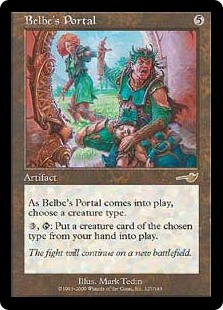
Belbe's Portal

Although it only functions in tribal decks, the Portal does a pretty good job with most tribes. For example, it functionally gives the creatures Flash. This would be important if you were running something like a Wizard deck, where a surprise Voidmage Prodigy could make a difference. I've seen it used most spectacularly in Dragon decks, where a big savings on mana comes with just about every activation. You might consider it in a Horde of Notions EDH deck focused on Elementals, because even though it costs a bit of mana to get out, it solves a lot of colored mana problems. It's still mostly inferior to Quicksilver Amulet, but in Highlander formats, you might as well have as much of this effect as you can have.

$1.25

Daze

If Force of Will is the underpinning of Vintage, then Daze defines Legacy. Some of the most consistent and powerful decks in Legacy can threaten with a single Island on the board, making you slow down a turn if you fear Daze. The format relies on such cheap threats that being set back a turn when you Daze isn't much of a problem.

Legacy players love their Dazes, and they'll pay a lot for foils. Keep an eye out for foil versions of this, since they've escalated a lot in recent months.

$2.00 ($40.00 in foil)

Flame Rift

Burn for everyone! Burn players like to have foil decks, and Flame Rift is a pricey piece of cardboard for them. Worthless in non-foil, it's coveted when shiny.

$4.50 in foil

Even more annoying than Maze of Ith.

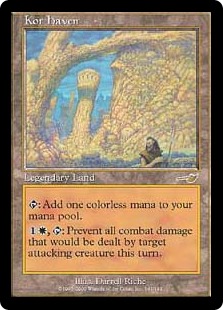
Kor Haven

Utility lands command a few bucks each, and even though the Haven requires white mana, people still love it in EDH. It is a second Maze of Ith, but it means that your blocking creatures can still damage the Haven'd monster. Thus, you get a sort of white removal! Immensely annoying, and it taps for mana, too. My friend and teammate Brian Demars has a theory about cards like Kor Haven; he feels that they'll all climb in value a bit because of EDH. With even more support coming along down the line, it might be worth to snag as many cheap copies of cards like Kor Haven, High Market, Dust Bowl and friends.

$2.50

Lin Sivvi, Defiant Hero

Lin Sivvi, destroyer of formats. The Rebel queen was just a little too good at everything she did. Even her big butt made it hard to burn her out. If you killed a rebel, she'd just recycle it, which made things like a single Thermal Glider or Lawbringer into pretty devastating recursion loops. I love to play her as my general, since you can loop Children of Korlis and other rebels. You can also do a power play by dropping her, then getting Mirror Entity and swinging for the fences. I've killed people on the fifth turn with a little help this way.

Lin Sivvi is pretty reasonably priced as a single, since people apparently don't build casual rebel decks. However, as a foil, she is silly expensive. I don't think there are many Lin Sivvi EDH decks, but people like foil generals, so of course she's been marked up a lot.

$1.50 ($23 in foil)

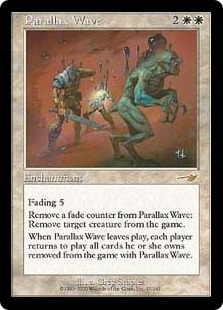
Parallax Wave

Of all the Parallax enchantments, this is the only valuable one. Parallax, by the way, is a method of finding an object's distance by measuring light from it at two different points. It's often used in astronomy, but I think it's used here because it sounds cool. For a long time, these cards had errata because you could cast one, then trigger all of its counters that you liked. With those on the stack, a Disenchant would keep things phased out forever. These days, the Wave is back to being able to do that, but it's not exactly a spectacular ability. The Wave was previously used in Rebel decks because, prior to new Legend rules, you used to be unable to play a Legendary permanent if one was already on the board! No “there can be only one!” rift opening up and sucking both Legends, just a stone block-out if one is already out. You can imagine that with Lin Sivvi as the cornerstone of every rebel deck, having a way to get rid of opposing ones was critical. You could Wave away the opposing Lin, then play your own. If your opponent killed yours and played one of their own, you could remove fading counters to legend-kill both of them. How annoying!

Now, it's thankfully relegated to EDH decks that need some fine-tuned creature removal.

$1.25

Predator, Flagship

For all the mana in the world, you can have your own colorless creature machine gun. I like the Flagship a lot in EDH, since you'll often hit seven mana and it's helpful to blow away creatures at instant speed. It got a little play in Standard, but mostly you'll see it pop up as a one-of in EDH decks. It's also thematically important to collectors, which makes it alluring in that regard.

$1.00

Reverent Silence

Back when Dredge was more of a force, people hotly traded for this in foil. It's a free way to kill Leyline of the Void in Vintage, and Dredge players love foiling out their decks (seriously, every one of them seems to). Thus, this card is highly priced in foil.

$7.25 in foil

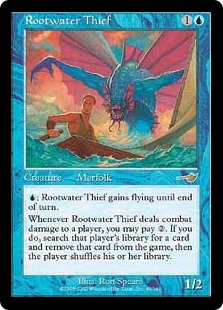
Rootwater Thief

Mike Long (pictured on it) is gonna cheat a card right outta your deck! Rootwater Thief is a fun card to fantasize about. What if you have two? What if your opponent only has three win conditions and you strip all of them? It's a great dream, but too often, the Thief is just too slow to matter. While you're devoting two mana each turn, they are either tutoring for their win conditions or just playing out their game and killing you. Alternately, you'll have Merfolk lords out and kill them before you can strip stuff out. It's still a cute card and people love the ability.

$2.00

Saproling Burst

This card was a key component of two hot decks, Pandemonium and Fires. Pandemonium, when combined with Sap Burst, makes for 21 damage. You can use Frantic Search and Attunement to set it up with Replenish or just naturally cast the components. Fires used the card with its namesake, because Haste broke open the Burst – the first turn, you make three 4/4s, the next turn, you swing with them at 3/3 and the opponent is probably dead. Even on its own, you'd get 20 damage from the card itself by making two tokens and crashing each turn unimpeded.

$1.25

Skyshroud Poacher

The chief reason people play this card is Deranged Hermit. You can get your first Hermit, pay his upkeep with Gaea's Cradle, then Poach up another one and swing with 3/3 Squirrels. This was actually a tournament-worthy strategy, as demonstrated by Aaron Forsythe's Angry Hermit deck. These days, Poacher has a few more targets like Viridian Zealot, Timberwatch Elf or Wellwisher (or Mirror Entity...). It's retained a good price, even though it's just an elf-fetcher.

$2.50

Submerge

Chalk this one up to Legacy, too. Free spells that remove Tarmogoyf are pretty cool! They were a little more expensive when you could play Vengevine with Survival of the Fittest, but people still like the uncommon. It's best when played in conjunction with an opposing fetchland so the creature gets shuffled back in. Otherwise, it's a lackluster card to play. Foils are, understandably, expensive.

$1.75 ($15.00 in foil)

Tangle Wire

A lot of the good cards in Nemesis owe it to being tricky with fading counters. Tangle Wire is a good example. It looks like trash on the surface, but remember – you can stack the fading to resolve before the tapping, so you always tap one less, and you can tap the Wire itself! What a design flaw! This meant you could grind down an opponent for a few turns with The Wire and apply supplemental pressure with Rishadan Port. All the while, your Chimeric Idol or whatever is going nasty. Tangle Wire is also heavily played in Stax and MUD in Vintage, since you can combine it with Goblin Welder for infinite tangles. On top of that, Stax plays a lot of permanents like Crucible of Worlds that don't mind being tapped. Adding this up, you'll see why Tangle Wire is a destructive tempo machine.

$4.50 ($35.00 in foil)

Nemesis was a pretty cool set to play around with. You can see the designers playing around with Fading, though they didn't really get a lot of the kinks worked out. Blastoderm would go lethal with Fires of Yavimaya all by its lonesome, for example, and Tangle Wire introduced a lot of people to stack tricks. Prophecy would follow it and be totally mediocre. Luckily, we've already done that set, so we'll move on to Invasion next week!

See you then!

Doug Linn

Twitter.com/legacysallure

City of Birds and Swords

Are you a Quiet Speculation member?

If not, now is a perfect time to join up! Our powerful tools, breaking-news analysis, and exclusive Discord channel will make sure you stay up to date and ahead of the curve.

Last weekend was SCG Open Memphis. I had arranged a hotel split with Kelly, Doug, and some guy I didn't know. After an uneventful 7 hour car ride, I showed up to the hotel, tried to check in, and was informed that they couldn't find Kelly's registration. Huh.

I e-mailed Kelly and told him they couldn't find the registration.

"We are about an hour out. I think they need my info to check in. Can ya kill an hour?"

My response? "I have ANT on me."

After about three hands of goldfishing, the hotel worker called me over to tell me he found the reservation on the computer. I gave him the confirmation number and got the keys. After going to the room I noticed a severe lack of power outlets, so I unplugged everything unessential so we could all charge our phones.

Fast forward to Saturday morning. I registered the following:

Untitled Deck

dudes

4 Squadron Hawk
4 Stoneforge Mystic
2 Sun Titan

planeswalkers

4 Jace, the Mind Sculptor
3 Gideon Jura

spells

4 Preordain
3 Day of Judgment
4 Condemn
2 Mana Leak
2 Spell Pierce

swords

1 Sword of Body and Mind
1 Sword of Feast and Famine

lands

4 Island
4 Plains
4 Tectonic Edge
4 Glacial Fortress
4 Seachrome Coast
4 Celestial Colonnade
1 Scalding Tarn
1 Arid Mesa

sideboard

2 Linvala, Keeper of Silence
2 Journey to Nowhere
1 Day of Judgment
4 Flashfreeze
1 Mortarpod
3 Baneslayer Angel
2 Divine Offering

That's right: classic Caw-Blade, to go with the sweet Justin Treadway shirt I was wearing. I tuned the deck a bit to have better numbers in the mirror and against aggro, by running a 4-spot of Condemn and the Sun Titans main. This made me correspondingly softer against Ramp decks.

Round 1: Kellen Willard, Mono-Green Eldrazi, finished 328th at 0-3.

Game 1 he hit me with an Emrakul. I kept Gideon, Jace, Sun Titan, a couple lands, and a couple of minor things. Gideon blew up Emrakul, I bashed him to get back some stuff, and took the game shortly afterwards. Winning after getting hit by an Emrakul as the highlight of the day? Not even.

Game 2 I got owned by a sequence of Eldrazi, and that sent us to game 3.

Game 3 I didn't take a single point of damage.

Round 2: Bruce Vance, Esper Tempered Steel, finished 287th at 1-4.

Tempered Steel, Tezzeret, Frantic Salvage, and just a general mess of awful too-slow beatdown cards meant this was a pitifully easy matchup.

Round 3: Aaron Malone, Boros, finished 41st at 6-3.

SCGLive should have picked us as the feature match here - the crowd that ended up surrounding us at Table 1 got their money's worth.

Game 1 I got hit by Goblin Guide twice and a [card Stoneforge Mystic]Squire[/card] twice. Both Goblin Guides revealed a Condemn that proved their demise the following turn. Gideon shut down the Squire before it could do anything relevant, and when I drew a Condemn, I let it try to hit me and fail. A team of Birds and Colonnades finished the job.

Game 2 was easily the highlight of the day thanks to Baneslayer Angel on my side facing off against Bonehoard and Basilisk Collar on his. My opponent didn't get a fast start, with his Steppe Lynx getting neutered by a Condemn. However, [card Basilisk Collar]Collar[/card] showed up very quickly, and a Divine Offering ended up taking my Sword. My double Baneslayer setup easily raced the 7/7 Bonehoard, but once he put it on a Squadron Hawk I had to stop attacking in order to keep my Baneslayers alive. A Plated Geopede came down with a mess of fetchlands still sitting on the table, and I was in trouble. The Hero of Oxid Ridge that showed up nearly ruined my day, taking me from 40 down to 6 in one swing. I had to Condemn it, and as my opponent dumped the rest of his hand on the board I was forced to swing with both Baneslayers to boost my life total, Mortarpod one at him for a bonus point, then cast Day of Judgment. This left us both awkwardly with nothing on the board, but I had relevant cards in hand, he had nothing, and when I Condemned his well-equipped Hero of Oxid Ridge, that pretty much sealed the game up even though he gained 19 life. We finished this game a few minutes before time was called.

Over the course of the game, my life totals went:
20, 19, 18, 17, 16, 21, 31, 20, 30, 40, 6, 16, 17, 22, 27, 32, 37, 38.

His went:
20, 22, 21, 24, 27, 26, 21, 28, 18, 17, 15, 26, 36, 24, 26, 24, 40, 30, 29, 20, 39, 30, 21, 12, 11, 4, dead.

Round 4, Richard Wayne, Boros, finished 19th at 7-2.

Game 1: He tried to get me with early beats, but I only ever got hit by a Goblin Guide 3 times before locking up the game. He scooped while at 21 life.

Game 2: I got overrun by a Hero of Oxid Ridge despite my Baneslayer Angel. If I had saved the Condemn for his Plated Geopede instead of blowing it on the Guide turn 2, this would have been quite a different game - I ended up taking ten from the Geopede over the course of two turns before trying to stabilize behind the Angel. It was probably a misplay, but I knew I didn't have early creatures. My plan was to stay alive at a high life total, drop Angel, and win. The plan was solid, but I shouldn't have gotten greedy with the Condemn.

Game 3: I stabilized behind a Gideon, or so I thought. A pair of Heroes robbed me of that misconception, and I picked up my first loss of the day to sit at 3-1 with 5 rounds to play.

Round 5, Dru Elwell, Naya Caw-Vine, finished 153rd at 3-3.

His poor finish doesn't really reflect his deck's quality. Naya is perfectly suited to beat the living hell out of Caw-Blade, but somehow I stole this match from him.

Game 1: Incredibly close - I started getting beat down by a Hawk, but stabilized. An Inferno Titan ate a Condemn, but not before dropping me to 14. He put a Sword of Body and Mind on a Squadron Hawk and started beating me down with it and a Raging Ravine. With a timely Tectonic Edge I ended the threat of his manland, and my own Colonnade took care of his Hawk. He suited up a Bird of Paradise to take me to 2, forcing me to hold back my Colonnade. Stoneforge Mystic showed up and I finally managed to take him out of the game with only a few cards left in my deck.

Game 2: He got my turn 2 Mystic with an Arc Trail, but I landed a Jace the turn after he played a Fauna Shaman, and just kept bouncing it so he couldn't get any uses. Once I hit him with a Sworded Baneslayer, I let him have the Fauna Shaman so I could Brainstorm, and he set up a Vengevine - which got hit by a Condemn without ever doing any damage to me. Baneslayer just kept getting in there, and when he made the mistake of cracking a fetchland at 8 life, I pointed out that he just put himself dead on board and rendered his play irrelevant.

Round 6: William "BJ" Bessler, Valakut, finished 27th at 6-2-1.

Game 1: A turn 2 Squadron Hawk hit him 5 times with no resistance, and a Sword of Body and Mind on my Gideon Jura smacked him silly in place of the 6th hit when his Inferno Titan cleared my board of the birds and tried to beat me, but Condemn saved the day. Two turns later he was dead. This took roughly 30 minutes, which was far too long.

Game 2: He got a fast Primeval Titan and there was nothing I could do about it.

Game 3: With very little time remaining, I got a fast draw and fatesealed him with Jace while beating him down with a Gideon and a Sword of Feast and Famine. He got Nature's Claim on the Sword, but Sun Titan solved that problem. He did hardmode a Valakut, but Tectonic Edge dealt with one and his other one didn't have any way of winning in time. Time was called at some point in here and when the turns were up, I had Sun Titan on board and a Jace at 12 counters. He refused to concede despite my incredibly superior board position, which put us both at 4-1-1 and having to win out to make top 8.

(To be fair, if not for time he would have Valakuted the Jace or my Sun Titan instead of myself, but he couldn't do both, and I would still have crushed the hell out of him.)

Round 7: John Penick, Caw-Blade, finished 101st at 4-3-1.

Naturally, the draw put me in the draw bracket and I got to play the mirror the next round.

Game 1: I landed turn 2 Mystic, turn 3 Squadron Hawk, and turn 4 Sworded the Hawk to take the win. Nice deck.

Game 2: He landed turn 2 Mystic, turn 3 Squadron Hawk, and turn 4 Sworded the Hawk to take the win. Nice deck.

Game 3: He mulliganed to 5 and I won because he only had two truly relevant plays - a Divine Offering on my Sword early, and a Gideon plus a Sword later. I was doing stuff all day long, including a Sun Titan to bring back my Sword, and that sealed it up.

Round 8: Nick Glavich, Monogreen Eldrazi, 7-1-1 and 9th on tiebreakers (ouch).

Game 1: Despite hitting him with a Sword of Feast and Famine on a Squadron Hawk, I got owned by some ridiculous monster.

Game 2: I managed to beat him down a turn or so before he could cast a ridiculous monster. Being on the play here helped.

Game 3: He cast turn 1 [card Joraga Treespeaker]Treespeaker[/card], turn 2 level up and cast Overgrown Battlement, turn 3 Overgrown Battlement and Primeval Titan. I played Mana Leak on the Titan and Summoning Trap hit Ulamog, the Infinite Gyre. Turn 3 Ulamog? I'm just going to put a 1/1 bird on the table and go cry in a corner.

At 5-2-1, I had to win the last round to have anything to show for my day.

Round 9: Eric Zimmerman, Boros, 5-3-1 and 68th.

Game 1: I mull to 6 and lose to Hero of Oxid Ridge while not doing anything relevant.

Game 2: He leads with Adventuring Gear into Squadron Hawk. The 5 points I took from that Bird was the only damage I took in the entire game, since my Mystic did serious damage to him while my Birds played defense.

Game 3: His lack of lands for landfall meant his Lynx and Geopede weren't particularly impressive, and once I hit him with a Sword on a Bird I locked up $50 and some Open Points.

Final record: 6-2-1 (really should have been 7-2, but with my tiebreakers I likely wouldn't have made top 16 at 7-2.)

We headed to some ribs-and-booze place in Memphis, despite Kelly's inability to navigate worth a damn with his iPad. After eating we eventually got back to my car so I could get it out of the parking lot, and I plugged my phone back up, waited for it to turn on, punched in the address of the hotel, and drove for 5 minutes. Around 20 minutes later the others showed up. Winner: Android.

BONUS CONTENT:
I didn't do too well in Legacy, which was a disappointment. I played my ANT deck, with the new sideboard tech of Lodestone Golem for mirrors and pseudo-mirrors. The logic is that mirror matches end up with both players gutting each other's hands, rendering neither player able to combo off until one of them topdecks a win. By playing Lodestone Golem, neither one of us are ever going to be able to topdeck a win, and my four-turn clock will take the game instantly. At least the 75-card Zoo deck I handed to Zac Jones made top 32.

Round 1: My opponent was on Merfolk and kept a hand with no disruption other than Cursecatchers. I got a Tutor -> [card Ill-Gotten Gains]IGG[/card] -> Tutor for [card Tendrils of Agony]Tendrils[/card] loop on turn 4 and won it easily. Game 2 I got a turn 1 Duress hit by Daze, a turn 2 Xantid Swarm hit by Force of Will, and set up a turn 3 Ad Nauseam through a second Daze... which saw no Rituals despite me going all the way to 2. Dammit. I played a Lotus Petal and a Xantid Swarm to block his Mutavault, keeping a Ponder and a setup that would let me cast Ill-Gotten Gains the following turn. I ramped to 9 mana thanks to a pair of Lotus Petals, and managed to Ill-Gotten Gains directly to Tendrils by returning Duress, Lotus Petal, and Tendrils of Agony. He returned both Dazes and a Force of Will, and I led off with Duress. He did some thinking, and due to the fact that countering it would up my storm count, there was nothing he could do to stop me from winning. It turned out that I should have simply waited to go off, since he had kept a hand with literally no pressure other than the lone Mutavault, and it wouldn't have been such a nailbiter.

Round 2: My opponent (Devin Koepke, who finished 17th) led off game 1 with Ancient Tomb into Chalice of the Void on 1. Turn 2 he played Trinisphere. Turn 3 he played Metalworker. Turn 4 he laid down a pair of Lodestone Golem. Really? Game 2 I don't turn one him, and a trio of Chalices lock me out of the game. I couldn't help but say, "You woke up this morning and decided there was no way you were losing to combo, didn't you?"

Round 3: I punted game 1 against Bant by playing Lion's Eye Diamond followed by Cabal Ritual with Infernal Tutor in hand... against an active Qasali Pridemage. Oops. Game 2 I got beat by multiple Ethersworn Canonists, and dropped to go draft.

I drafted a mediocre Red/White deck and managed to 2-0 a deck with a terrible manacurve. Round 2 I got paired against a Red/Green Dinosaur deck which I managed to beat the hell out of game 1. Game two I didn't have anything for him and he got fat on the board before I could get him to zero. Game 3 I landed a turn 3 Koth's Courier against his basic Forest, and cast Burn the Impure on his Ferrovore to give me more time to kill him. Unfortunately, I didn't draw anything but lands, stranding my Glint Hawk in hand. Eventually I drew a Darksteel Axe, played it and the Hawk, and stuck the Axe on the Courier. It ended up putting him to 1 the turn before I died to his double Razorfield Rhino. If I'd saved Burn the Impure for his lone Cystbearer (which he naturally played the turn after I killed Ferrovore) I'd have ended up killing him. Still, I can't really complain about ending up one point away from making top 8 of the Draft Open in my first post-Besieged draft.

All in all, Memphis was a good weekend, and I'm really looking forward to playing in SCG Atlanta on my home turf.

Joshua Justice

@JoshJMTG on Twitter

Evaluating Trumps in CawBlade

Are you a Quiet Speculation member?

If not, now is a perfect time to join up! Our powerful tools, breaking-news analysis, and exclusive Discord channel will make sure you stay up to date and ahead of the curve.

To every measure there is a countermeasure, and a counter-countermeasure.

Patrick Chapin wrote an article some time ago entitled Information Cascades in Magic. In it he described how information in any area, but particularly in Magic, cascades and plateaus. When everybody knows that Deck X is the best and most dominant deck, many people will play it.

Everyone knows Deck X is the best.

Later, when people are tired of losing to Deck X and its weaknesses are taken advantage of, innovations will occur. Maybe Deck X can't beat a resolved Card Y, and it will fall in popularity as Card Y becomes more widely played.

Everyone Knows Deck X loses to Card Y.

When Card Y is widely played and sideboarded, Deck X can either fold or adapt. Sometimes it can not adapt and will fall away from the limelight for a time or it can find a way to beat the hate. When a powerful strategy has become well known, then hated out to some degree, it can be a very powerful time to be creative.

Only I know that Deck X with Card Z can beat Card Y.

If Deck X was the best and most powerful deck in the format but was vulnerable to a particular card, and enough tournament results have been posted that it is safe to assume that all the tournament goers are aware that Card Y can beat it, you can gain a significant lead over the field if you can find a way for Deck X to overcome the obstacle that is Card Y.

An example of this can be easily seen when looking at the Dark Depths deck from last season. When the Dark Depths [card Vampire Hexmage]combo[/card] was first melded with the Thopter Foundry [card Sword of the Meek]combo[/card], a monster was born. As people started losing to it repeatedly and the tournament results started rolling in, conclusively proving that the deck was real, more hate moved into the field. Bant Charm and Path to Exile were both pretty good against the flying 20/20, and as they started seeing play in greater numbers in the Zoo decks and various others some started to claim that Dark Depths was dead.

Dark Depths can't beat Bant Charm and Path to Exile.

This, as the experienced should know, was not true. So what happened?

Dark Depths was able to adapt to beat single targeted removal spells by sidestepping the attack. Dark Depths began sideboarding or even maindecking other win conditions, such as [card Sphinx of Jwar Isle]Jwar Jwar Sphinx[/card].

[card Sphinx of Jwar Isle]Jwar Jwar Sphinx[/card] beats those pretty well.

After [card Sphinx of Jwar Isle]Jwar Jwar Sphinx[/card] became well known and the tech was out of the bag, [card Meloku the Clouded Mirror] Meloku[/card] and Gatekeeper of Malakir became the hotness as trumps to the Sphinx, and then others to beat them once they became known.

So what?

This seems a very similar situation to me to the current situation in standard, in regards to the CawBlade mirror.

After Pro Tour: Paris and a little testing, everybody and their mothers knew that CawBlade was the best deck. Everyone also knew that everyone knew that CawBlade was the best and it would be widely played , so mirror tech would be required. Gerry T introduced the world to the red splash for the Cunning Sparkmage+Basilisk Collar combo, allowing players to shoot opposing [card Sword of Feast and Famine]sword[/card]-[card Squadron Hawk]carriers[/card] from the skies.

Today, everyone knows that CawBlade is the best deck and that the Red splash for Spark-Collar is good against the mirror. That brings us up to date.

Now there are a wide variety of options available for the mirror.

1) Play Red, but better: Cunning Sparkmage is good at shooting down the opposing team, but other red cards are quite good at shooting him down. One option is to play the Red splash everyone is aware of, with more burn to answer any Cunning Sparkmages that hit play on the opposite side of the field. LSV chose this option at a recent 5k in San Jose where he played with Lightning Bolts and Arc Trails to help him shoot down opposing [card Cunning Sparkmage]Sparkmages[/card]. With maindeck Sparkmages and a Basilisk Collar as well as extra burn spells, he was well equipped to beat the creature war. This strategy is well positioned against any mirror that is not prepared for it, if they are still on level one, or against opposing Red splashes if they are on the next level. It is weak to [card Linvala, Keeper of Silence]Linvala[/card], as she will turn your Sparkmages into do-nothings.

2) Mortarpod: A Mortarpod can shoot down [card Cunning Sparkmage]Sparkmages[/card] as well as a burn spell or another Sparkmage could, only with colorless mana. This means it is available in a traditional UW build, allowing for a more stable manabase and Tectonic Edges. When equipped with Basilisk Collar it can also take care of opposing Sworded creatures, provided you remember the original Living Weapon Germ token is Black. It is, however, significantly more mana intensive than the Sparkmages. This is relevant in the mirror, but especially so against aggressive strategies such as Boros. A Sparkmage is quite good against Steppe Lynxes and Plated Geopedes, but the Mortarpod's speed and mana costs make it a severe step down. This plan of attack is good against the mirror if you value a more stable mana base (while still playing Tectonic Edges) more than the speed of Sparkmage. While stronger than Sparkmages against a resolved [card Linvala, Keeper of Silence]Linvala[/card] because it occupies fewer slots in the deck and thus has fewer cards turned into do-nothings, she still disrupts the combo. It is worse against aggressive strategies.

3) Linvala, Keeper of Silence: At the next level, we find Linvala. The Silence Keeper is quite a trump when opponents are attempting to shoot down your team, whether with Cunning Sparkmage or Mortarpod. A flying 3/4 is also well positioned against flying 3/3s, like [card Squadron Hawk]birds[/card] with [card Sword of Feast and Famine]Swords[/card]. By shutting down their lethal pingers and blocking any attempt at an offensive air attack, Linvala will have a greater impact on the board than almost any other card. Linvala is a sweet trump card if everyone is moving towards pingers as their trump of choice. She has nice applications against other troublesome cards besides the mirror, shutting down Fauna Shaman and just embarrassing Elves!, which can otherwise be a rough matchup. She is weak to both Jace, the Mind Sculptor and Gideon Jura which is a significant strike against her, as every list is running at least six of the duo. Tapping four mana at sorcery speed can also be sketchy if they are bucking the current conventional wisdom and have counterspells in game two.

4) Titans: At the next level of tech, we have trumps to Linvala. Who cares if you can't shoot anything with a Cunning Sparkmage if you have a 6/6? Nice 3/4, bro. Whether you like your Titans Red or White flavored, there is a Linvala trump for you. Inferno Titan is the most aggressive answer, mowing down blockers and threatening lethal in only a turn or two thanks to his Firebreathing. If you have the Basilisk Collar it just gets ridiculous. Sun Titan can bring back a swarm of attackers or blockers, any destroyed Swords, and Tectonic Edge or fetchlands. If you are going with Black as a splash instead of Red, as Gerard Fabiano recently did, you can play with Grave Titan and (are you ready for some spicy tech?) even Geth, Lord of the Vault. An unanswered Geth is probably the strongest card in the mirror. He can steal creatures to block other Titans or attack Planeswalkers, he can take any milled or destroyed Swords and let you double up, and eventually will either give you enough creatures to attack for the win or mill the opponent into oblivion. I would also consider Baneslayer Angel in this category. She is large and First Strikey enough to fight with any other fliers, and her Lifelink will go a long way towards winning a race with any other "Titan" even if she can't fight them directly. The [card Baneslayer Angel]BSA[/card] can regain you any need life points while also gaining an advantage on the board large enough you can ignore Linvala. Any Titan allows you to go big, moving the fight from the small end, where Linvala, Keeper of Silence reigns supreme to a larger arena where she is severely outclassed. They are all good against other decks besides the mirror, pulling double duty by also serving as a trump against any creature-based strategies. The actual Titans also shine when across the table from a Jace, the Mind Sculptor, while the Baneslayer Angel and Geth, Lord of the Vault fail that test. The only one to pass the [card Gideon Jura]Gideon[/card] test is the Sun Titan, but Inferno Titan's repeatable Arc Lightning gets him a solid C+.

5) Trinket Mage: Many games between CawBlade decks see all the Squadron Hawks die off rather quickly, making the third and fourth Hawks rather unappealing to cast. Two mana for a 1/1 flier that gets three friends is pretty damn good, the same mana for 1/1 flier that gets one tag-along is fine but not particularly appealing, and paying two mana for just one would be depressing even in limited. How about a graveyard shuffle effect to bring back your fallen birds, allowing every [card Squadron Hawk]Hawk[/card] you cast to bring all his boys to the yard? Damn right, it's better than yours. Nick Spagnolo played a trio of Trinket Mages and a small tutor package for them consisting of Basilisk Collar, Elixir of Immortality, and Sylvok Lifestaff. He made the top 32, the best possible without his list being published (SCG only publishes the top 16 of their tournaments), which means this won't attract much attention for the time being. He threw one match away and got mana-screwed out of another, ending at a 7-3 that could have been 9-1, which says the list is solid. Being able to tutor up five points of life gain on command is clearly good against aggressive matchups, and the endless Squadron Hawks are excellent in the mirror. They may not exactly trump a Titan, but they'll but you enough time to find an answer. The Trinket Mage package trumps Linvala and has game against some of the Titans, but it takes time to shine. It won't stop you from being dead on turn five against anyone but it will let you eventually win if you're still in the game on turn ten. If you are expecting significant amounts of Boros or other quick aggressive decks this may not be the way to go. If your meta has more of the mirror and the competition has discovered [card Linvala, Keeper of Silence]Linvala[/card] the Trinket Mage plan is probably the way to go.

6) Sword of Vengeance: I briefly mentioned this as a possibility in my last article. Since then I have had more time to test with it, and I am convinced it is superior to Sword of Body and Mind. Vengevine is good against CawBlade, and its numbers are rising. Milling can also be a problem if anyone is still playing [card Bloodghast]Vampires[/card], or if the reincarnation of DredgeVine takes off. The Sword of Vengeance allows you to Trample over any blockers and the granted First Strike will let your creatures survive to fight another day. This will let you trump [card Linvala, Keeper of Silence]Linvala[/card] in combat with [card Squadron Hawk]Hawks[/card], putting the opponent in a bad spot even if you can no longer machine gun down blockers with either Mortarpod or Cunning Sparkmage. It will also let your Titans trump opposing Titans, even if they have a Sword of Body and Mind or some other equipment attached, and it also trumps the Trinket Mage package by removing their ability to block indefinitely. It is weak to Cunning Sparkmage because it grants +2/+0 instead of Sword of Body and Mind's +2/+2, meaning that attached Hawks are vulnerable to pinging even after being equipped. If you play with Sword of Body and Mind instead of the Sword of Vengeance your creatures are equally vulnerable to pingers activating in response to equipping, but once equipped they will be safe from a top-decked pinger, at least until it teams up with Basilisk Collar.

Every trump in the CawBlade mirror can be trumped, the key is to know what the competition will be playing and have the appropriate trump for that week. Check the tournament results from every tournament you can find, and remember that what won last week is what most players will be playing next week.

Thanks for reading,

Brook Gardner-Durbin

@BGardnerDurbin on Twitter

Infinite MTGO

Are you a Quiet Speculation member?

If not, now is a perfect time to join up! Our powerful tools, breaking-news analysis, and exclusive Discord channel will make sure you stay up to date and ahead of the curve.

Welcome back everyone! My mythics article from last week generated a little bit of response though I feel like some of it was some trolling and a small bit actually was quality response. However, I promised you a how-to go guide for going infinite on Magic Online without playing, and that's what I am going to do. Unfortunately, my example became obsolete this week with a price increase on a few of the cards. So instead of being able to use specific current prices, I will use generalized examples and suggestions on what to do.

Step 1: Figuring out what things are worth.

Duh! On to the next step.....ok, I guess I will give a bit more to this point.  You need to research the going prices of the cards on MTGO and what it is going to cost you in both Tix costs and Dollar costs to make and redeem your sets.  This will tell you A) What sets are worth redeeming, and B) How far away the bad sets are from being redeemable. Point B is actually more important than point A. If you can keep an eye on the other sets and notice the change, it can give you a head start in buying up the cards in mass before other people and the sellers on MTGO correct their prices to the supply drop of that particular set.

Step 2: Acquiring Capital

This is actually one of the trickiest parts to making money on MTGO. Buying from the MTGO store will cost you $1 per 1 tix, unless you are from a Non-US or Canada (I think) country, and then you are paying $1.22 per 1 tix (22% VAT tax). This makes redeeming sets for profit very hard. Also, the most important thing is finding a reputable source of tix at a lower number. There are several clans out there that focus on getting cheap tix. I recommend doing research and finding who you can trust on MTGO. I would recommend getting no less than 2000 tix to start. You are going to blow through these tix quickly and you want to have a cash flow at all times so as to never not be redeeming sets (hot double negative there, huh?).

Step 3: Finding the cards

There are several ways you can go about doing this. The first is just spending Tix on bots and buying the cards. Simple. Second way is to visit websites that offer singles. A lot of these places offer discounts if you pay with Paypal over Tix. Take advantage of this because sometimes they are slow to recognize changes where as MTGO can be harder to find incorrect prices, save for the random bot at times. Another way is to let your friends and clan mates know that you are buying cards. Many times you just need to buy a bit higher than bots will buy at or even the same and they will hook you up. Also offering Paypal instead of tix is a lot more enticing to certain people.

Step 4: Redeeming.

This part really is simple. It will cost whatever WoTC is charging these days (still $6.99?). You need to factor this into your math when it comes to figuring out if a set is worth redeeming. Usually you can just sell off the common/uncommon playset that comes along and get your money back on the shipping fee.

Step 5: Unloading the cards.

I won't go into a whole lot of detail about this since I think it will do you more good to research these options on your own then for me to just spoon feed them. Just realize that if you have enough capital and can keep going without a pause to recoup money from the incoming cards, you should try to capitalize and make all that you can on your redemptions.

That is basically it. It is rather simple when you break it down and see the steps. It isn't AS profitable as it use to be. At one point I was redeeming 16 sets of Lorwyn a week and profiting $250 per playset redeemed. It was HOT. However, when the switch to 3.0 happened and WoTC started charging a VAT tax to overseas customers, it caused tix to rise from .80-.85 up to their current levels.  People tend to only go into this kind of venture with a small bank roll, and in reality, it takes thousands of dollars to do it correctly and make the kind of money that is actually impressive.

Join me next week when I discuss....well, I actually have no idea. Why don't you guys suggest something and I can see what I can come up with! Thanks ya'll.

Contact
E-mail: tennis_stu_3001@hotmail.com
MOTL/MTGO: stu55
AIM: stoopskoo15
Store: The Vault- Greensburg, PA

Posted in Finance, Free Insider4 Comments on Infinite MTGO

Have you joined the Quiet Speculation Discord?

If you haven't, you're leaving value on the table! Join our community of experts, enthusiasts, entertainers, and educators and enjoy exclusive podcasts, questions asked and answered, trades, sales, and everything else Discord has to offer.

Want to create content with Quiet Speculation?

All you need to succeed is a passion for Magic: The Gathering, and the ability to write coherently. Share your knowledge of MTG and how you leverage it to win games, get value from your cards – or even turn a profit.

Don’t Sell the Bulk

Are you a Quiet Speculation member?

If not, now is a perfect time to join up! Our powerful tools, breaking-news analysis, and exclusive Discord channel will make sure you stay up to date and ahead of the curve.

Don’t sell the bulk!  Your bulk rares are an asset to utilize so that you can increase your profit margin.  Trading is a form of art and the more creative you are, the more you can make the most out of your collection.

I did not realize that trading was one of my fiercest magic related skills for quite a long time, but my friends sure did.  When they were trading with me I started to notice how cautious they were about completing trades.  They were constantly analyzing the trade and were much more concerned about our trades than the others they completed.  My friends knew way before I did that I had some skills.  My subset of trading skills often flew under the radar because for most of my magic career my binder was not even close to impressive.  You know what it was filled with?  Bulk rares.

I have previously stated that I never had a lot of money for magic cards.  It seemed like I could never finish a deck and when I finally did, it was past the time where the deck would have been successful.  Why is that?  The reason is because I traded for 100% of my decks for eight years.  Really the only cards I bought were some of my original dual lands and even those, most of them were traded for.

How did I trade for all of my magic decks?  Well let me first say, it is not a good plan to rely 100% on trading to finish your decks.  Sometimes you just have to buckle down and buy a couple cards before the tournament so that you have the best version of your deck to play.  This is a widely accepted concept now, but it took a while for the majority of the magic community to accept this truth.  Anyway, the way I was able to trade for my decks was dealing with the low end.  You want to talk about art.  Trading and profiting from low end trading is certainly an art form.  What rares do you trade for?  How do you move them?  These are complex questions that arise from low end trading.

Everyone has to start somewhere.  Not everyone has every staple and every high end card just sitting in their trade binder.  Many players rely heavily on their collection to fund their competitive decks.  I started growing my beanstock out of some seemingly unmagical bulk beans.  My survival was based on my instincts as a trader.  Usually I had no problem flipping the cards I traded for to hop right up the profit ladder, but trading on instinct does have its pitfalls. When I first started trading with other players, I definitely traded for some things that never moved out of my binder.

My years of trading on instinct have shown me three ways to boil this process of low end trading down for future magic traders.

Step 1:  Know the players at your local shops, what they play, what they want to play, and stock accordingly.

How can we accomplish this?  Just have fun and play some magic.  This is a game after all, so have fun when you are out at a tournament.  Not every tournament has to be treated like a 5k or PTQ.  Then, while you are there, trade some cards with everyone.  You are a magic player and that usually means that you enjoy playing the game.  So, if you have multiple stores in your area, rotate between them.  The wider your trading circle gets the more you can spread your trading wings.  The main reason why everyone is not a trader or an efficient trader is because it involves talking to your opponent, the players sitting next to you, and the other players at the tournament.  Trading is socializing.  Make some new friends by talking to them about the deck they are playing and what cards they are trying to get their hands on.  It is difficult to stock your binder with cards other players will want unless you are familiar with the players that typically attend tournaments at the shops you go to.  This is not true for the cards that everyone is trying to get their hands on like Jace, The Mind Sculptor, Sword of Feast and Famine, and Primeval Titan.  You can always find someone to trade those high end staples to, but knowing what low end cards to pursue takes some previous knowledge.   For things like Birds of Paradise, Day of Judgment, and Knight Exemplar, if you are trading for them just to make your binder more appealing, you might want to have an idea who you might be able to trade them to.  The low end cards we are talking about today, take a little work to find homes for, but if you know who you will be trading with, you can minimize the turn around time on cards.

Step 2:  Know which rares are in demand that you should keep your eyes out for.

The reason I mentioned Birds of Paradise, Day of Judgment, and Knight Exemplar was because these cards are extremely hard to find for the players at one of the local stores I frequent.  One tournament I had multiple players ask if I had these cards.  This is the nugget of gold you have been searching for.  Obtaining cards for someone is a great way to build your reputation.  Think about if someone specifically got the cards you had been looking for and couldn’t obtain for yourself; you certainly would make it a point to trade with them in the future.  If you get cards you intend to trade you have a better chance to trade them immediately so they won’t just sit in your binder.  Second, people are grateful that you went out of your way to get cards for them.  Pay attention to the supply and demand of the players at your shop.  If everyone has Grand Architects in their trade binders, when that deck becomes popular most likely you won’t be able to capitalize on that spike in price.  If you trade for a playset (or more) of cards that multiple people want like the above mentioned Birds of Paradise and Day of Judgment, you know that you can trade them off quickly and most likely gain a little value out of it.

The other aspect of following the demand of cards is just paying attention to what it is that you trade a lot of.  For me the card I trade the most is Tempered Steel.  When I am trading I try to always have at least one playset of this card in my binder and sometimes extras in my bag because I move this card so often.  First of all, it is a card the players will definitely want four or none of, so either you can trade them all away or you can trade for all the copies someone has.  This is a great quality to find in a card.  I was lucky because before Tempered Steel, my ‘bread and butter’card, the card I traded for and away the most, was Stoneforge Mystic.  That’s the nice thing about trading so much.  When Stoneforge spiked, I had an extra three copies in my trade binder just because it was a card that I could trade for and trade away frequently.

Step 3:  Always, always, stay current on both buylist and regular prices of standard cards.

Often there is a price discrepancy between the retail price and the buylist price on cards.  One thing that traders often forget is that they need to know both prices.  Some people know both just by trading so frequently.  Let’s complete a short quiz to see how you are doing.  Don’t go look up the card prices, I will tell you in a moment.  Think about the retail price of the card if you had to go pay full price for it and then think about what dealers would buy the card at.

1.        Consuming Vapors

2.        Nirkana Revenant

3.        Sorin Markov

4.        Nicol Bolas, Planeswalker

Let me first say that apparently today as I write this I am in a very black mood because apparently I chose all black cards for this little survey.  Regardless, I started you off with an easy one.  Consuming Vapors has been fairly stable in its price for a while but I am still not sure that you got it right.  The regular price for Consuming Vapors is about four dollars.  Sometimes you can find them cheaper than that, but that’s about right most of the time.  If you go by the accepted shortcut to determining a buylist price of half of the value of the card you would most likely have guessed close to the right answer.  Consuming Vapors buylist price does have a fairly large range though.  You can find an offer to buy it as low as $1 or up to about $2.50.

What about Nirkana Revenant?  This mythic from Rise of the Eldrazi has a large casual appeal for players who love their swamps.  The regular price of this card, even with no Standard applications, is four to five dollars.  What is strange and great for trading a lot of low end is that dealers buy this card as high as 3.50!  These types of cards are not found often where you can basically sell it at the same price you traded for it.

The next one’s a bit tricky if you have not looked into Sorin lately.  He does have casual appeal but he also has made an appearance in a few Standard decks like the previously dominant Blue/Black Control, even if it was only in their sideboard.  I knew before I started writing this article that I wanted to mention this card.  When I did some research, I was quite surprised by what I found and realized that I needed to update some card prices myself.  Sorin sells online for about ten or eleven dollars!  That is crazy high to me.  Most players still think that he is worth about five to seven dollars.  I had no idea that he was worth so much.  The thing is, the buy price is just as surprising.  This card can be sold online from 7 dollars to 8.50!  That is much higher than I would have ever expected and Sorin is definitely on my radar of cards to trade for at the moment.

Ok, last one.  Nicol Bolas is not in Standard anymore but there a decent amount of them floating around in trade binders.  The point is that it is relatively accessible card.  This planeswalker has a huge variance between purchase prices.  I have seen him sell for as low as 14$, but his average is up around 25$.  This is also crazy because his buylist price ranges from 10 to 14$.

Alright, so we know that prices can be tricky.  How do we deal with that?  Well first of all, keep up to date on your prices!  Second of all, know which cards to trade for.  Don’t fret, I have done the research for you so take a look.  The following list are cards that are undervalued and I have listed their current buyprice range.

Name:                                                  Trollandtoad Buylist price:

Kuldotha Forgemaster                                                1.00

Hand of the Praetors                                       1.75

Etched Champion                                           1.00

Ezuri, Renegade Leader                                                                1.00

Genesis Wave                                                 1.00

Lux Cannon                                                    1.50

Myr Battlesphere                                            1.00

Platinum Emperion                                         1.00

Consecrated Sphinx                                        2.50

Massacre Wurm                                              1.80

Contested Warzone                                        2.50

Sorin Markov                                                  8.50

Nissa Revane                                                  6.00

Chandra Ablaze                                              2.50

Felidar Sovereign                                            2.50

Warren Instigator                                            1.75

Luminarch Ascension                                     1.75

Rampaging Baloths                                         1.25

Blade of the Bloodchief                                 1.25

Mindbreak Trap                                              1.50

Kalitas, Bloodchief of Ghet                           1.00

Ob Nixilis, the Fallen                                      1.58

Pyromancer Ascension                                    1.00

Basilisk Collar                                                 3.50

Dragonmaster Outcast                                                2.50

Omnath, Locus of Mana                                                           2.50

Eye of Ugin                                                    1.80

Admonition Angel                                          1.50

Joraga Warcaller                                              2.00

Nirkana Revenant                                           3.50

Lighthouse Chronologist                                3.00

Khalni Hydra                                                  3.00

Transcendant Master                                       2.50

Coralhelm Commander                                   2.50

Inquisition of Kozilek                                     1.75

Student of Warfare                                         4.00

Consuming Vapors                                         2.50

Awakening Zone                                            1.50

Eldrazi Temple                                                2.00

Eldrazi Conscrpition                                       1.00

Guul Draz Assassin                                         1.00

Knight Exemplar                                             3.00

Steel Overseer                                                 2.00

Elvish Archdruid                                            2.00

Captivating Vampire                                       1.50

Chandra Nalaar                                               1.50

Platinum Angel                                               1.25

Serra Ascendant                                              1.00

Goblin Chieftan                                              1.00

Honor of the Pure                                           1.00

Ajani Goldmane                                              3.75

Leyline of Sanctity                                         2.50

Death Baron                                                    1.50

Hellkite Overlord                                            2.00

Master of Etherium                                         1.75

Memory Erosion                                             1.25

Godsire                                                           1.50

Emperial Archangel                                        1.25

Master Transmuter                                          3.00

Maelstrom Archangel                                      2.50

Martial Coup                                                   1.00

Ethersworn Adjucator                                  1.00

Nicol Bolas, Planeswalker                                                     12.00

Wall of Reverence                                          1.00

Dragon Broodmother                                      2.50

Nemesis of Reason                                         1.75

Sen Triplets                                                     1.50

Lord of Extinction                                          1.75

Karthus, Tyrant of Jund                                  2.00

Jenara, Asura of War                                      1.50

Thraximundar                                                  1.25

There are a couple highlights from this list that I want to point out.  The two planeswalkers from Zendikar, Nissa and Sorin, are really undervalued at the moment.  If you are looking for some cards to flip, start there.  I have traded for and sold a ton of other crappy mythics from Zendikar as well, such as Felidar Sovereign and Chandra Ablaze.  After all, not very many players actually want those cards, so if you trade for them, you might as well just sell them.  The most important thing to remember with a list like this is to customize it to your own needs.  If you don’t need cash right now, I wouldn’t be trading for the Chandra Ablaze and Felidar Sovereign, I would be trading for Coralhelm Commanders and Student of Warfares.  Some cards on the list certainly trade much better than others.  The goal of this list is to provide an outlet for all of your junk rares.  If you can convert your junk rares into these types of low end cards that actually sell for something, then you have a bunch of low end cards you can sell whenever you need to.  When I do this, typically it is so that I can turn a pile of $0.10 rares into a high priced card I need.

Before I wrap it up here, I wanted to take a minute to talk about ripping players off.  Let me start with a little story.  When I first started playing, the format we played at my shop was technically Vintage but to be honest it was basically like Standard or Legacy that some people threw power into.  Not horribly degenerate and still accessible even for a new player like myself.  One of the first times I was there, I traded with one of the players.  I was trying to build World Gorger Dragon Combo and he had my first Dragon so I could start actually working on the deck.  At this time, I had no idea what cards were worth so I gladly traded my Decree of Justice for the Dragon.  Later I found out exactly what happened.  He blatantly ripped me off.  You see, Decree of Justice I found out, was a popular card in Standard and worth twenty dollars or more, where the Dragon I traded for was only a mere two dollars.  Needless to say, I was quite discouraged from trading for quite a while and I certainly never traded with that player ever again, even once I did start trading again.

I’m sure you have all heard stories like this many times, but I could not bear to write this article with out mentioning mine.  Make sure you try to keep the trades relatively even.  Sure you will be wrong sometimes, like recently when I traded for Sorin, but most of the time you know if the trade is close to being even or not.  If you make sure to trade fairly, you will have return customers.  If you make your living ripping players off, your bad rap will end your business venture rather quickly.  Building a good reputation at your local stores leads to a lot of good trading at every event.  When I show up at a tournament, the players know that I always have a bunch of cards to trade and that my binder will almost always have some new things from the last time they looked at it.  All I have to do is walk in the door, and I have offers to trade with players.  These are the type of relationships you want to build.  Trade them the cards they need and in exchange they will give you a good deal on the ones they don’t need.

**steps down from the box of soap**

To Sum it up, there are a lot of niche cards that are either undervalued or players just simply don’t want.  If you are not an elf player, you have no need for those Nissas or Elvish Archdruids sitting in your binder.  If you don’t play extended, you have no need for those Shards Block cards.  And really, how many people are ever going to play those Transendant Masters or Nirkana Revenants?  Provide a service.  Your bulk rare binder.  Casual players, EDH players, and players just trying to build a fun but maybe not extremely competitive Standard deck want these low end cards for one of the dozen decks they are currently working on and I am 100% sure that they have something they don’t mind giving up to get them.

So…..

Don’t Sell the Bulk!

Until next time,

I am Mike Lanigan.

Follow me on Twitter, MTGJedi

Direct questions to Jedicouncilman23@gmail.com

Vampires and Speculation

Are you a Quiet Speculation member?

If not, now is a perfect time to join up! Our powerful tools, breaking-news analysis, and exclusive Discord channel will make sure you stay up to date and ahead of the curve.

It’s been a crazy week, hasn’t it? A new set announced (the flavor already seems awesome), Kelly Reid’s return to the country (and to writing for QS), and the constant evolution of the Legacy metagame. Of course, that’s just on the Magic end of things. Many of our Magic peers in Japan are dealing with something much more serious, and our thoughts are with everyone affected.

As I write this, I’m laying down in my villa in Orlando for Spring Break. Since I don’t have much Internet access to keep myself 100 percent connected to the Magic world, this week’s article is going to be a bit more far ranging, with my thoughts on several recent hot topics in the community.

Innistrad incoming

Of course we know nothing about this set yet, other than the announcement and tagline Wizards announced. But from that tiny sample, I can tell you I’m very excited about the set. I love horror movies and the flavor of the set seems sweet. As Kelly suggested, I think it’s likely we’ll see plenty of Vamps and I’m hoping to see some Werewolves, or at least some Zombies.

There’s been a lot of discussion on Twitter about the price and possible reprinting of Vampire Nocturnus. I really don’t have any idea if it’s going to be reprinted or not, but I don’t think it’s a bad investment right now if you can get it under $10. I think it’s probable that it will show up in M12 in June, and it was a $20 Mythic during its time in Standard, despite seeing almost no play at all. I’m not sure if it will be viable next season, since his buddies from Zendikar will be gone, but by the end of the Innistrad block he may have found a home. And if more good Vamps are printed (something I think we can count on), then Nocturnus will still have two years in Extended with his pals from Zendikar and Innistrad.

So why am I acting like more Vamps are coming in Innistrad? If you didn’t know, sets are designed two years in advance, which means Innistrad was being put together in 2009, right about the time when the Twilight series was blowing up. Some people blasted Wizards for putting Vamps into Zendikar because they were “selling out,” but the truth is there’s no reason not to capitalize on the recent popularity of Bloodsuckers.

Another point is that during the Great Designer Search 2, Mark Rosewater constantly reminded contestants to “give the audience what they expect.” What do we expect from a horror-themed world? Vampires. A few weeks ago I talked about how I was dumb to let Stoneforge Mystic slip through the cracks last summer, and I don’t intend to duplicate the mistake.

While I’m on the subject, what kind of mechanics would we expect from a horror-themed set? Surprises and scares around every corner, and certainly a strong theme of death. As such, I’m going to make some fearless predictions on the upcoming mechanics.

What’s a fan-favorite mechanic that perfectly embodies something jumping out at you? Morph. I hope we can see some face-down cards flipping up to scare you in the future.

Another possibility? Something along the lines of Demon of Deaths Gate. The sacrifice mechanic (or something else to allow “Free” casting of spells) plays right into the theme of scary monsters jumping out at you from nowhere.

Legacy explosion

We’ve been calling it for months or years at this point, and I think the tipping point has finally occurred. Star City Games just completed a huge update of their Eternal buy list, and their Legacy Opens are getting bigger with every stop. If you have any interest in the format and still haven’t bought in, this is probably your last warning to do so. These cards are low on supply and skyrocketing in demand, and their prices aren’t going anywhere but up.

As for the effect on the financial market, imagine this (likely) scenario. Wizards begins to pick up more Legacy events along the lines of Grand Prixs and such, to meet the player demand for Eternal events. Someone rockets to the top with an innovative deck like Alix Hatfield’s Time Spiral, High Tide and Candlelabra of Tawnos deck. The Candles spiked absurdly in price after the event. What if this was a Grand Prix event? Candles would be going for $400 instead of $200 right now.

Of course this illustrates why Wizards is in such a difficult spot as far as trying to promote Eternal formats. They want to meet player demand for these events, but also have a much larger audience to appeal to that wants no part of decks costing thousands of dollars. The biggest issue is going to be the rising cost of dual lands, and Wizards should really do something to offset the issue, even if its just printing some type of dual land that doesn’t just eliminate players who have to use those instead of the original duals. The best option is to put these lands into some type of Precon deck so they don’t warp Standard.

Sword of speculation (#NameThatSword)

We know by now we’re just a few months away from the Protection from Red/Protection from White sword that will complete the sword cycle of Sword of Feast and Famine, Sword of Body and Mind, Sword of Light and Shadow, and Sword of Fire and Ice that span two blocks seven years apart.

What is the most important thing about this Sword? To me, it’s clearly the name. I’ve seen a ton of suggestions, ranging from Sword of Chaos and Order to Sword of Flame and Air. I have my money in on Sword of War and Peace. There will be plenty of people on this site trying to sell you speculation on the new set, but remember the most important piece of speculation is #NameThatSword (That’s the Twitter hashtag for the topic).

As far as abilities go, the low-hanging fruit is “Destroy target Artifact and Destroy target Enchantment.” I originally thought the fact that these would have to include “may” clauses eliminated them from consideration, but after someone pointed out the may clause in Sword of Light and Shadow, I’ve changed my stance. I think these are very likely and effective (if unexciting) choices for the card. I’d like to see something more innovative like a Kor Hookmaster clause along with something like a Forked Bolt or “Destroy target Nonbasic Land” sentence to round it out.

That’s all for this week. I know there isn’t a ton of hard-hitting financial topics here, but that’s the downside of being unplugged for a week. I hope you enjoyed it, and I’ll be back next week recovering from Spring Break and hopefully a strong finish at the Legacy portion of SCG Dallas!

Thanks,

Corbin Hosler

@Chosler88 on Twitter

The Five Best Intro Decks of Zendikar Block

Are you a Quiet Speculation member?

If not, now is a perfect time to join up! Our powerful tools, breaking-news analysis, and exclusive Discord channel will make sure you stay up to date and ahead of the curve.

Zendikar was one of those curveball blocks that we see from time to time, those that mess with the presently established order of BIG SET-small set-small set. While 2009's titular release and the subsequent Worldwake hewed to the formula, the third set in the block broke the mould and was decided that it, too, would be a BIG SET release. In many ways, time has shown that this was the right call, especially in Limited, as Rise of the Eldrazi was successfully received (indeed, no less a luminary than Marshall Sutcliffe of Limited Resources has pronounced ROE-ROE-ROE to be the best draft environment of all time).

Of course, one of the more lamentable aspects of the set's structure was in its execution and the fractious way the sets flowed into one another. In Rise of the Eldrazi's case, it was a set in a bubble, with little other than concept and flavour to tie it to Zendikar/Worldwake. The established mechanics (landfall, allies, etc) weren't supported in Rise, which instead gave us some new toys to play with in the form of level up and rebound. Still, this yielded some very diverse ground within the Intro Pack decks released along the way. Today, we'll be looking at the block as a whole and selecting the best of the bunch.

5. Eldrazi Arisen (Rise of the Eldrazi)

Not every intro deck is successful at representing the themes and concepts behind a particular set, but Rise of the Eldrazi did a better job at this than most. Billed as "Battlecruiser Magic," the core concept was simple: use the early and midgame to accelerate your mana growth through spells and effects that generated Eldrazi Spawn tokens, then sac them all to buy in on a giant Eldrazi which could end the game all by itself. Eldrazi Arisen was the set's red-green version of the strategy, and by tapping green's ramp abilities with cards like Ondu Giant and Growth Spasm, you'd often be well underway before you even generated your first Spawn token. Of course, Awakening Zone did its share of heavy lifting to help get you there, and Rapacious One all but guaranteed it if left unchecked. Once you had the right mana, it was goodbye Spawn tokens, hello Hand of Emrakul or Ulamog's Crusher!

Alright, so what's the catch? The deck had a fairly gaping hole in the front-end and could easily be blown out by a quick, aggressive opponent. This might normally be mitigated with a decent removal suite to pick off a few early threats, but Eldrazi Arisen whiffed here as well: two [card Flame Slash]Flame Slashes[/card] and a Windstorm were about the extent of it. Still, these handicaps couldn't have been too insurmountable; this deck was the 2009-10 Precon Champion.

4. Invading Spawn (Rise of the Eldrazi)

Were I just looking for a representative sample I might not have included both, but the best is the best after all. Being Rise's other "Battlecruiser" precon, Invading Spawn took the archetype into a darker place, keeping the red but swapping out the green for black. This opened up a whole new world for the deck, a world where you could reliably kill an opponent's creature outside of combat, with spells like Corpsehatch, Vendetta, and Lightning Bolt.

The deck's premise remained the same: generate Eldrazi Spawn (through Emrakul's Hatcher, Rapacious One, and Pawn of Ulamog), then cash in. Where Invading Spawn gets the edge is in its versatility. In addition to summoning an Eldrazi, the deck had other ways to use that mana in the event you didn't draw your otherworldly beatstick. A massive Fireball to the face would end games just as quickly as a rampaging Hand of Emrakul, and Drana, Kalastria Bloodchief could slurp up multiple creatures in a turn and bloat her power for an attack. Although its mana curve was similarly back-heavy, Invading Spawn simply had better ways to keep its pilot from being overrun in the early game.

3. Rise of the Vampires (Zendikar)

Looking at the history of the Vampire tribe, you see that Zendikar was a very exciting place to be for everyone's favourite bloodsuckers. After being marginalised as a fringe player for most of Magic's history in favour of their shambling, shuffling Zombie kinfolk, Magic R&D finally decided to bring them in from the cold (and higher rarity levels) and take them into the mainstream. Zendikar was the vanguard for this, and Rise of the Vampires was a full-trumpet proclamation. With a few exceptions (see: the Core Sets), mono-coloured decks had been fairly uncommon. The last time we'd seen one was Lorwyn's Kithkin Militia, and there hadn't been an expansion-set mono-Black deck since Betrayers of Kamigawa's Rats' Nest (the one with Umezawa's Jitte in it) in 2005.

The deck itself was very solid. It stayed relatively true to a fittingly aggressive mana curve and was packed with flavour. Its foil premium rare, Malakir Bloodwitch, not only had great tribal synergy with its minions, but also was strong enough on its own to see Constructed play, while its other rare Blood Tribute, while expensive, could do some truly wicked things.

As if giving this relatively unknown commodity a small choke on the throttle, Rise of the Vampires was a bit on the light side for removal. Sure you had a Hideous End and two [card Feast of Blood]Feasts of Blood[/card], but that was it (aside from the untargeting [card Gatekeeper of Malakir]Gatekeeper of Malakir's[/card] edict effect). Almost like a green deck, you were expected to do your talking in the red zone, with the combat tricks (two [card Vampire's Bite]Vampire's Bites[/card] to prove it). This was a restriction that wouldn't last very long.

2. Fangs of the Bloodchief (Worldwake)

Call it "Rise of the Vampires 2.0" because that's essentially what it was. Fangs of the Bloodchief had all the aggression of its predecessor, and with twice the removal. Sure some of the removal was a bit convoluted (see Brink of Disaster and Dead Reckoning), but it also had one thing that Rise of the Vampires was begging for: reach. The commonly-held (and largely true) notion about aggro decks is that if you haven't gotten there by turn 5 or so, you're just not going to. Having run out of steam, the best thing you can hope to do is die quickly so you can get another game in. Any aggro player will know the feeling of getting your opponent down to "burn range," only to see them stabilise with bigger bodies on the board and claw back to life. With red decks you might still topdeck a [card Lightning Bolt]Bolt[/card] and take the win, but oftentimes you were pretty much dead in the water.

That makes the inclusion of a Consume Spirit here all the better. Now you not only could reach your opponent with direct damage, but as an X-spell your only limit was the amount of mana available to you at that point in the game. Although the deck did cut the number of [card Vampire Nighthawk]Vampire Nighthawks[/card] in half from its predecessor, you had plenty of strong options like Bloodhusk Ritualist and Anowon, the Ruin Sage to keep your opponent under your thumb.

As before, you had a few cards that were included seemingly to slow you down. Butcher of Malakir, the deck's foil premium rare, is almost prohibitively expensive, and most games should be resolved even before you have enough mana to cast him. Two [card Piranha Marsh]Pihrana Marshes[/card] are a definite choke on speed for a nearly-useless tradeoff of a single point of damage (though Piranha Marsh kills are things to be cherished and gloated over amongst friends). Still, after the tri-colour kaleidoscope that was Alara block, the message couldn't be clearer: disco's out, murder's in.

1. The Adventurers (Zendikar)

I've frequently derided Zendikar block for being a low point for preconstructed decks, and with good reason. In addition to setting records for the highest Core Set filler content, it broke the "showcase the set" dictum by leaving Traps and quests virtually out in the cold. One thing it did get right, though, is with the Allies, and The Adventurers was their moment of glory.

A weenie-deck-with-a-twist, the Ally mechanic helped compensate for one of the weaknesses of a cheap creature swarm strategy, which is having your bodies simply outclassed the longer the game goes on. With a Runeclaw Bear, what you see is what you get. Unless you slap an aura on it, it's never getting any bigger. For the same mana cost, though, you could instead have an Oran-Rief Survivalist which can easily end up a 4/4, 5/5, or bigger. And in an unusually focused turn, the deck only carried three creatures (Awakener Druid, Borderland Ranger, and Greenweaver Druid) that were not Allies.

Packing a powerful punch while showcasing one of a set's premier mechanics while playing well with itself earns The Adventurers best-in-show honours. Although it was a touch light on the removal, it still carried some direct damage (a Fireball) for that end-of-game finisher or was a way to clear the field. It's rares, a Kazuul Warlord and Turntimber Ranger, created strong synergy with the rest of the deck to a degree not often seen. Indeed, it's likely no coincidence that other decks with such strong rare-card synergy also made the Top 5 list.

And there you have it! Admittedly with the amount of mediocrity in the set it wasn't a crowded class, but these five truly represent the best the block had to offer. They championed their respective sets in an effective manner that was fun to play. What more could you ask for?

Of course, your results may vary, and I'd love to hear your thoughts on these decks or others in the block you might have played.

_______________________________________________

Second Chance for a Prerelease Contest

With over 80 entries, this was a popular contest! I'd like to thank everyone who participated, and with such a wealth of both earnest tragedy as well as creative talent out there, it's a bit of a shame we only have one prize to award. The judges were very split, enjoying many of the submissions for different reasons. But almost without exception, one name kept cropping up, and we have a winner!

Nathan, who missed the prerelease due to military deployment in sunny Kandahar City. Quiet Speculation is delighted to offer him this welcome alternative to buzkashi and kite-flying. Congratulations, Nathan!

Some honourable mentions singled out by the judges are hamiltonianhurst ("The Grinch" parody), Cain Galt for his loyalty to his local gaming store, and Windborn Muse for passing the game on to the next generation.

Chasing Down the Stag.

Are you a Quiet Speculation member?

If not, now is a perfect time to join up! Our powerful tools, breaking-news analysis, and exclusive Discord channel will make sure you stay up to date and ahead of the curve.

Every week I look at the current metagame and wonder where the next innovation is going to be, both for playing and trading purposes. Last week I commented about how the Open series helped these things, and this week I'm going to go against them. This week, we're going to look at why the open series is bad, and why the open series is just like your local card shop.

Take a look at the names that are in the standard and legacy top 8. Notice a trend? I know I do. There are a few names there that have the mark of consistency, names that long time open series watchers and participants know. Edgar Flores, Alex Bertoncini, and Gerry Thompson just to name a few. Every week we can expect one of them to hit a top 8 in one of the events, and while they are great players and have earned their spots through good play, smart decisions, and luck; lets face it, it's kinda boring. I can only watch them rip on camera so many times before it becomes a drinking game on Saturday nights: Drink every time (Insert name player here) rips the win.

Maybe that's not a bad idea.

Anyways, take that information, and apply it to your local card shop. You have the 4-6 people that are there regularly that you expect to see in the top 8 or win every week. That's cool and all, but its leads to the biggest problem that faces our community in both a trading and playing aspect: stagnation.

Stagnation kills communities, both in games (including this one), trading, and in the real world. So lets talk about how to stop this evil menace from hurting our game, profits, and lives.

Stagnated games, or more specifically, metagames are usually solved on their own every three months when a new set comes out. This helps to keep things new and alive in this game. The problem comes when we lack innovation on the part of deck builders week to week. I can only see RUG, caw-blade, or UB for so long. Ya know what decks I actually looked at when the top 16 list for Memphis came out? Mono red and Eldrazi ramp. Sure, they've been around but I wanted to see what they used to get to the top 16.

Stagnated trading is something that has been growing worse and worse over the past few months. At local shops its because everyone knows what everyone has, and unless you trade outside of your shops group, its just the same cards being passed around between people. Even open series events have this issue, with everyone there only to make a profit. You will rarely be able to get an even trade unless your partner values something high or low because a majority of people trading at opens are there only to make money. This brings community building and networking to a halt because we're all out for ourselves.

I'll leave those statements for you to think about, now lets move to the financial side of things.

The SCG open in Memphis saw Valakut take the win over the traditional U/W caw-blade deck. Sadly, no real news on the front there to talk about as neither list has changed in ways that are worth investing in. Investment potential did however come from the Legacy side of things, which saw Affinity, Painted Stone, and Eldrazi Post come up in the top 16.

Affinity was rather traditional, with only Arcbound Ravager as its investment. Occasionally you can find the card for a rather low cost, so watching for those opportunities is a great way to score a few dollars. I wouldn't pay more than $10 each on them, and you can by them from the stores for $15.

Painted Stone is a deck that I said to watch for in my legacy article a while back.Painter's Servant has sold out on SCG at $5, but there are still 3 available on CFB for $3.99 each at the time of this writing. Grindstone is also still extremely low in stock, with only 12 of any condition between CFB and SCG, though they will cost you a bit if you're looking to buy them.

Eldrazi Post made use of the already extremely expensive Candleabra of Tawnos to untap the cloudpost and glimmerpost lands.  The two cards with money potential here are the FNM promotional cloudpost, and Vesuva, which brings the total "post" land potential to 12. Easy to see just how quickly you could power out an Eldrazi at that rate.

Speaking of foil commons, ever wondered just what some of them are worth?

Earlier this week @mtgmetagame posed a question: Without looking it up, how much is a foil squadron hawk worth?

A shocking number, I tell you. between 10 and 20+ dollars each. Just take a look at some of these completed listings.

Example A

Example B

Example Kibbler

Could copy the money in your wallet.

Insane! I wish my signature was worth an average of $10. Speaking of Kibbler,  he did a tournament in Riverside, CA this past weekend where he piloted standard infect. Rumor has it he's going to be trying to deck tech it at the SCG Open in LA. Here's the cards I would be trying to get ASAP.

Phyrexian Crusader

Phyrexian Vatmother

Inkmoth Nexus

Inkmoth nexus has already seen a rise in demand because of architect control, but if Kibbler places well in the SCG Open Los Angeles, expect it to gain more. Vatmother and Crusader are primed for a decent bump as well, and hopefully you got them a while back for nearly nothing. If you're going to speculate on them, foil ones can be bought for 3.99 each at CFB or SCG.

That's about it for this week. Leave me a comment, let me know what you think, what you want to see in the future, or just say hey.

Till next week

Stephen Moss

@MTGstephenmoss on twitter

E-mail open, mtgstephnmoss@gmail.com

Investing In Innistrad

Are you a Quiet Speculation member?

If not, now is a perfect time to join up! Our powerful tools, breaking-news analysis, and exclusive Discord channel will make sure you stay up to date and ahead of the curve.

UPDATE 7/19/2011: A followup article, Investigating Innistrad, covers specific cards from Core Set 2012 that have big, big implications for this exciting upcoming set!  Check it out!

---

Twitter and assorted other social media are abuzz with speculation about the new set revealed today.  Innistrad, the initial set of its block due for release in the fall of 2011, has been officially announced. This confirms the report that its name had been registered as a trademark in December.  While speculation on specific cards doesn't really make sense right now, it's helpful to know what to watch for as future details are revealed.  There are many community opinions, and they vary wildly.  Some of these will likely prove true, so having the heads-up on potential trends is a great advantage.

Don't $#!@ with Liliana Vess.

What We Know

The set's called Innistrad.  As Doug Linn pointed out in Memphis this weekend, a vampire named Strahd is a central character in the Dungeons and Dragons Ravenloft module, and considered to be one of the greatest villains in D&D history.  Wizards of the Coast owns the Dungeons and Dragons license.  A tidied-up Liliana Vess and the threat that  "Horror Lurks Within" strongly implies a Gothic Horror world similar to those of  Castlevania and Ravenloft.

Considering the current vampire population of the Magic Nation is low, a fresh boat of neckbiters  from Innistrad could certainly stir up some economic unrest.  Vampires have always been marginalized as a tribe. Their best tribal Lord was Vampire Nocturnus, a former $20 all-star, was cut from the core set.  People were outraged!  They killed off an entire deck in one card.   This is almost as bad as when they cut Birds of Paradise from the Core set.  Wait a minute, what happened after they cut Birds?

They reprinted it in the Fall set, in Ravnica.  Are they about to pull the ol' switcheroo on us again?  Vampire Nocturnus was a really popular card with appeal to all groups of Magic players at once.  It was cut from Standard for no reason.  Why is it gone?  Because they're bringing it back.  In this set.  I'm calling it right now, and if I'm wrong, I will tape a Vampire Nocturnus to my chest with the words "I'M DUMB" written in sparkly sharpie marker.   I will wear this to the next event and everyone can point and laugh.

This is clearly baseless speculation, but it does suggest a very valid scenario.  Why would they cut a massively popular card from a core set?  Because it fits the flavor of the next set so much better that they didn't want to reprint it twice in the span of 3 months.  It makes perfect sense, and it's pretty clever problem-solving by whomever at R&D made this choice.  It's a distinct possibility considering the fact that Vampires disappeared from the set in Scars of Mirrodin.  Another instance of saving the flavor for the next set?  If they'd made another Mephidross Vampire in Scars, we'd be all vamp'ed out by the time Innistrad unleashed a horde of bloodsuckers on us.

Trick Jarrett, who runs Mananation.com, has the following to say about Innistrad and its Vampire inhabitants.

We know Baron Sengir wasn't from Ulgrotha, the plane for Homelands, so my conjecture is that we are going to visit his plane, which is also the origin of Liliana Vess.  Wizards introduced us to Vampires as a core race with Zendikar, then they let up on the gas with Scars so that they can hit them again in Innistrad. Liliana has been revealed to not be in M11, allowing Sorin Markov to replace her in that line-up, which now makes sense so that they can introduce Liliana 2.0 in Innistrad.
Don't go rushing out to buy Homelands Baron Sengir cards or Sengir Vampires.  Its more likely that we're visiting his home plane which suggests he will return in Planeswalker form.  By the way, Sorin Markov has a grudge against someone.  He seems to be able to kill most things that are alive and survived an entire plane being reduced to dust.   I wonder what or whom he couldn't kill, and what this eternal grudge might be.  A couple of vampire Planeswalkers could certainly cause a big fuss if they got to fighting.  Still, Nicol Bolas from Legends didn't gain value after Nicol Bolas, Planeswalker was printed, so there's not really a "buy" here.
As far as other vampires are concerned, Kalastria Highborne might become a valuable Extended player in a year or so once Lorwyn leaves the format.  Its price will surely dip this summer, and it might be worth investing at that point.  Captivating Vampire could prove deadly alongside a host of new vampires of all shapes and sizes.  On a vamp-centric Plane, vampire tokens are not out of the question.  We might see Nocturnus or a comparable Lord-type creature bring the deck to Tier 1 status, so hoarding cheap vampire rares of that caliber is a good risk.  They often retain value due to the casual crowd, so you won't lose much if our ideas are blatantly wrong.  Hey, always helps to have a good exit strategy, right?

Which Way to "Wyndmoor Street?"

Future Sight Funhouse

Every time a new set gets announced, we get to step right up, spin the wheel, and play Future Sight Funhouse.  It's an exciting game of luck and skill that asks you to answer one simple question, "what cards from Future Sight will be in this set?"  What fun.  This week's contestant is Street Wraith, from none other than the Future Sight expansion.  Welcome our guest with a warm round of applause.   He's a creepy little dude, ain't he?
While the tournament implications of this are probably irrelevant, this is a "card flavor" home run waiting to happen.  People love the idea of hiding previews in older sets, and it would cause a great buzz.  The flavor of the card is already incredible, so from the perspective of someone who truly enjoys the flavor of cards, this would be quite a cool reprint.  The financial implications are, sadly, none.  They can't all be winners, people.
You'll Never See US Sparkle

Enough Already With the Vampires

So, we're all bled out about vampires.  What else is in the set that doesn't actively seek to drain your blood?  Well, Werewolves are a common horror trope, and any good horror world needs at least two.  A whole tribe of Lorwyn-style Lords and efficient utility creatures would make Standard sound like Van Hellsing.  Just print me up a Cursed Scroll and call it a Crossbow, and I'll be a happy Timmy.
While Lycanthropes might be the bane of vampires, there could be all kinds of cool Homelands-style ghosts and ghoulies.  Let's see some Ghost Hounds come out to play.  Bring on a less color-specific Spectral Bears.  Let's see some of those crazy undead soul-sucking monsters from Harry Potter, or a reasonable facsimile thereof.  There are a wealth of creatures that could inhabit this dark Gothic realm, and it will be wonderful to see just how much influence is drawn from the other Gothic Horror Fantasy universes.  Keep an eye out for more references, such as the one in the set's name.
The world of Innistrad looks to be a miserable place full of darkness and things that go "Kill" in the night.  It'll be like Shadowmoor meets Ravnica.  If there's a character named "Rigens Norab", I'm crying "bad form."  We'll surely know the financial implications of this once we have actual information, which won't be until mid to late Summer 2011.  Until then, consider slowly acquiring some of the more relevant vampires that could see tournament play.  This could be as good for the vamps as Mirrodin was for Artifacts.
--
Like what you see here and want to help Quiet Speculation grow?  Sign up for Insider! You'll get access to our expert financial advice and the indispensable prediction tracker, and you'll be helping us add new features to the site!
Don't forget to check out  Investigating Innistrad, which covers specific cards from Core Set 2012 that have big, big implications for this exciting upcoming set!

Kelly Reid

Founder & Product Manager

View More By Kelly Reid

Posted in Finance, Free, Free Finance30 Comments on Investing In Innistrad

Have you joined the Quiet Speculation Discord?

If you haven't, you're leaving value on the table! Join our community of experts, enthusiasts, entertainers, and educators and enjoy exclusive podcasts, questions asked and answered, trades, sales, and everything else Discord has to offer.

Want to create content with Quiet Speculation?

All you need to succeed is a passion for Magic: The Gathering, and the ability to write coherently. Share your knowledge of MTG and how you leverage it to win games, get value from your cards – or even turn a profit.

Tracking Profits and Inventory

Are you a Quiet Speculation member?

If not, now is a perfect time to join up! Our powerful tools, breaking-news analysis, and exclusive Discord channel will make sure you stay up to date and ahead of the curve.

Hey loyal Insider readers!  It’s been a while.  Now that things have quieted down on the back-end of QS, I can return to my roots and begin writing again!  I’m sure you all have loads of questions, so here are a few answers before I jump into my topic for the day.  If you don’t wnat to read all the back-story about the last month, just search for “---” (no quotes) and you’ll jump right to it.

Where the hell have you been!?

Well, I’ve been abroad for a month, ostensibly “finding myself” and meeting up with Magic players around the world.  More on this later.  Before that, since around Thanksgiving, I was preparing all the back-end stuff for Insider with Chris, working out budgets with Doug, and generally making sure the site kept running through the launch.  It was more work than I anticipated, as always, but I think you’ll agree that the efforts were worth it!

What happened with that Untapped Tour?

A lot happened.  As I said, I meant to travel the world and do amazing things.  A few issues cropped up along the way, some I am at liberty to discuss and others, not so much.  At least a full week was lost to a stomach virus, which was an absolute joy.  About 5 days into the trip, shortly after the BA Faces of Opportunity contest, my netbook died.  This was my only real way to write, edit and post things on the site.  Fixing it was not really an option along the way. Worst case scenario, right?

I had planned to spend my 10 days in New Zealand working on uploading a ton of media and doing some serious crunch-time work.  Unfortunately, around lunchtime on my third day there, the entire city of Christchurch was levelled by a 6.3 magnitude earthquake.  I was in the city center when it all went down, and I must say I’ve never been so terrified in my whole damn life.  Thankfully I was outside when the quake hit, but many hundreds were not so lucky.  I was able to help others in need, including helping a distressed woman locate her daughter at pre-school (she was alright!)  Needless to say, my mind was a million miles away from Magic that week.

All of these factors combined to really screw up my plans for the tour, and I made the executive decision to simply kill it.  I did learn quite a lot from my trip, and got some wonderful business advice for QS, from some really outstanding people.  Look forward to a lot of great things in the future.

What does the future hold, then?

I can’t get too specific, but I can tell you where our thoughts are.  First and foremost, as our Insider subscribers continue to grow, we’re looking at ways to keep adding value to our existing customers.  We’re constantly adding writers, and your support is what allows us to pay them a fare wage, so thank you very much for that!

We’re also viewing QS as sort of an incubator for new technology in the TCG world.  There are some projects that I wish I could discuss, but we’re looking at things that can automate the drudgery of owning Magic cards.  We’re also looking at more efficient ways to gather, process and analyze data in our community, similar to how financial institutions use the internet to gather broad-spectrum market sentiments.

We’re always looking for new bits and pieces to add on, and that includes affiliations with other sites.  We’ve had a few sites inquire about us perhaps rolling their technology into our site, and we’re in the early stages of working out those deals.  If you know of anyone who runs a Magic site and might want to team up, send them to me (kelly@quietspeculation.com) and I’ll get it started.  The more outlandish and tech-forward, the better!  We want to be at the forefront of developing tools for traders and players.

---

Today’s topic was suggested by reader Mark Slack of Columbus, OH.  Mark wanted to know some stuff about taxes, and I promptly told him to ask Doug.  He also wanted to know how I keep track of profits, losses and inventory.  While there is no one right or wrong way to do this, I’ll explain what I do, and how your circumstances may vary.

Tracking Inventory

This is a personal choice, but your goals and level of stock will help determine how to go about doing this.  I have a LOT of cards.  I get tons of collections from stores, trade at events, and a lot of people come to my store to trade in cards as well.  Thus, i have more cards than i can process.  This does not lend itself to a tight inventory system at all.  For a long time, I tried to keep every card sorted, organized and indexed*, but when you have 50,000 cards that turn over quite rapidly, it becomes more trouble than it’s worth - literally.  The labor required to keep the cards sorted and indexed is just cost-prohibitive since it scales with the size of your collection.

I used to use a digital system to inventory it all, but keeping that up to date was sucking out all my time.  TIme that is better spent selling cards, buying cards, and trading cards.  Time that is frankly better spent doing anything but indexing.  If you’re a site like StarCityGames.com, which has a well-established platform and millions of cards in stock, then your indexing needs are much greater.  I experimented with a web store, but found that at my level of stock, it’s just not too practical - yet!  It’s all about knowing where to spend your time, and I view time and money in the same light.  To me, money buys time.  I can pay someone $X.00 to sort and index my cards, and that saves me time.  I can remove the need to index entirely and save both time and money.

Sorting is, in my opinion, a non-negotiable necessity.  When I opeend my retail store, I heeded the common complaint of, “They can never find any cards in that place”.  My policy was, “I can find you any in-stock card in 10 seconds or less”.  It worked, and people took notice.  No matter your size, keeping your cards perfectly sorted will return many dividends.  Selling stuff to dealers becomes a quick and easy exercise, handing someone a well-sorted trade binder demonstrates that you’re serious about the game, and building decks becomes almost academic.  Sorting is worth the time it takes, but indexing the cards rarely is.  If you have low turnover and not too many cards, feel free to try, but in my experience, indexing is best left for the pros.

If you don’t index your cards, then you’ll have trouble keeping track of your profits and losses (PnL).  This is actually quite alright.  Since you don’t have accurate records of what you acquired, when, and for how much, it becomes difficult to do any accounting whatsoever.  You have to, on some level, trust your hustle.  I know that when I buy cards from someone at $X in my store, I can usually sell them for around $2X.  This is the same with most dealers.  Our buy prices are set such that it is almost impossible for us to lose money.  In rare events, buy list errors can cause loss, as can sharp changes in the market, but these are exceptions and not rules.

As someone who considers himself a data freak, it pains me to say this.  Your specific PnL doesn’t matter.  There’s a much better way to measure this.  Cashflow.  As far as I am aware, and I am open to correction, the IRS (and most likely, your government’s tax collectors) doesn’t really recognize Magic cards as a financial instrument.  This is because there is no one specific value for a given card.  You could aggregate buy lists to get an average sale price, compare it against eBay and the retail value of the card, but really, the IRS cares about money.  If you sell that Beta Lotus on eBay for $50, two things are true:  1) You’re a moron.  2) The IRS doesn’t care that you bought it for $1000, nor does it care about anything other than the fact that $50 just hit your bank account.  Depending on how you’re set up, you might be able to claim the cost of the lotus as an expense, but I know precisely nothing about taxes.  Consult an accountant, not a journalist.

If you have a good idea of what cards are worth, your trades should always be profitable.  It becomes irrelevant how profitable they are, because they’re not realized gains.  To get an accurate picture of what you’re doing will take hours of indexing and charting.  Hours that are better spent making some damn money instead.  There are serious diminishing returns in this category.  Using your instincts, a good mental snapshot of the market, and trusting your system, you can keep track of PnL by using online banking.

I like using PayPal, since I can get paid for almost anything that way.  I have their debit card, which has pulled me out of some tough financial circumstances.  It links to your bank account too.  You can also use the debit card to withdraw cash, so your entire transaction history is reflected in your current balance.  From there, just sum up cash on hand, accounts payable and receivable*, and your Paypal balance and keep daily track of it if you are really concerned.  I find this level of accounting to be unnecessary, and just handle it at the end of the tax season.  I trust my system to turn a profit, and focus more on cashflow than anything else.

The rate at which you invest and receive a return is more interesting to me than the specific percentages.  As long as I’m not losing money or breaking even, I’m happy.  Clearly, my system emphasizes the proper principles of trading, but that’s the scope of another article entirely - one I’ve written at least once.  If your system works, you don’t need to control inventory tightly until you’re a real bona fide business entity with a ton of assets.

The drawback to this slightly inaccurate system is that it’s tough to get an idea of what your stock is worth.  When I used a digital inventory system, I had a snapshot of my current inventory’s value and cost in realtime (based on my buy and sell prices).  This proved useful in figuring out where to generate cash, but it’s pretty easy to eyeball your collection and guess where you have the most value.  It doesn’t take a genius to go pop open your mythic rares and count the number of Jaces and Tezzerets.

By and large, the level of accuracy required scales with the size of your collection.  Until you are at a very high level, I’d suggest not wasting the time.  The only real reason to do digital indexing is for retail/online sales purposes.  Otherwise, you’re simply not generating revenue from your actions, and thus, wasting both time and money.  Inaccuracy is not a good thing, but when doing a cost/benefit analysis, a bit of inaccuracy can have a negligible effect on your bottom line when it’s understood and planned-for.  80% accuracy that takes no time is way better than 90% accuracy that takes a lot of time, and the returns keep diminishing from there.  The best thing you can do is develop a trading system that’s profitable and stick to it.  When you need cash (which is always, unless you have a ton of cash already), just use your instincts and sell off some overstock or at-risk cards that you suspect might go down.  Whatever you do, don’t spend too much time on bookkeeping as a trader.  Just get out there and trade.

*Indexing - The act of cataloguing cards on paper or in digital form in order to more accurately track performance of trades and stock levels.
*Accounts Payable and Accounts Receivable - the fancy way of saying “People whom you owe money” and “People who owe you money”.  And how much, of course.

On the Floor: GP Denver Resolved

Are you a Quiet Speculation member?

If not, now is a perfect time to join up! Our powerful tools, breaking-news analysis, and exclusive Discord channel will make sure you stay up to date and ahead of the curve.

So we had some interesting suggestions to resolve this issue. This week I'm going to pretend I'm the Head Judge and the comments from last week are rulings that were appealed. Each person did a good job of backing up their choice, and this situation does have a little gray area around the way you can handle it. So lets get right into it.

For some context for those who missed last weeks article, here is the situation:

JUDGE! I have a question. I played Jace Beleren. I put him in play with a die set to 3 on him. I rolled it down to 2, and said ‘draw a card.’ I drew a card, and a second later, my opponent drew a card. What do we do?”

First up @starwarer:

His Ruling: Issue a Warning to the Jace player's opponent for a Game Rule Violation and put a card at random from his hand on top of his library.

His Reasoning: An ability was resolving and this player resolved it incorrectly.

My Thoughts: I have a hard time with a player incorrectly resolving his opponents ability. Usually a player is quite clear when their opponent is supposed to do something. Especially when that something is to draw a card.  If everything was done clearly we wouldn't be in this situation in the first place. In the moment I would likely uphold this ruling. However after having weeks and many levels of judges to discuss it with, I don't believe this is correct.

Next, Sean:

His Ruling: (from what I could gather) Issue a Warning to the Jace player for a Player Communication Violation. Put a card from the non-Jace player's hand back on top of his library.

His Reasoning: Moving the die down a number was clear. His statement out loud was not. And what you say is more important than what you do.

My Thoughts: His reasoning is spot on. In the world of communication, the things you say out loud are much more binding than what you do with your hands. Its easy to accidentally knock a die over, or drop a card out of your hand when announcing a spell, but you generally think about what you say before you say it. We tend to hold you to what you say more than what you do, and this was quite ambiguous. However, a Player Communication Violation means that a player needs to have misrepresented Free or Derived information as described by the Magic Tournament Rules. This action does not do that.

And finally, Kaka:

His Ruling: Issues a Game Loss to the non-Jace player for (I assume here) Drawing Extra Cards. Issue a Warning to the Jace player for a Player Communication Violation.

His Reasoning: A Grand Prix is a Professional Rules Enforcement Level (REL) event, and players should be held to a high standard of play. The Jace player's opponent should have clarified what was happening before drawing a card.

My Thoughts: First of all, I should point out that day one of a Grand Prix is run at Competitive REL. Day two is run at Professional. That being said, this is the ruling that is correct. I wouldn't however issue the Warning for a Player Communication Violation for the reasons stated above. The Jace player was unclear, but not about what would be considered Free or Derived information.

Drawing Extra Cards is defined as a player putting one or more cards into their hand when it doesn't immediately follow a Game Rule Violation or a Player Communication Violation. In this scenario, we already know that this isn't a Player Communication Violation, but why isn't it a Game Rule Violation?

The thing that sticks out to me the most, is that from one player's perspective, this ability as resolved exactly as expected. The player who controlled the ability announced it, paid the cost, and resolved it with no issues whatsoever. If the other player was confused about what was happening, he should have clarified before he drew his card. It is a tough lesson to learn at any level of event, but the potential for abuse of situations like this require a heavy penalty go along with it. I would uphold (half) of this ruling, and issue a Game Loss to the Jace player's opponent for Drawing Extra Cards.

I want to point out though, that after a discussion with @starwarer, there is a good chance I wouldn't overturn this ruling. There is a lot that goes into the appeal process, and a big part of it is your discussion with the floor judge that caught the call originally. If during our discussion he made the points that he did in his comment to last weeks article, we would have discussed it a bit and maybe flushed out a better ruling. However at this point I've had weeks to think about it, and would have only minutes to consider during an actual event. It's likely his reasoning would convince me enough to rule as a Game Rule Violation.

As always, Keeping it Fun (and sometimes tricky),

Kyle Knudson

Level 2 Judge

allon3word at gmail.com

BONUS RULES STUFF

There are three types of information in tournament Magic: Free, Derived, and Private.

Free information is:

Details of current game actions and past game actions that still affect the game state.
(Did you cast a Giant Growth on that creature this turn?)

The name of any object in a public zone.
(Is that a Soldier token or a Myr token?)

The physical status (tapped/flipped) and current zone of any object.
(How many Lands do you have untapped?)

Player life totals and the game score of the current match.

Derived information is:

The number of any type of objects present in any game zone.
(How many cards are in your hand/graveyard/library?)

All characteristics of objects in public zones that are not defined as free information.
(What is the Power and Toughness if your Beast of Burden?)

Game Rules, Tournament Policy, Oracle content and any other official information pertaining to the current tournament. Cards are considered to have their Oracle text printed on them.

Private information is anything that is not Free or Derived.

At Regular REL (Prereleases, FNM, etc.) all Derived information is considered Free.

When asked a direction question about Free information, you have to answer truthfully and fully.

When asked a question about Derived information you cannot lie (or it would be a Player Communication Violation, or possibly worse) but you can choose not to answer.

If asked a question by a Judge about any information you have to answer truthfully and fully. You can ask to do so away from your match so your opponent doesn't hear the answer.

Hidden Gems: Apocalypse

Are you a Quiet Speculation member?

If not, now is a perfect time to join up! Our powerful tools, breaking-news analysis, and exclusive Discord channel will make sure you stay up to date and ahead of the curve.

The final chapter of the Brothers’ War closes in suitably epic fashion as Yawgmoth Himself descends upon the plane of Dominaria. Already battered and exhausted, the Dominarian forces are pushed to the brink as the Weatherlight crew scrambles to unlock the secret of the Legacy. In this darkest time, enemies join forces to face the Apocalypse.

The bedrock of many a Commander deck has been carved from the fruits of Apocalypse. It was one of the first sets to actively support enemy-colored spells and themes, and one of the first to print wedge-themed cards. For those who have looked to push the boundaries of their Commander deckbuilding, you will likely find at least a few Apocalypse cards sprinkled into their decklists. Enemy pain lands such as Shivan Reef and Llanowar Wastes are virtually Commander staples, as are enemy colored utility cards like Death Grasp, Pernicious Deed and Mystic Snake.

But, a number of cards in Apocalypse have fallen by the wayside. I am especially drawn to the cards that encourage wedge colored decks, as this is an area that I feel has not been fully explored, at least not until the Commander decks are relased this summer. As with the previous installments in the series, I’ll go over a hand-picked list of interesting, quirky, or just plain amusing cards from Apocalypse.

Volvers

I always thought the Volvers were awesome from the get-go, and always had ideas in my head to build casual decks around them. Even by today’s standards, their combined double-kicked mana cost isn’t a bad deal for what you can get, and if you need early drops to hold down your board a single-kicked Volver is perfectly acceptable, especially if they’re one of the regenerating variants. The Timmy in me loves all of them like my own children, and to pick one would be akin to Sophie’s Choice (that is, not nearly like Sophie’s Choice at all).

Brass Herald

For the Tribal deck in your life, there’s Brass Herald. While each color in Apocalypse had its own “Messenger” creature, Brass Herald can double up for the respective tribe, or just serve as a Messenger for a tribe that’s unfortunate enough not to have one. Although 6 mana is a little steep, it’s a decent dude.

Ceta Sanctuary

I’m not a fan of most of the sanctuary cycle, but I think Ceta Sanctuary has interesting potential. Green, one of the two relevant colors for the card, has similar cards like Sylvan Library, but Ceta Sanctuary is more like the blue equivalent of Phyrexian Arena, which makes it a potentially powerful card draw engine. And you can, you know, always use it with Sylvan Library. I think the Oracle text is unintentionally hilarious:

10/4/2004: The ability has you draw one or two cards, but never three.

So stop drawing three, you frigging cheater.

Life//Death

Talk about a sweet card for black-green decks! You can either turn your lands into an army of dudes for one mana, or Reanimate from your graveyard for two. I am a big fan of cards like these that offer swingy effects for little mana, for when you need to make a lot of plays in one turn.

Dragon Arch

The mana cost on this artifact is a little high, but once you get it down you can start sneaking in all your fatties for two mana (if you’re playing multicolored ones). But there are so many nice ones that I’m sure you’ll have no problem getting good mileage out of the Arch.

Desolation Giant

I love how the kicker cost is what turns Desolation Giant from “utterly terrible” to “pretty darn good.” It would be cool to find a way to bounce and replay the Giant as necessary, because as a one-shot, it’s comparable to worse than Phyrexian Rebirth. Then again, redundancy is key to making a Commander deck consistent, and the Giant type may be relevant for cards like Ancient Amphitheater. I guess.

Fervent Charge

There is something badass about the [card Oros, the Avenger]Oros[/card] wedge that I can’t quite put my finger on. Regardless, Fervent Charge rewards you for attacking by offering a pseudo-double-Crusade buff for your dudes. Which is not a bad thing at all, given that its colors all have their own potent token strategies. The artwork is also quite funny: the Kavu behind Crovax is obviously copping a feel, while the Treefolk in the background is clearly anxious to get in on the action.

Fungal Shambler

When I first saw this card as the prerelease promo for the Apocalypse release, I thought it was one of the coolest cards ever. And I still think it is. Seven mana is probably a little steep for a creature with only a 4 for a butt, but the swing in card advantage might just be worth it. Double strike will probably go a ways to getting more mileage out of Fungal Shambler.

Guided Passage

Robby Rothe (aka MTGColorPie) wrote about his friend who loved playing Guided Passage, and I can certainly see the appeal. I mean, you’re getting three cards here, and they’re all going to be relevant in some way, if your deck isn’t completely filled with crap. You may not get the card you need in a certain situation, but political scenarios can certainly come into play where an opponent may want to play nice and get you what you need.

Legacy Weapon

I love this card so gosh darn much I went and got an Apocalypse foil copy (which looks beautiful, by the way). It’s the kind of splashy effect you want to play in Commander: you can exile ANY permanent, but you need all five colors to do it. How cool is that? I have gotten this online more than once, and sometimes you’re the good guy coming to rescue by blowing the big baddie’s toys to smithereens, and other times you’ll feel like the evil villain charging his laser. And people can’t deck you (almost)! So fun.

Symbiotic Deployment

The drawback isn’t nearly as bad as it seems in the right strategies, and with the kinds of creatures coming out these days (ie. Avenger of Zendikar) it’s not too hard to draw a butt-ton of cards off this card. I especially like Symbiotic Deployment for Commanders like Rhys the Redeemed, where raw card advantage is harder to find. Like Necropotence, you don’t want to drop it with a full hand: it’s best to use for reloading your entire grip in one or two turns. Also, Seedborn Muse!

Whirlpool Warrior

There is something rather appealing about Whirlpool Warrior that I just can’t put my finger on. It's probably the red mana symbol in an otherwise blue card. It is obviously quite awesome with Niv-Mizzet, the Firemind, but the ability to recycle your hand and force your opponents to recycle theirs offers a power not unlike Teferi's Puzzle Box, where you keep combo players off their game by denying them the ability to sculpt their hands. It is also not nearly as annoying as the Puzzle Box, because you can crack the Warrior at key times.

Yavimaya's Embrace

Yet another card that appeals to my inner Timmy, for a whopping eight mana you can Control Magic a creature and give it an insane buff. It is definitely nice on someone else’s Eldrazi, but even in the absolute worst case scenario you can simply put it on your own creature, not unlike Corrupted Conscience. By the way, Corrupted Conscience is totally sweet with Sovereigns of Lost Alara.

And that concludes my Hidden Gems mini-series with the Invasion block and, unfortunately, my Commander column here at Quiet Speculation. I want to thank QS for giving me the opportunity to write about a format I love so much, and everyone who’s commented or offered feedback on my articles. Thanks also to the other fine writers with which I have had the pleasure of writing alongside. Lastly, I want to thank my editor, Adam Styborski, for his supreme insight and editorial eye.

If you'd like to check out what I'm up to or want to chat, feel free to hit me up on Twitter: @derfington.

Until next time, may flying purple hippos bring you much joy and lucksacking.

[Editor's Note: Do you have the Commander bug and a reasonable command of English writing? Drop me a line (styborski AT gmail) to see if you could be the next Commander writer! And thank you to David! You will be missed! Rumble on my heroic, pink Hippo!]

Want Prices?

Browse thousands of prices with the first and most comprehensive MTG Finance tool around.


Trader Tools lists both buylist and retail prices for every MTG card, going back a decade.

Quiet Speculation