menu

All I Want To Do is (Battle) Cry

Are you a Quiet Speculation member?

If not, now is a perfect time to join up! Our powerful tools, breaking-news analysis, and exclusive Discord channel will make sure you stay up to date and ahead of the curve.

Hey everyone! Contrary to the title of this week’s article, I have not, in fact, suffered an emotional breakdown. I am also not going to write about mono-black in Commander, nor will I write about any cards with depressing-sounding names like Sorrows Path or Caverns of Despair, although the thought of playing cards like those would make me feel a little dead inside.

My article title instead refers to the battle cry mechanic from Mirrodin Besieged. I originally didn’t think much of battle cry when it was first announced because I am a bad player and incorrectly evaluate cards all the time. But as in the case of Standard it seems to be good when you can barf out approximately 600 creatures by turn 2.

Battle cry got me to thinking about attacking in Commander. Many games are won by just attacking, although the size and amount of creatures do tend to vary a fair bit between games and decks. What if, as opposed to just relying on one dumb spell like Overwhelming Stampede to win the game (keep in mind I love Overwhelming Stampede to death), we had a deck that just relied on creatures that could mutually buff each other in combat? There’s no need to dig for specific kill cards because, theoretically, if you play enough of these creatures you can simply take out players by attacking them over and over, in overwhelming numbers and with overwhelming power. Power Overwhelming!

I’m sure this idea is far from original, and it’s not the most powerful strategy out there. However, I think it’d be pretty fun to attack with a giant token-based army. To this end, I became very interested in using Agrus Kos, Wojek Veteran as a Commander for a battle cry-themed deck. Red and white are pretty good at making tokens and swinging en masse, and red offers a number of haste-enablers that can catch players off-guard. Combine a token theme with an attack-buffing theme and I think you’ll have a neat strategy that can deal considerable damage at each stage of the game.

Some of the battle cry creatures in Mirrodin Besieged are a little underwhelming, so I wanted to include some of the more useful ones:

Battle Cry is far from the most busted mechanic ever, and it should come as no surprise that similar abilities have been introduced in older sets. There were some cards along these lines that I thought were snap-includes:

There are a number of Crusade-type effects we can include, but these are the ones I chose:

And of course, Agrus Kos provides his own buff as well. I think the important thing here is to focus on buffing the power of your attackers. While ideally you would like to be swinging with a horde of red and white tokens a la Rise of the Hobgoblins, the power of your army is what is going to help trade with blockers and kill players. To this end, I wanted to focus a bit more on making red creature tokens.

Speaking of tokens, it seems clear that we will need some token generators to raise up an army of buffed soldiers and maniacs. Because I’m a fan of the big words, we can divide them into two generously-titled categories:

Incremental token generation

This is the kind of token producing that works best early on, when you need to get a footing on the table. Hopefully you won’t need to use Goblin Trenches when you only have four lands, but it does potentially combo with Land Tax.

Explosive token generation

And this is the kind of token producing that wins games. Mogg Infestation can be used to wrath another player’s board, or to double up on your own creatures. Hellion Eruption is a card I have not honestly tried, but turning your 1/1 tokens into 4/4s is not a bad deal, especially if you have Vicious Shadows and/or a haste enabler out.

Speaking of haste, it is going to be very important to have hasty or instant speed tokens. Speaking seriously here, when you create a dozen tokens and have them sit in the open for a turn you are asking to have your board swept or your face kicked in. I know from personal experience that when you go all out on your turn and fail to successfully pull the trigger, your downfall will be quite imminent. Haste goes a long way toward making sure the other players will have a narrow window of opportunity in which to throw a wrench in your plans.

Cards like Gratuitous Violence, Savage Beating, and Waves of Aggression will exponentially increase our damage output.

There’s one thing about a red-white Commander deck that’s always fascinated me: Sunforger. Being able to tutor up all your awesome instants and play them at will seems a little busted. So to abuse this piece of equipment I added a couple strong equipment tutors (Stoneforge Mystic, Stonehewer Giant) and put together a neat little package:

Between these five cards, you can solve a variety of common threats in the format. I’m a big fan of Oblation and Return to Dust in Commander, and Wild Ricochet always threatens a blowout.

And with that breakdown of specific aspects of the deck, here is a sample decklist:

Agrus Kos, Wojek Veteran

Creatures

1 Duplicant
1 Signal Pest
1 Solemn Simulacrum
1 Anger
1 Balefire Liege
1 Boros Guildmage
1 Duergar Hedge-Mage
1 Figure of Destiny
1 Flame-Kin Zealot
1 Goblin Wardriver
1 Hero of Bladehold
1 Hero of Oxid Ridge
1 Inferno Titan
1 Mirror Entity
1 Nobilis of War
1 Pianna, Nomad Captain
1 Stoneforge Mystic
1 Stonehewer Giant
1 Sun Titan
1 Akroma, Angel of Wrath
1 Homura, Human Ascendant
1 Kiki-Jiki, Mirror Breaker
1 Marton Stromgald
1 Soltari Champion

Enchantments

1 Glory of Warfare
1 Goblin Trenches
1 Gratuitous Violence
1 In the Web of War
1 Mobilization
1 Rise of the Hobgoblins
1 Vicious Shadows

Spells

1 Enlightened Tutor
1 Oblation
1 Path to Exile
1 Return to Dust
1 Savage Beating
1 Shattering Pulse
1 White Suns Zenith
1 Wild Ricochet
1 Decree of Justice
1 Hellion Eruption
1 Insurrection
1 Martial Coup
1 Mogg Infestation
1 Waves of Aggression

Artifacts

1 Boros Signet
1 Coalition Relic
1 Darksteel Ingot
1 Dolmen Gate
1 Eldrazi Monument
1 Gilded Lotus
1 Lightning Greaves
1 Phyrexian Altar
1 Senseis Divining Top
1 Skullclamp
1 Sol Ring
1 Sunforger
1 Kondas Banner

Planeswalkers

1 Ajani Goldmane
1 Ajani Vengeant
1 Elspeth Tirel

Lands

11 Mountain
11 Plains
1 Ancient Amphitheater
1 Battlefield Forge
1 Boros Garrison
1 Contested War Zone
1 Kjeldoran Outpost
1 Plateau
1 Sacred Foundry
1 Spinerock Knoll
1 Springjack Pasture
1 Sunhome, Fortress of the Legion
1 Windbrisk Heights
1 Eiganjo Castle
1 Flagstones of Trokair
1 Hall of the Bandit Lord
1 Kher Keep
1 Shinka, the Bloodsoaked Keep

I came upon a number of possible variations to the theme. You can definitely focus on a Goblin or Soldier tribal twist, as both have creatures that vastly benefit each tribe. A "Voltron" sub-theme isn't out of the question as well, because white has a number of ways to tutor up equipment for your Commander or another beatstick like Akroma. I'd go so far as to encourage the latter idea if you happen to encounter Ghostly Prison/Propaganda-type cards that may stifle your tokens' attacks. I’m definitely excited to build with Agrus Kos in the near future.

Have you played a deck like this already? What cards would you suggest?

David Lee
@derfington on Twitter

Changes from the Capital

Are you a Quiet Speculation member?

If not, now is a perfect time to join up! Our powerful tools, breaking-news analysis, and exclusive Discord channel will make sure you stay up to date and ahead of the curve.

With Doug Linn out of town this week, I’ve stepped in to fill his usual Monday slot. His column from last week has been provided for free to the general public, but we wanted to make sure you still got a new Insider article, so you get a bonus edition of the Revenue Review this week.

I’ll still have my regular column up on Thursday, but today we have major metagame changes coming out of Washington D.C., where the Star City Games Opens shook up both the Standard and Legacy formats.

Standard

Top 16 decklists can be found here.

We expected a format full of Caw-Blade (ala PT Paris), and that’s exactly what we got. Nine of the top 16 decks were some form of Caw-Blade, though the sauciest of the bunch was definitely the version splashing Red that Gerry Thompson navigated to victory.

But digging beneath the surface, there is definitely a financial impact from the tournament, which you wouldn’t necessarily expect with Caw-Blade dominating as anticipated. We’ll start with the most entertaining surprise of the tournament, Mono-Blue Grand Architect control, piloted to a Top 8 finish by Ali Aintrazi. You can find the deck here.

Let’s look at the most interesting card from a financial perspective.

Grand Architect

This is really the only “new” card in the deck. Other additions are Mindslaver and Steel Hellkite, but these are not four-ofs and possibly not even must-haves in the deck.

Looking at Grand Architect’s price (courtesy BlackLotusProject) we see it at a mere $1.42, while it is selling at $3 or $4 on most major sites. I don’t think you’re going to break the bank if you buy these, but I would begin trying to pick them up in trades, for a few reasons. In addition to the small jump they might see from this deck’s performance, it seems to me that decks such as this one are only going to proliferate (see what I did there?) with time. You shouldn’t have any problem getting these at $2 apiece in trades, and I think you are going to be able to get $5 in trade for them after rotation, if not before.

The other thing this deck brings to the table is Treasure Mage and a full set of Enclave Cryptologist and Thrummingbirds. They’re a trio of uncommons that don’t fetch much but can be frustratingly hard to track down for players. These players don’t want to pay an inflated rate to get them from a dealer, but you can easily get $1-2 rares from these players if you keep some of these cards with you in your binders. Just an advantage of keeping playable uncommons around.

I’m going to move into some more speculative territory here, but I’m pretty confident in my perceptions about the current Standard metagame.

Inferno Titan

The Titan cycle has really rewarded those who can easily and cheaply move the Titan of the Week. First it was Frost Titan that made the jump, then Inferno Titan. Since then, the card has fallen about 20 percent on Ebay.

Gerry’s winning list had one in the sideboard, and the second-place deck (that put two players into the Top 8) RUG, carried three main. What’s the one thing in common with all the Swords in Standard? None of them carry Protection from Red (until, presumably, the third set). This means the Red Titan is one of the best answers around to the full Squadron of Hawks, and Inferno Titan is likely to pick up play because of it. If you can easily move these, you can make a little money off of these in the next few weeks. I want to stress that the Titan cycle has been, well, cyclical, in Standard, so the window to move these could close very quickly, but for now they’re a solid pickup.

Hero of Oxid Ridge

This guy is starting to see more and more play, and I don’t think it’s unreasonable to expect the post-rotation aggro decks to top out at this guy. He’s been cropping up more and more and his price is moving upward on Ebay, a trend I expect to continue. I think now is the time to pick these up, it’s a Mythic that I can see holding a $9-10 price tag moving forward.

Mirran Crusader

This guy seems to be popping up more as well, and is making a splash in Extended decks as well. As a rare, I don’t think you’re going to make much money off these in a pure buy-and-sell, but I’m actively trying to pick these up in trades right now. Double Strike + Equipment isn’t getting any worse.

That’s really all the insight I think I have into Standard at the moment. One thing I do know is that all these Caw-Blade decks are going to be absolutely terrifying when the next set comes out and likely includes a Protection from Red and White sword. This is going to give these decks access to whatever protection they need, and imagine a Mirran Crusader equipped with a Sword of Flame and Air, or whatever they name the RW sword. I think cards like Tumble Magnet are the best way to answer the Swords package at the moment (as Aintrazi did), rather than more narrow hate cards, if you have a deck that can use the three turns it buys you to actually accomplish something, but that’s just my take on the format.

Legacy

The Legacy Open turned in the most interesting Top 8 all season. Team America won the event, and Doomsday combo took second. You can find decklists here.

The most interesting thing to note is that Little Blue Men are nowhere to be found. Neither is Counterbalance, which just won the last event. Countertop put one copy into the Top 16 and none into the Top 8, while Merfolk didn’t break the Top 16 at all, a stunning development considering how ubiquitous both those decks have been recently. The MUD deck that Michael Bumholt piloted to second place at the last Open did post a Top 16 finish, indicating that the deck may have some staying power moving forward, making it reasonable to hold onto those Grim Monoliths you should have picked up when Doug gave us all advance warning on the card. It’s still climbing on Ebay, by the way.

While the Top 8 decks themselves were very interesting, there’s nothing particularly revolutionary about their card choices, so instead I want to focus on why some cards aren’t going to increase in price, despite their strong finish.

The guys on the SCGLive cast did a great job, but the pros need to leave finance to the finance writers. This is something of a pet peeve of mine, but unless you put in the work to understand how the secondary market works in Magic, don’t talk about it. You’re just going to lead people astray. The first thing Alex Bertoncini said when he saw that Enchantress had made the semifinals was that “these cards are all probably going to increase in price now,” and that's just not necessarily true.

While some of the cards, such as the Enchantress herself, might see a bit of an uptick in price, the fact remains that you have to have Moat to play this deck. Period. Even players who switch decks regularly and are willing to sleeve up a new deck after one strong performance aren’t going to drop $300 on one card so they can spend a couple hundred dollars more on some other cards to switch to a deck that Top 8’ed one event. And that’s not even going into the fact that just about everyone watching the deck play out was desperately looking for something else to do because the deck is duller than watching… well, there’s no good comparison here, because it’s about as dull as it gets. Also, the deck just straight up loses to Back To Nature if it starts performing well over a few events.

What all of that adds up to is very few players switching to Enchantress, very little new demand for the cards in the deck, and ultimately very little change in the prices of the cards involved. If you’re still determined to invest in this deck, your best bet is Serra's Sanctum.

I also want to touch on the differences between this situation and that of the MUD deck that Top 8’ed at the last event. While MUD has some expensive cards in it, it’s nowhere near the level of Moat. It’s a whole lot easier for players to justify spending a few hundred dollars on a dozen cards to fill out a deck than it is for them to spend $300 to pick up one card that is sideboarded out in half your matchups. In addition, the MUD deck uses “engine” cards like Grim Monolith and City of Traitors that are viable in more than one deck, making them much more attractive to buyers than narrow cards like Argothian Enchantress.

That’s it for today. I hope I did all right filling in for Doug this week, and you can find my regular column on Thursday.

Thanks,

Corbin Hosler

@Chosler88 on Twitter

0-2 Drop at GP Denver: A Success Story

Are you a Quiet Speculation member?

If not, now is a perfect time to join up! Our powerful tools, breaking-news analysis, and exclusive Discord channel will make sure you stay up to date and ahead of the curve.

Fair warning: This article is about the adventure that is a Grand Prix and has less tech than most articles.  I will have another article soon with more tech for upcoming tournaments.

0-2 Drop.

Oops.

I had high hopes going into GP: Denver.  I had done well at the local drafts leading up to the Grand Prix and felt I understood the format fairly well.  I had performed poorly at my only Grand Prix Trial, finishing ninth, but I felt good nonetheless, as my pool was a pile*.

I had been planning on leaving around noon on Friday and driving all day, getting to Denver around midnight the day before the event.  I was going with several friends and two of them were committed until then, so leaving earlier to get in a few side events on Friday wasn't an option.  I always prefer to go to events earlier whenever possible, as that gives me more breathing room if anything goes wrong, not to mention the extra side events and trading opportunities.  Getting to town at midnight the day before the event was not exactly how I was hoping to start my Grand Prix Experience, but it looked like those were the breaks.

Then fate dealt me pocket Aces.

My older brother had been planning on going to Central America, but he wasn't sure of the exact plans.  He knew he'd need a flight at some point, but was considering hitchhiking down to the border before getting on an airplane, and his plans were very vague.  Then he saw a listing for a ride to Denver.  Whether he continued hitching rides or took a flight, Denver was a better starting point than Bozeman, so he got in touch and secured a ride for early on Thursday morning.  I went over on Wednesday night to say my goodbyes, as I hadn't heard anything about the trip before then and hadn't given him a sendoff yet.  He was mostly packed but still running around the house like a fresh-chopped chicken when I arrived, as he couldn't find his Passport.  He was about ready to call his ride and cancel when I stopped him.  I could take his spot in the Thursday morning car while he could ride with my friends on Friday afternoon, then we'd all meet up down in Denver.

I went to my place and started packing as soon as we realized this just might be crazy enough to work, but it was already around 1 AM.  By the time I had gone home, packed, built a deck or two for the various formats of side events, and sorted the piles of newly acquired treasure into my trade binders, it was close to four in the morning.  Setting my alarm for just two hours later, I crashed on the couch.

The ride my brother had secured showed up on time, and after a bit of discussion they agreed to take me in my brother's place and we started towards Denver.  My general plan was to end up at the public library in Denver and use their computers to find a place to spend the night.  My friends would be coming down on Friday night, so I only had to arrange for one night on my own.  I arrived at the front doors of the library just in time to watch the last librarian walk out and lock the door behind them.  This trip had just been upgraded from "Interesting" to "Adventure".  I now had no contacts and no idea where I was going to spend the night.  After hearing my general outline of a plan, my ride had suggested I call him if I ended up needing a place to crash, but we never got around to trading phone numbers so that was out.

I had some familiarity with the downtown Denver area, as this was not my first time getting lost while alone on a trip for Magic.  Last summer Star City Games had one of their tournaments in the same hotel in which the current GP was going to be held (also the same site as the last GP Denver, which Gerry T won), so I made my way towards familiar ground.  After an hour or so of backtracking and general durdling, I was able to figure out where I was and how to get to the hotel site.  Running well, I had even passed a hostel that I figured would take me in for the night.  After dinner and a movie, I made my way back to the hostel.

It was closed.

Awker.

Aside: If you haven't heard it yet, the scale goes Awk, Awker, Awkest, all derived from the original Awkward.

Another night I may have just crashed in the park I found nearby, but last weekend was something less that toasty warm and I wanted to stay inside, so I found a cab.  The plan at this point was to find a couple of gamers and talk my way into sleeping on their floor, as I had the last time I was in Denver.  This time, however, it was not to be.  I only saw one group of gamers after I set up camp in the hotel lobby, and they quickly no-sirred me.  After crushing nearly a hundred pages of my book (A Most Wanted Man, John Le Carre), I gave up and resigned myself to sleeping on the couch.

A story is an important tool in your arsenal if you ever find yourself in a situation like this, as there's a decent chance that the hotel staff won't be particularly happy about you sleeping in their borders without paying for a room.  After deciding my friends John Perkins and William Damian had gotten a reservation but had their flight delayed from San Diego, I wrapped my backpack strap around my leg to make sure no one walked off with my cards while I was asleep and let myself close my eyes.

I woke up a few hours later, around five in the morning, in time to see Brad Nelson walking past.  I don't know if he was just tired (safe bet, given the hour), but he looked so sad and in his own world I didn't have the heart to congratulate him or ask him to sign some random card in my highlander deck.  He was shuffling his feet with his shoulders slumped, staring at the top of his shoes and looked like he was about to cry.  Again, I had been awake less than two minutes when I saw this and maybe he was just tired, but I wouldn't have been surprised to learn his fiancee had just dumped him.

I rolled over and went back to sleep.

After waking up for real and getting some breakfast, I wandered into a money draft to pass the time while we waited for the doors to open and the GPT Grinders to start.

I had a BG Infect deck that I was fairly happy with, minus its slight lack of removal, while my partner's deck was a pile.  He had misread one of the other team for Black and had hate drafted away a Skinrender and two Grasp of Darknesses and couldn't play any of them.  He had half Dinosaurs and half green Infect, with exactly zero cards I would be happy about take earlier than fifth pick.  I thought I was going to get crushed, as this was my first 2v2 draft that wasn't 2HG and I wasn't sure exactly how the drafting changed, but it looked like I was going to be playing Michael Mann to his Michael Bay**.

As I dreamcrushed Enemy Number One with back to back turn two Plague Stinger, turn four [card Flesh-Eater Imp]the 2/2 flyer sac-a-guy-to-pump[/card], he lost to Enemy Number Two.  After we swapped partners I got crushed by the nuts UR Control, and when my teammate lost again that was all she wrote.

Ten bucks poorer, I went back to the main site where I played in a grinder, followed by FNM for some more sealed practice.  Neither one proved particularly enlightening or fruitful, as I beat the opponents that made mistakes and misbuilt their decks, and I lost when they opened better Mythics than I did and didn't misplay too badly.  Both sealed pools were fairly straightforward to build, with only a couple of playable colors and no really tough calls.  Other than a sweet Treasure Mage-Spine of Ish Sah-Piston Sledge combo (which never got off the ground, unsurprisingly) in pool number one I had nothing worth mentioning.

As FNM was wrapping up my friends and brother showed up, so after finishing a few trades (my two Kuldotha Pheonixes, foil Myr Matrix and Myr Matrix for your Wasteland, two Ancient Tombs, four Mana Leaks and three Propagandas?  Sure, I can toss in the foil Palladium Myr, but you owe me one) we went to crash for the night.  The Rungoods continued, as one of the guys had a brother-in-law that lived in Denver and wasn't in town at the moment, which meant we could all crash there for free.  The next morning was the main event, so we skipped drafting and went straight to bed.

The next morning I ended up with a pool that can only be described as Massacre Wurm and some filler.  I played BG infect and dropped after losing four games running after after my bye, like a boss.  After spending a bit of time reworking my deck for Legacy, I was ready for the side events.

I was working on a hybrid of the Thopter-Sword and Counterbalance-Top combos a year or two ago when AJ Sacher stole my thunder by top eighting a SCG Legacy Open with a list that was five cards different from mine, and I thought the metagame now would be right to bring it back.

After Survival got hit by the ban-hammer, I expected the void to be filled mostly by Counterbalance decks, especially considering Ben Wienburg's win at the last SCG Open.  This was built to be good against the Counterbalance mirror without conceding to the rest of the field.  Engineered Explosives is quite good in the mirror because you can pay several mana of the same color to increase the mana cost beyond Counterbalance range while still only having Sunburst of two to clear out any opposing Counterbalances that have resolved.  The general plan was to lock the opponent out of the game with either of the two card combos, with the Planeswalkers playing backup.

I hadn't played any games with it yet, but Counterbalance-Top in various shells had been my deck of choice since I first started playing Legacy, and since I knew how all the major decks worked fairly well so I wasn't too worried.

I played in a Legacy win-a-box and was paired first round against a Bant deck with the usual suspects - Counterbalance-Top, Tarmogoyf, Natural Order-Progenitus, etc, in the hands of a player I knew was competent but not amazing.  I had birded the last Legacy win-a-box and seen him make several play mistakes, and though my Ensnaring Bridges and Peacekeepers seemed insane against his fatties, I managed to lose anyway.  I hadn't considered that Ensnaring Bridge doesn't do a very good job at fighting a full playset of Noble Hierarchs on the other side of the table, and I forgot to not draw infinite lands after landing the Bridge.

0-1 drop.

Oops.

Following that disaster I tried to sign up for another Legacy event, but they weren't firing so I entered a Star City Qualifier instead, playing Mystic-Go.  I gather the Channel Fireball crew that built the Caw-Go update have been calling it CawBlade, but my first thought when I saw the list was either Mystic-Go or Stoneforge-Go.  Either way, I'm glad it has some name as there has been a great lack of original deck names for quite a while.  We used to have Fruity Pebbles, Napster, Frog-in-a-Blender, Karsten-Bot Baby-Killer, and all kinds of other interesting deck names, but today all we have is Color-Color Archetype or Central Card, and we deserve better.  I had been playing UW in various builds for a while and won a $500 tournament the week before the GP, so I felt confident in my build.

Round one I had to dreamcrush a guy that thought he knew me and greeted me as an old friend, playing Boros.  His face did ring a small bell when I saw him so I could believe he used to play at my shop and had moved away or something like that, but he didn't give any clues about where we knew each other from and seemed so happy to see me again I didn't want to ruin his memories by asking who he was or where we knew each other from.  His draw should have been bad news bears for me, but he made enough combat mistakes and sideboarding errors that I picked up an easy 2-0.

Round two I sat down across from a guy wearing a Channel Fireball hoody.  Before the start of the Grand Prix I was 2-0 in lifetime matches against ChannelFireball members, a fairly meaningless statistic I brag about whenever possible, so I wanted to know whether he was actually one of the crew, or was some guy that had just purchased one of their hoodies.  He said he was Christopher Otwell, the owner of mtgcast.com, and he was a little connected with CFB at the moment as they were gradually becoming more integrated.  Good enough for me.

Lifetime record vs Channel Fireball members: 3-0.

Round three I 2-0ed a GW Quest deck, and round four I played Brian Grewe, the financial writer for CFB.

Lifetime record vs Channel Fireball members: 4-0.

I was one of only two undefeateds at that point, so two draws later I was a in the top eight.

In the quarters I had the bye, being matched against Mono Green Eldrazi.  Pretend decks are pretend.

We agreed to a top four split of the $250 and packs and to play for the invite to the invitational, but Star City vetoed any splits before the finals because they hate freedom.  I lost in a rematch with Brian in the semis when he had tripple Oust to keep me from developing lands, and I was out.  I don't like Oust much in the CawBlade mirror because all the creatures have gained value after they resolve and one-for-oneing them after they've already resolved seems bad, but I guess if you draw three to time walk the other guy three times while they're light on land it's pretty good.

Lifetime record vs Channel Fireball members: 4-1.

I took my twelve packs and went for another draft.  After picking [card Vedalken Anatomist]Vedalken tapper -1/-1 dudes first[/card] and second, I was ready to battle - what two card deck beats that?  Unfortunately, we had to continue drafting for a while to give the other decks a chance.  I ended pack one in mono Blue, and a late pick Quicksilver Geyser convinced me I was the only player in Blue.  I wheeled a Volition Reins in pack two and picked up two Tumble Magnets and a Trigon of Corruption to go with my earlier Vedalken Infuser which seemed pretty good, and then I opened a Steel Hellkite in pack three because mise.

3-0, obv.

My second draft was more of the same, as everyone else was fighting over infect, battle cry, and dinosaur cards and letting me take all the Blue cards.  Opening a Steel Hellkite in pack three again didn't hurt, but my deck was so insane already I honestly don't think it made much of a difference.

Blue-based Control is currently my favorite archetype in draft for several reasons.  First, it seems many people are underestimating Blue in Scars block draft which means you are often the only person taking those cards.  That means that even if your cards were slightly weaker than other archetypes, you are likely to end with a stronger deck because the other archetypes are being split between multiple people while you get to wheel everything you want to.  Second, Mirrodin Besieged has slowed the format down considerably which buys you more time to develop your board and hand.  If you are playing a Control deck this is exactly what you want - you want to not die long enough for your more powerful cards and synergies to take over the game.

Underrated cards for this archetype are Oculus or Myr Sire to buy time, Vedalken Infuser (safe bet you'll get a Tumble Magnet or Trigon later), and Tangle Hulk.  I've been happy splashing two Forests in my decks with Tangle Hulks so far as holding back a Hulk with regeneration mana open makes attacking a losing proposition much of the time, and they also hit hard when you have stabilized and want to start attacking.

What I like most about drafting the goodstuff/control deck instead of trying for one of the other big archetypes (poison, dinosaurs, battlecry/aggro) is that you are taking less of a risk.  If you open a pack with Rot Wolf, Blightwidow, Myr Sire, and Accorder Paladin as the most notable cards Myr Sire is the safest bet.  If you take the Rot Wolf it commits you to a color and an archetype, and the person to your left may see the Blightwidow as a sign that green Infect is open which will set the stage for a disastrous second pack.  The Blightwidow is more useful than the Rot Wolf if you don't end up Infect as it is a fantastic blocker and could easily find a home in a Ug Control deck, but it also commits you to a color and pushes you towards an archetype.  The Accorder Paladin is strong but not strong enough when compared to the Myr Sire to be worth the risk of being dead if you don't end up with an aggressive White deck.  The Myr Sire can be played in either an Aggressive deck or a Control deck and doesn't commit you to any colors, which seems worth a slight drop in power to me.

I played another draft after crushing the first two and got manascrewed out of the first match with a slightly less insane Blue deck, then played another Standard and got manascrewed out of out of the first match there as well.  I mulliganed to five both games looking for land number one and my opponent had the nerve to GG me, which I didn't even mind as much as the fact that I lost to Valakut.

How Valakut wins is still a mystery to me.  While I have plenty of losses to it, I have exactly one game loss to the pile since it came out in which I was not manascrewed.  The only time I lose to Valakut with UW is if I am manascrewed or do something awful, and this match was no exception.  If any readers have experience with Valakut and have better than 30% percentage against UW I would love to hear how.

After sitting down with the dealers and selling off enough to cover my trip, we went out for some real food.  Dinner was Casa Benita, a restaurant with an in-house waterfall and diver for entertainment, as well as a tour of Blackbeard's cave, mariachi band, and sketch artist.  If you are ever around Denver, it is an experience not to be missed.

I got home from the weekend late in the afternoon on Monday, twenty dollars and twenty packs richer than when I left.  Only one of the crew made it to day two in the main event, and he didn't manage to Q for the PT, but he ended in the top sixty-four which was good enough for two hundred dollars and bragging rights as the only Montanan with a Pro Point.  My Legacy deck lost the only match I played with it in a tournament but I was a little unlucky and would have won if he had seen only two of his Noble Hierarchs instead of all four and it seems like it has potential.  My CawBlade took me to the top four of SCG Standard Qualifier despite my poor sideboard plan for the mirror, and after talking to Ben Stark about the mirror a bit I feel better prepared for it in the future.  I also made him sign my playset of Mystics, because mise.  I also tracked down Brian Kibler and got him to sign my foil Oona, Queen of the Fae, something I'd been looking forward to since the last Grand Prix Denver***.  A successful weekend, all in all.

Bonus: my 3-0 random cube/random pile of cards draft
6 Plains
2 Swamp
8 Island
1 Azorius Chancery

2 Volition Reins
1 Frostwind Invoker
1 Counterspell
1 Vedalken Anatomist
1 Complicate
1 Ballista Squad
1 Sawtooth Loon
1 Bonds of Quicksilver
1 Mysteries of the Deep
1 Leaden Myr
1 Silver Myr
1 Simic Signet
1 Azorius Signet
1 Lumengrid Gargoyle
1 Isperia the Inscrutable
1 Mana Leak
1 Story Circle
1 Disembowel
1 Spiketail Drakeling
1 Goliath Sphinx
1 Halimar Wavewatch
1 Overrule

Sideboard
1 Demystify
1 Oust
1 Undertaker
1 Regress
1 Surveilling Sprite

Thanks for reading.

Brook Gardner-Durbin

@BGardnerDurbin on Twitter

*My pool was... let's say "Quality Challenged."  I had been forced to splash White in my RG Dinosaurs deck for the only cards in my pool that could even pretend to be removal, two Banishment Decrees and a Divine Offering, and was surprised to finish as well as I did, given the mana issues.

**If you don't get it, watch a couple of movies by Michael Mann, then a couple (if you can sit through them) by Michael Bay.  If you still don't get it, congratulations, you fail at Knowing A Good Movie.

***After getting my third loss at the last Grand Prix: Denver I started playing a side draft.  While playing the first round some guy was telling a Judge a story within earshot, which went as follows: Some Guy  was with a Name Pro, discussing whether Scrub should keep or mulligan a hand.  Some Guy said keep and Name Pro said mulligan, and after hearing both sides The Scrub said "I'm going to mulligan, because he's a pro."  The Judge and Some Guy both laughed, then Some Guy shook his head, saying "Oh, how quickly they forget!"  When I inquired, the judge told me that Some Guy was Brian Kibler.  I dug around in my backpack until I found my deck and pulled out the first thing that looked like a Dragon in flavor if not in type, which turned out to be my Oona, Queen of the Fae, and ran after Kibler to collect a signature.  Half an hour later I had traded for a foil Oona and spent the rest of the GP looking for Kibler to get another signature on my upgrade but couldn't find him again.  Since then my foil Oona has sat front and center in my binder waiting for the day I would meet Kibler again and get my upgrade.  Mission Accomplished.

It’s NOT Hammer Time

Are you a Quiet Speculation member?

If not, now is a perfect time to join up! Our powerful tools, breaking-news analysis, and exclusive Discord channel will make sure you stay up to date and ahead of the curve.

This first story takes place about ten years ago around my kitchen table. My brother, Syd Lexia, was taking his turn and started eyeing our friend Chris's Argothian Enchantress. This is the exact exchange that took place:

Syd: "What does this do?"

Chris: "It's an untargetable Verduran Enchantress."

Syd reads over the card, looks at his hand, then drops a Hammer of Bogardan on top of it and triumphantly declares "IT'S HAMMER TIME!"

Chris, facepalming: "No, Syd. It's not hammer time."

My friends and I have continued to celebrate misplays and illegal actions by letting the guilty party know that it is indeed not hammer time. This happened multiple times while playing cards recently, and as such this article is dedicated to many of my favourite such moments.

We were in a rough place this evening after my buddy Jim cast Praetor's Counsel to return about 20 cards to his hand. The following turn, our friend Eric cast Conflux and began furiously searching his library for a way to save us all from the impending doom. After letting him search and decide on his five cards for a couple minutes, we finally decided to point out that the Mycosynth Lattice that he had cast the turn before was going to make it awfully hard for him to find all of those coloured cards he was searched for.

My friend Steve dropped an Ivory Mask and then proceeded to try to cast Beacon of Immortality on himself. Time to invest in some Leyline of Sanctitys.

My friend Arthur went into the trash to retrieve a couple chicken wings that had been thrown out by mistake. This one's not really Magic related, but it's still a savage misplay.

It took me three attempts to write this article. I wrote it once, and WordPress deleted most of it. I rewrote it, and WordPress deleted it again. Lucky for you, in the time since I overcame my rage to rewrite this, we played cards again and Arthur made another savage misplay. I was playing my Erayo, Soratami Ascendant EDH deck, because I'm a jerk. I was able to cast and flip Erayo on turn 5, much to the dismay of Jim. He was ready to scoop, and Arthur proclaimed "It's okay, Jim, I got this" with a ridiculous grin on his face. I pass the turn, and Arthur gets ready to show me what's what. He casts a Worldly Tutor to trigger Erayo, and then says "Living Death!!! Oh...it's an enchantment? Well there goes my plan."

I could go on like this for days with little stories of all the ways my friends and I have screwed up, but instead I'll just tell you all the two most epic stories I have of when it was most assuredly not hammer time.

This first story is one I have alluded to on many occasions, but this is the first time I have told the story online. When I was 14, I showed up to my very first ever sanctioned event: a Pro Tour Chicago Qualifier in 1997. The format was Mirage block constructed, or "Mirvislight" as we called it back in the days when "block constructed" wasn't even really a thing yet.  The Dojo either didn't exist yet or was its infant stage, so, like everyone else, I was running a deck that I had designed and tested myself. Mine was a suicide black deck.

My first round was unspectacular. So much so, in fact, that I don't remember anything about it other than I won. Round two I get paired against some guy named Mike "Loco" Loconto. Despite having an international booster subscription to The Duelist, I failed to recognize him as the winner of the first ever pro tour. He wins the die roll, but game one is over before it even begins. He drops a Bad River and passes the turn. I drop Swamp, Dark Ritual, and then Choking Sands his Bad River. His second turn he does the same thing, and my second turn I do the same thing. Turn three he misses his land drop and is forced to discard an Ertai's Familiar (This was back when whoever went first drew on their first turn still, so he was at 8 cards despite going first).

He is now officially on tilt, though to his credit very quietly so. I then smash his face in with Tar Pit Warriors. The entire ordeal lasts about 90 seconds.

Game two is where the real excitement happens. He again stars slow, but gets to keep  his lands. My turn one I Dark Ritual into a Hidden Horror, discarding a Tar Pit Warrior, and my second turn I drop a Skulking Ghost and start swing for four. If you're wondering why I'm running such seemingly bad cards, just remember that it was a different time, and that the fragile creatures made delicious snacks for my Necratog. He kills the ghost on his third turn, and my third turn I Dark Ritual into Gallowbraid. Before you get too excited, Gallowbraid is on the reserved list and will NOT be appearing in FTV: Legends.

I'm as disappointed as you are.

I keep swinging a couple times and keep dropping fragile guys that get targeted, but he's now at dangerously low life. My turn six is when the big play went down. He's at single digits of life and getting worried. I swing with Gallowbraid, and he casts Necromancy on my Tar Pit Warrior to try to absorb some trample damage. I try very unsuccessfully to stifle my laughter, because he has both tried to turn Necromancy into a Healing Salve and failed to do so. He asks "Well can I have it?" at which point I explain to him that it is indeed not hammer time.

Please note that under the current oracle text that his plan would have worked fine. At the time, however, Necromancy returned the creature to play and then targeted it, thus triggering the Tar Pit Warrior's death. I explained this to him at which point he leaned to his left and asked Shawn "Hammer" Reigner if I was correct. Hammer informed him that he was quite boned. Loco takes the five damage.

I then tap three mana and remove all the creatures in my graveyard from the game to cast Haunting Misery. If you had to just read that card to see what it does, you and Pro Tour winner Mike Loconto share something in common. He read the card, signed the match slip, and banged his head down on the table. Hard. He didn't even pick up what little of a board he had, and I'm 99% certain he was crying. The entire ordeal lasted approximately seven minutes.

To make matters worse, when I brought my match slip up to the head judge he was in such disbelief that I had not only beaten Loco but had beaten him so quickly, he went to Loco to verify that yes, he had just been shellacked by some little kid.

That is probably the most epic example I have, but this is actually my favourite story of someone completely screwing the pooch. My friend Steve loves to build silly decks that may or may not even have win conditions in them. One evening he was playing one of these decks: a mill deck. The early turns were spent dropping Howling Mines, Millstones, and Cosi's Tricksters which got a couple counters.

Then the Time Walks began.

Steve has both damage and mill at his disposal against six opponents. He decides that it's time to take eleven extra turns, because why not? He starts attacking and milling people, however instead of focusing damage on one player and mill on another until they're dead and moving on, he spreads the damage and mill around. Everyone takes a little damage, everyone takes a little mill. It was the single most inefficient use of eleven extra turns and multiple win conditions that I have ever seen.

Finally, thanks to a previous Time Stretch, Steve begins what would be his twelfth turn. That's when he realizes that there are four Howling Mines in play, and three cards left in his library. That's right, my friend Steve took eleven consecutive turns with his mill deck, and the only person that he decked was himself.

And so we found ourselves at the end of the article. There is no moral to any of this other than "Don't eat trash chicken." and "Don't do stupid stuff." but I hope you've been entertained. I absolutely encourage everyone to share their favourite stories of people misplaying in the comment section, because I know that I and everyone else would love to hear them!

Meandering Through Masques [Free]

Are you a Quiet Speculation member?

If not, now is a perfect time to join up! Our powerful tools, breaking-news analysis, and exclusive Discord channel will make sure you stay up to date and ahead of the curve.


For all the trash talk I gave to Mercadian Masques last week, it's still a pretty good set for traders to make a dime on. It has a few powerhouses for actual tournament play, but most of the value is driven by the casual market. It also has some really high-value foils. To my knowledge (and I will be corrected below if not) that MM had increased foil frequency print runs, meaning more foils. You don't have as many ridiculously priced commons like you do with Urza Block, but there are a lot that are in demand.

Because MM is a big set with plenty of cards worth over a buck, I'll be splitting this article into two parts so you don't suffer from information overload. We'll go through the first half today and the second half, along with foils, next week (MM is front-loaded alphabetically with good cards...). Let's get started!

Pay up, pay up...

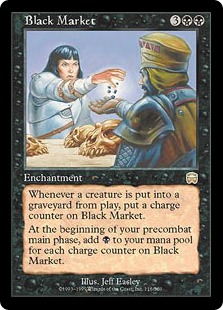
Black Market

With the removal of mana burn, some cards won and some lost. Black Market is a huge winner for multiplayer games. I try to work it into every EDH deck I can cram it into, where it's like some sort of ultra Gilded Lotus. With any amount of time, Black Market produces absurd amounts of mana. For example, in the last set of games I played, Black Market went over twenty counters in each game in about three turns. The real pain is finding out what to do with those crazy piles of mana.

$1.75

Brainstorm

We know this card is a boss, but what surprises me was how long it took people to string it together with fetchlands. We're not talking Onslaught here, but the classic ones like Flood Plain. By the time Bob Maher's Oath deck came around, people knew to string Brainstorm together with shuffle effects, but it wasn't immediately obvious. Even decks like CounterPost that ran Thawing Glaciers didn't couple it with Flood Plain. These days, Brainstorm gets coupled with as many shuffles as possible. It formed the backbone of blue in Vintage, to the point where it was restricted for being just too powerful. In Legacy, it is mostly constrained to CounterTop decks, but it's immensely popular, both in Ice Age and its reprint in MM.

$1.50

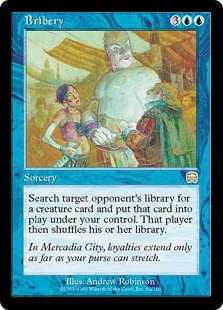
Bribery

Well let's let Blightsteel Colossus decide who she wants to work for, huh?

There was a day when Bribery was a chumpy little casual-only card. I remember bulking them out at fifty cents. What a terrible memory. Bribery is just about the most powerful blue card in EDH these days because it can turn into Blightsteel Colossus, Emrakul Lagasse, Iona or any other manner of monsters from opposing decks. As more good EDH creatures are printed, the better Bribery gets. Though it was printed again in 8th, it's still in high demand. It's especially good to know how much this card goes for because you might run into people like me who have no idea!

$7.00

Cave-In

My favorite Cave-In story involved someone in Legacy wishing for it with Burning Wish to kill the opponent, who was at 2 life. I don't think you can top that.

$1.00

Charisma

Charisma appeals to people who build decks full of pingers. They tack it on Prodigal Sorcerer and slam away. It doesn't sound especially powerful, but people like Living The Dream. You can make the most of their love of creature control by knowing the value of this weirdly-priced card.

$3.00

Collective Unconscious

Regal Force at a discount! I suppose this is for people who need eight of this effect for their elf decks? Anyway, worth knowing about. You didn't expect Urza Block level card draw, did you?

$1.00

Conspiracy

Now this is a card I can get behind! It used to be one of my favorite non-Trix Donate combos. Name Wall and give to the opponent! Now that Defenders took out that little trick, Conspiracy works for people who want to pack all sorts of monsters into a tribal deck. It's strictly casual, but people tend to enjoy the card.

$1.00

Crumbling Sanctuary

The two uses I remember for this card were in Tinker decks from Extended and 5-color. If you are unfamiliar, 5-color is a format with 250 card decks and no Highlander restrictions. Thus, you could go get your single Sanctuary against aggressive decks and quintuple your life total, removing it when you got control of the game. It works better in 5C than EDH because you can run all manner of redundant cards in 5C, so you don't run much of a risk from milling out.

$1.00

Dark Ritual

Though it has been extensively printed, people really like this copy. It's got Rebecca Guay art, after all! Foils are absurdly expensive.

$1.25

Delraich

Again, people casually love this card. It's easily summoned with Sengir Autocrat and it makes sense, thematically, with Suicide Black decks. It's also noteworthy for being a black creature with Trample.

$1.00

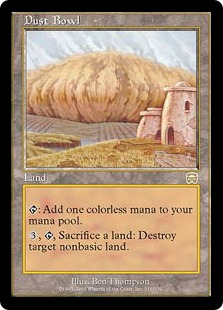
Obi-Wan's hut didn't know what was coming...

Dust Bowl

Dust Bowl is a very popular card for EDH and other formats where you can afford a few colorless lands. Since it fits in every EDH deck, it's got a bit of appeal. While blasting people every turn with Dust Bowl usually doesn't work in most formats, being able to tank a Maze of Ith or Gaea's Cradle can make you friends around the table. Turning every excess land drawn into Wasteland can be potent when used judiciously.

$2.50

Food Chain

Food Chain is the Great Green Hope. People want to make it a legit combo in Legacy, combining with Evoke monsters or Goblins. It's not amazing, but folks still want to stockpile them in hope. I wouldn't hold onto them on Legacy hopes. At this point, you can make an Evoke deck with them that will put out Emrakul on turn 3 or 4 without disruption, but that's simply too slow. Get rid of these guys if you have them.

$2.50

Fountain Watch

People just don't like getting their toys blown up... Fountain Watch steps a little further than Leonin Abunas, protecting your gear from meddlers. Fountain Watch has a surprising price tag, and it's gone up a bit as time goes by. It's popular for EDH decks full of toys, like Hanna and Sharuum decks.

$2.75

Gush

Recently unrestricted, Gush forms the backbone of several Vintage decks. It's still too good for Legacy, apparently, but it gets good play in Vintage. It's got a good price for a common and people need four copies, so they tend to move well.

$1.00

High Market

Again, we've got a colorless land that makes a little bit of utility. People like it to trigger their Academy Rector or get a little value from a guy that's gonna die anyway. It's largely outclassed by Miren, The Moaning Well, but if you need two of the effect and cannot afford Diamond Valley, the Market has you covered.

$2.00

Ivory Mask

If you really don't want to deal with Burn players, the Mask is great. It sees 1-of sideboard play in Legacy with decks packing Enlightened Tutor, but it's mainly for casual magic. You've got a friend with a pinger deck; use the Mask to stop them.

$1.25

This lets your opponent get a preview of the "still had these" moment postgame.

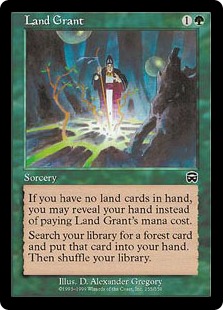
Land Grant

This was one of the first cards I fell in love with, mainly from 10-land Stompy. You'd use it to pull up a Forest in the land-thin deck. If you need a dual land or Rav-dual from your deck and cannot swing buying fetchlands, then Land Grant is a fine substitute in casual circles. It also sees play in 2-Land Belcher in Legacy, since it doesn't trigger Goblin Charbelcher and functionally acts as a land. It's an uncommon that holds a bit of value and a lot of casual attention; since you're unlikely to unload these to other traders, I suggest sending off four-packs to Ebay or buylists.

$1.25

Magistrate's Scepter

There are, I think, acceptable and unacceptable ways to take extra turns in casual Magic. For example, Time Walk is a little too good, and recurring it is inexusable. Time Stretch is pretty good on its own and every EDH deck with it has three or four ways to get the stupid thing back again. However, Magistrate's Scepter makes for an entirely fair extra turn now and then. People see it coming, but it's only when you tack on ways to put charge counters on that it gets out of hand. You can use Coretapper, Power Conduit, or Energy Chamber to get a deal on those extra turns. Use Coretapper with Skeleton Shard and take infinite turns with enough mana!

$3.50

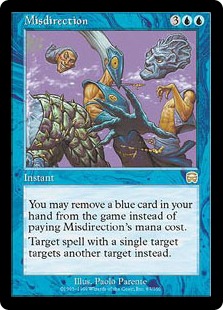
At least this Paulo Parente piece doesn't have inappropriate images... looking at you, Ekundu Cyclops.

Misdirection

This is the closest we get to Force of Will on a budget, and it's infrequently a good counter in Vintage. For example, it was played in Pitch Storm because it functioned to counter opposing Counterspells (by turning them on itself – trust me, it works). It also steals Ancestral Recall now and then. Unfortunately, Spell Pierce has changed the way blue decks function and Misdirection isn't as good as it once was, compared to the new Force Spike. That said, it's worth having a copy or two for both casual and Vintage decks. It trades briskly.

$8.00

On that note, we'll take a break until next week! We'll look at hits like Rishadan Port and look at what the most expensive foil in Masques is... it's probably not what you think!

Until next week,

Doug Linn

Shark Infested Waters

Stu Somers (Click to read more by Stu!)

Stu speaks from experience when he tells both new and experienced traders how to handle a difficult trade partner. Sometimes, you need to know when to nix a deal.

Cube SWOT: Multicolor

Are you a Quiet Speculation member?

If not, now is a perfect time to join up! Our powerful tools, breaking-news analysis, and exclusive Discord channel will make sure you stay up to date and ahead of the curve.

For a period of time after Shards of Alara block it became very tempting to include many multicolor cards because of all of the strong ones in modern sets. While it is important to have these cards represented in your cube, it's also important to understand their strengths and weaknesses as a whole to judge how they should be utilized. All that's gold does not glitter.

Strengths:

Blocks like Shards of Alara, Ravnica, and Invasion showed us how powerful multicolor cards can be and it's important to have them well-represented in a cube. This is because, on the whole, these multicolor cards offered extremely powerful effects for their cost. While good multicolor cards offer nearly high "bang for the buck", the best multicolor cards accentuate the strengths of the represented two-color pair. I'll illustrate this with a few examples.

Photobucket

When Odyssey was a legal block in standard Psychatog was one of the best parts of it, serving as a cornerstone card in the flagship control deck. Blue-black control decks also love "Dr. Teeth" because he fits the themes of control decks so well. As you may remember from prior SWOT articles, blue-black decks are best represented by control archetypes that seek to neutralize an opponent's threats and winning the game with a big finisher. Although Psychatog may appear to be a small creature, it fits these decks perfectly. This is because it helps the deck to stabilize in the early stages of the game and can easily be deployed in the late game with countermagic backup, similar to finishers like Frost Titan and Kokusho, the Evening Star.

While the two modern finishers are great in these decks, Psychatog is unique in its ability to be deployed as a finisher at an extremely cheap cost. Blue-black decks tend to be able to fuel Psychatog easily since they typically are able to draw cards easily, and can fill the graveyard with additional cards as fuel.

An excellent way to view how well Psychatog fits Dimir decks is to look at the other multicolor Atogs from Odyssey:

  • Lithatog
  • Phantatog
  • Sarcatog
  • Thaumatog

All of the other multicolor atogs aren't used in cubes for a good reason: they require devastating one's own board to use effectively and also require the player to significantly change the contents of the deck to enable them, but Psychatog requires no such effort - all that is required is to be playing Islands and Swamps!

Photobucket

A card like Ajani Vengeant, on the other hand, helps Boros by not only accentuating its strengths but also by covering the deck's weaknesses.

As Boros is a deck that seeks to win the game as quickly as possible, Ajani Vengeant contributes to this goal in several ways: its +1 ability disrupts an opponent's mana, making it so that the opponent has a harder time reaching the later stages of the game with an impending one-sided Armageddon threat, while its -2 ability helps the deck to clear opposing creatures that could block the Boros horde.

However, the more important role that Ajani Vengeant provides is that it provides inevitability, an extremely useful tool for aggressive decks in general. Aggressive decks such as Boros can have a difficult time dealing the last points of damage to an opponent and Ajani Vengeant helps to cover this weakness by being a continuous source of damage. After all, a stabilized opponent may have cleared the battlefield of creatures, but that opponent can't stop a Lightning Helix or two once Ajani Vengeant resolves!

Weaknesses:

Due to the fact that multicolor cards require at least two colors to play, their multicolor costs are certainly a drawback that can't be ignored when it comes to card evaluation, as they definitely need to be better than their mono-chromatic counterparts due to their difficult cost.

Like with Psychatog and Ajani Vengeant, I will use an example to illustrate:

Photobucket

Nath of the Gilt-Leaf is a card that ends up not making the cut in many black-green sections of cubes as Nath of the Gilt-Leaf is a card that doesn't compete very well with its competition from green's 5-mana creatures. For example, would you consider Nath to be better than these creatures?

  • Deranged Hermit
  • Kodama of the North Tree
  • Indrik Stomphowler
  • Genesis
  • Thornling
  • Acidic Slime

I certainly don't. Considering the fact that it is harder to cast Nath than almost all of these creatures, Nath loses on that front. But Nath is also suboptimal for the Golgari midrange decks in general. While the deck seeks to win through long-term advantages, the source is relatively fragile and takes a significant amount of time to achieve, making the card not worth running in Golgari decks or sections in general.

The only role that Nath could arguably effectively play is as a control hoser but that claim is quite questionable due to the paragraph above. Even if this point could be argued, is this effect of hosing an archetype really worth the slot in a black-green section? Would a card like Glissa the Traitor provide more of an overall useful effect for the archetype? Likely so.

Some multicolor cards like Ajani Vengeant are easy cards to splash in a deck and thus can be picked pretty highly, but due to the commitment that many multicolor cards require, multicolor cards tend to be later picks. This is especially evident in cubes with a lot of multicolor cards, including the "wedge" cycle of cards like Intet, the Dreamer and Doran, the Siege Tower. Due to the fact that these are relatively weak cards, they are not worth splashing in a deck like Selesnya (for Doran) and Gruul (Intet), making these cards essentially free late picks for decks like 4 and 5 color control.

Of course, the opposite can be said about the hybrid cards such as Murderous Redcap, which can be used in both colors and thus are relatively easy picks.  Cards with protection like Silver Knight and Great Sable Stag may make the fact that Murderous Redcap is both red and black a drawback, but for the most part this is a weakness that is overcome by the ease in playing them. Many times, these are included in multicolor sections due to the fact that these cards are optimal in their appropriate pair.

Opportunities and Threats – Usage of Multicolor in Cube:

In this section, I will briefly recap the optimal strategy of the 2-color pairs and how some of the guild's best cards support these archetypes (for example, while something like Boros control may exist, its optimal use is when Boros is used as an aggressive deck.)

Photobucket

Azorius (Blue-White) - Control

  • Wall of Denial
  • Grand Arbiter Augustin IV

Azorius seeks to play for a long game, neutralizing threats deployed in the early stages of the game and winning the game through a big finisher. While these two powerful cards don't provide much in terms of big finishers or cheap permanent removal, both cards supplement the themes in Azorius. Wall of Denial may not outright remove a creature in combat, but it does, as the flavor text says, gives an Azorius player time to stabilize, which is especially important against decks like Boros and Gruul which seek to win the game by dealing lots of damage with cheap creatures.

Grand Arbiter Augustin IV, on the other hand, helps the deck to be able to deploy its finishers quicker by enabling turns like a turn 5 Sun Titan or Frost Titan and simultaneously delaying the opponent and making it so that the opponent is disrupted by the mana addition clause. Both themes help Azorius decks (although moreso the cost reduction mechanic) and the overall effect provided by the creature's body makes it a very efficient card.

Due to the fact that both of these cards are creatures, they are not very synergistic with the deck's creature mass-removal effects, but the overall effect is strong enough to make their being creatures a non-prohibitive drawback.

Photobucket

Boros (White-Red) - Aggressive

  • Ajani Vengeant
  • Figure of Destiny

Boros decks seek to use its efficient creatures to deal as much damage in the early parts of the game and keep the opponent off-balance through disruptive cards like Molten Rain and Armageddon. Burn cards like Lightning Bolt and Burst Lightning supplement the deck's theme by acting as a finishing blow.

As Ajani Vengeant was discussed earlier, I won't elaborate further here. Figure of Destiny supports Boros decks by acting in a similar fashion to Ajani Vengeant - providing a useful effect in the early game but also by providing inevitability for the late game. Its ability to become an 8/8 flying and first strike may not happen that often, but its 4/4 ability certainly isn't difficult to achieve for the Boros deck and the efficient creature provides a useful reach element.

Photobucket

Orzhov (White-Black) - Aggressive

  • Vindicate
  • Desolation Angel

Orzhov aggro decks seek to deal lots of damage in the early stages of the game by attacking with efficient low-cost creatures and using disruptive elements in black (discard) and white (mass land-removal) to win the game.

Vindicate doesn't necessarily shore up any of the deck's weaknesses, it is an extremely useful card for all Orzhov decks due to its flexibility in being able to destroy permanents of all kinds, a trait shared by almost no other cards in cube, and is efficient enough for aggressive decks.

However, the same can't be said of Desolation Angel! Its 7-mana cost can be prohibitive, but its overall effect is extremely efficient.  Much like how a red section of a cube shouldn't overload on X-spells and it should certainly use a few if they are efficient enough, Desolation Angel is certainly efficient enough for the Orzhov midrange and control decks, as the angel provides not only a strong body to win the game, but a disruptive element that makes it very hard for an opponent to answer.

Photobucket

Selesnya (White-Green) - Aggressive AND Midrange

  • Kitchen Finks
  • Qasali Pridemage

Both of the represented cards in Selesnya are used because they are both extremely efficient creatures. Qasali Pridemage's closest monocolor counterpart is something like Viridian Zealot, a card that the Pridemage outclasses by a wide margin. It goes along well with both Selesnya aggro and midrange decks by providing a useful effect and providing a boost to evasive creatures (like Soltari Trooper in Selesnya aggro) or large midrange creatures (like Kodama of the North Tree in Selesnya midrange.)

On the other hand, Kitchen Finks is an incredibly efficient creature that provides 3 power for 3 mana with upsides of lifegain and persist. This is useful because these upsides help to shore up weaknesses in both Selesnya decks: card advantage (with persist) for Selesnya aggro and lifegain to combat opposing aggro decks for Selesnya midrange.

Photobucket

Dimir (Blue-Black) - Control

  • Psychatog
  • Shadowmage Infiltrator

Dimir control decks work similarly to Azorius control decks, winning the game through stabilization of threats and large finishing creatures. Much like with Ajani Vengeant, since Psychatog was already covered I won't do so here.

Shadowmage Infiltrator, on the other hand, is a very useful tool for Dimir decks since it helps to give strength to one of the deck's strengths: card advantage at a consistent rate as fear is a powerful evasive tool. It is important to note that even though blue already has similar creatures like Thieving Magpie and Lu Xun, Scholar General, Shadowmage Infiltrator is great in Dimir decks due to its reduced mana cost, making Finkel better than the blue creatures.

Photobucket

Izzet (Blue-Red) - Control

  • Prophetic Bolt
  • Fire/Ice

Izzet control decks are able to combine blue affinity for card advantage and late-game strength with red's removal suite (including mass-removal) to create an extremely powerful archetype.

Both of these cards support the goals of Izzet decks extremely well since both cards are able to utilize two vital strengths of Izzet: card advantage and burn. Most of the time these cards will be used to destroy a creature and to draw a card, but they certainly can be used to finish off an opponent if need be. However, their ability to destroy a creature with no card cost makes these cards extremely usefuls. Prophetic Bolt especially so since it  combines two powerful cards in the Izzet colors: Char/Psionic Blast (without the self-damage) and Impulse!

Photobucket

Simic (Blue-Green) - Midrange

  • Simic Sky Swallower
  • Mystic Snake

Simic midrange decks use blue's countermagic as more of a protective measure to protect efficient green creatures and also to serve as card advantage for the deck.

Mystic Snake supports the Simic midrange deck extremely effectively by aligning with the deck's basic game plan of using efficient creatures backed up by countermagic to win the game. While a 4 mana 2/2 certainly isn't efficient on the scale of creatures like Thrun, the Last Troll, its ability to protect other creatures (and you from generally problematic spells) while providing a body is a very useful tool that is synergistic with the Simic gameplan.

Simic Sky Swallower may be more at home in control decks, but much like Desolation Angel, the role is performed extremely efficiently since it provides a relatively efficient body while giving itself shroud, making it nearly impossible to deal with aside from mass removal.

Photobucket

Golgari (Black-Green) - Midrange

  • Pernicious Deed
  • Maelstrom Pulse

"The Rock," the classic midrange deck effectively uses green's midrange mana acceleration and card advantage to combine with black's card advantage mechanisms to win a game on the back of the deck's many 2-for-1s.

Pernicious Deed certainly aligns with this goal as it isn't uncommon for the mass-removal card to generate card advantage for the Golgari player while dealing with annoying aggro creatures and late game finishers alike (especially those with shroud like Simic Sky Swallower.) As Pernicious Deed is an extremely efficient card at providing mass removal, it certainly earned its reputation as one of the best multicolor cards of all time.

Maelstrom Pulse also goes well with the Golgari midrange deck by providing a flexible pinpoint removal spell. Despite the fact that it doesn't provide a 2-for-1 like many of the cards in Golgari decks, the flexibility and efficiency make it a very useful card.

Photobucket

Rakdos (Black-Red) - Aggressive

  • Terminate
  • Murderous Redcap

Efficient creatures in both black and red are given redundancy through the other color and this redundancy combines to create a very efficient aggressive deck that can win in a short manner.

While Terminate doesn't do anything particularly unique for the deck, it allows Rakdos to deal with creatures such as Grave Titan and Kokusho (black creatures with 5 or more toughness) which can be problematic for the deck to destroy, due to black's cards like Terror and red's difficulty in destroying creatures with 5 or more toughness. Much like with Vindicate, the overall efficiency of the card makes it very useful for the Rakdos deck.

Murderous Redcap, on the other hand, helps to provide inevitability through its persist (although nowhere on the scale of cards like Ajani Vengeant.) Its overall effect is very efficient but it is also especially nice since it can damage players, a trait shared by few other "enters the battlefield" creatures.

Photobucket

Gruul (Red-Green) - Aggressive

  • Bloodbraid Elf
  • Stormbind

Finally, Gruul decks work similarly to Rakdos decks by using its redundancy in green and red to win the game through a fast creature swarm backed up by disruptive elements in artifact, land, and creature destruction.

Bloodbraid Elf rightfully earned its reputation as an extremely powerful card in Jund decks by being a relatively solid creature in addition to giving the caster a free spell, and this transfers over to cube as well. Gruul decks typically utilize the cascade trigger well by having burn spells, like Char, or additional creatures, like Tarmogoyf, become free riders onto the 3/2 haste.

Stormbind is a card that I find tends to be underrated in cube but it is an extremely useful tool for Gruul aggro decks since it, like Ajani Goldmane, provides inevitability to win the game once the opponent is "in burn range." Discarding cards to deal the critical last points of burn to win the game is a powerful back-up plan of converting one resource (the hand) into a more valuable one for Gruul decks (extra damage and reach). By doing so at an efficient mana cost and using a drawback that is extremely friendly for Gruul decks, Stormbind is a very powerful card.

These examples highlight what essentially make for powerful multicolor cards - the ability to bolster strengths and cover weaknesses in the archetype in an extremely efficient and powerful manner. While some cards like Desolation Angel may not align with the optimal strategy, they certainly bring unique and very powerful effects to the table.

This concludes the multicolor SWOT analysis. While I have covered cards that may be apparent to seasoned cube veterans like Bloodbraid Elf, the overall lesson to be learned is to use a careful eye when examining multicolor cards. It can be very tempting to put together a lot of multicolor cards in a cube because they have splashy and powerful effects, but it is important to understand that this power comes at a cost and having too many multicolor cards can be detrimental to the overall health of a cube. Effectively mitigating these drawbacks is essential for a well-balanced cube and I hope that this article has given you some lessons in doing so.

In my final Cube SWOT article, I'll be discussing the role of artifacts in cube from a SWOT point of view and how to utilize them effectively in cube.

Thanks for reading!

@UsmanTheRad on Twitter.
idratherbecubing.wordpress.com - my cube blog with my various cube lists.
The Third Power – a cube podcast that Anthony Avitollo and I co-host.

Getting the Most Out of Your LGS

Are you a Quiet Speculation member?

If not, now is a perfect time to join up! Our powerful tools, breaking-news analysis, and exclusive Discord channel will make sure you stay up to date and ahead of the curve.

I’m not a Star Trek fan, in the least, but you can pick up some solid words of wisdom from time to time. Recently, I caught the following, while surfing through channels, on Star Trek: The Next Generation.

Anthwara: It is always good to understand one's adversary, in any negotiation.

Captain Jean-Luc Picard:I hope that by the end of this matter, you will no longer look on me as an adversary.

I chuckled, mostly because Star Trek is pretty cheesy, but this was a pretty valuable quote. Just because two people have different priorities, doesn’t mean they have to be adversaries. In fact, in drafting, we see this a lot. Although the player next to you is your possible opponent in the pod-finals, a successful drafter must cooperate with that player to maximize the quality of the deck. My articles are geared towards maximizing the financial benefits of drafting, many of which can be applied to most events. What is Draftcycling anyway? If it had reminder text, it might be: Discard this draft: Gain entry to another draft. Drafts, or any event really, are cycled in a number of ways. Prize support is the primary one, and certainly some tips on how to boost the portion of prize support that you are taking home, is to visit the Spike section. Secondary to this, but certainly not a small issue, is the other value you can extract from the event.

Your Local Gaming Store (LGS) is where all the magic happens. It’s where you can network with other gamers, participate in events, and most importantly, get your trade on. Once you’ve been attending the same LGS for a while, you probably already know most of the regulars and staff, and probably the owner. Many view the owner as the enemy, as a trader, when they actually should be one of your strongest allies. It is important to remember that the LGS owner is there to make a profit, and as long as you’re not negatively affecting his pocketbook, there’s likely to be a mutually beneficial relationship possible.

Knowing How the Store Operates
The more you know, well, the more you know! It seems simple enough, but there’s quite a bit of leverage you can gain by slowly weening information about how your LGS is run. Some things you should be able to answer about your LGS if you’ve been there any reasonable amount of time.

1) Does the owner hire people who are very knowledgeable about card values and hot decks? Or simply, cheaply hired Timmy’s who want to be paid to hang out at the store?

I’ve seen this go both ways, and it should simply swing the way you deal with the store. If the employees are sharp on pricing, and perhaps even know you as a value-trader, they may step-in if you’ve found a discrepancy in their “in the case” pricing, that you hope to exploit. The simple solution to this is, “I have a feeling these might spike up, and I want to pick up my set now.” And simply hold your purchase to 4 copies. This is less likely to raise a fuss, as compared to, “OMG, they have Stoneforge Mystic in the case for $5, I’ll take 20 of those please! HAHAHA.” This type of comment would probably result in a quick repricing, and all your value will disappear. In the other direction, if the employees are less knowledgeable on pricing, just simply keep quiet during your transaction. Any comment like, “You guys are clueless, I’m going to make a killing on these,” is a sure-fire way to not only make “Timmy the Employee” uncomfortable, but it will likely hurt your ability to find value at other times.

2) How does the owner set his pricing? Does he look to the Internet? Make his own personal valuations? Is it done by an employee?

It’s very important to understand how pricing is set at your LGS. In today’s age, it’s extremely likely the owner has some awful formula from an irrelevant source, that they use to set pricing. Sometimes, the owner is actually pretty sharp, and on top of his game. In either case, it shouldn’t be too hard to find out what the situation is, either by befriending an employee, or simply asking the owner, “How do you go about setting your retail pricing? Do you use an online site?” Some LGS store owners use a site like magictraders.org and set their buy/sell prices on some set percentages off that price guide. What they probably don’t realize, is these prices are generated based off of average E-Bay sales over a period of time, and if a card suddenly spikes, it may take some time for the site to reflect that change. This is my opportunity to pick up cards in the case, before they are repriced. The instant I saw the Tezzeret deck from the Pro-Tour, I raced to my LGS, and purchased 4 copies from the owner directly. I used my, “I want to pick up my set before these go up.” line, and it is true, but also misleading, as I already owned two copies. If the owner feels he’s being abused, they’ll scrutinize every purchase you make, and offer you less value on cards you want to sell or trade to the store.

3) What are the biggest markup items? What are the loss-leaders?

In business, every successful retail store has loss leaders. Loss leaders are products that are priced so low (often at a loss to the owner) that people will come to the store just for that product. The store owner hopes to sell you additional products, making up for that loss. Subway’s $5 foot-long is an example of this, while the store owner makes next to nothing on the sandwich, he’s making almost pure profit on the soda and chips. Most of your LGS aren’t going to have many products especially desirable to you in the form of loss leaders, but keep your eye open for when they do. I’ve seen stores offer price breaks on pre-ordering sealed product, that rival the best online sites. By supporting your LGS, for these types of purchases, you maintain good rapport with the owner. While unwarranted, I’ve witnessed owners getting offended when regular customers gloat about good deals they found online. Even if you did, rubbing this in the face of the owner, is not a good idea. T he biggest loss leader for store owners is their events, where much of the revenue is turned back out in prize support or limited product. This is how Draftcycling came to be, and why it's possible to "go infinite".
4) How often is pricing adjusted on singles?

This ties in with #2, but gives you an idea of what type of cycle the store operates on. It’s always a good idea to take a look at the case on Thursday, if pricing is always adjusted for FNM on Friday. As much as your LGS owner loves Magic, its likely that the reality of being a small business owner has prevented him from being on top of all the buzz that is constantly changing.

5) How is prize support awarded, and what do I do with it?

After a quick Twitter poll (find me: @torerotutor), it appears that prizes run the gamut of packs, store credit, and in some rare cases, cash. If you’re trying to Draftcycle, store credit, is the best option for you, and if you have multiple LGS options to choose from for your events, the ones that offer store credit will get you the farthest. They tend to have the strongest prize support, because they anticipate people using that credit to buy highly marked up products. In reality, you’re simply funding more events, and building up your credit at the store. Ultimately, you may use excess credit to leverage that credit into cash, either by picking up entries for friends, or simply buying under-priced cards from the case. Packs, as prize support, are a bit tricky to understand. In my experience, packs are best used in trading, AFTER VALUES HAVE BEEN DETERMINED. Maybe you and your trade partner are about $4 off of each other in value. You can simply offer up one of your prize packs, as the remaining $4, as that’s what they likely sell for at the store. In reality, cracking those packs is rarely worth the $4 in trade value, and you’re reducing the risk by trading into known cards. Sure, you may be annoyed when that guy cracks a foil Tezzeret in the pack you traded him, but those are the breaks. Last week I traded a pack, and unfortunately for that guy, he got a Semblance Anvil. Thanks for the $4.

Form a mutual respect with your LGS owner
This is a grey area, that not everyone will have success with. Some of it may be a part of age difference or even appearance, as we can’t control any prejudices our LGS owner may harbor. However, the owner must understand that you don’t want to be gouged on pricing. If the owner is around, I’ll attempt to make my purchases from him directly. Show him my face, let him see I’m spending cash (or store credit) and not just free-rolling events. I ask him about his business, and build a rapport that I know has personally benefited me many times.

Part of this, is you need to throw your LGS owner a few of your trades. There are a few reasons to do this. Primarily, you may need to cash out some of your trade-ups into funds. Your LGS owner is a good way to do this, if you need to do it promptly. Believe it or not, your ability to negotiate with them will greatly depend on how much they respect you. If you are constantly giving him attitude, then he will try and low-ball you so he can feel like he’s gotten some value out of you using his tables as a place of business. If you treat the owner and the store with respect, you’ll be in a much better place to shoot back with, “Actually, I was thinking I need something like $X for those.” Second, you may need to ship the store some cards to fund a draft, if you don’t have the cash or store credit to participate. More than once, I’ve handed him cards that I know total up to about $3 short of the draft cost, and said, “Anyway I can trade these in for a draft?” The answer is yes, more often than you’d think. While those cards are probably worth the draft anyway, it takes this fine maneuvering to let the owner give you that full value for them. Remember, the owner must love gaming too, or he wouldn’t have opened the store. It’s also highly likely they get a small bit of satisfaction from knowing how many people enjoy the events. As long as you’re on good terms with the owner, trades like this are far easier to tackle.

I don’t care what they say, I come here, don’t spend a dime, and make all my value on trades!

This is a fools error. Not only do you miss out on the additional value you can squeeze from your LGS, but there will come a time where the LGS owner decides he doesn’t need your business, since you aren’t giving him any. Part of this also falls into general “douchey” trade practices, that likely trickle down the rumor mill to the owners ears. It reflects poorly on his store when young kids go home and complain about being ripped off in a trade, or something of the like. The owner knows people trade, but don’t be “that guy”. You never want the owner to be able to describe you as “That guy who rips people off in trades.” or “That guy who sits here and mooches my internet to MODO.” As long as you make the effort to be the type of customer that is positive for the store, the store owner will make the effort to make the store beneficial to you.

Avatar photo

Chad Havas

Chad has been with Quiet Speculation since January of 2011. He uses price speculation to cover all his costs to keep playing. Follow his journey from format to format and be prepared to make moves at the right times.

View More By Chad Havas

Posted in Finance, Free Finance2 Comments on Getting the Most Out of Your LGS

Have you joined the Quiet Speculation Discord?

If you haven't, you're leaving value on the table! Join our community of experts, enthusiasts, entertainers, and educators and enjoy exclusive podcasts, questions asked and answered, trades, sales, and everything else Discord has to offer.

Want to create content with Quiet Speculation?

All you need to succeed is a passion for Magic: The Gathering, and the ability to write coherently. Share your knowledge of MTG and how you leverage it to win games, get value from your cards – or even turn a profit.

Magic: the Filibustering

Are you a Quiet Speculation member?

If not, now is a perfect time to join up! Our powerful tools, breaking-news analysis, and exclusive Discord channel will make sure you stay up to date and ahead of the curve.

With Pro Tour: Paris in the books and the Washington, D.C. Open coming up, Standard is currently in major flux, while Legacy seems to have stabilized somewhat from the last two Opens. Let's take this one format at a time.

Caw-Blade is currently sitting pretty as the best deck in Standard thanks to the introduction of Sword of Feast and Famine, but Kuldotha Red is capable of running it over before giving it a chance to do anything. Granted, Kuldotha Red can pretty much run over anything that isn't playing Forked Bolt or Arc Trail, so that's not too much of a knock against Caw-Blade. Tezzeret, Agent of Bolas has made appearances in multiple forms now, but the knowledge that it's a real deck and people should be playing artifact hate probably weakens it somewhat. Valakut didn't do nearly as well in Paris as it did in Indianapolis, and its presence in the metagame is likely to drop considerably in the near term.

On top of that, people are proposing all sorts of wacky things to attack this format from new angles, or to attack certain decks directly.
Ari Lax's stupid Red deck has been going around the internet a bit as of this writing:

Untitled Deck

dudes

4 Goblin Guide
4 Kargan Dragonlord

burn

4 Searing Blaze
4 Lightning Bolt
4 Staggershock
4 Burst Lightning
3 Koth of the Hammer
2 Elemental Appeal
3 Arc Trail
4 Forked Bolt

land

24 Mountain

This deck, while better than most people will give it credit for (typical - mono Red never gets enough credit), can't possibly beat Leyline of Sanctity (which is played heavily thanks to Valakut, the Molten Pinnacle) or Kor Firewalker (which isn't being played at all). The splash damage from peoples' sideboarding plans renders this thing useless unless you come up with a better plan. If you're going to be on Elemental Appeal, you should probably be on Zektar Shrine Expedition and a full 8 red fetchlands first. That said, maxing out on both instead of some of the targeted burn is probably a solid plan if you insist on playing this deck, since at least those actually serve a purpose post-Leyline. I like a good Red deck, but this isn't it. I think Brozek's version of Kuldotha Red is the Red deck I'd want to be on, and that's one of the decks I may actually play this weekend.

Ari Lax's White Weenie:

Untitled Deck

creatures

4 Student of Warfare
4 Steppe Lynx
4 Stoneforge Mystic
4 Squadron Hawk
3 Mirran Crusader

equipment

1 Adventuring Gear
1 Sword of Body and Mind
1 Sword of Feast and Famine

spells

3 Spell Pierce
3 Mana Leak
3 Jace, the Mind Sculptor
4 Preordain

lands

4 Celestial Colonnade
4 Seachrome Coast
3 Glacial Fortress
4 Arid Mesa
2 Marsh Flats
1 Misty Rainforest
1 Evolving Wilds
4 Plains
2 Island

This deck is a variation on Caw-Blade, only with the goal of beating the mirror by means of added aggression in place of the sweepers, Gideons, and some of the countermagic from the stock list. The list is admittedly rough in Lax's estimation, and I agree. It's definitely an intriguing possibility - I've had a discussion on Twitter about the proper number of counterspells in this deck. Trading in counterspells for early action is similar to trading counterspells for sweepers in that it gains value against Aggro while losing it against Combo/Ramp; but the early action is, at least in theory, favorable against other Control decks. The problem here is that Steppe Lynx isn't a lot of help against something like Kuldotha Red, and neither is Mirran Crusader. Mirran Crusader gains a lot of value against Vampires, but Lynx doesn't help a lot. If I were to approach things from this angle, I'd start with Naoki Nakada's deck:

Untitled Deck

land

4 Celestial Colonnade
4 Glacial Fortress
4 Island
1 Marsh Flats
5 Plains
4 Seachrome Coast
4 Tectonic Edge

creatures

4 Squadron Hawk
2 Stoneforge Mystic
2 Sun Titan

spells

4 Day of Judgment
1 Deprive
2 Elspeth Tirel
2 Gideon Jura
1 Into the Roil
3 Jace, the Mind Sculptor
2 Journey to Nowhere
4 Preordain
2 Spreading Seas
1 Sword of Body and Mind
1 Sword of Feast and Famine
2 Tumble Magnet
1 Venser, the Sojourner

sideboard

2 Condemn
1 Kor Sanctifiers
3 Leyline of Sanctity
4 Luminarch Ascension
1 Ratchet Bomb
2 Revoke Existence
2 Spreading Seas

Journey to Nowhere and Into the Roil should probably be cut at this point, and can be replaced with more Stoneforges or Mana Leaks. The “no-countermagic” gambit has been publicized now, and if you try to shave too low on countermagic people will just dare you to cast it. The alternative is cutting the countermagic altogether and play it as a pure tap-out deck, much like Super Friends last year, with Squadron Hawks and Stoneforges as replacements for the missing Planeswalkers.
The best part of this approach is you can board in a large number of counterspells and catch people by surprise, then force them to play chicken game 3. Sideboards that alter the strategy of the deck are better than sideboards that attack individual cards. More on this later, when I start talking about Legacy.

I personally find Venser greedy and wouldn't run it. A third Gideon would give you a lot more upside against aggro, more counterspells would give you a better chance at taking game 1 against ramp decks.

A word about this sideboard: Luminarch Ascension is pretty much the worst card you can be playing for the Control mirror these days. It might work out against Tezzeret, but when control decks are playing 8 2-drops, you're not likely to get 4 turns in a row undamaged, especially not when Leonin Relic-Warder exists. People are currently on Divine Offering, but I'm of the opinion that the hate bear is much better choice right now.

If you're on Caw-Blade of any form, Sun Titan is pretty much the best top-end card at this point, and you should absolutely be playing it in your 75: it brings back Ratchet Bomb, Tectonic Edge, fetchlands, Stoneforge Mystic, Squadron Hawk, Spreading Seas, Swords. That's basically everything that matters except the Planeswalkers. Let's break it down by matchup:

Against anything, you can get back a Stoneforge Mystic or Squadron Hawk that's been killed to set off its trigger. You can actually put back your last 2 Hawks on a Brainstorm and play Titan as your Ancestral Recall, instead of putting back one Hawk and playing the other. It doesn't come up often, but when it does there's not much left to do. Of course, getting back Mystic to get another piece of equipment means you've got to be running the extra equipment.

In the mirror, they're likely bringing in Divine Offering, Kor Sanctifiers, or both. Being able to get back your Sword after it's blown up is extremely good and can easily swing a game. Sun Titan gives you the advantage in the Tectonic Edge versus Celestial Colonnade battle.

Against decks like Tezzeret, you can bring back Relic-Warder if you've got him, Swords if they've been blown up, or a dead Mystic to get another equipment.

Against ramp, bringing back a [card="Acidic Slime"]Slimed[/card] Seas or Tectonic Edges is critical at keeping [card="Valakut, the Molten Pinnacle"]Valakut[/card] from killing you.

Against Aggro, bringing back Ratchet Bomb is a nail in the coffin.

Let's talk about Stoneforge Mystic for a bit. The precise list of targets for Mystic are not static. Sword of Feast and Famine is a given. There's no way around that. After that, the rest depends on your deck rather than some mystical list like this: “First, Sword of Feast and Famine. Second, Sword of Body and Mind. Third, Sylvok Lifestaff.”

Don't be that guy. The only constant is Sword of Feast and Famine. If your deck is soft to Aggro because your only sweeper is Day of Judgment, you'll want Sylvok Lifestaff. If your deck is strong against Aggro, you'll want more of the big Swords. If you're hybridizing the deck with Quest for the Holy Relic, you want Argentum Armor. If you're planning on playing against the mirror, you actually want a second Sword of Feast and Famine (at least post-board) since people will be packing artifact removal now. I personally would rather play the second Feast and Famine over the first Body and Mind at this point, but the mill effect is actually capable of single-handedly beating Valakut decks. One of my losses at Indy came from not having any Forests to get off my fetchland, followed by my opponent using a Tectonic Edge to take away my Raging Ravine, leaving me with no sources of Green on my battlefield, in my hand, or in my graveyard.

Shaheen Soorani: Caw-Blade Polymorph

Untitled Deck

creatures

4 Squadron Hawk
1 Emrakul, the Aeons Torn
1 Iona, Shield of Emeria

enchantments

2 Journey to Nowhere
4 Spreading Seas

instants

4 Mana Leak
1 Spell Pierce

planeswalkers

2 Elspeth Tirel
2 Gideon Jura
4 Jace, the Mind Sculptor

sorceries

2 Day of Judgment
3 Mass Polymorph
4 Preordain
2 See Beyond

lands

4 Island
3 Plains
3 Celestial Colonnade
4 Glacial Fortress
4 Khalni Garden
1 Marsh Flats
1 Scalding Tarn
4 Seachrome Coast

sideboard

3 Ratchet Bomb
4 Leyline of Sanctity
3 Luminarch Ascension
2 Flashfreeze
2 Spell Pierce
1 Day of Judgment

This takes the opposite approach from Ari Lax's build, opting to trade the Tectonic Edges for Khalni Gardens, and deciding to combo-kill with Mass Polymorph. On paper, the loss of sweepers makes it notably worse against Aggro, and the loss of Tectonic Edge forces a jump to the full set of Spreading Seas. I haven't had the chance to test with or against this deck, but it's definitely worth keeping in mind that you can just get blown out by Iona. I think I'd rather have Sun Titan at 6 instead of something which can be hit by Spell Pierce, but Mass Polymorph does effectively end the game immediately.

With all this talk, I had better put up a list of my own. This is the 75 I've got sleeved up, but by Saturday (I'm writing this on Tuesday) it's likely I'll be at least 5 cards off.

Untitled Deck

one-drops

4 Preordain

two-drops

4 Stoneforge Mystic
4 Squadron Hawk
3 Spreading Seas
2 Ratchet Bomb
3 Mana Leak
1 Deprive

three-drops

2 Sword of Feast and Famine

four-drops

4 Day of Judgment
3 Jace, the Mind Sculptor

five-and-six

2 Gideon Jura
2 Sun Titan

lands

4 Island
5 Plains
4 Tectonic Edge
1 Arid Mesa
4 Glacial Fortress
4 Seachrome Coast
4 Celestial Colonnade

sideboard

3 Spell Pierce
2 Leonin Relic-Warder
1 Ratchet Bomb
1 Spreading Seas
2 Baneslayer Angel
2 Elspeth Tirel
3 Leyline of Sanctity
1 Secret Tech

The sideboard definitely isn't there yet, and I will be very happy if I can play something other than Leyline against Valakut (Flashfreeze is a possibility, though Summoning Trap is a problem). As you can see, I've tried to split the difference between Stark's list and Nakada's by running 4 counterspells- enough to draw them reasonably often, but not so many that I end up just sitting on them and hoping to draw action.

The singleton Deprive is a nod to the fact that I prefer hard counters to Mana Leak, but drawing double Deprive is pretty much the worst thing possible.

The deck is designed to gain added value against Aggro (via additional sweepers and more Gideons) and Ramp (by running a full set of Edges and 3 Seas, while trusting my sweepers and Gideon to deal with Titan and Avenger) so that the equipment/creature layout can be brought to pointed squarely at the mirror. This build displays the full 4 Stoneforges to maximize my chances of landing one on turn 2, a matched pair of Swords in case one gets blown up, Sun Titan to bring back the best stuff in the mirror, and Gideon to protect against the Sword's ability. The truth is that the Valakut and Tezzeret matchups get weaker with the loss of some of the countermagic. The sideboard can be set up to solve that problem, but I'm not really satisfied with this sideboard, even with the Secret Tech. For one thing, I probably have too much Aggro hate, and it's likely I should be boarding in some Divine Offerings as well. (Unfortunately, I think too many people are on Sun Titan for that to be correct, but it is solid against Tezzeret.) Tumble Magnet is a notable exclusion, and that is quite possibly incorrect. If I can bank on a drop in Kuldotha Red play, the Ratchet Bombs would all go to the sideboard, letting me Tumble some Primeval Titans.

I've seen in several places a claim that Elves is an awful matchup for Caw-Blade. This is likely true - it can outswarm us, they don't really care about Sword of Feast and Famine, and Eldrazi Monument coming down ahead of Day of Judgment is game over. Luckily, Caw-Blade has access to all sorts of artifact hate, as well as Ratchet Bomb, so if you're expecting Elves rather than the mirror you can make it a favorable matchup with some minor tweaks. Leonin Relic-Warder is a perfectly maindeckable card, if it comes to that, and also has relevance against Tezzeret decks and the mirror. He can even nullify random Adventuring Gear against Boros, though the effect of that will likely be short-lived. Kuldotha Red can be vulnerable to a well-timed 2/2 that blows up a Mox Opal or a Chimeric Mass, and Glint Hawk Idol decks aren't playing very many answers to the Relic-Warder. I'm actually looking to find a way to fit in Relic-Warder anyway, since he answers the Tumble Magnet people are now leaning on to stop Sworded Hawks from hitting. Phyrexian Revoker can fill a similar role, but he's awkward in the mirror since they're doing the same thing you are, but it does stop Elvish Archdruid and Ezuri, Renegade Leader.

People are bringing up Pyromancer Ascension again. It is the worst possible time to do so, since the deck hasn't actually gained anything, and the artifact hate people are now starting to play is going to cause splash damage to Pyromancer. Avoid.

It might actually be time to take Caw-Blade and cut the Preordains and Jaces for Fauna Shaman and Vengevine. This would look sort of like Kibler's Caw-Vine deck from GP:ATL, with Mirran Crusader in the 3-slot where Knight of the Reliquary was, and would look to play the various hate bears: Relic-Warder, Phyrexian Revoker, a singleton Memnite to bring back Vengevine, Kor Firewalker out of the board, Leonin Arbiter (which is far too awkward to play a full set of in a Hawk/Mystic deck), and the like.

Alternatively, the deck could switch gears and become a full-fledged Aggro deck, aiming for consistency rather than the crazy starts of Quest-centric White Weenie decks. Leonin Skyhunter was good enough to see Constructed play the last time around, and can certainly carry a Sword. Mirran Crusader's double strike is nuts with equipment in general. This build would probably want to play 1 of each Sword and possibly other stuff- Sword of Vengeance is a pretty straightforward piece of face-smashery, Bonehoard is a fetchable Lhurgoyf, and if the manabase is bland, Strata Scythe makes anything massive. In fact, if your deck is all Plains, you probably want Scythe over Sword of Vengeance.

That's enough about Standard.

With the banning of Survival, the new metagame is once again “Merfolk, Goblins, Zoo, Counterbalance”, which is the same boring format it was before it got all interesting. I'm hoping that things get shaken up, but I'm convinced that it's not feasible to try to run a pure-cantrip version of ANT any longer. Grim Tutor is needed just to try to hit Krosan Grip for Counterbalance post-board, and while the deck was good enough to put me in the top 16 of Nashville, I couldn't do any better than 4-4 over the side event and main event in Indy. The awkward draws are more awkward now that you can't just chain cantrips all day. You really want that turn 3 win against Goblins or Zoo, else your life total becomes too low to reasonably Ad Nauseam for the win. As such, the deck either has to be built around Ill-Gotten Gains or Doomsday. The Shelldock Isle-Emrakul setup doesn't exactly play well with Ad Nauseam or the Dark Confidants that you sideboard, so Doomsday is a bit awkward.

The list I played in Nashville ran a transformational sideboard that I shouldn't have. It wasn't needed against Survival or Zoo, and it doesn't work properly against Merfolk or Dreadstill. As such, I went 1-5 in games where I brought in the sideboard. The fact that it was a suboptimal list of 15 creatures didn't help matters any.

The new metagame is one where the transformational board might actually work again. Consider playing against an Ad Nauseam deck which maindecks Dark Confidant over some of the cantrips, then boards in 4 Phyrexian Negator, 4 Tarmogoyf, 4 Sea Drake, 3 Vendilion Clique. That's a scary list of 19 creatures to be facing down when you've taken out your creature removal in favor of Stifles or Duress, and 19 creatures, 4 of which are [card Dark Confidant]Bobs[/card], plus 8 cantrips and 4 Infernal Tutors (which can tutor for a second copy of any creature in hand) means the deck will keep them coming at a rapid clip. A Dark Ritual can set up a [card="Dark Confidant"]Bob[/card] or Negator on turn one, a Lotus Petal or Chrome Mox can set up a Bob or Tarmogoyf turn one, or they can set up a Sea Drake on turn 2.

-4 Lion's Eye Diamond
-4 Cabal Ritual
-1 Ad Nauseam
-2 Tendrils of Agony
-1 Ill-Gotten Gains
-3 Duress/Thoughtseize (remember, Vendilion Clique comes in), or perhaps some Infernal Tutors
+15 hard-hitting face-beaters

That seems like it'd be a pretty savage beating to a Counterbalance deck that boarded out its Firespouts/Moats/[card="Humility"]Humilities[/card], doesn't it? The question is whether it's worth it against Merfolk and their Umezawa's Jittes, and that's a difficult question to answer. Obviously trading Ponder for Bob makes the Zoo and Goblins matchup a tiny percentage worse, but making Counterbalance winnable at all post-board is worth it. Xantid Swarm just isn't good enough there (though it is amazing against Merfolk).

On a related note, the Legacy metagame is ripe for a comeback or two. Let's look at the top 8 of Indy:

Ben Weinberg, RUG Counter-Top: 2 Trinket Mages that can get 1 Relic of Progenitus out of the board.
Michael Bomholt, Forgemaster Combo: 0
Brian Fisher, Junk and Taxes: 2 Extirpate and 1 Bojuka Bog in his sideboard. 4 Knight of the Reliquary to get the Bog.
Josh Guibalt, Counter-Top Thopter: 1 Tormod's Crypt sideboard, 1 Wheel of Sun and Moon sideboard. Both fetchable by 4 Enlightened Tutor that detract from his ability to fetch his combo.
Alex Bertoncini, Merfolk: 0
Josh Rayden, Show and Tell: 0
Drew Levin, NO Top: 0
Phil Jones, Goblins: 3 Leyline of the Void

If you want to play Dredge or Reanimator, now's the time. The format is extremely soft to graveyard abuse, and it's a great deal more resilient to Counterbalance than Ad Nauseam is.

Moat and Ensnaring Bridge both pose problems. Iona, Shield of Emeria is the obvious out to the Moat, but Bridge is an issue for Reanimator. Dredge can get around it by letting Iona lock them out of playing their cards then swinging for lethal with the small dudes, but that's awkward if they have removal in multiple colors. I wouldn't be shocked to see Dredge decks setting up Necrotic Ooze wins, and Buried Alive plus any reanimation spell is an instant win. Intuition can get there, but requires a discard outlet. Careful Study and Putrid Imp are already in the deck, so it's possible that the deck can achieve a great deal of consistency. This, of course, sacrifices speed, as Entomb plus any mana acceleration allows for a turn one Reanimate or Exhume. I think Reanimator decks are probably better off focusing on the turn one or two fatty rather than the Ooze kill, but Dredge should strongly consider fitting in the full trio of Necrotic Ooze, Triskelion, and Phyrexian Devourer.

Other than that interesting tidbit, I don't find Legacy all that interesting at the moment. I feel as though the Counterbalance/AEther Vial setup is stifling the format from both directions at the same time. I really think the full set of Mystical Tutor, Survival of the Fittest, Counterbalance/Sensei's Divining Top (pick one), and AEther Vial should be banned or legalized as a single uniform block. The Mystical ban combined with the Vengevine and Fauna Shaman printings to make Survival the top deck. The Survival ban let Counterbalance be a factor again, which brought Vial to the forefront. The Mystical ban and the resurgence of Vial Merfolk and Counterbalance means combo isn't really viable.

The cost of Grim Tutor and Imperial Recruiter means that ANT and Painter-Stone are only playable by those willing to put big bucks down on decks that aren't actually putting up numbers right now, so the decks aren't getting tuned by the Magic hive mind. I suspect the price of Moat is a massive part of the reason why Red and Green Counterbalance decks are seeing more play than White. It's not just a cost issue - it's a card availability issue. SCG themselves are out of Grim Tutors. They only have 3 Imperial Recruiters in stock. Even if I wanted to play ANT in SCG DC, there's a good chance that no matter what I'd be willing to pay, I wouldn't be able to get Grim Tutors. I couldn't get a full set of Recruiters for Painter-Stone. This is a problem for Legacy, even moreso than the skyrocketing cost of dual lands. Moat and The Tabernacle at Pendrell Vale can't be reprinted with the new strict Reserve list, but the Portal 3 Kingdoms and Starter 1999 cards aren't actually limited by the Reserve List, and Wizards needs to find a way to reprint them for the health of the format - or relegate Legacy to the same backwater that Vintage is. If Legacy continues to grow in popularity, widespread staples such as dual lands will begin to put a stranglehold on card availability. Legacy players are actually fortunate that all the really rare and expensive cards turned out to be niche role players. Had something widely-played, such as Swords to Plowshares, or the centerpiece to a deck, such as Natural Order, appeared only in Portal 3 Kingdoms or Starter 1999, it's unlikely that the format would have survived to this point.

Joshua Justice

Say Goodbye to your Bitterblossoms

Are you a Quiet Speculation member?

If not, now is a perfect time to join up! Our powerful tools, breaking-news analysis, and exclusive Discord channel will make sure you stay up to date and ahead of the curve.

The Revenue Review – Say Goodbye to your Bitterblossoms

I’m sorry, Bitterblossom, but I’m afraid it doesn’t look good. The market is saturated and demand is waning. Your time has come. But you’re not alone, your friends Cryptic Command and Figure of Destiny are coming too. Even poor old Leaf-Crowned Elder is coming along.

In you haven’t surmised by now, the time has come to sell off your Lorwyn Block cards, otherwise known as Extended staples. The reasoning is simple: Demand has peaked, and if you wait much longer you’re going to lose out on money holding onto these cards past their expiration date. For reference, look at this BlackLotusProject graph for Thoughtseize and this one for Reflecting Pool. You'll notice that both card's prices peaked around the end of January. The trend continues if you begin to look at other popular cards from the block. From this we can conclude that demand, and in turn, prices, for these Lorwyn block staples are falling off, and that means it's time for us to make our move.

I understand the format doesn’t rotate for another six months, but the Extended season is rapidly coming to a close, and your opportunity to sell along with it. We’ve already had the only Extended U.S. Grand Prix of the season, and players across the country are running out of Extended PTQs to compete in. Truthfully, we're actually a little late to the party, since demand seems to have peaked (on Ebay, at least) a few weeks ago. But buy prices for most cards are likely still the same, so you need to capitalize on this while you can.

So, unless you plan on holding onto your Lorwyn block cards for other reasons, it’s time to clean out your collection (including your boxes for extras) and move the cards. As prices on Ebay are down as whole for the block, I suggest pitching the cards to dealers while you can. This saves you some time and is particularly helpful if you’re trying to move a lot of uncommons and lower-priced rares. With the trend of lower prices on Ebay, you aren’t even eating much in profit here to save a lot of your time and energy.

I’ve sold a bit of my Lorwyn stock in the last week (after I noticed the downward trend on BlackLotusProject) and I plan on getting rid of the rest to a dealer right before I win the PTQ in Oklahoma this Saturday. If you happen to live in the region and are traveling to the tournament, find me and say hello! I’ll be the one casting Emrakuls on Turn 3.

* Quick aside regarding selling to dealers

Something very helpful to do when you’re heading to a tournament with the intentions of selling is communicating with the dealer beforehand. At the PTQs in this area, only one dealer shows up, so I don’t have to worry about comparing prices.

I’m working to contact the dealer before the tournament Saturday and send him a list of the cards I’m looking to liquidate. This allows us to agree to a price beforehand, which has a few benefits. It allows me to sell my cards off first thing in the morning and then focus solely on my plans to cast Emrakul, the Aeons Torn. For the dealer, it allows him to pre-plan his day and what cards he’s going to have in stock. He also is able to get the cards right away, and turn around and sell them to players looking to complete their decks for the tournament.

*End aside

Since most of you reading this are savvy Magic investors, you already know the big cards to unload. Cryptic Command, Sunken Ruins, Kitchen Finks, Thoughtseize, and so on. I’m not going to focus on the obvious ones today. Instead, I’m going to break down each of the four sets in Lorwyn Block and find some of the under-the-radar gems from each that you should consider selling.

While not all of these cards are popular because of the Extended season, it’s likely that most of them will experience some sort of dropoff as a result of rotation. I’m going to use Channel Fireball buy prices, though if you are selling to an online dealer you’re best off using Chris McNutt’s incredible chart work with buylists, found here. You can also still get premium on many of these cards on Ebay, just be aware that prices on nearly all these cards are trending down. A lot of the cards I’m going to look at sell for rather low prices to dealers, but it’s still more than they will sell for in a year. And all these small numbers add up very quickly.

With that, let’s begin.

Lorwyn

Sower of Temptation

You can get $2.50 for these right now, even though its play has been marginal at best. While the card does have Legacy applications, you’re going to be able to reacquire them after rotation for rather cheap, so I suggest making $2.50 a pop off of these now.

Tribal lands

Cards like Auntie's Hovel and Gilt-Leaf Palace are cool and all, but their price is being bolstered by the fact that they are in season. If you have some of these saved up, you can cash them in at least $.50 a pop and make some cash.

Hideaway lands

Windbrisk Heights and Mosswort Bridge form the backbone of the GW Trap deck that picked up a number of PTQ wins. You can cash them in now for $.50 to a dollar each. If you don’t have any personal use for them, it’s best to pitch them since I don’t see them being broken in Legacy any time soon.

Vivid lands

It’s doubtful these are going to see play anywhere but the kitchen table in the future, so take your pile of Vivid Creeks and so forth and turn them into a few dollars.

Cloudthresher

This anti-Fae card has no applications outside of Extended, so there’s no downside to pulling these out and unloading them.

Doran, the Siege Tower

While this card is still played as an EDH general, you will able to buy a playset a year from now for the same price as one or two today. Get rid of them and pick them up cheap later if you really need them.

Elf Cards

This probably has a lot more to do with the fact that Elves are insanely popular with casual players, but cards like Imperious Perfect can fetch you a few dollars apiece. I’m not sure if their price is going to be much affected by rotation, but there’s no reason not to get rid of them now anyway.

Scion of Oona

These aren’t even played in a lot of Faerie decks anyway, so feel free to pick up $2 apiece for these.

Foil watch

More Elf cards

Imperious Perfect and Elvish Promenade are best non-rare Elf cards to look for in foil.

Mulldrifter

$.50 each for a common.

Oblivion Ring

These foils can fetch you a dollar each at the minimum. Not bad for a card that’s seen a few reprints.

Ponder

Legacy players like Foils, I hear. You can get at least $2 apiece on these.

Silvergill Adept

Legacy players. Foils. Yeah. $4 each.

Spellstutter Sprite

Another ridiculous common. $3 each in foil.

Vivid Lands (again)

These will pull you in at least $1 in foil, except for Vivid Grove, which receives no love.

Morningtide

Vendillion Clique

Another card that has Legacy applications, but you can get $5 for one of these right now. If you aren’t playing these in your deck, sell them.

Chameleon Colossus

The Colossus seems to fall in and out favor with players, but it’s pretty popular with buyers. It has no real uses after rotation. $2.

Reveillark

Awesome card for both casual and competitive play, but not much of a player in the current Extended metagame. Sell for $2.

Leaf-Crown Elder

I know the Shaman deck was played on MODO for awhile and posted some decent results. I’m not sure if it’s still around, but the foliage-covered Elder can fetch a dollar online.

Heritage Druid

Another power uncommon that floats around in nearly every Extended Elf list. If you don’t need them, jettison them now, because there’s not enough Legacy-only demand for it to hold its price after rotation.

Mutavault

I’m suggesting you sell these now, and immediately pick them back up after rotation. They are going to be part of the Legacy metagame for the foreseeable future, and fit into one of the most popular decks, Merfolk. Sell now, pick up for cheap in a few months.

Foil watch

Mutavault

Star City Games BUYS these $25 apiece. That’s pretty sick, a 250% increase on their buy price of the non-foil. If you want the easy money sell these. But unless the card gets bumped from Legacy (I don’t see it happening anytime soon) this foil is going to remain extremely valuable and likely will appreciate.

Warren Weirding

This Edict effect will pull in a dollar at the minimum from most dealers due to its applications in Legacy.

Shadowmoor

Filter lands

These awesome hybrid land cards, including Mystic Gate and Sunken Ruins (and their cousins in Eventide), can fetch a very nice price online since they make appearances in nearly every multicolored deck in the format. I suggest cleaning out your binder of these, because they sell for very nice prices right now.

Wilt-Leaf Liege

Ah, the backbone of GW Little Kid decks everywhere. Okay, so that deck isn’t really good, but these still command a hefty price, considering. You can unload these for nearly $5 apiece on Ebay and $2 to most buylists. Take advantage while you can.

Kitchen Finks

This powerful uncommon sees no competitive play outside of Legacy, and it’s price can be reasonably expected to tank after rotation. Pull these out of your extras boxes and unload them now.

Spectral Procession/Firespout

A pair of three-cost uncommons that see fringe play in the format. They fetch decent prices for non-rares, though, so if you don’t need your Firespouts for Legacy pitch them along with the Bird tokens.

Boggart Ram-Gang

Yet another uncommon worth getting rid of now, since it sees play in Naya and Jund lists, and has no application after its rotation.

Reflecting Pool

These aren’t even seeing widespread play in the Extended format anymore. Get rid of these ASAP.

Foil watch

Cursecatcher

If you’re noticing a theme, it’s that Legacy-playable cards carry extreme prices on foils. Little innocuous Cursecatcher? $6  for a foil from Star City Games.

Faerie Macabre

$1 for foils so players  can have shiny graveyard hate.

Firespout

‘Spout sees occasionally Legacy play and fetches $3 per foil because of it.

Kitchen Finks

$5 apiece for a foil if you’re selling to Star City Games.

Manamorphose

Another card that seems so innocent on the surface, but has seen play in a variety of decks. $2 for a foil.

Wheel of Sun and Moon

I don’t think this has seen any play at all (outside of possibly Jon Medina’s GP Atlanta deck), but a foil still nets $3 somehow.

Eventide

Eventide is full of valuable cards, owing to the fact that it was opened for so little time. You know about Figure of Destiny, but there’s plenty of other gems in here, though many of these are influenced by factors other than Extended season.

Divinity of Pride

We know this is an EDH card, so I wouldn’t fault you for hanging on to them. If you do choose to sell, however, you can net at least $4 apiece from a good buylist.

Lieges!

Creakwood Liege and Deathbringer Liege will get you $3 on Channel Fireball, while Balefire Liege is close behind at $2.50. The other two aren’t worth as much, but there’s no reason to let these rot in your binder if you have any.

Stillmoon Cavalier

I haven’t seen this card in any competitive lists in a few years, but it still fetches a $3 buy price on CFB. I’m more than happy to make a few dollars off of these.

Glen Elendra Archmage

A nice role player in the current metagame, but a card that still brings in $3 on CFB. It’s not going to hold that much value after rotation, so sell now.

Regal Force

Basically you can classify this card with the Heritage Druids, because they are played in the same deck in Extended and Legacy. Nothing special here after Rotation, so unload these at $2 each.

Stigma Lasher

Sideboard RDW card selling for $1 to a buylist? Sign me up.

Foil watch

Cold-Eyed Selkie

I can’t explain it, but you can get $5 apiece for a foil copy of this creepy-looking chick.

Hallowed Burial

I assume this is an EDH card, because a foil copy will sell for at least $4 to a dealer.

Regal Force

$6 for a foil here.

Wake Thrasher

Not a card I’ve seen in many Legacy Fish lists, so maybe foil Merfolk are just the most popular thing ever. I don’t know, but the Thrasher nets you $4 for a foil.

I’m way over my word limit, so I’ll end it there. While the TLDR version is basically “Sell Lorwyn block now,” I know I’ve found a number of surprises while working on this piece, and I hope you can turn that to your advantage. This exercise has really made me appreciate the work Doug Linn is doing pricing out older sets. There are just so many surprise cards out there, even from recent times.

That’s it for this week. Next week hopefully I’ll have a PTQ Winner’s report for you!

Thanks,

Corbin Hosler

@Chosler88 on Twitter

Announcing Pro Tour: Preconstructed!

Are you a Quiet Speculation member?

If not, now is a perfect time to join up! Our powerful tools, breaking-news analysis, and exclusive Discord channel will make sure you stay up to date and ahead of the curve.

Alright, so maybe Magic's preconstructed format won't be making an appearance on the Pro Tour anytime soon, but we can certainly imagine can't we? In a time when we are frequently treated to articles in the community's news outlets and blogosphere about the latest format or twist on Magic's long-held gameplay, why not take a step back from the relentless tide of innovation and experimentation and instead look at something that, like a faithful companion, has been by our side all this time? So imagine with me just for a moment a world where the humble preconstructed deck is as much a fixture on the Pro Tour circuit as any other. Here are some considered reasons that this could happen.

1. Preconstructed Magic is a skill-tester.

It goes without saying that there are a wide range of skills that it takes to be successful in the game, and few are those players who possess them all in abundance. Some can build the core and structure of a solid deck. Others can take that deck and fine-tune it so that it crosses that last 10% to perfection. Some have an uncanny knack for reading the metagame, and have a good sense of what field they'll be facing in a competitive event. Others are superb in the clutch, all focus and steely nerve as they draw their opening hand of cards. And not in any way to denigrate any of those skills that are rendered (quite temporarily) obsolete by the reliance on precon decks, but wouldn't it be interesting to see how the games unfold when players are restricted to using a stock deck?

There's an element to the vintage car racing circuit which mandates that their racers must use stock autos for their races. You can't take a 30-year old car and tune it until the only thing left recognisable is the nameplate, and in the stricter classes you can't really tune it at all. This is a similar premise that's behind the show Deadliest Warrior. The fundamental goal is to take two (or more) things exactly how they existed, and pit them against one another. When the field is restricted to a very tight meta, and everyone knows exactly what they may be facing, it all comes down to luck and playskill on a very level playing field. Do you have what it takes to pilot Path of Blight or Rapid Fire to victory?

2. Preconstructed Magic blends the qualities of Constructed...

Pop quiz: what's the difference between a preconstructed deck and one your buddy built for you the night before a tournament? At the base level, not very much. Both are decks that have been constructed for you to play, one by your buddy and one by Tom LaPille. To be sure, comparison can be made about which deck is more competitive, which has the better cards, and certainly the "who has more mythics" debate will be entirely one-sided, but then it should be remembered that the decks have very different goals in mind.

At the end of the day both are constructed decks. They have a specific goal in mind, and are built to optimise their chances of achieving it (to variable degree). Going into game day you'll know exactly what you are playing with, and can prepare as much as you like against the expected field. You also have the flexibility of choosing a deck from a selected field, being able to match your playstyle with the appropriate deck. Like aggro? Take Battle Cries or Rise of the Vampires. Prefer a more controlling strategy? You might opt for Doom Inevitable or Deadspread. Although the field may not be open-ended as constructed play is accustomed to, it certainly has its variety.

3. ...with those of Limited

By most any yardstick, one of the game's most successful podcasts is Limited Resources. Devoted to Limited play, principally draft, Marshall and Ryan lend their expertise each week to those who enjoy the highly variable gameplay of the format. Although every once in awhile they painfully try to paint limited as "better" or "more skillful" of the formats – an argument that reminds me of the awkward ones in the high school corridor when the guy wearing the Steve Vai shirt bumped into the Stevie Ray Vaughn fan and they bickered about who the better guitar player was – they are absolutely dead on when they discuss the skills that are needed to excel in Limited and how they differ from Constructed.

One of the best points made here is that every card matters. To understand Constructed play you need to master a much smaller pool of cards than the limited player. A limited player is going to lean on commons and uncommons far more than they will the cards of higher rarity. This all-cards-matter subtext is one that unites some of the other variant formats, ranging from pauper to cube, and the preconstructed format is right in the heart of it. Your intro pack deck stands at 60 cards, of which a whopping two are rare, and without so much as a sniff of a mythic. There's a lot of fun to be had playing cards you don't ordinarily play in the smaller pool of constructed, and certainly with the precon format you get some of the best elements of both formats.

4. It's cheap!

This might not be the sexiest or most compelling reason you'll read today, but it certainly bears mention! Amongst the hue and cry of how players are getting "priced out" of standard, where decks can cost you hundreds of dollars (let's not even get started on extended or legacy), economics is certainly a consideration. With an MSRP of $12.99 an intro pack deck is just the ticket for ensuring a game format accessible to all, and hey, you get a free booster pack thrown into the deal as well. Of course, that's assuming a "Standard" deck pool. There's certainly no reason to say that format couldn't include the earlier theme decks as well, in which case you might be looking at $25-35 or so for the top end of most decks that don't actually include slivers, like Rat's Nest (Umezawa's Jitte) or Distress (Avatar of Woe).

It's all wishful thinking, of course. There's little room on the competitive circuit for another format, particularly one that won't necessarily appeal to many players whose skills aren't able to be leveraged for success. Then again, it can't be any sillier than the high-variance roulette wheel that is sealed deck so there's always hope, right? It's worth considering, and would restore some generous lustre to our old and faithful friend, the preconstructed deck. And it would be very intriguing to see what the hive mind thought of each deck's chances, and how they would do against one another (similar to what we did on the Lament with the 2009-10 Precon Deck Championships recently).

So, here's a question to ponder...

If it did happen, and you had to pick one deck from any set in Standard, which one would you take?

_____

Jay Kirkman

@ErtaisLament

ErtaisLament.com

Jay Kirkman

Jay Kirkman started playing Magic: the Gathering during Alpha, and despite some significant pauses his love for the game is as strong as ever. His area of focus is in the preconstructed products, and he runs the review weblog Ertai's Lament. He favours Grixis, is addicted to discard, and lives in Frankfort, Kentucky with his wife, stepkids and brand new son (and future Pro Tour stalwart) Liam.

View More By Jay Kirkman

Posted in Free, TimmyTagged , , , 11 Comments on Announcing Pro Tour: Preconstructed!

Have you joined the Quiet Speculation Discord?

If you haven't, you're leaving value on the table! Join our community of experts, enthusiasts, entertainers, and educators and enjoy exclusive podcasts, questions asked and answered, trades, sales, and everything else Discord has to offer.

Want to create content with Quiet Speculation?

All you need to succeed is a passion for Magic: The Gathering, and the ability to write coherently. Share your knowledge of MTG and how you leverage it to win games, get value from your cards – or even turn a profit.

Choose Your Adventure

Are you a Quiet Speculation member?

If not, now is a perfect time to join up! Our powerful tools, breaking-news analysis, and exclusive Discord channel will make sure you stay up to date and ahead of the curve.

Hey everyone, and welcome back to Whinston’s Whisdom on Quiet Speculation. I wanted to start off with some congratulations for Paul Cheon, who recently top 8ed GP Denver. Paul was an amazing West coast player, a precursor to LSV and founder of the “Cheontourage”, but then left Magic to take a job on the tropical paradise of Curacao. I’m very happy to see him back, even if only temporarily, as he was one of my favorite American players while active. Today, I’m going to bypass some of the ideas suggested last week to discuss something that I feel is very important to those who want to set themselves up with trading as a legitimate source of income. This topic is funding and investment, and how to get your start on making money.

Chances are, if you’re reading this article on the finance side of Quiet Speculation, you are a trader. But this word carries many different definitions, ranging from the local FNM ringer, to Pete Hoefling of Starcity Games himself. And because all traders are different, their goals for trading are different as well. Some simply want to get the cards they need to complete their deck, while others are focused on making huge profit margins, and turning trading into a source of income. This article isn’t for everyone. It’s mainly focused on this latter category, those that treat trading seriously enough to want to develop it into a job. With that said, if you’re of a more casual persuasion, feel free to read on! But I admit that this week will have less content than normal for you.

Personally, I do treat trading and speculation as a significant source of income. Being 16, it’s a great job that I can use to make some money, while having flexible enough hours so that I can go to school. But it would be impossible for me to make money without several key factors and steps that I went through to get to this point.

The first step is establishing yourself a reputation. You want to be known around your store as a savvy trader, someone that doesn’t fold on card prices and almost always comes out ahead. But this doesn’t mean that you take on an ugly persona, and berate the guy trading with you. Having that kind of negative baggage is never beneficial. Instead, start small. Buy a booster box of the latest set and then start swapping. The key here is just to do well enough to get noticed.

Once you’ve established a reputation, that’s when the benefits start coming in. At this point, your path often splits. The first option is to get picked up on commission by someone with a large inventory of cards, sometimes even the store. They will essentially give you their cards, and you’ll trade them, keeping a percentage of the profit you make. Often, when on commission from a store or a dealer, you’ll also have special buylist prices, making it more profitable to sell your cards to your benefactor rather than online. This is the path I chose. I currently work on commission, and also scour Ebay for cheap cards, knowing that I can then sell them at a more than fair price. This arrangement is good for everyone. The benefactor is able to make significant profit without having to do any work and the trader has access to a larger collection, without needing to invest monetarily. An important thing when working on commission is being completely accountable and trustworthy. Within 48 hours of an event, I’ll email or facebook my benefactor a complete list of everything that I traded away, that I traded for, and tally up the totals according to a predetermined price scale. THIS IS CRITICAL. It’s unacceptable to be a lazy or unorganized trader when it comes to others’ cards. I predict a very short tenure as a commissioned trader if you don’t keep the other side informed.

But that’s only half of the road ahead. Once you’ve established a reputation, rather than hiring on under someone else’s banner, you can instead set yourself up as a dealer. Now I won’t deny it, this is difficult. It was an option that was never available to me because of the significant time and financial investment it requires. Being a dealer is a full time job. Look at Jon Medina, or Kelly Reid. Dealing is what they do. You can’t deal and be in college. You can’t deal and hold down another job. But if you’ve reached the point where Magic is important enough to you that you want to deal, then I would encourage you to go for it. Earlier this year, I was inquiring about the costs of becoming a dealer, and talked to more well known names like Mr. Medina and Mr. Reid, as well as faces I know from the Chicago area, like MTG Chicago and Pastimes. While I never set up a dealership, I can still share some of the information I received with you dear readers.

The first thing I asked was about financial investment. How much money do you need in the bank before you can start dealing? I got a variety of answers, ranging from $5000-$12000. For a high school student, this is a lot of money. While possible, these numbers really gave me pause, and made me reconsider whether I would be ready to make such a large commitment. Even just looking at the ground level numbers, I learned that a booth at a local PTQ can go upwards of $600! And to even begin to make that money back on site, you need to have a massive variety of card stock so you can meet every need of every player, as well as maintain prices that are competitive when compared to other dealers. This is no easy task. It’s clear that to become a dealer, you need to be certain that this is a legitimate, full time career for you, and jumping into it without any knowledge, consultation, or forethought is a terrible mistake.

There is an alternative to the “commissioned trader” or the dealer paths that I described above, and that is the path of the pure speculator. I did touch briefly on this in the commissioned trader point, but I wanted to flesh it out a bit more. Speculators are those who buy cards because they know they can sell them for more. This isn’t limited to price shifts because of recent event results, as many believe. When looking at my earnings, I’d say 80% of my income comes from speculation, not because it is more profitable than commissioned trading, but because it is much easier. All it requires is an internet connection and a way to access Ebay. Every day, I fire up my computer and search the Magic auctions for good buys, and usually maintain a 15-22% profit margin. I’ve had a few losses. I bought a Mox Emerald at $250, only to never have it delivered and have to fight for two weeks to get a refund. But I’ve also had my wins. 45 Contested Warzones and $2 apiece, which I can now sell for $4-$4.25. A Mint Alpha Fastbond for $90, despite being worth $200. A Molten-Tail Masticore for $4. Theses deals are all around you, waiting to be picked up. Speculating is an easy and non-committal way to make money off of Magic, and I highly recommend getting into it if you don’t already do it.

Well, that’s all on this topic for now. I may revisit it sometime in the future if there’s enough demand, but for now, I’ve finished with it. So, let’s move on to my tip of the week:

Card: Reflecting Pool

Recommendation: Sell

Reflecting Pool is an essential part of the manabase for 5 Color Control, and got quite a boost in value after Worlds where 5 Color Control performed quite well in the capable hands of LSV, Pat Chapin, and Gab Nasif. but since then, there has been a conspicuous absence of any sort of success for the archetype. With the rising popularity of Faeries and U/G Scapeshift variants, both poor matchups for 5 Color, the archetype is quickly being pushed out of the picture, dragging archetype staples like Reflecting Pool behind it. I can’t see 5 Color making it big again, and Reflecting Pool will be rotating out of Extended this October, so get rid of it now!

That’s all for this week. I can’t really hand out a prize for last week’s comment contest, because only one person commented! Yes Corbin, you commented too, but I can’t hand out prizes to a fellow QS writer. Your comments are much appreciated though, and I’ve tried to follow your advice week to week. So, last week’s comment will be combined with any comments on this week’s article. Remember, one positive comment, one constructive criticism, and on article topic you’d like to see in the future. Either comment under the article, or tweet me your response (my twitter is at the very bottom of the article). Prizes are still undecided, but the larger the feedback, the larger the prize.

This weekend I’ll be PTQing with the evil Fae, but hopefully you’ll all be kind enough to look past my indiscretions and wish me luck anyway.

See you next week!

--Noah Whinston

mtgplayer@sbcglobal.net

nwhinston on Twitter

Arcadefire on MTGO

Baldr7mtgstore on Ebay

Building on the Basics part 3

Are you a Quiet Speculation member?

If not, now is a perfect time to join up! Our powerful tools, breaking-news analysis, and exclusive Discord channel will make sure you stay up to date and ahead of the curve.

Starting aside - My article was nearing completion as I got the news that NZ (New Zealand) has been hit by another major earthquake. This time QS is slightly more invested in it because our sites founder, Kelly Reid, was in the country at the time and has not been heard from since. I have never advocated any religious tones in this series before, but if you have a moment, say a quick prayer for his safety, hes an invaluable member of the Magic finance community. [Post publish note, Kelly has said he's fine, no longer a need to worry. Thank you for those that expressed your concern for him- Stephen]

Alas, we're near the end of our journey. If you are just jumping in, I highly suggest reading the previous two installments and catching up with the topics. This week we're going to cover the last of our basic skills, and begin looking at some of the more advanced techniques. In the next few hundred words we're going to cover the rise and fall of the market, how to look beyond the current numbers of a card, and how to deal with dealers.

All markets have an ebb and flow to them. Markets rise and fall based on supply and demand. A card in my area may be worth more or less than its average going rate because of its limited supply, or abundant supply paired against its low or high demand. I've seen situations like this happen a few times, and the most recent was based around Kargan Dragonlord. Most of us had sold them off before Shards rotated out, and there were very few left in the local supply pool. When Kargan Dragonlord made an appearance in a few decks, it was valued insanely high in trades by the people who still had their sets, because they knew they had the only ones in the area. Yes, they could have been bought online for a lower price, but as a whole Magic players are a group that likes instant gratification, and as such people were willing to take a hit on the higher price because of the limited supply. The life cycles of cards are part of this ebb and flow, and this week Jonathan Medina covered the life cycle of a rare in his premium SCG article, which is an excellent companion to the ideas covered in this series and I highly suggest reading it over, its very relevant. For those of you who don't have a premium account, I'll give you the quick rundown, though it's not nearly as detailed as his article.

Pre-Release: High point for the hype cards, and best opportunity to catch the sets sleepers before they go up. Using the previous two installments of this series you should be able to find the sleepers a bit easier.

Inclusion in a format: Basically, as soon as a card shows up as a contender in almost any format, its price will go up. sometimes by a lot, sometimes by just a little, but its going to go up.

Rotation from standard: Every standard staple has an expiration date. As that day gets closer, the price on it starts to drop, and will continue after its rotated because the market is flooded with people selling off their high value staple rares. Again, supply and demand.

Use in Extended and Legacy: This is where a card can pick back up in price, but unless its format defining, its not likely to see the prices it once saw while in standard.

All of that rolls into our next section, how to look beyond a cards current numbers. After the changes to extended, the majority of people have said that the format will be a rehash of this years and last years standard, with a few new tricks. Scapeshift evolved into its current Prismatic Omen form, Faeries gained more efficient removal, Mono Red still springs up now and then, Elves has made an appearance again, and control strategies that are developed week to week in standard Opens are retooled for use in extended. So how do you take that information and turn it into something that can be used for trading purposes? That goes back to the research portion.

Looking at last years standard and extended decks, this years standard decks, and new cards from sets it becomes quite a puzzle to figure out. The best advice I can give the financial community is to follow the advice that the pros give in their deck selection, and hit the windows as they open. This requires you to read their articles, and try to figure out where they are going with ideas to be one step ahead. Its probably the hardest way to make a profit, with the worst results, and not one that I recommend but if you want a challenge then I wish you the best of luck. Oddly, this is also the route that most people tend to take for trying to make their money, and I included it to show you what to avoid if you can.

This brings me to our last point, dealing with the dealers. First off, unless you're at a GP or Pro Tour, there probably won't be a large selection of dealers for you to work with. Realize before you ever sit down with them to hash out prices that they are going to buy your cards for less than you probably think they are worth. If you're ok with that, and you're willing to at least hear their offer and be mature about it then dealers are one of the best ways to unload cards for cash in hand. Most of the time dealers are willing to work with you on prices, and only on a few items are the prices set in stone. The more cards you're selling that have some value associated with them the better your chances are of gaining some negotiating room. Asking for $4.00 on a card they valued at $2.00 is sure to be shot down, but its not unreasonable to ask $18.00 on something they valued at $16.00. One of the best tips I can offer is before you sit down with them and start working out a deal, look at their inventory. Is there a staple or semi-staple card they are low or out of? If so, see if you can trade for some at a decent price from other players, and then when selling the card to the dealer, you have a bit of room to ask for a higher price because you are essentially resupplying them. The more you're selling, the more room you will have for negotiations, just play it honest and fair with them, don't act stupid on prices and then try to correct them, and don't make sarcastic remarks when they offer 1/4 the price on something. This is not going to make their next offer better, and will probably hurt your reputation with them. I've worked up a reputation with some of the larger dealers in the area through steady buying and selling, and its much easier for me to get closer to full value on a card than it is for the person that denies every offer with a sarcastic remark or eye roll.

That's about it for this week, and the end of this series. I hope you found some useful bits here if you've been trading for a while, and if you're new to it I hope this will give you something to start from and work your way up. I'm always available in the comments as well. Like the article? Hate it? Don't be afraid to say so! (with some tact if you hate it, we are human after all)

Till next week,

Stephen Moss

@MTGstephenmoss on Twitter

MTGStephenmoss@gmail.com

Stephen Moss

Stephen Moss currently lives in Lancaster, CA, is a usual PTQ grinder in the southwest region and working on his Masters in Business Administration. He has an obsession with playing League of Legends when not working on articles or school work. His articles often take on a business minded tone, and usually contain information applicable to magic trading as well as real world business.

View More By Stephen Moss

Posted in Finance, Free FinanceTagged , , , , 1 Comment on Building on the Basics part 3

Have you joined the Quiet Speculation Discord?

If you haven't, you're leaving value on the table! Join our community of experts, enthusiasts, entertainers, and educators and enjoy exclusive podcasts, questions asked and answered, trades, sales, and everything else Discord has to offer.

Want to create content with Quiet Speculation?

All you need to succeed is a passion for Magic: The Gathering, and the ability to write coherently. Share your knowledge of MTG and how you leverage it to win games, get value from your cards – or even turn a profit.

State Based Actions and You!

Are you a Quiet Speculation member?

If not, now is a perfect time to join up! Our powerful tools, breaking-news analysis, and exclusive Discord channel will make sure you stay up to date and ahead of the curve.

So I spent all week last week in Denver for GP Denver. In fact, when this article goes live I’ll probably be on a plane back home. I’d love to do something awesome and GP related, but unfortunately they kept me quite busy. So for now I want to talk about something else. (But soon there will be interesting stories from GP Denver!) I wanted to talk about what makes a game of Magic work.

There are a lot of things that make the game work but, specifically, I want to talk about what keeps the game in check. What makes your creature die when it takes lethal damage? Why do you lose the game when you can’t draw from your Library? Why do two Legendary Permanents die when they are both in play at the same time? All of these things are taken care of by one thing, State Based Actions.

State Based Actions are the things that keep the game in check. SBAs take care of a lot of the things that players usually just take for granted. SBAs are a list of things that the game checks for, things that are “wrong.” They are checked many times during a game and most players would never know it, but they are what make a game of Magic work. Specifically they are checked before any player receives Priority, and during the Cleanup Step at the end of each player’s turn. If a SBA affects the game in any way, they will be checked again before the game progresses. For example, if you cast a Pyroclasm, deal 2 damage to all of your 3/3 elves, but your Elvish Archdruid is destroyed, all of your 3/3s become 2/2s with 2 damage on them and get destroyed. SBAs are what takes care of these messy situations.

There are 21 different SBAs and each of them is important to making a game of Magic work. Some of them are to handle game mechanics that are not seen very often, and a couple of them are there for Commander or Archenemy variants, but if they didn’t exist, the game wouldn’t be able to progress like you’re used to.

Let’s start off with State Based Actions that cover how you can lose the game.

If a player has zero or less life, they lose the game.

This is the most common way a game of Magic ends. Since SBAs are not checked during the resolution of a spell, if you cast a spell that by itself causes you to lose life and go below zero, but gain life back up to at least 1 in the same spell, you wouldn’t lose the game.

If a player attempted to draw a card from an empty library since the last time SBAs were checked, they lose the game.

This is what makes Archive Trap so exciting, and milling your opponent's deck a strategy at all.

If a player has ten or more poison counters, they lose the game.

This has become more common lately with the new infect mechanic, and quickly becoming a more common way to end a game.

And that’s it. All the exciting ways to win a game of Magic can be boiled down to three basic things. Now how about creatures, there are a lot of ways a creature can die.

If a creature has zero toughness or less, put it into it owner’s graveyard.

This is again common recently because of infect, but really anything that puts -1/-1 counters on a creature can make this happen. There are some creatures that can have this happen without the use of -1/-1 counters, but that is the most common way to make this happen. It is worded very specifically as well. If this were to “destroy” the creature instead of just put it into the graveyard then indestructible and regenerate would both be a defense against this. Unfortunately we know it’s not.

If a creature has toughness greater than zero, and the total damage marked on it is greater than or equal to its toughness, it is destroyed.

Damage stays on the creature until the end of the turn, so if you Shock a 4/4 twice it will fall to this SBA. It also is worded specifically. Since this action destroys the creature, indestructible and regenerate both work against this.

If a creature has toughness greater than zero, and it’s been dealt damage by a source with deathtouch since the last time SBAs were checked, that creature is destroyed.

This is a fairly new addition to the family of SBAs. With the deathtouch mechanic there needed to be some way for the game to know that a creature should be destroyed, and this is it.

Now what about a newer card type? Planeswalkers have added a few more SBAs to our list.

If a planeswalker has Loyalty 0, it is put into its owner’s graveyard.

This can happen by using its abilities or by it taking damage, but either way it goes away when all of its loyalty counters are gone.

If two or more planeswalkers that share a planeswalker type are on the battlefield, all are put into their owners’ graveyards.

This is called the “planeswalker uniqueness rule,” but you won’t likely hear it referred to it as that, you will be to focused on how your Tezzeret, Agent of Bolas was taken down when your opponent played their Tezzeret the Seeker.

That’s it for this week, next week we will look into the rest of these things that keep our favorite game rolling along.

As Always, Keeping it Fun

Kyle Knudson

Level 2 Judge

Allon3word at gmail.com

BONUS RULES STUFF

Some of the SBAs have the phrase “since the last time SBAs were checked.” This is there because like I mentioned before, SBAs are checked after they change something. If you were to have a Platinum Angel in play and no cards in your library, SBAs would continually try to make you lose the game if this phrase didn’t exist. It wouldn’t affect paper Magic so much, players would just keep playing. But Magic Online players would be stuck.

Want Prices?

Browse thousands of prices with the first and most comprehensive MTG Finance tool around.


Trader Tools lists both buylist and retail prices for every MTG card, going back a decade.

Quiet Speculation