menu

Free: MTGO Standard and Extended Buy Lists

Are you a Quiet Speculation member?

If not, now is a perfect time to join up! Our powerful tools, breaking-news analysis, and exclusive Discord channel will make sure you stay up to date and ahead of the curve.

To see the Insider version of this article please click here.

This week we’re going to take a look at some of the MTGO pricing that is floating around out there. I’ve imported the pricing from every site that I could find and produce usable data from. There are surprisingly few posted price lists online for MTGO. For the data I was able to locate and use I’d like to thank Supernovabots, Magic Traders, Sharpbot, and Foggy. I was unable to pull down the data from CardHoarder, MTGO Academy, and MTGO Library. Some of those listed above that I was able to capture don’t have Buy Lists or Price Lists online, or in one case generates all their pricing figures as pictures instead of text. I may be able to do more in the future when I’m running something more sophisticated than Excel, but for now this is what I could get. Some of the online listings don’t allow browsing and you have to search for cards one at a time. If you have a favorite that isn’t listed here, please let me know and I will try to add it.

These spread sheets are all templated off of those designed for paper Magic so they may look a bit familiar. Keep in mind that like the other lists I work with, they will continue to get updated as time goes on, so you can always check back in later to this same article to see what might have changed.

First up, we have our Top 60 list. You may also notice that I have many of the columns figures going out to three digits after the decimal. This isn’t really nessesary for some of the charts, but some of the bots list prices at less than a cent, and this is a tradeoff so that my sheet doesn’t just round them to $0.00.

[iframe https://spreadsheets.google.com/pub?key=0AukC5EWiTvOpdEJ2Znp1cUZVVG4xMENZZ3ZxNXlNN3c&hl=en&single=true&gid=9&output=html&widget=false 567px 600px]

Just like in the world of offline MTG Jace, the Mind Sculptor is still sculpting the minds of players into the top spot for Standard and Extended. Next in line for the most valuable cards being bot bought are Vengevine, Primeval Titan, and Lotus Cobra. It takes five cards down the list before we hit our first Extended card Figure of Destiny. It’s about this time that we start to see the bigger differences between online and offline. A paper Figure of Destiny goes for under $9, but online it’s more than double. I would imagine that is a scarcity issue more than its relative worth. If anyone can point me toward MTGO historical population and sales figures we might be able to get a reason being such a swing. I’m thinking that if a set is relatively unpopular online for some reason we end up with a very different economy then we do IRL. For physical cards the markert is going to at least get it’s initial print run, no matter how popular it is… Online though only gets how many are purchased, one for one, so there would be fewer cards out there and available if it suddenly ā€œgot goodā€ later on. Figure of Destiny was always good, but perhaps that was realized too late? Going on down the list we start to get into more Extended cards like Bitterblossom and Mutavault, the Fae staples. I did a double take, and rechecked my numbers when i saw that Superovabots was buying and selling Twilight Mire for over $20. There also seems to be a large disparity in what the bots are selling for and some of the deals going through in eBay. There isn’t much data there, but we’ll look at it more later on in this article.

[iframe https://spreadsheets.google.com/pub?key=0AukC5EWiTvOpdFcwSnp6bUxTRFVTdkJ6cUdoNHRNb1E&hl=en&single=true&gid=3&output=html&widget=false 567px 600px]

[iframe https://spreadsheets.google.com/pub?key=0AukC5EWiTvOpdEJ2Znp1cUZVVG4xMENZZ3ZxNXlNN3c&hl=en&single=true&gid=3&output=html&widget=false 567px 600px]

This is only a guess since I don’t operate a bot myself, but the 24 hour nature of Magic Online must play into the slim margins on these cards. With the top end cards show margins as small as 6% there must also be a very large number of Commons and Uncommons being played to make this a viable system for any serious bot owner. I could also image that a series of market driven price cuts just got away from the big providers and ended up being the norm. Other than changes to the order of the cards on the Standard list above, it’s only two cards different from the paper version (Online has Eldrazi Monument and Avenger of Zendikar, where offline has Frost Titan and Abyssal Persecutor). The Extended lists share six of the same cards and the values are wildly different. I may have to focus in on that a bit more in another article. On to our MTGO Womby lists.

[iframe https://spreadsheets.google.com/pub?key=0AukC5EWiTvOpdEJ2Znp1cUZVVG4xMENZZ3ZxNXlNN3c&hl=en&single=true&gid=11&output=html&widget=false 567px 600px]

[iframe https://spreadsheets.google.com/pub?key=0AukC5EWiTvOpdEJ2Znp1cUZVVG4xMENZZ3ZxNXlNN3c&hl=en&single=true&gid=13&output=html&widget=false 567px 600px]

I have a bit of a caveat on these lists. The eBay community for MTGO cards is nowhere close to as large as it is for the cardboard croud. For our purposes this means that there are far fewer sales to be able to track and that has some adverse effects on our data. Normally, in order to eliminate false positives, I establish a minimum threshold number of transactions. The data that comes from MagicTraders doesn’t filter out completed but unpurchased sales, so if someone puts up a sale for a random Uncommon at 100 times the price, realizes the mistake and deletes the auction, it gets counted as a sale. Generally, if i card has fewer than say, 10 sales in a month I don’t count it. This is not something I can do with the MTGO list because nearly all the cards have only a single monthly transaction. So if something looks wrong here, it might be one of these false positive sales.

This may in fact be the case with the Time Warp that has a paper price of $7, and MTGO price of about $3 and an eBay price of about $1. If you can grab MTGO Time Warps for $1 on eBay and sell them to randombot for almost $3… more power to you! Take a look at the other items on this list where you might be able to rake in the tickets and pay for that Insider Subscription you’ve had your heart set on (or already purchased!)

The second list shows you similar data but it’s bots vs. bots. In the case of the number one slot (at the time of writing) Jenara, Asura of War, it’s certinaly some kind of mistake that they are selling the card for so much less than they are buying them for. I would not in fact advocate taking advantage of their clerical error since those kinds of things are a drain on the whole community and kindness tends to be self-rewarding, but there are going to be some legitimate times that one bot will need cards and pay more for them than others are selling them for. If any bot owners are reading this, make sure to get your sales online so that I can track these points of viable cross selling! For the rest of you guys, gobble ā€˜em up!

[iframe https://spreadsheets.google.com/pub?key=0AukC5EWiTvOpdFcwSnp6bUxTRFVTdkJ6cUdoNHRNb1E&hl=en&single=true&gid=5&output=html&widget=false 567px 600px]

[iframe https://spreadsheets.google.com/pub?key=0AukC5EWiTvOpdEJ2Znp1cUZVVG4xMENZZ3ZxNXlNN3c&hl=en&single=true&gid=5&output=html&widget=false 567px 600px]

Here we have the full list of MTGO Standard and Extended Rares in alpha order by set. If you want to look something up, this is the place.

[iframe https://spreadsheets.google.com/pub?key=0AukC5EWiTvOpdEJ2Znp1cUZVVG4xMENZZ3ZxNXlNN3c&hl=en&single=true&gid=14&output=html&widget=false 567px 600px]

[iframe https://spreadsheets.google.com/pub?key=0AukC5EWiTvOpdEJ2Znp1cUZVVG4xMENZZ3ZxNXlNN3c&hl=en&single=true&gid=15&output=html&widget=false 567px 600px]

Once more we have some Womby Lists, eBay and Stores. These are a lot more Rares than Mythics in Standard and Mythic so there are more options to make some margins. Take a look and hunt down the bots to grab what you can.

[iframe https://spreadsheets.google.com/pub?key=0AukC5EWiTvOpdFcwSnp6bUxTRFVTdkJ6cUdoNHRNb1E&hl=en&single=true&gid=7&output=html&widget=false 567px 600px]

[iframe https://spreadsheets.google.com/pub?key=0AukC5EWiTvOpdEJ2Znp1cUZVVG4xMENZZ3ZxNXlNN3c&hl=en&single=true&gid=7&output=html&widget=false 567px 600px]

Above are the complete MTGO Uncommon lists.

[iframe https://spreadsheets.google.com/pub?key=0AukC5EWiTvOpdEJ2Znp1cUZVVG4xMENZZ3ZxNXlNN3c&hl=en&single=true&gid=17&output=html&widget=false 567px 600px]

[iframe https://spreadsheets.google.com/pub?key=0AukC5EWiTvOpdEJ2Znp1cUZVVG4xMENZZ3ZxNXlNN3c&hl=en&single=true&gid=18&output=html&widget=false 567px 600px]

Much like in corporeal Magic there aren’t many opportunities for Uncommons. The best suggestion I have is to try and get deals on the higher value ones and trade them in… this might be more tedious then it’s worth though.

That’s all I have for this week. If you guys have anything in mind that you'd like to see or a different way to arrange the data, let me know.

Magic Analyist
Chris McNutt
Level 1 Judge
@fatecreatr on Twitter

Great Designer Search 2 Decks- Part 1

Are you a Quiet Speculation member?

If not, now is a perfect time to join up! Our powerful tools, breaking-news analysis, and exclusive Discord channel will make sure you stay up to date and ahead of the curve.

The Great Designer Search is fascinating reading. I read the first one over the course of a couple days while in the gym after coming across it last year (I was on a break from Magic when it originally occurred), and staring at a treasure trove of design nuggets on my iPhone's screen I forgot entirely that I was on an exerbike. When the second one rolled around, I was quite interested in seeing how far a certain idea I had been kicking around might do- even made a wiki page for it- but was given a better offer and abandoned the idea. Life's funny that way.

I stopped reading the GDS2 articles on the mothership, instead looking forward to when it had run its course and I could again go straight through it rather than wait week-to-week. This best-laid-plan had it's apple-cart upended by a timely message on Twitter from Eric McCormick,Ā thewachman, that I should offer my services to the Ā contestants.

It made a small amount of sense. Design Challenge #5 tasked the four remaining designers with creating an intro pack from top to bottom. Since last June we'd provided in-depth analysis and review of over sixty different preconstructed decks over at Ertai's Lament. And besides, who else could say that they had every intro pack deck in the current Standard environment boxed, sleeved, and ready to go? We published an open invitation to the designers on Lament along with suggested reading from Magic Beyond the Box, and waited to see what would happen.

A week later we had four prototype intro packs complete and ready for testing, and we spent nearly an entire weekend running them. We'll begin with the first deigner who sent us his deck.

Ethan Fleischer: Tooth and Claw

The World: Epolith "In a world where centuries pass in hours, only the fittest will survive!"

The Mechanic: Evolve is a creature-based keyword that triggers a certain effect whenever another creature enters the battlefield that has a higher power than an Evolve creature. This usually involves giving the creature a +1/+1 counter, but has the same rich vein of design space to mine as the Allies of Zendikar and Worldwake. An example:

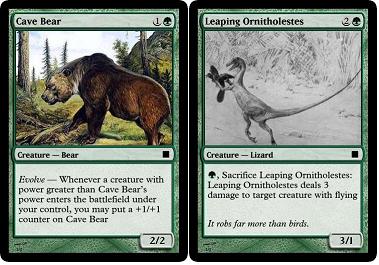
On my second turn, I tap out and play a Cave Bear. Next turn, after playing another Forest, I tap out again and play a Leaping Ornitholestes. Because the power of the Ornitholestes is greater than that of the Bear, the Bear's evolve triggers and gives it a +1/+1 counter. I now swing in on my dismayed opponent with a 3/3 Cave Bear.

ItĀ bears mentionĀ that I did the mockups for these- please don't blame Ethan for them.

The Deck: Ethan's design is a Red/Green deck that heavily showcases the evolve mechanic, much like Zendikar's The Adventurers did for Allies. Upon initial review, we noted that it had a thematically-fitting dinosaur-sized footprint on the back end of the mana curve, which plenty of expensive cards. This meant two things. First, that ramp would need to be a critical element of the deck, for what good are bombs that you can't play? Second, the deck would yield a higher amount of difficult opening hand decisions. No amount of ramp in the world is going to make you happy when you draw three cards with a converted mana cost of five or more in your opening grip. That said, every deck needs a weakness, and Tooth and Claw would hardly be the first intro deck to have that concern. Here are the design elements of the deck.

Evolve Creatures: Exactly half of the deck's 18 beaters had the evolve keyword, which seemed a very solid proportion. It allowed the deck to strongly represent the mechanic without being heavily dependant upon it. In many ways, evolve is a scaled back version of Allies. With Allies, you had a guaranteed trigger with almost every cast (80% of the creatures in The Adventurers had this subtype), but there was a tradeoff in that the cards were highly parasitic. In order to get the most from your Allies, you had to, well, play more Allies! You didn't often see one or two splashed here or there as they weren't all that impressive on their own (though [card Kazandu Blademaster]not without exception[/card]), and Allies decks generally included [card Bloodbraid Elf]only a handful of non-Allies[/card]. Now we have evolve, which is weaker in the sense that it's trigger is conditional (it only goes off when another creature enters the battlefield under your control with a higher power), but by consequence this makes it far more flexible as well.

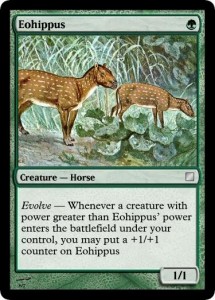
For Tooth and Claw, the evolve creatures naturally settled around the bottom of the power curve. You had a pair of Eohippus and a Hulking Sailback (the Red version which was unable to block). Next came a trio of Cave Bears, strictly better than their [card Grizzly Bears]much-maligned foundation[/card], as well as a pair of curveballs. The Potbreaker Bull not only got the +1/+1 counter bonus for evolve, but he also smashed artifacts with a converted mana cost less than or equal to his power. Meanwhile, the Fecund Maiasaur- the Tooth and Claw equivalent of the Turntimber Ranger- spawned 2/2 dino-babies every time it evolved. Playtesting showed that she was perhaps a touch too fecund, since her initial design only had her spawning tokens and didn't give her +1/+1 counters, so she was soon brought in line with the others and saw her power grow with each trigger. This made her stronger, but also had the happy consequence of balancing out her fecundity to fairer levels. Finally, there was the Prosaurapod, a 4/4 evolver which had trample to boot.

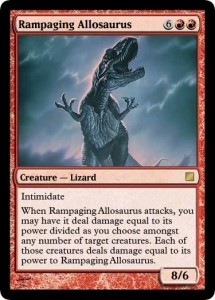
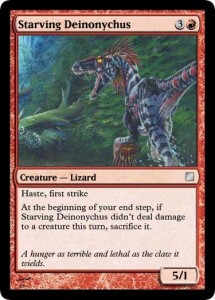
To help move things along, the rest of the creatures in the deck were ones with strong power, even at the cost of toughness. The Leaping Ornitholestes was a 3/1 for three mana, which had an activated ability allowing it to be sacrificed to deal three damage to a flying creature (very flavourful, for the name 'Ornitholestes' means "bird-robber"). You also had a Velociraptor Pack, which as a 4-power creature with flash gave a dash of trickery to the deck; a Ball Lightning variant in Starving Deinonychus which cleverly stuck around another turn if it happened to deal damage to a creature each turn; and the "foil premium rare" of Rampaging Allosaurus, a huge beatstick with intimidate and a "fight" ability comparable to Cyclops Gladiator. In support of these, we were given:

Mana Ramp: A generous serving of six cards helped get us where we were wanting to go with this deck, which is up the evolutionary power chain as fast as possible bringing as many evolving weenies up as we went. A trio of Elven Beastcallers wouldn't have felt out of place on Naya: a 1/1 mana dork that also tutored your library for a creature with power 3 or greater upon entering the battlefield had great synergy for the 'gargantuan' strategy. Migration Route filled out the other three, a sorcery which fetched a basic land to your hand and another to the top of your library. These had a great feel, though the card to hand was soon changed to entering the battlefield tapped instead.

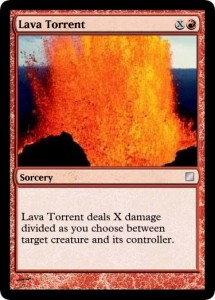
Burn: A healthy dollop of burn was included with Tooth and Claw, adding to the sense of primordial prehistory. You had a pair of [card Lightning Bolt]Lightning Bolts[/card], two Comet Crashes (instants that deal 7 damage to a target creature), and a Lava Torrent (an X-spell which dealt X damage divided however you saw fit between a single target creature and its controller).

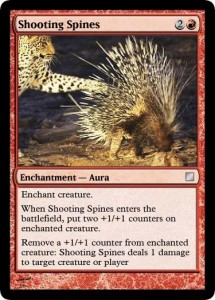
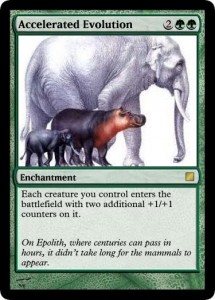
Miscellany: Everything else fit here. Selection Pressure was an instant that added two +1/+1 counters to one creature, while Accelerated Evolution was an enchantment version that gave every creature you played the same thing. Mist (replacing an early Act of Treason in the card list) was essentially Vines of Vastwood without the kicker, while Deliquesce melted down an artifact or enchantment and gave you an Ooze creature with power and toughness equal to the converted mana cost of your target. Finally there were a pair of creature auras, Symbiotic Adaption and Shooting Spines. Each bestowed a pair of +1/+1 counters to the target creature, but each allowed different shenanigans with the counters. For Symbiotic Adaption, you had to wait for the critter to die, but when it did it burst open and a number of 1/1 Elf token creatures spilled out equal to the number of +1/+1 counters that were on the enchanted critter. For Shooting Spines, you could trade in counters for 1 point of damage to a creature or player per counter.

In a nutshell, then you had a gaggle of low-power creatures with evolve and a slew of fatter ones to help their bretheren rapidly climb the evolutionary ladder, helped along by a solid suite of burn and ramp rounded out by a collection of combat tricks, pump cards and auras. Next, it was time to test! Ethan had sepcifically asked that we examine the matchup with Kor Armory with extra regard, for that deck simulated the equipment-heavy element of his set.

The Playtest: Our initial plan was to run the deck through the entire gamut of Standard-legal precons in a series of three-game matches, from Zendikar through Scars of Mirrodin. Very quickly the remaining three designers signed on for playtesting, and we were forced to scale back the scope of our operations. Tooth and Claw made it all the way through Zendikar, which was plenty of time to see the deck work, but we added on a few decks the following day after a few revisions were made.

From the outset, we also implemented an unofficial rating system, where we'd each rate our deck on a five-point scale after each game. A score of 3 meant that you felt your deck was approximate in power to the other, win or lose. A '2' or a '4' meant that your deck was either somewhat weaker or stronger, while '1' and '5' meant that the test was lopsided.

We began with six tests against Kor Armory (adding an extra three due to Ethan's preference for the matchup), and if these matches are anything to go by, I'd say the cavemen and their flint-tipped spears are in for a rough go of things. The Potbreaker Bull smashed its fair share of equipment, while the [card Kor Skyfisher]Kor flyers[/card] were easy pickings for the Leaping Ornitholestes. Nor could the Kor consistently compete on size or numbers. An optimal sequence for ToothĀ and ClawĀ often ran something like this: Turn 1 Eohippus gets evolved by a turn 2 Potbreaker Bull and swings for 2. Next turn land a Hulking Sailback (after swinging for 4), which gets evolved by a turn 4 Fecund Maiasaur (swing for 6). Follow that up with a turn 5 Bellowing Tarbosaurus (an early high-power critter cut in the last iteration of the deck) which evolves the whole table and swing for the win. Of course, the Kor didn't go down quite so easily, but the aggression is clearly evident. Tooth and Claw went 4-2 against the Kor, and the decks felt relatively balanced.

From there, we continued on through the rest of Zendikar. Tooth and Claw had similar success against Rise of the Vampires, the set's mono-Black aggro deck, going 2-1. Because so many evolve creatures were cheaply-costed, they had early parity with the Vampires. It didn't take long, though, for even the smallest amongst these to become a serious problem for the Vampires player, as even a single 3/3 can impose some difficult attacking decisions. With longer games clearly favouring the evolving Tooth and Claw, the Vamps pilot was under significant pressure. Still, Tooth and Claw's power curve was its own undoing- the game it lost it was stuck on five mana, with a Megalosaurus (a 7/4 beatstick) and two Comet Crashes (removal) in hand, each costing six.

The "mirror match" was next, pitting the dinosaurs against the Allies. Tooth and Claw raced, but as it happened The Adventurers was able to race just a little bit faster, since as discussed above every new Ally played triggered the rest while evolve was more limited and conditional. Still, with both mechanics somewhat draw dependant, Tooth and Claw hit the "evolutionary curve" perfectly in one game and crushed its adversary.

That left only Pumped Up and Unstable Terrain. Pumped Up is a Blue/Red midrange concoction that highlights multikicker, while the Green/Blue Terrain fields huge landfall beaters and prefers some time to develop the board. ToothĀ and ClawĀ chewed them up, though Pumped Up managed to save some face by winning one of the matches. Unstable Terrain was simply unable to muster up sufficient defense to buy it the time it needed to deploy its bombs.

At the end of the first round of testing, Tooth and Claw had gone 12-6 against Zendikar's intro decks, which was cause for concern. You wanted to build a good deck, but not one that would romp all over everything it faced in its weight class. We were somewhat reassured when we looked at the deck ratings that we'd assigned. For most of the decks, a score of '3' had been assigned. Again, that's what we wanted to see- decks that fell within the spectrum of power of one another. Rise of the Vampires and Unstable Terrain, however,Ā averaged 2's.

The Second Day

By now two of the other designers had shipped us their decks (the third was a day away), and we had to scale back the scope of our gauntlet. Nevertheless, we were quite satisfied that with 18 games of testing, we'd gotten a very solid feel for the deck, and were able to speak to it. After reading our initial report, Ethan sent back some revisions and we incorporated them into our playtest deck, then got back to work. We grabbed Phyrexian Poison and Myr of Mirrodin from Scars of Mirrodin, and the Rise of the Eldrazi deck (and 2009-10 Preconstructed Deck Championship Winner) Eldrazi Arisen.

The first game against the Myr was very encouraging. Tooth and Claw got off to a strong start and had the Myr down to 4 life, but they battled back. With the dinosaurs playing off the top of their library they just couldn't close the deal and lost the game. Swingbacks like this are a positive sign of balance. Dropping the second due to mana issues (which, again, are potentially lethal for decks bloated with expensvie cards), the deck hit the "evolutionary curve" again in the final game and smashed for the win. That curve was all-important, reminiscent of the "zip strips" in the old game RC Pro-Am (or, really, most any racing game): hit it, and the deck was capable of explosive results heading into the midgame. Without it, it could be hit or miss.

Tooth and Claw had little problem with the Phyrexians next, with the evolve mechanic uniquely suited to shrug off infect. Quickly we discovered that even if they picked up a few -1/-1 counters along the way, all it seemed to really do was lower their power and make it easier for them to evolve back to fighting strength. Ethan's deck went 2-1 against Phyrexian Poison, and overall it felt like a fun and fairly even matchup (the third game was won with 9 poison counters). Finally, there was Eldrazi Arisen. The deck at first seemed to be easy pickings for Tooth and Claw, for it too likes some time to develop, but it had some early beaters, burn, and a few lucky breaks. Swinging in with Ulamog's Crusher, my opponent chump-blocked with a body that had four +1/+1 counters on it and been enchanted with Symbiotic Adaption (that's the one that puts a 1/1 Elf token into play for each counter on it when the enchanted creature dies). Of course, overlooked at the time was the Accelerated Evolution in play (all creatures enter the battlefield with two +1/+1 counters on them), so my opponent was able to swing back with four 3/3 Elves and steal a win. Superb!

Final Thoughts

Ethan's own testing, he mentioned, had given him a few more losses than wins, so the combined record seemed to support that Tooth and Claw was a reasonably-balanced construction. After the conclusion of the first round of testing (the initial 18 games), I sent Ethan a report and analysis of what we'd found, mentioning each matchup, concerns or interactions incolving particular cards, and so forth. We'll end here with a reprint of the conclusion that was sent.

Overall I think this deck is a home run, though there are some areas for concern (don't worry, I say that about the Wizards releases all the time). It's stuffed with flavour, and the Evolve mechanic is a blast, and plays with action order in your main phases much like Allies. Often you'll trade the surprise factor of summoning a new creature post-combat, for the boost it can give the ones you're attacking with. The deck's biggest weakness is its end-heavy curve. Despite the sources of ramp and fixing in the game, that's still a lot to work around. If they didn't know how to before, players of T&C would soon learn to lose their fear of mulliganing- there's just too many hands which will be disadvantageous to keep.

The 12-6 record is a bit of a concern as well, but I'll want to see how it does against a couple ROE and SOM decks before drawing too many conclusions. The Adventurers was something of a legend around here for feeling consistently stronger than the others, so that may not be indicative of overpowering (though a couple cards could be, as noted below).

As mentioned above, the deck is "feast or famine," though it is certainly capable of recovering after a slow start. The presence of burn really helps even that out, as it can level the playing field a bit if T&C is lagging behind. It also makes for a great option for closing out the match, and might be a shade strong there. If intro decks include direct damage x-spells, they're usually singletons as they don't want too many games decided this way.

We've really enjoyed running Tooth and Claw, and will continue to put it through some more stress testing this weekend. If we see anything new we'll definitely let you know. It's a good sign of your deck that I'm not going to break this one down after testing, but leave it in my collection so it's available for play. Well done.

In our next piece, we'll be taking a look at Scott Van Essen's "Jailbreak" and Devon Rule's "Utopian Gold" decks, before moving on to Shawn Main's "Blight" and the series conclusion.

Presenting the Future

Are you a Quiet Speculation member?

If not, now is a perfect time to join up! Our powerful tools, breaking-news analysis, and exclusive Discord channel will make sure you stay up to date and ahead of the curve.

It's clearly time to speculate wildly about the near future of constructed Magic. Mirrodin Besieged is right around the corner, and the previews are giving us a good idea of what's in the set. So what kind of decks will come with these new cards?

1. Knights

At the time of this writing, a full 50% of the White cards previewed are Knights. Combined with M11's Knight Exemplar this is sure to make a deck. The question you should have: will that deck be worth playing in Standard? There are only 9 Knights available now, so we're certainly getting a lot of new ones to try.

Perhaps something like this:
Student of Warfare
Accorder Paladin
Leonin Skyhunter
Honor of the Pure
Knight Exemplar
Mirran Crusader
Hero of Bladehold
Awesome White spell in Besieged or Journey to Nowhere

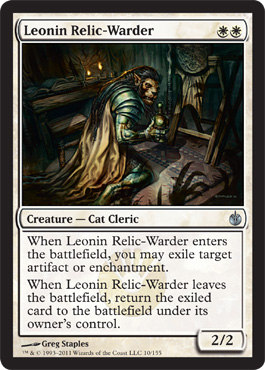
That's a pretty good pile of Knights, and you'll have Leonin Relic-Warder in the Sideboard against some decks. Still, this has all the markings of the "too-obvious" deck. Those are usually just below the cutoff from Tier 1. They don't want to make it too easy on us for several reasons. If you can see the best decks instantly you won't spend enough time exploring the set and thinking about every card. The more there is to think about in each set, the more satisfied the customer (that's you again, and me, now that I think about it) will be with the product. If the best decks are too obvious everyone will play them, and the environment will be boring (*Faeries*cough*). Will there be a sick 1-drop Knight that makes this deck better? Or a better Knight than we see here at any cost? Probably not. They've shown so many Knights so far, it feels like they're trying to get us excited about them (like Vampires in Zendikar), so they're likely to have shown the best ones (Hero of Bladehold, Leonin Relic-Warder, Mirran Crusader, and perhaps Accorder Paladin) up front. I think we're more likely to see these Knights as value creatures in non-knight decks. I mean, seriously, Hero of Bladehold is like a 7/6 for 4 mana! She's like a baby Grave Titan.

2. Infect

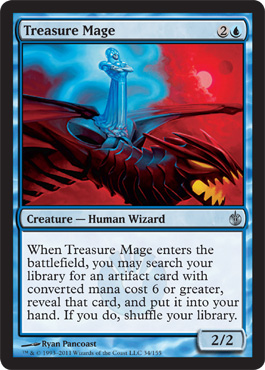
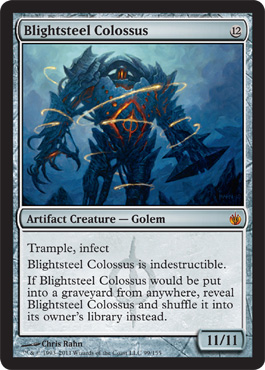
Now that we'll have a second set in the block, especially one with a lot more Phyrexian cards in it, an Infect deck for Standard should be possible. How good will it be? On the one hand, you might expect to need cards from the entire block to make the best iInfect deck. This could be the case, but that might not be in WotC's best interest. They need players to buy into the block and feel it is meaningful and relevant in Standard before the next block comes out. A star mechanic like Infect should be able to play that role by the time the second set of the block has come out. One last thing to consider, is that there are multiple themes per block, so perhaps the ideal situation is for a block to provide a couple of decks in each set. Infect may mature now, while Metalcraft matures with the last set in the block, or vice versa. The Infect deck will be a lot harder to build than the Knights deck. There are a lot of ways to go about it. Mono Green, Black/Green, Proliferate-based, or some sort of Combo deck that spits out a Blightsteel Colossus when your opponent least expects it.

Something like the following:
Grand Architect
Trinket Mage
Treasure Mage
Everflowing Chalice
Blightsteel Colossus
Preordain
Mana Leak
Jace, The Mind Sculptor
Perhaps a few other artifacts to tutor for?
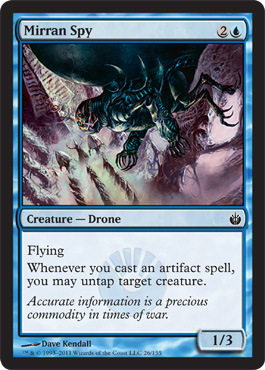
Perhaps some cool 1 or 2 cost blue creature that helps this deck work. Or maybe even Mirran Spy? That card looks
pretty interesting in combination with Grand Architect.

3. Metalcraft

As I mentioned earlier, a Metalcraft deck might be possible once we have Besieged, heck it might be possible now, but nobody found it. Perhaps this deck is the one that's complete with two sets, and Infect needs all three? Maybe that depends on who wins the war, eh? I don't really think a deck focused on the Metalcraft mechanic will do well in Standard, unless they print an Enchanted Evening type of card for artifacts. More likely there will be one or two Metalcraft card that are perfect for a Tempered Steel deck and can make that deck as good in Standard as it is in Extended, if not better.


4. Wacky Artifact Combos

Take for example:
Mirran Spy
Oxidda Daredevil
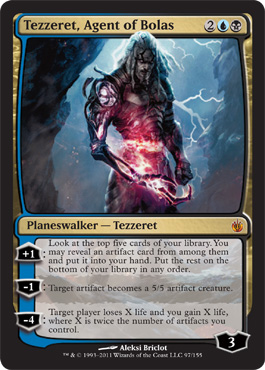
Tezzeret, Agent of Bolas
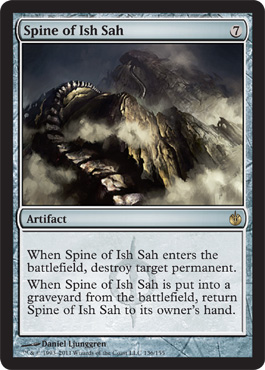
Spine of Ish Sah
Everflowing Chalice

You need to get 7 counters on your Chalice, somehow (Proliferate?) then use it to cast a Spine of Ish Sah, destroying a permanent while Mirran Spy untaps your Everflowing Chalice, which you made into a 5/5 creature with Tezzeret, Agent of Bolas. Then you can sacrifice the Spine to Oxidda Daredevil, getting it back, and starting the process all over again. Instant wipe of your opponent's entire board. It's a little bit difficult to assemble in Standard (and quite a bit easier in other formats, like Commander, where you can use Master Transmuter to skip a lot of steps), but you get the idea. This and other new combos will be available to us, and I bet there is at least one that's good enough to make a powerful Standard or Extended deck.

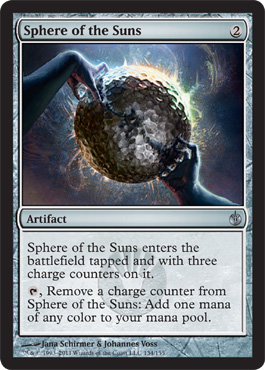
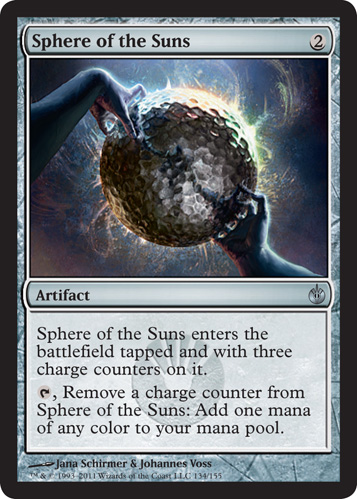
This reminds me, I've heard the new Tezz isn't getting much love. Come on people, it's a Blue Planeswalker that costs 4, it must be busted. It has all the usual requirements for a good Planeswalker. It can give immediate card advantage, it can defend itself, and the ultimate can kill the opponent. With Everflowing Chalice and Sphere of the Suns you can pretty consistently have him on turn 3, while having some good targets to make into 5/5s.

5. Open the Vaults

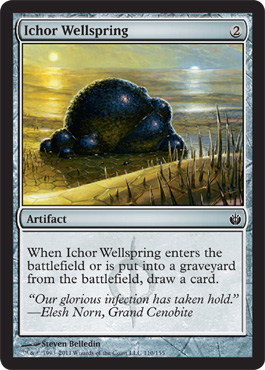
Extended could get more artifact heavy, with more than just an upgraded Tempered Steel deck. Does Time Sieve + Open the Vaults have what it takes? Ichor Wellspring is crazy good in that deck, offering you more than enough fuel to guarantee you'll get there once you start going off. I can't think of what else that card is for - instead of getting you a card only when it enters the battlefield, like Elsewhere Flask does, it gives you a second card when you sacrifice it to Time Vault.

Imagine:
Ichor Wellspring
Time Sieve
Open the Vaults
Fieldmist Borderpost
Mistvein Borderpost
Temple Bell
Prophetic Prism
Tezzeret, The Seeker
Cryptic Command
maybe Sphere of the Suns
and Everflowing Chalice
Time Warp

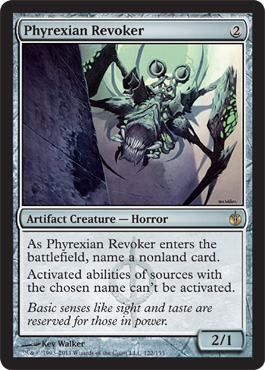
It's possible that Springleaf Drum is a secret powerhouse in this deck, accelerating you to 6 mana on the back of utility creatures like Tidehollow Sculler, Ethersworn Canonist, and newcomer Phyrexian Revoker. The question is: is it fast enough to beat Prismatic Omen and Faeries?

In very short order we'll see the whole set and can get cracking on the newest tech. Magic is so much fun!

Thanks for reading.

Gregory Marques

Morality and Ethics, Valuing the People

Are you a Quiet Speculation member?

If not, now is a perfect time to join up! Our powerful tools, breaking-news analysis, and exclusive Discord channel will make sure you stay up to date and ahead of the curve.

Welcome back to Whinston’s Whisdom on Quiet Speculation. This is a continuation on last week’s article, as it ended up running long and I didn’t want to do too much of a magnum opus on the topic of morality, instead deciding to split it up. You can find part 1 here: https://www.quietspeculation.com/2011/01/morality-and-ethics-the-n00b-quandary.

Let’s start by summarizing last week’s article. Essentially, I talked about how my own personal experience has led to me placing a high value on my Magic community and atmosphere. This means that I care more about building a sustainable player base than I do about making a quick buck or two, and because of this, I will always inform new players if they’re about to get ripped off. But n00bs don’t make up 100% of the MTG community. What about everyone else: the FNMers, PTQ grinders, Pro Players? Well that’s what I want to cover in this article, my code of conduct for miscellaneous trading.

The first area for potential controversy is in how I organize my binder. I’ll be honest, there’s nothing I hate more than looking at a page full of original duals and Jaces and have the other trader say ā€œoh that’s not for tradeā€. You are handing me a trade binder, where 90% of the value in it is unavailable? The chances of you finalizing a trade with me have just dropped significantly. It is my belief that not only is doing this rude, but it also can be misleading. If I see a first page of Jaces, I’m much more likely to search through the rest of the binder because there will probably be more cards of value there. But if I see some Llanowar Elves and Joraga Treespeaker, my time at the trading table will be relatively short. But knowing this, if I organize my binder to put all my very high value cards at the front, but say they’re not for trade in order to get the other trader to look through the rest of my lower value cards, I would find that to be unethical. Of course, not on the level of ripping somebody off, but still something I avoid. This is why everything that is in a binder I hand you is for trade. Every single card. Now this may mean that you’ll need to give me double or triple value on the stuff I want to hold onto, but there’s always a price, and I do my best to keep it reasonable while also reflecting my need for a specific card. And to be fair, there are other considerations when not wanting to trade a card. Maybe it has sentimental value, or your holding it as a loan from a buddy. In this case I have a very simple system. I have a second binder. Revolutionary, right? This is where I keep my decks when they’re not sleeved up, and all the stuff that I simply can’t trade off. If you lack the resources to own a second binder, feel free to put all the untradeable stock at the back of your trade binder, but flashing around the untouchable bling is just obnoxious.

Another topic I wanted to cover was pricing, but because this is such a broad topic, I divided it up into 3 subsections.

First, sealed product. Occasionally, though infrequently, I will get my hands on sealed product that I have no desire to open after winning it at an event (though thankfully Pastimes gives out store credit for FNM so this is rarely a problem). For most sets, cracking packs is a losing proposition, so I often try to trade it off to other players for format staples. A quick note though, selling packs to dealers tends to be a poor idea. At the events I attend, I will only get rates of about $1.75 per pack, which is just not worth it, especially when I can get $3+ in trade value. An example: at the 2nd Chicago SOM Sealed PTQ for Paris I ended up 6-1-1 but ending up in 9th on tiebreaks. Yeah, it sucks. For my efforts, I got what I believe were 9 packs of Scars. These I almost immediately swapped for 3 Knight of the Reliquary, a Noble Hierarch, and some other smaller rares. Clearly, my margin on these cards was far superior to what I would have gotten from either cracking or selling these packs. But it’s important to remember your priorities when dealing with sealed product. Team Drafts before Trading BAMF. A bit of a stretch, I know. But let’s be honest, Magic is about hanging with awesome friends. I’d take a team draft and some petty cash over more value in cards any day. And be sure to stick with your local going rate. The first time I team drafted, I started off charging WAY too much for the packs I was selling to my teammates (about $12 per draft set, rather than the normal $8) because I didn’t know any better. I quickly lowered my asking price after I was informed about this, because my goal was never to price gouge my friends. That’s not a very good move. Friends before profit, any day of the week.

Funnily enough, another subsection in pricing is about trading with friends. As I said above, the most significant part about Magic for me is the friendship I can cultivate with other players. You know that awkward feeling you have when you’re the first player from your play group to get to a PTQ and you’re sitting by yourself at a table? Yeah, it sucks. Staying close with your Magic friends is the most important thing within any path of the game that you choose. So while some may see it as a double standard, I try to never trade for significant profit with friends. I have had some missteps along the way. Old habits have kicked in and I ended up making a trade that looked fair but was really tilted heavily in my favor. But as a rule, I do my best to stay even with my friends. Part of the definition of having a friend is that you value them more than the small amount of cash you could gain by ripping them off. I honestly have no respect for those that don’t follow this code of behavior in their Magic financial conduct.

And finally, we come to just trading around. What are the rules we must hold ourselves to while we are actually trying to make profit? The first of these is the simplest. No lying. Period. Under no circumstances will I lie or mislead a trading partner as to the value or the potential value of a card. This doesn’t mean that I’ll inform them that Stoneforge Mystic was a critical part of the last Standard Pro Tour top performer, but it also means I won’t claim that Japanese Ally combo with Halimar Shapeshifter just won a Grand Prix. Analysis, you’re free to keep to yourself. But the facts must be out in the open. Likewise, if they ask you about one website’s sell price on a card, you must answer truthfully or not at all. Taking advantage of superior preparation is not the same as doing it through dishonesty, and as someone who takes the financial side of MTG seriously, your integrity is crucial to success. Even if you are a solely profit driven entity, you have to recognize that lying and taking advantage of others through blatant dishonesty is only bad for business, as it tarnishes your reputation and reduces the amount of people that are willing to trade with you. There are certain people at my local store who are just unwilling to trade with me, just due to my attitude towards trading and not due to dishonesty, but that inability to make deals with some people has hurt me. I promise you, lying is not going to bring about a net monetary gain.

That’s all for now (except for a brief conclusion at the end). Last week’s contest winner wasBrandon Cooper…because he was the only person to enter other than Wade who had already won. I guess free cards just don’t cut it anymore. So Brandon, email me your mailing information and I’ll get your cards out to you. Anyways, I obviously need to ramp up the prize support a little bit, so the winner of this week’s comment contest will receive a Demon of Death's Gate and a Dark Tutelage. Remember, one positive comment, one constructive criticism, and one future article topic. You may enter by emailing me, commenting on the article itself, or contacting me on twitter (my username is at the bottom of the article).

Though it may sound corny, ā€œtreat others as you would want to be treatedā€ is probably the best approach toward trading ethics. Personally, if someone leverages knowledge of a format in order to make profit off of me during a trade (I’m looking at you Craig Wescoe!) I’ll feel disappointed with myself and make sure to study the basics of that format before I hit the tables again, but I don’t feel cheated, just outplayed. But if someone lies to me, then they are on my blacklist. And I won’t deal with them again. Take a lesson from this, and let’s work together to put to rest the rumor that all traders and speculators only care about their bottom line. Just like players, we care about the people too.

Bros before pro(fit)s,

--Noah Whinston

mtgplayer@sbcglobal.net

nwhinston on Twitter

Arcadefire on MTGO

Baldr7mtgstore on Ebay

Grand Prix: Atlanta, 16th Place

Are you a Quiet Speculation member?

If not, now is a perfect time to join up! Our powerful tools, breaking-news analysis, and exclusive Discord channel will make sure you stay up to date and ahead of the curve.

[Today's Guest Author is Joshua Justice! As always, a Guest Author's fate with Quiet Speculation depends in large part on you, the readers. Please let your thoughts be known in the comments! I promise you I try to read everything you comment about the Spike content šŸ™‚ -Dylan]

My name is Joshua Justice. I'm technically a ā€œMagic Proā€ because I won a PTQ last year and made Day Two at Pro Tour: Amsterdam. In reality, I'm just a weekend grinder who's been back in the game for a little over a year, and I've had a couple of successful tournaments. This story begins two weeks before Grand Prix: Atlanta, in a comic shop called The DeeP in Huntsville, Alabama. My plan that day was to play in a Grand Prix Trial, then move to Atlanta to start my new job.

Having played White Weenie to an abysmal 2-2-1 finish at the Winter King in Kentucky late last year, I realized that it was no longer a viable strategy despite its success in Amsterdam, and my deck of choice for the 10-man Trial was Mythic Conscription with Gaddock Teeg in the maindeck over Dauntless Escort. I beat an awful deck round one, beat a fellow Huntsville grinder running Jund round two, then won round 3 in three games against a hilariously awful Naya deck that still managed to steal a game from me. It turns out that Elspeth's tokens, even when fully Emblemed, are simply useless when the opponent casts Overwhelming Stampede with a Gaea's Revenge and a Kalonian Behemoth on the battlefield. Despite that embarrassment, I took game 3 and moved on to the top 4 - promptly getting paired against the same Jund deck I beat in the second round. I beat him again, then got paired against Jund in the final round. I tried to convince him to concede to me since he had 2 byes and I only had 1, but he didn't take it. Mythic did its thing and I beat him in 3, locking up three byes to Grand Prix: Atlanta.

After moving, I got locked down to my apartment by the Snowpocalypse in Hothlanta. It wasn't until Friday that the roads were drivable, and I headed to Nashville to crash in a hotel near The Next Level Games for a PTQ, playing Mythic Conscription with minor tweaks. I went 5-2 with a loss in round 4 to Faeries and round 6 to Dredge-Vine. Having seen Mythic's utter inability to deal with the graveyard, and a complete lack of Wargate decks for him to prey on, I decided that Gaddock Teeg was no longer the stone nuts.

I spent Sunday, Monday, and Tuesday trying to fine-tune Mythic to work with Teegs in the board, switching over to Doran for a bit with Tidehollow Scullers in the Teeg slot, Thoughtseize in the Mana Leak slot, Baneslayers over Jaces and Conscriptions, and Dorans over Sovereigns, finally giving up and performing the time-honored tradition of picking up the undisputed Best Deck in the Format and taking Faeries to the Grand Prix. Thus, Wednesday and Thursday were spent trying to build a Faeries list that I was happy with. I couldn't ever make myself satisfied on the discard/removal/counterspell split, and the sideboard couldn't really fit in the full Wall+Wurmcoil plan plus a proper 4-card graveyard hate suite of either Faerie Macabre or Nihil Spellbomb. I did come across Vampire Nighthawk, but thought its applications were too limited. I went to the Hilton Friday after work, registered, and picked up a decklist form to take back to my apartment. I fired up a spreadsheet and entered two week's worth of PTQ data, plus two days' worth of MTGO Dailies and the Worlds data, resulting in the following with Daily Event 4-0s equal to 8th in a PTQ:
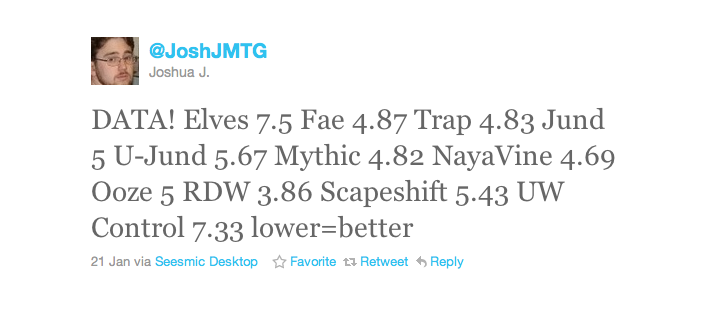
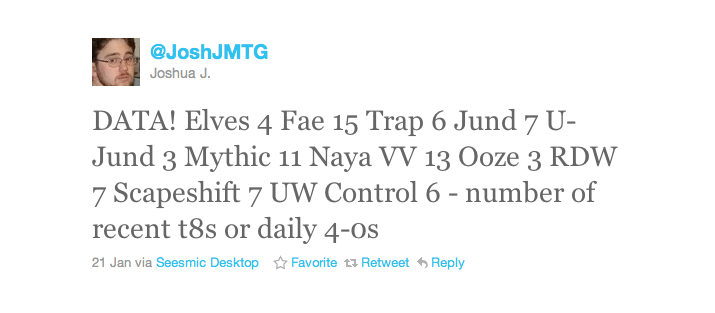
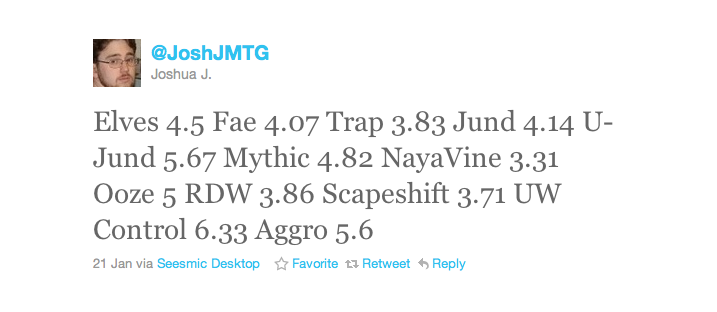
Setting the value of a Daily 4-0 to 2nd in a PTQ resulted in:
Disregarding Daily and Worlds data:
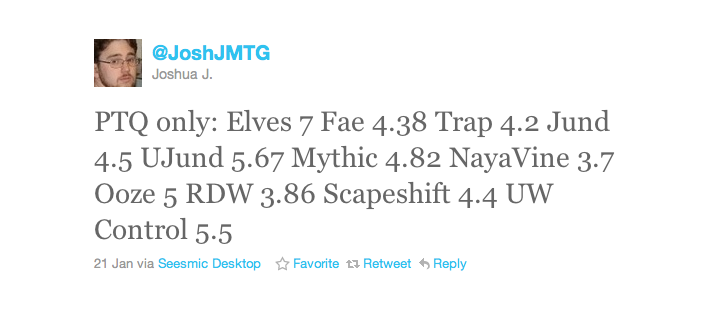
Red was actually averaging better performances in PTQ top 8s than the consensus ā€œBest Deckā€ of Faeries. So was Naya, which I believe was also a good choice, but I wasn't about to try to tech out a Naya build properly on such short notice. Had I done all the spreadsheeting on Monday it's likely I would have been on a Naya build for Atlanta.

After staring at PTQ results and Adrian Sullivan's article on Demigod Red, I built the following decklist for the Grand Prix in about three hours.

Untitled Deck

Creatures

4 Goblin Guide
4 Figure of Destiny
4 Hellspark Elemental
4 Plated Geopede
3 Kargan Dragonlord
1 Ball Lightning

Planeswalkers

1 Koth of the Hammer

Instants

4 Lightning Bolt
4 Flame Javelin
2 Burst Lightning
2 Searing Blaze

Sorceries

2 Arc Trail

Lands

1 Smoldering Spires
4 Teetering Peaks
4 Scalding Tarn
4 Arid Mesa
12 Mountain

Sideboard

4 Volcanic Fallout
2 Smash to Smithereens
1 Everlasting Torment
2 Reverberate
3 Relic of Progenitus
3 Mark of Mutiny

I also put together a sideboarding guide Friday night, which I'm sure made a lot of sense when I wrote it. You will find however that it is not included in this article, and believe me when I say there are good reasons for that. If you're scratching your head over Everlasting Torment not being Stigma Lasher, you're correct; but such are the perils of the 3 hour deckbuild. The popular Boggart Ram-Gang was in my first draft of the decklist, but got cut from 4 to 3 with a Ball Lightning replacing one, then cut from 3 to zero for the addition of 2 Burst Lightning and a Koth of the Hammer. I did this because my first draft of the sideboarding guide cut the Ram-Gang in every single matchup except the mirror (where Goblin Guides got cut instead).

I got up Saturday morning and walked from my apartment, arriving at the Hilton ready to play some Magic with home field advantage... but after turning in my decklist and noting that I'm in the pink pod, I had to wander around for a few hours since I had three byes. I helped get a friend from Huntsville to the food court in Peachtree Center through the three different buildings to get there, then wandered back because I wasn't hungry, then wandered back there after getting hungry, then wandered around aimlessly some more, and was in general quite bored. After roughly 2 PM, I finally got to start playing Magic.

ROUND FOUR 3-0 from byes
Stuart Parnes, 1844 Total, 1858 Constructed, Green/White Hideaway (ratings are pre-GP ratings)

I won the die roll and took the play. My notes are normally good at allowing me to figure out what happened, but seeing ā€œ18 Hierarchā€ on my side to ā€œ16 Goblin Guideā€ with the next entries being ā€œ14 Goblin Guideā€ and ā€œ10 Figure+Guideā€ doesn't really help. My best guess is I had a turn one Figure of Destiny get Pathed, I landed Guide+Teetering Peaks the following turn, so he decided to aggro me with the second Noble Hierarch because he had a bad draw. Apparently I killed everything of his because the Figure, Guide, and Hellspark Elemental took him to 3 and a Searing Blaze finished him off. Sorry I can't be more specific here, but it really doesn't matter, because it came down to the Red deck doing what it's supposed to do:

1. Smash you with dudes
2. Burn your dudes
3. Burn you

Game two he took the play and I hit him with an early Goblin Guide. I didn't have a lot of action after that, only hitting him with the Goblin Guide some more, and I got him down to 9 before a Baneslayer Angel held me off. It took me down all the way, so I boarded in the miser's Everlasting Torment.

Game three I managed to get him to 11 before he played an Obstinate Baloth; it ate a Flame Javelin, then a Baneslayer came down next turn to stall things out. However, I had a lot of lands and a Figure of Destiny, which I took to maximum level, followed by a Kargan Dragonlord which I also maxed out on the turn before he landed a Linvala, Keeper of Silence. I stalled the board out with me at 2 life and more creatures than my opponent at 25 life, and if I can engineer a situation where he has to block both of my fliers with his Angels to live, I would kill his only actual threats (remember that Dragonlord has trample and Firebreathing). After drawing a Ball Lightning, I did the math and played the Ball Lightning plus a Hellspark Elemental and sent the whole team in. As soon as he placed Baneslayer Angel in front of Ball Lightning and Birds of Paradise in front of the Figure of Destiny, I realized I threw the game away for no reason other than I had forgotten about the Birds of Paradise. Oops. Great start to a 3-bye GP! The sad thing was, the top card of my deck was a Lightning Bolt which would have killed the Bird and the math would have been right.

There's plenty of time left in the round, so I went to the restroom, got some water, and calmed myself down.

When you lose a match to something that's entirely your own fault, it's easy to get tilted and just play like a total moron from that moment forward, but I managed to focus myself, tell myself the deck was good, I should have won, so I'll just win out and call it a day.

ROUND FIVE 3-1
Josh Stanford, 1769 Total, 1686 Constructed, UW Control

I won the die roll and played a Mountain and Goblin Guide, said go, picked up my pen, and started to write.

…

…

...

I noticed my Goblin Guide wasn't tapped.

...Wait, what?

Seriously?

Did I just do that?

Yes. Yes I did. What the hell is wrong with me? He couldn't believe it either.

Mountain. Goblin Guide. Go.

So we all know exactly what's going to happen here. I'm going to beat his face down and get him all the way down to 2 life, at which point I'm going to lose the game, get utterly beat, get hit by Kor Firewalkers and Burrenton Forge-Tenders out of the sideboard, do something utterly idiotic next round, and 0-3-drop this GP after getting 3 byes.

Glacial Fortress, go.

Okay, fine, whatever. Hit him with the Guide, play a Plated Geopede. Something irrelevant? Cool. Crack a Scalding Tarn, bash to 13. He played something and I took the opportunity to Ball Lightning him while he couldn't counter it. A Kitchen Finks gained some life for him, my team took off most of it, and then some burn finished him off.

I don't know what was running through his head at this point. I mean, who loses to a mono Red player who doesn't attack on turn one with Goblin Guide, right?

The next game I got to have some fun, which totally made up for the idiocy from game one.

My turn 2 Geopede got Condemned to put me to 23. I cracked him with a Hellspark Elemental to take him to 17, a Kitchen Finks came down for him and got persisted to take him to 21. I hit him with a Ball Lightning, then the next turn I unearthed the Hellspark Elemental and Teetering Peaksed it to put him to 10. He played a Jace, the Mind Sculptor, so I kicked a Burst Lightning at his face to take him to 6. The following turn, I mainphased a Flame Javelin at his face. He played a Cryptic Command, which I snap-Reverberated.

Something finished him off the next turn. I didn't write it down, because really, who gives a shit?

ROUND SIX 4-1
Anthony Costa, 1904 Constructed, 1950 Total, Faeries

Game one, I was on the draw. Turn one, Figure of Destiny. His turn 2 featured a Bitterblossom. Turn two, Goblin Guide twice, take 5. No lands on top, good. Turn 3 level my Figure, take 6. Bitterblossom, not bad, Searing Blaze one of those tokens then swing for lethal with the rest of the team.

Game two, turn one Goblin Guide, swing, 18. He played a Wall of Tanglecord, to which I respond with double Goblin Guide. I took him all the way down to 12 with the Guides alone, then he tried to get me with Mutavault and Vendilion Clique, later resorting to Creeping Tar Pit. Eventually I burned out all his stuff and achieved lethal in a single swing.

ROUND SEVEN 5-1
Pascal Maynard, 2031 Constructed, 2101 Total, RG Scapeshift

On the play, I had a turn one Goblin Guide, turn 2 Searing Blaze for his Khalni Garden token, turn 3 Teetering Peaks for the Goblin Guide which sent him down to 11. He tanked, followed by Scapeshifting away the Khalni Garden for a Khalni Garden just to get a chumpblocking plant token. I couldn't allow that - Arc Trail, swing in there, play a Kargan Dragonlord. Primal Command took him to 14 life, Guide and Kargan took him down to 8, then Kargan went over the top next turn.

The notes for game 2 are simple enough. He mulliganed on the play, and I fire off the following sequence:

Turn one Goblin Guide, turn 3 Plated Geopede, turn 4 Mark of Mutiny on his Primeval Titan for massive damage.

While sitting around bored for 20+ minutes before time is called in the round, I see a judge dispute come up and wander over to see if it's anything interesting. Apparently, the defending player had moved an animated Celestial Colonnade in front of a 2/1 Kitchen Finks in the process of activating a fetchland to do something, and the active player thought that meant he was blocking with it. The appeal came after the judge ruled in favor of the attacker, and the Head Judge ruled in favor of the attacker as well. Both players were quite confused about the resulting game state, and it turned out that the end effect was that the defender was dead on board. The lesson here is that if you're going to move your creatures around without actually blocking you should be very clear about what's going on.

ROUND EIGHT 6-1
Matt Gargiulo, Constructed 1692, Total 1757, RG Scapeshift

He mulliganed on the draw, I played a turn one Figure of Destiny which didn't get pumped since I had a Plated Geopede incoming. Turn 3 I swung for 7, played another Geopede, and took him all the way down on turn 4. What was he doing? Durdling around with irrelevant mana ramp, of course.

Game two he mulliganed on the play, I led with Figure again, which I didn't level. I played a creature that got Bolted, then leveled my Figure for a 2-point swing and played a Plated Geopede. A Primal Command took him up to 24, my attack took him to 15, and Primeval Titan crushed my entire board and took me to 16. 15 is sadly 4 points too high for Mark of Mutiny to kill him, and Titan was guaranteed lethal next turn, so I conceded rather than show him the Mark.

Game three I took the play against his triple mulligan. I led with Figure of Destiny followed by leveling it to a 2/2 and Teetering Peaks. Then I hit him for 2 with the Figure, played a Geopede, and Bolted him. I smashed him down to 2 from 11 the following turn and burned him out.

ROUND NINE 7-1
Samuel Tharmaratnam, 1918 Constructed, 1972 Total, GW Omen/Scapeshift

I took the play, leading off with Figure of Destiny. Turn two I didn't level it, opting to play a Plated Geopede instead. The 7 points of damage next turn played nicely with his 3 fetchlands to take him to 9, and his activation of Murmuring Bosk for Knight of the Reliquary's White mana took him to 8. A pair of active Searing Blazes took him to 2, and I swung for lethal.

Game two I led off with Goblin Guide. His fetchland and my Goblin Guide took him to 15; my turn 2 play was a Figure of Destiny with a level up. His Obstinate Baloth forced me to Flame Javelin it to get the team through, and his Primeval Titan took me out.

Game three I led off with a Figure of Destiny followed by a 4-point swing thanks to Teetering Peaks. Verdant Catacombs took him to 15, then Goblin Guide and Hellspark Elemental joined the party to slam him all the way to 8 on turn 3. His fetchland took him down to 7, and I opted to level the Figure and bash him down to 1. He played Obstinate Baloth to go to 5, but it didn't matter.

DAY ONE FINAL RECORD 8-1, 5-1 in actual matches.

DAY TWO

I woke up, got some food, and walked back to the Hilton. Eric Deschamps didn't have much of a line, so I got my Plated Geopedes signed and labeled as a trophy of sorts.
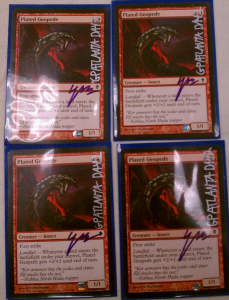
I like the way it turned out, and I'm hoping to continue this going forward every time I accomplish something with a deck.

ROUND TEN 8-1
Mat Mansoor, Constructed 1714, Total 1719, Faeries

I was on the play and led off with a Goblin Guide. If I remember correctly, an Inquisition of Kozilek took my turn 2 play, leaving the Guide as my only real creature. On turn 3, a Hellspark Elemental came down and my team took him to 11. A Mutavault kept me from attacking for some time, and soon a turn came up where my hand was an Arc Trail, a Searing Blaze, a Teetering Peaks, and a Smoldering Spires. With some thought, I decided to save the lands for when I had relevant creatures in play, or when I could Spire a blocker to get in there. I passed the turn, and at end of turn he played a Vendilion Clique. I responded to its enter the battlefield trigger with Searing Blaze to kill the Clique and deal 1 to him, taking him to 10. I ended up using a Flame Javelin on one of his three Mistbind Cliques (must be nice) later on, and with the various other pieces of burn that ended up hitting his creatures to keep me alive, I could have burned him out instead had I made the landfall that turn for the Vendilion Clique's Searing Blaze.

Game 2, my first creature to successfully hit him was a Plated Geopede for 3, which managed to achieve a puny one damage the following turn, then got held up by the threat of Mutavault trades. At 16 he happily played a Bitterblossom. I threw double Hellspark Elemental at him, and he went all the way down to 9 rather than trade Mutavault for half of a Hellspark Elemental. After Bitterblossom took him to 8, he Mistbind Cliqued me, so I Flame Javelined him in response, taking him to 4. His Bitterblossom took him to 3, and after much thought he sent the entire team at me (including his manlands). This sent me to 1, and after I said as much he conceded.

Game 3, I landed a turn 1 Figure of Destiny and a turn 2 double Goblin Guide. One of the Guides got killed, putting him at 17. I put him at 14, and got my creature play countered. The next turn a Wall of Tanglecord came down, making my third Goblin Guide look considerably less impressive. Taking him to 10 was the order of the day. A Mistbind Clique showed up to hassle me and I sent him to 6 with Flame Javelin. A Wurmcoil Engine of his came down next, and I simply couldn't deal with it.

I was definitely unhappy about starting day two off with a loss, and to a matchup which should be in my favor. The triple Mistbind Cliques game one were obviously sheer luck on his part, and the idea of an end-of-turn Vendilion Clique in game 1 never even entered my mind so I wasn't sure if not dropping a land was actually a misplay or not with as many lands as I had on a mostly-empty board.

ROUND ELEVEN 8-2
Scott Schauf, 1863 Constructed, 1868 Total, Demigod Red

I took the play game one and didn't have a turn one play (it may have been a tapped land, I don't remember). He led off with a Goblin Guide from an Arid Mesa to go to 19, sending me to 18. A Searing Blaze off a Scalding Tarn solved that problem, sending me to 17 and him to 16. As the game progressed, I kept killing his creatures with split-damage burn to get ahead of the game, while he played a total of 3 Goblin Guides and killed my guys with single-target burn. At the end of the game, I had taken 8 damage from Goblin Guides, 1 from my fetchland, and 4 from his Flame Javelin putting me at 7. He took one from a fetchland, 3 from a Searing Blaze, 2 from Arc Trails, 3 from a Hellspark Elemental, 8 from Flame Javelins, and 3 from the final Lightning Bolt.

Game 2 he took the play (which I think is wrong) and we played it like a Control mirror - every creature that hit the board died. He wasn't maximizing his split burn, as I took 1 from a Searing Blaze on two occasions while my one Searing Blaze dealt the full three, and at the end of a turn I cast a Volcanic Fallout to clear the board and put me at 7 to his 3. The Hellspark Elemental in my graveyard finished out the match.

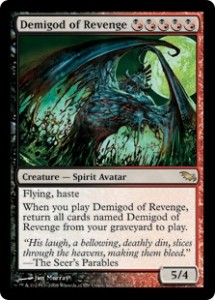
The Red mirror is in general a very strange matchup. If both players play properly and board out all their Goblin Guides for more burn (in my case 2 Volcanic Fallout and 2 Reverberate), there's very little chance any creature will stick. The key to victory is maximizing the value of split-damage spells like Searing Blaze and Arc Trail and gaining card advantage. Hellspark Elemental is ridiculous in the matchup - they're each worth 3 damage or a card two times. If you have Hell's Thunder somewhere it's even better, but most people don't play it because of how bad it is against Faeries. In theory, Demigod of Revenge should be good but in practice if you have two of them you're going to be short on burn, short on early creatures, or short on lands (in which case you obviously mulligan). If the former, your opponent can probably just outrace you, and if you're short on early creatures your opponent can save all his burn instead for your Demigods. A Flame Javelin can take out the first, and a combination of Searing Blazes and Arc Trails can make the double-Demigod setup not be quite so bad. In addition, the minimal burn draw runs the risk of the Demigods facing down a leveled Kargan Dragonlord or a maxed out Figure of Destiny, which can just ruin any chance of the Demigods being relevant. I'd have to say that all else being equal a Hellspark list is going to be favored over a Demigod list, but it also depends rather heavily on who draws better burn. The ideal opening hand for me is probably something absurd like 2 Mountain, 1 Scalding Tarn, 2 Searing Blaze, 2 Arc Trail.

ROUND TWELVE 9-2
Allen Jackson, 1837 Constructed, 1804 Total, Naya Beats

I led off with a mulligan followed by a Figure of Destiny. He played a Noble Hierarch, and I smacked him to 18 with Figure and Bolted his copy of Figure of Destiny. He killed my Figure of Destiny too and I played a Plated Geopede. The next turn it got in there for 5, then 5 more, then he killed it with Ajani Vengeant and went up to 13. Elspeth, Knight-Errant came down the following turn, and between the two Planeswalkers I couldn't do much more with all my creatures rendered irrelevant.

Game two, I took the play and led off with a Lightning Bolt for his Noble Hierarch. My turn two play was a Figure of Destiny to his second Hierarch. It ate the puny end of an Arc Trail, and my Figure poked him down to 17. He played a creature which I killed, and the Figure hit him to 15 the next turn without anything else happening. I followed that up with a second Figure, and hit him with them as a pair of 2/2s to take him to 11. He cracked a fetchland to go to 10, at which point a Bloodbraid Elf cascaded into an Arc Trail to kill off a Figure and bash me to 13. A Wooly Thoctar followed this up the next turn, but I had removal for it and a Kargan Dragonlord to level up. It knocked him to 5 and went lethal the following turn.

The decider looked just like a Red mirror, with every single creature on both sides dying, though mine were dying to Path to Exile and Oblivion Ring in addition to Lightning Bolt and Arc Trail. After some turns of ā€œplay a dude, watch him die, kill the other guy's dude,ā€ I managed to stick a Kargan Dragonlord with enough mana to take him to level 8 on the following turn. The first attack took him from 19 to 10, and the second one was lethal.

ROUND THIRTEEN 10-2
The Hustler, UW Control

At Grand Prix: Nashville last year, I drove up with Corey Waugh, and met up with some of the Huntsville Magic crew. After going 5-3 and dropping out of the GP day one, I showed up day two with the plan of grinding some side events. After bombing out of another draft I gave up in general disgust at Scars limited and started working the dealer tables. Two of the Huntsville players start a 4-man EDH event with two randoms. I did some wheeling and dealing involving buying Lux Cannons from one dealer at less than another dealer's buy price, shipping a Black Lotus between dealers for a $50 cut, and buying up some duals, Onslaught fetches, and Unglued lands for my collection. This wasn't all done in a hurry, either - I was just being lazy and wandering around with a meal break in between, and all the while they were playing in the same EDH game. I walked by after a couple of hours and asked if it was the same game. A mono Blue deck, a mono Black deck, a Zur deck, and a Green/White deck. Apparently so. Fine. I wandered around some more, made some more deals, haggled over a Timetwister and landed it, and eventually the Huntsville players finished their EDH game and came to the dealer area since one of us was working in a booth.

ā€œWhat took so long?ā€

ā€œYOU CAN'T HUSTLE A HUSTLER!ā€

ā€œUh... okaaaay.ā€

ā€œYOU TRYING TO HUSTLE ME? YOU CAN'T HUSTLE A HUSTLE!ā€

As the day wound down, we played Mental Magic with my 3 sealed decks shuffled together (not recommended, incidentally, since Scars of Mirrodin has way too many cards that cost {3}) , and whenever I named a card he didn't recognize, ā€œYOU TRYING TO HUSTLE ME?ā€ As we're leaving and paying the obscene parking fee at Opryland, ā€œTHEY'RE HUSTLING ME. THEY CAN'T HUSTLE A HUSTLER!ā€

Finally, I had enough and asked what the hell started this.

It turned out that at the end of the EDH match, one of their opponents called a judge and asked about a ruling. When it didn't go in his favor, he appealed to the head judge. The head judge confirmed the ruling, and about 20 minutes later he lost the EDH match. He started ranting about how they were cheating and repeating the phrase ā€œYOU CAN'T HUSTLE A HUSTLER!ā€ He even went and complained to the Grand Prix's Head Judge that these guys were working together, taking over the EDH scene, ruining Magic, and in general just plain trying to hustle a hustler.

As anyone who's ever seen him knows, Jody Keith is an extremely recognizable person. In case you ever forget his name, just look at his arm.

So when I sat down across from him in Atlanta, suffice it to say that I got hustled.

ROUND FOURTEEN 10-3
Travis Compton, 1850 Constructed, 1853 Total, UGr Valakut

He mulliganed twice with me on the play, and I landed turn one Goblin Guide, turn two Teetering Peaks + Figure of Destiny, turn 3 Goblin Guide and a level-up for the Figure. A Lightning Bolt at the end of his turn meant my team was lethal, and that was game one.

Game two was so bizarre that after the match, I actually talked to Brian Kibler (who was seated next to him and kept glancing at our game) and asked if my opponent's plays made any sense to him.
I landed a turn one Figure of Destiny which got stared down by his Wall of Tanglecord. I pumped it to a 2/2 and then with 2 lands in play I Teetering Peaksed it to turn it into a 4/2 and attacked (holding an Arc Trail). Rather than risk losing his Wall, my opponent opted to take the damage. Hm. Interesting.

The following turn, I tapped the 3 lands to make it a 4/4 and played a second Teetering Peaks. Even more bizarrely, he didn't block and opted to take 6 instead. This took him down to ten. In the meantime, he's set up Valakut with Prismatic Omen, and killed my Figure on the following turn. The Misty Rainforest took him to 9, and my Flame Javelin took him to 5. I stuck a Plated Geopede on the board and he opted not to kill it, doming me for 6 and trusting in his Wall to keep him alive. Unfortunately for him, my hand contained a Mark of Mutiny and an Arid Mesa.

Kibler summed it up perfectly: ā€œWhy board in the Wall if you're not going to block with it?ā€

ROUND FIFTEEN 11-3
Gaudenis Vidugiris, 2082 Constructed, 1834 Total, Demigod Red

I took the play and a mulligan, and Gaudenis took a double mulligan. As usual in this matchup, it came down to who stuck a creature. I took a 5-point hit from his Plated Geopede before killing it, whereas I kept hitting him with one Geopede then another after that one died, taking him down to 11. At one point in this I played a Hellspark Elemental which he chose to kill in order to preserve his life total. I found that strange, but I also didn't know he was holding a Demigod of Revenge. Once he played it, it attacked me to 8, but I took him from 11 down to 1, at which point he held back a 2/2 Kargan Dragonlord and the Demigod of Revenge as blockers. With no cards in hand for both of us, I drew a Teetering Peaks. With some thought, I Unearthed the remaining Hellspark Elemental and aimed a Teetering Peaks at it. It attacked alongside my 3/3 Plated Geopede. He blocked Geopede with Kargan Dragonlord and blocked the 5/1 Hellspark Elemental with his Demigod of Revenge. He put both of his creatures in the graveyard and I put the Hellspark aside. As he moved his hand away from the Demigod I remembered it was a 5/4, so the remaining damage trampled over and he was dead. Upon pointing this out, he called a judge.

He said I hadn't assigned the damage to him so all 5 damage was dealt to the Demigod. I responded that the combat damage rolled over automatically with trample and the judge confirmed. Gaudenis appealed, and while the judge went to find the Head Judge, we discussed it and I pointed out that the M11 rules just have an order and once lethal damage is dealt the rest rolls over, since damage doesn't stack any more. He thought about it a bit, agreed that I was probably right, and the Head Judge upheld the ruling.

Game two, he took the play. As I've said before, I think this is wrong. If both players are taking out Goblin Guides for better cards in the matchup then there's little way to gain tempo, and pure card advantage should be the strategy. The first source of damage to a player was my Hellspark Elemental joining forces with Teetering Peaks to put him to 15, followed a bit later by a Chandra's Outrage on my Figure of Destiny. After a Mesa and a Tarn took him to 13, Gau showed off his sideboard tech: Tuktuk the Explorer. My jaw hit the floor and I thought about it for a bit, deciding to let him poke me for 1 - it's not like I had any meaningful creatures anyway. I hit him with the Hellspark Elemental again, taking him to 10, and threw a Bolt to his face taking him to 7. Passing the turn to him again, Gau played a Teetering Peaks on Tuktuk and took me to 12. I kicked a Burst Lightning to bring him to 3, then on my turn played Arc Trail to take Gaudenis to 1 and killing Tuktuk. I got a strange look in return, then played the second Arc Trail to earn my invite to Pro Tour: Nagoya.

STATISTICS:

Total Record in games: 20-9
Record in actual matches: 9-3

Record on the play: 12-4
Record on the draw: 8-5

Clearly, being on the play was an advantage in general.

My mulligans: 5
Opponent mulligans: 13

The utter consistency of the red deck is a major point in its favor. At no point did I ever go down to five cards, and almost any hand with 2 or 3 lands is keepable.

Props:
59 out of 60 of my maindeck cards
Reverberate
Mark of Mutiny
Atlanta for being awesome
The judges and scorekeepers for making the GP run extremely smoothly

Slops:
Koth of the Hammer: the 1-of only showed up once, at which point it accomplished exactly nothing. I'd actually have been better off with a second Ball Lightning
Everlasting Torment: Should have been Stigma Lasher, and there should have been more of them. I just missed the card's existence in my 3 hour deckbuild. Oops
Myself for playing like a donk on multiple occasions
The utter ripoff that the Hilton tried to pass off as food in the game room itself. Six dollars for a ham sandwich?

Joshua Justice

@JoshJMTG on Twitter

Reviewing Besieged

Are you a Quiet Speculation member?

If not, now is a perfect time to join up! Our powerful tools, breaking-news analysis, and exclusive Discord channel will make sure you stay up to date and ahead of the curve.

At the moment I'm writing, only about half of the cards in Mirrodin Besieged have been spoiled, but it already looks poised to have a large impact on the Standard format in particular.Ā  I am generally more optimistic about formats than most (the last Standard format I disliked was with Affinity; I had no beef with either Faeries or Jund), but even I was starting to feel things were getting stale recently. I'm looking forward to the shakeup it'll make in Standard.

I'm not going to bother reviewing every card spoiled so far - I think we all know Peace and Pierce Strider aren't going to make the cut.Ā  If a card's uses seem obvious or it is clearly unplayable, I'll pass by.Ā  Instead, I'll only be mentioning the cards I think are either over or under hyped.Ā  Also, note that this is purely a constructed review.

I have heard a number of people talking about this guy as a possible answer to Counterbalance in Legacy, but I don't see it.Ā  First of all, if you want an answer to a resolved Counterbalance, two mana is a very awkward mana cost.Ā  If they already have the Counterbalance in play, resolving a two drop is anything but guaranteed.Ā  If this does resolve and take away the Counterbalance, you are still in an awkward position if they topdeck any kill spell.Ā  Casting something that you think is sure to resolve, then watching them [card Swords to Plowshares]Swords[/card] this guy in response to counter your spell with the Balance... seems to me like a good way to start hating Magic.

Also, this is nothing new.Ā  There are plenty of creatures that deal with enchantments already, such as Stern Proctor, Harmonic Sliver, Indrik Stomphowler, Viridian Zealot, or others, and none of them have seen significant amounts of play against Counterbalance.Ā  The best ways for aggressive decks to beat Counterbalance decks are to A. Attack their greedy manabases; B. Ignore it with Aether Vial; or C. Take it from their hand before it resolves.

The best thing about this guy is that he isn't a dead card if you are playing against a deck other than [card Counterbalance]Counter[/card][card Sensei's Divining Top]Top[/card], which makes it much more worthy of maindeck inclusion.Ā  Having versatile answers in your maindeck is always nice as long as they are still good when you play against something other than what you've expected, because it allows you to save on sideboard space.Ā  That said, I don't see how this beats out Qasali Pridemage.Ā  The Pridemage doesn't give them back their permanent if it dies, and it beats harder for the same amount of mana thanks to Exalted.Ā  If Counterbalace is heavily played, I could see running a copy or two of the Relic-Warder as [card Qasali Pridemage]Pridemages[/card] numbers five and six, but I would run the full set of Pridemages before I put in the first Relic-Warder.

In Standard, it's possible this could see some play if more artifacts start seeing significant play.Ā  At the moment I don't think that there are enough artifacts or enchantments being played to justify his inclusion, but that is of course about to change.Ā  Taking away a Wurmcoil Engine seems huge in a Boros-style deck, but again, the fact that they can get it back opens the door to huge blowouts.Ā  If you take away their Wurmcoil and then attack, they can kill the Relic-Warder in response to block your best guy with Wurmcoil Engine, gaining six in the process, which seems basically GG for a Boros deck.Ā  I expect Wurmcoil Engine to begin to see more play than it currently has due to its new best friend, Treasure Mage, so this situation is going to come up more often in the future than it currently does.

I expect this to see some play, but the opportunity for blowouts will stop it from becoming widespread.

Speaking of Treasure Mage, here he is:

As Paul Newman said in the great movie Butch Cassidy and the Sundance Kid, "I've got vision and the rest of the world is wearing bi-focals!"Ā  That's how this guy feels about his little brother, Trinket Mage.

Not long ago, Nick Spagnolo popularized UB with a Trinket Mage package for one or two Everflowing Chalice, along with an Elixir of Immortality and Brittle Effigy.Ā  I was never too big a fan of that, as it just didn't feel powerful enough to me.Ā  Treasure Mage, however, is another story.Ā  The most obvious target to get with him is Wurmcoil Engine, but others exist.Ā  The problem with most six drops is that you don't want to draw them in the early game, as they will simply clog up your hand until the late game when you can cast them.Ā  With Treasure Mage, you can cut one or two of your expensive bombs and replace them with the Mage.Ā  This will let you improve your early game without significantly hurting your chances of drawing a bomb when you need one.Ā  If you were playing four Wurmcoils, for instance, you could cut one or two for Treasure Mage and have the same chance of drawing a Wurmcoil when you need one while also having more blockers in the early game for [card Goblin Guide]Goblin Guides[/card] and their ilk.Ā  While Wurmcoil hasn't seen much play so far because it has been overshadowed by the Titans, I think the fact that it is now easily searchable will lead to a significant upswing in play.

Treasure Mage also opens the door to other artifacts that haven't seen significant play so far.Ā  One that comes to mind is Mindslaver.Ā  Mindslaver is an incredibly powerful effect that can turn the game around, but it hasn't seen much play since it was reprinted.Ā  My guess for why is thanks largely to [card Jace, the Mind Sculptor]Jace, TMS[/card].Ā  In original Mirrodin, you could Mindslaver someone, wreck their hand, and then they were just dead.Ā  Today, if you Mindslaver someone and they have Jace in play, they can still just beat you - especially if you do the Mindslaver over two turns instead of one.Ā  An extra turn allows them to Brainstorm any particularly devastating cards away with the Jace, hopefully limiting the damage you can inflict.Ā  Also, given the other potential six drops available today, Mindslaver doesn't tower above the other possible uses of mana the way it once did.Ā  There weren't nearly as many good uses of large amounts of mana in original Mirrodin block as there are today.Ā  That said, Mindslaver can still wreck an opponent if it hits.Ā  I think that a one-of Mindslaver in a deck already running Treasure Mage could be devastating, and is certainly worthy of consideration.

This is an interesting one.Ā  Its closest recent relative that comes to mind is Martial Coup, which was good enough to see some play last year.Ā  Unfortunately however, the extra creature token does nothing if there are no creatures on the board, or if you are in the early part of the game.Ā  When I played Coup, I enjoyed playing it as early as turn three or four, just to make a couple of blockers to buy me time against Goblin Guides and such.Ā  Phyrexian Rebirth can't do that.Ā  It is also no good if there are no creatures in play, or if there are a small number of opposing creatures.Ā  If the opponent is sitting on a Frost Titan, ripping Rebirth is going to be something less than amazing.

Against any swarm deck, however, this is going to shine.Ā  I would much rather have this than Sunblast Angel against an Elf deck.Ā  The fact that Sunblast can not kill creatures that are untapped, whether because they were just summoned or because they have Vigilence, is often quite annoying.Ā  The pluses in Sunblast's column are that it is good even if no creatures are in play, or at least not dead, and it has flying.Ā  The Rebirth destroys all creatures, tapped or not, which is nice.Ā  If there are no creatures in play, or very few like in a control mirror, then you would much rather draw a Sunblast.Ā  Against a swarm deck, however, this feels much more threatening than the Angel.Ā  Not only do you [card Wrath of God]Wrath[/card] their board, you also get a creature large enough it will often act as a walking [card The Abyss]Abyss[/card].Ā  If you make a large creature after Wrathing them, not only do they no longer have any guys, they are now on a short clock.Ā Ā  If they suddenly lose their army and have to block with any creatures they draw to avoid dying, they are going to be in a bad spot.

I don't expect this to see much adoption now, but it may see play later on, especially if Day of Judgment is absent from the 2012 Core Set or if you care about playing Block.Ā  I'd recommend trading for them at a buck or two as they aren't going to go down in price much, but if they start to see play they'll rise significantly.

As a devout blue mage, it pains me to say this, but I'm pretty sure this card sucks. The most recent equivalent to Blue Sun's Zenith is Mind Spring, which saw some play as a one or two of last year in builds of UW Tapout Control. The problem with Tapout, however, and the reason it fell from favor, is that it is weak to more counter-based Control builds.Ā  Tapping out for a Mind Spring is pretty good when you are playing against a creature deck and can breathe for a turn, but if the other guy is playing some combination of Mana Leak, Spell Pierce, Deprive, Stoic Rebuttal, Cancel, and Negate, it makes tapping out for a Mind Spring a significantly less appealing proposition.Ā  Most Control decks are playing more counterspells now than when Mind Spring was around, largely because Bloodbraid Elf has left the format and turned counterspells from embarrassing to viable.Ā  The difference between this and Mind Spring, obviously, is that Blue Sun's Zenith is an instant.Ā  That is an upgrade well worth the one extra blue required for Zenith.Ā  I love card draw as much as the next guy (really, probably more than the next guy), but this just doesn't seem as good as [card Jaces Ingenuity]Jace's Draw Three[/card] to me, andĀ when was the last time you saw [card Jaces Ingenuity]Jace's Draw Three[/card] in a tournament list?Ā  It has been a while, unless I missed one.Ā  If Blue card draw is what you want, a Jace of either size is just better most of the time.Ā  It is just embarrassing to cast Ingenuity when the other guy has a Mind Sculptor in play, let me tell you.

Also, look at the mana.Ā  For five mana (and 2UUU at that), Zenith draws you two cards, Ingenuity draws you three.Ā  You have to pay seven mana, a full two more than Ingenuity, before you are getting more cards than an Ingenuity would give you.Ā  The jump from five to seven mana is huge - a minimum of two turns, more likely three or more.

I've been ignoring the Zenith's reshuffling trigger in my previous arguments.Ā  I don't think that it will matter very much in most games, and the arguments against it are enough to make me want to build a deck without Zenith, even if the card could provide some benefit.Ā  I'm not sure exactly how to evaluate that aspect of the card, and it is possible that it is enough to push it over into playable.

I was quite excited about this one for Control mirrors when I first saw it, but since then my interest has cooled.Ā  In previous days, a card like this could blow a game open if it resolved, but I don't think it will see much play today.Ā  Current Control decks are playing more creatures than days bygone, and more importantly more 1/xs.Ā  UB Control frequently has Sea Gate Oracle and/or Vampire Nighthawk, and most UW control decks today are playing with Squadron Hawk, which makes it quite unappealing to invest in an x/1.Ā  I have been playing more with UW than UB, but I have heard many UB players say they board out their Oracles and any Nighthawks for games two and three.Ā  If that holds true, bringing in a Commando or two from the board could be a blowout for you.Ā  Given that it is less than stellar if they don't bring them out, however, and the fact that they could always bring them back in for game three, I won't be playing any Commandos in my 75 anytime soon.

This is my pick.Ā  This is the one.Ā  I am more excited by the seemingly humble Go for the Throat than any other card spoiled so far, for several reasons.Ā  First, it kills Grave Titan.Ā  Some cards or decks are so important that they warp the format around them, even if they see relatively little play.Ā  Bloodbraid Elf and Bitterblossom are two examples of recent format warping cards - you simply could not ignore their existence when deckbuilding and expect to win, even if only a small number of people in your area were playing them.Ā  Looking a little further back, Flametongue Kavu invalidated playing expensive creatures with four or less toughness simply by existing, even though not every deck played him, because if you played a four toughness creature for four mana and they FTKed it you would lose an enormous amount of value.Ā  You had to play creatures that cost a small enough amount of mana that you didn't lose too much value if they died to FTK, or else creatures big enough that they survived 4 damage.Ā  I feel Grave Titan is a similar format warping card, and Go for the Throat is going to change that significantly.Ā  The reason Grave Titan is so important now is because there are no cards in Standard that could target and kill a large Black creature other than the rarely-played Journey to Nowhere.Ā  If Grave Titan resolves, he isn't dying.Ā  UB Control's entire plan against Aggro decks is to live long enough to cast Grave Titan, because when it hits play it is going to dominate the game and there is nothing opposing players can do about it.Ā  It's so game threatening that in UB Control mirrors, players even often board in the horrendous Memoricide, just so they can try to stop their opponent's Grave Titans before one hits play. There's simply nothing they could do about one if it were to hit play.Ā  The fact that there will exist a way to kill Grave Titan, which is not dead if the other guy doesn't have Grave Titan, is going to be huge.Ā  UB Control can no longer just race for a Titan against Vampires and let it run away with the game, and the mirror match is going to get much more interesting.

Second, on the subject of killing large Black creatures: how about them [card Abyssal Persecutor]Persecutors[/card], eh?Ā  I haven't played any UB Control with Abyssal Persecutor, because you had to play awful cards like Consuming Vapors to get rid of it.Ā  Now you get to play with Go for the Throat, which is good instead of awful.Ā  Upgrade!Ā  I am going to be working on lists that start with 3 Persecutor, 4 Go for the Throat, 4 Jace TMS, some other cards for quite a while.

At the moment, one of UB Control's worst matchups is Boros.Ā  Phyrexian Crusader in the sideboard seems like it will have a tramendous effect on that.Ā  Being protection from both of their colors, he is going to be invulnerable to everything they have.Ā  The fact that he is Infect is crucial here - he can block and kill a Plated Geopede or Steppe Lynx regardless of how many Landfall triggers have occurred that turn.

Take that, Blue decks!Ā  Haha!

Thrun is certainly a kick in the teeth, but don't think you can just play a Thrun and watch the Blue mages of the world scoop up their cards.Ā  Even in the current environment, Blue decks have [card Squadron Hawk]Squadron Hawks[/card] and [card Sea Gate Oracle]Sea Gate Oracles[/card] to chump with until they can get any of their Titans online, and Thrun doesn't fight very well against either Squadron Hawk or Grave Titan.Ā  If Thrun proves to be a significant threat, Wall of Tanglecord is another excellent answer.Ā  Tanglecord is already seeing play in Extended as an answer to Great Sable Stag from Faeries, but it hasn't passed on to Standard yet.Ā  If Thrun starts popping up, I'd expect to see the [card Wall of Tanglecord]Wall[/card] make its way into sideboards in Standard, too.

I see another problem with Thrun besides the existing easy answers.Ā  He also doesn't have a home.Ā  I can't think of an existing deck that really wants something like Thrun.Ā  I suppose you could put him in a RUG type deck, but that doesn't seem like a good fit.Ā  The advantage RUG is supposed to have over other decks is in its mana, coming from [card Lotus Cobra]Lotus Cobras[/card] and [card Oracle of Mul Daya]Oracles of Mul Daya[/card].Ā  RUG wants to play a Titan on turn four, not a four drop on turn three.Ā  If it is playing Thrun on turn three, then its Oracles are coming out a turn late, and it isn't abusing its internal synergy - it's just throwing out a guy a turn early.Ā  That might be good enough, but it isn't abusing the synergies of the current breed of RUG decks.Ā  I'd like to play a RUG with Thrun that looked something like this:

3 Thrun
4 Nest Invader
4 Lotus Cobra
3 Inferno Titan
4 Jace, the Mind Sculptor
4 Mana Leak
4 Lightning Bolt
4 Acidic Slime
4 Preordain
26 land

This kind of deck would be less about abusing the [card Jace, the Mind Sculptor]Jace[/card]-Preordain-[card Oracle of Mul Daya]Oracle[/card]-[card Lotus Cobra]Cobra[/card] engine and would play more like a midrange beatdown deck that also got to play Jace.Ā  With Nest Invader and [card Lotus Cobra]Cobra[/card] you have eight ways to turn three a Jace, which is very similar to cheating.Ā  That also gives you the same chance to turn three a Thrun, which, next to the [card Lightning Bolt]Bolts[/card] and [card Nest Invader]Invaders[/card], should give you a fairly good game against aggro.
The only other deck I can think of that plays Green in Standard at the moment is Flores Wave, the UG Genesis Wave deck that Conley Woods recently placed with at the SCG Open.Ā  That deck is built on gaining a quick mana advantage and abusing that with high cost spells such as Titans and Genesis Wave.Ā  Many hands in that deck lead to a turn three Titan.Ā  If you curve turn one [card Joraga Treespeaker]Treespeaker[/card], turn two level it and play a Lotus Cobra, turn three play a land and Titan, why would you want Thrun?Ā  Where is he supposed to fit in the curve?Ā  You want to cast him instead of Primeval Titan on turn three?Ā  Do you want to cast him turn four, after your [card Primeval Titan]Primeval[/card] has gotten you two extra lands?Ā  Those seem less than stellar to me.
Thrun is extremely powerful and I am sure he will see play, but don't just feel you can add him to any deck with Green mana and expect to turn any Blue deck into a bye.

Yeah, that'll do.Ā  I can work with that.Ā  Tezzeret, like [card Tezzeret the Seeker]his predecesor[/card], can be quite powerful in the right deck, but must be built around to use.Ā  He is not like [card Jace, the Mind Sculptor]Jace[/card]--you can't just add him and some [card Island]Islands[/card] to any deck to make it better.Ā  As I see it, there are two ways to go with Tezzeret--you can either go all in and play with a bajillion artifacts, or you can play him in a deck with a couple of artifacts for some random value.

Suppose you go for something like this:

The Clap
4 Tezzeret, Agent of Bolas
3 Jace, the Mind Sculptor[/card]
4 Everflowing Chalice
4 Sphere of the Suns
4 Spell Pierce
3 Mana Leak
4 Preordain
4 Wurmcoil Engine
2 Treasure Mage
1 Titan Forge
3 Contagion Clasp

4 Inkmoth Nexus
20 other land

SB
3 Titan Forge
2 Treasure Mage
1 Mana Leak
4 Wall of Tanglecord
some other cards

I have to say, I like the idea of seven Blue Planeswalkers in a deck.Ā  While I just threw this together while chatting with my buddy last night, I think that something like this has serious potential with some fine tuning and tweaking.Ā  Playing Treasure Mage allows you to effectively play six Wurmcoil Engines, which, with the [card Contagion Clasp]Clasps[/card] to kill off various [card Steppe Lynx]Lynxes[/card] and [card Plated Geopede]Geopedes[/card], should make your Aggro matchup fairly good.Ā  After boarding you get to bring in two more Wurmcoil Searchers and the [card Wall of Tanglecord]Walls of Tanglecord[/card] for further defense.Ā  Against any Aggro deck you would play as Control, racing for the nigh-unbeatable Engine.Ā  With eight mana producers, you could have a turn four Engine fairly consistently.Ā  Tezzeret, of course, could also animate your [card Everflowing Chalice]Chalices[/card] and whatnot, making attacking into you with [card Kalastria Highborn]Grizzly Bears[/card] laughable.

Against any control deck, you have seven counters to push through your Planeswalkers.Ā  Your Clasps, with either the Titan Forges or the Inkmoth Nexus (Think: Blinkmoth Nexus with Infect!), grant you inevitability in the long game. I'm sure the numbers could use tweaking, but I think the general idea is solid and will be a player in the metagame ahead.

The other option with Tezzeret would be to play just one or two of him in a more traditional UB Control list.Ā  If you were already playing with several Everflowing Chalices and a Trinket Mage package, say an Elixir of Immortality and a Brittle Effigy or two, adding one Tezzeret would grant you significant value for fairly little investment.

I like this quite a bit.Ā  It grants you late game inevitability if it resolves, and it plays extremely well with counterspells.Ā  I could see this easily fitting into Control decks, whether they play any way to Proliferate or not.Ā  Simply pooping out a 9/9 every third turn while holding up counters/instant speed removal seems reasonably good, if not amazing, but it could get out of control rather quickly if you had any way to Proliferate as well.

Sphere of the Suns' closest comparison is clearly Everflowing Chalice.Ā  Chalice has seen some play as a one-or-two-of in some Control decks, especially those playing Trinket Mage, though its adoption has not been terribly widespread lately.Ā  The option to turn three a [card Jace, the Mind Sculptor]Jace[/card] is excellent, but in a Blue mirror it is often unused.Ā  If you tap out turn two for a [card Everflowing Chalice]Chalice[/card] you are leaving yourself open to a [card Jace Beleren]Baby Jace[/card] if they won the roll.Ā  Even if you are on the play, tapping out turn three for a [card Jace, the Mind Sculptor]Big Jace[/card] is often asking to lose, as they can counter it and then have free reign on their own turn.Ā  Another strike against the Chalice is the fact that it has very little impact late in the game.Ā  If you are past turn four or so, an Everflowing Chalice is probably not high on your list of dream topdecks.

That said, however, I like Sphere of the Suns quite a bit.Ā  The biggest upside it has over the [card Everflowing Chalice]Chalice[/card] is that it produces colored mana.Ā  This means that it is much more viable an option to play a three color deck now than it was before, or at least splash a third.Ā  Sphere also gives us eight instead of [card Everflowing Chalice]four ways[/card] (exempting Scars of Mirrodin's [card Copper Myr]mana myr[/card]) to have four mana on turn three in a non-Green deck, which opens some doors.Ā  Most Blue decks, when playing against Aggro decks, simply want to stall the game as long as possible, knowing that their superior card quality will win them the game if they survive long enough to start casting their high-impact cards like [card Grave Titan]Titans[/card] or [card Wurmcoil Engine]Wurms[/card].Ā  Having more acceleration consistently available means that Control decks may replace some of their early defense with acceleration, racing to the late game.Ā  Who cares if you can't Mana Leak a turn two Plated Geopede because you tapped out to play a Sphere of the Suns, if it means you have a turn four [card Frost Titan]game ender[/card]?

Sphere of the Suns could also fit in any artifact-centric deck, as it counts for Metalcraft and can attack even after it has run dry if animated by Tezzeret, Slave of Bolas.Ā  If you have a Contagion Clasp, of course, you can stop it from running out.

If we had Sphere of the Suns replacing Everflowing Chalice, I doubt the Sphere would see much play, but the fact that we can play both is opens some exciting doors.

Thanks for reading

Brook Gardner-Durbin

@BGardnerDurbin on Twitter

A Mirrodin Besieged Prerelease Guide

Are you a Quiet Speculation member?

If not, now is a perfect time to join up! Our powerful tools, breaking-news analysis, and exclusive Discord channel will make sure you stay up to date and ahead of the curve.

(*This article has been updated to reflect the full spoiler being available on Wednesday, Jan. 26)

We’re deep in Mirrodin Besieged spoilers now, and I’ve got some tips for trading at your prerelease this weekend. I asked on Twitter last week if you guys were interested in a full set review or hitting the highlights of the spoiled cards, and consensus was a more narrow look at early favorites won out, so that’s the plan for this week.
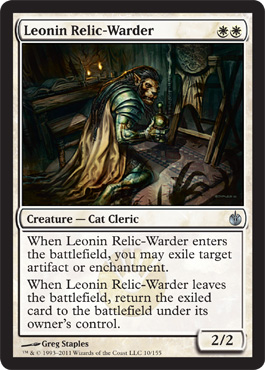
Today, I’m going to offer my opinion on the most-hyped cards, as well as those undervalued at the moment that you should try to pick up at your prerelease. I’m writing this on Sunday, but I plan on updating through Wednesday so I can keep this as up-to-date as possible for all of you. I’m not going to link images of all the cards, so if the autotags don’t link it and you don’t know the card, feel free to use your favorite spoiler website to follow along.

With that, let’s get started.

Hero of Bladehold

A nice Mythic and a prerelease card. This might enable some new strategies, but so far I’m not seeing it, in Standard or Extended. A cost of 4 and no haste makes it likely too slow for Extended, and I don’t think it has the tools it needs to work with in Standard. A well-timed Consume the Meek takes care of the Hero’s buddies, and that spells the end of the theoretical deck it goes into. It will still appeal to a lot of players, so I see it ending up in the $5-7 range.

Mirran Crusader

Sweet card, and it’s a Knight, which means it apparently has some casual value (see Knight of Exemplar at $6 on SCG). Its use in Standard probably relates directly to the possibility of Infect becoming a real deck. $3-5.

Phyrexian Rebirth

This made the list because of one reason. It’s probably nowhere good enough to see competitive play, but as a Wrath+ it could slide into White EDH, making it a good target to pick up as a throw-in.

Consecrated Sphinx

I’m addressing this because it’s a Mythic, but it’s pretty clearly a bulk Mythic that might go into Casual/EDH decks. $2.

Treasure Mage

Yes, it works with Wurmcoil Engine. Awesome. But the real reason it’s included on this list is because it’s a ā€œnewā€ effect, and could see a lot of play in Casual formats. Be sure to pick up Foils of this if you can (did you know foil Trinket Mages go for $6 on SCG?)

Black Sun's Zenith

This card is really powerful, and might find a home in U/B decks. Plus all the Zeniths seem made for casual or singleton formats with the ā€œshuffle back inā€ clause. Good trade fodder, and might see competitive play. Pick up some for cheap if you can, because it’s not grabbing much attention right now, and probably won’t at your prerelease.

Go For the Throat

This is a stellar card that is sure to see competitive play (almost always better than Doom Blade at this point in the meta). Speaking of Doom Blade, did you know it will cost you 50 cents to pick one of these up on SCG, and $3 for a foil? I see the same thing happening with Go For the Throat, especially since it’s an uncommon, so make sure to look through the cards people leave on the table to find these.

Phyrexian Crusader

I’m really on the fence about these new Infect cards. I think the deck is a one-drop away from actually being competitive, and if it gets there cards like the Crusader are going to go for $6-9 apiece. Infect has insane popularity among casual players (see Hand of the Praetors at $5 apiece on SCG). With even a hint of playability attached to Infect, the Crusader can hang around $7-9 for a good while. Pick these up at $4 if you can. It’s preselling at $5 on SCG, and while I think you can get value out of trading for it on prerelease day at $4-5, I wouldn’t clean out SCG’s inventory.

Phyrexian Vatmother

Same as above. I haven’t tested the theoretical Infect deck at all, but this card could have a place in it. Pick up as bulk this weekend, and it might pay off down the road. It’s preselling at $2, so there’s not much risk associated with this.

Hero of Oxid Ridge

If there’s going to be a Battle Cry deck, this guy has a realistic shot of having a place in it, due to haste. I don’t advise picking these up at the (now $8) presell price, but it’s a card to keep an eye on moving forward.

*Note: This has actually gone up to a $8 presell price since I first wrote the article. Trade for these at $4-6, but not higher.

Green Sun's Zenith

This is my vote for best in the cycle. It has a number of decks it already slots in – Elves of pretty much any format, Ramp decks and basically every Green EDH deck with lots of mana and big monsters (so, most of them). It was pre-selling at $5 (now $8). I think it ends up as a $5-7 card. I’ll be looking to pick this card up as much as possible in trades this weekend, especially foils.

*Note: This also went up to $8 after originally starting much lower. Pick them up all day at $4-5, and sell at $7-8.

Thrun, the Last Troll

I really think this guy is going to be a house, especially teaming up with Great Sable Stag to beat up on Faeries in Extended. As such, I think it will hang around $20 for awhile before slipping to $15ish as we move out of Extended season and more copies become available.

Glissa, the Traitor

This doesn’t fit into any deck right now, but I imagine it might get some work as an EDH general. I don’t see the $8 presale price holding up at all, and I think this ends up in the $3-5 range, unless someone finds a use for it in Standard or Extended. It does have the exalted Mythic status, so after the expected initial dropoff it could see quite the spike if it begins to see play (ala Frost Titan).

Tezzeret, Agent of Bolas

I think the presale price of $35 is high, but Dark Tezzy does have a ton of utility. The ultimate factor in his price is going to be whether or not he finds a home in Standard, which he might well do before his run in Standard ends. That said, I don’t see such a deck existing right now in Standard. Tezz is nuts in Vintage, though that doesn’t drive demand that much. I’m going to put a call of $20-25 BlackLotusProject.com average on him after a few months. Same thing as above applies, keep an eye out for any winning decks sporting Tezzeret, because if he jumps, he’s going to jump big.

Blightsteel Colossus

Here’s another card with some crazy casual appeal, and he’s even more nuts in Vintage than Tezzy. Jonathan Medina’s trying to break Shape Anew, but it’s just not happening, folks. There’s just way too many Mana Leaks floating around in Standard right now for such a plan to work.

The Colossus himself, on the other hand, is going to hold his price very nicely, and could even be a second target in Extended Polymorph decks. He doesn’t appeal to everyone, but to those who like him, they’re going to like him a lot. Pick him up from Spikes at a good price and flip him to casual players who are nuts over Infect.

Decimator Web

Some casual appeal, but the card is mostly on the list because it’s sweet. That’s not financial advice, mind you, just a fact of life.

Phyrexian Revoker

I’m not sold on this card, since most of the time you want your Pithing Needle to stay alive, which the 1 toughness makes difficult. It’s likely it will find it’s place in a variety of formats, but I don’t think it will hold its presale price of $4. I think it will eventually settle around $2-3.

Shimmer Myr

This card has such a powerful effect it could find a home somewhere. It’s preselling at $2.50, but I bet there are a ton of players at prereleases across the world who are going to treat it as Bulk. Pick them up cheaply, and trade them to the guy building the Myr deck. And in the unlikely event that such a deck ever becomes real, you’re going to end up with a very nice profit.

Sphere of the Suns

I’ll be on the lookout for this card when looking through draft leftovers. Cool design, sweet effect, probably ends up on a level with Everflowing Chalice ($1.50 and sold out on SCG). Another card to focus on foils of.

Sword of Feast and Famine

Decks sporting Stoneforge Mystic are getting yet another option with this card. I think it’s primary use is going to be for bashing through Tarmogoyfs in Legacy, where the Mystic is starting to see more regular play. It also gives Boros another good target to search for when playing against U/B or a theoretical B/G Infect deck. I see this being on the level of Sword of Body and Mind, though protection from Black might take it a bit further. $8-10 when it’s all said and done.

Contested Warzone

Cool design, but not happening right now. Don’t forget about this card if a Battle Cry deck breaks out down the line.

Inkmoth Nexus

This is one of my favorite cards spoiled so far, and it provides the theoretical Infect deck valuable reach. I’m not convinced it will see play in Control decks like Mike Flores suggested on his article on the mothership, but it’s going to be very popular nonetheless. I can see this holding its presale price of $8 (now $10). I love lands, so I’ll be trading aggressively for them anyway, but you should probably do the same. You can flip these at $10-12 all day long, and probably can pick them up at $7-8 from traders who still think Poison cards are jokes.

*Note: This has gone up to a $10 pre-sell price since the first draft of this article.

Now we have the whole spoiler, and I think I've hit on nearly all the important cards. Let me know if you like this type of card rundown and let me know if you agree with my projections or think I’m crazy!

Thanks,

Corbin Hosler

@Chosler88 on Twitter
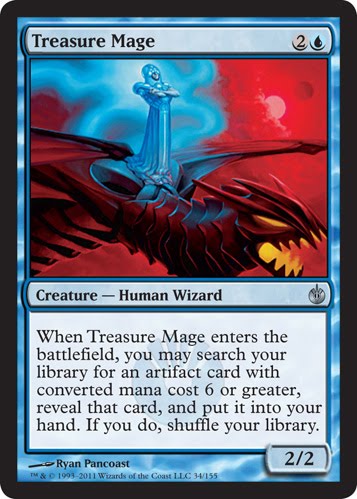
P.S. If you're a fan of ManaScrewed or Podcasts in general, check this out! It's the ManaScrewed crew along with myself, Jon Medina, and Frank Lepore talking about spoilers, SCG Opens, Jon's alleged Shape Anew deck, and, more relevant to this site, the growth of the Finance genre of Magic writing. Medina and I had a pretty good conversation about this, and I suggest giving it a listen if you're interested. The Financial talk is around the 1:10 mark. If you have two hours, though, the entire show is a good listen!

Cube SWOT: Blue

Are you a Quiet Speculation member?

If not, now is a perfect time to join up! Our powerful tools, breaking-news analysis, and exclusive Discord channel will make sure you stay up to date and ahead of the curve.

Let's not waste time and dive right into what makes blue in a cube!

Strengths:

Countless articles have been written about why card advantage wins games but, to summarize, card advantage gives players more resources to win the game. No color in the game is better at achieving card advantage, specifically raw card draw, than blue.

Many colors rely on more indirect methods, like Krosan Tusker or Staggershock. However, blue's card drawing cards are some of the most efficient and direct ways. All 3 of the monoblue planeswalkers support this theme and even ignoring broken cards, like Ancestral Recall, blue's card advantage tools are second to none:

  • Fact or Fiction
  • Deep Analysis
  • Mulldrifter
  • Thieving Magpie

Blue also has some of the most powerful card selection tools in the game. Ā Ponder and Brainstorm were restricted in Vintage because their ability to look through the library for powerful individual cards. Cube provides the same opportunities with a variety of these effects:

  • Ponder
  • Preordain
  • Brainstorm
  • Frantic Search

Removal effects are very valuable in cube as they allow the controller to neutralize powerful threats. While blue has no way to directly remove creatures outside of Psionic Blast, it does have a few ways of dealing with opposing creatures.

Tempo effects, mainly those that return permanents to the owner's hand (that is, ā€œbounceā€ effects) are useful because they can temporarily remove a troublesome permanent, often a creature, from the battlefield at a relatively cheap cost. While the solution is by no means permanent, the tempo gained is often worth the cost of having a temporary solution.

  • Man-o'-War
  • Remand
  • Venser, Shaper Savant
  • Crystal Shard

ā€œTheftā€ (or "Control Magic") effects allow blue decks to take control of opposing threats; Ā neutralizing them while gaining one.

  • Control Magic
  • Treachery
  • Sower of Temptation
  • Vedalken Shackles

Many blue decks seek to gain control of the game by neutralizing, at least temporarily, opposing threats and creating a dominant board position. Blue's creatures seek to end the game by having a combination of evasion and a way to protect themselves. This makes it so that the opponent can't simply aim a removal spell at a card that's meant to end the game on its own.

  • Kira, Great Glass-Spinner
  • Frost Titan
  • Morphling
  • Sphinx of Jwar Isle

Blue's other major strength is in its unique ability to neutralize threats while they are on the stack by means of countering spells. Ā Only blue has the ability to stop cards from taking effect at all.

  • Counterspell
  • Cryptic Command
  • Miscalculation
  • Force of Will

Blue also has many cards that are excellent with artifacts. Many of the artifact-based mana acceleration, like the Signets from Ravnica block and Mind Stone, are perfect for blue-based control strategies. Artifacts and artifact-centered cards are typically a strong component of blue-based decks.

  • Tinker
  • Thirst for Knowledge
  • Tezzeret the Seeker
  • Tolarian Academy

Weaknesses:

A major weakness of blue is that it is a very slow color. It is not very good at playing an aggressive role because of its 1- and 2-drop creatures are not very efficient at dealing damage quickly: there are no Elite Vanguard or Oona's Prowler equivalents in blue! Even a majority of its early creatures are meant to ultimately aid a player in a long-term strategy, not ending the game as quickly as possible.

  • Looter il-Kor
  • Enclave Cryptologist
  • Jushi Apprentice

Due to this slowness, blue archetypes are vulnerable to disruptive strategies and strong, early pressure from aggressive decks.

Many blue decks ultimately wait until the later stages of the game to enact their game plan. A well-timed Molten Rain, Tangle Wire, or Dwarven Blastminer can provide enough of a tempo disruption to make a blue mage lose the game. Disruption by means of discard, through Hymn to Tourach or Duress, can also provide sufficient disruption.

Opportunities and Treats – Archetypes:

Photobucket
Blue-White (Azorius) – Control

Azorius control is one of the classic archetypes in Magic. Blue's major strengths all encompass areas that white does not have, making blue a very good complement. The basic gameplan of Azorius control is to make beneficial one-for-one trades (my Swords to Plowshares for your Tarmogoyf, my Counterspell for your Garruk Wildspeaker, etc.) in the early game.

Blue's card advantage help Azorius decks hit the long-term game strategy by making it so that they can get a large improvement from the 1-for-1 trades made in the early parts of the game. Because of this, blue's more expensive card advantage tools like Desertion and Mulldrifter are good in Azorius control, since the deck plays a long game, making it so that the payoff from these expensive cards happens often. Blue's ā€œbounceā€ cards like Venser, Shaper Savant Ā can assist white's creatures with enter the battlefield triggers, in addition to white's own bounce cards like Kor Skyfisher and "blink" cards like Flickerwisp and Venser, the Sojourner, allowing the deck to recycle triggers on cards like Cloudgoat Ranger to generate card advantage.

Due to the fact that white's creature-removal suite contains some of the most efficient removal spells in the game, cards like Control Magic aren't as necessary as they are in other blue-based decks.

Countermagic helps Azorius decks deal with opposing threats, especially red direct damage which can be particularly painful when an Azorius player is at a low life total. Counterspells can also help to protect white's army of planeswalkers as well as several card advantage machines in blue's own Jaces and Tezzeret, the Seeker. Similarly to blue's card advantage, Azorius decks are able to utilize more expensive counterspells like Dismiss and Draining Whelk because of the longer game state.

Photobucket
Blue-Black (Dimir) – Control

Dimir decks play similarly to Azorius decks in that both seek to prolong the game through 1-for-1 card trades and win through a long battle of attrition and eventual card advantage, and many of the same cards overlap here. However, black's methods of achieving this route to victory are slightly different and blue's role takes advantage of this and increasing the removal available:Ā ā€œbounceā€ effects are useful with creatures like Grave Titan, Shriekmaw, and Skinrender.

Blue's card selection tools, especially those that place cards in the graveyard like Enclave Cryptologist, Looter il-Kor, and Frantic Search, are extremely useful with reanimation effects, like Recurring Nightmare and Animate Dead, as this combination allows a player to cheat a creature like a Myr Battlesphere, Sphinx of Jwar Isle, or a Sphinx of the Steel Wind into play much earlier than it could be played.Ā Even without reanimation effects, blue's card selection and card draw tools are useful for helping a Dimir deck ultimately achieve control and win a long game.

Photobucket
Blue-Red (Izzet) – Control

While red typically plays an aggressive role in cube, Izzet decks are able to temper red's arsenal of burn spells and 2-for-1 creatures into a powerful control strategy with some help from blue.

Many of red's burn spells like Burst Lightning and Flametongue Kavu can destroy creatures with 4 or less toughness, but it has a harder time dealing with creatures bigger than that, with only X-spells like Fireball can destroy opposing titans and dragons. Cards like Control Magic and Treachery can help red decks deal with those creatures, and blue's plethora of cheap card advantage and selection help decks quickly find burn spells to destroy smaller creatures.

Blue's array of counterspells can also deal with anything that isn't a creature or an artifact, as permanents like enchantments are difficult for red to remove from play. Red can deal with planeswalkers through burn spells like Lightning Bolt, but being able to prevent a planeswalker from even being able to use any ability is extremely nice for an Izzet deck.

Photobucket
Blue-Green (Simic) – Midrange

The best Simic decks are tempo-oriented machines, disrupting the opponent with cheap countermagic and removal while bashing with efficient creatures.

Blue provides a way to shore up one of green's major weaknesses: its inability to directly deal with creatures outside of combat. Cards that provide tempo, such as Aether Adept and Memory Lapse, may only temporarily prevent threats from being on the battlefield but the strategy of efficient creatures and cheap disruption uses these temporary effects to clear a path for creatures like Kodama of the North Tree to win the game quickly.

Blue's powerful suite of ā€œtheftā€ effects give Simic decks other tools to directly deal with troublesome permanents. Due to green's mana acceleration, Simic decks are able to easily circumvent having to tap out for spells like Control Magic and Treachery. It also helpĀ Simic decks accelerate into blue's large, difficult to answer threats like Frost Titan and Keiga, the Tide Star.

A more subtle effect is that green's acceleration through land-searching cards like Sakura-Tribe Elder, Yavimaya Elder and Krosan Tusker makes blue's already-strong card draw effects even better,since these cards decrease the probability of drawing a land and provide shuffle effects to change the cards on top of the library. Since green doesn't get much in the way of pure card draw, outside of Harmonize and Sylvan Library, this strength is especially important for Simic decks.

Photobucket
Monoblue – Control

Monoblue decks are the prototypical control deck and a good mono-blue deck can be a fearsome deck to see in a cube draft. Monoblue seeks to gain card advantage, creature theft and seek to win through a hard to answer creature, essentially playing it's own strengths to their peak. Since these decks lack a true mass-removal effect, they must rely on artifact-based ones like Oblivion Stone or Nevinyrral's Disk to destroy a horde of opposing threats, usually creatures.

However, since a monoblue deck can focus on its strengths–card draw, permanent theft, card selection, and counterspells–it can be a formidable foe due to high redundancy, similar to how a monored deck can be a formidable foe because of the redundancy in having many, many burn spells.

Analysis:

An examination of blue's archetypes shows that it is almost solely control-based, three out of its four archetypes are control-based with only Simic (and arguably Izzet) being midrange. However, as blue is often an incredibly strong color it is important to make sure these decks are not taking over your entire cube; fighting this common experience, however, happens mainly through making the other colors play to their strengths better, not by directly weakening blue.

Stay tuned for next week when I will perform a SWOT analysis on black, a color that, like white, is adept at both aggressive and control strategies and how to make black perform both these tasks optimally.

Thanks for reading!

My twitter account: @UsmanTheRad
My cube blog: idratherbecubing.wordpress.com
My cube podcast: The Third Power

The Legacy of Legacy

Are you a Quiet Speculation member?

If not, now is a perfect time to join up! Our powerful tools, breaking-news analysis, and exclusive Discord channel will make sure you stay up to date and ahead of the curve.

Legacy is like the high stakes poker tables of magic trading. If you come in with no knowledge and a few in demand cards, a skilled opponent (read: opposing trader) can walk away leaving you feeling dazed, worked over, and wondering if you even got a fair value trade. I have been a firsthand victim of this as legacy was heating up a few years back. I won't go into the specifics of it but I will say that it got me to begin learning the real value of cards that see play and are commonly traded in Legacy events.

I don't promise you will finish reading this and be able to make money trading at legacy events. The format takes more time to study and understand the flow of then any other as far as economics go. Its also the one that can see volatile changes in price the fastest, but prices stay where they peak more often than standard and even continue to rise over time.

One aside here. I assume that if you're reading financial articles you know the basic cards to look for so I'm going to skip most of them, including but not limited to Aether Vial, Wasteland, Daze, Standstill, Counterbalance, most things considered "staple" in Goblins, Merfolk, and Counterbalance, as well as all dual lands. If you don't know those decks and the pieces that make them work then you need more research into legacy than just this article. I would call this a Mid-level legacy article as far as finance goes. Cards ranging from semi-staple, to fringe, to exclusive will be in here, though I may include some format staples because I think some of them need to be covered. See above.

The first few cards I want to look at here go into the deck Solidarity, AKA High Tide. Not to be confused with Spring Tide which operates at sorcery speed and has the biggest gain from the unbanning of Time spiral, Solidarity works at instant speed and normally on your opponents turn. Unfortunately there aren't many money cards to be had in the deck, and its one of the cheapest decks in legacy to build. It uses no duals or wastelands, though they are an option. We'll go over a few examples anyways.

High Tide is a helper, not necessarily the key. Its a common and can be found for under a dollar. It holds casual appeal, but anyone looking to play the deck can easily get these at a low cost. I don't recommend picking these up because of their low value.

Turnabout is more of a key, but only when paired with High Tide. Its rare that games go long enough for this to generate substantial mana gains. Hovering between 2 and 4 dollars, it's a decent pick up if you can find it on the cheap. Its not worth picking up to sell to vendors, since they usually buy them for under a dollar.

Meditate is part of the draw engine the deck uses. When you're going to win on that turn, who cares if you skip the next few? It currently sees a price tag on the average of $6, and is worth having a couple in your binder.

Reset Ah ha! This is the reason I wanted to cover this deck. At 2 mana, you don't need many lands for this to begin providing gains that are worth something. Paired with a High Tide it can produce scary amounts of mana. Here's the kicker; it's a $20.00+ uncommon, and from Legends! Many players tend to criminally undervalue this card. Keep an eye open for them when trading with people that have older collections. They are very specific, only being played in this deck which is something to consider. Unfortunately the unbanning of time spiral doesn't do this card much in the way of favors, since its usually a one or the other situation. Still, good vendor item if you manage to pick some up when buying a collection.

Cunning wish is something of an oddity. Its had quite the roller coaster life, ranging from almost $15 each to its current value of $5. It's been declining steadily for nearly two years, though as is the usual story of Legacy cards it needs only a few events of good performance before it sees a rise. I would pick them up for $3-$4 each if able, but don't aggressively go after them. Their age will help the price recover eventually, but its hard to say when that day might be.

The next set of cards are commonly found in the deck Dead Guy Ale. A personal favorite of mine because of its card advantage engines.

Sword of Fire and Ice has seen slow but steady gains over the past two years, rising roughly one dollar a year. It currently sits between $13.60 and $18 on average, depending on where you see it. I would suggest getting a few of these to have in your binder. They always have casual appeal, and every so often they show up in a red and blue creature dominated format and do very well. If only we had formats where small red and blue creatures won a good number of games....if only.

Sword of Light and Shadow is the counterpart to SOFI, it sees values between $12.80 andĀ $15.00. HavingĀ a few of themĀ on hand won't hurt, as I could see both swords rising in demand steadily.

Vindicate has been loved by both competitive and casual players since its printing. It currently sits at an average of $15, and SCG is sold out of them at $18. A foil Vindicate can get you upwards of $50, and a Judge promo one can get you about $30. This card has been steadily rising, and should be watched. Trade for them when you see them, they will continue to rise over the next few years.

Mother of Runes is another uncommon that currently has its star rising. Sold out on both SCG and channelfireball, its current asking price is between $3 and $5, though I see those numbers going up in the near future with the success of Dead Guy Ale and Green and Taxes, where the card shines.

Dark Confidant has seen his day over and over again. He took the usual "rotate from standard" price hit, but recovered nicely, survived his premature departure from extended, and currently sits at a steady $15. Very few sites have multiple copies in stock, and as Legacy is explored more expect this card to continue to have influence over the format. Its use in Dead Guy Ale and BGW Junk and a host of other decks means his value will probably rise as legacy picks up more players.

The deck Painted Stone is seeing a rise in popularity again, and with many of its core pieces seeing a lull in price now is the time to invest in a few copies for trade or personal use. I expect all three of these cards to rise over the next year and beyond. I put them all on my list of cards to pick up when able.

Painters Servant is half of the combo, and is currently sitting at an average of $5. It pairs well with cards like Hydroblast and Pyroblast, but its lethal with the next card on the list...

Grindstone can be a beast by itself. It currently carries a price tag of $20+ and in 2008 hit a high of $36.Ā  It currently has a higher number in stock than painters servant, which is helping to keep its price lower for the time being.

Goblin Welder sits at an unimpressive $6 average right now, but has seen highs of up to $14. A foil one is worth quite a bit more, between $80 and $90, with most stores buying foil ones for $40-$50.

Hopefully this gives you a better idea of cards that carry value in the format beyond Goblins, Merfolk, and Tops. At this point everyone knows that Force of Will's and Wastelands carry a price tag, but with luck you can score a deal on some of the above cards. Legacy continues to grow, and as long as those cards aren't reprinted they stand to grow in value with the format. Four times a year every Legacy deck has the possibility to be removed from the format, or become a new dominant power player.

I'm going to start a thread for this article in our forums, I encourage you to check them out and get involved.

Until next week,

Stephen Moss

@MTGstephenmoss

MTGstephenmoss@gmail.com

Down With the Sickness

Are you a Quiet Speculation member?

If not, now is a perfect time to join up! Our powerful tools, breaking-news analysis, and exclusive Discord channel will make sure you stay up to date and ahead of the curve.

Ever since Scars of Mirrodin was released, in the back of my head, I always knew that infect would be a viable theme in Commander. In a format where players start with 40 life, being able to put down a player with just 10 damage seemed like a good plan. Putting an opponent at one-quarter their normal clock (regular damage), or even half of their fastest clock (Commander damage), with virtually no way to heal it gives a player a supreme ability to take out other players in the blink of an eye.

The sheer power of infect can be likened to infamous cards like Sorin Markov and Magister Sphinx. In this format, what better value can you find in dealing 30 damage with just 6 or 7 mana? The swings you can create with either of these cards is just obscene.

From what we had been given in Scars of Mirrodin, it didn’t take a Blind Seer to realize that infect was going to be something nasty in Commander. Just how nasty remains to be seen.

TheĀ Mirrodin Besieged prerelease events are this weekend and Phyrexian horrors loom just over the horizon. This is our Empire Strikes Back of the block, so things are going to get a whole lot hairier for the Mirrans before they get better (or rather, if they get better). I believe once this set is released, for the reasons I laid out above, we can expect Commander players to truly begin exploring and exploiting poison counters through infect-themed decks. While the power level of the infect mechanic has yet to be determined on a large scale, judging from the previews we’ve seen so far there are many tools available for an infect player to employ multiple strategies.

In my very first article about wedge-colored Commanders, the anonymous and unassuming commenter ā€œDanā€ clued me into Vorosh, the Hunter as an ideal legend for infect synergy. Black and green have the infect creatures; blue has proliferate. From the Mirrodin Besieged cards that have been previewed, it looks like Dan was right on the money. From this approach, let’s look at a few of the horrors we might see in the very near future:

Corrupted Conscience: In a format full of fatties, Corrupted Conscience reverses a player’s hubris on an overwhelmingly embarrassing scale. Someone can cast Bribery for another player’s Eldrazi, only to have it stolen back and killed in one swing for his impetuousness. On creatures that can pump (like Nirkana Revenant), shoot other creatures or players (Kumano, Master Yamabushi), or both (Inferno Titan), this aura, and other infect-enablers like it, are an utter beating.

Phyrexian Hydra: Five mana for a 7/7 is a great deal, and considering all it needs is a little power boost to one-shot a player, expect to see the Hydra often in infect decks. Thankfully, its power is mitigated by its self-infecting nature but remember that black and green are colors that enjoy recurring creatures.

Viridian Corrupter: In a kind of ghastly mirror reflection, Viridian Shaman has been twisted to create an infect variant with no less utility than before. In a format where 2/2s don’t do much to kill creatures or knock down life totals, the infect ability makes the Corrupter vastly superior to its untainted counterpart, in that even as a bear it becomes a 5-turn clock.

Blightsteel Colossus: This monstrosity has stirred up its fair share of discussion on message boards and on Twitter, being compared to creatures like Emrakul, the Aeons Torn for its ability to single-handedly win games. Being an 11/11 indestructible, trampling Infect creature, the Colossus threatens to become the new bogeyman of Commander.

Some of the controversy is warranted. One of the defining weaknesses of artifact creatures is that they can be killed by artifact removal spells. For the vast majority of cases indestructibility negates this weakness. It is also colorless, enabling it to dodge defensive measures like Story Circle, protection (not that it helps a whole lot against an 11/11 trampler) and Teferi's Moat.

But I don’t think we should count out red as a poison-enabling color, either. Imagine some of these cards paired with Infect:

All the tricks that red can do to abuse Lifelink and Deathtouch (namely, creatures that can ping for damage or can Earthquake/Inferno a table) are equally applicable to infect, and in many cases, even more potent.

We will no doubt see more tools for infect players when the rest of the set is unveiled. When Scars of Mirrodin was released the prevailing belief was that infect was held back by the size of its creatures. Judging from the likes of the Colossus, this is no longer the case. So what cards can we expect to see play to bolster the swelling ranks of the Infected?

Trample enablers: Loxodon Warhammer, O-Naginata and Rancor provide a huge boost to large infect creatures that need evasion to get poison counters through.

Firepower: If you're having trouble punching through blockers, an alternate route is to fire poison counters right over their heads. Surestrike Trident is a very cheap way to potentially tack on a ton of infect damage and, as long as you can afford the mana, you can keep throwing the Trident over and over. Hankyu is a slightly less effective way of firing off infect damage, but its mechanic plays fairly well with proliferate cards. Even Heavy Arbalest, a card normally relegated to Scars of Mirrodin Limited, isn't terrible in that you're still hitting them for two poison damage per activation.

Doubling Season: Proliferate gives an infect player an incredible amount of reach, and while Doubling Season doesn’t help with infect-related effects it certainly boosts the effectiveness of proliferate cards. It is also great with Vorosh, making him a tremendous force to be reckoned with even without granting him Infect.

Gilder Bairn: The "Little Ouphe That Could" is going to get even stronger with the release of MirrodinĀ Besieged, single-handedly possessing the ability to double the counter count on one of your permanents (like your Planeswalker’s loyalty counters) or on one of your opponent’s (like poison counters). Flexible, potent and repeatable.

Contagion Engine: I think this card will be huge in the near future in more proliferate-themed decks, simply because you can add 2 poison counters to every player with a single activation. The sweeper -1/-1 counter ability is a solid foil to tokens and other aggro decks.

Whispersilk Cloak: Equipping Blightsteel Colossus with the Cloak is a reliable one-shot kill, and it's not difficult to Voltron-assemble creatures through auras and other equipment to create your own one-shot infect monster that can't be blocked.

Hall of the Bandit Lord: A turn spent doing nothing is a turn that every other player can find or play an answer to an infect threat. Giving infect creatures haste shrinks that window of opportunity for opposing players.

From looking at some of the cards available to infect players it's apparent that they have a number of options available to them. They can avoid combat and snipe off players. They can proliferate entire tables once they get the poison counters going. Or they can just bash face the old-fashioned way.

It will be interesting to see which color combinations will be used to best exploit the infect mechanic in Commander. There's a surprising amount of space available for players to tinker around and find the ideal Infect strategy, and it will be safe to say that you can expect at least one of these new decks to pop up at your playgroup in the near future.

And if you are attending a Mirrodin Besieged prerelease this coming weekend, good luck and have fun! If you are in Toronto, I shall be at Heavy Support Games and Two Headed Dragon batting for the Phyrexians.

Come get some oil!

David Lee
@derfington on Twitter
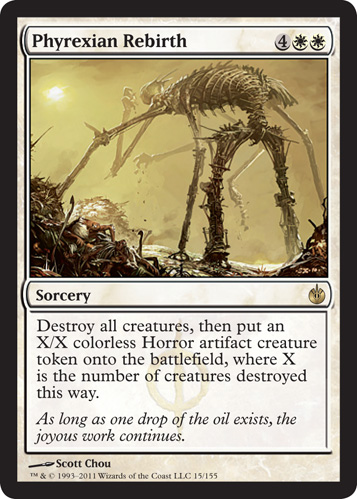
Judging Extended: PTQ Part 2

Are you a Quiet Speculation member?

If not, now is a perfect time to join up! Our powerful tools, breaking-news analysis, and exclusive Discord channel will make sure you stay up to date and ahead of the curve.

If you came here because you liked Part 1, great! Because we're jumping right into Part 2.

Round 4

ā€œJudge! I cascaded with my Bloodbraid Elf. I flipped up 4 cards and then a Volcanic Fallout. I don’t want to cast the Fallout, what happens to it?ā€

Cascade exiles cards from the top of your library until you exile a nonland card that costs less. That card is still exiled if you choose not to cast it, and is one of the ā€œexiled cardsā€ that get randomized and put on the bottom of your library.

ā€œJudge! So we were half way through playing our first game when we happened to look at our Result Slip and noticed that one of us isn’t supposed to be at this seat. The match next to us has one person that didn’t show up, but that person was supposed to be one of us. What happens now?ā€

So for those who may not know, a Result Slip is used to easily track match results for each match in a tournament. It is printed with both player’s names and DCI numbers so the person entering results into the computer can do it easily. There used to be a penalty that specifically handled when a player played the wrong opponent. Now however, we just treat it as if the player was tardy to his match. It had been more than 10 minutes, which means that this player unfortunately earned himself a Match Loss for not showing up to his seat on time. It might seem a little harsh, but it is ultimately each player’s responsibility to make sure they make it to the right seat on time.

ā€œJudge! My opponent tapped six lands and cast a Primeval Titan. I used Cryptic Command to counter it and draw a card. That resolved, and then she cast a Summoning Trap, looking at the top seven cards and put a second Primeval Titan. At this point, I noticed that one of her 6 lands in play is a Terramorphic Expanse. So she didn’t have enough mana to cast the first Primeval Titan in the first place. What happens now?ā€

I’m going to go into more detail about this situation next week, but for now I’ll just say that I didn’t back up the game: the Summoning Trap resolved as described and both players received Warnings.

The rulings here was a Warning for a Game Rule Violation for theĀ Titan-casting player, and a Warning for Failure to Maintain Game StateĀ for the opponent.

Round 3

"Judge! My opponent was going to cast a Vengevine. To speed things up while he tapped his lands I asked ā€˜so I take 4?’ He nodded, so I recorded the 4 damage on my life sheet and quickly took my turn. Just before I passed my turn, I looked over and noticed that he had put the Vengevine into play and left it untapped. So he didn’t attack me, but he insists he meant to. So did he, or didn’t he?ā€

I decided that based on their verbal acknowledgment, and the fact that both players had recorded the damage, the attack happened. Just because the card happens to be straight up instead of turned to the side, both players at one point agreed that an attack happened. I didn’t think that this player should be able to try to shortcut turns and then try to take advantage of it.

ā€œJudge! If I have a Linvala, Keeper of Silence in play, can my opponent unearth his Hell's Thunder.ā€

Unearth is definitely an activated ability, however Linvala only effects creatures that your opponent controls. Unearth requires that the creature be in the graveyard and, thus, is an activated ability of a card in the graveyard, not a creature one controls.

ā€œJudge! My opponent cast a second Vendilion Clique when he already had one in play. Does he get to take a card from my hand even though his Clique will die to the Legend Rule?ā€

The ability will still trigger. The creature entered play, it was just immediately put in the graveyard thereafter. So yes, he will get to take a card from the player he targets.

ā€œMy opponent cast a second Vendilion Clique 3 turns ago. Neither of us realized until now though that it’s legendary. What happens now?ā€

So this seems like some of the other questions that have come up so far. The issue originated turns ago so we just let things stand, right? Technically, yes. However, before we just let things stand we always have to apply State Based Actions, one of which is the Legend Ruleand both Cliques are put in the graveyard.

The ruling here was that Clique playerĀ receivedĀ a Warning for a Game Rule Violation and the opponent netted a Warning for Failure to Maintain Game State.

ā€œJudge! My opponent has a Leyline of Sanctity in play. Can I cast a Lightning Bolt and hit his Jace, the Mind Sculptor?ā€

No. In order for your Lightning Bolt to hit Jace, you need to target Jace’s controller and then redirect the damage to Jace. If you can’t target the player, Jace is safe as well (from Lightning Bolt).

Round 2

ā€œJudge! I cast a Tidehallow Scholar and my opponent doesn’t have any cards in his hand. What happens?ā€

The ability triggers, and resolves. You get no card. Not every question has a fun explanation.

ā€œJudge! I cast a Demigod of Revenge, my opponent used a Mana Leak on it, but didn’t say whether the Demigod’s triggered ability resolved first or not. What happens?ā€

This is an unfortunate situation for the control player. You don’t have to specifically announce that you put the Demigod trigger on the stack; that happens automatically. You do however have to specify that you let the trigger resolve. If you don’t, it will still be there when your Mana Leak resolves. Then when the Demigod trigger finally resolves it will put all of the Demigod of Revenges in the graveyard into play, including the one that was just countered.

ā€œJudge! I attacked my opponent. He blocked with his Kitchen Finks, but still took lethal damage. He claims that the Finks Persisting back into play will keep him alive. Is this true?ā€

Sadly both the player and the Finks die at the same time. There won’t be a chance this game for the Finks to persist as it usually does.

Round 1

ā€œJudge! My opponent and I were playing pretty fast and I didn’t notice after he started his turn that I had 8 cards in my hand still.ā€

This is very honest of a player, and the penalty is not harsh for this either. Just discard now and issue a Warning.

The ruling here was the player with 8 cards received a Warning for a Game Rule Violation.

ā€œJudge! My opponent cast a Figure of Destiny and in response I cast a Spellstutter Sprite. When it resolved I tried to counter the Figure. My opponent responded by Lightning Bolting my Sprite. Does his Figure still get countered?ā€

Spellstutter Sprite’s triggered ability counts the number of Faeries you control when it resolves. If your Sprite falls to a Bolt, you will have zero Faeries in play, and the Figure will not be countered.

ā€œJudge! Can I sacrifice my Burrenton Forge-Tender to my opponent’s Valakut, the Molten Pinnacle and prevent all of its damage for a turn?ā€

The Forge-Tender only can prevent damage from a red source. Valakut is a land and lands are colorless, regardless of what type of mana they produce.

And there you have it! These were the more interesting questions asked at this PTQ. I hope this can help you test for future Extended tournaments, or even just answer some burning questions about how things work. Until next week!

As always, Keeping it Fun

Kyle Knudson

Level 2 Judge

Allon3word at gmail.com

Outside the Sleeves: Number One Dime

Are you a Quiet Speculation member?

If not, now is a perfect time to join up! Our powerful tools, breaking-news analysis, and exclusive Discord channel will make sure you stay up to date and ahead of the curve.

I was in the middle of a family dinner on December 20th. I took two seconds away to check my phone to see what the verdict was. Twitter told me that Survival of the Fittest was banned in Legacy. I was a little bummed out, hoping that they would give it at least 3 more months so I would have a chance to play it in a tournament.
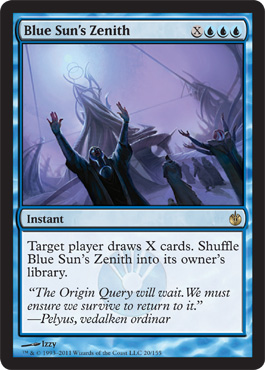
But this should not have been a surprise to anyone who was paying attention to all the analysis that was going around. You couldn't throw a stick on the internet without hitting someone who believed that it wasn't bound to be around much longer. If you wanted money from your playset that you possessed, it was best to sell. And fast.

I didn't.

It was hard to see this tidal wave of change and no matter what anyone said to me, I wouldn't sell my playset. This wasn't some attempt to buck the trend and hope that they wouldn't get banned. I was one of those people who believed it was going to; though I secretly hoped that wasn't the case. You're on this site to read some of the best financial information about Magic (this is not a plug nor was I encouraged to say it, it's what I believe) and telling those very same readers that sometimes the financial aspect of Magic takes a backseat to other things can be very risky.

But it does.

Let me go back. Some of you remember that in the late 80's-early 90's there was a cartoon called DuckTales. It was the on going adventures of the richest duck in the world, Scrooge McDuck, and his three nephews, Huey, Dewy, and Louie. Scrooge was famous for being really rich; he kept most, if not all, of his money in the liquid asset of coins (some of the economic structure was a little wonky, but that's to be expected). This is great for him, because he keeps it in a giant vault and one of his favorite activities is to go swimming through the coinage (again, it's a cartoon).

Sorry, I digress.

The most prized possession in Scrooge McDuck's life is his first physical payment for work, a dime. Out of everything he owned, cars, helicopters, houses, a giant vault to keep a swimming pool full of money, and a robot bodyguard, it was this simple dime that he cherished most.

Number One Dime.

And no matter what you do, sometimes you can't break those emotional bonds. Everyone has them. Including you. Including Scrooge McDuck. Including me. Financial incentives are sometimes no match for what's already in your possession. It's commonly believed that the value of something is only worth what someone would pay for it. That concept used all the time in Real Estate to value houses and properties. And while we're not talking about hundred of thousands worth of cards, the impact is the same.

The flip side of that argument is that one has to be ready to sell it from the right price. There's the issue of person with the item wanted too much money, so most people pass on it. Everyone is a potential seller/buyer if the price is right. But sometimes money isn't the issue. Sometimes you don't want to sell; you have emotional attachment to that object.

And that makes no financial sense.

To be a successful person, at least in the Darwinian sense, is to procreate and pass along your genes. If you lived your life giving to the needy and help out your fellow humans, but didn't leave offspring by the time you died, you failed at living according to Charles Darwin. If you don't buy/sell/trade Magic cards at the right time you fail at Magic economy. I can see Kelly Reid with slicked back hair in a suit standing in front of a crowd telling us that greed is good. That's what Scrooge McDuck believes and it worked amazingly for him. Why shouldn't you share that belief as well?

Scrooge McDuck also believed that he shouldn't have to sell a dime if he didn't want to. What's the true value of that Number One Dime? Trick question: ten cents (We're not going into the supposed magical value of the dime, so ignore it). To Scrooge it means so much more. Other people may want that dime because he values it so much and they're willing to pay more than a dime for it.

If Scrooge's belief that greed is good, and using money to make more money is what drives him, why doesn't he sell the dime?

Why didn't I sell my playset of Survival of the Fittest?

The simple logic that you could use to get me to sell them was that that old adage: sell high, buy low. I could sell my playset high, wait until they drop in price, then buy them low with extra coin in my pocket. Ā If Scrooge McDuck wanted another dime there was nothing preventing him from doing so.

How many of you remember the first rare you pulled? Or remember which card won you your first game, or FNM, or PTQ? How about your first foil? All of those things are emotional attachments that, depending on the player, will make it hard to sell or trade away. One of my copies of Survival has that story.

I was at my first Pro Tour: Seattle 2004. No, I wasn't playing in it: it had come to my backyard and I wanted to see what it was like. I sat at the same table as Kai Buddie, who was one of the only Pro Tour regulars I recognized, while he was in between drafts. It was the first time I saw Mark Rosewater and I was too nervous to meet him at first. But, it was the first time I went to an event where they had artists. After bringing some stuff to get signed, I wondered over to the dealer's table to see what he had. And there I saw it: Survival of the Fittest. That $15 was the most I've ever spent on a single card. Why did I buy it?

Pete Venters, the artist who painted the art, was there.

I had been playing 150 Highlander, and I wanted to pimp out the deck. One of the best ways to do that was to get an artist draw on his/her art. Not wanting to cramp their creativity, they had free reign to doodle whatever they wanted to. Sam Wood altered my Oblivion Stone to make it look like it was the obelisk scene from 2001: A SpaceĀ Odyssey (and as a sci-fi geek, it was completely cool). Anthony Waters drew a dinosaur on my Windswept Heath.

And this is what Pete Venters did:

Awesome, right? [Editor's Note: Despite all the discussion to the contrary, I'd totally be hot-to-trot to trade for this bad boy if it was on the market.]

After get some more cards signed and traded with a few foreign people who wanted my English cards as much as I wanted their foreign ones, I was off. Yes, it was a great time, and it's something I use to tell people why they should go to these big traveling Pro Tour stops. This experience shaped my love for the game more than any other event I've been to.

Now, not everyone likes their cards altered or signed, but I did. Does it add value? If I'm aiming to keep it, what does the value mean any way? However, if I could sell the card for $50, wait a couple weeks since I wasn't playing in any Legacy events, and buy some more back, I could easily do that. I've seen Pete Venters sign a couple more times, that's easy to do.

Except he doesn't alter cards anymore.

The constant altering with the tiny detail in his work hindered his eyesight to where he doesn't doodle on cards anymore. There’s a sign above his table where he signs that says just that.

My copy is the only one he will ever create.

While some might be similar, and while the card still functions the same, the fact that I can't get a semi-close replacement to what I currently have makes this priceless to me.

Even though it's only worth market price.

But this issue digs deeper than just one player and a card. Everyone has emotional attachments to certain cards. Some players like to show off their ā€œprettiesā€ by keeping them in their trade binder. When another person going flipping through them and points at that card, the owner goes ā€œNo, that's my favorite card.ā€ The trader gets mad because "Why have it in a trade binder if you're not going to trade it?"

Yes, a binder is a great way to keep all your cards together, but have one that you can have for all the cards you're not going to trade. The regulars on this site might know that, but this is for the people who don't read the financial side: if you're not going to trade a card, don't put it in your trade binder. Unless it's an oddity or you're using a page to separate what you're trading and what you're not trading, most people really don't care.

I've got a binder full of cards I'm not trading or selling for this very reason. Artists proofs, or cards signed by designers or Pro Players, or just cool cards that I don't want to get rid of (like a foil textless Lighting Bolt I received for participating in the Zendikar developer's chat that sits next to my Magic 2010 foil Lighting Bolt). If my friends want to see the cards they can, but they're not for sale.

Just like a certain cartoon dime.

You might be wondering about the other three cards in the playset. I acquired them sometime after the Pro Tour and brought them to the next time Pete Venters came to a Prerelease to sign cards. It was there that I first saw his no alter sign. It was only 14 months later. In case you were wondering, the three of them are signed. So, I could have just sold the three and done the same thing (sell high, buy low).

But it's more than just making money.

Magic is first, and foremost, a game. While some people consider cards like trading stock; a card is only as good as its last performance in a big tournament. I trade, buy and collect for the love of the game. Part of my wants to collect for fun, part of me wants to play a game. If I already have the cards, they why should I trade them away? Yes, I can join your little game of nickel and dime to earn me some money which then can earn me some more money and more cards.

But I don't have to.

Not with my Number One Dime.

Robby Rothe Jr

Robby Rothe Jr. is currently one of the only players to have read the Revised rule book to learn how to play. After he attacked with an 11/21 Kird Ape, believing it received +1/+2 for each forest in play, he has never looked back. Robby has been writing about Magic for the past three years on his design/humor/culture blog MTGColorPie.com as well its Elder Dragon Highlander cousin blog 99EDHProblems.com. Since then he has branched out and is currently writing a weekly EDH column for ManaNation.com as well. As a “Not quite a casual/not quite a professionalĆ¢ā‚¬Ā player, he knows that there’s a larger group out there that fits into that same mold. Believing that Magic is more than decklists and who made the Top 8, Robby focuses on what makes the game tick; from the cards to the people. Even though he lives with his wife in the Seattle area near WotC headquarters, you can always find Robby on Twitter at @mtgcolorpie.
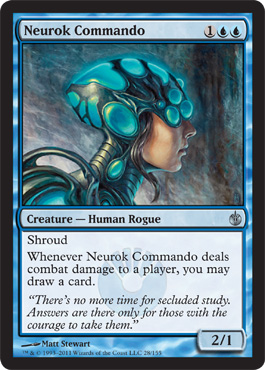
View More By Robby Rothe Jr

Posted in Feature, Free, TimmyTagged , , , 8 Comments on Outside the Sleeves: Number One Dime

Have you joined the Quiet Speculation Discord?

If you haven't, you're leaving value on the table! Join our community of experts, enthusiasts, entertainers, and educators and enjoy exclusive podcasts, questions asked and answered, trades, sales, and everything else Discord has to offer.

Want to create content with Quiet Speculation?

All you need to succeed is a passion for Magic: The Gathering, and the ability to write coherently. Share your knowledge of MTG and how you leverage it to win games, get value from your cards – or even turn a profit.

Scouring Through Saga

Are you a Quiet Speculation member?

If not, now is a perfect time to join up! Our powerful tools, breaking-news analysis, and exclusive Discord channel will make sure you stay up to date and ahead of the curve.

Urza's Saga is the first set in one of the financial powerhouse blocks of Magic. Though it was supposed to be themed around enchantments, I reckon that Urza's Saga really has the theme of ā€œyou'll pay $10 for this, this and this.ā€ While Tempest represented the first truly modern set, Saga expanded on this to make iconic cards that are still remembered today for being overly powerful. The block was also marked by Mark Rosewater's meddling with innocuous cards, resulting in beasts like Tinker (why should you have to pay mana with Transmute Artifact?) and Yawgmoth's Bargain (truly, Necropotence at twice the mana and instant payoff is fair).

This week, we'll take a romp through Saga and look at its multitude of valuable cards. As usual, I used www.magictraders.com to gather prices, while also cross-referencing with popular card stores to make sure that quoted prices were accurate. Saga represented a set about Enchantments, and you're bound to see many of these permanents pop up on the list. My hope is that, in reading this article, you get a sense of what the valuable cards are; I only mention ones worth a dollar or more. Even if you cannot recall aĀ  specific price, ideally you will remember a featured card when going through bulk binders at the local store. Saga has so many expensive cards that I broke this article into two halves so that you can appreciate the magnitude of the set in a more digestible form. Let's get started!

Angelic ChorusThe Inquest magazine killer combo was combining this with Serra Avatar – make the biggest creature in the game at the time even larger! Angelic Chorus is still useful to a lot of people, and since it has the word ā€œAngelā€ in it, the card has value for that reason too. You have to imagine, also, that Angelic Chorus appeals to the casual player across the spectrum. If they like fatties, then getting a life bump every time is great. The person who loves all their Walls also loves the Chorus – in fact, one of the other Inquest combos grouped the Chorus with Wall of Junk! It also has some charm for token decks that want to get the most out of each and every little Saproling they produce.$1.50Arcane LaboratoryThe Lab is a crucial piece of sideboard equipment for Eternal wizards, since it couples so well with counterspells to fend off Storm combo decks. Though it has been reprinted in 7th Edition and color-bled into Rule of Law, the Meth Lab is still a power uncommon in Saga. They are nicely tradeable cards and people expect to have sets of four. You might encounter a little competition from the 7th edition foils, but most people prefer the black-bordered Saga copies to white-bordered base set copies.$1.25Argothian EnchantressSince the dawn of time with Verduran Enchantress, people have been slapping Wild Growths onto Forests in pursuit of the Enchantress deck. It is only fitting that the Enchantment set would have a new Enchantress. Popular in both Legacy and casual circles, Argothian Enchantress is just about the best enchantress effect in Magic. Decks of old would use her to draw a thousand enchantments for a Rabid Wombat or Auratog. Current Legacy lists use her card draw to power Words of War or Solitary Confinement.For a card with a niche appeal (because Enchantress players are rare in general) the Enchantress has a huge value. She has been popular since Day One.$12.00Argothian Wurm
Honestly, I had to do a double-take when I saw this card in my research. In an era of Tarmogoyf and even Hunted Wumpus, the Wurm looks mediocre. However, for those intent on building a green-based Land Destruction deck, the Wurm is a combination Stone Rain and finisher. It's sort of the original Browbeat. Do you want to lose a land or face down a fast clock? When a deck can already punk a few of your lands, the prospect of losing more to the Wurm is scary indeed. It is a good example of how powerful the casual market is when it comes to Saga.

$2.00

Attunement

Attunement was a cornerstone of the Replenish deck, since it allowed for massive draw and discard to fuel the white sorcery. It also triggered the aforementioned Argothian Enchantress, letting a player filter through their deck with no loss in cards. I think most newer players are unaware of the card's existence; it certainly has a weird effect.

$1.00

Back to Basics

Back to Basics, aka B2B, wins The Most Literal Card Title award. It sat for years at $2, only really seeing play on monoblue sideboards in fringe Vintage decks. Merfolk decks in Legacy changed that dynamic dramatically, and now it is a cornerstone of most fishy sideboards. It commands a good price and trades quite briskly. Long-time traders might undervalue it because it was so marginal for so long.

$5.50

Catastrophe

I have this theory that any white card with the phrase ā€œdestroy all creaturesā€ won't ever dip below a buck. Catastrophe is an incredible card because it works whether you are ahead or behind. Rocking a big flying creature and looking to seal the deal? Blow away the board with the Armageddon side. Need to catch up? Wrath is your bet. There have been numerous riffs on the Wrath of God theme in Magic since the original, and Catastrophe is probably the second-best version (discounting Day of Judgment). It has enough casual and EDH appeal to garner a following.

$1.75

Child of Gaea

Remember folks, we're still in the ā€œCā€ part of the alphabet – you'll appreciate this richness when we get to the wasteland of Prophecy...

When you need a mountain of wood, Child of Gaea is an excellent choice. I wonder if MaRo looked at Force of Nature and decided to give it the MaRo Bump. Like Silvos, Rogue Elemental, Child of Gaea sees casual appeal in Elfball-style decks, where a big regenerating trampler is a fine outlet for lots of excess mana. When Rofellos was available as an EDH general, the Child appeared in just about every list; the Trample makes it a real player-killer. The Elemental is another example of one of those cards you would pass by as bulk filler, since it has never really seen competitive play.

$1.50

How to lose friends and annoy people.

Contamination

There was a time when you could blow someone out with Entomb for Nether Spirit, followed by Contamination. It is an absolute blowout of a card and has saved me in a lot of EDH games from the predations of five-color combo players. Those sick souls who base their decks around Contamination can now utilize Reassembling Skeleton if they want to perpetuate the disease. In some ways, I am surprised that Contamination isn't worth more money, but then again, without a continuous sacrifice outlet, it can be a poor card in Monoblack Control decks.

$2.50

Copper Gnomes

Why are these worth anything? Maybe someone has a gnome theme deck. Maybe they plan on getting Darksteel Colossus out by running the gnomes ahead. At their printing, there was no spectacular artifact to put into play – would you even want Aladdin's Lamp out? With that card, Gnomes only saves you four mana (or forty-nine if you play with the Arabian Nights copy). Nowadays, I am a little puzzled over the appeal of these little shoemakers.

$1.00

Crater Hellion

Saga also has Echo cards, and the Hellion is a good example. It is a great multiplayer card, one of the few Wrath effects available to Red players. What I like about the Hellion is that you can conceivably wipe the board and end up with a big pounder left over afterward. Echo has prevented it from being reprinted and it is a great addition to many red decks. These factors make it an especially valuable card to get as a bulk toss-in.

$2.50

Darkest Hour

Perhaps people are looking to combine this card with Light of Day or Circle of Protection: Black for a combo. Maybe they want to supercharge their Darkwatch Elves. This simple, elegant card has some sort of casual appeal and sees a tiny amount of commerce.

$1.00

Duress

Sometimes, the original is still the best. Though Duress has been reprinted frequently, the first printing remains in demand. Duress was, to my recollection, the first modern targeted discard. It is still a phenomenally powerful card and the ability to pluck out a card of your choice for a single mana was unseen before Duress. Previously, you had to spend 2B for Coercion. The reduction in mana cost can be justified because the cards that Duress takes out are usually lame and not fun. Nobody likes to lose their Shivan Dragon, but that guy with the Desertion? He deserved to lose it.

$1.25 (for a common!)

Endless Wurm

I picture this guy like one of those banal bumper stickers that says ā€œEnd This Wurmā€ with the first part crossed out. The Wurm continues the tradition of Big Green Men With Drawbacks, sharing that role with Child of Gaea in the very same set. Endless Wurm had appeal for Enchantress players looking for a quick game-winner. You could feed it used-up Wild Growths and you only needed two or three enchantments around to win the game with the Wurm. It also combos well with Crystal Chimes... Endless Wurm has a brisk amount of trading and appeal going for it, so it might not be hard to find a taker for spare binder Wurms.$2.00Energy FieldIt makes sense that Energy Field is blue because it is an annoying card. At least it works to foil counter decks, because they quickly must sacrifice it. On the other hand, Energy Field was good with Stasis and Millstone decks, since they could sit behind it for a long time with small, repeatable effects chugging away. It sees marginal play in Legacy, but its real appeal lies with the casual crowd. It has an ability that you do not find in Blue, so it is even more interesting for players who take the time to scour Gatherer for weird cards.$3.50ExhumeNeed another power common? Exhume is a potent Reanimator spell and lends a lot of power to the eponymous Legacy deck. Alongside Dark Ritual and Entomb, Exhume guarantees an early and dangerous fat creature to pound with. Unless the opponent geared their deck to work with the card as well, they are going to get something silly and wimpy while you are charging over with Iona, Shield of Emeria.$1.75ExplorationMy gripe with Exploration is simple: it is an elegant, interesting card and it has never been reprinted! I just checked, it's not even on the Reserve List! Come on, this is a fan favorite from the day it was printed, and we can't see it in another Core set? Is its acceleration that much more dangerous than Noble Hierarch?Exploration is, admittedly, a powerful card that has a good home in the Legacy Lands deck. It has been steadily rising in price over time, going from about $15 in the spring of last year to the current price it sits at today. It is a solid trade card and you shouldn't budge on its value, since you will easily find someone who wants it and appreciates its value.$22FluctuatorIn 2003, I came up with a Fluctuator deck that ran Ancient Tombs and City of Brass to Fluctuate out a lot of cyclers into the graveyard. From there, it was a Songs of the Dead off Lotus Petal for a Living Death or Haunting Misery. The idea of a deck with only eight lands shocked people! Of course, One-Land Belcher in Legacy kind of threw water on that glamor.Thanks to cycling showing up in later sets, Fluctuator has some pretty playable cards to send through the machine. It is pretty worthless to have multiples in play, but getting free cycling on a lot of your cards is good enough for players, apparently. Expect to find this one in dollar bins; I found two the other day!$2.75
Fog Bank

Fog Bank is a darned tough wall to get through in a color that sorely needs defense. It promises to neutralize an attacker every turn, making it useful in multiplayer for indicating that players should just attack someone else. It's a less annoying Maze of Ith. Fog Bank is also an uncommon that you can pull out of thoroughly-scoured collections for value. It's a superb card to know the value of.

$1.75

Gaea's Cradle

The Cradle clearly has a lot of appeal for Elf players who are not content to make only fifty mana per turn. It gets attention in EDH and, infrequently, in Legacy. It is the green Tolarian Academy and is hardly a fair card. The Cradle steadily ticks up in value each year, and it's one of those golden casual cards.

$30.00

Gamble

Gamble represents red tutoring, which is rare on its own. I like to put it in Sneak Attack decks, but it also appears in Belcher and Lands decks. Gamble also has a very economical casting cost, meaning it can be dropped into many decks packing Red and needing a little help finding something. I have seen this card double in price over the past year, probably on the back of EDH and a little Legacy attention.

$5.00

Gilded Drake

Does someone want to explain why this is on the Reserved List? For that matter, why is Oath of Ghouls but no other Oath on that list? Gilded Drake couples well with anything that can bounce it back to your hand or make tokens, like with Soul Foundry. It used to be played in the Reanimator mirrors because you could use it to jack your opponent's Avatar of Woe. People still like the Drake, especially because it gives the opponent a little consolation prize when you've taken their bad guy.

Glorious Anthem

Enough people complained that Crusade pumped opposing white creatures that Wizards printed the Anthem to make things right. They even printed it again in 7th Edition to widespread rage – it was in a vote against Crusade and competitive players felt that the casual crowd voted the Anthem in, even though it was historically worse than Crusade. Looking back on it, I tend to think Glorious Anthem has been vindicated; B/W Tokens would not have been as good if its enchantment could not pump Bitterblossom. People generally like the Anthem, while Crusade provoked the ā€œI don't want to help my opponent!ā€ response from too many people. On top of that, aside from brief moments, White Weenie is basically a dead strategy. The Anthem is a highly tradeable card, so it's good to keep an eye out for them.

$2.50

Goblin Lackey

Hey, let's print a Black Lotus for Goblins! As time went by, this Goblin got even more ridiculous. He went from putting Goblin Ringleader in to deploying a Siege-Gang Commander on the second turn. Lackey was so powerful, he was banned in Extended. I think at this point, most people know that it is a valuable card. However, they might not know just how much Lackey really goes for, and you can stand to profit by knowing its current trade value.

$9.00 (yes, really)

Goblin Offensive

They certainly are.

$1.00

Great Whale

Before Legacy brought the altogether-superior Palinchron, Great Whale was part of a combination with Recurring Nightmare that generated infinite mana. You could use Survival of the Fittest to get it online, then funnel the mana through a Shivan Hellkite or any other appropriate vessel to burn out an opponent. Great Whale is still worth more than bulk, in spite of being ā€œjustā€ a free 5/5 creature.

$1.50

Greater Good

One of the coolest things was seeing Greater Good get played in the GWU Greater Gifts deck of several seasons past. While discerning players have long known of Greater Good's incredible drawing power, this was the first deck to make the most of it. You could run a Yosei, the Morning Star through it as a free sacrifice outlet and hey, also draw five cards in the process! In that time, you probably found another Yosei or a Congregation at Dawn or Gifts Ungiven to pull up another Yosei for more locking. The green enchantment sees play in casual and EDH decks, where the original copy is much better than the terrible 9th Edition art.$1.25Herald of SerraAt one mana less, the Herald acts like her older sister but is weaker and needier – eight total mana to get use out of it! That said, she came out at a time when players were told that Serra Angel was too good to be reprinted (versus being unplayable now). On top of that, she's an Angel and a significant one for Angel collectors. I fondly remember opening one in a Saga pack and being thrilled to have it.$1.50Ill-Gotten GainsIGG sat around for years until my teammate Mike Bomholt put it together with Leyline of the Void and Intuition to make IGGy Pop, Legacy's first original Storm deck. It has a massive effect and can make friends in multiplayer, but the card retains value because it is still played in some Legacy metagames. On top of that, if you work really hard (over the course of months), you might be able to have Iggy Pop sign your copies. I've seen it accomplished.$3.50
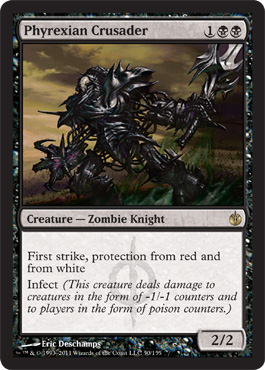
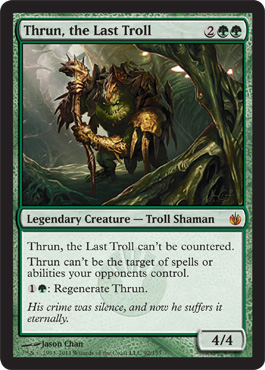
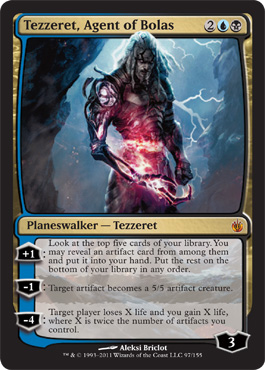
Intrepid Hero

I like Intrepid Hero a lot, since he's this questing knight off to kill the dragon. It was one of those way-cool cards to read about when it first came out, because this was like the white Royal Assassin! It even saw some minor play in Extended with Eladamri's Call, being a fetchable murder machine. It has been reprinted, but the original Hero still wields a premium.

$1.75

Karn, Silver Golem

The more that we see in Mirrodin Besieged, the more Karn looks like a total jerk. Vintage players have known he's been unkind for years. ā€œHey bro, let me give the gift of life to your Mox Sapphire – oh, it died? Whoops. Let's see if Mox Emeral fares any better.ā€ He's trash-talking you from the other end of the table while sending over a Tangle Wire and Smokestack to kill you. Though he acts like a pacifist, Karn is a killer through and through. He still sees substantial play in Vintage MUD decks and he's a quirky general in EDH.

$3.50

Whew! What a list of cards, and we are only halfway through! Urza's Saga is positively laden with expensive cards. Traders who buy collections have dreams of ripping through unsearched piles of Saga cards, for good reason. Join me next week as we look at the second half of the set, where we will encounter Superman, the MaRo-tinkered Eureka and the ā€œimprovedā€ Timetwister.

See you next week!

-Doug Linn

www.twitter.com/legacysallure

Want Prices?

Browse thousands of prices with the first and most comprehensive MTG Finance tool around.


Trader Tools lists both buylist and retail prices for every MTG card, going back a decade.

Quiet Speculation