menu

The Predicament

Are you a Quiet Speculation member?

If not, now is a perfect time to join up! Our powerful tools, breaking-news analysis, and exclusive Discord channel will make sure you stay up to date and ahead of the curve.

The day finally came!  I am putting the finishing touches on my online store, and I finally got an order from another dealer trying to buy me out of some cards that were, admittedly, priced aggressively to sell.  I am leaving out specific details to debate the morality of this issue, as I don't want to focus on the details of the transaction at hand.

The cards are almost all Tier 1 tournament staples, priced to sell below market price.  Their current selling price reflects an acceptable margin given the circumstances, but some may be below market price.  This is not the issue at hand.   Under normal circumstances, I would honor this order in a heartbeat.

These are not normal circumstances.  The buyer is another dealer, which in and of itself, is fine.   I have no issue selling many copies of a card (double digits and beyond) to another retailer, but I am not willing to be disrespected by a lack of reciprocity.  The buyer is a dealer who has cancelled an order of mine, a very similar order.  This is compounded by the fact that this seller has cancelled many of my readers' orders, something I know because they write to me and say so.

I am keeping this seller's name and all transaction details private until I decide what I want to do about this.   While my duty to my store is to maintain profitability (which this transaction would allow), my duty to my readers is transparency.  I'm hardly going to talk about this subject and then simply not address it when i am faced with a topical dilemma.

Here is the barebones fact sheet:

1) This dealer has placed an order with my online store.  I have accepted payment automatically, as my site is not currently set for manual order approval.   This constitutes a binding legal contract as my non-lawyer brain understands it.

2) This dealer has accepted my money for an order and later failed to honor the entire order.  I ordered 12+ of a card, received 4.  Many of my readers report similar issues.  This is to say, when he was placed in this precise situation, his choice was to reduce my quantities and refund my money, without my permission, and had planned to ship the adjusted order until I had to call and cancel it myself.

3) The order placed by this dealer is similar in nature to the orders that he has cancelled in the past, and by my honoring this sale, I de facto permit other dealers to buy me out, without receiving reciprocity.  This is not an arrangement I am willing to make.  Some things are worth more to me than money, and respect is one of them.

I have some options here, and I'd like to bring this discussion into the public to use as a case study for the issue of cancelling orders.  I'm listing a poll below to see what the community thinks.    I'd like to know two things; what should I do, and why.

In the event I choose to honor this order, I plan to make this seller's name public and solicit all past customers who have had a similar order cancelled to come out with their stories as well.  This has not been an isolated incident and I feel that if I honor the sale, I should at least use this opportunity to raise public awareness about shady business practices in our industry.    The amount of the transaction is small enough that the financials of it are of no concern to me; my bottom line will not change in a noticeable way no matter what decision I arrive upon.   Thus, my only concern and motivation is based in ethics.

Vote and comment, and I'll update you all with my choice shortly.

Create your free online surveys with SurveyMonkey, the world's leading questionnaire tool.

Kelly Reid

Founder & Product Manager

View More By Kelly Reid

Posted in Free25 Comments on The Predicament

Have you joined the Quiet Speculation Discord?

If you haven't, you're leaving value on the table! Join our community of experts, enthusiasts, entertainers, and educators and enjoy exclusive podcasts, questions asked and answered, trades, sales, and everything else Discord has to offer.

Want to create content with Quiet Speculation?

All you need to succeed is a passion for Magic: The Gathering, and the ability to write coherently. Share your knowledge of MTG and how you leverage it to win games, get value from your cards – or even turn a profit.

Rhys-ky Business

Are you a Quiet Speculation member?

If not, now is a perfect time to join up! Our powerful tools, breaking-news analysis, and exclusive Discord channel will make sure you stay up to date and ahead of the curve.

Let's pretend you've never played Commander before. Maybe you know a few people at the local store who play and you're a little curious. Perhaps you're normally a Constructed player, or a draft junkie, and aren't sure how to go about building a deck of 100 mostly unique cards. It's probably a little weird and just a little bit daunting.

And to make things even more complicated MTGCommander.net recently released its latest rules announcement. "Color identity? Does that change who can I pick as my Commander? Nothing makes any sense!"

Calm down there, Brosan the Protector. We're here to help. I'm going to guide you through my own process of building a Commander deck, from the ground up, using one of the newly legalized Legends. For those a little intimidated by the building process, hopefully it will provide some ideas for a framework you can follow.

We'll start with a budget-minded list as well in order to accommodate players whose collections may only encompass the newer sets. This will mean that some older/more expensive cards may be omitted from the list, but I will note them at the end.

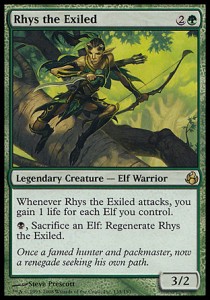
In the past, the color identity of a Legend was determined only by the colors in its mana cost, which invalidated Legends that had mana symbols in its text box that were different than those in its mana cost (ie. the card was one color but an activated ability required a different color). Now, color identity includes all the mana symbols on the card. A number of Legends have now become legal through this rules change, including Rhys the Exiled. Rhys, strangely enough, is no longer exiled from Commander play. Let's build a deck around this bad mofo.

Introducing: Rhys the Exiled

When considering a legendary creature to command your forces you may want to break down their text into individual sections to look at all the possible ways you can build around them:

Legendary Creature - Elf Warrior

We already know Rhys is an Elf, but the Warrior type is interesting. Lorwyn block has a number of cards that make Elf Warrior tokens, which makes cards like Obsidian Battle-Axe and Bramblewood Paragon much more useful.

Whenever Rhys the Exiled attacks, you gain 1 life for each Elf you control.

Rhys has an incentive to attack. As a 3 mana cost Legend with respectable stats, he can go on the offensive pretty quickly, so Commander beatdown is a viable strategy.

You also gain life from attacking, which is a benefit which may seem subpar but could serve as a healthy buffer in a war of attrition. The more Elves you control, the more life you gain. Simple, right? Naturally, because Rhys is an Elf, and because a lot of other Elves can pump Rhys, as well as the importance of Rhys' next ability, a Tribal route is pretty much required to incorporate the most synergistic cards into your strategy.

{B}, Sacrifice an Elf: Regenerate Rhys the Exiled.

Because Rhys will moving into the red zone a lot, this ability will help keep him alive, and will deter opponents from blocking because he will come out on top of most battles. This ability also means Rhys can serve as a sacrifice outlet.

Aside: The Great Card Search

For card searching, I use magiccards.info and the Wizard's Gatherer database. Poring through the entire Magic catalog can be a bit intimidating but I think it's exciting to find cards I'd never seen before. The first step is always the hardest, but you just might find it as addictive as I do!

Now, with these things in mind, let's get building!

'Da Elves

One of the most straightforward get Rhys' power up is to support him lots of "lord" effects. We can start with:

Since Rhys benefits from having a lot of Elves on the table, I looked into the most useful Elf token generators:

Gearing up

If we want to beat down with our pointy-eared friend, we'll need to suit him up with only the finest of epic loots:

The key is to push Commander damage through via high power and trample. Pumping Rhys' toughness is less of a priority because he can regenerate. Strata Scythe or Nightmare Lash are nice alternatives, but with these equipment cards we're focusing on speed and evasion - our other Elves can help pump his power even further.

Sleeping with the fishes

Black's creature removal is a great complement to green's everything-else removal. We can select some of the more staple removal spells, as well as some others that play well with Rhys' sacrifice ability and Tribe:

Decree of Pain is a great sweeper that should always be considered for any deck running black, but right now I'm going to set it aside.

As for non-creature removal, there are always a few green staples I fall back on:

As well as those of the Elvish variety:

This deck is not the kind to run massive sweepers like Oblivion Stone and Nevinyrral's Disk. Why would we blow up our own stuff, if we plan on winning with a mass of Elves and superior board position? We have a modest amount of tutoring to search for any answers we need, and we always have Living Death to swing things back in our favor.

Rhys Reloaded

There are a surprising number of cards that give you card advantage. Black has staples like Phyrexian Arena and Necropotence, but I thought there were several other inexpensive cards that gave good value, card advantage-wise:

All Your (mana) Base

We're working with two colors, which is perfectly fine, especially since one of them is green. I like to start at a land count of 40 and slowly whittle my way down until I'm at a number I'm comfortable with.

Let's look at the cheaper dual lands we can use:

The number of ramp and mana acceleration cards in your deck will also factor into your land counter. It's hard to forget that we're playing a tribe that excels at, well, mana acceleration. Whether you're ramping with lands or mana producers, you have a lot of options at your disposal.

The Full Monty

Naturally, I filled out the deck with mostly Elves and Elf-related cards. Here is a basic decklist I ended up with:

Untitled Deck

Creatures

Enchantments

Instants

Sorceries

Artifacts

Planeswalkers

Lands

18 Forest
10 Swamp

Most of my decks will run about 38-40 lands and about 25-30 creatures, but I'm running 36 here because many of the spells are quite cheap. You'll want to ensure you have a wide variety of removal spells as well as multiple paths to victory (hence the miser's Exsanguinate). I also tried to include as much recursion as I could, because Elves WILL die over the course of a game...one might say in droves.

Once you have the basic idea for your deck you can then tweak individual card selections to suit your tastes. Perhaps you want a Treetop Village as a backup plan against sweepers. Mind Slash would go great with that Nath of the Gilt-Leaf. Sanguine Bond might be hilarious. A lot of Commander decks start out as "100 cards I randomly put together from my collection," and while that's amazing, at some point you should drill down and examine your card choices.

Upgrading

I tried as much as possible to avoid pricier cards, even if it meant skipping out on some Commander staples. One of the entry barriers to the format is when players don't have as an extensive of a collection, and need to find a lot of older cards that may not be available to them. If I wanted to invest a little more into the deck, I'd definitely consider adding Gaea's Cradle and Rofellos, Llanowar Emissary, as well as a few other staples like Sensei's Divining Top and Sol Ring.

I hope this has given you a bit of insight into Commander card selection and deck building. If you're building your first deck, the only thing I can really say is pick your favorite cards and have a ball. No one ever nails the perfect list on their first go. Tweaking comes later; fun comes first!

Now if you'll excuse me, I need to finish building my own Rhys deck...

David Lee
@derfington on Twitter

The Myth of Making Profits

Are you a Quiet Speculation member?

If not, now is a perfect time to join up! Our powerful tools, breaking-news analysis, and exclusive Discord channel will make sure you stay up to date and ahead of the curve.

Let me share with you a conversation I’ve had several times with my girlfriend after returning from FNM.

Marianne: So how did it go?

Me: It was okay. I went 3-1 playing, but I made like $30 trading!

Marianne: Great, so are you taking me out to dinner tomorrow night? Or are you going to buy me shiny things?

Me: Well, it’s more like “theoretical money”

Marianne: So macaroni and cereal again?

Me: (sigh) Yeah, but I really like those!

This example shows clearly two traps you can fall into. First, while macaroni and cereal sound great when you’re a kid, they get old after four years in school. Two, thinking you made money trading just because at the end of the night you walk away with the cards that Star City Games is selling at higher prices. (Shiny things is code for “engagement ring.” Be on the lookout for your significant other trying to casually slip it into conversations like this)

The Myth of Making Profits stems from the fact that many traders believe that trading their Predator Dragon for your Thoughtseize means they have profited the difference in the sell prices of the two cards. This simply isn’t true. All they have done is trade one piece of cardboard (that beats up on Extended) for another piece of cardboard (that makes a really huge Dragon to beat up on everything). Neither player has profited from this exchange, they have simply gained or lost value.

Profit comes in only when these pieces of cardboard are turned into actual money. Trading up is not the same as profiting from trading. As covered numerous times on this site, cards sitting in your binder do nothing. They represent unrealized profit and restrain you to macaroni and Captain Crunch. Don’t get me wrong, you need to make “theoretical money” while trading, but you can’t stop there and rest on your laurels. It’s great to flip through your binder and see that shiny near-mint Tarmogoyf and other Legacy goodies like Force of Will. I assume you aren’t looking at Survival of the Fittest because you took the advice of those on Quiet Speculation and sold them before the Dec. 20 banning.

But what is the next step, and how do you take it? I’ve covered before Why We Trade, which basically means every person needs an endgame. A destination. Your own personal Mordor. For some, it’s collecting. For others, it’s playing the deck you want. For many of you, I suspect that end goal is to make a profit, which is the endgame I’ll be referencing today.

If you’re planning to flip the cards you pick up in trades into cash to buy Red Lobster, shiny things or just more Ramen, you need to understand the difference between buy and sell prices (you can read about my latest selling venture here). Star City Games sells Abyssal Persecutor at $15, but buys it at just $8. Selling through Ebay means you lose 12 percent to fees. Both incur shipping costs, in both your time and money. These things shouldn’t deter you from using these venues to cash out your cards, but you need to understand the back end of selling when you’re trying to get into the game. The time you put in trading is just the beginning, and it’s by far the easiest part of cashing out with your cards. Luckily, QS has some resources to get you going in these areas. Doug Linn wrote an excellent primer on Ebay sells here and Chris McNutt keeps you updated on all the best Buy List prices regularly.

Another common option is to sell directly to a dealer in person. This is by far the easiest option, and allows for haggling on prices, but availability can be an issue if you don’t have dealers in your area who buy regularly. For instance, in my hometown of Oklahoma City, there’s only one shop that even buys cards, and they offer ridiculously low buy prices (and then try to sell you Survival of the Fittest at $65).

But there is a fourth option, and one that is criminally underutilized – Selling cards directly to players. There are multiple factors you have to be aware of when going this route.

The first is that you need to be aware of your surroundings. If the store owner doesn’t like you selling cards in their store, take it out, and I don’t mean right outside the door. Wait until the night is over and do it elsewhere. You don’t want to upset the store owner, and they understandably have a complaint if you try to take their business right under their nose.

If you sell cards on a regular basis, you need to understand the legal implications of it, and at what point it becomes a small business where you need to report profits on your taxes. Unfortunately, I don’t have the knowledge to guide you through this process, but selling a few cards every month is unlikely to cause you any trouble.

It doesn’t hurt to ask a player if they are looking to trade for cards or if they are interested in buying if you can’t work out a trade. Cash can also be used as a throw-in to even up trades.

The reason selling cards directly to players is appealing is because it helps you to circumvent the Myth of Making Profits by eliminating a ton of back-end work. You save a few dollars on shipping and an hour of your time (and gas money) by making a deal on the spot. Both you and the player buying from you are in an advantageous position by dealing like this. For them, they can get a card for cheaper than the sell price online and don’t have to pay shipping and handling (and have no wait) while getting what they want. For you, you sell a card for at or better than its Ebay price while avoiding all the hassle associated with selling online. You can offer better prices than brick-and-mortar stores because you don’t have the overhead.

I want to make it very clear that I am NOT advocating pricing out your local store. You need them a lot more than they need you. You must be extremely careful to not step on anyone’s toes. Personally, I play at a store where the owner has a limited singles collection, and doesn’t mind other players buying cards from one another. I suspect this is the exception, which means you have to be very conscious of your local environment before going this route.

If you can clear those hurdles and receive the go-ahead to sell your cards, don’t be afraid to do it, even if it’s at a lower price than you would get on Ebay. Chances are losing out on a few dollars by selling it in person is well worth it, because the hassle of shipping cards through the mail is a lot greater than handing someone that card from your binder.

Last week at FNM a friend loaned me his BUG deck to play with, marking my first tournament that I’ve cast Jaces in real life (It doesn’t suck). I went 4-0-1, grabbing first place and earning $24 in store credit ($20 after the $4 store credit entry fee). I also made a few trades and sold a couple of cards, making it a very solid night all around.

His:

Master of Etherium ($4)

Mine:

[card]Inexorable Tide[card] ($1)

Net: $3

My partner wanted the Tide for the Poison/Proliferate deck he was building, and didn’t mind parting with the Master for it. With the play the Master is seeing in Extended, there’s plenty of chance I’ll be able to flip this easily.

His:

Scalding Tarn ($13)

Kitchen Finks ($3)

Mine:

Abyssal Persecutor ($15)

Net: $1

I have a lot more long-term hope for the Tarn and the Finks than I do the Persecutor. The Finks is really necessary for a lot of Extended decks, so I’ll either end up playing it or trading it up in a few months. The fetchland is a safe hold that is a lot more likely to retain value long-term than the Mythic that rotates in less than a year.

Sells:

I also sold a few cards on the night, as I mentioned. I was able to unload a Persecutor for $14, which is a very good price since it goes for $10-11 on Ebay. Note that as I mentioned above, this deal works for my partner and I both. After shipping, he saves at most a few dollars from getting on Ebay, and has to take the time to find an auction, bid on it and wait for it to ship. This way, he gets the card he wants at no hassle and in return I get a premium price for it.

My other deal involved a player really wanting to finish his Vampires deck before the tournament. This is basically the dream scenario for a trader, and I was able to capitalize.

His:

Fauna Shaman ($8)

$10 cash

Mine:

2x Consuming Vapors ($4)

Foil Vampire Nighthawk ($4)

Total: $12

Net: $6

The point of this trade is to demonstrate that my profit, while strictly using SCG values, is about $6. But if you account for the Myth of Making Profits, you’ll see that the $10 in cash I picked up goes a long way to making this trade better for me because I don’t have to sell the cards I received to earn that cash, saving at least an hour of my time. In addition, my partner was willing to use SCG values on the cards, even though he was essentially buying them rather than trading, which means he could’ve got away with offering premium Ebay prices for the cards rather than SCG prices. In the end, we both got what we wanted and walked away happy from this trade/sell, making it a success for both of us.

That’s all the space I have for this week. I’m taking a week of for Christmas, but I’ve chosen my favorite article of the year to run next week. It was actually written for Doubling Season (the original home of QS’s current content), so it’s a safe bet many of you haven’t seen it. I think you’ll enjoy it if you check it out.

Until the New Year,

Corbin Hosler

@Chosler88 on Twitter

The Repercussions of Events

Are you a Quiet Speculation member?

If not, now is a perfect time to join up! Our powerful tools, breaking-news analysis, and exclusive Discord channel will make sure you stay up to date and ahead of the curve.

As a site we are here to promote the use of speculation and smart time buying in order to help you secure profits for yourself. For the most part I would consider this to be a success, as most of the time we're able to get out information on items to buy before they jump and what items to sell before they fall as well. While those readers who stay on top of articles and twitter feeds are commonly able to hit cards just as they go up, this is a double edged sword. Today, we look at the ugly side of the business, its shortcomings and pitfalls, and see if we can do anything to prevent it.

Anyone remember the buying spree on this?

Two weeks ago two people were watching worlds coverage. Person A was reading the articles on match ups, and person B was watching videos and keeping track of twitter. Person A was able to see by round 5 coverage that a few name players were playing UB control, and if he was following standings he would have seen that they were doing well through the day. He has time to buy a few grave titans for resell in the next couple of days for a higher value, or secure other UB control staples that had gone down in price recently, again for profit at the resell. This is a smart move, and if he acted quickly enough he was ahead of the game since, sadly, most people don't truly read anymore.

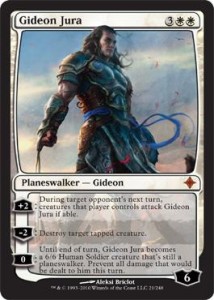
Person B was watching videos for Deck Tech, and saw the rise of Caw-Go in the hands of Brian Kibler (@bmkibler) and was able to buy Gideon Jura, a card which has seen a slow but steady price drop, at a good rate before everyone else caught on. His window was much smaller since he was competing against everyone else watching the deck tech videos, but his edge was twitter where Kibler himself gave a few hints away. Both situations were profitable if they acted within the time frame before the price jumps happened. This is smart buying and later smart selling. This is the good side of things, but its not always so......

Enter the extended portion of Worlds. We all know the story of Necrotic Ooze and how it exploded for a short time in price as a buy rush hit it. Some people placed large orders for Ooze to resell for profit or trade away at a later point. While some argue that this is morally wrong, I argue that if money was taken from a bank account and you got an order confirmation number, doing anything except shipping the order is bad business, and causes repercussions within the community.

Brian Doran (@MTGveteran) "Matchplay wont ship my bulk order even though they took money out of my bank account, I don't see how vendors get away with this. And so did Shuffle and Cut, they (Shuffle and Cut) didn't even bother giving me a reason other than "due to the card's demand". That's just sloppy."

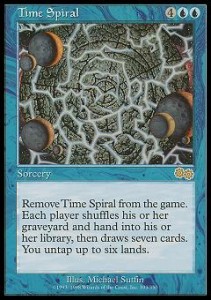
Moving away from worlds, and onto the Banned and Restricted list announcements, the community was in a buying frenzy, quickly followed by community uproar as multiple orders of Time Spiral were refunded. Not an isolated incident in the least, it quickly gained momentum as people on twitter expressed their outrage at multiple vendors.

(name removed by request) "Card Haus is terrible... They refused to sell me Time spirals for $5 I bought them at because they are out of stock but will have Them back in stock for 29.99.. Are you kidding me?"

Edwin Aragon (@edwin_aragon) "Ordered from gathering ground, and was told they had to refund my order at this time. If I get a order conf # I should get my stuff."

Did you get refunded? We want to know about it!

This is the ugly side of this business. Canceled orders, no explanation of refunds, and other underhanded business practices plague our secondary market. Every so often though, someone steps up to do something about it, and sometimes it works such as the Cape Fear Games Fiasco of August which can be read in the link if you're interested in reading about it. This time it seems the champion for the Time Spiral Disaster is Jonathan Medina (@mtgmetagame)

Mtgmetagame "Tweet me the names of the stores who pulled out and if they shipped you any copies. RE: Time Spiral - #letsbattle"

This is basically a call to action on the parts of individuals, and while he posted that tweet as I'm writing this, it will be interesting to see where this goes. I have a feeling that as the secondary market continues to evolve over the next year we will continue to see stores deny and refund orders, but we will also see a growing number of people become very vocal about these issues. I encourage this, because its up to us to protect our market from underhanded business practices such as this.

How else can we protect our market? Some sites are reputable for shipping orders even at a lower price. They aren't taking a "loss" since the product is still being sold, they just aren't capitalizing on the greed factor that other sites are. Supporting these sites helps to encourage their continued customer related business practices. The biggest name in singles also happens to be the best site for this; Starcitygames.com. While their prices tend to be a bit higher from other shops, running $1-$5 on most big ticket items, they also didn't cancel orders for Time Spiral or Necrotic Ooze when they were cheaper. You pay a bit more, but you have a higher chance of actually getting the product you paid for, so I have to give them props. An $8 Time Spiral from them yesterday is better then getting refunded for all of your $5 Time spirals from another site and seeing them reposted at $29.99 today. I have a feeling that the current Time spiral rush will die down in the next week, and unless its part of the next breakout deck from the Legacy Open, it will see a fate similar to Grim Monolith.

That's all for this week, I figured we needed a bit of controversy to spark some discussion, and I look forward to talking with you more in the discussion portions!If you have any ideas on how else to stop these refunds, speak up!

Until next week,

Stephen Moss

@MTGstephenmoss on twitter

mtgstephenmoss@gmail.com

Ps. How about that Jets/Steelers game?! Go New York!

Stephen Moss

Stephen Moss currently lives in Lancaster, CA, is a usual PTQ grinder in the southwest region and working on his Masters in Business Administration. He has an obsession with playing League of Legends when not working on articles or school work. His articles often take on a business minded tone, and usually contain information applicable to magic trading as well as real world business.

View More By Stephen Moss

Posted in Feature, Finance, FreeTagged , , , 23 Comments on The Repercussions of Events

Have you joined the Quiet Speculation Discord?

If you haven't, you're leaving value on the table! Join our community of experts, enthusiasts, entertainers, and educators and enjoy exclusive podcasts, questions asked and answered, trades, sales, and everything else Discord has to offer.

Want to create content with Quiet Speculation?

All you need to succeed is a passion for Magic: The Gathering, and the ability to write coherently. Share your knowledge of MTG and how you leverage it to win games, get value from your cards – or even turn a profit.

Extended GW Midrange

Are you a Quiet Speculation member?

If not, now is a perfect time to join up! Our powerful tools, breaking-news analysis, and exclusive Discord channel will make sure you stay up to date and ahead of the curve.

Hey everyone, and welcome back to On the Hunt. This week I will be taking a look into the Extended format since we have the new Pro Tour: Philadelphia season ahead of us, as well as Grand Prix: Atlanta, Kobe, and San Diego. It's been quite a while since I've taken a peak at Extended, however I have followed up with the recent tournaments around us as well as a few local tournaments being held. I have the urge to head up to GP: Atlanta this season and quite frankly, I had no idea what I will be playing since the format has had such a dramatic change as it has.

This year Wizards decided to change the Extended format in a big way. The new Extended format has changed to the point where its current rotation is about every four years rather than the seven year schedule it had been. This means that the current format is Lorwyn, Morningtide, Shadowmoor, Eventide, Shards of Alara, Conflux, Alara Reborn, Magic 2010, Zendikar, Worldwake, Rise of the Eldrazi, Magic 2011 and Scars of Mirrodin. This is why we're here today: to take a look at a new little home brew that I thought would be interesting to try out and test against the current Extended field.

So what are we on the hunt for today? Well, we're going to be building a Green-White Midrange deck. The main reason I'm looking into this archetype is because I think it is very underrated. These colors have had so many tools for us to use in this archetype style, and it seems like a waste to pass them up. So let's get started with White:

White

Removal
Path to Exile - One of the best White removal spells ever, exiles creature, player gains a basic land on loss of creature
Oblivion Ring - Exiles Planeswalkers and other troublesome non-land permanents
Day of Judgment- One of the best cheap casting cost mass removal spells White, or the entire format, has at the moment
Celestial Purge- Conditional removal spell due to color restrictions, exiles permanent
Journey to Nowhere - Enchantment that exiles a target creature
Condemn - Somewhat temporary removal, puts creature on bottom of library, player gains life to creature's toughness
Harm's Way - Combat trick, can gain you board position and tempo
Crib Swap - Exiles a creature, plus interactive creature type, downside is opponent gains a 1/1 creature afterward
Austere Command - Destroys creatures with casting cost 4 or more; destroys creatures with casting cost 3 or less
Hallowed Burial - Temporary removal, puts all creatures on bottom of owner's deck.
Martial Coup - Mass removal spell with conditional payment, doubles as utility card
Planar Cleansing - Exiles all non-land permanents
Mass Calcify - Destroys all non-White permanents
Gideon Jura - Destroys tapped creatures

So far we have a strong amount of spells we can use for the current format, most notably we have Path to Exile, Journey to Nowhere and Oblivion Ring. Other notable cards catching my eyes are Harm's Way and Hallowed Burial. I would highly note that in comparison to Standard, indestructible creatures are not that strong in the Extended format due to the massive amount of Exile effects in the format.

Utility
Wall of Omens - Card draw and 0/4 blocker
Austere Command - Destroys enchantments and/or artifacts
Elspeth, Knight Errant - Token producer, pump, and ultimate ability of an indestructibility Emblem
Revoke Existence - Exiles enchantment or artifact
War Priest of Thune - Destroys enchantments when entering the battlefield
Wispmare - Flash, evoke, destroys enchantments
Ethersworn Canonist - Hate bear, prevents players from playing multiple spells per turn that are non-artifact
Silence - Prevents opponent from playing spells
Spectral Procession - Token producer
Gideon Jura - Prevents damage to you, destroys a creature, makes himself a finisher
Martial Coup - Token producer plus removal on conditional payment
Reveillark - Very interesting card, had tons of potential combos back in the old extended and now recurs two low power creatures to the field
Runed Halo - Versatile protection from an opponent's "finisher." In my opinion, a very important card in the new format
Ranger of Eos - Search enabler for two creatures with one casting cost or less
Sun Titan - Recurs cards with converted mana cost 3 or less from graveyard when entering the battlefield or attacking
Burrenton Forge-Tender - Protection from Red, sac to prevent a Red source from killing you or your creature
Stoneforge Mystic - Very good utility card at getting an equipment we need, as well as putting others into play
Baneslayer Angel - One of the best finishers White has, protection from demons and dragons, and lifelink

So far this is what I consider the basic utility White can provide us with interesting interactions with the other cards of the deck design. Most notable of these are Elspeth, Knight Errant, Gideon Jura, War Priest of Thune, Spectral Procession and Reveillark.

Staples
Reveillark - Combo enabler, recurs specific creatures
Gideon Jura - Good Planeswalker, tons of interaction
Elspeth, Knight-Errant - Good Planeswalker, tons of interaction
Ranger of Eos - Searches for creatures to stabilize board or to gain tempo
Baneslayer Angel - One of the best finishers White has, protection from demons and dragons, and lifelink
Spectral Procession -Token producer, produces three 1/1 fliers
Path to Exile - Best removal white has had in a while compared to Swords to Plowshares
Burrenton Forge-Tender - Hoses Red decks and prevents lethal from killing you
Stoneforge Mystic - Tutor for an equipment card
Emeria Angel - Token producer, flier

Mono-White Kithkin decks used Spectral Procession as an important card to get Windbrisk Heights online. Elspeth, Knight Errant was often used to get the final damage over an opponent's head, as well as creating blockers and protecting itself from lethal attacks. Ranger of Eos got the Red hoser in the form of Burrenton Forge-Tender.

Base
Leyline of Sanctity - Protects you from being the target of spells and abilities
Kor Firewalker - Prevents Red decks from attacking through it and gains one life for every Red spell cast
Loam Lion - Kind of the surprise card everyone saw in the Doran deck from Pro Tour: Amsterdam, the White Kird Ape if you will
Squadron Hawk - A flier which fetches more of itself to thin your deck and puts creatures on board
Steppe Lynx - Powerful when in the right deck, pumps with landfall

Not many base cards being used; mostly it's all utility and staples in the format these days. I have Squadron Hawk in here after rumblings at the store but nothing further then that. I really like Leyline of Sanctity due to the Valakut match up.

Green

Removal
Acidic Slime – Deathtouch, destroys an artifact, enchantment, or land
Oran-Rief Recluse – Destroys flier
Plummet – Destroys flier
Slingbow Trap – Destroys flier
Hornet Sting - Combat trick and low toughness removal
Turntimber Basilisk - Deathtouch
Cloudthresher - Deals two damage to each flier and each player
Gloomwidow's Feast - Four mana destroy flying creature card, conditional token if creature was Blue/Black
Lys Alana Bowmaster - Conditional removal if an Elf came into play
Master of the Wild Hunt - Deals damage when tapped to target creature by the power of each wolf on your side of the field divided, produces a 2/2 wolf per upkeep
Scattershot Archer - Tap to deal one damage to each flying creature
Windstorm - Conditional payment to deal X where X is how much mana you paid into the card

Well, compared to Standard, this is a little better for what Green gets in removal. Most notable are Cloudthresher, Master of the Wild Hunt, and Windstorm. My opinions are that Master of the Wild Hunt is the best removal spell so far for Green, exempting Cloudthresher which is more for the Faeries matchup.

Utility
Explore – Ramp and card draw
Momentous Fall – Life gain and card draw
Cultivate – Ramp
Harrow – Ramp
Nissa Revane – Life gain, recursion, potential finisher with the right creature type
Primeval Titan - Big body to boot and ramps us faster
Realms Uncharted – Fixes mana and thins out the deck to get to our answers and/or finishers
Sylvan Ranger – Ramp
Arbor Elf – Conditional mana producer
Elvish Archdruid – Pump, conditional mana producer
Joraga Treespeaker – Conditional explosive mana producer
Acidic Slime – Destroys artifacts, enchantments and lands
Naturalize – Destroys artifacts and enchantments
Fauna Shaman – Good tool box to get our finishers and to get rid of stuff we don’t need (or want in graveyard)
Natures Claim – Destroys artifacts and enchantments, opponent gains life
Terastodon – Destroys multiple permanent types but not creatures, leaves you or opponent good power and toughness tokens.
Nature's Spiral – Recursion
Vengevine – Recursion and Haste
Autumn's Veil – Protection: Blue and Black, alternative strategy to null counter spells for finishers
Vines of Vastwood – Versatile pump, conditional Shroud
Ant Queen - Big creature, token producer with payment
Chameleon Colossus - Valid creature type, protection from Black, pumps itself with payment
Cream of the Crop - The Green Sensei's Divine Top, fixes draw when a creature comes into play
Devoted Druid - Ramps twice with ability
Elvish Promenade - Token producing spell, conditional to number of Elves in play
Helix Pinnacle - The "win the game" combo card everyone wants to break, wins the game when 100 counters are on it during your upkeep, Shroud
Nest Invader - Body plus token producer that sacrifices the token for ramp

....Whew, thats a lot of utility, and a lot more then the typical Standard list I had. I really like Green's Extended utility because it seems to set up a lot of interaction with cards in the format that need to be dealt with, however the loss of Time Spiral's Krosan Grip was a tough blow to Green. I consider a good amount of these cards for the slots we might need. Most notable I have are Nest Invader, Vengevine, Fauna Shaman, Chameleon Colossus, Ant Queen, Natures Claim, Realms Uncharted (oh ya I went there), Autumn's Veil, and Harrow/Cultivate. My reasoning behind Realms Uncharted is that I still consider it a card that fixes our mana and thins out the deck, but it also has another position which I will get to in the multicolor list. The choice between Harrow and Cultivate is tough, most notably since there are a lot more counter spells in this format, so the edge goes more to Cultivate since I don't want to be a land down. However, with certain cards we can use have uses for having extra lands in the graveyard. Autumn's Veil seems more of an anti-Faeries metagame choice, since it protects them from countering your spells. Nest Invader provides us two bodies to block with and ramp, Vengevine and Fauna Shaman interaction should be obvious, and Natures Claim is going to be a card that going to see more light in the Extended format rather then Standard. The reasoning behind this claim is the fact it has more notable targets for us such as Bitterblossom, Oblivion Ring, and many others.

Staples
Vengevine – Awesome four casting cost creature with good power, toughness and recursion
Fauna Shaman – Good tool box to get our finishers and to get rid of stuff we don’t need (or want in graveyard)
Avenger of Zendikar – Big body to boot and mass token producer that pumps the tokens
Birds of Paradise – Early drop mana producer plus evasion. Relevant with pump options and as blocker against fliers
Lotus Cobra – Multi-purpose ramp creature. Drop two lands (as with a fetchland) to produce two mana to get our finishers faster
Primeval Titan -Big body to boot and ramps us faster
Llanowar Elves – Early drop mana producer and good creature type
Garruk Wildspeaker – Mana producer, token generator and pump effect, and it’s a permanent that’s hard to deal with in the current format
Noble Hierarch - Mana producer plus pumps when a creature attacks alone
Great Sable Stag - Protection from Blue and Black and cannot be countered
Chameleon Colossus - Valid creature type, protection from Black, pumps itself with payment
Primal Command - Tool box spell, gains life, bounces non-creature permanent to the top of opponent's deck, fetches a creature and shuffles graveyard into library
Scapeshift - Finisher in certain archetypes, ramp
Thornling - The Green Morphling, trample, haste, indestructibility and pumps itself with valid payment. Supposed Jund killer.

Pretty good amount of staples Green has in this format, do note I am both upset and relieved at the fact that Tarmogoyf is out of Extended. It was a pain to deal with to almost everyone facing it and a joy for those playing it. For now I notice certain cards we can use to help with mana, board position, and a host of other uses. Notables include Primeval Titan, Lotus Cobra, Noble Hierarch, Great Sable Stag, Chameleon Colossus, Birds of Paradise, Vengevine and Fauna Shaman...err, that's most of the staples....hmmm. Alright here is where our problem starts. We have a very good set of cards to use, however where to go now depends on the metagame, so I need to cut some of these choices. The first card I can say we can cut is Birds of Paradise due to Noble Hierarch, some of these othert cards can be sided out but mostly I don't need Birds.

Base
Dramatic Entrance - Spell that puts a Green creature onto the battlefield at instant speed
Wickerbough Elder - Good body, destroys an enchantment with payment that also pumps itself
Wren's Run Vanquisher - The Elf deck's two drop enforcer, cheap alternative cost to enter the battlefield by revealing an Elf hand in hand.

Again this is something notable that most extended decks will have just the staples, removal and utility as their main deck focus. This is due to the fact that these decks have been played before and no one has either had the time to experiment with new cards in old archetypes or they simply haven't seen these cards yet. Dramatic Entrance can be a new contender with Summoning Trap to get Progenitus out. Wren's Run Vanquisher will mostly be used in the Elfball deck. Wickerbough Elder is more of a sideboard card to get rid of staple enchantments, however I believe Natures Claim took over that slot.

Multicolored

Removal
Mercy Killing - Target creature is sacrificed and gives player tokens based on that creature's power
Unmake - Exiles a creature with no strings attached, Instant-speed
Novablast Wurm - When attacking, it destroys all other creatures except itself, heavy mana cost

Ya.....mostly nothing for us to use so we're going to skip the multicolored removal. Mercy Killing can be an interesting combat trick however I would mostly use it on my creatures rather than my opponents. However, I would rather not X-for-1 myself by killing my finisher and having my opponent wipe out my tokens, or give them a massive amount of tokens that I can't deal with. Unmake is going to be hard to cast, and Novablast Wurm might be something to come back to but more or less not worth it.

Utility
Behemoth Sledge - Equipment, creature gains +2/+2, plus trample and lifelink
Dauntless Escort - Sacrifice itself to give creatures you control indestructibility
Elvish Hexhunter - Payment and sacrifice itself to destroy an enchantment
Steward of Valeron - Ramp
Trace of Abundance - Aura enchantment for land, gives land shroud and taps for extra mana, ramp
Wheel of Sun and Moon - Enchantment that enchants a player, puts all cards that would be put into that player's graveyard onto the bottom of their library instead
Guttural Response The Green counterspell

Interesting utility cards we have. The three I have my eyes on are Wheel of Sun and Moon, Dauntless Escort, and Behemoth Sledge. I can see Wheel of Sun and Moon as a valid sideboard option in case Dredge pops its head somewhere in the format again, since it just messes with their plans to overwhelm us and can help us against any mill decks or even to gain our finishers back. Dauntless Escort is pretty good against mass removal so it can be a good maindeck option. The power level of Behemoth Sledge, gaining both trample and lifelink along with pumping +2/+2, is really good.

Staples
Gaddock Teeg - Prevents each player from playing any non-creature spell with converted mana cost of four or greater (or with X spells in their cost).
Kitchen Finks - Awesome low cost creature that gains life when entering the battlefield and conditional recursion if it has no -1/-1 counters on it. Reduces power by -1/-1 with counter when it recurs itself but gains us life
Knight of the Reliquary - Beater when lands are in the graveyard, low casting cost and fixes our mana
Oversoul of Dusk - Protection from every color except colorless, Green and White. Big body with a heavy mana cost
Qasali Pridemage - Pumps creatures when a creature attacks alone, low casting cost plus 1-mana activation and sacrifice to destroy an artifact or enchantment
Wilt-Leaf Liege - Pump lord for each White or Green creature, alternate cost if opponent makes you discard it to bring it into the battlefield for free

Here we go, now there's a good amount of staples again for us to use. We can actually use all of these since not many of them have a downside except for Gaddock Teeg, since it prevents us from playing high costing spells (but it also hurts our opponents as well). Could be sided out just in case for that reason. Most likely all of these will be played in one fashion or another. Also with Knight of the Reliquary, Realms Uncharted can be used as a combat trick to pump Knight and gain board position if needed.

Base
Fracturing Gust - Spell that destroys all artifacts and enchantments and gains us two life per artifact and enchantment destroyed
Grizzled Leotau - I'll say this, this guy was a problem for me when I played jund and had no Terminate in hand, muds up the ground until you can deal with him
Wilt-Leaf Cavaliers - Good low cost beater

Again the sadness of Extended is that there are better cards to use besides these but Grizzled Leotau might be the exception due to my notes above.

Colorless

Removal
Ratchet Bomb – Destroys all permanents with condition of number of charge counters, one time removal
Molten-Tail Masticore – Flame Javelin anyone?
All Is Dust – Good removal spell, heavy mana cost, doesn’t affect Eldrazi creatures or artifacts
Ulamog, the Infinite Gyre- Destroys a permanents, expensive mana cost
Brittle Effigy - Exiles a creature

Alright onto colorless. Mostly I like Ratchet Bomb and Molten-Tail Masticore here. Masticore can discard spells we don't need as well as lands to pump Knight of the Reliquary. Ratchet Bomb will be against the weenie decks that will probably give us trouble.

Utility
Armillary Sphere - Fetches basic lands
Basilisk Collar - Equipment that gives deathtouch and lifelink
Mox Opal – Mana accelerator with Metalcraft condition, really good with the Esper colors especially
Sword of Body and Mind - Good overall equipment, pumps, token producer, protection from Green and Blue, and mills your opponent
Sword of Vengeance - +2/+0, Haste, First Strike, Trample and Vigilance all seem pretty good for a equipment
Dolmen Gate - Prevents all combat damage to our attackers
Relic of Progenitus - Exiles cards in a player's graveyard, plus able to exile all graveyards by removing itself and payment. Replaces itself
Thorn of Amethyst - Increases all noncreature spells casting costs by one

Mostly I am interested here in the equipments and relic. I really like Sword of Body and Mind but we will see.

Staples
Eldrazi Monument- Giving your creatures Flying, Indestructibility, and +1/+1 is good
Everflowing Chalice - Artificer’s mana ramp card
Lodestone Golem- Good stall card through adding mana cost to all non-artifact spells
Mimic Vat- Great card that "reanimates" creatures
Molten-Tail Masticore- 4/4 body with Flame Javelin and Regeneration
Wurmcoil Engine – Lifelink and deathtouch along with putting two 3/3′s out, one with each ability, all on a 6/6 is good in my book
Pithing Needle - Disrupts activated abilities of a named card

The only card again I really like in this list after going over it is Pithing Needle. In Standard now we have little to deal with Planeswalkers and Pithing Needle was one of the original ways for dealing with them.

Base
Temple Bell - Lets each player draw a card
Tumble Magnet - Conditional usage, but allows user to tap a creature, artifact or land
Voltaic Key - Untaps an artifact
Trip Noose - Allows user to tap a creature with payment

I can see us using Trip Noose or Tumble Magnet as a way to deal with creatures and/or manlands. So after going through my lists and what I consider logical choices and views on the metagame, let's see what my first version looks like:

GW Midrange V.1

Untitled Deck

Maindeck

4 Noble Hierarch
3 Qasali Pridemage
4 Kitchen Finks
4 Knight of the Reliquary
3 Wilt-Leaf Liege
3 Stoneforge Mystic
2 Dauntless Escort
4 Path to Exile
4 Oblivion Ring
3 Elspeth, Knight-Errant
2 Behemoth Sledge
2 Garruk Wildspeaker
4 Reflecting Pool
4 Razorverge Thicket
3 Wooded Bastion
2 Sejiri Steppe
5 Forest
4 Plains

Sideboard

3 Pithing Needle
3 Obstinate Baloth
3 Day of Judgment
2 Oversoul of Dusk
2 Runed Halo
2 Leyline of Sanctity

Reasoning behind the numbers: We have a lot of three drops including Knight of the Reliquary, Kitchen Finks, Oblivion Ring, Behemoth Sledge, and Dauntless Escort. Noble Hierarch helps ramp to the 3-drops on turn 2. Having 3 each of Wilt-Leaf Liege and Elspeth, Knight-Errant we can be sure to be drawing one of either early or in our opening hand. In the sideboard we have the 3 Baloths to replace any 3 cards to combine with our Lieges against any discard (notably against format staples Blightning or Cruel Ultimatum)

Thoughts on top decks so far (Rewritten along with new information from Worlds)

Scapeshift Valakut
One of the hardest matchups since it's a Combo deck. The deck's ability to deal massive amounts of damage is impressive, however playing the Standard version helps a bit in how they set up the deck. They mostly will play ramp with Primeval Titan, Khalni Heart Expedition, Harrow, and others until they have plenty of lands out then play Scapeshift to play a lethal set of their Valakut, the Molten Pinnacles and Mountains. What helps here is Kitchen Finks, Leyline of Sanctity, Runed Halo, and Behemoth Sledge since life gain and protection helps from Valakut.

UB Faeries
One of the original boogie man decks of the Standard format, a Control deck with its ability to counter most of your spells with creatures such as Spellstutter Sprite and counterspells such as Cryptic Command. Its most annoying feature is putting out creature tokens during each of their upkeeps with Bitterblossom. From what I know of the original decklist and the new lists, it has gained even more powerful tools. With a similar shell to its original, it gained a lot from what was released and reprinted. This list starts with Mana Leak, Smother as well as Jace, the Mind Scuptor, and with the help of a much smoother mana base with Darkslick Shores to play a turn one Thoughtsieze, the deck is much more consistent now. The matchup isn't that bad but it is going to be one of the harder ones. Even though we also have an ability to get through the air as well as produce tokens by means of Elspeth, Knight-Errant, they can get fliers out faster and Mistbind Clique and Vendilion Clique are troublesome too. Mistbind will notably champion a token and tap out our lands during our upkeep while Vendilion takes out our removal. To get around this you have to play around the counters and try to get early threats out; Qasali Pridemage is our friend here to take out the Bitterblossoms and the Day of Judgment is to get rid of the tokens.

Fish/Merfolk MonoU/UW
Merfolk is what I consider the Aggro/Midrange deck of the format, and it can get out of hand very quickly. Most notably a hard match up for us since they can easily put out 4/4's with counterspells up and alpha strike us with Cryptic Command. What I would consider is that when we go to game 2 we side in the Oversoul of Dusk and Day of Judgment. Depending on the build, if its UW we have to worry about Reveillark and Glen Elendra Archmage.

Ooze Combo GB
Wow this deck came out of nowhere fast thanks to the deckbuilding mastermind of Conley Woods. The main card to look at here is the new combo card in almost all formats: Necrotic Ooze. I watched how the combo works and it all focuses around this guy. He can get in for lethal by the Quillspike plus Devoted Druid in the graveyard combo, infinite mana as well as wiping out our field with Grim Poppet by removing the -1/-1 counter it gets off Devoted Druid, and it can also fetch up as many creatures it wants the same way with Devoted Druid and Fauna Shaman in the graveyard. It also has the ability to go into a land destruction set up with Acidic Slime and Fulminator Mage. So how do we view this new beast of a deck? Actually looking over our list so far, it does not actually look that bad. Our main deck has Oblivion Rings and Path to Exiles, and we have Oversoul of Dusk and Runed Halo in the sideboard to deal with Quillspike and Necrotic Ooze. However more testing is needed to test against this awesome new archetype. I will say that the main focus is to exile the graveyard as often as possible, most notably the heart of the deck isn't Necrotic Ooze but Devoted Druid. If you can get rid of the Druid in the yard most of the deck falls apart since Necrotic Ooze can't go off.

Polymorph
Ok, Polymorph is back in the spot light in the guise of a UB Control deck. With only two creatures in the form Emrakul, the Aeons Torn you wonder how the deck can run polymorph, well it helps when you have Bitterblossom to produce tokens, as well as Mutavault, Khalni Garden, and Creeping Tar Pit to make tokens or to create manlands for Polymorph to target. But to ignore one finisher for now opens up to another in the form of Jace, the Mind Sculptor. With Bitterblossom, the opponent can easily create blockers to stall us from destroying Jace and letting Jace get to his ultimate is a very big problem. I have faced a lot of Polymorph decks and the best way to deal with it is patience. You always let them target the creature first then deal with that in response. Mostly the deck isn't that worrisome due to the fact that our deck has multiple ways to deal with tokens with Path to Exile and Jace with Pithing Needle and Oblivion Ring.

Kellen Huber

@cavemankellen on Twitter

The Theory of Profit

Are you a Quiet Speculation member?

If not, now is a perfect time to join up! Our powerful tools, breaking-news analysis, and exclusive Discord channel will make sure you stay up to date and ahead of the curve.

How do we evaluate expected value? How do we calculate whether a risk is worth taking, or whether a deal will turn a profit? Having a constant, accurate, system for determining these will allow you to more consistently gain profit, while minimizing risk. While I talked about the different types of risk in one of my previous articles (“Recapping Risk”), I wanted to revisit this topic, this time covering more strategies to avoid risk, and also ways to measure risk, and conduct a risk-reward analysis.

Let’s start by reviewing the areas of risk a seller faces:

* Price fluctuations

* Finding a market

* Security concerns (fake cards, etc.)

Again, my last article about risk went over ways to minimize the risks you take in these areas while trading, buying, and selling. But without risk there is no reward. In order to determine when the risk is of an acceptable level to do a deal, we just apply a few simple equations.

Example 1:

I’m at my local store, and one of the players pulls a Koth from a booster while drafting. After the draft, I approach the player, trying to buy his Koth for $20, knowing that the store’s buy price on Koth is $25. Let’s start with a simple equation…

profit=sell price+buy price

So by plugging in our variables we get…

profit=25-20

Obviously showing that we get a profit of $5. Yet this is only monetary profit. This doesn’t reflect your own time invested. What if that $25 buy price was at a store an hour away? Then you’d be earning a paltry $5/hr, lower than minimum wage. A more effective variable to use instead of profit is wage profit, i.e. the amount of money you make per unit time above the maximum amount that you could be making elsewhere. So if you earn $20 by trading for an hour, while your normal job pays $15/hr, your wage profit is $5/hr. Yet there are also a host of other variables and costs that must be applied to the equation. Let’s hit you with this monstrosity, and then explain it below…

Wage profit=sell price-buy price-(% risk x potential monetary loss)-(investment length x money loss per unit time)-(labor value per unit time x personal time)

So at this equation’s base, we have our profit=sell price-buy price. Wage profit=sell price-buy price-(labor value per unit time x personal time) just expresses what I stated earlier about how to define wage profit. Labor value is equal to the maximum wage you can earn elsewhere, and we adjust that wage for the amount of personal time invested. But making a profit isn’t that simple. There are several other costs that we must factor in to calculate our wage profit. This is where risk comes in, as part of our costs. The % risk is the estimated chance of losing money, which we multiply by the potential money loss that would result from that risk. We also subtract our “opportunity cost”, something that Kelly and other writers have often talked about on this site. Every second that your money is tied in an investment is a second that you lose money. Sure, you might’ve gotten that playset of Frost Titans for only $35, but what if that means you now can’t afford the $250 Mox Jet that popped up on Ebay? While inflation is much less of a factor for Magic, it will apply to more long term investments in the real world. By multiplying our estimated opportunity cost per unit time by the time that the investment is held, we establish another cost. So by plugging in values for all of this, we end with our only variable being our wage profit. Let’s restate that equation again…

Wage profit=sell price-buy price-(% risk x potential monetary loss)-(investment time x money loss per unit time)-(labor value per unit time x personal time)

For that previous example, we can calculate our wage profit quite easily. Let’s assign some values to our variables. We already know that sell price=25 and buy price=20. Our % risk is 0, because we know we can resell the Koth for profit right away. We can assume our time to be fairly insignificant, because we flip the Koth so quickly, so let’s estimate our personal and investment times to be around 1 minute. I would also estimate that your money loss per unit time, or “opportunity cost”, to be 1 cent per hour. Let’s also assume that you took the night off to go to FNM, and you could be earning $6/hr if you hadn’t. so let’s plug in our variables…

Wage profit= $25-$20-$0-(1 minute x $.01/60 minutes)-($6/60 minutes x 1 minute)

Then, we just simplify…

Wage profit=$25-$20-$0-($0.000167)-($0.1)

Wage profit=$4.899833 per unit time

Not a light load of math, and this wasn’t even a complicated situation! Let’s try this again, giving ourselves a source of risk to factor in.

Example 2:

This time, you’ve secured a collection on Craigslist. It’s chock full of great cards, from Aether Vial and Sol Ring, to Revised versions of the original duals. You’re buying it for $500, but you’ve already talked to a friend who wants to start getting into the Eternal formats, and has promised you $750 for it. You estimate there’s a 5% chance that the cards are fakes, in which case you will lose all the value of your investment. The time you’ll have to take flipping it between the two parties is an hour, and you maintain the loss of $.01/hr. it will also take you an hour to drive to the seller’s house, half an hour to check the collection, and an hour to drive back, leading to a total time investment of 2.5 hours. Since it’s a Saturday, you don’t have work, but you could be making as much as $8/hr by helping out your local store while they’re busy…

Wage profit=sell price-buy price-(% risk x potential monetary loss)-(investment length x money loss per unit time)-(labor value per unit time x personal time)

Wage profit=$750-$500-(.05 x $500)-(1 hour x $.01/hour)-($8/hour x 2.5 hour)

Wage profit=$750-$500-($25)-($.01)-($20)

Wage profit=$204.9 per unit time

Again, the math here is not simple, but it’s not overly complicated either. By applying these basic economic principles, we are able to more accurately evaluate the amount of money we make. Ok, one more time, with more risks.

Example 3:

You found a Mishra's Workshop worth $250 selling on Ebay for only $200. You quickly snap it up, thinking you’ll be able to resell it for the normal $250 price. So what are the risks at play here?

1. The card is fake and you can’t get a refund. 5% probability, $200 loss

2. Stax becomes a very bad choice in Vintage because there is too much artifact hate for it to thrive. 7% probability, $50 loss

3. No one in your local scene needs the Workshop for Vintage, so you’re forced to sell it at a loss to the store. 20% probability, $15 loss

Other needed information:

* It will take a week for the card to be delivered and another week to sell it, so your investment time will be two weeks, with the normal loss of $.01/hr (for those of you without the inclination to do the math, there are 7x24=168 hours in a week)

* It took you an hour of your personal time to both find the listing on Ebay, and then resell it, which is time you could have spent working at your $35/hr job.

For this equation, we’ll need to do multiple iterations of our risk loss term.

Wage profit=sell price-buy price-(% risk x potential monetary loss)-(investment length x money loss per unit time)-(labor value per unit time x personal time)

Wage profit=$250-$200-(.05 x $200)-(.07 x $50)-(.2 x $15)-(336 hours x $.01/hr)-($20/hr x 1 hour)

Wage profit=$250-$200-($10)-($3.5)-($3)-($3.36)-($35)

Wage profit=-$4.86

So as we can see, speculating on this Workshop is less profitable on average than just grinding hours at work.

Now of course the calculations I demonstrated don’t take into account every possible factor. There's theft, a possible reprinting, random damage to the cards, getting paid in counterfeit money, ripping somebody off and getting double a card’s value, or an increase or decrease in value of the deck archetype or format that the card is played in. there are infinitely many variations of this, so do your best to simplify it down to it’s four or five key components to plug into the equation.

Well, that’s all for now. After taking a few weeks off I wanted to write a more theory centered article for my comeback, and I think I achieved that fairly well. So let me know what you think about this in the comment section.

Peace, love, and economics,

--Noah Whinston

mtgplayer@sbcglobal.net

nwhinston on Twitter

arcadefire on MTGO

baldr7mtgstore on Ebay

Prototyping a New Deck

Are you a Quiet Speculation member?

If not, now is a perfect time to join up! Our powerful tools, breaking-news analysis, and exclusive Discord channel will make sure you stay up to date and ahead of the curve.

Welcome back to the present! Last week we looked at a possible update for a known deck. This week we're striking out for the unknown, trying to find a new deck in an already crowded metagame. Why? For a couple of reasons. I build decks. It's just something I do. I wanted to show the building process, and how I wandered from one concept to another in a rather organic way. Finally, because there are a lot of cards I feel have a place in the metagame but haven't been showing up as I expected them to. Some of these cards lately are: Lodestone Golem, Luminarch Ascension, and Nissa Revane. Six months ago I would have had Abyssal Persecutor on this list, but looks like players all over have finally realized that a 4-mana 6/6 flier is pretty good.

Since my last article, I set out to find a deck for Lodestone Golem. 4-mana 5/3 isn't spectacular anymore, but the ability seems really relevant. On the play, or with acceleration, you can stall your opponent's 4, 5, and 6 drops while you beat them down. So I started with an aggressive creature strategy:

[deckbox did="a37" size="small" width="567"]

Steel Overseer clearly deserves a trial here: if it lives your army gets enormous very quickly. I think Perilous Myr should be great against other small creature decks, and can maybe suicide into Planeswalkers to take them down whether it is blocked or not. I wasn't sure about Etched Champion, as a 3-mana 2/2 most of the time, so only 2 of those. Runed Servitor is the only artifact 2/2 for 2, and at least buys a card on the way out, even if for both players. Interesting story, both Runed Servitor and Prophetic Prism were amazing in an Open the Vaults / Time Sieve deck I built once upon a time. Temple Bell was also spectacular there, really bringing that deck to the pinnacle of power - but only for 3 months while both M11 and M10 were legal. Not sure why that deck didn't see much play while it was available. I wonder if Extended has room for it? Back to the deck we're talking about here: Molten-Tail Masticore, Wurmcoil Engine and All is Dust are already confirmed to be Standard-worthy.

The lands? I started with colorless so I had no idea what color I would want. I was thinking that I would eventually add a color for a few spells, like Red for Lightning Bolt, Blue for Jace, or White for Tempered Steel.

How'd it do? Not very well, but passable for a starting point. I tried it out against GW Quest, RUG control, Vampires and UB Control. It was fine against Vampires, advantaged most of the time, in fact, because its creatures could get bigger pretty fast, and the occasional Wurmcoil really ends it. Against the other decks... not so much. I did find out that Etched Champion is pretty amazing when it has protection from colors.

So I cut the Palladium Myrs (they were terrible!) for more Etched Champions and added mana myr. I wanted to try them before I went to the better-known Everflowing Chalice because as creatures they can combo better with Seel Overseer and can "play Aggro" once in a while. I also added Origin Spellbomb as it cycles for a 1/1 and can be played on turn 1.

[deckbox did="a38" size="small" width="567"]

This was a little better in the Control matchups. Some games the Origin Spellbomb seemed great, and it was awful in others. Against UB Control the opponent had Mimic Vat, and I was like "Duh! Why not in this deck?" So this led me to the next configuration:

[deckbox did="a39" size="small" width="567"]

We also have the promised Tempered Steel, and the first appearance of Prototype Portal. I was hoping it would give the deck some great long game against Control... and it was really exciting! Portal on Wurmcoil is totally disgusting, as it also is with Etched Champion. The hard part was getting it going fast enough. The deck played very streaky - get the right combinations and you'd be great, but if not you just rolled over and died. Or perhaps it was that RUG has some weak draws you can capitalize on? UB Control seemed to have trouble unless it could get a turn 3 or 4 Abyssal Persecutor on the table (in which case it almost always won). Against GW Quest, this deck would just roll over and die if it didn't find All is Dust, but if it did it could stabilize, Prototype Portal just about anything, and go to town.

So this 1.3 build has potential, and perhaps the next step is to take out the weaker cards for more White spells that do good things, like Journey to Nowhere, or possibly Survival Cache? Some way of getting the good cards or disrupting what your opponent is doing. Note that I played all these games unsideboarded as I was just trying to hammer out the overall shape of the deck and find out which cards were good and which were bad.

Normally I would want to continue to refine the deck, but at this point, I got distracted by the powerful potential of Prototype Portal. This is the kind of card that just HAS to be broken, right? The question is... did R&D push it just out of constructed or did they leave it just barely inside? Or, if we are lucky, they thought it was safe but didn't quite find the ultimate combination that breaks it. To get the combos going faster, I moved into Blue for the top dog in standard, Jace, The Mind Sculptor.

[deckbox did="a40" size="small" width="567"]

This is certainly fun, and sometimes pretty effective. Infinite Origin Spellbomb is pretty nice, as are infinte Brittle Effigys. I must admit, however, that it's all a little slow sometimes, as we're sliding into a Control deck, but don't have many real Control cards. The deck continued to be hit and miss, more often miss against the heavily tuned competition.

So I searched all artifacts in Standard to see what I'd really like to make infinite prototypes of and I found (dum dum duuuum) Mindslaver! Of course! With just 10 mana, I can take all the turns, ALL THE TURNS! Surely at least one of you has tried this already, right? I tried to make a Controlish deck that could both get mana on the table and defend itself.

[deckbox did="a41" size="small" width="567"]

I tried both See Beyond and Preordain in this deck, thinking that I could send back extra pieces of the combo with See Beyond... but it didn't seem much better than Preordain, in the long run. I'd need more testing or some math homework in order to be sure which is best. Ratchet Bomb really helped against aggro decks, and the one game I put it inside a Prototype Portal (against GW quest) was pretty hilarious. Be careful not to blow one at 4 though - that kills the Portal. The most important thing I learned here is that the combo ends the game immediately. I guess that should be obvious, but the translation of that is that you don't need to consider your position after that. If you untap with 10 mana and the Prototype Portal with Mindslaver inside it, you've won.

So I tried a bunch of other colors and configurations - including pure Green ramping, UB Controlling (which can't get to 10 mana fast enough) and some other random stuff... but they all turned out weaker than the current metagame average.

Several of these builds will still be excellent for surprising your friends in more casual games, and perhaps even at FNM. The list above is close, or you can replace the top end of RUG's curve with the combo, and have a reasonable deck with a hilarious win condition. I also discovered another plan that has a lot of potential:

[deckbox did="a42" size="small" width="567"]

When you have a grand plan for vicotry, you need a Grand Architect to help you get it to fall into place. This guy is a great combo with Sea Gate Oracle and Trinket Mage, who are both already Standard staples (or is it role-players?). Don't forget that Trinket Mage can also fetch Everflowing Chalice, which helps you get up to the 10 (or 14 if you want to do it all in one turn) mana needed. The real juice comes from the Grand Architect's mana-production powers. I often found myself almost forgetting to throw down a Chalice after playing this Vedalken. This version was excellent against aggro decks (2/4 Oracles are really hard for weenies to get past). Vampires seemed weak against it (I went 6-2, though I must emphasize this is a small sample size of games). RUG, on the other hand, was much harder to beat, and although I did win some, I'm pretty sure this deck is rather disadvantaged against it. As for Valakut? Those are difficult but sometimes winnable games. It helps that I have maindeck Spreading Seas. Counters never seemed to be useful in this deck; I didn't want to hold up mana, just slow my opponent down long enough to combo out. Sorry there's no sideboard here. I didn't have time to get to it. I predict there should be Ratchet Bombs in it.

I tried out one Sphinx of Lost Truths for three reasons. First, it's a blue creature that can block quite well and sometimes attack Planeswalkers. Second, it helps find combo pieces and sometimes gives pure card advantage. Third, everyone was playing it in the FFL during Zendikar and Worldwake testing. It seemed very strong to me and I was surprised to see that it couldn't find a home in the real world. Perhaps it was a near miss? Maybe there's a sick UG attack deck with Lotus Cobra, Vengevine, and Sphinx of Lost Truths?

Here are some typical games, played against Simon Gortzen's Worlds 2010 version of Valakut:

Game 1

I win the roll and keep 2 Islands, 2 Spreading Seas, Grand Architect, Everflowing Chalice, and Sea Gate Oracle.

Me: Play Island, pass.

The opponent, "Val" keeps 2 Forests, Terramorphic Expanse, Cultivate, Primeval Titan, Overgrown Battlement, and Lightning Bolt.

Val: Draw Mountain, play Terramorphic Expanse.

Me: Draw Island, play it... can't Seas a Terramorphic. During my endstep it becomes a Mountain.

Val: Draw another Terramorphic, play Forest and Overgrown Battlement.

Me: Draw Island, Play it, Play Sea Gate Oracle, send one Island to the bottom, put one into my hand.

Val: Draw Mountain, play it, Cultivate for two Mountains, playing the one that goes to hand.

Me: Draw Brittle Effigy, play Island. Now this is where the deck gets cute. I play the Grand Architect, use it and the Sea Gate Oracle to make an Everflowing Chalice with 2 counters, and then I use that to cast a Spreading Seas on a Mountain. I'm not sure if the Forest is the better choice here, but I would think my opponent is smart enough to get a second Forest if they thought I might be able to Jace their Battlement this turn. Also every Mountain less they have slows down the Valakut death. I draw a Jace, the Mind Sculptor off the Seas. Hmm, should I cast the Brittle Effigy? The mana can be pretty tight in this deck. Let's see... next turn if I cast Jace, find a land, play it... I can cast my second Grand Architect and have 3 blue dudes... that's 6 mana, which is plenty to cast and use my Effigy... but if one of my Blue guys dies (the Architect is a pretty clear target) I'll only have 4... not enough to cast and use it... but enough to imprint it on Prototype Portal if I were to draw it... it's a tough choice but I think I'll try and mess with my opponent and cast it now. That, and the fact the opponent Lightning Bolted the Grand Architect in response to the Spreading Seas on his untapped Mountain.

Val: Draws an Overgrown Battlement. Plays Mountain and Primeval Titan, finds two Valakut, The Molten Pinnacles.

Me: Draw Prototype Portal (of course!), Play Jace, The Mind Sculptor, sculpt my mind into another Jace, Island, Trinket Mage. Keep the Island, bury Jace under Trinket Mage. Play Island, Grand Architect, and exite Primeval Titan with my Brittle Effigy.

Val: Draw Mountain, play it and the second Overgrown Battlement, but has no action.

Me: Draw and cast Trinket Mage... now do I get a chalice or the Elixir of Immortality? Math time! My opponent has 4 mountains in play. If they get a Primeval Titan next turn, and have a Mountain in hand... they can get a second Valakut, the Molten Pinnacle (I will certainly Spreading Seas one of the two they have now) and have 6 damage ready. If they also have some land fetching (though they didn't do anything last turn) it could be 12 damage? Not fatal... I'll get the Chalice and try to set up the win. After that, Jace, the Mind Sculptor shows me Halimar Depths, Tectonic Edge, and Sea Gate Oracle. I bury the Depths under the Spreading Seas, and play the Tectonic Edge. Next I play Sea Gate Oracle, keeping the Spreading Seas and sending the Depths deep under my library. I tap my team to play a Chalice with 4 counters, and use that and my Island to Spreading Seas a Valakut, drawing a Preordain. Finally, I use my remaining mana to activate Tectonic Edge on the last Valakut. Sick!

Val: Draw Summoning Trap, cast it. Find Oracle of Mul Daya. This is why Traps aren't as good in this deck as in some others: not enough targets, and certainly not enough 15/15s. The very next card (as revealed by the Oracle) is a Primeval Titan, and Val plays but does not use a Terramorphic Expanse.

Me: Draw Prototype Portal. Now... I could Brainstorm and then Preordain away the cards I don't like... but that doesn't dig very deep. All I need at this moment is a Mindslaver to win. Also... I might want to Jace away that Primeval Titan. So I Preordain and see Spreading Seas and Trinket Mage. I keep both on top and draw the Spreading Seas, flooding another Mountain into an Island and getting the Trinket Mage, which gets the Elixir of Immortality. I tap two guys to Prototype the Elixir. Now I can gain 5 life... a lot! Jace, the Mind Sculptor bottoms that pesky Primeval Titan, revealing a Mountain. During my end step the opponent fetches a Mountain, but they reveal a Cultivate on top.

Val: Draw that Cultivate, play it to get a Mountain and a Forest and change the top card. It's an Overgrown Battlement.

Me: Draw Mindslaver. Cast Prototype Portal, imprint Mindslaver, make a token copy of Mindslaver... ALL THE TURNS ARE BELONG TO US!

Game 2

Val: 2 Mountain, Forest, Lightning Bolt, Overgrown Battlement, Oracle of Mul Daya, Cultivate, Avenger of Zendikar. Plays Mountain.

Me: 2 Island, 2 Preordain, Everflowing Chalice, Sphinx of Lost Truths, Prototype Portal. Draw Island, play it. According to the new pro philosophy I'll hold back on the Preordaining, even though I have 2 of them.

Val: Draw Mountain, plays Forest and Overgrown Battlement.

Me: Draw Halimar Depths and play it. I see Island, Jace, the Mind Sculptor and Prototype Portal. I put Jace the furthest in and use a Preordain to get rid of the other two cars and draw the Jace.

Val: Draw Mountain, play it and the Oracle of Mul Daya. Explore is on top. Play an additional Mountain.

Me: Draw Island and play it and Preordain, seeing Sea Gate Oracle and Spreading Seas. I ship the Sea Gate Oracle and draw and play the Spreading Seas on the only Forest I see. Maybe this will slow down the fatties. I draw Halimar Depths.

Val: Draw the Explore, revealing Overgrown Battlement. Cultivate for Forest x2. Now showing Oracle of Mul Daya on top of their library. Play a Forest and cast Explore. There is a Forest on top of his library. Use Oracle to play that Forest, then find a Growth Spasm on top.

Me: Draw Everflowing Chalice. Play Island, cast Chalices for 2 counters and 1 counter.

Val: Draw Growth Spasm + reveal (on top) Explore. Play Avenger of Zendikar with 7 plants. Play Mountain (1/2s!)

Me: Draw Island. Play, unkicked, Sphinx of Lost Truths and drawing Jace, Island, and Mindslaver. Probably dead before I can get my combo off. Discard Island, Island, Jace, then play Halimar Depths. Stack Trinket Mage on top of Mystifying Maze on top of Island.

Val: Draw Explore, revealing Summoning Trap. play Growth Spasm, revealing Mountain. play that too, revealing Lightning Bolt. (3/4s!) Explore again revealing Growth Spasm. Attack with everybody. I take 23 damage before getting Bolted twice for good measure. (I blocked the Avenger.)

Game 3

Me: Island, Mystifying Maze, Prototype Portal, 2 Everflowing Chalice, Trinket Mage, Spreading Seas. Play Island.

Val: 3 Mountain, Evolving Wilds, Overgrown Battlement, Oracle of Mul Daya, Cultivate. Draw Growth Spasm, play Evolving Wilds.

Me: Draw Halimar Depths, play Mystifying Maze, Chalice for 1. Val gets a Forest from Evolving Wilds.

Val: Draw Forest, play Mountain and Overgrown Battlement.

Me: Draw Jace. Play Trinket Mage, finding Brittle Effigy. Play Halimar Depths seeing Grand Architect, Tectonic Edge, and Trinket Mage. Stack Architect on Tectonic on Trinket.

Val: Draw Primeval Titan, play Mountain, Oracle of Mul Daya and reveal a Battlement, play Forest from hand.

Me: Draw and play the Grand Architect. Use my dudes to play the Prototype Portal imprinting Brittle Effigy.

Val: Draw the Battlement, revealing Mountain. Play the Mountain. Top card is Cultivate. Play Primeval Titan, getting double Valakut, the Molten Pinnacle. Top card is now a Summoning Trap. Play Mountain from hand as an extra land. Attack with Oracle (my dudes are tapped). I take 2 (18 life). I make a token Brittle Effigy.

Me: Draw Tectonic Edge. Play it. Play Spreading Seas on one Valakut, Tectonic Edge away the other.

Val: Draw the Trap, another Trap is on top. Declare attack step. I tap Grand Architect and 2 lands to use my token Brittle Effigy on Primeval Titan. Oracle of Mul Daya stays home. During his second main phase, Val plays Growth Spasm for the 5th Mountain. Avenger of Zendikar is now on top. Sacrifice the spawn token to cast a Summoning Trap. Avenger enters the battlefield with 8 friends. Mountain on top makes them all 1/2s. Growth Spasm is on top. During the end step I use my Trinket Mage for mana to make a token Brittle Effigy.

Me: Draw Island and play it. Cast Trinket Mage getting Elixir of Immortality. Play that too. Use 2 guys to activate my Effigy and rid the board of the Avenger.

Val: Draw Growth Spasm, play Terramorphic Expanse off the top, then Forest, and Explore glares at them from their deck. They play an Overgrown Battlement and attack with eight 1/2s. I block and kill one with a Trinket Mage, and tap it to activate the Elixir of Immportality. I go down to 16. Then Val casts Cultivate to put a Forest into play and a Mountain into hand. Explore shows up on top again. I use my last Island to make another Effigy token at the end of Val's turn.

Me: Draw Tectonic Edge. Play it. I want to play Jace, but there are 7 plants out there still. I play Jace, the Mind Sculptor and Fateseal myself. Elixir of Immortality... I ditch it!

Val: Draw the Explore, revealing another! What a bad shuffler. Plays one, drawing the other, revealing Forest, plays that to find a Primeval Titan. Explore to get it. Mountain on top. Play the Titan (leave the Mountain in the deck, to get later for Valakut damage) getting two Valakut, the Molten Pinnacles. Play Mountain from the top of the deck. I blow up one Valakut, but not before it deals 3 to my Grand Architect and 3 to my Jace. I also tap my team to use my token Effigy to take out the Oracle of Mul Daya. Mountain from hand takes out the untapped Trinket Mage. The plants kill Jace and deal 5 to me, taking me to 11.

Me: I draw another Everflowing Chalice, but need to use all my mana to deal with the Titan.

Val: Draw and play Mountain, killing Trinket Mage. Attack with plants, I'm at 4. Play Growth Spasm for Mountain, I'm at 1. But uh-oh, there's a Terramorphic Expanse on the table. I am dead.

Phew! I can see why people can be reluctant to describe games. It takes a lot of work to get all that into an article.

So this week we got a good lead on two possible new decks for Standard: one full of artifact creatures and one that tries to win with the hilarious infinite Mindslaver combo. Hope you enjoyed it!

Gregory Marques

Author's Note: After writing this article, I was discussing the Mindslaver combo with a friend, and he pointed me to this article. Oh noes! I've been scooped! I totally love how Kyle Bailey talks about "some future pro" ripping him off when they later discover the combo. Sorry dude!


Five Reasons Why Intro Packs Matter

Are you a Quiet Speculation member?

If not, now is a perfect time to join up! Our powerful tools, breaking-news analysis, and exclusive Discord channel will make sure you stay up to date and ahead of the curve.

Okay, true confession time: the fact that I even have selected this topic to write about today indicates that there is a substantial enough sentiment in the community towards the negative. After all, if I pitched the concept as "Why Primeval Titan Matters" or even the daring "Why Standard Matters" one might hardly feel inclined to read it. "Prima facie," one might disdainfully mutter, before clicking onto far more substantive fare such as Living the Dream: Going Infinite or What Coverage Can Do for the Casual You.

But no, not the lowly intro pack deck! Alas, our beleagured friend must from time to time remind players why it is relevant, what it does, and why that even matters! But even our readers from the jaded wing might find some surprising answers within that humble, $12.99 package. Who knew, for example, that to a certain extent these preconstructed decks need to be bad to be good? And who might guess that the true enemy of the casual preconstructed scene is not the move from the kitchen table to the FNM, but rather none other than the mighty Elder Dragon Highlander Commander?

It is on this benighted stage that I pick up my quill and rush to the defense of my longtime love, that humble 60-cards-and-a-booster-pack, the preconstructed deck. And here are five reasons that they matter.

Reason #1: They are an introduction to the game.

Chances are if you are reading this, you have passed the point where Reason #1 ceases to be relevant but it is worth mentioning all the same. Intro Packs are the perfect way for a new player to 'get their feet wet' and get started on a fulfilling, lifelong cardboard addiction. The complexity of the decks tends toward the lower side (this is especially true for the Core Set decks, which find homes for bombs like Canyon Minotaur and Coral Merfolk), which keeps the learning curve light and helps players get comfortable with how to play the game.

The Intro Pack itself has a surprisingly short pedigree. From 1997's Tempest to 2008's Eventide, you had the "Age of the Theme Deck". Theme Decks carried the same "game-in-a-box" concept as Intro Packs but without worrying as much about catering to the educational needs of the Fifth Estate. Theme decks could be relatively simple affairs (see: Champions of Kamigawa's Way of the Warrior, a monowhite deck featuring a straightforward "bushido" mechanic) or constructions of mindbending complexity (see: Guildpact's Izzet Gizmomety, whose underreliance on creatures is not for the faint of heart).

If a Theme Deck was to be fobbed off on a new player for the purposes of learning the fundamentals of the game, the Core Set decks were just the ticket. Not entirely by design, mind, but in part because the cards and mechanics from those sets tend towards the simpler side. The Tenth Edition decks are a good example of this: five decks, each mono-coloured, one for each colour and themed around a corresponding Magic character such as Kamahl or Crovax the Evincar of Rath. This strategy would actually be repeated a few years later with the development of 30-card "Planeswalker" mini-decks to be used as convention fodder and giveaways.

Following the Age of the Theme Deck, the Intro Pack arose like mammals after the dinosaurs. An unintimidating 41-cards, including a shiny foil eyecatcher and a "first-one's-free" booster pack, Wizards finally had a product aimed squarely between the eyes of the new player. And while due to popular demand the card count was restored to the classical 60, the concept has remained the same. Which brings us to...

Reason #2: Intro Packs Offer a Lesson in Deckbuilding

There are a lot of things Wizards wants to teach you in those 60 cards, and not all of them are obvious. In fact, many of them are quite overlooked! How many land should I have in my deck? How many creatures will I need? How many colours can I play and still have a deck that works? One need only look at the example set by these decks to get some guidance on the rudiments of deck construction.

One occasionally hears the complaint that precon decks act as “shortcuts” to real deckbuilding, as if buying a deck off the shelf retards a player’s ability to disover how to build on their own. It may come as a surprise for some, then, to learn that precon decks are actually designed to do precisely the opposite: they teach deckbuilding through its composition and card selection. Just as Mark Rosewater and Wizards R&D have confessed that they sometimes build “bad” cards to test skill and give players “A-ha!” moments when they reach that conclusion on their own, so do precon decks contain suboptimal choices in their contents.

There are few who would argue that Goblin Piker is a good card. A vanilla 2/1 for two mana, even for the less-than-efficient red that’s a poor deal. How then do you account for his popularity with the intro pack? Just looking at decks in the Standard environment, the bugger has found himself in Magic 2010 (Firebomber) and Magic 2011 (Breath of Fire), Zendikar (Pumped Up) and Rise of the Eldrazi (Eldrazi Arisen).

The answer, of course, is that after a few experiences with his underwhelming presence even the most nascent deckbuilder begins flipping through their cards, looking for something better. Perhaps they open up a Grotag Siege-Runner, Goblin Shortcutter, or Oxidda Daredevil and the lightbulb sputters to life above their head. In short, the Goblin Piker is a bridge, a set of training wheels, a training tool. His lifespan is only so long as it takes a player to learn their first lesson in Good is not as Good as Better.

To them that would callously say, then, that “precons suck,” I would answer that they’re actually quite well-designed for the most pat but serve a specific need. The player looking to snag an intro deck to break out at their local FNM will be sorely disappointed, but the player looking for a good point of entry in a roiling mass of thousands upon thousands of cards lets them dip their toes (or jump right in) when ready. The intro decks have evolved to meet those needs.

Reason #3: They Are a Ready-Made Foundation for Deckbuilding

This is similar to #2, except it is aimed at the more experienced player who already knows how to stitch sixty cards together into a coherent whole. In this case the intro pack deck offers a stepstool to the archetype model, giving you a host of the component parts in one convenient package. Been looking to build a Myr tribal deck? You could do worse than to begin with Myr of Mirrodin. How about an Infect package? Pick up a copy of Phyrexian Poison. White Weenie? Splashing together Leveler's Glory from Rise of the Eldrazi with Magic 2011's Blades of Victory ought to give you a reasonable enough skeleton to drape some of your own cards over.

This needn't be confined to the ultra-casual kitchen table, either. Mana Nation's Brad Wojcheshonek has recently begun chronicling his quest to take an intro deck in a respectable competitive direction with his excellent Under Preconstruction series. In short, if you're looking for a quick-build on a midrange deck, you can frequently find Intro Packs a good place to start. If you're looking for more than that, better check out our Spike articles on how to build it, and our Finance section to help defray the cost!

Reason #4: They Provide Grist for the Alternative Formats Mill

It's hard to imagine that once upon a time there was no Draft, but it's just as hard to imagine modern Magic without it. From end to end, alternative formats are spectacular for the health of the game. Quite simply, the more and different uses we can find for foil packs filled with fifteen cards in it the better the business for Wizards, and the more the game gets supported.

As I discussed in my article about the Premium Deck Series (Slivers and the Secret of Fire, in case you missed it), cube and Commander are two formats where the appearance of the cards can for many be every bit as important as the cards themselves. Whether it's foreign, foil, textless, or any combination thereof, premium cards of all varieties command premium attention. In guaranteeing a specific foil rare in each deck the Intro Packs have been sought after by some players of these formats. Now if this was all there was to it, it might hardly warrant inclusion on so prestigious a list, but for Commander in particular there is more to the story.

The Commander community has begun to wake up to the fact that Wizards has woken up to the Commander community. While this has culminated in the recent news about the new Commander preconstructed decks this Summer, even leading up to this Wizards preconstructed products have given some consideration to the format. Many decks have leaned towards a wider variety of cards (making them more attractive to the adherents of a singleton format), and many in the Commander community saw Rise of the Eldrazi's Invading Spawn as a gift missing only a bow. With a sharp foil of a Legendary creature (Drana, Kalastria Bloodchief)as its premium rare the deck proved to be amongst the most popular of the lot, its only rival Leveler's Glory due to the foil Student of Warfare.

There is something of a downside to this, of course, and that lies in the tension between a 'good' preconstructed deck and one that's appealing to the Commander set. The ultimate preconstructed product for a Commander player is one that has as few duplicated cards as possible (ignoring for the purposes of this point whether or not the cards are actually any good). By the same token, reduction of variance by repetition of card selection is a characteristic of good preconstructed design (for five more, check out my article about the Five Elements of  the Best Precon Decks). Support for singleton formats is a great way to move Intro Decks but Wizards will have to balance this aim with the goal of making quality Intro Decks in the first place. Too much love for singleton formats will erode the quality of the products, but then, this might tie nicely back into Reason #2 and give new deckbuilders something obvious to improve upon.

Finally, we get to the last reason, and for a preconstructed diehard such as myself this is the most important of all.

Reason #5: Intro Pack Decks Serve as Museum Pieces

Every year, Wizards of the Coast takes us to a new worldscape conjured from the imaginings of some of the industry's greatest storytelling minds. Add to that a layer of mechanical innovation, with both new gameplay twists as well as versions of past keywords and interactions, and you have a tremendous amount of creativity that has a very short time in the sun. Once a card pool rotates out of Standard, it begins to dissolve into a cluster of noteworthy cards amidst a sea of bulk and background. This is good for the game overall (indeed, it's vital that there be a steady, unceasing march from old to new), but it seems a shame that so much creative effort gets left behind.

Enter the Theme Deck/Intro Pack. Serving as something of a "fly in amber" each of the theme decks encapsulates an element or aspect of the set that the designers want to highlight, and by replaying these decks you have the ability to time travle through Magic's storied past. Want to see what the game was like during Champions of Kamigawa? Urza's Saga? Lorwyn? You could go the expensive way and buy a box of boosters, but for the casual adventurer the precon deck is just the ticket.

Of course quality fluctuates and your mileage may vary, but overall you should be able to get a very good feel for the feel of a set through its decks. I've held up Zendikar as being a very poor example. Its decks were rather crummy, filled with Magic 2010 cards and overall poorly representative of the set. If the designer's tagline was "maps, traps, and chaps," only the latter saw any real focus. "Maps" (quests) and traps went largely ignored.

One need only look at the subsequent block to see improvement, and about the only thing later generations might miss when they come back to experience Scars of Mirrodin through it's intro decks is imprint.

Thanks for visiting the world of preconstructed Magic today. I hope you've enjoyed yourself as much as I have and as always your comments are not just welcomed; they're encouraged! Have thoughts about any of the reasons I've offered? Have a few reasons of your own? Let me know!

And to end with a laugh, I'd be remiss if I didn't include...

Bonus Reason #1: To Support the Developing 'Competitive Preconstructed' Format

Enjoy.

Picking Up Odds And Ends

Are you a Quiet Speculation member?

If not, now is a perfect time to join up! Our powerful tools, breaking-news analysis, and exclusive Discord channel will make sure you stay up to date and ahead of the curve.

Just about the first thing you hear about running a business is that it is a lot of little cleanup work. Kelly and I have streamlined a lot of QS so that things generally handle themselves and our writers and editors have the autonomy to tackle challenges. We are blessed with motivated and intelligent people that make the "you just put out fires" thing mostly irrelevant to QS.

It is, however, a perpetual learning process. Sometimes, for example, card images don't show up in articles - it's a quirk that must be manually fixed, as I did in a recent article. I don't mind doing it, though I wish I knew the root cause. We are also having some issues with the ebook sale - it sends a download link to your PayPal email account when you order, which is great, but some people don't use their PayPal email often! Tonight, I changed some of the wording on the "pitch page" to make it clearer that it went to PayPal. We will be developing a system that will ask for an email prompt or alternately, will ask for login info. I particularly like the second if we can interface it with our existing member system (which currently only manages writers and editors). That's because we can develop purchaser-specific content and host it right on the webpage, which I really want to do.

So, small little learning things here and there.

Douglas Linn

Doug Linn has been playing Magic since 1996 and has had a keen interest in Legacy and Modern. By keeping up closely with emerging trends in the field, Doug is able to predict what cards to buy and when to sell them for a substantial profit. Since the Eternal market follows a routine boom-bust cycle, the time to buy and sell short-term speculative investments is often a narrow window. Because Eternal cards often spike in value once people know why they are good, it is essential for a trader to be connected to the format to get great buys before anyone else. Outside of Magic, Doug is an attorney in the state of Ohio.  Doug is a founding member of Quiet Speculation, and brings with him a tremendous amount of business savvy.

View More By Douglas Linn

Posted in Biz Blog2 Comments on Picking Up Odds And Ends

Have you joined the Quiet Speculation Discord?

If you haven't, you're leaving value on the table! Join our community of experts, enthusiasts, entertainers, and educators and enjoy exclusive podcasts, questions asked and answered, trades, sales, and everything else Discord has to offer.

Want to create content with Quiet Speculation?

All you need to succeed is a passion for Magic: The Gathering, and the ability to write coherently. Share your knowledge of MTG and how you leverage it to win games, get value from your cards – or even turn a profit.

Taking on the World(s)

Are you a Quiet Speculation member?

If not, now is a perfect time to join up! Our powerful tools, breaking-news analysis, and exclusive Discord channel will make sure you stay up to date and ahead of the curve.

At this point you’re knee-deep in Worlds coverage. You have seen Spike articles about it, Finance articles about it, and even Timmy columns talking about the importance of Worlds. As such, I’m taking a slightly different approach to topic.

For starters, I’m aiming to be more immediate with my coverage, something normal deadlines make difficult. It’s 4 a.m. Tuesday morning as I write this (I do my best writing at night), so the numbers I have are as up-to-date as possible to help you out.

Results of the tournament are here, and any major site will give you the breakdown of which decks performed and which failed to live up to expectations. Rather than do the same, I’m going to look back at the cards I pointed out last week, and examine the effect of Worlds on those particular cards.

Another reason I want to do this is that a lot of prognosticators make arbitrary comments about card prices and never follow up.

(begin aside)

This is dangerous.

For starters, it’s just lame sauce. Be a man and stand behind your work. If you were wrong about Frost Titan, admit it. We all make mistakes. The important thing is that you own up to it.

Back when Scars was being spoiled, Jon Medina (@mtgmetagame), myself (@Chosler88), Stephen Moss (@mtgstephenmoss) and a few other people were speculating on the price of Venser, the Sojourner. My official prediction was a $20 max card in ~3 months of its release. While I’m looking pretty good at the moment (Can be had on SCG and CFB for under $20, and the average Ebay price currently is $15.49), I’ll be the first to point it out if I’m wrong. Other people think the card can still climb to the $30-35 range. If it does, I promise I’ll be telling you in this column that I was mistaken.

Secondly, and most importantly, it erodes trust in the “system.” As the online coverage of the financial side of Magic grows, there are a lot of people being introduced to it for the first time. If they believe the first column they read and buy up $100 worth of Near Death Experience, they might feel pretty cheated a few months later, especially if the author continues proclaiming his called shots while ignoring his misses.

It is vital to the growing world of MTG finance that its authors be accountable for their actions, even if that just means admitting their mistakes.

(end aside)

All right, now that we have that out of the way, let’s get back to your regularly scheduled Revenue Review.

Elementals

This deck, which Gavin Verhey posted a fairly-tuned list of last week, had just one appearance in Japan, which I don’t think exactly is a knock on the deck since I'm not sure how many people were able to test it in time. It has some powerful synergies, and has game against most of the field (with the exception being combo).

As the season progresses and the metagame figures out how to handle the combo decks, this deck is positioned to see more play. It can punish any opponent who is trying to play fair, whether that is through a Turn 3 Horde of Notions or recurring Vengevines.

The cards I pointed out last week are Horde of Notions and Primal Beyond, which were at $.50 and $1, respectively. The Horde is holding at $.50. The Beyonds are doing the same. As I said last week, the best thing about these cards is that even if they never spike, you’ve spent about the same as a meal at McDonalds to pick up a playset.

Cryptic Command & Reflecting Pool

As expected, these two powerhouses showed up all over the top Extended decks. And they aren’t getting any worse.

Noble Hierarch

The hierarch made a showing, but didn’t blow anyone away at Worlds. Still, this card isn’t going to drop, so it’s a safe hold with a potential upside.

Doran, the Siege Tower & Spectral Procession

Here we have a couple of big underachievers. Procession did literally nothing at the top tables, and White Weenie seems like it’s not going to cut it. It’s still a powerful uncommon that you can trade well, but it doesn’t look like it has much upside. Sell or trade them now.

Last week I said White Weenie was still a powerful deck, and I think it is. The biggest problem, as detailed by LSV, is that with the Punishing Fire combo gone, players are playing real removal, which punishes White Weenie a lot more than GroveFire did.

Just one Doran deck posted at least 13 points out of a possible 18, which is not a good sign for the deck. It still has the best mana base in the format, but it doesn’t seem like it’s holding up well in the new format. The card is dropping on Ebay, which means it’s probably time to flip these if you can.

I still think the flexibility afforded by the deck’s mana base gives it room to grow, but it’s probably a good time to trade away the Dorans before it falls off any further. You can still offload these at a nice premium to players who need them, but sooner is better than later.

Ranger of Eos & Scapeshift

These are the big winners of the tournament. Scapeshift decks performed very well, some versions including a truly surprising card. Wargate.

The Ranger has a lot of room to grow, and performed very well at Worlds. The biggest reason for excitement here is its inclusion in the true breakout deck of the format, (neo)-Affinity (which we’ll get to later).

Joraga Treespeaker, Path to Exile & Murmuring Bosk

Nothing unexpected from this group of cards, just solid performances all around. These are still good pickups and will be crucial to the format. The important thing is that the Bosk showed up in decks even without its buddy Doran, the Siege Tower. This land just offers too much flexibility to drop very far, so it’s still very safe.

Merfolk cards

This deck actually didn’t perform very well at Worlds, but I suspect that is due in part to the metagame there, which is different than a lot of PTQs. This tribe is fairly inexpensive and plays a very solid game, so I don’t expect demand to drop off much for these cards.

Faerie cards

This deck performed very well over the weekend, and showed it’s still a force to be reckoned with. It’s possible my stance on the deck last week may have been a bit harsh, but I still don’t expect the cards in this deck to represent great investment opportunities. The core cards of the deck will continue to climb as the season progresses, but that’s true of any Tier 1 deck. But I do expect this to be a very popular PTQ deck, so you shouldn’t have any trouble at all trading these off.

Maelstrom Pulse

Speaking of popular PTQ decks, I hear the Jund deck still exists. It had solid finishes at Worlds with a few different builds, all of which included Maelstrom Pulse. Aggressively pick these up in trades from players who don’t want them since their rotation from Standard, and flip them at >$10 apiece to Extended players.

Breakout cards

New formats are hotbeds of innovation, and there are a few cards to be on the lookout for after strong performances across the pond.

Steel Overseer & Tempered Steel

This deck is very solid, and has the opportunity to improve even more when Mirrodin Besieged releases. Besides the Steel decks’ two namesake cards, you can do very well for yourself picking up Master of Etherium and Tidehollow Sculler, two cards that will see a bump in value if the deck catches on.

Wargate & Prismatic Omen

These appear in the no-Mountain Valakut, the Molten Pinnacle deck (yes, 0 Mountains).  For Standard Valakut players looking to kill opponents with lands in Extended, these are cheap pickups that could easily double in value in a short period.

Necrotic Ooze

Yes, this deck is crazy awesome. No, I do not think you should pick up the Ooze for purposes of flipping them. It's not Mythic and it's still being opened. The card's price has actually dropped on Ebay over the last two weeks. The deck just isn't enough to overcome the factors that Ooze has going against it. That aside, this is a great card to trade for. Johnnies all over will give you great value on it, as well as anyone who actually wants to play the deck in Extended.

That’s all the space I have for this week. Don’t hesitate to point out any other potential opportunities in the comments!

Thanks,

Corbin Hosler

@Chosler88 on Twitter

A Look at Some Non-Standard Formats

Are you a Quiet Speculation member?

If not, now is a perfect time to join up! Our powerful tools, breaking-news analysis, and exclusive Discord channel will make sure you stay up to date and ahead of the curve.

Welcome back once again everyone! There’s a lot to talk about this week, so I’ll delve right in. Last weekend, I played in an Extended Grand Prix Trial for Grand Prix: Atlanta. With the PTQ season coming up so quickly, and through helping with some Worlds testing, I’ve really come to love the format. I realize it’s not for everyone, but this format is so wide open, and so many strategies are viable: there’s Combo in the form of Pyromancer Ascension, Scapeshift, Elves, or Time Sieve, Aggro with Goblin Guide, Spectral Procession or Vengevine, midrange in Jund, Bant, Faeries, Merfolk or 5 Color Cascade, and Control with Reveillark or Cruel Ultimatum Control. While it remains to be seen which of these decks are actually viable, the sheer awesomeness of this cardpool is amazing. I’m really enjoying the format so far.

At the Grand Prix Trial card availability was an issue for me, since I never played Standard during Lorwyn block, and I was given about 8 hours of notice before the tournament. I had wanted to play either Faeries with White for Esper Charm and Path to Exile or this 4ish Color Cruel Control deck:

Untitled Deck

Maindeck

4 Reflecting Pool
3 Sunken Ruins
3 Mystic Gate
3 Vivid Creek
3 Vivid Marsh
2 Vivid Meadow
3 Creeping Tar Pit
2 Celestial Colonnade
1 Crumbling Necropolis
1 Arcane Sanctum
1 Island
4 Cryptic Command
2 Jace, the Mind Sculptor
4 Esper Charm
3 Plumeveil
4 Preordain
3 Path to Exile
2 Lightning Bolt
2 Terminate
2 Day of Judgment
2 Grave Titan
2 Cruel Ultimatum
4 Mana Leak

Sideboard

2 Baneslayer Angel
2 Celestial Purge
2 Runed Halo
4 Volcanic Fallout
2 Maelstrom Pulse
2 Flashfreeze
1 Mind Spring

but I couldn’t find any Mystic Gates or Vivid lands. Instead, I played what I had the cards for, which is this Faeries list:

Untitled Deck

Maindeck

4 Darkslick Shores
4 Secluded Glen
4 Sunken Ruins
4 Mutavault
2 Creeping Tar Pit
6 Island
2 Swamp
4 Spellstutter Sprite
3 Scion of Oona
2 Vendilion Clique
4 Mistbind Clique
4 Bitterblossom
4 Mana Leak
4 Cryptic Command
4 Thoughtseize
3 Doom Blade
2 Agony Warp

Sideboard

2 Jace Beleren
2 Consume the Meek
4 Disfigure
2 Sower of Temptation
3 Flashfreeze
2 Molten-Tail Masticore

The deck was fine, but I wouldn’t recommend it. Because only eight people showed up to the GPT, I only got in one round of play, vs. Elf Combo, where I lost despite his ramming his Nettle Sentinels into my Scion-pumped Mutavault repeatedly. I had some really terrible draws, but afterward I played the deck vs. the field and it still felt underwhelming. It’s not that it’s bad per se, but there are a lot of must-answer cards in this format, and Faeries can’t really do that like it used to. I see Red-based Aggro, along with Jund (Great Sable Stag and Volcanic Fallout), and Vengevine all being potential problems with no great solution. While I wouldn’t fault you for playing Faeries if you really love it, I’d suggest something else (Cruel Control has been testing well and plays similarly, in my opinion).

That Time of Year

Once again, we’re at that wonderful time of year where Banned and Restricted list updates can shake up the Eternal formats. As a former exclusive Vintage player, I know that these announcements are particularly exciting to people who are invested in those formats. While I must admit that I have not been able to follow Vintage as much as I’d like since the unrestriction of Gush, there are two cards, one in Legacy and one in Vintage, that have been generating some good ole’ B/R discussion: Survival of the Fittest and Library of Alexandria.

Let’s start with Survival. If Legacy is your thing, I’m sure you’re well aware by now that Survival decks have been recently dominating the format. According to our good friend Patrick Chapin, Survival actually has no bad matchups. Since its debut at Grand Prix Columbus, Vengevine has been a major part of these decks. While there are some Survival decks that can certainly function without it (Necrotic Ooze combo), Vengevine is the core of the strategy, and on its own, even without Survival, represents a pretty powerful threat in a format dominated by small creatures. As a result, some have called for the banning of Vengevine as the enabler rather than Survival of the Fittest, the engine.

I must wholeheartedly disagree with this philosophy. Banning the enablers was the strategy way back in the day with Necropotence, and that didn’t help the issue all too much. Now quite honestly, Survival is an extremely powerful card. It is a repeatable tutor effect that requires little investment for a huge reward. Perhaps it is too powerful for Legacy in its current, Mystical Tutorless incarnation. While Mystical Tutor enabled Reanimator to be a dominant force, it was also the backbone of the Ad Nauesam combo deck, Survival’s worst matchup. I tend to agree with Mr. Chapin that Survival has certainly proven its unprecedented level of format dominance and should be dealt with. While I’m not a fan of banning cards by any means, the only solution that is consistent with Wizard’s current Legacy philosophy is to ban Survival. Lessons need to be learned, and the engine has to go. Unless of course they unban Mystical Tutor and just ban Entomb again instead…

A Very Special Vintage

Moving on to Vintage, there has also been talk of Library of Alexandria’s impending unrestriction to match its treatment in the upcoming Magic Online release of Master’s Edition IV. Library is a card that has been discussed extensively before by Vintage enthusiasts at TheManaDrain.com. Library has not seen significant play in Vintage, especially as the format speeds up to make even the venerable Mana Drain a liability. I fully support the restricted list being as small as possible, and I like the new philosophy of experimentation and rotation through B/R list changes. However, Library is certainly a card that can be extremely powerful in multiples, so let’s take a stab at a potential way to break an unrestricted Library. Cards that immediately come to mind that are good at keeping your hand at seven cards (and remember multiple Libraries are good at this too) are: Gush, Jace, the Mind Sculptor and in this case, Life from the Loam. Here’s a preliminary idea that focuses on keeping 7 cards in hand while disrupting the opponent’s Library plans:

Untitled Deck

Maindeck

4 Misty Rainforest
1 Polluted Delta
1 Flooded Strand
3 Tropical Island
3 Underground Sea
4 Library of Alexandria
1 Strip Mine
1 Mox Emerald
1 Mox Sapphire
1 Mox Jet
1 Black Lotus
2 Jace, the Mind Sculptor
1 Life from the Loam
1 Crop Rotation
4 Spell Pierce
4 Force of Will
1 Mystical Tutor
1 Vampiric Tutor
1 Demonic Tutor
1 Merchant Scroll
1 Yawgmoths Will
1 Fastbond
4 Gush
4 Lotus Cobra
1 Tinker
1 Myr Battlesphere
1 Time Vault
1 Voltaic Key
1 Ancestral Recall
1 Time Walk
1 Brainstorm
3 Preordain
3 Thoughtseize

Experiments

I’ve been particularly interested in Extended recently, so here’s another potential deck. Considering that Faeries, the worst matchup, is probably not as oppressively good as it once was, this deck might have a shot.

The plan is to abuse enters or leaves the battlefield effects with Reveillark, Venser, the Sojourner and Mimic Vat. Let me know what you think!

Untitled Deck

Maindeck

4 Celestial Colonnade
4 Seachrome Coast
4 Tectonic Edge
3 Mystic Gate
4 Plains
4 Island
2 Fieldmist Borderpost
4 Knight of the White Orchid
4 Mulldrifter
2 Mimic Vat
2 Jace, the Mind Sculptor
2 Venser, the Sojourner
4 Wall of Omens
4 Path to Exile
2 Glen-Elendra Archmage
4 Cryptic Command
3 Reveillark
2 Baneslayer Angel
2 Oblivion Ring

Sideboard

2 Runed Halo
4 Kitchen Finks
4 Flashfreeze
4 Day of Judgment
1 Glen-Elendra Archmage

-Josh Lalo

@joshlalo on Twitter

MirariKnight on TheManaDrain, most Forums

xhollyw0odx on AIM

joshualalo at gmail dot com

Let Your Flowstone Slide

Are you a Quiet Speculation member?

If not, now is a perfect time to join up! Our powerful tools, breaking-news analysis, and exclusive Discord channel will make sure you stay up to date and ahead of the curve.

Red just doesn't get enough love in Commander.

Sure, you don't have too many counterspells. Yeah, you can't draw cards or get rid of enchantments. Playing mono-Red is a challenge in and of itself.

But isn't blowing stuff up just really, really fun?

I've been playing Jaya Ballard, Task Mage on-and-off as a Commander for over a year now and the deck has gone through several iterations over that period of time. When you're playing as restrictive an archetype as monored you quickly learn, and perhaps all too harshly, which cards are workhorses and which cards are duds. A trial by fire, if you will.

Even though there have been a couple times when I wondered why I kept the deck together when there are easier color combinations to play, the fun of blowing things up is just too much. And with Red, you're playing the color dedicated to burninating and asploding things.

For me, brewing and tweaking a decklist is almost a game in itself with its share of challenges and decision trees, and monored Commander decks offer plenty of challenges. Even after a year of deconstructing, reassembling, and testing my list I still don't think my monored deck is as good as it can be. But I think its destructive goodness is satisfactory enough to share with you fine readers.

Onto the show

In Commander, the obvious advantage to combining colors is that one can shore up the weaknesses of another. Playing Blue and need some removal? White can help you out in a pinch. Need mana ramp? Get some Green in there. When you play a single color, you are working within that color's boundaries of what it can and cannot do.

And there is a lot that red can't do. But restrictions breed creativity. You find answers to questions you would never have asked yourself otherwise. In Commander, there is a lot of room for discovering new cards to use and thinking a little more outside the box.

Here is my current list:

Untitled Deck

Creatures

Enchantments

Instants

Sorceries

Artifacts

Planeswalkers

Lands

26 Snow-Covered Mountain

This deck loves to blow things up but it's fairly defensive when it goes about its business. When playing monored it's important to pace your plays so you don't get blown out by a sweeper or run out of spells to cast. It's very easy to run into topdeck mode, which is not the best place to be in Commander.

One thing you may notice is the relative cheapness of the cards. A suite of Snow-Covered Mountains may set you back about $15 but there are very concrete benefits to running these over regular Mountains (as I'll explain later). Not everyone has the spare cash for a Gauntlet of Might and it really isn't necessary, but if you can live with a copy that isn't in mint condition you can likely find one on eBay for about $40.

Koth of the Hammer is the other big-ticket card but has steadily decreased in price since Scars of Mirrodin was released. Other than a few other exceptions, the rest of the cards in the deck are dirt-cheap. Because you don't need to get filter lands, fetch lands, duals or shocks, monored is one of the cheapest decks out of all the ones I've built so far.

Perhaps the biggest mistake I made while working on the deck is that I tried to be too cute by building around Jaya. The honest truth is that Red doesn't possess enough tools to protect Jaya or tutor up various pieces to combo with. Another mistake I stumbled over was trying to include a lot of smaller utility creatures in the deck. One of Red's biggest strengths is its ability to nuke the board repeatedly. Unless the creature was reasonably resilient and/or offered good value, I cut it from the deck.

Some of the card choices are probably obvious, but I wanted to break down some of the more interesting choices that you may not usually see.

O' Commander, my Commander

So why is Jaya the Commander if the deck isn't built around her? Because she is a guaranteed turn three play. I usually run about 37 to 38 lands in my decks, not including mana acceleration, which is slightly on the higher end of land counts. With that many lands it's not uncommon to draw a lot of mana sources in an opening hand. But with Jaya that's not a problem. She'll come out either turn two or three in every game, and unless an opponent has an answer you will likely have a live play every turn thereafter. If you draw spells, that's great. But if you continue to get flooded with lands, you can pitch them to Jaya to burn other people's critters or faces. The blue permanent hate is also very nice against many opposing Commanders, planeswalkers, and enchantments.

Out of the gate

Because of most of the creatures in the deck are large, and because you want to play huge burn spells, you're going to need a lot of mana. Since Red doesn't have access to ramp spells or mana dorks on the same level as Green, it relies a lot on artifacts for acceleration. Sometimes it's safer to hold back an accelerator if you're doing fine without it, as a sweeper could ruin your plans pretty quickly. That being said, with mana doublers like Extraplanar Lens and the Gauntlets, timing is everything. Don't run them out if you don't plan on abusing them immediately afterwards.

Snowed in

I mentioned earlier that Snow-Covered Mountains were worth the cost. Here are the reasons why:

Rimescale Dragon: Red has a problem with dealing with large and/or indestructible creatures. Rimescale Dragon is a flying beater that has pseudo-removal built in for them.

Skred: With red removal you often have to pay mana through the nose in order to kill a creature. For one mana, Skred can take out some serious threats.

Mouth of Ronom: Protection from red sucks a lot. While this deck has other ways to get around that it's nice having a colorless kicked Burst Lightning handy. It's even nicer when you have a Crucible of Worlds out to recur it.

Scrying Sheets: After I tried this card I couldn't go back to not playing it. For two mana every turn you can pseudo-scry your way to better draws.

Extraplanar Lens: While not a Snow-related card it benefits from your snowy lands by denying other red players who aren't using Snow-Covered Mountains its benefits.

On the Draw

I've run out of gas far too many times while playing monored and I try to do as much as possible to mitigate that nasty pitfall. Skullclamp and Mind's Eye are very good, but because of the dearth of Red card advantage it's around this area that I start delving into normally "janky" cards that actually turn out quite useful. Candles of Leng and Urza's Blueprints are normally quite bad but since the deck can churn out a fair bit of mana the cost to pick up an extra card every turn is well worth it.

Burn Notice

Often times players will think red only has damage-based removal. Not so! While standard X spells like Banefire and Earthquake are very useful for offering that extra reach, some of the lesser known spells have their place as well.

Mogg Infestation is a one-sided Day of Judgment with a drawback that is part politically beneficial, and part negligible. 1/1 Goblins? We're playing the color that has Starstorm, right? Flowstone Slide is another card I've been testing; you haven't known excess until you've cast Flowstone Slide for 10 to get rid of Ulamog, the Infinite Gyre. The deck also runs Contagion Engine, which is a nice sweeper that gets around protection and indestructibility.

Aftershock, Cinder Cloud, Fissure, and Lava Flow are expensive for what they do, but they're in Red and they can destroy both creatures and lands. They offer a kind of flexibility people don't usually expect. Aftershock in particular has been an all-star spell for me.

The "Fork" copying spells (Fork, Reverberate, Reiterate, Wild Ricochet) are great ways to double up on burn and removal spells, and can also act as counter-counterspells or can trump whatever game-ending spell another player plays by resolving your copy first.

Seeing red

I hope this piece gave you a few ideas about Red card choices for your existing Commander decks, or even nudged you a bit toward considering a new monred Commander deck. Everyone has different play styles and I'm sure my deck will look completely different than someone else's Adamaro, First to Desire deck. There are definitely challenges and limitations in Red, but there is also a lot of explosions, fires, and, most importantly, fun.

Changes to Commander!

Are you a Quiet Speculation member?

If not, now is a perfect time to join up! Our powerful tools, breaking-news analysis, and exclusive Discord channel will make sure you stay up to date and ahead of the curve.

To say that I’m a fan of Commander is understating how much I enjoy the format.  The changes announced previously made me giddy with excitement. The rules announcement yesterday bolstered my confidence in the Rules Committee many times over.

If you, too, are a fan of Commander you should be thrilled about these changes too.

Bringing Down the House

There were two parts to the rules announcement: let’s cover the less fun one first.

“Emrakul, the Aeons Torn is banned.”

This is pretty awesome for the community at large.

Let’s put this into perspective: if you play with Emrakul, why do you play with it? Is it the intense concentration of the most powerful black-bordered creature in Magic? Is it the fact that casting it gives you an immediate turn to leverage fully? Is it that there are scant few solutions to Emrakul, many of which aren’t particularly useful in general in Commander?

I can understand how some of you really like Emrakul. I can appreciate that there are many more potential reasons to like a creature that can just end games (as I sometimes work the “time to end this game one way or another” angle myself). But Emrakul was nothing but trouble from the start.

It isn’t that there aren’t answers to Emrakul, or that having some of those answers (Oblivion Ring, Duplicant) aren’t an okay thing for Commander, but that decks were increasingly being built around abusing Emrakul and if your deck didn’t have an answer handy you simply rolled out. Comboing out Emrakul as quickly as possible just isn’t healthy for a social format.

A quick tour of Commander in Magic Online reveals a very awkward world of “Ramp to Eldrazi!” and “Gotta stop you from doing anything!” The idea that Emrakul wrecking games repeatedly isn’t a concern is silly. Complicating things is when Emrakul sticks around (after wrecking one player’s board) and it becomes to focus of every player: stealing, exiling, borrowing–anything to use, abuse, and lose the mightiest Eldrazi.

It’s like watching a group of shoppers trample into a store at the crack of opening on Black Friday: people get hurt, lose sight of the shared human experience, and only the most well-planned and greedy of individuals get everything they want. Emrakul is the kind of card that perverts and twists the experience of Commander in a subgame of “Have Emrakul and win.”

It’s boring, trite, and frankly disgusting.

And if you thought Bribery was rough before Rise of the Eldrazi then you know all too well what it’s like to have the five-color “blue” mage steal here with defensive back up. On turn five or six. Nearly every game.

Which is why Emrakul is now gone. Some of you might miss her but most of us are glad the wicked witch of the Eldrazi is dismissed. (And for those of you wondering why Ulamog, the Infinite Gyre is on this list I’m sure the Rules Committee is well aware of the problems that one can cause as well. If there’s more Eldrazi to lay the ban hammer down on you’ll have to wait a little longer.

Raise the Roof

The second part of the announcement deals with the most fun piece of rules change to happen since December 2nd: there are more Commanders available.

The rules change is a redefinition of color requirements through the lens of a “color identity” that Sheldon spelled out clearly:

When building a Commander deck, the mana symbols in the text box are just as important as those in the cost of a card. The Commander’s color identity restricts what cards may appear in the deck.

  • The color identity of a card is the colors of all mana symbols on the card, along with any color defined by a characteristic-defining ability (CDA) in the card's rules text.
  • Cards in your deck may not have any colors in their color identity not shared by your Commander.
  • Mana you produce of colors that are not in your Commander’s color identity is colorless instead.
  • Mana symbols in reminder text are not part of color identity.

The major impact here is that there are a few Legendary Creatures who no longer invalidate themselves as Commanders: Memnarch, Bosh, Iron Golem, Thelon of Havenwood, Daughter of Autumn, and Rhys, the Exiled. It means that you can have these creatures as Commanders, and you can generate mana of their color identity (so if you’re playing Memnarch, you can generate blue mana, or if you’re playing Thelon, you can generate black and green).

Exactly as Sheldon spelled out, all of those weird legendary creatures that “couldn’t be your Commander” are now available. Further, the color identity of cards is slightly different than previously thanks to the CDA portion of this update. Kobolds are now red. Transguild Courier is now all five colors.

I’ve always had a soft spot for Thallids, Saprolings, and Thelon. I can’t wait to whip up a fun Saproling/Thallid deck with the greatest Commander for it. And if you’ve been waiting to try out Memnarch (Pro Tip: He’s slow and artifacts are weak to removal.) or Bosh (Pro Tip: Fling effects are always a hoot!) now’s the time.

Speculate it, Baby

I would be incomplete here if I didn’t point out that these changes are part of the results from designing and developing the upcoming Magic: The Gathering Commander decks. Having a legendary creature with an off-color activated ability is an excellent way to increase the “number of wedge colored Commanders” without necessarily having to design a purely multicolored creature.

I point back to Thelon of Havenwood and Rhys the Exiled as great examples of what off-color activations can do. The feel and themes can be correct even with enemy colors in the mix. While there’s no basis for any speculation, consider some of these cards with interesting enemy color activations:

  • Sunforger
  • Plague Boiler
  • Evolution Vat
  • Leafdrake Roost

There’s a lot of cool wiggle room to play around when you start dealing with enemy color pairs. I wouldn’t be surprised in the least if many of the upcoming Commanders let us do weird things with off colors in addition to being giants of awesome like Karador, Ghost Chieftain.

R&D was keenly aware of Commander before the big collaborative Commander effort: to assume that the “new technology” won’t be put to use soon is being in the boat of those assuming the emblem update to Elspeth, Knight Errant for her Duel Decks release was just for shits and giggles.

The only thing I’m giggling about is who insanely awesome things are coming our way this summer.

What do you think? Are you ready for even more Commander?

Want Prices?

Browse thousands of prices with the first and most comprehensive MTG Finance tool around.


Trader Tools lists both buylist and retail prices for every MTG card, going back a decade.

Quiet Speculation