menu

Insider: Yawgmoth, Thran Physician Commander Specs

Are you a Quiet Speculation member?

If not, now is a perfect time to join up! Our powerful tools, breaking-news analysis, and exclusive Discord channel will make sure you stay up to date and ahead of the curve.

The first thing I need to bring up is that today's article contains a spoiler from Modern Horizons, so if you don't want any spoilers before the set releases don't read any further.

.

.

.

.

.

.

.

.

.

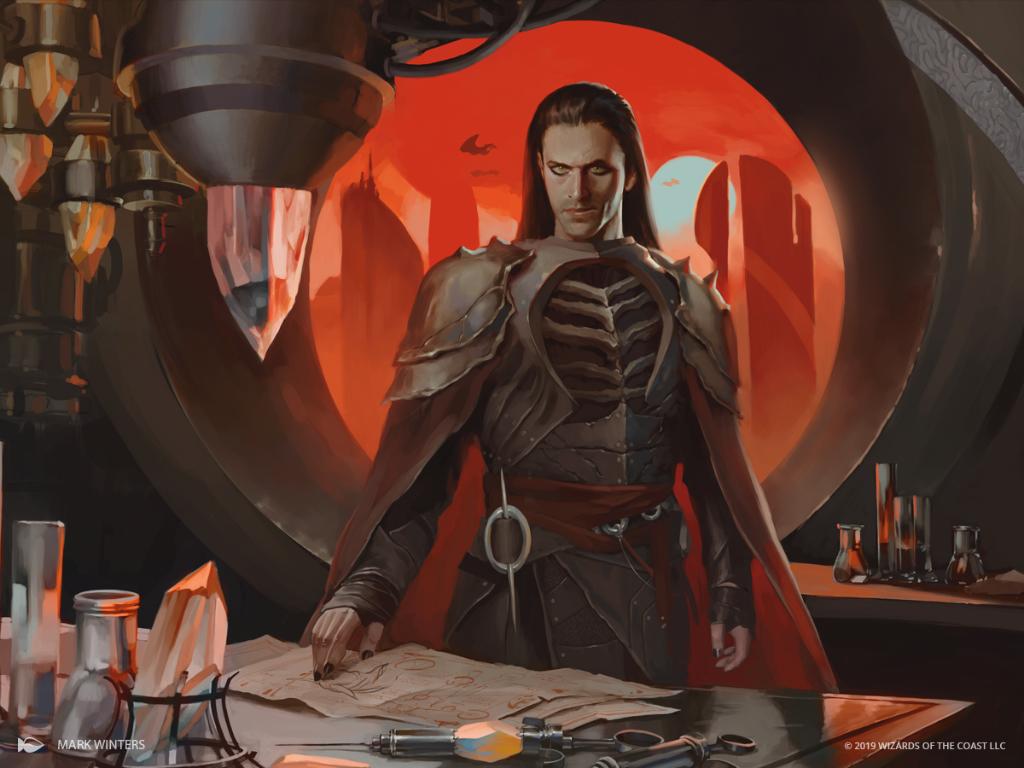
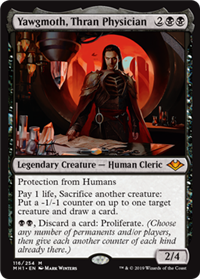
I chose to write about Yawgmoth, Thran Physician for two main reasons: he is one of Magic's greatest and longest-running villains, and because when he was spoiled a lot of our Discord chat focused on what decks he would go well into. It's that second point that inspired me most, but not for the reason you might think.

We often see two different types of price spikes when it comes to Commander cards:

  1. Cards that clearly play well with another commander
    When this happens you may get some smaller gains on other staples to the actual commander, as players rebuild or build the deck and simply slot the new card into it. The new card might even boost the power level of the deck as a whole, which may cause additional gains on hard to find staples.
    However, what's important to remember is that when a new card slots into an existing deck it doesn't always inspire a ton of brewing. Players simply go through their decklist and likely pull one of the weakest cards and replace it with the new card.
  2. Cards that demand a deck be built around them
    These are my favorite and the ones that drive a lot of price jumps and thus a lot of gains for those who find the cards most likely to be "staples" in said deck. This is the category I've had the most success in when it comes to Commander speculation gains.

Several of our fellow Insiders immediately jumped on cards like Hapatra, Vizier of Poisons because she plays extremely well with Yawgmoth, Thran Physician. However, Hapatra already caused a fair number of older cards like Harbinger of Night to jump up in value back when she was originally spoiled.

There was an error retrieving a chart for Harbinger of Night

As you can see by the graph, this card's price jumped dramatically and then settled back down to about half its pre-spike price. If you invested in these with your out being buylists, you likely made very little money. This is all thanks to the fact that buylist prices lag behind spikes, which allow prices to stabilize.

So if you assume that Yawgmoth will simply be one of the 99 in other Commander decks, you may be disappointed in most specs you pick up. Commander players tend to suffer from "Tiny New Toy Syndrome" more than any other group of players, so I don't expect we'll see many gains on cards that go in decks with a different Commander.

Instead, I think it's important to look at ol' Yawggy as a powerful new Commander. He serves as a "free" sacrifice outlet, a card draw engine, and even provides one of Magic's more powerful mechanics in proliferate. His first ability is arguably more powerful, but it requires a steady stream of creatures. Yawgmoth is mono-black, barring access to white, which is typically the color that provides the most token producing cards. However, this color restriction actually opens the door to potential speculation targets.

While these cards may not be powerful enough to fit into a B/W token deck, we are required to find alternatives to the standard token staples. In fact, when you think of mono-black token Commander decks there really aren't a lot of choices. This is the best one, and also my favorite speculation target for Yawgmoth decks.

There was an error retrieving a chart for Endrek Sahr, Master Breeder

Endrek Sahr, Master Breeder is the perfect card for this style of deck. It provides continuous free token creatures to be sacrificed for profit. There are currently three printings of this card: Time Spiral, Modern Masters 2015, and Commander 2013. Only two of those have foil printings and at the time of writing, foils are in the $1.50-$2 range (full disclosure: I bought 18 foils between the two printings when this card was spoiled). The fact that you want to be casting a lot of creatures to get the additional tokens plays perfectly with Yawgmoth's ability, as they provide additional fodder.

There was an error retrieving a chart for Dictate of Erebos

Dictate of Erebos is another mono-black staple commonly seen in B/x token decks already. Mono-black decks tend to love Grave Pact and its variants. Dictate of Erebos is the closest option we have to a second copy, and unlike Grave Pact it only has a single printing as opposed to the seven that Grave Pact has. Amazingly, foil copies of this card are barely more expensive than the regular versions, which is usually indicative of a future price increase. I was able to pick up two copies for $11.99 each when the regular versions are almost $9, making these foils seem criminally underpriced. Though it doesn't affect gameplay, the artwork on this card in foil is gorgeous.

There was an error retrieving a chart for Vindictive Vampire

While Vindictive Vampire is only an uncommon it does seem like it's a perfect fit in this deck. Given Yawgmoth's "free" sacrifice effect still requires you to pay life, one would need a continual source of life gain. This card provides that as well as serving as a potential win condition. I don't tend to go too deep on standard legal uncommons as Commander investments, because of their extremely high supply, but the foils of this card seem very underpriced. In fact, they are so low that you currently can't buy most of them without purchasing something else from a vendor, due to the $2 minimum on TCGPlayer.

There was an error retrieving a chart for Zulaport Cutthroat

The same reasoning behind Vindictive Vampire applies to Zulaport Cutthroat, except Cutthroat was reprinted once in Masters 25. This also has a lower converted mana cost which is typically seen as a benefit. Keep in mind this card was printed in Battle for Zendikar, which was opened in record numbers due to the search for Expeditions.

There was an error retrieving a chart for Genesis Chamber

Genesis Chamber is an uncommon that was sitting at $2.50 for almost three years until was reprinted. One of the challenges I'm having in building this deck is looking for cards that continually generate tokens, ideally for free. Genesis Chamber is especially interesting, because of the fact that your opponents also benefit from it. This has usually been a major detriment. However, as Yawgmoth can continually kill those tokens for the cost of your own while netting you a card and a death trigger, the downside is mostly mitigated.

Battlebond foils are sitting under $2, making them a bit difficult to purchase en masse due to that $2 minimum purchase requirement. However, it may be worth paying a little extra, as I expect this card will likely be an auto-include in Yawgmoth decks. Especially so, when these foils could easily double or triple in price.

Conclusion

While many might see Yawgmoth, Thran Physician as a 1 of 99er, I think he is very likely to inspire decks to be built around him. I also believe that the cards listed above are all fairly likely to find their way into said deck and may see price increases because of that. Researching for this article showed me that there are simply not that many mono-black token Commander decks. In fact, the only one I found was the Endrek Sahr, Master Breeder decks which mainly had other cards that gave you something to do with those tokens. Yawgmoth provides that and, instead of creatures, requires as many token generators as it can get.

Insider: QS Cast #123 – Mythic Sparking Fiasco [Unlocked]

Are you a Quiet Speculation member?

If not, now is a perfect time to join up! Our powerful tools, breaking-news analysis, and exclusive Discord channel will make sure you stay up to date and ahead of the curve.

Welcome to the QS Cast 2019! Our co-hosts Chaz and Tarkan explore the financial aspect of Magic the Gathering – and in this episode they discuss the following:

  • QS Writer Chris Martin re-joins the Cast, along with Stu Somers!
  • War of the Spark Mythic Edition fiasco.
  • What does this blunder mean for Supplemental products and Modern Horizons spending?
  • Insider Questions

Cards to Consider

*This Podcast was Recorded on 05/02/2019 for QS Insiders. If you want live recording sessions and up to date postings before anywhere check out the QS Insider Discord!

Avatar photo

Chaz V

Started playing during Invasion block at the age of 13. Always a competitive person by nature, he continues playing to this day. Got into the financial aspect of the game as a method to pay for the hobby and now writes, Podcasts, and covers all aspects of the game, always trying to contribute to the community and create great content for readers and listeners.

View More By Chaz V

Posted in Free, QS Cast, UnlockedTagged , , Leave a Comment on Insider: QS Cast #123 – Mythic Sparking Fiasco [Unlocked]

Have you joined the Quiet Speculation Discord?

If you haven't, you're leaving value on the table! Join our community of experts, enthusiasts, entertainers, and educators and enjoy exclusive podcasts, questions asked and answered, trades, sales, and everything else Discord has to offer.

Want to create content with Quiet Speculation?

All you need to succeed is a passion for Magic: The Gathering, and the ability to write coherently. Share your knowledge of MTG and how you leverage it to win games, get value from your cards – or even turn a profit.

Spoilers on the Modern Horizon

Are you a Quiet Speculation member?

If not, now is a perfect time to join up! Our powerful tools, breaking-news analysis, and exclusive Discord channel will make sure you stay up to date and ahead of the curve.

It's been less than a month since War of the Spark dropped, but since the extra product this year is Modern Horizons, we have more sets than normal to review. And then, about a month until Magic 2020 spoilers begin. 2019 is fast becoming Year of the Brewer. Today, I will be looking at some of the big themes from Horizons. There's a lot of potential in the expansion, but do its mechanics have the support they'll need in Modern?

A Sigh of Relief

First of all, I am relieved that my initial fears haven't been justified. While I was reasonably certain that Wizards had tested the set to death and had no intention of completely overhauling Modern, there was that nagging fear that something slipped through the cracks. Unleashing something like True-Name Nemesis onto Modern could be devastating, given how powerful that card is in Legacy. It's not outside Wizards' wheelhouse to drastically underestimate cards and misperceive formats.

However, that doesn't appear to have happened so far. As of writing, roughly half the set has been spoiled, and nothing strikes me as overpowered. Apparently, Modern Horizons started as Time Spiral 2. Thus, the inital design was with Standard in mind. Later, it became a standalone innovation set and Modern supplement. As a result, what we're getting is slightly-too-good Standard cards.

Horizons is a set full of interesting themes, role-players, and brewing tools. That's exactly what I was hoping for, and I'm looking forward to pulling the set apart to find the hidden gems amongst the hopefuls and wannabes.

'Snow Time Like the Present

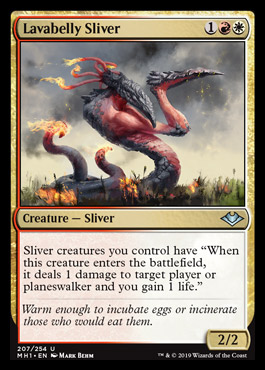
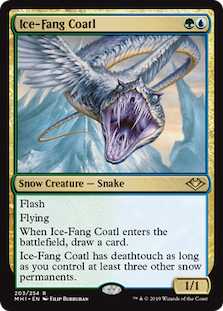
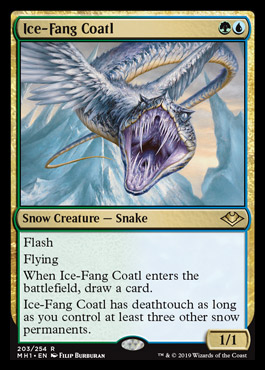
The first theme spoiled was the return of snow. Specifically, full-art snow-covered basics were spoiled, followed by Ice-Fang Coatl. However, there hasn't been much else since then. Another new card, Glacial Revelation, hints that snow is a major theme and there are more cards to come, but at the moment it's just an awkward manland and some unplayable four-drops. Coatl is far and away the best snow card, and a very good card by itself. Two-mana cantrip creatures have proven playable in the past, and Coatl having flash and flying are huge upsides compared to Silvergill Adept and Elvish Visionary.

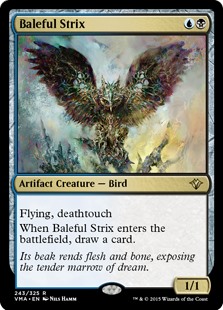
However, that's not the whole story; with three more snow permanents, the Snake gains deathtouch. This turns Coatl into an arguably better Baleful Strix, and Strix is an absurd card. In Legacy, Stix is arguably the best removal spell in the format; it cantrips, trades with everything, walls off Gurmag Angler and Eldrazi, and pitches to Force of Will. Every non-combo Dimir-friendly deck runs a set.

Players have asked me if Strix would be good in Modern, and I've always said it would, but that it wouldn't be healthy. Legacy is so high-power and spell-heavy that Strix's power isn't obvious, but in the more creature-focused Modern, it's absurd. Strix is always a cantrip, and then trades up. Against aggro decks, what the inquirers are always thinking of playing against, this is fine. There's plenty more where that came from.

However, against midrange, Strix would be warping. BGx relies on one-for-one trades and having bigger creatures. Strix completely breaks that gameplan since it isn't much of a threat but requires an answer to not lose value, eating removal for actual creatures. This would heavily disincentivize Jund as a deck and move the format toward being more blue. Coatl aspires to be Strix, but I don't think it will succeed.

Cool-Down Time

To be a better Strix, Coatl needs a lot of snow, and by extension, playable snow permanents. But there aren't. Now, there is no opportunity cost for running snow basics over regular basics. They're necessary in a deck that cares about snow and identical to regular basics in a deck that doesn't. Therefore, a Coatl deck could just run a set of Coatls and tons of Snow-Covered Islands and Snow-Covered Forests and call it a day. However, this strategy would lose the mana fixing of shocklands. Since a normal Modern manabase only has ~6 basics, running Coatl puts a lot of pressure on the mana.

To alleviate the pressure, it makes sense to run nonland snow permanents. However, the supply of those is limited. There are probably more to come in Horizons, but at this moment the only snow permanents that are definitely Modern playable are Coatl and snow basics. Boreal Druid has seen Modern play in RG Eldrazi as a source of colorless mana, and Scrying Sheets gets trotted out alongside Skred. That's it. Ohran Viper is close, but probably not good enough anymore. Viper could fit the same deck as Coatl, but I doubt Druid would. Coatl is color-hungry, and its deck probably would be too, so Druid's colorless mana would be weak. I can't see it working out without more Horizons help. Therefore, right now I think deathtouch will be gravy rather than an actual reason to play Coatl, and its utility will be limited.

Edit: Shortly before this article went to press, two new snow permanents were spoiled. Both are potentially playable, however it won't be in the same deck as Coatl. Arcum's Astrolabe is a one-mana egg, and will only see play in a combo deck. What combo deck is unclear since Krark-Clan Ironworks is banned, but that's the only style of deck that wants something like Astrolabe. While a mana fixing egg may up your snow count, it's not the sort of card that midrange decks historically want to play.

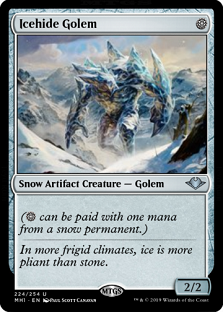
The other is Icehide Golem. As a 1-mana 2/2 artifact Golem is potentially playable in a dedicated snow aggro deck, though stat-wise it's mediocre for Modern. However, this doesn't really change anything for Coatl since it's too small to see play in an aggro deck while Golem doesn't belong in the midrange decks that want Coatl. The problem persists.

'Snow-Thing-Like Home

Even if the snow theme issues can be dealt with, Coatl still has one problem: it doesn't have a home. Strix is primarily played in Grixis Delver decks in Legacy, and while Grixis Death's Shadow is similar, Coatl is green/blue instead of black/blue. This limits its home to Sultai or Temur, which are not decks in Modern. While researching this article, I found exactly one Temur list from an SCG Qualifier this year plus the odd Death's Shadow list splashing for Tarmogoyf. Traverse Shadow appears to have vanished. The best result for a true Sultai deck appears to have been in an SCG Open win in 2015.

Despite years of trying, Temur and Sultai decks don't work in Modern. It makes logical sense that pairing the most powerful creatures with the most powerful removal and card advantage would be a great deck, but that doesn't play out. Compared to Jund, Abzan, and the Rock, Sultai is incredibly clunky, while Temur is underpowered. On paper, this makes no sense, and I've known a lot of players that have tried and failed to fix this problem. A lack of internal cohesion when pairing blue and green which kills the deck. I proxied up a Sultai deck based on Jund's numbers to confirm if this was still true.

Midrange Sultai, Test Deck

Creatures

4 Dark Confidant
4 Tarmogoyf
4 Snapcaster Mage
4 Ice-Fang Coatl

Planeswalkers

4 Liliana of the Veil

Sorceries

4 Inquisition of Kozilek
3 Serum Visions
2 Thoughtseize

Instants

4 Fatal Push
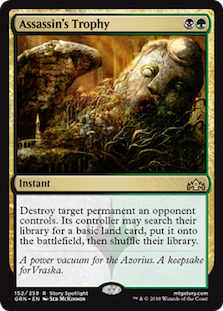
3 Assassin's Trophy

Lands

4 Verdant Catacombs
4 Misty Rainforest
2 Darkslick Shores
2 Blooming Marsh
2 Creeping Tar Pit
2 Snow-Covered Island
2 Snow-Covered Swamp
2 Snow-Covered Forest
2 Overgrown Tomb
1 Watery Grave
1 Breeding Pool

This deck grinded better than anything I've ever played. It had a great curve, was very consistent, was packed with interaction and card advantage... and didn't win against anything. It felt anemic and clunky, even for a test deck. Coatl is a great cog, but doesn't race or apply pressure. It's very all-in on Tarmogoyf to win, and there's not a great solution except to go more controlling and then compete with the superior UW decks. Unless someone can work out that closing problem, the decks that could run Coatl just won't exist.

'Snow-t Enough

The final problem is the mana base. As mentioned, Coatl is color-hungry, but also requires lands that discourage the fetch-shock base that's Modern's bread-and-butter. There's already a lot of tension between basics and shocks in midrange manabases; too few of the later and decks struggle to hit the right colors on curve, and too few of the former and they lose to Blood Moon. The snow lands add further tension. Fetching one of each basic ensures all colors, but makes it hard to cast Liliana of the Veil or flashback Assassin's Trophy.

This mana base tension means that any deck that could run Coatl will have to be built around the snow basics, because otherwise there's too much tension and too little space. The Temur list could because it's a Blood Moon deck and plays lots of basics anyway. However, Traverse Shadow only runs 17-19 lands, two of which are basics. We'll need more snow support to give Coatl the home it deserves.

Part of the Whole

The other big theme is tribal. There is specific support for a number of under-represented tribes in Horizons, the most exciting being fan-favorite Slivers. Slivers occasionally wins at big events, then quickly disappears again. It never has any staying power. The problem for Slivers is that it's multicolored Merfolk. The deck functions exactly the same way, but with more abilities than +1/+1 and islandwalk, and more mana trouble.

Less Than the Sum

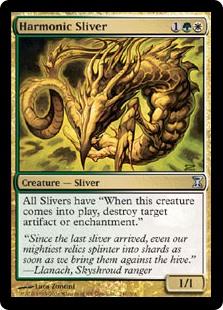
The problem has been lack of interaction. The only Sliver that can directly interact with opponents is Harmonic Sliver. Necrotic Sliver turns Slivers into Vindicates, but at a steep price. The shards are all about buffing the entire team. This is great if you're looking for a linear attack deck, but Slivers has been worse than Merfolk historically despite this because it couldn't disrupt the opponent. Merfolk runs counterspells and Spreading Seas, where Slivers just has creatures. This put Slivers in the same lane as the faster Affinity, and now means it competes with Humans.

In the head-to-head, Slivers will probably come out on top, since they have more pump effects as well as multiple ways to evade Humans' blockers. Galerider Sliver sees play, but there's also options for menace and shadow. However, being a great evasive linear deck isn't enough in Modern's context. Humans is the better deck in the format because of its disruption package. Given that Affinity, Hardened Scales, and Merfolk aren't taking home trophies, how will Slivers compete?

New Parts

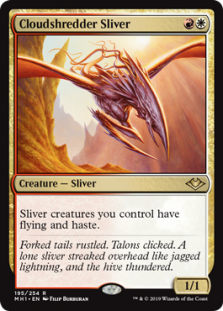
So far, the new Slivers have all been buffers rather than disruptors. This probably means that Slivers will remain fringe. If that isn't the case, it will be because of Cloudshredder Sliver, though I'm skeptical. Haste and flying for two mana should decrease the kill turn, assuming Cloudshredder survives to attack. The ideal curve is probably turn one Aether Vial; turn 2 Vial in a one mana Sliver, cast Cloudshredder and attack for 2; turn three cast another one drop and Sinew Sliver, Vial in Predatory Sliver, and attack for 15. That could be lethal. However, any removal just kills that curve, and if that's not good, enough what is?

Mom's Home

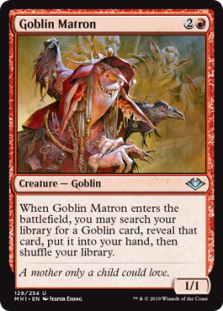
The tribal support doesn't end with Slivers. The card that I'm most excited about is Goblin Matron. I've tried a few times to make Goblins something other than 8-Whack and be good. It hasn't worked out. The problem is that the individual goblins need not only a critical mass, but also the right enablers to become a threat. This puts them in the same camp as Elves, but without all the tutors. With Matron, the battle begins to shift. Matron was arguably the most important piece of the old Standard decks and Legacy Goblins, so there may be hope for Modern too.

Partially-Full House

The clunkiness of Goblins will likely persist. Matron finds the best creatures in the deck, but costs three. This limits the rollout. Even going the combo route isn't enough. My issue with the Fecundity combos that I tried right after Skirk Prospector was spoiled was Fecundity itself. What Matron needs to make her brood great again is a Goblin Ringleader. I doubt that card will be reprinted, but even a nerfed version would go a long way towards making Goblins a real deck again.

Bright Future

Spoiler season is just getting started, and I'm feeling hopeful. There's a lot of cards still to reveal, so maybe these currently-lacking themes will be fleshed out soon.

The MTG Finance Backlash

Are you a Quiet Speculation member?

If not, now is a perfect time to join up! Our powerful tools, breaking-news analysis, and exclusive Discord channel will make sure you stay up to date and ahead of the curve.

It’s Modern Horizons spoiler season, and you’ve been carefully monitoring new cards in the set, eager to brew. Then the moment you’ve been waiting for arises: Slivers are confirmed in!

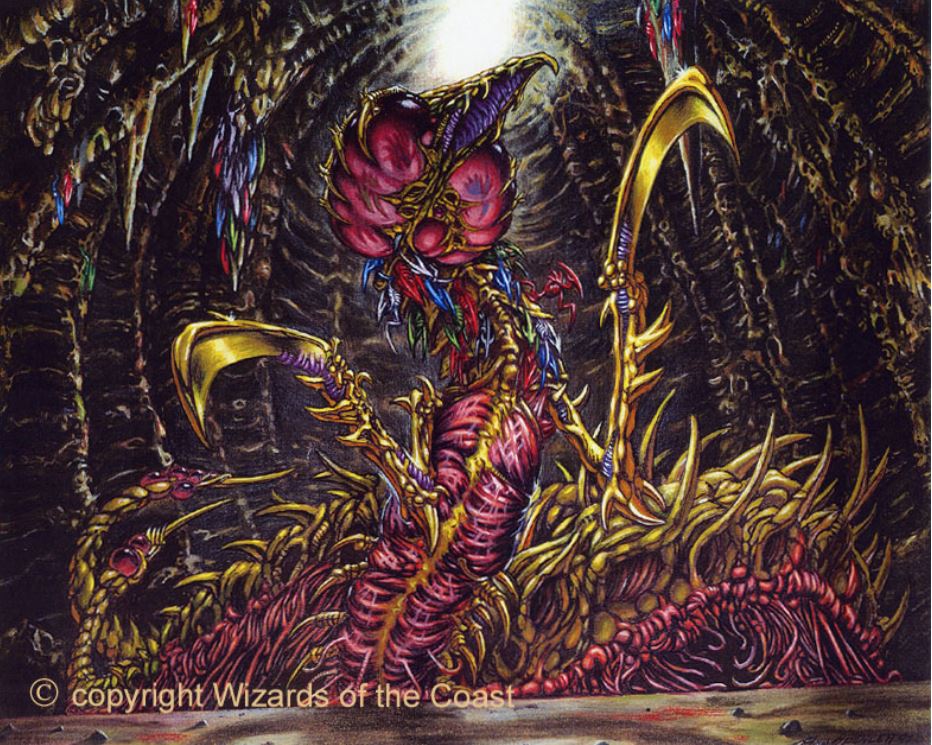
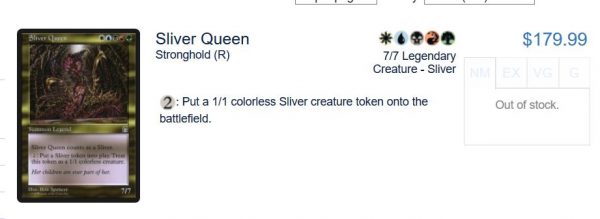
You rush to TCGPlayer to acquire that Sliver Queen you’ve been putting off purchasing. A 10% kickback from eBay or TCGPlayer would have been nice, but now that the ideas are flowing you are okay with that $80 price tag. You head to TCGPlayer.com, search for Sliver Queen, and find out that only a few copies are in stock with a $200 price tag.

You head to Card Kingdom’s site, but there’s no luck there.

How about Star City Games? Nope.

What is going on here?

A Sliver Queen Study

Last week I attempted to write an objective piece that covered the history and necessity of MTG finance. The fact that the game has an economy, consisting of varying rarities and power levels, was innate to Richard Garfield’s design. As soon as Black Lotus was printed to be better and rarer than Wall of Wood, relative values became a reality.

After completing the column, it occurred to me that my article was biased (though understandably so). I failed to address the dark side to MTG finance in the article. While I will always believe that the game’s economy is critical to the game’s success, I would be remiss not to point out the problems introduced by a concerted “MTG finance” community.

Before Slivers were originally spoiled in Modern Horizons, the number of copies in stock had already dwindled down to a couple dozen. But after the first Sliver was spoiled, the card quickly became unavailable everywhere. Shortly thereafter, copies started to trickle back into stock with price tags in excess of $200. In fact, the greediest sellers start with a ridiculously high price tag (there’s one seller on TCGPlayer with a $500 listing), and copies slowly enter the market from there.

There was an error retrieving a chart for Sliver Queen

This greed, this insistence on setting a new price five times higher than previous, and this sudden clearance of the internet, is what really gives MTG finance a deservedly bad reputation.

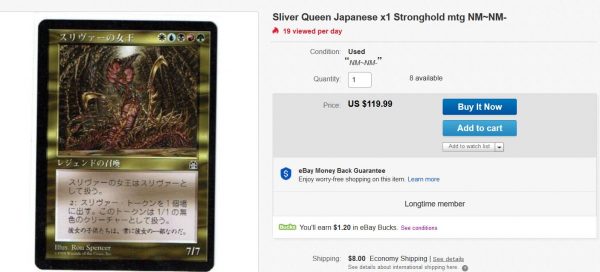
Then you get listings like these (and far worse)—they imply a speculator picked up whatever copies they could and threw them on eBay opportunistically, trying to cash out on the hype.

It’s possible this seller is a shop, and that shop happened to have eight copies in stock. But if I had to guess, I’d wager the seller scrambled to find whatever copies they could in reaction to the buyout, and now they’re trying to make a buck listing their copies on eBay at the new, elevated price. There used to be a bunch of $40-$50 Japanese Sliver Queens in stock. But when “MTG finance” cleans out copies at the old pricing, buying four or eight at a time, the sudden buyout enables the setting of a new, higher price.

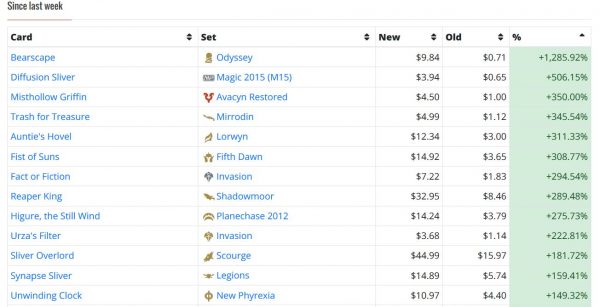
These instantaneous price-resets put MTG finance into a poor light. It happens all the time, and the buyouts really do become tiresome, especially to the casual player who doesn’t have time to watch the market like a hawk during spoiler season. And judging by the MTG Interests list from last week, it’s clear that MTG finance is both quick to react and incredibly thorough. Any synergy you could think of has already been targeted.

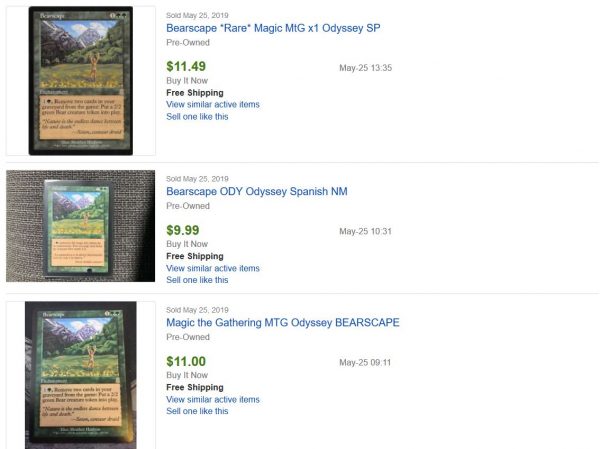
I mean, $10 for Bearscape?? Are you kidding me?!

There was an error retrieving a chart for Bearscape

MTG Finance: The Negatives

The MTG finance community may defend their actions and claim that their behavior only creates market inefficiencies in the very short term. If no one is willing to pay $500 for Sliver Queen, then no copies will exchange hands. New sellers will undercut that $500 price tag and the price will drop until a buyer is willing to pay up—that becomes the “market price”.

That’s a fine argument, and I agree that the correct equilibrium price will take hold…eventually. But I find some faults with the logic. Firstly, it’s unfair that the broader community has to wait to acquire their copies at a reasonable price. Of course, there aren’t enough Sliver Queens to go around, so not everyone can get a copy at a price they’re willing to pay. I won't believe for a minute that players need more than four copies of this card for their decks--most probably require only one. But by purchasing four to eight copies of the card at a time, it represents that many more players who can’t get a copy at a cheaper price. Maybe the price comes back down eventually, but this isn’t a guarantee.

That brings me to the second issue: emotions. MTG finance preys on emotionally driven and impulsive buyers. When someone sees new bears in Modern Horizons, they suddenly think of Bearscape. So they check TCGPlayer and see that Bearscapes are suddenly worth $10. If they’re patient, they could wait for the hype to subside and purchase their copies in a few weeks.

However, during spoiler season, many people are in a peak emotional state and are eager to brew with the new cards. That could lead them to make suboptimal purchasing decisions, such as buying their Bearscapes now at $10. This is how the MTG finance community profits by purchasing eight copies at a time at a buck a piece. Thus, the finance community takes advantage of peak emotional connections with Magic in conjunction with a temporary supply shortage. This is how the community can profit from buying out various cards.

The third concern I have with MTG finance behavior has to do with economic theory. When a card is bought out, supply slowly re-enters the market at lower and lower prices until buyers come along and make their purchase. This establishes the new price. The price is discovered in a manner akin to a Dutch Auction, an auction in which the auctioneer begins with a high asking price, and lowers it until some participant accepts the price. In other words, the buyer(s) willing to pay the most for the item ends up paying that much to make the purchase.

Contrast this to traditional eBay auctions, where an item’s price starts low and is bid on until no one is willing to pay more. The winning bidder is the person who was willing to pay the most for the item, and they end up paying the second highest bid plus some minimal increment. There’s a minor difference here I want to pause on.

In an eBay auction for a Magic card, the winning bidder essentially pays the amount the second highest bidder was willing to pay. In a Dutch auction, the winning bidder pays the highest amount they were willing to pay. See the difference? If everyone behaved rationally, there wouldn’t be much difference between the two approaches in terms of ending price. But during a period of peak emotions, I can’t help but wonder if there’s a difference in resulting price.

As a luxury good, there are some folks in the Magic community who can afford to pay up for the most desirable cards. If these people are in an emotional state, in a period of limited supply, and participating in a Dutch auction, I wonder if they’d end up overpaying for their cards. It’s just a theory I have—perhaps it’s an interesting topic for some prospective Ph.D. economist who also happens to play Magic!

Wrapping It Up: My Admission

Magic: the Gathering is a card game built upon an economy. There’s no way around this. Because money is involved, there will be greedy speculators who get involved in order to exploit the market’s inefficiencies. During spoiler season (or other periods of peak emotional interest), these inefficiencies magnify, yielding profitable opportunities.

Where there are opportunities, there are the opportunistic. They track the market closely, identify synergies, and purchase as many copies as they can at an “old price” in the hopes of selling into the hype at a new, higher (possibly inflated) price. This is an unfortunate facet to MTG finance, and it’s one that gives the finance community a poor reputation.

Throughout this article, I’ve been referring to that community as a third party unrelated to myself. But the reality is I have also participated in this speculative behavior—I am no less guilty than the next person. To deny this would be a blatant lie. However, I do tend to adhere to a couple personal rules.

  • I never go very deep. If a card is under five bucks, I may buy 4-8 copies (rarely more). But if the card is pricier, I stick to a playset or less. I don’t want to tie up too much capital in a single card, but I also don’t like the idea of “buying out the market” because the resulting feel-bads of the rest of the community are something I empathize with.
  • I don’t speculate on Old School cards. There are so many sweet, old cards I wish I could own. But I don’t have infinite resources. So why would I spend money to own more than four copies of an expensive Old School card when I could buy copies of other cards I don’t yet own. The only exception is Alpha Plague Rats, which I play in Alpha 40 and collect.
  • I often don’t have the patience to play the “race to the bottom” game during buyouts. When Scrying Sheetss spiked recently, I managed to sell a couple on eBay. But I grew very tired of dropping my price one penny at a time to remain the cheapest copy for sale. Eventually, I gave up and cashed out to Card Kingdom’s buylist. In fact, buylisting is my favorite way to move cards during spikes because I don’t have to price compete and I don’t prey on others’ emotions.
  • My speculation is always on the fringe of my activity. I estimate over 95 percent of my MTG resources are allocated to my decks and a modest collection of sweet Old School cards. I do speculate on occasion, but this activity is tiny relative to the rest of my collection. It’s the equivalent of owning $100,000 in an S&P 500 mutual fund for retirement and using $500 to trade in something like speculative Cannabis stocks and Bitcoin. I’m far too risk averse to do it any other way.

Even with these rules, I know I am part of the “problem”. But maybe I can slowly make up for this. In an upcoming article, I’m going to explore strategies to help you navigate an economy fueled by MTG finance. We’ll never see the end of MTG finance, but we can at least adopt strategies to help us avoid the pitfalls this community creates.

For now, I think that’s the best we can do.

Sigbits

  • I noticed the return of a couple older cards to Card Kingdom’s hotlist. Gaea's Cradle, Shahrazad, and Transmute Artifact are three examples. They’re off their peaks, but maybe they are on their way back up. These three cards are buylisting for $220, $180, and $80, respectively.
  • The Mythic Edition Jace, the Mind Sculptor is yet another version of this powerful Planeswalker that is on Card Kingdom’s hotlist. They currently offer $225 for this premium version of the card—I believe this reinforces that Jace is the most valuable Mythic Edition
  • Grim Monolith and Sliver Queen are both buylisting near all-time highs now, both coincidentally at $105. I believe Grim Monolith’s buy price could climb even higher, but Sliver Queen’s may hit a momentary peak as the market floods with copies post-buyout.


Modern Horizons: Spoilers and More!

Are you a Quiet Speculation member?

If not, now is a perfect time to join up! Our powerful tools, breaking-news analysis, and exclusive Discord channel will make sure you stay up to date and ahead of the curve.

Modern Horizons is the first set to introduce cards directly into the Modern format without hitting Standard, designed primarily with the Modern format in mind. The set is scheduled for release on June 14th, 2019 and will feature 254 cards plus an exclusive Buy-A-Box card (Flusterstorm) available with in-store preorders. Pack price will be slated for $6.99, similar to previous Masters sets. However, Modern Horizons will be printed to demand. More information will be posted here as it becomes available.

Spoilers are slated to start Sunday, May 19th and are slated to follow this schedule. Check back with us frequently for the latest spoilers and our MTG Finance flavored commentary!

May 30th

It's been a minute since we've had an update here, and that means a ton of spoilers to dive into! This week brought us a ton of fantastic cards and has generally improved many player's outlooks on the quality of this set. The general consensus seems to be that the set is jammed packed full of Commander cards, leading some to dub the set "Commander Horizons", but I think it's hard to fully grasp the impact of these cards without seeing any tournament results with these in the environment.
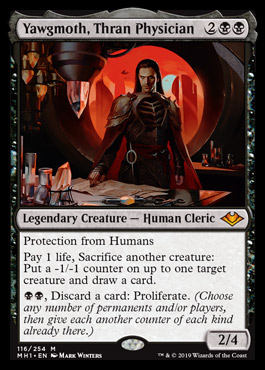
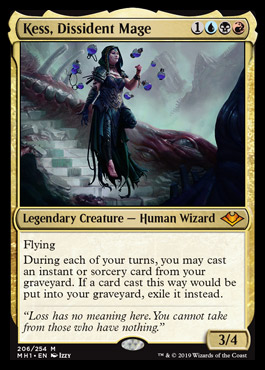
 

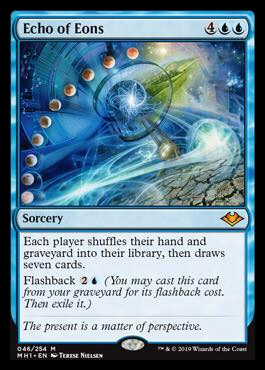
These mythics appear to be Commander focused in their design at first glance, but maybe there's something more here. While Yawgmoth, Thran Physician and Kess, Dissident Mage strike me as obvious generals, I think we get an interesting card in Echo of Eons, which does a nice impression of Timetwister. Modern Storm decks may consider slotting a copy of this in as a Gifts Ungiven target, and the synergy with Narset, Parter of Veils is downright disgusting.
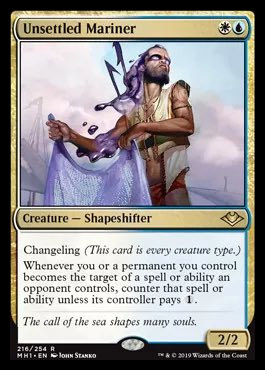
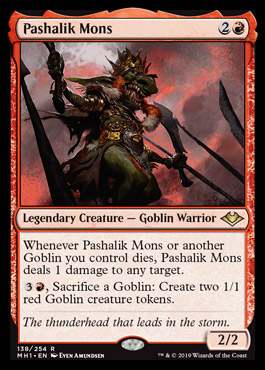
  

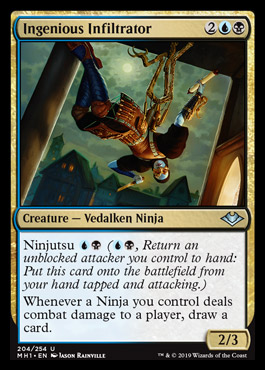
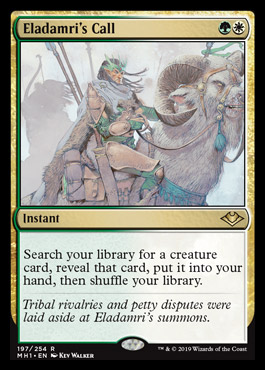
Tribal cards are mattering more and more here, with goblins, changelings, and ninjas emerging as major players. It feels incredibly fitting to see Eladamri's Call get a reprint, with creatures mattering so much in this set.
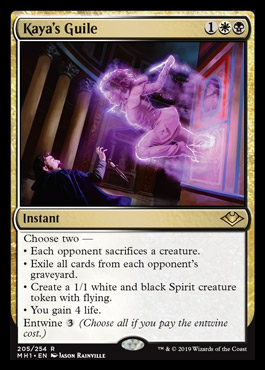
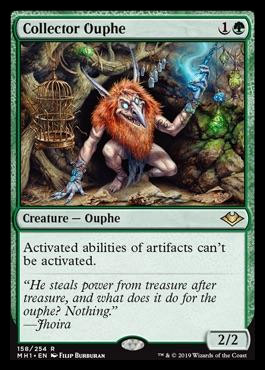
I'm excited to see cards like these, which seem to be tailor-made for the format, and provide answers to a lot of matchups. Kaya's Guile looks like a very strong card for decks that want it, like Esper or Mardu builds that may struggle to make it to later turns against a variety of different strategies. Collector Ouphe is a nice hatebear to include against a metagame full of Hardened Scales and other artifact-based decks.
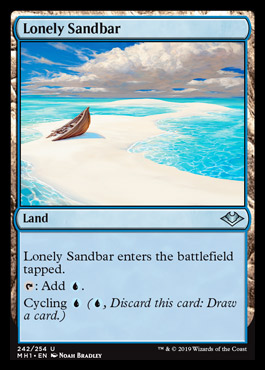
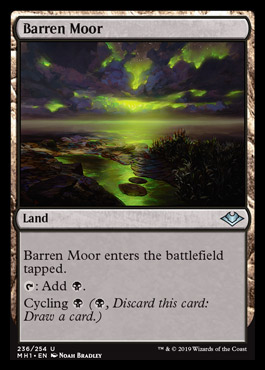
 

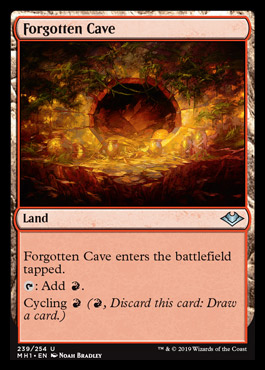
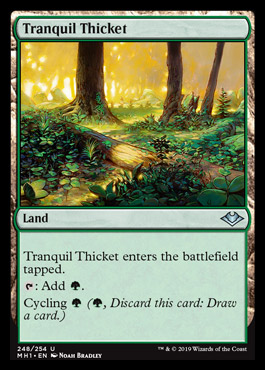
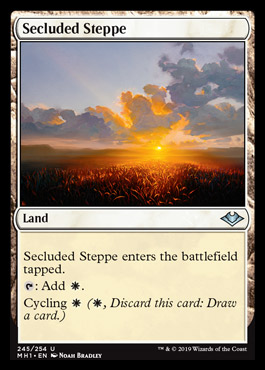
The Onslaught cycle lands make their return, hinting at a "lands matter" archetype that could develop, although there will be a few hurdles to this style of gameplay given the speed of the Modern format.
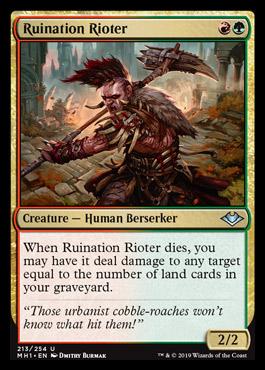
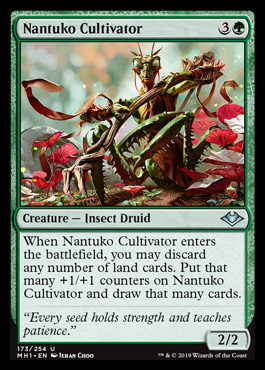
Quite a few enablers of an archetype like this were revealed and may allow the deck to see play, possibly in a prison-style deck with Ensnaring Bridge. Life from the Loam and other land-related cards are seeing a lot of pressure due to this, and it could turn out to be a viable archetype in the format.
There was an error retrieving a chart for Life from the Loam


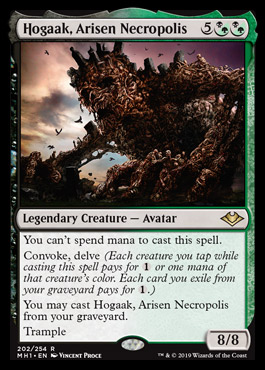
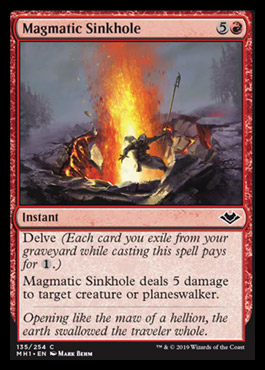
Even more surprising than lands mattering is the return of delve and dredge. These mechanics are pretty high on the Storm Scale (also in the set) and have to be tuned very carefully to not break the format in half. I think we're seeing that here, but these look like fair cards to add to the format. Hogaak, Arisen Necropolis seems like a viable player, as there are so many ways to get this thing on to the battlefield despite its strange casting restriction. Modern Dredge will likely slot this into the decklist, as it is easily castable there.

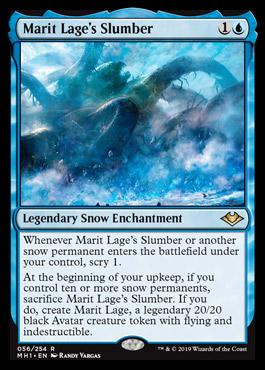
 

Significant snow cards were revealed, giving us a brand new reason to look at cards like Into the North and Scrying Sheets. While not quite Dark Depths, Marit Lage's Slumber is an obvious build-around enchantment that could find success in the format. We may be missing a few pieces, but being able to recur this enchantment in the face of removal will be important to this deck's success.
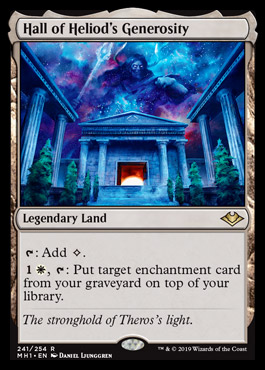
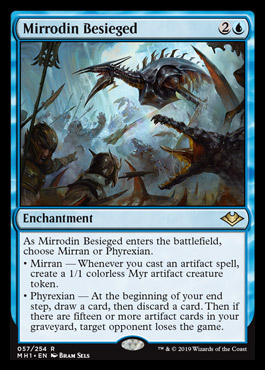
Speaking of enchantments, there seems to be strong support for them in the set, given cards like Hall of Heliod's Generosity. The type shifting from artifact seen on Academy Ruins is a pretty significant enabler for decks that want to use cards like Mirrodin Besieged, Marit Lage's Slumber, and more. For Mirrodin Besieged in particular, it could slot into Lantern Control as another win condition, as it is one of the grindiest decks in the format. It's not clear if the deck will be able fit the Hall in to go with it, but it is certainly possible.

May 25th

A pretty slow day for spoilers, but we did get one very important mythic!
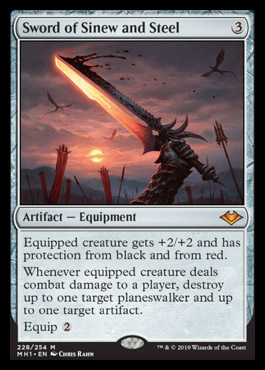
Another allied color Sword gets added to the mix, this time in Rakdos colors. Blowing up a planeswalker or artifact is certainly very strong if this connects, but this Sword feels very specific, especially for Modern. There just aren't many situations where you'd get to take advantage of both abilities on hit with a format that is so fast-paced. If this ever sees play, it will probably be relegated to sideboards.

May 24th

Friday wraps up with some really exciting cards spoiled, and I think we've officially hit a point where we can be optimistic about this set.
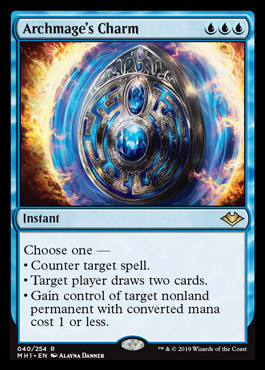
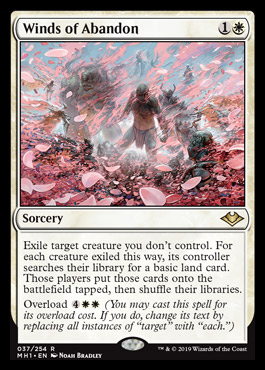
 

Archmage's Charm is still not Counterspell. Despite this sad fact, it's a flexible piece of countermagic that does a lot of things that further UW Control's gameplan in Modern. The casting cost is a bit restrictive at UUU, but manabases will likely adapt to accommodate this. Winds of Abandon may not fit into white decks right away. Path to Exile is still legal in the format, and performs at a better rate for the turns that matter (1-4).
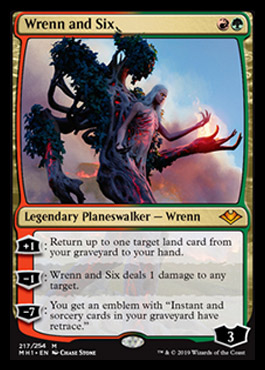
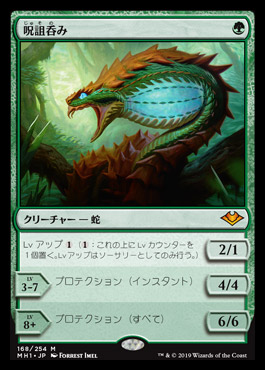
 

Wrenn and Six is an aggressive push for a two-mana planeswalker. In a format with fetchlands and the Canopy cycle, this enables pure card advantage and has a decent minus ability to help protect itself. It's a bit underwhelming in situations where you're behind on board, but I could see this easily slotting into something like Lantern Control or Whir Prison. Hexdrinker brings back the level up mechanic from Zendikar block, giving a nice mana sink in limited play. I'm sure this will be an easy addition to cubes everywhere, though I don't see it performing well outside of that. This card feels more like a rare, rather than a mythic, despite offering a mini Progenitus once you reach level 8.
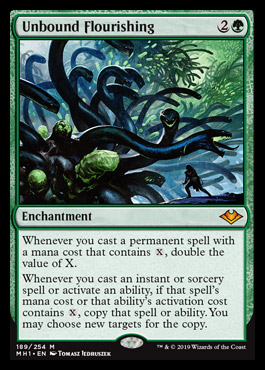
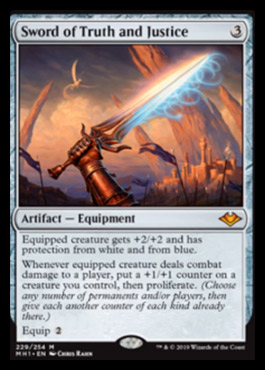
These mythics, on the other hand, are a bit more exciting. Unbound Flourishing is the next card to spark buyouts and price adjustments on any relevant card with an X cost printed on it. Nissa Steward of Elements, Genesis Hydra, and even Walking Ballista were the targets of speculative purchasing within the first hour of being spoiled. Sword of Truth and Justice brings back the Sword of X and Y cycle, this time pairing the allied colors. Dropping a +1/+1 counter and proliferating doesn't sound like much, but generals like Atraxa, Praetor's Voice might enjoy this effect greatly.

As well, it is worth noting that UWx Control is one of the most popular archetypes in Legacy right now. Having a specific Sword against these decks will likely be very strong coming out of the sideboard of decks like Stoneblade, Maverick, and Death and Taxes looking to search it out with Stoneforge Mystic. Many are hopeful that we could receive Stoneforge in this set to go along with the Swords, but this is just baseless speculation with the information we currently have.

There was an error retrieving a chart for Nissa, Steward of Elements
There was an error retrieving a chart for Stoneforge Mystic

May 23rd

Things slowed down a fair bit today in comparison to all the previous days of spoilers, but that doesn't mean we didn't get any interesting cards.
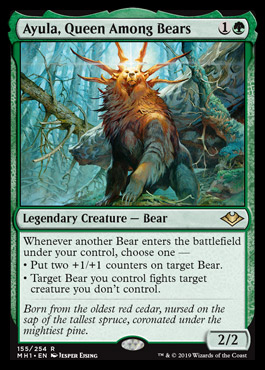
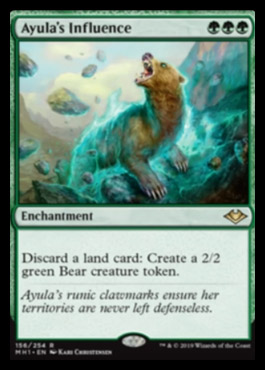
   

Ayula, Queen Among Bears and Ayula's Influence are some pretty sweet bears. Wizards really doubled down on flavor here and give us some exciting options for bear-related Commander decks.
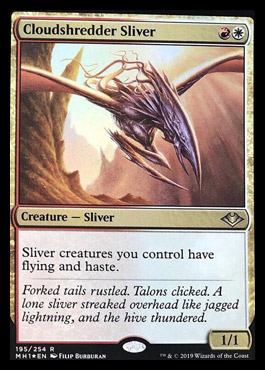
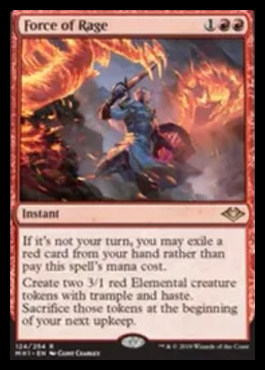
Another sliver gets added to the mix in Cloudshredder Sliver. While we already have cards like Galerider Sliver to provide flying, this will give another option for aggressive sliver builds. The last of the Force cycle comes in red with Force of Rage. This one is a bit more interesting than the other four, as it directly impacts the board state with blockers or aggressive attackers. It's not clear if this will be adopted by red decks, but it is certainly more flexible than the rest of the cycle.
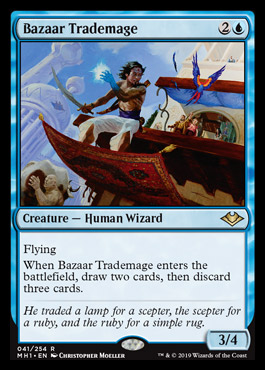
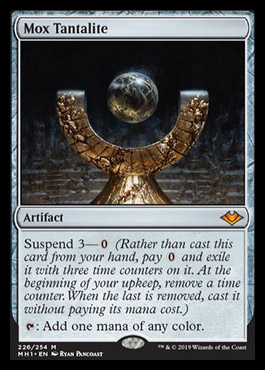
Last, but not least, here are what I think were the biggest cards from the day. Bazaar Trademage represents a flavorful nod to a lot of Arabian Nights cards, like Bazaar of Baghdad, Serendib Efreet, and Flying Carpet just to name a few. Some are speculating it could be a solid graveyard enabler in decks like Dredge or Izzet Phoenix, but that remains to be seen. Mox Tantalite is a great example of a divisive card. A lot of people believe it could be very powerful, while others are rating it the worst Mox to be printed so far. Free mana effects are often broken, and Modern has a few of them like Chancellor of the Tangle, Simian Spirit Guide, and Mox Opal. This one doesn't quite meet the same standard without very specific deck building, but there's still an opportunity for this to see play somewhere.

May 22nd

Wednesday comes to a close, and we saw plenty of bombshells dropped today.
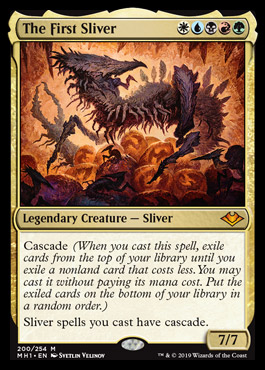
The return of Slivers is huge. It was widely rumored that the tribe would make an appearance sometime this year, and Wizards did not fail to deliver. The First Sliver will be a popular choice for Commander players looking to play meathooks, and that has a ton of cards like Sliver Queen, Sliver Overlord, Sliver Hive, and basically every significant tribal card on the upswing. The reactionary purchasing based off of this card, and the previously spoiled Morophon, the Boundless has moved the needle on a ridiculous amount of cardboard.
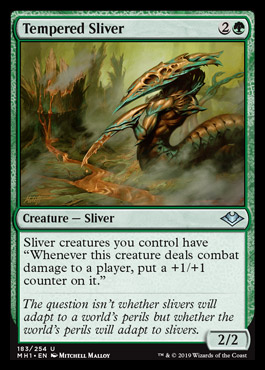
This has also increased interest in Modern and Legacy builds of the tribe, with cards like Cavern of Souls, Aether Vial, and Collected Company on the move. The premier tribal deck in Modern is, of course, Humans, but this new collection of slivers will have brewers trying them out in the Modern environment.
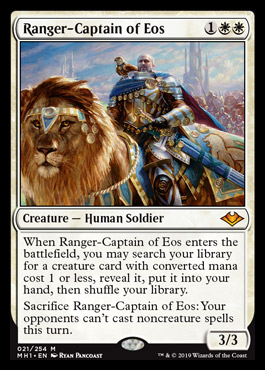
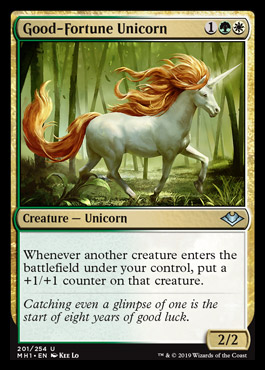
Ranger-Captain of Eos is an incredibly interesting mythic, and looks like an instant inclusion into Humans and Legacy Death and Taxes builds. This answers Terminus in response to the Miracle Trigger, which is nothing to scoff at when your win condition is a critical mass of dorks. Good-Fortune Unicorn is an awesome new edition for Abzan CoCo builds, pairing nicely with Collected Company, and persist creatures like Kitchen Finks.
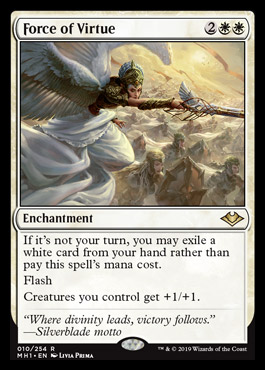
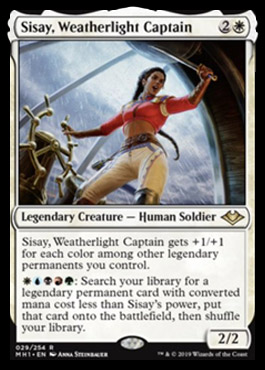
The white Force was spoiled today, with Force of Virtue acting as a flash anthem effect. That leaves us with only the red one left to finish out the cycle. Sisay, Weatherlight Captain throws another 5-color Commander option into the set, with an interesting set of abilities. Legendary-matters cards should be on your radar.
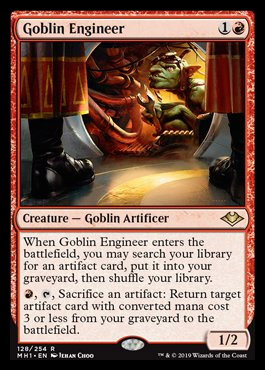
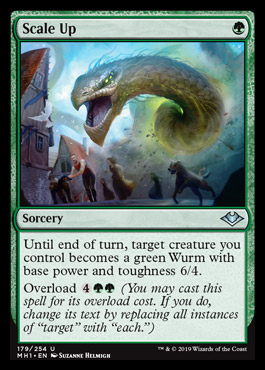
 

Rounding out the day, we have some potentially busted cards here with Goblin Engineer and Scale Up. Goblin Engineer could represent a strong utility card in artifact-based decks to tutor things like Ensnaring Bridge or Grafdigger's Cage, though it is a bit fragile to common removal spells in Modern and competes with Whir of Invention for a similar ability. Scale Up will likely be a premier pump spell in Infect builds, and may lead to an increase in turn two kills off the back of Glistener Elf and Mutagenic Growth.

May 21st

This Tuesday started off hot, with a barrage of solid additions to the set.
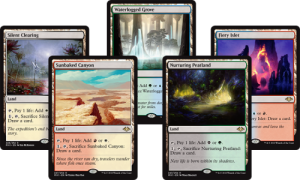
We have to start here, with the cycle of Canopy lands (Horizon lands?). Similar to Horizon Canopy, this enemy colored set pains you for access to either color or allows you to essentially pay 2 and draw a card. It's not clear if these will see widespread adoption just yet, but there is a good chance they will depress the price of Horizon Canopy.
There was an error retrieving a chart for Horizon Canopy


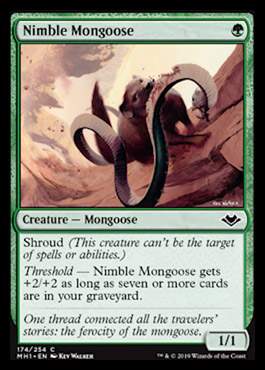
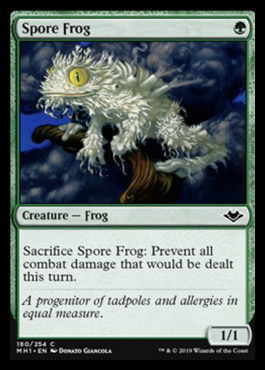
Some significant commons from the day are Spore Frog and Nimble Mongoose, which will offer cheaper foil prices than ever before on these cards. Spore Frog foils will be interesting pickups further down the line, as it is a significant EDH card with only one previous foil printing in Prophecy.

There was an error retrieving a chart for Spore Frog
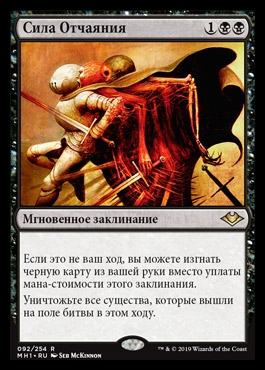
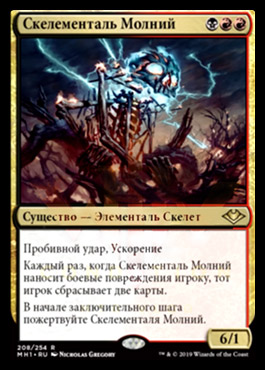
Continuing the Force cycle, we have Force of Despair, which destroys all creatures that entered play that turn. An instant speed Damnation will severely punish decks looking to dump their whole hand onto the table on one turn pretty effectively, albeit at the cost of two cards. Lightning Skelemental, a devastating combination of Ball Lightning and Blightning, presents an incredibly aggressive card that may be aggressively costed enough to see play in Modern.
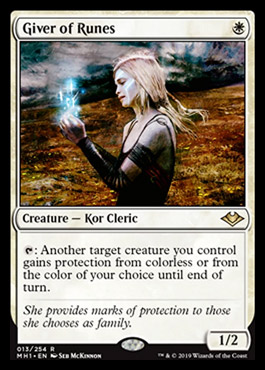
A strong contender for Modern playability is Giver of Runes, our Modern reimagining of Mother of Runes from Urza's Legacy. While it can't target itself like good ol' Mom can, the added benefit of an extra toughness and protection from colorless sources still may provide utility to creature decks looking to dodge removal.
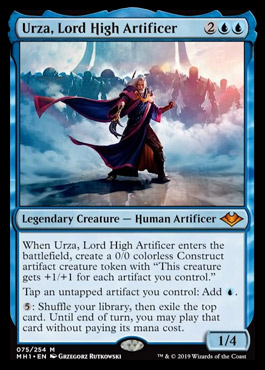
Now here's a mythic! Urza, Lord High Artificer is perhaps the most powerful card we've seen from the set so far. Likely to be a Commander all-star, this artifact based general does everything you'd want in your Mono-Blue artifact deck. Static Orb, Winter Orb, Sword of the Meek, and more were significant winners today, all due to their synergy with this card.

There was an error retrieving a chart for Static Orb
There was an error retrieving a chart for Winter Orb
There was an error retrieving a chart for Sword of the Meek

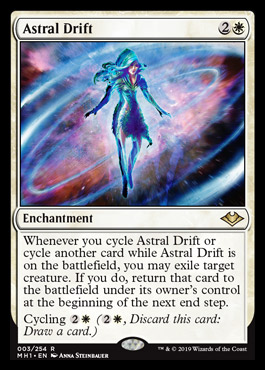
Lastly, here's the official art of Astral Drift, a drastic improvement over the blurry leaked image we received days ago. There have been no prominent leaks since then, but I've seen quite a few shares and retweets of cards like Brainstorm, Counterspell, and even Daze floating around. Be careful out there, and take every blurry image with a grain of salt.

May 20th

It's Monday, and that means more spoilers! The scheduled spoilers made their way to social media and had the MTG sphere going mad.
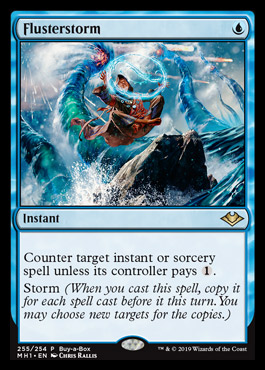
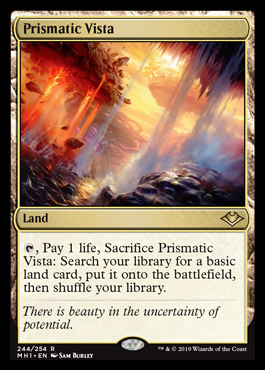
 

Among the cards spoiled today, the most important was this, an official rendering of the Flusterstorm Buy-A-Box promo. After the leak, it was important for Wizards to get this one out as soon as possible. Runner up was Prismatic Vista, a straight upgrade to Evolving Wilds, but not quite as good as the Onslaught or Zendikar classics that we are used to. It only fetches basic lands but can grab any of the five at the cost of 1 life. It's not clear whether this will see widespread adoption in Modern, but may have a home in decks like Legacy Miracles or Stoneblade.
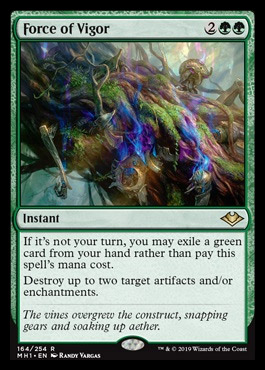
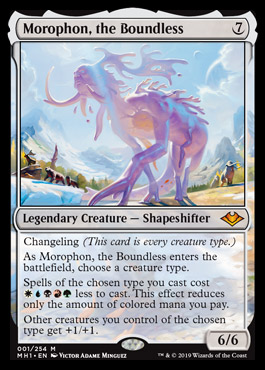
 

Force of Vigor confirms a cycle of spells similar to Force of Will, but this one is green. Tagging two artifacts or enchantments for free sounds like a good deal for two cards, especially against decks like Hardened Scales in Modern. Morophon, the Boundless sparked a ton of reactionary Commander buying, including Jodah, Archmage Eternal foils, and Fist of Suns.
There was an error retrieving a chart for Jodah, Archmage Eternal
There was an error retrieving a chart for Fist of Suns


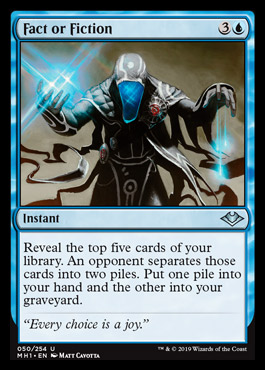
Closing out the day, significant additions are Ice-Fang Coatl, another snow card that can act as a strictly better Baleful Strix under the right conditions. Last up, we have a nice reprint in Fact or Fiction, a blue draw spell that might one of the most skill-testing cards in the entire game of Magic.

May 19th

We're officially into the first part of Modern Horizons spoilers season, with the first official spoiler on the schedule coming to us from the MOCS coverage, live on Twitch. The stream started off with a ton of commons revealing some of the mechanics from the set. Significant new mechanics include convoke, buyback, flashback, kicker, and entwine, storm. Already, we're seeing movement on old foils of two key cards, Prohibit and Lava Dart.
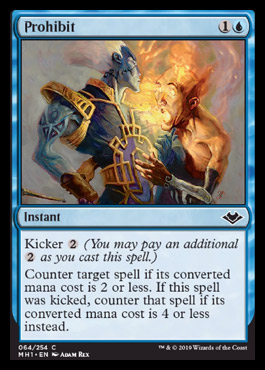
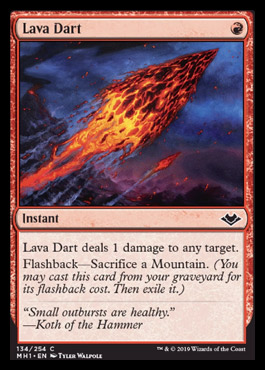
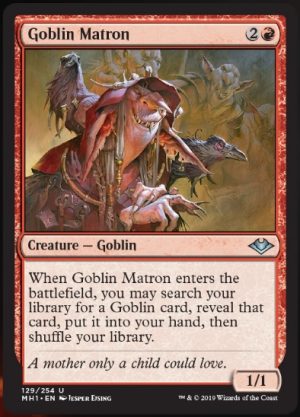
With the first wave of uncommons release, we see a very important card for Modern goblins in Goblin Matron. In Legacy builds, this is a potent tutor for finding cards like Goblin Ringleader, Goblin Warchief, and Goblin Piledriver. Time will tell if this shot in the arm brings this deck to the forefront of Modern, but this will certainly have many Goblin players excited to purchase complements for the deck.
As was speculated by many, Snow-Covered lands were confirmed as the basics for the set. Movement on cards like Scrying Sheets will be expected, and the first wave of speculators will be releasing them back into the market very soon.

There was an error retrieving a chart for Scrying Sheets

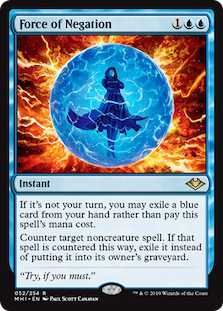
Coinciding with the finals of the MOCS, we received two more rares to drool over. Going with the theme of classic reworks, we have Deep Forest Hermit and Force of Negation. These new takes on Deranged Hermit and Force of Will show that we'll likely be getting a lot of interesting cards that are either powered down or are functionally different enough to make a splash in Modern.


May 17th

As we head into official spoiler season, we were given two preview cards by Matt Nass and Cassius Marsh:
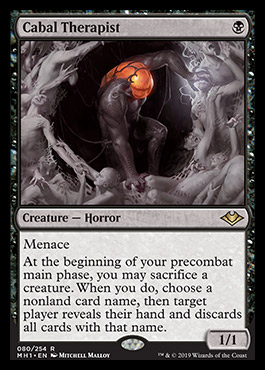
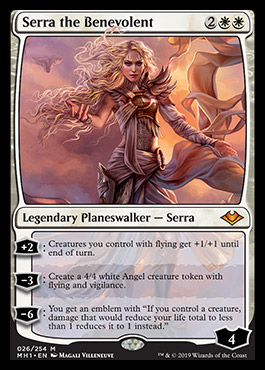
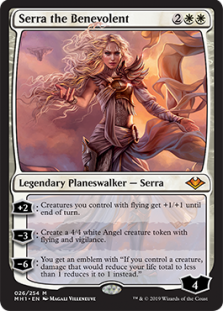
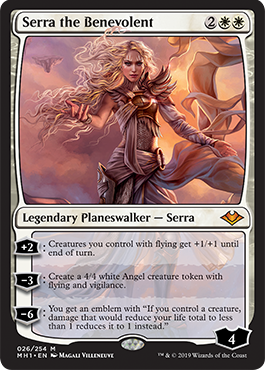
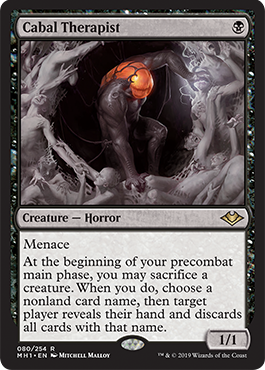
Cabal Therapist represents what many believe to be a theme of the set - reworking iconic spells into a new form. Serra the Benevolent will be the flagship card of the set, featured on most of the promotional material, and the first Angel-centric planeswalker. We can see the direct nod to Cabal Therapy from Judgment, and the ultimate ability of Serra being an immovable Worship. I'm excited to see what new cards we'll receive that follow these same patterns, and where the Modern format as a whole goes from here.
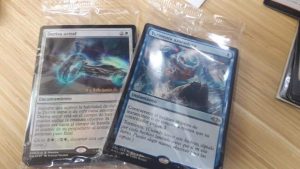
Early leaks indicate that Flusterstorm and the new Astral Drift are the promos for Modern Horizons. Flusterstorm entering Modern is a huge deal, and it is confirmed that this will be the Buy-A-Box promo for the set. We'll be seeing the effects of this in the next few hours. Astral Drift is also an incredibly interesting card that gives us a new take on Astral Slide, and definitely indicates that cards with cycling will be featured in the set. Expect related cards like Fluctuator to be on the move in the next few hours.

There was an error retrieving a chart for Flusterstorm
There was an error retrieving a chart for Fluctuator

Modern Horizons Spoiler Review, Pt. 1

Are you a Quiet Speculation member?

If not, now is a perfect time to join up! Our powerful tools, breaking-news analysis, and exclusive Discord channel will make sure you stay up to date and ahead of the curve.

Spoilers for the much-awaited Modern Horizons are finally underway. The expansion so far has exceeded my expectations, offering Modern playables without introducing busted eternal staples, and including a wealth of diverse mechanics and cute designs. Today, we'll look at the most interesting cards from Horizons and muse about where the rest of the set will go.

Modern Horizons: Initial Impressions

With part of the set spoiled, we at last have a pretty good idea of what Horzions is supposed to look like. In short, Wizards has taken to reinventing or updating older cards with contemporary text and refined flavor rather than just reprinting all-stars from Vintage and Legacy. The result is a batch of cards that generate nostalgia while providing a novel play experience. Flavor-wise, it turns out Cabal Therapist truly was a harbinger of things to come.
There are some high-profile reprints in the set, too. But by now, I think it's clear we won't be receiving stuff like Force of Will or Wasteland. (I'd count on an updated, nerfed Wasteland emerging in the coming weeks, though.) Smaller-scale role-players, especially beloved cards, are much more common—think Stifle or Cloud of Faeries.

Horizons also has the flexible, blanket answers Modern needs to self-police. While we haven't yet received interactive cards quite on the level of Fatal Push or Damping Sphere, the Force cycle has me optimistic that Wizards will have packed a highly-relevant answer or two into the set.

In terms of power, I've heard many recently decry Horizons as cards less powerful than Force of Negation are spoiled. But I think this set is packed with Modern playables; this is just what a spoiler season looks like when it's not tainted by mass leaks. Wizards is keeping anticipation high among its playerbase by gradually spoiling a mix of future staples, eternal reprints, and promising gems for more casual players. And who knows? Maybe the Brainstorm- or Wasteland-referencing cards, which have yet to be seen, will end up strong enough to drastically influence Modern. Don't be fooled by the naysayers: Horizons will be a hit in its namesake format, if just for the cards featured in this article.

The Cards: Hits and Misses

In this section, we'll review the spoilers so far, focusing on tribal support, lands, reprints, various standouts, and the not-quite-there cards.

Tribal and Archetype Support

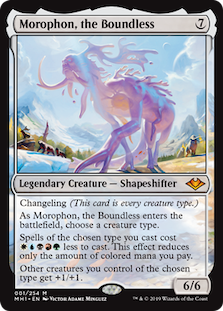
Morophon, the Boundless: Let's start with the card designed to help every tribe. Morophon strikes me as more of a combo card than anything else, and one destined for Commander at that. But I think we will see it poke its weird head out  in Modern from time to time. Free mana is just too alluring to ignore, and the format features plenty of ways to get this down early.
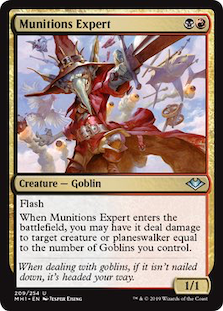
Munitions Expert: On to the Goblin support. Goblin Matron is a bit pricey for Modern, which rewards players for efficiently interacting with the board. But as a removal spell on a cheap, on-theme body, Expert is just what the doctor ordered. If there's a card that allows players to run Goblins successfully, this is it.
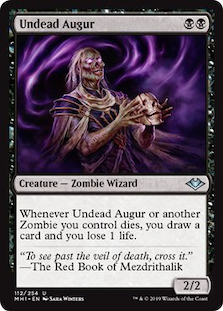
Undead Augur: This Zombie buff is less exciting, but good nonetheless, further punishing opponents for interacting with the deck's threats. It's a high-priority target for removal spell decks, but getting it off the table results in a minus, and Augur is cheap enough to make the exchange worthwhile for the tribal deck most of the time. We've seen Zombies put up fringe results in Modern with some help from Smuggler's Copter, and that trend should now continue.
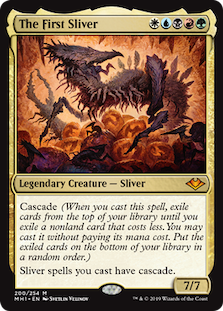
The First Sliver: Slivers, though, are Horizons's most pushed tribe. This Sliver Queen update staples an ability to the body that's actually worth five mana, and has intriguing implications for building around; players can even fit an Ancestral Vision or two into their deck and guarantee that the next couple Slivers they cast also draw them three cards, for example. Besides, there's a relatively simple way to bust it out:
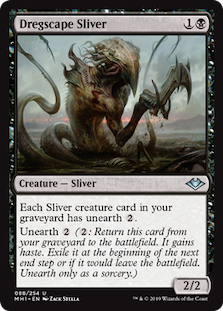
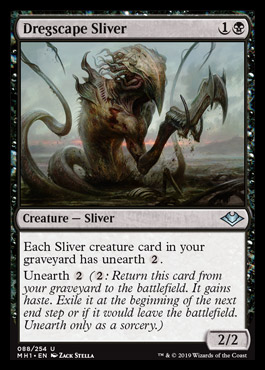
Dregscape Sliver: Besides the potential combo with The First Sliver, giving all the dead Slivers unearth makes Dregscape a heck of a comeback card. This creature mounts alpha-strikes from beyond the grave in the mid-game, so long as opponents can't remove it immediately. And if they can, Slivers still gets to reanimate one threat.
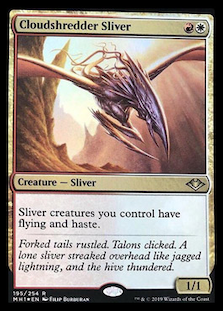
Cloudshredder Sliver: Both of those creatures pale, though, next to Cloudshredder Sliver, an update of the long-awaited Heart Sliver that tacks on the tribe's next-best creature, Galerider Sliver. Like Zombies, Slivers is a viable lower-tier choice online. Being less build-around and more all-around great for the aggro deck's bottom line, Cloudshredder alone should push it up to Tier 2 status.
Ice-Fang Coatl: Which brings us out of tribes and into the snow. Snow support has actually been mediocre so far, but Ice-Fang proves the exception to this rule. We already have Skred as a playable snow card, as well as maybe Scrying Sheets (although jamming all three colors together in a deck so focused around basics seems like asking for trouble). With its condition met, Coatl is a better Baleful Strix; the question, then, is how to meet it. Perhaps another snow payoff will be spoiled soon. Some fetchable snow lands that produce multiple colors would do the trick, too.

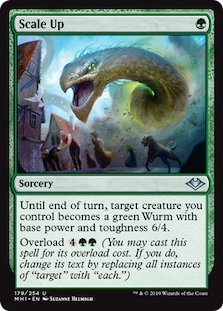
Scale Up: Let's be real—nobody's playing Wurm tribal. Scale Up is the most overt Infect support of all time. Perhaps pushing that deck is Wizards' answer to decks like Tron gaining power and popularity; linear combo can't win if it's dead, and Infect has proven time and again that it's great at slaying such behemoths.
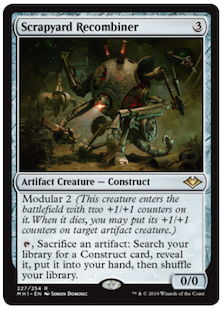
Scrapyard Recombiner: This one is more tentative, but I've heard players discuss it in Hardened Scales. It may have a home there as a tutor to multiple engine and payoff cards, as Modular helps forgive its steep price.
Lands

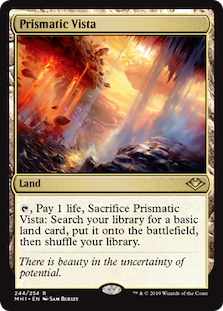
Prismatic Vista: Vista might help snow keep its head above water, and could shruggingly slot into two-color decks with plenty of basics like UW Control. But this card seems more to me like a budget consideration for players who don't want to buy the right fetches.
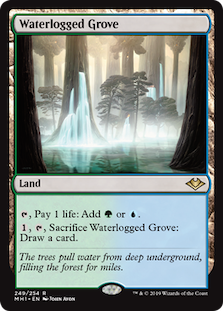
Canopy lands: As I see it, the Canopy lands—an enemy-colored cycle of lands with Horizon Canopy's effect—are the most important card spoiled so far. These will be run in decks across multiple archetypes, including midrange (BG Rock) and aggro-combo (Infect). While I don't expect the canopy lands to shake Modern up as a flexible answer or powerful threat might, they will have a sweeping, if subtle, effect on deck construction.
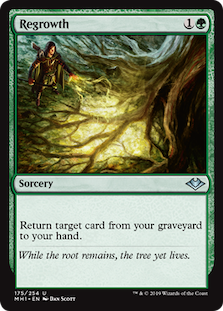
The Old Made New

Regrowth: I imagine there's a deck in the market for Eternal Witness with little use for the body, but I sure as heck can't think of it. Regrowth may well find its way into a combo strategy down the road, though.
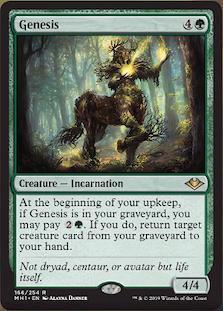
Genesis: Another great card without a home, Genesis may make it into fair deck sideboards as a value engine, especially alongside Faithless Looting. But there are probably better options in that role, colors depending. I'm excited to see where Genesis lands.
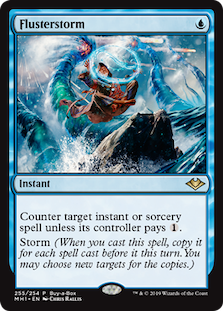
Flusterstorm: Move over, Force of Negation! Flusterstorm is one of the tools thresh decks in Modern have sorely missed, and is a welcome addition to Modern.
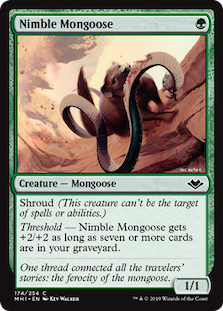
Nimble Mongoose: Speaking of thresh, here's the card that inspired me to build Counter-Cat; frustrated with a singular turn-one threat, I employed Wild Nacatl over Mongoose when the 3/3 was unbanned. Today, I'm not even sure I want Mongoose in a Modern thresh deck, as Hooting Mandrills and Path to Exile have become the primary draws to Counter-Cat for me. But I do think players will build Canadian Threshold in Modern, and sometimes successfully. Heck, I'll even try my hand at it! Mongoose is definitely a game-changer when it comes to removal, allowing us to not run protectors like Mutagenic Growth, and sideboarding, letting us attack linear decks more effectively by dedicating less space to recovering against midrange and control.
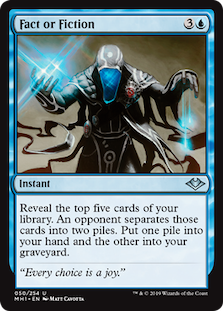
Fact or Fiction: Kids These Days Will Never Understand EOTFOFYL. Or will they? Having played against Fact a little online, I'll confirm that the piles are still excruciating to make. I'll also mention that flashing back my opponent's Fact with Dire Fleet Daredevil, the Human protected from Spell Snare via Domri, Anarch of Bolas, was some of the most fun I've had playing Magic lately. Fact will definitely see play, for one reason (winning) or another (giggling). I think UR Moon and UW Control are its most natural homes, although it's also possible we see Fact as a one- or two-of in the sideboard of more aggressive interactive blue decks as a gameplan.
Other Goodies

Force of Negation: The breakout "answer card" of the set, Negation's purpose is to prevent early wins from linear combo strategies. It looks like a sideboard card to me, and I doubt it replaces Disrupting Shoal in the decks that want that instant; countering creatures is too important. Like Force of Will, though, Negation will affect the format's complexion by virtue of existing.
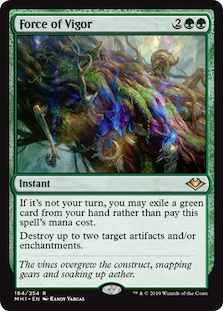
Force of Vigor: Another combo-breaker, Vigor has been noted for bailing players out of the Karn-Lattice lock. It does that with a bullet, sniping the walker and any other permanent to leave opponents with a dead Lattice and a nuked board. Force's floor against artifact or enchantment decks, though, is extremely high. Here, it's a Naturalize that turns another card in hand into Naturalize, and both Naturalizes are free to cast; think of Collective Brutality against Burn, but cheaper and more impactful. Vigor has all the makings of a sideboard staple.
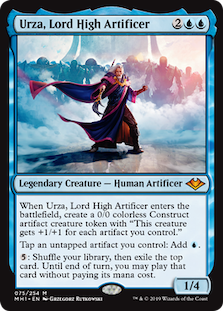
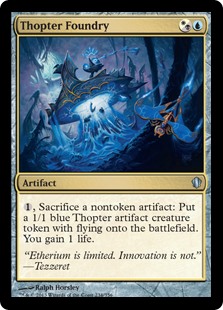
Urza, Lord High Artificer: Urza is generating hype for its interaction with the Thopter-Sword combo, which lets players make infinite mana, gain infinite life, and draw their deck. I think the card will end up like Prime Speaker Vannifar, another niche 1/4, in an artifact-based deck as an enabler and payoff. But in that respect, it's probably weaker than Sai, Master Thopterist, which is a win condition on its own.
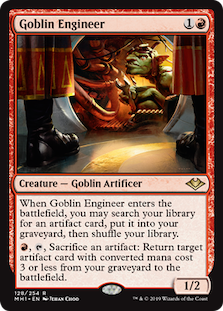
Goblin Engineer: This reference-packed mashup of Goblin Welder and Stoneforge Mystic is expertly-designed, setting up combos at a reasonable pace on its own or combining with the likes of Trash for Treasure to cheat fatties like Sundering Titan and Wurmcoil Engine into play early. If Engineer sees play outside of a Thopter-Sword build, where it super-tutors for the Sword, it'll be in its own deck, and I can't wait to see what that looks like.
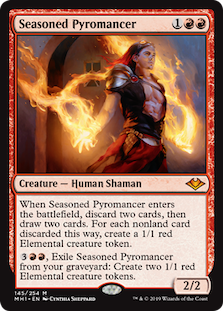
Seasoned Pyromancer: My personal favorite card of the set, this card combines an absurd amount of value on a creature. One nice thing about Pyro is that most of its value, the loot and the tokens, is locked-in upon resolution. We're left with lots of power/toughness for our trouble, but on an expendable body. Expect to see more on Pyro from me in the coming weeks!
Misses

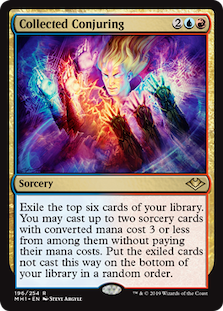
Collected Conjuring: What exactly are we hitting with this? Serum Visions? Modern isn't exactly known for its high density of cheap, busted sorceries. At four mana, even ripping costless suspend cards like Ancestral Vision seems like more work than assembling a shell with As Foretold or Finale of Promise.
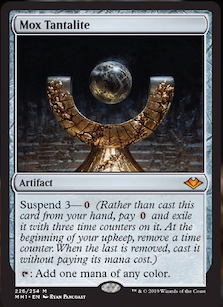
Mox Tantalite: I'm not one to dismiss nerfed moxen outright, having spent a good deal of time trying to break Mox Amber. But Tantalite is even worse than Amber. Players don't have three turns to kick it in Modern unless they're going to win right after, meaning Lotus Bloom trumps Tantalite in its would-be decks.
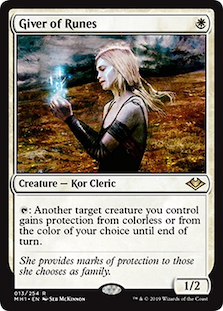
Giver of Runes: Giver's no Mother. Untap with her and she can still be Bolted, Pushed, you name it. Realistically, Giver is like a one-mana Spellskite that gives up the latter's disruptive effects; Runes doesn't do anything against Infect or Temur Battle Rage.
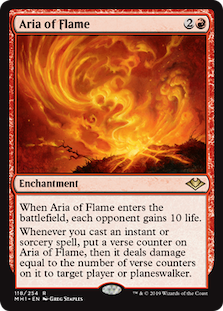
Aria of Flame: Yesterday, in an online Horizons room, my opponent stormed off as I occupied myself with other apps for a few minutes. He ended on Aria of Flame. Granted, I lost the game, failing to find a third land drop (or red source) to compliment my Arbor Elves and pair of Forests over something like six turn cycles. But with me doing nothing, it took my opponent six turns to kill me. I'll happily blame Aria. Storm doesn't need this card, and neither does anyone else.
The Best Is Yet to Come

As mentioned, I think some juicy callback cards are on the Horizon, as well as more flexible answers in the vein of Force of Negation and Vigor. Throw in another format-shaping cycle like the canopy lands and we're left with what's easily the most impactful Modern set of all time. Will Wizards get there in the end? Let me know your thoughts in the comments.

Jordan Boisvert

Jordan is Assistant Director of Content at Quiet Speculation and a longtime contributor to Modern Nexus. Best known for his innovations in Temur Delver and Colorless Eldrazi, Jordan favors highly reversible aggro-control decks and is always striving to embrace his biases when playing or brewing.

View More By Jordan Boisvert

Posted in Modern, Spoilers, TechTagged , , 15 Comments on Modern Horizons Spoiler Review, Pt. 1

Have you joined the Quiet Speculation Discord?

If you haven't, you're leaving value on the table! Join our community of experts, enthusiasts, entertainers, and educators and enjoy exclusive podcasts, questions asked and answered, trades, sales, and everything else Discord has to offer.

Want to create content with Quiet Speculation?

All you need to succeed is a passion for Magic: The Gathering, and the ability to write coherently. Share your knowledge of MTG and how you leverage it to win games, get value from your cards – or even turn a profit.

Punishing Fire: Qualitative Results and Conclusion

Are you a Quiet Speculation member?

If not, now is a perfect time to join up! Our powerful tools, breaking-news analysis, and exclusive Discord channel will make sure you stay up to date and ahead of the curve.

Last week, I unveiled the first part of my Punishing Fire test. With the data compiled and revealed, it's time for the less-concrete part. The data is the data and speaks for itself. However, that's not the whole story. Magic isn't just a numbers game; there are a lot of intangibles. For instance, it's also supposed to be fun, which is where Punishing Fire might take an L.

On Power

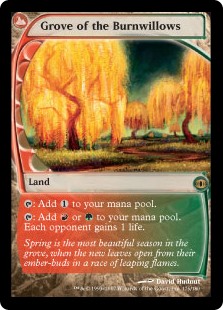
Starting off, I do not believe that the Punishing Fire/Grove of the Burnwillows combination is too powerful for Modern. Two recursive damage for three mana is fairly mediocre these days. Furthermore, Fire is mediocre on its own, because two damage doesn't kill as much as it used to; creatures have gotten much better in the 7.5 years since Fire was banned.

Fire is also balanced by deckbuilding requirements. To make Fire good, players must run Grove of the Burnwillows, a card with issues of its own. An early Grove will donate 4-5 life before the Fire engine can realistically get going, which generally translates into requiring an extra attack to win the game, giving opponents more time to find answers and come back.

Purely on raw power, there's no reason to keep Fire banned. However, if raw power or potential were the only factors determining a card's strength, Mox Amber and Smuggler's Copter would be Modern staples. Context is everything, and that's where Fire falters.

A Most Painful Experience

Testing Punishing Fire was not fun for me. Or for most of my team, for that matter. The problem is twofold. First of all, as I described last week, the games ran very long. Grove of the Burnwillows gives opponents life, and more life means needing more damage to win. Taking extra time isn't necessarily a bad thing, and many players lament Modern being a fast format. However, what they're really asking for is more matchups where more decisions are available and matter, and for more varied gameplay.

Fire is a fairly brainless card, and once the engine gets going, the whole thing plays itself. On my end, everything became very rote and mechanical. Every turn: throw some Fire at something, get it back, none of my other cards do anything at this point so say go, repeat until the game's over. My opponents either just kept doing what they were doing (Tron, Ironworks, sometimes Spirits) or were gradually snowed under with nothing to do (Humans, the other times with Spirits). Those games proved frustrating, tedious, and boring for opponents.
In addition, the Fire combo is incredibly slow. It takes forever to actually kill an opponent doing a net of one damage per turn. It takes several copies of the instant to present a decent clock, and that eats up all available mana very quickly, so I could never do anything else. Once we're locked into Firing out an opponent, there's nothing better to do. To make matters worse, the combo is very time intensive. Every cycle takes a lot of game actions, and even if you're quick about all of them, it adds up fast: tap two lands, cast Fire, mark damage, put Fire in graveyard; tap Grove, trigger Fire, mark lifegain; pay for the trigger, pick up the Fire. In short, endless busywork for both players as we tracked and performed every trigger and life change.

All in all, I would have rather traveled the River of Blood. At least in trial by painstik the agony is over quickly, this test was like months of water torture.

Not For Everyone

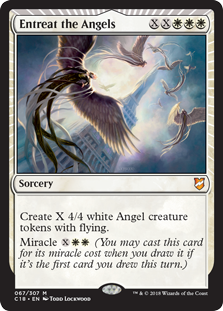
On the other hand, this is purely subjective. The UW pilot emphatically loved the whole thing, and to a rather creepy degree. Yes, I am calling him out on that. He loves grindy Magic, and going to time every round. He lamented when Sensei's Divining Top was banned in Legacy because there was nothing greater for him than winning game one of the Miracles mirror on turn 5 of extra turns via miracled Entreat the Angels on his opponent's end step. The matches where we ran over time, especially the ~95 minute one, are his favorite kinds of Magic games.

UW had to navigate every match very carefully, because Fiery Jund held the trump card in the Fire combo. It was not only a win condition by itself, but going long, it killed everything he could play and got there through counters. There's no way for planeswalkers to survive repeated attacks by several Fires.

Everything that I found atrocious about Fire's gameplay, he embraced. Ideally, he wants every game to be a lengthy, close, hard to win/easy to lose grind fest that taxes him mentally and physically to the limit. Which was the reality of his test matches. He says that on his end, it was like playing a combination of 3D Chess and a Rubik's Cube using 90's adventure-game logic. Winning was mind-meltingly hard, and the correct lines were non-obvious and convoluted. While it won't be majority, there will be plenty of players that would genuinely enjoy playing against Fire in Modern.
Impact

It is hard to asses the precise impact of a tested card in Modern. My test models the effect, but not perfectly; I can't test everything, and Modern is constantly shifting. However, it does give me a sense of how the cards play in the metagame. Based on my experiences, Punishing Fire would have a very different impact on Modern than I expected.

Not a Jund Card

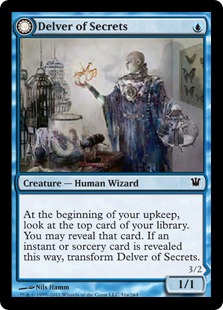
Jund was not a great test platform for Fire. It was the only one available given that it's always been my policy to try the closest deck to the one that got the card banned. However, I've come to believe that Fire really isn't a Jund card anymore. It's a decent fit in Legacy Jund because Delver of Secrets and Young Pyromancer are format-defining cards, but Modern creatures tend to be more robust. Jund wins by grinding out value by playing better cards at every stage of the game. Fire is never the best card; the value comes though continuous use. What Jund really wants to do is fire off a few disruption spells then start ramming home better threats to quickly close out the game. Going long is possible, but not its thing.
The other problem is that it was hard to reliably assemble the combo. Grove isn't fetchable, and the only card draw is the vulnerable Dark Confidant. This meant that most of the time, the game had to go long for the combo to come online. Even when it did happen in an average-length game, I had multiple Fires maybe 25% of the time. That's not a bad result, but I was acutely aware that I could have done better.

A Loam Home

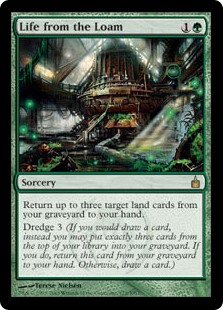
If I had given myself perfect freedom in deck choice, I would have run the test with Assault Loam. Despite a very dedicated player base, Assault Loam is not a good Modern deck. The deck is inherently very slow and clunky because it is built around Life from the Loam. Unless it is dredging Loam every turn, few of Assault's cards are any good. Flame Jab and Raven's Crime are only devastating when used multiple times a turn, while the win conditions Seismic Assault and/or Zombie Infestation need lots of fodder, which can only be gotten through Loam. If it never finds Loam or loses its graveyard to Rest in Peace, Assault Loam is just a pile of weak cards. Even when it is dredging, it's hard to keep up with aggro decks.

However, Punishing Fire could solve many Assault Loam's problems. As Legacy demonstrates, Loam naturally pairs with Fire. Dredging three is functionally identical to drawing three in the right deck (four if you count the Loam), translating into higher chances to find the combo. Loam decks struggle to miss land drops, so Assault Loam is more likely to be able to cast multiple Fires a turn and actually machine-gun down the creature decks.
Fire also alleviates some of the deck's tension. As mentioned, the win conditions aren't lands. The namesake Assault is an enchantment, and most versions I've seen also have creatures and other enchantments. These can't be recurred with Loam if they're destroyed or dredged over. Again, Assault Loam needs to be dredging Loam to be good. However, that risks milling the win conditions. This isn't Legacy with Dark Depths and Glacial Chasm; Loam actually has to cast spells. Fire doesn't mind being milled, so there's less risk of self-sabotage.

Loam decks tend to be naturally slow decks. The problems with the Fire combo would persist in a Loam shell. As a result, an already-slow deck stands to get much slower and more popular from Fire's unban.

Against Creatures

Based on the Spirits and Humans matchup, I don't expect Fire to be that great against creature decks. Back in 2011, creatures were so much worse that a repeatable two damage for three mana was oppressive. These days, we have rapidly growing 1/1s, hexproof creatures, and more cheap x/3s. A single Fire isn't that threatening. When multiple get going, it can be devastating. However, Magic has evolved enough that even a recursive four damage for five mana isn't that threatening for aggro decks. Decks like Merfolk would suffer, but they are struggling to stay relevant anyway. I think the anti-aggro argument isn't strong anymore.
Against Fair Decks

The surprising effect was against UW Control. I didn't appreciate or expect the impact Fire has on fair matchups. Decks that rely on small numbers of win conditions or attrition will be heavily impacted, because over the long game, the Fire combo can't be out-grinded. So long as there's a single Grove, Fire is always live. Closing the vulnerability to Field of Ruin is another reason to pair Fire with Loam. The game ends up being warped around Fire.

Usage

Should Fire be unbanned, its synergy with Loam is too great to not go into Loam decks. This will greatly improve their control and midrange matchups. This ensures that absent graveyard hate, the Loam deck can never be exhausted, and will eventually win. Because the combo is very slow, this will lengthen matches. Post-board, graveyard hate becomes essential. Against aggro decks, Loam potentially gets an improved Flame Jab to protect itself. It's hard to believe it turns the matchup around, but would stretch the game out and make aggro work harder.
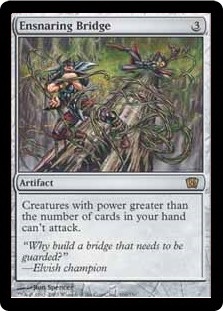
The other concern is if a deck really embraces Fire, and what it represents. Fire's gameplay is reminiscent of Loam-centric prison decks like CAL. I don't know if something similar is possible, but if not, Fire does lend itself very nicely to Ensnaring Bridge strategies: players can use Fire early to buy time, then hide behind Bridge and plink away to their heart's content. Fire may not actually be a Jund card, but it's almost certainly a prison card.

The Dance

There's also some weirdness concerning the Fire combo's mechanics. The recursion is a triggered ability, and it is triggered by a mana ability. This means, just like with Krark-Clan Ironworks, as long as Grove is untapped, Fire isn't vulnerable to Extirpate or Surgical Extraction. This specific situation never came up in my testing because no test deck ran Extraction, however I've seen it happen in Legacy. I call it the dance.

The Fire player has an untapped Grove and Fire in the graveyard. Their opponent has Extraction. The opponent can't just Extract the Fire, because in response, Grove will save it. Fire also can't just be retrieved, because there's only one Grove and one trigger. So both players enter into a standoff, trying to force an opening. The opponent is looking to force Fire to tap the Grove; Fire hopes to present a more pressing target for the Extraction. As a mental game, it is fascinating and enjoyable. However, it also tends to extend match length, since both players have to carefully and continually consider their moves and their opponent's counter moves while assessing whether to continue the dance.
My testing did have some versions of the dance, this time with Relic of Progenitus and Field of Ruin/Ghost Quarter. In the former, it was about keeping enough chaff in the graveyard to feed the Relic until either another Grove was found or Tron tapped out. In the latter, it was about holding Grove until it was actually time to get back Fire. Both created abnormal play patterns.

Holding lands to play around destruction spells felt bad, though it was strategically sound. Against UW, it was critical to preserve Groves to maintain inevitability. However, that often meant I had to skip land drops or play tapped lands when faced with Field. Generally speaking, players dislike this type of gameplay and Wizards doesn't like encouraging it.

Final Assessment

The data showed that Fire didn't improve Jund's win percentage very much. It also showed that Fire significantly increased how long matches took. There's reason to believe that Fire would slot into already-slow decks, and explicitly serves to lengthen games. I and most of my team disliked the actual gameplay. Therefore, I don't think there's much to gain from unbanning Fire, and as a result, would keep it banned.

Amongst Colleagues

Cards that drag out games get banned when they get too popular and/or significantly impact tournament length. Second Sunrise was banned for the later problem. Sensei's Divining Top was first banned in Extended for dragging out games, preemptively banned in Modern on the assumption it would do so again, and recently banned in Legacy both time problems and popularity. My experience says that executing Fire combo is mechanically very similar to spinning Top every turn. Therefore, I think it's fair to include Fire in the "Banned for Tournament Length" category rather than being overpowered.

Again, power-level wise, there's nothing onerous about Fire combo. It seemed fairly mediocre given the improvement in creatures since 2011, though its potential against fair decks is impressive. However, it creates, rewards, and requires repetitive, lengthy play patterns which would eat into tournament time. This also leads to games feeling very similar and mechanical, which many don't find that fun. Given Wizards' history with Top, I doubt that they'd want to take the risk of Fire getting popular enough to consistently stretch out tournaments and will keep it banned.

The Comparison

The Thopter Foundry/Sword of the Meek combo is a potential counterpoint. This combo also has a lot of moving parts and doesn't directly win the game. It makes lots of 1/1 fliers and tries to overwhelm opponents while shutting down aggressive decks and out-grinding fair decks. On face, it's very similar to Fire combo.

However, the Thopter combo has two saving graces. The first is that it is cleanly shortcutable: You simply declare how many tokens you're making at a time, skip going through all the steps, and gain life in a lump sum. You can't just declare a Fire loop; you do have to go through most of the motions. You can shortcut the triggers, but you will have to actually cast the Fire(s) and mark all the life total changes individually for proper tournament procedure. Also, there's no timing weirdness with Thopter combo.
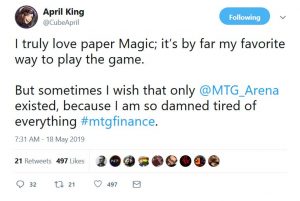
Secondly and most importantly, Thopter combo actually wins the game very quickly. The tokens persist, and it often only takes two turns of dumping mana into Foundry to generate a lethal airforce, even if a few have to chump block. Fire can't win quickly except by concession. Besides, Fire's is a combo that interacts, thereby extending the game by purpose, while Thopter's proacts, seeking instead to put games away. As a result, the comparison is only superficial, and doesn't really improve Fire's chances.

Fun > Boredom

Magic is a game and supposed to be fun. My experience with Fire in Jund was not fun. I have evidence that unbanning Fire would reduce Modern's available fun by making tournaments drag on. More than any power considerations, that notion makes me think Punishing Fire should stay banned.

Getting Started Part Two: Timing is Everything

Are you a Quiet Speculation member?

If not, now is a perfect time to join up! Our powerful tools, breaking-news analysis, and exclusive Discord channel will make sure you stay up to date and ahead of the curve.

In my first article, I mentioned the two major types of buyers when it comes to MTG Finance, long-term and short-term. If you haven't read it I suggest you check it out here. There are other types of buying/selling/investing that fit somewhere in between, but understanding where you want to be is an important step for getting into this game. Timing happens to be another important step.

What to look for

There was an error retrieving a chart for Niv-Mizzet Reborn

There are a lot of ways to do research on cards. I've listed a few resources in my recent articles and you can find a multitude of them across this website as well. Using said resources, or ones of your own (we all have our secrets sometimes), you can start to gather data on trends. Let's use a popular example for now: EDHRec.

If you're not familiar with EDHRec, it's a fantastic website that's full of everything Commander related.  It has articles, decklists, videos, and loads of data to use. Near the top of the page is a variety of menus, one of which allows you to search for decks by their commander. You can search by 2-color, 3-color, etc. or you can search by "Top Commanders". I'll save you a few seconds - here is the link.  It has "Commanders of All Time" and "This Week" - we are mostly interested in "This Week". The past two or three months there have been some common themes such as Atraxa, Praetors' Voice, Lord Windgrace, and Muldrotha, the Gravetide.

There was an error retrieving a chart for Feather, the Redeemed

These are good commanders to check in on once in a while in the instance something new has popped up. However, when new sets come out we get new toys for EDH.  A great example of this is Feather, the Redeemed. She became an EDH all-star when she was spoiled, and the internet exploded with great combos and one-hit wonders.  Since a lot of the cards that are good in Feather decks have already spiked we should take a look at another commander. Ever so slowly Niv-Mizzet Reborn has made its way to the top of the "Top Commanders" list. As of the writing of this article, there are 270 decks listed on EDHRec and it is ranked #114/888.

So now we have to answer the following questions:

  1. What is popular in the Niv-Mizzet decks?
  2. Are those cards a decent investment?
  3. When do you invest?

What is popular?

Scrolling down through Niv-Mizzet we can see a ton of multicolor and "multicolor matters" cards because that's what this Commander is all about. So how do we pick through what's going to be important? The first card we see that could be a hit is Tome of the Guildpact. Mana rocks are always great in Commander and this one is specific to multicolor cards. When we look at the foil price, Card Kingdom has it at $1.49 and it can be found on TGGplayer for under $1. Yes, it was printed recently in Ravnica Allegiance, but this is a long hold that could yield some cash one day. We can also add to that list Firemind Vessel. Sure, these prices seem great and buying sounds like a great idea, but shouldn't we have a bit more data to back up our plan?

We should also take into consideration both of these cards are in roughly 30% of the 270 Niv-Mizzet decks. If we expand further on that we find Tome is in 260 decks total and Vessel in is just under 400 decks. Out of over 200,000 decks on EDHRec these cards aren't very popular at all. My suggestion would be to not go very deep on these, should you feel the need to buy them.

A bit more scrolling leads us to Bring to Light, Anguished Unmaking, Pillar of the Paruns. To answer our first question about popularity we can dig a bit deeper into each card. All three of these cards are in under 37% of decks listed on EDHRec. Bring to Light is in 3264 decks, Unmaking is in almost 20k decks, and Pillar is in under 400. This is just data from EDHRec though, and I encourage you to do a bit more digging.

Bring and Pillar are currently being tested in Modern decks with the recent MTGGoldfish Deck Tech for a Niv-Mizzet Reborn deck as well as seeing quite a bit of success under the piloting of Jim Davis and Tier Fun on YouTube. Unmaking has been slowly creeping up - it was sitting around $3-4 only a few months ago and has been waiting for something to push it up. The foil version of this is also not at a typical 3-5x multiplier for the numbers that are being seen in EDHRec data. These three cards all have enough support for me to want to consider the next question.

What cards are a decent investment?

There was an error retrieving a chart for Anguished Unmaking

Let's start with Anguished Unmaking again. Both foil and nonfoil versions of this card were at an all-time low around January of 2018 and have been on a slow crawl ever since then.  It's a slightly worse Vindicate that is Modern legal. Let's also be honest - the art is GORGEOUS in foil. The fact that it was also a prerelease card and a Game Day promo does hurt it a little bit, but at about $7 (nonfoil) and $9 (foil) this seems like a great card to pick up.

There was an error retrieving a chart for Bring to Light

Bring to Light can be found in a lot of bulk bins and for fractions of a dollar online. Card Kingdom has it at $0.25/$2.99 and it can be found for about the same prices on TCGplayer.  That's a fairly cheap price to be picking these up. I would also argue that, especially for folks who are newer to MTGFinance, these foils are a great way to get into the finance game.

There was an error retrieving a chart for Pillar of the Paruns

Pillar is an interesting card. It can be found (as of the writing of this article) for around $9/$30. It is QUICKLY spiking due to the Modern play it's seeing (I.E. the Seth-Effect) and is something to keep an eye out for. This is a great example of something that has sat in binders and bins for a long time just waiting for the right card to come along. From the moment War of the Spark was spoiled and about a week ago I would say this card was a seriously decent investment. Now I'm not so sure. I would say these are great cards to trade your chaff for or if you are one of those lucky folks who have an LGS that slacks on pricing to pick up.

When do you invest?

Anguished Unmaking is a great investment right now. It was the best investment about a year ago leading up to now, but it still has a chance to hit it big.  I honestly think nonfoils could hit $12-15 one day and foils $20+. It's a great card to add to your cart if you need to hit a "free shipping over $50" type of shop or something to add on to a trade to finalize it. I have a few of these sitting on my table and that pile slowly grows each month.

Bring to Light is an AMAZING investment right now. It's only going to gain you money unless it's reprinted (for some reason).  I would be picking these up fairly actively, but not too aggressively.  Add a handful to a cart here or there, maybe make a $10-$15 buy occasionally. It has the potential to spike if it meets the right requirements, but it also has "Commander love" for multi-color decks to make small gains over a long period. I'd say buy them and tuck them away to forget about until the time is right.

Pillar is, in my opinion, a missed opportunity. However, it is something we can learn from. If scrolling through EDHRec is a resource that you want to use, then this teaches that we should be on the lookout for slightly random cards from older sets that folks have forgotten about in other lists. The same can be said for most of the cards on the "Top Commanders" list.

In Conclusion

Using EDHRec is just one of many ways to figure out specs, and it's quite a fantastic heap of data. Just like any other resource, you shouldn't rely strictly on just one data point and need to back up your specs with things like Top 8 lists, YouTube videos, and social media conversations. One of my rules (I've mentioned it in past articles) is to justify your specs and believe in them. You can't just say "this deck plays this card so I'll buy X copies in hopes of making money." Dive deep into the resources/data and figure out why it's important to buy. When should you sell? That's a whole different topic we can visit next time.

The Flusterstorm Controversy: A History of MTG Finance

Are you a Quiet Speculation member?

If not, now is a perfect time to join up! Our powerful tools, breaking-news analysis, and exclusive Discord channel will make sure you stay up to date and ahead of the curve.

Everyone’s heard of the famous quote, “…in this world, nothing can be said to be certain, except death and taxes.” In the Magic community, I’d like to put forth a third certainty: controversy. It seems like no matter what WOTC does, somebody somewhere is going to be offended, upset, and spark drama on social media.

Last week was no exception.

It all started with an allegedly leaked image depicting a Buy-a-Box promo Flusterstorm for the upcoming release of Modern Horizons. The image made it to social media, where major Magic personalities made it widely available to the public.

That’s when the controversy erupted. In various forms of written critique, “MTG finance” was blamed for the leak, blamed for its dissemination, and blamed for the resulting spike in Flusterstorms price.

There was an error retrieving a chart for Flusterstorm

Some folks piled on, while others came to MTG finance’s defense. Take a look at the numbers of retweets, likes, and replies. Everyone has an opinion on such heated topics. If you have some time, check out the responses to these tweets, linked below. The sentiment from the community is eye-opening.

April's Tweet
Saffron's Tweet

Obviously, I won’t be able to convince an entire community of one side or another in a single article. But I hope to convey a couple of important points that both sides should consider when entering into a debate on the merits/pitfalls of MTG finance. I’ll try to be as unbiased as possible, but please keep in mind this is an MTG finance website.

Point 1: Magic is Founded on “Finance”

Ever since Richard Garfield invented the game and designed it with rarities, there became a financial component to Magic. There were 16,000 copies printed of each Alpha common and only 1,100 of each rare—hence, from day one rares were fifteen times harder to come by than commons. In fact, if you look at the patent filing for Magic, it explicitly states:

“The game further includes the unique feature of components that have a tradable and a collectable status. In other words, a certain amount of the game components have a limited availability to the players, thus, increasing the value of the components and encouraging players to trade and collect game components.”

In plain black and white, Richard Garfield states the importance of cards having rarity and value to the game. If variable card values are not to one’s liking, they probably shouldn’t engage in a game built upon such an economy. In the background section of the patent, there’s an explanation of the importance of this economy:

“Trading cards are typically exchanged among enthusiasts to obtain cards that are needed to complete a set of related cards or to collect cards that are not readily available. Collectors buy and sell these cards for their economic and historic value. The cards themselves have varying monetary values, depending on the popularity of the individual depicted thereon and the availability of each card, some being more common than others. Such cards are typically sold through retail game stores and other specialty outlets.

Playing cards, on the other hand, especially the well-known fifty-two deck face cards, are easily and readily available. The cards themselves, individually and collectively, generally have no value other than for amusement. Many different games can be played with a single deck of playing cards, limited generally by the imagination of the players. Some card games require cards especially printed for that game, and these cards have little value outside the playing of that particular game.”

I’m not a lawyer, but it’s fair to say that removing the financial aspect of Magic would mean this game would not look anything like it does today. At least, the patent would have to use different phrasing. For those who detest the fact that cards have varying rarities and can be traded with monetary value are dissenting against one of the purest components of the game itself.

It’s a regular Catch 22. The game exists because of its economy, yet people hate the economy of the game.

Point 2: Magic Prices Have Increased Well Before MTG Finance

It’s difficult to pinpoint the beginning of “MTG finance”. People have probably been trading with the intent of increasing their collection’s value since the game’s invention in 1993. I personally attribute the origins of the “MTG finance” community back to Jonathan Medina’s articles on StarCityGames.com. He began his series on August 11th, 2010, covering a range of financial topics.

Even earlier, Kelly Reid founded this website on the basic premise of “helping readers get more out of their collection.” Quiet Speculation’s first published article dates back to May 17th, 2009, over a year before Star City Games picked up Medina. If we use this as the birth of “MTG finance”, then the community just celebrated its tenth birthday.

What was the financial landscape of Magic like before 2009? Did card prices remain largely stagnant, with only Standard (and Extended) rotation driving costs? Absolutely not! It turns out card prices were appreciating well before the founders of MTG finance hit the scene. In fact, I can track such price increases throughout time by examining them in old issues of InQuest magazine.

For argument’s sake, let’s take a look at the price of some Beta Duals and Unlimited Black Lotus from InQuest’s first and last issues. These prices will be least impacted by random fluctuation in Standard, metagame shifts, etc.

InQuest’s first issue from May 1995 shows that Unlimited Black Lotus’s value was around $150. Beta Underground Sea was $10. Fast-forward to issue 150, published in October 2007 (still before Quiet Speculation and Jonathan Medina hit the scene), and you see a very different story. Unlimited Black Lotus is worth around $800 and Beta Underground Sea is $275.

With this data in hand, I’d maintain the point that Magic’s collectability and success were responsible for these massive moves in price between 1995 and 2007. It stands to reason that further appreciation should be expected to happen as Magic’s popularity grew even further between 2007 and 2009.

Black Lotus appreciated 433% from 1995 to 2007. If we extrapolate this rate of return for the next 12 years, 2007 through 2019, we would have predicted a Black Lotus price tag of around $3500. Instead, it’s around $10,000. You could make the argument that the delta between $3,500 and $10,000 is the result of a self-serving MTG finance community. But we all know past performance never guarantees future returns. It’s difficult to say what Black Lotus would be worth today if there was no “MTG finance” but I’d argue it would be at least $3500 because Magic’s growth through the past decade has been huge.

There was an error retrieving a chart for Black Lotus

Point 3: Supply & Demand vs. MTG Finance

On Wall Street, the stock market will often overshoot to the upside and downside through never-ending fluctuation. A bout of bad news will emerge and people sell their holdings out of panic, thus degrading prices excessively. Then there’s a streak of good news and stock prices overheat, trading well above fair value. It’s possible to take advantage of these oscillations, buying when the panic peaks and selling when euphoria takes hold.

The short term over- and under-shooting of fair market value is related to speculator emotions, hype-driven writing, and the “Stock Market Finance” community. This community can create short term impacts on individual stocks, but in the long-run supply and demand should dictate that stock’s fair value.

In the same way, Magic card prices can spike or tank in response to community influence. The most recent example would be Flusterstorm, which doubled overnight once the alleged leaks surfaced. Speculators likely shopped around and purchased multiple copies at the old price in anticipation of increased demand.

You can point blame at this community for the short term impact on price—I agree that speculators likely bought out the market, causing the card’s value to increase rapidly. These same “MTG finance” people will try to establish a new, higher price point by listing their newly acquired copies at 2x the old price. In the short term, this stranglehold on supply, combined with hype and emotions, will cause the price to spike.

Over a longer period of time, however, Flusterstorm’s price will not be set by these speculators. Speculators have no interest in owning 20 copies of Flusterstorm—their goal is to make money. They only make a profit when they sell. They can list these cards at whatever silly price they want; if no one buys, then they’ll drop their price. Others will enter the market too, undercutting each other to try and get a piece of the action. In the end, the price will drop until players are willing to pay the listed price, and copies will once again exchange hands.

Thus, Adam Smith’s Invisible Hand will guide Flusterstorm to its new price point. MTG finance can be a nuisance and create price spikes in the short term. But in the long term, the economics of supply and demand are what establishes a card’s price. In the extreme case, when a concentrated few speculators control a majority position of a card, they may control the price. In that case, buyers simply won’t pay up and no copies will exchange hands.

This is unfortunate because it prevents some people from obtaining the cards they want. The good news is this is only really possible with Magic’s rarest and oldest cards, which aren’t played by 99.9% of the player base. This could also apply with something like a Masterpiece card, which has much more affordable counterparts that perform the same function in a deck.

Wrapping It Up

“MTG finance” has been around for a decade. But card prices, trading for value, and rarity are inherent to Magic’s design. Richard Garfield recognized this and included these details in his patent for the game. Without a Magic economy, there is no Magic. It’s that plain and simple.

That said, I will concede the fact that Magic card prices are manipulated by an “MTG finance” community, at least in the short term. This community buys out the market of a card in response to emotions and news, such as an alleged leak from a new set. The key though, is that this community doesn’t make a dime on such behavior unless the market is willing to bear a higher price point. If no one is willing to pay up for Flusterstorm at $30, then sellers will drop their price to $28. Then $26.

Sellers will continue to do so until a sale is made. At that point, the most a single buyer is willing to pay for the card becomes the new price for the card. Adam Smith predicts this will happen via the Invisible Hand that adjusts the price until exchanges are made. In the long run, as long as people behave rationally, a card will find its final price no matter what path it takes.

We can look at Flusterstorm’s spike and blame MTG finance. But if you want to point blame for the card’s new, higher price, then you need to point at Richard Garfield, Wizards of the Coast, and the person buying Flusterstorm at the higher price point. They’re the ones who make Magic’s long-term economy what it is.

Sigbits

  • Mox Diamonds buy price on Card Kingdom’s site hit a recent high, $175. This reflects a gradually draining supply on TCGPlayer, and it wouldn’t surprise me to see the buylist hit $200 if Card Kingdom gets desperate enough to restock. There’s no manipulation or “MTG finance” here—this is just a popular card on the Reserved List with sustained demand.
  • The Worldwake printing of Jace, the Mind Sculptor used to have the highest buy price on Card Kingdom’s site. But now the Eternal Masters printing is sporting a $100 buy price. I suspect each nonfoil printing is worth about the same, and Card Kingdom places the highest buy price on whatever version they have fewest copies of at any given moment.
  • The buy price on Grim Monolith hit a new high lately—Card Kingdom has it on their hotlist with a $95 buy price. This is yet another popular Reserved List card that is likely to climb higher over time as copies on the open market dwindle.

Modern Top 5: Planeswalkers

Are you a Quiet Speculation member?

If not, now is a perfect time to join up! Our powerful tools, breaking-news analysis, and exclusive Discord channel will make sure you stay up to date and ahead of the curve.

The focus of Magic's newest expansion, War of the Spark, is planeswalkers. These have historically lacked what it takes to consistently make a splash in Modern. Walkers are fair cards, after all, and designed for a Standard power level; besides, in a Turn Four Format, successfully integrating a permanent type that tends to cost four and up takes dedication, or just a certain kind of (*ahem* slow) deck. Today, we'll take a closer look at Modern's most snubbed of card categories, and tip our hats to the walkers that help define the format.

The Planeswalker's Plight

First of all, let's discuss why planeswalkers have such a hard time breaking into Modern. Fundamentally, planesalkers do two things:

  • Provide an immediate effect in the form of a small plus or minus
  • Provide a bonus effect in the form of snowballing value as the turns roll on

Immediate Effects

The immediate effect, for planeswalkers to be printable, always costs more than that effect on an instant or sorcery. Take Ajani Vengeant's Lightning Helix at two extra mana, or Gideon Jura's six-mana Vengeance. If the cost of the walker were the same as the cost of the spell it immediately cast, there would be no reason to play the original spell at all.
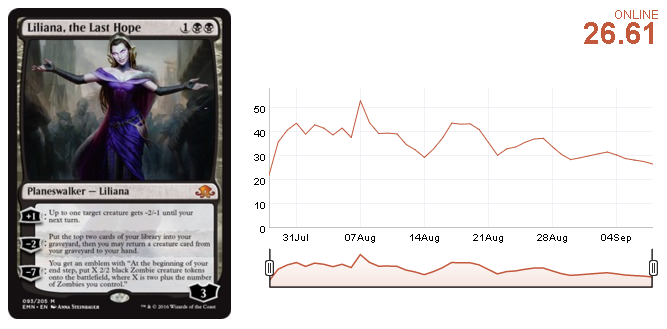
Ours is a format centered around mana efficiency, so overpaying for a given effect is especially displeasing for Modern players. And since walkers are always played at sorcery speed, these effects can prove less flexible than when on instants. Whether the additional price is worth paying depends on the value gained from keeping the walker in play rather than just sending it to the graveyard, as we would with an actual sorcery. Viewed through this lens, planeswalkers are sorceries with a non-optional kicker cost that leaves behind the potential for future effects.

Long-Term Value

We'll call that potential long-term value, or LTV. LTV comes in three styles, which each feature some degree of overlap with the others.

  • Inevitability. This mode of LTV pressures opponents to deal with the walker by threatening something menacing down the road. That could be re-use of its initial mode, like Liliana of the Veil, or a game-winning ultimate, like Liliana, the Last Hope. Of course, a horde of Zombies might break a midrange slog wide-open, but decks like Storm could care less; therefore, the inevitability of a given effect varies depending on the matchup. Inevitability often takes the form of a "suspend X" effect (e.g. Ancestral Visions), wherein opponents may attack the walker to increase the suspend count.
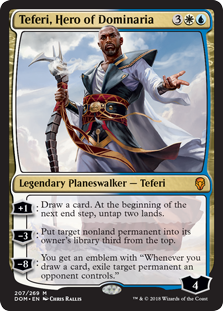
  • Gradual advantage. Walkers that produce advantage each turn fall under this category. Often, these effects involve drawing cards (Sarkhan, Fireblood), creating tokens (Gideon, Ally of Zendikar), or increasing power/toughness (Nissa, Voice of Zendikar). They pressure opponents to deal with the walker before that advantage snowballs into a game-winning threat.
  • Static effects. While literal static effects on planeswalkers were introduced for the first time in War of the Spark, some older walkers utilized the same principle. For instance, Gideon of the Trials locked down an enemy threat, as do enchantments like Runed Halo. What's truly new are static effects that hose opponents, such as Ashiok, Dream Render. With Ashiok in play, a type of play pattern becomes impossible for opponents to execute.

As perhaps evinced by the name, long-term value isn't exactly what Modern players look for in a card. How much turn-by-turn value can be generated if the game ends so fast? Since Modern is tempo-centric, and not card-advantage focused, creating a gameplan around snowballing value frequently proves a losing strategy. That, combined with the fact that players must already overpay for their initial walker effects, makes the format a hostile environment for the card type.

Reigniting the Guildpact

Of course, planeswalkers still see use in Modern, which means those that do meet certain thresholds for playability. In Modern Top 5, we try to break down those thresholds and apply them to thematic exemplars with the hope of improving future card analysis.

To assess our walkers, we'll draw from the very first entry in this article series, Modern Top 5: Utility Cards. In other words, we'll use three metrics.

  • Power: The degree of impact the card tends to have for its cost.
  • Flexibility: The card’s usefulness across diverse situations and game states.
  • Splashability: The ease with which Modern decks can accommodate the card.

Power and flexibility will be rated by considering both a card’s floor (the least it will do) and its ceiling (its best-case scenario). For example, Lightning Bolt‘s power floor is higher than Fatal Push‘s, as Push is dead when opponents have no creatures while Bolt can go to the face.

Splashability will be rated by considering how many existing Modern decks can accommodate the card and whether they’ll want it. For example, despite its lack of a color identity, Ghost Quarter doesn’t fit into BGx midrange decks. These decks can easily run Fulminator Mage as mana disruption instead, and prefer not to miss a land drop if they don’t have to.

In the case of power, we'll measure how cheap a walker's initial effect is relative to its sorcery analogue against the relevance of its LTV. Flexibility refers to the walker's applications in different matchups and game states. Each metric will be rated out of 5, giving the card a total rating out of 15. Even if a walker scores low overall, that doesn't mean it's bad or overplayed; just that its uses are somewhat limited in Modern as a whole. Similarly, there are plenty of great walkers not on this list!

#5: Teferi, Hero of Dominaria

Overall: 8/15

Power: 4

Let's be real—five mana for any of Teferi's immediate effects is a steep price. But the walker does protect himself from menacing creatures, and can start with a relatively high loyalty count if needed. That he costs closer to three mana in practice also increases his power, but further limits his splashability, as few decks can afford to make five land drops before dropping Teferi into play. The walker's effects do everything that UW Control could ever want, providing both inevitability and a stunning amount of gradual advantage.
Flexibility: 3

Teferi kind of does the same thing every time, which is start putting the game away for UW Control. But the wording on his -3 is a boon for the walker's flexibility. Like Assassin's Trophy, another costly multicolor card celebrated for its versatility, Teferi can remove a huge scope of permanent types—planeswalkers, enchantments, you name it (well, not lands). While adding them back to the deck can mean needing to deal with them again, UW can arrange to have an answer by then, and this form of removal doesn't care about clauses like indestructible.

Splashability: 1

Functionally costing three mana or no, the fact remains that Teferi's down-payment price tag is out of reach for most Modern decks. Barring fringe control builds, the only proven strategy that can wield him at all is pure UW Control, a deck already built to manage the battlefield for a game's entirety.

#4: Karn Liberated

Overall: 9/15

Power: 5

Generally costing a functional three mana thanks to Urza's Tower and its cronies, Karn Liberated boasts a power level obscene enough to single-handedly grant the Tron deck eternal meme status. At any stage in the game, Karn threatens to take at least a player's best permanent; early on, that's a land, and later, it's anything troublesome. Its +4 makes Karn difficult to attack down, and inevitability-wise, the ultimate does guarantee a win—it's just often superfluous anyway. Karn Liberated's abilities offer all three types of LTV.

Flexibility: 3

As with Teferi, the flexibility here comes primarily from Karn's -3 ability, which permanently removes any permanent. As a pricier walker, Karn's bar for flexibility is a little higher, but it also offers more modes than Teferi: should pilots just want to establish a big board, +4 helps keep Karn alive, and restarting the game can even beat infinite-life and other combos.

Splashability: 1

All good things must come to an end, and splashability is where Karn Liberated really suffers. Only Gx Tron can afford a seven-mana walker. While Karn is a fixture in that deck, and probably not going anywhere in the near future, we're also quite safe to not see him in another strategy.

#3: Karn, the Great Creator

Overall: 10/15

Power: 2

...That is, unless it's in a different suit! Karn, the Great Creator features a laughably small power level next to big brother, but more than makes up on our other metrics. Power-wise, Creator suffers in a few ways. Its +1 is only relevant in certain decks, and nothing to write home about regardless. Karn's -2 is as strong as the artifacts lying dormant in the sideboard, but with a catch: pilots need to cast those, too. All that mana quickly adds up, making Karn, the Great Creator a pricey inclusion.
Still, Modern has quite a few worthy artifacts. Among them is Mycosynth Lattice, the wishboard target that gives Creator so much inevitability: once pilots get to six mana, the artifact combines with Karn's static ability to totally lock opponents out of playing spells by preventing enemy lands from tapping for mana.

Flexibility: 4

Besides Mycosynth, Karn has a nigh-limitless arsenal at its disposal: artifact hate like Relic of Progenitus; recursive utility like Crucible of Worlds; surgical answers like Sorcerous Spyglass; pseudo-board wipes like Ratchet Bomb. I've enjoyed the walker in Colorless Eldrazi Stompy, a decidedly worse "Karn deck" than Green Tron. Nonetheless, the flexibility Karn provides has turned some bad matchups (Bridge Prison, Hardened Scales, UW, etc.) favorable single-handedly, and at a minimal cost to the deck's already-good matchups.
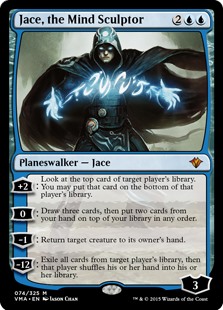
Karn's static ability also adds a hearty dose of flexibility, as its "floor" then becomes one of the best sideboard cards in the format, Stony Silence. While only relevant in certain pairings, giving decks the chance to run mainboard Stony at no real cost significantly broadens its appeal.

Splashability: 4

We've already seen Karn make appearances in Green and Eldrazi Tron, decks in which it seems to be a staple; mono-red prison and stompy decks; Eldrazi Stompy, as mentioned; and even combo strategies like Amulet Titan. The card is dominating in older formats, too, especially Vintage. Karn's wide applications in a format with so many great artifacts to choose from, as well as its colorless mana cost, make it a card many decks will continue to both want and be able to play.

#2: Jace, the Mind Sculptor

Overall: 11/15

Power: 4

Brainstorm is probably the most powerful cantrip in Magic after Ancestral Recall; AJ Sacher famously called it "too good to be cast." Casting Brainstorm every turn? Now that'll put the game away! Since its unban, Jace, the Mind Sculptor has had far from the format-warping effect its pundits once claimed. But it's still solidified itself as one of Modern's scariest planeswalkers.
Besides the incredible gradual value of a repeatable Brainstorm, Jace's -1 protects itself from enemy threats, if badly; Unsummon often plays like treading water, since Jace doesn't generate any value that turn. His +2 is more in line with what players might want to be doing, painfully keeping the game out of reach for opponents while ticking toward an ultimate that will win the game.

Flexibility: 3

Jace pulls much of his flexibility from his whopping four abilities. In a deck loaded with interaction, Brainstorm itself provides a good deal of flexibility; being able to grow Jace out of damage range with its +2, create gradual advantage both offensively or defensively, impact the board, and eventually win the game by itself also help. But Jace isn't much good at impacting the board, and is a largely miserable play when players find themselves behind.
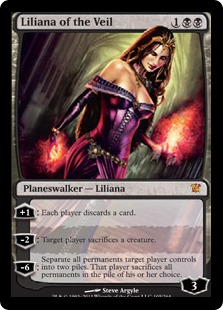
Splashability: 4

Jace has made appearances in decks ranging from the control end of the archetype spectrum (UW, Esper) to midrange (Temur, Faeries) to tempo (Kiki-Exarch, Blue Moon) to even combo (Copy-Cat, Breach). Four mana seems a totally reasonable price to pay for such a powerful walker, and the UU color cost manageable for all blue decks.

#1: Liliana of the Veil

Overall: 12/15

Power: 4

Since her printing, Liliana of the Veil has been Modern's premier planeswalker, and for good reason. Just one more mana for Diabolic Edict, a card we until recently haven't even had legal, is a tiny additional investment for what's left behind. While the -2 pressures creature decks, Lili's +1 forces opponents to play their threats out early, and gives her other applications against critical-mass combo decks.

Flexibility: 4

As hinted at above, Liliana mostly does it all; she's great on an empty board, where she pressures the hand and prevents creatures from sticking to attack her, and equally great against resolved threats, where she locks in her highest-value ability upon resolution. The -6 can deal with troublesome permanents otherwise out of reach for some color combinations, like Grixis (which can't touch enchantments), or just nuke big boards. It won't win on its own, but many decks still don't want it resolving.

Splashability: 4

As with Jace in blue, any black deck can fit Liliana—and usually does. From Grixis Shadow to Hollow One, not to mention her forever-home in BGx Rock and plenty in between, Lili's got no shortage of couches to watch the game from.

Boots Made for Walkin'

While the established metrics aim to reduce subjectivity in Modern Top 5, a degree of personal preference and bias is impossible to divorce from most any "Top Something" list. In this case, the number ratings on each metric, as well as the selection of metrics themselves, are the most arbitrary element of my process. How do you evaluate planeswalkers? Which do you think are Modern's best? Let's keep the discussion going in the comments!

Modern Horizons and the Road Ahead

Are you a Quiet Speculation member?

If not, now is a perfect time to join up! Our powerful tools, breaking-news analysis, and exclusive Discord channel will make sure you stay up to date and ahead of the curve.

War of the Spark's hype cycle has concluded! Mythic Edition refunds have been issued, foil sheets will be sent out to be inevitably mutilated, and suddenly, many Magic players are left with anywhere between $249.99 and $499.98 burning a hole in their pockets. With Modern Horizons spoiler season coming up, we're on the cusp of a lot of card movement across the board in Modern. Many are looking ahead to potential reworks of old favorites or returning cards never before seen in Standard sets of the past 15 years.

A lot of baseless speculation on what Modern Horizons will contain has no doubt graced your newsfeed in some shape or form. I've heard everything from the return of Slivers to those that are 100 percent convinced that we'll get Flusterstorm and Daze. I'm more inclined to call these guesses rather than strong hints, but time will tell.

I'm looking back on the cards we already have, calls I've made in the past, and potential gainers within this new hype cycle.

Dead Horses

Yes, I know I've talked it to death, and I'm not the only one. Fetchlands are without a doubt the safest MTG finance investment going into the end of May. We've got several options here, but the lowest buy-ins are with the five from Khans of Tarkir.

There was an error retrieving a chart for Windswept Heath

All five are solid plays, but the most interesting one to me here is Windswept Heath. The best Selesnya decks like Bant Spirits have been on the decline in Modern as of late, giving way to the rainbow-landed Humans, Grixis Death's Shadow, or Tron variants. Still, decks like Infect, TitanShift, and Abzan Company all make use of it and remain in the conversation for some of the best decks in Modern.

To add to this, the early spoiler of Cabal Therapist hints at creature-based reworks of favorite non-creature spells, which may add new utility creatures in green and white. Should the metagame shift towards playing these, Windswept Heath is where you want to be. Speaking of Selesnya lands...

There was an error retrieving a chart for Horizon Canopy

We're pretty far out from its most recent reprint in Iconic Masters, but Horizon Canopy is still at a great price compared to what it once was. It didn't take long for this card to start to recover from the initial supply spike and it has been trending upward ever since. Decks like Humans play the land as a full playset and it shows up in many other creature-based decklists as a way to draw cards later in the game.

Near Mint copies are still available under $60, which may seem a bit hefty. However, it's likely this will continue to be one of the most expensive utility lands once the new Modern goes into full swing.

There was an error retrieving a chart for Cavern of Souls

It is frankly astounding to me that despite multiple reprints, Cavern of Souls's price snaps right back so close to the $90 mark in times of Modern demand. The story here is a bit different from Horizon Canopy, as they aren't always featured in the same decks, it's not unreasonable to say that the two are closely related. Again, Humans drives a lot of the demand for this card, but it's overall one of the best rainbow lands ever printed and will be an auto-include in any tribal build going forward.

There was an error retrieving a chart for Aether Vial

Kind of in the same vein, I'm pretty high on Aether Vial. With creatures likely becoming a big focus, I'm very interested in this one-mana artifact. It's one of the most powerful fair cards in the format, as it essentially cheats the stack, paying specific mana costs, and being harder to answer outside of the normal suite of removal. Outside of its original Darksteel printing, Aether Vial has been featured in a From The Vault, the original Modern Masters, and Iconic Masters. Despite this, it has consistently maintained overall growth since Modern's inception, and will likely continue this trend moving forward.

There was an error retrieving a chart for Thoughtseize

A pillar of the format I've talked about a whole lot less than others is Thoughtseize. It is still the premier discard spell, alongside Inquisition of Kozilek. These are by far the best pieces of disruption in the format. Most of Modern's top decks are linear, redundant strategies that reduce the overall potency of discard spells, but I think there's a good chance that could change with the introduction of Modern Horizons.  We've seen many metagame snapshots where these cards were the best turn-one plays available.

Shaky Ground

There are a lot of cards we consider staples of the format. Modern Horizons presents an opportunity for a large paradigm shift in the format. At least, that's what I'm inferring from all the official verbiage given by WotC thus far.  There are a lot of cards that could easily be usurped and dethroned for appearing in decklists, and I think there are some cards that may be on thin ice. Some of this talk toes the line on what some consider baseless speculation, so please take some of these statements with a grain of salt.

There was an error retrieving a chart for Cryptic Command

Cryptic Command is one of the most powerful pieces of countermagic ever printed and has been the backbone of control decks since the format's inception. The major issue with this card is that it costs four mana, and doesn't always win you the game on the spot. That being said, UW Control decks have been performing very well as of late in Modern. The card has been on the upswing lately, largely having recovered from its Iconic Masters reprint. However, as I mentioned at the beginning of this article, the possible reprinting of cards like Counterspell, Flusterstorm, Daze, and even Force of Will present a threat of replacement.

UW Control has a lot of four-mana cards in it as is, and should we see the return of premier countermagic that sees play in Legacy, Cryptic may start getting cut from decklists in favor of leaner options. That being said, there is no guarantee that the texture of this format will be quite like Legacy, given the wide card pool available. If we get just one or two of the aforementioned spells, they will likely reinforce or push up Cryptic Command's price. If we get all of them, I predict the exact opposite.

There was an error retrieving a chart for Urza's Mine

Tron has been a hot topic of discussion for many Modern players for the past few weeks for several different reasons, but I think the deck could have some troubles going forward. Many have called Wasteland, or some fixed version of it to enter the format. Field of Ruin and Ghost Quarter are currently decent-enough options that are very well balanced, so I very much doubt we'll see Wasteland introduced. Running with what I do know, Cabal Therapist represents what will likely be a strong discard spell that improves the Tron matchup ever so slightly, especially for decks like Jund or Grixis Death's Shadow.

Bring It on Home

Modern Horizons presents an incredible opportunity to revitalize the format, and shake things up gameplay wise. My recommendation for nearly guaranteed growth will be purchasing the evergreen cards of the format, primarily the fetchlands.

We've only got a few days left until spoiler season starts proper. We're going to see a lot of quick movement over the course of the next few weeks, and you'll want to keep your eyes peeled on spoiler sources. I'll be covering spoiler content here if you'd like to join me. As well, you can follow me on Twitter @chroberry or on Instagram @chroberrymtg for updates on spoiler content.

Peace!

Chris’s Commander Corner: Niv-Mizzet Reborn

Are you a Quiet Speculation member?

If not, now is a perfect time to join up! Our powerful tools, breaking-news analysis, and exclusive Discord channel will make sure you stay up to date and ahead of the curve.

Editor's note: this article contains spoilers from the Magic storyline

Hey Readers, welcome back! It's been a while since I've done a Commander Corner article, but what better way to break the drought than writing about one of my favorite Magic characters of all-time?

There was an error retrieving a chart for Niv-Mizzet Reborn

I'll admit I was upset when I learned Nicol Bolas killed Niv-Mizzet, Parun because I was afraid Niv might not get any new cards in the future. Niv has always been one of my favorite characters in the Magic storyline. I even constructed a Niv-Mizzet, Parun EDH deck back in the winter and have continued upgrading it ever since. I also have had a fascination with dragons since I was a kid, so Niv being a favorite of mine shouldn't come as any surprise.

The EDH community has been mostly on a hiatus since Feather, the Redeemed was spoiled. My day-to-day news feed usually filled with EDH love has been completely overshadowed by the Mythic Edition fiasco, the new format being proposed called Oathbreaker, Modern Horizons speculation, various Magic Pro League issues and drama, and the shake-up of the Standard meta caused by War of the Spark.

I'm ready for all of the buzz to settle and refocus on my favorite eternal format, so to recalibrate myself I figured I would share some thoughts and specs based on the Niv-Mizzet Reborn EDH deck I'm brewing.

Questions to Ask Ourselves

Before speculating, I always preach asking yourself one very important question: would you play with those cards?

If the answer is a resounding yes because you brewed, play-tested, or saw a friend have success doing the same, then there is a strong likelihood you are onto something. In the case of Niv, my answer to that question ended up being a "yes". It helps that I preordered two boxes of War of the Spark and one of the mythics I pulled was Niv. It is also of equal importance to note that my wife and I welcomed a new baby boy to the world a couple of weeks ago, so despite the mostly-sleepless nights I have found reprieve in brewing EDH decks while he sleeps.

The combination of that sanctuary-esque feeling of brewing and having a physical copy of Niv-Mizzet Reborn in hand motivated me to evaluate the merits of Niv in an EDH setting, particularly as a general. It also led me to do a lot of research and find what I believe are some really strong targets for speculation purposes should we determine Niv to be popular enough to generate meaningful demand.

I have always felt I have a fairly strong pulse on the EDH scene, but like any content creator I have my misses and over-exaggerations, which I have learned are often spurred by my own clouded judgment and self-fulfilling prophecy. In this instance, I want to be extra transparent given all of the details I mentioned already:

  • I am a Niv-Mizzet fan
  • I love and am fascinated by dragons
  • I happened to pull a copy of Niv in one of my War of the Spark booster boxes
  • I am brewing more than ever as a new dad

With that in mind, let's move into the guts of my rationale for why I think A) Niv-Mizzet Reborn will be a popular general for years to come and B) why I think my specs are worth consideration.

Developing the 99

As with any EDH deck, cutting down to the final 99 with Niv-Mizzet Reborn was difficult. In fact, I am still working on final cuts two weeks after beginning my brewing journey (details on that to follow on Twitter). I struggled to determine a strategy for my Niv-Mizzet Reborn deck which only further complicated the choices in the 99.

Eventually, I decided I wanted to pursue a "legendary-creatures matter" deck that wins using an aggro strategy and which leverages Niv to consistently refill the hand. I saw an article put out by our friends at www.EDHREC.com while I was working on my own and the Niv strategy discussed by the writer there was to leverage Niv in a control/spell-wielder capacity because of the card advantage he can generate.

I don't dislike this approach, and frankly think it is probably quite effective, but my general demeanor in EDH is not to turtle but rather to strike fiercely with a more aggressive approach. I want my opponents to feel like my deck could win at any time to encourage them to play attentive Magic, and also to generate fun combat interactions I might not otherwise get by casting a lot of board wipes or cards like Counterspell and Anguished Unmaking. There is a moral to this story, though:

Important Takeaway #1

By Niv-Mizzet Reborn being a 5C commander, a dragon, and a commander who can generate consistent card advantage, he gives brewers a ton of options to pursue. That's extremely important when considering the longevity of a commander and determining whether speculating around the general is wise.

Conversely, if the general only offers a single, narrow-focused strategy or wincon, such as Prime Speaker Vannifar, the hype might be huge during spoiler season but will Snuff Out faster than the candles in the first War of the Spark teaser.

Chalk this up as a reason to consider Niv-Mizzet Reborn EDH-related specs.

Important Takeaway #2

The fact that Niv-Mizzet Reborn can enable so many different approaches and strategies makes it much tougher to focus on important specs. As a result, we have to narrow down the few cards which would be near-universal-includes. These are the cards which, no matter what strategy is chosen, are necessary to make Niv successful. As such, I contemplated this heavily and it reflects in my choices for cards to consider for Niv-Mizzet Reborn EDH purposes.

Important Takeaway #3

Niv-Mizzet Reborn has been consistently holding a top spot on the EDHREC weekly top commanders list and ranks #2 only to Feather, the Redeemed for overall weekly deck creation. This tells us that there is some non-zero demand to consider in the EDH community, and if nothing else Niv should have our attention.

Investment Plan

Let's dive into the cards I love the most which would benefit tremendously from an increase in popularity due to Niv-Mizzet Reborn EDH decks. Note that all but one of these cards has reasonable crossover between strategies employed by Niv (i.e. would be an inclusion in the Niv deck regardless of the wincon/strategy used).

There was an error retrieving a chart for Pillar of the Paruns

Confidence: 4/5

Pillar of the Paruns is all but guaranteed to show up in any deck that uses Niv-Mizzet Reborn. Much like a recent callout I made on a QS Insider Podcast (Mana Confluence), Pillar of the Paruns adds the beautiful dynamic of mana-fixing to an otherwise very complex mana base. To be successful with Niv's ETB trigger, brewers will need to be running 80%+ of their total non-land 99 as multicolored guild-pairings. This makes for a complex and expensive mana base short of running fetches and dual lands. Thus, while Pillar of the Paruns only gets brewers one land closer to mana-fixing, it will be absolute-must in any Niv deck. It will not be showing up as a reprint in Modern Horizons which only buoys its upside.

Niv has also been briefly showing up in some fun lists for Modern where he is complemented by Pillar of the Paruns as 4-of. I'm a lot less sold on Niv in Modern, but it has been mentioned in QS Discord and on Twitter as something to watch, and certainly won't hurt the upside of Pillar of the Paruns.

(Note: Mana Confluence is an equally intriguing card to watch and in full transparency, I picked up a handful of NM copies of the Mana Confluence Expedition when Niv was first spoiled).

Target Buy:

  • I like Pillar of the Paruns nonfoils at $6 (NM) if you can still find them --> I picked up four copies at this price when I first mentioned cards to consider for Niv-Mizzet Reborn in the QS Discord (a week early)
  • I like foils at or under $15 (NM) but those appear to have dried up quickly --> I picked up eight NM foil copies at $12.99 when first calling specs in the QS Insider Discord for Niv last week

Target Exit:

  • Nonfoils (NM) --> $15 (and higher if you are a Direct seller on TCGPlayer); turnaround time = 1 month or less
  • Foils (NM) --> $30 (with a much higher ceiling if Niv in Modern gains any traction); turnaround time = 1 month or less
There was an error retrieving a chart for Urza's Filter

Confidence: 4/5

Flickering Niv-Mizzet Reborn is the best way to achieve value off his ETB trigger, but recasting him is a good backup option. What better way to do that than having the first recast at a discount? Urza's Filter has always been one of those really old cards I have watched rot in my bulk rare bin with little to no love. The primary reason for that is because it makes all multicolored spells cost two less (even opponents). But, if you are casting 80%+ of your deck as a multicolored spell, that downside is more than offset.

Because it is a single-print rare from Invasion, Urza's Filter is the type of card that won't take much demand to drive prices up significantly. I believe it will be an auto-include in Niv decks even just to act as a second Sol Ring for Niv himself.

The downside case here is a reprint in Modern Horizons; if that were to happen, all bets are off on non-foils. Foils, on the other hand, could become very attractive long-term because of the "old border" premier look and feel.

Target Buy:

  • I took a gamble and purchased 16 LP non-foils for $0.79 --> I think any price sub-$1 for NM and LP is fine
  • I like acquiring NM and LP foil versions for sub-$15 if you can still find them --> when I called Urza's Filter last week to QS Insiders, there were a handful of NM foils still available for $12.99 on Card Kingdom, but those have since been purchased

Target Exit:

  • Barring reprint, nonfoils (NM) --> $3 (with a good buy list play if you are quick); turnaround time = 1-3 months
  • Reprint resistant foils (NM) --> $30, turnaround time = 1-3 months
There was an error retrieving a chart for Conjurer's Closet

Confidence: 4/5

I just mentioned flickering Niv-Mizzet Reborn as the best way to achieve value, so of course, one card that does just that had to make the cut, right? When I was reviewing Flicker options for my personal Niv brew several cards stood out and made the cut:

Venser, the Sojourner, Voyager Staff, Synod Sanctum, and Turn to Mist to name a few.

That said, Conjurer's Closet foils really stood out to me because of the single-print status and current supply on TCGPlayer and surrounding vendors. I believe this card could be an auto-include if you are building a Niv-Mizzet Reborn EDH deck and thus I believe it warrants a solid spot on my cards to consider list.

Target Buy:

  • Nonfoils are more expensive than you'd expect but due to the multiple prints I don't like them as a spec
  • The foils are in much shorter supply likely because existing demand for flickering exists due to Roon of the Hidden Realm popularity and thus any near mint copies sub-$12 is a solid buy still --> I called Conjurer's Closet foils on QS Discord last week when you could still find NM copies sub-$10 but I suspect that price is gone

Target Exit:

  • Foils (NM) --> $20; turnaround time = 1-3 months
There was an error retrieving a chart for Heroes' Podium

Confidence: 3/5

I had to throw one card in which I am using as a wincon in my "legends-matter" build: Heroes' Podium. To date, this card only sees fringe play in casual EDH decks like Captain Sisay and Raff Capashen, Ship's Mage. With a Niv-legends deck running around, I believe this card could have enough newfound demand to boost its foil print out of bulk status.

Heroes' Podium is interestingly one of those rare cards stuck in limbo by the $2 price requirement on TCGPlayer - if you look at buyable foil copies, the list is very short. There are hardly any vendors carrying four or more (I am actually one in full transparency). Additionally, its current bulk status (foils are available sub-$1) makes it a nice buylist play should any amount of new demand drive that price up over $2.

Target Buy:

  • Ignore nonfoils as there is too much supply and will not be enough demand to offset it
  • Near mint foils thrown into your cart for $0.50 to $1 to top-off free shipping on TCGPlayer (or other vendor sites) is a nice option --> it is worth paying a small premium such as TCG Direct to guarantee the NM condition as very few of those are available (note: I have seven LP copies listed which were all originally listed as NM by other vendors)

Target Exit:

  • Foils (NM) --> $3 or a buylist out; turnaround time = 3-6 months to be safe as this one could take more than just Niv-Mizzet Reborn to push over the hump

Wrapping Up

I am a big fan of Niv-Mizzet and of dragons in general, so take all of my cards to consider with a grain-of-salt and do your own research to make sure you agree.

That said, I do believe Niv-Mizzet Reborn will be a general worth watching in EDH circles throughout the summer and into the latter part of 2019. He has consistently ranked #2 on the top weekly commanders list shown on the EDHREC home page and top 5 on the overall EDHREC commanders list. This tells me people are definitely brewing around Niv

The buzz around EDH as a whole is tame right now because of competing priorities, Standard/Modern hype, and other community news taking the spotlight. But, I believe Niv-Mizzet Reborn will continue to rise in popularity, especially when EDH circles start to focus and brew again, and I wouldn't be surprised if he eventually dethroned Feather for most popular War of the Spark general.

As always, you can catch me on the QS Insider Discord or on Twitter (@ChiStyleGaming) with reactions, commentary, or miscellaneous banter! Thanks for the read!

Insider: Modern Horizons Speculation

Are you a Quiet Speculation member?

If not, now is a perfect time to join up! Our powerful tools, breaking-news analysis, and exclusive Discord channel will make sure you stay up to date and ahead of the curve.

Welcome back, readers! It feels like forever between visits now that I've switched to doing articles every other week, but life gets busy, so I definitely like having a bigger time gap in between articles. So, we know very little about Modern Horizons and I imagine we'll start seeing more spoilers starting any day now. We only have two spoilers for the set so far:

We've also been told that nothing in the set is currently Modern legal, but there will be reprints from past sets. This means we will see pre-Modern reprints, though there is no guarantee they will be cards that see play in Legacy. We also know they will not be from the Reserved List. However, that begs the question; what are the most valuable non-Reserved List pre-Modern cards?

There was an error retrieving a chart for Imperial Seal

Imperial Seal is number one on this list, even with the somewhat recent judge printing. I actually think this could be a good option for the set. While it is a powerful tutor, it is sorcery speed and is actually card disadvantage. I don't think it would break Modern. I imagine it would most likely show up in the Modern Ad Nauseum decks or Grishoalbrand style decks as these are Modern's two black based combo decks, though it would obviously be a great addition to the Death's Shadow decks as well. The set will need a big name reprint to help justify the box cost.

There was an error retrieving a chart for Zodiac Dragon

Zodiac Dragon is another Portal Three Kingdoms card with a high price tag, but in this case, a reprint would absolutely tank the value. Dragon collectors would be thrilled, except those who shelled out $200+ for their copy of the P3K version. This is the type of card that would likely be $8-$12 if it were reprinted and because of that, it would make a bad "flagship" card to sell boxes, though it could still show up in the set.

There was an error retrieving a chart for Grim Tutor

Grim Tutor would be the other "flagship black tutor" they could include to sell boxes. This one would likely be even safer for Modern thanks to its sorcery speed and costing 3 mana. The danger here would be that like Zodiac Dragon above, this card's value is heavily influenced by its extreme rarity; Starter 1999 was not a set people were racing to crack packs of. A reprint in Modern Horizons, even at mythic, would likely make this a $20-$30 card. I would expect it to follow a similar trajectory to Imperial Recruiter which went from being a $340+ card to around $120 with the reprints available for under $30.

There was an error retrieving a chart for Mana Crypt

Mana Crypt is a card I feel I can say with almost absolute certainty will NOT be in Modern Horizons. WoTC has banned all the free mana rocks save Mox Opal and even that one is often described as being near the line. If Chrome Mox  is too good for Modern, then Mana Crypt would be insane. All this being said, I do expect we'll see another reprint of this card before too long, just not one that would put it into Modern.

There was an error retrieving a chart for Force of Will

Force of Will would definitely be an interesting addition to modern. I do think that control decks could use a bit more help against some of the degenerate combo decks of the format, however, I would be concerned that adding Force of Will might simply be pushing Modern into being more of a diet version of Legacy. I think WotC wants to keep Modern a unique format. The recent price jump of FoW makes me think that some people are speculating on its inclusion, as there certainly hasn't been any major Legacy format changes to justify the 30%+ jump we've seen in the past couple of months.

There was an error retrieving a chart for Ravages of War

Ravages of War is the Portal Three Kingdoms version of Armageddon, yet thanks entirely to Commander it commands a price tag of over $100. However, that's entirely due to scarcity and any non-special reprint would bring the price crashing down likely to $15-$25. It's also important to note that WotC has definitely seemed to shift away from any mass land destruction spells, as they tend to lead to a lot of "non-games", which would be a bad direction to push a format you want to grow. For that reason alone, I think this card is very unlikely to be included in Modern Horizons.

There was an error retrieving a chart for Capture of Jingzhou

Capture of Jingzhou is the Portal Three Kingdoms version of Time Warp. We have Time Warp already legal in the format, and there is a tier 2 deck that tries to go infinite with extra turn effects. This would definitely fit well into that deck, though I don't think a bit more consistency would make it tier 1. As with most P3K cards, a large scale reprint would tank the value hard and it would likely fall into the $20-$30 range, similar to Imperial Recruiter. This is definitely a card that could be included in Modern Horizons.

There was an error retrieving a chart for Warrior's Oath

Warrior's Oath is the Portal 3 Kingdoms version of Final Fortune. Interestingly, despite three different reprintings, none of them were in Modern sets. They could also choose to print Last Chance which is the original Portal reprint of Final Fortune, though it's a lot less valuable. Honestly, any of these three versions of the same card could show up in Modern Horizons and I don't know what effect, if any, it would have on the format. We have seen some combo decks based around Chance for Glory so having an additional option might make these builds more viable.

There was an error retrieving a chart for Riding the Dilu Horse

Riding the Dilu Horse's value is entirely based on it being a rare in P3K. I truly doubt we will ever see Horsemanship as a mechanic return, so again, I can say with almost complete certainty this card will not be in Modern Horizons.

There was an error retrieving a chart for Mana Drain

Mana Drain is likely too powerful for modern. Currently, Modern doesn't even have regular Counterspell so it seems unlikely to get its far better big brother. If it did, we'd likely see a resurgence in Mono-Blue Tron decks, and we don't need that in Modern. Counterspell on the other hand seems plausible, but definitely not Mana Drain.

Conclusion

There you have it, a somewhat extensive list of the most valuable non-Modern legal and non-Reserved List cards. As you may have noticed, a fair number of them are only valuable because they have a single printing from Portal Three Kingdoms so any reprint would tank almost all of their value. I do think we will see at least one card on this list in Modern Horizons as the set will need a pretty expensive "flagship" card. Here are some examples from the past:

  • Modern Masters and Modern Masters 2015 - Tarmogoyf
  • Eternal Masters - Force of Will and Jace, the Mind Sculptor
  • Iconic Masters - Mana Drain
  • Modern Masters 2017 - Liliana, of the Veil and Snapcaster Mage
  • Masters 25 - Imperial Recruiter and Jace, the Mind Sculptor

WoTC knows that to sell a premium set at a premium price they have to put at least one big chase card in it. There are plenty of other possible lower-priced reprint options I could see being in the set including the other portal tutors, Goblin Settler, Scroll Rack just to name a few. Did I miss any obvious ones? Please feel free to comment below or reach out to me in the Insider Discord chat.

Want Prices?

Browse thousands of prices with the first and most comprehensive MTG Finance tool around.


Trader Tools lists both buylist and retail prices for every MTG card, going back a decade.

Quiet Speculation