menu

Breaking Down Hasbro’s Q1 Earnings Report

Are you a Quiet Speculation member?

If not, now is a perfect time to join up! Our powerful tools, breaking-news analysis, and exclusive Discord channel will make sure you stay up to date and ahead of the curve.

Recent chatter on social media has sounded very positive for Magic’s health. This motivates me (and others I’m sure) to increase financial exposure to cards—further price appreciation seems almost inevitable at this point. But how confident can we be in Magic’s health?

Fortunately, this past week Hasbro (parent company of Wizards of the Coast) reported their quarterly earnings. Upon doing so, their stock chart mirrored a traditional Magic card buyout, spiking suddenly and meaningfully and aggressively.
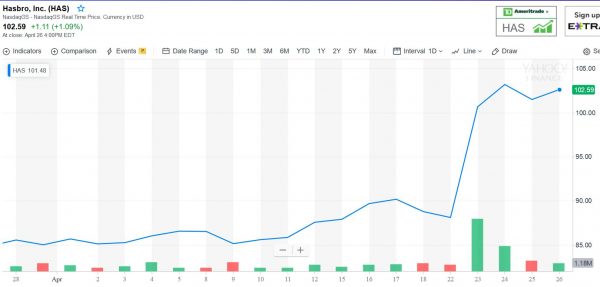
Hasbro’s a giant company with many brands—we can’t assume Magic was the sole reason for this spike. But it did play a contributing role, and Hasbro’s management called the game out multiple times for its strength. This week I’m going to dig into Hasbro’s earnings reports for tidbits on Magic to try and glean just how strong this franchise truly is.

Quarterly Report PowerPoint Presentation

When Hasbro reports earnings, they like to summarize results in PowerPoint form; it’s a handy way of merging pictures and text to communicate top level results. For those interested in following along, you can view the publicly available report here.

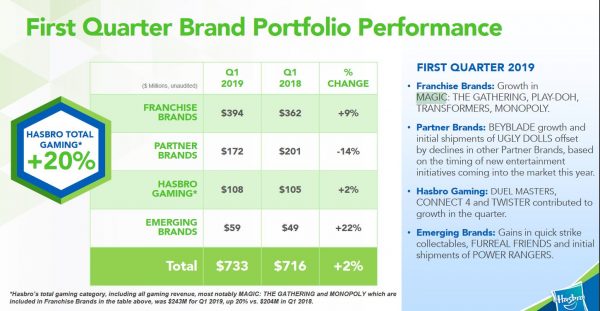
In total, Magic was explicitly referenced five separate times in the presentation. Here are the snippets associated with each reference:
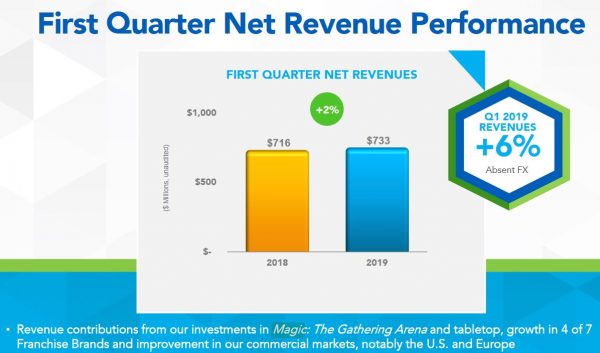

From these five mentions, we can draw two key conclusions about Magic.

First, it’s clear that Hasbro is committed to investing in Magic. They clearly state their intent to invest in advertising and product development for Arena. This commitment bodes very well for Magic. As players discover the game through the Arena platform, they may make the transition into the paper form of the game, driving higher sales and revenue growth for Hasbro.

The second valuable nugget from these slides is the overall strength of Magic revenues in general. In the one slide, there’s a statement that “Hasbro’s total gaming category, including all gaming revenue, most notably Magic: the Gathering and Monopoly…was $243M for Q1 2019, up 20% vs $204M in Q1 2018. To see 20% growth in such a mature business is phenomenal and it’s a testament to how strong these games are. Clearly, Hasbro is high on Magic and Monopoly to call them out individually like this.

But is this really conclusive? It’s nice to see Hasbro call out the strength in Magic and declare their intent to invest further in Arena, but can we really feel confident investing in Dual Lands and Black Lotuses based strictly on these slides?

There was an error retrieving a chart for Black Lotus

Perhaps not. Fortunately, there is more data to react to within Management's Remarks about this quarter.

Management’s Remarks on Magic

The PowerPoint presentation is really a high-level summary to help management navigate their conference calls with market analysts. The document containing management’s remarks provides additional color commentary around results. This is where some of the most interesting nuggets on Magic’s health reside.

Magic itself appears a dozen times in the document. Below are the snippets of the most interesting references.

  1. "During the first quarter we realigned our segments and began reporting the digital gaming revenue associated with our Wizards of the Coast two brands, including Magic: The Gathering Arena and several other games, in the renamed Entertainment, Licensing and Digital Segment.
  2. Our long-term investments in growth opportunities provided a meaningful contribution from our digital and e-sports initiative, Magic: The Gathering Arena, as well as growth in MAGIC: THE GATHERING tabletop revenues.
  3. …great success at our premier MAGIC: THE GATHERING Mythic invitational at Pax East in March…..which generated 2.7 million viewer hours on Twitch and paid out a million-dollar prize pool.
  4. Engagement with MAGIC: THE GATHERING is growing – in both digital gaming and analog tabletop. In-store player growth increased double digits and grew at an even higher rate for new players. The latest Magic card set, War of the Spark, was unveiled at Pax East and drove over 10 million views of the trailer, shattering the previous record…Magic: The Gathering Arena is performing well, with over 700 million games played to date during the open beta with the average player spending 8 hours per week in the game.  We will be further supporting the game with additional tournaments and marketing support as the year progresses.
  5. …we are also expanding the MAGIC: THE GATHERING franchise to reach a broader audience through an entirely new game, designed for mobile. The team launched this game, Valor’s Reach, into test markets during the first quarter.
  6. We reclassified revenues of $10.4 million and operating profit of $3.2 million…revenues grew 24% this quarter…driven by revenues from Magic: The Gathering Arena as well as consumer product licensing. Operating profit increased to $30.0 million, or 32.6% of revenues, driven by the higher revenue and lower amortization for film and television. This was partially offset by continued investments in the business, including in digital gaming initiatives for MAGIC: THE GATHERING."

Some of the snippets above echo what’s in the PowerPoint presentation: Magic is growing and Hasbro is committed to investing in Arena. They even explicitly mentioned their realignment of segments so that Arena revenue falls under a digital gaming category—this will make it easier to track Arena’s growth.

However, I think there are two new takeaways from these comments that are worth highlighting. First, Wizards provided some actual numbers when it comes to player engagement that appear to be very positive. Whether it's playing online, at a local shop, or watching coverage on Twitch, overall engagement with Magic is strong!

  • 7 million viewer hours on Twitch during Mythic Invitational
  • In-store player growth increased double digits
  • 10 million views of the War of the Spark trailer
  • 700 million games played in Arena during open beta

Secondly, what’s this mobile game “Valor’s Reach” all about? Seriously, am I the only one who didn’t know that Wizards is trying to expand the Magic franchise into a mobile game?

This is fantastic news! If the game has a lower barrier to entry than Magic, it may attract a far broader audience—some of those newcomers would naturally funnel to the card game.

Wrapping It Up

We need to be somewhat skeptical here in that Hasbro will naturally spin all their analyses in a positive light. Naturally, their management is confident in the decisions being made (if they weren’t, then Hasbro would need new management). But even with this skepticism, I am still left feeling quite optimistic about this earnings report. It’s clear Hasbro will continue to spend some of their cash to grow Arena while also transforming Magic into a true esport. At the same time, they’re seeing strong engagement with the paper version of the game.

What are the action steps for us speculators and investors coming out of this earnings report? I don’t think I’d make any sudden changes in my approach per se. But in the past, I have stated that Magic investing—especially in the Reserved List and high-end market (Duals, Power, Masterpieces, Alpha/Beta)—are great long-term investments as long as Magic stays healthy. What I’m reading in the last quarterly statement is that Magic is in the best shape it has ever been!

There was an error retrieving a chart for Serra Angel

This means we have the green light to proceed as planned…at least until the next quarterly earnings when we can examine numbers all over again.

…

Sigbits

  • At one point, the Winter version if Mishra's Factory spiked very high and buylisted for nearly $300. Since then stores restocked the card and the price pulled back significantly. But it is appearing on Card Kingdom’s hotlist yet again. Even though the buy price is a modest $160, I’ll still be paying close attention to see if the card runs higher once again.
  • I saw a fair amount of Dark Confidant on camera throughout the Mythic Championship in London. While I don’t think the card got much attention on Sunday, Bob still saw more play in Modern than he had for quite a while. I see Card Kingdom has the Judge Promo printing on their hotlist with a $120 price tag.
  • Right around the time of the Winter Mishra's Factory spike, Card Kingdom had aggressively high buy prices on all the Legends legendary creatures. Since then prices dropped back down to earth, but Angus Mackenzie has made a reappearance on CK’s hotlist recently, with a $110 buy price. This isn’t anywhere near its peak (probably around $200) but perhaps these cards are all finding a base and will appreciate going forward.

Sales Tax on Magic – Reacting to Increasing Costs

Are you a Quiet Speculation member?

If not, now is a perfect time to join up! Our powerful tools, breaking-news analysis, and exclusive Discord channel will make sure you stay up to date and ahead of the curve.

On April 1st, a change made by several TCG vendors quietly snuck into our everyday Magic: The Gathering purchasing habits. Depending on the state you live in, you may notice that your final cart price on various sites such as TCGplayer and Card Kingdom is a little higher now due to the introduction of sales tax.

For some states and vendors, these changes went into effect a while ago (I was actually impacted by it on TCGplayer back in mid-2018). For others, this change may be entirely new and a big shock to the system.

Most of us are used to paying sales tax on various daily goods or services, and already pay tax on purchases at our LGSs. As a result, taxation of Magic cards purchased online might not be a big deal as we get used to it over time—but as a speculator and player, the change stings in the moment.

I couldn't help but stop and think about the consequences of this change to the various parties who are impacted. The thing that stands out to me the most is how much money a single Magic card might generate in sales tax for states over its lifetime.

Think about this scenario for a moment:

You live in Illinois (like I do) and buylist $400 worth of Magic cards to Card Kingdom. Using their store credit bonus (1.3 multiplier), you buy a VG copy of Underground Sea (retail value at the time of this writing: $511.99).

Card Kingdom charges you $32 in sales tax on your Underground Sea (the Illinois rate of 6.25%). This effectively requires you to trade in an extra $25 worth of cards to cover the price change, if you're paying entirely with store credit.

Fast-forward eight months and it's Christmas time. You need cash to cover cost of gifts for your friends and family, so you list your Underground Sea on TCGplayer for $500 and it sells to someone in California.

Of course, you pay the fees and taxes on the sale to TCGplayer, but guess what? Your buyer just paid a California sales tax on that purchase—possibly as high as 10.25% (depending on your municipality, etc.). So, that Underground Sea now has somewhere between $60-80 worth of sales tax accrued on it just by changing hands twice.

We can all imagine how often "trading cards" change hands, but if you were to start to add up the sheer volume of actual sales per card, the taxation aspect becomes a mind-boggling statistic.

I was talking with folks in the QS Discord about this a few weeks ago—I am convinced the average Magic card will generate more sales tax in its lifetime than any major commodity.

To illustrate the point, some of us were jokingly using an analogy of underwear sales (picking it as a random commodity to compare) to Magic card sales. While hilarious, the comparison also perfectly underscores the biggest difference of sales taxation on Magic vs. the majority of other things that taxes hit. It is unlikely to resell underwear (or most commodities) after purchase, but it is highly likely to resell Magic cards.

Besides the hit to our wallets, what other impacts should we consider regarding the new sales taxation on Magic cards?

There was an error retrieving a chart for Swords To Plowshares

Downsizing the Box of Shame

We all know the pain of whiffing on specs. Whether the card falls out of favor, is reprinted, or simply just never hits in popularity, the cost of whiffing can be exorbitant (shipping, resale fees on various platforms, storage space, etc.). Anyone who is in the business of speculation should focus on keeping miss rates low and ROI high. The new sales tax cost, combined with the postage hike earlier this year, makes ROI even more difficult than before.

My advice: stick to the lowest-hanging fruit. There's no room to get cute with specs, because the costs of missing are even more punishing than before. Easier said than done, though. To shore this up on my end and keep the miss rate low, I have adjusted my strategy ever-so-slightly.

Leverage Overseas Options

There was an error retrieving a chart for Trade Routes

For one, I've begun using overseas options to help increase margins, notably by making several purchases recently from Hareruya. The EDH scene is smaller outside of the U.S., which means two things:

  1. Cards in demand here could still be available overseas.
  2. The cost of the cards might still be at the "old" (pre-demand) price.

We've heard a lot in the community about arbitrage of late (there have been some fantastic discussions about the pros and cons in the QS Discord). I'm not sure this is the same thing, though, since I'm not buying cards simply to flip for a modest 20% profit.

Instead, I'm waiting to find cards that I know are moving here in the U.S. Then while other speculators are purchasing from the U.S. mainstays (eBay, TCGplayer, Card Kingdom, etc.), I'm looking at Hareruya and picking up larger quantities all at once. I had a ton of success with this strategy when Feather, the Redeemed was spoiled, and will continue to use this strategy sporadically in the future.

Eliminate Early Movers

There was an error retrieving a chart for Preferred Selection

The second adjustment I've made to combat rising costs is not calling cards that rank below a 3/5 on my "confidence rating scale." In other words, I won't be formally calling "early-mover status" cards moving forward. I may still put these cards on a "watchlist" but I won't recommend purchasing them (nor will I buy them) until they blossom into a 3/5. This should limit the number of cards I put in my box of shame (also affectionately referred to in my household as the very-long-term specs box) and hopefully help you avoid doing the same.

You might be thinking that the best time to get in on a spec is when no one else knows about it, and this was my mindset for a long time as well. However, my thought-process has changed while contemplating why cards are ones and twos on the confidence scale in the first place—because there isn't enough demand yet to move the needle.

I have started tracking cards more closely, looking for the proverbial "tipping point." I have realized cards at that point (i.e. 3/5 or better on my scale) are much more likely to tip over within 3-6 months on the back of natural demand, rather than requiring a new card to catalyze them. This is important as it means the hold time is much shorter and the returns are more consistent.

There are good cards out there in the "early-mover" class (see: Preferred Selection). But they are simply not positioned to climb quickly, because there is something holding them back (in Preferred Selection's case, it is outclassed by other cards like Sylvan Library, Mirri's Guile, and now Guardian Project).

By avoiding these types of cards as specs, I will cut down the size of my very-long-term spec box, and keep money freed up to remain agile as metas shift and cards go in and out of spikes.

Increase Sales Volume

There was an error retrieving a chart for Increasing Ambition

Ultimately, I want to keep the box of shame small and the "for sale" pile large, because one of the best ways to combat a rising costs/lower margins scenario is to increase top-line sales volume. This brings me to my final strategic adjustment: lowering my target ROI on specs.

I normally shoot for a 100% gain on specs (i.e. a double-up) before fees and shipping are factored in. This usually keeps my margins around 50-70%, depending on the price of the card sold. Now I have made an adjustment to shoot for a lower pre-expense gain (80%) and a lower margin (30-50%). This should still allow me to profit handsomely on cards while making it a little easier to churn out specs faster and keep the sales volume higher.

Of note is that this strategy may not work for everyone, as it requires more time for the overall handling aspects (packaging, post office visits, etc.). I've been working on ways to offset some of that time spent via automation—for example, I bought a return label stamp to avoid writing it out by hand. Similar to any production line, my time-spent-per-envelope actually goes down when I'm doing more at once, so I've found this has actually improved my hourly rate when working on MTG-related sales.

The lower-target profit margin obviously hurts, and if I were a large company telling a Wall Street analyst this was my strategy to combat rising costs, my stock price could easily get crushed. For me, though, this strategy in a small sample size is working well. My expectation is that this will allow me to scale further over time, while absorbing more costs along the way.

Wrapping Up

While I believe the bad taste of sales tax on Magic cards will wear off in a few short months, the impacts will be felt for years to come.

I obviously cannot predict the future (wouldn't that be nice!) but I can be as prepared as possible for it knowing what I know now. To reiterate my adjustments to rising costs, I've adapted three new strategies: buy overseas more frequently to create a lower entry point on my EDH specs; reduce speculation to only the finest cards ranking 3/5 or higher on my confidence scale; and accept lower margins but offset them by increasing my top-line sales volume.

I recommend reviewing your speculation habits to factor in the constantly rising costs. If you are in it just to keep Magic cheaper, make sure you are finding ways to offset the rising expenses, and that you aren't spending more than you would if you simply did not speculate at all. Similarly, if you are in it for profit, make sure you know the ever-changing surroundings of the cost-basis on each spec you purchase, and have a plan for combating it.

The strategies I described above may not work for you, but the good news is they do not represent a list of all the possible solutions available. Be creative; challenge the norm; and try find ways new ways to optimize your speculation habits. I would love to hear what others are doing to adapt to the rising costs, and exchange notes.

To discuss further, you can always reach me in the QS Discord or on Twitter (@ChiStyleGaming)! Thanks!

Brew Report: That’s Wizard’s Chess

Are you a Quiet Speculation member?

If not, now is a perfect time to join up! Our powerful tools, breaking-news analysis, and exclusive Discord channel will make sure you stay up to date and ahead of the curve.

By the time this piece is published, Mythic Championship London will be streaming, and Modern players will be testing the London mulligan in a high-pressure environment for the first time. The results of that event will have a massive effect on the format's future. For those who just can't wait until the Top 8 ends to decide if they like the rule change or not, today's brew report explores the shifts in published online lists after Wizards began the London's trial period through the lens of brand-new Modern tech.

The New Mulligan: Pre-London Impressions

It's not much, but we've now at least got some tangible data regarding the London Mulligan's potential effects on Modern. That data takes the form of four MODO 5-0 dumps, two Modern Challenges, and two MOCS events, all published by Wizards. Poring over that data led me to a couple conclusions.

Combo Isn't Crazy

As in, combo decks don't seem to have polarized the metagame, despite combo decks benefiting more from the London Mulligan than other strategies. In fact, interactive decks seem to be doing even better than before. Perhaps we owe part of this result to Cheeri0s, a faster combo deck that naturally preys on other combo decks, or on decks otherwise interaction-light. When the London was implemented online, Cheeri0s is the one combo strategy that saw an immediate surge in performance, epitomized by a Modern MOCS that featured two copies in the Top 32. That success was not replicated in the other large event postings, indicating that Cheeri0s is not suddenly broken under the London, but rather just "a deck" again, something it couldn't boast under the Vancouver (or "scry 1") mulligan.
Cheeri0s becoming consistent enough to function unmolested bodes well for Modern's interactive and fair decks; the ones that are likely to have Fatal Push, Path to Exile, or Lightning Bolt handy as of turn one. These decks can easily disrupt the deck and go on to win the game, while other combo strategies, including big mana archetypes like Tron, must aggressively mulligan for their limited removal spells rather than for their enablers. Indeed, the deck continued to post 5-0s throughout the London's trial period.

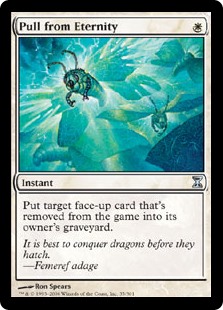
Other combo decks weren't as fortunate. I did catch a single Jeskai Ascendency deck, and one Bring to Light Scapeshift deck, but these kinds of fringe-strategy blips are common enough over the course of a month's MODO dumps that I'd hesitate to attribute them to the London Mulligan. Griselbrand-based combo decks did seem moderately viable, but not nearly as much as pundits the likes of Frank Karsten have cautioned; I spotted zero copies of Pull from Eternity, and Goryo's-Breach decks had set a precedent this month even before the London was implemented.
There was one final combo deck that resurged after the London was put into place: UR Twin. Splinter Twin is a card an extremely vocal subset of Modern players clamor for unbanning pretty much any time they're displeased with the format, including while Arclight Phoenix was bursting onto the scene (and bursting, and bursting...). Its defenders argue that by forcing opponents to interact, the deck encourages fair Magic and removes the ever-vague element of "degeneracy" from Modern. As examined above, Cheeri0s seems to be wearing that hat quite well right now. More curious still, the three Kiki-Exarch decks I found (linked below) showed up after the London was debuted. It's possible that this rule change revitalizes the archetype in a way Modern can demonstrably handle.

Looks Like Modern

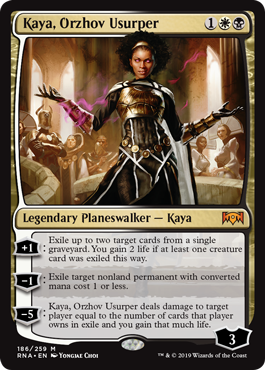
Most striking about the new data is how familiar Modern looks. A range of archetypes continue to be present, and new tech choices keep cropping up, as they always do—this month, Kaya, Orzhov Usurper has made a name for herself, popping up in BW Tokens, Whir Prison, Abzan Rock, and Esper Control, sometimes all at once! Phoenix appears on a decline as the metagame finally starts to adapt to the format boogeyman via mainboard hate cards.
Such innovation was on full display this month, as it tends to be in Modern, and as we'll observe now.

Mainboard Hate at a Premium

Existing and fringe archetypes alike are staking a claim in Modern with more mainboard hate. This month featured not one, but two Death & Taxes lists packing Jötun Grunt, as well as a Grixis Control build with a full set of Cremates in its 60. Others still went not for a splash of hate, but opted to build their decks around hosing Modern's top decks.

Esper Eldrazi, by MEHHOLE (5-0)

Creatures

4 Tidehollow Sculler
2 Spellskite
1 Wall of Omens
4 Spell Queller
4 Eldrazi Displacer
3 Wasteland Strangler
2 Deputy of Detention
4 Ulamog's Nullifier
2 Thought-Knot Seer

Artifacts

4 Aether Vial
1 Relic of Progenitus

Enchantments

2 Rest in Peace

Instants

4 Path to Exile

Lands

4 Eldrazi Temple
4 Cavern of Souls
4 Flooded Strand
2 Polluted Delta
2 Godless Shrine
2 Hallowed Fountain
1 Watery Grave
1 Moorland Haunt
1 Plains
1 Swamp
1 Island

Sideboard

1 Relic of Progenitus
1 Rest in Peace
1 Celestial Purge
1 Fatal Push
2 Lingering Souls
2 Phyrexian Revoker
4 Thoughtseize
3 Timely Reinforcements

Esper Eldrazi boasts a proactive, disruptive gameplan revolving around exiling an opponent's cards. Sculler, Queller, and Deputy all temporarily exile spells and permanents on the cheap, but processors like Wasteland Strangler and deck lynchpin Ulamog's Nullifier render that zonage permanent. A primary benefit of this synergy is the deck's desire to mainboard Rest in Peace and Relic of Progenitus, terrific cards against Phoenix, Dredge, and even the BGx Rock decks gaining steam.

Vizier Combo, by PARABOL336 (5-0)

Creatures

4 Devoted Druid
4 Vizier of Remedies
4 Thalia, Guardian of Thraben
3 Duskwatch Recruiter
4 Militia Bugler
2 Eternal Witness
1 Ezuri, Renegade Leader
1 Walking Ballista
4 Simian Spirit Guide

Instants

4 Collected Company
3 Chord of Calling

Artifacts

4 Chalice of the Void

Lands

4 Windswept Heath
2 Misty Rainforest
1 Overgrown Tomb
1 Temple Garden
4 Horizon Canopy
3 Razorverge Thicket
3 Gemstone Caverns
3 Forest
1 Plains

Sideboard

2 Assassin's Trophy
1 Kataki, War's Wage
2 Knight of Autumn
1 Kor Firewalker
2 Postmortem Lunge
2 Scavenging Ooze
1 Selfless Spirit
2 Sin Collector
2 Tireless Tracker

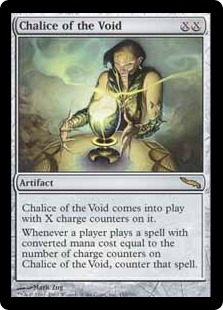
Vizier Combo, like Cheeri0s, makes great use of the London Mulligan to hastily find its combo pieces. As in Colorless Eldrazi Stompy, the deck has chosen here to maximize the buff it gets from enhanced mulligans by running Simian Spirit Guide and Chalice of the Void instead of mana dorks like Noble Hierarch, which upgrade lackluster hands with many cards. The package gives Vizier Combo a free-win dimension against Izzet Phoenix, most notably, but also Infect, Cheeri0s, and other various decks. Even some Humans decks have opted to run a set of Chalice in the main and enjoyed 5-0s.

Rakdos Stompy, by RAYSTACK (5-0)

Creatures

3 Goblin Rabblemaster
2 Master of Cruelties
1 Hazoret the Fervent
1 Phyrexian Obliterator
4 Simian Spirit Guide

Planeswalkers

3 Chandra, Torch of Defiance
2 Liliana of the Veil

Artifacts

4 Chalice of the Void
4 Ensnaring Bridge
2 Serum Powder

Enchantments

4 Blood Moon

Instants

2 Kolaghan's Command

Sorceries

3 Collective Brutality
1 Damnation
1 Dreadbore

Lands

4 Bloodstained Mire
2 Verdant Catacombs
2 Blood Crypt
2 Dragonskull Summit
2 Graven Cairns
1 Lavaclaw Reaches
7 Swamp
3 Mountain

Sideboard

1 Goblin Rabblemaster
1 Kolaghan's Command
2 Anger of the Gods
1 Damping Matrix
1 Eidolon of the Great Revel
3 Leyline of the Void
1 Nihil Spellbomb
1 Pia and Kiran Nalaar
1 Rakdos Charm
1 Ravenous Trap
1 Slaughter Games
1 Torpor Orb

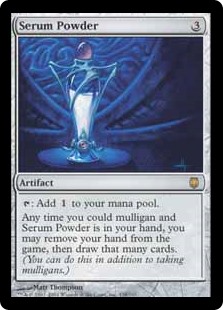
I covered Rakdos Stompy in detail last month, and am here to report that the deck is apparently not a fluke. It sustained impressive numbers for all of April, and has even evolved to include some new tech in the form of—no way—Serum Powder! Without Eternal Scourge synergies, I'm honestly not sold on Powder in the deck, but I also haven't tested this build. In any case, Rakdos seems more streamlined, now running Goblin Rabblemaster in the main for quick pressure and dropping Magus of the Moon from the mix entirely. I'm excited to see how this archetype shakes out in the near future.

Emperor Izzet's New Clothes

Izzet Phoenix's Top 8 appearances are apparently declining, if sluggishly. But no matter your take on the boogeyman's dominance, it would be tough to deny UR's recent stratification. Other Izzet decks are seeing play!

UR Suspend, by QEL33 (5-0)

Creatures

4 Greater Gargadon
2 Simian Spirit Guide

Planeswalkers

1 Chandra, Torch of Defiance
1 Jace, the Mind Sculptor

Artifacts

1 Tormod's Crypt

Enchantments

4 As Foretold

Instants

4 Opt
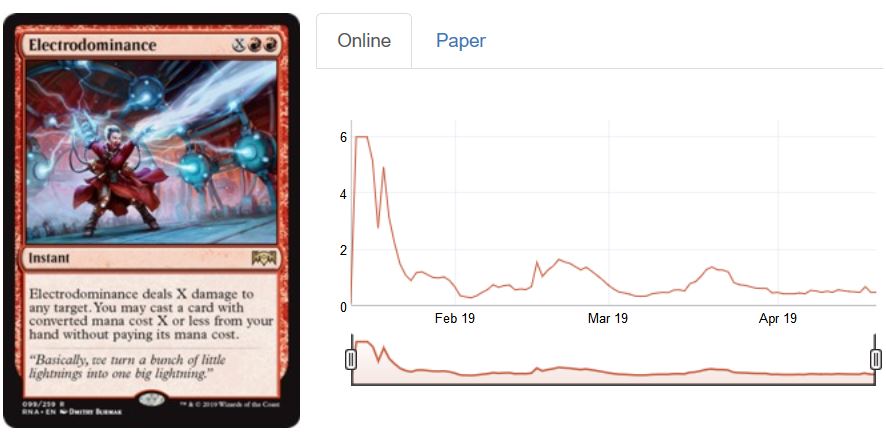
4 Electrodominance
3 Remand
2 Abrade

Sorceries

4 Ancestral Vision
4 Restore Balance
4 Serum Visions
1 Flame Slash

Lands

4 Scalding Tarn
4 Steam Vents
4 Spirebluff Canal
1 Cascade Bluffs
4 Tolaria West
2 Island
2 Mountain

Sideboard

1 Remand
1 Tormod's Crypt
2 Anger of the Gods
4 Dispel
1 Pithing Needle
4 Relic of Progenitus
1 Shattering Spree
1 Shatterstorm

UR Suspend is a deck I have some experience working on: when As Foretold was spoiled, I spent a few weeks trying out different builds, finally settling on UR and Grixis as ideal shells for casting Restore Balance, which I understood to be the best suspend spell. This list seems like a natural evolution of that one given how Modern's cardpool has grown.

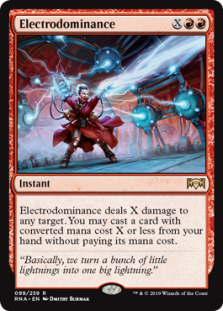
A Chandra was dropped for a Jace, which was banned at the time; Sleight was nixed for Opt, which was also not legal. But the biggest addition to the deck was Electrodominance, which allows the combo to be more consistent. This introduction informs the other swaps: Leak was traded for Remand, a superior option when the combo is more reliable; with less need for Plan Bs, Bolts, Snaps, and Moons became Abrade, Flame Slash, and Tormod's Crypt, all better interactive cards for staying alive, and more copies of Greater Gargadon.
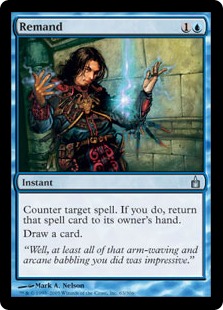
This streamlined version of UR suspend reads like a significant upgrade, but Modern's other decks have gotten more powerful, too. We'll need more data to determine if it's better than the As Foretold Living End decks, which have more of a pedigree at this point.

Remand Burn, by KO_MAK (23rd, Modern MOCS #11845695)

Creatures

4 Goblin Guide
4 Monastery Swiftspear

Sorceries

4 Sleight of Hand
4 Lava Spike
4 Rift Bolt
4 Skewer the Critics
4 Exquisite Firecraft

Instants

4 Lightning Bolt
4 Remand
4 Skullcrack

Lands

4 Scalding Tarn
3 Flooded Strand
3 Polluted Delta
4 Steam Vents
4 Ramunap Ruins
1 Island
1 Mountain

Sideboard

4 Satyr Firedancer
4 Searing Blaze
3 Torpor Orb
2 Shatterstorm
1 Blood Moon
1 Grafdigger's Cage

Remand Burn splashes blue into Burn for, you guessed it, Remand... and Sleight of Hand. Not Serum Visions, or Opt, but Sleight of Hand! Sleight offers immediate selection and gets a little deeper than Opt, but at the cost of letting down shields. In a deck splashing 4 Remand, I'm still a bit puzzled about its inclusion.
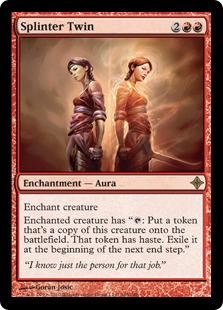
The rest of Remand Burn started to make sense as I unearthed more of the online metagame. With both clunky midrange decks and Chalice of the Void decks on the rise, this deck wants to extract a tempo advantage from the counterspell while side-stepping the hate with pricier, higher-impact damage-dealers. Rift Bolt, Skewer the Critics, and Exquisite Firecraft could all care less about the XX artifact, and closers like Wurmcoil Engine or even Tarmogoyf look much less appealing in the face of a pseudo-Time Walk.

UR Twin, by DARTHKID (1st, Modern MOCS #11845700)

Creatures

4 Deceiver Exarch
4 Snapcaster Mage
1 Pestermite
1 Vendilion Clique
2 Kiki-Jiki, Mirror Breaker

Planeswalkers

2 Jace, the Mind Sculptor

Instants

4 Lightning Bolt
4 Opt
4 Remand
4 Cryptic Command
1 Spell Snare
1 Abrade
1 Electrolyze

Sorceries

4 Serum Visions
1 Flame Slash

Lands

4 Scalding Tarn
3 Flooded Strand
3 Steam Vents
3 Sulfur Falls
1 Cascade Bluffs
1 Field of Ruin
6 Island
1 Mountain

Sideboard

1 Abrade
1 Spell Snare
2 Anger of the Gods
2 Blood Moon
1 Ceremonious Rejection
1 Disdainful Stroke
2 Dispel
1 Rending Volley
1 Shatterstorm
2 Surgical Extraction
1 Teferi, Mage of Zhalfir

And here's that UR Twin deck mentioned above. The deck looks remarkably similar to Twin in its prime, but it has adopted some newer tools: Jace, the Mind Sculptor seems important for tracking down those Kiki-Jikis; Abrade gives the deck's removal package some much-needed utility; Opt compliments Serum Visions and Twin's flash-in nature.

Besides winning the MOCS, DARTHKID also 5-0d with the deck in a dump published the same day, and another pilot did so a few days later. If Twin continues to post even lower-tier results using Kiki-Jiki, I doubt Wizards will rush to unban Splinter Twin itself for any reason.

The London Mulligan: Totally Barbaric?

I'm optimistic about the London mulligan. We know Wizards is interested in going forward with it, or they wouldn't be taking so much testing time. This weekend's Mythic Championship is the final proving ground for the rule change. I think should the tournament's results reflect the trends explored here, or deviate minimally, there's a good chance the London is implemented. That being said, London has much higher stakes than Magic Online, and the world's best will be trying their darnedest to break the mulligan. But they haven't succeeded so far. Here's hoping for another failure on their part and better openers for the rest of us!

Speculating on Modern Trends Before the Mythic Championship and Modern Horizons

Are you a Quiet Speculation member?

If not, now is a perfect time to join up! Our powerful tools, breaking-news analysis, and exclusive Discord channel will make sure you stay up to date and ahead of the curve.

Buying surrounding the London Mulligan will come to a head this weekend at the Mythic Championship II in London, which will reveal what the pros bring to battle. The results will help set the course of the Modern metagame afterward leading into Modern Horizons. This event is also likely to drive a lot of buying, especially if there are surprises.

I’ve been paying close attention to results in the past weeks, specifically on Magic Online where the new rule has been in effect since April 10th, in hopes of finding some insight into what the new rule enables and what decks we could see at the MC. It’s also a growing time for Modern and Magic in general, and with Modern Horizons coming and likely to spur more buyouts and real demand, it feels like a great time to be investing in the format.

There was an error retrieving a chart for Enter the Infinite

An example of a deck that could break out at the MC is the Narset, Enlightened Mastercombo deck. The deck hasn’t been putting up any published results to speak of since February, but I could not help but notice the price movement on Enter the Infinite, a staple of the deck. Before the London Mulligan rule was implemented on MTGO, its price was around 0.1 tickets, but it has steadily grown to over 1 ticket. A look at the paper price shows very steady and rapid movement over the past year when it was available under $2 last April, and has now broken $5. I imagine this increase has been from almost entirely non-Modern demand, so some significant increases would be due if the Narset deck breaks out. Regardless, it seems likely to keep slowly growing even if the deck doesn't perform.

There was an error retrieving a chart for Goryo's Vengeance

An extreme combo deck that has been putting up results is Grishoalbrand, which has now finished in the top 8 of multiple high-level MTGO events, and looks to be growing into a real contender with the new mulligan rule. When some of its big staples, including Goryo's Vengeance, Through the Breach, and Nourishing Shoal were reprinted in Ultimate Masters we saw spikes on some of its other staples like Griselbrand and Worldspine Wurm. For that reason, I think the best way to cash-in is to target these reprinted cards, which are currently very cheap and likely at a low. I think targeting cards in sets like Masters 25, Iconic Masters, and especially the recent Ultimate Masters make a lot of sense, and this fits right into that strategy.

There was an error retrieving a chart for Through the Breach

Cheating Griselbrandinto play is one of the most powerful things in Modern, and that plan has now appeared in a non-Grishoalbrand deck. It takes a more classic approach, using a set of Emrakul, the Aeons Torn to pair with Through the Breach, and a set of Jin-Gitaxias, Core Augur as another way to K.O. an opponent with Goryo's Vengeance.

There was an error retrieving a chart for Jin-Gitaxias, Core Augur

Jin-Gitaxias, Core Augur saw a spike online this week, and that brought my attention to the paper price, which despite an Iconic Masters reprint is over $9, a pretty solid price for a card that sees mostly casual play. It was under $8 at the new year and now approaching $10. It seems like a great buy because like Enter the Infinite its fortunes clearly are not tied to Modern and will likely slowly appreciate indefinitely until a reprint.

Tron has become the most popular Modern deck on MTGO since the London Mulligan, with Humans in second. Humans was once the top deck in Modern before losing metagame share to Spirits, and then getting further knocked down by Izzet Phoenix and Whir Prison, both tough matchups. Its fortunes are starting to turn, from a combination of things like the new rule helping it find Aether Vial, and an increase in combo decks for it to prey on. The prices of Humans staples have been in decline, and they are likely a bargain given the strong future prospects of the deck, especially given that it can incorporate any new Human printed.

There was an error retrieving a chart for Auriok Champion

The juiciest Humans target looks like Auriok Champion, which has become a true sideboard staple of the deck, often as a 2-of but up to a full playset. Humans' resurgence has spurred its price online to spike from 4 tix in February to over 22 tix now. It’s very easy to forget that Auriok Champion was once over $40, and was around $20 before Iconic Masters accelerated its decline to an all-time low of under $9 this March. Things are starting to turn around, and I expect this will get expensive again sooner than later.

There was an error retrieving a chart for Sliver Hive

I’ve taken notice of Sliver Hive, which in the past month moved from 0.1 tix to over 0.5 and growing. At the same time, its paper price has moved from around $6.50 to $9.50. Around this initial period of growth, we saw spikes in Sliver Queen and Sliver Legion, so it seems likely Sliver Hive is riding the same wave. Sliver Hive should have good prospects on the back of it being an essential Sliver Commander card, but even goes beyond with some competitive potential, whether it’s in Legacy or Modern. The presence of Slivers in a future set - which seems like a matter of when and not if - would surely send the prices of these Sliver staples higher.

There was an error retrieving a chart for Scalding Tarn

One of the best investments in Modern right now may be the Fetchlands. These cards are essentially unaffected by either the metagame or new releases, and are the prime example of an evergreen staple, a blue-chip stock. They are the exact class of cards that will rise if Modern sees growth in the player base, that could happen from the release of Modern Horizons. All of them look to be showing signs of slow and steady growth, and won’t turn around until we see another reprint.


Ravnica Allegiance Financial Power Rankings: Uncommon Edition

Are you a Quiet Speculation member?

If not, now is a perfect time to join up! Our powerful tools, breaking-news analysis, and exclusive Discord channel will make sure you stay up to date and ahead of the curve.

Welcome back. Today it's time for the Part 2 of my Financial Power Rankings series for Ravnica Allegiance. You can read about the rares here. For mythics, we'll have to wait for the redemption period to end. I expect mythic prices to decline across the board, and I'll be studying what happens to the price trajectories of Guilds of Ravnica and Ravnica Allegiance mythics so that I know what to expect from future sets.

Today's power rankings are going to be shorter than the rares. There aren't that many uncommons worth discussing, but the ones that are are ???. Let's get to it!

And remember: Treasure Chests no longer will be pumping uncommons into the market because the uncommon slot was replaced with Play Points. Investing in uncommons is among the safest and lowest-risk investment strategies one can employ.

Also remember: This next week will be a great time to invest, because folks will be selling their cards to pay for their Draft and Sealed events.

5) Single Deck Uncommons

Current Price: $0.02--$0.04
Risk: Low
Potential: Low
Chance of Success: <5%

Supply for these uncommons is lower than it was in the past, but it's not low enough for single-deck uncommons to rise beyond bulk. In theory Rhythm of the Wild serves a role as both build-around and anti-control tech out the of the sideboard, but Domri, Anarch of Bolas encroaches on that turf. I'll be surprised if any of these rise above $0.15, but it's not impossible.

Grade: D

4) Mortify

Current Price: $0.02
Risk: Low
Potential: Low
Chance of Success: 5%

Mortify is a control staple. If it wants to rise above bulk in the future, it needs to find a home in one or two other archetypes. A tall order, but not impossible. The power level is definitely here. Perhaps what it needs is for an enchantment set to come out—Return to Theros, anyone?

Grade: D+

3) Collision // Colossus

Current Price: Bulk
Risk: Low
Potential: Low
Chance of Success: 10%

Collision // Colossus is a powerful card, useful as hate against fliers and a pump spell for aggressive beatdown decks. It has already proven its worth as a sideboard staple in several archetypes. Don't be fooled into thinking this is a card for best-of-one only. I think it has a ceiling of $0.25, but as a penny stock I don't think you can go wrong here.

Grade: C-

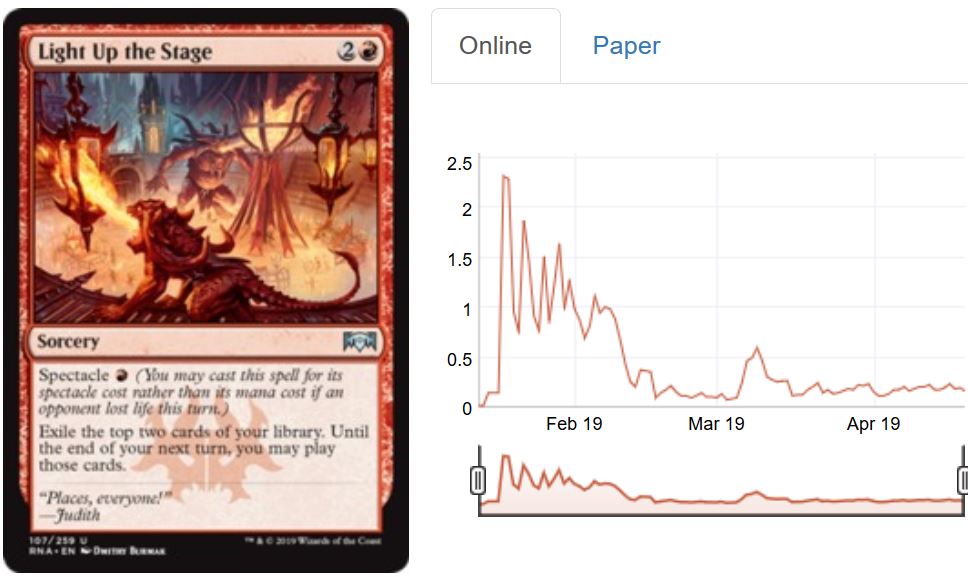
2) Light up the Stage

Current Price: $0.17
Risk: Low
Potential: High
Chance of Success: 75%

Wizards has been pushing these effects ever since their introduction in Dragons of Tarkir to fix Red's card advantage problem. After a bunch of misses, they finally hit a home run. Light up the Stage sees play in tier one strategies in Standard and Modern, and even sees play in tier two strategies in Legacy.

Demand for Light up the Stage, therefore, is sky high, and supply will gradually decrease over the coming months thanks to redemption. It's hard for me to imagine Light up the Stage not being a $0.50 to $1.00 card within the coming year. My main fear lies in the fact that it got a promo treatment in paper and could find its way into the Player Reward Program, but I'll be rolling the dice.

Grade: A-

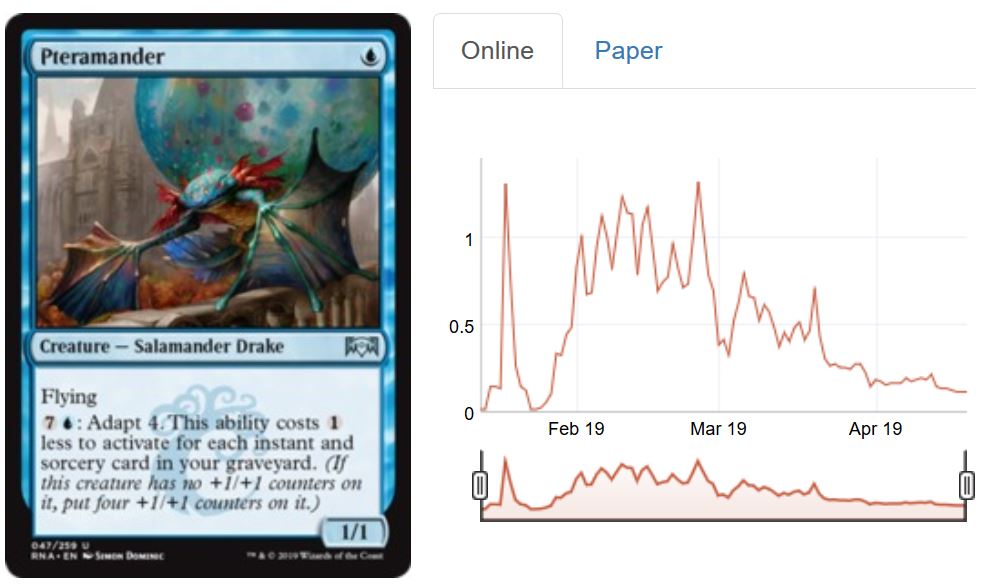
1) Pteramander

Current Price: $0.09
Risk: Low
Potential: High
Chance of Success: 75%

Like Light up the Stage, Pteramander is a powerful uncommon that's seeing play in tiered decks across all formats. In Standard it sees play in UR Drakes, Phoenix or Mono-U Tempo strategies. In Modern and Legacy it sees play in Delver variants.

Even if it merely maintains current demand, I expect it to rise to the $0.25 to $0.35 range—and if it finds its way into a tier one Modern deck it could go way up. I'm surprised Wizards printed this card, and I'm surprised it has flying prior to adapting.

Grade: A-

Signing Off

Thanks for reading, and let me know your thoughts in the comments below or on the QS Discord. Which cards from Ravnica Allegiance are you investing in? Are you ready for War of the Spark? I know I can't wait to draft this set on MTGO, and maybe for the first time in a long time I'll draft it in paper as well.

MagicFest: Niagara Falls and the Future of Tundra

Are you a Quiet Speculation member?

If not, now is a perfect time to join up! Our powerful tools, breaking-news analysis, and exclusive Discord channel will make sure you stay up to date and ahead of the curve.

The Grand Prix at MagicFest: Niagara Falls over the weekend was the first Legacy GP of the year. Daniel Goetschel (AKA Gul Dukat on MTGO) took the event down with this rock-solid UW Stoneblade list, a good showing for Tundra decks all around. The results have me taking a closer-than-usual look at the Legacy metagame, and more importantly, the pricing of select Legacy staples moving forward.

Force of Will and Wasteland

A little over a month ago, I took a similar look at market signposts for Legacy in order to get a baseline for the movement I expected to happen. As many have said before, the Legacy format is essentially held together by these two cards. When gauging Legacy demand and interest, always look to these first.

For those looking to enter the format, a playset of either one of these is almost always the first investment, as there are very few established decks that don't play at least one of the two. Legacy was in a lull period around the holiday season, but is now having a significant resurgence. At present, we're seeing these two cards hit retail highs as we've never seen.

There was an error retrieving a chart for Force of Will
There was an error retrieving a chart for Wasteland

If you take a look at the last month, there has been sharp upward movement on both of these, most likely due to players' interest in this event, SCG Syracuse last month, and Legacy in general.

Even in the face of the Reserved List, which locks down key staples such as the ABUR Duals, Lion's Eye Diamond, and City of Traitors, players are still entering the format. Options like Merfolk, Death and Taxes, and even Burn can give you an option to skirt the Reserved List. For those willing to spend a little more for some Revised Duals, Tundra decks are the easiest entry point into a fair blue strategy.

Tundra Decks

There was an error retrieving a chart for Tundra

Tundra is perhaps the unsung hero of the blue Dual Lands in Legacy. It has classically been the lowest of the four, with Underground Sea, Volcanic Island, and Tropical Island all taking a place above it in price and playability. However, I think we could see a changing of the guard if things keep going right for UW decks in Legacy. While it's highly unlikely it will every usurp U-sea at the top slot, it's already pushing higher than Trop, and has Volc in its sights.

The winning list of the event happened to be UW Stoneblade, a deck some would consider the fairest pile of cards possible to see success in Legacy—but it's been a while since Tundra decks were on top. As far as raw power goes, many would look to Grixis strategies such as the Storm Variants (ANT and TES), Grixis Delver, or Grixis Control. Combo decks like Sneak and Show or Turbo Depths have also been dominating strategies, and have been solid choices in recent years.

While Legacy's history has had a variety of strategies at the top, UW decks haven't been the top dog since the banning of Sensei's Divining Top, when Miracles commanded a staggering 14% of the metagame. The power vacuum was then filled by Deathrite Shaman strategies until its recent banning last year, when its metagame share was approaching the same percentile.

With these two power cards out of the format, the metagame has achieved a decent balance, with several strategies being equally viable any given weekend.

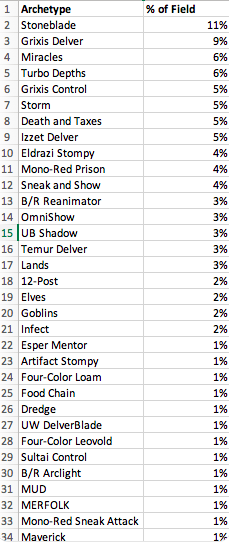
From this Day 2 metagame snapshot, you can see a pretty wide range of decks. I think Stoneblade, Miracles, and UW Delverblade's performances here are most noteworthy. In terms of overall success, fair decks are doing quite well, which some would call a sign of a healthy format. On that note, let's look at some of the cards I think will be significant winners going forward.

There was an error retrieving a chart for Council's Judgment

Council's Judgment is one of the cards that really holds these strategies together. It's the catch-all answer for nearly every problem that can't be solved by Swords to Plowshares, and demands at least a one-of in the mainboard.

The first Conspiracy set was a bit of an experiment from Wizards to create a fun, wacky draft environment outside of silver-bordered cards, and had a lower supply than that of a regular Standard set. Council's Judgment remains one of the most expensive cards in the set, and the supply of these is a lot lower than the new demand may be due to this weekend.

In addition to being core removal in UW Stoneblade, it sees regular play in Death and Taxes, another Stoneforge Mystic strategy, for much the same reason. Speaking of which...

There was an error retrieving a chart for Stoneforge Mystic

If you've read any of my work, you'd know that I have kept my eyes on this card for the better part of two years now, and these GP results only reinforce this habit. The case for its unban in Modern is strong, and could become a reality as early as this Summer with Modern Horizon's release.

While I can't say for certain that the Squire will make its debut this way, I'd rather have my copies sooner than later. At any rate, the fact that you can get a lot of use out of these in Legacy in decks like Stoneblade, Maverick, and Death and Taxes makes it feel more worthwhile than speculating on other banned cards like Splinter Twin or Birthing Pod.

There was an error retrieving a chart for Palace Jailer

Palace Jailer has the power to swing even games in your favor, especially in tandem with evasive creatures like True-Name Nemesis or Vendilion Clique. The immense value gained from resolving one of these and retaining the crown can break a board stall wide open.

I believe foils of this card are pretty much gone, but normal copies are already getting difficult to find at reasonable prices for an uncommon. Much like Council's Judgment, Palace Jailer has a Conspiracy-unique mechanic in Monarch. The obvious place for cards like this to come back are in Commander products where multiplayer mechanics are the focus, rather than a feature. Should these cards dodge reprints going forward, there's a real opportunity for growth.

There was an error retrieving a chart for Monastery Mentor

Monastery Mentor is the odd one out of the bunch here, as I don't think metagame share is currently pushing its price. War of the Spark spoiler season ended this weekend—a lot of pressure was put on this card due to the printing of Feather, the Redeemed and the relevant interactions in Commander. Mentor is often the win condition of choice in Miracles, and has the fringe strategies of Bomberman and Esper Mentor to vouch for its playability in the format.

The card's price has literally doubled in the past week, but I think a lot of this is due to hype. The card is definitely powerful, but I would expect this to settle around $15-$18 once War of the Spark is in circulation.

Foils are probably a different story. The single printing of this card in a small, under-opened set will result in a high multiplier we may have not hit the ceiling on just yet. I'll be keeping my eye on this over the next couple of weeks.

There was an error retrieving a chart for True-Name Nemesis

Probably the most unfair "fair" card, TNN rears its ugly head as one of the premier three-drops of the weekend. Even though we've got more answers than ever to stop this menace, it still proves difficult to answer with normal removal. Those answers are often at three or four mana as well, which can prove a liability, given the speed of Legacy and the prevalence of Wasteland.

TNN shines brightest when you make it difficult for your opponent to answer it. Grixis Delver does this best with a combination of Daze, Force of Will, Wasteland, and even Thoughtseize in the main.

The jury's still out on whether or not we'll get True-Name Nemesis, or any of the aforementioned cards, back in Modern Horizons, Commander 2019, or even a Standard set. If not, expect upward price movement going forward.

A Note on Coverage

Unfortunately, because this GP's coverage was subject to what some perceive as budget cuts, video coverage of the event was not available. Luckily, there was sparse social media coverage from the players in attendance (shoutouts to AnziD for holding it down), and some regular tweets from Channel Fireball to keep us updated.

This was an awesome win from a hardworking MTGO grinder dedicated to the format, and it seems odd not to have video coverage to memorialize the weekend for those looking to watch gameplay after the fact. Should this trend continue for premier Legacy events, it could be a bad sign for the format's overall visibility and lifespan.

Take this statement with a grain of salt, though, as many have heralded the end of Legacy for years for one reason or another. This will only just be the latest entry on that lengthy list.

Bring it on Home

It was a bit strange clamoring for the information from the event by constantly refreshing my Twitter feed, or combing Reddit for a possible update on the events, what decks people were seeing, and so on. As always, I'm bummed out Miracles didn't win the event, but UW Stoneblade is close enough, right? My big takeaways from outside looking in:

  • Stoneforge Mystic is still good. (But probably not too good for Modern.)
  • Palace Jailer has proven itself as a viable creature.
  • True-Name Nemesis is still the most frustrating creature in Legacy.
  • Combo strategies appear less successful than they could be.
  • Legacy isn't dead yet.

That does it for this week! You can follow me on Twitter @chroberry or Instagram @chroberrymtg if you want to see extra goodies and spoilers for next week’s article. Feel free to let me know how you feel about my targets here in the comments, or if there’s anything you think I missed!

Peace!

MTGO Market Report for Spring 2019

Are you a Quiet Speculation member?

If not, now is a perfect time to join up! Our powerful tools, breaking-news analysis, and exclusive Discord channel will make sure you stay up to date and ahead of the curve.

Welcome to the MTGO Market Report as compiled by Matthew Lewis. The report covers the fundamental speculative strategies that anyone can use to build an MTGO portfolio and harvest tix from the digital Magic economy. The three fundamental strategies involve foil mythic rares, in addition to full sets and boosters of the most recent draft format.

This time around the report will cover what changes the MTGO economy has gone through and how those changes have impacted the fundamental strategies. For an in-depth look at each of these strategies, please refer to this article. For a complete look at the transactions regarding these strategies, please check out the portfolio.

Changes to the MTGO Economy

The wide release of MTG Arena in the fall has had a substantial impact on the MTGO economy. Player participation in release leagues was down, with over 8000 participants in the fall for Guilds of Ravnica sealed deck (GRN) and less than 5000 participants in the Ravnica Allegiance sealed deck (RNA) leagues.

In the midst of this change, there was a market panic in December as the announcement regarding the future of professional Magic didn't mention MTGO, even though esports was the story they were pushing. Although that announcement triggered the panic, priming the market was the Channel Fireball article earlier that week speculating on the death of MTGO at the hands of Arena.

Market panics have come and gone in the past and this one was no different. Although the economy has not fully recovered, the buy price for tix is still below its long-term average of around $0.90. Nevertheless, stability has returned. Below I will detail the changes to the MTGO economy and their impact on the fundamental speculative strategies for foil mythic rares, full sets, and boosters.

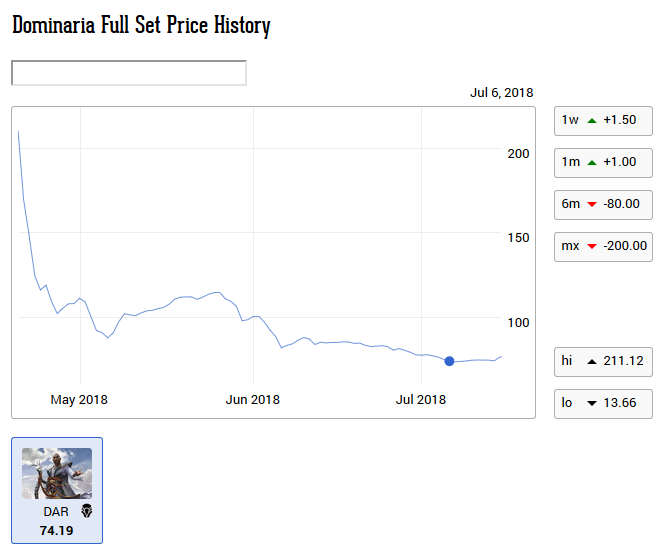
To illustrate the changes, have a look below at a chart of a full set of Dominaria (DOM) while it was being drafted (all charts are courtesy of Goatbots). The price starts out at over 200 tix but quickly drops off during release week. The overall trend is down while the set is being drafted, and the price bottom of 74 tix occurs on July 6, 2018 just as Core Set 2019 (M19) is released on MTGO.

This overall pattern is the result of a tussle between limited players injecting the market with supply on one hand, and redeemers and constructed players removing supply on the other. Based on the observed trends, the supply of cards from limited players was the dominant factor for DOM specifically, and this is true more generally of most sets in recent memory.

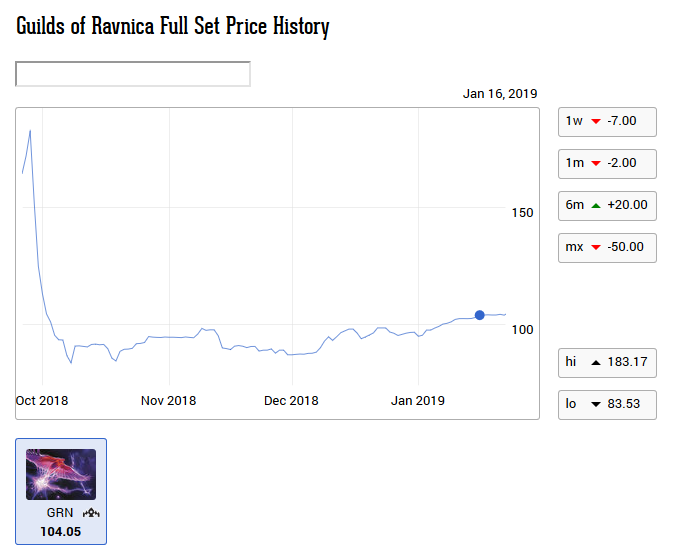
Now let's take a look at what happened with GRN. The same chart is reproduced below, that being the price of a full set of GRN while it is being drafted. Instead of the downward trend over time, we see a gradual increase. In fact, the set price of 104 tix when RNA was released on January 16, 2019 was higher than at any other point outside of its release week.

The conclusion to draw from this chart is that redemption and demand from constructed players is now the dominant factor in the MTGO economy for a set being drafted. Although the pattern for RNA gives a more mixed signal, I'm confident in the analysis, and in the conclusion that redemption is now the dominant effect. This has profound implications for speculators.

The first result is that the full set strategy will no longer work in a predictable way. The strategy relied on limited players being the dominant factor. Without that, there is no way to reliably predict when full sets will be close to their lowest price. As long as redemption is the dominant factor acting on the supply of cards, then the full set strategy must be put aside.

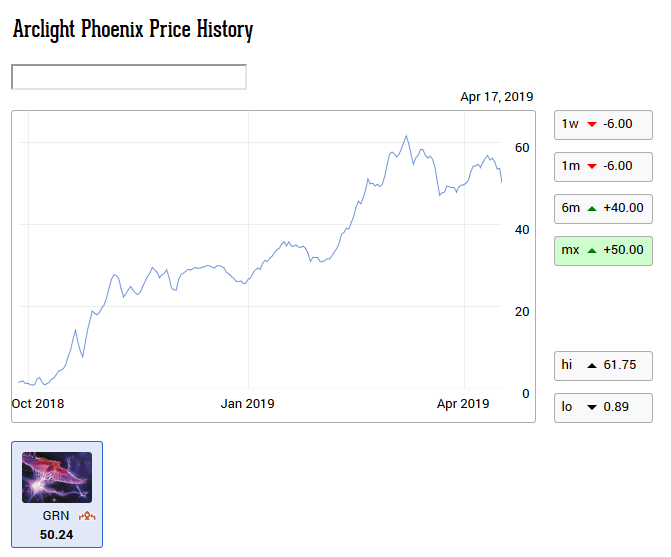
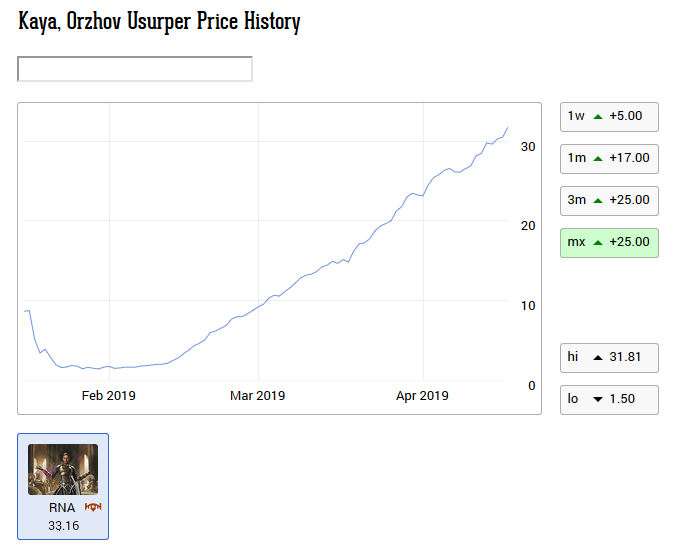
The other result is that with more stable set prices, a new area of speculation has opened up. In exactly the same way as the foil mythic rare strategy, it makes sense to pursue buying regular mythic rares as well. Have a look at the two charts for mythic rares with large price gains as a result of this dynamic. The first is Modern staple Arclight Phoenix, the second Modern playable Kaya, Orzhov Usurper.

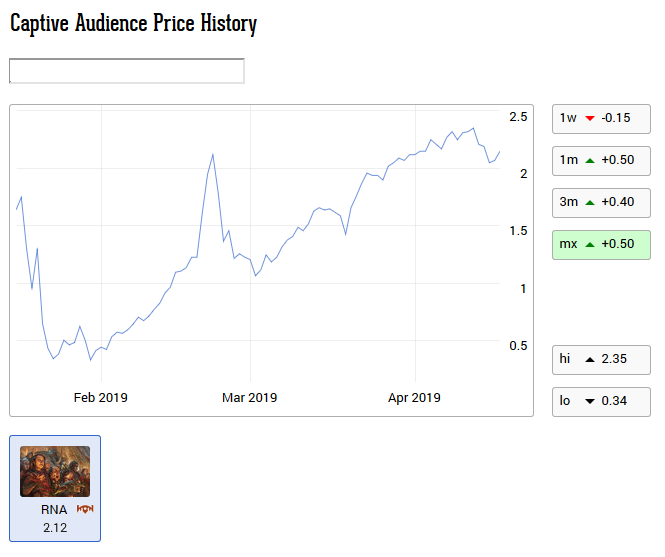
It's not just the constructed-playable mythic rares that can see big gains either. Have a look at the price chart for Captive Audience. It reached a price below 0.50 tix after RNA was released and it's basically been on a steady incline since then.

I experimented with a strategy around nonfoil mythic rares for RNA. I will detail some loose guidelines for employing this twist on the foil mythic rare strategy, but first let's revisit the original three fundamental strategies. I'll provide an update on how they have fared, with the outlook of using them for the release of War of the Spark (WAR).

Foil Mythic Rares

This strategy worked very well for GRN. Once I identified and avoided the seeded-booster mythic rares, there was lots of opportunity for picking up foil mythic rares at relatively cheap prices. The average price was around 20 tix per copy. I ultimately ended up selling at an average price of 28 tix for a gain of around 40%.

Unfortunately the market has been catching onto this trend and the prices for RNA foil mythic rares not in seeded boosters started at a much higher level. It was so high that I didn't actually pursue the strategy for that set, although I have a secondhand report from another speculator who employed the strategy. They achieved a modest return of 7%, which is a low return overall for this strategy.

If these anemic returns are the new normal, then the strategy will be still be suitable for players as a way to preserve value, but speculators will have to consider their opportunity cost of pursuing this strategy.

At this time, it looks like the seeded boosters will not be a part of WAR release leagues. This removes some uncertainty from the strategy. Supply of foil mythic rares is typically very thin in the early days of release events, so you'll have to spend some time to scour the bots for foil mythic rares if you are considering this strategy.

Full Set Strategy

As discussed earlier, the full-set strategy must be put aside as a fundamental strategy for the time being. Without being able to reliably predict a price bottom, buying full sets is a gamble that hinges on Constructed playability. If you are a master of the metagame this strategy might be for you, but I will not be pursuing it for WAR.

If the price of a set of WAR drops to 80 tix, then I would examine the differential between paper and MTGO prices to see if WAR is underpriced. Both GRN and RNA have stayed mostly in the 95-to-120 tix range, so a price of 80 tix would have enough margin of safety to get me to take a closer look. At prices higher than 80 tix, the potential returns and the risks do not favor speculation.

Booster Strategy

The booster strategy is alive and well, and GRN draft sets yielded a 26% return. The average buy price was 5.4 tix per draft set, and I was able to sell over 100 draft sets for an average price of 6.8 tix. The price peak for GRN boosters after the release of RNA was 3 tix a booster, or 9 tix per draft set, so potential profits were actually much higher.

This strategy will continue to work and I will be employing it with the release of WAR. Once the new set is released, I will look to purchase up to 200 draft sets of RNA for a price of 6 tix or less.

The key to this strategy is not to get antsy and start buying or selling too early. Definitely do not buy any RNA boosters prior to the release of WAR, and you must wait until at least June to consider selling. Prices will stay depressed until drafters start picking up cheap boosters to enter the RNA draft queues—this process can take a while to gain traction in the weeks after a new set is released.

Regular Mythic Rares

As introduced above, this strategy is similar to the foil mythic rare strategy. We rely on a relatively stable price per set, demand from redeemers, and the fact that mythic rares are the choke point for redemption. With these factors in place, buying mythic rares early in a set's release is a good speculative strategy. Unfortunately, it requires a bit more subjectivity than the other strategies, so I will try to highlight some aspects of the strategy as I understand it today.

For pure junk mythic rares, look for a price in the 0.5-to-1.0 tix range, but basically be willing to buy as much as you can of any WAR mythic rare below 0.5 tix. From RNA, these were cards like Captive Audience, Emergency Powers, and Rakdos, the Showstopper. They all eventually settled into the 1.0 to 2.0 tix range, yielding substantial profits in percentage, if not absolute, terms.

Next up will be the cards that have some appeal but are generally not considered good enough for constructed play. These will typically be in the 1.0 to 3.0 tix range.

From time to time the market will mistakenly put a Constructed-playable card into this category. This is what happened to Kaya, Orzhov Usurper, as it was priced at under 2.0 tix in the weeks after RNA's release. That is an unusual outcome—a card like Domri, Chaos Bringer is more typical, reaching a bottom of 2 tix and rising to close to 3 tix over time.

The third category contains cards that are Constructed-playable. At some point these will range in price from 3.0 tix to 5.0 tix. These are cards like Biogenic Ooze, Seraph of the Scales, and Spawn of Mayhem. Depending on how the Standard metagame unfolds, these can have quick price spikes that should be sold into. It's also possible that some of these will see lower prices over time, and could result in losses depending on the purchase price. These are worth buying but returns can be unpredictable as a result.

Lastly there's the Constructed staples that start out at prices of 10 tix or higher, like Hydroid Krasis and Prime Speaker Vannifar. Generally speaking I would avoid speculating on cards in this category, as the Standard metagame is too difficult to predict for me. Avoid buying the most expensive mythic rares and stick to the lower-priced ones if you want to employ this strategy.

Having said that, after a set has been available for a month or longer, the dynamics of the market are such that price trends on the most expensive mythic rares tend to continue. Hydroid Krasis and Kaya, Orzhov Usurper are great examples. Over time, Hydroid Krasis has been bleeding value while Kaya has been gaining value.

Demand from redeemers means that the value in mythic rares will increase over time, and player preferences are revealing that Kaya has much more in-game utility than initially thought. Don't be afraid to ride these trends out as long as they appear to be continuing.

This week I have bought about 20 copies of Kaya, with an eye to it hitting 40 tix or more in the next month. This will be the third time I have speculated on Kaya in the last three months. I was a buyer at 2 tix and a seller at 8 tix; a buyer at 21 tix and a seller at 28 tix, and now a buyer again at 31 tix.

Of course, buying early and riding the whole trend out would have been best in hindsight, so I am trying to take a lesson from this new type of trend.

The MTGO Economy and the Future of Speculation

Although the MTGO economy took a beating this winter, the bounce-back in Modern singles in the past few months has been substantial. There is still life in this old platform despite the rise of Arena. As long as players are drafting on MTGO and redemption exists, then the fundamental strategies as outlined here will yield profits.

Just remember that consistent profits can be found if you observe the big trends in the MTGO economy. Follow the fundamental strategies. Deploy tix in the weeks after a set is released, as this is when tix are worth the most.

In order to be able to deploy tix, you'll have to be a seller at some point—so be sure to sell your cards and boosters in advance of a new set's release. Sell your Modern cards during cyclical peaks, and don't be afraid to rebuy them in the fall, a typically low-demand time of year.

And if there's a market panic, get your tix ready to take advantage. It's not every day you get to buy staples like Polluted Delta for under 2 tix, but that was the card's price during the depths of the December panic.

Insider: QS Cast #119 – Invitational Success [Unlocked]

Are you a Quiet Speculation member?

If not, now is a perfect time to join up! Our powerful tools, breaking-news analysis, and exclusive Discord channel will make sure you stay up to date and ahead of the curve.


Welcome to the QS Cast 2019! Our co-hosts Chaz and Tarkan explore the financial aspect of Magic the Gathering – and in this episode they discuss the following:

  • Magic Invitational Success and it's wide effects it can have on every corner of Magic. It's tangible financial impact.
  • Standard Rotation
  • MTG Arena
  • Insider Questions - Modern

Cards to Consider


*This Podcast was Recorded on 03/28/2019 for QS Insiders. If you want live recording sessions and up to date postings before anywhere check out the QS Insider Discord!

Not-So-Quiet Speculations: Some Cards I’ve Put Money On

Are you a Quiet Speculation member?

If not, now is a perfect time to join up! Our powerful tools, breaking-news analysis, and exclusive Discord channel will make sure you stay up to date and ahead of the curve.

So my first two articles had a great amount of feedback from everyone and I honestly appreciate it.  A couple comments seemed to come up a few times, though: "What are your specs?" or something similar such as, "Show us some real numbers."

So I figured, why not? I don't think it will hurt anyone or anything too much to give you all a bit of insight to my speculation bin.  I'll do my best to explain why I have looked at each card, why I bought the amount that I did, how much I bought in at, where I purchased, and what my end goal is.  Hopefully this will provide something helpful for everyone in the finance game.  Before I start, here's a few tidbits about me and my buying/selling:

  • I typically spec in Standard, Modern, and Commander (in that order).
  • Standard specs are often meant for a quick flip anywhere from within 24 hours to about six months out.  I don't like to hold Standard much longer than that unless some information changes the game plan (i.e., banning, leak, etc).
  • With, Modern I often like to flip quickly too – it's such a crazy format sometimes that holding something for very long, unless there's a great reason (like MH1 specs), is just not worth it to me.
  • Commander cards I will often hold until I feel they have enough value to sell.  I've held Commander cards in the past for over a year.  I put them in a separate box so it's easy to forget about them and unless something crazy happens (like Feather or Teysa buyouts) I only check in on them about once a month.
  • I am a big fan of penny-stock type specs.  If I can get a card for bulk and flip it for over $1, then I'm all about it.  My income doesn't allow me to make larger purchases like investing in the Masterpiece Series or fetches.  I can purchase them, but I am not a fan of holding one or two of a card just to resell it.  I can buy two Polluted Deltas or for the same price buy six or more Smothering Tithes.
  • I'm not perfect and neither are you.  Specs don't always succeed and everyone should prepare for that.  If you can justify your reasons behind a card, then by all means go buy it... but just know that there is a chance it could fail (I still have a stack of Summoning Traps laying around, and it's slightly depressing).

Stop talking and show us your cards

Okay.

First up, we have the legendary sorcery cards!  More specifically, non-foil versions of Karn's Temporal Sundering and Yawgmoth's Vile Offering.  I don't have the liquidity to invest in foils just yet.

There was an error retrieving a chart for Karn's Temporal Sundering

As a blue player, this card caught my eye right away.  Take an extra turn? Yes please!  Sundering came on my radar right away with the Dominaria spoiler season, but I had a hunch that buying in to it during preorders was a trap.

Preordering can often be tricky, and I've been burned on it too many times.  This card hit bulk not long after Dominaria's release, and I knew it was EDH gold.  All of the legendary sorcery cards (in my opinion) are EDH gold, they just need some time to grow.  If you look at the history of "extra turn" cards, they all seem to become popular eventually.  With the recent spoiling of God-Eternal Kefnet this card jumped back on my radar and I doubled my stock.  There's actually a combo with those two cards (and a third) in the new standard, so maybe it will see play?

  • Stock: 40
  • Bought from: 30x TCGplayer, 10x LGS
  • Price: TCGPlayer $.36, LGS $.25
  • End goal: Buy-list for over $1.  If it goes over $2, I will list on TCGplayer and/or Facebook
There was an error retrieving a chart for Yawgmoth's Vile Offering

This card is the same appeal, but in a color-shifted mindset.  Black cards that return permanents are often great and have large impacts on the game, especially in Commander.  Not only is reanimation great, but a card that doesn't specify which graveyard you can take from is even better.  Add on to that the chance to grab a planeswalker and you have some spicy tech.

But we're not finished – you also get to destroy a target creature or planeswalker if you so choose, and for only five mana.  This card can find a home in so many Commander decks and has the potential to see play in the upcoming Standard meta.  With the amount of legendary cards that could see play, there's no reason you should be afraid of the legendary sorcery caveat on these cards.  I don't feel as confident in this card as I do with Sundering, but that might be because I am a blue player at heart and I love extra turns.

  • Stock: 20
  • Bought from: 25x TCGplayer, 5x LGS
  • Price: TCGplayer $.55, LGS $.25
    End goal: Buy-list for over $1. If it goes over $2, I will list on TCGplayer and/or Facebook
There was an error retrieving a chart for Ravager Wurm

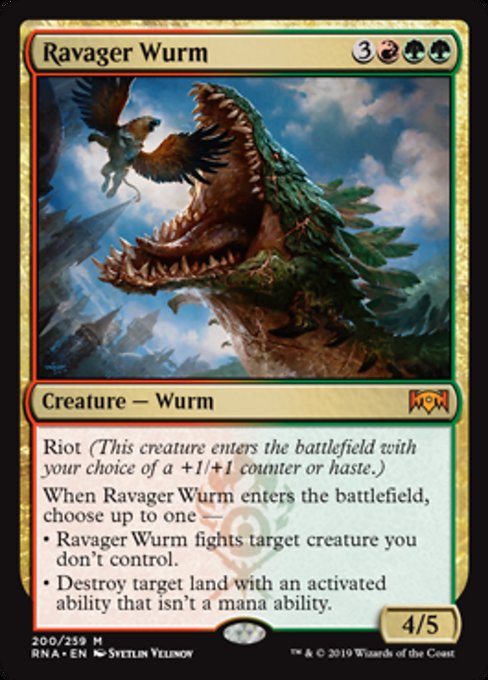
Ravager Wurm has been something that I've been watching since Allegiance spoilers.  It started pretty high during preorders and has been falling ever since.  In a standard meta that is very aggressive, this card doesn't see much play, but it has so much potential to be amazing – consider playing it alongside Rhythm of the Wild or Vivien's Arkbow.  Let's go over the checklist:

  • Mythic
  • Six or less mana means it's fairly on curve for most decks running red or green
  • 4/5 means it doesnt die to lava coil/lightning strike/etc
  • 4/5 also means it can block a lot of things
  • Riot
  • ETB trigger is relevant

Does anyone remember RG monsters?  This reminds me a bit of the giant curve of creatures that can come down fairly fast.  Not only that, but with the recent spoiling of the new Boar God Ilharg, the Raze-Boar, this card could be nuts.  It just needs the right deck to succeed.

  • Stock: 35
  • Bought from: TCGPlayer
  • Price: $.30 (and still buying under $.50)
  • End goal: My hope is that this hits $5, but if it doesn't, then I'd like to at least sell for $2
There was an error retrieving a chart for Lapse of Certainty

Lapse of Certainty is the first foil that I bought in at with the goal of investment.

Here's a secret I'll share with you... watch videos from The Command Zone right when they come out.  Not only are they pretty cool to watch, but you can keep an eye out for crazy tech.  These videos often cause spikes and buyouts, so it can be financially beneficial to be as ahead of the game as possible (there's an MTG pun in there somewhere).

Recently, a new video posted and I scrolled through it searching for something spicy before even enjoying the video.  I had no clue if this would be the card to hit, so I decided to take a risk.  Risk... it can be dangerous but sometimes rewarding.

  • Stock: 11
  • Bought from: SCG, as they were the only ones that had multiples at the price I liked.
  • Price: $.79
  • End goal: I started with 11, I'm down to nine because I sold two at $3.99 on TCG about a week ago.  Now they seem to have spiked, and the lowest on TCG as of the writing of this article is just under $10.  In all honesty, because I want the money, I'll probably post them on TCG for about $8.

Now that you know all of my secrets...

Well, not all of them.  A magician never gives away all of their secrets.  I think I'll do an update to this article in a few months, as well as give another insight to some more of my specs after War of the Spark is well into its Standard life.  I hope this helps some of you understand my frame of mind, as well as help you figure out where you want to go with your financial game.  'Til next time, folks!


Pat's Predictions

  • Alright I'll give you one more... Domri, Chaos Bringer needs a home. Gruul Warriors is seeing a lot more play and could evolve to something more in the coming months.
  • Gruul Spellbreaker is a four-of in that same deck.  Just a thought...
  • London Mulligan is happening and I don't have a whole lot of faith in it, so don't hold those Serum Powders too closely.

Ravnica Allegiance Power Rankings: Rare Edition

Are you a Quiet Speculation member?

If not, now is a perfect time to join up! Our powerful tools, breaking-news analysis, and exclusive Discord channel will make sure you stay up to date and ahead of the curve.

As promised, today I'm back to help you make sound speculation decisions on Ravnica Allegiance cards. In the past this took the form of the popular Financial Power Rankings series. I hope I can continue to do that series, but it may need some re-imagining to account for some new, emerging realities of MTGO finance.

An important difference between then and now is that mythic rares now operate on a very different financial schedule from the rest of the set. This is because mythic rares are the gateway for redeeming sets. Now that redemption is the primary driver of demand, more of their value is bound up in their potential for redemption than ever before.

I am thus squeamish about investing in mythic rares from redeemable sets—at least until we see how Ravnica Allegiance shakes out, so we can use it to predict what will happen with future sets. The same is not true for rares and uncommons. Now is a good time to invest in those since they're at peak supply.

Also remember that the standard common and uncommon slot was removed from the Treasure Chests, which means that no steady stream of Pteramanders will be flooding the market as they would have in years past.

Onto the Rankings!

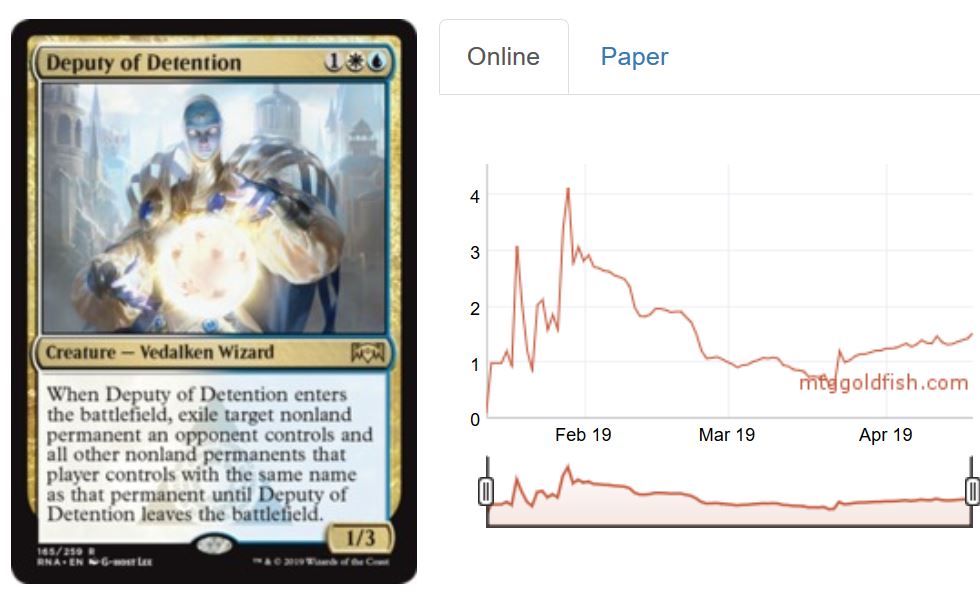
10) Deputy of Detention


Current Price: $1.54
Risk: Moderate-High
Potential: Moderate
Chance of Success: 25%

I'm much lower on this card than the market is. Right now it is the most valuable rare in Ravnica Allegiance, as it is seeing significant play in Modern and some play in Standard.

Depending on the demands of the future metagames in those formats, Deputy of Detention could become a $2.50 - $3.50 card. Its floor is being held up by Modern demand, so if Bant Spirits and Humans decide it's not worth a slot in the future, expect the card's value to plummet.

Grade: D+

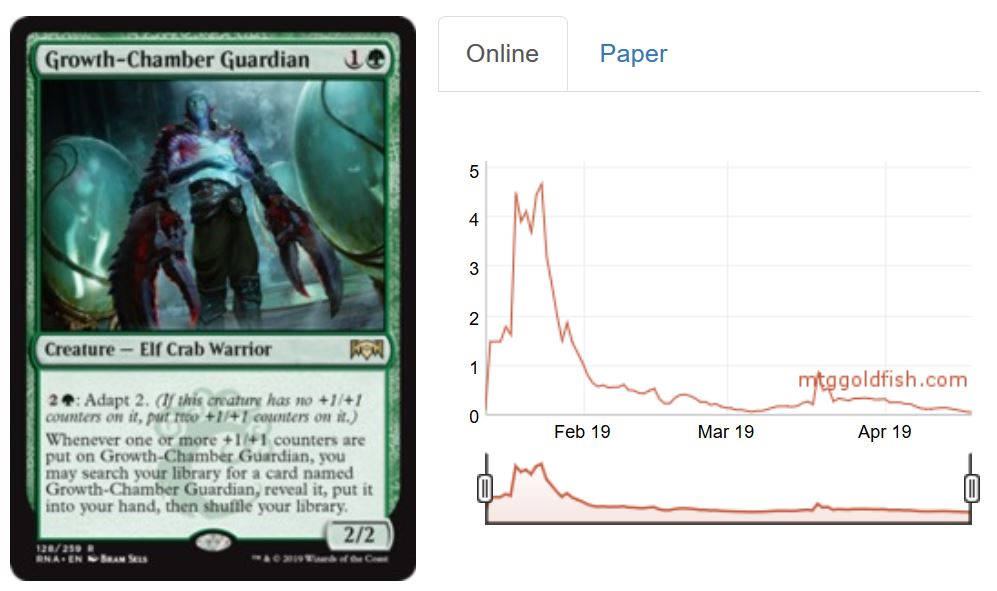
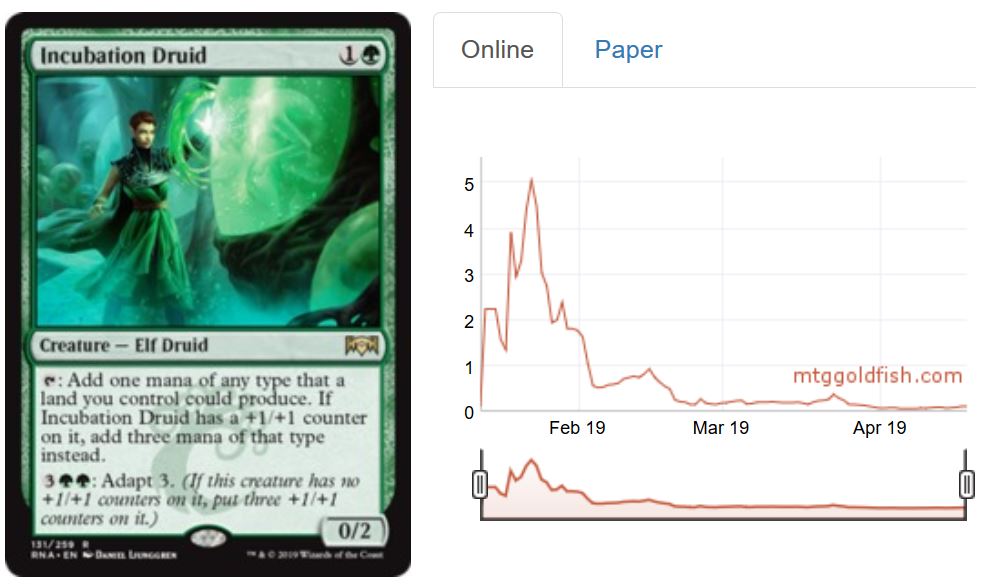
9 & 8) Growth-Chamber Guardian & Incubation Druid

Current Price: $0.10
Risk: Low
Potential: Moderate-High
Chance of Success: 5%

These green two-drops are both powerful cards. Neither, however, has managed to emerge as clearly better than their competition for the two-drop slot in a variety of decks. Merfolk Branchwalker helps support a Wildgrowth Walker explore package; Thorn Lieutenant is great against Cry of the Carnarium; Paradise Druid will join all of these green twos in a few short weeks.

Nevertheless, depending on metagames and individual card synergies, each of these could see an increase in play, and likewise see bumps in price. Neoform is interesting with both, for example. Guardian is better than the others in Gruul Aggro, and Incubation Druid could see a home in Modern at some point.

I like both at a dime, and I could see them eclipsing $0.50 should metagames shake out a certain way.

Growth-Chamber Guardian Grade: D+
Incubation Druid Grade: C-

7) Unbreakable Formation

Current Price: $0.10
Risk: Low
Potential: Low-Moderate
Chance of Success: 5%

Unbreakable Formation is a powerful card; indeed, alongside Benalish Marshal, it is a main reason why White Aggro can compete with the other tier one decks of the format.

The main reason this card is not higher on this list is that most decks only run two of them, which limits its growth potential as a speculation. I suspect we would need to see a few different white aggro decks gain traction in the meta for this card to realize real gains.

Remember when Heroic Intervention skyrocketed to $2.00, though? Pepperidge Farm remembers.

Grade: C-

 6) Electrodominance

Current Price: $0.49
Risk: Low-Moderate
Potential: Moderate
Chance of Success: 20%

Electrodominance was a card that so many were excited about, for both Standard and Modern. It has stayed above bulk thus far because it is a powerful card in a tier 2 strategy in Modern, As Foretold.

I think this card is likely not going to be good enough for Standard, but there is always an off-chance it becomes so. If Electrodominance is to double in price, more likely than not As Foretold will need to become tier 1. With Modern Horizons coming soon, who knows how Modern will be shaken up.

Grade: C-

5) Rix Maadi Reveler

Current Price: $0.06
Risk: Low
Potential: Low-Moderate
Chance of Success: 15%

Rix Maadi Reveler is one of the best cards that doesn't see play in Standard—that's because no midrange deck in the format uses Rakdos colors. What Reveler needs to be successful is for a Jund or Grixis midrange deck to become tier one, in which case it would be the premier two-drop available in this shell.

Given the love that Grixis is getting in War of the Spark, I'm optimistic about its chances to find a place in the metagame. If it does, I'd expect Reveler's price to rise between $0.25 and $0.50.

Grade: C

4) Shocklands

Current Price: $0.50-$0.90
Risk: Low
Potential: Moderate
Chance of Success: 33%

The Ravnica shocklands will be incredibly important for Standard mana bases for the next year and a half. Traditionally, important land cycles like this always go up after their sets have been drafted.

Given the large supply of these lands from previous printings plus a reduced overall digital demand, I'm not entirely confident that these lands will go up in price. The risk is low, though, and they are all quite low right now.

At minimum I'd say that you should buy your playsets now. The key to speculating on them might reside in your ability to pick unpopular color combinations that could see increased play in the future. My eyes are on Blood Crypt, as I think Mardu Aristocrats and Grixis Control could both become players in this upcoming Standard.

Grade: C

 3) Bedevil

Current Price: $0.14
Risk: Low
Potential: Low-Moderate
Chance of Success: 40%

Despite Theros flooding the market with Hero's Downfall as if straight of out Genesis 7, Hero's Downfall generally held steady between $2.00 and $4.00 during Theros-Khans Standard. Bedevil has settled slightly above bulk because Rakdos as a color combination has found no home in the Standard metagame. I expect that to change after WAR releases, and of course who knows what the Standard landscape next rotation will bring.

I'm going to buy some now, and if we get no replacement for Vraska's Contempt in the upcoming sets, I'll likely double down before rotation. Low risk modest reward. Two colors limits its potential.

Grade: C+

2) Cindervines

Current Price: $1.24
Risk: Low-Moderate
Potential: Moderate
Chance of Success: 50%

Cindervines has surprised me. It sees extensive play in Legacy and Modern, where it can punish Delver and Storm strategies in addition to its ostentatious function of hating on artifacts and enchantments. It is thus the very definition of a good sideboard card: cheap, potent, and effective against multiple styles of deck.

What's holding the card down is that it hasn't seen significant amounts of Standard play. Currently it is a mainstay in Gruul Aggro, and earlier this year some mono-green and mono-red decks were splashing specifically for this card.

Like Destructive Revelry before it, Cindervines is a premier sideboard tool that players will choose over lesser artifact and enchantment hate while its legal. I believe it's likely the card will rise modestly to $1.50 or $1.75. If Standard breaks a certain way, I could see it rise up to $2.00 or even $2.50.

Grade: C+

1) Tithe Taker

Current Price: $0.24
Risk: Low
Potential: Moderate
Chance of Success: 50%

Like Growth-Chamber Guardian and Incubation Druid, Tithe Taker is competing with a host of two-drop threats for spots in both tier-one (White Aggro) and tier two (Selesnya and Azorius Aggro) decks. Tithe Taker has, however, managed to stay above bulk the entirety of its time in the main draft set, indicating that it is a step above most other white twos and can see play in a variety of strategies.

Its main weakness is a real weakness—it gets no benefit against Cry of the Carnarium—but I think it has the chops to rise to $0.50 or $1.00 over the coming months.

Grade: C+

 Wrapping Up

Thank you for reading. There's very little daylight between #1 through #3, hence why they all share the same rating.

In a few days I'll publish my financial power rankings for the uncommons of Ravnica Allegiance. Don't worry—there will be some As and Bs there. The grades for these rares are lower than usual simply because of the increased uncertainty that MTGO has experienced since late last year.

Please leave your comments down below or in the QS Discord. Until next time, good luck and have fun in your games!

Final Check-in: Pre-London Cleanup

Are you a Quiet Speculation member?

If not, now is a perfect time to join up! Our powerful tools, breaking-news analysis, and exclusive Discord channel will make sure you stay up to date and ahead of the curve.

This is a very busy week. War of the Spark is now completely revealed, and so I have a few final cards to discuss. There have been a number of interesting cards for Modern, but we haven't seen any obvious all-stars. Of course, that may be a lot to ask for, and more role-players are always welcome. The other thing is that Mythic Championship London is this weekend. That tournament's results are critical for the future of Izzet Phoenix in Modern. However, an even more important factor will be the impact of the proposed change to the mulligan rule. While the proof is in the proverbial pudding, I've done some testing on my own, and have concerns about London.

Final Check-in

Before all that, let's take stock one last time of the metagame before the Mythic Championship. Unfortunately, there is currently no Day 2 data for GP Yokohama. I'm not sure why there wasn't one this week, though the lack of a Day 2 for GP Niagara also may indicate a policy change. Therefore, there's no way to tell if the real concern about Izzet Phoenix's Day 2 presence remains valid. There were five copies in the Top 32 and one more in the Top 8. I have noticed that non-US GPs have had fewer Phoenix lists Top 8 than the American ones, so this might not mean anything.

The Top 8 was won by Hardened Scales, which is fascinating, since it had to dodge three Dredge decks. Most Dredge decks run Ancient Grudge and Nature's Claim, so I can't imagine Grafdigger's Cage or any artifact creature surviving long. Fortunately for Scales, it did dodge Dredge and thus skated to victory. Dredge hasn't done that well in previous GPs, so I'm curious why it was so successful this weekend. The sideboard hate in the listed decks isn't really lacking, so maybe it just ran well.
In any case, the overall metagame in Yokohama appears to be consistent with what we've seen previously. This in turn means I expect to see the same decks in the same frequency this weekend in London. I do predict that if the observed trends continue through London, Wizards will be obligated to intervene.

Card Discussion: Narset's Reversal

Last week, I said that Dovin's Veto would revolutionize control decks. First, it forces changes in the mirror, because landing and riding a planeswalker to victory is far harder. Second, it stands to change combo matchups, since Pact of Negation no longer wins counter wars. The control vs. combo dynamic will have to change again, because in the intervening week, Narset's Reversal was spoiled. While its applications are very narrow, I expect Reversal to have a huge impact for combo decks.

Reversal copies an instant or sorcery, then returns the original copy to its owner's hand. As Jordan mentioned, this gives you the option to turn opposing spells on their owners. I'm a bit skeptical of this usage. The original spell will be cast again, so it's like kicking the can down the road with upside. Copying Path to Exile or Fatal Push with Reversal is like making the opponent pay an extra mana and sacrifice a creature to kill your creature. It's not bad, but not exactly a game changer. I think the real value lies in redefining counter wars.
Just like Misdirection, this can be used to counter counterspells. Reversal remains on the stack while it's resolving, and when the copy is made, Reversal is a momentarily-legal target. Upon resolution, Reversal leaves the stack, and the copy will fizzle for lack of a target. Since this doesn't actually counter the counter, it should only be used to force a game-winning spell through. A more straightforward use is to simply to use it on the instant or sorcery being countered, à la Remand. While this does only work for instants and sorceries, it will also result in fewer judge calls.

A Place for Everything

While I could definitely see control using Reversal to answer opposing Vetoes, I think that combo will be its real home. A deck like Ad Nauseam needs to resolve the namesake card no matter what. Reversal provides a way out of a counter war and can potentially defend against Thoughtseize. Pact of Negation will be better most of the time, but in a world where Veto is present, Reversal stands to be prime sideboard material.
A more intriguing use for Reversal is in Storm. In addition to the previously mentioned utility of getting around counterspells, Storm could integrate Reversal into its combo. Copies aren't cast, and therefore storm won't trigger, meaning you can't Reversal an opposing Grapeshot and win on the spot. However, targeting your own Grapeshot means it can be recast with additional Storm. This opens the possibility of forgoing Past in Flames entirely, an attractive option in a world full of graveyard hate. It does lose the synergy with Gifts Ungiven, but there may be other options. Watch Caleb Scherer closely; if this is a viable strategy, he'll know.

Card Discussion: Finale of Devastation

The next card is Finale of Devastation. The first half of the card is a better Green Sun's Zenith for an extra green. My testing indicated that Zenith's power was much higher than expected, and now there's a fixed version. I can't imagine Wizards would allow the two cards to coexist, since the fear of too much tutoring is very real. I was skeptical of an unban before, now I'm writing it off entirely.
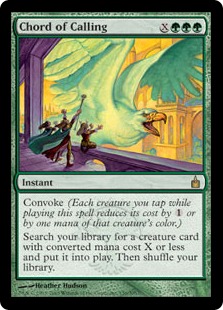
While Finale can still find Dryad Arbor to accelerate mana, it's much slower, and jumping from two to three is less dramatic than one to two. It may be a thing anyway, but it won't be as good. Therefore a lot of the appeal from Zenith is lost here. However, Finale compensates with some extra text. On the front end, Finale can find any creature, and it can also be used to reanimate creatures. The first part is very good, but I'm skeptical of the latter. Since you have to pump the creature's mana cost into Finale to cast it, it's not saving mana like Unburial Rites. Additionally, there's very little difference between searching the library or graveyard for most creatures, so the reanimation clause is mostly a nice feature.

Obvious Home

Deck that seems like it would be the best home for Finale is Elves. The deck already plays a lot of tutors and generates unreal amounts of mana with Elvish Archdruid and Heritage Druid. I noted in my Zenith test that Elves really liked the extra tutoring and while the explosive starts are great, the real power of the deck comes from tutoring a lot. I tried out Finale in the proxied Zenith test deck and while it was noticeably worse than Zenith, it's not enough to be disqualifying. I didn't use Zenith to accelerate with Arbor much anyway, so in practical terms, the only difference was a slightly more prohibitive cost. This tells me that Finale will see Modern play.

Side Benefits

As compensation for the extra mana, Finale isn't restricted to green creatures. Every creature is on the table, though take that with the whole salt shaker. Thanks to the extra green, Finale won't be played outside heavy-green decks, and so will mostly find green creatures. I'm also having a hard time coming up with other colored creatures that I want to search for.

Searching for non-green creatures puts Finale in competition with Chord of Calling. Chord is an instant, but it also costs one more green. However, convoke means it doesn't actually cost any more mana. Being an instant also opens the door for Restoration Angel tricks or Spellskite protection, which probably keeps Finale out of Kiki-Chord and similar decks.
Hatebears is another possibility, but finding small creatures is Collected Company's job. Tutoring for Thalia, Guardian of Thraben or Gaddock Teeg is very good, but Company provides so much value that it's a tough fight. The versatility is great, but the competition is very stiff. I realize that the tutoring clause isn't the only text on the card, but I'd argue it's the only relevant text.

Cool but Impractical

I've skipped over Finale's second clause so far because it is a mystery to me. I get what it's going for, but I don't see the point. I dump an incredible amount of mana into the spell, find Progenitus or something else huge and functionally unblockable, give it and whatever else is still untapped at least +10/+10, and then TIMMY SMASH! and I have a hugely satisfying win with a great story to tell my friends. If that was all Wizards wanted, I'm pleased to say they succeeded. But why should I bother?

There's no strategically sound reason to go that big in Modern. The clause only triggers if X is 10 or more, so it takes a minimum of 12 mana to happen. If I'm dumping twelve mana into a spell to find a huge creature, it should win the game anyway. Besides, I wouldn't cast Finale for 10GG or more in the first place. Tutoring for Ezuri, Renegade Leader or Craterhoof Behemoth accomplishes the same thing but cheaper and with trample.
For the other decks that could produce 12 mana in a normal game, it's not a very necessary addition. Searching up Primeval Titan and then immediately swinging for 16 sounds great, and should win the game, but it's not likely to happen. A Valakut deck with 12 mana available should have mostly won by that point anyway. Amulet struggles to get that much mana without first resolving a Titan, and already has ways to win immediately after casting the creature. Besides, Summoner's Pact is a far more efficient and versatile, especially post-board. Tron could easily hit that much mana and find Ulamog, the Ceaseless Hunger, but Ancient Stirrings does that already.

Intriguing Mulligan

Finally, it's my turn to comment on the London Mulligan. This proposed change has been met with some cautious optimism, since in theory reducing the instance of non-games improves the experience and therefore the game. My worry has been that this will backfire. Arguably, Magic only works because of the risk of non-games from bad hands forces players to moderate their deck construction. I've heard that Arena players are exploiting the hand selection system to play aggressively low land counts. If the new mulligan reduces variance as it seems to be designed to, that opens a huge risk for exploitation. The string of articles mathematically proving that it benefits specific-cards decks like Tron increased my concern.
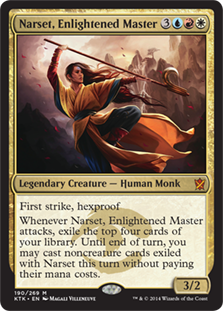
However, I didn't want to say anything until I had some actual experience with the mulligan. My experience has been very neutral, and I can see what Wizards is going for. However, other players are finding that the London Mulligan is very useful for some very worrying decks. If their personal experiences accurately reflect the metagame reality, then this could be a very big mistake. They're arguably already exploiting the new system until it breaks.

Tale from the Trenches

When the London Mulligan was announced, a Grishoalbrand player at my LGS, Black Gold, swore that if it were implemented he would grind leagues until he 5-0'd so many with turn 2 kills Wizards would have to admit their mistake. In preparation, he spent about a week trying to make a version that had a turn 1 kill work in paper, but it never came together. Then Wizards decided that one tournament wasn't enough data and initiated a trial period on MTGO. I caught up with Ken last week to ask him if he'd followed through with his threat. The answer, surprisingly, was kinda.

Ken has been grinding competitive leagues and claims to be blitzing through them and racking up the 5-0's. I can't confirm it, but I also have no reason to doubt him. However, he hasn't been using Grishoalbrand. Instead, he's been playing Narset Cannon. His reasoning was partially that it's really cool and weird and he enjoys it. The more important reason is that it abuses the London Mulligan better than Grishoalbrand thanks to its inclusion of Serum Powder. Specifically, he not only needs specific cards in hand to win but also certain ones in his library and going to London favors and rewards decks like that.
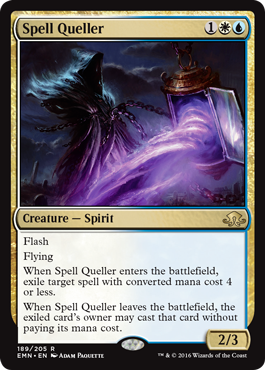
Narset Cannon wasn't actually a deck beforehand, because it's too brittle and inconsistent, but Ken says the London Mulligan changed that because now he can mulligan and sculpt until he finds a really busted hand and win on turn 2. And he has been winning on turn 2. He didn't have statistics for me, but he claimed that his turn 2 win-rate is surprisingly high. He'd seen an uptick in turn 2's while still on Grishoalbrand but not sufficient to actually stick with the deck. Admittedly, if he doesn't win on turn 2 he frequently doesn't win at all, but for him that's a small price to pay. Testimonials aren't data points, but it does support all the theory crafting's conclusions which in turn suggests validity.

Some Positives and a Warning Sign

I have not been grinding leagues and don't play that much MTGO in general. However, the experiences I have had and some testing I've done on the side raise troubling questions. As someone who primarily plays Aether Vial decks, the main change I've noticed is that I don't have to mulligan as much. The actual gameplay didn't dramatically improve for my decks, but over a two week stretch playing paper Magic with fair decks I had to mulligan past 6 in ~10% of games. During the same stretch on MTGO using the London Mulligan it happened ~5%. I also found the decision on which card to send easier than expected. I thought that there would be a lot of strategic decision making and potential to wreck myself, but in practice, it was obvious what the correct choice was every time.


However, in that same period, I also saw an uptick in glass-cannon decks. I'm used to hitting weirder-than-Grishoalbrand decks in about once every fifty matches. I've seen them roughly once every ten since the trial began. I don't know if this is just players assuming that the mulligan benefits these decks and all the talk has become a self-fulfilling prophecy, it's just me, or if this is a real thing. If the latter is the case, that is very worrying, and will probably lead to the abandonment of the new mulligan.

Judgement Week

I really hope that Ken's experience with the London Mulligan is a fluke, and it doesn't advantage Broken-Hand-Only decks as much as he claims. However, my experience can't actually refute his claim either. I'll be watching London closely next week. Hopefully, I'll be able to report that my anxieties were only that and Wizards knows what they're doing.

Identifying Specs in a Noisy Marketplace

Are you a Quiet Speculation member?

If not, now is a perfect time to join up! Our powerful tools, breaking-news analysis, and exclusive Discord channel will make sure you stay up to date and ahead of the curve.

We’re in the midst of a very exciting time for Magic, and it’s being reflected by the market. Everything from the popularity of Magic Arena, to the debut of Magic as a serious esport, to exciting releases like War of the Spark and Modern Horizons, has created a buying frenzy.

Prices have increased on a wide variety of cards, and more to come are likely. When so many cards are rising, how do you predict the next card to rise? There are endless cards to consider, nearly as much information out there to sort through, and of course plenty of opinions if you’re looking for them.

It’s impossible to know everything, but I’ve found there are some good clues available that can inform buys. Last week I encountered some clues and used them to inform some of my own specs, so today I’ll explore my process.

Foil Movement

I try to keep it simple, and one obvious thing to look for is when a foil version of a card spikes. Feather, the Redeemed has spurred a ton of Commander spikes. The foil versions of these cards tend to move first, since they are the juiciest targets for early adopters in the know.

In the case of a card like Mirrorwing Dragon, the foil spiked on April 9th, two days before the nonfoil spiked April 11. I anticipate similar movement on other spiked foils, which is why I’ve taken interest in Veilstone Amulet.

The card's foil spiked last week past $15, but the paper version is still under $1. It’s already showing signs of creeping up, and I see plenty of upside on this Future Sight rare. So far it doesn’t seem to be catching steam as a staple of the Feather, the Redeemed deck on EDHRec, and it’s not going to explode like Mirrorwing Dragon, but I don’t see much downside.

I picked up a couple dozen played copies in the $0.50-$0.75 range, and expect I’ll be able to turn them around for a couple bucks at some point this year. At worst, in that condition they are currently buylistable for $0.40 or $0.50.

There was an error retrieving a chart for Veilstone Amulet

MTGO Price Spikes

Another place to look for clues is Magic Online price movement. Its metagame moves faster than paper, so it tends to predict the future of paper. An increase in price and popularity there could precede a paper increase.

This week I couldn’t help but notice the spike of Fury of the Horde. I see two factors driving the price increase. One is that it’s part of the Narset, Enlightened Master combo deck that Magic Pro League Member Piotr "kanister" Glowgowski hyped last week, a deck that becomes better with the London Mulligan rule.

Two, it works well with Ilharg, the Raze-Boar for getting an extra attack out of whatever it puts into play, an interaction that could be used in Commander or even Modern. This puts a lot of pressure on an obscure and cheap card, and the price is already showing clear signs of increase.

There was an error retrieving a chart for Fury of the Horde

It does have a reprint that will help keep the nonfoil price in check. But if Fury of the Horde were to break out in Modern, like at the upcoming Mythic Championship, the price would likely explode. I like its prospects, so I searched online for the cheapest copies available and picked up a few dozen of the two versions under $2. Both look to be growing since, so I’m confident they’ll continue to grow and give me a good selling opportunity before long.

There was an error retrieving a chart for Commandeer

In the same cycle is Commandeer, which also spiked on MTGO last week. This might be attributed to the fact that a new style of Mono-Blue deck appeared and 5-0ed a league with three-of in the sideboard, but I believe the card has become better in general due to the London Mulligan.

The biggest winner from the change seems to be Urzatron, and players will have to take increasingly extreme measures to beat it. Commandeering a Karn Liberated is a huge blowout that Tron has little counterplay against, so I could see it rising in popularity as a way to beat the deck.

It’s a very unique card with low print run, and I think if it became any sort of real Modern staple or broke out in London the price would skyrocket. That plus its low chance for reprint and casual demand mean I like its future. I also like its relatively high buylist price. I moved in on a few playsets of near-mint copies at $7.50, with a buylist price of $5.50. It looks like it’s already nudged up and I can sell for $6.40, so things are looking good.

The London Mulligan

The most reliable way to speculate is to follow the metagame and determine the direction it is headed. The most important factor for the competitive metagame right now is the London Mulligan rule. It debuts at the Pro Tour this weekend, but it’s already live on Magic Online. It’s too early to tell the true impact of the change, but by looking at results it’s clear there are some shifts occurring.

There was an error retrieving a chart for Karn Liberated

Tron seems to be a big winner from the London mulligan rule, and the prices of its staples are increasing online accordingly. For that reason I like picking up paper versions of any Tron staples.

Another approach is to target anti-Tron cards. Fulminator Mage looks like a great target in this vein. It was once a $40 card—the Ultimate Masters version looks like a tremendous bargain at $8.

There was an error retrieving a chart for Fulminator Mage

Now is probably also a good time to pick up Alpine Moon for the long-term at its current price below $1.

There was an error retrieving a chart for Alpine Moon

Finally, there has been a steep increase in Colorless Eldrazi decks, which take advantage of Serum Powder and Gemstone Caverns. While there may be more to grow on these cards, they have already seen spikes.

For that reason a better investment might be in the Eldrazi creatures themselves. These have all been relatively cheap for a long time, and are bound to start growing eventually. Thought-Knot Seer is actually up $1 to $7 in the past six weeks, so surpassing its previous high of $9 a year ago seems likely.

There was an error retrieving a chart for Thought-Knot Seer

Modern Horizons: The Next Rising Tide

Are you a Quiet Speculation member?

If not, now is a perfect time to join up! Our powerful tools, breaking-news analysis, and exclusive Discord channel will make sure you stay up to date and ahead of the curve.

Back in December I wrote a provocative piece on the market cap of Magic. The premise was simple: much like calculating the market capitalization of a company, one could estimate the summed product of cards printed and their secondary value on the market.

With print-run data unavailable after the first couple years of Magic, this calculation is impossible to do with any precision. However focusing on the first few sets alone led to staggering conclusions regarding Magic’s market cap.

Well, I have some news for everybody: the market cap of Magic is about to climb yet again. The tide is likely to rise, lifting all ships as we’ve seen numerous times in the past.

What is the catalyst that will drive the increase? How am I so confident? It all comes down to one thing: Modern Horizons.

Past Modern Reprint Sets

In the past, Modern reprint sets (i.e. Modern Masters, Modern Masters 2015, Modern Masters 2017) have failed to make the format more affordable. Sure, the third reprint of Tarmogoyf finally kept the creature’s price under $100. Cards that were expensive primarily due to their initial print-run and lack of reprints rather than their ubiquity in Modern also dropped notably in price.

There was an error retrieving a chart for Linvala, Keeper of Silence

But the argument could be made that these Modern reprint sets actually drove card prices higher across the board.

First of all, you have the aptly named “Tarmogoyf effect.” That is, if a player interested in Modern opens a Tarmogoyf, they may be more inclined to go out and buy three more to play in Modern rather than sell their opened copy. Instead of increasing market supply, the net effect is a decrease. This may have happened with the original Modern Masters set, but I think the effect has diminished since then.

More likely, what’s happening is that cards that dodge reprint in these reprint sets are spiking, replacing reprinted cards to become the most expensive cards in Modern. Once upon a time Tarmogoyf was the most expensive card in Modern. Liliana of the Veil probably had a turn in that spot. Even Horizon Canopy was in the top three at one point before it was reprinted.

There was an error retrieving a chart for Horizon Canopy

Now that these cards have all seen reprinting, different cards take the top spot. Even though it doesn’t show up as one of the most played Modern cards, I’d argue that Jace, the Mind Sculptor is one of the most expensive cards in Modern. This card has been reprinted multiple times already, yet it still sells for over $100. We’ll see if the Mythic Edition printing of Jace has any impact on his price.

Perhaps if it drops enough, we’ll see Scalding Tarn take over the top spot—it is also flirting with $100 and there’s no reprint in sight. Liliana of the Veil has also been creeping higher, and is probably in the top five.

Lastly, Modern reprint sets shine a spotlight on Modern. This alone may catalyze interest in the format, driving up prices. Wizards of the Coast can reprint cards until they’re blue in the face—they will never be able to keep up with the evolving metagame and fluctuations in demand that lead to the expensive decks that make up this format.

By printing Modern Masters sets, they are only increasing supply of a fixed group of cards, while at the same time increasing demand of all Modern cards. The result: a growing market cap for Magic.

Modern Horizons: The Perfect Storm

If we were to write a simple table, we can quickly summarize how Modern reprint sets impact Modern prices. It would look something like this:

Let’s shift gears now and focus on Modern Horizons, a set with some reprints and some new cards with one key characteristic in common—no card is currently Modern-legal today.

What is this going to do to Modern card prices? Well, if we refer back to the table above we see that two of the three items above will hold true. Modern Horizons will likely cause some non-reprinted cards to jump in price. This happens any time there’s pent-up demand for cards as buyers await spoilers before purchasing any at-risk cards. Modern interest will definitely increase—the entire format is going to get turned on its head with so many new, Modern-legal cards being introduced at once.

However, if we go to the “Price Decrease Factors” column I’m not so sure this line item applies. There will be reprinted cards, and those cards will drop in price. But there won’t be any Modern-legal reprints. That means there will be no sudden increase in supply of any Modern card currently in the format.

So you have two catalysts for higher Modern prices and a muted catalyst for lower Modern prices. I suppose some of these new Modern cards will find their way into tier 1 decks in Modern, and those cards may be a little cheaper at first. But in all, I predict Modern prices will rise across the board as a result of Modern Horizons.

The Rising Tide

Currently Scalding Tarns are around $90 a piece. A playset will run you $360. A heavily played Volcanic Island will cost you around $300. It is conceivable that some players may see their Modern collection grow in price and use that leverage to acquire Reserved List staples. They may make their first foray into Legacy or upgrade their Commander decks.

The key here is that Scalding Tarn will one day be reprinted. It’s almost a guarantee. Volcanic Island will never be reprinted—also a guarantee.

There was an error retrieving a chart for Scalding Tarn

So if you’re in the game for the long haul, which would you rather own? Personally, I’d rather own the sure thing and sit on the Volcanic Island.

Now imagine what may happen when Modern Horizons launches. Scalding Tarns are already quite pricey—I’m not sure what upside remains. But other fetches can certainly climb near that $100 mark. Imagine Verdant Catacombs hits $100 each. A set of those could then be traded for two heavily played Bayous.

As Modern card prices rise, they become valuable trading tools into the upper echelon of this hobby. What speculator wouldn’t be tempted to ship a bunch of Modern cards that were $20 a few years ago into something that will inevitably climb toward $500 over time? It’s a no-brainer.

Such transactions will increase the demand for Dual Lands and other Reserved List staples. This will especially be the case for Commander staples, as that format is as strong as ever.

Next thing you know, a set of Volcanic Islands will be tradable for a heavily played Mox Sapphire. Now you have the next wave of trades being made as value funnels upward. Power will be the last tier to rise, and it will do so without the notice of the average player. But rest assured that the 1% of Magic speculators will see their wallets grow fattest with this rise in tide.

This is what I suspect will happen over the course of 2019 once Modern Horizons is launched.

Wrapping It Up

So what’s the play here? Honestly, you can’t go wrong no matter which avenue you pursue. You could stick to buying Modern staples that will likely remain relevant once the metagame is disrupted—I like fetch lands most for this, but Snapcaster Mage and Cryptic Command are also prime targets.

There was an error retrieving a chart for Snapcaster Mage

Or you could preemptively pick up a couple of Dual Lands, Mox Diamonds, and Gaea's Cradles in anticipation of the rising tide. Then when players are itching to trade up, you can make profit by trading down for a small premium and liquidating the Modern cards you get in return, netting a nice profit.

Or you could go all the way to the top and pick up that Mox Ruby or Library of Alexandria you’ve been wanting (or whatever high-end card you’re after).

It’s only a matter of time before those take another leg higher in price. I predict that six months from now we’ll look back and wish we had picked these up when they were “cheaper.” It’s the same thing we say every time these price increases happen, and 2019 will likely be no different.

All thanks to the printing of Modern Horizons.

…

Sigbits

  • Card Kingdom’s hot list is riddled with Masterpieces and foils, just like it has been for the past couple of months. They’re offering $305 for foil Eternal Masters Force of Will and $245 for Masterpiece Mana Crypt, for example. The premium printings of these in-demand cards remain robust, and will likely climb alongside Reserved List staples as the tide rises.
  • Card Kingdom also has non-foil Eternal Masters Force of Will on their hot list with a $95 buy price. This is an impressive number for a card reprinted not too long ago. What is driving the price of this card, I wonder? Is Legacy demand that robust, or is it mostly Commander and Cube players who want a copy of this card for their decks?
  • There aren’t as many older cards on Card Kingdom’s hot list these days. After last year's hype cycle, prices on these have really settled down (thankfully so). But I see In the Eye of Chaos recently popped onto their hot list with an $85 buy price. Rasputin Dreamweaver is also on there with a $70 buy price.

Want Prices?

Browse thousands of prices with the first and most comprehensive MTG Finance tool around.


Trader Tools lists both buylist and retail prices for every MTG card, going back a decade.

Quiet Speculation