
menu

Insider: Legacy Metagame Report

Are you a Quiet Speculation member?

If not, now is a perfect time to join up! Our powerful tools, breaking-news analysis, and exclusive Discord channel will make sure you stay up to date and ahead of the curve.

Next Friday at noon begins the StarCityGames Invitational in Somerset, NJ, bringing Legacy back into the spotlight.

I am qualified and I'd like to improve upon my weak Legacy finish at the last Invitational in Columbus. Prior to that event, I studied all the online Legacy content I could find. I will do the same for this event, but I haven't found any recent Legacy metagame pieces, so I have taken the opportunity to write one myself. I have looked at Magic Online data from mtggoldfish.com along with info from SCG and other events found on mtgtop8.com

UWx Miracles

Miracles holds the biggest market share of winning Magic Online decklists at over 13% of the metagame. With around an 11% share of the paper metagame, it's also very well represented in live events. Miracles was quite successful at the last SCG Invitational and it won last weekend's Legacy Open in Syracuse, and there were three copies in thee Top 8 in Dallas the weekend before, also taking home 1st place.

This deck is the true control deck of the format, and it's largely reactive. It has very versatile and powerful answers that match up well against the format, but by its controlling nature it must be carefully built and metagamed. The deck is surprisingly flexible and there' s often a surprising amount of decklist variation between players.

On the other hand, this deck uses a common core of cards: Counterbalance and Sensei's Divining Top as a proactive combo that helps it to assert control of the game, and a means to kill the opponent, whether it be aggressively with Vendilion Clique or Entreat the Angels or incidentally with Jace, the Mind Sculptor.

Here's the decklist that won the SCG Syracuse Legacy Open:

Miracles

Maindeck

4 Scalding Tarn
4 Flooded Strand
4 Island
3 Tundra
2 Plains
2 Volcanic Island
1 Karakas
1 Arid Mesa
3 Snapcaster Mage
4 Swords to Plowshares
4 Terminus
4 Brainstorm
4 Force of Will
4 Ponder
2 Counterspell
2 Entreat the Angels
1 Council's Judgment
1 Spell Snare
4 Sensei's Divining Top
3 Counterbalance
3 Jace, the Mind Sculptor

Sideboard

1 Council's Judgment
1 Wear // Tear
2 Red Elemental Blast
1 Pyroblast
2 Flusterstorm
2 Rest in Peace
2 Stoneforge Mystic
1 Pithing Needle
1 Batterskull
2 Vendilion Clique

Shardless BUG

Shardless BUG is the second most popular winning Legacy deck online at around 8% of the metagame. This to Legacy as Jund is to Modern: it operates on an attrition plan, is full of card advantage that powers of large removal suite, and has suffocating a board presence with creatures like Tarmogoyf.

It's often considered a foil to Miracles, which falls prey to card advantage and disruption like Liliana of the Veil, as well as Delver decks, which is weak against creature removal and lacks its own card advantage engines.

Shardless BUG is decidedly fair compared to other decks and it can fall prey to combo decks like Sneak and Show. With a properly built maindeck and sideboard, such as the inclusion of Thoughtseize or Hymn to Tourach, it seeks to prevent unfair opponents from doing unfair things, reducing them to a pile of loose cogs.

Here's a decklist from top SCG grinder Andrew Tenjum, who recently reached Top 8 in Syracuse:

Shardless BUG

Maindeck

4 Verdant Catacombs
4 Polluted Delta
3 Underground Sea
2 Tropical Island
2 Misty Rainforest
2 Wasteland
2 Bayou
2 Creeping Tar Pit
1 Swamp
4 Shardless Agent
4 Baleful Strix
4 Deathrite Shaman
4 Tarmogoyf
4 Ancestral Vision
4 Brainstorm
4 Abrupt Decay
3 Force of Will
2 Thoughtseize
2 Hymn to Tourach
2 Liliana of the Veil
1 Jace, the Mind Sculptor

Sideboard

1 Force of Will
1 Thoughtseize
1 Hymn to Tourach
2 Toxic Deluge
2 Grafdigger's Cage
2 Nihil Spellbomb
2 Pithing Needle
2 Spell Pierce
2 Dark Confidant

BUG Delver

There was an error retrieving a chart for Delver of Secrets

Delver of Secrets comes in many flavors, all of which are relevant and important parts of the metagame online and in paper.

BUG Delver makes up around 6% of the online metagame. It's arguable that BUG Delver has been the most successful Delver deck in SCG events in 2014.

Pairing Delver of Secrets with Abrupt Decay gives it huge game against Miracles and their oppressive Counterbalance, along with a versatile answer to most of the format's relevant threats.

These decks tend to eschew Stifle, but some do play it, including a version that reached Top 8 in Syracuse. The deck typically plays discard like Hymn to Tourach, which generates card advantage and specifically puts incredible pressure on Miracles and combo decks like Sneak and Show.

The decklist I recommend is the one Tannon Grace used to Top 16 SCG Dallas, based off of Rich Shay's expert design:

BUG Delver

Maindeck

4 Underground Sea
4 Wasteland
4 Scalding Tarn
3 Misty Rainforest
2 Verdant Catacombs
2 Bayou
1 Tropical Island
4 Tarmogoyf
4 Delver of Secrets
4 Deathrite Shaman
4 Abrupt Decay
4 Ponder
4 Hymn to Tourach
4 Force of Will
4 Daze
4 Brainstorm
1 Spell Pierce
2 Liliana of the Veil
1 Jace, the Mind Sculptor

Sideboard

2 Spell Pierce
2 Golgari Charm
2 Submerge
1 Dismember
1 Disfigure
1 Null Rod
2 Grafdigger's Cage
2 Vendilion Clique
1 Life from the Loam
1 Thoughtseize

RUG Delver

The longest running Delver deck is RUG Delver, formerly known as Canadian Threshold. It's a constant contender that regularly appears in the Top 8 of major events, and rivals the success of BUG Delver but has much more consistency in its construction. It makes up over 5% of the winning Magic Online metagame, and, by mtgtop8.com metrics, makes up around 8% of the paper Legacy metagame.

This is effectively an aggressive Fish deck that seeks to stick a threat and disrupt the opponent until they are dead. This deck seems to always use Stifle. This kills a bit quicker than the other Delver decks with Nimble Mongoose and has plenty of reach with a small burn suite highlighted by Lightning Bolt.

Here's a list that made Top 8 in SCG KC last month in the hands of grinder Matt Hoey, updated for his Top 16 in Syracuse:

RUG Delver

Maindeck

4 Wasteland
3 Volcanic Island
3 Tropical Island
3 Scalding Tarn
3 Polluted Delta
1 Flooded Strand
1 Wooded Foothills
4 Delver of Secrets
4 Nimble Mongoose
4 Tarmogoyf
4 Ponder
4 Stifle
4 Lightning Bolt
4 Force of Will
4 Daze
4 Brainstorm
3 Spell Pierce
2 Gitaxian Probe
1 Forked Bolt

Sideboard

4 Submerge
3 Pyroblast
2 Flusterstorm
2 Grim Lavamancer
2 Grafdigger's Cage
2 Rough // Tumble

UWR Delver

While currently making up less than 3% of the online metagame, UWR Delver has made major impact in the paper world. This version of Delver has been a metagame staple since last year. Owen Turtenwald won a GP with the deck, which increased its popularity, but he has since moved off the deck after poor finishes, citing creative differences.

Others still champion the deck. Ben Friedman took the deck to the Top 8 of the last SCG Invitational, and last weekend in Syracuse it made Top 8 in the hands of Jared Boettcher and Dan Jordan, the current rookie of the year and a long-time grinder with plenty of PT experience--two players to always look for at the top of the standings, alongside Theodore Jung.

The key card here is Stoneforge Mystic, and it plays some True-Name Nemesis to present a potent clock and carry equipment.

With both Lightning Bolt and Swords to Plowshares, this deck is great against creature opponents. Opinions are split on Stifle and it's not historically popular in the deck. But as the archetype evolves, it has been gaining more popularity, so it may be a staple in the future.

Here's the list Jared Boettcher played last weekend, with Stifle:

UWR Delver w/Stifle

Maindeck

4 Wasteland
4 Tundra
3 Volcanic Island
3 Polluted Delta
2 Misty Rainforest
2 Arid Mesa
1 Flooded Strand
4 Delver of Secrets
4 Stoneforge Mystic
2 True-Name Nemesis
4 Ponder
4 Lightning Bolt
4 Force of Will
4 Daze
4 Brainstorm
3 Stifle
3 Spell Pierce
3 Swords to Plowshares
1 Umezawa's Jitte
1 Batterskull

Sideboard

1 Swords to Plowshares
1 Wear // Tear
1 Red Elemental Blast
1 Pyroblast
2 Flusterstorm
2 Rest in Peace
3 Meddling Mage
2 Grim Lavamancer
1 Sword of Feast and Famine
1 Vendilion Clique

Here's the list of Dan Jordan:

UWR Delver w/ Gitaxian Probe

Maindeck

4 Wasteland
4 Tundra
3 Volcanic Island
2 Flooded Strand
2 Misty Rainforest
2 Polluted Delta
2 Scalding Tarn
4 Delver of Secrets
4 Stoneforge Mystic
2 True-Name Nemesis
4 Ponder
4 Lightning Bolt
4 Force of Will
4 Daze
4 Brainstorm
3 Gitaxian Probe
3 Swords to Plowshares
3 Spell Pierce
1 Batterskull
1 Umezawa's Jitte

Sideboard

1 Swords to Plowshares
1 Red Elemental Blast
1 Pyroblast
2 Flusterstorm
2 Rest in Peace
4 Meddling Mage
2 Grim Lavamancer
1 Sword of Feast and Famine
1 Wear // Tear

Esper Stoneblade/Deathblade

While it has largely fallen from grace, Esper Stoneblade/Deathblade is still a relevant Legacy archetype. It makes up around 3.5% of the winning online metagame and it reached Top 8 of the SCG Open in Dallas.

This deck sits somewhere between Shardless BUG and Delver decks in style, making it a very rock solid deck, but it's neither as fast and aggressive as Delver nor as capable of playing the long game as Shardless BUG. On the other hand, it's stronger against combo than Shardless BUG, and it's more resilient to removal than Delver decks.

Here's the list that reached Top 8 in Dallas:

Esper Stoneblade

Maindeck

4 Marsh Flats
3 Polluted Delta
3 Tundra
2 Underground Sea
2 Island
2 Flooded Strand
2 Creeping Tar Pit
1 Karakas
1 Plains
1 Swamp
1 Scrubland
4 Stoneforge Mystic
2 True-Name Nemesis
1 Vendilion Clique
1 Snapcaster Mage
1 Baleful Strix
4 Force of Will
4 Brainstorm
4 Swords to Plowshares
2 Inquisition of Kozilek
2 Ponder
2 Spell Pierce
2 Thoughtseize
1 Supreme Verdict
1 Council's Judgment
1 Counterspell
3 Jace, the Mind Sculptor
1 Umezawa's Jitte
1 Batterskull
1 Liliana of the Veil

Sideboard

1 Spell Pierce
1 Zealous Persecution
1 Venser, Shaper Savant
1 Enlightened Tutor
2 Rest in Peace
1 Surgical Extraction
2 Flusterstorm
1 Engineered Explosives
1 Pithing Needle
2 Meddling Mage
1 Engineered Plague
1 Duress

Some versions use Deathrite Shaman to speed up the deck and make it more powerful at the expense of the manabase. Here's a list SCG grinder Justin Uppal recently used online:

Deathblade

Maindeck

4 Polluted Delta
4 Underground Sea
4 Flooded Strand
3 Wasteland
3 Tundra
2 Marsh Flats
1 Scrubland
1 Tropical Island
1 Karakas
4 True-Name Nemesis
4 Deathrite Shaman
4 Stoneforge Mystic
1 Vendilion Clique
4 Thoughtseize
4 Brainstorm
4 Swords to Plowshares
3 Force of Will
2 Spell Pierce
1 Ponder
2 Jace, the Mind Sculptor
2 Liliana of the Veil
1 Umezawa's Jitte
1 Batterskull

Sideboard

1 Force of Will
1 Spell Pierce
1 Vendilion Clique
2 Pithing Needle
1 Inquisition of Kozilek
2 Rest in Peace
1 Seal of Cleansing
1 Supreme Verdict
2 Zealous Persecution
3 Meddling Mage

Death and Taxes

This archetype is never extremely popular, but it's always a contender. It's a prison deck that hates on combo like Sneak and Show but has tools to beat decks like Miracles and Delver.Here's the list that won the SCG Open in KC:

Death and Taxes

Maindeck

10 Plains
4 Wasteland
4 Rishadan Port
3 Karakas
1 Horizon Canopy
1 Eiganjo Castle
4 Phyrexian Revoker
4 Thalia, Guardian of Thraben
4 Stoneforge Mystic
4 Mother of Runes
3 Flickerwisp
3 Serra Avenger
2 Aven Mindcensor
1 Brimaz, King of Oreskos
1 Spirit of the Labyrinth
4 Swords to Plowshares
4 Aether Vial
1 Umezawa's Jitte
1 Batterskull
1 Sword of Fire and Ice

Sideboard

1 Ethersworn Canonist
1 Manriki-Gusari
1 Grafdigger's Cage
1 Meekstone
2 Cataclysm
2 Enlightened Tutor
2 Oblivion Ring
1 Moat
2 Rest in Peace
2 Wilt-Leaf Liege

Beyond those archetypes, the Legacy metagame picture starts to fall apart, with most of the metagame share being composed of various unfair combo decks of varying construction:

ElvesCombo a.k.a. Elfball

Elves Combo makes up a tremendous amount of the winning Magic Online metagame at nearly 8%, and comes in as the third most popular deck. This is not an extreme portion of the metagame, but it's certainly worth taking stock off. In paper, this deck makes up around 6% of the winning field according to mtgtop8.com metrics.

Elves did extremely well in major paper events prior to the last SCG Invitational, but shifts in the metagame, including the rise of bad matchup Miracles, left it poorly positioned in the metagame. How Elves fairs in the future will hinge on how prepared the field is and how many players bring the deck to action.

This deck operates as a degenerate combo deck around Glimpse of Nature, but it's capable of playing a fair game as a rush creature deck. Green Sun's Zenith provides amazing utility, while Natural Order gives it a powerful endgame and potential Plan B combo with Progenitus.

Notably, this deck had a major addition from M15, Reclamation Sage, which is an out to Counterbalance ans improves the Miracles matchup.

Here's a list from the Top 16 of Syracuse:

Elfball

Maindeck

3 Gaea's Cradle
3 Misty Rainforest
2 Windswept Heath
2 Bayou
2 Forest
2 Dryad Arbor
2 Verdant Catacombs
2 Wooded Foothills
1 Tropical Island
4 Wirewood Symbiote
4 Deathrite Shaman
4 Elvish Visionary
4 Quirion Ranger
3 Nettle Sentinel
3 Heritage Druid
2 Craterhoof Behemoth
1 Birchlore Rangers
1 Scavenging Ooze
1 Reclamation Sage
1 Llanowar Elves
4 Glimpse of Nature
4 Green Sun's Zenith
3 Natural Order
2 Gitaxian Probe

Sideboard

1 Natural Order
3 Cabal Therapy
1 Progenitus
2 Swan Song
3 Abrupt Decay
1 Sylvan Library
1 Pithing Needle
1 Null Rod
2 Thoughtseize

Dredge

Dredge is the winningest degenerate deck online, making up 5% of the winning metagame, and it reached Top 8 of the SCG Dallas Legacy Open. This deck is minimally interactive but can consistently execute its gameplan to go over the top of opponents. It lives and dies by the opposing sideboard, floundering against dedicated hate but flourishing when unopposed. Here's a decklist from Dallas:

Dredge

Maindeck

4 Gemstone Mine
4 Mana Confluence
4 Cephalid Coliseum
4 Stinkweed Imp
4 Narcomoeba
4 Ichorid
4 Golgari Grave-Troll
3 Golgari Thug
2 Putrid Imp
1 Elesh Norn, Grand Cenobite
1 Flame-Kin Zealot
4 Breakthrough
4 Cabal Therapy
4 Faithless Looting
4 Careful Study
1 Dread Return
4 Lion's Eye Diamond
4 Bridge from Below

Sideboard

1 Putrid Imp
4 Lotus Petal
1 Ashen Rider
2 Abrupt Decay
2 Chain of Vapor
3 Firestorm
2 City of Brass

Storm

Various Storm decks, such as Ad Nauseam Tendrils (ANT) and The Epic Storm (TES), make up around 4.5% and 3% of the online metagame. Taken together they make Storm strategies the most popular combo decks.

ANT is a more stable deck with a more solid manabase and a ton of card selection, while TES plays Burning Wish and is faster and more explosive but more vulnerable to disruption.

ANT Storm reached the Top 8 of the Dallas Open and won the Prague Eternal 2014 tournament last month and is what I'd both recommend and expect to play against at live events. Here's the list from Dallas:

ANT Storm

Maindeck

4 Scalding Tarn
4 Polluted Delta
2 Gemstone Mine
2 Underground Sea
1 Island
1 Swamp
1 Volcanic Island
4 Dark Ritual
4 Preordain
4 Ponder
4 Infernal Tutor
4 Gitaxian Probe
4 Duress
4 Cabal Ritual
4 Brainstorm
2 Cabal Therapy
1 Tendrils of Agony
1 Past in Flames
1 Ad Nauseam
4 Lotus Petal
4 Lion's Eye Diamond

Sideboard

2 Cabal Therapy
3 Chain of Vapor
1 Empty the Warrens
3 Abrupt Decay
2 Xantid Swarm
1 Karakas
1 Tropical Island
2 Massacre

Sneak and Show

Once the bogey man, over the past year the entire format has shifted around this deck to the point that it may no longer even be a part of the top tier. It makes up around 5% of the mtgtop8.com paper metagame, and under half a percentage of the Magic Online metagame.

The format certainly knows how to beat it, but Sneak and Show is still hugely powerful and will easily rise back to the top if players become lax and start cutting their hate, which will start to happen as the deck falls from mind.

This deck uses namesake cards Sneak Attack or Show and Tell to cheat into play Emrakul, the Aeons Torn or Griselbrand and overpower the opponent.

Here's a list that made Top 16 in Dallas:

Sneak and Show

Maindeck

4 Scalding Tarn
3 Ancient Tomb
3 Volcanic Island
3 Misty Rainforest
3 Island
2 City of Traitors
1 Mountain
4 Emrakul, the Aeons Torn
4 Griselbrand
4 Brainstorm
4 Show and Tell
4 Ponder
4 Spell Pierce
4 Force of Will
3 Gitaxian Probe
4 Lotus Petal
4 Sneak Attack
2 Jace, the Mind Sculptor

Sideboard

1 Shattering Spree
3 Pyroclasm
3 Through the Breach
2 Swan Song
1 Echoing Truth
3 Blood Moon
1 Grafdigger's Cage
1 Boseiju, Who Shelters All

Burn

Burn exists in Legacy as something like a 6-card combo deck: it is largely uninteractive and seeks to throw damage at the opponent until they are dead, which usually takes around 6 cards. Legacy burn spells are powerful and many deal 4 or more damage, and creatures like Goblin Guide may deal more than their fair share.

This archetype has been reinvigorated and re-popularized with the printing of Eidolon of the Great Revel.

Here's the list that reached Top 8 at SCG Syracuse:

Burn

Maindeck

20 Mountain
4 Goblin Guide
4 Eidolon of the Great Revel
4 Rift Bolt
4 Fireblast
4 Lightning Bolt
4 Price of Progress
4 Lava Spike
4 Chain Lightning
3 Flame Rift
3 Searing Blaze
2 Sulfuric Vortex

Sideboard

1 Sulfuric Vortex
2 Ensnaring Bridge
2 Relic of Progenitus
2 Vexing Shusher
2 Mindbreak Trap
2 Pyroblast
2 Red Elemental Blast
2 Smash to Smithereens

Wrap-Up

These dozen archetypes make up the lion's share of the Legacy metagame and paint an accurate picture of what to expect at the top tables of any competitive event. Please share in the comments any thoughts, ideas, opinions, decklists, or anything else related to Legacy.

-Adam
The Future of Nissa, Worldwaker

Are you a Quiet Speculation member?

If not, now is a perfect time to join up! Our powerful tools, breaking-news analysis, and exclusive Discord channel will make sure you stay up to date and ahead of the curve.

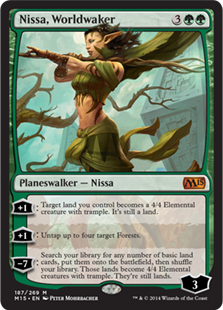
On a request, I wrote a piece this week on the future of NIssa, Worldwaker. She's the most expensive card in Magic 2015 at $35 and it hasn't shown any weakness recently. So what's the future hold?

Image.ashx.jpeg

The spike came out of nowhere. Nissa was trotting along at $15-20, right where we expected her to be, and the net thing you knew she was $30+. And there she's stood since...

You can read the full post here.

Avatar photo

Corbin Hosler

Corbin Hosler is a journalist living in Norman, Oklahoma (also known as the hotbed of Magic). He started playing in Shadowmoor and chased the Pro Tour dream for a few years, culminating in a Star City Games Legacy Open finals appearance in 2011 before deciding to turn to trading and speculation full-time. He writes weekly at QuietSpeculation.com and biweekly for LegitMTG. He also cohosts Brainstorm Brewery, the only financial podcast on the net. He can best be reached @Chosler88 on Twitter.

View More By Corbin Hosler

Posted in Feature, Finance, Free2 Comments on The Future of Nissa, Worldwaker

Have you joined the Quiet Speculation Discord?

If you haven't, you're leaving value on the table! Join our community of experts, enthusiasts, entertainers, and educators and enjoy exclusive podcasts, questions asked and answered, trades, sales, and everything else Discord has to offer.

Want to create content with Quiet Speculation?

All you need to succeed is a passion for Magic: The Gathering, and the ability to write coherently. Share your knowledge of MTG and how you leverage it to win games, get value from your cards – or even turn a profit.

In The Conjurer’s Closet

Are you a Quiet Speculation member?

If not, now is a perfect time to join up! Our powerful tools, breaking-news analysis, and exclusive Discord channel will make sure you stay up to date and ahead of the curve.

Magic is a welcoming community for the most part. With few exceptions, Magic players are socially tolerant and inclusive and it's very easy to be a part of the community. You don't even have to be particularly skilled at Magic to make an impact on the community, which is handy, because it's allowed me to have a career. Yes, this community is truly great.

However, we can live in Magic Christmasland all the time. Eventually the GP ends and we have to go home and back to our lives. What do you tell your family and coworkers about what you do all weekend? This was the subject of a great discussion on reddit this week.

I've always wondered what people think of magic players especially relatives. I'm in my early twenties and my family think it's a bit strange that I play "kids card games" I've tried explaining to them that average age of my play group is early twenties to mid and they still insist it's a kids card game. They've now stopped bothering me about it and just come to accept that I love playing magic and sometimes ask me how I got on in tournaments which is alright. so I was wondering
Tl;dr What does your family think of you playing magic?

The responses range from "my mother wouldn't let me play because she thinks the game is satanic" to "they mostly laugh at me" and everything in between.

What about you? How do you break the news to your friends and family? What do you tell them about your hobbies and what do they say?

Full discussion here

Avatar photo

Jason Alt

Jason Alt is a value trader and writer. He is Quiet Speculation's self-appointed web content archivist and co-captain of the interdepartmental dodgeball team. He enjoys craft microbrews and doing things ironically. You may have seen him at magic events; he wears black t-shirts and has a beard and a backpack so he's pretty easy to spot. You can hear him as co-host on the Brainstorm Brewery podcast or catch his articles on Gatheringmagic.com. He is also the Community Manager at BrainstormBrewery.com and writes the odd article there, too. Follow him on Twitter @JasonEAlt unless you don't like having your mind blown.

View More By Jason Alt

Posted in Free9 Comments on In The Conjurer’s Closet

Have you joined the Quiet Speculation Discord?

If you haven't, you're leaving value on the table! Join our community of experts, enthusiasts, entertainers, and educators and enjoy exclusive podcasts, questions asked and answered, trades, sales, and everything else Discord has to offer.

Want to create content with Quiet Speculation?

All you need to succeed is a passion for Magic: The Gathering, and the ability to write coherently. Share your knowledge of MTG and how you leverage it to win games, get value from your cards – or even turn a profit.

Retro Magic TV Ads

Are you a Quiet Speculation member?

If not, now is a perfect time to join up! Our powerful tools, breaking-news analysis, and exclusive Discord channel will make sure you stay up to date and ahead of the curve.

Did you know that Magic used to advertise on TV? It's true! Check it out:

Listening to that background music, we're clearly in the '90s. Maybe Beck played Magic?

Maybe not Beck, but the game did have some celebrity spokespeople back in the day:

What did Kenny say?

There were a few lighthearted but kind of disturbing ones that took a more traditional view of the term "Research & Development":

"Beat your friends," indeed.

Obviously, these old ads are dated and kind of corny. But what I like about them is that they are attempting to evoke the feeling of this game being awesome to play:

Magic doesn't advertise on TV anymore (that I know of), instead using its promotional videos during pro tours and grands prix. We've lost the whimsical ads of the past, and instead get story-related promos that take themselves far too seriously. Who do these type of ads attract, anyway? Why does everything have to be epic?

Of course, the story-related ads have come a long way themselves. This Ice Age promotional video is truly something special:

If that doesn't make you want to play Magic, what will?

Avatar photo

Danny Brown

Danny is a Cube enthusiast and the former Director of Content for Quiet Speculation.

View More By Danny Brown

Posted in Free, Video3 Comments on Retro Magic TV Ads

Have you joined the Quiet Speculation Discord?

If you haven't, you're leaving value on the table! Join our community of experts, enthusiasts, entertainers, and educators and enjoy exclusive podcasts, questions asked and answered, trades, sales, and everything else Discord has to offer.

Want to create content with Quiet Speculation?

All you need to succeed is a passion for Magic: The Gathering, and the ability to write coherently. Share your knowledge of MTG and how you leverage it to win games, get value from your cards – or even turn a profit.

First World Magic Cup Qualifiers in

Are you a Quiet Speculation member?

If not, now is a perfect time to join up! Our powerful tools, breaking-news analysis, and exclusive Discord channel will make sure you stay up to date and ahead of the curve.

I know the World Magic Cup is something a lot of us don't even think about, given how far away from it we are. In Oklahoma, for instance, it's basically impossible to play in one, so it kind of flies under everyone's radars.

That is, until the actual event begins. Then, it's just awesome. A cool spectacle of the world's best from every country imaginable.

We've got to get there somehow.

Isaac Sears, America's first winner.

It's not like he won a slouch of a tournament, either. Three of the world's top 25 players were there, and yet he battled through the entire field with a somewhat surprising deck: Rabble Red.

The little red deck that could took on all comers, and earned Issac his spot at the game's biggest tournament as a result.

There are more opportunities to qualify, and you can find the full details here.

Avatar photo

Corbin Hosler

Corbin Hosler is a journalist living in Norman, Oklahoma (also known as the hotbed of Magic). He started playing in Shadowmoor and chased the Pro Tour dream for a few years, culminating in a Star City Games Legacy Open finals appearance in 2011 before deciding to turn to trading and speculation full-time. He writes weekly at QuietSpeculation.com and biweekly for LegitMTG. He also cohosts Brainstorm Brewery, the only financial podcast on the net. He can best be reached @Chosler88 on Twitter.

View More By Corbin Hosler

Posted in Feature, Free2 Comments on First World Magic Cup Qualifiers in

Have you joined the Quiet Speculation Discord?

If you haven't, you're leaving value on the table! Join our community of experts, enthusiasts, entertainers, and educators and enjoy exclusive podcasts, questions asked and answered, trades, sales, and everything else Discord has to offer.

Want to create content with Quiet Speculation?

All you need to succeed is a passion for Magic: The Gathering, and the ability to write coherently. Share your knowledge of MTG and how you leverage it to win games, get value from your cards – or even turn a profit.

Insider: Khans Rotation Pickups (Part 1)

Are you a Quiet Speculation member?

If not, now is a perfect time to join up! Our powerful tools, breaking-news analysis, and exclusive Discord channel will make sure you stay up to date and ahead of the curve.

I’ve been trying to wait until the time is right to really dive into this stuff, but it’s time. In fact, it’s already begun. Xenagos, the Reveler doubled up last week from $7 to $15, showing that people already have an eye to rotation.

Luckily, Xenagos was an easy one to see coming. As I wrote two weeks ago, while breaking down the results of Pro Tour Magic 2015: “Specifically, I like Xenagos at $7, where it has bottomed out. This was also a huge player at the Block Pro Tour, and could easily see the ‘Jace spike’ to $15-20 next season.” Some other writers picked up on it last week, and suddenly you had the makings of a spike, which occurred really somewhat quietly.

I expect Xenagos to hold $15 (float somewhere between $10 and $20) for the next year. It’s a fine time to sell if you’d like, but I could also see this touching $20. Either way, you should be in the black on this if you got in when the time was right, and selling at least some now is an advisable move.

Now it’s time to turn our sights onto other prospects, and I want to break this mini-series down into two parts to run this week and next. In the first today I want to look at the rotating cards from Return to Ravnica block that are worth picking up at depressed rotation prices. We’ve seen in the past few years that a lot of the Eternal-playable cards re-spike around January, and that leaves you several months to get in at lower prices.

I’ll look at RTR block today and move on next week to the best targets from Theros block for post-rotation gains. I’ve touched on these fairly regularly in the past few months but there’s always value in updating the calls into a master list with all the latest information.

So let’s begin.

Return to Ravnica

Supreme Verdict

The best Wrath of God variant ever printed, and one that recently hit an all-time price low. Pretty soon this thing will be available at $1-2, and that sounds crazy for something that will surely be $4-5 in a few years.

Shocklands

These should be obvious, but of course they need some disclaimers. We’re seeing some weakness in the price, but I still think there’s a zero percent chance they fall to $5. I don’t think we’re going to see these go below $6-7, and I want them all at that price. We’ll never see the growth we saw with fetchlands, but these will easily be back to $10-12 in two years, which is an extremely predictable double-up with the possibility of more.

Chromatic Lantern

I have a pretty large position in this card, acquired mostly at $1-$1.50 in cash or $2 in trade from earlier in the year, and this thing is a sure bet to hit $5 within 18 months if left unchecked.

Unfortunately, it’s also probably a sure bet to be reprinted in some sort of ancillary product. It has a generic name and great Commander effect. But foils are 6x the regular price, so that scares me off a bit there too. Your position in this depends entirely on your risk tolerance, and while foils offer more stability, the opportunity cost is also much higher.

Planeswalkers from All the Sets

Obvious casual appeal is obvious. You guys got this, though I’ll note I like Vraska more than most since her price is currently depressed from a Duel Deck and she really does do some solid work in Commander.

Abrupt Decay & Deathrite Shaman

Grouping these together because of how often they are seen together. While Decay is on a predictable climb upward past $12, Shaman is actually on the way down. That makes me like Shaman at $7 more going forward. This is actually a great case study in how much Modern affects prices in comparison to Legacy, and I expect these two to be pretty illustrative in that regard moving forward.

Cyclonic Rift

Falling, and foils are sitting at $10. This is basically a must-play in every blue Commander deck there is, and I absolutely love this going forward. It’s so powerful/unfun for some, I don’t see it being a shoo-in for reprinting, and the foils at $10 are pretty appealing. But I’m also going in for some regular copies at the $1-2 they’ll be in two months.

Rest in Peace

This is the go-to graveyard hate spell of choice for many decks, not to mention being a combo piece with Helm. Available for under a buck. Easy acquire-and-hold here.

Gatecrash

Aurelia, the Warleader

$4 here? I’ll take that all day. See Gisela, Blade of Goldnight for a preview of this card’s future. Gisela powered along at $5 for a time before spike to $14 and holding $11. $3-4 Aurelias sound great.

Consuming Aberration

I actually like the prospects on this a lot more than some of the cards from Gatecrash that are currently more expensive. This card is available under $2 and is the mill player’s dream. I’ve also seen it be huge at a Commander table, and Lord of Extinction is a $12 card. This was a promo but will still push to $5 in a few years. Mind Grind fits in here as well.

The Rest

Other cheap pickups from the set I like long-term are Thespian's Stage and Crypt Ghast. Lord of the Void has seen some growth for whatever reason, and may continue some upward momentum.

Dragon’s Maze

Remember all that talk about how much this set sucked? Well, it still does. Sealed boxes of this yield an EV of just $56 using TCGMid prices; that’s just embarrassing. Still, let’s see what we can come up with.

Voice of Resurgence

The real question is how far this drops. I don’t doubt its Eternal playability for years to come, but I’m not sure where the buy-in will turn out to be. Look for a floor around November-December and reassess then.

Progenitor Mimic

It’s a mythic with a sweet Commander effect. I guess that’s the best we’re going to do in this set.

Savageborn Hydra

A mythic hydra? It’s no Primordial Hydra, but there’s no reason it won’t move up from the $1-2 mark it’ll be after rotation.

Breaking // Entering

Here’s a card I think we can be sure about, though it hasn’t really moved at all in the past year and there is a promo copy out there. Solid upside but nothing incredible.

The Rest

Say what you will about Dragon’s Maze; it has some cards that have some real breakout potential. Beck // Call could be broken any time in Modern if the meta shifts. Vorel of the Hull Clade was in an intro deck but isn’t a joke in Commander. Notion Thief is right on the edge. They are, for the most part, nothing to look at, but at one point Dark Depths wasn’t either. As little as this set was opened we could see something hit big one day.

Honestly I’m not a fan of most of these except for maybe Beck, which I do stash away. The rest I’m not a fan of, but I want to remind you that Dragon’s Maze was barely touched thanks to Modern Masters, and if there’s anything you think could be a breakout, the conditions are right for a big spike if things align.

The Primordial cycle with Sylvan Primordial and Diluvian Primordial are still worth stashing away I guess, but we’ve seen no movement at all despite how absurd they are in Commander. The only one to do anything pricewise was the green one, and it’s now banned. Hoarding foil copies of these seems like a prudent move, but I think if we were going to see the non-foils go anywhere they’d be more than a quarter right now.

Magic 2014

Mutavault

Another card that is an obvious pickup as soon as it bottoms out. A lot of its price is tied to Standard right now, and watching to see where it falls after that time is over is going to be interesting.

Scavenging Ooze

It’s not the powerhouse it once was, but Scooze is still super powerful in both Modern and Legacy. The price just continues to drop, and it’s really looking like it will be available at $2-3 in a few months. That seems insane and I’ll definitely be looking for these.

Rise of the Dark Realms

$3.50 for regular copies and $8 for a foil Commander powerhouse. One of those seems out of whack, and my guess is it’s the foil price. Big fan of both of these as a long-term pickup right now.

Sanguine Bond

I know they’ve done their best to print it into oblivion, but we can now get Bonds for under a dollar. For a card that was $10 just 18 months ago, it seems like a good time to stock up.

The Rest

Scourge of Valkas is probably the most random card on this list, but we’ve seen a solid track record of these powerful mythic, Core Set dragons go to $3-5, and this one is available under a buck. Door of Destinies and Darksteel Forge are pretty safe long-term holds, and Primeval Bounty is unlikely to go much lower. I don’t love the $4 buy-in on Bounty and I’m not big on buying into this, but it seems like it has enough appeal to slowly appreciate, so hold onto any you have.


So there you have it. My Return to Ravnica Block manifesto for the next six months. We have the full gamut here, from the safe casual pickups to the heavy hitters in Modern to the penny stocks worth taking a chance on. It’s a long list, as you’d expect, but figuring out which of these you most want to invest in and formulating a strategy around that is just as important as figuring out what you want to stock up on for Standard next season.

Good luck.


Thanks for reading,

Corbin Hosler

@Chosler88 on Twitter

Insider: Top 10 Underplayed Cards in Modern

Are you a Quiet Speculation member?

If not, now is a perfect time to join up! Our powerful tools, breaking-news analysis, and exclusive Discord channel will make sure you stay up to date and ahead of the curve.

Modern is a huge format. Since October 2, 2003, Wizards of the Coast has been making set after set, and these 8,451 cards are nearly all legal for play in this format. That’s 11 years of Magic the Gathering legal in one format.

Luckily Wizards has done a great job managing the format’s banned list so that the metagme is about as diverse as possible. No matter what type of deck you enjoy playing, there is something for everyone in Modern--and that’s just the explored archetypes.

This summer I’ve thought a great deal about Modern because it is the PTQ format. To be more accurate, it’s the last PTQ format. Because our organized play is changing significantly, subconsciously there is more pressure for results. Thus, I’ve spent much of my time working on the format. Last week, I discussed an innovation in the format that is significant but not metagame altering. Junk Aristocrats, or Melira-Crats as I dubbed it, is just one example of exploring the depth of the format.

Through my work in the format I’ve noted some cards that are underplayed or not played at all. Today I want to share these ideas and set the hive mind to work processing the information. Modern PTQ season may be at an end, but Modern is a great format and it’s not going anywhere. So, without further ado, I present, the Top 10 cards you aren’t playing in Modern.

10. Path to Exile

[cardimage cardname='Path to Exile']

Now you may be saying, everyone knows that Path to Exile is second only to Swords to Plowshares in power level and everyone knows its potential. Those things may very well be true, but knowing a card is good doesn’t make everyone play it.

My basis for Path to Exile's inclusion stems from a conversation my friends and I were having about the format. The end of that conversation was that Path to Exile disrupted the theoretical strategy too much, but my friend replied, “what decks even play Path?”

I stopped and thought for a moment. Sure UWR plays it and G/W Hate Bears usually does too, but most of the major decks would never play this premium removal spell. I’ve played this catch-all removal spell in both Melira and Kiki Pod, but that’s not typical.

My point is that Path is obviously amazing. No one doubts how good it is like when it was first released. So, when you have white mana, make sure you are including this great spell.

On the note of Path to Exile, have you noticed what happened to its price after the Modern Event Deck hit the shelves? That’s right, not much. Even after seven printings, this Shards block uncommon is holding strong at $4. Players know it’s a staple even if it isn’t seeing as much play as it should and the price reflects it.

9. Voice of Resurgence

[cardimage cardname='Voice of Resurgence']

Here’s another card that does see some play in Modern but not nearly enough. My time playing Melira-Crats the past few weeks showed off the true power of Voice. Being able to sacrifice it and get an elemental token at your convenience is extremely powerful, but even without a consistent sacrifice outlet, Voice is a strong card that forces your opponent to change their game plan to playing on their own turn. It’s a hate bear of sorts and more decks could use a two-drop of this caliber.

Financially, Voice has a little bit more to dip in price but I would soon start trying to pick up a couple copies to hold onto for some long-term growth. It’s even better in eternal formats than in Standard so its long-term potential is certain. You may need to wait it out a bit to see a return though.

8. Ajani Goldmane

[cardimage cardname='Ajani Goldmane']

As one of the original planeswalkers, Ajani Goldmane is in a unique camp of cards that are balanced but generally a higher power level than we expect these days. If you don’t believe me, cast it one time in Modern and you’ll be convinced.

Every time I’ve cast this card, I won the game. I know that most players consider this guy to be just another casual powerhouse that you secretly drool at in trade binders. You want to trade for it because dealers buy it much higher than you think they should, but you don’t want to let the person you’re trading with know how much you really want it.

Back on topic, Ajani Goldmane is the real deal in Modern, especially in combination with the resurgent Lingering Souls. You don’t need to be churning out tokens for this lion to power out a victory though; just Gavony Townshipping your team plus vigilance is enough to put you in the drivers’ seat in most games.

This planeswalker should start seeing more play, even if it’s in the sideboard of Melira Pod. If you have white creatures and they want to attack, this version of Ajani can help you out.

7. Prophetic Flamespeaker

[cardimage cardname='Prophetic Flamespeaker']

Next up on the list is my favorite card in Journey into Nyx, Prophetic Flamespeaker. While he may be hard to play in Standard, in Modern and Legacy, where there are better cards at lower converted mana costs, Flamespeaker lights up the room.

There is no other card drawing engine remotely close to this guy in red and there are a number of homes for him to jump right into. I’m excited to try him out in decks like Burn and Jund, but I’m sure there are many other places he’d fit well. What about a more aggressive UWR deck for instance? This guy is good and he should definitely be top-eighting events. What the best deck for him in your opinion?

6. Leyline of the Void

[cardimage cardname='Leyline of the Void']

There are so many top tier cards in Modern that rely on the graveyard. Lingering Souls, Tarmogoyf, Past in Flames, Living End, Kitchen Finks and Snapcaster Mage barely scratch the surface of cards and strategies that rely on the graveyard to win games.

So where are all the Leyline of the Voids and Relic of Progenitus’s? What about Nihil Spellbomb even? More decks should come prepared with cards like this in their sideboard. No matter what deck you’re playing, there’s room for a little graveyard disruption.

5. Phyrexian Revoker

[cardimage cardname='Phyrexian Revoker']

Linvala, Keeper of Silence is one of the best cards to tutor for in Birthing Pod decks. She is a staple and shuts down a huge number of strategies all on her own. Phyrexian Revoker is a colorless example of this effect that any deck can play. I could see Pod playing both of these cards because Chord of Calling is much easier to pull off with an x of two than four. Even Suppression Field could see play in the right metagame because this effect is so potent.

This little 2/1 for two is one of the cards I expect to rise in price from M15. Sitting at around a dollar, you can’t go wrong with this guy. Once Khans Standard is here it will be too late to get your cheap copies, so if you want in on this spec, the time is now. I wouldn’t recommend buying in cash because there are lots of copies in trade binders and bulk boxes but that time won’t last long. I expect this hate bear to break three dollars in the fall, maybe more if the format demand it.

4. Darkblast

[cardimage cardname='Darkblast']

No one argues the power level of Orzhov Pontiff in Melira Pod because there are so many great one-toughness creatures in Modern, and a tutorable way to deal with them wins games. Similarly, Darkblast should be seeing play in Modern because it kills all the same creatures.

The great thing about Darkblast is that anytime you want to draw an extra copy of it, you can just dredge it back to your hand. You can even kill two-toughness creatures with it if you cast it during your upkeep and then again in your main phase. There is so much utility with this instant that once you start playing with it, you won’t stop.

Many decks don’t need tons of removal spells. There are so many great options out there and that’s why Darkblast gets overlooked. In a deck like GB Rock though, this card has the perfect home. It fills the void left by Lightning Bolt as well as any card that’s not Lightning Bolt can.

3. Leyline of Sanctity

[cardimage cardname='Leyline of Sanctity']

Every Modern tournament you attend, there will be some number of Burn players. Before this past weekend when my friend won a PTQ with Burn, I did not give it enough credit. Sure I’ve lost to it before at a GP, but I didn’t think it was good enough to win or even top-eight an event. I was wrong. Don’t make the same mistake I did and undervalue the competitiveness of this deck.

If they can’t target you with their burn spells they basically can’t win the game. The great thing about this special enchantment is that it’s potent against more than one deck. Storm and Ad Nauseam both hate the card and often can’t win while its in play. Believe it or not, UWR struggles a bit to beat this card as well. Often their game plan is to burn you out. That’s not an option if this enchantment is in play.

I’m still surprised every time I see that $20 price tag on this card. Sure it’s good and it hoses lots of combo strategies, but I would never expect it to cost so much money. This is the type of card I expect to be undervalued but sadly it isn’t.

2. Temples

The power of scry is undeniable. Players are splashing off-color scry lands in Standard to smooth out their draws. While I wouldn’t go that far, they should be seeing more than the zero play they are currently. Temple of Epiphany specifically comes to mind as a way to bring even more consistency to Splinter Twin decks and just like in Standard, Temple of Malady would be sweet in G/B Rock decks. Who knows how much the scry lands will impact Modern, but the answer is more than they are now.

I don’t know about you, but I’ve been hoarding these lands in preparation for the Fall. They are a major player in Standard and I doubt even tri-lands will impact their level of play. When (not if) they start seeing play in Modern, their price tag should increase even more.

1. Pack Rat

[cardimage cardname='Pack Rat']

The pack daddy and destroyer of all things Standard is poised and ready to take Modern by storm. The ability to win the game with a single card is powerful no matter how slow it is. Being able to turn your situationally powerful spells into other threats is oppressively good. We all know how good Pack Rat is, but it’s as good in Modern as it is in Standard, maybe better.

How could it be better? In Modern there are fewer answers. Nearly every deck has no outs once you make the second rat. There are a few solutions, but many decks fold to this card.

If it’s better in Modern than in Standard, what decks should start playing it? First of all, it seems great alongside Tarmogoyf and Scavenging Ooze in G/B Rock. Second, it’s already seeing some play in Faeries next to Bitterblossom. We are talking about comparing Pack Rat with best finishers ever printed. That’s a strong statement, but regardless of its validity, Pack Rat is coming for you at the next Modern event. You’ve been warned.

If Pack Rat is the next threat to impact Modern, $2 seems incredibly low for it. If Pack Rat dips any lower than its current price, I’ll be buying in big time and you should too. It’s no mythic and the event deck did cripple its previous price, but it will recover. When everyone you know is selling their Pack Rats, start gobbling them up. You’ll thank me later.

Chapin mentioned Training Grounds as a good combo with Pack Rat. If there is any chatter about that card at all, I expect it to spike quickly but you'll have a short window most likely to profit from so keep your eyes open.

Well that’s it for this weeks Top 10. Hope you enjoyed the competitive and financial information. If you have questions or comments about my picks, feel free to post in the comments. Are there other cards that should be seeing play in Modern that I didn’t mention here? Post those below as well.

Until Next Time,

Unleash the Force!

Mike Lanigan
MtgJedi on Twitter
Jedicouncilman23@gmail.com

M15 Limited Focus: How Do You Beat a Soul?

Are you a Quiet Speculation member?

If not, now is a perfect time to join up! Our powerful tools, breaking-news analysis, and exclusive Discord channel will make sure you stay up to date and ahead of the curve.

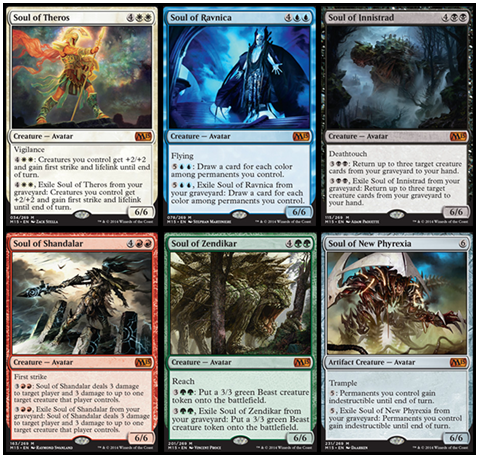
There's no doubt that the six Souls in Magic 2015 are unequivocal bombs. The cards are extremely hard to beat, with each one providing a huge body, an advantage-generating ability, and some post-death value. After finally getting exiled, a soul may have provided value in the four-for-one or five-for-one territory. Left completely unchecked, these cards are capable of winning games on their own.

allsixsouls

I'm not the type of player to just shrug my shoulders and accept losing to these monsters. I want to win my drafts, and if my opponent has a Soul, I want to do what I can to beat it, even if it is difficult. Thankfully, these mythics don't show up super often, but they're powerful enough that being aware of the cards that beat them during the drafting portion can help us get there a little more often when we do run into them. If possible, I try to have at least one card in my decks that deal with the Souls. So what are those cards?

White

White has the largest and most powerful arsenal to fight the Souls (which seems a little unfair given that Soul of Theros is the best of the cycle). Devouring Light has proven to be one of the best non-rares in the set, and while it is possible to win with a Soul without ever attacking or blocking with it, you can hopefully force your opponent's hand and encourage that thing to get into the red zone.

If not, Pillar of Light is a very proactive answer to the Souls, but it's situational against a lot of the other creatures in the format. Still, I always want to have one at least in the sideboard of my white decks to have a chance against these value-laden fatties.

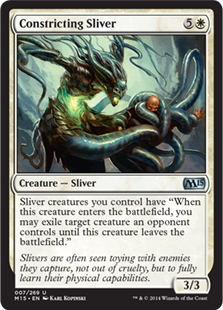
Finally, Constricting Sliver can deal with a Soul temporarily. It's much better if you can protect it with cards like Negate, Ranger's Guile, or Ephemeral Shields.

constrictingsliver

Blue

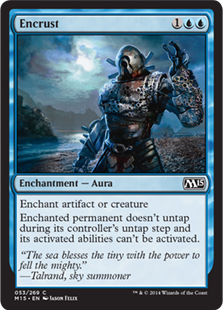
If your opponent isn't playing bounce or enchantment removal, Encrust can be one of the best answers to the Souls—except for Soul of Theros, that is. Vigilance is a pain, but Frost Lynx is a combo to shut it down.

Dissipate is a fine answer to the Souls, but you better keep it up at all times once your opponent has reached six mana. If you miss your chance, there is plenty of bounce available, and although running the old bounce-counter plan isn't typically good from a card advantage standpoint, almost any permanent answer to a Soul is acceptable.

encrust

Black

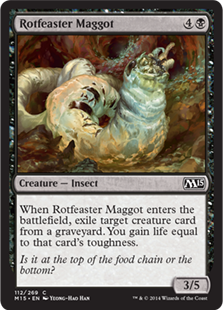
Black doesn't have any all-in-one answers like white and blue. Rotfeaster Maggot exiling a Soul can be a huge swing in the game, but you've got to find a moment when your opponent is tapped out to make that work. And there's still the question of killing the Soul, although black shouldn't have too hard a time with that.

If you can hit your opponent's last two cards with Mind Rot, that will leave only the graveyard activation for the Soul, so that's...something, but not great, considering Mind Rot is only fringle playable. Endless Obedience on a Soul when they're tapped out can turn the tables, but if they kill it you're right back where you started.

rotfeastermaggot

Red and Green

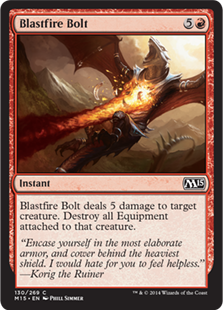
Um, there are no direct answers to the Souls in these colors. You'd better have a plan for racing, and if not that, you'd better just hope your opponent doesn't draw it.

blastfirebolt

Colorless

It won't come up often, but Perilous Vault can answer an on-board Soul. If you know one is in your opponent's deck, it's not a bad plan to play the Vault early to have it ready to go before your opponent can fire off an activation. Being a mythic, I wouldn't count on this being a consistent answer to these cards.

The other option is Tormod's Crypt, but I think that's going a little too deep. Even if you have a couple Ensoul Artifacts or Shrapnel Blasts, don't have any other answers in your deck, and are playing red and/or green, I just don't think you should be putting Crypt in your deck. It's not a good card.

There was an error retrieving a chart for Perilous Vault

Are the Souls hard to beat? Of course. Can you beat them? Absolutely! Be aware of the cards that can answer these adequately and you're one step ahead of beating your opponents' bombs. Did I miss any good answers to the Souls in this article? Sound off in the comments with your sweet tech.

Insider: Organization and Tracking Specs

Are you a Quiet Speculation member?

If not, now is a perfect time to join up! Our powerful tools, breaking-news analysis, and exclusive Discord channel will make sure you stay up to date and ahead of the curve.

Welcome back, readers!

This week's article will focus on the subject of organization, specifically in regards to your specs. As someone who previously evaluated cards and purchased them (and then let them sit in a box or binder) until one day I noticed they'd gone up, I wasn't always so organized. Even just a year or so ago, prices kept jumping up so there wasn't always a noticeable cost to my apathy. However, with the recent shifts in the MTG finance marketplace I'm realizing now that cards can actually go down in value even without a reprint.

I know if you'd read this a year ago, you'd think I was crazy. A rampant run of speculation in preparation for what was expected to be a major boon this past summer caused prices to balloon out of control, and likely push potential Modern players out of the market.

But that's a different matter--the point is, we've all seen that the market can only take so much, and in order to maximize our profits we need to be on top of everything. It's time consuming to keep on top of the constant metagame shifts in multiple formats, and time is a variable that is always limited so proper organization of our specs is critical to reducing inefficiencies.

Tracking Your "Stocks"

I often try to mention the similarities between MTG finance and the stock market and that's because I believe that a lot of strategies and concepts can be shared between the two (though to be fair a lot more of these have been well documented and discussed with regards to the stock market). That being said, I looked for a good "stock tracking" spreadsheet to use as a skeleton for my MTG spec tracking. If you want a "blank copy" you can find it here.

MTG Stock Portfolio - blank

Here's the sheet that shows all my MTG purchases through November of last year (I wanted to display it in tabular form, but unfortunately there was simply too much information and our screen size is limited).

MTG Stock Portfolio - 8/18/14

As you can see I'm only averaging 11.5% gains (which isn't terrible), but I have a lot of "red choices". It is important to note that several of the red options are repeats. It's also important to keep in mind the biggest outliers (most of the temples and the Dictate of Erebos's) were meant as longer-term holds and the expected time to sell hasn't hit yet--the temples are for after RTR block rotates out and the Dictates are a 2-3 year investment.

However, that isn't to excuse my choice to purchase them when I did, especially the Dictates. I got excited watching people get blown out by them in Limited and realized that Mono-Black Devotion style decks were currently the best option for the competitive player, so if the Dictate found a home it would likely jump to $4-5 each. Unfortunately, for me, this didn't occur and their price has dropped dramatically since prerelease times.

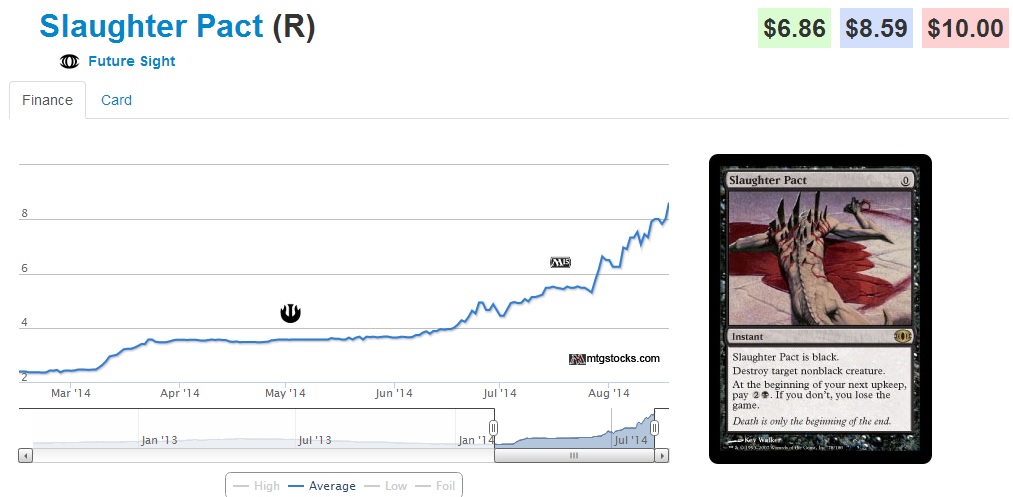
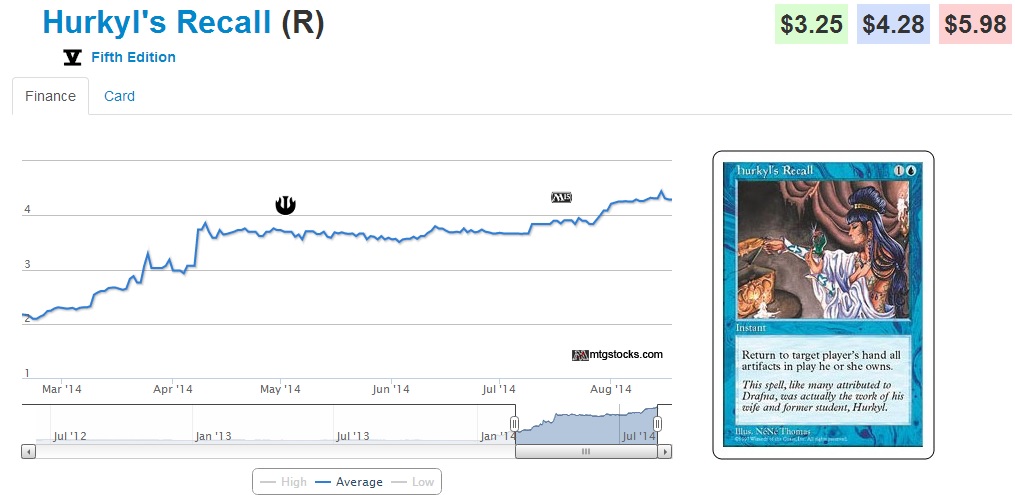
Consider this a lesson in patience, with very few exceptions--pre-ordering is a bad idea and even then the cost of waiting is rarely that bad. My biggest hits were Slaughter Pact and Hurkyl's Recall, both of which I purchased right after returning from GP Richmond (the first Modern GP of the year) where dealers were out of both cards and people were constantly asking me for them.

This is just another example of patience paying off, as these cards didn't really start to take off immediately. There was a week or two when you could have picked them up cheaply (and in Hurkyl's case, it just had a nice steady incline).

slaughter pact stock

hurkyl's recall stock

Now back to the spreadsheet. Most of the columns are pretty self explanatory, though I do want to highlight the "card profit" column. This refers to a "price from my door to your door" concept, meaning seller fees and shipping should always be factored in. Now to explain the equations (I'm assuming you did in fact download the sheet).

Total Cost = (Quantity * Cost per Item) + Purchase Fees [This represents the total cost to acquire the cards]

Market Value = (Current Value * Quantity) [This represents the current value of the cards if you were able to sell them for TCG Mid cash in person (i.e. no fees)

Market Value At Sale = (Value At Sale * Quantity) - Sales Fees [This represents the total amount of money you received selling the cards, however not the profit]

Gains/Losses ($) = ((Market Value at Sale (if Cell N# is not 0 else Market Value) - (Total Cost)) [This represents your actual gains or losses, actual or theoretical (if you were able to sell the cards at market value with no fees)]

Gains/Losses (%) = This is the Gains/Losses number above but in percentage form (as that's often a good way to normalize your data). 

You certainly don't have to use this spreadsheet, but I'm finding it helpful in tracking myself. I will be saving a copy and updating the Current Values in each cell every week to track my progress. I did get the basics of this sheet from microsoft (http://office.microsoft.com/en-us/templates/stock-investment-performance-tracker-TC001023352.aspx), but had to add some columns and change the equations around.

Understanding Your Gains and Losses

Like reviewing your play mistakes during a match, it's just as important to review your mistakes speculating. As I mentioned, I missed hard on the Dictate of Erebos's (averaging nearly a 40% loss) and I did well on Slaughter Pacts. What is critical to keep in mind though is that we're not all going to hit 100% of the time. What I really like about this spreadsheet is the "Difference" calculation, which lets you know the total value of your assets currently compared to what you paid for them.

Again, as previously mentioned I'm sitting at +11.5% which for about a nine month time span isn't terrible, though it is misleading as I haven't sold many of my assets--assuming I could do so at current market value and with no fees is quite a stretch. It's far more likely that if I were to sell out of my cards I'd be very much in the red.

Luckily, you can only lose money invested when you sell your investments (a lesson my father taught me at a young age). While my Dictate's didn't pan out, I still think my reasoning was sound. It does seem like a card that can easily break the mirror, there's just no room for it in the current environment.

I pre-ordered the "souls" of M15, primarily because they were all relatively cheap and with the exception of Soul of Theros they have not dropped a lot. This investment was more of a calculated risk. I do rarely pre-order as it's shown time and time again to be a money-losing proposition; however, if any of these cheap mythics did break out in the upcoming PT, they would likely quadruple or more in price (and thus push me into the green). I also didn't buy any M15 boxes and wanted to build my quirky decks for Standard, and the souls seemed like cards you can build around.

You'll also notice that with the exception of Dictate of Erebos, I don't order a lot of any one specific card (usually). This keeps my portfolio diversified, preventing me from taking devastating losses when one doesn't pan out (again..usually). However, this conservative approach also means I don't make a ton of money when one does hit.

My "MTG investment philosophy" is not tied to paying rent/travel/food/insurance/etc. I do it simply because I enjoy it, and because unlike stocks, I feel I have a pretty good grasp of MTG and I'm much more excited to discuss this subject than normal stock investments.

Quick Flips

While I understand the allure of "quick flips" (like Goblin Rabblemaster from the last Pro Tour), my problem is I don't have a quick out for any cards--no online or brick-and-mortar store front. Thus, a card could go from $1 to $4 in a three day time span, but if the buylists for each card don't adjust quickly (and they usually don't) you can be left with a lot of the "theoretical" profits mentioned above, but no real money.

The highest buylist on Goblin Rabblemaster right now is $1.50. Unless you found a seller with a large quantity in stock when they were under $1, you likely paid almost that per copy when you factor in shipping costs. This is the danger behind the "bulk to $4' cards and one of the reasons you don't see any of those buys on my chart.

Reprints

I also want to emphasize that my reasoning behind Dictate of Erebos was partially blinded by Standard potential and comparison to Grave Pact. The latter, despite six printings, is a $10 card and Dictate is pretty equivalent, if not slightly better due to a less restrictive mana cost and flash.

I also assumed that because it had a plane-specific character in its name that it would have a lower likelihood of being reprinted, however, with M15's release we saw both a new Avacyn and a new Ob Nixilis, both of which were characters specific to their own planes.

With this change in core set design philosophy, I am becoming more weary of long-term specs as my previous analysis regarding reprints shows a typical 27% drop in value when a card is reprinted. This will likely increase with the increase in print run sizes (after all if there are more of the original printings around then another mass reprint requires a substantial increase in demand for the value not to plummet).

Insider: Elegance

Are you a Quiet Speculation member?

If not, now is a perfect time to join up! Our powerful tools, breaking-news analysis, and exclusive Discord channel will make sure you stay up to date and ahead of the curve.

As a competitively-minded person, winning is important to me. As a human being, I also have an interest in doing cool things. The part of my brain that wants to do cool things is constantly at odds with the part of my brain that wants to win.

Luis-Scott Vargas is very capable of discerning the difference between being creative and being foolish. He has a propensity for drafting seven-drops, but, more importantly, he's willing to sleeve up Tempered Steel for a Pro Tour despite the deck being extremely boring and not having much play to it.

Travis Woo has no such interest in limiting his creativity. While he is capable of doing well at high-level Magic events, he spends more of his free time doing this:

By no means am I saying that creativity is bad. Far from it. I'm merely saying that the desire to be creative as an end to itself inhibits one's ability to be competitive.

Travis is very capable of being competitive. Top 8'ing with his Living End home brew was an incredible feat. LSV is very capable of being creative. I'm sure that he'd have several puns to illustrate this point.

What I'm driving at is that striking a balance is key.

Arguably, the most interesting deck from PT Magic 2015 was Yuuki Ichikawa's Jund Planeswalkers deck. I imagine everybody has seen it by now, but it's a sweet one.

Jund Walkers

spells

4 Elvish Mystic
4 Sylvan Caryatid
4 Courser of Kruphix
4 Xenagos, the Reveler
4 Nissa, Worldwaker
2 Chandra, Pyromaster
1 Vraska the Unseen
1 Golgari Charm
1 Abrupt Decay
1 Putrefy
2 Ultimate Price
2 Thoughtseize
3 Mizzium Mortars
2 Dreadbore
1 Rakdos's Return

lands

2 Mutavault
3 Forest
2 Overgrown Tomb
1 Urborg, Tomb of Yawgmoth
3 Llanowar Wastes
4 Stomping Ground
4 Temple of Abandon
1 Blood Crypt
4 Temple of Malice

sideboard

2 Thoughtseize
1 Mizzium Mortars
1 Golgari Charm
1 Rakdos's Return
2 Magma Spray
4 Mistcutter Hydra
2 Doom Blade
2 Scavenging Ooze

It can be mind-blowing at first glance to see a Nissa deck that isn't really bothering to untap Forests.

Most players--myself included--were blinded by Nissa's ability to untap Forests and, as such, only imagined her in devotion shells.

The problem was that the deck just wasn't very good. Yuuki looked past that though, and,while the devotion deck wasn't good, Nissa sure as hell was. He had the skill to identify Nissa as a great card in a bad deck and the creativity to find a home for it in a dramatically different shell. Creativity properly paired with the drive to win brought Yuuki to back-to-back Pro Tour Top 8's--an admirable feat.

There was an error retrieving a chart for Nissa, Worldwaker

Arguably, another small step can be taken to best utilize the power of our Nissas. Many would argue that the greatest strength of decks like Jund Monsters, Green Devotion and Jund Walkers also lend to their greatest weakness--it sucks to draw just lands and Elvish Mystics, even though Elvish Mystic is responsible for the deck's most explosive draws.

Pascal Maynard had a pretty brilliant idea for his WMCQ and just put Nissa, a powerful card in its own right, into the best deck:

Golgari Rock

spells

4 elvish Mystic
4 pack Rat
4 lifebane Zombie
4 desecration Demon
3 courser of Kruphix
2 scavenging Ooze
3 nissa, Worldwaker
4 thoughtseize
4 hero's Downfall
3 bile Blight
2 abrupt Decay

lands

4 llanowar Wastes
4 overgrown Tomb
4 temple of Malady
4 mutavault
3 forest
2 swamp
2 urborg, Tomb of Yawgmoth

sideboard

4 duress
3 doom Blade
3 mistcutter Hydra
2 golgari Charm
2 pharika's Cure
1 drown in Sorrow

He ended up taking second, but he sure as hell deserves recognition for this innovation.

The evolution of Nissa decks happened so fast that if you blinked, you missed it.

But something huge happened at every level. Phase one was building decks designed to take as much advantage of Nissa as possible, and this meant playing a lot of Forests. Phase two was ditching the truly bad cards from the Nissa shell and slotting her in a deck full of the singularly powerful cards, à la the Mike Flores school of Magic. Finally, Pascal Maynard just took Nissa and put her into what was already accepted as the de facto best deck in the format.

I fully expect to see decks very similar to Pascal's in the months leading up to Khans of Tarkir.

The desire to try something new and to further explore the format brought Nissa to the forefront of deckbuilding. From here, objective analysis of why Nissa decks were winning or losing and whether they were the best version of what they were trying to do brought us from exploring a new archetype all the way to simply updating the best deck.

To analyze this further, in phase one the Nissa deck was perceived as a mana ramp deck, capable of very explosive hands. In reality, it would most often win games based off of the power of singular cards instead of synergies.

In phase two, Yuuki Ichikawa decided that most of the green creatures didn't deserve slots in the same deck as Nissa, and instead elected to just play more haymakers, as the haymakers were what won the games anyhow.

In phase three, Pascal Maynard decided that any mana ramp was superfluous to the haymaker strategy and that Nissa was best fitted with the most consistently successful shell in the format now that the mana was finally good enough to enable Golgari Rock decks.

From the other side of things, we're also seeing a much more forward evolution of Black Devotion. I can't remember the last time Black Devotion wasn't the best deck in Standard. Periodically we would see a number of colors splashed, with straight black usually making its way back to the limelight.

For Pro Tour Magic 2015, the reprinting of enemy colored painlands made the enemy splashes consistent enough to be very serious considerations. Team Channel Fireball picked up Caves of Koilos and announced loudly that Blood Baron of Vizkopa and Obzedat, Ghost Council were stronger options than Grey Merchant of Asphodel.

There was an error retrieving a chart for Caves of Koilos

And now Pascal Maynard is saying that Nissa, Worldwaker is better than Blood Baron of Vizkopa. Abrupt Decay and Courser of Kruphix have spoken for themselves time and again.

It's really interesting to watch decks evolve in this manner. If you looked at SCG Open results from a few months back--particularly immediately after the printing of Temple of Malady--the Golgari Rock deck only looks like a minor evolution. In reality, it often takes a lot of time and effort to come up with even the most elegant of transitions.

Part of the reason for this is the drive to be creative. Most players would much rather develop a sweet new archetype than throw more good cards into a good deck. We're also biased looking at the list now, as in the present we can always wonder why we didn't think of something before, whereas in the past we may very well have been thinking that will never work. I certainly don't recall hearing about Golgari Rock in Standard at the PT.

Another reason we see evolutions like this is that it's very difficult to calibrate the level of correction needed for a deck, even when we know that something needs to change. When you know Nissa is good, it makes sense to hold onto the other good green cards in the deck. In particular, it's not surprising to see Courser of Kruphix in Yuuki and Pascal's decks.

It is more difficult to discern whether you want to be an Elvish Mystic deck, though, particularly without knowing the results of the Pro Tour and seeing how the post M15 metagame has come together. At any rate, knowing that something is wrong while still identifying strengths and continuing to work on ways to capitalize on these known strengths is how great decks are built.

There was an error retrieving a chart for Courser of Kruphix

On the lines of this difficulty of calibration, I'm guilty of this myself. I don't have time to jam 1,000s of games, which puts me at a disadvantage anytime I want to play anything other than a stock list--and indeed this disadvantage is felt by everybody who decides to stray from the pack.

One way I try to combat this disadvantage is by making somewhat dramatic changes to decklists in order to acquire more varied experience faster. In order to draw meaningful conclusions from this process, it's important to not give any particular weight to specific games, and I wouldn't recommend this approach for everybody. Most recently I employed such a deck tuning strategy when I tried to convert Izzet Delver into Grixis Delver.

Part of my reasoning was that Dark Confidant added a lot to the deck. In practice, really all that it added was another body. The Grixis list cut a significant portion of spells from the deck, which made Delver worse. This cost didn't strike me as particularly relevant as Delvers are quite good at dying in Modern, which was the entire reason to try to add more creatures. After testing the deck for a week, it occurred to me that a dead Dark Confidant was worth approximately as much as a dead Delver of Secrets.

There was an error retrieving a chart for Dark Confidant

Playing a deck with fewer spells showed me that I could cut a few while still flipping Delver of Secrets as often as I needed to and that it didn't really matter which extra creatures I was playing, just that I wanted extra creatures. As of now, I think I'm better off with more Vendilion Cliques and staying on a two-color deck.

Finding the exact configuration that I want is turning into a real headache, Modern being as broad as it is. While more experience brings more knowledge, more knowledge brings more frustration.

That said, progress is being made. When I do come up with new answers, it seems they are closer to what the list I jumped from was than the list that I jumped to in order to solve a problem. Magic is a complex game, and even the most simple answers can take a great deal of work to reach.

The Financial Future of Nissa, Worldwaker

If you had any illusion of Nissa dropping in price in the near future, I believe now is the time to dismiss that notion. Nissa is excellent now and very likely to be excellent post Khans. The fact that she has shined in multiple shells is indicative of the fact that she's not going anywhere. Magic 2015 won't be opened for very long, and once Khans launches, I could certainly see her climb well above her $30 price tag. She's very high risk for aggressive speculation, but I would pick up a set for Standard play.

Thanks for reading.
-Ryan Overturf
@RyanOverdrive on Twitter

Do Your Part

Are you a Quiet Speculation member?

If not, now is a perfect time to join up! Our powerful tools, breaking-news analysis, and exclusive Discord channel will make sure you stay up to date and ahead of the curve.

If you're following me on Facebook or Twitter, you've likely already seen some of these images.

Photo: Cannot catch a break tonight. Stay safe, Billy

Untitled


Some of you may recognize this face. It belongs to Magic Pro and WotC card designer Billy Moreno who is responsible for Glaring Spotlight among other cards. Tonight the spotlight was on him as he was arrested twice in a 24 hour period in Ferguson, Missouri after he traveled to Ferguson to help distribute supplies to the local people who are stranded in what is being described by Amnesty International as a police state.

Here is Billy being interviewed.

Where do you come in?

Well, we're not all as brave as Billy. Other than writing deadlines, there is nothing stopping me from going to do the same thing he is. I could try to co-ordinate aid distribution like he is. It's 48 hours later and it's been over a week since the protests against the overzealous police force started and I'm still sitting here. Honestly? I don't want to get shot, either by the police or by a demonstrator. I'm staying home because it's safer. We all are. Not all of us have Billy's balls, but we can help him out.

Tom Martell set up a GoFundMe site for Billy to help his efforts down there (and pay bail, presumably). Billy is trying to figure out the best way to distribute aid and helping to ensure the protests stay non-violent. No one wants to see anyone get hurt and even if you don't have a dog in this fight politically, we have a member of our community who is trying to do the right thing and who has so far eaten a face full of tear gas and been arrested twice for his efforts. I think this community is bigger than just the game itself, and I think we all proved that with the donations to #TeamPanda. If you want to help Billy but aren't inclined to get close enough to Ferguson to smell tear gas, please pass along his GoFundMe site on social media and let him know the community is behind him. If you are inclined to donate, go ahead, but I think it's more important to let everyone know what he's up to and what we can do to help. Please pass the link along on social media.

I'm proud of how our community has responded to help one of its own in the past. Let's keep it up.

Avatar photo

Jason Alt

Jason Alt is a value trader and writer. He is Quiet Speculation's self-appointed web content archivist and co-captain of the interdepartmental dodgeball team. He enjoys craft microbrews and doing things ironically. You may have seen him at magic events; he wears black t-shirts and has a beard and a backpack so he's pretty easy to spot. You can hear him as co-host on the Brainstorm Brewery podcast or catch his articles on Gatheringmagic.com. He is also the Community Manager at BrainstormBrewery.com and writes the odd article there, too. Follow him on Twitter @JasonEAlt unless you don't like having your mind blown.

View More By Jason Alt

Posted in FreeTagged 4 Comments on Do Your Part

Have you joined the Quiet Speculation Discord?

If you haven't, you're leaving value on the table! Join our community of experts, enthusiasts, entertainers, and educators and enjoy exclusive podcasts, questions asked and answered, trades, sales, and everything else Discord has to offer.

Want to create content with Quiet Speculation?

All you need to succeed is a passion for Magic: The Gathering, and the ability to write coherently. Share your knowledge of MTG and how you leverage it to win games, get value from your cards – or even turn a profit.

Insider: Are MTGO Boosters The New El Dorado?

Are you a Quiet Speculation member?

If not, now is a perfect time to join up! Our powerful tools, breaking-news analysis, and exclusive Discord channel will make sure you stay up to date and ahead of the curve.

Speculating on booster packs have been primarily considered as a slow and quiet way to bring in profit on MTGO. Price movements happen to be fairly predictable, especially if you are paying close attention to prize pay-out structures. Risks are pretty low since prices usually fluctuate within a +/- 20% range.

In these recent years, competition has intensified between bots, which has caused the spread between buying and selling prices to narrow down to few cents of Tix, allowing speculators to increase previously slim margins when speculating on boosters.

In one the several articles Matthew Lewis wrote about booster speculation, he compared them to the Bonds of MTGO:

With MTGO speculating, in-print booster packs are analogous to high quality bonds. These digital packs are in steady demand, they are highly liquid and their prices are stable compared to digital singles.

Recently, WotC engaged into an effort to help stabilizing in-print booster prices in the secondary market and showed that it would not hesitate to adapt the prize pay-outs to maintain prices of draftable boosters as homogeneous as possible. The idea is that awarded boosters should be at least worth the the entry cost. This was not the case, for instance, when JOU boosters dipped below 2 Tix while being awarded for a two man tournament that costs itself 2 Tix to enter.

I have been only moderately interested in speculating with boosters. I was only doing so when I had a fair amount of spare Tix and no decent investments within the next one or two months. Even with excellent speculative conditions, boosters would not generate really more than 20% in two months, which is still pretty good but slightly under what I am aiming for when I invest in cards.

Recent events, however,  made me consider pack speculation a bit differently.

During M15 release events, several specs on boosters showed tremendous gains. Today we'll take a look at M15 and other booster specs in order to get ready for Khans of Tarkir!

M15 Boosters

Maybe you have read about this here, on the MTGO forum or in Alexander Carl's article. Maybe you have actually done it and have generated a nice little stack of Tix in a very short period of time for a booster spec.

The idea is pretty simple. During the prerelease time only, Tix are accepted to enter sealed and draft events. The boosters awarded can't yet be used to enter events--not until the following Monday after release events. Therefore players who want to play sealed after sealed have little choice but to sell their packs to pay for their next buy in.

Substantial profit can be made by buying boosters during the prerelease events when everybody is getting rid of their boosters, then sell them for profit the following week when everybody needs boosters. Cant' be more simple.

This type of quick flip with boosters is not really new, although it is amazingly efficient. Matt Lewis, our boosters expert here at QS, has been on this for a while now and proved that the theory was worthwhile earlier this year with Theros boosters. He also suspected that such a strategy could be employed every time prerelease events accept only Tix as an entry option and when the draft format requires a triplicate of the same boosters.

It worked out pretty well for me and others. Here is what I did and what I would recommend to do next time.

Buying

On Thursday 24th, M15 boosters started to sell ~3 Tix and rapidly fell to 2.6-2.8 Tix. If you plan on buying a large quantity of boosters, you may want to start buying as soon as day one.

To buy boosters, you have basically two options: bots or via the Classifieds. As long as I was logged on, MTGO I had an offer posted as "Buying M15 boosters 2.5 Tix". And I bought a lot of them this way. Even when bots were offering a better buying price, even drowning in the ocean of offers on the Classifieds, I was buying several dozen boosters per hour, especially on the weekend.

No surprise the weekend is the busiest time. I was online as often as I could be, always with my offer on the Classifieds as well as buying from bots pretty regularly.

I was almost exclusively buying from Goatbots, as they are always stocked and their prices are very competitive. Their prices adjust and increase by ~0.02 Tix after every transaction, so you can't really buy them out without overpaying for it. I was buying 10 boosters (the limit) every time. I bought M15 boosters as low as 2.52 on Saturday and as high as 2.77 on Sunday.

I also bought a few boosters from Cardbots at a very surprising price of 2.41 Tix, although they were mostly out of stock for the rest of the weekend.

I had a pretty big stack of Tix ready to be invested this way and I was prepared to by an unlimited quantity of M15 boosters under 2.8 Tix. I ended up with a little less than 400 boosters, and that was the first time where time was the limiting factor, not Tix. This shows you that if you are ready to put big money on this kind of spec, you also have to be ready to spend some time on MTGO.

By Sunday night I was buying boosters as high as 2.77 Tix. In the end, my average price was 2.64 Tix/booster. I was not sure how high the prices would rebound, so 2.8 Tix felt like a good limit. By Monday morning, prices had already started moving up.

Here is how M15 booster prices have fluctuated these past three weeks. The lowest point is on Saturday 26th of July, the first weekend day of the prerelease events. You can also see that prices are always relatively high during the weekend and dip during the week.

Selling

With prices on the rise, I waited until Friday the 1st to start selling my packs and tried to sell all weekend long. With the same strategy I used for buying, an offer on the Classifieds and selling to bots whenever prices were good. I was selling my M15 boosters on the Classifieds for 3.5 Tix each and sold many boosters this way. I was selling to Goatbots when they were buying at a minimum of 3.4.

Due to lack of time, I had sold only about half of my stock by Sunday night. I decreased my selling price to 3 boosters for 10 Tix and sold some at Goatbots for ~3.25. When M15 boosters price dropped below 3.25, I stopped selling and waited for the next weekend for more favorable prices.

The following weekend (9th & 10th) prices rebounded and I sold the rest of my boosters in the 3.2-3.4 Tix range, again to bots and through the Classifieds.

My average selling price was 3.28 Tix per M15 boosters. A average margin of 0.64 Tix per boosters, for a 24% profit. Afterwards, it because clear that prices significantly drop during the week and rise again during the weekend, consistently reaching 3.3 to 3.5 Tix per booster. Even this past weekend, M15 boosters could have been sold for 3.5 quite easily. Next time I'll be more patient and I probably won't sell under 3.3 Tix per booster.

Overall, a 24% margin is a pretty good figure, especially for a two week turnaround. The strategy is clearly successful and is especially attractive since you can invest a fairly large amount of Tix on one single spec. If you prepare yourself to spend your weekends buying and selling, it is possible to invest several thousand Tix. With more presence, your margins could be as high as 30-35%, making the prerelease events a major event to generate some profit online.

Journey into Nyx Boosters

What an odd price trajectory are the JOU boosters.

From 4 Tix early in June to 2 Tix for about two months, then an additional dip to 1.5 Tix during M15 prerelease events, followed by a terrific rebound to 2.4 Tix two weeks later.

1.5 Tix is really low for an in-print booster, especially with several valuable cards in the set including Mana Confluence, Temple of Malady, Eidolon of the Great Reveal, Keranos, God of Storms and Ajani, Mentor of heros.

Didn't see it coming? I didn't. At least not as fast as that. If it is easy to say it was obvious now, but I certainly wasn't sure enough before and I still have Dragon's Maze in mind, where boosters price stayed flat pretty much forever, even at 2 Tix.

Nevertheless, thanks to our discussions on the QS Forums, some of our QS Insiders were more optimistic and had anticipated such a rebound. A relatively impressive gain in the end.

Theros Boosters

For the past five months, Theros boosters have been up and down, and if you were able to correctly time your specs, you may have made some easy profit. More recently, Theros packs also abruptly dipped during M15 prerelease events and went back up within two weeks.

Again, this trend not really new, but it was really sharp this time around.

It is also noteworthy to says that Born of the Gods boosters also dipped and jumped during M15 release events, although to a lesser degree than JOU and THS packs.

Release events are definitely a time worth watching booster price fluctuations in the future. Very decent quick flips are more than likely to happen again.

Want To Do It Again?

Repeating the M15 prerelease booster spec is what I'm looking forward to with Khans of Tarkir coming up in less than two months.

By that time, I'll be sure I have enough spare Tix and plan around having enough spare time. The great thing with booster specs is that you only need a couple of Tix to enjoy it. Theros boosters fluctuated this way when released:

Buying and selling prices may not be the same as M15 boosters. By watching the prices evolve on Friday and looking at how low they go on Saturday should provide some guide in order to get the most out of this type of spec.

Boosters are usually a quiet and slow way to grind Tix on MTGO, but during the release events of a new set, things can get wild, making it more lucrative than usual for attentive speculators.


Thank you for reading,

Sylvain Lehoux

Insider: Grim Calculus – Selling to Buylists when the Spread is Bad

Are you a Quiet Speculation member?

If not, now is a perfect time to join up! Our powerful tools, breaking-news analysis, and exclusive Discord channel will make sure you stay up to date and ahead of the curve.

I write Insider articles now. You know that, probably. If you've been following me for a while, you know I used to not write Insider articles and now I do. If you have never read one of my articles you know I write Insider articles now because you clicked on this on the Insider side and now is now. No denying that.

What's the point? Well, the point is that when I was moved to Insider, the expectation was that I would write about buylisting. I wrote quite a few buylisting articles, and I think all of them were informative and they were articles I'm proud of. However, it quickly proved to be a shallow well and I reverted to my "write whatever the hell I want as long as it's entertaining or informative" and I didn't get fired.

Still, I continue to buylist a significant number of cards and I'm always thinking about what lessons it's teaching me and what I can pass on. This weekend I realized that I had slightly changed the way I do things, and to an extent I had started to contradict advice I gave earlier.

FLIP FLOPPER!

Hang on, let's clarify. To an extent I'm contradicting advice I gave, but to a greater extent I am clarifying a vague guideline I sketched out. That makes me sound less crazy.

I'm not crazy, but I am starting to lower my "I'm not going to buylist this at that price" bar.

Why should I do this? Although I just described my thoughts on the subject last time I wrote about it as "vague", there was a mathematical basis to it. Basically, if the spread was more than about 40% on a card, you're losing a ton of money. Why would someone who has TCG Player and eBay as a potential out let someone else makes so much profit?

Obviously there are exceptions, and lower value cards make less sense to ship on TCG Player, but the number I decided (arbitrarily-ish) was a good rule of thumb was 40%. Lower spread and you were getting a good deal since someone else had to do far more work than you do and they only make 40% or less on the card, any more and you're a rube and you might as well rip up your cards and flush them down the toilet. Basically.

But there's nothing basic when your time and money are concerned, and recently I started doing the math a little more differenter.

Pennies on the Dollar

Most of the cards I process these days comes from collections. With the margins on Standard cards so thin, it's tough to get people locally to sell you hot Standard cards cheap enough to make a lot of profit. You can do business in volume, but lately my best sellers have been my specs and I'm scraping by on other stuff.

Collections, however, are great. If you buy correctly (don't pay too much) you should be able to make a small profit buylisting the "known" stuff if you have to, and the "unknown" stuff that you find when you finally start digging through boxes is all gravy. We all know this is the best part of buying collections, but we also know that to do with the known stuff, don't we? If you have a TCG Player account, you're not reading my article to see what you should do with an Elspeth right now. No, chances are you want to grind the less obvious money using a buylist.

The less obvious stuff is what I want to talk about today. There are times when you want to sell the less obvious stuff for what feels like pennies on the dollar. We're talking about 70%+ spreads. Why? Because your time is worth something, too.

The Math

Let's pretend your non-buylist out is TCG Player. You can adjust the equation based on whatever you're using. Broadly, I'm going to set up a simple equation to show why it isn't worth it to sell small stuff on anywhere but a buylist.

TCG Player takes a flat fee of 50 cents and 10% of your sales, and your shipping costs are generally around $0.50 if you're jamming a toploader in a plain white envelope and slapping a first class stamp on it.

y  = (.9x) - 1

For values of y under $1, I will ship to a buylist at over 80% spread.

Seriously.

And why not? The point of buylisting is that you're getting rid of a ton of cards quickly and easily. You're paying a convenience fee in the form of the spread you consent to so that you can dump a ton of cards all at once. If you don't like the spread numbers, you have a few options.

1) Put Them in a Box

Sitting on cards until the spread numbers are more favorable is a strategy I have endorsed in the past, and for cards that seem just ridiculous, like an offer of $0.05 on Wirewood Symbiote, waiting until the offer improves is a good way of maximizing the amount you can get. I used to put a lot more cards in this "wait" box than I do now, and there's a decent reason for it.

Why you might not want to - Those cards are something you have to sift through later. The more that's in the box, the more problems you have. Are you going to type the name of every card in the box into Trader Tools later to see if the offer improved on all of them? The opportunity cost of having the cards sit in a box is small when the box is small. When it's bigger, you have to ask yourself how much the offer would have to go up before it wasn't worth it.

Even if you're getting a dime on cards that sell on TCG Player for $1.50, you can do something with that dime today, especially if that dime goes out with $1,000 worth of cards. You can do more with a dime in your pocket than you can with a card in a box. I'm not saying don't jam stuff in a wait box, I'm just saying don't put every nickel in it. It's reserved for egregious cases.

2) TCG Player Them Anyway

Sure, you're making next to nothing after fees, but you're not going to let some jackass store offer you 20% of a card's value, are you?

Why you might not want to - Even if you were going to end up with like $0.50 or $0.75 after fees and the buylist offer is a dime, who is buying these cards? Regular TCG Player operations are going to see you sit on these cards a long time before they sell. The opportunity cost of sitting on a card that will sit in TCG Player inventory for a long time is the same as it sitting in your wait box. If the card were desirable and selling quickly, it's likely the spread would be lower and it would make more sense to buylist it.

Remember, the buylist spread is a good indicator of the demand for the card, at least from dealers. There isn't usually a huge disconnect between cards that move briskly on TCG Player and ones which dealers aren't selling.

That being the case, are you really getting an extra $0.40 or are you better off just letting someone else deal with a card that's not moving very quickly right now? Remember, bidwicket is also a site--if between bidwicket and Trader Tools you're not seeing a decent buylist offer, you can be reasonably sure that your sample size is big enough to indicate dealer demand isn't really there. So the cards may be turds. That dime is starting to look pretty good, isn't it?

3) Sell Them to "That Guy"

For a while I have been wanting to sit down with Carter Hatfield and pick his brain. Carter is a QS Insider and local dealer. When I have cards that are solid picks but I can't just buylist them for whatever reason, like when I have 24 copies of a card and Card Kingdom only wants 20, I put them in a box and ship them to Carter.

He's set up on Crystal Commerce and lists cards simultaneously to Amazon, eBay and TCG Player as well as his own website. While I wouldn't want to list Typhoid Rats on TCG Player, Crystal Commerce tracks his inventory, and if they are purchased on TCG Player, it sucks less because the new rule is that the minimum order is $1 so they are likely to order quite a few cards from him. He sells good picks all day and has said in the QS forums repeatedly that he loves to buy those boxes of picks.

If you are stuck with decent cards but don't have a convenient out for them or you're between buylist orders, consider finding someone locally who is set up to deal with those kinds of cards. The biggest reason to sell to someone like Carter is that your shipping costs are $0.

Why you might not want to - You can't. Not everyone knows a "that guy"

4) Become "That Guy"

Does your area not have someone who does what Carter does? Consider doing it yourself! You can be the guy to offer dimes on cards like Land Grant and while you need to sit on them for a bit, you will make 90% profit when they do sell. Having a steady supply of picks means you don't need to chase down collections. You're practically Troll and Toad at this point.

Why you might not want to - It's a lifestyle, not a business decision. Your inventory will grow, and while your sales will be steady, you will sit on a lot of inventory and have to put it somewhere. If you're really successful, you may have to take on help.

It's a lot of sales work, but it's a lot of sales. There is an initial startup cost of $500 for Crystal Commerce and you're going to have to buy a lot more envelopes than you buy now. I'm not saying anything negative about it other than that it's a lot of work and you have to be prepared to do it.

As a side note, I'm not really the person to talk about this exact process, but I'll be picking Carter's brain about it in the future and there is an article or two in there for sure.

5) Ship

Put it in the box. Take a dime on it. You could get more, but you're making the card someone else's problem. You don't deal with the opportunity cost of sitting on it, you don't have to comb through a box every time you put together another buylist order and you don't have to wait. You are selling into a wide spread, but maybe there are reasons for that.

Do you care? No, you're taking the easy way out, and when you have 100 cards, you might not want to take the easy way out. When you have 100,000 cards, maybe you do. Leave 10% for the next guy, even when the next 10% is more like 40%.

Avatar photo

Jason Alt

Jason Alt is a value trader and writer. He is Quiet Speculation's self-appointed web content archivist and co-captain of the interdepartmental dodgeball team. He enjoys craft microbrews and doing things ironically. You may have seen him at magic events; he wears black t-shirts and has a beard and a backpack so he's pretty easy to spot. You can hear him as co-host on the Brainstorm Brewery podcast or catch his articles on Gatheringmagic.com. He is also the Community Manager at BrainstormBrewery.com and writes the odd article there, too. Follow him on Twitter @JasonEAlt unless you don't like having your mind blown.

View More By Jason Alt

Posted in Buylist, Finance, Free InsiderTagged , , 3 Comments on Insider: Grim Calculus – Selling to Buylists when the Spread is Bad

Have you joined the Quiet Speculation Discord?

If you haven't, you're leaving value on the table! Join our community of experts, enthusiasts, entertainers, and educators and enjoy exclusive podcasts, questions asked and answered, trades, sales, and everything else Discord has to offer.

Want to create content with Quiet Speculation?

All you need to succeed is a passion for Magic: The Gathering, and the ability to write coherently. Share your knowledge of MTG and how you leverage it to win games, get value from your cards – or even turn a profit.

Want Prices?

Browse thousands of prices with the first and most comprehensive MTG Finance tool around.


Trader Tools lists both buylist and retail prices for every MTG card, going back a decade.

Quiet Speculation