menu

Insider: All Good Things…

Are you a Quiet Speculation member?

If not, now is a perfect time to join up! Our powerful tools, breaking-news analysis, and exclusive Discord channel will make sure you stay up to date and ahead of the curve.

The best came last.

Much like the vaunted epic conclusion to the Star Trek: Next Generation franchise, there comes a time in everyone’s life when they need to set their priorities straight, or look at their hobbies and investments in a different way if we intend to grow as people. This article won’t follow the traditional style because I won’t be telling you what cards to pick up. Instead, we’ll be looking at when to fold and either get out, or start anew.

Probably not what you were expecting to read from a site that normally advocates buying and trading, but quite possibly one of the more important things that you’ve had to ask yourself: “Is Magic the Gathering holding me back from achieving what I want out of life?”

It sickens me to say this, but sometimes when I look at my collection, I’m just disgusted with myself. If you’re like me, you’ve got thousands of dollars wrapped up in this game even though you can only ever play one deck at a time.

But, between traders, having a cash pool to draw upon, our own “personal stash” of expensive cards, and the need to build decks of every format, it’s easy to lose sight of the fact that sometimes, more is not better, and the money we have wrapped up in cards could be better used elsewhere.

As a personal example, I don’t have much debt aside from a mortgage, but I do have a little bit on my credit card. I say a “little bit”, but what I mean is close to $4000. Not a lot in this day and age, but enough to make you think about it whenever a bill comes and it shows that your minimum payment is equal to the cost of a box of Innistrad. Yes, some of it may pay down the principle, but how can I justify losing that much money every month when I could easily liquidate a few of my Magic card assets to pay it off?

A Rock and a Hard Place

The thing is, we invest so much of our time into our image as Magic players that considering selling off a portion of our collections is sometimes akin to selling off a part of our identities. I’ve become attached to the cards I have, even those that I don’t use.

My [card Candelabra of Tawmos]Candelabras[/card] and playset+ of dual lands happily stare back at me whenever I crack my “good stuff” binder, and my friends “oooh” and “awww” about the beauty they see within it.

I like that feeling. I like it when someone says to me: “Dude, that is a SICK collection you have there!”

These statements reaffirm that, when it comes to my hobby, I am doing well and have whatever kind of respect and awe you get from other players who want to achieve the kind of success that I/we have.

Letting go of these small pieces of ourselves is not as easy as just one day saying “screw it” and listing all our wares on eBay. Like a cigarette smoker with an addiction, it’s not that easy to quit.

It's All Your Fault!

You may be saying to yourself: “Well Carl, you’re the one who got yourself into this situation, you shouldn’t have overspent on cards!”

That’s the thing… who says I racked up that debt because of Magic cards?

In my case it was incidentals with my near hundred year old house that forced me to liquidate my savings and use credit to keep it together. Everyone has their own story, and if you don’t right now, good for you! But one day you may, and when that day comes and you need balance the need for cash versus credit, I hope you remember this article.

Going back to my house story, I could have just as easily sold off a few of my things that had value instead of racking up debt, but I don’t see my stuff as worth dollars and cents… I see them as a lifeline to my hobbies. Precious memories or good times yet to be had.

The fact remains that, even after I accumulated debt, I could still have slowly sold things to pay it down. Instead I acted irresponsibly and let my lust for accumulating more and more stuff hold me back from paying down debt and moving on with my life as a clean slate.

It's a Trick! Get an Axe!

Classic Ash!

Personally, I like to fool myself into believing that by investing in more cards, or trading into better, more valuable cards, that I’m "making money".

Well, little brain, that is simply not the case.

True, you may be increasing the value of your portfolio, but until you actually sell something, all you have is a stack of cardboard with a somewhat ambiguous value to a small group of like-minded collectors.

You can’t go to a store and give them a Birthing Pod for a bag of milk (and no, telling them "It’s going to go up in value because of a new mechanic in Dark Ascension!" is not going to make them think you’re any less crazy).

In fact, I’d go so far as to actually say that unless you’re Jon Medina and if you’re in my situation, it’s actually costing you MORE because of the illusion of gains that you’re under. Sure, you made $10 in REAL cash every FNM’s this month… too bad that at 15%, that $4000 debt is costing you roughly $50/month in interest, so you’re still out at least $10 overall. Not only that, but when you make a small profit like that, what are you more likely to do:

1) Put $10 on your credit card/against debt?

OR

2) Go out to the pub with the boys after the tournament, spend it on a pitcher and say: “This beer is FREE because I paid for it in Magic profits!”

… See where I’m coming from?

If you have debt, the pitcher wasn’t free. And on top of that you’ve deluded yourself into possibly spending more that you would have in the first place because now you can buy a second pitcher with the $10 you’d brought from home with the intention of spending regardless of whether or not you’d sold anything.

Buying a Collection = Buying Debt?

Buying collections is one of the BEST ways to actually make money at this game, since the discounts on an entire lot are often quite deep.

But where does that cash come from, and where does it go once you’ve made it back?

If you’re using credit to fund your expenditures because it’s "too good a deal to pass up", then instead of paying back your "loan" you spend the money on more cards or other things. Did you profit at all? Or did you just create more debt for yourself?

Us silly North Americans in particular just love to accumulate debt because it’s accepted here for some reason or another and considered the norm. It’s why I said that I "only" have $4000 in debt, because when I compare it to others it seems almost trivial.

We have to look at our buying strategies to avoid these kinds of pitfalls in order to stop the debt cycle and make real profit. If you can’t afford to lose the money and you don’t have the money in the first place, maybe you should re-evaluate going all in on the debt machine that we create for ourselves and instead just think to yourself: “I am making money by not spending money”.

The Big Trade Off

Time is finite. Each of us is granted a certain amount. And when it’s gone, it’s gone.

Time is a form of currency, and that currency is your life. The more you invest in cards at the expense of other things is a trade that you are directly making. Go to the movies with your girl/boyfriend, or buy a few packs of Scars of Alara? If you’re on a fixed income or limited budget, these are the choices that you’re making whenever you make a purchase.

Granted, this principle can be applied to anything we chose to spend our hard earned wages on, but, really, I’m sure I’m not the only one who spends a decent amount of my disposable income on cards. Speculating or not, I can’t spend that money twice… unless I use credit, as we’ve already discussed.

I have a friend on a fixed income who told me they were going to pay their rent ahead of time for the next two months so that when they get their next cheque, they could spend it all on Magic without thought of consequences since their living arrangements will already be covered.

This made me really sad for him, as he is trading in so much of his life and time into this game at the sacrifice of being able to do anything else. Please don’t let this happen to you.

Go out and enjoy life while you’re able and keep your hobby a (profitable and fun!) hobby, not a complete lifestyle.

Where Do We Go From Here?

I’m not advocating for you to sell your collection, as I know that I personally could never do that.

All I’m saying is that if you have debt and look at Magic cards as an investment, maybe you should ask yourself how much are you actually making versus losing to the banks? How many other things that you wanted to do with your life are you sacrificing in order to feed your obsession?

Maybe now's the time to cash in on some of those cards and pay off your debt. This doesn't mean you have to sell of your collection, but remember that your collection is liquid and it is okay to tap into that stream once in a while. Especially when you can buy down any interest you're paying elsewhere.

Let’s talk turkey here. You’re obviously looking to profit if you have a subscription to this site. That’s why we exist: to make you money. But sometimes the best way to actually make real gains is to pay down what you already owe, or go on that vacation with your family while you’re still young enough to enjoy it rather than buy those last two pieces of the P9 that you’re missing.

Think about that: What if you could say that Magic has paid for a vacation with your family or friends?

Give and take. Life is a delicate balance, one that’s easy to lose sight of and hard to bring back to equilibrium.

Maybe when you reeaalllyyy think about it, you do only need one deck of each format right now and you could sell the rest to clear up debt in order to start over with a clean slate with none of the stress and sleepless nights that owing creditors goes hand in hand with.

Maybe I don’t really need those three Candelabras for the "just in case", because maybe now is that just in case? Or maybe I should wait until next pay check to purchase that beat up beta Demonic Tutor they’ve got eyeing you from that expensive leather-bound binder.

Maybe you have no debt at all and this article didn't speak to you. But maybe you do have debt and this will inspire you to use your hobby to clear those stresses away.

And maybe this has helped you more than any hot pickup ever could. Even so, there are four other articles put out on this site weekly that keep you queued in. 🙂

On a Personal Note…

This is unfortunately the last article I will be writing in the near future for Quiet Speculation due to some health issues I’ve been having lately. I’ve got to turn my attention to focusing on getting better. And while I absolutely love writing, I feel that I need to prioritize where my time is going to go for now.

While I will still certainly try and make it out to FNM’s whenever I can and submit the occasional article, time and health permitting, I’m going to have to step down for a while and recover both physically and mentally. It has been a true pleasure getting to meet the QS crew and all of you Insiders. You’ve taught me as much as I’ve taught you and I thank you for all the opportunities and kind words.

Keep it real friends. Enjoy your lives AND your hobbies. Remember your priorities. And remember to have fun. 🙂

Cheers,
Carl Szalich

Editor's Note: We will miss Carl's constant enthusiasm and weekly contribution. I know that I have really enjoyed working along side him and learning all that he has had to teach. It is with hope and confidence that we all look forward to Carl's eminent return.

So thank you, Carl, for everything you've done. Rest up, don't worry about the Dark Ascension spoilers, and remember that you're still fully part of the QS family.

-Tyler Tyssedal

Carl Szalich

Currently found ranching Orggs in the wilds of London, Ontario, Canada, I've been playing MTG for the past 15 years. I remember when trading Dual Lands for Craw Wurms was the "in thing to do", and Shivan Dragon fought Royal Assassin to see which would carry the higher price tag. I'm primarily interested in MTG finance, and like a good Icatian Moneychanger I believe that we are all "bigger than we think" when it come to what we have, and what our potential may be.

View More By Carl Szalich

Posted in Finance, Free InsiderTagged , , 6 Comments on Insider: All Good Things…

Have you joined the Quiet Speculation Discord?

If you haven't, you're leaving value on the table! Join our community of experts, enthusiasts, entertainers, and educators and enjoy exclusive podcasts, questions asked and answered, trades, sales, and everything else Discord has to offer.

Want to create content with Quiet Speculation?

All you need to succeed is a passion for Magic: The Gathering, and the ability to write coherently. Share your knowledge of MTG and how you leverage it to win games, get value from your cards – or even turn a profit.

Yamabushi’s Flame: Mono-Red EDH

Are you a Quiet Speculation member?

If not, now is a perfect time to join up! Our powerful tools, breaking-news analysis, and exclusive Discord channel will make sure you stay up to date and ahead of the curve.

Red is the color generally looked down upon as the worst in Commander, across the board.

Red is a color which has difficulty recouping card advantage over a long game and has difficulty answering some of the most powerful permanents in the format. Traditionally, Red is a color which relies heavily on burn to do double duty as both removal and a way to close out games. As it happens, burn is one of the effects which takes the biggest hit when you go from a twenty life format dominated by efficient creatures to a forty life format dominated by gigantic monsters.

There have been a number of recent cards printed which have gone a long way to mitigate the weaknesses that Red has traditionally had. Scars of Mirrodin block has given us hits like Spine of Ish Sah, Karn Liberated, and Steel Hellkite, while Innistrad has given us sweet flashback cards that go a long way toward recouping card advantage when a game goes long.

Now one of the biggest problems that Red has in this format is dealing with countermagic. Blue decks can play some small threat or value engine and then just sit back on countermagic and make you deal with it, then cast instant-speed card draw if you don't play a spell.

What's more, Red does have the tools to fight decks like this in the form of Boil, Wake of Destruction and similar effects that must be answered right now. Because these kinds of effects are commonly frowned upon, it makes it even more difficult for Red to find a way to fight the control decks of the format.

There are a handful of ways to do that in non-Commander formats. The first is to fight their key spells with even more efficient countermagic, like Red Elemental Blast and Pyroblast. And, in Commander, that's actually not as unreasonable as you might think. There are a lot of very powerful Blue cards and you'll never feel bad spending a REB on a Time Stretch or a Cryptic Command.

The second way is to cast uncounterable threats that are difficult to deal with. Cards like Boseiju, Who Shelters All and Thrun, the Last Troll exemplify this mentality.

Lastly, you can cast an efficient threat that must be dealt with immediately, which can kill them on its own. Something like Primeval Titan or Inferno Titan from recent Standard.

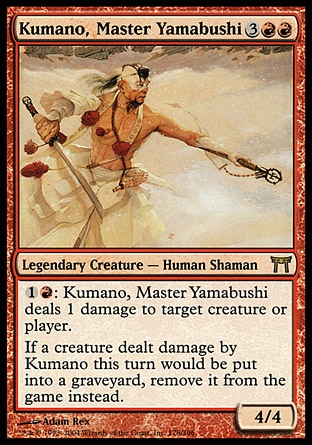
Your choices for Commanders is pretty scarce with Mono-Red, but the one who I think best fits these kinds of criteria is Kumano, Master Yamabushi.

It's reasonably cheap, especially if you run some mana rocks as ramp, and, once you play it, you never have to tap out again. Sure, it's not a fast clock, but you can certainly boost it with reasonably costed enablers and it doubles as removal and a way to generate card advantage. It even exiles creatures, which disrupts the sweet graveyard-based decks in the format.

The first thing a good Kumano deck is going to need is some mana acceleration, both so that you can cast Kumano earlier and so that you can pump more mana into his ability and make him a more imminent threat than he might otherwise be.

Mana Ramp

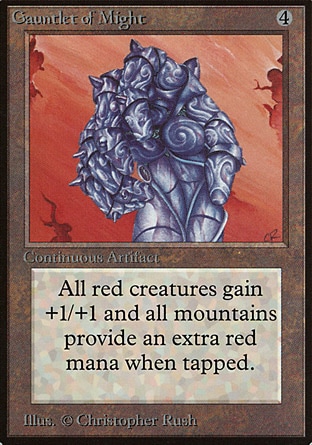
There're two kinds of acceleration here. The first are your Gauntlet of Might-style of effects, which aren't very good for powering out Kumano, but are great at letting you double up on Kumano activations. The second set of cards is the more traditional mana rocks, like Mind Stone, which don't scale up very well over the course of a game but do give you some explosiveness in the early game.

  • Gauntlet of Power
  • Caged Sun
  • Extraplanar Lens
  • Chaos Moon
  • Mana Flare
  • Koth of the Hammer
  • Braid of Fire
  • Mind Stone
  • Dreamstone Hedron
  • Solemn Simulacrum
  • Journeyer's Kite
  • Heartstone
  • Everflowing Chalice
  • Worn Powerstone

Of the Gauntlet effects, Chaos Moon and Braid of Fire are the only two which aren't pretty common in Mono-Red decks. Braid of Fire is pretty absurd specifically in a Kumano deck, though it is a pretty miserable topdeck later in the game since it doesn't have an immediate impact like the other Gauntlet effects.

I did decide to skip on Gauntlet of Might since that's a card that barely anyone is going to have access to. That said, it is absolutely insane in this deck, and would certainly make the cut over any of these other similar effects.

With the mana rocks there are a number of cards that are very obviously missing: Sol Ring and Mana Crypt would be great for this deck. The problem is that I just don't like the effect that those style of cards have on a game and on the deck that they're in. Rather, I'm running acceleration that's a little more fair and gives you a little more longevity if the game goes longer than you expected.

Journeyer's Kite in particular is a card that I really don't like in most decks. If you think about it, you have to spend five mana before you get one land out of the deal and eight before you've actually generated a card off of your investment.

For that I'd rather run basically any ramp or draw spell in the same slot unless you're desperate for color-fixing. However, in a Red deck that really wants to make every land drop, you don't have a ton of other choices so I think that Journeyer's Kite makes the cut.

Suit Him Up!

The second thing that a Kumano deck needs is a few ways to turn Kumano into a legitimate threat. You don't want to spend your entire turn pinging someone for five damage. While you will win eventually, someone's just going to go over the top of you. The two kinds of cards included here are ones that increase or bolster the damage output that Kumano is capable of and cards that give give him some kind of bonus, like Deathtouch.

Equipment

  • Quietus Spike
  • Basilisk Collar
  • Gorgon Flail
  • Neko-Te
  • Darksteel Plate
  • Shield of Kaldra
  • Champion's Helm
  • Grafted Exoskeleton
  • Godo, Bandit Warlord
  • Hoarding Dragon

There are a ton of sweet equipment for Kumano as well as two ways of tutoring them up. I'm not sure if both Shield of Kaldra and Darksteel Plate are necessary, but I figure starting with both of them is fine since you can always cut one later.

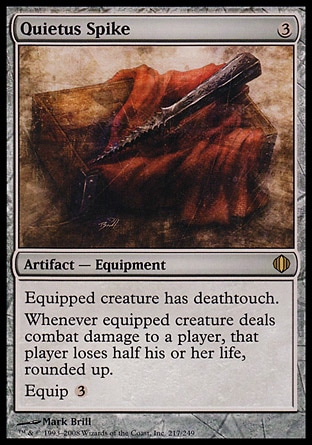
Beyond those, you've got the suite of Deathtouch equipment that let Kumano machine-gun down all of the other creatures. Grafted Exoskeleton is the scariest equipment to give Kumano, since it generally means that someone is going to die if you untap.

I'll warn you, though: there are a lot of people who don't like dying to poison, especially in a forty life format, so this might be something you want to cut if your group is particularly averse to the mechanic.

Enchantments and Such

  • Gratuitous Violence
  • Fractured Loyalty
  • Repercussion
  • Quest for Pure Flame
  • Pyrohemia
  • Claws of Valakut
  • Akki Lavarunner

These are the exciting cards! The ones that interact better with Kumano than you might expect and will catch people by surprise.

Fractured Loyalty in particular is pretty awesome, since it's basically a Control Magic for this deck, an effect which Red has never gotten!

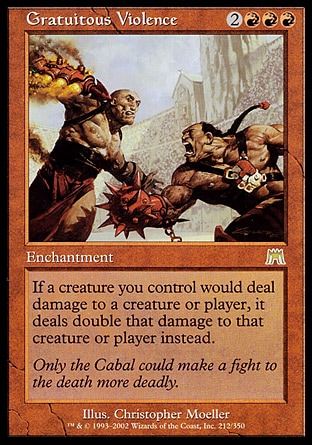
Beyond that, we've just got a bunch of ways to turn one damage into two damage, and two into three or four. If you manage to stick one or two of these and a Gauntlet of Power, suddenly you're dealing ten to twenty points of damage per turn. That's the kind of threat that people have to respect!

Being Hateful

Even if you can stick Kumano and manage to stick a Gratuitous Violence or so, you're still in danger of being Capsized or comboed out by the Blue players at the table.

Just because you can't really play cards like Boil doesn't mean you have to play completely fair. These are all cards which punish people for being too greedy with their mana, with their tutors, or with their over-powered Blue spells.

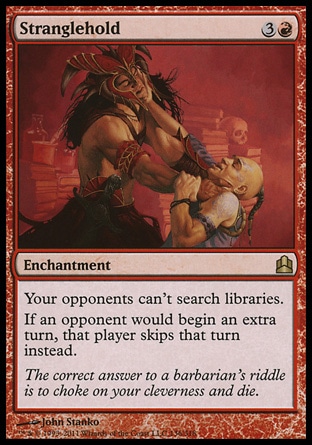
  • Stranglehold
  • Blood Moon
  • Magus of the Moon
  • Ruination
  • Pyroblast

i

It's worth noting that these cards should change depending on what kinds of decks you expect to play against.

If you plan on seeing a ton of [card Windswept Heath]Fetchland[/card]/[card Savannah]Dual Land[/card] manabases, then the non-basic hate is good. If you plan on seeing a ton of Blue decks, make space for Red Elemental Blast. If you see mostly [card Teneb, the Harvester]Teneb[/card]-colored graveyard decks, then run Tormod's Crypt.

These slots are just there to make other decks play fair, and should serve to supplement your utility removal in shoring up bad or anticipated match-ups.

Utility Spells

Again, this is a subsection of cards that should be tweaked so that you're using cards that answer the things you're expecting to see the most of.

For instance, this is mostly set up to deal with Tokens, Zedruu the Greathearted, Rafiq of the Many and Glissa, the Traitor. That means I want to be able to kill any creature with 4 or less toughness on command, but also want cheap ways to sweep the board against Token decks.

  • Duplicant
  • Ronin Cliffrider
  • Starstorm
  • Skred
  • Spitting Earth
  • Seismic Strike
  • Earthquake
  • Steel Hellkite
  • Chaos Warp
  • Aftershock
  • Expedition Map
  • Shattering Pulse

As you can see, the first set of cards are your answers to creatures. The sweetest one is probably Ronin Cliffrider, which I'm blatantly stealing from Secret Tech on Commandercast. He's a guy who's fine against tokens and insane once you pick up a Basilisk Collar or some such. One of the "mountains matter" removal spells could easily become Volcanic Dragon or Karn Liberated or one of the colorless sweepers like Nevinyrral's Disk.

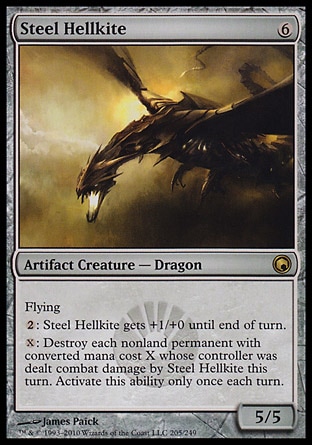
The second set of cards are your more generic answers to problematic permanents. I don't have to play against enchantments a ton, so my only two answers to them are Steel Hellkite and Chaos Warp. You could certainly run something like Karn Liberated or Spine of Ish Sah, but I really want to commit to Kumano, Master Yamabushi and see how strong that plan is. It's entirely possible that you don't need to deal with Enchantments, since you're just going to kill them anyway. Expedition Map is here to find either Valakut, the Molten Pinnacle and help Kumano kill creatures, or Buried Ruin to buyback important artifacts like Steel Hellkite.

Beyond having answers, Red needs the ability to pressure people. You don't have many ways to mess around with value-engines that generate cards, so you want to be the one threatening to kill people if they don't do things. You've got to have ways to go over-the-top and make people have an answer right now or die.

Fortunately Red is one of the best colors for that kind of effect!

Going Big

Curve-Toppers

  • Akroma, Angel of Fury
  • Inferno Titan
  • Conquering Manticore
  • Dragonmaster Outcast
  • Comet Storm
  • Devil's Play
  • Jaws of Stone

So there're a few things going on here.

First, there are cards like Devil's Play and Comet Storm, which can easily just kill someone.

Then there are cards like Dragonmaster Outcast and Jaws of Stone, which aren't as powerful but are easier to sneak in around countermagic because of their low cost.

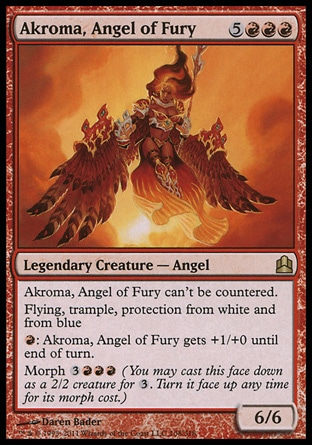
Finally, you've got Akroma, Angel of Fury to further punish the Counterspell decks and Inferno Titan to threaten to one-shot people if you untap with him. And Conquering Manticore. He's a card that doesn't get a ton of play around me and I can't figure out why. Who doesn't love stealing Primeval Titans or [card Ulamog, the Infinite Gyre]Ulamog[/card]s and beating down?

The biggest benefit of these is that, just like Kumano, they love when you have a billion lands in play and make every land drop.

That's all well and good, but generally the only way Red can make sure it has a ton of lands is to just draw them naturally. That means you have to have a fairly high land count, which in turn means that you're more likely to flood out in the late game and will need some ways to draw extra cards to compensate.

Card Advantage

Red is a color that is well known for being bad at recouping spent cards.

  • Chandra Ablaze
  • Reiterate
  • Wild Ricochet
  • Mind's Eye

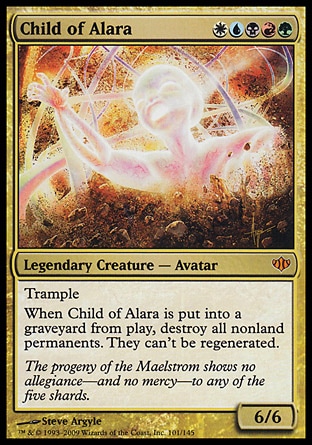
One thing I've learned from running Pauper Child of Alara is that Buyback spells are insane for recouping card advantage.

While red doesn't have anything as insane as Capsize or Disturbed Burial, you do get to copy their best spells every time they play them with Reiterate. Or you can Wild Ricochet their Time Stretch and get ahead that way. Those two cards are like Conquering Manticore in that they take advantage of other players being greedy and running good cards.

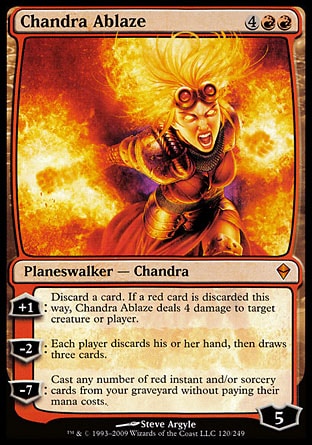
Chandra Ablaze, on the other hand, is a pretty rare combination of card advantage and disruption. You get to replace your hand while cutting the Blue players down to size and messing up their plans. That seems pretty insane to me! Chandra Ablaze is the kind of card that doesn't get nearly the amount of credit it deserves. If you get to do a mini-Wheel of Fortune twice, you should be pretty far ahead.

Manabase

One of the most important questions you have to ask when you're building a deck is how the manabase is going to support the spells you want to play and the way you want to play the game. This deck wants to cast Kumano and spend most of its mana on other players' turns. Because of that, you want to make as many land drops as possible so that Kumano is a giant threat. To that end, we're playing 42 lands and a bunch of artifact mana.

  • Mouth of Ronom
  • Buried Ruin
  • Thawing Glaciers
  • Deserted Temple
  • Terrain Generator
  • Scrying Sheets
  • Valakut, the Molten Pinnacle
  • Springjack Pasture
  • 34 Snow-Covered Mountain

At least the lands have some utility, right? Thawing Glaciers, Scrying Sheets, and Terrain Generator all interact very well with Deserted Temple, especially in conjunction with one another. These will help you get ahead on lands and give you things to do with your mana if you don't have a reason to activate Kumano.

You've also got Mouth of Ronom and [card Valakut, the Molten Pinnacle]Valakut[/card] as removal to back-up Kumano or to let you invest less mana when you have to activate him.

Lastly, Springjack Pasture is a sort of storage land with additional utility. Blockers are good, lifegain is good, and the ability to turn your Goats into a Dark Ritual to kill someone is great. Besides, they're goats! What more could you want?!

[deckbox did="a142" size="small" width="560"]

Honestly, I'm pretty happy with how the deck has turned out. It's a shame Red doesn't have something like Azure Mage, but I think that Kumano, Master Yamabushi does a pretty good job of letting you play Draw-Go.

I think you've got a pretty good matchup against the field as long as you can resolve Kumano since he gives you such a huge advantage in positioning yourself throughout a game. You decide when to tap-out, when things have to die, and who the biggest threat is. Worst case is you wait until they deal with Kumano and use the opening to resolve an even bigger threat!

Anyway, that's all I've got for this week! Next week I'm going to be looking at one of my favorite mechanics and one that's had a sadly minimal impact on Commander as a format. This next one's pretty far out there and has been doing pretty well in my local metagame, so I'm excited to share it! Be sure to check it out!

Carlos Gutierrez
cag5383@gmail.com
@cag5383 on Twitter

Insider: Hidden Gems in Shards of Alara, Pt. 2

Are you a Quiet Speculation member?

If not, now is a perfect time to join up! Our powerful tools, breaking-news analysis, and exclusive Discord channel will make sure you stay up to date and ahead of the curve.

Last week, we tore through the first half of Shards of Alara. We saw hit commons like Blightning and killer trade bait like Death Baron. Let's take a close look at the second half of the set this week and see what treasures we come upon.

Lich's Mirror

$1.50

I see the mirror here mainly as a curiosity. The best combo we came up with for it is to use Channel and the card. You can Channel the Mirror out, then kill yourself and float lots of colorless mana. From there, you'll be able to Channel more life away and hopefully cycle through Mirrors until you find something beefy like an Emrakul to cast. My best guess on why this isn't a junk rare is that it's a plausible Commander card with a few interesting uses.

Master of Etherium

$3.25

Before Mirrodin, the only real association between blue and artifacts was Tolarian Academy and Power Artifact. The relation was sometimes anatgonistic, considering Energy Flux and Annul. Wizards has been angling the two groups closer together since that set, thanks to cards like Fabricate and Etherium Sculptor. Master fits into an interesting slot - blue aggro. He's the Keldon Warlord of artifacts and pumps every last little Ornithopter along the way. It's not surprising that people casually like the card. We've seen attempts at blue Affinity in Modern, but I don't see it happening. Master is good to keep in mind when trading; he's worth a deceptive amount and there are a lot of casual and tournament players who want it.

Mycoloth

$2.50

I've been considering Big Myke a lot for Modern. A deck that aims to win through creatures attacking cannot beat this card if you devour three or four little guys along the way. It's one of those "Path or no?" cards that can buy you back into a game you were quickly losing. I could see it in Melira Pod decks and possibly in Elf decks. Mycoloth is friendly whenever there are other monsters to devour, though, so it is a natural for plenty of Commander decks. With the appeal of Verdant Force, I'm very surprised at how cheap Mycoloth is. I'd venture to say that the card is underpriced right now.

Quietus Spike

$2.00

Braining someone for half their life is easy with this icepick, and in Commander, it's withering. You can tear down that guy who just cast Beacon of Immortality and then swap the Spike onto a blocker to keep the love flowing. Spike is a great fit in Commander decks because there's always someone who can't block your evasive guy. For opportunistic players, this is an incredible piece of equipment.

Rafiq of the Many

$3.75

Rafiq is a hugely popular Commander general - he's really thematic and the Bant trio are great colors. He's a mythic rare, which makes me puzzled why he's only $4. Rafiq was printed in the FTV: Legends box set, which has depressed his price somewhat. He's a flashy card and you can find people who will knowingly overtrade to get him.

Ranger of Eos

$3.00

Whichever Ruel brother this is can bring on a little army of pesky weenies. I don't know if that's the legacy he wants to be remembered for, but Ranger sees some decent play in Modern Martyr decks. He'll get Martyr of Sands to start or twin Serra Ascendants to close the gap with an opponent. He can snag Figure of Destiny to bring the beats. He also infrequently shows up in Melira decks to get Viscera Seer. Ranger is kind of a weird card; would you pay 3W for a 3/2 that draws two cards? What if those two cards were the categorically worst cost you could think of? He's a "build around me" kind of creature, for sure. I expect to see Ranger played a bit in Modern and if Martyr picks up more steam, it may hit $5.

Sarkhan Vol

$8.75

The Dragon-man! Sarkhan's mini-Fires of Yavimaya ability has killed me in a lot of Commander games that I felt safe in. A token army can come out of nowhere and he'll send them right to ya. His other abilities are nothing to ignore, either. Who doesn't want a bunch of dragons! Despite seeing no tournament play at the moment, Sarkhan is still a highly-valued Planeswalker - I attribute it mostly to his draconic token generation capabilities.

Sharuum the Hegemon

$2.25

Chances are, you know a guy with a Sharuum Commander deck and he or she probably thinks it's their original creation. Sure, you can recur him over and over with Sculpting Steel and Altar of Dementia! You can rebuy Mindslaver! Why not get that Nevinyrral's Disk back while you're at it! It's a totally unfun general to play against; I defy people to make entertaining Sharuum decks that do not involve loops or insane recursion. Foil copies of this card are quite valuable, since they are in such demand as Commanders.

Tezzeret The Seeker

$4.50

Tezzeret has had a mighty trajectory. When he was printed, the Vintage community freaked out because he was basically a one-card combo with Time Vault. We played three copies, then two, then we dipped to one before we dropped him when Jace was printed. Sorry Tezz, merely being a gamewinning combo with Time Vault isn't strong enough for Vintage play. He's still enormously popular in casual play. His price is artificially deflated because a lot of people, me included, bought the Tezzeret vs. Elspeth boxed set for the white Planeswalker and have one of these sitting around as a result.

That rounds out Shards of Alara! Join me next week when we take a tour through Conflux!

-Doug Linn

Ascending into Darkness (Dark Ascension Spoilers!)

Are you a Quiet Speculation member?

If not, now is a perfect time to join up! Our powerful tools, breaking-news analysis, and exclusive Discord channel will make sure you stay up to date and ahead of the curve.

The time to Ascend into Darkness is upon us!

Dark Ascension spoilers are about to be on us in full force, and I’m sure the full set will be nearly as awesome as Innistrad was. Regardless of your opinion on double-faced cards, there’s no denying how popular the set has been.

And here we’ve dug up some spoilers by way of the blog MTG-Realm. Here’s the link to the original post with inspiration from the salient parts that are posted below.

It seems that a Japanese site has posted the below image of the goodies from Dark Ascension, and we can glean some knowledge from this picture.

Let’s start with the picture that we have the best view of. These are the Dark Ascension Intro Packs, and you can make out the mana symbols in the top left of each box, giving us a hint of what’s inside.

From this image, it seems that we can expect the following color combinations:

  • White/Red
  • Blue/Green
  • Red/Green
  • Black/White
  • Blue/White

Based on Innistrad, we can make a few educated guesses at the contents of each pack:

  • It’s likely the White/Red deck will represent the human contingent of the denizens of Innistrad and probably some spirits to go along with them, in the vein of Dearly Departed.
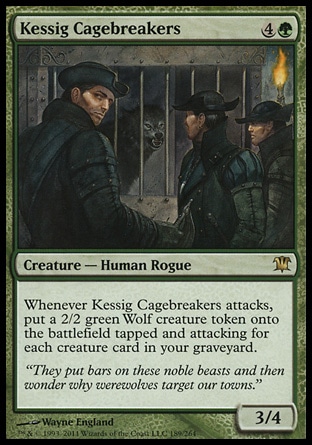
  • Blue/Green is likely to look something like the UG Mill Yourself decks that Innistrad draft has given us. These decks have made a splash in Block Constructed and I’ve seen a few trotted out at FNM. More cards that work with Splinterfright, Boneyard Wurm and Kessig Cagebreakers are probably on the way out of this pack.
  • We can only assume that Red/Green will bring more Werewolves, since those are the two Wolf colors. Exactly what the next evolution in double-faced Werewolves might look like is another story entirely.
  • Black/White is where I suspect the Vampires and/or Zombies will be coming from, though I’m not sure exactly how White fits into that. Maybe more cards a-la Cloistered Youth?
  • Blue/White is the Spirit color. It will be interesting to see what direction these go in the next set.

While all of this is blatant speculation, we have some solid clues from Innistrad to draw from and I’m reasonably confident we're not too far off the mark here.

And one other note that we can draw on from the promotion poster: If you haven’t guessed it already, it’s pretty clear that Sorin is back. I expect his Vengeance will play a major role in the set.

And don't forget about Faithless Looting.

What do you guys think? What do you think we can expect from Dark Ascension?

-Corbin Hosler

@Chosler88 on Twitter

Insider: A Modern New Year

Are you a Quiet Speculation member?

If not, now is a perfect time to join up! Our powerful tools, breaking-news analysis, and exclusive Discord channel will make sure you stay up to date and ahead of the curve.

We’re finally into 2012, which means, more importantly, we’re finally into Modern PTQ season! With that comes some easy moves for the PTQ season, and some other, more difficult to guess moves.

I’ve been hyping Modern for months, and with good reason. As Aaron Forsythe pointed out in his “state of 2011” feature article, Wizards is all-in on Modern. That means we’re going to see plenty of continued support for the format, both in the form of the current PTQ season and Grand Prix events throughout the year. Aaron also reiterated that they’d be freely reprinting cards for the format (something I’ll explore more fully next week).

The important thing to us now is that there are some cards that you probably should have already picked up, but you’ll have one last chance to do so this weekend before everyone catches on to some price increases. I’ll start by listing some of the obvious ones and then move into a metagame breakdown.

Fetches

Old news here. I’ve been talking about these forever, they’re still a good move.

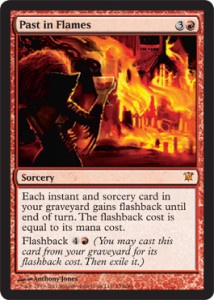
Past in Flames

This card has gone crazy in the last few weeks, but no one who isn’t already following the card’s price knows about it. It’s up to $8 on Star City Games and people will trade it to you all day at $3-4. Get in on these while you can. Remember, Modern doesn’t ever rotate, so the decks that are good now will continue to stay good (barring more bannings).

Aside

I think this is a fact that many people are overlooking. Unlike Extended, Modern will never rotate. With the continued support we know we can expect from Wizards, foils of these cards will hold their value very well, as will the regular versions of the cards. And with the new GP schedule, there won’t be as much “out-of-season/in-season” price fluctuations that we’re used to.

End aside

Elspeth, Knight Errant

Another card I’ve been championing for a while. It shows up in Matyr decks and control decks and Big Zoo decks alike. SCG has quietly sold out at $20, so move on these while you still can.

Thoughtseize

A good card in Jund or just about any other deck that wants the disruption, it’s hard to go wrong getting into a card like this, since it’s already a Legacy staple. Also start hoarding Inquisition of Kozilek again. It’s sometimes played instead of Thoughtseize and has seen high prices before.

Kitchen Finks

This is already absurdly expensive, but I don’t see any reason for it to come down, and many people will still move it at a couple of dollars.

Those are some obvious ones that fit into a multitude of decks. Now we get into another aspect of what makes this format unique. That is the fact that the metagame is being defined on MTGO and we’re basically going into PTQ season with just that information, as there’s no high-level Modern event for the pros to work on coming up soon. That means we can mine a lot of information from MTGO, where paper prices haven’t caught up yet to the coming demand.

Chord of Calling/Summoners Pact/Melira

Melira decks are sticking around, and moving in on the cards from this deck isn’t a bad idea. It brings a lot of angles of attack and can play solid disruption, so I don’t see any reason it won’t stick around the format.

Hate Bears

As evidenced by just a Melira deck or two, you can see that hate bears have a lot of value in this format. Ethersworn Canonist, Kataki, War's Wage, and Gaddock Teeg are all solid options in the format, though usually out of the sideboard. Canonist is an especially popular one with all the Storm decks running around.

Speaking of Storm…

Mindbreak Trap

We might finally see the big jump Trap is primed for. This is an incredibly cheap Mythic rare and Modern decks are packing 2-4 of these in the board. While “in the board” isn’t a good sign for a card’s price, if Trap does become the go-to answer (which I suspect it will, as Hate Bears die to Bolts), then it could really move.

Rise/Fall/Rain of Gore

Here’s a pair of Ravnica-block cards that are floating around as important tools. Rain of Gore is an incredibly potent sideboard card for the Red decks that I suspect many people will still sleeve up, and Rise/Fall is as close to Hymn to Tourach as you’re going to get.

Manamorphose

Yes this card is a common. It’s also sold out at $2 on SCG and foils are out of stock at $6. I’m willing to bet that comes as a surprise to many of you. If you can dig these out somewhere, do it.

Maelstrom Pulse

Jund is a real deck, and this baby has nowhere to go but up. It’s from a small, third-set and fits into formats besides Modern.

Leyline of Sanctity

Another card that hates on Storm, but also stops targeted discard. Easy to pick up as throw-ins in trade, and could pay off well down the line.

These are all cards I feel will make an impact in this PTQ season and you should be prepared to stock up on them now. Some of these cards will have a large price increase, and some won’t. That doesn’t mean you can’t profit from them, though. A lot of the random sideboard cards are very easy to pick up in random trades but can be traded off very well at the right moment. Stocking up on cards like these now is a very low-risk, high-reward scenario.

Modern isn’t going anywhere, and despite all the ups and downs of the format to this date, there are still opportunities to profit.

And, by the way, happy 2012!

Thanks for reading,

Corbin Hosler

@Chosler88

FNM FTW

Are you a Quiet Speculation member?

If not, now is a perfect time to join up! Our powerful tools, breaking-news analysis, and exclusive Discord channel will make sure you stay up to date and ahead of the curve.

There may not have been any large events recently to attend, but that doesn't mean there is no time for brewing! Weekly FNM has been a source of a great fun this season for me and a way to test out new decks almost worry free. Do not be afraid to build a crazy deck for FNM. Even if you lose horribly, it can be a great learning experience. For example, maybe you put together a Birthing Pod deck last week but it was a complete flop. What did you learn about the deck in your metagame? Maybe there was a particular card that stood out like Blade Splicer that over performed but the rest of the deck was not very good. Take that information and use it the next week. Maybe build an aggro deck with the Blade Splicer instead of Birthing Pod. I can’t tell you how many times this type of thing has happened to me. Whatever deck you take to FNM, make sure you reflect back on the event afterwards and find the valuable parts of the tournament. This allows you to progress in deck building and as a player.

Another important yet dangerous part about innovation is pet cards. During every Standard season, there are always a few cards that I try to play over and over again just because of how interesting I think they are, or a unique but powerful effect they have, etc. Some examples in Standard have been Wild Nacatl, Fauna Shaman, Kalastria Highborn, and Puresteel Paladin. In the last few weeks, I found my new pet card. What is it you ask? I am certainly glad you did.
Bloodline Keeper

This card is simply amazing if you untap with it. I have had conversations about Bloodline Keeper with many of my close friends over the past few weeks. It all started when I took a financial interest in the card. I buy and sell magic cards every Friday night at FNM and Bloodline Keeper has been a card that I buy and sell almost every week. They are just really popular. The interesting part though, is that no one was playing them at FNM. They just wanted the card for EDH decks or casual decks. I thought, but isn’t she at least good enough for FNM, if not competitive play? Since I had been thinking about her so much, it naturally led to deck building ideas. One week, after I slaughtered everyone with blue white Illusions, I thought that I didn’t quite like the deck because it didn’t have enough late game play. Even though Illusions is solid and ends the game rather quickly, I wanted something I could close the game out with. What about Bloodline Keeper?

That snowballed my thought process for days trying to figure out how to fit it in Illusions. I still wanted the white mana for Moorland Haunt because it is so powerful against the control decks. Obviously the mana was horrible and it didn’t work, but then, that will happen when you try to fit in a double black card into a mono blue deck that wants white mana for a colorless land. It was important to try and see if it would work though because if it would have, the leap in deck construction would have been quite the break through. Removing the white mana was hard, but not because of Moorland Haunt. I never realized how much the sideboard relied on the white mana until I took it out. I had to completely innovate the sideboard for a new deck, not just tweak it like I was expecting. With the white out of the deck, that gave me room to expand the black part of the deck. Doom Blade, Diregraf Ghoul, and Dismember were now easy additions.

I had to find something powerful though in addition to the Bloodline Keeper in order to justify no Moorland Haunts. This part took a great deal of research and thought. What I ended up with was not even really my idea. When Illusions was first built, before it played Geist of Saint Traft, it played a card that some laughed at but upon testing was amazing. The card?

Stitched Drake

While you do not want to play a lot of Stitched Drakes, when you can cast it turn three, it is so amazing. It doesn’t seem that great but the four toughness is hard to deal with in our non-Dismember Standard and it hits hard with evasion. When you draw it late in the game it is still powerful. Obviously Illusions stopped playing it because well, Geist of Saint Traft is sweet if unblocked and you were removing the creatures in your graveyard with Moorland Haunt anyway so why use them up with Stitched Drake. By the way, I do not really like Geist right now because he doesn’t go unblocked very often. The list I ended up with was a ton of fun and really good. Take a look.

UB Illusions

Untitled Deck

Creatures

4 Diregraf Ghoul
3 Phantasmal Bear
4 Delver of Secrets
2 Phantasmal Image
4 Snapcaster Mage
2 Stitched Drake
3 Bloodline Keeper

Spells

2 Gitaxian Probe
4 Ponder
3 Doom Blade
1 Dismember
4 Mana Leak
3 Vapor Snag

Lands

4 Darkslick Shores
4 Drowned Catacomb
3 Ghost Quarter
6 Island
6 Swamp

Sideboard

2 Batterskull
3 Tribute to Hunger
3 Gut shot
1 Sensory Deprivation
1 Phantasmal Image
1 Consecrated Sphinx
3 Dissipate
1 Psychic Barrier

The deck plays very similar to an aggro control deck that is very tempo oriented like Illusions. There are a bunch of cards that overlap so that seems obvious. Adding another one cost creature was exactly what the deck wanted too. Diregraf Ghoul adds more consistency to the deck so you should have a one cost creature almost every game. The additional removal package of three Doom Blade and one Dismember performed above my expectations. All of the options in the deck allows Snapcaster Mage to be quite the choose your own adventure.

a.) Search for a new path. Sea Gate Oracle

b.) Defend yourself against an unfriendly creature. Aether Adept

c.) Kill the enemy in your way. Nekrataal

d.) Stop the plot of your enemy planeswalker. Mystic Snake.

Wow, now that is versatility. This is definitely one of the best decks for Snapcaster Mage I have played in Standard for sure. I think the deck could use some tweaking but it was good and a lot of fun.

How else could we play the card? Can you hear the crowd chanting…

WE.

WANT.

MORE.

BLOODLINE KEEPERS!!!

With all the chanting, I caved. Red Black vampires forever has a home in my heart from a time where Viscera Seer, Bloodghast, and Kalastria Highborn combined to destroy my opponents. Oh and Gatekeeper of Malakir was sick too. This deck is no tier one deck like the previous version, it is barely tier two. I knew it would not be amazing when I had it built but it should be good enough given how cheap the creatures are, the fact some of them get bigger on their own, and Rakish Heir is really good because of how he grows all your vampires.

RB Vampires

Untitled Deck

Creatures

4 Stromkirk Noble
4 Diregraf Ghoul
3 Bloodcrazed Neonate
4 Vampire Interloper
4 Rakish Heir
3 Bloodline Keeper

Spells

4 Galvanic Blast
3 Doom Blade
1 Dismember
4 Volt Charge
2 Liliana of the Veil

Lands

4 Blackcleave Cliffs
4 Dragonskull Summit
3 Stensia Bloodhall
6 Mountain
6 Swamp

Sideboard

4 Shrine of Burning Rage
3 Traitorous Blood
2 Batterskull
3 Tribute to Hunger
3 Manic Vandal

I hope the first question is, why did you play this deck? It seems horrible. Well, you would be mostly correct. Why isn’t it good though? There are a couple reasons that make this deck a strictly worse version of aggro in Standard. The first reason is not one you might think of at first glance, I certainly didn’t think it would be that big of a deal.

1. Blocking.

This deck does not do it basically at all. I thought that would be fine because I wanted to be attacking all the time anyway. Still, there are creatures you just have to block sometimes like Geist of Saint Traft in particular, but also, Hero of Bladehold. Blocking is important because it allows you to survive until you can stabilize or find removal.

The second reason the deck is horrible is the obvious one.

2. Terrible creatures typically do not belong in competitive play.

Bloodcrazed Neonate and Vampire Interloper are just horrible. Bloodcrazed Neonate is not too bad if you can get it to connect but even with flying, Vampire Interloper still sucks. Almost all of these creatures having one toughness is pretty terrible for you also because it allows your opponent to trade profitably with cards like Doomed Traveler and Midnight Haunting. I did beat the green white tokens deck that ran both of those cards though somehow, but it was possibly the worst matchup I could think of.

How did the rest of FNM go? Not well. I beat a random mono black control deck with all star cards like Royal Assassin. Yes, I beat the Green White Tokens deck but I probably should not have. The two decks I lost to were four color control and Blue White Humans. The control games were really close but ultimately this deck cannot beat Wurmcoil Engine. I thought I could beat it game two with my sweet sideboard strategy. The plan was to steal it with Traitorous Blood and then Doom Blade it so I get the tokens. I successfully accomplished this plan but his Slagstorm the next turn followed up by another Wurmcoil Engine the following turn, decimated that plan. The Blue White Humans match was vastly one sided and not in my favor. The match is bad to start off with but my muliganning, colorless sources, all my lands coming into play tapped and no removal draws didn't help either.

What did I learn from playing the deck though? Going back to the beginning of the article, try to take something away from every tournament. It might not be every round, though you should evaluate each game, but definitely every event has some key knowledge that you can discover by replaying your matches in your mind once it is over. For me, I leaned that Rakish Heir was completely busted. I have played him in limited before and he was quite good in my decks there but I have not played him in Standard until this event. Sure he is only a 2/2 and is easily killable, but the effect it had on the game was immense. If we see some more aggressively costed vampires in Dark Ascension, this deck is worth revisiting. If I had never tried this deck, I would not know how good Rakish Heir was in constructed play. Play testing aside, tournament time with a deck is more beneficial than just testing.

Bloodline Keeper is awesome and I hope you guys have a chance to play with it. Both of these decks were tons of fun so give them a shot. I actually think that the Blue Black Illusions may be ready for a larger event, but we'll see. This weekend will be FNM and then Modern on Saturday, so next week I will probably have some cool stories about this new diverse format to share with everyone.

Until Next Time,

Unleash that new technology Force on Standard!

Mike Lanigan

MtgJedi on Twitter

Jedicouncilman23@gmail.com

Insider: Diving into Modern Daily Data

Are you a Quiet Speculation member?

If not, now is a perfect time to join up! Our powerful tools, breaking-news analysis, and exclusive Discord channel will make sure you stay up to date and ahead of the curve.

Time to Pass on Past in Flames?

PTQ season has officially switched into Modern, but there isn’t exactly a wealth of data available yet from high level events. Times like these are a good time to turn to MTGO Daily decklists. I spent some time this week pouring over some of the most recent 4-0 decklists from Modern Daily Events (DE’s), and taking a look at what a Modern deck costs, both in paper, and on MTGO. The data I compiled is found here, and I’ll be referencing it throughout my analysis. Keep in mind, this is only 7 from a few different events in the past week, but this should give us a grasp of what this format is looking like, and how it will move (if at all).

What is this data? I compiled pricing from 3 different sources. MTGOtraders.com, Starcitygames.com and blacklotusproject.com. Above each column you’ll see two calculations. Above any (each) column, I show the average price per card (Mainboard on top, Sideboard beneath), and above the (total) columns I show the total cost of the Mainboard and Sideboard respectively. When appropriate I selected the least expensive version of a card.

First Glance
Range is the one of the broadest ways to look at the spread of a dataset. On MTGO the range is from about $50 to about $700+. In paper, the two token decks are the only ones under $100, and Jund is in the $800 vicinity. Especially when a format is hot on MTGO, grinders want to shift into decks that are profitable. Meaning they could recoup any investment into the deck by grinding daily events. If they already have the cards for a deck like Jund, sure they’ll play it. But what if they don’t? They gravitate toward the cheaper deck that has also been having success in DE’s. If this happens enough, the key rares in those cheaper decks start to rise. This is something to look for. The range on paper cards isn’t as drastic. Most of the decks sit very close to to the same $175-225 mark, while the token decks are about half of that price and Jund is about 4 times the price. If I owned a Jund deck and I was playing Modern, I’d want to be certain it was the best choice if I had to tie up 4 times the funds to play with the deck for the season.

One step deeper

How is this data useful to me, unless I’m just buying a deck? This is the real question. The reason we want to look at this data is to predict how people will behave going forward. Sure, the die-hard grinders are already on MTGO firing away at DE’s, but most people I know are still tinkering with proxies at the LGS before they dip an investment into physical or MTGO cards. Most local PTQ’s don’t really pick up until next month, and people are still learning the format. With a deck like the tokens deck (Two variants in the past week have 4-0’d) there’s no question people will latch on to it, seeing as they could order the entire deck from SCG for $100. The other thing I noticed from the mono White deck is Proclamation of Rebirth. It’s the 2nd most expensive card in the deck on MTGO behind Elspeth, but in paper it sits about the same price as many of the staple uncommons. It can fall into a number of other strategies as well, and the fact that the MTGO price has already climbed so much comparatively, leads me to believe it’s paper counterpart may be right behind it.

We’re also able to look at cards that are appearing in multiple archetypes. Ethersworn Canonist has been found in a bunch of these lists, as is Relic of Progenitus/Tormod's Crypt/Nihil Spellbomb. We’re seeing tons of Storm hate here, guys and gals. Will storm lose popularity as a result? If so, the only card that stands to fall is Past in Flames. I’d be shipping out on those immediately. Alternatively, I noticed Mindbreak Trap in one of the sideboards, and found it was a $13 card on MTGO as a singleton in the board! If this is any type of indication, these are going to be hard to come by when the paper PTQ’s begin, and I’m placing an order for a handful of these as soon as I finish this article.

Wrap-up

This isn’t meant to be an all-inclusive list of every deck in the format, but a snapshot of what things look like right now. This is the type of digging I use to figure out what to target in trades, what to dish out cash for to hoard, and what to dump. It’s well known the paper market lags behind the MTGO market, and looking for anomalies in prices and decks is a valuable asset at the trade tables.

I hope you all find this data useful. If there’s demand for it, I can continue to update the spreadsheet for the next couple of weeks.

Find me on twitter! @torerotutor
Chad Havas

Five Cards To Build Around In Modern

Are you a Quiet Speculation member?

If not, now is a perfect time to join up! Our powerful tools, breaking-news analysis, and exclusive Discord channel will make sure you stay up to date and ahead of the curve.

I have made it no secret that I really like Modern. Whether you feel the same addiction to making fun decks or whether you just want to win PTQs, I have got some hot tech for you today. I'm presenting five cards that are worth building heavily around. They are not simply toss-ins, but they aren't so narrow that you have to maximize them at the expense of the rest of your deck. Let's jump in!

Has anyone else noticed how good this guy got when Punishing Fires left? Wretch is an absolute monster on someone's graveyard and he's a reasonable beater, to boot. Against Zoo, he makes sure Lavamancers don't turn on and Tarmogoyfs remain 0/1s. He invalidates Snapcaster Mage completely. He turns off Mystical Teachings' Flashback and smashes recursive strategies.

Speaking of recursion, there are a lot of decks in Modern right now that exploit the poor quality of maindeckable graveyard hate. I consider things like Gifts decks in this category. If you have two or three Wretches with some backup, they'll never be able to use their namesake spell the way they want to. Wretch is the best (only) graveyard hate that I would be proud to maindeck. The more you play him, the more you love him. You'll find him breaking Martyr of Sands recursion before too long.

Build around it by: stocking up on a heavy black list that can apply early pressure. Wretch is a long-term card and he's mana-intensive, but he shuts down other long-term strategies. Combine with things like Dark Confidant or slot it right into a Jund deck (but pack those Graven Cairns!).

People are taking serious runs at making ramp decks in Modern, but they're all awful. They run things like Overgrown Battlement and Llanowar Elves. Why not spend your first turn suspending Search For Tomorrow, your second turn with Sakura-Tribe Elder and your third turn with Bloom? On the fourth turn, you're tapping out to cast Tooth and Nail or Kozilek, Butcher of Truth. You're in kissing distance of hardcasting Emrakul. There's probably a place for ramp decks in Modern, and Vernal Bloom requires that kind of attention.

Build around it by: playing 22-24 basic forests - maybe you want Stomping Ground for that Red Sun's Zenith. Combine with Summoning Trap and Tooth and Nail. Max out on Kozilek and Emrakul. Ramp for three turns, then explode onto the board. The inevitability that comes with shuffling your Tooths back every time they kill your Eldrazi means you'll never hurt for gas.

Modern sometimes involves big creature mobs smashing each other. Rise gets the most out of it, whether you want to tempo someone or get some recursion with your Snapcasters. Rise almost always has targets. Unsummon isn't great in this format, but maybe Unsummon and Raise Dead become good. When you are pulling back a Snapcaster from the grave and bouncing your Vendilion Clique for a reload, that combo is just fine.

Fall is 3/4ths of a Hymn to Tourach. You can't mana-screw an opponent, but you can do just about everything else that Hymn can do. Modern has a paucity of playable draw cards. What you draw in the opening seven is pretty much what you'll be working with for your first few turns, so losing two of those cards at random is crippling. That triple Kird Ape draw from Zoo can get ripped into a one-monkey rush, unable to get a foothold against an opponent who is working their way into goodies like Bloodbraid Elf. It's fine later in the game if the opponent isn't wisely holding lands in their hand. Ripping out that Path to Exile before casting your finisher is superb.

Build around it by: playing Grixis colors. Fall is good enough to cram into Jund and never cast the Rise part outside of Cascading, but that re-buy on creatures is what makes this split card worthwhile. I have had success with it in Gifts piles with Snapcaster and by pulling back value guys like Gatekeeper of Malakir.

Let's put aside the bad combo of Gifts for Rites and Iona and look at what else this spell will do. Five mana is eminently reachable in Modern, especially if you run a little bit of ramp. When you get there, you get to put whatever monster you threw away back into play. That means your evoked Shriekmaw comes back for another taste. When you flash back the Rites, your Mulldrifter jumps back in. That one Rites can turn into a five-for-one with a deck built to attrition down an opponent. A lot of Modern decks have an issue with running out of steam and Unburial Rites solves that problem -TWICE!

Build around it by: playing it with lots of value creatures. I have faith that a B/W board control deck could be pretty decent in Modern. You control with Fiend Hunters and Shriekmaws, you draw cards with Phyrexian Arena and you buy back monsters like Wurmcoil Engine. Anything with an enters-the-battlefield effect is worth looking at with this. Avoid trying to game things by reanimating fatties and focus on getting three or four extra cards from your one Unburial Rites.

Exile isn't going to win you a game, but it will lock down creatures, especially now that Fires is gone. Let's say you're playing a slower control deck like Teachings and you've managed to blow away all of the early monsters. Exile lets you lock down the assault. They'll have to play more creatures and overextend into a Damnation or just get those same critters chipped away. For a deck without reach, beating Exile is nearly impossible.

Build around it by: playing Gifts Ungiven and grabbing your lone copy with this. It's also not out of the realm of possibility to play this like a Squee, feeding an engine. I'd love to use this with Compulsion, for example, but that can't happen. I'm sure there are good alternatives, though.

Go forth and brew! These are oddball ideas, but they should get you thinking about the strong and weak points of decks in Modern.

Going in Blind: Claws First

Are you a Quiet Speculation member?

If not, now is a perfect time to join up! Our powerful tools, breaking-news analysis, and exclusive Discord channel will make sure you stay up to date and ahead of the curve.

“Alright,” I thought, staring at the black words set in a white box. “I'm moving to Gathering Magic.”

I sat there, trying to figure out what I was going to send to Kelly and Tyler. It wasn't that I wanted to leave Quiet Speculation, it's just I'd already been feeling pressed for time last quarter between school and writing and I'm going to be taking an additional class this coming quarter.

“Well, maybe I could squeeze some time in if I stopped procrastinating...”

“Snap out of it. You could, but there's no point in stressing yourself that much; the content would be terrible.”

I lamented the fact that I couldn't comfortably fit in two writing positions.

“Oh, shut up! Lots of people would love to have one. Look at the Star City Games Talent Search!”

So I sat down and I wrote the email. And it really wasn't that bad, as Tyler and Kelly were supportive and understanding. The thing is, I still needed to say goodbye publicly. And that was bound to be a bit harder.

I could spend an entire column talking about the move, but that would be selfish. Most of the people who read this column don't know me or have any particular investment in my life.

They. Want. Content.

Oh... it looks like I've been forsaking that. Well, let's get some music on. Beatles? I guess I'm feeling pretty nostalgic. Anyway, time to take the leap of faith I need when I'm searching for content: I'm Going in Blind.

Click.

Click.

Click.

Click.

Click.

Click.

Click.

Click.

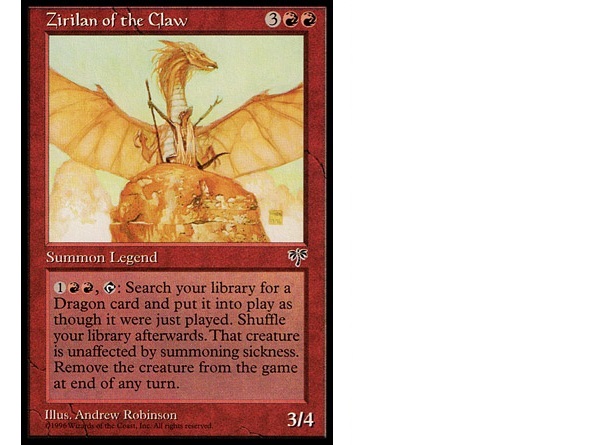
Zirilan does some pretty sweet stuff, but as with Myojin of Cleansing Fire, to justify running him as a Commander I need to find a job that he's the best at. Zirilan tutors for Dragons for a turn, but Scion of the Ur-Dragon does that while giving you access to more colors and dealing commander damage.

Areas of Expertise

The most obvious benefit that Zirilan offers is that, unlike [card Scion of the Ur-Dragon]Scion[/card], he actually makes his Draconic friends enter and leave the battlefield. Still, while Bogardan Hellkite is pretty sweet, it's not going to make up for loosing out on four colors. The only real way to turn that into a downside is to run stuff like Ruination and Price of Progress, and I'm certainly not planning on doing that.

Zirilan's biggest advantage is that he can bring out multiple Dragons. Sure, Scion can turn into more than one Dragon in a turn by responding to his own ability, but Zirilan can actually make use of multiple creatures provided you can untap him. Even without a way to untap him, activating Zirilan during the end step of the turn before yours and then on your turn will allow you to attack with two Dragons at once.

Two by Two

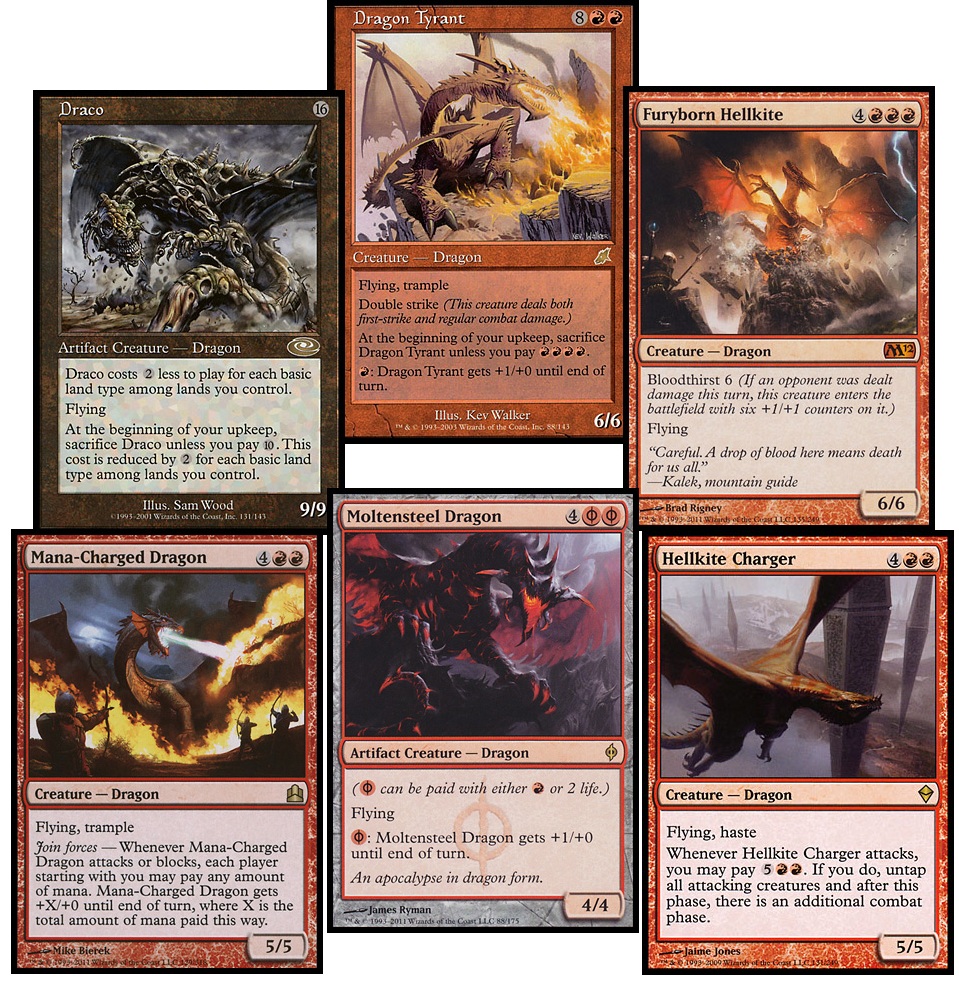
To capitalize on Zirilan's ability, I first looked for Dragons that had synergistic abilities to attack together with but came up short. Defeated, I skimmed the list of Dragons within Zirilan's color identity and absentmindedly added Dragon Tyrant to the list.

I don't like the Tyrant in Scion deck because he just leads to Commander damage kills, but here he should just attack for a lot without making you pay his upkeep. On top of that, the 18+ damage he represents as early as turn six can come out of nowhere.

After I finished going through, I looked back at the candidates I'd pulled out and as I scanned past Draco, I thought again about [card Zirilan of the Claw]Zirilan[/card]'s ability to bring two Dragons out of nowhere. And an idea hit me: I could build the deck to swing for huge amounts of unexpected damage! I proceeded to tap the best of the best for inclusion:

Implications

Great! Now all I have to do is figure out what sort of deck wants this type of sudden damage. My first thought was aggro, but not only is that sort of pressure hard to maintain in multiplayer, it doesn't make very good use of Dragons you draw or Zirilan's tutoring capabilities.

To take advantage of those benefits, Zirilan needs to play control, but it also needs to soften up the competition.

Luckily, this lizard again provides his own solutions. Balefire Dragon and Steel Hellkite will act as removal while dealing some damage, and Bogardan Hellkite and Fire Dragon allow Zirilan to play like [card Visara the Dreadful]Visara[/card] while still getting an attack in if you grab them on your own turn or don't need to grab them until the end step of the turn before yours. On top of that, Dragon Mage and Knollspine Dragon can net you more cards than Red typically ends up with.

The issue with all of these options is that you have very limited access to these effects because of the scarcity of similar cards, which means that getting them exiled by Zirilan's ability isn't going to cut it.

Thankfully Zirilan doesn't work like [card Dregscape Zombie]Unearth cards[/card] do, so we can reuse the Dragons with a little bit of extra effort.

Out of the Loop

Ultimately we need to get Dragons back into our library, but Mirror of Fate hardly seems like the solution. The easiest zone for Red (or rather, colorless) to get cards into the library from is the graveyard. And, luckily, it's not too hard to get creatures on the battlefield into the 'yard either.

Of course, requiring more pieces to start doing things entails greater difficulty in getting started, but if you really need to keep a particular Dragon around, you can always get it before your turn and subsequently search out a Predator Dragon to feed it to.

With a bunch of sacrifice effects already in place, we even get to include hits like Hoarding Dragon that don't do much with Zirilan on their own. And he'll let us convert mana into [card Miren the Moaning Well]life[/card] or [card Blasting Station]damage[/card].

The list up to this point does a good job of swinging with two dragons on demand after acting like a Red [card Visara the Dreadful]Visara[/card] deck for turns on end, but, as I mentioned earlier, we can squeeze a bit more value out of this particular Viashino.

Do it Again

As a Foil Addict™, I've been accruing cards that I thought I would put to use in Commander, and the group I'm most surprised to see languishing outside of a deck is the untappers.

Lots of Legends have tap abilities and it seemed only natural to me that Thousand-Year Elixir, Magewright's Stone, and Thornbite Staff would see the light of day. This is certainly the time for it, as Zirilan's even been errataed into a Shaman!

Even though this dragonspeaker doesn't offer Blue's trickery, the most passionate of colors offers not one, but two forms of untapping. While not an ideal untapping mechanism, Grab the Reins certainly does its job.

Still, the more exciting way to untap our new favorite lizard is via Relentless Assault. What's better than getting another use out of Zirilan? Getting another attack out of the first [card Firebreathing]Firebreather[/card] he searched up!

Disconnect

I'd leave you here, but if you've read my prior Commander-related ramblings, you'll know that this deck, despite all of its cool interactions, is missing its most vital piece: Mana.

Playing Mono-Red affords us a few interesting options, such as Valakut, the Molten Pinnacle and Scrying Sheets, but the real benefit lies not in the lands, but in the ramp.

Mono-colored decks of all stripes run explosive mana doublers like Caged Sun, Extraplanar Lens, and Gauntlet of Power. While Red may not give us Cabal Coffers or Vernal Bloom, it does offer Gauntlet of Might.


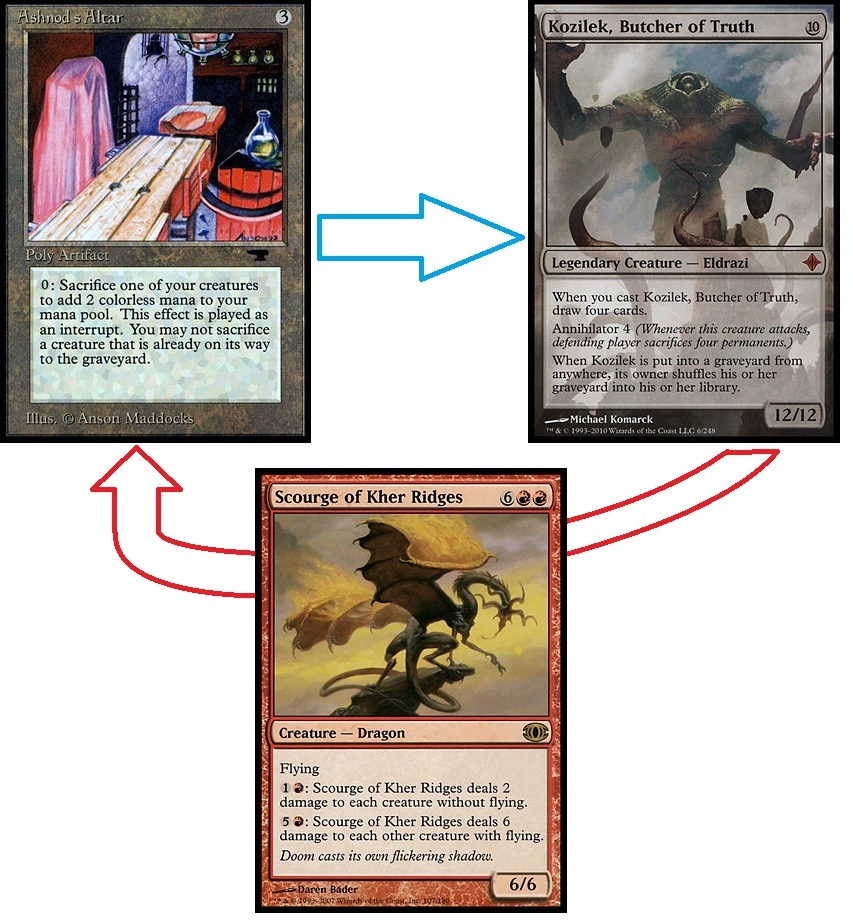
Shamelessly stolen from NonoKraken on deviantART.

Such a mountain of Red mana enables [card Zirilan of the Claw]Zirilan[/card]'s shenanigans and goes a long way toward making the deck's Dragons lethal. On top of that, it takes an awful lot of mana to attain a sizable Dragonstorm count.

Wrap it all together, and:

Daredevil

The Claw

Stinging Sands

Scorching Sun

Flowers of the Oasis

Heat's Toll

Fusing Sand

Windblown Tracks

Shifting Dunes

Bedrock

22 Snow-Covered Mountain

That's All Folks

Well I guess that's the end. You may see me back for an extra article sometime, but this was my last regularly scheduled piece for Quiet Speculation. I'll certainly miss writing here, but I'm looking forward to seeing all of the things this coming year brings, both for myself and for this website.

As always, I'd love to hear from you, but for now I'll just wish you a happy new year!

Jules Robins
julesdrobins@gmail.com/Google+
@JulesRobins on twitter

Insider: 2012 MTG New Year’s Resolutions

Are you a Quiet Speculation member?

If not, now is a perfect time to join up! Our powerful tools, breaking-news analysis, and exclusive Discord channel will make sure you stay up to date and ahead of the curve.

While it is still 2011 as I compose this article, you will be reading it shortly after New Year’s.

So Happy New Year! I hope everyone had an enjoyable, safe holiday. As I embrace the New Year, which will be filled with many new adventures, I wanted to take this opportunity to take a step back and reflect upon one of the holiday’s biggest traditions – New Year’s Resolutions!

Last Year’s Resolutions

On January 1st, 2011 I took on two resolutions.

The first was that I intended to read at least ten pages for pleasure every day. While some may brush this aside as a slam dunk, it became very difficult to make a conscious effort to read every single day. After only three months, I simply could not remember to maintain this promise to myself day in and day out. Epic fail.


(picture courtesy of http://alexsah.com/demotivational-poster-epic-fail-guy/)

Despite this regretful lapse, I did manage to uphold my second New Year’s Resolution. Conveniently enough, it’s also a Magic-related one!

After playing the game of Magic for about fifteen years, I was interested in (read: paranoid about) how much money I have spent on my hobby.

Without any previous documentation, this estimation is virtually impossible. I have purchased so many packs, so many singles, and paid so many tournament entry fees that there would be no way for me to recall all the incurred costs.

As an exercise of discipline and to satisfy my curiosity, my second resolution for 2011 was to record all out-of-pocket expenses paid on this game. This included all tournament entries, LGS purchases, and in person collection purchases, but does not include cards purchased online using funds available from selling other cards. The overall intent of this activity is to help me understand my annual cost to playing this game with the ultimate goal of reducing the cost each subsequent year until the hobby pays for itself.

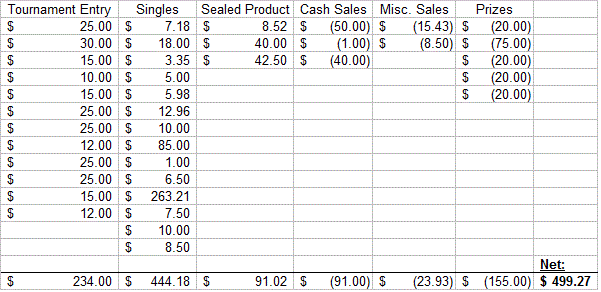
Here are how the costs broke down:

My overall outflow of money less prizes and sales was around $500. I’m actually pleasantly surprised at the reasonable number – I suppose having a hectic professional and personal life outside of Magic will help keep my spending under control.

What I am even happier to see is that my “MTG account”, which houses my available Magic budget from selling cards, is in excess of $500. While my collection has shrunk significantly in order to get there, it is still encouraging that my net cash from playing Magic in 2011 was in the black. Hopefully I can grow this account further without trimming my collection much more.

2012: Some Old and Some New

For 2012’s resolutions, I want to up my Magic commitments to two. First, I want to build upon last year’s exercise. This proved to be an insightful tool and I anticipate being able to better streamline purchases so that I am further in the black in 2012 without trimming large portions of my collection. Now that I am dedicating time to Magic finance and speculation, it should be reasonable to expect such an outcome.

As I continue recording out-of-pocket Magic purchases, I will also pledge to be more disciplined in keeping track of expenses and gains to the penny. I can improve accuracy, for example, by recording the eBay value of cards I obtain with store credit winnings rather than the value of the credit itself. The goal is not to artificially obtain an inflated number, but rather to obtain a truly accurate assessment of my gains/losses from playing this game.

My second resolution for 2012 related to Magic will be a bit more daunting. My goal is to trade, buy, and sell cards so that I can accrue enough cash to purchase a high-value card (preferably power) from Star City Games. But rather than simply selling a [card Underground Sea]few dual lands[/card] to accomplish this, I want to maintain my collection’s approximate value while doing so.

Of course, I will need to make progress in baby steps. Through a series of speculative purchases, I intend to generate most of the funds. (Recent pick-ups include Misty Rainforest, Past in Flames, and foil Pristine Talisman, by the way). Additionally, I will attempt to trade some smaller cards up to a few larger cards which I can more readily sell. This approach is reliable because it is far easier to sell four $20 cards than to sell twenty $4 cards. Also, it is much easier to find great prices on cheaper cards since there are often hundreds of eBay auctions and MOTL listings available.

Major Takeaway

I realize this second goal is a steep one. I may end up failing yet again. Even if I do fail, however, the outcome will be a net positive one. Either way I'll be picking up solid haggling habits and I will be sharpening my speculation skill. I encourage you to consider a similar goal.

Perhaps every time you bank a few bucks on some speculations, put that money aside and see how it accumulates. If you find your Magic funds are declining faster than they are coming in, perhaps you should reconsider your approach. I know I will be.

If this is not a priority of yours, then may I make one final recommendation? Recording the amount of out-of-pocket purchases on Magic cards this year was eye opening. My tournament winnings paid for nearly two-thirds of my entry fees, not to mention the product I kept from prereleases and drafts! But I also learned that I was prone to spending money on singles a little too freely, often times spending cash on impulse purchases which I could have avoided through trading.

If anything, the practice will drive awareness to your annual expenses. If you are money conscious like I am, this information will prove to be very helpful in identifying how to cut costs or streamline things. And by tracking the same thing in 2012, I will be able to keep track of how my spending is going year over year. By measuring progress, I will be motivated to become a savvier trader and speculator. And if my bookkeeping is accurate enough, I should be able to determine to the penny how much I will be allowed to spend on that second resolution. Wish me luck!

Before concluding, I'd like to solicit for your 2012 MTG resolutions! Please comment on what they are and how others may be able to benefit by implementing them as well.

Thanks for reading!

-Sigmund Ausfresser
@sigfig8

Avatar photo

Sigmund Ausfresser

Sigmund first started playing Magic when Visions was the newest set, back in 1997. Things were simpler back then. After playing casual Magic for about ten years, he tried his hand at competitive play. It took about two years before Sigmund starting taking down drafts. Since then, he moved his focus towards Legacy and MTG finance. Now that he's married and works full-time, Sigmund enjoys the game by reading up on trends and using this knowledge in buying/selling cards.

View More By Sigmund Ausfresser

Posted in Finance, Free InsiderTagged , , , 5 Comments on Insider: 2012 MTG New Year’s Resolutions

Have you joined the Quiet Speculation Discord?

If you haven't, you're leaving value on the table! Join our community of experts, enthusiasts, entertainers, and educators and enjoy exclusive podcasts, questions asked and answered, trades, sales, and everything else Discord has to offer.

Want to create content with Quiet Speculation?

All you need to succeed is a passion for Magic: The Gathering, and the ability to write coherently. Share your knowledge of MTG and how you leverage it to win games, get value from your cards – or even turn a profit.

Insider: The Art of Arbitrage

Are you a Quiet Speculation member?

If not, now is a perfect time to join up! Our powerful tools, breaking-news analysis, and exclusive Discord channel will make sure you stay up to date and ahead of the curve.

A few months ago I was lucky enough to find three sealed booster boxes of Dissension for sale at a local hobby shop for a great deal at $100 apiece, or $115 after taxes.

I quickly looked up eBay selling prices on my iPhone and confirmed that, indeed, I should buy them right away.

So I did. I sold them later that day for $150 each and made a cool $105 profit.

How long after I bought them did I have them sold? About 5 minutes. I walked from the initial point of purchase one block down the road to another comic book store and had them out of my hands immediately.

This is a story of arbitrage.

What is Arbitrage?

According to Wikipedia, Arbitrage is defined as:

… The practice of taking advantage of a price difference between two or more markets: striking a combination of matching deals that capitalize upon the imbalance, the profit being the difference between the market prices. When used by academics, an arbitrage is a transaction that involves no negative cash flowat any probabilistic or temporal state and a positive cash flow in at least one state; in simple terms, it is the possibility of a risk-free profit at zero cost.

While my example above did not fit 100% to the description due to the fact that I had to act as a broker (middleman) instead of having the exchange happen directly between the two stores, the fact that I had backed up my purchase by verifying profits to be made in another market (in this case, eBay) allows it to still fall within that category. It still followed the basic structure of:

  1. Find a product for sale at Market A
  2. Determine that you can sell it for more at Market B
  3. Buy from Market A and sell to Market B
  4. Profit! (Market $B - Market $A)

Seems simple, right? For our purposes… IT IS!

(Disclaimer: Yes yes yes… we could go on about the futures market, exchange traded funds, and imbalances in currency rates, but we’re talking small scale Magic Cards here, not the grain trade business. And this isn’t meant to be a hardcore economics class, just a primer.)

How Can I Get In On This?!

Odds are, you probably already are and may not even realize it. There are a few generalized examples that I can think of that we all probably already engage in.

Online Buying, Local Selling

How many of you visit sites like eBay or MOTL, purchase cards there, and then re-sell them in your own hometown for a tidy profit? The online world is a vast, global economy that presents products for sale from various regions around the world at prices that may differ from your local market.

When you purchase those 4x Stromkirk Noble for $16 online because you know that locally they sell for $6-7 each, you are indirectly performing a type of arbitrage! Granted, there was risk involved (what if no one wants to buy them when they arrive?), but by finding a buyer BEFORE you make the purchase, you will have achieved true arbitrage.

Next time you have that player complaining about how they are priced out of Legacy because the local B&M (Brick and Mortar) store is charging $65 for a Force of Will, there is no harm in asking: “Say, if I could get you a playset for $220… would you be interested?”.

If answer = YES, then:
            Buy online for $200
            Sell to Player for $220
Profit $20*!

(* = Minus any fees)

In this example there was NO risk, as you already had a buyer for the product you were bringing in. If you can get a few people's want lists completed all at the same time, there is a huge potential for profit. So ask around, see what people need and are willing to pay, and compare what you can get them for to determine if it’s worthwhile for you to buy it FOR them. With a tidy little cut for yourself, of course. 😛

Buy -> Sell Lists

Another common example of arbitrage would be something that the guys here at QS are always advocating… taking advantage of discrepancies between store buy and sell lists.

Since buy / sell lists are public, you can scour all that you want for opportunities and make a few quick dollars in the process! All it takes is for you to be at a convention and see Store A selling their Cryptic Commands at $8 and Store B buying at $10 for you to profit from this model. As long as one vendor does not sell out and the other vendor continues to buy, you can repeat this process ad nauseam until your cabal coffers are full.

MTGO is another excellent resource to follow this model. As you’ll primarily be dealing with bots, you can perform this buy / sell loop many more times in greater numbers.

Business Ventures

In pure arbitrage fashion, if your LGS (Local Gaming Store) is buying boxes for X and you can get them through your connections for Y, there may be room to discuss making the orders FOR your LGS!

This doesn’t apply solely to boxes, of course… it applies to every aspect of business they may carry! Have a hook up for Perfect Fit card sleeves from Asia that they may not be able to order? If they want 100 packs for $3 each and you can get them for $2… that’s $100 (- fees) in your pocket!

Even if it’s just an occasional or one time purchase like in the Perfect Fit example, it’s worthwhile to build the business relationship for the future.

Simple Trading

Trading in itself is a form of arbitrage. You and your trading partner can both be considered micro-markets, and the trade itself is an exchange of goods that results in loss, gain, or breakeven for one or both party members.

The wants/needs of the individuals will reflect the value of the goods being traded. And since an individual may value the goods more or less than the actual market, this allows us to profit due to the variance between perceived value and actual value.

We can take this a step further and actively solicit traders to determine their wants, trade for them from someone else, then re-trade them to the party who originally expressed interest for them to ensure that we make our “bottom line” in the deal.

This is especially useful when you find that one character who really, REALLY needs that 3rd Snapcaster Mage and you know someone who has one for trade at a lesser value than what your current partner is willing to pay.

Try and solidify a deal with a statement like: “Would you trade X for Y if I can get them for you? Could you hold Y for 15 minutes as I try and get you X?” There would be nothing worse than finally acquiring that Snapper just to have your original partner state that they no longer needed it.

Which bring us to…

Perils and Pitfalls

While arbitrage is an excellent business model, there are still risks and expenses involved that could cost you and/or the other party involved time and money. Be sure to bear in mind the following considerations:

1) Shipping costs

If you have to pay to get product from point A to B, ensure that the shipping costs are not greater than your profit. In our Force of Will example, it would be pointless to buy @ $200 and sell @ $220 if shipping was >= $20. I was actually just burned on this, as I’d promised to ship 2x Foil Tarmogoyf registered to Singapore from Canada. I was going to make $50 on the deal (- S&H), but it turns out registered shipping cost me $45. Curse your antiquated postal system Canada Post!

So I made $5 and considered it a lesson learned…

2) Auction Fees & Customs

Along the same line of shipping, if your fees are going to be greater than your profit, that defeats the entire purpose of the purchase.

3) Market Fluctuations & Changes in Demand

If the cards you’ve ordered increase or decrease in value while waiting for them to arrive, you could make a little more, but you are mostly concerned with the risk of losing. If we really want to have 0% risk, I advocate on solidifying a deal before ordering when this is a route that you’re taking.

Going back to the 4x Stromkirk Noble for $16 example: if, by the time they actually arrive in your town, the market for them has dried up or local values have come into line with the global market, you’ll have a hard time selling them for profit if you didn’t already have a pre-existing deal with someone. Cover your bases!

4) Responsibility

YOU are the one acting as a middle man. YOU are the one responsible to ensure that the end users are happy.

The onus of safe delivery lies on YOU, and no one else. So while there is much profit to be made, it would be at YOUR consequence should something go wrong. If you accept someone’s $24 for those Nobles ($6 each) and the price spikes to $8 each when you go home to buy (cost now = $32 instead of $16), YOU are the one out that $8 ($32-$24) + shipping and fees.

A Free Lunch?

There is no such thing as free money. And while arbitrage is a nice way to protect your capital, it does come with its own risk and reward matrix like any other business venture. I hope that the tips and tricks that we’ve discussed today not only help you in your Magic deals, but also open your eyes to the vast possibilities that exist outside our cozy little niche market.

Hope you had a great New Years, everyone! Glad to see you here in 2012!

Cheers,
Carl Szalich

Carl Szalich

Currently found ranching Orggs in the wilds of London, Ontario, Canada, I've been playing MTG for the past 15 years. I remember when trading Dual Lands for Craw Wurms was the "in thing to do", and Shivan Dragon fought Royal Assassin to see which would carry the higher price tag. I'm primarily interested in MTG finance, and like a good Icatian Moneychanger I believe that we are all "bigger than we think" when it come to what we have, and what our potential may be.

View More By Carl Szalich

Posted in Finance, Free InsiderTagged , , , , 6 Comments on Insider: The Art of Arbitrage

Have you joined the Quiet Speculation Discord?

If you haven't, you're leaving value on the table! Join our community of experts, enthusiasts, entertainers, and educators and enjoy exclusive podcasts, questions asked and answered, trades, sales, and everything else Discord has to offer.

Want to create content with Quiet Speculation?

All you need to succeed is a passion for Magic: The Gathering, and the ability to write coherently. Share your knowledge of MTG and how you leverage it to win games, get value from your cards – or even turn a profit.

The Five Color Cascade Shuffle

Are you a Quiet Speculation member?

If not, now is a perfect time to join up! Our powerful tools, breaking-news analysis, and exclusive Discord channel will make sure you stay up to date and ahead of the curve.

I could only go so long without making a quirky five-color deck, right?

I've been playtesting for the Modern PTQ season a ton recently and have been playing a couple of brews that abuse the pseudo-random nature the Cascade mechanic to always Cascade into specific spells. That particular strategy is something that's been going on since people initially figured out you could play gigantic monsters and Cascade into Hypergenesis to cheat them into play.

There's three problems with porting a Hypergenesis-style Cascade list directly from old Extended to Commander.

The first is that you only get one copy of Hypergenesis. If someone sweeps the board or counters your spell, you're on the plan of hardcasting fatties and midrange spells. The second problem is that you only have twelve Cascade spells in 99 cards, rather than no less than eight in 60. The last problem is that it puts strange conditions on what costs you can play and means that you really can't play many early game spells without disrupting your cascade chains.

Let's start by taking a look at the available Cascade spells and what kind of things you might want to Cascade into.

The Cascade Lottery

Unfortunately, there are only twelve cards with Cascade in existence at the moment which is an obstacle that needs to be overcome.

There's a thirteenth cascade card that will be incredible for this style of deck, Maelstrom Wanderer, but that's not coming out until the summer.

Notice the spread of casting costs of the Cascade spells. More than half of them cost four or less, which means that we will want to avoid playing cards that cost less than two or three unless they are the cards we want to be cascading into.

Cascade Spells

  • Ardent Plea
  • Bituminous Blast
  • Bloodbraid Elf
  • Captured Sunlight
  • Demonic Dread
  • Deny Reality
  • Enigma Sphinx
  • Enlisted Wurm
  • Kathari Remnant
  • Maelstrom Nexus
  • Stormcaller's Boon
  • Violent Outburst

Besides Bloodbraid Elf being the end-all of Standard for a season, people haven't done very much with Cascade besides finding cards from the Ancestral Vision cycle. I'm sure there's a ton of other sweet things you can do, but I don't really see a reason to change. The difference here is that I want to run all of them, just to complete the theme.

Bloodbraid Into...

  • Hypergenesis
  • Living End
  • Wheel of Fate
  • Restore Balance
  • Ancestral Vision

The interesting thing here is that these cards actually all do similar things and interact reasonably well.

Living End and Restore Balance are both sweepers if you need them to be. Living End also serves as a second Hypergenesis if you build your deck around it. Both Ancestral Vision and Wheel of Fate dig you into more Cascade spells, and Wheel of Fate even sets up your Living Ends!

Anyone who's familiar with Living End decks from old Extended knows that Cycling creatures are the crux of any Living End strategy. They set up for gigantic Living Ends while digging for Cascade spells or lands, all while giving you a back-up plan of just hardcasting fatties.

To be honest, I actually want a bulk of the deck to be Cycling creatures in order to increase the consistency of the deck and because with Land-cycling you can run fewer lands and increase your threat-density.

There are a few things worth noting when choosing your cycling creatures. First, that you want to overemphasize creatures with colorless cycling costs since this is a five-color deck. Second, you want to use mostly creatures costing four or more so that they stay out of the way of most of your Cascade spells. Last, we want to overemphasize creatures that are Black or White, for reasons revealed later. Here's the suite of cyclers I chose:

Where's My Fluctuator

  • Architects of Will
  • Bant Sojourners
  • Barkhide Mauler
  • Deadshot Minotaur
  • Drifting Djinn
  • Esper Sojourners
  • Grixis Sojourners
  • Hundroog
  • Jungle Weaver
  • Monstrous Carabid
  • Primoc Escapee
  • Ridge Rannet
  • Sanctum Plowbeast
  • Scion of Darkness
  • Street Wraith
  • Undead Gladiator
  • Yoked Plowbeast
  • Valley Rannet
  • Wirewood Guardian
  • Shoreline Ranger
  • Twisted Abomination
  • Noble Templar
  • Pale Recluse
  • Krosan Tusker
  • Igneous Pouncer
  • Jhessian Zombies
  • Elvish Aberration
  • Eternal Dragon
  • Chartooth Cougar

There are a few interesting effects attached to these cycling cards and a few interesting choices to make.

The Sojourner cycle from Alara Reborn has a number of interesting effects which could be reasonable choices, depending on what you're trying to accomplish. Of those, I'm only running the Bant, Esper, and Grixis Sojourner.

Grixis Sojourners is awesome, since it's graveyard hate to make your Living End more one-sided. Bant Sojourners creates White permanents, which will end up being very important. Esper Sojourners seems like a techy card I'd be glad to have on occasion. Being able to untap a blocker or tap a Cabal Coffers on someone's upkeep seems like enough of a high end that I'm willing to give it a shot.

The real question is this: what does the deck do besides cast Living End? You've only got one of them and have, at best, a one-in-five chance of Cascading into it. The goal here is to find other effects that play well with the kind of set up that Living End demands, but ones which don't mess up the Cascade chains at lower converted mana costs.

The Back-Up Plan

  • Living Death
  • Twilight's Cal
  • Pyrrhic Reviva
  • Kessig Cagebreakers
  • Nature's Resurgence
  • Death or Glory
  • Grimoire of the Dead
  • Necromancer's Covenant
  • Spider Spawning
  • Tombstone Stairwell
  • Balthor, the Defiled
  • Liliana Vess
  • Flame-Kin Zealot
  • Madrush Cyclops

It's not much, but it'll do. I think.

Spider Spawning may just be a result of me playing a little too much Innistrad limited, but I think it's fine. I wanted some number of spells that your opponent doesn't gain value off of, since so many of your win conditions reanimate their stuff as well.

The weakest card here is Necromancer's Covenant, but I think that it's pretty necessary. If you run into another Graveyard deck, then you get to hate on them pretty hard. It's also a way to make your Living End more one-sided.

The haste cards are also pretty important, since they give you ways to just kill people in the late game. It's also important to note which haste-enablers were chosen. I picked creatures that are Black or White, and which cost four or more so that they interact favorably with cards like Balthor the Defiled and don't interrupt your Cascades.

Choose Your Character!

At this point, the deck is 58 cards, which means I want ten or so more cards before I start adding lands, since all of our cyclers will enable us to hit land drops.

The important thing to decide now is who the Commander is going to be, so that the remaining slots can be dedicated to maximizing your Commander's potential.

It's actually an interesting question: Horde of Notions and Child of Alara are the two best options available to you, but which contributes more? Let's take a look at the different cards we could run for each Commander:

Horde of Notions

  • Horde of Notions (Commander)
  • Mulldrifter
  • Shriekmaw
  • Ingot Chewer
  • Skullmulcher
  • Tar Fiend
  • Crib Swap
  • Spitebellows
  • Mournwhelk
  • Slithermuse

There are a few cool things here. The first is that your Cascade spells help you find Crib Swap, which is one of the most powerful things that you can do with Horde of Notions.

Second, the Evoke elementals interact pretty nicely with the Living End plan and give you a sort of back-up plan to attrition people out.

Last, the Devour elementals can be gamebreaking and can set up larger and larger mass reanimation spells all while making sure it's even harder for people to continue to disrupt you.

Child of Alara

  • Child of Alara (Commander)
  • Unburial Rites
  • Rise from the Grave
  • Beacon of Unrest
  • Momentous Fall
  • Reap and Sow
  • Genesis
  • Miren, the Moaning Well
  • High Market
  • Phyrexian Tower

You need the extra lands here since you're playing a more controlling game. Because they don't add colored mana, they're more like spells than lands and don't necessarily add to your land count.

Besides that, Child of Alara does two things. It does give you a great mechanism of controlling the board while you cycle into Cascade spells, but it also makes Living End pretty awkward, since you probably won't want to cast it with Child of Alara in play.

As much as I love a Child of Alara deck, I just think that Horde of Notions interacts better with the rest of the deck.

The Manabase

Let me tell you, this is not a fun deck to build a manabase for! Depending on the hand you draw, you could have all colorless cyclers and be fine with any lands or all one-cost cyclers that want a color you don't have. You can't play cheap fixing because it messes up your Cascades, and I wanted the deck to be pretty budgety since number of the manabases I've built recently have cost an arm and a leg. Here's what I settled on:

Utility Lands

  • Mistveil Plains
  • Tolaria West
  • Petrified Field
  • Kjeldoran Outpost
  • Springjack Pasture
  • Moorland Haunt
  • Bojuka Bog
  • Vesuva
  • Crypt of Agadeem

This entire section is built around one card which is supposed to give you longevity and resiliency in the late-game: Mistveil Plains.

How important is this card? Well, the deck runs the token-lands just to make sure you can hit two White permanents more consistently. Tolaria West and Petrified Field are there just to make sure you can find and protect your Mistveil Plains. The deck wants to run as many White-based fetchlands as possible to make sure that you can easily find Mistveil Plains.

The ability to recycle specific Cascade targets is incredibly powerful and means that you can be more aggressive with your Cascade spells since you will get to rebuy them at some point.

Mana Sources

  • Terramorphic Expanse
  • Evolving Wilds
  • Terminal Moraine
  • Grasslands
  • Flood Plain
  • Krosan Verge
  • Command Tower
  • Rupture Spire
  • Shimmering Grotto
  • Halimar Depths
  • 3 Swamp
  • 3 Forest
  • 3 Plains
  • 2 Mountain
  • 2 Island

Like I said, the deck wants to run as many ways to fetch Plains as it can. In this case, the only Mirage fetches it has is Krosan Verge, since this is a more budgety deck, but that should be okay.

Besides that, the only interesting card is Halimar Depths. Honestly, Halimar Depths is a card you could cut if you wanted to. It's there for the potential to set up Cascades or to know that you want to use one of your land cyclers to shuffle away the top three cards. I'm not sure whether or not that effect is worth a slot, but the effect is basically free, so it's worth trying.

With that, let's take a look at the finished list:

[deckbox did="a141" size="small" width="560"]

While the deck is a little linear, I'm pretty happy with how it turned out.

I like the psuedo-randomness of Cascade and the consistency that you get when roughly a third of your deck cycles. There are enough cards that you can't really break the symmetry of, like Tombstone Stairwell and Hypergenesis, that I don't think the deck is too unfair for most playgroups. And it's conveniently something that's pretty easy to hate out with any kind of graveyard hate or countermagic.

Because of the nature of Cascade, the deck will get to do some incredibly stupid things sometimes, like casting Enlisted Wurm and cascading Bituminous Blast into Bloodbraid Elf into Ancestral Vision. These are the kinds of swingy, high variance plays that the format is all about and is a huge part of why I'm so excited about playing more with this deck!

As always, if you've got any comments or suggestions about this deck, I'd be glad to hear them. This is one I'm planning to tinker with for awhile, so if you think there's something I've overlooked, I'm certainly interested.

For the next few weeks I'm planning on taking a look at some Artifact decks, since that's something I don't generally do because of the stigma attached to mana rocks and giant artifacts. I'm hoping there's a way to build these decks so that they're powerful but not overbearing or overly reliant on busted mana acceleration.

But first we'll look at building a Mono-Red deck next week.

Carlos Gutierrez
cag5383@gmail.com
@cag5383 on Twitter

Insider: Hidden Gems in Shards of Alara

Are you a Quiet Speculation member?

If not, now is a perfect time to join up! Our powerful tools, breaking-news analysis, and exclusive Discord channel will make sure you stay up to date and ahead of the curve.

Welcome back and happy new year! This week, we will be taking a look at the not-so-distant past; we take a look back at the first half of the Shards of Alara set. Shards introduced the Mythic rarity, partly as a way to build more hype, though mainly to re-balance drafting. One can make powerful mythic rares (Planeswalkers, mainly) and they will not overpower drafts if they are less common. Garruk Wildspeaker was a wrecking ball in draft and Wizards wanted to keep those sorts of things from happening again.

Shards was a look at allied color sets (and where did we hear that before?). While fans like me were understandably tired of yet another set about color relationships, the set did explore interesting power combinations among trios of colors. It is the set from where we get our names of the allied color shards - Bant, Grixis and the like. Let's take a look at the high-value cards from the set!

Ajani Vengeant

$3.75

Ajani has a long and storied history in tournament decks. He can defend himself to an extent, both tapping down dudes and doing a reasonable Lightning Helix impersonation. Ajani factored into Standard control decks, often in sideboards. The idea was simple: in the control mirror, people sided out their removal. They also played a lot of lands that enter the battlefield tapped, like Vivid Creek. Ajani could come down, lock down a land and then Armageddon them a few turns later. Other decks used Ajani to mop up small creature swarms. I don't think the card is great at stopping monsters and it has a relatively pointless ultimate in Modern, so I don't think he'll see much competitive play from here on out - I'd consider this a casual staple, though.

Arcane Sanctum and associated tri-lands

$1.25

Wizards really pushed the envelope with these cards, making brilliant color-fixing lands and keeping them from being rare. This was huge for casual players, but these lands also dropped the prices on a lot of other rare lands, since these were mostly better. I rarely see them in bulk bins any more, but the foils are especially choice to find.

Blightning

$1.00

A solid and straightforward card, appealing to two things that casual players really like. These solidly go for a dollar, even to dealer buylists.

Death Baron

$8.00

This card has doubled in price over the last two months, thanks to Innistrad. It was entirely predictable, too. People love their Zombie decks and this is just about the best Zombie lord there is. You can make your tiny tokens trade with terrible towering titans, now that they have Deathtouch. I suppose he's also grand for your Skeleton tribal deck, since he pumps them up too! Keep your eye on these guys; they sell very readily to dealers, so if you are looking to make your collection more liquid for buylists, you can just trade dollar-for-dollar for these against less sellable cards.

Elspeth, Knight-Errant

$15.75

Elspeth has been on a roller coaster of a price run. She was elusive as a Hollywood starlet, then showed up in a cheap feature called Elspeth Vs. Tezzeret, which everyone ended up buying. She dropped from $40 to her current price and was even as low as $10 when the duel decks came out. Elspeth is still a very reliable Plainswalker. She makes her best impression of an unkillable 4/4 flier, given enough time, and she'll jump the unlikeliest creatures over to screw with your combat math. Although casual players angle more for her big sister (THREE tokens!), she's still a good Modern staple and commands the price to match.

Empyrial Archangel

$3.00

This monster of a woman usually shows up when people need a second Natural Order target to haul out against aggro hordes. It also shows up in Reanimator decks - most decks cannot work their way through her, even with burn spells. If the Archangel were Legendary, I'm sure she'd be worth double or triple what she is, simply because she'd be a great Commander general. As it is, she's still a fine throw-in to Bant Commander decks. Being an Angel makes her casual trade dynamite.

Etherium Sculptor

$1.50

This lowly uncommon has silently climbed to its current high price. Packs of these readily sell on Ebay, so there's a great market for them. This is my pick for the sleeper of the set. If you drafted Shards, you probably have four or five of these sitting around anyway.

Ethersworn Canonist

$3.50

A Cannonist is a person who presumably uses a cannon. A Canonist is, I would imagine, one who write canons - comprehensive tomes or musical movements. The Canonist sees a bit of play in Legacy and Vintage, since it is a storm hate card that can actually attack. It shuts down Cascade spells and combines in casually annoying Erayo decks. These are solid traders and I think you'll find a lot of attention on them in your trade binder.

Godsire

$2.25

This is a worthless bulk mythic, but it is an older Mythic; people want it for their sets. I suppose people also want it for their Commander decks. An 8/8 token is really cool, after all.

Hellkite Overlord

$4.00

This grand Dragon sees competitive play in Oath of Druids decks in Vintage. It also swings for a considerable surprise in the air. If it makes it to your untap phase, the game is probably over. Overlord actually got so popular in Oath decks in Vintage that people started siding in Karthuus, Tyrant of Jund from the sideboard to steal opposing monsters.

Knight of the White Orchid

$1.50

I'm not sure how often you get the Tithe out of this card - do you always play it so you can get the extra land? Is it worth playing if you can't score the Tithe? In any case, this is a white Knight, which means it slots into theme decks, and it is a reasonable accellerant on top of that.

Join me next week as we look through the second half of Shards!

Until then,

Doug Linn

Want Prices?

Browse thousands of prices with the first and most comprehensive MTG Finance tool around.


Trader Tools lists both buylist and retail prices for every MTG card, going back a decade.

Quiet Speculation