menu

Magic 2012 Set Review: Commons and Uncommons

Are you a Quiet Speculation member?

If not, now is a perfect time to join up! Our powerful tools, breaking-news analysis, and exclusive Discord channel will make sure you stay up to date and ahead of the curve.

If you haven't yet, please enjoy Part 1 of Josh's M12 Set Review, the Mythics and Rares, here!

Note: I write set reviews from a tournament player's perspective, not a financial perspective.

As such, I try to approach new set releases with a "wide net" of all the cards which might be relevant to tournament Magic, even if it's just a sideboard 1-of that will never be worth much. As such, this will necessarily include fringe cards. For commons and uncommons, I'm not going to talk about every single card, since a lot of them are obviously Limited-only stuff.

I strongly recommend buying a complete common/uncommon set for all expansions, since that can be had for around $20-40 (depending on whether you're buying locally or online), but the core set is full of a great many reprints (and many of the new cards are going to be purely Limited fodder), making that a waste of money for all but the newest players.

Also, card tags will be broken on new cards until they're in our WordPress plugin. However, they're included for the people who refer back to this article.

For those of you reading before card tags are working, follow along with a spoiler (like this one) and let's explore the new possibilities M12 brings.

White

Celestial Purge: This is a relevant sideboard reprint, though the question is whether the versatility here is enough to offset Leyline of Sanctity's ability to outright shut burn down. I'm guessing not, and at least where red is concerned, Kor Firewalker is a better option. It is a good answer to Bloodghast, so it'll remain in the mix for at least that long. This is a solid card which should continue to remain in the core set - it gets color hosing right.

Demystify: Another reprint, and this has the potential for fringe usability against Splinter Twin - one that can get past the tapped land from Deceiver Exarch a bit more easily. If there are other enchantment-based decks around, it's at least worth remembering that this is an option.

Elite Vanguard: Sadly, white weenie hasn't really cut it since Ranger of Eos rotated out of Standard, but with Honor of the Pure in the format it's worth remembering that dropping 2 power on the board on the first turn is never a terrible idea. Right now, Goblin Guide makes this guy look silly, but that's not always going to be the case. Puresteel Paladin may need some raw bodies to slap equipment on, and this guy isn't a bad choice.

Oblivion Ring: Welcome back. You never should have left. The important thing here is that Leonin Relic-Warder and Kor Sanctifiers just got better again for a while. The other thing to remember is that when O-Ringing to kill a Planeswalker or a Legendary permanent in a mirror match, you should exile their O-Ring (bringing yours back and letting the Legend rule solve problems) instead of their Planeswalker. If you remove the Planeswalker directly and they kill the O-Ring, you're put in a very bad position.

Timely Reinforcements (NEW): I've seen some people claim that this is the nail in the coffin for Red. I disagree. It's obviously a bad card for Red to deal with, but it's not so bad as to be automatic game over. With Shrine of Burning Rage, red tends to get into overkill territory pretty easily, and the creatures off the Reinforcements will find themselves ready targets for Arc Trail, Searing Blaze, and Grim Lavamancer. One important thing to note is that Timely Reinforcements pushes white players more towards Leyline of Sanctity than it does towards Kor Firewalker.
With use of fetchlands, white decks can maindeck this if they want, but it's iffy against combo decks like Valakut, Exarch-Twin, and Quicksilver Amulet. If you're not getting creatures off the Reinforcements, it's a bad card.

Blue

AEther Adept: Will continue to not see significant play, much to the continued annoyance of those who played Man-o'-War back in the day. However, it could have a home as a 1-of in a Birthing Pod deck or something similar.

Azure Mage (NEW): This is an upside to the blue half of Dimir Guildmage, since the card drawing can be played at instant speed. That's huge, and likely hurts Druidic Satchel's chances of seeing play by a lot. The question is whether blue would rather pay mana over time to draw extra cards, or get a fatty as part of the deal with Consecrated Sphinx. It's entirely possible that the answer may be a mix of both.

Cancel: The default Counterspell in the modern era, Cancel will see some play as part of the mix, but not a lot, same as it's been doing for a while.

Divination: Not amazing, but typically just barely good enough. This might fall by the wayside in decks packing Azure Mage and Consecrated Sphinx, while decks that can gain value from proliferation will prefer the "colorless" Tezzeret's Gambit.

Flashfreeze: Constantly showing up in sideboards, it turns out that a 2-mana hard counter is often exactly what blue needs in certain matchups.

Mana Leak: This is such a strong card that it's hard to believe that people actually complained about Counterspell leaving. It's quite clear now that Mana Leak replacing Counterspell made deckbuilding skill more important since getting the right mix actually took a bit of effort. As a general-purpose counterspell, Mana Leak is right where it needs to be.

Master Thief (NEW): Possibly a fringe 1-of for Birthing Pod mirrors, since it lets you have an answer to Pod on the 4-spot of your curve without playing Red for Oxidda Scrapmelter. It could also serve as random utility in or against the Tezzeret, Agent of Bolas deck, if one exists. I don't think the metagame has what it takes for this to see widespread play.

Merfolk Looter: Once an all-star, this sat on the sidelines when it was in M10, and will likely sit on the sidelines in M12. Sadly, the talk of moving looting to red doesn't seem to have panned out. With Coralhelm Commander and Grand Architect, is there a deck for this to see play in? I doubt it. It sits alongside Enclave Cryptologist and Hedron Crab as possible ways of dumping Vengevine in the yard, but Fauna Shaman is just so much better at it that there's no reason to bother.

Mind Control: The ultimate answer to a single oversized creature, this card doesn't see much play, but can utterly blow people out in Constructed just as much as it does in Limited. The catch is that Corrupted Conscience turns most of the things you'd like to steal into one-hit kills, while Volition Reins can steal even more things, so there's not much room for Mind Control right now.

Negate: A solid utility hard counter, Negate serves a powerful role in control mirrors and combo matchups. While Spell Pierce is around, there's debate to be had.

Phantasmal Bear (NEW): A 2/2 for 1 is worth considering, even if it is in blue. There may be some sort of tempo deck centered on this, Cosi's Trickster, Vapor Snag, and counterspells. I think it's unlikely, but if something odd happens to the metagame, it could work.

Phantasmal Dragon (NEW): A 5/5 flier for 4 is a respectable card even with the current level of power creep, but right now it dies to everything. Beast Within doesn't even have the dignity to give you a token when they kill it! You can't even counter their spell to save the Dragon, so it's probably not worth the hassle. Still, it's possible this could be part of a transformative beatdown sideboard for Exarch-Twin decks.

Ponder: Now this is a big deal. Some people are claiming that this card's return will single-handedly bring Pyromancer Ascension back to the forefront of the format. I am somewhat skeptical of Ascension's ability to compete with Exarch-Twin or Quicksilver Amulet, but people are clearly going to be trying it early. (If mill-based Ascension becomes popular, Amulet-Eldrazi shuts them out entirely.) It gives a boost to Exarch-Twin as well, since they gain more ways to dig for the combo, but blue control decks will probably stick to Preordain.

Turn to Frog (NEW): In order for this to see play, it has to be effectively a blue Doom Blade. Yanking a Baneslayer Angel out of the sky or turning Primeval Titan into a puddle of slime only to block with something - even a Calcite Snapper - accomplishes this goal. It's worse than Tumble Magnet in some situations, worse than Dismember in others, and in Blue-Black decks you may have access to actual Doom Blade and don't even need to consider this. This is also a 1-turn answer to Exarch-Twin. When they activate a Splinter Twin-enchanted Deceiver Exarch to make a copy of itself, you respond with Turn to Frog. A copy will still be made, and if they choose to untap the original Exarch, they're untapping an ability-less 1/1 Frog. If you think you want to play it before the enchantment resolves - big mistake. The ability-removing continuous effect and the Splinter Twin's ability-granting continuous effect are in the same layer, so whichever one has the later timestamp will win out.

Black

Deathmark: This has mostly disappeared from the format largely due to metagame reasons. It's unlikely to return to regular play, but with the loss of Disfigure at rotation, people may want a cheap way to kill small green/white creatures that don't require paying 4 life.

Distress: Duress is gone at the rotation, which means Despise is the main 1-mana discard spell. Unfortunately, it's not particularly good against control decks. Distress is pricier but far more versatile. It won't be universally adopted, but some lists will run it.

Doom Blade: Representing the best actual black removal spell in the format, Doom Blade Guy will continue to be relevant, despite being overshadowed by the color-flexible Dismember.

Mind Rot: A weak 2-for-1, it's much better when paired with other discard spells. Jund ran some copies alongside Blightning, but those days aren't coming back.

Smallpox: Bloodghast players are going to have some fun with this one. Sadly, there's no Flagstones of Trokair to abuse right now, but even if you can get yourself up by 1 via Smallpox, it should be enough to give you a sizable lead.

Zombie Infestation: For you to want to play this card, you either need recursion, or a belief that the two cards you're discarding are actually worse than a pair of 2/2s. If you're building your deck right, the second part shouldn't be happening (but it's a nice bonus when you draw too many lands).

Red

Circle of Flame (NEW): This is an awkward effect since Pyroclasm and Slagstorm often do a much better job of sweeping the board, but Pyroclasm will be gone. Multiple Circles stack, so it's not totally useless against decks with X/2s, but it's obviously a sideboard-only card.

Combust: As an uncounterable answer to Deceiver Exarch, Combust has a home for at least a little while. Everywhere else, it's a bit awkward - it can't kill Kor Firewalker, it doesn't kill Titans, and it doesn't kill Consecrated Sphinx. When Baneslayer Angel was around, Combust was a lot better. If white and blue creatures with less than 6 toughness start to need killing, this will remain Red's best way of doing so.

Goblin Arsonist: This guy is no Mogg Fanatic, but with the printing of Goblin Grenade he probably makes it into a dedicated Goblins deck if one exists.

Goblin Fireslinger (NEW): This is an excellent way to trigger Bloodthirst, but it doesn't look like that will matter in Constructed. More importantly, it's a guaranteed 1 damage per turn this guy stays alive, no matter how clogged up the board gets. That may be worth a spot.

Goblin Grenade: If Goblins is a real deck, this is the reason why. Being able to Lava Axe someone out from a single mana is incredibly potent. If the need arises, it can kill a creature to clear the way. Goblin Arsonist is obviously the fodder of choice, but nobody will mourn the loss of a second Spikeshot Elder or something along those lines. The only issue is that the reason to play Goblins over conventional RDW is reduced vulnerability to Leyline of Sanctity, and Goblin Grenade has that problem. Of course, you can simply board it out in games 2 and 3 if that is a real issue. Leyline also rotates out with Innistrad's release, which may also be a point in favor of conventional RDW at that time.

Incinerate: While this is obviously worse than Lightning Bolt, Red players don't have much room to complain. For a few glorious months, both cards will be in the format together, alongside both old and new Red all-stars Grim Lavamancer and Goblin Guide. The no-regeneration clause would be more appreciated if Thrun, the Last Troll didn't have Hexproof or a 4th point of toughness.

Manic Vandal: An underappreciated utility dork, Vandal gets the job done. While I'd much rather have Smash to Smithereens, you take what you can get, and a Gray Ogre that takes out artifacts and gets in there is just fine. It's one of those cards that's never exciting, but you're always happy to have around.

Green

Acidic Slime: With such amazing utility, the Slime doesn't get the respect he deserves. Costing only 1 mana less than Primeval Titan probably has a lot to do with it.

Autumn's Veil: While Summoning Trap was around, people used that to punish those who would dare to counter their creatures. Once Trap is gone, something like this can be used to guarantee that the creature resolves- and makes them waste their Counterspell or kill spell in the process. With the popularity of Dismember, this is an excellent tool for green to have available.

Jade Mage (NEW): There's actually precedent for cards like this seeing play: Selesnya Guildmage was used in Ghazi-Glare, a deck designed to use Glare of Subdual and a token army to suppress the opposition until Yosei, the Morning Star or the token army itself was able to close the game out. Obviously, Jade Mage doesn't have the ability to pump the entire swarm, but Eldrazi Monument, Beastmaster Ascension, Overrun, and Garruk Wildspeaker are all currently legal. Having the ability to channel extra mana into token generation is almost certainly worth a slot in a Fauna Shaman or Green Sun's Zenith deck.

Llanowar Elves: A longtime staple among the little green dudes, Llanowar Elves loses his buddies Joraga Treespeaker and Arbor Elf on the rotation. This may be a problem, but even if Elves isn't a deck, Llanowar Elves and Birds of Paradise are among the few ways to have 3 mana on turn 2. If the format has lots of powerful 3-drops, this will continue to be relevant. If the key mana cost is 4 or 5, the vulnerability of being a creature will push people more in the direction of Rampant Growth and the like.

Naturalize: This has lost popularity because of Nature's Claim, Beast Within, and the ability to Pod or Zenith Acidic Slime. Still, it's one of the best cards for doing what it does, and it's always worth considering for sideboard slots.

Overrun: Apparently it's considered fair in Limited for a 5 mana sorcery that reads "win the game" to be printed at uncommon.

Plummet: With the far more flexible Beast Within and Dismember around, it's unlikely this will see much play.

Rampant Growth: Providing a major boost to Valakut, Rampant Growth replaces Cultivate in M12. Accelerating from 2 to 4 mana on turn 3 is the primary use of this, but it can also serve to achieve a general mana advantage in general in something like a U/G archetype, even if it wants to leave Mana Leak open on turn 2.

Colorless

Dragon's Claw: In formats with an extremely potent Red deck, the Claw has seen play before. Some Jund lists sideboarded it last year, and it's not unreasonable to try to play it now.

Buried Ruin (NEW): Academy Ruins this isn't, but this might be good enough anyway. Bringing back a Sword of War and Peace or Wurmcoil Engine that got killed is an obvious use, but recurring something as simple as a Nihil Spellbomb could be enough to put the game away. It puts it in your hand, unlike Academy Ruins, so trading the land for even a minimally-useful artifact can be worthwhile when you're manaflooded or a game goes long.

Joshua Justice

@JoshJMTG on Twitter

Magic 2012 Set Review: Rares and Mythics

Are you a Quiet Speculation member?

If not, now is a perfect time to join up! Our powerful tools, breaking-news analysis, and exclusive Discord channel will make sure you stay up to date and ahead of the curve.

Note: I write set reviews from a tournament player's perspective, not a financial perspective.

As such, I try to approach new set releases with a "wide net" of all the cards which might be relevant to tournament Magic, even if it's just a sideboard 1-of that will never be worth much. This will necessarily include fringe cards, too. I will discuss every Rare and Mythic, so you can pick out which of the unplayed ones will quickly be bulk cards.

Note: card tags will be broken on new cards until they're in our WordPress plugin. However, they're included for the people who refer back to this article.

For those of you reading before card tags are working, follow along with a spoiler (like this one) and let's explore the new possibilities M12 brings.

White

Aegis Angel: Junk rare that will see no competitive play in any format anywhere, but will be appealing to the casual crowd for a while.

Angelic Destiny: Everyone will become a great deal less excited about this card when they realize they can't cast it without pumping their opponent's Spellskite. It may be playable, but the bar that pump Auras have to jump is probably too high for this, especially while Batterskull and Sword of War and Peace are around. Unfortunately, M12 and Scars will both rotate simultaneously, which means this card may never have a home despite its high power level.

Archon of Justice: It's unlikely this will see play, but the ability could fit into the Birthing Pod deck at the 5-slot. It'll be an interesting choice between Archon and Acidic Slime.

Day of Judgment: If you don't have 4 by now, you should get them. It's a clear staple and will continue to be the default White sweeper for years.

Gideon Jura: Another reprint of a card that we already understand pretty well. With the demise of Caw-Blade, we return to the "Gideon or Baneslayer" dilemma that UW control was asking last year before SCG Atlanta 2010 unleased Super Friends and showed us that playing all planeswalkers and no creatures was the way to go. Gideon's mere existence is enough to make playing aggro an unappealing prospect.

Gideon's Avenger: This is a rare? I suppose it has to be for limited purposes, but in constructed it's unlikely to find a home. It's miserable against control decks, ramp decks and the like, and against aggro decks they'll just use a burn spell in their upkeep or Dismember it before it gets too far out of control.

Grand Abolisher: This is a solid hate bear, but it's not amazing. The fact that it dies to basically everything means that it won't do much other than take a removal spell away from something else, and Spellskite does a better job of that. Remember that the control decks are going to be playing sweepers and/or Gideon, so you're strongly discouraged from playing aggro to begin with.

Honor of the Pure: Another reprint, this has seen play in the past and will likely see play again. It's unlikely the pre-Innistrad format has room for a white weenie deck, but it's possible things will change later on.

Mesa Enchantress: Yawn. People might try to break this at FNM again, what with Auramancer being reprinted, but Legacy [card Argothian Enchantress]Enchantress[/card] has access to a great many key cards that Standard doesn't even have anything even close to: Solitary Confinement, Enlightened Tutor, Wild Growth, and Serra's Sanctum.

Personal Sanctuary: Crappy casual "Johnny" rare that doesn't actually serve any meaningful purpose, and never will - unless Wizards prints something that combos with it for an instant win down the line. Trade them away ASAP, then quietly pick up 4 at bulk rare prices later on, just in case.

Sun Titan: This is the "next level" after Kor Sanctifiers, and should be critical in any white-based control matchup. Whether the deck is viable or not is in the hands of other cards to handle the rest of the metagame, but if it's a real deck, your mirror matches will be dealt with by Sun Titan if Consecrated Sphinx is already maxed out.

Blue

Djinn of Wishes: The bulk becomes bulkier.

Frost Titan: The only Titan to be firmly outclassed by another option in its color, Frosty stands little chance of seeing much play in blue control decks due to Consecrated Sphinx. It's possible that he's a better 6-spot in a Birthing Pod deck, but I have to imagine they'd rather play Wurmcoil Engine first instead.

Jace, Memory Adept: In order to play this over Jace Beleren you have to really care about the mill. Right now, that's useless. After rotation, Jace Beleren won't be a consideration though. You really need the mill to matter, and milling your opponent with this is not the way to go. Garruk and Gideon are both better 5-mana planeswalkers. I'm going to pass on this, but it has potential to see niche play.

Jace's Archivist: This guy is extremely disruptive to long-term plans. He plays well with Runeflare Trap and Liliana's Caress, so that could be a fringe archetype (one which has historically been very good against control decks). However, since it has to survive a turn, it makes this a worse combo than... I dunno, Deceiver Exarch and Splinter Twin? After rotation, the Trap is gone (along with Splinter Twin), but there may be similar effects.

Lord of the Unreal: The Illusion tribe will be very popular at FNM-level events, but vulnerability to mass removal and a lack of AEther Vial effects mean this isn't the second coming of Merfolk.

Mind Unbound: Consecrated Sphinx exists. This goes directly to the bulk pile (after attempting to trade it off at value to casual players).

Phantasmal Image: Have you noticed how absurd Phyrexian Metamorph is? And this is even cheaper! Phantasmal Image is possibly the best new rare in the set. Cutting the cost of Clone in half in exchange for a mostly-negligible drawback is a tremendous jump in power. This will see play, and it's likely to be the most expensive rare in the set after a bit of time goes by.

Redirect: Even less relevant than it has been in the past, since Spellskite exists.

Sphinx of Ulthuun: Consecrated Sphinx claims another victim.

Time Reversal: Oh, the agony. For those of you who haven't been following, this was the last card to be spoiled, and it was known to be a Blue Mythic in between Sphinx of Uthuun and Turn to Frog. We were hoping for Time Warp and got this unplayable garbage instead.

Visions of Beyond: I think this falls into the overhyped box. 20 is a lot to be milled for, requiring 2 activations of the new Jace, or a messload of cantrips. By the time you get full value off this, you've worked so hard for it that you could have been winning some other way already. Legacy Dredge doesn't even have a use for this thing - Deep Analysis just does better in that deck's strategy.

Black

Bloodlord of Vaasgoth: Really? Why couldn't we have gotten Vampire Nocturnus or Malakir Bloodwitch here? This is unplayable garbage.

Call to the Grave: I'm pretty sure this is just too expensive to do much in the modern era, but it's a popular casual/multiplayer card. This will likely tank the value of the originals, so don't bother.

Cemetery Reaper: This could be relevant, but it would require a lot of Zombies to be printed. Right now I don't think we have enough cheap zombies to fill out a tribal deck here. The graveyard hate ability isn't good enough at filling that role when Nihil Spellbomb exists, so this is either a maindeck card or not a relevant card at all.

Grave Titan: Remaining the best 6-drop in black, Grave Titan will haunt us for the next year. The question is whether it remains relevant after the 5-drop Vengeful Pharoah takes over.

Monomania: Persecute, this isn't. I don't expect this to see heavy play, but against certain decks it could be powerful, especially if it's being accelerated out. Turn 3 Monomania is crippling to both Valakut and Twin.

Royal Assassin: I'm a little surprised they reprinted this guy alongside Gideon in the core set. He's obviously going to be a fringe player from now to forever, but in dumb aggro mirrors it's a must-answer card. The problem, of course, is that answering him is extremely easy.

Rune-Scarred Demon: Casual garbage. This will see no constructed play.

Sorin Markov: Why would you play this when Grave Titan exists? Dropping someone's life total to 10 isn't a meaningful ability. If you're planning on comboing it with the drain-10 spell below, it's a straight-up worse Exarch-Twin combo.

Sorin's Vengeance: The aforementioned drain-10 spell, this is going to be unplayed. How often was Corrupt relevant in the past year? That won't dissuade the guy who's been screaming about how Mono-Black Control will come back at every set release since M10 reprinted Haunting Echoes, but logic hardly matters to people with that level of zeal.

Sutured Ghoul: Without Cephalid Illusionist, Dragon Breath, and a way to target the Illusionist a bunch of times for free, there's little reason to play this instead of the numerous other fatties that exist. The card is a combo card with no enablers.

Vengeful Pharoah: Now this is an interesting card. Like a defensive Bloodghast, he keeps coming back. Better than Grave Titan against aggro decks, but probably worse against control. It's going to take some time to figure out the right mix, and it's possible that Grave Titan is still better overall, but this is worth keeping in mind.

Red

Chandra, the Firebrand: Finally, the first Chandra that doesn't suck. I don't think she's better than Koth of the Hammer, but doubling spells is quite powerful. The problem is protecting her for a turn to pull off the free Reverberate- and what are we doing that we couldn't have done with Reverberate in the past? It has to be something that scales - Day of Judgment is pointless. Sure, Sorin's Vengeance is an instant win, but that requires 7 mana. Again, if we're going to play 2-card combos, Deceiver Exarch and Splinter Twin has a monopoly on that title for the near future. Once they rotate, other options may be worth exploring. For now, I don't think the new Chandra will see a great deal of play.

Chandra's Phoenix: This card, on the other hand, will. The red deck gains an unparalleled amount of reach (defined as an aggro deck's ability to win a game that has gone long) from the ability to recur a cheap, hasty flier. It's no Hell's Thunder, but that's okay. Phoenix doesn't even have to go in the maindeck - it slows you down too much in game 1 against the combo decks. Postboard, Phoenix can come in as a way to get around control decks (yet another "answer" to Kor Firewalker) and win a long attrition war against other aggro decks. Trading a Phoenix for any of their creatures will likely win the game in the end, especially when you get to 3-for-1 them with Searing Blaze. (Yes, 3-for-1. Searing Blaze is a 2-for-1 by default. Under the Philosophy of Fire, dealing 3 damage to your opponent is worth one card. If you have a problem with this logic, you shouldn't be playing red. Go whine on a forum about how red decks take no skill to play.)

Flameblast Dragon: How irrelevant.

Furyborn Hellkite: Yes, it's basically a 12/12 for 7. That's not enough. By the time you have 4RRR in a deck that can trigger Bloodthirst reliably, the opponent should already be dead. As a Mythic, dump this one quick.

Goblin Chieftain: Finally, the Chieftain gets a chance to shine. The printing of Goblin Grenade means that Goblins will be played for at least as long as Goblin Guide is legal. Whether it's better than the normal red deck or not is hard to say - Goblins is less vulnerable to Leyline of Sanctity but more vulnerable to Kor Firewalker and sweepers, so it depends heavily on how the metagame responds to the onslaught of Mountains.

Grim Lavamancer: This is the most-anticipated M12 card for a reason. It's proven itself to be viable even in Legacy, and left alone it can win games by itself. Top 8s will be getting swept away in a torrent of Lava, and not even the [card Valakut, the Molten Pinnacle]Molten Pinnacle[/card] itself will be able to stand in its way.

Inferno Titan: This is why all those stupid Dragons are completely irrelevant, and will remain so for the next year. This is the best red fatty available, and it's not even clear why you would want to play red fatties at all right now. I suppose Twin needs a backup win, but that's about it... and Consecrated Sphinx is an option there.

Manabarbs: One of the best red sideboard cards of all time, the Barbs put the hurt on control decks and ramp decks alike. Manabarbs should win almost every game it resolves. The typical line of play goes like this: "You're at 7? Okay, Manabarbs postcombat. You cast Day of Judgment? Take 4! Untap, Lightning Bolt, game."

Reverberate: An underappreciated card. I made top 16 of GP Atlanta with 2 in my sideboard for non-Faerie Cryptic Command decks and the mirror match, and it served me well there. The metagame has to be right for it, since you need a lot of lands, but when it's good, it's very good. (Story time: At PT Amsterdam last year, I had 2 latepick Reverberates in my Day 2 draft deck. I obviously didn't play them, but I got paired against a blue deck that had 5 Phantom Beasts... so I had to take out my Berserkers of Blood Ridge. I brought in both Reverberates, since we both had spells worth copying. I got an opening hand with one during game 3 and drew the second. Turn 4 I was given the choice of casting Canyon Minotaur or sitting on both Reverberates. I cast the Minotaur. He untapped and cast Foresee. Naturally, I lost game 3 with both Reverberates still in hand.)

Scrambleverse: A sick joke. The primary function of this card is to steal valuable cards from other people with the same sleeves you have.

Warstorm Surge: You could play this. Or you could play Inferno Titan and not be a terrible player.

Green

Arachnus Spinner: It's a 5/7 for 6 that puts a weak Arrest variant (Arachnus Web) on a creature the first turn it's in play. Okay. That's not utterly dismal, but... Primeval Titan exists. Go play that instead. (See why so many people don't like the Titans? Save for Frosty, they're all just obviously better than the other options in their color, and if they aren't, there's also Wurmcoil Engine to contend with.)

Birds of Paradise: If you don't know what to expect from Birds of Paradise by now, I'm not really sure what to say to you. Obviously Birds is somewhat outclassed by the Lotus Cobra + fetchland pairing in the ramp deck and Llanowar Elves alongside Arbor Elf in the Elves deck, but once Cobra leaves, Birds will probably find a home. A card this powerful never really stays homeless for long.

Doubling Chant: At first glance this looks like some garbage casual rare. On second glance, it looks like it could break open creature stalemates. On third glance you remember that Overrun and Overwhelming Stampede are both options and forget about this card.

Dungrove Elder: It's possible that between this and Leatherback Baloth there's a deck that just slams down medium-sized green dudes on small-sized-dude turns. Unfortunately, I suspect that deck is not only worse than Elves, but badly positioned in the metagame.

Elvish Archdruid: If Splinter Twin, Valakut, and Monored didn't exist, Elves might just be a powerhouse. Hm. Wait a second. Those decks all lose a great deal of power after rotation, whereas Elves gets to keep Llanowar Elves, Elvish Archdruid, Ezuri, Renegade Leader, and Copperhorn Scout. The loss of Arbor Elf and Joraga Treespeaker makes Copperhorn Scout worse, but it's possible Innistrad will bring more mana Elves.

Garruk, Primal Hunter: This is ridiculous. Easily the best new planeswalker, the Primal Hunter is a big draw towards green. I have no idea why his current price tag is lower than the new Jace's, but that won't last. He's now the best card-drawing Planeswalker in the format, and protects himself quite well.

Garruk's Horde: Garbage.

Primeval Titan: We all know this is going to be a big deal from now until rotation thanks to the existence of Valakut, the Molten Pinnacle. The question is whether or not it will continue to be relevant after that. Going from 6 mana to 8 really isn't all that impressive in a world where your lands aren't dealing 6 damage apiece when they enter the battlefield. At first glance, I'd have to say it probably stops being as relevant, since you'd rather run Garruk, a swarm of creatures, and Wurmcoil Engine or a Titan of a different color - or the very next card I'm going to talk about.

Primordial Hydra: If you play this as a 1GG 1/1, it attacks as a 2/2 the first turn it can. It then turns into a 4/4, then 8/8, then becomes a 16/16 trampler. If you play this as a 2GG 2/2, it attacks as a 4/4 the first turn it can, then turns into an 8/8, then a 16/16 trampler. If you play him turn 3 as a 2/2, he swings for 16 on turn 6. Sure, he probably gets killed, but that's a tremendous threat to pose to your opponent. A 3GG 3/3 swings as a 6/6 (the first level at which it's "above the curve", then as a 12/12 trampler. If you play this on turn 3, you're swinging for 12 on turn 5. A 4GG 4/4 swings first as an 8/8, then as a 16/16, and you can be doing this on turn 6. What if the game drags out and goes long and you drop him for 5GG or more? He's a massive trampler the very next turn!
The point is, it doesn't matter where you play the Hydra, it's ALWAYS a threat. This is probably the sleeper Mythic of the set, and I'll be looking to get 4 as soon as I can. The only drawback is that he doesn't play well with Genesis Wave, Green Sun's Zenith, and Birthing Pod. So what?

Rites of Flourishing: People are going to put this in their Valakut deck. They're going to get their faces burned off as a result. It may have a home, but it won't be a viable card until red is weaker.

Skinshifter: The QS preview card, this is one of those nifty utility guys that will be quietly responsible for a lot of tournament success. The 4/4 Rhino will probably be the main role for him, but being able to switch to the 2/2 Bird is a solid option when the board bogs down. Remember to check both possibilities when doing Overrun math. Switching him to a 0/8 plant is something you don't really want to do, but having the option is nice. (For instance, in a situation where your opponent has a Titan blocking and you've got two of these, you can turn the unblocked one into a 4/4 and turn the blocked one into a 0/8 so it lives.)

Colorless

Adaptive Automaton: This is getting a lot of hype, but I'm just not seeing it. What type of creature are you wanting to Lord up in Standard that don't have a Lord already? You don't want this in Elves or Goblins. Illusions isn't a real deck, and Merfolk already have 2 lords in Standard - Grand Architect isn't a Merfolk, but he's a better lord for them than Automaton is! Consider that while Architect doesn't get pumped by Coralhelm Commander, he does a great job of maxing the Commander out. This is a solid miss, but it will be extremely popular trade fodder. Take advantage of that.

Druidic Satchel: This could see play as a sort of hybrid between Thawing Glaciers and Scrying Sheets. I think if you use this, you're wanting to use it to "draw cards" by putting lands directly onto the battlefield. The catch is that it's a 3 mana artifact instead of a land that taps for colorless, so it's unlikely to see play. If control mirrors become important after rotation, this will be a very good card to break mirrors with - it gives both card advantage and mana advantage over time.

Pentavus: Unlikely to see play without some sort of colorless acceleration giving you a reason to play this instead of Wurmcoil Engine, Titans, and the like. However, it does have a bit of nifty play with Proliferate, it can block quite well, and it doesn't tie up your mana as much as Thopter Assembly does.

Quicksilver Amulet: End of turn, Emrakul, the Aeons Torn (or Blightsteel Colossus). Is it good enough? Maybe. It's not as vulnerable to certain kinds of hate as Exarch-Twin (most notably Dismember and Act of Aggression in response to Splinter Twin), and it provides an alternate 2-card combo for people who want to dodge that hate. The downside is it takes an extra two turns to pull off in the natural draw, but the upside is it removes all color restriction from the combo deck. You can, of course, stuff them both together (though the lack of synergy between the combos would discourage that). This is probably a viable archetype in the new format.

Solemn Simulacrum: A utility value card at 4 mana is not where you want to be right now. Maybe later on, once Twin, Valakut, Amulet and monored are gone or greatly weakened, Jens Thoren's invitational card can shine again.

Sundial of the Infinite: I am pretty sure this is utterly terrible, but as I said about Personal Sanctuary, this is the type of card that just randomly gets broken in half. The thing to look for is something terrible which triggers at the beginning of your end step, then respond to that with Sundial of the Infinite. It's also another way to cheat out Phyrexian Dreadnought in Legacy, but there are better ways to do that already.

Throne of Empires: Even if you draw all the pieces on time, the best you can do is cast Crown of Empires turn 2, Scepter of Empires turn 3 (and get a ping out of it), and Throne of Empires turn 4 (and get a ping out of Scepter). After that, on turn 5 you can finally deal 3 damage with Scepter, steal a creature with Crown, and make 5 tokens with Throne. Okay. So for a 3-card combo you've done basically nothing to affect the board until turn 5, had no counterspell protection for your fragile artifacts, and have already died to red decks. Yeah, that's not going to work. Trade this to the casual players ASAP.

Worldslayer: Why would you even try to play this?

Glacial Fortress and friends: Whee. This set has shown itself to be a solid cycle, and I'd like to see this cycle get completed since it's a pretty clean implementation, but it'd be nice to get a new cycle at some point. I sort of expect to see the Hallowed Fountain cycle get a reprint soon, since the fetchlands are about to rotate, and it'd put the fetch + dual interaction back into Extended (if that's a relevant format). It'd be nice if Wizards would make new dual lands fetchable to reduce the pressure on the original duals in Legacy - a budget player could then play 1 Tundra and 3 fetchable Glacial Fortress duals and not be significantly worse off than a player with 4 of the originals. It's unfortunate that the life loss on the Ravnica dual cycle is far too much of a drawback for Legacy.

Conclusion


Overall, the set seems to have very few new hits. Most of the good stuff are reprints, and green and red seem to get the greatest benefit. It's nice to have a core set like this which is basically a breather, especially after having 2 in a row with expensive and powerful new cards. Garruk and Primordial Hydra are likely the only 2 Mythics which you need to get for tournament play, with Chandra and Jace having an outside chance of being relevant.

Josh Justice

@JoshJMTG on Twitter

Deck Tuning: Infinite Bosh

Are you a Quiet Speculation member?

If not, now is a perfect time to join up! Our powerful tools, breaking-news analysis, and exclusive Discord channel will make sure you stay up to date and ahead of the curve.

Today I'll be tuning a deck set to me by Panahinuva. Panahinuva's deck uses Bosh, Iron Golem as it's commander, and is designed for multiplayer play.
Based on the feedback from last week I'm going to tune up the deck, making sure to keep Bosh as the General, then  run it through a test game on Magic  Online.

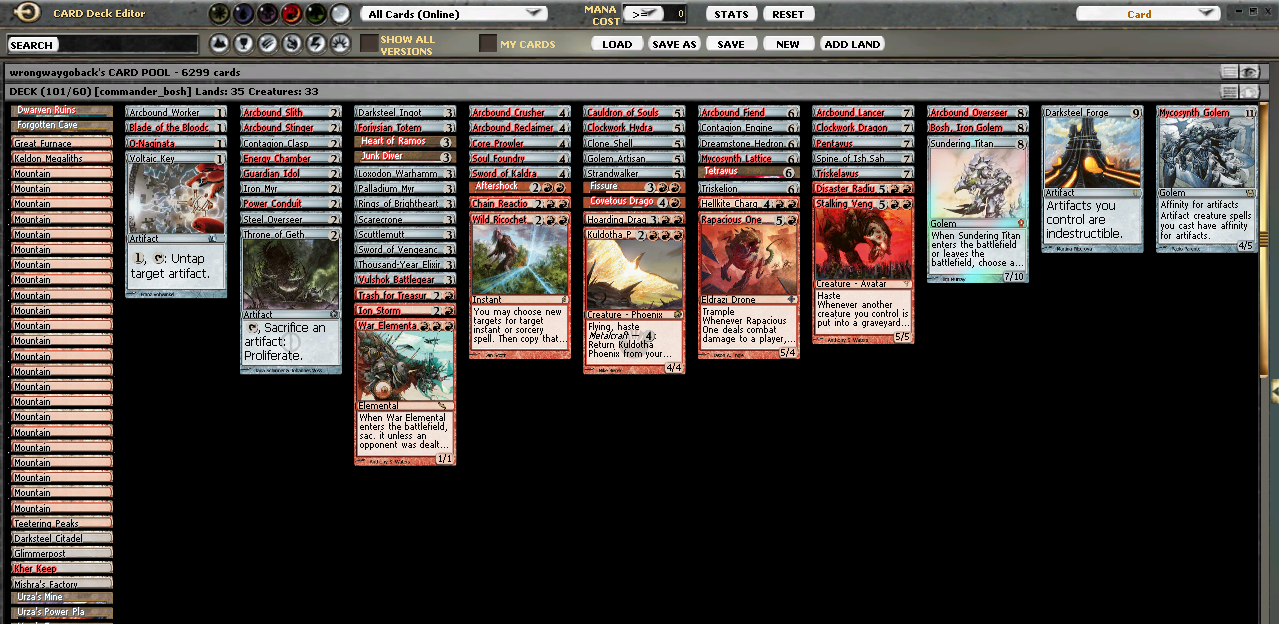
Here's the decklist Panahinuva submitted:

Bosh The Conqueror

General

1 Bosh, Iron Golem

Creatures

1 Arcbound Crusher
1 Arcbound Fiend
1 Arcbound Lancer
1 Arcbound Overseer
1 Arcbound Reclaimer
1 Arcbound Slith
1 Arcbound Stinger
1 Arcbound Worker
1 Clockwork Dragon
1 Clockwork Hydra
1 Clone Shell
1 Core Prowler
1 Covetous Dragon
1 Golem Artisan
1 Hellkite Charger
1 Hoarding Dragon
1 Iron Myr
1 Junk Diver
1 Kuldotha Phoenix
1 Mycosynth Golem
1 Palladium Myr
1 Pentavus
1 Rapacious One
1 Scarecrone
1 Scuttlemutt
1 Stalking Vengeance
1 Steel Overseer
1 Sundering Titan
1 Tetravus
1 Triskelavus
1 Triskelion
1 War Elemental

Artifacts

1 Blade of the Bloodchief
1 Cauldron of Souls
1 Contagion Clasp
1 Contagion Engine
1 Darksteel Forge
1 Darksteel Ingot
1 Dreamstone Hedron
1 Energy Chamber
1 Everflowing Chalice
1 Foriysian Totem
1 Guardian Idol
1 Heart of Ramos
1 Loxodon Warhammer
1 Mycosynth Lattice
1 O-Naginata
1 Power Conduit
1 Rings of Brighthearth
1 Soul Foundry
1 Spine of Ish Sah
1 Strandwalker
1 Sword of Kaldra
1 Sword of Vengeance
1 Thousand-Year Elixir
1 Throne of Geth
1 Voltaic Key
1 Vulshok Battlegear

Enchantments

1 Ion Storm

Instants

1 Fissure
1 Wild Ricochet

Sorceries

1 Aftershock
1 Chain Reaction
1 Disaster Radius
1 Trash for Treasure

Lands

1 Darksteel Citadel
1 Dwarven Ruins
1 Forgotten Cave
1 Glimmerpost
1 Great Furnace
1 Keldon Megaliths
1 Kher Keep
1 Mishra's Factory
1 Teetering Peaks
1 Urzas Mine
1 Urzas Power Plant
1 Urzas Tower
23 Mountain

At eight mana, with an activated ability of converted mana cost four, Bosh isn't the world's most competitive competitive. He has the ability of a pressure deck, but not the overall mana cost. He is, however, rather appealing in that he's not terribly frightening as he's in red, often considered the worst of the Commander colors.

As such, multiplayer-speaking, you may be able to keep the heat of yourself while you set up your kill conditions: a slow, creeping army that suddenly goes big.
The deck sent through is rather slavish to the modular theme (counters, counters, and more counters), playing most of the Arcbound creatures avaialable as well as a number of 'clockwork' creatures, backing this up with some proliferation enablers (including the original proliferators, Energy Chamber and Power Conduit).
Although it has great synchronicity betweeen cards, individually the power level of many of thechoices is pretty low. However, as tempting as it is to add Worldgorger Dragon and in keeping with the recent deck-tuning feedback, I'm going to try to keep to the theme and not drop in stock-standard power combos.

After I mentioned on Twitter that I was putting together a Bosh list, a chap named SgtContro DM'd me his own Bosh list. Here's what it looked like.

Sgt Control's Bosh Dance Party

General

1 Bosh, Iron Golem

Creatures

1 Palladium Myr
1 Steel Hellkite
1 Sundering Titan
1 Iron Myr
1 Myr Battlesphere
1 Triskellion
1 Wurmcoil Engine
1 Steel Overseer
1 Kuldotha Forgemaster
1 Etched Champion
1 Platinum Angel
1 Golem Artisan
1 Bogardan Hellkite
1 Shimmer Myr
1 Thopter Assembly
1 Manakin
1 Scarecrone
1 Myr Welder
1 Karn, Silver Golem
1 Hellkite Igniter
1 Darksteel Juggernaut
1 Lodestone Golem
1 Hoard-Smelter Dragon

Artifacts

1 Star Compass
1 Fire Diamond
1 Dreamstone Hedron
1 Worn Powerstone
1 Mana Vault
1 Armillary Sphere
1 Sisay's Ring
1 Thran Dyanamo
1 Darksteel Ingot
1 Mox Diamond
1 Guardian Idol
1 Sol Ring
1 Basalt Monolith
1 Everflowing Chalice
1 Grafted Exoskeleton
1 Loxodon Warhammer
1 Crystal Ball
1 Mirrorworks
1 Clock of Omens
1 Prototype Portal
1 Voltaic Key
1 Contagion Clasp
1 Brittle Effigy
1 Titan Forge
1 Lux Cannon
1 Sculpting Steel
1 Sensei's Divining Top
1 Energy Chamber
1 Spine of Ish Sah
1 Unwinding Clock
1 Myr Turbine
1 Temporal Aperture

Sorceries

1 Epicenter
1 Boom// Bust
1 Tectonic Break
1 Destructive Force
1 Wildfire
1 Wheel of Fortune
1 Comet Storm

Enchantments

1 Bludgeon Brawl

Lands

1 Ghost Quarter
1 Dwarven Ruins
1 Sandstone Needle
1 Keldon Megaliths
1 Valakut, the Molten Pinnacle
1 Shinka, the Bloodsoaked Keep
1 Stalking Stones
1 Mishras Factory
1 Tectonic Edge
1 Temple of the False God
1 Smoldering Crater
1 Great Furnace
1 Dormant Volcano
33 Mountain

Sgt Control's deck took a very different take on Bosh, using a mix of fast mana and land destruction to keep down opponents while smashing face with some pretty large creatures. What surprised me was the lack of instants, sorceries and enchantments in both decks. I can understand the appeal of going 'all-in' with artifacts as they do tend to be somewhat fragile on the multiplayer board.

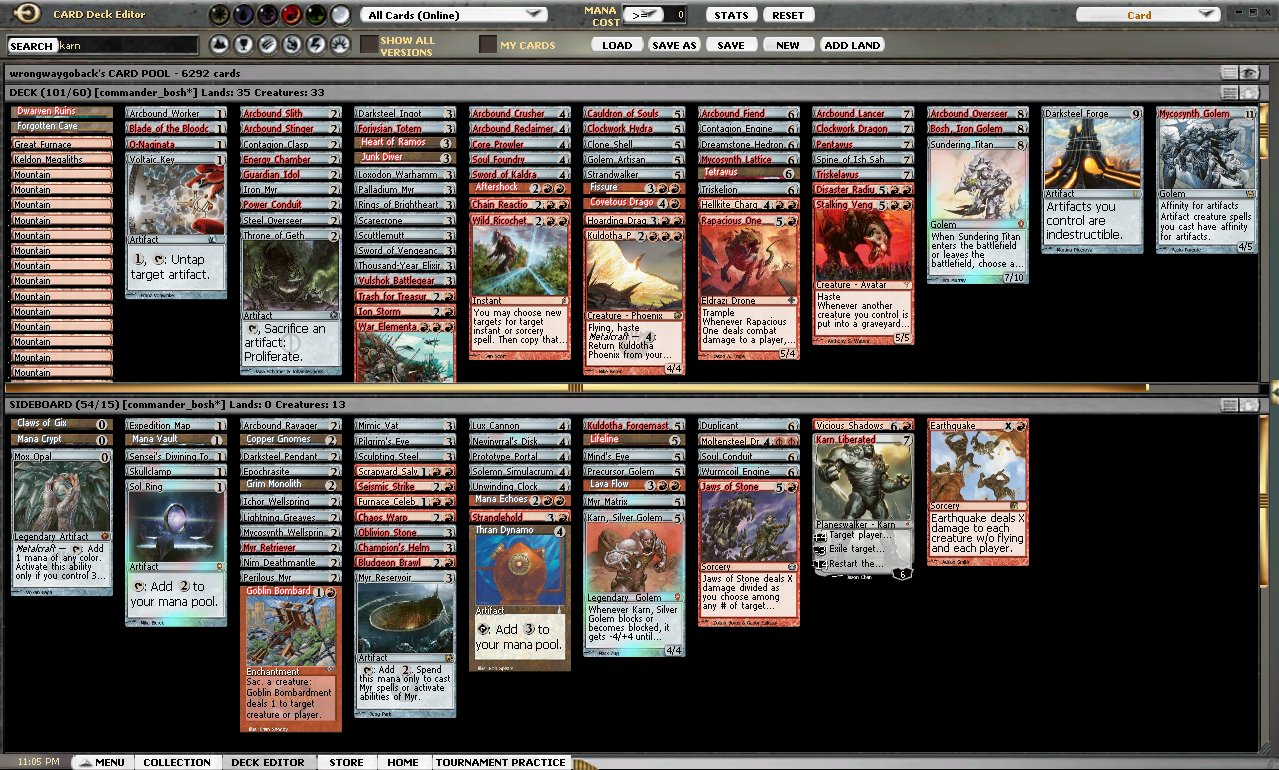
Looking at the deck list I certainly wanted more disruption, faster mana, more recursion, and some alternate sacrifice outlets than Bosh. Scrapping around I came up with 54 cards thought of working into the deck. 54 cards is a lot, so they can't possibly all make it in.

Here's what did.

The Fast Mana Suite

If Bosh is to reliably apply pressure, then a fast mana suite won't hurt to include. The fast mana suite, in case you don't know it, is as follows.

  • Mana Crypt
  • Mana Vault
  • Mox Opal
  • Sol Ring
  • Grim Monolith
  • Thran Dynamo
  • Voltaic Key

The Mox Opal could be a Mox Diamond, Basalt Monolith, Coalition Relic, or Felwar Stone, depending on how you feel.

The suite has less of a downside in Bosh than most other decks. First, he has no problem with the fact the fast mana suite produces colorless mana. Second, he can sacrifice away the Mana Crypt and Mana Vault if life totals become dangerously low.

Sacrifice Support Suite #1: Sac Outlets

With all the sacrifice effects going on I wanted to build a sacrifice support suite.

  • Bosh, Iron Golem: We're not going to get far without out commander. His sacrifice ability has certainly set the theme for this version of Bosh. Again, I'm not a huge fan of the eight mana as he's just so slow, but if you make it to the late game then he does become somewhat of a beast. The important thing to note is that he does damage equal to the converted mana cost of whatever he sacs, so power and toughness buffs are less useful for the big lunk. His ability also does not cause commander damage either.
  • Goblin Bombardment: One of my favorite red Commander staples, this sac outlet can put a great deal of pressure on opponents. It's also the perfect Control Magic foil for your creatures.
  • Claws of Gix: With a deck this slow, having a life-gaining ability seems a must. It also gives an easy out to Mana Crypt and Mana Vault if required, clawing a little of that life gain back. Incidently, has anyone noticed that the win/loss ratio on those two cards on Magic Online seem to be 66% win and 33 % loss (and 1% coin lands on the side and has to be reflipped)?
  • Throne of Geth: Helps against Control Magic, and works wonders with the counters-matter theme the deck retains. Due to the large amount of artifacts in the deck it will always have a target.
  • Trash for Treasure: I've not used the card before but wanted to test how it goes. I imagine sacrificing a Junk Diver or a Myr Retriever feels pretty good.
  • Kuldotha Forgemaster: The deck has so few tutors that even one that requires sacrificing several permanents seems fine. When you're able to get extra value out of those sacrifice effects, more is better. Note that I'm not running Lightning Greaves in this deck, so he's a little slower than usual. Why not Greaves? Because with so many sacrifice outlets I don't feel the need to protect anything, and I already know I'm not going to kill my opponents quickly. So no Greaves.
  • Copper Gnomes: It's not really a sac outlet, but it is a sac effect, and I've been using this card to power out a very, very fast Blightsteel Colossus. I'm not running old Blighty in this deck as I wanted to keep the threat of infect out of my opponents vision. This actually came up in a game during testing (details further down the article). Gnomes has been treating me very well.

There's a pretty broad range of casting costs amongst those cards so should be able to have a sac outlet any time I need it, to varying effect.

Sacrifice Support Suite #2: Sac Value

If I'm sacrificing all this stuff, I want some ways to get extra value out of the stuff that's heading to the graveyard dying.

  • Furnace Celebration: There's no value like incremental value, and two mana for two more damage anywhere you want it is certainly incremental. With all the sac outlets, this kind of damage stacks up over time and kills a lot of utility creatures out there.
  • Vicious Shadows: A fine, fine red card, one of the best in fact. The other day I played against this card with Gin & Taxes and almost died from the life loss of having 14 cards in hand. Worthy of any red deck, especially good here in a deck with so many ways to force it to trigger.
  • Stalking Vengeance: Pseudo Vicious Shadows on a stick, Stalking Vengeance does a fine job of ending games. Unlike Bosh, Vengeance does damage equal to the power of the dying creature, so cards like Nim Deathmantle really shine with Vengeance.
  • Mimic Vat: If you have a deck that can pick and choose what goes under the Vat then the Vat is awesome. Some decks, such as mono-blue, have a hard time getting the right cards underneath (although there are few cards you don't want there anyway). Bosh has a easy time making it happen, improving all your sac outlets along the way.
  • Skullclamp: With the high number of recursion engines and mana sinks in the deck, what there's little of is card draw. Skullclamp fills this niche nicely, especially when we get to take advantage our out Arcbound creatures, recursion cards, and on-death triggers. Also, it's out-of-this-world broken. Did I mention that?
  • Blade of the Bloodchief: Panahinuva included this great equipment in his original list, and I think it's worthy of a spot. With the modular creatures it can get out of hand very easily, even with the lack of vampiristic characteristics. The low equip cost is also appreciated as it becomes easy to move around and gain extra value.
  • Darksteel Forge: Not a sac value card per se, what it does is protect your sac fodder until you're ready to ship it off the board. Controlling your own destiny is very important in Commander, and Darksteel Forge acts wonder in regards to keeping your game plan intact.

Sacrifice Support Suite #3: Recursion

  • Junk Diver: A 1/1 flyer for 3 mana is no Storm Crow but its ability is perfect in this deck. Sac Junk Diver, get back something worthwhile, do 3 damage off Bosh, etc, seems good. If there is ever a thing as synergy then this card embodies it.
  • Myr Retriever: Effectively the same ability as Junk Diver, it's good to note that one can endlessly recur the other. Endless sacrifice fodder is exactly what a good Bosh deck wants.
  • Scarecrone: Another recursion tool, Scarecrone gets additional benefits from being able to sacrifice itself to draw a card. This can be very beneficial with the next two cards
  • Lifeline: Scarecrone becomes a card-drawing machine with Lifeline (and another creature) on the board. 1: Draw a card seems fine by me, allowing you to find exactly what you need to lock up the game. Of course, the effect is symmetrical, so if your opponents happen to have their own way to abuse the card you could be in trouble.
  • Nim Deathmantle: A must for any Bosh deck, the Deathmantle is the perfect big-mana effect. If you can cast Bosh, you can generally sac a creature for three-and-a-red then recur it for four, meaning you can truly rain pain down upon your opponents.
  • Couldron of Souls: As Bosh doesn't care about power or toughness, the instant recursion of Couldron is appreciated. You could even sac Bosh to himself if you so desired. Our ability to get +1/+1 counters onto persisted creatures is also pretty high, allowing for a broken long-game.
  • Mana Echoes: Put in largely to test, I have visions of endlessly persisting Arcbound creatures, creating more and more mana for Bosh as they return. Dream big, I say.

Arcbound Creatures

Voltron, form! Okay, we're not necessarily assembling a doomsday machine, but the Arcbound gang do a good Voltron impersonation. The creatures I chose are as follows:

  • Arcbound Crusher: Will grow and grow and grow thanks to your recursion engines, such as
  • Arcbound Reclaimer: It's a pity it doesn't move cards from your graveyard to your hand, but I guess that would be a little too ridiculous. But hey, he has a giant beam of light shooting out of his neck, so he's gotta be awesome regardless.
  • Arcbound Sith: If you can get him down early, he's fantastic, kind of like a slower Skullbriar, The Walking Grave. Otherwise he takes a little bit of work to get going, but once he's a 4/4 or above there's plenty of ways to help him grow through combat.
  • Arcbound Fiend: Flexibility is key in Commander and the Fiend helps you maintain a variety of threats. Sometimes the ability to maintain one big creature over many little ones is desirable, or visa versa. This guy helps you accomplish that.
  • Arcbound Overseer: He costs as much as Bosh, and only works with other modular creatures, making him pretty narrow. However he suits the deck so we can forgive the extravagant cost.
  • Arcbound Ravager: Nom nom.
  • Arcbound Lancer: First strike is one of the better keywords in Commander, and while a 4/4 first striker isn't that great, with a little bit of work he can be a 10/10 first striker, which is a very hard force to deal with in the Red Zone in any format.

To be frank, I’m not sold on arcbound creatures in Commander, but I felt it necessary to give them a try.

Counter Makers / Creature Makers

Arcbound creatures love counter generation, so I’ve included some of the best.

  • Steel Overseer: He's slow and clunky but in a loveable kind of way for this slow, clunky deck. He general needs a lot of creatures out to be worthwhile, and in any truly aggressive environments he's not going to stick around more than two or three turns, but he's great at doing what he does so he's worth a try.
  • Contagion Engine: The best proliferator in business, works best in decks with Doubling Season, but is a fine choice for this one as well. It's one of those cards you keep discovering interactions for, and as it doubles as a removal spell it almost always gets my vote.
  • Contagion Clasp: Contagion Engine's little cousin, it a fantastic little card. It's a useful political tool; being able to proliferate your opponent's cards to get them out of a jam can, on the odd occasion, be pretty useful.
  • Energy Chamber: It's not quite proliferation but it's enough to get it started. Very useful for getting the Arcbound engine up and running.
  • Core Prowler: Although it's tempting to tune the deck to have small theme of infect in this deck (infect has an excellent recursion card in [card]Corpse Cur) I'm staying away from it for purely political purposes. Infect draws a lot of attention in Commander, and in a deck this slow early, unwanted attention is a terrible thing.
  • Prototype Portal and Soul Foundry: While I'm usually very hesitant putting potential own-goal two-for-ones in a deck, the number of sacrifice outlets in the deck demands this kind of risk/reward plan. We won't be out-resourcing our opponents through card draw, so a metric ton of damage instead through a constant stream of cannon fodder is required.

Value Creatures / Sac Fodder

The machine needs grist for the mill. Here’s where my addled brain went.

  • Solemn Simulacrum: Sad robot, so sad. He's being reprinting in Magic 2012, so it will soon be a good time to pick him up (once his price settles down post release). At best he's a 3-for-1, at worst a 2-for-1, and you can't ask for much more than that. With any kind of recursion engine going he is truly silly: perfect for this deck.
  • Mycosynth Wellspring and Ichor Wellspring: They are card draw and sacrifice fodder. You'll be happy to see them early game and will be easily able to cycle them late game so they'll rarely be dead. The added benefit they give your recursion engines are also very useful. Drawing cards is something good.
  • Epochrasite: I have a soft spot for this critter as it ended up in my very first Commander deck. It's the little robot that could, continually coming back time after time after time. The fact that it has counter interactions makes it the perfect sacrifice fodder, ensuring a slot in the Bosh list.
  • Hoarding Dragon: A relatively unloved rare, I'm choosing this over Clone Shell as it can also be a relatively effective beater, unlike the Shell itself which generally sits around doing nothing. The dragon acts as one of the few tutors in the deck, if you're willing to pay the cost for it.
  • Duplicant: Fine, colorless removal that gets so much better with a sacrifice/recursion engine behind it. Take their biggest critter, sacrifice, return, do it all again the next turn? It's what Commander is made for.
  • Sculpting Steel: You can't combo out in the same way as you might with Sharuum, The Hegemon decks, but its utility and versatility are very real in an artifact based deck. Three mana for a second [card]Darksteel Colossus is rarely a bad deal.

Removal

  • Fissure and Lava Flow: The cost is barely an issue. The added utility of being able to take out a utility land if required, such as Maze of Ith, is pretty desirable. Clearly Fissure, as an instant, is the better card, and the deck would have had Chaos Warp as an alternative to Lava Flow if Chaos Warp was available on Magic Online at the time of writing.
  • Scrapyard Salvo: A janky little card, it fits the theme of the deck nicely. You won't get much value on turn 1, but by turns 7 and 8 this can become pretty brutal.
  • Jaws of Stone: A card that, after testing, should almost certainly be Earthquake, I chose Jaws of Stone as I wanted a little versatility in my removal. What I should of added was another sweeper, as the deck is just so soft against a fast early game.
  • Oblivion Stone and Nevinyrral's Disk: I've included both the artifact-based mass removal cards. The Disk is slower but I'm happy to run it because it does force your opponents to have the removal in a single upkeep regardless.
  • Karn Liberated: Karn is such a good card it's hard to go past him, especially given the flavor of the deck. If you manage to pull his ultimate off prepare to have various insults, food-stuffs, and furniture hurled at you.

Threats'n'Stuff

Finally we have ways, other than Bosh, of killing our opponents.

  • Wurmcoil Engine: He a machine alright (pun totally intended). The colorless Titan, Wurmcoil Engine has all the right attributes for Commander: a realistic converted mana cost, inherent card value, lifelink, and deathtouch. With Bosh he does double duty due to his token generation ability.
  • Sundering Titan: I like the guy as he really punishes powered-up, billion-dollar mana base five-color decks, just like the ones I love to run, with little repercussion.
  • Spine of Ish Sah: Another piece of colorless removal, as sacrifice fodder to Bosh it becomes a little extreme. Sacrifice, deal seven, return to hand, crush another permanent, reboot. Perfect.
  • Moltensteel Dragon: This card is a one-card combo, especially in a pressure deck like this. Works better with Stalking Vengeance than Bosh but is still fantastic anyway.
  • Triskelion and Triskelavus: Given the amount of token shenanigans in the deck, these two are a shoo-in. The ability to get the tokens off then sacrifice for full value to Bosh make them pretty versatile as well.
  • Unwinding Clock: Everyone I speak to seems down on Unwinding Clock, so I think they might not have tested it all that much. It is bonkers in an artifact-based deck. Crazy good. Seriously.
  • Darksteel Colossus: I've run with Darksteel over Blightsteel Colossus purefuly for political purposes. Bosh doesn't have an amazing early game, and depending on how your opponents feel about or fear the Blightsteel if they know you have it you'll be a big target in the early game. This Bosh deck has few defenses.

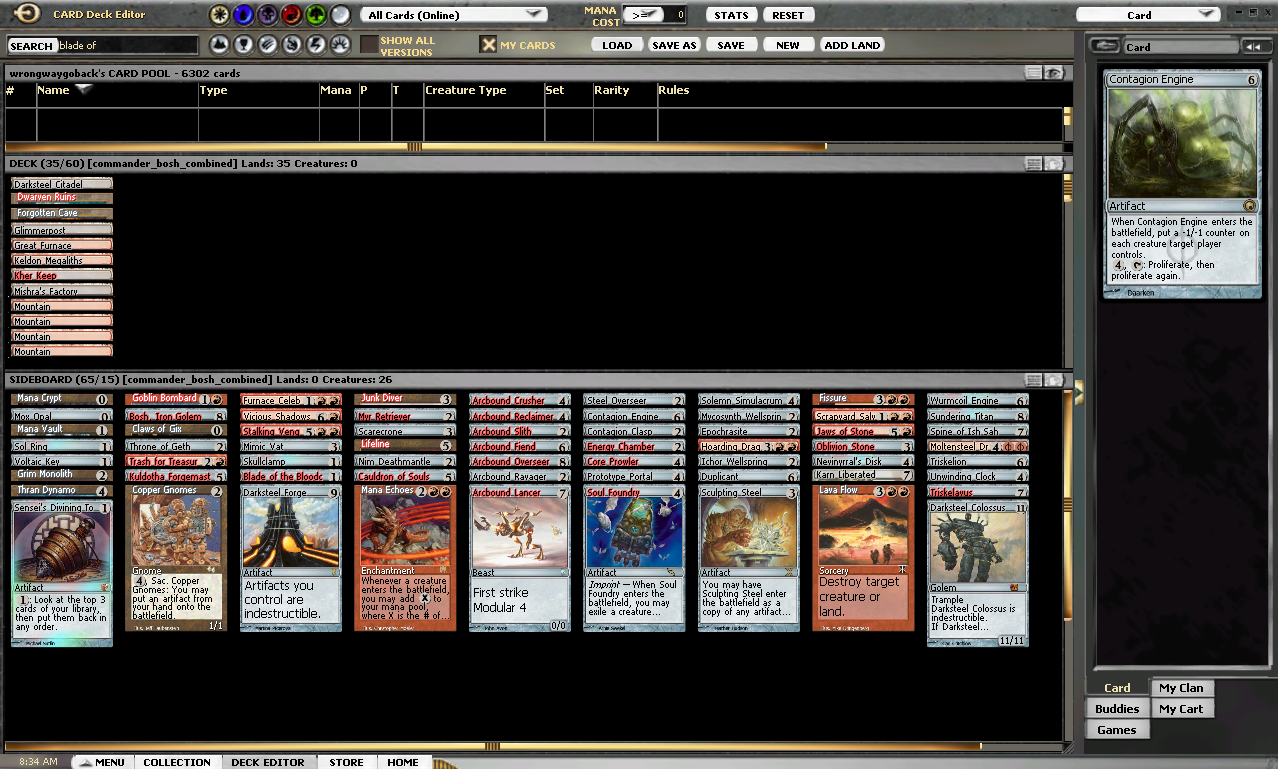
Here's the final decklist:


    Infinite Bosh

    General

    1 Bosh, Iron Golem

    Creatures

    1 Arcbound Crusher
    1 Scarecrone
    1 Junk Diver
    1 Copper Gnomes
    1 Arcbound Lancer
    1 Kuldotha Forgemaster
    1 Epochrasite
    1 Core Prowler
    1 Triskelion
    1 Steel Overseer
    1 Triskelavus
    1 Sundering Titan
    1 Duplicant
    1 Moltensteel Dragon
    1 Solemn Simulacrum
    1 Myr Retriever
    1 Hoarding Dragon
    1 Arcbound Ravager
    1 Darksteel Colossus
    1 Arcbound Slith
    1 Arcbound Fiend
    1 Arcbound Overseer
    1 Stalking Vengeance
    1 Arcbound Reclaimer
    1 Wurmcoil Engine

    Artifacts

    1 Soul Foundry
    1 Spine of Ish Sah
    1 Cauldron of Souls
    1 Contagion Engine
    1 Prototype Portal
    1 Mimic Vat
    1 Thran Dynamo
    1 Darksteel Forge
    1 Grim Monolith
    1 Voltaic Key
    1 Contagion Clasp
    1 Ichor Wellspring
    1 Mana Crypt
    1 Unwinding Clock
    1 Sol Ring
    1 Mana Vault
    1 Nevinyrrals Disk
    1 Sculpting Steel
    1 Mox Opal
    1 Blade of the Bloodchief
    1 Claws of Gix
    1 Oblivion Stone
    1 Nim Deathmantle
    1 Mycosynth Wellspring
    1 Lifeline
    1 Energy Chamber
    1 Senseis Divining Top
    1 Skullclamp
    1 Throne of Geth

    Enchantments

    1 Furnace Celebration
    1 Goblin Bombardment
    1 Vicious Shadows
    1 Mana Echoes

    Planeswalkers

    1 Karn Liberated

    Sorceries

    1 Jaws of Stone
    1 Trash for Treasure
    1 Lava Flow

    Instants

    1 Scrapyard Salvo
    1 Fissure

    Lands

    1 Urza's Mine
    1 Kher Keep
    1 Great Furnace
    1 Teetering Peaks
    1 Keldon Megaliths
    1 Dwarven Ruins
    1 Darksteel Citadel
    1 Forgotten Cave
    1 Glimmerpost
    1 Urzas Power Plant
    1 Mishra's Factory
    1 Urzas Tower
    23 Mountain
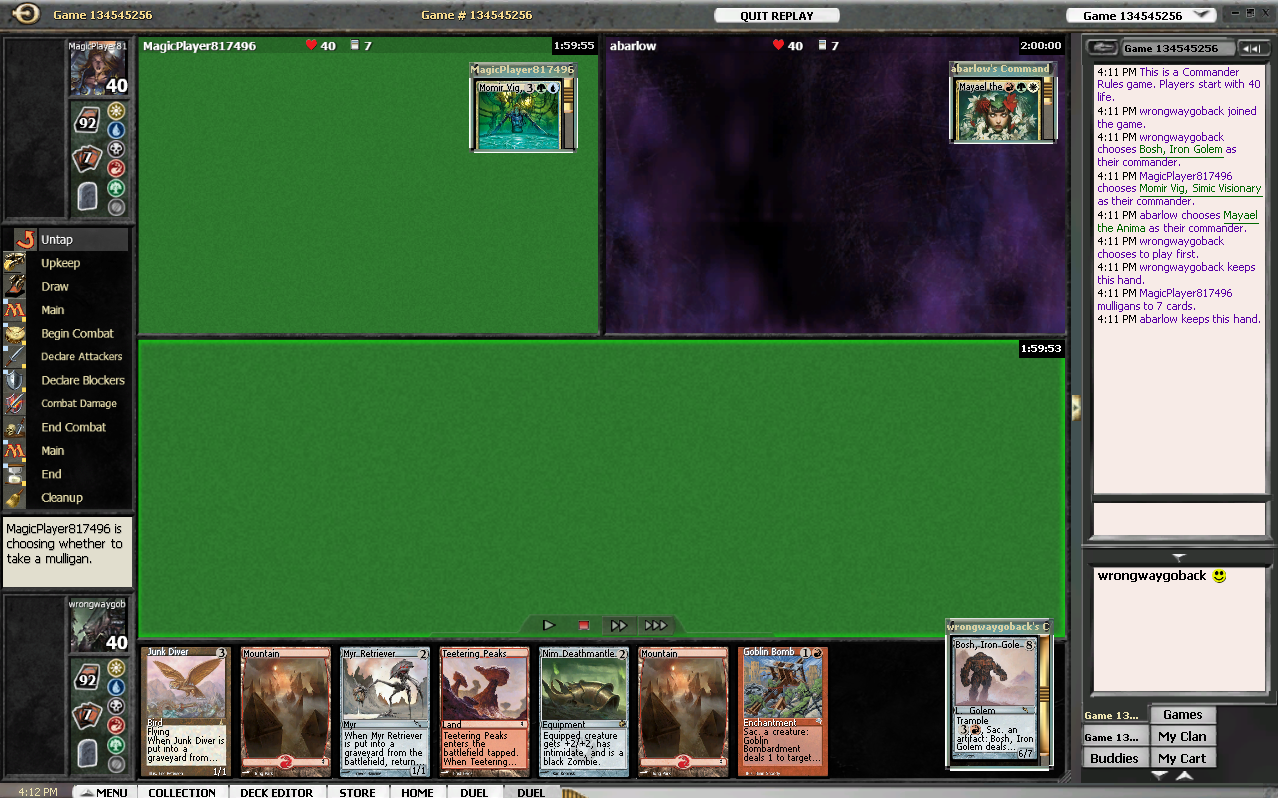
    I took the deck out for three spins in the Magic Online multiplayer room. Here's how they went.
    Game 1
    The first game was against Momir Vig, Simic Visionary and Mayael the Anima.

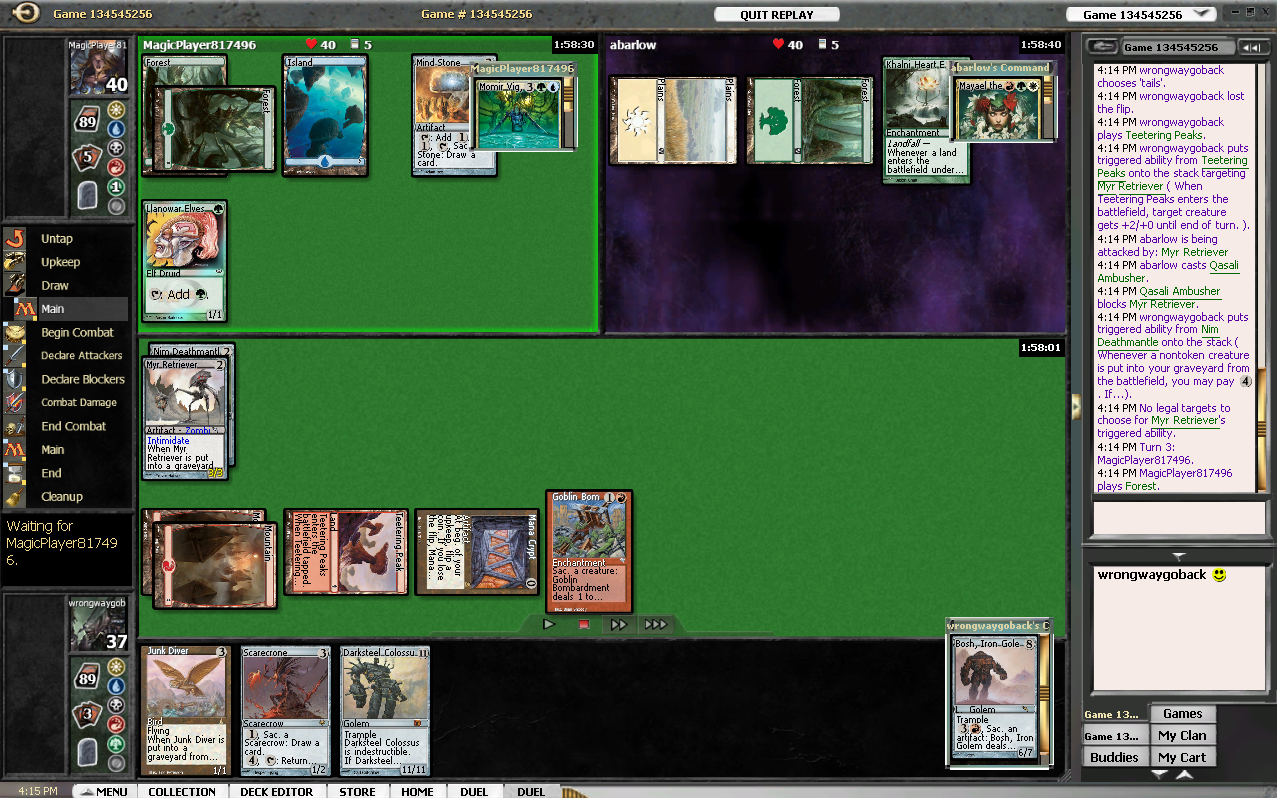
    I had a great start with a small combo going on and playing the beatdown role, getting through for four a turn using a combination of Myr Retriever, Goblin Bombardment and Nim Deathmantle.

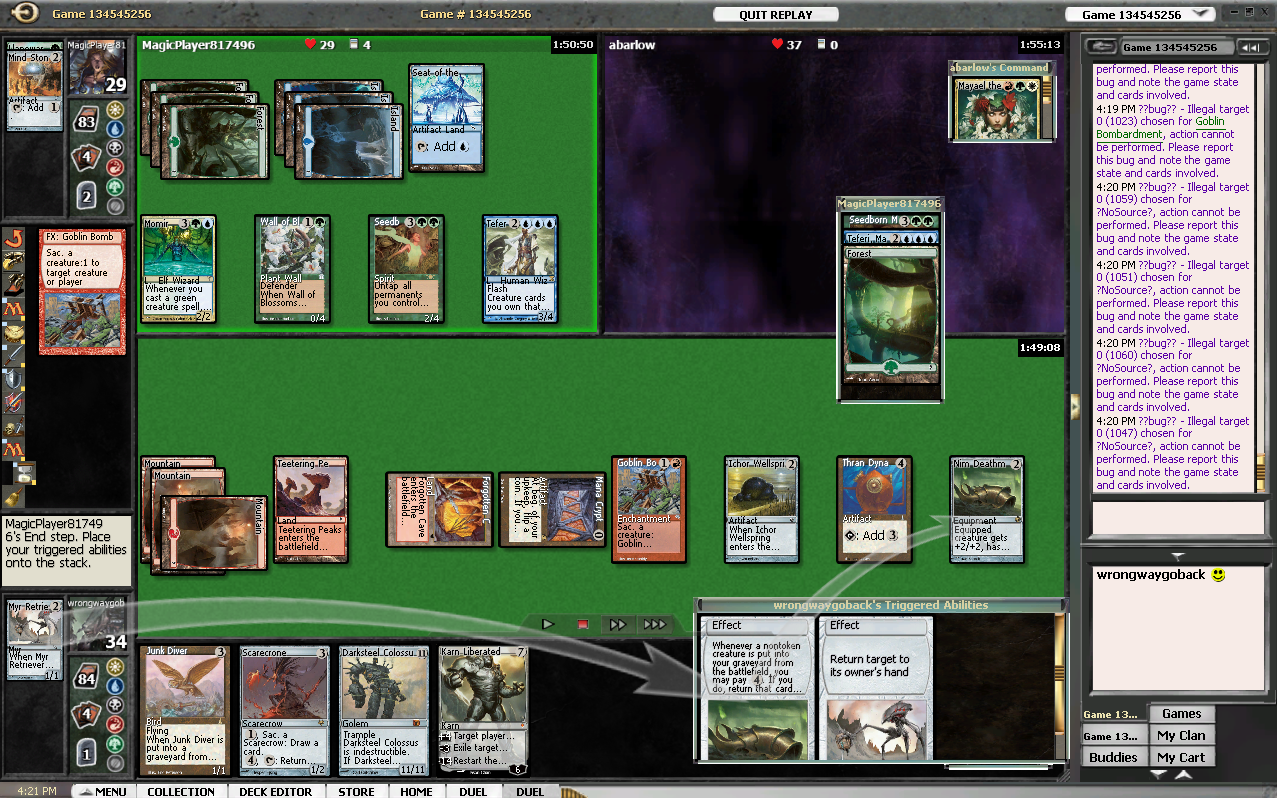
    Unfortunately, the Mayael player dropped out fairly quickly, leaving me with the light beatdown and no disruption to stop the Momir Vig player shuffling up some great creatures, and he quickly ramped into a Seedborn Muse, then Teferi, Mage of Zhalfir. I'm pretty sure I misplayed this game, and should of tried to play out more permanents than relying on the tiny combo I had going, possibly going for Karn Liberated, but I recklessly forged ahead on the beatdown/combo path as below.

    Missing the opportunity to play out Karn cost me, as my opponent layed out a Tidespout Tyrant with counterspell backup, stopping me hard. I ripped a Fissure to kill the Tyrant and delay him a turn, but a Body Double on his next play saw the Tyrant come back and my permanents slowly but surely disappear off the board.
    Game 2
    The second game was much more fun, so naturally Magic Online decided to keep no record of it. There was myself, a Kemba, Kha Regent player, a Horde of Notions player, and a fourth who dropped quickly didn't affect the outcome.
    I mulliganed into a two land hand (a recurring theme) and the Horde player mulled to five with onw land, complaining bitterly, but as a good sport decided to stick with it. What happened then was one of the most astounding land-ripping streaks I've ever seen, with the Horde player laying down a green source turn 2 followed by a Khalni Heart Expedition, then a Cabal Coffers, and soon a Primeval Titan fetching a Vesuva and a Urborg, Tomb of Yawgmoth for an astounding amount of mana.
    The only thing keeping him down was the Kemba player, who had suited their General up with a Pennon Blade and a Whispersilk Cloak, then laid down a wicked White Sun's Zenith for many kitties. I top-decked a Nevinyrral's Disk.
    I played it out then PM'd the Kemba player, letting him know I would not activate it until after his attack step against the Horde player. Seeing my sweeper, the Horde player realized he had the most to lose, but failed to top-deck removal against the disk. Instead everything was sent against me. I lived, but Horde player died to commander damage from Kemba immediately thereafter. I popped my disk, and the Kemba player and I started one-on-one.
    I popped down Bosh, he played out Kemba again, and then the war of attrition began. However, I ripped three key cards; Solemn Simulacrum, Mimic Vat, and Junk Diver. Now a Junk Diver under a Mimic Vat is not a combo, as the Diver needs to hit the graveyard to work. However Sad Robot under a Mimic Vat is perfect for a deck as hungry as this one. Then I hit Unwinding Clock and Skullclamp, and the deck went into overdrive. Drawing two cards and a ramping each turn, providing amazing amounts of cannon fodder for Bosh, and slowly but surely overwhelming the Kemba player.
    Game 3
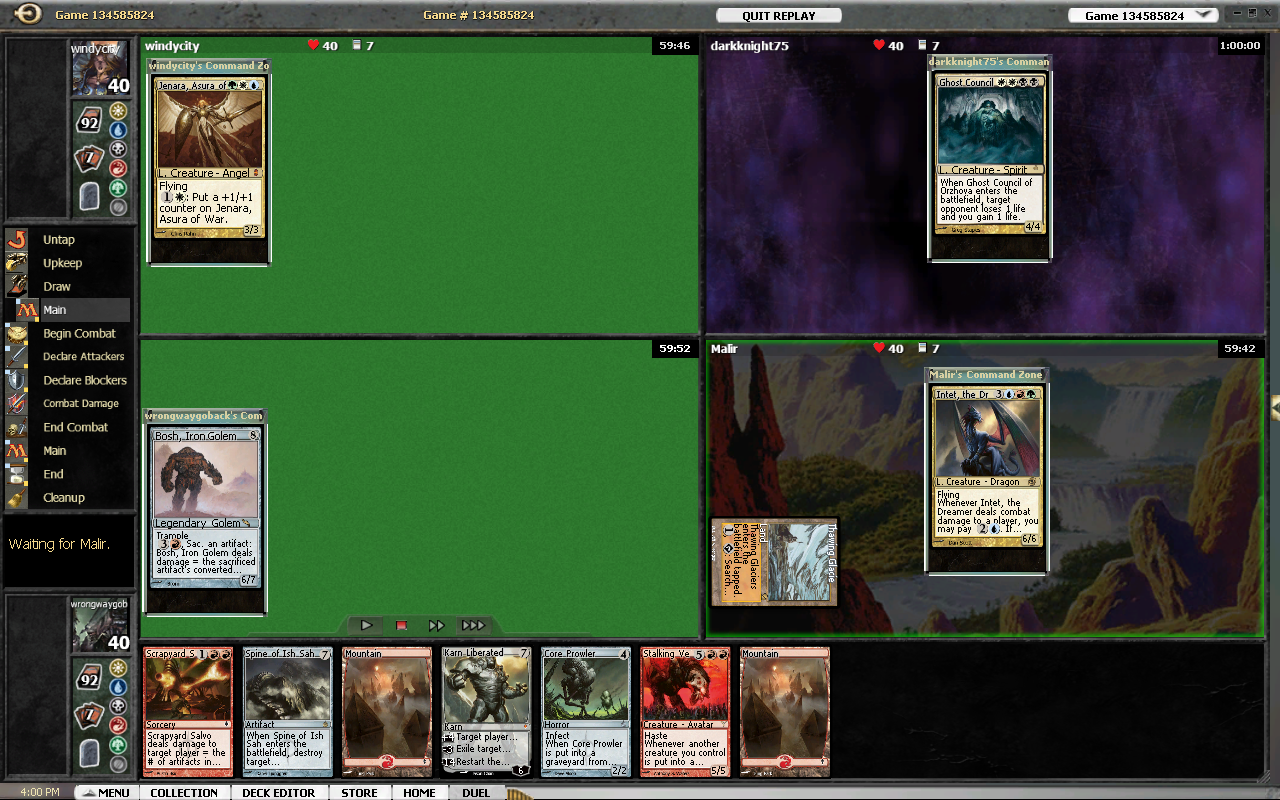
    The four players were Intet, the Dreamer, Ghost Council of Orzhova, and Jenara, Asura of War. I kept a relatively loose hand of two mountains with lots of seven-costed gas, which was a mistake from the start.

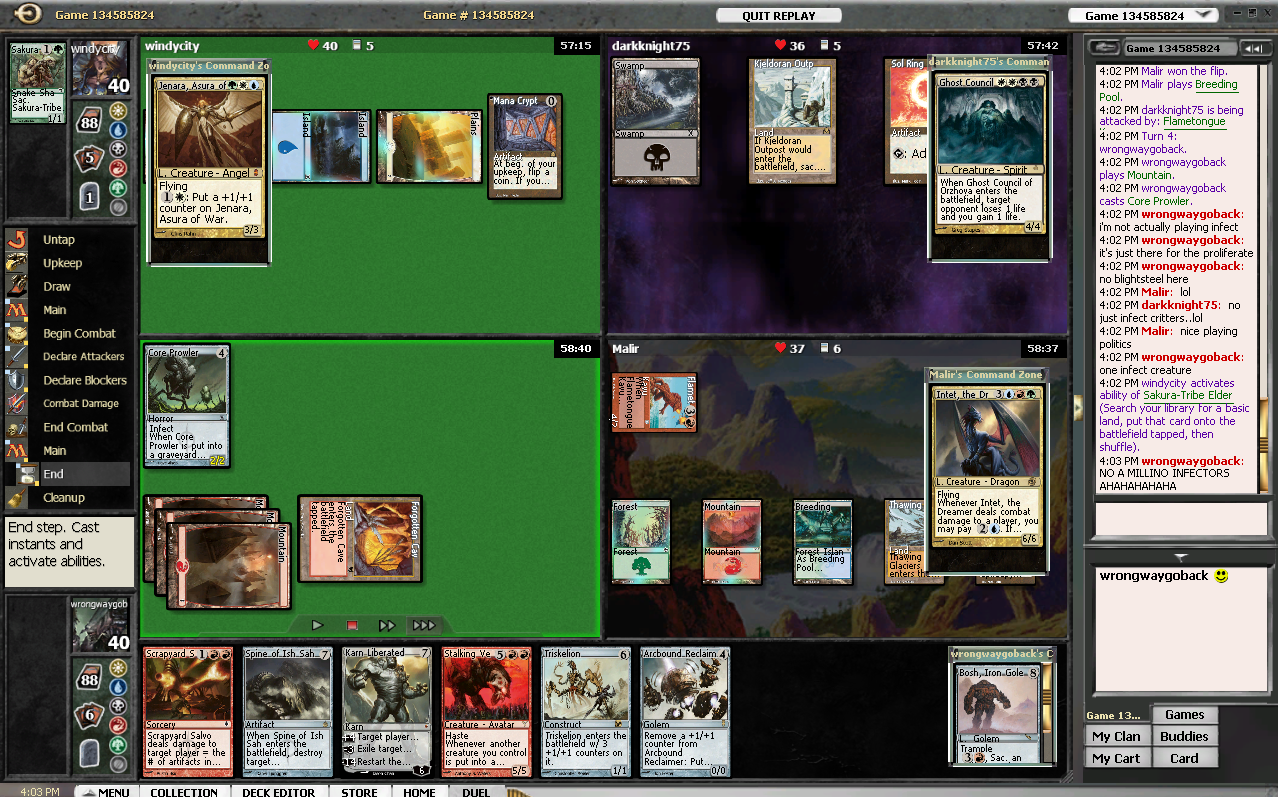
    The Intet player gets off to a rocket start, which is almost always trouble because any blue-green based deck with a fast start can be very difficult to reign back. While everyone else merrily ramps away I manage to hit four lands and lay down a pretty useless Core Prowler, loudly telegraphing that I am not playing an infect deck to try to keep the heat off my back.

    Unfortunately, my replay is corrupted from that point on but  it doesn't matter: the Intet player cheated out a Jin-Gitaxias, Core Auger, drew seven cards (filling up to 14), and left each us in turn without a hand. The game quickly ended from there. I guess there's not much you can do about that.
    Wrap-up
    Ultimately I don't think I've built the deck right. More importantly, I missed the need for some level for land-ramp, and I would probably slim down to two Sacrifice Support slots in order to gain a land-ramp slot. This is a hard task for Red, where you generally have to use things like Wayfarer's Bauble and Journeyer's Kite.
    The second thing I'd add is more sweepers. The deck can cope very well in the late game using Bosh's ability as spot removal; it's getting to the late game that's a problem. As such, more Earthquakes and Comet Storms need to make their way back into the removal suite.
    I think I'd like to add more planeswalkers to the deck, probably Koth of the Hammer and a Chandra of some description.
    I wonder if I thought enough about power level. Surely adding a Goblin Welder and a Kiki-Jiki, Mirror Breaker in there would of pushed the power level up, but they might of been too much of an old trope.
    Finally, I really didn't tinker with the mana base much. Some more utility lands, such as Maze of Ith would not have gone astray.
    However when the deck came together it was a thing of beauty, an unstoppable force. When the deck failed to ramp it was a timid thing, relying on the comfort of strangers to get it through to the late game.
    My question for the readers, as usual, is how would you build the perfect Bosh deck?
    Coming Next Time
    I've had a few requests to update the 'best archetypes in Commander' article based on the cards that have come out in New Phyrexia, Commander, and magic 2012 since that time. I plan to do just that. And if you have a deck you'd like tuned, don't forget to drop me a line with a deck list!

Commander Release Analysis (Part 5)

Are you a Quiet Speculation member?

If not, now is a perfect time to join up! Our powerful tools, breaking-news analysis, and exclusive Discord channel will make sure you stay up to date and ahead of the curve.

It’s been a fun four days but all great things must come to an end. In the first four parts of this series I focused on the new cards that Commander brought us. There are a lot of interesting cards that can easily be traded, or sold, to recoup the value of your commander purchase, but that is only half of what makes the Commander sets a great product. The majority of the boxed sets are reprints, and some pretty significant ones at that. I will be looking at the important reprints in each box, and giving you the information you need to get the best bang for your buck out of every box. Although I am out of my writing zone for some of the reprint cards, I am a trader at heart so I do know the trading game outside of Commander.

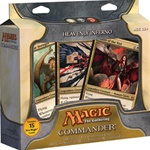
Heavenly Inferno

New Cards

Archangel of Strife - $4.03
Basandra, Battle Seraph - $4.72
Command Tower $4.74
Dread Cacodemon $1.99
Kaalia of the Vast $10.73
Mana-Charged Dragon$2.71
Soul Snare $2.29
Stranglehold $3.09
Syphon Flesh $2.21
Tariel, Reckoner of Souls $4.34

Reprints

Akroma, Angel of Fury
SCG - $2.99
AH - $2.91

Red Akroma is one of the more popular mono red commanders. Monored Commander decks are not at popular as some of the other mono-colored decks, but they are pretty straightforward to build. With the influx of new players coming in I wouldn’t be surprised if we saw more mono-colored decks in general around Commander tables throughout our community.

Akroma's Vengeance
SCG - $1.49
AH - $1.89

I spoke about this card in my debut article. It has now been reprinted twice, the first being Planechase. I believe this has now neutered the price of this card. There is a bright side to this card’s value however; it is an established playable and is pretty much at the lowest it can be. Do not trade this below $2 and don’t be scared to hold onto it until you find someone taking it at that price.

Angel of Despair
SCG $4.99
AH - $2.94

Angel of Despair is the biggest reprint from the Heavenly Inferno box set, aside from Sol Ring (which is by far the most significant reprint for every box set). The best thing about Angel of Despair is she’s an Angel first and foremost, and is a white-black staple that sees some fringe Legacy play. If Modern ever becomes a format, and the lack of Hypergenesis on the banned list stays intact, Angel of Despair will be a heavy hitter in that format as well.

Reprinting her only stunted her growth but will not cause her value to go down. Angel of Despair’s effect is just too good to have coupled onto a flying beater.

Bladewing the Risen
SCG - $2.99
AH - $2.07

Every set there is at least one new Dragon. Some are good, some are bad, but the good thing is Dragon collectors really only care about one thing: that "Creature – Dragon" appears on the card. Bladewing is the type of card that gets better with each Dragon printed. As long as they ease off on his reprinting in the future he should continue to maintain his value. Trade him away to that special Dragon lover in your life but don’t lose a penny of value. There is no rush getting rid of Bladewing.

Mortify
SCG - $0.99
AH - $1.06

This is one of those flexible spells that are so vital to making a great Commander deck. Enchantment removal is usually very sparse in Commander, so any chance a deck has to run a spell that deals with Enchantments as well as do something else important they end up being auto-inclusions. Even though it is just an uncommon, it is still one of the better removal options available to any deck playing white-black.

Mother of Runes
SCG - $3.99
AH - $3.47

Mother of Runes is an interesting card to be reprinted as it has held it’s value over the years. I don’t think this reprinting will hurt her value very much. Mom is still a decent card, and she also sees fringe Legacy play. If you don’t have one already I would keep her, but if you already have the [card Mother of Goons]Mom[/card]’s you need then trade her away.

Path to Exile
SCG - $2.99
AH - $2.50

Previously a Standard format defining card, Path to Exile will always have value attached to it. It is one of the best removal spells printed to date but only sees limited Legacy play (as Swords to Plowshares is almost always better). I would suggest only trading away a Path to Exile, reprint or original, if you are getting something of eternal value in return, such as Daze, Hymn to Tourach, or Brainstorm.

Lightning Greaves
SCG - $2.99
AH - $2.45
Sol Ring
SCG - $7.99
AH - $6.21

Every set has Lightning Greaves and Sol Ring. That’s roughly $10 worth of value already, and I doubt either will change much. They are played in basically any Commander deck that can play them, and should hold their current value due to the influx of players. I always try to hang on to a few of each for desperate traders out there. A smart play might actually be trading them both as a $10 package deal, as Sol Ring will be highly sought after but Greaves may not be “needed” by everyone as there are a [card Champion's Helm]handful[/card] [card Whispersilk Cloak]of[/card] [card Swiftfoot Boots]substitutes[/card].

New cards Apathy House Total: $40.85
Reprints Apathy House Total: $25.50
Apathy House Grand total: $66.35

Looking at the final price tag, why isn’t everyone piecing out their Commander decks? Well, this is a best case scenario (actually second best). Selling Commander cards at retail price is actually the best scenario right now. This is actually a great thing for the community because local game stores with a casual following are able to get a boost in sales due to Commander being released.

However, unless you own a store you can’t always get away with selling/trading at retail price. That doesn’t mean there isn’t money to be made through Commander. Each boxed set has several cards that have a high demand currently, indicated by their inflated prices. I won’t repeat my comments from my previous articles this week as I stand by all of my advice for each of the new cards from Commander: some are keepers, some are cards to dump right away, and some are steady price holders like any Angel ever created in Magic.

Mirror Mastery

New Cards

Animar, Soul of Elements - $6.25
Command Tower - $4.74
Edric, Spymaster of Trest - $10.96
Homeward Path - $9.96
Hydra Omnivore - $4.44
Magmatic Force - $2.70
Riku of Two Reflections - $5.79
Spell Crumple - $1.76

Reprints

Brainstorm
SCG - $2.49
AH- $1.79

Old cards in new borders, and new cards in old borders, always seem to be well received. There are not many that exist, and most are judge promos. Brainstorm is probably the most widely used one, and it's one of the defining cards of Legacy. No matter how many of these see print, unless it’s in a modern standard set (which is highly unlikely), Brainstorm will always be worth at least $2. Trade these away carefully if you already have your playset.

Fire // Ice
SCG - $1.49
AH - $0.87

Fire//Ice is one of those cards that you may find in bulk bins but is always a welcome sight. Even though it isn’t worth much there is always someone looking for this card. It appeals to competitive players as it sees limited Legacy play. It also appeals to casual players as most split cards do. They just catch most people’s eye while flipping through a binder, and hopefully you can bank on this appeal. Trade it away if you can find a buyer.

Garruk Wildspeaker
SCG - $6.99
AH - $4.10

I was surprised that Garruk was the only plansewalker to show up in the Commander product. Plansewalkers are so good in Commander that I don’t see why each deck didn’t receive one. With Garruk Wildspeaker being replaced by a [card Garruk, Primal Hunter]new version[/card] in Magic 2012, the original Garruk is a decent keep for now: casual players will slowly drive his price up again.

$8-$10 is not an outrageous price to ask for a card Garruk’s caliber, so unless you just want to recoup your money from your boxed set purchase I would suggest holding onto him for the time being. He could be a big powerhouse in some sort of turboland deck for Modern or Extended, especially if Time Warp ever gets reprinted.

Invigorate
SCG - $0.99
AH- $0.32

Even though Invigorate is only a $1 card, this is exactly the type of card you need to sell off to get full value out of your Commander sets. There are actually many other cards I chose not talk about in this article, like the Lorwyn [card Vivid Creek]vivid Lands[/card], Ravnica block [card Izzet Boilerworks]bounce lands[/card], and the [card Selesnya Signet]signets[/card], that can get you anywhere from a quarter to just over $1.

It is played in Legacy in stompy/infect builds that will continue to show up at lower levels of tournaments. It is also played in Pauper, and is one of the more popular decks available. It's so popular that Invigorate is 12 tickets online (MTGOTraders). This is mainly due to the lack of availability, only available through Garruk vs Liliana, until now.

Simic Sky Swallower

SCG - $2.99
AH - $1.26

This card was on my short list to talk about in my intro article to Commander finance, but in the end multicolor cards do not have a wide enough market to really jump much in price. Feel free to trade this guy away; his price is probably going to be the same five years from now.

Lightning Greaves
SCG - $2.99
AH - $2.45
Sol Ring
SCG - $7.99
AH - $6.21
See Above

New Cards Apathy House Total: $46.60
Reprints Apathy House Total: $17
Grand Total: $63.60

Mirror Mastery is top heavy with new cards so it is a little hard to make your money back on it if you are trying to keep some of these sweet new cards for yourself. But if you are not set on hoarding cards or making playsets, Mirror Mastery has decent value and most cards should be easy to get rid of because they are new.

Counterpunch

New Cards

Acorn Catapult - $2.17
Command Tower - $4.74
Celestial Force - $2.18
Ghave, Guru of Spores - $7.99 (SCG price. Unable to obtain price from AH)
Hornet Queen - $4.13
Karador, Ghost Chieftain - $6.99
Scavenging Ooze - $10.37
Soul Snare - $2.29
Syphon Flesh - $2.21
Vish Kal, Blood Arbiter - $3.35

Reprints

Attrition
SCG - $0.99
AH - $1.00

This card is somewhat of a staple in black-based Commander decks. Anything that allows you to have a relevant repeatable effect is playable in Commander. It’s also an enchantment, another plus in Commander, so it should stick around for a long time for you to get use out of it. If you can find [card Martyr's Bond]ways[/card] [card Faces of the Past]to[/card] [card Grave Pact]turn[/card] it’s [card Vicious Shadows]cost[/card] into a [card Fecundity]benefit[/card] it becomes even better. With all that said, the card is old, and has not really made any splash in the finance department. Try to trade this away for something small, but Legacy or Commander playable.

Mortify
See above

Skullclamp
SCG - $2.49
AH - $2.00

The infamous Skullclamp is just as broken in Commander as it was in Standard. It does not need to be included in every Commander deck, but it is hard to justify not running it just for value’s sake. There are always people interested in Skullclamp, especially players coming back to the game who played back when it was around. If my intuition is right you will see at least a few of these players coming back because of Commander. Hopefully you can find one of these players that is still in awe of Skullclamp’s ban-worthy power level.

Lightning Greaves
SCG - $2.99
AH - $2.45

Sol Ring
SCG - $7.99
AH - $6.21
See Above

New Cards Apathy House Total: $46.42
Reprints Apathy House Total: $11.66
Grand Total: $58.08

Counterpunch is the worst set to invest your money into. Unless you are dying to get [card Ghave, Guru of Spores]Ghave[/card], [card Karador, Ghost Chieftain]Karador[/card], or Scavenging Ooze, I would suggest just trading for those singles as there isn’t much else worth in the set.

Political Puppets

New Cards

Champion's Helm - $3.17
Chaos Warp - $13.92
Command Tower - $4.74
Flusterstorm - $15.84
Martyr's Bond - $4.56
Nin, the Pain Artist - $3.84
Ruhan of the Fomori - $3.46
Soul Snare - $2.29
Spell Crumple - $1.76
Zedruu the Greathearted - $4.33

Reprints

Austere Command
SCG - $1.99
AH - $1.28

I wrote about this card in my first article for Quiet Speculation. As I said in that article, Austere Command is one of the best [card Wrath of God]wraths[/card] for the format. It gives you flexibility, and allows you to build your deck around it, making your wrath closer to a Plague Wind than a Damnation. This will always be playable in Commander so hold it until you find the proper person to trade it to.

Brainstorm
See Above

Ghostly Prison
SCG - $2.99
AH - $2.16

Years from now people will still be making [card Zedruu the Greathearted]Zedruu[/card] decks just like they still make Phelddagrif or Kami of the Crescent Moon decks. Wacky, off-the-wall commanders are some of the most popular options in Commander. With Propaganda [card Norn's Annex]effects[/card] so closely tied to creating a Zedruu deck I would suggest being very conservative in trading these away. You should only get rid of them when you get good value for them.

Howling Mine
SCG - $1.99
AH - $0.78

I was very surprised at the value of Howling Mine. It has been printed several times, but still has above bulk value. This is entirely on the back of the casual market, and really shows how it can affect the price of a card. In case there is any fall back from my Howling Mine comments, I do admit it has seen some limited Standard play. Turbo Fog decks and Runeflare Trap decks are two examples, but those were never top tier decks. I should know, I dabbled with Runeflare Trap for as long as Time Warp was in standard. History has shown Howling Mine’s is as steady as they come so do not be afraid to trade the mine away.

Insurrection
SCG - $0.99
AH - $1.42

This is one of the elusive Red staples for Commander. However, I suggest trading these away any chance you get. It has been reprinted once already so it’s value is pretty much what you see now.

Jötun Grunt
SCG - $1.99
AH – (Unable to obtain price from AH because of those two little dots on top of the o.)

Officially the hardest card to search for along with all the Æther cards, Jötun Grunt sees very limited Legacy play but comes from a set that was opened in very small numbers, Coldsnap. It’s good to see Jötun Grunt get reprinted because it’s price really didn’t represent it’s playability. I’m not saying it’s a bad card, I’m just saying that in any other set this would be probably $1 or less. Get rid of them if you don’t have any desire to build a Legacy deck featuring the Grunt.

Propaganda
SCG - $2.99
AH - $2.79

See Ghostly Prison, but Propaganda is known a little more and is more important for blue to have than white. In price they should be around the same, but just keep it in the back of your mind that Propaganda is played slightly more.

Windborn Muse
SCG - $1.49
AH - $1.04
Treat this card exactly the same way you treat Ghostly Prison and Propaganda. Nothing else really to say about these cards except that Propaganda and Ghostly Prison sometimes see play in Legacy, and can possibly show up in Modern/Overextended if the meta is right. Sadly, Windborn Muse is not Legacy playable and therefore does not have the booming Legacy market to help it's price further.

Lightning Greaves
SCG - $2.99
AH - $2.45
Sol Ring
SCG - $7.99
AH - $6.21
See Above

New Cards Apathy House Total: $57.91
Reprints Apathy House Total: $20.12
Grand Total: $78.03

Political Puppets is pretty much the consensus first pick if you are looking to part out the box. However, most of it’s money is loaded in the new cards it contains. You will get very little value from it’s reprints so keep that in mind if you are hoping to keep the new cards and sell/trade off the reprints.

Devour for Power

New Cards

Command Tower - $4.74
Damia, Sage of Stone - $9.25
Mind's Aglow - $2.43
Sewer Nemesis - $2.99 (SCG price. Unable to obtain price from AH)
Skullbriar, the Walking Grave - $3.38
Spell Crumple - $1.76
Syphon Flesh - $2.21
The Mimeoplasm - $7.25

Reprints

Buried Alive
SCG - $2.99
AH - $3.43

The price for Buried Alive always surprises me but I think this is because I played back when this was a new card. I won my first tournament playing an Ashen Ghoul/Nether Shadow deck featuring Buried Alive. I had tons of them from the Weatherlight boxes we opened so for me it has never been a hard card to find. It was reprinted in Odyssey as well, but still holds a decent value for an uncommon. It is mainly the casual market backing this card, but it could also be limited Legacy play as well.

I’ve seen it used multiple times as a budget Entomb, or as a fifth copy, but I really suggest against both plays. Don’t be afraid to trade these away, but no need rush out and get rid of them. Their value will always be there.

Eternal Witness
SCG - $2.99
AH - $1.67

A staple to Commander that sees extremely limited play in Legacy. If Modern becomes a real format, Eternal Witness will become a player in that format’s  Elf deck. It’s an all around perfect card for green, so any player needs at least one for their Commander staples. The price is pretty much set so don’t worry about trading this one away. You won’t be sitting on a [card Dismember]future gold mine[/card], just a card that is really easy to trade away.

Fact or Fiction
SCG - $2.49
AH - $1.76

This is Fact or Fiction's second time being reprinted, the first being Jace vs Chandra. That box set recently sold for $99.99 on eBay, so the price of Fact or Fiction should not affected by that reprinting in any way. It’s another card that is a solid steady card so feel free to trade it.

Grave Pact
SCG - $3.99
AH - $3.50

Grave Pact is a pure casual card. I don’t think it has ever been in a tier 1, 2 or even 3 strategy for constructed. But as the casual masses love their griefer cards, Grave Pact continues to be worth a few bucks despite being reprinted numerous times now. I personally like the newest art as opposed to the older arts, and I think that is somewhat the general consensus. But if I were to get a foil, the 8th Edition version is the sauciest by far. In five years, Grave Pact will probably be the same price as it is today; do not be afraid to trade it away.

Living Death
SCG - $2.99
AH - $2.57

Living Death’s price is at its lowest point right now. The card used to actually be worth over $5 retail. It could be the reprinting that have affected it’s price, but other cards have been reprinted more than Living Death and have not seen any downward trend in their prices. It could be my fond memories of the card, but I think this is a little undervalued at the moment. I would personally hold onto it because I have faith in this card. I don’t see it going up much more $5 max at this point, and this would be a long hold so trade away if you don’t want to hold onto it for that little gain.

Oblivion Stone
SCG - $3.99
AH - $3.99

O-Stone is a huge Commander staple. Every deck can run it, and every deck usually does, or at least has it on it’s short list. An easy card to trade as there is always someone looking for it. Just remember: keep one for yourself!

Solemn Simulacrum
SCG - $5.99
AH - $4.56

Good old Jens could actually see a rise in price. Solemn Simulacrum is in Magic 2012 as well, but with new art. The card is sure to be played in Standard, post-rotation at the worst. Solemn is also a Commander all-star, and his current price is indicative of that. Some people may prefer the old art, and to those people a Jens version may be worth more than the Optimus Prime version. Try to leverage the old art desire in your trades. With that said, he is being reprinted so be careful with this one. Try to get them out if your collection if you can, just in case. It's price can only really go down at this point.

Troll Ascetic
SCG - $1.49
AH - $1.73

Troll Ascetic was once a feared card, then he was reprinted in Tenth Edition and we realized how far we had [card Tarmogoyf]come[/card]. Troll Ascetic, and any similar similar creature, is a natural progression for new players who first take a liking to big fatties. After seeing their Craw Wurms die to numerous Doom Blades, 'trollshroud' (or as kids call it these days, hexproof) creatures are usually the next line of thought. Try and find a newer player to trade these to as they will get a kick out of it, as everyone else did back the first time around Mirrodin.

Lightning Greaves
SCG - $2.99
AH - $2.45

Sol Ring
SCG - $7.99
AH - $6.21
See Above

New Cards Apathy House Total: $34.20
Reprints Apathy House Total: $31.87
Grand Total: $66.07

Devour for Power has some serious Commander staples, so it is a great box to invest in if you are looking to either start up with Commander or piece out the box to gain some profit. Because most of the cards are already proven casual hits, the price is pretty secure as well compared to something like Political Puppets who’s majority of worth is banking on new, currently unproven cards.

Recap on probable prices you could get from parting out each box:
Heavenly Inferno - $66.35
Mirror Mastery - $63.60
Counterpunch - $58.08
Political Puppets - $78.03
Devour for Power - $66.07

There are still a ton of other cards in each box that can be traded away. Some are even more than a buck but I didn’t want to make this article another week long affair. These totals are realistic amounts you can obtain from trading or selling the majority of your $29.99 investment, or $35.92 in Canada at Wal-Mart.

Well that’s a wrap everyone. Thank you for tagging along with me this week. A special thanks to my editor, Adam Styborski, for helping me along with the whole process of getting integrated to the QS family. Join me next time when I talk about Magic 2012 and what it means to Commander!

BONUS - Bad Seller Alert

I wanted to talk about a bad seller situation I had recently. On the eve of the ban hammer coming down on Jace, the Mind Sculptor and Stoneforge Mystic, I purchased five Primeval Titans at $18.38 each, with free shipping, from 'gamingetcstore' on eBay. They had 37 in stock. I was getting five so I could have 2 play sets, as I only currently own only three and share the card pool with my brother.

I have seen "Gaming Etc" branded Monster Binders at events so I thought they were a reputable dealer. But after having my purchase cancelled, without even an email, they have lost all respect in my books. The fact that they didn't even give me the courtesy of an email with some explanation, even if it would have been a fake, shows how much they actually care about their customers.

On top of losing out on my "deal" I have actually lost money due to the conversion rates because of this "refund". The funny thing is, Primeval Titan is selling for less than $18.38 on eBay now, but they have it selling at an outrageous price of $33.34. My advice to everyone is stay away from this seller. This type of business practice is not to be rewarded with our support.

Insider: All About Accents

Are you a Quiet Speculation member?

If not, now is a perfect time to join up! Our powerful tools, breaking-news analysis, and exclusive Discord channel will make sure you stay up to date and ahead of the curve.

Due to my brother's wedding in New Jersey this past weekend, I was unable to get any kind of a project in time for this article. That doesn't mean that there isn’t anything to learn though, so definitely keep reading (at least to the bottom for important announcements). Aside from welcoming my new sister to the family, the most important thing that Jersey did was remind me of an article that I have been meaning to write for a while now, an article about accents.

Whaddya talkin' about?

Yes, it's a bit of a stretch to link different dialects to accent painting so I'll give that up right here. Accent painting is a a very useful type of alter. It finds its' niche among newer players and more casual players as often times it allows the text of the card to remain visible. It can also be very quick in terms of time spent painting as well as create a very unique artistic effect.

Accents need not be very prominent. Their job is ultimately to make the viewer (at the very least) do a double-take when looking at a card. Many times an accent is just a continuation of the ideas presented in the original art, as seen in this (over used) Dark Ritual of mine. I looked at the art and asked where the dust was coming from, and then answered my question by painting a source. If that seems like a simple process it is, but as you can see it can create a very powerful effect without a lot of effort.

Accents can also be used in conjunction with border-less alters. You can liken this to putting icing on a cake. It helps the design to stand out from other border-less alters, and is a great way to put your own bit of flair into the design, which will help you stand out as an artist. When the colors of an altered card are rather bland, I often use an accent to add a certain amount of pop to the alter to keep it from being to boring.

Accents do not need to be a continuation of the art though. You may use them to express your own separate ideas about the content. Droplets of blood on a vampire card is a decent use of the myths and legends that surround these creatures and ideas. I have seen more literal ideas used though, like painting a black lotus on to a Trinket Mage or even adding Progenitus to a Natural Order. The important thing to take away from this is to use your imagination, and not limit yourself to what the artist gives you.

The most prominent use of accent work is on foil cards though. Foils are a unique challenge in their own right as they do not hold paint as well as their plainer non-foil cousins. Foils also happen to be, well, shiny. This very obvious quality eliminates the idea of any full art or border-less alters unless you have a way to make your paint appear as glossy as the foil itself. Otherwise, you just end up advertising where you painted on the card and more importantly where you “fudged”, which would be like the magician revealing where the rabbit is before he pulls it from the hat. Accents allow you to enhance the appearance, and if done carefully, allows you to do so without drawing to much attention to the alter itself.

We will cover more about foils next week when we paint one, but first a little fire side chat, just my readers and myself.

Fire side WHAT?

I like to pride myself on being honest and open with my readers. If you send me a scan of your work, I give honest criticisms if they are warranted, and in equal measure honest praise. I was honest with you when I confessed that my TARDIS was not my best work, and a few of you have returned the favor by sending honest criticisms back to me, be they on the topic of my articles and painting or even my Twitter icon. It is a trait I value, and in keeping with that ideal I feel I must share a growing thought with you. It is rapidly growing apparent to me that I have taught you most of everything I know about altering cards. This is not to say that the end of this article series is near. I will continue to provide you with insight into the hobby to the best of my ability. I just wanted to make you aware that from this point forward, when I learn something new, or try a new method, you will be the first to know. You will (hopefully) be learning alongside me and growing together with me in this hobby. To that end, I would like to announce that I will be taking open submissions on the subject of altering cards.

If you have been experimenting and practicing as I have advocated these past months, then you will have invariably stumbled upon a unique method of doing things. This is your chance to share that information with the community. I will of course continue to provide an article each week, so please do not think that I'm asking my readers to do my work for me. Instead, I envision this article series to become more of a community blog, a resource where beginners and experts alike can come for answers to their altering questions. Much like a medical journal keeps up with the latest advances in medical science, this series should note any advances in painting theory and technique.

All serious submissions will be read by me, and if I feel they are appropriate to what we are trying to accomplish than they will find their way into the article, with as much credit given to the author as they are comfortable with. If you don't fancy yourself a writer, just get your ideas down into an email and we can work together on finding the perfect words to express your thoughts. The idea of growing this community is one that is exciting to me, and I hope this will be a strong step towards doing just that.

Now if you don’t care about all that crap then tune in next week for a raffle prize and a workshop on how to paint foils.

-The Painters Servant

Twitter: PaintersServant

Email: Mbajorek02@gmail.com

Insider: When Good Speculation Goes Bad

Are you a Quiet Speculation member?

If not, now is a perfect time to join up! Our powerful tools, breaking-news analysis, and exclusive Discord channel will make sure you stay up to date and ahead of the curve.

We spend a lot of time on here reflecting on our successes, those called shots we’re right about and the times we make great trades (and justifiably so). Chances are you know about how the QS team was way in front of the spikes on Spellskite, Consecrated Sphinx, and how we harped on you to sell your Jaces before they began dropping, and months before the ban came.

But what about the other side of the coin? Not everyone is right all the time, and taking responsibility for leading people astray is something I’ve often taken a strong stance on.

Today I want to share with you the story of one of my recent speculating ventures that went sour and the lessons I’ve taken from it.

Remember the day the sky fell? Headlines of “JACE BANNED. STONEFORGED BANNED” screamed at you from every Magic outlet in the world. Of course, many of us took this as good news, an event to be celebrated, not decried. But, to quote Alison Krauss, every silver lining always seems to have a cloud.

In this case, that cloud was the return of Primeval Titan and Valakut, the Molten Pinnacle, back from the dead to terrorize the metagame once again.

Like any half-awake speculator, I saw the run on Titans coming. So, about four minutes after the ban announcement, I came to my senses and bought eight Titans for a good price. Had I been able to access MODO (I was out of town), I would have done as some of you did and bought up all the Titans on there and instantly flipped them. But since all I had access to was a laptop and a spotty internet connection, I did the next best thing – buy the Titans in paper.

@Chosler88: Got 4 Titans at average of 16.25 apiece with shipping. Shouldn't be too difficult to flip these for at least $20 each in the next week.

20 Jun via web

This is where the story starts to take a turn for the worse. Going into this purchase, I knew the window to sell the Titans was going to be short due to their reprinting. I figured as long as I moved them by the week before the prerelease I would be okay.

In the few days after the purchase I kept an eye on Ebay and the major sites. Before long, everywhere was sold out for under $20, the card was going for about $25 apiece on Ebay, and SCG had raised their price to $30. All was going according to plan. I even had a few people inquiring about picking them up from me on Twitter.

But the real world is very clearly not Magic Online. I had money tied up in an asset that I didn’t actually have yet. The following things had to happen before I could actually flip the cards.

-       Have my order processed and shipped;

-       Have the cards actually make it to my doorstep;

-       Find a buyer/list the cards on Ebay,

-       Have my auction come to a close.

I’ve written before about the Myth of Making Profits, and some of those factors caught up to me in this case. The cards took about five days to arrive from the dealer I purchased them from. From there, it took another couple of days for me to make it back to my mailing address to verify I received my order (splitting time between two cities sucks), and then finally place my Ebay auction. By this time, Ebay prices were already off their peaks, but still about where I expected them to be – about $20 apiece.

It wasn’t until a few days after I set up the two Ebay auctions that a terrible realization came to me – my auctions were set to expire on July 5th, the day after the end of a long holiday weekend. It’s pretty tough to get people to buy your cards on Ebay while they’re at the lake shooting off fireworks.

In addition, the fervor over Titan had abated by the time my auctions closed, and a large part of the community seemed to be in waiting for Magic 2012. I couldn’t get anyone in my area to bite, so I figured Ebay was my best option. I knew this was going to happen, of course, but the process of getting the cards sent to me, picking up the cards, and listing them on Ebay took longer than I would have hoped. To make matters worse, I couldn’t set a reserve price (a minimum price for your auction on Ebay) because demand was dropping by the day. Add in the holiday weekend and I knew it was going to be ugly.

Here’s how it turned out.
Image and video hosting by TinyPic

After I ship the cards, I’m going to end up down about $20. It could have been much worse, and I hope I (and you guys) are able to able to use this experience to correct a few of the things I did wrong.

Still searches up Valakuts, but dropping fast

Lesson #1 – Factor in extra time for processing

By processing, I mean both on the dealer end, as well as my end. It took four or five days for the order to arrive at my house – I counted on three. It was another day before I could get to the cards, and another day for my auction to start at the time I specified (which is a great tip when Ebaying, as detailed in this great article by Doug Linn)), and a week for my auction to close. In the end, I lost 3-4 days to processing, which is tough when dealing with such a small window.

Lesson #2 – Perception is Price

When the bannings were first announced, people flocked to Titans at $20-25 because they were used to it being worth $30-40. This was great for those who had Titans on hand already. Since I didn’t, people had more than a week to adjust to the post-banning world of Standard and M12, and what people thought Titan “should” be worth began to drop.

Perception is driving this decrease in price. Fundamentally, there’s no reason Titan shouldn’t still be selling on Ebay for $25-30 right now. There is more demand for it than there’s been in months, and there hasn’t been a single one reprinted since then. In short, demand is up but supply is steady, which typically leads to a run-up in price. But with reprints coming, people know the card is going to drop in price, which suppresses pent-up demand until more supply floods the market.

My mistake was in assuming that prices would at least stay relatively steady until more supply actually hit the market. Instead, after the initial run on Titans post-banning, the floor dropped out from underneath the card’s price. Since most action on Ebay auctions doesn’t take place until the final few hours of an auction, it doesn’t matter what the average price was when you started – all that matters is where it’s at when you’re finished.

Lesson #3 – Exhaust all options before moving to Ebay

I did spend some time in my area looking to unload the Titans, but I could have and should have put in more effort to move them. I could have made some calls to some contacts rather than simply talking to the people who were at the shops I visited.

I also should have put more effort into moving the cards through Twitter. Twitter’s been good to me in the past, but I didn’t want to get into a wait-and-see on Twitter when the clock was ticking. In retrospect, I should have at least given it a day to try, since my cards sat in Ebay limbo for nearly a day anyway before my auction was scheduled to start.

Lesson #4 – Know when to quit

At least this is something I practiced. I knew when I listed my cards I was in danger of not covering my costs. I could have set a reserve on the auctions, and if they didn’t meet a certain threshold set by me they wouldn’t sell. While this is appealing because it means you’re sure to hold onto your auction if it doesn’t net you a profit, I knew in this case it was no use. With the price dipping lower by the day, I didn’t stand to gain anything by relisting them a week later. It’s better that I lost $20 this week as opposed to $30 next week or holding onto eight Titans to play or trade that are plummeting in price.

So there it is – that’s how a “no-lose” speculating situation goes terribly awry. Had I been able to sell my cards even a week earlier I could have easily profited from the exchange. The line can be razor-thin, and hopefully this will help you stay on the right side of the margin in the future.

Next week I plan on looking back at the Prediction Tracker’s first two months and highlight some of the successes of the QS team. The Prediction Tracker has accomplished what I hoped it would when we created it, and I’ve found it to be a very useful tool. As always, let me know if you think there’s any way I can improve it and I’ll take it into consideration.

Thanks,

Corbin Hosler

@Chosler88 on Twitter

Insider: Being Picky at Your Pre-Release

Are you a Quiet Speculation member?

If not, now is a perfect time to join up! Our powerful tools, breaking-news analysis, and exclusive Discord channel will make sure you stay up to date and ahead of the curve.

The countdown to prerelease is upon us, with only a few days remaining until we all get to bust open six packs of M12 to build a sealed pool. With the changeover to the new Core Set format, sealed events have been a lot more enjoyable, and local preleases are now the only way to get your packs early. This brings out lots of players to your LGS that you may not see regularly. I want to pick out a few M12 cards to target at the Prerelease, and also talk about some trading strategies I use with players who are more casual or “pre-release only” type gamers.

I talked about breaking down a cards value upon the release of NPH, regarding the then overly priced Karn Liberated. I pegged that one right on the nose, and hopefully you readers are getting some value out of my system as well.

This time around, I’ve chosen a couple cards worth looking at. The first one is Dungrove Elder. This is the best Nightmare type creature I’ve seen in Standard. The card is a Rare, and it’s certainly playable, but will be limited to decks that run nearly all Forests as the Mana Base, and likely only in Standard. I expect Elf decks to be extremely popular, and while this guy isn’t an elf, he’s a hexproof threat, that only gets bigger as the game progresses. He will just be a role player in any Mono-Green-Aggro deck, and the quality and variety of non-basic lands in the next block will really determine his playability. The appearance of non-basics with basic land types (like shocklands) would make this guy shoot up in value pretty quickly. He does have decent synergy with the new Garruk, so I'd expect him to at least make some appearance. He doesn’t stand up for much Casual appeal, but there will be the few who are either fans of the Treefolk tribe, or have a casual Mono-G deck they want to jam him in. Star City Games has him at a $3 preorder price, and I don’t see that being too far off. I can see this guy finding a window in the Standard environment where gets as high as $3-5. I’m not going to be pre-ordering them, but I will be trying to trade for them at the pre-release. Pick up under $2 if possible.

Another Card worth mentioning, and Corbin mentioned it in his post as well, is Oblivion Ring. Dig up any old ones you have from previous blocks, and get those ready to trade. What was once a common, is now an uncommon, and people will need these immediately. The catch all answer card that slots into any deck that can reasonably pay the 2W cost, will undoubtedly be seen all over Standard for the foreseeable future. I wouldn’t pick these up at more than $0.25, but to the right person at the right time these will bring you at least $1. Old versions of this card are already seeing inflated prices on EBay.

The most interesting card to analyze, in my opinion, is Grand Abolisher. Star City is pre-selling at $7. At first glance, this price tag didn’t seem too bad to me, but after some thought, it’s clearly way too high. I can’t think of a single Rare from M10 or M11 to be worth more than $7. Fauna Shaman is the closest, as it Released around 10, then quickly fell to $8 and now sits at $3-4. If Fauna Shaman can sit between $6-8 during a bulk of its stint as a Standard player, that’s got to be the ceiling for any rare from a coreset. The packs are opened in such volume, that nothing gets too high, and Core Set cards are only legal for 1 year (the shortest life of any set in Standard). This card is similar in the sense that it is a splashy Grizzly Bear. This one could even be called a ‘hate-bear’. Hate-bears certainly have slots in Standard, but how many? I don’t see this card appearing in much more than a dedicated White Weenie deck. Ajani Goldmane will be out of Standard for the first time since his printing, is that when a White Weenie deck will finally pop up? The WW cost is very rough, and only aggro decks, or possibly combo decks are even interested in playing this guy. I can see him dipping as low as $1-3 fairly quickly, with some short spikes in price as he suddenly becomes the sick sideboard tech for a particular tournament.

I love this card, I like what it does, and I’ll probably want to own them, but I really don’t see how this card warrants anywhere near the $7 price tag. It seems silly to mention, but people tend to forget that a rare (See: Stoneforge Mystic) really has to be broken before it’s played in enough quantity to ever reach beyond $5 for an extended period of time. While Mythics can be the culprit of expensive Magic, it really does keep the cost of Rares down. I will be dumping this card as quickly as possible if I happen into some at the Pre-Release. Grim Lavamancer fits the same category, as he’s not only a reprint, but also a non-Mythic. His $6 pre-sale price is just too high, even though you'll certainly see a lot of him in Standard.

Solemn Simulacrum is the best Long-Run card at Rare as far as I'm concerned, but I don’t expect you’re able to find him cheaply. As usual, pre-order season is a tough time to be a speculator. I recommended the Fact or Fiction Sphinx last week, as a potential grab, but even that one isn’t a slam. Capitalizing on cards that are cheap early are the only ones that can truly turn a profit. My same general pre-release comments apply, as always:
1) Minimize expenses of the pre-release events by moving inflated cards immediately through your preferred channels. This is the time of year I tend to trade in cards to my store. I know the cards I’m trading in are inflated, so I’m willing to dump them to freeroll more events. Obviously the cards will pick up more steam in your trade binder, so be choosy.
2) Study the buylist at your event when you arrive. Keep that in mind in trades throughout the day.
3) Spend as much time as possible at your LGS during the pre-release. Capitalize on extra drafts and a larger pool of traders.
4) Have a couple cards you want to target in trades in mind. Don’t be attached to anything else, most prices will come down very quickly anyway.

Trading with the non-regulars can be tricky. I certainly don't suggest any dishonesty, but a non-spike's view of the Magic world is skewed, and trading with them can be a benefit.

I make a lot of my trades in Sealed events, when a player plays a card against me and I tell them I want to trade for it. Firstly, it takes them out of their concentration enough, and their response will likely give you an indication of how strong they feel about their position in the game. But also, a newer or less experienced player is typically very open to accepting help regarding game play or deck building. Once the trade talks open up, helping them fill slots in their casual deck out of stuff you have trouble trading to tournament regulars is totally fair game. Often times you may have stuff they haven't seen before, or is a perfect fit for their kitchen table games. I'm never dishonest about pricing when people ask, but don't feel obligated to offer the information. Keep the conversation off of pricing, and about what it is they need for their deck.

At the end, you'll find it doesn't really matter what it is you're asking them for, if they get a great addition to their deck for a card they won't use, everyone is a winner. When pricing does come up, offering to help them with deck ideas either for their sealed pool or constructed often makes them more willing to give up some value on the trade regardless. I do my best to show my binder to every face I don't recognize at the LGS on pre-release weekend, and it's always been a worthwhile effort.

Happy gaming at your pre-release!

Polymorphing Commander

Are you a Quiet Speculation member?

If not, now is a perfect time to join up! Our powerful tools, breaking-news analysis, and exclusive Discord channel will make sure you stay up to date and ahead of the curve.

Over the last few weeks we've had an increased showing at our Commander nights at my local game store, mostly people who were excited about the upcoming Commander products and wanted to get a head start on the format before the release event on the 18th.

Maybe it was the influx of new players and their unfamiliarity with the format. Maybe it's just my local playgroup. Or maybe it's just me, but something changed.

Everyone absolutely hated when someone sat down at the table with a five-color deck. It didn't matter who was playing it, what the deck did, or who the commander was, whenever someone revealed a five-color choice, the table would groan and ask if you had something "more casual" to play with. There's even been some rumblings from the internet community about this topic, like this article from Matt on the CommanderCast homepage.

Now, this kind of stigma is not altogether undeserved. I'd be willing to bet that the first five-color deck had both Sliver Queen and Mana Echoes in it. The combo decks have only gotten more unfair with the advent of the five-color Hermit Druid deck and the Oath/Tendrils deck. On the other end of the spectrum are the combo-control decks that splash every non-blue color for tutors and utility answers. These decks are incredibly powerful, and I can certainly understand how they could be off-putting at a more casual table.

That said, not every five-color deck is generic five-color control or fast combo. There's a lot to be said for having access to every color when you're building off-the-wall theme decks, where the deck just won't function well without having access to the entire cardpool. I have to say that most of the most fun and unique decks I've seen have been five-color; here's a few examples of exciting decks I've seen:

Every Prodigal Sorcerer and To Arms!/Vitalize effect in the game.

Every character from the Weatherlight Saga with Captain Sisay as the general.

Every card with horsemanship, with Karona, False God as the general.

Changeling tribal with all the best lords and Horde of Notions as the general.

This is just the first couple of decks I thought of, and all are all really interesting and are a lot of fun to play with and against. Commander is a format where anything is playable, and access to all the colors means you can build literally anything, and I can't see how that can be a bad thing. Just because these decks can be broken combo and combo-control decks doesn't mean they should be written off as being "un-casual"

In the spirit of fun five-color decks, this week I'm going to be taking apart my land deck to build a deck that is more interactive and political. Apparently, people don't like it when you play cards that are worth more than their deck (I'm looking at you The Tabernacle at Pendrell Vale!), which is definitely understandable on some level. I want to build something that drops gigantic creatures into play and forces people to deal with them; there's nothing more fun than skipping straight to gigantic fatties, right? This week we're building a five-color Polymorph deck, and I can't think of a better place to start than the creatures you want to play.

The Bombs!

  • Commander:Child of Alara
  • Iona, Shield of Emeria
  • Ulamog, the Infinite Gyre
  • Blightsteel Colossus
  • Progenitus
  • Terastodon
  • Jin-Gitaxias, Core Augur
  • Sheoldred, Whispering One
  • Kozilek, Butcher of Truth
  • Sakashima the Impostor

The two of these I'm least excited about are Iona, Shield of Emeria and Jin-Gitaxias, Core Augur because they're the most non-interactive. Granted, the Eldrazi make themselves difficult to interact with because of their annihilator trigger, but they don't hate on multiple players at the same time.

Beyond that, we essentially just have a combination of the most threatening creatures in the format and the biggest utility creatures. Sheoldred, Whispering One is probably the weakest of the Polymorph targets, but a one-sided The Abyss that reanimates Child of Alara or any of the other creatures that have been dealt with seems like a really powerful effect at any point in the game.

The next most important question is "how are these creatures getting into play?"  There have been a number of decks throughout the time that I've been playing that have cheated creatures like Darksteel Colossus and Akroma, Angel of Wrath into play. The creatures might have changed, but the methodology hasn't:

Cheatyface!

  • Natural Order
  • Pattern of Rebirth
  • Polymorph
  • Mass Polymorph
  • Proteus Staff
  • Reweave
  • Oath of Druids
  • Defense of the Heart
  • Show and Tell
  • Tooth and Nail
  • Reanimate
  • Animate Dead
  • Life // Death

Here's where the plan comes together! You always have access to Child of Alara as your general. If you Polymorph, Natural Order, or Reweave your general, you will get to destroy everything and then drop a gigantic creature onto an empty board!

That's the plan, but it's not going to happen every time, so building in some redundancy is always a good idea. Mass Polymorph and Proteus Staff are both great ways to cheat on creatures, but unfortunately they don't send Child of Alara to the graveyard.

The interesting cards here are the reanimation spells, and the cards that are left out. I don't know how good the reanimation package is when there are only five creatures that can be reanimated, but it seems like a good back-up because it requires less set-up than another Polymorph. They killed your guy? You don't have to muck around finding another creatures and a Polymorph, just Reanimate the thing!

As for the cards left out, there are a few cheap options that are missing: Gamekeeper, Shape Anew, and Dramatic Entrance for example. It's not necessarily that these are bad; you could definitely run them. I just think that they're going to clutter the deck more than anything else. For example: Gamekeeper messes up your Polymorphs ; Shape Anew only hits Blightsteel Colossus, and Dramatic Entrance requires you to warp your creature base so that you'll be able to use it reliably.

The last thing that's missing from the skeleton of the deck is more ways to make creatures without cluttering the deck with guys that mess up our Polymorphs. Traditionally, this has been done with manlands of different varieties, and I see no reason to stray from that tradition:

The Manlands

  • Mishra's Factory
  • Blinkmoth Nexus
  • Inkmoth Nexus
  • Mutavault
  • Khalni Garden
  • Dryad Arbor
  • Forbidden Orchard
  • Tolaria West
  • Petrified Field
  • Expedition Map
  • Awakening Zone
  • Green Sun's Zenith

Besides Dryad Arbor being a necessary evil, and just awful to Polymorph into, I'm pretty happy with the lands here. Fortunately, a large number of these turn into artifact creatures, so you could definitely run Shape Anew if you really wanted to. Child of Alara is also a creature that you can sacrifice without thinking twice about it. You don't have terribly many ways to recur a Child, but once or twice should be more than enough, right?

Like Vintage Oath decks, this deck needs to run pretty much every available cantrip, tutor, and card selection spell. This is going to go a long way towards mitigating the singleton nature of the format, and help to set up a Polymorph into specific threats, as opposed to playing the Fatty Lottery. The first few tutors and cantrips are pretty easy, since they're staples of their respective formats. But then you've got to dig a little deeper:

Card Selection

  • Shred Memory
  • Mystical Tutor
  • Personal Tutor
  • Enlightened Tutor
  • Idyllic Tutor
  • Vampiric Tutor
  • Demonic Tutor
  • Lim-Dûl's Vault
  • Entomb
  • Buried Alive
  • Merchant Scroll
  • Intuition
  • Crop Rotation
  • Jace, the Mind Sculptor
  • Sylvan Library
  • Mirri's Guile
  • Sensei's Divining Top
  • Ponder
  • Brainstorm
  • See Beyond
  • Fact or Fiction
  • Impulse
  • Flash of Insight
  • Thirst for Knowledge
  • Portent
  • Lat-Nam's Legacy

It's really unfortunate that there aren't more effects like See Beyond and Brainstorm. In fact, it's the lack of these kinds of effects that necessitates the presence of Jace, the Mind Sculptor in yet another casual deck.

However, the sheer density of tutors and cantrips makes it very likely that you'll be able to start polymorphing between turns 5 and 6, which is pretty close to ideal.

Lastly, we've got room for a few utility spells. Thankfully, the Polymorph plan already gives a ton of utility by letting us 'morph into guys like Terastodon, and Eldrazi let you shuffle up and tutor up the Terastodon again.

Because of that, I am much less inclined to run cards like Krosan Grip and Oblivion Ring, because I can just use gigantic creatures to do the same thing. Rather, the utility spells need to give the deck more consistency and resiliency to disruption.

Utility

  • Regrowth
  • Recollect
  • Yawgmoth's Will
  • Time Spiral
  • Life from the Loam
  • Crucible of Worlds
  • Lightning Greaves
  • Dragon Breath

The important interactions to note here are pretty simplistic, but still powerful. Giving gigantic creatures haste is obviously incredibly powerful, particularly when Eldrazi are involved. Lightning Greaves and Dragon Breath are the two most efficient ways to do that, as far as I can tell. Anger is typically a good way to do that, but since it's a creature and will mess up Polymorphs, we've got to make due.

The rest of the recursion is pretty straightforward. It's usually easier to buyback a tutor or a land than to find a new one, and it's certainly more mana-efficient.

The most interesting card here is Time Spiral. Eldrazi already give you a way to rebuy all your creatures and Polymorphs, but Time Spiral does more than that. It also untaps all your lands so you can chain some tutors and cheat a fatty into play the same turn you cast it. Unfortunately, it also gives every other player a chance to draw into removal of some variety, but most of the creatures in this deck have some sort of resiliency to removal.

Lastly, the manabase. I'm always of the opinion that you can add a lot of utility and flexibility to a deck through efficient use of land slots. We've got thirty-two cards left to for this deck, which is more than enough for a stable manabase and some utility lands:

Utility Lands and Mana Rocks

  • Mox Diamond
  • Simic Signet
  • Azorius Signet
  • Dimir Signet
  • Talisman of Dominance
  • High Market
  • Diamond Valley
  • Celestial Colonnade
  • Creeping Tar Pit
  • Halimar Depths
  • Volrath's Stronghold
  • Horizon Canopy

Typically, I advise against using mana artifacts. In my experience, they ramp you ahead for a turn or two, and then get wrathed away, leaving you down cards, and short on mana. Since this deck only needs five or six lands to function, I don't see that being a huge issue here, and the additional fixing and acceleration seems more important to me than the stability of Rampant Growth-style spells.

The utility lands for this particular deck aren't terribly interesting, but offer quite a bit of flexibility. You could certainly make space for things like Maze of Ith or [card Tranquil Thicket]Onslaught Cycling Lands[/card] and the like to go with your Life from the Loam. The additional sacrifice outlets let you use Child of Alara as a powerful control mechanism in conjunction with [card Sheoldred, Whispering One]Sheoldred[/card] and Regrowth effects, and the recursion of Volrath's Stronghold makes that even easier.

The additional manlands give a little more consistency to the Polymorph plan, though they are far and away the most expensive to activate, and are probably the weakest two slots in the deck.

Finally, you can fill out the mana base with some combination of dual lands and fetchlands and have a pretty sweet-looking deck! It's worth noting that fetchlands are incredibly important to this deck, even if they're just Terramorphic Expanse or Grasslands. They give you even more control over your draw steps with various cantrips and card selection spells, which is pretty key for a deck that wants to draw specific combinations of cards. Here's the list I end up with:

[deckbox did="a78" size="small" width="560"]

And that's another article! If you've got any suggestions or comments about this deck, I'm especially interested in them, since I'll be running this for the foreseeable future, and want to hit the "casual-competitive sweetspot." As always, if you've got questions, comments, or criticism, or just want to talk Commander, shoot me an email, leave a comment, or hit me up on Twitter; I'm always glad to talk shop!

Carlos Gutierrez
cag5383@gmail.com
@cag5383 on Twitter

Commander Release Analysis (Part 4)

Are you a Quiet Speculation member?

If not, now is a perfect time to join up! Our powerful tools, breaking-news analysis, and exclusive Discord channel will make sure you stay up to date and ahead of the curve.

We’re down to the home stretch everyone! If you missed part one, two, or three of this series, feel free to check on the links to catch up.

Today I will be talking about all the future commanders you will be seeing on tables everywhere for the foreseeable future. Everyone loves playing with shiny new things. Some are hits, some are duds, but generally all will always be worth at least a few bucks just as most legendary creatures are now solely based on their popularity in Commander. (I would love to talk about that phenomenon but that’s for another article down the line.)

MULTICOLOR

ANIMAR, SOUL OF ELEMENTS
Box - Mirror Mastery
SCG - $7.99
AH - $6.25

Any "Gro" creature has potential to be broken in some sort of vacuum, and Animar is no different. The protection from white and black seem to be just thrown on to protect Animar, and may be somewhat relevant. Although you still have to worry about sweepers, which both white and black have lots of, you wont have to worry about things like Vindicate, Putrefy, Wrecking Ball, or any other various multicolour/multi purpose removal spells that often show up in Commander.

Animar is also a candidate for a Voltron/Aggro hybrid, with multiple creatures providing buffs of some sort. Obviously artifact creatures would be ideal with him as they could end up being free due to his ability. I haven’t really looked at all the possibilities, but I do know that Glimpse of Nature is probably the number one card you will want in a deck that looks to abuse Animar as well as Aluren.

I believe all the commanderss made for Commander will all be worth at least a few bucks, and certainly a few will be worth even more. Before Commander was released, the only option for red-blue-green was [card Intet, the Dreamer]Intet[/card], so it is great to get a fresh commander to build around in this strong color combination. Although Animar is pretty unique in what he does, I am still confidant that the other new red-blue-green aligned commander, [card Riku of Two Reflections]Riku[/card], will see the most play time.

BASANDRA, BATTLE SERAPH
Box - Heavenly Inferno
SCG - $4.99
AH - $4.72

If Basandra was not an Angel I don’t think she would have much going for her. A flying commander is always a plus for Voltron style decks, but even with that I think there are just better options available for red-white.

Being an Angel does carry a lot of weight in the world of casual Magic. She has really nice art, and Angel players will probably love having her as their commander for their Angel deck. As I stated before, all of these will be worth at least a few bucks so make sure you get your best bang for your buck when you are trading Basandra away to that Angel player. Better yet, pick up a few bulk Angels, toss in [card Tariel, Reckoner of Souls]Tariel[/card] (see below) and try to get them traded away in a big Angel deal for something you really want.

DAMIA, SAGE OF STONE
Box - Devour for Power
SCG - $7.99
AH - $9.25

The wedge commanders, one color paired with it’s two enemy colors, have very little to fight with to make a deck. For most combinations there are only three that exist now. Damia is one card I did not recognize when I looked at the spoiler, but she seems pretty powerful. One of the most important things to do in Magic is to always maintain card advantage. With Commander, card advantage is even more important because of the size and singleton nature of your deck.

Damia seems like she could be almost broken, drawing you several cards a turn. As long as you can continue to cast spells she will more than pay for her somewhat hefty seven-mana price tag. It doesn’t hurt that green-blue-black is one of the more powerful combinations you can have. Having access to tutors, mana ramp, the best card draw spells, and counterspells is a great base to build a deck from.

The only problem I do see with Damia is that you really have to protect her as you are not going to be able to cast her many times in  a game. I would sell her if you don’t have the means to make a proper green-blue-black deck, with a proper land base and tutors of all sorts. If you do have a decent sized collection, I would hold on to her as the other new green-blue-black commander fills an entirely different role (and [card Vorosh, the Hunter]Vorosh[/card] is a little underwhelming), so her price should be somewhat protected.

EDRIC, SPYMASTER OF TREST
Box - Mirror Mastery
SCG - OOS $19.99
AH - $10.96

This little Elf was the first card to really blow up value wise out of Commander. They hype is somewhat warranted due to the fact that he’s like a Cold-Eyed Selkie with haste, and the Selkie has seen some limited Legacy play. They both have their pros and cons, but like Flusterstorm versus Mindbreak Trap I think they both have their place. It really depends on the metagame and deck construction.

What is more exciting is Edric is an Elf. I am not sure if he is needed in Combo Elves, but he should at least be looked at as a possibility. With more and more decks adopting Green Sun's Zenith packages, the possibilities of Edric making his mark on the Legacy scene grow.

As a Commander, Edric is an all-star. He not only allows you to draw cards off your attackers, he also makes it beneficial for other players to attack each other instead of you. This is a great way to build up your board and create an unbeatable position after everyone else got card draw happy basking in the glow of good ol’ Edric. I suggest holding onto Edric as he is great in Commander and could make a small splash in Legacy.

Blue-green is a popular color combination for all types of players, so the market for Edric should never really dry up. I am also buying Mirror Mastery boxes myself if I can find them at MSRP as I believe they are of decent value, but if I had to choose, I would still pick Political Puppets first as the box I want to be cracking open for trades/singles.

GHAVE, GURU OF SPORES
Box - Counterpunch
SCG - $7.99
AH - Not updating correctly on AH, but a brief look shows around $3.50 as a steady sell price, sometimes more, and very rarely less.

Ghave, Guru of Spores is interesting on his own, and appeals to anyone who likes fiddling with their dice and tokens (which seems to be a lot of Commander players out there). With Doubling Season out he just becomes ridiculous: double the +1/+1 counters, double the tokens, and double the chances for a bump to the table to mess up the game state big time!

Because this guy is so good with Doubling Season I think anyone in their right mind who owns a Doubling Season will now be making a deck with Ghave. In the black-white-green colors, Doran, the Siege Tower and Teneb, the Harvester have shared the limelight peacefully and somewhat equally. Ghave is different enough from Doran and Teneb that I think they can all live in harmony.

Only keep him if you have an interest in building a Doubling Season based deck.  Otherwise trade him away. Doubling Season decks really appeal to a certain player type and if that really isn’t you then Ghave is better served elsewhere.

KAALIA OF THE VAST
Box - Heavenly Inferno
SCG - $9.99
AH - $10.73

Kaalia is a pretty sexy card in more ways than one. She has amazing art, and really gives a feeling that she is a hell of a lady. She naturally appeals to three different players, the Angel collector, the Demon collector, and the Dragon collector. This works very well in your favor as the potential to trade her will be a lot greater than something like Damia, Sage of Stone. You can also hit the jackpot and find someone who is an Angel, Demon, and Dragon collector. If you find this triple threat, they will trade out the nose for Kaalia. But that’s not all.

Kaalia is actually pretty good as a commander. She is cheap enough to cast a few times throughout a game, and her ability is actually very scary if you get to trigger it. Her color combination is chock full of removal, so people will be wary of what they do to you because they know that at any time you can kick some major ass. Kaalia also doesn’t really fight for commander space when compared to the other [card Oros, the Avenger]commander[/card] [card Tariel, Reckoner of Souls]options[/card].

I can see Kaalia going up slowly over the years, riding on the coattails of Angel, Demon, and Dragon collectors. But if you can find someone that really wants her, trade her away to get every penny you can out of the trade. Their love for all things from heaven and hell will make them overpay.

KARADOR, GHOST CHIEFTAIN
Box - Counterpunch
SCG - $5.99
AH - $6.99

When I first saw this guy previewed waaaaay back on that fateful day of Dec 2, 2010, I knew Wizards had something special coming. Karador is a great commander that almost breaks the respawn rule for commanders in half. Often Karador will come back at a cheap black-green-white, so you should always have extra mana to recast something from your graveyard.

The color combination has historically been the most popular wedge combination because Teneb, the Harvester was so good compared to the [card Intet, the Dreamer]other[/card] [card Numot, the Devastator]Planar[/card] [card Oros, the Avenger]Chaos[/card] [card Vorosh, the Hunter]dragons[/card], and because you actually had another option with Doran, the Siege Tower. Karador continues in their footsteps and looks to be another great option.

However, he does fight a little bit for the space with Teneb: they both deal with recurring from the graveyard. If I had my choice, I would play Karador first before Teneb now, but that could just be the allure of all things new and shiny. The fact that Karador and Teneb share the same deck design space is a minus on his financial value. People will not be clamouring to find Karador because they can easily fall back on a $1 rare in Teneb. But this may be a blessing in disguise. This makes the financial decision on Karador simple: keep him, build a deck around him, and don’t go out of your way to get any extras.

NIN, THE PAIN ARTIST
Box - Political Puppets
SCG - $5.99
AH - $3.84

Nin can be used in a few ways. She can be abused on your own creatures to draw cards. She can also be used offensively to destroy opposing creatures, as well as play the political card giving your "allies" cards. The blue-red color combination has some pretty heavy hitters already in Jhoira of the Ghitu and Niv-Mizzet, the Firemind, so Nin really has her work cut out for her to reach that hall of commanders. Sadly I don’t think she can do it, at least not with the cards that exist today.

Nin seems better as a card in the deck than an actual commander. The only thing going for her as a general when compared to Jhoira and Niv is that she is very cheap to cast. Unless they start creating a bunch of cards that combo well with her abilities, I really think she’s a dud. Trade her away to the first buyer you can find. She isn’t an Angel, Dragon, or Elf, so she doesn’t have much inherent value.

RIKU OF TWO REFLECTIONS
Box - Mirror Mastery
SCG - $5.99
AH- $5.79

I looked over StarCityGames’s prices for Commander cards and I really don’t get why Animar, Soul of Elements is worth more than Riku of Two Reflections. Animar is very combo based with what he can do for your deck. Riku is just good any time you cast any spell or creature. Maybe people just don’t understand him. It may be my love affair with Wort, the Raidmother clouding my mind, but I think Riku is an extremely strong commander.

Doubling your spells and creatures is insanely strong in a singleton format. Essentially you can potentially break one of the fundamental rules of Commander every time you play a spell. It’s card advantage bundled up in every card you play. Doubling everything for the low cost of two extra mana is so powerful that I think Riku will become one of the more hated generals out there.

He is a also great looking card with a very memorable picture. One cool tidbit is the picture is an exact mirror even down to the signature!

I can’t see Riku going down in price, but like Doubling Season, some players just don’t like the kind of deck that Riku creates. Riku is one of the reasons why I look out for Mirror Mastery when shopping at Wal-Mart if I can't find any Political Puppets. From the SCG sales, Animar seems like the bigger hitter of the two, but I really think in the end Riku will be worth more.

RUHAN OF THE FOMORI
Box - Political Puppets
SCG - $2.99
AH - $3.46

Ruhan of the Fomori is the type of commander that you look at and wonder, is he breakable? I think he’s sort of a trap like Talara's Battalion and her newest friend Myr Superion are. He seems good due to being very undercosted, but his playability really actually matters on the temperament of your play group. If players start FLIPPING OUT on you when fate chooses them as Ruhan’s first victim then don’t bring him to the table. But if your play group gets a kick out of playing Ruhan Roulette I think he may be tons of fun. Obviously a great Voltron target, but he is so random that I really think he will be delegated to fun and friendly Commander.

I don’t see any future value in Ruhan so if you can find a buyer get rid of him, but good luck on finding someone in dire need of this special member of the Fomori.

SKULLBRIAR, THE WALKING GRAVE
Box - Devour for Power
SCG - $3.99
AH- $3.38

Wizards really stretched the limits of the game with Commander. Counters remain in any zone? Who knew that was even possible!

Skullbriar seems to be geared towards one-on-one as a Voltron type card. However, he will get outclassed pretty quickly after hitting early for a few commander damage. Once he gets outclassed it will be pretty hard for him to get there and one bounce spell could really ruin your day. I must admit I don’t play much one-on-one so I could be underestimating him, but as I’ve learned from past experiences going aggro in Commander is pretty hard and low-value.

Treat this guy just like Ruhan: trade him away while you still can.

TARIEL, RECKONER OF SOULS
Box - Heavenly Inferno
SCG - $5.99
AH - $4.34

It’s an Angel, that’s all that matters! $10 card! All joking aside (No, this is not really a $10 card.), Tariel is very interesting. Seven mana is pretty high, so you will really only get to cast her a few times in most games. Flying and vigilance are two powers great together, but adding on a tap ability and you have a lean, mean Angel machine!

I think Tariel gets beaten out by [card Kaalia of the Vast]Kaalia[/card] as a commander in most decks. They both appeal to the same player base, but Kaalia is just easier to focus your deck around. This doesn’t mean Tariel will not be played. I think Tariel will actually see a lot of play... in Kaalia decks. I don’t see why anyone would exclude Tariel when constructing their Kaalia deck, so if you are thinking of trading either card away try to trade them as a pair.

THE MIMEOPLASM
Box - Devour for Power
SCG - $5.99
AH - $7.25

Mimeoplasm is one of my favorite cards to come out of Commander. I think when everyone saw this guy gears started turning in their heads on how to break him. He’s part Necrotic Ooze, part Tooth and Nail, and all [card Kobolds of Kher Keep]AWESOME[/card].

One of my favourite aspects of the card is the art. Everybody loves dinosaurs, and T-Rex is the baddest of the bunch. As I said before when talking about [card Damia, Sage of Stone]Damia[/card], the green-blue-black combination is one of the most powerful, and it was really just waiting for a great general to lead it to glory. Sorry [card Vorosh, the Hunter]Vorosh[/card], you simply didn’t cut it.

The beauty of The Mimeoplasm is that you can play it a few different ways. This was the go-to infect color for most players, and our favorite legendary Ooze goes perfect in that type of deck. You can also use him in a graveyard-based deck with multiple combos that allow you to do busted things. Mimeoplasm is also a good option for a Voltron style deck, as mashing two creatures together can make for an amazing general damage killer all on his own.

Whichever way you want to take him, you will have access to some amazing Commander staples. I am sure everyone will have a concept in mind when they see Mimeoplasm, so I think he will maintain his price tag for years to come. I personally will not trade him away because I really want to make at least one deck out of him, and due to his flexibility he will probably end up as the commander of three distinct decks. His value should not drop so don’t be afraid to hold onto him and try him out. This is a game after all and we are all here to have fun!

VISH KAL, BLOOD ARBITER
Box - Counterpunch
SCG - $5.99
AH - $3.35

Another huge costed commander, so be a little wary of using him as such. However, this bloodsucker seems very strong. He’s an unlimited sac outlet, can potentially take out any creature except for hexproof/shroud/protection creatures, and he is a big, flying lifelinking vampire. He is not as memorable as some of the new generals we have received, but he does what he does powerful enough to make an impact in any game he is played in.

Vampires are inching their way up to the collectability status of Angels and Dragons, due in part to the Twilight craze. He may start climbing up over time just like most Angels do, but don’t be afraid to get rid of Vish now if you find a buyer.

ZEDRUU THE GREATHEARTED
Box - Political Puppets
SCG - $2.99
AH - $4.33

Zedruu is probably the most unique of the 15 created for Commander. The thing I love about her the most is that she makes an entire new archetype all on her own. There really hasn’t been that much benefit to donating cards to other players, until now. I just wish Sleeper Agent was on color to add another card that could be played in the deck.

One of the great things that the development team did is they included a bunch of Propaganda [card Ghostly Prison]effects[/card] to show new players how to build a Zedruu deck. I love the concept of the deck type and I think that it is pretty fun style. With all the love I just gave Zedruu you would think I would have confidence in her becoming an all-star single, however the Political Puppets box is full of many other valuable cards and this may hurt her future financial value. Trade her away as you will have a few to trade away anyway after piecing out several Political Puppets boxes.

Wow that’s almost the end of it! As always, comments are always welcome and appreciated. Join me tomorrow when I look at each box set individually, and pick them apart for their value and playability.

Follow me on Twitter @RyeAbc

Which Commander Deck is Right for You?

Are you a Quiet Speculation member?

If not, now is a perfect time to join up! Our powerful tools, breaking-news analysis, and exclusive Discord channel will make sure you stay up to date and ahead of the curve.

Perhaps you wanted to wait a little while and see how the new Commander decks were received. Perhaps you couldn't find them at a reasonable price and decided to wait until the next wave of printings hit the shelves. Or perhaps you picked up one to try it and it wasn't quite your speed. Whatever the reason you haven't found your Commander match yet, the fact that you're still reading this you very much would like to. Well worry no more friend! We're here today to play matchmaker and help you find the Commander deck of your dreams!

Well alright, let's be fair. The 'Commander deck of your dreams' is probably one you'll want to build yourself. Unlike the endlessly iterated Standard lists, or the predetermined preconstructed packages, Commander decks more than most any other tend to reflect the personalities of their creators. Which legendary character most resonates with you? What sort of deck would you most enjoy playing? As you grow in the format, these questions will begin to emerge, and you might start to feel that familiar little tickle in the back of your mind that compels you to start browsing through your boxes, binders, or Gatherer to start brewing a deck.

Like all preconstructed products, the Commander series has not been min/maxed to provide the ultimate, nigh unbeatable deck, but rather a more balanced and mid-rate deck. You might soon find that certain cards beg to be removed, while others from your collection might be a better fit. Like the urge to brew, the urge to tinker won't be long in coming.

Aren't we getting ahead of ourselves? Let's worry about all that some other day. For many reading this, you've never played the Commander format and are intrigued to try. You want to find the right place to dip your toes into it, perhaps, but at an MSRP of $29.99 you don't want to get stuck with the wrong choice. That's what today's article looks to address. Other questions for other times, there's only one thing we're concerned with today:

Which Commander deck is right for you?

When looking to play a particular deck from a list of options, most players tend to gravitate toward a certain color over another. Lay five monocolored intro decks on the table before a group of novice players, and it's an interesting study to see where they gravitate to. Some might feel comfortable with the fat stomping of green. Others feel empowered with the ability to throw damage around the table and drift to red. Evolving from there, we begin to have certain groupings of colors we like. Which fits you more? Boros (red-white) or Golgari (black-green)? Grixis (black-red-blue) or Naya (green-white-red)?

Up until this point, that mentality has probably guided you true more often than not. Go for a particular color, and you know what you're going to get. Some decks are better than others, but sticking to your own preferences (your colour identity) has provided reliable guidance when faced with the unknown. Today, though, I need you to do something rather radical, but it's important to find your right match:

Forget what you know.

What if I told you that the red Commander deck was a deck that tried to be everybody's buddy at the table, happily giving away permanent after permanent in order to attain extra cards and lifegain? Is that the red you know? Or if the black deck focused on creating token creatures? How is that black? Doesn't that sound rather suspiciously like green? No preconcieved notion is spared: blue likes the fatties, white trades advantage later for immediate gain now, and green worries about your graveyard.

If you haven't found yourself hopelessly confused yet, no, we haven't entered "Bizzarro World," and this isn't another silver-bordered Un-set. Forget what you know about the colors because they're an unreliable guide here. Instead, we'll want to focus on the deck's actual personality, strategy, and tactics to find that one most aligned with your playstyle. So grab a sheet of paper and a sharpened #2, and let's dive right in!

Heavenly Inferno

Colours: White, Red, Black

Commanders: Kaalia of the Vast lets you cheat an Angel, Demon, and Dragon into play every time she swings. Tariel, Reckoner of Souls instead goes fishing in any graveyard to pull you out a random creature. Oros, the Avenger detonates a Spontaneous Combustion-size effect with every successful attack on a player.

Strategy: Get Kaalia out as fast as you can and hope your hand is filled with ridiculously powerful nasties like Akroma, Angel of Fury, Reiver Demon, or the new Mana-Charged Dragon. Nothing subtle here; just a massive wrecking ball that can demolish an unprepared enemy in just a few hits with a good hand.

Personality: "Crush your enemies, see them driven before you, and hear the lamentations of their women." - C. T. Barbarian

Players who choose this deck might enjoy a career in: Demolitions, Navy SEALs

Mirror Mastery

Colours: Blue, Red, Green

Commanders: Riku of Two Reflections lets you double any creature, instant, or sorcery for only two mana more. Animar, Soul of Elements gets bigger with every creature you cast, and makes casting other creatures cheaper. Intet, the Dreamer gives you a free card off the top of your library.

Strategy: Whenever feasible, hold off on any major investments until you've had a chance to consult with Riku. For a little more capital up front, he can provide an amazing return on investment as you double almost everything you cast. Twin [card Magmatic Force]Magmatic Forces[/card]? A doubled-up Hunting Pack? All this and more can be yours if the price is right.

Personality: "Greed, for lack of a better word, is good. Greed is right. Greed works. Greed clarifies, cuts through, and captures the essence of the evolutionary spirit." - G. Gekko

Players who choose this deck might enjoy a career in: Capital management, investment banking

Counterpunch

Colours: Black, Green, White

Commanders: Ghave, Guru of Spores enters play with +1/+1 counters and lets you convert creatures to +1/+1 counters and vice versa. Karador, Ghost Chieftain is cheaper the more full your graveyard is, then lets you cast creatures from your graveyard itself. Teneb, the Harvester gives you a Rise from the Grave on impact.

Strategy: Play a bunch of token creatures, then use those tokens to fuel up sacrifice effects like Attrition, Skullclamp, and Vish Kal, Blood Arbiter to take control of the board. There are a lot of moving parts and combo effects here, so it can be a little tricky to get every string tuned just right. If you're up to the challenge, you can keep your enemies on virtual house arrest.

Personality: "Tactics flow from a superior position." - B. Fisher

Players who choose this deck might enjoy a career in: Weapons engineering, symphony conductor

Political Puppets

Colours: Red, White, Blue

Commanders: Zedruu the Greathearted donates permanents to your opponents, then lets you reap life and cards for your generosity. (Who says virtue has to be its own reward?) Ruhan of the Fomori is a 7/7 for four mana who attacks a random opponent each turn, giving you superior firepower and plausible deniability all in one! Numot, the Devastator throws subtlety to the winds and just blasts your enemies' lands.

Strategy: This deck is as reliant on your people skills as it is on any card out of the deck. To get the most from Political Puppets, you'll need to charm and wheedle your way to a point of indispensability, helped all the while by generous gifts and grants you rain on your allies and withhold from your enemies. Use subtle defensive tactics to dissuade aggressors from going after you, and be the power behind the throne as you use players to smash each other. Once other players have outlived their usefulness, stage a coup of your own and claim victory.

Personality: "Politics is the art of the possible." - O. V. Bismarck

Players who choose this deck might enjoy a career in: Politics (duh), law, lobbying

Devour for Power

Colours: Green, Blue, Black

Commanders: The Mimeoplasm is the ultimate morphling, never appearing on the battlefield the same way twice. Damia, Sage of Stone is a card-drawing engine of extraordinary power. Vorosh, the Hunter becomes overwhelmingly massive after just a few hits, growing each time he connects with an enemy.

Strategy: Fill everyone's graveyards with milling and other effects, then sample the choicest bits from each through graveyard recursion. Their owners may have callously thrown these cards away, but you know that one man's trash is another man's treasure! The Mimeoplasm, and the deck itself, work better the more stocked this ghoulish pantry is, so use effects like Syphon Mind, Syphon Flesh, and Shared Trauma to put plenty on the menu. After all, every card deserves a second chance!

Personality: "I only feel angry when I see waste. When I see people throwing away things we could use." - M. Theresa

Players who choose this deck might enjoy a career in: Environmental sustainability, recycling, salvage

As you've seen, each deck is filled with themes and strategies that are very separate and distinct from one another. Hopefully now you'll be able to make a more informed choice as to which Commander offering is right for you, and avoid the awkward discomfort that comes from a poorly-matched pairing. If you've been waiting until now to make the call, go forward and buy with confidence- these decks (and the format as a whole) are tremendously fun, and are easily the best multiplayer release to date.

Oh, and once you're ready to break ground on your own deck or modify one of these, we've got plenty of Commander offerings here on Quiet Speculation! Thanks for reading! We'd love to hear which deck you've enjoyed the most, and what spoke to you about it. Let us know in the comments below.

__________________________________________

Jay Kirkman

@ErtaisLament

www.ErtaisLament.com

Building Around Exarch-Twin

Are you a Quiet Speculation member?

If not, now is a perfect time to join up! Our powerful tools, breaking-news analysis, and exclusive Discord channel will make sure you stay up to date and ahead of the curve.

When you came in the air went out

and every shadow filled up with doubt.

I don’t know who you think you are,

but before the night is through

I wanna do bad things with you

--Jace, to Deceiver Exarch

The combination of Deceiver Exarch and Splinter Twin is the most powerful thing to do in standard.  It is a two-card combo that wins the game the turn it is assembled, provided the Exarch isn't affected by summoning sickness.  Other combos exist in standard, such as Primeval Titan and Valakut, the Molten Pinnacle or Eldrazi Temple, and there are a number of powerful cards to build around that can seem like combo decks when they get going, such as Puresteel Paladin, Pyromancer Ascension, or Fauna Shaman, but there is nothing else that is as powerful as Exarch-Twin.  Due to metagame considerations other decks may be better choices but Exarch-Twin is the place to start if you want to do the most powerful thing available.

I like doing powerful things.  Unless there is a compelling reason to avoid it based on the metagame playing the most powerful strategy available is usually correct.  CawBlade, Ravager Affinity, Illusions-Donate, Tinker, Thopter-Depths...all of the decks that come to mind when thinking about periods of format domination were leagues more powerful, in the abstract, than anything their opponents were trying to do.  When Affinity was legal it could goldfish a turn three or four kill, consistently.  Some of the other decks at the time were Tooth and Nail, which tried to accelerate out the mana to use the namesake card to put a Leonin Abunas and Platinum Angel or a Darksteel Colossus or two into play, which it could do around turn four or most of the time.  Another deck was the Big Red deck that saw Arc Slogger feature prominently in its game plan.  Guess which won most: the deck that could win by turn four, the deck that could stop from losing on turn four or five, or the deck that planned to attack with a 4/5.

When Thopter-Depths was doing a number on extended people were playing decks with Steppe Lynx and Wild Nacatl.  Thopter-Depths could make a turn two 20/20 with Dark Depths and Vampire Hexmage or a swarm of blockers while gained life with Sword of the Meek and Thopter Foundry, and people wanted to play 3/3s.

Obviously decks other than the most powerful strategy can and frequently do win tournaments.  The finals of PT Kobe saw Masashiro Kuroda (with an Arc-Slogger deck) beat Gabriel Nassif (with a Tooth and Nail deck), Brian Kibler won PT Austin with a deck that featured neither Dark Depths nor Thopter Foundry, and some recent top eights had as few as four CawBlades.  Here's the rub though: in order to put up those numbers, the tier two decks had to play a tremendous number of hate cards.  Gabriel Nassif's Tooth and Nail deck maindecked eight pieces of artifact destruction and sideboarded more, Masashiro Kuroda's list featured eight cards that directly interfered with the Affinity menace in addition to Electrostatic Bolt which counts as at least .5 and sideboarded another seven cards, and Kibler's deck planned to sideboard in more than ten cards against Thopter-Depths.

Imagine how things would have played out had everyone not been coming at the most powerful decks with all guns blazing--they wouldn't have had a chance.  In a metagame that is not home to significant amounts of hate for the most powerful deck, play the most powerful deck.

Enough theory, onto the meat.

The best thing about the Deceiver Exarch+Splinter Twin combo is that it is compact.  It only takes up eight cards in the deck, takes only three colored mana, and doesn't force you to play any cards that are useless alone.  Tapping a land with an Exarch at the end of turn to force through a threat or putting a Splinter Twin on a creature other than the Exarch is not amazing or what they were intended to do, but they are still powerful effects that have the ability to turn a game.  This is a significant upgrade from many historical combos which had a drawback of forcing decks to play cards that did stone cold nothing without the presence of the other pieces.

This allows for a number of shells to be built around the combo.  When it first debuted people were playing RBU, then Mike Flores started insisting RU was better, CawBlade adopted the combo and turned it into RWU, and now RUG builds have been gaining popularity.  For those keeping score at home, that's one point each for solo RU and every three color combination possible featuring RU.

Black Red Blue

The biggest draw to playing RBU is that it lets the combo play with targeted discard such as Inquisition of Kozilek or Duress.  This leads toward a more combo-centric list--it is less concerned with a backup plan than some builds, but it is better at protecting the combo from interference.

[deckbox did="a101" size="small" width="567"]

This was the list the first time the combo made a splash, taking second at an SCG Open.  This list is very much a combo deck--every card digs for the combo, removes interference from hand or protects from it, or lets you live long enough to combo off--note there are only four cards that are devoted to creature removal.  The Into the Roils are certainly good against creatures but can also remove any troublesome permanents such as Torpor Orb.

With only three Jace, the Mind Sculptor to replace this could easily be tuned for today's metagame.  A number of cards could be tried as Jace substitutes, such as Sea Gate Oracle or Augury Owl, or perhaps Shrine of Piercing Vision.  Gitaxian Probe is not as good in this build as it would be in others because the presence of targeted discard makes knowing the opponent's hand quite likely, turning the Probe into just a cycler.

With Valakut and RDW appearing to be the first picks to fill CawBlade's throne, a Grixis build easily be the best choice for a combo shell. Spell Skite can be quite good against Mono Red and can buy a turn against Valakut, and the targeted discard is good against them both.

While I haven't tested them yet, the Convertible Turtles (Calcite Snappers) in the board could be quite a beating.  Coming in before most control decks have their counter shields up, the Turtles can let the deck attack from another angle to dodge any sideboarded hate.  If Valakut adopts Rampant Growth over some of its creatures after the release of M12 it could also be useful there.  The deck plays enough cantrips that hitting a land every turn to trigger the Turtle should not be too difficult if that is the game play you are on.

Red Blue

The UR build first gained attention when Mike Flores started loudly insisting it was superior to the Grixis flavored builds.  Rather than trying to push for the combo as soon as possible and use discard to force it through, he advocated using the threat of the combo to keep opponents from being able to tap out for anything meaningful.  If they were unable to cast spells after the third turn without giving him an opportunity to beat them they had very few relevant plays to make, while he was able to spend mana at will.  He put his money where his mouth was shortly after, winning a 200+ player tournament with this list:

[deckbox did="a102" size="small" width="567"]

A combo-centric list, this had the possibility to win without comboing off, but it was not a very large part of the game plan.  A post-Jace list may look something like this:

[deckbox did="a103" size="small" width="567"]

Losing the big Jace is bad news, but it is not the end of the world.  Augury Owl digs deep, and can even be better than Jace, the Mind Sculptor would have been at times due to its ability to put unwanted cards on the bottom.  It can also chump block or put surprisingly relevant pressure on opponent's [cardTezzeret, Agent of Bolas]Tezzerets[/card], Jace Belerens, or other Planeswalkers.

The fact that Jace is gone can also be partially compensated for by Consecrated Sphinx.  The Sphinx serves as a win condition three different ways:

1) a 4/6 flier is no joke--it can take out most Planeswalkers in only one or two hits or can attack a defending player, putting them at a dangerously low life total in a hurry.  The last point of toughness is also quite relevant as Dismember, Tezzeret, Agent of Bolas, and Lightning Bolt+any card that isn't Lightning Bolt all make X/5s significantly less appealing than X/6s.

2) Whenever an opponent draws a card, you get to draw a card.  This is the real kicker.  This guarantees you a minimum of twice the number of cards as your opponent.  The fact you can run Jace Beleren next to this is just icing on the cake, providing a near endless stream of cards for you to work with.  After drawing that many cards the game is over, all that is left is finishing it.

3) Whenever an opponent draws a card, you get to draw a card. Preordain, looking for answers?  You get a chance to rip a Mana Leak.  Going Explore-ing?  Sphinx is coming along for the ride.  Opponent has a Jace Beleren?  Reasonable chance you don't even want to kill it, just let them keep using it and feeding you at the same time.

Gitaxian Probe is significantly better in non-black builds because of the diminishing returns on the information gained--if you played a Duress last turn there are significantly better topdecks than a Probe.  Sure, it can still cycle, but the extra mana or two life can prove relevant.

One of the best things about this style of build is that it can easily transition into a control deck after sideboarding.  If opponent's are bringing in enough hate to make comboing off more trouble than it is worth you can swap out the combo pieces for more counterspells, six drops, and removal.

"Nice Dismembers and Spell Skites, brah.  Here's my Inferno Titan."

Red White Blue

If RDW and Valakut aren't kept in check by something unforeseen, Leyline of Sanctity will be quite the appealing possibility.  It won't quite  win the game by itself, but it will be quite a thorn in their sides.  In order to make the most of the Leyline a deck needs to be able to cast it instead of just hoping to get lucky and having it in the opening hand, which means Red-White-Blue.

This was Michael Jacob's latest build, and interesting hybrid of the Deceiver Exarch-Splinter Twin combo and a Venser, the Sojourner control deck:

[deckbox did="a104" size="small" width="567"]

This build is not as combo-centric as the other builds.  It can fight on two fronts, wearing an opponent out of mana and cards with its control side until they have to commit enough of their remaining resources for an opening to emerge, allowing the combo to be pushed through.  If an opponent never taps out or otherwise leaves their defenses down then the combination of Gideon Jura, Venser, the Sojourner, and Inferno Titan.

Maindeck Pyroclasm is an interesting choice, as it kills neither Deceiver Exarch nor Primeval Titan, the premier creatures of current standard.  Still, it can take out a swarm of goblins if monored attempts to beat Leyline of Sanctity by adopting a more creature heavy build than the piles of burn that have been discussed recently, as well as doing good business against Elves, Lotus Cobra, or Fauna Shaman.  The fact it doesn't kill any of your own creatures (besides the singleton Pilgrim's Eye) is a plus over Day of Judgment.

The playset of maindeck Spreading Seas is something I'd expect to see more of in the near future, as the only matchup where it is truly bad is Mono Red or Boros.  Vampires is a deck with very few colorless mana requirements which turns Spreading Seas into a cantripping Sinkhole, the control decks have Tectonic Edge and creature-lands, and everyone is expecting Valakut to rise from the ashes of CawBlade.  In this deck it also provides a good target for Venser, the Sojourner's +2 ability if Wall of Omens or Sea Gate Oracle have died in combat.

A few possibilities for this build that are unavailable to other builds are Sun Titan and Totem-Guide Hartebeest.  The Sun Titan can return any cantripping creatures to the board to dig a little deeper, Tectonic Edges if any can be squeezed into the manabase, and or Deceiver Exarchs for another chance to combo.  The Hartebeest serves as a tutor for Splinter Twin at the moment, though it could also get Pacisfism or Angelic Destiny after M12's release.  While not particularly exciting on its own as a five mana 2/5 is hardly the deal of the century, it can act as a fifth Splinter Twin if that is wanted.  If the first combo fails to a removal spell or other piece of interference it can also be blinked by [card Venser, the Sojourner]Venser[/card] to get another chance.

Another interesting card that is available to UWR is Due Respect.  Due Respect buys a turn against an opponent comboing off (they can still make an infinite number of 1/4s with haste, just that only one of them is untapped) or against returning Vengevines, giving you a chance to untap and play an answer.  It can also allow Gideon Jura to kill a Primeval Titan before it gets a chance to attack or serve as a nasty surprise in response to a Harrow if the opponent was planning on doing something else later in their turn.  It may not be worth the slots, but it is a cantrip that has some intriguing potential.

Silence is a card I have heard some people murmuring about in this style of deck, but it does not seem like it does enough.  It can provide another must-counter spell against opponents planning to stop the combo with counterspells, but it doesn't do anything relevant if they are trying to stop you with permanents like Spell Skite or removal such as Doom Blade or the more common Dismember.  You can play Deceiver Exarch, then untap and play Silence before going for Splinter Twin, but they can simply kill the Exarch in response.  If Silence said opponent's couldn't cast spells until the beginning of the next end step you could Silence them at the end of their turn, then play your Exarch, untap and play Splinter Twin to win, but that's not what it says.  Into the Roil and Dispel seem like more of what this deck is looking for.

Red Blue Green

RUG is a natural home for the Exarch-Twin combo.  Besides the color requirements, RUG can easily accelerate out an Inferno Titan or other large threat that demands an answer and use the window created by the opponent answering that threat to push through the combo.  At this point in the format it is quite unlikely that the presence of Deceiver Exarch and Splinter Twin in any deck with blue and red mana will surprise any opponent, which means that opponents have to leave open mana and conserve resources or risk losing on the spot.  This gives a natural mana advantage to the Exarch-Twin deck, which can be capitalized on most readily by RUG and its acceleration.

[deckbox did="a87" size="small" width="567"]

This list is a fairly take on RUG with Exarch-Twin, from before the bannings.  Unfortunately I forget where I found it, but it placed fairly well at a tournament large enough to be worth mentioning.  It has acceleration, fatties, and the combo.

A close approximation, updated for the new metagame, could look something like this:

[deckbox did="a105" size="small" width="567"]

This has a large number of cantrips and card draw, allowing it to find the combo fairly consistently.  The full set of Lotus Cobra and Explore allow the maximum number of ridiculous draws (a turn two Cobra followed by an Explore into two fetchlands lets a Titan or Sphinx come down on turn three).  This build is fairly weak to interference as it has zero Into the Roils or Spell Skites to play defense and few counterspells, instead using those slots for more cantrips and fatties.  This lets it play a more aggressive game than some builds by having threat after threat in an attempt to overwhelm opponents if the combo plan fails at the cost of increased vulnerability to any answers the opponent is holding.

Another possible way to combine the combo with an aggressive secondary game plan is with the new and largely unexplored Birthing Pod.

[deckbox did="a106" size="small" width="567"]

This spicy brew is the latest creation of Smitty, of Eh Team fame.  It can use a Birds of Paradise to land a Birthing Pod as early as turn two, then begin Podding up the food chain from BOP to Nest Invader to Deceiver Exarch, allowing it to make a blocker and put one of the combo pieces directly into play without losing any cards in hand.  At that point it can cast Splinter Twin and combo off, or it can continue the Birthing Pod chain, turning the Exarch into a Vengevine into Acidic Slime into a Frost Titan or Wurmcoil Engine, all without casting another spell from hand.  This gives the deck more card advantage than it would appear at a glance while also beating any counterspells in an opponent's hand.

Urabrask the Hidden is a nice touch, allowing the deck to combo off without having an Exarch in play for a full turn.  With Urabrask out it can cast or Pod up an Exarch, cast the Splinter Twin, and win from nowhere.  It can also "just" give the Inferno Titan, Frost Titan, or Wurmcoil Engine haste, which together with the Vengevines can let the deck deal twenty damage in a hurry.  Only two Vengevine may look a little strange, but it seems correct--two is the minimum number needed to threaten a post-Day of Judgment board presence worth mentioning but lets the deck save on slots for other silver bullets.

While something along these lines is certainly viable, I have several issues with this particular list.  First, the only three casting cost creatures in the deck are Deceiver Exarchs.  I would like to play a Sea Gate Oracle, Pilgrim's Eye, or other three drop to feed to the Birthing Pod when operating on that game plan so that it would be possible to continue the chain without lowering the chances of drawing a combo piece off the top.

Second, this deck has no way to interact with an opponent playing the combo besides the aforementioned Urabrask the Hidden.  If Urabrask hits play they have to answer him before they can win, but he is vulnerable to the most commonly played answers--Into the Roil and Dismember.  Other than Urabrask this list's only plan of attack against another combo deck in game one is to win first.  It has eight cards in the sideboard that would be reasonable to side in for a combo mirror match so perhaps the matchup is salvageable but I would want something else.  At the moment it may be OK to concede game one to the mirror and presideboard against the rest of the field but I don't expect that to last--Exarch Twin in some form is going to be doing a lot of winning before long and people are going to start playing it more often.

Third, it plays only three of the three best cards in the deck.  Were I to play this tomorrow I would set aside the lands, Birthing Pods and combo pieces, then cut three cards at random to make up the forth copy of each of the three, confidant it would win more games throughout the day than the previous build.  I haven't played with Birthing Pod much and it is possible only three of each is correct and I would agree to cutting back to three after more testing but I am skeptical.

With Birthing Pod and Birds of Paradise already in the deck it is probably worth playing a singleton Totem-Guide Hartebeest which would allow the Pod to tutor up either piece of the combo was needed.

I'm still not sure exactly what build I like the most, but I do know that for the foreseeable future I'll be playing decks that look like this:

4 Deceiver Exarch

4 Splinter Twin

52 Filler

15 Support

Thanks for reading,

Brook Gardner-Durbin

@BGardnerDurbin

Insider: M12, Value, and Trades

Are you a Quiet Speculation member?

If not, now is a perfect time to join up! Our powerful tools, breaking-news analysis, and exclusive Discord channel will make sure you stay up to date and ahead of the curve.

The title for today is a direct reference to the good, the Bad, and the Ugly, which is really how I view M12 as a set. It looks awesome and fun (the Good). In terms of value it looks just like other core sets, which is to say it looks pretty terrible (the Bad). Trading it will be harder more often than it will be easy (the Ugly). Enough about that though, let's see if we can find the Good in the Bad. I'm gonna do it pretty simple, go through each color, look at the cards worth looking at, give you a pre-orders at price, a currently sells at price (where applicable), a price you should shoot for in buy/sale this weekend only, and the price you should be seeing 2 weeks or so out (the week after the release) in value. The preorder pricing is through SCG, since their prices are usually the highest, it will give you a good starting point when looking at pre-orders and who's prices are more manageable. I warn you, the outlook for this set is rather... Grim. All pun intended.

Red:

Grim Lavamancer: Red players rejoice! When you're done rejoicing, shell out a moderate amount of cash!

Preorders @: $6

Currently sells @: $6

Buy @: $3

Sell @: $5

2-week-out price: $4

This is its second set printing, third printing overall counting the premium deck series. the premium deck series has made a large amount of foil's available, so I don't think we'll be seeing prices in the Fauna shaman range here.

Chandra, the Firebrand: The first planeswalker with a single color mana cost comes with some average abilities. She should be decent once she finds her spot though, which is good, since it'll keep her price down for a while. I also don't see her price going insane, shes just not strong enough.

Preorders @: $30

Buy @: $10

Sell @: $15

2-week-out price: $15

$10 may sound low, but I don't want you investing a lot and possibly losing a lot of cash if you can't move them for a profit. It will be hard to find people willing to value her at $10, but there will be people that do.

Chandra's Phoenix

Preorders @: $3

Buy @: $2

Sell @: $5

2-week-out price: $5

A great creature in an aggressive red deck, I think this is the rare to be pre-ordering from the set. For 3 mana you get a 2/2 flying haster that you can get back almost every turn. Keep an eye on these, as they will spike if the rumors of red are true, and then they will die down again.

Black:

Sorin Markov: Same Sorin, different set. Hes still a casual crowd favorite, which will protect his price some.

Preorders @: $10

Currently sells @: $12

Buy @: $3

Sell @: $6

2-week-out price: $7

As a reprint, I expect the price to drop a bit, since I don't think he can maintain a $12 price tag from the casual crowd alone when another set of Sorin's is hitting the market.

Sadly, I wasn't impressed by other black rares/mythics in the set, so that's about where the list starts and stops.

White:

Gideon Jura: Very much the same as Sorin, only vendors buy him at much higher prices since he's seen play.

Preorders @: $20

Currently sells @: $25

Buy @: $9

Sell @: $15

2-week-out price: $15

Grand Abolisher

Preorders @: $6

Buy @: $2

Sell @: $4

2-week-out price: $4-$6

An awesome card with some pretty stacked abilities, however it needs to find a home. With the format changing, it's very very possible for that to happen, though the control decks he shines against so well may not hold up against red. Hold on to a few unless you get someone offering the farm for them.

Green:

Garruk, Primal Hunter: New Garruk has a triple green cost, but his abilities are a bit better than the other triple color costing walker we've seen.

Preorders @: $30

Buy @: $15

Sell @: $20

2-week-out price: $20

I feel comfortable buying these a bit higher than other cards in the set, even though its still a huge risk. If after the first few days of the set, he still looks less than stellar, make the move to drop them quickly. If you don't have a store that buys cards, I would be looking to get him at $12 and below.

Skinshifter

Preorders @: $4

Buy @: $3

Sell @: $5

2-week-out price: $5

A card that will be common in decks running green. His price may be a bit low on the 2 week curve, but we'll see how the color pans out in the hands of deck designers.

Blue:

Jace, Memory Adept: I feel like his pre-order is so high simply because his name is Jace and he's blue. I don't find his abilities or cost to be worth a $40 tag, but it will sadly be hard to get people to part with them for less than that after they watched JtMS climb to crazy highs.

Preorders @: $40

Buy @: $17

Sell @: $25

2-week-out price: $20

Jace's Archivist

Preorders @: $2.50

Buy @: $1

Sell @: $3

2-week-out price: $3

I really like this card, and while there doesn't seem to be a deck out right now that can abuse him, it wouldn't be hard for one to come together. I see this card as a plant for the next set, when he'll shine. Get them low, since I don't think its going to be hard to do.

Artifacts:

Adaptive Automaton: Giving any tribe a lord is awesome. This is probably one of my favorite cards from the set, and it has huge possibilities of seeing play at some point. I expect it to act much like Steel Overseer, and always be worth a few dollars when selling.

Preorders @: $5

Buy @: $3

Sell @: $5

2-week-out price: $5

Lands:

All of the M10 allies lands are back, and a third printing won't be doing anything to help their price. Still, most of them can be sold off for $1-$3 depending on which ones are in favor at that given moment.

Titans

Reprints, so I would expect their value to fall the usual %30, and then fluctuate as they see demand and play.

So what can we see? As usual the mythics are overpriced, and for the most part the money is in the rares, which as we all know is actually a lie because the money never stays in the rares. M12 is a great set to make a profit off in these two weeks. Get product on an as needed basis, and move it as soon as you can. I won't be playing in events just so I can pick up cards as people drop from events so I can move the most inventory possible the same day, as quickly as possible.

As I said above, there are a few sleeper cards, but a majority of them already have players wanting to hoard them, so you should hold off on the en-mass buying of them until they settle down in price after the two weeks mark, and get down to "sleeper" pricing. I don't want to call M12 a terrible set, because it looks like a great limited format....except we're not here to care about limited formats, we're here for finances. M12 is terrible.

Thanks for reading!

Stephen Moss

Playing for Value

Are you a Quiet Speculation member?

If not, now is a perfect time to join up! Our powerful tools, breaking-news analysis, and exclusive Discord channel will make sure you stay up to date and ahead of the curve.

There comes a time in a Magic player’s life when they realize the difference in value between Mulldrifter and Air Elemental. The Air Elemental might hit for more damage, and be a bigger threat, but Mulldrifter will replace itself while giving you another card. In a duel, generating card advantage is often the most solid path to victory. If you can eliminate more than one of your opponent’s cards using only one of yours, it’s highly likely you’ll come out ahead. Today I’m going to talk about the different kinds of card advantage inherent in Magic, and how you best exploit them in Commander.

Getting the Most Out of Your Cards

There are two basic kinds of card advantage. The first is when you get a net increase in cards. Getting additional cards is quite powerful, for obvious reasons. More cards let you do more things, whether that be stopping your opponent’s threats or producing your own. Blue is much-beloved by constructed players for this reason. Out of all the colors it has the easiest-to-obtain card advantage methods: cards that let you spend mana to draw extra cards. Spending a single card to draw two or more cards is almost always very powerful, assuming you have a strong enough board position to spend a turn’s worth of mana to draw cards.

In multiplayer, the odds that you can afford to spend a turn building card advantage is actually noticeably higher, unless you’ve managed to get yourself identified as the threat. Each player has to worry about multiple other opponents. When you can attack Player B, who has no blockers, but have to worry about Player C sneaking in to pound you because you turned your guys sideways, it’s a lot less appealing to do so.

Mulldrifter is an example of a good card advantage card. It gives you two new cards, whether you evoke it or pay full value. If you pay full value, you get even more out of the card because you get a 2/2 body with evasion on top of your two new cards. This type of card advantage stays constant regardless of the number of players currently in the game, so it’s very relevant for multiplayer. There are a lot of different variations on this, but they work around the basic concept of getting more out of a single card than a replacement card.

This type of card advantage isn’t limited to blue, though it has the best by leaps and bounds. Artifacts also get this ability somewhat frequently, and many of the better ones are Commander staples. Mind's Eye is one of those cards that can quickly put you way ahead just by breaking the normal card cycle. Jayemdae Tome is another example, though that card is pretty terrible 90% of the time.

Black has numerous cards that draw additional cards, some of which are actually cheaper mana-wise than blue, but they also require a life payment. In Commander, these are in some cases better than their blue counterparts because of the difference in starting life total. Phyrexian Arena is almost an auto-include in black Commander decks, and many of the non-repeatable effects are still quite solid.

Getting multiple cards out of a single card can actually take many forms beyond the standard “draw” effects. Green gets saboteur creatures (creatures that have a trigger based on dealing damage) that draw cards and a few other different ways of generating card advantage purely based on your own board position, but not on the scale of blue and black. Instead, green gets its card advantage primarily through finding lands (usually of the basic variety). Kodama's Reach and Cultivate are very solid cards in multiplayer because they give you a bonus land on the battlefield and another land drop for that turn or the next turn. Explosive Vegetation and its ilk are similarly powerful.

Getting the Most Out of Ruining Your Opponent’s Plans

The second kind of card advantage is using one of your cards to answer more of your opponent’s cards than you expended. Realistically, the getting-multiple-cards-for-yourself version of card advantage is the more reliably powerful version of card advantage in both multiplayer and dueling, but there are other ways to get card advantage.

Mind Rot is a simple example of this type of card advantage. You spend a single card to force an opponent to discard two of their cards. This particular example doesn’t scale well to multiplayer, however, since you are playing against two or more opponents. To maintain card parity, you have to eliminate at least one card per opponent remaining in the game. Cards like Mind Rot aren’t going to net you card advantage in multiplayer, so you have to get a bit more creative.

(A Quick Aside: This is also why two of the more powerful dueling strategies – discard and countermagic – are much weaker in multiplayer games. Instead of maintaining card parity by using either discard or countermagic to proactively answer your opponent’s threats, you end up at a card disadvantage. This makes these strategies significantly less powerful in multiplayer, and much more likely to run out answers.)

You might have noticed that I didn’t mention red or white in the card drawing section of card advantage. That’s because they really don’t have the ability to do it for the most part. Both colors have a variety of cantrips that can help you keep a reasonable number of resources, but very few of those cards produce effects that are worth playing in a multiplayer game. Instead, red and white tend to generate card advantage based on what their opponents are doing.

The most standard version of this effect is the common board sweeper. White has more of these than red, but both colors have access to destroying multiple permanents for a single card. Wrath of God is a good basic example on the creature spectrum. If you lose fewer creatures than your opponents (plus the sweeper card itself) you generate card advantage. Red and white are the kings of sweepers, and this is how they generate their card advantage. Black dips into creature sweeping as well with numerous global -X/-X effects, but doesn’t really have the same variety of sweepers that red and white get.

Fortunately for red and white, the power of sweepers only goes up in multiplayer. When you have to deal with more than one opponent, being able to affect all of them equally is very handy. Why kill one creature when you can kill all of them? Why destroy one enchantment when you can get rid all of them?

Since Commander is all about the creatures, creature sweepers are most frequently going to be the most useful card advantage engines for cards that can use them. Unlike normal constructed Magic, you can play decks focused more around the card advantage of red and white and have it work out well in multiplayer. Just remember to diversify your sweepers to hit permanents other than creatures. You’ll be surprised to see just how many artifacts you can destroy with a simple Shatterstorm for example. Sweepers require a little more thought and planning to use effectively, but can be just as rewarding as card drawing, if not moreso.

Virtual Card Advantage

“Virtual card advantage” is a concept that gets tossed around a lot. Depending on who you ask, you’ll get a different definition. Personally, I define virtual card advantage as "anything that requires someone to spend one of their sources of card advantage to answer," which is really just another version of card advantage. By forcing your opponent to use card advantage to answer your single card, you deny them the card advantage from that card.

Token Generation

Token generating cards are one of the main ways to generate virtual card advantage. The tokens often require a sweeper to be dealt with effectively. Spending a single card to generate 3+ tokens will typically require a sweeper to deal with them, or to have a significantly larger creature that can block them. Token generation can be an entire strategy in Commander. Decks focused on generating tokens can simply run opponents out of answers when every threat you resolve require a sweeper to answer effectively. I’ve played multiple token decks before, and I’ll break down token generation as a strategy in Commander in a future article.

Permanents with Built-In Protection

Regenerating creatures. Indestructible creatures. Creatures with shroud, hexproof, or protection from something. All of these are different kinds of virtual card advantage. Because they often can’t just be removed with a simple removal spell, or in some cases even in combat, your opponents end up spending additional cards to deal with them. Otherwise they end up having dead cards in their hand that don’t actually help them against the strategy you’re using to win. Blanking some of your opponents’ removal can go a long way toward getting damage in and getting ahead in the game.

Finding the True Value

Ultimately, every color has ways to generate card advantage. One of my favorite aspects of multiplayer play, and Commander in particular, is that red and white card advantage is both viable and effective. In some cases, it's even better than the blue and black counterparts. Green’s card advantage helps you pump out the huge haymaker cards the format is known for.

I feel this brings Commander much closer to an even power level across all the colors, as compared to other Magic formats where blue is dominant (with black typically coming in second). Red is still a bit underpowered because so many of the spells have specific numbers tied to them, and the starting life total is so high. That said, you can build a controlling red deck that is quite effective still and have fun with it.

As long as that balanced is maintained, I will love this format. Tune in soon where I’ll break down one of my decks that builds card advantage the hard way, and has fun doing it.

Until next time, may you have the answer you need when you need it.

Want Prices?

Browse thousands of prices with the first and most comprehensive MTG Finance tool around.


Trader Tools lists both buylist and retail prices for every MTG card, going back a decade.

Quiet Speculation