menu

Insider: Shots Fired: Wild Goose Chase

Are you a Quiet Speculation member?

If not, now is a perfect time to join up! Our powerful tools, breaking-news analysis, and exclusive Discord channel will make sure you stay up to date and ahead of the curve.
Two weeks ago we covered the essentials of a called shot and went in depth on the topic of small gains. This article will go further into the belly of the beast on another type of called shot, the "wild call". When attempting to make a risky call such as this, you want to be certain that the reward will heavily outweigh the potential risk involved.

A wild call I'm currently working with is Consecrated Sphinx. While Bulk rares carry relatively low risk, mythics and rares along the lines of the Sphinx carry a large potential to cause a loss. However, if the metagame is right, cards such as these can take off and explode in price.

Using the example of Consecrated Sphinx we see that the card does something powerful, but requires a bit of an investment of time. When I started speculating on Consecrated Sphinx the card had a paper value of approximately $4 and a digital value of two tickets. Then, I looked at the power of the card and compared it to other similarly costed pieces of cardboard in order to gain an idea of its possible future value. An obvious comparison in standard was Frost Titan, and the Sphinx's trend seemed almost identical given the history. Like Frost Titan, Consecrated Sphinx costs six and is looking to be a finisher for blue based control decks that could finish the game on its own.

Based on the analysis of Frost Titan we saw that it also began its standard life in the cheap mythic bin. Once the Titan found its home in decks over the next few months, we saw an extreme price increase due in large part to its mythic rarity. Unlike rares that typically have a ceiling of about ten dollars, mythics can reach greater heights based solely on playability due to limited availability. Frost Titan spiked as high as $20 when it was used in multiple tier one decks as a finisher, and Consecrated Sphinx has that same potential.

If we look at the current value of the Sphinx, we see that people have already taken interest in the card due to its showing in multiple RUG and Caw Blade lists. Once it was clear that this card could be "the next Frost Titan," the price instantly doubled. The card now has a paper and digital value of approximately $6-8, which is a solid return on both fronts if you invested early enough. Does this mean it is too late to get on board? Has the card hit its ceiling? That is the next and, arguably, most important point in a called shot like this.

When to Sell and When to Hold

Knowing when to sell and when to hold is key to any called shot, and it's at its most important with a card like Consecrated Sphinx. You again have to look at all the factors involved in such a decision and weigh the potential for gain against the profit already achieved. With enough copies of a card I tend to play it safe so as to avoid any future losses. Usually I will sell copies until I've recouped my initial cost, therefore immediately achieving my break even point. Assuming I collected one hundred copies at $2 each, and I now have the option to sell them at $5 each, I will sell forty copies and keep sixty if I believe there is still a potential for future growth.

Looking at a card's potential for future growth involves a similar process to what I discussed two weeks ago. First we look at rotation, and in Consecrated Sphinx’s case we have over a year until the card will leave Standard. That leaves plenty of opportunity for a new deck to drive the price even higher! The next aspect to look at is a potential ceiling. As I discussed earlier, mythics are harder to judge and are assumed to have a higher ceiling than their rare counterparts. Another key aspect is playability across formats. While Consecrated Sphinx would have a hard time making an appearance in Legacy, a strong performance in Scars of Mirrodin block constructed might drive the price higher. On the negative side, block constructed is only played in large numbers as an MTGO format, as the paper Magic world only really has Pro Tour: Nagoya to raise the cards price. In the more casual world, EDH allows Consecrated Sphinx to shine. Though a very small factor overall in driving the price, it is still relevant in the card's availability to standard players. Finally, you must look at the number of copies a standard build will require between the main deck and sideboard. A card like Consecrated Sphinx is unlikely to see a 4-of in the decks it will fit in, and it certainly does not belong in every blue deck like Jace, the Mind Sculptor.

Based on this analysis and a few formulas I have created over the years, I have deduced that the ceiling for Consecrated Sphinx lies around $25. Does this mean it will certainly hit this number? No. In fact it is unlikely, but given the proper metagame, it is reasonable to assume he may see the $20 mark, which makes him worth holding on to.

So now that we have looked at the potential of wild called shots, how do we identity such cards before they spike? Looking at past formats and comparing current cards to the stars of those older metagames is a great place to start. An example of a card in New Phyrexia we can make such a comparison with is Sheoldred, the Whispering One. Such a powerful finisher in black is nothing new to the standard world of Magic. In recent history we have seen cards like Grave Titan and Phyrexian Plauguelord fill such a position, locking down the board and creating a creature advantage to win the game. Sheoldred fills this same role and in turn has the same potential if the same types of decks started existing in the current standard environment. We have already seen Grave Titan filling the role in decks such as U/B and Mono Black Control, and after rotation it appears Sheoldred may be the next best option. There are certainly disadvantages to the Praetor which may affect its playability; however, its potential advantages may outweigh them. Costing seven is probably the biggest thing going against the card at first glance, closely followed by the fact that, unlike Grave Titan, if they kill her the turn you play her, you are left with no actual advantage. Another lesser disadvantage is the fact that she is legendary, creating awkward situations - whether it be drawing multiples or dying to an opponent’s copy. Even with these disadvantages, I feel the potential gain of such a powerhouse may be worth the risks, and if this proves to be true, Sheoldred's future price may see a similar trend to that of Grave Titan.

So what should you be buying these cards at? Should you be aggressive in trading for them? The answer to both of these questions isn't easy. You certainly want to be the first one on the bandwagon if possible, but taking wild leaps of faith may not always work out in the end. The key is to create trades that will ideally let you grab these type of cards to even up the value. If you seem too interested in certain cards, the trader across the table may look at this as an ideal time to unload them at a premium and you certainly don’t want that. Valuing such cards low by using their current perceived value rather than the monetary value is the best idea. If you feel a card is strongly favored to do well in the future and you want to put the investment in place to drive your stock numbers up, that’s a personal choice. I personally try to minimize risk when I can. Another key point is to leave these cards out of your own binder. If you have people asking on a card you believe will be going up in the near future you will likely be overvaluing them and if you do this on to many cards you are running the risk of losing trade partners.

On a final note for this week it is important to remember not to put all your eggs in one basket. Investing in Magic called shots is similar to the stock market: You want to diversify and never rely on one card to strike it big. Please join me next week as I divulge more information into the world of called shots. I will be covering the speculative format calls along with a few others that are rare, but important to have in your arsenal nonetheless. As always, please leave a comment or message me on Twitter for any article ideas or just to leave some feedback!

Until next week remember, diversify to make the earnings multiply.

Ryan Bushard

@CryppleCommand on Twitter

Vampires 2.0

Are you a Quiet Speculation member?

If not, now is a perfect time to join up! Our powerful tools, breaking-news analysis, and exclusive Discord channel will make sure you stay up to date and ahead of the curve.

Creativity. With ever new set release it sparks my creativity and reignites my passion for the game. In every set there are a few cards that stick out and start my gears turning. Cards that are powerful and interesting, that need to be played. Here is the first one.

This innocent little four mana creature… wait, what? You would think that statement might actually be true by reading what some authors have to say on the topic of this particular card. The Obliterator certainly has received a lot of press because players have been talking about him. What this card has not gotten is much positive feedback. Usually the conversation goes something like, well sure this card is amazing but Jace, the Mind Sculptor just dominates him by continuing to bounce him. I am here to tell you that this is not the case.

As you may well know, the deck I have been playing and advocating is B/R Vampires. A couple of weeks ago, I said I would be updating the deck list I have been using for post New Phyrexia Standard. That is what we will take a look at today!

The first thing I always do when a set comes out is to evaluate any type of new strategy that could drastically affect the format. I don’t think any such strategy exists or is easily seen. A new tier one deck may be discovered, but I have not found it yet. Once I am finished looking at the set from that perspective, next on the agenda is developing a list of cards that may impact the deck I have been playing. As far as the Vampires deck goes, the list of possible inclusions is as follows.

Black

Despise
At least for Standard, this is one of the best discard spells we have ever had access too. Certainly Thoughtseize was better but beyond that, there are not many other discard spells that compare. Honestly this is one of the main reasons that I want to continue to play Vampires because this card is so powerful. There are few threats in Standard right now that cannot be solved proactively with this card. Valakut, a tough match up in my opinion, swings drastically in the favor of Vampires due to the fact that Despise can make them discard Primeval Titan. That same logic goes for RUG as well. I expect both of those decks to drop off in popularity but they are solid decks that will make a comeback before Standard rotates. The great thing about Despise against those two decks mentioned is that you do not even have to play it early in the game. You can play creatures early to get some pressure on them and then turn three or four use your Despise to strip the Titan away. If you have more discard than just Despise you can use that to take their acceleration, further hindering their tempo.

Dismember
In a deck that has black mana this card becomes so versatile. The ability to cast this card for one, two, or three mana depending on your needs is amazing. A deck should not solely rely on this card for removal since it does not deal with a Titan, but as we have said, Despise does excel at that.

Phyrexian Obliterator
The power level of this card astonishes me. At first when I was reading over reviews of the reverse Phyrexian Negator, they had me convinced that this card would not see play because Jace, the Mind Sculptor has its claws spread throughout the format. The more I thought about comparing the two cards, the more I realized that players were being mislead. I think at first, it was assumed that the only decks capable of playing it were either Mono Black Control or Blue Black Control. With Dismember and Go for the Throat in the format though, I don’t think that Phyrexian Obliterator is going to match up well against Jace. So, in a sense I do agree with the assessment of this card. However, what if we paired him with more aggressive creatures? That way, either your opponent deals with your early aggression or they lose. If the Obliterator is the top of your curve, you should be able to just overwhelm your opponent. Also, if your opponent is relying on Dismember to deal with your finisher, you can force them into a checkmate position where their back is up against a wall from your early creature rush and they cannot afford the life loss of using Dismember. This thought process leads me to believe that the Obliterator will be a force to be reckoned with immediately.

Surgical Extraction
I am becoming less and less a fan of this card. Sure it is good, but it is just as good as an Extirpate that just happens to be able to be cast for two life instead of the one black mana. Surgical Extraction may deserve a place in the side board but that decision is still unresolved for me. Seeing the benefit of extracting the Primeval Titans from Valakut or the Deceiver Exarchs from the Splinter Twin deck is easy, the hard part is determining if that is really necessary or not. My initial impression is that this card will not be needed due to the amount of discard the deck will have, but it will always be a card to consider including as long as it is legal in Standard.

Lashwrithe
Unplayable. That is my opinion of this card currently. All the arguments about why Phyrexian Obliterator should not see play right now apply here. I suppose you can think about Lashwrithe as having haste, but that is not really true. First of all, if you equip it right away, you are losing part of what makes this card so powerful, the creature that comes with it. The card advantage of it being a creature then an equipment is its strength in my opinion. The other problem I see with this card right now is Squadron Hawk. Everyone is well aware that this card is flying around all throughout Standard right now. Lashwrithe matches up quite poorly against a seemingly never ending stream of 1/1 flyers and usually a Tumble Magnet to back them up. Also, a creature equipped with Sword of Feast and Famine will block all day for your opponent, leaving you without the ability to win the game. When you add the Mortarpod factor of trying to equip the Lashwrithe the turn it comes into play, you start to see why I think this card should not be played right now. Finally, making your deck only one color is a drawback even if the only thing you are running the second color for is Lavaclaw Reaches or maybe even Creeping Tar Pit. Let me clarify here for a moment, I do not think Lashwrithe is a terrible card, far from it. My opinions of the card are just based on its current playability in Standard. I like the card and with a fresh Standard in about six months it will certainly be a card to keep our eyes on. For now, I don’t think it is a good direction to head in.

Red

Act of Aggression

Mark of Mutiny, Act of Treason, and even Traitorous Instinct exist in Standard so why would I even consider this card? Well the first reason is that it is an instant. Being an instant does give it more versatility. It could be a reasonable choice against another fast deck as well as accomplishing the same thing the Mark of Mutiny would have. The real reason to consider Act of Aggression over these is to utilize the phyrexian mana. This card allows us to cast it without red mana, a thought worth considering. Being able to cast Despise means we do not necessarily need a card with the Threaten type effect. Act of Aggression does give a new ability to a variety of colors so it is also worth remembering.

Artilerize
Five damage is a lot, even for four mana. The ability to sacrifice a Bloodghast to deal five damage is enticing because you can just play another land to bring back your creature. The four mana requirement is a lot though and that does limit how good this card can be in my opinion. I don’t think this will make the cut but it is worth considering.

Blue

There are no cards that stand out in blue but I mention it because the color as a whole is worth considering adding to the deck.

Putting it all Together

Overall there are not very many cards to consider but they are all quite good. This set does provide some high power level cards that might be added to the deck. In my opinion, Despise and Phyrexian Obliterator are the two cards that automatically get included. They are a good reason to be playing a deck like this. Next, I spent a long time debating what the second color should be. As stated above, I do not think Lashwrithe is good in the current environment so we have no reason to stick to just Swamps. Adding a second color does not hurt us in anyway so we should either include the standard red or think about blue as a second color.

What is the difference between red and blue as second colors in this deck? With red we get cards like Lightning Bolt, Burst Lightning, Arc Trail, Staggershock, Mark of Mutiny, Shatter, and Hero of Oxid Ridge. Those are all cards that have been in successful B/R Vampires lists. In all seriousness, I do not think those cards are necessary in this deck right now. Though it has been noted before, one of the main differences between using red and blue mana is the difference in power level of the manlands. We all know that Creeping Tar Pit is an upgrade compared to Lavaclaw Reaches. Another good reason to include blue mana would be things like Preordain, Mana Leak, Into the Roil, and Flashfreeze. Both second colors have good things to offer but initially, I believe the blue mana will serve the deck better.

So, what do we know we definitely want in the deck? Phyrexian Obliterator and Despise seem too powerful to ignore and we most likely want four copies of each. We want early pressure to further enhance the effectiveness of the Obliterator so four Vampire Lascerator and four Bloodghast. Kalastria Highborn will still act as our combo kill so four of her seems correct. We need a way to sacrifice our vampires and while I have been liking Viscera Seer less and less lately, the tech I mentioned last week, Mortarpod, will shine in this new version. We will start with two copies of the equipment but maybe move to three if testing determines that is the correct number. Gatekeeper of Malakir seems like an auto four of in this deck because it is such an amazing tempo advantage. We will also need some more creature kill in the nature of Go for the Throat and maybe Dismember. I think most likely Inquisition of Kozilek will make the cut also because it helps what this deck is trying to do, protect Phyrexian Obliterator, as well as slow your opponent down. All these pieces amount to the deck list below.

Vampires 2.0 (U/B)

Untitled Deck

Creatures

1 Viscera Seer
4 Vampire Lascerator
4 Bloodghast
4 Kalastria Highborn
4 Gatekeeper of Malakir
4 Phyrexian Obliterator

Spells

4 Despise
4 Inquision of Kozilek
2 Mortarpod
4 Go for the Throat

Lands

4 Darkslick Shores
4 Drowned Catacombs
4 Creeping Tar Pit
4 Verdant Catacombs
9 Swamps

There are a few cards that I want in the deck that did not make it into this first version. Originally I thought I would include one or two copies of Into the Roil because bouncing a troublesome permanent and then using one of the discard spells can be pretty solid removal. Also, Into the Roil can temporarily solve any problem like bouncing a Batterskull to swing for the win or a titan they somehow managed to resolve. It also works for breaking up current combo decks like Pyromancer's Ascension, even once they achieved the necessary counters to make it active. If it does not find its way main deck, I think Into the Roil should be included in the sideboard.

The other card I wanted in the main deck was Dismember. I mentioned how versatile it is in a black deck and I think a deck like this could utilize it well. The only problem now is finding a place for it.

It is possible that we could cut one of the twenty five lands and a Phyrexian Obliterator to fit in some other cards but I am not sure that is correct. I always like twenty five lands in Vampires because you never want to miss a land drop. Even with such a low mana curve, you don’t mind having lots of lands because it allows you to attack with your Creeping Tar Pits, sacrifice all your creatures to end the game, and even just making sure to recur the Bloodghast every time will win you many games.

The only way to make these final adjustments is to test more games with the deck, which I will be doing over the next couple weeks. Unfortunately my schedule won’t allow me to attend any major events until June but I think this deck could serve many players well at a large scale event or just your local FNM.

Onto the side board.

Untitled Deck

Sideboard

4 Mana Leak
2 Into the Roil
2 Doom Blade
1 Twisted Image
3 Disfigure
3 Surgical Extraction

Please keep in mind that this is just a tentative sideboard for the deck, but if I were playing the deck tomorrow, this is what I would go with. If you are considering playing this deck, I always advocate testing the sideboard choices to see if you like them for yourself. When I am playing a deck, I always develop particular sideboard plans for specific matchups.

Tips for playing this version of the deck:

There are some major differences between this deck and the previous black/red version. The first main difference it the necessity to leave mana open on your opponents turn. With this version, unless you have a Kalastria Highborn in play or a Go for the Throat in hand, you will find yourself tapping out more often. The reason for this is because most of your removal is preemptive. With the majority of your removal being discard, you have to use that on your turn instead of reacting to what your opponent plays. That does not mean, however, that you cannot bluff Mana Leak. Leaving up mana that includes blue is a signal for potential cards you might have in hand just like leaving up red in the previous version. You might just be leaving up mana to use Kalastria Highborn’s ability but they don’t know that and might play around Mana Leak if you are lucky. Another really important concept about this deck is when to play your discard. If you do not have a Vampire Lascerator , Inquisition of Kozilek, or Creeping Tar Pit to play on turn one you can play your Despise there but be careful about what you take with it. Honestly I think that Despise reads target player discards a card named Jace, the Mind Sculptor, Gideon Jura, or Primeval Titan. I think the best time to play Despise is going to end up being on turn three against most decks. If you play it then, you can get the Jace they are about to cast or the Gideon they were planning on taking over the game with. It also lets you see if they actually have Day of Judgement or more removal in hand.

Vampires is still going to be a force in the metagame. The traditional black red version has had some small amount of success mainly due to its ability to kill just about any creature your opponent plays. One card that you have to worry about more in the black red version is Batterskull. If that card resolves you might just lose the game or at the very least you need to kill the first germ token and win that turn. I like what some other players have done with the black/red version. Let's take a quick look at a recent build.

R/B Vampires
A Standard Magic deck, by Matthew Landstrom
4th place at a StarCityGames.com tournament in Louisville, Kentucky, United States on 2011-05-22

Untitled Deck

Creatures

4 Bloodghast
4 Gatekeeper of Malakir
4 Kalastria Highborn
1 Manic Vandal
4 Pulse Tracker
4 Vampire Lacerator
3 Viscera Seer

Spells

1 Dismember
4 Go for the Throat
4 Lightning Bolt
4 Duress

Lands

6 Swamp
4 Blackcleave Cliffs
4 Dragonskull Summit
4 Lavaclaw Reaches
3 Marsh Flats
2 Verdant Catacombs

Sideboard

2 Batterskull
2 Manic Vandal
1 Skinrender
2 Dark Tutelage
2 Act of Aggression
2 Crush
1 Dismember
3 Arc Trail

Taking a look at this deck list we can see a few key things. First of all, he lowers his mana curve by not including any four drops. If you are planning on playing the typical red black version, I think this is a great idea because it allows you to play early threats to put pressure on your opponent and have mana open for your removal as well.

Another key difference is the inclusion of four main deck Duress, aka Batterskull removal. They play Stoneforge Mystic searching for Batterskull, you play Duress and strip it from their hand. That, of course, works for whatever equipment they search for. Duress also allows the deck to take out any Day of Judgments or problematic planeswalkers. For much of the time I have been playing the deck Duress was a mainstay in my sideboard. Landstrom takes it one step further by putting them in his main deck. Duress also happens to be good against the other popular deck, Splinter Twin Combo. You should not have a problem finding a target for your Duress against any deck in standard.

Finally, the third main difference between this deck and the version I had been previously been playing is the inclusion of the other one drop creatures again. Viscera Seer and Pulse Tracker have been extremely terrible to play against decks that had Mortarpod and Squadron Hawks. With some Caw-Blade decks not even running Squadron Hawk and basically no deck running Mortarpod, these creatures become effective again. Before, it was a complete waste to have them in your deck because they would just get taken out by a measly germ token, but that is just not the case anymore.

Whichever version you prefer, both have good matchups. It might be correct in your metagame to run the Mana Leaks main deck in the blue black version instead of some discard. I have not tested that change yet so I say it as a possible suggestion and not one I necessarily recommend. Mana Leak is always good though, so if you make that change I doubt it would be bad but the discard might just be better.

Until next time, may your discard always clear the way for Phyrexian Obliterator to Unleash its Force on the game!

Mike Lanigan

Jedicouncilman23@gmail.com

Mtgjedi on Twitter

P.S. For those of you interested in my article on the Bant deck my friends and I took to the National Qualifier, check out my friend's article about how he qualified for nationals with it!

Losing More Than a Game | CommanderCast S3E2

Are you a Quiet Speculation member?

If not, now is a perfect time to join up! Our powerful tools, breaking-news analysis, and exclusive Discord channel will make sure you stay up to date and ahead of the curve.

Chris Lansdell, from the Horde of Notions podcast, joins Andy, Carlos, and Donovan in another dead sexy episode of CommanderCast. (Note: This episode is not sexy.) Contained within this MP3 we have lively discussion on growing your Commander scene, token swarm decks, and humiliating losses to chump cards. Also don't miss the follow-up to Season 1's Free-For-All Roundtable on poison: we're back for Round 2 on that one!

As always,Ā commandercast.blogspot.com is where you can findĀ full show notes and additional information, content, and rules for the Season 3 Contest.

Click the button to play orĀ download the entire episode!

So Standard

Are you a Quiet Speculation member?

If not, now is a perfect time to join up! Our powerful tools, breaking-news analysis, and exclusive Discord channel will make sure you stay up to date and ahead of the curve.

This past week I played standard tournament for the first time since National Qualifiers. Now, I don’t actually own a Standard deck so I just showed, up and assumed my friend would hand me a pretty reasonable deck. My plan was to futz around with the deck a little, probably change two or three cards based on what I saw in the room, and play for the best.

Little did I know that I was going to get to play one of my absolute favorite cards in recent memory: Valakut, the Molten Pinnacle. FNM went pretty well, and I all but goldfished my way to a win, got a few packs of Worldwake and some new sleeves with my store credit, whiffed on both Jace, the Mindsculptor and Stoneforge Mystic in my packs, and went home. For those who are interested, my tweak was running a sideboard with Spell Pierce and Dispel for Splinter Twin combo and CawBlade. Brilliant or awful? No one knows!

At this point, it shouldn’t surprise anyone that I like getting extra value out of my lands. Emeria, the Sky Ruin and Valakut, the Molten Pinnacle are two of my favorite cards ever printed because they're increasingly powerful as games go longer. As long as Commander games tend to go long, and as long as playing land destruction is akin to political suicide, playing powerful spell-lands is one of the best things that you can do in Commander.

Assuming that spell-lands are as powerful as I believe they are, a deck built around Valakut, the Molten Pinnacle could have a lot of raw power available to it, while being difficult to disrupt, since your win condition is a land. If you're ramping already you've even got a solid back-up plan of casting gigantic guys!

The Skeleton

The problem with decks like this is that they're built around a one card. In a normal, 60 card format that's not really a problem, but in a 100-card singleton format it means there will be a number of games that you don't have access to your namesake. This problem is compounded when you're building around a card like Valakut, the Molten Pinnacle, which becomes significantly more threatening only in multiples. This means the deck is going to start with ways to find Valakut, and ways to increase the damage output of our single Valakut. Let's start with these:

Valakuts:

  • Valakut, the Molten Pinnacle
  • Vesuva
  • Quest for Pure Flame

Tutors and Card Selection:

  • Sylvan Scrying
  • Expedition Map
  • Scapeshift
  • Crop Rotation
  • Reap and Sow
  • Sylvan Library
  • Mirri's Guile
  • Sensei's Divining Top
  • Harmonize
  • Abundance

I've been playing this list a lot over the last few weeks, and I've been pretty happy with my ability to find Valakut and to produce staggering amounts of damage with it once it's in play. Quest for Pure Flame is completely unfair on your "combo" turn since it usually involves multiple Regrowth effects and ramp spells. It's more than possible to quadruple or even octuple your damage output with Quests.

The only two cards that have been a little disappointing are Sensei's Divining Top and Mirri's Guile. You run a ton of shuffle effects, but also a billion lands. Repeatedly digging three deep doesn't do quite as much as you'd expect it does. Sylvan Library is still awesome though, since you can draw extra cards if you want, and it combos with Abundance Ā in a color combination that doesn't get much card drawing.

Speaking of card drawing, there actually is an interesting tension you have to think about when building this deck: adding blue or black will make it much easier to find your singleton Valakut, however more colors mean lowering the number of mountains in your deck which really restricts the damage output. I want to have enough Mountains to kill a table of about three other people, plus some creatures here and there, so I'm going to stick with straight red-green.

Ramp Spells

The awesome thing about being a Valakut deck is that your ramp spells are going to be live at every point in the game, which means you can absolutely max out on them and can build your deck to enable some of the weaker ones. I want to take a second here to talk about commander selection since there are really two directions to take: Radha, Heir to Keld and [card]Wort, the Raidmother[/card. These two approaches want to emphasize different ramp spells.

Running Radha means you'll always have access to a turn two accelerant, and the consistency and speed provided by that are not to be underestimated. However, most Commander metagames are defined by hay-makers, and Wort, the Raidmother turns your suite of ramp spells into hybrid Searing Wind and Plague Wind, doubling the output of Valakut, the Molten Pinnacle alone, and lets you out-mana your opponents in a truly obscene fashion. It's safe to say that I'll be running Wort, but if you're in a more competitive metagame, I think there's definitely something to be said for a more consistent Radha deck.

General: Wort, the Raidmother

  • Kodama's Reach
  • Cultivate
  • Explosive Vegetation
  • Explore
  • Search for Tomorrow
  • Rampant Growth
  • Deep Reconnaissance
  • Far Wanderings
  • Growth Spasm
  • Frenzied Tilling
  • Into the North
  • Recross the Paths
  • Nature's Lore
  • Untamed Wilds
  • Primal Growth
  • Azusa, Lost but Seeking
  • Journey of Discovery
  • Krosan Tusker
  • Oracle of Mul Daya
  • Yavimaya Elder
  • Perilous Forays

Alright, these ramp spells are split into three groupings. The first is your typical Rampant Growth effects. It's important to pick ramp spells of this variety at a number of costs, and preferably that put lands into play untapped so you can have bigger "combo" turns by chaining ramp spells.

The second set of cards hope to take advantage of giving you multiple land drops, usually in conjunction with Yavimaya Elder or Crucible of Worlds, and let you take advantage of Cultivate and Kodama's Reach more effectively, especially when you start conspiring them.

How exactly are you going to use your ramp spells? Early game, you want to use them to find a combination of Forests and Mountains. you never want to go above four or five mountains without a Valakut, the Molten Pinnacle in play so that you get value out of each subsequent Mountain. You also want to consider that your damage output is restricted by the number of green spells that you can play in a single turn, so you want to have as many green sources as possible available to you in the mid game.

Now, there are about three ramp spells you're almost always going to want to save for big Valakut turns: Journey of Discovery, Far Wanderings, and Primal Growth. These are all absolutely disgusting when they're conspired, and chain into multiple other ramp spells easily, so be absolutely certain you're going to maximize their value before you fire them off.

Card Advantage
The problem with red and green as a color combination is that you have very few ways to recoup lost card advantage. This is a steep issuee in a format like Commander, where card advantage is king. Valakut turning all your mountains into burn spells certainly contributes to overcoming that disadvantage, but conspiring spells with Wort is going to be the primary value-engine of the deck. Let's take a look:

  • Regrowth
  • Recollect
  • Eternal Witness
  • Recoup
  • Vengeful Rebirth
  • Knollspine Dragon
  • Deranged Hermit
  • Gelatinous Genesis
  • Acorn Harvest

So, let's start by talking about Knollspine Dragon. It is a crime that this guy doesn't get more play. I have decked myself with him multiple times by being careless with how I stacked my triggers. It's very rare that you'll draw fewer than twelve cards, and that's without taking time to set him up. He is a card-advantage machine, and I have yet to lose a game where I've resolved him.

The rest of these are pretty straightforward. Eternal Witness and Recoup are the worst of the bunch, but have definitely pulled their weight. The Regrowth effects are absolutely insane with Wort, the Raidmother, and give you a really strong late-game plan. Conspire your Regrowth to buy back a Recollect and another good card. Conspire your Recollect to buy back Regrowth and another good card. Repeat? Win?

Lastly, we've got some minimal token generation. I picked these token generators because they seemed the most cost effective. Ā Acorn Harvest may seem weird, but with Wort you can conspire it both times you cast it to dump 8 squirrels into play for 4GG and three life. It's hard to match that efficiency.

Utility

  • Relic Crush
  • Hull Breach
  • Boseiju, Who Shelters All
  • Dust Bowl
  • Ghost Quarter
  • Mouth of Ronom
  • Dryad Arbor
  • Green Sun's Zenith
  • Natural Order
  • Primal Command
  • Crucible of Worlds
  • Life from the Loam

Every deck has to have some reactionary mechanisms and resiliency so you don't just lose to another proactive deck. These are some of my concessions to that. You've got some artifact and enchantment removal, but you don't need creature removal because Valakut takes care of that.Ā You have some land destruction in Ghost Quarter and Dust Bowl, which do double duty by letting you recycle your mountains with Crucible of Worlds and Primal Command so that you don't run out of Valakut triggers.

Mouth of Ronom might not be good enough, but it's a concession to creatures with more than three toughness, but could probably be cut in some metagames. If you do, then you can run basics instead of Snow basics.

Dryad Arbor is insane. It's fetchable with Wooded Foothills, sacrifices to Natural Order, conspires spells with Wort, the Raidmother; Dryad Arbor does everything you could possibly want a land to do! I've been slotting it into more and more decks, and I'm always surprised by just how much this "land" does.

Bombs

A funny thing about your primary plan involving dumping a billion lands into play: it makes casting gigantic hay-makers really, really easy. Suddenly, dropping Green Sun's Zenith for six or more isn't a very big deal. You can casually cast Avenger of Zendikar AND Primeval Titan in the same turn. These are the game-ending spells that I think have the most synergy with what the deck is already trying to do:

  • Avenger of Zendikar
  • Primeval Titan
  • Rampaging Baloths
  • Ulamog, the Infinite Gyre
  • Woodfall Primus
  • Genesis Wave
  • Warp World

Mostly, these bombs are cards that can win the game on their own and contribute positively in some other way, either making guys for more conspiring goodness, getting better when you play more lands, or answering problematic permanents.

Warp World is a little interesting as another copy of Genesis Wave. The difference is that Warp World shuffles your mountains into your deck, which gives you a ton of gas for your Valakuts, which is always important.

The Manabase

Last, but certainly not least, let's look at the mana-base. You have to have access to at least one green in EVERY game, but want to max out on mountains:

  • Terramorphic Expanse
  • Evolving Wilds
  • Wooded Foothills
  • Taiga
  • Stomping Ground
  • 7 Snow-Covered Forest
  • 24 Snow-Covered Mountain

That's the last couple of cards in the deck, so let's take a look at the finished list:

[deckbox did="a63" size="small" width="560"]

I've played this deck in a few games now, and it's been a blast. I've killed the entire table after untapping with Wort, the Raidmother and Valakut, the Molten Pinnacle. I've decked myself with Knollspine Dragon. I've even cast Ulamog, the Infinite Gyre multiple times in one turn. The deck is a ton of fun, and I hope you've enjoyed reading about it.

As always, I'm excited to get constructive criticism and comments; if you've got any questions or ideas, or just decklists you want to talk about, shoot me an email or a tweet! See you next week!

Carlos
cag5383@gmail.com
@cag5383 on Twitter

Deck Tune: The Writhing Of Korlash

Are you a Quiet Speculation member?

If not, now is a perfect time to join up! Our powerful tools, breaking-news analysis, and exclusive Discord channel will make sure you stay up to date and ahead of the curve.

A couple of weeks ago I wrote a Rafiq deck-tuning article. It seemed to be a success, so I put out the clarion call for other QS readers (and twitter followers) to submit their decks for tuning.Ā A number of you did so and that’s much appreciated. As I try to do a thorough job, I won’t be able to publish deck tuning articles for them all at once, but over the next few weeks I’ll work my way through them.

This week I have a deck submitted by @alawley, a man with a very spiffy twitter icon (if I do say so myself). Alawley’s deck uses Korlash, Heir to Blackblade as its commander, and is designed for "one versus many" play. Alawley's initial decklist:

Alawley's Korlash and Writhe

General

1 Korlash, Heir to Blackblade

Spells

1 Drana, Kalastria Bloodchief
1 Kalitas, Bloodchief of Ghet
1 Maga, Traitor to Mortals
1 Visara the Dreadful
1 Avatar of Woe
1 Bane of the Living
1 Coffin Queen
1 Dread
1 Magus of the Coffers
1 Midnight Banshee
1 Mortivore
1 Nantuko Shade
1 Nezumi Graverobber
1 Nirkana Revenant
1 Reiver Demon
1 Umbra Stalker
1 Undead Gladiator
1 Kuon, Ogre Ascendant
1 Withered Wretch
1 Liliana Vess
1 Beacon of Unrest
1 Beseech the Queen
1 Bubbling Muck
1 Consume Spirit
1 Corrupt
1 Decree of Pain
1 Demonic Tutor
1 Diabolic Tutor
1 Drain Life
1 Mutilate
1 Phthisis
1 Plague Wind
1 Profane Command
1 Promise of Power
1 Rise from the Grave
1 Sins of the Past
1 Syphon Mind
1 Unnerve
1 Cabal Conditioning
1 Exsanguinate
1 Skeletal Scrying
1 Slaughter
1 Sudden Spoiling
1 Tendrils of Corruption
1 Vampiric Tutor
1 Shred Memory
1 Enslave
1 Necropotence
1 Phyrexian Arena
1 Black Market
1 Expedition Map
1 Extraplanar Lens
1 Gauntlet of Power
1 Journeyers Kite
1 Mirari
1 Oblivion Stone
1 Caged Sun
1 Lightning Greaves
1 Lashwrithe
1 Whispersilk Cloak

Lands

1 Bojuka Bog
1 Cabal Coffers
1 Crypt of Agadeem
1 Deserted Temple
1 Reliquary Tower
1 Shizo, Deaths Storehouse
1 Urborg, Tomb of Yawgmoth
1 Vesuva
1 Volraths Stronghold
30 Swamps

That’s a lot of cards.

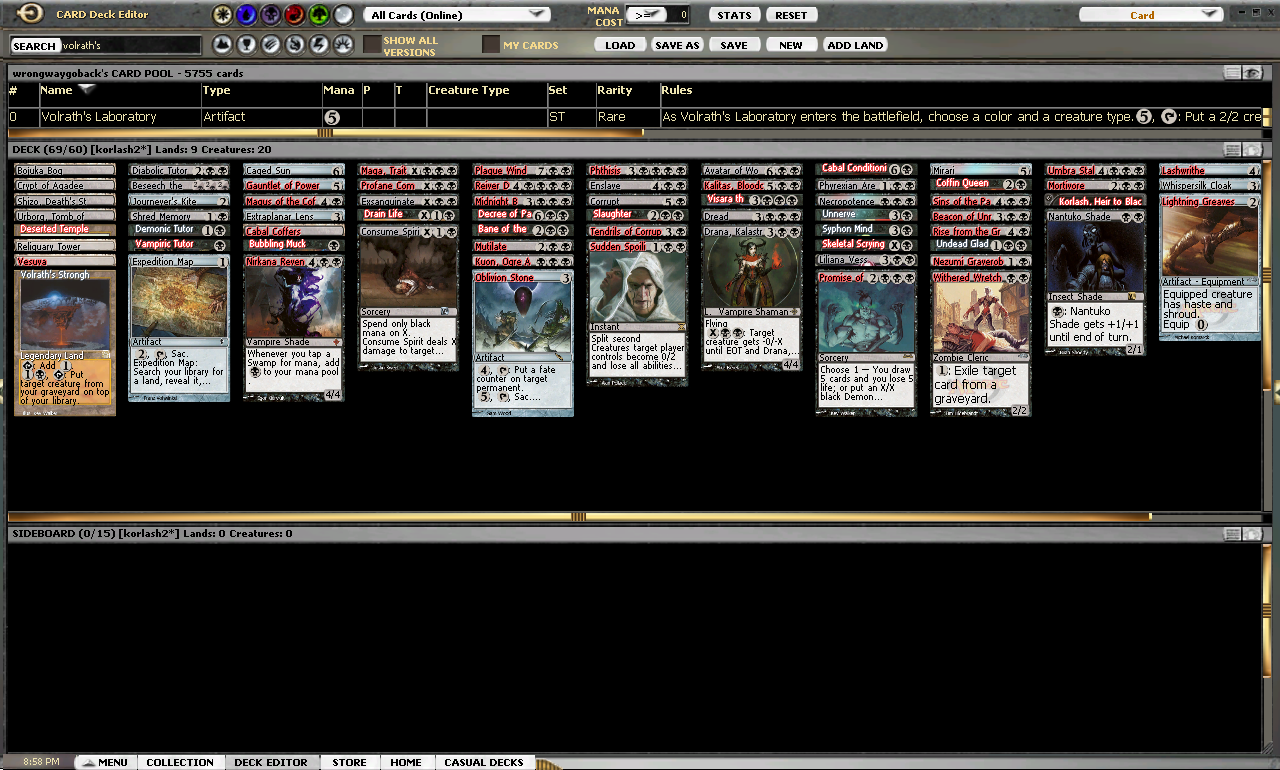
My first step is always to sort the cards into similar functionalities. I like to use Magic Online for this as I’m a visual person and find sorting it this way easiest, and my articles tend to be about Magic Online-based decks. Here’s a screenshot of how I do this:

In this case I’ve sorted the functionality into utility lands, tutors, Cabal Coffers effects, Drain Life effects, mass removal, spot removal, creature-based removal (removal-on-a-stick), graveyard interaction, card advantage, buff creatures, and equipment. Black Market is "missing" as it’s not on available on Magic Online.

Going back to basics, I have to ask myself whether my rules for powerful and consistent Commander deckbuilding are being followed:

  1. Is the General being served?
  2. Does it have a plan?

Korlash, Heir to Blackblade is a guy who likes to bash face, but right now this is not a deck that likes to bash face. This is much more of a control build, based around killing off everything that moves until there’s enough mana to resolve a giant Drain Life effect. In fact, based on the sheer quantity of Cabal Coffers and Drain Life effects in the deck I’d say Maga, Traitor to Mortals is the General most befitting running the show.

The question is now what the better change is to make: drop Korlash for Maga, or rebuild the deck around Korlash? In this case, with a deck as reasonably well tuned as this, I think replacing Korlash with Maga is the way to go as it requires far less changes to the deck. The gameplan of the deck resolving a massive x-spell that kills as many opponents as possible at once. This means the role the deck will be playing is one of control. We want ways to make sure no-one is getting our life total to low before we pull the trigger and nuke everyone. Neither, however, do we want to attract too much attention doing so.

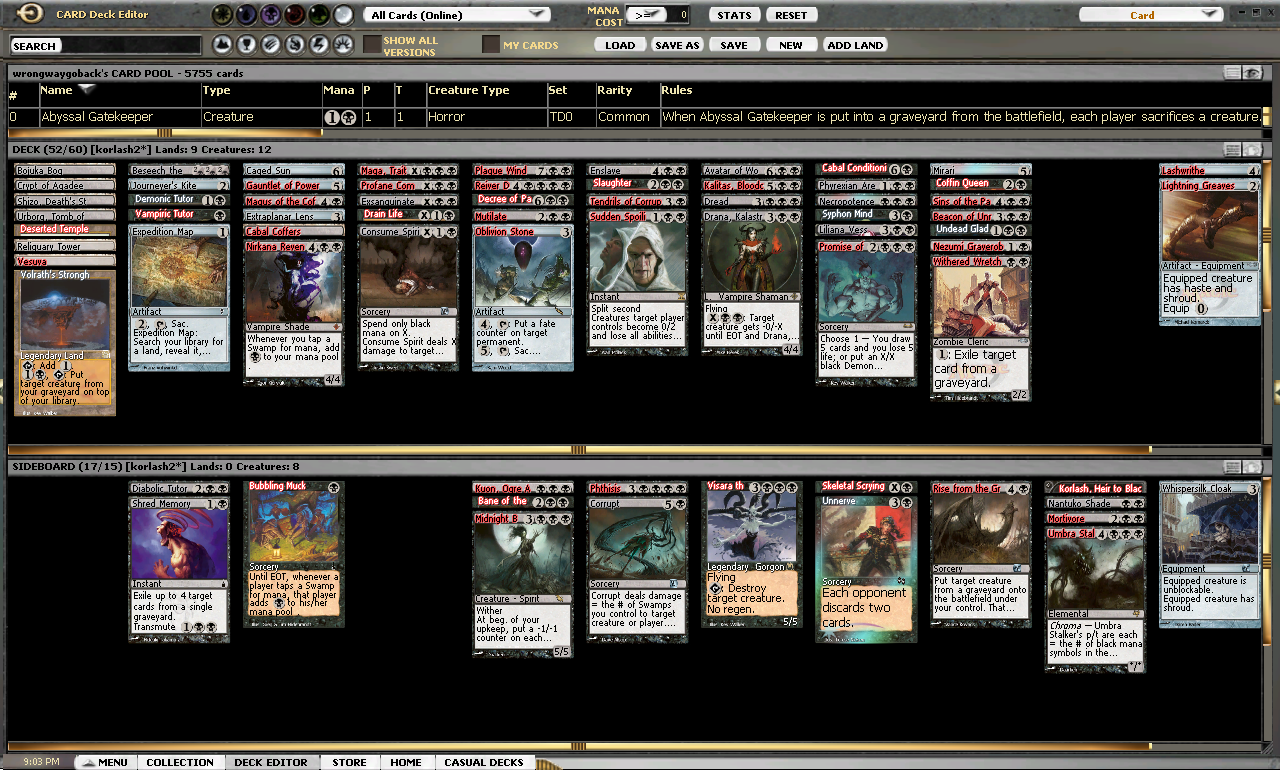
The next step is to pull into the sideboard the cards I believe aren’t working to the plan or serving the commander, as shown below. This is just a starting list of changes. I’ve also extracted cards there are better options for.

While looking for weak cards, I also try to note any weaknesses in the deck.

  • The only way to kill (non-creature) artifacts or enchantments is by resolving oblivion stone.
  • The deck is very spot-removal light.
  • The deck has no ā€˜obvious’ way to combo out ([card]Sins of the Past comes closest).
  • The deck is light on basic card draw.
  • The deck has an extremely high mana curve, even for an Commander deck.

Here’s why I’ve pulled what I’ve pulled:

  • Diabolic Tutor: Although it can grab anything in the deck, there are better cards we can upgrade to, such as Imperial Seal or Grim Tutor. While both of these may be prohibitively expensive in paper, they aren’t too bad on Magic Online.
  • Shred Memory: Transmute is nice, but there’s so little it can grab in this deck; just five cards in total. The occasional graveyard blowout is nice but I think we can do better.
  • Bubbling Muck: An abusive combo piece in the right deck, I’m taking it out with an eye to seeing if I can put it back in later.
  • Kuon, Ogre Ascendant: Flipping cards can be difficult, but this deck in particular will find flipping Kuon a real pain. Much better to run The Abyss as you gain the effect immediately and it’s generally hard to remove. Again, a disgustingly expensive card in paper, but in digital form it’s bearable if you’re willing to stretch.
  • Bane of the Living: It is six mana (split up over two turns) just to give each creature -0/-0. There are better forms of Damnation than this.
  • Midnight Banshee: While I appreciate the fact it nukes token creatures, it is simply too slow for my tastes.
  • Skeletal Scrying: The deck doesn’t have a lot graveyard abuse, but this card doesn’t help what it does have. It’s a corner case card that we have better options for.
  • Rise From The Grave: There are quicker, cheaper options for graveyard recursion than this.
  • Unnerve: When you play mass-discard in a group environment you make yourself and instant target, so the effect had better be good. This isn’t good enough.
  • Phthisis: You can steal the very slim, occasional win with this, but we need some better removal further down the curve.
  • Corrupt: This card is limited in the deck in a way that Drain Life and Consume Spirit isn’t, as it won’t get the benefit from the many mana-doubling effects in the deck. As such it can go.
  • Visara the Dreadful: I’ve taken Visera as by the time we’re done it’ll be unlikely anyone will be able to keep many creatures on the board anyway. Besides she’s slow and clunky when compared to the power of something like Kalitas, Bloodchief of Ghet.
  • Korlash, Heir to Blackblade: He’s out in order to let Maga have his due.
  • Nantuko Shade: Quite frankly I can never see the deck ever wanting to waste mana pumping this guy rather than doing other things.
  • Umbra Stalker & Mortivore: Big, dumb beaters with an unrealiable power and toughness but without trample are dead to me.
  • Whispersilk Cloak: With the likelihood of bashing for General damage diminished, this loses a lot of its appeal. We’ll take a look at what other options we have for equipment.

With that review out of the way, the next task is to add potential cards to the mix. Because I have an encyclopedic knowledge of every Magic card ever printed, this is extremely easy to do. Obviously that’s a lie, and I spend a fair amount of time in Magic Online searches and using Magiccards.info to find cards that may help out my sinister plans.

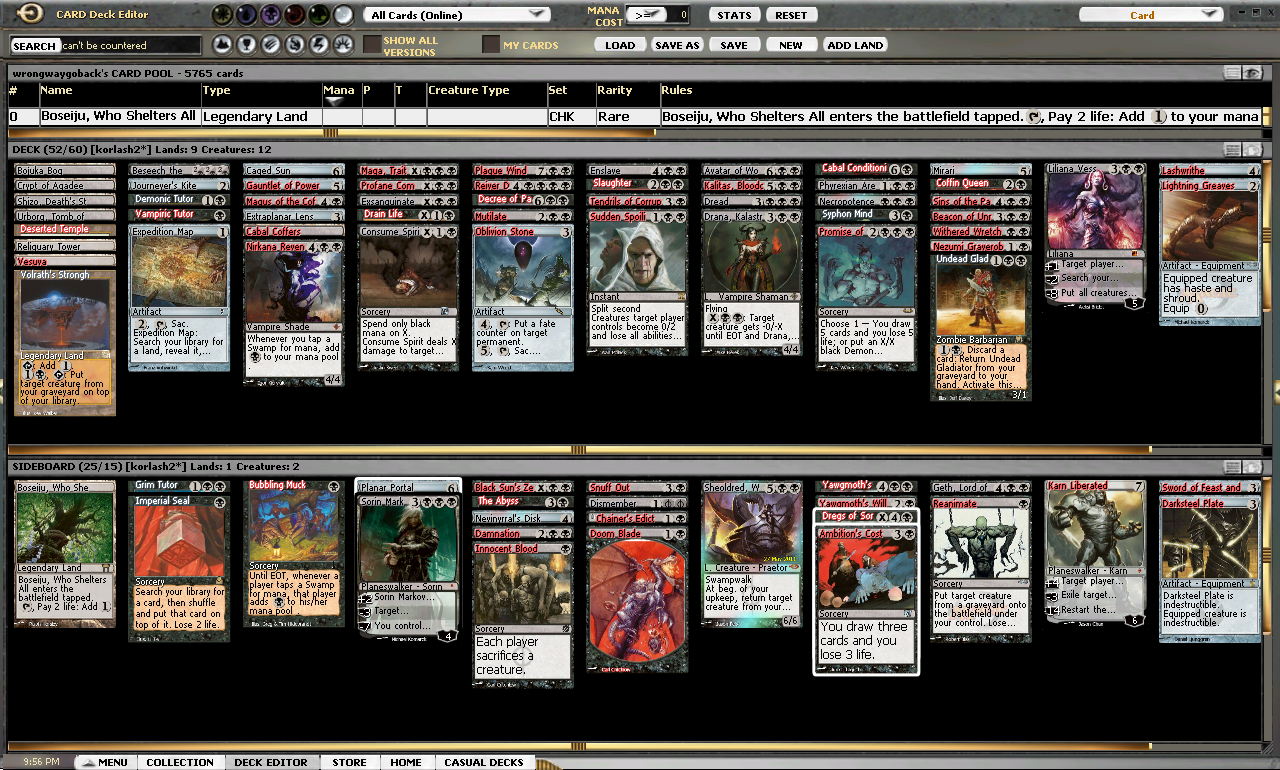
Having removed the cards I want to take out, I drop my options into the sideboard.

Here are my thoughts:

  • Boseiju, Who Shelters All: The last thing this deck needs is to have its killer Exsanguinate countered. This helps get around that, and the life cost is marginal for this deck.
  • Grim Tutor and Imperial Seal: Essential upgrades of the other, higher-costed tutors. These are must-haves in any competitive monoblack Commander deck.
  • Bubbling Muck: Still in there, largely because I’ve included Yawgmoth's Will as an option, and casting Muck, playing Will, and casting Muck again seems like crazy times.
  • Planar Portal: With all this mana, having the best repeatable tutor in the format seems like a good deal. There are two easy-to-abuse cards in the deck with this, Black Sun's Zenith and Beacon of Unrest, meaning infinite mass-removal and graveyard recursion at our fingertips.
  • Sorin Markov: He’s the six mana "Drain Life for 30," which seems like good value. The fact he can also be used to either take out weenies while buffing life, or Mindslavering an opponent into oblivion, is icing on the cake.
  • Black Sun's Zenith: Helps protect from decking (marginally), but an excellent killer of indestructible things.
  • The Abyss: We want to lock the board down and this is the premier card to do so. We’re likely dropping to around 14 creatures so this shouldn’t hurt us too much. Combos very, very nicely with Sheoldred, Whispering One
  • Nevinyyral's Disk: Our second Oblivion Stone, for killing those awkward Artifacts and Enchantments.
  • Damnation: Black’s Wrath of God and a fine card.
  • Innocent Blood: Helps shut down ludicrously fast starts by opponents. This deck has very few cheap creatures so controlling the board early is important. You can usually engineer this as a 3-for-1 for one mana, which is fantastic value.
  • Snuff Out: Like Slaughter, this card can come out of nowhere to blow out an opponent. I really like it.
  • Dismember: Another great ā€œsurpriseā€ removal card. Kills a heck of a lot in the format, and can get around some awkward indestructible moments.
  • Chainer's Edict: The deck doesn’t have a too much card advantage, so the fact you can flash this back makes it great. You’re not going to get many surprises out of it, but you will get value out of it. Just remember it’s there.
  • Doom Blade: Premier removal in a neat package. Should probably be Go For The Throat, but Doom Blade Guy would, well, Doom Blade me.
  • Sheoldred, Whispering One: The value you can get out of her is tremendous, and in a control deck like this not running her seems a missed opportunity. If you have The Abyss on the field and Reiver Demon in the yard you can be guaranteed your non-black opponents will never have another critter again.
  • Yawgmoth's Bargain: With all the lifegain effects in the deck, the Bargain seems like... a pretty sweet deal. [This card is banned in Commander. Apologies for the slip up.]
  • Yawgmoth's Will: Considered an overpowered card by many, it’s… wait. The fact it’s considered an overpowered card is the reason we want it in our deck! It’ll only be used to take either one or multiple opponents out of the game and not before, which is the same as any other finisher. This one just happens to be awesome.
  • Dregs of Sorrow: For every creature you kill with this, you’re getting better value. In fact, given a complicated board state it can get out of hand very quickly.
  • Ambition's Cost: I felt more straight card would be a good idea. It’s worse than Harmonize, but green would kill for a second Harmonize.
  • Geth, Lord of the Vault: He's in here as an alternate win condition. Given enough mana he can take many people out of the game very, very quickly, all the while gaining value.
  • Reanimate: To be frank, I’m not sure it’ll make it in, as I don’t think that’s what this deck is trying to do. It's here as a Rise From The Grave replacement.
  • Karn Liberated: This deck will be susceptible to a few problem permanents that black can’t deal with. This gets those permanents happily out of the way. Once on the board your opponents must deal with him, giving you time to realize your other plans while they are busily distracted (or killing you, which happens too).
  • Sword of Feast and Famine: Tapping and untapping and re-tapping Cabal Coffers in the same turn has got to be broken. This helps us do that.
  • Darksteel Plate: When running so many mass-destruction effects, it’s nice to be able to end up the last one standing.

However, this process leaves the deck with too many cards. The deck is running 40 lands, which is probably three too many, although the deck does love to make the land drops. With Boseiju, Who Shelters All, that’s still only a gain of a single card slot for the rest of the cards.

It's now time to see what sticks out like a sore thumb in the deck.

  • Undead Gladiator doesn’t seem to do much in the deck. There’s not enough card recursion to make it truly worthwhile, and we’ll rarely want to return it to our hand as most of our creatures are fantastic as it is. It can be cut.
  • Comparing all the card draw, the worst card seems to be Ambition's Cost. Likewise the worst reanimation spell in the deck is now Reanimate. Both are unlikely to work in this style of control deck and can be sent back into the card pool. [Because Yawgmoth's Bargain is banned in EDH, I'm putting Ambitions's Cost back in for some extra card draw - Neale]
  • Doom Blade: Funnily enough it doesn’t make the cut. The deck has so much great removal that can attack from all different angles that this card becomes too simple. Sorry DBG. Now excuse me while I go into hiding.

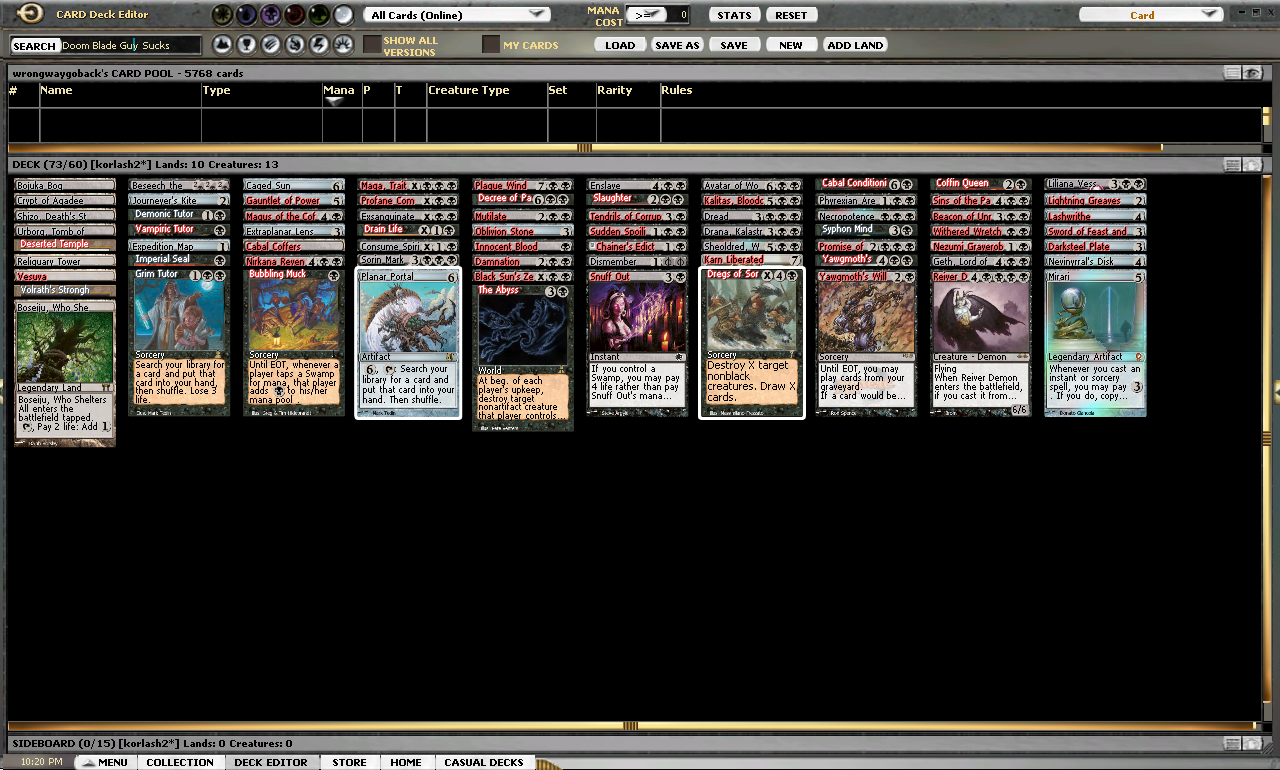
That leaves us with the following deck:

And decklist:

Maga, Traitor To Korlash

General

1 Maga, Traitor to Mortals

Tutors

1 Demonic Tutor
1 Grim Tutor
1 Beseech the Queen
1 Journeyers Kite
1 Vampiric Tutor
1 Imperial Seal
1 Expedition Map

Cabal Coffer Effects

1 Caged Sun
1 Bubbling Muck
1 Gauntlet of Power
1 Magus of the Coffers
1 Nirkana Revenant
1 Extraplanar Lens

Drain Life Effects + Planar Portal To Fetch Them

1 Planar Portal
1 Exsanguinate
1 Consume Spirit
1 Drain Life
1 Profane Command
1 Maga, Traitor to Mortals
1 Sorin Markov

Wrath Effects

1 Plague Wind
1 Decree of Pain
1 Mutilate
1 Oblivion Stone
1 Innocent Blood
1 Black Suns Zenith
1 Damnation
1 The Abyss

Spot Removal

1 Snuff Out
1 Tendrils of Corruption
1 Chainers Edict
1 Sudden Spoiling
1 Slaughter
1 Dismember
1 Enslave

Yet More Removal

1 Kalitas, Bloodchief of Ghet
1 Drana, Kalastria Bloodchief
1 Sheoldred, Whispering One
1 Dread
1 Karn Liberated
1 Avatar of Woe
1 Dregs of Sorrow

Card Advantage

1 Cabal Conditioning
1 Yawgmoths Will
1 Promise of Power
1 Phyrexian Arena
1 Syphon Mind
1 Ambitions Cost
1 Necropotence

Graveyard Interaction

1 Sins of the Past
1 Nezumi Graverobber
1 Beacon of Unrest
1 Coffin Queen
1 Withered Wretch
1 Reiver Demon
1 Geth, Lord of the Vault

The Rest

1 Nevinyrrals Disk
1 Sword of Feast and Famine
1 Darksteel Plate
1 Lightning Greaves
1 Lashwrithe
1 Liliana Vess
1 Mirari
1 Bojuka Bog
1 Urborg, Tomb of Yawgmoth
1 Crypt of Agadeem
1 Volrath's Stronghold
1 Shizo, Deaths Storehouse
1 Reliquary Tower
1 Vesuva
1 Cabal Coffers
1 Deserted Temple
1 Boseiju, Who Shelters All
25 Swamp

Ok, I’ll admit it’s a stretch to call the Reiver Demon graveyard interaction.Ā The deck is slower than the usual 1-on-1 decklists I talk about, but that’s generally ok in a one versus many environment, where the tallest poppy is likely to have its head cut off. This deck is out to win the long game and the higher mana curve – never truly corrected – is representative of that. At least this deck is capable of producing some truly incredible mana counts.

With any deck there are improvements to be made, pet cards to be included, combos to be discussed. If you’re willing to help, please chat about this deck and make suggestions for ALawley in the comments below!

Death and Gitaxias

Watching Sam Stoddard at the SCG Legacy Event the other week, confidently reanimating Jin-Gitaxias, Core Augur, made it clear to me how brutal that card is regardless of where it's played. I immediately had the urge to put together a decklist, hereby tentatively titled Death and Gitaxias.

The deck runs Dralnu, Lich Lord as the General, partly to access U/B, and partly because he can is amazingly abusable with all the instants and sorceries in the deck. But he’s a sensitive old soul, Dralnu, and as a result you have to play him pretty intelligently to get maximum value. Here’s the list, with more thoughts below:

Death and Gitaxias

General

1 Dralnu, Lich Lord

1. Reanimation package

1 Exhume
1 Reanimate
1 Animate Dead
1 Dance of the Dead
1 Stitch Together
1 Makeshift Mannequin
1 Beacon of Unrest

2. Tutor package

1 Demonic Tutor
1 Vampiric Tutor
1 Imperial Seal
1 Mystical Tutor
1 Intuition
1 Mystical Teachings
1 Muddle the Mixture

3. Graveyard fill package

1 Entomb
1 Buried Alive
1 Volraths Shapeshifter
1 Tortured Existence
1 Thirst For Knowledge
1 Frantic Search
1 Careful Consideration

4. Reanimation targets & control creatures

1 Sheoldred, Whispering One
1 Jin-Gitaxias, Core Augur
1 Inkwell Leviathan
1 Phage The Untouchable
1 It That Betrays
1 Kira, Great Glass-Spinner
1 Teferi, Mage of Zhalfir

5. Card draw package

1 Senseis Divining Top
1 Brainstorm
1 Ponder
1 Blue Suns Zenith
1 Lim-Dƻls Vault
1 Fact or Fiction
1 Consecrated Sphinx

6. Dralnu support package

1 Lightning Greaves
1 Mind Over Matter
1 Crucible of Worlds
1 Yawgmoths Will
1 Bribery
1 Time Warp
1 Pox

7. Countermagic

1 Counterspell
1 Mana Drain
1 Hinder
1 Cryptic Command
1 Dismiss
1 Last Word
1 Force of Will

8. Removal

1 Capsize
1 Sudden Death
1 Wipe Away
1 Dismember
1 Chainers Edict
1 Black Suns Zenith
1 Damnation

9. Fast mana/cheat mana

1 Sol Ring
1 Mana Crypt
1 Mana Vault
1 Dimir Signet
1 Felware Stone
1 Show And Tell
1 Dream Halls

Lands

1 Polluted Delta
1 Darkslick Shores
1 Darkwater Catacombs
1 Drowned Catacomb
1 Creeping Tarpit
1 Sunken Ruins
1 Underground River
1 Underground Sea
1 Ancient Tomb
1 Temple of the False God
1 Urborg, Tomb of Yawgmoth
1 Cabal Coffers
1 Minamo, School at Waters Edge
1 Strip Mine
1 Wasteland
1 Tectonic Edge
1 Dust Bowl
1 Diamond Valley
1 Volraths Stronghold
1 Academy Ruins
1 The Tabernacle at Pendrell Vale
1 Reliquary Tower
1 Cephalid Coliseum
1 Bazaar of Baghdad
6 Island
6 Swamp

It’s pretty clear what the deck’s Plan A is:

  1. Dump Jin-Gitaxias, Core Augur into the graveyard.
  2. Reanimate him.
  3. Protect him with counterspells and quickly win the game.

But it has a number of backup plans as well, including:

  • Cheating our bombs into play using Dream Halls or Show and Tell.
  • Using Full English Breakfast tricks abusing Volrath's Shapeshifter to control the board and steal a win.
  • Using Dralnu to stay ahead of our opponents on permanents (and turns) by abusing the cards in our graveyard.
  • When all else fails, locking our opponent out of the game with Crucible of Worlds with Strip Mine shenanigans.

This is not a ā€œdraw and see what happensā€ style of deck that more generally befits the casual Commander format. This is the type of deck that rewards players that understand the intricate actions and paths you can take to victory. Some examples:

  • Mystical Tutor -> Mystical Teachings - > Jin-Gitaxias, Core Augur.
  • With Volrath's Shapeshifter and Tortured Existence in play, then discard Inkwell Leviathan to make Volrath's Shapeshifter unblockable, and use Tortured Existence to swap for Phage The Untouchable which instantly kills your opponent
  • With Volrath's Shapeshifter and Tortured Existence in play, discard Inkwell Leviathan in response to removal, then discard It That Betrays before attackers. End of turn swap for Sheoldred, Whispering One.
  • Dralnu on board, play Demonic Tutor Ā for Buried Alive, flashback Demonic Tutor for Reanimate, then go with Plan A.

I haven’t had a chance to try this deck yet so it’s not tuned, but I thought I’d throw the deck list about for public consumption while I try to get the last of the cards I need (basically Jin-Gitaxias, Core Augur himself). As soon as I manage to get it together I’ll try wheeling it out and see how it goes. If you get a chance, please sleeve it up and let me know how it goes!

Insider: Outlining Onslaught

Are you a Quiet Speculation member?

If not, now is a perfect time to join up! Our powerful tools, breaking-news analysis, and exclusive Discord channel will make sure you stay up to date and ahead of the curve.

Onslaught was a momentous set. The cards catered to a huge number of casual players who wanted support for their tribal decks, with support for Elves, Goblins and other, newly-ordained tribes like Soldiers and Wizards. It's hard to believe that before Onslaught, ā€œtribalā€ wasn't really much of a term to describe the mechanic. The set had plenty for tournament players, too. The Morph mechanic was tailor-built for great drafts and the interaction between fetchlands and dual lands revolutionized Vintage by empowering Brainstorm with free shuffles. Onslaught also brought back cycling and support for it, with cards like Lightning Rift and Astral Slide making each cycle activation go a little further. Onslaught is also packed with expensive cards, ripe for the taking. I've split this article into two parts so you don't get overwhelmed with the number of cards. My goal, as usual, is that you get some recognition of the card pictures and prices, so you can pluck them out of bulk bins and trade binders for profit. No card listed in here costs less than a buck, so you won't waste your time. Let's get started!

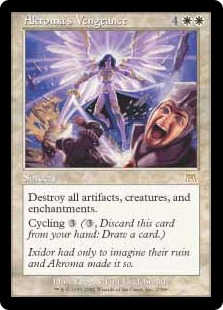
Akroma's Vengeance

White has had sweepers for a long time, but rarely did it get ones this good. Unlike Cataclysm, you can keep your lands. Unlike Catastrophe, you don't have to choose. And if that weren't enough, this guy cycles, too! I don't know anyone who actually cycled this, though – the advantage of blowing up the board was usually worth waiting for the mana to make it work.

Currently, Vengeance sees play a lot in EDH and casual players seem fond of the card, too. Since it's a generic white sweeper, it commands a little bit of money.

$2.25

Arcanis The Omnipotent

Onslaught included a selection of Pit Fighter Legends. The idea was that Onslaught was this combat-oriented block and they wanted iconic monsters that would fight for our amusement. They created the 3XXX mana cost Legends for this purpose. Arcanis has withheld the test of time as a casual wizard extraordinaire. Though never tournament-quality, he has a lot of appeal because hey, the guy happens to cast Ancestral Recall! His blink ability makes him hard to remove against a blue player with mana up (and don't they all?) so he can quickly get out of hand with a few taps. Arcanis gets some attention in EDH and as the big guy in Wizard theme decks.

$2.00

Blatant Thievery

Whenever we played Type Four (unlimited mana, one spell per turn, shared deck full of huge spells), this card made for a big turn. It also shifts EDH games around quickly, stealing an instant army if you'd like.

$1.00

Blistering Firecat

Ball Lightning has a lot of fan appeal, since it's a burn spell that looks like a monster. The ephemeral heavy hitter concept cropped up again with Skizzik, but BlisterKitty saw the culmination of the card idea. You could Morph it out, then surprise the opponent when you eat a third of their life total. You could also wait a turn and run it right out if you preferred. The Cat saw lots of play in Standard and Extended in Red Deck Wins variants. It still has many fans, since that instant seven damage is pretty cool. This is a real gainer to pick up, since folks sometimes consider it a dollar card.

$2.50

Bloodstained Mire

Onslaught fetchlands have had an indelible impact on Magic. They get dual lands and shocklands, which means that a deck supporting a card like the Mire can let a red deck splash a Bayou for green and black mana. The near-painless ability to get a tertiary color into play for immediate action has had what I consider a negative impact on the game. The fetch/dual setup, putting it plainly, removes a lot of design options from players. There is simply nothing better to use in Eternal formats than these cards; one need not even consider filter lands, tri-lands or the like. The only thing that comes close is City of Brass. One of the most negative impacts on Magic is that half of the combo, the dual lands, are unable to be reprinted. A finite supply means that the barrier to entry on fun, enjoyable formats continues to ratchet upward.

$13.50

Clone

Back in the day, Clone was awesome. Copy a Serra Angel or a Shivan Dragon (or a Scaled Wurm) for a bargain price on a fatty! I was honestly surprised that Clone from Onslaught is more than a bulk bin rare. It gets a little bit of attention in casual formats, but I'd also imagine a lot of its appeal is driven by nostalgia.

$1.75

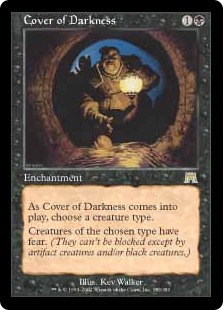
Cover of Darkness

Black sometimes has problems with punching through lots of defenders; it lacks trample and cannot easily give flying to its guys. Black has Fear, but cards like Cover of Darkness are one of the few permanents that can give the keyword to other creatures. In a dedicated tribal deck, Cover of Darkness can make your team unblockable for a really great price. Cover is above bulk prices by a little bit and it seems to move pretty easily online. It's worth grabbing them if people are going to let them go cheaply.

$1.50

Elvish Vanguard

Much like Quirion Dryad and Vinelasher Kudzu, Elvish Vanguard grows on a trigger. This time, it's other elves. I am a little confused about why this card is worth anything, and it's not because it's bad – it's because other elves are so much better. For example, you could run Timberwatch Elves and Quirion Ranger and pump up multiple guys. Elvish Vanguard isn't even great off the top of the deck in topdeck mode. But hey, it's an elf, and that drives enough of its value.

$1.75

Enchantress's Presence

The Presence is the backbone of Enchantress decks, which have been around since Alpha's Verduran Enchantress. The idea is to cast small, useful Auras and enchantments like Wild Growth, cantripping through your deck. The Presence is useful in an Enchantress deck because it isn't a creature. Thus, it's much harder for the opponent to get rid of. Enchantress is a Tier-2 Legacy deck and these are tradeable easily to the right people.

$3.00

Exalted Angel

Before Baneslayer Angel stole her light, Exalted Angel was a very expensive card. A lot of Standard decks would run it off of the sideboard, especially control decks. The idea is that the opponent would side out their removal, only to face down a 4/5 lifelinker on the fourth turn, thanks to the Morph ability. I'm surprised that Exalted is still worth much; it's just not as good as Dragonslayer Barbie, but maybe people who can't afford a four-pack of Walletslayers still want good Angels.

$4.75

False Cure

False Cure is part of some goofy combo decks and supposed to be good for hating on someone who is packing lifegain. It gets a tiny bit of Legacy play because in Dream Halls, you can Conflux for Cure and Beacon of Immortality, point both at the opponent, and then kill them instantly. It's also part of a terrible casual deck that combines it with free spells like Skyshroud Cutter. Just as a note, False Cure does not prevent lifegain. Instead, it cancels it out and deals a life point instead. You need to make the opponent gain 20 life to kill them from the start. As a side note, I like to pack False Cure in black EDH decks; simply stopping a Lifelink trigger, Swords to Plowshares lifegain or the like is fine enough as a grief card.

$1.75

Flooded Strand

Flooded Strand and Polluted Delta are worth a little more than the other fetches because it can grab blue dual lands, which is relevant in both Legacy and Vintage. The fetchlands are absolutely absurd in foil.

$19.75 ($55.00 in foil)

Future Sight

Future Sight is an inconsequential card, except for its play in EDH. Foils of this card are nuts.

$43.00 in foil

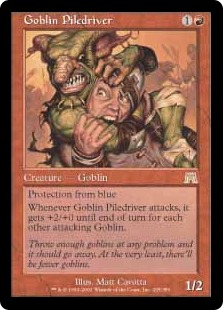
Goblin Piledriver

This goblin just keeps going up and up! The reason he has Protection from Blue, by the way, is that R&D really wanted a foil to Psychatog decks. The ability stops both Tog from blocking and Aether Burst from bouncing it. As a side effect, it makes Piledriver a complete beating against Merfolk, since it has Protection from Your Deck against them. Goblins are really popular with players, they're a solid tournament choice, and the Piledriver is an essential element of the deck. I was surprised to see how high these have climbed; if you're in the mood for solid Legacy investments, then these are good to pick up; they won't be reprinted any time soon, for sure.

$15.00

Goblin Sharpshooter

The Sharpshooter isn't exactly a great Goblin, but he's a neat pinger and people have this dream about playing the Sharpshooter and massacring the opponent's elf team. You can search it out with Goblin Matron and snag it off of Ringleader. It rarely sees tournament play, but people love the little guy and he's a great card to trade around – everyone wants it.

$5.25

Grand Coliseum

In my worse days of Magic, I thought Grand Coliseum was the coolest. You could tap it any time if you just needed mana and you didn't get pinged like City of Brass would do. Unfortunately, entering the battlefield tapped made the Coliseum a bad choice for tournament play, especially in a set with fetchlands providing better mana fixing. Still, people like the card because sometimes, it doesn't hit you just a little bit.

$1.25

Gratuitous Violence

For people who like Furnace of Rath, there's this guy too. It gets a little bit of attention in EDH decks, but it's a strictly casual card.

$1.25

Heedless One

See, this guy solves the problem of Elvish Vanguard because it's even better later in the game. Additionally, your monster has trample, which can give an Elf deck much more reach than otherwise possible. It's an uncommon that's worth searching your collection for, since this guy is definitely not bulk. Being reprinted in a Duel Deck has done little to affect its value.

$1.75

Insurrection

Again, another card that gets most of its value from EDH. For red decks, it doesn't get better than this! Late in the game, you get every monster that's playing, which means Insurrection is going to kill at least one fool at the table. When you can pull it off, Insurrection is an awesome game-ending play.

$1.25

Jareth, Leonine Titan

Jareth is another one of the Pit Fighter Legends, and I get the sense that Jareth would kick anyone's ass in the ring. One white mana for protection from a color? An 11/14 blocker? These kind of abilities talk to players. They make you feel confident and warn opponents that they aren't going to sneak past Jareth any time soon. The best, the BEST thing that Jareth means for your opponent is that they'll be taking 4 damage each turn from an unblockable giant lion! Wow!

$3.00

Kamahl, Fist of Krosa

So one of the coolest parts of looking over Onslaught when it came out was figuring that, with Goblin Sharpshooter, Kamahl would kill any lands you wanted. The Overrun was really good, don't get me wrong. Kamahl was cool then and it's cool now, especially because it gives an answer to ā€œwhat can Green do with twenty mana?ā€

$1.50

Mana Echoes

Mana Echoes is mostly used with token producers. For example, if you have Sliver Queen, you can generate infinite Slivers and infinite mana with the Echoes. Now that mana burn is gone, Mana Echoes gets even better. I haven't really seen it coupled with anything other than Sliver Queen, but hey, it could come up at some point.

$1.25

That's it for this week! What a full set! Onslaught has had a big lasting effect on Magic, and we'll see the second half of it next week.

Until then,

Doug Linn

The Pauper Price Creep

Are you a Quiet Speculation member?

If not, now is a perfect time to join up! Our powerful tools, breaking-news analysis, and exclusive Discord channel will make sure you stay up to date and ahead of the curve.

I'm hopelessly addicted.

For months, I told myself that I was only playing Pauper because I couldn't afford to play any other constructed formats online. Never mind my playsets of Koth of the Hammer, Zendikar fetchlands, Legacy Dredge... Okay, so aside from not having CawBlade, I really had no excuse, but I kept telling myself that I was just playing Pauper temporarily.

Six months later, and I can barely bring myself to play any other format.

Pauper really is that fun!

Last time I wrote about the format, I presented a very rough overview some of the top decks of the format from a gameplay and financial aspect. Now, I come bearing gifts of a different kind! First, a look at the format as it stands today:

[Note: In the last couple of days, LSV's UR 8Post deck has seen a surge of popularity due, I'm sure, to his fantastic videos on CFB showing off the deck. The Pauper format is constantly evolving - be sure to keep up with the most recent results!]

Top archetypes, by number of 4-0 Daily Event finishes:

1. White Weenie (including WW, WW/u, and WU Aggro) - 12
2. Esper Storm - 11
3. Affinity - 11
4. Goblin Warrens Storm - 9

5. Burn - 6
5. Goblins - 6
5. UR 8Post - 6

8. Mono Black (Aggro and/or Control) - 2
8. Infect - 2
8. Mono Green 8Post - 2
8. BW "Dredge" - 2*

*This is the Tortured Existence deck that MTGO user E. Hustle has been running with remarkable success.

The above make up what I consider to be Tier 1 and Tier 2 in the Pauper format. Archetypes not mentioned above, but perhaps meriting attention (and "winning" at least 1 Daily Event at 4-0), include Big Red 8Post, UB Reanimator, GW Aggro, & Stompy. Mono Blue Aggro/Control (a deck I typically refer to as Fae) has fallen quite far from its glory days. Other Cloudpost decks, such as Mono Blue 8Post and RUG 8Post, have also seen solid finishes with a much smaller sample size.

Let's get a better picture now by looking at just 3-1 Daily Event finishes for the upper echelon:

1. Goblin Warrens Storm - 50
2. Esper Storm - 44
3. Affinity - 41
4. Burn - 31
5. Goblins - 24
6. Mono Black - 19
7. White Weenie - 18
8. UR 8Post - 11
9. BW "Dredge" - 5
10. Infect - 4
11. Mono Green 8Post - 3

Making the rather crude assumption that over relatively these small sample sizes**, there isn't much difference between 3-1 and 4-0, we're left with the following combined list:

1. Goblin Storm - 59
2. Esper Storm - 55
3. Affinity - 52
4. Burn - 37
5. Goblins - 30
6. WW - 30
7. Mono Black - 21
8. UR 8Post - 17
9. BW "Dredge" - 7
10. Infect - 6
11. Mono Green 8Post - 5

**The alternative would be to try and normalize the two lists with each other, but that seems like a rather pointless exercise when brute forcing the results should work well enough for our purposes.

But are these results a true representation of each deck's power level, or is it just a function of how much each deck costs? Let's try and find out!

Top Pauper decks, by descending price:

1 Esper Storm - $84
2 Infect - $69
3 Goblin Storm - $60
4 Affinity - $25
5 Mono Black - $17
6 Goblins - $13
7 UR 8Post - $12
8 Mono Green 8Post - $12
9 Burn - $11
10 BW "Dredge" - $8
11 WW - $4

These factor in just maindeck costs (using prices from www.MTGOTraders.com) for a relatively generic decklist I dredged up for each from a 4-0 Daily Event finish. We'll get to sideboard cards later. And, yes, it really does cost 4 Event Tickets right now to build a competitive White Weenie deck for Pauper. You'd even have ~0.46 credits leftover!

The results of this query are clearly all over the map. Both Storm decks are fighting it out for combo supremacy, but newcomer combo deck Infect (on the back of its $12/ea Invigorates!) is in the top tier of bank-breaking decks too. Each of the rest of the decks in the format can be built for less than the cost of a playset of Stoneforge Mystics! ($38 according to MTGOTraders, so I have to assume that deck/card availability is not going to be a factor for the decks outside of the Top 3.

Survey Says?

So what archetype do you want to play? There are viable Combo, Aggro, Control, and Aggro-Control options.

You might want to keep in mind that many decks in the format are land destruction decks masquerading as Control; the best way to fight against decks abusing Azorius Chancery or Cloudpost is often by destroying the lands themselves. Add to that the fact that Wizards has printed a ton of cheap land destruction spells at common over the years (No, really, A TON: Reap and Sow, Thermokarst, Befoul, Stone Rain, Molten Rain, Earth Rift, Mwonvuli Acid-Moss, Raze...), should you be surprised of this at all? Red, Black, and Green all have an abundance of choices here.

Taking another look at the Daily Event results, but grouped by Combo, Control, Aggro, Aggro/Control, we find the following:

1. Combo - 157 (Red Storm, Blue Storm, Burn, Infect)
2. Aggro - 142 (Affinity, Goblins, WW)
3. Aggro/Control - 33 (Mono Black, BW "Dredge", Green 8Post)
4. Control - 17 (UR 8Post)

For a brief rundown of each of these decks, as well as an excellent intro to the Pauper format as a whole, check out Alex Ullman's offering on StarCityGames (free!).

The format is clearly defined by Combo and Aggro, but there definitely are viable Controlling archetypes as well.

Here is a sample of what I've been playing lately:

RUG 8Post

Untitled Deck

Creatures

1 Krosan Tusker
2 Ulamogs Crusher
2 Mulldrifter
4 Sakura-Tribe Elder

Spells

1 Capsize
4 Reap and Sow
1 Mystical Teachings
3 Condescend
1 Seismic Shudder
2 Flame Slash
2 Lightning Bolt
1 Rolling Thunder
1 Mysteries of the Deep
1 Deep Analysis
3 Compulsive Research
4 Preordain
1 Mana Leak
4 Prophetic Prism

Lands

4 Island
4 Forest
2 Mountain
4 Cloudpost
4 Glimmerpost
4 Evolving Wilds

Sideboard

1 Shattering Pulse
3 Gorilla Shaman
4 Hydroblast
3 Pyroblast
2 Flame Slash
1 Counterspell
1 Seismic Shudder

The list has been rather malleable, but this is approximately where I'm at right now. It's still a work in progress, and this version owes its existence to a Daily Event 3-1er that I cannot dredge up anymore - sorry! My original version of the deck had 26 lands, Explore instead of Sakura-Tribe Elder, and got flooded far too often.

RUG 8Post (and I'm sure BUG 8Post would be solid too) brings the same spells as UR 8Post, but instead of Steamcore Weird or more removal, you get Reap and Sow and Sakura-Tribe Elder. Both are huge. Have you ever cast Reap and Sow with entwine on a Cloudpost to fetch a Cloudpost? Yeah, it's brutal, and I've gotten concessions in the 8Post "mirror" on turn 4 due solely to this Reap and Sow.

Or, put another way, this deck takes the strongest points of UR 8Post and Mono Green 8Post and mashes them all together.

I've been very happy with the results so far.

E. Hustle's BW "Dredge"

Untitled Deck

Creatures

1 Augur of Skulls
2 Auramancer
1 Crypt Rats
2 Fume Spitter
2 Golgari Brownscale
2 Grave Scrabbler
3 Lone Missionary
2 Pilgrims Eye
4 Squadron Hawk
4 Stinkweed Imp
2 Tireless Tribe
2 Vampire Hounds

Spells

2 Echoing Decay
1 Last Rites
1 Temporal Isolation
4 Tortured Existence
2 Unearth

Lands

2 Orzhov Basilica
8 Plains
11 Swamp
2 Terramorphic Expanse

Sideboard

2 Augur of Skulls
2 Echoing Decay
1 Festercreep
1 Fume Spitter
1 Lone Missionary
1 Pilgrim of Justice
1 Ravens Crime
1 Seal of Doom
2 Snuff Out
2 Temporal Isolation
1 Twisted Abomination

It's been really cool to see this deck evolve, as E. Hustle has been very prolific in his Daily Event attendance. He's also had remarkable results, seemingly placing 3-1 or better in every other event, so the decklist has been available a number of times during its evolution.

It's also been incredibly fun to play! Lone Missionary works overtime with the help of Tortured Existence, and the 1CC enchantment is the real MVP of this deck.

Some fun interactions: Dredge isn't just for Legacy, as Stinkweed Imp and Golgari Brownscale prove here. The latter is a powerhouse against many aggressive strategies (and Burn especially), and dredging 5 cards with an Unearth in hand is pretty slick.

Vampire Hounds, powered by Squadron Hawk, can cut your clock by a few turns when you need to race, and the creature suite looks to be all over the place, but it's fairly effective. Tireless Tribe in particular has been one of my favorite cards to see in my opening hand.

I've also never lost a game where I cast Last Rites. Turns out Mind Sludge is pretty good on turn 3!

Affinity has been my Aggro deck of choice lately. If there's interest, I'll do a complete rundown of the archetype next time!

On Sideboards

Most sideboard cards are extremely cheap. They're also pretty fungible. The staples you'll probably most want to acquire playsets of are:

Gorilla Shaman*** ($6 - these were $3 a couple of weeks ago!)
Pyroblast ($1.5)
Hydroblast ($2)
Crypt Rats ($3)

Most other sideboard cards of note won't run anywhere close to a full ticket, and most will be closer to .05 tickets each. Of course this all mostly depends on your 60-card decklist!

***Last time I wrote about Pauper, the entire 75 for a UR 8Post deck (including 4 Gorilla Shamans, 3 Hydroblasts, and 1 Pyroblast), totaled just over $26. Now that barely gets you a full playset of Gorilla Shamans alone!

Questions from Twitter

Luis Acosta (@AuranAlchemist): What deck gained the most from New Phyrexia? How do you organize new commons into what decks they benefit?

I think it's pretty clear at this point that the Infect deck is real, and it owes a large part of its success to Glistener Elf and, to a lesser extent, Mutagenic Growth. Infect is an extremely hard strategy to fight for most decks, because damage-based removal is so spotty here. However, without Vines of Vastwood (which can be played around to a certain degree), Doom Blade-style removal should be enough to keep this deck in check.

The price of Invigorate (clearly the deck's most powerful card) is the only thing that's keeping me from testing this archetype out seriously.

As for your second question, it's the same as with any Eternal format. šŸ™‚ Rarely are new archetypes going to be formed, since common cards are probably going to show a lot less deviation from "fair" in today's sets than rares or mythics have been. However, any new mechanic in particular is a good chance. šŸ™‚

Beyond that, you need to look for any card that either does something that's never done before at common or that truly pushes the power level at least to beyond where it's been in years. From New Phyrexia, anything involving Infect or Phyrexian mana symbols would be the first place to look. Immolating Souleater, Apostle's Blessing, Blighted Agent, Glistener Elf, Mutagenic Growth, Gitaxian Probe, Porcelain Legionnaire, and Vault Skirge have all seen play, as well as Suture Priest. All of the above fit those guidelines - Suture Priest being a Soul Warden on steroids.

Thanks, Luis! šŸ™‚

Arturo Pineda (@OreoCorp): Is there any skill barrier? How many archetypes should you prepare for? Price will stay as they are or keep rising? Oreos or not?

Pauper rewards tight play as much as any format! And, because the overall power level of cards is obviously less than Legacy, it's a lot harder to topdeck into a win if both decks are out of gas. That being said, it's a great format for anyone less-skilled to practice with because the combo and control interactions are so much simpler.

As far as archetypes, the format diversity is much closer to that of Legacy than that of Standard! There are at least a dozen archetypes that have a legitimate shot of taking down a Daily Event, and another half dozen or so that are relatively competitive. And that's just established archetypes! With such a huge card pool, there's a ton of room for innovation too.

The price will not stay. It's already much more expensive than ever before. If you want to play Pauper, buy the staple cards as soon as possible.

Unfortunately, no oreos for me. Never been a fan! Sorry bro. šŸ˜›

Thanks Arturo!

You all can find me on Twitter at @dtlerch. If you don't use Twitter right now as a Magic: the Gathering resource... what the hell are you waiting for?

Bonus!

What are the most expensive cards in Pauper? I came across the following numbers when I was researching for this article:

1. Invigorate, $12
2. Sunscape Familiar, $6.86
3. Gorilla Shaman, $6
4. Nightscape Familiar, $5.39
5. Ancient Spring, $3.92
6. Lotus Petal, $3.75
7. Sulfur Vents, $3.43
8. Crypt Rats, $3
9. Deep Analysis, $2.75
10. Frantic Search, $2
10. Cloud of Faeries, $2
10. Hydroblast, $2
13. Rancor, $1.75
14. Cloudpost, $1.5
14. Fireblast, $1.5
14. Pyroblast, $1.5
17. Snap, $1.25
17. Unearth, $1.25
19. Cabal Ritual, $1
19. Rite of Flame, $1
19. Mogg Flunkies, $1

This is obviously not a super comprehensive list, but it gives a good enough idea. šŸ™‚

Thanks for reading!

Dylan Lerch

@dtlerch on Twitter

The MTG Brewery

PS: No, I didn't mention . Whether that be Simic Storm, or GW Aggro, or Mono Red Lifegain, or even 46 Bears, I'm sure it's a wonderful, viable archetype. Sorry for the omission! <3

Don’t MUC Around!

Are you a Quiet Speculation member?

If not, now is a perfect time to join up! Our powerful tools, breaking-news analysis, and exclusive Discord channel will make sure you stay up to date and ahead of the curve.

Today we look into the Mono-Blue strategy from its enemy’s perspective. We’ll figure out how to fight, what actually matters as the enemy of the strategy, and take back what was stolen. Welcome to The Way of the Warrior where we Don’t MUC Around.

There’s so much Blue.

Recently, Blue has finally become the color of dominance. Present in over 75% of decks in the top eights, it has cemented itself on the way to becoming the best color...

I’m kidding. Ask around. According to a lot of players, Blue has nearly always been one of the best colors in Magic. Card advantage in a game of limited resources is incredibly good. Do you want the ability to stop someone else’s agenda with a single card? Sure. Blue can give that to you for ā€œfreeā€.

So why would you fight an entire color and not a deck? Well, that’s simple, 22/32 decks in the top 16 of the StarCityGames Open Series for both Kentucky and Orlando were Blue decks. Real Blue decks.

I’m not counting MUDD as a blue deck—it’s ā€˜colorless’. I’m not counting AdNauseum—it’s combo.

I’m talking about real Blue-Blooded decks. Decks that do what the soul of Blue does: draw cards and counter spells.

With no Tides?

There are two decks that doing this exceptionally well. In fact, you could say that’s exactly how they did so well. Mono Blue Control (MUC) and Blue-White (UW) control? Today we’re learning how to fight with you.

MUC by Chris Kronenberger

Creatures

2 Vendilion Clique
2 Sower of Temptation

Instants & Sorceries

4 Brainstorm
2 Counterspell
2 Cryptic Command
2 Echoing Truth
4 Force of Will
4 Mental Misstep
3 Spell Snare

Artifacts & Enchantments

1 Oblivion Stone
2 Sensei's Divining Top
2 Vedalken Shackles
2 Back to Basics
3 Energy Field

Planeswalkers

3 Jace, the Mind Sculptor

Lands

2 Misty Rainforest
2 Polluted Delta
2 Scalding Tarn
16 Island

Sideboard

2 Chalice of the Void
2 Energy Flux
2 Mind Harness
3 Misdirection
3 Surgical Extraction
3 Llawan, Cephalid Empress

Now you may not see the name ā€œMUCā€ as being as appealingly intricate of a name as ā€œTeam Americaā€. But if you look at the deck, it’s obvious that it’s not anything like Team America. MUC is exactly what Mono-Blue Control claims to be—a slow, mono-plodding control deck. Its plan isn’t to win the game by denying an opponent’s hand, countering cards and swinging in with your neat creatures.

MUC intends to win by stealing your creatures and making use of Jace, the Mind Sculptor.

Gimme that Fillet of Fish

If you’re thinking Vedalken Shackles seems like a decent enough card, but limited in power by needing a ton of Islands, you’d be a little mistaken. Without an answer to it, you’ll find that a reuseable Control Magic constantly stealing your best creature(s) to be rather costly.

Anyone who played Standard right after Affinity was stripped of its power pieces understands this. For those of you who didn’t, I suggest you trust this as truth now instead of finding out the hard way by trying to find decklists from this time.

So how can you beat Vedalken Shackles? Well, Back in my day (oh man, I sound old…) we fought it with Artifact hate (Naturalize), Land Destruction (Deathcloud), and Troll Acetic (who will finally wield the keyword Trollshroud… I mean Hexproof).

Those were Standard’s Limited answers, though.

If you think those are the only answers, well, ā€œWELCOME TO LEGACY!ā€

Fight the Power

While the basic idea stays the same (LD, Artifact Hate, Troll-Shroud), our tools have drastically improved.

Cards like Krosan Grip (K.Grip) have been used to fight plenty of Legacy decks. That’s the beauty cards like it. There are enough Artifacts (Equipment, Sensei's Diving Top, Engineered Explosives, and nearly every card in Affinity) and Enchantments (Counterbalance, Engineered Plague, Enchantress's Presence, Back to Basics, etc) that including 1-4 copies of it in your 75 is almost always righ when playing Green. K.Grip, however, is just one way to destroy Vedalken Shackles.

For a lot of people, Troll Acetic is the only Troll. But they’ve never met The Last Troll who is now literally The Last Troll (Shrouder). If you’re considering combating Blue through use of a Troll, I’d advise you to instead look for creatures with Shroud.

I know that you can’t target them either (if I wanted to gain some life from my Swords to Plowshares), but at least your creature is safe from everyone else’s targeted thievery spells as well.

(I want to let you all know I am aware of Brooding Saurian. I just don’t think it would be a good option against anything else... if even this).

Lastly, we have the LD plan. Deathcloud was the other Control deck in the format when Vedalken Shackles was popular. Again, I don’t want you to think since we played it back in Standard you have to play it now. There are other ways to fight lands, especially Blue lands.

Due to the power level of Blue, LD received a lot of cards that either destroy or ā€˜destroy’ Islands. Cards like Boil will destroy all of the Islands in play, while cards like Choke ā€˜destroy’ the Island by stopping it from being used more than one more time. Just realize, however, that one of MUC’s other Best Weapons is this exact strategy: Back to Basics.

Armageddon is an extreme as it not only reduces the number of Islands your opponent has, but it also clears every other non-Darksteel Forge land on the battlefield. If they haven’t activated Vedalken Shackles by the time you’re casting this, they’ll wish they had. They do get to keep the your creature after you blow up all the land, though, Vedalken Shackles only checks the number of Islands they control upon targeting.

If you’re ahead on board after resolving an Armageddon, their outs (Jace, the Mind Sculptor and more lands) are likely too slow to come back from the game.

Just don’t try blowing up their land if they have a [card]Crucible of the Worlds[/cards] on board.

The Lost One

With all that hate against Vedalken Shackles, you also have to remember the fact that this deck plays Sower of Temptation!

While only a 2/2 flier, it is a serious threat. Not only because it flies, but because it simply takes your best Creature. While Vedalken Shackles is limited in how to hate it, Sower of Temptation is much more vulnerable. Let’s face it: it’s a creature.

Remember all of that useless removal you were holding in your hand, upset at having to shoot your Shackled creature? Well, now you have a target.

So, use your Swords to Plowshares, Path to Exile, Vindicate (if you don’t use it on [card]Jace, the Mind Sculptor[card]), and other forms of removal to get your creature back. MUC can’t reanimate it once it’s gone. You only have to do it once… unless they have another.

Not Created Equal?!

Nope. Take this list.

UW Control by Gerry Thompson

Artifacts & Enchantments

1 Crucible Of Worlds
2 Vedalken Shackles
4 Standstill

Instants & Sorceries

4 Brainstorm
3 Counterspell
4 Force of Will
4 Mental Misstep
4 Repeal
4 Spell Snare
3 Swords to Plowshares

Planeswalkers

4 Jace, the Mind Sculptor

Lands

3 Mishras Factory
4 Misty Rainforest
3 Scalding Tarn
4 Tundra
3 Wasteland
6 Island

Sideboard

1 Crucible Of Worlds
1 Engineered Explosives
3 Pithing Needle
2 Spell Pierce
4 Submerge
1 Swords to Plowshares
3 Llawan, Cephalid Empress

Gerry’s deck is essentially MUC—aside from the inclusion of Swords to Plowshares—as it functions nearly the exact same way. The biggest difference? The packages.

Gerry’s list has a recurring land package with Crucible of Worlds. Why is that important? Well, Wasteland, while nice, and Mishra's Factory provide fairly little all on their lonesome.

If you don’t understand, a 2/2 isn’t necessarily a premier creature in Legacy and Wasting one land isn’t the game winner that MUC’s clock yearns for. It’s when you start turning that 2/2 into a recurring blocker or a small army, or when you start taking out 2, 3, 4 lands… that’s when these cards become incredibly dangerous.

You’re Outta Here

Gerry’s list also contains a removal package. It may only look like Swords to Plowshares, but Repeal also counts. And there’s even more out of the board. It would seem that Gerry’s main intention stopping an opponent from resolving or swinging with everything, finally ultimating Jace, the Mind Sculptor for victory.

Gerry’s list did something else different as well. In the entire 75, there are only three real creatures—Mishra's Factory being a land. Why does this matter? It means that most of your removal is fairly useless, especially since Go for the Throat is dead against Mishra's Factory.

Lucky for us, Gerry’s list only runs one maindeck Crucible of Words—two after the side. That means that once we ā€˜solve’ that issue, we’re back onto dealing with Vedalken Shackles… and then Jace, the Mind Sculptor. But, THEN WE’RE DONE …if our spells resolve.

The Real Fight Begins

Fighting counterspells can be tricky. They’re not meant to always stop absolutely everything—with conditional counters like Mental Misstep, Spell Snare, Spell Pierce, and even Force of Will to some extent, needing an additional Blue card to pitch—so mindlessly slinging spells won’t always meet the counter in hand. But they’re usually very painful when they do make a showing. So how can you combat them?

You are usually very limited in options. You can:

  • Play them yourself.
  • Utilize Split Second.
  • Extract the rest of them from their deck.
  • Make them become discarded.
  • Play things they can’t use them on.
  • Bait out a counterspell with a card you’re willing to sacrifice.
  • Cross your fingers and hope they don’t have it.

Realize that if you’re playing counters yourself, you’re probably going to fall into those 22/32 decks above. Either way, if you are playing those counters now, you have to look at what you are countering. Don’t mindlessly burn your counters on things that have little to no effect on the game. Turn 1 Mental Misstep on Brainstorm may not always be the best choice…

Discard spells are a touchy subject in deck construction. When they’re good, they’re amazing. When it’s mid-late game… they make you wish they were anything else. The theory behind them is that are ā€˜advance counters’ or sorts, meaning they counter a spell before it can be played.

Empty hands beat discard strategies. That is why counters will always be more popular than discard.

People play spells. They typically don’t keep winning cards in hand.

-_-

I’d love to skip over telling you about playing things that don’t matter, but everyone plays cards we don’t really care about.

Take Affinity for example.

It’s Turn 1 and you have a Mental Misstep and a Swords to Plowshares in hand.

Your opponent plays: Land, Memnite (resolves), Memnite (resolves), Signal Pest (Important?).

If yes, counter. Otherwise it resolves.

This becomes your judgment call.

Me? I’m going to let it resolve 9-of-10 times as theyā€˜re only presenting 2 power on board and I can just swords it, saving the counter for something more important. If the Signal Pest were a Springleaf Drum, I would most likely consider countering it as Affinity plays very little lands and requires Blue to draw more cards. I would also prefer to save the Swords to Plowshares for larger game. Besides, what other relevant one drops does Affinity run?

The point is: is it important? If the answer is no, it shouldn’t really matter. Let the spell resolve.

This is how we’re taught the stereotypical good Blue players should think. The thing is, not everyone always operates this way.

Take advantage of that.

If you’re trying to bait out a spell with cards that don’t matter, don’t be mad if they don’t earn a counter. But be grateful if they snag one. Also remember that some players will have more than one counter in hand.

I Mean Junk

So for this week’s question, ā€œHow would I fight a Blue deck with a non-Blue deck, while still having game against the rest of the format?ā€

How would I do it? With an update to an old favorite:

The Rock by Ian Ellis

Creatures

1 Thrun, The Last Troll
3 Knight of the Reliquary
2 Tarmogoyf
2 Stoneforge Mystic
4 Dark Confidant
1 Birds of Paradise

Instants & Sorceries

4 Swords to Plowshares
4 Thoughtseize
2 Gerards Verdict
2 Maelstrom Pulse
3 Vindicate
2 Green Sun Zenith

Artifacts

3 Mox Diamond
2 Senseis Divining Top
1 Umezawas Jitte
1 Sword of Fire and Ice

Lands

1 Marsh Flats
3 Verdant Catacombs
3 Windswept Heath
2 Bayou
1 Savannah
1 Scrubland
2 Horizon Canopy
1 Bojuka Bog
1 Dryad Arbor
1 Karakas
2 Wasteland
1 Maze of Ith
2 Forest
1 Plains
1 Swamp

Until next time,
Ian Ellis

Draftcycling – Prestige Mode

Are you a Quiet Speculation member?

If not, now is a perfect time to join up! Our powerful tools, breaking-news analysis, and exclusive Discord channel will make sure you stay up to date and ahead of the curve.

Many of you are probably familiar with Prestige Mode from the Call of Duty series. Essentially, once you’ve mastered the achievements and levels, you can erase all your progress and start over and are signified with a special symbol next to your user-name when playing online. You could then repeat this process moving you to higher and higher echelons of ā€œI’m better than you...ā€ gaming. While today’s article has nothing to do with pride, it gives us a new angle to explore managing your collection.

Game Over.... Continue?

This past weekend my backpack, containing my trade binder, my two standard decks, a deck that belonged to a friend, and a box of about 500+ standard playable commons and uncommons was stolen out of my car. This article isn’t about the impact of theft on the community, or how to protect yourself from theft (see: Don’t leave your bag in your car). Instead, I’m going Back to Basics.

Flashback 15 years to 1996, I’m a scrawny 9th grader wearing thrift-store vintage clothes, because I think I’m cool (pro-tip: I wasn’t). I show up at our local cardshop with a fistful of Mirage cards I had just cracked at the release event two hours away. As I show off my cards, and proceed to sling some spells, my cards and my deck somehow leave my sight, and end up disappearing forever. I went home, and told my Mom, ā€œI don’t want to play this game, if it makes people steal.ā€ My mom had mixed emotions, probably because she just wasted a day taking me up to the Mirage release (Thanks, Mom), but probably also glad this newly found hobby wasn’t going to be absorbing as much time as she feared.

From that point on, Magic disappeared from my life until 2009. I started drafting around Alara Reborn, with no collection, no knowledge of trading card prices or even game play skills, and dug in. Within a year, I had a decent collection, including a Standard deck, and was spending minimal funds to maintain the ability to draft week in and week out. At the end of last year I started writing here for Quiet Speculation, because I felt I had good insights as to what it takes to make our favorite hobby as self-contained, financially speaking, as possible. I do feel many of the lessons I learned in the first couple years have been omitted, though. Now, as a fully ingrained member of the community, there’s no way I could quit playing, like I did so easily as a kid. This week will begin the journey of rebuilding my collection from scratch, and will be a great opportunity for tracking results and inventory the right way, from the beginning. So much for my plan to trade into Legacy staples. I still hope to work Legacy staples into my collection, but that will be a secondary priority for the time being.

/emotional purge

What does this really mean?
It means I’m walking back into the Magic world with no equity. Post-release is when my store credit is most depleted, as prize support is given as packs, and most cards I’m hoarding or trading. I’ve got $5 credit on my card, and will be forking over some cash to get the ball rolling this week at our Ravnica draft. Each week I’ll be updating on current progress of the collection, any additional injection of funds, trades, and trade binder update. Thus far, my trade binder contains one of my Tundras that for some odd reason I didn’t put into my binder when I traded for it last week, and is otherwise empty. At least I have a single card that could easily be traded into a decent stock of trade fodder.

Step 1- Set a Budget
The first step of rebuilding my collection is setting a budget. I can’t count on winning every draft I play for the next 3 events, which is what it would take to store up enough credit to afford a loss and still have enough for the following event in store credit. Before this becomes an issue, I need to have a realistic number in mind. Summer is a lean season for me, so I’m setting my budget at $15/week. This means I can only draft once per week if I’m not winning, and doesn’t allow for me to play in other events unless I’m winning or trading effectively.

Step 2-Have a system in place before you need it
Empty Binder? Check. Empty Spreadsheet? Check. Here we go. I’ve talked before about tracking your results, and a clean slate is a great time to revamp my tracking system. Next week, I’ll include a Google Doc that covers any transactions over this weekend, as well as a page that holds the current trade binder. It originally took me around 3-4 months before I had seriously reduced my cost to participate, and many more before I was consistently playing for free. I’ll have an edge this time because not only am I better at the game, but also more experienced at trading. I hope to be free-rolling on the store credit system as early as the end of the month.

Step 3- Get the ball rolling...
This week I’ll be participating in at least two events. First, a Ravnica block draft, and at least one other Scars block draft. If my luck is strong, I’ll likely jump in a few other drafts as well. Typically, I grab my rares and any valuable uncommons, and dump the remainder on the table for a needy soul. For now, I'll be loading up a longbox with that junk, so I have something. The reason for this, is when you’re trading with a small collection, often times people want a ā€œthrow inā€ to even out the deal. Even if all I have is junk uncommons and commons, its at least something to let someone pick through for some freebies to get the deal done. I have the advantage of already knowing most of the regulars at my LGS, and I expect to get some favorable trades as sympathy for my misfortune. Being a guy who lends cards, offers advice and is generally friendly, has bought me this reputation over time, and its time to cash that in.

Prediction Tracker Update-This week, I’ve chimed in on the tracker on a few items others have posted, as well as added Thrun, the Last Troll, to the Watch list. This past weekend, before my backpack was stolen, I had several people asking me if I had these (and yes I did). I managed to score a Koth, and a number of other desirable cards, simply because I had a handful of this guy. While the results of those trades are now moot, the fact that people were looking for this card was quite curious.

BONUS SECTION-Anyone who can identify what NES game the ā€œGame Over...ā€ screenshot above is from, will win a prize! Just leave your answer in the comments. If there is any aspect of starting or rebuilding a collection you’d like to see included here in the future, be sure to let me know.

Avatar photo

Chad Havas

Chad has been with Quiet Speculation since January of 2011. He uses price speculation to cover all his costs to keep playing. Follow his journey from format to format and be prepared to make moves at the right times.

View More By Chad Havas

Posted in Finance, Free FinanceTagged , 3 Comments on Draftcycling – Prestige Mode

Have you joined the Quiet Speculation Discord?

If you haven't, you're leaving value on the table! Join our community of experts, enthusiasts, entertainers, and educators and enjoy exclusive podcasts, questions asked and answered, trades, sales, and everything else Discord has to offer.

Want to create content with Quiet Speculation?

All you need to succeed is a passion for Magic: The Gathering, and the ability to write coherently. Share your knowledge of MTG and how you leverage it to win games, get value from your cards – or even turn a profit.

A Ph.D. in Fun

Are you a Quiet Speculation member?

If not, now is a perfect time to join up! Our powerful tools, breaking-news analysis, and exclusive Discord channel will make sure you stay up to date and ahead of the curve.

Last week, Mike ā€œTwinblazeā€ Cannon wrote a great article about the importance of building your decks with the goal of having fun. I’d already been thinking about writing this article, outlining how to fight optimization in casual formats (and of course Commander specifically), but it’s a big topic. Luckily, Mike has taken care of the deck building part, so today I’m going to talk about fighting optimization in game.

The bane of most casual Commander players’ existences is starting a game with a bunch of random people only to find that one of them has decided to play a completely unfair deck and spoil everyone else’s enjoyment. It makes your blood boil, but there’s nothing you can do (during the game). If your deck was strong enough to fight them off you would be a similar menace if they weren’t around, and it’s not as if you can switch decks in the middle of a game.

Unless, of course, you could.

What if every card in your deck could play nice or could turn into a precision strike against the person playing unfairly? There are nowhere near enough powerful modal spells (Esper Charm) or split cards (Crime // Punishment) to do that, and five Exarchs certainly aren’t enough creatures. By this point, those of you who are devotees of the Un sets may know where I’m going: how can one card be both Commandeer and Eye of the Storm? Both Ancestral Recall and Moonlace? Both Mindslaver and Knowledge Pool? Luckily for us, Magic’s creator discreetly gave us the tool we need: Richard Garfield, Ph.D. himself.

If played optimally, Mr. Garfield is ridiculously powerful. Azami, Lady of Scrolls is a pretty strong five mana play in blue, but the Doctor blows her out of the water. If you know your stuff, you’ll be hard pressed not to have an answer for any situation: after all, your spells are 40-part split cards, and perhaps more importantly your lands are ridiculous.

How does it feel to assemble the Urzatron(Urza's Tower, Urza's Mine, and Urza's Power Plant) in Commander without a tutor? Or put together Urborg, Tomb of Yawgmoth + Cabal Coffers + Vesuva (as a second Coffers) + Deserted Temple in a mono blue deck? Or just to plop down a Library of Alexandria if you need more cards? Or a Maze of Ith to protect you? Heck, after you drop Coalition Relic as Fist of Suns, and Caged Sun as a Mycosynth Lattice, you can even cast your lands as Ancestral Vision, Restore Balance, and friends. While a lot of casual groups are cool with Un cards, nobody’s going to appreciate that level of brokenness.

Then again, the good Doctor has other uses. All you have to do is make the wrong play. Remember, no matter how much of a Spike you are you’re not here to win; you’re here to have fun. Even if you enjoy winning a lot, you won’t have fun while everyone else is not only miserable, but berating you for making them miserable. With encyclopedic knowledge you could hold a Counterspell at any mana cost, but you also have the opportunity to pull off ridiculous feats that no other deck can accomplish consistently:

  • What other deck will constantly put together the requisite number of Mana Flares and draw spells to Mind's Desire for 40, and then cast each of the revealed cards as a mill spell?
  • What other deck could Trapmaker's Snare for Rite of Replication, then cast it kicked on a Sphinx of Lost Truths that they found using Eerie Procession?
  • What other deck could successfully play Camarid tribal?

Surely your playgroup will appreciate the oddities, right?Ā They won’t.

Limiting Yourself

I’ve been running a Richard Garfield, Ph.D. list for a few months now, and I’ve set rules for myself on how I play in an attempt to make it fun:

1. I can’t stop a spell from resolving as it was intended to. This means no Counterspells, no Deflections, and no granting things Shroud in response to a spell.
2. I can’t combo off. This applies both to the Grim Monolith + Power Artifact + Goblin Cannon variety and that of Stasis + Mycosynth Lattice + Ghost Town.
3. Every play I make has to further the aim of making something ridiculous occur. No giving an opponent’s creature Narcolepsy etc.
4. Even if Richard reenters the battlefield as a new object, I can’t use him to play a card I’ve already named this game.

These rules are somewhat arbitrary, but more important is the principle underlying framework. These rules are in place to help ensure that I won’t overpower the rest of the table, but why couldn’t I just decide not to? For a player with any semblance of a Spike streak, it is excruciatingly difficult to knowingly make the "wrong" play, and with the vague instruction to "play fair" you’re going to have a hard time in the heat of the moment determining what does or doesn’t overstep the boundaries.

But rules? Those are easy. You already know that you can’t draw an extra card for your draw step, or attack with that creature you just played; if you clearly define whiich spells you can’t counter, then tell your group so that they can hold you accountable, you won’t have any problems.

Part of the Un issue with Richard is that he simply offers too many options. To adequately restrict his power level, you would need some set of additional rules, like:

1. You can cast spells and activate abilities only any time you could cast a sorcery.
2. You must play lands as themselves.
3. You can only cast creature spells.
4. Even if Richard reenters the battlefield as a new object, you can’t use him to play a card you’ve already named this game.

But even then, the abundance of options haunts you. When you’re still trying to play optimally within this set of rules, it takes a while to figure out what to play your cards as, and nobody likes waiting.

That said, building and playing this deck still wasn’t a total failure. Just as you can improve the skills that help you win in Magic by looking back at your defeats, you can learn to make Commander more fun by scrutinizing your failed attempts. Though Richard has his own problems, we can nonetheless apply his lesson in rule setting to other decks. And if you only have one deck, and often need to play in a competitive environment, I would recommend you build a strong deck, but come up with limitations for yourself for when you play with a more casual crowd. For instance, if you play Azami, Lady of Scrolls, you’re going to use a lot of Time Walks, Counterspells, and at least one game winning combo to compete, so playing casually you might want a rule set like:

1. No countering spells.
2. No taking extra turns.
3. No combo kills.

That will give you a whole lot of dead cards, but with the number of cards Azami draws that shouldn’t really be an issue. Of course, it may be difficult to properly evaluate how much you need to limit your deck, so just like in creating your own Commander it’s best to err on the side of caution. It's much better to sit feeling powerless one game, then tweak the rules you set for yourself, than to dominate a table and then struggle to convince your angry playgroup that your new, more stringent, rules will fix the problem.

Those of us with multiple Commander decks can do even better; we can build decks to different levels. Why not have an Arcum Dagsson deck for the cutthroat games you play, an Uril, the Miststalker list for the semi-competitive group, an Experiment Kraj list to play in your casual group, and a Boris Devilboon stack to play with new recruits? Of course, unless you build thirty decks, you’ll miss some levels of competition, so it’s nonetheless important to police yourself in game. You always want people to have fun.

There is one rule that we should impose on all of our decks unless we’re playing at the most cutthroat of tables, one rule that more than any other will keep things fun.

The Payoff

Don’t keep another player from playing Magic.

This is the intent of the format’s social contract, but that can only go so far. We all know it’s not generally accepted to play Armageddon or Teferi, Mage of Zhalfir + Knowledge Pool: nobody can cast their spells. Likewise, Myojin of Night's Reach ensures that nobody has any spells to cast, and Forbid + Consecrated Sphinx isn’t going to let anything meaningful resolve.

But in addition to these, there are less obvious ways of keeping people out of the game. On the next level down from these hard locks, Grave Pact makes trying to build a board useless as does, to a lesser degree, Avatar of Woe. Darksteel Forge invalidates your opponents’ removal, Tower of the Magistrate devalues equipment, and Aura Shards makes metalcraft unreachable. But even below this level, you can still stop your opponents from playing, and you can do it with cards you wouldn’t want to cut from your deck. Enough card draw in a deck full of counters is as good as Forbid, and Erratic Portal with Acidic Slime can play a brutal Aura Shards or even a slow Armageddon. Genesis with Duplicant is awfully similar to Avatar of Woe, and Tidespout Tyrant, Mnemonic Wall, and Spin Into Myth combine to form a Declaration of Naught for each of your opponents.

The best thing you can do to ensure that your casual Commander games stay fun for everyone is to make sure that you aren’t taking away anyone’s opportunity to play, and to talk to your playgroup about doing the same. That isn’t to say that you shouldn’t answer threats, but rather, it should be worth your opponents’ while to make them, rather than leaving all of their efforts futile. Until next week, may all your games be back and forth.

Jules Robins
julesdrobins@gmail.com
@JulesRobins on twitter

Insider: Getting the most out of the Prediction Tracker

Are you a Quiet Speculation member?

If not, now is a perfect time to join up! Our powerful tools, breaking-news analysis, and exclusive Discord channel will make sure you stay up to date and ahead of the curve.

Welcome back to our second week of the Prediction Tracker! There were a few bumps, as we expected, but I’m glad we were able to get out to everyone last week. We appreciateĀ  the feedback, and will be working to make this the best it can possibly be.

Remember that the spreadsheet you see below is a snapshot (taken Thursday) of the Tracker, which is continuously updated. You can find the Live Tracker under the QS Insider tab at the top of your screen.

This week I want to talk a little about how I actually ā€œuseā€ the spreadsheet. There is a ton of information contained within the list, and nearly everyone sees something different when the first time they look at it. Let’s start with the Hot List.

Average Pricing

The first thing you may look at is the Average Price column. The efficacy of this statistic has a few factors limiting it. Because it simply averages the numbers listed by contributors, it can reflect one person’s prices, or several people’s.

The Average Price column is very handy for getting a quick price when using the Tracker at-a-glance, but you want to be aware how many people have contributed to that particular call. For instance, most of the team is suggesting to pick up Dark Confidant, and the average number reflects the views of four members of the team. Conversely, if only one person suggests picking up a card, then the average price column will reflect just that person’s prediction.

So what does this information mean? For me, I find the Average Price column very useful on cards that most people agree is a good buy. With Confidant, I can see that four members of the team suggest picking it up. Since most people agree that picking up the card is the right call, I consider that a ā€œsafeā€ prediction and can use the average price to split the difference between everyone’s individual price predictions. Of course, you can also see those individual predictions if you trust one person’s predictions more than another.

Having more people contribute to a call on a particular call doesn’t necessarily make the average price column more ā€œright,ā€ but it does mean that it is probably a safer bet.

One of the requests I’ve heard is for a ā€œpopularity indexā€ of each prediction. That is, everyone will weigh in on everyone else’s calls. There a few reasons this won’t work, but the primary reason is that not everyone has access to the same information. For instance, Doug has a ton of insight into the Legacy metagame, whereas I have very little. Thus, it doesn’t serve much of a purpose for me to comment on his predictions.

Time concerns

Another question was the duration of the calls made. We’ve chosen to approach this in a deliberate manner. Rather than have a certain prediction ā€œfall offā€ the tracker after a set number of days or weeks, we’re leaving everything up and making each contributor responsible for the integrity of his or her predictions. The professionalism of our contributors and editors makes us confident that we will be able to maintain the integrity of the spreadsheet. What this means is that when you open up the Prediction Tracker, you can be confident that you’re receiving the same advice as you would if you were talking to us in person.

If you see something on the sheet that is obviously out of date, let us know and we’ll take care of it, but I don’t think that will be a concern as we move forward. We’re committed to keeping this a live document that adjusts as quickly as the market does. Cells highlighted in green on the Live Tracker reflect recent changes made to the document.

Cards in multiple places

Why is Jace, the Mind Sculptor on both the Hot List and the Ditch List? This can be confusing when you first see it, but as we dig deeper it begins to make sense.

Jace is an interesting case study. His price has been steadily falling for the last two months, despite his seeing more play than ever. Why then, is he dropping? I could write an entire article on this situation, but the short story is the players who want and can afford Jace already have him, and the players who couldn’t afford him before still can’t. The community reached a palpable breaking point when Jace crossed the $100 threshold, and with rotation coming there just wasn’t enough demand to support the astronomical price.

That’s what gets him on the ditch list, a steadily dropping price and an approaching rotation. Why, then, is he on the hot list? It’s not a secret that Jace is tearing up the Legacy format, and is expected to do so for some time. As with all playable cards after they rotate from Standard, they take a large price hit and then rebound over time.

With Jace, he of the of Sculpting Minds and $100 pricetag, it’s pretty easy to see how his price is going to be absurd again in five years. Therefore, buying him from Standard players as he rotates makes him a great bet for re-doubling in price down the road.

Notes section

This is my favorite part of the Tracker. In the comments section you get the best collection of financial opinions ever assembled in one place. You don’t have to load up three separate webpages to compare opinions on a card, it’s all lumped together in front of you in an easy-to-read format.

This is where contributors have the opportunity to respond to other people’s predictions, and it also helps to set a timeframe on the card predictions. For example, this week I both suggested picking up Hive Minds, but with the caveat that you need to get them cheap and flip them quick. That’s the kind of supplemental information you don’t get from just the Hot List, and you need to use it to get the most out of the Tracker.

I hope that clears up some of the common questions we received this week. If not, let me know in the comments if there’s anything else, and I’ll try to respond quickly.

With that, let’s get to this week’s Tracker!
[iframe https://spreadsheets0.google.com/spreadsheet/pub?key=0AqV8zg-4f2ehdG9KTjlpVjFmcXBydGR2WnQwQVNOc1E&single=true&gid=2&output=html 925px 1000px]

[iframe https://spreadsheets0.google.com/spreadsheet/pub?key=0AqV8zg-4f2ehdG9KTjlpVjFmcXBydGR2WnQwQVNOc1E&single=true&gid=10&output=html 925px 700px]

[iframe https://spreadsheets0.google.com/spreadsheet/pub?key=0AqV8zg-4f2ehdG9KTjlpVjFmcXBydGR2WnQwQVNOc1E&single=true&gid=11&output=html 925px 700px]

[iframe https://spreadsheets0.google.com/spreadsheet/pub?key=0AqV8zg-4f2ehdG9KTjlpVjFmcXBydGR2WnQwQVNOc1E&single=true&gid=12&output=html 925px 700px]

Last week’s biggest suggested pickup was Consecrated Sphinx, and that appears to be well on its way to paying off. These are now being bought at $3 on Channel Fireball and are continuing their upward trend on BlackLotusProject. With a strong performance at the SCG Invitational this weekend, the card is going to explode, so keep a close eye on the results.

As noted above, the other pickup from the week appears to be Dark Confidant. I suggested picking up Bobs in April, and he’s now the most expensive he’s ever been. I don’t expect this to change moving forward, since two-drops are more powerful than ever in Legacy thanks to Mental Misstep.

Interest in the Modern format (which doesn’t officially exist in paper yet), seems to be growing, and Stephen Moss suggested Remand as a card to pick up cheaply, and this seems very solid to me. It’s great in combo decks, and it’s a very popular counterspell anyway.

What was the most in-demand card at GP: Providence on Friday? Would you believe me if I told you Manriki-Gusari? I don’t know if this will go anywhere, but with Stoneforge Mystic dominating every format around right now, it’s certainly something to keep an eye on, and Joshua Justice suggests picking them up at their current paltry price of $.15.

The Invitational at Indianapolis this weekend has the potential to really shake up the market, and I know a few members of the QS team are going to be in attendance, both playing and trading (I’ll probably be flying there as you read this). Keep a close eye on the Prediction Tracker for any big news coming out of the event, and don’t hesitate to stop by and say hello if you’re in attendance!

Thanks,

Corbin Hosler

Teaming the Cube: Cultivate your Playgroup

Are you a Quiet Speculation member?

If not, now is a perfect time to join up! Our powerful tools, breaking-news analysis, and exclusive Discord channel will make sure you stay up to date and ahead of the curve.

Author's Note: If you are fine with only Cubing at large events once a month or so, this article is not for you. If you would like to play with all your toys on a more regular basis, however, read on.

Moving sucks. It is #1 on my list of least favorite things to do (along with waiting in the airport) for a lot of reasons. When you own hundreds of books, hundreds of CDs, and tens of thousands of cards, it's a heavy-lifting and organizational nightmare. You have to find a new job, new restaurants that you like, learn the layout of the new grocery store, figure out how to get home around traffic…

…and find people with whom to play Magic.

Even though that sounds like it should be an easy task, it really isn't. I’m sure every one of you have had issues with finding reasonable people with whom to cast spells, which may include:

  • Unreasonable or jerky store owners: ā€œI got five From the Vaults. Awesome. But I’m just going to sell them to X website instead of you guys. And you’re banned, because I heard you bought some sleeves online instead of here. We do sell sleeves here, you know.ā€**
  • Obnoxious or smelly players: ā€œWhy does everyone always play netdecks like a bunch of jerks? I’m not signing the match slip for some netdecker! Do you smell something?ā€
  • Stores that are too far away: Last year I lived in Tahlequah, OK, and the closest Magic store was in Tulsa, about an hour’s drive away. This year, there is a great store near Atlanta… about a 1.5 hour’s drive away. With gas prices hovering near $4 peer gallon, driving there often is hard to justify.
  • Stores that are not suited to quality gaming: I have been to countless stores with bad tables, broken chairs, poor lighting, farting cats, dirty bathrooms, no air conditioning or heat, and/or a closing time of 8PM every night.
  • Bad prize support/high prices/table fees: In Oklahoma, I played in a 30-person FNM one night with an entry fee of $4. After five rounds of swiss and three elimination rounds, I stood victorious. My prize? The FNM promo and two booster packs. Awesome for $120 in entries, right? Afterwards, I went to another store in town to do some trading since they were still open only to have the store owner tell me that if I wanted to trade or play I’d have to pay him $5 per hour for using his tables without playing in his tournament. Good thing I keep a music stand in my trunk at all times! Who needs a table?

Hopefully, you’ll eventually find a combination of location and playgroup that will meet your basic Magic-al needs. But once you have pillaged all the trade binders (in a fair manner, of course), won all of the FNM cards, and earned the hearts of all the local maidens, it is time for the most important thing you can do with your cards:

You need to Cube.

Once again, this sounds easy. It ain’t, kind of like pimpin’. Some people will gladly do it, since they have done it before, or have read or heard about it. Some people will refuse, because they don’t know how or are afraid to fail. I’ve also heard that Cube isn’t a fair format because ā€˜some packs have more rares than others,' and others would rather just play Standard, Commander, or other games like Ascension. Your mission is to prove to them what you already know: that Cube is the best format ever.

I’ve lived in three different states in the past three years, and each time I’ve had to start my Magic social life all over again. Having learned the hard way, I want to share with you all what I’ve experienced, and how to have the highest chance of success for establishing an excited group of players all willing to add Cube drafting to their list of Magic activities.

Personal Introductions

Introduce yourself to people at the gaming location, make sure you learn people’s names, be sure to treat everyone like people, and blah, blah, blah. If you can’t do this part successfully then I’m unwilling to help you anymore at this point. Go read a book or two then come back for the next part.

Introducing People to the Cube

The main objective here is to get people interested in the Cube. You want people to see it, touch it, and play with it. Basically you are the pimp and the Cube is your…employee. Here are some ways to attract attention, without having to resort to fishnets.

If you are the type to pimp out your Cube, you have a lot of power to attract attention. Make it a point to show up early to a tournament, and then look for cards from your Cube to use in the tournament. Feel free to spread them around the table a bit like a casino dealer and make a little scene. Ā Then ask someone to help you look for the cards you need too!

When someone inevitably asks you what that pile of cards is (pimp or not), make it a point to talk up the Cube as the best format ever, which shouldn’t be difficult because it is, otherwise you wouldn’t be reading this. If you have to explain the format some, make some sample packs for people to ā€˜open’ and have them talk about what they would pick; a crack-a-pack, if you will.

Next to dirty sticky sleeves with black spots (ew), nothing is more gross in Magic than a white long box that looks like it has been used as a dinner plate, sponge, and blotter. No one thinks anything in that kind of box is cool. Please, please put your Cube in a nice box! Even if it as simple as starting with a white long box and decorating it (stickers, art, color), it will be head and shoulders above any old Magic box. Some examples of awesome Cube boxes.

Play some alternate formats with some people that are less time-consuming than an entire draft. The object is to get the cards in peoples’ hands and make them want more. Some ideas:

  • DC10: Unlimited mana, activated abilities 1x a turn, X costs are either 1 or 0, starting hand size is zero
  • Type 4: Unlimited mana, one spell per turn, roll a d6 for starting hand size
  • Windfall: Unlimited Exploration, Mental Magic lands (cards from hand face-down are 5-color lands), draw 2 card each turn (unless you're going first, then 1), starting hand size is seven
  • Winston Draft: Explained best here

Lastly, tell stories about the fun times you’ve had with the Cube! Talk about cool plays, funny moments, people with whom you’ve drafted, how you obtained certain cards, or anything else interesting! Make people want to be a part of future stories!

Once you have people frothing at the mouth for more hot Cube action (or at least interested in what you’re talking about), it is time to get down to the real nitty-gritty: a booster draft.

Starting a Draft

How do you set yourself up for a successful Cube draft that will keep them coming back for more? Here are some things that I have learned along the way:

Burn some calories and have everything readily available that could possibly be used in the draft. This includes, but isn’t limited to:

  • Have your Cube fully shuffled: If you are a pack-seeder/sorter, make sure that is done ahead of time as well. You don’t want to put people to work just yet. You could do randomized packs ahead of time, but people might get suspicious if your packs are 'too good'.
  • Have your basic lands sorted: Have them already in piles so people don’t have to scramble looking for extra lands all over the place, or the cardinal sin of drafting: not having enough lands for everyone. ā€œOK, so, my Plains are Swamps, and my Forests are Islands. Ugh.
  • Tokens: Figure out what tokens you need; there is no point in having a large pile of tokens that people need to sift through to find the right ones. For example, I would need 1/1 Goblin (min 3), 1/1 Soldier (min 6), 4/4 Angel (min 3), 3/3 Golem (min 2), 3/3 Elephant (min 3), 3/3 Beast (min 3), 2/2 Wolf (min 5), 2/2 Zombie (min 5), 0/0 Germ (2), and some spiffy 1/1 Illusion tokens. That isn't a full list of possible tokens in my Cube, but is a pretty good list for 99% of plays when you have dice also available.
  • Dice: Several d6's should be enough to handle the job here. One of those little cubic containers full of small ones should be plenty.
  • Life tracking material: Pads of paper and writing implements (or abacuses if you’re spiffy enough!) will do just fine.

Try to set up the draft time while another event is going on, so less people have to make a special trip. This can be pre- or post-FNM, PTQ, or Tuesday Commander; it doesn’t really matter as you will be bringing all the supplies. Make the Cube draft an extension of peoples’ gaming for the day. When you do, find a visible place in the room like near an aisle. Put yourself on the end.

Why? People passing by will have no choice but to behold the awesome of the Cube, and they will inevitably ask questions. This is a perfect opportunity to tell them all about it and do even more hyping! Avoid back corners and large tables (like tabletop figure gaming tables) if possible.

Explain any and all special rules before you draft, not when a confusing card comes up in the draft. You don’t want people passing cards because they don’t want to deal with any sort of extra thinking. For me, that just means telling people that cards play exactly as they read, including any writing on it, and no sideboarding. Come up with a plan for foreign cards, if you have any. My plan is to stand up and whisper it to people, as to not tip off other drafters. I only tell each person once, though! Communication is key, just like any other relationship.

Have a fun time! This sounds like really stupid advice, but you need to have an outwardly great time. Laugh a lot, joke around, and be excited when you draft cards. I can’t help but do things like windmill-slam cards, dramatically agonize over picks, and offer two cards face-down to people to pick for me. Fun is highly infectious, and soon enough other people will be laughing and loosening up as well (even if it is just to laugh at you!)

Team draft, if possible. For those unfamiliar, team drafting is done by breaking the participants up into two teams and each team member only has to play the opposite team members (instead of everybody playing everybody else, as in a round-robin). Teams help each other build decks, but do not share card pools. The winning team is the first team to x wins, where x is the number of wins the other team can’t match (four-man, x=3; six-man, x=5; eight-man, x=9). Pretty simple.

Here’s the problem: you want to create as positive an experience as possible for everyone, and straight up team drafting can cause some problems. Ā There are some modifications I have found to alleviate those issues:

  • Randomize seating before the draft,Ā except your aisle seat, but pick teams after the draft! This will discourage any sort of hate-drafting that happens in usual team drafts, as you might be hating a card from a teammate! It also helps to stir the pot some socially, as people who may not usually work together will be forced to do it.
  • Encourage people to play all of the matches out, not just to the magic number. People need to earn experience with the cards in the Cube, and having everyone stop playing once a team wins is not productive to leveling up.
  • Help people out as much as possible, regardless of team. If people want to know if an unfamiliar card isĀ ridiculous, or simply very good, tell them. If people have to decide between two cards, help them decide. This is not a super-competitive drafting environment (Yet!), and the object is for people to have fun. Help them.

If you can’t get an even number of people, run a different draft format such as round-robin or a form of swiss. Single elimination is right out.

Playing the Games

The draft is over, and its time to start sculpting those little piles of awesome into decks. Encourage teammates to help each other, and feel free to wander around helping out if needed. Make sure people know where to find the basic lands, and do your best to:

  • Celebrate cool plays! Make a big deal when someone plays Phyrexian Metamorph copying Murderous Redcap (killing something), then copies Batterskull when it persists, then finally returns it to hand to recast it and kill off an opposing Akroma, Angel of Wrath! My extensive research has proven to me that there isn’t a single Magic player who turns down high fives before or after something remotely cool. To be honest, I’m not sure I’ve met anybody who turns down high fives period.
O.K., maybe you can 'get' people with these. Consider it an honor.
  • Let people take back particularly bad plays if they missed something obvious, especially if it involves a card that is already in play and may be unfamiliar (playing x/1's under Kumano, Master Yamabushi with open mana, for example). The only thing you gain by ā€˜getting’ somebody because of an inexperienced mistake at this point is more work trying to find someone to replace the person you embarrassed.
  • Highly encourage people to play all their matches, even you have to skip playing a match or two to ensure the other people play theirs. You want people to be having as much fun as possible (and to get over any sort of new format anxiety), so make sure all the newbies get their games in and a winner is decided. All bets are off if people want to draft again, however!

Maintenance

Now that you all have drafted and had a wonderful time (which they should have, if you did your homework), you may think that your job is done. It isn’t, bucko! You need to make sure those people keep coming back for more. One Cube draft does not a steady playgroup make!

Try to talk about Cubing at FNM and other events. Ask people if they want to Cube afterwards, or between rounds, or the next week beforehand: you get the point. If people enjoyed themselves the first time (And they should have, if you listened to my advice!), then they will want to play again.

This also leads to the next tip: invite people who played to invite others to Cube. The best way for anything to spread is by word of mouth. If a friend tells you that something is awesome and you should do it, you are obviously more likely to do it than if a stranger tells you. Many people like to watch first, and voyeurism is fine, but everyone knows that the real thing is always better than watching. Implore them to help their friends build their decks, or maybe even tag in for some sleeved action.

Organize a regular night to Cube, if possible. This can be before FNM, after the Wednesday night Legacy, or even at a friend’s house or IHOP at 1 am. (By the way, I hate playing Magic in public places. Don’t ask me, because I’m not gonna do it unless there is no other choice). Having a regular time and place to meet will help ensure that you always have enough people to draft; because a lot of people will know exactly when to show up, you might get some more newbies to play if your regulars miss or if you have more room in your draft.

Talk to your players. Even though you are the Cube authority and godfather, find out what kinds of cards your people like. What do they think about cards from the new set? What do they think of that card that you are considering removing from the Cube? Is someone going to gain some angst if you take out Teferi, Mage of Zhalfir? Explain why you agree or disagree, but always be open to their suggestions about other cards. Making them feel as though they are a part of the creative process will go a long way to keeping them around for a long time as a Cubist.

That’s about it! Bottom line: you’re going to need to burn some serious calories to cobble together a regular Cube playgroup, but it’s worth it. The good news is that once you get it started, it does a very good job of keeping itself populated and will pay all sorts of dividends in the future. If you are going to be in Indianapolis for the SCG Invitational this weekend, hit me up and get some awesome Meloku tokens for you and your friends!

May all your squares be three-dimensional!

-AA

** Two true stories, combined into one.

Want Prices?

Browse thousands of prices with the first and most comprehensive MTG Finance tool around.


Trader Tools lists both buylist and retail prices for every MTG card, going back a decade.

Quiet Speculation