menu

Unloading Extended

Are you a Quiet Speculation member?

If not, now is a perfect time to join up! Our powerful tools, breaking-news analysis, and exclusive Discord channel will make sure you stay up to date and ahead of the curve.
Extended is a complex competitive format and that most importantly can be extremely profitable.  There are some important things you need to know about Extended in order for it to be profitable to you.

Earthquake, Great Sable Stag, Mind Shatter, Open the Vaults, Pithing Needle, Polymorph, Siege-Gang Commander, Twincast, Master of the Wild Hunt, Time Warp, Rampant Growth and Ponder.

What do all these cards have in common?  They are all at least semi-competitive cards that have seen some amount of play in Standard but more importantly, they are all from Magic 2010.  Why is that so important?  It is important because most players are not aware that they are rotating out of Extended.  Well apparently, in this new mini-Extended format there will only be two core sets legal at one time (except for that brief time before the fall set where 2010, 2011, and 2012 will all be legal).  No one has really mentioned this fact, but I think it is an extremely important one that needs highlighted not overlooked.

From a competitive standpoint, this could create quite a different feel to Extended.  Rather than Extended being a compilation of two Standard formats, Extended will be a little different this time due to the rotation of M10.  Now if you skim that list of cards, I don’t think that this will have a huge impact on the format but it’s possible that it could.  Some of those cards have been key pieces for different decks.  Let’s take Open the Vaults and Polymorph as examples.  Both of those cards had decks built around them that were played in Standard while they were legal.  If you were hoping to work on those decks for next Extended season that just isn’t going to happen.  Not that either of those decks dominated the format or anything, but the knowledge that they are not possible anymore is important.

The real reason to pay attention to changes like this is to protect your financial investment.  From a financial perspective, Time Warp is the most important card on the list because it is the most expensive.  I doubt this card will loose much value in the long run, its original version held a steady price for years, but if you want to get a little value out of it, now is the time to unload them.  Most of those cards still fetch a couple bucks and I doubt any of them are going to see play after they leave extended with the exception of Ponder and Pithing Needle.  So, if you are holding these cards for extended, I would look to move them while there is some small amount of demand left.

What about all the rest of the Extended cards in your collection?  Well their time is drawing near as well.  If you still own any Lorwyn block cards, I would start moving them unless you need them for an Extended PTQ.  Those Bitterblossoms, Prismatic Omens, and Filter Lands have dropped a bit already and are going to drop quite a bit more when Extended season is over and done.  Protect your investment!  Sell all those cards that are rotating before it’s too late to get anything out of them.

Extended is not just about getting out clean with no loss, there is a lot of room for profit in this format also.  In the off season, Extended cards often drop quite low because no one needs them.  This has been true in Extended no matter how many sets were legal for the format and it will also be true for this off season as well.  Because these cards drop so low, there is room to make a hefty profit if you are in the market for Extended.  Let’s take this past Extended season as an example.  Try to remember how much Prismatic Omen cost before the season started.  It had the large price tag of $2.00.  Now you might say that Omen is a bad example because it was really the breakout deck.  Okay, what about staples like Bitterblossom?  I bought mine for 8 and $9 a piece but during most of the season, they were selling for around 15 to 20.  Demigod of Revenge, Mutavault, any filter land, Cryptic Command, I could keep going but you get the point.  All of these cards were much cheaper before the season was in full swing.

How does that help you now?  In the coming months leading up to the next Extended season is the time to pick up the staples of the new format.  They will be at an all time low and ripe for the trading.  Which cards should you be keeping your eye out for?

Ranger of Eos:  You might be a little confused why this card is even on the list of cards I advocate picking up in the off season but I assure you, he belongs here.  Ranger of Eos has made an impact in two different Standard formats and is being played now in Extended.  My friend played in a PTQ recently and two out of the seven rounds he had to play against Boros featuring the all star Ranger of Eos.  Sure there is no Figure of Destiny to fetch but you will still have awesome one drops like Goblin Guide, Bushwhacker, and Steppe Lynx just to name a few.  Sitting at 3 to $4 right now is not even that unreasonable of a price tag but I assure you he will drop lower.  Once Extended is put on the shelves I imagine you will be able to trade for these at around $2.

Knight of the Reliquary: Many financial advisors have mentioned Reliquary as a card to invest in and I agree.  If you see the promo that will soon be out, trade for those as well.  Legacy players love their foils, and promo foils are even better.  Reliquary should be more important to Extended next season as well so we could see a significant price increase once it comes around again.  Even during this past Extended season I traded for these under ten dollars and I expect that to be the norm for the rest of the year.

Noble Hierarch: Much like Reliquary, Hierarch sees play in Legacy.  Its value will be similar to that of Reliquary and even the prices should be similar.  I expect Hierarch and Reliquary to be staples in the next Extended format.

Ajani Vengeant: This version of Ajani has seen quite a bit of play.  I don’t really exptect him to see a huge price increase but that depends on what the format looks like.  If there is a control deck that can consistently beat jund, then I think this card could do quite well in the format.  One of his best qualities is disrupting a control decks manabase.  I would imagine you could trade for them under five dollars and it would be a good card to have on hand.

Elspeth Knight Errant: Elspeth is a very good card.  She is just good all around.  I know this sounds a little crazy but honestly I could even see her breaking into Legacy to win the creature matches.  With the promo being printed in the last year her price is capped quite a bit lower than it was previously but that does not mean she cannot see a significant price increase.  Definitely worth keeping your eyes open for.

Hell's Thunder/Hellspark Elemental: Red is playable in almost every format.  These two cards will be the staples of new Extended red.  They are not expensive, nor do I expect them to be but I think they will trade insanely well.  Trade for them at a dollar or two and trade them away at four or five come Extended season.

Maelstrom Pulse: Pulse is one of those cards that is a solid investment long term.  We can compare it to Vindicate which is steadily creeping up in price thanks to Legacy.  Maelstrom Pulse deals with any problem cards, can kill multiple creatures, and was heavily played in Jund which is sure to be a popular tier 1 deck for the next Extended season.  Pulse is criminally priced around eight dollars right now so pick them up as soon as possible.

What does this all mean?  Extended is all about planning.  If you are prepared for the format in advance, you stand to make a hefty profit.  So start trading for your Extended staples now in preparation for next season.  It also means that if you are in possession of these cards, don’t trade them away easily.  M10 and Lorwyn block cards are dropping quickly so trade, trade trade!

Email:  jedicouncilman23@gmail.com

Twitter:  mtgjedi

Or just post in the comments and I’ll get back to you.

See you next time
Reaction to SCG Buylist

Are you a Quiet Speculation member?

If not, now is a perfect time to join up! Our powerful tools, breaking-news analysis, and exclusive Discord channel will make sure you stay up to date and ahead of the curve.

Welcome back everyone! Hopefully you enjoyed last week’s foray into MTGO redemptions, even though it is unfortunately not as profitable as it was in the past. There were lessons to learn there for the future. I was struggling for a topic this week, and then a miracle happened, Star City Games decided to post a buylist that will more than likely change the financial landscape forever. This buylist has already forced a change reaction that has been felt from everyone on eBay to every vendor on the planet to the casual player sitting in their local game shop, hoping to finish off their EDH deck or cube. Even Facebook has exploded with 100+ message conversations on walls of different members of the financial community. One such example that blew up this past week was this post by Dan Bock:

Dear Magic Players and Michael Angelo Russo,

Do you dislike high prices for Magic cards? Guess what? You're not going to enjoy the next 3-6 months of MtG.

Love,
...DanBock

This set off a firestorm of 100+ responses in a matter of 12 hours. That is quite impressive for a personal account, not one that is advertising a product or service.

Almost 2 years ago, Star City posted a list similar to this, looking to buy duals, power, and hard to find Vintage cards. These would eventually find their way into packs as “Priceless Treasure” as part of the marketing plan for Zendikar. This caused a sudden surge in the price of duals, where many of them gained 25-50% more value than they previously had. Last week, they posted a list with a similar list of cards, but at significantly higher numbers. Before this past week, you could find Sensei's Divining Top and Aether Vials for a reasonable amount of money, at least under the $10 they are currently asking for such cards. Force of Wills was hitting eBay at $35-$40 regularly, but now they are hitting $60-$70. Wastelands last week were $20-$25 most of the time and now they are $50. Kind of funny when Ben Bleisweiss said in his article at the beginning of the year that he thinks FoW will outgain Mana Drain, and low and behold, his company’s buylist has forced a decent condition Force to reach the price range of a  VG conditioned Mana Drain. These sudden price spikes have altered the landscape and people will now fall into one of three categories.

Category 1: People that will hold steady.

A segment of the people that play legacy regularly will just continue to do what they are doing now, not selling their cards and just play legacy. This could very well be the majority of players too.  Ok, yeah, this category is pretty boring but it is still an aspect to consider.

Category 2: People that will sell out.

Now, this is where it gets exciting. Getting $50 for your Forces or $40 for you Badlands is pretty tempting. Badlands have been $30-$35ish for a long time now, and with SCG offering to buy them at a number much higher than market makes it for enticing for players to just say “screw it” and ship everything and laugh to the bank.  If the majority of people choose this route, you could see a bubble burst when vendors have an overstock of cards and can’t move them for profit. This could cause a lot of vendors to have to sell out at much lower numbers and see profits drop significantly. A bubble burst could also scare people out of the format permanently. The question with this category is when will the bubble burst and how bad will it be?

Category 3: People that will never enter the format.

The simple truth with this category is that people have mostly been priced out of the format. A competitive Counterbalance deck is already reaching 4 figures. A lot of players just can't jump into a format like that; it almost makes Standard look tame with the $80 mythics. This hurts the growth of the format. It will start to get stagnant like Vintage did after its boom in the early part of the century.

It is a shame that the financial landscape has come to this. Personally, I think that the prices on this buylist are boarding on irresponsible and obscene. They are well over what the market was offering for these cards and just caused this huge spike instead of letting inflation take its normal course and let prices rise gradually. I would feel a lot safer investing in Legacy if the cards were going up on their own and were not artificially inflated. I think to solve this situation, WoTC should step in and find a way to lower the price of cards. After a long conversation with a friend of mine who is a very influential vendor, I think a “Master’s Edition” in real life that includes cards like Force of Will and Wasteland is the best option. Make it limited edition and a onetime shot like From the Vault sets. They will make money on the sets, cards will settle back down and new players will be able to enter the format which will get them buying other cards that are needed, causing vendors to make more money.

Speculation picks based on the bubble continuing to grow:

Dark Confidant: This guy is the key in quite a few decks and he offers such an insane amount of card advantage if left untouched he will quickly take over the game. He is currently $12-15 on eBay, but if he dominates a Top 8 for the GP or SCG event, I would see him spike into the $20-$30 range.

Goblin Piledriver: One of the lynchpins to the Goblin deck that will just never go away. He is already hitting $20 on eBay and a lot of vendors just do not have a significant quantity of them in stock. I would expect to see him hit at least $30 at the GP, if not sooner. Every Top 8 he makes, it adds another 10-15% to his value, and soon he will be the most sought after cards in the format.

Vindicate: This is another card that falls into the Piledriver category of a card that people just don’t have a lot of. It is used as a catch-all in the Junk decks that consistently put up quality results. I would expect this card to be at least $25 come GP time, if not higher.

Let me know your thoughts in the comments below. Next week I will talk about, well, haven’t decided yet. I am sure something exciting will happen between now and then to write an interesting article on. I will be PTQing in Columbus this weekend if anyone wants to say “Hi”. Unless you are Dr. Jeebus, I would not recommend saying “Hi”. Have a good weekend everyone!

Contact
E-mail: tennis_stu_3001@hotmail.com
MOTL/MTGO: stu55
AIM: stoopskoo15
Store: The Vault- Greensburg, PA

How to Leverage Your Image as a Drafter

Are you a Quiet Speculation member?

If not, now is a perfect time to join up! Our powerful tools, breaking-news analysis, and exclusive Discord channel will make sure you stay up to date and ahead of the curve.

Drafting is the most social form of competitive Magic. There’s often a lot of discussion about picks and builds, a lot of rail-birding matches, and simple joking around. Drafts really are a networking opportunity for the avid trader. The more you’re able to know about your trade partner, the easier it will be for you to strike up a deal. Networking is a very important skill, to maintain and upgrade your image in your local community. People that see you as a positive force in the community will be giving you breaks on trades, that you couldn’t otherwise get. If you are seen as a negative contributor to the community, people may not want to give you good value on trades, or worse yet, not trade with you at all. Especially if your community is smaller, maintaining this image becomes more important. In a smaller community, you have less trade partners, and therefore less opportunities to gain some value.

At most live drafts I’ve been to, there is a variety of players in attendance. Some are the regulars, who draft multiple times per week, and don’t play much constructed. Some are Standard players who dropped from a constructed event. While others, are traders/dealers who want to crack some packs and network with players. Dealing with these types of players each takes a slightly different approach, and your success will depend on which of the three categories your trade partner thinks you fall into.

Dealing with the regulars:
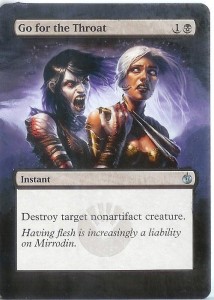
Because I’m known as a regular in the drafts, who only plays constructed occasionally, I’m able to form an unspoken relationship with the other regulars. It is easy for me to approach a player who drafted a card I want, and say, “Would you be willing to look at a trade?” This has a number of advantages. First, many of the drafters I know, stick to drafting exclusively. They either collect the cards, or dump them for more drafts, which means they probably don’t have an immediate need for any particular card. I’ve made a habit of trading a junk rare I’ve drafted for desirable uncommons and commons, such as Trinket Mage, Go for the Throat, even Myr Galvanizer. Drafters don’t have much of a need for these constructed cards, but I keep a handy list of all the commons and uncommons that my local dealer buys. Even if they have a rare that is worth quite a bit, you are in a decent position to negotiate with them. I always start by letting them look through my draft deck for anything they are interested in. If there’s nothing there they want, I’ll offer them store credit for the card. The reason I do this, instead of handing over my trade binder, is to maintain the drafter’s image.

Drafters operate on store credit, and if I trade them card for card, they are typically the one who loses value, when they look to trade that card in for store credit. If I can offer them store credit now, at a price that is fair, they’re likely to take it. There is also a camaraderie that forms between drafters who have been drafting together a few times per week for a while. They want to help you finish of that constructed deck, or fill the last hole in your set. Because they don’t have a need for the card, they’d rather see it go to someone who needs it, than just dumping it to the store. The drafters who are regulars, tend to be very analytical people. They won’t want to lose a ton of value on their cards, but they probably are only familiar with the store’s buy pricing (which may in no way reflect the actual value of the card). You will need to get a feel for each person individually to know the best way to deal with them, but ultimately that’s what this article is about. If you are a regular at your LGS drafts, you will naturally build this relationship with the other drafters around you. Just don’t forget to keep your eye on any commons and uncommons you may want to trade for. Some drafters pull the rares out of their decks and leave the rest on the table, when the event is over. Pulling out these dimes and quarters out of their leftovers can reward big dividends when you attend the next big event. I keep a long box of staple commons and uncommons in my car, because when there’s a shortage at an event, I want to be able to dump as many as I can for the temporary inflated price.

Dealing with the Traders/Dealers:

Dealing with other players who focus on trading, is usually okay, but not quite as profitable. While you both may value cards differently, its possible both parties walk away happy, but it is not likely. These players will likely overvalue their staple commons and uncommons, either because they know they can be good trade bait, or because they have the same intention of carrying a stock of them to the next big event. Dealers on the other hand are a great resource to have around. If you don’t have any dealers that come draft at your LGS, I would be surprised. (It may even scream ‘opportunity’ for you). Dealers are your outlet for any of your junk rares and foils you aren’t able to trade away. Often times they will give you cash for a stack of cards, or let you dig through their trades and trade up to constructed cards or trade bait. This is not only a great way to trim down the quantity of cards you’re carrying around, but also upgrades the quality of your trade binder. While Dealers are certainly making money on the transaction, they must have another outlet for the junk rares that you don’t. This is why there is a win-win possible. Those junk rares are deemed junk, because you can’t get rid of them, but the eBay PowerSeller can.

Dealing with the Constructed Players:

Dealing with constructed players, is probably the least advantageous at your draft, and I try to avoid it. There are some times when it makes sense, but it usually involves a higher ticket item, and a trade out of your binder. This fits the model that most of your trades do, find some cards that your trade partner values lower than you do, and offer him cards he values higher than you do. The only leverage the draft scenario has ever gained me in this situation, if after a match with that player I say, “Can I take a peek at your deck?” I use that opportunity to talk to them about the draft, what cards they picked in what order, and how certain cards performed for them. This is somewhat disarming, and allows you to try and pick up some cards from them. Perhaps they see you as a superior limited player, if this is the case, chat them up, make deck building suggestions, and work your image. Keep in mind the constructed player has the most use for these cards of the bunch, so knowing what deck they play, or archetype they prefer, will help you know which cards they will value higher than others. It also means, you know what cards to trade up to with the dealer, so you can re-trade them to the constructed players.

I can’t tell you how sick I am of the standard trade offers, and approaches I get on a weekly basis. As much as its a good tactic, the “What do you value this at?” has really started to wear on me. I know the drafting regulars at my store feel the same way. Why not wear a t-shirt that says, “I will buy things you undervalue, and sell you things you overvalue, would that be something you’d be interested in?” I take a different approach on my trades, based on building relationships with these people. I KNOW what they value cards at, without having to ask it so bluntly. I know what their priorities are, and what they have a need for or not. I’ve had a lot of success with this model, and I suggest you add it to your repertoire. While only helpful in your local community, where you can see the same faces every week, its also where you have to play your weekly events, so making social connections with the players around you, simply can’t be bad. I'd love for some of the value traders to comment below, about how they go about trading with drafters (if any different than another trade partner), and if they recognize how that persons image has affected they way trades go down.

Don’t You Forget About Timmy

Are you a Quiet Speculation member?

If not, now is a perfect time to join up! Our powerful tools, breaking-news analysis, and exclusive Discord channel will make sure you stay up to date and ahead of the curve.

As you've been reading my articles on this site about cube, you've noticed that they're in the Timmy section.  However, I've been talking all about card efficiency, critically evaluating each card in a cube and its worth to the color as a whole, continuous improvement and other such topics that are typically attributed to Spike.  Is this contradictory?  Not necessarily.

The ideology behind a cube, at least in the beginning, was to have all of "the best cards ever printed," although more modern cube ideology now centers around making a cube an extremely powerful draft set that features the best cards of all time within an optimal limited environment.  Due to this, making a cube isn't simply about deciding what the best cards are then shuffling them together and making them into a pile of cards, as that'd be not only relatively easy but also quite boring.  Yet, if you've been reading my articles, hearing these kinds of things shouldn't be news to you.  So why do I bring this up?

As I mentioned before, designing a cube is essentially about customizing an optimal draft environment with powerful cards.  Therefore, as a designer and developer, you're able to shape the environment.  Want a theme to be relevant?  Make it so!  Of course, you're at the mercy of the cards that are printed in Magic. If you really want to have another powerful 1 mana Zombie for your cube, you're going to have to wait until Wizards prints another one that's on the same power level as Carnophage.

However, what card you choose directly affect how your cube is perceived. Both Timmy and Spike see things in the cards in a cube. Before going into detail about what Spike and Timmy want, let's go over Mark Rosewater's definitions of them.  What does "Timmy" want to do?

Timmy is what we in R&D call the 'power gamer.' Timmy likes to win big. He doesn’t want to eke out a last minute victory. Timmy wants to smash his opponents. He likes his cards to be impressive, and he enjoys playing big creatures and big spells.

What does "Spike" want to do?

Spike is the competitive player. Spike plays to win. Spike enjoys winning. To accomplish this, Spike will play whatever the best deck is. Spike will copy decks off the Internet. Spike will borrow other players’ decks. To Spike, the thrill of Magic is the adrenalin rush of competition. Spike enjoys the stimulation of outplaying the opponent and the glory of victory.

These goals aren't mutually exclusive, and can intersect in several ways. Animating an early Woodfall Primus, Terastodon, or Myr Battlesphere can be exciting to both Timmy and Spike, albeit in different ways (Timmy because of the huge effect, Spike because it'll likely win the game quickly.)  However, this isn't the only way to appease both groups in cube.  I'll go over some examples.

"Theme cubes" such as tribal cubes.

An interesting way to make an intersection between Timmy and Spike is through a tribal cube.  The theory behind tribal cubes is to have each color's creatures center around several tribes, typically a major tribe and a minor tribe like what was done in Onslaught (with white having Soldiers and Clerics as their tribes) or two major tribes. The format is much like Onslaught and Lorwyn blocks since while there are powerful universally playable creatures and cards, tribal cubes seek to maximize on the interaction between the tribes.

It is very important to provide powerful incentives for people to draft according to tribes and their interactions.  A problem that can occur in cubes that try to support themes is that Spikier players can just ignore the theme cards and then win by just drafting a non-tribal, more "optimal" archetype and win.  While it's always important to keep overall strategies in mind in cube, it's especially important to have these strategies and incentives in mind for tribes in tribal cubes so that people are rewarded for pursuing them.

Of course, you don't want to resort to using suboptimal cards just for tribal support.  In a normal cube there isn't enough incentive to use a card like Goblin Ringleader since a deck won't have nearly enough goblins to make the card worthwhile, but there likely will be enough in a tribal cube.  Cards like Siege-Gang Commander, Imperious Perfect, Graveborn Muse, and Coralhelm Commander are already good in "normal" cubes, and are even better in tribal cubes.

But something like Lord of Atlantis, a card that has no place in a normal cube, will be a great card in a tribal cube. Tribal-hosing cards, like Tsabo's Decree, are suddenly more cubeworthy, but whether you choose to use them or not depends on whether they are deemed to be too powerful in that environment (which I believe to not be the case.)

If you don't want to create another cube to satisfy both Timmy players and Spike players, there are many ways to satisfy demographics in a regular cube.

"Big effect" cards.

As mentioned earlier in the definition of a Timmy player according to MaRo, a Timmy essentially wants to "win big" as a Timmy victory is much more rooted by winning with a spell with a big effect, like Terastodon and Sundering Titan, than winning through optimizing with efficient damage sources, like Wild Dogs.  When many people think of cube, they tend to think of stories centered around these types of powerful and splashy effects winning the game, such as using Venser, the Sojourner repeatedly on a Terastodon or Myr Battlesphere to create an army of tokens, winning the game with a huge X-spell, like Demonfire or Fireball, or having Nicol Bolas, Planeswalker go ultimate and ravage an opponent.

As with tribal cubes, one of the important things to do is to provide rewards for people to "go big" and get there with cards like Woodfall Primus, not having their efforts stymied by some blue mage with a couple of untapped Islands.  This is because if there aren't incentives to using these cards, people just won't bother to use them and those cards will just be relegated to sideboards or seen as a "trap" to ensnare people who are unfamiliar with that cube to drafting a suboptimal strategy.

It's similar to providing aggressive support to decks in cube, because if someone drafts a Isamaru but doesn't have the proper support to enable an aggressive deck, people who draft that cube will eventually realize that aggressive strategies don't work and thus, Isamaru will be relegated to sideboards.  Obviously big effects don't require anywhere near as much effort to support, since aggro decks work based on consistency and redundancy (an Elite Vanguard is mostly the same as Carnophage, at least in terms of overall function.)

So how do you aptly provide support for "big effect" cards?

Let's look at Rise of the Eldrazi for comparison.  It quickly became one of the most beloved recent draft environments since it supported many strategies, like U/W levelers and B/R tokens with Bloodthrone Vampire.

It's important to aptly support mana-acceleration in your cube.   The Eldrazi Spawn producers like Nest Invader, Overgrown Battlement, Growth Spasm, and Ondu Giant helped green support "big" effects like Gelatinous Genesis and the infamous Eldrazi creatures like Ulamog's Crusher.  Typically, this is not a major problem in cubes, particularly powered cubes with cards like Sol Ring, Mox Diamond. and Mana Vault, but it is nonetheless an important factor to be cognizant of in case the "big effects" aren't working out.

Another important point is to have colors play to their strengths,making sure that colors have big finishers to ramp into.  In the SWOT articles, I noted that all of the colors have non-aggressive elements that are useful to support and including cards like Terastodon and Woodfall Primus have been mentioned many times in this article because they align with the goals of what you want from Timmy effects - a hefty price but one almost certainly worth the cost.

The exact amount of these effects is something that may vary from cube to cube based on how much the desired effect is wanted, but it is always important to make sure that all avenues of cube strategy are well-represented. It's good to have big creatures and spells to make Timmy players happy, but not so much that the overall picture of efficiency is diluted.

Build-around me cards.

Another manifestation of Timmy (or more specifically, Timmy-Johnny) in cube is through the use of "build-around" cards. That is, cards that are generally useful but are even better when the deck (and cube) provide specific support for them.  Anthony Avitollo and I have talked about these types of cards on our podcast, but I will review this concept as well as discuss how they can appeal to Timmy strategies.

Cards like equipment such as Sword of Feast and Famine and Sword of Light and Shadow technically need support from other creatures in a deck, but this isn't very hard to achieve in a deck since all the effort that is required is to essentially get both of these cards onto the battlefield at the same time and have the creature damage a player.  There are synergistic creatures like Soltari Monk and Soltari Trooper which are nearly unblockable, almost assuring a sword trigger but these are much more in line with general card synergies than a card to specifically build around.

Photobucket

Build-around cards align with the Timmy victory since they provide for a unique and splashy effect to win the game (in addition to being generally efficient.)  Venser, the Sojourner may be useful in a deck with a couple of cards that can take advantage of re-used triggers, but it gets better with more cards.  Although this may sound obvious, the increased utility also aligns with the Timmy ideology of an impressive effect. Blink my Myr Battlesphere and then blink my Woodfall Primus next turn? Sweet!

Other build-around me cards, like Stoneforge Mystic, also align.  Initially I disliked the card due to the perceived inefficiency when the card is used with only one equipment, but that is still a useful effect and cubes presently have more than enough support for Stoneforge Mystic.

I once saw someone draft a Stoneforge Mystic deck with 3 equipment along with many interesting and flashy interactions.  While the deck was a good deck, it also provided for a fun and dynamic experience.  Also, much like with aggressive decks, it's important to ensure that these types of "build-around" decks are winning their matches and aren't simply decks that end up in the loser's bracket because even though Timmy isn't all about winning, they still want to win.

You definitely don't want to sell yourself on including suboptimal cards just because they are useful with other cards or that they can make for interesting stories ("I Tinkered my Darksteel Colossus and I won, isn't that awesome?") and a general useful rule is to ask yourself if you'd honestly play the card if it wasn't for a interesting use or a flashy combo (like with Darksteel Colossus.)

The most important manifestation of the Timmy ideology is that when you really think about it, despite the fact that maintaining a well-balanced cube is a lot of work, the overall experience is all about having fun. The times when I've had the most fun playing Magic is when I've cubed, sharing stories about insane plays and experiences, chatting with friends and having an overall great time.  Aside from personal pride, nothing's on the line and it's all about sharing a wonderful experience with friends and I can't think of any other Magic experience that I'd rather be doing.

I want to thank all of you who have enjoyed reading my material.  It has truly been an honor to write for this site and it has been an honor to provide content for you to read.

Cube blog:  idratherbecubing.wordpress.com
Twitter: @UsmanTheRad
My and Anthony Avitollo's podcast: The Third Power, on MTGCast!

Introduction to Scars Block Constructed

Are you a Quiet Speculation member?

If not, now is a perfect time to join up! Our powerful tools, breaking-news analysis, and exclusive Discord channel will make sure you stay up to date and ahead of the curve.

With the release of Mirrodin Besieged, Block Constructed has a reasonable enough cardpool to be playable, and the Daily Events and Premiers on Magic Online are firing.

Having won the Premier last week, I am now clearly an expert on the format.

Clearly.

Here's the deck:

Untitled Deck

creatures

4 Goblin Wardriver
4 Hero of Oxid Ridge
4 Kuldotha Phoenix
2 Perilous Myr
4 Phyrexian Revoker
4 Spikeshot Elder

spells

4 Koth of the Hammer
4 Red Suns Zenith
2 Shatter
2 Sword of Feast and Famine

lands

26 Mountain

sideboard

4 Into the Core
4 Molten-Tail Masticore
2 Perilous Myr
3 Ratchet Bomb
2 Shatter

This is what I put together, mostly cobbled together from a couple of netdecks and played a couple of times in the tournament practice room and 2-man queues before I took down the PE.

The first thing people comment on is that Kuldotha Phoenix doesn't really have the support it needs to come back often... or ever. I've yet to bring it back, though I have had a game or two where my opponent clearly made a play to keep my artifact count down. The important thing to remember is it's not a Phoenix - it's a cheaper Volcanic Dragon.

The mana curve of the deck is rather steep - most of the cards cost 4 or 5. This is a solidly midrange deck, with the early cards mostly being used for board control. As a result, Goblin Wardriver is nowhere near as good in this deck as he would be in a deck with a lower average mana cost that gets more people on the board. His primary role is to pump up Spikeshot Elder during an attack and to serve as basically a hole-filler on the curve.

Phyrexian Revoker is another hole-filler, but one that doubles as an important role player against the Tezzeret, Agent of Bolas and Kuldotha Forgemaster decks. Those are the two cards he names most of the time, with Liquimetal Coating and Tumble Magnet showing up reasonably often.

Sword of Feast and Famine needs no introduction. The card isn't quite as good without Stoneforge Mystic and Squadron Hawk, but it's still a game-breaker when you hit someone with it.

Perilous Myr is one of the most important cards in the format, and my later drafts of this deck have gone up to the full 4-spot, moving Shatter to the sideboard. I have no idea whether this is correct, but the Myr is just incredible. He kills almost everything that matters when he dies, and forces opponents to make bad plays. You will curse when he comes down on the other side of the table, which brings us to...

Red Sun's Zenith. I think I've cast this on more creatures in the past week than I've ever done with a Fireball variant in Constructed. This exiles the creature it kills, which is huge against Perilous Myr and to a lesser extent Viridian Emissary (though I tend to prefer just letting them get the land, and saving Zenith for something more important). The deck already has tons of reach in the hasty beatsticks provided by Koth of the Hammer, Hero of Oxid Ridge, and Kuldotha Phoenix, so sitting on Zenith just to try to blow them out of the game with it is often incorrect. Clearing a Perilous Myr off the board without losing your team often allows you to get more damage in than the Zenith would ever do by itself.

The sideboard is basically a pile of useful cards that this deck can cast rather than a cohesive 75. Into the Core is basically the MVP against the Forgemaster deck, as well as the Rock deck I played against in the Semifinals (more on that later). Ratchet Bomb is trash that should be replaced by Slagstorm and/or Arc Trail for broad use, or Burn the Impure for more direct Infect hate. I've seen people running Galvanic Blast, but I'll play the Trail over that in a deck which can't metalcraft it every time. Shatter is probably overkill, and I am likely to replace the Shatters and Bombs for Slagstorm and Burn the Impure as a full changeover. Molten-Tail Masticore is essentially the replacement of one of your "preboard" cards - Phyrexian Revoker or Perilous Myr - against decks where either isn't amazing. You can also take out Hero of Oxid Ridge for the Masticore when bringing it in, to keep your manacurve relatively sane. This is, incidentally, why I really don't like Oxidda Scrapmelter. I'd like to play something before turn 4!

So, what's the metagame look like?

On the aggressive side, we have Tempered Steel and Kuldotha Red variants. That's really about it for true "Aggro."

On the control side, there are roughly 4 different Blue decks: Grand Architect Blue, [card Tezzeret Agent of Bolas]Tezzeret[/card] with Kuldotha Forgemaster, Blue-White-Black Venser, the Sojourner, and Blue-Black Consecrated Sphinx Control (with or without Tezzeret). The lines kind of blur between these, and it's entirely possible to hybridize two or possibly even three of these strategies together. Going for all four is probably too greedy.

At varying degrees of "midrange," we have straight Infect, [card Liquimetal Coating]Liquimetal Infect[/card], mono Red, and [card Glissa, the Traitor]Glissa[/card] Rock.

Architect Blue was popular pre-Besieged, but has waned somewhat as people have shifted over towards Tezzeret-centered lists. Here's a post-Beseiged Architect list:

Untitled Deck

creatures

4 Argent Sphinx
4 Grand Architect
1 Myr Battlesphere
3 Palladium Myr
4 Precursor Golem
4 Silver Myr
1 Thopter Assembly
3 Treasure Mage
1 Wurmcoil Engine

spells

2 Steel Sabotage
4 Stoic Rebuttal
3 Volition Reins

lands

3 Glimmerpost
23 Island

sideboard

1 Contagion Engine
4 Fuel for the Cause
1 Mindslaver
1 Perilous Myr
1 Spine of Ish Sah
1 Steel Hellkite
2 Steel Sabotage
2 Tumble Magnet
1 Volition Reins
1 Wurmcoil Engine

Forgemaster Tezzeret is usually a Blue-Black deck, though White splashes are possible.

Here's a more or less stock Forgemaster list:

Untitled Deck

creatures

1 Blightsteel Colossus
4 Kuldotha Forgemaster

spells

3 Black Suns Zenith
2 Go for the Throat
4 Ichor Wellspring
2 Mindslaver
2 Mox Opal
1 Ratchet Bomb
4 Sphere of the Suns
4 Stoic Rebuttal
4 Tezzeret, Agent of Bolas
2 Throne of Geth
4 Tumble Magnet

lands

4 Darkslick Shores
4 Inkmoth Nexus
7 Island
8 Swamp

sideboard

1 Black Suns Zenith
2 Contagion Clasp
1 Go for the Throat
4 Phyrexian Vatmother
4 Steel Sabotage
3 Volition Reins

It's entirely possible to eliminate your vulnerability to all the Shatters and Viridian Corrupters going around by playing a completely artifact-free Blue-Black Control list, like this one:

Untitled Deck

creatures

2 Carnifex Demon
3 Consecrated Sphinx
4 Neurok Commando
2 Phyrexian Rager
4 Skinrender

spells

3 Black Suns Zenith
2 Blue Suns Zenith
4 Go for the Throat
3 Grasp of Darkness
3 Steel Sabotage
4 Stoic Rebuttal

lands

4 Darkslick Shores
11 Island
11 Swamp

sideboard

1 Black Suns Zenith
3 Disperse
1 Geth, Lord of the Vault
3 Halt Order
3 Memoricide
2 Mimic Vat
2 Wurmcoil Engine

There's also a deck somewhere in between these two extremes, which plays Sphere, Inkmoth Nexus, Tezzeret, and Sphinx, but eliminates the Forgemaster-Blightsteel nonsense, which treats Tezzeret, Agent of Bolas as if it were a sort of hybrid of Jace Beleren and Elspeth, Knight-Errant.

I've seen variants of all of these pop up that also splash White for Venser and its interactions with Spine of Ish Sah, Contagion Clasp, Tumble Magnet, Mortarpod, Skinrender, and so forth.

Moving over to the Aggro side, let's take a look at Tempered Steel and Kuldotha Red.

Untitled Deck

creatures

4 Glint Hawk
4 Leonin Relic-Warder
4 Memnite
2 Mirran Crusader
4 Phyrexian Revoker
4 Signal Pest

spells

4 Chimeric Mass
4 Glint Hawk Idol
3 Mox Opal
4 Origin Spellbomb
4 Tempered Steel

lands

19 Plains

sideboard

4 Divine Offering
2 Mirran Crusader
4 Perilous Myr
2 Revoke Existence
1 Sword of Feast and Famine
2 Tumble Magnet

Untitled Deck

creatures

4 Goblin Wardriver
3 Hero of Oxid Ridge
4 Memnite
2 Perilous Myr
4 Signal Pest
4 Spikeshot Elder

spells

4 Chimeric Mass
4 Flayer Husk
4 Galvanic Blast
4 Kuldotha Rebirth
3 Mox Opal

lands

4 Contested War Zone
16 Mountain

sideboard

4 Arc Trail
4 Burn the Impure
4 Koth of the Hammer
1 Mountain
2 Perilous Myr

There's not a lot to say about these - the decks as we know them in Standard are pretty much just the block lists with some bonuses thrown in - which is probably a large part of why they're not as successful in the larger environment. Goblin Wardriver is obviously far better in this deck than in the more powerful Big Red list that's been stomping face.

Mono Green Infect is a dumbly straightforward deck, but there's one common version that presents an interesting twist: Liquimetal Coating.

Untitled Deck

creatures

4 Corpse Cur
4 Plague Myr
4 Putrefax
4 Viridian Corrupter
4 Viridian Emissary

spells

4 Green Suns Zenith
3 Liquimetal Coating
3 Slice in Twain
2 Throne of Geth
3 Tumble Magnet

lands

21 Forest
4 Inkmoth Nexus

sideboard

2 Contagion Clasp
2 Culling Dais
4 Necropede
3 Phyrexian Hydra
2 Pistus Strike
1 Sword of Body and Mind
1 Sword of Feast and Famine

What is the saddest feeling a man can have in this block constructed format?

The one he gets when his Koth of the Hammer turns silver.

This deck gets to cheat and blow up anything so long as it has its key artifact in play - but it's still entirely functional without it! This format has so many random artifacts running around that the deck will always have things to Corrupt or Slice... except for against that aforementioned version of Blue-Black Control. On the flip side, Throne of Geth provides a nifty bonus play when you have Coating but no artifact destruction spells: sacrifice your own spare lands to Proliferate.

The Rock is the next deck on the list, and it's probably the worst matchup for mono Red.

Untitled Deck

creatures

1 Fangren Marauder
4 Glissa, the Traitor
4 Perilous Myr
1 Phyrexian Rager
4 Sylvok Replica
1 Thrun, the Last Troll
1 Viridian Corrupter
4 Viridian Emissary
2 Wurmcoil Engine

spells

2 Bonehoard
2 Genesis Wave
3 Green Suns Zenith
3 Mortarpod
3 Sylvok Lifestaff

lands

17 Forest
8 Swamp

sideboard

4 Creeping Corrosion
4 Go for the Throat
1 Green Suns Zenith
3 Pistus Strike
3 Viridian Corrupter

So many 2-for-1s! Plus Bonehoard to take advantage of all the death-trigger guys that you block forever with. Mortarpod to let you do it yourself! Glissa, the Traitor to get your artifacts back when things die!

Just consider a line of play like turn 2 Perilous Myr, turn 3 Glissa, the Traitor, turn 4 Mortarpod, shoot a guy, move it onto the Myr, shoot two more guys - that's 2+1+1 damage and you get the Myr back if the last 3 involved a kill, so you can do it all over again. It's no Goblin Sharpshooter, but a creature deck is going to be really hard-pressed to beat it anyway. You can even use this to bring back a dead Wurmcoil Engine late in the game.

The sideboard even has everything, including Pistus Strike and Go for the Throat to take down Consecrated Sphinx. It's borderline impossible for Red to beat it - I got a perfect aggro curve into Sword of Feast and Famine game 2 against his Glissa, the Traitor play, followed by a game that I only won because he played a Mortarpod before combat, letting me Into the Core his Wurmcoil Engine - followed by 3 straight Kuldotha Phoenixes. It looks like the midrange infect decks would have a hard time beating this deck as well.

Obviously it's not great against Kuldotha Forgemaster game 1 and it seems weak against Blue Control decks in general, but the sideboard gives it a ton of flexibility. I feel like there's some overkill going on with the 4 Creeping Corrosion and 4 Go for the Throat and would probably shave both of those down by 1 to try to make room for something to beat Blue decks with.

If you're looking to get into the format, the first thing to look at are the key cards and interactions - as in what you're going to be up against. The format hasn't fully shaken out yet, and the Blue Control lists in particular are all over the place, so you need to be prepared for your opponents to come at you from a variety of different angles.

I've compiled a list of what I think are the most important cards in the format. I'm not trying to name every card that sees play, but the ones that are major components of one of the decks (Tempered Steel, Koth of the Hammer), fill a staple role across multiple decks (Go for the Throat), or act as unique roleplayers that don't really compare to other cards (Mimic Vat).

White: Divine Offering, Glint Hawk, Leonin Relic-Warder, Mirran Crusader, Tempered Steel.

Blue: Blue Sun's Zenith, Consecrated Sphinx, Corrupted Conscience, Disperse, Grand Architect, Neurok Commando, Treasure Mage, Volition Reins, the various counterspells.

Black: Black Sun's Zenith, Go for the Throat, Grasp of Darkness, Memoricide, Phyrexian Rager, Skinrender, possibly Geth, Lord of the Vault and either of Carnifex Demon or Massacre Wurm. If you think Black infect is a real deck, throw in Skithiryx, the Blight Dragon and friends.

Red: Go look at the decklist and commentary again. Throw in Kuldotha Rebirth if you want.

Green: Creeping Corrosion, Green Sun's Zenith, Phyrexian Hydra, Pistus Strike, Putrefax, Slice in Twain, Thrun, the Last Troll, Viridian Corrupter, Viridian Emissary.

Gold: Glissa, the Traitor, Tezzeret, Agent of Bolas, and possibly Venser, the Sojourner.

Artifact: Blightsteel Colossus, Bonehoard, Chimeric Mass, Contagion Clasp, Contagion Engine, Etched Champion, Flayer Husk, Ichor Wellspring, Kuldotha Forgemaster, Liquimetal Coating, Memnite, Mimic Vat, Mindslaver, Molten-Tail Masticore, Mortarpod, Mox Opal, Myr Battlesphere, Necropede, Palladium Myr, Perilous Myr, Phyrexian Revoker, Plague Myr, Precursor Golem, Ratchet Bomb, Signal Pest, Sphere of the Suns, Spine of Ish Sah, Steel Hellkite, Sword of Feast and Famine, Sword of Body and Mind, Tumble Magnet, Wurmcoil Engine.

Lands: The 5 dual lands, Inkmoth Nexus, Contested War Zone. Glimmerpost doesn't see a lot of play in block, but it shows up in mono Blue Grand Architect lists from time to time.

Joshua Justice

@JoshJMTG on Twitter

The Five Worst Intro Decks of Zendikar Block

Are you a Quiet Speculation member?

If not, now is a perfect time to join up! Our powerful tools, breaking-news analysis, and exclusive Discord channel will make sure you stay up to date and ahead of the curve.

As you'll recall, we went the positive route last week and presented the five best intro decks of Zendikar block. This week, we're going negative! It's always useful to count the bad with the good, to illustrate what went both right and wrong with design, and see the variance present in a particular block. This isn't the first time that we've explored the darker side of intro decks; Three Deadly Shortcomings was devoted to those most common and deadly of flaws. It is, however, the first time we'll be taking a critical eye at so narrow a field.

5. Brute Force (Worldwake)

Worldwake was in most regards a worthy successor to Zendikar, at least from a preconstructed perspective (the value of having a [card Jace, the Mind Sculptor]hundred-dollar mythic[/card] is best left to some of my more involved colleagues). The landfall mechanic expanded past its creature ties and began appearing on instants such as Searing Blaze and Mysteries of the Deep. Kicker became multikicker, highlighted in ways ranging from [card Apex Hawks]creatures[/card] to [card Spell Contortion]instants[/card] and even to an [card Everflowing Chalice]artifact[/card].

Brute Force's task was to highlight and illustrate the multikicker mechanic, and it did so in a red/green environment. A Wolfbriar Elemental walked the talk in the premium rare slot, while the Terastodon was perhaps a little less consistent, but a real monster when it landed. A number of other multikicker options give the deck a cohesive feel. So where did it all go wrong?

Try having one of the most expensive mana curves in the block with only two [card Borderland Ranger]Borderland Rangers[/card] and a Greenweaver Druid to support it. Perhaps the worst offender here is Rumbling Aftershocks, a nifty and thematically-fitting option that's just too unwieldy in actual play to be worth its place. Did we really need two [card Vastwood Zendikon]Vastwood Zendikons[/card], a card that comes not only come with a hefty price tag, but that further ties up your land? (Oh, right, they don't tap to defend.) Add in a lackluster removal suite consisting of a pair of [card Lightning Bolt]Lightning Bolts[/card], and you've got a stew with all the right ingredients, but not in the best of proportions.

4. Leveler's Glory (Rise of the Eldrazi)

Levelers really seemed to polarise the community when they were unveiled. Were they good or bad? Should they have leveled at instant or sorcery speed? I must confess, though, I was firmly in the approving camp: levelers were a great example of a solid concept splendidly executed. Thus I had good cause to be excited about the release of not one, but two leveler-focused decks in Rise of the Eldrazi, but I was to end up disappointed in the both of them. The blue/black Leveler's Scorn was the more entertaining of the two, and while it suffered from congestion at the three-drop slot (an awkward slot to be congested in when a number of both your cards as well as your levelers are competing for your mana), it was still an improvement over Leveler's Glory.

To steal a line from Braveheart, this deck was one that from top to bottom had no sense of itself. Part of it wanted to be white weenie, with options like Caravan Escort, Affa Guard Hound, and of course the premium Student of Warfare. Other cards like the Snapping Drake and Makindi Griffin pointed at a more expensive aerial component. Those routes aren't mutually exclusive, but then you add a third dimension of a defensive quasi-control element with Wall of Frost, Hedron-Field Purists, and Soulbound Guardians and any cohesive game plan just goes up in smoke.

Oh, and might I mention that every single card in its removal package is blue?

3. Kor Armory (Zendikar)

Now here's a white weenie deck that gets it right! You can't accuse Kor Armory of lacking a sense of purpose and identity. All white creatures (mainly Kor, with an exception in Serra Angel), a tribally-potent premium rare in the Armament Master, with another rare (Conqueror's Pledge) that ties neatly into the theme. Nope, no identity crisis here.

Instead, where it falls down is in the execution. First, any weenie/swarm deck lives and dies on its aggression, and it's hard to sustain that strategy when your opponent doesn't cooperate, and instead starts dropping creatures bigger than yours. That's where removal becomes essential, and Kor Armory sleeps on the job: two [card Pacifism]Pacifisms[/card] and a Divine Verdict. Furthermore, it packs in "helpful" inclusions like Landbind Ritual, Narrow Escape, and two [card Kor Cartographer]Kor Cartographers[/card] which seem optimised to make the game go longer. What aggressive strategy wants to pay four mana for a bear, even if it does come with a free (tapped) Plains?

While occasionally living the dream of getting one of the deck's three equipment into play with the Armament Master, most times you'll find yourself wishing for something other than a Spidersilk Net. For the most part, though, you'll just find yourself dealing into frustration as this mid-paced weenie deck takes too long to get there.

2. Pumped Up (Zendikar)

Perhaps I'm being a bit too hard on Pumped Up by placing it second. After all, if Leveler's Glory wound up on the list because it was being pulled in three directions, could a case perhaps be made that Pumped Up is an improvement because it's only split in two? With Glory, though, you could be forgiven for not noticing the challenges of the deck right away, but this one suffers from no such subtlety.

Where Brute Force looked to showcase multikicker, this earlier intro deck looked to do the same for kicker (as the multi version hadn't arrived yet). Toward that end, it packed in goodies like Torch Slinger and Burst Lightning. The problem it faced was simply one of mana commitment: this deck asked a lot of its pilot, and the payoff wasn't always there. Either cards came demanding a heavy colour commitment up front (Phantom Warrior, Dragon Whelp), asked for it to optimise the card (Into the Roil, Torch Slinger), or simply had their power level potentially throttled by what lands you'd managed to play (again the Dragon Whelp, Spire Barrage). Naturally this could be forgiven on endgame bombs like Hellkite Charger or Rite of Replication, the deck's two rares, but in actual play it was so inconsistent that you felt like the deck was designed to make you feel like you're driving 35mph in a Porsche.

Compounding the sin, this deck was one of the worst offenders for lacking set flavour. Stuffed with core set filler (I'm looking at you, Goblin Piker, but you're far from alone), it really didn't feel all that... Zendikar-ish. And that, perhaps, was the unkindest cut of all.

1. Totem Power (Rise of the Eldrazi)

We've made a number of stops along this boulevard of broken dreams, but in the end there really can be only one. In this case it came in the final set of the block, and it was the odd man out. In order to showcase the overarching themes and mechanics of the set, R&D gave a pair of deck slots to each of the set's two primary innovations: level-up creatures and "Battlecruiser Magic" (Edrazi Spawn ramp into massive Eldrazi creatures). The former was a mixed bag (obviously, as one of them ended up in this august company), the latter a smashing success (both of which landed on last week's Top 5 list). Still, there was the matter of the fifth deck, and that was devoted to totem armor.

Totem armor?

Sure it's a nifty trick, and they were very creatively rendered, but an entire deck around them? It seemed a tall order. Still, with the right deck it could certainly be pulled off. Unfortunately, Totem Power wasn't the right deck. Bad totem choices (an Eland Umbra over a Hyena Umbra?) and a general lack of synergy prevented this from being anything more than a glorified beats deck, and a poor one at that.

To be fair, there was an attempt at synergy with the inclusion of the Kor Spiritdancer, but no Aura Gnarlid? Howabout a Pelakka Wurm and Gigantomancer without a single piece of ramp? Or janky cards like Angel's Mercy and Ornithopter, which requires either a totem armor or an on-line Gigantomancer to justify its slot? This deck had every bit the look and feel of a cobble-together of spare parts around the laboratory. Take or leave totem armor, but hold your nose on this one.

To be fair, Wizards deliberately throws a few lemons into most any intro pack mix for the encouragement of deckbuilding, but each of these has gone above and beyond in discharging this duty. If there's a worse deck than these in the mix, it'd be hard to find, but I'd enjoy hearing your experiences with the worst of the bunch (any of these, or others from the block). Zendikar block was a disappointing time for the intro deck, and I've written before on how Scars block has turned over a new leaf. Still, if you ever get the itch to revisit the land of Zendikar, you'll know which stops to avoid.

Revisiting the “New Power 9” in Magic

Are you a Quiet Speculation member?

If not, now is a perfect time to join up! Our powerful tools, breaking-news analysis, and exclusive Discord channel will make sure you stay up to date and ahead of the curve.

If you didn’t catch the reference in the title, I’m referring to this article by Kelly Reid. He wrote it in February 2010, when we were considering the rumored introduction of a new, “OverExtended” format, which would have extended from Mercadian Masques forward. Tarmogoyf, dominating both Extended and Legacy at the time, was skyrocketing and Star City Games Legacy Open series was starting to pick up steam.

Kelly’s article at the time picked out a few Legacy cards that he dubbed the new “Power,” referring to the original Power 9. This seems like an appropriate time to revisit this concept since Star City Games and Channel Fireball have both made massive upgrades to their Legacy buy lists in an effort to get your cards.

Today I’m going to look at the cards Kelly pointed out as Power, as well as identify some other cards you need to be aware of in the Legacy format and where their prices have gone since Kelly’s article, and where they are going.

Let’s start with the cards Kelly specifically pointed out in his article. As usual, prices will be from BlackLotusProject whenever possible.

Tarmogoyf

Feb. 2010 price: $64

Current price: $50

At the time of the original article, ‘Goyf was pushing $100 on major sites. Today, he’s actually fallen, but I don’t think we can fault Kelly for that, since none of us knew Tarmogoyf wasn’t hanging around Extended for another few years. Since ‘Goyf hit a low of $40 in August, he’s climbed back up to $50 and is trending up. Still the best 2-drop ever printed (arguably, I know), the Lhurgoyf is headed nowhere but up for the foreseeable future.

Force of Will

Feb. 2010 price: $30

Current price: $44

$44 on BLP and up to $75 on SCG. Force of Will is the single best card to invest in for the foreseeable future. I’ll repeat that for effect: If you want to invest in or play Legacy, Force of Will is the single best investment you can make, especially if you do it now before everyone catches on the insane trajectory this card is taking. It has doubled in price in the last year and half, which is very impressive for cards in Eternal formats, which tend to move slower than Standard cards, which see drastic short-term jumps (see: Stoneforge Mystic).

Another upside to investing in Forces is that they are practically immune from the banhammer. If you ban Force, every degenerate combo deck in the format is free to do whatever it wants. Force holds the format together and makes it such a deep and entertaining format.

The Tabernacle at Pendrell Vale

Feb. 2010 price: $215

Current price: $223

While the card hasn’t moved much since the article (though it doubled in price shortly before Kelly’s article), it certainly can be considered “Power.” It sees play in some decks, but mostly it’s just an incredibly powerful and sought-after card. I’m not sure how much higher it can go, since its price keeps player demand depressed since its nearly unaffordable. But I don’t see it dropping below $200 any time soon, either.

Of the three cards Kelly mentioned, only the ‘Goyf is showing a loss at this point in time, but barring any crazy new creatures from Wizards I think it will be back to its 2010 price within a year.

Now let’s look at some other very expensive cards in the format that might be considered “Power,” which I’m defining as something akin to the original Power 9, in that it’s a very powerful, rare and expensive card that offers one of the safest long-term investments you can make in Magic. I’m going to continue to use Feb. 2010 as our baseline for these card’s prices.

Moat

Feb. 2010 price: $130

Current price: $213

Although Counterbalance has fallen out of favor recently, Moat is an important part of some of the lists of the formerly dominant deck. But Moat also fits into a number of other archetypes, and the decline of CounterTop hasn’t done much to its price. Another card I don’t see dropping below $200.

Candelabra of Tawnos

Feb. 2010 price: $32

Current price: $156

After Alix Hatfield’s Time Spiral deck won the title a few weeks ago, the Candles have doubled in price. They also appear in “12-post,” a deck that uses the Candles to power out Eldrazi. This card is extremely rare, a situation where supply actually has a hard time keeping up with demand. As such, I think Candle could push $200 and sit around there, and it’s probably not falling below $125 in the foreseeable future.

Imperial Recruiter

Feb. 2010 price: $110

Current price: $191

It’s crazy to think that such an innocuous creature carries such a price tag, but the absolutely impossible-to-find Portal cards will do that to a price. I’m not sure how good of a long-term hold this is, since its effect is one that isn’t all that hard to see duplicated, but it’s still a relatively safe investment that you should pick up if you’re lucky enough to find one.

Grim Tutor

Feb. 2010 price: $125

Current price: $129

This card has had a pretty swingy history in the last 18 months, but it’s still an important piece to one of the format’s best combo decks: Ad Nauseam Tendrils. Hailing from the fondly-remember Starter 1999 set (you do remember it, right?), the Tutor is just too powerful to ever become obsolete.

Dual Lands

They’ve all seen massive gains in the last year, and that trend isn’t going to stop any time soon. If you can get your hands on them now, do it. There isn’t going to be a better time.

Not going to be reprinted, not ever going to be obsolete.

I’m going to stop our list of “Power” there, since I’m trying to limit it to current Legacy cards rather than every old card with an absurd price tag. I think all these cards have serious potential to continue their price growth, and I would consider all of these a good long-term investment at this point.

I’ve also got some other cards that have plenty of room to grow, though I don’t classify them as “Power.”

Umezawa's Jitte

Feb. 2010 price: $18

Current price: $13

Like Tarmogoyf, Jitte suffered from its early removal from Extended, but it has rebounded nicely. There’s only one more set left in New Mirrodin, and it's unlikely we'll see equipment as powerful as Jitte in it or any forthcoming set. Jittes will continue to dominate creature battles in Legacy, something that will become more and more commonplace as Wizards continues to push creatures.

Sword of Light and Shadow / Sword of Fire and Ice

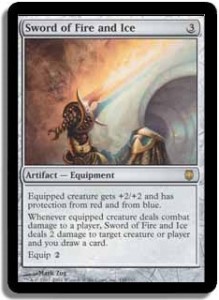
You can sell these for $20 and $25, respectively, right now, which is crazy since they are both still under $20 on BLP. But pick these up now, because Stoneforge Mystic has already seen some Legacy play, and the plethora of good targets mean the full cycle of Swords is going to hold long-term value.

Wasteland

Feb. 2010 price: $17

Current price: $32

Wasteland-based strategies are very powerful in Legacy and not going anywhere. Next to Force, this is probably your safest Legacy investment. Snap these up now while you still can.

That’s all I’ve got for this week. This obviously is not an exhaustive list of the most expensive or powerful Eternal cards, but it does hit most of the high points. I keep saying it, but we are nearing the end of the time to buy into Legacy. If you’ve waited this long, you’re way behind, but it’s still worth your time and energy to put work into the format.

Until next week, remember to check out the forums and welcome the new Insider members who have joined in the last few weeks!

Thanks,

Corbin Hosler

@Chosler88 on Twitter

Ninja-edit Bonus Content!

*Baneslayer Watch*

I wanted to continue tracking Baneslayer Angel, which I pointed out two weeks ago as a card to watch. Since then, the card has continued to decline a little. There were 7 copies in the Top 8 of Dallas, which has been about par. I think the card still has an opportunity to see a resurgence in the new "Naya" decks coming out, as well as if Goblins becomes more popular. It's also likely we'll see a number of new Goblins in the third set of the block, which could make the deck stronger, and in turn bring out more Baneslayers. The Angel is still a relatively safe investment due to the "Angel rule" propping up her price for some time to come.

Building A New Deck

Are you a Quiet Speculation member?

If not, now is a perfect time to join up! Our powerful tools, breaking-news analysis, and exclusive Discord channel will make sure you stay up to date and ahead of the curve.

I am not a deckbuilding expert.  I like to think I am pretty good at tweaking existing lists to perfect them for my expected metagame, but I am no deckbuilder.  That said, I recently attempted to build a new brew that could attack the metagame from a new angle.  I'm not going to claim this is going to win the next Pro Tour or anything like that, but I thought my process might be helpful.

I went to a tournament last Saturday, where I played UW CawBlade because I felt the benefit of having a stable manabase while still running four Tectonic Edges was a bigger gain than either the Red or Black splashes offered.  I cruised into the top eight with a single match loss to Elves!, during which I was mana screwed.  I lost in quarterfinals to the same Elves! player in a heartbreaker.  He misplayed himself out of the game repeatedly, but I only had three land on turn eight after keeping a three-lander with Mana Leak, Jace, the Mind Sculptor, Linvala, Keeper of Silence, and Day of Judgment, so it didn't matter.

In between rounds I did some good trading, picking up a foil Sword of Fire and Ice for only $25, as well as some other treasure.  While flipping through some binder or other I came across a card I had never seen before: Cyclops Gladiator.  I'm not sure how I had never seen one before, but after reading it I quickly traded the $3 or so I needed for a playset.

The Cyclops Gladiator caught my eye for several reasons.  First, it is a Red creature that has a four mana casting cost.  At the moment there are several good Red creatures, but only the Hero of Oxid Ridge costs four to cast, making the Gladiator a welcome addition on the curve to any deck looking to go a little larger on the scale.

Second, almost every creature being played at the moment has less than four power and toughness.  That means that the Cyclops Gladiator can almost always kill a creature with his ability and live to tell about it, which could be game-breaking against many creature based decks.  It is also the right size to take on anything in the current CawBlade lists short of a sideboarded Baneslayer Angel or Sun Titan, whether equipped with a Sword of Feast and Famine or no.

I had already been considering four Inferno Titan as a good way to start a decklist due to their awesomeness against basically everything, but most of my lists had moved in a RUG direction, featuring Lotus Cobra, Explore, and the other usual suspects.  When I saw the Cyclops Gladiator I started imagining a deck featuring a full playset of both the Cyclops Gladiator and the Inferno Titan.

After a bit more trading and browsing through other binders I stumbled across another large Red creature that had escaped widespread attention: Kazuul, Tyrant of the Cliffs.  Kazuul has seen a small amount of play, mostly as a one or two of in RUG sideboards, but he hasn't become widely adopted.  The Cliff Tyrant makes attacking a risky proposition for most aggressive decks.  They are forced to choose between attacking and paying the mana to stop you from getting free blockers or playing spells for the turn.  If they don't attack and instead play spells you have gotten a free untap step, buying you time to cast another fatty or otherwise deal with the pressure.  If they attack you and pay the mana you are probably in a lot of trouble, but it will keep the situation from deteriorating any further.  After coming across the Kazuul, Tyrant of the Cliffs, I traded for a playset, valued at $5.

I couldn't think of any other good Red creatures I would want for a midrange-controlish deck like which didn't seem like much of a problem when I didn't want many more creatures anyway.  At this point I was thinking I had about half of the deck built: four Inferno Titan, four Cyclops Gladiator, three Kazuul, Tyrant of the Cliffs, and four Everflowing Chalice for some acceleration.  I only wanted three Kazuuls because of the Legendary status.  Twenty-four lands seemed about right for a first draft, which made thirty-nine cards together.  Twenty-one cards to fill.

Some creature removal would be essential, preferably better than one-for-one so that this deck could have some additional sources of card advantage.  In went four Arc Trail and four Slagstorm.  Burst Lightning seemed worth of inclusion as it can take out a Tezzeret, Agent of Bolas after a +1, activated Celestial Colonnade, or Stoneforge Mystic with a [card Sword of Feast and Famine]Sword[/card] on it.  Burst Lightning also represents a significant chunk of life if you want to point it at their head.

At this point the list looked like this:

4 Inferno Titan

4 Cyclops Gladiator

3 Kazuul, Tyrant of the Cliffs

4 Everflowing Chalice

4 Arc Trail

4 Slagstorm

4 Burst Lightning

24 land

That leaves only nine card to fill in.  Having filled in some of the broad strokes, I wanted to take another look at what all the pieces were and how they fit into the whole.

General Game Plan:  Control the ground with removal long enough to land a fatty or two that can lock the game up.  The fatties are all sources of card advantage, hopefully allowing this deck to have some play into the late game.  It should play like a control deck.

Finishers: Cyclops Gladiator, Kazuul, Tyrant of the Cliffs, and Inferno Titan.

Early Control: Arc Trail, Burst Lightning, and Slagstorm.  Arc Trail and Slagstorm can take out multiple creatures, helping to generate card advantage, and the Burst Lightning is good at taking down larger threats and Planeswalkers.

Strengths: This list seems very good against decks attempting to win by attacking in the early game.  Boros, Elves!, KRed, all seem like good matchups.  CawBlade could easily pull ahead with an unchecked Jace or Gideon, but barring those I like my chances.

Possible Weaknesses: Decks that don't rely on the attack phase.  Looking at the list so far I would guess that it goldfishes a kill around turn seven or eight which means it will almost assuredly lose to either Valakut or Pyromancer because it would be too slow to beat them before they went off, and it has no meaningful disruption.  I would also expect this deck to be weak to any deck playing a significant number of counterspells.  All the the threats require a large amount of mana to cast, enough that it would probably be the only meaningful thing you did with your turn.  When you are spending a whole turn to cast a single threat at sorcery speed, you turn every Counterspell your opponent has into a pseudo Time Walk.  For the same reason it would be weak to any deck playing significant spot removal.

Possible Fixes: More burn would give the deck a greater chance at racing combo decks like Valakut or Pyromancer, as would smaller, quicker creatures.  The danger of going with creatures is they would make our Slagstorms less card-advantageous.  Manlands are always helpful against counterspells, so perhaps I could add Raging Ravine or Lavaclaw Reaches with a splash, and/or Dread Statuary.  Having lands that also can attack would be helpful in fighting against targeted removal as well.

With the expected weaknesses and possible fixes in mind, I take another look at the mana curve.

1 Burst Lightning

2 Arc Trail, Everflowing Chalice

3 Slagstorm

4 Everflowing Chalice, Cyclops Gladiator

5 Burst Lightning, Kazuul, Tyrant of the Cliffs

6 Inferno Titan

Even with some cards pulling double duty and being counted at multiple places due to their variable costs, I still see a mana curve that looks more like a line.  At the moment there is basically one card at every point on the curve.  This could be awesome if we curve out perfectly, but it opens the possibility of drawing the wrong cards at wrong time and not being able to use your mana to its fullest.  That means I'd like to add a few cards to fill in the gaps, especially at the three- and four-drop spots.

Possible Options:

Tumble Magnet: Tumble Magnet is one of the strongest ways to spend three mana in Standard.  It can buy you a fog for three turns from a Sword of Feast and Famine, which is more than any spot removal can do.  Doom Blade and its kind are great for taking down various Titans, but it is pretty weak when the opponent is attacking with [card Squadron Hawk]four 1/1s[/card] and a [card Sword of Feast and Famine]Sword[/card].  It is also strong against manlands, making the opponent pay their activation cost multiple times before finally getting to attack.

Koth: Koth of the Hammer is a strong four drop in any Red deck that wants to be aggressive.  His mana producing ability is useful, but that's just a happy bonus and not what you're really paying for.  The main event is the hasty 4/4s and the threat of a game-ending ultimate.  While I may be wrong, my feeling is that Koth belongs in the sideboard, not the maindeck.  The deck I have so far is more a control deck than an aggressive deck.  It wants to control the ground with spot removal before generating card advantage with a large threat, not attack with Goblin Guide.  While it may assume a more aggressive role against some decks, I don't think [card Koth of the Hammer]Koth[/card] fits with the game plan of the maindeck.

Sphere of the Suns: [card Sphere of the Suns]The Sphere[/card] would enable splashing a second color a more feasible option, if desired, and could also accelerate the fatties onto the field.  Eight accelerators may be too many, but it is worth considering.

Iron Myr: Iron Myr is a decent accelerator if we want to rush into the mid/late game, and could block if need be.  It has summoning sickness while the Everflowing Chalice does not, and it is also vulnerable to spot removal.  If it seemed a second color was needed I would probably go with the Sphere of the Suns before the Myr, but if the deck stays mono Red, the ability to block when needed may be a greater benefit than the drawbacks of summoning sickness + vulnerability.

Gideon: Gideon Jura would be rather hilarious with Kazuul, Tyrant of the Cliffs.  He would fit well with this deck's current game plan of controlling the ground until fatties hit play, then attacking for a million.  The only drawback is the double-White required to cast, which would make casting him the turn after a Cyclops Gladiator a little tricky.  If the deck moves to add another color, however, Gideon Jura is high on the list for reasons to go White.

Preordain: Significantly easier to splash than [card Gideon Jura]Gideon[/card], Preordain could help smooth the draws of the deck considerably.  An Everflowing Chalice is exactly what you're looking for on turn two, but it is a poor topdeck on turn eight.  The same is inversely true of the fatties such as Inferno Titan.  A small splash for Blue could allow for a significant boost in the average card quality of cards drawn in the later game while also ensuring the accelerators were cast in the early game, rather than clogging up the hand later on.

Jace Beleren: [card Jace Beleren]The lesser Jace[/card] would require a more committed mana base than just Preordain, but it would also yield greater rewards.  At the moment the deck can gain card advantage through its creatures but it has no way to actually draw cards.  Killing two or three creatures with each creature you cast is certainly card advantage, but it does not increase your options the way having more cards in hand does.  [card Jace Beleren]Jace, Jr.[/card] fits well on the curve and would increase our ability to grind out a long game which could prove quite helpful.

Jace, the Mind Sculptor: If you're going to play a Jace, you might as well play the best one, right?  The mana curve is probably fine.

Fauna Shaman and Vengevine: This is just clearly not going to work.

Consecrated Sphinx:[card Consecrated Sphinx]The Sphinx[/card] is one of the best ways to cement a small lead in Standard today.  If this deck trades one-for-one all day until landing a fatty, the Sphinx could fit in well.

Primeval Titan: Another strong Titan, Primeval Titan could search up any manlands that ended in the deck, or perhaps something like Teetering Peaks or Smoldering Spires.  If we're running a Red and Green deck with Primeval Titan, however, why aren't we just playing Valakut?

I don't think that I've stumbled across anything format breaking here.  This most-of-a-deck is probably good enough to do well with at FNM with some tweaking, but my goal with this article was not to build the next Pro Tour winner, but rather to share my process of deckbuilding.  When I come across a card or idea that hasn't been exploited yet I try to follow it as far as it will go.  After sketching out the broad strokes, I try to examine its strengths and weaknesses.  Then I look at the mana curve again and try to brainstorm any intersections of cards, trying to think of ways I can solve its current weaknesses while also plugging holes in the mana curve to ensure your mana is being used fully when possible.  The most important thing, however, is to put it together and play a few games.  Many decks that seem good on paper are unplayable when put together, just as many that seem amazing in theory fail entirely when put to the test.

Good luck brewing!

Brook Gardner-Durbin

@BGardnerDurbin on Twitter

Past Reflections – Eating My Crow

Are you a Quiet Speculation member?

If not, now is a perfect time to join up! Our powerful tools, breaking-news analysis, and exclusive Discord channel will make sure you stay up to date and ahead of the curve.

We all like looking back and trying to gauge our success, and see where we are in terms of accuracy of our predictions and overall credibility of calls. I wanted to take this week and try and identify my strengths and weaknesses in calls so that I can do this better. I know I got some wrong, and I got some right, and lets see how it went overall.

I'm only going to look at how I've done so far this year, as that's when most of the major price changes have happened, and its also when insider began.

A Helping Hand published 11 January 2011.

Not published too long ago, my big card to pick up here was Hand of the Praetors. Since then they haven't gained almost anything in overall value, and only have a market for casual players. Ah well, better luck next time.

I left my Jaces in San Jose published 19 January 2011

Sell off the Jace, buy Green Sun's Zenith, and be careful about Tezzeret, Agent of Bolas! Well I sold Jace for $75 a piece to SCG, they are only buying them for $60 now. Green Sun's Zenith has doubled since I wrote that piece, and Tezz was a bigger hit than I anticipated. Not bad overall, and if you were careful about picking up Tezz you made a boatload of profit getting him near the prices I listed. I'd consider this one a win.

Legacy of Legacy published 25 January 2011

Looking back over this one, the cards either stayed where they were, or went up. Sword of Fire and Ice now sees a $50 price tag at its lowest, Goblin Welder was $6, and is now $10. A couple weeks after I published this article we also sent out an email saying to pick up the welder and a few other cards for the legacy welder deck. This article was a good win if you were able to pick up Welders or Swords.

Balancing the Books published 02 March 2011

Just after finishing my Building on the Basics series, I wrote this piece. While most of it is still practical trading advice, I  mentioned the two newer Mirrodin swords, and noted the continued popularity of decks containing Stoneforge Mystic. Those have all since gone up, though my Tombstalker call was a failure, as he has since dropped, but not by much. Overall a win, if even by a few dollars.

*Update!* between the time of writing and posting, Tombstalker has climbed in price, and is now sold out on SCG at $9.99 a piece. This I would now call a win if bought when I put it on watch.

Knowledge Pools published 09 March 2011

Two weeks ago I wrote this one, saying to sell off Green Sun's Zenith, Games Day Black Sun's Zenith, and the new Mirrodin swords. The two Sun's I still stand by the call to sell, unless you want to hold onto GSZ for long term gains. The swords, however, I would now hold onto in the wake of the older swords hitting $50. It would be a longer term investment that probably won't hit $50, but they are more likely than not to go up.

Most of the other information in that article is still too new to have seen much change, so it will be evaluated at a later time.

Chasing Down the Stag Published 16 March 2011

Last weeks article is still too new to evaluate, though it was published just days before the UB infect deck made the news at this past weekends Open. I would call this one a win, but it may be too early. As with Knowledge Pools, it will be evaluated at a later date.

So where does that leave me? A loss on Hand of the Praetors, possible loss on Tezzeret, agent of Bolas if hesitation to pick him up stopped you from buying, a loss on Tombstalker, and I'll call an even draw on Jace, the Mind sculptor since his price hasn't gone down too much since then.

Getting to positive wins, we have Green Sun's Zenith, Goblin Welder, Sword of Fire and Ice, and Games Day Black Sun's Zenith. Picking these up when originally mentioned was at least a 30% profit gain, more on some.

1 solid loss, 5 solid wins, and 2 unknowns depending on how you acted. After the update on Tombstalker the numbers are showing a positive gain and positive calls. A decent run so far for the year, lets see if I can keep it up and raise those profits higher!

This past weekend at the SCG Open Dallas/Fort Worth standard saw another round of red decks break the top 16, this time with Goblins making the finals, sadly to lose to Esper-Blade. Goblin Chieftain gained a marginal amount, as it's never been very expensive, and Goblin Guide held steady in price even against the addition of more into circulation from the event deck that he's in.

Vengevine returned again to the scene as well with the support of its Naya friends. The price didn't do anything interesting as most people who want them already have them, though continued use and decent finishes could help its price.

On the legacy side of the Open, Tezzeret Affinity managed to win it overall. The current card to be on the watch for is Blinkmoth Nexus as it could see a spike in the near future if the deck does well this weekend in the Los Angeles Open. Mox Opal was also included as a 4-of in the affinity deck, showing decent possibilities of it seeing a further price bump as its also used in Spanish Inquisition, and still finds some use in Standard and Extended.

Thoughtseize seems to be here to stay even after extended, as Legacy continues to gain popularity, so will cheap efficient spells. With extended cards about to drop heavily in price, keep watch for people getting rid of Thoughtseize for criminally low prices, and pick them up before legacy demand raises their price again.

That's all for this week, I hope you enjoyed reading this piece as much as I did writing it!

Stephen Moss

MTGstephenmoss on twitter

MTGstephenmoss@gmail.com

Tradition, Tradition

Are you a Quiet Speculation member?

If not, now is a perfect time to join up! Our powerful tools, breaking-news analysis, and exclusive Discord channel will make sure you stay up to date and ahead of the curve.

My last article got some…mixed reviews. I got emails saying how much some of the readers enjoyed the article, but some of the comments gave me a different impression. Whether or not you felt like the article accomplished its intended goal, I still appreciate feedback. To be honest, the negative feedback actually helped me more than the positive! So keep telling me your opinions on my writing, and I’ll constantly be making small tweaks to try and get it right.

Looking at this week though, I figured I should start doing some card price predictions, and while I’m at it, make it a tradition. So here it is: The 2nd article of every month henceforth will be looking at general card price changes and make some predictions, while the 4th article of the month will look at some newer prices and evaluate how well I did on my predictions. So let’s take a look at what’s been going on in the world of pricing, and what predictions we can draw from it (for reference I'll be using MTGOTraders for online pricing and Black Lotus Project for paper):

First off, we have the rise of High Tide as a legitimate contender in Legacy. Alix Hatfield's win with the mono Blue combo deck refuted many claims that the unbanning of Time Spiral would have no impact on the format. While paper prices remained relatively stable after Hatfield's win, aside from a predictable spike in the price of Time Spiral, online prices shifted much more. Candelabra of Tawnos, a key way to generate mana after a High Tide, shot up 260%, from 1.25 to 4.5 tickets, though I don't see it going any higher. Which leads us to...

Prediction #1

The growth of Candelabra of Tawnos on MTGO will slow, and its price will not be higher than 4.5 tickets by the end of the month

Another addition to the Legacy metagame has come with the rise of 12 Post, a deck that uses Glimmerpost, Cloudpost and Vesuva, alongside the aforementioned Candelabra, to generate massive amounts of mana, which is then used to cast Eldrazi such as Emrakul and Kozilek or sweep an aggro player's board with All is Dust. Eye of Ugin is essential here to tutor for the fatties, and this has led to it gaining use online, causing a 73% rise in price to 1.3 tickets each.

Continuing in Legacy, the top 16 decklists of the SCG Open in Memphis have been posted, with 3 copies of Team America making top 8. Team America is a B/U/G Control deck combining spot removal, countermagic, and the mana efficient fatty duo of Tarmogoyf and Tombstalker to beat down. Though most of the cards in the deck are already of a high enough value that their prices won't be affected by the deck's success, Tombstalker still has some room to move.

Prediction #2

Tombstalker will hit at least $8 in the aftermath of Team America's success in Memphis

I can also see a slight increase in the price of Stifle. The metagame of Legacy has shifted such that Stifle is becoming an even better choice: manascrewing opponents by countering Fetches, preventing getting decked by Brainstorm in High Tide or killed by Tendrils in Ad Nauseum, or saving your own mana base by dealing with Wasteland. Stifle is supremely well positioned in the current Legacy environment.

Prediction #3

Stifle will increase to at least $11.25

Moving on to Standard, we see 2 new decks making an impact on digital prices. First up we have Pyromancer Ascension. Heavily promoted by Mike Flores prior to the SCG tournament in Edison, the prices of the key cards in this deck rose rapidly. Pyromancer Ascension increased by 95% to 1.95 tickets, and Archive Trap went up by ~92% to 1.15 tickets. However, as its lack of results at the SCG Open indicates, Pyromancer Ascension isn't capable of combating the current metagame. Though it may find success at a later date, today is not that day.

We also saw Ali Aintrazi's mono Blue Grand Architect deck. Based around powering out absurdly strong artifacts with the mana boost from Grand Architect, Ali's top 8 performance boosted the price of digital Mindslavers by 74%, to 2 tickets apiece. Contrasting with Pyromancer Ascension, I can see Architect Blue being a force in Standard when conditions are ripe. It's also worth noting that most of the deck is in Scars block, meaning it will still be around when Zendikar rotates out of Standard in October.

Surprising no one, Thrun, the Last Troll continued to drop, down 37.5% to 5 tickets. Though a powerful card in a vacuum, Thrun simply doesn't have a home in the current Standard environment, especially since both the all-star equipment currently being played lend creatures Protection from Green, an inauspicious sign for the new Troll Ascetic. I'm waiting for a Green based Fauna Shaman deck to make Thrun good, but even then, it will need to be after Zendikar's rotation. Stoneforge Mystic combined with the Scars Swords create too hostile an environment for base Green decks to prosper.

Prediction  #4

Thrun's paper price will fall below $11 by the end of the month.

However, out of the blue, Sword of Feast and Famine has been taking quite a tumble on MTGO even as it increases in price in paper. Online, it dropped a massive 38% to 15.5 tickets even as Starcity raised their sell price by $5 to $24.99. What's happening here? Certainly, part of Sword's drop online is as a result of more Mirrodin Beseiged product being opened, but that can't account for such a large decline. Sword is still seeing more and more play, not only in U/W/X Stoneforge in Standard, but also in U/W and Fae in Extended. I'm personally quite confused at the discrepancy between digital and paper pricings here, but if you have any light to shed on the issue please don't hesitate to let me know.

Prediction #5

Sword of Feast and Famine's current level of growth will slow, and it will not reach $16.50 on Black Lotus Project by the end of the month.

The aggressive strategy of choice in Standard has gradually shifted away from Kuldotha Red and other swarm variants to Boros and Pat Sullivan's mono Red burn from SCG Edison. Both of these strategies don't focus on multiple creatures attacking, rather swinging with one or two large or resilient threats. This has led to a decline in the price of Contested War Zone, a card that is only ever good with three or more attackers on the table, and awful when facing down a Squadron Hawk. Over the past week, War Zone has dropped 47% on MTGO, to 1.85 tickets, and 40 cents in paper to $2.50. Because Boros and Burn have been outperforming Kuldotha by so much, I predict War Zone's dropping even more over the next 2 weeks.

Prediction #6

Contested Warzone's paper price will drop to $2.00 or less.

RUG, a deck popularized by Adam Prosak, Alex Bertoncini and Gerry Thompson, along with several other ringers on the Starcity Games circuit, has experienced a bit of a resurgence lately. The finisher of choice for the deck is still largely undecided, with players waffling between Frost Titan, Inferno Titan, Avenger of Zendikar and Precursor Golem. Of these, the inclusion of Inferno Titan has been near unanimous, leading to a good few weeks for him: 90% growth on MTGO to 7.5 tickets. But RUG didn't put up good results at either of the last two Standard tournaments, which has given some doubts about the lifespan on Inferno's gain.

Prediction #7

Inferno Titan's growth will slow, not exceeding 8 tickets on MTGO

Well, that's all I have for this week. I'll be returning to these predictions in my last article of the month to evaluate how I did, as well as examine more pricing trends.

Don't forget to leave me feedback! At the end of the month I'll be picking one commenter who I felt left the best comment, including at least one positive comment, one constructive criticism, and one future article idea. Your feedback is really helping me to improve the way I structure my articles and offer useful information to my readers, so keep it up.

Looking forward to my new tradition,

--Noah Whinston

mtgplayer@sbcglobal.net

nwhinston on Twitter

Arcadefire on MTGO

baldr7mtgstore on Ebay

Go for the Throat

Are you a Quiet Speculation member?

If not, now is a perfect time to join up! Our powerful tools, breaking-news analysis, and exclusive Discord channel will make sure you stay up to date and ahead of the curve.

Welcome to my second article and your first step by step guide to altering Magic cards. Hopefully by now you have procured everything you need and have done a little experimenting with your paints. If you are anything like me you fiddled with it for a good half an hour before deciding it was too hard and gave up. Not to worry, that happens regularly to me and others. You did the right thing by walking away. This hobby should be fun, and you'll produce your best work when you are happy.

For our first project, I have chosen a great card with a surprisingly easy design. Go for the Throat should have shown up in your binder by now, and if not, they should be easy to buy for just a couple of bucks. Before we begin, I want to address an issue that will at some point pop into everyone's mind. What happens if you screw up? You have two safety nets in place here. First, mistakes can be painted over. In the event that you paint over a mistake too many times to the point that the card is noticeable thicker, a toothpick can be used to scrape paint off. Do note that this will do minimal harm to the card, but you will be able to start over again with a “clean” slate. It's at this point that I will promise not to use expensive cards for these guides. I will always try to use cards that are accessible to the majority of people.

It begins...

For this project I used “Titanium White”, “Mars Black”, “Ultramarine Blue”, and “Naphthol Crimson”. These should all have come in your starter pack. I was able to do this whole project with 1 brush, and it was a “Chisel Blender” #4 size.

Mount your card using a loop of masking tape on the back so that it is secure. Since the color scheme is very dark, we will use “Mars Black” as our primer coat. Cover the frame around the picture and the rest of the borders of the card. Leave the frames around the textbox and name box. Try not to use too much paint. Our goal is not to completely blot out the background, we just want to give an even coat to put our color on. As you can see in the picture, the original color should still show through. Be sure to use nice even strokes. There is a tendency to dab and poke the paint almost like you're sketching. This will leave bumps and lines and overall unevenness in our base coat which will show through to the finished product. Use confident bold strokes, if you look like you know what you are doing (even if you don't), the painting will reflect this. You want this base coat to be very even and smooth.

While we are waiting for this to dry, go ahead and rinse your brush in the water cup. “Paint” the excess moisture onto your paper towel. Repeat this process until the brush no longer leaves pigment on the towel.

The First Color

For the first color treatment, we mix “Ultramarine Blue” with “Naphthol Crimson”. Use more blue than red. Then add just a touch of “Titanium White”. Work with these colors until they match the shade of purple that is showing in the background that is lower than our subject shoulders. I wish I could tell you exact measurements, but in reality, your card is from a different print run and is actually a different color than mine. This can easily be solved by painting slightly over the picture to help match the colors.

If you have used your paint sparingly, you'll notice that in the time you spent making the “perfect color”, the paint has dried a bit. Don't worry, it's water based and can be resurrected with a brush full of water from your cup.

When you do find that color, you'll find that you can now easily alter it by adding white to bring the color “up”, and by adding more blue and red to bring it “down”. By adding small amounts of either, we can recreate and match the shading effects given to us by the artist. While doing so, use your imagination to think about what is happening just outside the frame. Use the clues from the original picture to guess what shapes are occurring just outside the borders of the original picture. Take your time with this, and when it looks something like my example, you are ready for the next step.

Adding More...

The sky above the purpleish glow may appear to be black, but it is not. Mix up some purple like the first step, but instead of “Titanium White” use “Mars Black” to make it very dark. Use this above and around the Name Box, then slowly add more purple to bring the tone up to match what you have done below it.

At this point we want to return to the colors we've used in the first step (mixing more if we must) and add a touch of water to it. By thinning it with water, we allow it to spread a mix with the colors we've already applied to the card. This type of “wet blending” will give the alter a seamless look to it. Be sure to paint a little over the original artwork to help add to the illusion.

Finishing Touches

The final step is simple. Take some black and paint under and around the text box. Take care to blend the black with the color you've added to the card already. Finally, use a toothpick to gently scratch of paint that has invaded the textbox.

That's it, you've finished your borderless alter! I hope you like it, and if you don't, well nobody said you couldn't continue to work on it. For reference, this particular alter took me about an hour, but the first time I altered cards it took about 4 hours. So be patient, and once again, if you get frustrated, just walk away.

If you are happy with it, congrats! Allow it to dry for a little while before tossing it into any kind of sleeve.

Now is the part where I open myself up to comments and questions. This is the first time I've ever written a guide like this, so please let me know what I could improve upon. Also, feel free to share your newly created artwork with me by emailing me at Mbajorek02@gmail.com.

Until Next Time!

The Painter's Servant

Illusions of Grandeur

Are you a Quiet Speculation member?

If not, now is a perfect time to join up! Our powerful tools, breaking-news analysis, and exclusive Discord channel will make sure you stay up to date and ahead of the curve.

This week’s article will be devoted to the art of the shark, and no we aren’t talking about the fiendish fish Fonzie jumped but instead on the equally fearsome trader. This is not to say a shark or player vendor is a bad person to trade with. Quite the opposite in fact! These trades can be profitable for both parties if you know how to conduct yourself. This article will give you the tools to conduct trades with even the most savvy trader and still come out on top. If you already consider yourself a suave trader of sorts this week’s edition even has pointers for you from how to maximize profits, to the ins and outs of trades to receive repeat business.

I would first like to start this off by saying that sharks can be one of the hardest groups to identify. I have come across countless different trade styles and techniques many of which are equally effective and have myself evolved my trading style incorporating some of these things I have learned over the years. A shark by no means strictly has to be a trader though many times will be at events strictly to trade such as myself, but if you notice a large backpack or suitcase chances are that’s what they are there for. Becoming proficient enough to command trades can take years to learn and master and months at a time of memorization. The key is to know your values. Nothing feels worse than walking away from a trade just to find out later that junk rare you had in a box at a dollar is actually worth ten. Keeping a good idea of current prices is key to creating profitable trades, no one wants to wait while you look up the latest prices on all your rares and frankly it makes you look bad. Especially when trading with a shark.

The Binder

Keeping things well organized is always a must when trying to trade in any scenario and especially here when dealing with someone who knows what they are doing. An unorganized binder can drive traders away and profit traders don’t want to wait while you dig through your bag to see if you have a particular card. I always suggest keeping a number of smaller binders as opposed to one large one. This will make trades more streamlined and allow multiple trades to be conducted at once. I personally have a Standard binder, a binder with extended and legacy rares, an EDH binder, and a binder with the more expensive/hard to find cards. In addition, having overflow boxes can be helpful for a number of reasons. Keeping playsets of competitive commons and uncommons on you can create opportunities to trade when someone is looking and no one else brought any. Sometimes that Everflowing Chalice can shore up a close deal. Fat pack boxes work great for this and are easy to store. Having playsets of Squadron Hawks on hand can net you a dollar or two each if the person needs them enough. Besides your commons and uncommons, keeping a box with everything over a 4-of will both save your binders (packing 10 rares into a binder sleeve will destroy it) and create a loss prevention aspect. If someone takes four of a card and still asks for more you may have undervalued it and perhaps this allows you to stem the loss. Sharks will typically have a very well organized binder and to conduct a proper trade and be taken seriously you should as well.

The Trade

Some sharks have niches that they know extremely well or feel more comfortable trading in. This can be anything from standard to hard to find foils and promos. If you have a niche yourself letting them know will save you both a lot of time and effort as no one wants to unload a whole suitcase just to find out your only interested in standard. If you need particular cards just ask. They will know what they do and don’t have in stock or with them and can probably keep an eye out for you in future trades if they don’t. If they know they have someone who is looking for a card they will keep an eye out, after all who would give up the opportunity to conduct future business. The primary key to remember here is unlike other types of traders a true shark will not take a loss, so know going into the trade that if your dealing with a competent shark it’s a good idea to know your values. I know I keep coming back to this but its important. This does not mean you can't come out ahead and should not deter you from conducting such a trade. Future and predictive trading are both great ways to make a profit for yourself while still keeping the shark happy. If you are the shark, inventory trades can be added to this list as another great way to make a deal. Future trading is like I just mentioned a process of picking up cards you already know you have another trader looking for. You can many times work out a deal with a shark as he may himself have cards he is seeking either at the event or back home. Predictive trading can be more dangerous and is not suggested for those with small inventory sizes. This skill not only takes a great deal of knowledge on the market side but also the gaming side as well. If you have the latest tech or see an opening for a particular deck sometimes it is a great idea to stock up on those cards while the prices are still cheap. Some of the better callshots I can recall in the recent past were Knight of the Reliquary and Dark Depths, both of which I was picking up anywhere from .50-2.00 at their respective times and both soared later on in those seasons to net me a great deal of profit. Last but not least is the inventory trade, one which is mostly conducted when two sharks are involved in a trade. A great example of this is a trade me and Kelly Reid conducted at a recent GP. At my local shop Valakut was still seeing heavy play and I was cleaned out of most of the pieces. Kelly had a good number of Oracle of Mul Daya and we proceeded to trade cards each of us was low on knowing each would make profit in our own local areas off of each other.

This is not to say all sharks are going to follow your ideals in trading or even be interested in a nearly fair trade. There are traders out there strictly in the business of ripping someone off, and that again is not to say that everyone who rips someone off is a bad trader, its just something you have to look out for. There is a gentleman I see at almost every major event that carries around a buylist and values your cards at what he knows he can get for them. This is a common thing and although knowing a buylist is good and something I take full advantage of it is not something that looks good in the middle of a trade. These are typically people you may want to be weary about trading with as they probably don’t always have the best intentions.

The Attitude

The thing to pay attention for when trading with a shark is to not let them bully you into a trade. You can always say no, and although you don’t want to make a habit of it, sometimes it is necessary to keep yourself from taking a major loss. A good shark will let the other trader set values most of the time and pick and choose from there what they would like. Keeping this in mind, don’t undervalue your cards just to complete a deal. Sometimes it just wasn’t meant to be. Keeping yourself professional is also a nice touch and will gain you some respect among sharks, if you don’t like a price there is no need to rant. Just move on. We might not always like the price you offer, or you may not like some of our values. It happens. For many of us, this is our job and I can say there is nothing more frustrating than dealing with someone who scoffs at every price I give them. A card is only is as valuable as you allow it to be. Stores set good price guides but sometimes people fail to remember sharks are not stores. We have different values and you might too. As a bit of advice, it is good to know the sharks. You will see many of the same people at events over and over again. You may feel some are fair traders and others are not, but remembering these faces can allow you to keep yourself out of trades you know you cant justify.

The key is to not enter the trade thinking your going to get ripped off every time. Sometimes you may lose value but this can usually be corrected by spending time learning the prices of cards. The fact that the shark can take advantage of traders lack of knowledge does not make them a bad person. If you have a good idea of values and are courteous you may find the shark to be one of the more laid back traders, many times allowing banter during the trades that make it both enjoyable and open the possibility to create friendships after a few trades over the course of a couple of events.

What about me?

So by this point some of you may be wondering yourself, how do I get onboard? Perhaps playing in the current format is getting stale or you just want something to do after that terrible 1-2 drop weekend. Contrary to popular belief it really doesn’t take as much to get started as you may think. The first step as I covered before is knowing your values. I cannot stress this enough. To start pick a market you are familiar with. Do you keep up with all the latest standard tech? Perhaps you're a savvy EDH player who knows the value of even the most obscure cards? Either way take advantage of your current knowledge and build from there, you don’t have to learn every card in Magic overnight nor should you try. Starting with what you know may mean less profit in the beginning but it also includes much less risk. I have been doing this for years and I still stray away from some markets (Japanese/Foils). This doesn’t mean you can't pick some cards up if you know your getting a good deal but just don’t make a habit of it right away. Keep your binder organized and have a good idea of what you have in stock, then just value trade. Even if you only net a dollar or two on each trade to begin with that can add up over a hundred trades on the day and with some practice you can find this funding your trips. Once you get to this break even point you may find yourself thriving for more, or perhaps decide this is not for you. Either way it will make you a better trader and will allow you to meet a whole new group of people you may not have even known were there.

Well this concludes this weeks article, I will be doing a follow-up in the next few months with a more in depth look at how to work your way up to a shark level trader including a good idea of how to initially invest and how to deal with other traders and vendors. Until next week, I look forward to reading your comments. Let me know what you thought and again if there are any ideas you would like to see in the future. Next weeks article will be covering a very different type of trader: a very casual local area many times what I consider a “color” trader.

Until next time thanks for all the fish…think about it.

@CryppleCommand on Twitter

Ryan Bushard on Facebook

ryanbushard@hotmail.com

A Missed Trigger?

Are you a Quiet Speculation member?

If not, now is a perfect time to join up! Our powerful tools, breaking-news analysis, and exclusive Discord channel will make sure you stay up to date and ahead of the curve.

This week I have another situation that came up at Grand Prix Denver. It was a call that I personally took, and it was pretty interesting. Let’s get right into it:

Judge! I (Player A) had a Serum Raker in play. It had just gone to the graveyard from blocking a creature. I was recording Life totals before triggering his ability, and when I looked back up my opponent (Player B)had already played a Bladed Pinions. So this is a Missed Trigger, and now the trigger needs to go on the stack on top of his Bladed Pinions.”

Player A was very insistent on this penalty right out of the gate. I discovered right away that his opponent only had one other card in his hand. This player clearly wanted to make sure to get that other card out of his hand and not give his opponent a choice in the matter. But was this really the right call?

I started to investigate to see what exactly had happened. I asked Player B and he explained to me that he didn’t realize that his opponent’s creature had an ability on it, and just assumed after everything went to the graveyard he was free to move on to the next phase and start casting spells. This is a perfectly reasonable assumption to make. That had been the way things went the whole match so far, and if this creature hadn't had a triggered ability it wouldn’t have been a problem.

When I turned back to Player A to see what he thought, he told me that after creatures dealt damage in combat, he put his creatures in the Graveyard and reached for his score pad to adjust his life total from the attack before dealing with the triggered ability on his Raker. When he looked up his opponent had already cast a spell, which is when he called for a Judge.

This was the first thing that jumped out at me as strange. Usually, in my experience, a player makes sure all his triggers are handled and everything is taken care of before he changes his life total. However, after thinking about it, the way he went about it is technically correct. Very technically correct, in fact, as that is the way it would have happened on Magic Online.

Player A also wanted to clarify that in the current game state the Bladed Pinions was still on the stack. He was pushing really hard to make sure I knew we were definitely no longer in the attack phase. He really, really wanted that last card out of his opponent’s hand.

So now that we know that both players agree about what physically happened, we needed to figure out what to do so the game can go on.

I know that Player A had convinced himself that this is a Missed Trigger. At least he had convinced himself that it would be good for him if it was. If it was a Missed Trigger, we would apply the trigger right now, and his opponent would have to discard his last card and then the artifact would resolve. However, I’m not sure if this qualified.

It seemed pretty clear to me that one player (A) thought we were still in the combat step, readied for his trigger to go on the stack. The other player (B) thought they were already in the main phase, so much so that he had already cast a spell. Knowing this discrepancy, we needed to be backing things up to the point of confusion.

In order to do this, the IPG tells us that we needed to consult the Head Judge in order to do this. At a Grand Prix, this task is often delegated to any Judge level 3 or higher. So I found the closest level 3 and we had a brief discussion.

When I explained to him the situation, his first reaction was to remind me that we can’t back up a game state for a Missed Trigger penalty. This is true, but I didn' t suggest that this was a Missed Trigger. I had said that this was a Player Communication Violation.

There was an understood shortcut that was created between these players by the way they had played the match up to this point. That shortcut was that once damage was dealt, and creatures went to the graveyard, it was time to move on to the main phase. When you have a shortcut that exists, and suddenly it needs to change, sometimes a player doesn’t mention it right away. When this happens, it falls under the category of a Player Communication Violation.

After getting approval from the level 3 Judge, I returned to the match. Much to the dismay of Player A, I ruled to back-up the game state to the point of confusion, putting the Bladed Pinions back into Player B’s hand. I issued the Warning for Player Communication Violation to Player A for not being clear about his trigger and we put the trigger on the stack at the appropriate time.

The biggest reason for this, in my opinion, not being a Missed Trigger is that the player who had control of the trigger hadn’t missed it yet. In his mind the game had not yet reached the point where the trigger would go on the stack. The other player simply didn’t realize it was going to happen and tried to move on. Since one player was still in his end of combat step, and the other was in his Second Main Phase, I believe putting them both on the same page was the only way to go.

As Always, Keeping it Fun

Kyle Knudson

Level 2 Judge

Allon3word at gmail.com

BONUS RULES STUFF

Triggered Abilities

Triggered Abilities are special abilities that rather than get activated, they “trigger” on a specific event. When that event happens, the ability goes on the stack before the next time a player would receive priority. This happens after State Based Actions are checked.

If multiple Triggers happen during the same period of time between players receiving priority, they will all be put on to the stack in what is called Active Player, Non-Active Player order (APNAP). The Active player (the player whose turn it is) will choose the order that his or her triggered abilities will go on the stack first. Then, each other player in turn order will put their abilities on the stack in the order they choose.

The abilities will then resolve as normal, in the opposite order they were put on the stack. Under normal circumstances the Non-Active Player’s triggered abilities will always resolve first.

Want Prices?

Browse thousands of prices with the first and most comprehensive MTG Finance tool around.


Trader Tools lists both buylist and retail prices for every MTG card, going back a decade.

Quiet Speculation