menu

CROATIAN Live! | MNM 276

Are you a Quiet Speculation member?

If not, now is a perfect time to join up! Our powerful tools, breaking-news analysis, and exclusive Discord channel will make sure you stay up to date and ahead of the curve.

“You read it somewhere else, but you heard it here first!”

We are brought to you by MTGOTraders.com, CapeFearGames.com, CardHoarder.com, MagicOnABudget.com, HalfPriceHobbies.com, MTGPad.com and MTGMintCard.com!
Get your own MTGCast t-shirt today! - www.zazzle.com/mtgcastshirts
Check us out on Quiet Speculation, and TCG Player (shop and support us!).

Click the button to play, or download the entire episode!

This Week in Magic
The Internet ate another podcast, so Tom decides to say "what the hell" and throw a spontaneous live show!  Luckily Chris (@lansdellicious – lansdellicious@gmail.com) and Jack help keep him out of trouble, and a few call-ins and live chats pop up!  Fun!  The audio quality is surprisingly decent, so we think we will be doing this quite a bit in the future. And Tom will even get a good phone headset to kick it up a notch. Onto the news!

We run down the announcement of Planeswalker Points, Duels of the Planeswalkers 2012 DLC, Innistrad previews, and some of the crazy secondary market card prices of Leveler and Thought Lash with the preview of a new alternate win-condition, Laboratory Maniac.  Also, there's a bit about the changes to the SCG Players Club that have many upset.

Listener Emails
As promised, a bunch of awesome emails and of course our live callers and chat questions!

MTGCast News
Let Tom know what you think of a more live-based format for MNM and we will work on bringing the best audio quality we can!

Subscribe to the MTGCast Monday Night Magic RSS feed!
RSS feed for Monday Night Magic
iTunes feed for all shows on the MTGCast network
RSS feed for all shows on the MTGCast network
Twitter for MTGCast
Hoodchefz favored by MTGCast crew

Contact Us!
Join the MTGCast Facebook Group - Discussion, Photos, Videos and More!
Tom at pitimp@mtgcast.com or papabear@mtgcast.com
Gavin at lesurgo@mtgcast.com
Jack at jack@mtgcast.com
Eric at eric@mtgcast.com
Conley at conley@mtgcast.com
Steve at steve@mtgcast.com
Marcel at marcel@mtgcast.com
Chris at otwellc@gmail.com
Robert at robert@mtgcast.com
Tristan at tsg@channelfireball.com
Adena at prsgrrl@gmail.com
Adam Styborski on Twitter: @the_stybs

Tom & Gavin & Jack & Eric & Conley & Steve & Marcel & Robert & Chris & Adena & Everyone Else Who Plays MTG – Your Monday Night Magic news team!

Posted in Free, TimmyTagged , , Leave a Comment on CROATIAN Live! | MNM 276

Have you joined the Quiet Speculation Discord?

If you haven't, you're leaving value on the table! Join our community of experts, enthusiasts, entertainers, and educators and enjoy exclusive podcasts, questions asked and answered, trades, sales, and everything else Discord has to offer.

Want to create content with Quiet Speculation?

All you need to succeed is a passion for Magic: The Gathering, and the ability to write coherently. Share your knowledge of MTG and how you leverage it to win games, get value from your cards – or even turn a profit.

Skullbriar, Innistrad’s Bestest Buddy

Are you a Quiet Speculation member?

If not, now is a perfect time to join up! Our powerful tools, breaking-news analysis, and exclusive Discord channel will make sure you stay up to date and ahead of the curve.

Innistrad, quelle horreur. We're seeing a lot of interesting cards come from the heavily flavored set.

That sounds so odd, "heavily flavored set," like some kind of alternate scratch'n'sniff.

Nevermind. The wonderful thing about Innistrad is that it plays so well, both thematically and mechanically, with two of the commanders introduced in the Devour for Power deck, Damia, Sage of Stone and Skullbriar, the Walking Grave.

BUG, that is black-blue-green, decks have been done to death, and every time you add blue to a deck you start travelling down the same old broken path. So I thought I'd take a look at pulling together a Skullbriar, the Walking Grave deck that takes advantage of the new things from Innistrad.

Here's our deck list so far:

Skullbriar, the Crying Talking, Sleeping, Walking Living Grave

Commander

1 Skullbriar, the Walking Grave

Skullbriar is a beatdown card if ever I've seen one. He's fast, savage, and becomes particularly broken if we can abuse his counter-making ability.

The green-black deck we want is going to work on that beatdown theme. Most GB decks want to play The Rock or The Ramp, but we want to play The Rod, happily smacking heads in the redzone.

The first cards we're going to steal from Innistrad are Splinterfright and Boneyard Wurm, getting us straight into a "creatures in the graveyard" matters theme. Both act as the original Lhurgoyf, but for less mana (and Splinterfright also helps us fill our graveyard). Clearly Lhurgoyf and Tarmogoyf will make it into the deck, giving us some pretty cheap creatures that can hit for a billion. Once we add Lord of Extinction and Mortivore our theme of filling the graveyard for profit becomes settled quite nicely, and adding Golgari Grave-troll makes sense. We'll round this out with Sewer Nemesis: dude has one eye, so he's gotta be pretty powerful.

Skullbriar, the Crying Talking, Sleeping, Walking Living Grave

Commander

1 Skullbriar, the Walking Grave

Goyf Creatures

1 Splinterfright
1 Boneyard Wurm
1 Tarmogoyf
1 Lhurgoyf
1 Mortivore
1 Golgari Grave-Troll
1 Sewer Nemesis
1 Lord of Extinction

In regards to counters, we will stretch back in time to that Commander favorite Doubling Season. With that in hand, it seems crazy not to try out the new Innistrad card Parallel Lives, which is a Doubling Season fur just tokens. This adds a new "token generation" theme to the deck, and immediately makes me want to play Worm Harvest and Creakwood Liege (certainly two peas in a pod).

Between Boneyard Wurm, Worm Harvest, Creakwood Liege, there seems to be a bit of a Wurm/Worm theme, so adding a Massacre Wurm, Crush of Wurms, and Garruk, Primal Hunter seems to make a lot of sense. And if we're abusing counters, Vulturous Zombie, one of my most favorite cards of all time ever deserves a home as well. Necrogenesis is on color, makes tokens, and hoses other people's graveyards (and is absolutely perfect for this deck).

Skullbriar, the Crying Talking, Sleeping, Walking Living Grave

Commander

1 Skullbriar, the Walking Grave

Goyf Creatures

1 Splinterfright
1 Boneyard Wurm
1 Tarmogoyf
1 Lhurgoyf
1 Mortivore
1 Golgari Grave-Troll
1 Sewer Nemesis
1 Lord of Extinction

Token Generators

1 Creakwood Liege
1 Worm Harvest
1 Crush of Wurms
1 Garruk, Primal Hunter

Utility Creatures

1 Massacre Wurm
1 Vulturous Zombie

Utility Enchantments

1 Doubling Season
1 Parallel Lives
1 Necrogenesis

Speaking of Garruk, I guess he's the 100-pound veil-cursed psychopathic gorilla in the room. In a format like Commander, where you're running so many one-of utility creatures, anything that acts as a continual tutor is a good thing, especially when you're making so many tokens to sacrifice. As a result Garruk Relentless/Garrul, the Veil-Cursed, the new transforming Garruk from Innistrad seems a great choice for the deck, regardless of how nutty he seems to be (both literally and metaphorically).

Speaking of both tutoring for creatures and filling the graveyard, I guess it makes sense to add our friends Fauna Shaman, Survival of the Fittest, and Birthing Pod. With all that sacrificing going on we'd best add some cards to get value out of all this stuff going to our graveyard (and not just growing our creatures). Fecundity and the little played Foster seem like a great idea. I thinking adding Savra, Queen of the Golgari is a nice addition as well, and if we're going to keep our path clear, Grave Pact is probably just as nice (no matter what your opponents will think of you when you play it). Master of the Wild Hunt can play along too.

At the same time, I'm going to try and steer away from Hermit Druid, as that way leads to the dark side (ie. Necrotic Ooze).

Skullbriar, the Crying Talking, Sleeping, Walking Living Grave

Commander

1 Skullbriar, the Walking Grave

Goyf Creatures

1 Splinterfright
1 Boneyard Wurm
1 Tarmogoyf
1 Lhurgoyf
1 Mortivore
1 Golgari Grave-Troll
1 Sewer Nemesis
1 Lord of Extinction

Token Generators

1 Creakwood Liege
1 Worm Harvest
1 Crush of Wurms
1 Garruk, Primal Hunter

Utility Creatures

1 Massacre Wurm
1 Vulturous Zombie
1 Savra, Queen of the Golgari
1 Master of the Wild Hunt

Tutors/Graveyard Fillers

1 Garruk Relentless/Garruk, the Veil-Cursed
1 Fauna Shaman
1 Survival of the Fittest
1 Birthing Pod

Utility Enchantments

1 Doubling Season
1 Parallel Lives
1 Necrogenesis
1 Foster
1 Fecundity
1 Grave Pact

I don't think I'm going to travel down the "Werewolf" theme with this deck, but I might want to dip a little into dredge mechanic to make sure the graveyard stays full. However, there is one another mechanic from Innistrad that suits the deck: morbid. Morbid reacts whenever a creature dies during that turn and, since we'll be doing a lot of sacrificing and opponent-creature-killing, morbid is right up our ally.

Only a few morbid cards have been released so far, but right now Reaper of the Abyss and Morkut Banshee seem great in a deck that gets value out of killing its own creatures. To help ensure we have a sacrifice outlet, and easy-to-sacrifice creatures, we'll add Attrition and Awakening Zone to the mix.

We also want to kill our opponent's creatures. GB has a fine range of removal, including Pernicious Deed, Putrefy, and Maelstrom Pulse. We can mix it up with Barter in Blood, Doom Blade, Go For The Throat, and Chainer's Edict. However, as we really want as many creatures as possible, we'll swap out Doom Blade for Shriekmaw and Go For The Throat for Nekrataal.

Skullbriar, the Crying Talking, Sleeping, Walking Living Grave

Commander

1 Skullbriar, the Walking Grave

Goyf Creatures

1 Splinterfright
1 Boneyard Wurm
1 Tarmogoyf
1 Lhurgoyf
1 Mortivore
1 Golgari Grave-Troll
1 Sewer Nemesis
1 Lord of Extinction

Token Generators

1 Creakwood Liege
1 Worm Harvest
1 Crush of Wurms
1 Garruk, Primal Hunter
1 Awakening Zone

Utility Creatures

1 Massacre Wurm
1 Vulturous Zombie
1 Savra, Queen of the Golgari
1 Master of the Wild Hunt
1 Reaper of the Abyss
1 Morkut Banshee

Tutors/Graveyard Fillers

1 Garruk Relentless/Garruk, the Veil-Cursed
1 Fauna Shaman
1 Survival of the Fittest
1 Birthing Pod

Utility Enchantments

1 Doubling Season
1 Parallel Lives
1 Necrogenesis
1 Foster
1 Fecundity
1 Grave Pact
1 Attrition

Removal

1 Pernicious Deed
1 Putrefy
1 Maelstrom Pulse
1 Barter in Blood
1 Shriekmaw
1 Nekrataal
1 Chainers Edict

Taking a look at the deck thus far, I recognize I need to round out my token generators and tutors/graveyard fillers, and could stand add some more beaters as well. There are plenty of good token generators left in green and black, including Ant Queen, Archdemon of Unx (which turns on morbid), Avenger of Zendikar, Bitterblossom, Grave Titan, Jade Mage, Kazandu Tuskcaller, Mycoloth, Rampaging Baloths, Skeletal Vampire, Sprout Swarm (which becomes crazy the longer you have it for), Terastodon, and Wolfbriar Elemental. (Whew!)

The two that interest me most in a beatdown deck are Rampaging Baloths and Grave Titan, although Mycoloth seems broken with Doubling Season and Parallel Lives in play. Terastodon is also a fine utility creature.

In regards to tutors, the obvious ones are Demonic Tutor, Worldly Tutor, and Imperial Seal, which should round out the tutor suite quite nicely, giving the deck a higher level of consistency.

At this point I have six categories of cards:

  1. Goyf Creatures
  2. Token Generators
  3. Utility Creatures
  4. Tutors/Graveyard Fillers
  5. Utility Enchantments
  6. Removal

The three categories I think I'll add are Graveyard Stockers, Card Draw (something the deck is sorely lacking), and Recursion.

Under Graveyard Stockers I'm going to add Wild Mongrel, Vampire Hounds, and Oona's Prowler, which are interesting beatdown cards, especially if you have enough ways of restocking your hand. They aren't your traditional graveyard crew, but I'm trying to get more creatures going, as opposed to running sorceries such as Buried Alive. I'm also going to add Krosan Tusker, Yavimaya Elder, and Viridian Emissary, as the deck needs a little ramp and these guys provide it while filling the graveyard (Emissary over Sakura-Tribe Elder as he's a little more aggressive). Lastly, I'll add Stinkweed Imp as he's a great little creature that can fill the graveyard while holding down the fort.

Under Card Draw, adding Hunter's Insight, Harmonize, Masked Admirers, Phyrexian Arena, Decree of Pain, Ohran Viper, and Sword of Fire and Ice would add enough card refill to the deck. The Sword is particularly good with the amount of critters in the deck, but we haven't committed heavily to an equipment plan.

Finally there's Recursion. I'm a little in love with Sheoldred, The Whispering One and the ever-staple Genesis. Eternal Witness is always great and will happily bash face. Disturbed Burial, while not a creature, is generally pretty good at taking over a game. Then I'm going to add a sneaky Sol Ring, Lightning Greaves, and Sensei's Divining Top into this list. They have nothing to do with recursion, but they do need to find a home.

And here's what you get.

Skullbriar, the Crying Talking, Sleeping, Walking Living Grave

Commander

1 Skullbriar, the Walking Grave

Goyf Creatures

1 Splinterfright
1 Boneyard Wurm
1 Tarmogoyf
1 Lhurgoyf
1 Mortivore
1 Golgari Grave-Troll
1 Sewer Nemesis
1 Lord of Extinction

Token Generators

1 Creakwood Liege
1 Worm Harvest
1 Crush of Wurms
1 Garruk, Primal Hunter
1 Awakening Zone
1 Rampaging Baloths
1 Grave Titan
1 Mycoloth

Utility Creatures

1 Massacre Wurm
1 Vulturous Zombie
1 Savra, Queen of the Golgari
1 Master of the Wild Hunt
1 Reaper of the Abyss
1 Morkut Banshee
1 Terastodon

Tutors/Graveyard Fillers

1 Garruk Relentless/Garruk, the Veil-Cursed
1 Fauna Shaman
1 Survival of the Fittest
1 Birthing Pod
1 Demonic Tutor
1 Worldly Tutor
1 Imperial Seal

Graveyard Stockers

1 Wild Mongrel
1 Vampire Hounds
1 Oonas Prowler
1 Krosan Tusker
1 Yavimaya Elder
1 Viridian Emissary
1 Stinkweed Imp

Utility Enchantments

1 Doubling Season
1 Parallel Lives
1 Necrogenesis
1 Foster
1 Fecundity
1 Grave Pact
1 Attrition

Removal

1 Pernicious Deed
1 Putrefy
1 Maelstrom Pulse
1 Barter in Blood
1 Shriekmaw
1 Nekrataal
1 Chainers Edict

Card Draw

1 Hunters Insight
1 Harmonize
1 Masked Admirers
1 Phyrexian Arena
1 Decree of Pain
1 Ohran Viper
1 Sword of Fire and Ice

Recurssion/Need To Have

1 Sheoldred, Whispering One
1 Genesis
1 Eternal Witness
1 Disturbed Burial
1 Sol Ring
1 Lightning Greaves
1 Senseis Divining Top

All it needs now are lands.

Innistrad helps out once again with the new BG land, Woodland Cemetary. After that, adding Verdant Catacombs, Twilight Mire, Tainted Wood, Overgrown Tomb, Golgari Rot Farm, Gilt-Leaf Palace, Command Tower, and Bayou are no-brainers. Temple of the False Gods gives us a little ramp, and utility lands such as Maze of Ith, Arena, Bojuka Bog, Diamond Valley, Wasteland, Stripmine, Treetop Village, Thawing Glaciers, and Volrath's Stronghold should round out the non-basics. After that's it's just Swamps and Forests.

As an afterthought to building the manabase, I'm going to add a Skinshifter into the Creatures, as the low curve of the deck can probably afford one less land and one more two-drop.

Skullbriar, the Crying Talking, Sleeping, Walking Living Grave

Commander

1 Skullbriar, the Walking Grave

Goyf Creatures

1 Splinterfright
1 Boneyard Wurm
1 Tarmogoyf
1 Lhurgoyf
1 Mortivore
1 Golgari Grave-Troll
1 Sewer Nemesis
1 Lord of Extinction

Token Generators

1 Creakwood Liege
1 Worm Harvest
1 Crush of Wurms
1 Garruk, Primal Hunter
1 Awakening Zone
1 Rampaging Baloths
1 Grave Titan
1 Mycoloth

Utility Creatures

1 Massacre Wurm
1 Vulturous Zombie
1 Savra, Queen of the Golgari
1 Master of the Wild Hunt
1 Reaper of the Abyss
1 Morkut Banshee
1 Terastodon
1 Skinshifter

Tutors/Graveyard Fillers

1 Garruk Relentless/Garruk, the Veil-Cursed
1 Fauna Shaman
1 Survival of the Fittest
1 Birthing Pod
1 Demonic Tutor
1 Worldly Tutor
1 Imperial Seal

Graveyard Stockers

1 Wild Mongrel
1 Vampire Hounds
1 Oonas Prowler
1 Krosan Tusker
1 Yavimaya Elder
1 Viridian Emissary
1 Stinkweed Imp

Utility Enchantments

1 Doubling Season
1 Parallel Lives
1 Necrogenesis
1 Foster
1 Fecundity
1 Grave Pact
1 Attrition

Removal

1 Pernicious Deed
1 Putrefy
1 Maelstrom Pulse
1 Barter in Blood
1 Shriekmaw
1 Nekrataal
1 Chainers Edict

Card Draw

1 Hunter's Insight
1 Harmonize
1 Masked Admirers
1 Phyrexian Arena
1 Decree of Pain
1 Ohran Viper
1 Sword of Fire and Ice

Recurssion/Need To Have

1 Sheoldred, Whispering One
1 Genesis
1 Eternal Witness
1 Disturbed Burial
1 Sol Ring
1 Lightning Greaves
1 Senseis Divining Top

Lands

1 Woodland Cemetary
1 Verdant Catacombs
1 Twilight Mire
1 Tainted Wood
1 Overgrown Tomb
1 Golgari Rot Farm
1 Gilt-Leaf Palace
1 Command Tower
1 Bayou
1 Temple of the False Gods
1 Maze of Ith
1 Arena
1 Bojuka Bog
1 Diamond Valley
1 Wasteland
1 Stripmine
1 Treetop Village
1 Thawing Glaciers
1 Volraths Stronghold
13 Forest
12 Swamps

That's a deck that truly loves to live in the red-zone. I can't see any immediate "combo out' scenarios as I've tried to avoid them: no Hermit Druid and Necrotic Ooze, no Melira, Sylvok Outcast and Woodfall Primus with Greater Good, not even a Tooth and Nail. Despite the "missing" punch, it should be pretty resilient in the long run. It's also missing some "high-power" staples, such as Sudden Death and Krosan Grip, but it's feels like it could be a blast. I'm going to give it a go and see how it runs once the noted cards in Innistrad come out. [Editor's Note: Cards are legal in Commander as of their set's Prerelease. Get out there next weekend!]

Now About Those Wolves

A fair number of the new transform cards in Innistrad are Werewolves. I'm not sure how I feel about them in Commander yet. I think that, in all likelihood, without cards like Moonmist they are simply never going to transform. How often do you see a turn of Commander happen where no one plays a spell? Not all that often. And there are any number of turns where someone will play two, which will make keeping them transformed difficult as well.

I'll test them, and they may be fine for one-in-one play, but they don't appear terribly overpowered. Their numbers are few, and it may not be until the third set that they get a chance to shine. Until a critical mass is achieved I don't hold out much hope.

Stop in next week when I talk about competitive mono-green. Have fun! And if you have any lists you'd like me to review don't forget to send 'em through to
wrongwaygoback@yahoo.com!

Voltron + Innistrad = Tier 1!

Are you a Quiet Speculation member?

If not, now is a perfect time to join up! Our powerful tools, breaking-news analysis, and exclusive Discord channel will make sure you stay up to date and ahead of the curve.

Spoiler Season is one of my favorite times of the year and we get it four time every year now!  It is so exciting looking to see what new cards are spoiled each day, almost like a mini Christmas present. What was my present a couple days ago?  Confirmation that Voltron will still be a deck post rotation via the following card.

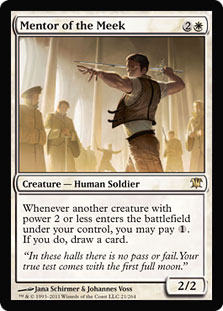
Mentor of the Meek

That's right, not only do we have the engine of Puresteel Paladin but now we have Mentor of the Meek! Any time you are building a combo deck the goal is to try to have eight copies of the same card. This ensures that you should statistically draw one of the eight copies over the course of each game. It is for this reason that Splinter Twin in Modern is a much better deck than in Standard. They are basically the same accept that in Modern you can run Kiki-Jiki the Mirror Breaker as well as Splinter Twin and Pestermite as well as Deciever Exarch. Most builds do not run the full sixteen cards for the combo but only because they also run a bunch of cards like Preordain and Ponder.

For us though, Mentor of the Meek is amazing! With him costing three mana though, most likely we will just have to tap out for him on turn three and try to make sure he survives until we can play some guys and draw some cards the turn after.

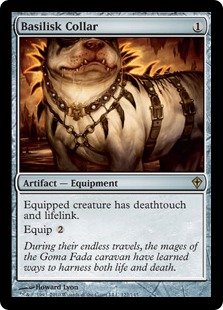
What cards do we actually lose from this deck? Not very many. The most important card we lose is Basilisk Collar. What it does for the deck is simply amazing.

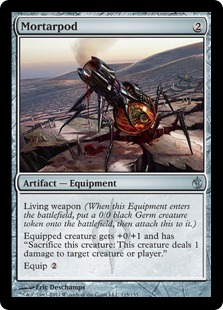
Basilisk CollarMortarpod

Combining the two equipment is a combo that some decks just can't beat. I am sad to see the collar go from the deck. My only hope here is that maybe Innistrad will give us something comparable. We also lose Preordain, but Ponder can just fit in that spot at least for testing this new version. Yes Squadron Hawk is finally gone from the format but at least for us we have Mentor of the Meek to put in that spot. Other than that, we do lose Celestial Colonnade but that's it. The rest of the deck is in tact if we want it to be. The deck will need to be adjusted according to the metagame and how good it will be will be determined by the other decks in the format.

New Voltron might look like the following:

Innistrad Standard Voltron

Untitled Deck

Creatures

2 Etched Champion
4 Puresteel Paladin
4 Mentor of the Meek
2 Trinket Mage

Equipment

3 Flayer Husk
4 Mortarpod
1 Sylvok Lifestaff
1 Accorders Shield
3 Sword of Feast and Famine
3 Sword of War and Peace

Spells

1 Mox Opal
4 Ponder
4 Dispatch
2 Oblivion Ring

Lands

4 Glacial Fortress
3 Inkmoth Nexus
1 Island
10 Plains
4 Seachrome Coast

There are some things we need to take into consideration. First, the whole set is not spoiled yet so we may get some new card to run. Second, just because this deck is viable right now does not mean that will continue to be viable in a new metagame. With the power of our two card drawing engines and all the swords, this deck could be very good but we will have to see.

Sweet new Innistrad cards!

There are a few new cards that perk my interest more than the others so far but every time I start thinking about new Standard the first thing that comes to mind is Garruk Primal Hunter. The amount of love I have for him is unreal. The card is so amazing and if there is a way to make him work in the new environment, trust me when I say I will be working to find it. His power level is significantly high enough that he is worth developing a deck for.

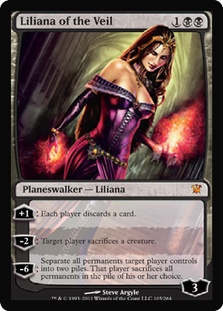
What about actual Innistrad cards though? Sure my first thought is about new awesome Garruk but the second thought is about his buddy Liliana of the Veil.

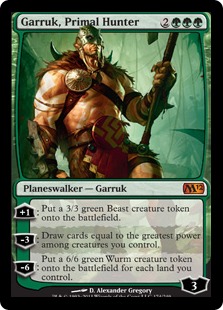
Liliana of the VeilGarruk, Primal Hunter

I think the two of them might not just go together in the storyline but also in deck construction. Thinking about playing the two of them in a deck together is like players who love old school Rock decks finally realizing their dreams of playing that deck again. Many of the pieces are going to be available for that deck. Despise, Birds of Paradise, Dismember, Titans, and then the two planeswalkers. What level planeswalker are you by the way? That is a subject for another day but Garruk and Liliana might make the core of a solid Rock deck. I think in order for Liliana of the Veil to be truly playable we need to see a Zombify or Dread Return reprint. My call is one of those two cards in this set. I suppose we could have a functional reprint but there seems no point to that in my opinion. I want to play with my cool textless Zombifys or use the flashback mechanic that is already present in the block from Dread Return. What could we reanimate? There are many options but Grave Titan is an obvious one because he is certainly castable in the deck but having him on turn three would be amazing. (Birds of Paradise, Liliana of the Veil, then Zombify would get us turn three)

There are certainly other ways Liliana of the Veil could be used. Take a look at this new card.

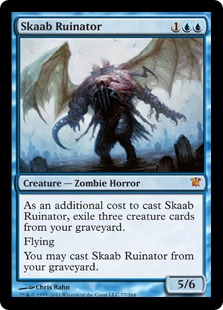
Skaab Ruinator

This flying zombie monster is like a Vengevine Tombstalker hybrid but not as good as either. I think that the drawback on this card is too much. There might be a way to make it work with some of the new cards we don't know about but three creatures is a lot. I would say on average if you are milling yourself three creatures amounts to about seven cards from your library. If you are discarding them from your hand, why? That doesn't seem productive to me. I think the best use of this card is not discarding to Liliana of the Veil but playing him in a Birthing Pod deck. With Birthing Pod you want to be sacrificing a bunch of creatures so it is feasible that you would want Skaab Ruinator in a deck like that if you have blue mana. I am sure we will find more ways to use both Liliana of the Veil and Skaab Ruinator as we see more of the set. Both are high power level and both do things not often found on magic cards.

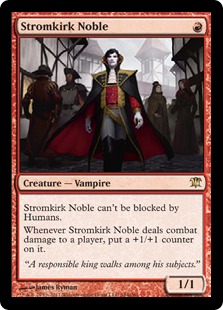
Stormkirk Noble

The final card I want to talk about today is the most aggressive creature in the set so far. Red Deck Wins has been on my mind due to the similarities between this card and Slith Firewalker from original Mirroden Block. Haste is different than costing less mana but they do the same thing and the first time they can attack is the same turn. Slith Firewalker is still better but his power level was very high for the time. If RDW has a chance of working, I think it is with this guy in the list somewhere. You can even play Volt Charge if you really want to in order to remove a blocker and make him bigger.

The format is changing. Tempered Steel is basically in tact but all the other aggro decks are going to have to find new life. There is certainly room for innovation in the aggro department, as well as basically every other deck type as well. Once Innistrad is legal we will have a whole new format to explore. Most decks will simply not be viable and we will have room to create new decks.

So until next time, get ready to Unleash the Force on new Standard!

Mike Lanigan

MtgJedi on Twitter

Jedicouncilman23@gmail.com

Planeswalker Points and You

Are you a Quiet Speculation member?

If not, now is a perfect time to join up! Our powerful tools, breaking-news analysis, and exclusive Discord channel will make sure you stay up to date and ahead of the curve.

Joshua breaks down the new Planeswalker Point system, analyzing what these and the SCG Open Series changes mean for you.

The DCI replacing the old Elo-style ratings with a new point system has caused a drastic change in how events are perceived. Now, instead of sitting on their rating, players are encouraged to grind out events. Furthermore, the changes to the StarCityGames Open Series will have a major impact on the event choices of American players.

So let's look at what's changed and then we'll analyze what this means for PT-gunning players.

Overview

An event gets participation points based on the number of players. An 8-man event starts out with 1 point. Every time a power of two is reached (16, 32, 64, etc.), the event gains one participation point, eventually maxing out at 9 points for 2048 or more players.

Every win in an event gets you 3 points, while every draw awards you 1.

Those are the baseline points for every event. Depending on what kind of event it is, however, there will be a multiplier attached.

  • Most "local" events and tournament side events will simply be 1x.
  • Game Day events are 2x, as are WPN Premium Qualifiers.
  • FNM is 3x, as are GPTs and various WPN Premium events (for Americans, it's important to note that this is where SCG Opens are).
  • PTQs and National Qualifiers are 5x.
  • Grands Prix and Nationals are 8x.
  • Pro Tours and the World Championships are 12x, with a bonus given to top 8 finishers of the PT.

With the exception of the weird overemphasis on FNM, it's clear that the best way to rack up points is to play in high-level events. The fact that FNM is now a 3x event, however, means that skipping FNM is no longer a real option for people who are trying to qualify or earn byes off their rating.

Why Bother?

Lifetime points are—currently—completely meaningless, save for the label you get attached to your name. What is important are the seasonal totals. To view this on the Planeswalker Points page, select "Leaderboard", "Competitive", then, in the drop-down boxes on the left, select the current season instead of "All Time" and click "Filter".

Each season, the top 100 players, with some split by region, gets an invite to the Pro Tour. The top 300 players in a season get three byes to every Grand Prix in the next season. The top 2000 get two byes, and the top 15000 get one.

Of course, PTQs and GPTs continue to exist, so you don't have to grind rating if you don't want.

StarCityGames Open Series

StarCityGames has changed the point thresholds and prize payout in the Open Series. This image shows the point cutoffs.

The most important takeaway here is that there is absolutely no way to qualify for an Invitational off points until you get all the way up to 60 SCGO Points—a feat bordering on impossible unless you do something that would put you into an Invitational in the first place!

This means that grinding the Open Series is no longer a good idea.

The smart thing to do is attend your local SCG IQs and the local SCG Opens (people who played in SCG Atlanta last week scored 21 Planeswalker participation Points for Standard and 15 for Legacy), but flying around the country attending Opens makes very little sense unless you're merely a hair shy of 60 SCGO Points.

Save your money.

Instead, fly to Grand Prix events. Let's compare a real-world example:

  • I went 7-2 at SCG Richmond, earning 18 participation points and 9 points per win, for a total of 81 points.
  • I went 5-3 (including a first-round bye) on day one of Grand Prix Nashville last year. That got me 64 participation points alone, and 24 points per win, for a total of 184 points.

GPs now have a better prize structure and pay out Professional points as well, which can add up to a Worlds invite.

Pro Tour Qualifiers

The 5x multiplier on these mean that, while they may have a lower base participation score, you'll still get 20-25 points for playing in a typical PTQ. On top of that, wins rack up 15 points, so going 4-3 in a 64-127 player PTQ will be an 80 point boost to your total.

Naturally, making Top 8 and winning more will get you more points.

I had 9 wins in a PTQ last year, which was a 155-point payday for me. Obviously, if you win the PTQ, you won't need the points to score the invite anyway, but having the byes to GPs in the same season will help you stay on the train.

General Strategy

Obviously, you want to be playing in your local FNM every week. It's a bushel of points always available without much travel for most of the US.

In some places, however, it's simply not going to be feasible to do this. People living in these areas should consider traveling early enough to major events so that they may hit up nearby FNMs for more points.

Ideally, you'll also be picking events in locations with more players and more rounds so you can get more participation points and have more opportunities to win. The big problem here is that many players—myself included—preferred to skip FNM the night before big events, preferring the extra sleep. That now seems to be a bad idea.

Dropping is not an option for serious players anymore, either.

Where Planeswalker Points are concerned, dropping from a high-multiplier event to play in a lower-multiplier event is a poor decision. If you know you're clearly out of contention or are safely in the point range you need to be in for your seasonal goal, you can drop if you wish, but grinding out the points is otherwise a necessity.

This is going to be a downright miserable sealed deck PTQ season for precisely this reason. If you open a marginal pool, you're going to be forced to tough it out for the rest of the day even upon being eliminated. If you're out of contention, consider using the remaining rounds to experiment with your deck while trying to grind out wins and stave off the misery.

Remember that if you're sitting at the 2-3 table, your opponent is as well, and his deck is probably just as bad as yours.

Event Selection

If you're qualified for a Pro Tour, Worlds, or a National Championship, you should obviously attend it, especially since now there is no way to qualify for the PT or Worlds that doesn't come with a flight attached.

The next level down are various third-party, high-dollar tournaments, mostly because you're playing in these for money rather than points. The SCG Invitationals and TCGPlayer.com Championships are the best examples of this, though the TCGPlayer.com championship was marred by the event being far too short compared to the number of byes handed out.

3-round byes simply shouldn't exist in a 9-round event.

If you can make it to a Grand Prix, you should.

The cash payout isn't bad. If you have any byes, those give you 24 points each, letting you freeroll 88/112/136 points just for showing up. The entry fee is minimal compared to the cost of traveling to the event and staying in a hotel (most of the time), so worrying about whether it's constructed or limited tends to miss the point. With Wizards saying there will be approximately 20 North American GPs next year, it should be possible for anyone who's been grinding the SCG Open circuit this year to easily make it to 5-10 GPs next year.

The next priority is the PTQ circuit. It's still an open question whether attending GPs is a better decision than attending PTQs, but the fact that GPs pay out Professional Points as well has me inclined to choose GPs for the meantime, especially if the Pro Players' Club remains intact, which has yet to be revealed.

However, once we have a couple of seasons' worth of data to look at, it should be possible to figure out which ones are the better choices in a more general sense. Naturally, if you've given up on making it on points, PTQs are a much better decision in terms of qualifying (though not in terms of money!), and it's possible that even if you do care about points you're better off going to a local PTQ than taking a long trip to a GP in which you don't have byes. If I had to guess, as a rule of thumb, I'd put the line at 2 byes to attend GPs and people with 0 or 1 bye to go to PTQs instead, but that's purely a guess.

After PTQs come the StarCityGames Open weekends. If you've got one nearby, it makes sense to go to those since they do pay out reasonably well in cash, especially if attendance goes down and the field becomes softer due to the reduction in top players flying around to all of them. The 3x multiplier, while equal to FNM, does get better as the player count and round count go up.

One thing to note about the SCG Open weekends is that on Sunday, due to the Draft Opens being 3x, you can actually drop from the Legacy Open if you're doing poorly and go draft instead. You'll even pick up more participation points this way.

After all this, you should attend GP Trials when available, since they're also 3x events, but importantly, the byes to a GP give you a much better shot at making the prize , or even just day two for more rounds and more points.

It may seem a bit silly to play in one of these if you already have byes, but if you're fighting for points and it's the best option available for the weekend, there's little reason not to. Ideally, however, if you already have three byes, you've hopefully already won the money to fly to some event which has better prizes than a GPT.

SCG Invitational Qualifiers are a decent choice if you can't make it to anything bigger, since the SCG Invitationals themselves have an amazing cash payout relative to the number of players in them. If you're level two or three in the SCG Open Series this year, you'll be invited to one or two Invitationals of your choice next year.

But there are a staggering four of them—and you want to make them all if possible.

To summarize, you can get in by winning an IQ, by making Top 8 of a Standard or Legacy Open, or by winning a Draft Open. The other way is to make it to 60 next year or be level 5+ this year, and that'll get you into all four of them.

Minor Events

Random 8-man events are extremely bad value under the new system. Consider this hypothetical:

You're 0-3 in a SCG Open or a PTQ, and you want to drop to go play in a side event. If you go 3-0 in an 8-man draft or a constructed 8-man win-a-box event, you get 1 point for participation and 3 points for each win, netting a total of 10 points. Meanwhile, if you had continued playing in the main event and won two rounds in the entire day, you'd have scored 18 points.

Even slightly larger events, such as local Standard or Legacy tournaments throughout the week, only score a few additional points over the baseline. Wizards' system, despite its flaws, managed to create a world where grinding a bunch of events at a local shop won't be worth very many points, successfully avoiding punishing people who live near a shop that only runs FNM.

Since Legacy is not currently a legal FNM format, it won't receive 3x events at local shops, which could cause Legacy’s appeal to slowly deteriorate for those aiming for points, especially outside of the United States. It has been confirmed that the SCG Open series will continue to keep running Legacy on Sunday, so it's unlikely to see a meaningful drop in popularity in the US.

When an entire event is worth less than a single round of FNM, it's not worth it to spend a bunch of money on entry fees just to grind out points unless you already know you're right on the line of making it or not. And if that's the case, you're still better off just biting the bullet and flying to a random PTQ somewhere you normally wouldn't go.

Conclusion

This system heavily rewards actively playing the game rather than sitting on rating, but doesn't promote spending every single day of your life at the local cardshop playing 8-man drafts.

Overall, the system seems like a great improvement over the prior system, and the mathematical purists can still go to www.thedci.com and look up their rating under the old system—it just doesn't count for anything, much like the Lifetime points under the new system.

Looking at point totals for previous seasons isn't really very instructive. Players who care about points won't be dropping from events with a 3x or higher multiplier, so the number of points needed to make a particular level will go up. This season will help a little bit, but, due to the fact that it doesn't have the massive number of GPs that we'll be seeing next year, the cutoffs to the various levels will be a lot higher.


Joshua Justice

Joshua Justice is a Magic player in Atlanta who's been to the Pro Tour twice. College put him on hiatus from the game until January 2010, and 5 months later he won his first Pro Tour invite with Super Friends. After a series of narrow misses in the second half of the year, Joshua won a GPT and used that to make top 16 of Grand Prix: Atlanta and secure his second Pro Tour invite in just over a year. While Nagoya was a bust, Joshua has been grinding points on the SCG Open Series, and is a virtual lock for the second Invitational. His focus is primarily on metagaming and deck tuning, and partially-open formats are his favorite playground.

View More By Joshua Justice

Posted in Free, StrategyTagged , 13 Comments on Planeswalker Points and You

Have you joined the Quiet Speculation Discord?

If you haven't, you're leaving value on the table! Join our community of experts, enthusiasts, entertainers, and educators and enjoy exclusive podcasts, questions asked and answered, trades, sales, and everything else Discord has to offer.

Want to create content with Quiet Speculation?

All you need to succeed is a passion for Magic: The Gathering, and the ability to write coherently. Share your knowledge of MTG and how you leverage it to win games, get value from your cards – or even turn a profit.

Insider: Stinky, Homeless Fetch Lands

Are you a Quiet Speculation member?

If not, now is a perfect time to join up! Our powerful tools, breaking-news analysis, and exclusive Discord channel will make sure you stay up to date and ahead of the curve.

G'day stränga.

Lets jump right in.

This week LEDless Dredge managed to take down the SCG 5k.

Dredge by Michael Morrissey

Creatures

4 Golgari Grave-Troll
4 Golgari Thug
4 Ichorid
4 Narcomoeba
4 Phantasmagorian
4 Stinkweed Imp
4 Street Wraith

Enchantments

4 Bridge from Below

Instants

1 Darkblast

Sorceries

4 Breakthrough
4 Cabal Therapy
4 Careful Study
2 Dread Return

Lands

4 Cephalid Coliseum
4 City of Brass
4 Gemstone Mine
1 Tarnished Citadel

Sideboard

1 Ancestors Chosen
1 Angel of Despair
1 Flame-Kin Zealot
4 Ancient Grudge
4 Natures Claim
2 Ray of Revelation
1 Elesh Norn, Grand Cenobite
1 Iona, Shield of Emeria

Every time I see Dredge win I always look in the mirror and say, "How did this happen?"

Have you ever hated someone?

Think hard about the person you hate.

I'm not talking a strong dislike.

I want you to visualize someone that makes your blood boil.

Think of why you hate that person.

You can't quite pick one singular thing, can you?

One day I was in a friends brand new Ford Mustang. We were driving down one of the busier streets in downtown Minneapolis, when all of a sudden we hear someone yell. We look around and see a very intoxicated man.

This man wasn't just drunk.

I'm surprised he was even able to stand let alone speak.

We rolled down the windows and asked him what he was screaming.
He yelled something like this,

"WRYYOU DRUUVEPONDEY!"

Ridin' My Poney

"What!?" My friend replied.

We got out of the car to see if he was okay. We thought he might be in trouble or need help.

We walked over to the man and stood about 5 feet from him when he lunged forward and yelled, "WHY DO YOU DRIVE A PONY!"

He then threw his empty glass bottle at the side of my friends Mustang.

Did I mention what my friend does for a living?

He fights.

http://www.youtube.com/watch?v=IVMKQP0K3a0

He travels the country doing MMA.

He doesn't like having things thrown at his new car.

Needless to say, some intervention from local police helped handle the situation. My friend got lucky and was just asked to go home.

That drunk (homeless?) guy is the person I hate.

When I picture someone I hate, I picture a disrespectful, dirty, smelly, loud, 55+ year old man.

When I see Dredge, I picture that man.

My friend and I gave him a chance. We thought he needed help. Should we really have stopped to help?

That old drunk is how I feel about Dredge.

I gave it a chance, I own Dredge cards, and I even had them all in sleeves at one point to play it. I then saw the look on my opponents faces as I won the die roll and took the draw. I watched people get stomped by my hard cast Narcomeba as they kept a hand full of Graveyard hate, sans pressure.

Dredge is a deck that, if you aren't prepared for, will disrespect you. Dredge will take your mother on a beautiful date, tell her it had a great time, and then never call her again. If you don't know how to play against it, it will make you regret introducing them in the first place.

Dredge is good because it has a very good game one against nearly everything. Post-sideboard the hate packages come in, if they have any. After moving hate intro your deck, Dredge isn't so bad.

All the Steps

Picture Relic of Progenitus, and Tormod's Crypt as a shower. Give a stinky homeless man a shower and he will smell better. His clothes will still stink and you will still be able to clearly tell he is homeless, but at least you can focus and give attention properly.

Think of Leyline of the Void as a shower, an AA meeting and a job. You get the picture.

The best hate against Dredge is something that stops them before they can really even try.

Okay

Stop picturing the person you hate.

This new Dredge list has a sideboard filled with all kinds of answers to an opponent's hate. This is not something to hate.

It's something to fear.

I like that the list has eight answers to [card Tormod's Crypt]Crypt[/card]. I strong>LOVE that it has six answers to Leyline of the Void. This drunken homeless man (Dredge) came prepared to battle.

You give it a shower and it runs off in the dirt. You take it to an AA meeting and give it a job, then it steals your alcohol and gets you fired from your job.

This deck is sweet.

I would recommend picking up your Foil Phantasmagorians now before they get hard to find.

I think this deck will be tried by a ton of people and could even be the new face Dredge has been needing for awhile now.

I don't hate this list.

I actually like it.

If you have never tried to play Legacy Dredge, I recommend you try. But know it is very narrow and doesn't have a whole bunch of interaction. Kind of like an undisturbed homeless man.

Is This the Future?


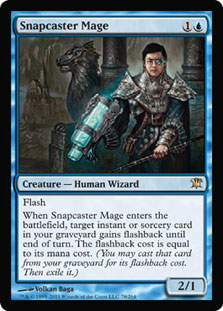
Snapcaster Mage.

I LOVE this card.

I've been brewing it inside of a BUG shell. So far its proven to be pretty good and I'm really excited to play with this card in multiple formats.

I found a set right away for really cheap, at between $5 and $7 each for the set, but I wouldn't pay the requested price tag ($17.49 at SCG) right now.

Being a rare in the first set of a block that has a limited PTQ season means that the non-mythics will eventually find a relatively low price tag. A ton of Innistrad packs will be opened at PTQs and major events this year.

The cards will flood the market for a while and we will see these cards be at a reasonable price after the pre-order dust has settled.

Fetch

A lot of people in my area have been talking about how Zendikar Fetchlands are going to go up in value. Some people have even gone as far to buy them now.

I don't think now is the time to buy.

Give it time.

When Zendikar rotates from Standard, a ton of these will hit the trading room floor. Pick them up when you see them them in peoples' trade binders.

The Onslaught fetches took a lot of time to go up. The Zendikar ones will not take nearly as long, but they will go down before any rise in price is seen.

NOTE: I still don't believe Modern will survive, so the price hike from Modern will end soon enough and the fetches will settle down again.

So let's take a look at the current prices:

Misty Rainforest - $15.99 on SCG

The UG fetchland has been proclaimed as the best of the enemy fetches. Expect these will go as low as $11 before they start to rise.

Scalding Tarn - $17.99 on SCG

I was actually a little surprised to see the UR fetchland have such a high tag. This has to be a result of Modern. Like I said before, Modern won't survive. Just wait it out and these will go down. I see them all the time for around $12 in trades.

Arid Mesa - $12.99 on SCG

This fetchland's tag is about right where I would like to see all of the fetches. Arid Mesa doesn't see much eternal play so don't go over board on these. There are a ton of them out there and I know you can get them in trades for an easy $10. This one is fine to pick up at around $8-$10. I doubt they will ever go much lower than that.

Marsh Flats - $11.99 on SCG

Just like Arid Mesa, this fetch doesn't see much Eternal play. But one thing is different: It fetches for a Plains and a Swamp. For some reason, every single WB card ever has continued to hold a good value, as casual players love it (see: Deadguy Ale). It was actually harder for me to find these than any of the other fetch, and I'd suspect these to be about the same price as Arid Mesa but harder to find.

Verdant Catacombs - $11.99 on SCG

My favorite of the enemy fetches. This one is a sleeper. A ton of Legacy decks are already playing it. I know this is in the Vampires Event Deck, but that's merely another excuse to get them really cheap. Pick these up at $10 and you will not regret it.

Checklist

This week on the checklist we will focus on some lands. I talked about fetches earlier, so why not aim at more?

Bojuka Bog - $0.25 on SCG

A land that hates on one of the most powerful zones in the game. AWESOME! These are easy to find right now because it was printed semi recently. I recommend buying a few sets of these now, as I bought a ton of foils that I will be sitting on for quite some time. The next few years will make them harder to find.

Maze of Ith - $34.99 on SCG

Maze was cheap for a long time and only recently shot up quite a bit. It's not seeing a ton of play right now, but when it does it will skyrocket. Pick them up in trades for around $30 and just wait.

Creeping Tar Pit - $4.99 on SCG

Don't buy this card right now. Wait a few weeks, and as soon as it rotates from Standard, snap them up. Keep an eye out for people trying to unload these at almost nothing. This card will be a 1-2 of in some decks in Legacy for awhile. It makes both Black and Blue and easily kills Jace, the Mind Sculptor with hardly an issue.

Until Next Time…

Get ready for the rotation! Have some bankroll ready to buy some staples on the cheap.

If you’re not having fun, you’re not risking anything.

Please feel free to post question in the comments or email me.

-Mike Hawthorne
Twitter: Gamble4Value
Email: MTG_Mike@live.com

Underplayed and Unappreciated

Are you a Quiet Speculation member?

If not, now is a perfect time to join up! Our powerful tools, breaking-news analysis, and exclusive Discord channel will make sure you stay up to date and ahead of the curve.

First and foremost, I'd like to take a chance to thank everyone that made Magic Weekend Philadelphia awesome! There were infinite Commander games to be played, tons of great people to meet, and lots of fun to be had in various side events. Special thanks to @the_stybs and @CMDRdecks for some especially intense games over the course of the weekend! This coming weekend I'll be making the trip to Grand Prix Montreal. I can't wait to meet the Canadian Twitter crowd, and I'm hoping to even get in some Commander while I'm up there!

This week I wanted to take some time to talk about underplayed Commanders. There are currently 466 legendary creatures which you could use as your Commander, and it's sort of interesting to think about just how many actually get used. Especially with the over-emphasis (at least in my group) on Blue and Green, there are some colors that get completely ignored, much less specific generals in those colors. One of the most exciting things about this format is that there's always something new to do - there are cards that hardly ever see play as generals, much less as singletons in your 99!

What I wanted to do this week was take a chance to talk up some of my favorite legends that I haven't seen very much of, and to ask other people what their favorite underplayed legends are. Before we get started though, it's important to talk about what makes a Legend underplayed. Typically, underplayed refers to a card that sees relatively little play compared to other similar cards, but you have to decide what metric to use to define what is "similar." Typically, power-level is the metric that's used, but for this format you could also talk about how much fun a card is to play with, or how flavorful a card is. I'll be discussing a couple of legends fitting into each of these categories, and hopefully I'll start seeing them around a little more! In no particular order:

1. Rosheen Meanderer

I can honestly say the only build of this I've ever seen is the one that my friend Jim built when we first heard about this format in college, and that deck was awesome! It turns out that there are an awful lot of X spells in the history of the game, and most of them are awesome, especially the newer ones. Now, if you want to cast gigantic X Spells, Rosheen Meanderer is not the most efficient way to do it; the "best" way to do it is probably Wort, the Raidmother plus mana ramp. However, Rosheen Meanderer makes for an awesome theme deck, and lets you play with cards like Instill Energy rather than just typical mana ramp and Mana Reflections.

If you take a look at some of the X Spells that are available in Red/Green, there are some pretty awesome things I'd like to power out with Rosheen Meanderer, like Comet Storm, Gelatinous Genesis, and Wurmcalling, and some sweet things that I want to power them out with, like Quirion Ranger and Provoke. Even something like Green Sun's Zenith becomes an even more powerful utility card than it typically is. You can even do some cute things like run Blazing Shoal and Untamed Might, and go for the General Damage kill.

The important question is what other kinds of things are necessary to make the deck more resilient? A Wort, the Raidmother deck gets some resiliency to countermagic just because of her ability, and has pseudo haste if you can afford to cast Wort and then cast a spell. Along with being less narrow, it's these two things that make [card Wort, the Raidmother]Wort[/card] so much more powerful, and it's these things that a Rosheen Meanderer deck should try to emulate. Things like Boseiju, Who Shelters All will protect you from countermagic, and things like Instill Energy and Hall of the Bandit Lord will give your Meanderer haste so you can use him as a ritual to cast a giant burn spell the turn you drop your Commander.

2. Kaervek, the Merciless

I'm a huge fan of Commanders and decks that are more proactive. Way too many of my decks, and most of the decks I play against on a regular basis, are value-engine decks that grind out single cards over a very long game. While these games can be very interesting, and very skill intensive, it's not something that I'm interested in doing on a regular basis. I much prefer games where there are one or two players at the table who are the aggressors, and one or two people who are the controlling players. Kaervek, the Merciless is interesting because it allows you to put pressure on the table in a number of ways. Once you hit seven mana and drop Kaervek, the game is going to end very, very quickly. He's just going to dominate the board, and you can build your deck around speeding the game along to that state.

Something else that you can consider is running lots of cards like Manabarbs and Citadel of Pain to punish people regardless of whether they're casting spells or not. This can put an incredible amount of pressure on the table to answer Kaervek or die. Depending on what you're trying to beat, you can build a land destruction, discard, or removal deck to make Kaervek more difficult to answer. The deck is great at changing up the dynamics of a fairly stale table since you are, in essence, changing the rules of the game by making life a more valuable resources rather than cards. I definitely would recommend something similar if you're tired of ramp decks and attrition decks!

3. Yosei, the Morning Star, Mangara of Corondor, Hokori, Dust Drinker

These are a few different Commanders that I wanted to talk about, and started writing about individually before I realized that the engines that make them all run are very similar, and that I could condense them to fit more content! The two things that each of these Commanders have in common are:

  1. You're going to want ways to sacrifice them at will so you can better take advantage of them
  2. You want as many ways to recur them as possible

With [card Yosei, the Morning Star]Yosei[/card], this means you can lock one or more players out of the game, with [card Mangara of Corondor]Mangara[/card], you get to exile problematic permanents as necessary, and with [card Hokori, Dust Drinker]Hokori[/card], you get to Winter Orb everyone but you!These are all very powerful effects, and are well positioned to take advantage of some of the most powerful engines in white, like Emeria, the Sky Ruin, and maybe Enduring Renewal. However, what's more interesting than what these have in common is what is different.

Yosei, the Morning Star has an incredible late game because you can just lock multiple players out of the game with Enduring Renewal and mana, or Nim Deathmantle and Ashnod's Altar. The name of the game is how many times can I kill Yosei on my turn. You'd be surprised with what the answer is. A Yosei deck is going to have a very powerful late game, just by nature of your general making it very difficult to interact with you when you decide to start locking people down. That said, you're going to have to back up your late game plan with lots of sweepers and spot removal so that you don't just lose the early game when someone gets out of hand.

Mangara of Corondor, on the other hand, is in need of a late-game win condition. You have all the removal you could need, since your general is a recursive removal spell, even if you're not eking extra activations out of him with Thousand-Year Elixir and Puppet Strings. This is a deck that can take great advantage of cards like Sun Titan, and will have no problem keeping the game from getting too out of hand. Giving [card Mangara of Corondor]Mangara[/card] haste is very powerful, and will make Hall of the Bandit Lord worth running. The biggest problem with this deck has to be finding a way to actually close out games, probably with something like Sacred Mesa or Luminarch Ascension.

Hokori, Dust Drinker is the epitome of unfun cards, but it's something that's very powerful which is why I'm not sure why it doesn't see more play. You can easily build your deck to mitigate the impact of Hokori on your own development, with various mana rocks, sacrifice outlets, and Sword of Feast and Famine. Enough recursion will allow you to sacrifice Hokori, untap, and then play him again. It seems like there are two ways to go with this, either a longer, grindy game that ends with Iona, Shield of Emeria or some such, or a Voltron beatdown deck that's very difficult to disrupt. Both seem very powerful, and I'm surprised I haven't seen it before.

4. Vorinclex, Voice of Hunger

This is another really powerful general who I haven't seen much of. It's certainly not very much fun to play against, but it's a very powerful effect that solves some of the problems that green ramp tends to have since Emrakul was banned, namely that your threats are typically very easy to answer. Vorinclex protects himself in a way, and you can build yourself in such a way that makes him even harder to answer, specifically by including Vedalken Orrery and Winding Canyons in your deck, so that you can float mana in response to removal, and then recast Vorinclex. And really, most Green decks should be playing Winding Canyons anyway, for sheer utility.

Typically, people trying to beat Vorinclex have a very small window in which to do so before it just becomes too hard. Witj all the gigantic bombs that he enables,  all you really need to do is protect him for a turn or two and the game should be pretty close to over. Between Winding Canyons and [card Swiftfoot Boots]Das Boots[/card] it shouldn't be too hard to protect your Praetor. The biggest problem that you're going to have is efficient, targeted removal, and that's what your boots are for!

5. Ertai, the Corrupted

Ertai, the Corrupted is interesting in that he is very powerful, but frequently overshadowed by the other legends in the Esper shard. He's very capable of taking advantage of a number of the powerful cards in that color combination, and can certainly be built around (with cards like Thornbite Staff and Hatching Plans). Thornbite Staff is especially powerful with cards like Reassembling Skeleton, Nether Traitor, and Bloodghast. The biggest problems with Ertai are going to be finding ways to close out the game instead of just keeping the game under control, and making sure you get Ertai out early enough that someone doesn't run away with the early game. This shard has more than enough removal to accomplish that.

Cards like Zur the Enchanter would let you find key cards like Hatching Plans or even Spirit Loop. Nomad Mythmaker could be very powerful if you can find auras you want to play. Even Fool's Demise is kind of awesome for protecting Ertai! There are a ton of interesting things that you can do that take advantage of the cost of Ertai's ability to generate all kinds of card advantage.

So there you have it, five Commanders that are underplayed and undervalued. They all enable you to do interesting and powerful things that should be fun for you, if not for the rest of the table, and I'm hoping that the discussion, on twitter, and elsewhere, will encourage even more unique takes on the format in the future! I'm interested to hear what other people think are undervalued Commanders, and the interactions that you think make them powerful. I've already gotten a ton of answers from Twitter, and I'm looking forward to seeing some more in the comments!

Carlos Gutierrez
cag5383@gmail.com
@cag5383 on Twitter

Insider: Researching Ravnica, Part 2

Are you a Quiet Speculation member?

If not, now is a perfect time to join up! Our powerful tools, breaking-news analysis, and exclusive Discord channel will make sure you stay up to date and ahead of the curve.

This article marks the second half of our review of Ravnica: City of Guilds. Last week, we saw some power uncommons and surprisingly-valuable casual cards. This week, we'll get into heavy hitters like shocklands and more! Let's take a look...

$20.00

The shock-Bayou has been a perennially-popular land in competitive play. For example, it showed up in plenty of Rock decks in older Extended seasons, and these days in Modern, it powers out other decks like Melira/Birthing Pod. If I'm ranking the value of the shock-duals, this one comes in right under anything that makes blue mana. Casual players love the Golgari color combination, since it turns on things like Pernicious Deed and you can use Elves to accelerate into Visara, The [card]Dreadful. A solid card that hasn't broken the top tier of shockland pricing; this one has yet to reach $25.


$4.75

This is another hidden superstar in the set. To understand its power, all you must do is play against it once in Commander. The card singlehandedly deflects all the frustrating removal spells to other people. Your Kor Haven stays on the table, your Altar of Dementia lasts another day. Getting rid of a problem permanent usually means that two players have to work in concord, which is challenging enough if they have the removal spells in hand already.

I was surprised by the price on Privileged Position and I reckon that a lot of traders don't know that this thing has climbed as far as it has.


$1.25

When Remand was developed, designers said they considered that it might get block play, but wouldn't become anything greater. Boy, were they wrong! Remand has been an iconic, powerful counterspell since its printing. On its face, Remand looks kind of bad – don't they just get to cast that spell again next turn? In practice though, Remand is much greater. In the early game, it sends back a monster and draws you a card. In effect, it's a Time Walk. Even in later turns, Remand can soak up an opponent's excess mana, tapping them out of removal options. It has superb applications in Storm combo because you can send back the original spell and then cast it again. It is this engine that powers up the Modern Pyromancer Ascension deck. Who cares if they can cast the spell again next turn? They'll be dead by then!


$16.00

The Boros land has also seen play since printing, since it enables the Zoo archetype in multiple formats. Zoo cares about white mana, and its importance has increased over the years. At first, it was just for Lightning Helix. Later came Path to Exile and Wild Nacatl, both cards rewarding you for having a Plains around. White mana also enables Qasali Pridemage, one of the most influential cards in Zoo. Sacred Foundry doesn't get a lot of casual love, since W/R is an unpopular color combination; it's pretty boring. Foundry is reasonably priced, but I could see it going up if we see another Modern deck utilizing the color combo.


$17.00

The shocklands from the base Ravnica set are all a little less expensive than their expansion counterparts, simply because they were opened in far greater quantities. Temple Garden supports the most boring color combination, but luckily, some competitive decks care about Savannahs. Zoo runs one, and several other decks (like Melira) also go to the Garden for mana now and then. Because of low casual appeal and easy access, I don't see Temple Garden breaking past its current price.


$22.00

As an aside, my auto-complete called this “Watery Grave-Troll.”

Dimir was held back in Ravnica, for the express reason that we had just seen what Psychatog could do in the same color combination. While other colors got hits like Lightning Helix and Vitu-Ghazi, the City Tree, Dimir got plain nothing. The primary mechanism for Dimir was milling, and all of the milling cards, save Glimpse the Unthinkable, were terrible and unplayable outside of draft. I don't fault Wizards for holding the guild back, but I would have preferred they focus on other U/B color themes. For example, both colors have creatures that are hard to block; why not make some Phantom Warriors and guys with Fear? What about cards that could have stolen the enemy's previously-played spells? We didn't see things like Memory Plunder until much later, and Dimir would have been a thematic home for the sneaky spell-thieves of the house.

Watery Grave doesn't see much play in Modern because the color combination is underpowered right now. It's hard to beat Steam Vents decks and Watery Grave cannot get us there alone. If cards are banned in September, we could easily see Watery Grave pick up because if there is a control deck, it will be running these two colors. It's a fine card to pick up and hold onto.

That rounds out Ravnica, but stay posted for next week's look at Guildpact! Until then,

Douglas Linn

p.s. I am trying out a new format/layout for the article series. Let me know if you think it makes it better to read!

Insider: Innistrad spoilers and Fetching a deal

Are you a Quiet Speculation member?

If not, now is a perfect time to join up! Our powerful tools, breaking-news analysis, and exclusive Discord channel will make sure you stay up to date and ahead of the curve.

We’re really deep in Innistrad spoilers now, and the set looks incredible.

Most unfortunately, I will not likely be able to play it as much as I would like to. My new full time job as a sports reporter at a large newspaper here in Oklahoma is pretty much sucking up all of my time, and I work Friday nights covering football.

This means no FNM for me (and makes me hate #pwpts even more). I also work Saturdays, although on a more flexible schedule. Overall, playing Magic and especially traveling to events just got a lot more difficult. Still, I’ll be playing as much Innistrad as I can, and there are a few cards from it I want to cover today before I move into the crux of this week’s piece – what to do with Fetchlands.

Next week I’ll be giving my full prerelease trading primer as usual. In the past I’ve called such risers as Tezzeret, Agent of Bolas, Timely Reinforcements and Spellskite before they’ve spiked, and I hope to have the same success this time around. That said, there’s a few things I wanted to weigh in on now, in order to be as timely as possible.

Find the full spoiler list here.

Day of Judgment

What? This isn’t an Innistad card! I know, but I just wanted to throw it out there. White Weenie is being pushed hard as an archetype, and I expect Day to become much more in demand. I don’t think we’ll see too much of a price increase, but more players are going to need it, so snag a few now so you’ll have them in stock.

Skaab Ruinator

Opinions are all over the place on this card. I’m going to wait to see the final spoilers to make a call, but I see this guy finding a home as a 1-2 of in Pod decks and (as of what we know now), not much else. Overhyped for now, but is still very powerful and worth being aware of.

Snapcaster Mage

Very good card. Not $20 good. We haven’t had a $20 rare since Stoneforge, and I don’t expect that to change.

Moorland Haunt

This card hasn’t been “officially” spoiled yet, but I’m pretty sure this card is insane. I haven’t seen much press about it yet, but this thing fits right into Neo-Cawblade lists to replace Tectonic Edge. Infinite Sword carriers seem pretty good. Keep an eye on what this things presells for when it becomes available, because it could very well be too low.

That’s all for now. I just wanted to hit on a few of the major discussion-provoking cards and let you know where I stand. Next week I’ll dive into the entire set and give you a full breakdown, but that’s enough for now.

The Curious Case of the Rising Fetchland

Conventional wisdom on the Zendikar fetches stated that their price would bottom out after rotation and then increase in perpetuity. However, following the trend of well, trends, occurring ahead of schedule, it looks like we’re already at that point.

Using Scalding Tarn and Misty Rainforest as our baseline, we see that the price bottomed out at the beginning of August and has started creeping upward since. This didn’t catch anyone’s attention until SCG raised the prices on their fetches, but even this has escaped a huge part of the Magic community. It’s possible (likely, even) that SCG used Modern to raise the prices on their fetches, but Modern isn’t going anywhere and, unlike so many speculative Modern cards, fetches aren’t going anywhere either.

Literally all the buzz in the last month has been centered around Modern (glad I covered that well in advance and advised getting out a few weeks before the bubble burst), and now it’s being dominated by Innistrad. There are very few players or authors paying attention to fetchlands, and you’re running out of time to move on these.

Pick up literally every single Zendikar fetch you can find for $12 or lower, and trade for them aggressively (ideally with overpriced Innistrad goodies), and you’ll be looking very good a few years from now. It remains to be seen if these experience a dropoff once they are actually rotated, but I’m of the opinion that they won’t. We won’t be seeing a better time to buy in, and there certainly isn’t going to be less demand for them in older formats as we move forward. I’ll be spending my Innistrad prerelease (if I’m able to attend one) trading for fetchlands.

So where are fetchlands going? We see that old ones in the best color combinations can push $25 (Flooded Strand). It will be awhile before Zendikar fetches get to that point, but they’ll likely see $15 in a year or so. There’s a few reasons I love lands so much. In addition to being awesome in game design (a resource AND a bonus? Sweet!), lands are also one of the most stable investments you can make in Magic. They aren’t going to eclipse Misty Rainforest in the “fetching a land” category anytime soon (and probably never), so there’s no downside to getting in on these now.

Not to mention that most people don’t even realize that the price on these has gone up.

The Dark is Rising

With Innistrad now just a week away, I’m excited to dig deep into the financials of the set once we have it fully spoiled next week. I’ll also have some exciting Prediction Tracker updates for you ready to go just in time for your prerelease. This move should give you the best possible knowledge to get ahead at the prerelease.

Until then, thanks as always for reading.

-       Corbin Hosler

@Choser88 on Twitter

The Devil’s Carpenter

Are you a Quiet Speculation member?

If not, now is a perfect time to join up! Our powerful tools, breaking-news analysis, and exclusive Discord channel will make sure you stay up to date and ahead of the curve.

A quick note before we get started this week: you can find some horrific car puns (see what I did there?) about using Innistrad's mechanics in Commander in last week's article here.

A few months ago the Commander Rules Committee unbanned Worldgorger Dragon, stating that since there were lots of other unbanned two card combos besides [card Worldgorger Dragon]Dragon[/card]-Animate Dead there was no reason to keep it on the list. A portion of the community objected to this, believing that whereas High Tide and Palinchron both have non-combo applications, [card Worldgorger Dragon]Worldgorger[/card] has none.

That's just not true.

The only problem was that, for a while, I couldn't find any either. Sure, you could use him as the worst Ghostway in history, but I was looking for a deck that would actually want to play him. After all, it's probably not worth risking all of your permanents on the chance that nobody has removal for an expensive, two-card Ghostway.

In a seemingly unrelated note I've been playing a lot of Type IV recently, and have had the luck to find myself controlling Hellcarver Demon on three occasions (we play with a one spell cast from hand per turn variant). The card is a blast to play, but it's only feasible because you don't lose all of your mana when you hit with it in Type IV. Still, I decided to see if I could make use of the Demon in a hundred card concoction. At some point after finding another copy of Crucible of Worlds for the deck, it hit me. Worldgorger Dragon can save all of my permanents! Sure I need twelve mana at least three of which is black and three of which is red, but floating mana and casting Dragon into Demon would make Malfegor proud. With renewed vigor I went to magiccards.info and began searching.

Limited Time Warranty

I had some idea how I might go about making use of Demon already, so the first step was to figure out how to keep it from losing me the game. Just like in Type IV, I want to keep my mana after [card Hellcarver Demon]carving up hell[/card]:

Of course, that mana would be more useful if I still had a hand.

And, what the heck, nonland permanents are cool too.

I went a little bit overboard on keeping stuff around; at that point I might as well just not attack! Still, some resilience is good, especially in the land department. On that note, it looks like this deck is going to have to be five colors to get the benefits of Teferi's Realm, Second Sunrise, and Worldgorger Dragon, all in a deck with [card Hellcarver Demon]Hellcarver[/card].

Saleable Items

So what are we actually looking to cast? [card Kozilek, Butcher of Truth]Kozilek[/card] and [card Ulamog, the Infinite Gyre]Ulamog[/card] look appealing at first, but with all of the [card Momentary Blink]blinking[/card] effects that we already have, creatures with enters-the-battlefield abilities are going to give us more utility. Since we're five colors anyway, we get our pick of the litter. While I'm not planning to run zero beneficial creatures, since Hellcarver takes everything away answers will be the more powerful advantage engines here.

Apprenticeship

So we have ways to mitigate [card Hellcarver Demon]Hellcarver[/card]'s drawback, and awesome spells to cast off of his ability. What more do we need? More abuse of course! Who wants a meager one trigger per turn? We could use [card Double Cleave]Double strike[/card] or [card World at War]extra combat phases[/card] for more triggers, but why not go for [card Savage Beating]both[/card]? There is of course the small issue that these negate the benefits of some of our mitigation measures, and frankly we didn't end up with enough ways to save our lands anyway. If only there was a way to find recovery methods or threats as appropriate.

You learn something new every day draw! Top of library tutors are ludicrous here: you can find the necessary pieces to start carving, put awesome spells on top to cast, or even set up fail-safes through multiple demon triggers (Personal Tutor for Cruel Tutor, then cast it off of the first trigger of a [card Hellcarver Demon]Hellcarver[/card] [card World at War]at War[/card] to find Second Sunrise). That said, they pose an enormous threat to the deck's future. The more tutors I include, the more likely games are to go the exact same way. Even in my [card The Mimeoplasm]Mimeoplasm[/card] deck, which runs zero ways to search a library, games can get repetitive just from drawing too many cards. Before we get any further into this, lets take a look at a complete deck list:

The Devil's Carpenter

Client

Carpenter

Sawdust

Catalog

Fresh Blades

Furniture

Workbench

As you can see, this build of the deck has a small number of of cool spells to 'Cascade' into and relies on tutors to get some advantage out of [card Hellcarver Demon]the Carpenter[/card] without losing its board position to it. That's not the only way to do it. I was talking to my younger brother when making some of the final cuts to the list, and he contended that the deck would be more fun if it wasn't so meticulously planned out. The above build should almost always have access to Hellcarver and a way to save its board, but what if we looked to maximize the upside of the Demon's ability rather than trying to mitigate its downside?

Sleep Sawing

Subconscious

Carpenter

Lovecraftian Monstrosities...I Mean Carvings, Carvings

Bench Makers

Master Craftsmen

Dual Saw

Workbench

This deck is really all in. Usually you'll just scoop to a post-Carving [card Wrath of God]Wrath[/card], and I certainly wouldn't advise playing it at a small gathering, but if you're at a shop and can move on to something else after losing, this deck should be exciting to play. The only nonrandom element is the assortment of tutors, but I made sure not to include any of the top-of-library options. The only consistent part of the deck is finding [card Hellcarver Demon]Hellcarver[/card], and the mana to cast him. I'm not sure which route to go down, but I hope that this article has gotten you thinking about building around cards other than Legends in your Commander decks, and I'll let you know what I learn from testing.

See you next week,

Jules Robins
julesdrobins@gmail.com/Google+
@JulesRobins on twitter

Insider: Skaab Ruinator and other Pre-order considerations

Are you a Quiet Speculation member?

If not, now is a perfect time to join up! Our powerful tools, breaking-news analysis, and exclusive Discord channel will make sure you stay up to date and ahead of the curve.

Spoilers are still flying around all over the place, and this set looks like a ton of fun. I’m not normally a flavor fanatic, but I’m looking forward to this set for its flavor more than I ever have before. I love the graveyard mechanics, I love the Dual Faced Cards (DFCs) and I especially love Skaab Ruinator. I’m pretty confident this card will be the chase-mythic of the set.

Skaab Ruinator 1UU
Creature - Zombie Horror
As an additional cost to cast ~, exile 3 creature cards from your graveyard.
Flying
You may cast ~ from your graveyard.
5 /6

Combined with any looting/mill effects, this guy has the makes of a Standard Dredge-style deck written all over him. It may even be the link to making Liliana of the Veil breakable, but it is to early yet to know for sure. I’m not condoning jumping in on presales, perse, but its the first time I’ve seriously considered it in a while. Star-City Games has him at $22.50, but CardKingdom.com has 8 in stock at $19.99, and I’m still on the fence, as I think this card will certainly find $25+, but when, and how high can it go?

A mythic, most certainly is worth noting, and an undercosted, cheatable, asking-to-be-broken, beater, is going to see way more action than Vengevine ever did. Vengevine hit $40 range during PTQ seasons, and I do not think that’s impossible for the Ruinator, but I’d say that’s likely his ceiling. There is a reason why Vengevine can’t be a perfect analog to the Skaab Ruinator, but it isn’t a huge one. Both mythics come from big sets, meaning they are drafted in all 3 packs, and see 6 packs of sealed. But ROE sealed was never a PTQ format, and Innistrad will see limited play for about 9 months (in decreasing pack density). As a drafter, my personal need to buy these cards are slim, as I can expect to pick up a couple throughout the PTQ season, and on through the draft year. The question remains, how soon will I need them, and how quickly can they spike.

Enabling this beast could mean an artifact based deck, using Riddlesmith and mill effects to fill your graveyard is a possibility. It might even use Argent Sphinx (if I’m lucky). I still hope that Argent Sphinx finds a home, and a deck with the Ruinator is not a bad combination, to continuously apply high power fliers to the table. I’ve been holding the bulk-rare Argent Sphinx for some time now. It  might be a missed call, but there's no loss in holding out at this point. It’s possible the Ruinator falls into a Liliana deck, filling the role of a Tarmogoyf in a “Team America” style deck of sorts.

While at a particular PTQ Skaab Ruinator may hit the area of $40, I expect it to sit around $20-25 after the dust settles. That being said, buying in at $20 now isn’t a horrible idea, but I’m not sure I’m willing to take the risk, when the opportunity to gain big will depend on what larger events I’m able to attend.

The next card I want to talk about is:

Kessig Wolf Run
Land
T: add 1 to your mana pool.
XRGT: Target creature gets +X/+0 and gains Trample until end of turn.

This card preorders around $2, and I’m considering picking up a set. If there is a R/G aggro deck, an on board fireball that doesn’t use up a card is a sweet addition. Inkmoth Nexus pairs well with this card too, as do other cheap infect guys. I can only dream about pumping a Razor Swine with this land. At the least, keep your eyes on this card. Try to pick them up in trades, but pre-ordering with cash may be a risk. If you see pre-order prices climbing, I’d try to find a REPUTABLE site to catch before they raise prices.

Lastly, the one-drop aggressive creatures. Both Stormkirk Noble and Champion of the Parish are going to see Standard Play, and I see them tracking like a Goblin Guide would, hitting heights of $5 at times. I’m going to preorder sets of both of these, they are both easily found under $3 each.

My sleeper/gamble pick is Curse of Stalked Prey. Can be preordered for under $2, and I’m simply deciding how many I want to buy. There’s got to be decks in Standard that want this, and it will surely be an EDH staple immediately.

For the first time in recent history, I’m actually pre-ordering singles. I really thought I’d never see that day come.

With a PTQ format around the corner, I typically rely on Limited to supply me with cards I need for constructed, but the seemingly safe moves have definite upside, and I’m willing to throw the dice on this one. Any other pre-order targets I missed?

By next week, we should have a full grip on the remaining spoilers, and we can try to find some good uncommons to target during the Pre-Release/Release weekends and throughout the sealed PTQ season.

Chad Havas
@torerotutor on twitter

Pauper Dreamcrusher

Are you a Quiet Speculation member?

If not, now is a perfect time to join up! Our powerful tools, breaking-news analysis, and exclusive Discord channel will make sure you stay up to date and ahead of the curve.

Unfortunately, this week's article isn't going to go quite the way I'd wanted. What I'd planned to do was a video walkthrough of Donovan's (d0su) Pauper Child of Alara deck. For some pretty extensive discussion of the deck, check out the MTGSalvation thread. However, because of some technical difficulties, some very persistent telemarketers, and the incredible amount of combo decks on MTGO, I was unable to get a recording with a reasonable game that wasn't multiple hours long.

That said, I did record an introduction to the build of the deck that I first started playing some games on Magic Online with. That build is certainly a few cards off of the version that I'm basically settled on, but it's still a great place to start. There's quite a bit of flexibility within the deck, and there aren't terribly many slots that are set in stone. Pretty much any way that you can think of to build incremental advantages is going to be right at home in this deck. If you're interested in a deck that's looking to grind out small advantages in the super-late game, and end games by hardcasting Rolling Thunder for 20+, then this is probably for you!

For those of you who haven't read about this deck before, the deck typically functions in three distinct phases. The first phase is where you lay low, make land drops, and try to keep a full hand. Feel free to spend removal to keep the rest of the table from getting out of control, but just try to make land drops and stay ahead on cards. The second phase is where you find a way to start grinding out extra cards, like Disturbed Burial plus Krosan Tusker. You want to leave up enough mana to either destroy your Child of Alara, or counter any absurd spells, but you want to be spending most of your mana drawing extra cards and making even more land drops. The last stage is when you finally stop actively wanting to make land drops, and you want to start locking down the game, either with Capsize or some kind of Grim Harvest loop that lets you wrath every turn with Child of Alara. Once you have the game locked down, you'll eventually win with Rolling Thunder, attacking with Grey Ogres, or Child of Alara beat down.

Using my draft commons and some bots, I was able to build the deck for just under 5 tickets; to be honest though, it could be built for much less than that if you wanted to eschew the snow mana base. All the snow mana is good for is enabling Skred, and while Skred is very efficient it's not necessary for the deck to function (as you could replace it with any number of efficient removal spells like Eyeblight's Ending). Beyond that, though, the deck is very affordable, and I've been very happy with it. That said, this is certainly not a very easy deck to play, and I know there were a number of times where I made small mistakes or misclicks and got punished pretty hard for them.

The first thing that you need to be aware of when you're playing this deck, and which cannot be overstated, is that mana is king. You want to make a land drop every turn, for as many turns as possible, and you absolutely do not want to cut any of the lands or cards that help you hit land drops. The deck doesn't really start doing anything until it has 11-14 mana available each turn, and even then it's still very mana hungry. However, not only is the quantity of mana important to the deck, the color is very important as well. The deck is most hungry for Blue and Black sources, so that you can cast Capsize and Disturbed Burial multiple times in a turn. After that, the deck needs Red and Green sources, so that you can cast Child of Alara and Skred or another removal spell in one turn, or so that you can cast multiple ramp spells in a single turn. The least important color in the deck is White, and it's not particularly close. You only need one White source at a time unless you need to start looping the copy of Sun's Bounty in the late game, and by even then, you should be sure to have access to all of your other colors first.

Secondly, your life total and politics are two very important tools for this deck. If any one person decides to kill you, then you're probably going to die, since all of their cards are, on average, going to be much more powerful than yours. You have to leverage politics to keep your life total high, and to stay on the table's good side for as long as possible. Once you have access to enough mana, and have found the appropriate cards, then you are more than capable of playing archenemy, but until then you have to be very careful to be helpful and not make any enemies. In addition, your life becomes much easier when you can encourage other people to use their removal so that you can hold yours for later. You want to play as conservatively as possible in the early and mid game to make sure that nothing gets out of hand, and that you don't get swept off the table.

Thirdly, recognize when you can and can't cast Child of Alara without a removal spell to back it up. If you have the luxury of playing around Swords to Plowshares or Oblation, then there's no reason not to do so. Sometimes you just have to cast Child of Alara and hope for the best, but more often than not you can wait until you can cast it and kill it, which is much safer. Child of Alara is an incredible tool if you manage to get it in play, and can just leave up removal for it. People are loathe to cast permanents into a board with an angry baby on it, and this means you'll get a ton of time to develop your mana base and sculpt your hand.

The fourth tenant of playing this deck is an extension of sorts of the last one: play around everything. All of your cards are individually less powerful than your opponents, and you rely very heavily on the interactions between certain cards in order to be able to keep up with the rest of the table. If you overextend into a Bojuka Bog, you're probably going to lose. If you try to capsize your Mnemonic Wall and removal gets rid of your Wall and fizzles Capsize, you probably lose. Obviously, you can't actually play around absolutely everything, but it's important to recognize the kinds of effects that you should be playing around based on your familiarity with the generals, decks, and players at the table. You also need to be aware of how much your opponents know about how your deck works. If they hold their graveyard hate and exile effects for Izzet Chronarch and Mnemonic Wall, then you're going to have a lot more trouble winning than you might otherwise.

And the last rule about playing the deck: be afraid to win the game. It is almost always correct to stall the game a little longer than it is to make a risky play that might end the game more quickly. I win the vast majority of my games by Capsize locking one player while I beat them down with Child of Alara, and then Rolling Thundering someone else to death. Usually it's correct to wait two or three turns to cast lethal Rolling Thunder with Counterspell back up. This deck does not lack ways to keep the game under control once you've stabilized the board, you're short on ways to get the game under control in the first place, so it's usually not worth giving someone an opening to cast something absurd. The obvious exception to the rule is when you're afraid of someone comboing off, or just killing you with a giant creature or Fireball or some such. However, if you're not fearing imminent death, then there's you'd almost always rather wait.

So now that I've gone into a little bit about how to play the deck, I want to talk a little bit about the weaker slots in the deck, and some cards I'm interested in trying. For reference, here's the decklist I ended up with after playing fifteen or so matches with the deck from the video above:

[deckbox did="a121" size="small" width="567"]

Leonin Squire
Basically a strict upgrade to Sanctum Gargoyle. I suppose that the Gargoyle can get Mycosynth Wellspring and Pilgrim's Eye, but most of the cards I want to get back are 1cc Baubles, and Leonin Squire is infinitely more mana efficient.

Primal Growth/Skulltap
These were both absolutely stellar as efficient ways to sacrifice Child of Alara that contribute positively to the decks end game as well. I tried Vivisection for awhile, but it was just too slow and clunky; nine mana to cast Child of Alara and wrath the board is much, much more than seven and eight.

Sylvok Lifestaff
I'm just trying a few different things in the Sun's Bounty slot to see what works best. I liked Sun's Bounty quite a bit, but I know some people have preferred Overrule, and I'm trying something that's tutorable via Trinket Mage and lets you trade off your utility guys for some amount of value. I'm also considering Wandering Streams for the slot, but that seems much worse than Sun's Bounty.

Wrecking Ball
I have a love-hate relationship with this card. On the one hand, it's so much less efficient than the other removal spells that the deck is running. On the other hand, it's basically the deck's only way to deal with problematic non-basic lands. The prevalence of powerful non-basics has become more and more pronounced with the printing of Primeval Titan, and so it's a problem I don't think can be ignored, but I wish there were a better way to deal with it.

Dimir Infiltrator
This has been absolutely stellar in the game I've played with it. It's really powerful to be able to transmute this guy for Disturbed Burial, and then have access to every card with converted mana cost two in your deck for the rest of the game. Most of your best cards cost two, or can be found by some kind of transmute chain without too much trouble.

Ponder/Preordain
These two cards weren't in the deck I started playing initially, but were quickly added. You have a ton of shuffle effects, want to find specific combinations of cards, and don't actually need straight up card drawing like Compulsive Research. If you add too many card draw spells, you'll frequently find yourself discarding, which, while not a problem, isn't really good either. I'd rather play a more efficient spell that finds me the one card I need than a bunch of cards that don't matter.

To be perfectly honest, there aren't too many things that I'd change about the deck as it was first shown to me. The deck runs on engines that are very slow, but powerful and hard to disrupt. There's a ton of redundancy, and the end game is very powerful. If you like challenging yourself to play more tightly, and to play around more things, this is a very good deck for that. All in all, I had a ton of fun playing the deck, and would definitely recommend something similar to someone who wants to play a powerful five-color deck on a budget.

Let me know what you think of this kind of approach to these articles. What'd you think of the MTGO video? I'd be glad to try to do more budget/pauper videos on MTGO in the future if there's enough interest! As always, feel free to leave comments and ideas! I've got some material ready for the next few weeks, but I'm always looking for more cool decks to mess around with!

Carlos
cag5383@gmail.com
@cag5383 on Twitter

It’s Tough Being Green

Are you a Quiet Speculation member?

If not, now is a perfect time to join up! Our powerful tools, breaking-news analysis, and exclusive Discord channel will make sure you stay up to date and ahead of the curve.

As a color, Green holds an interesting position in Commander. In most metagames I've been a part of, Green-based ramp decks are the baseline of the format. If you're going to beat down, you have to do it before they stabilize with giant monsters. If you want to play control, you have to be able to consistently deal with a fast start from a green deck. In many formats, Blue is the base-color for many decks because of the power and utility the cards provide you. In Commander, Green tends to be the color of choice because it has the most consistent acceleration and some of the best utility cards in the format.

The problem that I have with Green-based ramp decks is that they're basically combo decks. You have to draw the correct proportions of ramp, threats, and utility in order to really be in a game. If you draw too few threats, you ramp into nothing, and if you draw too few ramp spells, then you just sit around not doing anything. Even if you draw the right proportion of ramp and threats, you can just lose to a stray Wrath of God or Swords to Plowshares. Now, the upside is that the vast majority of your combo pieces are interchangeable, and frequently your general is one of your "combo" pieces.

Most of the decks that I've seen run either Azusa, Lost but Seeking or Omnath, Locus of Mana as their Commander, since these two commanders allow you to build around being able to break fundamental rules of the game. They magnify the power of each ramp spell you draw, which allows you to raise the threat-density of your deck without compromising your ability to ramp up to obscene amounts of mana early in the game. The problem that tends to come up with these builds is the variance in power level between hands. You still have games where you just don't do anything, but there are also games where you draw the absolute nuts, and land a turn 2 [card Azusa, Lost but Seeking]Azusa[/card] into turn 3 Tooth and Nail.

Personally, I tend to prefer the inverse approach. Rather than using my commander as a ramp spell, I would prefer to use it as a threat. While this means that my deck is less explosive, it means that it will be more consistent. I can run as many utility spells and ramp spells as I want because I know that my Commander will be a threat that I'll typically have access to at any point in the game, ignoring tuck effects. There are quite a few commanders that can fill this role, like Kamahl, Fist of Krosa and Molimo, Maro Sorcerer; even Omnath, Locus of Mana can be built that way if you want to. My problem with each of these is that you're open to spot removal when you rely on these as your only threat. You can cast them, and if you get hit by a Path to Exile, you're out of luck until next turn and haven't gained anything.

That said, for this venture into mono-Green territory I'm going to try Verdeloth the Ancient. This gives you a threat that leaves a board presence, even when it gets hit by removal, and a mana sink that scales up in power over the course of a game, meaning that your ramp spells are never dead. The deck's plan is going to be to ramp in the early game, and then to cast [card Verdeloth the Ancient]Verdeloth[/card] every turn until it sticks, and start killing people. Seems pretty reasonable to me, right? So let's start with the ramp package:

Ramp

  • Cultivate
  • Kodama's Reach
  • Explosive Vegetation
  • Skyshroud Claim
  • Explore
  • Oracle of Mul Daya
  • Recross the Paths
  • Primal Growth
  • Far Wanderings
  • Hunting Wilds
  • Solemn Simulacrum
  • Primeval Titan
  • Reap and Sow
  • Nature's Lore
  • Deep Reconnaissance
  • Khalni Heart Expedition
  • Genesis Wave
  • Search for Tomorrow
  • Garruk Wildspeaker
  • Thawing Glaciers
  • Deserted Temple

And here's the reason that I like having [card Verdeloth the Ancient]Verdeloth[/card] as a general. A solid fifth of this deck is comprised of ramp spells, and that's not even close to too many. A lot of decks have to limit the number of ramp spells that they can run, because each one is card disadvantage. This deck just doesn't care, because your general is your source of card advantage. You're going to cast [card Verdeloth the Ancient]Verdeloth[/card] a bunch of times in any given game, and so being able to pay the additional two mana each time you recast him, as well as being able to pump more mana into the kicker is going to be important.

The only really interesting choices here are the Thawing Glaciers package and Reap and Sow. Thawing Glaciers is a great card for a slower ramp deck. Being able to consistently make land drops is a very powerful ability, and when you find either [card Garruk Wildspeaker]Garruk[/card] or Deserted Temple, suddenly you get to ramp every time you activate Thawing Glaciers. Reap and Sow is particularly powerful in this deck because it can find the pieces of the Thawing Glaciers "combo" and because it can find some utility lands that are pretty important to the deck's functionality.

However, ramping doesn't do any good if you can't ensure that you'll be able to cast [card Verdeloth the Ancient]Verdeloth[/card] again if there aren't any Wrath of Gods at the table.

Rebuying Verdeloth

  • High Market
  • Diamond Valley
  • Miren, the Moaning Well
  • Momentous Fall
  • Cloudstone Curio
  • Erratic Portal
  • Greater Good
  • Ashnod's Altar
  • Perilous Forays
  • Eldrazi Monument

So, even if other players don't do you the favor of killing [card Verdeloth the Ancient]Verdeloth[/card], you're more than capable of doing it yourself, and for value, even! The most interesting of these is probably Ashnod's Altar, since it lets you do some pretty unfair things, like cast [card Verdeloth the Ancient]Verdeloth[/card] for a large number, then double the amount of mana you put into his Kicker. Perilous Forays serves a similar role, but has more power over the course of a long game.

The two most powerful cards here are probably Cloudstone Curio and Erratic Portal, since these are cards that you can build around outside of your general, and get value out of them. Suddenly, I'm much less interested in cards like Krosan Grip, and much more interested in Mold Shambler. With all the ramp in the deck, I'm sure it won't be difficult to alternate between Eternal Witness and Acidic Slime a few times in a given turn.

Speaking of utility guys, let's go ahead and give the rundown of utility guys that we have available to us:

Utility Creatures

  • Avenger of Zendikar
  • Terastodon
  • Acidic Slime
  • Mold Shambler
  • Fierce Empath
  • Brutalizer Exarch
  • Eternal Witness

The purpose of these is to give you some generic answers, and some resiliency. Between Acidic Slime, Brutalizer Exarch and Mold Shambler, you've got a number of creatures that can answer any problematic permanents that you encounter. Fierce Empath gives you a way to tutor up whatever guy you may need at the time, and gives you some resiliency to tuck effects.

Oddly enough, Brutalizer Exarch is a card which hasn't received a whole lot of love from the community at large, yet is one of the best cards here. It does absolutely everything: finds you creatures, deals with problematic permanents, and gets bounced to do it all over again! These creatures with "Enters the Battlefield" effects are the primary card advantage engine of the deck, but even then you need some kind of back up. These are the cards that are going to help you dig for or recur any pieces you may be missing, or tutor up a specific answer:

Card Selection

  • Time of Need
  • Harmonize
  • Garruck's Packleader
  • Regal Force
  • Sylvan Library
  • Abundance
  • Green Sun's Zenith
  • Chord of Calling
  • Nemata, Grove Guardian
  • Restock
  • Regrowth
  • Genesis
  • Nightsoil

There's a couple of weird cards here, and a couple that just don't fit, but I wasn't really sure where else to put them, so here they are! Sylvan Library and Abundance are both quite good on their own, and let you draw 3 cards each turn in combination with one another, and are usually in most green decks I build.

Time of Need is another answer to tuck effects, since this deck is very light on threats, and also serves to find Nemata, Grove Guardian. [card Nemata, Grove Guardian]Nemata is a great way to overrun the board, and is there mostly to be redundant to [card Verdeloth the Ancient]Verdeloth[/card], and a second target for Time of Need.

Green Sun's Zenith is obviously a very powerful utility card in most green decks, but it's not the most exciting tutor in this deck. Chord of Calling, on the other hand, is actually just insane when you're casting [card Verdeloth the Ancient]Verdeloth[/card] for large amounts. Casting [card Verdeloth the Ancient]Verdeloth[/card] and then immediately tutoring up Regal Force just seems absurdly powerful, especially when you have the capability to bounce Regal Force any number of ways to do it again later.

So that's how the deck plans on ramping, answering various permanent, and setting on a dominant board presence, but it doesn't cover how the deck goes over the top to actually end a game. For that, we've got another set of pump effects and similar effects that let you get real big:

Get Big

  • Nature's Will
  • Sword of Feast and Famine
  • Winding Canyons
  • Mana Reflection
  • Caged Sun
  • Muraganda Petroglyphs
  • Beastmaster Ascension

There are two subsets of cards here. There are anthems, and there are cards that let you double-up on mana. Caged Sun does a good job of both, but that's a little besides the point. Winding Canyons is an important card in this deck because of Sword of Feast and Famine and Nature's Will. With those, you can float mana, then allow the trigger to resolve, then tap out again and cast [card Verdeloth the Ancient]Verdeloth[/card] during your combat step. Both of these effects not only let you double the size of your Kicker, but also help to play around countermagic and removal, since you can either tap someone out or hope that they discard their answer.

Finally, we've got the mana base. Including the mana-producing utility lands that have been discussed in before, there are 45 mana-producing lands in the deck. Ideally, you'll have no shortage of threats, and so the best thing you can do is just make land drops every turn and keep casting your threats over and over. The plan, like most ramp decks, is pretty straightforward, powerful and relatively difficult to disrupt. As long as you kill the players with decks that are capable of attrition-ing you out of the game first, the deck should be fine at most tables.

Manabase

  • Gaea's Cradle
  • Mosswort Bridge
  • Vesuva
  • Buried Ruin
  • Dryad Arbor
  • Tectonic Edge
  • 34 Forest

And with that, the final list looks like this:
[deckbox did="a125" size="small" width="560"]

While this list certainly isn't as explosive or as powerful as a lot of the other mono-Green ramp lists I've seen, it is much more consistent and is more capable of winning a longer attrition-based game than other decks I've seen. Is this approach better? Honestly, it depends on the metagame. If you see a lot of Wrath of Gods and spot removal spells, then this is probably a better approach, since you have a built-in mechanism of dealing with those kinds of game states. However, if your plan is to race, then this isn't going to give you the kind of explosive draws that can race the faster decks in the format.

As always, I'm very interested in any ideas you have, regarding this deck or decks you'd like to see in the future!

Carlos Gutierrez
cag5383@gmail.com
@cag5383 on Twitter

Our Zombies Are Just Too Smart: A Cultural Analysis of The Undead In Magic

Are you a Quiet Speculation member?

If not, now is a perfect time to join up! Our powerful tools, breaking-news analysis, and exclusive Discord channel will make sure you stay up to date and ahead of the curve.

I am in the process of guiding a Lord of Tresserhorn Commander deck through evolutions, changing from a 'big mana, big guys' deck into a Zombies tribal deck. I have never been one for tribal decks, theme decks, synergies or anything less than raw, brutal power cards like Cruel Ultimatum. It has been a bit of a learning curve for me to figure out how tribal decks work. On top of that, it's the zombie tribe, which is much less coherent, but more broad, than most tribes in Magic.

Elves gain life and make mana. Goblins give haste and mob the board. Soldiers get vigilance, Merfolk get Islandwalk, and Zombies get... actually, I still cannot really answer that. Zombies have more Lords than any other tribe – Zombie Master, Lord of the Undead, Cemetery Reaper, Undead Warchief and Death Baron. Most of them give pumps, and we do get to see some thematic abilities like Deathtouch and Swampwalk.

But what makes a zombie a zombie? And how does that relate to Magic?

Brains: Why Do Our Zombies Have Them?

Zombies are mindless, shuffling automatons bent on eating your brains. That's pretty standard fare across the zombie genre. In an attempt to avoid turning this into yet another lame English 112 thesis, I won't go into what zombies represent. That said, they have some common themes – mindlessness, disease, endlessness. You get that in Left 4 Dead, Dungeons & Dragons, Diablo and many other kinds of consumable media. A zombie isn't simply some deceased body with an Animate Dead slapped on it that remembers how to operate a shotgun, open its locker and use a telephone.

In Magic, it seems that our tribes need to have brains to be flavorful. Otherwise, we wouldn't have clever Zombie Assassins like Thraximundar or wizards like Cabal Interrogator. In this way, Magic's undead differ from zombies in just about everything else, because our zombies think. They plan, they plot, they learn spells, skulk and sneak. They compare better to Liches than traditional zombies. A Lich is a mythical monster created from a powerful wizard who has triumphed over death; it has ambitions and goals. It has a brain.

Unfortunately, this begs off the question of whether we can have a serious tribe that is a brainless and shiftless group. Beasts, after all, do just fine and they lack wizards and clerics. Why do our zombies need to have backgrounds such that it drives us away from how we classically identify zombies? Why are ours so different that an article like this is even possible to write?

Applying Zombie Ambitions To Magic's Flavor

Having a group of self-interested, ambitious, learning, and undead beings presents challenges in coming up with a coherent theme for them. When I look at the powers that zombies have in Magic, they are all over the place. There are a few cards in many sets; they drain life (Vengeful Dead and Shepherd of Rot), they poison other creatures (Noxious Ghoul, Skinrender). Zombies can make opponents discard, they can reasonably pump each other, and some can make tokens. None of these effects are very concentrated, though. You can't depend on a card like a “mana elf” to show up repeatedly. Especially when building singleton decks, it is frustratingly hard to come up with a cohesive strategy. If you want that life-drain stuff to get past a Moat, you might draw the discard zombies instead.

I was challenged when making my Lord of Tresserhorn deck because I lacked sufficient zombies to sacrifice. I could go with things like Kher Keep and Reassembling Skeleton, but those were clearly not zombies and it seemed a little out of place that I would have to dip outside of the tribe for victims to sacrifice. If you are going for a Lord of Tresserhorn deck and you want to cast him early, while still staying in the Zombie tribe, abandon it. There are only ten one-cost zombies in the game and they are varying shades of terrible. This was my first strange observation. Why do zombies lack a mechanic that efficiently creates more Zombies? The only two serious Zombie token makers that don't ask you to discard are Lich Lord of Unx and Cemetery Reaper, and only the former will make one without obligating you further.

Another obvious aspect of zombies that is missing in Magic is how hard it is to kill them and keep them down. Zombie Master gives regeneration, which is really good, but there are only three zombies that come back from the grave: Gravebane Zombie, Ghastly Remains and Pyre Zombie. For the sake of balance, you cannot make these effects too often, but what is more iconic about zombies than the grey hand rising out of the soil? One example of an easily-ported card for zombies is Krovikian Horror. We are sadly beyond the “graveyard order matters” stage of Magic development, but wow, isn't that a cool ability? Imagine a zombie just rising up through the next body on the pile! Cards like Necrosavant and Nim Devourer bring us close, but they just transform a cheap dork into a beater. As I previously mentioned, the zombie tribe lacks cheap dorks. I would love to be able to drop down a Squee-like zombie and then sacrifice it for a zombie effect. It doesn't need to be something super-powered, just something that makes sense.

The enormous advantage of having such a varied tribe is that games play out in non-linear ways in Commander. Sometimes, that opening hand is the slow grind when you see Death Baron. That lord says “we're in this for the long one, nobody is attacking in!” Other times, that hand contains Carrion Feeder into Shivan Zombie and the curve just goes up from there. Sometimes, it's a simple setup to last long enough to string together Vengeful Dead and Tombstone Stairwell (combo time!). I used to play a Lin-Sivvi deck and every game played the same way. Zombies is nearly the polar opposite, simply because there are not 40 playable zombies in the subcategories like life drain or board control.

Retrofitting Zombies: When, Exactly, Did Coffin Queen Get Her Brains Ripped Out?

I am undecided on whether I consider the retro-typed zombies to be zombies for Magic flavor. Coffin Queen was fine for years as a wizard, then became a zombie. That was not part of design intent, and that situation comes up a lot after the Great Creature Typing that happened a few years ago. Some cards, like Khabal Ghoul, shifted types to a relevant tribe, though others, like Marauding Knight, bear little resemblance in their in their art or flavor to their current pickled state. These creatures get boosted from Zombie Master, but they were not created with the intent of enriching the definition of “zombie” in Magic. I am hesitant to use them as flavor examples.

Where To From Here?

I would like to see a return to the deep, fascinating and conventional lore of zombies. We've changed things up with a shocking number of zombie wizards recently. How about a card that turns dying creatures into zombies? What about one that gives us a token whenever a creature dies? Where are the zombies that just won't stay dead? I'd love to see a zombie that assembles its power from other dead zombies. Sutured Ghoul does this and Phyrexian Ghoul does to an extent. One zombie is not fearsome, but a whole horde at the doorstep is terrifying. Mayael's Aria rewards big monsters; why not something that rewards you for getting the shuffling mass together? Scaling effects would be incredible for the Zombie tribe.

Overall, though, I welcome new zombies. It's great that Magic is developing and expanding on what we think of the zombie creature type. Let's just refine our understanding of what undeath and zombification have to do with one another, and what they mean for creatures in Magic's universe.

I wrote the majority of this before we started seeing spoilers from Innistrad, which seems to be getting zombies right. I considered posting my EDH deck, but I'll do that after my post-Innistrad changes. I am looking forward to revisiting this topic, once we have seen more of the Innistrad block. As a bonus, enjoy these lists:

Five great zombies, flavor-wise:

Bone Dancer: the best example of a zombie “recruiting” the dead to your side. A classic scenario in zombie media, which rarely makes it to Magic.

Phyalectery Lich: I mentioned Liches briefly above, and this one pulls on all the classical themes of lichdom. It's recent and self-aware of how it references the past, but it's worth mentioning because this was done very well.

Bladewing's Thrall: Zombies are sometimes employed by evil creatures, and I like the idea that this is a dragon's lackey.

The Fallen: (DON'T LOOK AT THE PICTURE) The Fallen portrays the idea of infection perfectly. Once you've been bitten, you will eventually die and there is no stopping it.

And some bad zombies, flavor-wise:

Nim Replica: I have no idea how a zombie artifact creature is made, much less a replica. A zombie is dead flesh reanimated, and an artifact creature is frequently a construct.

Zombie Wizards: There is simply nothing in Western zombie lore that points to zombies remembering human skills, much less a complicated skill like casting spells.

Hate Weaver: There is nothing about this card that suggests “zombie.”

Great zombies for EDH zombie decks:

Corpse Harvester: a serious engine that gives necessary card selection. Worth tutoring for all the time.

Nameless Inversion: Counts as a Zombie for a lot of meaningful reasons. Lord of the Undead loves it.

Vengeful Dead: highly punishing and levels the field against decks that summon Dragons and Angels. Combines with Tombstone Stairwell in devastating ways.

Anathemancer: incredible reach and a fantastic recursion target.

I am in the process of guiding a Lord of Tresserhorn Commander deck through evolutions, changing from a 'big mana, big guys' deck into a Zombies tribal deck. I have never been one for tribal decks, theme decks, synergies or anything less than raw, brutal power cards like Cruel Ultimatum. It has been a bit of a learning curve for me to figure out how tribal decks work. On top of that, it's the zombie tribe, which is much less coherent, but more broad, than most tribes in Magic.

Elves gain life and make mana. Goblins give haste and mob the board. Soldiers get vigilance, Merfolk get Islandwalk, and Zombies get... actually, I still cannot really answer that. Zombies have more Lords than any other tribe – Zombie Master, Lord of the Undead, Cemetery Reaper, Undead Warchief and Death Baron. Most of them give pumps, and we do get to see some thematic abilities like Deathtouch and Swampwalk.

But what makes a zombie a zombie? And how does that relate to Magic?

Brains: Why Do Our Zombies Have Them?

Zombies are mindless, shuffling automatons bent on eating your brains. That's pretty standard fare across the zombie genre. In an attempt to avoid turning this into yet another lame English 112 thesis, I won't go into what zombies represent. That said, they have some common themes – mindlessness, disease, endlessness. You get that in Left 4 Dead, Dungeons & Dragons, Diablo and many other kinds of consumable media. A zombie isn't simply some deceased body with an Animate Dead slapped on it that remembers how to operate a shotgun, open its locker and use a telephone.

In Magic, it seems that our tribes need to have brains to be flavorful. Otherwise, we wouldn't have clever Zombie Assassins like Thraximundar or wizards like Cabal Interrogator. In this way, Magic's undead differ from zombies in just about everything else, because our zombies think. They plan, they plot, they learn spells, skulk and sneak. They compare better to Liches than traditional zombies. A Lich is a mythical monster created from a powerful wizard who has triumphed over death; it has ambitions and goals. It has a brain.

Unfortunately, this begs off the question of whether we can have a serious tribe that is a brainless and shiftless group. Beasts, after all, do just fine and they lack wizards and clerics. Why do our zombies need to have backgrounds such that it drives us away from how we classically identify zombies? Why are ours so different that an article like this is even possible to write?

Applying Zombie Ambitions To Magic's Flavor

Having a group of self-interested, ambitious, learning, and undead beings presents challenges in coming up with a coherent theme for them. When I look at the powers that zombies have in Magic, they are all over the place. There are a few cards in many sets; they drain life (Vengeful Dead and Shepherd of Rot), they poison other creatures (Noxious Ghoul, Skinrender). Zombies can make opponents discard, they can reasonably pump each other, and some can make tokens. None of these effects are very concentrated, though. You can't depend on a card like a “mana elf” to show up repeatedly. Especially when building singleton decks, it is frustratingly hard to come up with a cohesive strategy. If you want that life-drain stuff to get past a Moat, you might draw the discard zombies instead.

I was challenged when making my Lord of Tresserhorn deck because I lacked sufficient zombies to sacrifice. I could go with things like Kher Keep and Reassembling Skeleton, but those were clearly not zombies and it seemed a little out of place that I would have to dip outside of the tribe for victims to sacrifice. If you are going for a Lord of Tresserhorn deck and you want to cast him early, while still staying in the Zombie tribe, abandon it. There are only ten one-cost zombies in the game and they are varying shades of terrible. This was my first strange observation. Why do zombies lack a mechanic that efficiently creates more Zombies? The only two serious Zombie token makers that don't ask you to discard are Lich Lord of Unx and Cemetery Reaper, and only the former will make one without obligating you further.

Another obvious aspect of zombies that is missing in Magic is how hard it is to kill them and keep them down. Zombie Master gives regeneration, which is really good, but there are only three zombies that come back from the grave: Gravebane Zombie, Ghastly Remains and Pyre Zombie. For the sake of balance, you cannot make these effects too often, but what is more iconic about zombies than the grey hand rising out of the soil? One example of an easily-ported card for zombies is Krovikian Horror. We are sadly beyond the “graveyard order matters” stage of Magic development, but wow, isn't that a cool ability? Imagine a zombie just rising up through the next body on the pile! Cards like Necrosavant and Nim Devourer bring us close, but they just transform a cheap dork into a beater. As I previously mentioned, the zombie tribe lacks cheap dorks. I would love to be able to drop down a Squee-like zombie and then sacrifice it for a zombie effect. It doesn't need to be something super-powered, just something that makes sense.

The enormous advantage of having such a varied tribe is that games play out in non-linear ways in Commander. Sometimes, that opening hand is the slow grind when you see Death Baron. That lord says “we're in this for the long one, nobody is attacking in!” Other times, that hand contains Carrion Feeder into Shivan Zombie and the curve just goes up from there. Sometimes, it's a simple setup to last long enough to string together Vengeful Dead and Tombstone Stairwell (combo time!). I used to play a Lin-Sivvi deck and every game played the same way. Zombies is nearly the polar opposite, simply because there are not 40 playable zombies in the subcategories like life drain or board control.

Retrofitting Zombies: When, Exactly, Did Coffin Queen Get Her Brains Ripped Out?

I am undecided on whether I consider the retro-typed zombies to be zombies for Magic flavor. Coffin Queen was fine for years as a wizard, then became a zombie. That was not part of design intent, and that situation comes up a lot after the Great Creature Typing that happened a few years ago. Some cards, like Khabal Ghoul, shifted types to a relevant tribe, though others, like Marauding Knight, bear little resemblance in their in their art or flavor to their current pickled state. These creatures get boosted from Zombie Master, but they were not created with the intent of enriching the definition of “zombie” in Magic. I am hesitant to use them as flavor examples.

Where To From Here?

I would like to see a return to the deep, fascinating and conventional lore of zombies. We've changed things up with a shocking number of zombie wizards recently. How about a card that turns dying creatures into zombies? What about one that gives us a token whenever a creature dies? Where are the zombies that just won't stay dead? I'd love to see a zombie that assembles its power from other dead zombies. Sutured Ghoul does this and Phyrexian Ghoul does to an extent. One zombie is not fearsome, but a whole horde at the doorstep is terrifying. Mayael's Aria rewards big monsters; why not something that rewards you for getting the shuffling mass together? Scaling effects would be incredible for the Zombie tribe.

Overall, though, I welcome new zombies. It's great that Magic is developing and expanding on what we think of the zombie creature type. Let's just refine our understanding of what undeath and zombification have to do with one another, and what they mean for creatures in Magic's universe.

Five great zombies, flavor-wise:

Bone Dancer: the best example of a zombie “recruiting” the dead to your side. A classic scenario in zombie media, which rarely makes it to Magic.

Phyalectery Lich: I mentioned Liches briefly above, and this one pulls on all the classical themes of lichdom. It's recent and self-aware of how it references the past, but it's worth mentioning because this was done very well.

Bladewing's Thrall: Zombies are sometimes employed by evil creatures, and I like the idea that this is a dragon's lackey.

The Fallen: (DON'T LOOK AT THE PICTURE) The Fallen portrays the idea of infection perfectly. Once you've been bitten, you will eventually die and there is no stopping it.

And some bad zombies, flavor-wise:

Nim Replica: I have no idea how a zombie artifact creature is made, much less a replica. A zombie is dead flesh reanimated, and an artifact creature is frequently a construct.

Zombie Wizards: There is simply nothing in Western zombie lore that points to zombies remembering human skills, much less a complicated skill like casting spells.

Hate Weaver: There is nothing about this card that suggests “zombie.”

Great zombies for EDH zombie decks:

Corpse Harvester: a serious engine that gives necessary card selection. Worth tutoring for all the time.

Nameless Inversion: Counts as a Zombie for a lot of meaningful reasons. Lord of the Undead loves it.

Vengeful Dead: highly punishing and levels the field against decks that summon Dragons and Angels. Combines with Tombstone Stairwell in devastating ways.

Anathemancer: incredible reach and a fantastic recursion target.

Want Prices?

Browse thousands of prices with the first and most comprehensive MTG Finance tool around.


Trader Tools lists both buylist and retail prices for every MTG card, going back a decade.

Quiet Speculation