menu

Tales From the Buylist #1 – The Stoneforge Cycle

Are you a Quiet Speculation member?

If not, now is a perfect time to join up! Our powerful tools, breaking-news analysis, and exclusive Discord channel will make sure you stay up to date and ahead of the curve.

I’m a buylist processor for ABU Games in Boise, Idaho. I stare at expensive cardboard all day, and I love every second of it. I’ve been playing Magic since 2010, beginning with Standard. Since then, I’ve grown to love non-rotating formats, making Legacy my format of choice. Blue decks are my thing. For the most part, I’m an average Magic player who enjoys weekly LGS tournaments and the occasional Grand Prix when I can afford it. When it comes to Magic finance, my philosophy is trying making the most of what resources I have and make my insanely expensive Legacy addiction a little bit more affordable.

A Light History Lesson

Speaking of 2010, what a year to start playing the game! The Zendikar block had been well established, with Scars of Mirrodin dropping in October of that year. It wasn’t until the release of Mirrodin Besieged that I started playing tournament-quality decks and keeping up with the metagame at large. Pro Tour Paris 2011, coinciding with Mirrodin Besieged’s release in February, wrapped up with a win from a deck that would come to be known as Caw-Blade. For some, merely mentioning the name of this deck jogs memories of long, drawn-out control mirrors and one of the stalest GP metagames to date.

Caw Blade

A rough overview of Caw-Blade: it was a Blue-White control deck with an insane card-advantage engine in Stoneforge Mystic, Jace, the Mind Sculptor, and Squadron Hawk. These cards, in tandem with powerful equipment such as Sword of Feast and Famine and Sword of Body and Mind, came together to create what would ultimately become an unstoppable force. Naturally, this became my deck of choice for every FNM I would attend in that time.

New Phyrexia’s release in the summer of that year would solidify the deck’s dominance, with the printing of Batterskull and Mortarpod. Not long after, the decision was made to enact the first Standard banning in several years, with the removal of both Jace and Stoneforge. Some point directly to GP Dallas-Fort Worth’s top eight as the event that would seal their fate, where a record 32 copies of Jace (yes, that means four in every deck) and 16 copies of Stoneforge Mystic were featured.

There was an error retrieving a chart for Jace, the Mind Sculptor

Many players around me were talking about bans long before the decision was made by R&D, and as I was afraid of losing all the value of my very young collection. Jace was then at an all-time high where a playset would set you back at least $400, which is not all that different than today.

Judge me if you will for being rash, but I made the decision to panic sell the deck and play something else with the cards I had left over. I consider myself lucky, as I made this decision the week before the announcement. Talk about close calls! However, with my suspicions confirmed, I was left with a sour taste in my mouth, as were many other players. I decided to leave the game for a while, selling most of my remaining collection and putting that money into the World of Warcraft TCG (RIP). Oops!

While I would dip into Limited from time to time (looking at you, Innistrad!), I largely was out of the game until the release of Theros in 2013, and more importantly, the advent of the Modern format. Coming back, I was unsurprised to find Jace and Stoneforge on the banned list for the format. With the wounds of that Standard being so fresh, this was understandable.

From what I just told you, would you believe it took six long years to get Jace into the format safely, only for him to make a relatively dull thud of an impact? 

In its infancy, the format was dominated by decks like Affinity, Jund, Splinter Twin, Birthing Pod, and Jeskai Control. Jace and Stoneforge were then considered to be too powerful to have a healthy format. Since that time, we’ve gone through several Banned and Restricted List announcements where two of the namesake cards for the decks I just mentioned are no longer even legal for play.

Alright, enough of the history lesson,  on to my point.

Enter Stoneforge Mystic

I find it hilarious that Stoneforge still isn’t legal. Even funnier, every three months, it's the same story. The Stoneforge Mystic hype train pulls into the station, carrying passengers eager to strike it rich on the next big thing in Modern. Around the Magic sphere of the internet, many vocal proponents of Stoneforge's unban in Modern outline great reasons as to why it would be fair and balanced in the metagame. Jeff Hoogland probably has my favorite takes on how silly the situation has become. So, bearing in mind all this chatter, why don’t we take a look at the numbers?

There was an error retrieving a chart for Stoneforge Mystic

In the graph above, you can see an even, pulsating rhythm of price movement. Shortly before each B&R cycle, people get hyped about the card. Each time that B&R announcement doesn’t include the unbanning, it dips, and after a short while sees slow but steady growth into the next three-month period. This last one was perhaps the most intense. Reviewing my time as a buylister at ABU, I have not seen a single card that has fluctuated with such reliability as Stoneforge Mystic, and with net-positive gains to boot.

The Foil Version

There was an error retrieving a chart for Stoneforge Mystic

While Stoneforge Mystic does have a Foil Grand Prix version that made the card widely available during its distribution run, I believe the original Worldwake foil printing will be the primary target for substantial returns. Community response to the new art was mostly positive, but the most premium version will be the original.

Two Different Cards, Similar Story

There was an error retrieving a chart for Splinter Twin

There was an error retrieving a chart for Birthing Pod

It bears mentioning that you can see upward trends for both Birthing Pod and Splinter Twin. The fringe viability of these cards in Legacy, as well as the relatively low buy-ins that are widely available, make these great targets to pick up. While not a direct comparison, as Stoneforge Mystic’s current prominence in the metagame surely outstrips both of these cards by a country mile, they still may have some play value to them yet.

During the legal period of Dig Through Time in Legacy, Splinter Twin was oddly viable as an alternative to Sneak and Show builds, and will still occasionally crack a top eight at a smaller event. Birthing Pod is currently in the middle of a modest resurgence in popularity in Legacy, and is seeing small yet substantial gains.

Connected Items

The obvious complements to Stoneforge are of course the main targets to fetch up: Batterskull, the Swords of X and Y, and the most succinct and widely played answer, Kolaghan's Command. A quick note on Batterskull: I’ve personally seen quite a few of these go out the door to drop our current stock on non-foils to zero. This is anecdotal at best, but I expect upward movement in the very near future. Honorable mention to Manriki-Gusari, which may be a bit narrow as an answer, but is sometimes boarded in by UW Stoneblade and Death and Taxes decks in Legacy.

Wrapping Up

So what does this all rambling and speculation mean to you?

If I had to make a recommendation on purchasing, I’d say to pick up Stoneforges when you can get them around the $20 to $25 mark. The current buylist spread of several retail stores, including Card Kingdom, makes the investment fairly low risk at that price point should you want to out them in a pinch.

Between you and me, I currently own a non-English playset for Legacy UW Stoneblade, and I’m seriously considering snapping a few English copies up if the price is right. Due to the track record of reluctance from R&D in releasing the Kor Artificer from her prison, I won’t be holding my breath for a quick turnaround on these. However, I do believe patience will win out the day, and we’ll see the card make its debut in Modern a relatively short time from now.

That does it for this week! You can follow me on Twitter @chroberry or Instagram @chroberrymtg if you want to see extra goodies and spoilers for next week’s article. Feel free to let me know how you feel about my targets here in the comments.

Peace!

Insider: ABUGames is Making Waves Yet Again

Are you a Quiet Speculation member?

If not, now is a perfect time to join up! Our powerful tools, breaking-news analysis, and exclusive Discord channel will make sure you stay up to date and ahead of the curve.

A large vendor has made yet another major shift in their pricing scheme. I’ve written about them before, cautioning customers of rampant credit inflation risks. I even went as far as to say that it was inadvisable to hold any store credit at this store for any extended period of time. The risk of value-loss due to price inflation was so great.

Then they did something bold, unexpected, and one-hundred-percent necessary.

If you haven’t guessed already, the vendor is ABUGames. What they did was significantly reduce prices on many key staples. While they essentially invalidated my advice, I must say their move was absolutely necessary given the downward spiral they were navigating. Just when I thought the opportunities to arbitrage with ABUGames had evaporated, there’s now a huge group of cards worth acquiring via trade credit.

Let’s take a look at some examples. But remember: as soon as people start discovering this trend, the best opportunities will vanish. So if you see anything you like, make sure you jump on the cards as soon as possible. Take advantage of ABU’s policy that allows you to place an order for cards first, even before shipping your trade-in.

Price Drops Across the Board

I’ve become obsessed with ABUGames’s buylist. I used to check Card Kingdom’s list religiously, anticipating every single small tweak to their numbers. But now I’ve switched focus and spend the majority of my time reviewing ABU’s numbers.

Because of this research, you can take my word for it when I say that many prices on Legacy and Commander Reserved List cards have dropped significantly.

For example, ABUGames used to have their near mint Gaea's Cradles listed at $499.99. I know this because I was trying to acquire their played copies for a slightly-more-tolerable $399.99. I figured I could sell such copies on the market and net $240 in cash, meaning I could convert store credit into cash at a 60% rate. At the time, that was sadly attractive.

Now their prices are slashed about 15%. Near mint Cradles are listed at $424.99 and played $382.49. A solid drop.

There was an error retrieving a chart for Gaea's Cradle

More interestingly was their move on Mox Diamond. I was actually ecstatic to trade in for a slightly played, signed copy they had a couple weeks ago. It was listed at $234.99. This was attractive because their near mint pricing was way higher, in the $300 range.

Now their near mint copies are listed at $236.25 and played copies at $179.99. Are you kidding me?! Market price on TCGplayer is $201.13! With ABUGames’s cash rewards program, I currently can get 15% off singles. So technically that means I could purchase these Mox Diamonds for under “market price” if I wanted to spend the cash. Of course, with credit, the pricing becomes that much more attractive!

There was an error retrieving a chart for Mox Diamond

But let’s talk about the most notable price drops of them all: dual lands. I firmly believe dual land prices have stabilized over the past couple weeks. There are signs that these cards are in-demand yet again as I see Card Kingdom’s hotlist has a couple popping up now and again. You can’t quite see the movement in price charts yet, but the flattening out we’ve seen over the past couple months is, to me, a very encouraging sign. I think they even dropped prices on Beta and Unlimited duals—something I thought would never happen.

I don’t remember all of ABUGames’s former dual land prices, but I can say with confidence that these prices have all dropped across the board. Suddenly if you’re sitting on store credit, you could do just fine cashing it out into their duals. And they sure have a lot of them available!

Finding That Trade-In

If these Legacy and Commander staples don’t interest you, don’t fret. I suspect you’ll find a lot of cards with lower prices now across the board. Their price on stuff like Serra's Sanctum dropped. I think even some of their Arabian Nights prices are down. $250 for a played Arabian Nights Erhnam Djinn still seems a bit high, but if you’re trying to acquire them without laying out cash, a trade-in may be worthwhile.

So all of this begs the question: if their sell prices on many key cards are down, are their buy prices also down? The answer is a resounding yes. But there are exceptions—you just gotta find them.

For example, I had a Beta Nevinyrral's Disk sitting in a deck. I had acquired it for $500 a few months ago thinking it would slot well in an Old School deck. But it really didn’t fit, so it ended up getting pulled out. Luckily ABUGames is completely out of stock on the Beta rare, so their trade-in credit number for played copies was $950.

There was an error retrieving a chart for Nevinyrral'S Disk

In the old world I would have been lucky to convert that $950 credit into $500-$550 in cash. Now I am more optimistic about a profitable cash-out. I sent the card in and ordered four near mint Mox Diamonds in exchange. I’m hoping to sell the Moxes for around $160 each or perhaps $600 for the set. Even if I can’t move them so quickly, I think the Moxes will be easier to sell and far more liquid than the Disk, so the trade made sense in my mind.

It seems ABUGames still has some pretty solid trade credit numbers on other Alpha, Beta, and Unlimited cards as well. I’d encourage you to browse these numbers, and pay special attention to the played and heavily played numbers. I had a heavily played Unlimited Jayemdae Tome  rotting in my binder and was happy to ship it to ABUGames for $58.10 in credit. These start at $35 on TCGplayer—with their new prices, I’m confident I can cash out of the $58.10 in credit and get very close to $35 in cash, perhaps even more. That’s an exchange I’ll take any day!

There was an error retrieving a chart for Jayemdae Tome

This works well because other vendors mark down their buy prices on played cards so severely. Card Kingdom will pay 40% of their near mint price on a heavily played card (I’d get $22.88 for my HP Tome). Channel Fireball pays 25% of their near mint price for moderately played, and 10% for damaged. Pretty sure they would have called mine damaged because it was a bit too rough to be MP.

Their near mint buy price on Unlimited Tome is very attractive at $60, but that means I would have gotten an insulting $7.80 in trade credit for my copy. Maybe they would have given me $19.50 if they graded it MP. ABUGames really is best in class when it comes to trade credit on MP and HP old cards.

With some research, I’m confident you’d be able to find other played or heavily played cards from Magic’s first three sets that can be flipped profitably for credit. Now that their prices are down, I no longer value their credit at 50-60%. Suddenly a 70% number isn’t so farfetched!

Hurry While Supplies Last

This move by ABUGames was brilliant. It will cause them some losses in the short term because I’m sure they offered aggressive buy numbers on the inventory they’re now marking down. But assuming they can get through the short-term, the price adjustments will bring in a flood of new business.  Prices are definitely attractive now if you have trade credit, and even tempting with cash if you have a high enough loyalty discount.

I have just one caution to folks looking to take advantage of this shift. There’s opportunity now but that will dry up quickly. There’s going to be a lot of people cashing out credit into Mox Diamonds, Gaea's Cradles, and dual lands. Before you know it, ABUGames will be sold out of all these cards.

That’s not a terrible thing, I suppose, but it does mean the opportunity for attractive trades will be short-lived. From there, it will take time for the market to find equilibrium and copies to come back into inventory. It will be absolutely critical that ABUGames sticks to their new pricing strategy to avoid the return of unhealthy inflation. If they jack up their buy prices on Mox Diamond in response to selling out, they’ll end up back where they started. They will need to be very vigilant and deliberate with any price adjustments upward.

What does that mean for you? It means you will need to act fast if you want to get the best deals. And if you can’t move quickly enough, you’ll need to be patient to watch how things unfold at their site.

Maybe they’ll drop other prices, and you can jump on those cards—it wouldn’t kill them to, say, drop their price on Academy Rector. They have 41 played copies in stock for crying out loud! No one wants to pay $62.99 for these cards, even with credit. But $53.49 may suddenly get some interest. Maybe they’ll make another drastic shift and drop prices on the heavily played Beta and Unlimited stuff. If that happens, you’d better believe I’d be trading with them again to acquire key Old School cards for my decks!

There was an error retrieving a chart for Academy Rector

In other words, if you don’t get to take advantage of the recent move you shouldn’t fret. There will be other opportunities because I highly doubt this is the last big price change ABUGames will make. They’re on the right track, but they’re going to make waves at their site with the recent adjustments and they will have to adjust further in time. Just make sure you have some cards ready to trade in so you’re ready to take advantage.

Perhaps you may even want to hold some store credit for a change!

Wrapping It Up

I know I write about ABUGames often, but their business model is so different from other stores that it merits a lot of discussion. No other store provides 100%+ trade credit bonuses on certain cards. No other vendor slashes prices so drastically across so many highly desirable cards. And while there’s plenty of arbitrage to be had at many stores, I think ABUGames’s current price adjustments yields some of the most attractive arbitrage opportunities in the game.

If you have some stuff you’ve been waiting to send in for trade credit, I’d encourage you to look at their new prices to see if any deals leap out at you. They had hundreds of dual lands rotting in their inventory before, but I bet you anything they’re going to become “sold out” in a few short weeks. With their new pricing, the deals with trade credit are so much more attractive.

So get on it! Let’s see how things unfold. While it is impossible to predict what will happen, I’m fairly confident in one thing. I’ll likely be writing another article about more price changes at ABUGames in the future!

…

Sigbits

  • Let’s talk about some other cards that ABUGames still pays attractively on despite recent price drops. How about we start with the heavy hitter: Power. You can still get $2784 in trade credit for the least desirable piece of power, a Mox Pearl. That wasn’t too bad back when their credit could be converted to cash at a 60% rate. But now imagine getting 12 Mox Diamonds in trade, valued at $150 a piece. That’s $1800 cash, a great price for selling a played Pearl. Of course, ABUGames doesn’t have 12 Mox Diamonds in stock anymore… you’ll have to find other things to get!
  • ABUGames isn’t paying as aggressively on low-end Alpha cards anymore, but they still have attractive credit numbers on the more desirable Alpha cards. Not that everyone has a stack of playable Alpha cards lying around, but if ABUGames has little-to-no stock of a given card, I suspect they didn’t adjust their buylist price lower. I have an Alpha Vesuvan Doppelganger and I noticed they still have the same trade credit numbers on this card: $1425 for played and $1140 for HP.
  • Perhaps there’s another angle with foils. I’m not as familiar with the foil market, but I do see ABUGames still has some pretty decent trade credit numbers on played high-end foils. They pay $444 in store credit for a played foil Academy Rector, for example. While you can’t exactly get free arbitrage money buying the cheapest TCGplayer copy ($350) and flipping it for credit, it’s probably much easier to flip such a card to ABUGames for more liquid cards such as duals. Food for thought, if you’re sitting on some played foils you can’t sell.

Rule of Law: Ethics and Fun in Modern Magic

Are you a Quiet Speculation member?

If not, now is a perfect time to join up! Our powerful tools, breaking-news analysis, and exclusive Discord channel will make sure you stay up to date and ahead of the curve.

Yesterday, Brian Braun-Duin published "When Playing to Win Is a Loss," an article detailing the dangers of getting caught up in the competitive spirit. It admonishes angle shooting and makes a case for sportsmanship in a gaming environment. Brian's thoughts resonated with some of my own, especially as relates to the place of ethics in Magic and the virtues of refining one's own tastes. Today's article responds to some of the points he made, examining the balance between ethics and ruling ambiguities and stressing the worth of self-knowledge.

Know Theyself: Saga of the Scrub

BBD's article draws heavily on an e-book called "Playing to Win" by David Sirlin. PTW defines a scrub as any player imposing artificial restrictions on themselves when it comes to playing a game, be it for reasons of principles, preference, or something else—for instance, staunchly refusing to play Counterspells or Red Deck Wins, even if those be the dominant strategies in a given format. BBD goes on to reveal the inner peace he's achieved by accepting that playing to win, in the hardcore, Sirlin sense, is not for him after all.

I came to a similar realization myself two years ago, while half-heartedly preparing for an SCG Invitational. Since then, my Magic goals have become more defined; I've been able to pour my newfound knowledge of self towards ensuring the game better meets my needs, a feat that has kept me interested in and involved with Modern. Articles like "Love What You Play: Taking the Taste Test" suggest some benefits of understanding one's own preferences.

This idea of refining tastes is one we'll continue touching on throughout this article, as it pertains to every topic herein. As it relates to PTW, though, "knowing thyself" in this way—or, deliberately choosing the Path of the Scrub—may actually prove more competitively sound than Sirlin would have us think. Letting preferences get in the way of the "correct" choice, he argues, counteracts the goal of winning. But what if, without the ensuing enjoyment, playing the game at all became unsustainable? What if playing a worse deck for a given metagame keeps players stimulated enough that they stick around and amass the reps necessary to succeed in Modern? These exceptions to Sirlin's rule explain what BBD means by the title of his article; fun is in fact paramount to competitive success so long as it incentivizes players to continue playing.

The Ethics of Magic

Soon enough, BBD dives into the murky waters of ethics:

[Sirlin is] clear that if there is something within the rules that you are allowed to do, you should do it, even if it seems exploitative. That's where I draw the line in the context of Magic.

In this passage, the author begins his steady trek up the high road of sportsmanship. It's a path I've walked myself, and have come to grow disillusioned with. Just as fun is subjective, so too are terms like "exploitative." For instance, to Sirlin's "scrub," playing Counterspell is exploitative. Since different players enjoy different elements of the game and expect different things, sportsmanship is far from definite or universal. All that's universal in any game is the rulebook.

Oops-I-Moralist

BBD claims that he doesn't want to moralize, stating, â€śThis [article] is about how I now choose to approach Magic and less about a moralization of what one should or shouldn't do,” but what else can we call an attempt to universalize terms as vague as "unsavory" and "downright miserable?" By whose standard do such terms apply? How is "angle shooting" even measured? "Cheating" has a clear meaning in the rules, but "angle shooting" does not. Decrying actions so undefined has little objective effect but to endorse a value system.

A younger version of myself also oops-I-moralized. In "Sowing Salt: Eliminating Toxic Attitudes," a piece published close to half a decade ago, I defined toxic as the antonym of productive. The article urged fellow players to consciously work towards creating a Magic community devoid of toxicity. Today, I would be much more hesitant to push that morality on anyone, much less my own readership, no matter how much I anticipate they may agree with me. And anticipate a positive response, I did; looking back critically, "Sowing Salt" was, to some degree, a plea for validation (which I indeed received from a community preoccupied with certain notions of good and bad). Perhaps any such moralization is. After all, I only even stumbled upon the BBD article because peers in my online networks were spreading it around.

Mystifying though human motivations may be, they aren't the point of this article. Rather, my thesis re: ethics is that I've come to believe they have little to no place in a competitive game. In Magic specifically, ethics are often a mechanism invoked by players as a means for seeking validation (touched on above) and by, or in the name of, game ambassadors to defend needlessly ambiguous rulings (keep reading).

Solving for Ambiguity

Here's where BBD and I clash more explicitly. He writes:

The rules are often ambiguous and whether or not something is allowed or not allowed in the rules comes down to subjective measurements like how long someone paused between saying words, or how they gestured at something or what word choice they had when talking to their opponent. Those kinds of things aren't easy to make rules about, and the rules aren't always clearly defined or definitively black and white about whether something is or isn't allowed.

This isn't the fault of judges or the rules committee that develops the Magic Tournament Rules. In fact, I am continually impressed at how great the rules are for handling nearly every situation imaginable and how knowledgeable a lot of the judges I interact with are about how to properly apply those rules.

I, too, am impressed with and grateful for the work Wizards puts into making the game function smoothly. I feel that goes without saying; after all, I play Magic, and therefore consume Wizards’s product—my very participation in that cycle endorses the company’s efforts. I nonetheless disagree with some of their calls.

Specifically, I disagree entirely with BBD’s assertion that rules ambiguity is not the fault of the rules committee. In my eyes, that committee is entirely at fault for any ruling ambiguity. It is their literal job to address such ambiguity, which they in fact try to do in monthly digests.

Occasionally, though, the digests do the opposite. For a recent example, look to the Policy Changes for Ravnica Allegiance. This rules update changed the way triggers work:

Now, if you miss a trigger with a default option, your opponent decides if it goes on the stack. If it does, you make all the appropriate choices.

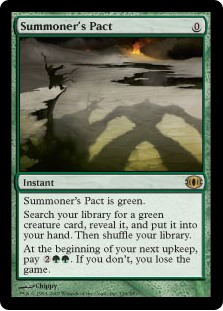
Under the old rules, if a player cast Summoner's Pact and drew their card for turn without paying 2GG, they lost the game. Under the new rules, if that player's opponent "catches" them missing their Pact trigger, the player must immediately pay 2GG, and may now do so with additional information at their disposal—they have drawn for turn. This rules change asks players to remember their opponent's triggers for them, and punishes players for their opponent's mistakes.

Of course, deliberately not paying for Pact with the intention of first seeing one's draw is cheating. But whether a player cheated or not is rendered ambiguous by this ruling, the decision in practice coming down not to what we know happened in-game, but to the capricious opinion of a judge. BBD argues that cases like these are inevitable in a game as dense as Magic, and there's nothing judges or the rules committee can do about their occurrence. He instead appeals to ethics, placing the onus on the player (in this case, himself), as I once did, to account for what I now see as needless ambiguities in the rules.

Needless how? Well, in Pact's case, the supplanted ruling was unambiguous: forgot to pay your Pact trigger? You lose. That ruling removes the possibility for exploitation from the equation altogether. In video games, for instance, such unambiguous rules enforcement is built-in, which in my eyes leads to a higher skill ceiling; players are forced to work within hard lines, rather than allowed to find ways around those lines, such as cheating. Of course, Magic changes faster than a video game. But even if new rules issues come up, which they inevitably will, they can be addressed on a case-by-case basis as they arise. I don't see how the triggers change and other ambiguous rulings can't be made black-and-white as they are in other games.

In the Name of Fun

I don't see how, but I do hear why; many changes to competitive rules that I disagree with are traced back to blurry notions of fun. It apparently "feels bad" to untap, draw, and realize that you have lost because you didn't pay for your Pact. I do not find this argument compelling, as fun is too subjective. For me personally, rulings like these make a Competitive tournament less fun.

Magic has a built-in solution to this problem. Don't want to lose to a forgotten Pact trigger? Well, you are not required to put Pact into your deck. Similarly, this scenario would never come up at lower levels of play anyway, because the rules are more relaxed at Regular REL; the "new rule" would have been applied there even before it was put into practice. Conversely, every Competitive REL tournament I've been to features a judge's opening monologue about how players will be held accountable for their mistakes at this level of play. Why suddenly baby players who knowingly and willfully enter into that contract, especially when such babying incentivizes cheating?

Fun, as mentioned, is subjective. I'd like to think that for most Magic players, the game itself is plenty fun at Competitive without added ambiguity. In fact, for certain players (myself included), the game is more fun when I and my opponents are held accountable for our mistakes. And to BBD, the game is more fun when players need not fret about the possibility of opponents exploiting ambiguous rulings:

I genuinely think the game is worse off if everyone is trying to “get” each other or exploit the rules to get edges over each other. Sirlin believes that people pushing games to their extremes makes those games better, and maybe in fighting games with programmed in rules engines, that is true, but I don't think it holds for Magic, which has a level of interpersonal interactions, relies on communication in tournaments as one of its core rule structures and has so many grey areas and ambiguities that the sheer amount of areas in which you can exploit things or abuse rules is astronomical and frankly exhausting to keep up with. It also creates a downright miserable experience for opponents who have to play against someone who is doing this or trying to do this at every possible situation.

I'd argue that rules changes like the Pact one actually exacerbate this issue. I now have to worry about opponents exploiting a newly-ambiguous rule rather than knowing they will be held accountable for their mistakes. Ambiguous rules enable cheating. The more ambiguity we can eliminate in the rules, the less place ethics must hold in making Magic sustainable to play at high levels.

So, now what? The capitalist in me places the responsibility on the provider of the good, in this case Wizards—if they do enough things consumers do not like, consumers will stop buying. Power creep, dubious banlist management, and reprints (or a lack thereof) have all driven players I know away from Magic in recent years; while none of those elements bother me, the game's clinging to ambiguous rulings does.

Democracy of Enjoyment

Behind even diversity, Modern's calling card, Wizards has designated "fun" the number-one most important factor when it comes to nurturing the format. Of course, fun's subjectivity renders it impossible to define, so format analysts and banlist predictors tend to spend most of their energy on the next-best thing: gathering and assessing available data. That said, if enough players are vocal about things they do or don't find fun, and especially if that outcry corresponds with an indisputable effect of such distaste—for instance, a marked drop in event attendance—Wizards is bound (inasmuch as "Where Modern Goes From Here" is binding) to take banlist action. In other words, banlist management, and what happens with Modern in general, is at least partially democratic.

Every player gets a vote; to vote effectively, they must understand what they want out of a candidate. Players will have an easier time clearly articulating what is and isn't fun to them if they have a solid grasp on their own preferences. BBD digs into his personal taste in "When Playing to Win Is a Loss," determining the level of competitiveness he likes holding himself to. I did it myself in this article, expressing dissatisfaction with ambiguous rulings. Taste refining can also apply to other elements of Magic, such as deck selection and personalization.

In the words of Socrates, "to know thyself is the beginning of wisdom." Maybe it's also the beginning of something even more valuable: a better Magic experience.

This Week in Magic Finance

Are you a Quiet Speculation member?

If not, now is a perfect time to join up! Our powerful tools, breaking-news analysis, and exclusive Discord channel will make sure you stay up to date and ahead of the curve.

Counterfeiters Getting Aggressive

The topic of counterfeit cards is one that seems to work its way into the Magic news cycle time and time again for one reason or another. It returned this week when a tweet revealed a local game store owner received a mail solicitation from someone advertising their counterfeit business, including a sample of their wares.

This counterfeiter presumably wants to prey on the greedy store owner, or one who might be struggling with their business, and give them an easy way to make a massive margin on the unsophisticated buyer. It seems especially malicious that these counterfeits are being advertised directly to the LGS, which are in a position to get them into the hands of the most susceptible people, especially children.

The reality is that any store could obtain proxies to sell through other means, as proxies have been readily available for years. But the point is that counterfeiters will only continue to grow more aggressive as the market continues to grow and as their fakes improve in quality over time. It’s important to be alert now in 2019 more than ever, because it seems to be only a matter of time before proxies like these will filter through the Magic ecosystem like a toxin through the food chain.

Another Special Release

Wizards has moved to fully embrace printing supplemental products and other special releases. These days there are special releases of all sorts, headlined by the Mythic Edition releases we’ve seen for the last two sets, which David Schumann went into great detail about.

This week it was revealed that a new Modern-oriented product would be released at the end of February.

What the product is exactly remains to be seen. It could be just about anything, because Mark Rosewater said it is this year's “innovation product." Rest assured that whatever it is, it will be full of big reprints.

Since last year I’ve taken the strategy of aggressively moving away from holding Modern cards. At this point anyone holding them needs to be aware that reprints could be imminent for any non-Reserved List card.

One possibility for this upcoming release are the Zendikar fetchlands, with Scalding Tarn creeping towards the $100 price it held before reprint in Modern Masters 2017. MaRo said “If you guys don’t love it, I’ll be floored,” and history shows there’s no more surefire way to make Magic players love a product than to reprint fetchlands.

There was an error retrieving a chart for Scalding Tarn

Wizards of the Coast and Magic is a big moneymaker for Hasbro, and they are going to milk it for all it is worth—supplemental products are a great way to do this. It’s becoming increasingly important to be a discerning consumer and properly evaluate each release. Mythic Edition: Ravnica Allegiance showed us that not all may be as good of opportunities as they initially seem.

Even if you aren’t interested in buying them, new releases like the upcoming Modern product have the potential to impact the market with reprints. So becoming aware of these as early as possible and reacting accordingly is important for anyone holding cards at risk of reprint.

The Wizards Coming Soon page is one place to keep bookmarked. But that doesn’t even show the upcoming Modern release—a more definitive source is the community and the places it gathers like Twitter and Reddit.

Looking Ahead: Pauper Pops Off!

When Pauper began to explode in popularity at the end of 2017, Channel Fireball stoked the flames by supporting the format with side events at their Grand Prix in 2018. These initial Pauper events proved very popular, drawing crowds into the hundreds.

They continued to support the format with special side events like Pauper Championships at multiple Grand Prix,  but now in 2019 have taken the format a monumental step ahead. Last month CFB announced they would hold the first ever Pauper Pro Tour Qualifier, now technically called a Mythic Championship Qualifier, at Grand Prix Los Angeles in March.

Pauper to the Pro Tour already became a reality in November when Wizards announced they would be adding the Pauper format, along with Legacy and Vintage, to their Magic Online Championship Series.

I’ve already expressed my bullish outlook on Pauper in 2019, and I see the CFB announcement as a major sign that there will be further Pauper support to come. The occasional Pauper MCQs at Grand Prix is likely not enough to majorly increase demand for cards, but very early on Channel Fireball teased that a Pauper Grand Prix was a real possibility.

I see the upcoming Pauper PTQ as a test run, and potentially a stepping stone to a Pauper Grand Prix. GP formats for the second half of the year have not yet been announced, so we could see the event as early as this year. If we do, then the prices of many Pauper staples would be set to explode, whether from player demand or the speculators the announcement would be sure to attract.

Avatar photo

Adam Yurchick

Adam started playing Magic in 1999 at age 12, and soon afterwards he was working his trade binder at school, the mall food court, FNM, and the Junior Super Series circuit. He's a long-time Pro Tour gravy-trainer who has competed in 26 Pro Tours, a former US National Team member, Grand Prix champion, and magic.tcgplayer.com columnist. Follow him at: http://twitter.com/adamyurchick

View More By Adam Yurchick

Posted in Counterfeits, Finance, Mythic Edition, News, Pauper, ReprintsTagged Leave a Comment on This Week in Magic Finance

Have you joined the Quiet Speculation Discord?

If you haven't, you're leaving value on the table! Join our community of experts, enthusiasts, entertainers, and educators and enjoy exclusive podcasts, questions asked and answered, trades, sales, and everything else Discord has to offer.

Want to create content with Quiet Speculation?

All you need to succeed is a passion for Magic: The Gathering, and the ability to write coherently. Share your knowledge of MTG and how you leverage it to win games, get value from your cards – or even turn a profit.

MTG Metagame Finance #30

Are you a Quiet Speculation member?

If not, now is a perfect time to join up! Our powerful tools, breaking-news analysis, and exclusive Discord channel will make sure you stay up to date and ahead of the curve.

I took a break from MTG Metagame Finance last week to start the new What’s Next series. If you haven’t seen that yet, you can check it out here. Now that Ravnica Allegiance has been making its way into all the formats, we’re starting to get a feel for how it's affecting the different metagames. So let’s dive into that this week.

It’s also still very early so I suggest a couple of ways to stay ahead of everyone else.

Ways to Stay ahead of Everyone Else

1. Quiet Speculation Discord Channel (Paid)

This is probably one of, if not, the most active MTG finance chat group that discusses cards before the movement actually happens.


Members

If you have a membership, sign in to the Discord channel here.

Future Members

If you don't have a membership, you can purchase one here.

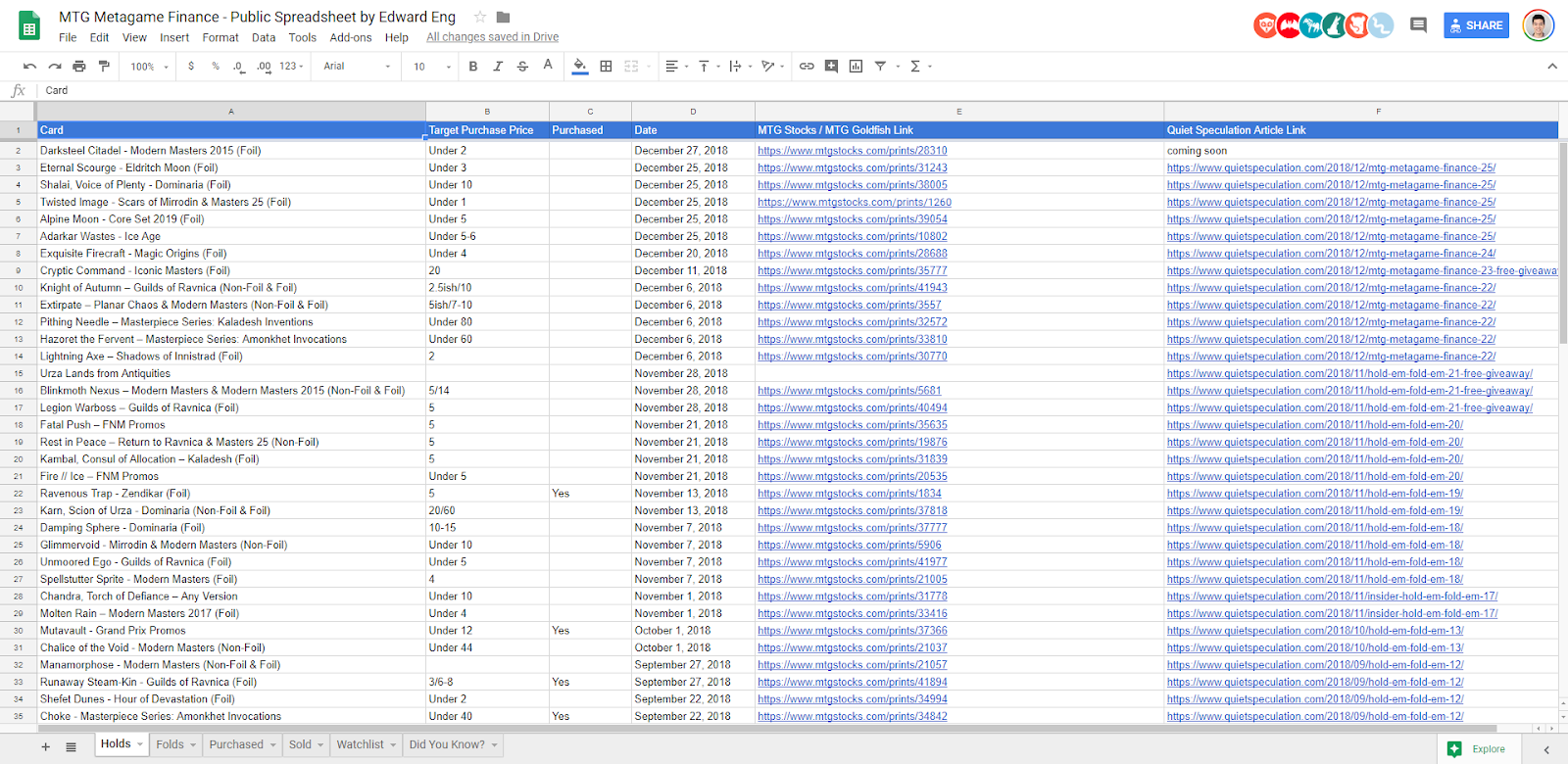
2. Public MTG Metagame Finance Spreadsheet (Free)

I update this spreadsheet often, especially before I write and post my articles. I also update this spreadsheet every time I buy a card right after I place the order.

Article Series Main Focus Points

  • Cards that you should hold on to or pick up for tournaments if you need them before they rise in price. These cards are either seeing increased play in one or more formats, the supply is drying up, or they’re pretty far from the next reprint.
  • Cards that you should consider selling or trading away. Their prices are pretty much at the ceiling owing to inflation from speculation, reprint inevitability in the near future, a lull in tournament play, or some combination of these.

Recent Buys

Silhana Wayfinder - Ravnica Allegiance (Foil)

There was an error retrieving a chart for Silhana Wayfinder

Purchased Price
$1.25

I must admit I misread this card at first. I thought that you put the creature or land into your hand. Sad face. This card is much worse than I had originally imagined. However, that doesn’t mean it’s a bad card. I think it could still see play in Standard. But I don’t think it’s good enough for Modern.

Here are a couple of brews that I think could have some legs with some testing and adjustments.

Standard: Abzan Angels by nzznzn

Creatures

2 Angel of Grace
3 Knight of Autumn
2 Ravenous Chupacabra
2 Seraph of the Scales
2 Shalai, Voice of Plenty
4 Silhana Wayfinder

Non-Creature Spells

2 Assassin's Trophy
2 March of the Multitudes
3 Revitalize
2 Settle the Wreckage
1 Vraska's Contempt
4 History of Benalia
3 Seal Away
2 Find / Finality
2 Kaya's Wrath

Lands

4 Godless Shrine
4 Isolated Chapel
4 Overgrown Tomb
3 Plains
2 Sunpetal Grove
4 Temple Garden
3 Woodland Cemetery

Sideboard

2 Consecrate / Consume
2 Cry of the Carnarium
4 Duress
1 Golden Demise
4 Knight of Grace
2 The Immortal Sun

This is an interesting build because Silhana Wayfinder helps you find powerful Angels that can take over the mid to late game such as Shalai, Voice of Plenty and Angel of Grace. It also sets up a sequence where you can play this, find one of those Angels, cast Kaya's Wrath, and then cast the Angel after you’ve cleaned up the board.

Standard: Prime Speaker Vannifar by Chobeslayer

Creatures

2 Biogenic Ooze
2 Carnage Tyrant
1 Conclave Cavalier
1 Forbidding Spirit
4 Incubation Druid
3 Jadelight Ranger
2 Knight of Autumn
4 Llanowar Elves
1 Mesmerizing Benthid
2 Nullhide Ferox
1 Pelakka Wurm
4 Prime Speaker Vannifar
1 Shalai, Voice of Plenty
3 Silhana Wayfinder
1 Sumala Woodshaper
1 Trostani Discordant

Non-Creature Spells

4 Adventurous Impulse

Lands

4 Breeding Pool
5 Forest
2 Hallowed Fountain
4 Hinterland Harbor
4 Sunpetal Grove
4 Temple Garden

Sideboard

4 Baffling End
1 Carnage Tyrant
3 Deputy of Detention
2 Knight of Autumn
1 Lyra Dawnbringer
4 Negate

Since there aren’t any effective tutor effects in Standard, Silhana provides a decent way to dig for Prime Speaker Vannifar. It comes down early, and you can sacrifice it later for a Jadelight Ranger or Knight of Autumn.

Ill-Gotten Inheritance - Ravnica Allegiance (Foil)

There was an error retrieving a chart for Ill-Gotten Inheritance

Purchased Price
$0.25

Thanks to Ari Lax, it’s probably not really a secret anymore that this is a good card in Limited. There’s a slight chance this could see play in Standard in midrange or control. But I think it has the most potential in Pauper.

We’ve already seen the foil price of Curse of the Pierced Heart shoot through the roof. That could be a good sign for this card. Twenty-five cents is pretty cheap, so get them while you can now.

Frilled Mystic - Ravnica Allegiance (Foil)

There was an error retrieving a chart for Frilled Mystic

Purchased Price
$3.25

This has already been showing up in Standard Simic decks. It started out kind of pricey, then dropped a bit. But it’s starting to tick back up in price. I also think this card could have potential in the longer-term outside of Standard in something like a Simic or Bant Wizards deck in Modern.

I don’t think WotC is going to stop printing Wizards anytime soon. So there will probably be a point in time where there are enough powerful Wizards in Simic or Bant to build a new deck. And it’s possible that cards I mentioned in previous articles, like Senate Guildmage and Wizard’s Retort, will make the cut.

Standard: Simic Elves by SANRYU

Creatures

3 Frilled Mystic
4 Growth-Chamber Guardian
4 Incubation Druid
4 Jadelight Ranger
4 Llanowar Elves
4 Merfolk Branchwalker
4 Nullhide Ferox
4 Pelt Collector
4 Steel Leaf Champion
4 Wildgrowth Walker

Lands

4 Breeding Pool
9 Forest
4 Hinterland Harbor
4 Unclaimed Territory

Sideboard

1 Frilled Mystic
2 Crushing Canopy
2 Disdainful Stroke
1 Island
3 Spell Pierce
3 Thrash // Threat
3 Watertrap Weaver

It’s too bad the manabase in this deck doesn’t really allow you to consistently cast Incubation // Incongruity. However, if you really want to cast it, the next deck allows you to do so.

Standard: Bant Hydroid Krasis by PUTPUT

Creatures

4 Deputy of Detention
4 Frilled Mystic
4 Growth-Chamber Guardian
4 Hero of Precinct One
4 Hydroid Krasis
4 Incubation Druid
4 Llanowar Elves
3 Trostani Discordant

Non-Creature Spells

3 Incubation // Incongruity
2 Hadana's Climb

Lands

4 Breeding Pool
2 Forest
4 Glacial Fortress
3 Hallowed Fountain
4 Hinterland Harbor
1 Island
2 Sunpetal Grove
4 Temple Garden

Sideboard

3 Baffling End
2 Disdainful Stroke
2 Ixalan's Binding
3 Lyra Dawnbringer
3 Negate
2 Shalai, Voice of Plenty

Benthic Biomancer - Ravnica Allegiance (Foil)

There was an error retrieving a chart for Benthic Biomancer

Purchased Price
$2.25

Speaking of Wizards, here’s another one from Ravnica Allegiance that’s already seeing play in Modern and Legacy.

Modern: Merfolk by LE_PIP

Creatures

4 Benthic Biomancer
2 Harbinger of the Tides
4 Lord of Atlantis
4 Master of the Pearl Trident
4 Master of Waves
4 Merfolk Trickster
4 Silvergill Adept
1 Vendilion Clique

Non-Creature Spells

1 Echoing Truth
4 Wizard's Retort
4 Aether Vial
4 Spreading Seas

Lands

17 Island
2 Mutavault
1 Oboro, Palace in the Clouds

Sideboard

1 Vendilion Clique
1 Echoing Truth
2 Deprive
1 Dismember
4 Relic of Progenitus
2 Spellskite
2 Tidebinder Mage
2 Venser, Shaper Savant

I would bet that a decent number of people are overlooking the fact that Wizards is the more commonly shared creature type over Merfolk now in this type of deck. But it certainly seems like LE_PIP got the memo and incorporated Wizard's Retort this Mono-Blue Merfolk Wizards deck.

Legacy: Merfolk by TUXDEV

Creatures

3 Benthic Biomancer
4 Cursecatcher
4 Lord of Atlantis
4 Master of the Pearl Trident
4 Phantasmal Image
4 Silvergill Adept
4 True-Name Nemesis

Non-Creature Spells

1 Echoing Truth
4 Force of Will
4 Aether Vial
4 Chalice of the Void

Lands

4 Cavern of Souls
12 Island
4 Mutavault

Sideboard

1 Echoing Truth
2 Back to Basics
2 Dismember
2 Flusterstorm
2 Grafdigger's Cage
2 Relic of Progenitus
2 Sorcerous Spyglass
2 Venser, Shaper Savant

Holds

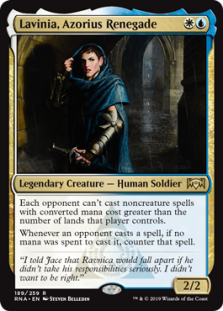
Lavinia, Azorius Renegade - Game Day & Store Championship Promos

There was an error retrieving a chart for Lavinia, Azorius Renegade

Target Purchase Price
$10ish

These are still pretty expensive right now on eBay. But that might be because they won’t be officially released to the public until February 16-17. I would wait to see what the price is shortly after that weekend.

This card showed up all over the place in the Vintage Challenge on January 27. Vintage is in its own bubble and doesn’t really cause the prices of most cards to move like other formats do. However, we might see a trickle down effect into Legacy and Modern. If that happens, we’ll probably start to see this card rise in price. Just remember, this is a blue card and can be used with Force of Will to stop opposing Force of Wills.

Vintage: Eldrazi by Venioetvinco

Creatures

2 Containment Priest
3 Eldrazi Displacer
2 Glowrider
3 Lavinia, Azorius Renegade
1 Phyrexian Revoker
4 Reality Smasher
4 Thalia, Guardian of Thraben
3 Thalia, Heretic Cathar
4 Thought-Knot Seer

Non-Creature Spells

1 Black Lotus
1 Chalice of the Void
1 Mana Crypt
1 Mox Emerald
1 Mox Jet
1 Mox Pearl
1 Mox Ruby
1 Mox Sapphire
1 Null Rod
1 Sol Ring
1 Thorn of Amethyst
1 Trinisphere

Lands

4 Adarkar Wastes
4 Ancient Tomb
4 Cavern of Souls
4 Eldrazi Temple
2 Karakas
1 Strip Mine
3 Wasteland

Sideboard

2 Containment Priest
1 Null Rod
2 Energy Flux
3 Grafdigger's Cage
1 Path to Exile
2 Rest in Peace
1 Stony Silence
2 Swords to Plowshares

Legacy: Humans by Venioetvinco

Creatures

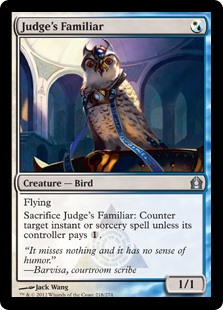
2 Judge's Familiar
3 Deputy of Detention
3 Lavinia, Azorius Renegade
3 Meddling Mage
4 Leonin Arbiter
4 Mother of Runes
4 Spell Queller

Non-Creature Spells

1 Swords to Plowshares
4 Stifle
4 Force of Will
4 Aether Vial

Lands

1 Island
2 Cavern of Souls
2 Karakas
3 Adarkar Wastes
4 Wasteland
4 Tundra
4 Rishadan Port
4 Seachrome Coast

Sideboard

1 Winter Orb
2 Walking Ballista
1 Vendilion Clique
2 Surgical Extraction
1 Rest in Peace
2 Geist of Saint Traft
2 Ethersworn Canonist
3 Swords to Plowshares
1 Judge's Familiar

Assassin’s Trophy - Guilds of Ravnica (Non-Foil)

There was an error retrieving a chart for Assassin's Trophy

Target Purchase Price
Under $10

Now that Ravnica Allegiance has hit the market, we might be close to the floor on this card. This was the talk of the town when it was spoiled, but has kind of faded into the sunset a bit. However, it shouldn’t be forgotten as it still does see quite a bit of play in multiple formats.

Deputy of Detention - Ravnica Allegiance (Non-Foil)

There was an error retrieving a chart for Deputy of Detention

Target Purchase Price
Under $2

The price of this has finally calmed down, yet the number of decks that play it continue to rise. This means we could start to see a slow uptick in the near future. It’s also a blue Wizard. So if you didn’t read anything before this, what that means is that it could see play in a new Wizards deck in Modern or alongside Force of Will in Legacy. And it’s already showing up in Legacy Humans.

Legacy: Humans by Dopedafi

Creatures

1 Sanctum Prelate
1 Palace Jailer
2 Imperial Recruiter
2 Phantasmal Image
2 Reflector Mage
3 Meddling Mage
4 Champion of the Parish
4 Thalia's Lieutenant
4 Thalia, Guardian of Thraben
4 Noble Hierarch
4 Mother of Runes
4 Kitesail Freebooter

Non-Creature Spells

4 Aether Vial

Lands

2 Karakas
3 Horizon Canopy
4 Unclaimed Territory
4 Wasteland
4 Ancient Ziggurat
4 Cavern of Souls

Sideboard

2 Surgical Extraction
2 Orzhov Pontiff
2 Knight of Autumn
1 Kambal, Consul of Allocation
1 Grafdigger's Cage
1 Gaddock Teeg
1 Faerie Macabre
2 Dismember
1 Deputy of Detention
2 Containment Priest

Karn, Scion of Urza - Dominaria (Non-Foil)

There was an error retrieving a chart for Karn, Scion of Urza

Target Purchase Price
$15-20

I think we’ve been pretty much at the floor on this card for a few months now. I’m not sure how much lower it can go during rotation in October. Can it hit $10? I doubt it since it sees a decent amount of play outside of Standard.

However, if you’re worried about that and have a some extra cash to spend, I would pick up the Mythic Edition version. There are a lot fewer of these in the market, and it has cool full-art artwork.

Folds

Massacre Wurm - Mirrodin Besieged (Non-Foil)

There was an error retrieving a chart for Massacre Wurm

Target Sell Price
$20+

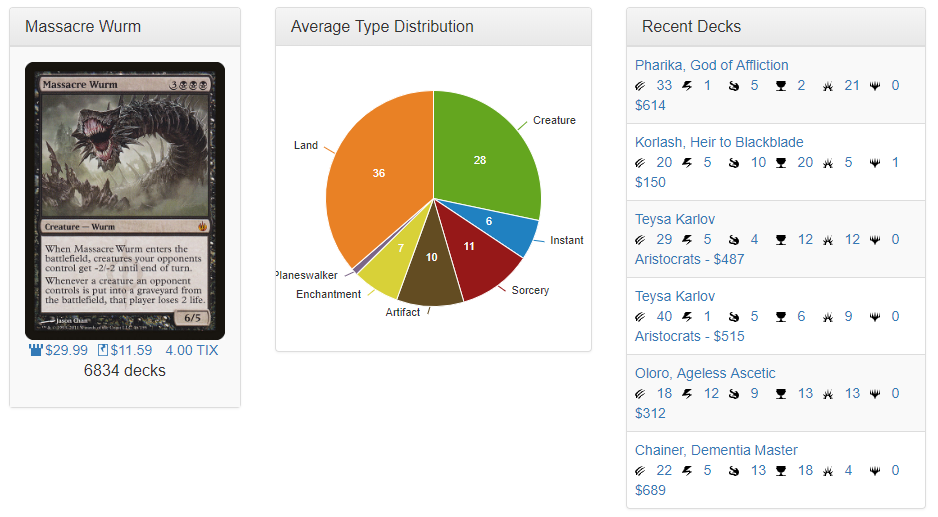
A lot of people seem to be going crazy over this in EDH/Commander since the release of Teysa Karlov. I would sell into the hype if you have these, especially because there’s only one printing of this card. Wizards could easily reprint this in a supplemental set.

Surgical Extraction - New Phyrexia (Non-Foil)

There was an error retrieving a chart for Surgical Extraction

Target Sell Price
$30-40+

This might be a tougher pill to swallow since it sees play in so many decks.

Phyrexian mana as a mechanic is essentially broken, which makes this hard to reprint in any kind of normal set. I could see them adding a Phyrexian mana theme to a supplemental set, though. In any case, this card is at least more resilient to reprints because of its weird mechanic.

Nivmagus Elemental - Return to Ravnica (Foil)

There was an error retrieving a chart for Nivmagus Elemental

Target Sell Price
$1-2

This has been showing up recently on the fringes in Legacy. I suspect this is a flash in the pan. I would get rid of these if you have any, especially because a ton of Return to Ravnica was opening owing to the reprint of shocklands.

Card Kingdom is buying these for $2.50 cash and $3.25 store credit.

Legacy: Izzet Delver by Manuel Capponcelli

Creatures

2 True-Name Nemesis
2 Grim Lavamancer
3 Nivmagus Elemental
3 Young Pyromancer
4 Delver of Secrets

Non-Creature Spells

1 Abrade
1 Spell Pierce
2 Spell Snare
3 Flusterstorm
4 Force of Will
4 Lightning Bolt
4 Daze
4 Brainstorm
1 Forked Bolt
4 Ponder

Lands

1 Flooded Strand
1 Mountain
1 Polluted Delta
2 Wooded Foothills
2 Island
3 Volcanic Island
4 Wasteland
4 Scalding Tarn

Sideboard

2 Vapor Snag
2 Surgical Extraction
1 Smash to Smithereens
2 Pyroblast
2 Price of Progress
1 Abrade
1 Sulfur Elemental
1 Izzet Staticaster
2 Winter Orb
1 Pithing Needle

Legacy: Azorius Delver by Mw_94ga

Creatures

2 Nivmagus Elemental
4 True-Name Nemesis
4 Delver of Secrets
4 Stoneforge Mystic

Non-Creature Spells

4 Swords to Plowshares
4 Force of Will
4 Flusterstorm
4 Daze
4 Brainstorm
1 Council's Judgment
4 Ponder
1 Umezawa's Jitte
1 Batterskull

Lands

1 Snow-Covered Plains
1 Scalding Tarn
1 Misty Rainforest
2 Arid Mesa
3 Snow-Covered Island
3 Tundra
4 Wasteland
4 Flooded Strand

Sideboard

1 Sword of Fire and Ice
1 Surgical Extraction
1 Snapcaster Mage
1 Rest in Peace
1 Pithing Needle
1 Path to Exile
2 Meddling Mage
1 Karakas
1 Grafdigger's Cage
1 Engineered Explosives
2 Disenchant
2 Cataclysm

Searing Blood - Born of the Gods (Foil)

There was an error retrieving a chart for Searing Blood

Target Sell Price
$7-10

Burn has started to pick up steam again in Modern with the printing of Skewer the Critics and Light Up the Stage. We’ve seen many different builds with a lot of them running this card in the sideboard. It only has one printing. And as the metagame continues to adjust, Burn usually gets pushed to the wayside. With that said, I would lock in your value now on these if you have them and aren’t using them.

Card Kingdom is buying these for $7 cash and $9.10 store credit.

Modern: Burn by Derek Pite

Creatures

1 Grim Lavamancer
4 Goblin Guide
4 Monastery Swiftspear
4 Eidolon of the Great Revel

Non-Creature Spells

4 Boros Charm
4 Lightning Bolt
4 Lightning Helix
4 Searing Blaze
4 Rift Bolt
4 Skewer the Critics
4 Lava Spike

Lands

1 Scalding Tarn
1 Bloodstained Mire
2 Sacred Foundry
3 Mountain
4 Wooded Foothills
4 Arid Mesa
4 Inspiring Vantage

Sideboard

4 Smash to Smithereens
3 Skullcrack
3 Searing Blood
3 Path to Exile
2 Exquisite Firecraft

Viashino Pyromancer - Core Set 2019 (Foil)

There was an error retrieving a chart for Viashino Pyromancer

Target Sell Price
$2-5

Red really hasn’t put up the numbers in Standard. And it might be a while before we see this Wizard used in Modern. I mentioned this in article #14. So if you picked them up then to play with, you can still sell these at a profit now if you’re not playing with them anymore. You can pick them up again cheaper after they rotate in October.

Card Kingdom is buying them at $2 cash and $2.60 store credit.

Bump in the Night - Innistrad (Foil)

There was an error retrieving a chart for Bump in the Night

Target Sell Price
$1-3

Here’s another card that’s seeing renewed play in Modern due to Skewer the Critics and Light Up the Stage. I’m not sure if Rakdos Burn is the most optimal build. But if you have these and aren’t using them, you can cash in on the hype before it dies down.

Card Kingdom is buying them at $1.70 cash and $2.21 store credit.

Modern: Rakdos Burn by Enihcamamgine

Creatures

2 Grim Lavamancer
4 Monastery Swiftspear
4 Goblin Guide

Non-Creature Spells

4 Lightning Bolt
4 Shard Volley
4 Searing Blaze
4 Lava Spike
4 Rift Bolt
4 Light Up the Stage
4 Bump in the Night
4 Skewer the Critics

Lands

1 Bloodstained Mire
1 Scalding Tarn
2 Blood Crypt
3 Blackcleave Cliffs
3 Mountain
4 Wooded Foothills
4 Arid Mesa

Sideboard

3 Surgical Extraction
4 Smash to Smithereens
4 Searing Blood
4 Eidolon of the Great Revel

Summary

Recent Buys

  • Silhana Wayfinder - Ravnica Allegiance (Foil)
  • Ill-Gotten Inheritance - Ravnica Allegiance (Foil)
  • Frilled Mystic - Ravnica Allegiance (Foil)
  • Benthic Biomancer - Ravnica Allegiance (Foil)

Holds

  • Lavinia, Azorius Renegade - Game Day & Store Championship Promos
  • Assassin's Trophy - Guilds of Ravnica (Non-Foil)
  • Deputy of Detention - Ravnica Allegiance (Non-Foil)
  • Karn, Scion of Urza - Dominaria (Non-Foil)

Folds

  • Massacre Wurm - Mirrodin Besieged (Non-Foil)
  • Surgical Extraction - New Phyrexia (Non-Foil)
  • Nivmagus Elemental - Return to Ravnica (Foil)
  • Searing Blood - Born of the Gods (Foil)
  • Viashino Pyromancer - Core Set 2019 (Foil)
  • Bump in the Night - Innistrad (Foil)

Public Spreadsheet

Stay up to the minute on what I’m looking at on a daily basis via the MTG Metagame Finance Spreadsheet. Don’t forget to bookmark it, because I update it on the fly. This way you can see what’s going on as the market moves and before articles about certain cards are published.

Let me know what you think in the comments below. Agree? Disagree? Why? You can also connect with me on Twitter at @edwardeng.

Important!!!

You can also catch me in the Discord channel (edward.eng#4978) if you have an Insider membership. I would go as far to say that this is one of the most valuable things you receive as a member. The Discord channel is very active and real-time discussions revolve around cards that move before anyone sees the actual movement—it’s usually already too late when you see this movement on sites like MTG Stocks, MTG Goldfish, and MTG Price. Hit me up on Twitter at @edwardeng, and I’ll answer any questions you have.

I’m also open to suggestions on how to make this series more valuable. Hit me up.

Have fun,
Eddie

Lessons Learned: Ravnica Allegiance Mythic Edition

Are you a Quiet Speculation member?

If not, now is a perfect time to join up! Our powerful tools, breaking-news analysis, and exclusive Discord channel will make sure you stay up to date and ahead of the curve.

Last week, Sigmund wrote a great article on why he canceled his order of Ravnica Allegiance Mythic Edition after it failed to sell out. I definitely understand his reasoning, but for those of us who did purchase them – myself included – we should look at the data to establish any final conclusions.

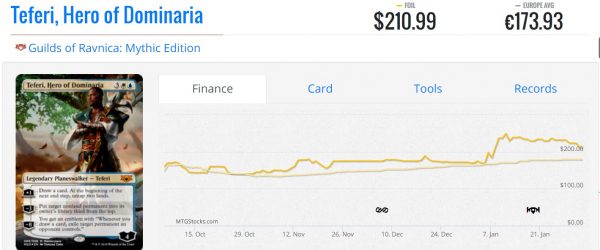
The first thing everyone should have considered was that the RNA Mythic Edition planeswalker list was much weaker than the GRN planeswalker list. GRN had both Liliana, the Last Hope and Teferi, Hero of Dominaria as powerful, highly desirably mythics that see play in multiple eternal formats. RNA Mythic Edition is clearly aimed more at the Commander crowd, given that its heavy hitters are Tamiyo, the Moon Sage and Karn, Scion of Urza, both clearly in a lower league than the GRN chase planeswalkers.

The Numbers

If we look at the GRN Mythic Edition 'walkers market prices three weeks after release and then three months after release, we see:

GRN Mythic Walkers Market 3 Weeks After Release Market 3 Months after Release Price Change
Teferi, Hero of Dominaria $139.91 $167.11 19.44%
Liliana, the Last Hope $106.82 $119.09 11.49%
Elspeth, Knight- Errant $90.00 $66.15 -26.50%
Tezzeret, Agent of Bolas $45.41 $40.36 -11.12%
Vraska, Golgari Queen $65.91 $49.71 -24.58%
Nicol Bolas, Planeswalker $50.21 $33.23 -33.82%
Ral, Izzet Viceroy $43.83 $38.50 -12.16%
Daretti, Ingenious Iconoclast $31.78 $26.39 -16.96%
Average -11.78%
Average Negative -20.86%

Honestly, this doesn't bode well for the RNA Walkers. As the average price drop after three months was almost 12 percent (from their current going rate). If we eliminate the two higher-tier walkers, the average drop is almost 21 percent.

Now, we aren't even at the three-weeks-released mark for the RNA 'walkers, and there was a lot of variances the first few weeks after the GRN Mythic Edition was released, so we can't currently compare them 1:1. However, the GRN distribution was also more spaced out and there were a lot of issues with initial sales from the Hasbro website. The RNA release was considerably smoother.

If we do assume that the RNA walker prices have somewhat stabilized, then we likely can expect a continued downward trend for awhile.

RNA Mythic Walkers Current Price Expected Price Assuming 21% Drop
Ajani, Mentor of Heros $28.94 $22.86
Dack Fayden $52.14 $41.19
Domri, Chaos Bringer $21.79 $17.21
Jaya Ballard $18.89 $14.92
Karn, Scion of Urza $61.11 $48.28
Kaya, Orzhov Usurper $21.75 $17.18
Sorin Markov $22.82 $18.03
Tamiyo, the Moon Sage $52.12 $41.17
Total $279.56 $220.85

Since the product MSRP is $250, this means that most of us who purchased the RNA Mythic Edition and weren't able to unload the planeswalkers as soon as we got them will likely not make much profit on this transaction. It is important to remember that each Mythic Edition did come with 24 packs of cards as well, so if you factor in those, it looks a bit brighter.

This also assumes that we see the same continued price drop as GRN. I actually believe that the fact that so many of them are starting off much lower than the GRN Mythic Edition 'walkers means we will likely see a lower overall percentage drop, as many have plummeted considerably from their very initial price points already.

Lessons Learned

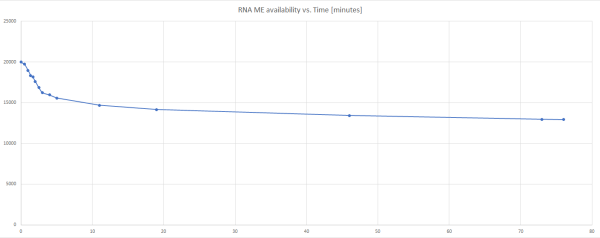
  1. Product demand for the RNA Mythic Edition was clearly much lower than the GRN version. When GRN released, it very quickly sold out on Hasbro's website, and even the ones offered by Channel Fireball at GPs mostly sold out very quickly. The RNA Mythics being offered on eBay actually allowed us to track their sales velocity thanks to eBay's default "sold" information (special thanks to QS's own poppu_mtg for the below graphic). You can see below that they sold very quickly initially but demand quickly petered out. Now it is important to note that this product released at awkward times for both European and Asian customers, however, import taxes and costs would make them much more expensive than for US-based customers. 
  2. A lot of people have stated these products were "slam dunks" when it came to profits based heavily off of the profitability of GRN Mythic Edition. Some of us warned that the weaker power level of the planeswalkers in this set would likely mean lower profits, however, very few expected it to be this bad. The lesson to take away here is to evaluate the cards included in these sets moving forward instead of simply assuming they will all be profitable.
  3. We don't know how many GRN Mythic Editions were ultimately made and sold. However, we were able to pull the number of RNA Mythic Editions from the eBay store, though the listing has since been changed, so you can't see it. Hasbro posted 20,000 RNA Mythic Editions initially. While they are unlikely to repeat the same eBay setup that allowed us to see the quantities available next time, the lackluster sales may hint to WotC that they need to make these products more limited via a lower print run next time. If we do get to see the total number available, I will begin tracking them.
  4. There is a potential for sellers to race too quickly to a price floor on this product, as I've seen numerous sales posts on Facebook offering prices considerably below TCGplayer as people who expected profits are now desperate to recoup the money they sunk into the product. While this isn't guaranteed, it would be smart to monitor these prices and set a buy call should specific cards drop below a certain price point. The best way to determine that price point is to look at other variants of the card's prices. I would expect at least a 2-2.5x multiplier for the Mythic Edition version, so any cards whose Mythic Edition price is lower than that might be worth picking up.
  5. It's important to keep in mind that we are in the beginning of tax season and Magic card sales tend to tick up in February and March as people start getting in their tax refunds and        spending them. People tend to be more willing to make impulse buys with tax return money, as many seem to view it as a yearly "bonus," and high-dollar limited-edition foil                      planeswalkers seem like a likely impulse buy for the Magic community.

Context Clues: Allegiance Testing

Are you a Quiet Speculation member?

If not, now is a perfect time to join up! Our powerful tools, breaking-news analysis, and exclusive Discord channel will make sure you stay up to date and ahead of the curve.

Testing with Ravnica Allegiance has been fruitful. For the most part, the cards that looked good enough for Modern have been. A few cards have even exceeded expectations.

Most of the time in Modern, it's correct to only play the very best card for the job. Raw card power makes up for a variety of other problems and can pull back seemingly lost games. However, that's not always the case. The right tool isn't always a bigger hammer, and sometimes the "better" card is actually worse in many ways. This week, I'm revisiting some Allegiance cards that fall in this category.

Deputy of Detention

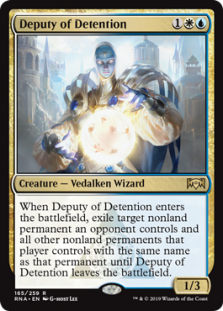
I didn't even mention Deputy of Detention during preview season. Most of the reason was that almost everything I would have said had been said before I got around to it. The rest was that I didn't actually think that there was much to say. It looked like another decent, though not great, utility creature in Chord of Calling toolboxes, probably replacing Fiend Hunter. Deputy seemed too weak compared to Reflector Mage to make it on its own merits.

Versus Reflector Mage

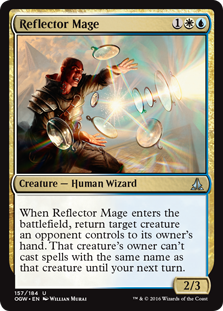
Mage is such an insane card that it seemed like a no-brainer. The tempo swing is enormous and devastating in many matchups. Being unable to replay the creature for a full turn is often lethal in race situations, and a 2/3 is decent on both offense and defense. Being a Human just supercharges its power and playability.

Meanwhile, Deputy is a smaller 1/3, and if it leaves the battlefield the permanent is returned without need to spend additional mana or time. It also has less-useful and synergistic creature types. Deputy can hit any nonland permanent and its siblings, but it dies to everything that kills Reflector Mage. If that happens before the ability has resolved, then nothing happens and you've wasted mana, unlike with Mage.

Contextual Improvement

The catch is that in a lot of matchups, Mage is just a 2/3 for three. Sometimes it's arguably worse than that because the all the creatures have enters-the-battlefield abilities and bouncing them is doing the opponent a favor. And it will return to play baring intervention. This means that if that tempo swing isn't enough, playing Mage might be self-defeating. Also, rather facetiously, not every deck has creatures in the first place.

There's no guarantee that Deputy will be killed, and so the removed permanent may never return. That's not really a good enough reason to beat out Mage. What is: how many noncreature permanents see play, and how many multiples are reliably in play. Taking dangerous artifacts, enchantments, and planeswalkers in addition to creatures means that Deputy has text beyond its stats in every matchup.

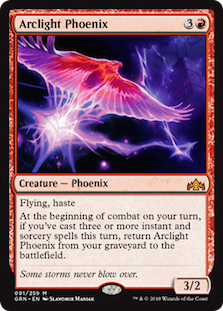
Furthermore, Reflecting one Bloodghast or Arclight Phoenix while facing down several is pretty mediocre. The rest will swing freely and it's not like either will stay in hand waiting to be recast in the first place. Using Deputy means they're all gone for the life of the lawman. That's significant.

In straightforward creature matchups and race situations, Reflector Mage is superior thanks to its better stats, type line, and ability. However, the versatility of Deputy cannot be overlooked in this shifting format. Outside of Humans, I now believe that Deputy of Detention is superior to Mage.

Lavinia, Azorius Renegade

I discussed Lavinia at length during Ravnica Allegiance previews. Basically, I thought that Lavinia wasn't as good a sideboard card as Gaddock Teeg because her first ability was too soft and the second one too niche to see widespread play. I expected Lavinia to see play as a compliment to Spell Queller and as maindeck hate in combo heavy matchups. Testing has prompted me to revise my opinion.

To be clear, in most situations, Teeg is still the harder answer. However, his main appeal was shutting down Ironworks, a deck that no longer exists, which lowers his stock. I also found through experience that Lavinia's ability is much closer to Teeg's against Tron and Miracles than expected. Neither decks reliably hits land drops five plus on time that often, and by then it's frequently too late. There have also been occasions where Lavinia relevantly prevented Burn from spectacle-casting Skewer the Critics and/or Light Up the Stage.

However, it was the second ability that really surprised me. It's far more relevant than anticipated. Firstly, suspend spells are seeing more play with Electrodominance getting tested. Secondly, in my local metagame and on MTGO I've seen spikes in Amulet Titan, Living End, and Valakut decks. Lavinia counters Summoner's Pact, Living End, and Search for Tomorrow, all of which are critically important to their respective decks. Answering suspended Search in particular has been crucial because RG Valakut decks of all stripes only have it and Sakura-Tribe Elder for independent ramp.

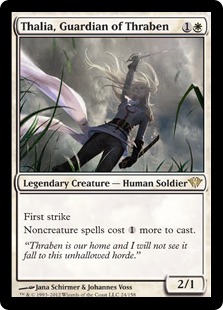
This has left the real test being whether Lavinia can compete with Thalia, Guardian of Thraben. I've become confidant she can, not just in Spirits but throughout Modern. Stats- and versatility-wise, Lavinia is much worse than Thalia, but in context, she's much better.

In Context

Most of the time I've found Thalia to be Lightning Bolt fodder. I haven't had a relevant Thalia in any deck survive more than one turn in any matchup in months. It's been getting worse since the UR Phoenix decks started maindecking Gut Shot.

Even when Thalia has survived, she hasn't been that important. She's outclassed by far too much these days, and the taxing isn't making up the difference. Thalia has always been a just speed bump for spell-dependent decks; the question is how easily they get over the bump. Legacy is defined by cantrip dependence and low land counts. Slowing down the velocity and requiring extra mana is frequently insurmountable. None of that is true in Modern, and thus it's easier to overcome the tax. Even against Phoenix decks where Thalia should be good, Thing in the Ice answers her by brickwalling the clock until it can Awaken, remove the tax, and unleash the deck. Thalia hits everything, but not well.

Meanwhile, Lavinia is technically worse. In most matchups she's just a 2/2 bear and not really worth killing. She'll never win at combat, so why worry about an otherwise textless card? I've gotten more damage through with Lavinia than Thalia in comparable situations, but that's not enough reason to play a card. The real reason is impact magnitude. Thalia has a marginal effect against almost everything. Lavinia only hits a few decks, but she hits them hard.

A Place in Modern

I underestimated just how massive an effect Lavinia could have in the right matchups and how widespread they were becoming. Removing Krark-Clan Ironworks has reopened the space for combo decks, and suddenly Lavinia has more targets. Amulet Titan loses its tutoring engine, arguably the heart of the deck. Storm cannot go off turn three under Lavinia because Gifts Ungiven and Past in Flames are uncastable. Living End is similarly bricked. What Lavinia does is demand an answer from affected decks, where Thalia just asks a question.

As a result, I've come to believe that Lavinia has a place in Modern independent of Spell Queller or other support cards. I don't think she'll ever see the widespread play of Thalia (partially due to color requirements and partially her more limited usage), but the play she does see will be devastating. I have been playing her in UW Spirits to good effect alongside Queller, but if Tron or combo decks become more prevalent, I expect more decks will pick up Lavinia.

UW Spirits (Test Deck)

Creatures

4 Mausoleum Wanderer
4 Selfless Spirit
4 Rattlechains
4 Supreme Phantom
2 Phantasmal Image
1 Lavinia, Azorius Renegade
4 Spell Queller
4 Drogskol Captain
3 Deputy of Detention
1 Kira, Great Glass-Spinner

Artifacts

4 Aether Vial

Instants

4 Path to Exile

Lands

4 Flooded Strand
4 Hallowed Fountain
3 Cavern of Souls
3 Ghost Quarter
4 Plains
3 Island

Sideboard

1 Lavinia, Azorius Renegade
1 Deputy of Detention
3 Damping Sphere
2 Rest in Peace
2 Stony Silence
2 Negate
2 Timely Reinforcements
2 Settle the Wreckage

If you're a Spirits player heading to Toronto this weekend, I highly recommend maindecking Deputy whether you're playing UW or Bant. In a format where prison players are beginning to emerge from the woodwork again, maindeck answers to Ensnaring Bridge are vital. I've also seen more UR Phoenix players adopting Pyromancer Ascension, and having an answer or at least a way to reset the enchantment is quite good. Deputy also frees up sideboard slots that would have gone to general answers like Disenchant.

I had both the Lavinias maindeck for awhile, but Tron has drastically fallen off locally, so I switched the second out for another Deputy. If Tron comes back in force, I would replace Kira with the second Lavinia.

Growth Spiral

My next card has actually met my expectations, but the decks it goes in do not. Growth Spiral is on track to have a huge impact on Standard, but Modern is another story. In my preview, I predicted that it wouldn't see widespread play because it simply didn't belong in currently existing decks. It would take a very specific deck filled with instants for Spiral to be useful. It appears that I'm not alone in this belief and that it's correct so far, because the only deck I could find using Spiral was from the recent Modern 5-0 listings.

Bring to Light Scapeshift, Savagebeats (5-0 MTGO Competitive)

Creature

4 Sakura-Tribe Elder

Enchantments

4 Prismatic Omen

Instants

4 Growth Spiral
4 Remand
2 Izzet Charm
4 Cryptic Command

Sorceries

1 Farseek
4 Search for Tomorrow
1 Anger of the Gods
2 Scapeshift
4 Bring to Light

Lands

4 Misty Rainforest
4 Stomping Grounds
4 Steam Vents
3 Island
2 Breeding Pool
2 Valakut, the Molten Pinnacle
2 Forest
1 Cinder Glade
1 Flooded Grove
1 Mountain
1 Plains
1 Prairie Stream

Sideboard

4 Obstinate Baloth
2 Anger of the Gods
2 Gigadrowse
2 Negate
1 Platinum Emperion
1 Madcap Experiment
1 Crumble to Dust
1 Shatterstorm

I wonder why this deck has a 14 card sideboard. I thought that it would be strict Temur Scapeshift that would play Spiral, but I also frequently forget that Bring to Light exists. This deck, with its abundance of lands and instants, is a natural home for Spiral and showcases how the card should be used.

However, one result is not a great showing for the Spiral. It's a little disappointing for such a promising card, but I'm not too surprised. There may be a lot to recommend about Spiral eligible decks, particularly additional flexibility and interaction, but it's currently not enough to justify their more complex natures. The simpler Titanshift is going to win more.

The Problem

There are a number of players at my LGS who are trying to make Temur Scapeshift work and not getting anywhere. One played it back in Splinter Twin days, and one is an eternally optimistic brewer; they're approaching the deck from very different angles. The former dreams of combo-control, while the latter has swung between pure combo and tempo-combo. Spiral is a good card in both decks and arguably the glue that holds them together. However, neither have won with any version of the deck so far.

The problems vary, but the underlying one is speed. Not necessarily their decks' speed, but their opponents'. Twin aside, Modern was slower in 2015 because the fast decks of today weren't viable. The Fundamental Turn has decreased, and it's proving hard for Temurshift to keep up. Bolt-Snap-Bolt is powerful removal, but not as much as it used to be. Thus playing one land a turn with one or two extra just isn't enough to kill fast enough. This requires them to reprioritize constantly and it's not working. The deck is getting strained in too many directions to be coherent and successful.

The Other Problem

This leads into the larger problem for the hopeful brewers because in the same time period the normal GR Titanshift pilots have done very well. This begs the thus-far unanswered question: why bother with the counters and Spiral? Titanshift has more ramp, so it kills faster and doesn't have to worry as much about opposing decks. This proactiveness makes it a more coherent strategy.

The other problem is that Titanshift rarely has to worry about failing to kill withScapeshift. Most of Titanshift's lands are mountains of one form or another, so it shouldn't have to worry about fetching too many. The multi-colored Valakut decks usually run just enough mountains so if they don't have Prismatic Omen and/or the game runs long, they can draw too many and the kill will fail. This has been a problem for my brewers. So far, Titan keeps being so much better a deck than Temur, despite its one-sidedness, that the additional interaction isn't worthwhile.

Developing Format

Modern is showing quite a bit of adaptation and development from Ravnica Allegiance. I'm sure there's a lot more still in the brewing labs and I hope to see it at the GP level soon. Until then, don't be discouraged, and keep testing.

Coming Back to an Old Collection After a Break

Are you a Quiet Speculation member?

If not, now is a perfect time to join up! Our powerful tools, breaking-news analysis, and exclusive Discord channel will make sure you stay up to date and ahead of the curve.

I was a super active PucaTrade user back in its heyday. After the Puca economy went under, I got distracted. So while I still played Cube and Arena and continued to follow the MTG social and financial worlds, I stopped engaging in the regular buying, selling, or trading of Magic cards.

In fact, I just looked it up: I made my last Puca trades in October of 2016, and besides prereleases and purchases for my cube, I don't recall any other MTG purchases during that time. I have sent in a small buylist or two, but it's been a while since I reviewed my full holdings.

So it was with mixed delight and horror that I went through my years-old specs, draft leftovers, and trade bait last night to ship out a buylist. What really spurred me to do this was this guy right here:

There was an error retrieving a chart for Woodland Bellower

I went pretty deep on this card via PucaTrade, picking up 39 copies at approximately 130 points each, which was about a dollar in cash at the time. I'm buylisting 38 of those copies to Card Kingdom for $4 each and feel very good about how this has turned out.

What are some other things I learned and decisions I made in this process? Let's go through a few.

Stop Being Precious About Cards You're Not Playing

I didn't dip into any of my decks or cube for this buylist, but I was sitting on a ton of stuff that was a mix of speculation, "I might play this format or deck someday" wishy-washiness, and stubbornness that this card could still go higher.

For example, I've been sitting on several dozen shocklands since the Return to Ravnica era, virtually all picked up via Draft or trade. I outed many of them via PucaTrade and buylisted a few here and there, but still had dozens more. When Guilds of Ravnica was announced, I literally placed buylisting shocklands on my to-do list. But I didn't get around to it—and then the reprints were spoiled.

I obviously punted a lot of value, but it could be worse—I'm buylisting them now for roughly the value I placed on them in trade years ago. I did, however, lose the opportunity cost of using this money elsewhere, as well as the chance for higher profits. Still, I traded for Steam Vents specifically at $8, I've outed a lot of them in the $13 to $15 range in the last several years, and now I'm buylisting the rest of them for $8. So I still consider it a win, if not as large as I would have hoped.

I have a handful of Polluted Deltas and Flooded Strands as well. I'm happy to report that I've half learned my lesson of holding reprinted lands like this for years and years, as I am shipping all of my Deltas for $15 a pop. Strand at $10 wasn't cutting it, however, so I am stubbornly holding onto those. Full disclosure: I'm also still holding my Temple Gardens and Godless Shrines, as I just can't get on board with the sub-$4 price tags on these specifically.

Here are some more examples of cards that I speculated on years ago for about the same price as I am buylisting now. I'm learning to let go, especially in an era where any non-Reserved List card can be reprinted:


Some of these are slightly above or below where I acquired them years ago, but mostly they're right around the same level. For years I've been talking myself into holding onto cards like this. But in a world where reprints happen constantly, I just don't want to ride these things into dust. Cashing out here leaves me feeling neither especially excited nor disappointed, but I feel great about these sales once I realize I dodged reprints on most of this stuff.

There's No Reason to Ship Bulk

I'm shipping out very few bulk rares. In a few cases, I was happy to take 25 or 50 cents on a card. But if the offer is 10 or 15 cents, it's not worth my time to enter on a website, sort, and increase my package size. And as we all know, these cards can jump up at any time. In my opinion, it's always worth keeping them around when the offer is literal pennies.

One thing I've done for years with bulk is to create deck-builder's toolboxes to sell on Craigslist. Once I've attended enough drafts or Sealed events to fill a long box with commons and uncommons, I can add a few of each color's lands and 10 or 20 bulk rares, and make $15 or $20 selling to someone who wants to get into the game.

I have a lot of draft bulk rares lying around, so I'm considering trying a number like five mythics and 50 rares to see if I might get $30 on a box. I always curate the bulk to ensure that it includes lots of fun cards for new players, and usually throw a few extra rares in for good measure. It seems to work out well, as everybody gets what they want in these transactions.

Accepting Failure Is One Thing, But There's a Limit

I've made some bad speculations over the years and gotten unlucky plenty of times as well. Here's a sampling of cards I'm still holding a decent number of copies of:

Most painful of these is Beck // Call, which would have made me a hefty profit at one point if I had shipped my copies. I maintain a vague hope things will turn around again, but I may need to hold these copies forever to remind me of my failure.

Tasigur hurts too. I acquired more than 20 of them in the 300 PucaPoint range when it had only one printing. By now it has been reprinted into dust.

As for Sarkhan, a couple of (non-QS) MTG finance personalities who shall remain nameless pushed it hard at $5, which convinced me to pick up a couple playsets. We see how that has turned out.

I don't expect these cards to hit any time soon, but neither am I willing to accept barely-above-bulk prices for them. They stay with me for now. On the other hand, I still have a decent amount of hope that cards like Greenwarden of Murasa and From Beyond will have their time to shine. I sure hope so, anyway–I went pretty deep on both of them, including several foils of From Beyond.

There was an error retrieving a chart for Greenwarden Of Murasa
There was an error retrieving a chart for From Beyond

Accept the Small Wins – Before Reprintings Strip Even Those Away

Shipping Woodland Bellower at $4 would be an example of a small win. I could wait and see if it's going to push higher, but I run the risk of finding myself in another Tasigur situation, which is exactly what I'm trying to avoid. Folks, Wizards can reprint non-Reserved List cards at any time.

Once I wanted to buy a very well-priced copy of Opposition for my cube, but I needed $25 in my cart to get to free shipping. I bought 12 copies of Karametra, God of Harvests for $2 each (which, in retrospect, was too high of a cash buy price for this card) and now I'm doubling up by shipping for $4 a piece. I could see if it will go higher, but Wizards can reprint non-Reserved List cards at any time. 

Similarly, I acquired a handful of Phenax, God of Deceptions once for around $3 each, which I'm now shipping for $5. These could go wild over the next years, but I have to remind myself: Wizards can reprint non-Reserved List cards at any time. 

Make Good Choices

We live in a world where it's not wise to sit on Modern, non-Reserved List cards. Everything gets reprinted eventually, and when it does, it almost always crashes the value. I've been far too precious for far too long with many cards I had no business continuing to hold.

Long-term investments in MTG should be cards from the Reserved List, period. If you're extremely active in MTG finance, it makes way more sense to flip cards in the short and medium terms. For someone like me, who just pokes his head in every once in a while, things change too rapidly to keep up. Know your situation and plan accordingly.

Three Strategies to Remember

Are you a Quiet Speculation member?

If not, now is a perfect time to join up! Our powerful tools, breaking-news analysis, and exclusive Discord channel will make sure you stay up to date and ahead of the curve.

While the MTG market was cooling down late last year, one mantra was repeated over and over again to give speculators hope: “Prices will rebound once tax season comes and everyone gets their refund check.”

Well, here we are. It’s early February and the tax refunds should start pouring in. It’s still early, but I recently noticed subtle signs of life on Card Kingdom’s hotlist. For example, some Reserved List cards once left for dead are slowly trickling back into play. The top six cards on their list fall into this category:

  1. The Tabernacle at Pendrell Vale - $1440
  2. Mishra's Workshop - $1120
  3. Nether Void - $395
  4. Drop of Honey - $385
  5. Volcanic Island - $270
  6. Gaea's Cradle - $240

Granted these buy prices are a far cry from their peak and other stores are likely paying better, but it’s encouraging to see Card Kingdom’s focus to get more in stock. It gives reason to be optimistic, if nothing else.

There was an error retrieving a chart for Nether Void

But optimism doesn’t mean we should start buying without restraint. Just like in the stock market, people tend to become euphoric all at once and this inflates prices to unrealistic levels. This week I want to share three important strategies to keep in mind as we navigate a (hopefully) fruitful time of year.

Strategy 1: Profit Is Profit

If only I had a nickel for every time I bought a stock, watched the stock go up into euphoria, and then watched it come all the way back down again. Better yet, I wish I learned the discipline to sell a stock into strength to secure the profits! Most recently I’ve gone through this with Domino’s Pizza stock (ticker symbol DPZ).

(Click to expand.)

My entry point into this stock was well timed, and throughout November I watched its price climb. Then it came crashing down below where I initially bought in! Luckily it has rebounded, but I’m left wondering if I should sell this time around?

Similar charts can be found on Magic cards though sometimes it occurs on a different time scale. Volcanic Island had a hot start to 2018 but gave up much of its gains the back half of the year.

There was an error retrieving a chart for Volcanic Island

The moral of this story: sometimes taking profits is perfectly fine. We all dream of finding that 10-bagger that Peter Lynch talked about in his book One Up On Wall Street. Buying a Magic card for $10 and selling for $100 is every speculator’s dream. But I have bad news for those who cling to this dream: it happens very rarely.

But that’s okay! We can’t always expect massive gains with every card we buy. Sometimes MTG finance is about hitting many singles and using some sacrifice plays rather than swinging for the fences (forgive the baseball analogy). Profit is profit; if you’re selling cards for more than you paid, you’re doing just fine. I like the quote by Jim Cramer to remind me that you don’t always have to sell at a peak: “Nobody ever went bankrupt selling for a profit.”

Strategy 2: Don’t Turn a Trade Into an Investment

When I invest in stocks, I tend to focus my money on larger companies with an established pedigree. If a company is in its infancy, losing money while it continues to grow, I won’t touch it. It’s a personal rule of mine.

Occasionally, I get the itch to make a more speculative trade. But trading should not be confused with investing. I’m perfectly willing to trade any stock, even if the company is bleeding money left and right. The intent is to make transactions on a much shorter time scale, so the company’s profits are virtually meaningless—all that matters is market sentiment and momentum.

But like every trader, I sometimes (too often?) make a bad trade. My timing is off and I end up buying at the top. That’s not the end of the world as long as I’m willing to cut my losses. Sometimes people recognize they’ve made a bad trade and then decide to keep the equity, justifying it as a new long-term investment. This mindset is just as precarious with Magic cards as it is with stocks.

This is why it’s important to remember why you acquired a certain card and stick to your strategy. If you’re purchasing cards for arbitrage, make sure you’re selling them as planned. If you think a particular card is going to break out in Standard as a new set is released, make sure you follow the metagame closely those first few weeks. If you believe prices on Reserved List cards will climb as tax refunds kick in, make sure you have an exit strategy when/if the euphoria returns.

There was an error retrieving a chart for Grave Robbers

It’s very important to stick to your thesis. If a Standard card doesn’t pan out as hoped, it can be painful to sell at a loss. But it could be far worse if you decide to keep the card in the hopes it breaks out in Modern, for instance. You could see that trade gradually go to zero.

Or if you purchase a card in the hopes of flipping to a buylist for arbitrage, and that buylist drops, you could hold the card in the hopes that buylist rebounds. But this is also risky—the card may have already peaked. You may end up holding that card, tying up resources, for months or years while you wait for it to rebound.

At that point you are incurring other risks. What if there’s a reprint? What if the card is outdone by something new? What if your card is no longer the flavor of the month? These are considerations you may not have taken while planning your arbitrage. An unfortunate shift could suddenly become a terrible investment.

Don’t get caught holding the bag, turning a small loss into a large, time-consuming one. Unless you have thoroughly thought through a shift in strategy, it’s best to stick to the plan.

Strategy 3: Timing Is Everything and Nothing

I make this paradoxical statement about timing because the importance of timing really does depend on your strategy. But there are two important points you need to consider when talking about market timing.

First, it’s impossible to time peaks and valleys, so don’t bother trying. The old mantra, “leave the last 10% for the next person,” comes to mind here. You could grind out a little more value if you try to time the market perfectly, but you could just as easily miss the chance to sell for profit at all as a card’s price drops back down to earth. As I mentioned before, profit is profit.

It’s equally important to remember this on the buying side. We all want to buy our cards at the very lowest price. This can be reckless, especially as momentum accelerates. You could be shopping around for the best price on a card while everyone else is sniping copies right out of your cart. In these situations, trying to time the market perfectly is a fool’s errand. We all know how rapidly a price moves during a buyout.

There was an error retrieving a chart for Marble Titan

The second point can contradict the first one: timing can be everything. If you ignore timing altogether and buy and sell cards when it’s convenient, you could potentially be putting capital at risk for a long period of time. Opportunity cost is important to remember here.

I once heard a phrase that resonated with me: “If you’re early, you’re wrong.” Buying a card and having to wait three years for it to appreciate may feel like a win—and it could be perfectly fine if you’re using that card to play with—but from the standpoint of cash flow management, it’s far from a perfect strategy.

Wrapping it Up: A Case Study

Let’s use the recent release of the Mythic Edition set as a case study. I bet you many people are violating my strategies with this set.

I wonder how many people purchased this set with the intent of selling it immediately for profit, only to find the price on the secondary market is somewhat soft. Right now, TCGplayer has a market price of $340 on the set. Subtract out 10% for fees and $10 for shipping, and your margin may be razor thin. Some are probably adopting the mindset that the product will likely appreciate over time so it’s fine to hold for a while.

This decision flies in the face of all three of my strategies. Firstly, there’s nothing wrong with a razor-thin profit. Deciding not to sell because profits were juicier the first time around is a terrible strategy. If you’re in the black, take your profits and be happy about it. The last thing you want to do is hold in the hopes of a better exit point only to have the product rot on your shelf for months.

Second, you are turning a trade into an investment. If your hypothesis was, “I’ll buy this product, receive it, and immediately flip it for profit,” then I suggest you do just that. If you intended to hold the product all along, then I’m not trying to talk you off that strategy. But don’t flip from one thesis to another without thinking long and hard about your rationale. If you are doing so simply because you’re averse to taking a small loss, then your motivations are misplaced.

Finally, you’re ignoring timing with this decision. You may have bought in too soon and now you’re stuck with the opportunity cost associated with this product. This may still be a fine long-term investment, but if you had additional capital to put to work would you purchase more of these sets? If the answer is no, then why are you holding them in the first place?

The bottom line is that we need a strategy when we deal in Magic finance and it’s crucial to stick to the plan unless you have a well-thought out reason to change it. Flip-flopping haphazardly can lead to some very suboptimal trades, and may discourage you from Magic speculation altogether. While I’m sure some folks in the community would embrace this, it’s rather counterproductive to the purpose of this website. Keep these strategies in mind, and you’ll be better equipped to handle both the ups and downs in this volatile market.

…

Sigbits

  • Let’s see what else has suddenly reappeared on Card Kingdom’s hotlist recently. For starters, Old School gem City in a Bottle is back, with a strong $200 buy price. It probably isn’t the peak, but it’s good to see this market is finding its footing again after some significant price retraction.
  • Card Kingdom has a $150 buy price on City of Traitors, which seems fairly strong. It’s a Legacy staple, and will continue to appreciate over time as long as Legacy receives support. That’s very likely given the popularity of team events. And it’s highly unlikely the land ever gets outclassed.
  • Another popular Old School card, Thunder Spirit, appears to be rebounding as well. Card Kingdom’s buy price is back to $100 on the Reserved List Legends card. This underscores the importance of a card’s utility in its respective format. A solid Old School card with real demand will rebound in price more quickly and deliberately than something with minimal demand.

Modern Top 5: Enablers

Are you a Quiet Speculation member?

If not, now is a perfect time to join up! Our powerful tools, breaking-news analysis, and exclusive Discord channel will make sure you stay up to date and ahead of the curve.

Successful Magic decks are like well-oiled machines: the pieces fit together well enough to ensure they enact their gameplans consistently and effectively. They owe their cohesion to enablers, cards that supercharge certain gameplay mechanics or themes (i.e. "artifacts matter"). Just like payoff cards, or the ones newer players crack in packs and immediately want to cast, enablers incentivize players to take their deckbuilding in a given direction. Modern is a format as defined by its removal as by its enablers. Today, we'll continue in the tradition of last year's Modern Top 5 series to assess its best ones.
Enablers Beware

We've come a long way from Faithless Looting being a sleeper card. Enablers enjoyed quite a bit of limelight last year, with some players even calling for their bannings. But I think, barring certain scenarios, that banning enablers goes against the spirit of Modern.
Since diversity is far and away the most important factor for Wizards when it comes to managing Modern, any enabler that successfully supports multiple strategies (even if one is oppressive) is probably safe. It seems to me that banning louder offenders like Krark-Clan Ironworks is more in line with the company's format goals.

That said, wizards has pointed to these cards being on their radar as recently as the latest Banned and Restricted Announcement, and made a point to reveal that the enablers "are not being given a free pass in perpetuity." Still, the same announcement reinforces the idea that consistency tools will only be banned if they result in a diversity decrease.

When we examine the effect of powerful cards, we consider whether they are increasing or decreasing the number of viable decks in the environment. In the current state of the metagame, the build-around nature of Ancient Stirrings supports decks that look very different from a simple collection of the strongest rate cards, and that otherwise may not exist. The recent resurgence of a new generation of Amulet Titan decks is a good example of this. Mox Opal is a similar case. In addition to showing up in high-profile decks like Hardened Scales, we also see Mox Opal enabling a variety of more fringe artifact synergy decks.

As Stirrings and Opal inhabit a wide range of decks, unlike, say, Wild Nacatl did, they are safe from the banlist. To be banned, Opal would have to make one deck so powerful that other Opal decks could no longer compete, or Wizards would have to reassess how they feel about Modern's existing fast-mana options. That other enablers were not even mentioned in the announcement bodes well for the stock stability of this sort of card in general—go ahead and spring for those foreign foils!

What's In a 'Nabler?
Unlike many best-of lists, Modern Top 5 seeks to establish parameters that explain its ranking. Grades are given out of 15, with three different metrics being counted out of 5; cards with more points are ranked higher. This system is not without its faults: some metrics are perhaps more important than others when it comes to a card's playability, but the metrics are not weighted; similarly, while doling out numbers removes a degree of subjectivity from the process, the numbers assigned and metrics chosen remain eminently debatable. The system's purpose, then, is less to create a definitive list than to pave the road for a structured debate surrounding the cards' playability in relation to one another.

There are two metrics I always use when evaluating cards for Modern Top 5.

  • Power: The degree of impact the card tends to have for its cost.
  • Splashability: The ease with which Modern decks can accommodate the card.

From Modern Top 5: Utility Cards:

Power and flexibility will be rated by considering both a card's floor (the least it will do) and its ceiling (its best-case scenario). For example, Lightning Bolt's power floor is higher than Fatal Push's, as Push is dead when opponents have no creatures while Bolt can go to the face.

Splashability will be rated by considering how many existing Modern decks can accommodate the card and whether they'll want it. For example, despite its lack of a color identity, Ghost Quarter doesn't fit into BGx midrange decks. These decks can easily run Fulminator Mage as mana disruption instead, and prefer not to miss a land drop if they don't have to.

As usual, we'll also add a third metric, or "guest judge," into the equation.

  • Resilience: The degree to which the card proves unfazed by targeted or splash disruption.

Resilience describes an enabler's ability to function under pressure. Cards like Thalia, Guardian of Thraben, Chalice of the Void, and Damping Sphere are Modern mainstays, and each of these mess with a subset of played enablers. Factors to consider when judging resilience include how common the top hate cards are in the format, whether they see mainboard play, and the amount they cramp the enabler in question.

With our method outlined, let's roll out the contestants!

#5: Thought Scour

Power: 2

Thought Scour's effect is relatively minute, especially for the mana it charges. But it does enable otherwise impossible plays, like turn two Tasigur, the Golden Fang with Stubborn Denial up out of Grixis Shadow, and help Snapcaster Mage be more of a toolbox than ever. Lately, Scour is seeing play in UR Phoenix, where it has the upside of hitting a card with flashback or the deck's namesake creature. In these cases, the card ends up a +1 or better for just one mana.
Scour is at its worst when there are no payoffs in sight or in reach and pilots find themselves light on mana sources. Here, digging deeper into the deck for blind tries to find a land ends up too expensive, making players ripe for punishment from opponents. Similarly, in the mid- to late-game, the graveyard may be plenty stocked for whatever pilots have in store; Scour is then superfluous. Nonetheless, it does cycle into the next card, if for a mana and the small possibility of either milling a key card or, when targeting opponents, enabling their synergies.

Resilience: 3

A major historical failing of Scour's is that it incentivizes players to invest heavily into graveyard synergies. But doing so opens them to splash hate run in sideboards for decks like Dredge, such as Rest in Peace. As such, to run Scour is to walk a tightrope between extracting enough value from the cantrip to justify it over other options (most directly, Opt) and not designing a worse graveyard deck than Modern's lynchpin ones that loses to the same cards.
I faced this problem head-on while brewing UR Delver a couple weeks ago. Solutions include diluting the graveyard plan post-board, as is possible in Temur decks by removing creatures like Tarmogoyf for ones like Huntmaster of the Fells, and running cards that function okay under graveyard hate but still benefit from a mass of cards there, such as Snapcaster Mage and Grim Lavamancer. The best strategy in my eyes, though, is freshly available: to lean on a Crackling Drake Plan B, which extracts value from every Scour no matter the opponent's hate cards.

There's also the issue of spell-count hosers like Thalia, Guardian of Thraben and Damping Sphere. Scour has a leg up over its sorcery-speed sisters here, though, since it can be thrown on the opponent's end step or in response to the 2/1.

Splashability: 2

Any deck with both graveyard synergies (most of them) and blue (a minority) can accommodate Scour. Those decks should also be spell-based, as otherwise, there are simply better options for turbo-charging the graveyard. But as a one-mana cantrip, Scour has what seems like a permanent niche in the kind of strategy that also plays sorcery-speed blue cantrips, Lightning Bolt, and threats that benefit from one-mana spells.

Overall: 7/15

#4: Manamorphose

Power: 3

On its surface, Manamorphose does nothing. Players get their card back, and their mana back. So why run it? For the filtering? For the deck thinning? For the lulz? These questions are typical of new Magic players, but not of Modern veterans, who understand the card's power lies with the scope of what it allows. This format features cards that reward players for:
  • Casting instants/sorceries (Arclight Phoenix, Thing in the Ice, Monastery Swiftspear)
  • Having those cards in the graveyard (Snapcaster Mage, Bedlam Reveler)
  • Having those cards in exile (Crackling Drake)
  • Having those cards in the deck (Delver of Secrets)

In a shell featuring cards from multiple bullet points, Manamorphose is among the deck's best cards. Consider the Precognition Field decks I brewed back in March; all of them abused Manamorphose for multiple purposes. Or, more compellingly, look at UR Phoenix's results in Modern.

Resilience: 2

For all its enabling power, Manamorphose is very easy to hate out. Thalia, Guardian of Thraben has players lose at least one mana on the exchange, and often cripples hands clogged with cantrips like this one. Same deal with Eidolon of the Great Revel and Damping Sphere. Additionally, countermagic can blow out a Manamorphose turn; if players chain one into another, and that second copy is met with Spell Pierce, the turn player might have to just pass without recurring Arclight Phoenix. Permission can leverage an opponent's Manamorphose when playing against something like Storm, as well.

Splashability: 4

Manamorphose looks splashable enough on paper: it costs one of two colors to cast, and then produces any color mana. In truth, this assessment is apt. We've seen decks as diverse as Mardu Pyromancer, Traverse Shadow, Grishoalbrand, and Elves tech the card. Where it doesn't really fit is alongside countermagic. Holding up mana for permission doesn't gel with this card because casting Manamorphose on an opponent's turn could draw a card that would have been useful last turn, such as a land drop or a creature.

Overall: 9/15

#3: Faithless Looting

Power: 4

Faithless Looting is a relatively innocuous card that went largely unnoticed in Modern for much of the format's lifespan. Those days are long behind us now—the card is widely accepted as one of the format's premier cantrips. Not only does it take advantage of the fact that card advantage is far from one of the format's most important gameplay mechanics, Looting powers graveyard decks way up.
In a graveyard-based deck, Looting goes from a decent selection tool to a ridiculous spell. Players often have cards in hand they want in the graveyard anyway, and would happily expend cards binning otherwise. In this sense, Looting sometimes reads more like "draw 3" or "draw 4," an absurd rate for one mana. Combined with the dredge mechanic, things get even more out of hand.

Looting even has applications in decks with fringe graveyard requirements. Grixis Shadow, for instance, has taken to running Looting as a 2-of based on its card selection merits alone, as my GRx Moon decks have for years. In short, having the card in a deck fundamentally changes the way that deck navigates the mid- to late-game. Lands are generally best deployed each turn to ensure access on mana-hungry turns; Looting turns that philosophy on its head, rewarding pilots for sandbagging lands in hand. When Looting is drawn, it can chew through the chaff immediately, making it a "draw 4" in certain situations. Similarly, Looting is great at transforming spare copies of hosers like Blood Moon into something worthwhile.

Resilience: 3

Hosers like Rest in Peace interact effectively with graveyard decks in general, but they only counter half of Faithless Looting—its flashback. I see bringing in targeted graveyard hate for this one card to be overkill akin to boarding in Surgical Extraction against Snapcaster Mage.

How affected Looting is by other hate cards depends on the deck it's played in. For example, ones with a higher curve will care less about Damping Sphere, while Phoenix struggles under the artifact. Still, since Looting incentivizes players to hold lands in hand, they are likely to have less mana to work with, making these kinds of effects somewhat irksome.

Splashability: 3

Looting fits best into decks with graveyard synergies, but most strategies can accommodate it. The cantrip merely asks that pilots be on R, incidentally the color of Modern's best card: Lightning Bolt. Besides Shadow, we've seen Looting break into other midrange shells before, including Jund.

Highly streamlined decks not relying on graveyard synergies have little use for Faithless Looting, and the same can be said of creature-dense combo strategies like Kiki-Chord.

Overall: 10/15

#2: Mox Opal

Power: 5

If you thought leading with Noble Hierarch was good...! Mox Opal can't be Bolted and it lets players take other actions on their first turn. It's the most efficient accelerator in Modern, in the Moxen tradition of being the most efficient accelerators in Magic. While it doesn't do much in many later-game scenarios (try as I might have to offset this detriment), Modern is still a Turn Four Format, and getting ahead by a turn right away—not to mention for free—tends to be hugely impactful. And while this Mox is legendary, it's still not totally dead in multiples, with extra copies acting as Lotus Petals.

Resilience: 5
Thalia makes Opal cost one more. Ancient Grudge blows it up. Stony Silence turns it off. But all those cards cost two mana! There is no meaningful way to interact with the mana acceleration provided by Opal in the very early game, which is when it comes online.

Splashability: 1

Every rose has its thorn, and Opal's is its strict requirement. Without metalcraft, the Mox does nothing, so it only fits into shells basically built around the card. No worries; we've seen Opal make massive waves in strategies ranging from Affinity to Ironworks, and I don't doubt plenty of new Opal decks, however viable, will emerge in Modern over the next few years.

Overall: 11/15

#1: Ancient Stirrings

Power: 5

Let's review Modern-era card selection cantrips. Opt and Sleight of Hand give players two looks into their deck to find the card they want. Serum Visions? Three. The banned Preordain gives three as well, but in a better sequence. Ponder, also banned (and even restricted in Vintage), gives players a whopping four looks for one mana. At the top of the heap rests Ancient Stirrings, which provides five.
Granted, I think Ponder is better than Ancient Stirrings, both because it's more splashable and because of how nuts its stacking capabilities are with fetchlands in the picture. But when it comes to finding a specific card, Stirrings reigns supreme—on the condition players want to find something colorless.

That condition has proven to not be as restrictive as Wizards may think. For starters, lands are colorless, meaning it automatically has about a 1/3 chance to hit. Decks looking for specific lands like Tron, Eldrazi, and Amulet Titan benefit immensely from this feature. Next, pilots should tweak their decks and sideboard to include colorless disruption (Engineered Explosives, Relic of Progenitus, Oblivion Stone, etc.) and proaction (Thought-Knot Seer, Wurmcoil Engine, Karn Liberated, etc.).

Of course, if the upside of finding a specific colorless card (i.e. Amulet of Vigor) is high enough, the other "rules" for running the cantrip can mostly go out the window. Like most cantrips, Stirrings is also great throughout the game: early on, it finds lands, and later, it finds business.

Resilience: 5

Stirrings is very difficult to hate out. While Thalia or Sphere technically slows it down, Stirrings itself does not encourage the cantrip-chaining gameplay that Scour and Manamorphose do. Players are likely to resolve Stirrings and then one other spell in a turn anyway, so a small tax affects them very little. Players looking for an edge against Stirrings decks prefer to leave the cantrip alone and attack aspects they have more control over, such as with Stony Silence or Alpine Moon.

Splashability: 2
Here's where the deckbuilding restriction comes into play. While many Modern decks do play Ancient Stirrings (about a quarter of them), that number is still a clear minority for the reason that Stirrings can't be splashed willy-nilly. To accommodate the cantrip, players must either:

  • Have colorless cards they benefit greatly from finding at certain points in a game
  • Be composed primarily of colorless cards
  • Be able to utilize available colorless disruption from the sideboard (i.e. Relic of Progenitus, Engineered Explosives)

Decks combining multiple criteria make even better homes for Stirrings, but the fact remains that the card can't go just anywhere. In some decks, that restriction just isn't a restriction, but the same can be said of the drawbacks on most enablers. According to Wizards' statements thus far, this predicament is only problematic for Modern if it translates to a diversity loss; Stirrings being stronger than Ponder in some decks does not matter in regards to the banlist.

Overall: 12/15

Are You an Enabler?

In addition to attacking from unconventional angles and circumventing hate, Ironworks maxed out on both of Modern's best enablers. Similarly, the other best-performing deck in the format runs the other three. Coincidence? You decide!


Modern Specs After Ravnica Allegiance and the KCI Ban

Are you a Quiet Speculation member?

If not, now is a perfect time to join up! Our powerful tools, breaking-news analysis, and exclusive Discord channel will make sure you stay up to date and ahead of the curve.

It seems like these days new sets always make some impact on Modern, so it's no surprise a powerful set like Ravnica Allegiance has already made its presence felt in the format. Coinciding with the set’s release was the banning of Krark-Clan Ironworks, which opens up the metagame by removing its most oppressive strategy. These factors combined mean that Modern is in a relatively unstable and uncertain place at this moment.

Savvy speculators can capitalize on this if they can figure out where the metagame is headed next and what cards will come along for the ride. Today I’ll cover some changes that the banning and the new set have brought, and the cards I am targeting as a result.

A direct consequence of Krark-Clan Ironworks being banned is elevating the other combo decks in the format, which are now all scrambling to take the throne it vacated. The clear front-runner is the Amulet Titan deck, which had already been increasing in popularity over the past weeks, highlighted by winning SCG Worcester. Since the banning it has seen an increase in online play, including putting two copies in the Top 8 of the Modern Challenge last weekend.

Any of this deck's staples would be reasonable targets. Like the obscure Vesuva, which has increased 25% to $25 since the release of UMA and will likely keep trending higher.

There was an error retrieving a chart for Vesuva

My favorite target from the deck is Tolaria West, which has become my favorite spec in Modern of because multiple factors are playing in its favor.

There was an error retrieving a chart for Tolaria West

More than a staple of Amulet Titan, Tolaria West also plays a key role in the Whir Prison deck, sometimes called Lanternless Control. The strategy has always existed on the fringes of the format, but with a strong, successful underground following. The banning of KCI has players looking for alternate Mox Opal decks, and the Prison deck fits the bill.

It’s also now breaking through as a legitimate top strategy—two copies reached the Top 8 of the SCG Modern Classic weekend, including in the hands of Michael Coyle, who popularized the deck streaming as sussurrus_mtg. People are going to get on board with the deck, driving demand for Tolaria West, which is a four-of staple used to dig for any of its other lands or many zero-cost artifacts.

Adding even more pressure to Tolaria West is the printing of Electrodominance. It’s being used alongside As Foretold to play zero-cost spells like Living End and Ancestral Vision, and Tolaria West can tutor for them. Gabriel Nassif has been streaming with Electrodominance since it was released, and last weekend he broke through by top-eighting the Modern Challenge. When I was playing Modern this week I ran into the deck twice in the same League—so there are definitely people who took notice, and there will be more to come.

I’m very confident about the prospects of Tolaria West, but there are other possible specs in decks playing it. One example is Tezzeret, Agent of Bolas, which has become an accepted two-of sideboard staple of the Prison deck.

There was an error retrieving a chart for Tezzeret, Agent of Bolas

Tezzeret’s paper price has sunk to under $17 from $25 last spring. The price has averaged around $20 for the past two years, so the price seems quite low. It could be due for another spike, like when it rose from $15 to over $40 in spring 2016.

A look at the MTGO price shows it steadily growing from an all-time low of 0.8 tickets in mid-December to the nearly 2 tickets where it now sits. Demand is certainly increasing online, and I expect it will be felt in paper before long.

There was an error retrieving a chart for Spellskite

Another consideration is Spellskite, a four-of staple in the sideboard. Spellskite once demanded over $30, but it has fallen to under $9, a shadow of its former self in price and in the metagame. Once one of Modern’s best sideboard staples used in many different archetypes, it has become a minor player.

Demand from the Prison deck could be the factor that turns Spellskite around. A closer look at the price shows that it may already be on the rise. Both printings seem to have bottomed out at $8 sometime over the last month, and are now back to around $8.50.

There was an error retrieving a chart for Ensnaring Bridge

The single most important card in the Prison deck is Ensnaring Bridge, which is also the lynchpin of Lantern Control. The card first spiked when Lantern emerged a few years ago and hasn’t fluctuated much since, even through a reprint in Masters 25. There was sufficient demand for the card that the market absorbed them without the price taking a hit.

This leads me to believe that there aren’t a ton extra Ensnaring Bridges out there not being played with, and that those holding them in inventory aren’t especially eager to offload them. Ensnaring Bridge was a big winner from the banning of KCI because it’s used in other Mox Opal decks. An increase in demand and price during 2019 seems inevitable.

Beyond Electrodominance, the biggest impact from Ravnica Allegiance on Modern has been from Prime Speaker Vannifar and the spectacle cards. The first has spawned a new kind of Birthing Pod deck, while Skewer the Critics and Light Up the Stage have rapidly become staples in Burn.

There was an error retrieving a chart for Chord of Calling

I think the best spec for Prime Speaker Vannifar is Chord of Calling. This card was a staple alongside Birthing Pod as another way for accessing a toolbox and assembling combos. Early decklists show it performing the same role now.

There was an error retrieving a chart for Eidolon of the Great Revel

Eidolon of the Great Revel seems like a great way to spec on Burn, with Masters 25 copies up to $5 from a low of $4.70. This price has seemingly nowhere to go but up for what is such a strong staple.

-Adam

What’s Next #1

Are you a Quiet Speculation member?

If not, now is a perfect time to join up! Our powerful tools, breaking-news analysis, and exclusive Discord channel will make sure you stay up to date and ahead of the curve.

I decided to take a break from MTG Metagame Finance this week. We had our first week of the new Standard at SCG Indianapolis, so instead I’ll be diving into that tournament and the SCG Classics that ran alongside it. Magic Fest New Jersey was Ravnica Allegiance Limited, so not too much Constructed info coming out of there. But there was still a major takeaway—the fact that there wasn’t any coverage. I think this was a pretty large mistake on Wizards's and Channel Fireball’s part.

Magic Fest New Jersey 2019 Top 8 Draft

I can understand that paper Magic might not be very intuitive or fun to watch if you don’t know much about the game. But if part of Wizards’s goal is to eventually transition some people from MTG Arena to paper Magic, coverage of Magic Fests is probably a decent way to get people interested.

I also think a good amount of people watch coverage to get a heads-up on what cards to pick up or get rid of. But more than just being a tool to help finance-minded people, it’s really about providing more visibility to the game we all love.

Anyways, this week I’m revisiting the What’s Next idea I mentioned in article #23. If you didn’t read it or don’t recall the section, I talked about the decline of Humans in Modern, and how you could port over to Spirits as a way to maintain the value of your cards and stay up to speed with the metagame. That article came out almost two months ago. And if you take a look at the latest trends in Modern from MTG Top 8, you’ll see some correlation to what I wrote.

Originally, I was going to start this series off with KCI/Ironworks Combo. That got thrown out the window with the latest banned and restricted announcement. My initial thought was that KCI could port over pretty easily to something like Hardened Scales Affinity.

Modern: Ironworks Combo by Kanister

Creatures

1 Sai, Master Thopterist
1 Myr Retriever
4 Scrap Trawler

Non-Creature Spells

4 Ancient Stirrings
1 Spine of Ish Sah
1 Mishra's Bauble
1 Pyrite Spellbomb
2 Engineered Explosives
3 Conjurer's Bauble
4 Mox Opal
4 Darksteel Citadel
4 Terrarion
4 Mind Stone
4 Krark-Clan Ironworks
4 Ichor Wellspring
4 Chromatic Star

Lands

1 Forest
1 Island
1 Glimmervoid
2 Inventors' Fair
2 Buried Ruin
3 Yavimaya Coast
4 Grove of the Burnwillows

Sideboard

1 Wurmcoil Engine
1 Unmoored Ego
2 Swan Song
1 Rending Volley
3 Nature's Claim
1 Lightning Bolt
2 Galvanic Blast
1 Dispel
1 Back to Nature
2 Sai, Master Thopterist

Modern: Hardened Scales Affinity by Garth Dracoulis

Creatures

4 Hangarback Walker
4 Arcbound Ravager
4 Arcbound Worker
4 Metallic Mimic
4 Walking Ballista

Non-Creature Spells

4 Ancient Stirrings
4 Hardened Scales
2 Throne of Geth
2 Animation Module
4 Mox Opal
4 Darksteel Citadel
4 Welding Jar

Lands

1 Phyrexia's Core
1 Pendelhaven
2 Horizon Canopy
3 Llanowar Reborn
4 Inkmoth Nexus
5 Forest

Sideboard

3 Dismember
4 Nature's Claim
1 Spellskite
2 Pithing Needle
3 Damping Sphere
2 Grafdigger's Cage

Since Krark-Clan Ironworks is banned now, I think it’s a good exercise to think about how the format could potentially change. A couple of questions come to mind when I think about this.

1. Which decks had a bad KCI matchup?

Here’s a starting list:

  • Affinity
  • Hardened Scales Affinity
  • Tron
  • Jund
  • Dredge

2. Which decks have a good Arclight Phoenix deck matchup?

Here’s a starting list:

  • Burn
  • Dredge
  • Grixis Death's Shadow
  • Jund
  • Humans

Of course, this is not totally comprehensive. But it gets the wheels spinning. A couple of decks that see overlap are Dredge and Jund. With that said, it seems like a good number of people are pretty hyped about Light Up the Stage and Skewer the Critics for Burn in Modern. If that hype turns out in fact to be valid, Jund might be a better choice over Dredge, since it generally has a better matchup against Burn.

One could argue that Dredge is the better choice since it just won the SCG Modern Classic in Indy. But I wouldn’t be so quick to rule out Jund as an option right now—the format is just starting to adjust to the banning.

If you take a look at the Top 16 decks, you’ll see that there are quite a few Burn and Phoenix decks.

Top 16 - SCG Modern Classic in Indy

  • Dredge (1st)
  • Azorius Control
  • Whir Prison
  • Izzet Phoenix
  • Izzet Phoenix
  • Burn
  • Amulet Titan
  • Whir Prison
  • Bant Spirits
  • Elves
  • Ad Nauseam
  • Burn
  • Burn
  • Burn
  • Grixis Death's Shadow
  • Grixis Death's Shadow (16th)

Now, although slightly outdated, take a look at this breakdown of Grand Prix Portland from Tobi Henke at Channel Fireball.

From this you can see that…

Bad for Jund

  • Humans
  • Tron

Good for Jund

  • Phoenix
  • Amulet Titan
  • Burn

Thus, I think it’s worth a shot looking further into Jund as an option going forward. For starters, let’s take a look at a couple of Jund decks from the Modern Magic Online Championship Series on January 21.

Modern: Jund by Qbturtle15

Creatures

4 Bloodbraid Elf
4 Dark Confidant
3 Scavenging Ooze
4 Tarmogoyf

Non-Creature Spells

1 Abrupt Decay
1 Dreadbore
1 Fatal Push
3 Inquisition of Kozilek
2 Kolaghan's Command
4 Lightning Bolt
1 Maelstrom Pulse
3 Thoughtseize
3 Liliana of the Veil
1 Liliana, the Last Hope

Lands

4 Blackcleave Cliffs
1 Blood Crypt
2 Bloodstained Mire
1 Blooming Marsh
1 Forest
1 Mountain
2 Overgrown Tomb
4 Raging Ravine
1 Stomping Ground
2 Swamp
1 Treetop Village
1 Twilight Mire
4 Verdant Catacombs

Sideboard

2 Alpine Moon
2 Ancient Grudge
2 Collective Brutality
3 Fulminator Mage
1 Huntmaster of the Fells
3 Leyline of the Void
1 Terminate
1 Tireless Tracker

Modern: Jund by Jaberwocki

Creatures

4 Bloodbraid Elf
4 Dark Confidant
3 Scavenging Ooze
4 Tarmogoyf

Non-Creature Spells

1 Abrupt Decay
1 Fatal Push
4 Inquisition of Kozilek
2 Kolaghan's Command
4 Lightning Bolt
2 Maelstrom Pulse
1 Terminate
2 Thoughtseize
4 Liliana of the Veil

Lands

3 Blackcleave Cliffs
1 Blood Crypt
4 Bloodstained Mire
2 Blooming Marsh
1 Forest
1 Mountain
2 Overgrown Tomb
3 Raging Ravine
1 Stomping Ground
2 Swamp
4 Verdant Catacombs

Sideboard

3 Ancient Grudge
2 Collective Brutality
2 Engineered Explosives
1 Fatal Push
3 Fulminator Mage
1 Liliana, the Last Hope
2 Nihil Spellbomb
1 Thoughtseize

There was an error retrieving a chart for Tarmogoyf

One card I like here is Tarmogoyf. It’s been reprinted many times now. But there aren’t any new Masters sets coming out in the foreseeable future. So if you don’t have these and need or want them, now is probably a good time to start picking them up. It was also recently featured in the cheap pickups section on MTG Stocks.

There was an error retrieving a chart for Dark Confidant

Another card to watch out for is Dark Confidant. This has been holding steady at about $50 for the past few months. But it could start to see a small uptick since it dodged an Ultimate Masters reprint.

There was an error retrieving a chart for Collective Brutality

This is another card that sticks out to me, especially with all the Burn decks floating around. I’d be a little more cautious with this one since it only has one printing. We’ve see this card hit $20 before and it could do it again without a reprint in the near future. It’s played in a lot of Modern decks.

There are a few other cards in the sideboards of these two lists that I’d also like to point out, since I highlighted them in recent articles.

There was an error retrieving a chart for Alpine Moon

I mentioned this in article #25.

There was an error retrieving a chart for Fulminator Mage

I mentioned this in article #24.

There was an error retrieving a chart for Engineered Explosives

I mentioned this in article #23.

Conclusion

It’ll only be a matter of time before we see what happens. But if you want to stay ahead of the curve, I would at least start testing Jund in Modern again. One tournament to keep an eye on would be Magic Fest Toronto from February 8-10. Let’s hope there will be coverage.

Public Spreadsheet

Stay up to the minute on what I’m looking at on a daily basis via the MTG Metagame Finance Spreadsheet. Don’t forget to bookmark it, because I update it on the fly. This way you can see what’s going on as the market moves and before articles about certain cards are published.

Let me know what you think in the comments below. Agree? Disagree? Why? You can also connect with me on Twitter at @edwardeng.

Important!!!

You can also catch me in the Discord channel (edward.eng#4978) if you have an Insider membership. I would go as far to say that this is one of the most valuable things you receive as a member. The Discord channel is very active and real-time discussions revolve around cards that move before anyone sees the actual movement—it’s usually already too late when you see this movement on sites like MTG Stocks, MTG Goldfish, and MTG Price. Hit me up on Twitter at @edwardeng, and I’ll answer any questions you have.

I’m also open to suggestions on how to make this series more valuable. Hit me up.

Have fun,
Eddie

Daily Stock Watch – Woodland Bellower

Are you a Quiet Speculation member?

If not, now is a perfect time to join up! Our powerful tools, breaking-news analysis, and exclusive Discord channel will make sure you stay up to date and ahead of the curve.

Hello, readers and welcome to a new edition of the Daily Stock Watch! I'm going to do a review today of a card that is spiking as we speak, thanks to its inclusion in a possible new version of Kiki Pod in Modern. It has suddenly leapfrogged to $7.50 from around $2, and it could get out of hand real quick if a complete buyout happens.

There was an error retrieving a chart for Woodland Bellower

Prime Speaker Vannifar has been an on and off card for the entire time it has existed, as it started off hot at around $24, and has now cooled off at around $13 even though people are still hyped about the idea of it being the centerpiece of a new Birthing Pod concept minus the actual pod itself. The list is still raw but it has gathered a following somehow and has helped in boosting the prices of the some of the less popular pieces such as Woodland Bellower (which is a singleton in this list, by the way).

Prime Speaker Kiki Chord

Creatures

1 Eternal Witness
1 Scryb Ranger
1 Magus of the Moon
1 Zealous Conscripts
1 Woodland Bellower
2 Scavenging Ooze
2 Breaching Hippocamp
2 Coiling Oracle
2 Kiki-Jiki, Mirror Breaker
2 Tireless Tracker
3 Noble Hierarch
3 Bounding Krasis
4 Prime Speaker Vannifar
4 Birds of Paradise

Other Spells

3 Chord of Calling
2 Eldritch Evolution
2 Postmortem Lunge
1 Jace, the Mind Sculptor

Lands

1 Steam Vents
1 Temple Garden
2 Island
2 Scalding Tarn
2 Breeding Pool
2 Grove of the Burnwillows
2 Stomping Ground
3 Forest
4 Wooded Foothills
4 Misty Rainforest

Sideboard

1 Thragtusk
1 Relic of Progenitus
1 Reclamation Sage
2 Kitchen Finks
1 Izzet Staticaster
1 Glen Elendra Archmage
2 Blood Moon
1 Avalanche Riders
1 Ancient Grudge
2 Abrade
2 Tireless Tracker

The plan is quite basic for this deck idea: keep Vannifar alive (or just time your Chord of Calling properly) so that it can finish the game in this single chain of "podding" in this order.

Going Infinite With Vannifar

This list omits the need for white and Restoration Angel but gives you the flexibility to stay on three colors for more power off the board and a lower risk to color screw. Getting your second copies of Bounding Krasis and [/card]Breaching Hippocamp[/card] allows you to finish the game with a finishing kick from Kiki-Jiki, Mirror Breaker on the same turn you start your combo, but do note that this deck will depend a lot on your key pieces staying alive to make sure it goes off. As problematic as that sounds, the same is true for other decks of its kin, anyway. Failure to go off on the first chance you get would almost always result in a loss.

Knowing that there is a deck concept like this out there, the prices of Scryb Ranger, Postmortem Lunge, and now Woodland Bellower are up and about until it is proven that the deck is just another hype train gone wrong. Although Woodland Bellower is a Commander staple, I don't see it sustaining this price tag if the deck doesn't succeed much. It should settle in the $5 range soon enough and I think that it's reasonable enough, considering that this deck list is out there and could possibly win a big event or two given the right timing.

At the moment, you could still find copies of Woodland Bellower from multiple vendors via TCGPlayer at anywhere between $5.48 up to $10.60. Foil copies are also available in various languages between $12.50 and $25. StarCityGames is out of stock for both normal and foiled ones, while Card Kingdom still has two play sets of normal copies available at $6.99 each. Seeing how the market is still running around with supplies, it's safe to say that the price tick wasn't caused by a buyout, but a rather vigilant move by sellers to try and gain profit from it while there is hype. Big stores don't usually panic on minor price spikes, so it should be safe to say that you could still get copies for $5 or less elsewhere. That would be the number I'm looking at if I were still to speculate at this point.

And that’s it for today’s edition of the Daily Stock Watch! See you again next time, as we check out a new card that should be on the go, or good enough for speculating. As always, feel free to share your opinion in the comments section below. And if you want to keep up with all the market movement, be sure to check in with the QS Discord Channel for real time market information, and stay ahead of the hottest specs!

Want Prices?

Browse thousands of prices with the first and most comprehensive MTG Finance tool around.


Trader Tools lists both buylist and retail prices for every MTG card, going back a decade.

Quiet Speculation