menu

Burn Notice

Are you a Quiet Speculation member?

If not, now is a perfect time to join up! Our powerful tools, breaking-news analysis, and exclusive Discord channel will make sure you stay up to date and ahead of the curve.

Summer has not yet arrived but I guess they forgot to tell Pennsylvania, which has been bombarding us with an absolutely scorching heat wave for weeks already. One’s strength is instantly sapped the moment one goes outside, and the air (which my wife has not-quite-affectionately referred to as “Satan’s fetid breath”) is hot enough to singe your lungs and nearly humid enough to drown in.

As I write to you from my un-air conditioned apartment, my face almost feels like it might actually be burning in this heat. Well I’ll tell you right now, I’m not going to be the only one. If my face is burning, it can only mean one thing: it’s time to burn some faces on Magic Online.

Ah, burn. It might not be the least expensive deck, but it’s certainly the cheapest. A couple of weeks ago, not long after the start of this crushing heat wave, I made this:

[deckbox did="a76" size="small" width="567"]

I threw that together in about twenty minutes, didn’t bother testing it, and immediately started taking down two-man queues. I’m so good at this game, clearly.

In all seriousness, burn is not a difficult deck to build, or to play for that matter. The deck isn’t exactly on autopilot, but once you get down a few basics (such as to play instant burn during your opponent’s upkeep against blue, play your Lightning Bolts in reverse order of quality most of the time, etc.) it’s really not that complicated most of the time. You start with four each of these cards:

And then throw in some Mountains with some other red cards that say “target player” on them, and you’re done. In my case, I went with Staggershock because however inefficient it might seem, it deals four damage, which is something very few other cards in this format can say. The singleton Kaervek's Torch is mostly there to be cute, and could just as easily be something else that’s decent, like Incinerate or Bird Maiden. I’ve seen other people play things like Spark Elemental and Mogg Fanatic, which are also fine. It’s pretty much down to personal preference for those last few slots, but I tend to like to stick to spells rather than creatures to maximize the impact of Kiln Fiend.

Oh yeah, Kiln Fiend. Let’s talk about that guy for a little bit. See, burn is one of those decks that mostly wins the matchups it’s supposed to win and loses the matchups it’s supposed to lose, without all that much variance. Whenever my opponent opens a game with

I win, and whenever they open with

I lose, and that’s ok. It mostly comes with the territory. But that’s the reason that burn, as well-suited as it is to certain metagames, will forever be a tier two deck. Why? Simple: the burn deck plays too fair.

Here's a quick thought experiment for you guys. Think of the decks in pauper that play fair, besides burn. Monogreen Stompy, right? Monoblack Control. Zoo. Monogreen Post.

Now think of the ones that don’t play fair. Affinity. Red Storm. Frantic Storm. Infect. UR Post. Notice anything?

Those two categories might as well be named “tier one decks” and “tier less than one decks.” Pauper might be commons-only, but it’s still an eternal format, and that means that the best decks will generally be the ones that fight as dirty as possible. From time to time, a fair deck finds itself perfectly situated to prey on an overly greedy unfair one that has dominated the metagame, but these moments of modest, just-plain-Magic best decks rarely last very long.

Here’s why I bring it up. There’s one brutally unfair card in the burn deck, and in case you forgot what happened a few paragraphs ago I’ll tell you what it is: Kiln Fiend. Kiln Fiend is a hot card, probably because he lives in a kiln. Also I’m not sure whether this is a cause of all that heat or a result of it but it easily attacks for seven to ten damage on turn three, which is pretty much always lethal since you have to deal at least nine through other means first to make that happen. I’m no brain scientist but that seems pretty good to me, and it got me thinking about how to expand that power to make the burn deck a little less fair. Here’s what I came up with:

[deckbox did="a75" size="small" width="567"]

Things I learned from this deck:

1. Lotus Petal is totally worth buying, guys. I got my playset for fifteen tickets, which yeah, is not really the price range that draws people to Pauper in the first place, but of all the more expensive commons in the format, this one is the most worth it. It just expands your deckbuilding options so much.

2. Manamorphose is criminally underplayed in this format. It has so far been played almost exclusively in the role it occasionally shows up in in other Constructed formats: a “free” plus one to spell count. But those formats all have amazing lands, whereas Pauper doesn’t have any mana-fixing lands that don’t slow you down in one way or another. Have you noticed that the true aggro decks of the format are all mono-color (except for Affinity, which has the benefit of Chromatic Star and Springleaf Drum)? Lack of good mana-fixing is why, and Manamorphose is an as yet mostly untapped resource in mitigating that problem. It’s not that amazing in a deck that’s a more or less even split between two colors, but in a deck that’s just splashing an off-color spell or two, it’s really, really good. I’d say that any aggressive red or geeen deck should at least consider running it.

3. Neither of the above are enough to make Wee Dragonauts any good. Turns out that as completely unfair as Kiln Fiend is, making it cost one more and giving it two-thirds of the ability is enough to drop it from “amazing” all the way down to “just not very good at all,” even with flying added. Meanwhile, you get a less stable mana base and a dramatically increased vulnerability to removal for your trouble.

And that’s where the story of that particular version of the deck ends. Next, I turned my gaze on a different splash color, to play a few cards that are more solid and less greedy and to allow for more techy options in addition to a higher overall power level. Take a look:

[deckbox did="a77" size="small" width="567"]

Duress is one of those cards that makes a lot of lists because it’s “just good,” and I have mixed feelings about that. I have to get to twenty damage somehow, after all, and that slot isn’t really helping. On the other hand, it’s a potential life saver. For now, I'll stick it in the sideboard, but certain metagame shifts might make it worthy of maindeck inclusion. Blightning, though, is solid gold. It’s a burn spell that generates card advantage, which is this deck’s biggest weakness in general. How can you go wrong? Apart from those two, I don’t think any other black cards are immediately necessary, but it does give you access to things like Shrivel and Doom Blade if they become more relevant to the deck.

So how is it? It’s ok. It’s about as good as the mono-red version, with some matchups changed for the better and others changed for the worse. It’s not a replacement for classic burn, but it is another option for burn-oriented players to turn to when the metagame starts looking more unfriendly. For example, the higher density of instant-speed removal makes the mono-red version better against Infect, and the discard makes the red-black version better against storm combo.

Sorry for not breaking the format this week, but hey, that’s Magic cards.

It's a bit cooler now than it was when I started writing this, which means that’s about all I have on the subject of burn. Join me next time when I show you a new way to serve up an old favorite at your Fourth of July barbecue. (Or regular old cook-out for you not-from-the-United-States folks.)

Insider: Outlining Onslaught, Pt. 2

Are you a Quiet Speculation member?

If not, now is a perfect time to join up! Our powerful tools, breaking-news analysis, and exclusive Discord channel will make sure you stay up to date and ahead of the curve.

Hello and welcome back to our study of the Onslaught set! We're picking up this week on the second half of the set that brought tribal creatures to the forefront and made combat trickier with Morph. The entire block is full of excellent cards that command a few dollars, because they are oriented to casual players with thematic tribal decks. Let's take a look at some of these cards...

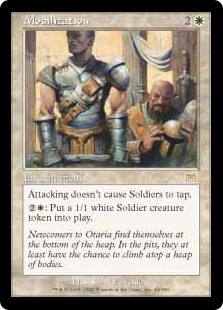
Mobilization

Mobo is a huge card in terms of design. The reason is that before this, R&D was very stingy with repeatable creature token makers. They always had a limit – you could make one per turn with Kjeldoran Outpost, you had to eat a pony every turn with Sacred Mesa, and you needed to burn through the graveyard for Bearscape. With Mobilization, though, if you had the mana, that Soldier was yours forever! That Mobilization even gave the soldiers a combat bonus made it better. Centaur Glade appeared in the same set, but people seem to remember Mobilization more. This was a big turn for a design department that was previously worried about letting players get free access to lots and lots of tokens at instant speed. People still like Mobilization and it pops up in soldier decks; if you've got Veteran Armorer out, it helps every token you make.

$1.25

Oversold Cemetery

Oath of Ghouls is a particularly fun card, but it helps opponents out and requires counting during most upkeeps. Oversold Cemetery was an intentionally-made upgrade to that Oath so that players could get a little benefit from sending their guys to the slaughter. Although it didn't make much of an impact on the tournament scene, the Cemetery is a fan favorite. You get to recycle Sakura-Tribe Elder and his friends every turn, or alternately, it can get back a fattie you lost. Oversold Cemetery  has that Genesis appeal for casual deckbuilders and it's a very light mana investment to get going.

$3.00

Patriarch's Bidding

In some ways, this card bests Living Death. Bidding is great because of the Balance situation; it looks fair on the face, but the reality is that you are playing a deck that is designed to use Bidding and the opponent is not. There was a deck in Standard called Goblin Bidding that used the card to rebuy against opponents who could sweep the board. The seriously dangerous part of Goblin Bidding, though, was that it had sacrifice outlets like Skirk Prospector and Goblin Sledder. You could eat all of your Goblins with Skirk Prospector, then play Siege-Gang Commander, shoot his little goblins away with your new mana, then Bidding them all back into play! The big deck at the time was focused on Mirari's Wake and a Patriarch's Bidding trumped their Wrath of God. Bidding stills gets some love from people playing Zombie and Goblin tribal decks. Technically, it could fit into anything willing to pay for it, but I haven't seen Sliver Bidding at this point...

$3.50

Polluted Delta

Delta commands the highest price for fetchlands from Onslaught, and even after rotating out of Extended, people love the card.

$24.25

Quicksilver Dragon

This reminded me of Silver Wyvern, another fun card from days long past. The allure of the Dragon is that, on a large enough board, it simply dodges removal like Morphling did. Quicksilver Dragon is a fine beater in multiplayer games because it can just slide right out from under spells. The end result is that nobody even tries to pick it off, so your one Island sitting untapped protects the Dragon much more than you'd think!

$1.25

Ravenous Baloth

Oh, how this Beast has fallen. It was the pinnacle of green value creatures at the time – a 4/4 for 4 mana with an upside? Unheard of! (really!) It's been overshadowed by Loxodon Hierarch and Obstinate Baloth because those can get your life as soon as they show up. However, Ravenous Baloth can eat a team of Beasts, meaning he can chalk up some serious lifegain. In the dark ages, I ran Ravenous Baloths in my Survival deck in Legacy, since they were just about the best thing to play with an Aether Vial at four counters. That should indicate how long ago that was!

$1.25

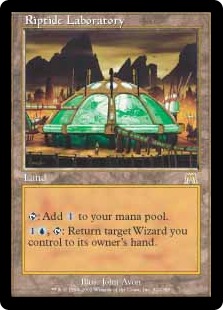
Riptide Laboratory

When this was printed, Wizards were terrible. You had Meddling Mage and that's about it. The best thing on the block was Voidmage Prodigy and man, that was a bad card too. The Meth Lab became very important, however, a few years later when Lorwyn was printed and Spellstutter Sprite ended up with a Wizard subtype. Now you could bounce most of the cards in an Extended Faeries deck with the Lab, setting up frustrating soft-locks on opponents and fouling up combat. The Lab jumped from a bulk card to a chase rare at tournaments and was personally memorable for me because it was one of the first cards I'd predicted a price increase on. Their price has settled considerably from the $7 they used to command, but the Lab is still popular enough for folks wanting to send Venser, Shaper Savant back to their hand.

$1.50

Rorix Bladewing

Rorix is a quick six for six mana, a surprise for nearly a third of your life total. It saw play occasionally in Dragonstorm decks, but I'm sort of baffled about why Rorix is still valued above bulk rare prices. It's not like Rorix does anything particularly cool.

$1.50

Rotlung Reanimator

Now we're talking about cool effects! Rotlung Reanimator promises value from your Clerics on their way out. It's especially fun when you hack its text line to change “Cleric” to “Zombie” so that you have a never-ending parade of monsters! Rotlung Reanimator is a very popular card casually because it makes up for the annoyance of losing creatures. Enterprising deckbuiders may also use it as a bridge in a hybrid zombie-cleric deck. A fun card all around.

$2.50

Shared Triumph

If you're looking for more Crusade effects, Shared Triumph is pleasant in tribal decks. This card pops up a bit in EDH as a little creature buff in theme decks like Allies and Slivers, too.

$1.50

Silvos, Rogue Elemental

Okay, I get that this is what Green gives you for six mana, but I don't get why people actually pay money for this. An 8/5 trampling regenerator is awesome, so maybe I'm just jaded by cards like Path to Exile that solve this guy quickly. A lot of people love Silvos and his price shows it; I was actually surprised when I cashed out some junk copies of Silvos I picked up for awhile back to get a good chunk of beer money!

$2.00

Soulless One

This is that big, bad zombie that all the other guys call out when it's time to fight the final boss. Soulless One is an uncommon so it's worth keeping an eye out for him; he routinely goes for a little bit of money. He counts Zombies in play as well as graveyards, which can make this guy into a real attention-getter in a game of Magic.

$1.25

Starstorm

Starstorm trades Earthquake's ability to hit players for the chance to knock out some Angels and other fliers. It technically has cycling, but like Akroma's Vengeance, I've never really seen one cycled so I don't know if that ability is just on there for show. Startstorm makes up part of the toolbox of red board sweepers that you reach for in EDH if you need that kind of ability.

$1.00

Steely Resolve

Like Dense Foliage, Steely Resolve protects all your guys. It is a little more limited because it only protects a tribe, but giving all of your Elves Shroud is just fine in a multiplayer game. Steely Resolve is a potent card for tribal decks and I'm not surprised to see it at its price; I'd look to splash for it in any Tribal deck I were constructing.

$2.00

True Believer

True Believer is part of a group of cards in Vintage and Legacy known as “hate bears.” Bears, because they are 2/2 and hateful, because they stop an opponent from executing a popular strategy. Gaddock Teeg is the king of ursine haters, but True Believer does a fine job of shutting down cards like Intuition, Blue Sun's Zenith, Tendrils of Agony and more. It was reprinted in Tenth Edition, which has slightly dropped its price.

$1.25

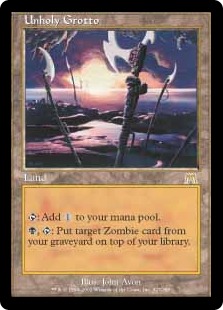
Unholy Grotto

Do you remember how annoying Volrath's Stronghold is in EDH? This thing does the same thing, cheaper, but at least trimmed to just a single tribe. Unholy Grotto is so important to Zombie decks that it's a big power rare in the set. It has distinctive art, so you'll never miss it when you're looking through boxes of junk from people. One thing's for sure, you won't find any bunnies in this grotto.

$2.00

Visara the Dreadful

Avatar of Woe is fun, but it has a lot of rules text. Visara has two pertinent things she does: flying and murdering. No mana, no sacrifice of your own, no requirements. Turn her sideways to eat a quarter of the opponent's life or to slaughter their best guy. It's no wonder that people like this gorgon, and she's been a popular selection for black decks since printing. Visara's price is also influenced by the fact that she hasn't been reprinted at all, making her less common than Avatar of Woe.

$4.25

Weathered Wayfarer

Wayfarer acts like the guy in Land Tax, but he'll do one better – he grabs any land you want. The Wayfarer has seen a bit of attention in Legacy, where he'll grab a Karakas to bounce a Mangara of Corondor or a Wasteland to grind down an opponent's resources. It's a little tyke that always gets the job done. He was reprinted in 9th Edition, which dropped the price by about a buck. Did I mention that he can find Library of Alexandria?

$1.00

Windswept Heath

G/W is a popular color combination for hate decks in both Legacy and Vintage. Those decks often rely on basic lands, so the Heath is subsequently, also popular.

$18.50

Wirewood Lodge

What's better than gaining a bunch of life from Wellwisher or pounding an opponent with Timberwatch Elves? Doing it again that turn! Wirewood Lodge is another modestly-desired uncommon, so pick through your boxes for copies.

$1.25

Wooded Foothills

The importance of Wooded Foothills was dramatically lessened with the printing of Arid Mesa, which could get all of the important dual lands for Zoo decks that the Foothills could. Now, players could mix up a manabase with Windswept Heaths, Mesas and Foothills, meaning that the Taiga fetch suffered a bit in the mix. They're still ridiculously expensive.

$16.50

Words of Worship

The Words cycle fascinates me, since it asks a player to turn their top card into what is functionally a spell. What does a Shock cost? Would you rather draw a Shock than anything else right now? How about a Life Burst? Half a Delerium Skeins? The Words cycle gets more interesting when you are drawing multiple cards per turn, and Words of War is a popular kill mechanic in Enchantress decks in Legacy. However, Words of Worship is the only one to have escaped bulk range, thanks to its massive aggro-blunting abilities.

$1.00

And that's Onslaught! It was a fascinating set and I remember a lot of players getting very excited to see that Wizards of the Coast acknowledged their elf decks. This was, sadly, a time when Merfolk were put aside for flavor reasons, so we had to wait until Lorwyn to snag great cards for that tribe. However, we got bruisers like Goblin Piledriver and token machines like Mobilization. It's a fun set and I look forward to walking you through the first all-creature set, Legions, next week!

Until then,

Doug Linn

Top 8 with Merfolk: SCG Indianapolis

Are you a Quiet Speculation member?

If not, now is a perfect time to join up! Our powerful tools, breaking-news analysis, and exclusive Discord channel will make sure you stay up to date and ahead of the curve.

Scott Muir gives us an event report on how he earned 3rd place at this past weekend's StarCityGames Legacy open event, including how he sideboarded for each matchup and what he would consider for future changes in the deck.

I have been running Merfolk for the past two years. While some might question my logic for staying with Merfolk for so long if it hadn’t produced any real results, the truth is that it is the only deck that I completely understand. I know exactly when to mulligan, when to get into a counter war, how to correctly play Force of Will, and how to sideboard.

In short, it is the deck I am comfortable with.

”Merfolk by Scott Muir”

Maindeck

4 Coralhelm Commander
4 Cursecatcher
4 Lord of Atlantis
4 Merrow Reejerey
4 Silvergill Adept
1 Sower of Temptation
2 Kira, Great Glass-Spinner
3 Daze
1 Echoing Truth
4 Force of Will
4 Mental Misstep
4 Aether Vial
1 Umezawas Jitte
13 Island
4 Mutavault
3 Wasteland

Sideboard

3 Null Rod
3 Pithing Needle
4 Relic of Progenitus
3 Mind Harness
1 Echoing Truth
1 Umezawas Jitte

3rd place at a StarCityGames.com Legacy Open
Indianapolis, Indiana, United States on 2011-06-05

I was asked to write this tournament report two days after the Legacy Open. Combine that with the fact that I was pretty much off in my own world the entire day, I simply can’t remember everything that happened. While not every detail is still with me, I would like to share with you the matchups I played against and any significant plays that stuck around in my head.

Round 1: U/W Stoneforge

Game One: I came into this tournament being told only two things: That Goblins was dead and, thanks to [card]Mental Misstep[card], my matchup against Zoo was reasonably winnable. I wasn’t aware of any other changes in the metagame.

So when I saw my opponent play a Stoneforge Mystic fetching up Batterskull, I knew I had no idea what this deck was. After the initial surprise, the deck just seemed like a basic Legacy control deck. It played Swords to Plowshares/Path to Exile, 10+ counterspells, and some Mishra's Factory.

Fortunately for me, Merfolk thrives in control-heavy matchups. I was able to pump out more creatures than he had removal for while outracing his Batterskull.

Sideboard:
-1 Umezawa's Jitte
-1 Echoing Truth
-4 Aether Vial
+3 Null Rod
+3 Pithing Needle to keep Stoneforge Mystics, Equipment, and Mishra's Factory in check.

Game Two: He still managed to play a turn two Stoneforge picking up a Batterskull. After that, I started drawing my sideboard and slowly worked my way around the singular threat of Batterskull to start the day off with a 1-0 record.

Record: 1-0

Round 2: Naya Stoneforge

Game One: A pretty standard Merfolk beatdown. My opponent got up Stoneforge/Batterskull, but I had too many lords on the field to care about a 4/4.

Sideboard:
-4 Aether Vial
-4 Force of Will
-3 Daze
+4 Relic of Progenitus
+3 Null Rod
+3 Pithing Needle

Game Two: He assembled the Grove of the Burnwillows/Punishing Fire combo turn 3. I missed my third land drop, which prevented me from getting a second lord onto the battlefield to protect my guys. I saw no Relics or Wastelands to stop the combo. I scooped shortly after.

Game Three: I drew ten lands while he beat me down. Again, saw none of my sideboard. Wasn’t looking good for the rest of the day.

Record: 1-1

Round 3: Death and Taxes

Game One: My opponent played Karakas into Mother of Runes. I instantly knew what he was playing and hoped I could kill him before he got anything going. My deck granted me my wish and set me up with a single Daze for his Stoneforge Mystic and every other draw being creatures. I swung in for around 40 on turn five.

Sideboard:
-4 Aether Vial
-3 Mental Misstep
+3 Null Rod
+3 Pithing Needle
+1 Echoing Truth

Game Two: My opponent kept a one-land hand and drew dead.

Record: 2-1

Round 4: Tendrils Storm

Game One: He played Underground Sea into Ponder, so I knew I was up against Storm. Fortunately I had Daze and Force of Will for his critical spells. He scooped on turn four.

Sideboard:
-4 Aether Vial
-2 Kira, Great Glass-Spinner
-1 Sower of Temptation
-1 Merrow Reejerey
+4 Relic
+3 Null Rod
+1 Umezawa's Jitte
I didn’t know if he played Empty the Warrens, which is why I left the Echoing Truth in the Deck.

Game Two: He just couldn’t get around a turn one Cursecatcher. (It was my only counter) He lost four turns later to my creatures.

Record: 3-1

Round 5: Zoo

Game One: Mental Misstep was my hero, countering a turn one Grim Lavamancer. After that I had a very creature heavy hand which allowed me to outrace Zoo.

Sideboard:
-4 Aether Vial
-1 Sower of Temptation
-3 Daze
-1 Force of Will
+4 Relic of Progenitus
+3 Mind Harness
+1 Umezawa's Jitte
+1 Echoing Truth

Game Two: A little less tricky as I stole his Qasali Pridemage with Mind Harness and was able to overpower all his subsequent creatures.

Record: 4-1

Round 6: Merfolk (Feature Table)

This was my first ever feature table and I was pretty nervous, more so than average for the day.

Game One: I landed both Aether Vial and Umezawa's Jitte. It wasn’t long before I overpowered his defenses.

Sideboard:
-2 Kira, Great Glass-Spinner
+1 Echoing Truth
+1 Umezawa's Jitte

Game Two was an absolute blow out. I, again, got a turn one Vial. By turn three I had three Lord of Atlantis on the battlefield. The fourth one was in my hand which I pitched to a Force of Will to stop his Sower of Temptation.

Record: 5-1

Round 7: U/W Stoneforge

By this point I had a strong urge to burn every single Stoneforge Mystic I could get my hands on. I dislike Standard and I sort of hate that fact that it’s becoming the new Legacy.

But I powered through three Stoneforge decks before this, so I decided I could do it again.

There was very little variation between what happened here and in round one.

Sideboard:
-1 Umezawa's Jitte
-1 Echoing Truth
-4 Aether Vial
+3 Null Rod
+3 Pithing Needle to keep Stoneforge Mystics, Equipment, and Mishra's Factory in check.

Record: 6-1

Round 8: Merfolk (Feature Table)

Again, playing against Merfolk at the feature table.

Game One: Kind of one-sided. We both got out Vials, but I had twice as many creatures as he did. I top decked a Lord of Atlantis to get all my guys through for the win.

Sideboard:
-2 Kira, Great Glass-Spinner
+1 Echoing Truth
+1 Umezawa's Jitte

This game came down to the wire.
We again both got Vials.
We both had creatures.
I eventually drew into my Sower of Temptation, tipping the scale to let me win.

Record: 7-1

Round 9: UWGR Ancestral Visions

Since I lost in Round 2, my tie-breakers were bad and there was no way I could draw with my opponent into Top 8. I felt bad for my opponent because his deck gave him the worst two games he had ever seen.

Game One: He suspended Ancestral Vision turn one and then just played land turns two and three and died on turn four.

No sideboard.

Game Two: Almost the exact same thing. I didn’t see a single creature or counterspell either game.

Record: 8-1 and onto Top 8!

Quarterfinals: RUG Tempo

A very detailed coverage of this match can be found here.

Sideboard:
-3 Daze
-3 Mental Misstep
-1 Force of Will
+4 Relic of Progenitus
+3 Pithing Needle

Record: 9-1

Semifinals: Reanimator

My opponent this round was the same person that I rode to the tournament with.

We were both sad that we had to face each other before the finals, but being friends didn’t deter us from playing our best and at our luckiest.

I won game one.

Sideboard:
-2 Kira, Great Glass-Spinner
-4 Aether Vial
-2 Umezawa's Jitte
+4 Relic of Progenitus
+1 Echoing Truth
+3 Pithing Needle (to name his fetchlands)

Then he won games two and three.

I didn’t see a single Relic of Progenitus, also having his own counter backup for every reanimation combo he fired off.

Again, more detailed coverage can be found here.

Record: 9-2

Overall...

I ended the day in 3rd place. I felt pretty good about my first Top 8. After eleven grueling rounds, I think I can discuss potential changes to the deck.

First off, I’m sure many of you noticed the Echoing Truth in the mainboard. It replaced one of the maindeck Jittes (the equipment that’s ALWAYS good) and pushed it to the sideboard. That was, literally, a last-minute change. The reason for this is because Merfolk absolutely LOSES to Ensnaring Bridge. I didn’t want to lose any games that way. It also gives you a maindeck chance at "counterspelling" a Llawan that hit the board earlier in the game. It can also be an unsummon when you need it. That being said, I saw neither Llawan, Cephalid Empress nor Ensnaring Bridge the entire day. It was an experiment that didn’t hurt the deck. That spot would have been equally filled by a Merfolk Sovereign, another land, or the second Jitte.

There have been a few popular changes to Merfolk that I’ve copied myself. The first are the two mainboarded Kira, Great-Glass Spinners. They were amazing all day. She probably won me four games because my opponent couldn’t kill my creatures, or simply because of her 2/2 flying body.

The second popular change is the addition of a Sower of Temptation. This card won me the game two out of three times it was played. I don’t think I really need to explain this. The creature advantage is just too good. I could reasonably see someone playing two in the deck, but no more. It is too hard to cast Sower of Temptation reliably, so you only want to draw it once in a while.

Now to talk about my sideboard. Relic of Progenitus is the best graveyard removal spell available for Merfolk. I qualify it as such because it deals with some of Merfolk’s biggest threats (Tarmogoyf, Grim Lavamancer, and Knight of the Reliquary) while also providing great use against Dredge, 43 Land, Stax, and Reanimator.

Null Rod is also an auto-include in any good sideboard. It beats equipment, Mishra's Factory, Affinity, MUD, Storm, and Belcher.

Pithing Needle is another card that is just plain good against most of the metagame. Important cards I named with it this tournament were Mishra's Factory, Jace, the Mind Sculptor, Mother of Runes, and Grim Lavamancer.

Mind Harness is there simply to help win the Zoo matchup. The second Echoing Truth and Umezawa's Jitte were to be sided in as necessary.

With the growing popularity of NO RUG (and now probably Reanimator) I would throw in a couple Llawan, Cephalid Empress so that you can bounce Progenitus, Jin Gitaxias, Core Augur and Stormtide Leviathan, on top of being great in the mirror.

Thanks for reading!

Stock Options

Are you a Quiet Speculation member?

If not, now is a perfect time to join up! Our powerful tools, breaking-news analysis, and exclusive Discord channel will make sure you stay up to date and ahead of the curve.

Over the past few weeks I've advocated my general rules for competitive deckbuilding in Commander, especially for one-on-one play. Two of those rules, as I've often restated, are:

  • Seven By Nine, All The Time
  • Search and Destroy

The reason why I advocate these rules are for the sake of consistency to achieve a specific gameplan, a must in competitive play. There is another strategy to deck building Commander decks I haven't discussed; it's the "I can take whatever you throw at me" approach to deck building. Rather than building for your gameplan, you're building for the gamestate. In the words of "His Holiness Sheldon Of The Immaculate Banlist" you can Embrace The Chaos and try to master it.

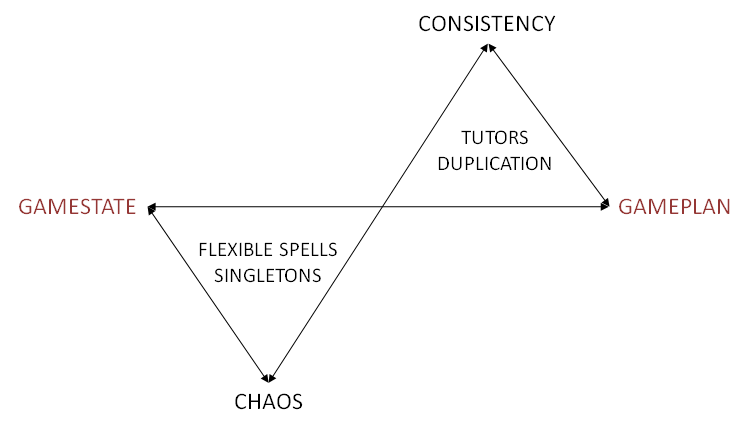
Here's a diagram that demonstrates the tension between gameplan and gamestate. It's applicable to any sort of deckbuilding, not just for Commander, but in this format it pushes you to the left of the spectrum, where as you can consciously choose to push to the right.

An unmolested gameplan will always win; that's why goldfishing a deck always produces unrealistic results. No plan survives intact first contact with the enemy. The question then becomes how resilient your deck is to disruption, and how capable of disrupting the plans of your opponents.

I advocate a strong resilience through Tutors and Consistency of function through 'duplication' of card effects. This is very good at creating situations that make it difficult for your opponents to stop you achieving your end plans. However another school of thought is that your decks should have as many 'silver bullets' as possible in order to deal with whatever is thrown at you. This is where the philosophy of 'packages' comes from (such asTrinket Mage packages and Stoneforge Mystic packages, etc.). This approach allows you the consistency to tutor up the exact card you need to put a spear through your opponent's gameplan. This school of thought still borrows a great deal from the 'search and destroy' approach to deckbuilding.

There is another approach you can take. You can simply massively increase the options open to you by running a metric tonne of flexible spells, and there are a wide variety of flexible spells in Magic. The ones I'm going to concentrate on in this article are:

  • Modal Spells: Those spells that ask you to "Choose" from a number of options (includes Entwine)
  • Split Cards: Those spells that have two card faces
  • Kicker Cards: Those spells that have an added benefit for paying an options costs (includes Multikicker)
  • Alternate-Cost Cards: Those spells that allow you to cast the spell in ways other than mana
  • Cycling Cards: Those spells that grant a benefit for cycling the card

MODAL SPELLS
Modal spells begin with "Choose one -" followed by various effect choices, or modes. There have been many modal spells in the history of Magic, from Healing Salve through to the Exarch cycle in New Phyrexia. Here are some of the best.

Charms

There are two basic types of charm, monocolored versions and the 3-color charms. Both versions three 'modes' of choice and no ability to select more than one version. Most of the monocolored charms are decidedly lacking in power, but there are some of note.

  • Evolution Charm: Has three largely useful effects. You can use it to ramp, recur a creature, or as a combat trick for your big green ground pounders. The first two are highly regarded in any ramping green deck, and although the first mode is no Rampant Growth it does help in those early turns when finding land is a must. The fact that it is instant also helps you use the second mode to rescue a recursion piece form the graveyard after being targeted by graveyard hate.
  • Dawn Charm: A fog, a regenerate, and a counterspell are nothing to sniff at. Very few people run these types of effects in white so few will see any of them coming. The fog can be useful against game-ending commander or fast infect damage, especially when you can crush on the back swing. The Dawn Charm effect hits Bribery, Acquire, Duress and any other number of disruptive spells.
  • Hearth Charm: In Commander this is no end of artifact creatures, so the first ability will usually have something to hit. As part of a pressure deck or goblin-tribal theme, the second ability is great. And if, for some reason, you need to push through that Goblin Lackey you can probably get some use out of the third mode as well.
  • Piracy Charm: In a heavy blue metagame this card is solid. The islandwalk granting mode can be a kick in the pants, the second mode kills most Wizards, and the hand disruption at instant speed is brutal when stuck under an Isochron Scepter.

There are the tricolorws Charms. My favorites are:

  • Bant Charm: There is so much to love about this card. It destroys Sol Rings, 'tucks' commanders (into their library), and counters counterspells. All three modes are powerful effects, and at instant speed even more so. Possibly the best of the tricolor charms.
  • Chrosis's Charm: It's a Boomerang, a Doom Blade, and a Shatter, which are three effects that are always applicable in Commander. The nonblack requirement on the second mode is frustrating (oh only if it were Terminate instead) but the utility in bouncing any permanent with the first effect more than makes up for it.
  • Esper Charm: The Disenchant ability is generally the least used mode of Esper Charm as the next two effects are so good. Instant speed, no-downside, draw-two or double-discard for three mana simply doesn't exist in Magic outside of this card. That makes Esper Charm an amazing card.
  • Naya Charm: The deal-three-to-a-critter mode isn't fantastic in Commander, but nor is it useless. The recursion of the second mode is nice; but it's the third mode that's the best. Forcing a turtling player to tap all their defensive critters at the end of their turn is one of Commander's best face-slaps. Most decks playing this colors want to attack; this card is great at allowing that to happen.
  • Rith's Charm: There is exactly one instant-speed spell that destroys a nonbasic land at 3 mana, and this is it. It can also provide yourself with three surprise blockers (or attackers), or use as a combat trick. For consideration with any deck running Realm Razer

Commands
The Command cycle came out of Llorwn block and pushed modal spells to their power limits. Each Command has four modes. The only card everyone remembers all the options to is Cryptic Command (quick, name them!) but the others are all worth remembering as well. As there were only five, I'll talk about each one.

  • Austere Command: Probably the best of the Commands for casual Commander, Austere Command grants flexibility for dealing with a lot of different types of permanents. Whether it's big creatures, small creatures (such as tokens), frustrating enchantments. or dominating artifacts, this spell can deal with them all. The best thing about it is you can do so surgically, destroying what you need to while generally leaving your army intact. A very smart card.
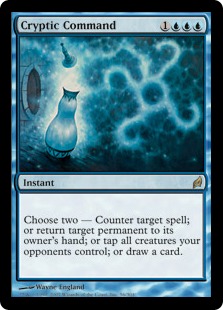
  • Cryptic Command: Probably the best of the Commands for competitive Commander, Cryptic Command is still the powerhouse it was when abused by Faeries and Five Colour Control. All the modes are good. Whether it's unconditional countering, a boomerang effect, tapping an opponent's creatures out, or drawing a card, every mode has its uses. Also, it's the only Command that operates at instant speed, an auto-include in just about any blue control Commander deck ever.
  • Incendiary Command: To be frank, this card doesn't float my boat. Even the hand-disruption fourth mode doesn't thrill me, even when you're trying to abuse a mechanic built around it. It's big, it's slow, and it generally doesn't do enough.
  • Primal Command: The modes are gain 7 life, Excommunicate a permanent (including a commander if desired), shuffle away a graveyard, or tutor for a creature. This gives Green a deck access to a 'tuck' effect (by choosing modes 2 & 3), which can be devastating against certain decks (eg. Jhoira of the Ghuitu, Arcum Daggson). Tutors are always good, and 7 life isn't inconsequential in Commander.
  • Profane Command: Even if you're not Patrick Chapin you can still get a lot of utility out of this. Most monoblack decks are capable of creating vast amounts of mana and therefore the drain-life-without-the-lifegain first mode is relelvant. The second mode recurs creatures straight back onto the battlefield, which is a powerful effect. The third mode is capable of killing indestructible critters, and the fourth can make your presumably-zombie army unblockable. All are fine modes, making Profane Command a highly inclusive card.

Entwine Cards
Entwine cards are modal, but with the upside of paying the Entwine cost to activate both modes at once. There are 24 modal spells in all, with Tooth and Nail the Commander poster child for the Entwine mechanic. Here are some of the better ones.

  • Betrayal of Flesh: Okay, it's expensive. But it's one heck of a combat trick, killing just about any creature on the board while getting your best creature from the graveyard back onto the battlefield. I'm not sure whether you're willing to pay 6 mana and three lands for the effect, but it is certainly worth considering.
  • Grab the Reins: It's a little bit Act of Treason, a little bit Fling, but for six mana you can instantly grab any creature without shroud (or hexproof) and remove it from the board while nugging an opponent. A very nice option for alternate creature removal.
  • Journey of Discovery: There are more favored ramp spells out there but I happen to have a soft spot for this one. The first mode is worse than Cultivate, and the second worse than Exploration, but together they do marvelous things. I'm never unhappy to see it in my starting hand, which means a lot in Commander.
  • Promise of Power: It's not hitting anything other than a heavy-black deck, and like Betrayal of Flesh the cost is extraordinary (9 mana to get to entwine), but the upsides are delicious: putting an at least 5/5 beatstick into play and drawing 5 cards. The loss of life is barely a scratch in Commander. Unless you're at 5 life, in which it becomes a take-your-chances Demon summoning spell.
  • Reap and Sow: Mwonvuli Acid-Moss does it cheaper, but is restricted to tutoring for Forests. This allows you to go grab any land, which is a nice piece of utility. If you're going the mana-denial route, however, they probably both belong in the same deck.
  • Savage Beating: BOOM! How much fun is this card? I mean, just look at the guy in the picture, happily coming to plant his fist between some blue mage's teeth. Seven mana is a lot to spend, but you're going to do so to win the game by giving your creatures an effective "quadruple" strike.
  • Tooth and Nail: As mentioned, this is the entwine card people think about when they talk about Commander. It is also part of the reason Painter's Servant is banned in Commander. My current favourite duo to go for is to go for Melira, Sylvok Outcast and Woodfall Primus with Greater Good on the board to cause infinite land destruction with infinite card draw. Hopefully Melira will be fixed on MtGO soon so this can actually be pulled off. Meanwhile, if you're running green, you're running this.

New Phyrexia Modal Creatures
New Phyrexia introduced a new cycle of enter-the-battlefield modal creatures. They are:

  • Brutalizer Exarch: I underrated him when I first saw him, but having played with him a little, I confess he's pretty damn good. Able to get rid of troublesome lands and equipment, and able to tutor up creatures you need while holding down the fort: he's a competent little package. Worth considering in any deck running Green.
  • Deceiver Exarch: Essentially a combo piece with Splinter Twin or Kiki-Jiki, Mirror Breaker, he's a second Pestermite for those looking to add consistency to their combo deck.
  • Entomber Exarch: A more flexible gravedigger, don't read the second mode wrong. A lot of people assume it's 'choose a creature card', but it isn't. It's 'choose a non-creature card'. I'm not sure if that makes it a better card or not, but a Duress effect on a bear is pretty interesting.
  • Inquisitor Exarch: A dull bear that, unless part of a large combo, doesn't do enough in Commander to make it worthwhile
  • Tormentor Exarch: The -0/-2 ability is cute, but will hardly turn Commander on its head.

Random Modal Chaff
There are also a host of other random modal cards. For example:

  • Grim Discovery: A great card that deserves more play.
  • Hull Breach: An amazing little card that can take out a just-cast Erayo and the Sol Ring used to power it out.
  • Invoke the Firemind: What a lot of UR decks look for, the flexibilty to get ahead on cards or just end the game.
  • Soul Manipulation: A savage beat when masterfully played in a UB control deck.

SPLIT CARDS
Split cards offer all sorts of flexibility tricks for rules lawyers familiar with how split cards work in regards to the mana costs of the individual 'split' cards. I really suggest reading the MTGSalvation Wiki on Split Card rules to learn more about them.
Here are some of my favorites:

  • Crime // Punishment: It's the 'or enchantment' rider on Crime that thrills me. Stealing someone else's Mana Reflection or Moat seems like a fine use for a card as it's completely unexpected in white-black-green. The pseudo-Engineered Explosives effect is also highly useful for surgical strikes against opponents, especially tokens. I don't see a lot of white-black-green decks around, but that's likely to change once the Commander decks are released.
  • Life // Death: Exhume isn't fair. Death is only slightly more fair as you can only grab your own creatures, but as a back-up it's not half bad. Green-black decks love their creature recursion while ramping out lands, so I can see both sides of this split card seeing play.
  • Fire // Ice: It's the Isochron Scepter imprint of choice in various formats, though not as powerful here. Still, it's hard to ignore the ability to tap down any permanent while drawing a card, or ping a couple of opponents for 1 each a turn, even in a beat-heavy format like Commander.
  • Supply // Demand: There are a number of sweet token strategies in Bant decks and Supply can happily help out with this. Demand is a little more selective on the tutoring front, but with the range of new gold cards coming out specifically for Commander this card is likely to have more targets than ever.
  • Spite // Malice: A sweet card for blue-black control decks, you can either repair the damage done when an opponent gets a creature through your countermagic net, or prevent one of your own creatures being nuked by a removal spell (or even help win a counter war).

KICKER/MULTIICKER CARDS
Kicker and Multikicker cards are useful as you get a reasonable effect for a reasonable amount of mana, or a great effect for just a little bit more. Here are some of the better ones.

  • Ana Battlemage: This guy doesn't just pack a kick down low, but also a sock to the jaw and a smack to the head. As a bear he's pretty useless, but he can force a player to discard three cards while dealing damage to that player (or another) at the same time. Why he requires Blue instead of Red is entirely up to the mysterious thinking of the Planar Chaos design team. Thunderscape Battlemage is so jealous.
  • Blood Tribute: An instant-win combo piece with Wound Reflection or Sanguine Bond. [Editor's Note: Been there, killed by that. It happens!]
  • Citanul Woodreaders: For six mana you get a blocker plus two cards, which isn't the worst thing ever to happen in green. Not competitive playable, however.
  • Comet Storm: Once you have a large enough mana pool, this card becomes a real threat to everyone else sitting opposite you. You can strike instantly, yes instantly, at any number of creatures or players to take them out hard and fast. It's disappointing more people don't play this Fireball variant as it's just made for the big-mana Commander environment.
  • Desolation Angel & Desolation Giant: No one has ever played either of these and not paid the kicker. They are truly Commander worthy, through if you do decided to blow up the world make sure you can end the game fast afterwards.
  • Dismantling Blow: A fine removal spell that more than replaces itself.
  • Everflowing Chalice: A card that loves to be abused with proliferate, Everflowing Chalice is a fine colorless ramp spell.
  • Gatekeeper of Malakir: Cruel Edict effects can be a bit hit-and-miss in Commander, but they're always good to have around against people playing with indestructible or creatures with shroud. Certainly a fine card for monoblack control decks.
  • Joraga Warcaller: An absolute beast in Elf tribal decks. Thank goodness they didn't give him a name and make him legendary, or he may well of needed to be banned.
  • Kangee, Aerie Keeper: A very expensive Joraga Warcaller for the bird tribe, Kangee is a fine casual commander. I have a Kangee deck myself and it's a blast. There a few people still willing to sling Thieving Magpies across the kitchen table, and they're always welcome around my place for a beer.
  • Marshal's Anthem: A sweet little card that can be heavily abused with enough mana. Note that it brings the creatures directly back onto the battlefield, bigger and better than ever. This can be backbreaking for decks not equipped for that kind of sudden burst.
  • Orim's Chant: This is the single best thing to get under a Turn 1 Isochron Scepter, if you can manage it. Strictly a competitive format card; not casual at all.
  • Rite of Replication: This is the type of card that stories get told about. Paying 9 mana to put five of any creature into play is ok, but when those creatures are all copies of your opponent's Blightsteel Colossus? That's a great story. I've always enjoyed the moment when this is cast, and especially enjoyed it when the effect is Misdirection'd at a lowly saproling token. A beautifully designed card for those moments that make Commander truly enjoyable.
  • Sphinx of Lost Truths: He's a decent flier with terrible dreadlocks, but anything with 'draw three' on it is worth playing, especially in blue. Even if you think of him as an overcosted Ancestral Recall with a 3/5 flyer attached, it's still Ancestral Recall and that card is good I hear.
  • Wolfbriar Elemental: Speaking of putting tokens into play, here's a guy who gets the job done. After the cost of playing a 4 mana 4/4, you then get the option to put another 2/2 into play for every extra Green you spend; and what Green deck doesn't have mana to burn? I've been blown out by this card several times and I'm sure will have it happen again several times more.

CYCLING CARDS
A card that cycles is never a dead card (alright pedants, if you have no cards left in your library it's a dead card, congratulations!). Its ability to replace itself means you have the flexibility to try your luck top-decking into something useful at all times.
There are a few types of cycling cards. The first are cards the straight cyclers (ie. have 'cycling' printed on them but do nothing more). The second are cards that cycle for specific cards (eg. landcycling, slivercyclers). The third are cards that cycle for effect (ie. have "When you cycle this, do X" on them).
As the first group are relatively straightforward I'm not going to talk about them much. The second group is still relatively small, but there are some interesting cards:

  • Vedalken Æthermage: A card that is an uncounterable tutor for Wizards is pretty tight in blue. The fact it allows you to tutor back Azami, Lady of Scrolls that's been Hindered away, making it pretty invaluable in that type of archetype. The flash and the ability to bounce two other popular commanders, Sliver Queen and Sliver Overlord make it that much better.
  • Homing Sliver: One of the most seriously abusable cards in the Sliver arsenal. Slivers are the tribe that's best at the 'silver bullet' effect and this card pushes the deck into overdrive, turning every Sliver in hand into an uncounterable tutor. That's seriously impressive.
  • Absorb Vis: An eight-point life swing isn't terrible late game, but it's the early game ability to ensure hitting three mana that counts. Black hardly needs another tutor, but this isn't the worst option at its disposal (I'm looking at you, Diabolic Tutor).
  • Traumatic Visions: It's a hard counter that can be flushed away to help ramp. That's fine in mono-blue, although there are various other cards a Competitive blue player will use before resorting to this.

And then there are the cyclers for effect. These are fantastic as the cycling is effectively uncounterable, meaning you gain a card and a pretty devastating effect as well and nothing can be done about it by your opponents. Here are some of the best:

  • Decree of Annihilation: Regardless of whether you cycle this or cast this, you're getting value. Just be sure you have a plan on how to end the game after you do, because no-one enjoys starting the game from scratch again without there being some sort of purpose.
  • Decree of Justice: A great end-game card, it's expensive to activate but well worth it. The tension between having the 4/4 flying angels that might be countered, or the certain army of 1/1 soldiers is sweet.
  • Decree of Pain: The base effect of this card is absurd, the cycling effect merely very good. Great at hosing the board, or just other people's token strategies (or Wizards, I might add).
  • Krosan Tusker: The first non-Decree on this list, he's on the list because, quite uniquely, he cycles for two cards which is excellent card advantage for green mages.
  • Resounding Silence: It's playable as written, but can be brutal when cycled as it’s an effective 3-for-1. I have a soft-spot in my heart for this card as I rode it to a Top 2 spot in a PTQ in Sydney once. The mana is not easy, but achievable in Commander without too much hassle.

And there you have it. A whole bunch of cards that can add flexibility and, dare I say it, chaos to any deck. Naturally I would advocate a sensible mix of flexibility and consistency, but at the end of the day it's up to you on how you choose to build your deck. Will it be with certainty, consistency and resilience, or with flexibility, variety and adaptability?

Let me know in the comments what you think about consistency versus flexibility for consideration for the deck-tuning article coming next week!

Ach Hans, Run! It’s the Humility!

Are you a Quiet Speculation member?

If not, now is a perfect time to join up! Our powerful tools, breaking-news analysis, and exclusive Discord channel will make sure you stay up to date and ahead of the curve.

Next week I’ll discuss some of the exciting Commander previews, but for the time being I’m ignoring the future in favor of the past. Last weekend, I was testing out my newly completed (not compleated) Saffi Eriksdotter deck at the local store. My opponents were playing Merieke Ri Berit control and Numot, the Devastator land destruction. After battling through some abuse to my mana base and sticking Birthing Pod under Counterbalance (okay, maybe it is compleated), I began chaining Reveillark into six drops. I had, to say the least, a dominating board presence, and when my Numot opponent cast Wrath of God, I casually sacrificed Saffi to recur ‘Lark and continued to go off. He asked incredulously “How do you stop that thing?”

“Hallowed Burial, or maybe Final Judgment,” I replied. From the look on his face, I got the distinct impression that he was running neither of the aforementioned sweepers. After a couple more turns of beating face, the Merieke player dropped Humility. “What a pain,” I thought, “let’s see what outs I have.” I cast an Idyllic Tutor to examine my options, and after looking through my deck, found that all of my enchantment removal was creature based (so as to better synergize with Saffi). Resigned to my fate, I commenced to beat down with Triskelion and 1/1s against Thopter Foundry and Sword of the Meek while commenting that I needed to add a Beast Within or something to the deck. After all, having your synergies turned off makes you lose, and it’s not hard to beat Humility or Torpor Orb without playing bad cards.

Power Dynamics
We didn’t finish the game because the next round of Draft was beginning, but as I went into my match, I wondered: should I really be adding a Beast Within? Of course the card is strong, and while I’m certainly no fan of staples, I’d be adding this to fill a specific role. No, my problem was that the removal might be too much the right fit for the deck. Commander is great in that you can pick pretty much whatever strategy you like, and in a casual playgroup, you can make it work. This format is open as such because everyone is not running the most powerful or efficient cards (yet another issue with staple filled decks). If you’re running a deck based around Psychic Possession, admittedly not the most potent or robust of strategies, you can still stay ‘competitive’ by giving your deck every tool you can muster. You need to find a specific enchantment; you can reach for Demonic Tutor. You need to protect it from destruction; you have access to Arcane Denial. You need to get it back when it’s inevitably dealt with; you have Holistic Wisdom waiting in the wings. These cards may not be directly linked to your theme, but they’re necessary to be a major player in the game.

Not so with Saffi.

The deck is plenty powerful. No, it’s not going to best Arcum Dagsson in a duel, but the deck certainly isn’t struggling to avoid chastisement at a multiplayer table. Saffi doesn’t need every edge she can muster merely to put up a fight; I’ll often be the frontrunner on the back of the deck’s inherent synergy. It answers a lot of problems, and it demands a lot of answers. The truth of the matter is that anything like the aforementioned Psychic Possession deck is going to have a tough enough time competing as it is. And the format should allow decks like that. Otherwise, what really separates casual Commander from the cutthroat groups that so many cry out against? So if we want to build intrinsically powerful decks, they absolutely must not cover all of their bases. They need a weakness.

Weaknesses
“Okay,” you say, “I won’t put any creature removal in my Zur the Enchanter deck. If they can stick a creature, it’ll stay there.” That’s not going to keep you from locking them out of the game with Solitary Confinement, Necropotence, and Steel of the Godhead. Just like with creating your own Commander, you need to weave a weakness into your deck that undermines the very core of what it was trying to do. Most of the time, a themed deck’s game plan is proactive: Uril, the Miststalker aims to suit up its General and SWING FOR MASSIVE DAMAGE! Sharuum the Hegemon looks either to combo off or to Darksteel Forge an unbeatable board position (yes, that is a verb now). Wort, the Raidmother wants to conspire an entwined Tooth and Nail… repeatedly (Eternal Witness + Kiki-Jiki, Mirror Breaker).

Each of these powerful plans is vulnerable to disruption, and thus they usually include countermeasures to keep their plans from being derailed. Uril runs Bear Umbra to beat Day of Judgment; Sharuum runs Counterspells to fend off Return to Dust; Wort uses Boseiju, Who Shelters All to fend off countermagic. That’s all well and good when they’re battling one another. They form a level of competition that allows for awesome plays and huge swings: a healthy, enjoyable format. But, ultimately, a narrow one.

If your playgroup consistently gets big games running this may not be an issue as politicking makes up for large power imbalances, but if you often find yourself playing with one or two other "Commandites" (What’s the proper term for a Commander player?), then this invulnerability will make it nearly impossible for really off-the-wall decks to compete. Without your protective measures, you play on the same level. Your deck is naturally redundant because it’s playing a strategy that the format inherently supports, either because of a particular Commander or because of an abundance of strong cards; in turn, they’ve fought tooth and nail to force redundancy upon a plan that is practically a glass cannon. We want to build blind spots into our innately strong decks, but how do we get there?

Theme Songs
When somebody exploits your deck’s blind spot it should be devastating. If your board position is strong enough to fight the whole table, a single spell should send you back to the stone age; if you have twenty more cards in hand than the rest of the table put together, a precision strike should invalidate all of your spells. In order to empower the other players you should be beatable. But how can you ensure such a ploy will crush you without just building a terrible deck in the first place?

You need a theme.

If your deck has a lot of divergent game plans, then once you’re far enough ahead you’ll be unstoppable. But if all of your game plans overlap in what sorts of cards they rely on, the right answer can disrupt multiple lines of attack. If you build your deck around creating huge numbers of token creatures, your Plan A might be to drop a Glorious Anthem effect or two and have a huge army. Plan B could be to Shivan Harvest your tokens to mana-screw your enemies. Plan C could be to lock down your opponents with Glare of Subdual. Plan D could be to Overrun.

Each of these plans has its own weakness. Stoic Angel might shut down Kaysa, but Glare of Subdual will keep the Angel down too. Playing a bunch of basic lands will spoil the Harvest, but won’t save you from Glare. Slice in Twain gets rid of Gaea's Anthem, Shivan Harvest, or Opposition, but it won’t stop your opponent from delivering a Titanic Ultimatum. A Fog will avert a Triumph of the Hordes, but it won’t stop any of the other threats. In a dominating position, the deck might have multiple plans assembled, and even with multiple opponents, it’s unlikely they’ll all draw the appropriate answer to each, but because each of them relies on tokens a well placed Wrath of God can put a stop to all four.

The more strictly you build to your theme, the more overlap you’ll find, and the more powerful a theme you can pick without annoying the entire table. A token deck that’s a slave to theme will have a really tough time against opposing Akroma's Vengeances, but once you add Jace, the Mind Sculptor and Karn Liberated to the mix, Nevinyrral's Disk starts to look a lot less threatening. But if the deck is weak, you want to eke out every potential advantage (maybe not Mindslaver + Mirrorworks + Glissa, the Traitor + Forbidden Orchard, but you get the point).

Balancing Act
So how do you know when to cut every answer out of your deck, when to plan for every eventuality, and when to take the middle road? Ultimately, you have to assess how powerful your theme is. If you’ve played Magic for a long time, some may immediately jump out to you as strong. Anybody who played in tournaments when Torment was new knows the power that Cabal Coffers and its monoblack friends offer (or less monochromatic ones with the help of Urborg, Tomb of Yawgmoth), and anyone who has played a lot of casual Magic can attest to the power of Elves.

However, just because you haven’t played for long doesn’t mean you’re left in the lurch. One of the best ways to find great cards for your themed decks is to search a database for cards that play into your theme of choice, and compile the ones that look good somewhere. Through this process, you should get some sense of how many cards that are on theme you’re excited to run (that is, how many feel powerful). This number may be abstract at first, but after doing this a few times, you’ll start to get a sense of what constitutes a lot (every card that pumps your team) as opposed to few (every card that Norin the Wary can abuse). Alternatively, if you’re willing to do a bit of math, you can see how often you’ll draw a card that fills the role you’re looking for by the turn that you need that effect, and use that level of consistency as a gauge for your strategy’s power.

I hope you found today’s suggestions helpful and that they’ll lead you to better balanced Commander games, and I would love to hear your thoughts on the matter. Next week we’ll finally take a look at the imminent Commander release; until then, may your crazy decks succeed.

Jules Robins
julesdrobins@gmail.com
@JulesRobins on Twitter

Insider: The Consequences of Magic 2012

Are you a Quiet Speculation member?

If not, now is a perfect time to join up! Our powerful tools, breaking-news analysis, and exclusive Discord channel will make sure you stay up to date and ahead of the curve.

(Note – The Prediction Tracker update will now be added to my column every week, and it will appear on Fridays from now on).

It’s been a busy week in the Magic world. We’ve had the Star City Invitational, GP Singapore, an upcoming Pro Tour, and M12 and Commander spoilers everywhere!

Last week was also one of the first times I’ve truly traveled for an event, and it’s safe to say I have a better understanding of the grind than I used to.

I also didn’t get to trade as much as I would have liked at the Invitational, on account of Top 32’ing and cashing at the event, but I was able to work in a little. While trading, I was able to consistently pick up Consecrated Sphinx at low prices, and at least one dealer on site was buying them at $4. I also saw a number of Sphinx at the top tables of the tournament.

All of this makes it seem like the Sphinx is a sick pickup right now, doesn’t it? Well, yes and no. On the positive side, it’s seeing more and more play and its price is steadily increasing. The only bad news to temper its rise?

Magic 2012.

This brings me to the focus of this week’s column. With spoilers flying at us from M12, it’s time to take a step back and evaluate what it is going to do to the market.

I’ll start with the reprints that are going to have the biggest impact.

Titans

With this picture, we have confirmation of what we have expected for a while – the Titan cycle is coming back.

Personally, I’m not excited about what this does to the metagame. It pushes almost any other expensive drop out of consideration (Sheoldred, I’m looking at you), it stifles creativity in deckbuilding, and I’m just tired of the cycle in general at this point.

But what does this mean for the market? The short answer is to get rid of your Titans now. If you’re looking to acquire Titans on the cheap for post-rotation, I think Inferno Titan is the easy pick. I suggested picking them up in February, and they’ve continued to prove their worth since then, doubling in price before holding steady now.

Aggro strategies would appear to be more viable post-rotation (or post-Stoneforge banning), and the Red titan is the most well-positioned to remain viable. Wurmcoil Engine also stands to gain prominence, though its price will be tempered by being a release promo.

Looking outside of the cycle, it’s likely that the reprinting of the Titans will lower the ceiling on Consecrated Sphinx. While the card still has room to grow, since it’s seeing play already, it isn’t as likely to climb as high as it otherwise might have.

It also means that you can pretty much write off any other six or seven drop, sorry Sheoldred, Whispering One, Elesh Norn, Grand Cenobite, and the entire Chancellor cycle. Plenty of interesting decks could be built around these cards, but instead it looks like games are going to end in a flurry of 6/6s.

Returning Planeswalkers

Nothing to see here, you know what to do.

Baneslayer Angel

It certainly appears the Angel is gone, with so many of the Mythic slots already accounted for (5 Titans, 5 Planeswalkers, the new Dragon and the new Vampire), this leaves very little room for more Mythics. It’s unlikely they’ll waste a spot on a reprint that doesn’t see any play, especially considering the points Mark Rosewater raised in this article.

This means to dump Angels if you have a way to get decent value out of them. It also means to pick them up dirt-cheap after the fall rotation, since you can still find Angel collectors who want her. In addition, it’s not impossible that she’ll be back at a later date in a format not dominated by 6/6s.

Lightning Bolt

Bolt is out of M12, and Shock is in. But, being Lightning Bolt, the card is going to continue to be valuable and sought after. Dealers frequently buy Bolts at a quarter. Pick them up from the huge number of players who don’t value them worth anything, especially since they’ll be rotating.

In all, Magic 2012 appears to mean relatively little to the current Standard environment. As of yet, there’s no big reveal to “sell” the set. I think this means Wizards is holding something exciting they expect to sell the set with, probably at the rare slot. Some people have speculated it will be a reprint of the Ravnica shocklands, but I don’t see that happening with fetchlands currently legal in Standard. But I think we can be pretty sure there will be something exciting and new to sink our teeth into.

The real question is whether or not anything is going to be banned on June 20th. I still think it’s unlikely, but I would welcome it if it were to occur. I really don’t see a reason to hold onto any extra Stoneforge Mystics right now, so if you haven’t already, you should unload them in case they get the banhammer.

Now let’s move on to the Prediction Tracker.
[iframe https://spreadsheets.google.com/spreadsheet/pub?key=0AqV8zg-4f2ehdE5QVkFHWmVpOEdqcUdMSmFKd3h5NXc&single=true&gid=2&output=html 925px 1000px]

[iframe https://spreadsheets.google.com/spreadsheet/pub?key=0AqV8zg-4f2ehdE5QVkFHWmVpOEdqcUdMSmFKd3h5NXc&single=true&gid=10&output=html 925px 700px]

[iframe https://spreadsheets.google.com/spreadsheet/pub?key=0AqV8zg-4f2ehdE5QVkFHWmVpOEdqcUdMSmFKd3h5NXc&single=true&gid=11&output=html 925px 700px]

[iframe https://spreadsheets.google.com/spreadsheet/pub?key=0AqV8zg-4f2ehdE5QVkFHWmVpOEdqcUdMSmFKd3h5NXc&single=true&gid=12&output=html 925px 700px]

With Consecrated Sphinx seeing heavy play in the last week, you’re unlikely to be able to pick them up any lower than the $4 most people agree you should look for. I also lowered her target price due to the Titan reprints being confirmed. If you bought in early, I don’t think it’s a terrible idea to sell out a few now at $4 cash, and hold onto some and wait out the market.

Another popular pickup this week is Caged Sun. I know for a fact that Ryan Bushard and I were able to pick them up as throw-ins all weekend long at the Invitational. Gauntlet of Power is a $7 card, and foil prices on it are insane. There’s no reason to think Caged Sun won’t go the same way in a year or two, especially with Commander product about to hit the market. Pick these up as throw-ins (especially foils) and hoard them. You’ll profit later.

Spikeshot Elder is also picking up some love, and it appears like it’s a solid card to watch. It’s going to be an incredibly important one-drop after rotation, and the reprinting of Goblin Grenade is going to ensure that it doesn’t lose value late in the game.

The other trend this week is the call to watch for Scars dual lands. These are criminally undervalued right now, with many traders valuing them at a dollar. They are going to be a very important part of the Standard and Extended manabases for the next few years, and they stand to gain a few dollars in that time.

That’s all the major changes from this week. Let me know how you think we’re doing with the Tracker and any suggestions you have to improve it!

Thanks,

Corbin Hosler

@Chosler88 on Twitter

Insider: What’s your plan?

Are you a Quiet Speculation member?

If not, now is a perfect time to join up! Our powerful tools, breaking-news analysis, and exclusive Discord channel will make sure you stay up to date and ahead of the curve.

This last week of Magic has been a very humbling experience. For the first time in recent memory, I opened a paltry trade binder with 3 lonely cards in it, and began my trading for the weekend. I made some pretty good progress on the binder this weekend, but due to the amazing kindness of some strangers I’ve met through the online community, I received a huge boost to my restart. I can’t even begin to describe how great it feels to have such a supportive community. To put it lightly, I have a very potent trade stock now. I’m in the process of cataloging my new additions and tweaking my spreadsheets, so those will appear next week. This week I want to touch on something specific about building a collection from scratch, that I didn’t address last week. Setting priorities is something that many people don’t spend enough time thinking about, and defining what it means specifically.

You need to know what your goals are in order to take proper steps to maximize your time and resources. If your primary goal is to maintain a collection, so that you can play Standard, you should have a much different set of priorities and evaluations than someone who plays Legacy, or someone who strictly trades for value. I started trading to support my nasty drafting habit. Any successful business person has a business plan. What’s yours?

As a drafter, I’m mostly looking for cards that will hold value and draw attention to my binder. If you fit this category, every trade you make should see you trying to trade up. You’ll have a consistent flow of low valued rares and playable uncommons coming to you naturally from drafting, so trading those up to higher ticket items is the model. This also gives you access to quickly liquidate any or all of your high ticket items through any of the usual channels, whether that’s EBay, a local dealer or your LGS. Most drafts don’t give enough prize support to reliably ‘go-infinite’ without using the cards you open, or trade to help cover a cold streak. At most places I play, you need to make the finals 3 out of every 4 drafts to be completely free-rolling. Figure out where you’re at on this scale, and set a specific goal as to how you will make that up. I’ve found, over the long run, I’m able to cover all my drafting for a month with about $15 invested each month. When you’re first starting out, sometimes you’ll need to pay into the game a couple times to get the ball rolling, and keep in mind hot streaks can often pay for your entire season. I make a point to try and pick up that remaining $15/month through trading each month, and in some way convert that back into draft dollars. Everything else, stays in the trade binder. When rotation approaches, I start cashing out, or trading into cards that won’t rotate. This is the annual cycle of a drafter.

Standard Players face an entirely different trading problem. First, they need to have all the format staples on hand, and that is a fairly dynamic list. The strategy I recommend for this is to trade down all your money cards prior to rotation into staples that will survive the the season. An example of this might be to fill any holes in the Scars cycle of duals, by dumping just one or two rotating rares, like Stoneforge Mystic. Nothing is worse than having to pay inflated event pricing at the PTQ, because you don’t own 4 Inquizition of Kozileks. From there, you can use extras as trade binder filler, and be ahead of the metagame by being prepared to dump any sudden spike in uncommons or junk rares you’ve accumulated. As I’ve recounted in this column a number of times, keeping a longbox of uncommons has bought me entire PTQ entries because I had stashed a couple dozen of a particular card that people are looking for at the last minute. With this model, you should be able to build most decks in the format, and reasonably survive rotation each year.

Legacy players, on the other hand, have a much different set of priorities. Typically they’ve been playing longer, and already have a deck built, and trading isn’t a necessity. However, dipping into Legacy, can be a very daunting task. In order to finance the jump into Legacy, you’ll likely need to start with one of the above paths to get some kind of collection behind your efforts. Once you have something to start with, just start picking up playable Legacy cards in trades. Maybe you get someone to throw in a Mishra’s Factory in a trade. Or maybe that EDH player at your store has Pact of Negations or Swords to Plowshares that are extras. Starting with some of the lower dollar staples, will make trading up into the higher dollar Legacy cards much easier. Many people will be reluctant to trade their Legacy cards for Standard cards, with good reason. Also, they are simply more familiar with the Legacy cards and their values, that if they are going to trade down, they typically want to see some Legacy cards in there too. Trading into Legacy isn’t an easy task, but it’s something I want to tackle as part of my business plan.

Over the next year, I hope to work my way through at least the first two sections, and be ready to branch into the third around this time next year. Set a plan. Take actions towards that plan with every trade. Revise your plan as your priorities change. These steps are simple, but have the ability to let Magic be as affordable as possible.

Prediction Tracker Update:

I removed Aether Vial from my dump list and slid it over to watch this week, as it’s fallen to $6 on the SCG buylist. I’ll call this a win for those few that didn’t doubt me on this one. Hopefully some of you who had extras cashed in. I also want to comment on Candelabra of Tawnos, even though it doesn’t have any movement. The buy price on SCG is now only $100. Again, if even one person got out at $200+ on my recommendation upon the Mental Misstep spoiling, this paid for their QS subscription for a couple years. I also added the Scars Duals to the watch list. As I’m trying to bolster up a standard collection, and trying to be thinking long term with regards to rotation, I’m realizing the Scars duals will be important in nearly every deck. Fetchlands and Manlands are leaving, and even if the Fall block brings some interesting non-basics, the Standard environment is going to be heavily dependent on the Scars duals for their manabases. I’ve been able to trade for these very cheaply, and plan to continue to do so, and stash them, until they turn a profit. I’m not sure what kind of price these will ultimately reach, so I’m not actively buying them, but targeting them as throw-ins on trades has been surprisingly successful. I’ve also chimed in a number of other cards other writers have posted, and updated my notes on a few old ones.

Another thing, I’ve been scanning the forums here on QS lately, and I’ve noticed the activity has picked up there a bit. This is an amazing resource. You have the ability to pick the brain of all of the writers, as well as like-minded readers. You get to hear success stories, post critiques, and provide feedback to this fairly young service with a staff that is receptive to your requests. If you aren’t using the forums yet, add that to your regular cycle of information you check on. Having a tight knit group of people to bounce ideas around with about different trading strategies, or card trends is very powerful.

See you guys next week, I’m going to continue to document the collection rebuilding, and bring back a new topic that relates to building or branching your collection.

Precon Buyer’s Guide: Core Sets and the Rest!

Are you a Quiet Speculation member?

If not, now is a perfect time to join up! Our powerful tools, breaking-news analysis, and exclusive Discord channel will make sure you stay up to date and ahead of the curve.


Welcome back to the final installment of the Precon Buyer's Guide. In previous installments we've discussed eBay and theme deck/intro deck retail, splitting the length of Magic into three eras: Vintage, Classic, and Modern. Today we'll be concluding with a look at the Core Set decks, as well as the majority of the other products ranging from Duel Decks to Duels of the Planeswalkers. Although the prices are set at the time we publish this, it's our hope that Quiet Speculation can even help improve the financial perspective of the casual player. Had I known when I began my precon collection what I know now, I would certainly have saved a good chunk of change. Hopefully we've helped those of you also looking to collect a few more entires in the precon format to do the same.

A few quick notes before we begin. We'll be continuing to examine the same vendors we've been surveying throughout the series, the main players in today's market which have a solid inventory. There are others (CoolStuffInc comes to mind) which certainly pass the first test, but lamentably fail the second. For our needs, we want those merchants who have a good chance of having what we're after on hand. The one's we'll be using are:

ABU Games (ABU): Boise, Idaho’s “Alpha Beta Unlimited”

Channel Fireball (CFB): Well-established game store and top-tier article site in San Jose, California

Card Kingdom (CK): Game store in Seattle, Washinton looking to expand its brand. Recently became sponsor of Limited Resources podcast.

MTG Fanatic (Fanatic): A game store and article site/forum community in Houston, Texas

StarCityGames (SCG): One of the leading presences in the game right now, from store to articles to the SCG Open Series of cash tournaments. Located in Roanoke, Virginia

Troll and Toad (TT): Located in Corbin, Kentucky, they claim to be the largest retailer of Magic cards in the world (in both stock and sales)

Amazon (Amazon): Amazon acts essentially as a brokerage, putting the consumer in touch with the inventory of a large number of smaller, independent retailers for precon decks. Rather than identify any specific retailer (since they vary from deck to deck), I’ll be using the best price available for that item, but as you’ll see these often act as something of an outlier and don’t reflect a serious cost.

Also, I'd like to reiterate the following disclaimer:

DISCLAIMER: The following data tables reflect a good-faith effort to collect retailer pricing from the retailers’ websites directly. These figures are a snapshot taken no earlier than June 6th, 2011 and may not reflect current pricing and stock with completeness or accuracy. Many sites list their price for an item even if they do not carry it in stock. I will not be reporting these, not least because they can often be inaccurate; the retailer will update a price if there is demand, but often wait until they update their inventory.

Now with the boilerplate out of the way, let's get started!

7th Edition

Although not the first entry-level set to feature a number of theme decks (Starter saw print two years prior, and Portal: Second Age even earlier), 7th Edition established the model: five decks, one per color, that would last until Core Set got the reboot with Magic 2010. Also of note was that like the Starter decks, these continued the 40-card model which seemed both simple enough for the beginner to grasp as well as give ample room for adding new cards (expansion-set theme decks would go to this model with 2008's Shards of Alara). There wasn't much here in the way of standout decks; they're very simple affairs.

8th Edition

Again, these decks are on the cheaper end of the spectrum, a reflection perhaps of their rather simple nature. There's no good reason why StarCityGames has Heavy Hitters at a 50% premium over its competitors; the deck's rares are Rhox and Primeval Force, and are not in high demand.

9th Edition

Although as we'll see they'll soon fail us, MTG Fanatic continues to hold the award for best early Core Set inventory, and their pricing tends to be within the ballpark. Army of Justice and Dead Again are slightly marked up, but again this is not propped up well by the card selection. Army of Justice has Glorious Anthem and Righteousness, the latter of which would soon be downgraded to Uncommon status. Dead Again features Nightmare and Underworld Dreams.

10th Edition

Now isn't this interesting! Whether it be from early player demand or a smaller print run, Tenth Edition is somewhat hard to find, except on eBay where there always seems to be some lingering about in the $12-range. The interesting innovation here was the adoption of personalities for each deck, personified by the legendary creature drawn from Magic history that each deck was named for (as well as featured within the deck itself).

Magic 2010

Magic 2010 gave the Core Set concept a radical reboot, and was a tremendous success. The "challenge assumptions" mentality that went into its design and development extended happily to its precon decks as well. In addition to the expected changes resulting from the transition from theme deck to intro pack (a foil rare and a booster now included), each were now two-color affairs, although they still hewed close to the simplistic line of their predecessors. Case in point: they all boast a 12/5 primary/secondary land ratio (save for Nature's Fury, which is 11/5), meaning that this secondary color is is just a splash. Note also that a Nightmare again has made the cut for a rare, so soon after featuring in 9th Edition's Dead Again.

We Are Legion clearly takes pride of place here as a Boros weenie deck, though its rares (Lightwielder Paladin and Honor of the Pure) are no great shakes. The Amazon prices are clearly divorced from any reality we are familiar with, though it is not without a small dose of irony that we see they have the cheapest. We Are Legion on the board.

Magic 2011

Next we have the second of the line with Magic 2011. The basic outline of the set differs little from Magic 2010, with an approximate two-thirds/one-third land split between the two types. Both sets boast both a black-green and an blue-red colored construction, and the primary white deck gets paired with its other enemy color, black. To those gazing hungrily at the upcoming decks from Magic 2012, the lesson here is "what's the rush?" The decks will remain fairly available, and outside of Amazon will be reasonably priced.

Duels of the Planeswalkers

In June of 2010, pleased with the success of the Duels of the Planeswalkers game, Wizards released a series of decks "inspired by" the decks in the game itself, to serve as a bridge for potential new players to make the jump to the actual paper Magic: The Gathering product itself. These decks were the first ones we ever reviewed over at Ertai's Lament, and they weren't especially impressive.

It's worth noting, though, that only Nissa Revane's deck has not only held, but increased its value. In previous installments we've noted the popularity of tribal decks, and Ears of the Elves is no exception. With cards like Immaculate Magistrate, Talara's Battalion, Imperious Perfect, Coat of Arms], and Elvish Champion- all cards hovering around the $3 to $5 range- it's not hard to see how ABU might have seen need to jack it up. If you have to have it, hold your nose and go for Amazon, or try fishing on eBay.

Duel Decks

Ahh, the Duel Decks! One has to wonder if, back in November of 2007, anyone figured that their $20 outlay for the new Elves vs Goblins would be an investment, or if it was just dismissed as another precon product aimed at the casual crowd. If the prices of the first three sets are anything to go on, anyone who felt the latter might well regret it now. Difficult to find, and even more difficult to find at a reasonable cost, it's hard to endorse any of the Duel Decks at the higher end of the price spectrum, but they can occasionally be had for a steal (like anything else) on eBay. By now the print runs and collectability have stabilised, and they can be had fairly easily upon release and for a time thereafter. Not surprisingly, the alternating Planeswalker-themed ones tend to hold value a little better than their non-Planeswalker counterparts.

By the way, when I checked Card Kingdom's website boasted having an incredible 371 copies of Jace vs Chandra in stock. For those interested, with that kind of backlog they might be willing to make a deal. Also, for those wanting a little more in-depth coverage of the Duel Decks themselves, we've got you covered!

Premium Deck Series

Another of the newer precon lines, the Premium Deck Series caters to the player who has a foil habit and is willing to pay a high premium for the privilege. For their inaugural release, Wizards played it safe and went for one of the most popular tribes ever to hit the casual table, perhaps forgetting for a moment that "casual nation" as a whole isn't quite as enamoured of "pimping out their decks" as other market segments (see: Legacy). It made for an odd pairing, and Slivers didn't sell as well as hoped.

Next year, Wizards aimed at a broader spectum of players with Fire & Lightning (as discussed here), and it has to be said that the foiling for that set was stunning. Although it appeared to do better, it wouldn't surprise me to hear that this line has been discontinued altogether. At the end of the day, who wants to play $35 for a precon deck? If Wizards decided to use this series to reissue Legacy staples, however, they would find a very ready market. Premium Deck Series: Countermagic anyone?

Planechase

Although not directly a "series" the way we've seen above, Planechase kicked off the annual tradition of a variant format or multiplayer edition, which would be succeeded by Archenemy and Magic: The Gathering Commander. Although very popular at first, general consensus is that Wizards left their baby stillborn with inadequate follow-up support, and enthusiasm these days is fairly muted. On the upside, so are the prices. Zombie Empire again gets the "tribal premium" with the rest fairly straightforward decks. Metallic Dreams is notable for the return of affinity, while Strike Force is a fairly serviceable Boros deck.

Archenemy

While Planechase was all about love's labor lost, Archenemy actually seems to have cultivated a fair bit of active dislike over its brief life. Intended to put a different spin on multiplayer Magic (particularly the dreaded three-person group), players complained that the schemes it employed were wildly hit or miss, and that it didn't offer a consistently enjoyable outcome. Others leveled the same charge against Wizards as they did for Planechase: a seeming lack of enthusiastic support (mainly in the releasing of additional plane and scheme cards). Although there were other ways to make the products engaging, Archenemy too seemed to fall to neglect, widely available now for less than sticker price.

Mirrodin Besieged Event Decks

We've given these the once-over before, but in short we're very happy to see a new precon product, and one that seems to have generated compelling interest. Of course, much of the buzz comes from the Stoneforge Mystic pair in the upcoming War of Attrition Event Deck for New Phyrexia. But having an FNM-ready deck is a laudable objective. To be sure, the decks have their flaws, but the line is already showing signs of improvement. Watch this space.

Miscellaneous

These items tend to be for the collector's collector these days, because they are insanely priced, hard to find, and, frankly, not all that great. Take the Deckmasters release, for example: you get two decks, one each designed by Jon Finkel and Richard Garfield, using a preset rarity scheme and drawn from Ice Age and Alliances. Were it not for collectability and nostalgia, there wouldn't be much of a market for something like this these days.

Even more egregious is Anthologies, which contains a wonderful mini-book on the history of the game perched right above two steaming 60-card piles. The decks are dreadful, and can be assembled on the cheap at a fraction of the cost, so what you're getting for your hundred bucks is the book. I own three of these four products, and I can tell you firsthand that your money is probably better spent elsewheres.

And on that note, we conclude! I hope you've enjoyed the Precon Buyer's Guide series here on Quiet Speculation, and that it's helped guide you in some way to save some money in your precon collecting. It's been great fun to assemble, and of course I would always encourage you to do your own research as well. There are a lot of ways to save money on these, whether it be to assemble it from scratch using singles or happily bid on "gently used" products on eBay. I picked up my Deckmasters box for a mere $20 simply because it was incomplete, missing a 10 x 14 inch poster of a Lhurgoyf fighting a Goblin Mutant which would have languished in the box anyway.

Good luck, and happy hunting!

_______________________

Jay Kirkman

@ErtaisLament

www.ErtaisLament.com

All the Ways to Ramp

Are you a Quiet Speculation member?

If not, now is a perfect time to join up! Our powerful tools, breaking-news analysis, and exclusive Discord channel will make sure you stay up to date and ahead of the curve.

My apologies for missing an article last week. My brother just entered the blissful (or hellish, depending on who you ask) state of marriage over Memorial Day weekend here in the US. Between that and work travel immediately following the wedding I didn’t get my article cranked out like I'd have liked last week. To make up for it, today I’m going to talk about the nearly ubiquitous inclusion of mana ramping cards in Commander decks, and which ones you should play, and in which decks, to give you the leg up on one of the most important parts of a deck.

Regardless of color choices, there are many different strategies to ramp in Commander. It’s a universal truth that you should at least consider having a few ramp cards in your 99, regardless of what archetype you’ve chosen to play. From the most “broken” ramp cards like Sol Ring, to the humble Rampant Growth, there’s a huge array of cards to choose from for the average deck builder.

The Broken (Undercosted and Overplayed)

This category includes the cards that pretty much everyone wants to run in every deck, with Sol Ring and Mana Crypt being the two primary offenders. Very few decks want to skip out on these two for one simple reason: they give you a net increase in mana when you play them, and stick around to keep doing it turn after turn. These cards are almost always better than another land in your deck because they let you cheat your curve. Playing a 4-drop on turn 2 will often put you way ahead of your opponents in board development, card quality, or whatever angle you’ve decided to attack from with your choice of deck.

Short Aside: These types of cards are frequently brought up for a possible banning by members of the Commander community who feel the banned list should be balanced for one-versus-one play, as well as multiplayer. Thankfully, the Commander Rules Committee understands the value of having a format that is based around multiplayer play and does not cater to the more competitive crowd, and these cards remain unbanned. For those who wish to play solely one-on-one I would recommend banning these types of cards as a local ban.

Non-broken Artifact Ramp

The other form of acceleration available to every color, artifact ramping has its plusses and its minuses. In the days of Tolarian Academy being legal, it was noticeably more powerful, but these days it has fallen off in popularity. Many decks still run mana fixing acceleration like Darksteel Ingot and Gilded Lotus because of the bonus mana and the color fixing provided by those artifacts. Neither one is particularly stellar, but they both do the job. Sometimes you’ll see a Medallion (that is, Sapphire Medallion and friends) in a mono color deck, or a Diamond (like Ruby Sapphire) because if you only need one color, you might as well get the acceleration going as early as possible.

There are also the few gems like Wayfarer's Bauble that let any color play green’s game and search up basics and put them directly onto the battlefield. If you’re playing in a heavy artifact-hate meta, cards like the Bauble can get the job done without exposing you to as much of the hate.

Green “Land onto the Battlefield” Effects

If there is one thing that makes green much better in Commander than it is in other formats, it is the strength of ramp. Commander is oftentimes about having your haymakers start landing before those of your opponents, and no color enables ridiculously costed haymaker spells and creatures like green can. There are two main types of these effects: tutoring up a land and putting it directly onto the battlefield, and getting additional land drops. Tutoring is the more universally powerful effect, but additional land drops can make for some silly combos in the right deck.

It’s safe to say that pretty much anything that generates card advantage independent of number of players is a solid multiplayer card. Green land fetching has that in spades starting at three mana.  Kodama's Reach, and the new non-Arcane subtypeless version Cultivate, are both are great cards for ramping, as are the put-both-on-the-battlefield versions in Skyshroud Claim and Explosive Vegetation. The Rampant Growth variants are less powerful simply because you’re only getting one card in the deal, but you can also start ramping sooner which might matter depending on your curve. In most of my green decks, I play all four of Cultivate, Kodama's Reach, Skyshroud Claim, and Explosive Vegetation unless I’m leaving them out for flavor reasons.

The second type, extra land drops, is a type of ramp usually left to dedicated ramp and land focused decks because it’s fairly narrow. However, in these types of decks, it’s extremely powerful. Oracle of Mul Daya is a prime example of how powerful this effect can be: for four mana, you get to see the top card of your library and play it if it’s a land every turn, letting you get to the business spells that much faster. Other effects like Exploration and Rites of Flourishing see play as well. The mana-ramp-into-huge-threat strategy is powerful enough that Asuza, Lost but Seeking sees play as a mono-green general just to play Eldrazi faster. If you’re looking to play things far earlier than anyone has the right to be playing them, green is your go-to color.

“Land into Hand” Effects

If you have a top heavy curve, and you need to make all your land drops for the first few turns, playing effects that let you find additional lands is a great way to go when you aren’t in green. (While green has this ability in large quantities too, you’re usually better off playing the spells that put them directly onto the battlefield for you, with the exception of cards like Yavimaya Elder that give you additional card advantage.)

Amusingly enough, the color that can do this the best is probably white, for no other reason than a single card: Land Tax. Land Tax is so incredibly underrated it’s almost criminal. How would you like an enchantment that said “At the beginning of your upkeep, if an opponent controls more lands than you, draw 3 cards.”? Would you run that? I sure would. When you look at Land Tax and how important it is to make sure you hit your land drops for as long as possible, along with the nice thinning effect multiple triggers gets you, it’s hard not to read Land Tax that way. If for some reason you’ve mostly eschewed basics in your deck, then Land Tax might not be right for you, but if you play at least 9 basics I’d say you should probably be running it in your white decks. White and artifacts both have several one shot ways to do this, as well as the basic landcycling cycle from Conflux, but what makes Land Tax awesome is the repeat usage.

The other nice thing about this effect is being able to get any land, rather than just basics. White will often let you get Plains on the one shot effects, and multiple green spells will let you tutor for lands with a basic land type, so you can find those pricey Revised duals (or slightly cheaper Ravnica versions) if you have them. In green and artifacts, you have effects like Sylvan Scrying and Expedition Map which let you find any land you might need. These become an auto-include when trying to take advantage of particularly powerful lands, such as Cabal Coffers or Gaea's Cradle, because they become "additional copies" of the card you’re really looking for.

Aside #2: Some people may feel these cards go against the spirit of Commander because you’re only running them to be a second/third/whatever copy of some broken land in your deck. As always, check with your playgroup to make sure people won’t be upset when you use Sylvan Scrying to get Gaea's Cradle almost every game.

Mana Doubling Effects

There are many ways to double your mana for double the fun, and every color has one or two besides white. Red gives you the oldie-but-goodies of Mana Flare and Gauntlet of Might but not much else in the reusable department. Blue gives you the classic combo-enabler High Tide. Black has the virtual mana doublers of Cabal Coffers and Magus of the Coffers. Green has the colorshifted-to-the-right-color Mana Flare, Heartbeat of Spring as well as ones that only work for them in Mirari's Wake (I know it’s white, but it’s really green) and Mana Reflection. Choose your own colors in artifacts gives you Gauntlet of Power and the new-and-improve version, Caged Sun. Playing one of these at the right time will often catapult you miles ahead of your opponents, provided you have the cards to take advantage of all that mana goodness. Obviously, X spells are great for this, but don’t forget about multikicker cards as well. The flexibility lets you go big when you can, but still lets you play them if someone forced you to deal with them instead of continuing to ramp early.

Lands to Ramp Ratio

One important thing to remember when building your deck is to never cut lands because you’re playing ramp spells with the exception of the cards like Sol Ring and Mana Crypt. Nothing is more of a downer than having Skyshroud Claim and Gauntlet of Power sitting in your hand and only three lands on the battlefield.

When building a deck, I aim for 40-45 mana sources on average, hedging one way or the other depending on the average converted mana cost of my spells. If I’m playing a particularly small curve, I might go as low as 36 actual lands with 3-4 additional ramp effects, but that’s the bare minimum and it’s exceptionally greedy when you’ll almost always want to get to 10 or more mana available in a game. With any average converted mana cost over 4.0 or so, I’d recommend 38-40 actual mana producing lands and five to six additional mana sources. It may look like a lot, but you’ll be much happier when you have the mana to play your spells on time.

Mana flood in Commander is often mitigated by using your commander more aggressively since you’ll have the mana to replay him or her even if someone kills them. In my dedicated ramp deck that plays big silly spells, I run upwards of 55 lands and ramp spells and I’ve never felt mana flooded. If you aren’t experiencing occasional mana flood, you probably aren’t running enough mana sources in your decks.

Go Big or Go Home

While I hit the major points, I didn’t hit everything. There are many, many different approaches to mana ramping in Commander. Not every strategy fits how you may want to play. For more aggressive players, putting additional lands into play is huge, because it lets them get the aggro on faster. For a more control oriented player it’s highly likely they need to make sure they hit every land drop consistently rather than just getting ahead of the curve. It all depends on the goal for your deck, so pick the ramp strategy that works best for you. Next week I’ll share one of my ramp-oriented decks that does silly things with some of the mana doublers I mentioned above.

Until next time, may you always hit the gas before the brakes.

Where Were You December 2, 2010?

Are you a Quiet Speculation member?

If not, now is a perfect time to join up! Our powerful tools, breaking-news analysis, and exclusive Discord channel will make sure you stay up to date and ahead of the curve.

[Editor's Note: Please welcome Ryan Abcede to Quiet Speculation! He has an interesting financial overview of the Commander format, and if this type of information is something you're interested in please share in the comments! He'll be sure to come back with more!]

December 2, 2010 will be remembered as one of the most important days in Magic history. On that fateful day, Aaron Forsythe and Monty Ashley announced Wizards of the Coast’s full-fledged support of the casual community created format, Elder Dragon Highlander (renamed to Commander), through the Magic: The Gathering Commander decks. This was a huge move by Wizards, and an indication of where the game is going and their priorities lie. I could continue on and on about what this means for the game but that's really an whole article; it's looking at the financial implications that have occurred due to Wizards officially supporting Commander that I'm interested in here.

Before jumping into all the nitty gritty numbers, I’d like to introduce myself. My name is Ryan Abcede (yes, almost like the alphabet). I’m from Toronto, Ontario. I’ve been playing since Fallen Empires, but only really started playing casual competitive during Time Spiral block. Prior to that I mainly drafted, and went to Prereleases. I am pretty much the trading guy at my local game store. I try to play FNM as much as I can, but due to my work schedule usually doesn't work out that way. To get my Magic fix I started a Commander League on Thursday nights. This brought my full attention to Commander, and really showed me that there is a lot of money to be made through the EDH market.

Let’s start off with what has now become a cliché casual statement: what is the most expensive card from Ravnica? Most people would say it’s a shock land, or possibly Dark Confidant. But for the longest time it actually was Doubling Season (only until recently has Dark Confidant threatened to take that throne). Doubling Season is a purely casual card. It has not seen any significant constructed play, and it probably never will. However it's been on more kitchen tabletops than Islands have in all the Top 8’s in all of the tournaments ever held.

Casual appeal is the safest factor affecting the price of a card, are are eternal as they come. Rarity can change, cards can get banned or become underpowered/irrelevant depending on metagame shifts, and ultimately they rotate out of Standard and Extended. But with casual cards these normalfactors affect card prices very little. Look at Staff of Domination. It sees limited Legacy play and was banned for Commander use, but it’s price didn't budge at all because casual players as a whole still love the card. That’s the beauty of the casual market: players essentially make their own rules and metagame when playing in the vast wilderness of kitchen tables across the world.

There are a few ways to take advantage of trading in the trading in the casual market as it's a great resource if managed correctly. Casual players do not value price as the only factor when trading because:

  1. When a casual player wants a card they really want a card.
  2. Casual players are usually not as up-to-date on the value of cards.
  3. Tournament players don’t really care about their casual cards.

I am not saying take full advantage of a casual player and their lack of price knowledge; I’m not into lying and keeping things from people to rip them off. But what I am saying is to leverage the level of attachment various players have to particular cards to get some serious value. Find out what they want and provide it to them at a premium. Casual players usually don’t have a network of stores they frequent or players they regularly can trade with. They usually stay within their groups and do not travel far outside of that group. That’s why I try to keep as many casual cards as I can because when you see a new casual player you never know when you will see them again. And because they are usually not regular traders they'll have one or two gems in their binders. Even foil commons or uncommons can be great finds from a casual player.

On the flip side, tournament players are the easiest way to get casual cards at undervalued levels. You can get casual cards at lower than market price from almost any tournament player as long as it’s for a card they want for a tournament deck. They need their cards for a purpose: to win, and tThis means they will usually overvalue them if required. Tournament players often have little attachment to their casual cards, and you are really preying on that.

Usually, it works out favorably to trade up your casual cards to casual players and trade down your constructed cards to tournament players. It’s a great way to get value at each step of the trading game, almost like getting compound interest while trading.

While this is basic information for you all, the main reason I wanted to write this article is to highlight the big gainers in the past six months since the initial Commander announcement. Most of these cards that have gained value have never really had a significant price change in the last two or more years. This is as close as we get to the creation of a new format, until Modern/Overextended or something similar gets confirmed. Yes, Commander (EDH) did exist before but now with the full backing of Wizards it has basically become legit. Money is now being put into the format to grow it and this can only be positive for the value of the format's best cards. It is not to late to get in on the trend (obviously 6 months ago was prime time), but there is still a glimmer of hope. I do believe that once the Commander decks come out there will be a second but more gradual price increase once all the new and returning players settle in.

Let's start off with the prime target of most of my trades in the past six months, to fully illustrate what kind of cards I am talking about:

Bribery – Rare from Mercadian Masques, 8th Edition; not on the Reserved List

Test time: how much do you think this card is worth? How much was it worth when Wizards announced the Commander decks?

Ready? Time’s up; Bribery is worth roughly $10 retail right now. StarCityGames is sold out of near mint copies, of the Mercadian Masques version, at $9.99 and has two in stock of 8th Edition. Some sites are selling Masques versions slightly higher, but SCG seems to value both the same.They have a few slightly played copies from each set in stock at $8.99. While SCG does not have historical pricing, working from memory I am sure it was around $5.99 less than six months ago because that was the value I was trading for them.

To illustrate how much this card, and every other card discussed today, has jumped I will be using BlackLotusProject prices.

Bribery was $5.09 on BLP on December 2nd. Today’s price is $7.83, which is a 54% increase in just six months! Yes, there are cards that have jumped quicker than Bribery in Magic’s history, but this is a safe and solid increase with very little risk and is something applicable for all cards I am talking about today. Some cards have higher chances of getting reprinted or banned, however they all have one thing in common: the mass of casual players that want them for multiple decks, including Commander. This market is growing by the day and there seems to be no end in sight.

Some colors have more staples or money cards than others, and I really tried to make my initial list even for each one. But as you will see that just was't possible. If there is enough interest for a future article I will elaborate on which cards you should be looking for and what I expect them to be priced at. So don't forget to comment at the bottom if you want to see more Commander financial articles!

WHITE

Austere Command

December 2: $1.37 Today: $1.95 (34% Increase) SCG: $2.99

This is one of the best Wrath of God effects you can have in Commander, and I would even say at times it's better than and actual Wrath. Commander is not a format to just play the best cards, which is why something like Tarmogoyf is pretty underwhelming. He's just an efficient body, that’s it. All cards have to “do something” and Austere Command does so much more than a regular Wrath of God. In Commander, the difference between four and six mana is fairly negligible, and the extra two mana is usually worth it for the extra flexibility Austere Command gives you. There is a reasonable chance of being reprinted, but as long as it’s not reprinted in standard it’s power and flexibility should maintain it’s demand. Pick these up if you can as it's easy money once the market experiences it’s next level of growth.

Karmic Guide

December 2: $2.47 Today: $3.94 (100% Increase) SCG: Out of Stock at $4.99

This is the meat of many combos in Commander, and it's played in the Legacy deck Cephalid Breakfast. This is a huge pick up, and could easily be $10 retail in the near future.

Stonehewer Giant

December 2: $1.12 Today: $2.34 (154% Increase) SCG: Out of Stock at $2.99

This is Stoneforge Mystic before she took steroids and made a deal with the devil, and a very solid Commander card. Every deck at least has one to two pieces of Equipment, and just tutoring those up while providing a body is all you need. It is easy to find at near bulk prices, but scarce enough to gain value over time. Being from Morningtide helps as well as that set was not opened up all that much.

RECAP: White has many other cards that are good and has experienced some price increases, but these are ones that stick out in my mind as being perfect Commander cards. Another tip is pick up any random Wrath-type card, especially if they can be asymmetrical in some way. There are tons out there as every block seems to have at least one.

BLUE

Acquire

December 2: $0.66 Today: $1.05 (59% Increase) SCG: $3.99

This usually works just like another Bribery in most decks. Artifacts play a huge role in Commander, and Acquire preys on that fact. I feel this is severely undervalued, and SCG’s price is closer to where it should be.

Bribery

December 2: $5.09 Today: $7.83 (54% Increase) SCG: $9.99

Bribery is usually #1 in most decks, and it bears noting again that this card is hot. If you can get it for anywhere near $5 to $8, get it. I don't think a reprinting will happen and if it does it won't hurt the price that much. You can always find someone who wants a Bribery, especially more competitive players taking their stab at Commander and building a “broken” blue based deck. (Isn’t this always the case?)

Treachery

December 2: $4.07  Today: $6.28 (54% Increase) SCG: $9.99

This is both on the Reserved List and has the "free spell" mechanic. What more do you want out of a card? Get these now, and get as many as you can. The sky’s the limit on this one. [Editor's Note: I recently tried to pick up a foil copy and found the price to be absolutely insane at around $40. Really.]

RECAP: Blue may be the most popular color in all of Magic, and Commander is no different. Control Magic effects are big as well as countermagic that “do something,” like Draining Whelk and Desertion. Keep your eye out for anything powerful that a tricky blue mage would love.

BLACK

Decree of Pain

December 2: $1.98 Today: $2.83 (43% Increase) SCG: $3.99

This is easily a $5 card. Get these if you can find them, and if you can get them for below retail. Wrath effects that draw cards are far better than regular Wraths. I know; it surprised me too.

Demonic Tutor

December 2: $6.64 Today: $7.60 (14% Increase) SCG: $11.99

This is the staple of all black decks. In a 100-card format, tutors win games. Even though it was "only" a 14% increase, Demonic Tutor is always worth something and will never lose its value. Nostalgia is big factor for this card as well.

Vampiric Tutor

December 2: $10.31 Today: $11.47 (11% Increase) SCG: $19.99

As we said before, Tutors win games. Almost every black deck should start off with a Demonic Tutor and a Vampiric Tutor. New players introduced to Commander will eventually realize this. Be there to trade to them when they need them.

RECAP: I had problems finding more cards for black that are either real money makers or solid stable cards. Mind Twist, Damnation, and [caard]Phyrexian Arena[/card] are three other decent pick ups I'd suggest looking into, but have not experienced any significant price spikes yet. Could this actually be the perfect time to pick these up?

RED

Kiki-Jiki, Mirror Breaker

December 2: $5.70 Today: $4.72 (17% Deccrease) SCG: $9.99

That is not a typo: this card did go down in price, but it's still a hot card. Kiki-Jiki is to red as Karmic Guide is to white. Both set up combos, game winning plays, or just sheer brokeness (and also sees play in Cephalid Breakfast). I believe Kiki-Jiki will be in the FTV Legends set, but that will not affect his price in any way.

RECAP: Really? Only one card in red and it has a negative value change? Yes, red is pretty much the worst color in EDH and red rares in all of magic really have a hard time becoming money rares. Before Mythics came along I can’t remember a red chase card that held it’s value.

GREEN

Eternal Witness

December 2: $2.75 Today: $2.58 (6% Deccrease) SCG: $3.99

This is an eternally safe green card to invest in. Don’t let the negative change scare you; I treat these like pocket change. They are easy to use to equal out trades and easy to trade away for the same amount or more. I don’t think anything, even a standard reprinting, can make this card drop in price either. It will also be a player in Overextended/Modern if that happens.

Genesis

December 2: $5.55 Today: $6.39 (15% Increase) SCG: $11.99

This is areat card for green and depending on your creature quality it can act almost like a tutor. Old, and hard enough to find that people will trade out the nose for him. Hopefully you are the only guy who has them actually for trade.

Sylvan Library

December 2: $4.40 Today: $6.46 (47% Increase) SCG: Out of Stock at $7.99

Part of this card’s price is due to Legacy, but this can only work in it’s favor. Being a dual format superstar allows this card to be traded to almost any player out there. It has a somewhat nostalgic feel to it as well, another little bump in it’s price.

Tooth and Nail

December 2: $3.65 Today: $5.16 (41% Increase) SCG: $9.99

This is what Commander is all about: big splashy spells creating "deal with it or I win" situations. This card also saw previous constructed play, so if Modern or something ever actually hits paper this could potentially be a strategy there as well. It would also be great in monogreen Eldrazi/8-12-16 Post hybid deck. Any time I get one of these “in stock” it flies right out of my binder, getting replaced with some great constructed cards.

RECAP: Green is arguably the most powerful color in Commander. If blue is actually more powerful, green is certainly not far behind. Green is also the most casual friendly color because most casual players love to beat down with big monsters and that's what Green does best. Cards like Woodfall Primus and Vigor are slowly creeping up in price as well, so keep an eye on those ones.

MULTI COLOR

Mirari's Wake

December 2: $4.42 Today: $5.68 (29% Increase) SCG: $7.99

Commander players love Mana Flare effects. Big mana is a major part of most player’s strategies. The price of this card surprised me at my last major trading session, and it was a good thing I checked its price before letting it go.

RECAP: Multicolor cards are more limited in their ability to tap into the Commander craze due to the color restrictions. Most are either very high priced due to Legacy playability or very low priced because of their narrow appeal. The Wake is the exception to the rule because it is a casual superstar.

ARTIFACTS

Akroma's Memorial

December 2: $9.99 Today: $13.16 (32% Increase) SCG: $19.99

The price for this, out of all the other cards, surprised me the most. It has pretty much doubled in a year, but I understand why it's so high. This card is following the footsteps of Doubling Season, and all casual players could see one in their collection. I don’t see this dropping in price, but it’s retail SCG price seems like the top end of its value.

Mind's Eye

December 2: $2.59 Today: $3.94 (52% Increase) SCG: $5.99

This is probably one of the best card advantage artifacts available for multiplayer. I wouldn't be surprised if it showed up in one of the upcoming Commander decks, as it is tied very closely to that format as a whole. I don't think a reprint would affect it's price that much. On that note however I do not see it gaining much more value either. It is easy to find people who want this card so don’t be scared to trade for these.

Nevinyrral's Disk

December 2: $3.87 Today: $4.87 (26% Increase) SCG: $5.99

Almost every Commander deck has this in their 100. As with Mind's Eye, I wouldn't be surprised if it showed up as a reprint in an upcoming Commander deck. But it's broad casual appeal and nostalgic feel will keep its price on a slow climb.

Solemn Simulacrum

December 2: $3.54 Today: $5.51 (56% Increase) SCG: $7.99

This is exactly the type of card Commander players love. It does so many things while being a random creature to tutor, sacrifice, recur, equip, attack, or block with. Flexibility is the name of the game in Commander, and Mr. Jens is flexible as they come.

RECAP: Artifacts are the lifeblood of Commander. Every deck has access to them, and this allows colors that do not have access to specific effects a chance to break through the color pie. There are numerous artifacts that are Commander stars but it's just too many to list for this introductory article.

LANDS

Cabal Coffers

December 2: $4.89 Today: $3.78 (23% Decrease) SCG: $5.99

Just like in standard, everyone loves Monoblack Control. Even though it is in a decreasing trend, look at it more as an opportunity to get in while the market is low. A few reprintings have also kept the price of this card down, but the power level of this land is off the charts. Black also has numerous ways to tutor for this card. If Xiohou Dun, the One-Eyed is in the From the Vault: Legends box set as many are speculating, expect a price spike for Cabal Coffers. Everyone and their mother will be making that deck and Coffers is essential.

Strip Mine

December 2: $3.37 Today: $2.50 (26% Decrease) SCG: $2.99

Strip Mine is in every Commander deck. If it isn't they are building their deck wrong. Strip Mine and Wasteland keep utility lands in check, and every deck has at least a few utility lands. I usually never really Strip Mine a land to cut someone off of a color or mana, but I do hit many utility lands. And when I do it usually prevents the table from getting blown out. This is a great staple to keep well stocked as everyone needs at least one and can always use more, especially when they get the deck building bug and build multiple Commander decks.

Vesuva

December 2: $4.34 Today: $7.58 (75% Increase) SCG: $9.99

This card is always the best land on the table. It kills legendary lands which are usually game breaking. It also sees limited Legacy play. This is probably the third most popular land in Commander, after Strip Mine and Wasteland, and it's reasonable to get these at $6 at the moment. I would get as many as you can at that price as Vesuva can only go up from here.

RECAP: There are many other lands that have spiked, many that are multi-format all-stars, but it's just too many to list. Some are already too high to even remotely jump on the bandwagon, like Wasteland and Gaea's Cradle. The beauty with lands is that most of them don't really cost you a card in a 100 card deck because you need so many lands to make the deck work anyway. As with all of Magic, if you invest on lands you can't really go wrong.

Thank you everyone for staying with me through this price induced adventure. When I was researching this article over half of these cards were out of stock on SCG's site and they may recently got restocked, possibly even just in the past day or so. I speculate that they are holding back on some stock they think might fare well after the Commander decks are released. Why sell out of everything while the busy buying season is just on the horizon, right?

I may be wrong, but I think holding back a few key cards isn't the worst business move to be made. If they are not holding back then all the out of stock means is that those cards are selling like hot cakes, and supply is definitely not meeting demand. Either way, both situations are great for investing if you believe there will be an increase in the player base.

Magic is in a renaissance. Wizards has everything moving like a well oiled machine, and they really seem to understand all their markets now. They acknowledged casual players in the past but the Commander boxed sets are really the first step that Wizards has made to fully embrace the purely casual side of Magic. No matter how much some of us love playing and watching Caw-Blade mirrors week in and week out, there are other amazing places this game can take us.

Commander is on board; don't miss the boat.

-@RyeAbc

Decisions, SparkBlade, and Last Week’s Deck

Are you a Quiet Speculation member?

If not, now is a perfect time to join up! Our powerful tools, breaking-news analysis, and exclusive Discord channel will make sure you stay up to date and ahead of the curve.

Last week I played in a standard tournament for four Jace, the Mind Sculptors.  I played SparkBlade, a list very similar to the one in my last article.  I cut the maindeck Spellskites and Phyrexian Revokers for a third maindeck Mirran Crusader, two Dismembers, and three Into the Roils.  The idea was that the Dismembers and the Into the Roils would help against the UR Twin combo deck the same way the Spellskites and Revokers did, but at instant speed instead of being proactive.  After Mike Flores' recent win and articles insisting that Izzet was superior to the Grixis flavored builds I figured more people would be piloting Into the Roils than Duresses or Inquisition of Kozileks, which makes reactive answers more effective than proactive ones.

So why SparkBlade instead of UW or DarkBlade?  Mostly because I like the ability to threaten opponent's Jaces with Cunning Sparkmages.  Having a Sparkmage in play can make the opponent's Jace-related decisions quite a bit more difficult, as you can threaten an EOT ping, untap, ping.  Having a haste creature can also be quite useful for carrying a Sword of War and Peace as a surprise.  Shooting down Squadron Hawks or an Inkmoth Nexus or two is also a nice bonus, even before you add Basilisk Collar to the equation.  If you ever draw a second Sparkmage you can do even more unfair things, from taking down Mirran Crusaders to posing a serious threat to an opponent's life total in a stalemate.

The mana is also better than DarkBlade.  DarkBlade has more dual lands available to it but fewer fetchlands, while SparkBlade has fewer duals and more fetches.  This makes DarkBlade's mana better in the late game when it has all of its lands untapped, while SparkBlade is better in the early game because it has more lands that come into play untapped.  The major difference, however, is that DarkBlade is a three color deck while SparkBlade is a UW deck that is splashing red.  DarkBlade wants to have a first turn black source to cast a turn one Inquisition of Kozilek or Despise followed by a white source for a second turn Stoneforge Mystic, and then have running blue sources to make a fourth turn Jace, the Mind Sculptor possible.  Think about Mirran Crusader as well and you have a recipe for disaster.  SparkBlade, however, has much more easy to hit mana requirements.  It is a UW Caw deck that is splashing red for Cunning Sparkmage and nothing else, and the Sparkmage is good at any point in the game.  A turn three Sparkmage is good, but it is not a disaster if you do not draw the red to cast it until later in the game - a turn six Sparkmage and equip with Basilisk Collar is still an excellent play and will have a dramatic effect on the board.  Compare that with DarkBlade - if it is missing its black source until turn six it will be severely handicapped.  A late game Cunning Sparkmage is also a better topdeck than a late game Duress effect.

I also like SparkBlade more than DarkBlade because the Cunning Sparkmage+Basilisk Collar is a must answer problem for Deceiver Exarch+Splinter Twin, but DarkBlade does not have anything equivalent.  It can disrupt their hand in the early game while SparkBlade cannot, but they can topdeck their way out of it.  Assembling Sparkmage+Collar means that the only thing you have to play around is Into the Roil, and everything else they play is irrelevant.  Once assembled, you turn the game into a subgame of, "can you resolve an Into the Roil AND the combo before I can kill you?," and often the answer is 'no'.

I split third/fourth place, losing to a UW Caw in the semis.  Along the way a number of interesting plays cropped up that I thought could be illuminating to discuss.

In the first round I played against UR Twin.  He had to mulligan and led with Island, Preordain, Island, Tectonic Edge, which made me think he was playing the MonoBlue Grand Architect deck.  I had a turn two Stoneforge Mystic and searched up a Sword of Feast and Famine to start wrecking his hand.  On my fourth turn I missed my land drop and had to decide if I wanted to equip or not before attacking.  My relevant cards in hand were Mana Leak and Into the Roil.  If I equip and he has an answer for my Mystic I will be in a lot of trouble because it will be hard to come back from that kind of tempo loss on three land.  If I can successfully equip and attack, however, my mana shortage will lose most of its bite, and I will begin attacking his hand.

There are several things to consider here.

1) What is he playing?

He led with Island, Preordain on turn one, followed by Island Go and Tectonic Edge Go on turns two and three after a mulligan.  From that I put him on the Grand Architect deck most likely, followed by a mana screwed CawBlade or UR Twin as other possibilities.  It is a safe bet that there is more CawBlade in the tournament than either Grand Architect or UR Twin.

2) What are his answers?

Before I can choose whether or not to equip, I have to know what his answers to my plays are.  If I equip the Mystic and attack and am answered in some way I will be behind quite a ways in tempo, and it is not hard to imagine that snowballing into a loss.  With two islands and a Tectonic Edge untapped, his possible answers, as I thought of them were Into the Roil, Dismember, Vapor Snag, and Steel Sabotage.  There may be other answers, but those were the ones that occurred to me.

3) How likely is he to have an answer?

Many decks at the moment are playing with multiple Into the Roils to deal with the Deceiver Exarch-Splinter Twin combo as well as Sworded creatures, which makes this the most likely answer.  Most lists I have seen so far are playing with three, which means that one in twenty cards would answer.  He had his opening hand of six cards, three draw phases, and a Preordain, which means he has seen twelve cards so far this game, giving him a slightly better than even chance of having drawn an Into the Roil.

Dismember is a colorless, cheap answer to most problems, but the four life lost represents a significant chunk of life, making running more than one or two a serious liability.  This is a more likely answer if he is a manascrewed CawBlade than either Grand Architect or UR Twin because Caw can gain the life back with Batterskull, but I have no way to know which he is playing at the moment.  Dismember would be at most a two-of, meaning one in thirty cards, so after having seen twelve cards he has slightly better than one in three odds to have a Dismember.

Vapor Snag hasn't seen any play yet, but it could serve as Into the Roil number five if that was needed.  It can't answer a Jace, but it can bounce a Sworded creature or Deceiver Exarch in a pinch.  I would not expect to see any in the later rounds, but this is round one and at this point I still am not sure what my opponent is playing or how good he is.  For all I know he could have a playset.  Four cards in sixty is one in fifteen, giving him an almost 100% chance to have one after seeing twelve cards.

Steel Sabotage is another card that hasn't seen any play in winning decklists and I would not expect to see in the finals, but again, this is the first round against an unknown opponent.

If he had played a Seachrome Coast or Mountain or was a player I knew I would have a better idea of what I was playing against and could narrow it down some, but without more information there are a plethora of possible answers.

4) What happens if he does have an answer?

Suppose I do take the riskier play of equipping the Mystic, leaving only one mana untapped, and then attacking.  If he is holding an answer and plays it, I have to consider what my board position will look like.  The most likely answer is Into the Roil for my Stoneforge Mystic, which leaves me with one mana untapped and no pressure.  The nightmare scenario after that is if he is holding a Jace, the Mind Sculptor, a land, and doesn't think I have a Spell Pierce.  If he thinks I am holding Spell Pierce casting Jace is clearly a bad idea, but most likely he will correctly read me for no Spell Pierce and play the Jace.  On my next turn I can either Into the Roil the Jace or replay my Mystic, or hopefully both if I rip a fourth land (and it comes into play untapped).  If I don't rip a land or I rip a land and it comes into play tapped I will have to choose between Roil and Mystic.  If I play the Mystic again I will only have one mana untapped, leaving me open to anything he resolves with up to five mana available.  He could start fatesealing me away from lands, bounce my Mystic to keep me from applying pressure, or brainstorm into more action--none of these go well for me.  If I mainphase the Into the Roil he can just replay the Jace, leaving me in the same situation.  I could also pass the turn back, leaving up my three mana.  Doing this instead of replaying my Mystic will broadcast loud and clear that I am holding a counterspell or bounce, but it may be necessary to give that information away.  Waiting to Into the Roil at the end of his turn lets me keep open my Mana Leak if necessary, but it also means that he could just counter my Into the Roil because he got to untap.

He could also be playing the UR Twin deck.  If so he has all the possibility of CawBlade I ran through above, plus the possibility he plays a Deceiver Exarch and threatens lethal at any point later in the game.  Without a red source in play I am not worried about him simply winning on his turn, but having Exarch in play will severely limit my options for the rest of the game.

Basically, I'm screwed.

I chose to just attack for one, leaving all my mana untapped.  He looked a little surprised and glanced at his hand when I attacked for one which indicated to me he did have an answer.  He drew a card, played a Mountain (almost surely telling me he was UR Twin), and said go.  I ripped a Plains and played it, giving me four mana, and ran through the possibilities again.  This time I chose to equip because even if he bounced it or otherwise answered I could Mana Leak back if desired, or just replay the Mystic while still holding up my Leak.  He tapped out for Into the Roil kicked, I Mana Leaked, untapped with the Sword's trigger, played a Jace, the Mind Sculptor and fatesealed in second main, and won shortly thereafter.

Second round I beat UW CawBlade, followed by a loss to UW CawBlade, a win against Valakut, then ID with Valakut into the top eight at 3-1-1 with the best tiebreakers of any nine pointer.  None of those games played out terribly unexpectedly - I beat the UW CawBlade player that misplayed several times, lost to the UW CawBlade player when I forgot he had an Inkmoth Nexus and punted a game away, and beat Valakut when I  stuck and protected a Mirran Crusader long enough to go the distance.

For the foreseeable future, this is the list I will be running:

[deckbox did="a74" size="small" width="567"]

The biggest thing in this list's favor is that it is not the mainstream list.  This is not the lastest brew from Patrick Chapin, it doesn't have any changes Brian Kibler would recommend, and it isn't the list PVDDR just won the GP with.  In a world where lists and technology are distributed as easily as ours, this is quite a large plus in my book.  Everyone can see the lists from recent articles by the best in the game or last week's tournaments, which makes playing an exact duplicate a risky proposition.  You wouldn't hand your opponent your decklist on paper before the match started (well, maybe you would, but you shouldn't) so why would you play an exact copy of last week's popular list?  Giving away information like that might not hurt, if you are playing against someone that doesn't stay up with the current lists, last week's tournament winners etc, but it can't help.  Playing your own brew, however, can let you attack from a surprising angle or have an unexpected answer to steal a game.  PVDDR had one Consecrated Sphinx in his CawBlade last week, and won the GP.  The Sphinx, while powerful, is not terribly difficult to play around if you know it's there. If you know that a bomb like the Sphinx might show up you can build your game around it and be prepared, but imagine the surprise on people's faces when they thought they were winning and suddenly Paulo tapped six mana to start drawing three cards a turn, blocking any Squadron Hawks with Sword of War and Peace in the process.

If you are playing against someone you know has PVDDR's list tomorrow I bet you'll hold onto that last Mana Leak like your life depended on it.

Think about that.

Playing with a list that a name Pro recommended or that won a large tournament last week has several advantages, mostly that you know it is pretty close to polished.  There aren't going to be any terrible card choices, none of the numbers are going to be too curious, and so on.  It is a finished product, ready to be taken out of the box and played with.

Sometimes, however, they can lead you astray.  The Pros are called Pros for a reason--they're better than you and me.  Sometimes they win even though they had their deck, not because. At the recent SCG Invitational, for example, Michael Jacob said that he hated his Natural Order RUG deck and sideboarded out the Orders and the Progenitus every single match.  Patrick Sullivan disliked his Steppe Lynxes and said they were a mistake to play.  Both of them made the top eight of the SCG Invitational not because they had perfectly tuned decks but because they were skilled enough players they could win even with slightly weaker decks.  They had been focusing on other tournaments or formats and didn't have enough time to perfect their lists, ran what they had, and played their way to a winning record despite their handicaps.  If someone just looked at the Top Eight decklists they would see Michael Jacob's NO RUG and Sullivan's Zoo and think those were reasonable decks to take to their next tournaments and recommended by pros, which is inaccurate.

Another example would be the TurboFog deck that came out during Jund's reign after Worlds (I think).  The goal of the deck was to mill an opponent out of cards with Font of Mythos, Jace Beleren and Howling Mine while staying alive with various Fog effects.  After posting a 6-0 record it was being hailed as an answer to the Jund menace...until it turned out that despite playing in a room with 65% Jund, the pilot, Joel Calafell, had not played against a single Jund player in six rounds.  In fact, it had a pretty miserable matchup against Jund.  Anyone that had missed that detail and only heard about the initial hype would have been in for a rude surprise at their next tournament.

Given the damage giving information to an opponent can do and the possible pitfalls of playing a stock list, I prefer to play lists that are a little off the beaten path whenever possible, or at least have my thumbprint.  Not playing either Splinter Twin or Stoneforge Mystic at the moment seems just foolish, but that doesn't mean that no avenues for innovation are available.

Go brew up something spicy.

Brook Gardner-Durbin

@BGardnerDurbin on Twitter

Insider: The Cynic on Overextended and Modern

Are you a Quiet Speculation member?

If not, now is a perfect time to join up! Our powerful tools, breaking-news analysis, and exclusive Discord channel will make sure you stay up to date and ahead of the curve.

In World War Z: The Oral History of the Zombie War, a satirical novel by Max Brooks, the author writes about why the Israelis were more adaptable to the zombie virus.

Bear with me, this has to do with Magic.

The reason was that they made sure all policy-making included a Devil's Advocate who, no matter how outlandish the position, would take a contrary voice against the mass of deciders. As a result, this  made sure people heard uncomfortable truths and pondered worst-case scenarios (in the book, a zombie attack). There's a lot to say about the two new Magic formats being batted around, and a negative voice is valuable to safeguard your money and trading success. These formats are Modern (everything with a new card frame) and Overextended (Invasion to current).

These formats, still in their nascent stages, span huge swathes of Magic. Their proposition has caused a lot of spirited debate and interest for players. Because of the depth of the pool, speculators are also wondering when and how to get in on the action. In this article, we'll look at the two formats and what directions they can go in, as well as why now is not the time to start speculating. Finally, we will look at what to pick up when the time is right.

Understanding The Modern and Overextended Formats

The Modern format is the easiest to explain. It is part of the Wizards Community Cup, a promotional event played between members of WOTC and selected members of the Magic online community. Like Invitationals of seasons past, this event needs some eye-catching formats to get people interested. The sets in Modern were chosen, as Tom Lapille said on Twitter, because nobody would be unsure of whether a card was legal when the format only includes new-frame cards. Let me reiterate: this is a Community Cup format, not a GP format. This is more like Build Your Own Standard or Alphabet Deckbuilding, which challenge casual and creative people, instead of a new, intense, serious format. The teams are even limited to four of a copy of a single card among all their decks, so there will only be four Cryptic Commands, four Urza's Towers, four Dark Confidants on each side. The resultant decks will be expressions of specific design constraints for that particular format, not representative of what Modern could actually do.

The $64,000 question, though, is whether Modern is actually here to stay. My honest guess is that Modern will not become a format any time soon. Wizards is, frankly, not an ambitious company when it comes to deviating from their usual R&D/print cards/host GPs and PTs mode. They just fired up Extended, which has been a failure of a format because... no store support? The first large Extended event was a lame-duck event because the sets involved would rotate right after it. Thus, people didn't get a great sense of what this new Extended was, they just saw more goofy Goyfs and decided to skip it. Because Extended wasn't announced with much lead time, people didn't know to hold onto their Kithkin or Faeries before selling them for more Standard cards. I'd wager that a lot of people wanted to skip Extended at the beginning because they didn't like the prospect of rebuying things like Bitterblossom at a premium.

I am also not sure what will make Modern any different than Extended in terms of popularity. Modern encompasses some big parts of Magic and has cripplingly-expensive cards that are staples. When you look at what's involved to make good decks, it's nearing the price of Legacy at points. Thus, you get the same result as rebooted Extended; people are uninterested in another hyper-expensive format. They'd like to sell their Ravnica duals and just move on in Standard.

Overextended is a community-driven attempt to make Legacy-lite. The idea is, let's cut out the dual lands, the Force of Wills, the Lion's Eye Diamonds and the Sensei's Divining Tops and see what shakes out. Starting from Invasion onward and basing the testing of the game on MTGO means that one hits serious card access issues (especially with Vindicate). Overextended has received no official support and has no sanctioning mechanisms, but it has enthusiastic promoters who say that WOTC is watching the format's progress.

In The Grim Darkness of the Deep Formats, There is Only Blue

Modern and Overextended sound really cool, let's make no mistake about that. Right now, people are rebooting Kithkin, Aggro CAL, Wake, Hustle n' Flow and all manner of other neat decks. You'll see UR Tron, UW Tron, MartyrTron and more. When it comes down to it, though, these formats lean hard on the strongest cards in Magic, which are often strong enough on their own to overcome weak-but-synergistic cards like Urza's Tower.

In other words, I expect this to be another format dominated by Blue. Here's why: though we're out Top (and thus, Counterbalance), we've still got Tarmogoyf, Engineered Explosives (with Academy Ruins), Dark  Confidant and the mother of all blue annoyances, Cryptic Command. How does Kithkin plan to beat a Blue deck that peels out an Engineered Explosives to wipe the board, then Cryptics their Cloudgoat Ranger? Does a Wake deck stand a chance with tapping out for five main-phase mana? Your Astral Slide deck just won't cut it against untapped Islands.  Overextended even includes Counterspell!

This isn't going away...

Adding to the grim future of both of these formats is Stoneforge Mystic, a card with an enormously negative pull onStandard right now. Thanks to a Fetch/Shock manabase, Stoneforge goes in just about everything. Once she hits, expect Umezawa's Jitte, Batterskull or whatever Sword you fear most. We have seen Tarmogoyf alongside Cryptic Command; we've seen Bitterblossom there, too. We have never seen a Stoneforge linked up with the blue Command, though, and its power rivals or beats both Goyf and Bitterblossom.

The end result of this is that you either pay a lot to play or lose. Players have made it clear over and over that these scenarios aren't fun. I see little to no hope for a Goblins or Kithkin or Affinity budget deck to compete against a deck that you can pour money into. If these formats are going to work, they need enough people who come in with a W/R Astral Slide deck, realize it sucks, and then still stick with the format and buy into blue or the designated blue-killer deck that month. I don't see people casually attending these events for fun. No fan support, dead format.

When to Start Speculating On These Formats (and what to get!)

The short answer on when to dig out your cash for this is "as soon as Wizards officially recognizes it."

However, the more nuanced suggestion is to get into it when people are picking up the format. That means when you hear about stores hosting it, when a vibrant online community emerges to discuss it, when it develops coherently good decks, and more. Sure, you can stock up on Rav duals right now and probably be pretty safe, but I don't like tying up my money on long-term bets like that.

But hey, you read this site for card tips and I don't blame you. At some point, one of these formats will get enough attention so that it influences secondary markets. When it does, these are going to be the hot cards:

No Explanation Needed:

Tarmogoyf, Dark Confidant, Cryptic Command, Bitterblossom, Ravnica duals, fetchlands

Vedalken Shackles: The Shackles have gone up recently thanks to being in a winning Legacy SCG$5K deck, but they'll see a lot more attention in one of these formats. They fit so well with decks like Faeries and X-Level Blue that they're worth picking up when things get rolling.

Baneslayer Angel: I am not as sure on this card, but if there's a Tron deck to be had, it will be tapping out for this woman. Exalted Angel was a fine friend in older Extended Tron decks, after all.

Engineered Explosives: My boldest prediction is that both of these formats will be dictated in a large way by the interaction of this card with Academy Ruins. EE is a super-efficient sweeper that kills Planeswalkers like a champ. The easy mana with fetch/shock configurations makes EE a malleable removal spell.

Thirst for Knowledge: Thirst is more of an element in Overextended than Modern, where the banning of Seat of the Synod blunts the card. I predict a lot of blue decks tying TFK and a Seat together at the end of a turn for a refuel. It's cheaper than Fact or Fiction and not hard to set up when you've got Trinket Mage floating around. Instant-speed draw like this is worth stocking up on.

Grove of the Burnwillows: With Punishing Fire, this is perhaps my favorite interaction in much of Magic. Grove and Fire necessarily limit decks development, since you cannot really rely on x/2s unless you can make them so quickly that the opponent cannot Fire them. Grove sits at about $2 right now, so this is going to be one of the first stock-ups to grab.

Why Event Decks are not The Answer to Card Supply Problems

On June 1, Aaron Forsythe tweeted:

It is hard to imagine a reasonably-priced Legacy Subsidy Kit that isn't just busted for singles by every retailer worth his salt.

If you're reading this, you probably know that Aaron is high up at Wizards and has a lot of influence on their projects. That Aaron himself is doubtful that an Eternal-focused promotional deck would effectively reach the right customers is telling. While we recently saw Stoneforge Mystic appear in the white Event Deck for New Phyrexia, please be aware that this was most likely completely unintentional. The decklists for these products must be solidified months before printing. That's because the decks have to be tested, tweaked for fun play and then sent to the printers for layout. After they are printed, they have to be shrink-wrapped, bubble-wrapped, sent to distributors and then sold to local gaming stores. That kind of backlog time makes me think that the decks were figured out about three or four months ago, when Stoneforge Mystic was about $7. In no way was Mystic hitting the event deck engineered to be a benefit to tournament players. Wizards doesn't want people buying a deck for two cards and then tossing the other 58.

Aaron's point is worth more reflection. A Subsidy Kit, be it for Modern or Eternal formats, would only function if retailers charged the MSRP for the product. What's more likely is that Wizards prints up an "event deck" containing Wasteland and Aether Vial and Sensei's Divining Top and then 90%+ of retailers mark the product up from the $25 retail price to $100 or more. Asking a retailer to stick to a $25 pricetag for something that could be divided for much, much more is terrifically bad for the game - these decks wouldn't even be sold to the public, they'd be cracked and subdivided. The end result is that you're looking at adding more $60 Wastelands to the environment. So ultimately, our big issue with Event Decks is that their distribution is not controlled by WOTC, it is controlled by retailers who have an interest in getting the most for their product. The best vehicle for getting good Eternal cards to players was the Magic Player Rewards, a program that was recently killed. That's grim for format promoters that want good cards to get into the hands of players. The near-complete inability of Wizards to get cards into the hands of players doesn't seem to matter for established Eternal formats, but it is crucial for getting people to pick up a format in a crowded field of options. Currently, Wizards' opinion on formats requiring a $1000 outlay is a limp "oh my, we care, oh yes we do" with no followup about how much they care or what they are doing to fix things.

Let's be clear, Wizards has no problem reprinting really expensive cards. Just this month, they reprinted Mana Crypt as a judge promo, and that card is worth $50! However, judge promos have a very limited distribution, so they rarely effect the secondary market by very much. People clamoring for a limited reprinting of staples ("let's give a reprinted set of Duals to all the T8 of the Legacy Champs at GenCon!") will do nothing to lower the price of cards. Instead, it introduces a small number of cards that are just priced the same as everything else on the market, if not more. So if you want to get lots of good cards like Dark Confidant into the hands of players, you must give enough away, which has the side effect of putting a dent in the market.

The one possible solution is to give away seriously good cards as FNM prizes. I don't know whether WOTC purposely gives out doofus cards like Rhox War Monk to make sure sharks don't show up and ruin the fun of the event (as if that wouldn't happen now). One could predict a much bigger FNM showing at every store hosting if, for example, the T8 got a Dark Confidant instead. $160 in prize money in a weekly event is something to talk about and it gives newer players who might win a FNM but not be at PTQ level yet a valuable item to trade for good Standard cards. If WOTC decides to get these kinds of cards out, though, they must give away enough promotional cards to make it meaningful. Further, so as not to totally upset collectors, they should announce the promotional cards more than a month in advance - with four months of warning, for example, collectors have nobody to blame but themselves.

The Long Call

I've laid out my reasoning on why I will not be investing in hopeful formats quite yet. It is lovely to want to be on the cutting edge of a speculator's market. The markups are enormous if you can get in at the right time. This is a time to be calm in the face of hype and realize that if these formats actually do get recognition, you'll still have a lot of time to profit from them.

-Doug Linn

Douglas Linn

Doug Linn has been playing Magic since 1996 and has had a keen interest in Legacy and Modern. By keeping up closely with emerging trends in the field, Doug is able to predict what cards to buy and when to sell them for a substantial profit. Since the Eternal market follows a routine boom-bust cycle, the time to buy and sell short-term speculative investments is often a narrow window. Because Eternal cards often spike in value once people know why they are good, it is essential for a trader to be connected to the format to get great buys before anyone else. Outside of Magic, Doug is an attorney in the state of Ohio.  Doug is a founding member of Quiet Speculation, and brings with him a tremendous amount of business savvy.

View More By Douglas Linn

Posted in Finance, Free Insider3 Comments on Insider: The Cynic on Overextended and Modern

Have you joined the Quiet Speculation Discord?

If you haven't, you're leaving value on the table! Join our community of experts, enthusiasts, entertainers, and educators and enjoy exclusive podcasts, questions asked and answered, trades, sales, and everything else Discord has to offer.

Want to create content with Quiet Speculation?

All you need to succeed is a passion for Magic: The Gathering, and the ability to write coherently. Share your knowledge of MTG and how you leverage it to win games, get value from your cards – or even turn a profit.

The Color Wheel and Legacy: White

Are you a Quiet Speculation member?

If not, now is a perfect time to join up! Our powerful tools, breaking-news analysis, and exclusive Discord channel will make sure you stay up to date and ahead of the curve.


Today we'll continue our exploration of Legacy and the Color Wheel, moving onto the series’ second installment. You’ll find all the White cards you can comfortably prepare to see in Legacy, alongside the most prominent decklists harnessing the color.

SERIES INDEX

  1. The Color Wheel and Legacy: Intro
  2. The Color Wheel and Legacy: Green
  3. The Color Wheel and Legacy: White

THE COLOR WHEEL AND LEGACY: WHITE

White as a color is easy to define, judging by the fact that you can simply grab a handful of White cards and get a feel for what White is about. To be clear, White puts value in the group, the community, and its civilization as a whole. White's ultimate goal is peace, harmony, and perfection — a world where everyone gets along and no one seeks to disturb the bonds of unity that White had worked so long to forge. To govern and protect its community, White makes use of and puts value in a number of broad concepts; morality (ethics, religion), order (law, discipline), uniformity (conformity), and structure (government, planning).

-MTG Salvation Wiki

White’s Role in Legacy

White holds ownership over the best removal in the format: Swords to Plowshares & Path to Exile. Arguments can be made over which spell is the “best”, but the overwhelming consensus is that Swords to Plowshares gets the nod over Path to Exile in most decks, with Path serving as Swords 5-8. As it turns out, a basic land is far more valuable of a resource than a few points of life in most matchups.

White creatures are rarely extolled for their vanilla—plain and boring, not necessarily White—bodies. You’ll find relevant utilities attached to nearly every White creature worth its weight in salt, such as:

  • protection (Mother of Runes),
  • tutorability (Stoneforge Mystic & Knight of the Reliquary),
  • graveyard hate (Jötun Grunt),
  • tempo limitation (Ethersworn Canonist),
  • and color locking (Iona, Shield of Emeria).

White also likes to:

  • remove cards from the game—rfg, or the proper “Exile” (Swords to Plowshares & Oblivion Ring),
  • stop cards from being played (Orim's Chant & Silence),
  • gain life (Baneslayer Angel & Exalted Angel),
  • stop life from being lost (Moat & Ghostly Prison),
  • reset the board’s creatures (Wrath of God & Day of Judgment),
  • and wipe away all the lands (Armageddon & Catastrophe).

As the strongest removal in the format requires nothing more than a single source of White, it's fairly easy to work in a couple of on-color duals in order to reliably cast a Swords to Plowshares. White also gets along well with Green, as the combination of the two produces the beefy land tutor Knight of the Reliquary, the combo and Force of Will hoser Gaddock Teeg, and the artifact/enchantment hate of Qasali Pridemage. Mixing White with Blue offers the classic Meddling Mage, which can shut down entire decks unprepared for needing to remove a creature.

Stoneforge Mystic has been drawing a ton of attention lately, as it can search up some amazing equipment and cheat around counterspells in order to get it on the field. Umezawa's Jitte, Sword of Fire and Ice, Sword of Light and Shadow, and, more recently, Batterskull make for excellent targets that can single handedly reverse the course of a game. The ways to play Stoneforge Mystic and Batterskull deserve an article on its own. Absurd things can come from flashing in a 4/4 blinkable lifelink creature for 2.

Currently, the most competitive mono-White deck is Death & Taxes. Beyond the Stoneforge Mystic package, the deck also takes advantage of cards like Flickerwisp or Mangara of Corondor and Karakas, alongside the instantability Aether Vial, and the way the triggers resolve on the stack.

White Cards You’ll See

First, what I believe to be the top five White cards currently seeing play in Legacy:

I'd also recommend watching Magic TV's Top 8 of the Week: Best White Cards. Tristan Shaun Gregson and Luis Scott-Vargas' review of the colors is a little more holistic in that they include cards that are either banned or no longer see play in Legacy, but I'd still encourage you to watch it as it's some good entertainment. They also discuss the top 8 walls after reviewing White, which is a fun list to consider.

For those unable to watch Youtube at work, here's a spoiler.

  1. Swords to Plowshares
  2. Balance
  3. Armageddon
  4. Land Tax
  5. Stoneforge Mystic
  6. Lin Sivvi, Defiant Hero
  7. Wrath of God
  8. Replenish

Whether Swords to Plowshares should be ranked above Balance is debatable, as Balance is easily regarded as one of the most powerful cards of all Magic history. But it's their list. So it goes.

Anywho, onto the most common White cards you may run across in any particular meta. Keep in mind that there are always players digging up uncommonly played cards, so this list is by no means absolute. It should, however, help familiarize you with the cards you are most likely to see.

Creature

Non-creature

Multicolored

White-producing Land

The following cards should also be included: Jötun Grunt; Kataki, War's Wage; Orim's Chant; and Serra's Sanctum.

White Decks

You will (likely) find White cards in four styles or types of decks:

  1. Knight

    Knight of the Reliquary, Path to Exile, and Swords to Plowshares are the White cards you're most likely to run across in any of these decks.

    Zoo (G/W/R aggro) is a deck where you play a creature and turn it sideways. If there's a creature blocking the way, Zoo has an arsenal of Red and White removal spells that will clear the path. Red offers burn and spot removal alongside the frustratingly good Grim Lavamancer.

    Bant (named after the Shards of Alara shard) opts to play Blue over Red in order to support a counter package, sometimes running the Natural Order/Progenitus package or one to two Elspeth, Knight-Errant. Bant occasionally veers into more of a tempo strategy, packing Stifles and Horizon Canopy to earn the title of "New Horizons".

    The Rock and Junk combine Black, White, and Green in order to make use of discard and disruption. Black and White also offer the destroy-anything power of Vindicate.

  2. Stoneforge

    Stoneforge Mystic is one of the new kids on the block. It's also really, really, really good. It's safe to say that these decks exist in order to take advantage of her cheating tutoring.

    Cards Stoneforge is willing to put into your hand:

    and any other pet equipment someone may want to tutor up.

    Then she will Vial/cheat it into play at instant speed, working around counters.

    Another exploit people have been recently taking advantage of is equipping a Mirran Crusader with good equipment. Doublestriking with a Batterskull (12 damage, +8 life), Umezawa's Jitte (8 damage, netting 2 counters), Sword of Fire and Ice (8 damage, +2 cards, two Shocks), and so is fairly absurd. Not to mention Mirran Crusader is already pro-Green and pro-Black...

  3. Prison

    Mono-White Stax is (used to be?) a deck that attempts to lock the other player out of being able to do anything, whether that be attack, keep a permanent around, or have fun. Ghostly Prison and Magus of the Tabernacle are the key players in this strategy.

    You'll find Moat and other cards like Solitary Confinement in Enchantress and decks that utilize the Thopter Foundry/Sword of the Meek combo, effectively locking an opponent out of the game.

  4. The Rest

    I promise I'm not being lazy by just lumping the rest of the decks into a category conveniently called "The Rest". It just happens to be that they're all around the map, so it'd be a little silly to consider each archetype its own classification.

    Sometimes people want to run one color. Sometimes people realize they would like some removal. Splashing White for Swords to Plowshares is easy enough, especially when all you need is a single White source in order to utilize the best removal in the format.

    We also have decks like Cephalid Breakfast utilizing en-Kor cards, TES splashing White for Orim's Chant, and maybe someday new Affinity brews slinging Dispatch.

Show All Decklists
Collapse All Decklists

Knight

Zoo by John Kubilis
Top 8 at Grand Prix-Providence 2011 (Legacy)
Providence, Rhode Island, United States on 2011-05-29

[expand title="Click to Show Decklist" swaptitle="Click to Hide Decklist"]

Zoo

Maindeck

2 Gaddock Teeg
3 Grim Lavamancer
2 Knight of the Reliquary
4 Qasali Pridemage
4 Steppe Lynx
4 Tarmogoyf
4 Wild Nacatl
1 Fireblast
4 Lightning Bolt
4 Path to Exile
2 Price of Progress
2 Sylvan Library
4 Arid Mesa
1 Forest
1 Horizon Canopy
1 Karakas
1 Mountain
1 Plains
2 Plateau
1 Savannah
3 Taiga
3 Windswept Heath
4 Wooded Foothills

Sideboard

3 Choke
1 Gaddock Teeg
2 Krosan Grip
2 Price of Progress
1 Relic of Progenitus
2 Swords to Plowshares
2 Thrun, the Last Troll
1 Tormods Crypt
1 Umezawa's Jitte

[/expand]

Bant Aggro by James Rynkiewicz
1st at Grand Prix-Providence 2011 (Legacy)
Providence, Rhode Island, United States on 2011-05-29

[expand title="Click to Show Decklist" swaptitle="Click to Hide Decklist"]

Bant Aggro

Maindeck

1 Birds of Paradise
3 Knight of the Reliquary
3 Noble Hierarch
2 Qasali Pridemage
2 Stoneforge Mystic
1 Tarmogoyf
2 Vendilion Clique
4 Brainstorm
3 Daze
4 Green Suns Zenith
2 Jace, the Mind Sculptor
3 Mental Misstep
1 Sword of Feast and Famine
4 Swords to Plowshares
2 Sylvan Library
1 Umezawas Jitte
1 Dryad Arbor
1 Forest
1 Karakas
1 Maze of Ith
4 Misty Rainforest
2 Savannah
3 Tropical Island
2 Tundra
3 Wasteland
4 Windswept Heath

Sideboard

1 Bojuka Bog
1 Dispel
1 Gaddock Teeg
2 Krosan Grip
1 Mental Misstep
1 Path to Exile
2 Rhox War Monk
3 Spell Pierce
1 Sylvan Safekeeper
1 Thrun, the Last Troll
1 Umezawa's Jitte

[/expand]

New Horizons by Mike Hawthorne
Suggested on 2011-05-26
[expand title="Click to Show Decklist" swaptitle="Click to Hide Decklist"]

New Horizons

Maindeck

1 Vendilion Clique
2 Terravore
4 Knight of the Reliquary
4 Tarmogoyf
2 Engineered Explosives
2 Elspeth, Knight-Errant
3 Daze
4 Stifle
3 Mental Misstep
4 Brainstorm
4 Force of Will
4 Swords to Plowshares
2 Ponder
4 Wasteland
1 Karakas
3 Misty Rainforest
4 Windswept Heath
3 Tundra
3 Tropical Island
3 Horizon Canopy
1 Forest

[/expand]

The Rock by Ian Ellis
Suggested on 2011-06-03
[expand title="Click to Show Decklist" swaptitle="Click to Hide Decklist"]

The Rock

Maindeck

1 Thrun, The Last Troll
3 Knight of the Reliquary
2 Tarmogoyf
2 Stoneforge Mystic
4 Dark Confidant
1 Birds of Paradise
4 Swords to Plowshares
4 Thoughtseize
2 Gerards Verdict
2 Maelstrom Pulse
3 Vindicate
2 Green Sun Zenith
3 Mox Diamond
2 Senseis Divining Top
1 Umezawas Jitte
1 Sword of Fire and Ice
1 Marsh Flats
3 Verdant Catacombs
3 Windswept Heath
2 Bayou
1 Savannah
1 Scrubland
2 Horizon Canopy
1 Bojuka Bog
1 Dryad Arbor
1 Karakas
2 Wasteland
1 Maze of Ith
2 Forest
1 Plains
1 Swamp
[/expand]

Junk by David Paschal
13th at a StarCityGames.com Legacy Open tournament
Louisville, Kentucky, United States on 2011-05-22

[expand title="Click to Show Decklist" swaptitle="Click to Hide Decklist"]

Junk

Maindeck

2 Mox Diamond
2 Senseis Divining Top
4 Dark Confidant
4 Knight of the Reliquary
2 Qasali Pridemage
4 Tarmogoyf
2 Pernicious Deed
1 Sylvan Library
3 Swords to Plowshares
4 Hymn to Tourach
1 Inquisition of Kozilek
3 Thoughtseize
4 Vindicate
1 Forest
1 Plains
1 Swamp
3 Bayou
1 Bojuka Bog
2 Horizon Canopy
3 Marsh Flats
1 Maze of Ith
1 Savannah
3 Scrubland
3 Verdant Catacombs
1 Wasteland
2 Windswept Heath
1 Karakas

[/expand]

Stoneforge

Death and Taxes by Daniel Payne
10th at a StarCityGames.com Legacy Open tournament
Orlando, Florida, United States on 2011-05-15

[expand title="Click to Show Decklist" swaptitle="Click to Hide Decklist"]

Death and Taxes

Maindeck

3 Jotun Grunt
3 Phyrexian Revoker
3 Mangara of Corondor
4 Flickerwisp
4 Mother of Runes
4 Serra Avenger
4 Stoneforge Mystic
4 Swords to Plowshares
4 Aether Vial
1 Sword of Fire and Ice
1 Sword of Light and Shadow
1 Umezawas Jitte
1 Oust
11 Plains
4 Rishadan Port
4 Wasteland
4 Karakas

Sideboard

3 Ensnaring Bridge
1 Relic of Progenitus
1 Tormods Crypt
1 Ethersworn Canonist
1 Phyrexian Revoker
1 Oblivion Ring
1 Serenity
1 Wheel of Sun and Moon
4 Enlightened Tutor
1 Oust

[/expand]

U/W Stoneforge Mystic by Owen Turtenwald
Top 8 at Grand Prix-Providence 2011 (Legacy)
Providence, Rhode Island, United States on 2011-05-29

[expand title="Click to Show Decklist" swaptitle="Click to Hide Decklist"]

U/W Stoneforge

Maindeck

4 Stoneforge Mystic
1 Vendilion Clique
1 Batterskull
4 Brainstorm
1 Crucible of Worlds
3 Daze
4 Force of Will
3 Jace, the Mind Sculptor
4 Mental Misstep
2 Spell Snare
4 Standstill
1 Sword of Body and Mind
4 Swords to Plowshares
4 Flooded Strand
3 Island
4 Mishras Factory
1 Plains
4 Polluted Delta
4 Tundra
4 Wasteland

Sideboard

1 Batterskull
3 Meddling Mage
1 Oblivion Ring
4 Path to Exile
1 Pithing Needle
3 Relic of Progenitus
1 Vendilion Clique
1 Wrath of God

[/expand]

B/W Discard by Joe Bernal
4th at a StarCityGames.com Legacy Open tournament
Louisville, Kentucky, United States on 2011-05-22

[expand title="Click to Show Decklist" swaptitle="Click to Hide Decklist"]

B/W Discard

Maindeck

1 Batterskull
3 Chrome Mox
2 Senseis Divining Top
1 Sword of Fire and Ice
4 Dark Confidant
3 Gatekeeper of Malakir
2 Mirran Crusader
3 Stoneforge Mystic
3 Swords to Plowshares
1 Umezawas Jitte
1 Elspeth, Knight-Errant
3 Cabal Therapy
4 Hymn to Tourach
4 Thoughtseize
4 Vindicate
3 Bitterblossom
1 Plains
2 Swamp
1 Godless Shrine
4 Marsh Flats
4 Scrubland
3 Verdant Catacombs
3 Wasteland

Sideboard

1 Sword of Feast and Famine
2 Tormods Crypt
2 Phyrexian Revoker
2 Tidehollow Sculler
1 Mirran Crusader
1 Shriekmaw
3 Extirpate
1 Surgical Extraction
1 Swords to Plowshares
1 Elspeth, Knight-Errant

[/expand]

Prison

Enchantress by Adam Baxter
14th at a StarCityGames.com Legacy Open tournament
Louisville, Kentucky, United States on 2011-05-22

[expand title="Click to Show Decklist" swaptitle="Click to Hide Decklist"]

Echantress

Maindeck

4 Argothian Enchantress
1 Blood Moon
1 City of Solitude
3 Elephant Grass
4 Enchantresss Presence
1 Moat
1 Oblivion Ring
2 Runed Halo
1 Sigil of the Empty Throne
3 Solitary Confinement
4 Sterling Grove
4 Utopia Sprawl
4 Wild Growth
1 Words of War
1 Enlightened Tutor
1 Emrakul, the Aeons Torn
2 Replenish
3 Chrome Mox
4 Forest
2 Plains
2 Horizon Canopy
1 Misty Rainforest
2 Savannah
1 Taiga
1 Verdant Catacombs
4 Windswept Heath
1 Karakas
2 Serras Sanctum

Sideboard

1 Pithing Needle
1 Choke
2 City of Solitude
1 Humility
4 Leyline of Sanctity
2 Runed Halo
2 Wheel of Sun and Moon
1 Enlightened Tutor
1 Replenish

[/expand]

White Stax by Desmond Ng
Australian Nationals (Legacy) on 2010-07-23
[expand title="Click to Show Decklist" swaptitle="Click to Hide Decklist"]

White Stax

Maindeck

2 Exalted Angel
4 Magus of the Tabernacle
1 Elspeth, Knight-Errant
4 Armageddon
4 Chalice of the Void
4 Crucible of Worlds
4 Mox Diamond
4 Smokestack
3 Trinisphere
4 Ghostly Prison
1 Oblivion Ring
4 Ancient Tomb
4 City of Traitors
3 Flagstones of Trokair
1 Karakas
4 Mishras Factory
5 Plains
4 Wasteland

Sideboard

3 Aura of Silence
1 Oblivion Ring
2 Rule of Law
3 Suppression Field
1 The Tabernacle at Pendrell Vale
2 Tormods Crypt
1 Trinisphere
2 Wrath of God

[/expand]

Counterbalance/Thopter Combo by Monti Andrea
Tarmogeddon 4 - Padova (Legacy) on 2011-04-10
[expand title="Click to Show Decklist" swaptitle="Click to Hide Decklist"]

Counterbalance/Thopter Combo

Maindeck

4 Brainstorm
3 Counterspell
4 Enlightened Tutor
4 Force of Will
4 Swords to Plowshares
1 Engineered Explosives
1 Pithing Needle
4 Senseis Divining Top
1 Sword of the Meek
2 Thopter Foundry
1 Vedalken Shackles
4 Counterbalance
1 Humility
1 Moat
1 Oblivion Ring
1 Elspeth, Knight-Errant
2 Jace, the Mind Sculptor
1 Academy Ruins
4 Flooded Strand
3 Island
3 Misty Rainforest
2 Plains
1 Seat of the Synod
1 Tropical Island
4 Tundra
2 Underground Sea

Sideboard

1 Aura of Silence
1 Circle of Protection Red
1 Energy Flux
1 Engineered Explosives
1 Ensnaring Bridge
1 Ethersworn Canonist
1 Humility
2 Meddling Mage
3 Perish
1 Pithing Needle
1 Relic of Progenitus
1 Tormods Crypt

[/expand]

The Rest

U/W Landstill by Gerry Thompson
2nd at a StarCityGames.com Legacy Open tournament
Orlando, Florida, United States on 2011-05-15

[expand title="Click to Show Decklist" swaptitle="Click to Hide Decklist"]

U/W Landstill

Maindeck

1 Crucible Of Worlds
2 Vedalken Shackles
4 Standstill
4 Brainstorm
3 Counterspell
4 Force of Will
4 Mental Misstep
4 Repeal
4 Spell Snare
3 Swords to Plowshares
4 Jace, the Mind Sculptor
6 Island
3 Mishras Factory
4 Misty Rainforest
3 Scalding Tarn
4 Tundra
3 Wasteland

Sideboard

1 Crucible Of Worlds
1 Engineered Explosives
3 Pithing Needle
2 Spell Pierce
4 Submerge
1 Swords to Plowshares
3 Llawan, Cephalid Empress

[/expand]

Cephalid Breakfast by Orrin Beasley
13th at a StarCityGames.com Legacy Open tournament
Atlanta, Georgia, United States on 2011-04-03

[expand title="Click to Show Decklist" swaptitle="Click to Hide Decklist"]

Cephalid Breakfast

Maindeck

4 Aether Vial
3 Cephalid Illusionist
3 Daru Spiritualist
1 Karmic Guide
3 Narcomoeba
3 Nomads en-Kor
1 Pestermite
4 Brainstorm
4 Force of Will
4 Worldly Tutor
1 Kiki-Jiki, Mirror Breaker
3 Cabal Therapy
1 Dread Return
4 Living Wish
3 Ponder
4 Flooded Strand
1 Misty Rainforest
3 Polluted Delta
3 Starlit Sanctum
3 Tropical Island
3 Tundra
1 Underground Sea

Sideboard

1 Cephalid Illusionist
1 Daru Spiritualist
1 Gilded Drake
1 Harmonic Sliver
3 Meddling Mage
1 Nomads en-Kor
3 Krosan Grip
1 Ray of Revelation
1 Emrakul, the Aeons Torn
1 Kataki, Wars Wage
1 Starlit Sanctum

[/expand]

TES by Liam Kane
3rd at a StarCityGames.com Legacy Open tournament
Los Angeles, California, United States on 2011-03-27

[expand title="Click to Show Decklist" swaptitle="Click to Hide Decklist"]

TES

Maindeck

4 Chrome Mox
4 Lions Eye Diamond
4 Lotus Petal
1 Ad Nauseam
4 Brainstorm
4 Dark Ritual
3 Orims Chant
1 Silence
4 Burning Wish
4 Duress
1 Empty the Warrens
4 Infernal Tutor
4 Ponder
4 Rite of Flame
1 Tendrils of Agony
1 Bloodstained Mire
2 City of Brass
4 Gemstone Mine
1 Misty Rainforest
1 Polluted Delta
1 Scalding Tarn
2 Underground Sea
1 Volcanic Island

Sideboard

4 Xantid Swarm
2 Echoing Truth
1 Krosan Grip
1 Wipe Away
1 Diminishing Returns
1 Empty the Warrens
1 Grapeshot
1 Ill-Gotten Gains
1 Shattering Spree
1 Tendrils of Agony
1 Thoughtseize

[/expand]

Show All Decklists
Collapse All Decklists

Until Next Time…

GP Providence was a good time with great people. Piloting BUG Disruption (Team America with Bob over Stalker), I ended up out after Round 7 on Day 1, losing to Merfolk twice and U/W Standstill in game three moments from going to time. Merfolk has never been a very favorable matchup, especially upon mulligan, so I wasn't terribly crushed over my losses. You don't always have Deeds when you needs it.

I'll have the next installment of The Color Wheel and Legacy up soon.

Relating back to Magic TV's ranking of the top 8 White cards, how would you rate Balance in terms of overall power within Magic?

Doug Linn mentioned to me that he's had some serious discussions on whether Balance or Ancestral Recall in the second best card behind Black Lotus. I'd love to hear some of your thoughts on this, as I'm sure the debate has been going on at kitchen tables for over a decade.

Until next time!
Tyler Tyssedal

Bonus! White Cards Banned in Legacy

Want Prices?

Browse thousands of prices with the first and most comprehensive MTG Finance tool around.


Trader Tools lists both buylist and retail prices for every MTG card, going back a decade.

Quiet Speculation