menu

Tales from the Buylist #3 – All About Eldritch Moon

Are you a Quiet Speculation member?

If not, now is a perfect time to join up! Our powerful tools, breaking-news analysis, and exclusive Discord channel will make sure you stay up to date and ahead of the curve.

Since its rotation in the latter half of 2017, Eldritch Moon has kind of flown under the radar in terms of value. While many of the cards' values have deflated from their Standard highs, I believe there's still a high potential for growth not only for singles in the set but also the sealed box price. Eldritch Moon was a small set that wasn't opened nearly as much as the previous expansion in Shadows over Innistrad, and it has a lot of strong players in the set list.

In the past few weeks, I've been seeing a lot of these cards go in and out of our inventory, and I've noticed some pretty interesting movement on a few cards in particular. Below is my list of reliable picks for return, as well as a few sleeper picks that could be popping in the very near future.

Known Entities

There was an error retrieving a chart for Liliana, the Last Hope

I'm probably not telling you anything you didn't already know here, but Liliana, the Last Hope is so incredibly powerful. It has all but usurped the powerhouse that is Liliana of the Veil in eternal formats like Legacy, and shows no signs of slowing down in terms of price. Her prevalence is less pronounced in Modern, but she still sees a lot of play in Jund, BG, and Death's Shadow builds that benefit from having a repeated source of removal and recursion. You're likely to find a copy of this card around the $40 mark, but I expect that number to go much higher in the coming weeks with War of the Spark hype putting pressure on planeswalker cards.

There was an error retrieving a chart for Emrakul, the Promised End

Another marquee mythic of the set that has largely retained its value is Emrakul, the Promised End. Not only is this a casual favorite for it's turn-controlling ability, but it's also just an outright game-winning beater that can be cast for as low as five mana in the right deck. Again, this is a mythic in a small set, and most definitely will post growth the farther it goes without a reprint. This card was powerful enough to be banned in Standard, and isn't too far off from being Modern playable.

There was an error retrieving a chart for Collective Brutality

Collective Brutality is next on my list for proven winners, and I'd like to highlight this card specifically for its current downturn in the Modern and Legacy metagames. Copies of this card are more often being relegated to the sideboard if not cut entirely. With decks like Mardu Pyromancer in Modern and BR Reanimator in Legacy holding smaller shares of the overall metagame, this card is in a slight depression at the moment. I think this is a fantastic time to be picking these up and forgetting about them – until a deck that can abuse it comes back into favor.

There was an error retrieving a chart for Spell Queller

Last up in this section is Spell Queller, along with its spirit brethren Mausoleum Wanderer and Selfless Spirit. These cards are all sitting around the same value range of $3 to $5 dollars. Growth in the very short term is possible if the Modern Bant Spirits deck gains more visibility and a larger share of the metagame. While there are many options out there, Bant Spirits has proven itself as the best Collected Company deck in terms of Top 8 results.

Sleeper Hits

There was an error retrieving a chart for Elder Deep-Fiend

Full disclosure, Elder Deep-Fiend is one of my all-time favorite Magic cards, so you may want to take this with a grain of salt.

The emerge mechanic does require you to sacrifice a creature to cast this at a decent cost, which is typically not something you want to be doing. However, if you are sacrificing cards with death triggers that can get you a positional advantage, this card can prove incredibly useful.

There is currently no home for this card in eternal formats just yet, but I don't see it as an unreasonable inclusion in an Eldrazi pile of some sort. This card can easily close out a game with the tempo it creates from tapping four permanents at instant speed, as it did in many games of Standard. I advise foils here for future investment, as this card is not much better than a bulk rare at present.

There was an error retrieving a chart for Grim Flayer

This one doesn't really count, as Grim Flayer was previously a large player in Modern when it first debuted. It pairs well with Tarmogoyf and Liliana of the Veil decks, but has fallen out of favor in recent months in the Jund and BG Rock decks in favor of cards like Tireless Tracker and more mainboard Scavenging Ooze. This card will also always have to compete for space with Dark Confidant, which is just now coming back into these lists as a playset. People will eventually remember this card's power, and it would be smart to have a few for sale when that time comes.

There was an error retrieving a chart for Sigarda's Aid

Sigarda's Aid is most definitely a Commander card at this point, and has already seen a bit of growth in the past few years since its release. A staple for equipment based decks, this card is another solid foil pickup. While you can expect to only move one at a time, EDH foils are never bad to have in reserve. With the confirmation last week of Commander 2019, a new commander with an equipment theme is highly possible to come around again.

There was an error retrieving a chart for Bedlam Reveler

While it's only a rare, the fact that Bedlam Reveler is still under $10 is astounding to me. Sure, it's got a very unique casting cost that requires a certain style of deck to take full advantage of, but Ancestral Recall on a 3/4 Prowess creature is absolutely nuts. Like I've mentioned previously, Mardu Pyromancer has dwindled in popularity as of late, which opens a short window to be snapping these up to hold in the long term.

There was an error retrieving a chart for Deploy the Gatewatch

With War of the Spark on the horizon, a lot of chatter is happening around this card and the possible planeswalker-matters environment we may be on the cusp of. I have a few of these tucked away in hopes of a spike in the near future.

I've personally seen a ton of these go out the door, and I believe this is one of the biggest slam dunks if you can pick them up now. Foils are the target here, as these will be a hot item for the Commander crowd building planeswalker-themed decks. Normal copies can be found for under a dollar on TCGplayer at time of writing. Many have caught wind of this card already, but there's still a decent supply of these at dirt cheap prices, both foil and non-foil.

There was an error retrieving a chart for Hanweir Battlements

The last card I'd like to highlight here is Hanweir Battlements. Prime Speaker Vannifar is currently doing a very good impression of Birthing Pod in Modern leagues. This card is primed to make a debut in premier level play during the Grand Prix at MagicFest LA come the first weekend of March. Many of the decklists I've seen recently are sporting this as a one-of to give haste to a creature at the fantastic rate of two mana.

Foils are the play here in my opinion. While we're on the subject of Vannifar Pod, it bears mentioning that Eldritch Evolution is one of the more important cards in the deck that is currently seeing upward pressure, and could take off should the deck put up results on that weekend.

Sealed Product

Boxes of this set are in a curious position right now, as they are now starting to clear the $100 mark. This set was nestled in-between the Lottery Card blocks of Battle for Zendikar and Kaladesh, leaving it largely unopened. Booster boxes are widely available on avenues like eBay for less than $150, but I'd be looking to pick these up closer to that $100 mark if you can, and hold them.

There is a popular notion that sealed product from the recent era of sets has little room for growth if it doesn't feature a shot at a Lottery Card. I don't think this is necessarily the case. Given the fact that Arena has put Magic in the spotlight on streaming sites like Twitch and YouTube, the ceiling on products like this is only going to get higher. When more of the digital crowd begins to also move into to paper Magic, we'll see sets like this experiencing growth.

Wrapping Up

Eldritch Moon contains a lot of very specifically powerful cards that require the right metagame conditions to be good. The Modern application of these cards is going to be the most important factor in determining their price, but I would keep an eye out for the EDH pieces over the next few years.

Cards I have a good feeling about but not a lot of faith in are Mind's Dilation and Summary Dismissal. Your safest bet is Liliana, the Last Hope if you're looking to park your money in a proven earner. Eldritch Moon has flown under the radar for a while outside of a few key cards. The combination of being opened far less than sets surrounding it, and featuring some key Modern pieces make sealed boxes and fatpacks decent acquisitions if you can get them for the right price. Overall, Eldritch Moon is a great set with many opportunities in the near future.

That does it for this week! You can follow me on Twitter @chroberry or Instagram @chroberrymtg if you want to see extra goodies and spoilers for next week’s article. Feel free to let me know how you feel about my targets here in the comments, or if there’s anything you think I missed!

Peace!
Power Levels: How Tiers Work

Are you a Quiet Speculation member?

If not, now is a perfect time to join up! Our powerful tools, breaking-news analysis, and exclusive Discord channel will make sure you stay up to date and ahead of the curve.

Determining a deck's tiering is a fairly simple process: take the decks that place in tournaments, compile them in a spreadsheet, rank them by population, done. This is a fine system, and is the only remotely objective way to determine the tier list. However, it doesn't tell the full story because it can't explain what exactly makes a deck Tier 1 or 3. The short and simple answer is power, but what exactly that means and how I think the metagame works is up for the debate, and the topic of this article.

Last week, I mentioned that decks within a given tier are roughly equal in terms of power. Their positioning within the tier is a reflection of metagame trends rather than of their actual power. Going deeper, power is hard to directly determine, and largely contextual. There's also the question of which tier a deck belongs to.

Over years of watching decks rise and fall in the metagame, I've noticed some similarities and patterns shared by Tier 1-3 decks. It's not about win rates or quantity of representation. In this era of scarce and unreliable data, grouping decks via data is questionable. When Wizards was still releasing all the MTGO data, we could absolutely and objectively determine tierings based on win rates alone.

Since that is no longer possible, we need new methodology. My system is to look at the decks themselves and group them based on how, for lack of better terms, complete and powerful they are regardless of their current win rates. Everything rises and falls over time. I argue that only those decks that hang tough through the years really deserve to be considered tier 1.

The New Tier 1 Deck

I hold that there is no "best deck" in Modern. To quote myself,

it is more accurate to say that at any given point, a deck is more visible and popular while being better positioned than others. New decks attract attention and players away from established decks. This magnetism inflates their presence at tournaments. Once the initial surprise wears off, players learn how to play against it. If the deck has enough inherent power, it can maintain its position for a time, but the rest of the format will target and police it. Subsequently, if it has a unique niche, it will simply become part of the metagame in a tier equal to its power vis-Ă -vis the rest of Modern.

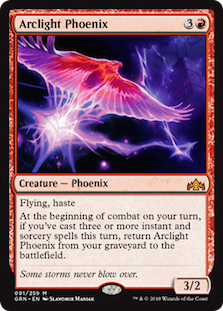
To expand on this idea, I don't know how good Izzet Phoenix actually is. I do know that it is very popular and has been successful since Arclight Phoenix was printed. Given its popularity, it makes sense that it would be successful. A higher starting population naturally means more decks placing highly. The real test will come in the next few months. Phoenix decks may still make Top 16 or better in tournaments, but that's not winning the tournament. Such a development precipitated Death's Shadow's fall from the top of Modern in 2017.
Compare this to Tron and Burn, which have always been and will always be. Burn just got some new cards and is especially popular. Prior to this development, it had been chugging along with a stable metagame share for years. Tron has frequently changed its splash colors and exact composition as the metagame shifted and hate was printed, but the central strategy always endured, and Tron now keeps putting up numbers. These consistent results are the measure of a true Tier 1 deck.

What a Deck Needs

To become and remain Tier 1 takes four things. The first is independent power: a deck needs to be powerful enough that it can contend with any other deck, regardless of the metagame. Once the cat is out of the bag and players know how to beat the deck, can it survive the scrutiny? If a deck is only good in specific contexts or when other decks aren't present, it doesn't have the power to remain tier 1. Similarly, it needs to be resistant to hate. Having hate against a deck doesn't disqualify it, see also Burn, but if it simply folds to commonly-played hate, then the deck will fall off.
On that note, the deck need needs resilience. If something goes wrong, it mustn't just fail. Every deck has some fail rate, usually linked to mana screw or flood. That's just Magic. However, if the opponent disrupts the deck, it needs to be able to keep playing the game. Tier 1 decks push through encountered resistance, and at least have a chance to win the game. Effective disruption will slow them down, but the deck still works.

Third is consistency. A deck needs to deliberately do its thing in most games. Every deck has a god-hand; every deck has auto-mulligans. But the average hand will still do the thing that the deck is supposed to do, even if not very well. If a deck doesn't do anything unless specific circumstances are met, it won't remain Tier 1.
Finally, it needs to be a finished deck. There's no deck that can't be improved in some way, whether through a new card or a metagame-specific tweak, but it is apparent when when a deck isn't ready. It feels like a card is missing and/or the deck is just clunky. There's something wrong with the strategy, and the grease or cog that would make the engine run isn't present. More refinement may fix the problem, but it may also be a deck that's waiting for a new card.

The Real Test

If a deck has all these pieces, there's one more thing it needs to be a real Modern Tier 1 deck: pedigree. It's not enough to have some good results then fade away; a deck needs to continue to do so over a long period. Modern is weird in that the exact composition of the metagame constantly changes, but certain decks always seem to compete. Burn and Tron are excellent examples, but so are GBx and UWx. The exact composition of these decks and their exact place in Modern may change constantly, but the strategies themselves always endure. Taking the longer view, Tier 1 decks don't need to prove themselves against any other deck. They're simply good regardless of context.

The Lesson of Death's Shadow

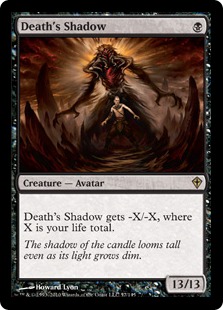
Grixis Death's Shadow isn't what it used to be. In 2017, it was considered a ban candidate. Now, whenever the namesake card does anything, it's a cause for celebratory articles. To me, it looks like everyone has forgotten about the deck and assumes that since it's out of the limelight, the deck is gone. But I think the deck is still just as good now as it was back then. The deck keeps winning and should rightfully be considered a Tier 1 deck.
With continuing high-level wins over several years, Shadow definitely has pedigree. It's a deck that quickly presents a large creature backed by a strong disruption package, so that ticks the first box. Despite all the attention, there was never a way to simply hate out or break Shadow. It had the tools to answer anything thrown at it, even though players adapted learned to fight back, so that's the second box. It has the most cantrips of any non-combo deck and will fire off a lot of disruption in a game every time, so that's three. Finally, while I could invent plenty of cards for Shadow decks, I don't think it needs any. Thus, I will argue that even though Shadow isn't the most visible deck anymore, it has clearly become Tier 1.

Definite Tier 1 Decks: Tron, Burn, Grixis Death's Shadow, Humans, Affinity, BGx Midrange, UWx Control

Possible Tier 1 Decks: Izzet Phoenix, Spirits, Dredge

Defining Tier 2

Tier 2 is full of decks with great potential. However, something is missing that keeps them down. They're typically finished decks, but that alone isn't good enough. There's nothing inherently wrong with the decks, but they don't work right. Maybe there's some power missing or the metagame isn't right for them. These decks can be very good when the context is right, but it won't happen consistently, so they're dependent on other decks to make them good. With the right shift or printing, they'll move up the ladder.

Merfolk's Lament

Loath though I am to admit it, Tier 2 is Merfolk's home and will remain that way for the foreseeable future. My fishy friends don't really have holes in the gameplan or lack power, yet they only occasionally makes any waves in Modern. It's had good runs and success, but hasn't been able to maintain the momentum. Thus, it has to wait for its time to come, just like the rest of Tier 2.

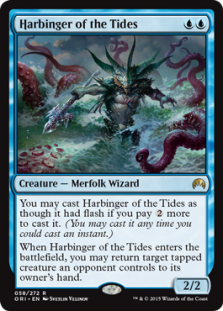
The problem keeping Merfolk in Tier 2 is twofold. First, the metagame is wrong. Merfolk was an underplayed good deck in 2015. URx Twin was everywhere and Merfolk had a very good matchup against it. Twin played Islands, so islandwalk was always active, and Harbinger of the Tides gave Merfolk an on-curve and in-strategy answer to the combo. When Twin was gone, Merfolk remained a good deck first because its matchup against Eldrazi wasn't hopeless, and then because it could hang with Jund. The niche I found for the deck was as a grindy creature aggro deck thanks to the cantrips. However, grinding hasn't been very relevant in Modern since Death's Shadow entered the scene, so Merfolk's advantage disappeared.
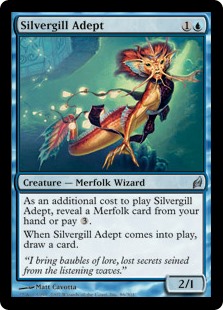
The second, and linked, problem is that it's not doing its own thing well enough. With grinding through removal being less relevant with GBx losing ground, the main appeal of Merfolk is as a low-evasion tribal deck. Blue isn't as widespread as during the Twin era, so unless Spreading Seas is in play, the fish are just big beaters. This makes Spirits and their intrinsic flying more attractive. Staying on the ground, Humans is also a tribal deck that makes big beaters, but it has three advantages. First, Humans uses +1/+1 counters rather than static bonuses from lords. Removal doesn't shrink an entire team, so the offense is easier to maintain through blockers. Second, it is primarily composed of disruptive creatures. Merfolk's tools are limited to Cursecatcher, Harbinger, and Merfolk Trickster while Humans has Kitesail Freebooter, Thalia, Guardian of Thraben, and Meddling Mage maindeck with more options in the sideboard. Finally, Humans has some fliers too.
Benthic Biomancer is a good card for Merfolk, but it just reinforces its grindy nature. The metagame needs to make a permanent switch back to pure attrition for that to matter. Unless that happens, the only way for Merfolk to leave Tier 2 will be a new card supercharges it over Humans and Spirits. I'm not sure what an actually printable card that would do that looks like, so I doubt it will happen.

Other Tier 2 Decks: Eldrazi, Amulet Titan, Storm, RG Valakut, Counters Company, Elves, Hollow One, Living End

Defining Tier 3

Tier 3 deck have big holes that need filling. In other words, they're not finished decks. Maybe it's because they're too unrefined, the card they need doesn't currently exist, or they're too fragile to withstand metagame heat. Regardless, these decks have problems. They may have powerful cards and gameplans, but they lack the means to consistently unleash it in any metagame. Thus they'll be stuck waiting for the stars to align.

The Pyromancer's Fall

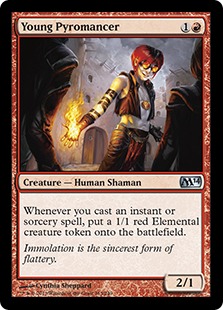
Mardu Pyromancer is the classic tier 3 deck that exploded then faded. At the end of 2017 it began blowing up on MTGO, then got some press and gained popularity. Early in 2018, the deck was everywhere. However, this popularity never turned into success. Despite its MTGO presence, Mardu never managed to crack the Top 8 of a GP, though it did Top 16 a few times. The deck then faded away, and I don't see it with any regularity today.

Pyromancer has several problems that contributed to its downfall. The first and most important was the deck was just clunky and slow. It was very good at disrupting the opponent, especially creature decks. Mardu is the wedge with the most creature removal and hand disruption. The problem was actually turning it into a win. Other than the eponymous Young Pyromancer, it doesn't have threats that really stand on their own and can take advantage of all the disruption. There were a lot of games where my opponent won the attrition war, and then did nothing for the rest of the game, allowing me to come back and win.
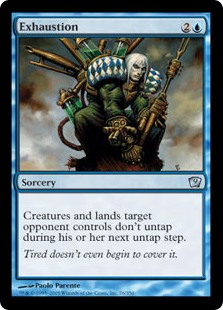
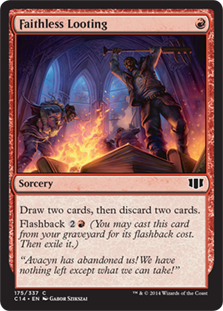
Also, Pyromancer is very vulnerable to graveyard hate. Other than its namesake threat, all the deck's good cards needed to the graveyard to function. Faithless Looting and Lingering Souls are decent when cast, but their value and power here comes from flashback. Bedlam Reveler is a potent card drawer only when cast for RR. The deck doesn't hold up well in the face of hate and doesn't work through no fault of the opponent enough that it can't really compete in Modern.

Other Tier 3 Decks: Lantern Control, Bogles, Infect, Ad Nauseam

Everything Else

Below Tier 3 exist the decks that don't work in Modern. In a vacuum, there may be nothing wrong with them. The core strategy isn't necessarily missing anything, and the deck may be doing something reasonably powerful. However, that's not enough. Whether the problem is that the deck is too clunky, slow, inconsistent, or another deck does its same thing much better, the deck just isn't competitive in Modern.

This doesn't mean that it cannot win, just that I wouldn't expect it to happen. Anything can win, and never count out the ability of an enthusiast and master to make their deck work despite the odds.
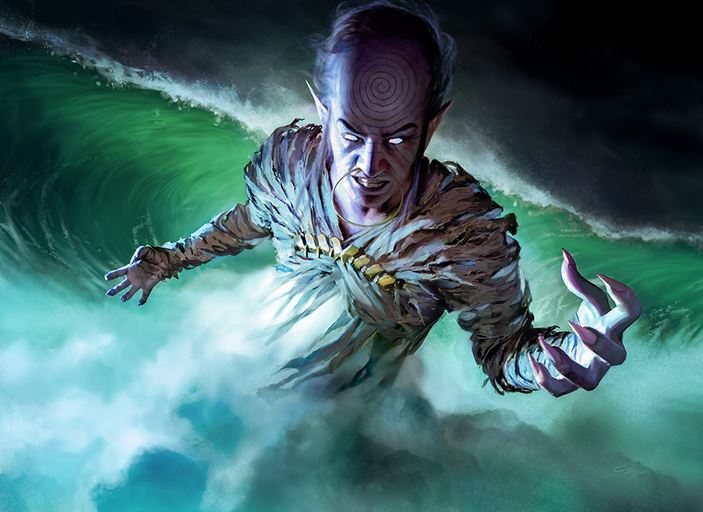
For example, I wouldn't consider Taking Turns to be a real deck. It's incredibly slow with a very high curve and reliant on a very small amount of interaction to not just die to whatever the opponent does. However, David Wong made of Top 8 GP Las Vegas 2017 and Top 16 in Hartford and Toronto since then. However, as far as I can tell, he's also the only Turns player to win at high levels outside MTGO. He is a master of his deck and understands how to pilot it around his frequently-confused, and thus disadvantaged, opponents. He loves the deck so much that he fully foiled it with quadruple sleeves. That's the level of commitment that it takes for an untiered deck to win.

As with every deck, there is always the potential for an untiered deck to gain legitimacy. Before Supreme Phantom was printed, Spirits was a gimmick deck that I and few others played. Now, it's everywhere. Similarly, Death's Shadow was a gimmick in Suicide Zoo decks for years. Then, it finally attracted enough attention that serious work was put in and it became the menace of 2017. However, unless one of those two things happen, I would never recommend picking up an untiered deck with the intention of winning.

Everything in its Place

New decks are always a welcome addition to Modern. However, just because a new deck is winning now doesn't make it viable in the long term. Eventually, Modern will adjust to the new deck, and the strategy will find its place. Perhaps that new hotness will be the next Grixis Death's Shadow and have what it takes to stay competitive. Or maybe, like Mardu, it will prove a casual fling. Only time will tell where Izzet Phoenix actually belongs.

Standard vs. Non-Rotating Formats

Are you a Quiet Speculation member?

If not, now is a perfect time to join up! Our powerful tools, breaking-news analysis, and exclusive Discord channel will make sure you stay up to date and ahead of the curve.

Another successful Pro Tour—uhh, I mean, “Mythic Championship”—is in the books! As I’m writing this article Sunday morning, I don’t know precisely who will have won but it is sure to be an exciting conclusion to a successful event. Standard was thoroughly diverse, making for exciting live coverage of the event all weekend.

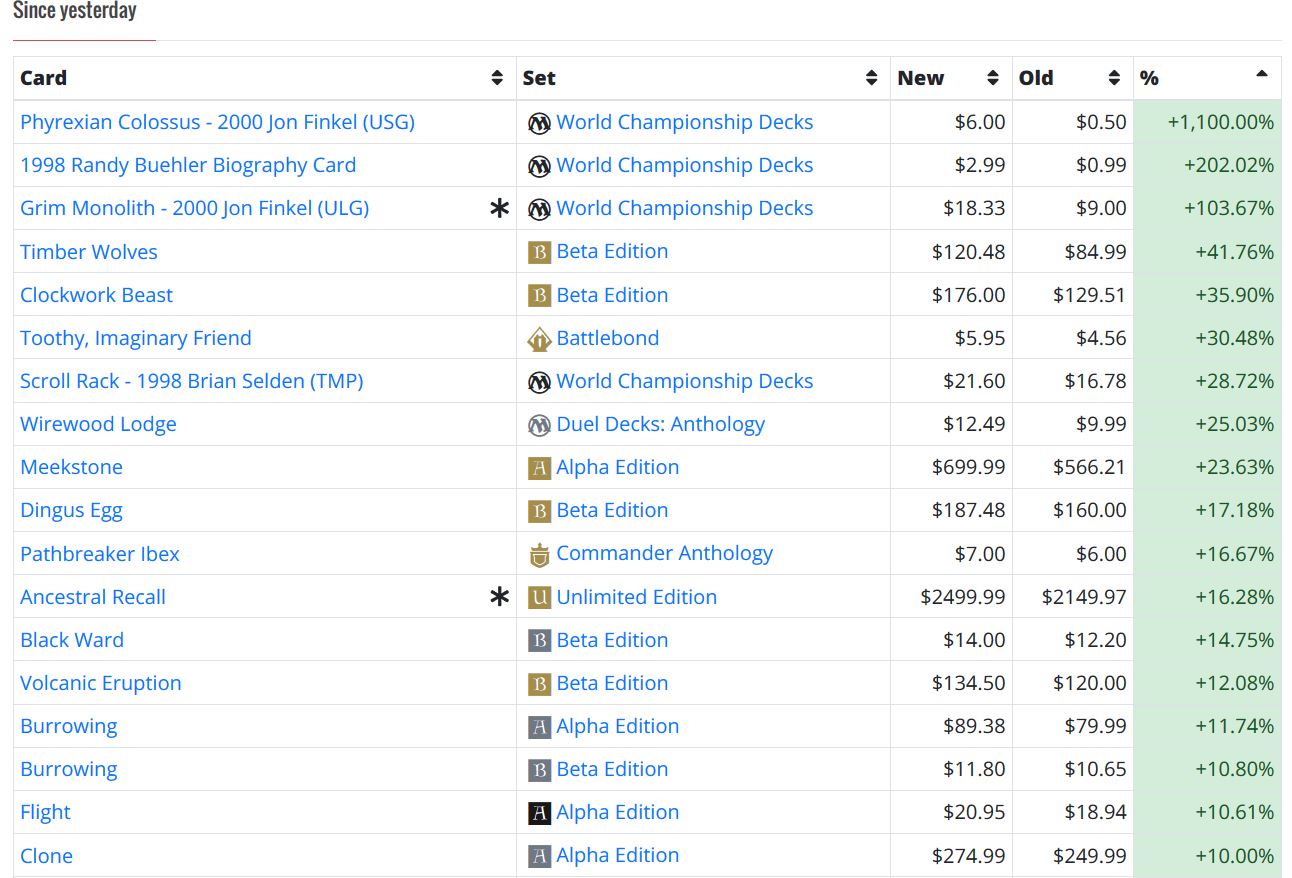
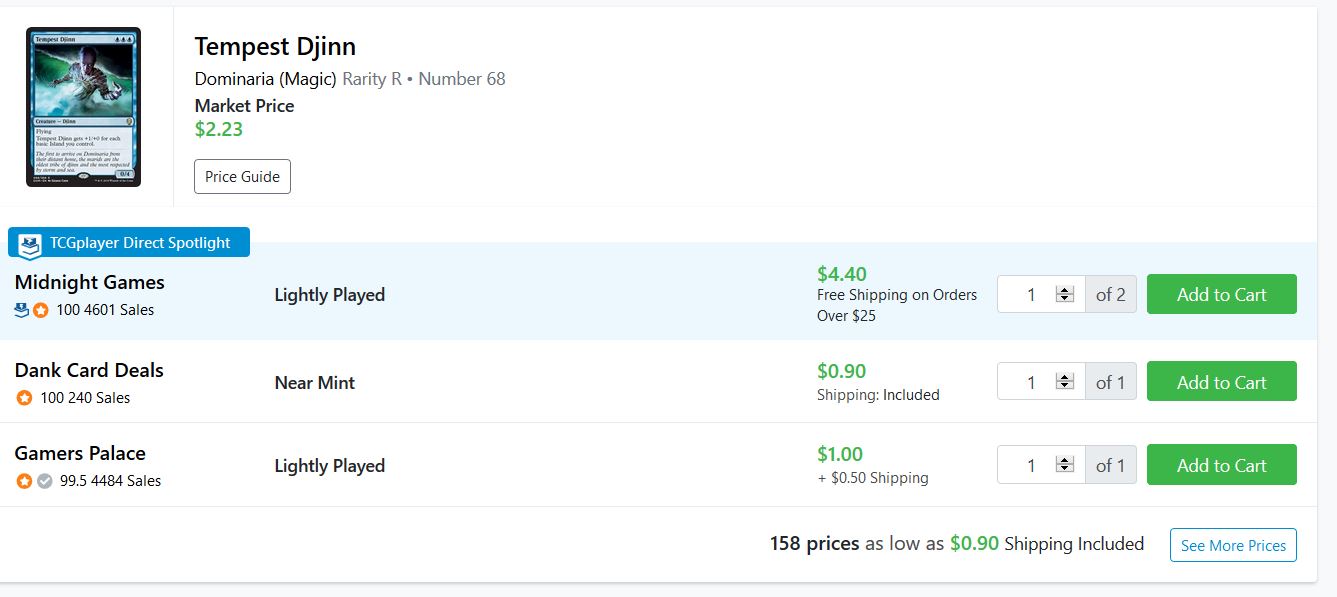
Once the Top 8 decks were secured Saturday night, I was fully expecting to see some significant price increases on MTG Stocks Sunday morning. Surely Tempest Djinn would skyrocket in value, with 12 copies appearing in the Top 8. Or maybe we’d see another buyout of Nexus of Fate after it showed up in the Top 8—after all, isn’t there a massive shortage of that card?

As it turns out, nothing happened.

Note I have some additional sets unfiltered with my MTG Stocks account (hence all the movement in Alpha, Beta, and World Championship Decks), but out of all the 10%+ gainers, there’s not a single Standard card. In fact I don’t see a single Standard card on the list at all. Tempest Djinn did move in price, but it’s still too cheap to be relevant.

What Gives?

I can think of three possible explanations for why Standard prices had not moved based on the Mythic Championship results.

The first reason is that I am looking at prices Sunday morning rather than the Monday after the event. Perhaps after getting steady camera time, the most successful lists will showcase the strongest cards in Standard. While 158 listings seems like a lot, I suspect speculators and players alike will be purchasing playsets of Tempest Djinn throughout the day Sunday. Maybe we’ll see a bigger spike tomorrow—by the time this article goes live, we’ll know if this reason holds any water.

The second reason is that there were no breakout mythic rares from the weekend. Sure, we saw Teferi, Hero of Dominaria and Arclight Phoenix show up in the Top 8, but these were both known quantities already. Their prices were already high.

The absence of any unexpected mythic rares could explain the muted movement in Standard prices this weekend. Many decklists ran mostly commons and uncommons (besides the mana base). Some players barely even used cards from the newest set (the one most prone to buyouts). LSV made a point to highlight that his deck only included a single Ravnica Allegiance card: Blood Crypt.

There was an error retrieving a chart for Arclight Phoenix

The third reason I’ve got is more farfetched, but cannot be overlooked entirely. What if people are moving in on these cards but they’re not acquiring paper copies? Since Standard is available on Arena, perhaps players who want to try out the winning Mythic Championship decklists are piecing the deck together on Arena instead of paper. It’s probably cheaper, more instantaneous (no shipping time), and there’s less risk of getting burnt by paying inflated prices. If this is indeed a factor, it could bode poorly for Standard speculation going forward.

Perhaps it’s a combination of these three factors that muted price reactions over the weekend. Or perhaps it’s related to something different altogether. These events happen on a different timeline, there was no single deck that dominated the event, and maybe Standard is not being viewed as the speculation vehicle it once was. I stopped speculating on the format years ago, and it’s possible others are turning their attention elsewhere as well.

So What Is Relevant?

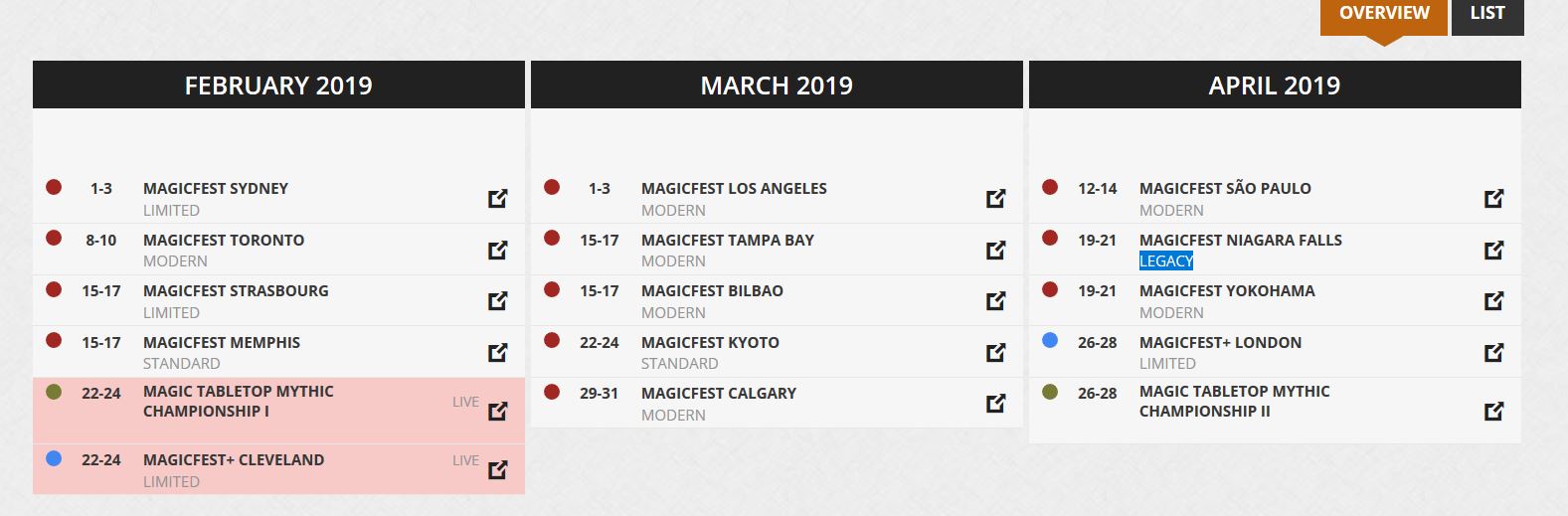
Just because the Mythic Championship didn’t move prices drastically doesn’t mean Magic is in a poor place. Standard isn’t really the place to be from a speculation standpoint, but there are definitely other formats worth your focus. Firstly, I submit for your consideration the upcoming Magic Fest schedule:

Two observations leap out at me. First, there are six Modern events between now and the end of April. That’s a lot of Modern. Second, there’s a Legacy event coming up in mid-April. I hypothesize that this schedule is catalyzing movement in both Modern and Legacy staples.

Yes, even Legacy staples.

For supportive data, consider the reappearance of Dual Lands on Card Kingdom’s hotlist. There are currently seven on the list and those buy prices have been climbing. Also climbing are Reserved List Legacy staples Lion's Eye Diamond and Mox Diamond. The price graphs don’t necessarily show a bounce yet, but I am detecting some underlying strength in this market. And something like Force of Will has been showing some appreciation lately.

There was an error retrieving a chart for Force Of Will

Also hot are Modern staples—ABU Games is consistently out of Fetch Lands, Jace, the Mind Sculptor, and Snapcaster Mage. While I don’t think the format is all that healthy (personal opinion), the large number of upcoming Modern events will surely catalyze demand. Keep an eye on the most played Modern staples. But be careful—there’s supposedly an announcement about a special Modern product coming up soon and it could mean more reprints.

Lastly, I would be remiss if I did not discuss Commander, a format that offers generous returns to patient speculators time and again. I’m admittedly out of touch with this format, but it doesn’t take much to visit EDH REC and observe that three of the five most popular generals last week are from Standard sets.

When new cards stimulate Commander deck builders to brew, the market moves. The Quiet Speculation Insider Discord has been all over Teysa and her impact on the markets.

There was an error retrieving a chart for Teysa, Orzhov Scion

As long as Commander stays fresh, it will continue to be a bedrock of speculation and profitability.

Noticing a Trend

Standard is leaving me a bit uninspired, but Modern, Legacy, and Commander are all continuing to offer steady rewards. Do you see a trend here? It appears that non-rotating formats are offering the best profitability at this point in time. I think that trend will continue.

For one, older cards are less readily available than Standard cards and their market supply could be much less. Also, there’s no risk to spending $20 on a card and then watching it tank as the metagame shifts or the format rotates. Reprints aside, money parked in these non-rotating formats will keep fairly well; often times, it will even grow!

This is why I continue to focus my attention solely on these non-rotating formats. Specifically, I like Dual Lands a lot right now. I don’t think they’re going to spike in the immediate future (though this does happen on a roughly annual basis). But there’s a lot of underlying demand for them now that prices calmed down and vendors are slowly bleeding inventory. I’ve been targeting Dual Lands from ABU Games as trade targets with store credit.

There was an error retrieving a chart for Taiga

I also like other Reserved List Legacy staples—especially those that also have Commander relevance, such as Gaea's Cradle and Mox Diamond. If Reserved List isn’t your thing, you could look at picking up Jace, the Mind Sculptors. As long as they dodge (yet another) reprint, these will be buylisting for $100 before you know it. And while they don’t do a whole lot in Modern yet, I expect this will gradually change.

I’m no Commander expert, but I can throw out a pick or two based on what I see on EDH REC. For example, Sifter of Skulls is a signature card in the Teysa Karlov deck and foils are still around $0.50. Is Oath of the Gatewatch old enough now for cards like this to move? Perhaps. If you want to go even older, you could grab Twilight Drovers, which goes all the way back to the first Ravnica.

There was an error retrieving a chart for Twilight Drover

Wrapping It Up

Standard isn’t what it used to be, at least not based on my observations. Perhaps this was a one-off situation and the next Mythic Championship will cause multiple cards to spike. Or perhaps multiple cards did spike but it took until Sunday evening for price movement to really take place.

Either way, I think there are a number of reasons why you’re better off sticking to non-rotating formats. Given the upcoming Magic Fest schedule, containing multiple Modern events and a single Legacy event, I think these formats are worth your attention in the coming months. I’m already seeing prices move and I suspect the timing is not coincidental. Plus, don’t forget that rumored tax refund impact that may or may not be a thing.

The non-rotating aspect of Commander, Modern, and Legacy make for attractive places to park resources. As long as you’re agile enough to dodge reprints, you can gain plenty of upside exposure while keeping downside risk to a minimum. And of course, if you target Reserved List cards your risk is even smaller, tied mostly to the health of Magic as a whole.

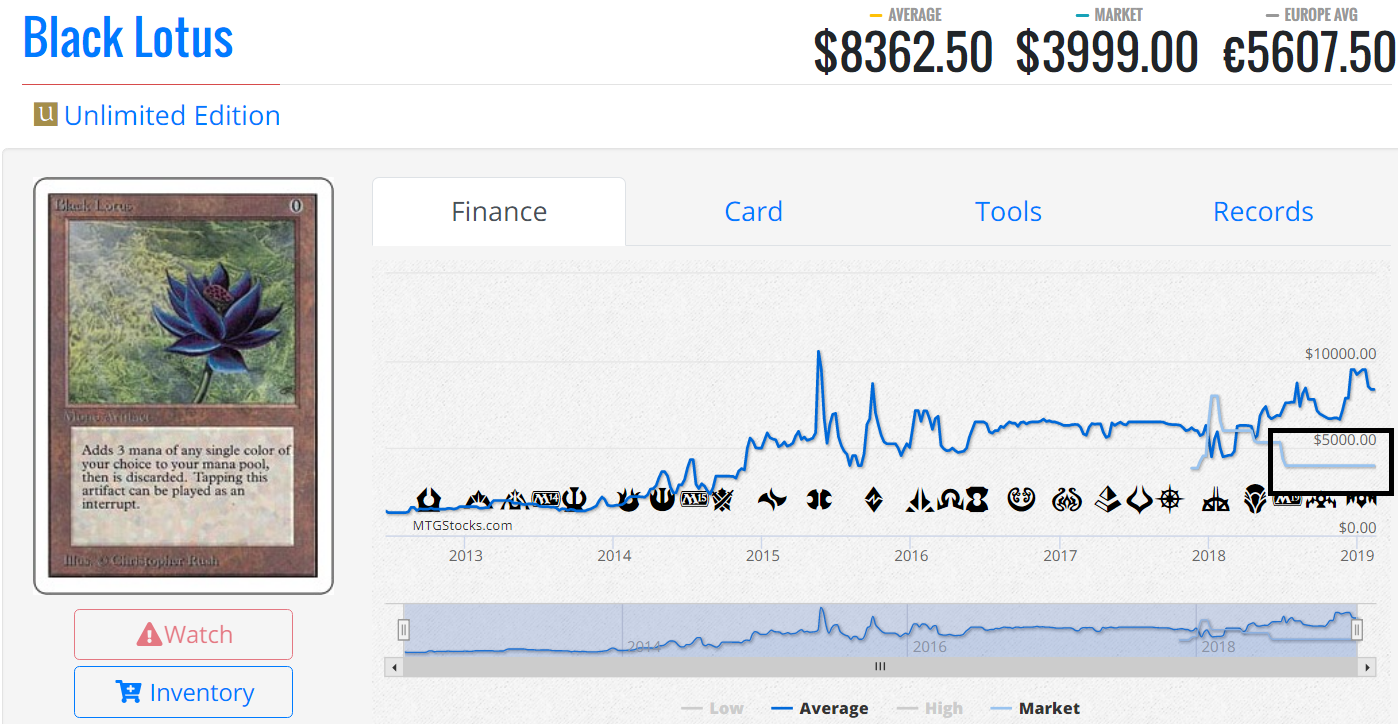
One last thing: I didn’t mention Vintage. People argue that paper Vintage is dead, but if this were the case I don’t think Tolarian Academy would be worth as much as it is. Same goes for Yawgmoth's Will and Yawgmoth's Bargain. But the real reason I bring up Vintage is the recent price movement I’ve seen on Power.

There was an error retrieving a chart for Black Lotus

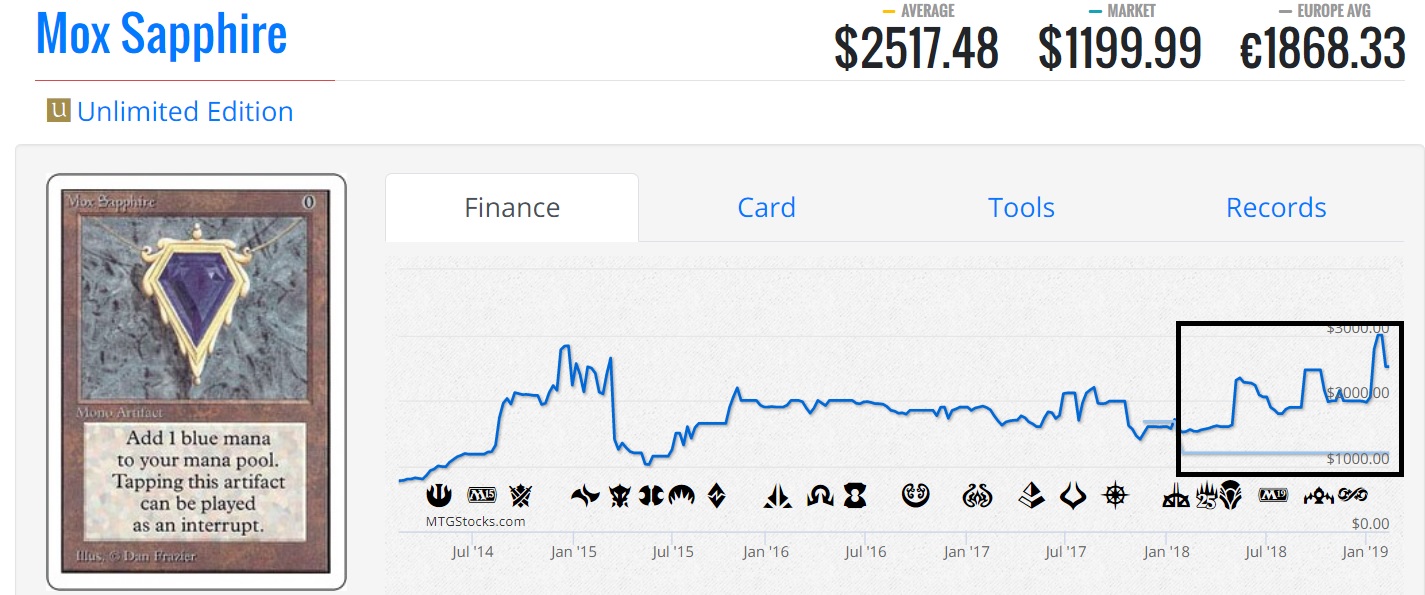
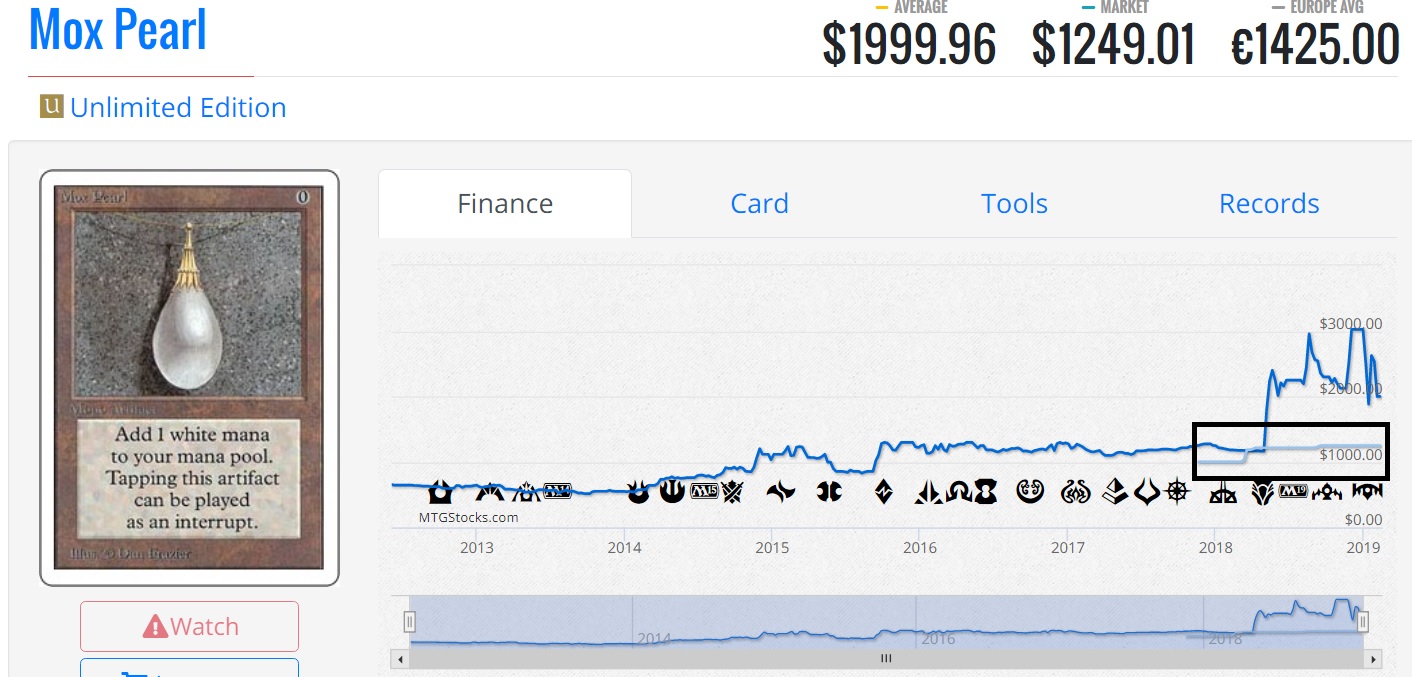
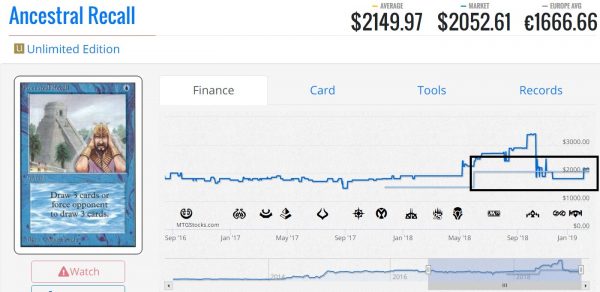
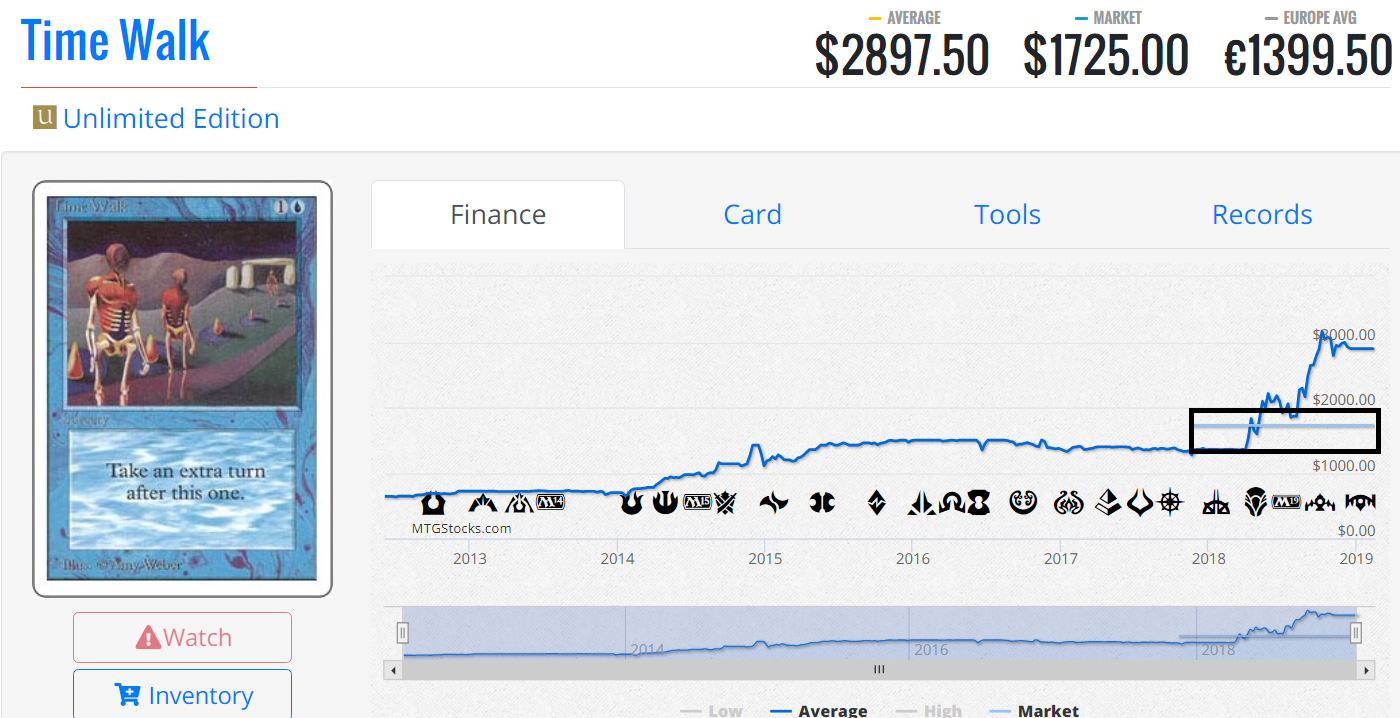
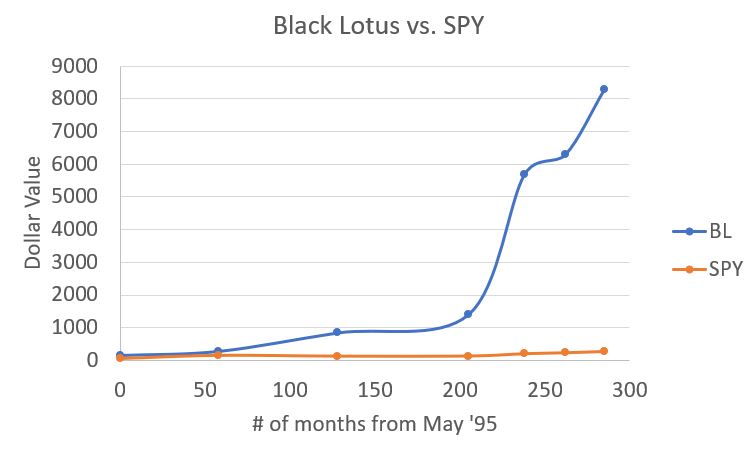
Card Kingdom is now paying an industry-leading $9600 on Black Lotus, $3300 on Mox Sapphire, and $2700 on Mox Jet. These cash buy prices are unprecedented and signify the strength of this market. The cheapest piece of Power is Mox Pearl, with a buylist of $1650 on Card Kingdom. Before long, any near mint piece of Power will buylist for over $2000.

This is just more data to show you that non-rotating formats offer great returns. The older the cards and the more desirable they are, the better. Finding Modern and Legacy staples that also extend to the Commander world may be the best place to go. The more formats a card is played in, the more sources of demand. And that demand is largely permanent, which is the best part. I just can’t say the same with Standard cards, I’m afraid.

…

Sigbits

  • Speaking of Vintage, did you know that Card Kingdom has Mishra's Workshop on their hotlist now with a $1080 buy price? This probably isn’t a peak, but seeing the return of these older, high-value cards on their hotlist gives me confidence that this market has stabilized and should return to growth going forward.
  • City of Traitors is another Legacy staples on the Reserved List, and as such it is also on Card Kingdom’s hotlist with a $145 buy price. This card isn’t an EDH staple, though, so its demand is pretty much solely from Legacy and Vintage. But given its age and presence on the Reserved List, it still makes for an attractive long-term hold.
  • Grim Monolith and Serra's Sanctum: these are two cards I can get behind! Both have seen play in Legacy, but get a huge amount of demand from Commander. The former is in nearly 10,000 decklists on EDH REC and the latter is in 3,700. What’s neat about Serra's Sanctum, though, is its tie to enchantments, a popular theme in Magic. Both cards are on Card Kingdom’s hotlist with a $75 buy price, and I like both for the long term.

Lightning, London, Linguine: ‘Manders and Mulls

Are you a Quiet Speculation member?

If not, now is a perfect time to join up! Our powerful tools, breaking-news analysis, and exclusive Discord channel will make sure you stay up to date and ahead of the curve.

Four weeks after proposing a UR Delver shell with Ptermanader, I've got some insights to share. And I also have more than a few words on Wizards' newly-proposed mulligan rule, which has considerable implications for Modern—and for Colorless Eldrazi Stompy.

'Manders

As soon as "Salamander Drake" was spoiled, I set to work on UR Delver, building a thresh shell from scratch around the innocuous blue Tombstalker. Some days after my article went live, Pteramander's English name was revealed; some weeks later, the card's strength in UR Phoenix was revealed. But I don't think UR Delver is necessarily a worse Phoenix deck. Its two big strengths over the format boogeyman are its resilience to hate and the ability to pack heavy-duty disruption itself. It gains these edges, of course, at the cost of precious proactivity: never will UR Delver find itself attacking for 6 on turn two.

UR Delver, by Jordan Boisvert

Creatures

4 Delver of Secrets
4 Pteramander
4 Snapcaster Mage
1 Vendilion Clique
1 Crackling Drake

Instants

4 Lightning Bolt
4 Thought Scour
4 Disrupting Shoal
3 Spell Pierce
2 Mana Leak
1 Spite of Mogis
1 Dismember
1 Echoing Truth

Sorceries

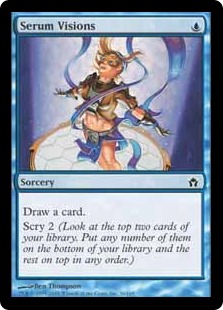
4 Serum Visions
2 Faithless Looting
2 Chart a Course

Lands

4 Scalding Tarn
2 Misty Rainforest
4 Spirebluff Canal
3 Steam Vents
5 Island

Sideboard

3 Damping Sphere
2 Blood Moon
2 Crackling Drake
3 Abrade
3 Surgical Extraction
1 Spell Pierce
1 Spite of Mogis

Deck Changes

Over the past month, I've made some tweaks to the initial shell.

Enablers: 4 Opt replaced by 2 Chart a Course and 2 Faithless Looting. The new cards are simply better at enabling Pteramander. Chart "tucks" a second spell for a next-turn adapt or simply allows us to profit from 1/1 Salamanders. Having additional CMC 2 cards for Shoal is also nice.
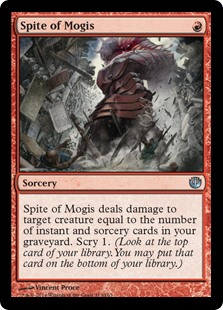
Meanwhile, Looting joins Scour in gassing up the graveyard. With multiple Pteramanders in play, it's often advantageous to aggressively loot away instants and sorceries and make big attacks. But without them, Looting sifts past lands in longer games and finds the action.

Doodads: Mountain and Abrade replaced by Island and Spite of Mogis. Mountain was mostly just worthwhile when UW opponents tried to cut me off red. The rest of the time, it proved a liability, gumming up opening hands and sitting around just not casting anything most of the time.

Abrade wasn't providing enough utility for me game 1, while a problem I continuously encountered was running into big creatures. I played Flame Slash for a bit to deal with Thing in the Ice and Crackling Drake. But Looting turns on Spite practically as fast, and Spite can also kill larger creatures, namely Tarmogoyf. I was worried at first about graveyard hate, but the only creature deck likely to bring in Rest in Peace is Spirits, and I already love that matchup. Besides, Looting lets us bin dead Spites or whatever else.

Sideboard: 2 Anger of the Gods and 1 Crackling Drake replaced by Spite of Mogis, Spell Pierce, and a third Abrade. Ah, here's that third Abrade! I hold that the Crackling plan is awesome in this deck, but 4 in the 75 were just too many. I'd sometimes clog on them while setting up a gameplan and have been happy on 3. At first I tried another Vendilion Clique in the extra spot, but ended up settling on Spell Pierce, a card I want as many of as possible in many matchups. This Spite was also Slash at first.
Place in the Metagame

These weeks of testing and playing have granted me a better understanding of UR Delver's roles and potential niches in Modern.

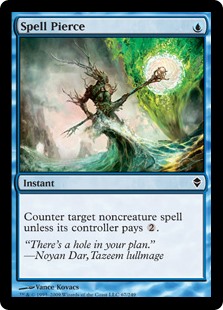
Compared with Phoenix, it finds the interactive matchups quite breezy; no need to worry about Surgical Extraction or Damping Sphere putting a damper on its day. The post-board Crackling Drake package combines with 4 Snapcaster Mage and the inevitability of Ptermander itself to dominate opponents looking for two-for-ones. It also doesn't hurt that Modern's most played two-for-one cards are planeswalkers such as Teferi, Hero of Dominaria and Liliana of the Veil, or steep-costed instants like Hieroglyphic Illumination, Kolaghan's Command, and Cryptic Command—Spell Pierce has a field day with these would-be haymakers, not to mention Snap-Spell Pierce!

Where UR Delver falters on paper, then, is against the less interactive decks. Some of those matchups actually improve—basically, the ones that lose to Spell Pierce: Ad Nauseam, Storm, and the resurgent Ironworks deck. These decks are even easier for UR Delver to beat than for Phoenix.

Not so against Burn, where Phoenix has a clear edge. A first-turn 3/2 with flying just isn't so fast anymore, and if our lock pieces and Pierces don't pull a lot of weight in a given matchup, we find ourselves in a slog. It turns out Spell Pierce and Disrupting Shoal are mostly good against Searing Blaze decks when we've also got a Tarmogoyf or two in play. Creature-based aggressive decks are easier on UR Delver thanks to Snapcaster and our many removal spells.

Mulls

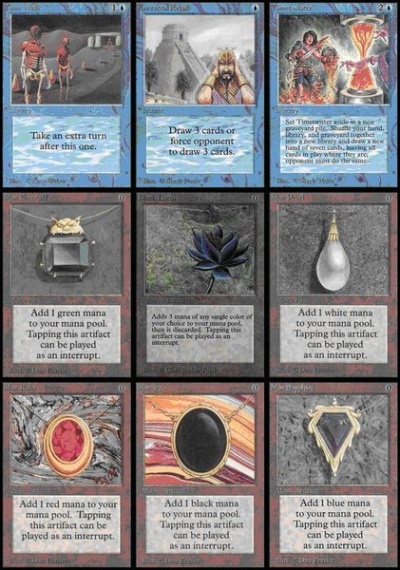
In two months, the Mythic Championship II in London will make guinea pigs of Modern players eager to test the London Mulligan. That rule reads as follows:

When you mulligan for the Nth time, you draw seven cards, then put N cards on the bottom of your library in any order.

On its face, this rule is designed to smooth out openers even more than "scry 1," letting more players play more satisfying games of Magic. In Modern, it also plays to the idea of diversity. We've seen decks enter the format after receiving a critical redundant piece from a newly-released set: Cheeri0s getting Sram, Senior Artificer, for instance, or Goryo's As Foretold snagging Electrodominance. If mulligans improve at finding the right cards, perhaps more lurking strategies can surface without first being graced by a redundancy booster.
Of course, there's one exception to this notion: diversity decreases if some decks prove too consistent with the new rule. Should Wizards end up pleased with the London Mulligan anyway, there's always the banlist to address over-performing archetypes directly. But the last time Wizards considered this mulligan (in a marginally different iteration called "7-7-7"), they indeed deemed it unacceptably powerful:

This mulligan was way too strong in Constructed, and encouraged big changes in deck building. Perhaps the most notable thing was in Modern and Eternal formats, where sideboard hate got a lot stronger since you could shuffle extra copies back into your decks. Similarly, combo decks got a huge advantage since they could mulligan away possibly useless cards. In one of our biggest rules violations for changing the mulligan rule, it clearly changed the parameters for deck building, and would have a profound impact on how older formats played out.

Another issue I haven't heard much about is one of time. London Mulligans may take extra long as less-experienced players deliberate about which cards to put back before ultimately deciding, during the next step of the process, to ship their hand anyway.

I think the company very much likes this new rule, but is also wary of its potential in Modern. Mythic Championship II is then the litmus test to see just how much such a rule would alter deckbuilding and the incentive to mulligan in an already mulligan-centric format.

Strategic Effects

Decks become more consistent. What does that mean in practice? Combo-centric decks, or decks focused around a single card, stand to gain the most from the London Mulligan. On the other hand, opponents now have an easier time locating hate cards.
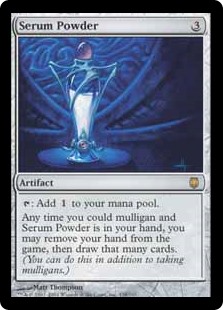
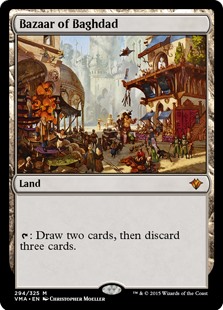
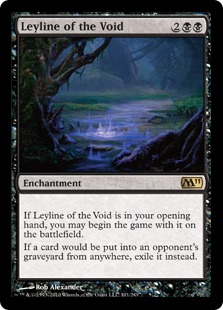
For an extremely obvious example, take Vintage Dredge, which runs 4 Serum Powder to increase the odds of opening Bazaar of Baghdad. That deck is now much better at opening Bazaar, but its opponents are also better at opening Leyline of the Void. A Modern example? Cheeri0s improves at finding a cantrip creature, but its opponents have more of a shot at opening Eidolon of the Great Revel or Chalice of the Void.

Essentially, the more combination- or card-dependent the deck, the better it becomes under the London Mulligan. And the more easily disrupted it is by played hosers, the worse it becomes under the London Mulligan. These numbers do not always correlate; some decks, like BG Rock and Burn, mulligan very little. The former is resilient enough to be mostly unaffected by the London (no net change), while the latter now has to worry about increased odds of opponents finding life-gaining silver bullets (negative net change). Alternatively, consider decks that mulligan heavily, such as Cheeri0s and Colorless Eldrazi Stompy. The former is soft to enemy hate (no net change), while the latter resists enemy hate (positive net change). Unsurprisingly, I'm mostly interested in the latter.

Eldrazi Calling

Colorless Eldrazi Stompy is the perfect deck to abuse the London Mulligan. It's built around finding Eldrazi Temple, just as Vintage Dredge is built around finding Bazaar. Key difference: there's no Leyline of the Void equivalent that shuts Eldrazi out of the game. Key similarity: Eldrazi's use of Serum Powder, which happens to become extra potent under the new rule.

Colourless Oi Guv'na Stompy, by Jordan Boisvert

Creatures

4 Eldrazi Mimic
4 Eternal Scourge
3 Endless One
2 Matter Reshaper
4 Thought-Knot Seer
4 Reality Smasher
4 Simian Spirit Guide

Artifacts

4 Serum Powder
4 Chalice of the Void
1 Smuggler's Copter

Instants

4 Dismember

Lands

4 Eldrazi Temple
2 Gemstone Caverns
4 Zhalfirin Void
2 Blinkmoth Nexus
4 Mutavault
4 Ghost Quarter
2 Wastes

Sideboard

4 Leyline of the Void
4 Spatial Contortion
2 Gut Shot
1 Karn, Scion of Urza
1 Damping Sphere
1 Torpor Orb
1 Ratchet Bomb
1 Surgical Extraction

Serum Powder presents an interesting design balanced by a couple restrictions. First, Powder decreases in power with each true mulligan taken—it starts exiling and drawing six cards, then five, then four. Second, an otherwise competent hand with Serum Powder was a functional mulligan on its own, as no constructed player is ever too happy to open a three-mana, no-draw Mind Stone. When I first saw the London Mulligan rule, I erroneously thought it would eliminate both of these drawbacks.

My misunderstanding was that under the London, every Serum Powder exiled and drew seven cards. This change would significantly increase both the odds of drawing into more Eternal Scourges and Powders for mulling-ups, and the odds of finding Eldrazi Temple. Every Powder opened represented seven non-Temple cards gone from the deck for our next mulligan.
In fact, the rule states that after each mulligan, cards are put back into the deck before a new mulligan decision is made. So Powder doesn't get the quite the boost I assumed. It's still made better: seeing extra cards lets us dig deeper into Powder and Scourge, setting up hands to exile away for additional "free" mulligans. Under the old system, a keep there would yield drawing into that copy of Powder a couple turns down the road.

Powder's second drawback is indeed eliminated, though. Copies of the artifact found in our good hand are simply tucked under the library, where they're unlikely to ever be heard from again—we don't shuffle our own deck, after all.

Since we're now likelier than ever to find Temple early, I've built this deck a little differently from previous builds. Endless One increases in stock, both because it's more often under-costed and because I anticipate fewer Pushes in a London Mulligan world (more streamlined decks=less interaction). Having Temple lets us play the aggressor more reliably, a gameplan One contributes more than Matter Reshaper or Smuggler's Copter. My love of Copter in this deck knows no bounds, but I've trimmed one since we no longer start the game with dead cards, ever (unless we find a keepable seven that includes Powder, which should win us the game regardless).

The sideboard also gets a makeover. Gone are the grindy Relic of Progenituses, which prevented opponents from ever out-carding our Eternal Scourges. We're just faster than that now. And Relic, while annoying, doesn't cripple graveyard strategies like Leyline of the Void, which becomes supremely findable between Powder and the London. Recently successful Colorless lists, like Austin Gattuo's 6th-place one from the SCG Glassboro IQ two weeks back, have already transitioned to Leyline; the London further incentivizes that choice: open two? Tuck one! My sideboard also includes a number of hoser bullets to mulligan for, matchup depending.
Colorless Eldrazi Stompy is already the best-performing Spaghetti Monster shell in the format, and has been for a couple months. I wonder if the London Mulligan could push it into the realm of Tier 1.

Piped Up in London

As I adapt Pteramander week after week, concerned Boston-area Modern players ask me what happened to Eldrazi. I'm just having more fun on Delver right now, I reply. Of course, I'd still favor Colorless for larger events. But if anything could make me bring it to everything, it might just be the London Mulligan. Which decks do you think will be most impacted by the rules change? Will Wizards go through with a switch at all? Is Mythic Championship II doomed to fall to Eternal Scourge? All this, and more... in the comments!

This Week in Magic

Are you a Quiet Speculation member?

If not, now is a perfect time to join up! Our powerful tools, breaking-news analysis, and exclusive Discord channel will make sure you stay up to date and ahead of the curve.

A Record-Breaking Black Lotus

There is currently an eBay auction for an Alpha Black Lotus with a price over $109,000. It will become the most expensive Magic card ever sold, surpassing the $87,672 record another copy of Alpha Black Lotus with identical grading claimed last July. It seems the buyer of the previous copy scored a serious bargain, and there are still days left for the price to grow until the auction ends Wednesday night.

There was an error retrieving a chart for Black Lotus

A card like a pristine Alpha Black Lotus transcends being a Magic card into a piece of artwork or other high-end collectible. But I see this as a great sign about the health of the market for Magic cards as collectibles and for their legitimacy as investments.

Graded copies of the rarest and most iconic cards will continue to be the best way to capitalize on this demand, with a serious premium paid for pristine condition. The same dealer who sold both record-breaking Black Lotus sold two other Alpha copies in January and December, but being graded just 9 they brought in only $57k and $52k respectively.

Snow on the Forecast

Magic’s head designer Mark Rosewater has a blog where he regularly provides nuggets of Magic knowledge and answers questions, and within these words there can be information very relevant to Magic finance. This week Mark implied that that the return of Ice Age’s snow theme is inevitable, at least in a supplemental set.

This isn’t exactly the most prophetic wisdom he has shared, but my immediate thought was to find out what old snow-matters cards are on the Reserved List. A return of snow in something as major as a Commander deck would surely drive a frenzy for these cards. But I imagine any printing of snow cards in any fashion will send their prices higher, whether by speculators or otherwise.

Don’t count on this as a definitive list, but my search through Ice Age Reserved List cards for the snow-matters theme provided the following four cards: Blizzard, Glacial Crevasses, Snowblind, and Winter's Chill.

There was an error retrieving a chart for Snow-Covered Mountain

One way to cash in on demand for Snow cards could be old-school Ice Age Snow-Covered lands, or even the Coldsnap lands—foils especially. That said, the printing of a full-art Snow-Covered land could throw a wrench in that plan and become the most desirable of these lands.

No More MSRP On Boosters

Magic cards have had an MSRP (manufacturer’s suggested retail price) for as long as they have been in print. This week it was announced that from War of the Spark forward they won’t be suggested for Magic products. The rationale WotC has shared for the change is that MSRPs are, “not favored in many parts of the world, which has led to some confusion among our global player base.”

The actual impact of this is outside my area of expertise. My initial thought are that it would decrease transparency at the local level and allow for stores to overcharge customers, especially in foreign markets where sealed product is already sold at a premium. I’ve read speculation that a likely result is allowing major retailers, specifically Amazon—with which Wizards recently partnered—to create their own price and sell at a massive discount.

After the partnership, Amazon slashed their price of sealed boxes significantly, and there are now likely more discounts to come. This might not be a bad thing for players looking to get cards cheaper, but it has the impact of gutting support for local game stores that will not be able to compete.

With the increased focus on Arena and a decrease in paper, it creates the paradox of these paper cards offering less utility and therefore being less valuable. What’s the point of buying cheap cards if there's nowhere to play them? That’s a question the community will have find an answer to.

Channel Fireball Takes Over GP Coverage

When Wizards announced the end of video coverage at Grand Prix, a clear cost-cutting measure given their shift to more competitive play online with Magic Arena, it caused an uproar in the community. This created an opportunity for another party to step in. Like the way GGsLIVE used to handle video coverage for Grand Prix, CFB has now grabbed the reins, announcing they’ll provide their own coverage for select events.

This was the natural solution to the problem, with the tournament organizer now handling coverage for their own event. It represents a nearly complete hand-off of running and managing Grand Prix to CFB, but also of CFB stepping up and taking complete ownership of their MagicFest product.

CFB has produced their own GP coverage before, and this will be an opportunity to further develop and refine their system. It has long been said by the community that Star City Games coverage has blown away official WotC coverage in terms of quality and consistency. This move will ideally result in CFB following suit to bring Magic coverage to the next level.

The more exposure Magic gets, the more it will grow and the stronger the market will be. So I see this announcement as a great sign for the health of paper Magic.

Avatar photo

Adam Yurchick

Adam started playing Magic in 1999 at age 12, and soon afterwards he was working his trade binder at school, the mall food court, FNM, and the Junior Super Series circuit. He's a long-time Pro Tour gravy-trainer who has competed in 26 Pro Tours, a former US National Team member, Grand Prix champion, and magic.tcgplayer.com columnist. Follow him at: http://twitter.com/adamyurchick

View More By Adam Yurchick

Posted in Finance, MSRP, NewsTagged , , , Leave a Comment on This Week in Magic

Have you joined the Quiet Speculation Discord?

If you haven't, you're leaving value on the table! Join our community of experts, enthusiasts, entertainers, and educators and enjoy exclusive podcasts, questions asked and answered, trades, sales, and everything else Discord has to offer.

Want to create content with Quiet Speculation?

All you need to succeed is a passion for Magic: The Gathering, and the ability to write coherently. Share your knowledge of MTG and how you leverage it to win games, get value from your cards – or even turn a profit.

What’s Next #2 – Slot Machine

Are you a Quiet Speculation member?

If not, now is a perfect time to join up! Our powerful tools, breaking-news analysis, and exclusive Discord channel will make sure you stay up to date and ahead of the curve.

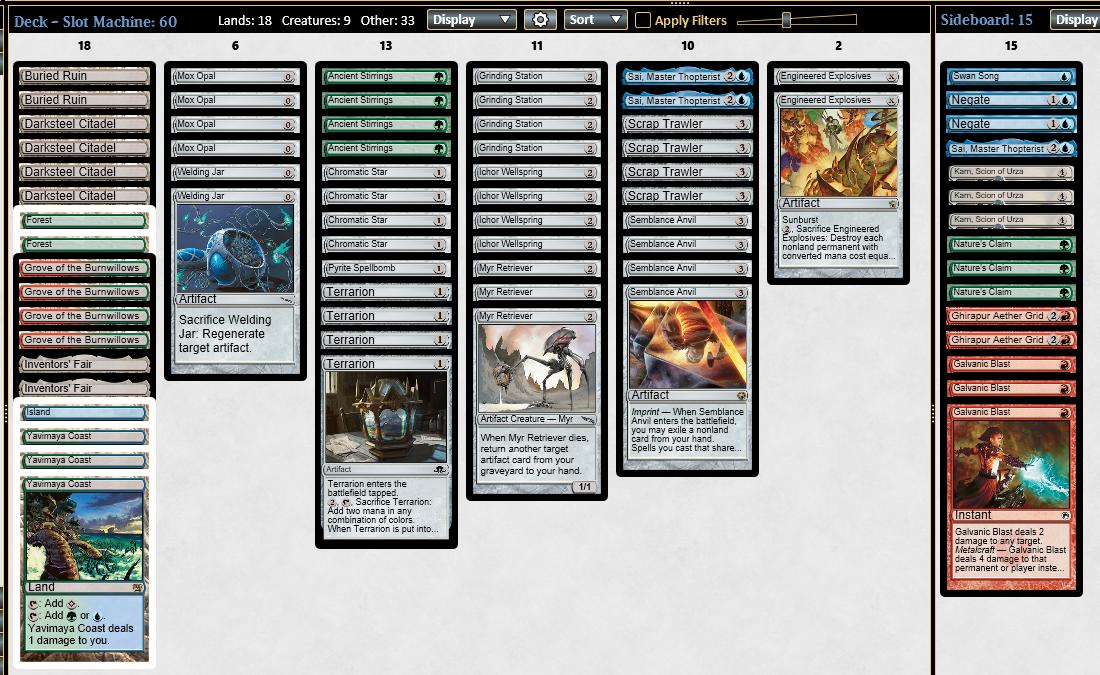
Many of you probably already know about the new Mox Opal deck called Slot Machine, a deck that has been worked on by Adam Richardson, Benito Pena Vargas, Zach Sweat, and others. It was featured by Piotr Głogowski, who’s known for his proficiency with combo decks like Ironworks Combo, Lantern Control, and Amulet Titan. He’s also known as kanister on Magic Online and Magic Arena.

On Twitter Piotr asked if Wizards should’ve banned Mox Opal and Ancient Stirrings in Modern, maybe instead of or in addition to Krark-Clan Ironworks. And this is the reason why…

Shortly after this information was posted, Semblance Anvil and Grinding Station disappeared from the internet. With that said, if you have copies of these cards and don’t plan on playing this deck anytime soon, I would sell into the hype.

Yes, the deck might have legs and many Ironworks Combo players might pick up the deck; but these two cards don’t see play anywhere else and can easily be reprinted. Also, they both have only one printing.

Folds

There was an error retrieving a chart for Semblance Anvil
There was an error retrieving a chart for Grinding Station

Since it’s too late to pick these cards up on the cheap, I’d rather think about top-tier cards and decks in Modern that might have a decent matchup against this deck. This deck attacks from different angles, so it’s actually quite difficult to combat. It can mill you out with Grinding Station, burn you out with Pyrite Spellbomb, or attack you to death with Thopter tokens from Sai, Master Thopterist.

First, I’d like to start with a list of cards generally found in sideboards that could help with this matchup.

  • Rest in Peace
  • Surgical Extraction
  • Stony Silence
  • Leyline of Sanctity
  • Creeping Corrosion
  • Shatterstorm
  • Fracturing Gust
  • Shattering Spree

Then there are cards that see play in the maindeck.

  • Emrakul, the Aeons Torn
  • Meddling Mage
  • Thoughtseize
  • Deputy of Detention

However, since this deck can attack from different angles, there’s no silver bullet. And you can’t just durdle around—you need to put the pressure on fast and have multiple ways to put a wrench in Slot Machine’s plans.

Considering that strategy and the various wrenches listed above, a few decks come to mind.

  • Humans
  • Spirits
  • Golgari (a.k.a. The Rock)
  • Death's Shadow

I mentioned in article #23 that Humans was most likely on the decline before it actually happened. In that article I suggested that you could pretty easily port over to Bant Spirits if you wanted to. But the recent banning of Krark-Clan Ironworks has started to alter the metagame a bit.

I don't know to what extent this effect has contributed to the recent plateauing in popularity of Bant Spirits, but it’s probably non-zero. On the other hand, the rise of various Arclight Phoenix decks has definitely put pressure on Spirits. With that said, it might be time to take a look at Humans again.

Modern: Humans by MOONGLOW

Creatures

4 Champion of the Parish
4 Kitesail Freebooter
4 Mantis Rider
4 Meddling Mage
4 Noble Hierarch
4 Phantasmal Image
4 Reflector Mage
1 Tajic, Legion's Edge
4 Thalia, Guardian of Thraben
4 Thalia's Lieutenant

Non-Creature Spells

4 Aether Vial

Lands

4 Cavern of Souls
4 Gemstone Mine
4 Horizon Canopy
1 Plains
2 Seachrome Coast
4 Unclaimed Territory

Sideboard

4 Auriok Champion
3 Deputy of Detention
1 Gaddock Teeg
3 Rest in Peace
4 Stony Silence

If you look closely at the manabase, we see a slightly different take on Humans. I’ve been wondering how to rework the mana to take full advantage of Tajic, Legion's Edge or consistently cast something like Judith, the Scourge Diva. You can also see that MOONGLOW is running a full set of Stony Silences and three Rest in Peace in the sideboard.

The mana base still needs work, though—according to Frank Karsten’s mana guide you can't reliably cast either of the two sideboard cards. At the very least, I would consider playing either a Mana Confluence or City of Brass in place of one Unclaimed Territory.

Holds

There was an error retrieving a chart for Deputy of Detention

Definitely keep an eye on Deputy of Detention, which I mentioned in article #30. The price of non-foils and foils has started to rise ever so slightly, which makes sense. Take a look at all these decks it already sees play in since its release in January.

If you dislike the idea of potentially not being able to reliably cast Stony Silence or Rest in Peace on turn two and still want to run Deputy of Detention, you might want to consider Spirits. But you might have to consider some other options like Surgical Extraction and additional Path to Exiles to have a better chance against Arclight Phoenix decks.

Modern: Spirits by Rusty_gates

Creatures

1 Rattlechains
1 Deputy of Detention
1 Geist of Saint Traft
2 Reflector Mage
2 Selfless Spirit
3 Phantasmal Image
4 Spell Queller
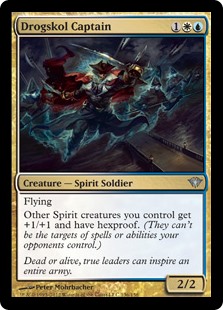
4 Drogskol Captain
4 Mausoleum Wanderer
4 Noble Hierarch
4 Supreme Phantom

Non-Creature Spells

2 Path to Exile
4 Collected Company
3 Aether Vial

Lands

1 Plains
1 Moorland Haunt
1 Breeding Pool
1 Temple Garden
1 Forest
1 Hallowed Fountain
1 Seachrome Coast
1 Island
2 Windswept Heath
2 Botanical Sanctum
3 Misty Rainforest
3 Horizon Canopy
3 Flooded Strand

Sideboard

1 Worship
2 Unified Will
2 Thalia, Guardian of Thraben
2 Stony Silence
3 Rest in Peace
2 Knight of Autumn
1 Eidolon of Rhetoric
1 Path to Exile
1 Geist of Saint Traft

Another route you can consider is Golgari a.k.a. The Rock. I mentioned Jund in What’s Next #1 as a potential riser after the Krark-Clan Ironworks banning. But it seems like Golgari has been putting up better results. Two decks made the Top 8 at Grand Prix Toronto.

Modern: Golgari by Lucas Siow

Creatures

4 Dark Confidant
2 Kalitas, Traitor of Ghet
3 Scavenging Ooze
4 Tarmogoyf
2 Tireless Tracker

Non-Creature Spells

4 Assassin's Trophy
2 Collective Brutality
3 Fatal Push
4 Inquisition of Kozilek
1 Maelstrom Pulse
3 Thoughtseize
3 Liliana of the Veil
1 Liliana, the Last Hope

Lands

4 Blooming Marsh
4 Field of Ruin
2 Forest
1 Hissing Quagmire
2 Overgrown Tomb
4 Swamp
2 Treetop Village
1 Twilight Mire
4 Verdant Catacombs

Sideboard

2 Collective Brutality
1 Duress
1 Engineered Explosives
4 Fulminator Mage
2 Languish
2 Nihil Spellbomb
1 Nissa, Vital Force
2 Surgical Extraction

The combination of discard spells like Thoughtseize and Inquisition of Kozilek plus the pressure of Tarmogoyf could be a recipe for success against Slot Machine.

There was an error retrieving a chart for Tarmogoyf

Tarmogoyf is still pretty cheap compared to its all-time highs, and hasn’t started bouncing back yet. I kind of like the Box Topper version. It’s a steep entry price, but it’ll probably be a while before Wizards comes out with another special version of the iconic card.

Note there’s the full set of Fulminator Mages in Lucas’s sideboard, which I mentioned in MTG Metagame Finance #24. Also continue to keep an eye on Assassin's Trophy, which I mentioned in article #30. This could hit a low of $5, but I think $8 is probably more realistic.

There was an error retrieving a chart for Assassin's Trophy

Blooming Marsh is probably a solid pickup right now since it just rotated in October and is a Modern staple.

There was an error retrieving a chart for Blooming Marsh

And speaking of Tarmogoyf, maybe the better discard-plus-pressure deck is Death's Shadow. After all, it did win Grand Prix Toronto.

Modern: Death’s Shadow by Michael Rapp

Creatures

4 Death's Shadow
4 Gurmag Angler
3 Snapcaster Mage
4 Street Wraith

Non-Creature Spells

2 Dismember
1 Faithless Looting
4 Fatal Push
2 Inquisition of Kozilek
2 Serum Visions
4 Stubborn Denial
2 Temur Battle Rage
4 Thought Scour
4 Thoughtseize
3 Mishra's Bauble

Lands

2 Blood Crypt
4 Bloodstained Mire
1 Island
4 Polluted Delta
2 Scalding Tarn
1 Steam Vents
1 Swamp
2 Watery Grave

Sideboard

1 Ceremonious Rejection
2 Collective Brutality
2 Disdainful Stroke
1 Grim Lavamancer
1 Jace, Vryn's Prodigy
1 Kolaghan's Command
1 Lightning Bolt
1 Liliana of the Veil
1 Liliana, the Last Hope
1 Shattering Blow
3 Surgical Extraction

There was an error retrieving a chart for Street Wraith

Death's Shadow has already spiked. But I kind of like Street Wraith. It’s already starting to creep back up in price. It sees play in a quite a few decks, and probably won’t be replaced for a very long time, if ever.

There was an error retrieving a chart for Leyline of Sanctity

Other than that, the one card that sticks out to me from the list above is Leyline of Sanctity. It dropped in price recently, which means it might be a good time to pick them up. Bogles can put on a lot of pressure and can be tough to interact with, which might be good against Slot Machine.

However, I don’t particularly like it against a field of Thoughtseizes and Inquisition of Kozileks. If Leyline of Sanctity strikes a chord with you, maybe Ad Nauseam is a better choice.

Modern: Ad Nauseum by Chris Flink

Creatures

1 Laboratory Maniac
4 Simian Spirit Guide

Non-Creature Spells

21 INSTANTS and SORC.
4 Ad Nauseam
4 Angel's Grace
1 Lightning Storm
2 Pact of Negation
4 Serum Visions
3 Sleight of Hand
3 Spoils of the Vault
4 Lotus Bloom
4 Pentad Prism
4 Phyrexian Unlife
2 Solemnity

Lands

2 City of Brass
1 Darkslick Shores
4 Gemstone Mine
1 Island
1 Nephalia Academy
1 Plains
3 Seachrome Coast
3 Temple of Deceit
3 Temple of Enlightenment
1 Urborg, Tomb of Yawgmoth

Sideboard

2 Bontu's Last Reckoning
1 Echoing Truth
2 Grand Abolisher
4 Leyline of Sanctity
2 Pact of Negation
2 Path to Exile
2 Thoughtseize

There was an error retrieving a chart for Urborg, Tomb of Yawgmoth

I still like the Urborg, Tomb of Yawgmoth Box Topper as a target, which I mentioned in article #27.

One word of caution though: be careful with Modern cards. As I mentioned in article #31, we’re not sure yet what’s coming at the end of February. If you don’t know by now, this is one of the reasons I like promo versions of cards when it comes to non-Reserved List stuff, if you tend to hold onto specs longer so you can play with them.

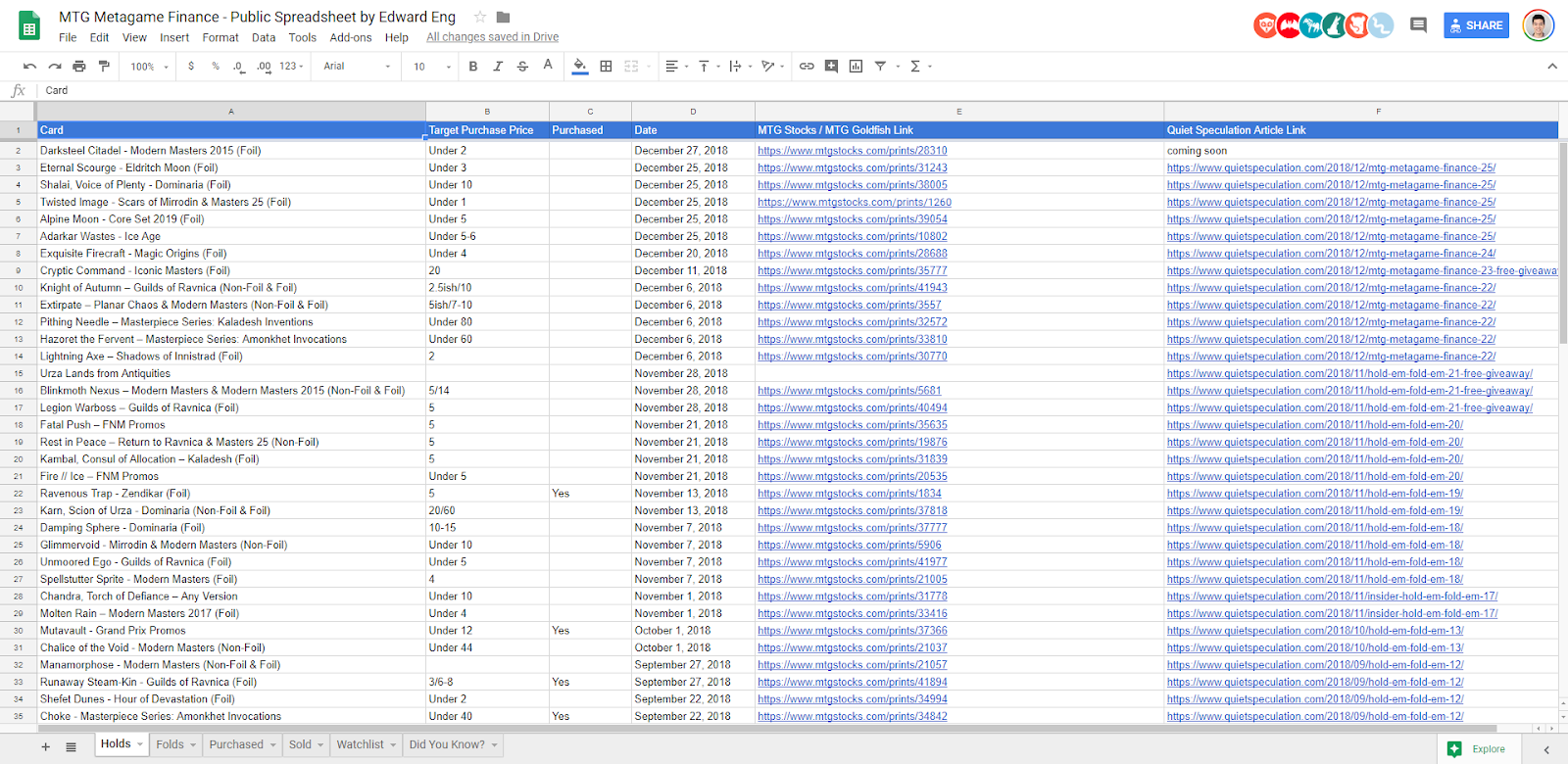
Public Spreadsheet

Stay up to the minute on what I’m looking at on a daily basis via the MTG Metagame Finance Spreadsheet. Don’t forget to bookmark it, because I update it on the fly. This way you can see what’s going on as the market moves and before articles about certain cards are published.

Let me know what you think in the comments below. Agree? Disagree? Why? You can also connect with me on Twitter at @edwardeng.

Important!!!

You can also catch me in the Discord channel (edward.eng#4978) if you have an Insider membership. I would go as far to say that this is one of the most valuable things you receive as a member. The Discord channel is very active and real-time discussions revolve around cards that move before anyone sees the actual movement—it’s usually already too late when you see this movement on sites like MTG Stocks, MTG Goldfish, and MTG Price. Hit me up on Twitter at @edwardeng, and I’ll answer any questions you have.

I’m also open to suggestions on how to make this series more valuable. Hit me up.

Have fun,
Eddie

The New is the Old: Metagame Analysis

Are you a Quiet Speculation member?

If not, now is a perfect time to join up! Our powerful tools, breaking-news analysis, and exclusive Discord channel will make sure you stay up to date and ahead of the curve.

The Modern format is so diverse, both quantitatively and competitively, that it can prove tough to quantify; certain players subsequently claim there is no metagame, while others focus only on tournament-winning decks. Each approach lacks some degree of nuance. Today, I'm trying to bring some of it back.

I was thrilled when I heard that Channelfireball was publishing the full list of Day 2 decks from GP Toronto: I'd have the data to really dig into the metagame for the first time in a while. Then, I got scooped. Oh well, at least the hard and tedious data entry work is done. Also, I don't agree with everything that Tobi Henke said, so consider this not only an analysis, but a response article. We'll parse the data a different way and examine the metagame quirks that make Modern unique.

Toronto Metagame

For the first time I can remember, we have Day 1 data from a GP. Long have we lamented its lack, since there's no other way to know the starting population of a tournament. Without that, it's impossible to tell if the Day 2 metagame is a deviation from metagame trends or a simply function of that stating population. The former merits deeper exploration.
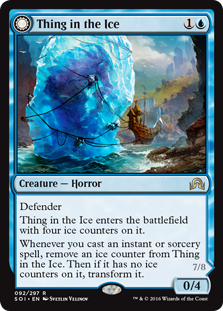
The most striking aspect of Toronto's Day 1 data is how it mirrors and deviates from the actual metagame, as compiled by MTGTop8. Taking the decks with 4% share or more in the overall metagame and comparing to their Toronto share shows consistency in the top decks with significant deviation elsewhere. It isn't a perfect comparison, but that is to be expected. The entire metagame is an aggregate of all the data that gets reported to MTGTop8, while Toronto's data is just that one event.

Deck NameMetagame Share %Toronto Day 1 %
Burn1011.45
Izzet Phoenix98.14
Dredge75.09
Death's Shadow74.33
Spirits64.20
Tron54.83
UW Control44.45
Humans 42.80
Affinity41.53

Worth noting is that the sample is only 60% of the starting decklists, but that sample is still large enough to be considered valid. The remaining 40% would have to contain major outliers to substantially change the data or my conclusions.

Burn is on top in both rankings, followed by Izzet Phoenix and Dredge. Burn, Phoenix, Tron, and UW Control all surfaced in proportion to their metagame shares. Other aggro decks were severely underrepresented in Toronto. Dredge is also down from it's overall share, but maintained its 3rd place position. It's natural for there to be variation between overall stats and localized stats, as regional differences exist. However, this particular result is worth looking into.

Going Deep

The decks that maintained their share in Toronto are the two It Decks, Burn and Phoenix, and two stalwart decks, Tron and UW Control. Every creature deck was well below their share.
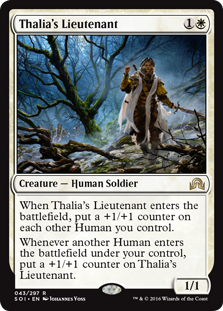
I speculate that the two results are linked. Burn and Phoenix have very good matchups against creature decks; the former thanks to its speed and interaction, and the latter because of Thing in the Ice. Mulitple early Phoenixes are certainly hard to race, but they're not a guarantee. Resolving and flipping Thing is far more certain against the removal-light creature decks and devastatingly effective as both a sweeper, tempo swing, and huge threat. The fact that both predator decks are getting the press right now would have turned some players off playing creatures. These trends don't impact Tron or UW Control, so they were free to keep on keeping on.

Conversion Rate Fallacy

That being said, the Day 2 data is in many ways more interesting. However, I disagree with how Henke looks at the data. He organized his chart and subsequently based his conclusion around the Day 2 conversion rate. Doing so gives an inaccurate conclusion: Henke says that Izzet Phoenix is arguably the best deck in Modern, while Burn isn't good. His evidence seems to hold up, but the overall conclusion is flawed.

That the most popular decks also have poor Day 2 conversion rates isn't new. In fact, it's par for the course. Part of this is simply statistical probability. The more of a given deck there is in the field, the more likely they are to meet each other, and there can be only one winner. Additionally, popular decks are ones players have on their radar, and have presumably brought hate for. Thus, the more popular decks, in a reasonably fair metagame, should have mediocre-at-best conversion rates.

Conversely, it is natural for unpopular decks to do well on conversion. If only two players pilot a deck and one makes the cut, that's a 50% rate. They're also more likely to be specialists of that deck. Mastery is key to success in Modern, and there's no greater master than an enthusiast. Conversion rates are therefore not inherently a measure of success or failure for any deck.

The Day 2 Difference

I'm looking at the actual numbers that made Day 2 rather than their conversion rates. Looking at all the decks with 7 copies or more is very suggestive of the overall metagame.

Deck NameTotal
Others27
Izzet Phoenix24
Burn18
Dredge13
Amulet Titan11
Humans10
Tron8
Hardened Scales7
RG Valakut7
Spirits7
Jeskai Control7

The most indicative results is that "Others" is the top result, reflective of how diverse Modern really is. It also backs up my earlier argument about low population decks, because the Others category was for every deck in the initial sample with fewer than 8 pilots. Rogue decks flying under the radar get a lot of wins thanks to confusion.

The top three individual decks are still on top, but now Phoenix displaces Burn for the top slot. That they're still on top reaffirms their overall metagame power and potential. The fact that Phoenix surpassed Burn is almost certainly drag caused by Light Up the Stage, as Henke argued. I mentioned last week that it hasn't been impressive against me, and it appears that it simply isn't necessary at all. Once Burn players get the memo, I'd expect their win rates to go back up.

Amulet Titan suddenly appears in the data and Humans has dramatically improved its position. That Humans is doing well in the standings reaffirms the deck's actual power, despite its apparent drop-off in metagame charts. Amulet suddenly appearing is to be expected. It is not and has never been a popular deck, but it has a very dedicated following. These devotees will have an advantage over other players just from experience. The same could be said for the rest of the sample.

The Metagame Truth

One conclusion that could be reached from this data is that the data derived metagame picture is remarkably accurate. However, it is also possible to look at how many decks fall under the Others category, see that power rankings have no relationship to what actually wins tournaments, and conclude that Modern doesn't have a metagame. If anything could win at any time and there's no guarantee of seeing a given deck in a tournament, how can there be a metagame? I think both of these viewpoints miss the big picture: Modern has a metagame, but it works differently than other formats.
Standard has a very defined and predictable metagame. Every time a new set is released, the metagame changes as decks gain or lose viability. Within a week or two, the heavy hitters will be well established, the matchups and sideboarding strategies will be worked out, and players will know what they're taking to tournaments. Every subsequent week until the next set release is about minor adjustments based on expected populations. The meta is stable and predictable.

Legacy is defined by Brainstorm vs. Anti-Brainstorm decks. The former are decks that play lots of cantrips and low land counts, seeking to find the most powerful cards in the format. The later all attack the former, either by shutting down some aspect of their deck or ignoring them. This has proven to be a very stable equilibrium for a long time, and the metagame doesn't shift very much. Individual decks in each category can change, but they're not that different from predecessors.
In contrast, Modern apparently has a constantly shifting metagame. Since Splinter Twin was banned, there hasn't been a deck that sat atop the rankings for more than a year. Decks rise and fall constantly. However, they don't disappear after falling from grace. Instead, they settle into the metagame and become Just Another Deck. Death's Shadow was 2017's boogeyman; Humans was in 2018. Neither is anything special anymore, but they're still doing well. This is the key to Modern: decks of the same tier have the same power level. Their ranking within the tier is primarily determined by popularity. The new deck rises, players learn how to beat it, they succeed, and the deck fades from view. Barring bannings, the metagame just absorbs decks, and they become no big deal. The key to understanding the metagame in Modern lies in recognizing which tier a deck belongs to and planning accordingly.

No Best Deck

In this context, the idea that a Best Deck exists in Modern is false. It is more accurate to say that at any given point, a deck is more visible and popular while being better positioned than others. New decks attract attention and players away from established decks. This magnetism inflates their presence in tournaments. Once the initial surprise wears off, players will learn how to play against it. If the deck has enough inherent power, it can maintain it's position for a time, but the rest of the format will target it and it will be brought down. Subsequently, if it has a unique niche, it will simply become part of the metagame in a tier equal to its power vis-Ă -vis the rest of Modern.

Popularity Contest

Looking at the big ticket events since Guilds of Ravnica released shows Arclight Phoenix having a huge impact on Modern. It's consistently placing well and at a very high rate. Nothing appears to prey on it, so how couldn't it be the best deck in Modern?

First of all, the exact same thing was said of Death's Shadow, to the point that there were calls for a ban. Secondly, that's only true of some events. The February 17 MOCS was dominated by Dredge, who took home half the Top 8; Izzet Phoenix failed to crack the Top 16. The Mythic Qualifier in Strasbourg was all about BG Rock, not Phoenix. New, visible, and popular decks naturally do well in big events because lots of players pick them up.

Double-Edged Sword

This popularity comes at a price: chiefly, a big target on the deck. Grixis Death's Shadow didn't suffer an actual power drop or lose cards and subsequently disappear from Modern. Instead, the format adapted, and its relative power diminished. Players learned how to fight back and eventually defeat the deck. The same thing happened with Humans and Spirits. Saying a deck is good because it is doing well is not meaningful. Any popular deck will necessarily do well. The key is longevity. Once everyone adapts to Phoenix, will it remain a factor? My guess is yes, because every other recent new deck has, but there's no way to know.

Modern's Different

The actual best decks in Modern are those that last year after year, despite no attention. Burn is the classic example. Despite peaks and throughs of popularity and visibility, it always performs. The same is true of Tron or UW Control. The New Hotness is just that, and it will eventually cool. The question is whether it can join the long-timers in the high tiers or just fades away.

Tales from the Buylist #2 – Examining Kaladesh

Are you a Quiet Speculation member?

If not, now is a perfect time to join up! Our powerful tools, breaking-news analysis, and exclusive Discord channel will make sure you stay up to date and ahead of the curve.

Famed for creating some of the most disliked Standard gameplay environments in recent history, Kaladesh is still fresh on the minds of many players since its rotation last October. Throughout its life in Standard, this set sported some of the most powerful and problematic cards to ever grace FNM. It's been over two years since its release, with many of the cards seeing a lot of price movement over the past five months. These days, a good chunk of Kaladesh sees play in eternal formats like Modern and Commander.

Kaladesh

We are living in a post-Arena world. A new non-rotating format is almost assuredly on the horizon. The work of making these cards function in Arena’s closed beta was done, and I can’t imagine Wizards of the Coast letting that all those assets go to waste.

While many point to an Ixalan-and-forward format, I think there’s a decent chance that we see Kaladesh be the starting point. Even if I’m wrong here, there are still a lot of applications for these cards in terms of playability, both casual and competitive. That being said, I think an examination of some key cards from the set is in order.

The Fastlands

There was an error retrieving a chart for Blooming Marsh

There was an error retrieving a chart for Botanical Sanctum

There was an error retrieving a chart for Spirebluff Canal

There was an error retrieving a chart for Inspiring Vantage

There was an error retrieving a chart for Concealed Courtyard

Perhaps the most important rares in the set are the enemy-colored Fastlands. Many Modern lists have adopted these along with their Scars of Mirrodin counterparts to great success, seeing play in multiples for most two-color decks. All of these are great pickups at their current prices and will be easy includes in my proposed format.

Spirebluff Canal is currently the most prominent of these as it is one of the better lands to play in Izzet Phoenix. While not fetchable by Scalding Tarn, being able to shave on Steam Vents and saving two or more life over the course of a game can be very relevant. Outside of Spirebluff, the available supply of these is quite high at sub $10 prices.

The Gearhulk Cycle

There was an error retrieving a chart for Torrential Gearhulk

There was an error retrieving a chart for Cataclysmic Gearhulk

There was an error retrieving a chart for Noxious Gearhulk

There was an error retrieving a chart for Verdurous Gearhulk

There was an error retrieving a chart for Combustible Gearhulk

This cycle of artifact creatures at mythic rarity is worthy of review as well. Save for Combustible Gearhulk, these were all powerhouses at one time or another in Standard and see fringe play in eternal formats. Cataclysmic Gearhulk is currently seeing play in Modern UW sideboards.

First and foremost, I believe these cards have great casual appeal as they all have very powerful and fun effects. The buy-in for these is very low for a cycle of mythics that should experience modest growth over the next few years. Note that Verdurous Gearhulk's supply is far greater than the others due to its Challenger Deck printing and might be the one to avoid if you’re looking for substantial gains. Torrential Gearhulk is my pick for the best of these, for its big-boned impression of Snapcaster Mage and its ability to do some real damage on an empty board. Noxious Gearhulk is probably the least exciting of these, but being able to blow up a creature on ETB is nothing to scoff at.

Planeswalkers

There was an error retrieving a chart for Chandra, Torch of Defiance

I really like this cycle, as the four planeswalkers of this set are all available at $10 or under at time of writing. Chandra, Torch of Defiance is chief among this cycle as she sees a significant amount of play in Modern and Legacy, and is just an overall powerful card. This too was a Challenger Deck reprint as a one-of, but I feel there’s still a lot of room for this card to grow in the coming months, especially with more premiere level events featuring Modern coming up this year.

There was an error retrieving a chart for Nissa, Vital Force

Nissa, Vital Force is currently seeing play as a one-of in the sideboard of the BG Rock deck in Modern, and has the added benefit of being one of the most popular characters in Magic’s history. She can close out games incredibly quickly with her first ability and will probably be one of the better sideboard options for a lot of green decks in the format for years to come.

There was an error retrieving a chart for Dovin Baan

Dovin Baan… well, he’s a card, I guess. I’d probably stay away from this one, as he competes with the likes of Jace, the Mind Sculptor and Teferi, Hero of Dominaria for a slot in UW decks. However, you can find copies of this card for under a dollar if you look hard enough. Historically speaking, bad planeswalkers still have a chance to chart upward, albeit very slowly. Tibalt, the Fiend-Blooded which is widely considered to be the worst planeswalker of all time is a great example of this.

There was an error retrieving a chart for Saheeli Rai

Last, but certainly not least, is Saheeli Rai. This is by far the most interesting card of these, as it is part of a two-card infinite combo with Felidar Guardian that sees fringe play in Modern. Aside from the combo applications, copying creatures with ETB abilities and getting to swing with them in the same turn is potent. At around $3.50 a piece, this is a very attractive target.

Commander Staples

Kaladesh has a metric ton of Commander staples, but here are my favorites. I'll note that foil versions of these cards will be preferred (and the graphs below reflect those prices), as nearly anything in the set is susceptible to a Commander 20XX reprint.

There was an error retrieving a chart for Panharmonicon

Aside from the fastlands, I believe Panharmonicon could be the most important card in this set as an investment target. The Commander crowd absolutely adores this card, and it’s not hard to see why. Doubling Season is probably the closest comparison you could make here in terms of casual appeal. People really love it when a card does the thing, and then it does it again. Since the rotation of Kaladesh, Panharmonicon has seen slow but steady growth.

There was an error retrieving a chart for Rashmi, Eternities Crafter

Rashmi is one of the better commanders to come out of the set, and can really do some busted stuff. Essentially adding cascade to every spell is fun and can really swing games in your favor if you hit the right cards.

There was an error retrieving a chart for Gonti, Lord of Luxury

This card is currently seeing a bit of upward movement, and will definitely be on the rise for the foreseeable future. I would act sooner rather than later on this one.

Energy Cards

Honestly, most of these cards have nowhere to go but up, but I don’t think they’ll be moving in that direction very fast. While the card pool in a format in a format like Modern is very vast, these cards are locked into playing with each other almost exclusively and are not very powerful in comparison to many of the strategies available.

Due to the Standard bannings of Aetherworks Marvel, Rogue Refiner, and Attune with Aether, I very seriously doubt that we’ll see this mechanic return in a future Standard set, or even a supplementary product. However, I would point to these as potentially being incredibly powerful in a Kaladesh onward format, should Wizards decide to let them run free. Aetherworks Marvel is very good at putting fatties in to play at a brisk clip, is available for as low as 69 cents, and is begging to be broken in Modern.

Masterpieces and Sealed Product

I would be remiss to fail to mention these! The Masterpiece Series Inventions available in Kaladesh include many of the staple mana rocks that are played in eternal formats, most notably Commander, and are often the most premium versions of those cards.

While these have taken off from the standard $100 price point long ago, I’m very surprised to find sealed boxes of this set to be widely available on avenues like eBay and Amazon for under $200. Of course, you’re not guaranteed an Invention in every box, but the chance of a hit will continue to drive the box price upward. If you’re solely looking to pick these up to play the Masterpiece lottery, sealed foreign boxes of this set are pretty close to $100 from various sources. All Masterpieces were only printed in English, making foreign boxes the lowest buy-in available.

Wrapping Up

I feel like there are so many opportunities in this set for great returns, but the vast supply of these cards is a bit of a double-edged sword. The buy-in for many of these cards is super low, but the returns are likely not very high given the short term.

To reiterate my earlier point, I think the fastlands are going to be the most desirable cards here and will have the most room to grow overall. Pick these up sooner rather than later, as these all could easily be more than double the price in a year’s time. Panharmonicon is a Commander staple, and undoubtedly will see growth over time. There aren't too many cards outside of the ones I mentioned above that are worth a look, but it is worth noting that the cards in the vehicle cycle like Smuggler's Copter could be spec targets for some. I'm not completely sold on them at the moment.

That does it for this week! You can follow me on Twitter @chroberry or Instagram @chroberrymtg if you want to see extra goodies and spoilers for next week’s article. Feel free to let me know how you feel about my targets here in the comments, or if there's anything you think I missed!

Peace!

Is Power 9 a Good Investment?

Are you a Quiet Speculation member?

If not, now is a perfect time to join up! Our powerful tools, breaking-news analysis, and exclusive Discord channel will make sure you stay up to date and ahead of the curve.

Not long ago I ran a somewhat controversial poll on Twitter, inspired by internal discussions within the Quiet Speculation Discord.

No no, not that one! Though I am curious to hear what others think—134 votes is surprisingly high for such a silly poll, but I question The Fallen’s dominance. By the way, financially speaking, Rag Man is the most relevant of the three.

The poll I’m referring to is this one:

This deceptively simple question, seven words in length, created a bit of a stir on Twitter. After a whopping 380 votes, the poll came out nearly dead-even. If someone were to run statistics on these results, I wonder if there’d be a statistically significant difference between “Yes” and “No."

Why is this such a complex question despite its face-value simplicity? This week I’ll peel the layers back on this question and share both community sentiment as well as my own thoughts.

Controversy 1: Define “Good”

The return on investment yielded by the Power 9 over the past 5, 10, and 25 years can be described as phenomenal. Here are some prices for Unlimited Black Lotus, with values pre-2012 coming from InQuest magazine issues. Values from 2012 onward come from MTG Stocks.

May 1995: $150
March 2000: $275
January 2006: ~$840 (only a range was given this issue)
June 2012: $1400
March 2015: $5700
March 2017: $6300
Today: $8300

Granted the time points I selected were a bit arbitrary, but I plotted the above prices for Black Lotus and compared with the price of SPY, an exchange-traded fund (ETF) that tracks the S&P 500. The results are staggering.

However, this is all historical data. Everyone knows past performance does not predict future returns. This brings me to the first word in my poll question that people struggled with: “good.”

Some people felt Black Lotus and other Power were good investments, but may not be going forward. After all, to experience the same percentage gain over the next 24 years or so, Black Lotus would have to be worth over $450,000. I love this hobby, but even I have a tough time seeing this happen by 2043. The price has got to level out.

If we assume the price does level out, then our expected returns from Power should be significantly lower. Perhaps gains over the next 5-10 years will only be a tenth of what they were the past 5-10 years. If that’s the case, then perhaps the investment isn’t “good” enough for some folks.

One dissenter explained how buying and selling smaller cards on a frequent basis would yield better returns than a single piece of Power. It’s certainly feasible—one only needs to average a modest 10-20% gain, and over the course of 50 transactions can churn some major profit. 1.15^50 = 1083, a pretty great return.

I’ll concede the frequent-transaction option could readily beat a piece of Power, but with two caveats. First, there’s the time component. If you have limited time and do not wish to spend it constantly flipping cards, then perhaps a piece of Power could be considered a “good” investment.

Second, there’s the risk factor. You need to consistently gain on your card flipping—one terrible pick that loses you 50% of your investment could set you back months. And what if you’re on transaction number 49 when that happens? You’d be losing a huge portion of your gains. With Power, there’s no such risk. You won’t get fast, exciting returns but it’s highly unlikely you’d be taking any losses from a bad spec, a reprint, etc.

There was an error retrieving a chart for Black Lotus

Controversy 2: Define “Investment”

Some “no” voters on my poll chose accordingly because they did not view Power as a good investment. Others voted no because they didn’t deem Power as a good investment. “Investment” is the second controversial word of my poll.

Librarian of Leng is a well-liked member of the Old School community. His sentiment above is supported by many in the community, as evidenced by the 23 likes. Black Lotus may make people lots of money, but some may view this as a consequence of the game rather than a main purpose.

I’m not going to dive into the Reserved List debate here. It will add no value to this article. The point is that some people believe this is a card game to be enjoyed, not an asset to be treated as an investment. While I readily see both sides of the argument over the word “good,” I have a tougher time accepting the sentiment that Magic should not be an “investment.”

For instance, consider the numerous other examples of collectible items that were initially made for one purpose but end up gravitating towards investor collections over time.

Transformers toys were originally made to be played with. Yet now some in nice condition can sell for hundreds or even thousands of dollars. Does that make these toys an “investment?” Or how about something closer to Magic, such as Pokemon cards. First-Edition Shadowless Charizard sells for a ton of money, but is a game piece that was designed for play. Is this not an “investment?”

Even something as day-to-day as video games can be graded and kept in a box for investment purposes. Check out this copy of Panzer Dragoon Saga, a valuable and rare Sega Saturn game that sold on eBay.

This copy is graded and brand-new. Therefore it was never used and perhaps never will be used for its intended purpose. Why buy this game if you’re not going to play it? As an investment, of course.

The list goes on and on. I stuck to games and toys, but if you expand the list to other hobbies you can find some really bizarre non-traditional assets. If you’ve ever watched Antiques Roadshow you know what I’m referring to—that random worn-out carpet from 1800 made by someone most people never heard of that would “sell at auction” for $20,000. Try telling the owner that their carpet is meant to be walked upon, not preserved as an investment. See where that gets you.

Don’t get me wrong—I completely understand Librarian of Leng’s sentiment. Old School players love the game for what it is, and they consider people who buy up loads of copies of older cards for investing as barriers to enjoying that game. They would also probably cringe at that Sega Saturn game or Transformers toy, all cased up and unavailable for enjoyment.

They’re completely correct in feeling this way, because collectors/investors are essentially making Magic and other games more expensive. But investor demand is no less legitimate than someone who wants a card to play with—the investor just has a different objective in mind.

My Vote

I created this poll to explore the sentiment of the broader Magic community. I tried to remain as unbiased as I could on Twitter so as not to sway people’s decision.

But if you were to ask me whether or not I felt Power 9 was a “good investment,” I would reply in the affirmative. I don’t have excess free time where I can shop around and flip collections, buy and sell cards constantly, etc. I do this to a lesser degree with a small portion of my collection, but if I were to put a set of Power’s worth of money into card-flipping I would quickly become overwhelmed. I like the idea of parking money in Power for the long term while also flipping a more manageable collection of cards for short-term gains.

While I don’t expect nearly the same returns on Power over the next 5-10 years as we had over the past 5-10 years, I still expect the directional arrow will go upwards and to the right. A Black Lotus will be worth more in five years than it is worth today, so that makes me happy to sit on one. I also think it will still outperform the S&P 500, though not nearly by the same margin as in the past.

As for the “investment” portion of the poll, I have defended my stance in the previous section. I do view Magic as an alternate investment, but only to a limited extent. There are some vocal members of the Magic community that have taken Magic investing to a whole new level, buying up $100,000’s or even $1,000,000’s worth of Reserved List cards.

There was an error retrieving a chart for Library of Alexandria

This is not my approach. I like that my cards can increase in value over time, but I also like playing with them. To me, it’s about enjoying a hobby that also pays me over the long haul…that’s the best of both worlds.

Wrapping It Up

A controversial Twitter poll has inspired me to write up this (potentially) controversial article. I declare to the community that I do, in fact, believe Power 9 is a good investment. I recognize others do not feel this way for numerous reasons. But I combine the fact that I like these older cards, appreciate their gameplay, and also want to hold them as they appreciate in the hopes of using them to offset my kids’ college costs. The result: I can have my cake and eat it too.

If you have much more time to spend then you could probably find better returns than Power as long as you avoid significant setbacks. If you just want to enjoy the game for what it is, then you will be unhappy with those who purchase large piles of these cards for the sole sake of making money. These two mindsets would cause one to argue that Power 9 is not a good investment.

At the end of the day, this is what I love so much about Magic. There are so many ways to engage with the hobby. Not everyone agrees on the optimal way to engage, but the complexity of the hobby has kept it fascinating to follow for over 25 years. With any luck, it will remain just as inspiring and we will be having this same debate 25 years from now!

…

Sigbits

  • Did you notice that Card Kingdom set a new precedent on near mint Unlimited Black Lotus? Over the weekend they increased their buylist to an industry-best $9,000. Clearly the card has not hit its ceiling yet.
  • Other Reserved List cards are making a comeback on Card Kingdom’s hotlist. I noticed Mox Diamond’s buy price recently increased to $155. This is the highest that card has been at for quite a while.
  • Buylist on Thunder Spirit, a popular Old School card, has also hit a local maximum lately. Card Kingdom has the card on its hotlist with a $135 buy price! Perhaps tax refunds are kicking in and Reserved List “investing” is kicking in, yet again.
Avatar photo

Sigmund Ausfresser

Sigmund first started playing Magic when Visions was the newest set, back in 1997. Things were simpler back then. After playing casual Magic for about ten years, he tried his hand at competitive play. It took about two years before Sigmund starting taking down drafts. Since then, he moved his focus towards Legacy and MTG finance. Now that he's married and works full-time, Sigmund enjoys the game by reading up on trends and using this knowledge in buying/selling cards.

View More By Sigmund Ausfresser

Posted in Analysis, Behavior, Buying, Buylist, Finance, Finance History, Reserved ListTagged , , , , 10 Comments on Is Power 9 a Good Investment?

Have you joined the Quiet Speculation Discord?

If you haven't, you're leaving value on the table! Join our community of experts, enthusiasts, entertainers, and educators and enjoy exclusive podcasts, questions asked and answered, trades, sales, and everything else Discord has to offer.

Want to create content with Quiet Speculation?

All you need to succeed is a passion for Magic: The Gathering, and the ability to write coherently. Share your knowledge of MTG and how you leverage it to win games, get value from your cards – or even turn a profit.

Brew Report: Perfect Pairs

Are you a Quiet Speculation member?

If not, now is a perfect time to join up! Our powerful tools, breaking-news analysis, and exclusive Discord channel will make sure you stay up to date and ahead of the curve.

Roses are red, violets are blue—it's time for another Report About Brews! This (day after) Valentine's Day, we'll take a look at some of the exciting developments Modern has seen this month, and present each deck alongside its significant other: another deck that's somehow related. In the words of a certain heart-shaped candy, LET'S GET BUSY!

Old Faithfuls

Nothing says "romance" like good ol' fashioned steadfastness. At least, that's the tip these star-crossed Modern standbys are on. We'll start with the format's most storied aggro strategy: while they've come a long way from Fatal Frenzy targeting Atog, everyone's favorite robots apparently still have a bit of Frenzy left in them.

Frenzy Affinity, by JOSITOSHEKEL (26th, Modern Challenge #11794021)

Creatures

4 Arcbound Ravager
3 Memnite
4 Ornithopter
4 Signal Pest
4 Steel Overseer
4 Vault Skirge

Artifacts

4 Cranial Plating
4 Mox Opal
4 Springleaf Drum

Enchantments

3 Experimental Frenzy

Instants

4 Galvanic Blast
1 Welding Jar

Lands

4 Blinkmoth Nexus
4 Darksteel Citadel
4 Inkmoth Nexus
1 Mountain
4 Spire of Industry

Sideboard

2 Ancient Grudge
2 Dispatch
2 Etched Champion
2 Ghirapur Aether Grid
2 Rest in Peace
1 Rule of Law
2 Thoughtseize
2 Wear // Tear

Frenzy Affinity takes a decidedly different route from that of casting a three-mana Temur Battle Rage. It relies on Experimental Frenzy to restock after deploying its hand. Veteran readers may recall my dismissing of Frenzy as a worse Precognition Field, which itself sees no play despite my own attempts to tame it. But between plenty of 0-drops, just 17 lands, and its snowballing, play-to-the-field mentality, Affinity seems like a perfect home for the red enchantment.

Frenzy  vies for precedence over Affinity's other colored spell options, which include Master of Etherium and Thoughtcast. It's closest in role to the latter. In a format always interested in accessing powerful hate cards post-board, I like Frenzy's promise to tear through the deck once players untap with it.
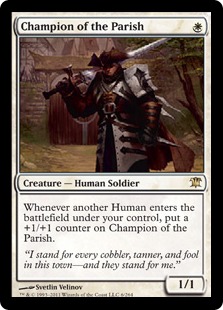
Even though Affinity's seen its shares decline significantly as Modern has become more weaponized, with Hardened Scales-based artifact decks cutting deep into its shares, I wouldn't dismiss Frenzy Affinity outright. The same build was also quick to post a 5-0 listing after its Challenge performance, which itself put two copies into the Top 32.

Benthic Merfolk, by MASHMALOVSKY (5-0)

Creatures

4 Benthic Biomancer
2 Harbinger of the Tides
4 Lord of Atlantis
4 Master of the Pearl Trident
4 Master of Waves
4 Merfolk Trickster
4 Silvergill Adept

Artifacts

4 Aether Vial

Enchantments

4 Spreading Seas

Instants

4 Deprive
2 Spell Pierce

Lands

1 Cavern of Souls
14 Island
4 Mutavault
1 Oboro, Palace in the Clouds

Sideboard

2 Damping Sphere
1 Dismember
2 Echoing Truth
1 Hurkyl's Recall
1 Mistcaller
3 Relic of Progenitus
2 Spellskite
1 Tidebinder Mage
1 Vapor Snag
1 Venser, Shaper Savant

Benthic Merfolk also puts a new spin on an old classic, dropping Cursecatcher and Merrow Reejery for some of the flashier tribal additions from recent sets. As a one-drop, Benthic Biomancer seems significantly better than Catcher in the mid- and late-game, offering some immediate card selection and featuring built-in bulk. A potential 2/2 in this slot has worked for Merfolk in the past, and Biomancer has way more utility than Kumena's Speaker without even demanding a splash.

On paper, Catcher seems better than Benthic in the early-game. But that's only true for certain matchups. Most decks will happily pay a mana to destroy Catcher, and are fine casting their removal spell before deploying a creature after turn one. The decks with big instants and sorceries to resolve are few and far between in Modern, and the really juicy ones (i.e. Ad Nauseam) come out of decks that should lose to Merfolk's hate cards anyway.

Speaking of hate cards, this new build will have a hard time losing to combo at all with all its permission. My new beau Spell Pierce joins a full set of Deprives to prevent opponents from doing much while Vial deploys threats. The sideboard compliments the stack interaction with hosers.

Speed Dating

If there's one thing Modern's known for, it's speed. If there's a second? The format's powerful creatures. Modern has always been defined by removal for the reason that creatures tend to dominate at a given top table. February introduced us to a couple creature-based newcomers.

Mardu Aristocrats, by DRANTIDERIVATIVE (5-0)

Creatures

3 Judith, the Scourge Diva
4 Bloodsoaked Champion
4 Champion of the Parish
4 Thalia's Lieutenant
2 Doomed Traveler
2 Kytheon, Hero of Akros
3 Kitesail Freebooter
3 Thalia, Guardian of Thraben
4 Falkenrath Aristocrat
3 Tithe Taker

Instants

3 Lightning Bolt
3 Path to Exile

Lands

2 Arid Mesa
4 Cavern of Souls
1 Clifftop Retreat
3 Concealed Courtyard
2 Godless Shrine
4 Marsh Flats
1 Mountain
1 Mutavault
2 Plains
1 Sacred Foundry
1 Swamp

Sideboard

1 Thalia, Guardian of Thraben
1 Path to Exile
2 Auriok Champion
1 Dark Confidant
2 Ethersworn Canonist
2 Kambal, Consul of Allocation
1 Kaya, Orzhov Usurper
1 Nearheath Pilgrim
2 Rest in Peace
1 Stony Silence
1 Wear // Tear

First on our list is Mardu Aristocrats, which by now has scored multiple 5-0 records. David's RNA spoiler review wondered about Judith, the Scourge Diva and Teysa Karlov in the deck, and the former seems to have revitalized it. The other new card here is Tithe Taker, an unassuming Human perhaps best known for its recent 9-0 at GP Toronto in a Soldiers deck.
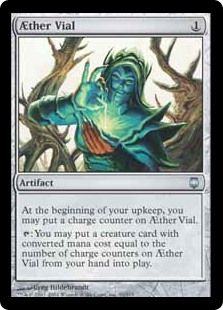
Judith indeed does a lot for Aristocrats. She gives the deck access to some built-in removal with her triggered ability, punishes opponents for interacting and enables combos Ă  la Blood Artist, and makes the strategy more proactive on the whole with her static anthem effect. Cheap beaters like Champion of the Parish and Bloodsoaked Champion look far more appealing with Judith in the picture, as they now represent serious clocks. And as is true of many white aggro decks, Aristocrats gets to run the color's infamous hosers in the sideboard.

Gruul Vial, by GOOBYGOO (5-0)

Creatures

3 Gruul Spellbreaker
3 Duskwatch Recruiter
4 Eidolon of the Great Revel
4 Scavenging Ooze
2 Tarmogoyf
2 Goblin Cratermaker
4 Noble Hierarch
4 Ghor-Clan Rampager

Artifacts

4 Aether Vial

Instants

4 Lightning Bolt
3 Smuggler's Copter

Lands

4 Copperline Gorge
1 Dryad Arbor
2 Fire-Lit Thicket
2 Forest
2 Misty Rainforest
2 Mountain
3 Raging Ravine
3 Stomping Ground
4 Wooded Foothills

Sideboard

2 Chandra, Torch of Defiance
4 Cindervines
2 Crumble to Dust
1 Dismember
3 Flame Slash
1 Grim Lavamancer
2 Magus of the Moon

Gruul Vial is another novel aggro deck with multiple placings. This deck uses Vial not for tricks, but purely for mana, helping pilots empty their grip as soon as possible. Eidolon of the Great Revel and Scavenging Ooze provide incidental disruption, while Tarmogoyf (6/7 here thanks to Smuggler's Copter discarding funky card types) brings the beats.

Also bringing beats is Gruul Spellbreaker, subbing in for the too-expensive Bloodbraid Elf. While the card underwhelmed many Modern players during spoiler season (me included), its versatility is proving potent in practice; Spellbreaker has even shown up in the little-seen GR Eldrazi. Against Bolt decks, Spellbreaker is another hard-to-kill threat, and it eats unprotected planeswalkers no-questions-asked thanks to its hexproof clause. Forcing Path to Exile during an opponent's main phase also seems decent.
On the utility end of things, Duskwatch Recruiter keeps the cards flowing against anyone trying to one-for-one the deck, teaming up with Copter for a slow-and-steady filtering engine. And Goblin Cratermaker makes its Modern debut, hopefully destroying anything from Chalice of the Void to Pteramander to Thought-Knot Seer. I'd love to pick the pilot's brain about the roles this card plays in the deck.

Poly Wanna Cracker

Why love one when you could love two? Or... three?! That's what these engine-courters asked themselves this Valentine's Day, coming up with some impressive Frankenstein decks in the process.

Arclight Goryo's, by MANMOL (5-0)

Creatures

4 Arclight Phoenix
4 Griselbrand
1 Jace, Vryn's Prodigy
2 Thing in the Ice

Instants

4 Goryo's Vengeance
1 Izzet Charm
1 Lightning Axe
4 Lightning Bolt
4 Manamorphose
2 Noxious Revival
4 Thought Scour

Sorceries

4 Faithless Looting
4 Serum Visions
3 Sleight of Hand

Lands

1 Blood Crypt
1 Bloodstained Mire
2 Island
1 Mountain
2 Polluted Delta
4 Scalding Tarn
1 Snow-Covered Island
3 Spirebluff Canal
2 Steam Vents
1 Watery Grave

Sideboard

2 Thing in the Ice
2 Abrade
2 Anger of the Gods
3 Crackling Drake
2 Dispel
1 Engineered Explosives
2 Surgical Extraction
1 Threads of Disloyalty

Arclight Goryo's takes the Goryo's Vengeance combo (in its original form here, exactly one year ago) and... doesn't go all-in on it. What Modern player goes all-in anymore? These days, successful decks attack from multiple angles. MANMOL decided to make his second angle of attack the most winning angle in the format: Arclight Phoenix.

Of course, both Phoenix and Vengeance utilize the same resource: the graveyard. And there's plenty of hate for that running around, too. Fortunately, the sideboard works to offset this pitfall, with enough copies of Thing in the Ice to be running the full 4 against creature decks and practically a playset of Crackling Drake to laugh at any Rest in Peaces. With Thing being so popular in Modern, Threads of Disloyalty also seems like promising tech.

Hollow Shadow Vine, by AXEL_FOLEY (5-0)

Creature (29)

4 Death's Shadow
4 Hollow One
4 Insolent Neonate
4 Street Wraith
4 Vengevine
3 Flameblade Adept
3 Goblin Bushwhacker
3 Gurmag Angler

Instants

4 Lightning Bolt

Sorceries

2 Call to the Netherworld
3 Cathartic Reunion
4 Faithless Looting

Lands

2 Arid Mesa
3 Blood Crypt
4 Bloodstained Mire
2 Mountain
2 Stomping Ground
1 Swamp
4 Wooded Foothills
60 Cards

Sideboard

1 Ancient Grudge
2 Anger of the Gods
1 Collective Brutality
1 Destructive Revelry
2 Fatal Push
2 Gut Shot
1 Pyroclasm
1 Surgical Extraction
1 Temur Battle Rage
3 Thoughtseize

Hollow Shadow Vine seeks to right the wrongs I made with Hollow Bedlam Shadow, my own experiment in engine-mashing. Bedlam Reveler proved tough to support in my shell, but Vengevine fits right in as a more proactive plan. This deck is all about putting huge creatures into play really fast, and it runs the three beefiest free guys in Modern.
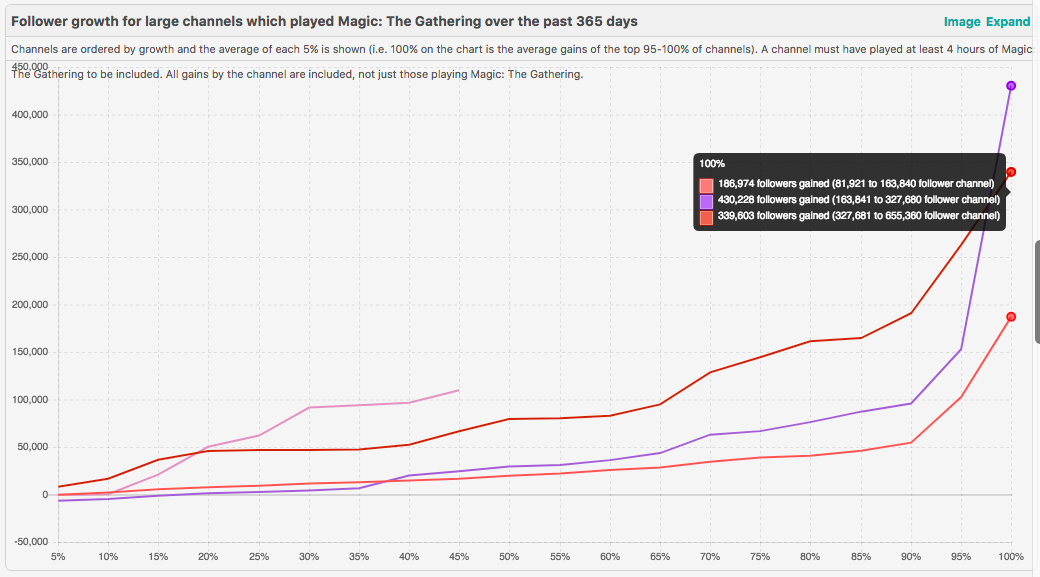
Only the most critical enablers are kept: Insolent Neonate and Cathartic Reunion, which support One and Vine, and Street Wraith, which supports One and Shadow. Greasing the wheels of course is Faithless Looting, the best enabler for this style of deck and one of the most powerful in the format. Without Goblin Lore or Burning Inquiry, Hollow One will often cost a mana, but that's still a bargain for a 4/4.

All This Chocolate

Despite Arclight Phoenix apparently dominating the tournament scene, leafing through lists of 5-0s still evokes the whimsical joy of choosing treats out of a Whitman's Sampler. Modern's got plenty of variety for everyone, so take your favorite playset by the sleeves and get ready for Date Friday Night Magic!

MTG Metagame Finance #31 – The Future of Magic

Are you a Quiet Speculation member?

If not, now is a perfect time to join up! Our powerful tools, breaking-news analysis, and exclusive Discord channel will make sure you stay up to date and ahead of the curve.

In case you haven't heard, some big things are coming up for Magic later this month, particularly for Modern. We don't know just yet what the news is, but Wizards seems to think we'll consider it a big deal. You can see them teasing the announcement on Weekly MTG in the clip below (the complete video can be found on Twitch.

Contrary to what many people may think owing to decreased coverage of paper Magic, the game is still growing and will continue to flourish thanks to Magic Arena attracting many new players to the game.

As some of you might think the same, I predict paper Magic player numbers will dip a little bit this year as more people shift over to Magic Arena. Then we could see a jump in paper player numbers next year as old players that have shifted over to Magic Arena come back to play some paper Magic. But the big increase will come from the players who started playing Magic through Magic Arena. A certain percentage of these players will shift over to playing in paper.

We're already seeing a huge increase in viewership of Magic on Twitch. Take a look at these growth charts covering the past year. (Note that these trends hold for the smaller-size Magic channels as well.)

(Click to expand.)
(Click to expand.)

Why do I mention these two things one right after another? Well... first, I think there’s a very short window right now to get rid of some cards that will probably be reprinted at the end of this month. Without further ado, let's look at my Folds for this week.

Folds

Zendikar/Modern Masters 2017 Fetchlands (Non-Foil)

There was an error retrieving a chart for Scalding Tarn

It’s been almost two years since fetchlands were last reprinted, and Wizards has said there won’t be another Masters set in the near future. The announcement later this month could contain a supplemental set that provides an outlet for Wizards to reprint them since they’re badly in need of it. Look at the price of Scalding Tarn. It’s creeping up towards $100 again. That’s scary.

Scars of Mirrodin Fastlands (Non-Foil)

There was an error retrieving a chart for Blackcleave Cliffs

There’s only one printing of these and they’re over eight years old. I talked about this in article #1. Eventually, these will definitely get reprinted and tank in value. Get out now and buy back in later after the reprint.

Surgical Extraction (Non-Foil)

There was an error retrieving a chart for Surgical Extraction

This is a card I’ve talked about more recently. I mentioned this in article #30. As I’ve stated before, Phyrexian-mana cards are harder to reprint. But the last reprint of this card was over three years ago and has skyrocketed in price recently, making it a great target for a supplemental set at the end of this month.

So how does tie into the mention of Magic Arena earlier? Well, as I explained, there will most likely be a dip in paper Magic this year as people focus on Magic Arena. And then next year is when we could possibly see an increase in paper Magic again. With what seems like an inevitable reprint of some cards on the horizon, it’ll probably be a good time for people to buy cards on the cheap before things start to spike again next year.

So what should you buy now? Well, I recently sent another buylist order to Card Kingdom.

One of the cards that I’ve had my eye on is Judith, the Scourge Diva, particularly Prerelease foils. It shows up quite a bit in Standard and often as a four-of. But it’s also starting to make some small waves in Modern. I don’t know if it’s good enough for Legacy since it’s not blue and costs three mana. But increased play in Modern could make this a decent card to pick up and hold for a little while.

Standard Decks with Judith

Standard: Jund by Ihavethefire

Creatures

2 Graveyard Marshal
3 Ravenous Chupacabra
3 Rix Maadi Reveler
4 Judith, the Scourge Diva
4 Fireblade Artist
4 Footlight Fiend
4 Gutterbones
4 Priest of Forgotten Gods
4 Midnight Reaper

Non-Creature Spells

4 Skewer the Critics
1 Angrath, the Flame-Chained

Lands

4 Blood Crypt
4 Dragonskull Summit
5 Mountain
10 Swamp

Sideboard

3 Theater of Horrors
2 Moment of Craving
3 Lava Coil
1 Gruesome Menagerie
4 Drill Bit
2 Angrath, the Flame-Chained

Standard: Mardu by Uniq

Creatures

2 Midnight Reaper
2 Plaguecrafter
3 Ravenous Chupacabra
4 Gutterbones
4 Rix Maadi Reveler
4 Priest of Forgotten Gods
4 Militia Bugler
4 Judith, the Scourge Diva
4 Hunted Witness

Non-Creature Spells

2 Find // Finality
3 Revival // Revenge

Lands

2 Unclaimed Territory
2 Plains
4 Godless Shrine
4 Dragonskull Summit
4 Blood Crypt
4 Sacred Foundry
4 Swamp

Sideboard

1 Plague Mare
3 Mortify
2 Inspiring Cleric
2 Elenda, the Dusk Rose
3 Duress
2 Dire Fleet Daredevil
1 Ravenous Chupacabra
1 Plaguecrafter

Standard: Boros by Pitafred

Creatures

2 Healer's Hawk
4 Snubhorn Sentry
4 Dauntless Bodyguard
4 Hunted Witness
4 Judith, the Scourge Diva
4 Skymarcher Aspirant

Non-Creature Spells

2 Light Up the Stage
4 Heroic Reinforcements
3 Conclave Tribunal
4 Legion's Landing
4 History of Benalia

Lands

4 Sacred Foundry
4 Clifftop Retreat
4 Godless Shrine
4 Isolated Chapel
5 Plains

Sideboard

4 Tocatli Honor Guard
3 Lava Coil
3 Drill Bit
3 Baffling End
2 Ajani, Adversary of Tyrants

Standard: Rakdos by David Borges

Creatures

2 Legion Warboss
2 Rekindling Phoenix
2 Skarrgan Hellkite
3 Judith, the Scourge Diva
4 Rix Maadi Reveler
4 Fanatical Firebrand
4 Goblin Chainwhirler
4 Runaway Steam-Kin

Non-Creature Spells

2 Bedevil
4 Lightning Strike
3 Lava Coil
2 Theater of Horrors
1 Angrath, the Flame-Chained

Lands

2 Swamp
2 Cinder Barrens
4 Dragonskull Summit
4 Blood Crypt
11 Mountain

Sideboard

1 Lava Coil
3 Drill Bit
1 Banefire
2 Fiery Cannonade
2 Bedevil
1 Theater of Horrors
2 Rekindling Phoenix
1 Sorcerous Spyglass
2 Fountain of Renewal

Modern Decks with Judith

Modern: Zoo by Calebd

Creatures

1 Metallic Mimic
2 Firedrinker Satyr
2 Bosk Banneret
3 Rix Maadi Reveler
3 Spikeshot Elder
3 Judith, the Scourge Diva
4 Burning-Tree Emissary
4 Elvish Visionary
4 Rage Forger
4 Flamekin Harbinger

Non-Creature Spells

4 Collected Company
4 Lightning Bolt

Lands

1 Fire-Lit Thicket
1 Blood Crypt
1 Overgrown Tomb
1 Forest
2 Verdant Catacombs
2 Mountain
2 Stomping Ground
4 Cavern of Souls
4 Copperline Gorge
4 Wooded Foothills

Sideboard

3 Tormod's Crypt
2 Surgical Extraction
3 Reclamation Sage
2 Plaguecrafter
3 Fulminator Mage
1 Eternal Witness
1 Bonfire of the Damned

I talked about Flamekin Harbinger in article #12. I think the ship has sailed on that one already, since some of the cheapest ones I can find now are $6 on Miniature Market.

I also talked about Collected Company in article #21. I would be more careful about this card now with the upcoming Modern announcement later this month, which could showcase a reprinting of this card. Also, Spirits in Modern hasn’t been as dominant lately compared to the past few months.

Modern: Tokens by Drantiderivative

Creatures

2 Doomed Traveler
2 Kytheon, Hero of Akros
3 Tithe Taker
3 Judith, the Scourge Diva
3 Kitesail Freebooter
3 Thalia, Guardian of Thraben
4 Thalia's Lieutenant
4 Champion of the Parish
4 Falkenrath Aristocrat
4 Bloodsoaked Champion

Non-Creature Spells

3 Path to Exile
3 Lightning Bolt

Lands

1 Sacred Foundry
1 Clifftop Retreat
1 Mountain
1 Mutavault
1 Swamp
2 Godless Shrine
2 Arid Mesa
2 Plains
3 Concealed Courtyard
4 Marsh Flats
4 Cavern of Souls

Sideboard

1 Wear // Tear
1 Stony Silence
2 Rest in Peace
1 Nearheath Pilgrim
1 Kaya, Orzhov Usurper
2 Kambal, Consul of Allocation
2 Ethersworn Canonist
1 Dark Confidant
2 Auriok Champion
1 Path to Exile
1 Thalia, Guardian of Thraben

I just picked up a playset of foil Falkenrath Aristocrats for $2.75 each from Miniature Market. TCGplayer has just a couple of foil playsets for $5-6 each, but I think that’s too expensive since it doesn’t really see play anywhere else yet.

I also think this deck should probably run at least three Aether Vials instead of some combination of Path to Exile and Lightning Bolts. It should probably also play some number of Rix Maadi Revelers since you can reliably cast it for its spectacle cost with this deck’s manabase. And it has synergy with Bloodsoaked Champion and Falkenrath Aristocrat.

Modern: Humans by Austin Noll

Creatures

1 Venser, Shaper Savant
2 Judith, the Scourge Diva
3 Reflector Mage
3 Kitesail Freebooter
4 Thalia's Lieutenant
4 Thalia, Guardian of Thraben
4 Phantasmal Image
4 Noble Hierarch
4 Meddling Mage
4 Mantis Rider
4 Champion of the Parish

Non-Creature Spells

4 Aether Vial

Lands

1 Island
1 Plains
2 Seachrome Coast
3 Horizon Canopy
4 Ancient Ziggurat
4 Unclaimed Territory
4 Cavern of Souls

Sideboard

2 Sin Collector
1 Riders of Gavony
1 Knight of Autumn
1 Kambal, Consul of Allocation
1 Gaddock Teeg
1 Dismember
2 Deputy of Detention
2 Damping Sphere
3 Auriok Champion
1 Anafenza, the Foremost

I mentioned Judith in the Ravnica Allegiance spoilers page. According to Frank Karsten’s mana guide, I didn't think the current Humans manabase would be able to reliably cast it. But it looks like Austin Noll has had some minor success with Judith in Humans.

Summary

Folds

  • Zendikar / Modern Masters 2017 Fetchlands (Non-Foil)
  • Scars of Mirrodin Fastlands (Non-Foil)
  • Surgical Extraction - Modern Masters 2015 (Non-Foil)

Watchlist

  • Judith, the Scourge Diva - Ravnica Allegiance (Foil)

Recent Buys

  • Falkenrath Aristocrat - Modern Masters 2017 (Foil)

Public Spreadsheet

Stay up to the minute on what I’m looking at on a daily basis via the MTG Metagame Finance Spreadsheet. Don’t forget to bookmark it, because I update it on the fly. This way you can see what’s going on as the market moves and before articles about certain cards are published.

Let me know what you think in the comments below. Agree? Disagree? Why? You can also connect with me on Twitter at @edwardeng.

Important!!!

You can also catch me in the Discord channel (edward.eng#4978) if you have an Insider membership. I would go as far to say that this is one of the most valuable things you receive as a member. The Discord channel is very active and real-time discussions revolve around cards that move before anyone sees the actual movement—it’s usually already too late when you see this movement on sites like MTG Stocks, MTG Goldfish, and MTG Price. Hit me up on Twitter at @edwardeng, and I’ll answer any questions you have.

I’m also open to suggestions on how to make this series more valuable. Hit me up.

Have fun,
Eddie

On Fire: Understanding the New Burn

Are you a Quiet Speculation member?

If not, now is a perfect time to join up! Our powerful tools, breaking-news analysis, and exclusive Discord channel will make sure you stay up to date and ahead of the curve.

Burn has always existed in Modern in some capacity. However, it never gets any respect or discussion until there's a major metagame shift or new cards. This is unfortunate for players of the archetype and their opponents. The former often receive derision for playing the kiddie deck, and the later don't realize how vulnerable they actually are until too late. I aim to help correct this problem today.

It might be because I live in Denver, a notoriously red-friendly city, but I'm always shocked when players don't prepare for Burn. The deck is a certified predator thanks to most Modern decks Bolting themselves at least once with fetch and shock lands. Manabases have become less damaging since the enemy-colored fastlands were printed, and this made Burn appear less potent. However, the data usually disagrees. Burn is consistently a major player in the metagame. It's time to stop pretending that Burn's only viable when it gets new cards. It's always good, and players must be ready. The only real question is what form it will take.

Modern's Rodney Dangerfield

I think that lots of players, especially those that make Magic content, sometimes just forget that Burn exists. I don't think they actually discount the deck, but until something specifically happens, they just don't talk about the deck. Shortly after Monastery Swiftspear was printed, there was a huge spike in articles, especially after a good showing at PT Fate Reforged. Then, silence. A few videos here and there, but not much discussion of the deck itself. If it was discussed at all, it was as part of sideboarding plans for other decks. Even then the strategy always comes down to answer a few burn spells, race, and pray.
Once Collective Brutality was printed, it got worse. Players assumed that Brutality was the end of Burn. Which makes sense: Brutality is very efficient at answering everything Burn does on the cheap, and definitely remains a potent answer. However, Burn just motored through. In 2017, Burn represented 6% of the metagame. In 2018, it was still at 6%. Despite this consistency and resiliency, most competitive players seem to think of Burn as just a metagame choice. Maybe the enduring stigma of being an "autopilot deck for n00bs" remains strong, but Burn just doesn't get the respect it deserves.

The Actual Predator

It's not just Burn's history or individual achievements that demand respect. Burn is a major predator in Modern. Whenever new decks appear, there's always that lingering question of the Burn matchup that they have to answer. When Death's Shadow emerged, players assumed that Burn would just crush the deck. However, the Shadow players were aware of the vulnerability, and adjusted their gameplan. Every other matchup was straightforwardly played for a deck like Grixis Death's Shadow, but Burn required actual substantial gameplay adjustments. That's significant.

Weird, slow, and/or specifically interactive decks tend to have very poor matchups against Burn. Much was made of Humans' matchup against Storm in 2017, but Burn had a similarly strong matchup. Arguably, Burn had the better maindeck card against anything Storm or any combo could do in the form of Eidolon of the Great Revel, and to a lesser extent Searing Blaze. Tron similarly struggles: Wurmcoil Engine is a fantastic threat, but Burn has Skullcrack. Everything else is mediocre against Burn's attack or is very slow. There's a reason current Tron lists sideboard heavily against Burn.
A more extreme example is Lantern Control. Burn was the nightmare matchup because Ensnaring Bridge was minimally effective and Lantern could never allow Burn to draw a single spell. Everything but the creatures gets thrown at the face, so going long game 1, Burn was going to find enough fire. The printing of Inventors' Fair gave Lantern players some hope, but it was still terrible. I credit the prevalence of Burn for keeping Lantern from ever gaining traction.

The Reality

Even if a given deck isn't specifically terrible against Burn, everyone is vulnerable. Individual matchups aren't what makes Burn a good deck, or even what it's actually preying on. Burn targets Modern as a whole. The fact that the manabase is painful certainly helps, but that's not something contemporary Burn can rely on. Instead, Burn thrives because it takes advantage of how everyone else sees Modern.

There is a perception that Modern is entirely linear and uninteractive. This is false; even a cursory look through Modern decklists show that some combination of creature removal, counterspells, and targeted discard is in every deck. A more accurate description is that Modern cycles between periods of high and low quantity of interaction. In 2017 Grixis Death's Shadow dominated early, then Jeskai Tempo rose. Both were replaced by Humans in 2018, a year that saw UW Control, Hollow One, Mardu Pyromancer, Dredge, Spirits, and UR Phoenix become the decks to beat. More interactive decks followed by less and back again. Through it all, Burn held steady in the upper tiers because it naturally responds in opposition to the trend.
When interaction is high, Burn goes less interactive and faster to slip past defenses. When UW Control is popular, I see Burn maxing out on one-mana spells to overwhelm counters. There's also the option to completely ignore defenses with Exquisite Firecraft. If the rest of the format is getting more aggro-oriented, Burn responds with more Grim Lavamancers and Searing Bloods. It can go as extreme as hiding behind Ensnaring Bridge and chucking burn until the opponent dies. Players may think of Burn as just a metagame deck, but the truth is that Burn regularly pushes against metagame trends.

A Secret Pillar

This doesn't mean that Burn polices Modern. If Twin didn't, I don't think anything actually can. Instead, I argue that Burn is and has always been a pillar of the format. It's a deck that every other deck must take into account and always does well. The key is that Burn is the most focused deck in Modern. It doesn't mess around with enablers, cantrips, or air. Every single nonland card gets pointed at the opponent's face. This gives it considerable game in any situation, and ensures it is always relevant.
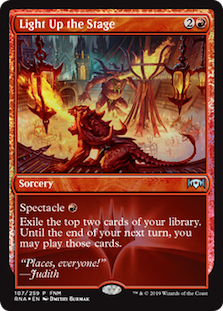
This makes it all the more baffling that players just don't play well against Burn. In my experience, most think of Burn as just an aggro deck and that stalling their offense and gaining back a few points of life is enough. This attitude forgets first of all, that Burn has faced this attitude since time immemorial and found ways to win. Secondly, they're forgetting Burn can just keep flinging cardboard at their face after the lifegain spell. Burn almost always has inevitability as a result. Thus players need to either preempt Burn by winning first or shut down Burn completely. The former is done with racing, and is where lifegain spells like Blessed Alliance are good.

Decks that don't effectively race need to actually shut Burn down and steal inevitability, either with continuous lifegain or actual, effective hate. There are few Modern playable cards (other than being Soul Sisters) outside Kor Firewalker for the former, though Lantern tried Sun Droplet. The better option is to just beat Burn with Chalice of the Void, Witchbane Orb, and Leyline of Sanctity. Burn's cheapness and linearity are its greatest strength and weakness and I'm surprised these aspects don't get attacked more.

New Hotness

Burn is efficient and focused enough that if its opponents stumble at all, regardless of how the matchup *should* go, it will win. This doesn't mean that players need to go all out with maindeck hate or sideboarding like Tron. Instead, it's time to give Burn its due, just like the Shadow players did, and figure out how to play against it. Burn's greatest strength so far has been that opponents don't really understand it, and that needs to change.

This is of supreme importance now because Burn got some new toys in Ravnica Allegiance and it's the New Latest Thing. The spectacle mechanic, and Skewer the Critics and Light Up the Stage specifically, are tailor-made for Burn decks and are making their way into Modern. It's a natural fit. Rift Bolt has long been a staple, and Skewer is that with a different restriction. It's a more restrictive restriction, but in a deck like Burn, damaging the opponent isn't that hard.

This is also made easier thanks to Stage. Functionally a one-mana Divination, Stage is a very good deal, especially in a deck that is entirely cheap spells. Playing more spells than the opponent is a time-honored route to victory. It's been a while since Burn got anything substantial, so at minimum, it's a nice treat for Burn stalwarts.

The Catch

I haven't been impressed by the new cards. They're fine, and if they encourage new players to play Modern, then I hope they maintain a presence in Burn. However, in my experience so far, they haven't been necessary and are sometimes actively harmful. Last week I mentioned that Lavinia has been surprisingly good against Burn because of Skewer and Stage. Burn may only cast them for one mana, but they still have a CMC of 3, and Stage decks are cutting a land. I've also won a number of games against Burn recently thanks to them having no way to spectacle-cast Skewer or Stage. Were those stranded cards Boros Charms or Skullcracks, I would have died. Instead, I had the time to put together an offense and win.

I've also never had a game where Stage actually won my opponent the game. Chaining Stages together did produce an impressive amount of reach, but when I died, my opponents still had plenty in hand to kill me. They didn't need the Stage. In attrition matchups, that may change, but so far that hasn't happened. I've witnessed a lot of games against Jund and UW where Stage didn't change the outcome. Games that normal Burn won would have won were won, and vise-versa.

Great Power, Great Vulnerabilities

The spectacle cards are encouraging players to cut the two mana spells and go as low to the ground as possible. This is a fine strategy, and worked out well for Death's Shadow in 2017. However, that additional speed isn't free. The lower you go, the greater the risk of being stepped on. Consider this Rakdos Burn list:

"Rakdos Burn, AndreasP (Modern Challenge, 1st Place)"

Creatures

4 Goblin Guide
4 Monastery Swiftspear
2 Grim Lavamancer

Instants

4 Lightning Bolt
4 Shard Volley
4 Searing Blaze

Sorceries

4 Bump in the Night
4 Lava Spike
4 Rift Bolt
4 Light Up the Stage
4 Skewer the Critics

Lands

4 Scalding Tarn
3 Bloodstained Mire
3 Arid Mesa
3 Blackcleave Cliffs
3 Mountain
2 Blood Crypt

Sideboard

4 Smash to Smithereens
4 Eidolon of the Great Revel
4 Searing Blood
3 Surgical Extraction

How does this deck beat Chalice of the Void or Leyline of Sanctity? I know that neither sees much play right now, but that is easily fixable. Naya and Boros Burn can struggle against those cards, and they play answers out of the sideboard. I don't think there's any out to Leyline for Rakdos except for creature beatdown. These new Burn decks are trying to ignore the opponent entirely, which is a fine strategy as long as Modern continues to not be ready for Burn.

Once that changes, it's going to be tough for Stage Burn of any stripe to win. The new cards incentivize running the most effective hate (read: shuts off part or all the deck) over the more splashable lifegain cards. Compare the new to the older lists:

Modern Burn, Yann Guillaume (GP Lyon 2018 Trial Winner)

Creatures

4 Goblin Guide
4 Monastery Swiftspear
1 Grim Lavamancer
4 Eidolon of the Great Revel

Instants

4 Lightning Bolt
4 Boros Charm
4 Searing Blaze
4 Lightning Helix
4 Skullcrack

Sorcery

4 Lava Spike
4 Rift Bolt

Lands

4 Wooded Foothills
4 Bloodstained Mire
4 Inspiring Vantage
3 Sacred Foundry
2 Mountain
1 Stomping Ground
1 Wooded Foothills

Sideboard

4 Destructive Revelry
2 Chained to the Rocks
2 Grafdigger's Cage
2 Ensnaring Bridge
2 Kor Firewalker
1 Searing Blood
1 Deflecting Palm
1 Tormod's Crypt

This list isn't as fast or streamlined as Rakdos, but it is ready for players that pay attention to it. There are answers for the typical hate that fit into the overall strategy and provide outs to anything. If players finally wake up to Burn, this type of reliability will be necessary.

Firestarter

Skewer and Stage have not suddenly made Burn a real deck. It always was one, even if players weren't paying attention. All they've done is focus attention, long overdue, onto the deck. Right now, they're pushing Burn away from the resilience and adaptability that made it a pillar of Modern for so long, but I think the archetype is sure to cycle back to its roots. Burn has always been. Burn will always be.

Want Prices?

Browse thousands of prices with the first and most comprehensive MTG Finance tool around.


Trader Tools lists both buylist and retail prices for every MTG card, going back a decade.

Quiet Speculation