menu

Daily Stock Watch – Year End Special

Are you a Quiet Speculation member?

If not, now is a perfect time to join up! Our powerful tools, breaking-news analysis, and exclusive Discord channel will make sure you stay up to date and ahead of the curve.

Hello, readers and welcome to the last Daily Stock Watch segment of 2018! It has been a good year for Magic that has been capped off by the news that it is going to venture in the E-sports world via MTG Arena, and the release of what's reportedly the last Masters set in a while, Ultimate Masters. Now, we'll look forward to a new year of MTG Finance adventures as we face the world of paper Magic that's somehow threatened by the idea of everything becoming digital.

IS PAPER MAGIC DYING?

There was an error retrieving a chart for Black Lotus
There was an error retrieving a chart for Ancestral Recall
There was an error retrieving a chart for Time Walk

People who panicked at the news of everything possibly going digital aren't true fans of the game. If we are to look at what WotC's plans for Magic are, expansion is definitely on top of that list. It is a known fact by now that we are losing the Nationals and World Championships for paper as it transitions to Arena, but bear in mind that we still have the brand new MagicFest where Pro Tours and the Grand Prix main event will take place. You can see the schedule for the coming year's MagicFest on this page. They have also restructured the Pro Tour qualifiers to something different this time around but it's something that I'm not really an expert on, so it's best that you ask your WPN stores about it. You can actually read more about it here. If you look closely at how they ended this article, you know for sure that Magic isn't going anywhere anytime soon.

SO WHAT DO I DO WITH MY PAPER CARDS?

There was an error retrieving a chart for Havoc Festival

This is easily the most common question that I'm getting from some readers and MTG friends of mine. Like what I've said earlier, there's no need to sell them just because you think that WotC is pushing for MTG to go digital. There's no way that they are going to bite the hand that feeds them, and you throwing your collection away in fears of it losing more value over time is just an absurd idea for me. If I may suggest, go out there and buy good collections from people who are panicking at a good rate. Magic is a billion dollar industry that thrives off its paper sales, not its online portfolio, that will be here to stay for as long as you're breathing. If you are to lie low for a bit into buying anything, I think that you could temper down a bit on your Standard cravings. MTG Arena will be focused on that as the big tournaments are bound to be online. Commander, Modern, and Legacy are more than enough to keep paper Magic going. These are your safe havens out there.

WITH THAT IN MIND, WHAT DO WE FOCUS ON BUYING AND SELLING THIS YEAR?

There was an error retrieving a chart for Lightning Bolt

This is still a broad question that requires a specific answer in different aspects. I guess this is the reason why we have the Daily Stock Watch. Cards will be popular in a heartbeat, or they could easily be obsolete as better ones arrive. There will always be reprints in every new set, and there could possibly be new gimmicks (just like the box topper!) that we have yet to find out in the coming years. The people behind our favorite card game have done a great job of coming up with new ideas to keep us going, and they are obviously not done yet.

There was an error retrieving a chart for Mox Opal

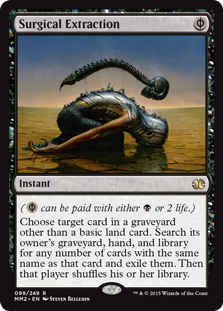
My model for speculating will still be the same one that I've used for the past decade -- adapting to the demand scale. Cards like Ponder, Lightning Bolt, Path to Exile, and Thoughtseize will always be in demand no matter what happens. Reprints barely do anything to these cards. It's more on cards like Mox Opal and Surgical Extraction that I'm concerned about, as they could easily get hit by a sudden dip as soon as they get reprinted in a new set or supplemental product. Logically, going with "penny stocks" is still the best way to earn if you are into MTG's business aspect. If you're in it for competitive playing as well, completing play sets of staples will always be a good practice. They will eventually balance out in value as some of them will get random spikes every now and then, while others will go down due to reprints.

2019 is going to be an exciting year for Magic. That much I could tell you right now. Stay tuned to the Daily Stock Watch as we continue our MTG Finance adventure for a new year! I'll be back with the last part of my box topper feature in our next edition. Happy New Year, everyone!

Maximizing All These Coupons

Are you a Quiet Speculation member?

If not, now is a perfect time to join up! Our powerful tools, breaking-news analysis, and exclusive Discord channel will make sure you stay up to date and ahead of the curve.

According to Wikipedia, the concept of the coupon was created by The Coca-Cola Company back in 1886. Asa Candler came up with the idea of giving away coupons in the mail and in magazines to drive trial of the new flavored tonic water. The results speak for themselves.

Since then, the coupon has been a powerful tool combining art, psychology, and economics to impact consumer behavior. More recently this has extended into the Magic market with profound repercussions. It seems a number of places—places where MTG products are sold—are offering attractive sales and coupon opportunities. These have led to some interesting trends within MTG finance.

It is these trends that I want to discuss this week.

The Right Kind of Coupons

Some websites offer coupons only very rarely, such as during the U.S.’s famous Black Friday holiday. These once-a-year discounts alone don’t have a long-term impact on the market, and the radar would show merely a blip that disappears once the holiday season is over. However, plenty of websites offer deals throughout the year—it is these that I want to discuss.

I also want to distinguish between site-wide sales/coupons versus discounts on a small subsection of the market. When a site offers 10% cash back or a 15% coupon, one can purchase anything they choose and receive the discount. This is far more powerful than when a website decides to “mark down” prices on select cards. Often times these markdowns are on cards the sites had overpriced in the first place.

For example, Star City Games has had a huge sale throughout the entire month of December—they advertise Revised Plateau as one of their headliners for this sale. You can purchase an “HP” (often times SCG’s “HP” is really Moderately Played) copy for $106.24, a nice markdown from $124.99.

However, they still have 30 such copies in stock because you can buy a bunch of MP copies from TCGplayer for under $75. Suddenly the “sale” really isn’t much of a sale, and you can bet the impact to the overall market will be near zero.

There was an error retrieving a chart for Plateau

The real impact comes in when a site offers consistent site-wide sales and coupons so that MTG products with competitive prices can be purchased below market price. From my observations, the sites that offer such coupons somewhat regularly include eBay, TCGplayer, and Channel Fireball. These three sites have regular coupons or cash-back deals up to 15%, and such deals can really warp the market.

Warping the Market

What do I mean when I say these coupons “warp the market?” I’m referring to strange pricing discrepancies that arise between sites due to these coupons. For example, last weekend eBay had a 15%-off coupon—one of their best coupons, which they only offer a couple times a year. While I was surfing stock on Old School cards, many Magic players scooped up a sealed booster box of Ultimate Masters. The result? Now the cheapest box on eBay is $349.89, whereas the cheapest box on TCGplayer is $299.44. That means boxes are about 15% more expensive on eBay than they are on TCGplayer.

This is no coincidence. There is robust demand for these boxes, so as long as people can save even a few bucks, they’ll buy a box from eBay with a coupon rather than buy on TCGplayer without a coupon. If TCGplayer were to offer a 15% coupon next week, we would see the trend suddenly reverse.

Sealed product is often a go-to purchase when coupons are available because the discount is very transparent. People tend to know what going prices are on new sealed product, so it is easy for them to justify a coupon-based purchase that gets them a price below the market. These boxes are also on the pricey side, so a percentage-based discount is especially tempting. Thus, the pricing discrepancy.

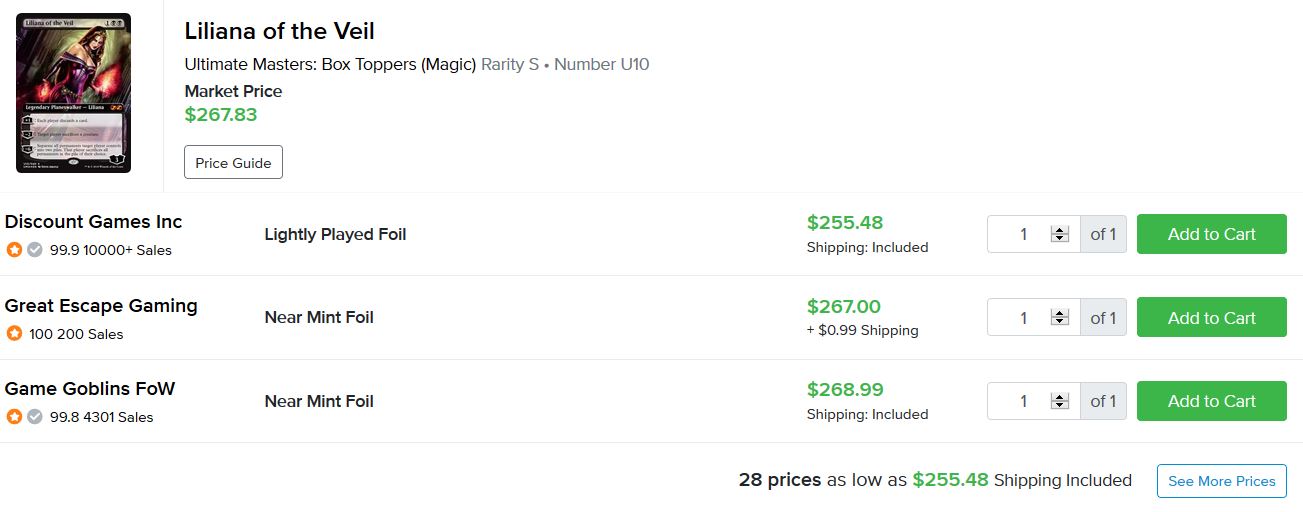
Besides sealed product, you’ll also see price discrepancies arise on the hottest singles—especially the pricier ones. For example, the cheapest near mint Ultimate Box Topper Liliana of the Veil on TCGplayer is now $267. On eBay (ignoring the listing with the wrong picture), it’s $300.

Once again the price on eBay is more than 10% above that on other sites—likely because people purchased the cheaper copies with the recent coupon. When I look at “sold” listings, I can see that seven copies sold—all in the $270-$280 range—the day of the coupon. Seven may not seem like much, but when you consider there are only 28 listings of the card on TCGplayer, you can appreciate the large percentage of the market acquired thanks to this coupon.

How to Make (Save) Money with this Information

Okay, we’ve established how these coupons can warp the market, causing pricing discrepancies upwards of 15% (the magnitude of the sale) between websites. How can we use this information to our benefit?

There are three ways to take advantage of these major sales. Sure, you can try to scoop up booster boxes at a discount to market pricing, but these opportunities dry up quickly as evidenced by the resulting pricing discrepancy. Instead, I’d recommend three strategies.

1. Become an opportunistic seller

Coupons on eBay and cash-back deals on TCGplayer can be a boon for buyers, but it benefits sellers just as much. During the last 15% eBay sale, I sold a Beta Counterspell because someone could get it with a discount. The card may have sat there for weeks longer had that coupon not arisen.

There was an error retrieving a chart for Counterspell

If you have popular cards you’re looking to sell, making sure to list them when these sales go live can help you increase cash flow. You can even charge a little above market price because of the coupons—imagine selling a Box Topper Liliana on eBay for $295 rather than on TCGplayer for $270. The buyer may be paying a discounted price, but you’re still netting $20 more for your sale.

2. Shop around for the obscure

There are two reasons I bought a Beta Timber Wolves with the most recent eBay coupon. The primary one is simply that I wanted another Beta rare for my collection and I have a soft spot for this one. But the other reason is financially driven. While everyone’s buying up the hottest cards, inevitably driving prices higher on eBay, I am looking for a card very few other people are seeking. By doing this, I can get the full benefit of the coupon, paying well below market price.

You don’t have to go as obscure as I did, either. Consider this: the best price on an HP Revised Underground Sea is currently $368.54 on eBay and $371.99 on TCGplayer. They’re about the same, meaning if you use a 15% off eBay coupon to get an HP Sea, you can get one 15% below TCG low, maximizing the discount (not to mention getting $3.50 in eBay bucks).

There was an error retrieving a chart for Underground Sea

3. Look for Arbitrage

If you’ve been reading my content for a while now, you had to expect this one. What better way to use a 15% coupon than to get a card you can immediately sell for profit? This admittedly takes some work—you can’t just go and buy that aforementioned HP Underground Sea and immediately sell it on TCGplayer for profit. Fees and shipping will completely eliminate any chance of gains.

But if you seek out some of the more obscure cards, you can definitely find arbitrage opportunities. For example, consider that played Beta Timber Wolves I bought. After the coupon it cost me around $60. ABUGames offers $118.75 in store credit for it. Obviously this is in the inflated ABUGames currency, but I can definitely get a card worth more than $60 with that kind of credit (I’d rather have the wolves, of course). The deals are out there if you’re willing to hunt for them.

There was an error retrieving a chart for Timber Wolves

Wrapping It Up

It looks like coupons and cash-back offers are here to stay. What was initially developed over 100 years ago is still heavily utilized, even in the world of MTG finance. When sites like eBay and TCGplayer offer such discounts, it can have profound impacts on the market. Significant price discrepancies can arise between sites as a result of said coupons.

If you missed a chance at a cheap Ultimate Masters booster box with the latest coupon, there’s no need to worry. In fact, I would steer clear of the most obvious options to apply the coupon and instead look at the more obscure. Less popular cards can help you maximize your discount and even yield some arbitrage opportunities. Even if you can’t flip a card for immediate profit, you can eliminate your downside risk by getting a price 10-15% below the market.

Better yet, try listing some popular cards for sale when a coupon goes live. If your cards have enough demand behind them, you may be able to sell a copy slightly above market price due to the coupon. Even if a buyer can pay just 10% above market price, they’re still saving 5%—if the demand for such a card is robust enough, the sale will still happen, and this is more money in your pocket.

As long as they stay around, these sales, coupons, and cash-back offers are a boon to you and the MTG community as a whole. It essentially takes money out of these big corporations’ pockets and places it in yours. That is, if you know how to maximize them!

Sigbits

  • I want to reference some interesting trade credit numbers on ABUGames’s site this week. For starters, consider a card I have shipped to ABU multiple times recently because of their aggressively high credit number: Unlimited Two-Headed Giant of Foriys. Even for HP copies they offer $72 in store credit, and you can find copies for less than half that (especially when a coupon is available).
  • There is softness in prices all across the Old School market. It may be worst in low-end, less playable Reserved List stuff, but even prices on Power are suffering a little. However, ABUGames still offers very aggressive trade credit numbers on Power. For example, they will offer $2850 in credit for an HP Unlimited Mox Pearl. Even if you can only convert that to cash at a 50% rate, you’re still getting over $1400 in cash for the card. The number is even more attractive if it falls in the “Played” category: $3515 in credit!
  • Here’s an Old School card that has kept a fairly high price tag even during this period of softness: Alpha and Beta Hypnotic Specter. This card is nostalgic for so many players who enjoyed Magic during its infancy. ABUGames offers $665 and $285 for played Alpha and Beta copies, respectively. Find a near mint card and you can net yourself $1337.50 and $642 in credit for those same cards!

Insider: Office Hours #4

Are you a Quiet Speculation member?

If not, now is a perfect time to join up! Our powerful tools, breaking-news analysis, and exclusive Discord channel will make sure you stay up to date and ahead of the curve.

Join Edward Eng and Sig Ausfresser for Office Hours #4, the live Q&A podcast. Keep an eye out in the Insider Discord for upcoming Office Hour events!

A couple handy links referenced in this cast:

EDH REC

Most Played Cards on MTG Stocks

Avatar photo

Sigmund Ausfresser

Sigmund first started playing Magic when Visions was the newest set, back in 1997. Things were simpler back then. After playing casual Magic for about ten years, he tried his hand at competitive play. It took about two years before Sigmund starting taking down drafts. Since then, he moved his focus towards Legacy and MTG finance. Now that he's married and works full-time, Sigmund enjoys the game by reading up on trends and using this knowledge in buying/selling cards.

View More By Sigmund Ausfresser

Posted in Cash Flow, Commander, EDHREC, Finance, Free Insider, Office Hours, Podcast, Reserved List, Ultimate Masters: Box ToppersLeave a Comment on Insider: Office Hours #4

Have you joined the Quiet Speculation Discord?

If you haven't, you're leaving value on the table! Join our community of experts, enthusiasts, entertainers, and educators and enjoy exclusive podcasts, questions asked and answered, trades, sales, and everything else Discord has to offer.

Want to create content with Quiet Speculation?

All you need to succeed is a passion for Magic: The Gathering, and the ability to write coherently. Share your knowledge of MTG and how you leverage it to win games, get value from your cards – or even turn a profit.

Best of 2018: Accepting Tension

Are you a Quiet Speculation member?

If not, now is a perfect time to join up! Our powerful tools, breaking-news analysis, and exclusive Discord channel will make sure you stay up to date and ahead of the curve.

Editor's note: from Humans to Ironworks to Arclight Phoenix, 2018 saw Modern's power level rise dramatically. This year, deckbuilders learned to balance tension in their brews to devastating effect. Today's article is a re-run of what I consider my most relevant article to that metagame development. Happy holidays!

The Modern community is ruthless in its dismissal of new decks. When one hits the scene (and one frequently does), pundits invariably point out instances of tension on paper: these cards can't possibly work together, the sentiment goes. And yet, the deck placed high enough to draw that attention in the first place.

Tension is as oft-misunderstood a Magic concept as tempo. In this article, I'll define the term and argue for its overlooked beneficial role in deck composition: taking advantage of an untapped resource.

Tension vs. Synergy

What is tension? Well, let's start by defining what isn't tension. The opposite of tension is synergy, or the cooperation of multiple distinct parts to form a combined effect greater than the raw sum of its parts.

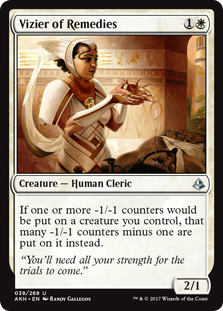
Taken to its logical extreme, the ultimate example of synergy is just combo: attacking opponents for millions of damage sure beats the individual effects of Deceiver Exarch or Splinter Twin. Working down the spectrum, currently-legal synergy combos include Vizier of Remedies with Devoted Druid (which together yield unlimited mana) and Vizier with Kitchen Finks and a sacrifice outlet (unlimited life).

Examining Micro-Synergy

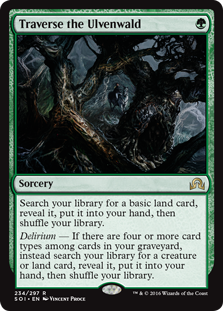
As we move deeper into fair territory, infinite combos disappear to make way for micro-synergies, or small, favorable interactions between cards that snowball into tangible advantage down the road. Micro-synergies are defined by groups of cards that work towards the same goal. Think Street Wraith, Mishra's Bauble, Tarmogoyf, and Traverse the Ulvenwald—a set of cards which, together, yield a product more powerful than the mana spent on them might suggest.

No fair deck in Modern lays claim to more micro-synergies than Traverse Shadow, a strategy that leverages these small advantages to at once be highly proactive, highly interactive, and highly consistent.

Traverse Shadow, by jled (13th, MTGO Modern MOCS)

Creatures

4 Death's Shadow
4 Tarmogoyf
1 Grim Flayer
4 Street Wraith

Artifacts

4 Mishra's Bauble

Instants

3 Fatal Push
2 Abrupt Decay
2 Dismember
3 Manamorphose
3 Stubborn Denial
2 Temur Battle Rage

Sorceries

4 Traverse the Ulvenwald
4 Thoughtseize
3 Inquisition of Kozilek

Lands

1 Blood Crypt
2 Bloodstained Mire
1 Breeding Pool
1 Misty Rainforest
2 Overgrown Tomb
4 Polluted Delta
1 Swamp
4 Verdant Catacombs
1 Watery Grave

Sideboard

2 Abrade
1 Ceremonious Rejection
1 Collective Brutality
2 Delay
2 Fulminator Mage
1 Izzet Staticaster
1 Jace, the Mind Sculptor
1 Liliana, the Last Hope
1 Maelstrom Pulse
1 Snapcaster Mage
2 Surgical Extraction

All the pieces here work together. For instance, Mishra's Bauble is more of a delirium enabler than a Death's Shadow buff. Still, it offers scrying with fetchlands, which feed the Shadow; adds information for Thoughtseize, the Avatar's other compatriot; and turns Street Wraith, the final piece of the Shadow core, into Opt. Similarly, Temur Battle Rage is here to get over impossible boards and one-shot opponents with a huge Shadow. But it's also happy to target Tarmogoyf, which grows up to 6/7 in this build.

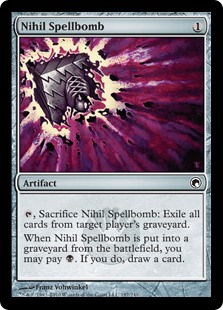
By now, Traverse Shadow has decisively been reigned in. The deck's emphasis on micro-synergies makes it vulnerable to hosers that invalidate those synergies, especially graveyard hate like Rest in Peace and Nihil Spellbomb, despite that same focus generating a terrifying deck when left unchecked.

In this way, Traverse Shadow has much in common with Affinity, a decidedly less interactive, but far more proactive, aggro-combo deck. Affinity has so much built-in synergy that nearly any hand featuring Mox Opal is sure to be excellent, but hosers like Stony Silence shut the deck down almost entirely.

Defining Tension

With synergy defined, we can move on to tension. Tension is the strain resulting from ill-fitting pieces being jammed together. Magic players often refer to instances of tension as "non-bos" (cf. "combos").

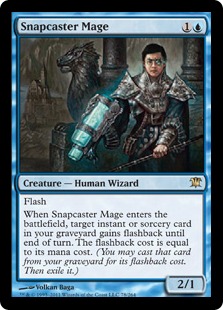
Such instances include playing Snapcaster Mage in the same deck as delve creatures, or Chalice of the Void alongside Expedition Map. But as we'll see, tension isn't inherently bad. After all, decks running those combinations exist and perform. A key skill in Modern deckbuilding is to identify where decks can afford some tension, and to introduce it accordingly to achieve some other goal.

Diversifying the Offensive

Most of the time, that goal is diversifying angles of attack. There are two types of diversified attacks: ones that skirt opposing interaction, and ones that force opponents to have different types of interaction.

Back to Traverse Shadow. Its namesake threat, Death's Shadow, notably doesn't care about graveyard hate at all, making it an elegant line of attack against opponents packing hosers—the 13/13 ignores that type of interaction.

Unfortunately for Shadow, though, the deck only gets to play four copies of the creature, leading it to rely on Traverse the Ulvenwald to search out more. As such, graveyard hate still cripples many Traverse Shadow lines, and the deck's Shadow plan doesn't offer enough coverage to fully insulate the deck against hosers.

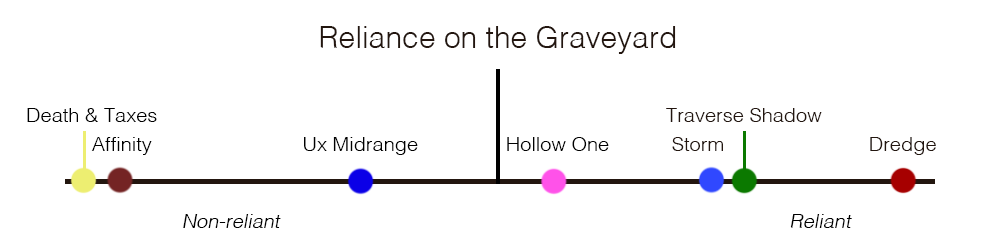
Traverse Shadow still finds itself relatively centered on the spectrum of "folding to grave hate," and around the same notch as Storm. On the very end, we have Dredge, a deck that very rarely beats a Rest in Peace. Consider this makeshift table on graveyard reliance among certain Modern decks.

This table is by no means comprehensive or accurately scaled.

So far, I've primarily focused on graveyard reliance to illustrate synergy and tension, but these two principles operate on many axes: converted mana cost clumping and curving; gameplan sharing; hand size and other resources. In terms of hand size, for example, Jace, the Mind Sculptor (whose +0 rewards players for accumulating many cards in hand) and Liliana of the Veil (whose +1 rewards them for going hellbent) have tension when played together. Graveyard reliance is just one of the easiest axes to visualize, so we'll stick with this example for the duration of this article.

In the table, my method for differentiating between graveyard-reliant and non-reliant decks was simple: non-reliant decks get to splash heavy-duty hosers like Relic of Progenitus and Rest in Peace; reliant ones do not. All the way on the left, such hosers become attractive sideboard and even mainboard options. Moving closer to the middle and beyond, decks begin to abandon them in favor of more surgical answers (such as literally Surgical Extraction).

Doing It Right

One deck I want to focus on is Hollow One, which has been putting up impressive results online. Rest in Peace does indeed stop the deck's Bloodghasts, Flamewake Phoenixes, and Gurmag Anglers. But it does nothing against Anglers that have already resolved, nor against Flameblade Adept or Hollow One itself. And since these threats come down so quickly, tapping out on turn two for a do-nothing enchantment could spell doom for Hollow One's opponent.

Hollow One, by Jono Mizer (6th, MTGO Modern MOCS)

Creatures

4 Hollow One
4 Flameblade Adept
4 Bloodghast
4 Flamewake Phoenix
3 Gurmag Angler
1 Tasigur, the Golden Fang
4 Street Wraith

Instants

4 Lightning Bolt

Sorceries

4 Burning Inquiry
4 Faithless Looting
4 Goblin Lore
1 Collective Brutality
1 Call to the Netherworld

Lands

4 Arid Mesa
3 Blackcleave Cliffs
3 Blood Crypt
4 Bloodstained Mire
2 Mountain
1 Stomping Ground
1 Swamp

Sideboard

3 Ancient Grudge
3 Big Game Hunter
2 Collective Brutality
2 Engineered Explosives
2 Fatal Push
1 Grim Lavamancer
2 Liliana of the Veil

While having threats that don't care about the graveyard (i.e. Death's Shadow) is nice, ones that can consistency apply pressure through graveyard hate, and occasionally blank graveyard hate by virtue of their sheer proactiveness, gives Hollow One a very solid plan against hosers.

Hollow One and Flameblade Adept let the deck attack from a different angle than Bloodghast and Flamewake Phoenix in both ways. As mentioned, they utilize a different resource—cards discarded, as opposed to the graveyard. That way, graveyard hosers don't single-handedly defeat the deck.

But they also perform different roles, and therefore demand different answers. The former pair goes tall, and fast, demanding heavy-duty spot removal. The latter pair attacks over or around defenders and laughs in the face of that same removal. Anger of the Gods and Surgical Extraction look pretty silly against a pair of on-board 4/4s, just as Ancient Grudge looks silly against everything besides Hollow One.

Hollow One's proactive gameplans attack from enough different angles at once to give most interactive decks a headache. Of course, this boon does come at a cost. The deck isn't as interactive or as reliable at assembling its gameplan as Traverse Shadow. And although its Goblin Lore-fueled consistency engine meshes well with grave-related creatures, it's still possible to draw the "Bloodghast half" of the deck when requiring the "Hollow One half," or to discard critical threats to a Lore and be left with more useless air. Granted, Hollow One does an admirable job of mitigating these tensions, but they do exist to some degree.

Doing It Wrong

A few weeks ago, I published "Unlikely Gifts: Brewing with Precognition Field," an article containing multiple decks with the Dominaria newcomer. Around the time I brewed those decks, all of which feature Manamorphose, I tried another Manamorphose deck that mashed together a heap of proven Modern engines, Yu-Gi-Oh! style. This deck re-vamped my old Mardu Shadow deck to accommodate Hollow One.

Hollow Bedlam Shadow, by Jordan Boisvert

Creatures

4 Bedlam Reveler
4 Death's Shadow
4 Street Wraith
4 Hollow One

Instants

4 Manamorphose
2 Fatal Push
4 Lightning Bolt

Sorceries

4 Thoughtseize
4 Faithless Looting
4 Burning Inquiry
2 Collective Brutality
2 Inquisition of Kozilek

Lands

1 Stomping Ground
4 Blood Crypt
1 Swamp
1 Mountain
4 Bloodstained Mire
4 Wooded Foothills
2 Verdant Catacombs
1 Sacred Foundry

Sideboard

2 Fatal Push
3 Ancient Grudge
3 Temur Battle Rage
2 Pyroclasm
3 Lingering Souls

The idea behind this deck was to attack opponents from many different angles at once, forcing them to present diverse answers and nullifying their hate. I figured the Hollow One and Shadow engines share Street Wraith, and Hollow's one-mana looting spells quickly fill the graveyard for Reveler. The Devil also shines alongside targeted discard, which compliments Shadow and protects Hollow One from Kolaghan's Command.

To include all three engines, I cut Goblin Lore from Hollow One, retaining the superior one-mana cantrips; I cut the blue and green consistency tools from Death's Shadow, relying instead on Faithless Looting to find my
Avatars; and I cut Young Pyromancer from Mardu Pyromancer, preserving instead Lingering Souls for token assaults from the sideboard and Bedlam Reveler as a way to abuse the graveyard and defeat grindy decks. (Death's Shadow already forces opponents to keep Fatal Push against us, and I've never much liked Pyromancer).

Of course, the deck was a failure. I found in testing that Hollow One requires more than just eight looting spells to be reliable. Wraith also does nothing for Bedlam Reveler without specifically Traverse the Ulvenwald in the mix. I encountered plenty of awkward draws with, say, one of each threat and no way to cast any of them.

Embracing Tension

My failed experiment notwithstanding, deliberately introducing tension into a deck sometimes improves it—if that tension is minimal compared to the benefits of attacking from a unique angle, for instance. After all, some decks do play Snapcaster Mage and delve threats together. And in my Queller-Cat deck from a month ago, I found Rest in Peace invaluable out of the sideboard, despite the deck's packing 4 Tarmogoyf.

The biggest reason to divest from synergy in Modern, though, is the utter power of the format's spells. If a UR deck doesn't utilize the graveyard at all, but can properly wield the likes of Snapcaster Mage or Bedlam Reveler, it should certainly do so. This example in particular is quietly reshaping the metagame as we speak; we're starting to see the UR Pyromancer decks from Pro Tour Rivals of Ixalan foresake non-Thing in the Ice creatures for the grave-hungry Bedlam Reveler and even Pyromancer Ascension. And the same principle holds for other decks: Modern contains so many incredible grave-based cards that it's generally correct to find a way to utilize that resource, even if doing so takes the form of running heavy-duty graveyard hosers instead.

Deckbuilders have much to gain in learning both when tension is acceptable and how much is too much. As always, my advice to these would-be scholars is to experiment and find out firsthand why certain combinations work or don't. To those of you who do, Godspeed, and may you steer clear of Value Town!

Daily Stock Watch – UMA Box Toppers Part 3

Are you a Quiet Speculation member?

If not, now is a perfect time to join up! Our powerful tools, breaking-news analysis, and exclusive Discord channel will make sure you stay up to date and ahead of the curve.

Hello, everyone and welcome to the last part of our UMA Box Toppers special edition of the Daily Stock Watch! I've focused on the cards that I think will be good in the first two parts of this special so today, I will be talking about the cards that I think are fairly average finance-wise, and I could be on the fence for keeping or investing on. Consider it as the "middle ground" of what we would like to put our money on. Without further ado, let's go over to the list!

There was an error retrieving a chart for Bitterblossom

I've always had a love/hate affair with this card, as I find it too narrow for Modern use off the sideboard or as a singleton in the main board for decks that could use extra creatures at a certain pace. It is widely regarded as a strong card in Duel Commander and as a source of tokens in multiplayer cEDH, and these are the primary reasons why I think the card is still finding its niche as a mythic in a world of crazy good cards. If this happened five years ago, I would have easily been sold on purchasing the box topper for $109.99 but since we could just about put our investment elsewhere, I would think twice before doing so. Pretty decent at $100 if you would use it or collect it, though.

There was an error retrieving a chart for Through the Breach

It's hard to argue with people who loves playing combo decks for a number of reasons that's beyond us. I fell in love with the concept in cEDH, and I found myself playing with Through the Breach and Sneak Attack in no time. Hitting someone in the face with Blightsteel Colossus to ruin their night is kinda fun, and TtB is one of the cards that gives you that power to do so out of nowhere. Grishoalbrand is still a threat in Modern, and partnered with the other box topper that I will talk about later on, the deck could still do wonders if it gets lucky enough to get paired with the right match ups. The normal price of the card dipped from somewhere around $60 to $20 in an instant, so I'm not so sure if getting the topper for $89.99 is a pretty good idea right now. Maybe $60-$70 would be more like it.

There was an error retrieving a chart for Goryo's Vengeance

The less loved among the two combo pieces in Grishoalbrand, Goryo's Vengeance is surprisingly low at $59.99 as a box topper after spending majority of its existence as a normal card in the $50 range. As an instant-speed reanimator, the card should be considered quite broken at many levels but no thanks to the restriction that only allows it to legendary creatures, it's kept at bay from being shelved as a broken combo card. I wouln't be indulged on investing in it at the current price tag of the box topper, but I do think that this is a good pick up at around $40. There are still plenty of legendary cards that will be coming in future sets, and it could simply be one good legend away from becoming relevant again. A hit and miss scenario for speculation with lots of upside.

There was an error retrieving a chart for Kozilek, Butcher of Truth

My first pick among the eldrazi trinity, there are lots of casual appeal for Kozilek, Butcher of Truth than the other two eldrazi lords that were reprinted in UMA. Emrakul, the Aeons Torn is banned in multiplayer Commander, and there has always been a toss up on which Ulamog people would prefer to use in their decks. $79.99 is still a bit too steep for me, but $60 wouldn't have me thinking twice if I should pick them up.

There was an error retrieving a chart for Celestial Colonnade

This was close to hitting $70 as a normal card until it suddenly hit that proverbial brick wall called reprint in UMA. In a number of ways, it's healthy for the community as more players are given the chance to play with UWx-themed decks in Modern (I see this as a strictly-Modern card as I haven't played against someone who uses it in Commander) for a lesser cost. The $87 tag for a topper is somehow justifiable for me, but I think that people are still overselling the fact that this is just another one of those manlands that's just in a better color pie right now. Maybe you could get me to grab some for $60, but I'm not stopping you from getting your own now if you need it. Just not that good of an investment at that price if you ask me.

And that’s it for the third part of this special edition of the Daily Stock Watch! See you again next time, as we continue my review of the box toppers from the UMA set that I think will be bad pick ups for now. As always, feel free to share your opinion in the comments section below. And if you want to keep up with all the market movement, be sure to check in with the QS Discord Channel for real time market information, and stay ahead of the hottest specs!

Daily Stock Watch – The UMA Box Toppers Part 2

Are you a Quiet Speculation member?

If not, now is a perfect time to join up! Our powerful tools, breaking-news analysis, and exclusive Discord channel will make sure you stay up to date and ahead of the curve.

Happy Holidays, everyone and welcome to a new edition of the Daily Stock Watch! We'll continue where we left off last week as I talk about more box toppers that I think are great pickups now, and I'll continue next time with the ones that I think are not good to invest on.

There was an error retrieving a chart for Ancient Tomb

Every Commander deck (multiplayer that is) almost has this on their lists because of sheer power level. Have you ever played against something like this on turn one?

Drive you Nuts

Play a turn one Ancient Tomb followed by [card]Mana Crypt then Sol Ring to cast Paradox Engine, then go bananas by dropping the Lotus Petal and sequencing the casting of Grim Monolith and Basalt Monolith properly to unleash Kozilek, Butcher of Truth and start a crazy chain that let's you go off with so much mana (or infinite if you draw Rings of Brighthearth on the same turn. Seems too odd to happen in real life? It does. And take note that we only accounted for seven cards here when you always have eight on your first turn in multiplayer Commander if you didn't mulligan. Of course, this is only one example of the things that [card]Ancient Tomb[card] could go crazy with in that format. Don't forget its relevance in Legacy as well. An absolutely great pickup at its current price of $140.

There was an error retrieving a chart for Karn Liberated

I intentionally didn't include this in the first article because I think it's not really that great right now. Tron hasn't been that impressive as of late, and pretty much where Ugin, the Spirit Dragon goes, this one goes. Is $197 for the box topper version of this card justified? For as long as it's under $200, then I guess it is. Probably something you might want to get at around $150-$170, but wouldn't hurt if you're into planeswalkers and playing all foil Modern decks.

There was an error retrieving a chart for Noble Hierarch

It seems like it wasn't so long ago when the RPTQ version of this card was released, and here comes another foiled version of the card. This reprint didn't actually seem to hurt its stock a lot, as it has stayed at close to $60 due to high demand and somehow reminiscent of how Aether Vial managed to stay afloat despite the IMA reprint. The box topper version at $126 over that of the RPTQ at $85? Pretty close to call. It boils down to preference in my opinion but if you're after class, my vote goes to this one. It helps that the box toppers card quality is pretty good.

There was an error retrieving a chart for Engineered Explosives

It's crazy how a card hits $100 then suddenly just dips to $90 as a box topper upgrade. Supply really does wonders to a card's price, and it's no surprise that this one got hit by that factor as well. People might be overselling a bit because of the sudden price dip, but real players know how important this card is to their sideboards. I've sold 12 copies of this after opening 20 boxes right on the day I posted them (normal copies sold for $33 fairly easily) and I guess we could expect the box topper price to rebound someday to $120-$150 if I'm being realistic. Pick them up now while they are in this price range.

There was an error retrieving a chart for Gaddock Teeg

My last pick and probably the surprise pick from all the good ones that I think will work is this old dude. At $55, I think that the box topper is an absolute steal considering how good this card is across multiple formats. The lack of supply probably was the reason why it tanked hard before and rose up to $55 for the normal copies, but over supply now doesn't mean that there's no room for its premium to be good pick ups. This will rebound pretty well someday, and along with its normal price will be the surge of the topper version as well. Grab a playset at least while it's this low. I don't see this getting any lower than $50 anytime soon.

And that’s it for the second part of this special edition of the Daily Stock Watch! See you again next time, as we continue my review of the box toppers from the UMA set that I think will be bad pick ups for now. As always, feel free to share your opinion in the comments section below. And if you want to keep up with all the market movement, be sure to check in with the QS Discord Channel for real time market information, and stay ahead of the hottest specs!

Merry Christmas, everyone!

Studying the Market Cap of Magic

Are you a Quiet Speculation member?

If not, now is a perfect time to join up! Our powerful tools, breaking-news analysis, and exclusive Discord channel will make sure you stay up to date and ahead of the curve.

A simple economic equation has got me thinking this week about the common phrase “a rising tide lifts all ships.” I throw this expression around a great deal in explaining why any card price increase is healthy for Magic, but perhaps a deeper explanation is warranted.

In my mind, it all boils down to calculation of the market cap of Magic. If this was a Wall Street type article, I would simply use the product of a stock’s price and the number of shares of that stock to calculate the market cap. For example, Hasbro (HAS) stock closed last Friday at $78.11. There are 126.5 million shares available. Thus, the market cap is $78.11 * 126,500,000 = $9,880,915,000, approximately $9.9 billion.

Thus, when the stock price increases the market cap increase proportionally. Should Hasbro issue new shares, the market cap could increase, but for the law of supply and demand—usually when new shares are issued by a company, its stock price suffers a bit. The market cap can’t easily be manipulated due to the basic laws of economics.

Magic Market Cap

Calculating the market cap of Magic isn’t so easily determined. I would define it as the sum of the product of each card and its respective price. In fancy mathematical terms, this would be:


Its form isn’t that much more complex, as one only needs to take into account the summation across all cards. However due to the extremely large pool of cards that exist across all printings, this calculation is best left to those with a sophisticated database. I can’t begin to estimate the number. I can, however, do some simple math to create a lower limit for the number.

Consider Alpha for starters: 1100 of each rare printed. We know that number. So taking the top 20 most expensive cards from Alpha and multiplying by their price, we can already see how high the number gets. The tricky thing is, pricing varies so heavily on condition—let’s use Card Kingdom’s VG price as an attempt to pick a centered point since there’s no way of guessing the condition of every copy that exists.

This calculation yields $129,558,000. Then you need to account for the rest of Alpha, and then every other set that exists. Do you see how difficult the calculation becomes? To compound the complexity, the print runs of all but the oldest sets are unknown quantities, thus it’s impossible to precisely determine this number. Then there’s all the sealed product that is on the secondary market, which also adds up to a sizable chunk.

Still, if the 20 most expensive cards from Alpha already give us over $100 million in market cap, I have to imagine the total market cap of Magic is well into the billions. Beta probably contributes a similar amount to Alpha, and Unlimited wouldn’t be that far behind. Arabian Nights, Legends, and Antiquities would yield another large number. Let’s say these add up to $600 million.

Then you have Revised dual lands: with 289,000 Underground Seas printed and an average price of around $400, you get another $100 million from just one card! Then add up all the other duals, and you’ve got another half a billion dollars.

Then you get the highly printed cards that are still worth significant dough. Jace, the Mind Sculptor may only be worth $85 or so, but can you imagine how many exist?! Between Worldwake, From the Vault: 20, Masters 25, and Eternal Masters, there must be a ton in existence.  To buy out TCGplayer alone would cost you upwards of $30,000 and that’s for one, new card!

There was an error retrieving a chart for Jace, the Mind Sculptor

Taken in total, the market cap of Magic may be the same order of magnitude as the market cap of Hasbro, the maker of Magic!

So What?

Why am I rambling on about this calculation? Because I believe it provides a fundamental basis for understanding why the price of Magic cards—especially those that aren’t reprinted or made obsolete—will continue to move upward and to the right.

Think about it. We just got a ton of new reprints with Ultimate Masters, and the box toppers provide even more infused cash into the market. Yet despite the huge increase in supply on key staples like Ancient Tomb, the price hasn’t really dropped as much as I would have expected.

If the supply of a given card doubles but its price does not drop in half, the resulting market cap of that card increases. If that happens enough over a given set, the net impact to Magic’s market cap increases.

Then you have non-reprint sets, such as new Commander sets. These introduce many reprints, sure, but they also introduce many new cards with nonzero value. They also may inspire Commander players to build new decks, thus generating new demand without increasing supply (Commander players don’t often take apart decks to sell cards).

There was an error retrieving a chart for Yuriko, the Tiger's Shadow

You also have the fact that stores are selling every new product at a profit, giving them more cash to buy singles with, host tournaments, etc. These all help generate demand and increase the market cap of Magic. Each of these products introduces new “value” into the market. Over time, these values add up and lead to a higher market cap for the game. After all, it’s not like the release of Guilds of Ravnica will have any negative impact on demand for, say, Apocalypse cards. We’re talking largely incremental value here.

Largest Ships Benefit Most

Imagine you were fortunate enough to acquire a box of Ultimate Masters for $250 during one of the eBay sales. You cracked open your product and discovered $300 worth of cards including a sweet box topper. What’s your first step?

Well, if you want the cards yourself, you would keep them all—this introduces no new supply to the market, and that $250 you sank into Magic remains part of the game’s “market cap.”

What if you decide to sell all the cards, though? You would net your $300, and then have a decision to make. You could be content with $300 and use that on non-Magic stuff. But if you’re reading this article, chances are you’re going to use your freshly earned profits to buy different cards. You could buy other new cards—perhaps you want to build a Standard deck.

Though, Standard decks rotate, so you’ll need to sell those Standard cards eventually (or else eat the cost). Then you’ll have to put that money elsewhere yet again. It is my belief that, ultimately, after all the dust settles, this money goes into cards for play in non-rotating formats. This is the best way to park value without having to worry about Standard rotation.

Let’s say you go for some Modern or Commander staples—you have a new concern: reprints! The perpetual risk of reprints means if you want to avoid losing money on your investments, you’ll have to constantly be shifting your collection. And selling a bunch of Modern staples just before a reprint set like Ultimate Masters means you once again have the same decision in front of you: where do you put that newfound cash to work?

If your primary income comes from buying and selling Magic cards, maybe the time shifting your collection is well spent. Perhaps you are not yet married with kids, and have plenty of free time to juggle a large, diverse inventory—this will surely maximize your profits. But as time goes on and life gets in the way, this no longer becomes a viable approach.

Thus, we have the ultimate: Reserved List cards and collectible cards that don’t care about reprints. These never lose value due to reprint and never become obsolete (e.g. Juzám Djinn isn’t a good card, but that doesn’t hurt its price).

There was an error retrieving a chart for Juzám Djinn

These older cards are the ultimate place to park MTG money as the market cap of Magic expands. It may take a long time—we’re talking over the course of years—but at the end of the day, I believe this is where most of Magic’s market cap will continue to funnel.

As long as that happens, prices of things like Power, Duals, Alpha and Beta cards, etc. will continue to climb disproportionately as compared to new, reprintable cards. This is why Underground Sea went from $190 to $630 over the past five years, while Jace, the Mind Sculptor remained flat ($100 to $100).

There was an error retrieving a chart for Underground Sea

In the short term, you can definitely make more money dealing in newer cards. But if you don’t have a lot of time to juggle a collection nowadays, you can do no better than to park money in the classics. Everyone knows this, and it’s why these cards remain such strong, liquid investments.

Wrapping It Up

Here’s a simple summary for my thought process:

  1. Magic has a market cap just like stocks, and I believe its valued in the billions of dollars much like its owner, Hasbro.
  2. Every time WotC releases a new set, it increases that market cap, by generating new demand for cards and putting more money in retailers’ pockets to further fuel the engine.
  3. As these profits are made with each new set, they often get filtered into other cards.
  4. While this could be Standard or Modern cards, I believe format rotation and reprints make these investments shorter-term in nature. Thus, they need to be sold again, with proceeds put in yet a different place.
  5. As the player base ages, fewer people will have time to juggle collections in this way.
  6. For those with little time or desire to sell cards frequently, the best place to park money is in Magic’s oldest sets: Alpha through The Dark, along with key Reserved List cards.
  7. Therefore, as the market cap of Magic grows the rising tide will lift the largest ships the most. That’s where I want to be.

It all boils down to a fairly straightforward approach, and it is why I focus where I do. Hopefully the explanation makes sense and the arguments hold.

If not, feel free to engage with me in the Insider Discord, where I frequently join in discussion on anything related to Magic finance. Or join fellow Quiet Speculation writer Edward Eng and I this upcoming Thursday, 9pm Eastern Time, for a live Office Hours session where we answer Insider questions. Hope to see you there!

ring

Sigbits

  • Did you know Unlimited Birds of Paradise are worth a crazy amount of money? At least, it’s crazy in my opinion. They’re not even black bordered! Yet Card Kingdom has low stock on the card and advertises $168 for near mint copies on its hotlist. I wish I had kept my playset from years past!
  • I didn’t mention these in my article, but buying high-end Expeditions and box toppers could be another sound long-term investment strategy. They could always be trumped by some newer and cooler reprint, so I avoid them myself. But there’s no denying how hot they are right now. Card Kingdom has a ton of these on their hotlist right now. Some examples include Mox Opal ($170), Liliana of the Veil ($200), Cavern of Souls ($145), and Snapcaster Mage ($135).
  • I still check Card Kingdom’s hotlist daily, but I haven’t seen a ton of movement this past week—that makes sense given the holiday timing. One card that did suddenly make an appearance is Ring of Ma'rûf from Arabian Nights. I noticed their buy price of $70 this past weekend and was temporarily tempted to ship my copy. Then I realized these have climbed on TCGplayer more than I had realized, and that $70 for near mint copies wasn’t as great a buy price as I originally thought. It should climb higher.

Places, Everyone: Spectacle in Hollow Phoenix

Are you a Quiet Speculation member?

If not, now is a perfect time to join up! Our powerful tools, breaking-news analysis, and exclusive Discord channel will make sure you stay up to date and ahead of the curve.

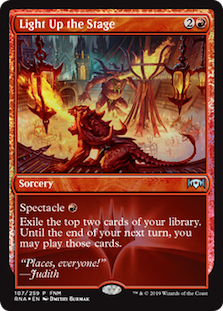
Instant/sorcery support? Cost-reduction mechanics? Cheap card draw for aggressive strategies? Light Up the Stage, a card with spectacle spoiled from Ravnica Allegiance this week, hits all my soft spots, yanking me from a haze of Inkling up-smashes and Richter side-specials to brew anew.
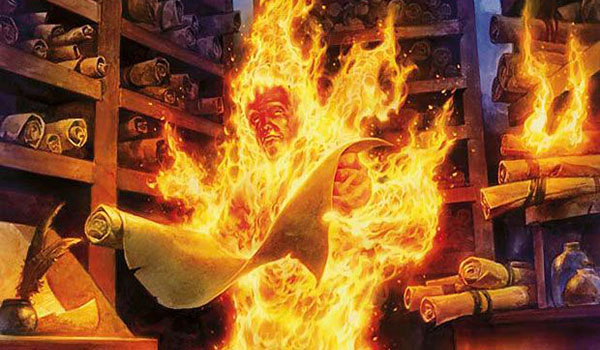
Today, I'll share my findings on Light Up the Stage in what I consider a natural home: Hollow Phoenix.

"Random" Looting Effects Are Not Random

A major complaint of Hollow One newcomers is the deck's randomness. Sometimes that turn-one Inquiry yields a couple Ones and an automatic victory; others, it discards the Golems and mana-screws its pilot! Before we jump into a whole article dealing with Hollow One, I want to give my two cents on this idea.
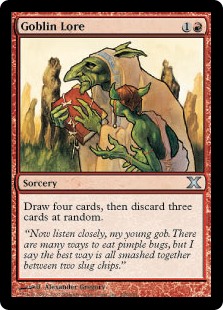
"Random," like all descriptors, can only exist in relation to its environment. And the opposite of random is consistent. So where does Hollow One sit on the random-consistent spectrum? Despite the literal presence of the word "random" in the rules text of archetype staples Burning Inquiry and Goblin Lore, I'd argue that the strategy is among Modern's most consistent, or least random, gameplans—and that its success in the format supports this theorem.

Burning Inquiry (and Lore) has many more subtle effects in Hollow One than its rules text alludes to alone. That text reads: "draw 3 (random) cards; discard 3 random cards." The cards Inquiry draws and discards vary wildly between resolutions—random! But in Hollow One, the card also has the following effects:

  • Reduce the cost of all your Hollow Ones to 0
  • Give your prowess creatures +1/+1
  • Give your Flameblade Adepts +3/+0

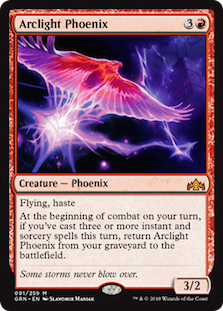
The above three clauses are guaranteed (read: not random) effects of Burning Inquiry. On top of all those effects, Inquiry has the added potential benefit of discarding Arclight Phoenix or Fiery Temper, yielding even more explosive plays. And should BR
Hollow One discard its Golem, it's likely to have Gurmag Angler as a backup plan, just as Mono-Red keeps Bedlam Reveler on call.
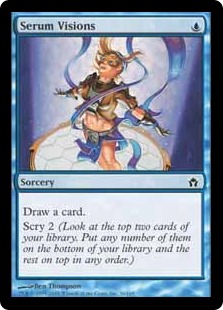
Finally, there's the age-old tactic of sandbagging useless lands in hand until a looting effect is found. Since the pilot chooses when to cast these spells, they can be timed so that probability dictates a net hand improvement.

Compared with something like Serum Visions, which always draws one card and scries 2, Burning Inquiry in Hollow One decks removes significantly more variance by enabling multiple gameplans. Just as creatureless control decks are built to functionally remove the symmetry of sweepers like Wrath of God, Hollow One decks are built in such a way that random looting effects drastically increase their consistency, in turn lowering their "randomness."

Light Up the Stage

At a glance, Light Up the Stage seems like a card that wants to slot into an aggressive red deck, where it would keep the cards flowing and the pressure on. But it still needs to fulfill needed roles for those decks. The bar is quite high, as Arclight Phoenix strategies are already among Modern's top performers. The other aggressive red deck is Burn, which is generally less proactive and easier to hate out than the Arclight decks, and whose own performance has subsequently taken a dip. We'll start there.
Stage in Burn

Burn was happy to go as far as splashing another color for Treasure Cruise, an obvious precedent for Stage. Cruise costs one mana and draws three cards on the condition pilots keep a stocked graveyard. Stage, for its part, costs one mana and draws two cards on the condition pilots have already dealt
damage this turn and can use the cards drawn by the end of their next turn. In terms of raw numbers, that's one fewer card with one more condition attached. But the latter condition isn't so tough to meet, as Burn is full of one
drops. Stage's primary drawback—its spectacle condition—boasts some palpable tension with Burn's haste creatures, which incentivize players to cast draw spells before combat.

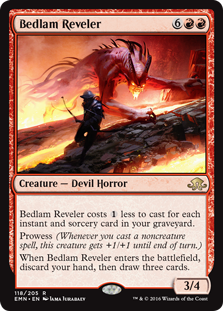
Stage has another precedent: Bedlam Reveler. Here's a card that also draws 3 and was discussed as possible in Burn. It costs twice as much mana as Cruise, but players get a whopping 3/4 prowess for their trouble, and multiple Revelers are easier to chain than multiple Cruises. While Reveler did appear in Burn sideboards occasionally, it quickly vanished from the archetype's repertoire, to be seen again beside Faithless Looting in midrange decks a year later.

When it comes to Burn, then, Stage may be adopted if its power level there sits between Cruise (good enough) and Reveler (not). But like both cards, it's fully possible a shell exists that can wield Stage more adeptly than Burn. I think that shell is Hollow Phoenix.
Stage in Phoenix

Stage looks to be even more comfortable in a deck with Arclight Phoenix: not only does it constitute an instant/sorcery for the creature's trigger, it draws pilots into additional spells and contributes to the deck's velocity. The question to ask, then, becomes whether Arclight Phoenix is interested in drawing more cards; it already has a more impactful option in Bedlam Reveler, which many builds don't even play.

I'd argue that these decks aren't particularly hungry for another draw spell. But more velocity couldn't hurt; we've seen various builds include the likes of Street Wraith, Goblin Lore, and the aptly named Maximize Velocity to achieve those ends. At its best, Stage plays like a mix of Phoenix's most efficient velocity spells: Faithless Looting and Manamorphose. It draws into business like the former, and ensures multiples instant/sorcery casts like the latter.
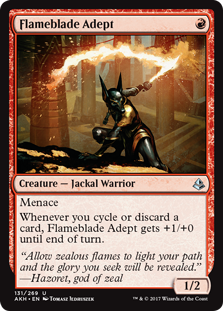
Running Stage isn't totally free, though; doing so requires some deckbuilding compromises to accommodate spectacle reliably. The direction I took involved maxing out on aggressive one-drops. These creatures start swinging out of the gate: Flameblade Adept has menace, ensuring a poke should it survive, and Monastery Swiftspear hits the turn it's cast to set up spectacle on the go. Both creatures hit like a ton of bricks for their cost, assuming a deck construction that keeps both in mind.

While a slew of cheap red spells do a fine job of maximizing Swiftspear, Adept demands a more unique supporting cast, notably Burning Inquiry and Hollow One. The artifact also has some interesting applications with Stage: exiling it to the sorcery lets us Burning Inquiry to our heart's content without fear of discarding our namesake creature, and exiling lands lets us play those, keeping Mountains in hand to lower the chances of discarding freshly-found Hollow Ones.

The rest of the deck's first draft wrote itself, and a week of tweaking the components led me here:

Hollow Phoenix, by Jordan Boisvert

Creatures

4 Monastery Swiftspear
4 Flameblade Adept
4 Arclight Phoenix
4 Hollow One
1 Grim Lavamancer
1 Bedlam Reveler

Instants

4 Manamorphose
4 Lightning Bolt
3 Fiery Temper
3 Gut Shot

Sorceries

4 Faithless Looting
4 Burning Inquiry
3 Light Up the Stage

Lands

17 Mountain

Sideboard

4 Tormod's Crypt
3 Shrine of Burning Rage
2 Dragon's Claw
2 Anger of the Gods
2 Abrade
1 Dismember
1 Bedlam Reveler

Card Choices and Engine Possibilities

This deck's numbers may look simple and intuitive, but arriving at them proved anything but. The flex spots were, and are still, in constant flux throughout my testing sessions. I think there are three types of cards in Hollow Phoenix: enablers, payoffs, and disruption. In this section, we'll look at the different roles each card plays, as well as other options in each category.

As may become evident from my card choices, the above build aims to maximize its explosive starts, and the odds of its pieces meshing in the first few turns of the game. It hopes this strong start will carry it through a potentially meandering mid-game in which ill-fitting pieces are drawn naturally, although cards like Faithless Looting mitigate the durdle.
Enablers

Let's start with the staples. These are cards whose numbers never faltered in my testing:

4 Faithless Looting
4 Burning Inquiry
4 Manamorphose

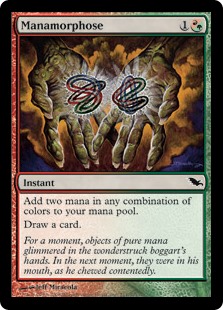
Manamorphose practically guarantees a Phoenix rebirth on three mana, is free off Stage, and triggers prowess. Looting is also likely to reanimate Phoenix, digs through excess lands, and further supports our payoffs by dumping Phoenix or Temper into the graveyard. Inquiry is simply the most efficient enabler in Modern when it comes to Hollow and Adept, both four-ofs, and has the random upside of sometimes ruining enemy hands and binning the right payoffs on our end.

Onto the flex spots:

3 Light Up the Stage
3 Gut Shot

I ended up settling on 3 Stage after doing roughly 70% of my testing at 4. Towards the end, I realized Stage excelled when cast on turn three and later. Waiting this long gives us the chance to hard-cast exiled Phoenixes. By turn three, we also have the ability to cast three spells for Phoenix without a zero-mana instant. A sequence like Bolt you, Stage, Looting discarding Phoenix is par for the course at that point in the game.
Running Stage out early is possible when we're in need of lands, which can also be played from exile. But relying too heavily on the cantrip for this purpose can yield some awkward exiles forever lost to mana screw, so it's best to wait when given the option. That makes the card closer to Bedlam Reveler, another late-game payoff spell, but Stage has the distinction of serving as an enabler for many of our pieces (including Reveler) in the early- and mid-game.

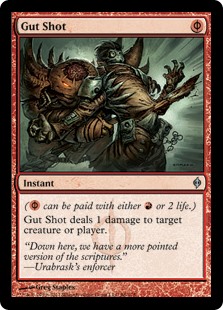
While Stage does a fine Manamorphose impression for Phoenix on turns 3+, Gut Shot fills in for Manamorphose when it most needs to: earlier. Another free instant, Gut proves integral to powering out Phoenix before opponents can muster the tools to deal with our assault or assemble a functioning gameplan through our many burn spells. It also supports both "halves" of Light Up a Stage: Gut lets us cast it as early as the first turn to search for lands, and is an always-castable exile off the sorcery.

I also tested plenty of enablers that didn't work out. Here's a quick summary of each.

  • Maximize Velocity: Did too little at too steep a cost. Taxing us a red mana per cast doesn't "ramp" us into Phoenix as zero-mana instants do, and since we tend to rely on the discard to play Hollow One, it rarely gives the 4/4 haste. Besides, eight of our threats already have the evergreen keyword.
  • Flame Jab: I liked the idea of reliable damage to turn on Stage, but in practice, Jab also did too little. Since early Stages like to find us lands, and late Stages are even fine at three mana, discarding a land rather than a card we wanted to pitch was also a tough ask.
  • Lightning Axe: Dead against too many decks to be worth it over a burn spell that fulfills more of our needed functions.
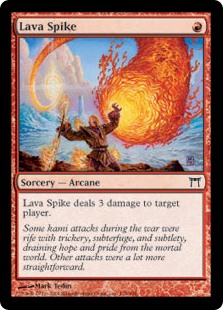
  • Lava Spike: Probably optimal in a build without Hollow One. Alongside the Golem and its engine cards, Spike has too much tension. I do expect such a build, which blends the Phoenix and Burn cores, to emerge post-Stage; I'm just not so interested in playing it myself.
  • Rift Bolt: Similar issues, but also too cute. Suspending it turn one, burning on upkeep, and then casting Stage in main 1 is about as fun as exiling Rift to Stage is miserable.
  • Pyretic Ritual: Like Spike and Rift, Ritual belongs in a different build than mine—one perhaps more combo-oriented and featuring Runaway Steam-Kin.
  • Street Wraith: Great with One, and we can support the life loss, but can't be cast off Stage.
  • Goblin Lore: The best of the reject enablers, Lore sets up Hollow and Adept without the minus or chance of fixing enemy hands. But it's so expensive that reviving Phoenix off it is impossible on three lands without one free spell, and impossible on two lands without double that. Lore is then best run with Gut Shot, but including both packages takes up too much room.

Payoffs

Again, the good:
4 Monastery Swiftspear
4 Flameblade Adept
4 Arclight Phoenix
4 Hollow One

This deck's main payoffs are its threats. It runs eight "Delvers" (aggressive one-drops that put opponents on the back foot), which also enable Light Up the Stage as Wild Nacatl once did Chart a Course, and eight "Goyfs" (bigger beaters meant to clean up the mess and close out games). Of course, its gameplan is far more proactive than that of an actual Delver of Secrets deck.

The ugly...

1 Grim Lavamancer
1 Bedlam Reveler
3 Fiery Temper

With all the one-drops, we don't have room for many flex payoffs in this deck. I tried varying numbers of Lavamancer and Reveler, at times only running one or the other, and eventually settled on a split. The second copy of each is sometimes superfluous, and both offer free win dimensions against certain decks (the former vs. small creatures and the latter against classical midrange). I found that running either Lavamancer or Reveler at 3 or more copies necessitated an 18th land, which I oppose in this explosiveness-aligned build. Reveler in particular has some light tension with Stage in the early-game, where it's a dead exile like Phoenix.
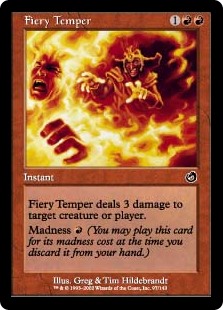
Like the one-drops, Temper is a payoff that doesn't utilize the graveyard, but still rewards our loot effects. I especially like its applications with Phoenix, as it serves as another spell without putting us down a card (yet another thing Manamorphose does for free). More burn lets us attack from multiple angles and turns on spectacle in a pinch, but casting Temper from exile (er, not from madness) is a hassle.

Although Burning Inquiry can occasionally disrupt opponents, it might also fix their hand, and savvy opponents navigate the mid-game with it in mind by also sandbagging useless cards. So I don't really count it as interaction.

The bad!

  • Risk Factor: Three mana? thank u, next
  • Runaway Steam-Kin: Not bad per se, and a 4-of, then 3-of in my very first Light Up a Stage brew. I quickly learned I had no interest in ever casting this thing and walked away. (But imagine the Gut Shot wars!) To its credit, Risk Factor seemed decent alongside Steam-Kin.

Disruption

Most of our disruption is incidental, as the cards play other, more important roles. We're slower than pure combo decks like Storm, so it's critical that Hollow Phoenix runs enablers and payoffs that disrupt opponents in addition to supporting its gameplan (I like 10+ disruption slots).
4 Lightning Bolt
1 Grim Lavamancer
3 Fiery Temper
3 Gut Shot

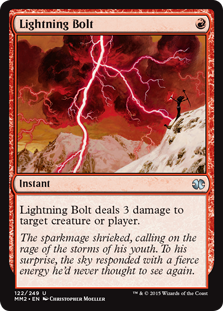
The possible exception (and one card on this list we haven't yet discussed in detail) is Lightning Bolt, which is so efficient and flexible it often does act as an enabler (a cheap spell for Phoenix/prowess), or even as a payoff (drawing it off an Inquiry seals many a game), without offering any explicit synergy.

The Stage Is Set

I've been wildly off-base about spoilers before, but never have those cards been so apparently tailor-made for existing tier decks. So where does Hollow Phoenix go from here? Does it want the 4/4 at all? Are Phoenix decks better off pursuing a burn route with Lava Spike? A ritual route with Runaway Steam-Kin? Let me know your thoughts in the comments, and keep watching those Rakdos spoilers—if history has taught us anything, it's that freshly-designed cost-reduction mechanics often find a home in Modern!


Don’t Sleep on Basic Lands!

Are you a Quiet Speculation member?

If not, now is a perfect time to join up! Our powerful tools, breaking-news analysis, and exclusive Discord channel will make sure you stay up to date and ahead of the curve.

This week I discovered a major blind-spot in my approach to Magic finance which has surely cost me money over the years. Simply becoming aware of it allowed me to immediately pull a ton of extra value from my bulk cards and profit from my newfound knowledge. I am sure there are others out there making the same mistake I was, so today I want to share what I learned.

What I’m talking about is basic lands, both foil and non-foil, of which it turns out many are very valuable. I always knew there were some foil lands with great art that were in high demand, but I didn’t realize just how many. There are a ton of foil lands from many sets that demand significantly more than the bulk rate, which is typically between $0.10 to $0.25 per foil basic land. Many of these lands are in high demand even for their non-foil versions, so bulk basic land boxes are worth picking through too.

My eyes were first opened up to the world of valuable basic lands when I was browsing a Facebook trade group and came across a post about a specific Foil Swamp 291 from Lorwyn, which demands $15 for mint foil versions.

Image result for Lorwyn Swamp 291

I knew the art looked familiar. When I scoured my bulk foil lands I found three copies, which together are worth nearly as much as my entire box of bulk foils would sell for to a dealer. The scary thing about the situation is that I've been trying to pawn off my bulk rares and foils on Craigslist for weeks—if someone bought my cards they would have handsomely profited from my ignorance.

What was most startling is that even nonfoil versions of the land sells for almost a dollar, and it's actually on buylists. An even more valuable land from Lorwyn is Island 287, foils of which are nearly $20.

Image result for Lorwyn Island 287

Nonfoil versions of these lands can’t be had any cheaper than $1 on TCGplayer, which puts them into the realm of Snow-Covered lands, which I always treated as the gold pickings of bulk lands.

There are actually many more valuable lands, and I am sure they are sitting unpicked in countless bulk cards around the world. I recently sold tens of thousands of picked bulk cards, including a few thousand land. Now I wonder just how much value I gave away in the form of basic lands I could have sold for very significant amounts.

These Lorwyn lands are so valuable both because of their great art, but also because of their relatively low supply. Lorwyn is notorious for a low print-run, and high prices in turn, because it was released right before the massive boom in Magic that came in the years following.

This provides clues as to what lands are valuable. These valuable lands are found in old sets, starting from when foil basics first appeared—with the release of Mercadian Masques in 1999—to the beginning of the Magic boom around Rise of Eldrazi in 2010.

Image result for Mirrodin Plains 290

I’ve always known about the “Razor Plains,” Mirrodin Plains 290. But it turns out that it isn’t even particularly valuable compared to other lands, only demanding a couple bucks, and there’s a ton of lands worth more.

The most impressive basic land I came across in my bulk was Odyssey Plains 333. Another iconic Plains, this one is worth nearly $25 foil. It’s worth an incredible $1.25 for the non-foil version, and no cheaper than $0.50 for even Heavily Played copies.

Image result for odyssey Plains 333

I was also surprised to learn that another land in Odyssey, Forest 349, was worth over $10 for foils, with nonfoils around $0.50.

Image result for odyssey Forest 349

John Avon is known for his stunning land artwork, so his lands often demand a premium. A good example is Invasion Plains 331, worth $8 for near-mint foils.

Image result for Invasion Plains 331

When I saw Shards of Alara Plains 233 I picked it because it because it looked cool, but I didn’t expect it would be worth over $5.

Image result for shards of Alara Plains 233

It turns out that a couple other lands from Shards of Alara are valuable too, with foils of Island 236 demanding near $10, and Swamp 238 around $8. Again, nonfoils of these lands are also worth far above bulk rate.

If you look at buylist prices for basic land in various sets, you’ll be surprised by how many have a land or two that are worth something significant. If you have any bulk lands, foil or otherwise, I recommend familiarizing yourself with the valuable lands and picking your bulk.

Even easier—just run your basic lands through Quiet Speculation's Ion Scanner, and you'll immediately know the best buylist price available for each. Even if you don't want to buylist the lands, it's a great way to identify and separate the good stuff from the true bulk.

-Adam

Avatar photo

Adam Yurchick

Adam started playing Magic in 1999 at age 12, and soon afterwards he was working his trade binder at school, the mall food court, FNM, and the Junior Super Series circuit. He's a long-time Pro Tour gravy-trainer who has competed in 26 Pro Tours, a former US National Team member, Grand Prix champion, and magic.tcgplayer.com columnist. Follow him at: http://twitter.com/adamyurchick

View More By Adam Yurchick

Posted in Basic Lands, Bulk, Finance, Foils, Free, Picking4 Comments on Don’t Sleep on Basic Lands!

Have you joined the Quiet Speculation Discord?

If you haven't, you're leaving value on the table! Join our community of experts, enthusiasts, entertainers, and educators and enjoy exclusive podcasts, questions asked and answered, trades, sales, and everything else Discord has to offer.

Want to create content with Quiet Speculation?

All you need to succeed is a passion for Magic: The Gathering, and the ability to write coherently. Share your knowledge of MTG and how you leverage it to win games, get value from your cards – or even turn a profit.

MTG Metagame Finance #24

Are you a Quiet Speculation member?

If not, now is a perfect time to join up! Our powerful tools, breaking-news analysis, and exclusive Discord channel will make sure you stay up to date and ahead of the curve.

Ultimate Masters is still in full bounce back mode, and the last World Magic Cup has come to a finish. Plus, some sweet Ravnica Allegiance spoilers have hit the market so there’s gonna be a nice mix of things to talk about again in this piece.

Owing to the spoilers, this might be a little more on the speculative side of things compared to previous articles where a lot of the content was based on tournament results and shift in the metagame.

Article Series Main Focus Points

  • Cards that you should hold on to or pick up for tournaments if you need them before they rise in price. These cards are either seeing increased play in one or more formats, the supply is drying up, or they’re pretty far from the next reprint.
  • Cards that you should consider selling or trading away. Their prices are pretty much at the ceiling owing to inflation from speculation, reprint inevitability in the near future, a lull in tournament play, or some combination of these.

Holds

Exquisite Firecraft - Magic Origins (Foil)

There was an error retrieving a chart for Exquisite Firecraft

Target Purchase Price
Under $4

With UWx Control decks still being quite popular and also doing decently well in Modern and Legacy, some people have started to add this to their sideboards again. The price has pretty much remained flat since it rotated out of Standard about a couple of years ago but has started a slight rise in the past six months. I’m not sure if this will get reprinted anytime soon; but if it does, the price can’t really fall too much further.

Modern

Legacy

Recent Buys

Mortify - Magic Player Rewards

There was an error retrieving a chart for Mortify

Purchased Price
$3.50ish

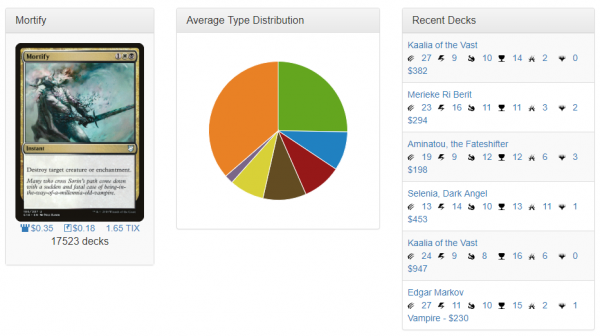
This was recently spoiled as a reprint. If you haven’t seen the spoilers yet, be sure to check them out here. This is really a Standard-only card with an additional boost from quite a bit of play in EDH/Commander, showing up in over 17,000 decks.

However, I picked up a playset of these because this version will never get printed again. And Wizards will probably continue to reprint this once in a while in Standard. This is a sweet version of the card, especially if you don’t like foils.

Ral, Izzet Viceroy - Guilds of Ravnica (Non-Foil)

There was an error retrieving a chart for Ral, Izzet Viceroy

Purchased Price
Under $5

This has really tumbled from it’s release price of $25. And I’ve had my eye on this card for Modern’s Izzet Phoenix. It actually shows up in quite a few decks in Modern.

The card also had a pretty good weekend at the World Magic Cup with it showing up on both sides of the table in the finals between Arnaud Hocquemiller and Shahar Shenhar.

Standard: Jeskai Control by Arnaud Hocquemiller

Non-Creature Spells

3 Teferi, Hero of Dominaria
1 Ral, Izzet Viceroy
1 Lava Coil
4 Deafening Clarion
2 Fight with Fire
4 Revitalize
1 Blink of an Eye
1 Syncopate
1 Negate
3 Ionize
4 Chemister's Insight
2 Settle the Wreckage
3 Expansion // Explosion
2 Seal Away
1 Ixalan's Binding
1 The Mirari Conjecture

Lands

4 Steam Vents
4 Sacred Foundry
4 Glacial Fortress
4 Sulfur Falls
4 Clifftop Retreat
3 Island
3 Plains

Sideboard

2 Lava Coil
1 Seal Away
1 Negate
1 Ixalan's Binding
1 Cleansing Nova
2 Star of Extinction
1 Niv-Mizzet, Parun
3 Legion Warboss
2 Lyra Dawnbringer

Standard: Izzet Drakes by Shahar Shenhar

Creatures

4 Crackling Drake
3 Enigma Drake
1 Murmuring Mystic
2 Niv-Mizzet, Parun

Non-Creature Spells

1 Beacon Bolt
4 Chart a Course
4 Lava Coil
3 Dive Down
4 Opt
4 Shock
3 Spell Pierce
4 Discovery // Dispersal
2 Search for Azcanta

Lands

7 Island
5 Mountain
1 Dragonskull Summit
4 Steam Vents
4 Sulfur Falls

Sideboard

1 Murmuring Mystic
1 Niv-Mizzet, Parun
4 Treasure Map
2 Disdainful Stroke
3 Fiery Cannonade
2 Ral, Izzet Viceroy
1 Star of Extinction
1 Shivan Fire

I think we’re going to see more of this card in Modern and Standard going forward. So I picked up a playset, especially since they’re only about $5 each now. There are a lot of copies on TCGplayer right now, and it doesn’t see play as a four-of; so I don’t expect the price to pop anytime soon. And if you want to splurge, the Mythic Edition under $35 seems like a pretty decent deal.

Watchlist

Nexus of Fate - Buy-A-Box Promos

Observed Price
$12-15

This has pretty much come back down to its lowest price even after the crazy spike during the Pro Tour 25th Anniversary. But now might be the time to pick it up again thanks to the spoiling of Growth Spiral.

Aside from it being two colors, this is an essential an upgrade to Explore, which could cause an uptick in decks like Scapeshift and Amulet Titan. I’ll get to those two decks next.

Primeval Titan - Grand Prix Promos

There was an error retrieving a chart for Primeval Titan

Observed Price
$19ish

There are five printings, but this is probably the coolest one. Thus, the price is a little higher than the other versions. But it’s hard to see the price of this go down much further if any at all ever again. It sank to about $10 once. But that happened about five years ago, and this is a promo so I would say that’s very unlikely to happen again.
This shows up in the aforementioned Scapeshift and Amulet Titan decks, so the demand is there. And as I mentioned, the demand could rise a bit with the printing of Growth Spiral. There isn’t really any countermagic in either deck, but there are still some instants that show up like Lightning Bolt, Abrade, Nature's Claim, and Ancient Grudge. Plus, Engineered Explosives and Walking Ballista sometimes also show up. So Growth Spiral gives the deck a bit more flexibility now on its opponent’s turn.

Modern: Scapeshift by Luis Gobern

Creatures

1 Wood Elves
4 Primeval Titan
4 Sakura-Tribe Elder

Non-Creature Spells

2 Summoner's Pact
3 Lightning Bolt
2 Anger of the Gods
4 Scapeshift
4 Farseek
4 Search for Tomorrow
1 Prismatic Omen
4 Relic of Progenitus

Lands

1 Sheltered Thicket
2 Forest
2 Cinder Glade
4 Wooded Foothills
4 Bloodstained Mire
4 Stomping Ground
4 Valakut, the Molten Pinnacle
6 Mountain

Sideboard

1 Flame Slash
3 Damping Sphere
1 Reclamation Sage
1 Carnage Tyrant
1 Ruric Thar, the Unbowed
1 Ancient Grudge
1 Nature's Claim
2 Abrade
1 Thragtusk
2 Obstinate Baloth
1 Hour of Devastation

Modern: Amulet Titan by Loriwwa

Creatures

1 Walking Ballista
2 Trinket Mage
2 Skyshroud Ranger
4 Primeval Titan
4 Azusa, Lost but Seeking
4 Sakura-Tribe Scout

Non-Creature Spells

1 Pact of Negation
4 Summoner's Pact
4 Ancient Stirrings
1 Engineered Explosives
4 Amulet of Vigor
4 Relic of Progenitus

Lands

1 Boros Garrison
1 Sunhome, Fortress of the Legion
1 Slayers' Stronghold
1 Radiant Fountain
1 Khalni Garden
1 Ghost Quarter
1 Cavern of Souls
1 Vesuva
1 Bojuka Bog
2 Grove of the Burnwillows
3 Forest
3 Tolaria West
4 Gemstone Mine
4 Gruul Turf
4 Simic Growth Chamber

Sideboard

1 Tormod's Crypt
1 Tireless Tracker
1 Ruric Thar, the Unbowed
1 Reclamation Sage
1 Ramunap Excavator
1 Obstinate Baloth
1 Hornet Queen
1 Emrakul, the Promised End
1 Academy Ruins
4 Abrade
1 Pact of Negation
1 Engineered Explosives

Ultimate Box Toppers

I just wanted to spend a little bit a time talking about these specifically since a lot of the regular cards have already bounced back. If you want to read more about that, I suggest checking out Sigmund Ausfresser’s article.

Anyhow, the box toppers that kind of stick out to me are Fulminator Mage and Life from the Loam. They both see quite a bit of play and neither of them have a promo version. And they’re both significantly cheaper than many of the other box toppers.

Fulminator Mage - Ultimate Masters: Box Toppers

There was an error retrieving a chart for Fulminator Mage

Life from the Loam - Ultimate Masters: Box Toppers

There was an error retrieving a chart for Life from the Loam

I’m having a hard time with these. I think because I’m not really that big of a fan of them. But I’m pretty sure I’m an outlier. Over time, I think most of these will just continue to go up in price, since many of them have new art or are the only ‘full art’ version. I think Wizards could’ve made the full art design a bit more pronounced, but that’s just my opinion.
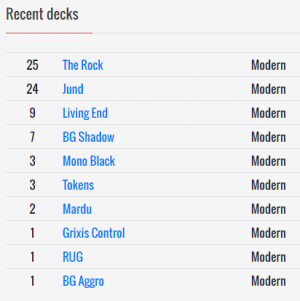
Anyhow, I think if you really want them, it’s pretty hard to go wrong with picking these up as they’ll most likely hold their value and continue to appreciate over the years.
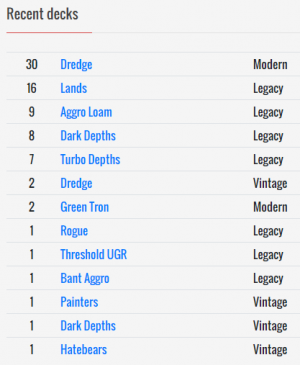
Office Hours

Office Hours #4 is coming up, and I’ll be co-hosting it with Sigmund Ausfresser. You can catch the audio of Office Hours #3 with Sigmund Ausfresser and me here in case you missed it.
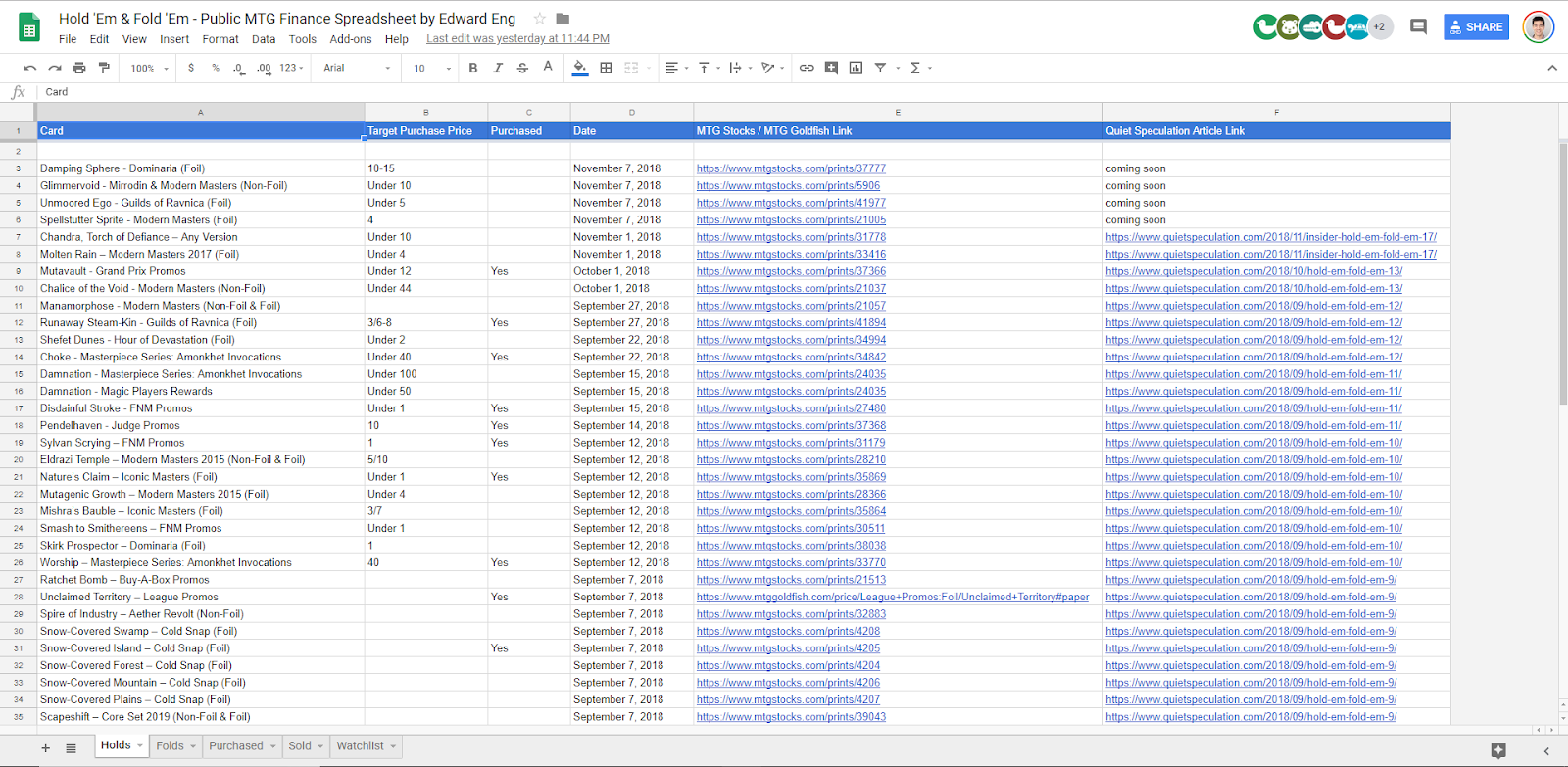

Office Hours #4 is set for Thursday, December 27 at 8p Central, so mark your calendars and join us in the Discord channel if you have a Quiet Speculation membership subscription.

Office Hours

Public Spreadsheet

Stay up to the minute on what I’m looking at on a daily basis via the Hold ‘Em & Fold ‘Em - Public MTG Finance Spreadsheet. Don’t forget to bookmark it, because I update it on the fly. This way you can see what’s going on as the market moves and before articles about certain cards are published.

Summary

Holds

  • Exquisite Firecraft - Magic Origins (Foil)

Recent Buys

  • Mortify - Magic Player Rewards
  • Ral, Izzet Viceroy - Guilds of Ravnica (Non-Foil)

Watchlist

  • Nexus of Fate - Buy-A-Box Promos
  • Primeval Titan - Grand Prix Promos

Ultimate Masters: Box Toppers

  • Fulminator Mage - Ultimate Masters: Box Toppers
  • Life from the Loam - Ultimate Masters: Box Toppers

Office Hours

Public Spreadsheet

Hold ‘Em & Fold ‘Em Spreadsheet

Let me know what you think in the comments below. Agree? Disagree? Why? You can also connect with me on Twitter at @edwardeng. I’m also open to suggestions on how to make this series more valuable. Hit me up.

Have fun,
Eddie

When Collection Buys Go Bad

Are you a Quiet Speculation member?

If not, now is a perfect time to join up! Our powerful tools, breaking-news analysis, and exclusive Discord channel will make sure you stay up to date and ahead of the curve.

Welcome back, readers!

With the release of Ultimate Masters (UMA) and the insanely quick price rebounds we've been seeing on many of the hot staples, I almost feel like my last article has been nullified. But I stand by the research and data trends calculated based on previous Masters sets. I feel like Ultimate Masters may prove to be the anomaly simply because it was jam-packed with highly desirable cards for all formats.

I have been buying UMA cards like crazy the past week, but not all buys go smoothly. Today's article will help you steer through the murky waters that can occur when money is on the line.

Set Clear Expectations

Setting your expectations at the outset may seem extremely obvious. However, both buying and selling parties are coming at the transaction from different viewpoints, and what seems obvious to one may be ambiguous to the other.

I once drove 45 minutes to meet a gentleman who had posted his collection for sale on Craigslist at a gas station off of the interstate. His ad stated that he'd been playing since the early days of Magic and had quit after Kamigawa block. I didn't ask to see pictures and assumed that there would be some hidden gems in his collection. Once I scrolled through his binders I realized that it was all the chaff of a collection that had been picked over. We both left the transaction unfulfilled.

Get a Photo First

There is a reason the old saying, "A picture is worth a thousand words," is quoted so often. If you are going to spend time and effort buying a collection, getting pictures of as much as you can ahead of time can save you a great deal of disappointment, wasted time, and gasoline. You can often glean a lot about a potential collection even from a few pictures.

These pictures are from a recent collection I looked at. They show that the cards may be on the older spectrum, there may be a lot of foreign-language cards included, and the owner has likely taken at least somewhat good care of them. This collection may or may not be organized, and if it isn't then it's likely to take longer to dig through.

Be Upfront About Pricing

You also need to be upfront about your intentions for buying. This day and age, almost every Magic player has access to the internet and can look up prices on their cards. You will often find people who aren't used to selling cards aghast that you won't pay full retail price on their cards. If they aren't aware of that ahead of time, the conversation and transaction can quickly go sour.

In another example, a local player I knew posted on Facebook that he was looking to downsize his collection and wanted to sell cards between 50-70% off. I drove over to his house and spent over an hour combing through his binders and boxes, all the while placing the cards I was interested in onto a buy mat. I told him to check over each price point and pull out anything he didn't want to sell at that price.

Once I had finished, he looked through the piles and then proceeded to put every card into MTG Familiar and then pushed back on my pricing stating he was aiming more for 70%. I reminded him that his post stated 50-70%, but he remained adamant. The lesson here is that ambiguity is not your friend when it comes to business dealings.

To try and prevent this kind of misunderstanding, I always mention ahead of time that I am buying for my store inventory and that I can't pay full retail on any cards. I am willing to purchase a lot of different types of cards, which allows the seller to move their wares in a single transaction. This cuts down on the amount of time they have to spend finding buyers, as well as the cost of shipping.

My buying system now incorporates a Google Sheet with information and equations built in, allowing me to automate as much as I can. I usually request a list of the cards my seller wants to move ahead of time, so I can look up the prices to make the transaction quicker and smoother. I provide pricing per card, as opposed to some stores which offer a lump sum, to allow my seller to consider each price individually and show that I am not trying to cheat them.

It Doesn't Always Work Out

As I mentioned earlier, not all buys will work out. Sometimes the seller wants too much for their cards; sometimes the cards aren't as expected. While it can feel bad to leave a potential buy without purchasing anything, it is far worse to do so with an upset or angry seller.

When it becomes evident that a sale simply will not occur, remember that your reputation as a buyer is built over time, but it can be destroyed in an instant. I always thank the seller for their time and for giving me the opportunity to browse their collection, parting ways on positive terms. This prevents me from developing a reputation as a pushy buyer and keeps the door open for future transactions.

Be Prepared for Pushback

This past year is the first one that I have actually posted buylists on various Facebook groups. This allowed me to greatly expand my buying potential and has opened up a massive realm of potential sellers. This means I am openly competing with a lot more buyers for purchases. It also means I occasionally get negative comments in my posts from random people who feel that my prices are too low and that I'm trying to "rip people off."

Most buy/sell groups tend to weed these types of commentators out, but you still see them from time to time. These tend to be the same people who would expect TCGplayer mid prices when selling a card—but in any case, it can still make you look and feel bad.

The important point to remember is that your prices need to be high enough that you seem like the best option for someone looking to sell, but low enough to generate a profit worth your effort. You may also run into people who want to haggle on your prices. While you always want to make sure you can make a profit, flexibility can be critical when it comes to buying cards on a time crunch.

This happened to me repeatedly when I posted my UMA buylist. I've learned that when prices are fluctuating upward repeatedly, you want to lock in your stock as soon as possible. Rigid pricing can cause you to miss out on opportunities that would have been quite profitable in the near future.

Conclusion

While I imagine some of these pointers may seem quite obvious, I try to remember that we have speculators of varying experience and it can be very unnerving to enter the minefield that is Magic: The Gathering finance.

It is easy for those of us who have been wandering this field for a long time to forget we didn't always know the obvious truths we do now—which may have come at a steep price. If we can prevent some of our newer members from paying that price, then we are acting as responsible QS members.

Avatar photo

David Schumann

David started playing Magic in the days of Fifth Edition, with a hiatus between Judgment to Shards. He's been playing Commander since 2009 and Legacy since 2010.

View More By David Schumann

Posted in Buying, Collection Buying, Finance, Free3 Comments on When Collection Buys Go Bad

Have you joined the Quiet Speculation Discord?

If you haven't, you're leaving value on the table! Join our community of experts, enthusiasts, entertainers, and educators and enjoy exclusive podcasts, questions asked and answered, trades, sales, and everything else Discord has to offer.

Want to create content with Quiet Speculation?

All you need to succeed is a passion for Magic: The Gathering, and the ability to write coherently. Share your knowledge of MTG and how you leverage it to win games, get value from your cards – or even turn a profit.

Daily Stock Watch – The UMA Box Toppers Part 1

Are you a Quiet Speculation member?

If not, now is a perfect time to join up! Our powerful tools, breaking-news analysis, and exclusive Discord channel will make sure you stay up to date and ahead of the curve.

Hello, everyone and welcome to the return of the Daily Stock watch! I was out for a while to attend to some personal stuff and we're back with a vengeance, as I'll be doing a review of some fun stuff before the year ends. For this initial write up, I'll be focusing on the Ultimate Masters box toppers and what I think are great going forward. It might be arguable that each and everyone of them are great but then again, finance junkies like us are supposed to focus on the ones that really matter. If the toppers aren't your thing, Sigmund Ausfresser can guide you a bit further on the things to look out for in UMA in this article.

There was an error retrieving a chart for Liliana Of The Veil

LotV will never go down no matter how much WotC decides to reprint it. The card is just too good at three mana, and the ability to play it on turn two makes it ultra hard to beat in any format. But is the $299 box topper price justifiable at the moment? I would say yes to that if you are into that kind of thing. Teferi, Hero of Dominaria is almost just as good and its mythic edition version has been doing well along this price range. There might be room for it to drop to around $250, but I'm not sure about it. I won't be taking my chances if I am a collector for that time to come. Invest now.

There was an error retrieving a chart for Tarmogoyf

I was just talking about how this card keeps on getting reprinted, but we have to give props to WotC because they gave him a facelift just now. Back in the day, the $200 price tag for a premium Tarmogoyf would be a bit low but considering how many times this has been printed (and will still be printed) makes it seem like a decent price. I would be a buyer at $150, but I don't think it would go down that low.

There was an error retrieving a chart for Snapcaster Mage

At $209, I think that this is the best topper from this set. Any competitive blue deck almost always packs four copies of this, and its power level covers all formats. It was never deemed a bannable card despite of its greatness and that will always factor in when we consider cards that we should invest on. I'm a buyer at the current price tag, as I think that there is a higher ceiling for this card.

There was an error retrieving a chart for Mana Vault

I have a soft spot for cards that are faring well in older formats, and this one certainly fits the bill. I have played against tons of multiplayer Commander decks, and I barely see any that doesn't have this on their list. Casual crowds and hardcore EDH players are foil addicts, and I don't see why this isn't a good investment at $150 with the art that was used for it. I would be investing on this right now while it's not that hot.

There was an error retrieving a chart for Demonic Tutor

Another one of those cards that is more appealing to the casual crowd, I was surprised that this was more expensive than Mana Vault at $180. It's arguably the best tutor out there as it has no drawback and is another auto include in every Commander deck that plays black. I would also be paying $180 for the topper, as it seems that the Judge Foil version has gone bananas at around $275. The ultimate battle between this version and the Judge foil would mostly rely on art preference by players. I am slightly biased towards the artwork on this one.

There was an error retrieving a chart for Cavern of Souls

The last card I would like to talk about today would be Cavern of Souls, which is sitting at around $206 as of writing time. One argument that could be made for this case was how more people preferred the Avacyn Restored version over the newer art (which was the one used for UMA and MM3) and how it was able to maintain its price tag due to preference. I think that the way the box toppers were made gave this version an edge over the old school foil, and the price tag is justified for me if we are to invest in it. $200 is somehow fair in my opinion, but it would be great if you could snag copies for a lower price. It should be $250-$300 if the demand continues in the coming months.

And that’s it for the first part of this special edition of the Daily Stock Watch! See you again next time, as we continue my review of more box toppers from the UMA set. As always, feel free to share your opinion in the comments section below. And if you want to keep up with all the market movement, be sure to check in with the QS Discord Channel for real time market information, and stay ahead of the hottest specs!

Want Prices?

Browse thousands of prices with the first and most comprehensive MTG Finance tool around.


Trader Tools lists both buylist and retail prices for every MTG card, going back a decade.

Quiet Speculation