
Are you a Quiet Speculation member?
If not, now is a perfect time to join up! Our powerful tools, breaking-news analysis, and exclusive Discord channel will make sure you stay up to date and ahead of the curve.
Magic Online has a problem. A card value problem. In a recent Channel Fireball article, Florian Koch showed just how much card prices have fallen over the past few years:
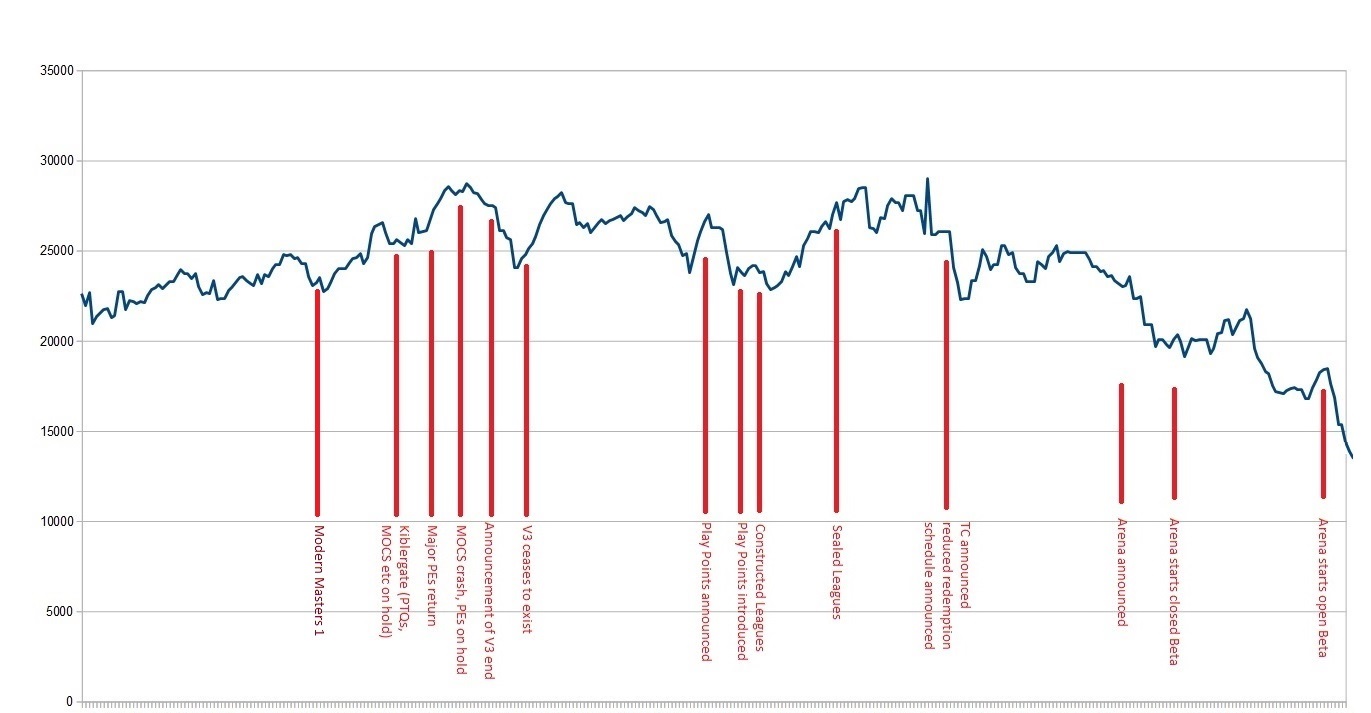
That's right. To own a playset of the cheapest version of every Magic card ever printed on MTGO would have cost you roughly $28,000 in September of 2016 before treasure chests were announced. One year later in September 2017 when Magic Arena was announced, that would have cost you roughly $22,500. Before Arena went into open beta September 2018, it would have cost you roughly $18,000. And now, roughly $14,000.
Although it's now cheaper to buy into MTGO than ever before, this precipitous decline is too much absolutely, and too much too quickly. As in paper Magic, players need to trust that their cards will have value in the long term for the market to be healthy.
Right now we are seeing many people upset that their Modern and Legacy collections on MTGO have lost so much value. Although the market on MTGO has not yet collapsed, it is in some danger of doing so; drastic action is needed – and fast. So many panic-stricken people sold their collections in response to the Channel Fireball article and Magic eSport news that Cardhoarder and MTGO Traders have temporarily suspended their collection buying.
While people and the market will come to their senses eventually – Magic Online will continue to be a platform that connects players to the new Mythic Championship series and provides the most affordable platform to play Modern, Legacy, Pauper, Vintage (and yes, Standard) – action is needed on Wizards's part, and specifically on MTGO Product Manager Alli Medwin's part, because the heart of the problem is that Treasure Chests, not Magic Arena, are predominantly responsible for causing this card value decline and making the Magic Online economy unhealthy.
Once you read his article, you can tell that that is the opinion of Koch as well (but the truth wouldn't have garnered so many clicks). The acceleration in the decline of prices is a necessary consequence of keeping treasure chest values fixed between 2 and 2.5 tix...it's an economic truth and has little to do with Arena. If there is less overall value in the economy, you have to take a higher percentage of the system's value to keep chests at that fixed price.
Consider this revised take of the Biblical account of Jesus creating loaves and fishes: let's say Jesus didn't want to give a loaf of bread to each hungry person, but rather $2.50 worth of bread to each hungry person. He figures he needs to make 5,000 loaves of bread to accomplish this, and so he miraculously creates 5,000 loaves of bread and gives them to all these hungry people. But now that the market has had that major influx of bread supply, the cost of bread declines, so the amount of bread Jesus has to give to the next wave of hungry people must go up if he wants to maintain his goal of giving $2.50 worth to each hungry person. Those 5,000 loaves will become 6,000, which puts more downward pressure on bread prices than the original influx of 5,000, so the next time will be 10,000, then 20,000, then 50,000, and eventually there will be so much bread that bread will become worthless and Jesus will have to drop his goal.
The moral of the parable is this: the amount of bread needed to be created and given away must increase at an accelerated pace to maintain the $2.50 figure, and likewise, the value of bread will consequently decline at an accelerated pace. Right now we are in the midst of that accelerated decline, and it is wreaking havoc on players' confidence in the MTGO economy and in the platform itself. Consider this an open letter to Alli Medwin. I'm here today to offer a few realistic longer-term solutions to keep the Magic Online economy healthy and strong.
Method I: The Treasure Chest Fix

The most straightforward solution is to change the contents of Treasure Chests (TCs). Right now, curated cards take up 10 percent of TC contents, random Modern rares or mythics take up 23 percent of TC contents, playpoints take up 10 percent of TC contents, and boosters take up 0 percent of TC contents. Ignoring the junk filler commons and uncommons, the value breakdown in TCs comes out to:
- 23% curated cards
- 53% random rare or mythic
- 23% playpoints
- 0% boosters
This means that roughly 76 percent of the prize support embedded inside TCs is value coming not from Wizards but from other MTGO users. Lee Sharpe, the inventor of TCs, is one wily fox, as he figured out a way to give players prize support without having it come from Wizards's pockets. Imagine if a casino forced all of its patrons to give it their credit card numbers, and then every time someone hit a jackpot or won a poker game. the casino paid out these winners by charging a little bit from all the other patrons' credit cards. That is what is happening here, and has been happening for two years now.
The constant downward pressure on the market and constant devaluation of collection values thus caused must end if MTGO is to be saved. This method of prize support depends on an ever-growing user base to stave off collapse – it is not internally stable or sound in a closed system.
To be blunt: play points and boosters need their percentage increased, and curated cards and Modern mythics and rares need their percentage decreased. As I mentioned last week, Magic Arena has reduced the overall amount of drafting done on MTGO, so lower booster prices would help make drafting more attractive and increase demand. I'd propose:
- 10% curated cards
- 30% random rare or mythic
- 45% playpoints
- 15% boosters
This would cut the amount of non-redeemable product flooding into the system by at least 35 to 50 percent. That might not be enough, but this change would go a long way toward saving MTGO.
Method 2: The Dusting Fix
Another remedy to too many cards flooding the market is to take cards out of the market. A dusting system for bulk cards introduced alongside Method 1 would further ease the downward pressure on the market. If Magic players were allowed to dust some number of rares/mythics, uncommons, and commons into play points or tickets, that would clear out some excess supply and would help keep some of the chest contents more valuable over time.
Method 3: Remove Cards from the System
I know, I know. "We don't have the developmental resources to implement a dusting system." That's fine Alli, no problem! Set up some official Wizards bots that will pay 1 tix for 400 commons, 200 uncommons, 100 rares, or 50 mythics. Get cards out of the system that way.
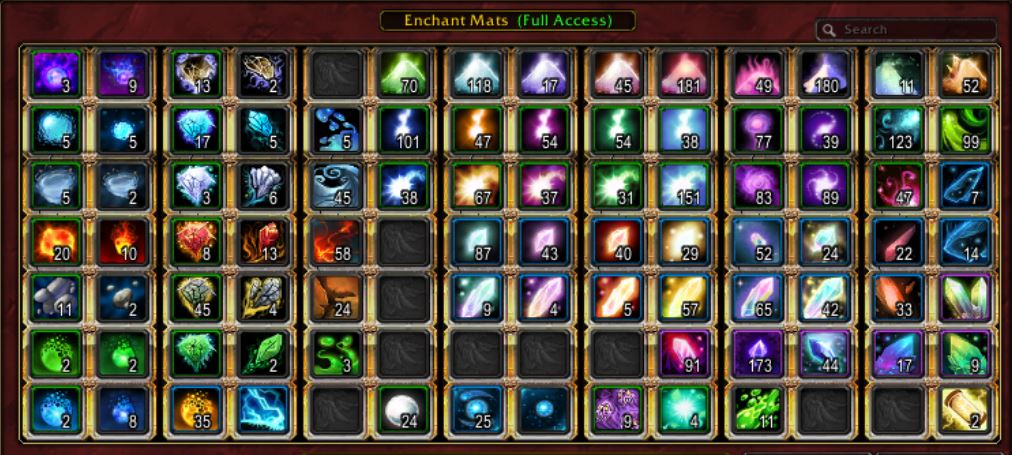
Also....have y'all seen how many treasure chests there are in the system? Look at GoatBots glutted inventory.
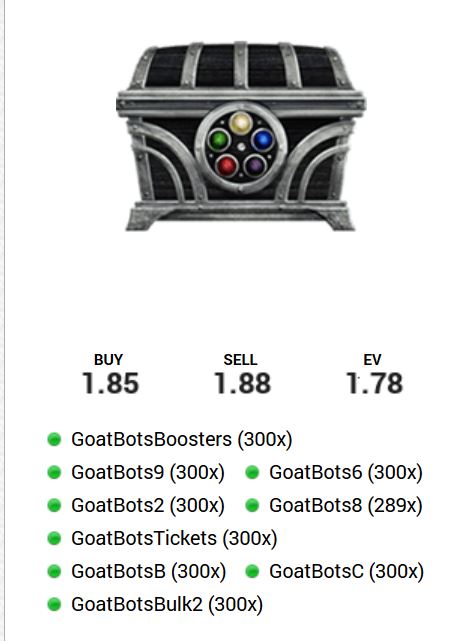
If these chests weren't tradeable, the economy would have already collapsed. Use these Wizards bots to buy chests for 2.25 tix each. Or let them be used for a while as currency to enter events. Get them out of the system.
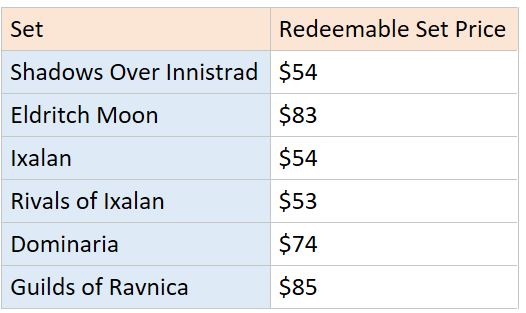
A lot of chests are also pumped into the system through the weekend Format Challenges, so it'd be a good idea to reduce the number of treasure chests given as payout. Replace some of the treasure chests with real money and boxes of physical product like Ultimate Masters and Guilds of Ravnica.
Method 4: The Time Fix
Alli Medwin could also take a page from the Arena playbook and reward players in the currency of time. Arena has taught us at least one thing -- players want to be able to play more digital Magic for their dollar. Right now MTGO offers no way for players to enter into leagues or drafts without paying some sort of fee -- the platform is built around a tournament gameplay model.
One way to give players more game time for the same price would be to give players a free entry to an event every ten events they enter (perhaps reducing the amount of compensation slightly to compensate). Say, as part of the reward for participating in any event players receive a "phantom token," ten of which can be redeemed to enter any event. If we want to push this idea further, we could increase the number of free entries given to players but preclude them from winning prizes when they enter with phantom tokens – the reward would exclusively be playing more Magic (and without added stress!).
There are many different ways to take this concept and run with it. I personally came up with this method when thinking that Limited players should be awarded a phantom token after each Guilds of Ravnica Sealed or Draft event, ten of which could be redeemed for a Cube or Flashback draft entry. But what makes this method a part of a potential solution to the value problem is that it slows down the rate that treasure chests are pumped into the system.
At any rate, the key take away is that players need to be rewarded in ways other than non-redeemable product. Reward them with more Magic. Reward them with play points. Reward them with redeemable product. But for the love of God, for the sake of the MTGO platform, for the sake of your long-term profits, and for your appreciation and respect for MTGO players, stop rewarding them with more Explorations and Noble Hierarchs than the market can bear. Arena has given you an opening here, as Limited demand has gone down even as Constructed demand has stayed the same or increased. Shift the contents of treasure chests accordingly – only strong and immediate action will re-instill confidence into the marketplace and make the economy fundamentally healthy again.
Wrapping it Up
Thank you for reading. This week we will hear details about how MTGO is connected to the paper Mythic Championships, which is something I had expected but needed to hear from the horse's mouth. This is something that will give me and others renewed confidence in Magic Online and will make me likely to continue to be an investor on the platform.
I haven't made any buys since late September, but by the time this article goes live, I likely will have started investing in MTGO again. There's never been a better time to buy, and if any of my Arena readers are interested in Modern or Pauper, now is your chance to buy a deck for cheap. This also means Guilds of Ravnica financial power rankings will be coming your way as a Christmas treat, so stay tuned for that! Please don't hesitate to hit me up on Discord or in the comment section below with any questions and comments.
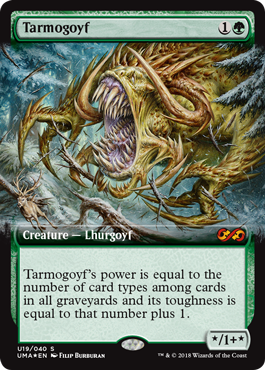 Tarmogoyf once
 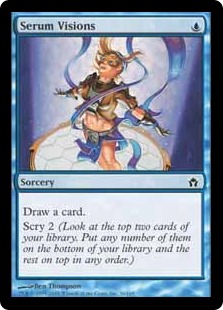 Available options are limited: Grim Flayer (a squishier, less-splashable Tarmogoyf); Traverse the Ulvenwald (I, too, lose to Rest in Peace); Serum Visions (enjoy your
 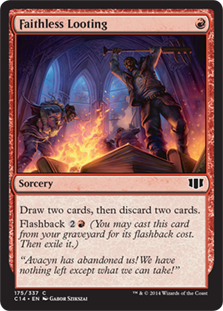 These two points informed my first decision, which was to go red. But my eight-card core still had to fill 52 more spots. This deck would need two things:
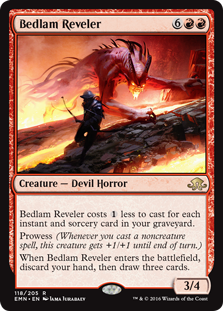 Many options already exist in red, and we are seeing some contemporary Looting/Bolt decks neglect to splash altogether.
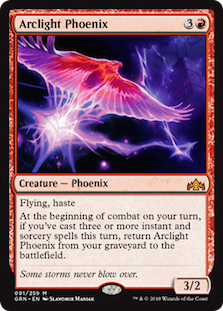 That leaves Arclight and Bedlam, the red threats seeing the most play beside Looting/Bolt. These threats compliment each other frighteningly well, occupying suitably distinct spots on the
 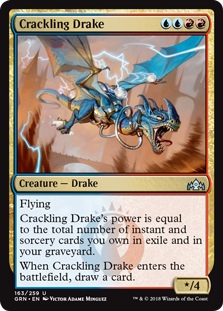 Threats: Delver of Secrets, Thing in the Ice, Crackling Drake
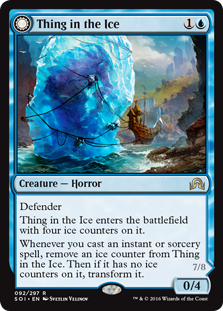 As such, Thing proves exquisitely compact, letting players fill out their decks with cards that bring it from viable to insane. A shell full of cantrips and Manamorphose is not only poised to make exceptional use of Arclight/Reveler, but threatens to flip Thing in the Ice on turn three with pinpoint accuracy, significantly improving Izzet's
 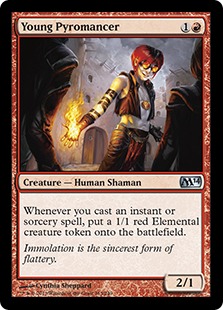 Death's Shadow heavily taxes our life count and shoves us towards aggro-combo with Temur Battle Rage, although the card already enjoys minor success in the rock shell of Traverse Shadow. Tasigur and Angler are relatively unimpressive in Modern right now, being outpaced by the faster aggro decks and suffering from splash damage aimed at those same decks. As mentioned above, Young Pyromancer is an intriguing option given this splash, but we'd have to take care not to
 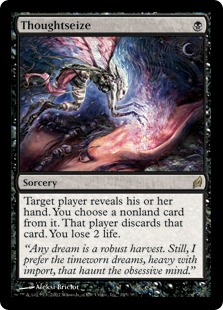 Disruption: Inquisition of Kozilek/Thoughtseize, Fatal Push, Collective Brutality
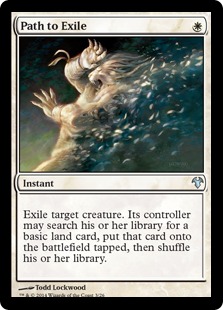 Disruption: Path to Exile, Rest in Peace, Stony Silence, Suppression Field
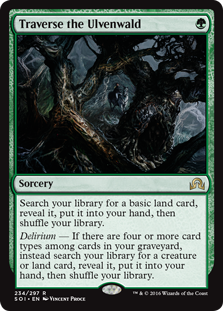 Utility: Traverse the Ulvenwald, Scavenging Ooze, Tireless Tracker, Huntmaster of the Fells
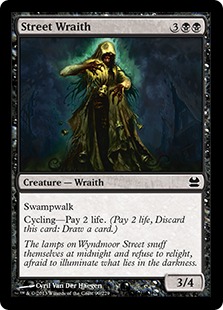
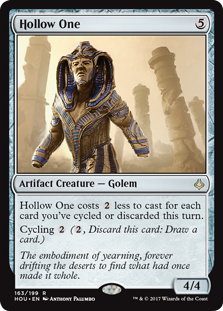 The above catalog includes one non-Eldrazi colorless creature: Hollow One. Hollow works with Faithless Looting, but requests a little more discard to be reliable; the proven loot effects, Burning Inquiry and Goblin Lore, tend to be too random in their discards to excel in a midrange deck. Not so with Street Wraith, which rewards a fetchless manabase and perhaps enables One when combined with Looting alone. The Golem also has tickling explosiveness applications with Eldrazi Mimic.
 4 Faithless Looting
 The first draft got value out of Eternal Scourge with 4 Serum Powder. It was better at finding Temple, too, but disjointed overall; it stretched hands featuring both Eldrazi and Hollow elements precariously thin. As a midrange deck, I found myself wanting to keep many slower hands that included Powder, and eventually cut the artifact.
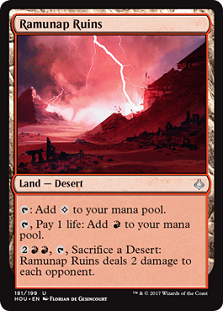 We're mostly a red Eldrazi deck, so our white sources are limited. I'd add more if we had better options available (Battlefield Forge 5-8), and may trim a Mutavault for the fourth Sacred Foundry. Vault is the best utility land (besides Zhalfirin Void) in Colorless Eldrazi Stompy
 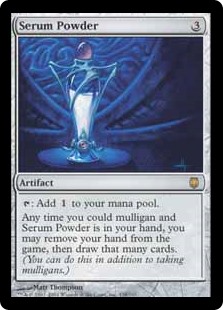 Serum Powder: See above.
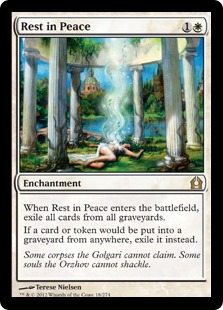
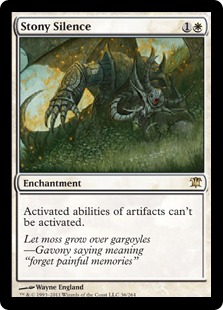 Rest in Peace: We want multiple copies against the decks we bring it in against, since they aggressively mulligan into answers for it.


 I've also taken my
 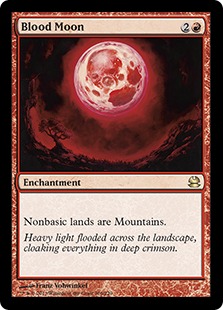 But local Arclight players have been running rituals for more explosive starts. This naturally makes fast Moons possible, and having lost way too many times to getting locked by Moon and Abrade on Vial, I've decided to make that not a thing that can happen to my deck.
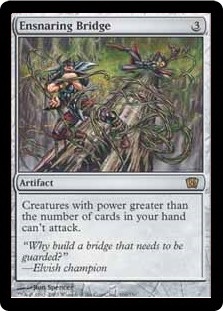 Round 2 I'm tipped off that I'm against 8-Rack when my opponent opts to draw. The key to winning this matchup is to not mulligan, hold lands, and then get a creature to stick. 8-Rack doesn't beat creatures without Bridge and I win. Game 2 I get blitzed with Racks after keeping a very slow hand with awkward mana. Game 3 I have Queller for every Bridge and Rattlechains for the only removal.
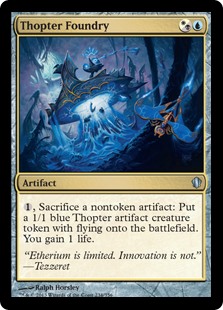 I'm dead for the Top 8 but not for prizes, so I stick around for round 5 and hit Esper Thopter Control. Game 1 he strings multiple Engineered Explosives together until the Thopter-Sword combo comes together and I can't win. Game 2 he doesn't have much, and I Echoing Truth to maneuver around his Supreme Verdict and get there. Game 3, his mana is very awkward after a mulligan, and his only removal is Collective Brutality on my Rattlechains; I stop that with another Rattlechains. He Gifts Ungivens to reanimate Elesh Norn, Grand Cenobite, but I flash in Remorseful Cleric.
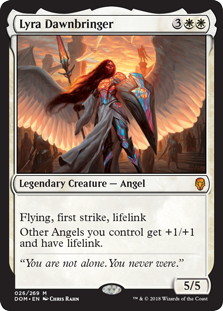 The main thing I noticed during the tournament was how decks are changing. The UWx lists were all running more creatures main than has been the norm; toward the end, the X-1 lists were all running a heavy Angel theme, though I don't know if it was main or sideboard. Given everything I said about observed shifts
 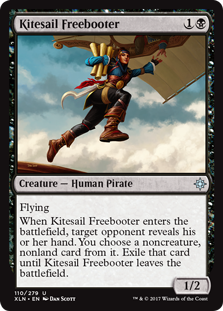 decks are so redundant that it's hard for Kitesail Freebooter and Meddling Mage to be impactful. Thalia is very good against the new, trendy decks, but she's been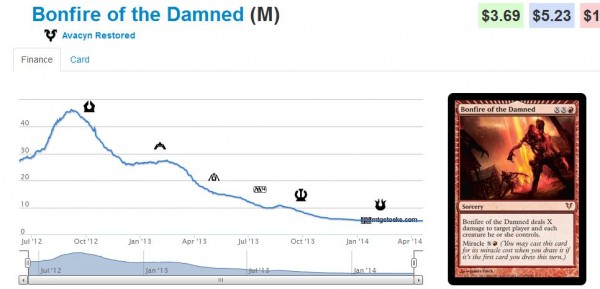


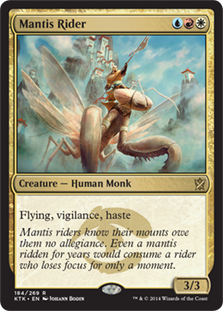 This deck's counterspell package is significantly lighter than Temur Delver's due to its red presence. With more burn spells, using permission to keep opponents from stabilizing the board becomes less of a priority. Jeskai pilots can instead allow opponents clean up the battlefield, resolving to put the game away with burn spells. Between the full set of Lightning Helix, the added couple Jeskai Charms, and the inclusion of Mantis Rider, MANDARK's build features plenty of ways to "go over" enemies looking to out-muscle them in the red zone.
 Since
Since 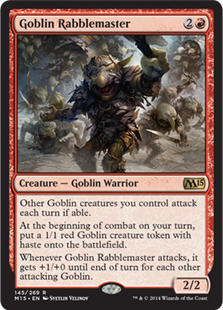 I imagine this switch gives Jeskai Mentor a larger advantage in the pseudo-mirror. UW Control can struggle against win-in-a-jar creatures like Goblin Rabblemaster, and Monastery Mentor acts as a supercharged version, capable of dumping a whole army onto the battlefield at instant speed.
 Okay, it's not Jeskai. But